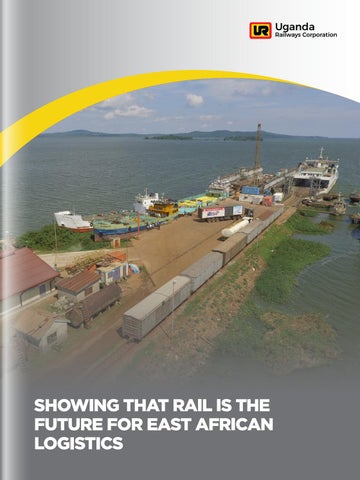
SHOWING THAT RAIL IS THE FUTURE FOR EAST AFRICAN LOGISTICS
UGANDA RAILWAYS CORPORATION
2 | Africa Outlook issue 84
SUPPLY CHAIN
STAYING ON
TRACK Despite facing challenges brought about by natural disaster and COVID-19, Uganda Railways Corporation continues to drive improvements to critical infrastructure that will open up opportunities and deliver growth Writer: Tom Wadlow | Project Manager: Lewis Bush
T
he last 12 months, it is safe to say, has brought many a challenge to the development of Uganda’s rail network. Investment has been difficult to secure, while the El Nino of November 2019 devestated infrastructure in nearby Kenya and Tanzania, vital export links which Uganda relies upon. Meanwhile, the outbreak of COVID-19 has caused severe disruption, not only causing construction projects to be put on hold, but also a standstill in passenger and freight rail usage. However, while the difficulties presented are stark, Uganda Railways Corporation (URC) has continued to stabilise operations and make progress on a number of its game-changing projects. “We are rehabilitating the track and rolling stock while finalising plans for full revamping of the Meter Gauge network,” comments Managing Director Charles Kateeba, speaking to Africa Outlook 12 months on from our previous conversation.
Africa Outlook issue 84 | 3
UGANDA RAILWAYS CORPORATION
Charles Kateeba, Managing Director, Uganda Railways Corporation “The year has seen commencement of the rehabilitation of Tororo-Gulu line, construction of Gulu multimodal hub and the Capacity Building Programme. We have also re-opened the second line to Kisumu and seen the return of fuel carriages from Kisumu Jetty to Jinja and Port Bell. There is also marked growth of rail exports, now averaging 30 percent of total cargo carried.” Kateeba is also quick to acknowledge how challenging the first half of 2020 has been. The pandemic brought about a huge decline in import and export flows, its volumes reduced by more than 83 percent between February and May, the resultant reduction in cashflow forcing it to place some recovery plans on hold. Commuter rail traffic also nosedived due to lockdown restrictions, although Kateeba points out that URC was faced with a situation whereby it needed to help increase railway operations. “This is to mitigate the health risk posed by foreign truck drivers crossing our borders,” he explains. “This required us to ramp up operations, despite the cashflow problems and 4 | Africa Outlook issue 84
constrained investment climate. “This has led to renewed attention by the government of the need to invest in rail transportation and, as a result, we’ve been able to receive allocations for urgent procurement of locomotive container handling equipment. “The hardships faced by truck drivers and border entry points has meant longer transit times for trucks, thereby making rail, which hitherto was much slower than trucks, become attractive. “It has given prominence to the Kisumu-Port Bell route for fuel transport by wagon ferry, and the return of Eldoret as a loading point for fuel by rail transport. We have therefore brought forward plans for rehabilitation of our second wagon ferry and fuel tank wagons.”
PROJECT PROGRESS Indeed, in spite of the challenges faced, URC is determined to fulfil its mission undeterred, which is to establish and manage a reliable, efficient and safe railway and marine transport service in East Africa for sustainable economic and social development. Kateeba goes into further detail on a number of ongoing developments which have made promising progress over the past 12 months, starting with Tororo-Gulu line which serves northern Uganda. Rehabilitation work began on the 375-kilometre line in February 2020, the €47 million project being funded by the European Union and Ugandan government and delivered by French contractor SOGEA-SATOM. Although the coronavirus restrictions have caused some disruption, the Managing Director is confident of timely completion in early 2023. “The terminus, Gulu, is about 130 kilometres from the South Sudan border and 250 kilometres from the Democratic Republic of Congo,” Kateeba explains. “It is therefore expected to bring about renewed impetus to economic development.
Consultrans Ever since it was founded, Consultrans has been a strategic consultancy firm, which has been providing assistance for both public administrations and private enterprises. In 1985 we decided to set up a consultancy firm, focusing mainly on the transport sector that would be able to give its customers integral solutions. We realised very early on that the integration of engineers and economist with lawyers and IT specialists was essential to meet this challenge. 30 years have gone by and we now have the satisfaction of being able to say we still have our first clients and our company has grown considerably, currently consisting of some 60 professionals, who have led Consultrans along new courses, turning it into an innovative enterprise present in several sectors of the economy, and a clear benchmark in the area of transport in Europe. Since 2008, Consultrans is part of IMATHIA GROUP, that began its activities in 1999. The Consultrans client can always expect creative solutions based on the rigorous analysis method of a changing reality and in the practical experience of the consultants. The strength of Consultran’s human team consists of the combination of senior consultants with executive experience in methodologies and advanced tools.
www.consultrans.com
Transport Consultancy and Logistics Transport planning, demand studies, mobility analysis, modeling of the Transport system, evaluation of transport policies and projects, public bus concessions, BRT (Bus Rapid Transit) feasibility studies, plans sectorial of taxis, bicycle, traffic studies, field investigations, railway operation and simulation, as well as due diligence for investment, operation and railway simulation or economic-financial studies in transport infrastructures.
Civil Engineering High specialization in the transport sector, mainly the railway sector, where the company covers all technical fields, from geotechnics, structures or layout to superstructures, electrification, communications and signaling.
Architecture and Urban Mobility Design and technical assistance in complex and modern buildings such as intermodal stations or workshops, with the rehabilitation of historical buildings the adaptation of which to current modes of transport requires highly qualified work for their architectural adaptation, all developed with the BIM methodology.
Technology and R&D&I Projects and Studies to analyse needs, planning and development of information systems, ICT project assessment, etc.
www.consultrans.es consultrans@consultrans.es
UGANDA RAILWAYS CORPORATION
THE KAMPALAKASESE LINE The Kampala-Kasese meter gauge line was constructed in the 1950s with the main objective of transporting copper ore from Kilembe mines to a copper smelter in Jinja, and finally onto Mombasa for shipment around the world. It was built at low cost, on an alignment running along or across swamps and wetlands laid with second hand light rails, high ruling gradient of 1.5 percent and sharp curves of 175 metre radius. The line, having largely run its life, was abandoned in 1997 and much of the track materials have all been stolen or lifted – it requires full reconstruction. “The long-term plan is to rebuild it to Standard Gauge but there are plans to relay the line in the medium term, as the plans for Standard Gauge line have fallen behind schedule regionally,” Kateeba adds. “The line serves a rich agricultural, mineral and tourism area of Rwenzori, connecting to the mineral rich North Kivu Region in the DRC. It is expected to boost agriculture and agri-processing industries, tourism, mineral and mineral processing and urbanisation activities.”
6 | Africa Outlook issue 84
“Alongside the rehabilitation, a multimodal hub is being set up at Gulu at the cost of $11m. Together, the two projects will bring cheaper and reliable transport to the country’s most prospective agricultural region and connection to South Sudan and northeastern DRC. It will also serve as the staging ground for oil production logistics in the Northern Albertine oil basin.” Construction of the Gulu hub also began in February and, once complete, will deliver a wide array of benefits, not least in terms of cost effectiveness. For example, the cost of transport by rail from Mombasa to Kampala will be seven cents USD per tonne per kilometre, six cents cheaper than travelling by road. The development will also deliver employment opportunities and growth of urban centres along the line, with
greenhouse gas emissions also set to be cut with more efficient rail operations removing trucks from roads. The hub at Gulu will also carry a decongestion impact on Kampala, with freight destined for Northern Uganda, South Sudan and Eastern DRC able to take this alternative route, while the regional airport is also expected to benefit from more custom. Another significant initiative highlighted by Kateeba is the URC Capacity Building programme, a scheme which over several phases will see €330 million injected into track rehabilitation (275 kilometres), refurbishment of rolling stock, renewal of workshop machinery and training of employees. The track improvements will see it upgraded to 50 kilos per metre rail on concrete sleepers and full ballast, a vast enhancement of the existing ageing lines.
SUPPLY CHAIN FUELLED BY OPTIMISM The prospective benefits of the Gulu project reflect Kateeba’s wider confidence in the future of rail in Uganda. Asked what he might expect to report back in another year’s time, the Managing Director reveals expectations to improve traffic and increase the share of freight travelling in and out of the country by rail. The COVID-19 pandemic has highlighted the need for further government investment in railways, its fiscal plans now reflecting this imperative and providing Kateeba with more optimism than he had a year ago. He concludes the conversation buoyantly: “The very survival of Uganda as a viable sovereign state depends on the success of rail to
“The main goal of the project is to modify the current railway organisation and reinforce local industry’s current market competitiveness by reducing transport costs below the road haulage rates,” Kateeba says. “This will allow us to accelerate the country’s competitiveness, meet increasing traffic demands and create employment opportunities.”
“UGANDA AND EAST AFRICA HAS ENTERED INTO A VERY EXCITING THOUGH CHALLENGING PERIOD IN RAILWAY DEVELOPMENT AND LOGISTICS”
provide reliable transportation of her exports and imports. Being literally at the crossroads of Africa’s north, south, east and west logistics corridors, Uganda is the perfect country for trans-African rail development. “Uganda and East Africa has entered into a very exciting though challenging period in railway development and logistics. “On one side there’s high demand for rail transport due to high cost and inefficiency of road transport. On the other, all the three East African countries are revamping and extending their railway networks by constructing the new Standard Gauge network that will extend to the Democratic Republic of Congo, Rwanda, Burundi and South Sudan. “This presents an opportunity for both railway construction companies to come in with proposals for design, build, operate, transfer and private rail operation over public-owned networks and leasing of rolling stock. Therefore, it is exciting for foreign investors to be looking at East Africa, and particularly Uganda, for investment in rail transport and related infrastructure and services.”
UGANDA RAILWAYS CORPORATION Tel: +256 312 219 100 info@urc.go.ug www.urc.go.ug
Africa Outlook issue 84 | 7
UGANDA RAILWAYS CORPORATION Plot 57, Nasser Road P.O Box 7150, Kampala Uganda Tel: +256 312 219 100 info@urc.go.ug www.urc.go.ug
PRODUCED BY AFRICA OUTLOOK MAGAZINE