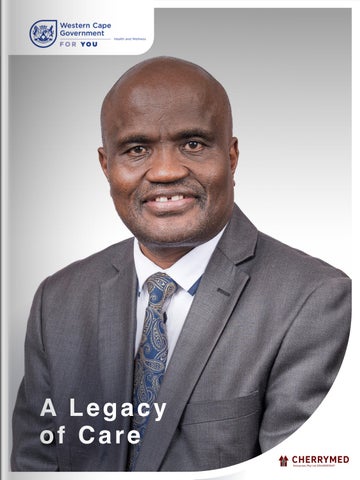
A Legacy of Care
A Legacy of Care Celebrating its 50th anniversary, Tygerberg Hospital continues to strengthen South Africa’s healthcare ecosystem through innovation, education, and a steadfast commitment to improving patient outcomes. We sit down with the hospital’s executive team to discuss the clinical excellence and compassionate care that permeates the hospital walls Writer: Lily Sawyer | Project Manager: Amelia Jennings
2 | Africa Outlook Issue 121
TYGERBERG HOSPITAL HEALTHCARE
advancements, workforce pressures, financial constraints, and growing public expectations,” introduces Dr Matodzi Mukosi, CEO of Tygerberg Hospital, the largest hospital in the Western Cape. Yet, despite these realities, SA’s healthcare sector remains a rewarding professional environment due to the impact it has. “Everything we do is both tangible and profoundly human – every decision, interaction, and innovation has the potential to change the course of someone’s life,” he smiles. Reflecting on the legacy and true value of Tygerberg Hospital in this challenging landscape, Dr Mukosi emphasises how the hospital is ultimately built on the selfless contributions of its staff and the countless moments where science, humanity, and transformation come together. “The real value of our institution lives in the nurse who comforts an anxious family, porter who reassures a frightened patient, doctor who stays a little longer after their shift to monitor a critical patient, maintenance technician who restores essential services overnight, student who is learning the true meaning of compassionate care, or specialist sharing decades of knowledge with the next generation.” Indeed, the true legacy of the hospital relates to the extraordinary achievements made possible by ordinary people choosing to serve something bigger than themselves.
W
ith the global healthcare sector always having existed at the intersection of immense challenge and extraordinary possibility, demand continues to outpace available resources – and South Africa (SA) is no exception. “Every day we are confronted by increasingly complex disease burdens, rapid technological
EVOLVING HEALTHCARE ECOSYSTEM Over the years, SA’s healthcare system has been significantly transformed, with the first democratic South African government initially inheriting a structurally fragmented, inequitable, and primarily hospitalcentric system in 1994. “This system was shaped by the apartheid regime where access to
care, funding, and infrastructure were ultimately distributed along racial lines,” outlines Dr Melvin Moodley, COO. Since then, healthcare reform has focused on integrating previously fragmented services, improving equity, and expanding access to quality healthcare for all – a transformation driven by successive policies and reforms aimed at strengthening governance. “Whilst we celebrate these successes, we continue to face significant challenges in healthcare. SA continues to operate a dual healthcare system in which public and private healthcare coexist,” states Dr Mukosi. Private healthcare remains accessible only to those who can afford it, creating a fundamental inequality in access to health services that is driven by financial resources. Although both sectors draw on similar resources, the private sector serves only a small proportion of the population, whereas the public sector caters for approximately 85 percent, many of whom rely exclusively on state-funded healthcare. “This inequality runs counter to the principles of fairness and equity, which is why we strongly support the implementation of universal health coverage (UHC), aimed at ensuring equitable access to healthcare irrespective of one’s ability to pay,” laments Dr Mukosi. The implementation of UHC will require a concerted effort to strengthen the healthcare system across the country. This has led to growing recognition that strong governance and leadership are fundamental drivers of health system performance. Leaders must excel in strategic planning, financial stewardship, quality improvement, workforce management and development, and the cultivation of partnerships across the continuum of care. Africa Outlook Issue 121 | 3
“Everything we do is both tangible and profoundly human – every decision, interaction, and innovation has the potential to change the course of someone’s life” – D R M AT O D Z I M U K O S I , C E O , T Y G E R B E R G H O S P I TA L
“We need leaders who are not only technically competent, but also demonstrate high levels of emotional intelligence so we can develop sustainable health systems that deliver better outcomes for the people we serve,” Dr Moodley adds.
SERVING COMMUNITIES As one of SA’s largest academic hospitals, Tygerberg Hospital is one of only two central major healthcare sites in the Western Cape. “We provide highly specialised tertiary and quaternary services across every major clinical discipline, with more than 65,000 patients admitted annually and more than 4 | Africa Outlook Issue 121
400,000 outpatient visits each year,” explains Mr Dirk Heyns, Head of Corporate Services. Spanning the full life course, from foetal medicine and neonatal intensive care to geriatric care, the hospital offers a comprehensive package of tertiary services. These include advanced trauma care, complex surgery, critical care, infectious disease management, and highly specialised allied health services, including its flagship Cochlear Implant Unit. As the Western Cape’s population has grown significantly over the past two decades, demand for these highly specialised services has increased accordingly. “As the only referral centre for many of our patients, Tygerberg Hospital must continue to keep pace with growing demand,” notes Dr Mehreen Hunter, Chief Strategy Officer. “This requires us to continually
review our core service mandate, models of care across the health ecosystem, patient referral networks, technological advancement, workforce management, and collaboration with internal and external partners so we can maximise the impact of the resources available to us,” she explains.
POWERFUL PARTNERSHIPS As an academic institution, Tygerberg Hospital is closely linked with multiple universities, including Stellenbosch University, the University of the Western Cape, and the Cape Peninsula University of Technology. Through these academic partnerships, it can deliver world-class teaching, training, and research. Indeed, Tygerberg Hospital has a reputation for exceptional clinical training and is a sought-after destination for local and international undergraduate and postgraduate students.
TYGERBERG HOSPITAL HEALTHCARE
“Our relationships with universities have evolved into true partnerships, enabling us to collaborate in fulfilling our mandate of service delivery, teaching, training, and research,” comments Mr Heyns. Tygerberg Hospital has come to understand that meaningful transformation cannot be achieved in isolation; rather, it is strengthened through enduring partnerships with academic institutions, clinical teams, organised labour, patients, communities, and stakeholders who share responsibility for building a stronger and more responsive health system. “One of our most critical partnerships is with our Hospital Board, which provides an important link between Tygerberg Hospital and the communities it serves. “Through its oversight, advocacy, and engagement, the board ensures the perspectives and needs of patients and communities inform decision-making and service improvement initiatives,” notes Mrs Vuyokazi Dubase, Acting Head of Nursing Services.
PART OF A HEALTH ECOSYSTEM The Western Cape Department of Health and Wellness has distinguished itself over several decades through sustained investment in strengthening health systems. “One of the most significant shifts I have witnessed over the course of my career has been the move away from hospitals functioning as isolated institutions towards a far more integrated ecosystem approach to
HOW DO YOU EMPOWER YOUR STAFF, SUPPORT PROFESSIONAL DEVELOPMENT, AND CREATE A POSITIVE WORKPLACE CULTURE? Dr Matodzi Mukosi, CEO: “The key part of ensuring we can deliver on our mandate is our people. Every day, thousands of healthcare professionals, support staff, administrators, engineers, porters, cleaners, and students contribute to delivering care under significant pressure. “Our staff have managed to turn the extraordinary into routine. Complex surgeries, life-saving interventions, and moments of compassion happen alongside countless unseen acts that keep a hospital of this scale functioning. “Over the last five years, we have placed renewed and intentional emphasis on organisational culture and leadership development. The hospital has invested in creating environments where people feel heard, supported, and connected. We have focused on the creation of psychologically safe spaces and the importance of consistent and effective communication. “Professional development extends beyond formal education. We believe leadership is developed through mentorship, workplace experience, multidisciplinary collaboration, and creating opportunities for people to grow. Therefore, this is something we are actively strengthening across departments and with our partners as well. “Our vision is to build an institution where kindness and accountability coexist, where excellence is expected but compassion is valued, and where every staff member understands the vital contribution they make to the patient experience.”
healthcare,” says Dr Mukosi. “Our responsibility for patient care is not limited to what happens within our facility alone. We are health stewards, working to improve healthcare at every stage of the patient journey.” This approach has been deliberately fostered by the Western Cape
“One of our most critical partnerships is with our Hospital Board, which provides an i m p o r t a n t l i n k b e t w e e n Ty g e r b e r g H o s p i t a l and the communities it serves” – MRS VUYOKAZI DUBASE, ACTING HEAD OF NURSING SERVICES, T Y G E R B E R G H O S P I TA L
Department of Health and Wellness under the leadership of Dr Keith Cloete, Head of Department. “We are all stewards of healthcare along the care continuum, with a shared responsibility to ensure all people in the province have access to quality healthcare,” explains Dr Hunter.
TYGERBERG HOSPITAL HEALTHCARE
“Success is therefore no longer measured simply by what happens within our own walls, but by how effectively we strengthen the broader health system and improve the patient journey across multiple levels of care,” she adds.
PEOPLE FIRST “Although our institution has been responsible for numerous pioneering advances, including several national and international firsts, their true value lies in how we use them to improve access, redesign systems around patient needs, strengthen partnerships, and deliver highquality care more effectively within resource-constrained environments,” Dr Mukosi reflects. Over the years, this has reinforced one of the most important lessons in healthcare: that exceptional care is fundamentally about people - not only the patients, but also those who deliver care every day. “Technical excellence will always remain essential, but patients remember how they were treated just as much as the treatment they received,” Dr Hunter points out. For this reason, sustainable healthcare depends on creating environments in which staff feel valued, supported, and empowered to deliver their best every day. “When we invest in our people, we strengthen our ability to care for others; that, ultimately, is the foundation on which resilient and compassionate health systems are built,” Dr Mukosi states.
50 YEARS OF TRANSFORMATION Having been established in 1976, this year marks the hospital’s 50th anniversary and, like the country itself, the institution has undergone significant transformation over the decades, moving from a hospital shaped by division towards one increasingly defined by inclusion, 6 | Africa Outlook Issue 121
collaboration, and a shared purpose. “That journey has not always been straightforward, but it has been essential, and at the heart of this legacy are the countless people who have worked tirelessly and selflessly at this institution for years,” Dr Mukosi acknowledges. “50 years represents far more than an anniversary. It provides an opportunity to reflect on the millions of lives that have intersected with this institution and the direction we wish to take this hospital going forwards,” he adds. “Most people remember Tygerberg Hospital as the place where a life was saved, where they held their newborn child for the first time, or where hope was restored during moments of profound uncertainty.” “We are immensely proud of our clinical and internationally renowned academic achievements, but what makes me most proud is the culture we are building, legacy we are shaping, and incredible people who show up every day with extraordinary
commitment,” notes Mrs Dubase. “Indeed, Tygerberg Hospital’s greatest strength has never been its size, capacity, or media presence, but the people who make the facility a home and a place of hope.”
MAKING THE IMPOSSIBLE POSSIBLE As an academic hospital, Tygerberg Hospital’s clinicians, researchers, and educators continually challenge existing practices to provide premium services to all patients. Impactful research is key to this mission, generating evidence that guides clinical decision-making, drives innovation, and facilitates improvements in the way healthcare is delivered. “Whether through pioneering clinical procedures, advances in medical technology, or new care models, innovation is only valuable if it ultimately improves patient outcomes, increases access to care, and strengthens the health system,” Dr Hunter informs.
“We need leaders who are not only technically competent, but also demonstrate high levels of emotional intelligence so we can develop sustainable health systems that deliver better outcomes for the people we serve” – D R M E L V I N M O O D L E Y, C O O , T Y G E R B E R G H O S P I T A L
UNDERSTANDING ELECTROCONVULSIVE THERAPY (ECT) A Safe, Effective Treatment That Can Save Lives Electroconvulsive Therapy (ECT) is one of the most effective treatments for certain severe mental illnesses. Modern ECT is a safe, carefully controlled medical procedure performed under general anaesthesia. Recognised worldwide as an evidence-based treatment, ECT has transformed, and often saved, the lives of thousands of patients. Modern ECT is delivered using advanced systems such as the Thymatron®, one of the world’s leading ECT devices.
WHO CAN BENEFIT FROM ECT?
THE THYMATRON® ECT SYSTEM
• Treatment resistant depression
The Thymatron® is an advanced Electroconvulsive Therapy system used by psychiatrists and hospitals around the world.
• Depression with suicidal thoughts or behaviour • Severe bipolar disorder • Catatonia, psychosis • Certain forms of schizophrenia • Severe psychiatric illness requiring a rapid response Many patients find ECT, alongside other treatments, provides significant improvement and hope when medication and psychotherapy have not been effective.
BENEFITS OF ECT RAPID IMPROVEMENT
IS MODERN ECT SAFE?
Unlike antidepressants, which may take weeks to work, ECT often produces improvement within days or after only a few treatment sessions.
HIGHLY EFFECTIVE
Research consistently shows that ECT is the most effective treatment for severe depression, with remission rates significantly higher than those achieved with medication alone.
LIFE-SAVING TREATMENT
For patients with severe depression and suicidal thoughts, refusal to eat or drink, or extreme psychiatric illness, ECT can rapidly stabilise symptoms and prevent potentially life-threatening outcomes.
A TREATMENT THAT RESTORES HOPE
Individuals living with severe mental illness can often experience a renewed sense of well-being, regain their independence, rebuild relationships, and return to fulfilling lives.
CHERRYMED ENTERPRISES (PTY) LTD Sole Southern African Distributor of Somatics Medical Technologies
It incorporates sophisticated technology that allows clinicians to deliver carefully controlled treatments tailored to each patient’s needs.
www.cherrymed.co.za
Yes. Modern ECT is very different from the treatment portrayed decades ago. • Performed under general anaesthesia • Includes muscle relaxants to minimise physical movement • Uses precisely controlled electrical stimulation delivered by the Thymatron® system • Closely monitored by psychiatrists, anaesthetists, and trained nursing staff • Follows internationally accepted clinical guidelines and safety protocols
REDUCING THE STIGMA Many misconceptions about ECT continue to exist because of inaccurate media portrayals and outdated practices. Modern ECT, delivered using advanced equipment such as the Thymatron®, bears little resemblance to these depictions and has evolved into one of psychiatry’s safest and most carefully regulated procedures. Mental health professionals around the world continue to recommend ECT because of its proven ability to relieve severe symptoms and save lives.
admin@cherrymed.co.za
+27 82 800 9717
TYGERBERG HOSPITAL HEALTHCARE
SELECTING STRATEGIC PARTNERS “Understandably, healthcare organisations are highly selective when it comes to choosing strategic partners and suppliers as they
understand how significant these relationships can be. Indeed, Tygerberg Hospital believes
healthcare is a collaborative domain, and that no hospital can succeed in isolation.
“It is for this reason the institution looks for partners who
understand they are contributing to healthcare outcomes rather than statistics,
products, or services, and that reliability, integrity, and responsiveness are key. “As a government entity, Tygerberg Hospital is bound by the statutory requirements and legislation surrounding procurement. Nevertheless, it understands the most successful partnerships are built on shared purpose.” - Mr Dirk Heyns, Head of Corporate Services
Some of Tygerberg Hospital’s most significant innovations have changed the lives of families across SA, making the impossible seem possible. In 1984, for example, the hospital’s Reproductive Biology Unit was responsible for the breakthrough that led to the birth of the country’s first baby conceived through invitro fertilisation (IVF), opening new possibilities for many couples experiencing infertility. This was followed by numerous advances in reproductive medicine that helped establish Tygerberg Hospital as a leader in the field. Then, in 1986, the hospital performed SA’s first multi-channel cochlear implant, establishing a programme that transformed the lives of children and adults living with profound hearing loss. Tygerberg Hospital’s commitment to innovation continued through the decades, with interventions including the world’s first successful penile transplant in 2014; becoming the first South African government-run hospital to perform robotic surgery using the Da Vinci Surgical System 8 | Africa Outlook Issue 121
in 2022; successfully performing the country’s first living donor kidney removal using robotic surgery in 2025; and making history by performing SA’s first fully internal limb reconstruction and bone transport procedure in 2025. “Yet, whilst these milestones are remarkable, they are not how we define success,” Dr Mukosi points out. “The true measure of innovation is not defined by whether we are the first but by the impact these interventions have on the people we serve – whether patients live longer, recover faster, regain functionality, become parents after years of uncertainty, or return to their families with renewed hope.” This is the enduring philosophy that continues to shape everything Tygerberg Hospital does.
STRENGTHENED BY HUMILITY Constructed 50 years ago in what was a very different landscape, it is no surprise Tygerberg Hospital’s existing infrastructure has reached the end of its serviceable lifespan. Therefore, plans to reimagine
the hospital have been developed through the replacement of the current facility with two new hospitals: Tygerberg Central Hospital and Metro-East Regional Hospital. “This project is about far more than replacing ageing buildings. It is an opportunity to reconsider healthcare delivery and redesign it around modern patient expectations, technological advancement, multidisciplinary collaboration, and future healthcare needs whilst preserving the values that have come to define us over the course of our 50-year journey,” Dr Hunter highlights. Looking ahead, the hospital’s key priorities for this year are centred around three interconnected areas; people, clients, and the health system. With regard to its people, the institution intends to continue fostering psychologically safe spaces in which staff feel valued and respected, whilst continuing to invest in leadership, staff well-being, and organisational culture. Tygerberg Hospital also seeks to improve the patient experience by focusing on the needs of its
TYGERBERG HOSPITAL HEALTHCARE
Boston Scientific South Africa, 8 Anslow Crescent, Anslow Office Park, Bryanston, 2021 | Johannesburg
“As the only referral centre for many of our p a t i e n t s , Ty g e r b e r g H o s p i t a l m u s t c o n t i n u e t o keep pace with growing demand” – D R M E H R E E N H U N T E R , C H I E F S T R AT E G Y O F F I C E R , T Y G E R B E R G H O S P I TA L
clients – from entering the facility to receiving excellent care and a safe discharge, it wishes to enhance all aspects of the patient experience. “We will focus on strengthening the health system, clarifying and bolstering our service platform through closer collaboration across the provincial health ecosystem to ensure patients receive optimal care in the most appropriate setting,” Dr Moodley explains. An important part of this work is expanding strategic partnerships and twinning initiatives – where institutions or health systems commit
to learning from each other over time to strengthen services, leadership, and performance. Based on Tygerberg Hospital’s belief that no single institution, country, or context has all the answers, it is currently part of multiple twinning programmes at both national and international level. “Healthcare is strengthened through humility when organisations learn from one another and grow together,” Dr Mukosi reflects. “All these priorities converge into a single mandate: to use 50 years of learning to create not only a stronger
institution but also a sustainably stronger ecosystem for our patients today and for future generations,” he passionately concludes.
Tel: 021 938 4911 TBH.Generalenquiries@westerncape.gov.za https://www.westerncape.gov.za/ health-wellness
Africa Outlook Issue 121 | 9
Tel: 021 938 4911 TBH.Generalenquiries@westerncape.gov.za https://www.westerncape.gov.za/ health-wellness
PRODUCED BY AFRICA OUTLOOK MAGAZINE