M E T R O P O L I TA N WAT E R D I S T R I C T O F S A LT L A K E & S A N DY
NEBRASKA PUBLIC POWER DISTRICT Powering Nebraska’s future
UPRITE CONSTRUCTION www.sustainabilityoutlookmag.com • I s s u e 3
Partnerships built on trust and thinking outside the box
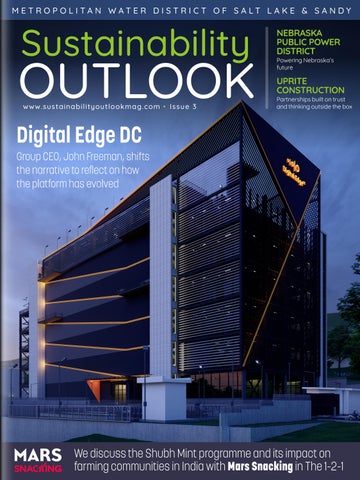
Digital Edge DC Group CEO, John Freeman, shifts the narrative to reflect on how the platform has evolved
We discuss the Shubh Mint programme and its impact on farming communities in India with Mars Snacking in The 1-2-1
RICHGLEN MAINTENANCE SERVICES
T R I - STA R CO N ST R U C T I O N
B R I T I S H P O R T S A S S O C I AT I O N
N E B R A S K A P U B L I C P OW E R D I S T R I C T
G A S TO N E L E C T R I C A L
TURNER MINING GROUP
HUNTER VALLEY OPERATIONS
L O S
A N G E L E S
G E N E R A L
End-to-end solutions from exploration to extraction
Issue 82
PNG POWER LTD
w w w. e m e o u t l o o k m a g . c o m
Issue 73
www. northame ricaoutlookmag.com
Issue 37
Creating lasting value through responsible mining
Stefanutti Stocks is reshaping Southern Africa’s construction landscape through multidisciplinary expertise, digital innovation, and sustainable infrastructure solutions
MBA ENERGY & INDUSTRIAL
On a coal mining mission to champion sustainable practices
MARTIN-BAKER AMERICA, INC. Seat and safety vanguards for the defense sector
VULCAN MOZAMBIQUE
M Resources delivers a suite of essential steelmaking raw materials, infrastructure, and mining and logistics services to steelmakers across the globe. Matt Latimore, Founder and President, details the company’s futurefacing approach to investment and market growth
Trusted partners in technical excellence and expertise
GERMAN DATACENTER ASSOCIATION
AMP BANK The banker, the one that couldn’t fail
Five years of institutional reform
MARTIN-BAKER AMERICA , INC . • CEMENTIS GROUP
Michael Hanisch, Head of Technology Germany, discusses Amazon Web Services’ significant cloud infrastructure investments
A M A Z O N B U S I N E S S • U N I L E V E R • G E P • O R I TA I N
On a mission to be a leading integrated green coal mining operation
Thermo Fisher Scientific has reinforced its position as a trusted biologics manufacturing partner
The ultimate goal of Virginia Tech Dining Services is to create an environment where students not only eat, but also grow, connect, and thrive as members of the Hokie community
At the helm of Europe’s data centre future
Across Asia Pacific, Hitachi Energy’s focus is on the priorities utilities are wrestling with. Massimo Danieli, Executive Vice President and CEO – Grid Automation Business Unit, reveals more
Mark Scott, General Manager of Pinto Valley Mining Corp., delves into Capstone Copper’s Pinto Valley Mine and its importance in Arizona’s Globe-Miami mining district
CO O P L A N DS B A K E RY • D N AG RA R • B RA K E B U S H
KOLEKTOR CONSTRUCTION
Jason Bontempo, CEO of Gladiator Metals, discusses the resurgence of the Whitehorse Copper Belt in Canada’s historic Yukon mining district
VECA ELECTRIC & TECHNOLOGIES
Family-run, proudly Canadian
DANONE ROMANIA
w w w. s u p p ly c h a i n - o u t l o o k . c o m
Issue 14
EUROPEAN SUBSEA CABLES ASSOCIATION
NEBRASKA PUBLIC POWER DISTRICT W W W .CONST RUCT ION-OUT L OOK.COM • ISSUE 4
Delivering advanced medicines from Australia to the world
RADIANT LOGISTICS
Built for resilience
Bridging the Beyond Real Humanoid: and Virtual Worlds Traditional Automation
SHORR PACKAGING
More efficient, optimized packaging solutions
Bringing humanoid robots to the factory floor and reshaping industrial automation
BRITISH PORTS ASSOCIATION
Iss ue 9
Steven Johnson, Managing Director, UKIE, Nordics, and Eastern Europe Network Operations, explains why operations leadership is critical Network Operations, explains why operations leadership is critical Steven Johnson, Managing Director, UKIE, Nordics, and Eastern Europe
of the Singapore aerospace ecosystem, keeping airlines flying to connect the world Chris Pattinson, CEO, tells us how SAESL has become an indispensable component
Traditional Automation and Virtual Worlds Humanoid: Bridging the Beyond Real
SAVOURING THE FLAVOUR OF THE CRISP PARADIGM SHIFT From humble potatoes to gourmet crisps, SAVOURSMITHS is transforming snacking with bold flavours and a rich family heritage
Over the last year, Saulsbury has expanded its position as one of North America’s leading engineering, procurement, and construction contractors
Johan van Jaarsveld, Managing Director of Montego Pet Nutrition, tells us about the pet care brand’s promise of ‘Better Every Day’ tells us about the pet care brand’s promise of ‘Better Every Day’ Johan van Jaarsveld, Managing Director of Montego Pet Nutrition,
decarbonisation and infrastructure across UK ports in recent years Richard Ballantyne OBE, outlines the strong investment in Our latest catch-up with the British Ports Association and CEO,
and reshaping industrial automation Bringing humanoid robots to the factory floor
solutions optimized packaging More efficient,
ASSOCIATION BRITISH PORTS
PACKAGING SHORR
Built for resilience
LOGISTICS RADIANT Australia to the world medicines from Delivering advanced
Partnerships built on trust and thinking outside the box
Group CEO, John Freeman, shifts the narrative to reflect on how the platform has evolved
Our latest catch-up with the British Ports Association and CEO, Richard Ballantyne OBE, outlines the strong investment in decarbonisation and infrastructure across UK ports in recent years
Chris Pattinson, CEO, tells us how SAESL has become an indispensable component of the Singapore aerospace ecosystem, keeping airlines flying to connect the world
UPRITE CONSTRUCTION www.sustainabilityoutlookmag.com • I s s u e 3
Digital Edge DC
Connecting nations and driving innovation
THERMO FISHER SCIENTIFIC
Powering Nebraska’s future
OUTLOOK
Contributing to a healthier world
www.foodbeverage-outl ook.com
Garry Edwards, VP EMEA at Wolters Kluwer, emphasises the need for formalised, organisation-wide frameworks to ensure responsible use of artificial intelligence
M E T R O P O L I TA N WAT E R D I S T R I C T O F S A LT L A K E & S A N DY
OSMOW’S SHAWARMA ISSUE 11
www.mfg-outlook.com
YY Group Holding operates an artificial intelligence-native workforce solutions and integrated facility management platform. CEO, Mike Fu, discusses the company’s established capabilities
We discuss the Shubh Mint programme and its impact on farming communities in India with Mars Snacking in The 1-2-1
facility management platform. CEO, Mike Fu, discusses the company’s established capabilities YY Group Holding operates an artificial intelligence-native workforce solutions and integrated
farming communities in India with Mars Snacking in The 1-2-1 We discuss the Shubh Mint programme and its impact on
procurement, and construction contractors as one of North America’s leading engineering, Over the last year, Saulsbury has expanded its position
a rich family heritage with bold flavours and transforming snacking SAVOURSMITHS is to gourmet crisps, From humble potatoes
SHIFT PARADIGM OF THE CRISP THE FLAVOUR SAVOURING
TELL US YOUR STORY, AND WE’LL TELL THE WORLD
SCIENTIFIC FISHER THERMO
the platform has evolved the narrative to reflect on how Group CEO, John Freeman, shifts
innovation nations and driving Connecting
www.mfg-outlook.com
Issue 14
ASSOCIATION SUBSEA CABLES EUROPEAN
www.foodbeverage-outl ook.com
Digital Edge DC
Iss ue 9
healthier world Contributing to a
w w w. s u p p ly c h a i n - o u t l o o k . c o m ISSUE 11
ROMANIA DANONE
Canadian Family-run, proudly
W W W .CONST RUCT ION-OUT L OOK.COM • ISSUE 4
OUTLOOK
A M A Z O N B U S I N E S S • U N I L E V E R • G E P • O R I TA I N
CO O P L A N DS B A K E RY • D N AG RA R • B RA K E B U S H
www.sustainabilityoutlookmag.com • I s s u e 3
and thinking outside the box Partnerships built on trust
CONSTRUCTION UPRITE future Powering Nebraska’s
SHAWARMA OSMOW’S
MARTIN-BAKER AMERICA , INC . • CEMENTIS GROUP
Modernising and transforming health systems
ARGO NATURAL RESOURCES
Delivering construction with integrity and expertise
L’Osteria is transforming Europe’s culinary landscape by focusing on creating a distinctive Italian dining destination where guests feel at home
DIALOG FITZROY
Rita Apell Akot, CIO at Stanbic Bank Uganda, outlines an ambitious initiative to make banking technology more connected and interoperable across the continent
www.healthcare-outlook.com
www.mining-outlook.com • Issue 16
EMIRATES RAWABI Uniting food and beverage production under one national banner
Responsible for generating, transmitting, distributing, and retailing electricity in Papua New Guinea
GALIANO GOLD
EASTERN CAPE DEPARTMENT OF HEALTH
w w w. a p a c o u t l o o k m a g . c o m
Issue 122
STEFANUTTI STOCKS
Meeting the dynamic demands of the Ghanaian mining industry
C E N T E R
ST. JOSEPH’S HEALTH SYSTEM
Elevating the patient experience
DIGITAL HEALTH ASSOCIATION
w w w. a f r i c a o u t l o o k m a g . c o m
PAMICOR LIMITED
M E D I C A L Issue 15
WEIR
DISTRICT PUBLIC POWER NEBRASKA
KOLEKTOR CONSTRUCTION
VECA ELECTRIC & TECHNOLOGIES
M E T R O P O L I TA N WAT E R D I S T R I C T O F S A LT L A K E & S A N DY
Africa Outlook, APAC Outlook, EME Outlook, North America Outlook, Mining Outlook, Healthcare Outlook, Manufacturing Outlook, Supply Chain Outlook, Food & Beverage Outlook, Construction Outlook, and Sustainability Outlook are digital publications aimed at boardroom and hands-on decision-makers, reaching an audience of more than 800,000 people around the world. With original and exclusive content compiled by our experienced editorial team, we look to promote the latest in engaging news, industry trends, and success stories from across the globe. Your company can join the leading industry heavyweights enjoying the free exposure we provide across our platforms with a free marketing brochure, extensive social media saturation, enhanced B2B networking opportunities, and a readymade forum to attract new investment and help you grow your business. Visit www.outpb.com/work-with-us for details on how your company can feature for free in one of our upcoming editions.
www.outpb.com/work-with-us
WELCOME FROM THE EDITOR
THE ENVIRONMENTAL EDGE
EDITORIAL Head of Editorial: Jack Salter jack.salter@outpb.com Deputy Head of Editorial: Lucy Pilgrim lucy.pilgrim@outpb.com Senior Editor: Lily Sawyer lily.sawyer@outpb.com
Welcome to our third edition of Sustainability Outlook
Editor: Ed Budds ed.budds@outpb.com
magazine.
Editor: Rachel Carr rachel.carr@outpb.com
Sustainability is integral to our latest cover star’s licence to
Copy Editor: Lauren Kania lauren.kania@outpb.com PRODUCTION Art Director: Stephen Giles steve.giles@outpb.com Senior Designer: Devon Collins devon.collins@outpb.com Designer: Louisa Martin louisa.martin@outpb.com Production Manager: Alex James alex.james@outpb.com Digital Marketing Director: Fox Tucker fox.tucker@outpb.com Senior Web Content Manager: Oliver Shrouder oliver.shrouder@outpb.com Social Media Executive: Jake Crickmore jake.crickmore@outpb.com Digital Content Executive: Tara Steele tara.steele@outpb.com BUSINESS CEO: Ben Weaver ben.weaver@outpb.com Managing Director: James Mitchell james.mitchell@outpb.com Chief Technology Officer: Nick Norris nick.norris@outpb.com Content Director: Neil Perry neil.perry@outpb.com Global Head of Media: Lewis Hammond lewis.hammond@outpb.com Global Media Executive: Kai Boyle-Vennard kai@outpb.com ADMINISTRATION Finance Director: Suzanne Welsh suzanne.welsh@outpb.com Finance Manager: Victoria McAllister victoria.mcallister@outpb.com CONTACT Sustainability Outlook Norvic House, 29-33 Chapelfield Road Norwich, NR2 1RP, United Kingdom Sales: +44 (0) 1603 804 445 Editorial: +44 (0) 1603 804 431 SUBSCRIPTIONS Tel: +44 (0) 1603 804 431 jack.salter@outpb.com www.sustainabilityoutlookmag.com Follow us on Linkedin: @sustainabilityoutlook Follow us on X: @outlookpublish
grow. Digital Edge DC (Digital Edge), the Singapore-headquartered digital infrastructure platform backed by Stonepeak, is on a mission to build the foundation for the world’s digital future. The company is targeting 100 percent renewable or carbon-free electricity across its operations by 2030, expanding renewable energy procurement, advancing the use of recycled and reclaimed water, and linking its financing strategy to measurable environmental outcomes. “Ultimately, platform maturity is demonstrated through consistency: delivering safely, meeting customer commitments, allocating capital responsibly, and creating sustainable value in every market in which we operate. That is the standard against which we measure our progress,” sets out John Freeman, Group CEO. Data centres are likewise becoming a major part of the Nebraska story, which has also witnessed growth in areas such as biofuels and value-added agriculture. Nebraska Public Power District (NPPD) represents the foundation of economic growth in the state, providing affordable, reliable electricity, and is currently embarking on a new major project – Princeton Road Station. “We are undertaking a capital expansion plan of a scope and scale that we have not pursued as an organisation since the 1970s,” highlights CEO, Tom Kent. To improve the long-term environmental performance of projects, Uprite Construction (Uprite) helps clients make informed decisions around energyefficient building systems, renewable energy integration, lower-carbon materials, and water conservation strategies. “Every owner has to determine whether the additional initial cost aligns with the anticipated long-term return on investment, operating savings, or broader sustainability goals,” outlines Brad Kollar, Executive Vice President of Industrial and Strategic Markets. Read on to learn about the sustainability goals of the Metropolitan Water District of Salt Lake & Sandy, the Platte River Power Authority, and SalMar. We hope that you enjoy your read. Jack Salter Head of Editorial, Outlook Publishing Sustainability Outlook Issue 3 | 3
SUSTAINABILITY OUTLOOK CONTENTS
28 THE QUESTION Closing Gaps: What stands between sustainability ambition and action?
3
CONTENTS REGULARS
12 SU STA I N A BI L I T Y I N S I G H TS
6 THE 1-2-1
12 Sweep
Mars Snacking
Sustainability into Strategy
Building a Sustainable Mint Supply The Shubh Mint programme and its impact on farming communities in India
Resilient and competitive supply chains
17 THE DISRUPTOR Polytag Making Recycling Measurable
28 S U STA I N A B I L I TY S P OTL I G H T
40 European Algae Biomass Association A cornerstone of the continent’s blue bioeconomy
Invisible tagging technology
23 THE THOUGHT LEADER Bin Lu Executive Vice President – Global Power Products, Schneider Electric
6
4 | Sustainability Outlook Issue 3
Why the Energy Crunch Is Also a LastMile Problem Overcoming the energy transition’s next challenge
40
SUSTAINABILITY OUTLOOK CONTENTS
FEATURES AS IA PACIFIC
50 Digital Edge DC Building APAC’s AI-Ready Digital Infrastructure Platform Evolving to deliver the next generation of digital infrastructure
82 Metropolitan Water District of Salt Lake & Sandy Streams of Sustainability Securing a reliable flow amid urban demands
90 Platte River Power Authority Powering Northern Colorado Reliable, financially stable, and environmentally responsible electricity
EU R OP E & M I D D L E E AST
98 SalMar Passion for Salmon
NO RT H AMERICA
Sustainability, local value creation, and salmon welfare
106 AFRICA
106 uMngeni-uThukela Water Leading the Flow Water security in KwaZulu-Natal
114 Tecroveer 50 Years of Clean Water Restoring confidence in clean water
122 Simam Côte d’Ivoire Energy for All
62 Nebraska Public Power District
Côte d’Ivoire’s premier energy supplier
Power to the Public Powering Nebraska’s future
72 Uprite Construction Relationship-Driven Success Partnerships built on trust and thinking outside the box
98
122
Sustainability Outlook Issue 3 | 5
Building a 1-2-1 Sustainable Mint Supply THE
Sam de Frates, Vice President, Procurement and Sustainability, and Meenal Bahirwani, Sustainable Sourcing Lead, both at Mars Snacking, discuss the Shubh Mint programme and its impact on farming communities in India
6 | Sustainability Outlook Issue 3
THE 1-2-1 MARS SNACKING
Sustainability Outlook (SO): Firstly, can you tell us about the Shubh Mint programme? Looking back over the last nine years, what are you both most proud of? Sam de Frates, Vice President, Procurement and Sustainability (SDF): The Shubh Mint programme is about helping future-proof our natural mint supply whilst creating a more sustainable future for the farming communities who grow it. Since launching in 2017, we’ve worked alongside our partner Tanager and thousands of farming families in Uttar Pradesh, India to improve farming practices, strengthen livelihoods, and build more resilient communities. Together, we’ve supported more than 24,000 farmers, helping them increase productivity whilst using less water, and we’ve seen incomes from mint more than double. The programme has also empowered thousands of women through technical training, self-help groups, and opportunities to build independent businesses. Meenal Bahirwani, Sustainable Sourcing Lead (MB): Looking back, what we’re most proud of is demonstrating that sustainability and business performance can go hand in hand. Today, traceable Shubh-sourced natural menthol is becoming embedded across our European gum portfolio, creating a direct link between the products people enjoy and the positive impact being delivered in farming communities. But we don’t see this as the finish line. One of our most important learnings over the last nine years is that true resilience cannot be built one crop at a time. Farmers’ livelihoods depend on the whole farm. That insight is shaping Shubh’s next chapter: evolving from a single-crop approach to a whole-farm approach that helps farmers work towards a verified living income, strengthens responsible and resilient supply chains, and creates greater value for communities and the business. SO: Why is it important to recognise that sustainability is rarely a quick fix? SDF: One of the biggest lessons from the Shubh Mint programme is that meaningful sustainability takes time. It is built on trust, and trust is earned by listening, understanding what matters to communities, and proving value before expecting change. You can’t build resilient supply chains or transform agricultural systems overnight. We deliberately spent the first two years listening to farmers, understanding their challenges, and
We recognised that securing the future of our mint supply meant investing in the resilience of the farming communities and agricultural system behind it” testing practical solutions together before scaling the programme. What followed was partnering with our suppliers, factories, and R&D teams to build a high-quality and traceable supply chain. Finally, having our marketing teams involved throughout meant they had first-hand experience of the impact we were having and were able to bring this to our consumers. That long-term commitment built trust, enabled lasting behavioural change, and ultimately delivered stronger outcomes for farmers, communities, and our business. MB: Sustainability isn’t about quick fixes; it’s about making thoughtful investments today that create value for decades. Lasting change doesn’t happen because an organisation has influence. It happens because people believe the change is worth making. Sustainability Outlook Issue 3 | 7
SO: The Shubh Mint programme began as a response to supply chain risk. What challenge was Mars looking to solve? SDF: Mint is a critical ingredient in many of our chewing gum products, yet around 80 percent of the world’s natural menthol comes from a single region in India: Uttar Pradesh. That concentration creates an inherent supply risk, compounded by climate change, rising production costs, declining yields and quality, and increasing pressure on farmer incomes, which made mint farming increasingly difficult. When we looked deeper, we realised this wasn’t simply a supply chain challenge. Farmers had limited access to research and
science-based guidance on sustainable mint production; women, despite playing an important role in agriculture, had limited economic agency and influence in decisionmaking; the value chain lacked the traceability and transparency needed to consistently recognise quality. We recognised that securing the future of our mint supply meant investing in the resilience of the farming communities and agricultural system behind it. Rather than addressing the symptoms of supply risk, Shubh was designed to tackle its root causes. SO: How has climate-smart agriculture strengthened farming outcomes and supply chain resilience? MB: Climate-smart agriculture has been fundamental to strengthening both farmer resilience and the resilience of our supply chain. The programme introduced practical farming techniques, including improved plant spacing, more efficient irrigation, better fertiliser management, and intercropping. These practices have helped farmers reduce production costs by around 20 percent, whilst increasing productivity and improving the long-term sustainability of mint farming. SDF: As adoption has grown, it has also contributed to greater consistency, quality, and traceability across our supply chain. Better farming practices create stronger farms and, ultimately, a more resilient value chain. SO: Why have farmer trust, livelihoods, and women’s empowerment been central to the programme’s success?
WHAT IS THE SHUBH MINT PROGRAMME? Launched in 2017 by Mars and Tanager, the Shubh Mint programme supports sustainable mint farming in Uttar Pradesh, India. Through climate-smart agriculture and farmer training, the programme improves productivity, strengthens livelihoods, and builds supply chain resilience. Traceable natural menthol from the programme is now being integrated into Mars’ European chewing gum production, with plans to expand its approach beyond mint to whole-farm sustainability.
8 | Sustainability Outlook Issue 3
MB: The programme was built on the understanding that lasting change only happens when communities see value in it. That’s why we started with small demonstration plots, allowing farmers to see the benefits of climate-smart practices for themselves before deciding whether to adopt them. That approach helped build trust, encouraged wider participation, and created the foundation for long-term change. As the programme grew, it became about much more than improving mint production. For the farmers who have participated, incomes from mint have more than doubled, whilst over 8,500 women have received training in climate-smart agriculture. Through self-help groups and entrepreneurship programmes, more than 1,000 women have gone on to establish independent businesses, creating new
THE 1-2-1 MARS SNACKING
Lasting change doesn’t happen because an organisation has influence. It happens because people believe the change is worth making” opportunities for themselves, their families, and their communities. Perhaps the most meaningful impact is seeing women who once identified themselves with a thumbprint now proudly sign their own names. That simple change reflects something much bigger: confidence, independence, and the belief they can shape their own futures.
When people have the knowledge, confidence, and opportunity to succeed, the benefits extend far beyond individual households. Stronger communities ultimately create stronger, more resilient supply chains. SO: How did the Shubh Mint programme evolve from a local pilot into part of Mars’ European supply chain? SDF: The journey from a local pilot to commercial integration was built step by step. As trust grew and farmers began to see the value of the interventions, adoption of climate-smart agricultural practices scaled and the impact became increasingly visible, including a doubling of incomes from mint. At the same time, we worked with partners to strengthen the wider supply chain ecosystem, building local supply systems and establishing farmer producer companies. Sustainability Outlook Issue 3 | 9
Women also became important agents of change, using self-help groups to strengthen their economic agency and help scale practices within farming households and communities. Once this was in place, we needed to partner with our suppliers to bring the menthol to their processing plants, ensuring high quality and traceability through to our factories. Together, these efforts built the consistency, quality, and traceability needed to move from impact at farm level to integration at commercial scale. Today, Shubh-sourced natural menthol is becoming embedded in our European gum portfolio, demonstrating how a programme that began by addressing challenges at farm level can ultimately strengthen and create value across the entire supply chain.
ABOUT MARS Mars is a family-owned global business with annual net sales exceeding USD$65 billion, based on combined Mars and Kellanova 2025 figures. Its portfolio spans snacking, food, pet care, and veterinary services, with brands including M&M’S, SNICKERS, Pringles, PEDIGREE, WHISKAS, and ROYAL CANIN, and employs approximately 170,000 people worldwide.
10 | Sustainability Outlook Issue 3
SO: How has the Shubh Mint programme changed the way Mars approaches sourcing and supply chain risk? SDF: It has reinforced that resilience starts long before ingredients reach our factories. By investing further upstream and working directly with farming communities, we can help address the root causes of supply chain risk rather than simply responding to disruptions when they occur. It has demonstrated the value of combining commercial objectives with sustainability ambitions, creating sourcing models that strengthen both business continuity and positive impact.
THE 1-2-1 MARS SNACKING
SO: What can other businesses learn about embedding sustainability into their sourcing strategies? SDF: One important lesson is that sustainability works best when it’s embedded into core business strategy rather than treated as a separate initiative. At Mars, we use the Mars Compass. It’s our framework for guiding business decisions and measuring success against both financial and non-financial goals. Introduced in 2018, it connects Mars’ purpose with its long-term strategy, helping the company balance business performance with positive impact on people, pets, and the planet. It is built around four areas: strong financial performance, quality growth, positive societal impact, and being a trusted partner. Together, these help Mars focus on creating sustainable value for both today and future generations.
MB: Success also depends on collaboration. Businesses, farmers, non-governmental organisations (NGOs), and local partners all bring different expertise, and lasting progress comes from working together towards shared outcomes. When businesses invest in the people and ecosystems behind their supply chains, they’re also investing in their own long-term resilience. SO: What’s next for Shubh Mint? MB: The next phase is expanding beyond mint through a whole-farm approach. Rather than focusing on a single crop, we’re helping farmers apply climate-smart practices across their entire farms, improving resilience across their livelihoods, not just one crop. Our longer-term ambition is to help participating farmers work towards achieving a verified living income whilst continuing to strengthen the traceability and sustainability of our natural mint supply. It’s about building on what we’ve learned to create even greater impact. SO: Finally, how can programmes like this shape the future of sustainable sourcing across the wider industry?
THE RESULTS OF AN INTEGRATED APPROACH • Improving livelihoods and empowering women: More than 24,000 farmers supported, with mint incomes doubling. Over 8,500 women trained and 1,000 establishing businesses. • A healthy planet and resilient farming: Climatesmart practices have reduced production costs by 20 percent, improved yields, and strengthened supply resilience.
SDF: Agriculture is facing increasing pressure from climate change, resource constraints, and growing global demand, and no single organisation can solve these challenges alone. Building resilient agricultural systems requires businesses, farmers, suppliers, NGOs, and local communities to work together around shared outcomes. We hope the Shubh Mint programme demonstrates what is possible when sustainable sourcing moves beyond managing risks to investing in the resilience of the system itself, creating measurable value for farmers and communities whilst strengthening the supply chains businesses depend on. The opportunity for the wider industry is to move from isolated interventions towards long-term, partnership-led models where responsibility is shared, learning is scaled, and impact becomes part of how business is done.
• A business fuelled by purpose: Sustainable farming investment has enabled Mars to integrate Shubhsourced menthol into its commercial supply chain. www.mars.com/our-brands/mars-snacking Sustainability Outlook Issue 3 | 11
Sustainability into Strategy From uncovering hidden inefficiencies to informing investment decisions, Rachel Delacour, CEO of Sweep, explains how manufacturers can use realtime data and artificial intelligence to improve performance, strengthen risk management, and drive long-term business value Writer: Lily Sawyer
A
s climate risks and geopolitical uncertainty increasingly impact global supply chains, sustainability data is becoming a key strategic tool for manufacturers seeking to build more resilient, competitive operations. “Sustainability data provides manufacturers with the intelligence they need to effectively manage their increasingly complex supply chains alongside the risks and costs they introduce,” opens Rachel Delacour, CEO of Sweep. Traditionally, sustainability data was seen only as a way to meet reporting deadlines and comply with regulations. However, with climate and geopolitical turmoil disrupting global supply chains, manufacturers need accurate, real-time sustainability data to make informed business decisions. The case for data visibility is becoming more urgent. According to Sweep and Capgemini’s Sustainability in Action 2026 Report, 94 percent of 12 | Sustainability Outlook Issue 3
SWEEP – AT A GLANCE Founded in 2020, Sweep is a sustainability data management platform that helps businesses track their environmental impact and manage climate-related risks. Its solutions provide organisations with greater visibility into sustainability performance across their operations and value chains, supporting regulatory compliance, risk management, and long-term business growth. By combining sustainability data with artificial intelligence (AI)driven capabilities, Sweep helps businesses turn complex information into actionable insights, improve operational efficiency, and identify opportunities to reduce their impact on the environment.
business leaders surveyed said they experienced a climate-related supply chain disruption in the previous 24 months, with 30 percent reporting setbacks of over USD$1 million. “Sustainability data can help manufacturers uncover inefficiencies and vulnerabilities before they translate into financial risks,” explains Delacour. For instance, it can identify inefficient material use and uncover processes that generate waste. When manufacturers have a full picture of their production lines, they can assess supplier performance, optimise costs, and drive product innovation. This not only reduces the environmental impact of a production line but also helps manage operational costs effectively. When it comes to resilience, sustainability data can also help manufacturers manage emerging risks, such as droughts affecting shipping lanes or shortages of raw materials. By having access to supply chain information, manufacturers can devise strategies to plan for external impacts, working with suppliers and partners to tackle disruptions. “Ultimately, informed decisions can no longer be made without sustainability data. It plays a key role in building more resilient and competitive supply chains,” Delacour surmises.
SUSTAINABILITY INSIGHTS SWEEP
Sustainability Outlook Issue 3 | 13
SUSTAINABILITY INSIGHTS SWEEP
BUILDING OPERATIONAL RESILIENCE With manufacturers facing repeated extreme weather events and persistent geopolitical conflicts, 2026 is testing their ability to maintain operational resilience. “This year has really tested manufacturers, with repeated extreme weather events and persistent geopolitical conflicts,” states Delacour. “The best way to achieve true operational resilience is by having intelligence across all aspects of the business and building proactive and reactive risk management strategies.” For instance, sustainability data can uncover energy and resource waste in the production line. A leaky plumbing system at a plant or an unreliable energy partner can be costly from a financial standpoint, but also in terms of environmental performance. Sweep tree
14 | Sustainability Outlook Issue 3
Total emissions categorised by the scopes of the GHG Protocol in tCOe
Sweep dashboard
As such, manufacturers need a full picture of sustainability data across the supply chain to uncover vulnerabilities without disrupting operations and improve operational resilience. Sustainability data also helps manufacturers understand how well their businesses are functioning from both a financial and operational perspective. When they have current and precise data surrounding their energy consumption, emissions, materials, and suppliers, they can identify opportunities for growth and resilience. “When manufacturers rely upon annually collected sustainability data for a reporting deadline, they’re unable to understand the cause of present risks and where they are situated,” Delacour shares. By having regular and granular sustainability data inputs, manufacturers can ensure they invest in the places that are most vulnerable and can have the biggest business impact.
SUSTAINABILITY INSIGHTS SWEEP
“It also aids the reduction of an organisation’s environmental impact – which is exactly why it should be on the agenda in every boardroom,” Delacour asserts.
TRANSFORMATIONAL TECHNOLOGY
Sweep team
“Sustainability data gives manufacturers business intelligence to make informed decisions across their supply chain, remain resilient, and drive sustained growth grounded in the knowledge of what is true today – not a year ago,” she adds.
“Sustainability data can help manufacturers uncover inefficiencies and vulnerabilities before they translate into financial risks” – R AC H E L D E L ACO U R , C E O, SW E E P
TURNING DATA INTO ACTION As business leaders look to stay ahead of the curve, they increasingly treat sustainability data with equal rigour and value as financial reporting. “This can help respond to sustainability compliance requirements with confidence but also address the climate-related risks surfaced by the data,” Delacour highlights. One example is Voltalia, an international renewable energy company operating in 15 countries. Having set ambitious carbon reduction goals, the company also needed to comply with the EU’s CSRD reporting standards. By moving away from spreadsheets
to Sweep’s software, it solved its data issues around collection, reliability, and consistency. Sweep also enabled faster identification of impacts, risks, and opportunities, all whilst producing compliant-ready reports. “Essentially, by having a clear, accurate, and real-time picture of sustainability data in one dashboard, the sustainability team was able to better address the strategy and material issues,” Delacour tells us. And that is just one example. Sustainability data can help with risk management, and financial and procurement planning.
As manufacturers look to turn sustainability data into actionable business intelligence, Sweep helps organisations use this information to inform everyday business decisions. “Sustainability data is no longer a resource to uphold compliance; it provides the intelligence manufacturers need to improve operations, finance, and procurement across their supply chain,” Delacour tells us. Through its solutions, manufacturers have access to a real-time view of their sustainability performance, including carbon emissions, energy usage, and water consumption, across their operations, entities, and value chain, where configured. “When manufacturers have timely and accurate sustainability data, they can identify potential supply chain risks before they detrimentally impact the business. This is direct business intelligence,” she explains. Sustainability information is not about ticking a box or keeping regulators happy; it genuinely helps manufacturers optimise performance and make informed decisions that generate the most value over time. AI is also becoming an invaluable tool for manufacturers looking to transform sustainability data into insights they can trust and act on with confidence. “AI strengthens data accuracy and audit readiness, whilst significantly reducing the time and effort required to collect and process it,” Delacour insights. The Sustainability in Action 2026 Report by Sweep and Capgemini polled 1,000 senior business leaders across the US, UK, France, the DACH Sustainability Outlook Issue 3 | 15
SUSTAINABILITY INSIGHTS SWEEP
region, and the Nordics. It found that eight in 10 respondents said AI adoption had increased investment in sustainability. This is significant because AI is helping manufacturers translate sustainability data into accurate and credible information, which can be used to determine where investments can deliver the greatest return.
DRIVING FUTURE PERFORMANCE Looking ahead, Sweep is continuing to strengthen its AI capabilities to drive business value with the recent launch of Sweepy.
Delacour and Emmanuel Macron, President of France, at VivaTech 2025
“By strengthening data accuracy and reducing the time and effort required to collect and process it, AI can help manufacturers better understand where investments can deliver the greatest return” – R AC H E L D E L ACO U R , C E O, SW E E P
Sweep leadership
“Sweepy is an AI assistant that allows manufacturers to spend less time on manual reporting and compliance, freeing teams to focus on strategy and action,” Delacour outlines. In the past, organisations spent days preparing questionnaires and reports, gathering data, and evaluating performance. Now, Sweepy coordinates across various teams and business units to complete 16 | Sustainability Outlook Issue 3
end-to-end sustainability workflows. As a result, manufacturing teams can easily obtain accurate and credible sustainability data whilst focusing on building business resilience, mitigating risks, and driving supply chain performance. For manufacturers, AI has become an invaluable tool for informed decision-making by transforming data into insights they can trust and act on with confidence.
Ultimately, sustainability data gives manufacturers the business intelligence to understand their current performance, uncover vulnerabilities, inform decisions across operations, finance, and procurement, and build more resilient supply chains whilst driving sustained growth. “By strengthening data accuracy and reducing the time and effort required to collect and process it, AI can help manufacturers better understand where investments can deliver the greatest return,” Delacour confidently concludes.
www.sweep.net
N EW PERSPECT I V ES O N T H E FUT UR E O F B U SI NESS
FACT FILE BUSINESS NAME: POLYTAG YEAR FOUNDED:
2018
LOCATION:
Deeside, Wales
KEY PRODUCTS:
Invisible ultraviolet tags, smart QR codes
MAKING RECYCLING MEASURABLE Alice Rackley, CEO of Polytag, explains how invisible tagging technology is helping brands track packaging, improve recycling data, and strengthen the circular economy
Sustainability Outlook (SO): Firstly, what is broken about recycling data today? Alice Rackley, CEO (AR): Historically, brands have worked from assumptions about recyclability rather than evidence of what happens in practice – and collection is only half the story. There is currently a gap between the packaging brands put on the market and the materials that recycling facilities receive. Without reliable data on what happens after disposal, it is difficult for brands to understand how their packaging performs in the real world, or for recyclers to know exactly what materials are coming through their facilities. SO: How does the ultraviolet (UV) tagging technology work? AR: Recently named one of TIME’s Best Inventions of 2026, Polytag UV
18 | Sustainability Outlook Issue 3
Tag technology uses invisible UV tags applied to packaging, which specialist detection equipment can identify when tagged packs pass through participating recycling facilities. This captures barcode-level data showing which tagged packaging has reached a facility, and where and when it was detected. The data gives brands a more direct view of what happens to their packaging after disposal, rather than relying solely on estimates or information passed down through the supply chain. The tags can also carry additional information about a pack, such as its plastic melt flow temperature, packaging converter, or food-grade status. This can help build a richer picture of the packaging entering the recycling system and support the creation of higher-quality recycled materials.
THE DISRUPTOR POLYTAG
SO: How does the Polytag Ecotrace Programme change what brands can see? AR: The Polytag Ecotrace Programme (Ecotrace) is Polytag’s growing network of detection units, now deployed across 14 UK recycling centres, including Crayford Materials Recycling Facility and Re-Gen Waste Limited in Northern Ireland. Collectively, these sites are helping build a clearer picture of how tagged packaging moves through the UK recycling system, currently covering 50 percent of the household recycling stream. The network currently focuses on polyethylene terephthalate (PET) packaging, with high-density polyethylene (HDPE), flexible plastics, aluminium, and cartons amongst the materials planned for future expansion. As coverage grows, so will the opportunity to understand packaging flows across a wider range of materials and recycling facilities. SO: Why is barcode-level tracking such a game changer? AR: The opportunity is even bigger than knowing where packaging ends up. More detailed information about the packaging entering a recycling facility could help operators make better-informed decisions about how materials are sorted and recovered.
“HISTORICALLY, BRANDS HAVE WORKED FROM ASSUMPTIONS ABOUT RECYCLABILITY RATHER THAN EVIDENCE OF WHAT HAPPENS IN PRACTICE AND COLLECTION IS ONLY HALF THE STORY” Sustainability Outlook Issue 3 | 19
We’re working with sorting technology providers to explore how UV tag detection could support more targeted sorting. The aim is to help recycling facilities identify materials more effectively and recover higherquality resources for reuse. For the wider industry, this could help connect decisions made at the design stage with what happens at the end of a pack’s life, bringing packaging design, recycling infrastructure, and material recovery closer together.
“IT’S NOT ENOUGH TO SIMPLY COLLECT MORE INFORMATION. BUSINESSES NEED EVIDENCE THEY CAN USE TO EVALUATE PACKAGING CHOICES AND UNDERSTAND HOW PRODUCTS PERFORM AFTER DISPOSAL”
SO: Can packaging now be tracked beyond the point of sale? AR: Yes, in two ways. UV tagging tracks packaging through the recycling system after disposal. Our smart QR codes, meanwhile, allow packaging to continue delivering value whilst a product is in
20 | Sustainability Outlook Issue 3
consumers’ hands and beyond the point of sale. A QR code can link to recycling instructions, detailed product information, or other digital content, giving consumers a simple way to access information without overcrowding the physical pack.
THE DISRUPTOR POLYTAG
a particular milk bottle, establish who converted the packaging, and access information about its material properties. They can also see where and when tagged packs are detected across the Ecotrace network, helping them compare packaging variants and identify patterns in how their products enter the recycling system. These insights can help brands assess packaging choices against real-world evidence, understand the materials reaching recycling facilities, and identify opportunities to improve packaging design and recovery. They also offer an additional source of evidence for sustainability reporting and evolving regulatory requirements, alongside other data needed to assess overall recycling performance. SO: What benefits will customers see from this technology?
Crucially, brands can update that content remotely without reprinting the packaging and access data such as dwell time to inform future campaigns. This makes packaging a more flexible communications channel, as well as a way to provide useful information at the point when people need it.
AR: For our customers, the value lies in turning packaging into both a more effective consumer touchpoint and a source of insight. Smart QR codes give businesses a flexible way to connect with consumers beyond the point of sale, offering everything from product information and recycling guidance to multilingual, location-aware content and interactive experiences. Because content can be updated remotely, brands can adapt their messaging by market, season, or campaign without changing the physical packaging. Our UV tagging technology offers a completely different benefit, helping brands understand what happens to their tagged packaging after use by capturing barcode-level data when it reaches participating recycling facilities. Together, these capabilities can help businesses make better use of their packaging, from strengthening consumer engagement to informing packaging decisions with real-world data.
SO: What can brands learn from real-time recycling data?
SO: What have you learned from pilots with manufacturers and retailers?
AR: The data can reveal much more than whether packaging reaches a recycling facility. By linking barcode-level detection with information about individual products and packaging, brands can build a more detailed picture of what happens to their packs after use. For example, they could identify which dairy supplied
AR: One of the biggest lessons is that the value of better data depends on making it relevant to the decisions brands need to take. It’s not enough to simply collect more information. Businesses need evidence they can use to evaluate packaging choices and understand how products perform after disposal.
Sustainability Outlook Issue 3 | 21
Working with brands and retailers including Kraft Heinz, Ocado Retail, and Waitrose & Partners is helping demonstrate the potential of capturing packaging data directly from the recycling system. It also reinforces the importance of collaboration. Brands, retailers, technology providers, and recycling operators need to work together to make the data meaningful and build a network that can expand across the industry. SO: How can technology make extended producer responsibility more effective? AR: Extended producer responsibility (EPR) makes packaging performance a more pressing commercial issue for brands. Businesses need to understand their packaging obligations and make informed decisions about the formats and materials they place on the market – but the quality of those decisions depends on the quality of the evidence available. Barcode-level detection can help strengthen that evidence base by showing where tagged packaging reaches participating recycling facilities. We believe this kind of independently captured data should have a role in the development of a fairer, more effective EPR system. In particular, we want to see modulated fees informed by robust evidence wherever reliable data is available, giving brands the opportunity to reduce their fees upon proof of recycling.
HOW POLYTAG UV TAG TECHNOLOGY WORKS 1. Printed – Invisible UV tags are incorporated into packaging artwork using standard printing methods. 2. Sold and used – Tagged products pass through retailers and consumers’ homes as normal. 3. Disposed of – Packaging enters the household recycling stream through existing collection systems.
“DESIGNING FOR RECYCLABILITY IS ONLY THE STARTING POINT” SO: Finally, could smart packaging ultimately make the circular economy measurable? AR: Absolutely. Designing for recyclability is only the starting point. Measuring whether packaging is recovered and ensuring it retains its value and becomes something useful requires the barcode-level data that UV tagging and the Ecotrace network provide. Achieving this at scale will depend on collaboration between brands, recyclers, materials recovery facilities, and technology providers. We would love more businesses to join us to help expand this network and build the evidence needed to make the circular economy work in practice.
4. Detected – Specialist equipment identifies UV tags as packaging passing along conveyor belts at participating recycling facilities. 5. Recorded – Each detection is logged by product barcode, location, and time, giving brands evidence of where their packaging reaches the recycling system.
22 | Sustainability Outlook Issue 3
www.polytag.io
THE
THOUGHT LEADER Why The Energy Crunch Is Also a Last-Mile Problem BIN LU, Executive Vice
President - Global Power Products at Schneider Electric
Why intelligent, low-voltage infrastructure is essential to overcoming the energy transition’s next challenge
Why The Energy Crunch Is Also a Last-Mile Problem Bin Lu, Executive Vice President – Global Power Products at Schneider Electric, explains why intelligent, low-voltage infrastructure is essential to overcoming the energy transition’s next challenge
F
or much of the past two decades, the energy transition has been viewed primarily through the lens of generation. Renewable energy deployment, grid-scale storage, transmission expansion, and nuclear investment all remain critical. However, an equally important challenge is emerging much closer to where electricity is consumed. The next constraint on our energy system is increasingly the last mile: the low-voltage electrical infrastructure that distributes power throughout commercial buildings, industrial facilities, and critical infrastructure. As electrification accelerates, this is where many of the next generation of engineering challenges will need to be solved.
ELECTRIFICATION IS CHANGING THE RULES Electric vehicle (EV) charging, heat pumps, heating, 24 | Sustainability Outlook Issue 3
ventilation, and air conditioning (HVAC) systems, and rapidly expanding digital infrastructure are introducing larger and less predictable electrical loads. At the same time, greater adoption of renewable energy increases the need for flexibility across the electricity system. Together, these changes are reshaping low-voltage electrical distribution. Buildings are evolving from passive consumers of electricity into active participants in a more connected, responsive energy system. Historically, electrical distribution has been designed around three core objectives: safety, reliability, and availability. Whilst these remain fundamental, most installations were developed for relatively stable demand profiles and have offered limited visibility into how electrical capacity is used once commissioned. Today’s electrical systems are considerably more dynamic. Commercial buildings now combine EV charging, rooftop solar, battery storage, heat pumps, and increasingly sophisticated building management systems. Manufacturing facilities are electrifying production processes, whilst data centres continue to expand to support cloud computing and artificial intelligence (AI). These changes are increasing the complexity of electrical distribution at exactly the point where available capacity is often most constrained. In many cases, the challenge is not simply generating more electricity. It is ensuring existing low-voltage infrastructure can accommodate changing demand efficiently, safely, and economically. This is where energy intelligence is becoming increasingly important.
THE THOUGHT LEADER BIN LU
TRANSFORMING ELECTRICAL DISTRIBUTION
At its simplest, energy intelligence is an For electrical engineers, the value lies intelligence layer that connects electrical not in connectivity for its own sake, but assets, operational data, and energy in what that connectivity enables” systems to provide meaningful insight and support better decisions in real time. It combines connected electrical equipment, embedded sensing, communications, and software to create visibility across operating simultaneously can create short-duration the electrical distribution network within a building or peaks that exceed available capacity, even when facility. overall daily energy consumption remains well within By bringing together data from connected devices, acceptable limits. energy intelligence enables organisations to anticipate An intelligent electrical distribution system can help changing conditions, optimise performance, and support address this challenge by understanding how loads operational decisions rather than simply responding to interact and coordinating them more effectively. events after they occur. EV charging can be scheduled dynamically according For electrical engineers, the value lies not in connectivity to available capacity. HVAC systems can respond to for its own sake, but in what that connectivity enables. occupancy and environmental conditions whilst avoiding Rather than relying on periodic inspections or isolated unnecessary demand spikes. Battery storage, where measurements, engineers can continuously monitor installed, can support short periods of high demand electrical performance across the installation. They before recharging during quieter periods. can understand how capacity is being utilised, identify These adjustments are largely invisible to building changing load profiles, monitor power quality, detect occupants but can significantly improve infrastructure abnormal operating conditions, and make informed utilisation whilst avoiding unnecessary investment in decisions about how electrical assets should be additional network capacity. managed. The same principles apply across industrial facilities, The objective is not simply collecting more data. It hospitals, and data centres. is giving context to operational data so that electrical systems can anticipate changing conditions, optimise RESILIENT ELECTRICITY SYSTEMS performance, and support timely operational decisions. Many of today’s capacity constraints exist much closer to By bringing together energy, operational, and asset consumers. Local substations, distribution transformers, data, organisations gain a clearer understanding of how and low-voltage feeders all have finite capacity. When their electrical infrastructure is performing and where neighbouring buildings simultaneously increase demand, greater flexibility and efficiency can be achieved. local infrastructure experiences the greatest strain. Building more generation alone does not resolve these MANAGING ELECTRICITY DEMAND constraints. Greater flexibility is also needed within the Consider a commercial building adding EV charging and electrical systems connected to the network. electric heating. At first glance, this may appear to require When buildings can stagger flexible loads and make a larger grid connection or major investment in new better use of existing infrastructure, they collectively electrical infrastructure. contribute to a more resilient electricity system. In reality, the constraint is often not total capacity, In this sense, energy intelligence benefits not only but when demand occurs. Multiple high-power loads individual buildings but also the wider grid. It allows buildings to become active participants in balancing demand whilst providing engineers with greater operational visibility throughout the lifecycle of an The success of the energy transition installation. will depend not only on how much Energy intelligence also creates a electricity we generate, but on how connected system capable of adapting to changing operating conditions and intelligently we distribute, manage, and use it” supporting a more flexible energy network. Sustainability Outlook Issue 3 | 25
ABOUT SCHNEIDER ELECTRIC Schneider Electric is a global energy technology company specialising in electrification, automation, and digitalisation. Its portfolio includes intelligent devices, software, AI-powered systems, and digital services that improve efficiency and sustainability across buildings, factories, data centres, and infrastructure. The company employs 160,000 people and works with one million partners across more than 100 countries.
As our energy system becomes more distributed and complex, future flexibility is becoming just as important as installed capacity. Intelligent electrical systems can be upgraded incrementally rather than requiring wholesale replacement, allowing buildings to evolve alongside changing energy demands. This is key to improving the efficiency, resilience, and longevity of last-mile electrical distribution.
IMPROVING MAINTENANCE Electrical assets naturally degrade over time, but conventional maintenance often relies on periodic inspections or fixed service intervals. Whilst effective, these approaches cannot always identify developing issues between inspection cycles. Continuous monitoring provides a different perspective. Changes in current, voltage, temperature, power quality, or switching behaviour can provide early indications that equipment performance is changing. By analysing these trends over time, engineers can identify potential issues before they result in unplanned failures, allowing maintenance to be planned around actual equipment conditions rather than predetermined schedules. This approach is particularly valuable in environments where electrical reliability is business-critical, such as manufacturing, healthcare, transport, and data 26 | Sustainability Outlook Issue 3
centres, where unplanned downtime carries significant operational and financial consequences.
GROUNDED IN OPERATIONAL DATA AI is expected to play an increasingly important role in analysing growing volumes of operational data. However, general-purpose AI alone lacks the physical understanding required for mission-critical electrical infrastructure. Effective energy intelligence depends on hardware performance models built on accurate operational data from connected assets. When intelligence is grounded in physical reality rather than assumptions, it becomes a practical engineering tool that helps anticipate issues, optimise performance, and support better operational decisions. For more than a century, the primary role of lowvoltage electrical distribution has been to deliver power safely and reliably. That responsibility remains unchanged. What is changing is the expectation that electrical infrastructure should also provide operational insight, support flexible energy use, and strengthen the resilience of both buildings and the wider electricity system. As electrification accelerates, energy intelligence at the point of use will become as fundamental to electrical distribution as protection, reliability, and power quality are today. The next generation of electrical infrastructure must not only distribute power safely and efficiently, but also provide the operational intelligence needed to make better use of every available kilowatt. The success of the energy transition will depend not only on how much electricity we generate, but on how intelligently we distribute, manage, and use it.
AUTHOR BIO Bin Lu is Executive Vice President – Global Power Products at Schneider Electric. His prior roles at the company include Senior Vice President of Strategy in Energy Management from 202324, Senior Vice President of Data Centres and Secure Power Division from 2020-22, and Vice President of R&D and Offer Creation from 2017-19.
SUBSCRIBE NOW TO OUR DIGITAL MAGAZINE
Exclusive, earth-friendly content, straight to your inbox As organisations worldwide confront unprecedented change, embracing technological innovations and incorporating critical environmental sustainability agendas, now more than ever is the time to showcase the strides being taken in this dynamic sector. A multi-channel brand, Sustainability Outlook brings you the positive developments driven by organisations across the global sustainability industry through its various platforms. Discover exclusive content distributed through the brand’s website, online magazine, social media campaigns, and digital dispatches, delivered straight to your inbox with a bi-weekly newsletter. Through these compelling media channels, Sustainability Outlook will continue to foreground the movers and shakers of the industry. To participate as a featured company and join us in this exciting endeavour, contact one of our Project Managers today.
www.sustainabilityoutlookmag.com
TH E Q U E STION
Closing Gaps: What stands between sustainability ambition and action? In each edition, we invite business leaders from across the sustainability sector to give their views on the same question 28 | Sustainability Outlook Issue 3
THE QUESTION CLOSING GAPS
BIN LU EVP Power Products, Schneider Electric Sustainability ambition is no longer the main barrier. The gap is increasingly between setting targets and having the operational visibility, infrastructure, and flexibility to deliver them. For years, the transition has focused rightly on cleaner generation, storage, and transmission. But many constraints now sit much closer to where energy is used, inside homes, buildings, factories, and data centres. Many of these sites are adding electric vehicle (EV) chargers, heat pumps, on-site renewables, batteries, and digital infrastructure, which generate significant electrical loads. The problem is existing buildings and facilities were not designed for the scale and unpredictability of today’s energy demands. Organisations can have ambitious decarbonisation plans, but without enough insight and intelligence into energy usage, they will struggle to connect and operate new electric loads without higher costs or risks of disruption. Closing this gap requires more intelligent electrical infrastructure. Connected assets, real-time data, and software can help engineers understand loads, anticipate peaks, and coordinate flexible demand such as EV charging, heating, ventilation, and air conditioning (HVAC), and
TOM BEAGENT Partner of Strategy, PwC UK Many businesses set ambitious climate targets around COP26 in Glasgow, with a flood of 1.5 degrees
storage without compromising comfort or business continuity. This is what we call energy intelligence. This is not a substitute for grid investment. Major network upgrades remain essential. But flexibility can unlock existing capacity faster, helping organisations act now whilst longerterm investment progresses. Ultimately, sustainability becomes achievable when every kilowatt is managed more intelligently. www.se.com
Celsius (°C)-aligned commitments. Yet delivery has proven challenging. There are a number of highprofile companies whose recent announcements to reduce, delay, or drop decarbonisation targets have made headlines. Conversely, PwC’s latest State of Decarbonisation Report found that whilst 18 percent of companies decreased their ambition, 23 percent increased it. A key challenge is that many businesses expected stronger regulatory support. As a result, the latest climate scenarios show breaching 1.5°C is now unavoidable, with best-case scenarios peaking at 1.8°C by 2050 – raising questions about business case assumptions. The real gap emerges in execution. Companies must make capital allocation decisions amidst competing demands in a very different operating environment to that in 2021.
But the value case is still strong. Our research shows a 15 to 59 percent valuation premium for companies in key sectors investing significantly in climate transition. Three factors bridge ambition and action: 1. Quantified business case – Include impact of inaction, not just transition costs. 2. Investment clarity – Secure financing and validate the investment case. 3. Governance – Strong accountability mechanisms for implementation. The question isn’t ambition – it’s whether your organisation has these fundamentals in place.
www.pwc.co.uk
Sustainability Outlook Issue 3 | 29
THE QUESTION CLOSING GAPS
ANNA PALAZIJ Vice President of Sustainability, PepsiCo The biggest gap between ambition and action is rarely a lack of ideas. We know many of the solutions that can help build a more resilient food system. The challenge is scaling them in ways that work for farmers, businesses, and communities. At PepsiCo, we’ve learned that transformation happens when sustainability is embedded into how people operate every day. Farmers – who are on the front lines of climate pressures, soil degradation, water scarcity, and extreme weather – must be at the centre of that transition. The second barrier is the system around those solutions. Many regenerative agriculture practices can improve resilience, soil health, water stewardship, and productivity, but adoption often requires upfront investment whilst benefits take time to materialise. Too often, markets, financing structures, and measurement systems do not fully reward those outcomes. That is why collaboration and innovative financing models matter. Collaborative programmes like RegenLend help reduce equipment costs and de-risk adoption for farmers implementing regenerative practices. Similarly, STEP Up for Agriculture invests in trusted farmer-facing organisations to expand technical support
NICHOLAS MAZZEI Vice President Sustainability, DP World The biggest gap between sustainability ambition and action is ownership. Often, sustainability is treated as something a separate specialist team will deliver for the business. But it becomes real only when operational leaders make it part of everyday decisions: how we power assets, move goods, invest, and manage risk. A second barrier is the myth that the greener option is automatically more expensive. Falling costs for solar photovoltaic (solar PV), batteries, and EVs are increasingly strengthening the commercial case for these technologies, yet outdated assumptions continue to delay investment. Finally, transitions are hard work. Changing energy systems, infrastructure, and established
30 | Sustainability Outlook Issue 3
and scale solutions on the ground. Closing the gap between ambition and action requires aligned incentives, better data, innovative finance, and collaborations that turn proven solutions into widespread impact. pepsico.com
processes demands time, capital, and leadership. The temptation is to keep going as before and postpone difficult decisions. But delay is not a neutral choice. Businesses often struggle to manage energy transitions, and some will fail because they move too late. The answer is not another distant commitment. It is clear operational accountability: budgets aligned with ambition and practical delivery. The principle is simple: do not tell me your values; show me your budget. Businesses must move at the right moment – not so far ahead that they undermine themselves, but never so far behind that they lose their competitiveness. www.dpworld.com
THE QUESTION CLOSING GAPS
HANNAH CORNICK Director of Sustainability and Social Innovation, Danone North Europe Turning sustainability ambition into action means embedding nature, climate, and resilience into everyday business decisions, with measurable outcomes that deliver tangible benefits for people, communities, the planet – and the business. But the challenge can often be how to turn that ambition into action at scale. That means measuring impact, making the business case, being transparent about progress and challenges, and working with partners to deliver positive change. At Danone, data and long-term impact guide our decision-making, helping us prioritise initiatives that deliver measurable outcomes and strengthen our resilience. Our investment in locally sourced British oats for Alpro’s core oat drinks is one example, reducing carbon emissions by 25 percent in 2025 whilst supporting a stronger local supply chain. We’ve gone further by joining the Landscape Enterprise Networks (LENs) programme, supporting farmers to adopt regenerative practices that strengthen both farm businesses and the landscapes they depend on. Bringing together farmers, businesses, and environmental experts, our partnership with LENs demonstrates how targeted investment and collaboration can turn sustainability ambition into meaningful action. Ultimately, closing the ambitionaction gap depends on demonstrating how we can deliver lasting environmental impact alongside business value, and building partnerships that support the transformation of the wider food system. www.danone.com
DR MÁRCIA BALISCIANO Chief Sustainability Officer, RELX Leaders may want to advance sustainability but struggle to understand what it entails and where to start. Sustainability looks at how a company operates: its risks and opportunities. It means minimising negative impacts whilst increasing positive contributions to society, stakeholders, and the environment. It is about creating business value, maintaining a ‘licence to operate’, and ensuring long-term viability. Everyone needs to own the commitment, but sustainability must also be someone’s job. That person should work across the organisation, building consensus on meaningful goals with the board and senior leadership, and holding themselves and the organisation accountable. They must understand the business, act as a change agent, engage colleagues at all levels, and bring best practices into the organisation. Start by assessing what good looks like and identifying gaps between where the organisation is today and where it could go. Rapid technological and geopolitical change, demanding markets, and limited resources make this challenging. Pick one or two areas where you can make progress fastest and start there. There are no perfect conditions. The best way to begin is to begin. But if I have learned anything in my sustainability career, it is that the important thing is to stay the course. www.relx.com
Sustainability Outlook Issue 3 | 31
THE QUESTION CLOSING GAPS
CHRISTINE WISSINK Technical Director, WSP The gap between sustainability ambition and implementation remains one of organisations’ greatest challenges. One major barrier is uncertainty. Organisations want evidence before committing scarce resources, but climate change creates a particular challenge: decisions must be made today about futures that cannot be predicted with complete confidence. Climate models can indicate broad trends, but there is still uncertainty around how hazards may change, combine and affect specific assets, places, and communities. The most successful organisations focus on actions that deliver value regardless of exactly how future conditions evolve. These ‘win-win’ measures can strengthen resilience whilst supporting wider objectives – from improving asset maintenance to reduce failure risks during extreme weather to investing in green infrastructure that manages surface water whilst improving biodiversity or strengthening supplier engagement to improve reliability and operational performance. The future may be uncertain, but that should not stall action. Resilient organisations will not be those waiting for perfect information but those with the confidence to make informed decisions today and adapt as knowledge, risks, and climate conditions evolve. www.wsp.com/en-gb
PIERRE-FRANÇOIS THALER Co-Founder and co-CEO, EcoVadis What stands between sustainability ambition and action is supplier engagement. Without it, companies have no access to reliable data on the suppliers carrying most of their emissions and labour risk, and no basis to act on either one. Scope 3 emissions can be 27 times larger than Scope 1 and 2 combined, yet over 70 percent of companies aren’t tracking Scope 3 emissions and only seven percent of companies currently engage suppliers on carbon. It’s not surprising, then, that only 16 percent of companies are on track to hit net zero targets by 2050. The same gap shows up on human rights. It doesn’t surface on its own,
32 | Sustainability Outlook Issue 3
and 80 percent of Tier 1 suppliers haven’t mapped their own suppliers’ risk at all to catch it. This isn’t unwillingness. Many suppliers, particularly smaller ones, don’t have the systems or expertise to measure and report consistently, so emissions get estimated and labour conditions go undocumented. That’s what supplier engagement solves. Equip suppliers with the tools, training, and support to produce verified data, and keep the dialogue going on a regular cadence rather than a one-off audit. This takes time, but it’s the difference between a target a company has set and one it can progress against.
ecovadis.com
THE QUESTION CLOSING GAPS
LIANNE PEMBERTON UK and Ireland Sustainability Lead, Smurfit Westrock For many businesses, the biggest gap between sustainability ambition and action is turning long-term targets into practical, commercially viable decisions. Extended producer responsibility is shifting packaging conversations from long-term ambition to practical decision-making. Materials previously considered acceptable are now being reviewed more closely for recyclability, recovery infrastructure, and overall packaging efficiency. Regulation is accelerating that process, but uncertainty, cost, and operational complexity can slow progress. Ultimately, businesses need to move from broad commitments to measurable changes. In practice, some of the biggest improvements come from getting the basics right. Reducing unnecessary material, simplifying packaging formats, and better use of transport space can help businesses improve efficiency whilst preparing for changing regulations. Data is also critical. Our customers aren’t just buying packaging; they’re working with us to make it work harder for their business. Drawing on insights from over 110,000 supply chains, we can quickly identify opportunities to reduce material, improve pack design, or move to packaging formats that better support circularity. The opportunity is to demonstrate that sustainability and commercial performance aren’t competing priorities. Often, by simplifying materials, right-sizing packaging, and making transport more efficient, businesses can reduce both their environmental impact and their costs. That is what turns ambition into action. www.smurfitwestrock.com
KATE AHERN Head of ESG, Sandoz Broad access is what keeps modern healthcare moving forwards. When patent protection ends, Sandoz makes high-quality medicines available at scale worldwide. As a global leader in generics, we help health systems stay strong and ensure treatments remain affordable and within reach for generations to come. That makes affordability central to our sustainability decisions. Like many EU companies, we face evolving reporting demands. Our challenge is to meet sustainability expectations without increasing medicine costs or making access harder. So, we start with practical changes that can deliver both environmental and financial benefits. Omeprazole, a common heartburn medicine, is one example. Redesigning its packaging cut greenhouse gas (GHG) emissions by 63 percent and saved over USD$500,000. We are reviewing 80 more packaging formats to see where the same approach could work. We are also working towards longer-term change. We have submitted decarbonisation targets to the Science Based Targets initiative (SBTi) as part of our commitment to net zero, whilst expanding renewable electricity and on-site solar. Everything must work within the realities of a generics business. For Sandoz, the test is simple – can we reduce environmental impact whilst keeping medicines affordable and accessible? That is the balance we must get right. www.sandoz.com
Sustainability Outlook Issue 3 | 33
THE QUESTION CLOSING GAPS
SOPHIE GRAHAM Chief Sustainability Officer, IFS Most organisations are committed to their sustainability targets. Where they struggle is turning those high-level goals into decisions that operational teams make every day. In practice, this starts with making better use of the data the company already collects. Sustainability reporting can become a tick-box exercise, inadvertently creating distance between ambition and action. Reporting tells businesses what has happened, but not necessarily what is happening now, or what is likely to happen next. To drive real progress, organisations need to move from retrospective accounting to real-time, proactive management across every level of the business. But when these datasets are embedded into operational
workflows and combined with artificial intelligence (AI), they have the potential to deliver real-time proactivity. Instead of simply measuring performance after the fact, organisations can identify the crucial patterns of inefficiencies and anticipate emerging issues as they happen. For example, predicting an energy usage spike creates an opportunity to intervene before unnecessary consumption and associated emissions occur. Moving from reactive reporting to continuous, intelligent optimisation is what turns ambitious climate goals into measurable operational impact. For corporate sustainability, this represents a crucial shift from a retrospective exercise to continuous visibility, prediction, and action.
www.ifs.com
AMY WORTH
By providing a single view of purchasing data, procurement teams can set product policies directing employees towards over a million products with sustainability certifications, making it easier to choose products that align with procurement policies. Supporting small to mediumsized enterprises (SMEs) and buying locally are also central to many organisations’ commitments. We aim to make it easier to identify and purchase from local businesses to help organisations deliver on their social value goals. With steps like these – which embed commitments into processes – businesses can make responsible purchasing part of everyday decisionmaking.
Director, Amazon Business UK For many organisations, the challenge is no longer making environmental, social, and governance (ESG) commitments but embedding them into everyday purchasing decisions across the organisation. Responsible purchasing remains top of mind for 80 percent of decision-makers, with supply chain visibility and social value creation at its heart. Yet turning commitments into action is difficult when purchasing data is fragmented, supplier visibility is limited, and sustainability considerations are not embedded into routine buying. At Amazon Business, we see procurement as central to bridging the gap between sustainability ambitions and action. Greater visibility over spending, supplier credentials, and purchasing patterns
34 | Sustainability Outlook Issue 3
can help teams understand where money is going, reduce waste, and make more responsible purchasing decisions.
business.amazon.co.uk
THE QUESTION CLOSING GAPS
STEFAN PREMER Senior Director, Corporate Sustainability Consulting, Sphera The biggest barrier between sustainability ambition and action is visibility. Businesses may have sustainability targets in place, but without reliable and granular data, they struggle to translate those ambitions into everyday decisions.
As organisations gain greater regulatory clarity, sustainability is becoming more closely connected to wider business priorities, with companies increasingly looking at how sustainability data can deliver measurable value. Our research found that two-thirds of organisations are using sustainability data to improve supply chain transparency and risk management, but its value extends much further. The same data can help businesses identify and implement decarbonisation measures, address deforestation and human rights risks in their supply chains, improve resource efficiency, and inform investment in products and technologies. Decarbonisation is a good example. Detailed data on emissions and potential carbon reduction levers can give companies a quantitative basis for transition planning. It can help them understand which technologies or operational changes could deliver meaningful reductions, strengthen the evidence behind climate targets, identify technologies for further development, and inform procurement teams about what to request from suppliers. Sustainability information becomes more valuable when it reaches the people making day-to-day business decisions. Connecting those insights across financial, operational, procurement, and risk systems can help businesses identify emerging risks earlier, understand where emissions, resources, and costs are concentrated, and make betterinformed decisions about where action and investment will have the greatest impact. That depends on having data that is accurate, auditable, and accessible to the people making those decisions. Without that foundation, sustainability risks remaining primarily a reporting exercise rather than something that shapes how the business operates. With it, businesses can implement sustainability programmes that deliver measurable environmental and social impact, whilst also creating tangible value for the organisation. Ultimately, closing the gap between ambition and action means making sustainability data part of how the business operates, so longterm commitments can be translated into informed decisions, targeted interventions, and measurable progress. sphera.com
Sustainability Outlook Issue 3 | 35
THE QUESTION CLOSING GAPS
DAVID JONES CMI Policy and Innovation Manager, Chartered Management Institute The evidence points to one answer: management capability. Threequarters of UK managers tell us their organisation places at least a moderate priority on net zero, yet a third lack confidence that their organisation is ready to deliver. Over half say they lack clarity on what net zero means for their role, and 42 percent don’t fully understand how it connects to daily responsibilities. This is a leadership issue, not a technical one. Technical knowledge provides the tools; management and leadership provide the means to use them. It takes a manager skilled in systems thinking and ethical decision-making to translate targets into redesigned processes or revised key performance indicators (KPIs). Yet 82 percent of UK managers enter their roles without formal management training – otherwise known as ‘accidental managers’ – and it is this group we ask to lead a generational transition. Organisations that invest in management development see, on average, a 23 percent improvement
THOMAS NESFIELD Environmental and Energy Manager, EGGER For an organisation to go from sustainability ambition to sustainability action, it needs to have net zero goals with a clear roadmap.
36 | Sustainability Outlook Issue 3
in performance. Encouragingly, 80 percent of managers would welcome sustainability leadership training. The willingness is there; what is missing is systematic investment. Sustainability efforts stall not from a lack of commitment, but because
too few leaders are equipped to navigate the transition. Close the management capability gap, and the say-do gap closes with it.
At EGGER, we set milestones on the way to our net zero by 2050 objective. Our first milestone is a 30 percent reduction in direct emissions from our plants by 2030. These are Scope 1 emissions, accounting for 10 percent of our carbon footprint. To achieve this, we are focusing mainly on saving energy through specific and actionable levers. We constantly invest in our facilities and ensure our plants are running on the latest technology. This is also a sustainability lever, helping to lower energy consumption with state-of-the-art facilities that are efficient both in function and process. Another key lever is the
modernisation of our internal motor vehicle fleet, with the integration of electricity-powered forklifts. Finally, by utilising biomass power plants situated within our manufacturing sites, which use material not suitable for production, we ensure the valuable material that is wood is used to its fullest potential. Most recently, our St Johann headquarters generated electricity for the first time with a new power plant. Identify your levers and set milestones to get started on real sustainability action.
www.managers.org.uk
www.egger.com
THE QUESTION CLOSING GAPS
ALEXANDRA SMITH CEO, FuturePlus Working with hundreds of businesses over the past five years, we’ve seen UK SMEs improve sustainability performance by almost a fifth. Businesses are investing in people, strengthening governance, and changing operations. Yet turning ambition into consistent, evidenced action remains harder. Our analysis of 191 UK SMEs shows where the challenge lies. FuturePlus scores verified sustainability performance out of 100, based on evidenced actions. SMEs average 66 out of 100 on responsible business and governance, compared with 38 out of 100 for environment and 37 out of 100 for climate. Scope 3 is a particular stumbling block: 42 percent of SMEs committing to measure supply chain emissions miss their target timeframe. The common thread is complexity. Progress becomes harder when it depends on technical measurement, investment, reliable data, or cooperation beyond a business’ direct control. The answer isn’t simply to set more ambitious targets, but to create the structure that helps businesses deliver them. The strongest performers we’ve worked with set specific, short-horizon ambitions over three to six months. Moving from ambition to action requires breaking long-term goals into manageable steps, assigning responsibility, and tracking progress. It’s non-negotiable for businesses to evidence sustainability achievements, prove their credentials, strengthen bids, and open the door to new business. future-plus.co.uk
Sustainability Outlook Issue 3 | 37
THE QUESTION CLOSING GAPS
ADAM WHITE Co-Founder, Positive Planet
RAJIV JALIM Global Director of Sustainability Solutions, Novisto The gap between ambition and action depends on what kind of ambition we’re talking about. When companies set hard, quantifiable targets during sustainability’s hype phase, such as net zero and diversity goals, they often skip the groundwork. Meaning, nobody had worked out the budget, people, technology, or policies it would take to get there. It’s like aiming for a summit without ever mapping the mountain. That gap is large because the target was never rooted in real business data. When ambition is more directional and there is a genuine intent to integrate sustainability into how the business operates, the gap is much smaller. Progress happens iteratively, with time to build stakeholder buyin, procure the right tools, and train people properly. The real barrier here is applying the wrong methodology to this kind of ambition. Unfortunately, many companies try to run integration like a rigid, linear project with fixed milestones, when it actually calls for small, iterative steps across every business function. To close the gap, you don’t need a bigger target. You need to treat sustainability the way you’d treat any other strategic priority as part of the company’s DNA. novisto.com
38 | Sustainability Outlook Issue 3
Too often, it’s not a lack of intent. It’s a lack of confidence. Organisations worry about saying the wrong thing, being challenged on incomplete data, or making commitments they might struggle to meet. So, they say very little at all. That silence leads to greenhushing, delayed decisions, and less shared learning about what actually works. The good news: in our experience, most organisations are already doing more than they say. Progress requires pragmatism. Act on the best data you have, be transparent about your assumptions, and communicate honestly about where you are. Language matters here too. There’s a meaningful difference between exploring, piloting, or planning an approach and claiming to have solved it. Match the verb to your intention and resourcing; nobody can hold “exploring” against you the way they can a broken commitment. We also need to be more open about what doesn’t go to plan. A record that includes failures alongside successes is more credible than one showing only wins, and it makes the next proposal easier to defend. Ambition becomes meaningful when it’s followed by action. Organisations don’t need everything figured out – they need the confidence to start, learn, and keep moving. positiveplanet.uk
THE QUESTION CLOSING GAPS
KEVIN DUNCKLEY Founder, Earthwise Partners In my experience, it’s rarely a lack of ambition. Most leadership teams genuinely want to do the right thing. What stops them is the gap between the boardroom commitment and the day-to-day decisions that actually shape impact. Three things usually sit in that gap. First, ownership. Targets get set at the top, but the people who buy, design, and ship products often don’t see sustainability as part of their job, and nobody has made it so. Second, data. You can’t manage what you can’t see, and most organisations have little visibility beyond their first tier of suppliers, which is where the bulk of their footprint lives.
Third, incentives. If a buyer is measured purely on cost and speed, that’s what they’ll deliver, whatever the annual report says. Working with more than 6,000 suppliers across 64 countries taught me progress comes from making sustainability practical, not aspirational. Build it into procurement criteria, supplier conversations, and performance reviews. Give people simple tools and clear accountability. Use technology to illuminate the supply chain, but keep humans in the lead on the judgement calls. Ambition sets the direction. Embedded, everyday decisions make the journey.
earthwise-partners.com
Sustainability Outlook Issue 3 | 39
S P OT L I G H T O N E U R O P E A N A LG A E BIOMASS As Europe’s algae biomass sector expands, the versatile resource is emerging as a cornerstone of the continent’s blue bioeconomy, driving sustainability and innovation and backed by ambitious EU policy Writer: Lily Sawyer | Project Manager: Eva Van Leeuwen All photography © EABA
40 | Sustainability Outlook Issue 3
EUROPEAN ALGAE BIOMASS ASSOCIATION SUSTAINABILITY SPOTLIGHT
P
laying a critical role in Europe’s renewables industry, algae biomass is a highly versatile feedstock driving the European Green Deal – a comprehensive policy framework launched by the European Commission (EC) in 2019 to make the region the world’s first climate-neutral continent by 2050. It also fuels the circular bioeconomy and creates employment in coastal communities, bolstering Europe’s reputation as a modern, resourceefficient, and competitive economy. A primary application for European algae is in the food and nutraceuticals market, where the focus is on high-value dietary supplements, alternative plant-based proteins, and nutrientdense species like spirulina and chlorella. It is also a major contributor to the cosmetics sector, where its uses range from functional skincare extracts to UV protection. However, its advantages span much wider than this, with algae capable of contributing to food security, sustainable agriculture, health, renewable chemicals, and climate resilience. Indeed, the resource’s positive impact on the environment and sustainability is notable, acting as an efficient biological absorber of carbon dioxide and thereby assisting the EU in achieving its climate-neutrality and emissions-reduction targets. Elsewhere, algae’s use in bioremediation sees it naturally filter pollutants, excess nitrogen, and phosphorus from industrial wastewater and runoff. The EC is actively promoting the use of algae biomass through a dedicated policy framework – yet the industry faces various challenges before it can achieve full, continent-wide adoption. Obstacles include the costly infrastructure required to cultivate algae biomass, stringent EU food regulations and pharmaceutical manufacturing standards that currently inhibit its widespread use, and digestibility concerns surrounding the use of some microalgae species in animal feedstock. Looking ahead, progressing the algae industry is an active political and economic priority for Europe, spearheaded by the EU4Algae initiative and the EC’s backing. Indeed, the EU’s official roadmap targets 23 crucial actions to transition the sector into the cornerstone of the region’s blue bioeconomy, focusing on improving governance and legislation, creating business support mechanisms, driving knowledge and innovation, and raising market awareness. Sustainability Outlook Issue 3 | 41
INTERVIEW:
E U R O P E A N A LG A E B I O M A S S A S S O C I AT I O N Seeking to accelerate the development of a sustainable, innovative, and competitive algae sector, the European Algae Biomass Association brings together scientists, industry, and policymakers to unlock the resource’s potential as a key pillar of Europe’s future bioeconomy, as we find out from President, Carlos Unamunzaga Sustainability Outlook (SO): Firstly, could you talk us through the origins and primary goals of the European Algae Biomass Association? Carlos Unamunzaga, President (CU): Founded in June 2009, the European Algae Biomass Association (EABA) is dedicated to advancing the algae biomass sector by fostering collaboration amongst scientists, industry professionals, and policymakers. EABA was created with a very clear vision – to bring together everyone working with algae across Europe, and to help transform algae from a promising scientific field into a thriving industrial sector. 42 | Sustainability Outlook Issue 3
EUROPEAN ALGAE BIOMASS ASSOCIATION SUSTAINABILITY SPOTLIGHT
When EABA was founded, the algae industry was still in its infancy. There were many excellent research groups and a handful of pioneering companies, but collaboration between stakeholders was limited and there was no common voice representing the sector at European level. Today, EABA has evolved into the largest European network dedicated exclusively to algae and algae biomass. We represent companies, universities, research institutes, technology providers, public organisations, consultants, and entrepreneurs working across the entire algae value chain. Our mission goes far beyond simply representing our members. We aim to accelerate the development of a sustainable, innovative, and competitive algae sector in Europe by promoting collaboration, facilitating knowledge exchange, supporting research and innovation, and engaging with policymakers to create an enabling regulatory environment. One of our greatest strengths is that we bring together people from very different backgrounds. Within EABA, scientists interact directly with industrial companies, startups exchange ideas with multinational corporations, and policymakers have access to technical expertise from the sector itself. This multidisciplinary approach is essential because algae are incredibly versatile.
They can contribute to sustainable food systems, aquaculture, animal nutrition, pharmaceuticals, cosmetics, agriculture, renewable materials, wastewater treatment, carbon capture, and even advanced biomanufacturing. Very few biological resources have such a broad range of applications. Our objective is therefore not only to support individual sectors but also to help position algae as one of the key pillars of Europe’s future bioeconomy. Ultimately, EABA exists to help the continent unlock the enormous potential of algae whilst ensuring scientific excellence is translated into successful industrial applications that generate economic growth, skilled employment, and environmental benefits. SO: Who is EABA membership open to, and what are the key benefits of membership? CU: One of the defining characteristics of EABA is that we are an open and highly diverse community. Membership is available to virtually any organisation with an interest in algae. This includes industrial companies ranging from start-ups to large corporations, universities, research institutes, technology developers, engineering companies, investors, consultants, public bodies, and innovation clusters, including individual members. Our membership represents the entire algae ecosystem. Sustainability Outlook Issue 3 | 43
Some cultivate microalgae or macroalgae. Others develop processing technologies, manufacture equipment, produce ingredients, conduct clinical research, work on regulatory affairs, or develop new commercial applications. This diversity creates enormous value. Members do not simply join an association; they become part of a collaborative ecosystem. One of the greatest benefits is networking. Many collaborations, European projects, commercial partnerships, and even company acquisitions have started through contacts made within EABA. Members also gain early access to information on European policies, regulatory developments, funding opportunities, and market trends. Through our working groups and committees, they can actively contribute to shaping the future of the sector rather than simply reacting to regulatory changes after they happen. Another important benefit is visibility. EABA provides members with opportunities to present their work through conferences, webinars, publications, and international events. For young companies in particular, this exposure can be invaluable. Perhaps most importantly, members become part of a collective voice. When EABA engages with the EC or other institutions, we represent the expertise and experience of the entire community. That collective representation carries much greater weight than any individual organisation could achieve on its own.
SO: What is your take on the biomass and renewables landscape in Europe, and how have you seen it evolve over the course of your career? Would you say it’s currently a particularly exciting or challenging space? CU: I would actually say everything in our sector is both exciting and challenging at the same time. Over the past 20 years, Europe has undergone a remarkable transformation. When I started working in this field, biomass and BioTech were often viewed as niche technologies. Today, they are recognised as strategic components of the European Green Deal, bioeconomy strategy, and industrial strategy. We have seen enormous advances in BioTech, synthetic biology, fermentation, precision agriculture, and circular economy approaches. At the same time, awareness of climate change and resource scarcity has fundamentally changed the way governments and industries think about biological resources.
EABA – KEY BENEFITS OF MEMBERSHIP Being a member of EABA provides unique opportunities to participate in Europe’s algae biomass sector, such as: 1. Representation at industry and scientific events at national level. 2. Spreading key knowledge about algae biomass and its benefits. 3. An opportunity to make algae research relevant in public debate. 4. Promoting investment and financial support in the field. 5. Helping to structure and plan research and industrial development around algae. 6. Fostering scientific freedom and responsibility.
However, despite this progress, Europe still faces significant challenges. Scientific excellence has never been our problem as the continent produces world-class research. The real challenge is converting innovation into industrial-scale production.
EUROPEAN ALGAE BIOMASS ASSOCIATION SUSTAINABILITY SPOTLIGHT
Can we enable efficient algae cultivation? Yes! PBR system / microalgae plant: Algalif, Iceland; Photo: Valentin Brandes
SCHOTT AG, Erich-Schott-Strasse 14, 95666 Mitterteich, Germany Phone +49 (0)9633 80-304, fritz.wintersteller@schott.com
Too many promising technologies remain stuck in the so-called “valley of death” between laboratory success and commercial deployment. Investment remains difficult, permitting and regulatory procedures are often lengthy, regulation can be fragmented, and scaling manufacturing continues to be expensive. Meanwhile, international competition is becoming increasingly intense. Countries such as the US, China, South Korea, Japan, and several Gulf countries are investing heavily in BioTech and algae production. Europe cannot afford to fall behind. The encouraging news is that European policymakers increasingly recognise BioTech as a strategic industrial sector. Recent initiatives, including the European Biotech Act and support for biomanufacturing, demonstrate that the political momentum is moving in the right direction. More specifically, we now have the EU Algae Initiative. For algae specifically, I believe we are approaching an important turning point. The science is mature. The applications are also expanding rapidly, and market demand continues to grow. What we now need is faster industrial deployment.
SO: How important is the cultivation of algae biomass in helping Europe meet legally binding climate neutrality targets? How heavily are you involved in the EU Algae Initiative, for example? CU: Algae can make an important contribution to Europe’s climate neutrality objectives, although I think it is important to be realistic. Algae alone will not solve climate change; there is no single technology capable of doing that. However, algae can contribute simultaneously to several European priorities – they capture carbon through photosynthesis and are cultivated without competing for fertile agricultural land. Many species can grow using seawater, brackish water, or industrial process water. They can recycle nutrients, contribute to wastewater treatment, and integrate with industrial carbon emissions. Beyond carbon capture, algae can replace fossilbased materials, provide sustainable proteins, produce valuable bio-based ingredients, and support more circular production systems. This multifunctionality is perhaps their greatest strength. Sustainability Outlook Issue 3 | 45
Regarding the EU Algae Initiative, EABA has been closely involved since it was developed by the DirectorateGeneral for Maritime Affairs and Fisheries (DG MARE). The EU4Algae forum is tackling all 23 actions included in the EU Algae Initiative.
We are part of the consortium forming EU4Algae and highly involved and representative of the EU algae sector. We have worked with the EC by providing technical expertise, industry feedback, and practical recommendations based on the experience of our members. This role, engaging directly with the EC through EU4Algae and the EU Algae Initiative, is one of the most relevant contributions EABA makes on behalf of the sector. The EU Algae Initiative represented an important milestone because it recognised, for the first time at the European level, that algae deserves a dedicated policy framework. Of course, publishing an initiative is only the beginning. The real challenge now is implementation. We need to reduce regulatory barriers, facilitate investment, support demonstration facilities, improve market access, and create stronger links between research and industry. EABA intends to remain an active partner throughout this process.
EUROPEAN ALGAE BIOMASS ASSOCIATION SUSTAINABILITY SPOTLIGHT
“ I G E N U I N E LY B E L I E V E T H AT A L G A E A R E N O L O N G E R A N I C H E TO P I C . T H E Y A R E B E C O M I N G PA R T O F T H E S O L U T I O N TO MANY OF THE WORLD’S BIGGEST CHALLENGES, AND EABA IS C O M M I T T E D T O H E L P I N G M A K E T H AT V I S I O N A R E A L I T Y ” – C A R L O S U N A M U N Z A G A , P R E S I D E N T, E U R O P E A N A L G A E B I O M A S S A S S O C I AT I O N
SO: As an association that serves as a link between scientific research, industrial applications, and political decision-making, how extensively is EABA involved in promoting policy, mutual exchange, and cooperation to foster synergies amongst scientists, industrialists, and decision-makers? CU: This bridging role is probably one of EABA’s most valuable contributions. Innovation rarely happens in isolation, and successful innovation requires continuous dialogue between researchers, companies, and policymakers. That is exactly the environment EABA tries to create. We organise conferences, workshops, webinars, and technical meetings throughout the year where members exchange knowledge and identify opportunities for collaboration. Many Horizon Europe consortia and international partnerships have originated through these interactions. At policy level, we regularly engage with the EC, members of the European Parliament, and national
authorities. We exchange and serve as a networking point with national algae associations, which brings coordination and harmonisation amongst all member states. Our objective is always to provide evidence-based recommendations grounded in scientific knowledge and industrial experience. For example, EABA has actively contributed to consultations on BioTech policy, food regulations, sustainability, industrial strategy, and the European Biotech Act. Internally, our Scientific Committee and Industrial Committee bring together experts from different disciplines to identify common priorities and develop coordinated positions. This internal dialogue ensures that our policy recommendations genuinely reflect the diversity of the algae sector. Ultimately, we see ourselves not only as an association but as a platform for collaboration. Our role is to connect people who otherwise might never have worked together.
Sustainability Outlook Issue 3 | 47
EUROPEAN BIOTECH ACT Proposed by the EC in December 2025, the European Biotech Act aims to strengthen the competitiveness of Europe’s BioTech and biomanufacturing sectors. The proposal forms part of wider EU efforts to close the innovation gap and make it easier for promising technologies to progress from research to commercial deployment. Suggested measures include: 1. Supporting strategic health BioTech and biomanufacturing projects to strengthen Europe’s industrial capacity and value chains. 2. Improving access to finance through a proposed EU health BioTech investment pilot, developed with the European Investment Bank Group and others. 3. Simplifying and strengthening the regulatory environment for novel health BioTech products, whilst reducing barriers to bringing innovative products to market. 4. Supporting the use of AI and data in BioTech whilst introducing measures aimed at preventing the misuse of BioTech and strengthening biosecurity. As of August 2026, the act remains under consideration. The EC has also begun work on a second European Biotech Act focused on industrial BioTech and biomanufacturing, with a proposal expected later this year.
48 | Sustainability Outlook Issue 3
SO: Can you talk about your involvement in the upcoming algae conference, AlgaEurope 2026, and what key topics are on the agenda to discuss? CU: AlgaEurope 2026 is undoubtedly the flagship event of the European algae community. Our annual conference has become the leading event in the algae sector with over 400 participants and growing every year. AlgaEurope is the perfect spot to learn from science, industry, and technology. Every year it brings together researchers, industry leaders, investors, policymakers, and technology developers from around the world. As President of EABA, I am very much looking forward to this year’s conference in Valletta, Malta between 8th and 11th December. AlgaEurope is unique because it covers the entire value chain, from fundamental biology and cultivation technologies to industrial applications, investment opportunities, and regulatory developments. We dedicate specific sessions to industrial developments and key research topics, and have an EC-dedicated session with key policymakers and members from the commission. Europe has outstanding research, but the discussion is increasingly focused on how we translate scientific breakthroughs into commercially successful businesses.
EUROPEAN ALGAE BIOMASS ASSOCIATION SUSTAINABILITY SPOTLIGHT
“ U LT I M AT E LY, E A B A E X I S T S T O H E L P T H E C O N T I N E N T U N L O C K T H E E N O R M O U S P OT E N T I A L O F A LG A E W H I L ST E N S U R I N G S C I E N T I F I C E X C E L L E N C E I S T R A N S L AT E D I N T O S U C C E S S F U L I N D U S T R I A L A P P L I C AT I O N S T H AT G E N E R AT E E C O N O M I C G R O W T H , S K I L L E D E M P L O Y M E N T, A N D E N V I R O N M E N TA L B E N E F I T S ” – C A R L O S U N A M U N Z A G A , P R E S I D E N T, E U R O P E A N A L G A E B I O M A S S A S S O C I AT I O N
Other important topics include biorefinery concepts, novel foods, animal nutrition, aquaculture, cosmetics, pharmaceuticals, BioTech, carbon utilisation, sustainability assessment, life-cycle analysis, and advances in cultivation technologies. Artificial intelligence (AI), digitalisation, and automation are also beginning to play a much larger role in algae production. But the most important aspect of AlgaEurope is networking. Many collaborations begin during informal conversations at the conference. This is why we have extended time for coffee breaks and networking activities that propel mutual interexchange. Bringing together people from academia, industry, and government in the same room creates opportunities that simply cannot be replicated elsewhere. For EABA, AlgaEurope is much more than an annual conference. It is the most important event you could attend in the algae sector.
investors, and public authorities will be essential. Fourth, we want to increase public awareness. Many people still only associate algae with seaweed on beaches or dietary supplements. In reality, algae are becoming a strategic renewable resource capable of contributing to food security, sustainable agriculture, health, advanced materials, renewable chemicals, and climate resilience. Finally, we want Europe to become the global leader in algae BioTech. The continent already possesses exceptional scientific knowledge. If we combine that with supportive policies, industrial investment, and strong collaboration, Europe has every opportunity to lead the next generation of sustainable BioTech. I genuinely believe that algae are no longer a niche topic. They are becoming part of the solution to many of the world’s biggest challenges, and EABA is committed to helping make that vision a reality.
SO: Finally, what are EABA’s key priorities for the future? CU: Our priorities are very much aligned with what Europe needs to build a strong bioeconomy. First, we want to accelerate industrial deployment. The continent has outstanding research capabilities, but we now need more commercial production facilities, more investment, and faster scale-up. From EABA’s market-driven perspective, optimising production capacity to the technical and environmental carrying capacity is a priority, but it is even more important to develop the market so the sector grows in value and not only in production capacity. Second, we want to improve the regulatory environment. Innovation should be supported by regulations that are science-based, proportionate, and predictable. Reducing unnecessary administrative complexity will help companies innovate more quickly. Third, we want to strengthen collaboration across the entire value chain. No single organisation can develop this sector alone. Partnerships between academia, industry,
Tel: +39 055 3241132 info@eaba-association.org eaba-association.org/en
Sustainability Outlook Issue 3 | 49
B u i l d i n g A PA C ’s AI-Ready Digital Infrastructure Platform Our latest catch-up with Digital Edge DC and Group CEO, John Freeman, shifts the narrative to reflect on how the platform has evolved Writer: Jack Salter | Project Manager: Josh Whiteside
We’ve moved decisively from building a portfolio of individual assets to operating as an integrated regional platform capable of delivering AI-ready infrastructure sustainably at speed, at scale, and to consistent global standards.” 50 | Sustainability Outlook Issue 3
The evolution of Digital Edge DC (Digital Edge), who we last spoke to in August 2025, is important because the next generation of digital infrastructure cannot be delivered through isolated projects, according to Group CEO, John Freeman. Rather, it requires a regional
platform with repeatable capabilities across development, design, construction, operations, customer delivery, capital formation, and sustainability, combined with deep local execution in each market. “We have invested in those capabilities at platform level whilst
DIGITAL EDGE DC ASIA PACIFIC
retaining strong local leadership in each market,” outlines Freeman. “That allows us to apply common standards and institutional discipline without losing the market knowledge, relationships, and responsiveness required to execute successfully across Asia.”
The Singapore-headquartered digital infrastructure platform, backed by Stonepeak, is on a mission to build the foundation for the world’s digital future. To fulfil this mission, Digital Edge needs to do more than grow quickly – it needs to create infrastructure that
customers, lenders, governments, and communities can rely on for decades. Sustainability is therefore integral to its licence to grow; the company is targeting 100 percent renewable or carbon-free electricity across its operations by 2030, expanding renewable energy procurement, Sustainability Outlook Issue 3 | 51
DIGITAL EDGE DC ASIA PACIFIC
advancing the use of recycled and reclaimed water, and linking its financing strategy to measurable environmental outcomes. “Ultimately, platform maturity is demonstrated through consistency: delivering safely, meeting customer commitments, allocating capital responsibly, and creating sustainable value in every market in which we operate. That is the standard against which we measure our progress,” Freeman sets out.
INFRASTRUCTURE REQUIREMENTS The Asia Pacific (APAC) data centre (DC) market continues to accelerate, but the conversation has moved beyond simply meeting demand for more capacity. Now, the defining challenge is whether that capacity can be delivered at the scale, density, and speed required by artificial intelligence (AI). “Cloud adoption remains a
significant growth driver, but AI inference and increasingly large-scale AI factory deployments are reshaping infrastructure requirements,” insights Freeman. “Customers need campuses with secure, scalable power, advanced cooling, resilient connectivity, and a credible path to expansion. Above all, they need certainty that capacity can be delivered when promised and operated reliably over the long term.” This environment favours platforms with the capital, technical capability, and local market expertise to convert demand into operating infrastructure. Over the past year, Digital Edge has demonstrated that capability through major customer commitments, the expansion of its campuses in South Korea, India, Thailand, and Indonesia, and more than USD$2 billion of financing raised across the platform. “It’s a substantial opportunity, but scale without discipline creates risk. Our focus remains on staying ahead of customer needs whilst maintaining
capital discipline, operational resilience, and responsible environmental stewardship,” Freeman assures. “The companies that lead this next phase will not necessarily be those that announce the most capacity, but those that consistently deliver it.”
ROUTE TO DEPLOYMENT AI has made digital infrastructure a strategic constraint as well as a strategic enabler. The availability of suitable land, power, cooling, and connectivity will increasingly influence where AI ecosystems can develop and how quickly countries and companies can participate in the opportunity. This is particularly significant in APAC; demand is regional, but infrastructure conditions are highly local. “Power availability, permitting, land constraints, regulation, and sustainability expectations vary considerably from one market to another. Our role is to navigate
“We’ve moved decisively from building a portfolio of individual assets to operating as an integrated regional platform capable of delivering AI-ready infrastructure sustainably at speed, at scale, and to consistent global standards” – John Freeman, Group CEO, Digital Edge DC
that complexity with deep market knowledge, trusted local relationships, and platform-wide expertise, giving customers a scalable, credible route to deployment across APAC,” explains Freeman. Digital Edge’s campuses are being designed for higher-density environments, including liquid cooling applications and next-generation AI workloads, whilst its recognition as an NVIDIA DC partner is also strategically important. “It connects us more closely with the broader AI ecosystem and strengthens the technical foundation from which we can support customers as their requirements evolve,” he informs. More widely, AI is only one part of the transformation taking place; DCs support cloud adoption, digital financial services, e-commerce, communications, enterprise modernisation, and public-sector digitisation.
As these services become more central to economic activity, DCs are increasingly being recognised as essential infrastructure. “Digital Edge’s role is to build that infrastructure responsibly, enabling innovation whilst contributing to the long-term resilience and digital competitiveness of the markets we serve,” Freeman tells us.
DIFFERERENT DIMENSIONS OF GROWTH India is one of APAC’s most strategically important DC markets, combining strong domestic digital growth, increasing international
hyperscale demand, and access to a sophisticated renewable energy ecosystem. The company’s existing BOM campus in Navi Mumbai has multiple buildings under construction and significant customer commitments already secured. India, along with Thailand and Indonesia, each represent a different dimension to the company’s regional strategy. However, all three demonstrate Digital Edge’s ability to identify longterm demand, secure the necessary infrastructure, and build platforms capable of scaling with customers.
Sustainability Outlook Issue 3 | 53
Inside the Industry with Michael L. Gierges,
President, Climate Solutions Asia Pacific, Middle East & Africa, Carrier
Could you elaborate on your collaboration with Digital Edge? How do the two companies mutually benefit each other, and what complementary strengths do you bring? Our collaboration with Digital Edge is built on a shared commitment to delivering high-quality, innovative and scalable data centre infrastructure across Asia Pacific. As Digital Edge continues its rapid expansion, it is looking for partners that can provide standardization, speed of deployment, innovation, consistency across multiple markets, and reliable long-term service support. These requirements align closely with Carrier’s strengths and have formed the foundation of our collaboration. Carrier supports Digital Edge’s growth strategy through innovative solutions such as packaged chiller rooms
and modular chiller plants, which can reduce both construction and commissioning timelines by nearly 20 percent. Beyond accelerating deployment, we work closely with Digital Edge to support its vision for efficient and sustainable data centre operations by incorporating advanced technologies such as free cooling and trim cooling into our system designs. This enables Digital Edge to meet evolving performance, energy efficiency and sustainability requirements while maintaining speed to market. The collaboration is mutually beneficial. Digital Edge provides Carrier with the opportunity to support large-scale, multi-country deployments and a strong growth pipeline in one of the most dynamic sectors of the economy. In return, Carrier delivers consistent products, engineering expertise and aftermarket services across the geographic regions where Digital Edge
operates, helping ensure operational reliability and a seamless customer experience. Perhaps most importantly, our two organizations share common values. Both Digital Edge and Carrier prioritize speed, quality and a customer-centric approach to project execution. This cultural alignment, combined with our complementary capabilities, enables us to work together effectively to deliver mission-critical infrastructure that meets the needs of today’s rapidly evolving digital economy.
Data centres are becoming a critical part of the global digital economy. How is Carrier positioning itself to support this rapidly evolving sector, and what differentiates Carrier’s approach to helping customers achieve both operational excellence and sustainability goals?
Data centres have become the backbone of the digital economy, and the rise of AI and high-performance computing is fundamentally reshaping cooling requirements. Carrier recognized early that customers need more than cooling equipment. They need a trusted partner that can manage the entire thermal ecosystem while balancing performance, reliability, efficiency and sustainability. That’s why we developed QuantumLeap™, our integrated “chip-to-chiller” thermal management platform that combines advanced cooling technologies, intelligent controls, DCIM software, predictive analytics and lifecycle services into a single ecosystem, helping customers optimize performance, improve energy efficiency and scale with confidence. What further differentiates Carrier is the combination of our 125year engineering heritage, deep R&D expertise and end-to-end accountability. As the inventor of modern air conditioning, we bring decades of experience in missioncritical environments and continue to invest in next-generation cooling technologies for AI-ready data centres. We also work closely with hyperscalers and colocation providers as a strategic engineering partner, codeveloping solutions that address their unique performance, scalability and sustainability goals. Our collaboration with Digital Edge is a strong example, where modular and packaged cooling solutions have helped accelerate deployment while enhancing operational resilience and efficiency. Today, Carrier supports more than 300 data centres globally, enables the management of over one million racks and more than 10 million live
operational data points. Combined with our service network spanning more than 50 countries, customers benefit from real-time monitoring, predictive maintenance, dedicated technical expertise and lifecycle support that maximize uptime and operational performance across their portfolio. Sustainability remains central to our strategy. Through intelligent thermal optimization, advanced liquid cooling and digital platforms such as Abound™, we help customers reduce energy consumption and emissions while maintaining the resilience required for mission-critical environments. By combining engineering innovation, collaborative customer partnerships and global lifecycle expertise, Carrier helps customers achieve both operational excellence and sustainability goals while preparing for the next generation of AI-powered infrastructure.
Looking ahead, what are Carrier’s key priorities and goals? Carrier is focused on enabling the next generation of digital infrastructure by helping customers address the growing demands of AI, high-performance computing, energy efficiency and sustainability. Data centres remain a strategic growth priority for the company, and Carrier is aligning its investments, innovation, acquisitions and talent development tosupport the industry’s rapid evolution. A key priority is advancing AI-ready thermal management solutions, including next-generation air and liquid cooling technologies that can support increasing rack densities and higher computing loads. Carrier is also continuing to invest in intelligent
controls, predictive analytics, digital platforms and lifecycle services that help customers maximize uptime, optimize performance and scale with confidence. Another major focus is helping customers achieve their sustainability and energy-efficiency goals. Through integrated solutions such as QuantumLeap™ and Abound™, Carrier is enabling customers to reduce energy consumption, improve thermal efficiency, optimize resource utilization and lower emissions while maintaining the operational resilience required for mission-critical environments. Ultimately, Carrier’s goal is to become the industry’s most trusted thermal management partner. By combining cooling infrastructure, intelligent controls, digital intelligence and lifecycle expertise into a unified ecosystem, Carrier aims to help customers confidently scale AI, improve sustainability, enhance operational resilience and build the high-performance data centres that will power the global digital economy for decades to come.
Connect with us at: www.carrier.com
DIGITAL EDGE DC ASIA PACIFIC
In Thailand, the company’s BKK campus in Chonburi is being developed within the Eastern Economic Corridor as a major hyperscale and AI-ready destination. The first two buildings represent 100 MW of committed capacity, with BKK1 scheduled to be ready for service in Q4 2026 and BKK2 to follow. “Our partnership with B.Grimm Power combines its local energy expertise and institutional relationships with our regional DC capabilities,” Freeman notes. “The result is a campus designed for scale, resilience, and efficiency, including an annualised power usage effectiveness (PUE) target of 1.25, hybrid closed-loop cooling that helps minimise water consumption whilst maintaining operational efficiency, and infrastructure that supports longterm sustainability and increased renewable energy utilisation.” Indonesia, meanwhile, illustrates the breadth of the company’s
evolution particularly well. It began by establishing EDGE1 and EDGE2 in Central Jakarta, supported by Indonet’s fibre and connectivity network. Indonet remains a significant differentiator; its network of more than 500 kilometres of fibre connects Jakarta’s principal DC hubs and allows Digital Edge to combine carrierneutral colocation with highly reliable connectivity. “As customers increasingly seek integrated infrastructure solutions, that combination strengthens our customer proposition and positions us to play a broader role in Indonesia’s digital development,” highlights Freeman. Digital Edge is now developing its CGK campus – a USD$4.5 billion, 500-MW, AI-ready hyperscale campus with the potential to scale to one gigawatt (GW) – located in the Greenland International Industrial Centre (GIIC) in the Bekasi Regency.
Regional scale, local execution One of the most important
elements of Digital Edge’s strategy is its ability to combine regional
scale with genuine local execution. APAC is not a single, homogeneous market; each country has different infrastructure constraints,
regulatory frameworks, business practices, and stakeholder expectations.
A purely centralised organisation will struggle to respond to those differences, whilst a collection
of independently managed local
businesses will struggle to deliver consistency and scale.
Digital Edge has been designed to bridge that gap. At platform
level, the company provides capital strength, customer relationships, technical standards, governance, and specialist capabilities. Within each market, experienced local teams bring the relationships,
judgement, and execution expertise required to turn that platform capability into results.
This model allows customers to
receive a consistent, high-quality experience whether they are
deploying in Mumbai, Bangkok, Jakarta, Seoul, or Tokyo, whilst
ensuring each project is grounded in its local market.
That balance between global
customer expectations, regional platform strength, and local accountability is difficult to
replicate. It is one of the principal
reasons why Digital Edge has been able to scale successfully and will remain a defining competitive advantage.
56 | Sustainability Outlook Issue 3
“Our objective is not only to grow Digital Edge, but also demonstrate what responsible, institutionally managed digital infrastructure g row t h s h o u l d l o o k l i k e i n A PAC ” – John Freeman, Group CEO, Digital Edge DC
“The first building is targeted to be ready for service in Q4 2026. We have also entered into Indonesia’s largest single-campus power agreement with PLN, securing 1.45 GW of long-term power capacity,” he shares.
DISCIPLINED REGIONAL EXPANSION Beyond India, Thailand, and Indonesia, Digital Edge continues to deepen its presence in APAC’s leading digital markets, including Japan, South Korea, and the Philippines. These markets give it a balanced regional portfolio across established
digital hubs and high-growth metroadjacent locations. “Our strategy is not to be everywhere – it is to build meaningful positions in markets where we can secure the right combination of customers, power, land, connectivity, and long-term scalability,” Freeman elaborates. “That discipline allows us to offer customers a multi-market platform without compromising the quality or economics of individual projects.” The company also continues to invest in the capabilities behind the physical infrastructure. As technology
and customer requirements evolve, the ability to attract, develop, and retain exceptional people will be just as important as its access to land and power. Digital Edge is therefore strengthening its leadership, technical expertise, operating systems, and organisational capacity across the platform. The appointment of Andy Rigoli – who we previously interviewed a year ago – as Chief Sustainability Officer is part of that evolution. Rigoli previously led Indonet and now has executive responsibility for the company’s platformwide environmental, social, and governance (ESG) and corporate social responsibility (CSR) agenda. “The creation of this role reflects our belief that responsible growth requires dedicated leadership, measurable objectives, and clear accountability,” affirms Freeman. Sustainability Outlook Issue 3 | 57
AI ready data center systems from grid to chip
Connect with us to explore how we can help you prepare for an ever-changing future
With the rise of big data, edge computing, and the cloud, data centres are under pressure to be more high-performing, sustainable, and costeffective than ever, without compromising resilience or security. At the same time, new opportunities and revenue streams require faster speed-to-market. With our digital intelligence, world-class cyber-secure products and services, reliable, compatible solutions, and engineering expertise, we help data centres realise real business benefits today while optimising their operations for the future. Our Data Centres as a Grid approach enables data centres to reshape their electrical infrastructure to drive new levels of efficiency, sustainability, and revenue growth.
Q&A Briefly introduce us to Eaton and the differentiators that set the company apart from the rest. Eaton is a global intelligent power management company dedicated to improving quality of life and protecting the environment through the safe, efficient, and sustainable use of power. With a heritage spanning more than a century, we serve customers in over 180 countries across data centres, utilities, industrial, commercial, and residential markets. Here in Asia Pacific, we’re playing an important role in supporting the rapid growth of digital infrastructure. We work closely with hyperscalers, colocation providers, and enterprise customers, providing solutions that include uninterruptible power supply (UPS) systems, power distribution, energy storage, software, and services to help keep data centres resilient, efficient, and ready to scale. What sets Eaton apart is the combination of our global expertise and strong local presence. That allows us to help customers manage growing power demands, meet sustainability goals, and maintain business continuity in an increasingly digital world. How does Eaton solve critical power management challenges with innovative technologies that meet the everchanging needs of the world? The data centre industry is evolving rapidly, driven by AI workloads, electrification, and the growing focus on sustainability. At Eaton, we address these challenges through an integrated approach that combines hardware, software, and services. Our advanced UPS and power distribution systems provide the foundation for resilient operations, protecting critical loads and ensuring uptime. On top of that, our intelligent power management software provides operators with real-time visibility into their infrastructure, helping them optimise performance, improve efficiency, and identify potential issues before they become problems. We’re also continually investing in R&D. One of our latest developments is the 800Vdc Medium-Voltage Solid-State Transformer (MVSST), designed to support the rapid growth of AI data centres, particularly those running high-density AI servers. Innovations like these help operators reduce energy
consumption, lower carbon emissions, and improve operational efficiency. Just as importantly, our solutions are modular and scalable, allowing customers to futureproof their infrastructure whilst adapting to higher power densities and rapidly changing technology requirements. Could you elaborate on your partnership with Digital Edge DC? How do you mutually benefit each other, and what complementary strengths do you bring? Our partnership with Digital Edge is built on a shared commitment to delivering resilient, sustainable, and future-ready digital infrastructure across Asia. Digital Edge brings extensive expertise in designing, developing, and operating data centres, whilst Eaton contributes deep power management capabilities and decades of experience in mission-critical environments. Together, we’re delivering high-performance electrical infrastructure that supports Digital Edge’s continued expansion across key markets. Our solutions help improve uptime, enhance operational efficiency, and support sustainability goals across its facilities. But the partnership goes beyond technology. It’s built on close engineering collaboration, strong local support, and a shared long-term vision. By combining our strengths, we’re well-positioned to support the next phase of digital transformation and data centre growth across the region. Please tell us more about any recent projects or investments that you are working on. Eaton continues to invest in strengthening its capabilities across Asia Pacific to meet the rising demand for sustainable and resilient data centre infrastructure. One of our key initiatives is our collaboration with the National University of Singapore on the Sustainable Tropical Data Centre Testbed (STDCT), an industry-academia programme focused on validating next-generation data centre architectures designed specifically for tropical environments. We’ve been involved since Phase 1 began in 2022, contributing equipment, engineering expertise, and technical support. Building on that work, we’ve expanded our involvement into Phase 2, which focuses on
developing and validating AI-driven, highdensity data centre power architectures. This marks a shift from providing individual components to delivering more integrated, modular power solutions for next-generation, GPU-intensive workloads. A key part of this phase is Eaton’s 2.5-megawatt MVSST container, designed to support AI-powered workloads operating on 800Vdc applications. The STDCT acts as a living testbed, allowing technologies to be validated under real tropical operating conditions. The insights gained will help shape future data centre designs and standards whilst reducing deployment risks. Alongside this, we’re supporting major data centre developments across Southeast Asia and North Asia whilst continuing to invest in local capabilities and sustainability-focused innovation. Looking ahead, what are some of your key priorities? Our priorities are closely aligned with the major trends shaping the industry: electrification, digitalisation, and sustainability. We’ll continue to innovate in intelligent power management, developing solutions that deliver greater efficiency, visibility, and resilience as infrastructure becomes more complex. Sustainability will remain central to everything we do, with a focus on helping customers reduce their environmental impact through energy-efficient technologies, renewable energy integration, and lifecycle optimisation. We’re also strengthening our presence across key growth markets in Asia Pacific so we can provide local expertise and support as customers continue to expand. Finally, collaboration will remain essential. We’ll continue working closely with partners such as Digital Edge and industry stakeholders to develop solutions that meet evolving customer needs and support the growth of next-generation digital infrastructure.
DIGITAL EDGE DC ASIA PACIFIC
Under Rigoli’s leadership, Digital Edge is formalising its CSR programme around three principal areas: education; women in technology; and health, environment, and communities. The objective is to move beyond individual initiatives and create programmes capable of delivering sustained, measurable impact across the communities in which the company operates. “Our success should be judged by not only the capacity we develop, but also whether we help expand digital opportunity, develop future talent, and leave a positive, lasting contribution in our markets,” Freeman acknowledges.
to fund its growth pipeline whilst maintaining a prudent and diversified capital structure. Several of these transactions established new market benchmarks. For example, it secured a USD$665 million green loan for the first phase of the CGK campus, the largest green loan for a DC project in Indonesia. Digital Edge and B.Grimm Power also completed a USD$880 million green loan for the BKK campus, the largest DC financing in Thailand and
its greatest green loan to date. In addition, its USD$575 million inaugural HoldCo facility provides greater flexibility to allocate capital efficiently across the platform. “These financings are important not only because of their size. The support of leading international and domestic lenders demonstrates confidence in our strategy, governance, execution capability, and long-term customer proposition,” Freeman emphasises. “We view capital as an enabler of
Digital Edge – at a glance Solutions – Hyperscale and retail colocation, interconnection and, in selected markets such as Indonesia, fibre and connectivity.
Employees – More than 800 across the region, together with its regional
STRATEGIC ENABLER
headquarters in Singapore and corporate office in Hong Kong.
Access to capital is essential in the DC industry, but the real competitive advantage is the ability to deploy it with discipline against secured demand, power, and executable projects. In the first half of 2026, Digital Edge raised more than USD$2 billion across the platform through green financings and its inaugural HoldCo facility. This provides the company with both the capacity and flexibility
Customers – Leading global hyperscalers, cloud and AI platforms, financial
60 | Sustainability Outlook Issue 3
institutions, carriers, digital-native businesses, and domestic enterprises.
Operations – Across nine APAC markets, with DCs operating or under development across Japan, South Korea, India, Indonesia, China, Thailand, and the Philippines. What increasingly differentiates Digital Edge is not simply the breadth of its footprint, but how customers use it.
Many larger customers now work with the company across multiple metros and countries, which reflects confidence in its ability to offer a consistent regional standard whilst navigating the very different commercial, regulatory, and infrastructure environments within each market.
DIGITAL EDGE DC ASIA PACIFIC
B&D Transformer,
Simply Reliable
Building a Better Tomorrow with Us Accesstech Engineering Pte Ltd is your premier partner for precision engineering excellence. We specialise in delivering highquality, reliable solutions tailored to meet the complex demands of modern industry. With a dedicated team of experts, we leverage cutting-edge technology and rigorous quality standards to ensure your projects are completed efficiently and cost-effectively. Whether you require bespoke fabrication, system integration, or technical consultancy, our commitment to innovation and client satisfaction remains unmatched. Choose Accesstech Engineering for superior craftsmanship, seamless project management, and the technical expertise necessary to elevate your business operations today.
+62 21 29032778
Contact us:
sales@bambangdjaja.com
@bdtransformer bambangdjaja.com
our strategy rather than the strategy itself. Our objective is to match long-duration capital with highquality, customer-led infrastructure opportunities and generate sustainable value by delivering those projects well.”
CAPTURING THE OPPORTUNITY Ultimately, since our previous conversation with Digital Edge, the company’s ambition has not changed – it remains intent on being the leading provider of next-generation, AI-ready digital infrastructure across APAC. What has changed, however, is the scale of the opportunity and level of execution now required to capture it. “We have assembled a substantial development pipeline across our core markets, supported by secured land, power, and customer demand. The priority is now to convert that pipeline into operating capacity safely, sustainably, predictably, and
efficiently,” asserts Freeman. “That means delivering our committed projects on time and on budget, maintaining worldclass operational performance, and continuing to secure the next generation of strategic sites and power positions. “It also means standardising designs and processes where doing so improves safety, speed, and reliability, whilst retaining sufficient flexibility to meet different customer and market requirements,” he adds. Digital Edge will continue investing in its people, technology, operating systems, and platform capabilities so the organisation scales with the same discipline as its physical portfolio – delivering consistent performance for customers whilst advancing sustainable growth across APAC. It will also maintain capital discipline, because long-term leadership in this sector will be determined by the quality and returns
Yim Koh - Chief Project Officer Phone: (65) 9369 5735 Email: Yim.Koh@accesstech.com.sg https://accesstech.com.sg/
of the infrastructure delivered, not simply the size of the development pipeline announced. Sustainability will remain central to every aspect of that agenda, from renewable energy and water stewardship to green finance, community engagement, and governance. “Our objective is not only to grow Digital Edge, but also demonstrate what responsible, institutionally managed digital infrastructure growth should look like in APAC,” Freeman closes.
info@digitaledgedc.com
https://digitaledgedc.com/
Sustainability Outlook Issue 3 | 61
POWER TO T H E PU B L I C
With electricity being the lifeblood of modern society, Nebraska Public Power District plays a critical role in ensuring it’s available at the flip of a switch for Nebraskans. Tom Kent, CEO, tells us more about the company’s proud history of public power Writer: Ed Budds | Project Manager: Molly Foss 62 | Sustainability Outlook Issue 3
NEBRASKA PUBLIC POWER DISTRICT NORTH AMERICA
I
t is a time of monumental change in the utilities industry. Distributors must embrace innovation and move swiftly to find new and improved ways to deliver affordable, reliable, sustainable, and resilient electricity to customers, as well as products and services to help improve their quality of life. As such, demand for energy is currently at its highest in the US since World War II. As new requirements emerge in areas such as value-added agriculture, sustainable aviation fuel, biofuels, clean fuels, and data centers – as well
as countless others – energy remains a key part of economic growth, with electricity the primary resource feeding that growth across the nation. The same is true in Nebraska, a state heavily reliant on agriculture, which has witnessed growth in areas such as biofuels and value-added agriculture, while data centers are also becoming a major part of its story. For Nebraska Public Power District (NPPD), this current era represents the state’s highest demand for power since the 1970s. “We represent the foundation
of economic growth in Nebraska and have an important role to play, ensuring we provide affordable, reliable electricity that can continue to spur economic growth and bring good jobs in for our state,” introduces Tom Kent, CEO. “Whether the opportunity involves data centers or other businesses, the goal is to attract the right companies; those that grow the local economy, expand the tax base, and create jobs – increasingly, electricity sits at the center of that opportunity,” he explains. Sustainability Outlook Issue 3 | 63
NEBRASKA PUBLIC POWER DISTRICT NORTH AMERICA
ORIGINS OF PUBLIC POWER The concept of public power and why and how it was created date back to the 1920s and 1930s. At the time, electricity was being recognised as a major force for growth – it could improve business efficiency, support the transmission of energy, modernize homes, make daily tasks easier, and improve people’s quality of life. In the 1930s, that transformation was taking place largely in urbanised parts of the country, and investorowned utilities were leading the charge. “If you look at the nation as a whole today, investor-owned utilities still serve the largest share of the population. However, the largest land area of the country is served by public power, whether through public power districts, municipalities, or cooperatives,” Kent pinpoints. What was not happening in the 1930s was the electrification of rural areas. Those utilities were not especially interested in serving communities in the countryside, so there was a grassroots effort, alongside leadership from key figures in government, to put the right structures in place for rural electrification. That was the birth of public power. “Public power was founded on a few central questions – how do we serve the community, provide affordable and reliable electricity, and help improve the quality of life for the people we serve in rural areas.” Some of the key leaders in that effort were Nebraskans. Senator George Norris, who served in Congress and the Senate for many years, played an important role at the national level. “That proud history – of being founded to be owned by the customers to provide service and improve quality of life – remains the same foundation we stand on today. 64 | Sustainability Outlook Issue 3
“We keep our focus on how we best serve the people who own us, while ensuring affordability and reliability every day – that remains our key underlying drive,” Kent prides. Indeed, utilities in Nebraska continue to deliver some of the highest reliability in the nation and some of the lowest electricity costs – a quality Kent believes is rooted in
HOW IMPORTANT IS IT TO REMAIN AGILE WHEN RESPONDING TO NEW TRENDS AND EMBRACING THE ONGOING INDUSTRY TRANSFORMATION? Tom Kent, CEO: “I would say it is absolutely essential. That has probably been one of the biggest areas of focus for us as an entity and business.
the core purpose of public power dating back to the founders of NPPD a century ago.
BOOSTING CAPACITY NPPD is currently embarking on a major new project – Princeton Road Station (PRS), a large generating facility in Southeast Nebraska with a 700-megawatt (MW) capacity.
“The idea of ‘speed to power’ has become a key mantra, not just for us, but for the utilities industry as a whole. It is about helping these projects move forward and supporting economic growth. The question is, how do we get that done faster? “We have become much more innovative in the way we work with potential large customers, including the implementation of a new load process that helps both us and our wholesale customers understand what businesses are committed to coming to Nebraska, as well as developing a large load rate that aims to mitigate against the potential for cost shifts to existing customers and stranded assets should a large load leave. “We’re always trying to ‘solve the puzzle’, as I like to say, of how to provide the new generation, transmission, infrastructure, and interconnection infrastructure needed to serve new and expanding businesses at a pace that also meets their goals. “Over the past three years, to the credit of the team at NPPD and the wider industry, we have really stepped up. We have looked outward, benchmarked against others, and worked to understand how we can be more agile and flexible. “The goal is to address these issues in a way that creates wins for our current and future customers, while also growing NPPD as a business.”
Sheldon
North Platte hydrostation
The first phase of construction at PRS includes installing two internal combustion turbines (CTs) with a capacity of 478 MW and 12 reciprocating internal combustion engines with a capacity of 216 MW, which are scheduled to come online in 2029. In addition, NPPD will also install three more CTs at this site that will provide an additional 717 MW and are scheduled to be online in 2032. Once completed, PRS will generate over 1,400 MW, along with an expansion of the output of the Cooper Nuclear Station (CNS), which will increase the company’s generating capacity by about 50 percent over the
PRS groundbreaking
next six years. NPPD is pursuing a 20-year license extension for CNS and conducting a study for an extended power uprate, which would ultimately provide an additional 100 MW. “We are undertaking a capital expansion plan of a scope and scale that we have not pursued as an organization since the 1970s, which represents a very significant undertaking,” highlights Kent. This project will place NPPD in a strong position to serve the growing load of its existing customers while also supporting new businesses coming into the state and providing substantial value to Nebraska in terms
of jobs and economic expansion. “At the same time, we are making sure that we never lose sight of the most important metrics for our customers – the reliability and affordability of the electricity we provide.” Alongside these generation projects, the company is expanding its transmission system. Already by far the largest transmission owner and operator in Nebraska, together these new initiatives form a capital plan of more than $5 billion over the next six years. In addition, over the past two years, NPPD has put new wholesale power contracts in place with its customers. Sustainability Outlook Issue 3 | 65
A Q&A with Forbes Bros. Building Utility Infrastructure Across North America
TRANSMISSION
DISTRIBUTION
Briefly introduce me to Forbes Bros. Group of Companies, e.g., a brief overview of your main products and services, family origins, locations, client base, number of employees, etc. Forbes Bros. Group of Companies (Forbes Bros.) is a family-owned utility construction contractor established in 1977 by brothers Mark, Earl, and Rob Forbes. Since then, the company has grown into a major North American contractor with approximately 1,200 employees and operations throughout the US. This growth has been supported by strategic acquisitions, including FB Timberline in South Dakota and FB Titan in Wyoming, which strengthened the company’s regional expertise, workforce, and operational capabilities. Forbes Bros. provides transmission, distribution, substation, underground, and telecommunications services. We support utilities and other public- and privatesector clients with projects ranging from ongoing maintenance and emergency response to large, complex infrastructure programs. What, for you, differentiates Forbes Bros. from the competition? What distinguishes Forbes Bros. is our
SUBSTATION
combination of nearly 50 years of utility construction experience, family ownership, and a service offering dedicated exclusively to the utility industry. Our broad range of capabilities enables us to support clients across multiple disciplines while providing a consistent approach to safety, quality, and project execution. With operations across Canada and the US, we have the geographic reach to deliver projects throughout North America while maintaining the flexibility to meet regional and client-specific requirements. Our long-standing relationships with utility owners are built on reliability, collaboration, and a commitment to delivering projects safely and efficiently. How does the company achieve its purpose of working together to build things that matter?
EV INFRASTRUCTURE
relationships based on trust, reliability, and shared success. This approach has helped establish Forbes Bros. as a contractor of choice for many of our longterm utility clients. Could you elaborate on your partnership with Nebraska Public Power District? How do the two organizations mutually benefit each other, and what complementary strengths do you bring? Forbes Bros. has partnered with Nebraska Public Power District (NPPD) on the R-Project for approximately eight years. Throughout the project, both organizations have remained committed to working collaboratively to address challenges and deliver successful outcomes.
Strong executive alignment and open communication have enabled us to Forbes Bros. achieves its purpose by navigate project approvals and develop focusing on collaboration, long-term a commercial model that supports the relationships, and community investment. objectives of both organizations. NPPD We take a community-first approach to our brings in-depth knowledge of its system work, recognizing that the infrastructure and stakeholders, while Forbes Bros. we build has a lasting impact on the contributes specialized transmission people and regions we serve. construction expertise and proven project execution capabilities. We prioritize strong partnerships with our clients, employees, subcontractors, and suppliers, working to build lasting
Are there any recent projects or investments you would like to highlight? One of the most significant investments Forbes Bros. has made was our strategic entry into the U.S. utility construction market through the acquisitions of FB Titan and FB Timberline. Rather than building a US presence from the ground up, these acquisitions provided an established platform with experienced leadership, skilled employees, customer relationships, and a strong operational footprint. They enabled Forbes Bros. to accelerate our expansion into the US and demonstrate a long-term commitment to serving utility customers across the country. Since then, we’ve successfully integrated and grown those businesses, establishing permanent operating locations throughout the US and creating a dedicated headquarters to support our expanding operations. Today, our US business represents approximately 50 percent of Forbes Bros.’ overall revenue and employee headcount, highlighting the significance of that initial investment and the growth it has enabled.
Construction of 121 miles of 230 kV transmission line in Wyoming
Over this period, we’ve successfully delivered several major transmission line projects that have strengthened our reputation as a trusted contractor in the US market. We’re particularly excited to have been selected by NPPD to deliver the R-Project, a critical transmission infrastructure initiative that will help improve reliability and support future energy demand. The success of this investment has positioned Forbes Bros. as a leading North American utility infrastructure contractor and allows us to continue playing an important role in delivering the energy infrastructure that powers communities and economies across the US. Looking ahead, what are Forbes Bros.’ key priorities? Looking ahead, Forbes Bros. is focused on strengthening the people, systems and operational capabilities that support consistent project execution and delivery across our business. We are continuing to invest in the development and training of our people, strengthening our approach to safety and operational excellence, and creating opportunities for the next generation of leaders within our organization. Ultimately, our goal is to build on the success we’ve achieved by continuing to improve how we execute, building trust and long-term relationships with our clients, and creating a strong, sustainable organization for the future.
forbesbrosgroup.com
NEBRASKA PUBLIC POWER DISTRICT NORTH AMERICA
CNS
“We recently completed a strong, principle-based negotiation process to extend and improve those contracts, which are our primary source of revenue for funding this expansion. “Ultimately, that revenue is tied to the customers who use the electricity we generate. It was a very positive process, with strong receptivity, and the vast majority of our customers signed on which really sets the stage for us to do the things we need to do to serve their growing load,” details Kent.
EXPLORING NUCLEAR SOLUTIONS There are currently 21 nuclear operating utilities in the US that are licensed by the US 68 | Sustainability Outlook Issue 3
“ W E R E P R E S E N T T H E F O U N D AT I O N O F ECONOMIC GROWTH IN NEBRASKA AND H AV E A N I M P O R TA N T R O L E T O P L AY, E N S U R I N G W E P R OV I D E A F FO R DA B L E , R E L I A B L E E L E C T R I C I T Y T H AT C A N C O N T I N U E TO S P U R E CO N O M I C G R OW T H A N D B R I N G G O O D J O B S I N F O R O U R S TAT E ” – T O M K E N T, C E O , N E B R A S K A P U B L I C P O W E R D I S T R I C T
government’s Nuclear Regulatory Commission to operate nuclear power plants. NPPD is one of those utilities and has been in the nuclear operating business for more than 50 years. “As we look to the future and think about how we can continue to reduce our carbon footprint while ensuring affordable and reliable electricity,
nuclear needs to be part of the answer,” Kent reasons. NPPD has recently helped form a consortium of large public power utilities to investigate and develop new nuclear systems and improve affordability and reliability while managing collective carbon footprint.
WATTS ELECTRIC IS
Building for
the Future
From the ground to the grid, Watts Electric delivers. For more than 45 years, Watts Electric has specialized in the full spectrum of power delivery for clients throughout the Midwest. From municipalities to large power providers, we work with owners of all types and sizes, bringing the same commitment and focus to every project.
Facing complex challenges head-on has shaped who we are today—a diverse team of power professionals bringing broad, crossdisciplinary expertise to every project.
With every specialty under one roof, our customers get a single, accountable partner— not a patchwork of subcontractors. That means consistent safety standards, quality installation, tighter schedules and a team that understands how every piece of the system connects.
Toni Watts-McDonald – Owner
SERVICES 🟥🟥
🟥🟥 🟥🟥
Transmission and Distribution Construction Duct Bank Construction Transmission & Distribution Maintenance, Upgrades & Reconductoring
WE ARE PERFORMANCE DRIVEN
🟥🟥
🟥🟥 🟥🟥
🟥🟥
Emergency Storm Restoration Substation Construction Renewable Energy Construction
🟥🟥 🟥🟥
🟥🟥
Trenchless Construction Battery Storage Construction Utility Construction & Fiber Optics
Drilled Pier Foundations
13351 Dovers Street, Waverly, NE, 68462, U.S.
(402) 786-2270 www.gowatts.com
“ T H AT P R O U D H I S T O R Y – O F B E I N G F O U N D E D TO B E OW N E D BY T H E C U STO M E R S TO P R OV I D E S E RV I C E A N D I M P R OV E Q UA L I T Y O F L I F E – R E M A I N S T H E S A M E F O U N D AT I O N W E S TA N D O N T O D AY ” – T O M K E N T, C E O , N E B R A S K A P U B L I C P O W E R D I S T R I C T
These organisations are similar in size and structure, although they are not all based in Nebraska. Grand River Dam Authority and Lincoln Electric System are both involved, along with Omaha Public Power District. The consortium is focused 70 | Sustainability Outlook Issue 3
on working together to create the right partnerships, de-risk nuclear development, and position members effectively. “We want to be part of the next wave of nuclear development, so that when pilot plants are successful, and when we better understand the risks
NEBRASKA PUBLIC POWER DISTRICT NORTH AMERICA
and what construction looks like, we can move quickly,” Kent tells us.
GROWTH FOR ALL As the company moves through the next 18 months, opportunities abound for continued growth. Many different organisations are interested in entering Nebraska, and energy, electricity, and power supply are a big part of those discussions. NPPD possesses a very active economic development team, and endeavors to continue moving forward and landing new projects. As more of those projects come in, they will drive decisions around further expansion.
Meanwhile, another key focus is on delivering the commitments made for the new generating facilities and transmission lines that NPPD is building, while continuing to support local communities and helping to grow the state’s economy. Undoubtedly, a personal connection to Nebraska having spent so much of his career working in the state has helped Kent sustain an undeniable enthusiasm and drive for his work at NPPD. “I grew up in a small town where my parents owned a small business, so I understand the importance of the agricultural economy and the
relationship with public power,” he passions. “Nebraska is a 100 percent public power state, where all electricity is provided to customers by a publiclyowned entity such as a public power district like NPPD, a municipality, or a cooperative. That foundation of being guided by a publicly elected board, and making sure essential critical infrastructure is delivered in a reliable and affordable way, is what connects us to the customers we serve. “To me, that is the special ingredient that makes this business model work so well,” Kent concludes with a smile.
Tel: 1-877-ASK-NPPD customerservice@nppd.com
www.nppd.com Sustainability Outlook Issue 3 | 71
RELATIONSHIPDRIVEN SUCCESS Delivering a strong portfolio of industrial and commercial construction projects, Uprite Construction continues to overcome obstacles through partnerships built on trust and thinking outside the box. We catch up with Brad Kollar, Executive Vice President of Industrial and Strategic Markets Writer: Lucy Pilgrim | Project Manager: Ben Weaver
72 | Sustainability Outlook Issue 3
UPRITE CONSTRUCTION NORTH AMERICA
The general contracting industry has continued to evolve over the past year, but one thing hasn’t changed – we’ve become accustomed to navigating uncertainty. That’s simply the nature of our business today.” The opening words of Brad Kollar, Executive Vice President of Industrial and Strategic Markets at Uprite Construction (Uprite), aptly summarize its perseverance against
adversity and skill in overcoming industry obstacles since we last spoke to the company 14 months ago. For instance, increasing concerns surrounding tariffs have created significant market uncertainty and price volatility, further driven by ongoing global geopolitical conflicts. “The circumstances may change, but the challenges are often the same – material availability, labor pressures,
longer procurement timelines, and cost escalation. None of this is new to the industry anymore,” he continues. “The contractors who continue to succeed are those who know how to adapt, communicate proactively with their clients, and make informed decisions before issues become project delays.”
Sustainability Outlook Issue 3 | 73
UPRITE CONSTRUCTION NORTH AMERICA
The consolidation of construction partnerships is becoming equally as important, as national owners and developers are increasingly seeking firms that can deliver a consistent experience across several markets while still bringing strong local relationships and expertise. Uprite has experienced this firsthand, having expanded into several new markets since we last spoke to the company, including Colorado, Tennessee, Michigan, and Ohio, while actively pursuing opportunities in additional regions across the country. “We’ve remained focused on building long-term relationships by combining national reach with local expertise and maintaining executive involvement throughout every project. “Construction has always been, and will continue to be, a relationship business. Markets will fluctuate and technology will continue to evolve, but trust, accountability, and delivering on your commitments will always be the foundation of lasting partnerships,” Kollar insights.
COMBATTING COMPLEXITY While Uprite’s core markets have remained centered around industrial and commercial construction, project complexity has increased significantly. Indeed, many of its clients are building highly specialized facilities that demand a much deeper level of planning, coordination, and technical expertise compared to traditional industrial construction. “We’ve continued to evolve alongside those clients by investing heavily in our people, preconstruction capabilities, and geographic reach. 74 | Sustainability Outlook Issue 3
HOW HAVE RECENT CHALLENGES ENABLED YOU TO EVOLVE AS A COMPANY? Brad Kollar, Executive Vice President of Industrial and Strategic Markets: “Growth is exciting, but it also has a way of exposing areas where you need to improve. “We experienced that first-hand over the past year. We had a project where a combination of staffing challenges, turnover, and not having the right people in the right roles impacted both the project and, more importantly, our relationship with the client. We took that very seriously. “Rather than treating it as an isolated issue, we viewed it as an opportunity to evaluate ourselves as an organization. We wanted to put everything on the table, have honest conversations about where we fell short, and determine what we needed to do to become a better company. “One of the biggest conclusions from those discussions was that we have to hold ourselves to an exceptionally high standard. Every person on our team has a direct impact on our clients’ experience, culture, and ultimately reputation. “That led us to evaluate our organization from top to bottom and ask a difficult question. Are we giving every employee the training, support, and resources they need to perform at the highest level? Where the answer was yes, we continued to invest in them. Where additional coaching or development was needed, we committed ourselves to helping them succeed. “Leadership is not about avoiding hard conversations. It’s about having them before they become bigger problems. Those decisions were not easy, but we recognized that maintaining a championship calibre organization requires a commitment to excellence at every level. “That period of introspection made us stronger, reinforcing the importance of accountability, communication, and surrounding ourselves with people who share our values and commitment to excellence.”
“Whether it’s advanced manufacturing, cold storage, mission-critical logistics facilities, self-storage, office environments, or complex tenant improvements, our approach remains the same – we become an extension of our clients’ teams from the earliest stages of planning through to project completion,” details Kollar. One of the biggest challenges Uprite has seen over the past year is the growing importance of preconstruction, as successful projects are no longer defined solely by what happens in the field. “They’re won or lost months before construction begins through thoughtful budgeting, value engineering, procurement strategies, constructability reviews, and risk identification. That’s an area where we’ve continued to invest because it provides tremendous value to our clients,” he outlines.
The company has equally expanded its presence into additional US markets to better support national owners and developers, thereby combining local expertise with the resources and experience of a national contractor. As Uprite has grown over the last 12 months, its biggest evolution has been its commitment to remaining relationship-driven. “We never want to become a company where clients feel like they’re simply a number. Executive involvement, accessibility, and accountability remain fundamental to how we operate, regardless of the size, location, or complexity of the project. “We believe that’s one of the reasons so many of our clients continue to trust us with increasingly complex work across the country,” Kollar affirms.
A PARTNERSHIP BUILT ON TRUST Uprite’s motto ‘A Partnership Built on Trust’ is even more relevant than it was 14 months ago. As the industry proves to be more competitive, trust has become the deciding factor for owners choosing who they want to build long-term relationships with. “For us, trust is not something that is established when the contract is signed. It is built every day through honest communication, transparency, accountability, and consistently delivering on our commitments. “We have always believed construction should be a collaborative process rather than an adversarial one. Our goal is to become an extension of our clients’ teams, working together to solve problems, manage risk, and create successful outcomes for everyone involved,” elaborates Kollar. Sustainability Outlook Issue 3 | 75
UPRITE CONSTRUCTION NORTH AMERICA
“We’ve always believed the best projects are built on strong partnerships, mutual respect, and a shared commitment to doing the right thing. Those relationships are among our greatest strengths, and we’ll continue investing in them for years to come” – BRAD KOLLAR, EXECUTIVE VICE PRESIDENT OF INDUSTRIAL AND STRATEGIC MARKETS, UPRITE CONSTRUCTION
As the company has continued to grow into new geographic markets, maintaining that philosophy has become even more important. For instance, customers have direct access to Uprite’s leadership team, and its executives remain actively engaged throughout every project, therefore reinforcing accountability and demonstrating how far the business is invested in its clients’ success. “Many of our strongest client relationships today were not built on a single successful project but on years of consistently doing what we said we were going to do. “Anyone can be a great contractor when everything is going according to plan; the real measure is how they respond when things do not go according to plan. That philosophy 76 | Sustainability Outlook Issue 3
continues to shape our culture and remains the foundation of every relationship we build.” Indeed, Kollar believes that many of Uprite’s projects would not achieve success without the trade partners, architects, engineers, consultants, and clients involved. “At the end of the day, we’re still a company that believes relationships matter, trust has to be earned, and every new project is another opportunity to prove ourselves. I hope that’s something that never changes,” he reflects.
STRENGTHENING CONSTRUCTION CAPABILITIES Uprite is currently in the design and preconstruction phase of an indoor vertical farm project for Australian AgriTech company Stacked Farm, one
of the most technically challenging and rewarding projects it has undertaken. The project has been submitted for plan check, with groundbreaking anticipated in September, and will help bring an innovative concept to life. The farm will have significant environmental benefits. By growing produce in a highly controlled indoor environment, it will have the ability to dramatically reduce water consumption, eliminate many of the variables associated with traditional agriculture, shorten transportation distances by locating production closer to consumers, and produce fresh food throughout the year without being restricted by changing weather conditions. “We aren’t simply constructing a building, we’re creating a highly controlled agricultural and food production environment where lighting, irrigation, refrigeration, heating, ventilation, and air conditioning (HVAC) systems, process piping, automation, water treatment, power distribution, and environmental controls all have to function together seamlessly,” Kollar explains. Projects such as these force Uprite to think differently, whereby traditional construction methods are combined with a much deeper understanding of complex building systems and how they interact. This requires greater collaboration between the company’s preconstruction, engineering, operations, and field teams long before construction begins, therefore encouraging Uprite to expand its capabilities further. “One of the biggest lessons we’ve taken from the design and preconstruction process is the importance of integrating every stakeholder early. Success depends on bringing together the owner, designers, engineers, trade partners, equipment suppliers, and
UPRITE CONSTRUCTION NORTH AMERICA
GIVING BACK Uprite is proud to be part of the communities where it builds, creating jobs, supporting local contractors and suppliers, and contributing to the long-term growth of the area. The company encourages its staff to engage with causes that are meaningful to them, including nearby charities, industry organizations, educational programs, and community events. “Rather than taking a one-sizefits-all approach, we believe our teams are in the best position to identify where they can make the greatest impact,” Kollar notes. One initiative that has been especially meaningful to Uprite this year has been its partnership with FrontSight Military Outreach. Through fundraising efforts and a recent charity golf tournament, the company has worked with the charity to provide critical services and resources to military veterans and their families. “We see community involvement as an extension of the relationships we build every day. Whether it’s supporting a local nonprofit organization, mentoring the next generation of construction professionals, or delivering projects that create lasting economic value, we believe success should be measured by the positive impact we leave behind as well as the buildings we construct,” he informs.
78 | Sustainability Outlook Issue 3
construction team to solve problems collectively rather than sequentially. “The more collaboration that happens during preconstruction, the smoother the execution becomes in the field,” he shares. The indoor vertical farm project has also reinforced the company’s belief that the future of industrial construction will continue to involve increasingly sophisticated facilities, including indoor agriculture, cold storage, advanced manufacturing, and highly automated logistics centers, which require far more complex environments than traditional industrial buildings.
“For Uprite, projects like this continue to expand our knowledge and strengthen our capabilities. Each one teaches us something new, and those lessons make us a better builder for the next client and the next challenge. “If those projects also contribute to a more sustainable future, we’re excited to be part of that journey,” Kollar tells us,
IMPROVING ENVIRONMENTAL FOOTPRINT Sustainability has become an increasingly important topic across the industry as more owners and
UPRITE CONSTRUCTION NORTH AMERICA
“Construction is a relationship business, but it’s also a people business. At the end of the day, our clients aren’t hiring a logo; they’re hiring the people behind it” – BRAD KOLLAR, EXECUTIVE VICE PRESIDENT OF INDUSTRIAL AND STRATEGIC MARKETS, UPRITE CONSTRUCTION
developers are asking Uprite to analyze alternative materials, building systems, and construction methods that can improve a project’s long-term environmental performance. As such, the company’s responsibility is to help clients make informed decisions around energy efficient building systems, renewable energy integration, lower carbon materials, and water conservation strategies. “In many cases, these options require a greater upfront investment than conventional solutions. That doesn’t mean they aren’t worthwhile but that they need to be evaluated within the overall financial objectives of the project. “Every owner has to determine whether the additional initial cost aligns with the anticipated long-term return on investment, operating savings, or broader sustainability goals.
“Our role is not to make that decision for the client but to provide accurate information, reliable pricing, and practical guidance so they can make the decision that’s right for their business,” Kollar posits.
A HOME-GROWN TEAM People continue to be the foundation of Uprite’s continued prosperity – something which Kollar believes will never change. “Construction is a relationship business, but it’s also a people business. At the end of the day, our clients aren’t hiring a logo; they’re hiring the people behind it,” Kollar smiles. Indeed, Uprite has always believed in promoting from within whenever possible, as it has seen first-hand the benefits of growing within a company – a deep understanding of the culture, strong relationships across the organization, and a genuine sense of ownership in the success of the business. In line with these strengths, it is currently working on the development of Uprite University – an idea born from asking the question: how does the company help people become great? “We have a tremendous amount of knowledge throughout this business, and we want to do a better job of sharing it. Whether someone is just starting their career or preparing for a leadership role, we want to give them the tools, mentorship, and support to continue growing. Sustainability Outlook Issue 3 | 79
UPRITE CONSTRUCTION NORTH AMERICA
80 | Sustainability Outlook Issue 3
UPRITE CONSTRUCTION NORTH AMERICA
“Ultimately, buildings are the product of what we do, but people are the reason we succeed. If we continue attracting great people, investing in them, and creating an environment where they can do their best work, projects and client relationships will take care of themselves,” he states.
ON THE HORIZON Over the next 12 months, Uprite wants to continue building a company its clients trust, employees are proud to be part of, and the industry respects. Uprite will maintain its growth in strategic markets where it can support both existing and new clients. At the same time, the company is focused on growing its presence in more technically demanding sectors such as cold storage, food production, advanced manufacturing, and other complex industrial facilities.
Internally, one of its biggest priorities is continuing to invest in its people – whether through leadership development, Uprite University, recruiting exceptional talent, or creating new opportunities for the existing team. “We’re equally committed to preserving the culture that has helped us get to where we are today. Growth is important, but only if we can maintain the responsiveness, accountability, and personal relationships our clients have come to expect. We never want to become so large that we lose what has made us successful,” affirms Kollar. In parallel, the increasingly complex projects Uprite is delivering would not be possible without the trusted relationships it has built over many years. “That includes the subcontractors
and trade partners who work alongside us every day, architects and engineers who collaborate with us to solve complex challenges, and clients who place their confidence in all of us to bring their vision to life. “We’ve always believed the best projects are built on strong partnerships, mutual respect, and a shared commitment to doing the right thing. Those relationships are among our greatest strengths, and we’ll continue investing in them for years to come,” he closes.
Tel: (949) 877-8877 brad.kollar@upriteco.com
www.upriteco.com Sustainability Outlook Issue 3 | 81
STREAMS OF S U S TA I N A B I L I T Y The Metropolitan Water District of Salt Lake & Sandy stands at the forefront of innovative and sustainable water management solutions. Annalee Munsey, General Manager, discusses the crucial steps being taken to ensure a dependable supply amid growing environmental challenges and urban demands Writer: Rachel Carr | Project Manager: Molly Foss
82 | Sustainability Outlook Issue 3
T
he roots of the Metropolitan Water District of Salt Lake & Sandy (Metro Water) run deep, reflecting a 90-year legacy of development and innovation in water resource management that predates its formal establishment. The company was officially created in 1935 during a challenging period for the US, marked by the Great Depression and the worst drought recorded in the Salt Lake Valley, Utah. Despite these hardships, proactive
METROPOLITAN WATER DISTRICT OF SALT LAKE & SANDY NORTH AMERICA
steps were taken to generate a sustainable water supply program aimed at securing the future of the state capital and ensuring a reliable long-term water source, marking a significant milestone in the region’s water management history. In March 1935, the Metropolitan Water District Act was enacted, allowing cities to form districts to develop water resources for meeting public needs. Electors within the corporate limits
of Salt Lake City voted for the creation of the Metropolitan Water District of Salt Lake City in August 1935 and, two weeks later, the Secretary of State issued its incorporation certificate. Shortly thereafter, Metro Water participated in the Provo River Project, a Bureau of Reclamation Project. As a result, Metro Water became the local sponsor for the Aqueduct Division of the Provo River project, taking on the responsibility of
operating and maintaining the 42-mile Salt Lake Aqueduct (SLA), which would convey water from Deer Creek Reservoir to the Terminal Reservoir in the Salt Lake Valley. Metro Water found that the Provo River Project offered more than just an affordable water supply. With cleaner water than creek sources and softer than groundwater, its storage capacity was double the city’s then consumption, ensuring future resiliency. Sustainability Outlook Issue 3 | 83
METROPOLITAN WATER DISTRICT OF SALT LAKE & SANDY NORTH AMERICA
WHICH REGULATORY CHANGES ARE HAVING THE BIGGEST OPERATIONAL IMPACT, AND HOW DO EVOLVING WATER QUALITY STANDARDS INFLUENCE INVESTMENT DECISIONS? ANNALEE MUNSEY, GENERAL MANAGER: “Regulatory requirements significantly shape Metro Water’s operational planning and investments. The
With increasing water demand projections, Sandy City recognized in the 1980s that its water supply would soon be insufficient. In response, the city sought to annex into Metro Water and receive the benefit of treating its Little Cottonwood Creek water rights at the Little Cottonwood Water Treatment Plant (LCWTP). By 1990, Sandy City had become a member of the organization, which resulted in its current name.
revised Lead and Copper Rule has had the greatest impact on Salt Lake City
PARTNERSHIPS FOR PROGRESS
and Sandy City.
Metro Water prioritizes excellence as a core value, believing collaboration produces high-quality water and excellent service to customers and communities. “Ensuring access to reliable drinking water is a shared responsibility that can only be achieved through strong partnerships,” introduces Annalee Munsey, General Manager. Our member cities, industry partners, contractors, consultants, and various organizations within Utah’s water community each contribute unique expertise that strengthens the overall system. When we collaborate, share knowledge, and address challenges together, we create a more resilient water system and provide better outcomes for the communities we serve.” Importantly, Metro Water implements strategies to ensure that water remains affordable for up to half a million residents served. “As we assess the costs of replacing aging infrastructure, it’s important to consider water affordability for our communities. Historically, water treatment in the Salt Lake Valley has been low-cost due to the high quality of our protected mountain watersheds. “We benefit from using stored snowpack water, which simplifies treatment and reduces costs, but replacing the critical infrastructure needed to deliver quality water requires a substantial investment,
“While the rule has not changed our treatment operations as a wholesale water provider, our certified lab has experienced a significant increase in lead and copper samples to support the cities’ compliance efforts. Thousands of additional samples have increased demand on lab equipment, staffing, and testing capacity. “We have also been proactively preparing for other emerging water quality regulations by monitoring for per- and polyfluoroalkyl substances (PFAS) compounds to comply with the Environmental Protection Agency’s (EPA) first national drinking water standards for these contaminants. “To date, no PFAS compounds have been detected in our system, with initial monitoring continuing until 26th April 2027. “We are closely monitoring the potential revisions to the microbial and disinfection byproducts rules proposed by the EPA. If these changes are adopted, we may need to adjust our chlorine dosing practices or add booster stations in the distribution system to ensure compliance with regulations.”
84 | Sustainability Outlook Issue 3
significantly higher than in the past,” she explains. Metro Water has acknowledged these challenges and put strategies in place to manage costs while ensuring communities have access to affordable and reliable drinking water, including an asset management program, conditional assessments, and a comprehensive maintenance program that proactively maintains equipment to extend its service life. One of Metro Water’s key strategies is actively pursuing state and federal funding opportunities to help reduce the amount that must be generated through water rates and property taxes, easing the financial burden on communities. “Competition for funding is prevalent as numerous water systems throughout the state and the country are upgrading infrastructure that was built between the 1940s and 1970s. “By securing external funding whenever possible, we can make crucial investments in system
“ W E A S S E S S VA R I O U S F U T U R E S C E N A R I O S AND INVEST IN RESILIENT INFRASTRUCTURE, D I V E R S I F I E D WAT E R S O U R C E S , A N D S T R AT E G I C S T O R A G E T O E N S U R E R E L I A B L E WAT E R S U P P LY F O R O U R G R O W I N G COMMUNITIES” – A N N A L E E M U N S E Y, G E N E R A L M A N A G E R , M E T R O P O L I TA N WAT E R D I S T R I C T O F S A LT L A K E & S A N D Y
reliability while ensuring water remains affordable for both current and future generations,” Munsey reassures.
A PROACTIVE APPROACH Metro Water is enhancing resilience against drought and climate variability by addressing climate change-related water scarcity through long-term planning and
strategic investments. “In 2025, we updated our Supply and Demand Master Plan to assess how factors such as drought, population growth, and climate change may reduce mountain snowpack, alter runoff timing, increase evaporation, and extend irrigation seasons – all of which create greater demand on the water system,” reports Munsey. Sustainability Outlook Issue 3 | 85
METROPOLITAN WATER DISTRICT OF SALT LAKE & SANDY NORTH AMERICA
THE SALT LAKE VALLEY OVERVIEW WATER TREATMENT INFRASTRUCTURE: • LCWTP – Located in Cottonwood Heights as the second-largest conventional water treatment plant in the Salt Lake Valley. • POINT OF THE MOUNTAIN WATER TREATMENT PLANT (POMWTP) – Located in Draper and commissioned in 2007, the POMWTP treats water from the Provo River system and the Central Utah Project. With a capacity of 70 MGD, it supports peak flow demands and provides redundancy for the LCWTP during maintenance shutdowns. • JORDAN VALLEY WATER TREATMENT PLANT – Located in Bluffdale and built in 1972 with expansions in 1979 and 1986, it is the largest conventional facility in the valley, currently operating at 180 MGD. Ownership was transferred to Jordan Valley Water Conservancy District and Metro Water in 2007. A project is underway to expand capacity to 250 MGD, with Metro Water entitled to 2/7ths of the existing capacity. WATER CONVEYANCE INFRASTRUCTURE: • SLA – Completed in 1951, the aqueduct runs 42 miles, has a 69-inch inside diameter, and is mostly reinforced by a concrete pipe that runs from Deer Creek Reservoir in Provo Canyon to 3300 South and I-215 in Millcreek. • POINT OF THE MOUNTAIN AQUEDUCT (POMA) – Commissioned in 2007, its finished water portion allows water to be delivered between LCWTP and POMWTP. • JORDAN AQUEDUCT (JA) – Starting midway in Provo Canyon, its pipeline delivers water to the Northwest quadrant of Salt Lake City. Metro Water is 2/7ths owner of the JA. WATER STORAGE INFRASTRUCTURE: • TERMINAL RESERVOIR – A 48-MG storage reservoir, it was originally constructed in 1951 and rebuilt in 2017 to address seismic concerns. The new reservoir provides reliable water storage for municipal and fire use. • JA TERMINAL RESERVOIR – A 100-MG storage reservoir on the JA system. Metro Water is 2/7ths owner of this reservoir.
The strategy focuses on a diverse water portfolio to enhance long-term security. In response to the 1930s drought, Metro Water engaged in the Provo River Project to reduce dependence on a single source, and now water is obtained from there as well as Little Cottonwood Creek and the Central Utah Project, providing flexibility in water management. “By storing holdover water in Deer Creek Reservoir, we extend resources 86 | Sustainability Outlook Issue 3
from wetter years into drier times. This allows us to meet customer demands during reduced reservoir allotments amid drought cycles, providing a crucial buffer against future shortages,” assures Munsey. Water conservation is vital for regional resilience, and as such, Metro Water supports conservation programs and drought-planning initiatives in Salt Lake City and Sandy City, as every gallon saved helps
extend supplies and prepare for future dry years. “Climate change is a key factor in our future planning. In Utah, our water supply is heavily dependent on mountain snowpack, making us vulnerable to changing weather patterns, intense storms, and prolonged droughts.” In order to conserve water during times of low demand, Metro Water has completed a Managed Aquifer Recharge Project with one injection well, two infiltration basins, and five monitoring wells. A five-year pilot program was recently initiated to assess the impact of these facilities on aquifer water levels. “We assess various future scenarios and invest in resilient infrastructure, diversified water sources, and strategic storage to ensure reliable water supply for our growing communities,” informs Munsey. In addition, Metro Water has an Emergency Action Plan in place to address potential water contamination and other emergencies. Indeed, its 84 employees regularly participate in exercises to practice protocols for various scenarios. Metro Water trains staff to establish an incident command structure and conduct site investigations to assess potential threats. Additional steps include notifying public health agencies and isolating any suspected contaminated water. “We acknowledge our responsibility as stewards of water resources and facilities, implementing robust precautions and ensuring our staff can handle emergencies with confidence,” she emphasizes.
REVOLUTIONIZING WATER TREATMENT The LCWTP, constructed in 1960, is a conventional water treatment plant using flocculation, conventional sedimentation, and dual-media granular filtration.
BUILDING
A STRONGER
WATER FUTURE. In partnership with Utah’s water providers, we’re delivering more than treatment plants and pipelines. Together, we’re helping secure the future of water. COPCONSTRUCTION.COM
In 2007, the plant was upgraded with a series of on-site improvements that allowed treatment capacity to increase from 113 to 150 million gallons per day (MGD), making it the secondlargest conventional treatment facility in the state of Utah. Improvements to the facility included a nine-million-gallon water reservoir, added ozone disinfection processes, a new diversion structure on Little Cottonwood Creek, upgraded grit removal, and screening facilities. Strategically located at the mouth of Little Cottonwood Canyon, the facility effectively captures raw water for treatment and transport to the Terminal Reservoir. However, its proximity to the Wasatch fault zone (WFZ) poses a risk of structural damage from seismic activity. The original structures do not meet current seismic codes and are at significant risk during an earthquake. Considering this, the LCWTP Rebuild (LC Rebuild) has three main 88 | Sustainability Outlook Issue 3
“BY SECURING EXTERNAL FUNDING WHENEVER POSSIBLE, WE CAN MAKE CRUCIAL INVESTMENTS IN SYSTEM R E L I A B I L I T Y W H I L E E N S U R I N G WAT E R R E M A I N S A F FO R DA B L E FO R B OT H C U R R E N T A N D F U T U R E G E N E R AT I O N S ” – A N N A L E E M U N S E Y, G E N E R A L M A N A G E R , M E T R O P O L I TA N WAT E R D I S T R I C T O F S A LT L A K E & S A N D Y
goals: to reconstruct the plant to ensure continued operation during major hazards, such as earthquakes; to enhance the performance of key treatment processes; and to upgrade electrical and control systems. Although the project will not increase the plant’s overall capacity, it will enhance its reliability. “We are excited to use the construction manager/general contractor (CM/GC) method for the LC Rebuild. This collaborative approach among the owner, engineer, and contractor fosters innovation,
improves constructability, and identifies cost-saving opportunities early in the design process. “Expected long-term benefits for the Salt Lake Valley include the plant’s ability to produce 50 MGD of water within three days of a ‘maximum considered’ earthquake,” Munsey comforts. After a natural disaster, access to clean drinking water is crucial for public health and supports vital industries such as hotels, food service, and healthcare, which can suffer significant losses.
METROPOLITAN WATER DISTRICT OF SALT LAKE & SANDY NORTH AMERICA
“The LC Rebuild will improve system reliability, increase resilience, and secure safe drinking water for our growing population while being more energy-efficient and cost-effective,” she urges.
STRENGTHENING WATER RESILIENCE Metro Water’s Cottonwoods Connection Project is nearing completion. As part of the Salt Lake Aqueduct Resiliency Program, the pipeline will support finished water deliveries to Salt Lake City. “The Cottonwoods Connection provides redundancy for the SLA and Salt Lake City’s Little Cottonwood Conduit – now 95 years old. Metro Water uses the existing pipelines to complete finished water deliveries to the city, which supports our regional approach to water supply and ensures reliability for our communities,” Munsey expresses. A concrete pipeline, like the SLA,
has a design life of 50 to 100 years. Now 75 years old, the finishedwater portion of the SLA was identified as the number one priority in Metro Water’s Multi-Hazard Mitigation Plan. Due to the pipeline’s age, location along the WFZ, and belland-spigot design, earthquakes are the biggest concern. The Cottonwoods Connection – a 36-inch to 72-inch welded steel pipe – runs mostly parallel to the SLA from the mouth of Big Cottonwood Canyon to the LCWTP and is intentionally designed to withstand a 2PE50 seismic event. As the Cottonwoods Connection nears completion, Metro Water is working toward its next legacy project. Advancing the LC Rebuild project will remain Metro Water’s top priority in the coming year. It has now entered the pre-design phase, during which crucial decisions will be made to refine the facility’s scope, evaluate
delivery methods, and develop a reliable cost estimate. As planning progresses, Metro Water and its Board of Trustees will continue to explore funding strategies to support an estimated investment of approximately $800 million. Options being considered include phased construction, financing through the State Water Infrastructure Fund, and actively seeking state and federal grant funding. “Metro Water has been providing water to the Salt Lake Valley for over 90 years, a legacy we’re proud of. As we move forward, our team remains focused on doing everything within our power to support our vision,” Munsey concludes emphatically.
Tel: 801.942.1391 info@mwdsls.gov
www.mwdsls.gov Sustainability Outlook Issue 3 | 89
Powering Northern Colorado 90 | Sustainability Outlook Issue 3
PLATTE RIVER POWER AUTHORITY NORTH AMERICA
W
ith great power comes great responsibility. While this iconic proverb is most famously associated with comics and movies, it simultaneously provides a timeless reminder that our collective impact on the world should be matched by our care for it. This opening statement also resonates as a core belief and proud duty that the Platte River Power Authority (Platte River) integrates within every facet of its operations.
It best showcases the obligation that whenever the authority has the ability, influence, or resources to make a significant impact, there lies a corresponding moral duty to use such power wisely and benefit others. “We’ve successfully partnered with electric utilities in our four owner communities – Estes Park, Fort Collins, Longmont, and Loveland – to provide the region with dependable power since 1973,” introduces General Manager and CEO, Jason Frisbie.
A JOURNEY THROUGH POWER Frisbie joined Platte River in 1982 as a college intern and, upon graduating, began a full-time career at the authority’s Rawhide Energy Station (Rawhide). Having held various positions in facilities, maintenance, fuel handling, and power production, he became Plant Manager in 1999. Then, having transitioned to Division Manager of Power Production in 2001, Frisbie was
Boasting a proud legacy of powering Northern Colorado, the Platte River Power Authority generates reliable, financially sustainable, and environmentally responsible electricity for its four owner communities. We hear more from General Manager and CEO, Jason Frisbie Writer: Ed Budds | Project Manager: Molly Foss
Sustainability Outlook Issue 3 | 91
PLATTE RIVER POWER AUTHORITY NORTH AMERICA
promoted to COO in 2010, overseeing generation and transmission assets, power sales, fuel, water, and system engineering. This extraordinary journey through the business culminated in becoming General Manager and CEO of Platte River in 2016 and, to this day, he remains resolutely committed to leading the organization during what is proving to be a transformational time in the utilities industry. Frisbie routinely draws on his past experience to help inform the path forward.
“A S A LWAY S , O U R M I S S I O N W I L L G U I D E U S AS WE CHART A PATH FORWARD. RELIABILIT Y REMAINS A KEY FOCUS AS WE WORK TO ENSURE A CONSISTENT AND DEPENDABLE S U P P LY O F P O W E R T O O U R O W N E R COMMUNITIES” – J A S O N F R I S B I E , G E N E R A L M A N A G E R A N D C E O, P L AT T E R I V E R P O W E R AUTHORITY
“It’s about putting the right people in the right place with the right support and the right tools, and establishing clear goals and expectations,” he says. “It’s how we built a world-class power plant and how we’ve served our owner communities for over the last 50 years.” Further, Frisbie believes you cannot expect from others what you do not expect of yourself. “You have to set the tone for the organization and lead by example.”
OVER 50 YEARS OF SERVICE Today, Platte River provides wholesale electric power to its four owner communities on a full requirements basis. “Our authority is a political subdivision and public corporation of the State of Colorado, having originally evolved from the Platte River Municipal Power Association created in 1966,” Frisbie explains. “Four municipalities banded together in 1973 to create a not-forprofit electric utility owned by the
PLATTE RIVER POWER AUTHORITY NORTH AMERICA
PLATTE RIVER’S VISION, MISSION, AND VALUES Vision: To be a respected leader and responsible power provider, improving the region’s quality of life through a more efficient and sustainable energy future. Mission: While driving utility innovation, Platte River aims to safely provide reliable, environmentally responsible, and financially sustainable energy and services to the owner communities of Estes Park, Fort Collins, Longmont, and Loveland. Values: • Safety – Without compromise, Platte River will safeguard the public, its employees, contractors, and assets it manages while fulfilling the overarching mission. • Integrity – The authority conducts business equitably, transparently, and ethically while complying fully with all regulatory requirements. • Service – As a respected leader and responsible energy partner, Platte River empowers its employees to provide energy and superior services to all its owner communities. • Respect – Platte River embraces diversity and a culture of inclusion among employees, stakeholders, and the public.
residents served by each local utility,” he expands. Platte River has delivered exceptional service for the communities of Northern Colorado for over half a century. “While we’re extremely proud of our body of work so far, we’re simultaneously planning for the next 50 years,” Frisbie excites. Ensuring the authority continues to provide families with safe, reliable power means investing in innovative, diverse sources of energy and
partnering with the community at each step of the way. “As always, our mission will guide us as we chart a path forward. Reliability remains a key focus as we work to ensure a consistent and dependable supply of power to our owner communities.” Alongside this, Platte River is equally prioritizing environmental responsibility as it looks to achieve its owner communities’ non-carbon energy goals while protecting the region’s natural resources.
• Operational excellence – The authority strives for continuous improvement and superior performance in all that it does. • Sustainability – Platte River helps its owner communities thrive while working to protect the environment. • Innovation – The authority aims to proactively deliver creative solutions to generate best-in-class products, services, and practices.
Sustainability Outlook Issue 3 | 93
PLATTE RIVER POWER AUTHORITY NORTH AMERICA
“DESPITE UNPRECEDENTED COST PRESSURES ACROSS T H E U T I L I T I E S I N D U S T R Y, WE CONTINUE TO MAKE STRATEGIC INVESTMENTS IN BOTH OUR INFRASTRUCTURE AND OUR EMPLOYEES TO DELIVER RELIABLE, SUSTAINABLE, AND AFFORDABLE SERVICE FOR OUR COMMUNITIES – NOW AND INTO THE FUTURE” – JASON FRISBIE, GENERAL MANAGER AND CEO, P L AT T E R I V E R P O W E R AU T H O R I T Y
Furthermore, as the authority gears up for its next half century of success, financial sustainability must be a point of focus too. “As we continue down the path of decarbonization – we’re on track to exceed 80 percent non-carbon energy by 2030 – our focus is shifting to ever-increasing costs and managing affordability while continuing to provide exceptional
value to the citizens served by our owner communities,” he adds.
RESPONSIBILITY AND COMMUNITY Platte River’s commitment to service and dedication to its local surroundings and communities goes beyond supplying reliable, environmentally responsible, and financially sustainable energy and services.
This commitment is at the heart of public power, a type of utility characterized by a not-for-profit model and community ownership. “We work to enhance the quality of life across our four owner communities by financially supporting local charitable organizations and encouraging our staff members to engage in various volunteering efforts,” Frisbie continues.
PLATTE RIVER POWER AUTHORITY NORTH AMERICA
“Many of our employees live in the very communities that we’re responsible for serving.” From an environmental standpoint, Platte River is equally as passionate about enacting responsible choices to benefit its communities and broader geography.
This core belief is perfectly encapsulated by the bison in Platte River’s logo – a reminder that responsibly operated power generation facilities can coexist peacefully with wildlife when proper care is taken. These magnificent creatures
are sensitive to toxins in their environment and cannot thrive in suboptimal conditions. “We’ve even deemed them our environmental ambassadors – today, one herd of American bison resides at Rawhide, where they’re taken care of by our staff,” he tells us. The use of a manmade reservoir instead of cooling towers makes Rawhide a year-round attraction for migratory birds and other wildlife.
INVESTING IN THE FUTURE Since 1973, Platte River has focused on building an energy system with long-term resilience and sustainability in mind. “We were among the first utilities in the country to add scrubber technology on our coal-fired unit at Rawhide to reduce emissions, and the first utility in Colorado to bring wind energy online in 1998,” Frisbie prides. Sustainability Outlook Issue 3 | 95
PLATTE RIVER POWER AUTHORITY NORTH AMERICA
PLANNING A NON-CARBON ENERGY FUTURE Phasing out coal Platte River is in the process of retiring its coal-powered energy station, Rawhide Unit 1, approximately two decades before its planned retirement, and is transitioning its employees to operate other resources.
Adding renewables The authority has increased solar capacity, expanded wind generation, and added battery storage capacity. Going forward, Platte River expects its resource portfolio to be more than 80 percent non-carbon by 2030.
Investing in long-term reliability At present, Platte River is participating in an energy market that allows the authority to optimize its power portfolio by buying and selling excess energy. Reliability will be further strengthened through a diverse mix of resources, including natural gas generation, battery storage, and a virtual power plant that all serve as dispatchable capacity for a renewable-focused energy mix.
Fostering and maintaining strategic partnerships with vendors has enabled Platte River to efficiently and effectively adapt to system needs and evolving technologies over the years. “We have upgraded many systems at our flagship coal unit, including controls and steam-path technology improvements, with both Emerson and Siemens. These projects have resulted in improved reliability, reduced emissions, and lower operational costs, a true win-win-win for our owner communities,” Frisbie enthuses. Additionally, in 2018, the board of directors adopted a Resource Diversification Policy outlining decarbonization goals long before Colorado established statewide policies. “Since then, we’ve added additional wind, solar, and storage, and partnered with our owner communities to develop virtual power 96 | Sustainability Outlook Issue 3
PLATTE RIVER POWER AUTHORITY NORTH AMERICA
Go reliable, intelligent power. The Ovation™ Automation Platform helps modernize power operations to extend asset life, increase availability, improve performance and lower operating costs. Learn more
plant programs to engage customers in the energy transition.” The utility is also optimizing existing generation as they look toward retiring their coal-fired assets by the end of the decade. Three of five single-cycle natural gas-fired turbines have received upgrades over the years, adding capacity to Platte River’s portfolio. “Our existing combustion turbine units are an increasingly important part of our generation portfolio, and we’re in the process of installing new aeroderivative turbine technology. “We will continue to rely on our strategic partnership with vendors for opportunities to improve reliability, efficiency, and cost,” he highlights. Going forward, Platte River will leverage its refreshed strategic plan – set to be finalized this fall – to continue pursuing a 100 percent non-carbon energy mix while maintaining delivery of reliable and financially sustainable
energy and services to its owner communities. However, there’s still more work to do for Platte River to achieve its ambitious goal. The authority first began using battery storage technology in late 2020, but a significant percentage of the non-carbon energy produced is dependent upon the available wind and sunshine required – output therefore varies from day to day and hour to hour. “We were formed to help the owner communities deliver a vital public health and safety service as reliably and affordably as possible. This foundation must be maintained as we pursue our decarbonization goal,” Frisbie clarifies. By staying engaged, purposeful, and intentional with the people that it proudly serves, the authority looks set for a prosperous and fulfilling future of power generation and delivery.
“Despite unprecedented cost pressures across the utilities industry, we continue to make strategic investments in both our infrastructure and our employees to deliver reliable, sustainable, and affordable service for our communities – now and into the future,” he closes.
Tel: (970) 226.4000
www.prpa.org Sustainability Outlook Issue 3 | 97
PA S S
FO
SALM
SalMar has progressed to become producer. Speaking to Mats Wærøe L Maria Gaasø, Business Developer, w journey and how sustainability, local remain foundational to
Writer: Lucy Pilgrim | Proje
98 | Sustainability Outlook Issue 3
SION
SALMAR EUROPE & MIDDLE EAST
OR
MON
the world’s second-largest salmon Langseth, Head of Sustainability, and we learn more about the company’s l value creation, and salmon welfare o its continued growth
ect Manager: Presley Smith
Sustainability Outlook Issue 3 | 99
SALMAR EUROPE & MIDDLE EAST
T
he Norwegian aquaculture sector holds a strong position in both the national economy and global food production. Indeed, protein production at sea is seeing high international demand and strongly endorsed by leading health and sustainability organisations due to its nutritional value, low climate footprint, limited freshwater consumption, low land use requirements, and significant scalability. “How often do you find a product that is very popular whilst also being widely recognised for its health and sustainability benefits? How often do you find a food product that is tasty, healthy, versatile, sustainable to produce, and acknowledged as an important contributor to feeding future generations? We have a remarkable product on our hands!” exclaims Mats Wærøe Langseth, Head of Sustainability at SalMar – the second-largest salmon producer in the world. The company is proud to have established itself as a frontrunner in this space, harvesting just over 300,000 tonnes (t) of Atlantic salmon in 2025, and aims to produce 350,000 t in 2026. Since its inception in 1991, SalMar has always been driven by entrepreneurship, continuously challenging industry norms to innovate and develop the sector whilst remaining grounded in fish welfare.
SCHOOLMASTER OF SALMON SalMar is also continuously focused on quality, emphasised by its fully integrated value chain – from roe to harvest – which enables precision and world-class products across all stages of production. “Salmon roe is carefully selected and nurtured until hatching. Juveniles are then closely monitored in controlled environments to ensure their needs are met during the early 100 | Sustainability Outlook Issue 3
“The sustainable development we have achieved over time is the result of the hard work and dedication of more than 3,500 employees. Understanding how longterm value is created, and how sustainability contributes to that, is central to our strategic priorities” – M AT S WÆ R Ø E L A N G S E T H , H E A D O F S U S TA I N A B I L I T Y, S A L M A R
growth stages and our salmon are raised in healthy, sea-based environments until harvest,” Maria Gaasø, Business Developer, outlines. Alongside quality, “Sustainability in Everything We Do” is one of SalMar’s core cultural tenets. Case in point, at the World Economic Forum in January 2026, the company was recognised by Corporate Knights as the world’s most sustainable food producer. A year earlier, it was also acknowledged by TIME and Statista as a leading company for sustainable growth. Yet, for SalMar, its environmental priorities go far beyond gaining industry recognition. “For us, sustainability is about taking a holistic view of how longterm value can be created whilst
supporting local communities, respecting nature, and building on our vision of ‘Passion for Salmon’,” Langseth urges. Compared to other food production sectors, salmon farming is a highly resource-efficient way of producing healthy food at scale. Reason being, salmon requires only about 1.2 kilograms (kg) of feed per kg of biomass growth, contributing to its low carbon footprint. From an already low baseline, SalMar has achieved significant reductions in its climate emissions over the past five years, including a decrease of 20+ percent in greenhouse gas (GHG) emissions and more than 40 percent in emissions per unit of production. This puts the company on track to achieve its emissions reduction targets in line with the Paris Agreement. SalMar is simultaneously reporting its highest salmon survival rate in more than 15 years, an achievement it is deeply proud of. “The sustainable development we have achieved over time is the result of the hard work and dedication of more than 3,500 employees. Understanding how long-term value is created, and how sustainability contributes to that, is central to our strategic priorities,” Langseth highlights.
LOCAL VALUE CREATION Local value creation has been part of SalMar’s identity from the outset. Founded in Frøya, a coastal community in Central Norway, the company’s first objective was to create eight full-time jobs locally. Since then, contributing to thriving coastal communities has remained part of SalMar’s DNA. Over the last three decades, the company has expanded beyond Frøya to other parts of Norway, as well as Iceland and the UK. Despite this growth, its founding principles remain the same.
SALMAR EUROPE & MIDDLE EAST
“Successful companies depend on strong communities, and strong communities benefit from successful companies. We are interdependent and must work together to foster open dialogue and a shared understanding of how both sides can contribute to long-term engagement and value creation,” notes Gaasø. SalMar’s focus on the latter also extends to its local processing operations; instead of only exporting salmon as a whole fish to markets around the world, it delivers ready-toeat fillets, portions, and loins directly to customers, therefore reducing the need for additional handling and processing further down the value chain. This ultimately creates greater employment opportunities in its processing facilities, enhances quality assurance, and generates a lower carbon footprint for its products. “SalMar is also strongly committed to increasing public knowledge and understanding of salmon farming. We operate six salmon exhibition centres that offer free tours of our sea sites and educational experiences,” Langseth adds.
SALMAR’S CULTURAL VALUES - What we do today, we do better than yesterday. - The job is not done until the person you are doing it for is satisfied. - Focus on the solution. - The job we do today is vital to the success of us all. - We care. - Sustainability in everything we do.
102 | Sustainability Outlook Issue 3
Social Media: TikTok: FroyaSalmon Instagram: FroyaSalmon
www.froyasalmon.com
Erik Lidahl, International Sales Manager
Gunvor Collier, International Sales Director
E: Erik.lidahl@lofoten.no M: +47 92 63 10 00
E: Gunvor.collier@lofoten.no M: +47 98 23 69 88
Success in the kitchen. Every time. FRØYA® Salmon is for those who know that exceptional food begins with exceptional ingredients. It is salmon for people who never compromise expecting a clean, fresh taste, a firm texture, and complete confidence in how their food is produced. Every fish is individually inspected and graded. Only flawless, Superior-grade salmon become FRØYA® Salmon. We carefully select the loin, the finest part of the fillet, and assess every piece for colour, texture, and overall
quality. Anything that falls short of our standards is removed from the Frøya® selection. Our home on the island of Frøya is no coincidence. Strong tides provide a constant flow of fresh, oxygen-rich seawater, creating natural conditions that cannot be replicated. We have monitored these waters for years, and continue to do so every day. This uncompromising approach is what makes FRØYA®, FRØYA®.
SALMAR EUROPE & MIDDLE EAST
SALMAR EUROPE & MIDDLE EAST
On top of this, the company operates the SalMar Fund, which contributes to community development across the core focus areas of fellowship, diversity, sports, culture, innovation, value creation, and sustainability.
FORGING FISH FARMING INNOVATION The industry has significantly evolved since SalMar’s inception, particularly as aquaculture transitions from an experience-based approach to datadriven – which the company is keenly adopting. “Today, we can gather highly sophisticated data from our farms, providing a broader understanding of salmon’s biological needs and the environment in which it lives. Better information leads to better decisionmaking,” Gaasø informs us. The Norwegian salmon industry’s leading global position is attracting growing international attention, with many companies worldwide interested in contributing to its development. For instance, SalMar recently partnered with Tidal, a spinout of X, Google’s Moonshot Factory, to accelerate the deployment of automated feeding and enable realtime, industrial-scale farm intelligence. The partnership’s objective is to further improve fish welfare and environmental performance through artificial intelligence (AI) and autonomous systems. It also reflects the company’s commitment to sustainable aquaculture and represents one of several development initiatives across its value chain. SalMar is also actively involved in developing the Salmon Living Lab, a global research and innovation initiative that brings together industry, research institutions, academia, non-governmental organisations (NGOs), and authorities. The aim is to share knowledge, pool resources,
“Our vision, ‘Passion for Salmon’, puts fish welfare and human motivation at the heart of our operations and serves as a key driver of operational efficiency, precision, and performance” – MARIA GAASØ, BUSINESS DEVELOPER, SALMAR
projects that further enhance its ability to operate on salmon’s terms. “Salmon farming is complex, and there is no one-size-fits-all approach. The optimal technology and production strategy depend on the local environment at each site and the biology of the fish,” he affirms. AI and automation have already begun to play a vital part in SalMar’s operations, and their application is likely to expand in the near future. Looking ahead, SalMar’s ambition is to continue developing aquaculture on the terms of the salmon, environment, and communities in which it operates. For the company, progress is not defined by growth alone, but by its ability to combine strong biological performance, responsible innovation, and longterm value creation across the coastal regions it calls home. “What we do today, we do better than yesterday,” concludes Langseth.
and address complex challenges that cannot be solved by individual stakeholders alone. “The Salmon Living Lab has already attracted some of Norway’s leading research institutions as partners and has several industry-relevant projects underway,” excites Langseth.
STRIVING FOR SALMON EXCELLENCE For SalMar, being the world’s best salmon producers means understanding the complexity of its operations and striving for excellence in everything it does. “Our vision, ‘Passion for Salmon’, puts fish welfare and human motivation at the heart of our operations and serves as a key driver of operational efficiency, precision, and performance,” GaasØ smiles. Over the next five years, the company will invest in new technologies and development
Tel: +47 72447900 salmar@salmar.no
www.salmar.no
Sustainability Outlook Issue 3 | 105
UMNGENI-UTHUKELA
WATER . AMANZI
Above left: Sandile Mkhize, CEO
106 | Sustainability Outlook Issue 3
UMNGENI-UTHUKELA WATER AFRICA
LEADING THE
F LOW On a mission to enhance sustainable development and provide water security in KwaZulu-Natal, uMngeni-uThukela Water goes above and beyond in its role as a bulk water service provider for the province. Sandile Mkhize, CEO, outlines how the company’s recent activities align with both provincial and national development goals to improve quality of life for all Writer: Lily Sawyer | Project Manager: Robert Payne
L
ike many parts of South Africa (SA), KwaZulu-Natal province faces pressing water security challenges, ranging from climate change and recurring drought cycles to urbanisation and ageing infrastructure –variables that have converged to place immense pressure on water systems. As an entity that provides bulk water to municipalities, industries, and communities across the region, uMngeni-uThukula Water is no stranger to such difficulties. With challenges further compounded by a lack of technical skills at municipal levels to both operate and maintain water infrastructure, alongside KwaZuluNatal’s rapidly growing population, the province is uniquely positioned
to demonstrate how integrated planning, sustainable investment, and strong partnerships can ensure a water-secure future. “The mammoth task of delivering water to all our stakeholders, whether in urban or rural areas, has served as a call to action,” opens Sandile Mkhize, CEO. Indeed, all spheres of government must work towards the common vision of achieving the UN’s Sustainable Development Goal (SDG) 6 – to ensure availability and sustainable management of water and sanitation for all. In her recent address at the 2026 Water Institute of Southern Africa (WISA) conference, SA’s Minister of Water and Sanitation, the Honourable Pemmy Majodina, exhorted all water Sustainability Outlook Issue 3 | 107
UMNGENI-UTHUKELA WATER AFRICA
sector players to intensify their efforts and tackle water backlogs with a simple yet powerful reminder. She outlined how securing the nation’s water future will require more than additional infrastructure, but new governance models, financing mechanisms, technologies, and a renewed commitment to collective action. Majodina added how water is a catalyst for socioeconomic development and must be prioritised, emphasising that infrastructure on its own cannot guarantee water security. “This statement resonates strongly with our mission at uMngeni-uThukela Water. Every drop we treat and deliver to our customers is part of a broader social contract to advance equity, dignity, and development in line with the vision of universal access,” he impassions.
PROGRESS IN THE FACE OF ADVERSITY For KwaZulu-Natal, the past year has demonstrated that whilst the road is challenging, progress is possible. Although communities continue to face intermittent supply constraints, with some municipalities struggling to cope with maintenance backlogs, through coordinated action, partnerships, and investment in infrastructure, the situation is improving. Strategic augmentation projects, upgrades to treatment works, and the extension of key pipelines have collectively enabled tens of thousands of households to enjoy improved and more reliable water compared to previous years. “Our efforts are underpinned by a philosophy of sustainability. Water infrastructure is capital-intensive, but also foundational to economic growth, food security, and public health,” Mkhize confirms. To finance and implement the scale of projects required, partnerships remain essential for uMngeni-uThukela Water, including collaborations with contracted water services authorities, engagements with industrial clients who depend on reliable supply, and ongoing alignment with the Department of Water and Sanitation as one of its shareholders. “Moreover, partnerships are also forged with a view to extend into new and previously underserved areas,” he insights.
The company’s efforts have culminated in the signing of a partnership deal with the uThukela District Municipality to resuscitate water infrastructure in that area. “Again, these initiatives of going above and beyond in our role as a bulk water service provider resonate with the call made by Minister Majodina in her maiden budget speech where she called upon all water sector actors to address water scarcity with urgency and innovation. “This is an injunction that continues to guide our approach to water stewardship. Our goal is to be efficient in our operations, transparent in our governance, and bold in our vision,” Mkhize reflects.
MAKING MEANINGFUL STRIDES uMngeni-uThukela Water is acutely aware that its responsibility extends beyond pipes and reservoirs and encompasses building a culture of water conservation, promoting community awareness, and preparing for the impacts of climate change. Recent flooding in KwaZulu-Natal province serves as a stark reminder that resilience must be built into every aspect of water planning. “Accordingly, our strategic initiatives now prioritise not only the expansion of access but also the protection of ecosystems, diversification of water sources, and strengthening of disaster preparedness,” Mkhize tells us.
“Our efforts are underpinned by a philosophy of sustainability. Water infrastructure is capital-intensive, but also foundational to economic growth, food security, and public health” – S A N D I L E M K H I Z E , C E O , U M N G E N I - U T H U K E L A WAT E R
108 | Sustainability Outlook Issue 3
THE TRUE COST OF DOWNTIME: WHY FLUID DYNAMICS DEMANDS ENGINEERING EXPERTISE, NOT JUST EQUIPMENT? In the engineering sector, procurement is often treated as a transactional matter of matching part numbers on a datasheet. However, when a municipal pump station fails or a chemical dosing system loses calibration, the fallout is measured in lost revenue, stalled delivery, and compromised communities. In fluid dynamics, the hardware installed is only as good as the engineering intellect behind it. This reality defines the operational philosophy of Ecochem Pumps. Rather than acting as a passive supplier, the company has spent over 30 years positioning itself as a high-tier fluid handling solutions partner in South Africa. Drawing upon a combined wealth of industry expertise spanning more than half a century, our team handles the complex mechanics that keep heavy industry and public utilities moving. A standout example of Ecochem Pumps’ approach to infrastructure modernisation is the recent upgrade of the Ntuzuma Reservoir 2 Water Pump Station for the eThekwini Municipality. Designed to strengthen water security for Ntuzuma, Inanda, KwaMashu, and surrounding communities, the project involved a complete mechanical, electrical, and control systems overhaul. Our team established fifteen high-performance pumps, installed a modern and more reliable electrical distribution system, and implemented advanced control automation that reduces reliance on manual operation while enabling seamless communication with other reservoirs across the municipal water network. To further enhance resilience against power interruptions, a 1,650 kVA standby generator was installed, ensuring uninterrupted operation during outages. The result is a smarter, more reliable, and future-ready pumping station that improves the resilience and efficiency of the region’s water infrastructure.
Executing public infrastructure projects of this scale requires strict regulatory trust. We back our operational capacity with elite industry credentials, holding both 8ME and 6EP CIDB ratings, legally qualifying them to pilot major mechanical and electrical contracts. However, specialised engineering requires access to world-class machinery. Ecochem Pumps anchors its technical capability through seven exclusive global brand partnerships. The company is an authorised sales partner for KSB and stands as the sole distributor of Milton Roy pumps in South Africa. This Tier 1 portfolio is further strengthened by direct access to specialised international manufacturers, including Someflu Prochem Services, Des-Case, Hidracar S.A. Controlmatik ABW, Haskel BuTech, and Albin Pump. The lesson from the Ntuzuma Reservoir 2 project is clear: successful infrastructure requires a marriage of elite international hardware and sharp local engineering insight.
Lead the Industry with Ecochem Pumps This project underscores a critical truth facing the modern industrial sector, relying on off-the-shelf equipment without understanding systemic fluid dynamics invites premature wear, energy waste, and catastrophic downtime. Operational endurance demands a holistic approach where hydraulic design, robust controls, and backup power work in harmony. By prioritising engineering depth over sales volume, Ecochem Pumps custom-tailors installations to withstand harsh realities. In an era of escalating infrastructure demands, don’t leave your fluid handling to chance. As your definitive partner, we diagnose system vulnerabilities before they manifest as failures. Our value lies not just in the components we deliver, but in the long-term reliability we secure.
Contact our engineering team today to future-proof your next project. JHB (Head Office)
KZN (Durban Office)
Contact details:
011 455 5710
031 101 3045
ecoinfo@ecochempumps.co.za
4 Sunrock Close, Sunnyrock, Germiston
Unit 16, Thynk Industrial Park, Brickworks Way, Briardene, Durban
www.ecochempumps.co.za
UMNGENI-UTHUKELA WATER AFRICA
These activities demonstrate how, with the support of its Board of Directors, executives, and dedicated staff, uMngeni-uThukela Water continues to make meaningful strides. From large-scale capital projects to operational efficiencies and skills development, the company has worked tirelessly to fulfil its mandate. “Importantly, this work is not confined to engineering and technical solutions. It also embraces governance, stakeholder engagement, and social responsibility,” he highlights.
KEY PROJECTS – PROGRESS UPDATE Key schemes that uMngeni-uThukela Water is currently delivering include the: • UMKHOMAZI WATER PROJECT – Serving six water service authorities, Phase 1 includes a dam, raw water tunnel, pipelines, treatment works, and reservoirs. Major milestones have been achieved, including the signing of water use and off-take agreements in April 2024. The treasury also approved a cost-sharing model by which the state funds 50 percent and users contribute via a unit charge. Site access has now been secured, procurement packages approved, and stakeholder engagements are ongoing. • LOWER UMKHOMAZI BULK WATER SUPPLY SCHEME – Serving eThekwini and Ugu, the construction of Phase 1 is progressing, with Ngwadini Dam having progressed by 13 percent, targeted for completion in July 2027. Goodenough Abstraction Works is 80 percent complete, and additional pipeline and reservoir contracts are in tender or early works stages. Phase 2, which includes a water treatment works and bulk pipeline, is scheduled for completion in 2029. • GREATER MPOFANA BULK WATER SUPPLY SCHEME – Phase 1 was completed three years ago, providing treatment works, reservoirs, and pipelines to Nottingham Road and Bruntville. Phase 2 – a 25-kilometre steel pipeline to Lions River – is at design stage. • IMPENDLE BULK WATER SUPPLY SCHEME – The Stepmore and Nzinga schemes are in preparation, with Stepmore scheduled to begin in 2026. Nzinga is in the detailed design stage, planned to commence a year later. • UMSHWATHI BULK WATER SUPPLY SCHEME AND SOUTHERN NDWEDWE PROJECT – Phase 4 of the Southern Ndwedwe scheme is 75 percent complete with multiple work packages underway, whilst Phase 6 of the regional project remains in detailed design. • OTHER MAJOR SCHEMES – Progress has been achieved on the Lower Thukela Phase 2 upgrade, Maphumulo Phase 3, Mhlabatshane Phase 2, Vulindlela upgrade, Mpophomeni Wastewater Treatment Works, and South Coast Pipeline Phases 2B and 3.
110 | Sustainability Outlook Issue 3
According to statistics from SA’s 2025 General Household Survey (GHS), some ground has been covered in terms of pushing back the water deficit in KwaZulu-Natal. For example, access to water in KwaZulu-Natal has reportedly increased to 81.2 percent over the past two decades. Similarly, when it came to sanitation provision, GHS noted that
the proportion of households with improved sanitation had increased by 30.6 percentage in KwaZulu-Natal over the same period.
LONG-TERM VIEW In order for the province to make good on its SDG goals, municipalities in KwaZulu-Natal require an estimated ZAR3.98 billion to alleviate the
backlog in infrastructure investment. “Combined with high non-revenue water losses – averaging 52.6 percent in some instances – these factors build a case for urgent interventions to tackle the infrastructure challenge,” Mkhize reveals. uMngeni-uThukela Water’s infrastructure strategy directly targets these deficits by prioritising backlog
reduction, loss mitigation, and the rehabilitation of ageing systems to safeguard sustainable water provision for the province. “Our goal is to extend the benefits of reliable water provision beyond our current bulk water infrastructure footprint – including those municipalities that currently do not fall within our areas of supply. Sustainability Outlook Issue 3 | 111
UMNGENI-UTHUKELA WATER AFRICA
“We will continue to work collaboratively with municipalities to ensure we augment their water service delivery efforts for the benefit of all the people of KwaZulu-Natal” – S A N D I L E M K H I Z E , C E O , U M N G E N I - U T H U K E L A WAT E R
“We do this in the knowledge that many communities in KwaZulu-Natal still remain outside the reach of uMngeni-uThukela Water’s supply system and are not yet served by alternative water schemes,” he outlines. These areas often face severe service backlogs and limited access to safe and sustainable water sources. To address this, the company’s long-term infrastructure development plans specifically prioritise underserved communities and ensure current and future projects remain inclusive, equitable, and aligned with provincial and national development goals to improve quality of life for all. 112 | Sustainability Outlook Issue 3
THE ROAD AHEAD Guided by its mission statement to improve quality of life and enhance sustainable development in KwaZuluNatal, uMngeni-uThukela Water made significant progress in capital infrastructure implementation during the 2024/25 financial year. Spend performance for the year exceeded ZAR3 billion – of which approximately ZAR3 million was spent on infrastructure work and ZAR1 million on rural development. “Notably, more than 85 percent of planned milestone targets were met,” Mkhize asserts. Indeed, targeted and progressdriven key bulk infrastructure
development continues to drive uMngeni-uThukela Water’s implementation of large-scale bulk water infrastructure projects across KwaZulu-Natal. These projects are aimed at expanding access, reducing backlogs, and improving system reliability for municipalities, industries, and communities. Looking ahead, the company is
confident it will deliver its mandate of bulk water and wastewater management services with diligence, integrity, and ethical responsibility. “We will continue to work collaboratively with municipalities to ensure we augment their water service delivery efforts for the benefit of all the people of KwaZulu-Natal,” Mkhize passionately concludes.
UMNGENI-UTHUKELA
WATER . AMANZI Tel: 033 341 1111 info@uuw.co.za
www.umngeni-uthukela.co.za
Sustainability Outlook Issue 3 | 113
50 YEARS OF C L E A N WAT E R Operating across Southern Africa and beyond for half a century, Tecroveer upholds a shared commitment to restoring confidence in clean water. Group CEO, Izak Cronje, talks us through the company’s unwavering environmental purpose and flagship Hammanskraal water treatment plant Writer: Lucy Pilgrim | Project Manager: Robert Payne Izak Cronje, Group CEO
D
espite experiencing a significant upward trajectory at the time, the South African mining industry in the 1970s was running into serious sewage capacity constraints. The existing infrastructure left challenges unresolved, leading the Council for Scientific and Industrial Research (CSIR) and other consulting engineers to create a solution for such conditions. It is within this context that Tecroveer was founded; on 1st March 1976, the company was born from a real problem rather than a business idea. Indeed, the Tecroveer name itself is a portmanteau of technology, rotor, and Pasveer – after a Pasveer oxidation ditch. “Engineering is literally in the name, and that has never stopped being 114 | Sustainability Outlook Issue 3
true of how we operate,” begins Izak Cronje, Group CEO. “We have been anchored in Glenharvie, Gauteng since the late 1980s, which means five decades of serving the same community. That matters more than it sounds; you cannot walk away from work you have to drive past,” he emphasises. Celebrating its 50th anniversary this year, Tecroveer views this milestone as a marker not of longevity, but of maintaining a clear purpose whilst everything else has changed – the technology, regulations, clients, and South Africa (SA) itself. “Our purpose is ‘We Clean Water’. The picture behind that is simple and has not moved: our children playing in pristine rivers and oceans and drinking safe water straight from the tap,” shares Cronje.
Half a century after Tecroveer was founded to revolutionise water and wastewater treatment solutions, the company has opened its Hammanskraal water treatment plant – built to answer another emergency. “50 years on, we’re doing the same thing – showing up when water fails and fixing it. That is what the milestone means to us. “Looking forward, our goal for 2035 is to be a globally recognised, purpose-driven water technology company. 50 years is the platform, not the achievement,” Cronje sets out.
SOLUTION-DRIVEN GROWTH Since its inception, Tecroveer has expanded significantly not from strategised planning, but from creating tailored solutions for clients who had no off-the-shelf answer.
TECROVEER AFRICA
TECROVEER AFRICA
This unique growth began in 1976 when the province’s mines required greater sewage capacity, for which the company built a wastewater foundation. Moreover, local municipalities with failing works needed a business that would not just design a fix but stand behind it, resulting in a turnkey service delivery system and, later, resuscitation as an operational discipline. From here, industry demands for better wastewater treatment facilities paved the way for Tecroveer’s industrial treatment capability, with its plant gaining a solid reputation for long-term dependability after several years – attracting clients and resulting in the creation of the company’s Operation and Maintenance (O&M) division. Elsewhere, clients that needed compliance but had no capital budget sparked the launch of Tecroveer’s
Financed Solutions model, whilst the Hammanskraal emergency demanded drinking water in months rather than years, forcing the company to productise five decades of learning to create a plant quickly and efficiently. “The pattern is as such: listen to the client’s actual constraint, engineer for it and, when the same problem walks in the door three times, turn the answer into a product. That is how a wastewater specialist became a fullspectrum provider,” explains Cronje.
A PROJECT OF NATIONAL SIGNIFICANCE In 2023, Hammanskraal, a town north of Pretoria, experienced a significant cholera outbreak that transformed the area’s long-standing water quality problem into a national emergency overnight. “The facility’s requirement changed shape completely; the country
needed safe drinking water at Hammanskraal in months, not years,” Cronje tells us. Under Pro-Plan Consulting Engineers (Pro-Plan) and Magalies Water, Tecroveer was contracted as the full turnkey partner – including design, supply, installation, and commissioning works – for a new modular drinking water plant. The answer was the Calabash modular water treatment system installed at Hammanskraal, comprising four modular units delivering up to 50 megalitres (ML) per day of safe drinking water. On the conviction that the company would rise to the challenge, Tecroveer tendered the project without an offthe-shelf solution. “Pro-Plan and Magalies Water had seen our track record – the acid mine drainage work and the industrial plants – and there was enough trust there to appoint us on that basis.
What we delivered was not a package plant at all; it was a modular water treatment plant that had never existed before and developed in record time inside the project,” he outlines. At this scale and efficiency, Hammanskraal’s modular concept was a world first and is one of the largest modular water treatment facilities of its kind in Africa. On 18th July this year, SA President, Cyril Ramaphosa, officially opened the facility and chose it as the platform to launch the government’s National Water Access Acceleration Programme. “The President could have spent Mandela Day anywhere in the country doing anything, but he opened the plant because of what it represents: an emergency answered with working infrastructure,” Cronje gleams. The four Calabash modules now feed 50 ML of treated water
“ O U R P U R P O S E I S ‘ W E C L E A N WAT E R ’ . T H E P I C T U R E B E H I N D T H AT I S S I M P L E A N D H A S N O T M O V E D : O U R C H I L D R E N P L AY I N G IN PRISTINE RIVERS AND OCEANS AND D R I N K I N G S A F E WAT E R S T R A I G H T F R O M T H E TA P ” – I Z A K C R O N J E , G R O U P C E O, T E C R OV E E R
per day into the City of Tshwane’s network, serving an estimated 47,550 households and around 180,000 people in Hammanskraal and the surrounding communities. The project’s significance has also been recognised internationally. At this year’s International Federation of Municipal Engineering (IFME) World Congress in Helsinki, Finland, Tecroveer’s Calabash solution at Hammanskraal won the IFME Construction Project Gold Award.
“That is a South African emergency response judged against the best municipal engineering in the world and taking gold. It reflects the teamwork between Pro-Plan, Magalies Water, and Tecroveer as much as any single company,” he prides.
FULL TURNKEY CONTRACTOR The secret behind Hammanskraal’s success was its modularity, enabling the company to beat the clock. Sustainability Outlook Issue 3 | 117
OUTPERFORMING THE INDUSTRY NORM Across its 50-year history, Tecroveer has overcome many barriers in conventional water treatment, including high-strength industrial effluent, ageing infrastructure, and systems under real operational pressure. High-strength industrial effluent is waste that conventional municipal works were never designed to receive, particularly across the South African food and beverage sector. “In each case, the load is far outside what the standard works can absorb. Tecroveer’s answer to this is process design built for that specific stream rather than a general-purpose plant that is expected to cope with the highstrength effluent,” Cronje details. Tecroveer was also the mechanical and electrical implementer of the Eastern Basin Acid Mine Drainage plant – at 108 ML per day, it is one of the largest facilities of its kind in the world. Ageing infrastructure is another Tecroveer speciality. It has refurbished hundreds of wastewater treatment works, including the Matwabeng facility in Senekal and Rooiwal facility in Gauteng. “These works were brought back into service through smart redesign and automation rather than demolition and rebuild. Extending the life of an asset is almost always the better engineering and economic answer,” he explains. Tecroveer is further differentiated by its ability tackle systems under real operational pressure. Its O&M contracts keep plants compliant day to day, whilst the company’s financed solutions let municipalities reach compliance without waiting for a capital cycle that may never arrive. “The common thread across all three is accountability that does not hand over at commissioning. Design, build, operate – one partner, one line of responsibility,” Cronje states.
118 | Sustainability Outlook Issue 3
“On a conventional build, you construct a bespoke plant on-site, stage by stage, and the programme is the sum of those stages. Here, the integrated treatment modules were manufactured whilst civil works proceeded in parallel, which compresses a schedule in a way sequential construction simply cannot match,” illustrates Cronje. Just six months after the emergency work began – with staff working round the clock – the first 12.5-ML module delivered clean water into the reservoir whilst the civil works for the remaining modules were still being built around it. The plant was subsequently improved during delivery rather than after a defect period thanks to a standardised design across all four units and the company’s total ownership of the project, from ideation to commissioning. Through that optimisation, each module now delivers 16.5 ML per day against the 12.5 ML per day contracted, totalling 66 ML per day operational across the plant, against the 50 ML per day contracted. As the designer, fabricator, installer, and commissioning team were all from one company, there was a single line of accountability, turning an emergency timeline into working infrastructure. “When something needed to change, the decision took days, not months,” he recalls. Hammanskraal also created a documented, repeatable model for any municipality or utility facing a similar constraint. “The standardised, optimised unit design means the next municipality does not start from a blank sheet. The model is on the shelf, documented, and with known performance – and now with a presidential opening and an international gold award behind it, no one has to take our word for what it can do,” Cronje affirms.
TECROVEER AFRICA
Proudly part of
The Steel Service Solution Centre
LOOKING FOR A STEEL SERVICE PARTNER THAT DELIVERS PRECISION, SPEED, AND RELIABILITY?
Our Services Hi Definition Plasma Cutting Laser Cutting Bending Rolling Guillotining Chamfering Brushing Machining Flange Manufacturing Material Cutting to size (sheets & plates)
331 Dame Street, Extension 3 Wadeville, Germiston Gauteng, South Africa, 1422 � +27 11 902 5550 +27 82 490 0406 � sales@plasmacut.co.za
www.plasmacut.co.za DRIVING THE CIRCULAR ECONOMY The Hammanskraal facility also demonstrates Tecroveer’s ability to turn waste streams into vital resources, primarily because the plant treats its own residuals. Indeed, an on-site dewatering plant – added as a separate phase of the contract – significantly reduces the sludge volume, and the dewatered sludge goes to a composting contractor rather than to landfill. “There is also deliberately no composting on site, as the Hammanskraal community lives on one side of the works and a wildlife estate sits across the river, so the material leaves the site only to become compost,” notes Cronje. Broaden this ethos to the wider organisation, and sludge management and resource recovery is a core service line for Tecroveer – recovering water, nutrients, and Sustainability Outlook Issue 3 | 119
“WE DESIGN IN AFRICA, FOR AFRICA – FO R A N I N D E F I N I T E D E S I G N L I F E , N OT A F I N I T E O N E . W E O P E R AT E P L A N T S S T I L L P R O D U C I N G C L E A N LY A F T E R 2 0 Y E A R S WITHOUT MAJOR REFURBISHMENT” – I Z A K C R O N J E , G R O U P C E O, T E C R OV E E R
energy from streams that would otherwise be a disposal cost. The company’s Cape Town Biogas facility is a clear example of this, where the city’s organic waste is turned into renewable energy, simultaneously reducing emissions 120 | Sustainability Outlook Issue 3
and operating costs. Similarly, PepsiCo’s Simba plant in Isando is designed to process around 50 tonnes of organic solid waste a day into biogas and electricity in support of a zero-organic-waste-to-landfill strategy. The Hammanskraal plant itself is low energy by design as its Calabash systems are engineered to reduce energy use and total lifecycle cost. “Measured against the existing conventional works treating the same raw water on the same site, the Calabash system uses roughly a
third of the energy per ML,” Cronje expands. It is equally durable by design. Being built using standardised units with interchangeable parts means the plant stays maintainable for decades, whilst Tecroveer remains available to operate and support it – a distinguishing factor that decides whether the infrastructure survives. “We design in Africa, for Africa – for an indefinite design life, not a finite one. We operate plants still producing cleanly after 20 years without major refurbishment,” he points out.
TECROVEER AFRICA
STEWARDSHIP AS A PURPOSE
SA President, Cyril Ramaphosa, and Minister of Water and Sanitation, Pemmy Majodina, at the Magalies Water Klipdrift Modular Package Plant, Calabash
Tecroveer team with Minister Majodina
Tecroveer has a clear commitment to the UN’s Sustainable Development Goals (SDGs), adhering to SDG 6 – clean water and sanitation, SDG 7 through its waste-to-energy services, SDG 9 through resilient infrastructure, and SDG 12 via responsible production. “Stewardship is the purpose, not a policy document,” declares Cronje. “We hold ourselves to whether a project leaves a river cleaner, an ecosystem healthier, and a community better served – if it does not, we have not done the job, regardless of what the contract says.” Indeed, the local community are not just an audience to this model but a key part of it, as each Tecroveer project creates economic participation and builds local service delivery capacity, creating a measurable social impact that sits alongside the environmental result. “There is a human side that engineers tend to leave out. We do not just build plants; we rebuild confidence in clean water. Restoring dignity, health, and trust in the tap is the real output at somewhere like Hammanskraal,” he closes.
Tecroveer and Pro-Plan Consulting Engineers with Ofentse Nthutang, CEO of Magalies Water, and Stanley Ngobeni, Board Member and Chair of the Audit and Risk Committee
Tel: +27 11 752 1191 info@tecroveer.co.za Tecroveer, Nthutang, and Deputy Minister of Water and Sanitation, David Mahlobo
www.tecroveer.co.za Sustainability Outlook Issue 3 | 121
E N E R GY FOR ALL Simam Côte d’Ivoire is the country’s premium energy supplier and a major player in the distribution of petroleum products. We revisit the company with Karim Ousmaes, General Administrator, to hear about its latest advancements Writer: Lauren Kania | Project Manager: Josh Whiteside 122 | Sustainability Outlook Issue 3
W
hether an individual, professional, or public sector actor, Simam Côte d’Ivoire (Simam CI) is the energy supplier of choice in the country. As a major player in Côte d’Ivoire’s petroleum product distribution since 2005, with more than 3.5 million bottles in circulation, choosing Simam CI means opting for practical,
SIMAM CÔTE D’IVOIRE AFRICA
accessible energy for everyday comfort. “Simam CI represents 20 years of expertise serving the energy needs of the Ivorian people and has established itself as the leader in packaged butane gas in Côte d’Ivoire. Our story is one of exceptional growth,” introduces Karim Ousmaes, General Administrator. Driven by Ousmaes’ leadership,
the company has proudly grown from a volume of 50 tonnes (t) per month in 2012 to over 700 t per day in 2026. Its operations cover the full spectrum of energy needs, including butane gas packaged in B6 cylinders for households, B12 gas, bulk gas, diesel, and a comprehensive range of lubricants for professionals and industrial clients under the EUROLUB
brand, for which it is the official and exclusive distributor in the country. Equally, Siman boasts a powerful industrial and logistical infrastructure. Its operational hub is located in the Yopougon Industrial Zone in Abidjan, housing both its headquarters and filling plant. “This site underwent a twophase modernisation involving an Sustainability Outlook Issue 3 | 123
SIMAM CÔTE D’IVOIRE AFRICA
HOW HAS SIMAM CI GROWN INTO A MAJOR NATIONAL ENERGY SUPPLIER SERVING BOTH HOUSEHOLDS AND INDUSTRIAL CUSTOMERS SINCE ITS INCEPTION IN 2005? Karim Ousmaes, Director General: “For over 20 years, we have held a clear vision – to become a key player in the energy sector in Côte d’Ivoire. We have pursued this vision with rigour: a business model tailored to the Ivorian market, massive industrial investments, and an obsession with service quality. “Naturally, this is achieved by realising a long-held vision: to be a key player in Côte d’Ivoire’s energy sector. We have implemented our strategy through a business model designed and tailored to better serve our customers. “Growing from 50 t per month to 700 t per day is not a matter of luck; it is the execution of a deliberate strategy.”
investment of over €20 million and highlights a storage capacity of 2,600 t. We are also preparing for the future. Between 2026 and 2028, we will construct a new storage sphere, effectively doubling our logistical capacity,” details Ousmaes. Beyond Abidjan, the company’s network of depots covers the entire country, supported by a fleet of over 100 trucks operated by its group partner, Ivoire Transport, ensuring daily supply. The company proudly serves households, businesses, industrial clients, and public sector entities through a nationwide network of over 4,000 retailers, with approximately three million cylinders in circulation. Equally, Simam CI’s strength lies in its people and commitment to excellence. Comprising approximately 1,000 employees, the company has a young workforce averaging 34 years of age. “It is a team dedicated to serving both households and the country’s largest industries with the same high standards. This commitment to excellence was rewarded with ISO 9001:2015 certification, obtained in 2023. Our next steps are getting the ISO 14001 certification for the environment and ISO 45001 for safety,” Ousmaes furthers.
ENERGY SUPPLIER OF CHOICE Since last speaking to Ousmaes in 2024 about Simam CI’s objectives and priorities, the company’s vision has evolved since successfully concluding its previous strategic plan in 2025, driven by the vision ‘SIMAMCI 2025: The Benchmark for Energy Suppliers’. Additionally, the company has found success in the business-toconsumer (B2C) market, having proudly become a go-to brand for Ivorian households and earning both an award and a consumer label for bottled gas for households from The Label of African Consumers. Notably, 94 percent of its customers have 124 | Sustainability Outlook Issue 3
been satisfied with its products and services for five consecutive years. “Today, the oil and gas sector is more exciting than ever because the biggest challenge lies ahead – transforming B2C success into business-to-business (B2B) leadership,” enthuses Ousmaes. “We have a major asset to help us achieve this: a 94 percent customer satisfaction rate for five consecutive years. That is the perfect foundation for tackling the next stage.” What sets Simam CI apart from the competition is its unique business model, where it has chosen to never sever the link with the end customer. Whilst many competitors rely on intermediaries, Simam CI has built an integrated model. This strategic decision was made in order to maintain contact with the company’s end customers, better understand their needs, and respond with aligned products and services. Thanks to its retailers and plethora of cylinders in circulation, the company is close to households in their daily lives. Such proximity enables the company to understand actual needs and respond with a perfectly aligned product and service. Ultimately, Simam CI meets all of the country’s and its customers’ energy needs through supplying gas cylinders, fuel cylinders, bulk gas, diesel oil, lubricants, additives, and biocide for various industries.
FINDING MAXIMUM DAILY COMFORT Currently, Simam CI is focused on a particularly strategic project for the coming years – the construction of a new 5,000-t storage sphere housed within a protective enclosure, which represents an investment of approximately USD$27 million and will significantly boost the company’s logistics capacity. This project is crucial on two levels. The first is industrial, as it will lift the ceiling on the company’s current
SIMAM CÔTE D’IVOIRE AFRICA
“Today, the oil and gas sector is more exciting than ever because the biggest challenge lies ahead – transforming B2C success into B2B leadership” – K A R I M O U S M A E S , G E N E R A L A D M I N I S T R AT O R , S I M A M C Ô T E D ’ I V O I R E
product capacity. The second is financial, with the project enabling Simam CI to generate millions of dollars in savings on its processing costs. “This project is highly strategic for us. It will not only address the issue of the current plant’s maximum production capacity limits but also generate savings in processing costs estimated at approximately USD$7 million per year. This investment secures our leadership and profitability for the future and is what
will allow us to approach the market with confidence,” Ousmaes states. Equally as important to the company are its staff, whose daily contributions comprise Simam CI’s continued success. The company is steadfast in its belief that its people are the greatest asset it possesses – which is more than just a slogan. “We have a young, ambitious workforce that has driven the company’s growth. Every year, all of our teams undergo continuous evaluation, and internal promotions
are prioritised. As Siman CI grows, our employees grow with us,” expands Ousmaes.
SAFE, EFFICIENT NETWORK Crucial to Simam CI are the corporate social responsibility (CSR) practices it participates in, such as the Fondation Atef Omaïs (FATOM). The company’s commitment is tangible and local, notably driven by this significant foundation. Its achievements to date consist of participation in the renovation and construction of schools in North Abidjan in order to provide better learning conditions for students. Soon, this initiative will be extended to South Abidjan as well. Additionally, the company is aiming to allocate a 2027 budget to fund initiatives in collaboration with the Sustainability Outlook Issue 3 | 125
SIMAM CI’S VALUES • HEALTH AND SAFETY FIRST – Demonstrating safe behaviour in every activity, ensuring that all work and travel are carried out safely, and promoting safety and health in the workplace. • EMPLOYEE ACHIEVEMENT – Continue to develop oneself and others, seek solutions to help, be socially responsible, and contribute to social well-being. • TEAM SPIRIT AND COLLABORATION – Treating colleagues as one would like to be treated, trusting in the abilities of others, actively seeking different points of view, and breaking down barriers between professions. • EXCELLENCE AND CONTINUOUS IMPROVEMENT – Respect the commitments made, have the will to be a leader, act like an entrepreneur, have the courage to be innovative whilst taking reasonable risks, have the curiosity for the opinions of others, and communicate in an understandable way. • CLIENT SATISFACTION – Put the customer at the heart of concerns, respond to customer needs by taking into account their expectations and complaints, and offer added value in all customer interactions.
126 | Sustainability Outlook Issue 3
National Commission on Combatting Climate Change – a unit within the Ministry of the Environment, Sustainable Development, and Ecological Transition. For the company, being an energy leader also means acting responsibly. As Simam CI is planning for the upcoming year, its primary objective is to fully focus on the sphere construction project, without losing sight of its business development goals in line with its strategic plan. “This serves as the foundation that will enable us to confidently roll out the next phase of our strategic plan – capturing the B2B market whilst consolidating our leadership in the B2C sector,” Ousmaes insights. Ultimately, Simam CI’s 20 years of success boil down to what lies behind its impressive figures; a truly Ivorian human story. “Simam CI is an Ivorian company that believed in Côte d’Ivoire. Over the past two decades, we have built a
SIMAM CÔTE D’IVOIRE AFRICA
“Simam CI represents 20 years of expertise serving the energy needs of the Ivorian people and has established itself as the leader in packaged butane gas in Côte d’Ivoire. Our story is one of exceptional growth” – K A R I M O U S M A E S , G E N E R A L A D M I N I S T R AT O R , S I M A M C Ô T E D ’ I V O I R E
national leader, creating 1,000 direct jobs for young Ivorians and thousands of indirect jobs through our retailers. “Our ambition goes beyond gas as we aim to contribute to our country’s energy sovereignty and demonstrate that a national champion can compete with multinationals by staying closer to its customers,” confidently concludes Ousmaes. “When you choose Simam CI, you are choosing high-quality Ivorian energy that is accessible to everyone. I would also like to take this opportunity to thank our 4,000 retailers and 1,000 employees, without whom none of this would be possible.”
simam.ci/en Sustainability Outlook Issue 3 | 127