A M A Z O N B U S I N E S S • U N I L E V E R • G E P • O R I TA I N
ISSUE 11
w w w. s u p p ly c h a i n - o u t l o o k . c o m
EUROPEAN SUBSEA CABLES ASSOCIATION Connecting nations and driving innovation
RADIANT LOGISTICS
Built for resilience
BRITISH PORTS ASSOCIATION
Our latest catch-up with the British Ports Association and CEO, Richard Ballantyne OBE, outlines the strong investment in decarbonisation and infrastructure across UK ports in recent years
Steven Johnson, Managing Director, UKIE, Nordics, and Eastern Europe Network Operations, explains why operations leadership is critical
GLADSTONE AREA WATER BOARD
D E S I M O N E CÔT E D ’ I VO I R E
B R I T I S H P O R T S A S S O C I AT I O N
N E B R A S K A P U B L I C P OW E R D I S T R I C T
G A S TO N E L E C T R I C A L
TURNER MINING GROUP
HUNTER VALLEY OPERATIONS
L O S
A N G E L E S
G E N E R A L
M E D I C A L Issue 15
WEIR
End-to-end solutions from exploration to extraction
C E N T E R
ST. JOSEPH’S HEALTH SYSTEM
Elevating the patient experience
DIGITAL HEALTH ASSOCIATION
w w w. a f r i c a o u t l o o k m a g . c o m
w w w. a p a c o u t l o o k m a g . c o m
Issue 121
B2GOLD NAMIBIA Proudly operating the nation’s largest and most successful underground gold mine, B2Gold Namibia continues to flourish with exciting plans in the pipeline
Drop Access works at the intersection of healthcare and clean energy, as we learn from Norah Magero, co-Founder and CEO
Issue 81
ALTRAD
SAESL
One of Australia’s most recognised industrial service providers
Keeping airlines flying to connect the world
w w w. e m e o u t l o o k m a g . c o m
Issue 73
www. northame ricaoutlookmag.com
Issue 37
www.healthcare-outlook.com
www.mining-outlook.com • Issue 16
EMIRATES RAWABI
MBA ENERGY & INDUSTRIAL
Uniting food and beverage production under one national banner
On a coal mining mission to champion sustainable practices
MARTIN-BAKER AMERICA, INC. Seat and safety vanguards for the defense sector
ARGO NATURAL RESOURCES
MARTIN-BAKER AMERICA , INC . • CEMENTIS GROUP
On a mission to be a leading integrated green coal mining operation
Thermo Fisher Scientific has reinforced its position as a trusted biologics manufacturing partner
The ultimate goal of Virginia Tech Dining Services is to create an environment where students not only eat, but also grow, connect, and thrive as members of the Hokie community
At the helm of Europe’s data centre future
Michael Hanisch, Head of Technology Germany, discusses Amazon Web Services’ significant cloud infrastructure investments
A M A Z O N B U S I N E S S • U N I L E V E R • G E P • O R I TA I N
VULCAN MOZAMBIQUE
M Resources delivers a suite of essential steelmaking raw materials, infrastructure, and mining and logistics services to steelmakers across the globe. Matt Latimore, Founder and President, details the company’s futurefacing approach to investment and market growth
GERMAN DATACENTER ASSOCIATION
Unearthing coal potential in Australia, Argo Natural Resources champions sustainable mining practices
Brendan Tritton, Managing Director and CEO of Valiant Gold, a Western Australian gold company, discusses advancing the restart of two historic mining centres in the Murchison Goldfields
Mark Scott, General Manager of Pinto Valley Mining Corp., delves into Capstone Copper’s Pinto Valley Mine and its importance in Arizona’s Globe-Miami mining district
CO O P L A N DS B A K E RY • D N AG RA R • B RA K E B U S H
KOLEKTOR CONSTRUCTION
Garry Edwards, VP EMEA at Wolters Kluwer, emphasises the need for formalised, organisation-wide frameworks to ensure responsible use of artificial intelligence
Jason Bontempo, CEO of Gladiator Metals, discusses the resurgence of the Whitehorse Copper Belt in Canada’s historic Yukon mining district
VECA ELECTRIC & TECHNOLOGIES
N O F A R
E N E R G Y
R O M A N I A
K I N G S PA N
Family-run, proudly Canadian
DANONE ROMANIA
w w w. s u p p ly c h a i n - o u t l o o k . c o m
Issue 14
EUROPEAN SUBSEA CABLES ASSOCIATION
W W W .CONST RUCT ION-OUT L OOK.COM • ISSUE 4
Contributing to the nation’s net zero goals
OUTLOOK
CBRE www.sustainabilityoutlookmag.com
Contributing to a healthier world
www.foodbeverage-outl ook.com
N O R D I C S
GREEN BUILDING COUNCIL OF AUSTRALIA
OSMOW’S SHAWARMA ISSUE 11
www.mfg-outlook.com
Issue 2
Real estate solutions of the future
Iss ue 9
Connecting nations and driving innovation
THERMO FISHER SCIENTIFIC
Delivering advanced medicines from Australia to the world
RADIANT LOGISTICS
Built for resilience
Bridging the Beyond Real Humanoid: and Virtual Worlds
Traditional Automation
SHORR PACKAGING
More efficient, optimized packaging solutions
Bringing humanoid robots to the factory floor and reshaping industrial automation
BRITISH PORTS ASSOCIATION
Steven Johnson, Managing Director, UKIE, Nordics, and Eastern Europe Network Operations, explains why operations leadership is critical Network Operations, explains why operations leadership is critical Steven Johnson, Managing Director, UKIE, Nordics, and Eastern Europe
of the Singapore aerospace ecosystem, keeping airlines flying to connect the world Chris Pattinson, CEO, tells us how SAESL has become an indispensable component
Margaret Henry,
VP of Sustainable and Regenerative Agriculture, discusses PepsiCo’s collaborative regenerative farming initiative
From humble potatoes to gourmet crisps, SAVOURSMITHS is transforming snacking with bold flavours and a rich family heritage
Over the last year, Saulsbury has expanded its position as one of North America’s leading engineering, procurement, and construction contractors
Johan van Jaarsveld, Managing Director of Montego Pet Nutrition, tells us about the pet care brand’s promise of ‘Better Every Day’ tells us about the pet care brand’s promise of ‘Better Every Day’ Johan van Jaarsveld, Managing Director of Montego Pet Nutrition,
decarbonisation and infrastructure across UK ports in recent years Richard Ballantyne OBE, outlines the strong investment in Our latest catch-up with the British Ports Association and CEO,
and reshaping industrial automation Bringing humanoid robots to the factory floor
Traditional Automation and Virtual Worlds Humanoid: Bridging the Beyond Real
SAVOURING THE FLAVOUR OF THE CRISP PARADIGM SHIFT
Our latest catch-up with the British Ports Association and CEO, Richard Ballantyne OBE, outlines the strong investment in decarbonisation and infrastructure across UK ports in recent years
Chris Pattinson, CEO, tells us how SAESL has become an indispensable component of the Singapore aerospace ecosystem, keeping airlines flying to connect the world
solutions optimized packaging More efficient,
ASSOCIATION BRITISH PORTS
PACKAGING SHORR
Built for resilience
LOGISTICS RADIANT Australia to the world medicines from Delivering advanced
YY Group Holding operates an artificial intelligence-native workforce solutions and integrated facility management platform. CEO, Mike Fu, discusses the company’s established capabilities
Simon Thompson, VP Northern Europe at JAGGAER, explains why artificial intelligence-powered data infrastructure is becoming essential
facility management platform. CEO, Mike Fu, discusses the company’s established capabilities YY Group Holding operates an artificial intelligence-native workforce solutions and integrated
intelligence-powered data infrastructure is becoming essential Simon Thompson, VP Northern Europe at JAGGAER, explains why artificial
procurement, and construction contractors as one of North America’s leading engineering, Over the last year, Saulsbury has expanded its position
initiative regenerative farming PepsiCo’s collaborative Agriculture, discusses and Regenerative VP of Sustainable
a rich family heritage with bold flavours and transforming snacking SAVOURSMITHS is to gourmet crisps, From humble potatoes
SHIFT PARADIGM OF THE CRISP THE FLAVOUR SAVOURING
Margaret Henry,
TELL US YOUR STORY, AND WE’LL TELL THE WORLD
SCIENTIFIC FISHER THERMO
innovation nations and driving Connecting
www.mfg-outlook.com
Issue 14
ASSOCIATION SUBSEA CABLES EUROPEAN
www.foodbeverage-outl ook.com
Iss ue 9
healthier world Contributing to a
w w w. s u p p ly c h a i n - o u t l o o k . c o m ISSUE 11
ROMANIA DANONE
Canadian Family-run, proudly
W W W .CONST RUCT ION-OUT L OOK.COM • ISSUE 4
OUTLOOK
www.sustainabilityoutlookmag.com
Issue 2
A M A Z O N B U S I N E S S • U N I L E V E R • G E P • O R I TA I N
CO O P L A N DS B A K E RY • D N AG RA R • B RA K E B U S H
of the future Real estate solutions
CBRE
nation’s net zero goals Contributing to the
AUSTRALIA COUNCIL OF BUILDING GREEN
SHAWARMA OSMOW’S
MARTIN-BAKER AMERICA , INC . • CEMENTIS GROUP
Modernising and transforming health systems
ARGO NATURAL RESOURCES
Delivering construction with integrity and expertise
L’Osteria is transforming Europe’s culinary landscape by focusing on creating a distinctive Italian dining destination where guests feel at home
KOLEKTOR CONSTRUCTION
VECA ELECTRIC & TECHNOLOGIES
N O F A R
E N E R G Y
R O M A N I A
K I N G S PA N
N O R D I C S
Africa Outlook, APAC Outlook, EME Outlook, North America Outlook, Mining Outlook, Healthcare Outlook, Manufacturing Outlook, Supply Chain Outlook, Food & Beverage Outlook, Construction Outlook, and Sustainability Outlook are digital publications aimed at boardroom and hands-on decision-makers, reaching an audience of more than 800,000 people around the world. With original and exclusive content compiled by our experienced editorial team, we look to promote the latest in engaging news, industry trends, and success stories from across the globe. Your company can join the leading industry heavyweights enjoying the free exposure we provide across our platforms with a free marketing brochure, extensive social media saturation, enhanced B2B networking opportunities, and a readymade forum to attract new investment and help you grow your business. Visit www.outpb.com/work-with-us for details on how your company can feature for free in one of our upcoming editions.
www.outpb.com/work-with-us
WELCOME FROM THE EDITOR
LEADING VOICES
EDITORIAL Head of Editorial: Jack Salter jack.salter@outpb.com Deputy Head of Editorial: Lucy Pilgrim lucy.pilgrim@outpb.com
Welcome to our 11th edition of Supply Chain Outlook
Senior Editor: Lily Sawyer lily.sawyer@outpb.com
magazine.
Editor: Ed Budds ed.budds@outpb.com
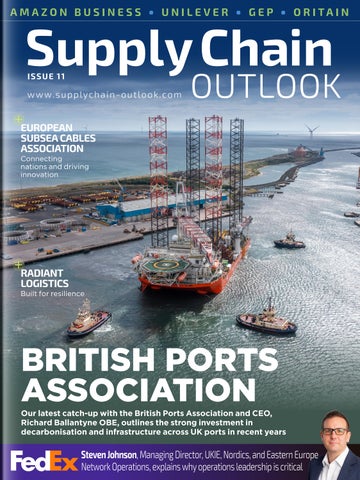
UK ports, such as the Port of Blyth on this issue’s front cover, are constantly evolving to meet changing demand.
Editor: Rachel Carr rachel.carr@outpb.com Copy Editor: Lauren Kania lauren.kania@outpb.com PRODUCTION Art Director: Stephen Giles steve.giles@outpb.com Senior Designer: Devon Collins devon.collins@outpb.com Designer: Louisa Martin louisa.martin@outpb.com Production Manager: Alex James alex.james@outpb.com Digital Marketing Director: Fox Tucker fox.tucker@outpb.com Senior Website Content Manager: Oliver Shrouder oliver.shrouder@outpb.com Social Media Executive: Jake Crickmore jake.crickmore@outpb.com Trainee Digital Content Executive: Tara Steele tara.steele@outpb.com BUSINESS CEO: Ben Weaver ben.weaver@outpb.com Managing Director: James Mitchell james.mitchell@outpb.com Chief Technology Officer: Nick Norris nick.norris@outpb.com Content Director: Neil Perry neil.perry@outpb.com Global Head of Media: Lewis Hammond lewis.hammond@outpb.com Global Media Executive: Kai Boyle-Vennard kai@outpb.com A D M I N I S T R AT I O N Finance Director: Suzanne Welsh suzanne.welsh@outpb.com Finance Manager: Victoria McAllister victoria.mcallister@outpb.com C O N TA C T Supply Chain Outlook Norvic House, 29-33 Chapelfield Road Norwich, NR2 1RP, United Kingdom Sales: +44 (0) 1603 904 445 Editorial: +44 (0) 1603 904 431 SUBSCRIPTIONS Tel: +44 (0) 1603 904 431 jack.salter@outpb.com www.supplychain-outlook.com Follow us on Linkedin: @supplychainoutlook
This underlines the sector’s resilience and continuing role at the heart of the nation’s trade and supply chains. Our latest catch-up with the British Ports Association, the national trade association for ports and harbours across the UK and the voice of the ports industry, outlines the strong investment in decarbonisation and infrastructure at UK ports in recent years. “Investment across UK ports remains strong. Over recent years, we have seen significant spending on quay infrastructure, deep-water berths, logistics parks, digital technologies, passenger and cargo handling equipment, fuel and maritime services, and facilities supporting offshore wind and other clean energy industries,” updates CEO, Richard Ballantyne OBE, who we last spoke to in July 2022. Often extending deep beneath the ocean’s surface, subsea cables play a vital role in advancing Europe’s energy and digital sectors. We sit down with the European Subsea Cables Association (ESCA), the collective voice for the industry, to explore its integral role in meeting Europe’s evolving energy needs and dynamic digital demands. Featuring insights from Executive Director, John Wrottesley, and Chair, Steve Holden, we uncover the strategies driving the future of subsea infrastructure. Whilst subsea cables are complex networks that transmit electricity and data across vast distances, Radiant Logistics is the ‘Network that Delivers’. Combining entrepreneurial expertise, global logistics capabilities, and technology-enabled solutions, the company helps customers navigate complexity whilst positioning itself for the next chapter of growth, as we find out from the leadership team. “We ultimately aspire to be the preferred platform for logistics entrepreneurs,” outlines Bohn Crain, Founder and CEO. Our brand-new platform, the Supply Chain Outlook Podcast, recently launched with Céline Vuillequez, Vice President of Amazon Business Europe, joining us on the inaugural episode, which was recorded at Amazon Business Exchange in London. Read our insightful, in-person conversation with Vuillequez in The 1-2-1, alongside another in-depth interview with Steven Johnson, Managing Director, UKIE, Nordics, and Eastern Europe Network Operations at FedEx. We hope that you enjoy your read. Jack Salter Head of Editorial, Outlook Publishing Supply Chain Outlook Issue 11 | 3
SU P P LY C HA I N I N S I G H TS
TH E TH O U G H T L E A DE R
20 Unilever
29 James Larmer
Building Resilience, Driving Growth
Global AI and Supply Chain Transformation Leader, GEP
Inside Unilever’s AI-powered supply chain
Why the Biggest Supply Chain AI Prize May Be the Wrong Place to Start
11|CONTENTS
Focus on governed authority
29
REGULARS TH E 1 -2-1S
6 Céline Vuillequez Vice President, Amazon Business Europe From Insight to Action The future of procurement AI
20
14 Steven Johnson Managing Director, UKIE, Nordics, and Eastern Europe Network Operations, FedEx
T HE D I SR U P TOR
Operations Leadership Matters More Than Ever
Building trust with evidence
FedEx invests in smarter, more resilient hubs across its network
4 | Supply Chain Outlook Issue 11
25 Oritain How forensic science is replacing assumptions with physical evidence of product origin
SUPPLY CHAIN OUTLOOK CONTENTS
34 THE QUESTION Supply Chain Visibility: How do you turn it into a competitive advantage?
SU P P LY C HA I N SP OT L I G HTS
50 British Ports Association
60 European Subsea Cables Association Connecting nations and driving innovation
Investment in decarbonisation and infrastructure across UK ports
60
F E AT U R E E VENT FOCUS
44 ProcureCon Europe Europe’s pioneering procurement conference
N O R TH A ME R I C A
74 Radiant Logistics The Network that Delivers Built for resilience
44
74
Supply Chain Outlook Issue 11 | 5
THE
1-2-1 AN IN-DEP TH INTERVIEW WITH CÉLINE V UILLEQUEZ, VICE PRESIDENT OF AMAZON BUSINESS EUROPE
Supply chain resilience means three things: visibility, agility, and diversification of your supplier base”
THE 1-2-1 CÉLINE VUILLEQUEZ
From Insight to Action With Amazon Business rolling out new artificial intelligence tools to more than 11 million customers, Céline Vuillequez, Vice President of Amazon Business Europe, joins the Supply Chain Outlook Podcast at Amazon Business Exchange to discuss the shift from insight to action
Supply Chain Outlook (SC): Firstly, Amazon Business operates at an enormous scale, and the industry pays close attention whenever you introduce something new. Does that create pressure? Céline Vuillequez, Vice President (CV): I wouldn’t say pressure; I would say responsibility. Amazon Business now serves more than 11 million customers across 11 countries, including 97 of the Fortune 100. That’s a privilege, and it keeps us really focused on what matters most: our customers. What sets us apart is this unique combination of
8 | Supply Chain Outlook Issue 11
global scale, innovation, and customer obsession. We are obsessed with serving our customers of all sizes to help them move towards their next stage of growth. SC: What are some of the key announcements Amazon Business has made this year? CV: We’ve made a number of important announcements this year, aimed at improving experiences for customers by providing them with intuitive solutions that deliver even better insights and processes. We’ve announced a selection of artificial intelligence
THE 1-2-1 CÉLINE VUILLEQUEZ
(AI)-powered tools to make business buying easier and smarter for our 11 million customers. Tools such as Savings Insights provide businesses with suggestions about how they can save money by analysing spending and suggesting options such as bulk discounts or repeat orders. Spend Anomaly Monitoring helps organisations track and gain greater visibility into how spending is happening across the organisation, with better control so any irregularities can be spotted and addressed quickly. We’ve also introduced tools designed specifically to simplify how people work. Amazon Quick is an agentic AI assistant that works with tools people are already familiar with at work, such as Microsoft Outlook or Slack. It can perform tasks on your behalf with your validation, such as building deliverables, creating dashboards, or scheduling meetings. It’s like having a personal assistant, helping you save time and allowing your organisation to focus on serving its customers. Amazon Business is customer-obsessed. We work with organisations of all sizes, across sectors, to ensure they have what they need to operate. This dedication to customer success has enabled Amazon Business to achieve significant milestones this year. Saving organisations time and money is what drives us to continue to innovate. SC: What are customers telling you about spend visibility and the challenges they are facing? CV: Our customers want to empower their teams to make faster decisions at scale, but they also need control and transparency. They’re trying to strike that balance, and that is what Amazon Business is striving to offer. For example, East London NHS Foundation Trust has been able to transform the way it manages tail spend by adopting Amazon Business. This gives its teams the agility they need, whilst providing an understanding of where money is going and making sure savings are captured in the best way, so they can be reinvested to better serve patients. SC: How valuable is it to receive direct feedback from customers at events like Amazon Business Exchange (ABX)? CV: That’s the whole reason we host ABX. It allows our teams to get direct feedback from customers. We’re not building solutions for customers; we’re building solutions with them.
Supply chain resilience means three things: visibility, agility, and diversification of your supplier base” SC: Which organisations are getting the most value from tools such as Amazon Quick? CV: Those seeing the most value are embracing AI right here, right now, and they are doing it pragmatically, rather than thinking about it as something futuristic or complex. It’s about starting now, embarking on the journey because the tools are here, and embedding them into your teams’ daily tasks. The organisations making the fastest progress are the ones iterating quickly. Ultimately, it comes down to adoption and iteration. That’s why we’re constantly discussing this with customers and bringing new features powered by technology, AI, and machine learning (ML) to help them progress on that journey. SC: Does experimentation need to be part of that process? CV: Absolutely. There needs to be a spirit of experimentation and an acceptance that you’re going to be almost constantly disrupted, given the pace at which things are accelerating. But every step gets you moving in the right direction.
Supply Chain Outlook Issue 11 | 9
We’re not building solutions for customers; we’re building solutions with them” It shouldn’t be daunting; it should be exciting. But it also has to be pragmatic and integrated into what your teams are already doing. Change management is hard, but making these technologies part of existing workflows is what drives long-term transformation. SC: What does good supply chain resilience look like in 2026? CV: Supply chain resilience means three things: visibility, agility, and diversification of your supplier base. At Amazon Business, that’s what we’re striving to offer our customers. We have millions of suppliers around the world, most of which are small to medium-sized businesses (SMBs), so that gives customers options
10 | Supply Chain Outlook Issue 11
when they need them most. Most senior procurement leaders now believe supply chain resilience is one of their top priorities for the next one or two years. It’s no longer a procurement team discussion; it’s a board meeting topic. The challenge with diversification, however, is that it can create complexity. That’s what we want to minimise. For example, Invoice by Amazon gives customers access to a very broad supplier base, whilst simplifying how they manage it through one consolidated invoice. Diversification helps you absorb disruption and keep your supply chain moving, but you need to make sure you don’t add complexity. SC: With the pressure to control costs, how can procurement leaders balance cost efficiency with environmental, social, and governance (ESG) considerations? CV: Sustainable procurement is good for the planet – and good for business. We also now have more regulation, particularly in Europe, such as the Corporate Sustainability Reporting Directive (CSRD), so it’s becoming a requirement for doing business.
THE 1-2-1 CÉLINE VUILLEQUEZ
Our customers are increasingly adopting sustainable purchasing behaviours, and we enable that at Amazon Business through things such as Climate Pledge Friendly certifications, EcoVadis-rated suppliers, and other recognised environmental credentials. This allows customers to make smart purchasing decisions in line with their values. We also enable reporting so customers can track against their sustainability commitments. It’s not a tradeoff. It’s not either/or; it’s an ‘and’. Another feature we offer is Guided Buying. This allows an organisation to establish its policies and surface those policies to end users, helping them make purchases that comply with them. For example, a public institution might want to favour local suppliers. You can easily filter and select local businesses when purchasing with Amazon Business, improving compliance and control over spending. These are some of the ways we’re helping organisations maintain cost efficiency whilst embracing sustainable procurement.
SC: Does making those tools simpler particularly help SMBs that don’t have large procurement or sustainability teams? CV: Absolutely. Because we make it simple for customers to find and surface those options, you don’t need a huge procurement team to make purchases that are in line with your values. SMBs can also select from other SMBs, so when you purchase through Amazon Business, you can support the ecosystem and develop a more diverse and sustainable supplier base. SC: Everyone talks about supply chain visibility. How does better visibility strengthen supply chains and create opportunities for future growth? CV: The vast majority of procurement teams now understand that faster, more reliable data and insights help their organisations make better decisions. Data powered by AI or ML is helping organisations
Supply Chain Outlook Issue 11 | 11
THE 1-2-1 CÉLINE VUILLEQUEZ
move in that direction. With Amazon Business Analytics, for example, we help organisations access that information so their teams can make decisions at scale, whilst maintaining oversight. They can understand where to optimise, identify savings opportunities, and benchmark across different categories and organisations. In a world where organisations have to optimise not only for product savings, but also for total cost of ownership, that requires more than data. It requires intelligent insights. Now, with agentic AI, you don’t just have insights that provide advice; you have insights that can take actions on your behalf, with your validation. That’s the future. That’s where we’re going.
For Amazon Business, it comes back to customer obsession and creating a seamless experience with the solutions we bring to customers. It’s about innovation, but making that innovation so easy that customers don’t have to think about it because it fits seamlessly into their daily working environment. Amazon Quick is connected with those tools and understands the context of the organisation. That knowledge removes some of the friction you can experience with tools that need to be fed huge amounts of information. You plug it in and use it; it’s easy to use. I believe that is what differentiates Amazon Business: this customer obsession around creating a seamless purchasing experience for smart business buying.
SC: How important is it to keep a human in the loop as AI takes on more procurement tasks?
SC: Finally, what advice would you give to organisations that can see where procurement technology is heading but haven’t started the journey yet?
CV: Whenever you’re talking about relationships, you need high-judgement decisions. That’s where having a human in the loop is critical. You can automate repetitive administrative tasks, but procurement is evolving from a back-office function into a genuinely strategic area that helps organisations drive efficiency and push innovation. Those discussions need humans in the loop because they involve highjudgement calls. SC: There is intense competition around procurement and supply chain technology. What makes a tool stand out and encourages people to actually adopt it? CV: It’s about being pragmatic and making tools simple to adopt. All teams are facing rapid change, and the pace of that change is only accelerating. That means it’s even more important to make these tools easy and intuitive for customers to use.
CV: You don’t have to take it all on at once because it can be daunting. Instead, there are a few steps that can be taken to get going. First, it always starts with visibility. You need the data and insights to understand and analyse what is happening. That analytical power starts you on the journey towards making better decisions. The next step is understanding that change management is hard, so you need to embed change into people’s everyday working lives. It shouldn’t be a training session every six months. You’re going to be continuously disrupted, so it’s an evolutionary journey rather than a big bang. That mindset is very important. Third, select tools that make it easy for your teams to transform data into insights, insights into advice, and advice into actions. A lot of tools don’t reach that final stage, so you can be surrounded by data but still not know what to do with it. The tools I’ve mentioned are striving to make that process simple and action-driven, helping customers save time on purchasing decisions so they can spend more time on strategic, value-added activities that better serve their customers.
business.amazon.com
12 | Supply Chain Outlook Issue 11
THE
1-2-1 AN IN-DEPTH INTERVIEW WITH
STEVEN JOHNSON,
MANAGING DIRECTOR, UKIE, NORDICS, AND EASTERN EUROPE NETWORK OPERATIONS AT FEDEX
Why Operations Leadership Matters More Than Ever FedEx invests in smarter, more resilient hubs across its network
THE 1-2-1 STEVEN JOHNSON
Why Operations Leadership Matters More Than Ever As FedEx invests in smarter, more resilient hubs across its network, Steven Johnson, Managing Director, UKIE, Nordics, and Eastern Europe Network Operations, explains why operations leadership is critical to transforming modern supply chains
Supply Chain Outlook (SC): Firstly, how has the role of operations leaders changed in today’s supply chain environment? Steven Johnson (SJ): The fundamentals of our role haven’t changed. Customers still expect their shipments to arrive safely, on time, and exactly where they need them. Delivering on that expectation remains our number one priority. What has changed is the pace at which we operate and the complexity of the environment around us.
14 | Supply Chain Outlook Issue 11
Today’s supply chains are more connected than ever before. Customer expectations continue to evolve, global events can have an immediate impact on our network, and technology provides us with more information than we’ve ever had available. As operations leaders, we’re no longer just managing activity within our own four walls. We’re making decisions that consider the entire network and how every part works together to deliver the best outcome for our customers. At FedEx, we talk about One FedEx because
THE 1-2-1 STEVEN JOHNSON
collaboration is essential. Whether it’s different operating companies, planning and engineering, sales, the customer experience, or our frontline teams, success comes from working together with a shared purpose. For me, though, one thing has remained constant throughout my career: people make the difference. Technology helps us make better decisions and improve efficiency, but it’s our team members who solve problems, adapt to changing circumstances, and deliver an outstanding experience and service every single day. My role is to create an environment where people feel trusted, supported, and empowered to do just that. SC: FedEx has been heavily investing in UK hubs. How are they transforming what you can offer customers? SJ: Our investment programme is about far more than increasing capacity. It’s about building a smarter, more resilient network that gives our customers greater confidence, flexibility, and reliability. Modern facilities and advanced automation help us process shipments more efficiently and provide greater flexibility across the network, enabling us to manage seasonal peaks, changing customer demand, and unexpected disruption with greater agility. As customer supply chains become increasingly complex, they need supply chain partners that can provide visibility, resilience, and consistency. That’s exactly what these investments are helping us achieve. At FedEx, innovation has always been part of who we are, but innovation only delivers value when it improves the customer experience. By combining world-class facilities with the expertise of our people, we’re creating a network that’s ready not only for today’s challenges, but also the opportunities of tomorrow. SC: What has driven the need for this expansion and how are customer needs evolving? SJ: Customer expectations have changed significantly over the last decade. Businesses expect greater visibility, faster transit times, and more flexibility than ever before. They’re also operating across increasingly global and interconnected supply chains, which means they need logistics providers that can adapt as quickly as they do. The investments we’re making are driven by those changing expectations. Our customers want confidence that their logistics partner can continue to support them as their businesses grow, regardless of market conditions or changing demand. The expansion of our Dublin Hub is a great example.
Technology is an enabler, not a replacement for leadership or operational experience”
It’s not simply about increasing capacity; it’s about strengthening connectivity across our network, improving resilience, and creating additional flexibility for customers moving freight across Ireland, the UK, Europe, and globally. Ultimately, every investment we make is focused on one outcome: making it easier for our customers to do business and giving them confidence that FedEx will continue to deliver for them, both today and into the future. SC: What qualities define a successful operations leader today? SJ: The best operations leaders I’ve worked with all have different personalities, but they share the same core qualities. First and foremost, they genuinely care about people. They build trust, communicate openly, and create an environment where everyone understands how their role contributes to the bigger picture. They also stay calm under pressure. Logistics is a dynamic industry, and there will always be challenges – whether that’s severe weather, unexpected disruption, or changing customer demand. Strong leaders provide clarity, make informed decisions, and give their teams the confidence to respond safely and effectively. Curiosity is another quality I value highly. Our industry is changing rapidly, and the best leaders never stop
Supply Chain Outlook Issue 11 | 15
THE 1-2-1 STEVEN JOHNSON
AI can provide recommendations and insights, but people still make the decisions, solve the problems, and support customers when situations become complex”
learning. They embrace new ideas, challenge existing ways of working, and continually look for opportunities to improve. Most importantly, they lead by example. At FedEx, safety is always our highest priority, and our leaders demonstrate that through their actions every single day. They create a culture where doing the right thing is never compromised, whilst keeping customers at the heart of every decision.
16 | Supply Chain Outlook Issue 11
SC: How can strong operations leadership improve supply chain resilience? SJ: Resilience isn’t something you switch on when disruption happens. It’s something you build every day through strong leadership, disciplined processes, and engaged people. The most resilient organisations are the ones that invest in preparation. They develop clear operating standards, build strong relationships across the business, and empower their teams to make decisions when circumstances change. One of the biggest responsibilities of any operations leader is creating clarity during uncertainty. When people understand the priorities, trust the decisions being made, and feel empowered to act, organisations can respond much more quickly and effectively. At FedEx, our ‘Safety Above All’ motto underpins everything we do. That strong foundation allows us to remain agile without compromising the well-being of our people or the quality of service we provide our customers.
THE 1-2-1 STEVEN JOHNSON
Ultimately, resilience comes down to culture. Technology, infrastructure, and processes are all important, but it’s the commitment, experience, and professionalism of our people that enables us to adapt, recover quickly, and continue delivering an outstanding experience, whatever challenges come our way. SC: What role does technology play in helping operations leaders make better decisions? SJ: Technology has transformed the way we run operations. Early in my career, leaders often had to make decisions with far less information and much less visibility across the world than we have today. Access to real-time data allows us to understand what’s happening across our operations, identify trends earlier, and respond far more quickly when conditions change. It enables us to move from being reactive to becoming increasingly proactive, helping us anticipate potential issues before they become larger challenges. For operations leaders, visibility is incredibly powerful. Better information means better decisions around capacity, resource allocation, service recovery, and customer commitments, allowing us to make these decisions with greater confidence and at greater speed. That said, data alone doesn’t move freight. Technology is an enabler, not a replacement for leadership or operational experience. The real value comes when you combine information with the expertise of the people interpreting it. At FedEx, innovation has always been part of our DNA, but the objective is never technology for technology’s sake. The goal is to equip our teams with better tools
so they can make faster, smarter decisions and continue delivering the service our customers expect. SC: How are artificial intelligence and data changing supply chain management? SJ: Artificial intelligence (AI) and advanced analytics are helping supply chains become more predictive, responsive, and efficient than ever before. These technologies can identify patterns, improve forecasting, optimise resources, and provide earlier visibility of potential disruptions. In increasingly complex global networks, that ability to anticipate and act earlier can have a significant impact on both service and efficiency. We’re also seeing AI help organisations make better use of data. The volume of information available to supply chain leaders today is vast, and AI can help turn that data into meaningful insights that support faster and more informed decision-making. However, I don’t see AI replacing people; I see it as an enabler. Operational experience, judgement, and leadership remain incredibly important. AI can provide recommendations and insights, but people still make the decisions, solve the problems, and support customers when situations become complex. The organisations that will gain the most value from AI are the ones that successfully combine advanced technology with experienced teams and a culture of continuous improvement. At FedEx, that’s where we see the greatest opportunity: using innovation to empower our people and further enhance the customer experience.
WHAT IS THE FEDEX PURPLE PROMISE? The FedEx Purple Promise is the company’s commitment to ‘make every FedEx experience outstanding’, providing a guiding principle for how its team members serve customers and work with each other.
Supply Chain Outlook Issue 11 | 17
THE 1-2-1 STEVEN JOHNSON
Ultimately, resilience isn’t built by one organisation alone. It’s built through collaboration, shared expertise, and a common commitment to delivering for customers, whatever challenges lie ahead”
SC: How can operations leaders balance efficiency with flexibility? SJ: It’s one of the biggest challenges operations leaders face because customers rightly expect both. Efficiency remains essential as strong processes, operational discipline, and clear standards are what enable us to deliver safe, reliable, and consistent service every day. But efficiency alone isn’t enough in today’s environment.
18 | Supply Chain Outlook Issue 11
Supply chains are constantly evolving, and organisations also need the flexibility to adapt when volumes change, disruptions occur, or customer requirements shift. That’s where empowered teams and agile decision-making become critical. I’ve always believed that efficiency and flexibility aren’t competing priorities. In fact, the best operations achieve both. Strong foundations create stability, whilst capable people provide the agility to respond when circumstances change. At FedEx, Safety Above All provides that foundation. From there, we focus on empowering our teams, encouraging collaboration across FedEx, and continuously looking for smarter ways of working. When you combine operational discipline with empowered people, you create an organisation that can remain agile whilst consistently delivering for customers. Ultimately, balancing efficiency and flexibility comes down to culture. If you have great people, clear priorities, and a relentless focus on the customer, you can achieve both.
THE 1-2-1 STEVEN JOHNSON
SC: What are the biggest challenges facing supply chain leaders right now? SJ: The defining challenge for supply chain leaders today is managing constant change whilst continuing to deliver consistent results for customers. Customer expectations continue to rise, technology is evolving rapidly, and businesses are expected to deliver more efficiently than ever before, all whilst operating in an increasingly unpredictable environment with tighter regulations. The challenge is balancing long-term transformation with flawless day-to-day execution. Customers don’t see the complexity behind the scenes; they simply expect us to deliver safely, reliably, and on time, which is exactly how it should be. At the same time, we’re investing in automation, AI, and new ways of working to ensure our network is ready for the future. The real challenge is introducing those innovations without losing sight of the operational discipline that customers depend on every day. Another key challenge is developing the next generation of leaders. Technology will continue to evolve, but our industry will always rely on people who can lead with confidence, make sound decisions under pressure, and inspire those around them. Creating a culture where people can grow, challenge themselves, and reach their full potential is one of the most important responsibilities we have as leaders. At FedEx, our People-Service-Profit philosophy has stood the test of time because it reminds us that when we invest in our people, they deliver outstanding service, and that drives sustainable success for both our customers and our business. SC: How can logistics partners help businesses build more resilient supply chains? SJ: Resilient supply chains are built on strong partnerships. Today’s customers need far more than a company that simply moves shipments from A to B. They need a trusted partner that understands their business, provides insight, and works alongside them to overcome challenges. The strongest relationships are built on transparency, collaboration, and trust. When logistics providers and customers openly share information, plan together, and communicate effectively, they’re much better positioned to respond quickly when circumstances change. At FedEx, we see ourselves as an extension of our customers’ supply chains. Our role is to simplify complexity, provide confidence, and help customers
adapt to changing market conditions whilst maintaining the service levels their own customers expect. Our global network, combined with local expertise, gives customers access to solutions that support growth, improve resilience, and create greater flexibility. But it’s our people who bring that network to life. Every day, our team members work across functions and borders as a global team to solve problems, remove barriers, and keep businesses connected. Ultimately, resilience isn’t built by one organisation alone. It’s built through collaboration, shared expertise, and a common commitment to delivering for customers, whatever challenges lie ahead. SC: Finally, what should supply chain leaders be focusing on over the next five years? SJ: I believe successful supply chain leaders will need to focus on three priorities in the coming years: people, technology, and adaptability. Technology will continue to reshape our industry, with AI, automation, and advanced analytics creating exciting opportunities to improve efficiency, visibility, and customer experience. Organisations that embrace innovation will be well positioned for the future. Adaptability will also remain essential. The world isn’t becoming any less complex, so organisations must build resilient networks, foster a mindset of continuous improvement, and remain agile enough to respond to changing customer needs without compromising safety or service. However, technology alone won’t determine success. The organisations that thrive will be those that continue investing in people, developing strong leaders, and building cultures that embrace change. For me, though, one thing won’t change. At FedEx, our purpose will always be to connect people and possibilities. Whether through innovation, investment, or operational excellence, everything we do should make life easier for our customers and strengthen the trust they place in us. That’s what the Purple Promise at FedEx means to me – making every customer experience outstanding – and it’s what will continue to guide our business long into the future.
www.fed-ex.com
Supply Chain Outlook Issue 11 | 19
Building Resilience, Driving Growth Vicky Cuthbert, Chief Product Supply Chain Officer for Personal Care, outlines Unilever’s artificial intelligencepowered supply chain and how it maintains consistency and availability across its extensive brand portfolio, particularly during global activations such as the 2026 FIFA World Cup Writer: Lucy Pilgrim
U
nilever’s world-class supply chain plays a strategic role in driving business growth by innovating faster, improving operational efficiency, and responding to an increasingly uncertain global landscape. Vicky Cuthbert, Chief Product Supply Chain Officer for Personal Care, highlights what that means in practice. Supply Chain Outlook (SC): Firstly, what are your priorities as Chief Product Supply Chain Officer for Personal Care? Vicky Cuthbert, Chief Product Supply Chain Officer for Personal Care (VC): Every day, Unilever moves products from hundreds of factories through complex global networks to reach
20 | Supply Chain Outlook Issue 11
billions of consumers around the world. My priorities are to continually improve the speed, agility, and resilience of our operations by investing in our people, artificial intelligence (AI), and digital technologies so we can make better decisions, respond faster, and deliver for our customers and consumers. Demand cycles for consumer brands have shortened from months to hours. To meet that demand, we’ve had to increase our speed and responsiveness across our supply chain by, for example, reducing concept-to-pilot timelines to 12 weeks and building more predictive customer operations and stronger digital capability across our teams.
UNILEVER SUPPLY CHAIN INSIGHTS
The Dove x Crumbl collaboration at Walmart is an example of what this looks like in action. Sparked by social listening, the limited-edition launch was shaped by real consumer interest, whilst replenishment, production, and variant drops were driven by live consumer feedback and demand signals. Together, they helped shape one of Walmart’s most successful innovation launches. Vicky Cuthbert, Chief Product Supply Chain Officer for Personal Care, Unilever
SC: What is supply chain resilience and how do you improve it? VC: Resilience is how well we’re able to anticipate and respond to volatility and disruption. Over the past 100 years, our supply chains have faced many disruptions, from energy price hikes and extreme weather events to maritime bottlenecks. We have responded by strengthening their agility and resilience by transitioning to renewable energy and investing heavily in the digital transformation
of our supply chain operations, for instance. Today, AI is improving demand and supply forecasting. Digital twins – computer simulations of manufacturing processes – are optimising manufacturing and reducing energy use, and we’re using various tools to give us an evermore accurate view of our logistics operation. We have created a tech ecosystem that allows us to identify potential disruption early, assess scenarios, and make faster, better-informed decisions to help us stay future-fit. Supply Chain Outlook Issue 11 | 21
“WE HAVE CREATED A TECH ECOSYSTEM THAT ALLOWS US TO IDENTIFY POTENTIAL DISRUPTION EARLY, ASSESS SCENARIOS, AND MAKE FASTER, BETTER-INFORMED DECISIONS TO HELP US STAY FUTURE-FIT” – V I C KY C U T H B E R T, C H I E F P R O D U C T S U P P LY C H A I N O F F I C E R F O R P E R S O N A L CARE, UNILEVER
SC: How does Unilever’s supply chain help deliver a major global retail activation? VC: Take our sponsorship of the 2026 FIFA World Cup as an example. We activated 35 brands with 180 22 | Supply Chain Outlook Issue 11
limited-edition products across over 120 countries and millions of retail locations. Our job is to fulfil the demand created around the event. From a supply chain perspective, it doesn’t get much more complex than that, so precision planning is the
starting point. When we know what products each brand is promoting, we need to ensure the material sourcing, manufacturing, and logistics capacity is in place to produce and deliver them. Once the production plan is in place, the focus shifts to execution: getting the right products to the right retailers at the right time – in many cases in display executions. For this tournament, that included hundreds of thousands of small ‘mom and pop’ stores as well as our major retail customers. Then, our marketing campaigns activated on social media, in-store,
UNILEVER SUPPLY CHAIN INSIGHTS
UNILEVER’S 2026 FIFA WORLD CUP SPONSORSHIP As the Official Personal Care Sponsor for the 2026 FIFA World Cup, Unilever’s global brand activations comprised over 35 brands rolled out across 120+ markets. The partnership’s cross-channel content and limited-edition products drove international demand and transformed global visibility into commercial impact. Some of its most significant brand activations included: • Dove: #KeepHerConfident – This social media campaign shone a spotlight on the next generation of football fans and players, advocating for young girls across the world who are passionate about the sport. The campaign also included ‘The Game is Ours’ – a 30-second commercial centred on the sounds of girls’ bodies playing football, celebrating the joy and resilience of young female football players. • Dove Men+Care: Care for Your Skin Like You Care for the Game – This multi-platform advertisement evoked the passion men share for football to promote the importance of skincare and taking care of your body to fans.
out-of-home, and on TV with more than 50,000 creators globally. This level of activity means there can be demand spikes at any time. So, whilst we plan meticulously, we also have to remain highly agile to respond to sudden rushes on our products. For example, whilst watching the 2026 FIFA World Cup final, my team and I were eager to find out which winner’s editions we’d soon be starting to produce. Just days after the final, the special limitededition ‘World Champions’ Rexona deodorants were ready for dispatch to Spain. These end-to-end capabilities underpin how we deliver products across markets every day. SC: How do you handle demand changes? VC: We invest heavily in connecting closely with our customers and consumers so we can respond faster to changes in demand. For example, our AI-enabled customer connectivity model with Walmart integrates forecast and sales data, connecting consumer purchases back
to material sourcing. In a Mexico pilot, it delivered 98+ percent on-shelf availability, reduced inventory, and supported category growth. We’re also continually expanding our ability to serve consumers directly. In China, where social commerce is popular, our factory-toconsumer operation in Hefei manages 31,000 orders a day across more than 400 products, fulfilling orders 75 percent faster and reducing logistics costs by almost a quarter. SC: How is AI transforming supply chain management? VC: AI in supply chains helps us make better decisions at scale, but human expertise remains key. Our people provide the judgement, context, and experience needed to make the final decisions. Data and AI enable us to process much more information than would be possible manually, significantly improving the accuracy of our forecasting and scenario planning, as well as optimising logistics routes. One example is our Forecast Engine Utility. This combines machine learning (ML) and
• Sure (Degree in US, pictured right): It Won’t Ever Let You Down – With a simple message, this brand activation associated the product’s 72-hour protection against sweat with the high pressure and sweat-inducing emotions often felt in 2026 FIFA World Cup games. • Lynx (Axe globally, pictured left): Smell Your Best When You Look Your Worst – This campaign centred around football’s multi-generational fans, and the fun costumes that many adorn during the games. The activation shared stories of supporters’ dedication and the ideas behind their costumes, all whilst still smelling good.
Supply Chain Outlook Issue 11 | 23
UNILEVER SUPPLY CHAIN INSIGHTS
“AI IN SUPPLY CHAINS HELPS US MAKE BETTER DECISIONS AT SCALE, BUT HUMAN EXPERTISE REMAINS KEY. OUR PEOPLE PROVIDE THE JUDGEMENT, CONTEXT, AND EXPERIENCE NEEDED TO MAKE THE FINAL DECISIONS” – V I C KY C U T H B E R T, C H I E F P R O D U C T S U P P LY C H A I N O F F I C E R F O R P E R S O N A L CARE, UNILEVER
data science to generate a 104-week forecast every week across more than five million product–customer combinations in 40 operating markets. In Hefei, AI has contributed to an eight percent increase in overall equipment effectiveness and a 20 percent reduction in waste, whilst our factory in Raeford, North Carolina, which was critical in producing products for the 2026 FIFA World Cup, uses digital twins to achieve superior-quality personal care products as well as a 20 percent 24 | Supply Chain Outlook Issue 11
reduction in waste and a 10 percent uplift in capacity.
Manufacturing will become increasingly predictive and scenariobased. We’re rolling out more than 40 AI-powered digital twins across our network over the next 18 months, helping teams identify issues earlier, simulate scenarios faster, and make smarter decisions. The biggest opportunity isn’t just deploying AI; it’s fundamentally redesigning our underlying processes so people and AI can work together effectively.
SC: Finally, how will digital technologies change Unilever’s supply chain in the future? VC: We’re moving from using AI in individual tools to everything being interconnected. Our five-year Google Cloud partnership will create an enterprise-wide digital backbone that turns data into insights and supports agentic workflows across business processes.
unilever.com
NEW PERSP ECTIVES ON THE FUTURE O F BUSINESS
BUILDING TRUST WITH EVIDENCE How forensic science is replacing assumptions with physical evidence of product origin
FACT FILE BUSINESS NAME: ORITAIN
2008 FACT FILE
YEAR FOUNDED:
LOCATION: Auckland, New Zealand; BUSINESS NAME: ORITAIN
YEAR FOUNDED: LOCATION: KEY PRODUCTS: KEY PRODUCTS:
London, UK; Washington DC, xxxxx US Xxxxxxxxorigin verification Forensic
XXxxxxxxxx
BUILDING TRUST WITH EVIDENCE Supply chains have long relied on documents, declarations, and trust. Rupert Hodges, Chief Strategy Officer at Oritain, explains how forensic science is replacing assumptions with physical evidence of product origin, helping businesses expose fraud, satisfy regulators, and protect their reputations
Supply Chain Outlook (SC): Firstly, what is broken about traditional traceability?
companies a clearer picture of complex global supply chains than ever before.
Rupert Hodges, Chief Strategy Officer (RH): Traditional traceability, or paper and digital trails of documentation and supplier declarations, are unreliable. It is easier than ever for businesses to misrepresent what they submit for their own commercial interests. Whilst traditional or solely digital methods can demonstrate intent and process, only verification provides a defensible source of truth in an increasingly enforcement-led environment. Brands that want to keep customers, regulators, and consumers onside need to upgrade to forensic verification processes where appropriate, which cannot be manipulated in the same ways. Investing in supplier mapping, digital traceability, and better data can give
SC: Why should companies test products, not just paperwork?
26 | Supply Chain Outlook Issue 11
RH: Documents can be easily manipulated, falsified, or lost. It is no longer enough to rely solely on a paper or digital trail of documentation and supplier declarations. Moreover, an item’s country of manufacture has become an increasingly weak and misleading proxy for origin assurance, as material flows, trade routes, and upstream sourcing decisions take priority over factory addresses. Relying exclusively on paper trails can create a dangerous ‘compliance illusion’ – a false sense of security that paperwork equates to physical supply chain control.
THE DISRUPTOR ORITAIN
SC: What can a product’s chemical fingerprint reveal? RH: A product’s chemical fingerprint reflects the unique environmental conditions where it was grown or produced. By comparing that fingerprint against reference data, forensic science can provide independent evidence to assess whether a product is consistent with its claimed origin. SC: Where is origin fraud hiding in today’s supply chains? RH: Origin fraud rarely stems from a single bad actor. Instead, it thrives in the systemic gaps within complex global supply chains. One primary vulnerability is transshipment risk, where goods pass through intermediate ports or processing hubs, creating opportunities for documentation to be altered or data to be lost before reaching the final market. Another major gap occurs when supply chain documentation is digitised after the point of origin. When paper trails or legacy records are uploaded into digital management systems without baseline verification, unverified claims are accepted as truth and carried downstream. Often, these discrepancies are unintentional, driven by complex sourcing layers. Rather than blaming suppliers, modern supply chain management relies on working with the entire chain to verify data directly at the source. These forensic verification measures can protect brands from transshipment risks whilst enabling trusted suppliers to demonstrate the value and authenticity of their goods. SC: What happens when the product contradicts the data? What is the commercial value of knowing exactly where goods come from? RH: When a product contradicts the data or its origin is unclear, it can expose instances of supply chain fraud, consequently leading to consumer mistrust or serious legislative concerns. Brands selling products that contradict their data not only risk being fined by regulatory bodies but might also face limited market access or missed seasons through detention. The Oritain Global Supply Chain Intelligence Report revealed that 60 percent of consumers consider ethical sourcing important when buying something and will disengage if they do not trust the brand in question. But brands can use consumer concerns to their advantage. Being able to verify that a luxury product
does actually originate from its claimed origin, such as Egyptian cotton, can justify a brand selling it at a premium, directly benefitting the business. SC: How are artificial intelligence and data science changing origin verification? RH: Artificial intelligence (AI), more specifically machine learning (ML), is helping to scale and enhance origin verification by supporting the analysis of highly complex datasets. At Oritain, forensic science and advanced statistical modelling are at the core of our verification programmes, with ML enabling greater precision and consistency in how origin insights are interpreted. Advanced data science also helps strengthen risk intelligence, enabling more targeted, risk-based verification programmes and smarter supply chain decision-making. SC: How is regulation raising the standard of proof? RH: Overlapping policy, regulatory, tariff, and enforcement developments are materially changing standards for supply chain compliance. Regulators are cracking down on companies that fail to meet required standards of proof and are increasingly expecting independent, evidence-based verification of origin claims. In fiscal year 2025 (FY25) alone, whistleblower-driven False Claims Act lawsuits resulted in more than USD$6.8 billion being paid out by US companies. Similarly, companies that fail to meet forced labour frameworks risk becoming prohibited suppliers, potentially hindering their market access on a global scale. These rules are also pressuring businesses into making claims they can stand behind. Unsubstantiated claims are no longer acceptable, and those that make sweeping generalisations risk serious fines. In the EU, these can range from one to six percent of a company’s EU sales.
“WHILST TRADITIONAL OR SOLELY DIGITAL METHODS CAN DEMONSTRATE INTENT AND PROCESS, ONLY VERIFICATION PROVIDES A DEFENSIBLE SOURCE OF TRUTH IN AN INCREASINGLY ENFORCEMENT-LED ENVIRONMENT”
Supply Chain Outlook Issue 11 | 27
THE DISRUPTOR ORITAIN
“RELYING EXCLUSIVELY ON PAPER TRAILS CAN CREATE A DANGEROUS ‘COMPLIANCE ILLUSION’ – A FALSE SENSE OF SECURITY THAT PAPERWORK EQUATES TO PHYSICAL SUPPLY CHAIN CONTROL”
SC: Finally, are you ever surprised by what your product investigations reveal? RH: Brands themselves can often be surprised by the results. When they have invested in digital traceability and documentation, discovering prohibited materials in their supply chain can come as a shock. This is why forensic verification is so critical in providing full visibility across the entire supply chain. Brands can spend significant amounts on digital traceability, but if they do not have sight of products at their source, they have fallen at the first hurdle.
SC: Firstly, can forensic verification work on a global scale? RH: Forensic verification can work on a global scale. It is already shaping the approaches of many leading global brands and suppliers. Verification-led approaches such as the Oritain Membership Programme play a part in ensuring that forensic verification works at a global scale. These are designed to help brands, retailers, manufacturers, and suppliers turn origin verification data into actionable supply chain intelligence. Not only can these schemes help brands foresee challenges they might encounter, but they can also support their compliance objectives.
28 | Supply Chain Outlook Issue 11
ABOUT ORITAIN Oritain provides forensic origin verification for global supply chains. Its methodology combines analytical techniques, including isotopes and trace elements, with statistical modelling and a global reference database to verify product origins. Oritain works with organisations across industries including fashion, cotton, leather, and timber, helping them support regulatory compliance, manage risk, and verify product provenance.
THE
THOUGHT LEADER Why the Biggest Supply Chain AI Prize May Be the Wrong Place to Start James Larmer, Global AI and Supply Chain Transformation Leader at GEP
Why businesses should focus on governed authority, not just capability, when scaling artificial intelligence across supply chains
30 | Supply Chain Outlook Issue 11
THE THOUGHT LEADER JAMES LARMER
Why the Biggest Supply Chain AI Prize May Be the Wrong Place to Start James Larmer, Global AI and Supply Chain Transformation Leader at GEP, shares why businesses should focus on governed authority, not just capability, when scaling artificial intelligence across supply chains
C
onsider a composite scenario based on a recurring pattern across supply chains. A company puts an artificial intelligence (AI) planning system into shadow operation for 12 weeks. It consistently makes better choices than experienced planners, reduces costly inventory transfers, responds faster to disruption, and generates fewer unnecessary expedites. The pilot meets every technical and financial threshold. Six months later, the operating model is unchanged. The system still recommends. Humans still approve every significant action. Routine decisions still wait in queues.
THE AUTHORITY GAP The authority gap is the distance between the decisions a system is capable of making and the decisions the organisation permits it to make. As capability rises whilst authority stays fixed, more recommendations flow into approval structures designed for human decision volumes. Managers review more low-value transactions. Queues persist. The organisation captures only part of the speed and capacity the technology can provide.
Supply Chain Outlook Issue 11 | 31
THE THOUGHT LEADER JAMES LARMER
The evidence required should rise with the consequence of the decision” That matters more as AI moves from prediction towards action. A forecasting model can inform a planner. An agent can reroute freight, move inventory, resolve procurement exceptions, allocate warehouse work, or communicate directly with suppliers. Each can commit resources, change service outcomes, or create obligations for the organisation. Transaction-level approval can feel reassuring because a person remains involved. Yet, in highvolume, well-bounded work, it also determines where authority sits – and often leaves it in the queue. Managers spend their attention confirming routine choices, leaving less capacity for novelty, ambiguity, and genuine exceptions.
THE DECISION MANDATE Supply chains already know how to delegate. Executives approve spending limits. Buyers receive sourcing authority. Planners operate within service and inventory policies. Machine authority can be handled with the same discipline. A decision mandate is a bounded, evidence-backed, and revocable grant of authority for a system over a defined class of recurring decisions. Consider inventory rebalancing. ‘Optimise inventory’ describes a capability. A mandate says what the system is actually allowed to do: rebalance nonregulated products amongst three distribution centres, up to USD$75,000 per transfer and USD$500,000 per day, provided projected service improves, total network inventory does not increase, and no customer allocation rule is breached. Demand anomalies above a defined threshold,
About GEP GEP provides AI-enabled procurement and supply chain software, consulting, and services. Headquartered in Clark, New Jersey, it works with global enterprises, including more than 550 Fortune 500 and Global 2000 companies. GEP has offices and operations centres across Europe, Asia, Africa, and the Americas.
32 | Supply Chain Outlook Issue 11
new-product launches, and temperature-controlled products escalate automatically to a planner. That specificity changes the management conversation. Risk appetite becomes visible in thresholds and exclusions. It also separates authority from accountability. A machine may hold operational authority within that envelope; a named executive remains accountable for the objective, the boundaries, the residual risk, and the decision to continue, narrow, or withdraw that authority.
WHAT A MACHINE MUST PROVE Average accuracy is too blunt a test for authority. Two systems can produce similar average performance whilst creating very different risks. One may occasionally make extreme errors; another may recognise uncertainty, respect constraints, and escalate unfamiliar conditions. For a leader deciding how much authority to grant, those differences matter enormously. The evidence required should rise with the consequence of the decision. Before authority expands, leaders need answers to four questions: • Competence – Can it do this reliably? • Comparison – Is it better than what we do today? • Containment – What is the worst credible outcome? • Control – Can we stop it, and have we proved we can? Reversibility is a useful test for autonomy; its more important implication is what it tells leaders about sequencing. Decisions that are easier to unwind can earn authority with less evidence because mistakes can be contained and corrected. Decisions whose consequences persist demand a higher bar. An authority envelope that has never been tightened or withdrawn has not yet proved that its brakes work.
START WHERE EVIDENCE MOVES FASTEST A common way to rank AI use cases is by potential financial value, beginning with the biggest prize. Once authority enters the equation, that logic can work against the organisation. Consider strategic supplier selection. It may carry enormous value, making it an obvious candidate for AI investment. It is also difficult to accumulate evidence from – comparable decisions occur infrequently, and outcomes can take months or years to become visible.
The biggest AI prize may be the worst place to start granting authority” Switching is costly, whilst the effects on resilience, geopolitics, and relationships are difficult to measure. AI can materially improve the analysis, yet the evidence required for independent authority may accumulate too slowly. A purchase order exception behaves very differently. Another decision arrives tomorrow. The outcome becomes visible quickly. The downside can be capped. The system gets another chance to prove itself. The same is true of many inventory transfers, logistics-routing decisions, and bounded warehouse actions. High-frequency decisions can generate repeated observations, faster feedback, and clearer baselines. Their authority can also be constrained through value limits, exclusions, and escalation rules. This creates a sequencing inversion: the biggest AI prize may be the worst place to start granting authority. The reason to begin with more mundane decisions is speed. Each successful mandate teaches the organisation how to define authority envelopes, produce evidence, interpret exceptions, and operate controls. Those capabilities are reusable. A company that learns to delegate frequent, reversible decisions builds the management machinery required for more consequential ones, rather than waiting for rare strategic decisions to generate evidence that may never accumulate.
WHAT LEADERS SHOULD MEASURE As machine authority expands, leaders need to distinguish announced autonomy from authority that is actually being exercised. One useful measure is mandate utilisation: the share of all decisions in a defined decision class that are actually executed under machine authority. The denominator matters. A deliberately narrow envelope should not produce a flattering utilisation number whilst leaving almost the entire decision class under human approval. The override rate provides a useful diagnostic beneath it. Persistent overrides can signal weak performance, a poorly designed envelope, missing context, or low operating confidence. Three questions can start the conversation: Which recurring decisions are our AI systems already capable of making? Which still wait for routine human authorisation? What evidence would cause us to narrow or revoke authority once granted? The competitive advantage will come from converting machine intelligence into governed authority with speed and discipline.
About James Larmer James Larmer is Global AI and Supply Chain Transformation Leader at GEP. A former partner at Bain & Company and founder of PwC’s AI Lab, he advises senior executives on AI-enabled transformation, strategy, and operating-model redesign. His work focuses on how organisations can move from AI experimentation to scaled execution by redesigning decision rights, governance, and accountability around intelligent and agentic systems.
Supply Chain Outlook Issue 11 | 33
TH E Q U E STION
Supply Chain Visibility: How do you turn it into a competitive advantage? In each edition, we invite business leaders from across the supply chain sector to give their views on the same question 34 | Supply Chain Outlook Issue 11
THE QUESTION SUPPLY CHAIN VISIBILITY
JUANJO MESTRE CEO and co-Founder, Dcycle Most companies don’t have a supply chain data problem. They struggle with visibility. Finance knows what things cost. Procurement knows how suppliers perform. Sustainability holds the emissions picture. Three functions, three partial views of one supply chain – sitting in separate systems and on separate timelines, so nobody sees the whole thing at once. The money isn’t hidden in the supply chain; it’s hidden in the gap between the systems that describe it. Manufacturers can save up to €720,000 a year by gaining visibility on supply chain data and simply connecting the data they already hold within the company. Carbon intensity is a cost signal most companies never read as one. High carbon usually means more material, more transport, more energy, and more process steps — which is to say, more cost. The competitive advantage lies in taking action from the reporting. It is the ability to connect data and act on operational reality, allowing businesses to locate capital that was already there but hidden in the gap between the systems that finance, procurement, and sustainability teams were each running in isolation. That’s how companies can invest in innovation and competitiveness. dcycle.io
SIMON THOMPSON Vice President Northern Europe, JAGGAER Most companies think visibility means knowing where a shipment is. That’s table stakes. Real visibility means seeing three tiers deep into your supplier network, spotting a bottleneck before it becomes a stockout, and having the clean data to act on it in minutes, not weeks. The winners aren’t the ones who react fastest to disruption; they’re the ones who never get surprised in the first place. That shift, from firefighting to foresight, is where visibility stops being an IT project and starts being a genuine competitive edge. The organisations pulling ahead right now are treating supplier collaboration and data quality as strategic assets, not back-office chores. It also has to be a team sport. The moment you treat supplier relationships as a power play, you lose the early warning signal that makes visibility worth having in the first place, and that discipline can’t stop at Tier 1. The businesses getting real value are quantifying it too, asking what share of spend sits with a singlesource supplier, or in a high-risk region, and using that answer to build the case to their board. That’s when visibility stops being a cost line and becomes the reason you win the next contract. www.jaggaer.com
Supply Chain Outlook Issue 11 | 35
THE QUESTION SUPPLY CHAIN VISIBILITY
GIANLUCA CASANOVA Global Procurement and Operations Excellence Leader, ABB Smart Buildings For years, most manufacturers measured supply chain emissions using spend-based Scope 3 estimates. It was a necessary starting point, but too broad to drive action. You can’t improve what you can’t see. Today, the opportunity lies in combining verified carbon data with visibility into circular materials. At ABB Smart Buildings, we’re moving beyond category averages and tracking product carbon footprints, from a specific circuit breaker to a light switch. Combined with supplier sustainability data provided by EcoVadis, this gives us a clearer understanding of where emissions originate and improvements can be made. The same transparency is increasingly important for circularity. Understanding recycled content, material origin, and end-of-life recovery enables procurement teams to make sourcing decisions that balance cost, performance, and environmental impact. This shift is influencing market behaviour. Customers can compare products using a verified product carbon footprint and environmental product declaration data, whilst sustainability criteria are embedded in tender evaluations, particularly in the Nordics and the Netherlands.
TOBY NEWMAN CEO, Secaro Supply chain visibility can boost competitiveness in three different ways. It can help manage risks, remove inefficiencies, and build more productive, mutually beneficial relationships between value chain partners. Knowing your risks is always a competitive advantage. Supply chain visibility enables the identification of areas of vulnerability – energy uncertainty, dependency on high freshwater volumes, or rare earth minerals, for example. By identifying these dependencies alongside regional data on energy volatility, carbon tax, human rights risks, or water scarcity, companies can implement mitigatory measures that prevent costly supply chain disruption. Supply chain visibility also enables companies to pinpoint inefficiencies. Whether they involve energy or material use, or potential hidden compliance costs, each inefficiency adds up, reducing margins and impacting competitiveness. To obtain visibility across supply chains, companies should strengthen relationships with their manufacturing partners. Driving greater visibility results in shared savings and better trust and collaboration. This provides the right environment for innovation and mutually beneficial progress. secaro.io
36 | Supply Chain Outlook Issue 11
The competitive advantage comes from data that is transparent, verifiable, and actionable. Visibility is no longer about reporting. It’s about enabling better purchasing decisions, accelerating circularity, and building trust. As sustainability requirements become stricter, suppliers who can prove their impact will outperform those who can only estimate it. new.abb.com
THE QUESTION SUPPLY CHAIN VISIBILITY
CARMEL GIBLIN CEO and President, Ethical Supply Chain Program Consumers increasingly expect transparency about where and how products are made – and may walk away from brands that fall short. Organisations that work constructively with suppliers and take worker well-being seriously can strengthen trust, protect their reputation, and differentiate themselves from competitors. Meaningful visibility involves more than a supplier audit. It requires an understanding of day-to-day workplace experience. A well-designed worker helpline gives employers and workers a safe, trusted, and confidential channel to communicate, resolve misunderstandings, and identify opportunities for improvement. It supports workplace harmony and business performance, rather than creating an adversarial relationship. Feedback can help suppliers address root causes before concerns develop into absenteeism, staff turnover, work stoppages, or production delays. Earlier action reduces disruption, lowers costs, and supports a stable, productive workforce. Handled responsibly, aggregated and anonymised insights can identify recurring themes, show where training or management support would help, and guide practical supplier engagement. Clear safeguards over privacy, access, and purpose are essential, particularly across different legal and cultural settings. Organisations that use worker feedback to make targeted, locally appropriate improvements can strengthen supplier relationships and labour practices whilst improving resilience, productivity, and continuity. That turns visibility into a tangible competitive advantage. www.ethicalsupplychain.org
RACHEL DELACOUR CEO and co-Founder, Sweep For years, supply chain resilience has been viewed as a question of logistics. Today, it’s increasingly a question of intelligence. Businesses can’t manage what they can’t see. From supplier mapping and material sourcing to emissions and energy use, having access to timely, reliable sustainability data gives organisations a clear picture of where risks lie and opportunities exist. That visibility enables leaders to identify fragile supplier relationships, dependencies on materials, and operational inefficiencies before they become costly disruptions. In an increasingly volatile world, shaped by geopolitical tensions, extreme climate events, and evolving regulation, resilience depends on informed decision-making. The commercial benefits are already here. Organisations using sustainability data are reducing waste, improving logistics, and lowering operating costs. CNW IT-Systeme, for example, reduced operational costs by 12 percent after using sustainability data to identify inefficiencies in energy consumption and optimise its logistics network. Sustainability data has become a strategic business asset. Companies that embed sustainability intelligence into everyday procurement, operations, and risk decision-making will not only be better prepared for future disruptions, but may also improve resource efficiency, strengthen supplier decisions, and build a more resilient competitive position. sweep.net
Supply Chain Outlook Issue 11 | 37
THE QUESTION SUPPLY CHAIN VISIBILITY
SHARATH MUDDAIAH Head of Global Customer Success and Business Strategy IoT Solutions, Giesecke+Devrient The recent rise in cargo theft has brought the need for supply chain visibility into sharp focus. No longer dominated by smash-and-grab incidents, cargo crime is becoming increasingly sophisticated, with identity-based theft now prevalent.
Criminals have been impersonating carriers, spoofing emails, hijacking carrier IDs, and rerouting loads using convincing paperwork. With many stolen goods never recovered, these thefts are costing the industry more than £1 billion since 2020. Fortunately, preventative technology is growing in sophistication, providing the visibility businesses need to react quickly when things go off course. Real-time tracking is enabling businesses to identify unexpected stops, route deviations, or movement beyond an agreed area. These alerts give companies an opportunity to intervene during the short window of time when goods may still be recoverable. Sensor technology is also adding an extra layer of sophistication. It gives companies the ability to detect not just whether a parcel or container is on track, but whether it has been opened, damaged, or exposed to temperature changes. In turn, this gives shippers and carriers access to verifiable information that supports faster decisions, strengthens resilience, and builds trust. Used well, supply chain visibility becomes more than a safeguard; it can be a competitive advantage. www.gi-de.com
DAVID VALLEJO Vice President and Global Head of Supply Chain, SAP Supply chain visibility is often confused with more and fresher data. That’s one important foundation, but competitive advantage comes from the shorter distance between data, insight, and action. If your visibility lives in one system and your planning lives in another, you’re not running a supply chain. You’re running a relay race with a baton that keeps getting dropped. Real competitive advantage comes when visibility is natively connected to execution — when the moment a supplier signals a delay, your planning, procurement, and logistics are already recalibrating; not because someone built a dashboard, but because intelligence is embedded into the workflow. The companies pulling ahead aren’t the ones with the most screens showing colourful doughnut charts. They’re the ones where an artificial intelligence (AI) agent can detect an anomaly at 2 AM, model five response scenarios, and surface a recommended action before a human even logs onto the computer Monday morning. Visibility without action is just anxiety at scale. The question isn’t whether you can see your supply chain. It’s whether your supply chain can think and act more autonomously. www.sap.com
38 | Supply Chain Outlook Issue 11
THE QUESTION SUPPLY CHAIN VISIBILITY
NICK BOYER Senior Director of Strategic Consulting, Conga
ROB SHAW General Manager EMEA, Fluent Commerce Supply chain visibility becomes a genuine competitive advantage when retailers move beyond simply knowing where inventory is and use real-time data to make faster, smarter decisions. With 70 percent of retailers experiencing supply chain disruption over the past year, resilience and the ability to respond quickly have become businesscritical. Accurate, real-time inventory visibility gives retailers a clear picture of stock across stores, warehouses, in-transit inventory, and back orders. This allows them to make more reliable promises to customers, optimise fulfilment and intelligent order routing, and respond quickly when disruption occurs. It can also help protect margins by reducing costly rerouting, overselling, and cancellations. But visibility alone isn’t enough. The real advantage comes from connecting inventory data across the entire supply chain and turning that insight into action. Technology such as distributed order management can help retailers intelligently determine how and where orders should be fulfilled, whilst providing the flexibility to adapt when circumstances change. Retailers that take a strategic approach to realtime visibility will be better positioned to anticipate disruption, improve operational resilience, and deliver the seamless, reliable experiences customers increasingly expect.
Supply chain visibility only becomes a competitive advantage when businesses can act on the information they have. Most organisations already track inventory and demand well. What’s often missing is connecting that operational data to the commercial reality behind it — the contracts, pricing terms, and supplier commitments that were actually agreed. Without that link, teams can see that something has changed, but not why it matters commercially, or what obligations are already in place with customers and suppliers. When operational and commercial data sit in the same picture, teams can spot risk earlier, forecast with more confidence, and renegotiate or reprioritise quickly when conditions shift – rather than finding out after the fact. The advantage doesn’t come from having more data. It comes from closing the gap between what a business knows and what it’s contractually committed to — and acting on that in real time. conga.com
fluentcommerce.com
Supply Chain Outlook Issue 11 | 39
THE QUESTION SUPPLY CHAIN VISIBILITY
JORN VAN DE PLAS SVP Air Network and GTS Europe, FedEx Express Supply chain visibility has evolved from an operational necessity into a competitive differentiator. In today’s environment, businesses need more than tracking capabilities. They need actionable insights that help them anticipate disruptions, make faster decisions, and deliver a better customer experience. At FedEx, we deliver almost 18 million packages a day, giving us a broad view of global supply chains and trends. We’re seeing demand for solutions that don’t just show where a shipment is but help customers understand what could happen next. FedEx Surround is an example of this shift. By combining near real-time shipment visibility, AI and predictive
40 | Supply Chain Outlook Issue 11
analytics, weather alerts, and proactive intervention capabilities, it enables businesses to manage risk effectively and act before delays occur. FedEx Surround was initially launched during the COVID-19 pandemic to provide greater visibility into vaccine transportation. We now use it globally to deliver faster, more tailored services. One US customer told us FedEx Surround saves him six to 12 hours every month, previously spent tracking packages and requesting status updates. Ultimately, the value of supply chain visibility lies in transforming data into smarter decisions. Businesses that do so will be best positioned to drive growth, improve customer satisfaction, and gain a lasting competitive edge.
www.fedex.com
THE QUESTION SUPPLY CHAIN VISIBILITY
AMY WORTH Director, Amazon Business UK With businesses navigating uncertainty and supplier disruptions, the importance of good supply chain visibility has never been clearer. Nearly a third of procurement professionals see supply chain disruption as the most likely reason for an operational risk or challenge, according to our 2025 State of Procurement Data report. Resilience has become the driver for many businesses to improve visibility, and organisations that get this right gain an advantage in three ways. First, it enables them to turn real-time data into actionable insights. Having purchasing activity, supplier performance, and spending patterns as raw data is the first step in mitigating risk. Second, businesses can anticipate disruptions before they escalate. The same research found that developing a broader supplier base is very important or a top priority for 67 percent of senior leaders. Clear visibility lets them make strategic sourcing decisions early, like activating back-up suppliers to fulfil orders, for example. Third, they can review data cross-functionally. Regularly reviewing supply chain and operational data with the wider team, such as leadership, marketing, and sales, supports budget planning, product priorities, and supplier audits. This is what helps businesses to act faster, mitigate risk, and be more strategic, giving them a competitive advantage. business.amazon.co.uk
NICK HEINZMANN Head of Research, Zip Traditionally, supply chain visibility meant knowing your direct suppliers and the tiers beneath them. That definition is expanding now that most AI vendors carry their own AI supply chain underneath: the foundation model, where inference runs, and the subprocessors behind it – whether hosted by a frontier model or using self-hosted open weights. If procurement can’t see that layer, it can’t price the
regulatory exposure, internet protocol, and data privacy risk, or the real unit economics it’s signing up for. Seeing it is only the first step, because the protection lives in the contract terms. The job for procurement professionals evaluating their AI supply chain is really about visibility. The need to see beyond cost into the origin of intelligence and how it’s being managed and governed. We believe governance is what lets enterprises adopt AI fast without stopping. That’s the competitive advantage: access to the best technology suppliers without taking on risk you haven’t priced, including the shadow AI already running unsanctioned inside the business. With that visibility, you can stay efficient, get more value from your team, and stay on the frontier, capturing more of AI’s upside without accepting unforeseen risk. www.zip.com
Supply Chain Outlook Issue 11 | 41
THE QUESTION SUPPLY CHAIN VISIBILITY
EMILE NAUS Partner, BearingPoint Managing a supply chain depends on having visibility of stock, orders, product, and customer data. The benefits of extending this visibility across the wider supply chain ecosystem are clear and proven. Making it happen in reality is much harder. The cost of not having visibility is typically in missed sales, excess inventory, and additional handling and firefighting. The issue is not technological. Data sharing protocols and supply chain orchestration systems exist and are widely used. The issue is mostly cultural and commercial. Supply chain collaboration is required to establish visibility, but supply networks are often turned into competitive arenas. Suppliers typically work with multiple, competing customers; customers work with multiple, competing suppliers. Trust is a critical component and would require a significant effort from all parties in a consistent way. The benefits are substantial. The system has a balance of cost, working capital, and service. Without collaboration, that system is fixed; with collaboration, you can extend the system and have the option to reduce costs and working capital or extend service. From a shareholder perspective, getting higher revenues against lower cost and working capital delivers material improvement in key financial ratios, such as return on investment. www.bearingpoint.com
IAN THOMPSON Vice President Northern Europe, Ivalua Modern supply chains are more complex than ever, with organisations relying on a massive network of suppliers, subcontractors, and third parties across multiple regions. In this environment, the goal shouldn’t be to predict supplier failure – that’s a pipe dream. Instead, organisations need greater visibility across their entire supply chain. This visibility can be used as a competitive advantage to spot the
42 | Supply Chain Outlook Issue 11
early warning signs of delays or issues with suppliers, and act before disruption can impact operations. AI can play a critical role here, helping organisations connect and analyse vast amounts of supplier data to identify emerging risks and prioritise where action is needed. But AI is only as effective as the data it’s working with, and up to 50 percent of organisations admit their data is not AI-ready. For leaders to establish a competitive advantage, achieving unified, governed, and reliable data is crucial.
www.ivalua.com
THE QUESTION SUPPLY CHAIN VISIBILITY
BEAT SIMON CEO – Logistics, DP World Knowing where a shipment is matters. But it only creates an advantage if it helps you decide what to do next and gives you a realistic plan of action. This is where many supply chains still fall short. They can show you that something is delayed, but not always why it is happening, what it will affect, or which alternative will keep things moving. More data does not solve that problem on its own. The real test is whether visibility helps people act earlier. Can they spot a risk before it becomes a disruption? Can they see the knock-on effects? Can they make a decision whilst there are still options available? That requires a view of the whole journey, from purchase order to final delivery, but it also requires the ability to influence what happens along the way. If a route, port, or part of the network is disrupted, having alternatives matters. So does having the operational control to put those alternatives into practice. Ultimately, competitive advantage will not come from knowing more about the supply chain. It will come from seeing what is changing, understanding what it means, and being able to do something about it. www.dpworld.com
SHIRELL JAMES Vice President of Supply Chain Advisory, Blue Yonder To turn supply chain visibility into a genuine competitive advantage, organisations must move from passive monitoring to proactive execution. Whilst basic visibility simply alerts leaders to disruptions after they occur, competitive visibility integrates end-to-end data across planning, suppliers, logistics, and control towers to enable real-time tactical decision-making. True resilience relies on connecting external market events directly to internal operations. Instead of constantly firefighting, resilient businesses leverage unified data to detect pinch points, evaluate impacts on lead times or constraints, and act before disruptions escalate. Crucially, technology alone isn’t enough. Clean, connected data forms the foundation for effective AI adoption and predictive automation. However, turning visibility into a long-term edge requires deep, trustbased collaboration with suppliers. By moving past transactional exchanges and sharing richer operational data, such as live inventory, production capacity, and warehouse performance, companies build shared value. Ultimately, organisations that pair real-time data integration with strong leadership and supplier trust can adapt faster than competitors, maintain service levels, and reliably protect their bottom line during volatile times. blueyonder.com
Supply Chain Outlook Issue 11 | 43
ProcureCon Europe Europe’s pioneering procurement conference, ProcureCon Europe, recently returned in Cologne, Germany, bringing together over 650 of the continent’s leading procurement decision-makers Writer: Jack Salter
44 | Supply Chain Outlook Issue 11
P
rocureCon Europe is the premier gathering of Chief Product Officers (CPOs) and senior procurement leaders. The conference has established itself as the premier forum for procurement professionals looking to measure performance, exchange practical insights, and redefine procurement’s role as a driver of enterprise-wide value.
PROCURECON EUROPE EVENT FOCUS
When: Tuesday 22nd – Thursday 24th September Where: Cologne, Germany This year’s event, which recently took place from 22nd-24th September in Cologne, Germany at the Congress-Centrum Koelnmesse, welcomed more than 650 of Europe’s most influential procurement leaders for three days of strategic discussion, peer-to-peer learning, and industry collaboration. They included 400 procurement buyers from global brands such as
DHL, Nike, Unilever, Maersk, Roche, Asahi, Zurich Insurance, and many more. With a dynamic mix of keynotes, more interactive workshops and roundtables than ever before, and live demonstrations, this year’s ProcureCon Europe provided a unique platform to benchmark against peers, tackle shared challenges, and leave with actionable strategies to elevate
procurement’s strategic impact.
NAVIGATING DISRUPTION At a time when procurement leaders are being asked to deliver far more than cost savings, ProcureCon Europe 2026 explored how the function can navigate unprecedented levels of disruption whilst accelerating business growth, resilience, and transformation.
Supply Chain Outlook Issue 11 | 45
Senior leaders gained practical strategies and real-world case studies focused on the issues shaping the future of procurement, including: • Adopting agility to navigate a fastchanging business environment. • Using AI to streamline procurement workflows and improve operational efficiency. • Adopting a ‘value architect’ mindset to support enterprise-wide transformation. • Responding to cost inflation and geopolitical uncertainty whilst strengthening supplier resilience. • Positioning procurement as a strategic business partner through effective stakeholder management. As procurement teams face growing pressure to deliver strategic impact amidst economic uncertainty, operational complexity, and rapid technological change, this year’s theme – ‘Harnessing Agile Procurement Practices to Drive Business Value’ – reflected the priorities shaping the function today. The theme was built around two pillars central to modern procurement: • Agility – Focuses on procurement’s ability to adapt quickly, from navigating complex stakeholder demands, redesigning workflows,
46 | Supply Chain Outlook Issue 11
and operating models to doing more with leaner teams and managing supplier relationships in a volatile macroeconomic and geopolitical environment. • Business value – Highlights procurement’s role in securing cost savings and positioning the function as a strategic contributor to enterprise priorities such as risk mitigation, harnessing AI and data, supplier co-innovation, and crossfunctional collaboration. The 2026 programme at ProcureCon Europe featured over 20 hours of content delivered through keynote presentations, executive panel discussions, interactive workshops, peer-led roundtables, CPO boardroom sessions, and live technology demonstrations.
Attendees heard directly from some of Europe’s most respected procurement leaders as they shared practical lessons, transformation journeys, and proven approaches to overcoming today’s most pressing challenges. There was a wide range of speakers at the event, from Advisory Board members to CPO leaders, procurement professionals, IT procurement professionals, guest speakers, and industry thought leaders, who engaged in candid discussions sharing real challenges and strategies to drive business success.
PROCURECON EUROPE EVENT FOCUS
PROCURECON IT SOURCING Embedded within ProcureCon Europe is a dedicated track that brings together IT procurement leaders to tackle today’s biggest challenges, including:
THE PROCURECON EUROPE DIFFERENCE GET CONNECTED – Uniting the ‘who’s who’ from the Europe’s procurement community to connect major players from the world’s largest companies and build lasting relationships. INTERACT – Benchmark with the best and brightest minds by participating in small-group interactive formats, including roundtables and workshops. With a focus on tangible case studies, ProcureCon Europe eliminates the possibility of “so what?” superficial presentations. UNIQUE INSIGHTS – Join solution-focused sessions led by senior primary procurement leaders, inspired by interviews with procurement professionals to gain practical insights on how to lead procurement into the future.
• Bringing software-as-aservice (SaaS) spend under control through stronger governance. • Increasing procurement’s influence across IT decisionmaking.
AI APPLICATION A major focus of this year’s event was the application of AI across procurement. From AI-powered sourcing and procurement orchestration to autonomous agents, supplier intelligence, and workforce optimisation, attendees gained first-hand insight into how leading organisations are successfully deploying emerging technologies to improve performance and create measurable business outcomes. Beyond the conference programme, ProcureCon Europe offers unparalleled networking opportunities, connecting procurement leaders with peers facing similar challenges, innovative technology providers, and industry thought leaders. Through facilitated networking sessions, interactive discussions, and informal meetings, attendees will build valuable relationships that extend well beyond the event itself. ProcureCon Europe 2026 provided senior procurement professionals with a unique opportunity to benchmark against leading organisations, discover innovative
• Measuring the real value of AI capabilities. • Accelerating supplier negotiations and commercial outcomes. • Unlocking savings without compromising security or functionality.
solutions, exchange ideas with peers, and return to their organisations with actionable strategies to strengthen procurement’s contribution to business success. As procurement continues its evolution from cost controller to strategic value creator, ProcureCon Europe remains the essential meeting place for leaders committed to shaping the future of the function.
www.procurecon.eu
Supply Chain Outlook Issue 11 | 47
The global resource for supply chain professionals and organisations As supply chain organisations worldwide confront unprecedented change, embracing technological innovations and incorporating critical environmental sustainability agendas, now more than ever is the time to showcase the strides being taken in this dynamic sector. A multi-channel brand, Supply Chain Outlook brings you the positive developments driven by organisations across the global supply chain industry through its various platforms. Discover exclusive content distributed through its website, online magazine, social media channels, and dispatches delivered straight to your inbox with a bi-weekly newsletter. Through these compelling media channels, Supply Chain Outlook will continue to foreground the movers and shakers of the industry. To participate as a featured company and join us in this exciting endeavour, contact one of our Project Managers today.
SUBSCRIBE NOW TO THE DIGITAL MAGAZINE
www.supplychain-outlook.com
UK PORTS S P OT L I G H T UK ports are constantly evolving to meet changing demand, underlining the sector’s resilience and continuing role at the heart of the nation’s trade and supply chains Writer: Jack Salter | Project Manager: Deane Anderton
50 | Supply Chain Outlook Issue 14
BRITISH PORTS ASSOCIATION SUPPLY CHAIN SPOTLIGHT
T
he UK ports industry has demonstrated remarkable resilience over recent years. Since the COVID-19 pandemic, the sector has continued to adapt to changing global trading patterns, geopolitical uncertainty, inflationary pressures, supply chain disruption, and evolving regulatory requirements. At the same time, ports have become increasingly central to delivering national priorities. Indeed, they are playing an essential role in supporting offshore wind, handling new energy products, facilitating the transition to net zero, and strengthening supply chain resilience. Further, as the UK government looks at national resilience, ports are increasingly seen as vital hubs that can also support military defence and mobilisation. The industry additionally continues to invest at significant levels; since the pandemic, UK port investments have exceeded £1 billion a year on average. Unlike many countries, most UK ports operate commercially without routine government subsidies, reinvesting profits into infrastructure and services. That commercial model has enabled billions of pounds of private investment across the sector, although planning, consenting, grid connections, and wider infrastructure remain challenges that need continued attention. The importance of ongoing investment in port infrastructure is demonstrated by the growth in container traffic at UK ports in 2025, which increased by 10 percent to 66.9 million tonnes (t). This was driven by strong import demand and additional capacity at DP World London Gateway, the UK’s most advanced integrated logistics hub. Overall, UK ports handled 428.3 million t of freight last year – a slight decrease of less than one percent compared to 2024. Despite overall freight volumes remaining broadly stable, significant changes in the types of cargo moving through UK ports reflect wider shifts in trade, energy, and the economy. Whilst consumer traffic increased, liquid bulk traffic fell by two percent due to continued declines in crude oil movements linked to changing North Sea production and refinery activity. Roll-on/roll-off (Ro-Ro) traffic likewise decreased by two percent last year, although it remained the secondlargest cargo category handled by UK ports. Dry bulk traffic also shrank by three percent, continuing longer-term reductions in traditional bulk commodities such as coal and ores. However, the decline in these traditional bulk cargoes reflects structural changes in the wider economy, rather than the performance of the ports themselves. Supply Chain Outlook Issue 14 | 51
INTERVIEW:
BRITISH PORTS A S S O C I AT I O N Our latest catch-up with the British Ports Association and CEO, Richard Ballantyne OBE, outlines the strong investment in decarbonisation and infrastructure across UK ports in recent years
52 | Supply Chain Outlook Issue 14
BRITISH PORTS ASSOCIATION SUPPLY CHAIN SPOTLIGHT
Our aim is to ensure public policy recognises the strategic importance of ports whilst allowing the sector to continue investing and operating on a commercial basis. Unlike other trade organisations, we are open to all and have an inclusive membership approach, accessible outlook, and strong rules on governance and accountability. SC: How does BPA represent the interests of British ports to the UK and international governments? RB: We engage with ministers, parliamentarians, civil servants, and regulators across a wide range of government agencies and departments on behalf of our members, both in Westminster and the devolved assemblies. That includes following transport, trade, energy, planning, environment, border policy, security, marine and fisheries, tourism, and employment issues, reflecting the breadth of activities that ports support. BPA also works closely with the UK government, the devolved administrations in Northern Ireland, Scotland, and Wales and, where appropriate, international organisations and governments on issues affecting maritime trade. We respond to consultations, provide technical expertise, organise industry working groups, and facilitate dialogue between policymakers and the sector.
Supply Chain Outlook (SC): We previously featured the British Ports Association in July 2022. Could you reintroduce us to the association and your aims? Richard Ballantyne OBE, CEO (RB): The British Ports Association (BPA) is the national trade association for ports and harbours across the UK and the voice of the ports industry. Our members range from the country’s largest commercial ports handling global trade through to smaller regional ports, passenger gateways, fishing and community harbours, and specialised terminals. Collectively, they are responsible for 88 percent of the UK’s seaborne trade. BPA’s role is to represent the interests of the sector to governments and regulators, provide a forum for collaboration across the industry, and promote the importance of ports to the wider economy. Ports are critical national infrastructure, supporting around 95 percent of the UK’s international trade by volume, facilitating energy security, offshore renewables, manufacturing, fishing, tourism, and regional economic growth.
BPA’S GOALS • Be the voice of the UK’s ports sector to policymakers and beyond. • Dedicate resources to representing a wide variety of UK port interests to government in the UK and internationally. • Provide a resource for its members on legislative and policy issues, as well as a forum for the exchange of knowledge and development of best practices. • Work towards achieving an equitable and transparent ports industry and a level playing field throughout Europe. • Promote the use of ports and shipping as an environmentally sustainable mode of transport.
Supply Chain Outlook Issue 14 | 53
Q&A
with Mike Barlow, Regional Sales Director
network will provide flexible and reliable connectivity for the growing network of autonomous transport, video and sensor-driven processes. It will also enable Hamburg Port to test and deploy future digital innovations across the port, creating a scalable blueprint for the next generation of smart port operations. What is the next wave of mobile, and how will it transform ports and drive innovation? A misconception of mobile innovation is that it is defined simply by delivering faster speeds. But connectivity has become the critical platform that automation, AI and operational intelligence is built upon. We increasingly observe this at Ericsson, where the biggest value for our customers often comes from the unplanned use cases that emerge postdeployment.
Firstly, could you please introduce Ericsson, its services and products, mission and vision, and a brief history of the company? Ericsson is the global leader in mobile connectivity, combining creativity, expertise and technology to keep operations moving across people, devices and locations, and supports in resolving some of the most pressing business challenges. This year, Ericsson celebrates 150 years of innovation in communications technology, and there’s plenty of successes to reflect on. The business was founded in 1876 in Sweden, originally supplying telephone equipment to telecommunications companies. After decades of innovating across infrastructure, software and services and increasingly working with enterprises to deploy private cellular connectivity, Ericsson now generates approximately $23 billion in annual revenues. In the UK Ericsson provides network infrastructure for every mobile network – so if you’ve used your mobile today – you have used Ericsson. Our evolving focus on 5G leadership and digital transformation for industries worldwide uniquely positions us to support the next generation of connected industries, including ports.
How is Ericsson advancing its technologies building the digital foundation for modern ports? Ports are constantly under pressure to adapt and accommodate new and growing industries and evolving export and import requirements. For example, the port of Lowestoft is being developed to support the Sizewell C nuclear power station, and in the North East, ports are adapting their infrastructure to handle ultra-heavy offshore wind components. Ensuring connectivity in these situations is difficult. Public mobile networks don’t provide adequate coverage to support scaling operations, and while fibre can work in specific areas, the vast civil engineering works required every time a site changes makes cabling slow, expensive and inflexible. Private 5G changes this dynamic. Instead of waiting months to install new fibre infrastructure, port organisations can quickly and easily provision new SIMs, allowing connectivity to move with operational requirements. For instance, Hamburger Hafen und Logistik AG (HHLA) has chosen Ericsson to provide a private 5G network for one of Europe’s most advanced automated container terminals. The high-performance
Our original project with Port of Tyne provided cellular connectivity for AI-enabled CCTV to monitor PPE compliance on site. This capability then unlocked road surface inspection via vehicle cameras and drone asset inspection in hazardous environments to help keep workers safe. Organisations can also unlock unexpected benefits for customers and the workers themselves in the process of a project – and that’s the mark of real mobile innovation. Our work with Rotterdam Port is a great example of this. By connecting remote-controlled cranes, Rotterdam could remove the physical constraints associated with traditional crane operation, helping to broaden their recruitment base; attract younger workers, women and people who may previously have been excluded because of physical requirements. What would you say sets Ericsson apart from the competition? Ericsson is wholly focused on mobile networking and enabling communications in industrial environments. That said, our differentiation isn’t simply about network performance. Many organisations start by looking through a technology lens, meanwhile Ericsson starts by understanding business’ different operational priorities and outcomes. This means solutions are built which actually benefit enterprise operations and solve real pain points.
Our work with Belfast Harbour demonstrates there’s no “one-size-fitsall” approach to digital transformation. Ericsson originally identified 51 potential private 5G use cases, which were then prioritised into the five most valuable opportunities to build a practical business case. However, even ports owned by the same operator often arrive at completely different priority use cases that unleash the greatest value for each entity. The objective isn’t simply to deploy a network but to create a platform that can continue evolving as new operational requirements emerge. Finally, what is the future of communication and connectivity, and how will it enhance people’s lives? The future is about creating resilient digital platforms that transform how industries operate and how people work and live. Realising that vision starts with dispelling common misconceptions
about Private 5G. The first is that it is simply an extension of public 5G. In reality, organisations operate their own network, and control the spectrum, radios and SIMs to deliver the security, resilience and performance their operations demand. Effectively they become their own localised Mobile Network Operator. The second misconception is that Wi-Fi can deliver the same operational outcomes. While Wi-Fi suits many office environments, operational environments like ports require predictable performance at scale which Wi-Fi simply can’t efficiently achieve. Private 5G enables reliable connectivity across vast industrial environments without the complexity and disruption of deploying hundreds of access points. By providing the digital foundation for automation, AI and real-time decisionmaking, private 5G will help create safer workplaces, more resilient supply chains and smarter, more sustainable industries.
Mobile: +44 7794 920228 Email: mike.barlow@ericsson.com www.ericsson.com
BRITISH PORTS ASSOCIATION SUPPLY CHAIN SPOTLIGHT
“ D E C A R B O N I S AT I O N I S O N E O F T H E D E F I N I N G C H A L L E N G E S A N D O P P O R T U N I T I E S FA C I N G T H E P O R T S S E C T O R ” – R I C H A R D B A L L A N T Y N E O B E , C E O , B R I T I S H P O R T S A S S O C I AT I O N
In terms of our wider reach, we have indirect representation at EU and UN/International Maritime Organisation (IMO) level. Also within our network are a number of ports located in the Crown Dependencies and a host of specialist industry advisers, suppliers, and consultancies, adding to the strength of knowledge we provide across our sector. One of our strengths is that we represent ports of every type of ownership model and size. This allows us to present a balanced industry perspective whilst ensuring the needs of different types of ports are understood. We do this for all UK ports, even the handful that are outside BPA. 56 | Supply Chain Outlook Issue 14
SC: Can you tell us more about the decarbonisation of British ports and what role BPA plays in this? RB: Decarbonisation is one of the defining challenges and opportunities facing the ports sector. Every port is different, with varying cargoes, business models, and operational requirements, so there is no single pathway to net zero. Many ports are investing in equipment electrification, renewable energy generation, alternative fuels, shore power, and more efficient buildings and vehicles, whilst also enabling the wider energy transition by supporting offshore wind, carbon capture, hydrogen, and other emerging industries.
BRITISH PORTS ASSOCIATION SUPPLY CHAIN SPOTLIGHT
From offshore wind and decommissioning to oil and gas and general cargo, Montrose Port is a trusted, strategic hub for the UK’s energy supply chain. As the world’s largest chain and anchor port, we’re helping customers move projects forward efficiently and sustainably. +44 (0)1674 672302 info@montroseport.co.uk www.montroseport.co.uk
Kilkeel Three automated cradles
Complete Vessel Repair and Refit Services Northern Ireland Fishery Harbour Authority is Northern Ireland’s premier vessel repair facility on the east coast, catering for fishing vessels and all classes of work boats – wood, steel and composite hulls, multi hulls and flat bottoms.
Up to 9m beam, 25m OAL and 350T displacement Flat-bottom vessels up to 40m OAL may be accommodated on request. Kilkeel: Tel: 028 4176 2287 Mobile: 075 9278 6138 Email: norman.bridges@nifha.co.uk
We offer a full range of experienced skilled engineering support services available on site and locally.
Portavogie
These include diesel fitting, steel fabrication, shipwrights, hydraulics, electrics/electronics, refrigeration and painting services.
Up to 9m beam, 30m OAL and 570T displacement
We support all types of vessel visits, from cleaning, painting and surveying through to full vessel refits. Licensed vessel dismantling and disposal services are also available by special agreement.
One automated cradle
Portavogie: Tel: 028 4277 1470 Mobile: 077 1207 4609 Email: neil.warnock@nifha.co.uk
Supply Chain Outlook Issue 14 | 57
BRITISH PORTS ASSOCIATION SUPPLY CHAIN SPOTLIGHT
“ O V E R R E C E N T Y E A R S , W E H AV E S E E N S I G N I F I C A N T S P E N D I N G O N Q U AY I N F R A S T R U C T U R E , D E E P - WAT E R B E R T H S , L O G I S T I C S P A R K S , D I G I TA L T E C H N O L O G I E S , P A S S E N G E R A N D C A R G O H A N D L I N G E Q U I P M E N T, F U E L A N D M A R I T I M E S E R V I C E S , A N D FA C I L I T I E S S U P P O R T I N G O F F S H O R E W I N D A N D OT H E R C L E A N E N E R GY INDUSTRIES” – R I C H A R D B A L L A N T Y N E O B E , C E O , B R I T I S H P O R T S A S S O C I AT I O N
Encouraging our varied types of customers to match the pace has been a challenge and the high electricity prices in the UK puts the ports sector at a competitive disadvantage. BPA works closely with government and industry with the aim of ensuring public policy supports these investments. We facilitate knowledge sharing between ports, engage on funding and regulation, contribute to the development of national decarbonisation strategies, and advocate for practical approaches that recognise commercial realities. We also work to ensure policy reflects the diversity of UK ports, rather than adopting a one-size-fits-all approach.
BPA’S MEMBERS BPA’s members represent a very broad crosssection of the UK port industry, ranging from large cargo handling ports and terminal operators to small leisure ports. Full membership is available to all port authorities and groups, whilst associate membership is available to terminal operators and industry-related organisations. Ports typically fall into one of three types of ownership – privatised, local authority, or trust. All three models are equally open to market forces and run independently as stand-alone, self-financing commercial enterprises, free from systematic government support or subsidies. BPA is an inclusive ports trade association representing its members’ interests, irrespective of ownership, activity, or size.
58 | Supply Chain Outlook Issue 14
SC: What developments and investments have there been in ports and logistics infrastructure? RB: Investment across UK ports remains strong. Over recent years, we have seen significant spending on quay infrastructure, deep-water berths, logistics parks, digital technologies, passenger and cargo handling equipment, fuel and maritime services, and facilities supporting offshore wind and other clean energy industries. Many ports are also expanding warehousing and distribution facilities to improve supply chain efficiency and support manufacturing and exports. Investment in automation, digitalisation, and security is helping ports improve productivity whilst maintaining resilience. However, investment decisions increasingly depend on efficient planning processes, timely regulatory decisions, and supporting infrastructure such as road, rail, and electricity networks. Ensuring these wider systems keep pace with private investment is becoming ever more important.
BRITISH PORTS ASSOCIATION SUPPLY CHAIN SPOTLIGHT
Telephone: +44 (0)191 262 9614 | Email: headoffice@shepherdoffshore.com www.shepherdoffshore.com
ENERGISING INDUSTRY TO SUPPORT LOCAL, REGIONAL AND GLOBAL BUSINESSES
Neptune Energy Park
Swans Energy Park
The global resource for supply chain professionals and organisations
Offshore Technology Park
Offshore Technology Park Shepherd Offshore is one of the North East’s leading service providers, developers and enablers, operating across more than 200 acres of strategically valuable deepwater and high-value facilities. We enable the co-location, establishment and growth of a thriving, worldclass advanced manufacturing and educational cluster, along with its supply chains, on the banks of the River Tyne. Shepherd Offshore has more than 60 acres of development-ready land available for inward investment and expansion opportunities on
the banks of the River Tyne. With direct access to deep-water quaysides and extensive port infrastructure, we can facilitate co-location opportunities and support the delivery of stateof-the-art facilities tailored to the needs of advanced manufacturing, offshore energy and maritime businesses.
Address: Offshore Technology Park, 1 Rendle Road, Walker, Newcastle upon Tyne, NE6 3NH, United Kingdom
www.supplychain-outlook.com/work-with-us
SUBSCRIBE NOW TO THE DIGITAL MAGAZINE
SC: How do you see the British ports industry developing by the end of the decade?
SC: Lastly, what are BPA’s key priorities in order to continue representing the interests of British ports?
RB: I expect UK ports to become increasingly diversified. Traditional cargo handling will remain fundamental, with a greater focus on unitised activities, but ports will also become major hubs for renewable energy, advanced manufacturing, logistics, offshore maintenance, and lowcarbon fuels. Digital technologies and greater automation will continue to improve efficiency, whilst resilience and security will remain high priorities given the increasingly uncertain global trading environment. The industry will continue investing, but maintaining competitiveness will require proportionate regulation, efficient planning systems, and policies that encourage private investment. If these conditions are in place, UK ports will continue to play a vital role in supporting economic growth and achieving the UK’s wider industrial and environmental ambitions.
RB: Our priorities remain focused on ensuring that ports can continue to invest, compete, and support economic growth. That means working with governments on planning reform, infrastructure investment, border policy, decarbonisation, energy, skills, security, and regulation. We also want to ensure policymakers fully recognise the commercial nature of the UK ports sector and the significant private investment that underpins it. At the same time, we will continue supporting our members through events, training, technical working groups, and opportunities to share best practices. As the industry continues to evolve, BPA’s role in bringing ports together and providing a strong, unified voice will become even more important. Tel: +44(0)20 7260 1780 info@britishports.org.uk news@britishports.org.uk www.britishports.org.uk
Supply Chain Outlook Issue 14 | 59
S P OT L I G H T ON EUROPEAN SUBSEA CABLES Increasingly integral to people’s daily lives, subsea cables play a vital role in advancing Europe’s energy and digital sectors, highlighting their importance in connecting nations and driving innovation Writer: Rachel Carr | Project Manager: Ben Weaver
60 | Supply Chain Outlook Issue 11
EUROPEAN SUBSEA CABLES ASSOCIATION SUPPLY CHAIN SPOTLIGHT
T
he European subsea cable industry is rapidly evolving, driven by the increasing demand for high-speed data transmission, cloud computing, hyperscale data centres, and international internet connectivity. Subsea cables serve as essential connectors and enablers in our daily lives, forming the backbone of the dynamic energy and digital sectors. These complex networks, often extending deep beneath the ocean’s surface, transmit electricity and data across vast distances. In particular, the European subsea cable industry plays a crucial role in this infrastructure, connecting countries and facilitating advancements in technology and renewable energy initiatives. Through these underwater connections, resources can be harnessed and information shared more efficiently than ever, fostering innovation and connectivity in our interwoven world. Indeed, the subsea cable market is projected to reach USD$13.30 billion by 2033, growing at a compound annual growth rate (CAGR) of 7.39 percent from 2026 to 2033. Key drivers include the rapid expansion of offshore wind energy projects, deployment of submarine communication cable systems, and rising investments in cross-border electricity interconnectors. Additionally, technological advancements in highvoltage cable systems, high-voltage direct current transmission, and durable cable insulation materials are enhancing project efficiency and reliability. To safeguard these vital connections, the EU is actively investing in legal, technological, and military measures. However, achieving resilience requires coordinated action across member states, private operators, and international partners to protect connectivity, economic stability, and security. European subsea cables face several risks and threats of damage, including abrasion, ocean currents, and seismic activity. Accidental damage also often results from fishing equipment or ship anchors, whilst the risk of intentional threats and cybersecurity have increased attention of governments in recent years. These cables carry trillions of dollars in daily financial transactions, support military communications, and enable cross-border energy flows, making them critical infrastructure. Therefore, the resilience and advancement of the European subsea cable industry is vital not only for technological progress and renewable energy integration, but also maintaining global connectivity and security in an increasingly interdependent world. Supply Chain Outlook Issue 11 | 61
INTERVIEW: EUROPEAN SUBSEA C A B L E S A S S O C I AT I O N We sit down with the European Subsea Cables Association to explore the integral role of the subsea cable industry in meeting Europe’s evolving energy needs and dynamic digital demands. Featuring insights from Executive Director, John Wrottesley, and Chair, Steve Holden, we uncover the strategies driving the future of subsea infrastructure 62 | Supply Chain Outlook Issue 11
T
he European Subsea Cables Association (ESCA) is a forum for companies involved in the ownership, operation, installation, maintenance, and supply of submarine cables in European and nearby waters, focusing on telecommunications (telecoms), power, and offshore renewables. As a non-commercial, member-led association, ESCA promotes marine safety and protects submarine cables from hazards. Its members have interests across the Baltic Sea, North Sea, Irish Sea, Atlantic approaches, and Mediterranean.
EUROPEAN SUBSEA CABLES ASSOCIATION SUPPLY CHAIN SPOTLIGHT
ESCA holds Observer Status with the OSPAR Commission and is a member of the Seabed User & Developer Group (SUDG), which promotes cross-sector cooperation for sustainable development in increasingly busy marine spaces, advocating for early communication between marine industries and good practices to minimise conflicts. The association provides technical evidence to the European Commission and national regulators and manages the Kingfisher Information Service – Offshore Renewable & Cable Awareness (KIS-ORCA), a free cable awareness resource for fishermen and mariners in Northwest Europe. ESCA is run by a small, experienced Secretariat, whose lean structure draws on its members’ expertise, under an elected Executive Committee. It collaborates with governments, regulators, and policymakers to share technical expertise and ensure decision-makers have accurate information. When taking a public stance, the association invites others to collaborate. Addressing the complexities of subsea cables that cross national boundaries, ESCA engages with the European Commission and national government departments, maintains its OSPAR Observer Status, and supports the Valentia Island Symposium on Subsea Cable Security and Resilience. In addition, ESCA works closely with other subsea cable associations such as the International Cable Protection Committee (ICPC), Danish Cable Protection Committee (DKCPC), and wider stakeholder groups for other marine industry groups across Europe to support collaboration. Moreover, the association partners with academic and scientific organisations to ensure access to quality, neutral data concerning subsea cables in the marine environment, focusing on evidence rather than specific conclusions. Supply Chain Outlook (SC): Firstly, could you talk us through the origins of ESCA, its inception, and initial mission and vision? ESCA: It is worth starting a little earlier than ESCA itself, because the industry we represent began in European waters. The first successful permanent transatlantic telegraph cable ran from Valentia Island in County Kerry, Ireland to Heart’s Content in Newfoundland, Canada at the western end, completed in 1866 after the celebrated failure of 1858. The questions operators of that cable faced about protection, repair, and coexistence with other sea users are recognisably the issues the industry still works on today. ESCA’s roots run back much further than its name. The first international body dedicated to protecting undersea cables, the Cable Damage Committee, formed in 1958,
HELEN McENTEE TD, IRISH MINISTER FOR FOREIGN AFFAIRS AND TRADE AND MINISTER FOR DEFENCE, AT THE VALENTIA ISLAND SYMPOSIUM ON SUBSEA CABLE SECURITY AND RESILIENCE
became the ICPC in 1967. Four decades later, it became clear that European waters, amongst the busiest and most contested stretches of seabed anywhere in the world, needed a regional forum of their own. The UK Cable Protection Committee was established in 1999 by companies that own and operate cables in UK waters. It became Subsea Cables UK in 2011 and, in 2016, adopted its present name to reflect a membership and workload that had long since stopped at the UK’s territorial limit. The founding mission has barely changed – promoting marine safety and safeguarding submarine cables from man-made and natural hazards. Those two aims sit together deliberately. When fishing gear snags a cable, the result is not only a service outage; it’s a serious risk to the life of the crew aboard that vessel, and commercial fishing remains one of the most dangerous occupations in Europe. Preventing cable faults and keeping people safe at sea are, in practice, the same piece of work. Supply Chain Outlook Issue 11 | 63
EUROPEAN SUBSEA CABLE SPOTLIGHT · INTERVIEW
ULTRAMAPGLOBAL
In conversation with Martin Connelly
Co-Founder & Commercial Director, UltramapGlobal Europe's repair fleet is stretched, the seabed is getting busier and the 1885 Act is finally being replaced. Martin Connelly on what a cable owner can control, and what to ask before appointing a monitoring provider. ESCA and IMCA have both warned about Europe's repair capacity. What does that mean for the owner of a cable? We sit at the prevention end of it. ESCA and IMCA have been warning about the state of the repair fleet since August last year, and no owner can do much about how many vessels Europe has. What we can change is how often you need to send for one. How does an alert about a high-risk vessel turn a cable into one that does not get hit? The vessel alert comes off a behavioural assessment. An analyst looks at what the vessel is doing and how vessels usually behave on that route, then contacts the vessel or its operator. Speed matters, but so does avoiding crying wolf. An operator who's been woken for nothing three times stops answering. What should an owner ask a monitoring provider before appointing one? Ask who responds to alerts for their cable, by name, and what happens at three in the morning on a Sunday. Ask how far back the behavioural data goes. Anyone can show you a map with vessels on it. What you're buying is the judgement applied to it.
Martin Connelly, Co-Founder & Commercial Director, UltramapGlobal
“UltramapGlobal focuses on reducing subsea cable strikes – to zero. It’s a goal I’m comfortable setting.”
The ICPC puts 70 to 80 per cent of telecommunications cable faults down to accidental human activity. Does that match what you see? It does. Most of what we see is a crew who had unintentionally got too close to the cable that was under them, doing the same job they did last week and the week before. Nobody set out to cause damage. An accident is preventable in a way a deliberate act is not. The government said in May it will replace the Submarine Telegraph Act 1885, with duties on operators modelled on the Telecommunications (Security) Act 2021. What should owners take from that? The Act dates from 1885 and it shows. Its replacement will criminalise reckless damage as well as intentional, and place security duties on operators. For an owner the question is evidential. If you must show that you prevent, detect and respond, you need a record of having done so. That's where we come in.
ESCA describes a seabed that is getting busier, with cables, offshore wind, fishing and shipping in the same space. What does that change operationally? More assets in an area means more vessels working near them, and nearly all of that traffic is doing an honest job. What we are judging is which one is not behaving like the rest, and that comes from knowing what normal looks like on that route.
Better Informed, Means Better Protected. UltramapGlobal monitors subsea assets in every ocean.
ultramapglobal.com
SUBSEA CABLE AND PIPELINE MONITORING SINCE 2009
Reducing subsea cable strikes. To zero.
100%
of customers see fewer cable strikes
60%+
have zero cable strikes since appointing us
Protection can cost 1/1000th of 1% of the cost of one single strike — and a cable gives no warning it has been hit. FIVE MODULAR CORE SERVICES · TOGETHER OR SEPARATELY
AssetMonitor® Software
Global Monitoring Teams
Intelligent rules honed over 15 years detect threatening vessel behaviour
Our own highly trained teams respond to every alarm, around the clock
Global Data
Marine Liaison
DAS
Nobody has gathered more data, for longer, than us
Cable awareness delivered at targeted locations, in person and in real time
Real-time seabed detection, hardware independent
Tell us which assets you need watched. We will talk you through how the watch would run on your routes. info@ultramapglobal.com · +44 (0)191 233 6351 · ultramapglobal.com
REQUEST A DEMO TODAY
For telecoms, offshore wind, oil and gas, power interconnectors and defence. UltramapGlobal, Newcastle upon Tyne, United Kingdom. Members of ESCA. ICPC member since 2010.
What has changed is the breadth of the membership. ESCA began as a telecoms body and today brings together telecoms and data cables, power interconnectors, offshore transmission owners (OFTOs), island and festoon systems, offshore renewables export and inter-array cables, and the supply chain that installs, maintains, and repairs all of them, alongside government and regulator participants from a number of European countries. ESCA is a non-commercial forum focused on sharing technical information and best practices, not a marketplace or lobby group. It provides decision-makers with the technical input necessary for informed decisions without campaigning for commercial outcomes. Steve Holden, Chair (SH): We were founded on an idea that hasn’t dated, which is that protection of subsea cables and protection of lives at sea and maritime safety go hand in hand. Protect the cable and, through active liaison, safeguard the crew of all inshore and offshore maritime users, and everything downstream of that cable benefits. Everything else we do flows from these basic principles. SC: How is the subsea cable industry addressing the growing demand for digital connectivity and energy security? ESCA: Two demand curves are rising at once, and they are sharing the same seabed. On the digital side, subsea cables carry over 99 percent of intercontinental data traffic, and the current wave of investment in artificial intelligence (AI) and cloud infrastructure is driving both new cable systems and far higher capacity on existing routes, with hyperscalers now investing directly alongside carriers. On the energy side, Europe has around 39 gigawatts (GW) of offshore wind capacity installed, and WindEurope expects roughly a further 34 GW of offshore build from 2026 to 2030, alongside a steady increase in interconnectors. None of that reaches shore without subsea cables.
66 | Supply Chain Outlook Issue 11
Geography shapes where the pressure falls. Ireland sits at the western edge of Europe, and its exclusive economic zone, seven times the size of its land area, carries most transatlantic data traffic to the continent. The Baltic and North Seas combine dense shipping, extensive fishing activity, and Europe’s fastest offshore wind buildout. The Mediterranean carries the routes linking Europe to Africa, the Middle East, and Asia. Each of these has a different mix of users, regulators, and risks, which is one reason a European forum is more useful than a purely national one. The industry’s response has three strands. The first is promoting diversity by design – more routes, landing points, and system-level redundancy, so cable faults do not disrupt the end user. The second is investment in capacity, meaning manufacturing, installation vessels, and long-term maintenance agreements. The third, and the one ESCA is directly concerned with, is coordination. Policy has moved quickly to keep pace. The EU Action Plan on Cable Security, adopted in February 2025, has since produced the Cable Security Toolbox, a list of 13 Cable Projects of European Interest (CPEI) to guide investment over the next 15 years. ESCA contributes technical input to that work and consultations run by European bodies, and its consistent message is that measures need to be designed alongside the operators who will have to deliver them. This is where ESCA stands out. It is one of the very few places where telecoms, power, and offshore renewables collaborate, and where these sectors engage with governments to exchange technical advice and information. Historically, they have used the same seabed with different regulators, standards, and vocabularies. When a wind farm export cable and transatlantic cable system want to deploy in the same area or close to each other, or
EUROPEAN SUBSEA CABLES ASSOCIATION SUPPLY CHAIN SPOTLIGHT
when an offshore wind farm export cable has to cross an in-service interconnector, these types of situations need to be resolved technically and early. ESCA’s Guidelines do exactly that, covering the proximity of offshore renewable energy installations to cable infrastructure, rock placement, power cable installation and repair, crossing arrangements, and much more. Energy and digital security have become the same conversation in government. It helps that, within ESCA, they have already been the same conversation in industry for a decade. John Wrottesley, Executive Director (JW): Connectivity and energy security now depend on the same seabed and a limited supply of vessels and people. It is vital to consider the differences, but treating them as entirely separate policy areas can create bottlenecks in both. SC: What specific challenges does the industry face in enhancing this critical infrastructure? ESCA: There are several, but three come up consistently. First, repair and maintenance capacity: in 2025, ESCA and the International Marine Contractors Association (IMCA) issued a joint statement warning of emerging gaps in Europe’s ability to repair its own undersea infrastructure. The repair vessel fleet is ageing, strategic spares and equipment reserves need investment, and the sector faces a generational transition in a specialised offshore workforce. Power cable repairs are particularly complex, and inconsistent processes between neighbouring states can hold up cross-border repairs. Building new cable is only half of the resilience picture; the other half is repairing it quickly. Secondly, regulatory fragmentation and permitting. Rules made for other purposes, whether environmental permitting, maritime spatial planning, or maritime transport, routinely produce unintended consequences for cables. Complex authorisation procedures can delay new systems and, more seriously, slow emergency repairs where no expedited route exists. A cable that crosses four exclusive economic zones can encounter four different consenting regimes, four sets of environmental conditions, and four different definitions of what counts as an emergency. ESCA has consistently asked for two practical things: designated single points of contact for subsea cable policy
at member state level, and consultation with operators whilst rules are being drafted rather than after they are made. That is how you arrive at resilience measures that are technically feasible and proportionate. Government departments from a number of countries are members of ESCA, and those countries have seen good outcomes from being part of the discussions that take place within industry and becoming aware of challenges naturally, rather than being informed only once a serious problem has arisen. Lastly, seabed congestion – marine protected areas, offshore wind, aggregates extraction, fishing, aquaculture, defence activity, and carbon storage are all competing for space. Marine spatial planning needs to account for a characteristic unique to cables: they are linear rather than confined to a single footprint. The best spatial plans incorporate the needs of future cable installation and repair from the outset. Framing is also an important consideration; since the incidents in the Baltic Sea, undersea cables have become a prominent security issue in the headlines. Whilst the increased attention on this sector is welcome and long overdue, the daily risk profile for the things which commonly damage cables has not changed. Policies based on sensational headlines rather than data often overlook the measures that could prevent most faults. However, the heightened focus has led to greater collaboration between industry and governments, which benefits everyone involved.
SC: What are some of the potential risks or threats to subsea cables, and how does ESCA monitor and protect them? ESCA: The hazard list is long, and most of it is either accidental or natural in origin: commercial fishing gear, ship anchors, other human activities on the seabed, earthquakes and turbidity currents, underwater landslides, seabed mobility and abrasion, weather and climate effects, and collateral damage from marine incidents. ICPC records about 150 to 200 submarine telecoms cable faults globally each year, of which 70 to 80 percent are caused by accidental human activity, mainly fishing and anchors. The UK government says 97 percent of faults affecting UK cables result from fishing or anchor dragging. In practical terms, a subsea cable is damaged somewhere in the world roughly every three days. That frequency does
not indicate a crisis; it reflects a well-understood operating condition the industry is built to absorb. It is worth separating three kinds of risk, because each calls for a different response – direct damage to the cable; impeded access to the water column and seabed, which delays repair; and clustering of systems, or limited access for future routing, which magnifies the consequences of both. ESCA should clarify its role here: it does not operate cables or monitor them in real time. Members do that, and national authorities lead on maritime security. ESCA brings a collective voice for the industry, improves the quality of information available to everyone with operational responsibility, shares experience between members, engages with all stakeholders, and helps improve safety, coordination, and cable awareness. In practice, that means promoting the charting and dissemination of route information through the hydrographic offices and KIS-ORCA, sustained awareness and education work with fishermen, mariners, offshore operators, and divers, a library of technical guidelines developed by member experts, structured liaison, and the provision of accurate technical evidence to governments, regulators, and European institutions. SC: What measures ensure the integrity and resilience of subsea cables, and how do you respond to detected issues to minimise disruption? ESCA: Protection begins long before installation. A desk study and detailed route survey identify hazards and other users of the area. Burial is the single most effective protection measure, and how deep to bury is an engineering judgement that balances cable protection, cost, and the route’s risk profile. After installation, the toolkit largely focuses on separation and information: separation distances from other activities, crossing agreements with other asset owners, cable protection zones, corridors where national frameworks provide for them, proper representation in marine spatial planning, and accurate charting through the hydrographic offices and KIS-ORCA. Behind all of that sits a legal framework of civil and criminal liability, supported by maritime guidance such as Marine Guidance Note (MGN) 661 and ESCA’s own guidance. When a fault occurs, the network itself is the first line of defence. Resilience and diversity of design, i.e. multiple systems, routes, and landings, mean most single faults never reach the end user. Repair vessels are then mobilised, usually under a standing maintenance agreement, and the cable is recovered, jointed, tested, and reburied.
68 | Supply Chain Outlook Issue 11
EUROPEAN SUBSEA CABLES ASSOCIATION SUPPLY CHAIN SPOTLIGHT
“A C A B L E I S S T I L L R E P A I R E D AT S E A , B Y A C R E W, B R I N G I N G C H A L L E N G E S O F W E AT H E R , MARITIME TRAFFIC, AND ALL OF THE COMPLEXITIES OF WORKING IN THE OCEANS” – J O H N W R O T T E S L E Y, E X E C U T I V E D I R E C T O R , E U R O P E A N S U B S E A C A B L E S A S S O C I AT I O N
This is normally an emergency response because you can’t plan for the unexpected incidents that typically damage cables, so readiness is key. New technology is changing detection, not repair. Vessel behaviour analytics built on automatic identification system data can flag loitering or anchor dragging near a route in near real time. Distributed acoustic sensing and state-of-polarisation monitoring can support understanding of activities around the cable, and power cables increasingly carry distributed temperature sensing for condition monitoring. Improved seabed mobility modelling is making burial decisions smarter. The EU has recognised the need for further funding to support the subsea cable ecosystem, with close to €350 million committed in February 2026. Of that, €60 million is earmarked for cable repair equipment, €20 million for monitoring tools that can detect damage, and a further €20 million for faster repairs, with the Baltic Sea as the pilot region for rapid repair capability. JW: There is a lot of interest in what technology can do for cable protection, and rightly so. What we would add is that a cable is still repaired at sea, by a crew, bringing
challenges of weather, maritime traffic, and all of the complexities of working in the oceans. Investment in monitoring is one thing, but it is vital to invest in people, skills, and typical cable protection techniques in policy and practice. SC: What notable projects, events, or key initiatives is ESCA currently involved in? ESCA: KIS-ORCA – Managed by ESCA with Seafish’s Kingfisher department, KIS-ORCA provides free, accurate, and regularly updated information on subsea cables and offshore renewable infrastructure to mariners and fishermen. It covers the North Sea, English Channel, Bristol Channel, Irish Sea, west of Scotland, and more widely across Europe and down to the Mediterranean, and is distributed as charts, plotter-compatible files, an interactive website, and the Kingfisher Bulletin app. Full members include their operational cable data in the system, with annual data calls managed through ESCA and Seafish. It is one of the clearest examples of the industry collectively funding the prevention of incidents that would otherwise fall to individual operators. Supply Chain Outlook Issue 11 | 69
BARONESS LIZ LLOYD, UK MINISTER FOR DIGITAL ECONOMY WITH ESCA NEXTGEN AT THE BT TOWER 2026
Valentia Island Symposium on Subsea Cable Security and Resilience – ESCA has supported the symposium since its inception and remains one of its strongest supporters. Hosted by the Valentia Transatlantic Cable Foundation at the historic Valentia Transatlantic Cable Station, it brings government, industry, and academia together over several days and has become one of Europe’s most productive dialogues for working through the harder questions of cable security and resilience. Then-Tánaiste, Micheál Martin, addressed the inaugural symposium in October 2024, and the resulting report was launched on European Maritime Day in Cork, Ireland in May 2025. The second symposium, held in April 2026 on the theme of restoration and repair, was addressed by the Minister for Defence and Minister for Foreign Affairs and Trade, Helen McEntee, who set out Ireland’s National Maritime Security Strategy and intention to put maritime security and subsea infrastructure on the European agenda during its Presidency of the Council of the EU. The location is not incidental; Valentia Island has historical significance as the site of the first permanent transatlantic telegraph cable. The station buildings remain in remarkable condition, and the two sites together are the subject of a transnational UNESCO World Heritage bid, the Transatlantic Cable Ensemble, which sits on Ireland’s tentative list and is working towards formal nomination. For a largely invisible industry, having a physical place where its origins can be seen and visited matters more than 70 | Supply Chain Outlook Issue 11
it might sound and gives discussions about the network’s future an unusually long perspective. JW: Valentia Island is a remarkable place, and it works because industry, academia, and government are together across multiple days in a unique and historic location. The focus is on practical, shared dialogue, not just talking sessions. ESCA has supported it from the outset for exactly that reason. ESCA: Fishing Liaison Best Practice Guidelines – Launched in June 2026 and formally endorsed by the Minister for Digital Economy, Baroness Liz Lloyd, at a Royal United Services Institute (RUSI) Whitehall Briefing on Subsea Cable Resilience. The guidelines were developed with fishing organisations and government departments through joint workshops in York and Cardiff and set out how early dialogue and open information sharing should work across the whole lifecycle of a cable project. Two plenary meetings each year – These are members’ meetings rather than commercial conferences. They bring together cable owners, operators, and the supply chain from across the industry, with governments, regulators, and policymakers attending as participants rather than an audience. Subsea Cable Awareness Workshop – ESCA’s dedicated forum for sharing information freely on how cables are installed and repaired and scientific evidence is a great place to start if you want to learn about subsea cables.
EUROPEAN SUBSEA CABLES ASSOCIATION SUPPLY CHAIN SPOTLIGHT
Engagement with European institutions – The association responds to European consultations, contributes technical evidence to the European Commission’s work on cable security, and maintains working relationships with national departments and regulators across Europe. Several government departments are ESCA members in their own right, which means the technical conversation happens continuously rather than only when something goes wrong. Observer Status with the OSPAR Commission – Allows ESCA to contribute technical expertise and evidence to discussions on marine environmental protection and keep members informed of emerging policy. SUDG membership – Much of the cross-sector work with other marine industries happens here with a key focus on sustainable development. Sub-Groups and Working Groups – Six standing groups do the substantive work: the Maritime Sub-Group, Technical and Regulatory Sub-Group, Renewables and Power Cables Sub-Group, Next Generation Sub-Group, the Subsea Cable Decommissioning Working Group, and Southern Europe Sub-Group. NextGen – ESCA’s NextGen programme supports early-career professionals through training, outreach, and mentorship. In July 2026, ESCA’s Subsea Cables Summer Reception at BT Tower in London brought around 120 students and early-career professionals together with Baroness Lloyd, The Crown Estate, and industry leaders to talk about routes into the sector, including graduate schemes, apprenticeships, and vocational and technical training. There is no single way in, and the sector needs all of them.
ESCA FACTS AND FIGURES • Over 99 percent of intercontinental data traffic travels on subsea cables. • Approximately 150 to 200 submarine telecoms cable faults occur per year globally, of which 70 to 80 percent are caused by accidental human activity. • A subsea cable is damaged somewhere in the world roughly every three days. • 97 percent of faults affecting UK cables result from fishing or anchor dragging. 64 cables serve the UK, £1.4 trillion of daily UK transactions depend on the sector, and the average repair response time is eight days. • The UK plans to replace 140-year-old legislation with a modern criminal and security framework, with a white paper expected in 2026. • Ireland holds the Presidency of the Council of the EU from July 2026 and has named subsea cable resilience amongst its digital priorities. • Ireland’s exclusive economic zone is seven times the size of its land area and carries the majority of transatlantic data communications. • Ireland’s National Maritime Security Strategy was set out at the 2026 Valentia Island Symposium on Subsea Cable Security and Resilience, alongside €1.7 billion of capital defence investment over five years. • The recovery impacts of cable decommissioning are typically localised, short-lived, and smaller than installation impacts, and materials are over 95 percent
SC: How does ESCA support its members in adopting sustainable practices and minimising their ecological footprint? ESCA: The physical footprint of a subsea cable is small. A telecoms cable is roughly the diameter of a garden hose and buried wherever the seabed allows, but small is not the same as evidenced, and ESCA’s position is that decisions about the marine environment should rest on neutral, independent data rather than assumptions in either direction. Where evidence has been thin, precaution has often filled the gap. That is understandable, but it is not a substitute for data. ESCA’s Observer Status with the OSPAR Commission allows the association to contribute technical expertise directly to discussions on marine environmental protection and help ensure guidance reflects how cables are actually designed, installed, and maintained.
recyclable. • A 35-year synthesis of 67 peer-reviewed studies from 1990 to 2024 found measurable biological responses to EMFs alongside significant gaps in chronic and population-level effects. • A published library of 21 ESCA Guidelines covers fishing liaison, UK Home Office liaison, navigational aids, offshore liaison, proximity to offshore renewables, rock placement, decommissioning, cable fouling incidents, research vessel safe working distances, anchor fault reporting, fishing compensation, power cable installation, power and renewable cable repair, cable testing, marine aggregate extraction proximity, vessel notifications, and power cable mechanical handling, together with a statement on EMFs and subsea cables.
Supply Chain Outlook Issue 11 | 71
Where ESCA believes existing guidance has not kept pace with modern practice, it has consistently offered to help bring it up to date. The more important work sits upstream of any guideline – improving the evidence itself. ESCA works with academic and scientific organisations across Europe to support better availability of independent data on subsea cables in the marine environment. Two recent examples show why this matters. A global assessment of the environmental considerations of subsea cable decommissioning, led by the National Oceanography Centre and published in late 2025, found the impacts of cable recovery are typically localised, short-lived, and substantially smaller than those of installation; modern cables remain structurally sound after decades on the seabed, and their materials are over 95 percent recyclable. Separately, a 2026 synthesis of existing research into EMF, to provide a technical summary of the topics, and support the knowledge base as well as where there may be uncertainty. ESCA maintains its own statement on EMFs and subsea cables and wants to close those gaps, whichever way the findings fall. In practical terms, members are supported through ESCA Guidelines on rock placement and decommissioning, through the Subsea Cable Decommissioning Working Group’s work on end-of-life regulatory, environmental, and practical questions and shared best practices on route planning that avoids sensitive habitats and minimises seabed intervention. JW: We are not asking regulators to take our word for anything. We are asking for the science to be done properly and independently, and we will help whoever does it. Filling an evidence gap with assumptions harms the marine environment and infrastructure. SC: What are the most significant benefits members receive, and how are these tailored to different types of organisations? ESCA: ESCA offers two categories: full membership is open to submarine cable owners and operators and includes voting rights, full participation in governance, eligibility to stand for the Executive Committee, Chair, or Vice Chair, and inclusion of operational cables and offshore renewable infrastructure within KIS-ORCA. The other category is associate membership, open to government departments, suppliers, consultants, and wider industry stakeholders, with full participation in SubGroups, Working Groups, and meetings. The common benefits are straightforward: access to 72 | Supply Chain Outlook Issue 11
peers across telecoms, power, and renewables; shared technical, environmental, legal, and regulatory expertise; collective engagement with governments, regulators, and European institutions; reduced operational risk through initiatives such as KIS-ORCA; and a public demonstration of commitment to safety and responsible operation. Tailoring happens through the Sub-Groups, which is where most of the work is done. An offshore wind developer or OFTO will gravitate towards the Renewables and Power Cables Sub-Group; a telecoms operator tends to find most value in the Technical and Regulatory SubGroup and Maritime Sub-Group. A vessel operator or supplier gains direct access to the technical debate that shapes the standards they will be asked to work to and the people specifying that work. A government department or regulator gets something hard to obtain elsewhere: a neutral, non-commercial technical channel into the industry it regulates and a view of what is happening in neighbouring member states. Members in Southern Europe and the Mediterranean have the Southern Europe Sub-Group, early-career staff have NextGen, and organisations facing end-of-life decisions have the Decommissioning Working Group. Membership is deliberately accessible. Associate membership is currently £1,500 a year with a £500 oneoff joining fee, and full membership is currently £3,500 a year with a £1,000 joining fee, pro-rated for those joining mid-year. SH: The value members talk about most is the relationships. Working alongside people across the sector over several years builds trust, and that allows issues to be resolved quickly and sensibly when they do arise. SC: Finally, what is the anticipated outlook for ESCA and the broader industry over the next five years? ESCA: Five things look reasonably certain. Volume – Demand from AI and cloud infrastructure on the digital side, and from European electrification and offshore wind on the energy side, means the demand for subsea cables continues to increase. Regulation catching up – The EU Action Plan on Cable Security has moved from communication to delivery, and Ireland has named subsea cable resilience amongst the digital priorities of its Presidency of the Council of the EU, which runs from July 2026. In the UK, the government has announced plans to replace legislation dating back over 140 years with a modern criminal and security framework, with a white paper expected in 2026. The direction of travel is right, and the detail will determine whether it helps or hinders, which is precisely where ESCA’s technical input matters.
EUROPEAN SUBSEA CABLES ASSOCIATION SUPPLY CHAIN SPOTLIGHT
“ W E W E R E F O U N D E D O N A N I D E A T H AT H A S N ’ T D AT E D , W H I C H I S T H AT O F S U B S E A C A B L E S A N D P R OT E C T I O N O F L I V E S AT S E A A N D M A R I T I M E S A F E T Y G O HAND IN HAND” – S T E V E H O L D E N , C H A I R , E U R O P E A N S U B S E A C A B L E S A S S O C I AT I O N
Repair capacity as the binding constraint – If one issue defines the next five years, it will be whether Europe invests in the vessels, equipment reserves, and workforce needed to fix what it is so enthusiastically building. People – The generational transition in the offshore workforce is real. NextGen exists because a sector that cannot recruit cannot be resilient, no matter how much cable it lays. A maturing evidence base – Independent science on decommissioning, EMFs, seabed mobility, and coexistence is improving quickly. Better evidence should mean more proportionate regulation and better environmental outcomes. For ESCA specifically, expect a broader geographic footprint through the Southern Europe Sub-Group, deeper government participation, and more cross-sector work through SUDG and with the fishing industry. The association has grown from a UK cable protection
committee into a European forum spanning three industries, and that trajectory continues. SH: Five years from now, there will be more subsea cables on the European seabed, more sectors sharing that space, and more political attention on all of it. Our job is to make sure the decisions taken in that environment are informed by the people who actually install, operate, and repair this infrastructure.
secretary@escaeu.org https://www.escaeu.org/
Supply Chain Outlook Issue 11 | 73
THE NET WORK T H AT D E L I V E R S In an industry defined by constant change, Radiant Logistics has spent 20 years building a business designed to adapt. Combining entrepreneurial expertise, global logistics capabilities, and technology-enabled solutions, the company continues to help customers navigate complexity while positioning itself for the next chapter of growth, as we find out from the leadership team Writer: Lauren Kania | Project Manager: Ben Weaver
74 | Supply Chain Outlook Issue 11
RADIANT LOGISTICS NORTH AMERICA
F
ew industries are as dynamic as logistics. From geopolitical uncertainty and shifting trade policies to changing sourcing strategies and customer expectations, supply chains have become increasingly interconnected and complex. “The complexity and interdependency of the supply chain and ever-changing global affairs always keep you on your toes,” opens Bohn Crain, Founder and CEO of Radiant Logistics (Radiant). Helping customers navigate that reality has been central to Radiant’s founding in 2006. After building his career in transportation, including time with Fortune 100 transportation company CSX, Crain recognized an opportunity to create something different.
Rather than building a traditional logistics company, he envisioned a platform that would connect experienced logistics entrepreneurs through shared capabilities, resources, and technology, while maintaining the responsiveness and customer focus that drive long-term success. “It was that background in transportation alongside my familiarity with capital markets that created an opportunity for me to set up Radiant,” he recalls. Founded on the belief that entrepreneurial operators could deliver exceptional value when connected through a broader network of capabilities and resources, Radiant has spent the past two decades expanding its reach while remaining focused on solving customer challenges.
Through strategic acquisitions and organic growth, Radiant has expanded its capabilities while preserving the entrepreneurial culture and customer relationships that helped build the business. “There has been a lot of hard work, dedication, and perseverance to get us to where we are today,” acknowledges Crain. “Our stability and continued growth speak to the durability of our diversified non-asset-based model and ability to weather all types of storms while still thriving.” As one of the few publicly traded, non-asset-based thirdparty logistics (3PL) providers of its size, Radiant offers a level of transparency and accountability rarely found in the middle market.
Supply Chain Outlook Issue 11 | 75
RADIANT LOGISTICS NORTH AMERICA
RADIANT – AT A GLANCE Founded: 2006 Headquarters: Renton, Washington Business model: Technologyenabled, non-asset-based 3PL Public company: NYSE American: RLGT Core capabilities: • Domestic and international freight forwarding • Customs brokerage • Truck and rail brokerage • Warehousing and fulfillment • Specialized transportation solutions • Global trade management Technology platform: Navegate®
20 years after its founding, the company remains focused on the same objective that inspired its creation: helping customers move confidently through an increasingly complex supply chain landscape.
THE POWER OF THE NETWORK While Radiant’s growth over the past two decades has been significant, the company’s evolution has never been driven by scale alone. Instead, it has been shaped by a belief that customers are best served when entrepreneurial expertise, specialized capabilities, and local market knowledge are connected through a broader platform designed to support growth and collaboration. That philosophy continues to define Radiant today. 76 | Supply Chain Outlook Issue 11
Over the years, the company has expanded through a combination of organic growth and the strategic acquisition of highly respected transportation and logistics providers. Rather than simply consolidating operations, Radiant has focused on preserving the expertise, customer relationships, and entrepreneurial culture that made those businesses successful while connecting them to a broader network of capabilities, technology, and resources. For customers, that means access to broader capabilities and specialized expertise without sacrificing the responsiveness and accountability that often define strong local relationships. Organizations are often forced to choose between the personalized
service of a smaller provider and the scale and resources of a larger one. Radiant’s model is designed to eliminate that trade-off. “We are small enough that we can adapt to our customers and what they’re looking for, yet large enough to provide the rates, resources, and service capabilities associated with much larger organizations,” highlights Joe Pelletier, Senior Vice President. “Our size and capability are perfectly blended.” That balance allows Radiant to support a diverse range of customer needs, from global forwarding programs and manufacturing supply chains to government and defense logistics, healthcare shipments, timecritical transportation, and complex trade show and event moves.
RADIANT LOGISTICS NORTH AMERICA
“THE COMPLEXITY AND INTERDEPENDENCY O F T H E S U P P LY C H A I N A N D E V E R - C H A N G I N G G L O B A L A F FA I R S A LWAY S K E E P Y O U O N YO U R TO E S ” – BOHN CRAIN, FOUNDER AND CEO, RADIANT LOGISTICS
adds Laurent Grousseau, CTO. The result is a model that combines the agility of entrepreneurial operators with the capabilities, technology, and global reach of a larger logistics platform, helping customers solve increasingly complex transportation and supply chain challenges. “Radiant prides itself on being extremely collaborative. We collaborate across different parts of the business to bring together everything required to deliver the best possible outcomes for our customers,”
TECHNOLOGY WITH PURPOSE As supply chains have become more data-intensive, customers increasingly need more than information – they need the ability to turn that information into action.
Recognizing that shift, Radiant has made technology a central component of its strategy, helping customers gain greater visibility, control, and insight across their operations. At the center of that strategy is Navegate®, the company’s proprietary global trade management and collaboration platform. “Navegate® is a truly differentiated service offering that empowers our associates to engage with customers in a unique and meaningful way,” notes Crain.
RADIANT LOGISTICS NORTH AMERICA
BUILT FOR COMPLEXITY Radiant supports customers across a wide range of industries and supply chain requirements, including: • Manufacturing and industrial • Government and defense • Healthcare and life sciences • Retail and consumer goods • Trade shows and events • Time-critical transportation • Global freight forwarding By combining specialized expertise with global transportation capabilities, Radiant helps customers navigate some of the most demanding logistics challenges in the world.
teams,” Grousseau tells us. “There’s a constant exchange of ideas so we can better understand what the business needs and deliver the best possible experience and results for customers.” By combining digital capabilities with experienced logistics professionals, Radiant continues to help customers move from reacting to disruption toward anticipating it.
LOOKING AHEAD The platform connects orders, inventory, shipments, and supply chain events in a single environment, helping customers identify potential issues, respond more quickly to disruption, and make more informed decisions. “It’s a natural fit because customers are looking for greater visibility and a deeper understanding of what’s happening throughout their supply chains,” says Pelletier. 78 | Supply Chain Outlook Issue 11
“By combining technology with the expertise that exists across the Radiant network, we’re able to help customers make better decisions and improve overall supply chain performance.” Importantly, Radiant views technology as an extension of operational expertise rather than a replacement for it. “We have many discussions between the business and technology
As Radiant enters its third decade, the company’s focus remains remarkably consistent with the principles that guided its founding: invest in people, embrace innovation, and help customers solve increasingly complex logistics challenges. Through its ongoing partnership with the University of Washington Foster School of Business, Radiant has explored practical applications for artificial intelligence (AI) while creating a pipeline for the next generation of
RADIANT LOGISTICS NORTH AMERICA
“RADIANT PRIDES ITSELF ON BEING E X T R E M E LY C O L L A B O R AT I V E . W E C O L L A B O R AT E A C R O S S D I F F E R E N T P A R T S O F T H E B U S I N E SS TO B R I N G TO G E T H E R E V E RY T H I N G R E Q U I R E D TO D E L I V E R T H E B E ST P O SS I B L E O U TCO M E S FO R O U R C U STO M E R S ” – L AU R E N T G R O U S S E AU, C TO, R A D I A N T LO G I ST I C S
technology and business leaders. “We started our partnership two years ago and provided students with a problem statement as a proof of concept of how we might use AI within the business,” Crain outlines. The program gained so much interest and was so successful that Radiant ultimately hired a number of those students to continue carrying forward that initiative. “We have already established live AI agents, including RAY, our
AI-powered logistics assistant, and believe this is going to be the next big transformation within our sector in the next couple of years,” insights Grousseau. “We are finding new ways to connect the old with the new to be more efficient and provide more accurate information for customers.” For Radiant, innovations such as RAY are designed to enhance expertise, not replace it. At its core, logistics is a people business.
“We’re positioned in a manner where we don’t bring technology to customers where they were, but rather where they are going,” states Pelletier. “We’re not applying yesterday’s technology to tomorrow’s problems; we’re applying tomorrow’s technology to today’s problems.” Supply Chain Outlook Issue 11 | 79
RADIANT LOGISTICS NORTH AMERICA
INVESTING IN WHAT’S NEXT • University of Washington Foster School of Business partnership focused on practical AI applications. • Graduate student innovation projects addressing real-world logistics challenges. • Hiring pipeline supporting the next generation of transportation, technology, and business leaders. • Deployment of live AI agents to improve efficiency and customer outcomes. • Continued investment in Navegate® and customer-facing technology solutions.
80 | Supply Chain Outlook Issue 11
20 years after its founding, Radiant has grown into a diversified global logistics platform serving customers across industries, geographies, and modes of transportation. More importantly, it has built a foundation designed to evolve alongside the needs of the market. “We ultimately aspire to be the
RADIANT LOGISTICS NORTH AMERICA
“ W E ’ R E N O T A P P LY I N G Y E S T E R D AY ’ S T E C H N O L O G Y TO TO M O R R OW ’ S P R O B L E M S ; W E ’ R E A P P LY I N G T O M O R R O W ’ S T E C H N O L O G Y T O T O D AY ’ S PROBLEMS” – J O E P E L L E T I E R , S E N I O R V I C E P R E S I D E N T, RADIANT LOGISTICS
preferred platform for logistics entrepreneurs,” concludes Crain. That ambition is rooted in the same philosophy that inspired the company’s founding: empower great people, connect them through a stronger network, and create better outcomes for customers. As Radiant looks toward the future,
that belief remains unchanged: bring together the right people, capabilities, and technology to help customers move forward. It is a philosophy that has defined the company for the past 20 years – and continues to prove why it is, and always has been, the ‘Network that Delivers’.
Tel: (800) 843-4784
www. radiantdelivers.com
Supply Chain Outlook Issue 11 | 81
TRUCK COUNTRY IS PROUD TO SUPPORT OUR DEDICATED BUSINESS PARTNER, RUAN TRANSPORTATION. RUAN IS A DYNAMIC CUSTOMER THAT IS DEVOTED TO BEING THE BEST IN THE TRANSPORTATION INDUSTRY. Our partnership with Truck Country began in 2015 with the acquisition of Freightliner trucks. Since then, they have been a strategic partner, providing exceptional vehicles and support. Their involvement includes driver and technician training and keeping our team proficient and up-to-date, which has been vital to our operational efficiency and overall growth. — Brad Gehring, Ruan Transportation Vice President, Procurement & Asset Management At Truck Country, we take a different approach to marketing trucks through our Corporate Fleet Sales program. We are not here to simply sell you trucks. We are here to build long, sustaining business partnerships. We deliver: • Expert account management • Dedicated uptime support • Quality delivery process
Scan to learn more about Truck Country’s Corporate Fleet Team and what we can do for your fleet.
truckcountry.com
Let’s move the world together.