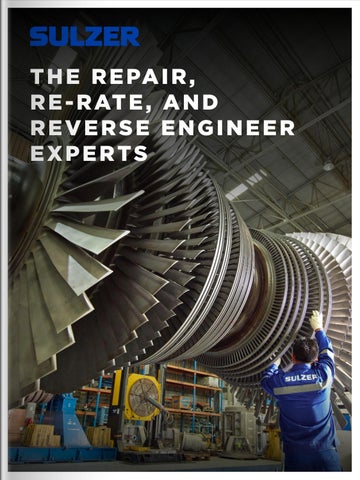
T H E R E PA I R , R E - R AT E , A N D REVERSE ENGINEER EXPERTS
T H E R E PA I R , R E - R AT E , A N D REVERSE ENGINEER EXPERTS Most rotating equipment used in power plants and process industries were built for outdated operating conditions. Brian Byrne, President, East Asia Pacific and Australia at Sulzer Services, explains how restoring existing assets can improve reliability, resilience, and cost performance Writer: Rachel Carr | Project Manager: Eddie Clinton
A
cross the Asia Pacific (APAC) region, turbines, pumps, compressors, and other rotating equipment that keep power plants, mines, and processing facilities running are under mounting pressure. Many of these machines were built for a different operating environment, yet today they must handle greater demand, changing loads, and duties that extend far beyond their original design. Sulzer helps operators meet these challenges through preventive maintenance, advanced diagnostics and testing, targeted repairs, overhauls, and re-engineering. 2 | APAC Outlook Issue 82
By combining broad technical capabilities with local expertise, Sulzer restores performance, improves reliability, and prolongs the working life of critical equipment. “When a machine fails, the downtime disrupts production and causes loss of revenue. New replacements take time operators cannot afford to lose, and for some older machines, the original parts are no longer available. “We help operators get their existing assets performing to today’s operational expectations and extend their lifespan,” introduces Brian Byrne, President, East Asia Pacific and
Australia (EAPA) at Sulzer Services. “We handle the full range of rotating equipment under one roof, from diagnostics and repairs to parts supply, upgrades, and life-extension solutions.” Sulzer’s Pump Services department handles centrifugal pumps; Turbo Services covers steam and gas turbines, centrifugal and axial compressors, and expanders; and Electromechanical Services deals with motors, generators, and select auxiliary equipment. As an original equipment manufacturer (OEM)-agnostic service provider, Sulzer works on equipment
SULZER ENERGY & UTILITIES
Brian Byrne, President, EAPA, Sulzer Services
from any manufacturer, handling a wide portfolio of categories across OEMs and assets, which has enabled the company to develop efficient repair and re-engineering methodologies. “Customers can bring maintenance, repairs, re-rates, and reverse engineering for all their rotating equipment to one provider without managing several vendors,” Byrne emphasises. “Rapid turnarounds and local expertise are important to our customers, including power generators, independent power producers, refineries, petrochemical
plants, mines, and water utilities. “We have over 20 service locations across APAC, including Australia, China, India, Indonesia, Malaysia, and Thailand, which means heavy repair work stays in-region.”
REPAIR VERSUS REPLACEMENT Rotating equipment is designed for specific loads and operating patterns. At many plants, however, operating demands have changed significantly since commissioning. In power generation, the grid is driving the transition. As renewable capacity expands, thermal plants designed to provide steady baseload
power are increasingly required to balance intermittent generation. Equipment that once operated at a constant load must now ramp up and down, start and stop more frequently, or run at very low loads beyond its original design parameters –conditions which introduce new stresses. Turbine rotors can develop thermal fatigue at the blade grooves, whilst generator end windings undergo repeated heating and cooling cycles. Insulation may age faster, and pumps can be forced to operate in unstable regions. As a result, operators are APAC Outlook Issue 82 | 3
SULZER ENERGY & UTILITIES
encountering new failure modes in machines that previously ran incidentfree for decades. In extraction and processing industries, including oil and gas and mining, operating demands evolve with the process itself. As fields mature and feedstocks change, pumps may need to handle increasingly abrasive or corrosive fluids, often whilst throughput targets continue to rise. A pump specified for one duty can therefore be pushed outside its preferred operating range, consuming more power, delivering less flow, and wearing out faster. Before recommending a repair, re-rate, or upgrade, Sulzer reassesses
WHAT ARE AN OPERATOR’S OPTIONS WHEN IT COMES TO WORKING WITH OLDER EQUIPMENT WHERE THE OEM MIGHT HAVE STOPPED MAKING PARTS? Brian Byrne, President, EAPA: “When a part can no longer be sourced, we re-engineer it, beginning by reverse engineering the original part using 3D scanning and precision measurement to capture its exact geometry so that work can proceed even without the manufacturer’s drawings. “We then redesign the component to meet the machine’s new operating requirements before manufacturing it in-house or through qualified suppliers. For instance, we supported an independent power producer in West Sumatra, Indonesia, by reverseengineering a turbogenerator that a third party had previously rewound. “When the machine was recommissioned, the stator suffered a major ground fault with
4 | APAC Outlook Issue 82
“ R E PA I R H A S A S M A L L E R C A R B O N F O O T P R I N T. A N E W M A C H I N E C A R R I E S THE EMISSIONS OF CASTING, FORGING, M AC H I N I N G , A N D S H I P P I N G I T AC R OSS T H E W O R L D , W H I C H A R E P A I R AV O I D S ” – B R I A N B Y R N E , P R E S I D E N T, E A S T A S I A P A C I F I C A N D A U S T R A L I A , SULZER SERVICES
each machine against its current operating conditions. It can then monitor performance to confirm that the chosen solution delivers the required improvement. “At one site in Australia, we worked on a high-speed multistage pump handling which produced water from a extensive core damage. The original manufacturer could not offer a repair and quoted USD$5 million for a replacement with a 14-month lead time. “We collected data on-site using scanning and precision measurement, reverse-engineered the stator core, produced new stator half bars in our own manufacturing facility, and assembled the core using a better grade of laminated steel. “The operator saved USD$2.5 million against the replacement quote, cut its lead time by 40 percent, and gained 35 years of life on a core that now runs more efficiently than the original. “For smaller and highly complex geometries, Sulzer leverages additive manufacturing technologies, including selective laser melting (SLM) and laser metal deposition (LMD), to directly manufacture metal components. Combined with computer numerical control (CNC) machining, LMD also provides an effective way to reconstruct, repair, or modify existing pump and turbine components.”
mature oil field. Rising concentrations of formation sand accelerated wear on the pump’s internal components, causing performance degradation and repeated failures. “Because the pumps were installed offshore, frequent maintenance and changeovers to the spare unit created a significant operational challenge. “Therefore, we replaced the original wear-resistant coatings and installed solid ceramic components in critical areas, substantially improving the pump’s resistance to abrasive wear. The average time between repairs increased from six months to more than three years. “The operator subsequently removed the pumps from its list of ‘bad actors’, significantly reducing maintenance requirements and associated operating costs,” Byrne reports.
GIVING EXISTING ASSETS A SECOND LIFE When a critical machine fails, operators may instinctively consider replacing it. However, the existing equipment may still have years of useful life remaining. Sulzer assesses whether a repair can restore the machine safely, reliably, and economically before recommending replacement. “We first look at the cost of an unplanned outage per day, compared with the required downtime. A new unit could take 12 to 14 months to arrive. However, depending on the fault, a specialist could complete a repair in weeks or months,” Byrne explains.
“For example, a project in Malaysia had a gas turbine rotor that began showing rising vibrations after more than a decade, and inspection revealed critical defects. “Replacement through the OEM would have meant a year of downtime and losses of up to RM1 million per day, so we carried out a life extension assessment on the rotor, proposed a repair programme, and completed it in three months.” Downtime cost is the first consideration; subsequently, Sulzer must also determine whether the machine can be restored to the required technical and reliability standards. If the damage is too extensive, or a repair cannot deliver the required performance, the company will recommend replacement. The case for repair is particularly strong for large, bespoke equipment such as rotors, stator cores, and casings, for which replacement parts or complete new units can be expensive and subject to long lead times. For other equipment, restoration can often extend service life significantly, provided the shaft and casing remain intact. “Repair has a smaller carbon footprint. A new machine carries the emissions of casting, forging, machining, and shipping it across the world, which a repair avoids,” he points out. APAC Outlook Issue 82 | 5
“A machine brought back to its original design point also burns less energy to do the same work, which cuts operating emissions and fuel costs. For operators reporting against emissions targets, a repair delivers on time, with savings in money, energy, and emissions.”
REBUILDING OBSOLETE PARTS To ensure older machinery meets modern requirements, Sulzer restores and upgrades equipment to deliver reliable, improved performance. “Once a decision is made to keep a machine in service, we must manage accumulated wear and the duty it now faces. Most of our work falls into repairs, retrofits, re-rates, and lifeextension solutions,” informs Byrne. Repairs and overhauls reverse the effects of degradation. Submerged arc welding, for example, can rebuild worn turbine rotor journals and restore thrust collars and couplings to 6 | APAC Outlook Issue 82
“OUR SOLUTIONS HIGHLIGHT THE G A P B E T W E E N A M AC H I N E ’ S D E S I G N C A P A B I L I T I E S A N D W H AT T O D AY ’ S M A R K E T D E M A N DS , R E V E A L I N G W H E R E T H E M AC H I N E IS LOSING EFFICIENCY AND WHERE IT RISKS FA I L U R E ” – B R I A N B Y R N E , P R E S I D E N T, E A S T A S I A P A C I F I C A N D A U S T R A L I A , SULZER SERVICES
their original dimensions. In addition, laser metal deposition achieves similar results with significantly less heat, making it ideal for components that might otherwise distort. Both processes are typically followed by heat treatment, machining, and balancing. Re-rates and retrofits go a step further by changing what a machine is designed to do. New hydraulics can be installed within an existing pump casing to meet a revised duty point,
whilst requiring minimal changes to the foundations and piping. Steam turbines can also be re-rated to improve operational efficiency or accommodate changes in production output. Rewinds, meanwhile, restore the electrical integrity of motors and generators. Both re-rating and rewinding can incorporate modern materials and technology, improve performance, and potentially extend service life. “The upgrade is the biggest
SULZER ENERGY & UTILITIES
servicing. The lead times put its wind farm customers at risk of penalties for missing availability targets. After qualifying against the manufacturer’s own standards, our team overhauled a three-megawatt generator using laser cladding for metal repairs, which resulted in better durability than conventional metal spraying,” he continues.
opportunity because insulation systems and core lamination steels have improved since most installed machines were built. How much longevity a machine gains depends on its condition and the scope of work,”
Byrne notes. “We worked with one of the world’s largest wind turbine manufacturers in Australia who had no specialist generator repair capability and were shipping machines to Europe for APAC Outlook Issue 82 | 7
The overhauled machine returned better vibration results than units arriving straight from the factory, with an expected service life of 20 to 25 years. Consequently, the machine not only returns ready to meet its revised duty but is also fortified with better materials than when it was new. 8 | APAC Outlook Issue 82
A CHANGING GRID IS RESHAPING EQUIPMENT OPERATION The International Energy Agency (IEA) expects electricity demand to grow by an average of 5.3 percent a year in Southeast Asia and 6.4 percent a year in India through 2030, and operators must meet that growth amidst rising
operating costs, tightening efficiency, and emissions targets, largely with the machines they already have. The energy and heavy industrial sectors face several pressures, with rising operating costs adding to the challenge, whilst mandates require greater energy efficiency and lower carbon emissions.
SULZER ENERGY & UTILITIES
Scale Your Workforce. Not Your Risk.
Flexible staffing built for mining, energy and manufacturing demands. BUILD YOUR TEAM WITH RECRUITFIRST bara.p@recruitfirst.co
SULZER’S SERVICES (APAC) – IN NUMBERS 30+ years’ experience 1,550+ gas and steam turbines serviced 400+ compressors serviced 500+ engineering and technical personnel 53+ gigawatts of turbines serviced 300+ turbogenerators serviced 35,000+ square metres (sqm) of workshop space 20+ service/sales locations 4+ million manhours safety record
“Our solutions highlight the gap between a machine’s design capabilities and today’s market demands, revealing where the machine is losing efficiency and where it risks failure. “We begin with condition assessment, including diagnostics, vibration analysis, inspections, nondestructive tests, material analysis, and electrical testing,” states Byrne. “The process includes repairs, retrofits, or re-rates to bring the machine in line with its current demand, whether that means extending its remaining life or adapting it to how it is being run. Existing equipment can then meet today’s demand for a sustained period, without operators having to buy costly new units.” Byrne’s key advice for operators to maintain performance and uptime is to take a more proactive approach to maintenance and asset management. “That means establishing a clear
recruitfirst.co.id
baseline for each machine, monitoring how its condition and performance change over time, and acting on emerging trends before they become failures. The earlier operators can identify these changes, the more options they have to intervene before performance deteriorates or an unplanned outage occurs. “Active asset management can also uncover opportunities to improve efficiency and performance. Ultimately, the goal is to understand how each asset is performing today, anticipate what it will need tomorrow, and keep it delivering reliably for as long as possible,” Byrne ardently concludes.
sulzer.com
APAC Outlook Issue 82 | 9
www.sulzer.com
PRODUCED BY APAC OUTLOOK MAGAZINE