S I N G A P O R E N AT I O N A L E Y E C E N T R E
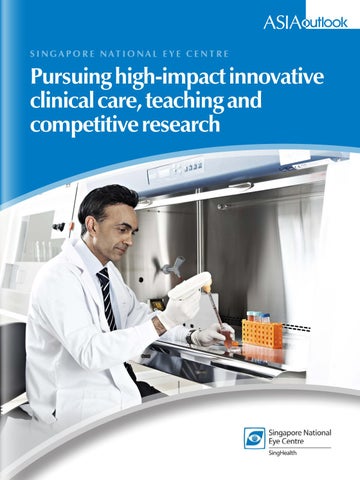
Pursuing high-impact innovative clinical care, teaching and competitive research
S I N G A P O R E
N A T I O N A L
E Y E
C E N T R E
International Eminence in
Ophthalmology The Singapore National Eye Centre seeks to transform eye care in Asia, bringing eye care to the community while increasing innovation, quality and value Writer: Phoebe Calver | Project Manager: Callam Waller n the middle of Singapore’s transition from a manufacturingbased economy to a knowledge-based “value creation” hub in 1990, the Singapore National Eye Centre (SNEC) was established. At that time, cataract was the major cause of blindness. Over time, this was compounded by an epidemic of myopia in young schoolchildren, leading to visual problems later in life. Concurrently, with an ageing population, glaucoma and agerelated macular degeneration (AMD) were becoming major problems. Fortunately, at the same time, the practice of ophthalmology was experiencing a revolution enabled by new technology. A prime example of this was eye doctors’ transition from standard extracapsular cataract extraction (ECCE) to small incision “sutureless” phacoemulsification, a method which gave both positive and predictable clinical outcomes in a faster recovery time. “We saw the gradual transition from in-patient surgeries into day surgeries and the gradual replacement of general with local anaesthesia
2
WWW.ASIAOUTLOOKMAG.COM
during procedures,” begins Professor Wong, the 5th Medical Director at Singapore National Eye Centre. “These changes provided the foundations for a standalone ambulatory eye centre, giving birth to the true concept of SNEC.” Undoubtedly, the establishment of SNEC as the national specialist centre for eye care that would be independent from the Singapore General Hospital (SGH) was one of the most profound changes for ophthalmology in Singapore, a change which would subsequently accelerate many other changes in the practice of eye care.
Ahead of its time
Beginning with a team of only nine, Professor Arthur Lim, the founding Medical Director of SNEC, experienced considerable resistance as a number felt uncomfortable leaving SGH as they were unsure if SNEC would be a viable entity. “Of course, for many eye surgeons at that time, joining a new startup standalone centre, separate from the 100-year
H
E
A
L
T
H
C
A
R
E
WWW.ASIAOUTLOOKMAG.COM
3
S I N G A P O R E
N A T I O N A L
E Y E
C E N T R E
IDS MEDICAL SYSTEMS
I
DS Medical Systems (idsMED) Group is one of the largest integrated solutions providers of medical equipment, supplies and services in Asia. The Company has an extensive distribution network covering various healthcare institutions including government and private hospitals, day surgery centers, specialist and primary care clinics, laboratories and nursing homes. The Company provides a comprehensive and one-stop solution to its customers with a focus on a number of key specialties including critical and primary care, infection control, surgical workplace, diagnostic imaging, hospital beds & furniture, cardiovascular, OBGY & perinatal, endoscopy, wound care, aesthetic, dental, emergency care, patient support system and surgical and biomedical engineering.
SNEC performs 38,000 surgeries and laser procedures annually
old ‘mothership of SGH’ was a very risky move. Shortly after Professor Lim mooted the idea of creating a research institute within SNEC,” explains Wong. “This led to the development of the new Singapore Eye Research Institute (SERI). The bravery to build a research institute within a new healthcare institution was way ahead of its time. Research in a healthcare setting at that time was seen as counter to the primary mission of hospitals, which was to provide care.” Times have changed considerably since that point in the Centre’s history, now fully embracing its role as a major academic eye centre in Asia and globally, with a triple and integrated mission of clinical care, research and education. Wong adds: “As part of delivering better care to our patients, SNEC encourages its younger residents to have diverse training and to gain experience in innovation, conducting
4
The group successfully operates in 8 countries across the continent: Singapore, Malaysia, Indonesia, Hong Kong, Philippines, Thailand, Taiwan and Vietnam. In Singapore, the Company has a history of over 50 years in the healthcare industry. The partnership between Singapore National Eye Center (SNEC) and idsMED Singapore goes back a few decades and has been growing from strength to strength over the years. The Company has been consistently promoting and supporting various infection control initiatives at SNEC, sharing different practices and solutions. The Company has also been an active player in surgical workplace and operating rooms at SNEC and looks forward to growing and nurturing this relationship further. In line with promoting healthcare learning & education, the Company also takes pride in hosting various educational roadshows and expert talks for SNEC staff. T +65 6690 7330
Prof Wong Tien Yin, Medical Director, Singapore National Eye Centre
WWW.ASIAOUTLOOKMAG.COM
www.idsmed.com
WE DELIVER HEALTHCARE SOLUTIONS TO IMPROVE QUALITY OF LIFE INFECTION CONTROL
SURGICAL WORKPLACE
CARDIO VASCULAR
PATIENT SUPPORT SOLUTIONS
BIO MEDICAL SERVICES
DIAGNOSTIC IMAGING
MEDICAL CONSUMABLES
O&G AND PERI-NATAL
HEALTHCARE EDUCATION
SINGAPORE
IDS Medical Systems (Singapore) Pte Ltd 20 Science Park Road #01-23/25, Teletech Park, Singapore 117674 Phone: +65 6690 7330 | Fax: +65 6690 7380
www.idsmed.com
INDONESIA
|
MALAYSIA
|
idsMED
@idsmed.sg
idsmed_sg
SINGAPORE | HONG KONG | PHILIPPINES | TAIWAN | THAILAND | VIETNAM
S I N G A P O R E
N A T I O N A L
E Y E
C E N T R E
ESSILOR Myopilux® Lenses Effectively Manage Childhood Myopia Singapore is the world capital of childhood myopia. Studies show that 65 percent of primary school students suffer from myopia. Telltale signs include struggling to see the whiteboard clearly, sitting overly close to television screens, eyestrain during gaming, squinting to see far objects like approaching buses, and headaches. Childhood myopia usually surfaces between the ages of five and six, but can start as early as three and progresses most rapidly during the preteens. The power generally stabilises when your child is older (where the eye stops growing), and the power is unlikely to reduce as your child gets older. Furthermore, a high degree of myopia increases the risk of sight threatening eye conditions, such as glaucoma and retinal detachment, in adulthood. Therefore it is important that the progression of childhood myopia is managed and slowed down. The question is – how?
Singapore National Eye Centre
research projects, and becoming part of its teaching faculty. SNEC now partners with Duke-NUS Medical School Singapore to train future clinicians, clinician-educators and clinician-scientists as part of the massive uptake in biomedical sciences that are now recognised as the fourth pillar of Singapore’s economy. “27 years after SNEC was conceptualised, Singapore’s population has almost doubled and now stands close to 5.5 million; this means we now face new challenges in eye care, particularly with an ageing population,” pointed out Wong who is also Chairman of SERI and Vice-Dean of Clinical Sciences at Duke-NUS Medical School.
Significant improvements
Today the Singapore National Eye Centre receives 340,000 outpatient visits annually, meaning that more than 1,000 patients are coming through its doors daily, while performing
6
WWW.ASIAOUTLOOKMAG.COM
As part of delivering better care to our patients, SNEC encourages its younger residents to have diverse training and to gain experience in innovation, conducting research projects, and becoming part of its teaching faculty
The standard method of treatment is prescription eyeglasses. However, not all lenses are created equally. Myopilux® progressive lenses, developed over 10 years by French optical manufacturer Essilor, have been delivering promising results. In a two-year study amongst 87 children aged between seven and 13, it was found that Myopilux® lenses slowed down myopia progression by up to 62 percent. Glasses fitted with Myopilux® lenses address the need to correct and manage myopia, by concurrently correcting far vision and reducing strain for near vision. They are superior to single vision lenses, which only correct far vision without reducing the strain on near vision. Choosing Myopilux® lenses is as good as gifting your child with the best possible eyesight of their life. It’s an investment worth considering.
http://bit.ly/29MBvAy
S I N G A P O R E
N A T I O N A L
E Y E
C E N T R E
CARL ZEISS
C
arl Zeiss Medical technology products and solutions aim to help physicians to improve patient outcomes and their quality of life. With a special focus on ophthalmology, ophthalmic surgery and visualisation systems in the field of microsurgery, the Company supports healthcare professionals in setting new standards of care with proven medical technology and broad application competence based on cutting-edge innovations. Carl Zeiss Medical technology also offers visualisation solutions for dental treatment and gynaecology. The Company’s medical technology portfolio is completed by futureoriented technologies such as intraoperative radiotherapy.
www.meditec.zeiss.com Pursuing high impact competitive research is one of the tenets of SERI
42,000 major eye surgeries and laser procedures. With its level of expertise in the industry, SNEC also receives tertiary referrals for complex eye conditions from overseas, such as advanced retinal conditions, corneal transplants and paediatric eye conditions. “In the 1990s, SNEC was also among the first centres worldwide to videotape and record all surgical procedures to use in clinical audit and teaching,” continues Wong. “This is still practiced today and we have a specialist team that audits the outcomes of procedures and this is presented to all doctors in a forum among their peers annually.” For the research institute, SERI is now Singapore’s national research institute for ophthalmic and vision research, with a mission to conduct high impact eye research with the aim to prevent blindness, low vision
8
WWW.ASIAOUTLOOKMAG.COM
In the 1990s, SNEC was also among the first centres worldwide to video-tape and record all surgical procedures to use in clinical audit and teaching
H
E
A
L
T
H
C
A
R
E
REIMAGINING ZEISS Intraocular Lenses (IOLs)
EYE CARE
Modern cataract treatment technology Different types of intraocular lenses – from monofocal to multifocal are available today is the global in eye care. Aspatients. a division of Novartis, toAlcon accommodate various leader vision needs of cataract
we discover new ways to enhance sight and improve people’s lives. We have done this successfully for 70 years, through innovative products, partnerships with eye care professionals and programs that create greater access to quality eye care. Vision simulation with a monofocal lens: clear vision at distance
Vision simulation with a bifocal lens: clear near and distance vision
WHO WE ARE
® Benefits of ZEISS AT LISA tri lenses: & WHY WE EXIST
• Three focal points for clear Sight is arguably our most important sense, and vision at various distances: data shows that people describe losing eyesightand as far near, intermediate potentially having the greatest impact on their day-to-day life.1
Vision simulation with a trifocal lens: clear near, intermediate and distance vision
QUICK FACTS
• Correction of existing vision disorders, including astigmatism and presbyopia
• 93%* of patients treated with ZEISS AT LISA tri lenses no longer require glasses
*Data available upon request Incorporated in 1947
www.zeiss.com/lisa-tri
This is only for basic information. It is not to be considered medical advice or a substitute for obtaining your own medical consultation, please consult your ophthalmology for further assessment.
Alcon began as a small ophthalmic pharmaceutical shop in Fort Worth, Texas. Through breakthrough innovations, strategic acquisitions and partnerships, and a deep-rooted commitment to partnering with SG_SNEC-Ad-IOLs-96x160mm_v1.indd 1 and serving eye care professionals, we’ve grown into the global leader in eye care.
Our products touch the lives of millions of people each year living with conditions like cataracts, glaucoma, retinal diseases, and refractive errors. We offer the most complete line of ophthalmic surgical devices, as well as a differentiated contact lens and lens care portfolio to help patients see, look and feel their best.
Operations in 74 countries 3/17/2017 10:59:39 AM
16,000 associates Serving patients in 140 countries
REI MAGI NI NG
EYE CARE Global leader in eye care
WWW.ASIAOUTLOOKMAG.COM
9
S I N G A P O R E
N A T I O N A L
and major eye diseases common to Singaporeans and Asians. SERI has the unique distinction of being among the first research clinics to be located and embedded in a hospital “During the past decade or so, SERI has conducted landmark research that has led to tangible outcomes, continuous patient benefit and success stories,” Wong describes. “It has paved the way for significant improvements in the way in which eye diseases are treated and prevented, not just for Singaporeans or Asians, but on a global scale.” SERI has now published 2,700 scientific journal papers as of January, 2017, alongside securing 252 external peer-reviewed competitive grants worth more than $227 million and being awarded more than 400 national and international prizes.
E Y E
C E N T R E
facility provides an additional 15,000 square metres to the already existing area of 6,500 square metres. “Today our facility features a full array of consultation clinics, well-integrated diagnostic, imaging and laser systems, modern operating theatres, day recovery suites, sophisticated training and education facilities as well as a dedicated floor to house the SERI’s trial
clinics and comprehensive ancillary and support facilities,” Wong describes. “On top of that SNEC has 80 consultation suites and nine operating theatres.” All of the above enhances SNEC’s capabilities in the healthcare sector to deliver cost-effective and quality eye care to meet increasing demand and expand its role in ophthalmic education and research.
Expanding facilities
With the tremendous growth that has been achieved since SNEC’s inception, the plans for a new-phase two-wing Centre were conceived as early as 1992. Completed in October, 2001 at a total cost of $50 million, SNEC’s new purpose-built, eight-storey phase-two
The SNEC Faculty (Ophthalmologists)
10
WWW.ASIAOUTLOOKMAG.COM
Singapore Eye Research Institute occupies four floors in the purpose-built Academia building
H
E
A
L
T
H
C
A
R
E
Pioneering innovations becoming of the leading
Nurturing the young generation of ophthalmologists,education is one of the pillars of SNEC
In 2014, SNEC developed the Retina Centre, complementing the services of the adjacent new Diabetes and Metabolism Centre on the campus. Then SERI started operations in the Academia Building which opened in 2013. There are four levels of basic and advanced eye research facilities such as corneal tissue engineering and stem cell, ocular genetics, ocular therapeutics, drug delivery as well as a retinal reading centre and research administration office. “The new building is able to offer a more conducive environment for greater synergies in pathology, medical research and education to raise the benchmarks for better healthcare,” clarifies Wong. “Located within the vicinity of the clinical services at
SNEC and Duke-NUS Medical School, this is a key milestone in academic medicine with a vibrant environment for networking and professional collaborations to advance diagnosis, treatment and innovative care for patients.”
Transforming healthcare
SNEC is actively involved in local and multi-centre clinical trials and research into the causes and treatment of major eye conditions such as myopia, AMD, diabetic eye disease, glaucoma and corneal conditions, with hundreds of ophthalmologists from neighbouring countries. The Centre has been privy to thousands of ophthalmologists from neighbouring countries and beyond participating in the Centre’s teaching
courses and international meetings which are organised annually. In order to advance ophthalmic science and service, and to increase opportunities for professional interactions and collaboration, SNEC has also fostered strategic links with leading eye institutions the world over. Not only is the institution as a whole well-respected, but it has also selected the top talent to take it forwards successfully. Wong continues: “Three of our top clinicians from the Singapore National Eye Centre and the Singapore Eye Research Institute were awarded the prestigious President’s Science and Technology Award in 2009, 2010 and 2014 for their outstanding contributions in translational, clinical and epidemiological research in cornea, retina and glaucoma. “Apart from retaining this top level of talent, the other challenge we face is in continually providing good service, and even with an ever-increasing workload, we saw 250,000 annual visits in 2007, compared to close-to 340,000 today.” An issue for the Centre is the time in which it takes to increase its manpower, due to the many years - up to 12 - that it takes to train a specialist, and at present it is challenging to keep up with the increasing population demands. However, SNEC is now working closely with the Ministry of Health with the overall aim to transform eye care, bringing eye care to the community, while enhancing quality and value for the patients. Over the next five-10 years, SNEC and SERI hope to develop new innovation in areas of deep learning technology or artificial intelligence for diabetic retinopathy screening, telemedicine for remote diagnosis and monitoring, step-down community eye care for patients with mild or stable eye disease, and new surgical treatments such as minimally invasive glaucoma surgery and stem cell therapy for retinal diseases.
WWW.ASIAOUTLOOKMAG.COM
11
Singapore National Eye Centre 11 Third Hospital Avenue, Singapore 168751 Tel: +65-62277255 feedback@snec.com.sg
www.snec.com.sg
www.outlookpublishing.com