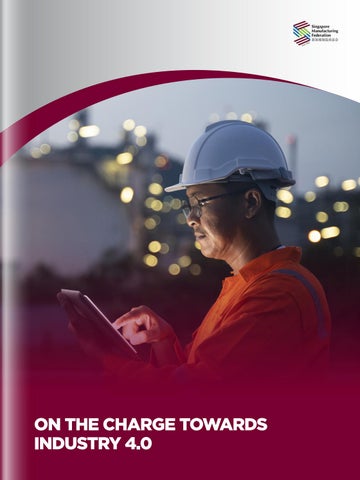
ON THE CHARGE TOWARDS INDUSTRY 4.0
INDUSTRY SPOTLIGHT
MANUFACTURING IN SINGAPORE Singapore has one of the world’s most innovative and advanced manufacturing industries, moving full throttle towards Industry 4.0 Writer: Dani Redd | Project Manager: Matt Cole Wilkin
S
ingapore has one of the world’s most stable economies. According to Bloomberg’s 2020 Innovation Index, it is the third most innovative economy in the world too, scoring high on tertiary efficiency and higher education enrolment. The country’s largest industry is manufacturing, which contributes around 20 of GDP every year. Key industries within the sector include electronics, chemicals and biomedical engineering – it is also the fourth largest exporter of high tech products in the world.
INTRODUCTION
Rapid growth Singapore’s manufacturing industry is growing rapidly, and appears to be bouncing back after lockdown. In September 2020 it jumped 24.2 percent year on year, which was far above economists’ projections of a 2.5 percent rise. While precision engineering and general manufacturing subsectors shrank, there was a huge rise in biomedical manufacturing, specifically pharmaceuticals (113.6 percent). The electronics subsector also rose by 45.3 percent. These are strong figures, which are even more remarkable bearing in mind the global pandemic. So what explains the strength of the manufacturing sector in Singapore? One reason is the country’s commitment to innovation and technology. When Singapore became an independent republic in 1965 it had a small, low productivity manufacturing industry, and quickly began working towards industrialisation. It quickly moved towards high-skilled and technologyintensive economic activity, introducing high-paid
2 | APAC Outlook issue 48
positions and easing out labour-intensive, lowpaid positions through automated production and industrial robots. By the 1980s computers and electronics soon began to constitute the largest section of the manufacturing industry. Singapore is behind some of the world’s most compelling manufacturing advancements, including robotics, additive manufacturing, predictive analytics and artificial intelligence. Multinational manufacturing firms are attracted to the country because of this innovative culture. For example, in 2019 British manufacturer Dyson established a US$427 million research and development centre to complement its advanced digital motor manufacturing facility (also located in Singapore). Singapore has also become a leading chemical manufacturer, despite the fact that it is not an oilproducing country. In the 1990s, the government reclaimed 12 square miles of land from the ocean
FACTS & FIGURES Sub-sectors: Chemicals, electronics, precision engineering, pharmaceuticals Contribution to GDP (%): 20.9 (2019) Sector growth (yoy): 24.2% (September 2020) GDP (Singapore $): 100.5 billion (2019)
off the southern coast, which they converted into a chemical manufacturing site. More than 100 global petroleum, petrochemical and specialty chemical companies are located on the Jurong Island site, which has become a world-leading chemical manufacturing site. Modern day Singapore has a strong, diversified manufacturing sector, which is preparing for further evolution through the adoption of Industry 4.0.
Industry 4.0 in Singapore Industry 4.0 refers to The Fourth Industrial Revolution, and refers to the enhancement of computers and automation (the third industrial revolution) with smart autonomous systems
fuelled by data and machine learning. In 2018, Singapore was ranked second worldwide in the World Economic Forum’s Readiness for the Future of Production Report. Its base of world-leading technology companies and solutions providers mean it has the capacity to transition to Industry 4.0 – the country houses Accenture’s IoT Centre of Excellence and Siemens’ first digitalisation hub. The government has committed to investing US$2.3 billion into R&D in the manufacturing and engineering sectors, helping boost the capacity of companies embarking on Industry 4.0. It has also Eleveted, night view established the Smart Industry Readiness Index, of Makati, the business the world’s first ever self-diagnostic tool allowing district of Metro Manila companies to assess their readiness for Industry 4.0.
I INNTTRROODDUUCCTTI IOONN
THE SINGAPORE MANUFACTURING FEDERATION
APAC Outlook issue 48 | 3
What Packaging means to Medical Device Companies
Santosh Madival
W
ith the global production and distribution of various COVID-19 vaccines underway, it is fitting that we take a look at the healthcare industry, and more specifically, the packaging manufacturing sector within this industry. Oliver Healthcare Packaging is a global leader in medical packaging. The Oliver legacy has consistently been one of innovation, technical expertise, customer focus, and a commitment to excellence. Oliver is headquartered in Grand Rapids, Michigan, and operates manufacturing sites all around the globe. It continues to invest, expanding its footprint and distribution network to bring quality packaging where its customers need it most. We spoke to Santosh Madival, Senior Principal Engineer at Oliver Heathcare Packaging, about medical packaging and the wider healthcare and manufacturing industry. APAC Outlook (AO): Could you give us a brief overview of medical packaging, its importance, and a few details regarding operations? Santosh Madival (SM): The primary role of medical packaging is to keep its contents sterile until the point of use. Medical device companies need to consider package design, sterilisation, testing requirements, manufacturing process validation and transportation validation in their package development process. Packages come in different forms, most commonly, pouches or trays. Material and package type are largely dependent on sterilisation method and device features, but other factors such as manufacturing processes and logistics are critically important as well. Incorrect material selection or package design can lead to damage resulting in a package that will fail to maintain the sterile integrity of the system. Such non-sterile devices when used, may severely impact a patient’s treatment and recovery time and in extreme cases may even cause death. Converters are companies that manufacture semi-formed or pre-formed packages. They are manufactured in a controlled and monitored clean room environment so as to minimise contamination. Medical device companies then use the preformed packages to package their device, also in a clean room environment and subsequently sterilise and distribute them. The entire operation from creating a pre-formed package until the final distribution of sterile medical devices is highly regulated by requirements set forth by different governing bodies in various regions of the world. At different levels both converters and medical device companies have to comply with those requirements that are outlined within various standards, such as ISO standards, to be able to manufacture and sell their devices within the respective regions. AO: Tell us about the key benefits of producing medical packaging? SM: Working in a regulated environment and with start-ups, as well as large established medical device and pharmaceutical companies, gives Oliver tremendous insight into new and changing technologies in this industry. The packaging we produce is considered a sterile barrier, it is intended to protect the
device from contamination, while it is undergoing transportation and distribution, or ensure the outside seals remain intact while going through rigorous sterilisation conditions. In the end, customers have additional expectations around shelf-life, and how long the packaging would retain its expected seal characteristics after sitting on a hospital shelf for years. Though material science evolution is slow to move in the healthcare space, working with our customers on new devices has presented a lot of advantages in helping the healthcare industry and thus patient outcomes have improved over the past few decades. Increasing regulatory requirements in all the major markets are adding additional challenges in getting devices launched. As a producer of medical packaging, Oliver has been able to interpret the regulatory changes into outcomes on which materials, designs and processing will ensure our customers launch products on time and help them meet the validation requirements. In addition to this, as we formulate our own adhesives and commercialise them, and as customers move to more sustainable sterilisation modalities, we have been able to ensure our coatings and materials are suitable for more environmentally friendly sterilisation requirements. All of this makes medical packaging and healthcare unique and challenging yet one of the top rewarding industries in terms of helping people. AO: What is your take on the development of the medical industry in Asia at the moment? Is it an exciting space to be working in? SM: Globally, medical device and therapeutic manufacturing markets are growing. Asia Pacific countries are a big part of that. The market in Asia-Pacific is wellpositioned to serve its growing MedTech industry. An aging population, higher access to healthcare services, and growing disposable incomes fuel the APAC region’s market potential and opportunities. Today, a large portion of the market produces lower-end class I and II devices, but we also see growth in higher-end (class II and III) device manufacturing, which are typically more challenging from a packaging standpoint. Oliver launched a state-of-the-art manufacturing facility with ISO-7 cleanroom manufacturing in Suzhou, China in 2018, and last year, we opened a new Technical Development Centre and office in Singapore. The Technical Centre offers customers a more interactive experience, where they can work with our engineers to quickly generate and prototype package designs. As both facilities serve the APAC medical device industry, the collaborative process and advanced expertise has been transformative for all of us. As established partners invest in this region, Asia’s producers are seeing a welcome rise in available technical services. Helping fill these gaps has connected us with talented, passionate, and visionary minds. It is exciting to see and be part of the upward trajectory.
A global partner who understands your business and your region, we can help you manage the technical, quality and regulatory challenges that come your way. WHY CHOOSE OLIVER?
Oliver Healthcare Packaging offers an array of packaging solutions, from medical device packaging, to drug delivery or pharmaceuticals, and packaging for diagnostics. With the shocking worldwide spread of the COVID-19 virus, the investment into various technical centres have allowed the company to provide its services across the board in this key and critical period of time. “Oliver has made significant investments in our global facilities, including several new Technical Centres located in key locations for the medical device, diagnostic, and pharmaceutical industries. Our centres are staffed with technical experts with industry experience and are available to our customers to collaborate on activities including packaging design and innovation, testing and troubleshooting.” - Kevin Zacharias, Technical Director Singapore Technical Centre The Technical Centre is a hands-on, collaborative environment where customers and prospective customers can work directly with our sterile barrier packaging experts to design, test and troubleshoot their packaging. The centre offers a variety of capabilities, including: • HDPE CleanCut Card/Pouch design and rapid prototyping to increase your speed to market • Package integrity testing, including submersion leak testing and dye penetration testing • Package seal strength testing, including peel testing • Material testing, including puncture, tensile, grammage / yield testing, and coefficient of friction (COF) • Material analysis, including microscopic analysis and package failure evaluation • Troubleshooting for packaging challenges and process related issues • Technical and design consultation
Oliver™ Healthcare Packaging, 73 Science Park Drive #01-08/09, CINTECH 1, Singapore 118254 Contact: +65 6232 4001 | Website: www.oliverhcp.com | www.linkedin.com/company/oliver-healthcare-packaging/
INDUSTRY SPOTLIGHT
Interview: The Singapore Manufacturing Federation
A S S O C I AT I O N
T
he Singapore Manufacturing Federation (SMF) is the largest national organisation in Singapore, representing the interests of manufacturing-related industries. It was first established in 1932, just after the first Singapore Manufacturers Exhibition was held. It was the work of the Governor and Commander-in-Chief of the Straits Settlements, Sir Cecil Clementi, who vigorously championed the development of industries in Singapore (apart from rubber and tin), and strongly advocated the setting up of a representative body to advance the interests of small local manufacturers. After the exhibition, the exhibitors continued to meet with the intention of setting up an association to nurture local manufacturers. On September 20, 1932, the association was formally incorporated as a Company Limited by Guarantee with 17 member-companies. The SMF’s initial vision and purpose was to diversify the island’s economic base, nurture its fledgling industries, and champion the collective needs of its manufacturing enterprises. APAC Outlook spoke to Douglas Foo, current president of SMF, about the organisation’s current goals and visions, as well as gaining a deeper insight into Singapore’s manufacturing sector. APAC Outlook (AO): Since inception, how has the Singapore Manufacturing Foundation developed and progressed in terms of its key objectives and the messages it tries to get across? Douglas Foo (DF): Over the years, the SMF has championed the interests of the local manufacturers and worked with them to continually grow the manufacturing community in Singapore. This role
6 | APAC Outlook issue 48
has remained unchanged through the years. Over time, the SMF built its credibility as a steadfast partner to manufacturers and to nation building. With collaboration as a fundamental tenet of the SMF’s ethos, it progressively garnered a higher public profile as it actively submitted proposals to the government and engaged the media. In its role as a partner to nation building, when the late Mr Lee Kuan Yew became the first Prime Minister of Singapore in 1959, SMF leaders helped to garner support for the new government’s economic proposals. In 1965, the SMF hired its first Secretariat to manage the Federation and liaise with the government. In the same year, the SMF signed a historic charter for industrial progress with the National Trades Union Congress and the Singapore Employers’ Federation. It was believed to be the first joint-agreement of its kind in Southeast Asia. Today, the SMF is proud to represent the interests of close to 4,000 members comprising SMEs, MNCs and affiliate members. AO: What do you find most exciting about the manufacturing industry in Singapore? DF: The manufacturing sector in Singapore has a high commitment to innovation, which differentiates us from the rest of the world. Today, Singapore is the world’s fifth largest refinery export hub and is also amongst the top 10 of global chemical hubs. Also, the manufacturing sector in Singapore is constantly evolving. With Singapore not having the land resource that other countries have, the focus is on cultivating a culture of continuous upskilling of the workforce, and increasing the
THE SINGAPORE MANUFACTURING FEDERATION
consumed in a digital space would not have been imagined when the traditional games console was conceptualised. AO: On the flip side, what are its biggest challenges? DF: The perennial challenges of manufacturing in Singapore stem from us being land and natural resource scarce. Operational costs must be carefully managed and our businesses must constantly innovate to bring our products out of Singapore, as the local consumer market is small relative to countries such as China and the US. In addition, Singapore as a trading hub is susceptible to the global economic climate; our manufacturers have to work hard at working smart in planning inventories for production and stock.
A S S O C I AT I O N
efficiency and productivity of the manufacturing sector through the use of technology. It is in this regard that the SMF has set up a professional training Centre for Corporate Learning (CCL) to better provide training in the relevant corporate fields. As manufacturing continues to evolve globally, we can take reference from our history to get a sense of how this sector can change beyond our current imagination. For example, in the past video games came in the form of game cartridges – manufacturers had to produce different parts including the gaming console box, the cartridge that contains the game software, a controller, as well as a monitor screen to view the game. Now, digital games are downloaded onto phones with just a tap on the screen. Therefore there is now almost no need to have factories to produce these digital games. The manufacture of a non-physical product that is
APAC Outlook issue 48 | 7
A S S O C I AT I O N
INDUSTRY SPOTLIGHT
AO: How has COVID-19 affected the manufacturing industry? DF: Much has been said, and in certain circumstances felt, about the negative effects that COVID-19 has brought. However, here at the SMF we believe that there is always opportunity in crisis. It is important to take an optimistic approach because there is no good in lamenting things that we cannot change. What we should do is make the best of every situation and be prepared to be in the best position possible to seize opportunities when the effects of the pandemic recede, and ride the upswing of the economic cycle. In this regard, it is heartening to see that many companies are using this opportunity to send their staff for training, re-examining their business models, adopting more digital solutions and making their workforce more mobile by implementing remote working arrangements. Lessons have been learnt about the necessity to inculcate agility, resilience and flexibility in the way we do business and interact with one another. It is also a relief to see that there are still many bright spots in the manufacturing sector such as the medical technology industry, life sciences
8 | APAC Outlook issue 48
industry and smart automation industry. With these industries doing relatively well, there is perhaps some cushioning effect for services and products up and down the supply chain to these industries. What is heartening to see in such economic uncertainty is how the government, employers and employees band together in solidarity as part of a tripartite alliance to work through this difficult time. AO: What trends are currently transforming the manufacturing industry in Singapore? How are you responding to them? DF: Perhaps the biggest trend transforming the manufacturing industry is the COVID-19 pandemic. Previously, there was little or no impetus to change the way business is done traditionally. Given the differing preventive measures taken from country to country and city to city, our manufacturers now have to do with uncertainty both from the supply and demand side. Manufacturers must be able to adapt quickly. Perhaps an area which has seen the biggest change for our manufacturers would be that of making their products known to the world. Prepandemic, trade associations like the SMF would lead our members on business missions, set up exhibition
www.SembcorpEnergy.com.sg
Sustainability Is Our Business At Sembcorp, sustainability is at the heart of what we do. As a one-stop sustainable solutions provider, we help you cut your carbon footprint and optimise performance across energy, water and waste. With a customer-centric approach, we will conduct a sustainability performance baseline assessment based on your challenges and needs to propose an integrated solution. Our solutions and executions can be measured in real time on a customised Sembcorp Sustainability Dashboard to help you track your sustainability journey.
Meeting your business needs through resource optimisation
Our Approach
Meet sustainability targets
Outsource capabilities to raise efficiency & productivity
Your Needs
Optimise savings and flexibility
Understanding your needs and challenges
Establishing your baseline environmental performance across intended areas
Customising solutions to meet your operational needs and sustainability targets
Comply with environment regulations
Contact us for a consultation today!
www.SembcorpEnergy.com.sg
Hello@Sembcorp.com
+65 6723 3113
INDUSTRY SPOTLIGHT
A S S O C I AT I O N
“The future of manufacturing is exciting – there is no telling if the next five years will be realised in the next two years or sooner. No matter, we will advance if we adopt a positive “can-do” attitude and stride into each new frontier with confidence and optimism”
pavilions to exhibit their products and offerings and attend physical networking sessions. In line with safe distancing measures and travel restrictions, we have quickly adapted to allow for our businesses to exhibit their products through virtual exhibitions and online business missions. The SMF has also conducted virtual business matching sessions for our members with overseas counterparts. The pandemic has also shown companies the importance of banding together to work as a pack, thereby increasing the chances of success. Digitalisation is another major trend happening in the manufacturing sector in Singapore. Under the fourth industrial revolution, the manufacturing sector is being encouraged to embrace and implement digitalisation into their operational processes to efficiency. Technologies like Artificial Intelligence (AI), Internet of Things (IoT), autonomous vehicles and additive manufacturing (3D printing) are some of the more common technologies that manufacturers are experimenting with for integration into the production process. AO: Have you got any projects in the pipeline you wish to highlight? DF: Some of the projects that the SMF are working on include: identification of new areas of business model innovation and conducting courses and seminars on the same to businesses; promoting digitalisation and innovative advanced manufacturing techniques such as 3D printing; “Manufacturing as a Service” through AI business ad usage matching; and, working with our manufacturing counterparts overseas to prepare for a technical “GiG” Economy. The SMF will continue to curate programmes and services which will serve our members’ interest. The key areas that the SMF focuses on are skills upgrading and conversion in the manufacturing sector, digitalisation, internationalisation and data analytics. We welcome anyone willing to collaborate to get in contact with us.
10 | APAC Outlook issue 48
AO: How do you see the manufacturing industry developing over the next five years? DF: Given the pace of evolution of the manufacturing industry, it would difficult to predict and of little value to speculate what the industry would be like over the next five years. However, if we see what some of the more advanced factories of automobiles such as Mercedes and McClaren are doing, it would quickly become apparent that manufacturing will evolve from being one that is thought to be labour intensive in production lines to one where human involvement is in supervision and perhaps quality control. The use of data, collected from more technologically convenient sources, to understand the wants and needs of consumers, will help reduce wastage and focus production. Production for consumption in the digital realm should also take on greater importance and scale. The future of manufacturing is exciting – there is no telling if the next five years will be realised in the next two years or sooner. No matter, we will advance if we adopt a positive “can-do” attitude and stride into each new frontier with confidence and optimism.
The Singapore Manufacturing Federation 2985 Jalan Bukit Merah SMF Building Singapore 159457 Tel: (65) 6826 3000 Fax: (65) 6826 3008 www.smfederation.org.sg
www.SembcorpPower.com
Sustainability is our business Sembcorp Power is a trusted home-grown brand that has powered Singapore for over two decades. We are proud to make Singapore a more sustainable place to live in with greener electricity plans for residential households, SMEs and large businesses. Your energy needs and sustainability targets become ours when you choose Sembcorp.
Greener power plans for your home
Customisable business power plans
Sembcorp Power offers residential households in Singapore competitive blended-green electricity plans.
Achieve your sustainability targets with our range of business power plans for small to medium enterprises.
Greener power for a more sustainable environment
Achieve your sustainability targets
Customisable power plans to suit your needs
Reliable and supportive customer service
Kickstart your sustainability journey with us. Scan QR code to find out more.
www.SembcorpPower.com
Support@Sembcorp.com
+65 6723 3113
INDUSTRY SPOTLIGHT
Focus on:
Oil & Gas
The O&G sector in Singapore is heavily investing in research and development. Dani Redd tell us more
F OBUSINESS C U S O N : O IINSIGHT L & GAS
S
ingapore is a leading oil and gas manufacturer – in fact, it is one of the world’s top five oil trading and refining hubs, housing over 3,000 established marine and offshore engineering firms. It is also a world leader in the construction of jack up rigs, semi-submersibles and exploration platforms. The oil industry contributes around five percent of Singapore’s annual GDP, and employs some 10,000 workers. The country’s key strengths in engineering, manufacturing and innovation have attracted some of the largest multinational O&G firms, such as Baker Hughes, Halliburton and TechnipFMC. These companies have entrusted their Singaporean divisions with the manufacturing of important product lines, such as completion tools and artificial lift. Many of these companies are headquartered on the Jurong Island petrochemical complex, which has a refining capacity of 1.3 million barrels per day, makes up a third of Singapore’s manufacturing output and has attracted over $35 billion in investment. The O&G sector in Singapore is heavily investing in research and development. The Technology Centre for Offshore and Marine Singapore (TCOMS) is the country’s first national R&D centre for the sector. It was launched in 2016 to facilitate public-private partnerships and develop innovative industry solutions. The centre boasts nearly $107 million of top infrastructure, including a deep water ocean basin. International O&G companies are drawn to Singapore not only by the country’s innovation, but because of a skilled workforce. “Talent is a key enabler for this complex and dynamic industry.
12 | APAC Outlook issue 48
As it constantly upgrades capabilities to operate state-of-the-art technologies, companies can tap a highly skilled workforce capable of managing highend complex manufacturing and research projects,” explains Lim Kok Kiang, Assistant Managing Director of Economic Development Board. The government is constantly putting new initiatives in place to ensure talent is developed and maintained. For example, the National University of Singapore recently established both a maritime technology and subsea engineering professorship programme. Despite the shocks of COVID-19 and a slow global movement towards carbon neutral economies, the outlook for Singapore’s O&G industry remains positive. This is thanks to recovering prices, strong demand from the transport industry and sustained growth in consumption of natural gas, petroleum and petrochemical products. Government support in the industry and R&D investments by major players continue to boost and fuel this manufacturing sub-sector.
THE SINGAPORE MANUFACTURING FEDERATION
Warehouse & Sort Centre
Food Production Industry
Focus building core competency in present time and creates new capability for tomorrow A-Plus Automation (S) Pte. Ltd. Block 3016 Bedok North Ave.4 Eastech #03-20 Singapore 489947 Tel : +65 6245 5886 Fax : +65 6245 5883
www.aplus-am.com sales@aplus-am.com
The companies shaping and disrupting the manufacturing sector in Singapore SUNNY METAL & ENGINEERING Sunny Metal & Engineering is a one-stop metal processing and manufacturing centre located in Singapore.
QUALITY LABORATORY FURNITURE MANUFACTURER
A-PLUS AUTOMATION
Sunny Metal & Engineering was established in 1974 and has evolved into one of the leading manufacturers of laboratory furniture systems in Singapore. We provide one-stop bespoke, finest quality and best priced solutions, even if the orders are small batch quantities.
A-Plus Automation engineers and manufactures equipment using fully-integrated systems.in Singapore.
We are customer-centric, always working on the fastest turnaround time for every customised solution, delivering superior made in Singapore laboratory furniture systems of international standards.
Dassault Systèmes Singapore Samsung Asia Dyson Singapore
We are also ISO9001:2015 and bizSAFE 3 certified. Other than a fully equipped factory with best of class machineries from Germany and Japan, we also apply quality management system and highest standards in workplace safety and health (WSH).
Diana Pang +65 96686038 | diana@sunnymetal.com | www.sunnymetal.com Ben Pang +65 94576219 | yj@sunnymetal.com
APAC Outlook issue 47 | 13
The Singapore Manufacturing Federation 2985 Jalan Bukit Merah SMF Building Singapore 159457 Tel: (65) 6826 3000 Fax: (65) 6826 3008 www.smfederation.org.sg
PRODUCED BY APAC OUTLOOK MAGAZINE