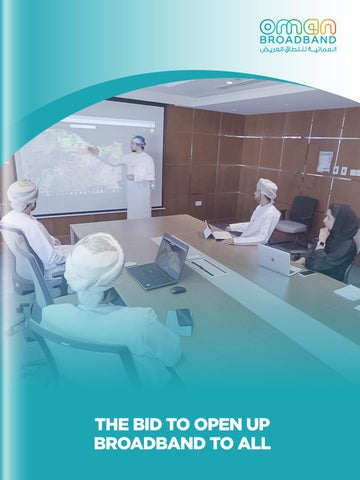
THE BID TO OPEN UP BROADBAND TO ALL
OMAN BROADBAND COMPANY
OMAN’S
CRITICAL CONNECTOR Having successfully connected more than 50 percent of Oman’s housing units to modern, fit-for-purpose internet, Oman Broadband Company is planning for Phase 2 of the nationwide rollout Writer: Tom Wadlow | Project Manager: Vivek Valmiki
2 | EME Outlook issue 37
TECHNOLOGY
I
n the modern age of industry 4.0, ecommerce and ultra-connectivity, where there are more connected devices than people on earth, the importance of a reliable, affordable internet connection has never been more important. In Oman, this was recognised in legislation in 2014 with the formation of the National Broadband Strategy. Mandated to overcome the low levels of fixed broadband penetration within the Sultanate and challenges associated with connecting rural areas in geographically awkward landscapes, the ultimate objective is to provide access for every resident to high speed internet at a fair price. Further still, the strategy aims to provide all enterprises with worldclass broadband services, a crucial step to the country’s transformation into a truly digitised society and economy.
“The National Broadband Strategy of Oman recognised the importance of broadband infrastructure in supporting and promoting economic development and diversification,” comments Bader Saud Al Zeidi, Acting CEO of Oman Broadband Company. “Indeed, it has been recognised that a 10 percent increase in broadband penetration may enhance national GDP by up to 1.3 percent. Unfortunately, the majority of broadband connections in the country to date have been based either on an aging copper network through the use of ADSL, or using wireless broadband based on LTE. “Although both these technologies have been important, the resultant average download speed in Oman has been in the range of 10 Mbps, well below the average of other industrialised nations. The introduction of fibre to the home (FTTH) by Oman Broadband has already seen download speeds increase by more than double, as FTTH has taken up an increasing share of all broadband connections.” In order to execute these priorities, sweeping infrastructure like those described by Al Zeidi are needed, and this is where Oman Broadband Company comes to the fore.
EME Outlook issue 37 | 3
OMAN BROADBAND COMPANY
Bader Saud Al Zeidi, Acting CEO
ABOUT OMAN BROADBAND COMPANY Oman Broadband Company is part of the Oman ICT group that was founded in 2014 as a joint-stock company wholly owned by Oman Investment Authority. Today it is a privately funded enterprise, responsible for the deployment of broadband infrastructure across the country, providing equal and open access to telecommunication service providers on a wholesale basis. A single infrastructure company provides significant economies of scale, which can be passed on to competing service providers, passing the benefits on in turn to consumers and businesses across the Sultanate. The company also has a mandate to cooperate with utilities, for example through coordinated civil works, enabling further cost benefits. One further key point is that other government owned utilities have a mandate to share optical networks that they may have built for their own use with Oman Broadband. This has allowed the company to also develop a national backbone network, running ultra-high speed DWDM systems, used to interconnect all local FTTH networks across Oman. Oman Broadband’s main clients are three major internet service providers – Omantel, Ooredoo and Awasr. The firm has also helped facilitated the formation of Vodafone Oman, to which it rents infrastructure.
4 | EME Outlook issue 37
Formed as a direct consequence of the National Broadband Strategy, the organisation is now privately financed and responsible for provisioning connectivity on an open access basis to service providers who retail high speed services to their customers. Al Zeidi took the opportunity to join Oman Broadband in 2016, this having worked with Omantel on its broadband network since 2002. “My preference was always to promote high speed broadband networks, and the newly created Oman Broadband Company provided an opportunity to focus on FTTH networks and to promote the rollout of FTTH nationally across Oman,” he explains. “I joined initially as GM of Projects and later became GM of Network Planning & Technology. Following this, I was appointed VP of Technology and Commercial Affairs, and at the beginning of 2020 I accepted the role of Acting CEO. In addition, I maintain an external profile, sitting on the BoD of the MENA FTTH council and supporting the Oman IT Society.”
POWERING PROGRESS The end of this year will see Phase 1 of the company’s mandate come to a close. It was established with a provisional target to roll out FTTH broadband to more than 80 percent of the greater Muscat area and more than 30 percent of other urban areas outside of the Omani capital. This amounts to 50 percent of housing units, a target which Al Zeidi is proud to reveal the firm has met with time to spare. “It should be noted that because of the demographics in Oman, urban areas constitute nearly 80 percent of properties in the Sultanate,” he says. “As of mid-2020, the rollout has reached more than 400,000 homes and businesses, including 90 percent of homes in Muscat as well as close to 30 percent outside, now taking Phase 1
Mustafa Sultan Telecommunication Committed to its vision since its inception in 1972, Mustafa Sultan Enterprises (MSE) has emerged as a premier group in the Sultanate of Oman. It has a glorious entrepreneurial history spurred by the dreams and ambitions of Late Mr. Mustafa A. Sultan. Mustafa Sultan Enterprises today has diversified interests and is organised into various subsidiaries, each an achiever, each an example of commitment to the highest ethical and professional standards. Mustafa Sultan Telecommunication (MST), a jewel in the crown of MSE, was incepted in 1994. It has today grown to the position of being one of the largest enterprises in the field of Communications in the Sultanate of Oman. Focused on a vision of being a brand name, and having a track record of 26 years, MST has established an enviable reputation for quality, service and cost-effective technological capability and is recognised for swift, smooth and integrated execution of turnkey projects. There are three main divisions of MSTEL which are Telecom Networks and infrastructure Solutions (TNIS), Carrier & Enterprise Networks (CENS) and Value Added Services (VAS). These divisions have expertise in multiple domains of telecoms and are capable of delivering any complex solution. We are providing solutions for VSAT, coverage enhancement solutions, FTTX, power solutions, land mobile radio, in building solutions, IoT, telecom towers, value added services, and more. MSTEL has been fortunate enough to have long years of experience and association with all major players including Omantel, OBB, Ooredoo, oil and gas companies and other government and private organisations.
www.mustafasultan.com
Delivering Performance RETAIL - PROJECTS - HOSPITALITY CONSUMER ELECTRONICS & HOME APPLIANCES | LIGHTING | PAYTV CHANNELS REFRIGERATION & AIR-CONDITIONING SERVICES | SECURITY & COMMUNICATION SYSTEMS | OFFICE TECHNOLOGY | TELECOMMUNICATIONS | SPECIAL PROJECTS | SCIENCE & INDUSTRY | REAL ESTATE SERVICES | EXCHANGE | RESTAURANTS | HOSPITALITY | LOGISTICS
www.mustafasultan.com
OMAN BROADBAND COMPANY
“OMAN BROADBAND IS VERY PROUD OF ITS ACHIEVEMENTS TO DATE, ALREADY PROVIDING FTTH TO SOME 50 PERCENT OF HOUSING UNITS”
of broadband to over 50 percent of housing units. “A further success has been the cooperation of the three main service providers in the country, Omantel, Ooredoo and Awasr, all of whom compete to sell retail broadband internet and promote the take-up of services. In turn, this has meant that the company has seen rapid financial growth, meeting all of its financial targets so far.” Another important part of Oman Broadband’s remit is to work with
other utilities providers providing services to the home. Here, the company works with all utilities, including Haya Water, which is currently embarking on a project to build upgraded water and sewage services across the country. Oman Broadband also utilises existing trenches laid by power and water companies in order to reuse and modify existing fibre cables, a feature which will help it towards 5,000 kilometres of high capacity cable routes by the end of 2020.
Such bustling activity has created economic opportunities up and down the supply chain, especially among local SMEs which the company is eager to support through direct and indirect tenders for things such as FOC equipment and ancillaries, and construction work. The firm estimates that to date around 400 new Omani jobs have been created in the supplier base, with local contract awards totalling some OMR32 million ($83 million).
CONNECTING THE UNCONNECTED And Oman Broadband’s suppliers will continue to play a pivotal role as planning for Phase 2 of the broadband rollout gets underway. The year 2020 has highlighted even further the critical nature of reliable connectivity around the world, not least because of the coronavirus pandemic which has forced many industries and enterprises to adopt home working in response to lockdown measures. It has provided Oman Broadband with renewed focus and motivation to
6 | EME Outlook issue 37
TECHNOLOGY open up broadband access to all, and this is exactly what the second phase is all about. “Around 22 percent of homes are found in rural and remote areas, frequently in the mountainous parts of the country in the north where most of the villages are found,” Al Zeidi says. This means that Phase 2 will involve the introduction of new technologies to overcome such challenges, with four initiatives identified: backbone fibre networks; optimised FTTH in the less dense urban areas; fixed wireless access in rural areas; and satellite to remote locations. The Acting CEO explains: “Optimised FTTH construction includes small design changes that better match the distribution of fibre in less dense areas, hence reducing rollout costs. “Fixed wireless access is now being considered for less dense rural areas, where the costs for FTTH deployment remain high. We have a wireless trial running in rural mountainous locations near Rustaq, where customers are able to enjoy, through their service providers, the same high-speed services that are offered in Muscat, using DOCSIS over radio technology. We are also exploring the possibility of other fixed wireless technologies, including 5G standard, as a means of complementing our FTTH rollout. “Costs of satellite broadband remain high, but the technology is still well suited to remote mountainous villages where currently there is no broadband or indeed mobile service. Hence, Oman Broadband will be offering a satellite-based six Mbps service to these areas, through the service providers, using the latest Ka band technology. Although the number of satellite homes will be relatively small, this is an important initiative that fits alongside other technologies being used.” By using the mixture of solutions identified above, Oman Broadband is hopeful of providing service to more than 90 percent of urban areas
FACTS Oman Broadband’s vision is to provide high speed broadband infrastructure reaching 50 percent of urban premises by 2020 and 95 percent of urban premises by 2030. Oman Broadband uses creative ways of leveraging synergies and collaboration to minimise costs and provide affordable infrastructure that equally serves all service providers.
by 2030, with overall penetration reaching 75 percent. It is a bold target, but if 2020 is anything to go by, it is a goal that is well within reach. By the end of this year it will have built a further six central offices, added another 60,000 newly connected customers and expanded its national backbone to include not only Salalah, but also Sohar, Ibri, Ibra and Sur. In terms of kickstarting Phase 2, the new satellite service to remote areas will be launched imminently, with fixed wireless access set for launch in 2021. These developments leave Al Zeidi optimistic about the next chapter in the Oman Broadband story, one which will only serve to elevate the nation’s standing on the global digital stage. The Acting CEO concludes: “Oman Broadband is very proud of its achievements to date, already providing FTTH to some 50 percent of housing units, and with plans to expand to some 75 percent of
homes by 2030. The impacts of these changes are already being seen, and the initiative is fundamentally supporting the growth and diversification of the economy. “Oman is rising significantly in the leagues of broadband download speeds, with average speed increasing by 69 percent in the last year alone, to 37 Mbps. The initiative to expand coverage to remote areas is also having profound impacts, closing the digital divide significantly, and with trial customers expressing great satisfaction with the service.”
P.O. BOX 3, P.C. 135, KOM 5, Knowledge Oasis Muscat, Sultanate of Oman
Tel: +968 2231 0500 Fax: +968 2200 9940 www.omanbroadband.om info@omanbroadband.om
EME Outlook issue 37 | 7
OMAN BROADBAND COMPANY P.O. BOX 3, P.C. 135, KOM 5, Knowledge Oasis Muscat, Sultanate of Oman Tel: +968 2231 0500 Fax: +968 2200 9940 www.omanbroadband.om info@omanbroadband.om PRODUCED BY EME OUTLOOK MAGAZINE