N E B R A S K A P U B L I C P OW E R D I S T R I C T
G A S TO N E L E C T R I C A L
www.n o rth a me ric ao utl o o km ag.co m
Issue 37
MBA ENERGY & INDUSTRIAL Delivering construction with integrity and expertise
MARTIN-BAKER AMERICA, INC. Seat and safety vanguards for the defense sector
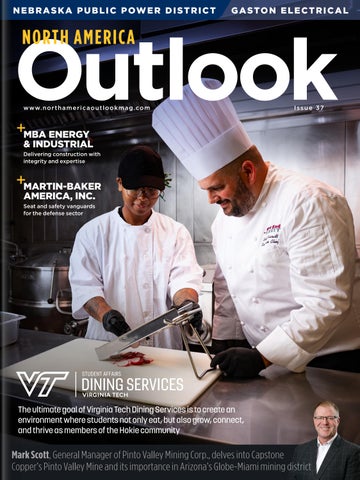
The ultimate goal of Virginia Tech Dining Services is to create an environment where students not only eat, but also grow, connect, and thrive as members of the Hokie community
Mark Scott, General Manager of Pinto Valley Mining Corp., delves into Capstone Copper’s Pinto Valley Mine and its importance in Arizona’s Globe-Miami mining district
GLADSTONE AREA WATER BOARD
D E S I M O N E CÔT E D ’ I VO I R E
DERICHEBOURG | RHEINMETALL UK
N E B R A S K A P U B L I C P OW E R D I S T R I C T
G A S TO N E L E C T R I C A L
TURNER MINING GROUP
HUNTER VALLEY OPERATIONS
L O S
A N G E L E S
G E N E R A L
End-to-end solutions from exploration to extraction
w w w. a f r i c a o u t l o o k m a g . c o m
M E D I C A L Issue 15
WEIR
C E N T E R
ST. JOSEPH’S HEALTH SYSTEM
Elevating the patient experience
DIGITAL HEALTH ASSOCIATION Issue 121
B2GOLD NAMIBIA
w w w. a p a c o u t l o o k m a g . c o m
Issue 81
ALTRAD
w w w. e m e o u t l o o k m a g . c o m
Issue 72
www. northame ricaoutlookmag.com
Issue 37
MBA ENERGY & INDUSTRIAL
Keeping airlines flying to connect the world
The pioneering endeavour delivering a new benchmark for golf equipment
Transforming waste into valuable resources
On a coal mining mission to champion sustainable practices
MARTIN-BAKER AMERICA, INC. Seat and safety vanguards for the defense sector
VULCAN MOZAMBIQUE
Drop Access works at the intersection of healthcare and clean energy, as we learn from Norah Magero, co-Founder and CEO
GRYDALE
Operator safety through world-class dust management solutions
Unearthing coal potential in Australia, Argo Natural Resources champions sustainable mining practices
Thermo Fisher Scientific has reinforced its position as a trusted biologics manufacturing partner
The ultimate goal of Virginia Tech Dining Services is to create an environment where students not only eat, but also grow, connect, and thrive as members of the Hokie community
Panasonic Connect Europe is a vital bridge between the digital and physical worlds. Peer Schumacher, Head of Electronics Manufacturing Solutions, gives his insight
Brendan Tritton, Managing Director and CEO of Valiant Gold, a Western Australian gold company, discusses advancing the restart of two historic mining centres in the Murchison Goldfields
THE 1-2-1 • THE QUESTION • TURBOCAM
On a mission to be a leading integrated green coal mining operation
M Resources delivers a suite of essential steelmaking raw materials, infrastructure, and mining and logistics services to steelmakers across the globe. Matt Latimore, Founder and President, details the company’s futurefacing approach to investment and market growth
Contributing to a healthier world
ARGO NATURAL RESOURCES
THE THOUGHT LEADER
• THE 1-2-1 • THE QUESTION
Mark Scott, General Manager of Pinto Valley Mining Corp., delves into Capstone Copper’s Pinto Valley Mine and its importance in Arizona’s Globe-Miami mining district
CO O P L A N DS B A K E RY • D N AG RA R • B RA K E B U S H
KOLEKTOR CONSTRUCTION
Garry Edwards, VP EMEA at Wolters Kluwer, emphasises the need for formalised, organisation-wide frameworks to ensure responsible use of artificial intelligence
Jason Bontempo, CEO of Gladiator Metals, discusses the resurgence of the Whitehorse Copper Belt in Canada’s historic Yukon mining district
VECA ELECTRIC & TECHNOLOGIES
N O F A R
E N E R G Y
R O M A N I A
K I N G S PA N
Family-run, proudly Canadian
DANONE ROMANIA
w w w. s u p p ly c h a i n - o u t l o o k . c o m
W W W .CONST RUCT ION-OUT L OOK.COM • ISSUE 4
Real Estate Solutions of the Future
www.foodbeverage-outl ook.com
Locked and loaded
Bridging the Real and Virtual Worlds
Enhancing all outdoor recreation adventures
Real estate solutions of the future
VP of Sustainable and Regenerative Agriculture, discusses PepsiCo’s collaborative regenerative farming initiative Over the last year, Saulsbury has expanded its position as one of North America’s leading engineering, procurement, and construction contractors
As a subsidiary of Dassault Systèmes, DELMIA is on track to shape the manufacturing industry of the future. We speak to Guillaume Vendroux, CEO Jan Diekmann, Head of Business Development and Manufacturing at Ericsson Enterprise Wireless Solutions, explores how private 5G is transforming the factory floor
Enterprise Wireless Solutions, explores how private 5G is transforming the factory floor Jan Diekmann, Head of Business Development and Manufacturing at Ericsson
Packsize is the global leader in packaging automation. We unbox the company’s right-sized approach with Brian Reinhart, Chief Revenue Officer company’s right-sized approach with Brian Reinhart, Chief Revenue Officer Packsize is the global leader in packaging automation. We unbox the
Johan van Jaarsveld, Managing Director of Montego Pet Nutrition, tells us about the pet care brand’s promise of ‘Better Every Day’ tells us about the pet care brand’s promise of ‘Better Every Day’ Johan van Jaarsveld, Managing Director of Montego Pet Nutrition,
YY Group Holding operates an artificial intelligence-native workforce solutions and integrated facility management platform. CEO, Mike Fu, discusses the company’s established capabilities
Simon Thompson, VP Northern Europe at JAGGAER, explains why artificial intelligence-powered data infrastructure is becoming essential
facility management platform. CEO, Mike Fu, discusses the company’s established capabilities YY Group Holding operates an artificial intelligence-native workforce solutions and integrated
intelligence-powered data infrastructure is becoming essential Simon Thompson, VP Northern Europe at JAGGAER, explains why artificial
procurement, and construction contractors as one of North America’s leading engineering, Over the last year, Saulsbury has expanded its position
We speak to Guillaume Vendroux, CEO track to shape the manufacturing industry of the future. As a subsidiary of Dassault Systèmes, DELMIA is on
and Virtual Worlds Bridging the Real
Issue 2
Margaret Henry,
From humble potatoes to gourmet crisps, SAVOURSMITHS is transforming snacking with bold flavours and a rich family heritage
LIPPERT
CBRE www.sustainabilityoutlookmag.com
Iss ue 9
SAVOURING THE FLAVOUR OF THE CRISP PARADIGM SHIFT
CBRE’s multidimensional perspective helps businesses find greater success with real estate facilities. John Kirkman, Senior Managing Director and Supply Chain Leader, gives us the full story
LOCKHEED MARTIN
Contributing to the nation’s net zero goals
OUTLOOK
Contributing to a healthier world Issue 12
N O R D I C S
GREEN BUILDING COUNCIL OF AUSTRALIA
OSMOW’S SHAWARMA ISSUE 10
www.mfg-outlook.com
initiative regenerative farming PepsiCo’s collaborative Agriculture, discusses and Regenerative VP of Sustainable
a rich family heritage with bold flavours and transforming snacking SAVOURSMITHS is to gourmet crisps, From humble potatoes
adventures outdoor recreation Enhancing all
LIPPERT
SHIFT PARADIGM OF THE CRISP THE FLAVOUR SAVOURING
Locked and loaded
MARTIN LOCKHEED
gives us the full story Director and Supply Chain Leader, John Kirkman, Senior Managing success with real estate facilities. helps businesses find greater CBRE’s multidimensional perspective
Margaret Henry,
TELL US YOUR STORY, AND WE’LL TELL THE WORLD the Future Solutions of Real Estate
www.mfg-outlook.com
www.foodbeverage-outl ook.com
Iss ue 9
Issue 12
healthier world Contributing to a
w w w. s u p p ly c h a i n - o u t l o o k . c o m ISSUE 10
ROMANIA DANONE
Canadian Family-run, proudly
W W W .CONST RUCT ION-OUT L OOK.COM • ISSUE 4
OUTLOOK
www.sustainabilityoutlookmag.com
Issue 2
THE THOUGHT LEADER
• THE 1-2-1 • THE QUESTION
CO O P L A N DS B A K E RY • D N AG RA R • B RA K E B U S H
of the future Real estate solutions
CBRE
nation’s net zero goals Contributing to the
AUSTRALIA COUNCIL OF BUILDING GREEN
SHAWARMA OSMOW’S
THE 1-2-1 • THE QUESTION • TURBOCAM
Modernising and transforming health systems
ARGO NATURAL RESOURCES
Delivering construction with integrity and expertise
REMONDIS BELGIEN
DANONE ROMANIA
Proudly operating the nation’s largest and most successful underground gold mine, B2Gold Namibia continues to flourish with exciting plans in the pipeline
www.healthcare-outlook.com
www.mining-outlook.com • Issue 16
SAESL
One of Australia’s most recognised industrial service providers
KOLEKTOR CONSTRUCTION
VECA ELECTRIC & TECHNOLOGIES
N O F A R
E N E R G Y
R O M A N I A
K I N G S PA N
N O R D I C S
Africa Outlook, APAC Outlook, EME Outlook, North America Outlook, Mining Outlook, Healthcare Outlook, Manufacturing Outlook, Supply Chain Outlook, Food & Beverage Outlook, Construction Outlook, and Sustainability Outlook are digital publications aimed at boardroom and hands-on decision-makers, reaching an audience of more than 800,000 people around the world. With original and exclusive content compiled by our experienced editorial team, we look to promote the latest in engaging news, industry trends, and success stories from across the globe. Your company can join the leading industry heavyweights enjoying the free exposure we provide across our platforms with a free marketing brochure, extensive social media saturation, enhanced B2B networking opportunities, and a readymade forum to attract new investment and help you grow your business. Visit www.outpb.com/work-with-us for details on how your company can feature for free in one of our upcoming editions.
www.outpb.com/work-with-us
WELCOME FROM THE EDITOR
MINE AND DINE
EDITORIAL Head of Editorial: Jack Salter jack.salter@outpb.com Deputy Head of Editorial: Lucy Pilgrim lucy.pilgrim@outpb.com
Welcome to our 37th edition of North America Outlook.
Senior Editor: Lily Sawyer lily.sawyer@outpb.com
At Virginia Tech, the commonwealth’s most comprehensive university and leading research
Editor: Ed Budds ed.budds@outpb.com
institution, our campus cover star makes a meaningful
Editor: Rachel Carr rachel.carr@outpb.com
impact on the student experience.
Copy Editor: Lauren Kania lauren.kania@outpb.com
An award-winning dining program, Virginia Tech Dining Services (Dining
PRODUCTION Art Director: Stephen Giles steve.giles@outpb.com
Brian Grove, who started out as a student employee, became Director in
Senior Designer: Devon Collins devon.collins@outpb.com Designer: Louisa Martin louisa.martin@outpb.com Production Manager: Alex James alex.james@outpb.com Digital Marketing Director: Fox Tucker fox.tucker@outpb.com Senior Website Content Manager: Oliver Shrouder oliver.shrouder@outpb.com Social Media Executive: Jake Crickmore jake.crickmore@outpb.com Trainee Digital Content Executive: Tara Steele tara.steele@outpb.com BUSINESS CEO: Ben Weaver ben.weaver@outpb.com Managing Director: James Mitchell james.mitchell@outpb.com Chief Technology Officer: Nick Norris nick.norris@outpb.com Content Director: Neil Perry neil.perry@outpb.com Global Head of Media: Lewis Hammond lewis.hammond@outpb.com Global Media Executive: Kai Boyle-Vennard kai@outpb.com ADMINISTRATION Finance Director: Suzanne Welsh suzanne.welsh@outpb.com Finance Manager: Victoria McAllister victoria.mcallister@outpb.com CONTACT
Services) is a core part of daily life at the university.
January 2024 and now overseas and heads Dining Services. After nearly 40 years at the department, he discusses his legacy and vision for Dining Services to be the leader in collegiate dining. “I firmly believe we can achieve this by continuously adapting to student needs, creating welcoming spaces that foster connection and belonging, investing in student and employee development, and embracing innovation that enhances convenience, sustainability, and operational excellence,” Grove sets out. From dining to mining, Arizona is the leader in copper production in the US, with the prolific Pinto Valley Mine representing one of the country’s largest copper reserves. The open-pit mine has produced more than four million pounds of copper since its inception and was purchased by Capstone Copper in 2013. “There’s no question the project has been a key contributor to copper mining in Arizona,” affirms Mark Scott, General Manager of Capstone Copper’s wholly owned subsidiary, Pinto Mining Valley Corp. Thanks to an ongoing investment strategy, Pinto Valley achieved a substantial increase in daily mine material movement in 2025. Likewise, since we spoke to MBA Energy & Industrial (MBA) in September last year, the industrial construction services provider has continued to expand and strengthen its footprint, recently completing its largest facility to date. “When one of our biggest clients needed a mission-critical data center not only designed but constructed with almost unrealistic speed without
North America Outlook Norvic House, 29-33 Chapelfield Road Norwich, NR2 1RP, United Kingdom Sales: +44 (0) 1603 804 445 Editorial: +44 (0) 1603 804 431
sacrificing quality and safety, they turned to MBA to be the architect and get
SUBSCRIPTIONS Tel: +44 (0) 1603 804 431 jack.salter@outpb.com
We turn to Nebraska Public Power District, Martin-Baker America, Inc., Gaston
www.northamericaoutlookmag.com Follow us on LinkedIn Follow us on X: @OutlookPublish
the all-important shell and grey space constructed,” outlines Phil Garner, Vice President of Business Development.
Electrical, and more elsewhere in this issue. We hope that you enjoy your read. Jack Salter Head of Editorial, Outlook Publishing North America Outlook Issue 37 | 3
37| CONTENTS REGULARS
6 EXPERT EYE Ensuring a skilled future workforce in engineering consulting
B U S I N E SS I N S I G H TS
8 Airbnb Investing in Washington’s Natural Future Environmental protection projects across the state
8 MI N I N G
12 Gladiator Metals Yukon Moment The resurgence of the Whitehorse Copper Belt
E N E R GY & U TI L I TI E S
20 Grand River Dam Authority Electrifying the Industry A proud steward of the Grand and Illinois Rivers
TO P I C A L F O C U S
26 Retail Stories Beyond the Screen Netflix favorites in real life
170 THE FINAL WORD Which abilities are most crucial when it comes to leadership and why?
NORTH AMERICA OUTLOOK CONTENTS
F E AT U R E S F O O D & BEVERAGE
34 Virginia Tech Dining Services Shaping the Student Experience Diverse dining concepts
94 Uprite Construction Relationship-Driven Success Partnerships built on trust and thinking outside the box
EN ER GY & U T I L I TI E S
104 Nebraska Public Power District Power to the Public Powering Nebraska’s future
140 MA N U FAC TU R I N G
140 Martin-Baker America, Inc. A Legacy of Life-Saving Innovation in Aviation Seat and safety vanguards for the defense sector
42 CPM|Crown
104
Enacting Change in Edible Oils A leader in edible oilseed processing and extraction
MINING
114 Metropolitan Water District of Salt Lake & Sandy
52 Capstone Copper
Streams of Sustainability
Custodians of Copper Production At the forefront of Arizona’s Globe-Miami mining district
148 Dayton-Phoenix Group Progress Through Purpose Generations of solutions-driven innovation
Securing a reliable flow amid urban demands
122 Platte River Power Authority Powering Northern Colorado Reliable, financially sustainable, and environmentally responsible electricity
148
156 Plasser American Corporation Built on Heritage, Driven by the Future Safe and reliable rail infrastructure
52 CO NST RUCTION
76 MBA Energy & Industrial Unparalleled Service, Regardless of Scope Delivering construction with integrity and expertise
122 HEA LT HC A R E
86 Gaston Electrical
132 Queen Elizabeth Hospital
Engineering Ongoing Electrical Evolution
Every Patient Matters, Every Staff Member Counts
New England’s trusted specialty contractor
Learning the fundamentals of great healthcare
156
164 Técnico Holdings One Family, Countless Capabilities A stronger, more connected marine enterprise
North America Outlook Issue 37 | 5
Proactive Leadership Development is Key for Consulting Success In an evolving engineering consulting landscape, Jason Mikkelsen, West Region Director, Building Engineering Services at HDR, discusses how a proactive approach to mitigating potential leadership shortages and enhancing organizational resilience is essential to ensure a competent future workforce that aligns with the values and aspirations of new generations Writer: Jason Mikkelsen, West Region Director, Building Engineering Services, HDR
I
s an industry leadership shortfall forthcoming? Over the last 15 years, a combination of economic volatility, shifting workforce priorities, and evolving attitudes toward career progression have put pressure on the leadership pipeline across the engineering consulting industry. By understanding these pressures, we can proactively address our future needs with a more intentional, value-driven approach to developing the next generation of leaders. Driving factors include the 2008 global recession, which cost the industry 12 percent of its workforce by August 2010, a loss documented 6 | North America Outlook Issue 37
by the US Department of Labor Bureau of Labor Statistics. At the same time, many engineering students diverted their studies and entered different professions. Although the workforce recovered to some extent, with almost half of lost jobs regained by 2013, a substantial labor shortage remained, and the future talent pipeline was reduced, a trend that persists to this day. Across the industry, almost 500,000 new employees are needed in 2026 to keep pace with demand. That number is unlikely to be met, putting the industry at risk of losing almost $124 billion in output because of unfilled positions.
BALANCING GROWTH, EXPERIENCE, AND WELL-BEING Despite the post-downturn rebound, caution and nervousness remained around job security at engineering consulting firms, with many senior staff ‘hoarding’ work rather than delegating responsibilities to junior staff, leading to overwork and a culture of ‘busyness’. Junior staff were given less responsibility and made to believe they needed more experience before considering growth opportunities in leadership. In addition to the shortage, new generations entering the workforce began to view leadership as stressful, difficult, and unrewarding. The COVID-19 pandemic then fundamentally changed attitudes, with greater emphasis placed on work-life balance, career purpose, and personal fulfillment. While these changes were welcome for many, they also highlighted reluctance to consider and pursue leadership development in traditional ways, intensifying the challenge of attracting top talent in an already transformed employment landscape. Without a proactive focus on
EXPERT EYE CONSTRUCTION
developing and nurturing future leaders, consulting firms risk becoming structurally shallow and less diverse, missing out on future growth progression and opportunities in flourishing markets.
ALIGNING WITH VALUES Any success current leaders achieve is arguably the result of training, development, or mentoring investments from those who came before them. We owe future generations the same opportunity, but we should understand they may not have the same motivations. Rather than accepting a future leadership shortfall, we should embrace new approaches to mentoring, encouragement, and incentivization – ones that genuinely align with the values of today’s workforce and make leadership opportunities attractive for the next generation. For example, a Deloitte global survey found that for many Gen Z and millennial employees, success is not necessarily defined by climbing a corporate ladder or reaching senior positions. Instead, 52 percent of Gen Zs and nearly 60 percent of millennials feel happy at work when their values align with their company’s. In comparison, almost 90 percent of Gen Zs and 92 percent of millennials say a sense of purpose leads to better engagement, well-being, and job satisfaction. Flexible working, diverse work, supportive leadership, and a sense of broader social and environmental impact also rank among their key priorities. Understanding these priorities is the starting point. From there, it calls for proactive commitment from current leaders to identify and nurture employees through training, development, and mentorship programs, actively bringing out qualities that might otherwise go unnoticed.
CULTIVATING TOMORROW’S LEADERS Raising awareness of leadership benefits for all employees and acting quickly on those who express interest or curiosity with coaching, education, and mentoring generally results in a thriving and rewarding experience for the employee, even when they did not know leadership opportunities existed for them. We also need to recognize each individual’s priorities and show them how leadership can directly support their values and benefit them. Someone who prioritizes flexibility will often find that leadership roles built on respect and trust offer more of it. In contrast, someone who wants variety will find it in the constantly shifting demands of a leadership role. Those motivated by social purpose can use their leadership platform to shape strategies that reflect their values. Making these connections explicit, then following through with mentoring, development, and real growth opportunities at earlier stages, builds confidence in younger employees who may never have considered leadership as a path for themselves. The goal is to create a framework where leadership development is proactive, visible, and rewarding, and where people are nurtured before the need arises, not after. Firms that act now by embedding leadership development early and deliberately will be best-positioned to grow as the current generation of leaders retires and demand accelerates. Current leaders must drive this shift in how they develop future leadership. By genuinely understanding what motivates their people and connecting those values to the opportunities leadership offers, firms can cultivate more diverse teams, be more resilient, and deliver better workplaces where people choose to build long, rewarding careers.
Done well, the benefits are wide-reaching – individuals grow, businesses strengthen, and the industry becomes a more compelling option for the talent it urgently needs – enabling broader and more prepared future generations of leadership.
ABOUT THE EXPERT Jason Mikkelsen is West Region Director, Building Engineering Services at HDR and guides teams and business programs to provide outstanding client service, build excellent relationships, and deliver successful projects. With proven experience, leadership, and team building skills, with an emphasis on mentoring and staff development, he drives regional business and staff growth with outstanding design professionals who lead and support projects worldwide. Mikkelsen is a registered professional civil engineer and a Leadership in Energy and Environmental Design (LEED)-accredited professional, providing strategic planning, professional development, training, and communication for his teams and the organization.
North America Outlook Issue 37 | 7
INVESTING IN WASHINGTON’S NATURAL FUTURE 8 | North America Outlook Issue 37
AIRBNB BUSINESS INSIGHTS
Marking the travel titan’s biggest community investment in the state to date, Airbnb has pledged $1 million to support environmental protection projects across Washington. We dig into the non-profit beneficiaries making a difference to the area’s natural landscape Writer: Lucy Pilgrim
S
ince its founding in 2008, Airbnb has worked to transform tourism and foster a new kind of travel – one that empowers local communities and grows the sector in a way that is equitable, inclusive, and sustainable. This founding vision continues to guide the growth of Airbnb, whose $1 million investment in environmental protection projects across Washington is its largest commitment
to the state’s local communities to date. The unprecedented funding initiative is telling of the company’s deep commitment to Washington’s green spaces, which are beloved by both tourists and locals alike, while also emphasizing what’s possible when the private and public sector join forces. Its investment will support the vital works of local environmental and
conservation non-profits and projects. By partnering with community pillars of sustainability, Airbnb hopes to advance responsible recreation and generate investment to support climate resilient forests on the Olympic Peninsula and throughout the Mountains to Sound Greenway National Heritage Area, therefore strengthening conservation efforts and maintaining Washington’s natural landscapes for future generations. North America Outlook Issue 37 | 9
AIRBNB BUSINESS INSIGHTS
EMPOWERING ENVIRONMENTAL STEWARDS The Airbnb Community Fund is a $100 million global initiative intended to help strengthen the places and communities Airbnb hosts and guests call home. In Washington, Airbnb hosts have helped direct over $500,000 in funding to a number of organizations. This includes Washington’s National Park Fund, which supports the preservation and protection of the Mount Rainier, North Cascades, and Olympic National Parks. As part of the commitment, and in celebration of National Park Week, Airbnb has also launched a special incentive for people who sign up to volunteer with Washington’s National Park Fund in the parks. Running until the end of summer 2027, the company is offering volunteers a $100 Airbnb credit while supplies last. Given half of Airbnb guests in Washington are state residents rather than tourists, the company hopes to encourage local exploration and stewardship of the state’s great outdoors while simultaneously connecting people with local environmental organizations. Another non-profit, Trout Unlimited, works tirelessly to sustain healthy fish populations and local ecosystems by restoring waterways and natural habitats. This funding will bolster the company’s work to restore salmon and trout populations across the state through key restoration projects in areas such as the Olympic Peninsula. As such, Airbnb’s investment will support Washington’s beloved rivers and native fish, which have become a crucial part of its state identity. Elsewhere, the investment also forges a partnership with Leave No Trace – a non-profit that teaches people how to care for their local environment. Through Airbnb’s support, the 10 | North America Outlook Issue 37
AIRBNB BUSINESS INSIGHTS
AIRBNB COMMUNITY FUND Founded in 2020, the Airbnb Community Fund strives to play a central part in local communities, serving key stakeholders and giving back to millions of hosts across the world. As part of this aim, the organization will distribute $100 million by the end of 2030 among communities across the world, supporting a vast range of organizations – from local nonprofits to hyperlocal community businesses – to have a real impact in their area.
company can implement its highly reputable Leave No Trace Spotlight stewardship program in the city of Issaquah. The collaboration also involves Leave No Trace partnering with Airbnb hosts across Washington to integrate its environmental protection guidance into hosts’ listings. This will ensure both Airbnb hosts and guests have the right tools and knowledge to enjoy nature responsibly and protect Washington’s extraordinary landscapes.
SUPPORTING SUSTAINABLE FORESTRY Airbnb’s $500,000 pledge will also support the work of two reforestation organizations, bolstering their conservation of green spaces and sustainability programs across the state. Namely, the Mountains to Sound Greenway Trust aims to enhance and conserve the Mountains to Sound Greenway National Heritage Area – spanning 1.5 million acres across a 100-mile stretch between the cities of Seattle and Ellensburg.
One green area of particular importance is Ballinger Open Space, where Airbnb is helping to deliver measurable climate benefits to its urban forest, facilitating cleaner air, healthier waterways, and more welcoming green spaces for the surrounding community. EFM Investments and Advisory LLC (EFM) – a sustainable forest and investment management company – is also a recipient of the funding, which will support the company in its work to restore Pacific Northwest forestlands, preserving their biodiversity and health.
With forest management operations centered around generating carbon revenue, EFM extends harvest rotations, protects carbon-rich stands via reserves, and funds restoration works – all while keeping working forests productive. Expanding on its founding ethos to facilitate a forward-looking form of travel, Airbnb’s investment in Washington will foster immeasurable impacts on the state’s treasured parks and waterways, meaning visitors and locals alike can delight in these green spaces for generations to come. North America Outlook Issue 37 | 11
GLADIATOR METALS MINING
Yukon Moment Jason Bontempo, CEO of Gladiator Metals, discusses the resurgence of the Whitehorse Copper Belt in Canada’s historic Yukon mining district, amid renewed national focus on domestic resource development W R I T E R : J A C K S A LT E R
North America Outlook (NA): Firstly, could you tell us about the resurgence of the Whitehorse Copper Belt in Canada’s Yukon? Jason Bontempo, CEO (JB): The Whitehorse Copper Project (WCP) is an advanced-stage high-grade copper, molybdenum, silver, and gold skarn exploration project in the Yukon, Canada. Copper mineralization was first discovered in 1897 on the Whitehorse Copper Belt (WCB) and comprises over 30 copper-related, primarily skarn occurrences, covering an area of 35 kilometers (km) long by 5 km wide on the western margin of Whitehorse, the Yukon capital. Exploration and mining development have been carried out intermittently since 1897, with the main production era lasting between 1967 and 1982, where production from primarily 12 | North America Outlook Issue 37
H. Coyne & Sons first acquired claims from Hudson Bay Mining and Smelting Co. in 1998 and continuously consolidated the claims until 2022, when its then-land position was opened to Gladiator Metals (Gladiator). This was the first time in over 40 years that the entire WCB holding would have the attention and expertise of an experienced and committed technical team – led by President, Marcus Harden, and Vice President of Exploration, Kell Nielsen – and dedicated funding via Gladiator.
Jason Bontempo, CEO
the Little Chief deposit totaled 267.5 million pounds of copper, 225,000 ounces (oz) of gold, and 2.838 million oz of silver from 10.5 million tons of mineralized material milled.
NA: How is the historic mining district re-emerging amid renewed national focus on domestic resource development? JB: Canada has declared copper as a critical mineral and all Canadian copper projects have benefited from this attention and focus.
GLADIATOR METALS MINING
Over the past three years, Gladiator has attracted significant funding to be able to progress WCP, highlighting numerous prospects along the belt which have great potential to advance from surface to high-grade copper resources. NA: Gladiator is operating within a clear ‘Yukon moment’ where several forces are converging. Please talk us through: The growing urgency around North American copper supply and electrification. JB: North America is facing a structural copper crunch, and that urgency is directly tied to the accelerating push toward electrification, energy transition, and domestic supply chain security. Gladiator’s positioning in the Yukon sits squarely within this moment because the region offers scale, grade, and geopolitical stability at a time when all three are in short supply. NA: The new political landscape in the Yukon, positioning the region for responsible development. JB: The Yukon now has a political landscape that is more stable, pro-development, and aligned with Indigenous partnership than at any point in the last decade – creating a clearer path for responsible mining projects to advance. Several structural shifts have converged to create a more predictable, development-friendly environment. The Yukon’s current leadership has placed stronger emphasis on: • Streamlining regulatory processes. • Improving permitting timelines. • Supporting critical minerals development. • Strengthening infrastructure investment. 14 | North America Outlook Issue 37
This doesn’t mean lowering standards – it means reducing uncertainty, which is often the biggest barrier to capital deployment in northern jurisdictions. NA: The increasing importance of First Nations partnerships in shaping project outcomes. JB: The Yukon is unique in Canada, allowing for a more collaborative approach with First Nations governments, where 11 of 14 First Nations have modern selfgovernment agreements. Land use, permitting, and economic participation are co-managed, and the political climate has shifted toward partnership rather than negotiation. For responsible developers, this is a major advantage. It means clearer expectations, earlier engagement, shared economic benefits, and reduced project risk.
“Over the past three years, Gladiator has attracted significant funding to be able to progress WCP, highlighting numerous prospects along the belt which have great potential to advance from surface to high-grade copper resources” – J A S O N B O N T E M P O, C E O, G LA D I ATO R M E TA L S
NA: The historically productive district now being revisited with modern exploration and development approaches. JB: Modern exploration is advancing WCB primarily through highresolution geophysics, reanalysis
of historical drill data, large-scale drilling programs, and new geological modeling. The result is a rapidly improving understanding of the belt’s copper skarn and intrusive related systems, leading to new discoveries and expanded resource potential.
NA: What roles do community alignment and long-term partnership models have in project success? JB: Community alignment and longterm partnerships with the Kwanlin Dün First Nation (KDFN) and the Ta’an Kwäch’än Council (TKC) have played a pivotal role in advancing WCP from early exploration into a permittingready asset. From the outset, Gladiator established a framework of respectful consultation, transparency, and structured engagement, formalized through a capacity funding agreement that enables KDFN to actively participate in project review, environmental assessment, and decision-making processes. North America Outlook Issue 37 | 15
This approach has ensured Indigenous perspectives, environmental concerns, and cultural values are integrated directly into project planning rather than addressed late in development. As a result, both KDFN and TKC have been able to shape key mitigation measures and provide informed input into regulatory submissions, strengthening the project’s environmental and social credibility. Most importantly, this collaboration has translated into tangible project success, with WCP receiving a Class 3 exploration permit in 2026 following a positive Yukon Environmental and Socioeconomic Assessment Board (YESAB) process that explicitly included consultation with both First Nations. The support and engagement of KDFN and TKC were acknowledged as critical contributors to this outcome, demonstrating how early and continuous partnership can de-risk permitting and accelerate progress. Beyond regulatory milestones, the partnerships have also helped build broader public trust and social license in a project located near an urban center, where community expectations are particularly high.
“Projects like WCP are becoming strategically important in Canada because they sit at the intersection of energy transition demand, economic growth, and national security” – J A S O N B O N T E M P O, C E O, G LA D I ATO R M E TA L S
GLADIATOR METALS MINING
Alignment with KDFN and TKC has not only enabled project advancement, but also laid the foundation for a long-term, mutually beneficial relationship that is essential for continued success at WCP. NA: Finally, why are projects like WCP becoming strategically important? JB: Projects like WCP are becoming strategically important in Canada because they sit at the intersection of energy transition demand, economic growth, and national security. At the core is the rising importance of critical minerals such as copper, which are essential for modern technologies – from electric vehicles (EVs) and renewable energy systems to digital infrastructure – and are considered the “building blocks” of the low-carbon economy. As global demand for these materials is expected to surge dramatically – and even double by 2040 – countries like Canada are racing to secure reliable domestic supply and position themselves as long-term suppliers to global markets. At the same time, geopolitical tensions are reshaping how governments think about resource development. Critical minerals supply chains are highly concentrated internationally, creating vulnerabilities for Western economies. As a result, Canada has elevated these materials to a strategic and even national security priority, investing billions in domestic projects and aiming to reduce reliance on international dominant suppliers. In this context, projects such as WCP are not just mining ventures – they are part of a broader effort to build secure, resilient, and allied supply chains. Economically, these projects also represent a major growth opportunity. Mining already contributes significantly to Canada’s GDP, jobs, and regional development, with new
projects capable of generating billions in economic activity, infrastructure investment, and long-term employment. Developing district-scale projects in established regions like Whitehorse can amplify these benefits by supporting local industries, Indigenous participation, and downstream processing capacity. Finally, projects like WCP align closely with Canada’s policy direction under its Critical Minerals Strategy, which aims to integrate the entire value chain – from exploration to processing and manufacturing – while advancing reconciliation
with Indigenous communities and maintaining high environmental, social, and governance (ESG) standards. In a world defined by climate change, supply chain competition, and shifting geopolitics, such projects are increasingly viewed as nation-building assets that underpin Canada’s economic resilience, global competitiveness, and role in the clean energy future.
www.gladiatormetals.com North America Outlook Issue 37 | 19
ELECTRIFYING THE INDUSTRY
On a mission to deliver affordable, reliable electricity with a commitment to environmental stewardship, the Grand River Dam Authority is a proud steward of the Grand and Illinois Rivers. We revisit the organization with Dan Sullivan, CEO, who updates us about its new state-of-the-art gas unit Writer: Lauren Kania
20 | North America Outlook Issue 37
GRAND RIVER DAM AUTHORITY ENERGY & UTILITIES
F
ormed in 1935 by the Oklahoma Legislature to construct the first hydropower project in the state, the Grand River Dam Authority’s (GRDA) first project, the Pensacola Dam – which created the Grand Lake O’ the Cherokees – was completed in 1940. Over 80 years later, the organization has proudly grown to become the largest public power electric utility in Oklahoma (OK). “Today, our generation capacity includes hydropower, coal, natural gas, solar, and wind. Soon, battery storage will be added to our generation portfolio to meet the needs of our customers,” introduces Dan Sullivan, CEO. With 600 employees producing and transmitting electricity to municipal customers in OK, Kansas (KS), Arkansas (AK), and Missouri (MO), alongside serving the MidAmerica Industrial Park in Pryor, OK, GRDA is a stalwart in all things energy. It is organized as a state agency but does not receive any appropriations or tax dollars to fund its operations. Additionally, GRDA manages the three lakes created by its hydropower projects as well as OK’s Scenic Rivers, which collectively provide recreation, tourism, and economic activity to the state’s economy. Since last speaking to Sullivan in January 2026, he notes that the energy and utilities industry is just as exciting as ever. “The pace of change is providing unique challenges and opportunities. Large loads require more resources that are scarce with long lead times; our ability to support the speed to market needed for large loads is a frustrating situation. Fortunately, new customers are sophisticated enough to recognize the universal struggle for equipment and resources and finding creative ways to meet the challenge,” he details. North America Outlook Issue 37 | 21
GRAND RIVER DAM AUTHORITY ENERGY & UTILITIES
TECHNOLOGY FOR THE FUTURE Currently, GRDA is adding a new state-of-the-art gas unit, scheduled for commercial operation by September this year.. “We are very excited about the addition of a Mitsubishi M501JAC simple-cycle gas turbine to our generation fleet,” enthuses Sullivan.
The new unit is able to produce 420 megawatts (MW) of electricity in a quick-start fashion, fitting perfectly into the overall footprint of the Southwest Power Pool (SPP). It will sit next to GRDA’s Mitsubishi M501J combined-cycle unit, which has been in service since 2017. “Our partnership with Mitsubishi
has brought a whole new dimension to our generation fleet that is responsive to the current SPP market,” Sullivan continues. The Mitsubishi natural gas units reside alongside the organization’s remaining coal unit at its Grand River Energy Center in Chouteau, OK, and represent the backbone of its thermal generation capabilities. This new equipment is set to modernize GRDA’s generation portfolio and enhance operational efficiency. As OK is an oil and gas-producing state, GRDA’s ability to utilize its natural gas to meet the electricity needs of customers creates a win-win scenario. Equally, the operational characteristics of a simple-cycle gas unit allow for rapid reaction to changing market conditions. “A coal unit takes around 16 hours to start from cold, and a simple-cycle gas unit can produce electricity in less than 30 minutes. The changes that intermittent resources have brought
GRAND RIVER DAM AUTHORITY ENERGY & UTILITIES
“ O U R PA R T N E R S H I P W I T H M I T S U B I S H I H A S B R O U G H T A W H O L E N E W D I M E N S I O N TO O U R G E N E R AT I O N F L E E T T H AT I S R E S P O N S I V E T O THE CURRENT SPP MARKET” – D A N S U L L I VA N , C E O , G R A N D R I V E R D A M A U T H O R I T Y
GRDA’S FIVE E’S OF EXCELLENCE • Electricity – GRDA has grown substantially into a major power supplier across the region. Its diverse electric generation portfolio includes gas, coal, water, and wind, allowing the organization to transmit electricity across a four-state region via a sophisticated energy delivery network. • Efficiency – The organization’s objective is to continuously seek greater efficiency, always striving to provide the greatest benefit to its customers and stakeholders. • Environmental stewardship – GRDA was created by legislation to be a conservation and reclamation district for the waters of the Grand River, a designation that ensured stewardship would always be an essential part of its mission. • Economic development – Promoting economic development is central to the
to the electricity market create opportunities for quick-start units and those that can be dispatched to meet the dynamic market conditions,” insights Sullivan.
COMMITTED TO STEWARDSHIP The state-of-the-art gas unit is a direct example of GRDA’s dedication to innovation, while also remaining committed to its original charge of being a good steward of the natural resources under its oversight. “The purpose of GRDA is to serve our customers with low-cost, reliable electricity on a cost-of-service basis. The generation sources we employ
to meet that purpose provide a net benefit to our customers by generating power for less than the market cost. Keeping our generation costs low allows us to meet customer requirements and our environmental stewardship responsibilities at the same time,” Sullivan explains. GRDA was initially formed as a conservation and reclamation district, and environmental stewardship has been part of its mission since the start. The organization built the first scrubbed coal generation unit in the 1980s, then brought advanced class high-efficiency natural gas units to OK. It is committed to an
organization’s overall mission. The low-cost and reliable electricity it provides is an attractive incentive for business and industry to locate and expand in GRDA’s service areas. • Employees – GRDA’s employees are its greatest asset. It has a dedicated workforce of Oklahomans with the critical skills, expertise, and professionalism needed to carry out the organization’s mission.
North America Outlook Issue 37 | 23
GRAND RIVER DAM AUTHORITY ENERGY & UTILITIES
‘all of the above’ strategy that is environmentally responsible and keeps the lights on for its customers. Currently, GRDA is renovating and upgrading its Salina Pumped Storage Project, which is unique in the SPP and acts as a large battery by pumping water into an elevated reservoir, allowing for hydropower generation until the pool needs recharging. Installed in the late 1960s, the project is receiving its first major renovations to the turbine and pump units. “By updating the technology supporting the project, it is our goal to make the project more beneficial to the SPP grid in the future and maximize the resource. The modernization upgrades that are underway at our pumped storage facility are a continuation of our tradition of innovation that has led to our robust and fuel-diverse electric generation fleet,” Sullivan informs.
“ W E A R E CO N T I N U I N G TO M A K E M A J O R INVESTMENTS IN OUR TRANSMISSION SYSTEM AS WELL AS PLANNING FOR O U R N E X T I T E R AT I O N O F G E N E R AT I O N C A PAC I T Y ” – D A N S U L L I VA N , C E O , G R A N D R I V E R D A M A U T H O R I T Y
MEETING DEMANDS WITH CONFIDENCE As GRDA looks toward a future of excellence, it is putting innovation, community engagement, and sustainability at the heart of its goals. “We are continuing to make major investments in our transmission system as well as planning for our next iteration of generation capacity,” states Sullivan. “Future additions in battery storage and natural gas generation are currently being planned, and
discussions are underway with a consortium of public power utilities in Nebraska (NE) to evaluate advancedclass nuclear generation. The increasing demand of our customers has led to a period of continuous planning and preparation to meet current and future requirements.” Additionally, one of GRDA’s goals for the coming months is to extend municipal wholesale agreements to match anticipated future bond debt to finance additional transmission and generation projects.
GRAND RIVER DAM AUTHORITY ENERGY & UTILITIES
The organization’s long-term wholesale agreements allow longterm debt to match asset life, which keeps its borrowing costs low with lessened impacts on rates. Maintenance of its existing generation and transmission assets is a top priority as GRDA concurrently plans for new additions. “Ultimately, I think it’s important for customers and policymakers to be informed of the current market realities required to service new large loads. The electric industry is working diligently to meet those demands in a timely fashion,” concludes Sullivan.
M501JJAC SERIES – AT A GLANCE Mitsubishi’s cutting-edge large-capacity gas turbines for 60 hertz (Hz) power generation incorporate state-of-the-art technologies. Its features include: • Standalone gas turbine output: 453 MW class. • Combined-cycle output: 664 MW/1,332 MW class. • Combined-cycle efficiency: More than 64 percent. • Total commercial operating hours: Over 3.2 million as of December 2025. • 30 percent hydrogen co-firing has been demonstrated, supporting the transition to carbon neutrality. • Reduces carbon dioxide (CO2) emissions by approximately 65 percent compared to conventional coal-fired power plants.
North America Outlook Issue 37 | 25
STORIES BEYOND THE SCREEN
N
etflix’s mission is to entertain the world, and Netflix House is a vital part of this effort. Spanning more than 100,000 square feet, it brings to life some of the streaming platform’s most popular shows and movies, including 26 | North America Outlook Issue 37
Wednesday, Squid Game, Stranger Things, and more. Netflix House is free to explore – whether a Netflix member or not – and features a variety of complimentary and paid activities, games, and immersive story-driven
experiences, as well as a restaurant, shop, and photo opportunities. Just like the shows and movies on Netflix, the house regularly updates its offerings throughout the year based on what’s popular on-screen, so there’s always something new to
TOPICAL FOCUS RETAIL
For over 20 years, viewers have welcomed Netflix into their homes. Now, they can play, eat, and shop their favorite shows and movies in real life at Netflix House – a first-of-itskind, permanent, everchanging entertainment venue Writer: Jack Salter Photography © Netflix
discover with each visit. It’s another step in Netflix’s journey to create immersive, in-person experiences, allowing fans to step into beloved worlds and become the main character in their favorite stories. The first-ever Netflix House
was opened in November 2025 in Philadelphia, Pennsylvania, located in the King of Prussia shopping mall. Philadelphia was the perfect place to debut Netflix House as the city is known for its creativity, heart, and deep sense of community.
This opening marked an exciting milestone for Netflix, transforming how audiences experience its stories in real life. Then, in December last year, the second Netflix House was opened in Dallas, Texas at Galleria Dallas, with North America Outlook Issue 37 | 27
TOPICAL FOCUS RETAIL
IMMERSIVE EXPERIENCES There are several immersive experiences and activities on offer at Netflix House. In Philadelphia, there’s Stranger Things: The Immersive Experience, in which visitors venture into Hawkins National Laboratory to volunteer for a new sleep study. Along the way, they join forces with Eleven, Mike, Will, Dustin, Lucas, Max, and the rest of the gang to fight Vecna in an exclusive story created by the team behind the iconic series.
a third location in the heart of Las Vegas, Nevada set to launch in 2027. More than 260 local tradespeople were employed during the construction of each house, with nearly 300 permanent jobs created at both venues since opening. The project also includes permanent partnerships with local creatives, including large-scale murals by artists Emily White and Jeremy Biggers in Philadelphia and Dallas, respectively. 28 | North America Outlook Issue 37
TOPICAL FOCUS RETAIL
A SNAPSHOT OF THE SHOWS AND MOVIES AT NETFLIX HOUSE • Bridgerton • KPop Demon Hunte rs • Wednesday • Squid Game • Emily in Paris • Stranger Things • Glass Onion: A Knive s Out Mystery • Black Mirror • The Hunting Wives • One Piece • Virgin River • Chef’s Table • Big Mouth • Floor Is Lava • The Queen’s Gambit • Nonnas • The Witcher • Heartstopper • Queer Eye • Love, Death & Robots • The Gentlemen • Raw • La Casa de Papel
North America Outlook Issue 37 | 29
Guests have the chance to explore the Rainbow Room, the Upside Down, and other iconic locations and interact with favorite moments alongside live actors. In Wednesday: Eve of the Outcasts, Wednesday Addams reluctantly takes over the Eve of the Outcasts festival from roommate Enid Sinclair, giving the event her own twisted touch. Each visitor follows a mysterious trail left by texting clues back and forth with Wednesday and everyone’s favorite disembodied hand, Thing, to uncover secrets hidden throughout the experience. The festival grounds and halls of Nevermore Academy can also be explored, with cursed carnival games, unsettling surprises, and eerie photo opportunities to encounter along the way. Elsewhere, in Dallas, Squid Game: Survive the Trials is an in-person Squid Game experience where players take on five thrilling games in the arena, face off against the Front Man, and compete against friends to be the last one standing. 30 | North America Outlook Issue 37
Additional experiences at Netflix House include Top 9 Mini Golf, which offers nine holes of gamified mini golf each themed to popular Netflix series and events, while TUDUM Theater hosts special screenings, trivia nights, seasonal activities, and surprise fan events.
PLAY, EAT, AND SHOP AT NETFLIX HOUSE PLAY – Drop into beloved stories with large-scale interactive experiences, virtual reality (VR), arcade games, and mini golf.
EAT – Dig into themed eats and drinks with an entertaining twist at the in-house restaurant, Netflix Bites.
SHOP – Bring home exclusive merchandise, collectibles, and must-have items from fan-favorite Netflix series and movies.
Philadelphia’s Netflix V/RTUALS, meanwhile, lets fans play as the main character inside the worlds of Netflix shows and movies with virtual reality (VR) games. In Dallas, there’s also Netflix RePLAY, a classic arcade featuring 20+ interactive games with physical challenges, immersive story rooms, and retro-style fun.
TOPICAL FOCUS RETAIL
EAT AND SHOP Just as immersive is Netflix Bites, the official restaurant of Netflix House serving food and drinks with entertaining twists – all inspired by fans’ favorite shows and movies. From screen to table, Netflix Bites serves up imaginative, iconic meals with nods to nearly 20 beloved Netflix stories. Guests can walk in, order via kiosk
or QR code, and enjoy bold, playful dishes and drinks that give main character energy. All cravings are covered as there’s something for everyone, from appetizers, entrées, and desserts to a full bar with craft cocktails and even options for little ones. The restaurant is a fun opportunity for fans to get closer to the stories they love with exclusive creative dishes only
found inside Netflix House. For exclusive merchandise, meanwhile, Netflix Shop offers collectibles, apparel, and lifestyle items from fan favorites, such as a One Piece t-shirt, Bridgerton mug, and KPop Demon Hunters popcorn bags. Fans are at the center of everything at Netflix House – a place to hang out, shop, eat, and immerse in the Netflix world. North America Outlook Issue 37 | 31
Exclusive, appetizing content, delivered straight to your inbox As organizations worldwide confront unprecedented change, embracing technological innovations and incorporating critical environmental sustainability agendas, now more than ever is the time to showcase the strides being taken in the food and beverage sector. A multi-channel brand, Food & Beverage Outlook serves up all the positive global developments driven by companies across the food and beverage industry. Discover exclusive content presented through its website, social media channels and dispatches, delivered straight to your inbox with a bi-weekly newsletter. Through this compelling venture, Food & Beverage Outlook foregrounds the movers and shakers of the industry by confronting unprecedented change, showcasing technological innovations and incorporating critical environmental sustainability agendas. To participate as a featured company and join us in this exciting endeavor, contact one of our Project Managers today.
SUBSCRIBE NOW TO THE DIGITAL MAGAZINE
www.foodbeverage-outlook.com
VIRGINIA TECH DINING SERVICES FOOD & BEVERAGE
SHAPING THE
STUDENT EXPERIENCE The ultimate goal of Virginia Tech Dining Services is to create an environment where students not only eat, but also grow, connect, and thrive as members of the Hokie community. After nearly 40 years at the department, Brian Grove, Director, discusses his legacy Writer: Jack Salter | Project Manager: Harry Thurlow
V
irginia Tech is the commonwealth’s most comprehensive university and leading research institution, with around 38,000 students and 280 undergraduate and graduate degree programs. As a core part of daily life at the university, Virginia Tech Dining Services (Dining Services) makes a meaningful impact on the student experience. 34 | North America Outlook Issue 37
“Every innovation, enhancement, and interaction contributes to creating memorable dining experiences for our students,” introduces Brian Grove, Director. “Being part of an organization that helps shape campus life through food, hospitality, and community engagement is what makes this work so rewarding.” Dining Services is an award-winning dining program spanning nine distinct
buildings that offers an unparalleled variety of culinary experiences through 36 unique retail dining concepts, ranging from national brands to chef-driven. Complementing its retail portfolio are two all-you-care-to-eat dining centers featuring 19 diverse dining concepts, delivering an exceptional array of cuisines, flavors, and experiences. “Together, these venues create a
ALL PHOTOGRAPHY BY DARREN VAN DYKE, VISUAL PRODUCTION MANAGER
dynamic foodservice program widely recognized for its quality, variety, innovation, and commitment to meeting the evolving needs of our campus community,” Grove outlines.
TRUSTED TO LEAD Grove himself started out as a student employee at Dining Services in January 1988, working his way up to Associate Director by April 2007. Then, when the COVID-19 pandemic
hit, the department’s operations pivoted and Grove was made Senior Associate Director by Ted Faulkner, who was Director of Dining Services at the time. “I was trusted to lead the department out of the final stages of the pandemic and completely humbled and honored that Ted and others had full faith in me,” recalls Grove. “He became my greatest mentor
prior to and during this period of my career. When I moved into my new office, there was a handwritten note – “Wishing you great success in your new role!... The keys to the finest automobile are yours.” – I share this because it’s really where I thought about what my legacy would be for Dining Services and Virginia Tech.” Grove became Director of Dining Services in January 2024 and now oversees and heads the department. North America Outlook Issue 37 | 35
VIRGINIA TECH DINING SERVICES FOOD & BEVERAGE
“ B E I N G P A R T O F A N O R G A N I Z AT I O N T H AT H E L P S S H A P E C A M P U S L I F E T H R O U G H F O O D , H O S P I TA L I T Y, A N D C O M M U N I T Y E N G A G E M E N T I S W H AT M A K E S T H I S W O R K S O R E WA R D I N G ” – B R I A N G R OV E , D I R E C TO R , V I R G I N I A T E C H D I N I N G S E RV I C E S
His vision is for Dining Services to be the leader in collegiate dining by delivering exceptional food, innovative facilities, meaningful programs, and outstanding service that enriches the student experience. “I firmly believe we can achieve this by continuously adapting to student needs, creating welcoming spaces that foster connection and belonging, investing in student and employee development, and embracing innovation that enhances convenience, sustainability, and operational excellence,” Grove sets out. After more than 35 years with Dining Services, Grove recognizes his role today is as much about preparing for the future as it is about leading the present. “I want to leave the organization stronger than I found it by developing future leaders, modernizing our facilities and programs, and creating a culture that embraces innovation while staying true to our commitment to students,” he affirms. “My goal is to ensure that 10 years from now, Dining Services is still recognized as a national leader – not because of any one person, but because we have built an organization that continuously develops its people, adapts to changing student needs, and creates exceptional dining 36 | North America Outlook Issue 37
experiences that strengthen the Hokie community.”
LEAVING A LEGACY People are the first of three focus areas for Dining Services, creating opportunities for professional growth, leadership development, and succession planning so the next generation of leaders is prepared to continue advancing its mission. The department’s success has always been driven by its talented and dedicated employees, of which there are 2,200, so ensuring it cultivates future leaders is essential. “My goal is to foster a culture of
leadership development, continuous improvement, and empowerment that prepares the next generation of Dining Services leaders for success,” Grove emphasizes. “If our team is stronger, more capable, and better-positioned to thrive because of the investments we make today, then we will have built a solid foundation for the future. “Our operation serves as a livinglearning environment where students gain leadership, customer service, teamwork, and professional skills through employment opportunities. We should continue investing in training, mentorship, and leadership
development programs that prepare students for success beyond Virginia Tech,” he tells us. As well as student staff, Dining Services offers the same type of training and professional development for its full and part-time staff, preparing them to take the next step in the organization as supervisors and management. Second is the continued evolution of the department’s facilities and dining environment. Today’s students have different expectations than they did even a few years ago, and those will continue to change. By strategically planning renovations, new concepts, and flexible dining spaces, its facilities will remain relevant, welcoming, and supportive of student engagement. The third and final focus area is Dining Services’ commitment to fostering a culture of innovation and continuous improvement. “I want us to remain proactive rather than reactive – embracing change, testing new ideas, and consistently seeking ways to enhance the student experience,” urges Grove. “I hope to leave Dining Services with a strong foundation that balances tradition with innovation. While we should continue to evolve and adapt to changing student needs, we must also preserve the
SOUTHGATE FOOD CENTER The Southgate Food Center (Southgate) has served as the centralized warehouse, bakery, and food production facility for Dining Services, providing critical support to dining operations across campus. The warehouse receives, stores, and distributes food and beverages and supplies campus dining locations, while the on-site bakery produces a wide variety of fresh-baked items including cakes, cookies, brownies, donuts, and other specialty desserts. Now, Southgate is to be replaced by a single-story, high-bay facility on university-owned property on Research Center Drive, near Virginia Tech Montgomery Executive Airport (BCB). The project scope envisions shifting all food production and preparation to a modern, fully equipped, commercial food preparation facility with both cold and dry storage capacity.
North America Outlook Issue 37 | 37
VIRGINIA TECH DINING SERVICES FOOD & BEVERAGE
WHAT IS PERRY PLACE AND HOW DOES IT FUNCTION AS A PHYSICAL AND CULTURAL BRIDGE BETWEEN LEARNING AND LIVING ON CAMPUS? BRIAN GROVE, DIRECTOR OF DINING SERVICES: “Perry Place is located in the heart of the newly completed Hitt Hall, a 100,000-square-foot multipurpose facility that pairs cutting-edge construction labs with destination dining. “It was developed as a next-generation dining destination to support Virginia Tech’s planned enrollment growth, expand dining access for offcampus and upper-division students, and enhance the overall student experience. “As the university prepared to add approximately 5,000 students over five years, existing dining facilities – particularly in the North Academic District – faced increasing capacity pressures. Rather than expanding traditional dining halls, Virginia Tech invested in a flexible, retail-focused food hall model that can adapt to demand, offer extended service hours, and meet the diverse preferences of today’s students. “The primary goals of the project included expanding seating capacity and access, increasing culinary variety and choice, improving the speed of service and peak period throughput, and creating a branded destination dining experience. “The final project addressed these goals by delivering a two-level food hall with 629 seats, nine distinct dining concepts, and a centralized production kitchen. Perry Place supports approximately 36,400 daily transactions and generates more than $10.5 million in annual sales. Eight of the nine concepts were developed internally by Virginia Tech, reinforcing institutional brand ownership while offering broad culinary appeal. “Concept development was informed by direct student input and national best practice research, while operational decisions were grounded in throughput, labor efficiency, and scalability. This combination of vision and execution ensured Perry Place delivered immediate impact upon opening while remaining flexible enough to evolve with future enrollment growth, menu innovation, and changing student expectations. “Sustainability was incorporated from design through to daily operation. Perry Place uses energy-efficient kitchen systems, demand-controlled ventilation, and data-driven production practices to reduce food waste. AMP Coffee Bar emphasizes responsibly sourced ingredients, reinforcing environmental and social responsibility within everyday student choices. The dining center also uses all compostable to-go containers.”
38 | North America Outlook Issue 37
VIRGINIA TECH DINING SERVICES FOOD & BEVERAGE
DISPOSABLES WORTHY OF VIRGINIA TECH Since 2023, Terravive has proudly supported Virginia Tech with BPI Certified compostable foodservice products guided by a simple belief: what touches your food matters. Made in the USA from plants, Terravive’s products are free from Forever Chemicals and are designed to compost without generating microplastics, delivering the performance campus dining expects while reflecting the same care and quality as the meals they serve. Their products are designed to be worthy of every meal, every student, faculty member, and guest they reach.
www.terravive.com
“ I WA N T T O L E AV E T H E O R G A N I Z AT I O N STRONGER THAN I FOUND IT BY DEVELOPING FUTURE LEADERS, M O D E R N I Z I N G O U R FA C I L I T I E S A N D P R O G R A M S , A N D C R E AT I N G A C U LT U R E T H AT E M B R A C E S I N N O VAT I O N W H I L E S TAY I N G T R U E T O O U R C O M M I T M E N T T O STUDENTS” – B R I A N G R OV E , D I R E C TO R , V I R G I N I A T E C H D I N I N G S E RV I C E S
values that have made us successful – our commitment to excellence, hospitality, teamwork, and the student experience. “If my legacy is that I helped to develop future leaders, strengthen our culture, and position our staff and organization for continued success, then I would consider that my greatest accomplishment,” he prides.
PRIORITIES FOR FUTURE SUCCESS While Dining Services has built a strong foundation, several opportunities and challenges will shape its future. Workforce development remains a top priority; recruiting, developing, and retaining talented and dependable employees is essential to
the department’s long-term success. “We will continue investing in leadership development, employee engagement, and succession planning to ensure we have a strong team prepared to meet future needs,” Grove confirms. At the same time, there are ongoing financial pressures facing the industry to navigate, including rising costs for food, labor, utilities, and supplies. Maintaining operational efficiency and sound financial stewardship will be critical as Dining Services delivers the high-quality dining experiences its students and guests expect. “Today’s customers expect exceptional food quality, convenience, technology-driven solutions, and strong value. We will continue enhancing the dining experience through customer-focused service, expanded technology offerings, and flexible dining options that meet the changing needs of our campus North America Outlook Issue 37 | 39
VIRGINIA TECH DINING SERVICES FOOD & BEVERAGE
WHAT MAKES THE DINING PROGRAM SPECIAL? SUSTAINABILITY INITIATIVES • Homefield Farm – The farm is the only certified organic operation owned by a university in Virginia. A partnership between Dining Services, the College of Agriculture and Life Sciences, and the School of Plant and Environmental Sciences, it is also a site for outreach and experiential learning, with various classes and departments utilizing the farm for educational experiences. • Waste minimization – Composting, food diversion, recycling, and polystyrene-free dining. • Local and sustainable sourcing – Dining Services strives to support local agriculture and source campus-raised ingredients produced by the College of Agriculture and Life Sciences. • Reusable To-Go – An innovative program that makes Virginia Tech a more sustainable place to live and work.
SPECIAL EVENTS More than 100 take place per year, including culinary demos, cultural events, study monotony breaks, holiday events, and customer appreciation events. • International Café – Highlight countries around the world through food, drink, and education of cultural customs and traditions. • Chili Challenge – A tradition in which students eat a bowl of chili that becomes progressively hotter over five days. • Oyster Day – Showcasing the diversity of Virginia’s oyster industry, it has become one of Dining Services’ most anticipated and popular annual events. • Diwali – Educates students about Indian cuisine, cultural traditions, and customs through interactive dining experiences.
PROFESSIONAL DEVELOPMENT OPPORTUNITIES FOR STAFF Dining Services is a living-learning environment where staff and student staff gain leadership, customer service, teamwork, and professional skills through employment opportunities. The department invests in training, mentorship, and leadership development programs that prepare students for success beyond Virginia Tech.
40 | North America Outlook Issue 37
VIRGINIA TECH DINING SERVICES FOOD & BEVERAGE
community,” assures Grove. Health, wellness, and sustainability will also remain important areas of focus, with students increasingly seeking fresh ingredients, allergenfriendly options, locally sourced products, and environmentally responsible practices. This is exemplified by the introduction of a certified top nine allergen-free dining concept in D2 at Dietrick Hall, opening in fall 2026. A new menu, alongside existing favorites, will be served by committed and trained staff, with all recipes tested and reviewed by students. “The concept reinforces our commitment to students selfidentifying with food allergies and promotes success, well-being, and a sense of belonging on the Virginia Tech campus,” Grove highlights. Innovation and continuous improvement, meanwhile, will be central to the department’s future success. “Whether through consumer waste technology, robotics, datadriven decision-making, new dining concepts, facility enhancements, or operational efficiencies, we will continue looking for ways to evolve and improve,” he states. As one of the largest auxiliary enterprises on campus, Dining Services also plays an important role in student satisfaction, community engagement, and the overall Virginia Tech experience. “We will continue to strengthen that impact by providing welcoming spaces and meaningful connections for students and the broader campus community,” closes Grove.
Tel: 540-231-3933 dining@vt.edu
www.dining.vt.edu North America Outlook Issue 37 | 41
Enacting Change in Edible Oils CPM|Crown has grown over the last 146 years to become a leader in edible oilseed processing and extraction. We sit down with the company’s senior leadership team, who shed light on how CPM|Crown’s focus on innovation is helping it shape the future of the industry Writer: Lucy Pilgrim | Project Manager: Molly Foss
A
s a trusted global leader in oilseed extraction, CPM|Crown provides advanced technologies, processing equipment, services, and solutions for industries including food, feed, aqua, energy, industrial, and specialty products. More specifically, these markets focus on oilseed processing, including the extraction of soybeans, canola, sunflower, and other oilseeds; green energy and renewable fuels, such as biodiesel and renewable diesel; food, feed, and aquaculture, comprising food-grade processing, specialty proteins, animal feed, and aqua feed; and chemical and pharmaceutical applications, which utilize specialized solid-liquid separation, refining, and specialty processing across many diverse products. 42 | North America Outlook Issue 37
The company offers a comprehensive portfolio of oilseed processing and refining solutions. Prior to refining, oil must be extracted from the oilseeds, which involves seed preparation, solvent extraction, and desolventization processes. Seed preparation includes cleaning, dehulling, conditioning, cracking, and flaking, each critical to enabling effective extraction. Next, the extraction process uses a counter-current flow where prepared flakes and liquid solvent wash in opposite directions inside an efficient and reliable, patented Crown extractor. The liquid stream yields a rich mixture of oil and solvent called miscella, alongside the solvent-wet solid meal. The meal is desolventized and toasted for use as a feed ingredient,
while the miscella is pumped to the distillation process to separate the solvent from the crude oil. The solvent is subsequently reused in the process. Meanwhile, the oil undergoes a stripping process to remove any residual solvent – making it available as crude oil feedstock for further refining.
CPM|CROWN FOOD & BEVERAGE
In the oil refining process, the first step involves degumming the oil to remove phospholipids and other components. From there, neutralizing steps remove free fatty acids and bleaching removes color bodies and residual impurities, creating a lighter appearance. Deodorizing strips volatile
compounds to secure a stable, palatable flavor profile, while also improving the color. Finally, crude filtration and winterizing involve the removal of solid impurities and wax fractions, respectively. “This detailed refining process ensures the customer can provide high-quality products on a consistent
basis,” opens Bill Morphew, VP Sales – Liquids Segment. CPM’s vast global structure is supported by over 1,700 employees from its international headquarters and Global Innovation Center in Blaine, Minnesota, as well as worldwide locations such as the UK, Netherlands, Argentina, Brazil, and China. North America Outlook Issue 37 | 43
CPM|CROWN FOOD & BEVERAGE
FEEDING A CHANGING WORLD Increasing biofuel demand, feedstock volatility, tighter quality standards, and evolving sustainability expectations are continuing to shape the edible oil refining sector in North America. As a result, food applications remain essential, while other sectors such as renewable diesel, biodiesel, and sustainable aviation fuel compete for soybean oil, canola oil, used cooking oil, animal fats, and other feedstocks. This restricted supply environment is pushing refiners to improve yield, flexibility, uptime, and feedstock optionality, and adapt to changing products, where oil has gained strategic importance, and the food produce markets move more independently. Within this landscape, CPM|Crown plays a key role. Crown is a brand division of the CPM organization whose systems support core refining steps such as degumming, neutralizing,
44 | North America Outlook Issue 37
bleaching, deodorizing, winterizing, dewaxing, enzymatic degumming, hydrogenation, fractionation, and fat modification. By helping refiners process variable crude oils, remove key impurities, protect yield, and maintain product stability, CPM|Crown supports the industry’s move toward more flexible, efficient, and sustainable refining capacity. “CPM|Crown’s full suite of solutions positions the company as a strategic partner in a market where food, fuel, and sustainability priorities increasingly overlap,” Morphew outlines.
SUSTAINABLE AND ECONOMICAL In October last year, CPM|Crown launched Monarc Clean Oilseed Processing™ (Monarc™) – a revolutionary alcohol-based solvent extraction technology. Monarc™ provides customers with a competitive advantage because it
solves the central trade-off that has limited the clean oilseed processing sector for decades. “Processors have wanted safer, more sustainable, clean-label alternatives to petroleum-derived hexane, but alcohol-based systems historically struggled to match hexane’s economics at commercial scale. Monarc™ changes that by combining a patented ethanol-based extraction process with the scale, economic viability, and familiar plant configuration customers expect from modern Crown crush and protein plant offerings,” highlights Marc Ulery, Global Product Director – Monarc™. Historically, hexane became the industry standard because of its efficient, high-volume, and affordable oil extraction qualities. However, Monarc™’s use of ethanol maintains these attributes while also ensuring cleaner production, with a process that is on par from both a capital investment and an operational cost perspective.
CPM|CROWN FOOD & BEVERAGE
“CPM|Crown’s holistic process solutions integrate custom process engineering, technical expertise, equipment supply, material handling, automation, and turnkey delivery
CAN YOU TALK ABOUT THE COMPANY’S LONG-STANDING SUPPLY CHAIN OPERATIONS AND HOLISTIC PROCESS SOLUTIONS?
capabilities into a single coordinated offering – providing endto-end support from initial planning through to equipment delivery and commissioning. “Lifecycle360™ single-source support services are designed to help customers optimize and extend the full lifecycle of their
Kris Knudson, President: “CPM|Crown leverages more
facilities from pre-engineering to
than 75 years of industry experience to provide end-to-end
revitalizing aging plants.
operational solutions for the global oilseed, renewable fuel, and specialty extraction sectors.
“This approach is designed to minimize plant downtime,
“Its supply chain management approach includes strategic
sustain equipment
sourcing, supplier risk analysis, purchased materials planning,
performance, and provide
and logistics optimization across international manufacturing
customers with a trusted,
branches. These capabilities help customers reduce project
proven partner across the
complexity while maintaining consistent engineering quality,
full operating life of their
delivery performance, and operational reliability.
processing assets.”
This allows Monarc™ to be positioned as much more than a niche sustainability upgrade, but a commercially viable platform for mainstream oilseed processors. The technology’s aforementioned characteristics also make adoption easier for processors, investors, and engineering teams because it does not ask them to choose between sustainability and economics. Moreover, the design and operation of Monarc™ oilseed processing facilities are very similar to Crown’s
existing crush or protein plant systems. This makes the solution more familiar to customers evaluating retrofits, brownfield improvements, or greenfield construction and presents it as an evolution of established extraction infrastructure rather than a risky departure to an unfamiliar processing platform. “Crown provides the process know-how needed to make ethanol extraction economically viable while leveraging established and well-known technologies. This
combination reduces perceived technology risk and improves our ability to win strategic projects,” Ulery points out.
CLEAN-LABEL MOVEMENT The clean-label movement continues to permeate the food and beverage industry, with consumer awareness around food production processes growing, and the edible oil sector playing a key part in this increased focus. Fortunately, Monarc™ closely aligns with the consumer-driven shift.
“Monarc™ aligns closely with the clean-label movement by enabling processors to respond to growing consumer awareness around what people consume and how those products are made. As expectations on food manufacturers continue to rise, Monarc™ creates a market-facing advantage by supporting the production of high-value, clean-label ingredients and products, including the potential for organic labeling, where supply chain and regulatory compliance permits” – MARC ULERY, GLOBAL PRODUCT DIRECTOR – MONARC CLEAN OILSEED PROCESSING™, CPM|CROWN
North America Outlook Issue 37 | 45
“As expectations on food manufacturers continue to rise, Monarc™ creates a market-facing advantage by supporting the production of high-value clean-label ingredients and products, including the potential for organic labeling, which are permitted by supply chain and regulatory compliance,” Ulery says. The technology’s use of ethanol, which is already associated with food and beverage applications, gives processors a more consumeraligned processing story compared to petroleum-derived hexane. This also supports the goals of brand owners and ingredient suppliers as they seek to communicate simpler processing, cleaner ingredients, and more responsible production. Such advantages extend across a broad range of markets, including
46 | North America Outlook Issue 37
oils, meals, white flakes, protein concentrates, animal nutrition products, and biofuel-related value chains, all of which can benefit from a hexane-free processing narrative. “The potential for clean manufacturing strengthens CPM|Crown’s value proposition beyond equipment sales by giving customers a scalable route into premium, differentiated markets and helping them advance broader growth strategies tied to cleaner, more responsible manufacturing,” he expands.
CIRCULAR CARBON MODEL As a clean oilseed processing technology, Monarc™ also offers a meaningful environmental step forward by enabling ethanol extraction as an alternative to petroleum-derived hexane. Because ethanol can be produced
from plant-derived renewable sources, the technology enables processors to better align extraction operations with corporate sustainability goals, renewable energy strategies, and broader industry decarbonization commitments, while also being more scalable, efficient, and economical. Renewable ethanol additionally supports a departure from fossilbased extraction solvents in favor of a more circular carbon model. “Alcohol-based extraction can draw on agricultural or bio-based ethanol supply, reducing exposure to fossil-carbon inputs while allowing producers to maintain scale. Rather than introducing additional petroleum-derived solvent demand into the production chain, alcohol extraction draws on an agriculturalbased ethanol supply, helping processors reduce exposure to fossilcarbon inputs,” explains Ulery. This ultimately supports decarbonization while allowing producers to maintain the processing scale their businesses require. Monarc™’s alcohol-based approach also creates practical advantages for permitting and environmental review. In the US, hexane appears on the Environmental Protection Agency’s List of Hazardous Air Pollutants. Ethanol is not identified as such, making it better-positioned for facilities facing tighter air emissions targets, regulatory uncertainty, or heightened community scrutiny. Furthermore, for producers located in populous areas or markets
CPM|CROWN FOOD & BEVERAGE
Upper Consulting, Inc. (UCI) is an experienced process mechanical engineering firm located in America’s heartland. We provide detailed process mechanical design services to the oilseed, renewable fuels, food, chemical and mineral industries. We have extensive experience in full process plant design and have executed brownfield and greenfield projects in more than 30 states and six countries.
Relationship with CPM|Crown: UCI has worked with both CPM and Crown Iron Works since the very early 1990s on many brownfield retrofit projects in oilseed preparation, solvent extraction, oil processing, meal processing, biofuel pretreatment, biodiesel, plant-based protein processing. We have worked with the CPM|Crown team on a few new greenfield facilities as well. From extraction plant retrofits; deodorizer replacements; seed types system upgrades - UCI has worked closely with Crown on these type projects over the last 35 years and look forward to the next 35 years collaborating with the leader in oilseed processing. Upper Consulting, Inc | 1400 North 30th Street | Suite 3 | Quincy, Illinois 62301 217-221-4634 | www.upperconsulting.com
where permitting timelines and public acceptance can influence project viability, using ethanol can support a smoother path through environmental approvals and reduce the perceived risk associated with new extraction capacity.
SAFETY ADVANTAGES Monarc™ also offers myriad workplace safety advantages, helping customers transition from petroleumbased hexane exposure risks to an
alcohol-based process, which has more favorable safety and handling properties. “By eliminating toxic hexane exposure concerns, the technology can improve plant safety profiles and essentially remove the risks of processing with hydrocarbons, which are traditionally used to strip or clean any residual hexane from the oil,” Ulery tells us. On top of this, ethanol is non-toxic and not classified as a carcinogen,
thus reducing worker health risks during operations, maintenance, material handling, and storage. It also provides an added fire safety advantage because the chemical’s autoignition temperature of 363 degrees Celsius (°C) is significantly higher than hexane’s at 223°C, creating a wider margin against unintended ignition. Furthermore, since water is miscible in ethanol, sprinkler or deluge systems can both cool and dilute it, while water
“The Global Innovation Center connects innovation with execution. It gives producers a state-of-the-art production plant for innovation, real-world testing before implementation, engineering, ROI analysis, confidential product sampling, and workforce training” – ALEX DANELICH, CCO, CPM|CROWN
North America Outlook Issue 37 | 47
applied to hexane can only provide cooling and cannot dilute the solvent. These advantages support customer goals around worker safety, operational risk reduction, and responsible manufacturing. As such, for processors facing growing expectations around safety, the operating profile of Monarc™ can become a meaningful project driver. “By enabling safer, more confident day-to-day operations, the technology creates an opportunity for increased employee engagement, stronger safety culture, and improved conditions for successful plant performance,” Ulery notes.
CONNECTING INNOVATION AND EXECUTION CPM|Crown’s Global Innovation Center provides a low-risk path to develop, validate, scale, and commercialize new products and processes. Located at its Blaine headquarters in Minnesota, the 15,000-squarefoot pilot plant, analytical lab, and 48 | North America Outlook Issue 37
training facility replicate production environments while providing expert support, confidential testing space, and full-scale processing insight. The company’s world-class value comes from combining production capability with deep technical expertise. With systems for preparation, extraction, and liquids refining, customers can progress from feasibility work to continuous pilotplant testing with data representative of commercial operations. The Global Innovation Center operates 24 hours a day, five days a week, enabling scale-up testing under real-world production conditions. It offers a complete innovation ecosystem with an analytical lab, engineering, fabrication, piloting, and R&D teams translating results into process designs, equipment selections, and return on investment (ROI) analysis for efficient implementation. Through the Center, CPM|Crown combines forward-thinking, proprietary technology, engineering
knowledge, aftermarket experience, and full-scale support to help customers anticipate megatrends, improve continuously, and bring products to market with confidence. The facility also strengthens workforce readiness through classroom and hands-on training in controlled environments that mirror plant realities while reducing risk and disruption. “The Global Innovation Center connects innovation with execution. It gives producers a state-of-the-art production plant for innovation, realworld testing before implementation, engineering, ROI analysis, confidential product sampling, and workforce training,” surmises Alex Danelich, CCO.
ADDITIONAL PRIORITIES With Monarc™ moving from the development stages into commercial execution, the first commercial plant contract was awarded to Elian in Barcelona, Spain in August last year. CPM is supplying equipment for Elian’s commercial-scale facility
CPM|CROWN FOOD & BEVERAGE
A TRUSTED ADVISOR CPM’s internal culture of help, support, and collaboration is embedded into its teams’ daily activities. Because the company’s engineering, operations, field service, training, R&D, and commercial departments work together as one team, customers encounter the same experience externally through responsiveness, technical guidance, active listening, and a commitment to staying engaged from early discussions through implementation, start-up, training, optimization, and long-term support. This creates a value-added company culture that is easily able to solve complex challenges in oilseed processing, food, renewable fuels, specialty extraction, and industrial operations. “Our customers are seeking a trusted advisor who understands their process, constraints, requirements, and business goals. The Global Innovation Center and Lifecycle360™ both demonstrate this customer-facing culture by providing them access to collaborative expertise, piloting, testing, training, field service, maintenance, optimization, and support across the full lifecycle of their facility,” Danelich affirms.
expansion to produce soy protein concentrate at the Port of Barcelona, supporting clean-label, plant-based protein production capacity using Monarc™’s alcohol-based extraction system. Elsewhere, the company is continuing to advance equipment innovations that improve reliability and optimization in oilseed processing plants. For example, Crown’s Flexible Control Tray™ Oil Stripper maximizes active tray areas while reducing the risk of fouling and plugging that can lead to costly shutdowns. Initially focused on stripping hexane from crude oil, the technology is expanding into additional applications where improved stripping performance, uptime, and energy efficiency are priorities. “Compared with conventional disc-and-donut style systems, it can deliver a 35 percent or greater reduction in energy requirements while maintaining or improving residual hexane performance, and
its adjustable orifice layout provides flexibility across different plant conditions and operational rates,” details Danelich. With customers looking to purify and pretreat renewable oil feedstocks for sustainable aviation fuel and renewable diesel production, CPM|Crown’s projects demonstrate how it is positioning its technologies to support both conventional oilseed processors and emerging renewable fuel markets.
EXCITING NEW ERA Looking ahead, Rosebank Industries’ recent acquisition of CPM marks an important new chapter for the company, bringing a renewed focus on long-term growth, commercial discipline, and the customer experience across the full plant lifecycle. “As CPM becomes part of Rosebank Industries, the transition is an opportunity to strengthen its core commitments. The coming year will be defined by a clearer emphasis on
helping customers maximize the value of their equipment well beyond the original sale with practical support that keeps their operations running confidently, reliably, and efficiently,” says Kris Knudson, President. The acquisition will be most visible in the company’s aftermarket support – comprising service, parts, components, technical expertise, rapid downtime response, and refurbishment – which will lead to clearer processes, stronger parts planning, and reduced lead times. Utilizing Rosebank Industries’ resources, CPM will strengthen its delivery across key markets by combining local expertise with its broader engineering, technology, and technical network to help customers extend equipment life, improve uptime, and reduce unplanned downtime. Customers will also benefit from a stronger CPM that has a greater ability to support equipment performance over time. The organization’s future priorities are aimed at extending equipment life, improving uptime, and delivering more predictable support through better processes and planning. “With Rosebank Industries’ backing, CPM is positioned to combine commercial focus, local service, global resources, and technical expertise in a way that reinforces its commitment to longterm customer value,” Danelich concludes.
Tel: 651-639-8900 crownsales@cpm.net contact@onecpm.com
onecpm.com North America Outlook Issue 37 | 49
Discover our exclusive content, delivered straight to your inbox As mining organizations worldwide confront unprecedented change, embracing technological innovations and incorporating critical environmental sustainability agendas, now more than ever is the time to showcase the strides being taken in this dynamic sector. A multi-channel brand, Mining Outlook brings you the positive developments driven by organizations across the global mining industry through its various platforms. Discover exclusive content distributed through its website, online magazine, social media campaigns and digital dispatches, delivered straight to your inbox with a bi-weekly newsletter. Through these compelling media channels, Mining Outlook continues to foreground the movers and shakers of the industry. To participate as a featured company and join us in this exciting endeavor, contact one of our Project Managers today.
SUBSCRIBE NOW TO THE DIGITAL MAGAZINE
www.mining-outlook.com
52 | North America Outlook Issue 37
CAPSTONE COPPER MINING
CUSTODIANS OF COPPER PRODUCTION Equipped with a portfolio of long-life copper operations spanning the Americas, Capstone Copper is a growing titan of the industry. Mark Scott, General Manager of Pinto Valley Mining Corp., delves deeper into the company’s mighty Pinto Valley Mine and its importance in Arizona’s Globe-Miami mining district Writer: Lucy Pilgrim | Project Manager: Scarlett Burke
North America Outlook Issue 37 | 53
CAPSTONE COPPER MINING
H
ome to both the Grand Canyon and the Sonoran Desert, Arizona is no stranger to magnificent natural formations. Yet, one natural resource that is both abundant but lesser known is the state’s ample copper assets, positioning it as the highest copper producing region in the US. The lucrative resource was first properly utilised in the 1800s during the copper boom, as Arizona’s mining industry shifted from small gold and silver excavation to substantial industrial copper production, making it a key component of the state’s economic engine and attracting
entrepreneurs from across the globe. The resource’s significance is demonstrated by the fact it formed part of Arizona’s famous ‘Five Cs’ – copper, cotton, citrus, cattle, and climate – economic outputs which originally attracted people to the state. Today, with the technological advancements of the 21st century, another C could be added to the list – chips, as Arizona has been selected as the location for many major tech manufacturing facilities, including TMC Technologies, data centers for Meta, and early piloting of Waymo’s self-driving cars. The state’s strong history of copper
production underpins these recent developments by providing the raw materials essential to electrical power, data center management, and microchip fabrication. “The growth of the Arizona tech economy underscores what policymakers have recently recognized: that copper and critical minerals production is the irreplaceable foundation of our clean energy and smart technology future,” opens Mark Scott, General Manager of Pinto Valley Mining Corp. for Capstone Copper – owner of a leading portfolio of long-life copper operations in the Americas and the prolific Pinto Valley Mine (Pinto Valley).
CAN YOU TALK US THROUGH CAPSTONE COPPER’S GEOGRAPHICAL POSITIONING OF COPPER ASSETS ACROSS THE AMERICAS, AND HOW THIS SERVES TO DISTINGUISH THE COMPANY? Mark Scott, General Manager of Pinto Valley Mining Corp.: “Capstone Copper’s portfolio includes four operations and one project: the Pinto Valley operation in the US, the Cozamin operation in Mexico, and the Manto Blancos and Mantoverde operations – along with the Santo Domingo project – in Chile. “Since copper is our primary focus, we’re able to develop and share deep subject matter expertise across all our sites. This distribution of expertise and the team camaraderie that accompanies it is baked into Capstone Copper’s organizational DNA. “Our Pinto Valley staff connect regularly with managers and technical professionals from our other operations to tackle the technical challenges we face. “I also believe the size of our business and the decentralized management of our operations give us a great degree of agility in decision-making. “The company has assembled a remarkably talented and experienced team of leaders, operators, mine builders, and technical subject matter experts who are achieving a unique balance of corporate governance and local operational excellence.” “It’s certainly a challenging space, but one that aligns with my strengths in leadership, strategy, and people-driven impact.”
54 | North America Outlook Issue 37
“Copper is embedded in our past and essential to our future,” he states.
A MINE FOR THE AGES Pinto Valley represents one of the largest copper reserves in the US, comprising an open-pit mine, a 60,000 ton (t)-per-day concentrator, heap-leaching facilities, solvent extraction-electrowinning (SX-EW), and tailings storage facilities. “We ship copper concentrate by truck to the port of Guaymas, Mexico, where it is loaded on ships for delivery to processing facilities elsewhere in the world due to the absence of available domestic processing capacity,” Scott details. The SX-EW tankhouse, meanwhile, produces copper cathode for domestic sale, while the company also produces a molybdenum concentrate as a by-product of sulphide ore processing. The open-pit mine was first commissioned in the 1970s, before being purchased by Capstone Copper
in 2013. From there, Pinto Valley Mining Corp. was established as a wholly owned US subsidiary of the company to hold and operate the mine. Capstone Copper would not have achieved its success without the strength of its 900+ workforce, which represents the cultural diversity of Arizona. “A good portion of our people come from generational mining families who settled in the ‘Copper Triangle’ district. It’s not unusual for me to hear people talk about their great-grandfathers working the region’s early mines and processing facilities 100 years ago or more,” Scott shares. “I have the good fortune to get to know these individuals who demonstrate a deep sense of pride in both their family and copper mining heritage.” The company also has employees who hail from other areas of the world, including North, Central, and South
America, Australia, South Africa, and elsewhere, who have made Arizona their home, mining their career, and Pinto Valley their workplace of choice.
INNOVATION AND IMPROVEMENT Thanks to an ongoing investment strategy to upgrade equipment and planning, Pinto Valley achieved a substantial increase of daily mine material movement in 2025, marking a forward-looking approach that is integral to its long-term growth plan. “Innovation and continuous improvement are critical in mining, as every year of operation means your production naturally gets more expensive as haulage distances lengthen and the cost of other inputs increase at the rate of inflation or higher,” Scott points out. With this in mind, the company is locally investing in a range of equipment and technology, as well as training, development, and system implementation. North America Outlook Issue 37 | 55
From Products to Partnerships: Part I: Con-Wear Products, Inc. Growing Around the Customer At its core, Con-Wear is a service company built around one principle: to get the job done. Over the years, however, the definition of that service has expanded dramatically. What may begin as a request for skilled manpower often grows into mechanical maintenance, construction, safety support, equipment rentals, facility improvements, or complete site infrastructure. One project uncovers another need, and that need frequently becomes an entirely new capability. Rather than responding with, “That’s outside our scope,” Con-Wear has built its culture around a different question: “What will it take for us to do it?” That question has become one of the driving forces behind the company’s continued growth. Today, Con-Wear provides a broad range of industrial, construction, maintenance, and site-support services throughout the
Southwest. Its capabilities include skilled craft labor, mechanical maintenance, welding, HDPE pipe fusion and installation, plumbing, carpentry, concrete, masonry, structural steel, iron work, facility maintenance, renovations, and new construction. The company’s services extend well beyond traditional construction. Customers also rely on Con-Wear for safety professionals, training, audits, consulting, and safety supplies; short- and long-term manpower support; fleet and equipment rentals; UTVs; light towers; shipping containers; shade trailers; roll-off dumpsters; fencing; portable sanitation; water and ice solutions; and the temporary infrastructure necessary to keep industrial operations running efficiently. That diverse portfolio has led to a simple description of what Con-Wear strives to become: A true one-stop industrial partner.
To Con-Wear, however, that means far more than offering a long list of services. It means taking ownership of the customer’s challenge and finding the right solution, regardless of where it originates. One Call, Multiple Solutions Industrial facilities and mining operations routinely coordinate dozens of contractors, suppliers, equipment providers, and specialty vendors. Every additional company introduces more purchase orders, scheduling coordination, safety requirements, invoices, site access, and communication. Con-Wear believes there is a better way. If a customer already trusts the company with manpower, maintenance, or construction, why should they have to start over every time a new need arises? The company’s objective is to become the first call customers make. Sometimes the solution already exists within Con-Wear. Other times, it comes through an affiliate company, a trusted supplier, a strategic partner, or a specialized subcontractor. Occasionally, it requires creating an entirely new capability. Regardless of where the answer comes from, the commitment remains the same:
Building for the Future
Find the solution. Expanding Beyond Execution Another significant area of growth is taking place within industrial maintenance and operational support. Providing qualified mechanics, electricians, millwrights, supervisors, and skilled tradespeople remains an important part of Con-Wear’s business. Increasingly, however, the company sees opportunities to help customers improve the way maintenance is managed—not simply how it is executed. Con-Wear continues expanding its capabilities in preventive maintenance, reliability programs, mechanical and electrical planning, outage coordination, maintenance scheduling, warehouse support, materials planning, critical-spares management, and long-term maintenance strategies. The progression is natural. Adding skilled mechanics helps address today’s maintenance backlog. Improving how work is identified, planned, scheduled, supplied, and executed helps eliminate tomorrow’s backlog.
well enough to determine where the company can create the greatest longterm value. Investing Where the Work Is Growth also means investing where customers operate. Industrial facilities rarely have the luxury of long lead times. Production schedules shift. Equipment fails unexpectedly. Shutdowns move. Projects accelerate with little notice. Having resources nearby matters. Where practical, Con-Wear has established local yards, equipment inventories, materials, personnel, and support infrastructure close to the operations it serves. Those investments reduce mobilization time, shorten response times, and allow the company to react quickly when customers face unexpected challenges.
Con-Wear believes customers deserve both.
Sometimes growth means hiring additional people.
The objective is never simply to place more people on a jobsite. It is to understand each customer’s operation
Sometimes it means opening another
Sometimes it means purchasing equipment.
location, creating a new service line, developing strategic partnerships, or launching an entirely new company. Con-Wear has remained willing to pursue whichever path best serves its customers. A Philosophy That Created Something New As Con-Wear continued expanding its capabilities, another opportunity became increasingly clear. Customers weren’t only looking for contractors who could execute work. They also needed trusted partners who could source difficult-to-find equipment, manage critical wear components, strengthen procurement strategies, and improve supply chain reliability. Meeting that need required a different kind of company. That opportunity became S.U.M. Equipment LLC.
Part II: S.U.M. Equipment LLC A Different Company Built Around the Same Philosophy While Con-Wear’s expansion has centered on construction, maintenance, and industrial services, it also revealed another challenge facing many mining and heavy industrial operations. Customers weren’t simply looking for contractors to perform the work. They were also searching for dependable partners who could source critical parts, reduce procurement delays, strengthen supply chains, and provide access to highquality equipment and wear components. That opportunity became S.U.M. Equipment LLC. Although affiliated with Con-Wear, S.U.M. Equipment operates as an independent company with a distinctly different mission. Where Con-Wear focuses on construction, manpower, maintenance, and industrial service execution, S.U.M. Equipment is dedicated to supplying the equipment, components, wear items, and industrial products that keep those operations running. Maintaining that distinction is important. While the two companies may collaborate and support many of the same customers, each brings its own expertise, resources, and value to the relationship. Together, they provide complementary services without overlapping responsibilities. Understanding What Industrial Operations Really Need Every mining operation depends on a
constant flow of replacement parts, wear components, equipment, and industrial supplies. Some purchases are planned months in advance. Others happen because a pump fails, a conveyor goes down, or production is interrupted without warning. S.U.M. Equipment’s objective extends well beyond simply responding to purchase orders. The company works to understand what customers repeatedly consume, where procurement challenges exist, and how stronger supplier relationships can improve availability, reduce lead times, and create long-term value.
That means identifying high-wear components, understanding equipment applications, developing relationships with manufacturers, and building pricing structures that support long-term partnerships rather than one-time transactions. For frequently purchased products, S.U.M. Equipment can develop agreedupon product programs and transparent cost-plus pricing models that provide customers with predictable pricing, dependable supply, and a procurement process built around their operation. The goal is simple: Move beyond transactional purchasing and become a trusted extension of the customer’s procurement strategy. Strategic Relationships That Create Value One of S.U.M. Equipment’s greatest strengths is the network of relationships it continues to build throughout the heavy industrial and mining industries. The company works directly with manufacturers, foundries, OEMs, exclusive distribution partners, and an expanding network of strategic suppliers to source solutions for its customers. Through established relationships and preferred supplier agreements with major industry manufacturers and foundries, S.U.M. Equipment is able to provide customers with priority access to products, competitive pricing, and dependable supply chains for critical equipment, replacement parts, and highwear components. These partnerships allow S.U.M. Equipment to respond quickly when production is on the line while also
supporting long-term procurement planning that reduces uncertainty for its customers.
relationships, supplier network, and ability to support heavy industrial operations throughout the Southwest.
More importantly, these relationships position S.U.M. Equipment as more than a distributor.
As those relationships mature, the company continues developing preferred supplier programs, strategic inventory solutions, critical-spares management, long-term sourcing agreements, and customized procurement strategies that help customers reduce downtime while improving purchasing efficiency.
They establish the company as a strategic sourcing partner capable of connecting customers with trusted manufacturers, specialized foundries, and industryleading suppliers while helping simplify procurement and improve operational reliability. As those partnerships continue to grow, so does S.U.M. Equipment’s ability to deliver greater value to every customer it serves. The First Call for Industrial Supply A major part of the S.U.M. Equipment philosophy is relationship-driven support. When a customer needs a difficult-tosource component, specialized equipment, replacement part, or industrial product, S.U.M. Equipment wants to be the first call. That doesn’t mean assuming every answer is already sitting on a warehouse shelf. It means having the experience, industry relationships, and determination to find it. Rather than saying, “We don’t carry that,” the team approaches each request with a different mindset: “Let’s find it.” Whether the solution comes directly from an OEM, a preferred manufacturer, an exclusive distribution partner, a foundry, or another trusted supplier, S.U.M. Equipment is committed to delivering the right solution as efficiently as possible. That willingness to search, negotiate, build new partnerships, and continually expand its supplier network reflects the same customer-first philosophy that has fueled Con-Wear’s growth from the beginning. Building for the Future S.U.M. Equipment continues to expand its product knowledge, manufacturer
Those partnerships create value for everyone involved. Customers gain a supplier that understands their operation, purchasing patterns, and long-term objectives. S.U.M. Equipment gains the ability to strengthen relationships with manufacturers, negotiate better pricing, improve inventory planning, and invest in the resources necessary to support future growth. Rather than measuring success by individual purchase orders, the company is focused on becoming an integral part of its customers’ long-term operational success. The Bigger Picture Con-Wear Products, Inc. and S.U.M. Equipment LLC are two independent companies, each serving a distinct role within the industrial marketplace. Con-Wear builds capabilities around the work its customers need performed. S.U.M. Equipment builds relationships around the products, equipment, and supply chains that keep those operations moving.
For S.U.M. Equipment, it continues to drive the development of strategic manufacturer relationships, preferred supplier partnerships, industrial sourcing capabilities, and dependable supply solutions for mining and heavy industry. Neither company views its current capabilities as the finish line. There will be new services Con-Wear provides tomorrow that don’t exist today. There will be new manufacturers, supplier partnerships, equipment categories, and sourcing opportunities S.U.M. Equipment develops as customer needs continue to evolve. That isn’t accidental. It’s the result of a philosophy built on listening, adapting, and investing where customers need support the most. Ultimately, both companies continue to ask the same question that has shaped their growth from the beginning: “What does our customer need, and what will it take for us to provide it?” Sometimes the answer is construction. Sometimes it’s skilled manpower. Sometimes it’s maintenance planning, a critical replacement component, a strategic supplier relationship, or an entirely new capability. Whatever the answer may be, the philosophy remains unchanged: Take care of the customer. Find the solution. Continue to grow. And always be willing to do what it takes to get the job done.
While their services differ, their philosophy remains remarkably similar. See the need. Understand the challenge. Build the capability. Deliver the solution. For Con-Wear, that philosophy has driven expansion across construction, maintenance, manpower, safety, industrial support, and operational reliability.
Con-Wear: Media Contact: Cody Holderman: info@conwearinc.com 480.892.4176 www.conwearinc.com SUM Equipment: Website- sumequipment.com Contact- xopher@sumequipment.com or info@sumequipment.com
This includes financing a modern fleet of loading and hauling equipment, processing and metal recovery improvements, water and tailings management improvements, a risk management system, and an asset management framework, which encompasses its management operating, maintenance, and reliability systems. The work involves close partnership between Pinto Valley and its network of service and supply vendors, which includes Empire Cat, Komatsu, Capitol Engineering, Con-Wear, Goodyear/Yokohama, Legion Fleet 60 | North America Outlook Issue 37
Services, Sturgeon Electric, and X-Vac Hydro Excavators, among dozens of others. The mine’s management operating system implementation is being executed with support from Proudfoot. Capstone Copper’s pursuit of innovation equally exists at the corporate level, having established a technical services team of experts to lead commercially impactful advancements in metals processing and recovery. “Our local team works closely with our corporate team to plan and execute a path forward which will realise the full potential of Pinto Valley
and the Globe-Miami copper district,” he insights.
DRIVING FORCE FOR COPPER Pinto Valley has produced more than four billion pounds of copper since its inception in the 1970s. “There’s no question the project has been a key contributor to copper mining in Arizona,” prides Scott. “When I hear numbers like that, I think of how many people have contributed to that achievement over generations and the opportunities that were created for families and our communities across the region.”
CAPSTONE COPPER MINING
CAPSTONE COPPER’S VALUES The company’s values reflect who the company is, what it believes in, and what sets it apart from competitors: SAFETY – Viewed as a non-negotiable, making safe choices ensures Capstone Copper can improve the health and well-being of its people, contractors, and communities. Ultimately, zero harm is the goal. ACCOUNTABILITY – The company takes ownership for itself and its work. Each employee acts with integrity and does everything honestly, ethically, fairly, and transparently. EXCELLENCE – Capstone Copper continuously seeks innovative ways to improve its operations, is focused on growth, and committed to unlocking the full potential of the business, its teams, and resources. CARING – The company is proud to develop open and constructive relationships. It embraces diversity, sees itself as a steward of resources, and cares deeply for its people, environment, and communities.
The company is proud to be part of a group of copper producers working together through the Arizona Mining Association for the benefit of the industry and the entire state. “We’re part of a very technologically advanced industry, and we’re proud to be part of that ongoing and rapidly developing story,” he expands. Capstone Copper’s leading position in the industry is cemented by the fact that it operates the only sulphide concentrator in the historic GlobeMiami copper district – creating enormous opportunity for growth in sustainable copper production. North America Outlook Issue 37 | 61
Data to wrench time How long is it between your data showing a problem and somebody fixing it?
M
ost operations can answer the easy questions. Availability, tons per productive hour, recovery, cost per ton: all close at hand. The harder question is how many shifts pass between a number moving the wrong way and a person with a wrench changing something on the ground. That interval is where a good deal of mining’s lost yield sits, and it is rarely measured. At Capstone Copper’s Pinto Valley operation in Arizona, information was never the constraint. The meetings were in place. The KPIs were in place. The performance tools were in place. What was less clear was how they connected, and who owned each one. The effects will be familiar to most operators: plans that struggled to survive contact with the shift, decisions taken reactively, departments solving their own problems ahead of the operation. Integrated short-range planning, in particular, had no single accountable leader.
Working alongside the Pinto Valley team, Proudfoot set out to close that gap. More material moved with the same fleet. A steadier mill. Procurement running to a defined operating rhythm, and a disposal route finally opened for assets that had sat idle for years. And, for the first time, named ownership for the integrated plan, supported by a core team drawn from mine, processing, water, and maintenance who held it together. Mark Scott describes what that has meant for the operation elsewhere in this issue. Not every operation carries the same problem. Elsewhere, we see productivity running persistently under plan with no single cause anyone can point to. We see the first and last hour of every shift quietly given away. We see maintenance that is technically preventive treated as reactive and we see recovery drifting a little further from the model each quarter. Different symptoms, often
“Many companies have operating or planning system expertise. But none of them have the people and behaviour expertise that Proudfoot brings to performance management. We also liked how Proudfoot runs a flat organisation. Their most experienced senior people stay involved after they win an assignment.” – UG Mine GM the same underlying condition: the operation can see the loss, but closing it takes longer than it should. Proudfoot is a global mining consulting firm, and what we bring to clients is the support and structure to enable disciplined work execution. That looks much the same from site to site,
“I have been able to see the change of all my supervisors, I can see that everyone is more focused on achieving the results without losing sight of the safety, and that all are focused on solving the important problems that have the biggest impact in our operations.” – Mine General Manager because good execution runs on the same mechanism wherever you find it. We use the Proudfoot MOS™ framework to build, with your teams, the operating system your operation actually needs: one that connects the meetings, the measures, and the decision rights, so a deviation picks up an owner and a route to action rather than a line on a report. Our eight active management behaviors, the 8AMBs™, are coached with supervisors until active management becomes simply how a shift runs, giving people the confidence and the
habits to hold the standard on their own. Our people work on the floor alongside yours, because that’s where discipline is built, one shift at a time. It’s all built to be handed over, and by the end, the structure belongs to your people, and they run it themselves. What has changed across our wider client work is how quickly we can see where to aim, and how much we can see. Our artificial intelligence (AI) diagnostic reads a client’s own operating data against a codified 86-step method built on 80 years and more than 20,000 engagements, returning decision-grade material in days and surfacing more hypotheses about where value is going than a manual analysis has room to test. A senior operator challenges and signs off on every one. Where a site’s data and systems support it, our Agentic AI Frontline Operating Report (AFOR™), assembles overnight and hands the supervisor variances and focus areas in place of an hour of reconciliation. Their morning comes back to them, and what matters is what they spend it on: coaching the crew, improving productive time, holding the standard, or clearing
the blockers that were quietly costing production. None of this replaces the harder half. AI can show an operation where it is losing money. Only its people can decide, shift after shift, to run it differently. Mining is a human business, and it isn’t run from a conference room. So, we work at the point of execution, with the people who will still be there long after we’ve gone. We call it a co-venture: your operation, your plan, our people alongside yours, and risk and reward shared. It’s also why results are sustained. Behavior coached doesn’t leave when the consultants do. If you’re not sure how much time, throughput, and EBITA is lost due to your data-to-wrench gap, talk to Proudfoot or try our free Size Your Prize tool: proudfoot.com/assess With Proudfoot, you can.
Chuck Reinighaus, creinighaus@proudfoot.com +1-404-260-0566 www.proudfoot.com
“For me, it was essential to ensure that the people and teamwork led us on the journey transformation. Proudfoot not only took us to new heights, but they did it by engaging our people in a way we didn’t think was possible. We have an astounding amount of technology at our fingertips, but when we initially implemented it we forgot that it was our people that would drive the change. Now, we’re equipped with the MOS, technology, and the people to continue to improve.” – Mine superintendent
CAPSTONE COPPER MINING
CAPSTONE COPPER’S RESPONSIBILITY TARGETS CLIMATE – Reduce GHG emission intensity by 30 percent by 2030. The company is developing and executing numerous impactful decarbonization strategies. WATER – Reduce freshwater consumption intensity by 2030. Given that freshwater is an increasingly scarce resource, Capstone Copper aims to increase desalinated or recycled water as a proportion of total water used in its operations. TAILINGS – Implement the Global Industry Standard on Tailings Management (GISTM) across all business tailings storage facilities by the end of 2028. This is critical for minimizing negative environmental and social impacts. BIODIVERSITY – Establish a biodiversity standard and assess all its sites against this framework, applying a mitigation hierarchy and prioritizing nature-related risks and opportunities. To this end, the company will complete site-specific reclamation, reforestation, and habitat restoration projects. COMMUNITIES – Implement a social performance standard to identify and manage social risks and impacts, stakeholder engagement, grievance management, and community investment.
64 | North America Outlook Issue 37
HARNESSING UNLOCKED POTENTIAL Capstone Copper sees great potential for copper resource and production consolidation in the Globe-Miami copper district, particularly given the number of developing, active, and idled deposits surrounding its mining and processing infrastructure. Notably, there are several pastproducing copper deposits in the district with unlocked potential, which are ripe for future development and may be economic in today’s copper price environment. “Globe-Miami’s geology is not terribly complex from a processing perspective, but it is also not high grade in a global context. This means that, in this district, scale is our friend and we see significant economic potential to realize the economies of scale available from the consolidation of two or more past, present, and future producing deposits,” reveals Scott.
WE’RE WITH YOU TO GET THE JOB DONE
www.goodyearotr.com Goodyear Off-the-Road (OTR) is a globally recognized leader in mining and construction tires — a legacy built on performance where it counts most. Under license by The Yokohama Rubber Co., Ltd., the Goodyear OTR brand now draws on Yokohama’s engineering and operational strength to deliver one of the industry’s broadest tire lineups.
CAPSTONE COPPER MINING
Indeed, Pinto Valley has made great strides in 2026 – increasing its exposed ore inventory and daily material movement out of the mine, implementing standardized maintenance and reliability systems, and improving its fixed plant reliability, water supply, and conservation, alongside numerous other risk management breakthroughs which are positioning the company for future investment and growth. On top of this, there are also several partnership possibilities within the Globe-Miami district which would allow Capstone Copper to increase its production output, reduce its unit cost and water and energy intensity, deploy capital intelligently, and increase local employment and procurement opportunities – possibly for generations to come. “We see these neighbouring deposits and our existing infrastructure, alongside other workforce and water conservation 66 | North America Outlook Issue 37
“ O U R G OA L I S TO AC H I E V E R E L I A B L E , S U S TA I N A B L E C O P P E R P R O D U C T I O N W I T H Z E R O H A R M TO O U R P E O P L E A N D ASS E TS . W E ’ R E M A K I N G P R O G R E S S E V E R Y D AY I N T H AT D I R E C T I O N A S O U R I N D I V I D U A L A N D CO L L E C T I V E R I S K M A N AG E M E N T M I N DS E T M AT U R E S ” – M A R K S C O T T, G E N E R A L M A N A G E R O F P I N T O VA L L E Y M I N I N G C O R P. , C A P STO N E CO P P E R
opportunities, as a chance to grow the US’ domestic supply of copper whilst increasing the local, regional, and statewide benefits which result from that,” Scott expands.
SUPER BOWL-SIZED IMPACT As the second-largest employer in the Globe-Miami district, Capstone Copper has a significant impact on the communities that surround Pinto Valley.
In fact, in Spring this year, the company completed an economic impact study to quantify the mine’s expected direct and indirect economic contributions over the next 15 years – and the results were astounding. The report indicated Capstone Copper is expected to create 3,200 direct and indirect jobs per year, generate $5 billion in total wages and salaries, and have a total economic impact of over $17 billion.
Reliable, Efficient, and Safe Hydrovac Excavation Across Arizona. We are a team of experienced excavators who are committed to providing reliable and efficient excavating services for our clients. With X Vac Hydrovac Services, you can trust that your excavation needs are in good hands. Our Services X Vac provides safe, non-destructive excavation and industrial cleaning solutions for contractors, municipalities, and industrial facilities. Our services are designed to protect infrastructure, reduce downtime, and keep projects moving efficiently. • • • • •
Hydro Excavation (Non-Destructive Digging) Pipe, Sewer & Storm Drain Cleaning Culvert & Large-Diameter Pipe Cleaning High-Pressure Hydro-blasting (Up to 20,000 PSI) Industrial Equipment & Heat Exchanger Cleaning • Pipeline CCTV Inspection & Condition Assessment • Confined Space Cleaning & Entry Support • Safety-Trained Industrial Services
Fast quotes. Flexible scheduling. Safety-first crews.
T 480-510-7707 | office@xvac-az.com | www.xvac-az.com
Generational Technical Solutions Offering tailored solutions for even the most specialized mining and heavy equipment needs, Legion Field Service LLC is an industry stalwart with a reputation for quality, reliability, and expertise
H
aving started as a small, family-driven operation built on generations of mechanical knowledge, hands-on experience, and a strong commitment to solving problems the right way, Legion Field Service LLC (Legion Field Service) now proudly services the mining and heavy-equipment industries with integrity and reliability. Legion Field Service’s story begins with owners James and Roxanne’s first company, DSR Technical Solutions, established in 2020. Soon after, James started working independently with his own service truck in Southern Arizona, primarily providing service and repairs for heavy construction equipment. His vast experience and expertise within the crucial sectors allowed him to develop a reputation for dependable workmanship, practical problem-solving, and finding solutions that fit his customers’ needs, no matter how unique. As the company continued to develop, James found a new opportunity – expanding his services into the mining industry. What had begun as a one-truck operation had developed into a larger team capable of delivering increasingly complex equipment and operational needs, and in 2021, Legion Field Service was born. James and Roxanne founded the company with the vision of creating a family-owned and operated
organization built around technical expertise, integrity, and dependable service. Ultimately, however, Legion Field Service’s success is due to its dedicated and passionate team. Family is more than just a word for those who work at the company – it is a commitment. A commitment to delivering unparalleled quality, to taking pride in the
work delivered, and to maintaining the standards upon which the company was built. EXPERTISE ON DEMAND As Legion Field Service has expanded its regional presence, so has the company’s range of capabilities within the mining and heavy-equipment industries. Its services and technical capabilities include but are not limited to: • Hydraulic troubleshooting • Hydraulic system tuneups • Electrical troubleshooting • Engine and emission systems • Machine overhauls • Mining and heavy construction equipment service • Equipment inspections and evaluations • Excavator service and repair • Wheel loader service and repair • Structural component inspections and repairs • Safety-system evaluations • Diagnostic evaluations • Troubleshooting and technical problem-solving • Preventive maintenance support • Equipment efficiency and operational assessments • Technical solutions designed to improve operational efficiency Legion Field Service and its team continue to expand its capabilities and develop new opportunities to support mining operations and heavy-equipment customers. Additionally, the company helps improve equipment availability, alongside assisting customers in maintaining production goals. A REPUTATION FOR SUCCESS Legion Field Service’s reputation within the industry has been built through its dedication, work ethic, technical knowledge, and ability to efficiently solve problems. Customers and industry professionals alike
have sought the expertise of James and his team to address challenging problems because of the company’s ability to look beyond the immediate issue and identify practical solutions that improve efficiency, reliability, and overall operations. James’s approach is centered around providing an honest, fair, and reasonable solution rather than merely addressing a problem temporarily. Legion Field Service emphasizes understanding each operation’s needs and developing cost-conscious strategies that provide long-term value. A major part of this philosophy is actively sharing knowledge. The team believes that finding the right solutions isn’t only about completing a job; it is also about helping others understand the equipment, the problem, and the most efficient way to prevent or address similar issues that may arise in the future. CREATED FOR THE LONG RUN From a single service truck to a growing team of skilled professionals, Legion Field Service has remained grounded in the principles that started the company: hard work, technical expertise, honesty, family, and finding better solutions. James’s and Roxanne’s goal is to continue building a company that boasts a reputation for a dependable, old-school work ethic and modern technical services while creating opportunities for the team, developing the next generation of skilled professionals, and helping customers operate more safely, efficiently, and cost-effectively. What began as a family business built from the ground up has grown into a company with a growing presence in the mining and heavy-equipment industries – and the journey is far from over. Contact Legion Field Service today to learn more about how we can provide personalized, reliable services to keep your operations running seamlessly.
James Harmon 520-904-6030 James@legionfieldservice.com Roxanne Harmon 520-490-6610 Roxanne@legionfieldservice.com
CAPSTONE COPPER MINING
company expects the total to be over $100,000, which is to be divided evenly among three schools. “Those who organize the tournament and come out to participate in the event, along with our sponsors and vendors, make it possible and are making an amazing contribution to the facilities and programming at those three local schools,” he smiles.
COLLECTIVE RISK MANAGEMENT
“ C O P P E R I S E M B E D D E D I N O U R PA S T A N D E SS E N T I A L TO O U R F U T U R E ” – M A R K S C O T T, G E N E R A L M A N A G E R O F P I N T O VA L L E Y M I N I N G C O R P. , C A P STO N E CO P P E R
“For context, that’s at least equivalent to bringing the Super Bowl to Globe-Miami every year, for 15 straight years,” Scott highlights. It’s important to note that these figures do not take into account the company’s potential output growth and life of mine extensions, which would increase those numbers substantially. “It’s challenging to articulate just how much it means for our people and communities to have the opportunity to work and build careers in our safe, 70 | North America Outlook Issue 37
high-tech, and sustainable business that contributes every day to global decarbonization. Our people should be, and are, very proud of those facts.” Another example of employeedriven community impact is the annual golf tournament overseen by a volunteer committee of Capstone Copper staff. 2025’s net proceeds from the tournament resulted in $90,000 of donations to high schools in Globe, Miami, and San Carlos. With 2026 marking the event’s fourth year, the
A key pillar of Capstone Copper’s success is the championing of a safe and productive working environment – continuously upheld by the company’s senior leadership team. “Our on-site leaders are required to be in the field regularly leading hazard identification and risk management discussions, exercising a layered approach to risk assessment and controls,” divulges Scott. Capstone Copper is also in the process of implementing its ‘CuSafe’ risk management program, in which proactive hazard identification and risk management activities and performance metrics, incidents, and response actions are all managed in a common intelligent database. “Our goal is to achieve reliable, sustainable copper production with zero harm to our people and assets. We’re making progress every day in that direction as our individual and collective risk management mindset matures.” This message of safe and responsible mining speaks to the wider importance of active leadership at the company. “An effective leader is someone who understands in equal measure the social, technical, and commercial hemispheres of their organization and applies that knowledge to implement systems, symbols, and behaviors which enable a group of people to productively achieve the team’s objectives,” Scott notes.
ETHICAL AND RESPONSIBLE MINING Capstone Copper has an overarching commitment to be a responsible supplier of copper, which is deeply rooted in its business philosophy, central to its values, and vital to its success. A testament to this, Pinto Valley was recently awarded by Salt River Project (SRP) – Capstone Copper’s electric utility provider – its Champions of Sustainability Award. “This was in recognition of our efforts to convert much of our on-site equipment, which was historically powered by diesel generators, to more sustainable grid power,” Scott expands. Additionally, the company has converted to LED lighting sitewide, implemented a bus service from nearby East Valley to reduce greenhouse gases (GHGs) generated via employee commuting, and has purchased multiple pieces of hybridpowered mobile equipment. 72 | North America Outlook Issue 37
“ W E ’ R E P A R T O F A V E R Y T E C H N O L O G I C A L LY A D VA N C E D I N D U S T R Y, A N D W E ’ R E P R O U D T O B E P A R T O F T H AT O N G O I N G A N D R A P I D LY D E V E LO P I N G STO RY ” – M A R K S C O T T, G E N E R A L M A N A G E R O F P I N T O VA L L E Y M I N I N G C O R P. , C A P STO N E CO P P E R
Moreover, Pinto Valley has an on-site task force that meets regularly to identify and action GHG emission reduction opportunities. Additionally, the company’s adoption of The Copper Mark certification system requires it to routinely gauge business and operational practices against a rigorous standard which is verified through regular, independent third-party audits. “The certification system makes real demands of us in so many ways – including how we affect biodiversity, our water and energy usage, waste management practices, and social
responsibilities, among other things,” he outlines. All of these measures highlight Capstone Copper’s ongoing commitment to reduce its carbon footprint while at the same time producing the copper which enables the ongoing domestic and global lowcarbon energy transition.
THE FUTURE OF COPPER Looking ahead, copper market fundamentals are very strong in the short-, mid-, and long-term, primarily because of how critical the resource is to the development of major
CAPSTONE COPPER MINING
CUSTOM METAL FABRICATION BUILT FOR MINING Some of Our Greatest Accomplishments Aren’t Projects - They’re Relationships
Connect With Us Capitol Engineering is proud to be a long-time, trusted partner to, Pinto Valley Mine, and the mining industry. Here’s to continued success and the partnerships that make it possible.
(602) 252-5754 | www.capitolaz.com industry trends, including energy decarbonization and technological advancements in data and artificial intelligence (AI) – challenges which are increasingly viewed as being vital to national security and sovereignty for the US and its allies. “Like all sectors, it remains to be seen just how dramatically machine learning and AI will transform mining, but there’s no doubt that its impact will be significant. “From relatively simple applications of AI involving partial automation of administrative and technical tasks to much more involved means of improving exploration, technical modeling, and mining and processing control improvements, big data and AI are already very much at play in our industry, and intelligent deployment of that technology is going to increase exponentially in the next few years,” Scott insights. Indeed, on one hand, the effective use of those technologies will result in
a safer, less environmentally impactful, and more economically sustainable business at Pinto Valley, throughout Capstone Copper, and across the mining industry as a whole. On the other hand, AI won’t eliminate the need for highly skilled, highly trained, and well-compensated people across the full spectrum of skillsets the company employs. To this end, Capstone Copper is working with the Arizona Mining Association and local educators to push mining education further upstream, so younger generations understand how mining can be a great career choice for them. “In these initiatives, we are partnering with other copper producers in the area, since we all face the same skills shortages and are all concerned about building this stable pipeline of equipment and process operator technicians, tradespeople, technologists, engineers, and other professionals for the present and future,” he tells us.
In a broader sense, Pinto Valley’s future priorities are to continue implementing its risk management and operating systems, improving its fixed plant mechanical reliability, and performing engineering studies to position the company for long-term growth and sustainability. “We’re focused on maximizing the long-term value we can create for our people, our communities, and our shareholders, and we’re on the right path to realize that potential,” Scott concludes optimistically.
Tel: 604-639-0459 info@capstonecopper.com
www.capstonecopper.com North America Outlook Issue 37 | 73
Building exclusive content, straight to your inbox Adding to the success of its regional titles; Africa Outlook, EME Outlook, APAC Outlook, and North America Outlook, Outlook Publishing is proud to introduce a new platform dedicated to the construction sector. A multi-channel brand, Construction Outlook brings you the positive developments driven by organizations across the global construction industry through its various platforms. Discover exclusive content distributed through its website, online magazine, social media campaigns and digital dispatches, delivered straight to your inbox with a bi-weekly newsletter. Through these compelling media channels, Construction Outlook will continue to foreground the movers and shakers of the industry. To participate as a featured company and join us in this exciting endeavor, contact one of our Project Managers today.
SUBSCRIBE NOW TO THE DIGITAL MAGAZINE
www.construction-outlook.com/work-with-us
UNPARALLELED SERVICE
REGARDLESS OF SCOPE 76 | North America Outlook Issue 37
MBA ENERGY & INDUSTRIAL CONSTRUCTION
Delivering more than just results, but construction with integrity and expertise, MBA Energy & Industrial is trained, equipped, and ready to perform in any environment. We speak with Phil Garner, Vice President of Business Development, to catch up with the company and how it is cementing itself in an ever-changing industry Writer: Lauren Kania | Project Manager: Scarlett Burke
H
aving come to fruition when the founders noticed a gap in the construction industry and decided to fill it with grit, precision, and purpose, MBA Energy & Industrial (MBA) was built to offer cost-conscious design-build service without ever cutting corners. Today, the nationwide company
based just outside of Houston, Texas, boasts over two decades of hands-on experience and a deeply integrated team of architects, engineers, designers, and construction managers for a true end-to-end design-build experience, no matter how complex. With a strong track record for safety, MBA brings consistency, control, and
confidence to every build – whether a project is around the corner or hundreds of miles from the nearest hub, the same level of care and commitment is brought to every site. What started as a shared vision in Magnolia, Texas has since expanded into a national operation trusted across North America.
North America Outlook Issue 37 | 77
MBA ENERGY & INDUSTRIAL CONSTRUCTION
Since featuring MBA in September 2025, the company has continued to expand and strengthen its footprint across the country. “The last 12 months have continued to be a great time to be working in construction. Although some aspects of the industry are down due to interest rates or other factors, the projects in our wheelhouse continue to accelerate. We have had significant growth in headcount and in contracts since we were last featured,” introduces Phil Garner, Vice President of Business Development. “Headwinds continue to be finding enough skilled workforce, a change in public sentiment about the benefits of data centers has emerged, and constraints and lead-times across the supply chain continue to be felt.” As a design-build industrial construction services provider focusing its efforts in the vast industrial, energy, and manufacturing
78 | North America Outlook Issue 37
sectors, MBA ensures every project is an exercise in precision, shaped by a clear commitment to operational excellence, jobsite safety, and clientdriven results. Through these values, the company is proudly cementing itself as a stalwart within the crucial industry.
INDUSTRIAL CONSTRUCTION SOLUTIONS One of the company’s primary differentiators is ‘the MBA Advantage’, where it doesn’t just show up but takes ownership. Providing straight answers, tight timelines, and a crew that knows how to deliver, MBA doesn’t wait for problems to show themselves; it looks ahead, clears the path, and keeps projects moving before the first delay has a chance to land. “Our customers rely on the MBA Advantage because it means they get the same safety, quality, and speed
they have come to expect, wherever the job may be and whatever we are constructing,” details Garner. “On top of that, through decades of work, we have built a foundation that allows for the physical construction of the artificial intelligence (AI) revolution. In other words, we did not ‘go after’ the remote data center and power generation construction work; it came to us because we were already doing it.” MBA has been building remote facilities with high-quality and highspeed requirements for 20 years, constructing water treatment, gas gathering, and power generation facilities for as long as the company has been in business. During this time, MBA has been assembling the pieces needed to make mission-critical remote projects a reality. Through its turnkey facility construction services, the company’s in-house team offers
MBA ENERGY & INDUSTRIAL CONSTRUCTION
“FOR THE LAST TWO DECADES, MBA HAS GARNERED A STERLING R E P U TAT I O N F O R R E M O T E C O N S T R U C T I O N E X C E L L E N C E . T H I S C O M E S F R O M N O T O N LY D O I N G J O B S I N T H E D I S TA N T C O R N E R S O F T H E U S , B U T A L S O C A R R Y I N G O U T T H O S E P R O J E C T S W I T H S T E L L A R S A F E T Y, Q U A L I T Y, A N D S P E E D D E S P I T E T H E D I F F I C U LT L O C AT I O N S ” – PHIL GARNER, VICE PRESIDENT OF BUSINESS DEVELOPMENT, MBA ENERGY & INDUSTRIAL
design, engineering, procurement, construction, project management, and will commission projects in any location. Whether the job calls for work in a remote destination or under harsh conditions, MBA’s process stays grounded in quality control, technical rigor, and a relentless pursuit of success – all of which have contributed to its long-standing reputation. “For the last two decades, MBA has garnered a sterling reputation for remote construction excellence.
“This comes from not only doing jobs in the distant corners of the US, but also carrying out those projects with stellar safety, quality, and speed despite the difficult locations,” Garner expands. “One of the largest differentiating factors for us is our on-site superintendents and the MBA culture they bring to every job.”
MBA’S SERVICES – AT A GLANCE • INDUSTRIAL STRUCTURES – Industrial design-build construction experts. • DATA CENTERS – Where critical infrastructure meets operational confidence. • RENEWABLE ENERGY FACILITIES – The power behind renewable infrastructure. • BIOGAS AND RNG CONSTRUCTION – Constructing the future of sustainability. • CRUDE OIL AND NATURAL GAS CONSTRUCTION – Oil and gas construction that lasts. • HYDROGEN AND CARBON CAPTURE – Constructing the future of sustainability. • OPERATION AND MAINTENANCE – From smallscale projects to grandiose building projects. • WATER SYSTEMS – Highperformance solution for oil recovery and well management. • INDUSTRIAL PROCESS DESIGN - Build engineering experts
Roofing the Next Generation of Critical Infrastructure LOA Roofing & Construction has built the field capacity, technical depth, and operating discipline required for large industrial and mission-critical construction. A COMMERCIAL OPERATION BUILT FOR A DIFFERENT SCALE
LOA Roofing & Construction is a Texas-based commercial roofing and exteriorenvelope contractor built on a straightforward principle: take care of people, own the work, and deliver what was promised. That foundation has helped the company grow from a respected regional roofing business into an established partner for large commercial, industrial, and mission-critical construction.
“The larger and more demanding the project, the more valuable planning, communication, and field execution become.” — Steven Sartory, Vice President, Commercial Division
Today, LOA supports projects that demand far more than the installation of a roof system. Large campuses, accelerated schedules, remote locations, changing construction sequences, and coordination
LOA AT A GLANCE
• 2M+ SF | Various roofing assemblies installed in 2025 • PROJECT EXPERIENCE | Data centers • Industrial • Critical infrastructure • Military • Institutional • ROOFING + SPECIALTY EXTERIOR ENVELOPE | Commercial roofing and specialty exterior-envelope experts
among multiple trades require a contractor that can plan ahead, mobilize decisively, and communicate clearly. In 2025 alone, LOA installed more than two million square feet of roofing assemblies across Texas, with operational reach extending into Oklahoma and other markets supported by established client relationships. LOA’s commercial operation combines experienced field leadership with dedicated estimating, project management, safety, procurement, and qualitycontrol resources. Its capabilities span low-slope and metal roofing, wall cladding, sheet metal, and related exteriorenvelope systems. More important than any individual system is LOA’s ability to plan the work, mobilize the necessary resources, coordinate with surrounding trades, and remain accountable for the outcome.
Working as an Extension of the Project Team On complex construction programs, LOA Roofing & Construction manages the roofing scope as part of the broader project plan—not as an isolated trade. EXECUTION THAT SUPPORTS THE ENTIRE PROJECT
On large industrial and missioncritical projects, roofing performance affects far more than dry-in. Material releases, deck readiness, site access, equipment availability, weather, manpower, safety controls, and the sequencing of surrounding trades can all influence production and downstream milestones.
LOA works with project teams to identify those constraints early and develop an installation plan around the needs of the overall schedule. That involvement begins before crews arrive on site and continues through procurement, mobilization, installation, inspection, and closeout. The objective is to give the general contractor clear information about upcoming needs, current production, emerging risks, and the steps
LOA is taking to address them.
The company’s work alongside MBA Energy & Industrial is one example of this approach in practice. On demanding projects, LOA coordinates its field operations with the priorities of the broader construction team while remaining accountable for the performance of its own scope. Remote locations and accelerated schedules add
“The best trade partners do more than install their scope. They understand how their work affects the entire project and take responsibility for keeping it moving.” — Steven Sartory, Vice President, Commercial Division
another layer of complexity.
Workforce travel, housing, material staging, equipment access, and field supervision must be planned alongside installation activities. When project priorities or turnover dates change, LOA can adjust manpower, sequencing, and working hours to focus resources where they provide the greatest value to the schedule. Communication is central to that process. LOA’s role is not simply to report a problem after it affects production. The company’s project and field leaders are expected to identify the issue, explain its potential impact, and bring forward a workable response.
That operating model allows LOA to function as an extension of the construction team while giving clients a clear point of accountability for a critical portion of the building envelope.
Mission-Critical Performance Multibuilding mission-critical programs test more than installation capability. They test a contractor’s discipline, repeatability, field capacity, and ability to perform as project conditions change. PERFORMING AT SCALE ACROSS ACTIVE CONSTRUCTION PROGRAMS
LOA Roofing & Construction supports large-scale missioncritical developments where schedule certainty, consistent execution, and operational discipline are essential. LOA’s completed, active, and scheduled data-center work encompasses approximately 679,000 square feet across 33
data halls at two Texas facilities. As of September 2026, LOA has completed roofing installations on 17 data halls—three in West Texas and 14 in North Texas—with 16 additional North Texas data halls active or included in the company’s scheduled backlog. Programs at this scale require substantial field capacity, repeatable installation standards, and consistent quality control as production moves from one structure to the next.
DATA-CENTER EXPERIENCE
• 17 DATA HALLS COMPLETED | 3 West Texas + 14 North Texas
• 16 ADDITIONAL DATA HALLS | Active or included in scheduled backlog
• 2 TEXAS FACILITIES | Multibuilding data-center construction
• WEST TEXAS | 159,000 SF • 3 Data Halls completed
• NORTH TEXAS | 520,000 SF total scope • 14 of 30 Data Halls completed as of September 2026 Project status as of September 2026.
“Mission-critical projects demand more than roofing expertise. They demand discipline, adaptability, and trust.” — Steven Sartory, Vice President, Commercial Division
Multibuilding programs require crews to adapt as turnover priorities, access, site congestion, and weather conditions change. LOA maintains consistent field leadership, material controls, inspection points, and documentation while adjusting sequencing, staffing, and safety measures to match the operating environment.
Quality is managed throughout installation through manufacturer requirements, defined inspection points, field documentation, and prompt corrective action. Whether production shifts between buildings or working hours expand, those standards remain unchanged.
Mission-critical environments also require teams to operate within project-specific access, documentation, safety, and security protocols. LOA incorporates those requirements into its planning and field operations while maintaining responsibility for production and workmanship.
Proven in the Work. Built for What’s Next. Completed industrial work demonstrates LOA Roofing & Construction’s ability to execute at scale, while its growing institutional and federal portfolio reflects the technical range supporting the company’s next phase. INDUSTRIAL-SCALE EXECUTION IN GEORGETOWN GTX Building 2 provides a public example of LOA’s ability to execute a coordinated roofing and exterior-envelope scope at industrial scale. The 415,000-square-foot project combined a mechanically attached TPO roof with extensive sheet-metal, facade, and cladding work.
“We are building LOA to take on larger and more complex work without losing the responsiveness and accountability that built our reputation.” — Steven Sartory, Vice President, Commercial Division
EXPERIENCE ACROSS ESSENTIAL FACILITIES
At Fort Hood, LOA’s work on the UEPH 1st Cav Barracks and UEPH 69th ADA encompasses approximately 70,000 square feet of standing-seam metal roofing, gypsum substrate board, R-30 insulation, highdensity cover board, and metal soffit. Together, these projects demonstrate LOA’s ability to adapt its operations and technical capabilities to industrial, institutional, and military construction environments.
GROWTH SUPPORTED BY PEOPLE AND SYSTEMS
LOA is expanding deliberately alongside clients who value accountability, communication,
SELECTED COMPLETED + ONGOING PROJECTS
• GTX BUILDING 2 | 415,000 SF; approximately 30,000 SF per active construction day; May 8–24 dry-in; peak crew of 32; TPO + exterior-envelope scopes • SELMA INDUSTRIAL BUILDING 3 | 430,000 SF membrane roofing; sheet-metal flashing + trim • CFA SUPPLY COLD-STORAGE CONVERSION | 215,000 SF membrane-roofing scope; existing space converted to cold storage • NATALIA ISD PROP A | TPO roofing; metal wall panels; soffit panels + sheet-metal flashing • UEPH 1ST CAV + 69TH ADA | Approximately 70,000 combined SF; standing-seam roofing; R-30 insulation; cover board + metal soffit and execution. Continued investment in people, field capacity, safety, quality control, and project-management systems is supporting that growth without weakening the responsiveness that built the company’s reputation.
As LOA takes on larger and more complex work, its measure of success remains the same: whether clients trust the company to take ownership, communicate clearly, and deliver.
LOA ROOFING & CONSTRUCTION | SALES@LOACONSTRUCTION.COM | 512-375-3654 WWW.LOACONSTRUCTION.COM/COMMERCIAL-ROOFING/
MBA ENERGY & INDUSTRIAL CONSTRUCTION
“ D U E T O O U R E X C E P T I O N A L R E P U TAT I O N A N D R E S U LT S , M B A C O N T I N U E S T O G R O W B Y A D D I N G N E W C U S T O M E R S A N D E X PA N D I N G WORK WITH EXISTING CUSTOMERS. OVER 7 0 P E R C E N T O F O U R W O R K I S F O R R E P E AT CUSTOMERS, WHICH SPEAKS VOLUMES TO THE WORK THE ENTIRE TEAM IS DOING BECAUSE PEOPLE CONTINUE TO COME BACK FOR MORE” – PHIL GARNER, VICE PRESIDENT OF BUSINESS DEVELOPMENT, MBA ENERGY & INDUSTRIAL
SHAPED BY PRECISION Recently, MBA completed its largest facility to date at roughly 800,000 square feet (sqft) – a testament to the company’s vast capabilities and project management skills. “When one of our biggest clients needed a mission-critical data center not only designed but constructed with almost unrealistic speed without sacrificing quality and safety, they turned to MBA to be the architect and get the all-important shell and grey space constructed,” describes Garner. Relying on previous experience, 84 | North America Outlook Issue 37
top-of-market relationships with vendors, and in-house design capabilities, MBA installed the first column in December 2025 and celebrated the final beam installation in a top-out ceremony in April 2026. “That is only 127 calendar days to put up almost 800,000 sqft worth of steel. Without our long-standing relationships with best-in-class subcontractors, suppliers, and travelling superintendents, this would not have been possible,” prides Garner. However, despite this momentous achievement, MBA is currently
contending with a unique challenge – educating the public about data centers and fighting miscommunication. In September 2025, Damian Rockett, CEO, discussed how many data centers take utilities into their own hands and build them behind the meter. MBA has been involved for years, even though issues such as moratoriums on growth have only occurred in recent months. “Some of the fear is understandable, as no one wants to run out of water or live next to a giant sound machine. However, the reality doesn’t match the fear tactics that are being spread online. “For one, modern data centers use closed-loop cooling, which uses about as much water a year as a few residential homes or a single McDonald’s. When it comes to sound issues, proper sound attenuation on the equipment or building, along with proper sound walls, can significantly reduce any noise coming from the site,” Garner informs. As with almost every construction challenge faced over the past two centuries, when there is an economic, environmental, or safety issue, it can almost always be overcome through experience, innovation, and technology.
BUILDING ACROSS THE US MBA is an industrial construction services provider that has always prided itself on offering clients a variety of solutions for their construction needs. Ultimately, the company’s goal is to be the preferred contractor and partner for all current and future projects. It recognizes the crucial role its employees play in this continued success, especially the impact proper training can have on long-term retention. “About eight years ago, we changed the way we were recruiting and hiring, and it is now paying off, as we have a fantastic bench
MBA ENERGY & INDUSTRIAL CONSTRUCTION
Electrical Expertise That Keeps Projects Moving For general contractors looking for electrical work to elevate an entire project, Bunkley Electric provides quality, reliable solutions with minimal project oversight, based on diverse and deep experience with the latest technology, giving our clients peace of mind that they can complete projects on time and within budget. Bunkley Electric has worked on Residential, Commercial, Civil/ Government, NonProfit, and Industrial projects for 62 years. Our future vision involves staying on the cutting edge of technology and ensuring we remain available for years to come to help you keep the lights on.
(325) 677-4460 | contact@bunkleyelectric.com | www.bunkleyelectric.com
MBA’S SAFETY CULTURE Safety is more than just a slogan for the company; it’s how it operates, tangible in the way it plans, trains, and looks out for its crew. Zero incidents isn’t just a box to check – it’s the result of being relentless, prepared, and accountable every single day. The company builds in environments that demand precision and pressure, which is exactly why it doesn’t cut corners but leads with awareness, communicates with clarity, and stops the work if something’s off. Because no deadline is worth someone not making it home.
of young talent, almost entirely trained in-house, taking the reins and performing great. We continue to invest in training, coaching, and mentoring of our teams to ensure they can deliver the exceptional results our customers expect,” Garner details. Equally, as MBA looks towards the future, it is continuing its growth in revenue and employee numbers. Most recently, the company’s largest growth has been from data centers and power generation facilities, but it is also experiencing fantastic expansion in carbon capture, renewable natural gas (RNG), petrochemicals, manufacturing, and water treatment facilities. “Due to our exceptional reputation and results, MBA continues to grow by adding new customers and expanding work with existing customers. Over 70 percent of our work is for repeat customers, which speaks volumes to the work the entire team is doing because people continue to come
back for more projects,” explains Garner. Although a significant amount of MBA’s projects for the following year are tied up in data centers and power generation, the company is excited to see the breadth of the future work that will take place across the entire industrial supply chain. “From petrochemicals to manufacturing, we are seeing a lot of growth that is no longer directly tied to data centers. It gives me a lot of encouragement for the state of the US construction industry,” concludes Garner.
Tel: 832-299-4844 sblackhurst@mba-nrg.com
www.mba-nrg.com North America Outlook Issue 37 | 85
ENGINEERING ONGOING ELECTRICAL EVOLUTION Gaston Electrical’s progress over the last year has reinforced its position as an industry leader in electrical, low-voltage, and fire alarm contracting services. We sit down with Brian Jasinski, Vice President of Preconstruction and Business Development, to discuss the company’s continued excellence Writer: Lily Sawyer | Project Manager: Ben Weaver
P
rominent New England electrical contractor Gaston Electrical (Gaston) provides full-service electrical construction, low-voltage systems, and fire alarm installations for commercial, life-sciences, and institutional clients. Established in 1934 and acquired by EMCOR in 2022, the company continues to leverage its near century-long reputation of excellence, supported by EMCOR’s expertise, to operate efficiently within the electrical construction services segment. Since we last spoke to Gaston in 2025, Brian Jasinski has moved into a new leadership role as Vice President of Preconstruction and Business 86 | North America Outlook Issue 37
Development – having previously served as Project Executive. Jasinski shares his observations of the current Boston and New England markets, along with some of Gaston’s best practices for building and maintaining strong client relationships. “The Boston and New England construction markets continue to be very competitive. Many projects are being bid from incomplete progress documents while other projects undergo frequent updates and addendums – resulting in multiple rounds of bidding. This puts a significant strain on estimating resources,” Jasinski opens.
GASTON ELECTRICAL CONSTRUCTION
GASTON ELECTRICAL CONSTRUCTION
Fortunately, concerns over tariff uncertainty appear to be subsiding to some extent, with most vendors implementing plans to hedge or otherwise include these costs in their pricing. A greater disrupting market factor for companies like Gaston is the boom in data center construction, which has created longer lead times for some materials and key components. “Generators in certain sizes, medium-voltage cables, fiber-optic cables, and cable trays have all seen significant lead time and cost increases due to the scarcity created by the demand for data center construction,” he adds. On a more positive note, however, Gaston’s Estimating Team continues to receive steady project bidding opportunity solicitations and its backlog of work remains strong. “With today’s competitive market conditions, it is more important than ever to communicate, bring value, and remain innovative in order to win work from existing and new clients alike,” Jasinski reveals. Indeed, Gaston is communicating scope gaps, bringing value
engineering ideas to the table, and sharing useful information relating to potential lead time issues. These best practices, paired with years of project experience, help define that value and innovation with its general contractor partners and end-user customers. “While it is more difficult to successfully win project awards in this market than it has been in recent years, we find the strong relationships we’ve built, along with the solid past performances of our field teams, have helped us get to the finish line and secure top projects in the region!”
SUPPORT AND STRATEGIC DIRECTION As a full-service union electrical, lowvoltage, and fire alarm contractor, the majority of Gaston’s work is in the Boston and Cambridge markets, with a growing percentage taking place in Central Massachusetts (MA), New Hampshire, and Rhode Island. It recently began its fire alarm division, which is experiencing significant growth and exclusively performs fire alarm system installation, service, testing, and maintenance.
In addition, Gaston has started a controls division in response to a steady stream of requests to support its heating, ventilation, and air conditioning (HVAC) trade partners. “While controls can be considered a specialty trade, we see it as a natural progression and complimentary service to our core offerings,” Jasinski states. As part of EMCOR, Gaston has benefited from the support and strategic direction of the specialty contracting giant since it was acquired in 2022. “From the beginning of our merger, EMCOR has been very supportive, taking the time to truly understand our market, company history, and vision for the future,” he smiles. EMCOR has also provided Gaston with additional resources which the company has used to increase overall efficiency and effectiveness. “From personnel training and materials to safety training and support, among other intangibles, EMCOR’s systems and processes have allowed us to be more competitive in our increasingly saturated and competitive marketplace,” Jasinski adds.
“WITH TODAY’S COMPETITIVE MARKET CONDITIONS, IT IS MORE IMPORTANT THAN EVER TO COMMUNICATE, BRING VALUE, AND REMAIN INNOVATIVE IN ORDER TO WIN WORK FROM EXISTING AND NEW CLIENTS ALIKE” – BRIAN JASINSKI, VICE PRESIDENT OF P R E C O N S T R U C T I O N A N D B U S I N E S S D E V E LO P M E N T, G A S TO N E L E C T R I C A L
88 | North America Outlook Issue 37
INNOVATIVE JOBSITE SOLUTIONS With jobsite temporary power becoming a significant part of modern-day projects, Gaston’s custom-built temp power skids are an example of the company’s continuous improvement. “The days of multiple extension cords and limited temp lights are over – today, sophisticated projects have full and complex temporary power needs,” Jasinski outlines. For instance, jobsites now require
everything they need to construct the building until the permanent service can be energized, such as Occupational Safety and Health Administration (OSHA)-required lighting levels and power for a full spectrum of large and small equipment. Many of Gaston’s projects in metropolitan areas are high-rise buildings, meaning it frequently has a need for mixed voltages across multiple floors. “This is what prompted us to
create uniform temp power skids – custom-built to specific criteria at our 25,000-square-foot (sqft) prefabrication shop,” he tells us. As such, the company now has a large fleet of custom temp power skids that are safe, mobile, and perfect for its needs. “We include provisions for almost any requirement in the field – making them much more efficient and safer for our field teams to install, maintain, and re-condition for use on the next project,” says Jasinski. North America Outlook Issue 37 | 89
Do what you do best. We got the rest. Knowing how to get the job done is power. A partner who helps your business run smoothly is electric. NorthEast Electrical is a full-service electrical distributor providing products and services to electrical contractors, industrial, OEM, utility, and institutional customers to help you work more efficiently.
NorthEast Electrical operates in more than 40 branches strategically located throughout six New England states. We’re more than an electrical distributor. We understand your needs and challenges, and we are dedicated to providing exceptional service to our customers.
650+
employees
40+
locations
6
states
1998 est.
We are Aligned with Your Market Needs Lighting
Residential
OEM
Industrial
Commercial
Utilities
Government
Healthcare
Other
We Offer Expert-driven Services & Solutions Let your skilled installers focus, while we handle those tasks that slow you down or cause bottlenecks. Efficient solutions give you the flexibility to react quickly to changes, and higher productivity means your team can take on more while improving jobsite safety. Assembly Services
Renewable Solutions
Lighting Solutions
Wire Services
Project Solutions
And More
needco.com
GASTON ELECTRICAL CONSTRUCTION
DESIRE FOR THE COMPANY AND OTHERS TO SUCCEED As a company that places social responsibility at the center of its culture, Gaston is proud to make a positive impact on the areas in which it operates through its support of various non-profits and volunteer organizations in the Boston area. Boston Parters in Education (BPIE), for example, provides academic mentoring services to over 1,200 Boston Public Schools students every year. “We see this work as an important part of overall workforce development and a way to empower the next generation – especially in the 60th year of BPIE, which was founded in 1966,” Jasinski informs us. Indeed, Gaston’s Senior Director of Marketing and Business Development, Tim West, is on the Board of Directors for this important non-profit, reflecting the company’s close ties to the organization and overall support for its mission.
92 | North America Outlook Issue 37
PROJECT SPOTLIGHT – FM GLOBAL SCIENCE AND TECHNOLOGY CENTER Commissioned by FM Global, the new 320,000 sqft Science and Technology Center in Norwood, MA is a state-of-the-art, all-electric R&D campus on a redeveloped 17-acre site. The project was led by Hobbs Brook Real Estate, with architect PAYETTE and general contractor Shawmut Design and Construction also playing a crucial role. Gaston served as the key electrical subcontractor, partnering with these companies to build the high-performance electrical infrastructure.
PROJECT HIGHLIGHTS
• Sustainable design – Features 221 geothermal wells with a depth of over 600 feet, targeting Leadership in Energy and Environmental Design (LEED) Gold and WELL Building Standard Bronze certifications. • Campus features – Research labs, corporate offices, high-performance façades, and a 930-space pre-cast parking garage linked by a prefabricated canopy. • Timeline – Despite including major structural milestones such as topping out and lifting mega canopy panels, the project was still completed ahead of the planned 2026 date.
“LEADERS TODAY MUST BE ABLE TO SHARE INFORMATION CLEARLY AND LISTEN ACTIVELY – GOOD COMMUNICATION CAN ENSURE ALIGNMENT OF GOALS, ELIMINATE CONFUSION, AND REDUCE LOST TIME” – B R I A N J A S I N S K I , V I C E P R E S I D E N T O F P R E C O N S T R U C T I O N A N D B U S I N E S S D E V E L O P M E N T, G A S T O N E L E C T R I C A L
Looking to the future, Jasinski’s belief in the crucial nature of communication in leadership defines Gaston’s desire to succeed not only when it comes to delivering project excellence but also truly listening to its customers’ needs. “Leaders today must be able to share information clearly and listen actively – good communication can ensure alignment of goals, eliminate confusion, and reduce lost time,” he
reflects. He points out that another critical skill is the ability to evaluate data in order to make informed and timely decisions, particularly as a large contractor working on some of the most significant projects in the region. “When project delays can impact schedules, budgets, or overall outcomes, the worst action is no action,” Jasinski boldly concludes.
Tel: 781.255.8881 marketing@gastonelectrical.com
www.gastonelectrical.com
North America Outlook Issue 37 | 93
RELATIONSHIPDRIVEN SUCCESS Delivering a strong portfolio of industrial and commercial construction projects, Uprite Construction continues to overcome obstacles through partnerships built on trust and thinking outside the box. We catch up with Brad Kollar, Executive Vice President of Industrial and Strategic Markets Writer: Lucy Pilgrim | Project Manager: Jakub Tyl
94 | North America Outlook Issue 37
UPRITE CONSTRUCTION CONSTRUCTION
The general contracting industry has continued to evolve over the past year, but one thing hasn’t changed – we’ve become accustomed to navigating uncertainty. That’s simply the nature of our business today.” The opening words of Brad Kollar, Executive Vice President of Industrial and Strategic Markets at Uprite Construction (Uprite), aptly summarize its perseverance against
adversity and skill in overcoming industry obstacles since we last spoke to the company 14 months ago. For instance, increasing concerns surrounding tariffs have created significant market uncertainty and price volatility, further driven by ongoing global geopolitical conflicts. “The circumstances may change, but the challenges are often the same – material availability, labor pressures,
longer procurement timelines, and cost escalation. None of this is new to the industry anymore,” he continues. “The contractors who continue to succeed are those who know how to adapt, communicate proactively with their clients, and make informed decisions before issues become project delays.”
North America Outlook Issue 37 | 95
UPRITE CONSTRUCTION CONSTRUCTION
The consolidation of construction partnerships is becoming equally as important, as national owners and developers are increasingly seeking firms that can deliver a consistent experience across several markets while still bringing strong local relationships and expertise. Uprite has experienced this firsthand, having expanded into several new markets since we last spoke to the company, including Colorado, Tennessee, Michigan, and Ohio, while actively pursuing opportunities in additional regions across the country. “We’ve remained focused on building long-term relationships by combining national reach with local expertise and maintaining executive involvement throughout every project. “Construction has always been, and will continue to be, a relationship business. Markets will fluctuate and technology will continue to evolve, but trust, accountability, and delivering on your commitments will always be the foundation of lasting partnerships,” Kollar insights.
COMBATTING COMPLEXITY While Uprite’s core markets have remained centered around industrial and commercial construction, project complexity has increased significantly. Indeed, many of its clients are building highly specialized facilities that demand a much deeper level of planning, coordination, and technical expertise compared to traditional industrial construction. “We’ve continued to evolve alongside those clients by investing heavily in our people, preconstruction capabilities, and geographic reach. 96 | North America Outlook Issue 37
HOW HAVE RECENT CHALLENGES ENABLED YOU TO EVOLVE AS A COMPANY? Brad Kollar, Executive Vice President of Industrial and Strategic Markets: “Growth is exciting, but it also has a way of exposing areas where you need to improve. “We experienced that first-hand over the past year. We had a project where a combination of staffing challenges, turnover, and not having the right people in the right roles impacted both the project and, more importantly, our relationship with the client. We took that very seriously. “Rather than treating it as an isolated issue, we viewed it as an opportunity to evaluate ourselves as an organization. We wanted to put everything on the table, have honest conversations about where we fell short, and determine what we needed to do to become a better company. “One of the biggest conclusions from those discussions was that we have to hold ourselves to an exceptionally high standard. Every person on our team has a direct impact on our clients’ experience, culture, and ultimately reputation. “That led us to evaluate our organization from top to bottom and ask a difficult question. Are we giving every employee the training, support, and resources they need to perform at the highest level? Where the answer was yes, we continued to invest in them. Where additional coaching or development was needed, we committed ourselves to helping them succeed. “Leadership is not about avoiding hard conversations. It’s about having them before they become bigger problems. Those decisions were not easy, but we recognized that maintaining a championship calibre organization requires a commitment to excellence at every level. “That period of introspection made us stronger, reinforcing the importance of accountability, communication, and surrounding ourselves with people who share our values and commitment to excellence.”
“Whether it’s advanced manufacturing, cold storage, mission-critical logistics facilities, self-storage, office environments, or complex tenant improvements, our approach remains the same – we become an extension of our clients’ teams from the earliest stages of planning through to project completion,” details Kollar. One of the biggest challenges Uprite has seen over the past year is the growing importance of preconstruction, as successful projects are no longer defined solely by what happens in the field. “They’re won or lost months before construction begins through thoughtful budgeting, value engineering, procurement strategies, constructability reviews, and risk identification. That’s an area where we’ve continued to invest because it provides tremendous value to our clients,” he outlines.
The company has equally expanded its presence into additional US markets to better support national owners and developers, thereby combining local expertise with the resources and experience of a national contractor. As Uprite has grown over the last 12 months, its biggest evolution has been its commitment to remaining relationship-driven. “We never want to become a company where clients feel like they’re simply a number. Executive involvement, accessibility, and accountability remain fundamental to how we operate, regardless of the size, location, or complexity of the project. “We believe that’s one of the reasons so many of our clients continue to trust us with increasingly complex work across the country,” Kollar affirms.
A PARTNERSHIP BUILT ON TRUST Uprite’s motto ‘A Partnership Built on Trust’ is even more relevant than it was 14 months ago. As the industry proves to be more competitive, trust has become the deciding factor for owners choosing who they want to build long-term relationships with. “For us, trust is not something that is established when the contract is signed. It is built every day through honest communication, transparency, accountability, and consistently delivering on our commitments. “We have always believed construction should be a collaborative process rather than an adversarial one. Our goal is to become an extension of our clients’ teams, working together to solve problems, manage risk, and create successful outcomes for everyone involved,” elaborates Kollar. North America Outlook Issue 37 | 97
UPRITE CONSTRUCTION CONSTRUCTION
“We’ve always believed the best projects are built on strong partnerships, mutual respect, and a shared commitment to doing the right thing. Those relationships are among our greatest strengths, and we’ll continue investing in them for years to come” – BRAD KOLLAR, EXECUTIVE VICE PRESIDENT OF INDUSTRIAL AND STRATEGIC MARKETS, UPRITE CONSTRUCTION
As the company has continued to grow into new geographic markets, maintaining that philosophy has become even more important. For instance, customers have direct access to Uprite’s leadership team, and its executives remain actively engaged throughout every project, therefore reinforcing accountability and demonstrating how far the business is invested in its clients’ success. “Many of our strongest client relationships today were not built on a single successful project but on years of consistently doing what we said we were going to do. “Anyone can be a great contractor when everything is going according to plan; the real measure is how they respond when things do not go according to plan. That philosophy 98 | North America Outlook Issue 37
continues to shape our culture and remains the foundation of every relationship we build.” Indeed, Kollar believes that many of Uprite’s projects would not achieve success without the trade partners, architects, engineers, consultants, and clients involved. “At the end of the day, we’re still a company that believes relationships matter, trust has to be earned, and every new project is another opportunity to prove ourselves. I hope that’s something that never changes,” he reflects.
STRENGTHENING CONSTRUCTION CAPABILITIES Uprite is currently in the design and preconstruction phase of an indoor vertical farm project for Australian AgriTech company Stacked Farm, one
of the most technically challenging and rewarding projects it has undertaken. The project has been submitted for plan check, with groundbreaking anticipated in September, and will help bring an innovative concept to life. The farm will have significant environmental benefits. By growing produce in a highly controlled indoor environment, it will have the ability to dramatically reduce water consumption, eliminate many of the variables associated with traditional agriculture, shorten transportation distances by locating production closer to consumers, and produce fresh food throughout the year without being restricted by changing weather conditions. “We aren’t simply constructing a building, we’re creating a highly controlled agricultural and food production environment where lighting, irrigation, refrigeration, heating, ventilation, and air conditioning (HVAC) systems, process piping, automation, water treatment, power distribution, and environmental controls all have to function together seamlessly,” Kollar explains. Projects such as these force Uprite to think differently, whereby traditional construction methods are combined with a much deeper understanding of complex building systems and how they interact. This requires greater collaboration between the company’s preconstruction, engineering, operations, and field teams long before construction begins, therefore encouraging Uprite to expand its capabilities further. “One of the biggest lessons we’ve taken from the design and preconstruction process is the importance of integrating every stakeholder early. Success depends on bringing together the owner, designers, engineers, trade partners, equipment suppliers, and
UPRITE CONSTRUCTION CONSTRUCTION
GIVING BACK Uprite is proud to be part of the communities where it builds, creating jobs, supporting local contractors and suppliers, and contributing to the long-term growth of the area. The company encourages its staff to engage with causes that are meaningful to them, including nearby charities, industry organizations, educational programs, and community events. “Rather than taking a one-sizefits-all approach, we believe our teams are in the best position to identify where they can make the greatest impact,” Kollar notes. One initiative that has been especially meaningful to Uprite this year has been its partnership with FrontSight Military Outreach. Through fundraising efforts and a recent charity golf tournament, the company has worked with the charity to provide critical services and resources to military veterans and their families. “We see community involvement as an extension of the relationships we build every day. Whether it’s supporting a local nonprofit organization, mentoring the next generation of construction professionals, or delivering projects that create lasting economic value, we believe success should be measured by the positive impact we leave behind as well as the buildings we construct,” he informs.
100 | North America Outlook Issue 37
construction team to solve problems collectively rather than sequentially. “The more collaboration that happens during preconstruction, the smoother the execution becomes in the field,” he shares. The indoor vertical farm project has also reinforced the company’s belief that the future of industrial construction will continue to involve increasingly sophisticated facilities, including indoor agriculture, cold storage, advanced manufacturing, and highly automated logistics centers, which require far more complex environments than traditional industrial buildings.
“For Uprite, projects like this continue to expand our knowledge and strengthen our capabilities. Each one teaches us something new, and those lessons make us a better builder for the next client and the next challenge. “If those projects also contribute to a more sustainable future, we’re excited to be part of that journey,” Kollar tells us,
IMPROVING ENVIRONMENTAL FOOTPRINT Sustainability has become an increasingly important topic across the industry as more owners and
UPRITE CONSTRUCTION CONSTRUCTION
“Construction is a relationship business, but it’s also a people business. At the end of the day, our clients aren’t hiring a logo; they’re hiring the people behind it” – BRAD KOLLAR, EXECUTIVE VICE PRESIDENT OF INDUSTRIAL AND STRATEGIC MARKETS, UPRITE CONSTRUCTION
developers are asking Uprite to analyze alternative materials, building systems, and construction methods that can improve a project’s long-term environmental performance. As such, the company’s responsibility is to help clients make informed decisions around energy efficient building systems, renewable energy integration, lower carbon materials, and water conservation strategies. “In many cases, these options require a greater upfront investment than conventional solutions. That doesn’t mean they aren’t worthwhile but that they need to be evaluated within the overall financial objectives of the project. “Every owner has to determine whether the additional initial cost aligns with the anticipated long-term return on investment, operating savings, or broader sustainability goals.
“Our role is not to make that decision for the client but to provide accurate information, reliable pricing, and practical guidance so they can make the decision that’s right for their business,” Kollar posits.
A HOME-GROWN TEAM People continue to be the foundation of Uprite’s continued prosperity – something which Kollar believes will never change. “Construction is a relationship business, but it’s also a people business. At the end of the day, our clients aren’t hiring a logo; they’re hiring the people behind it,” Kollar smiles. Indeed, Uprite has always believed in promoting from within whenever possible, as it has seen first-hand the benefits of growing within a company – a deep understanding of the culture, strong relationships across the organization, and a genuine sense of ownership in the success of the business. In line with these strengths, it is currently working on the development of Uprite University – an idea born from asking the question: how does the company help people become great? “We have a tremendous amount of knowledge throughout this business, and we want to do a better job of sharing it. Whether someone is just starting their career or preparing for a leadership role, we want to give them the tools, mentorship, and support to continue growing. North America Outlook Issue 37 | 101
UPRITE CONSTRUCTION CONSTRUCTION
102 | North America Outlook Issue 37
UPRITE CONSTRUCTION CONSTRUCTION
“Ultimately, buildings are the product of what we do, but people are the reason we succeed. If we continue attracting great people, investing in them, and creating an environment where they can do their best work, projects and client relationships will take care of themselves,” he states.
ON THE HORIZON Over the next 12 months, Uprite wants to continue building a company its clients trust, employees are proud to be part of, and the industry respects. Uprite will maintain its growth in strategic markets where it can support both existing and new clients. At the same time, the company is focused on growing its presence in more technically demanding sectors such as cold storage, food production, advanced manufacturing, and other complex industrial facilities.
Internally, one of its biggest priorities is continuing to invest in its people – whether through leadership development, Uprite University, recruiting exceptional talent, or creating new opportunities for the existing team. “We’re equally committed to preserving the culture that has helped us get to where we are today. Growth is important, but only if we can maintain the responsiveness, accountability, and personal relationships our clients have come to expect. We never want to become so large that we lose what has made us successful,” affirms Kollar. In parallel, the increasingly complex projects Uprite is delivering would not be possible without the trusted relationships it has built over many years. “That includes the subcontractors
and trade partners who work alongside us every day, architects and engineers who collaborate with us to solve complex challenges, and clients who place their confidence in all of us to bring their vision to life. “We’ve always believed the best projects are built on strong partnerships, mutual respect, and a shared commitment to doing the right thing. Those relationships are among our greatest strengths, and we’ll continue investing in them for years to come,” he closes.
Tel: (949) 877-8877 brad.kollar@upriteco.com
www.upriteco.com North America Outlook Issue 37 | 103
POWER TO T H E PU B L I C
With electricity being the lifeblood of modern society, Nebraska Public Power District plays a critical role in ensuring it’s available at the flip of a switch for Nebraskans. Tom Kent, CEO, tells us more about the company’s proud history of public power Writer: Ed Budds | Project Manager: Molly Foss 104 | North America Outlook Issue 37
NEBRASKA PUBLIC POWER DISTRICT ENERGY & UTILITIES
I
t is a time of monumental change in the utilities industry. Distributors must embrace innovation and move swiftly to find new and improved ways to deliver affordable, reliable, sustainable, and resilient electricity to customers, as well as products and services to help improve their quality of life. As such, demand for energy is currently at its highest in the US since World War II. As new requirements emerge in areas such as value-added agriculture, sustainable aviation fuel, biofuels, clean fuels, and data centers – as well
as countless others – energy remains a key part of economic growth, with electricity the primary resource feeding that growth across the nation. The same is true in Nebraska, a state heavily reliant on agriculture, which has witnessed growth in areas such as biofuels and value-added agriculture, while data centers are also becoming a major part of its story. For Nebraska Public Power District (NPPD), this current era represents the state’s highest demand for power since the 1970s. “We represent the foundation
of economic growth in Nebraska and have an important role to play, ensuring we provide affordable, reliable electricity that can continue to spur economic growth and bring good jobs in for our state,” introduces Tom Kent, CEO. “Whether the opportunity involves data centers or other businesses, the goal is to attract the right companies; those that grow the local economy, expand the tax base, and create jobs – increasingly, electricity sits at the centre of that opportunity,” he explains. North America Outlook Issue 37 | 105
NEBRASKA PUBLIC POWER DISTRICT ENERGY & UTILITIES
ORIGINS OF PUBLIC POWER The concept of public power and why and how it was created date back to the 1920s and 1930s. At the time, electricity was being recognised as a major force for growth – it could improve business efficiency, support the transmission of energy, modernize homes, make daily tasks easier, and improve people’s quality of life. In the 1930s, that transformation was taking place largely in urbanised parts of the country, and investorowned utilities were leading the charge. “If you look at the nation as a whole today, investor-owned utilities still serve the largest share of the population. However, the largest land area of the country is served by public power, whether through public power districts, municipalities, or cooperatives,” Kent pinpoints. What was not happening in the 1930s was the electrification of rural areas. Those utilities were not especially interested in serving communities in the countryside, so there was a grassroots effort, alongside leadership from key figures in government, to put the right structures in place for rural electrification. That was the birth of public power. “Public power was founded on a few central questions – how do we serve the community, provide affordable and reliable electricity, and help improve the quality of life for the people we serve in rural areas.” Some of the key leaders in that effort were Nebraskans. Senator George Norris, who served in Congress and the Senate for many years, played an important role at the national level. “That proud history – of being founded to be owned by the customers to provide service and improve quality of life – remains the same foundation we stand on today. 106 | North America Outlook Issue 37
“We keep our focus on how we best serve the people who own us, while ensuring affordability and reliability every day – that remains our key underlying drive,” Kent prides. Indeed, utilities in Nebraska continue to deliver some of the highest reliability in the nation and some of the lowest electricity costs – a quality Kent believes is rooted in
HOW IMPORTANT IS IT TO REMAIN AGILE WHEN RESPONDING TO NEW TRENDS AND EMBRACING THE ONGOING INDUSTRY TRANSFORMATION? Tom Kent, CEO: “I would say it is absolutely essential. That has probably been one of the biggest areas of focus for us as an entity and business.
the core purpose of public power dating back to the founders of NPPD a century ago.
BOOSTING CAPACITY NPPD is currently embarking on a major new project – Princeton Road Station (PRS), a large generating facility in Southeast Nebraska with a 700-megawatt (MW) capacity.
“The idea of ‘speed to power’ has become a key mantra, not just for us, but for the utilities industry as a whole. It is about helping these projects move forward and supporting economic growth. The question is, how do we get that done faster? “We have become much more innovative in the way we work with potential large customers, including the implementation of a new load process that helps both us and our wholesale customers understand what businesses are committed to coming to Nebraska, as well as developing a large load rate that aims to mitigate against the potential for cost shifts to existing customers and stranded assets should a large load leave. “We’re always trying to ‘solve the puzzle’, as I like to say, of how to provide the new generation, transmission, infrastructure, and interconnection infrastructure needed to serve new and expanding businesses at a pace that also meets their goals. “Over the past three years, to the credit of the team at NPPD and the wider industry, we have really stepped up. We have looked outward, benchmarked against others, and worked to understand how we can be more agile and flexible. “The goal is to address these issues in a way that creates wins for our current and future customers, while also growing NPPD as a business.”
Sheldon
North Platte hydrostation
The first phase of construction at PRS includes installing two internal combustion turbines (CTs) with a capacity of 478 MW and 12 reciprocating internal combustion engines with a capacity of 216 MW, which are scheduled to come online in 2029. In addition, NPPD will also install three more CTs at this site that will provide an additional 717 MW and are scheduled to be online in 2032. Once completed, PRS will generate over 1,400 MW, along with an expansion of the output of the Cooper Nuclear Station (CNS), which will increase the company’s generating capacity by about 50 percent over the
PRS groundbreaking
next six years. NPPD is pursuing a 20-year license extension for CNS and conducting a study for an extended power uprate, which would ultimately provide an additional 100 MW. “We are undertaking a capital expansion plan of a scope and scale that we have not pursued as an organization since the 1970s, which represents a very significant undertaking,” highlights Kent. This project will place NPPD in a strong position to serve the growing load of its existing customers while also supporting new businesses coming into the state and providing substantial value to Nebraska in terms
of jobs and economic expansion. “At the same time, we are making sure that we never lose sight of the most important metrics for our customers – the reliability and affordability of the electricity we provide.” Alongside these generation projects, the company is expanding its transmission system. Already by far the largest transmission owner and operator in Nebraska, together these new initiatives form a capital plan of more than $5 billion over the next six years. In addition, over the past two years, NPPD has put new wholesale power contracts in place with its customers. North America Outlook Issue 37 | 107
A Q&A with Forbes Bros. Building Utility Infrastructure Across North America
TRANSMISSION
DISTRIBUTION
Briefly introduce me to Forbes Bros. Group of Companies, e.g., a brief overview of your main products and services, family origins, locations, client base, number of employees, etc. Forbes Bros. Group of Companies (Forbes Bros.) is a family-owned utility construction contractor established in 1977 by brothers Mark, Earl, and Rob Forbes. Since then, the company has grown into a major North American contractor with approximately 1,200 employees and operations throughout the US. This growth has been supported by strategic acquisitions, including FB Timberline in South Dakota and FB Titan in Wyoming, which strengthened the company’s regional expertise, workforce, and operational capabilities. Forbes Bros. provides transmission, distribution, substation, underground, and telecommunications services. We support utilities and other public- and privatesector clients with projects ranging from ongoing maintenance and emergency response to large, complex infrastructure programs. What, for you, differentiates Forbes Bros. from the competition? What distinguishes Forbes Bros. is our
SUBSTATION
combination of nearly 50 years of utility construction experience, family ownership, and a service offering dedicated exclusively to the utility industry. Our broad range of capabilities enables us to support clients across multiple disciplines while providing a consistent approach to safety, quality, and project execution. With operations across Canada and the US, we have the geographic reach to deliver projects throughout North America while maintaining the flexibility to meet regional and client-specific requirements. Our long-standing relationships with utility owners are built on reliability, collaboration, and a commitment to delivering projects safely and efficiently. How does the company achieve its purpose of working together to build things that matter?
EV INFRASTRUCTURE
relationships based on trust, reliability, and shared success. This approach has helped establish Forbes Bros. as a contractor of choice for many of our longterm utility clients. Could you elaborate on your partnership with Nebraska Public Power District? How do the two organizations mutually benefit each other, and what complementary strengths do you bring? Forbes Bros. has partnered with Nebraska Public Power District (NPPD) on the R-Project for approximately eight years. Throughout the project, both organizations have remained committed to working collaboratively to address challenges and deliver successful outcomes.
Strong executive alignment and open communication have enabled us to Forbes Bros. achieves its purpose by navigate project approvals and develop focusing on collaboration, long-term a commercial model that supports the relationships, and community investment. objectives of both organizations. NPPD We take a community-first approach to our brings in-depth knowledge of its system work, recognizing that the infrastructure and stakeholders, while Forbes Bros. we build has a lasting impact on the contributes specialized transmission people and regions we serve. construction expertise and proven project execution capabilities. We prioritize strong partnerships with our clients, employees, subcontractors, and suppliers, working to build lasting
Are there any recent projects or investments you would like to highlight? One of the most significant investments Forbes Bros. has made was our strategic entry into the U.S. utility construction market through the acquisitions of FB Titan and FB Timberline. Rather than building a US presence from the ground up, these acquisitions provided an established platform with experienced leadership, skilled employees, customer relationships, and a strong operational footprint. They enabled Forbes Bros. to accelerate our expansion into the US and demonstrate a long-term commitment to serving utility customers across the country. Since then, we’ve successfully integrated and grown those businesses, establishing permanent operating locations throughout the US and creating a dedicated headquarters to support our expanding operations. Today, our US business represents approximately 50 percent of Forbes Bros.’ overall revenue and employee headcount, highlighting the significance of that initial investment and the growth it has enabled.
Construction of 121 miles of 230 kV transmission line in Wyoming
Over this period, we’ve successfully delivered several major transmission line projects that have strengthened our reputation as a trusted contractor in the US market. We’re particularly excited to have been selected by NPPD to deliver the R-Project, a critical transmission infrastructure initiative that will help improve reliability and support future energy demand. The success of this investment has positioned Forbes Bros. as a leading North American utility infrastructure contractor and allows us to continue playing an important role in delivering the energy infrastructure that powers communities and economies across the US. Looking ahead, what are Forbes Bros.’ key priorities? Looking ahead, Forbes Bros. is focused on strengthening the people, systems and operational capabilities that support consistent project execution and delivery across our business. We are continuing to invest in the development and training of our people, strengthening our approach to safety and operational excellence, and creating opportunities for the next generation of leaders within our organization. Ultimately, our goal is to build on the success we’ve achieved by continuing to improve how we execute, building trust and long-term relationships with our clients, and creating a strong, sustainable organization for the future.
forbesbrosgroup.com
NEBRASKA PUBLIC POWER DISTRICT ENERGY & UTILITIES
CNS
“We recently completed a strong, principle-based negotiation process to extend and improve those contracts, which are our primary source of revenue for funding this expansion. “Ultimately, that revenue is tied to the customers who use the electricity we generate. It was a very positive process, with strong receptivity, and the vast majority of our customers signed on which really sets the stage for us to do the things we need to do to serve their growing load,” details Kent.
EXPLORING NUCLEAR SOLUTIONS There are currently 21 nuclear operating utilities in the US that are licensed by the US 110 | North America Outlook Issue 37
“ W E R E P R E S E N T T H E F O U N D AT I O N O F ECONOMIC GROWTH IN NEBRASKA AND H AV E A N I M P O R TA N T R O L E T O P L AY, E N S U R I N G W E P R OV I D E A F FO R DA B L E , R E L I A B L E E L E C T R I C I T Y T H AT C A N C O N T I N U E TO S P U R E CO N O M I C G R OW T H A N D B R I N G G O O D J O B S I N F O R O U R S TAT E ” – T O M K E N T, C E O , N E B R A S K A P U B L I C P O W E R D I S T R I C T
government’s Nuclear Regulatory Commission to operate nuclear power plants. NPPD is one of those utilities and has been in the nuclear operating business for more than 50 years. “As we look to the future and think about how we can continue to reduce our carbon footprint while ensuring affordable and reliable electricity,
nuclear needs to be part of the answer,” Kent reasons. NPPD has recently helped form a consortium of large public power utilities to investigate and develop new nuclear systems and improve affordability and reliability while managing collective carbon footprint.
WATTS ELECTRIC IS
Building for
the Future
From the ground to the grid, Watts Electric delivers. For more than 45 years, Watts Electric has specialized in the full spectrum of power delivery for clients throughout the Midwest. From municipalities to large power providers, we work with owners of all types and sizes, bringing the same commitment and focus to every project.
Facing complex challenges head-on has shaped who we are today—a diverse team of power professionals bringing broad, crossdisciplinary expertise to every project.
With every specialty under one roof, our customers get a single, accountable partner— not a patchwork of subcontractors. That means consistent safety standards, quality installation, tighter schedules and a team that understands how every piece of the system connects.
Toni Watts-McDonald – Owner
SERVICES 🟥🟥
🟥🟥 🟥🟥
Transmission and Distribution Construction Duct Bank Construction Transmission & Distribution Maintenance, Upgrades & Reconductoring
WE ARE PERFORMANCE DRIVEN
🟥🟥
🟥🟥 🟥🟥
🟥🟥
Emergency Storm Restoration Substation Construction Renewable Energy Construction
🟥🟥 🟥🟥
🟥🟥
Trenchless Construction Battery Storage Construction Utility Construction & Fiber Optics
Drilled Pier Foundations
13351 Dovers Street, Waverly, NE, 68462, U.S.
(402) 786-2270 www.gowatts.com
“ T H AT P R O U D H I S T O R Y – O F B E I N G F O U N D E D TO B E OW N E D BY T H E C U STO M E R S TO P R OV I D E S E RV I C E A N D I M P R OV E Q UA L I T Y O F L I F E – R E M A I N S T H E S A M E F O U N D AT I O N W E S TA N D O N T O D AY ” – T O M K E N T, C E O , N E B R A S K A P U B L I C P O W E R D I S T R I C T
These organisations are similar in size and structure, although they are not all based in Nebraska. Grand River Dam Authority and Lincoln Electric System are both involved, along with Omaha Public Power District. The consortium is focused 112 | North America Outlook Issue 37
on working together to create the right partnerships, de-risk nuclear development, and position members effectively. “We want to be part of the next wave of nuclear development, so that when pilot plants are successful, and when we better understand the risks
NEBRASKA PUBLIC POWER DISTRICT ENERGY & UTILITIES
and what construction looks like, we can move quickly,” Kent tells us.
GROWTH FOR ALL As the company moves through the next 18 months, opportunities abound for continued growth. Many different organisations are interested in entering Nebraska, and energy, electricity, and power supply are a big part of those discussions. NPPD possesses a very active economic development team, and endeavors to continue moving forward and landing new projects. As more of those projects come in, they will drive decisions around further expansion.
Meanwhile, another key focus is on delivering the commitments made for the new generating facilities and transmission lines that NPPD is building, while continuing to support local communities and helping to grow the state’s economy. Undoubtedly, a personal connection to Nebraska having spent so much of his career working in the state has helped Kent sustain an undeniable enthusiasm and drive for his work at NPPD. “I grew up in a small town where my parents owned a small business, so I understand the importance of the agricultural economy and the
relationship with public power,” he passions. “Nebraska is a 100 percent public power state, where all electricity is provided to customers by a publiclyowned entity such as a public power district like NPPD, a municipality, or a cooperative. That foundation of being guided by a publicly elected board, and making sure essential critical infrastructure is delivered in a reliable and affordable way, is what connects us to the customers we serve. “To me, that is the special ingredient that makes this business model work so well,” Kent concludes with a smile.
Tel: 1-877-ASK-NPPD customerservice@nppd.com
www.nppd.com North America Outlook Issue 37 | 113
STREAMS OF S U S TA I N A B I L I T Y The Metropolitan Water District of Salt Lake & Sandy stands at the forefront of innovative and sustainable water management solutions. Annalee Munsey, General Manager, discusses the crucial steps being taken to ensure a dependable supply amid growing environmental challenges and urban demands Writer: Rachel Carr | Project Manager: Molly Foss
114 | North America Outlook Issue 37
T
he roots of the Metropolitan Water District of Salt Lake & Sandy (Metro Water) run deep, reflecting a 90-year legacy of development and innovation in water resource management that predates its formal establishment. The company was officially created in 1935 during a challenging period for the US, marked by the Great Depression and the worst drought recorded in the Salt Lake Valley, Utah. Despite these hardships, proactive
METROPOLITAN WATER DISTRICT OF SALT LAKE & SANDY ENERGY & UTILITIES
steps were taken to generate a sustainable water supply program aimed at securing the future of the state capital and ensuring a reliable long-term water source, marking a significant milestone in the region’s water management history. In March 1935, the Metropolitan Water District Act was enacted, allowing cities to form districts to develop water resources for meeting public needs. Electors within the corporate limits
of Salt Lake City voted for the creation of the Metropolitan Water District of Salt Lake City in August 1935 and, two weeks later, the Secretary of State issued its incorporation certificate. Shortly thereafter, Metro Water participated in the Provo River Project, a Bureau of Reclamation Project. As a result, Metro Water became the local sponsor for the Aqueduct Division of the Provo River project, taking on the responsibility of
operating and maintaining the 42-mile Salt Lake Aqueduct (SLA), which would convey water from Deer Creek Reservoir to the Terminal Reservoir in the Salt Lake Valley. Metro Water found that the Provo River Project offered more than just an affordable water supply. With cleaner water than creek sources and softer than groundwater, its storage capacity was double the city’s then consumption, ensuring future resiliency. North America Outlook Issue 37 | 115
METROPOLITAN WATER DISTRICT OF SALT LAKE & SANDY ENERGY & UTILITIES
WHICH REGULATORY CHANGES ARE HAVING THE BIGGEST OPERATIONAL IMPACT, AND HOW DO EVOLVING WATER QUALITY STANDARDS INFLUENCE INVESTMENT DECISIONS? ANNALEE MUNSEY, GENERAL MANAGER: “Regulatory requirements significantly shape Metro Water’s operational planning and investments. The
With increasing water demand projections, Sandy City recognized in the 1980s that its water supply would soon be insufficient. In response, the city sought to annex into Metro Water and receive the benefit of treating its Little Cottonwood Creek water rights at the Little Cottonwood Water Treatment Plant (LCWTP). By 1990, Sandy City had become a member of the organization, which resulted in its current name.
revised Lead and Copper Rule has had the greatest impact on Salt Lake City
PARTNERSHIPS FOR PROGRESS
and Sandy City.
Metro Water prioritizes excellence as a core value, believing collaboration produces high-quality water and excellent service to customers and communities. “Ensuring access to reliable drinking water is a shared responsibility that can only be achieved through strong partnerships,” introduces Annalee Munsey, General Manager. Our member cities, industry partners, contractors, consultants, and various organizations within Utah’s water community each contribute unique expertise that strengthens the overall system. When we collaborate, share knowledge, and address challenges together, we create a more resilient water system and provide better outcomes for the communities we serve.” Importantly, Metro Water implements strategies to ensure that water remains affordable for up to half a million residents served. “As we assess the costs of replacing aging infrastructure, it’s important to consider water affordability for our communities. Historically, water treatment in the Salt Lake Valley has been low-cost due to the high quality of our protected mountain watersheds. “We benefit from using stored snowpack water, which simplifies treatment and reduces costs, but replacing the critical infrastructure needed to deliver quality water requires a substantial investment,
“While the rule has not changed our treatment operations as a wholesale water provider, our certified lab has experienced a significant increase in lead and copper samples to support the cities’ compliance efforts. Thousands of additional samples have increased demand on lab equipment, staffing, and testing capacity. “We have also been proactively preparing for other emerging water quality regulations by monitoring for per- and polyfluoroalkyl substances (PFAS) compounds to comply with the Environmental Protection Agency’s (EPA) first national drinking water standards for these contaminants. “To date, no PFAS compounds have been detected in our system, with initial monitoring continuing until 26th April 2027. “We are closely monitoring the potential revisions to the microbial and disinfection byproducts rules proposed by the EPA. If these changes are adopted, we may need to adjust our chlorine dosing practices or add booster stations in the distribution system to ensure compliance with regulations.”
116 | North America Outlook Issue 37
significantly higher than in the past,” she explains. Metro Water has acknowledged these challenges and put strategies in place to manage costs while ensuring communities have access to affordable and reliable drinking water, including an asset management program, conditional assessments, and a comprehensive maintenance program that proactively maintains equipment to extend its service life. One of Metro Water’s key strategies is actively pursuing state and federal funding opportunities to help reduce the amount that must be generated through water rates and property taxes, easing the financial burden on communities. “Competition for funding is prevalent as numerous water systems throughout the state and the country are upgrading infrastructure that was built between the 1940s and 1970s. “By securing external funding whenever possible, we can make crucial investments in system
“ W E A S S E S S VA R I O U S F U T U R E S C E N A R I O S AND INVEST IN RESILIENT INFRASTRUCTURE, D I V E R S I F I E D WAT E R S O U R C E S , A N D S T R AT E G I C S T O R A G E T O E N S U R E R E L I A B L E WAT E R S U P P LY F O R O U R G R O W I N G COMMUNITIES” – A N N A L E E M U N S E Y, G E N E R A L M A N A G E R , M E T R O P O L I TA N WAT E R D I S T R I C T O F S A LT L A K E & S A N D Y
reliability while ensuring water remains affordable for both current and future generations,” Munsey reassures.
A PROACTIVE APPROACH Metro Water is enhancing resilience against drought and climate variability by addressing climate change-related water scarcity through long-term planning and
strategic investments. “In 2025, we updated our Supply and Demand Master Plan to assess how factors such as drought, population growth, and climate change may reduce mountain snowpack, alter runoff timing, increase evaporation, and extend irrigation seasons – all of which create greater demand on the water system,” reports Munsey. North America Outlook Issue 37 | 117
METROPOLITAN WATER DISTRICT OF SALT LAKE & SANDY ENERGY & UTILITIES
THE SALT LAKE VALLEY OVERVIEW WATER TREATMENT INFRASTRUCTURE: • LCWTP – Located in Cottonwood Heights as the second-largest conventional water treatment plant in the Salt Lake Valley. • POINT OF THE MOUNTAIN WATER TREATMENT PLANT (POMWTP) – Located in Draper and commissioned in 2007, the POMWTP treats water from the Provo River system and the Central Utah Project. With a capacity of 70 MGD, it supports peak flow demands and provides redundancy for the LCWTP during maintenance shutdowns. • JORDAN VALLEY WATER TREATMENT PLANT – Located in Bluffdale and built in 1972 with expansions in 1979 and 1986, it is the largest conventional facility in the valley, currently operating at 180 MGD. Ownership was transferred to Jordan Valley Water Conservancy District and Metro Water in 2007. A project is underway to expand capacity to 250 MGD, with Metro Water entitled to 2/7ths of the existing capacity. WATER CONVEYANCE INFRASTRUCTURE: • SLA – Completed in 1951, the aqueduct runs 42 miles, has a 69-inch inside diameter, and is mostly reinforced by a concrete pipe that runs from Deer Creek Reservoir in Provo Canyon to 3300 South and I-215 in Millcreek. • POINT OF THE MOUNTAIN AQUEDUCT (POMA) – Commissioned in 2007, its finished water portion allows water to be delivered between LCWTP and POMWTP. • JORDAN AQUEDUCT (JA) – Starting midway in Provo Canyon, its pipeline delivers water to the Northwest quadrant of Salt Lake City. Metro Water is 2/7ths owner of the JA. WATER STORAGE INFRASTRUCTURE: • TERMINAL RESERVOIR – A 48-MG storage reservoir, it was originally constructed in 1951 and rebuilt in 2017 to address seismic concerns. The new reservoir provides reliable water storage for municipal and fire use. • JA TERMINAL RESERVOIR – A 100-MG storage reservoir on the JA system. Metro Water is 2/7ths owner of this reservoir.
The strategy focuses on a diverse water portfolio to enhance long-term security. In response to the 1930s drought, Metro Water engaged in the Provo River Project to reduce dependence on a single source, and now water is obtained from there as well as Little Cottonwood Creek and the Central Utah Project, providing flexibility in water management. “By storing holdover water in Deer Creek Reservoir, we extend resources 118 | North America Outlook Issue 37
from wetter years into drier times. This allows us to meet customer demands during reduced reservoir allotments amid drought cycles, providing a crucial buffer against future shortages,” assures Munsey. Water conservation is vital for regional resilience, and as such, Metro Water supports conservation programs and drought-planning initiatives in Salt Lake City and Sandy City, as every gallon saved helps
extend supplies and prepare for future dry years. “Climate change is a key factor in our future planning. In Utah, our water supply is heavily dependent on mountain snowpack, making us vulnerable to changing weather patterns, intense storms, and prolonged droughts.” In order to conserve water during times of low demand, Metro Water has completed a Managed Aquifer Recharge Project with one injection well, two infiltration basins, and five monitoring wells. A five-year pilot program was recently initiated to assess the impact of these facilities on aquifer water levels. “We assess various future scenarios and invest in resilient infrastructure, diversified water sources, and strategic storage to ensure reliable water supply for our growing communities,” informs Munsey. In addition, Metro Water has an Emergency Action Plan in place to address potential water contamination and other emergencies. Indeed, its 84 employees regularly participate in exercises to practice protocols for various scenarios. Metro Water trains staff to establish an incident command structure and conduct site investigations to assess potential threats. Additional steps include notifying public health agencies and isolating any suspected contaminated water. “We acknowledge our responsibility as stewards of water resources and facilities, implementing robust precautions and ensuring our staff can handle emergencies with confidence,” she emphasizes.
REVOLUTIONIZING WATER TREATMENT The LCWTP, constructed in 1960, is a conventional water treatment plant using flocculation, conventional sedimentation, and dual-media granular filtration.
BUILDING
A STRONGER
WATER FUTURE. In partnership with Utah’s water providers, we’re delivering more than treatment plants and pipelines. Together, we’re helping secure the future of water. COPCONSTRUCTION.COM
In 2007, the plant was upgraded with a series of on-site improvements that allowed treatment capacity to increase from 113 to 150 million gallons per day (MGD), making it the secondlargest conventional treatment facility in the state of Utah. Improvements to the facility included a nine-million-gallon water reservoir, added ozone disinfection processes, a new diversion structure on Little Cottonwood Creek, upgraded grit removal, and screening facilities. Strategically located at the mouth of Little Cottonwood Canyon, the facility effectively captures raw water for treatment and transport to the Terminal Reservoir. However, its proximity to the Wasatch fault zone (WFZ) poses a risk of structural damage from seismic activity. The original structures do not meet current seismic codes and are at significant risk during an earthquake. Considering this, the LCWTP Rebuild (LC Rebuild) has three main 120 | North America Outlook Issue 37
“BY SECURING EXTERNAL FUNDING WHENEVER POSSIBLE, WE CAN MAKE CRUCIAL INVESTMENTS IN SYSTEM R E L I A B I L I T Y W H I L E E N S U R I N G WAT E R R E M A I N S A F FO R DA B L E FO R B OT H C U R R E N T A N D F U T U R E G E N E R AT I O N S ” – A N N A L E E M U N S E Y, G E N E R A L M A N A G E R , M E T R O P O L I TA N WAT E R D I S T R I C T O F S A LT L A K E & S A N D Y
goals: to reconstruct the plant to ensure continued operation during major hazards, such as earthquakes; to enhance the performance of key treatment processes; and to upgrade electrical and control systems. Although the project will not increase the plant’s overall capacity, it will enhance its reliability. “We are excited to use the construction manager/general contractor (CM/GC) method for the LC Rebuild. This collaborative approach among the owner, engineer, and contractor fosters innovation,
improves constructability, and identifies cost-saving opportunities early in the design process. “Expected long-term benefits for the Salt Lake Valley include the plant’s ability to produce 50 MGD of water within three days of a ‘maximum considered’ earthquake,” Munsey comforts. After a natural disaster, access to clean drinking water is crucial for public health and supports vital industries such as hotels, food service, and healthcare, which can suffer significant losses.
METROPOLITAN WATER DISTRICT OF SALT LAKE & SANDY ENERGY & UTILITIES
PRESERVING ROOFS. PROTECTING BUDGETS. RESPECTING THE ENVIRONMENT. Founded in 2022, Ahava Roofing, a division of Ahava Builders LLC, was established to help commercial and government property owners preserve valuable assets through innovative roof restoration solutions rather than unnecessary roof replacement. The company’s professionally installed silicone restoration systems are increasingly seen as a smarter investment, providing
numerous long-term benefits and enabling organizations to protect their facilities and make responsible financial and environmental decisions. “At Ahava Roofing, our goal is not simply to install a coating – we help preserve valuable assets, extend roof life, and protect critical infrastructure for future generations,” impassions Pedro Etchebest, Owner.
LET’S PROTECT YOUR INVESTMENT
801-609-5600
GET QUOTE
FAST • EASY • NO OBLIGATION
“The LC Rebuild will improve system reliability, increase resilience, and secure safe drinking water for our growing population while being more energy-efficient and cost-effective,” she urges.
STRENGTHENING WATER RESILIENCE Metro Water’s Cottonwoods Connection Project is nearing completion. As part of the Salt Lake Aqueduct Resiliency Program, the pipeline will support finished water deliveries to Salt Lake City. “The Cottonwoods Connection provides redundancy for the SLA and Salt Lake City’s Little Cottonwood Conduit – now 95 years old. Metro Water uses the existing pipelines to complete finished water deliveries to the city, which supports our regional approach to water supply and ensures reliability for our communities,” Munsey expresses. A concrete pipeline, like the SLA,
has a design life of 50 to 100 years. Now 75 years old, the finishedwater portion of the SLA was identified as the number one priority in Metro Water’s Multi-Hazard Mitigation Plan. Due to the pipeline’s age, location along the WFZ, and belland-spigot design, earthquakes are the biggest concern. The Cottonwoods Connection – a 36-inch to 72-inch welded steel pipe – runs mostly parallel to the SLA from the mouth of Big Cottonwood Canyon to the LCWTP and is intentionally designed to withstand a 2PE50 seismic event. As the Cottonwoods Connection nears completion, Metro Water is working toward its next legacy project. Advancing the LC Rebuild project will remain Metro Water’s top priority in the coming year. It has now entered the pre-design phase, during which crucial decisions will be made to refine the facility’s scope, evaluate
delivery methods, and develop a reliable cost estimate. As planning progresses, Metro Water and its Board of Trustees will continue to explore funding strategies to support an estimated investment of approximately $800 million. Options being considered include phased construction, financing through the State Water Infrastructure Fund, and actively seeking state and federal grant funding. “Metro Water has been providing water to the Salt Lake Valley for over 90 years, a legacy we’re proud of. As we move forward, our team remains focused on doing everything within our power to support our vision,” Munsey concludes emphatically.
Tel: 801.942.1391 info@mwdsls.gov
www.mwdsls.gov North America Outlook Issue 37 | 121
Powering Northern Colorado 122 | North America Outlook Issue 37
PLATTE RIVER POWER AUTHORITY ENERGY & UTILITIES
W
ith great power comes great responsibility. While this iconic proverb is most famously associated with comics and movies, it simultaneously provides a timeless reminder that our collective impact on the world should be matched by our care for it. This opening statement also resonates as a core belief and proud duty that the Platte River Power Authority (Platte River) integrates within every facet of its operations.
It best showcases the obligation that whenever the authority has the ability, influence, or resources to make a significant impact, there lies a corresponding moral duty to use such power wisely and benefit others. “We’ve successfully partnered with electric utilities in our four owner communities – Estes Park, Fort Collins, Longmont, and Loveland – to provide the region with dependable power since 1973,” introduces General Manager and CEO, Jason Frisbie.
A JOURNEY THROUGH POWER Frisbie joined Platte River in 1982 as a college intern and, upon graduating, began a full-time career at the authority’s Rawhide Energy Station (Rawhide). Having held various positions in facilities, maintenance, fuel handling, and power production, he became Plant Manager in 1999. Then, having transitioned to Division Manager of Power Production in 2001, Frisbie was
Boasting a proud legacy of powering Northern Colorado, the Platte River Power Authority generates reliable, financially sustainable, and environmentally responsible electricity for its four owner communities. We hear more from General Manager and CEO, Jason Frisbie Writer: Ed Budds | Project Manager: Molly Foss
North America Outlook Issue 37 | 123
PLATTE RIVER POWER AUTHORITY ENERGY & UTILITIES
promoted to COO in 2010, overseeing generation and transmission assets, power sales, fuel, water, and system engineering. This extraordinary journey through the business culminated in becoming General Manager and CEO of Platte River in 2016 and, to this day, he remains resolutely committed to leading the organization during what is proving to be a transformational time in the utilities industry. Frisbie routinely draws on his past experience to help inform the path forward.
“A S A LWAY S , O U R M I S S I O N W I L L G U I D E U S AS WE CHART A PATH FORWARD. RELIABILIT Y REMAINS A KEY FOCUS AS WE WORK TO ENSURE A CONSISTENT AND DEPENDABLE S U P P LY O F P O W E R T O O U R O W N E R COMMUNITIES” – J A S O N F R I S B I E , G E N E R A L M A N A G E R A N D C E O, P L AT T E R I V E R P O W E R AUTHORITY
“It’s about putting the right people in the right place with the right support and the right tools, and establishing clear goals and expectations,” he says. “It’s how we built a world-class power plant and how we’ve served our owner communities for over the last 50 years.” Further, Frisbie believes you cannot expect from others what you do not expect of yourself. “You have to set the tone for the organization and lead by example.”
OVER 50 YEARS OF SERVICE Today, Platte River provides wholesale electric power to its four owner communities on a full requirements basis. “Our authority is a political subdivision and public corporation of the State of Colorado, having originally evolved from the Platte River Municipal Power Association created in 1966,” Frisbie explains. “Four municipalities banded together in 1973 to create a not-forprofit electric utility owned by the
PLATTE RIVER POWER AUTHORITY ENERGY & UTILITIES
PLATTE RIVER’S VISION, MISSION, AND VALUES Vision: To be a respected leader and responsible power provider, improving the region’s quality of life through a more efficient and sustainable energy future. Mission: While driving utility innovation, Platte River aims to safely provide reliable, environmentally responsible, and financially sustainable energy and services to the owner communities of Estes Park, Fort Collins, Longmont, and Loveland. Values: • Safety – Without compromise, Platte River will safeguard the public, its employees, contractors, and assets it manages while fulfilling the overarching mission. • Integrity – The authority conducts business equitably, transparently, and ethically while complying fully with all regulatory requirements. • Service – As a respected leader and responsible energy partner, Platte River empowers its employees to provide energy and superior services to all its owner communities. • Respect – Platte River embraces diversity and a culture of inclusion among employees, stakeholders, and the public.
residents served by each local utility,” he expands. Platte River has delivered exceptional service for the communities of Northern Colorado for over half a century. “While we’re extremely proud of our body of work so far, we’re simultaneously planning for the next 50 years,” Frisbie excites. Ensuring the authority continues to provide families with safe, reliable power means investing in innovative, diverse sources of energy and
partnering with the community at each step of the way. “As always, our mission will guide us as we chart a path forward. Reliability remains a key focus as we work to ensure a consistent and dependable supply of power to our owner communities.” Alongside this, Platte River is equally prioritizing environmental responsibility as it looks to achieve its owner communities’ non-carbon energy goals while protecting the region’s natural resources.
• Operational excellence – The authority strives for continuous improvement and superior performance in all that it does. • Sustainability – Platte River helps its owner communities thrive while working to protect the environment. • Innovation – The authority aims to proactively deliver creative solutions to generate best-in-class products, services, and practices.
North America Outlook Issue 37 | 125
PLATTE RIVER POWER AUTHORITY ENERGY & UTILITIES
“DESPITE UNPRECEDENTED COST PRESSURES ACROSS T H E U T I L I T I E S I N D U S T R Y, WE CONTINUE TO MAKE STRATEGIC INVESTMENTS IN BOTH OUR INFRASTRUCTURE AND OUR EMPLOYEES TO DELIVER RELIABLE, SUSTAINABLE, AND AFFORDABLE SERVICE FOR OUR COMMUNITIES – NOW AND INTO THE FUTURE” – JASON FRISBIE, GENERAL MANAGER AND CEO, P L AT T E R I V E R P O W E R AU T H O R I T Y
Furthermore, as the authority gears up for its next half century of success, financial sustainability must be a point of focus too. “As we continue down the path of decarbonization – we’re on track to exceed 80 percent non-carbon energy by 2030 – our focus is shifting to ever-increasing costs and managing affordability while continuing to provide exceptional
value to the citizens served by our owner communities,” he adds.
RESPONSIBILITY AND COMMUNITY Platte River’s commitment to service and dedication to its local surroundings and communities goes beyond supplying reliable, environmentally responsible, and financially sustainable energy and services.
This commitment is at the heart of public power, a type of utility characterized by a not-for-profit model and community ownership. “We work to enhance the quality of life across our four owner communities by financially supporting local charitable organizations and encouraging our staff members to engage in various volunteering efforts,” Frisbie continues.
PLATTE RIVER POWER AUTHORITY ENERGY & UTILITIES
“Many of our employees live in the very communities that we’re responsible for serving.” From an environmental standpoint, Platte River is equally as passionate about enacting responsible choices to benefit its communities and broader geography.
This core belief is perfectly encapsulated by the bison in Platte River’s logo – a reminder that responsibly operated power generation facilities can coexist peacefully with wildlife when proper care is taken. These magnificent creatures
are sensitive to toxins in their environment and cannot thrive in suboptimal conditions. “We’ve even deemed them our environmental ambassadors – today, one herd of American bison resides at Rawhide, where they’re taken care of by our staff,” he tells us. The use of a manmade reservoir instead of cooling towers makes Rawhide a year-round attraction for migratory birds and other wildlife.
INVESTING IN THE FUTURE Since 1973, Platte River has focused on building an energy system with long-term resilience and sustainability in mind. “We were among the first utilities in the country to add scrubber technology on our coal-fired unit at Rawhide to reduce emissions, and the first utility in Colorado to bring wind energy online in 1998,” Frisbie prides. North America Outlook Issue 37 | 127
PLATTE RIVER POWER AUTHORITY ENERGY & UTILITIES
PLANNING A NON-CARBON ENERGY FUTURE Phasing out coal Platte River is in the process of retiring its coal-powered energy station, Rawhide Unit 1, approximately two decades before its planned retirement, and is transitioning its employees to operate other resources.
Adding renewables The authority has increased solar capacity, expanded wind generation, and added battery storage capacity. Going forward, Platte River expects its resource portfolio to be more than 80 percent non-carbon by 2030.
Investing in long-term reliability At present, Platte River is participating in an energy market that allows the authority to optimize its power portfolio by buying and selling excess energy. Reliability will be further strengthened through a diverse mix of resources, including natural gas generation, battery storage, and a virtual power plant that all serve as dispatchable capacity for a renewable-focused energy mix.
Fostering and maintaining strategic partnerships with vendors has enabled Platte River to efficiently and effectively adapt to system needs and evolving technologies over the years. “We have upgraded many systems at our flagship coal unit, including controls and steam-path technology improvements, with both Emerson and Siemens. These projects have resulted in improved reliability, reduced emissions, and lower operational costs, a true win-win-win for our owner communities,” Frisbie enthuses. Additionally, in 2018, the board of directors adopted a Resource Diversification Policy outlining decarbonization goals long before Colorado established statewide policies. “Since then, we’ve added additional wind, solar, and storage, and partnered with our owner communities to develop virtual power 128 | North America Outlook Issue 37
PLATTE RIVER POWER AUTHORITY ENERGY & UTILITIES
Go reliable, intelligent power. The Ovation™ Automation Platform helps modernize power operations to extend asset life, increase availability, improve performance and lower operating costs. Learn more
plant programs to engage customers in the energy transition.” The utility is also optimizing existing generation as they look toward retiring their coal-fired assets by the end of the decade. Three of five single-cycle natural gas-fired turbines have received upgrades over the years, adding capacity to Platte River’s portfolio. “Our existing combustion turbine units are an increasingly important part of our generation portfolio, and we’re in the process of installing new aeroderivative turbine technology. “We will continue to rely on our strategic partnership with vendors for opportunities to improve reliability, efficiency, and cost,” he highlights. Going forward, Platte River will leverage its refreshed strategic plan – set to be finalized this fall – to continue pursuing a 100 percent non-carbon energy mix while maintaining delivery of reliable and financially sustainable
energy and services to its owner communities. However, there’s still more work to do for Platte River to achieve its ambitious goal. The authority first began using battery storage technology in late 2020, but a significant percentage of the non-carbon energy produced is dependent upon the available wind and sunshine required – output therefore varies from day to day and hour to hour. “We were formed to help the owner communities deliver a vital public health and safety service as reliably and affordably as possible. This foundation must be maintained as we pursue our decarbonization goal,” Frisbie clarifies. By staying engaged, purposeful, and intentional with the people that it proudly serves, the authority looks set for a prosperous and fulfilling future of power generation and delivery.
“Despite unprecedented cost pressures across the utilities industry, we continue to make strategic investments in both our infrastructure and our employees to deliver reliable, sustainable, and affordable service for our communities – now and into the future,” he closes.
Tel: (970) 226.4000
www.prpa.org North America Outlook Issue 37 | 129
Brand new exclusive content, delivered safely to your inbox As organizations worldwide navigate the new healthcare landscape, defined by technological innovation in the wake of the COVID-19 pandemic, now is the time to showcase the strides being taken in this critical sector. A multi-channel brand, Healthcare Outlook brings you the positive developments driven by organizations across the healthcare industry through its various platforms. Discover exclusive content distributed through its website, online magazine, social media campaigns and digital dispatches, delivered safely to your inbox with a bi-weekly newsletter. Through these compelling media channels, Healthcare Outlook continues to foreground the movers and shakers of the industry. To participate as a featured company and join us in this exciting endeavor, contact one of our Project Managers today.
SUBSCRIBE NOW TO THE DIGITAL MAGAZINE
www.healthcare-outlook.com
QUEEN ELIZABETH HOSPITAL HEALTHCARE
Every Patient Matters, Every Staff Member Counts Having worked in three different healthcare systems across the globe, Neil Clark, CEO of Queen Elizabeth Hospital, believes the fundamentals of great healthcare are universal. We learn more about his experience and how it is changing hospital operations in a modern setting Writer: Lauren Kania | Project Manager: Ben Weaver
I left school at 16 and joined the Royal Air Force (RAF), with no career plan beyond wanting to make something of myself. The 12 years that followed taught me the fundamentals I have relied on ever since: discipline, planning, and leadership.” This passionate start to a career is what led Neil Clark, CEO of Queen Elizabeth Hospital (QEH), to work within the healthcare industry – a sector that is not only in a state of constant development and innovation, but also directly impacts the lives of everyday individuals across the world. After leaving the military and joining the UK’s National Health Service (NHS), Clark assumed the skills he had 132 | North America Outlook Issue 37
previously learned would transfer easily; however, he quickly discovered that this new industry would ask more of him. “Hospitals are among the most complex organizations in society – running 24 hours a day, seven days a week, with thousands of professionals making hundreds of decisions every hour, often under immense pressure. The challenge for leaders is not simply managing that complexity; it is creating systems that allow talented people to deliver consistently excellent care,” he details. Much of Clark’s early leadership career in the NHS was spent progressing through operational leadership roles at
Breast cancer surgery led by Dr. Dale Springer
QUEEN ELIZABETH HOSPITAL HEALTHCARE
challenging healthcare facilities. It was through this work that he learned the most important lesson of his career so far – a plan, however well designed, is worthless without the people to deliver it. This was where he developed crucial skills, such as the ability to listen properly, build trust, and translate a technical plan into something frontline staff could believe in and own. “It was also where I first noticed something that has shaped the rest of my career: the teams that improved fastest were almost always the ones with the best information about their own performance. You cannot fix what you cannot see – and you cannot expect people to change something they cannot measure,” he reveals.
departments; they experience one healthcare journey. If organizations fail to work together, patients experience delays and duplication rather than seamless care. This is the exact perspective he brought to Barbados when he became CEO of QEH in April 2024. “QEH is far more than a hospital – it is one of Barbados’ most important public institutions, and thousands of people pass through its doors every day at some of the most vulnerable moments of their lives,” he explains.
LEARNING LEADERSHIP By the time Clark left the NHS, his team had delivered measurable improvements in performance, finance, and culture at every hospital he had led – proof that the model of leadership he had developed since his days in the RAF was working; combining people skills with a growing belief in the value of good information. “If the NHS taught me how to lead hospitals, my work in Abu Dhabi taught me how to lead healthcare systems. I was subsequently recruited to the Abu Dhabi Department of Health where I was no longer working for a single provider, but helping develop an entire health system,” Clark describes. “For the first time in my career, I was looking at healthcare as an interconnected system rather than a single organization, and, to this day, it has fundamentally changed the way I think.” Abu Dhabi’s combination of information and technology as core infrastructure and access to the people skills to attract providers taught Clark that healthcare should never be managed in isolation. The interdependencies of departments and the economics of preventative medicine highlighted that the chosen model of care shapes the performance of the whole system far more than the volume of any single service. One of the greatest lessons Clark learned, however, was that patients do not experience separate hospitals, clinics, and government 134 | North America Outlook Issue 37
CAN YOU TELL US MORE ABOUT YOUR LEADERSHIP PRINCIPLES AND HOW THEY HAVE MANIFESTED IN A HEALTHCARE ENVIRONMENT? Neil Clark, CEO: “After more than 40 years in leadership, my vision of what makes an effective leader has become simpler than it once was. It’s not about hierarchy or issuing instructions from the top but creating an environment where people can do their very best work, and giving them the tools and information to do so. “Three principles have stayed constant across every organization I have led, at every scale. The first is purpose: people want to know that what they do matters, and in healthcare, that is never in doubt, from the cleaner maintaining infection control to the porter transporting a patient safely, the pharmacist checking medications, and the consultant making complex clinical decisions. “The second is trust, which cannot be demanded, only earned through honesty, consistency, and genuine listening; the best ideas rarely come from the executive office; they come from the people delivering care every day. The third is continuous improvement – no organization is ever finished, and every member of staff should feel empowered to ask, ‘Can we do this better?’, and have the data to answer the question honestly.”
Aerial picture of QEH in 2022
“QEH is far more than a hospital – it is one of Barbados’ most important public institutions, and thousands of people pass through its doors every day at some of the most vulnerable moments of their lives” – N E I L C L A R K , C E O , Q U E E N E L I Z A B E T H H O S P I TA L
“I found an organization with highly committed and talented staff, proud of the care they provided despite real operational challenges, such as rising demand, workforce shortages, aging infrastructure, financial pressure, and a lack of coordinated information across paper records, spreadsheets, and systems. None of that was unique to Barbados. What was unique was the opportunity.”
BUILDING SYSTEMS With all the challenges modern healthcare is currently facing, Clark decided that rather than treating those hurdles separately, QEH would look at the organization as a whole and build a strategic framework around modernizing infrastructure, financial sustainability, and digital transformation.
The centerpiece of this transformation is the roll-out of a new health information system within the hospital – to give every clinician a single, accurate, real-time view of a patient’s history, and provide QEH’s leadership with reliable data on what is happening across the organization. “ A hospital does not sit in isolation, and one of the questions we are having to answer now is how that data needs to interoperate with the rest of Barbados’ healthcare providers,” expands Clark. “We are extending that same discipline well beyond clinical care, digitizing our human resources (HR), finance, and procurement records by moving that information off paper and into systems that let us plan properly.” Ultimately, none of these developments would be possible without the belief that Clark first learned in the NHS: buildings and systems do not care for patients; people do. His philosophy – every patient matters; every staff member counts – is what connects the two. It is why the hospital is expanding recruitment and training, investing in technology, and why Clark always reminds colleagues that equipment and information systems alone do not transform healthcare; transformation happens when investment in data is matched by investment in people, leadership, and culture. Small island nations often possess advantages that larger healthcare systems struggle to replicate. North America Outlook Issue 37 | 135
QUEEN ELIZABETH HOSPITAL HEALTHCARE
UNOPS and QEH
“I believe QEH has the potential not only to remain Barbados’ national referral hospital, but also become one of the Caribbean’s leading centers of excellence – a hospital where good data and leadership reinforce one another” – N E I L C L A R K , C E O , Q U E E N E L I Z A B E T H H O S P I TA L
Decision-making can be faster, partnerships closer, and innovation implemented more rapidly because people know one another and share a common commitment to their communities. “I believe QEH has the potential to not only remain Barbados’ national referral hospital, but also become one of the Caribbean’s leading centers of excellence – a hospital where good data and leadership reinforce one another,” impassions Clark. “That will not happen overnight, but every day I see colleagues, better informed and genuinely empowered, moving us another step closer.” 136 | North America Outlook Issue 37
THE FUTURE, LEADERSHIP, AND LEGACY Having worked across myriad healthcare systems, Clark has seen how rapidly healthcare continues to evolve, from paper records to integrated systems, and now to artificial intelligence (AI), predictive analytics, and genomics. “I believe the future will be shaped just as much by leadership and culture as technology, because data on its own changes nothing. It is only useful once it changes a decision, and healthcare remains, above all else, a human profession,” he asserts. The role of technology is to enable healthcare professionals to deliver better care, not to replace them – a philosophy that underpins everything being built at QEH. The future lies in organizing healthcare around the patient rather than around departments and professional boundaries, with information following the patient across hospitals, primary care, and community services, and in organizing leadership around empowered people rather than command-and-control. In looking towards the future of the industry, Clark views his role, and leadership in general, as a temporary custodian for an organization. “Rather than asking what I can achieve during my tenure, I try to ask what I will leave behind. Some of what we are building at QEH will be visible while some will be less so – but it will matter just as much, because they will be shaping
QUEEN ELIZABETH HOSPITAL HEALTHCARE
Bryden Stokes Ltd (BSL) proudly congratulates the Queen Elizabeth Hospital (QEH) on its remarkable legacy of excellence in healthcare and its unwavering commitment to serving the people of Barbados. Over the years, BSL has had the privilege to partner with QEH in supporting patient care through continued medical advancements and the reliable supply of quality pharmaceuticals, medical devices and diagnostics. Together, we have worked toward a common goal, improving health outcomes and enhancing the lives of our community. We extend our sincere appreciation to the Hospital’s dedicated team of healthcare professionals.
1 (246) 467-2200 www.brydenstokes.com bslhealthandwellness
how the hospital cares for patients and empowers staff, long after I have moved on,” Clark notes. PMHEALTH-AD-Outlook-QEH.indd 1 7/31/26 3:12 PM As he reflects on his own journey, Clark recognizes how fortunate he has been to work alongside extraordinary people, and how much the tools available to healthcare leaders have changed along the way. No meaningful achievement in healthcare is ever the work of one individual, but the result of teams united by a common purpose and the shared information that lets them act together. “Technology may transform how we deliver care, and data may transform how we plan it, but compassion, Left to right: Paul Inniss, Depty Chairman; Paul Ashby, Chairman; Lisa Cummins, professionalism, teamwork, and trust will always define Minister of Health and Wellness; Neil Clark, CEO whether we succeed. That is why every decision at QEH is guided by one simple belief: every patient matters. Every staff member counts,” Clark proudly concludes. “Those six words have become more than a motto; they have become my philosophy of leadership. If the systems, information, and empowered people we are building today continue to guide this hospital long after my time here has ended, I will consider that my greatest achievement.”
Tel: 246-536-4800 helpdesk@qeh.gov.bb Transplant team conducting kidney transplant led by Dr. Margaret O’Shea
www.qehconnect.com North America Outlook Issue 37 | 137
A production-line of exclusive content, delivered straight to your inbox As manufacturing organizations worldwide confront unprecedented change, embracing technological innovations and incorporating critical environmental sustainability agendas, now more than ever is the time to showcase the strides being taken in this dynamic sector. A multi-channel brand, Manufacturing Outlook brings you the positive developments driven by organizations across the global manufacturing industry through its various platforms. Discover exclusive content distributed through its website, online magazine, social media campaigns and digital dispatches, delivered straight to your inbox with a bi-weekly newsletter. Through these compelling media channels, Manufacturing Outlook will continue to foreground the movers and shakers of the industry. To participate as a featured company and join us in this exciting endeavor, contact one of our Project Managers today.
SUBSCRIBE NOW TO THE DIGITAL MAGAZINE
Manufacturing
OUTLOOK
www.mfg-outlook.com/work-with-us
MARTIN-BAKER AMERICA, INC. MANUFACTURING
A LEGACY OF LIFE-SAVING INNOVATION IN AVIATION Martin-Baker America, Inc. is pioneering advancements in ejection seats and safety equipment, driven by a commitment to quality and a proven history of preserving pilots’ lives. Matthew Johnson, Vice President and General Manager, discusses the company’s mission to protect those who protect us Writer: Rachel Carr | Project Manager: Poppi Burke
F
or over 80 years, Martin-Baker Aircraft Company (MartinBaker) has proudly been a world leader in the design and manufacture of ejection and crashworthy seats, with a remarkable history of saving more than 7,800 lives. Today, the company continues to thrive under the leadership of the Martin family – descendants of Founder Sir James Martin. Headquartered in Denham, England, Martin-Baker America, Inc. (MBAI) was established in 1999. It commenced operations the following year as a subsidiary of Martin-Baker to better serve its customers in the US market. North America Outlook Issue 37 | 141
MARTIN-BAKER AMERICA, INC. MANUFACTURING
As the corporate structure evolved and capabilities expanded within the US, it became an affiliate, allowing the manufacture and service of Martin-Baker products for the North American market. Employing 165 people across two main sites, with the majority working in the Johnstown, Pennsylvania plant, the area hosts a strong defense community, including companies such as Leonardo DRS, Concurrent Technologies Corporation (CTC), Lockheed Martin, and Kongsberg Defence & Aerospace AS. “At the Johnstown plant, we focus on manufacturing crashworthy helicopter seats for the US military and our global commercial and military customers,” introduces Matt Johnson, Vice President and General Manager. “Additionally, we produce components for both our helicopter and ejection seats in support of US military flight line maintenance and performing scheduled maintenance and unscheduled repair of ejection seats to support the US and Canadian militaries.” Moreover, at the Johnstown site, MBAI has all the necessary supplychain capabilities to source materials both domestically and internationally. “Our manufacturing capabilities include ejection seat maintenance, repair, and overhaul (MRO), parachute packing, computer numerical control (CNC) machining, industrial sewing, painting, assembly, and inspection. “This core set of skills allows us to build all Martin-Baker products to print with technical assistance provided by the design authority,” Johnson affirms. A second facility in Fort Worth, Texas, acts as the home base for field service activities and a training center for military fleet maintainers. From here, engineers are strategically deployed to Air Force and Naval bases to support customers and products in action. 142 | North America Outlook Issue 37
In crashworthy seating, MBAI produces seats for Blackhawk (H-60), Chinook (MH-47), Super Stallion (CH53), and the Poseidon (P-8). For the ejection seat market, meanwhile, the company provides spare parts and full-scale maintenance for Talon (T-38), Texan (T-6), Super Hornet (F-18), and Lightning II (F-35) aircraft. Additionally, it offers spare replacement parts for all seats, including cushions, fabrics, restraint harnesses, and other contact points.
ELEVATING EJECTION SEAT SAFETY There are varying but equally important strategies that MBAI deploys to ensure quality and safety. “Firstly, we have world-class design engineering that has been refined over many decades to treat the safety of pilot and maintainer as the highest priority. Each design has specific product safety reviews before being placed into the manufacturing stream,” Johnson outlines.
MARTIN-BAKER AMERICA, INC. MANUFACTURING
“I’m particularly proud of the work we’re doing with the F-35 program on the maintenance of our US16E ejection seat. Each seat must undergo a significant overhaul at the 10-year mark, and we are currently the only facility in the US capable of performing this work” – M AT T J O H N S O N , V I C E P R E S I D E N T A N D G E N E R A L MANAGER, MARTIN-BAKER AMERICA
CA N YO U E L A B O R AT E O N YO U R T I M E AT M A R T I N - B A K E R ? H O W H A S T H E I N D U S T RY C H A N G E D I N YO U R 24 Y E A R S O F S E RV I C E ? Matthew Johnson, Vice President and General Manager: “It has changed in a few ways, but workforce shortages and inflation have been felt in every industry since the COVID-19 pandemic. “The industry-specific changes can be attributed to increased Buy American government-backed initiatives and cybersecurity regulatory compliance. “The US Government is taking our data security very seriously, and I believe it would be hard to argue this isn’t for a good reason, but the new Cybersecurity Maturity Model Certification (CMMC) rules are making it very difficult to work with small domestic and foreign businesses of any kind. “The feel of the company hasn’t changed much. Of course, we’ve had to become more sophisticated over the years, both in the US and UK, but the changes and improvements are based on long-term relationships and views. “The Martin family is a fantastic group to work for. Each of the directors is actively engaged in running the business, and they always find time for you. “As I progressed through the company, I could feel that family culture all along the way, which is why I think so many employees complete their entire working careers here – I hope to be one of them.”
“The next approach is in supply chain selection. We only accept suppliers who can comply with strict aeronautical standards like AS9100 and can also meet tightly toleranced machining requirements necessary for precision equipment like an ejection seat.” This selection process, combined with robust incoming product inspection, ensures MBAI’s maintainers are only using the highest-quality products. “Our culture is rooted in quality and safety. There is a banner that hangs at the entrance to the plant stating, ‘Aircrew Safety Equipment, the only part of the aircraft that CANNOT fail!’” he tells us. “We treat this as a guiding statement for all things we do around the plant. Employees hold themselves and each other accountable to extremely high-quality work because they know that someone’s life depends on it.” Importantly, MBAI has a dedicated safety coordinator and safety council, and the team ensures working conditions are exceptionally safe and that foreign debris has no chance of entering critical workspaces. North America Outlook Issue 37 | 143
MARTIN-BAKER AMERICA, INC. MANUFACTURING
“There is tremendous pride that comes with this type of work, which is reflected in the cleanliness of the shop floor,” Johnson notes. Martin-Baker helicopter seats contain a special attenuation device that is designed to allow the seat to absorb the impact of a crash or hard landing rather than transfer that energy into the occupant. This critical technology has saved many soldiers’ spines. “The safety regulations are conveyed to us through military specifications which often prescribe the lowest acceptable safety factors. Martin-Baker designs incorporate additional margin-of-safety factors to ensure our customers receive the highest-quality product,” insights Johnson.
EMPOWERING THE NEXT GENERATION MBAI’s workforce development strategy is closely tied to the plant’s geography and Johnstown’s history. Once a major steel-producing town, Johnstown faced significant job losses when the steel industry declined in the early 1980s, leading to a steady drop in population. Throughout that time, the town’s economy continued to struggle. However, Congressman Jack Murtha became prominent on the Defense Appropriations Committee, advocating for Johnstown to be established as an industrial defense base. As a result, several large contractors set up operations there, including Martin-Baker. “As steel workers transitioned to defense jobs, many encouraged their children to pursue college and move to more prosperous areas of the country,” observes Johnson. Over the years, this left a limited pool of aging skilled workers. Recognizing the need to cultivate new talent, MBAI launched a high school apprenticeship program to transfer knowledge from its experienced workforce. 144 | North America Outlook Issue 37
R E VO L U T I O N I Z I N G P R O D U C T I O N By integrating cutting-edge technology into its manufacturing processes, MBAI is investing in automation. “We have invested in several automatic stitching machines that can perform some repetitive work. This helps tremendously by unburdening our sewing technicians so they can focus on the many jobs that cannot be automated. “There are a lot of 3D assemblies in our portfolio that don’t lend themselves to automation, so we’ll be training new technicians for many years to come,” Johnson provides. In terms of artificial intelligence (AI), the company sees huge potential in two applications – firstly, AI-driven vision systems that can ensure assemblies are made correctly where humans might otherwise miss a defect. “As you can imagine, even one defect in our product could be quite disastrous, so error-proof inspection is very desirable.” Secondly, data analytics – seat maintenance cycles can be difficult to manage, considering the movement of any given fleet and the funding cycles it experiences. “We take pride in getting the right parts to the right people at the right time, but there’s always room for improvement. We believe AI will help us make this task more efficient,” shares Johnson.
(631) 752-2290
•
METAIR.COM
Metropolitan Aircraft Parts, Inc.: A Trusted Partner Powering Aerospace Excellence For more than 50 years, Metropolitan Aircraft Parts, Inc. has provided precision hardware, fasteners, and supply solutions backed by responsive service and technical expertise. As a family-owned business based in West Babylon, New York, Metropolitan has built its reputation on reliability, integrity, and a commitment to helping customers keep production moving. Supporting some of the industry’s most respected aerospace manufacturers requires more than maintaining inventory. It demands a supplier that understands strict aerospace standards, responds quickly to changing production requirements, and consistently delivers dependable products with complete traceability. Metropolitan has gained that confidence by combining deep industry knowledge with a customerfirst approach focused on long-term partnerships. Metropolitan’s 25-year relationship with Martin-Baker America, Inc. demonstrates its ability to uphold those principles. During that time, the company has supplied critical aerospace hardware and components used in aircraft ejection seats and crashworthy helicopter seating systems—products where precision, consistency, and reliability are essential. Metropolitan’s ISO 9001:2008 and AS9120B certifications reflect the company’s dedication to maintaining robust management systems and meeting the rigorous requirements of the aerospace supply chain. These certifications underscore Metropolitan’s pledge to deliver dependable products and service that customers can rely on. As the aerospace industry continues to evolve, Metropolitan remains focused on the principles that have guided the company since its founding: integrity, responsiveness, and exceptional customer support. The company takes pride in building lasting relationships by providing personalized service, dependable delivery, and solutions tailored to each customer’s needs. Today, Metropolitan Aircraft Parts, Inc. continues to support leading aerospace manufacturers with the products, expertise, and service needed to meet today’s production demands and tomorrow’s challenges. Whether supplying missioncritical hardware or helping customers navigate complex supply chain requirements, Metropolitan remains dedicated to being a trusted partner every step of the way.
MARTIN-BAKER AMERICA, INC. MANUFACTURING
“We seized the chance to fill our labor pool with bright young minds and give our children an opportunity to stay in the place they call home prosperously. We decided to invest in our high school students and equip them for the future. This is how the high school apprenticeship program began,” Johnson reveals. Indeed, it is truly a grassroots effort from MBAI, which provides funding to ensure training is available and removes barriers to employment by providing free bus passes to students, but mostly, it’s successful because employees give back. “Our work culture is rooted in servant leadership, and many employees actively engage with local high schools to inform students about opportunities at MBAI. “We offer year-round tours and workshops for teachers, parents, and students to raise awareness about careers focused on our lifesaving equipment. Each summer, we interview students for eight to 146 | North America Outlook Issue 37
10 junior and senior apprenticeship positions,” he explains. During these months, the company supports students holistically, pairing them with mentors and offering training in job skills and financial management. Successful participants receive a certificate and help with resumes to boost their employability in the defense sector. “Of course, we keep the best candidates! Those who excel are offered jobs in our manufacturing
areas, launching their formal careers. As a lifelong Johnstown resident, this work is deeply rewarding,” Johnson impassions.
AT THE FOREFRONT OF FLYING In terms of projects, MBAI is very unique in its seat maintenance capabilities. “I’m particularly proud of the work we’re doing with the F-35 program on the maintenance of our US16E ejection seat. Each seat must
MARTIN-BAKER AMERICA, INC. MANUFACTURING
COMPLETE PRECISION MANUFACTURING & ENGINEERING FOR AEROSPACE & DEFENCE
COMPLETE PRECISION MANUFACTURING & ENGINEERING FOR AEROSPACE & DEFENCE
Shaping the Future of Aerospace and Defence Shaping the Future of Aerospace and Defence
1
RLC delivers specialist engine components and defence equipment solutions, providing precisionengineered products and manufacturing expertise that meet the exacting standards of the global aerospace and defence industries. Discuss your manufacturing requirement, program sustainment need or supply-chain strategy with RLC today.
Shaping the Future of Aerospace and Defence
“Our culture is rooted in quality and s a fe t y. T h e re i s a b a n n e r t h a t h a n g s a t t h e e n t r a n c e t o t h e p l a n t s t a t i n g , ‘A i r c r e w Safet y Equipment, the only part of the aircraft that CANNOT fail!’”
1
– M AT T J O H N S O N , V I C E P R E S I D E N T A N D G E N E R A L M A N A G E R , MARTIN-BAKER AMERICA
undergo a significant overhaul at the 10-year mark, and we are currently the only facility in the US capable of performing this work,” Johnson acclaims. For the fleet, flight time is invaluable. The government has a limited inventory of spare seats, so they cannot afford to wait long while any seat is in maintenance. “If we don’t do our job as quickly as possible – obviously without sacrificing safety – the fleet may
RLC is an aerospace manufacturing group built around connected sites, technical depth and long-term program support.
experience the dreaded aircraft on the ground (AOG). Our small but mighty team works extremely hard to ensure seats are serviced promptly,” explains Johnson. As the fleet size continues to grow, MBAI is working with prime contractors Lockheed Martin and BAE Systems to increase maintenance capacity further. The future is bright for the company and, as such, several near-term goals excite Johnson and the team.
“For one, we are starting a journey to engineer some of our own helicopter seat products. The details are of a competitive nature, so it’s under wraps for now, but we believe we are better positioned to meet the needs of the modern warfighter. “We are working diligently to reach both the military and commercial markets with some new ideas that we believe our customers will love. Martin-Baker is a very respected name in aircrew safety, so we’re very excited to help keep that legacy at the front of technology,” Johnson proudly concludes.
Tel: 814-262-9325 information@martin-baker.us
martin-baker.com/mb-america North America Outlook Issue 37 | 147
Progress Through Purpose With decades of expertise, Dayton-Phoenix Group delivers innovative solutions that meet the highest standards of quality and performance for critical heavy industry applications. We get the full story from CCO, John Gordon Writer: Ed Budds | Project Manager: Poppi Burke
148 | North America Outlook Issue 37
DAYTON-PHOENIX GROUP MANUFACTURING
S
ince 1939, Dayton-Phoenix Group (DPG) has been at the heart of heavy industry – designing, engineering, and manufacturing electrical and mechanical solutions that keep railroads, mining operations, and offhighway equipment running at peak performance. Born from a proud tradition of American innovation in the heartland, the company has spent generations solving the toughest challenges in the
harshest industries. “We design and manufacture electric motors, dynamic braking systems and resistors, cooling fans and blowers, locomotive heating, ventilation, and air conditioning (HVAC) systems, and other engineered solutions primarily for the rail and mining industries,” introduces CCO, John Gordon. Today, DPG employs more than 350 people and operates over 700,000 square feet of manufacturing and
service facilities across the US. “Our primary manufacturing operations are in Dayton, Ohio and West Lafayette, Indiana, while our remanufacturing facilities in Houston, Texas and Gothenburg, Nebraska provide lifecycle support for our customers’ critical equipment,” he lists. Today, its customers include many of the world’s leading original equipment manufacturers (OEMs), railroads, mining companies, and fleet operators.
North America Outlook Issue 37 | 149
“As both an OEM supplier and a trusted aftermarket partner, we support customers around the world with engineered solutions that keep critical operations running while improving performance, reducing lifecycle costs, and preparing for the future of electrification,” Gordon sets out.
INDUSTRY IN TRANSITION Right now, across the vast landscape of US manufacturing, particularly in rail and heavy industry, there is tremendous pressure to improve efficiency, reduce operating costs, modernize aging equipment, and strengthen domestic manufacturing, while new technologies are creating opportunities that simply weren’t available before. Meanwhile, one of the biggest trends on the rise is a more practical approach to electrification and sustainability. While reducing emissions remains an important objective, the conversation has shifted toward improving the total cost of ownership. Customers are looking for solutions that reduce fuel consumption, maintenance costs, downtime, and overall operating expenses, but the economics must make sense. 150 | North America Outlook Issue 37
COULD YOU TALK ABOUT YOUR RECENT INVESTMENT IN AUTOMATION? John Gordon, CCO: “Automation is a key part of our long-term strategy, but perhaps not in the way many people think about it. “DPG’s core purpose has always been centered on creating jobs and building careers, so we don’t view automation as a way to replace people or reduce our workforce. Instead, we see it as a tool that enables our employees to produce higher-quality products more consistently while allowing us to meet growing customer demand. “As our business grows, particularly in our new products, we expect production volumes to increase significantly. Investing in automation today helps ensure we’re ready for that growth by improving quality, increasing throughput, and creating safer, more repeatable manufacturing processes. “We’re already implementing automation in several areas, including stamping, welding, and the production of braking resistor assemblies. At the same time, we’re evaluating how automation can support the next generation of electric motor manufacturing as we expand our electrification portfolio, allowing us to scale production while maintaining the quality and reliability our customers expect. “For us, automation isn’t about replacing skilled people – it’s about giving them better tools. Our employees bring the expertise, problem-solving, and innovation that machines simply can’t replace.”
DAYTON-PHOENIX GROUP MANUFACTURING
Replacing entire fleets of expensive assets is rarely practical, creating a significant opportunity to modernize and improve equipment already in service. “We’re also currently watching the emergence of autonomous rail operations. These technologies have already demonstrated their value in mining, and we believe freight rail is beginning a similar evolution,” observes Gordon. As these technologies mature, they have the potential to make rail transportation more flexible, improve asset utilization, enhance safety, lower operating costs, and ultimately allow rail to capture freight that has traditionally moved by truck. For DPG, these industry trends align directly with its strategy. “Our focus isn’t on technology for technology’s sake – it’s on developing practical, reliable, and commercially viable solutions that deliver measurable value for our customers. “We understand the equipment they operate today, where it can be improved, and how to apply new technologies in ways that strengthen performance, reduce operating costs, and provide a clear return on investment,” Gordon muses. That’s what makes this such an exciting time for the industry and why the company remains so optimistic about where it’s heading.
“Our focus isn’t on technology for technology’s sake – it’s on developing practical, reliable, and commercially viable solutions that deliver measurable value for our customers” – J O H N G O R D O N , C C O , D AY T O N - P H O E N I X G R O U P
SERVICE WITH A DIFFERENCE Gordon believes what truly differentiates DPG is a deep understanding of the industries it serves. “We don’t simply manufacture products – we understand the applications, operating environments, and challenges our customers face every day,” highlights Gordon. Whether it’s a locomotive operating in extreme climates or mining equipment running around the clock, the company’s solutions are designed specifically for demanding conditions. North America Outlook Issue 37 | 151
DAYTON-PHOENIX GROUP MANUFACTURING
“Our products have earned a reputation for robustness, reliability, and long service life. Customers depend on our equipment because downtime is extremely costly, so durability and performance are never compromised,” he prides. That focus on quality has helped build relationships with customers that span decades. Just as important is DPG’s commitment to putting the customer first, working closely to understand their operational goals and develop solutions that solve real problems rather than offering one-size-fits-all products. “That collaborative approach has made us a trusted engineering partner, not just a supplier,” Gordon affirms. Another significant competitive advantage for DPG is its people. With decades of experience in both the rail and mining industries, their expertise allows the company to anticipate challenges, innovate with purpose, and deliver solutions that provide real value. “As these industries transition toward electrification, we’re combining deep industry knowledge with new technologies to ensure
152 | North America Outlook Issue 37
our customers receive practical, commercially viable solutions that improve performance and lower the total cost of ownership,” he assures.
THE PATH TO INNOVATION One project that the company is especially proud of is VOLT, its portable battery-electric and hybrid solution for locomotives. Rather than replacing an existing diesel-electric locomotive with an entirely new asset, VOLT is designed to work with the locomotive a railroad already owns, using battery energy to offset diesel-generated power
while retaining the diesel engine when needed. “A key part of VOLT is its modular, swappable approach. Instead of tying up a locomotive for hours while batteries charge, the goal is to exchange the energy storage and keep the locomotive working,” Gordon explains. What makes VOLT special to DPG is that it represents exactly how the company believes change should happen – by taking an enormous industry challenge, finding a practical solution with a real economic return, then going and proving it.
YOUR PARTNER FOR PERFORMANCE ALUMINUM CASTINGS Low pressure Permanent mold Semi-permanent mold Heat treating Casting services
WHY RAMSDEN?
With 80 years of foundry operating expertise, we build trust with:
Family-owned. Customer-focused. Built on science. Backed with expertise. As a family business, we treat every customer relationship like a partnership. We are fully committed to your success – it is why our customers stay committed to us.
A collaborative approach We work hand-in-hand with you as an operational team to ensure your project is a success. Advanced capabilities Simulation, tooling design, real-time process data, automation, quality assurance. Deep expertise Decades of industry knowledge and experienced leadership combined with the latest software and technologies.
sales@ramsden.ca www.ramsden.ca
+1.519.451.6720
128 Oakland Avenue, London, Ontario, Canada
DAYTON-PHOENIX GROUP MANUFACTURING
“We’ve already demonstrated the fundamental technology on a locomotive at MxV Rail in Pueblo, Colorado, and we’re now working toward the next phase of larger-scale testing and real-world operation,” he informs us. VOLT isn’t about electrification for the sake of electrification – it’s about giving railroads a practical path to reduce fuel consumption and operating costs using the assets and infrastructure they already have.
CATALYST FOR CHANGE DPG has several other electrification projects in development that apply 154 | North America Outlook Issue 37
the same philosophy to different parts of rail, mining, and heavy industry. In this realm, the company is developing SYNC, which captures energy from regenerative braking on large electric-drive haul trucks, stores it, and puts that energy back to work rather than simply dissipating it as heat. “We’ve also developed CATALYST, our permanent magnet motor, which can serve as a key component in solutions that convert traditionally mechanical-drive mining haul trucks to electric drive,” Gordon tells us. That type of conversion requires collaboration with other technology
partners, but it’s another example of where DPG’s core expertise can help enable larger electrification solutions. In rail, the company is also working on a compact integrated motor and drive solution aimed at enabling self-propelled railcars without the complexity of a traditional drivetrain. “What excites me most is that we’re moving beyond talking about what electrification could look like someday,” he enthuses. DPG already has a significant footprint as an OEM supplying equipment throughout the rail and mining industries, which gives it an incredible foundation to build from. “We understand the equipment, applications, and customers. We’re taking technologies and expertise DPG already has and putting them together in new ways, often alongside great industry partners, to solve real problems today,” asserts Gordon.
INVESTING FOR THE FUTURE The next three to five years will be a defining period for DPG.
DAYTON-PHOENIX GROUP MANUFACTURING
“ We d o n ’ t s i m p l y m a n u f a c t u r e products – we understand the applications, operating environments, and challenges our customers face every day” – J O H N G O R D O N , C C O , D AY T O N - P H O E N I X G R O U P
The company is preparing to launch several major new products that will fundamentally redefine the business, expanding it from a long-established manufacturer of proven rail and industrial products into a leader in next-generation electrification technologies for the rail and mining industries. “Successfully bringing these products to market and scaling production is our highest priority. These programs represent years of engineering, customer collaboration,
and strategic investment, and we believe they will position DPG for significant long-term growth,” Gordon excites. Just as important as financial growth is preserving the culture that has made DPG successful. “As we grow, we are committed to maintaining a culture that values our people, encourages collaboration and innovation, and stays true to our core purpose of serving our communities, creating jobs, and providing opportunities for our team
members to be the best they can be,” he outlines. Moreover, the company believes sustainable growth is achieved by not only investing in technology, but also continuing to invest in its people. While the business is evolving rapidly, one thing will remain unchanged – DPG’s commitment to developing commercially viable solutions that solve real customer challenges. “Our goal isn’t simply to become a larger company – it’s to redefine what DPG represents in the marketplace and become the preferred partner for innovative, reliable technologies that power the future of heavy industry,” Gordon finishes.
Tel: (937) 496-3900
www.dayton-phoenix.com North America Outlook Issue 37 | 155
B U I LT O N H E R I TA G E , DRIVEN BY THE FUTURE
I’ve always been drawn to manufacturing because it’s an industry where innovation, craftsmanship, and execution come together.” The opening words of Thomas Blechinger, President and CEO of Plasser American Corporation (Plasser), reflect his view that success is measured not by presentations, 156 | North America Outlook Issue 37
but by the quality of the product, performance in the field, and the trust you earn from your customers. Plasser is a leading original equipment manufacturer (OEM) of railway track maintenance equipment and the North American subsidiary of the Austrian group Plasser & Theurer. Headquartered in Chesapeake, Virginia, the company has been
serving the North American rail industry for more than 60 years and today employs more than 400 people across manufacturing, engineering, sales, service, and support. “As an OEM, we don’t simply resell or assemble machines – we develop, engineer, design, and manufacture equipment specifically for the unique operating conditions, regulatory
PLASSER AMERICAN CORPORATION MANUFACTURING
Plasser American Corporation doesn’t simply manufacture machines – it partners with customers throughout the entire lifecycle of their assets, helping them maintain safe, reliable, and efficient rail infrastructure. Thomas Blechinger, President and CEO, tells us more Writer: Ed Budds | Project Manager: Poppi Burke
requirements, and customer needs of the North American market,” Blechinger outlines. “By combining the global technology leadership of Plasser & Theurer with local engineering and manufacturing expertise, we deliver solutions that are purpose-built for freight railroads, transit agencies, passenger rail operators, and
contractors across the continent,” he follows.
TANGIBLE VALUE Today, what continues to motivate Blechinger is that manufacturing creates tangible value. “Every machine we build supports critical infrastructure, improves safety, and helps keep freight and passenger
railroads operating efficiently. “Seeing an idea progress from engineering to the shop floor and ultimately into service with our customers is still incredibly rewarding,” he enthuses. Blechinger’s varied career in manufacturing started with an apprenticeship as an electrical mechanic in Austria over three North America Outlook Issue 37 | 157
PLASSER AMERICAN CORPORATION MANUFACTURING
decades ago, and that hands-on technical foundation has shaped the way he leads to this day. Across Europe, North America, Asia, and Latin America, he has had the opportunity to lead increasingly complex technical and business operations. “Those experiences reinforced my belief that successful manufacturing is built on the combination of engineering excellence, operational discipline and, most importantly, great people,” recalls Blechinger. At present, Plasser’s core business is the design, manufacture, and lifecycle support of highly specialized machines used to build, maintain, and renew railway infrastructure. Its portfolio includes tamping machines, ballast cleaning and management equipment, track renewal systems, material logistics solutions, rail treatment technologies, track geometry measurement systems, and an expanding range
of battery-powered and digitally enabled machines. “Beyond manufacturing, we provide comprehensive aftermarket support, machine overhauls and upgrades, spare parts, operator training, digital fleet solutions, and extensive contracting services throughout the US,” Blechinger lays out.
EXPANDING PORTFOLIO One trend that Plasser is particularly encouraged by is the increasing adoption of digital technologies, automation, and data-driven decision-making. Manufacturers are leveraging predictive maintenance, connected equipment, artificial intelligence (AI), and advanced analytics to improve productivity, quality, and customer service. At the same time, there is an increasing interest in more sustainable equipment. “At Plasser, we recently began
production of one of our first battery-powered heavy railway track maintenance machines, representing an important milestone in the evolution of our product portfolio,” Blechinger excites. Meanwhile, alternative propulsion technologies are becoming increasingly important, particularly in urban environments and tunnels. Beyond the environmental benefits, these technologies improve working conditions for crews, especially when operating in confined spaces such as tunnels. Another exciting area is the increasing use of AI and machine vision to automate complex maintenance processes. “Together with Plasser & Theurer, we are developing the next generation of highly automated track maintenance machines that combine visual recognition systems with AI-based machine control,” he informs us.
“SEEING AN IDEA PROGRESS FROM ENGINEERING TO THE SHOP FLOOR A N D U LT I M A T E LY I N T O S E R V I C E W I T H O U R C U S T O M E R S I S S T I L L I N C R E D I B LY R E W A R D I N G ” – T H O M A S B L E C H I N G E R , P R E S I D E N T A N D C E O , P L A S S E R A M E R I C A N C O R P O R AT I O N
The objective for Plasser is to deliver more consistent work quality, optimize outcomes, and significantly reduce the potential for human error by allowing operators to move from continuously controlling the machine to supervising and managing the automated process. Rather than replacing skilled operators, these technologies augment their expertise and enable them to focus on higher-value decision-making. “However, technology alone isn’t the answer. The companies that will lead the next decade are those that
combine advanced manufacturing and innovative product development with a highly skilled workforce and culture of continuous improvement – that’s where lasting competitive advantage is created,” states Blechinger.
BUILT FOR THE FUTURE Several initiatives currently underway at Plasser reflect where the company believes the future of railway infrastructure maintenance is heading. “One of our most exciting milestones is the recent start of production for one of our first
battery-powered heavy railway track maintenance machines. This project represents a significant step in expanding our portfolio of alternative propulsion technologies,” Blechinger highlights. Battery-powered machines are particularly valuable in urban environments and tunnels, where they dramatically reduce noise and completely eliminate diesel emissions. This not only supports customers’ sustainability goals but also creates a healthier and safer working environment for maintenance crews operating in confined spaces. North America Outlook Issue 37 | 159
PLASSER AMERICAN CORPORATION MANUFACTURING
“ O P E R AT I O N A L E X C E L L E N C E I S N O T A O N E T I M E A C H I E V E M E N T – I T ’ S A M I N D S E T T H AT M U S T B E R E I N F O R C E D E V E R Y D AY ” “As rail operators continue to pursue more environmentally responsible infrastructure solutions, we see electrification becoming an increasingly important part of our product strategy,” insights Blechinger. Another area the company is particularly proud of is its work on the next generation of highly automated track maintenance machines. By combining machine vision, AI, and advanced machine control systems, Plasser is developing equipment capable of recognizing track components, optimizing work processes, and executing maintenance tasks with a level of consistency that was previously impossible. The objective is to deliver higher and more repeatable work quality while reducing the potential for human error. Rather than replacing skilled operators, these technologies shift their role toward supervising and managing the automated process, allowing them to focus on operational 160 | North America Outlook Issue 37
– THOMAS BLECHINGER, PRESIDENT AND CEO, PLASSER AMERICAN C O R P O R AT I O N
decisions while the machine performs repetitive tasks with greater precision. “We believe this technology will play a key role in addressing the industry’s skilled labor shortage while improving safety, productivity, and infrastructure quality,” he clarifies.
GROWTH AND EXCELLENCE Plasser’s priorities for the coming year are centered on disciplined growth, operational excellence, and continued innovation. First, the company remains focused on executing its strong backlog while
PLASSER AMERICAN CORPORATION MANUFACTURING
BRIDGING THE ATLANTIC - A EUROPEAN CEO’S PLAYBOOK FOR THE AMERICAN MARKET Blechinger’s new book, ‘Bridging the Atlantic – A European CEO’s Playbook for the American Market’, grew out of more than 20 years of operating on both sides of the Atlantic. He tells us more about the ideas behind the book and the writing process. “Throughout my career, I repeatedly saw outstanding European companies enter the US market with excellent products, strong engineering, and solid financial backing, yet many still struggled to reach their full potential. Over time, I realized that the challenge was rarely the product itself; more often, it was a misunderstanding of how business is conducted in the US. “The book is a practical guide for business leaders, entrepreneurs, and companies looking to establish or expand operations in the US. It explores topics such as marketing, organizational structure, communication, decisionmaking, sales, customer expectations, and the cultural differences that influence business success. “Rather than being an academic textbook, it’s a collection of practical lessons, real-world observations, and experiences from my own journey leading organizations across different continents. “The writing process was surprisingly rewarding. Most of the ideas had been with me for years in the form of notes, presentations, and conversations with peers and colleagues. “Putting them into a structured narrative gave me the opportunity to reflect on the lessons I’d learned, sometimes through successes, sometimes through mistakes. My goal wasn’t to write a book about theory; it was to create a practical playbook that I wish had existed when I first moved to the US. “If readers take away one central message, I hope it’s this – succeeding in the American market isn’t about changing who you are; it’s about understanding the market well enough to adapt your approach while building on the strengths that made your company successful in the first place. “European companies bring exceptional engineering, quality, and long-term thinking. The key is learning how to translate those strengths into an American business environment rather than simply transporting them across the Atlantic.”
162 | North America Outlook Issue 37
maintaining the highest standards of quality, safety, and on-time delivery. As demand for rail infrastructure investment continues across North America, its responsibility is to deliver for customers while continuously improving the efficiency of manufacturing operations. “Second, we will continue investing in the next generation of railway maintenance technology. That includes expanding our portfolio of battery-powered machines, advancing AI-enabled automation and machine intelligence, and accelerating the digitalization of our equipment,” Blechinger expands. These innovations will help Plasser’s customers improve productivity, address skilled labor shortages, and meet their long-term sustainability objectives. Another important priority is the continued expansion of its aftermarket business. “We continue to see tremendous opportunity to grow our lifecycle support capabilities through modernization programs, rebuilds, digital services, spare parts, field service, and maintenance contracting,” he adds. Increasingly, customers are looking for long-term partners who can maximize the availability and performance of assets throughout their entire lifecycle. Internally, the company will continue driving operational improvements across the business. That means strengthening manufacturing processes, reducing costs through lean initiatives, design for manufacturing, and continuous improvement, developing the workforce, and maintaining the strong safety culture built over the past several years. “Operational excellence is not a one-time achievement – it’s a mindset that must be reinforced every day.” Ultimately, Plasser’s goal isn’t simply to grow for the sake of growth
PLASSER AMERICAN CORPORATION MANUFACTURING
– Blechinger wants to build a stronger, more resilient company that delivers industry-leading products, creates opportunities for employees, and continues to earn the trust of its customers. “If we remain focused on innovation, execution, and our people, I’m confident we’ll continue building on the momentum we’ve created,” he concludes.
Tel: +1-757-543-3526 plasseramerican@plausa.com
www.plasseramerican.com
O N E FA M I LY, COUNTLESS C A PA B I L I T I E S Bringing together four specialist marine businesses, Técnico Holdings combines expertise, employee ownership, and nationwide capabilities to build a stronger, more connected enterprise Writer: Lily Sawyer | Project Manager: Poppi Burke
B
ringing together Técnico Corporation, Propulsion Controls Engineering, Lyon Shipyard & Fabrication, and Bay City Marine, Inc. (Bay City), Técnico Holdings aligns the strengths of these organizations, enabling strategic collaboration and international scale. The family of companies has come together with a unified vision for growth, innovation, and long-term impact, where shared knowledge, stronger customer partnerships, and continued operational excellence thrive. As such, Técnico Holdings’ 164 | North America Outlook Issue 37
overarching objective is to build a more connected and agile organization while maintaining the quality, reliability, and performance its customers have come to expect. Técnico Holdings has grown from a company supporting repair yards in the city of Chesapeake, Virginia, into an employee-owned industrial marine contractor serving both commercial and government customers across the country. Today, its focus remains on providing customers with the capability to keep their vessels operational – from ship repair, maintenance, modernization,
fabrication, and scaffolding. The company’s strategic locations across North America allow it to respond to work where it is most required, while its relationship with a broader group of companies enables it to access additional expertise.
UNITED CAPABILITIES With each company in the Técnico Holdings family having developed its own identity and specialisms, this is an important part of its strength, as the business model champions bringing capabilities together. Bay City, for example, joined
TÉCNICO HOLDINGS MANUFACTURING
Técnico Holdings while continuing to operate under its existing name with a focus on safety, quality, and reliable execution. Simultaneously, Técnico Holdings gained access to shared resources, best practices, and coastto-coast capabilities. This sense of balance in preserving specialist expertise while encouraging collaboration across the enterprise is central to Técnico Holdings’ One Enterprise approach, which is built around employee ownership, teamwork, accountability, innovation, and shared success.
TÉCNICO HOLDINGS MANUFACTURING
INSIDER – AT A GLANCE Having recently launched the INSIDER enterprise-wide newsletter, Técnico Holdings brings together stories from across the family of companies. The inaugural edition, which was released in July this year, covers enterprise growth, business-unit highlights, employee recognition, cybersecurity, and operational excellence, alongside major project successes and the development of the One Enterprise culture. The INSIDER newsletter provides industry connectivity, linking key people across Técnico Holdings’ different businesses and locations while recognizing the employees and teams whose work is driving the organization forward. Recent coverage, for example, has highlighted developments in Virginia, Florida, California, and Washington state alongside achievements across the wider organization, emphasizing its ability to connect enterprises and share success across the group.
Indeed, its supplier and subcontractor relationships are an important part of its ability to deliver for customers, having acquired a broad support network of suppliers, 166 | North America Outlook Issue 37
subcontractors, and industry partners that enable it to respond to customers while maintaining quality, competitive pricing, and reliable service.
With Técnico Holdings continuously growing, sustaining these relationships is a key priority as it believes a strong local network is crucial, while the wider enterprise can provide additional reach and resources. Ultimately, the company’s objective is to continue building productive, long-term relationships while maintaining the highest possible standards.
CONNECTING PEOPLE, CUSTOMERS, AND SUCCESS Employee ownership is a defining part of Técnico Holdings’ culture, which is why as the organization evolves, it remains focused on the contributions of its employee-owners and creating an environment where people can take pride in the work they do.
U.S. Naval Plumbing: Celebrating a Valued Partnership with Técnico We are proud to serve as a trusted supplier to Técnico, supporting their journey with quality, reliability, and dependable service. Over the years, we have had the privilege of providing plumbing materials for their head, galley, and sick-bay contracts, and it has been rewarding to contribute to projects that reflect their high standards and commitment to excellence. Watching Técnico’s growth and continued achievements has been a privilege, and we are delighted to celebrate this well-earned success alongside them. Their dedication to delivering exceptional results, embracing new challenges, and maintaining the highest levels of professionalism has established them as a respected leader in their industry. It is inspiring to see the continued impact they make, and we are grateful to have played a small part in supporting that success.
As Técnico continues to reach new milestones and build on its impressive accomplishments, we look forward to strengthening our relationship and supporting their future endeavors. We remain committed to providing the quality products, dependable service, and responsive support they have come to expect from us.
(757)420-0387 sales@usnavalplumbing.com www.usnavalplumbing.com Congratulations to the entire Técnico team on this outstanding achievement. We are honored to be part of your journey and look forward to many more years of partnership, shared success, and continued growth together.
TÉCNICO APPRENTICESHIP PROGRAM Técnico Holdings recognizes that it’s the hard-working men and women that maintain and modernize its vessels who are pivotal to the nation’s economy and security. It is aware there are many opportunities for high-paying careers in the shiprepair industry – all of which require experience and training for success. As such, the company’s Virginia state-accredited apprenticeship program prepares participants for a promising career in the maritime industry. The Técnico Apprenticeship Program, founded in 2012, is designed to invite talented individuals to build a workforce of skilled journeymen who want a rewarding career. The program is a powerful solution to equip workers with the technical skills required to grow and succeed in the ship repair industry, while carrying out the company’s mission to support fleet readiness. Técnico Holdings offers training in the following trades: • Electrical • Pipefitting • Sheet metal • Shipfitting/structural • Welding
168 | North America Outlook Issue 37
This culture is also reflected in the way the wider enterprise talks about growth, describing its strengths as coming from the dedication of its employee-owners and collaboration across its family of companies. As Técnico Holdings expands, it seeks to maintain a connection between its people, customers, and the success of the organization. Operational consistency across quality standards, along with a unified culture across all sites, is also deeply important to Técnico Holdings, whose operations across Virginia, Florida, Pennsylvania, California, and Washington state are wide-reaching. As such, the company’s approach is to maintain the highest standards in these areas while drawing on specialist knowledge of individual locations and businesses.
TÉCNICO HOLDINGS MANUFACTURING
The holdings model enables the enterprise to share resources, knowledge, and best practices, which is particularly important as its geographic footprint grows.
THE ROAD AHEAD As Técnico Holdings prepares for the future, it recognizes that developing the next generation of skilled workers is essential to sustaining the maritime industry of tomorrow.
The Técnico Apprenticeship Program therefore provides a pathway into skilled trades for many young people and has become an important part of building the workforce. That commitment continues through Técnico Holdings’ involvement in workforce development initiatives, such as its recent support for the Accelerated Training in Defense Manufacturing (ATDM) Maritime Workforce Forum. The annual, high-level summit brings together leaders from the US Navy, the Department of Defense, private industry, education, and public policy, who focus on strengthening the defense manufacturing workforce and addressing the general needs of the Submarine Industrial Base (SIB) Program Office. As Técnico Holdings grows, it plans to continue supporting the manufacturing workforce through its
apprenticeship program and national agendas such as the ATDM and SIB Program Office. Looking ahead, the company’s overall goals include sustainable expansion, stronger industry collaboration, and continued investment in capabilities that support customers, all achievable thanks to its holdings business model. More recently, C & B Technology transitioned under Técnico Corporation, further expanding the wider enterprise’s capabilities. The first edition of the INSIDER enterprise-wide newsletter also highlighted continued enterprise growth, strategic partnerships, customer recognition, and new contract openings across the organization. As such, Técnico Holdings hopes to build a more connected, agile organization that can meet today’s demands while anticipating the challenges and opportunities of tomorrow. North America Outlook Issue 37 | 169
THE FINAL WORD To round off each issue, we ask our contributing business leaders for their views on the same question
W H I CH A B I L I T I E S ARE MOST C R U CI A L W H E N I T CO M E S TO LEADERSHIP AND WHY? Brian Grove Director, Virginia Tech Dining Services “The leadership abilities I value most are vision, communication, adaptability, and developing others. Leaders must provide direction, communicate effectively, adapt to change, and invest in their people. “In my experience, organizations achieve long-term success when leaders focus on not only operational results but also building trust, developing future leaders, and creating a culture where employees feel valued and empowered to succeed. “Our continued success is only based upon our staff’s continuous hard work and dedication. It is a team effort.”
Mark Scott General Manager of Pinto Valley Mining Corp., Capstone Copper “An effective leader understands the social, technical, and commercial hemispheres of their organization in equal measure 170 | North America Outlook Issue 37
and applies that knowledge to implement systems, symbols, and behaviors which enable a group of people to productively achieve the team’s objectives. “An effective leader clarifies objectives, monitors progress toward them, communicates what the future looks like, and ensures the resources required to get there are made available. “A great leader does all that, clears obstacles along the way, works consistently and persistently in service of the team’s success, celebrates those successes, and otherwise gets out of their way.”
Phil Garner Vice President of Business Development, MBA Energy & Industrial “Our CEO, Damian Rockett, who was featured last September, is the quintessential example of leading with boldness and integrity. “He is not afraid to have a difficult conversation with a client, partner, or employee. He never wants anyone to be surprised by information and would rather ensure everyone knows where his head is at. “This also shows integrity as nothing is said behind the scenes that is not said to the person’s face. That is part of our culture; we don’t try to hide issues – we meet them head-on and work to overcome them.”
Matthew Johnson Vice President and General Manager, Martin-Baker America, Inc. “When it comes to leadership, I think there are a few key behaviors that make an impactful difference. “For one, surround yourself with the right people – and I certainly don’t mean the ones that think like
you or agree with you easily. Surround yourself with people with strong integrity who you trust to challenge both yourself and themselves in a professional manner. When you have people you trust, listen to them carefully. “Secondly, act with intention. Make sure your messages are clear and clearly linked to stated, desired outcomes; ambiguity will kill any work culture.”
Brian Jasinski Vice President of Preconstruction and Business Development, Gaston Electrical “I believe the ability to communicate and make decisions is crucial. I recently read this quote from Theodore Roosevelt, and it struck me how true it was: ‘In any moment of decision, the best thing you can do is the right thing, the next best thing is the wrong thing, and the worst thing you can do is nothing’.”
John Gordon CCO, Dayton-Phoenix Group “I believe one of the most important qualities of a leader is humility. No leader has all the answers, especially in a company filled with talented engineers, manufacturing professionals, technicians, and commercial experts. “My role isn't to be the smartest person in the room – it’s to empower the people who are. When you trust capable people, remove obstacles, and give them the support they need, they consistently achieve more than they could through micromanagement.”
Are you a CEO/Director with a company story to tell? Contact North America Outlook now!
Diverse dining concepts... See page
34
N E B R A S K A P U B L I C P OW E R D I S T R I C T
G A S TO N E L E C T R I C A L
www. no rtha m e r i ca o ut l o o k m a g .co m
Virginia Tech Dining Services has told its story.
Issue 37
MBA ENERGY & INDUSTRIAL Delivering construction with integrity and expertise
MARTIN-BAKER AMERICA, INC. Seat and safety vanguards for the defense sector
The ultimate goal of Virginia Tech Dining Services is to create an environment where students not only eat, but also grow, connect, and thrive as members of the Hokie community
Mark Scott, General Manager of Pinto Valley Mining Corp., delves into Capstone Copper’s Pinto Valley Mine and its importance in Arizona’s Globe-Miami mining district
Now, why not tell yours? Our bi-monthly magazine North America Outlook is essential reading for business executives wanting to keep up with the latest in global news and trends affecting US and Canada businesses across all industries. Reaching ever increasing audiences across the continent and beyond, your company can take advantage of this global exposure with a FREE article and FREE digital brochure, as well as access to further digital and print-based marketing tools that could transform your business. To share in this unrivalled opportunity, contact one of our Project Managers today!
www.northamericaoutlookmag.com/work-with-us
SOUTHWIRE.COM ©2024 Southwire Company, LLC. All rights reserved.