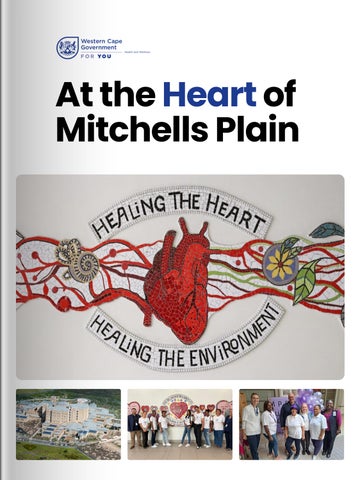
At the Heart of Mitchells Plain
At the Heart of Mitchells Plain
Mitchells Plain Hospital is strengthening healthcare across its growing community through clinical excellence, innovation, education, and a steadfast commitment to compassionate patient care. We sit down with Evan Swart, CEO, who explores how the hospital is responding to the region’s evolving needs Writer: Lily Sawyer | Project Manager: Ben Weaver
Evan Swart, CEO
S
outh Africa (SA) utilises a two-tiered healthcare system designed to provide medical care to all citizens, with a wellresourced private sector serving between 15 and 20 percent of the population and a public framework catering to the vast majority. Within this space, Mitchells Plain Hospital (MPH) is a large public district hospital located in Lentegeur, Cape Town, operating as one of the busiest in the region and functioning as a vital clinical training site for the University of Cape Town (UCT). Having qualified as a pharmacist in 2000 before completing his MBA and postgraduate diploma, Evan Swart, CEO, has spent the majority of his career in healthcare leadership roles. 2 | Africa Outlook Issue 122
Hired by MPH in 2020, Swart brings a wealth of expertise to the hospital having spent six years working as a general manager in the private healthcare space prior to his appointment. During this time, he witnessed the incredible sophistication of SA’s private healthcare space, alongside cost escalations, an ageing population, and the COVID-19 pandemic, which placed additional pressures on state-provided health services. “This has since pushed the universal health coverage (UHC) discussion further into the country, stimulating conversations around how best to achieve a unified health ecosystem,” Swart opens. There has been subsequent focus on moving from hospital-centric,
illness-focused models towards embracing a community-oriented primary care approach integrated across communities and within the home. “This will keep our communities healthy with a preventative approach, as opposed to a treatment-focused, reactive approach,” he adds.
AT THE CENTRE OF COMMUNITIES With more than 415 beds, MPH is a major contributor to healthcare in SA, offering emergency, medical, surgical, orthopaedic, paediatric, obstetrics, gynaecology, and acute psychiatric services, as well as outpatient clinics in several disciplines. Mitchells Plain, which has developed into a 900,000-strong catchment area, commemorates
MITCHELLS PLAIN HOSPITAL HEALTHCARE
MPH
TCC
its 50th anniversary this year and is proud to have MPH at its centre. Prior to the hospital being built in 2013, the community was serviced by the 24-hour Mitchells Plain Community Health Centre and Maternity Obstetric Unit. Since its inception, MPH has heralded countless healthcare advantages for the local population. “The hospital has evolved to meet
more of the community’s needs closer to home, such as the introduction of hip and knee replacements,” Swart shares. Today, MPH receives more than 5,000 emergency centre (EC) visits per month and accepts referrals from various primary healthcare clinics in the community, making it the busiest facility in the province. When tertiary services are required, the hospital
refers to Groote Schuur Hospital (GSH) in Cape Town. Linked with eight other clinics in the geographical area that work together to improve health outcomes, MPH does not function as a sole entity but as part of a comprehensive healthcare ecosystem, which helps when it comes to tackling the high levels of disease burden faced by the Western Cape. Africa Outlook Issue 122 | 3
MITCHELLS PLAIN HOSPITAL HEALTHCARE
“Our province and catchment area face amongst the highest incidences of tuberculosis (TB) cases in SA, and our medical wards are constantly fighting new or recurring TB outbreaks,” reflects Swart. “Whilst we understand there are socioeconomic factors driving these infection rates, we are doing our utmost from a medical standpoint to work in unison with clinics and local non-governmental organisations
(NGOs) to track and trace TB cases, with an aim of reducing loss and ensuring adherence to the highest standards of care.” Naturally, this is one of MPH’s ongoing priorities as it seeks to play a crucial role in countering the major health issues facing SA today.
STEMMING THE TIDE In addition to TB, HIV rates persist in local communities, further
MPH DEALS WITH A NUMBER OF MAJOR HEALTH PROBLEMS FACING SA ON A DAILY BASIS. COULD YOU OUTLINE WHAT THESE PROBLEMS ARE AND EXPLAIN HOW THE ORGANISATION IS WELL-EQUIPPED TO COMBAT THEM? Evan Swart, CEO: “I’ve mentioned infectious diseases such as HIV and TB, which we manage as part of a continuum of care in partnership with local PHCs. “Then, there are non-communicable chronic diseases such as diabetes, hypertension, and associated complications, which form the bulk of our EC admissions. “Together with eight clinics in our network, we discussed the main driver for diseases such as these at a recent population hub meeting. “We concluded that we must focus on prevention and keeping our patients on their treatment plans, which is why we are starting an intervention at the EC to link patients to post-discharge care pathways. “We see about 160 patients daily, of which 50 to 60 may require admission – however, the other 100 will just be going home, so we want to catch them upon leaving the EC and provide follow-up care such as ensuring they have appointments in place and are adhering to treatment. “Maternal and child health issues are another major health problem that is wellmanaged at our facility in partnership with our clinics. “We do however still have high teenage pregnancy rates in our community, which is why our PHC is coordinating with the Western Cape Education Department to launch a programme whereby QR codes are placed in schools to get teenagers and young adults to seek related services and care. “When it comes to trauma injuries, interpersonal violence, homicide, and road accidents, our EC unfortunately sees many cases of these incidents, which is why MPH sits on many boards, forums, and teams to address this, in addition to working with law enforcement and government departments.”
4 | Africa Outlook Issue 122
exacerbated by the withdrawal of international aid in 2025. Despite this, MPH has worked hard to ensure patients continue to be treated; campaigns and education on prevention are ongoing, and morale amongst healthcare workers remains high in the battle against HIV and AIDS. “There is significant coordination between primary healthcare (PHC) campaigns and the hospital to ensure TB and HIV are treated as integrated services rather than separate,” Swart observes. “When combining TB, HIV, and the prevalence of other chronic diseases in our community, it’s no wonder our EC patient numbers are high.” Indeed, MPH admits up to 40 patients a day who are experiencing chronic conditions, which is why a focused, linked care pathway is now in place to ensure patients are followed up with in the community by PHCs and NGOs. “We must focus our efforts on prevention with our communities to stem this tide,” he asserts. Another unfortunate occurrence in the region is violence against women and children, the consequences of which MPH treats at its EC. As such, it has recently constructed a Thuthuzela Care Centre (TCC) – a dedicated centre for survivors of sexual assault, rape, and genderbased violence offering support and care – on the hospital grounds. The TCC has been curated in partnership with the National Prosecuting Authority and MOSAIC – a local NGO funded by the Networking HIV and AIDS Community of Southern Africa (NACOSA) and The Global Fund to Fight AIDS, Tuberculosis, and Malaria. “In order to give dignified care to victims and try to convict offenders, we have a good working relationship with the police services and law enforcement in this regard.” To maintain high standards within
Mosaics are a proud feature of MPH
the facility despite the high and continuous volume of patients, MPH’s senior clinicians and nurses drive quality care whilst holding both management and their colleagues to account. “We also take our National Quality Standards seriously, complying with annual audits and recently receiving compliance status in the Office of Health Standards Compliance external audit,” he tells us. The quality management system
in the hospital is actively managed, recording incidents, complaints, and serious incidents, investigating and responding to authorities, and conducting quality improvement plans with the relevant monitoring and evaluation.
INNOVATION ACROSS THE BOARD As a busy, patient-focused hospital, innovation is at the heart of MPH, whose staff are dedicated to
improving conditions for themselves, their patients, and the system itself. “As leaders, we embrace this spirit and endeavour to support ideas coming from our teams,” emphasises Swart. Indeed, the hospital’s emergency medicine specialists have taken it upon themselves to develop the Hospital and Emergency Centre Triage and Information System (HECTIS) for MPH’s EC so they can track patients in real time. Africa Outlook Issue 122 | 5
MITCHELLS PLAIN HOSPITAL HEALTHCARE
“As HECTIS has developed, more information has been captured, meaning the system has now become akin to an electronic patient record, indicating triage status and enabling us to track a patient’s journey,” he details. The HECTIS Implementation Team won the Gold Award for Best Digital Innovation at the Western Cape Government Service Excellence Awards for the innovative solution. MPH’s Dr Moosa Parak is currently rolling out HECTIS to all public sector 24-hour ECs in the Western Cape province. Elsewhere, an MPH specialist has developed an innovative electronic discharge programme to ensure patients are followed up by their local clinic post-discharge from the hospital. “There has been a huge uptake of this programme; it has been extended to other departments and rolled out further to the rest of the province,” Swart prides. The hospital is also trailing an advanced transitional care space due to the high numbers of medical patients and shortage of beds. “This space is designed to allow lower-acuity patients to be moved and cared for in lower-cost wards whilst they await transfer to stepdown facilities or TB hospitals, complete courses of parenteral antibiotics, or even receive palliative care,” he shares. This system is designed to improve flow through MPH and alleviate pressure at its EC.
TRAINING THE FUTURE OF HEALTHCARE As a hospital aligned with the UCT Medical School, MPH welcomes medical students, interns, registrars, nursing, and allied health workers in training. It is proud to be a facility where interns and registrars request to be placed and one of the most 6 | Africa Outlook Issue 122
“Part of our duty is to cultivate good healthcare professionals for our country and health system, which is why we are proud to welcome medical interns and community service doctors from all over the country” – E VA N S WA R T, C E O , M I T C H E L L S P L A I N H O S P I TA L
sought-after destinations for junior doctors. Medical students from UCT rotate through the hospital across various departments, with specialists often overseeing both student examinations and research work, bringing fulfilment to the work environment. The Western Cape is lucky to be home to three universities in terms of local talent, namely UCT, the University of the Western Cape (UWC), and Stellenbosch University (SU). “We also have students from UWC and SU rotating through our hospital and have a good relationship with these institutions, as well as the Western Cape Department of Health and Wellness,” Swart insights. “Part of our duty is to cultivate good healthcare professionals for our country and health system, which is why we are proud to welcome medical interns and community service doctors from all over the country.”
MPH is likewise a choice destination for medical students from abroad due to the exposure to various conditions that interns can experience at the hospital. “We currently have a waiting list of students from Europe to attend our hospital as part of their course,” he confirms. Coordinated by the EC and UCT, interest from international students is also a source of revenue for the hospital board academic fund, which enables local doctors to embark on training courses and attend conferences. There are also community colleges in the area offering courses in administrative and technical competencies which, when paired with the internships in people management, finance, and supply chain, and technical disciplines offered by MPH, provide a supported career pathway for young people in the province.
summary
MITCHELLS PLAIN HOSPITAL HEALTHCARE
COMPANY REGISTRATION NO: 2017/165391/07
Madge Computers is an established IT and office automation supplier founded in Cape Town in 2010. They specialize in hardware, software, office consumables, maintenance contracts, and comprehensive networking solutions.
THE BIXOLON PARTNERSHIP & GOVERNMENT PROJECTS
Madge Computers maintains a close partnership with Bixolon to deliver specialized hardware and automation systems. They actively deploy these solutions across key Government Projects in the Western Cape, ON specifically targeting: • Healthcare: Supplying reliable printing and data systems for medical facilities. • Law Enforcement: Assisting with public safety infrastructure and uters a QSE company that was established in 2010. equipment. • City of Cape Town: Supporting municipal operations and urban uters changed from a Close Corporate to a Private Company in 2017 governance initiatives.
eller of IT and Printer hardware, printer and computer consumables and BRANDS & OPERATIONS data media supplies and office consumables. Madge Computers are an • Supported Brands: Along with Bixolon, their product ecosystem ffering best of breed brands, superior stock availability via the Distribution features leading global brands like Adobe Acrobat, Samsung, gether with a professional andAcer, efficient sales delivery service enabling our Canon, Dell, Lenovo, andand Asus. rely on us as an extension of their organisation. •
Commitment: The company employs a dedicated, specialized staff focused on delivering long-term value, skills development, and
uters is recognisedup-to-date as a Level 2 contributor with a BBBEE procurement industry solutions to both corporate clients and public vel of 125% with 51 % Black Shareholding and 51% Black Women sector institutions.
T+27 21 982 0722 | +27 828536360 magdaspies@mweb.co.za
mer service and quality parameters in all aspects of our business to ensure that s receive the highest possible service level in our industry.
N
r customers with industry-leading products backed up by world-class service at icing levels.
mance-based culture that recognises entrepreneurship and promotes equality, lopment, enthusiasm and respect for the individual.
Africa Outlook Issue 122 | 7
MITCHELLS PLAIN HOSPITAL HEALTHCARE
In addition, MPH’s nursing department has partnered with NGOs to train community healthcare workers, who can be placed within the hospital for practical training before being sent out into the community.
THE GREATER GOOD Swart highlights how MPH’s greatest asset is its staff, who have an innate understanding of the pressures presented by a hospital setting and therefore support each other. “This can be clearly witnessed in the strong working relationships our doctors and nurses have with one another, along with the senior clinicians from different departments working for the greater good rather than seeking personal comfort,” he observes. “This stood us in great stead during the COVID-19 pandemic and is something I cherish amongst the top aspects of the daily functioning of the hospital.” MPH’s doctors also go on courses and attend conferences and learning exchanges across the world in their field of study. 8 | Africa Outlook Issue 122
“We support our staff by granting time away from the workplace for continued professional development and subsidise a portion of their costs via our training budget or hospital board academic fund” – E VA N S WA R T, C E O , M I T C H E L L S P L A I N H O S P I TA L
“We support our staff by granting time away from the workplace for continued professional development and subsidise a portion of their costs via our training budget or hospital board academic fund,” Swart shares. In addition, MPH provides senior clinicians with the opportunity to work with UCT in forums around the province, adding an important dimension to their work-life balance. The hospital’s largest contingent of staff are its nurses, many of whom have undertaken leadership courses in recent years.
“Our nurses also ensure their ward staff enjoy health and wellness events to keep them motivated,” he outlines. An area of improvement for MPH is its allied health services, which have so far struggled to keep pace with the increase in bed numbers. “Whilst this is an area we must work on, there is a positive collegiate
MITCHELLS PLAIN HOSPITAL HEALTHCARE
relationship between the allied health service and the respective clinical teams, who often attend conferences and courses run by the allied health services,” shares Swart. Elsewhere, MPH has been implementing policy frameworks around harassment in the workplace, which are focused on understanding human rights and the code of conduct. “We are proud to have active union representatives who host a management and labour caucus every month where staff can discuss issues,” he expands. MPH also has departmental employee health and wellness support systems in place, through which staff can disclose matters causing stress, alongside occupational health and wellness support nurses who attend to workplace injuries or incidents. “Whilst we have our share of staff complaints, we attempt to address these fairly and equitably. For example, I host regular town hall meetings to update staff on new policies or systems, where they can ask questions to the management team,” Swart exemplifies.
MEETING FUTURE HEALTH NEEDS In a world where sustainability is becoming increasingly important, another exciting development from MPH is its effort to be more environmentally conscious. As such, it is completing an energy-saving initiative relating to the hospital’s lights and energy consumption and has recently installed a Newster NW50 ecomedical waste heat treatment sterilisation system to manage its clinical waste, reducing the environmental impact of typical incineration processes. “As a result of our sustainability efforts, we are even seeing some financial savings. This will be a continual process and we will soon look to identify other areas of the facility that require improvement,” Swart sets out. Looking ahead, MPH strives to continue meeting the health needs of the community it serves, which will include installing high-care beds at the facility. Despite being designed as a district hospital service at the time of
commissioning, MPH plans to work together with its tertiary service hospital, GSH, to install high-care beds to benefit the wider community. As its service offering has grown, the hospital often has to take care of critical care patients post-EC, which requires a dedicated space, equipment, and staff. MPH must find a solution for the increasing number of medical patients waiting to be admitted to hospital, overcrowding in the EC, and increasing patient waiting times. “We will have to find space for these patients to be kept outside the EC whilst they wait to be admitted, which will also mean increasing the bed capacity of the hospital,” Swart firmly concludes.
Tel: +27 21 377 4306 service@westerncape.gov.za
www.westerncape.gov.za Africa Outlook Issue 122 | 9
Tel: +27 21 377 4306 service@westerncape.gov.za www.westerncape.gov.za
PRODUCED BY AFRICA OUTLOOK MAGAZINE