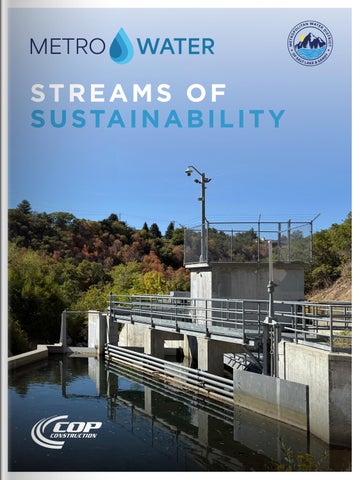
STREAMS OF S U S TA I N A B I L I T Y
STREAMS OF S U S TA I N A B I L I T Y The Metropolitan Water District of Salt Lake & Sandy stands at the forefront of innovative and sustainable water management solutions. Annalee Munsey, General Manager, discusses the crucial steps being taken to ensure a dependable supply amid growing environmental challenges and urban demands Writer: Rachel Carr | Project Manager: Molly Foss
2 | North America Outlook Issue 37
T
he roots of the Metropolitan Water District of Salt Lake & Sandy (Metro Water) run deep, reflecting a 90-year legacy of development and innovation in water resource management that predates its formal establishment. The company was officially created in 1935 during a challenging period for the US, marked by the Great Depression and the worst drought recorded in the Salt Lake Valley, Utah. Despite these hardships, proactive
METROPOLITAN WATER DISTRICT OF SALT LAKE & SANDY ENERGY & UTILITIES
steps were taken to generate a sustainable water supply program aimed at securing the future of the state capital and ensuring a reliable long-term water source, marking a significant milestone in the region’s water management history. In March 1935, the Metropolitan Water District Act was enacted, allowing cities to form districts to develop water resources for meeting public needs. Electors within the corporate limits
of Salt Lake City voted for the creation of the Metropolitan Water District of Salt Lake City in August 1935 and, two weeks later, the Secretary of State issued its incorporation certificate. Shortly thereafter, Metro Water participated in the Provo River Project, a Bureau of Reclamation Project. As a result, Metro Water became the local sponsor for the Aqueduct Division of the Provo River project, taking on the responsibility of
operating and maintaining the 42-mile Salt Lake Aqueduct (SLA), which would convey water from Deer Creek Reservoir to the Terminal Reservoir in the Salt Lake Valley. Metro Water found that the Provo River Project offered more than just an affordable water supply. With cleaner water than creek sources and softer than groundwater, its storage capacity was double the city’s then consumption, ensuring future resiliency. North America Outlook Issue 37 | 3
METROPOLITAN WATER DISTRICT OF SALT LAKE & SANDY ENERGY & UTILITIES
WHICH REGULATORY CHANGES ARE HAVING THE BIGGEST OPERATIONAL IMPACT, AND HOW DO EVOLVING WATER QUALITY STANDARDS INFLUENCE INVESTMENT DECISIONS? ANNALEE MUNSEY, GENERAL MANAGER: “Regulatory requirements significantly shape Metro Water’s operational planning and investments. The
With increasing water demand projections, Sandy City recognized in the 1980s that its water supply would soon be insufficient. In response, the city sought to annex into Metro Water and receive the benefit of treating its Little Cottonwood Creek water rights at the Little Cottonwood Water Treatment Plant (LCWTP). By 1990, Sandy City had become a member of the organization, which resulted in its current name.
revised Lead and Copper Rule has had the greatest impact on Salt Lake City
PARTNERSHIPS FOR PROGRESS
and Sandy City.
Metro Water prioritizes excellence as a core value, believing collaboration produces high-quality water and excellent service to customers and communities. “Ensuring access to reliable drinking water is a shared responsibility that can only be achieved through strong partnerships,” introduces Annalee Munsey, General Manager. Our member cities, industry partners, contractors, consultants, and various organizations within Utah’s water community each contribute unique expertise that strengthens the overall system. When we collaborate, share knowledge, and address challenges together, we create a more resilient water system and provide better outcomes for the communities we serve.” Importantly, Metro Water implements strategies to ensure that water remains affordable for up to half a million residents served. “As we assess the costs of replacing aging infrastructure, it’s important to consider water affordability for our communities. Historically, water treatment in the Salt Lake Valley has been low-cost due to the high quality of our protected mountain watersheds. “We benefit from using stored snowpack water, which simplifies treatment and reduces costs, but replacing the critical infrastructure needed to deliver quality water requires a substantial investment,
“While the rule has not changed our treatment operations as a wholesale water provider, our certified lab has experienced a significant increase in lead and copper samples to support the cities’ compliance efforts. Thousands of additional samples have increased demand on lab equipment, staffing, and testing capacity. “We have also been proactively preparing for other emerging water quality regulations by monitoring for per- and polyfluoroalkyl substances (PFAS) compounds to comply with the Environmental Protection Agency’s (EPA) first national drinking water standards for these contaminants. “To date, no PFAS compounds have been detected in our system, with initial monitoring continuing until 26th April 2027. “We are closely monitoring the potential revisions to the microbial and disinfection byproducts rules proposed by the EPA. If these changes are adopted, we may need to adjust our chlorine dosing practices or add booster stations in the distribution system to ensure compliance with regulations.”
4 | North America Outlook Issue 37
significantly higher than in the past,” she explains. Metro Water has acknowledged these challenges and put strategies in place to manage costs while ensuring communities have access to affordable and reliable drinking water, including an asset management program, conditional assessments, and a comprehensive maintenance program that proactively maintains equipment to extend its service life. One of Metro Water’s key strategies is actively pursuing state and federal funding opportunities to help reduce the amount that must be generated through water rates and property taxes, easing the financial burden on communities. “Competition for funding is prevalent as numerous water systems throughout the state and the country are upgrading infrastructure that was built between the 1940s and 1970s. “By securing external funding whenever possible, we can make crucial investments in system
“ W E A S S E S S VA R I O U S F U T U R E S C E N A R I O S AND INVEST IN RESILIENT INFRASTRUCTURE, D I V E R S I F I E D WAT E R S O U R C E S , A N D S T R AT E G I C S T O R A G E T O E N S U R E R E L I A B L E WAT E R S U P P LY F O R O U R G R O W I N G COMMUNITIES” – A N N A L E E M U N S E Y, G E N E R A L M A N A G E R , M E T R O P O L I TA N WAT E R D I S T R I C T O F S A LT L A K E & S A N D Y
reliability while ensuring water remains affordable for both current and future generations,” Munsey reassures.
A PROACTIVE APPROACH Metro Water is enhancing resilience against drought and climate variability by addressing climate change-related water scarcity through long-term planning and
strategic investments. “In 2025, we updated our Supply and Demand Master Plan to assess how factors such as drought, population growth, and climate change may reduce mountain snowpack, alter runoff timing, increase evaporation, and extend irrigation seasons – all of which create greater demand on the water system,” reports Munsey. North America Outlook Issue 37 | 5
METROPOLITAN WATER DISTRICT OF SALT LAKE & SANDY ENERGY & UTILITIES
THE SALT LAKE VALLEY OVERVIEW WATER TREATMENT INFRASTRUCTURE: • LCWTP – Located in Cottonwood Heights as the second-largest conventional water treatment plant in the Salt Lake Valley. • POINT OF THE MOUNTAIN WATER TREATMENT PLANT (POMWTP) – Located in Draper and commissioned in 2007, the POMWTP treats water from the Provo River system and the Central Utah Project. With a capacity of 70 MGD, it supports peak flow demands and provides redundancy for the LCWTP during maintenance shutdowns. • JORDAN VALLEY WATER TREATMENT PLANT – Located in Bluffdale and built in 1972 with expansions in 1979 and 1986, it is the largest conventional facility in the valley, currently operating at 180 MGD. Ownership was transferred to Jordan Valley Water Conservancy District and Metro Water in 2007. A project is underway to expand capacity to 250 MGD, with Metro Water entitled to 2/7ths of the existing capacity. WATER CONVEYANCE INFRASTRUCTURE: • SLA – Completed in 1951, the aqueduct runs 42 miles, has a 69-inch inside diameter, and is mostly reinforced by a concrete pipe that runs from Deer Creek Reservoir in Provo Canyon to 3300 South and I-215 in Millcreek. • POINT OF THE MOUNTAIN AQUEDUCT (POMA) – Commissioned in 2007, its finished water portion allows water to be delivered between LCWTP and POMWTP. • JORDAN AQUEDUCT (JA) – Starting midway in Provo Canyon, its pipeline delivers water to the Northwest quadrant of Salt Lake City. Metro Water is 2/7ths owner of the JA. WATER STORAGE INFRASTRUCTURE: • TERMINAL RESERVOIR – A 48-MG storage reservoir, it was originally constructed in 1951 and rebuilt in 2017 to address seismic concerns. The new reservoir provides reliable water storage for municipal and fire use. • JA TERMINAL RESERVOIR – A 100-MG storage reservoir on the JA system. Metro Water is 2/7ths owner of this reservoir.
The strategy focuses on a diverse water portfolio to enhance long-term security. In response to the 1930s drought, Metro Water engaged in the Provo River Project to reduce dependence on a single source, and now water is obtained from there as well as Little Cottonwood Creek and the Central Utah Project, providing flexibility in water management. “By storing holdover water in Deer Creek Reservoir, we extend resources 6 | North America Outlook Issue 37
from wetter years into drier times. This allows us to meet customer demands during reduced reservoir allotments amid drought cycles, providing a crucial buffer against future shortages,” assures Munsey. Water conservation is vital for regional resilience, and as such, Metro Water supports conservation programs and drought-planning initiatives in Salt Lake City and Sandy City, as every gallon saved helps
extend supplies and prepare for future dry years. “Climate change is a key factor in our future planning. In Utah, our water supply is heavily dependent on mountain snowpack, making us vulnerable to changing weather patterns, intense storms, and prolonged droughts.” In order to conserve water during times of low demand, Metro Water has completed a Managed Aquifer Recharge Project with one injection well, two infiltration basins, and five monitoring wells. A five-year pilot program was recently initiated to assess the impact of these facilities on aquifer water levels. “We assess various future scenarios and invest in resilient infrastructure, diversified water sources, and strategic storage to ensure reliable water supply for our growing communities,” informs Munsey. In addition, Metro Water has an Emergency Action Plan in place to address potential water contamination and other emergencies. Indeed, its 84 employees regularly participate in exercises to practice protocols for various scenarios. Metro Water trains staff to establish an incident command structure and conduct site investigations to assess potential threats. Additional steps include notifying public health agencies and isolating any suspected contaminated water. “We acknowledge our responsibility as stewards of water resources and facilities, implementing robust precautions and ensuring our staff can handle emergencies with confidence,” she emphasizes.
REVOLUTIONIZING WATER TREATMENT The LCWTP, constructed in 1960, is a conventional water treatment plant using flocculation, conventional sedimentation, and dual-media granular filtration.
BUILDING
A STRONGER
WATER FUTURE. In partnership with Utah’s water providers, we’re delivering more than treatment plants and pipelines. Together, we’re helping secure the future of water. COPCONSTRUCTION.COM
In 2007, the plant was upgraded with a series of on-site improvements that allowed treatment capacity to increase from 113 to 150 million gallons per day (MGD), making it the secondlargest conventional treatment facility in the state of Utah. Improvements to the facility included a nine-million-gallon water reservoir, added ozone disinfection processes, a new diversion structure on Little Cottonwood Creek, upgraded grit removal, and screening facilities. Strategically located at the mouth of Little Cottonwood Canyon, the facility effectively captures raw water for treatment and transport to the Terminal Reservoir. However, its proximity to the Wasatch fault zone (WFZ) poses a risk of structural damage from seismic activity. The original structures do not meet current seismic codes and are at significant risk during an earthquake. Considering this, the LCWTP Rebuild (LC Rebuild) has three main 8 | North America Outlook Issue 37
“BY SECURING EXTERNAL FUNDING WHENEVER POSSIBLE, WE CAN MAKE CRUCIAL INVESTMENTS IN SYSTEM R E L I A B I L I T Y W H I L E E N S U R I N G WAT E R R E M A I N S A F FO R DA B L E FO R B OT H C U R R E N T A N D F U T U R E G E N E R AT I O N S ” – A N N A L E E M U N S E Y, G E N E R A L M A N A G E R , M E T R O P O L I TA N WAT E R D I S T R I C T O F S A LT L A K E & S A N D Y
goals: to reconstruct the plant to ensure continued operation during major hazards, such as earthquakes; to enhance the performance of key treatment processes; and to upgrade electrical and control systems. Although the project will not increase the plant’s overall capacity, it will enhance its reliability. “We are excited to use the construction manager/general contractor (CM/GC) method for the LC Rebuild. This collaborative approach among the owner, engineer, and contractor fosters innovation,
improves constructability, and identifies cost-saving opportunities early in the design process. “Expected long-term benefits for the Salt Lake Valley include the plant’s ability to produce 50 MGD of water within three days of a ‘maximum considered’ earthquake,” Munsey comforts. After a natural disaster, access to clean drinking water is crucial for public health and supports vital industries such as hotels, food service, and healthcare, which can suffer significant losses.
METROPOLITAN WATER DISTRICT OF SALT LAKE & SANDY ENERGY & UTILITIES
“The LC Rebuild will improve system reliability, increase resilience, and secure safe drinking water for our growing population while being more energy-efficient and cost-effective,” she urges.
STRENGTHENING WATER RESILIENCE Metro Water’s Cottonwoods Connection Project is nearing completion. As part of the Salt Lake Aqueduct Resiliency Program, the pipeline will support finished water deliveries to Salt Lake City. “The Cottonwoods Connection provides redundancy for the SLA and Salt Lake City’s Little Cottonwood Conduit – now 95 years old. Metro Water uses the existing pipelines to complete finished water deliveries to the city, which supports our regional approach to water supply and ensures reliability for our communities,” Munsey expresses. A concrete pipeline, like the SLA,
has a design life of 50 to 100 years. Now 75 years old, the finishedwater portion of the SLA was identified as the number one priority in Metro Water’s Multi-Hazard Mitigation Plan. Due to the pipeline’s age, location along the WFZ, and belland-spigot design, earthquakes are the biggest concern. The Cottonwoods Connection – a 36-inch to 72-inch welded steel pipe – runs mostly parallel to the SLA from the mouth of Big Cottonwood Canyon to the LCWTP and is intentionally designed to withstand a 2PE50 seismic event. As the Cottonwoods Connection nears completion, Metro Water is working toward its next legacy project. Advancing the LC Rebuild project will remain Metro Water’s top priority in the coming year. It has now entered the pre-design phase, during which crucial decisions will be made to refine the facility’s scope, evaluate
delivery methods, and develop a reliable cost estimate. As planning progresses, Metro Water and its Board of Trustees will continue to explore funding strategies to support an estimated investment of approximately $800 million. Options being considered include phased construction, financing through the State Water Infrastructure Fund, and actively seeking state and federal grant funding. “Metro Water has been providing water to the Salt Lake Valley for over 90 years, a legacy we’re proud of. As we move forward, our team remains focused on doing everything within our power to support our vision,” Munsey concludes emphatically.
Tel: 801.942.1391 info@mwdsls.gov
www.mwdsls.gov North America Outlook Issue 37 | 9
Tel: 801.942.1391 info@mwdsls.gov www.mwdsls.gov
PRODUCED BY NORTH AMERICA OUTLOOK MAGAZINE