MARTIN-BAKER AMERICA , INC . • CEMENTIS GROUP
www.mfg-outlook.com
Issue 14
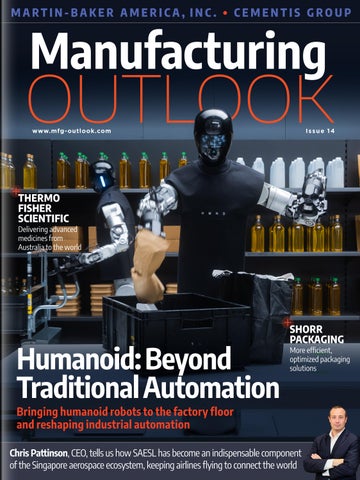
THERMO FISHER SCIENTIFIC
Delivering advanced medicines from Australia to the world
Bridging the Real Humanoid: Beyond and Virtual Worlds
Traditional Automation
SHORR PACKAGING
More efficient, optimized packaging solutions
Bringing humanoid robots to the factory floor and reshaping industrial automation
Chris Pattinson, CEO, tells us how SAESL has become an indispensable component of the Singapore aerospace ecosystem, keeping airlines flying to connect the world
GLADSTONE AREA WATER BOARD
D E S I M O N E CÔT E D ’ I VO I R E
B R I T I S H P O R T S A S S O C I AT I O N
N E B R A S K A P U B L I C P OW E R D I S T R I C T
G A S TO N E L E C T R I C A L
TURNER MINING GROUP
HUNTER VALLEY OPERATIONS
L O S
A N G E L E S
G E N E R A L
M E D I C A L Issue 15
WEIR
End-to-end solutions from exploration to extraction
C E N T E R
ST. JOSEPH’S HEALTH SYSTEM
Elevating the patient experience
DIGITAL HEALTH ASSOCIATION
w w w. a f r i c a o u t l o o k m a g . c o m
w w w. a p a c o u t l o o k m a g . c o m
Issue 121
B2GOLD NAMIBIA Proudly operating the nation’s largest and most successful underground gold mine, B2Gold Namibia continues to flourish with exciting plans in the pipeline
Drop Access works at the intersection of healthcare and clean energy, as we learn from Norah Magero, co-Founder and CEO
Issue 81
ALTRAD
SAESL
One of Australia’s most recognised industrial service providers
Keeping airlines flying to connect the world
w w w. e m e o u t l o o k m a g . c o m
Issue 73
www. northame ricaoutlookmag.com
Issue 37
www.healthcare-outlook.com
www.mining-outlook.com • Issue 16
EMIRATES RAWABI
MBA ENERGY & INDUSTRIAL
Uniting food and beverage production under one national banner
On a coal mining mission to champion sustainable practices
MARTIN-BAKER AMERICA, INC. Seat and safety vanguards for the defense sector
ARGO NATURAL RESOURCES
MARTIN-BAKER AMERICA , INC . • CEMENTIS GROUP
On a mission to be a leading integrated green coal mining operation
Thermo Fisher Scientific has reinforced its position as a trusted biologics manufacturing partner
The ultimate goal of Virginia Tech Dining Services is to create an environment where students not only eat, but also grow, connect, and thrive as members of the Hokie community
At the helm of Europe’s data centre future
Michael Hanisch, Head of Technology Germany, discusses Amazon Web Services’ significant cloud infrastructure investments
A M A Z O N B U S I N E S S • U N I L E V E R • G E P • O R I TA I N
VULCAN MOZAMBIQUE
M Resources delivers a suite of essential steelmaking raw materials, infrastructure, and mining and logistics services to steelmakers across the globe. Matt Latimore, Founder and President, details the company’s futurefacing approach to investment and market growth
GERMAN DATACENTER ASSOCIATION
Unearthing coal potential in Australia, Argo Natural Resources champions sustainable mining practices
Brendan Tritton, Managing Director and CEO of Valiant Gold, a Western Australian gold company, discusses advancing the restart of two historic mining centres in the Murchison Goldfields
Mark Scott, General Manager of Pinto Valley Mining Corp., delves into Capstone Copper’s Pinto Valley Mine and its importance in Arizona’s Globe-Miami mining district
CO O P L A N DS B A K E RY • D N AG RA R • B RA K E B U S H
KOLEKTOR CONSTRUCTION
Garry Edwards, VP EMEA at Wolters Kluwer, emphasises the need for formalised, organisation-wide frameworks to ensure responsible use of artificial intelligence
Jason Bontempo, CEO of Gladiator Metals, discusses the resurgence of the Whitehorse Copper Belt in Canada’s historic Yukon mining district
VECA ELECTRIC & TECHNOLOGIES
N O F A R
E N E R G Y
R O M A N I A
K I N G S PA N
Family-run, proudly Canadian
DANONE ROMANIA
w w w. s u p p ly c h a i n - o u t l o o k . c o m
Issue 14
EUROPEAN SUBSEA CABLES ASSOCIATION
W W W .CONST RUCT ION-OUT L OOK.COM • ISSUE 4
Contributing to the nation’s net zero goals
OUTLOOK
CBRE www.sustainabilityoutlookmag.com
Contributing to a healthier world
www.foodbeverage-outl ook.com
N O R D I C S
GREEN BUILDING COUNCIL OF AUSTRALIA
OSMOW’S SHAWARMA ISSUE 11
www.mfg-outlook.com
Issue 2
Real estate solutions of the future
Iss ue 9
Connecting nations and driving innovation
THERMO FISHER SCIENTIFIC
Delivering advanced medicines from Australia to the world
RADIANT LOGISTICS
Built for resilience
Bridging the Beyond Real Humanoid: and Virtual Worlds
Traditional Automation
SHORR PACKAGING
More efficient, optimized packaging solutions
Bringing humanoid robots to the factory floor and reshaping industrial automation
BRITISH PORTS ASSOCIATION
Steven Johnson, Managing Director, UKIE, Nordics, and Eastern Europe Network Operations, explains why operations leadership is critical Network Operations, explains why operations leadership is critical Steven Johnson, Managing Director, UKIE, Nordics, and Eastern Europe
of the Singapore aerospace ecosystem, keeping airlines flying to connect the world Chris Pattinson, CEO, tells us how SAESL has become an indispensable component
Margaret Henry,
VP of Sustainable and Regenerative Agriculture, discusses PepsiCo’s collaborative regenerative farming initiative
From humble potatoes to gourmet crisps, SAVOURSMITHS is transforming snacking with bold flavours and a rich family heritage
Over the last year, Saulsbury has expanded its position as one of North America’s leading engineering, procurement, and construction contractors
Johan van Jaarsveld, Managing Director of Montego Pet Nutrition, tells us about the pet care brand’s promise of ‘Better Every Day’ tells us about the pet care brand’s promise of ‘Better Every Day’ Johan van Jaarsveld, Managing Director of Montego Pet Nutrition,
decarbonisation and infrastructure across UK ports in recent years Richard Ballantyne OBE, outlines the strong investment in Our latest catch-up with the British Ports Association and CEO,
and reshaping industrial automation Bringing humanoid robots to the factory floor
Traditional Automation and Virtual Worlds Humanoid: Bridging the Beyond Real
SAVOURING THE FLAVOUR OF THE CRISP PARADIGM SHIFT
Our latest catch-up with the British Ports Association and CEO, Richard Ballantyne OBE, outlines the strong investment in decarbonisation and infrastructure across UK ports in recent years
Chris Pattinson, CEO, tells us how SAESL has become an indispensable component of the Singapore aerospace ecosystem, keeping airlines flying to connect the world
solutions optimized packaging More efficient,
ASSOCIATION BRITISH PORTS
PACKAGING SHORR
Built for resilience
LOGISTICS RADIANT Australia to the world medicines from Delivering advanced
YY Group Holding operates an artificial intelligence-native workforce solutions and integrated facility management platform. CEO, Mike Fu, discusses the company’s established capabilities
Simon Thompson, VP Northern Europe at JAGGAER, explains why artificial intelligence-powered data infrastructure is becoming essential
facility management platform. CEO, Mike Fu, discusses the company’s established capabilities YY Group Holding operates an artificial intelligence-native workforce solutions and integrated
intelligence-powered data infrastructure is becoming essential Simon Thompson, VP Northern Europe at JAGGAER, explains why artificial
procurement, and construction contractors as one of North America’s leading engineering, Over the last year, Saulsbury has expanded its position
initiative regenerative farming PepsiCo’s collaborative Agriculture, discusses and Regenerative VP of Sustainable
a rich family heritage with bold flavours and transforming snacking SAVOURSMITHS is to gourmet crisps, From humble potatoes
SHIFT PARADIGM OF THE CRISP THE FLAVOUR SAVOURING
Margaret Henry,
TELL US YOUR STORY, AND WE’LL TELL THE WORLD
SCIENTIFIC FISHER THERMO
innovation nations and driving Connecting
www.mfg-outlook.com
Issue 14
ASSOCIATION SUBSEA CABLES EUROPEAN
www.foodbeverage-outl ook.com
Iss ue 9
healthier world Contributing to a
w w w. s u p p ly c h a i n - o u t l o o k . c o m ISSUE 11
ROMANIA DANONE
Canadian Family-run, proudly
W W W .CONST RUCT ION-OUT L OOK.COM • ISSUE 4
OUTLOOK
www.sustainabilityoutlookmag.com
Issue 2
A M A Z O N B U S I N E S S • U N I L E V E R • G E P • O R I TA I N
CO O P L A N DS B A K E RY • D N AG RA R • B RA K E B U S H
of the future Real estate solutions
CBRE
nation’s net zero goals Contributing to the
AUSTRALIA COUNCIL OF BUILDING GREEN
SHAWARMA OSMOW’S
MARTIN-BAKER AMERICA , INC . • CEMENTIS GROUP
Modernising and transforming health systems
ARGO NATURAL RESOURCES
Delivering construction with integrity and expertise
L’Osteria is transforming Europe’s culinary landscape by focusing on creating a distinctive Italian dining destination where guests feel at home
KOLEKTOR CONSTRUCTION
VECA ELECTRIC & TECHNOLOGIES
N O F A R
E N E R G Y
R O M A N I A
K I N G S PA N
N O R D I C S
Africa Outlook, APAC Outlook, EME Outlook, North America Outlook, Mining Outlook, Healthcare Outlook, Manufacturing Outlook, Supply Chain Outlook, Food & Beverage Outlook, Construction Outlook, and Sustainability Outlook are digital publications aimed at boardroom and hands-on decision-makers, reaching an audience of more than 800,000 people around the world. With original and exclusive content compiled by our experienced editorial team, we look to promote the latest in engaging news, industry trends, and success stories from across the globe. Your company can join the leading industry heavyweights enjoying the free exposure we provide across our platforms with a free marketing brochure, extensive social media saturation, enhanced B2B networking opportunities, and a readymade forum to attract new investment and help you grow your business. Visit www.outpb.com/work-with-us for details on how your company can feature for free in one of our upcoming editions.
www.outpb.com/work-with-us
WELCOME FROM THE EDITOR
EDITORIAL Head of Editorial: Jack Salter jack.salter@outpb.com Deputy Head of Editorial: Lucy Pilgrim lucy.pilgrim@outpb.com
THE ROBOLUTION Welcome to our 14th edition of Manufacturing Outlook
Senior Editor: Lily Sawyer lily.sawyer@outpb.com
magazine.
Editor: Ed Budds ed.budds@outpb.com
Manufacturers today are looking for practical solutions
Editor: Rachel Carr rachel.carr@outpb.com Copy Editor: Lauren Kania lauren.kania@outpb.com PRODUCTION Art Director: Stephen Giles steve.giles@outpb.com Senior Designer: Devon Collins devon.collins@outpb.com Designer: Louisa Martin louisa.martin@outpb.com Production Manager: Alex James alex.james@outpb.com Digital Marketing Director: Fox Tucker fox.tucker@outpb.com Senior Website Content Manager: Oliver Shrouder oliver.shrouder@outpb.com Social Media Executive: Jake Crickmore jake.crickmore@outpb.com Trainee Digital Content Executive: Tara Steele tara.steele@outpb.com BUSINESS CEO: Ben Weaver ben.weaver@outpb.com
in the face of very real labour, productivity, and flexibility challenges. Humanoid robots become a business case when they can solve one of these problems; the conversation quickly shifts from technology to economics if they can help address labour shortages, reduce bottlenecks, or improve throughput where traditional automation struggles. Our robotic cover star, Humanoid, believes the future is about creating a more collaborative relationship between people and automation. “Over time, as deployment scales and the technology matures, we can imagine facilities being designed from the beginning around mixed human-robot workforces,” outlines Humanoid CEO and Founder, Artem Sokolov. The world’s largest maintenance, repair, and overhaul facility for Rolls-Royce Trent engines, meanwhile, is SAESL. Celebrating its 25th anniversary this year, SAESL is now in the process of undergoing a bold transformation.
Managing Director: James Mitchell james.mitchell@outpb.com
“We have a hugely exciting journey ahead, and it is important we continue on
Chief Technology Officer: Nick Norris nick.norris@outpb.com
that path because this is setting up the next 25 years of SAESL’s success,” sets
Content Director: Neil Perry neil.perry@outpb.com Global Head of Media: Lewis Hammond lewis.hammond@outpb.com Global Media Executive: Kai Boyle-Vennard kai@outpb.com A D M I N I S T R AT I O N Finance Director: Suzanne Welsh suzanne.welsh@outpb.com Finance Manager: Victoria McAllister victoria.mcallister@outpb.com C O N TA C T Manufacturing Outlook Norvic House, 29-33 Chapelfield Road Norwich, NR2 1RP, United Kingdom Sales: +44 (0) 1603 804 445 Editorial: +44 (0) 1603 804 431 SUBSCRIPTIONS Tel: +44 (0) 1603 804 431 jack.salter@outpb.com www.mfg-outlook.com Follow us on Linkedin: @manufacturingoutlook
out Chris Pattinson, CEO. In the two years since we last spoke with Thermo Fisher Scientific (Thermo Fisher), the company has reinforced its position as a trusted biologics manufacturing partner. Its site in Brisbane, Queensland specifically focuses on biologics manufacturing and forms part of a wider global network, allowing customers to access both Australian expertise and Thermo Fisher’s international scale. “My role is to ensure we keep delivering for our customers whilst also building the capability, culture, and resilience of the site for the long-term,” says Kym Baker, General Manager, Brisbane Biologics, who we interviewed previously. Likewise delivering for their customers are Shorr Packaging, Martin-Baker America, Inc., Cementis Group, and more. We hope that you enjoy your read. Jack Salter Head of Editorial, Outlook Publishing Manufacturing Outlook Issue 14 | 3
T HE D I SR U P TO R
17 Humanoid
14 CONTENTS
Beyond Traditional Automation
28 TH E Q U E STI O N Your Factory of the Future: How do you get the most from manufacturing tech investments?
Bringing humanoid robots to the factory floor
REGULARS TH E 1 -2-1
6 Arti Garg CTO, AVEVA The Rise of Responsible AI Transforming manufacturing safely
M A N U FAC TU R I N G S P OTL I G H T
40 European Subsea Cables Association
T HE T HOU G HT L EA D ER
Connecting nations and driving innovation
23 Vijay Mahadevan 6 M ANUFACTURIN G INS I G HTS
12 Apple Unfolding the New iPhone Era Apple’s first foldable iPhone
4 | Manufacturing Outlook Issue 14
Executive Managing Director Europe and Chief Operations Officer, Nexans Powering Europe’s Industrial Future Resilient regional energy networks
23
40
MANUFACTURING OUTLOOK CONTENTS
174 HESTO Harnesses
F E AT U R E S
Driving Innovation for Automotive Excellence
AS IA PACIFIC
Local leadership combined with global expertise
56 SAESL Powering Flight, Connecting People Keeping airlines flying to connect the world
134
134 Plasser American Corporation
182 Osho Chemical Industries Ltd. Pan-African Dream New markets, new products, same ambition
Built on Heritage, Driven by the Future Safe and reliable rail infrastructure
142 Argus Proven Powerful Pigging
56
Unmatched pigging expertise and a unique employee ownership model
88 Thermo Fisher Scientific Biologics Manufacturing of Tomorrow
182
Delivering advanced medicines from Australia to the world
E U R O P E & MI DD L E E AST
102 BOE Varitronix
190 Derichebourg
Delighting the Journey
Enabling Europe’s Circular Economy
The premium automotive partner
NO RT H AMERICA
110 Shorr Packaging A Shorr Thing More efficient, optimized packaging solutions
142
At the forefront of metal recycling
150 Técnico Holdings One Family, Countless Capabilities A stronger, more connected marine enterprise
156 Chart Industries Setting the Standard in Cooling Solutions At the intersection of energy, industries, and innovation
190
200 Rheinmetall UK Readiness Through Sovereign Capability
110
A central delivery partner in the UK’s defence strategy
118 Martin-Baker America, Inc. A Legacy of Life-Saving Innovation in Aviation Seat and safety vanguards for the defense sector
156 AFRICA
126 Dayton-Phoenix Group
164 Cementis Group
Progress Through Purpose
Cementing a Sustainable Future
Generations of solutions-driven innovation
Building the infrastructure of tomorrow
200
Manufacturing Outlook Issue 14 | 5
THE 1-2-1 AN IN-DEP TH INTERVIEW WITH ARTI GARG, CTO AT AVEVA Arti Garg, CTO at AVEVA, explains why responsible industrial artificial intelligence must combine trusted data, human oversight, and measurable value to transform manufacturing safely 6 | Manufacturing Outlook Issue 14
The Rise of Responsible Industrial AI Manufacturing Outlook (MO): Firstly, how do you define responsible industrial artificial intelligence? Arti Garg, CTO (AG): Responsible industrial artificial intelligence (AI) empowers people by delivering measurable value whilst operating within the physical, safety, and regulatory constraints of industry. Unlike consumer AI, an error in a manufacturing
environment can affect human safety, equipment health, production outcomes, or the environment. Responsibility therefore requires trusted data, clear guardrails, transparent recommendations, and human accountability for managing risk. The goal is not autonomy at any cost, but to increase intelligence and autonomy in ways that serve human purposes whilst protecting people, assets, and operations.
Manufacturing Outlook Issue 14 | 7
THE 1-2-1 ARTI GARG
to be grounded in first-principles models and established engineering knowledge. Industrial AI should augment those systems rather than attempt to replace them. MO: Where do large language models add the most value in manufacturing, and where do they fall short? AG: Large language models (LLMs) are extremely valuable as an interface between people and complex industrial information. An engineer should increasingly be able to ask a natural-language question such as, “What are the likely causes for the reduction in efficiency of this machine?” and quickly surface an answer they can act on.
MO: How does industrial AI differ from the AI most businesses use today? AG: Most enterprise AI operates primarily in the digital world – drafting content, summarising information, or supporting knowledge work. Industrial AI interacts with the physical world. It works with engineering information, sensor readings, asset histories, and real-time operational data, and its outputs can influence how physical assets are controlled. That demands a much higher level of reliability and context. Industrial companies are therefore moving beyond general-purpose models towards domain-specific AI grounded in engineering and operational knowledge. Whilst industrial applications can benefit from general-purpose foundation models, these must be used carefully, particularly where outputs could affect physical operations. The most reliable approach often combines multiple types of models, including traditional machine learning (ML) models that behave more predictably. In addition, industrial systems can use more deterministic approaches where appropriate, selecting the right intelligence for each task. MO: Why are the risks of AI greater in industrial environments like manufacturing? AG: Because the consequences move from the screen to the plant floor. If an AI generates a poor summary for use in the back office, somebody corrects it. If an industrial system misinterprets an asset condition or operating constraint, the consequences could include downtime, damaged equipment, or even a safety incident. Industrial operations also have hard constraints imposed by physics. AI is very good at interpreting large volumes of information, but critical engineering calculations still need 8 | Manufacturing Outlook Issue 14
This can reduce hours of searching through manuals, maintenance records, and operational data whilst helping preserve institutional knowledge. LLMs, multimodal models, and world models also have the potential to fundamentally change how people interact with software, shifting the way industrial user experiences are designed. However, these types of models need to work in concert with engineering models. They should not be treated as an authoritative source for deterministic calculations or safety-critical decisions. The real power of industrial AI comes when the language interface is grounded in trusted industrial data, models, and domain expertise. MO: What role will agentic AI play in future industrial and manufacturing operations? AG: An agent might detect an abnormal condition, bring together the relevant operational context, recommend
THE 1-2-1 ARTI GARG
action, and coordinate the appropriate response – from alerting an operator to initiating a maintenance workflow. Over time, specialised agents could work across engineering, maintenance, and operations. As AI becomes more capable of autonomous action, human oversight becomes more important, not less. This could be through control system automation as well as robotic automation. The opportunity is to reduce the effort required to move from detection to diagnosis and action, whilst operators and engineers retain oversight and control. MO: Why are explainability and auditability essential for industrial AI? AG: Trust is fundamental. An engineer needs to know where an answer came from, what information was used, and whether that information is current. If AI produces a recommendation without that traceability, it becomes very difficult to use confidently in an operational environment. Transparency and traceability are key elements in responsible AI and corporate AI governance. This is often achieved by having a solid, comprehensive platform where data is stored end-to-end along the process for full visibility and auditability. MO: Why must humans remain accountable for AI-driven decisions?
MO: What should CTOs at manufacturers consider before moving AI from pilot to production? AG: The question should shift from ‘does the technology work?’ to ‘can it deliver measurable value reliably at scale?’ – AI cannot remain a science experiment; it must be tied to business outcomes. Manufacturers need a clear definition of success, with specific and trackable outcomes, whether that is avoided downtime, lower maintenance costs, improved efficiency, or reduced energy use. They also need to assess data quality, cybersecurity, governance, latency, and system integration.
AG: Because AI does not carry responsibility for the consequences of a decision; people and organisations do. Humans must set the goals and constraints for AI, interpret its outputs, and manage the overall risk. Operators also understand context a model may miss, including unusual plant conditions, competing priorities, and safety considerations.
As AI becomes more capable of autonomous action, human oversight becomes more important, not less”
Aviation provides a useful analogy. Modern aircraft use enormous amounts of automation, but pilots remain responsible for objectives, oversight, and intervention. Industrial AI is moving in a similar direction: AI can perform analytical work and scenario modelling at a scale humans cannot, whilst people define objectives, constraints, and acceptable outcomes.
Trusted industrial AI starts with accurate, contextualised data that is maintained as operations change”
Manufacturers should also be very clear about the level of agency they are granting the system. Moving from an AI that recommends an action to one that executes it is a significant step. Production deployments need clear operating boundaries, escalation paths, and human oversight rather than simply scaling a successful demonstration. MO: How can businesses ensure AI is grounded in trusted operational data? AG: Start with the data architecture and quality. Industrial information is often fragmented across engineering systems, historians, maintenance applications, and other repositories. 10 | Manufacturing Outlook Issue 14
Sensors can also fail or produce incomplete data through dropouts. If sources are disconnected, inconsistent, or unreliable, AI can amplify the problem rather than solve it. Businesses need a connected data backbone that preserves the relationships between assets, events, and decisions, supported by strong data governance. AI can also help identify multivariate outliers and support dataquality detection and cleansing.
About AVEVA AVEVA is a global industrial software company providing solutions that connect people with operational data and AI-enabled insights. Headquartered in Cambridge, UK, it has more than 6,000 employees and works with 5,000 partners and 5,700 certified developers worldwide. Its software supports industries including energy, food, pharmaceuticals, and infrastructure.
THE 1-2-1 ARTI GARG
If a sensor reading cannot be reliably mapped to the correct asset, however, even a high-fidelity AI model can produce the wrong conclusion. Trusted industrial AI starts with accurate, contextualised data that is maintained as operations change. MO: How do digital twins, industrial cognition, and autonomous operations work together? AG: Think of them as layers of increasing intelligence. The digital twin provides a living representation of the industrial environment; industrial cognition adds context by connecting operational data, engineering knowledge, and the relationships between assets and processes. Agentic capabilities can then use that context to understand what is happening, recommend what should happen next and, within defined guardrails, help coordinate the response. These guardrails should include physicsbased constraints, ensuring recommendations remain consistent with how equipment and processes can operate safely in the real world. Together, these capabilities create a path towards more autonomous operations – not a ‘lights-out’ plant, but operations that can increasingly sense, understand, and respond whilst keeping people appropriately in control. MO: Can AI improve productivity, safety, and sustainability at the same time? AG: Yes, in industrial environments these outcomes are often interconnected. Better visibility can identify equipment problems before failure, improving safety and uptime. Better optimisation, meanwhile, can increase throughput whilst reducing energy, water, or material consumption. For example, chocolate manufacturer Barry Callebaut created a digital backbone for its smart factory programme. Predictive models enabled lines to be adjusted in real time, identifying an opportunity to increase capacity by 10 percent whilst reducing energy use to meet sustainability goals. Predictive AI can identify underperforming assets, support root cause analysis, and improve maintenance, fuel utilisation, and carbon performance. It can also help green energy assets, such as wind and hydro, perform more efficiently, reducing costs and increasing adoption. Advanced autonomous control can provide further sustainability benefits. The important point is to optimise across outcomes rather than treating them separately. AI can evaluate far more variables and scenarios than a human team could manually, giving organisations the opportunity to find solutions that improve performance and resource efficiency simultaneously.
MO: Finally, what will define the next generation of industrial AI leaders? AG: The leaders will not necessarily be the organisations deploying the most AI. They will be those that move beyond experimentation and turn AI into trusted, repeatable, and measurable operational value governed by responsible AI practices. That requires strong industrial data foundations, domain expertise, responsible governance, and a clear understanding of where humans need to remain in control. The industry is moving beyond experimentation. The next generation of industrial AI leaders will be distinguished by their ability to connect AI, digital twins, and industrial knowledge to make better decisions, and turn those decisions into safe, measurable action whilst keeping people accountable and in control.
www.aveva.com Manufacturing Outlook Issue 14 | 11
Unfolding the New iPhone Era Apple’s first foldable iPhone brings together two displays, a redesigned camera experience, upgraded performance, and a new approach to durability, battery life, and connectivity Writer: Lily Sawyer
A
pple has launched the iPhone Duo, marking the company’s first move into the foldable smartphone market. Measuring 7.6 inches (in) across its inner display, the iPhone Duo becomes Apple’s thinnest phone when fully opened. Folding the device reveals a 5.4-in outer display, which retains 90 percent of the screen area offered by the iPhone 18 Pro in a more compact format. Both displays use the same aspect ratio, allowing content to transition between them without significant changes in scale, whilst a special nano-texture finish is designed to reduce glare. At the heart of the device is a precision-engineered hinge, which reinforces the display when fully opened whilst providing a secure closure when folded. Apple has also incorporated a new hardware architecture intended to 12 | Manufacturing Outlook Issue 14
support the demands of a larger, more versatile product. Powered by the A20 Pro chip, the iPhone Duo combines a customdesigned vapour chamber with a dual-battery system to manage heat and maximise available power. The device also introduces new ways of interacting with the camera, whilst artificial intelligence (AI) capabilities such as Apple Intelligence and Siri AI turn the camera into an interactive visual search and action tool. With two displays available concurrently, the iPhone Duo can also support the simultaneous use of two applications, providing a larger workspace for increased productivity. Elsewhere, touch ID is incorporated into the side button, allowing authentication whether the device is open or closed, whilst Apple Watch users can unlock the iPhone Duo using their watch.
APPLE MANUFACTURING INSIGHTS
Manufacturing Outlook Issue 14 | 13
APPLE MANUFACTURING INSIGHTS
A MORE SUSTAINABLE iPHONE Environmental considerations have heavily informed Apple’s approach to developing the iPhone Duo, as the company works towards its ambition of achieving carbon neutrality across its entire footprint by 2030. As such, the device contains 35 percent recycled content overall, including 100 percent recycled cobalt in its battery and 100 percent recycled titanium in the cover of its 3D-printed hinge. Across its supply chain, the iPhone Duo is manufactured using 60 percent renewable energy, including power generated through wind and solar sources. The device also meets Apple’s requirements for energy efficiency and chemical safety. Furthermore, its paper packaging is entirely fibre-based and can be recycled through household recycling systems, continuing Apple’s wider approach to reducing the environmental impact of its product packaging.
14 | Manufacturing Outlook Issue 14
The device is constructed from grade-five titanium with a polished finish and is available in star white and night sky. The iPhone Duo will officially launch on 23rd October, with pre-orders beginning on 16th October.
CONSTRUCTED WITH DURABILITY IN MIND A key consideration in the development of the iPhone Duo has been the durability of its foldable construction. Thus, the hinge mechanism has been engineered to keep the inner screen supported across the device’s centre when it’s unfolded, with magnets incorporated into the construction to bring the two halves securely together when closed. Ceramic Shield protects the rear of the device, whilst Ceramic Shield 2 is used across the outer display to reduce glare and provide three times greater scratch resistance than previous generations. The inner display, meanwhile, incorporates several laminated layers designed to maintain a flat surface during use. During folding, the individual
layers can shift independently rather than placing excessive strain on the display – an approach intended to help preserve the panel through repeated use.
ENHANCED CAMERA CAPABILITIES The folding form factor also provides new possibilities for the iPhone Duo’s camera system. The device features a 48-megapixel (MP) Fusion Ultra-Wide camera, allowing users to capture broader perspectives whilst retaining a high level of detail. Camera Control provides quick access to the camera, including the new Siri Camera mode, which allows Siri to interpret what the camera is viewing and respond to questions or requests based on that information. A new FaceTime camera sits beneath the inner display, enabling video calls regardless of whether the device is fully opened or positioned hands-free. The dual-display configuration also supports several new camera functions, such as Dual Capture which allows front and rear camera
APPLE MANUFACTURING INSIGHTS
Manufacturing Outlook Issue 14 | 15
APPLE MANUFACTURING INSIGHTS
feeds to be recorded simultaneously during FaceTime and Duo FaceTime, enabling another person to participate in a call using the outer display and camera. For video recording, the 48 MP Fusion Main camera can capture footage at 4K and 120 frames per second, with users able to alter playback speed after recording to retrospectively create slow-motion footage. Ultimately, the combination of two displays and a folding form factor gives the iPhone Duo a different approach to photography and video, allowing the device itself to become part of the experience.
BUILT TO LAST Apple has incorporated a high-energy battery into each side of the device, using the available internal space created by the foldable architecture to increase capacity. Its silicon- and software-based energy management system coordinates the two power cells, balancing their output according to how the device is being used. This provides up to 31 hours of video playback when using the inner display, rising to 44 hours when using the outer display. When both screens are used equally, the device offers up to 24 hours of usage per charge.
16 | Manufacturing Outlook Issue 14
Fast charging can take the iPhone Duo to 50 percent capacity in around 20 minutes, whilst wireless charging through MagSafe or Qi2 can reach the same level in approximately half an hour.
UNPARALLELED CONNECTIVITY The iPhone Duo adopts an eSIM-only configuration worldwide, removing the need for a physical SIM card and creating additional internal space for the device’s other components. According to Apple, eSIM is now supported by more than 500 carriers globally, including EE, O2, Vodafone, Three, and Sky Mobile, providing compatibility across a wide range of networks. iOS 27 also introduces the iPhone Handoff, allowing users with supported carriers to switch between two iPhone models whilst retaining the same phone number. Connectivity is supported by Apple’s N1 wireless networking chip, which provides Wi-Fi 7, Bluetooth 6, and Thread capabilities. The C2 cellular modem system, meanwhile, incorporates AI-powered improvements intended to enhance cellular performance and reliability.
Apple is also launching a range of accessories alongside the iPhone Duo, such as the foldable iPhone Duo Folio which incorporates an integrated kickstand that can hold the device at different angles for reading, viewing content, or FaceTime. In addition, the iPhone Duo Case is available in sand and navy blue and uses a two-part construction designed to protect both sides of the device, whilst keeping the overall profile thin and lightweight.
N EW PERSPECT I V ES O N T H E FUT UR E O F B U SI NESS
BEYOND TRADITIONAL AUTOMATION Bringing humanoid robots to the factory floor
FACT FILE HUMANOID FACT FILE 2024 BUSINESS NAME:
YEAR FOUNDED: BUSINESS NAME: HUMANOID LOCATION: London, UK; Boston, San YEAR FOUNDED: xxxxx Diego US; Vancouver, Canada LOCATION: KEY PRODUCTS: KEY PRODUCTS:
Xxxxxxxx Artificial intelligence and humanoid robotics XXxxxxxxxx
BEYOND TRADITIONAL AUTOMATION Artem Sokolov, CEO and Founder of Humanoid, explains how physical artificial intelligence, real-world testing, and its partnership with Siemens are helping bring humanoid robots to the factory floor and reshape industrial automation Manufacturing Outlook (MO): Firstly, what response have you had to the testing of Humanoid robots in partnership with Siemens? How did the robots perform against key performance targets, and what lessons are you learning from real-world testing? Artem Sokolov, CEO and Founder (AS): Siemens is one of the key industrial partners for Humanoid. In the joint proof of concept (POC), the Humanoid Alpha robot autonomously handled tote-handling tasks, picking, transporting, and placing containers for human operators. We met all key targets, including 60 tote movements per hour, more than eight hours of uptime, and autonomous pick-and-place success rates above 90 percent. The response has been extremely positive because manufacturers are currently looking at how humanoids can create value in real industrial environments. In this POC, the robot was integrated into an actual workflow alongside existing industrial systems and performed a task that exists in thousands of factories around the world.
18 | Manufacturing Outlook Issue 14
One thing we’ve learnt is that robots can become useful quickly when the workflow is clearly defined. A robot doesn’t need to solve every possible task from day one; it just needs to solve one valuable task reliably before moving to the next one. MO: At what point do humanoid robots become a business case rather than a technology experiment? AS: For many years, companies viewed robotics projects as innovation initiatives, but what we’re seeing today is different. Manufacturers are facing very real challenges around labour, productivity, and flexibility, and they’re looking for practical solutions. A humanoid robot becomes a business case when it can solve one of those problems. If it can help address labour shortages, reduce bottlenecks, or improve throughput where traditional automation struggles, then the conversation quickly shifts from technology to economics.
THE DISTRUTOR HUMANOID
ABOUT ARTEM SOKOLOV Artem Sokolov is the CEO and Founder of Humanoid, a UK-based AI and robotics company building commercially scalable humanoid robots for industrial applications. Before launching Humanoid, Solokov spent more than a decade building and scaling businesses, including growing his family manufacturing company into a billion-dollar enterprise. Since founding Humanoid in 2024, he has grown the company to a team of around 300 people across London, Boston, Vancouver, and San Diego. Under Solokov’s leadership, the company has secured more than 34,000 pre-orders.
Manufacturing Outlook Issue 14 | 19
“A ROBOT DOESN’T NEED TO SOLVE EVERY POSSIBLE TASK FROM DAY ONE; IT JUST NEEDS TO SOLVE ONE VALUABLE TASK RELIABLY BEFORE MOVING TO THE NEXT ONE”
Our robots are engineered for a low total cost of ownership and efficient fleet economics. This means customers can deploy and operate robots at scale in a commercially viable way. For example, the wheeled robot can deliver a return on investment in less than two years, with an expected lifespan of more than five years. MO: How do you see humanoids changing the relationship between people and automation on the factory floor? AS: For decades, people needed to adapt to automation. Production lines and processes were built around fixed automation systems, and humans worked around those constraints. Humanoid robots are designed to operate in environments built for people and can adapt to existing workflows. We believe the future is about creating a more collaborative relationship between people and automation. Robots will take on repetitive, physically demanding, and routine tasks, whilst humans will continue to make decisions and manage operations. It will be a collaboration between people and fleets of humanoid robots working side by side on the factory floor.
20 | Manufacturing Outlook Issue 14
THE DISTRUTOR HUMANOID
MO: Could factories eventually be designed around humanoid workers rather than fixed automation? AS: Factories are already designed for humans, and that’s exactly what makes the humanoid form factor so attractive in the long term. Today, humanoid robots can fit into factories that already exist and even interact with automation systems that are already installed. Moreover, humanoid robots allow automation to enter spaces that historically have been difficult to automate. For example, they can open doors, press buttons, pull levers, inspect components in hard-to-reach areas, and support maintenance or quality inspections. Over time, as deployment scales and the technology matures, we can imagine facilities being designed from the beginning around mixed human-robot workforces. MO: What is the biggest misconception manufacturers still have about humanoid robotics? AS: One misconception is that humanoid robots will replace workers. In reality, most of the conversations we’re having with manufacturers now are about labour shortages, not replacements. In the US, around 409,000 manufacturing positions were vacant in 2025, and that number is expected to rise to 1.9 million by 2033. In the UK, manufacturers report more than 58,000 unfilled vacancies. Globally, the challenge will become even more significant as populations age. Another misconception is how close the technology is to commercial adoption. Many people still think humanoid robots are decades away, but commercial adoption will arrive sooner than many of us expect. Finally, many people assume humanoid robots must be bipedal, but in reality, the optimal form factor depends on the task and environment. In many industrial environments, wheels are more efficient and stable, making them the better choice. MO: How important is artificial intelligence adaptability compared with speed and precision in modern manufacturing? AS: Traditional automation is extremely good at speed and precision, performing the same task in the same environment repeatedly. However, the biggest
Manufacturing Outlook Issue 14 | 21
“HUMANOID ROBOTS ARE DESIGNED TO OPERATE IN ENVIRONMENTS BUILT FOR PEOPLE AND CAN ADAPT TO EXISTING WORKFLOWS” advantage of humanoid robots is artificial intelligence (AI)-powered adaptability and their general-purpose capabilities. With traditional automation, every new workflow requires new equipment or reprogramming. Humanoids, on the other hand, can perform a wide range of tasks using the same platform. This is exactly what we are building with KinetIQ, our AI framework for end-to-end orchestration of humanoids. Its cross-timescale architecture operates simultaneously across four layers, from assigning goals at the fleet level down to joint control. This allows the same system to coordinate robots with different embodiments and adapt them to different tasks and workflows. Modern manufacturing environments are increasingly dynamic, and adaptability is becoming a competitive advantage. The ability to understand new situations and learn new workflows allows automation to move beyond highly structured environments; this is where humanoids will create the greatest value. MO: Which manufacturing roles or processes are most likely to be transformed first? AS: The first wave will focus on simple, repetitive, and physically demanding tasks that are increasingly difficult for industries to staff. A good example is material handling. Moving materials between workstations, transporting containers, and replenishing production lines are tasks that exist across almost every industrial facility. As the technology matures, robots will move into more dynamic, cross-functional workflows, including machine feeding, machine operation, and packing. The next step will be more complex tasks, such as assembly or quality inspection.
22 | Manufacturing Outlook Issue 14
Ultimately, humanoid robots will evolve into general-purpose workers performing a wide range of manufacturing, inspection, and maintenance tasks. MO: Five years from now, what will separate manufacturers that embraced this technology from those that waited? AS: The companies that start deploying humanoid robots today are not just investing in hardware; they’re building expertise and learning how to integrate physical AI into their operations, redesign workflows, and manage human-robot collaboration. They’ll also be more efficient and able to operate with greater productivity and flexibility. Five years from now, we believe the manufacturers with the strongest competitive advantage will be those that started early. They’ll have the data, processes, and experience needed to deploy humanoid robotics at scale. Those that wait will also have access to similar technology, but they’ll still need to climb the learning curve.
thehumanoid.ai
THE
THOUGHT LEADER Powering Europe’s Industrial Future Vijay Mahadevan, Executive Managing Director Europe and Chief Operations Officer at Nexans
Why resilient regional energy networks will be vital to Europe’s manufacturing and electrification ambitions
Powering Europe’s Industrial Future
Vijay Mahadevan, Executive Managing Director Europe and Chief Operations Officer at Nexans, explains why resilient regional energy networks will be vital to Europe’s manufacturing and electrification ambitions PHOTOGRAPHY ©ROBERTO CAUCINO
F
or years, Europe’s electrification ambitions have focused heavily on sustainability. From ambitious net zero targets to integrating more renewable energy and creating a more connected energy system, building a greener world remains a key objective, but turning those ambitions into reality requires a transformation on a scale that is still too often underestimated.
24 | Manufacturing Outlook Issue 14
The reality is that Europe’s energy networks were built for a very different era. Much of the continent’s grid infrastructure is almost four decades old and was designed for a different energy model, based on centralised generation, predictable demand, and limited volatility. This means Europe’s energy networks are not built for the new world. As Europe moves towards
THE THOUGHT LEADER VIJAY MAHADEVAN
Furthermore, extreme weather and sudden demand spikes add to the pressure. As these demands converge, maintaining a reliable and secure energy supply becomes increasingly difficult. Recent blackouts in parts of Europe are not isolated incidents. They highlight structural vulnerabilities in the way grids are planned and operated and how ageing infrastructure is being pushed beyond its limits. Electrification therefore requires more than adding capacity; investment must also focus on renewing and strengthening the infrastructure that supports the entire energy system. It is clear that meeting Europe’s electrification objectives will depend heavily on how quickly those ambitions can be translated into reliable and secure energy infrastructure capable of handling the large volumes of renewable energy Europe aims to generate. This task is being reshaped as leading companies rethink globalised models in favour of a more regional approach.
Electrification cannot succeed if power supply is intermittent or vulnerable; every outage reinforces the need to build resilience into the system from the ground up”
THE OVERLOOKED BOTTLENECK Whilst much of the public and investor focus remains on large-scale transmission projects, particularly subsea interconnections, the real pressure point lies elsewhere. Medium-voltage networks, which form the backbone of electricity distribution, are emerging as a critical bottleneck.
About Nexans renewable energy, planning frameworks and investment have not always been fully aligned with the scale of transformation required. These ageing systems are now being asked to do far more than they were designed for. They must absorb ever-increasing volumes of renewable energy whilst supporting rising demand from data centres and gigafactories.
Nexans is a global electrification company providing cable systems, accessories, and services for energy transmission, power grids, and electrical connections. With more than 140 years of experience, it operates in 39 countries, employs 12,830 people, and generated €6.1 billion in standard sales in 2025. Nexans has committed to achieving net zero emissions by 2050.
Manufacturing Outlook Issue 14 | 25
These networks are not only ageing but also increasingly complex to upgrade. Unlike transmission, which is planned over long-term horizons, mediumvoltage infrastructure requires coordinated, mediumterm planning with distribution system operators (DSOs). It must also adapt to highly regionalised specifications, regulatory requirements, and usage patterns. In other words, electrification at this level is not a one-size-fits-all scenario. It is deeply regionalised, with a need for consistent and clear collaboration. At the same time, demand is accelerating. The rise of data centres, industrial electrification, and urban expansion is placing unprecedented pressure on distribution networks. What was once considered a relatively standardised, even commoditised segment of the market is now becoming strategic.
REGIONAL RESILIENCE Perhaps the most profound change shaping electrification today is the move away from globalised models towards regional resilience. For years, critical digital infrastructure has been concentrated in a handful of global hubs, but recent geopolitical tensions, supply chain disruptions, and security concerns are driving a reassessment. National and regional governments are increasingly asking: Where is our data stored? How secure is it? And how dependent are we on external systems? The result is a clear trend towards regionalisation.
26 | Manufacturing Outlook Issue 14
Electrification is often described as a transition. In reality, it is a transformation and, like all transformations, its success will depend on vision and execution”
Across Europe, data centres and gigafactories are no longer confined to a few established locations. They are expanding into the Nordics, Spain, Germany, and beyond, closer to where data is generated and consumed, as multinational companies move to store more European customers’ data within the continent. This shift also has direct implications for electrification. More regionalised data infrastructure means more regionalised energy demand. It requires robust, reliable power networks at a regional level. These networks must be capable of supporting highdensity, high-availability operations. In simple terms, as the dependency on data becomes more regional, so must the energy infrastructure that supports it.
RELIABILITY BECOMES THE BENCHMARK In this evolving landscape, reliability is becoming the defining metric of success.
THE THOUGHT LEADER VIJAY MAHADEVAN
Electrification cannot succeed if power supply is intermittent or vulnerable; every outage reinforces the need to build resilience into the system from the ground up. This is driving a new wave of investment, particularly in grid renewal and reinforcement. It is also changing how the industry thinks about operations. Operational excellence has always been about efficiency, but there are other aspects that must not be taken for granted. Anticipating risk, managing complexity, and ensuring continuity in an increasingly unpredictable environment are essential to building reliable infrastructure. Digitalisation also has a role to play. Predictive models, data sharing, and smarter network management can help extend the life of existing infrastructure and identify potential points of failure before they occur. But technology is not the sole answer. It must be combined with long-term planning, closer collaboration between stakeholders, and a willingness to rethink how infrastructure is designed and deployed.
For industry, this shift brings new demands, but also significant opportunities. A successful transition will require a stronger understanding of regional markets, closer collaboration with partners, and the ability to deliver tailored solutions at scale. Done well, this approach can create a more resilient and secure energy system, giving Europe stronger foundations for its long-term electrification ambitions. Electrification is often described as a transition. In reality, it is a transformation and, like all transformations, its success will depend on vision and execution. The next chapter of electrification across Europe will be shaped by collaboration, infrastructure, operations, and an increasingly regionalised landscape.
ELECTRIFICATION TRANSFORMATION The shift towards regionalisation does not mean the end of international collaboration. Europe’s energy system will continue to rely on strong connections across borders, with large-scale transmission projects remaining an essential part of the picture. However, greater emphasis is now being placed on regional infrastructure. Europe’s electrification will increasingly depend on a combination of interconnected networks and resilient regional systems built around local needs. Together, these systems can strengthen the wider European energy network whilst giving regions greater flexibility and security.
Author Bio Vijay Mahadevan is Executive Managing Director Europe and Chief Operations Officer at Nexans. He joined the company following an extensive career in the steel industry, where he held senior roles across sales and marketing, plant management, and executive management. Mahadevan’s international experience spans Europe, Central Asia, the US, and the Middle East.
Manufacturing Outlook Issue 14 | 27
TH E Q U E STION
Your Factory of the Future: How do you get the most from manufacturing tech investments? In each edition, we invite business leaders from across the manufacturing sector to give their views on the same question 28 | Manufacturing Outlook Issue 14
THE QUESTION YOUR FACTORY OF THE FUTURE
CHRIS LLOYD Chief Solutions and Technology Officer, Syspro Manufacturing technology investments will only deliver tangible outcomes if they are built on strong operational foundations. Enterprise resource planning (ERP) should provide this base, connecting the core data and processes that keep businesses running. When this information is reliable and connected, rather than fragmented, manufacturers can gain a clearer view of the business, which allows them to make smarter decisions faster. Once the fundamentals are in place, businesses must understand what obstacles are slowing them down and how they can address them. Without this clarity, organisations may race to deploy the latest tool without a clear idea of the intended impact, increasing the risk of investing in something that makes little to no difference to operations. Artificial intelligence (AI) is a clear example of this, with 80 percent of projects not delivering the gains that businesses had expected. On the factory floor, AI should strengthen the expertise of manufacturing teams, whilst keeping human judgement at the centre. This becomes especially important in regulated or safety-critical environments, where a glass-box approach helps ensure AI decisions are clear and explainable. To build factories of the future, they will need to be built on investments that solve clear problems in order to deliver meaningful outcomes. www.syspro.com
JAN DIEKMANN Global Vertical Lead Manufacturing – Private 5G Networks, Ericsson Enterprise Wireless Solutions Maximising technology investments starts with getting the foundations right. Intelligent automation, AI, and augmented reality all have the potential to revolutionise the factory floor, but the greatest return on these investments stems from the connectivity infrastructure underpinning them. From everyday tasks through to complex projects, low latency, high-performance connectivity is required as factories become more digitalised. Without it, manufacturers run the risk of investing in technology they can’t fully implement. Reliable connectivity enables seamless collaboration between machines, systems, and people, more efficient ways of working, and provides the real-time visibility and responsiveness needed to make faster, more informed decisions. By making connectivity infrastructure core to digital transformation from the start, manufacturers can ensure new technologies integrate effectively, scale as needed, and deliver the maximum return on investment (ROI).
www.ericsson.com
Manufacturing Outlook Issue 14 | 29
THE QUESTION YOUR FACTORY OF THE FUTURE
BEREND BOOMS Head of Enterprise Asset Management Insights, Ultimo Ask most manufacturers where their technology investments underperform and the honest answer is rarely the technology itself. It’s everything around it: tools that don’t fit how people actually work, data nobody trusts, and capability that’s purchased but never truly used. My first rule for the factory of the future is simple – adoption beats acquisition. A modest tool used daily by every technician outperforms a sophisticated platform used by nobody. Second, invest where value is measurable. Maintenance is
ANDREW KINGSLEY CEO Home Textiles International Marketing UK and Europe, Trident Group I don’t think the factory of the future is about being the most advanced, but it will be about the most integrated. To get the most from manufacturing technology investments, companies should start small, prove ROI on a single line or process, then scale quickly – all to help reduce capital risk but build confidence amongst the operators who will use the tech. Automation will be a huge part of this, and workforce capability has to grow with it. Any investment made on equipment will have to be matched in the training of operators and maintenance teams. Otherwise, even if you’ve got the best tech, it’ll be underutilised. Interoperability is equally as important, with manufacturing execution systems (MES), Internet of Things (IoT) platforms, and quality systems all needing to integrate seamlessly rather than create new data silos or proprietary lock-in. Every investment should have a measurable business outcome, whether that’s improving overall equipment effectiveness (OEE) and first-pass yield, reducing energy per unit, or shortening lead times. If the link to a hard metric isn’t clear, the investment deserves scrutiny. Ultimately, the best strategy is not more or better tech, but connected, well-used tech, supported by skilled people, that enables data to flow from the factory floor to decision-makers. www.tridentindia.com
30 | Manufacturing Outlook Issue 14
the proving ground: downtime in manufacturing can exceed USD$100,000 an hour, so every improvement in mean time to repair (MTTR) lands directly on the bottom line. Anchor investments to operational metrics and ROI stops being a debate. Third, treat AI like a new apprentice. Let it earn autonomy gradually – summarising shift logs, preparing work orders, flagging safety incidents – whilst your experts stay in control. Done well, AI doesn’t just consume your institutional knowledge; it captures it, before an ageing workforce carries it out of the door. The factory of the future isn’t the one with the most technology; it’s the one where technology serves its people – never the other way around. www.ultimo.com
THE QUESTION YOUR FACTORY OF THE FUTURE
DANILO KIRSCHNER Managing Director, Zoi North America To maximise manufacturing tech ROI, start with the connective tissue: robust IT/OT integration, clean and secure data pipelines, and scalable cloud foundations. Architectural groundwork and data governance are nonnegotiable. For instance, Kärcher’s shift to 95 percent cloud penetration established the groundwork for its first fully cloud-native plant in Vietnam, proving that modernised cloud infrastructure precedes advanced automation. Today, they are rapidly developing into an agentic enterprise, based on an ‘Agent Factory’ approach. The factory floor doesn’t care about AI hype; it demands tangible operational impact. Tech investments escape pilot purgatory only when grounded in deep domain knowledge rather than generic prompts. Quality inspection succeeds when models learn your specific defect taxonomy; predictive maintenance works when algorithms synthesise technician logs alongside sensor telemetry; and enterprise knowledge management delivers when implicit operator knowledge is digitised before key staff retire.
The manufacturers leading the market aren’t buying offthe-shelf AI platforms on hope. They treat AI as a business imperative, aligning tech investments directly with targeted profit and loss objectives. By starting on a single production line with a focused use case and clear key performance indicators (KPIs), they scale what works and ruthlessly discontinue pilots that fail to show measurable ROI within 90 days. www.zoi.tech
Manufacturing Outlook Issue 14 | 31
THE QUESTION YOUR FACTORY OF THE FUTURE
STEPHEN TAGG Global Application Sales Manager Software, Markem-Imaje
JESUS HERNANDEZ SVP, EMEA, AVEVA To get the most from manufacturing technology investments, companies need to treat digital transformation as a journey towards better, faster decision-making, not as a collection of standalone projects. That starts by identifying the outcomes that matter most to the business, whether that be improving OEE, reducing energy and material waste, strengthening quality, or responding more quickly to disruption. From there, manufacturers can build a connected digital backbone that brings operational, IT, and engineering data together, creating a trusted, common view of the business. This is critical because AI, analytics, and digital twins can only deliver meaningful results when they are fed consistent, contextualised information. It also makes successful use cases easier to replicate across sites, reducing technical debt and accelerating value. Most importantly, technology must work for the people using it. By involving operators and engineers early, manufacturers can ensure insights are presented in context and at the moment decisions need to be made. The result is a progressive, scalable approach: start with a measurable challenge, prove the impact, and use that foundation to extend connected intelligence across the enterprise. In the factory of the future, the real return comes from turning trusted information into action, continuously scaling what works.
www.aveva.com
32 | Manufacturing Outlook Issue 14
Many manufacturers invest heavily in robotics, AI, and analytics, yet they overlook the “final metres” of digital transformation: data flow to packaging lines, where products are packaged, coded, labelled, and verified. McKinsey & Company research shows that whilst most industrial companies are implementing digital solutions, only about one in five report high levels of success, with fragmented data landscapes and legacy infrastructure among the main barriers to robust, secure IT/OT architecture. This disconnect leaves operators manually entering batch numbers, changing date codes, or transferring information between systems. This manual data entry is a bottleneck, responsible for approximately 20 percent of production mistakes, including incorrect packaging and printing errors. A single incorrect code or label can lead to rework, rejected goods, fines, compliance issues, or recalls. To maximise technology investments, factories must prioritise automated information flow. Linking ERP, MES, and warehouse management system (WMS) environments with packaging, coding, labelling, and verification equipment creates a single source of truth. Connected packaging automation can reduce manual data entry and message data maintenance costs by up to 90 percent. It can half changeover duration, saving hundreds of hours each year, support fully compliant finished products, and reduce coding errors, helping manufacturers cut up to 15 percent from total running costs.
www.markem-imaje.com
THE QUESTION YOUR FACTORY OF THE FUTURE
VIRENDRA SHELAR Executive Officer, President, and CEO, OMRON EUROPE B.V The factories getting real value from technology start with the shopfloor and bring people, processes, and technology together around a clear business need. Continuous improvement and digitalisation should reinforce each other. The key is to start small and prove that a solution delivers measurable value to be able to scale with confidence. Connected data and automation can help teams improve productivity, quality, and resilience. Predictive maintenance illustrates this well; instead of discovering a problem when a machine stops, data can identify signs of wear weeks in advance and your maintenance team can replace the part on their own schedule. That is a return measured in hard numbers: less downtime and less waste. When looking at technology investments, from AI to robotics, vision inspection to connected sensors and digitalisation, we should always ask: what value will this bring, and what will actually change? If the answers are not clear, the investment is paying for a label, not results. The best technology builds on the expertise of people on the shopfloor and gives them better information and tools to make better decisions. Get that right, and the factory of the future will be built on a sound business case. www.omron.com
Manufacturing Outlook Issue 14 | 33
THE QUESTION YOUR FACTORY OF THE FUTURE
DAVE EVANS President and CEO, MISUMI Americas and CEO and coFounder, Fictiv We finally have the technology to attack the constraints that have limited throughput, quality, and productivity on factory floors for decades. The opportunity is significant – but it starts with solving the right problem. The factory of the future starts with walking the floor, looking at the value stream, and identifying where throughput is actually being constrained. Maybe it’s a changeover that drives too much downtime, an inspection process dependent on tribal knowledge, or a machine that has become the bottleneck. Start there. Remove one real constraint, measure the impact, and prove the ROI. Once operators see that technology is making the work better, adoption and momentum follow quickly. I’d also challenge the idea that the factory of the future is a lights-out factory. The best manufacturing operations I see are the ones that have designed the right balance between skilled people, automation, and intelligent systems. Machines excel at repeatability, precision, speed, and high-volume tasks. People excel at troubleshooting, judgment, and adapting when production falters. Get that combination right and you increase throughput, reduce rework, and unlock capacity from the equipment and workforce you already have. Once you start with the constraint, establish the baseline, measure improvement, and scale, operational transformation follows. misumi.com
SURAJ SRIRAM Digital Manufacturing Leader, Kimberly-Clark The biggest mistake manufacturers make is treating technology implementation as the finish line. In reality, it’s the starting point. Over the past 15 years leading digital manufacturing initiatives at Kimberly-Clark and Kohler, I’ve seen the same pattern repeat. A new system goes live, performance improves, and everyone celebrates. Then, over time, adoption declines, workarounds emerge, and data quality starts to slip. What looked like a successful deployment
34 | Manufacturing Outlook Issue 14
gradually delivers less and less value. The reason is simple: technology amplifies the environment it is deployed into. If processes are inconsistent, data is unreliable, or people are not prepared for new ways of working, the technology will expose and often magnify those weaknesses. At Kimberly-Clark, we learnt this lesson first-hand that scaling technologies across a large manufacturing network was much harder. The breakthrough wasn’t a better technology stack; it was establishing a repeatable foundation of people readiness, process discipline, and data integrity. Technology doesn’t create value on its own – it simply provides the capability. People and processes are what turn that capability into business results. www.kimberly-clark.com
THE QUESTION YOUR FACTORY OF THE FUTURE
ANDREW POWER Head of UKI, Tricentis The future factory will not be defined by how much technology manufacturers adopt, but whether they can make it work reliably at scale. AI, robotics, and digital twins can deliver gains, but only when they operate on reliable, well-governed software. As manufacturers connect AI and automation with critical operations, they need to know that the software making decisions, controlling processes, and moving data can be trusted. The mistake is treating software quality as the last gate before go-live. Quality needs to be built in from the start, testing early and continuously so defects are identified before they become production problems. In manufacturing, a software defect is a production event. It can stop lines, delay shipments, trigger compliance exposure, and damage customer confidence, making software quality a question of operational resilience rather than IT hygiene. Yet, our Quality Transformation Report found that 57 percent of manufacturers globally still deploy code changes without fully testing them. Getting more from manufacturing technology investments therefore starts with redesigning the process around quality: testing continuously from the earliest stages of development, rather than relying on a final check before deployment. This helps manufacturers make AI, automation, and connected systems work together reliably, safely, and at scale. tricentis.com
Manufacturing Outlook Issue 14 | 35
THE QUESTION YOUR FACTORY OF THE FUTURE
DON ROGERS Manufacturing Industry Lead, Slalom When manufacturers think about the factory of the future, the conversation often starts with technology. In my experience, it should start with the business outcome you’re trying to achieve. Whether the goal is improving quality, increasing throughput, reducing downtime, or capturing critical knowledge before experienced workers retire, technology is only one part of the equation. I encourage manufacturers to focus on three things,
ROB NICOL UK Sales Director, Verizon Business The future of manufacturing isn’t about chasing shiny tech for its own sake – it’s about building practical resilience into the factory floor. We all know the pressure points: supply chain volatility, rising costs, and shifting demand. Modernising operations to handle those pressures isn’t easy, but sitting still isn’t an option either. When we talk about the ‘smart factory of the future’, we don’t view it as a distant ideal. It’s about getting private 5G networks, AI-driven quality control, and mobile edge computing (MEC) to actually talk to each other in real time. Private 5G provides the ultra-reliable, low-latency backbone, whilst edge computing processes data right where it’s generated – on the plant floor. That’s why 91 percent of manufacturers we survey tell us 5G connectivity will be critical to their future. To make these tech investments pay off, the focus needs to be on utility, not complexity: • AI and Machine Learning: It’s not just about collecting data; it’s about turning shop-floor signals into predictive insights so teams can make faster, smarter calls on the fly. • Robotics and Automation: Combining advanced 5G edge architecture with localised computing allows autonomous systems to handle complex, unstructured environments safely and dynamically. www.verizon.com
36 | Manufacturing Outlook Issue 14
in this order: people, process, and technology. First, understand how people do their work and make decisions, then look at the process. If a process isn’t well understood or consistently followed, AI won’t fix it; in many cases, it simply accelerates existing problems. Once those pieces are in place, technology can play a powerful role. The manufacturers seeing the greatest ROI today aren’t necessarily the ones with the most advanced tools. They’re the ones that have aligned their teams around a clear business objective, built trust in their data, and embedded new capabilities into day-to-day operations. The factory of the future isn’t defined by the technology you install; it’s defined by how effectively people, processes, and technology come together to create measurable business value.
www.slalom.com
THE QUESTION YOUR FACTORY OF THE FUTURE
PHIL HADFIELD Regional Sales Director (UK & Ireland) and UK Managing Director. Rockwell Automation
JIM TOBOJKA Senior Vice President, Global Operations, TE Connectivity The conversation about manufacturing technology often centres on the next breakthrough. The more interesting challenge begins after a technology proves it can work. The question then becomes whether that improvement can be replicated across a global operations network where sites, products, and operating conditions aren’t always the same. We’ve seen solutions deliver strong results in one part of the business, only to encounter a different reality elsewhere. What works in one environment can’t simply be copied and pasted into another. Success depends on understanding why an improvement worked and what it takes to apply it in a different setting. That has shaped the way we approach technology adoption at TE Connectivity. We’ve invested in connecting data and people across our operations to create greater consistency in the way information flows through the network. The goal is to make it easier for successful improvements to move beyond a single site and be applied more broadly. That’s where we’ve seen the greatest return from manufacturing technology investments. Not from proving that a solution works once, but from creating the conditions that allow it to be adapted, adopted, and repeated across the network.
For manufacturers, getting the most from investment in technology is less about buying new technology and more about making existing systems work together effectively. For many UK manufacturers, the technology is already in place. The challenge now is making it deliver. Digital technology is already widely used, so the focus now is on whether those investments deliver measurable improvements in performance and resilience. Rockwell Automation’s 2026 State of Smart Manufacturing research shows the scale of that investment: UK manufacturers allocate 27 percent of operating budgets to industrial technology, yet only 45 percent of collected operational data is used effectively. That leaves considerable untapped value in technology manufacturers have already paid for. That means the factory of the future can’t be built around disconnected systems. Manufacturers should focus on integrating data and systems, building cybersecurity into those systems from the outset, and ensuring employees have the skills to work effectively alongside AI and automation. Digital twins also give manufacturers a way to test changes and optimise performance before making changes on the factory floor. The manufacturers that get this right will be those that connect their technology and data effectively, whilst giving their people the skills to make the most of both. www.rockwellautomation.com
www.te.com
Manufacturing Outlook Issue 14 | 37
THE QUESTION YOUR FACTORY OF THE FUTURE
TUE MICHEELSEN President, Novonesis North America Getting the most from manufacturing technology investments starts with knowing what you need the technology to do. The investment should solve a real problem, improve how you operate, or create an opportunity you could not capture before. At Novonesis, we typically generate two to five percent more volume each year through productivity improvements before we reach the point where additional capacity is
AMIT CHADHA CEO and Managing Director, L&T Technology Services Start with the engineers, not the software. Most manufacturers I talk to are piloting AI, but only a few have moved it into day-to-day operations. The stalled pilots are almost always where the technology arrived before anyone defined which engineering constraint to respect and which numbers to move. That gap will narrow when technology follows engineering, not the other way around. This is the premise of engineering intelligence – the convergence of AI, deep engineering expertise, and real-time operational data. In a physical system, intelligence creates value when it can be translated into decisions that respect engineering constraints. In manufacturing, the objective is not to bolt AI onto a plant, but to embed intelligence into the workflows that already govern quality, throughput, and uptime – anchoring investments to measurable outcomes. Three disciplines determine success: an engineering roadmap anchored in value, an operating model that ties every use case to a measurable business outcome, and a workforce equipped to own the tools. Get these right, and technology stops being a cost line and becomes the engine of sustained operational advantage. www.ltts.com
38 | Manufacturing Outlook Issue 14
needed. Technology and advanced analytics can help us find those opportunities and apply what we learn to future investments. The foundation matters, too. We have spent years investing in data infrastructure and machine learning. AI is a powerful tool, but its value depends on what you put into it. For us, that means combining technology with proprietary data, biological knowledge, and decades of experience. In North America, we also have to think about the people operating these increasingly advanced facilities. Manufacturing brings together biology, engineering, data, and automation. Getting the full value from those investments requires people with the skills to work across them. Ultimately, we invest where technology can make a meaningful difference, improve productivity, and strengthen our manufacturing capabilities.
www.novonesis.com
THE QUESTION YOUR FACTORY OF THE FUTURE
FARÈS SAKKA Director of Smart Industries – Americas, Orange Business The factory of the future should be an integrated ecosystem. Security depends on the network, cloud services run on secure lines, and applications rely on a resilient platform. This is especially critical in AI deployments; you cannot simply bolt AI onto an existing infrastructure and expect great results. The foundation requires clean, connected data flowing from IT/OT integrated systems. Manufacturers struggle with digital transformation because this interconnectedness involves many divergent technologies. First, assess what you have before you start shopping. Run a digital enablement review to understand what your current infrastructure can do. For AI projects, this means ensuring your operational data is accessible, secure, and ready to feed your AI. Aim for a single, unified architecture. For the least amount of friction, pick a vendor who can orchestrate all the pieces; this will eliminate the risk of a slow, overcomplicated IT stack. Scale your investments slowly. Prove value in one project and use the learnings to expand to other parts of your operation. Remain grounded by focusing on realistic, quantified outcomes. And remember, technology should enable those results, not define them. www.orange-business.com
DR JULIA PENFIELD Chief AI Officer, VelocityEHS Manufacturers can get more from their technology investments by buying for the problem, designing for adoption, and measuring outcomes. First, start with the problem, not the product. Too much technology is bought because it’s new or because “everyone” is using AI. The tools that earn their keep are built around a specific operational problem. That takes discipline, especially with AI, which has quietly become synonymous with “chatbot”. A general-purpose model bolted onto your operation is not a strategy. Bigger and flashier isn’t smarter; your hardest problems usually need something built for exactly that job. Second, design for adoption. The most expensive technology in any factory is the kind nobody uses. However impressive the demo, a tool that doesn’t fit how people already work becomes shelfware. Involve the people who’ll use it and build it into their workflow, don’t ask them to invent a new one. Third, measure what changed, not what you deployed. Did it prevent a failure? Cut downtime? Send a worker home whole? “We rolled out AI” is not a result. Overall, the best technology doesn’t replace the people who know the operation. It puts their expertise on the floor at 6am, when they can’t be. www.ehs.com
Manufacturing Outlook Issue 14 | 39
S P OT L I G H T ON EUROPEAN SUBSEA CABLES Increasingly integral to people’s daily lives, subsea cables play a vital role in advancing Europe’s energy and digital sectors, highlighting their importance in connecting nations and driving innovation Writer: Rachel Carr | Project Manager: Ben Weaver
40 | Manufacturing Outlook Issue 14
EUROPEAN SUBSEA CABLES ASSOCIATION MANUFACTURING SPOTLIGHT
T
he European subsea cable industry is rapidly evolving, driven by the increasing demand for high-speed data transmission, cloud computing, hyperscale data centres, and international internet connectivity. Subsea cables serve as essential connectors and enablers in our daily lives, forming the backbone of the dynamic energy and digital sectors. These complex networks, often extending deep beneath the ocean’s surface, transmit electricity and data across vast distances. In particular, the European subsea cable industry plays a crucial role in this infrastructure, connecting countries and facilitating advancements in technology and renewable energy initiatives. Through these underwater connections, resources can be harnessed and information shared more efficiently than ever, fostering innovation and connectivity in our interwoven world. Indeed, the subsea cable market is projected to reach USD$13.30 billion by 2033, growing at a compound annual growth rate (CAGR) of 7.39 percent from 2026 to 2033. Key drivers include the rapid expansion of offshore wind energy projects, deployment of submarine communication cable systems, and rising investments in cross-border electricity interconnectors. Additionally, technological advancements in highvoltage cable systems, high-voltage direct current transmission, and durable cable insulation materials are enhancing project efficiency and reliability. To safeguard these vital connections, the EU is actively investing in legal, technological, and military measures. However, achieving resilience requires coordinated action across member states, private operators, and international partners to protect connectivity, economic stability, and security. European subsea cables face several risks and threats of damage, including abrasion, ocean currents, and seismic activity. Accidental damage also often results from fishing equipment or ship anchors, whilst the risk of intentional threats and cybersecurity have increased attention of governments in recent years. These cables carry trillions of dollars in daily financial transactions, support military communications, and enable cross-border energy flows, making them critical infrastructure. Therefore, the resilience and advancement of the European subsea cable industry is vital not only for technological progress and renewable energy integration, but also maintaining global connectivity and security in an increasingly interdependent world. Manufacturing Outlook Issue 14 | 41
INTERVIEW: EUROPEAN SUBSEA C A B L E S A S S O C I AT I O N We sit down with the European Subsea Cables Association to explore the integral role of the subsea cable industry in meeting Europe’s evolving energy needs and dynamic digital demands. Featuring insights from Executive Director, John Wrottesley, and Chair, Steve Holden, we uncover the strategies driving the future of subsea infrastructure 42 | Manufacturing Outlook Issue 14
T
he European Subsea Cables Association (ESCA) is a forum for companies involved in the ownership, operation, installation, maintenance, and supply of submarine cables in European and nearby waters, focusing on telecommunications (telecoms), power, and offshore renewables. As a non-commercial, member-led association, ESCA promotes marine safety and protects submarine cables from hazards. Its members have interests across the Baltic Sea, North Sea, Irish Sea, Atlantic approaches, and Mediterranean.
EUROPEAN SUBSEA CABLES ASSOCIATION MANUFACTURING SPOTLIGHT
ESCA holds Observer Status with the OSPAR Commission and is a member of the Seabed User & Developer Group (SUDG), which promotes cross-sector cooperation for sustainable development in increasingly busy marine spaces, advocating for early communication between marine industries and good practices to minimise conflicts. The association provides technical evidence to the European Commission and national regulators and manages the Kingfisher Information Service – Offshore Renewable & Cable Awareness (KIS-ORCA), a free cable awareness resource for fishermen and mariners in Northwest Europe. ESCA is run by a small, experienced Secretariat, whose lean structure draws on its members’ expertise, under an elected Executive Committee. It collaborates with governments, regulators, and policymakers to share technical expertise and ensure decision-makers have accurate information. When taking a public stance, the association invites others to collaborate. Addressing the complexities of subsea cables that cross national boundaries, ESCA engages with the European Commission and national government departments, maintains its OSPAR Observer Status, and supports the Valentia Island Symposium on Subsea Cable Security and Resilience. In addition, ESCA works closely with other subsea cable associations such as the International Cable Protection Committee (ICPC), Danish Cable Protection Committee (DKCPC), and wider stakeholder groups for other marine industry groups across Europe to support collaboration. Moreover, the association partners with academic and scientific organisations to ensure access to quality, neutral data concerning subsea cables in the marine environment, focusing on evidence rather than specific conclusions. Manufacturing Outlook (MO): Firstly, could you talk us through the origins of ESCA, its inception, and initial mission and vision? ESCA: It is worth starting a little earlier than ESCA itself, because the industry we represent began in European waters. The first successful permanent transatlantic telegraph cable ran from Valentia Island in County Kerry, Ireland to Heart’s Content in Newfoundland, Canada at the western end, completed in 1866 after the celebrated failure of 1858. The questions operators of that cable faced about protection, repair, and coexistence with other sea users are recognisably the issues the industry still works on today. ESCA’s roots run back much further than its name. The first international body dedicated to protecting undersea cables, the Cable Damage Committee, formed in 1958,
HELEN McENTEE TD, IRISH MINISTER FOR FOREIGN AFFAIRS AND TRADE AND MINISTER FOR DEFENCE, AT THE VALENTIA ISLAND SYMPOSIUM ON SUBSEA CABLE SECURITY AND RESILIENCE
became the ICPC in 1967. Four decades later, it became clear that European waters, amongst the busiest and most contested stretches of seabed anywhere in the world, needed a regional forum of their own. The UK Cable Protection Committee was established in 1999 by companies that own and operate cables in UK waters. It became Subsea Cables UK in 2011 and, in 2016, adopted its present name to reflect a membership and workload that had long since stopped at the UK’s territorial limit. The founding mission has barely changed – promoting marine safety and safeguarding submarine cables from man-made and natural hazards. Those two aims sit together deliberately. When fishing gear snags a cable, the result is not only a service outage; it’s a serious risk to the life of the crew aboard that vessel, and commercial fishing remains one of the most dangerous occupations in Europe. Preventing cable faults and keeping people safe at sea are, in practice, the same piece of work. Manufacturing Outlook Issue 14 | 43
EUROPEAN SUBSEA CABLE SPOTLIGHT · INTERVIEW
ULTRAMAPGLOBAL
In conversation with Martin Connelly
Co-Founder & Commercial Director, UltramapGlobal Europe's repair fleet is stretched, the seabed is getting busier and the 1885 Act is finally being replaced. Martin Connelly on what a cable owner can control, and what to ask before appointing a monitoring provider. ESCA and IMCA have both warned about Europe's repair capacity. What does that mean for the owner of a cable? We sit at the prevention end of it. ESCA and IMCA have been warning about the state of the repair fleet since August last year, and no owner can do much about how many vessels Europe has. What we can change is how often you need to send for one. How does an alert about a high-risk vessel turn a cable into one that does not get hit? The vessel alert comes off a behavioural assessment. An analyst looks at what the vessel is doing and how vessels usually behave on that route, then contacts the vessel or its operator. Speed matters, but so does avoiding crying wolf. An operator who's been woken for nothing three times stops answering. What should an owner ask a monitoring provider before appointing one? Ask who responds to alerts for their cable, by name, and what happens at three in the morning on a Sunday. Ask how far back the behavioural data goes. Anyone can show you a map with vessels on it. What you're buying is the judgement applied to it.
Martin Connelly, Co-Founder & Commercial Director, UltramapGlobal
“UltramapGlobal focuses on reducing subsea cable strikes – to zero. It’s a goal I’m comfortable setting.”
The ICPC puts 70 to 80 per cent of telecommunications cable faults down to accidental human activity. Does that match what you see? It does. Most of what we see is a crew who had unintentionally got too close to the cable that was under them, doing the same job they did last week and the week before. Nobody set out to cause damage. An accident is preventable in a way a deliberate act is not. The government said in May it will replace the Submarine Telegraph Act 1885, with duties on operators modelled on the Telecommunications (Security) Act 2021. What should owners take from that? The Act dates from 1885 and it shows. Its replacement will criminalise reckless damage as well as intentional, and place security duties on operators. For an owner the question is evidential. If you must show that you prevent, detect and respond, you need a record of having done so. That's where we come in.
ESCA describes a seabed that is getting busier, with cables, offshore wind, fishing and shipping in the same space. What does that change operationally? More assets in an area means more vessels working near them, and nearly all of that traffic is doing an honest job. What we are judging is which one is not behaving like the rest, and that comes from knowing what normal looks like on that route.
Better Informed, Means Better Protected. UltramapGlobal monitors subsea assets in every ocean.
ultramapglobal.com
SUBSEA CABLE AND PIPELINE MONITORING SINCE 2009
Reducing subsea cable strikes. To zero.
100%
of customers see fewer cable strikes
60%+
have zero cable strikes since appointing us
Protection can cost 1/1000th of 1% of the cost of one single strike — and a cable gives no warning it has been hit. FIVE MODULAR CORE SERVICES · TOGETHER OR SEPARATELY
AssetMonitor® Software
Global Monitoring Teams
Intelligent rules honed over 15 years detect threatening vessel behaviour
Our own highly trained teams respond to every alarm, around the clock
Global Data
Marine Liaison
DAS
Nobody has gathered more data, for longer, than us
Cable awareness delivered at targeted locations, in person and in real time
Real-time seabed detection, hardware independent
Tell us which assets you need watched. We will talk you through how the watch would run on your routes. info@ultramapglobal.com · +44 (0)191 233 6351 · ultramapglobal.com
REQUEST A DEMO TODAY
For telecoms, offshore wind, oil and gas, power interconnectors and defence. UltramapGlobal, Newcastle upon Tyne, United Kingdom. Members of ESCA. ICPC member since 2010.
What has changed is the breadth of the membership. ESCA began as a telecoms body and today brings together telecoms and data cables, power interconnectors, offshore transmission owners (OFTOs), island and festoon systems, offshore renewables export and inter-array cables, and the supply chain that installs, maintains, and repairs all of them, alongside government and regulator participants from a number of European countries. ESCA is a non-commercial forum focused on sharing technical information and best practices, not a marketplace or lobby group. It provides decision-makers with the technical input necessary for informed decisions without campaigning for commercial outcomes. Steve Holden, Chair (SH): We were founded on an idea that hasn’t dated, which is that protection of subsea cables and protection of lives at sea and maritime safety go hand in hand. Protect the cable and, through active liaison, safeguard the crew of all inshore and offshore maritime users, and everything downstream of that cable benefits. Everything else we do flows from these basic principles. MO: How is the subsea cable industry addressing the growing demand for digital connectivity and energy security? ESCA: Two demand curves are rising at once, and they are sharing the same seabed. On the digital side, subsea cables carry over 99 percent of intercontinental data traffic, and the current wave of investment in artificial intelligence (AI) and cloud infrastructure is driving both new cable systems and far higher capacity on existing routes, with hyperscalers now investing directly alongside carriers. On the energy side, Europe has around 39 gigawatts (GW) of offshore wind capacity installed, and WindEurope expects roughly a further 34 GW of offshore build from 2026 to 2030, alongside a steady increase in interconnectors. None of that reaches shore without subsea cables.
46 | Manufacturing Outlook Issue 14
Geography shapes where the pressure falls. Ireland sits at the western edge of Europe, and its exclusive economic zone, seven times the size of its land area, carries most transatlantic data traffic to the continent. The Baltic and North Seas combine dense shipping, extensive fishing activity, and Europe’s fastest offshore wind buildout. The Mediterranean carries the routes linking Europe to Africa, the Middle East, and Asia. Each of these has a different mix of users, regulators, and risks, which is one reason a European forum is more useful than a purely national one. The industry’s response has three strands. The first is promoting diversity by design – more routes, landing points, and system-level redundancy, so cable faults do not disrupt the end user. The second is investment in capacity, meaning manufacturing, installation vessels, and long-term maintenance agreements. The third, and the one ESCA is directly concerned with, is coordination. Policy has moved quickly to keep pace. The EU Action Plan on Cable Security, adopted in February 2025, has since produced the Cable Security Toolbox, a list of 13 Cable Projects of European Interest (CPEI) to guide investment over the next 15 years. ESCA contributes technical input to that work and consultations run by European bodies, and its consistent message is that measures need to be designed alongside the operators who will have to deliver them. This is where ESCA stands out. It is one of the very few places where telecoms, power, and offshore renewables collaborate, and where these sectors engage with governments to exchange technical advice and information. Historically, they have used the same seabed with different regulators, standards, and vocabularies. When a wind farm export cable and transatlantic cable system want to deploy in the same area or close to each other, or
EUROPEAN SUBSEA CABLES ASSOCIATION MANUFACTURING SPOTLIGHT
when an offshore wind farm export cable has to cross an in-service interconnector, these types of situations need to be resolved technically and early. ESCA’s Guidelines do exactly that, covering the proximity of offshore renewable energy installations to cable infrastructure, rock placement, power cable installation and repair, crossing arrangements, and much more. Energy and digital security have become the same conversation in government. It helps that, within ESCA, they have already been the same conversation in industry for a decade. John Wrottesley, Executive Director (JW): Connectivity and energy security now depend on the same seabed and a limited supply of vessels and people. It is vital to consider the differences, but treating them as entirely separate policy areas can create bottlenecks in both. MO: What specific challenges does the industry face in enhancing this critical infrastructure? ESCA: There are several, but three come up consistently. First, repair and maintenance capacity: in 2025, ESCA and the International Marine Contractors Association (IMCA) issued a joint statement warning of emerging gaps in Europe’s ability to repair its own undersea infrastructure. The repair vessel fleet is ageing, strategic spares and equipment reserves need investment, and the sector faces a generational transition in a specialised offshore workforce. Power cable repairs are particularly complex, and inconsistent processes between neighbouring states can hold up cross-border repairs. Building new cable is only half of the resilience picture; the other half is repairing it quickly. Secondly, regulatory fragmentation and permitting. Rules made for other purposes, whether environmental permitting, maritime spatial planning, or maritime transport, routinely produce unintended consequences for cables. Complex authorisation procedures can delay new systems and, more seriously, slow emergency repairs where no expedited route exists. A cable that crosses four exclusive economic zones can encounter four different consenting regimes, four sets of environmental conditions, and four different definitions of what counts as an emergency. ESCA has consistently asked for two practical things: designated single points of contact for subsea cable policy
at member state level, and consultation with operators whilst rules are being drafted rather than after they are made. That is how you arrive at resilience measures that are technically feasible and proportionate. Government departments from a number of countries are members of ESCA, and those countries have seen good outcomes from being part of the discussions that take place within industry and becoming aware of challenges naturally, rather than being informed only once a serious problem has arisen. Lastly, seabed congestion – marine protected areas, offshore wind, aggregates extraction, fishing, aquaculture, defence activity, and carbon storage are all competing for space. Marine spatial planning needs to account for a characteristic unique to cables: they are linear rather than confined to a single footprint. The best spatial plans incorporate the needs of future cable installation and repair from the outset. Framing is also an important consideration; since the incidents in the Baltic Sea, undersea cables have become a prominent security issue in the headlines. Whilst the increased attention on this sector is welcome and long overdue, the daily risk profile for the things which commonly damage cables has not changed. Policies based on sensational headlines rather than data often overlook the measures that could prevent most faults. However, the heightened focus has led to greater collaboration between industry and governments, which benefits everyone involved.
MO: What are some of the potential risks or threats to subsea cables, and how does ESCA monitor and protect them? ESCA: The hazard list is long, and most of it is either accidental or natural in origin: commercial fishing gear, ship anchors, other human activities on the seabed, earthquakes and turbidity currents, underwater landslides, seabed mobility and abrasion, weather and climate effects, and collateral damage from marine incidents. ICPC records about 150 to 200 submarine telecoms cable faults globally each year, of which 70 to 80 percent are caused by accidental human activity, mainly fishing and anchors. The UK government says 97 percent of faults affecting UK cables result from fishing or anchor dragging. In practical terms, a subsea cable is damaged somewhere in the world roughly every three days. That frequency does
not indicate a crisis; it reflects a well-understood operating condition the industry is built to absorb. It is worth separating three kinds of risk, because each calls for a different response – direct damage to the cable; impeded access to the water column and seabed, which delays repair; and clustering of systems, or limited access for future routing, which magnifies the consequences of both. ESCA should clarify its role here: it does not operate cables or monitor them in real time. Members do that, and national authorities lead on maritime security. ESCA brings a collective voice for the industry, improves the quality of information available to everyone with operational responsibility, shares experience between members, engages with all stakeholders, and helps improve safety, coordination, and cable awareness. In practice, that means promoting the charting and dissemination of route information through the hydrographic offices and KIS-ORCA, sustained awareness and education work with fishermen, mariners, offshore operators, and divers, a library of technical guidelines developed by member experts, structured liaison, and the provision of accurate technical evidence to governments, regulators, and European institutions. MO: What measures ensure the integrity and resilience of subsea cables, and how do you respond to detected issues to minimise disruption? ESCA: Protection begins long before installation. A desk study and detailed route survey identify hazards and other users of the area. Burial is the single most effective protection measure, and how deep to bury is an engineering judgement that balances cable protection, cost, and the route’s risk profile. After installation, the toolkit largely focuses on separation and information: separation distances from other activities, crossing agreements with other asset owners, cable protection zones, corridors where national frameworks provide for them, proper representation in marine spatial planning, and accurate charting through the hydrographic offices and KIS-ORCA. Behind all of that sits a legal framework of civil and criminal liability, supported by maritime guidance such as Marine Guidance Note (MGN) 661 and ESCA’s own guidance. When a fault occurs, the network itself is the first line of defence. Resilience and diversity of design, i.e. multiple systems, routes, and landings, mean most single faults never reach the end user. Repair vessels are then mobilised, usually under a standing maintenance agreement, and the cable is recovered, jointed, tested, and reburied.
48 | Manufacturing Outlook Issue 14
EUROPEAN SUBSEA CABLES ASSOCIATION MANUFACTURING SPOTLIGHT
“A C A B L E I S S T I L L R E P A I R E D AT S E A , B Y A C R E W, B R I N G I N G C H A L L E N G E S O F W E AT H E R , MARITIME TRAFFIC, AND ALL OF THE COMPLEXITIES OF WORKING IN THE OCEANS” – J O H N W R O T T E S L E Y, E X E C U T I V E D I R E C T O R , E U R O P E A N S U B S E A C A B L E S A S S O C I AT I O N
This is normally an emergency response because you can’t plan for the unexpected incidents that typically damage cables, so readiness is key. New technology is changing detection, not repair. Vessel behaviour analytics built on automatic identification system data can flag loitering or anchor dragging near a route in near real time. Distributed acoustic sensing and state-of-polarisation monitoring can support understanding of activities around the cable, and power cables increasingly carry distributed temperature sensing for condition monitoring. Improved seabed mobility modelling is making burial decisions smarter. The EU has recognised the need for further funding to support the subsea cable ecosystem, with close to €350 million committed in February 2026. Of that, €60 million is earmarked for cable repair equipment, €20 million for monitoring tools that can detect damage, and a further €20 million for faster repairs, with the Baltic Sea as the pilot region for rapid repair capability. JW: There is a lot of interest in what technology can do for cable protection, and rightly so. What we would add is that a cable is still repaired at sea, by a crew, bringing
challenges of weather, maritime traffic, and all of the complexities of working in the oceans. Investment in monitoring is one thing, but it is vital to invest in people, skills, and typical cable protection techniques in policy and practice. MO: What notable projects, events, or key initiatives is ESCA currently involved in? ESCA: KIS-ORCA – Managed by ESCA with Seafish’s Kingfisher department, KIS-ORCA provides free, accurate, and regularly updated information on subsea cables and offshore renewable infrastructure to mariners and fishermen. It covers the North Sea, English Channel, Bristol Channel, Irish Sea, west of Scotland, and more widely across Europe and down to the Mediterranean, and is distributed as charts, plotter-compatible files, an interactive website, and the Kingfisher Bulletin app. Full members include their operational cable data in the system, with annual data calls managed through ESCA and Seafish. It is one of the clearest examples of the industry collectively funding the prevention of incidents that would otherwise fall to individual operators. Manufacturing Outlook Issue 14 | 49
BARONESS LIZ LLOYD, UK MINISTER FOR DIGITAL ECONOMY WITH ESCA NEXTGEN AT THE BT TOWER 2026
Valentia Island Symposium on Subsea Cable Security and Resilience – ESCA has supported the symposium since its inception and remains one of its strongest supporters. Hosted by the Valentia Transatlantic Cable Foundation at the historic Valentia Transatlantic Cable Station, it brings government, industry, and academia together over several days and has become one of Europe’s most productive dialogues for working through the harder questions of cable security and resilience. Then-Tánaiste, Micheál Martin, addressed the inaugural symposium in October 2024, and the resulting report was launched on European Maritime Day in Cork, Ireland in May 2025. The second symposium, held in April 2026 on the theme of restoration and repair, was addressed by the Minister for Defence and Minister for Foreign Affairs and Trade, Helen McEntee, who set out Ireland’s National Maritime Security Strategy and intention to put maritime security and subsea infrastructure on the European agenda during its Presidency of the Council of the EU. The location is not incidental; Valentia Island has historical significance as the site of the first permanent transatlantic telegraph cable. The station buildings remain in remarkable condition, and the two sites together are the subject of a transnational UNESCO World Heritage bid, the Transatlantic Cable Ensemble, which sits on Ireland’s tentative list and is working towards formal nomination. For a largely invisible industry, having a physical place where its origins can be seen and visited matters more than 50 | Manufacturing Outlook Issue 14
it might sound and gives discussions about the network’s future an unusually long perspective. JW: Valentia Island is a remarkable place, and it works because industry, academia, and government are together across multiple days in a unique and historic location. The focus is on practical, shared dialogue, not just talking sessions. ESCA has supported it from the outset for exactly that reason. ESCA: Fishing Liaison Best Practice Guidelines – Launched in June 2026 and formally endorsed by the Minister for Digital Economy, Baroness Liz Lloyd, at a Royal United Services Institute (RUSI) Whitehall Briefing on Subsea Cable Resilience. The guidelines were developed with fishing organisations and government departments through joint workshops in York and Cardiff and set out how early dialogue and open information sharing should work across the whole lifecycle of a cable project. Two plenary meetings each year – These are members’ meetings rather than commercial conferences. They bring together cable owners, operators, and the supply chain from across the industry, with governments, regulators, and policymakers attending as participants rather than an audience. Subsea Cable Awareness Workshop – ESCA’s dedicated forum for sharing information freely on how cables are installed and repaired and scientific evidence is a great place to start if you want to learn about subsea cables.
EUROPEAN SUBSEA CABLES ASSOCIATION MANUFACTURING SPOTLIGHT
Engagement with European institutions – The association responds to European consultations, contributes technical evidence to the European Commission’s work on cable security, and maintains working relationships with national departments and regulators across Europe. Several government departments are ESCA members in their own right, which means the technical conversation happens continuously rather than only when something goes wrong. Observer Status with the OSPAR Commission – Allows ESCA to contribute technical expertise and evidence to discussions on marine environmental protection and keep members informed of emerging policy. SUDG membership – Much of the cross-sector work with other marine industries happens here with a key focus on sustainable development. Sub-Groups and Working Groups – Six standing groups do the substantive work: the Maritime Sub-Group, Technical and Regulatory Sub-Group, Renewables and Power Cables Sub-Group, Next Generation Sub-Group, the Subsea Cable Decommissioning Working Group, and Southern Europe Sub-Group. NextGen – ESCA’s NextGen programme supports early-career professionals through training, outreach, and mentorship. In July 2026, ESCA’s Subsea Cables Summer Reception at BT Tower in London brought around 120 students and early-career professionals together with Baroness Lloyd, The Crown Estate, and industry leaders to talk about routes into the sector, including graduate schemes, apprenticeships, and vocational and technical training. There is no single way in, and the sector needs all of them.
ESCA FACTS AND FIGURES • Over 99 percent of intercontinental data traffic travels on subsea cables. • Approximately 150 to 200 submarine telecoms cable faults occur per year globally, of which 70 to 80 percent are caused by accidental human activity. • A subsea cable is damaged somewhere in the world roughly every three days. • 97 percent of faults affecting UK cables result from fishing or anchor dragging. 64 cables serve the UK, £1.4 trillion of daily UK transactions depend on the sector, and the average repair response time is eight days. • The UK plans to replace 140-year-old legislation with a modern criminal and security framework, with a white paper expected in 2026. • Ireland holds the Presidency of the Council of the EU from July 2026 and has named subsea cable resilience amongst its digital priorities. • Ireland’s exclusive economic zone is seven times the size of its land area and carries the majority of transatlantic data communications. • Ireland’s National Maritime Security Strategy was set out at the 2026 Valentia Island Symposium on Subsea Cable Security and Resilience, alongside €1.7 billion of capital defence investment over five years. • The recovery impacts of cable decommissioning are typically localised, short-lived, and smaller than installation impacts, and materials are over 95 percent
MO: How does ESCA support its members in adopting sustainable practices and minimising their ecological footprint? ESCA: The physical footprint of a subsea cable is small. A telecoms cable is roughly the diameter of a garden hose and buried wherever the seabed allows, but small is not the same as evidenced, and ESCA’s position is that decisions about the marine environment should rest on neutral, independent data rather than assumptions in either direction. Where evidence has been thin, precaution has often filled the gap. That is understandable, but it is not a substitute for data. ESCA’s Observer Status with the OSPAR Commission allows the association to contribute technical expertise directly to discussions on marine environmental protection and help ensure guidance reflects how cables are actually designed, installed, and maintained.
recyclable. • A 35-year synthesis of 67 peer-reviewed studies from 1990 to 2024 found measurable biological responses to EMFs alongside significant gaps in chronic and population-level effects. • A published library of 21 ESCA Guidelines covers fishing liaison, UK Home Office liaison, navigational aids, offshore liaison, proximity to offshore renewables, rock placement, decommissioning, cable fouling incidents, research vessel safe working distances, anchor fault reporting, fishing compensation, power cable installation, power and renewable cable repair, cable testing, marine aggregate extraction proximity, vessel notifications, and power cable mechanical handling, together with a statement on EMFs and subsea cables.
Manufacturing Outlook Issue 14 | 51
Where ESCA believes existing guidance has not kept pace with modern practice, it has consistently offered to help bring it up to date. The more important work sits upstream of any guideline – improving the evidence itself. ESCA works with academic and scientific organisations across Europe to support better availability of independent data on subsea cables in the marine environment. Two recent examples show why this matters. A global assessment of the environmental considerations of subsea cable decommissioning, led by the National Oceanography Centre and published in late 2025, found the impacts of cable recovery are typically localised, short-lived, and substantially smaller than those of installation; modern cables remain structurally sound after decades on the seabed, and their materials are over 95 percent recyclable. Separately, a 2026 synthesis of existing research into EMF, to provide a technical summary of the topics, and support the knowledge base as well as where there may be uncertainty. ESCA maintains its own statement on EMFs and subsea cables and wants to close those gaps, whichever way the findings fall. In practical terms, members are supported through ESCA Guidelines on rock placement and decommissioning, through the Subsea Cable Decommissioning Working Group’s work on end-of-life regulatory, environmental, and practical questions and shared best practices on route planning that avoids sensitive habitats and minimises seabed intervention. JW: We are not asking regulators to take our word for anything. We are asking for the science to be done properly and independently, and we will help whoever does it. Filling an evidence gap with assumptions harms the marine environment and infrastructure. MO: What are the most significant benefits members receive, and how are these tailored to different types of organisations? ESCA: ESCA offers two categories: full membership is open to submarine cable owners and operators and includes voting rights, full participation in governance, eligibility to stand for the Executive Committee, Chair, or Vice Chair, and inclusion of operational cables and offshore renewable infrastructure within KIS-ORCA. The other category is associate membership, open to government departments, suppliers, consultants, and wider industry stakeholders, with full participation in SubGroups, Working Groups, and meetings. The common benefits are straightforward: access to 52 | Manufacturing Outlook Issue 14
peers across telecoms, power, and renewables; shared technical, environmental, legal, and regulatory expertise; collective engagement with governments, regulators, and European institutions; reduced operational risk through initiatives such as KIS-ORCA; and a public demonstration of commitment to safety and responsible operation. Tailoring happens through the Sub-Groups, which is where most of the work is done. An offshore wind developer or OFTO will gravitate towards the Renewables and Power Cables Sub-Group; a telecoms operator tends to find most value in the Technical and Regulatory SubGroup and Maritime Sub-Group. A vessel operator or supplier gains direct access to the technical debate that shapes the standards they will be asked to work to and the people specifying that work. A government department or regulator gets something hard to obtain elsewhere: a neutral, non-commercial technical channel into the industry it regulates and a view of what is happening in neighbouring member states. Members in Southern Europe and the Mediterranean have the Southern Europe Sub-Group, early-career staff have NextGen, and organisations facing end-of-life decisions have the Decommissioning Working Group. Membership is deliberately accessible. Associate membership is currently £1,500 a year with a £500 oneoff joining fee, and full membership is currently £3,500 a year with a £1,000 joining fee, pro-rated for those joining mid-year. SH: The value members talk about most is the relationships. Working alongside people across the sector over several years builds trust, and that allows issues to be resolved quickly and sensibly when they do arise. MO: Finally, what is the anticipated outlook for ESCA and the broader industry over the next five years? ESCA: Five things look reasonably certain. Volume – Demand from AI and cloud infrastructure on the digital side, and from European electrification and offshore wind on the energy side, means the demand for subsea cables continues to increase. Regulation catching up – The EU Action Plan on Cable Security has moved from communication to delivery, and Ireland has named subsea cable resilience amongst the digital priorities of its Presidency of the Council of the EU, which runs from July 2026. In the UK, the government has announced plans to replace legislation dating back over 140 years with a modern criminal and security framework, with a white paper expected in 2026. The direction of travel is right, and the detail will determine whether it helps or hinders, which is precisely where ESCA’s technical input matters.
EUROPEAN SUBSEA CABLES ASSOCIATION MANUFACTURING SPOTLIGHT
“ W E W E R E F O U N D E D O N A N I D E A T H AT H A S N ’ T D AT E D , W H I C H I S T H AT O F S U B S E A C A B L E S A N D P R OT E C T I O N O F L I V E S AT S E A A N D M A R I T I M E S A F E T Y G O HAND IN HAND” – S T E V E H O L D E N , C H A I R , E U R O P E A N S U B S E A C A B L E S A S S O C I AT I O N
Repair capacity as the binding constraint – If one issue defines the next five years, it will be whether Europe invests in the vessels, equipment reserves, and workforce needed to fix what it is so enthusiastically building. People – The generational transition in the offshore workforce is real. NextGen exists because a sector that cannot recruit cannot be resilient, no matter how much cable it lays. A maturing evidence base – Independent science on decommissioning, EMFs, seabed mobility, and coexistence is improving quickly. Better evidence should mean more proportionate regulation and better environmental outcomes. For ESCA specifically, expect a broader geographic footprint through the Southern Europe Sub-Group, deeper government participation, and more cross-sector work through SUDG and with the fishing industry. The association has grown from a UK cable protection
committee into a European forum spanning three industries, and that trajectory continues. SH: Five years from now, there will be more subsea cables on the European seabed, more sectors sharing that space, and more political attention on all of it. Our job is to make sure the decisions taken in that environment are informed by the people who actually install, operate, and repair this infrastructure.
secretary@escaeu.org https://www.escaeu.org/
Manufacturing Outlook Issue 14 | 53
A production-line of exclusive content, delivered straight to your inbox As manufacturing organizations worldwide confront unprecedented change, embracing technological innovations and incorporating critical environmental sustainability agendas, now more than ever is the time to showcase the strides being taken in this dynamic sector. A multi-channel brand, Manufacturing Outlook brings you the positive developments driven by organizations across the global manufacturing industry through its various platforms. Discover exclusive content distributed through its website, online magazine, social media campaigns and digital dispatches, delivered straight to your inbox with a bi-weekly newsletter. Through these compelling media channels, Manufacturing Outlook will continue to foreground the movers and shakers of the industry. To participate as a featured company and join us in this exciting endeavor, contact one of our Project Managers today.
SUBSCRIBE NOW TO THE DIGITAL MAGAZINE
Manufacturing
OUTLOOK
www.mfg-outlook.com/work-with-us
POWERING FLIGHT, CONNECTING PEOPLE Through diversification, expansion, and innovation, SAESL has been redefining standards of service for 25 years. CEO, Chris Pattinson, tells us how the company has become an indispensable component of the Singapore aerospace ecosystem, keeping airlines flying to connect the world Writer: Ed Budds | Project Manager: Josh Whiteside
56 | Manufacturing Outlook Issue 14
SAESL ASIA PACIFIC
Manufacturing Outlook Issue 14 | 57
SAESL ASIA PACIFIC
A
t a time when the global aviation industry continues to grow at pace and new players are entering the market, SAESL stands out as one of the pioneers in the sector, with 25 years of experience, pedigree, and excellence behind it. The company represents a joint venture (JV) between Rolls-Royce and SIA Engineering Company (SIAEC). Today, the business finds itself at a unique point in its history as this year marks its 25th anniversary, which is a hugely important and proud milestone for everyone involved. “SAESL was incorporated in
58 | Manufacturing Outlook Issue 14
early 1999, inducted its first engine in 2001, and recently delivered its 5,000th engine from the production line, marking the occasion with a major celebration,” introduces Chris Pattinson, CEO. At present, the company hosts around 2,500 employees and serves customers worldwide, giving it a genuinely global reach rather than a purely regional presence. Having started in 2001 with around 200 employees in a single factory, the company is now on a journey that will see it operate eight factories across Singapore, further cementing its position as the world’s largest maintenance, repair, and overhaul
(MRO) facility for Rolls-Royce Trent engines. The Rolls-Royce Trent is a family of high-bypass turbofan aircraft engines known for models like the Trent 900, Trent 1000, Trent 7000, and Trent XWB. Derived from the three-spool architecture of their predecessor, the RollsRoyce RB211, these engines power a wide range of modern long-range and wide-body commercial aircraft. Currently, approximately 25 percent of the world’s Rolls-Royce Trent engines pass through SAESL, propelling aircraft such as the Airbus A380, A330neo, and A350, as well as the Boeing 787 Dreamliner.
SAESL ASIA PACIFIC
A REGION ON THE RISE Right now, the Asia Pacific (APAC) region is a huge growth market for aviation, including India, China, and the wider Association of Southeast Asian Nations (ASEAN) region. Singapore sits at the apex of that growth and is widely recognised as a thriving epicentre for the aviation sector. “You only have to look at the country’s ambition in aviation, including the construction and commencement of Changi Airport Terminal 5, a massive, 1,080-hectare (ha) mega-terminal which is expected to double air traffic in Singapore by the mid-2030s,”
“ I T I S A P L E AS U R E TO D O B U S I N E SS I N SINGAPORE ALONGSIDE LIKE-MINDED PA R T N E R S W H O S H A R E A H I G H L E V E L O F A M B I T I O N A N D PAC E ” – C H R I S P AT T I N S O N , C E O , S A E S L
Pattinson excites. This level of ambition and investment creates major opportunities for engine MRO manufacturers such as SAESL. “From our location here, we are surrounded by many of the biggest players in the aviation sector, which reflects the strength and energy of
the industry in Singapore.” For SAESL, being based here is a significant advantage because the regional growth is substantial and there is a real sense of buoyancy across the market. As Pattinson is keen to point out, another important factor is the nation’s overall stability.
Manufacturing Outlook Issue 14 | 59
CHINESE LEADING EQUIPMENT MANUFACTURER FOR AEROSPACE MRO
COMPANY PROFILE Established in 1994, CHiNDT stands as a leading Chinese manufacturer in the field of non-destructive testing (NDT) and surface treatment equipment. Our comprehensive product portfolio is engineered to meet the highest industry standards, ensuring quality, safety, and reliability for our clients worldwide. We specialise in: • NDT Equipment: MT, PT, UT, and ET Devices and Systems • Surface Treatment Equipment: Cleaning Lines & Chemical Treatment Lines • Auxiliary Equipment: Water Treatment Systems, Air Scrubbers and UV LED Lamps
TURNKEY SOLUTION PROVIDER FOR MRO
CLEANING AND NDT LINE FOR MRO
UV LED LIGHTS
MPI SYSTEM
CHEMICAL LINE
(PASSIVATION, ANODISING, PLATING, etc.)
AUTOMATED FPI LINE
ZERO-DISCHARGE VACUUM DISTILLATION MVR
REFERENCE
CHiNDT Headquarters: No. 499, Pinghu, Zhejiang, China CHiNDT SEA (Singpore): 3014A Ubi Road 1, #02-06 Singapore 408703
CONTACT US
E-mail: gm@chindt.com yslee@chindt-tech.com www.chindt.com www.chindtsea.com
LinkedIn Code
The Leading Chinese Supplier of Customized CARTHING PRECISION
PROFESSIONAL SHOT PEENING AND SURFACE TREATMENT SOLUTION SUPPLIER
25 Since 2001
120 Emplo oyees
42000 m2+ Building Area
2000 chines Mac Installed
800 Customers
Shot Peening & Surface Treatment Systems
CNC Sand Blasting Machine
CNC Shot Peening Machine
CNC Wet Shot Peening Machine
Robtoic Sand Blasting Machine
Robotic Shot Peening Machine
Robotic Peen Forming System
Microsphere Peening Machine
Robotic Water Jet System
Automatic Waxing and Motocoat Station
15 Countriies
REFERENCE
CONTACT US No.588, Jinfenghuang Road, Kunshan, Jiangsu, China sales@shcarthing.com www.shcarthing.com
ENGINEERING SOLUTION PROVIDER FOR TURBINE INDUSTRIES YOUR TRUSTED PARTNER FOR A COMPLETE MRO SOLUTION
CF Global Technologies, established in 2010, provides industrial products under a group of companies with a special focus in turbine industries. We specialise in supplying capital equipment like adaptive machining systems, automated/manual precision TIG welding machines, heat treatment solutions, coating solutions - APS/HVOF, micro resistance welding machines, drilling technology for cooling holes, and also cleaning, and FPI and MPI automated equipment.
2010
Global
Turbine Industry
One-stop
Established Since
Partner
Focus
Solution Provider
Surface Treatment Solutions:
AMS-Approved Ovens:
Turnkey solutions for new automated chemical cleaning lines. With water systems, and Integrated Flourescent Penetrant (FPI) Inspection Penetrant Systems.
Turnkey solutions for hot-air circulating ovens for the curing of protective paint and coatings.
Contact CF Global Technologies for more information
+65 6858 0388
sale
TURBINE INDUSTRY FOCUS CONSUMABLE PRODUCTS:
R
▪ One-Stop Material Supply ▪ Specialised Masking ▪ Design and Fabricate Jig and Fixtures Process Equipment: - Cleaning, FPI and MPI Automated Equipment - Intelligent Machining/AM Systems - Customised CNC Automation - Automated Machine Tool Tending System - Automated/Manual Precision TIG Welding Machines - Grit Blast and Shotpeening Machines - Thermal Spray Monitoring System - Heat Treatment Solutions - Coating Solutions APS/HVOF/LPPS/VPS - Micro Resistance Welding Machines - Waterjet Solutions - Vertical Turning Lathe - High-End Drilling Technology for Cooling Holes
Waterjet Coating Removal Solutions:
Blasting / Shotpeening Solutions:
Efficient waterjet technology for removing thermal barrier coatings from turbine components.
Automated grit blasting machines for thermal spray processes and painting processes.
es@cfglobaltech.com
www.cfglobaltech.com
SAESL ASIA PACIFIC
“Having worked in the US and extensively across Europe, I can see that Singapore offers a strong foundation built on political and economic stability. That matters enormously in a longcycle business such as ours,” he adds. With a government that is genuinely pro-business, the speed at which SAESL can mobilise, change, and adapt to macroeconomic trends, as well as internal trends, is vital to the company’s success to date. These favourable attributes allow the company to remain nimble and react to any fluctuating industry trends and developments it encounters. “That is undoubtedly why the growth we are seeing across the MRO sector in APAC is so strong right now,” affirms Pattinson.
STABILITY AND TALENT During a product lifecycle, an engine is built, fitted to an aircraft, and flown for several years before returning for planned maintenance, after which it goes back into service. 64 | Manufacturing Outlook Issue 14
WHAT ELEMENTS OF YOUR ROLE GIVE YOU THE MOST SATISFACTION? CHRIS PATTINSON, CEO: “There are probably three elements I would highlight. First, being CEO of a company that is a JV between Rolls-Royce and SIAEC is an incredible honour. “It is very exciting, and a huge amount of accountability comes with it. You are dealing with like-minded and highly capable people, and we are doing this at a time of maximum growth and significant change, which is excellent. “Second, in addition to that growth, we are now positioned at the forefront of technology. We are working at the absolute cutting-edge with some of the best minds focused on solving highly complex problems. We are making huge inroads, and that is incredibly exciting. “Third, and very importantly for me, is the people. Here in Singapore, the culture, teams, government, and businesses all have such a can-do mindset. “The energy and level of ambition we have for the future are incredibly high. That really inspires me and makes this such a great place to work.”
These engines last for decades, so operating in a stable environment is extremely valuable to companies such as SAESL. “When you combine stability with the growth taking place across the region, Singapore becomes a powerful place to position SAESL,” Pattinson confirms. Elsewhere, technology is another major trend right now, and Singapore, including government agencies such as the Singapore Economic Development Board (EDB), is strongly pro-business, which is particularly important in today’s rapidly changing world. Companies face pressures now that did not exist before, so being in a business environment that supports progress, growth, and innovation is a real advantage. “It is a pleasure to do business in Singapore alongside like-minded partners who share a high level of ambition and pace,” he gushes. Manufacturing Outlook Issue 14 | 65
Shaping smarter manufacturing: Hexagon on innovation, resilience, and regional growth In this interview, Frederick Lim, Managing Director of Hexagon Metrology Asia Pacific Pte. Ltd., shares how the company is advancing precision manufacturing across ASEAN through next-generation metrology technologies and integrated digital ecosystems. He discusses Hexagon’s approach to differentiation, risk mitigation, and strategic partnerships, offering insights into how Hexagon helps manufacturers strengthen productivity, quality, and long-term competitiveness. 1. Briefly introduce us to Hexagon Metrology Asia Pacific, Pacific with an overview of your main products and services, locations, client base, number of employees, etc. Founded in 2003, Hexagon Metrology Asia Pacific is a fully owned subsidiary of Hexagon AB and serves as the Singapore regional office for Hexagon Manufacturing Intelligence. We provide advanced metrology solutions that enhance manufacturing efficiency across aerospace, defence, automotive and general manufacturing sectors. Our portfolio includes CMMs, portable measuring arms, laser trackers and 3D optical scanners, strengthened by a comprehensive suite of software for quality and productivity improvements. Supported by a global infrastructure of more than 20 production facilities, 70 precision centres and over 100 distribution partners worldwide, we offer end-to-end support from design and development through to production and final inspection. In ASEAN, Hexagon Metrology Asia Pacific operates offices in Singapore, Malaysia, Indonesia, Thailand and Vietnam, complemented by innovation centres that showcase advanced manufacturing technologies and promote regional innovation. 2. What, for you, differentiates Hexagon Metrology Asia Pacific from the competition? Hexagon offers both metrology hardware and a full software ecosystem, providing not just measurement tools but end-to-end digital manufacturing intelligence that enables customers to build a continuous, data-driven workflow across their entire production value chain. From microns to Mars, we measure what matters for the future. Alongside its aerospace leadership, with Hexagon technologies influencing 90 percent of aircraft produced worldwide, Hexagon’s impact extends even further by enabling 95 percent of cars and 75 percent of smartphones manufactured globally. For aerospace customers, this translates into proven reliability, superior measurement accuracy and confidence in a partner whose systems have been validated at the highest scale of global manufacturing. 3. How does the company mitigate risks, maintain business continuity, and optimise operations across various industries? By bringing our talents, resources, technologies, and supply chains closer to customers in their specific territories, Hexagon effectively mitigate
risks, ensure business continuity, and optimise operations across various industries. This approach enables us to foster resilience and sustainable growth, even in a rapidly changing environment. Our ongoing transformational strategy involves constant analysis, allowing us to respond swiftly to shifts and new growth opportunities in different sectors and countries. The global operating model offers our local teams greater flexibility, operational breadth, and the ability to nurture unique local specialisms. These functional teams, including our factories and product development units, are properly trained and assigned to adapt quickly and effectively.
Frederick Lim, Managing Director of Hexagon Metrology Asia Pacific Pte. Ltd
4. Could you elaborate on your partnership with SAESL? How do the two companies mutually benefit each other, and what complementary strengths do you bring?
Our partnership with SAESL exemplifies how collaboration accelerates progress in the aerospace sector. Built on trust, innovation and a shared commitment to operational excellence, the relationship brings together SAESL’s world-class aero engine MRO expertise with Hexagon’s leadership in measurement and digital manufacturing technologies. Our joint efforts have enabled SAESL to produce faster, smarter, safer, and more cost-effective results delivering higher quality outcomes based on real-time, reliable data. This partnership grants SAESL access to the latest technologies and innovations, enhancing MRO capabilities and service offerings. Ultimately, we streamline processes, set new industry benchmarks, and deliver greater value to clients. As the aerospace industry evolves, our partnership continues to inspire us to explore new opportunities, embrace emerging technologies, and expand our collaborative ventures, ensuring we are well-positioned to shape the industry’s next chapter. 5. Looking ahead, what are Hexagon Metrology Asia Pacific’s key priorities? Looking ahead, Hexagon remains focused on evolving with the needs of the aerospace, automotive, electronics, semiconductor and energy sectors. Priorities include accelerating digital transformation through smart-manufacturing metrology, artificial intelligence (AI)-enabled capabilities and data-driven solutions. The organisation is expanding its presence across Southeast Asia, the Pacific, Korea and Japan through enhanced local support, new service centres and strategic partnerships. Close collaboration with teams in Greater China, the Americas and EMEA ensures global customers receive consistent, best-in-class support. Continued investment in R&D and talent development underpins a strong innovation pipeline focused on automation, AI and advanced measurement systems, equipping teams to meet the demands of high-performance industries and drive long-term customer value.
From micron to Mars. Precision that powers aerospace. Hexagon supports the manufacturing and inspection of 90% of aircraft worldwide. Hexagon solutions deliver the precision, repeatability and traceability required for flight-critical aerospace components. From coordinate measurement machines and laser trackers to portable arms, scanners and software, our technologies connect measurement into integrated digital workflows that improve accuracy and accelerate throughput.
• Advanced metrology solutions for aerospace manufacturing and inspection • Trusted by aerospace OEMs, engine manufacturers and MRO leaders worldwide
Talk to our experts today. Learn more about us at https://www.hexagonmi.com/ ©2024 Hexagon AB and/or its subsidiaries and affiliates. All rights reserved.
SAESL ASIA PACIFIC
Finally, the most important ingredient of SAESL’s location is the people. Indeed, Singapore has a strong and plentiful talent base, supported by its universities, polytechnics, and institutes of technical education. “This rich and diverse pool of talent adds real value to companies such as SAESL, particularly in high-end
68 | Manufacturing Outlook Issue 14
aerospace manufacturing. We have access to highly capable people, which is exciting, especially as artificial intelligence (AI) and other new aerospace technologies emerge over the next decade,” enthuses Pattinson. Undoubtedly, being positioned in Singapore gives SAESL a strong platform for future success.
NEXT PHASE OF GROWTH Over the past 25 years, SAESL has delivered 5,000 engines, but this is just the beginning of its next phase. “We’re now in the process of undergoing a bold transformation of the company and investing USD$190 million to increase our production capacity to 400 engines per year,” Pattinson reveals.
SAESL ASIA PACIFIC
“ W E H AV E S TA F F H E R E W H O H AV E B E E N W I T H U S Q U I T E L I T E R A L LY F R O M D AY O N E , S O I T ’ S A N E X T R E M E LY P R O U D Y E A R F O R U S A N D A H U G E LY T R A N S F O R M AT I V E T I M E . H OW E V E R , T H I S I S N OT T H E E N D – I T I S J U ST THE BEGINNING” – C H R I S P AT T I N S O N , C E O , S A E S L
This ambitious target represents a 40 percent increase in engines coming off the production line, as well as a doubling of the work content in the factory. SAESL is building two new factories in Singapore, a development which is hugely exciting for Pattinson. “We’re also growing our team from 2,000 employees to 2,500, creating 500 new skilled jobs across the wider ecosystem. That is a real testament to the success and foundations we have built over the past 25 years,” he emphasises. Alongside, the company is driving significant technological development across the business. This involves introducing high levels of automation and AI across the company, implementing new systems and enterprise planning capabilities, and advancing repair technology. “I am really proud of our teams because we are developing some of the most advanced repair technologies that exist today – there are only a handful of companies in the world that can do what we do.” Through the company’s links in Singapore, including with the Agency for Science, Technology, and Research (A*STAR), SAESL has made huge strides in areas such as additive manufacturing. “This allows the repair of different engine components using laser powder, 3D printing, and additive manufacturing technologies that, quite frankly, do not exist amongst many of our competitors,” Pattinson acclaims. These advancements are currently being applied across different areas of the company, and much of it is enabled by two key factors. The first is that SAESL is differentiated by having Rolls-Royce, an original equipment manufacturer (OEM), as its partner. The second is being located in Singapore, where there is highly capable talent and a pro-business government that has enabled the establishment of world-class research labs. Manufacturing Outlook Issue 14 | 69
TPS Solutions GmbH - Precision Thermal Spray Technology for the Future of Flight In modern aerospace engineering, each coating layer and every process parameter matters. At TPS Solutions GmbH, we deliver thermal spray systems engineered to drive measurable component performance improvements - higher-temperature capability, longer component life, reduced oxidation, and improved structural resilience. Powered by Swiss precision and customer-specific engineering, our solutions help aerospace manufacturers strengthen their competitive edge. We are proud to partner with and be trusted by the biggest names in the industry. Engineering Excellence Built for Aerospace Performance Aerospace components operate under extraordinary thermal and mechanical stress. To meet these challenges, we offer tailor-made APS, HVOF, Multi-Process, VPS, CAPS, LPCS Coating systems, each purpose-built around specific customer requirements. Our engineering approach is simple: Maximum control. Maximum repeatability. Maximum reliability. Atmospheric Plasma Systems (APS): High-temperature plasma systems (up to 20,000°C) designed to apply metallic and ceramic coatings with excellent density and wear resistance. Controlled Atmosphere Plasma Spray (CAPS): Offers a full range of pressure control, from vacuum mode to high-pressure mode, making it ideal for R&D and advanced coatings. High-Velocity Oxygen Fuel (HVOF) Systems: A high-energy combustion-based spray process that propels partially molten particles at supersonic speeds to create extremely dense, high-bond strength coatings. Available in Gas or Liquid fuel variants. Vacuum Plasma Systems (VPS): Cutting-edge industrial systems, operating inside a large vacuum chamber enabling precise control of particle heating and velocity for ultra-low porosity coatings and reactive materials like titanium and silicon; designed to apply high-performance protective coatings to aerospace components. Low-Pressure Coating System (LPCS): Designed for high-volume automated manufacturing, with continuous loading and unloading of turbine blades without breaking the vacuum. “A VPS machine optimised for high-volume automated manufacturing”. Multi-Process Systems: Versatile systems capable of performing APS, HVOF, Combustion and Electric Arc spraying within one platform to support diverse coating requirements.
TECHNOLOGY. PRECISION. SAFETY.
Automation that Elevates both Capability and Confidence Our systems integrate the latest industrial automation platforms to deliver aerospacegrade control. Through these platforms, users gain: • An intuitive operator interface • Robust safety interlocks • Automated sequence programming • Intelligent parameter control Combined with high-precision process monitoring sensors, our systems support continuous monitoring and comprehensive quality assurance, ensuring every coating cycle meets aerospace standards. Traceability and Quality Assurance for Flight-Critical Parts Aerospace regulations demand full transparency and traceability across coating processes. That is why we offer integrated data acquisition systems capable of recording all major spray and process variables throughout the entire coating cycle. Benefits include: • Complete process documentation for audits • Early detection of drift or anomalies • Optimised repeatability for high-volume aerospace production • Reduced risk of component rejection These datalogging systems protect both your components and your certification paths. TPS Solutions GmbH Badstrasse 34 5312 Döttingen, Switzerland
A Complete Ecosystem: Spare Parts, Consumables and Global Support Aerospace production depends on uptimeand we’re structured to keep your operations running smoothly. We supply a wide portfolio of spare parts and consumables, including spray guns, electrodes, nozzles, barrels, powder injectors, cables, and hoses. Our global partner network, spanning Europe, North America and Asia, ensures fast and reliable support. We provide: • Installation and commissioning • Operator training • Calibration and maintenance • Technical troubleshooting This global infrastructure gives aerospace manufacturers confidence that their coating systems will perform day after day, cycle after cycle. Coating Development and Validation Support in line with OEM Specifications Beyond equipment, TPS Solutions provides comprehensive coating development and laboratory analysis services to help customers engineer and validate coatings that meet stringent aerospace and industrial OEM requirements. Our laboratory capabilities include sampling, sample preparation, hardness testing, surface roughness measurement, microstructure analysis, and 3D surface analysis ensuring that coating performance is fully characterised and aligns with specificationdefined properties such as porosity, Tel: +41 56 249 3434
hardness, adhesion, and microstructural integrity. These services support customers through qualification, process optimisation, and ongoing validation activities to ensure coating processes consistently meet demanding OEM expectations. Why Aerospace Leaders Choose TPS Solutions ✓ Swiss engineering precision ✓ Customer specific system design ✓ Robust automation and process monitoring ✓ Full traceability for regulatory compliance ✓ Global support infrastructure ✓ Engineering expertise that accelerates qualification We are more than a system provider - we are a long-term engineering partner dedicated to improving aerospace component performance, production efficiency, and coating reliability.
Email: info@tp-systems.ch
Website: www.tp-systems.ch
SAESL ASIA PACIFIC
“We have a hugely exciting journey ahead, and it is important we continue on that path because this is setting up the next 25 years of SAESL’s success,” he sets out.
RESPONDING TO ADVERSITY Pattinson knows that running a company brings challenges every day at different scales. “Clearly, the decisions we took as the world navigated the COVID-19 pandemic were hugely important, particularly because the aviation sector was so heavily impacted as countries across the world closed their borders,” he reflects. Global air passenger numbers plunged from over 4.5 billion in 2019 to roughly 1.8 billion in 2020, a drop of over 60 percent. The pandemic caused the most severe disruption in aviation history, resulting in an unprecedented collapse in passenger traffic, trillions in lost revenue, and permanent 72 | Manufacturing Outlook Issue 14
“ I A M R E A L LY P R O U D O F O U R T E A M S BECAUSE WE ARE DEVELOPING SOME OF THE M O S T A D VA N C E D R E P A I R T E C H N O L O G I E S T H AT E X I S T T O D AY – T H E R E A R E O N LY A H A N D F U L O F C O M PA N I E S I N T H E W O R L D T H AT C A N D O W H AT W E D O ” – C H R I S P AT T I N S O N , C E O , S A E S L
changes to global flight operations. Such challenges are not taken lightly by SAESL and, amid current global tensions – particularly in the Middle East – there are further obstacles to overcome. “SAESL is a JV between RollsRoyce in the UK and SIAEC in Singapore, so we do a huge amount of trade between those two countries. “We have millions of parts moving across the world in order to rebuild jet engines and put them back into service. As a result, we have had to take prudent measures to deal with the effects of
inflation and escalation in fuel prices over the short term,” he explains. The company is well-positioned to respond in this way because SAESL is creating a business built on fantastic people, outstanding technology, and strong capabilities, which has enabled it to remain resilient. “Looking ahead to the next 18 months, despite such challenges, we are continuing to invest USD$190 million in our company and our people because we can see the growth that will come on the back of that investment.”
Our Core Capabilities 1) Shot Peening Systems
• High-precision control of media flow, velocity, and coverage • Repeatable, uniform surface enhancement for fatigue critical parts • Custom configurations for aerospace component geometries 2) Abrasive Blasting Systems • Controlled surface preparation for coating adhesion and repair • Customised processes for aerospace materials and specifications 3) Blasting and Shot Peening Services • One-stop precision surface treatment • Scalable capacity with process customisation • Approximately 50 percent of AE’s business, demonstrating deep operational expertise
Precision Innovations
Through the AE-A*STAR (Agency for Science, Technology and Research) Joint Labs, AE developed next generation technologies, including: • The world’s first microwave media dosing unit, enabling highly accurate control of blasting media
Abrasive Engineering Pte Ltd -
Innovative Surface Engineering for Aerospace Excellence Who We Are
• Precision media dosing unit for ferro-magnetic media, improving surface uniformity and coating performance • Automated blasting and shot peening systems sold locally and globally These innovations directly support aerospace demands for process repeatability and surface integrity.
Quality and Credibility
• ISO 9001-certified for design and development • ISO/IEC 17025-certified media flow rate valves • Nadcap-certified for aerospace quality system (AC7004) and surface enhancement
Founded in 1990, Abrasive Engineering Pte Ltd (AE) is a Singapore• Several patents granted in Singapore the US, the EU, and China based specialist in blasting and shot peening machine design, for media flow rate control solutions fabrication, and precision surface treatment services. With over three decades of experience, AE supports aerospace manufacturing • Proven track record with multinational customers and maintenance operations that demand tight tolerances, high • Strong experience supporting the aerospace, energy, marine, repeatability, and uncompromising quality. automotive, and medical industries AE is one of the few local companies capable of end-to-end • Trusted partner for high-precision, high-reliability applications machine design, fabrication, process development, and service Your Trusted Aerospace Partner delivery, enabling us to support both production and MRO AE continues to invest in AI-enabled systems, advanced process environments with speed, reliability, and accountability. control, and sustainable manufacturing. With a strong R&D pipeline Our Aerospace Solutions and global outlook, Abrasive Engineering is positioned to support AE’s technologies and processes are deployed across critical aerospace customers with smarter, more accurate, and futureaerospace use cases, including: ready surface treatment solutions. • Fatigue life enhancement of structural and rotating components • Surface preparation for coating, bonding, and repair • Consistent surface roughness and compressive stress profiles • Precision treatment of complex geometries and high-value parts Our systems are designed to support safety-critical components where process stability and documentation are essential.
Website URL: www.abrasiveengineering.com.sg Email addresses: abrasive@singnet.com.sg Office Number: +65 6863 4555
SAESL ASIA PACIFIC
Moreover, with a firm belief in a long-term vision and resilience baked into the fabric of the company, SAESL is ready to respond to any new challenge.
MILESTONE ACHIEVEMENT Reflecting on SAESL’s 25-year anniversary this year, Pattinson believes it is important to celebrate what this milestone means in terms of legacy and what the company is ultimately striving for. “I think the single word that encapsulates this milestone is pride. Everyone here is incredibly proud, and I think this marker is a testament to the teams that came before us, as well as the ones we have here today,” Pattinson says. It is also testament to the partnership between Rolls-Royce and SIAEC, bringing together two of the most iconic brands globally to create real excellence.
SAESL’S PURPOSE, VISION, MISSION, AND VALUES PURPOSE • Keep airlines flying to connect your world.
VISION • To be the most admired engine MRO facility.
MISSION CUSTOMERS • Deliver engines safely, reliably, cost-effectively, and on time. • Enable customers’ growth through sustainable business practices and solutions to optimise engine time on-wing. EMPLOYEES • Provide purposeful employment and personal/career development. • Empower employees to drive innovation and continuous improvement. • Foster an inclusive culture that respects differences and promotes well-being.
74 | Manufacturing Outlook Issue 14
COMMUNITY • Reduce environmental impact and carbon footprint. • Partner on environmental, social, and governance (ESG) initiatives. • Engage educational institutions to develop industry talent. INVESTORS • Deliver returns through sustainable growth with a resilient business model. • Enhance investors’ public image and branding through sustainable business practices. MRO ECOSYSTEM • Provide value-added jobs aligned with Singapore’s industrial and global MRO hub strategy. • Partner with small to medium-sized enterprises (SMEs) and suppliers on supply chain resilience and growth. • Lead indigenous technology development and contribute to thought leadership.
VALUES • Safety, innovation, respect, teamwork, integrity, and communication.
Aerospace & Aviation Ready For Takeoff Logistics Ready To Deliver The Aerospace & Aviation industry is projected to double in size over the next 20 years. For a complex supply chain that is often fragile, we offer more than just transport services. Let us help you secure stable logistics operations that deliver damage-free performance – at scale.
Dedicated People ▪ ▪
▪
Dedicated Transport
Centers of Excellence of A&A’s experts across the network Global training program to Industry’s requirements for a better understanding DHL AERO internal qualification to certify our CoEs meet industry’s standards
▪ ▪ ▪
A new suite of products dedicated to A&A customers One service for each level of criticality (Routine, Critical, AOG) Specific set up to manage the most critical shipments AOG & Engines
Dedicated Tools ▪ ▪
▪
Dedicated A&A web app to provide full visibility on our performance Specific quality management system with documented SOPs and investigation reports On-Time and On-Quality KPIs let you measure the quality delivered for you
DHL AERO Solutions provides in four service levels to match the specific needs of each of your supply chain: AeroRoutine
AeroCritical
AeroAog
AeroEngines
Air Consolidation/ Economy Service
Next Available Flight
Next Flight Out
Engine-specialized Air Freight Service
Economical for planned shipments to manufacturing sites & for stock replenishment.
When waiting for the next consolidation is not an option.
Our emergency product for the most urgent situations, e.g. grounded aircraft – available 24/7.
Our dedicated product to ship your shock-sensitive, high-value, time-critical engines by Air.
SAESL ASIA PACIFIC
Equally as crucial to the company’s ongoing success is the synergistic partnership between the UK and Singapore. “When you boil it down to what it means to me personally, and what it means to our team, it is about people and continuity. We are celebrating many long-service awards this year, and many of our team members are also marking their 25-year anniversaries with the company.” This tells its own story and shows that SAESL’s employees enjoy working at the company, there is a great culture, and its people can see a bright future and want to stay. “We have staff here who have been with us quite literally from day one, so it’s an extremely proud year for us and a hugely transformative time. However, this is not the end – it is just the beginning,” states Pattinson. Having delivered 5,000 engines in 25 years, the company is resolute in 76 | Manufacturing Outlook Issue 14
“ W E A R E AT A R E A L T U R N I N G P O I N T I N O U R H I STO RY I N A V E RY P O S I T I V E S E N S E . O V E R T H E N E X T Y E A R A N D A H A L F, W E W I L L B R I N G T W O B R A N D - N E W FA C I L I T I E S O N L I N E A N D W E LCO M E U P TO 5 0 0 A D D I T I O N A L E M P LOY E E S I N TO O U R T E A M S ” – C H R I S P AT T I N S O N , C E O , S A E S L
its promise to deliver the next 1,000 engines in just three. “This gives you a sense of the scale of the expansion and the growth we see in the company, the market, and across APAC. This is a really proud moment, one where we can all stand tall and hold our heads high.”
A PERSONAL JOURNEY Pattinson has been on a journey through the aerospace sector for more than 20 years, leading to his
current position as CEO of SAESL. In a career that can be viewed through the lens of two distinct halves, he studied engineering at university, then graduated and joined RollsRoyce, where he spent the first 10 years in a variety of engineering roles, initially in the defence sector, working on global defence applications and highly technical projects. “Over time, however, you start to understand what you enjoy most and where your strengths lie.
Engineering the Future of Material Handling and Logistics Efficiency OUR ORIGINS
MHE – A Jebsen & Jessen brand is the materialhandling brand under the umbrella of Jebsen & Jessen. It took shape when Jebsen & Jessen acquired the Industrial Products (IPD) business of MHEDemag, integrating decades of engineering and material handling expertise into its portfolio.
About MHE – A Jebsen & Jessen brand
At its core, MHE is about movement, precision, and enabling infrastructure. MHE provides a full spectrum of material handling solutions: from design, manufacturing, engineering, and rental, to service, and support. MHE is about creating solutions and building environments that allow for the optimisation of logistics to function efficiently and safely.
Milestones and Impact
• The roots of MHE’s legacy run deep: The IPD business portion has been involved in delivering systems for iconic structures like the Petronas Twin Towers, Marina Bay Sands, KL Tower, Gardens by the Bay, Bitexco Financial Tower, and Okada Manila. • It also supplied major infrastructure systems - for example, the mechanism for the retractable roof of Singapore Sports Hub, one of the largest freespanning domes globally. • In 2023, Jebsen & Jessen’s acquisition of MHEDemag’s IPD business marked a strategic expansion in the group’s industrial engineering capabilities. These milestones serve as proof of MHE’s ability to deliver at scale, in complexity, and with long-term reliability.
WhatsApp: +65 8809 8005 Email: info_mhe@jjsea.com Website: www. mhe.jjsea.com WHAT WE OFFER Bespoke Solutions
We build customised solutions with the client, making sure they’re involved in every step of the process. From conceptualisation to execution, every solution we design is unique to every customer, addressing their every need. ✓ Warehouse Solutions We offer reliable, efficient, and cost-effective solutions for the warehousing and logistics industry, from reach trucks, lift trucks, docking equipment, to stackers, and narrow aisle trucks. ✓ Warehouse Automation Our automation solutions range from Automated Storage and Retrieval Systems (ASRS), Vertical Storage Systems, and Automated Guided Vehicles, making operations efficient whilst complying with safety standards and regulations. ✓ Building Access Systems From gondolas, vertical, and boom lifts, to car parking systems, we offer a wide range of building access systems that comply with safety rules and regulations while enhancing security and efficiency. ✓ Cranes and Components Our standard cranes deliver reliable, scalable performance, as well as fully customised cranes designed for specialised lifting demands to accommodate every need and industry. ✓ Rail Fastening System We design and engineer solutions for crane rail interfaces, customisable to your needs, whilst ensuring regulations and safety standards are being met. ✓Aftersales Service and Refurbishment We are proud to offer all brands servicing throughout the customer journey to ensure your operations run smoothly. From preventive maintenance, repairs and refurbishment, and digitalisation, we’ve got you covered every step of the way. Redefined under Jebsen & Jessen’s vision, MHE has one aim: to enable infrastructure and industry to move forward - reliably, intelligently, and sustainably. From the mechanisms behind world-class buildings to the cranes and lift systems that power factories and logistics hubs - we craft each solution with integrity, partner with our clients in design, and stand behind every movement with support and service.
SAESL ASIA PACIFIC
“After around a decade, I became Engineering Director for some of the production facilities and realised I got a great deal of energy from working with people – that was when I began
to transition into business and more commercially focused leadership roles,” he recalls. For the past 10 to 15 years, Pattinson has been running different groups
QUALITY AND SAFETY Quality and safety are primary considerations for all operations undertaken by SAESL across every facet of the organisation. As evidenced by the company’s airworthiness approvals and other numerous certifications, the integrity of its customers’ engines and components are of the highest priority. To this end, SAESL has established quality and safety management systems that ensure customer needs are fully met, whilst complying with regulatory and legal requirements at all times. SAESL has a culture of quality and safety that is embraced by all employees. This is nurtured through various training and awareness programmes, fostering an atmosphere of open reporting and prompt feedback between leadership and teams, who form the backbone of SAESL’s core competencies.
78 | Manufacturing Outlook Issue 14
of factories and companies across Rolls-Royce. Throughout the last seven years, he has overseen new production lines for Rolls-Royce in the UK, Germany, and in Singapore. That journey ultimately brought him to SAESL, where he now has the huge honour of leading the company as CEO. “Looking back, during those 10 years in the technical domain, I was also fortunate to have some quite unique opportunities throughout my career. One example is the Airbus A350, one of the most popular aircraft in the wide-body market, and the Trent XWB, the Rolls-Royce engine that powers it. “I was fortunate enough to be selected to work on one of the very first Trent XWB engines ever built,” he highlights. Pattinson also spent around two years living in the US, working at a
YOUR STRATEGIC PARTNER IN LOCAL LOGISTICS One of the core services offered by Richbox Manufacturing (S) Pte Ltd is the production of custom wooden crates. These crates are designed to accommodate a wide range of products, including machinery, equipment, fragile items, and industrial components.
R
ichbox Manufacturing (S) Pte Ltd is a trusted packaging manufacturing company that deals with different materials, specializing in highquality crating, pallet production and transportation support solutions. With a strong focus on durability, reliability, and craftsmanship, the company provides essential packaging solutions that help businesses safely store and transport goods. Operating within the wood manufacturing industry, Richbox plays a key role in supporting supply chains by producing sturdy wooden crates and pallets designed to protect products during handling, storage, and transit. The company understands that effective packaging is critical to preventing damage, improving efficiency, and ensuring goods reach their destination in optimal condition. A core service offered by Richbox Manufacturing is the production of
Each crate is built with precision and care to ensure it meets the specific requirements of the client, offering strong protection during handling, shipping, and storage.
Custom wooden crates
custom wooden crates. These crates are carefully designed to accommodate a wide range of items, including machinery, industrial equipment, and fragile goods. Each crate is built to meet specific client requirements, ensuring maximum protection and structural integrity. In addition to crating, the company manufactures durable wooden pallets that support efficient logistics operations. These pallets are built to handle heavy loads and enable easy movement using forklifts and other equipment, helping businesses improve workflow and warehouse efficiency. Richbox also provides practical solutions for transportation and storage, offering
reliable wooden structures that safeguard goods in demanding environments. The company uses carefully selected materials and maintains strict quality standards to ensure every product meets client expectations. With a strong emphasis on customer satisfaction, Richbox Manufacturing works closely with clients to deliver tailored solutions that enhance packaging efficiency and product protection. Its commitment to quality, service and reliability makes it a dependable partner for businesses seeking professional manufacturing and packaging support in wood and various materials.
Email: solution@richbox.com.sg Phone number: +65 6365 3268 www.richbox.com.sg
RichBox Manufacturing (S) Pte. Ltd.
In addition to crating, Richbox Manufacturing (S) Pte Ltd also provides wooden pallet manufacturing. Pallets are a crucial component in modern logistics, allowing goods to be easily transported and handled using forklifts and other equipment. The company produces pallets that are durable, stable, and capable of supporting heavy loads, helping businesses streamline their operations and improve warehouse efficiency.
Customisable size & shape to suit your needs.
SAESL ASIA PACIFIC
NASA test base in Mississippi where Rolls-Royce has an outdoor engine test stand. Based in the Deep South, he worked on a site where NASA tests rocket propulsion systems and Rolls-Royce tests next-generation jet engines. “It was a fantastic and hugely exciting experience that gave me deep technical familiarity with the engine. When I step back now, I can really see how that experience connects to the role I have today,” he remembers fondly. “When I recently flew from London Heathrow Airport (LHR) to Singapore Changi Airport (SIN), I saw a huge number of Trent XWB engines in operation. Those were the earliest versions I was involved in building, designing, and testing.” To now see around 1,500 of those engines flying around the world, with many hundreds of them coming 80 | Manufacturing Outlook Issue 14
“WHEN PEOPLE SEE INVESTMENT IN I N D I V I D U A L S , T H AT I S W H E N T H E Y R E A L LY C O N N E C T W I T H A N O R G A N I S AT I O N . I T I S ABOUT CONNECTING PEOPLE’S HEADS AND THEIR HEARTS” – C H R I S P AT T I N S O N , C E O , S A E S L
through the facility, really brings Pattinson’s story full circle. “I have a deep connection with these machines as I have spent a great deal of my career working with them, and I am hugely proud to be leading the largest MRO facility for Rolls-Royce Trent engines globally,” he prides.
INVESTMENT IN PEOPLE As the company expands and enters an exciting period of growth, Pattinson tells us that the single most
crucial factor in maintaining a culture of success is the people at SAESL. “Everything leads back to investment in our people. We have several key strategic pillars, and every single one of our employees is fully aligned to those beliefs,” he details. That means not only investing in their development, growth, and skills, but also developing their connectivity and the culture that sits around them. “We’re building some of the most world-class facilities that will exist in the aerospace sector today, but all of
Laser Technology for Advanced Manufacturing
TRUMPF laser systems shaping the future of manufacturing in the aerospace and aviation industry.
1
TRUMPF Laser Metal Deposition: Deposition of metal powder to build, repair, and clad dense, functional industrial components.
2
TRUMPF Laser Cutting & Welding: Highpower lasers enable precise, fast cutting and reliable, high-speed welding for industrial fabrication.
3
TRUMPF Laser Cleaning: Precision lasers removing contaminants, coatings, and rust non-abrasively for fast, selective surface preparation and restoration.
You get more information at www.trumpf.com TRUMPF Pte Ltd 25 International Business Park, 02-26 German Centre, Singapore 609916, info@sg.trumpf.com
SAESL ASIA PACIFIC
that is irrelevant if we do not invest in our people. That is the most important part of our transformation journey – upskilling, reskilling, and training them.” At the Singapore Airshow in February this year, SAESL announced a memorandum of understanding (MoU) with the EDB to establish a dedicated SAESL training academy. This is a multi-million-dollar, multi-year investment programme to create a pioneering training academy that will allow the company to train hundreds of thousands of employees every year as it continues to grow.
SMART MANUFACTURING One of the things that is unique in 82 | Manufacturing Outlook Issue 14
Singapore and really showcases the combination of a pro-business environment and outstanding technology is the Smart Manufacturing Joint Lab, which was launched in 2017. “We started this initiative as a strategic partnership between A*STAR, Rolls-Royce, and SAESL,” Pattinson states. The programme focuses on developing next-generation aerospace manufacturing and MRO capabilities enabled by advanced processes, automation, and digital technologies. “We have been running this enterprise-wide, multi-million-dollar partnership for several years. It allows
us to set some difficult challenges around how we drive productivity in our factories, then use some of the best minds in Singapore and around the world to help us solve them,” he outlines. Now, through Singapore’s research institutes, SAESL can bring those people together in one place. At the Advanced Remanufacturing and Technology Centre (ARTC) in the western part of Singapore, the company has a dedicated lab and teams working on technologies that will further drive business performance. “Now we are seven years in, it’s really exciting to see those technologies being deployed across
Yamazaki Mazak Singapore Pte Ltd 21 Joo Koon Circle, Singapore 629053 (65) 6862 1131 ymsg_marketing@mazak.sg www.mazak.com
Manufacturing Innovation
Supporting Aerospace Precision Advanced multi-tasking machining and high-efficiency turning solutions from Yamazaki Mazak The aerospace industry demands the highest levels of precision, reliability, and manufacturing efficiency. From complex structural components to precision rotating parts, manufacturers rely on advanced machining technologies capable of delivering consistent accuracy and stable production. Yamazaki Mazak supports aerospace manufacturers worldwide with innovative machine tool solutions that combine multi-tasking capability, high-productivity turning, and integrated automation.
INTEGREX e-V Series
QRX Series
Advanced Multi-Tasking for Complex Aerospace Components
High-Efficiency Turning with Automation Capability
The INTEGREX e-V Series integrates high-performance turning with full 5-axis milling capability in a single machine platform. Built on Mazak’s renowned Done-in-One® machining concept, multiple operations can be completed in one setup, reducing workpiece handling and improving machining accuracy. This capability is particularly effective for machining large aerospace components such as engine cases, housings, and structural parts requiring complex geometries and tight tolerances.
The Mazak QRX Series is designed for high-productivity machining of precision components. Featuring a twin-spindle, twin-turret configuration, the QRX enables simultaneous machining on both spindles, significantly reducing cycle time while maintaining stable cutting performance. Designed with automation integration in mind, the QRX Series supports bar feeders, parts catchers, and automated unloading systems for efficient and consistent production.
Key Features
Key Features
• • • •
• • • •
Simultaneous 5-axis machining Done-in-One® multi-tasking capability MAZATROL SmoothAi CNC Automation-ready platform
Twin-spindle, twin-turret design Simultaneous machining capability Automation-ready configuration High productivity for precision components
Integrated Automation for Modern Manufacturing Mazak machine tools are designed to integrate seamlessly with robotic automation systems and flexible manufacturing cells, enabling efficient production workflows and extended unattended operation. Combined with Mazak’s iSMART Factory™ concept, these technologies provide greater production visibility and connectivity, helping manufacturers optimise machining performance and maintain consistent quality.
SAESL ASIA PACIFIC
different parts of the company. “I can walk around our factories and see a wide range of examples, from automated vision systems that use AI to measure, record, and analyse parts, to automated machines that support different areas of engine repair and assembly,” Pattinson shares. Parallel to this, SAESL also launched Phase 2 of the Smart Manufacturing Joint Lab last year, representing the next five-year tranche of this technology journey, further cementing this exciting investment in technology and people. “We launched Phase 2 with Dr Tan See Leng, Minister for Manpower, which shows the level of support we have across the country for aerospace and particularly SAESL,” he insights.
AN ENVIRONMENT TO THRIVE IN As a testament to those who have been with the business for 25 years, SAESL aims to foster and continue 84 | Manufacturing Outlook Issue 14
“ I H AV E A D E E P C O N N E C T I O N W I T H T H E S E M A C H I N E S A S I H AV E S P E N T A G R E AT D E A L OF MY CAREER WORKING WITH THEM, AND I A M H U G E LY P R O U D T O B E L E A D I N G T H E L A R G E S T M R O FA C I L I T Y F O R R O L L S - R O Y C E T R E N T E N G I N E S G L O B A L LY ” – C H R I S P AT T I N S O N , C E O , S A E S L
its carefully curated culture in an ever-changing world and constantly shifting business environment. Therefore, corporate social responsibility (CSR) is taken incredibly seriously. “We invest heavily every year across a range of areas, including our diversity and inclusion programmes, and our sustainability agenda is very high on the board’s accountability framework,” Pattinson details. This is complemented by SAESL’s dedication to safety and quality with
zero tolerance for defects or harm. “You have to create pillars that are anchored in stability. Companies must grow, but they must also be resilient; that is one of the key lessons from the recent macroeconomic environment – resilience is king,” he furthers. Having come through the COVID19 pandemic, whilst the company still needs to grow and maximise outcomes, what really matters is building a growing, resilient, and competitive business that ultimately delivers value to customers.
SAESL ASIA PACIFIC
DEDIENNE AEROSPACE YOUR OFFICIAL OEM TOOLING & SERVICES PARTNER FOR CIVIL AND DEFENSE FLEETS - Official OEM licensee: Boeing, CFM56, CFM LEAP, Collins Aerospace, GE9X, IAE, Pratt & Whitney, Rolls-Royce, Safran - Innovative equipment solutions for aircraft tooling, engine tooling, engine stands, GSE, OWS, shipping containers - In-house engineering, new tool design, tooling recommendation, tooling commissioning - 360° tooling services: tooling fleet availability, periodic certification, repair, upgrade, asset lifecycle management
SALES@DEDIENNE-AERO.COM
Professional Engineering Pte Ltd is a company with extensive experience in engineering support services. • Incorporated in 2011 • Staff have more than 10 years of proven experience • Accreditied with ISO 9001 and Bizsafe Level 3 in 2011-12 • Pioneering new engineering concepts with clients • Accreditied with AS9100 in 2016
Provision of design engineering Fabrication services
PROFESSIONAL ENGINEERING PTE LTD 4 Defu South Street 1, Defu Industrial City #05-12 Singapore 533756 Tel: +65 6758 2526 / 6758 8768 | Fax: +65 6851 8151 Email: main@proengrg.com.sg
Repair/overhaul Installation services
Manufacturing Outlook Issue 14 | 85
SAESL ASIA PACIFIC
PAVING THE WAY A key element of the company’s ongoing and proactive investment in its people is the crucial process of laying the path for future team members – setting up the next generation of people to come through and join the SAESL family. “What we are creating is a talent pipeline and an ecosystem. As well as establishing a training academy, which will be a place that inspires technology, innovation, and collaboration, we also announced several collaborations at the Singapore Airshow,” Pattinson elaborates. One of those was an MoU with Singapore Polytechnic. SAESL also connects with several other polytechnics, building a talent network that gives students a pathway from their studies into the workforce. “We are specifically curating 86 | Manufacturing Outlook Issue 14
courses and electives during their studies so that they can progress through their education then graduate into a range of different roles within our business.” SAESL knows it is vital to provide a coherent vision for people whilst they are learning and studying to show where their training can lead them. “When people see investment in individuals, that is when they really connect with an organisation. It is about connecting people’s heads and their hearts,” Pattinson continues.
“This is where we really cement the transformation and make it real. When everyone comes to work each day, they will be able to walk past what the future is going to look like.” To this end, every day, SAESL is investing in its people and the future of the company. In terms of future expansion into new geographies, the business remains tied to its partners – as such, Rolls-Royce continues to expand into new customers and new regions around the world. “Publicly, China and India are clearly very large growing markets. From a SAESL perspective, we are part of that ecosystem and will continue to work closely with Rolls-Royce and SIAEC on those ventures,” he comments. Elsewhere, throughout the rest of the year, anniversary celebrations will continue. Having already held a large celebration with all its partners to mark the 5,000th engine coming off the production line, the company is also planning a formal reception around its board meeting in September. “Here, we will invite many of the company’s previous leaders, along with our industry partners and dignitaries, to celebrate this hugely proud moment. “It will be an opportunity to not only reflect on what we have achieved, but importantly, also look at where we are going and what we all have to look forward to in the years ahead,” Pattinson concludes with pride.
FUTURE VISIONS Pattinson is keen to express how important the next 18 months are for the company. “We are at a real turning point in our history in a very positive sense. Over the next year and a half, we will bring two brand-new facilities online and welcome up to 500 additional employees into our teams,” he asserts.
enquiry@saesl.com.sg
saesl.com.sg
SAESL ASIA PACIFIC
SYSMATIC GLOBAL PTE LTD -
Sysmatic Global Pte Ltd (Sysmatic) is a Singapore-based engineering and manufacturing company established in 2010, specialising in advanced assembly systems, automation solutions, and precision engineering. With a skilled team of 30 staff and a 25,000 square foot facility in Tampines, Sysmatic provides customised industrial equipment such as robotic fastening systems, vision inspection machines, screwfeeding systems, and automated production lines.
The company also operates through its subsidiaries, offering high-precision machining services and specialised physical vapour deposition (PVD) coating solutions for tooling and industrial components. Tel: +65 6223 0722 Email: sales@sysmaticgpl.com Website: www.sysmaticgpl.com
Sysmatic supports a wide range of industries with capabilities in CNC milling, turning, sheet metal fabrication, welding, and quality measurement.
Quality Assurance at All Altitudes ZEISS Aerospace Solutions
Embracing safety and improving performance Meet production targets, pursue sustainable growth, and guarantee the highest safety standards with ZEISS metrology solutions. Safety takes top priority, but staying competitive also means optimizing your production capacity. ZEISS quality assurance solutions such as material analysis, automation, X-ray, and computed tomography (CT) help address production challenges via early identification of defects. More at zeiss.com/aerospacesolutions
Manufacturing Outlook Issue 14 | 87
Biologics Manufacturing of Tomorrow Thermo Fisher Scientific’s progress over the last two years has reinforced its position as a trusted biologics manufacturing partner by expanding its sovereign capability, strengthening ecosystem partnerships, and supporting the delivery of advanced medicines from Australia to the world. We catch up with Kym Baker, General Manager, Brisbane Biologics Writer: Lily Sawyer | Project Manager: Robert Payne
88 | Manufacturing Outlook Issue 14
THERMO FISHER SCIENTIFIC ASIA PACIFIC
S
ince we last spoke with Thermo Fisher Scientific (Thermo Fisher) in 2024, its evolution continues to be defined by disciplined growth and technical excellence at its site in Brisbane, Queensland (QLD), underpinned by a very clear purpose – to help its customers bring important biologic medicines to their patients. The site specialises in clinical and commercial manufacturing and single-use biologics technology and sits within Thermo Fisher’s global biologics manufacturing network alongside other major sites in the US and Europe. “My role is to ensure we keep delivering for our customers whilst
also building the capability, culture, and resilience of the site for the longterm,” introduces Kym Baker, General Manager, Brisbane Biologics. For Baker, this means balancing dayto-day operational performance with strategic priorities such as workforce development, quality, maturity, digital enablement, safety, customer engagement, and continued future growth. “Over the past two years, our focus here in Brisbane has been on strengthening the site’s role as a trusted advanced manufacturing partner,” she insights. As such, the company’s activities in the QLD capital have continued
to support Thermo Fisher’s wider scale-up and the organic growth of its advanced manufacturing services for recombinant proteins and monoclonal antibodies. The site also reinforces the systems, talent, and cross-functional collaboration required to operate in a highly regulated biologics environment, alongside seeking multiple regulatory approvals to support its commercial programmes. With Brisbane located in a highly collaborative biomedical ecosystem, it benefits from its proximity to research institutes, hospitals, universities, and translational partners. Manufacturing Outlook Issue 14 | 89
THERMO FISHER SCIENTIFIC ASIA PACIFIC
These local institutions give Thermo Fisher a real opportunity to contribute not only as a manufacturer, but as a partner in Australia’s broader life sciences and sovereign capability agenda. “A major part of our work has been building stronger ecosystem connections,” Baker confirms.
can offer substantial savings for companies looking to take their products into the clinic at costcompetitive rates within Australia, with the added security of a strong regulatory framework,” she emphasises. The Brisbane biologics site,
HEALTHIER, CLEANER, SAFER On a mission to enable its customers to make the world healthier, cleaner, and safer, Thermo Fisher continues to provide scientific technologies across the life sciences, healthcare, applied sciences, diagnostics, environmental, industrial, and research markets in Australia. Through the Patheon™ pharma services brand, the company offers contract development and manufacturing services across the drug development journey. Indeed, the Brisbane site is specifically focused on biologics manufacturing, including clinical and commercial manufacturing, single-use technologies, and scale-up services for recombinant proteins and monoclonal antibodies. “Our client base includes pharmaceutical and biotechnology (biotech) companies, emerging biotech innovators, research organisations, universities, government agencies, and customers working across research and applied science, clinical development, and commercial manufacturing,” Baker specifies. More than 50 percent of Thermo Fisher’s Brisbane client base is Asia Pacific (APAC)-focused, though global clients are increasingly choosing Australia to leverage the R&D tax incentives and Clinical Trial Notification scheme, alongside Thermo Fisher’s PPD™ clinical research business, which supports trials across the entire development lifecycle. “Together, these incentives 90 | Manufacturing Outlook Issue 14
therefore, forms part of a wider global network, allowing customers to access both Australian expertise and Thermo Fisher’s international scale.
GROWING DEMAND Having continued to evolve rapidly over the past few years, Australia’s
permitting the intellectual property (IP) to also remain here, which is critical for the industry.”
Can you explain why university integration and STEM collaborations across government, industry, and academia are so important? Kym Baker, General Manager, Brisbane Biologics: “Collaboration is essential because no single organisation can build the future of healthcare alone. “The path from discovery to patient impact requires universities, hospitals, government, industry, manufacturers, regulators, investors, and skilled talent to work together. “In QLD, we are fortunate to be part of a biomedical ecosystem that is naturally collaborative. TRI is an example of that model, bringing together partners including Metro South Health, The University of Queensland, Queensland University of Technology, and Mater Research. “The Brisbane site’s proximity to this type of translational environment is extremely valuable because it helps connect early-stage science with the realities of development, scale-up, quality, and manufacturing. “We have historically manufactured products spun off from the University of Queensland for clinical trials, therefore translating and maintaining sovereign capability and
Recent examples of Thermo Fisher’s broader collaborations include: • Memorandums of understanding (MoUs) – The company has signed MoUs with both the University of Queensland and Griffith University, focused on advancing innovation across health, biotech, and translational research. The partnerships are anchored in key health and knowledge precincts to support industry-led growth, workforce capability, high-value jobs, and stronger local-to-global innovation pathways. • STEM focus – Thermo Fisher supports several schools with work experience opportunities and universities in STEM, alongside offering work-integrated learning internships supporting key student bodies and an Australia and New Zealand (ANZ) graduate programme. This intervention matters because not only does it help students and researchers excel in their field, but grants the industry early access to emerging talent. For the company’s Brisbane site, for example, STEM collaboration is especially important because it requires scientists, engineers, operators, supply chain experts, and leaders who truly understand advanced biologics manufacturing.
healthcare and life sciences industry has witnessed a growing demand for advanced therapies, biologics, personalised precision medicines, diagnostics, digital health, and more resilient supply chains post the COVID-19 pandemic. At the same time, the healthcare system faces ongoing challenges when it comes to workforce shortages, rising demand, cost pressures, digital disruption, and the need to modernise infrastructure and care models. From a biopharmaceutical manufacturing perspective, the opportunity is clear – Australia has world-class research, strong clinical capability supporting 10 percent of global Phase 1 clinical trials, a trusted regulatory environment, and a growing appetite to translate discovery into commercial and clinical outcomes. “The challenge now is ensuring that promising scientific discoveries do not stall because of gaps in scale-ups,
“When people feel connected to the purpose of the work and supported by their teams, they are more willing to learn, contribute ideas, and step into greater responsibility” – KYM BAKER , GENER A L M A N A G E R, BRI S BA N E BI O LO G I C S , TH E RM O FI S H E R S C I E N TI FI C
manufacturing capabilities, capital, or workforce capacity,” Baker urges. Australia’s sovereign capability has also become more prominent in recent years, with ongoing global disruptions reinforcing the importance of being able to manufacture critical medicines, vaccines, diagnostics, and other health technologies closer to home. Indeed, the National Reconstruction Fund Corporation has highlighted how sovereign control over vaccine platforms, diagnostic reagents, and medical device manufacturing helps Australia
be better prepared for health crises and less dependent on fragile global supply chains. “For QLD specifically, the opportunity is significant,” she reflects. Equipped with a highly integrated biomedical sector, the state brings together clinical care, research, manufacturing, and global industry partners with health precincts, connecting hospitals, universities, research institutes, and industry. “That is exactly the kind of environment where advanced manufacturing can thrive,” Baker adds. Manufacturing Outlook Issue 14 | 91
Engineering Efficiency and Containment in Modern Therapeutic Manufacturing The rapid evolution of biopharmaceutical pipelines driven by biologics, cell and gene therapies, and high-potency compounds has placed unprecedented demands on manufacturing systems. Facilities are under continuous pressure to improve speedto-market, ensure operator safety, and maintain strict contamination control, all while navigating increasingly complex regulatory expectations. Within this environment, the importance of engineered containment and single-use technologies has expanded significantly. These solutions are no longer viewed as incremental improvements; they are now critical enablers of modern therapeutic manufacturing. ILC Dover, an Ingersoll Rand business, has been at the forefront of this shift, supporting life sciences manufacturers with engineered solutions designed to improve process efficiency and mitigate risk across the production lifecycle.
Rising Complexity in Bioprocessing
Biopharmaceutical manufacturing is undergoing a structural transformation. Therapeutic modalities have evolved from traditional small molecules to include monoclonal antibodies, antibody-drug conjugates (ADCs), mRNA-based therapeutics,
and personalised cell and gene therapies. Each of these modalities introduces distinct processing and containment challenges. For example, highly potent active pharmaceutical ingredients (HPAPIs) require robust containment strategies to protect operators and prevent environmental exposure. At the same time, advanced biologics manufacturing demands strict control of sterile conditions to avoid cross-contamination and ensure product integrity. This convergence of potency and sterility requirements has increased reliance on flexible containment solutions and closed processing systems. Manufacturers are seeking technologies that can maintain high levels of control while supporting operational agility.
The Role of Single-Use Technologies
Single-use systems have become a cornerstone of modern bioprocessing strategies. Their adoption is driven by several well-documented benefits, including reduced cleaning validation requirements, faster turnaround times, and improved flexibility in multi-product facilities.
In powder and liquid handling applications, singleuse solutions also offer significant advantages in minimising cross-contamination risk and enabling safer handling of hazardous materials. These capabilities are particularly important in facilities working with potent compounds or small-batch, high-value therapeutics. However, the shift toward single-use is not without challenges. Integration into existing workflows, material compatibility, waste management considerations, and operator training all require careful planning. As a result, manufacturers increasingly look to solution providers not only for products but also for expertise in system design and implementation.
Containment as a Process Enabler
Historically, containment has often been treated as a compliance requirement and necessary component of facility design to meet occupational safety standards. Today, this perspective is changing. Containment is increasingly viewed as a process enabler that can directly impact productivity and product quality. Advanced containment systems, including flexible isolators and closed transfer solutions, allow manufacturers to handle potent or sensitive materials without compromising process efficiency. By reducing exposure risks and minimising contamination pathways, these technologies support more consistent and reliable operations. In addition, well-designed containment solutions can streamline workflows by reducing the need for extensive personal protective equipment (PPE) and simplifying material transfer steps. This can translate into shorter process times and improved operator ergonomics factors that are gaining importance as labour shortages and operational efficiency remain key industry concerns.
Integration Across the Workstream
One of the key challenges in modern manufacturing is ensuring that individual process improvements translate into overall efficiency gains. Optimising a single unit operation in isolation can sometimes create bottlenecks elsewhere in the workflow. To address this, there is growing emphasis on integrated solutions that consider the full manufacturing workstream, from material handling and upstream processing to downstream purification and final fill. Providers with a systems-level understanding of bioprocessing are better positioned to identify interdependencies and design solutions that align with end-to-end process requirements.
This approach helps minimise disruptions, improve scalability, and support more seamless technology transfer between development and commercial manufacturing. ILC Dover has positioned itself within this context as a provider of integrated solutions, leveraging experience across multiple process stages to support holistic workflow optimisation.
Supporting Advanced Therapies
The rise of advanced therapies, including cell and gene treatments, is introducing new technical and operational challenges. These therapies often involve small batch sizes, high product value, and complex handling requirements, making traditional large-scale manufacturing approaches less applicable.
Flexible, modular systems are therefore essential. Single-use containment solutions can support the scalability and adaptability needed for these therapies, enabling manufacturers to operate efficiently while maintaining stringent quality standards. In addition, the handling of viral vectors, genetically modified cells, and highly potent compounds requires precise control of both containment and sterility. This places further emphasis on engineered solutions that can meet dual requirements without adding unnecessary complexity to the process.
Digitalisation and Future Manufacturing Trends
Looking ahead, several key trends are expected to shape the future of therapeutic manufacturing: • • • •
Digital integration and process analytics to improve visibility and control Modular facility design to support flexible production capacity Sustainability considerations, particularly in relation to single-use systems Expansion of decentralised and regional manufacturing models
These trends will further increase the need for adaptable, efficient, and integrated solutions. Manufacturers will require technologies that not only meet current demands but can also evolve alongside changing production paradigms.
Balancing Innovation and Compliance
As innovation accelerates, regulatory expectations continue to evolve in parallel. Agencies are placing greater emphasis on risk-based approaches, quality by design (QbD), and lifecycle management.
This creates a dynamic environment in which manufacturers must continuously balance innovation with compliance. Engineering solutions that are robust, validated, and well-documented play a critical role in achieving this balance. Solution providers that can demonstrate a deep understanding of regulatory requirements while delivering technologies that enhance performance will remain key partners in the industry.
Conclusion
The expansion of GLP 1 therapies, alongside continued innovation in advanced modalities, is redefining expectations for pharmaceutical manufacturing. Contract development and manufacturing organisations (CDMOs) are at the centre of this shift, facing increasing pressure to deliver both scalability and flexibility while maintaining stringent standards for safety, quality, and regulatory compliance. For CDMOs, this challenge is particularly acute. Facilities must support a diverse client base, manage multiple products with varying containment requirements, and scale production rapidly from
clinical batches to commercial volumes - often within the same infrastructure. This places greater emphasis on adaptable technologies that can streamline changeovers, reduce cross-contamination risk, and ensure consistent performance across campaigns. Containment and single-use technologies have emerged as key enablers in this environment. They allow CDMOs to operate closed, flexible systems that can be deployed quickly, reconfigured efficiently, and validated with reduced complexity. This not only improves operational efficiency but also enhances the ability to meet tight client timelines and evolving regulatory expectations. Within this context, ILC Dover supports CDMOs by providing engineered solutions specifically designed for multi-product, high-mix manufacturing environments. Its portfolio of flexible containment systems and single-use technologies enables safe handling of both high-potency and high-volume materials, while minimising downtime associated with cleaning and changeover. By integrating containment into single-use workflows, ILC Dover helps CDMOs achieve: • • • •
Improved facility utilisation through faster batch turnaround Reduced risk of cross-contamination across client programmes Scalable solutions that transition from development to commercial manufacturing Enhanced operator safety and process consistency
About ILC Dover, Part of Ingersoll Rand Today, ILC Dover (an Ingersoll Rand business) delivers a broad portfolio that includes flexible containment systems, single-use bioprocessing solutions, bulk packaging, inflatable structures, and personal protective equipment. These solutions are designed to protect people, products, and critical infrastructure in hazardous conditions, supporting industries that require high levels of safety, contamination control, and operational efficiency Driven by innovation and customer-centric design, ILC Dover partners with organisations globally to solve complex technical challenges - particularly in life sciences manufacturing and advanced aerospace applications - while enabling safer, more efficient processes.
Equally important, ILC Dover’s partnership-driven approach aligns with the CDMO business model. By working closely with customers to understand process requirements and facility constraints, the company helps design solutions that integrate seamlessly into existing operations rather than requiring extensive reconfiguration. As therapeutic pipelines continue to diversify, spanning high-growth products such as GLP 1 therapies alongside advanced modalities, CDMOs will play an increasingly critical role in global manufacturing capacity. Supporting this evolution requires technologies that combine flexibility, containment, and efficiency within a unified framework. Through its expertise in engineered containment and single-use systems, ILC Dover is positioned to support CDMOs in meeting these demands, enabling more agile operations, improved scalability, and the reliable delivery of life-saving therapies to patients worldwide.
CONTACT US
THERMO FISHER SCIENTIFIC ASIA PACIFIC
CULTURE AND COLLABORATION
How does the sovereign manufacturing of medicinal products enable Thermo Fisher to contribute to a strong Australian pipeline? Kym Baker, General Manager, Brisbane Biologics: Sovereign manufacturing matters because medicines are not just commercial products; they are a critical health infrastructure. “The COVID-19 pandemic, geopolitical disruption, and global supply chain constraints have all demonstrated how important it is for countries like Australia to have local capability in areas such as vaccines, biologics, diagnostics, and advanced therapies to prevent supply disruptions. “For Australia, sovereign manufacturing supports health security, economic resilience, skilled jobs, and the ability to translate local research into patient outcomes and a pathway to retaining IP within the country.
96 | Manufacturing Outlook Issue 14
“It also provides emerging biotech companies with a stronger translational pathway to move from discovery to clinical trials and, eventually, commercial supply. “The Brisbane site contributes by providing specialised biologics manufacturing capability within Australia. “Our work in clinical and commercial manufacturing, singleuse biologics technology, and scale-up for recombinant proteins and monoclonal antibodies helps strengthen the bridge between Australian innovation and global patient impact. “We also contribute to the ecosystem by developing people. A strong pipeline is not only about products; it is about talent. “By building advanced manufacturing skills locally and collaborating with universities, research institutes, government, and industry partners, we help ensure Australia has the capability to support the next generation of medicines.”
Guided by Thermo Fisher’s ethos that culture and collaboration can provide the ideal infrastructure for advanced manufacturing success, Baker believes they are the ‘secret sauce’ to how the company has operated and conducted business successfully so far. “Advanced manufacturing is often discussed in terms of equipment, facilities, automation, and technology. Whilst these are critical, they are not enough on their own. The real infrastructure is culture – how people communicate, solve problems, make decisions, escalate risks, learn from mistakes, and work across functions,” she highlights. Being situated on a hospital campus only adds to this culture, with the company’s staff reminded every day of why they come to work – to make a difference and manufacture lifesaving medicines for its clients’ patients. “In biologics manufacturing, success depends on quality, consistency, discipline, and trust. A strong culture ensures that every person understands the importance of the work – from the production floor to quality assurance, engineering, supply chain, technical operations, and customer-facing teams.” This kind of collaboration also reduces friction, as Baker believes that when they are relationshipdriven, teams can move faster without compromising on quality. “They can identify risks earlier, respond to customer needs more effectively, and maintain the level of transparency required in a highly regulated environment,” she points out. At Thermo Fisher’s Brisbane site, culture is not separate from performance, but the enabler of it – helping the company operate safely, meet customer expectations, support compliance, and continue improving.
Driving Innovation in Fluid Management
Watson-Marlow Fluid Technology Solutions (WMFTS) is a world leader in peristaltic pumps and associated fluid path technologies. Dedicated to innovative fluid management solutions that help customers run more efficient, safe, and reliable processes – ensuring accurate metering, dosing, transfer and filling while reducing downtime and cost. We are experienced problem solvers in fluid management and manufacturers of bioprocessing equipment. Our solutions optimise cell culture processes by tightly controlling critical process parameters and maximising cell viability - driving consistent performance across workflows. Our validation testing services team develops rigorous, industry-standard validation studies in collaboration with fully qualified partners. Together, we deliver customised regulatory and compliance solutions that help you meet quality assurance standards with confidence - accelerating time to approval and maximising operational efficiency. +61 (2) 8787 1400 info.au@wmfts.com wmfts.com/en-au LinkedIn: watson-marlowfluid-technology-solutions
Defining purpose As a company that takes pride in the purpose of its work, Thermo Fisher understands that every decision it makes ultimately connects to someone’s health and quality of life – despite not always being able to see the patient at the end of the process. The Brisbane site is a strong example of what the company can offer in this context – scientific capability, manufacturing discipline, trusted quality systems, and a collaborative ecosystem. “Our opportunity now is to keep building on that foundation so that more Australian science can move through translation, development, manufacturing, and clinical trials to deliver a global impact,” Baker reflects.
98 | Manufacturing Outlook Issue 14
CONNECTED TO THE CAUSE With a leadership structure built around cross-functional accountability, at Thermo Fisher’s biologics manufacturing site, no single function can succeed in isolation. “Manufacturing, quality, engineering, supply chain, technical operations, environment, health, and safety (EHS), finance, human resources (HR), and customer-facing and commercial teams all need to be aligned,” Baker details. As General Manager, her role is to create clarity around priorities, remove barriers, and ensure teams are connected to both the site strategy and Thermo Fisher’s broader mission. “We rely on leaders who are technically strong, commercially aware, client and quality-focused, and people-centred,” she states. A relationship-driven culture has been essential to the company’s lasting success because it encourages
open communication and trust, and has been critical in helping Thermo Fisher to develop future leaders. “In a complex manufacturing environment, issues need to be raised early and solved collaboratively. That requires psychological safety, mutual respect, and a shared commitment to doing the right thing for both our customers and patients. “When people feel connected to the purpose of the work and supported by their teams, they are more willing to learn, contribute ideas, and step into greater responsibility,” Baker continues. She goes on to highlight Thermo Fisher’s ongoing efforts in workforce development, STEM engagement, internships, work-integrated learning, and university collaborations. “These initiatives are critical to building the skills Australia needs for advanced manufacturing and biopharmaceutical innovation,” Baker prides.
THERMO FISHER SCIENTIFIC ASIA PACIFIC
Quantity Meets Quality Manufacturing timelines are shrinking. Quality expectations aren’t.
Charles River Laboratories’ suite of QC and biosafety testing products and services can help streamline workflows, accelerate release decisions, and maintain compliance, so you can bring safe, effective therapeutics to patients faster.
Partner with us
“Our focus is to remain close to customers, understand their programmes deeply, and partner with them to provide solutions that support both immediate milestones and long-term product strategies” – KY M B A KE R, GE N E RAL MAN A GER , BR ISBANE BIOLOGICS, T HERMO FI S H E R S C I E N TI FI C
STRONG REPUTATION Historically, Thermo Fisher’s Brisbane site has made a continuous and widely acknowledged contribution to biologics manufacturing in Australia. “The site has a strong reputation, including its recognition as the International Society for Pharmaceutical Engineering’s 2014 Facility of the Year award for Process Innovation early in its lifecycle,” she smiles. More recent accolades include the facility being awarded Best Biologics contract manufacturing organisations (CMO) in Australasia by IMAPAC in
2023 during the Asia Pacific Biologics CMO Excellence Awards. In this way, the company remains focused on clinical and commercial biologics manufacturing using singleuse technology. Another important theme to highlight, Thermo Fisher’s location alongside the Translational Research Institute (TRI) on the campus of the Princess Alexandra Hospital – QLD’s second-largest hospital – places the company within one of Australia’s leading health and medical research environments.
Funded by the QLD government and TRI, the adjacent ENTRI facility adds flexible current good manufacturing practice (cGMP) capability and will further strengthen the ecosystem’s translational manufacturing output, helping to accelerate the translation of new therapies into clinical trials. “That proximity reflects the strength of the local biomedical precinct and the importance of connecting research, clinical translation, and manufacturing from research through to translation and commercial manufacturing,” Baker emphasises. The APAC region continues to be strategically important to Thermo Fisher’s overall scientific growth trajectory due to its scientific growth, expanding healthcare needs, strong clinical research activity, and increasing demand for high-quality biopharmaceutical development and manufacturing services. Manufacturing Outlook Issue 14 | 99
“For customers, the priorities are consistent – quality, reliability, speed, regulatory confidence, technical expertise, supply chain resilience, and transparent communication,” she distinguishes. Indeed, emerging biotechs need partners who can help them scale, whilst larger pharmaceutical companies require dependable networks that can support complex global programmes and research organisations that need access to technologies and services that help move science forwards.
FUTURE PRIORITIES Due to its combination of local capability and global scale, Thermo 100 | Manufacturing Outlook Issue 14
THERMO FISHER SCIENTIFIC ASIA PACIFIC
highest standards of safety, quality, and compliance,” Baker asserts. Thermo Fisher is also focused on building capability, which includes investing in its people, leadership, technical depth, digital tools, process improvement, and forging stronger connections with the wider Australian biomedical ecosystem. More broadly, it will continue to support customers across the life sciences and healthcare value chain. “Our goal is to help customers move faster and more confidently, whether they are conducting research, developing future medicines or diagnostics, running clinical trials, scaling biologics, or bringing medicines to patients,” she passionately concludes.
Fisher possesses a distinct advantage. “The Brisbane site provides highly specialised biologics manufacturing capability in Australia, whilst our broader network gives customers access to international expertise, technologies, and pathways across development, manufacturing, clinical research, and commercialisation,” Baker insights. Having grown significantly over the last two years, the company has increased capacity supply by 40 percent to meet continued client demand ahead. “Our focus is to remain close to customers, understand their programmes deeply, and partner with them to provide solutions that
support both immediate milestones and long-term product strategies,” she confirms. Looking ahead, Thermo Fisher’s future priorities are centred on quality, customer success, operational excellence, talent development, and sustainable organic growth to meet the growing need for sovereign biomanufacturing. For the Brisbane site, this means continuing to strengthen its position as a trusted biologics manufacturing partner of choice in the APAC region. “We want to ensure the site remains ready to support complex customer programmes, from clinical development through to commercial manufacturing, whilst maintaining the
Tel: +61 7 3896 2800; +1 919 226 3200 pharmaservices@thermofisher.com
thermofisher.com/patheon Manufacturing Outlook Issue 14 | 101
Delighting the Journey With a vision of becoming the market leader in intelligent automotive displays and solutions, BOE Varitronix has positioned itself as the ideal premium partner of choice. We hear more from Chief Strategy Officer, James Park Writer: Ed Budds | Project Manager: Tyler Sheppard
T
oday, a car is no longer just a means of transport. Thanks to over-the-air update capabilities, it is rapidly evolving into a mobile intelligent space that integrates mobility, entertainment, and even relaxation. As such, the automotive industry is currently undergoing two major transformations. First, electrification has fundamentally disrupted the traditional internal combustion engine paradigm. With the rise of the ‘three-electric’ system – battery, motor, and 102 | Manufacturing Outlook Issue 14
electronic control – electric vehicles (EVs) now provide a robust power architecture and hardware foundation that fully enable vehicle intelligence. Building on that, the competitive battleground has shifted to the smart cockpit arena. “We’re seeing multi-display setups, onboard large language models, and multimodal interaction technologies being rolled out at scale, which will fundamentally reshape how drivers and passengers interact with the vehicle,” opens James Park, Chief Strategy Officer of BOE Varitronix.
Similarly, digital cockpit services have become a key differentiator for original equipment manufacturers (OEMs) and a sustainable revenue driver over the vehicle lifecycle. In terms of in-cabin display form factors, the industry has moved far beyond the old single small-size centre stack paired with mechanical gauges. The trend is clearly moving towards larger screens and seamless integration. Full-width pillar-to-pillar and rear-seat passenger displays, full-digital instrument clusters, co-driver
BOE VARITRONIX ASIA PACIFIC
entertainment screens, and augmented reality head-up displays (AR-HUDs) are increasingly becoming mainstream specifications and the number of displays per vehicle has grown significantly. At the same time, innovative solutions like integrated borderless curved screens, flexible free-form and transparent window-type displays will increasingly be adopted. “Essentially, every surface inside the cabin has the potential to become an interactive interface – delivering both driving safety and an enriched
entertainment experience for all occupants,” he sets out. Within this burgeoning realm, BOE Varitronix – a subsidiary of BOE Technology Group – serves as the exclusive global platform responsible for developing, manufacturing, and distributing automotive display and system solutions, with a strategic focus on both the automotive and industrial sectors.
ESTABLISHING GLOBAL REACH Varitronix Limited was established in 1978 and listed on the main board
of the Hong Kong Stock Exchange (HKEX) in 1991, where the business was originally focused on automotive and industrial displays. In 2016, BOE Technology Group acquired Varitronix, and the company was renamed BOE Varitronix. “As BOE Technology Group’s global automotive business platform, we have been deeply engaged in the smart mobility sector for years. We have a broad global footprint and a well-diversified automotive business portfolio, building strong, long-term relationships with more than 100 Manufacturing Outlook Issue 14 | 103
BOE VARITRONIX ASIA PACIFIC
automakers and Tier 1 suppliers worldwide,” Park explains. Headquartered in Hong Kong with operations across China, South Korea, Europe, and the US, the company now employs over 7,800 people. “Currently, we operate manufacturing facilities in Heyuan and Chengdu in China, as well as Vietnam, which support our global supply chain and customer commitments. “Our primary focus is on smart cockpit solutions, and our client base includes global luxury car brands and Tier 1 automotive suppliers,” he adds. According to the latest data released by global technology research and advisory group,
Omdia, BOE Varitronix has secured the number-one position globally in automotive display shipments – both in unit volume and by total area – for three consecutive years as of 2025. Within the mid-to-large-size category (eight inches and above), the company has also maintained global leadership in both shipment volume and area for the same period. “In the centre stack display segment, we have ranked first in global unit shipments for two consecutive years. Furthermore, our smart cockpit solutions have now been comprehensively adopted by all major automotive brands worldwide,” Park prides.
BOE Varitronix, Chengdu
HOW HAVE YOU CREATED SUCH A POSITIVE WORK CULTURE AT BOE VARITRONIX? James Park, Chief Strategy Officer: “We’ve rolled out a comprehensive training system designed to support employee growth and unlock talent potential. This includes tailored management development programmes, structured onboarding for fresh graduates, and regular professional seminars aimed at fostering continuous career development. “To recognise contributions, we established a robust rewards framework. One of our most prestigious accolades is the BOE achiever award. We also introduced the women role model award to actively promote gender diversity, recognise exceptional contributions, and ensure an equitable workplace. “Additionally, we hold dignified retirement ceremonies to honor the dedication of departing colleagues, reinforcing a corporate culture of gratitude. “By streamlining operating processes and focusing on energy-efficient hardware development, we enable our teams to concentrate on high-value technological advancements. “We also organise a diverse range of team-building activities, including cross-departmental sports events and collaborative workshops, breaking down communication barriers and cultivating a vibrant, positive workplace atmosphere.”
104 | Manufacturing Outlook Issue 14
PRODUCT, DELIVERY, AND QUALITY BOE Varitronix approaches customer satisfaction from three key dimensions – product, delivery, and quality. The product is the starting point of customer value, and the company has established a comprehensive portfolio covering the full spectrum of automotive display technologies, size specifications, and cockpit application scenarios. “From small-format clusters to large-format pillar-to-pillar displays and AR-HUDs, our product matrix enables rapid response to customised development requirements across traditional internal combustion engine, new energy, and commercial vehicles,” lists Park. BOE Varitronix provides one-stop solutions from hardware to complete cockpit display systems, anticipating trends like mini LED, organic LED (OLED), and flexible displays to reduce supplier complexity for clients. “Stable delivery is the critical
geopolitical and logistics-related supply chain risks, ensuring OEMs’ vehicle production schedules remain unimpeded. “On the quality front, we are advancing the deep integration of artificial intelligence (AI) and intelligent manufacturing, upgrading from single-point intelligence to closed-loop control across the process flow.
BOE Varitronix, Vietnam
enabler for honouring commitments. We have established a global manufacturing network with three intelligent production bases across Asia.” The company’s domestic bases in Chengdu and Heyuan provide proximity service to local OEMs, whilst its Vietnam facility serves overseas customers. This agile, multi-factory model enables it to handle large-scale mass production whilst flexibly reallocating capacity to hedge against
BOE Varitronix, Heyuan
Manufacturing Outlook Issue 14 | 105
BOE VARITRONIX ASIA PACIFIC
“Our goal is consistent excellence. We uphold this quality standard across customer experience, design, manufacturing, components, and systems,” he notes. Ultimately, this is all underpinned by deep technological collaboration. BOE Varitronix interacts with over 40 ecosystem partners globally to co-develop products, ensuring its solutions are precise, scalable, and highly reliable. “This approach has earned us numerous customer accolades, including recognition for being an outstanding supplier, our technology innovation, and best delivery,” Park excites.
ADS Pro–UB cell display technology
“Currently, we are systematically advancing a threestep strategic transformation, moving progressively from display components to display systems and ultimately to comprehensive smart cockpit solutions” – J A M E S PA R K , C H I E F S T R AT E GY O F F I C E R , B O E VA R I T R O N I X
Transparent micro LED display technology
H.E.R.O. 3.0 ECOSYSTEM A major focus for the company is its upcoming H.E.R.O. 3.0 ecosystem, which it will showcase at the Consumer Electronics Show (CES) 2027, under the slogan ‘Beyond Mobility’. “Since HERO 2.0, we have refined our branding to the punctuated acronym H.E.R.O. – representing health, entertainment, relaxation, and office – to emphasise our identity as a sophisticated technological ecosystem rather than invoking traditional superhero imagery. 106 | Manufacturing Outlook Issue 14
Flexible display technology
Sunlight Readable
Industrial / IPC
Mobility / Medical
Portable / Productivity
Light / Long Life
Energy Saving / E-Paper
Simple Displays, Simple Life. Bespoke Vision, Engineered to Endure. When mission-critical applications leave no room for error, your display must not compromise. At Giantplus Technology, we specialise in high-quality small-to-medium display solutions for the most demanding medical, industrial, and automotive fields. Delivering reliable, application-oriented designs backed by our one-stop vertical integration, we are the partner global leaders trust. From critical surgical monitors and smart cockpit clusters to cutting-edge AI applications, Giantplus is your most flexible, dependable global partner.
Five Pillars of Giantplus Manufacturing Excellence: High Flexibility (HMLV):
One-Stop Vertical Integration:
Industrial, Automotive & Medical Expertise:
Tailored for your unique specifications. We excel in High-Mix, Low-Volume (HMLV) demands, developing customised products in special sizes and bespoke shapes.
Seamless in-house production from CF and panels to touch modules, ensuring rapid time-to-market. We also offer a secure, compliant, robust Made in Taiwan (MIT) supply option.
Engineered for extreme reliability. Mass-production experienced and globally certified under IATF 16949:2016 and ISO 13485:2022.
Continuous Technological Innovation:
Your Trusted Supply Chain Partner:
Advancing key technologies (e.g high brightness, low power) and expanding into non-display sectors with OTFT & Flexible Displays to power next-generation innovations, including AI-related applications.
Listed on the Taiwan Stock Exchange (TWSE: 8105), providing long-term financial stability and supply security.
Scan to explore custom display solutions
Giant Your Vision, Color New Life! Contact us today to co-design the perfect, flexible production solution for your next project. Explore more at: www.giantplus.com
BOE VARITRONIX ASIA PACIFIC
“This project is crucial because it envisions seamlessly connecting the vehicle, home, and office into one continuous, enriched life experience,” Park enthuses. The H.E.R.O. 3.0 architecture introduces eight core innovations to create an ultimate smart space. BOE Varitronix utilises rollable OLED screens that can transform the cabin into a mobile office or entertainment lounge. “For safety, we incorporated invisible under-display cameras (UDCs) for driver monitoring,” he details.
FUTURE-FACING INNOVATION Last year, BOE Varitronix officially unveiled its five-dimensional operational guideline, the ‘5V’ framework – volume, vehicle, value, various, and vision. “Currently, we are systematically advancing a three-step strategic transformation, moving progressively from display components to display systems and ultimately 108 | Manufacturing Outlook Issue 14
“Our goal is consistent excellence. We uphold this quality standard across customer experience, design, manufacturing, components, and systems” – JA M E S PA R K , C H I E F S T R AT E GY O F F I C E R , B O E VA R I T R O N I X
to comprehensive smart cockpit solutions. We plan to significantly expand our R&D and capital investments in AI-driven scenario applications over the coming years,” Park reveals. “Our key priority for the coming year is to prepare our smart mobility ecosystem for global showcases, aiming to scale the adoption of our energy-efficient and highly integrated displays.
BOE VARITRONIX ASIA PACIFIC
“We will continue deepening our co-development partnerships across both the consumer electronics and automotive sectors to make concepts like H.E.R.O. 3.0 a market reality,” Park tells us. He is keen to reiterate how the company’s ‘AI-Driven Leadership, Dual-Engine’ strategy drives comprehensive premiumisation and business model reinvention. The company is positioning AI as the foundational engine powering its entire operation, whilst advancing two parallel growth pillars – the primary track of intelligent automotive solutions, and a dual-engine business
growth pattern encompassing both automotive and broader industrial display applications. By leveraging AI to connect the entire value chain, BOE Varitronix is breaking beyond the confines of pure hardware manufacturing. “Ultimately, I always look to emphasise our long-term commitment to a tech-driven green development model. Our objective goes beyond simply manufacturing displays – we are focused on systematically building a fully sustainable mobility ecosystem that spans eco-friendly production methods to innovative end-user products,” he concludes.
Tel: +852 2197-6000 info@boevx.com
www.boevx.com Manufacturing Outlook Issue 14 | 109
SHORR PACKAGING NORTH AMERICA
A Shorr
Thing
Through sustainability, innovation, and an employee-owned culture, Shorr Packaging continues to outpace market growth. We sit down with CEO, Rob Onorato, and Sustainability Manager, Meredith Moore, who explain how the company is positioning itself as a trusted partner for customers seeking more efficient, optimized packaging solutions Writer: Lily Sawyer | Project Manager: Poppi Burke
O
ver the course of the last five years, the US packaging industry has continued to grow slowly yet steadily by around four percent year-over-year. Shorr Packaging (Shorr), however, has taken a much more progressive approach, having grown from a $500 million company in 2020 to a $1 billion company today. “We’ve been growing at a 20+ percent compound annual growth rate (CAGR), and we fully expect that to continue,” introduces Rob Onorato, CEO. Onorato cites two major factors behind Shorr’s recent growth 110 | Manufacturing Outlook Issue 14
– sustainability and freight efficiency. Four or five years ago, if sustainable products cost more, most customers weren’t willing to absorb a significant premium, but this has changed considerably. Recognizing that sustainability was evolving quickly, and many distributors weren’t taking a strategic approach, Shorr hired Meredith Moore, Sustainability Manager, in February 2023. “Today, whenever we’re discussing new product introductions with manufacturers, we’re also discussing sustainability,” Moore observes. “Meredith has fundamentally
changed how Shorr is viewed from a sustainability standpoint,” Onorato continues. When it comes to package design and freight efficiency, Shorr has made significant improvements in this area too. Historically, products were shipped in corrugated boxes with protective packaging, tape, and void fill, meaning freight costs were heavily influenced by the dimensions of the package. “Customers began realizing that for smaller items, they could replace traditional boxes with mailers. Whether padded or unpadded, mailers are smaller, lighter, and more
cost-effective,” Onorato outlines. As such, Shorr has worked with key suppliers to promote a sustainable, efficient shift away from traditional packaging as a result.
SUSTAINABLE MINDSET As a company that has prioritized sustainability as an essential pillar of its day-to-day operation, Shorr continues to receive prestigious accolades. It views sustainability as essential for both the environment and helping customers meet their own corporate objectives. Its recent EcoVadis Silver Badge is a true reflection of Shorr’s genuine
commitment to sustainability. The EcoVadis Silver Badge assessment evaluates organizational sustainability performance across more than 175,000 companies worldwide through 21 sustainability criteria spanning four key areas: environment, labor and human rights, ethics, and sustainable procurement. “That first year took months. It was an extremely comprehensive assessment, and it required a lot of preparation,” reflects Moore. Under the 2025 EcoVadis standards, the Silver Badge distinguishes companies ranking among the top 15 percent of all
evaluated organizations, recognizing Shorr’s ongoing commitment to responsible and ethical operations and strategy. “For us, the biggest lesson wasn’t about achieving a particular rating or badge, it was learning how to think differently about our business and translate those lessons into value for customers,” she adds. Another example of Shorr’s sustainable mindset is being the recipient of the 2023 John Deere Sustainability Award, presented to suppliers demonstrating strong performance in sustainable processes, products, and operations. Manufacturing Outlook Issue 14 | 111
SHORR PACKAGING NORTH AMERICA
“ T H AT ’ S W H Y W E C O M E T O W O R K E V E R Y D AY – W E WA N T TO B E T H E LO G I C A L C H O I C E W H E N E V E R A C U STO M E R H AS A PAC K AG I N G C H A L L E N G E O R OPPORTUNITY” – R O B O N O R AT O , C E O , S H O R R P A C K A G I N G
“ H AV I N G W O R K E D I N O T H E R O R G A N I Z AT I O N S , I C A N H O N E S T LY S AY T H E E S O P M O D E L C R E AT E S A V E R Y D I F F E R E N T E N V I R O N M E N T. P E O P L E F E E L GENUINE OWNERSHIP AND RESPONSIBILITY A N D C A R E A B O U T I M P R O V I N G N O T O N LY T H E I R O W N P E R F O R M A N C E , B U T A L S O T H E L O N G -T E R M S U C C E S S O F T H E C O M PA N Y ” –
M E R E D I T H M O O R E , S U S TA I N A B I L I T Y M A N A G E R , S H O R R P A C K A G I N G
“John Deere is a long-standing, traditional manufacturing company, and what ultimately differentiated us wasn’t just product selection – it was our ability to incorporate sustainability into their packaging strategy,” Onorato emphasizes. “Meredith and the team demonstrated a range of sustainable packaging options tied to a broader sustainability roadmap.” This approach helped Shorr win their business and subsequently earn John Deere’s Sustainability Award, with emphasis on emissions reduction, product circularity, and social improvement. “The awards are appreciated, but they’re really a by-product of our commitment to innovation and customer value,” he points out. 112 | Manufacturing Outlook Issue 14
SOLUTIONS-DRIVEN Shorr listens to its customers before designing customized solutions using products and services from its network of more than 700 suppliers. “85 percent of the inventory is already allocated to specific customer needs – for example, the inventory we stock in Chicago looks
very different from what we stock in Atlanta or Los Angeles because it’s tailored to local requirements,” Onorato explains. The company’s private label, ShorrExpress®, and its intellistock℠ inventory solution have helped simplify the purchasing process and streamline customers’ business needs.
Where automation meets the human T O U C H. As automation is being layered into the way we work – that’s where Dehnco fits in. Our workstations are designed to create an ergonomic, adaptable surface where people and technology can work together seamlessly. We’re built to adjust, integrate and evolve – and keep up with the pace of your industry. See what’s possible at dehnco.com
SHORR PACKAGING NORTH AMERICA
Sustainable to the core From sustainability awards to its proud participation in both national and international sustainability frameworks, Shorr has proven that sustainability is truly part of its DNA. Recent accolades include: • PREGIS PURPOSE AWARDS – Having achieved all three awards (Renew, Preserve, Inspyre) for the third consecutive year, Shorr’s tangible commitment to sustainability includes cutting hundreds of tons (t) of carbon emissions and saving hundreds of thousands of trees annually. • ECOVADIS SILVER BADGE – This award places Shorr within the top 15 percent of all evaluated organizations in terms of sustainability • PRATT ENVIRONMENTAL AWARD – Shorr earned this award for its 2024 initiatives, acknowledging the significant impact of its sustainability partnership. The company’s use of packaging made from Pratt Industries’ (Pratt) 100 percent recycled content paper resulted in more than 370,000
Through ShorrExpress, products are strategically stocked across the company’s distribution centers, meaning if a customer needs stretch film, tape, mailers, or similar, the products are available and ready to ship from Shorr’s nearest warehouse. On the other hand, intellistock has been one of the biggest technological developments in the company’s recent history. This inventory management platform is offered to Shorr customers and gives them complete visibility into everything they purchase. “Depending on the customer’s needs, our representatives can visit facilities, monitor inventory levels, and replenish stock according to agreed minimum and maximum levels,” Onorato tells us. Today, Shorr manages over 40 percent of its revenue annually through intellistock, which benefits customers because they don’t need as much warehouse space, devote fewer resources to inventory management, and have less supplier relationships to oversee. “Finance teams appreciate the simplification, and customers gain access to detailed purchasing data, inventory visibility, and demand forecasting tools. It’s become a very powerful platform,” he shares. 114 | Manufacturing Outlook Issue 14
trees, 152 million gallons of water, and 87 million kilowatt hours of power saved, 21,809 t of carbon dioxide (CO2) eliminated, and 71,970 cubic yards diverted from landfill. • 2023 JOHN DEERE SUPPLIER SUSTAINABILITY AWARD – Presented to suppliers demonstrating strong performance in sustainable processes, products, and operations. • SUSTAINABLE FORESTRY INITIATIVE (SFI) CHAIN OF CUSTODY – Achieved through third-party audits and verification, this certification allows Shorr to track forest fiber content from production to the end product. Continuously striving to serve as a resource for our customers and lead by example, Shorr is also a proud member of the: • Sustainable Packaging Coalition • Flexible Film Recycling Alliance • Association for Packaging and Processing Technologies As a member of the UN Global Compact, Shorr also aligns itself with universally accepted principles in the areas of human rights, labor, environment, and anticorruption. Shorr is also a proud UN Climate Pledge signatory, reinforcing its commitment to sustainability.
SECURING SMARTER, MORE EFFICIENT PACKAGING SOLUTIONS For more than 30 years, Shorr Packaging and PAC Strapping have partnered to deliver secure, efficient, and cost‑effective packaging solutions for demanding operations
STRAPBLASTER® TECHNOLOGY
For over three decades, PAC Strapping has been a trusted strapping partner to Shorr Packaging, helping their team deliver secure, efficient, and cost‑effective packaging solutions to customers across North America. What began as a product relationship has evolved into a true extension of Shorr’s capabilities, with PAC’s product expertise and quality solutions supporting Shorr’s sales team in solving complex packaging challenges every day.
At the heart of this long‑standing partnership is a shared commitment to providing customers with the most efficient, effective, and innovative packaging solutions. Shorr’s sales team brings deep, consultative relationships with their customers, while PAC Strapping contributes technical know‑how and a comprehensive portfolio of strapping materials, tools, machines, and automation options. Together, they ensure that every solution is tailored to the application, the operation, and the customer’s performance and cost goals. From bundling and carton closure to reinforcement and vertical load retention for palletizing, PAC’s products are one of many tools in Shorr’s packaging toolbox. Shorr customers rely heavily on PAC’s polyester and polypropylene strapping, along with the compatible tools, machines, and automated systems that apply these materials to secure loads and protect products in transit. This combination of consumables and equipment allows Shorr to present complete, integrated strapping solutions rather than one‑off products.
“It has been an honor to support the Shorr sales team for over 30 years, helping deliver the best packaging solutions with cost‑effective, quality strapping products.” Jeff Lowmiller, Territory Manager at PAC Strapping Products, Inc
Collaboration is central to how the two teams work. PAC supports Shorr through ongoing product training, open communication, and hands‑on problem solving—whether reviewing applications remotely or visiting customer sites to assess challenges firsthand and recommend the best path forward. Shorr’s customers, in turn, benefit from PAC’s product and application expertise, as well as competitively priced, high‑quality strapping solutions that help improve safety, efficiency, and total cost of ownership. Above all, the relationship between PAC Strapping and Shorr Packaging is grounded in shared values: an emphasis on strong relationships, a deep understanding of customer needs, and a focus on delivering the most effective, efficient, and innovative packaging solutions. It has been an honor for PAC to assist the Shorr sales team for the past 30 years, helping them supply their customers with the best packaging solutions backed by product expertise and cost‑effective, quality products.
Contact
Contact
info@strapsolutions.com
https://www.shorr.com/contact-us/
1-800-523-7752
888‑885‑0055
https://strapsolutions.com/
https://www.shorr.com/
SHORR PACKAGING NORTH AMERICA
EMPLOYEE-OWNED Shorr is a 100 percent employeeowned company that takes great pride in its culture, operating through an employee stock ownership plan (ESOP). “Every employee, from executives to warehouse associates, has
116 | Manufacturing Outlook Issue 14
ownership in the company,” Onorato prides. As such, Shorr was recently named the 2026 ESOP Company of the Year by the Illinois Chapter of the ESOP Association. This sense of ownership mindset creates accountability, engagement,
and a strong customer-first culture within the company. “As we grow and become more profitable, employees directly benefit from that success. It’s one of the biggest drivers of our culture,” he acknowledges. “Having worked in other organizations, I can honestly say the ESOP model creates a very different environment. People feel genuine ownership and responsibility and care about improving not only their own performance, but also the long-term success of the company,” Moore insights. This mindset is visible every day across the company and its activities, where a positive culture is tangible and people feel encouraged to think about what’s best for the customer and the business in the long term. “We’re a $1 billion company with no debt, focused on investing where it
SHORR PACKAGING NORTH AMERICA
PACKAGING
THAT SHOWS UP. PEOPLE WHO FOLLOW THROUGH. Deadlines don’t move. Production lines don’t wait. At Kruger, reliability goes beyond the box. It’s built into how we operate, from proactive communication to consistent quality and on-time delivery. We deliver clarity, accountability, and follow-through so you can focus on running your business, not chasing your box supplier.
See How Easy Packaging Can Be. KRUGERPACKAGING.COM
creates value,” Onorato sets out. Unlike some of its competitors, Shorr is proud to have grown organically rather than through acquisitions. “If we want to enter a new market, we’ll build a facility, hire and train people, and grow the business ourselves - that’s a major competitive advantage for us,” he adds.
SCALING FOR THE FUTURE As it looks to the future, Shorr
will continue investing heavily in sustainability, cold-chain packaging, and contract packaging services. “Our real estate strategy is simple - we follow the customer,” Onorato states. Operating across multiple distribution centers today and supported by a broad network of third-party logistics providers (3PLs), Shorr is confident in its ability to quickly establish operations in new locations. More broadly, the company’s strategy remains centered around customer success. “Recently, we won a major customer after their CEO personally asked me how we would support their business,” Onorato exemplifies. Before launching the proposed new program, Shorr assembled a 35-person project team to map every milestone and risk. As a result, the implementation and execution were exceptional, and the
customer was thrilled with the results. “That’s why we come to work every day - we want to be the logical choice whenever a customer has a packaging challenge or opportunity,” Onorato asserts. “We’ve doubled the value of the business in five years, and I don’t see that momentum slowing.” Ultimately, this is because Shorr genuinely cares about its customers. The company has 5,000 active accounts, and every day it works to earn their trust. “In short, that’s what drives our growth,” he confidently concludes.
Tel: 888-885-0055
www.shorr.com Manufacturing Outlook Issue 14 | 117
MARTIN-BAKER AMERICA, INC. NORTH AMERICA
A LEGACY OF LIFE-SAVING INNOVATION IN AVIATION Martin-Baker America, Inc. is pioneering advancements in ejection seats and safety equipment, driven by a commitment to quality and a proven history of preserving pilots’ lives. Matthew Johnson, Vice President and General Manager, discusses the company’s mission to protect those who protect us Writer: Rachel Carr | Project Manager: Poppi Burke
F
or over 80 years, Martin-Baker Aircraft Company (MartinBaker) has proudly been a world leader in the design and manufacture of ejection and crashworthy seats, with a remarkable history of saving more than 7,800 lives. Today, the company continues to thrive under the leadership of the Martin family – descendants of Founder Sir James Martin. Headquartered in Denham, England, Martin-Baker America, Inc. (MBAI) was established in 1999. It commenced operations the following year as a subsidiary of Martin-Baker to better serve its customers in the US market. Manufacturing Outlook Issue 14 | 119
MARTIN-BAKER AMERICA, INC. NORTH AMERICA
As the corporate structure evolved and capabilities expanded within the US, it became an affiliate, allowing the manufacture and service of Martin-Baker products for the North American market. Employing 165 people across two main sites, with the majority working in the Johnstown, Pennsylvania plant, the area hosts a strong defense community, including companies such as Leonardo DRS, Concurrent Technologies Corporation (CTC), Lockheed Martin, and Kongsberg Defence & Aerospace AS. “At the Johnstown plant, we focus on manufacturing crashworthy helicopter seats for the US military and our global commercial and military customers,” introduces Matt Johnson, Vice President and General Manager. “Additionally, we produce components for both our helicopter and ejection seats in support of US military flight line maintenance and performing scheduled maintenance and unscheduled repair of ejection seats to support the US and Canadian militaries.” Moreover, at the Johnstown site, MBAI has all the necessary supplychain capabilities to source materials both domestically and internationally. “Our manufacturing capabilities include ejection seat maintenance, repair, and overhaul (MRO), parachute packing, computer numerical control (CNC) machining, industrial sewing, painting, assembly, and inspection. “This core set of skills allows us to build all Martin-Baker products to print with technical assistance provided by the design authority,” Johnson affirms. A second facility in Fort Worth, Texas, acts as the home base for field service activities and a training center for military fleet maintainers. From here, engineers are strategically deployed to Air Force and Naval bases to support customers and products in action. 120 | Manufacturing Outlook Issue 14
In crashworthy seating, MBAI produces seats for Blackhawk (H-60), Chinook (MH-47), Super Stallion (CH53), and the Poseidon (P-8). For the ejection seat market, meanwhile, the company provides spare parts and full-scale maintenance for Talon (T-38), Texan (T-6), Super Hornet (F-18), and Lightning II (F-35) aircraft. Additionally, it offers spare replacement parts for all seats, including cushions, fabrics, restraint harnesses, and other contact points.
ELEVATING EJECTION SEAT SAFETY There are varying but equally important strategies that MBAI deploys to ensure quality and safety. “Firstly, we have world-class design engineering that has been refined over many decades to treat the safety of pilot and maintainer as the highest priority. Each design has specific product safety reviews before being placed into the manufacturing stream,” Johnson outlines.
MARTIN-BAKER AMERICA, INC. NORTH AMERICA
“I’m particularly proud of the work we’re doing with the F-35 program on the maintenance of our US16E ejection seat. Each seat must undergo a significant overhaul at the 10-year mark, and we are currently the only facility in the US capable of performing this work” – M AT T J O H N S O N , V I C E P R E S I D E N T A N D G E N E R A L MANAGER, MARTIN-BAKER AMERICA
CA N YO U E L A B O R AT E O N YO U R T I M E AT M A R T I N - B A K E R ? H O W H A S T H E I N D U S T RY C H A N G E D I N YO U R 24 Y E A R S O F S E RV I C E ? Matthew Johnson, Vice President and General Manager: “It has changed in a few ways, but workforce shortages and inflation have been felt in every industry since the COVID-19 pandemic. “The industry-specific changes can be attributed to increased Buy American government-backed initiatives and cybersecurity regulatory compliance. “The US Government is taking our data security very seriously, and I believe it would be hard to argue this isn’t for a good reason, but the new Cybersecurity Maturity Model Certification (CMMC) rules are making it very difficult to work with small domestic and foreign businesses of any kind. “The feel of the company hasn’t changed much. Of course, we’ve had to become more sophisticated over the years, both in the US and UK, but the changes and improvements are based on long-term relationships and views. “The Martin family is a fantastic group to work for. Each of the directors is actively engaged in running the business, and they always find time for you. “As I progressed through the company, I could feel that family culture all along the way, which is why I think so many employees complete their entire working careers here – I hope to be one of them.”
“The next approach is in supply chain selection. We only accept suppliers who can comply with strict aeronautical standards like AS9100 and can also meet tightly toleranced machining requirements necessary for precision equipment like an ejection seat.” This selection process, combined with robust incoming product inspection, ensures MBAI’s maintainers are only using the highest-quality products. “Our culture is rooted in quality and safety. There is a banner that hangs at the entrance to the plant stating, ‘Aircrew Safety Equipment, the only part of the aircraft that CANNOT fail!’” he tells us. “We treat this as a guiding statement for all things we do around the plant. Employees hold themselves and each other accountable to extremely high-quality work because they know that someone’s life depends on it.” Importantly, MBAI has a dedicated safety coordinator and safety council, and the team ensures working conditions are exceptionally safe and that foreign debris has no chance of entering critical workspaces. Manufacturing Outlook Issue 14 | 121
MARTIN-BAKER AMERICA, INC. NORTH AMERICA
“There is tremendous pride that comes with this type of work, which is reflected in the cleanliness of the shop floor,” Johnson notes. Martin-Baker helicopter seats contain a special attenuation device that is designed to allow the seat to absorb the impact of a crash or hard landing rather than transfer that energy into the occupant. This critical technology has saved many soldiers’ spines. “The safety regulations are conveyed to us through military specifications which often prescribe the lowest acceptable safety factors. Martin-Baker designs incorporate additional margin-of-safety factors to ensure our customers receive the highest-quality product,” insights Johnson.
EMPOWERING THE NEXT GENERATION MBAI’s workforce development strategy is closely tied to the plant’s geography and Johnstown’s history. Once a major steel-producing town, Johnstown faced significant job losses when the steel industry declined in the early 1980s, leading to a steady drop in population. Throughout that time, the town’s economy continued to struggle. However, Congressman Jack Murtha became prominent on the Defense Appropriations Committee, advocating for Johnstown to be established as an industrial defense base. As a result, several large contractors set up operations there, including Martin-Baker. “As steel workers transitioned to defense jobs, many encouraged their children to pursue college and move to more prosperous areas of the country,” observes Johnson. Over the years, this left a limited pool of aging skilled workers. Recognizing the need to cultivate new talent, MBAI launched a high school apprenticeship program to transfer knowledge from its experienced workforce. 122 | Manufacturing Outlook Issue 14
R E VO L U T I O N I Z I N G P R O D U C T I O N By integrating cutting-edge technology into its manufacturing processes, MBAI is investing in automation. “We have invested in several automatic stitching machines that can perform some repetitive work. This helps tremendously by unburdening our sewing technicians so they can focus on the many jobs that cannot be automated. “There are a lot of 3D assemblies in our portfolio that don’t lend themselves to automation, so we’ll be training new technicians for many years to come,” Johnson provides. In terms of artificial intelligence (AI), the company sees huge potential in two applications – firstly, AI-driven vision systems that can ensure assemblies are made correctly where humans might otherwise miss a defect. “As you can imagine, even one defect in our product could be quite disastrous, so error-proof inspection is very desirable.” Secondly, data analytics – seat maintenance cycles can be difficult to manage, considering the movement of any given fleet and the funding cycles it experiences. “We take pride in getting the right parts to the right people at the right time, but there’s always room for improvement. We believe AI will help us make this task more efficient,” shares Johnson.
(631) 752-2290
•
METAIR.COM
Metropolitan Aircraft Parts, Inc.: A Trusted Partner Powering Aerospace Excellence For more than 50 years, Metropolitan Aircraft Parts, Inc. has provided precision hardware, fasteners, and supply solutions backed by responsive service and technical expertise. As a family-owned business based in West Babylon, New York, Metropolitan has built its reputation on reliability, integrity, and a commitment to helping customers keep production moving. Supporting some of the industry’s most respected aerospace manufacturers requires more than maintaining inventory. It demands a supplier that understands strict aerospace standards, responds quickly to changing production requirements, and consistently delivers dependable products with complete traceability. Metropolitan has gained that confidence by combining deep industry knowledge with a customerfirst approach focused on long-term partnerships. Metropolitan’s 25-year relationship with Martin-Baker America, Inc. demonstrates its ability to uphold those principles. During that time, the company has supplied critical aerospace hardware and components used in aircraft ejection seats and crashworthy helicopter seating systems—products where precision, consistency, and reliability are essential. Metropolitan’s ISO 9001:2008 and AS9120B certifications reflect the company’s dedication to maintaining robust management systems and meeting the rigorous requirements of the aerospace supply chain. These certifications underscore Metropolitan’s pledge to deliver dependable products and service that customers can rely on. As the aerospace industry continues to evolve, Metropolitan remains focused on the principles that have guided the company since its founding: integrity, responsiveness, and exceptional customer support. The company takes pride in building lasting relationships by providing personalized service, dependable delivery, and solutions tailored to each customer’s needs. Today, Metropolitan Aircraft Parts, Inc. continues to support leading aerospace manufacturers with the products, expertise, and service needed to meet today’s production demands and tomorrow’s challenges. Whether supplying missioncritical hardware or helping customers navigate complex supply chain requirements, Metropolitan remains dedicated to being a trusted partner every step of the way.
MARTIN-BAKER AMERICA, INC. NORTH AMERICA
“We seized the chance to fill our labor pool with bright young minds and give our children an opportunity to stay in the place they call home prosperously. We decided to invest in our high school students and equip them for the future. This is how the high school apprenticeship program began,” Johnson reveals. Indeed, it is truly a grassroots effort from MBAI, which provides funding to ensure training is available and removes barriers to employment by providing free bus passes to students, but mostly, it’s successful because employees give back. “Our work culture is rooted in servant leadership, and many employees actively engage with local high schools to inform students about opportunities at MBAI. “We offer year-round tours and workshops for teachers, parents, and students to raise awareness about careers focused on our lifesaving equipment. Each summer, we interview students for eight to 124 | Manufacturing Outlook Issue 14
10 junior and senior apprenticeship positions,” he explains. During these months, the company supports students holistically, pairing them with mentors and offering training in job skills and financial management. Successful participants receive a certificate and help with resumes to boost their employability in the defense sector. “Of course, we keep the best candidates! Those who excel are offered jobs in our manufacturing
areas, launching their formal careers. As a lifelong Johnstown resident, this work is deeply rewarding,” Johnson impassions.
AT THE FOREFRONT OF FLYING In terms of projects, MBAI is very unique in its seat maintenance capabilities. “I’m particularly proud of the work we’re doing with the F-35 program on the maintenance of our US16E ejection seat. Each seat must
MARTIN-BAKER AMERICA, INC. NORTH AMERICA
COMPLETE PRECISION MANUFACTURING & ENGINEERING FOR AEROSPACE & DEFENCE
COMPLETE PRECISION MANUFACTURING & ENGINEERING FOR AEROSPACE & DEFENCE
Shaping the Future of Aerospace and Defence Shaping the Future of Aerospace and Defence
1
RLC delivers specialist engine components and defence equipment solutions, providing precisionengineered products and manufacturing expertise that meet the exacting standards of the global aerospace and defence industries. Discuss your manufacturing requirement, program sustainment need or supply-chain strategy with RLC today.
Shaping the Future of Aerospace and Defence
“Our culture is rooted in quality and s a fe t y. T h e re i s a b a n n e r t h a t h a n g s a t t h e e n t r a n c e t o t h e p l a n t s t a t i n g , ‘A i r c r e w Safet y Equipment, the only part of the aircraft that CANNOT fail!’”
1
– M AT T J O H N S O N , V I C E P R E S I D E N T A N D G E N E R A L M A N A G E R , MARTIN-BAKER AMERICA
undergo a significant overhaul at the 10-year mark, and we are currently the only facility in the US capable of performing this work,” Johnson acclaims. For the fleet, flight time is invaluable. The government has a limited inventory of spare seats, so they cannot afford to wait long while any seat is in maintenance. “If we don’t do our job as quickly as possible – obviously without sacrificing safety – the fleet may
RLC is an aerospace manufacturing group built around connected sites, technical depth and long-term program support.
experience the dreaded aircraft on the ground (AOG). Our small but mighty team works extremely hard to ensure seats are serviced promptly,” explains Johnson. As the fleet size continues to grow, MBAI is working with prime contractors Lockheed Martin and BAE Systems to increase maintenance capacity further. The future is bright for the company and, as such, several near-term goals excite Johnson and the team.
“For one, we are starting a journey to engineer some of our own helicopter seat products. The details are of a competitive nature, so it’s under wraps for now, but we believe we are better positioned to meet the needs of the modern warfighter. “We are working diligently to reach both the military and commercial markets with some new ideas that we believe our customers will love. Martin-Baker is a very respected name in aircrew safety, so we’re very excited to help keep that legacy at the front of technology,” Johnson proudly concludes.
Tel: 814-262-9325 information@martin-baker.us
martin-baker.com/mb-america Manufacturing Outlook Issue 14 | 125
Progress Through Purpose With decades of expertise, Dayton-Phoenix Group delivers innovative solutions that meet the highest standards of quality and performance for critical heavy industry applications. We get the full story from CCO, John Gordon Writer: Ed Budds | Project Manager: Poppi Burke
126 | Manufacturing Outlook Issue 14
DAYTON-PHOENIX GROUP NORTH AMERICA
S
ince 1939, Dayton-Phoenix Group (DPG) has been at the heart of heavy industry – designing, engineering, and manufacturing electrical and mechanical solutions that keep railroads, mining operations, and offhighway equipment running at peak performance. Born from a proud tradition of American innovation in the heartland, the company has spent generations solving the toughest challenges in the
harshest industries. “We design and manufacture electric motors, dynamic braking systems and resistors, cooling fans and blowers, locomotive heating, ventilation, and air conditioning (HVAC) systems, and other engineered solutions primarily for the rail and mining industries,” introduces CCO, John Gordon. Today, DPG employs more than 350 people and operates over 700,000 square feet of manufacturing and
service facilities across the US. “Our primary manufacturing operations are in Dayton, Ohio and West Lafayette, Indiana, while our remanufacturing facilities in Houston, Texas and Gothenburg, Nebraska provide lifecycle support for our customers’ critical equipment,” he lists. Today, its customers include many of the world’s leading original equipment manufacturers (OEMs), railroads, mining companies, and fleet operators.
Manufacturing Outlook Issue 14 | 127
“As both an OEM supplier and a trusted aftermarket partner, we support customers around the world with engineered solutions that keep critical operations running while improving performance, reducing lifecycle costs, and preparing for the future of electrification,” Gordon sets out.
INDUSTRY IN TRANSITION Right now, across the vast landscape of US manufacturing, particularly in rail and heavy industry, there is tremendous pressure to improve efficiency, reduce operating costs, modernize aging equipment, and strengthen domestic manufacturing, while new technologies are creating opportunities that simply weren’t available before. Meanwhile, one of the biggest trends on the rise is a more practical approach to electrification and sustainability. While reducing emissions remains an important objective, the conversation has shifted toward improving the total cost of ownership. Customers are looking for solutions that reduce fuel consumption, maintenance costs, downtime, and overall operating expenses, but the economics must make sense. 128 | Manufacturing Outlook Issue 14
COULD YOU TALK ABOUT YOUR RECENT INVESTMENT IN AUTOMATION? John Gordon, CCO: “Automation is a key part of our long-term strategy, but perhaps not in the way many people think about it. “DPG’s core purpose has always been centered on creating jobs and building careers, so we don’t view automation as a way to replace people or reduce our workforce. Instead, we see it as a tool that enables our employees to produce higher-quality products more consistently while allowing us to meet growing customer demand. “As our business grows, particularly in our new products, we expect production volumes to increase significantly. Investing in automation today helps ensure we’re ready for that growth by improving quality, increasing throughput, and creating safer, more repeatable manufacturing processes. “We’re already implementing automation in several areas, including stamping, welding, and the production of braking resistor assemblies. At the same time, we’re evaluating how automation can support the next generation of electric motor manufacturing as we expand our electrification portfolio, allowing us to scale production while maintaining the quality and reliability our customers expect. “For us, automation isn’t about replacing skilled people – it’s about giving them better tools. Our employees bring the expertise, problem-solving, and innovation that machines simply can’t replace.”
DAYTON-PHOENIX GROUP NORTH AMERICA
Replacing entire fleets of expensive assets is rarely practical, creating a significant opportunity to modernize and improve equipment already in service. “We’re also currently watching the emergence of autonomous rail operations. These technologies have already demonstrated their value in mining, and we believe freight rail is beginning a similar evolution,” observes Gordon. As these technologies mature, they have the potential to make rail transportation more flexible, improve asset utilization, enhance safety, lower operating costs, and ultimately allow rail to capture freight that has traditionally moved by truck. For DPG, these industry trends align directly with its strategy. “Our focus isn’t on technology for technology’s sake – it’s on developing practical, reliable, and commercially viable solutions that deliver measurable value for our customers. “We understand the equipment they operate today, where it can be improved, and how to apply new technologies in ways that strengthen performance, reduce operating costs, and provide a clear return on investment,” Gordon muses. That’s what makes this such an exciting time for the industry and why the company remains so optimistic about where it’s heading.
“Our focus isn’t on technology for technology’s sake – it’s on developing practical, reliable, and commercially viable solutions that deliver measurable value for our customers” – J O H N G O R D O N , C C O , D AY T O N - P H O E N I X G R O U P
SERVICE WITH A DIFFERENCE Gordon believes what truly differentiates DPG is a deep understanding of the industries it serves. “We don’t simply manufacture products – we understand the applications, operating environments, and challenges our customers face every day,” highlights Gordon. Whether it’s a locomotive operating in extreme climates or mining equipment running around the clock, the company’s solutions are designed specifically for demanding conditions. Manufacturing Outlook Issue 14 | 129
DAYTON-PHOENIX GROUP NORTH AMERICA
“Our products have earned a reputation for robustness, reliability, and long service life. Customers depend on our equipment because downtime is extremely costly, so durability and performance are never compromised,” he prides. That focus on quality has helped build relationships with customers that span decades. Just as important is DPG’s commitment to putting the customer first, working closely to understand their operational goals and develop solutions that solve real problems rather than offering one-size-fits-all products. “That collaborative approach has made us a trusted engineering partner, not just a supplier,” Gordon affirms. Another significant competitive advantage for DPG is its people. With decades of experience in both the rail and mining industries, their expertise allows the company to anticipate challenges, innovate with purpose, and deliver solutions that provide real value. “As these industries transition toward electrification, we’re combining deep industry knowledge with new technologies to ensure
130 | Manufacturing Outlook Issue 14
our customers receive practical, commercially viable solutions that improve performance and lower the total cost of ownership,” he assures.
THE PATH TO INNOVATION One project that the company is especially proud of is VOLT, its portable battery-electric and hybrid solution for locomotives. Rather than replacing an existing diesel-electric locomotive with an entirely new asset, VOLT is designed to work with the locomotive a railroad already owns, using battery energy to offset diesel-generated power
while retaining the diesel engine when needed. “A key part of VOLT is its modular, swappable approach. Instead of tying up a locomotive for hours while batteries charge, the goal is to exchange the energy storage and keep the locomotive working,” Gordon explains. What makes VOLT special to DPG is that it represents exactly how the company believes change should happen – by taking an enormous industry challenge, finding a practical solution with a real economic return, then going and proving it.
YOUR PARTNER FOR PERFORMANCE ALUMINUM CASTINGS Low pressure Permanent mold Semi-permanent mold Heat treating Casting services
WHY RAMSDEN?
With 80 years of foundry operating expertise, we build trust with:
Family-owned. Customer-focused. Built on science. Backed with expertise. As a family business, we treat every customer relationship like a partnership. We are fully committed to your success – it is why our customers stay committed to us.
A collaborative approach We work hand-in-hand with you as an operational team to ensure your project is a success. Advanced capabilities Simulation, tooling design, real-time process data, automation, quality assurance. Deep expertise Decades of industry knowledge and experienced leadership combined with the latest software and technologies.
sales@ramsden.ca www.ramsden.ca
+1.519.451.6720
128 Oakland Avenue, London, Ontario, Canada
DAYTON-PHOENIX GROUP NORTH AMERICA
“We’ve already demonstrated the fundamental technology on a locomotive at MxV Rail in Pueblo, Colorado, and we’re now working toward the next phase of larger-scale testing and real-world operation,” he informs us. VOLT isn’t about electrification for the sake of electrification – it’s about giving railroads a practical path to reduce fuel consumption and operating costs using the assets and infrastructure they already have.
CATALYST FOR CHANGE DPG has several other electrification projects in development that apply 132 | Manufacturing Outlook Issue 14
the same philosophy to different parts of rail, mining, and heavy industry. In this realm, the company is developing SYNC, which captures energy from regenerative braking on large electric-drive haul trucks, stores it, and puts that energy back to work rather than simply dissipating it as heat. “We’ve also developed CATALYST, our permanent magnet motor, which can serve as a key component in solutions that convert traditionally mechanical-drive mining haul trucks to electric drive,” Gordon tells us. That type of conversion requires collaboration with other technology
partners, but it’s another example of where DPG’s core expertise can help enable larger electrification solutions. In rail, the company is also working on a compact integrated motor and drive solution aimed at enabling self-propelled railcars without the complexity of a traditional drivetrain. “What excites me most is that we’re moving beyond talking about what electrification could look like someday,” he enthuses. DPG already has a significant footprint as an OEM supplying equipment throughout the rail and mining industries, which gives it an incredible foundation to build from. “We understand the equipment, applications, and customers. We’re taking technologies and expertise DPG already has and putting them together in new ways, often alongside great industry partners, to solve real problems today,” asserts Gordon.
INVESTING FOR THE FUTURE The next three to five years will be a defining period for DPG.
DAYTON-PHOENIX GROUP NORTH AMERICA
“ We d o n ’ t s i m p l y m a n u f a c t u r e products – we understand the applications, operating environments, and challenges our customers face every day” – J O H N G O R D O N , C C O , D AY T O N - P H O E N I X G R O U P
The company is preparing to launch several major new products that will fundamentally redefine the business, expanding it from a long-established manufacturer of proven rail and industrial products into a leader in next-generation electrification technologies for the rail and mining industries. “Successfully bringing these products to market and scaling production is our highest priority. These programs represent years of engineering, customer collaboration,
and strategic investment, and we believe they will position DPG for significant long-term growth,” Gordon excites. Just as important as financial growth is preserving the culture that has made DPG successful. “As we grow, we are committed to maintaining a culture that values our people, encourages collaboration and innovation, and stays true to our core purpose of serving our communities, creating jobs, and providing opportunities for our team
members to be the best they can be,” he outlines. Moreover, the company believes sustainable growth is achieved by not only investing in technology, but also continuing to invest in its people. While the business is evolving rapidly, one thing will remain unchanged – DPG’s commitment to developing commercially viable solutions that solve real customer challenges. “Our goal isn’t simply to become a larger company – it’s to redefine what DPG represents in the marketplace and become the preferred partner for innovative, reliable technologies that power the future of heavy industry,” Gordon finishes.
Tel: (937) 496-3900
www.dayton-phoenix.com Manufacturing Outlook Issue 14 | 133
B U I LT O N H E R I TA G E , DRIVEN BY THE FUTURE
I’ve always been drawn to manufacturing because it’s an industry where innovation, craftsmanship, and execution come together.” The opening words of Thomas Blechinger, President and CEO of Plasser American Corporation (Plasser), reflect his view that success is measured not by presentations, 134 | Manufacturing Outlook Issue 14
but by the quality of the product, performance in the field, and the trust you earn from your customers. Plasser is a leading original equipment manufacturer (OEM) of railway track maintenance equipment and the North American subsidiary of the Austrian group Plasser & Theurer. Headquartered in Chesapeake, Virginia, the company has been
serving the North American rail industry for more than 60 years and today employs more than 400 people across manufacturing, engineering, sales, service, and support. “As an OEM, we don’t simply resell or assemble machines – we develop, engineer, design, and manufacture equipment specifically for the unique operating conditions, regulatory
PLASSER AMERICAN CORPORATION NORTH AMERICA
Plasser American Corporation doesn’t simply manufacture machines – it partners with customers throughout the entire lifecycle of their assets, helping them maintain safe, reliable, and efficient rail infrastructure. Thomas Blechinger, President and CEO, tells us more Writer: Ed Budds | Project Manager: Poppi Burke
requirements, and customer needs of the North American market,” Blechinger outlines. “By combining the global technology leadership of Plasser & Theurer with local engineering and manufacturing expertise, we deliver solutions that are purpose-built for freight railroads, transit agencies, passenger rail operators, and
contractors across the continent,” he follows.
TANGIBLE VALUE Today, what continues to motivate Blechinger is that manufacturing creates tangible value. “Every machine we build supports critical infrastructure, improves safety, and helps keep freight and passenger
railroads operating efficiently. “Seeing an idea progress from engineering to the shop floor and ultimately into service with our customers is still incredibly rewarding,” he enthuses. Blechinger’s varied career in manufacturing started with an apprenticeship as an electrical mechanic in Austria over three Manufacturing Outlook Issue 14 | 135
PLASSER AMERICAN CORPORATION NORTH AMERICA
decades ago, and that hands-on technical foundation has shaped the way he leads to this day. Across Europe, North America, Asia, and Latin America, he has had the opportunity to lead increasingly complex technical and business operations. “Those experiences reinforced my belief that successful manufacturing is built on the combination of engineering excellence, operational discipline and, most importantly, great people,” recalls Blechinger. At present, Plasser’s core business is the design, manufacture, and lifecycle support of highly specialized machines used to build, maintain, and renew railway infrastructure. Its portfolio includes tamping machines, ballast cleaning and management equipment, track renewal systems, material logistics solutions, rail treatment technologies, track geometry measurement systems, and an expanding range
of battery-powered and digitally enabled machines. “Beyond manufacturing, we provide comprehensive aftermarket support, machine overhauls and upgrades, spare parts, operator training, digital fleet solutions, and extensive contracting services throughout the US,” Blechinger lays out.
EXPANDING PORTFOLIO One trend that Plasser is particularly encouraged by is the increasing adoption of digital technologies, automation, and data-driven decision-making. Manufacturers are leveraging predictive maintenance, connected equipment, artificial intelligence (AI), and advanced analytics to improve productivity, quality, and customer service. At the same time, there is an increasing interest in more sustainable equipment. “At Plasser, we recently began
production of one of our first battery-powered heavy railway track maintenance machines, representing an important milestone in the evolution of our product portfolio,” Blechinger excites. Meanwhile, alternative propulsion technologies are becoming increasingly important, particularly in urban environments and tunnels. Beyond the environmental benefits, these technologies improve working conditions for crews, especially when operating in confined spaces such as tunnels. Another exciting area is the increasing use of AI and machine vision to automate complex maintenance processes. “Together with Plasser & Theurer, we are developing the next generation of highly automated track maintenance machines that combine visual recognition systems with AI-based machine control,” he informs us.
“SEEING AN IDEA PROGRESS FROM ENGINEERING TO THE SHOP FLOOR A N D U LT I M A T E LY I N T O S E R V I C E W I T H O U R C U S T O M E R S I S S T I L L I N C R E D I B LY R E W A R D I N G ” – T H O M A S B L E C H I N G E R , P R E S I D E N T A N D C E O , P L A S S E R A M E R I C A N C O R P O R AT I O N
The objective for Plasser is to deliver more consistent work quality, optimize outcomes, and significantly reduce the potential for human error by allowing operators to move from continuously controlling the machine to supervising and managing the automated process. Rather than replacing skilled operators, these technologies augment their expertise and enable them to focus on higher-value decision-making. “However, technology alone isn’t the answer. The companies that will lead the next decade are those that
combine advanced manufacturing and innovative product development with a highly skilled workforce and culture of continuous improvement – that’s where lasting competitive advantage is created,” states Blechinger.
BUILT FOR THE FUTURE Several initiatives currently underway at Plasser reflect where the company believes the future of railway infrastructure maintenance is heading. “One of our most exciting milestones is the recent start of production for one of our first
battery-powered heavy railway track maintenance machines. This project represents a significant step in expanding our portfolio of alternative propulsion technologies,” Blechinger highlights. Battery-powered machines are particularly valuable in urban environments and tunnels, where they dramatically reduce noise and completely eliminate diesel emissions. This not only supports customers’ sustainability goals but also creates a healthier and safer working environment for maintenance crews operating in confined spaces. Manufacturing Outlook Issue 14 | 137
PLASSER AMERICAN CORPORATION NORTH AMERICA
“ O P E R AT I O N A L E X C E L L E N C E I S N O T A O N E T I M E A C H I E V E M E N T – I T ’ S A M I N D S E T T H AT M U S T B E R E I N F O R C E D E V E R Y D AY ” “As rail operators continue to pursue more environmentally responsible infrastructure solutions, we see electrification becoming an increasingly important part of our product strategy,” insights Blechinger. Another area the company is particularly proud of is its work on the next generation of highly automated track maintenance machines. By combining machine vision, AI, and advanced machine control systems, Plasser is developing equipment capable of recognizing track components, optimizing work processes, and executing maintenance tasks with a level of consistency that was previously impossible. The objective is to deliver higher and more repeatable work quality while reducing the potential for human error. Rather than replacing skilled operators, these technologies shift their role toward supervising and managing the automated process, allowing them to focus on operational 138 | Manufacturing Outlook Issue 14
– THOMAS BLECHINGER, PRESIDENT AND CEO, PLASSER AMERICAN C O R P O R AT I O N
decisions while the machine performs repetitive tasks with greater precision. “We believe this technology will play a key role in addressing the industry’s skilled labor shortage while improving safety, productivity, and infrastructure quality,” he clarifies.
GROWTH AND EXCELLENCE Plasser’s priorities for the coming year are centered on disciplined growth, operational excellence, and continued innovation. First, the company remains focused on executing its strong backlog while
PLASSER AMERICAN CORPORATION NORTH AMERICA
BRIDGING THE ATLANTIC - A EUROPEAN CEO’S PLAYBOOK FOR THE AMERICAN MARKET Blechinger’s new book, ‘Bridging the Atlantic – A European CEO’s Playbook for the American Market’, grew out of more than 20 years of operating on both sides of the Atlantic. He tells us more about the ideas behind the book and the writing process. “Throughout my career, I repeatedly saw outstanding European companies enter the US market with excellent products, strong engineering, and solid financial backing, yet many still struggled to reach their full potential. Over time, I realized that the challenge was rarely the product itself; more often, it was a misunderstanding of how business is conducted in the US. “The book is a practical guide for business leaders, entrepreneurs, and companies looking to establish or expand operations in the US. It explores topics such as marketing, organizational structure, communication, decisionmaking, sales, customer expectations, and the cultural differences that influence business success. “Rather than being an academic textbook, it’s a collection of practical lessons, real-world observations, and experiences from my own journey leading organizations across different continents. “The writing process was surprisingly rewarding. Most of the ideas had been with me for years in the form of notes, presentations, and conversations with peers and colleagues. “Putting them into a structured narrative gave me the opportunity to reflect on the lessons I’d learned, sometimes through successes, sometimes through mistakes. My goal wasn’t to write a book about theory; it was to create a practical playbook that I wish had existed when I first moved to the US. “If readers take away one central message, I hope it’s this – succeeding in the American market isn’t about changing who you are; it’s about understanding the market well enough to adapt your approach while building on the strengths that made your company successful in the first place. “European companies bring exceptional engineering, quality, and long-term thinking. The key is learning how to translate those strengths into an American business environment rather than simply transporting them across the Atlantic.”
140 | Manufacturing Outlook Issue 14
maintaining the highest standards of quality, safety, and on-time delivery. As demand for rail infrastructure investment continues across North America, its responsibility is to deliver for customers while continuously improving the efficiency of manufacturing operations. “Second, we will continue investing in the next generation of railway maintenance technology. That includes expanding our portfolio of battery-powered machines, advancing AI-enabled automation and machine intelligence, and accelerating the digitalization of our equipment,” Blechinger expands. These innovations will help Plasser’s customers improve productivity, address skilled labor shortages, and meet their long-term sustainability objectives. Another important priority is the continued expansion of its aftermarket business. “We continue to see tremendous opportunity to grow our lifecycle support capabilities through modernization programs, rebuilds, digital services, spare parts, field service, and maintenance contracting,” he adds. Increasingly, customers are looking for long-term partners who can maximize the availability and performance of assets throughout their entire lifecycle. Internally, the company will continue driving operational improvements across the business. That means strengthening manufacturing processes, reducing costs through lean initiatives, design for manufacturing, and continuous improvement, developing the workforce, and maintaining the strong safety culture built over the past several years. “Operational excellence is not a one-time achievement – it’s a mindset that must be reinforced every day.” Ultimately, Plasser’s goal isn’t simply to grow for the sake of growth
PLASSER AMERICAN CORPORATION NORTH AMERICA
– Blechinger wants to build a stronger, more resilient company that delivers industry-leading products, creates opportunities for employees, and continues to earn the trust of its customers. “If we remain focused on innovation, execution, and our people, I’m confident we’ll continue building on the momentum we’ve created,” he concludes.
Tel: +1-757-543-3526 plasseramerican@plausa.com
www.plasseramerican.com
PROVEN POWERFUL PIGGING Offering more than intelligent manufacturing solutions, Canadian-based Argus specializes in pipeline equipment and premium threading. Jason Weiss, Vice President of Innovation and Technology, details the company’s unmatched pigging expertise and the benefits of its unique employee ownership model Writer: Lucy Pilgrim | Project Manager: Scarlett Burke
C
anada’s oil and gas industry remains highly dynamic, technically demanding, and a major contributor to the national economy – driving investment, exports, employment, and innovation while supplying energy to domestic and international markets. Furthermore, the country possesses some of the world’s largest oil and gas reserves, a highly skilled workforce, strong engineering and manufacturing capabilities, and growing access to global 142 | Manufacturing Outlook Issue 14
markets through expanding export infrastructure. This environment creates significant opportunities for companies that can deliver innovative technologies, reliable products, and operational excellence. However, the industry simultaneously proves to be a highly challenging landscape. “Canadian operators must maintain safe, reliable operations in harsh field conditions, meet stringent quality and environmental standards,
protect critical infrastructure in the long term, and continually improve efficiency while reducing risk and environmental impact,” opens Jason Weiss, Vice President of Innovation and Technology at Argus – a growing employee-owned engineering and manufacturing company. Indeed, this combination of scale, complexity, and constant innovation fosters an industry where practical engineering, strong manufacturing capabilities, and field-proven solutions have a direct, measurable impact.
ARGUS NORTH AMERICA
“For companies like Argus, this creates an exciting opportunity to help customers operate more safely, efficiently, and sustainably while supporting one of Canada’s most strategic industries,” he expands.
DEEP ENGINEERING EXPERTISE With facilities in Western Canada, Argus serves a broad client base, including major oil and gas producers, pipeline operators, and energy service companies across North America and select international markets.
“For decades, we have built our reputation on quality, precision, and a practical approach to solving complex challenges for customers in the energy sector and other industrial markets,” Weiss highlights. “Our focus is on delivering highquality, field-proven solutions that help customers operate more safely, efficiently, and reliably,” he adds. Argus is built around two core divisions: threading services and engineered products. The former provides both API
and premium threading and related machining and repair services, and is a trusted, licensed provider for several leading premium thread technologies. The company’s engineered products division, meanwhile, designs and manufactures pipeline and wellsite solutions, with a particular focus on pipeline pigging systems. Argus is widely recognized for products such as the Pig Valve and Multi-Pig Launcher, which help operators simplify maintenance, improve safety, and reduce Manufacturing Outlook Issue 14 | 143
ARGUS NORTH AMERICA
operational downtime in challenging pipeline applications. Alongside its state-of-the-art products and equipment, the company combines proprietary technology, deep engineering expertise, precision manufacturing excellence, and decades of field experience. As a result, it works with customers to design and implement tailored pigging solutions to overcome complex operational challenges. “We do far more than supply products – we work closely with our partners and end users to understand operational challenges and develop solutions that improve safety, reliability, efficiency, and environmental performance,” Weiss attests. “At the end of the day, our goal is simple – to be trusted by both our partners and the operators they serve, delivering innovative solutions and lasting value while continuing to grow as a proudly Canadian,
employee-owned company.”
ENHANCING PIGGING INTEGRITY Argus has developed a unique approach to pipeline pigging by replacing conventional pig launchers and receivers with compact systems built around trunnion-mounted ball valve technology. “Our innovative solutions, including the Pig Valve and Multi-Pig Launcher, provide operators with a practical alternative to traditional pig traps or barrels, which can be large, expensive, and operationally complex,” Weiss explains. Indeed, the company’s Pig Valve has a much smaller internal volume than a conventional pig trap, significantly reducing the amount of gas or liquid that must be depressurized and vented before access. This lowers operator exposure to high-pressure releases, flammable
or toxic hydrocarbons, and associated ignition risks. Argus’ automatic pig launcher builds on these advantages by enabling multiple pigging cycles with minimal operator involvement. By reducing the frequency of reloading, depressurization, and on-site intervention, the Multi-Pig Launcher lowers personnel exposure to both operational hazards and travelrelated risks, particularly in remote installations. “This approach offers important advantages in both new construction and retrofit applications. In new facilities, our compact designs give operators and engineering firms greater flexibility to incorporate pigging from the outset in ways that are more efficient, cost-effective, and innovative than conventional systems. “In existing facilities, the technology can often be
THE HEART OF THE BUSINESS Argus was founded on a core set of values: you matter, one team, own it, and passion for excellence, all underpinned by a commitment to doing what is right for its customers, employees, and communities. Today, these ideals inform the company’s environmental, social, and governance (ESG) approach. From an environmental perspective, Argus develops technologies that help customers reduce emissions, improve asset integrity, and operate more efficiently. Socially, the company’s employee ownership model fosters engagement, safety, staff development, and a strong sense of shared responsibility, while also encouraging employees to support the communities where they operate. From a governance standpoint, Argus maintains rigorous standards for quality, compliance, and ethical business conduct. “Ultimately, our ESG commitment is about carrying forward our founders’ values while operating responsibly, supporting our people and communities, and delivering solutions that help our customers improve both operational and environmental performance,” Weiss surmises.
144 | Manufacturing Outlook Issue 14
installed where traditional pigging systems are impractical due to space limitations, cost constraints, or risks associated with major modifications,” Weiss outlines. Additionally, the solution enables operators to launch multiple pigs in sequence with minimal manual intervention, allowing for more frequent and consistent pigging programs while reducing the need for site visits and depressurization cycles. The technology delivers meaningful benefits in safety, emissions reduction, corrosion mitigation, and production optimization. “What makes this particularly exciting is its growing adoption well beyond Western Canada, with successful deployments across major US basins including the Bakken Formation, Permian Basin, and Marcellus Formation, as well as
“ O U R P E O P L E C A R E D E E P LY A B O U T T H E C O M PA N Y ’ S R E P U TAT I O N A N D T H E O U T C O M E S W E D E L I V E R , A N D T H AT O W N E R S H I P M I N D S E T I S REFLEC TED IN THE QUALIT Y OF OUR PRODUC TS, S T R E N G T H O F O U R R E L AT I O N S H I P S , A N D T R U S T WE BUILD OVER TIME” – J A S O N W E I S S , V I C E P R E S I D E N T O F I N N O VAT I O N A N D T E C H N O LO G Y, A R G U S
upcoming installations in the Middle East,” Weiss shares. “This international traction reinforces the technology’s global relevance and validates Argus’ position as a leader in pipeline pigging innovation.” As such, by making pigging more practical and accessible, the company helps operators strengthen integrity programs by enhancing corrosion mitigation, maintaining
flow efficiency, removing liquids and debris, and preparing pipelines for in-line inspection and integrity management. “Our solutions can also reduce emissions by minimizing venting while promoting production optimization within pipeline operations. In many cases, we allow customers to implement pigging where it was previously considered too difficult or uneconomic,” he highlights. Manufacturing Outlook Issue 14 | 145
ARGUS NORTH AMERICA
EMPOWERMENT THROUGH OWNERSHIP Being 100 percent employee-owned is a defining part of Argus’ identity and a direct reflection of the vision established by its two founders, who believed the people building the company should also share in its success. This philosophy continues to shape Argus’ culture and long-term approach today. “When employees are also owners, they have a direct stake in the company’s performance and future. That creates a stronger sense of accountability, engagement, and commitment at every level of the organization,” Weiss impassions. “It fosters a culture where people think and act like owners, with a heightened focus on quality, customer satisfaction, safety, and continuous improvement.” This ownership model also creates 146 | Manufacturing Outlook Issue 14
“A T T H E E N D O F T H E D AY , O U R G O A L I S S I M P L E – TO B E T R U S T E D BY B OT H O U R PA R T N E R S A N D T H E O P E R AT O R S T H E Y S E R V E , D E L I V E R I N G I N N O VAT I V E S O L U T I O N S A N D L A S T I N G VA L U E W H I L E C O N T I N U I N G T O G R O W A S A P R O U D LY C A N A D I A N , E M P LOY E E - OW N E D CO M PA N Y ” – J A S O N W E I S S , V I C E P R E S I D E N T O F I N N O VAT I O N A N D T E C H N O LO G Y, A R G U S
a more positive, entrepreneurial workplace, as the company’s employees know they are contributing to something they genuinely share in, which builds a strong sense of purpose, pride, and connection. Being an employee-owned business also encourages innovation, collaboration, and long-term thinking rather than a narrow focus on shortterm results. “From a customer perspective,
employee ownership translates into greater commitment and responsiveness. “Our people care deeply about the company’s reputation and the outcomes we deliver, and that ownership mindset is reflected in the quality of our products, strength of our relationships, and trust we build over time,” Weiss elaborates. At its core, the employee ownership model aligns the interests of Argus’ people, customers, and values. It
ARGUS NORTH AMERICA
Precision‑Engineered Seals for Valve Applications
hitechseals.com info@hitechseals.com linkedin.com/company/hitechseals
creates a culture of accountability, pride, and shared success that is fundamental to the company’s uniqueness.
DIVERSIFICATION, ENTREPRENEURSHIP, AND CREATIVITY
particularly meaningful is that it demonstrates the versatility of Argus’ core capabilities while also expanding them in several ways. For example, Arkoza strengthens
the company’s product development and commercialization skills, exposes its team to new customers and market dynamics, and provides a platform for diversification.
Argus’ new subsidiary, Arkoza, is an exciting example of how the company leverages its engineering expertise and precision manufacturing excellence to create opportunities beyond its traditional markets. “Through Arkoza, we have applied our experience in precision machining, product development, creative marketing, and highperformance manufacturing to design and produce premium components for the electric mountain bike industry,” Weiss tells us. What makes the subsidiary Manufacturing Outlook Issue 14 | 147
ARGUS NORTH AMERICA
It also reinforces Argus’ culture of innovation and entrepreneurship by showing how employee-generated ideas can evolve into real business ventures. “As a 100 percent employee-owned company, initiatives like Arkoza are particularly powerful because they reflect the creativity and ownership mindset of our people. “They demonstrate that Argus is not only committed to serving its core markets, but also to exploring new opportunities where our engineering and manufacturing strengths can create value,” he states. Arkoza is also a clear example of how an employee-owned culture can encourage innovation and long-term thinking, enabling Argus to pursue opportunities that strengthen the company and create lasting value.
ARGUS NORTH AMERICA
EVOLVING WITH INDUSTRY CHALLENGES Argus’ journey began as a machine piping and threading business, and this foundation remains central to the company’s position in the industry today. “Our early success was built on precision, quality, and a deep understanding of materials, tolerances, and the demanding requirements of the energy industry. Those core strengths established the technical and operational discipline that continues to define our business,” Weiss prides. Over time, Argus recognized that customers were looking for more than well-made components; they needed practical solutions to complex operational challenges, including pipeline pigging, maintenance access, corrosion mitigation, integrity management, and production optimization. In response, the company leveraged its machining and threading expertise to design and manufacture increasingly sophisticated engineered products that addressed these realworld needs. This evolution was a natural extension of its existing capabilities. Indeed, the same engineering rigor, precision manufacturing excellence, and commitment to quality that underpin its threading business also enabled the company to develop innovative products such as the Pig Valve and Multi-Pig Launcher, which have since become industry-leading solutions for pipeline pigging.
A CLEAR OBJECTIVE Argus’ key priorities for the coming year are centered on disciplined growth, innovation, and operational excellence. The company is focused on expanding its pipeline pigging solutions business, strengthening support for customers, and continuing to invest in new technologies that deliver meaningful improvements in safety, efficiency, and environmental performance. Geographically, Argus is working to grow its presence in key markets across North America and internationally, building on the strong momentum it has seen in the US and emerging
opportunities in the Middle East. The business is also supporting the continued development of newer initiatives such as Arkoza, which reflects its commitment to diversification and innovation beyond traditional markets. Internally, Argus remains focused on enhancing its capabilities and operational discipline while continuing to strengthen the ownership culture. “Overall, our objective is steady, sustainable growth driven by innovation, exceptional customer value, and a long-term commitment to building a stronger and more diversified Argus,” Weiss concludes.
Tel: 1 888 434 9451 info@argusinnovates.com
www.argusinnovates.com Manufacturing Outlook Issue 14 | 149
O N E FA M I LY, COUNTLESS C A PA B I L I T I E S Bringing together four specialist marine businesses, Técnico Holdings combines expertise, employee ownership, and nationwide capabilities to build a stronger, more connected enterprise Writer: Lily Sawyer | Project Manager: Poppi Burke
B
ringing together Técnico Corporation, Propulsion Controls Engineering, Lyon Shipyard & Fabrication, and Bay City Marine, Inc. (Bay City), Técnico Holdings aligns the strengths of these organizations, enabling strategic collaboration and international scale. The family of companies has come together with a unified vision for growth, innovation, and long-term impact, where shared knowledge, stronger customer partnerships, and continued operational excellence thrive. As such, Técnico Holdings’ 150 | Manufacturing Outlook Issue 14
overarching objective is to build a more connected and agile organization while maintaining the quality, reliability, and performance its customers have come to expect. Técnico Holdings has grown from a company supporting repair yards in the city of Chesapeake, Virginia, into an employee-owned industrial marine contractor serving both commercial and government customers across the country. Today, its focus remains on providing customers with the capability to keep their vessels operational – from ship repair, maintenance, modernization,
fabrication, and scaffolding. The company’s strategic locations across North America allow it to respond to work where it is most required, while its relationship with a broader group of companies enables it to access additional expertise.
UNITED CAPABILITIES With each company in the Técnico Holdings family having developed its own identity and specialisms, this is an important part of its strength, as the business model champions bringing capabilities together. Bay City, for example, joined
TÉCNICO HOLDINGS NORTH AMERICA
Técnico Holdings while continuing to operate under its existing name with a focus on safety, quality, and reliable execution. Simultaneously, Técnico Holdings gained access to shared resources, best practices, and coastto-coast capabilities. This sense of balance in preserving specialist expertise while encouraging collaboration across the enterprise is central to Técnico Holdings’ One Enterprise approach, which is built around employee ownership, teamwork, accountability, innovation, and shared success.
TÉCNICO HOLDINGS NORTH AMERICA
INSIDER – AT A GLANCE Having recently launched the INSIDER enterprise-wide newsletter, Técnico Holdings brings together stories from across the family of companies. The inaugural edition, which was released in July this year, covers enterprise growth, business-unit highlights, employee recognition, cybersecurity, and operational excellence, alongside major project successes and the development of the One Enterprise culture. The INSIDER newsletter provides industry connectivity, linking key people across Técnico Holdings’ different businesses and locations while recognizing the employees and teams whose work is driving the organization forward. Recent coverage, for example, has highlighted developments in Virginia, Florida, California, and Washington state alongside achievements across the wider organization, emphasizing its ability to connect enterprises and share success across the group.
Indeed, its supplier and subcontractor relationships are an important part of its ability to deliver for customers, having acquired a broad support network of suppliers, 152 | Manufacturing Outlook Issue 14
subcontractors, and industry partners that enable it to respond to customers while maintaining quality, competitive pricing, and reliable service.
With Técnico Holdings continuously growing, sustaining these relationships is a key priority as it believes a strong local network is crucial, while the wider enterprise can provide additional reach and resources. Ultimately, the company’s objective is to continue building productive, long-term relationships while maintaining the highest possible standards.
CONNECTING PEOPLE, CUSTOMERS, AND SUCCESS Employee ownership is a defining part of Técnico Holdings’ culture, which is why as the organization evolves, it remains focused on the contributions of its employee-owners and creating an environment where people can take pride in the work they do.
U.S. Naval Plumbing: Celebrating a Valued Partnership with Técnico We are proud to serve as a trusted supplier to Técnico, supporting their journey with quality, reliability, and dependable service. Over the years, we have had the privilege of providing plumbing materials for their head, galley, and sick-bay contracts, and it has been rewarding to contribute to projects that reflect their high standards and commitment to excellence. Watching Técnico’s growth and continued achievements has been a privilege, and we are delighted to celebrate this well-earned success alongside them. Their dedication to delivering exceptional results, embracing new challenges, and maintaining the highest levels of professionalism has established them as a respected leader in their industry. It is inspiring to see the continued impact they make, and we are grateful to have played a small part in supporting that success.
As Técnico continues to reach new milestones and build on its impressive accomplishments, we look forward to strengthening our relationship and supporting their future endeavors. We remain committed to providing the quality products, dependable service, and responsive support they have come to expect from us.
(757)420-0387 sales@usnavalplumbing.com www.usnavalplumbing.com Congratulations to the entire Técnico team on this outstanding achievement. We are honored to be part of your journey and look forward to many more years of partnership, shared success, and continued growth together.
TÉCNICO APPRENTICESHIP PROGRAM Técnico Holdings recognizes that it’s the hard-working men and women that maintain and modernize its vessels who are pivotal to the nation’s economy and security. It is aware there are many opportunities for high-paying careers in the shiprepair industry – all of which require experience and training for success. As such, the company’s Virginia state-accredited apprenticeship program prepares participants for a promising career in the maritime industry. The Técnico Apprenticeship Program, founded in 2012, is designed to invite talented individuals to build a workforce of skilled journeymen who want a rewarding career. The program is a powerful solution to equip workers with the technical skills required to grow and succeed in the ship repair industry, while carrying out the company’s mission to support fleet readiness. Técnico Holdings offers training in the following trades: • Electrical • Pipefitting • Sheet metal • Shipfitting/structural • Welding
154 | Manufacturing Outlook Issue 14
This culture is also reflected in the way the wider enterprise talks about growth, describing its strengths as coming from the dedication of its employee-owners and collaboration across its family of companies. As Técnico Holdings expands, it seeks to maintain a connection between its people, customers, and the success of the organization. Operational consistency across quality standards, along with a unified culture across all sites, is also deeply important to Técnico Holdings, whose operations across Virginia, Florida, Pennsylvania, California, and Washington state are wide-reaching. As such, the company’s approach is to maintain the highest standards in these areas while drawing on specialist knowledge of individual locations and businesses.
TÉCNICO HOLDINGS NORTH AMERICA
The holdings model enables the enterprise to share resources, knowledge, and best practices, which is particularly important as its geographic footprint grows.
THE ROAD AHEAD As Técnico Holdings prepares for the future, it recognizes that developing the next generation of skilled workers is essential to sustaining the maritime industry of tomorrow.
The Técnico Apprenticeship Program therefore provides a pathway into skilled trades for many young people and has become an important part of building the workforce. That commitment continues through Técnico Holdings’ involvement in workforce development initiatives, such as its recent support for the Accelerated Training in Defense Manufacturing (ATDM) Maritime Workforce Forum. The annual, high-level summit brings together leaders from the US Navy, the Department of Defense, private industry, education, and public policy, who focus on strengthening the defense manufacturing workforce and addressing the general needs of the Submarine Industrial Base (SIB) Program Office. As Técnico Holdings grows, it plans to continue supporting the manufacturing workforce through its
apprenticeship program and national agendas such as the ATDM and SIB Program Office. Looking ahead, the company’s overall goals include sustainable expansion, stronger industry collaboration, and continued investment in capabilities that support customers, all achievable thanks to its holdings business model. More recently, C & B Technology transitioned under Técnico Corporation, further expanding the wider enterprise’s capabilities. The first edition of the INSIDER enterprise-wide newsletter also highlighted continued enterprise growth, strategic partnerships, customer recognition, and new contract openings across the organization. As such, Técnico Holdings hopes to build a more connected, agile organization that can meet today’s demands while anticipating the challenges and opportunities of tomorrow. Manufacturing Outlook Issue 14 | 155
We revisit Chart Industries, which is redefining the future of energy and industries with its cool, cutting-edge cryogenic technologies. As it navigates a landscape of expanding global opportunities, the company has a competitive edge with sustainable solutions for a transforming world Writer: Rachel Carr | Project Manager: Michael Sommerfield
156 | Manufacturing Outlook Issue 14
CHART INDUSTRIES NORTH AMERICA
S E T T I N G T H E S TA N DA R D IN COOLING SOLUTIONS
B
eginning in the mid-19th century with the liquefaction of gases, cryogenics has evolved as a scientific field throughout the 20th century, leading to modern applications in medicine and industry. A key player in this sector is Chart Industries (Chart), a global pioneer in the design, engineering, and manufacturing of process technologies and equipment for handling gases and liquids.
In fact, with domestic locations across the US and a presence on every inhabited continent, the company has established itself as a prominent force in the industry. Meanwhile, since we last spoke to Chart, Baker Hughes, a US-based global energy technology company that provides products and services for the oil and gas industry, is set to acquire it, with an enterprise value estimated at $13.6 billion.
Chart operates manufacturing and service facilities and offers comprehensive product solutions, including aftermarket services and digital support. Recognized as a leading authority, the company excels in advanced process technologies and has a unique product portfolio used in every phase of the liquid gas supply chain, including upfront engineering, service, and repair. Manufacturing Outlook Issue 14 | 157
Consequently, its products are used throughout the gas value chain, from production and liquefaction to storage, transportation, and end use.
CHARTING A PATH TO GROWTH Through the acquisition by Baker Hughes, Chart aims to achieve more organic growth, ultimately building on its previous merger with Flowserve Corporation. Indeed, since its founding in 1992, the company’s history has been characterized by rapid growth through strategic acquisitions and niche expansion in the industrial process equipment industry. Today, it serves a diverse range of industrial and energy markets. However, another recent Chart acquisition is Howden, which has broadened its capabilities and enabled it to offer a wider range of products, including compressors, 158 | Manufacturing Outlook Issue 14
fans, and rotating equipment. This strategic move enhances its competitive advantage and positions the company favorably in the evolving energy landscape. Known for its cryogenic tanks,
vaporizers, cold boxes, and heat exchangers, Chart’s equipment is vital for the production, storage, and end-use of hydrocarbon and industrial gases. The company delivers innovative
CHART INDUSTRIES NORTH AMERICA
SUSTAINABLE SOLUTIONS THROUGH THE NEXUS OF CLEAN™ • Hydrogen energy – A combination of deep cryogenic expertise and Howden’s compression knowledge delivers gaseous and liquid hydrogen solutions across the value chain. • Helium liquefiers – Helium liquefaction capacities from 50 to 600 million standard cubic feet per year. • LNG equipment – Integrating proprietary core products and technologies, Chart facilitates the adoption of LNG as a safe, economical, clean-burning fuel alternative. • Biogas liquefaction – Modular liquefaction plants and associated process technology enable displacement of liquid fuels through small- and mid-scale LNG. • Small-scale carbon capture – CiCi® enables customers to capture CO2 emissions with a patented purification technology that transforms a waste gas stream to value. • Clean vehicle fueling systems – Core technologies develop fuel systems for hydrogen-powered vehicles. • Water and wastewater treatment – Incorporating AdEdge™, BlueInGreen® and, Howden. ChartWater™ provides the most efficient and cost-effective products and solutions for treatment challenges across municipal, waste and industrial water, rivers, lakes and other waterways. • Cryogenic carbon capture™ – Post-combustion technology reduces carbon emissions from fossil energy power stations, cement, pulp and paper, iron and steel facilities, as well as certain chemical production plants. • Nitrogen dosing – Liquid nitrogen dosing systems are used in the packaging of a wide range of products for preservation, pressurization, and freezing. • Decarbonizing shipping – ChartMarine leverages the expertise of Howden and Cryonorm to offer solutions for decarbonizing the marine industry through clean propulsion, energy savings, and emission reduction. • Hydrogen liquefiers – Complete in-house engineered and manufactured hydrogen liquefaction plant equipment ranging from five to 150 tons per day.
solutions that enhance operational efficiency and sustainability across various applications, placing itself as a vital element in addressing the complex demands of a dynamic landscape. Furthermore, Chart specializes in equipment and solutions related to the storage and distribution of cryogenic gases and fluids, with a strong presence in the energy, industrial, and medical sectors, providing essential infrastructure for the production, transportation, and storage of liquefied gases. As a global operator, Chart has manufacturing facilities and service centers that enable it to meet a myriad of clients’ needs worldwide. Additionally, the company is committed to advancing its products and services through ongoing R&D, ensuring it remains at the forefront of the industry.
REVOLUTIONIZING INDUSTRIES Cryogenic and compression equipment plays a pivotal role across a variety of industries, facilitating the efficient handling and storage of gases and liquids at extremely low temperatures, especially those plummeting below -150 degrees Celsius. This specialized equipment is particularly crucial in processes involving liquefied gases such as liquefied natural gas (LNG) and hydrogen, as well as in carbon dioxide (CO2) capture and in the management of industrial gases such as oxygen and nitrogen. Manufacturing Outlook Issue 14 | 159
CHART INDUSTRIES NORTH AMERICA
CHART’S INNOVATIVE SOLUTIONS ACROSS INDUSTRIES • LNG – Storage tanks, heat exchangers, liquefaction systems, trailers, and regasification equipment. • Industrial gases – Systems for oxygen, nitrogen, argon, helium, and CO2. • Hydrogen – Equipment for hydrogen production, storage, transport, and refueling infrastructure. • Clean energy and decarbonization – Equipment supporting biogas, renewable fuels, and other lower-carbon energy projects. • Medical and life sciences – Cryogenic storage for biological samples and medical gases. • Data centers and industrial cooling – Heat transfer and cooling technologies used in demanding industrial applications. • Aerospace and space industries – Cryogenic rocket propellant storage tanks, vacuum-insulated transfer piping, high-pressure and deluge systems, and knock-out drums. • Water treatment – ChartWater™ offers cost-effective solutions for contaminant removal, including per- and polyfluoroalkyl substances (PFAS) and arsenic, aerobic biological processes, pH adjustment, ozonation, desalination, odor control, and aeration.
160 | Manufacturing Outlook Issue 14
Key components of this technology include cryogenic storage tanks, which are designed to safely contain liquefied gases, prevent evaporation, and maintain structural integrity under extreme cold conditions. Heat exchangers are another vital component, engineered to transfer thermal energy between fluids without allowing them to mix, maintaining purity and efficiency. Meanwhile, compressors play a significant role by increasing the pressure of gaseous substances, ensuring their seamless transport through pipelines. In addition, vaporizers are employed to convert liquefied gases back into a gaseous state, enabling energy generation and various industrial applications. Specialized valves and piping systems are meticulously designed to ensure the safe transfer of these fluids, even under the harshest conditions. The applications of cryogenic technology span a wide range of sectors. In the energy sector, it is indispensable for the production and transportation of LNG and hydrogen – both of which are key factors in the transition to cleaner energy sources. In the healthcare sector, this technology is vital for preserving biological samples and storing medical gases, contributing to advancements in medical research and patient care. Moreover, the aerospace industry heavily relies on cryogenic systems, particularly for rocket propulsion, where efficient fuel storage and transfer are critical, and for cooling superconductors used in advanced technologies. Recent advancements in cryogenic and compression equipment focus on enhancing efficiency, safety, and sustainability. Innovations include improved insulation techniques, advanced materials that withstand extreme
CHART INDUSTRIES NORTH AMERICA
PRECISION ENGINEERING
Trusted by the Petrochemical Industry for over 40 years
Jett Weld, Inc. engineers, designs, and manufactures quality pressure vessels, steam drums, columns, tanks, towers, separation equipment, piping, and heavy equipment for the petrochemical industry. We strive to deliver the best products from a safe and honest environment that will meet and exceed your expectations.
MADE IN TEXAS
JETTWELD.COM
conditions, and automated systems that streamline operations. As a result, cryogenic and compression equipment has become a cornerstone of modern industries and in the transition toward more sustainable energy practices.
NEXUS OF CLEAN™ Known for its innovative technology and high-quality products, including tanks, heat exchangers, and liquefaction systems, Chart focuses on sustainability and efficiency, positioning itself as a key player in the push towards cleaner energy solutions. Through the company’s Nexus of Clean™, the company is not only building a business but also shaping a cleaner future for industries and communities worldwide. With a vision to be a global leader in the design, engineering, and manufacturing of cryogenic process Manufacturing Outlook Issue 14 | 161
CHART INDUSTRIES NORTH AMERICA
technologies and equipment for the power, water, food, and industrial sectors, Chart is committed to contributing to many of the United Nations Sustainable Development Goals. These goals provide a global blueprint for a more peaceful, prosperous, and sustainable future. One notable initiative, ChartWater™, aims to enhance water treatment processes, making them more efficient, safer, and environmentally friendly. Additionally, Chart’s cryogenic technology plays a crucial role in the energy transition by facilitating the production, storage, and distribution of LNG and hydrogen. The company also promotes decent work and economic growth by providing productive employment opportunities worldwide in an environment that values freedom, equality, security, and dignity. Responsible consumption and
production are also key focuses; many of Chart’s products and solutions enable industries to do more with less, which is a principle that underpins its internal development programs. Furthermore, the company is actively pursuing various initiatives to reduce its environmental footprint in the short term and aims to achieve carbon neutrality by 2050.
As a sustainable company, Chart is dedicated to making a positive impact on the environment and society.
LEVERAGING EXPERTISE FOR A SUSTAINABLE FUTURE Chart has established a formidable competitive edge, rooted in several pivotal factors that significantly strengthen its market presence.
CHART INDUSTRIES NORTH AMERICA
At the forefront is the company’s exceptional expertise in cryogenic engineering, a niche that poses considerable technical challenges and is characterized by high barriers to entry. This specialized proficiency not only distinguishes Chart from its competitors but also cements its reputation in the industry, showcasing an unparalleled depth of knowledge. Importantly, the company benefits from a vast installed base of equipment and systems, which generates a continuous stream of revenue through aftermarket services and repairs. This model ensures a reliable income flow, allowing it to maintain financial stability and invest in future innovations. As a trailblazer in cryogenics and an essential contributor to the global shift towards cleaner energy solutions,
the company has a rich history of innovation and a commitment to advancing technology and is wellpositioned to tap into the surging demand for efficient gas handling. With Baker Hughes’ support, Chart is set to enhance its capabilities further. This partnership enables the development of cutting-edge solutions tailored to the evolving
requirements of diverse markets, ultimately ensuring sustained growth while prioritizing environmental sustainability. Through its focus on innovation and market responsiveness, Chart is well-equipped to navigate the complexities of today’s energy landscape and contribute significantly to a greener future. Manufacturing Outlook Issue 14 | 163
CEMENTING A S U S TA I N A B L E FUTURE On a mission to help build a more prosperous, resilient, and sustainable Indian Ocean for future generations, Cementis Group is the leading regional producer and supplier of cement and construction solutions. We discover more with Urs Straub, Group CEO Writer: Lauren Kania | Project Manager: James Melton
Across the Indian Ocean region, population growth, urbanisation, tourism development, and major public infrastructure programmes continue to generate strong demand for construction. Governments are investing in roads, desalination plants, renewable energy infrastructure, and affordable housing, whilst private 164 | Manufacturing Outlook Issue 14
developers increasingly seek higherquality, longer-lasting, and more sustainable building solutions.” This insight into the transformative era that the construction industry is currently experiencing, provided by Urs Straub, Group CEO of Cementis Group (Cementis), highlights the necessity for companies ready to pave the way for this innovation-driven future.
One such business that has already proved itself a stalwart within the industry is Cementis – a leading regional producer and supplier of cement and construction solutions across the Indian Ocean islands, with operations in Mauritius, Réunion, Mayotte, Comoros, and Seychelles. “This October marks our fifth anniversary. Although the group itself
CEMENTIS GROUP AFRICA
is relatively young, the businesses that form Cementis have been supporting construction and infrastructure development in their respective markets for decades. During the past five years, we have successfully integrated these operations under a single regional vision whilst preserving the strength, heritage, and identity of each local business,” states Straub.
Today, Cementis operates through a portfolio of well-established local brands that have become benchmarks in their particular fields. This collective of specialist knowledge is advantageous as the construction industry fundamentally redefines itself, with environmental performance, digitalisation, circular economy
principles, and customer-centric innovation becoming the new drivers of competitiveness. This evolution is especially meaningful in island territories where Cementis primarily operates. “Across the regions we work in, environmental challenges are not abstract concepts debated in boardrooms; they are lived realities. Manufacturing Outlook Issue 14 | 165
CEMENTIS GROUP AFRICA
HOW IS CEMENTIS CREATING SYNERGY BETWEEN MAURITIUS, MAYOTTE, RÉUNION, SEYCHELLES, AND COMOROS WHILST CEMENTING A SUSTAINABLE FUTURE? Urs Straub, Group CEO: “One of the greatest advantages of being a regional company is our ability to connect our islands rather than operate them independently. Each territory has its own market dynamics, regulatory environment, and customer needs. However, many of the challenges we face, such as logistics, sustainability, supply chain resilience, and skills development, are shared across the region. “Our strategy is therefore based on intelligent collaboration. Technical knowledge developed in Mauritius benefits Seychelles. Operational improvements introduced in Réunion can be transferred to Mayotte. Engineering expertise from one island supports projects in another. We increasingly share people, industrial capabilities, commercial best practices, and innovation across the group. “These synergies also support sustainability. By developing local blending capabilities, increasing the use of supplementary cementitious materials, and producing more products closer to customers, we reduce transportation requirements, lower carbon emissions, and improve resilience across the supply chain. “In many ways, Cementis acts as a bridge between our islands, strengthening regional cooperation whilst respecting each market’s unique identity.”
As an industrial group, we therefore have a responsibility that extends beyond supplying construction materials. We believe our role is to help shape a construction industry capable of supporting economic development whilst preserving the exceptional natural environment that defines our islands,” he expands. This philosophy sits at the heart of the company’s strategic roadmap as it works to transform Cementis from a traditional cement supplier into a 166 | Manufacturing Outlook Issue 14
provider of sustainable construction solutions that combine technical excellence with environmental responsibility.
PASSION WITH PERFORMANCE Having begun his career at General Motors, where he got his first exposure to how large and complex international organisations operate across multiple markets, Straub quickly found himself across the globe working for notable companies, such
as Cemento Polpaico, Holcim, Aljabor Cement, and LafargeHolcim’s Indian Ocean cluster, alongside founding Factum Intelligence. In 2025, he was appointed CEO of Cementis, overseeing operations across numerous islands. “Today, our ambition is to become the leading provider of sustainable, performance-driven construction solutions across the Indian Ocean. This transformation is about strengthening our industrial capabilities, accelerating
CEMENTIS GROUP AFRICA
“OUR VISION IS S I M P L E : TO H E L P BUILD A MORE PROSPEROUS, R E S I L I E N T, A N D S U S TA I N A B L E I N D I A N OCEAN FOR FUTURE G E N E R AT I O N S ” – URS STRAUB, GROUP CEO, CEMENTIS GROUP
innovation, developing lower-carbon products, empowering our people, and placing customers at the centre of everything we do,” Straub highlights. Alongside Cementis’ strong brand portfolio, its activities extend beyond cement distribution. It operates cement terminals, blending facilities, bagging plants, three ready-mix concrete operations, one precast manufacturing facility, and advanced R&D laboratories. Every day, the company serves major infrastructure developers, multinational contractors, local construction companies, distributors, and individual builders across the region. However, what truly defines Cementis is not only what it produces, but its partners and where it is going. “Our vision is simple: to help build a more prosperous, resilient, and sustainable Indian Ocean for future generations,” asserts Straub. Several factors distinguish and assist the company in achieving its vision, but its greatest strengths are its multicultural teams and combination of regional integration, local expertise, and long-term vision. Unlike other competitors operating within a single market, Cementis has built a truly regional platform spanning five island economies, enabling the company to optimise logistics, transfer expertise, accelerate innovation, and create synergies that improve operational efficiency and customer service. Manufacturing Outlook Issue 14 | 167
YOUR RELIABLE PARTNER FRENCH BASED TRADING COMPANY SPECIALIZING IN THE CEMENT RELATED PRODUCTS Global Transit Trading, a successful French based trading company. Operation Started in Marseille, France in 2001. Global Transit have grown to become the market leader for Cementitious trading, have invested in cement manufacturing plant in Vietnam, running a successful bag’s cement distribution network in Asia, Africa and Indian Ocean.
FORWARD THINKING We are driven by ambition and a focus on future opportunities, constantly seeking to grow, to learn, and pioneer markets solutions that are best-in-class in cost, quality and logistics. RELIABLE We are accountable for our decisions and actions, executing with precision and taking pride in our work to deliver on our promises to all stakeholders. CUSTOMER FOCUS We build our success on a deep understanding of our customers’ unique needs, ensuring we deliver tailored solutions that meet their specific challenges.
ABOUT US
18+
Million tons of goods transported per annum
25+
Years of experience
8
Trading offices in Marseille, Singapore, Dubai, Istanbul, Miami, Madrid, Hanoi, Bangladesh
200
More than 200 ships chartered per year
$1+ billion
FLEXIBLE We apply common sense and a meritocratic approach to navigate market complexities, leveraging our extensive global network and experience to adapt our strategies and execution, ensuring we can seize opportunities and meet our clients’ evolving needs.
Total turnover
MARSEILLE - FRANCE Les Docks, 10 Place de La Joliette, Atrium 10.6, 13002 Marseille +33 (0) 4 95 04 52 98 contact@globaltransit.fr www.global-transit.fr
CEMENTIS GROUP AFRICA
CEMENTIS’ PARTNERSHIP WITH PENETRON A key milestone in Cementis’ transformation has been its strategic partnership with Penetron in 2025, a global leader in crystalline waterproofing technology and advanced concrete durability solutions. Through its regional partner, Penetron (Mauritius) Ltd., Cementis has gained access to world-class waterproofing expertise, enabling the group to expand its portfolio beyond traditional cement products and deliver greater value to customers across the Indian Ocean. The flagship achievement of this collaboration is the development and launch of BAOBAB PROTECH+, the region’s first cement with PENETRON ADMIX technology already incorporated into the product. This innovative solution simplifies construction by providing integral waterproofing directly within the cement, improving durability, extending the lifespan of structures, and reducing maintenance requirements. By combining Cementis’ regional
A prime differentiator for the business lies in its strategic transformation. “Historically, the cement industry has competed largely on production capacity and price. Our roadmap deliberately moves beyond this model. We are shifting from products to integrated construction solutions, from volume to value, from commodity markets to technical specifications, and from reacting to market demand to actively shaping it,” he explains. 170 | Manufacturing Outlook Issue 14
“Ultimately, we do not simply want to be recognised as the largest cement supplier. We want to become the preferred technical partner for everyone involved in designing and building the infrastructure of tomorrow.”
INNOVATION AT THE CORE Responsibility is deeply embedded in Cementis because the infrastructure the company helps to build will serve communities for generations. “Every day, our products contribute
manufacturing expertise with Penetron’s internationally recognised technology, the partnership represents a significant step forward in delivering high-performance, sustainable construction solutions tailored to the unique challenges of island environments faced by small and medium-sized contractors.
CEMENTIS GROUP AFRICA
taking place across the business. “One of the most strategic initiatives is the development of new grinding and blending facilities in Mayotte. These projects will enable us to manufacture multiple cement grades locally whilst significantly reducing clinker consumption through the incorporation of locally available mineral components. This will represent both an environmental and economic opportunity,” expands Straub. In Mauritius, Cementis continues to invest in upgraded and highly efficient bagging facilities, digital commerce, artificial intelligence (AI), and valueadded construction products that extend its offering beyond traditional cement. Meanwhile, in Réunion, the company is focusing on developing specialised mortars and supporting major infrastructure projects through innovative, low-carbon solutions. Finally, in Seychelles, it is strengthening logistics infrastructure, modernising industrial facilities, and expanding the distribution network to improve customer service. “Collectively, these investments are aligned with one strategic objective – transforming Cementis from a cement supplier into a regional construction solutions company,” he notes.
SHAPING THE FUTURE to the construction of schools, hospitals, roads, bridges, and homes throughout the Indian Ocean. That gives us a responsibility that extends well beyond manufacturing cement. Our vision is based on a simple conviction: long-term economic performance and environmental responsibility must progress together,” Straub details. Across its operations, Cementis has already made important decisions that reflect this philosophy, with a prime example being its transition from polypropylene bags to kraft
paper bags across Mauritius, Réunion, and Mayotte. In parallel, the company is investing heavily in lower-carbon cements, industrial efficiency, responsible sourcing, and innovation. Beyond environmental initiatives, Cementis is prioritising employee development, governance, safety, and technical expertise because sustainable companies are built on strong people as much as strong industrial assets. Additionally, the company is embarking upon a variety of initiatives which illustrate the transformation
As Cementis continues to look towards the future, the company recognises that sustainability is no longer a separate corporate social responsibility (CSR) initiative; it has become one of the fundamental drivers of its business strategy. In 2024, Cementis became one of the first building materials companies in the Indian Ocean to complete a comprehensive carbon assessment covering all of its operations. “This gave us a detailed understanding of our direct and indirect emissions, energy consumption, and logistics footprint, Manufacturing Outlook Issue 14 | 171
CEMENTIS GROUP AFRICA
CEMENTIS’ PARTNERSHIP WITH HOLCIM SPAIN Another key step in Cementis’ strategy to expand its value-added solutions has been its partnership with Holcim Spain, a recognised expert in the development of high-performance mortars and construction systems. Backed by decades of international experience and a strong culture of innovation, Holcim Spain has developed one of the industry’s most comprehensive mortar portfolios, combining technical expertise with solutions tailored to every stage of the construction process.
“ U LT I M AT E LY, W E D O N O T S I M P LY WA N T TO B E R E CO G N I S E D AS T H E L A R G E ST C E M E N T S U P P L I E R . W E WA N T T O B E C O M E T H E P R E F E R R E D T E C H N I C A L PA R T N E R F O R E V E R Y O N E I N V O LV E D I N D E S I G N I N G AND BUILDING THE INFRASTRUCTURE OF TO M O R R OW ” – URS STRAUB, GROUP CEO, CEMENTIS GROUP
enabling us to identify where we can achieve the greatest reductions,” Straub recalls. In Réunion, Cementis is currently the only cement manufacturer offering a locally produced CEM-V cement incorporating slag and pozzolanic materials. The blended cement technology has been successfully used throughout Europe for many years and combines excellent mechanical performance with approximately 30 percent lower carbon emissions compared with 172 | Manufacturing Outlook Issue 14
traditional cement production. This is not an experimental product; it is fully CE and Norme Française (NF) certified, carries the PM-ES designation for marine and sulphate-resistant environments, and has already been selected for major construction projects including residential developments for Icade and the future Lycée des Métiers de la Mer in Réunion. “This demonstrates that environmental performance and technical excellence are not
Through this collaboration, Cementis has developed the C’MIXÉ range, now available across its five island markets. The portfolio includes tile adhesives, levelling, and finishing products, as well as a selection of technical mortars designed for applications such as structural repair, grouting, and waterproofing, enabling customers to address both everyday construction needs and more demanding technical projects. By combining Cementis’ regional manufacturing and distribution capabilities with Holcim Spain’s internationally recognised know-how in mortar technology, this partnership strengthens Cementis’ ability to deliver reliable, high-quality solutions adapted to the specific requirements of construction across the Indian Ocean. It reflects Cementis’ commitment to making worldclass expertise accessible to builders and contractors throughout the region.
CEMENTIS GROUP AFRICA
increasing the use of regional mineral resources, strengthening its research laboratories, and accelerating the development of innovative products and services. “Ultimately, our objective is not simply to reduce carbon emissions. It is to demonstrate that sustainable construction can simultaneously deliver greater technical performance, longer infrastructure life, and stronger economic value for our customers and communities,” proudly concludes Straub.
mutually exclusive. On the contrary, they reinforce one another,” he emphasises. Equally, Cementis’ strategic roadmap is centred around one clear ambition – transforming the company into the leading provider of sustainable construction solutions across the Indian Ocean. Over the coming years, it will invest in market
intelligence, commercial excellence, customer experience, and innovation whilst expanding its portfolio of lower-carbon products. An important milestone will be the deployment of additional blended cement technologies across the company’s territories. At the same time, it will expand local blending capabilities in Mayotte and Comoros,
Tel: 230 465 2210 contact@cementis.io
www.cementis.io
Manufacturing Outlook Issue 14 | 173
DRIVING I N N O VAT I O N FOR AUTOMOTIVE EXCELLENCE Blending local talent with cutting-edge technology, HESTO Harnesses is revolutionising South Africa’s automotive component manufacturing landscape and championing ingenuity and sustainability. Managing Director, Alex Holmes, tells us about the company’s commitment to quality and employee empowerment Writer: Rachel Carr | Project Manager: Tyler Sheppard
H
ESTO Harnesses (HESTO) is one of the Southern Hemisphere’s leading manufacturers of automotive electrical distribution systems, supplying Toyota, Ford, and Isuzu whilst employing over 7,000 people in KwaZulu-Natal, South Africa (SA). Supplying world-class wiring harnesses and combination meters to some of the most respected automotive brands, the company’s operations make it one of the largest employers in the region, utilising advanced production technologies and skilled teams to produce complex 174 | Manufacturing Outlook Issue 14
systems that meet global automotive quality standards. Established more than 35 years ago, HESTO was incepted as a strategic collaboration between three prominent manufacturing companies – Hella, Smiths, and Toyota – to bolster the burgeoning automotive industry in SA. Approximately 20 years ago, it entered into a technical licensing agreement and a joint venture with Yazaki Corporation (Yazaki) – the world’s largest electrical distribution systems manufacturer. As a result, the company is 74.9 percent owned by Metair and
25.1 percent by Yazaki, effectively combining global expertise, engineering capability, and industryleading innovation, thereby enabling the implementation of international best practices whilst delivering solutions tailored to the South African market. “That evolution from a regional supplier into a major manufacturing partner is the thread running through HESTO’s story: a company rooted in KwaZulu-Natal, strengthened by global collaboration, and now preparing for a more complex, electrified, and sustainability-driven
HESTO HARNESSES AFRICA
automotive future. One thing has remained constant: our commitment to quality, innovation, and people,” introduces Alex Holmes, Managing Director. “These three pillars continue to shape how we grow and position HESTO for the future. Being based in KwaDukuza has significantly influenced our business. Whilst operating in a semi-rural environment presents challenges, it has also become one of our greatest strengths,” he adds. This unique blend of local engagement and global collaboration
positions the company to overcome challenges and prosper in a competitive landscape. “What truly sets HESTO apart is our people. As wiring harness manufacturing is people-intensive, our workforce is at the heart of our business; over the years, we’ve built a reputation for developing local talent, creating meaningful employment opportunities, and equipping our people with the skills they need to succeed. The commitment, adaptability, and resilience of our employees are what enable us to consistently deliver the quality our
customers expect,” continues Holmes. “Of course, operating outside a major metropolitan area also requires us to think differently. We invest significantly in skills development, employee well-being, and the infrastructure that supports our workforce because we recognise that building a sustainable business goes hand in hand with building a strong community. Ultimately, our location isn’t something we’ve had to overcome; it’s become one of the reasons we’ve been able to build such a resilient and people-focused organisation.” Manufacturing Outlook Issue 14 | 175
HESTO HARNESSES AFRICA
PAVING THE WAY FOR FUTURE SUCCESS In recent years, HESTO has experienced significant growth, expanding its customer base to include the Ford Ranger programme alongside its long-standing partnership with Toyota. This expansion led to the establishment of a new 30,000-square-metre (sqm) manufacturing facility and the creation of around 5,000 jobs in a relatively short period, enhancing the company’s capabilities and broadening its experience, positioning it as a trusted partner to global automotive manufacturers. “We are now focused on solidifying the foundations we’ve created, and we want to maintain the quality and reliability our customers have come to expect,” Holmes determines. “We are also planning an exciting and significant investment in our solar energy project, utilising approximately 60,000 sqm of roof
space across our facilities to harness renewable energy to support our operations.” Beyond reducing HESTO’s environmental footprint, the solar project is an investment in longterm business resilience, helping the company manage future energy demands whilst advancing its broader environmental, social, and governance commitments (ESG). “We continue to invest in the systems, infrastructure, and capabilities that will support our future growth. Whether it’s developing our people, strengthening our manufacturing operations, or improving sustainability, every investment we make is guided by one simple principle: creating a business that is stronger tomorrow than it is today.” For HESTO, sustained growth involves more than just expanding production; it means developing an organisation that supports long-term success. As the company evolves, it
is investing in systems and processes to remain agile, resilient, and future-ready. Following the successful expansion of HESTO’s Ford programme, one of the company’s key priorities is securing future business by continually demonstrating its engineering capability, manufacturing excellence, and ability to meet the increasingly complex requirements of global automotive customers. “Vehicle programmes are evolving at a rapid pace, with hundreds of engineering changes introduced throughout a product’s lifecycle, and our ability to respond quickly and accurately is critical to maintaining our competitiveness,” he points out. To support this, HESTO is investing in areas such as product lifecycle management, engineering systems, and enterprise resource planning (ERP), enabling greater visibility, consistency, and collaboration across the business.
HESTO HARNESSES AFRICA
AS THE LARGEST EMPLOYER IN THE REGION, WHAT IMPACT DOES HESTO HAVE ON THE COMMUNITY, AND HOW DOES THE COMPANY MAINTAIN EMPLOYEE SATISFACTION AND RETENTION? Alex Holmes, Managing Director: “HESTO’s impact extends far beyond the walls of our manufacturing facilities. We recognise that our success is closely linked to the well-being of the communities in which we operate, and with that comes a responsibility to create opportunities, support development, and make a meaningful difference in people’s lives. “That responsibility begins with our own employees. We believe when people feel valued, supported, and equipped to succeed, they do their best work. That’s why employee well-being is one of HESTO’s core values and a principle that guides many of our decisions. “From creating a safe working environment and investing in learning and development to providing quality facilities and initiatives that support employee well-being, we’re committed to creating a workplace where people can build long-term careers.
“ W H A T T R U LY S E T S H E S T O A PA RT I S O U R PE O PL E . AS WIRING HARNESS MANUFACTURING IS PEOPLE-INTENSIVE, OUR WORKFORCE IS AT THE HEART OF OUR BUSINESS; OVER THE YEARS, WE’ VE B U I LT A R E P U T A T I O N FOR DEVELOPING LOCAL TALENT, CREATING MEANINGFUL EMPLOYMENT OPPORTUNITIES, AND EQUIPPING OUR PEOPLE WITH THE SKILLS THEY NEED TO SUCCEED” – ALEX HOLMES, MANAGING DIRECTOR, HESTO HARNESSES
“More broadly, we’re equally committed to investing in the communities that support us. Through our corporate social investment initiatives and Broad-based Black Economic Empowerment (B-BBEE) programmes, we’ve contributed to projects such as school libraries and educational development, helping to create opportunities that extend beyond our business. “We also recently invested in new employee canteen facilities to provide healthier, high-quality meals because we recognise that something as fundamental as good nutrition contributes directly to well-being, productivity, and dignity in the workplace. “Retention is not something we achieve through a single initiative; it’s the result of building an organisation where people feel respected, trusted, and part of something bigger than themselves. If we continue to create opportunities for our people to grow, whilst making a positive contribution to our community, then we believe we’re creating a business that people are proud to be part of.”
Manufacturing Outlook Issue 14 | 177
HESTO HARNESSES AFRICA
“Whilst some investments may not always be visible to our customers, they strengthen the foundations of our organisation and allow us to deliver with greater precision, reliability, and efficiency. “Our goal is not simply to grow; it’s to build a business that can sustain that growth for decades to come. By strengthening our internal capabilities today, we’re ensuring HESTO remains a trusted partner to our customers and a resilient business for our shareholders, employees, and the communities we serve,” Holmes ardently expresses.
BUILDING A RESILIENT SUPPLY CHAIN HESTO’s supply chain is vital to its success, accounting for around 50 percent of sales costs. As such, a strong supplier network enables the company to consistently deliver quality and reliability to its customers. Utilising three main sourcing channels, the first of which is through Yazaki’s Global Purchasing Organisation in Singapore, allows HESTO to leverage established supplier relationships and the purchasing power of a leading automotive component manufacturer. The second supports the company’s Ford programmes, which involve close collaboration with suppliers in North and Central America and other global markets to meet Ford’s engineering, quality
standards, and performance requirements. The third focuses on local procurement by partnering with South African suppliers such as Unitrade and HellermannTyton. This collaboration not only meets local content requirements but also strengthens the country’s automotive manufacturing value chain and improves supply chain responsiveness. “Across all three sourcing channels, quality is a non-negotiable expectation - it’s the foundation of every supplier relationship we establish. From there, our focus shifts to continuous improvement. “We work collaboratively with
suppliers to identify opportunities for product enhancements, innovation, and improved manufacturing performance, ensuring we continue to meet the evolving expectations of our customers and the global automotive industry,” asserts Holmes. Certain criteria affect the decisions made regarding the sourcing of raw materials and components. “In the automotive industry, sourcing decisions have typically centred on three key criteria: quality, cost, and delivery (QCD). Those principles remain the foundation of every sourcing decision we make. However, today’s environment requires us to look beyond traditional measures,” he outlines.
Increasingly, resilience has become a critical factor in supplier selection. The disruption experienced across global supply chains over recent years has demonstrated that quality products delivered at the right price are only valuable if suppliers have the resilience to continue operating in an increasingly unpredictable world. “When we assess potential suppliers, we look not only at their quality performance and competitiveness, but also the longterm sustainability of their business. Financial stability is an important consideration, as we’ve seen the impact supplier failures can have on the continuity of supply across the automotive industry,” warns Holmes. “Therefore, we prefer suppliers with flexible manufacturing footprints across multiple locations, which enables us to adapt to geopolitical events or logistics challenges as they arise, ensuring greater continuity for our customers.” Thus, whilst QCD remains an essential expectation, resilience has become a key differentiator. Additionally, HESTO encourages its supply partners to innovate and continuously improve, fostering supplier relationships that evolve
“DESPITE OUR ACHIEVEMENTS, WE CANNOT AFFORD TO STAND STILL – THAT IS NOT AN OPTION. THE AUTOMOTIVE INDUSTRY IS UNDERGOING ONE OF THE MOST SIGNIFICANT TRANSFORMATIONS I N I T S H I STO RY, A N D O U R A B I L I TY TO REMAIN COMPETITIVE WILL DEPEND ON H O W E F F E C T I V E LY W E C O N T I N U E T O EVO LVE ” – ALEX HOLMES, MANAGING DIRECTOR, HESTO HARNESSES
together in response to changing market conditions. “The strongest supplier relationships are those that continually evolve together,” Holmes says.
EMPOWERING EXCELLENCE WITH INTEGRATED INNOVATION ERP software has significantly improved efficiency in HESTO’s supply chain management. Once fully implemented, the system will enhance planning, inventory management, traceability, and supply chain visibility, leading to better decision-making and operational efficiency. Indeed, access to accurate, realtime information will also strengthen
collaboration between functions, improve responsiveness, and support more effective planning in manufacturing and supply chain operations. “Our ERP transformation remains one of HESTO’s key strategic initiatives. Whilst the programme is still being implemented, it represents far more than a software upgrade; it’s an investment in building a more integrated, agile, and data-driven organisation that is better equipped to support our future growth,” assures Holmes. Ultimately, the ERP transformation is about creating a stronger operational foundation. By improving the way information flows across the Manufacturing Outlook Issue 14 | 179
HESTO HARNESSES AFRICA
organisation, HESTO is positioning itself to make faster, better-informed decisions whilst continuing to deliver the levels of quality, reliability, and service its customers expect. “Whilst innovation is essential for our long-term growth, it does not mean replacing people with machines. Manufacturing wiring harnesses is a skilled, labour-intensive process that values precision and craftsmanship. For us, innovation involves supporting the workforce, refining processes, and preparing for the future,” Holmes resolutely proclaims. Although HESTO continues to invest in specialised manufacturing technologies across its production facilities, one of the company’s greatest areas of focus is developing the skills of its workforce. “The faster we can equip employees with the knowledge and confidence to perform at the
highest standard, the faster we can respond to our customers’ needs without compromising quality. That’s why we’ve invested significantly in training, capability development, and the systems that support continuous learning.” Innovation also means anticipating where the automotive industry is heading. As vehicle technologies evolve, so too must the products HESTO manufactures. “We’re closely monitoring the industry’s transition from traditional copper wiring to aluminium conductors, as well as the growing demand for high-voltage electrical distribution systems required for hybrid and electric vehicles (EVs). These developments present exciting opportunities, and we’re ensuring our technologies, manufacturing capabilities, and people are ready to support the next generation of mobility.
“Ultimately, innovation isn’t a destination; it’s a mindset. It’s about continuously challenging ourselves to improve, adapt, and evolve so we remain a trusted partner to our customers today and well into the future,” states Holmes.
TRANSFORMING HESTO’S HERITAGE INTO A LEGACY Operational excellence and sustainable growth are key priorities for HESTO, but the company’s main focus for the coming year is on its people and the culture shaping its future. “Launched in 2026, OUR HESTO is our cultural transformation initiative that builds on our heritage whilst preparing for our next stage of growth,” impassions Holmes. “We describe our journey as evolving from old HESTO to new HESTO and, ultimately, ‘OUR HESTO’ – building on our strengths whilst
HESTO HARNESSES AFRICA
LEADERSHIP DEVELOPMENT IS NEVER ACCIDENTAL. IT’S ALWAYS INTENTIONAL.
YEARS OF IMPACT
Organisations across South Africa have trusted DYNA to build practical leadership capability where it matters most: on the ground, within teams and across the business. We turn good people into great leaders 021 447 6547 / 0860 820 820 info@dyna-training.co.za www.dyna-training.co.za
fostering a culture that positions us as a people-first, values-led organisation that is investing in its future.” To support this vision, HESTO is rolling out seven core values, including trustworthiness, commitment, teamwork, and staff well-being, which the company wants reflected in how it leads and serves customers. “Our culture is our long-term competitive advantage. Whilst technologies and markets change, an organisation united by shared values and purpose will flourish. If we can unlock the minds and hearts of our employees by year-end, we will have built a strong foundation for our future success. “Despite our achievements, we cannot afford to stand still – that is not an option. The automotive industry is undergoing one of the most significant transformations in its history, and our ability to remain competitive will depend on how
effectively we continue to evolve,” Holmes highlights. HESTO has seen a global shift toward hybrid and EVs and, in SA, the market is becoming increasingly competitive with the growth of vehicle imports from countries like China and India, which creates both challenges and opportunities. As such, this reinforces the need for HESTO to stay agile, innovative, and focused on continuous improvement. “Professionalising our organisation remains an important priority. As we grow, we must continue strengthening our systems, developing our people, and improving the way we operate, whilst never losing sight of the experience, commitment, and ingenuity that have been the foundation of HESTO’s success for many years.
“Remaining competitive means continually improving our quality, efficiency, and cost competitiveness so we continue to deliver value to customers such as Toyota, Ford, and Isuzu. Ultimately, our goal is not simply to respond to change, but to anticipate it and position HESTO to thrive in an increasingly dynamic global automotive industry. “The future will belong to organisations that can combine world-class systems with the passion, dedication, and ingenuity of their people, and that’s exactly the organisation we’re building,” Holmes concludes emphatically.
Tel: 032 347 6700 info@hesto.co.za
www.hesto.com Manufacturing Outlook Issue 14 | 181
The industry has matured considerably over the past three years. When we last spoke, the conversation was largely about access and availability – getting quality inputs into farmers’ hands. Today, the conversation has shifted towards sustainability, regulation, and data.” Since our previous interview in August 2023 with Rushabh Shah, Chief Business Officer at Osho Chemical Industries Ltd. (Osho Chemicals), there has been a clear move towards biological and 182 | Manufacturing Outlook Issue 14
integrated solutions as farmers, regulators, and consumers all become more conscious of residues and resistance management. The regulatory environment has tightened too, both at the Kenyan level through the Pest Control Products Board (PCPB) and across the wider East African Community (EAC) and Common Market for Eastern and Southern Africa (COMESA) markets, which is a positive development – it raises the bar on quality and pushes out counterfeit and substandard
products, which has long been a challenge for the sector. At the same time, the macro environment has been demanding; currency volatility, the cost of imported raw materials, climate variability, and shifting tax policy have all tested resilience. “What we’ve learned is that the companies that invest in local manufacturing, genuine farmer relationships, and their own people are the ones that come through these cycles the strongest. That has very much shaped how we’ve run Osho
OSHO CHEMICAL INDUSTRIES LTD. AFRICA
Pan-African Dream From expanding into new markets to launching new products, developing a sales automation platform, and achieving numerous awards, it’s been a busy three years for Osho Chemical Industries Ltd. We catch up once more with Rushabh Shah, Chief Business Officer, who updates us on recent developments as it seeks to become a pan-African business – reaching farmers across the continent Writer: Jack Salter | Project Manager: Andrew Marjoram
Chemicals over the last three years,” Shah reflects.
MARKET EXPANSION Osho Chemicals began as an industrial chemicals trading business in Kenya before identifying the opportunity to transform the agricultural input landscape across East and Southern Africa. Today, it is the leading manufacturer, marketer, and distributor of crop protection, animal health, public health, and industrial chemical products, as well as farm
equipment and allied products and services. Headquartered in the Kenyan capital, Nairobi, where it operates the largest agrochemical manufacturing facility in East and Central Africa, the company now has a direct presence across a further five markets – Uganda, Tanzania, Rwanda, Zambia, and Malawi – with Ethiopia now coming onstream. “Expansion into new markets is a core part of our growth strategy, and Ethiopia is where our focus and energy are right now,” outlines Shah.
Ethiopia is a large market with enormous agricultural potential and a farming population that stands to benefit significantly from access to quality crop protection, animal health, and public health solutions. “We already have feet on the ground in Ethiopia – our team is established and in place – and we are working through the final registration formalities before we can trade at full scale. It’s an exciting position to be in because the hard groundwork of building a local presence and capability is already done,” he tells us. Manufacturing Outlook Issue 14 | 183
OSHO CHEMICAL INDUSTRIES LTD. AFRICA
What role do family business values play at Osho Chemicals? Rushabh Shah, Chief Business Officer: “Osho Chemicals was founded as a family business in 1993, and the way we run the company still reflects that origin – a long-term view rather than a quarter-by-quarter one, decisions taken with our name attached to them, and a genuine sense of responsibility towards the people who work here and the farmers who trust us.
“That reflects how we approach new markets generally. Rather than simply exporting product, we build a genuine local presence – establishing distribution, putting technical and agronomic support on the ground, and navigating each country’s registration and regulatory requirements properly. That groundwork takes time, but it allows us to serve farmers sustainably and responsibly over the long term.” The Democratic Republic of the Congo (DRC), meanwhile, remains firmly on Osho Chemicals’ radar as a market of real long-term potential. It continues to evaluate the DRC, however entering a market well matters far more to the company than entering quickly. “Our immediate priority is doing right by Ethiopia whilst deepening our leadership across our existing footprint – particularly in animal health and public health, where we intend to be the number one brand of choice for our customers,” Shah affirms.
POINTS OF PRIDE Alongside expansion into new 184 | Manufacturing Outlook Issue 14
markets, there is much for the company to be proud of since we last spoke three years ago. For example, Osho Chemicals has brought 28 new products to market – that pace of innovation is only possible because of its investment in R&D and local manufacturing. “It reflects a deliberate strategy of staying ahead of farmers’ evolving needs, whether that’s resistance management, the shift towards biologicals and more sustainable solutions, or filling gaps in our animal health and public health portfolios,” states Shah. Then there’s Osho Chemicals’ independent validation by Ipsos as Kenya’s number one farmer brand, a result that means a great deal as it came from farmers themselves through an independent, credible research process. The company’s own proprietary sales automation software, Osho Force, has also been developed and rolled out, giving a genuinely deep insight into how its teams are engaging with farmers on the ground – who they’re reaching, how often, and to what effect.
“That is what allowed us, for instance, to absorb cost pressures rather than pass them straight on to farmers during difficult years. It’s why a company of 565 still feels like a family and why our people call themselves ‘Osholites’ – through them, our products touch the lives of an estimated 10 million farmers across the region. “I think it’s the quiet reason behind a lot of the recognition we have received – the workplace awards and the trust farmers place in the brand. Values are easy to put on a wall; living them over three decades is what actually builds a business.”
OSHO CHEMICAL INDUSTRIES LTD. AFRICA
Osho Force has transformed how the company manages and coaches its commercial teams and means decisions are now driven by real data on farmer engagement rather than instinct. “For a business whose model is built on going to the shamba, being able to measure and improve engagement at scale is a significant step forward,” Shah emphasises.
Osho Chemicals has also stepped up its investment in biological products and integrated solutions in recent years. This is where the market is heading – driven by resistance management, residue requirements in export crops, and rising consumer and regulatory expectations – and the company intends to lead rather than follow. “Building this capability locally,
“Expansion into new markets is a core part of our growth strategy, and Ethiopia is where our focus and energy are right now” – RUSHABH SHAH, CHIEF BUSINESS OFFICER, OSHO CHEMICAL INDUSTRIES LTD.
and pairing it with the agronomic support farmers need to use these products effectively, is central to how we see the next decade of African agriculture,” he sets out.
SUPPORTING WOMEN Another recent proud achievement for Osho Chemicals is being recognised as the Best Workplace for Women in Kenya by Great Place to Work Kenya. This demonstrates the company’s commitment to building an inclusive, supportive, and empowering environment where women can thrive, excel, and lead with confidence. “We’re genuinely proud of this recognition because it reflects everyday practice rather than any one-off initiative,” highlights Shah.
Manufacturing Outlook Issue 14 | 185
OSHO CHEMICAL INDUSTRIES LTD. AFRICA
“Supporting women is part of our culture, and the award is an independent affirmation of years of intentional effort.” In practical terms, Osho Chemicals upholds fair and transparent recruitment, promotion, and pay practices to ensure equal opportunities for growth and leadership. Moreover, the company provides flexible working arrangements where possible to support worklife balance, alongside structured career development and continuous learning. “We’ve also put concrete measures in place, including a dedicated mothers’ room that gives nursing mothers a supportive and dignified environment,” Shah adds. “For us, inclusion is both a cultural priority and a business imperative; inclusion and equal opportunities build trust, drive innovation, and sustain long-term performance. When women across every department can thrive, excel, and lead with confidence, the whole organisation is stronger for it.” 186 | Manufacturing Outlook Issue 14
WORKPLACE VALIDATION Likewise, being named Africa’s Top Manufacturer by CIO Africa is an achievement Osho Chemicals holds in very high regard. It’s the result of decades of consistent effort – a validation of the company’s dedication to quality manufacturing, customer trust, and continuous improvement. “In an increasingly competitive and globalised manufacturing landscape, it positions Osho Chemicals as
Osho Chemicals’ crop protection range • Insecticides • Fungicides • Herbicides • Foliar fertilisers • Biological products • Growth media • Spraying equipment
a benchmark for what African manufacturing can achieve at worldclass standards,” acclaims Shah. Being ranked the No. 2 Best Workplace in Kenya by Great Place to Work is equally meaningful because it comes directly from the voices of Osho Chemicals’ own people through a confidential, data-driven survey. These awards matter commercially as well as culturally as they give credible, independent validation of the workplace, which reinforces pride and loyalty amongst existing colleagues and helps Osho Chemicals attract skilled professionals who value purpose, growth, and fairness. “Motivated, satisfied employees are more focused, accountable, and quality-conscious. In a manufacturing environment, that translates directly into improved safety, higher productivity, better quality output, and reduced inefficiency,” Shah insights. Last year, Osho Chemicals also made its debut at the CIO100 Awards and walked away as the winner of the PlusOne Awards Manufacturing Sector 2025.
The Africa MICE Hub is building the intelligence, connections and platforms that enable Africa to complete for and maximize the economic value of business events.
20+ COME TO THE AFRICA MICE SUMMIT TO:
Africa MICE Summit is a strategic convergence of government, destinations, investors, corporate and association buyers, event professionals, hospitality, venues, technology, tourism and many other key stakeholders shaping the future of Africa’s business events economy.
An Initiative of the Africa MICE Hub Ecosystem www.africamicehub.com
+254 705 761 111
info@africamicehub.com
OSHO CHEMICAL INDUSTRIES LTD. AFRICA
Where the company has genuinely pulled ahead is making that closeness
The CIO100 is a pan-African platform that recognises digital leadership across banking, telecommunications, healthcare, energy, and every other sector – the titans of African industry. “What makes this award particularly meaningful is who we were up against. For an agrochemical manufacturer to stand on that stage in its first year and win says something important – that technology leadership in Africa is not the preserve of the sectors people expect it from. It’s validation of the digital transformation work we have been quietly doing for years and the team behind it,” prides Shah.
engaging with farmers on the ground.
CLEAR SENSE OF DIRECTION
What makes Osho Chemicals one of the leading agrochemical suppliers in Kenya? Local manufacturing – The company has always believed in producing locally rather than simply importing and repackaging, and that conviction has given it the largest manufacturing facility in East and Central Africa. It means better
quality control, shorter lead times, products formulated for local conditions, and resilience when global supply chains are disrupted.
Measurable closeness to the farmer – Osho Chemicals’ model is built on going to the shamba – meeting growers in their fields, running farmer outreach and
training programmes, and designing solutions around real agronomic problems rather than selling off a shelf. That depth of relationship, supported by its distributor and stockist network, is very hard to replicate.
measurable, with Osho Force providing deep insight into how its teams are People and integrity – People are central to who Osho Chemicals is. The
company invests heavily in technical capability and a strong, values-driven culture, as well as taking a firm stance against counterfeit and substandard
products. For farmers and distributors, the Osho Chemicals name has come to mean quality they can trust – and in this industry, trust is everything.
188 | Manufacturing Outlook Issue 14
Vision 2028 gives Osho Chemicals a clear sense of direction, and at the heart of it is an ambition to become a pan-African business – reaching farmers in every corner of the continent, not just the markets served today.
“For a business whose model is built on going to the shamba, being able to measure and improve engagement at scale is a significant step forward” – RUSHABH SHAH, CHIEF BUSINESS OFFICER, OSHO CHEMICAL INDUSTRIES LTD.
“That is the dream, and everything we are building is pointed towards it,” Shah enthuses. Technology is central to that vision, with the company placing significant emphasis on artificial intelligence (AI) and precision agriculture, which it believes will define the next era of African farming. Precision agriculture allows farmers to apply the right input, in the right place, at the right time – improving yields whilst reducing waste, cost, and environmental impact. Combined with AI, it gives Osho Chemicals the ability to turn data
into genuinely actionable agronomic advice at scale. “Osho Force has already shown us what’s possible when you bring real data to farmer engagement, and that is only the beginning,” notes Shah. Alongside, the company’s other priorities are portfolio leadership – particularly in animal health, public health, and biologicals, where it intends to be the number one brand of choice – and continued investment in manufacturing capacity and capability to keep raising the standard for what local African manufacturing can deliver.
Underpinning everything is Osho Chemicals’ commitment to its people and the farmers it serves. “Scale means nothing if we lose the closeness to the farmer that got us here. Vision 2028 is ambitious, but it’s built on the same foundations that have carried us for over three decades: quality, trust, and going to the shamba,” closes Shah.
Toll free: (+254) 800 724 211 customercare@oshochem.com
www.oshochem.com
Manufacturing Outlook Issue 14 | 189
DERICHEBOURG EUROPE & MIDDLE EAST
At the forefront of the European metal recycling sector, Derichebourg offers a comprehensive range of integrated waste management and recovery solutions. Abderaman El Aoufir, CEO, highlights how the company maximises material recovery, reduces dependence on virgin raw materials, and boosts the continent’s circular economy Writer: Lucy Pilgrim | Project Manager: Robert Payne 190 | Manufacturing Outlook Issue 14
T
he environmental services industry in Europe has undergone a profound transformation over the last four decades, something Abderaman El Aoufir, CEO of Derichebourg – a leader in the metal recycling sector – has a deep understanding of. “When I began my career, recycling and waste management activities were still viewed largely as local industrial services focused mainly on collection and disposal. Today,
ENABLING EUROPE’S CIRCULAR ECONOMY
our industry has become a strategic pillar of the European industrial and environmental agenda,” he opens. Indeed, over the span of El Aoufir’s 40+ year career, there has been a growing recognition that waste is not something to eliminate but a valuable source of secondary raw materials – a shift in mindset that has significantly altered the sector. Recycled metals, plastics, paper, electronic waste, and batteries are now considered critical resources
that contribute directly to reducing dependence on virgin raw materials and lowering industrial carbon emissions. European regulation has simultaneously evolved considerably with the creation of one of the most advanced environmental regulatory frameworks in the world. This has driven higher standards in recycling, traceability, depollution, emissions control, and resource recovery, ultimately accelerating innovation and
professionalisation across the sector. “Technological progress has also been remarkable; modern recycling facilities today bear little resemblance to those of 40 years ago. “Automation, optical sorting, artificial intelligence (AI), advanced shredding technologies, battery treatment processes, and sophisticated material recovery systems have dramatically improved both efficiency and material quality,” he excites. Manufacturing Outlook Issue 14 | 191
DERICHEBOURG EUROPE & MIDDLE EAST
DERICHEBOURG RECENTLY PARTNERED WITH LG ENERGY SOLUTION TO RECYCLE ELECTRIC VEHICLE (EV) BATTERIES IN FRANCE. WHY DOES THIS COLLABORATION REPRESENT AN IMPORTANT STEP IN WASTE MANAGEMENT SERVICES? Abderaman El Aoufir, CEO: “We believe this represents a very important milestone, both for our group and the broader evolution of the recycling industry. “The rapid growth of electric mobility is creating an entirely new industrial ecosystem around batteries and critical raw materials such as lithium, nickel, cobalt, copper, and graphite. “This partnership combines LG Energy Solution’s expertise as one of the world’s leading battery manufacturers with Derichebourg’s dense network and long-standing industrial know-how in collection, logistics, dismantling, recycling, and material recovery. “The objective is to develop efficient and secure recycling solutions capable of recovering valuable materials and reintegrating them into the battery manufacturing supply chain. “Battery recycling is significantly more complex than traditional metal recycling because it involves advanced technologies, strict safety requirements, and increasingly demanding environmental standards. It therefore represents the next generation of recycling activities, requiring high levels of industrial expertise and innovation.”
192 | Manufacturing Outlook Issue 14
The industry has witnessed numerous other notable evolutions, such as the increasing strategic importance of recycling for heavy industry and manufacturing, the landscape’s transition from a fragmented and largely local industry to more international and consolidated supply chains, and a growing awareness of sustainable performance and adherence to environmental, social, and governance (ESG) criteria. “Overall, I would say the industry has evolved from a relatively traditional waste management business into a highly strategic industrial ecosystem that sits at the intersection of environmental protection, industrial competitiveness, and the energy transition. “It is a transformation that has been both challenging and extremely rewarding to witness throughout my career,” El Aoufir reflects.
CIRCULAR ECONOMY PIONEER Derichebourg has grown over the last seven decades to be a major player in environmental services and circular economy solutions, with a strong presence across Europe and North America. The company is organised around two main divisions: Environmental Services and Public Sector Services. The former focuses primarily on collecting, recycling, recovering, and trading ferrous and non-ferrous metals, as well as end-of-life products comprising vehicles, waste electrical and electronic equipment (WEEE), and industrial waste streams. Meanwhile, the Public Sector Services division provides local government services such as household waste collection and urban cleaning. Collectively, Derichebourg serves a broad and diversified base, including steelmakers, foundries, manufacturers, and local authorities. Indeed, the company’s roots
DERICHEBOURG EUROPE & MIDDLE EAST
“From the very beginning, the company understood the value of recovering industrial materials and reintegrating them into the production cycle, long before the circular economy and decarbonisation became widely recognised” – A B D E R A M A N E L AO U F I R , C E O, D E R I C H E B O U R G
date back to 1956 when it began developing activities linked to metal recovery and recycling in France. “From the very beginning, the company understood the value of recovering industrial materials and reintegrating them into the production cycle, long before the circular economy and decarbonisation became widely recognised,” El Aoufir elaborates. Over the decades, Derichebourg progressively expanded both geographically and operationally, investing heavily in industrial
infrastructure, shredding capacity, logistics, and advanced recycling technologies. The company soon became one of the leading recycling operators in Europe and amongst the early pioneers in recognising that raw materials would play a critical role in the future of manufacturing and steel production. “Our mission is to transform waste into resources and support a more circular industrial model where materials remain in the economy for as long as possible.
“We believe this is essential not only for increasing Europe’s recycling performance, but also reducing dependence on virgin raw materials and supporting long-term industrial decarbonisation,” he surmises.
MEETING EUROPE’S RECYCLING NEEDS Derichebourg is deeply committed to its role of recovering valuable raw materials from industrial, commercial, and end-of-life products and reintroducing them into the manufacturing cycle under the highest quality conditions. In the current context of the energy transition and geopolitical uncertainty, the company plays an active role in supporting the continent’s transition towards a more circular and resource-efficient economy. Manufacturing Outlook Issue 14 | 193
ITALIAN TECHNOLOGY FOR GLOBAL RECYCLING FOR REC presents its story through tailor-made plants, international growth and the development of efficient and reliable solutions capable of ensuring high-quality output fractions. In the recycling technology sector—where operational efficiency, output quality and process sustainability are increasingly critical—plant manufacturers are required to evolve their role. FOR REC designs, engineers, manufactures and installs machines and complete plants for the treatment of a wide range of waste streams, including WEEE, metals, municipal and industrial solid waste, cables and electric motors, photovoltaic panels, refrigerators, tires and aluminum, as well as many other types of materials. In an exclusive interview, Marco Zoccarato, CEO of FOR REC, describes the company’s positioning in a rapidly evolving market and explains the engineering-driven approach behind the development of tailor-made machines and plants designed for increasingly complex materials and applications. “Our role is not to sell machines; it is to design the most efficient solution for each material flow, every operational context, and every recovery goal.” — Marco Zoccarato, CEO of FOR REC.
CEO’S PERSPECTIVE: INNOVATION, MARKET AND INTERNATIONAL GROWTH FOR REC has been operating in the recycling technology sector for many years. What is your current market positioning and which customer needs do you feel you are most effective at addressing? FOR REC is a highly specialized partner in the design and manufacturing of machinery and complete waste treatment plants, with a strong engineering approach that combines
performance, reliability, and efficiency. Today, the market demands robust, versatile systems capable of continuous operation, controlled costs and high-quality output fractions, with increasing focus on customized turnkey solutions and the valorization of secondary raw materials. FOR REC meets these needs by delivering tailor-made plants designed for high capacity, operational continuity, and reduced environmental impact, through optimized energy consumption, efficient process flows, and advanced control systems. More than a manufacturer, FOR REC acts as
an engineering partner, supporting clients with technical consultancy, rapid analysis and a structured after-sales service. This integrated approach ensures reliable, high-performance solutions aligned with the evolving demands of the circular economy. Your product range covers a wide variety of materials and sectors. What are the design principles that unite your solutions and what differentiates you from other manufacturers in terms of technical approach? All FOR REC solutions are built on consistent design principles that define the company’s technological identity. The core element is customization: each plant is tailor-made according to the material and the client’s objectives, ensuring effective solutions even for complex waste streams. From a technical perspective, FOR REC systems combine robust construction, energy and production efficiency, simplified maintenance, modular flexibility and advanced separation technologies that guarantee high-quality output fractions. What sets FOR REC apart is its engineeringdriven approach, based on material analysis, testing and close collaboration with customers. This allows the company to deliver reliable, high-performance solutions designed for continuous operation, high production capacity and optimized environmental impact. In recent years, efficiency—energy, operational, and maintenance—has become a central theme in treatment plants. How do your machines respond to this evolving demand? In recent years, efficiency has become a key factor in plant selection, with a focus on reduced consumption, operational continuity, ease of management and high-quality output fractions. FOR REC addresses these needs by developing technologies designed for continuous operation, optimized energy use and stable performance, even with complex materials. Systems are engineered to minimize wear, simplify maintenance and reduce downtime through accessible components and modular configurations. This approach is supported by a structured service organization, including scheduled maintenance, rapid interventions, remote assistance and fast spare parts availability worldwide.
For FOR REC, efficiency means reliable performance, controlled costs and sustainable processes capable of delivering long-term value. One of the most interesting aspects of your journey is your strong growth in international markets. Which geographical areas are responding best to your solutions, and what factors have driven this expansion? In recent years, FOR REC has achieved strong international growth, with exports now accounting for 80% of turnover, driven by a flexible engineering approach and highly adaptable technologies. The company has built a global commercial and project network, with installations across Europe, the Middle East, Asia, North and South America, successfully adapting to diverse markets and operational contexts. This expansion is not based on standardization, but on customization and direct customer relationships, supported by continuous investment in R&D and a high level of customer loyalty. Key drivers include tailor-made design, highefficiency and low-impact technologies, system
“We are not just a manufacturer: we are a partner that stays close to the customer, providing high-level technical consultancy and a structured after-sales service.”
“In a rapidly changing market, customers are looking for partners able not only to supply machines but to build complete, high-performance solutions oriented towards ecological transition.” — Marco Zoccarato, CEO of FOR REC. versatility across multiple waste streams, and a strong service and spare parts network. This combination enables FOR REC to deliver reliable solutions and continuously strengthen its presence in international markets. Looking ahead to the coming years, what are the key development directions FOR REC is investing in: new markets, new applications, or technological evolution? Looking ahead, FOR REC is investing in three key strategic directions to drive future growth. The first is international expansion, with a focus on strengthening our presence in high-demand regions such as Northern Europe, the Middle East, Asia, and the Americas. The second is the development of new applications, particularly for emerging waste streams such as photovoltaic panels, complex industrial waste and next-generation WEEE, ensuring high-quality output fractions and economically sustainable recovery. The third is continuous technological evolution, with ongoing investment in R&D to improve efficiency, reduce energy consumption and wear, increase production capacity and achieve zero environmental impact.
— Marco Zoccarato, CEO of FOR REC.
+39 049 0990015 info@forrec.it www.forrec.eu
“Recycling and environmental services are activities that operate at the heart of local economies, creating industrial employment, supporting circular economy initiatives, and contributing directly to environmental protection and resource preservation” – A B D E R A M A N E L AO U F I R , C E O, D E R I C H E B O U R G
emissions compared to primary extraction and refining. “By supplying high-quality recycled metals to industrial customers, we directly contribute to the decarbonisation of sectors such as steel, aluminium, automotive, and manufacturing,” he highlights.
LOCAL ANCHORING, INTERNATIONAL REACH Indeed, Derichebourg contributes to the resilience and sovereignty of European industry by helping secure local sources of secondary raw materials and providing integrated waste management and recycling solutions designed to maximise material recovery and reduce dependence on virgin raw materials. One of the company’s key strengths in this regard is its ability to manage the entire value chain, from collection and sorting to processing, recovering, and reintegrating recycled materials into industrial production cycles. 196 | Manufacturing Outlook Issue 14
“This integrated approach allows us to improve traceability, optimise recovery rates, and deliver highquality secondary raw materials that can be reused by steelmakers, foundries, refiners, and manufacturing industries across Europe,” details El Aoufir. Metal recycling in particular has become strategically important for the continent’s industrial and environmental ambitions. Recycling ferrous and non-ferrous metals significantly reduces energy consumption and carbon dioxide
Both local and international suppliers play a critical role in the success of Derichebourg. At a local level, the company’s operations rely heavily on strong relationships with regional suppliers, industrial partners, transport companies, maintenance providers, and equipment specialists. “Recycling is fundamentally a proximity business: the ability to collect, process, and valorise materials efficiently depends on a dense local ecosystem and trusted long-term partnerships.
DERICHEBOURG EUROPE & MIDDLE EAST
“Local suppliers also help us remain agile, responsive to customer needs, and compliant with national environmental and regulatory requirements,” El Aoufir notes. At the same time, international suppliers are increasingly important as the recycling industry becomes more globalised and technologically advanced. “Scrap flows, refined recycled materials, and end customers often operate across borders. Having a strong international supply chain enables us to secure outlets for recycled materials, diversify sourcing opportunities, and better support major industrial customers – particularly steelmakers and metallurgical groups transitioning towards more sustainable production models such as electric arc furnace (EAF) steelmaking,” illustrates El Aoufir. Ultimately, Derichebourg’s balance between strong local anchoring and international reach is one of the key strengths of its business model, allowing the company to combine operational proximity with industrial scale and global market access.
PAN-EUROPEAN NETWORK With a broad European footprint, Derichebourg strongly believes that an efficient supply chain cannot be managed exclusively from a central office. “The strength of our organisation comes from combining a common industrial strategy with strong regional leadership teams that understand their local markets in depth,” El Aoufir tells us. Indeed, the company’s regional supply chain heads play a key role in ensuring operational efficiency whilst adapting to the specific realities of each country and region. This includes understanding local business practices, regulatory environments, transport infrastructures, customer expectations, and language and cultural nuances.
REINFORCING A LEADING POSITION Derichebourg recently reached a major milestone in the acquisition agreement relating to Scholz Recycling – one of the leading metal recycling companies in Europe. This project is strategically important to Derichebourg as it significantly strengthens the company’s industrial footprint in Germany, Austria, the Czech Republic, Slovenia, Poland, and Romania. “Beyond this geographical expansion, the transaction will reinforce our position as a major supplier of high-quality recycled raw materials to the European steel industry, particularly as steelmakers accelerate their transition towards lower-carbon production models and EAF technologies,” El Aoufir points out.
Manufacturing Outlook Issue 14 | 197
DERICHEBOURG EUROPE & MIDDLE EAST
the scale, expertise, and international reach of a major European recycling and environmental services organisation.
THE HEART OF THE LOCAL ECONOMY
“In industries such as recycling and environmental services, relationships and trust remain extremely important, and having local teams who speak the language and understand the culture creates a significant operational advantage,” he affirms. “These regional teams also allow us to react more quickly to market fluctuations, logistical disruptions, or changes in material flows.” At the same time, Derichebourg’s pan-European structure allows it to coordinate strategically across borders. Indeed, best practices, market intelligence, industrial standards, and operational expertise are shared throughout the group, whilst procurement and logistics synergies are leveraged whenever relevant. “This balance between local autonomy and European coordination helps us build a resilient, agile, and highly responsive supply chain,” adds El Aoufir. In practical terms, this means Derichebourg can remain locally embedded whilst benefitting from 198 | Manufacturing Outlook Issue 14
Derichebourg upholds a deep commitment to local communities across its operations. “Recycling and environmental services are activities that operate at the heart of local economies, creating industrial employment, supporting circular economy initiatives, and contributing directly to environmental protection and resource preservation,” El Aoufir insights. With this in mind, the company’s sites are long-standing industrial actors within their respective regions, demonstrated through strong and constructive relationships with stakeholders, including municipalities, residents, schools, associations, industrial partners, and public authorities. Internally, social responsibility is also embedded in Derichebourg’s operational culture. “Our industry remains highly people-oriented, and the expertise of our employees is one of the key drivers of our success. We therefore place significant emphasis on health and safety, professional development, internal promotion, and workforce stability,” he reveals. Case in point, many of the company’s employees build longterm careers in the business, reflecting the importance it places on loyalty, knowledge sharing, and social cohesion. Derichebourg’s staff base is also built on a social model centred around diversity and inclusion. “The recycling industry brings together a wide variety of professions, skills, and backgrounds, and we see this diversity as a strength. We actively support vocational integration and seek to provide opportunities across different levels
DERICHEBOURG EUROPE & MIDDLE EAST
of qualification and experience,” El Aoufir informs us. In parallel, the company’s environmental mission naturally creates a positive social impact. “By recovering and transforming waste into secondary raw materials, we help reduce the consumption of virgin natural resources, lower industrial carbon emissions, and support the transition towards a more circular and sustainable economy,” he prides.
DISCIPLINED GROWTH With continued investment in industrial performance and operational excellence as one of its main priorities, Derichebourg intends to strengthen its position as a leading player in the circular economy. The company plans to modernise its equipment, improve recovery rates, increase automation where relevant, and further enhance safety and environmental standards across its facilities. Supporting the decarbonisation of the industry also remains a steadfast focus.
“Steelmakers and manufacturers across Europe are accelerating their transition towards lower-carbon production models, particularly through EAF technologies, which require high-quality recycled raw materials. “We see this transition as a major long-term opportunity for our sector, and we intend to further strengthen our ability to supply reliable, high-quality ferrous and nonferrous recycled materials to these industries,” El Aoufir sets out. Geographical expansion and selective external growth also remain part of Derichebourg’s strategic vision, as it continues to evaluate opportunities that strengthen its industrial footprint, improve access to strategic markets, and complement existing expertise in recycling and environmental services. “Our objective is not diversification for its own sake, but rather disciplined growth aligned with our core competencies and long-term industrial strategy.” In parallel, the company is
continuing to accelerate its ESG and sustainability roadmap. This includes reducing the environmental footprint of its operations, improving energy efficiency, advancing decarbonisation initiatives, and strengthening transparency and governance practices in line with evolving European regulatory expectations. “Ultimately, our ambition for the coming years is to combine sustainable growth, industrial leadership, and environmental responsibility, whilst continuing to reinforce our role as a key contributor to Europe’s circular economy and resource independence,” closes El Aoufir.
Tel: 33.1.44.75.40.40 www.derichebourg.com Manufacturing Outlook Issue 14 | 199
READINESS THROUGH S OV E R E I G N C A PA B I L I T Y As the UK’s defence manufacturing sector continues to undergo a period of major industrial expansion, we catch up with Rebecca Richards, Managing Director of Rheinmetall UK, who outlines the company’s role as a central delivery partner in the country’s defence strategy and its emphasis on delivering mobility, sustainment, and the industrial resilience that underpins British defence Writer: Lily Sawyer | Project Manager: Ben Weaver 200 | Manufacturing Outlook Issue 14
RHEINMETALL UK EUROPE & MIDDLE EAST
I
n today’s modern defence landscape, the ability to deter conflict, protect national interests, and support allies no longer rests solely on the strength of military platforms. It depends on something much broader – the resilience of a nation’s industrial base, skills of its people, and its ability to generate and sustain combat power at pace. In an increasingly contested world, sovereign defence capacity has become a strategic imperative. Few people understand that challenge better than Rebecca Richards, Managing Director of Rheinmetall UK. In her role, Richards leads an
organisation at the forefront of the UK’s defence transformation. The company is investing in advanced manufacturing, autonomous systems, weapons production, logistics support, digital integration, and future battlefield technologies whilst helping to modernise the British Army and strengthen the nation’s defence industrial base. Across its sites in Bristol, Telford, Gateshead, Southampton, Bovington, and the Isle of Wight, more than 1,300 Rheinmetall UK employees are designing, integrating, manufacturing, and supporting systems and technologies spanning combat
vehicles, logistics platforms, weapons systems, electronics, digital integration, training, and in-service support. Together, they are helping build the industrial resilience and operational readiness required to meet the challenges of the future. For Richards, however, the mission extends beyond programmes, platforms, and production lines. “The defence industry has entered a new era. Recent conflicts have reinforced the importance of readiness, resilience, and the ability to sustain military effectiveness over time. Manufacturing Outlook Issue 14 | 201
“Military capacity and industrial capability are inseparable. If we are serious about protecting our future, we must be equally serious about investing in the people, skills, and infrastructure that make that possible” – R E B E C C A R I C H A R D S , M A N A G I N G D I R E C T O R , R H E I N M E TA L L U K
“Military capacity and industrial capability are inseparable. If we are serious about protecting our future, we must be equally serious about investing in the people, skills, and infrastructure that make that possible,” she emphasises. This philosophy has shaped Richards’ leadership approach throughout a career spent steering organisations through growth, change, and transformation. Today, it is helping to define Rheinmetall UK’s role as a trusted partner to the UK Ministry of Defence and a key contributor to national prosperity, domestic capability, and future force readiness.
BUILDING SOVEREIGN INDUSTRIAL RESILIENCE The changing character of warfare has fundamentally altered how governments and industry think about defence. Where success was once measured 202 | Manufacturing Outlook Issue 14
largely by platform delivery, today’s operational environment demands something more comprehensive – integrated defence systems, resilient supply chains, domestic manufacturing capacity, technological innovation, and the ability to adapt rapidly to evolving threats. For Richards, this shift represents both a challenge and an opportunity. “Defence capability is no longer just about what you build; it’s about your ability to design, manufacture, integrate, support, and continuously evolve equipment and systems throughout their lifecycle. “That requires long-term investment, collaboration, and a clear commitment to UK industrial resilience,” she outlines. At Rheinmetall UK, this commitment is visible across every part of the business and, as a result, the organisation has become a major contributor to the nation’s defence
industrial ecosystem. Combining advanced engineering, manufacturing, logistics vehicles, digital technologies, weapons systems, training, and in-service support, it is delivering a single enterprise capable of supporting the British Army’s current and future requirements.
DELIVERING FOR TODAY’S ARMY At the heart of Rheinmetall UK’s portfolio are the programmes helping define the next generation of the British Army’s future fighting power. For Richards, these programmes are about much more than delivering world-class platforms. They represent long-term investment in domestic capacity, industrial resilience, and the highly skilled people who will sustain the UK’s defence capability for decades to come. “Every programme we deliver strengthens military readiness. It
RHEINMETALL UK EUROPE & MIDDLE EAST
strengthens our industrial base, develops sovereign skills, and demonstrates the value of long-term investment in UK defence.” One of the most significant examples is Challenger 3, the future of the British Army’s Main Battle Tank capability. Combining enhanced survivability, increased lethality, a fully digital architecture, and Rheinmetall’s 120-millimetre L55A1 smoothbore cannon, Challenger 3 is being developed to meet the demands of modern warfare whilst ensuring interoperability with NATO allies. Earlier this year, the programme achieved a landmark milestone with the successful completion of its first crewed live-firing trials – the first time Challenger 3 had fired on UK soil and the first occasion a newly developed British Main Battle Tank had fired in Britain for more than 30 years. Building on that achievement, the programme has continued to
progress through Battlefield Mission (BFM) serials. Conducted in representative operating conditions, these activities are generating critical engineering data, validating procedures and trial methodologies, with data and observations feeding directly back into the engineering baseline to support continuous improvement and further mature the platform ahead of formal trial phases. For Richards, Challenger 3 is about much more than developing a world-class platform. “Challenger 3 demonstrates what home-grown capability looks like in practice. Every stage of the programme strengthens our understanding, builds confidence in the platform, and sustains highly skilled engineering, manufacturing, and integration expertise here in the UK. “It is a powerful example of what can be achieved when industry, government, and the British Army
work together with a shared commitment to delivering operational effect.” Alongside Challenger 3, Team BOXER UK recently celebrated another major milestone with the delivery of the 100th BOXER Mechanised Infantry Vehicle for the British Army. Delivered through the collaborative efforts of Rheinmetall UK, KNDS UK, the Ministry of Defence, the British Army, and a nationwide UK supply chain, the achievement reflects the strength of British manufacturing and the power of partnership in delivering platforms at scale. Built by British teams, in British facilities, for the British Army, BOXER continues to strengthen sovereign capacity whilst supporting highly skilled jobs, apprenticeships, future talent, and a more resilient UK defence industrial base. For Richards, BOXER represents far more than a vehicle programme.
AWARD-WINNING SUPPLY CHAIN SOLUTIONS
If you’re on a mission to vastly improve your supply chain processes, look no further than Spring Solutions – we take pride in taking over the ownership of all the parts that tend to be forgotten in Supply Chain and delivering them exactly when and how you need them?
One Supplier. One Purchase Order. Total Control.
A Smarter Way to Manage Supply Chain
We remove the inefficiencies that slow production and increase cost:
Spring Solutions, based in Bathgate, is a specialist dual-commodity supply partner supporting the defence sector. We provide fasteners, chemicals, and consumables through a single, integrated solution.
We are proud to supply and partner with leading defence organisations, including: • • • •
BAE Systems (UK Supplier of the Year) Thales Rheinmetall BAE Systems Land (RBSL) Leonardo
Our service is designed to remove complexity from procurement and ensure materials are delivered exactly where and when they are needed.
We consolidate multiple supply streams into one seamless service: • • •
Fasteners Chemicals Production consumables
All delivered line-side under a single purchase order
The Result • • • •
No multiple suppliers to manage No repeated inspections across vendors Reduced storage and inventory burden Elimination of obsolescence risk and scrap
You focus on production. We handle the supply chain.
Line-Side Delivery That Works
We go beyond traditional distribution—our service integrates directly into your operation: • • •
Materials delivered exactly where they are needed Reduced internal handling and downtime Improved production flow and efficiency
Ultrasonic Cleaning Services
We provide precision ultrasonic cleaning to ensure components meet strict quality and compliance standards.
Benefits: • Removes contaminants at a microscopic level • Improves component reliability and lifespan • Ensures readiness for critical applications • Reduces rework and quality issues
Driving Measurable Efficiency
ESD Kitting – Protecting Product & Productivity
Our Electrostatic Discharge (ESD) kitting service ensures sensitive components are protected, organised, and ready for immediate use. Critically, it eliminates inefficiencies within your operation: • • • • •
No engineers walking to stores No delays searching for parts No interruptions to high-value work No wastage, everything you need, when you need it Everything you need for the build, when you need it, where you need it and how you need it
Spring Solutions is built around one goal: making your operations leaner, faster, and more costeffective. We deliver: • • • • •
Reduced procurement complexity Lower inventory and storage costs Elimination of line stoppages Improved traceability and compliance Greater supply chain resilience
Backed by Strength. Built for Growth
Spring Solutions is part of Diploma PLC, through the Clarendon Specialty Fasteners Group, providing us with the financial strength, stability, and global reach of a FTSE-listed organisation.
This backing enhances our ability to support customers at scale, while maintaining the agility and responsiveness of a specialist supplier. What this means for our customers: • • • • •
Access to a broader global supply network Expanded and more diverse product ranges Increased resilience and security of supply Ongoing investment in systems and capability Long-term stability from a strong parent group
Through Diploma and Clarendon, we are connected to a wider ecosystem of specialist businesses—enabling us to deliver greater capability, flexibility, and value.
Let’s Talk
If you’re looking to reduce cost, improve efficiency, and simplify your supply chain, we’re ready to help. Sales@spring-solutions.co.uk info@spring-solutions.co.uk 01506894458
RHEINMETALL UK EUROPE & MIDDLE EAST
“Modern defence readiness is not simply about delivering equipment; It is about ensuring that capability can be supported, sustained, and adapted over time. Readiness is a whole-life endeavour – a philosophy that is increasingly shaping the future of military logistics” – R E B E CC A R I C H A R DS , M A N AG I N G D I R E C TO R , R H E I N M E TA L L U K
“It demonstrates what can be achieved when government, industry, and the Armed Forces work together with a shared commitment to delivering for our future force. It is strengthening British capability, supporting our supply chain, and creating lasting prosperity through investment in people, skills, and advanced manufacturing.” Together, Challenger 3 and BOXER
206 | Manufacturing Outlook Issue 14
demonstrate Rheinmetall UK’s commitment to delivering platforms today whilst creating the industrial resilience required for tomorrow. For Richards, Rheinmetall UK’s role does not end when a platform enters service. Through in-service support, digital integration, additive manufacturing, upgrades, and sustainment, the company remains a long-term partner to the British Army.
PREPARING FOR THE FUTURE BATTLEFIELD Whilst delivering today’s capability remains essential, Rheinmetall UK is equally focused on the technologies that will shape tomorrow’s battlefield. A key example is the establishment of the Advanced Land Autonomy Centre of Excellence (ALACOE) in the UK. Part of Rheinmetall’s wider global autonomy network, the centre brings world-leading autonomous systems expertise directly to the UK whilst strengthening cooperation between NATO partners and creating opportunities to localise advanced technologies. At the heart of ALACOE is Rheinmetall’s PATH autonomy technology, developed by Rheinmetall Canada. Demonstrated on more than 40 wheeled and tracked platforms, PATH enables autonomous navigation, leader-follower convoy operations, and dynamic obstacle avoidance in complex, GPS-degraded, and contested environments.
We protect those who protect us. Spares, Repairs, and Legacy Support That Keep Fleets Moving
Gus understands the operational pressure of keeping older vehicles mission ready. With leadership experience drawn from REME (Royal Electrical Mechanical Engineers), we’ve built a dedicated capability to repair obsolete components and provide UK based refurbishment options.
Expanding Collaboration with Rheinmetall
Contains public sector information licensed under the Open Government Licence v3.0.
Precision Vision for the Modern Battlefield
Gus Periscopes Ltd (Gus) is a leading UK specialist in armoured vehicle vision systems. We design, manufacture and test glass and PMMA periscopes, hybrid electronic units, and bullet resistant vision blocks built to perform in the harshest combat environments. When reliability matters, militaries trust Gus.
Our partnership with the wider Rheinmetall Group continues to accelerate. In 2025, Gus added several Rheinmetall companies to its customer base and is now entering qualification test phase for a new product designed for a member of the Rheinmetall group. Stuart Evans, Head of Manufacturing – MIV (RBSL) said “Gus Periscopes expertise in vision systems and commitment to quality make them a valued partner, and we look forward to building on our collaboration in the years ahead.”
Innovation That Sets New Standards
Gus is developing fully electronic periscopes with embedded AI giving a major step forward in AFV situational awareness. The AI suite is modular and customer configurable, offering capabilities such as object identification and classification, passive range finding, and image stabilisation, because resilience is non negotiable, Gus also has a system that includes a display that automatically reverts to a traditional mirror base giving a traditional direct view mode if power is lost.
advert name
A Business Accelerating Forwards
Gus is in a period of strong, sustained growth. Demand is rising, programmes are expanding, and our customers are asking for more and we’re ready to deliver. Over the past two years, we’ve invested heavily to scale up, enhance our capabilities, and position Gus as a leading supplier of next generation AFV vision technology.
In 2025, we commissioned a cutting edge CNC machining and polishing centre, unlocking a major leap in PMMA prism production capacity. We’ve improved our production processes for speed and efficiency, strengthened our workforce with new talent, and embedded structured training to support a high performance manufacturing culture. Our supply chain has been upgraded to match our ambition. New collaborations with companies offering advanced optical coatings, sophisticated design analysis capabilities and metal machining capabilities; all based in the UK meaning we can offer a one stop sovereign capability.
Proud to Support the Armed Forces Community
Our mission is clear: to protect those who protect us. Gus is proud to have been awarded Silver Status under the Armed Forces Covenant in the 2026 awards, reflecting our commitment to serving personnel and veterans. We host unit visits, engage with local barracks, and actively recruit former service members, strengthening our team with real operational insight.
GuS Periscopes Ltd · Unit 33 Springvale Industrial Estate · Cwmbran NP44 5BD · United Kingdom
T +44 (0) 1633 495043 | E info@gus-periscopes.co.uk | www.gus-periscopes.com
PEOPLE – THE FOUNDATION OF SOVEREIGN CAPABILITY Despite the scale of Rheinmetall UK’s programmes and investments, Richards consistently returns to one overarching priority: people. A passionate advocate for inclusive leadership, skills development, and early careers opportunities, she believes the future of British defence depends on attracting, developing, and retaining the very best talent. “If we are serious about sovereign capability, we must be equally serious about sovereign skills.” As a WORK180 Endorsed Employer, a Women in Defence UK partner, and an active member of the Women’s Engineering Society (WES), Rheinmetall UK continues to strengthen its commitment to creating an inclusive workplace where people from all backgrounds can thrive. The company also plays an active role in initiatives such as the Women in Defence Critical Mass Summit, recognising that building a more diverse defence workforce is essential to strengthening the industry’s future. Alongside this commitment to inclusion, Rheinmetall UK continues to invest heavily in apprenticeships, graduate programmes, early careers pathways, STEM outreach, and partnerships with schools, colleges, and universities, helping inspire the next generation of engineers, technologists, and manufacturing specialists. “We want young people to see that modern engineering is innovative, collaborative, and capable of making a real difference. Defence offers the opportunity to solve some of society’s most complex challenges whilst contributing directly to national security and economic prosperity.”
208 | Manufacturing Outlook Issue 14
“The future battlefield will increasingly rely on autonomy, artificial intelligence, and digital integration. Through ALACOE, we are helping to ensure the UK remains at the forefront of those developments whilst creating high-value engineering and technology opportunities here at home,” Richards asserts. The initiative also reinforces Rheinmetall UK’s commitment to strengthening defence capacity whilst supporting future economic growth.
SUPPORTING READINESS AT SCALE Operational effectiveness depends on more than front-line combat systems – it requires mobility, sustainment, and operational resilience. Through its HX family of tactical and logistics vehicles, Rheinmetall UK delivers the combat power required to survive in demanding environments. Beyond manufacturing, Rheinmetall UK provides training, digital integration, additive manufacturing, and in-service support functions that
RHEINMETALL UK EUROPE & MIDDLE EAST
ensure critical equipment remains available, effective, and mission-ready throughout its operational life. For Richards, this whole-life approach is fundamental to delivering operational readiness. Just recently, British Army personnel successfully completed the first UK autonomous HX convoy using Rheinmetall’s PATH autonomous kit (A-Kit) technology as part of project MAIA. Working alongside personnel from 8 Squadron, 27 Regiment Royal Logistic Corps, and Rheinmetall specialists from the UK, Canada, and Austria, the company activity explored how autonomous systems can enhance future logistics operations through the project. The kit is now progressing to Project Convergence Capstone 6 in California, where experimentation will continue alongside international partners. “Project MAIA demonstrates the pace of innovation taking place across defence. It highlights the value of collaboration between industry and the Armed Forces as we explore technologies that can improve readiness, resilience, and operational effectiveness.”
INVESTING IN SOVEREIGN CAPABILITY Perhaps no project better reflects Rheinmetall UK’s long-term commitment to defence capability than the UK Gun Hall in Telford. Now in production and preparing for its official opening, the facility marks one of the most significant milestones in UK defence manufacturing for a generation. The UK Gun Hall restores largecalibre weapon barrel manufacturing back to Britain, strengthening
national resilience, supporting future programmes, and reinforcing the UK’s ability to deliver critical defence equipment on home soil. For Richards, the significance extends well beyond the facility itself. “The UK Gun Hall is a landmark investment in sovereign capability. It solidifies our long-term commitment to the UK, strengthens industrial resilience, preserves highly specialised skills, and creates opportunities for future generations of engineers and manufacturers.”
Alongside continued investment in manufacturing infrastructure, workforce development, and supply chain growth, the UK Gun Hall represents another important step in Rheinmetall UK’s ambition to strengthen the country’s defence industrial base whilst supporting future export opportunities and longterm prosperity.
INNOVATING FOR TOMORROW Alongside established programmes, Rheinmetall UK continues to develop future mobility and battlefield solutions. Amongst these is Shadow Wolf, the company’s solution for the British Army’s future Land Mobility Programme. Building on the proven pedigree of Caracal – Rheinmetall UK’s highly 210 | Manufacturing Outlook Issue 14
agile 4x4 assault vehicle already selected by multiple NATO nations – Shadow Wolf has been designed to provide a highly mobile, adaptable, and mission-configurable platform capable of supporting a broad range of operational requirements. The vehicle demonstrates the company’s ability to combine proven technology, innovation, and UK industrial participation to deliver future-ready solutions for the Armed Forces. “Programmes such as Shadow Wolf highlight how we are helping shape the Army’s future force whilst supporting British industry and strengthening domestic supply chains,” Richards points out.
ONE TEAM. ONE MISSION Looking ahead, Rheinmetall UK’s
priorities are centred around continuing to deliver Challenger 3 and BOXER vehicles and advancing future technologies through ALACOE and project MAIA. It will also continue to invest in UK industrial manufacturing capacity through its UK Gun Hall, developing future solutions such as Shadow Wolf as well as expanding whole-life in-service support and sustainment expertise that ensure equipment remains available, adaptable, and ready throughout its operational life. Yet, for Richards, success ultimately comes down to three interconnected outcomes – operational advantage, skills, and prosperity. “We are delivering capability for the Armed Forces, developing the skills needed for future generations, and creating prosperity through
RHEINMETALL UK EUROPE & MIDDLE EAST
long-term investment in the UK’s industrial base – priorities that guide every decision we make,” she confidently concludes. As defence enters a new era defined by readiness, resilience, and technological innovation, Richards is helping to ensure Rheinmetall UK remains at the forefront of that transformation – delivering today’s operational capability whilst building the sovereign foundations for tomorrow.
Tel:07511177299 uk.events@rheinmetall.com
www.rheinmetall.com www.rbsl.com Manufacturing Outlook Issue 14 | 211
EXCELLENCE, INNOVATION, RESPONSIBILITY:
EXPERTISE YOU CAN TRUST EXCELLENCE, INNOVATION, RESPONSIBILITY: EXPERTISE YOU CAN TRUST
Argor-Heraeus is the preferred choice for all your precious metal needs, offering comprehensive solutions and a longstanding dedication to trust and excellence. Established in 1951, and located in Mendrisio, Switzerland, Argor-Heraeus has been for decades at the forefront of Argor-Heraeus is the preferred choice the for all yourprecious preciousmetal metalsupply needs, the precious metals industry, covering entire offering comprehensive solutions and As a longstanding dedication chain, from sourcing to final product. part of Heraeus Preciousto trust and excellence. Established in 1951, and located Mendrisio, Metals, we are one of the world’s leading companies in theinindustry. Switzerland, Argor-Heraeus has been for decades at the forefront of the precious metals industry, covering the entiretechnology precious metal Focusing on responsibility, with cutting-edge and supply strict chain, from sourcing towefinal part offull Heraeus Precious compliance frameworks, are product. able to toAsprovide traceability of Metals, we are one of the world’s leading companies in the industry. precious metals, to meet your specific needs and ESG goals. With our
We offer a comprehensive product range that extends to investment bars, minted bars and coins, bespoke alloys, raw materials and both semi-finished and high-precision finished products crafted specifically for the luxury and watchmaking industries. We offer a comprehensive product range that extends to investment bars, minted barsofand coins, bespoke Argor-Heraeus alloys, raw materials As a confirmation our high standards, is one ofand theboth five semi-finished andGood high-precision finished products crafted specifically LBMA “Approved Delivery Referees” worldwide. for the luxury and watchmaking industries. Our longstanding reputation as a trusted refinery is built upon our core As a confirmation of our excellence, high standards, is one of the five values of responsibility, trustArgor-Heraeus and innovation. These values LBMA “Approved Goodproduct Deliveryand Referees” worldwide. resonate through every service we offer, assuring you of our commitment to not only meet but exceed expectations. Our longstanding reputation as a trusted refinery is built upon our core values of responsibility, excellence, trust and innovation. These values resonate through every product and service we offer, assuring you of our commitment to not only meet but exceed expectations.
expertise in delivering personalized 360° precious metal services, we Focusing on responsibility, with cutting-edge technology strict can accommodate varying production volumes and provide and precious compliance are able solution to to provide full suit traceability metal trading frameworks, services for awecomplete that will the mostof precious metals, to meet your specific needs and ESG goals. With our demanding requirements. expertise in delivering personalized 360° precious metal services, we can accommodate varying production volumes and provide precious DEUTSCHLAND GMBH ARGOR-HERAEUS SA for a complete solution thatARGOR-HERAEUS metal trading services will suit the most Ostendstrasse 12 Viademanding Moree 14 |requirements. CH-6850 Mendrisio
+41 091 640 53 53 info.argor@heraeus.com ARGOR-HERAEUS SA| www.argor-heraeus.com Via Moree 14 | CH-6850 Mendrisio
D-75175 Pforzheim +49 7231 139360 ARGOR-HERAEUS DEUTSCHLAND GMBH Ostendstrasse 12
Certified Member
Good Delivery Referee
Good Delivery