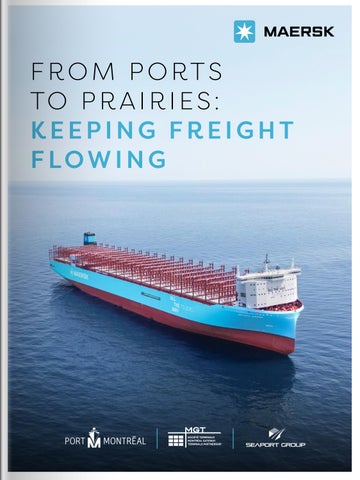
F RO M P O RTS TO P R A I R I E S : KEEPING FREIGHT F LOW I N G
F RO M P O RTS TO P R A I R I E S : KEEPING FREIGHT F LOW I N G
2 | North America Outlook Issue 38
MAERSK CANADA SUPPLY CHAIN
For Maersk Canada, the box is only the beginning. Michelle Grose, President of Maersk Canada, shares how connected logistics, intelligent technology, and resilient networks are transforming complex journeys into seamless supply chains Writer: Rachel Carr | Project Manager: Scarlett Burke
North America Outlook Issue 38 | 3
MAERSK CANADA SUPPLY CHAIN
F
or industries worldwide, the name Maersk evokes vast container ships carrying cargo across oceans through carefully coordinated transportation networks and schedules. However, for Maersk Canada, arrival at the port marks only one stage in a much longer and more complex operation. As a subsidiary of the larger Maersk group, the company connects ocean and air freight with customs services, road and rail transport, warehousing, and distribution. Its integrated logistics offering spans the complete end-to-end supply chain. By bringing these capabilities together, Maersk Canada transforms a series of individual services into one seamless supply chain, moving goods smoothly from their point of origin to their final destination.
Impressively, the Maersk group has more than 100,000 employees globally operating across almost 130 countries, approximately 700 container vessels moving more than 12 million 40-foot equivalent units (FEUs), 53 terminals across 28 nations, and more than 9.3 million square meters of warehousing capacity across 500+ sites. Within this global network, the organization has approximately 1,000 colleagues in Canada across
its offices, warehouses, distribution facilities, and operations, including five distribution centers (DCs) and transload facilities as part of its landside network. Maersk Canada connects this physical footprint to the country’s major trade gateways, including Vancouver, Prince Rupert, Toronto, Montreal, Halifax, and Saint John, extending its reach from the West Coast through central Canada to the Atlantic.
“Having women in the room isn’t enough; they need the same access to experiences, sponsorship, networks, and meaningful assignments that ultimately lead to the most senior roles” – M I C H E L L E G R O S E , P R E S I D E N T, M A E R S K C A N A D A
MAERSK CANADA SUPPLY CHAIN
“We don’t focus simply on moving containers in and out of Canada. The key is connecting those ocean flows to what happens next through drayage, rail and ground transportation, customs, transload, warehousing, and distribution to help drive resilience and remove waste from the customer’s supply chain. “That is where I think Maersk Canada is differentiated. We can combine the strength and scale of a global network with a strong physical presence and on-theground execution in Canada,” emphatically introduces Michelle Grose, President of Maersk Canada. Building on this national footprint, the company’s ground transportation capability spans full truckload (FTL), less-than-truckload (LTL), cross-border, and intermodal solutions. At the same time, its broader Canadian offering includes ocean, air, customs and trade, warehousing and distribution, and supply-chain visibility. “Our vision is to continue bringing those capabilities closer together. We want to make Maersk simpler to do business with, get closer to our customers, and use our people, physical assets, local expertise, and global network to help Canadian businesses compete and grow,” Grose outlines.
HOW HAVE OPPORTUNITIES FOR WOMEN WORKING IN THE SUPPLY CHAIN INDUSTRY EVOLVED, AND WHAT STRUCTURAL CHANGES ARE STILL NEEDED? Michelle Grose, President, Maersk Canada: “In my nearly 30-year supply chain career, I’ve seen a real evolution in the opportunities available to women. More are stepping into roles, industries, and leadership levels that historically weren’t as accessible, and I think we should recognize that progress. “I also think opportunity and equality of opportunity are different things. Having women in the room isn’t enough; they need the same access to experiences, sponsorship, networks, and meaningful assignments that ultimately lead to the most senior roles. “For me, the structural change still needed is how we define leadership and make decisions about talent. We need to challenge whether we assess potential consistently, flexibility comes with an unintended career penalty, and women get the same opportunities to take on operational, commercial, and profit and loss (P&L) leadership roles. “I believe strongly in sponsorship. Mentorship is valuable; however, women can be over-mentored and under-sponsored. At some point, someone needs to advocate for you when you’re not in the room, put your name forward for the difficult assignment, and be prepared to take a chance on your potential. “As a female leader, I also think we have a responsibility to help create that pathway for the women coming behind us. The goal shouldn’t simply be more women in leadership. It should be creating an environment where talented women can lead authentically, ambitiously, and without feeling they have to become someone else to succeed.”
ONE NETWORK, EVERY MILE As Maersk Canada’s services work together to create a connected, endto-end cargo journey, Grose believes in end-to-end integration, moving from individual logistics products to solving the customer’s broader supply chain needs. “We can connect ocean and air transportation with customs, inland and ground transportation, transload, warehousing, and distribution. What matters isn’t simply having those capabilities, but bringing them together around the customer’s cargo flow,” she informs. North America Outlook Issue 38 | 5
By the time a supply chain urgently needs another option, the capacity must already exist. Anticipation is essential. That is why the Port of Montreal is building Contrecœur. The new terminal will add 1.15 million twenty-foot equivalent units (TEUs) of annual container capacity, increasing the Port’s capacity by 60%. Two berths, an intermodal yard and direct highway access will strengthen Eastern Canada’s gateway to international markets.
The Port of Montreal: A strategic gateway for Canada’s trade resilience Volatility has become a defining condition of global trade. Tariff disputes, geopolitical conflicts and shifting routes are reshaping how goods move - and how businesses plan. For producers, carriers and consumers, the pressure is real. Maritime transport must do what it has always done: navigate uncertainty and weather disruption and keep trade moving. At the Port of Montreal, our responsibility is clear: to provide a dependable gateway for Canadian supply chains, with the connectivity businesses need today and the capacity they will need tomorrow.
A strategic location. A powerful reach. Canada’s extensive network of trade agreements gives businesses a competitive advantage. Turning that advantage into growth requires reliable connections between Canadian production and global demand. The Port of Montreal delivers that reach. From its strategic position near the Montreal–Toronto manufacturing corridor, the Port provides access to more than 110 million consumers in Canada and the United States in less than 72 hours. Its reach encompasses 66% of Canada’s population and 75% of its manufacturing capacity. Connected to major rail and highway networks, Montreal brings international trade close to the businesses and communities that depend on it. Direct maritime connections with Northern Europe, the Mediterranean and Latin America support trade with more than 140 countries.
Diversification demands readiness Canadian exporters and importers should be thinking now about how the Port of Montreal can fit into their international supply chains - and how new routes and markets can strengthen their competitiveness. Trade diversification is no longer just a policy objective. It is a business strategy built on reliable infrastructure and commercial routes - and a matter of economic sovereignty. Expanding into Europe, Asia, Latin America and the Middle East can help Canadian businesses broaden their customer base, diversify sourcing and reduce exposure to disruptions. But new opportunities require infrastructure ready to support them.
More capacity creates room for growth and greater flexibility as trade patterns shift. It gives businesses the confidence to pursue opportunities beyond their traditional markets. Alongside this expansion, the Port’s $1.5 billion infrastructure investment plan focuses on optimizing rail infrastructure, modernizing terminals and improving operational fluidity. Together, these investments reinforce Montreal’s role as a long-term partner in Canada’s growth.
Partnerships that turn connectivity into trade Infrastructure creates the conditions for trade. Partners make it move. Our partnership with Maersk connects the Port of Montreal’s strategic advantages with the global logistics networks businesses rely on. Shipping partners provide the maritime services, international reach and commercial relationships that turn port capacity into market access. Ports, carriers, railways, trucking companies and logistics providers form one interconnected chain. Its strength depends on every partner’s contribution. For the Port of Montreal, building resilience means investing ahead of demand and working with partners like Maersk to support Canada’s trade ambitions. Markets will keep changing. Our commitment holds steady: keep Canada connected, keep goods moving and give businesses the confidence to go further.
MAERSK CANADA SUPPLY CHAIN
“This creates a much more connected experience. Instead of the customer coordinating multiple providers and managing handoffs between them, we can take greater accountability across the journey, provide stronger visibility, and identify where we can remove complexity or improve flow.” This is where Maersk’s breadth becomes powerful: turning a portfolio of individual capabilities into one connected solution for the customer. Furthermore, Maersk Canada’s asset-light approach enables continuous operational efficiency across customers’ logistics operations by leveraging local partners to add capacity while maintaining control over its ocean network and terminals. “Our asset-light approach gives us flexibility without giving up control. Rather than owning every asset, we work with a strong network of 8 | North America Outlook Issue 38
partners and can adjust capacity as customer demand and market conditions change,” Grose explains. “The key is that we still connect the experience through Maersk, bringing together transportation, visibility, and operational oversight so customers have reliability and accountability across their supply chain. It allows us to stay agile, scale where our customers need us, and invest in dedicated capacity when demand supports it.”
MODERNIZING AND DECARBONIZING Building on its integrated network, Maersk Canada is modernizing its logistics solutions through cuttingedge technology and innovative systems. “The biggest change we’re seeing is the shift from visibility to intelligence, and ultimately from intelligence to
action,” enlightens Grose. “For years, the industry has focused on giving customers more data about where their cargo is. That’s important, but the next evolution is using more advanced planning solutions to help customers understand what the data means, what is likely to happen next, and what action they should take.” Solutions like Maersk’s Supply Chain Platform are essential to that evolution because they bring visibility and planning together. As those capabilities advance, the company will move further toward predictive, proactive supply chains rather than reactive ones. Updating its systems isn’t the only focus for Maersk Canada; it is also leveraging a proactive approach to decarbonization. Indeed, the company is taking practical steps to reduce emissions across both ocean and inland transportation.
EXPERIENCE THAT MOVES TRADE. Flexibility that moves you forward. YOUR SUPPLY CHAIN PARTNER - OVER 50 YEARS OF GLOBAL CONNECTIONS EXPERIENCE AND CONNECTIVITY In a rapidly evolving market, experience and adaptability matter! With over five decades of terminal operating heritage, Montreal Gateway Terminals (MGT) helps customers connect global trade with Canadian and North American markets. With 135 acres of land, five berths, and 23,000 feet of on-dock rail capacity, we connect vessel, rail and truck operations, working with all logistics partners to keep cargo moving.
MARKET REACH With direct access to both Canadian Class 1 railway networks and major highway connections, MGT supports the movement of cargo across Canada and into the U.S. Midwest through all modes of transport.
SOLUTIONS SHAPED AROUND YOUR CARGO With proven expertise in project cargo up to 88 tons, out-of-gauge handling and refrigerated cargo, MGT delivers solutions for complex logistics needs. As global trade evolves, we adapt - developing tailored services and sustainable partnerships to keep your business moving forward.
Let’s move your next opportunity forward. Explore a cargo solution tailored to your business. #MGT #SupplyChain #ProjectCargo www.mtrtml.com
MAERSK CANADA SUPPLY CHAIN
MAERSK CANADA’S RANGE OF SERVICES • Ocean and inland freight transportation – Efficiently moving goods across international and domestic markets. • Supply chain management – Helping businesses manage their logistics and shipping needs. • Customs clearance and warehousing – Facilitating the import and export processes and providing storage solutions.
“Maersk, as an enterprise, has progressed our shift towards energy sources with a lower climate impact across our operations by electrifying equipment, integrating renewables, and diversifying our mix of loweremission marine fuels. “In 2025, we added 10 dual-fuel methanol vessels, bringing our fleet to 19, and advanced our multi-fuel portfolio approach through a liquefied biomethane supply agreement and a successful blended e-methanol pilot,” she outlines. Energy efficiency measures play a vital role in Maersk’s energy transition, especially as regulations still need to narrow the cost gap between fossil fuels and low-emission alternatives. 10 | North America Outlook Issue 38
“We don’t focus simply on moving containers in and out of Canada. The key is connecting those ocean flows to what happens next through drayage, rail and ground transportation, customs, transload, warehousing, and distribution to help drive resilience and remove waste from the customer’s supply chain” – M I C H E L L E G R O S E , P R E S I D E N T, M A E R S K C A N A D A
“We have made improvements in network and asset efficiency in our Gemini Cooperation – a strategic alliance between Maersk and HapagLloyd – and traditional network
operations through the increased use of advanced artificial intelligence (AI) technologies to optimize sailings and terminals and by retrofitting vessels,” Grose declares.
MAERSK CANADA SUPPLY CHAIN
MORE GATEWAYS, GREATER RESILIENCE Maersk Canada is adapting its network to address challenges that can affect the movement of goods through Canadian ports. “Canada’s port system can’t be viewed independently of the inland network. We must consider West Coast bottlenecks, rail, and equipment availability as a whole,” Grose cautions. “A shipment is only as predictable as the connections that move it through the network. So rail capacity and the ability to move freight inland become just as important as port capacity itself.” Additionally, Maersk Canada has seen firsthand how labor-related 12 | North America Outlook Issue 38
disruption can ripple through the entire network. In 2023 and 2024, Canada’s West Coast ports experienced a combined 24 days of labor-related disruptions. According to public estimates cited by the Greater Vancouver Board of Trade, labor disruptions over a 16 month period affected approximately CAD$19.2 billion worth of cargo moving through Canada’s West Coast ports. “At Maersk, we’re focused on creating more resilience through optionality rather than relying on a single gateway or mode. We connect Vancouver and Prince Rupert to eastern gateways such as Montreal, Halifax, and Saint John, and link those gateways to our road,
rail, warehousing, and distribution network. “Longer term, I think Canada needs to rethink the balance of trade. Growing exports and strengthening export flows through multiple gateways would help the country build a healthier, more balanced network and ultimately would create more opportunity for import capacity. That is where I see the real opportunity for Canada’s supply chain,” Grose confidently concludes.
maersk.com
MAERSK CANADA SUPPLY CHAIN
Maersk.com
PRODUCED BY NORTH AMERICA OUTLOOK MAGAZINE