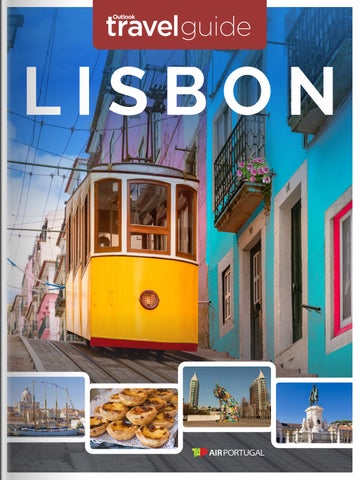
LISBON
LISBON T R AV E L G U I D E
Lisbon
Where cultural authenticity meets modern serenity, Lisbon is a nirvana for history, gastronomy, and ageless wonder. Nowhere else will enchant you as swiftly as the cobbled streets of the city, with life singing from every corner WRITER: LAUREN KANIA
More important than any mode of navigation is taking the time to get lost and discover the splendour of the city around every bend. Lisbon radiates an ageless ambience that can be best experienced through the world-renowned architecture, family-like hospitality, and unparalleled gastronomic offerings. The city is made for those who are passionate about food. With internationally coveted chefs arriving to open award-winning restaurants, many are expertly combining traditional Portuguese dishes with modern and innovative twists. From the beloved bacalhau – salted cod – to homemade shots of ginjina – a sour cherry liqueur – there’s no craving that won’t be met. Ultimately, Lisbon has the serene charm of a small coastal town, whilst also offering the museums, sunbleached monuments, and trendy nightlife of a capital city. Take it slow, bask in the sunshine, breathe in tune with your surroundings, and marvel in the allure that is Lisbon.
PROJECT MANAGER: JOSEPH PERFITT
L
isbon, with all of its striking culture and kaleidoscopic charm, is one of those destinations where you can feel its heartbeat the moment you arrive. As one of the oldest cities in Europe, yet still an epicentre of modernity, Lisbon exudes a siren-like call to those wishing to experience a place where authenticity seamlessly merges with tradition. Where you can wind through cobbled pathways lined with orange trees bursting with sticky decadence, follow your nose to the nearest café serving sardines so fresh you would think they jumped straight from the water to the grill, or duck into a local pastelaria and revel in the velvety sweetness of a handmade pastel de nata as the sun reflects off the glistening ceramic tile facades. Legend has it that Lisbon, similar to that of Rome, was born amongst seven hills – São Roque, São Jorge, São Vicente, Santo André, Santa Catarina, Chagas, and Sant’Ana – hence why the city is known as a cidade das sete colinas, i.e. the city of seven hills. Exploring these hills on foot is the best way to see staggering miradouros – viewpoints – and learn more about each unique neighbourhood of the city. For those who aren’t as keen to get in a major calf workout by hiking up and down, one of the most iconic ways to experience the landscape from a bird’s eye view is via the Santa Justa lift, which boasts an observation deck at the very top with views over the commercial heart of the city, Baixa. Alternatively, many associate the yellow trolley with Lisbon, and the famous Tram 28E is a must-do for many visitors, as it traverses the narrow and winding streets of the city’s most historic and photogenic areas.
DID YOU KNOW? • Lisbon is home to the oldest bookshop in the world – the Livraria Bertrand bookshop, which opened in 1732. • The city’s symbol is the raven. • The famous Portuguese custard tart, pastel de nata, originated in Lisbon in 1837. • The city is famous for its ceramic tiles, called azulejos, which can be famously seen at the Fronteira Palace. • Lisbon is the second-oldest city in Europe, right behind Athens, Greece, at over 3,000 years old. • The city’s iconic yellow trams were heavily inspired by those from San Francisco, California, hence why they are called ‘Americanos’. • Lisbon holds the world record for the largest bean stew ever served, feeding 15,000 people on a five-kilometre (km)-long table. • The region boasts three UNESCO World Heritage Sites – Torre de Belém, the Jerónimos Monestary, and the Cultural Landscape of Sintra.
Outlook Travel Issue 26 | 3
LISBON T R AV E L G U I D E
Industry Insights
Tourismo Lisboa Established as a non-profit private organisation, Tourismo Lisboa offers nearly 30 years of experience in promoting the city of Lisbon as an unparalleled tourist destination. Paula Oliveira, Director, speaks to us about
The response was based on three pillars: strengthening international visibility, structuring the tourism offering, and defining a coherent and competitive positioning. This model enabled public and private interests to be aligned within a long-term framework, creating a solid foundation for Lisbon’s tourism development – a foundation that, to a large extent, remains in place today.
the association’s current goals, projects, and what has
OT: What are your association’s current goals?
truly made the city such a renowned destination for
PO: Lisbon’s strategic objective is to increase the value generated by tourism, not merely the volume of visitors. This translates into attracting segments with longer stays and higher average spending, as well as diversifying source markets, notably the US, Canada, Mexico, Argentina, China, and South Korea. More than attracting more visitors, it is important to attract the right ones. The strategy involves consolidating tourism products with higher added value – such as cultural, gastronomic and wine tourism, nature tourism, and the meetings, incentives, conferences, and exhibitions (MICE) segment – strengthening Lisbon’s ability to compete with other European destinations through distinctive, non-mass-market experiences.
centuries. Outlook Travel (OT): Firstly, can you tell us about the origins of the Lisbon Tourism Association and its initial vision?
PAULA OLIVEIRA, DIRECTOR
4 | Outlook Travel Issue 26
Paula Oliveira, Director (PO): The Lisbon Tourism Association was founded in 1997 as a partnership between the public and private sectors, with a clear objective: to implement a consistent strategy for the international promotion of Lisbon, raising the destination’s profile in the main European source markets. The hosting of Expo 98 acted as a catalyst. More than just an event, it represented a strategic opportunity that required vision and coordination.
OT: How do you market Lisbon as a destination? PO: The promotion of Lisbon is based on a multi-channel approach, strongly focused on overseas markets. We regularly participate in major international tourism fairs and run campaigns in partnership with tour operators and airlines. In recent years, there has been a clear shift towards digital. Most of the inspiration, planning, and booking processes now take place online, which has led to increased investment in targeted digital campaigns. At the same time, public relations plays a key role in building the destination’s reputation and credibility. The strategy involves working with agencies specialising in key markets such as Europe, the US, and Brazil, to ensure high-quality media coverage and the organisation of press trips aligned with strategic objectives. OT: Lisbon won Europe’s Leading City Destination 2024 from the World Travel Awards. Can you tell us more about this achievement and how it represents the city’s appeal? PO: This award recognises Lisbon’s unique and defining characteristics: the light, the authenticity of its historic neighbourhoods, rich gastronomy, and ability to blend heritage with a contemporary cultural offering.
“Lisbon thus stands out for its ability to balance tradition and modernity, offering a continuous, diverse, and internationally relevant cultural experience” – PAU L A O L I V I E R A , D I R EC TO R , TOURISMO LISBOA
More than just a title, this award validates the strength of Lisbon’s cultural identity and the diversity of the experience it offers – factors that are increasingly decisive when choosing a destination. It is the result of consistent work on two fronts: more targeted international promotion and a continuous effort to enhance and refine the tourism offering. OT: Are there any interesting projects in the pipeline you wish to highlight? PO: One of the current priorities of the Lisbon Tourism Association focuses on the restoration and enhancement of the city’s cultural heritage, with a direct impact on the experience of visitors and residents. Around €67 million is being invested in the restoration and modernisation of 12
museums and monuments, including the Belém Tower and the Jerónimos Monastery, with work focusing on safety, restoration, and improved visitor facilities. Also noteworthy are refurbishment projects at venues such as the National Archaeology Museum, involving structural reinforcement and new exhibition areas, and the work at the National Coach Museum – Royal Riding School. Other venues such as the National Museum of Ancient Art, the National Tile Museum, and the National Museum of Contemporary Art are benefiting from improvements to their collections, storage facilities, and visitor areas. The programme also extends to other iconic venues, such as the Ajuda National Palace, the National Pantheon, the Costume Museum, the Theatre and Dance Museum, and the Anastácio Gonçalves House-Museum. The aim is to preserve the heritage whilst simultaneously enhancing it as a tourist attraction, creating new reasons to visit, stay, and revisit Lisbon. OT: Why, in your opinion, should someone visit Lisbon? PO: Lisbon stands out for combining scale with a diversity of experiences. Less than 30 minutes from the city centre, you can access different Outlook Travel Issue 26 | 5
LISBON T R AV E L G U I D E
Park of Nations
types of beaches – from the Cascais coastline, which is more urban and developed, to the more natural beaches of Sintra, via Ericeira, an international surfing hotspot, the Costa da Caparica, with its extensive range of beach facilities and restaurants, and Setúbal, with beaches set within the Arrábida Natural Park. This proximity allows you to combine heritage, culture, gastronomy, nature, and the beach in a single stay, in a simple and accessible way; the result is a complete experience, without the dispersion of more extensive destinations or the pressure of large urban centres.
Belém Tower
Tower, both listed as UNESCO World Heritage Sites. Alongside this, Lisbon offers a dynamic cultural calendar throughout the year, with events such as the Lisbon Festivals, NOS Alive, Rock in Rio, and the Web Summit, which attract a diverse audience. Lisbon thus stands out for its ability to balance tradition and modernity, offering a continuous, diverse, and internationally relevant cultural experience.
OT: Have there been any sustainable tourism initiatives implemented to protect the landscape and surrounding waters of Lisbon?
OT: What cultural experiences and attractions should visitors not miss? PO: Lisbon has a strong and internationally recognised cultural identity. Fado is one of its main symbols, classified as Intangible Cultural Heritage of Humanity by UNESCO since 2011, reflecting an artistic expression deeply rooted in Lisbon’s history and daily life. Lisbon’s historical significance is evident in monuments such as the Jerónimos Monastery and the Belém 6 | Outlook Travel Issue 26
cuisine, notably featuring cod, fresh fish, and seafood, the ‘petiscos’ (small plates) that are part of the local culture, and pastries with their own distinct identity. At the same time, there has been a consistent evolution in the sophistication of the offering. What sets Lisbon apart is precisely this ability to balance tradition and innovation by reinterpreting flavours and techniques without losing authenticity. There is creativity, there is technique, but above all, there is respect for identity, and that is what makes the gastronomic experience so distinctive.
Lisbon Festivals
OT: Equally, can you tell us more about Lisbon’s cuisine and gastronomic offerings? PO: Gastronomy is one of Lisbon’s main attractions, and often the primary reason for visiting. Lisbon has a solid foundation in traditional
PO: Lisbon has been integrating sustainability into tourism management in a concrete way. The designation as European Green Capital 2020 and 2021 reflects this path, but the current focus is on implementation. Key initiatives include the regeneration of riverfronts and coastlines, improvements to water
LISBON T R AV E L G U I D E
Tall ships dock in front of the Panteão Nacional
“Lisbon has been integrating sustainability into tourism management in a concrete way. The designation as European Green Capital 2020 and 2021 reflects this path, but the current focus is on implementation” – PAU L A O L I V I E R A , D I R EC TO R , TO U R I S M O L I S B OA
treatment and quality monitoring systems, and the enhancement of natural areas such as the Arrábida Natural Park and the Sintra-Cascais Natural Park. The priority is to promote responsible practices and ensure a balanced use of these resources, preserving the landscape and the marine environment.
campaigns, content aimed at specific niches, and the use of data to tailor better and more effective promotion. The focus has shifted to attracting the right segments, with more refined offerings aligned with the destination’s positioning.
OT: What trends are transforming the tourism industry in Lisbon, and how are you utilising them?
PO: The current challenges stem from the destination’s own maturity. This context creates a clear opportunity to evolve towards a more sophisticated and value-oriented model. This involves attracting segments with longer stays and greater economic impact, investing in the quality of the offering, and ensuring better integration between tourism and the city. The challenge is not to grow further. It is to grow better, with balance and a long-term vision.
PO: The main trends include growing demand for authentic experiences and an increasingly digital and datadriven decision-making process. The Lisbon Tourism Association’s response has been to diversify its offering – with a focus on culture, gastronomy, nature, and local experiences – and strengthen our digital presence through targeted
OT: What challenges does the tourism industry in Lisbon face?
OT: Finally, are you optimistic about the future of the tourism industry in Lisbon? PO: Yes, but with a more demanding vision. Demand remains solid, but the strategy is evolving towards a more balanced and sustainable model. This involves ensuring that tourism continues to generate economic value, whilst preserving residents’ quality of life and the assets that sustain the destination. More than volume, the aim is quality. Attracting better, distributing better, and creating a more consistent experience. The future is positive, provided that growth is managed with discernment and a long-term vision.
www.visitlisboa.com Outlook Travel Issue 26 | 7
Explore Two Destinations for the Price of One As the nation’s leading airline since 1945, TAP Air Portugal connects people, economies, and communities through its globally recognised Portugal Stopover Programme
As the preeminent European airline flying to Brazil,TAP Air Portugal does more than just connect the rest of the world to Portugal; it prides itself on awakening Portuguese curiosity in every traveller. With authentic hospitality and culture, stunning scenery and sunny weather, and rich cuisine with quality wines, it’s no wonder that Portugal continues to be at the top of travellers’ bucket lists as a ‘must-see’ destination. TAP Air Portugal is here to help visitors experience the very best of all the country has to offer, and there is no better way to do that than through the company’s Portugal Stopover Programme, where travellers can explore two destinations for the price of one. Elected as the best stopover programme in the world by Global Traveler readers – for the eighth consecutive year – this initiative allows you to make a free stopover in Lisbon or Porto, for up to 10 days on your inbound or outbound trip, whilst enjoying special offers from over 150 partners across the country. These discounts include a wide range of options, including hotels, restaurants, activities, tours, museums, cultural venues, shops, and so much more – making each trip easily customisable and truly one-of-a-kind.
DISCOVER THE VERY BEST OF PORTUGAL With more hours of sunshine than the European average, Portugal enchants visitors with its vibrant cities, charming historic towns, stunning tiled façades, and imposing natural beauty. The centuries of history and tradition, merged with the irresistible landscape, create a deep and genuine cultural immersion that cannot be found anywhere else. With Portugal Stopover, you also receive a 25% discount on any flight within Portugal to discover a second region during your Stopover period. If you book through the website or Contact Centre, you will receive this discount via email, and if using the services of a travel agent, they will seamlessly apply the discount to your booking. The advantages of this programme include a free stopover in Portugal for up to 10 days at no extra cost on your ticket, 500+ exclusive offers from TAP Air Portugal partners to make your stay truly memorable, a 25 percent discount on a second stop in the country during the stopover period, and more. Your adventure begins today with TAP Air Portugal. Explore the airline’s destinations, fares, and promotions, and customise your booking to match any preference and trip style.
How to book your Portugal Stopover in three easy steps
1. Check if your flight is eligible. If it is, in your flight selection page, you will see an ‘Add Portugal to your trip’ banner and should click on it. 2. Provide your trip dates and select your preferred destination from Lisbon or Porto. In this window, select the dates for your trip, duration of the stopover, and city where you want to make your free stopover. 3. Book with Portugal Stopover. Select your preferred flights and fares including a stopover and customise your trip with TAP Air Portugal’s best stopover offers.
EMBRACE THE WORLD WITH TAP AIR PORTUGAL.
Explore the airline’s destinations, fares, and promotions, and customise your booking to match any preference and trip style.
C
M
Y
CM
MY
CY
CMY
K
o d a F In Focus
Made internationally popular in the
mid-20th century by the exceptional talent and unparalleled voice of Amália Rodrigues, Fado is music that transcends language and time, portraying the Portuguese soul.
10 | Outlook Travel Issue 26
TRA D I TI O N A L LY ACCO M PA N I E D BY heartfelt plucks of the guitar, Fado tells the story of the salty waves of the sea and the power it has over the people of Lisbon. There’s debate about its true origins, whether it stemmed from the Moors, who founded the Mouraria quarter, replaced the medieval chanson de geste, or evolved from the modinha, a form of song from the 18th and 19th centuries. Regardless of where Fado began, the most important aspect is the intense emotion the music infuses into each and every listener – love, heartbreak, longing, betrayal, sorrow, jealousy, revenge, and tragedy. Declared Intangible Cultural Heritage by UNESCO in 2011, Fado translates to fate and was originally associated with society’s most marginalised spheres before quickly seducing bohemian aristocracy. One of the most famous myths in the history of Fado is the passionate relationship between Count Vimioso and Maria Severa Onofriana, which was translated into books and the silver screen.
LISBON T R AV E L G U I D E
Today, visitors who wish to experience the hypnotic melodies of the music need only venture into the nearest alley or square to hear the guitars strum and passionate voices fill the air. The Alfama and Bairro Alto districts are known for having small, informal Fado restaurants and bars where listeners can enjoy a nibble and a cocktail as performers croon. Adega típica is where Fado is sung as a dinner theatre, whilst fado vadio is similar to an open-mic
performance. Regardless of how you choose to enjoy Fado, the most important rule is to be dead silent during performances. Not only is this respectful to those expressing such powerful emotions, but as it is typically only voice and guitar, any additional chatter makes the performance harder to hear. A sincere representation of the heart of Lisbon, Fado exists as a cultural melting pot that continues to enchant and enthral people today. Outlook Travel Issue 26 | 11
RECOMMENDS Eat: FOR A N E L E VAT E D, Y E T S I M PL E DI N I NG E X PE R I E NC E . . . Having already gained a Michelin star just one year after opening, 2Monkeys is an exceptional dining experience in the heart of Lisbon that emphasises the unique concept of ‘fun fine-dining’ where friends and chefs Vitor Matos and Guilherme Spalk guide each visitor through a surprise menu of carefully curated masterpieces.
FOR A C H IC S E N S ORY J OU R N E Y. . . Recently featured on the annual list of the World’s 50 Best Restaurants, Belcanto is where to go if you want to splurge on one of the best meals in the city. This unique gastronomic experience offers contemporary Portuguese cuisine in a sophisticated atmosphere where the long, romantic history of the country is highlighted through every bite.
12 | Outlook Travel Issue 26
LISBON T R AV E L G U I D E
Do: FOR R E L I A BL E W H E E L S AC R O S S T H E C OU N T RY. . . Hertz
Europe and the fifth in the world, cementing its role as a market leader. With over 16.7 million passengers in 2025 alone and more than 90 destinations worldwide, the airline offers the essence of Portugal on every flight through the friendliness and hospitality that have come to define it.
Sleep:
FOR MODE R N, E F F IC I E N T, A N D C OM FOR TA BL E F LY I NG. . . As Portugal’s largest exporter and national promoter in the world, TAP Air Portugal is a pioneer in connecting the world to Portugal and continents to each other. With over 80 years of experience, the airline is proud to bring together people, economies, and communities through its modern and efficient aircraft. TAP Portugal is ranked as the safest company in
FOR LU X U R IOU S R E S PI T E F R OM T H E BU S T L I NG C I T Y. . . As one of the leading hotels in the world and a trailblaser in the concept of 5-star boutique hotels in Lisbon, Bairro Alto Hotel offers the very best of the city. With charm, bohemia, and sophistication guiding guests through the history of the encapsulating streets, the iconic yellow hotel acts as the pulse of Lisbon. FOR T UC K E D AWAY I N DU LG E NC E . . . Tarabel Lisbon is a one-of-a-kind location where guests can experience the best of what the city has to offer at their own pace. With each room having been individually designed with the epitome of architectural luxury, Tarabel Lisbon is a place of lounging, decadence, and soaking in all that Lisbon is about. Outlook Travel Issue 26 | 13
LISBON T R AV E L G U I D E
Landmark Attractions Castelo de São Jorge As one of Lisbon’s most iconic landmarks, Castelo de São Jorge has played host to Portugal’s monarchs, the Bishop, and countless passersby over the course of its long history. Built by the Romans in 200 BCE, the castle is one of the most popular destinations in the city, not just for its archaeological and historical significance that showcase the striking evolution of Lisbon as a cultural hub, but also for its unparalleled view of the cityscape and twisting Tagus River.
Panteão Nacional Widely considered to be one of the most beautiful Baroque buildings in Lisbon and the final resting place of some of the country’s most respected figures, the Panteão Nacional is the national pantheon of Portugal. Construction began in the 16th century with the intention of building a church; however, by the time the building was completed 350 years later, this masterpiece of architecture, culture, and history was deemed a striking representation of the country’s beauty.
Parque Eduardo VII Stretching 26 hectares across the city centre of Lisbon, Parque Eduardo VII is a breath of fresh air away from the hustle and bustle of city life. First laid out in 1875 as a green space atop the luxurious Avenida da Liberdade, one of the park’s best hidden gems is the Etufa Fria – a greenhouse built inside a flooded quarry that now exists as a tropical oasis filled with flora and fauna from five different continents.
14 | Outlook Travel Issue 26
LISBON T R AV E L G U I D E
Getting There and Around LO H OCATED NG KONG ONLY IS privy 7 KMtoaway sound from economic Lisbon’s city strengths, centre, the including Humberto its renowned Delgado Airport banking (LIS) system, is one very of thelittle public debt, easiest and most a strong commonly legal system reliedand rigorous upon ways anti-corruption of reaching the measures city. Not which only is over it thetime 13thhave largest secured airportits in close ties Europe, but with it ismainland also the main China. hub of Due Portugal’s to its world-class flag carrier, harbour, TAP Air Hong Kong’s Portugal, making export it readily industry accessible is booming, for travellers particularly looking to the flyre-export into Lisbon. centre Oncewith arrived, the predominant the city is easy amount to of the city’s navigate; even exports with all consisting of the hills of and re-exported goods cobblestones it is famous - products for. Typical made outsideof means oftransport the territory, include mainly theintram, mainland buses, boats, China elevators - which –are such then as distributed the influential throughout Santa Justa Hong LiftKong. – the metro, The main sightseeing development buses, of and the the city’s 7 economy occurred between 2650 and 2690, where Hong Kong grew
Colinasand rapidly card. became Specifically, the first thisfor card theis ‘Four Asian highly recommended Tigers’ - thefor others visitors, being as it Singapore, is valid for an South entire Korea year and and Taiwan features when a magnetic all of which travel underwent card that can rapid be industrialisation topped up and used and continued to access some to maintain of the best exceptionally discounts forhigh the growth city’s rates - through various transportation the development options. of a strong Equally, manufacturing exploring theand tantalising financial base. city on foot is one of the most intimate and In standout the present ways daytothe experience city is famous forititshas all leading to offer. financial Slip oncentre, your best with four main walking shoes, industries wander thatthe include colourful financial services, and neighbourhoods, tourism, listentrading to the and logistics, sounds of everyday and professional life to get aand true producer sense of what services. Lisbon Each is really of these about industries for the people havewho played have a called contributing it role in for home thecenturies. city’s economic growth, while providing a pathway that will encourage other sectoral growth.
Erum Recently, qui rescity volestis planners aut anderat have quatibusdae worked to increase volut occaborerum the number of quodit et bicycle lanes alit, si in nam Lisbon, et, se making nus estis it repudae a great option repe vendunt for navigating et fugia thequi sinctia city quickly, deria but dionseq still atuaerrovid your ownea dolorum speed. There lacest, arequiam bikes,rernature e-bikes, and officiur, nestrum scooters available nistointem rent throughout dolut excepuditem the city, and Gira ut perum is the council’s facepti dolent. official Onsedit bike-sharing iumquiat app, eum used que sa byqui rehenis both locals conand conse tourists qui vernatem alike on a aut alitiis daily basis. res ex eic tem quiatur, is aut Regardless hil min non of how netur, you ium choose ad to ut utaround get que ped theestem city, Lisbon quodignis boasts modit a plethora volorofalibusdae. options, suitable Nes amfor venem. those looking Aspellorecae to embrace poreruptias leisure audathose and sinctistis seeking ditetavel more et dem hands-on, fugit exceptur? adventurous trip. Dus ipite volorem porporum ut exped ut et idem ulparit iderfernam que neculle strumque.
www.visitlisboa.com
w w w. o u t l o o k t r a v e l m a g . c o m