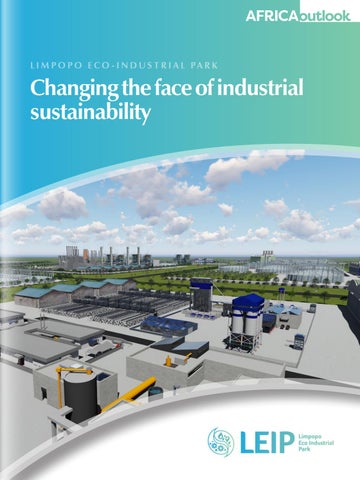
L I M P O P O E C O - I N D U S T R I A L PA R K
Changing the face of industrial sustainability
L I M P O P O
2
E C O - I N D U S T R I A L
WWW.AFRICAOUTLOOKMAG.COM
PA R K
C
O
N
S
T
R
U
C
T
I
O
N
Industry
Nurturing Nature
E
co-industrial development has become a hot topic in the past decade. Encompassing a broad range of environmentally sustainable solutions, addressing anything from water pollution to energy management to air quality, the term has been pushed to the top of the agenda for the private and public sector alike. However, whilst a number of regions have been heralded for their innovative eco-friendly concepts, such as Singapore with its buildings
Utilising the latest technologies and solutions, Eco-Industrial Solutions and the Limpopo Eco Industrial Park are set to raise the continent’s sustainability benchmark Writer: Jonathan Dyble Project Manager: Josh Mann
that blend with nature, the African continent continues to lag behind the rest of the world on this front. South Africa alone emits millions of tonnes of carbon dioxide per year, largely down to its continued reliance on coal-fired power plants. In response, the national government has revealed that it is looking to reduce harmful emissions by 34 percent by 2020, an initiative that will require coordinated action from all influential parties.
WWW.AFRICAOUTLOOKMAG.COM
3
L I M P O P O
E C O - I N D U S T R I A L
Eco-Industrial Solutions (Pty) Ltd (EIS), in particular, is one company that is likely to play a crucial role in facilitating these changes. “EIS’s slogan is ‘industry nurturing nature’, a motto that outlines its vision of finding techno-economically viable solutions to the challenges facing humanity today, and of promoting industrialisation in a way that is beneficial to local communities as well as the environment,” says Deshika Kathawaroo, CEO of EIS. In pursuit of this inspiration, the firm is working to develop the first zero solid-waste eco-industrial park in Africa, known as the Limpopo EcoIndustrial Park (LEIP).
Empowering industry
“The LEIP is a direct response to reclaiming Africa’s rightful place in the global industrial village by establishing Africa’s and the world’s first zero solid-waste eco-industrial and integrated nature park,” states Webster Mfebe, the Chairman and Director of both EIS and LEIP.
P A R K
“This project will underscore the indispensable symbiotic relationship between people, planet and profit by demonstrating their mutually beneficial co-existence, thereby preserving mother earth for future generations.” Located in Musina on over 6,400 hectares of land, the park that currently remains in the planning phase is designed as a sustainable industrial development with 80 chalets in an integrated nature reserve with 2,286 hectares of environmentally sensitive tourism area; two residential eco-estates in Musina Eco-Housing Estate and Singelele Equestrian Estate, comprising a total of 3,797 and 903 units, respectively; gasification plants; syngas production and clean-up; a blended mix of PV solar, syngas and steam combined-cycle; and base load power for industries from Eskom. Solar PV panels for 35 MW power will be installed for agro-processing, buildings and water heating.
LEPELLE NORTHERN WATER
L
epelle Northern Water (LNW) is a schedule 3B public entity that has for nearly six decades been providing treated and semi-treated bulk water services to the municipalities and industries within Limpopo province respectively. It was established from three different organisations – the Phalaborwa Water Board, Northern Transvaal Water Board, and the Bosveld Water Board that were set up in 1960, 1990 and 1993 respectively. Today LNW operates 20 different types waterworks and four wastewater treatment schemes, the biggest single water scheme having a capacity of 175 megalitres a day. The entity supplies water to Capricorn, Mopani, Sekhukhune, Vhembe and portion of Waterberg district municipalities. The entity further operates some borehole and wastewater schemes on behalf of Sekhukhune district. Limpopo’s development depends on a reliable water supply. It is one of the economically poorest regions of South Africa but among the fastest-growing, and water infrastructure is vital in supporting these ambitions. The entity is looking at boosting capacity across its portfolio, having completed the feasibility studies, concept designs and the implementation readiness study for Olifantspoort and Ebenezer schemes. It has SANAS Accredited Water Services Laboratory, situated in Ebenezer that caters for all the schemes operated by the entity as well as its clients who regularly drop water and wastewater samples for analysis. The entity is 14001 certified for all its 25 operational sites, which complement the zero solid waste eco- industrial park’s requirements amongst others.
T +27 15 295 1800/1900 F +27 15 295 1931 E information@lepelle.co.za
4
WWW.AFRICAOUTLOOKMAG.COM
Lepelle Northern Water is a waterboard established in terms of Chapter Six (6) of the Water Services Act, No 108 of 1997. Lepelle Northern Water currently operates 20 water treatment schemes spread across Capricorn, Mopani, Sekhukhune, Waterberg and Vhembe district municipalities. It also operates 4 wastewater schemes on behalf of Sekhukhune district municipality.
Postal Address Private Bag X9522 Polokwane, 0700 South Africa
Physical Address: 1 Landdros Mare, Polokwane, 0700 South Africa
T: +27 15 295 1800/1900 F: +27 15 295 1931 E: information@lepelle.co.za
Providing Complete Peace of Mind A MEMBER OF THE
www.pentgon.co.za
GROUP
Pentagon and Elvey deliver best practice security, connectivity and communication to the LEIP The Limpopo Eco-Industrial Park (LEIP), located in the border town of Musina, will be Africa’s first economically viable, zero-solid waste eco-industrial park. During the design phase of the project in 2017, Gary Lowe (CE of Elvey) was approached by the project lead Pieter du Toit to demonstrate its niche set of comprehensive skills around technology provision to safe cities. The subsequent partnership of Hudaco companies Pentagon, Elvey and MiRO is geared up to provide a solution that comprises the selection and deployment of security, communication and connectivity technology.
for the most secure and connected industrial premises on the African continent.
After a detailed briefing from the client and collaboration with the large number of professionals appointed to the project, the Elvey/Pentagon partnership was given carte blanche to design the most sophisticated and client-centric solution
Elvey/Pentagon will deploy an EPC (Engineering, Procurement and Commissioning) approach, using the vast array of skills sets from its in-house LEIP consortium, together with best of breed products and technologies that will be
All aspects of physical security industry management and open access connectivity need to be provided ASAS (as-a-service) to ensure LEIP meets all the credentials of a ‘Safe Connected City’. “We are responsible for delivering an ecosystem of technology and manpower to ensure that the LEIP as a facilities management company not only provides a superior experience for industry, eco tourists and residents, but that it also delivers a model that generates maximised return on investment for the LEIP and its investors,” says Pentagon MD Brendon Hall.
installed by its experienced installer base to ensure that it takes ownership of this prestige project. The client has specified the deployment of a carrier-neutral communications network that can be internationally benchmarked as world-class and which is also designed as future-proofed. This will ensure that the LEIP project will remain aligned with international communication provision best practices. The network will facilitate the following elements: • A fully resilient, fibre-optic based communications network that features ring and co-location redundancy; • Backhaul redundancy through terrestrial and air-transmitted mediums such as microwave and satellite; • Internet, voice and data services that cover all the various communication needs of first tier carriers and internet service providers. Services will be
Contact Brendon Hall (Pentagon), +27 (0) 11 401 6700, +27 (0) 82 572 4756; info@pentgon.co.za
C
O
N
S
T
R
U
C
T
I
O
N
www.pentgon.co.za
Providing Complete Peace of Mind A MEMBER OF THE
GROUP
delivered via a combination of dark fibre, dedicated point to point and time-basedmultiplexed methods; • It will carry all satellite, terrestrial and IP streamed television and media services, distributed from diverse landing stations located in or near the LEIP precinct; • It will provide dedicated backhaul connectivity to strategically placed mobile cellular towers, which will be erected on a co-located and neutral basis, for superior throughput speeds. Cellular coverage will include a design that covers macro (on rooftops or stand-alone), micro (at street level) and in-building distributed antennae systems; • All electronic security and building automation signals will be transported over the communications network to prevent the replication of duplicated networks for various security systems requiring communication facilitation for the purposes of centralised storage and review.
However, and arguably most importantly, plasma waste gasifiers will be introduced here – a well proven commercially available technology that Katharawoo believes will be fundamental to the future of ecoindustrial development. While many companies have utilised the technology in turning waste to energy, EIS will look to take this a step further and apply it to close the region’s industrial loops, eliminating the environmental and social problems that arise through the disposal of waste. “The LEIP’s zero-solid waste and near-zero gas emission goals aim to reduce, eliminate, or prevent pollution at its source, where possible,” she states. “Our primary tool to achieve this strategy is integrating plasma gasification into a major industrial system. “People and governments will quickly realise that such is entirely possible through plasma gasification,
Pentagon will provide the critical ICT infrastructure comprising optical fibre networks, including redundant networks; site data centres; wired and wireless communication, including redundant communication; network switches and servers, including redundant systems; internet links including, redundant links.
The project emphasises the importance of security in South Africa to ensure reliable and productive facilities with a number of elements that are deemed as critical to the project. Physical security will consist of fences, walls, gates, turnstiles and booms. Other elements include specially trained and PSiRA-registered security officers; access control through identification (card) and verification
and this realisation will no doubt lead to closer inspections and understanding, and in turn increase the application of plasma solid waste gasification technology in various industries throughout the world,” explains Dr Pieter du Toit, Founding
(biometrics) of persons entering the park, as well as vehicle identification (number plate or tag); alarm systems to detect unauthorised intrusion and surveillance to verify alarm causes; optical fibre networks, computers, telephones, PA systems, radios, intercoms, Wi-Fi and 4G/5G. Control rooms will be implemented for alarm and surveillance monitoring and forensic investigation of events. Central monitoring of support systems and the facilities management function will be handled by BMS (building management systems) and SCADA (Supervisory Control and Data Acquisition) systems. High-level maintenance of the systems has been planned into the design and will continue for at least five years after completion and handover of the project to the LEIP. As per the directive from the LEIP, Elvey/Pentagon will procure from and up-skill the local community allowing them to take ownership of the long-term maintenance.
member of EIS and Executive Project Director for the LEIP. Leveraging this, LEIP’s heavy industries will be based on a fossil fuel-free feedstock, ensuring a closed loop system is maintained throughout the park.
WWW.AFRICAOUTLOOKMAG.COM
7
L I M P O P O
E C O - I N D U S T R I A L
A collaborative approach
This innovative approach is expected to effectively address a broad range of Musina’s development constraints, creating approximately 35,000 new jobs and directly contributing an estimated R6.6 billion to GDP within the first three years of its operation. “The LEIP will contribute towards local community development through socioeconomic and enterprise development, local ownership and local job creation,” says Kathawaroo. Having worked closely with municipal, local and national government, various inputs were integrated into the design, allowing the project to become a collaborative
P A R K
effort that will effectively help to address a number of initiatives, including the National Development Plan, the Green Economy Plan, and the country’s Sustainable Development Goals. The Musina Local Municipality itself, for example, is a development partner in the project, holding a 10 percent stake, whilst the Lepelle Northern Water Utility has signed an agreement to become the park’s water service provider. Equally, Transnet intends to operate the intermodal terminal facility within the confines of the LEIP as a dry port extension of a sea port, expected to have an initial storage capacity
ARCHON
A
s strategic utility management partners to LEIP, we have focused on the delivery of effective, future-facing solutions that speak to the specific needs of this exciting project. Utility infrastructure needs to be planned for, designed, managed and maintained to ensure solid compliance, stability and reliability throughout: from how houses are wired and metered in the residential estates through to water and sanitation utility management across the entire park. As leaders in this space, we’re well placed to add strategic value to the LEIP. – Greg Matthews, Managing Director of Archon
PLASMA GASIFICATION EXPLAINED Plasma gasification is a thermal process that uses plasma to convert organic matter into a synthetic gas, primarily constituting of hydrogen and carbon monoxide. Used as a waste treatment method, this process can be used for the gasification of municipal solid waste, biomass, industrial waste, hazardous waste and solid hydrocarbons, amongst other things. The LEIP project will extensively employ plasma gasification, producing inert solids and energy gas. All solid waste is sorted for recycling by SMMEs and the remainder is gasified at temperatures exceeding 2,000 degrees celsius.
8
WWW.AFRICAOUTLOOKMAG.COM
T +27 11 425 3620 E info@archon.co.za
www.archon.co.za of 50,000 units that may eventually expand to eight times this number, and adding a train ferry that will be able to carry roughly 1,000 vehicles per day across the Beitbridge-Zimbabwe border. “We have come to realise that, with the economic recession that our country is going through, it is only through collaboration and strategic partnerships that a ground-breaking megaproject such as the LEIP can be realised,” adds Kathawaroo. “The LEIP will set new standards for sustainable development which shows that, through the effective management of engineering and technology, industrial systems can be designed as virtually closed loop systems.” The project is also expected to become a benchmark for the South African government in helping to further a policy of regional economic integration. Off the back of the LEIP’s success, Mfebe believes that similar practices and implementations can be
C
O
N
S
T
R
U
C
T
I
O
N
At Archon we know that utilities are an enabler and a vital network that supports your business. This makes your utility management an opportunity space: where you can save both time and money, and change critical behaviour relating to consumption and use. Our holistic solutions offering includes: • Utility Management & Billing; • Metering & Monitoring Equipment; • Electrical Infrastructure Management & Maintenance; • Power Systems Design; • Project Management; • Supply of MV & LV equipment; • Installations & Commissioning; We service clients across the industrial, commercial and retail sectors, assisting developers, property owners and managers.
www.archon.co.za
LEGER RISK MANAGEMENT FINDING OPPORTUNITY IN RISK IMAGINE A WORLD WHERE BUSINESS INSURANCE IS MULTI-DIMENSIONAL Welcome to our world We have been sourcing commercial insurance solutions to the mining, petrochemical and construction industries for more than 2 decades. Leger Risk Management is a proudly South African, Level 2, Financial Services Provider with a continental reach. Also an active, contributing partner to the African Sustainable Development Association (A-SDA) advocating collaborative partnerships towards a self-sustaining, globally competitive Africa - www.africansda.org
WE FACILITATE LOCAL AS WELL AS CROSS-BORDER COMMERCIAL GUARANTEES If your business entails Rail Freight, Utilities, Bulk Fuel, Custom Bonds, Mine Rehabilitation, Advance Payments, Performance or Contractors All Risk
+27861 333 443 information@leger.co.za www.leger.co.za
YOU SHOULD BE TALKING TO US Contact us about the exciting new concept of MINERAL STREAMING CONTRACTS
WWW.AFRICAOUTLOOKMAG.COM
9
L I M P O P O
E C O - I N D U S T R I A L
P A R K
SOME OF THE LEIP’S DESIGN AND IMPLEMENTATION PARAMETERS: • Protect and integrate sensitive areas throughout the LEIP. • Employ water and energy conservation technologies and practices. • Modify industrial production processes to produce less waste. • Investigate and ensure the reuse of materials or alternatively the plasma gasification of that waste, as the LEIP will not allow any disposing of waste, whether inside or outside the premises. • Capture industrial process heat and gas emissions to supplement the generation of electricity and fuels. • Employ a combination of solar PV, gas turbines and Eskom power, whereby excess electricity during daytime is returned to the Eskom grid, while additional electrical power may be drawn from Eskom during the night hours. • Reduce the use of water and chemicals in agri-processing. • Use non-toxic or less toxic chemicals as cleaners, degreasers and other maintenance chemicals in all buildings and facilities.
10
replicated in strategic economic centres across the entire African continent. “The innovative and technologically driven eco-industrial park bears testimony to the practical realisation of the fourth industrial revolution in Africa, showcasing industrial solutions conceptualised by South Africans for Africans, thereby leap frogging processes for the inclusive and sustainable development of Africa’s people,” he says. “South African President Cyril Ramaphosa’s vision of a ‘New Dawn’, predicated on the twin cardinal pillars of ‘Renewal and Rebuilding’ and driven by his Thuma Mina/Send Me Campaign, finds resonance with what
WWW.AFRICAOUTLOOKMAG.COM
the LEIP project is all about. We, like the majority of South Africans, remain spellbound by his incisive and inspiring leadership.”
Enabling development
This emphasis on local development is an ethos that EIS will ensure is maintained throughout the LEIP, evident in a broad range of initiatives that are focused on aiding the local population. Alongside the creation of 35,000 new direct jobs, EIS is looking to ensure that a number of other social benefits are achieved, from the inclusion of all demographics to the enhancement of personal development.
C
O
N
S
T
R
U
C
T
I
O
N
community empowerment and academic citizenship.”
“The innovative and technologically driven eco-industrial park bears testimony to the practical realisation of the fourth industrial revolution in Africa”
From concept to reality
“We aim to create value for all investors and local communities in which the project is situated”
“The LEIP will be designed to ensure that local women, youth and disabled people benefit from the project, whilst it will also feature a SMME incubation centre to encourage local entrepreneurs, by providing support services and facilities at subsidised costs to startup businesses,” explains Kathawaroo. “Further, the housing developments will be integrated with the natural environment and include four schools, a children’s hospital as well as local shopping, community centres and places of worship.” Education will also be heavily promoted within the park in the aim of encouraging continual sustainable
development amongst future generations. As part of this, the LEIP will be introducing an industrial ecology facility in collaboration with local universities, helping to keep industrial developments headed in the right direction. “The LEIP is honoured to forge strategic partnerships with local universities, helping to power innovation, research and development, community engagement and literacy and numeracy, amongst other things,” adds Kathawaroo. “Such collaborations will allow us to strengthen the LEIP’s research capacity to facilitate and establish best practice in industrial ecology,
Currently in Phase One, with the final bankable feasibility study being conducted by EIS, LEIP and the project’s associated partners, the majority of plans for the project are readily in place. “Subject to obtaining funding to complete this study, we are confident that we can achieve financial close within six months following this,” reveals du Toit. “Currently, we anticipate that construction on both the LEIP’s basic infrastructure and housing will begin next year, to be completed within three years.” Situated at the northern tip of the Limpopo province, an area commonly referred to as the gateway into Africa, the LEIP stands to be crucial in Musina’s vision of becoming a vibrant, viable and sustainable continental hub. “The Limpopo Province is blessed with an abundance of natural resources, accessible labour and existing infrastructure, and the LEIP is in an ideal location to utilise these to promote inter-regional trade, something that we are hoping to see much more of in years to come,” du Toit adds. Moving forward, there is feeling of confidence surrounding the project, and an expectancy that its success will bring prosperity to not only South Africa, but the wider region. Mfebe concludes: “We aim to create value for all investors and local communities in which the project is situated for the advancement of not only the town of Musina, but for the rest of South Africa and Africa.
Limpopo Eco-Industrial Park Tel: +27 87 702 6065 info@eco-industrialsolutions.org www.limpopoecoindustrialpark.com
WWW.AFRICAOUTLOOKMAG.COM
11
9 Sussensvale, Modimolle, Limpopo, 0510 Tel: +27 87 702 6065 info@eco-industrialsolutions.org www.limpopoecoindustrialpark.com
www.outlookpublishing.com