CO O P L A N D S B A K E RY • D N AG RA R • B RA K E B U S H OSMOW’S SHAWARMA Family-run, proudly Canadian
DANONE ROMANIA Contributing to a healthier world
www.fo o dbeve rage- outlook .com
Issue 9
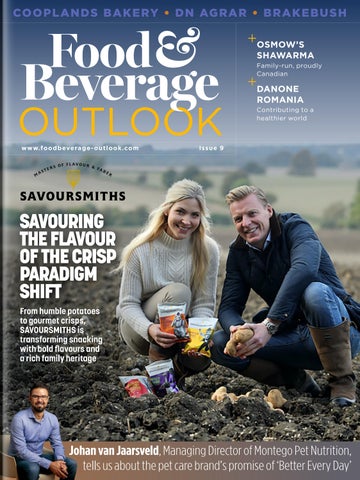
SAVOURING THE FLAVOUR OF THE CRISP PARADIGM SHIFT From humble potatoes to gourmet crisps, SAVOURSMITHS is transforming snacking with bold flavours and a rich family heritage
Johan van Jaarsveld, Managing Director of Montego Pet Nutrition, tells us about the pet care brand’s promise of ‘Better Every Day’
COUGAR GROUP
COMPAGNIE DES BAUXITES DE GUINÉE
DERICHEBOURG | RHEINMETALL UK
DIGICEL HAITI
CBRE TURBOCAM
COOPER FLUID SYSTEMS
K N E U M AY E R C I V I L C O N T R A C T O R S
LONDON FIRE BRIGADE
JOHN A. MORAN EYE CENTER Issue 14
ROBINSON MINE
Unearthing new standards of copper extraction
w w w. a f r i c a o u t l o o k m a g . c o m
Issue 120
w w w. a p a c o u t l o o k m a g . c o m
www. northame ricaoutlookmag.com
Issue 80
AGILE MINING SERVICES
w w w. e m e o u t l o o k m a g . c o m
The pioneering endeavour delivering a new benchmark for golf equipment
Where technology meets tenacity
Transforming waste into valuable resources
BANNERMAN MINING RESOURCES NAMIBIA
Harnessing the nation’s rich resources
DANONE ROMANIA
MONTEGO PET NUTRITION
HUNTER VALLEY OPERATIONS
VULCAN MOZAMBIQUE
BUILT FOR THE
GRYDALE
Operator safety through world-class dust management solutions
JOURNEY AHEAD
Amongst the world’s premier coal miners, contributing significantly to energy security and economic stability in the Hunter Valley
On a mission to be the world’s leading integrated green coal mining operation, Vulcan Mozambique continues to drive the country’s mining space
Pad-Up Creations is determined to provide hygiene products with safety, comfort, and sustainability. Olivia Onyemaobi, Founder and CEO, tells us more
Whether on the road or on the water, Lippert enhances all outdoor recreation adventures
Panasonic Connect Europe is a vital bridge between the digital and physical worlds. Peer Schumacher, Head of Electronics Manufacturing Solutions, gives his insight
Dr Omera Khan, Chief of Staff, Strategy and ESG Lead at DHL Supply Chain Asia Pacific, provides insight into the next era of supply chain excellence
THE 1-2-1 • THE QUESTION • TURBOCAM
Margaret Melanson
President and CEO, shares the organization’s innovative approaches and dedication to quality across its wide network of hospitals and community-based facilities in New Brunswick, Canada
Mopani Copper Mines is a proudly Zambian mining company engaged in the full spectrum of copper production, from ore extraction to the beneficiation of finished copper cathodes ready for export across the globe
Contributing to a healthier world
A well-loved and innovative pet care brand
THE THOUGHT LEADER
• THE 1-2-1 • THE QUESTION
Phil McKee, Chairman and Founder of Appliance Innovation, explores the company’s approach to automation, driven by a commitment to solving operational challenges in the foodservice sector
CO O P L A N DS B A K E RY • D N AG RA R • B RA K E B U S H
KOLEKTOR CONSTRUCTION
Paula Burke, Director, HealthTech and Medical Devices, discusses HSBC Innovation Banking Life Sciences’ UK & Europe: Life Sciences & Healthcare Venture Financing Report
Dr Max Werner, CEO and Founder, details Hades Mining’s proprietary drilling technology, which is set to fundamentally change drilling economics
VECA ELECTRIC & TECHNOLOGIES
N O F A R
E N E R G Y
R O M A N I A
K I N G S PA N
Family-run, proudly Canadian
DANONE ROMANIA
w w w. s u p p ly c h a i n - o u t l o o k . c o m
W W W .CONST RUCT ION-OUT L OOK.COM • ISSUE 4
Real Estate Solutions of the Future
www.foodbeverage-outl ook.com
Locked and loaded
Bridging the Real and Virtual Worlds
Enhancing all outdoor recreation adventures
Real estate solutions of the future
VP of Sustainable and Regenerative Agriculture, discusses PepsiCo’s collaborative regenerative farming initiative Over the last year, Saulsbury has expanded its position as one of North America’s leading engineering, procurement, and construction contractors
As a subsidiary of Dassault Systèmes, DELMIA is on track to shape the manufacturing industry of the future. We speak to Guillaume Vendroux, CEO Jan Diekmann, Head of Business Development and Manufacturing at Ericsson Enterprise Wireless Solutions, explores how private 5G is transforming the factory floor
Enterprise Wireless Solutions, explores how private 5G is transforming the factory floor Jan Diekmann, Head of Business Development and Manufacturing at Ericsson
Packsize is the global leader in packaging automation. We unbox the company’s right-sized approach with Brian Reinhart, Chief Revenue Officer company’s right-sized approach with Brian Reinhart, Chief Revenue Officer Packsize is the global leader in packaging automation. We unbox the
Johan van Jaarsveld, Managing Director of Montego Pet Nutrition, tells us about the pet care brand’s promise of ‘Better Every Day’ tells us about the pet care brand’s promise of ‘Better Every Day’ Johan van Jaarsveld, Managing Director of Montego Pet Nutrition,
YY Group Holding operates an artificial intelligence-native workforce solutions and integrated facility management platform. CEO, Mike Fu, discusses the company’s established capabilities
Simon Thompson, VP Northern Europe at JAGGAER, explains why artificial intelligence-powered data infrastructure is becoming essential
facility management platform. CEO, Mike Fu, discusses the company’s established capabilities YY Group Holding operates an artificial intelligence-native workforce solutions and integrated
intelligence-powered data infrastructure is becoming essential Simon Thompson, VP Northern Europe at JAGGAER, explains why artificial
procurement, and construction contractors as one of North America’s leading engineering, Over the last year, Saulsbury has expanded its position
We speak to Guillaume Vendroux, CEO track to shape the manufacturing industry of the future. As a subsidiary of Dassault Systèmes, DELMIA is on
and Virtual Worlds Bridging the Real
Issue 2
Margaret Henry,
From humble potatoes to gourmet crisps, SAVOURSMITHS is transforming snacking with bold flavours and a rich family heritage
LIPPERT
CBRE www.sustainabilityoutlookmag.com
Iss ue 9
SAVOURING THE FLAVOUR OF THE CRISP PARADIGM SHIFT
CBRE’s multidimensional perspective helps businesses find greater success with real estate facilities. John Kirkman, Senior Managing Director and Supply Chain Leader, gives us the full story
LOCKHEED MARTIN
Contributing to the nation’s net zero goals
OUTLOOK
Contributing to a healthier world Issue 12
N O R D I C S
GREEN BUILDING COUNCIL OF AUSTRALIA
OSMOW’S SHAWARMA ISSUE 10
www.mfg-outlook.com
initiative regenerative farming PepsiCo’s collaborative Agriculture, discusses and Regenerative VP of Sustainable
a rich family heritage with bold flavours and transforming snacking SAVOURSMITHS is to gourmet crisps, From humble potatoes
adventures outdoor recreation Enhancing all
LIPPERT
SHIFT PARADIGM OF THE CRISP THE FLAVOUR SAVOURING
Locked and loaded
MARTIN LOCKHEED
gives us the full story Director and Supply Chain Leader, John Kirkman, Senior Managing success with real estate facilities. helps businesses find greater CBRE’s multidimensional perspective
Margaret Henry,
TELL US YOUR STORY, AND WE’LL TELL THE WORLD the Future Solutions of Real Estate
www.mfg-outlook.com
www.foodbeverage-outl ook.com
Iss ue 9
Issue 12
healthier world Contributing to a
w w w. s u p p ly c h a i n - o u t l o o k . c o m ISSUE 10
ROMANIA DANONE
Canadian Family-run, proudly
W W W .CONST RUCT ION-OUT L OOK.COM • ISSUE 4
OUTLOOK
www.sustainabilityoutlookmag.com
Issue 2
THE THOUGHT LEADER
• THE 1-2-1 • THE QUESTION
CO O P L A N DS B A K E RY • D N AG RA R • B RA K E B U S H
of the future Real estate solutions
CBRE
nation’s net zero goals Contributing to the
AUSTRALIA COUNCIL OF BUILDING GREEN
SHAWARMA OSMOW’S
THE 1-2-1 • THE QUESTION • TURBOCAM
Integrated digital health information
Horizon Health Network
MOPANI COPPER MINES
FORTERRA
REMONDIS BELGIEN
www.healthcare-outlook.com
www.mining-outlook.com • Issue 15
Every product deserves a box that fits perfectly
End-to-end solutions from exploration to extraction
Helping junior miners unlock value
JOSEPH BRANT HOSPITAL
PACKSIZE
WEIR
HARDY DIAGNOSTICS
Building a healthier world
Issue 35
Issue 72
KOLEKTOR CONSTRUCTION
VECA ELECTRIC & TECHNOLOGIES
N O F A R
E N E R G Y
R O M A N I A
K I N G S PA N
N O R D I C S
Africa Outlook, APAC Outlook, EME Outlook, North America Outlook, Mining Outlook, Healthcare Outlook, Manufacturing Outlook, Supply Chain Outlook, Food & Beverage Outlook, Construction Outlook, and Sustainability Outlook are digital publications aimed at boardroom and hands-on decision-makers, reaching an audience of more than 800,000 people around the world. With original and exclusive content compiled by our experienced editorial team, we look to promote the latest in engaging news, industry trends, and success stories from across the globe. Your company can join the leading industry heavyweights enjoying the free exposure we provide across our platforms with a free marketing brochure, extensive social media saturation, enhanced B2B networking opportunities, and a readymade forum to attract new investment and help you grow your business. Visit www.outpb.com/work-with-us for details on how your company can feature for free in one of our upcoming editions.
www.outpb.com/work-with-us
WELCOME FROM THE EDITOR
EDITORIAL Head of Editorial: Jack Salter jack.salter@outpb.com Deputy Head of Editorial: Lucy Pilgrim lucy.pilgrim@outpb.com Senior Editor: Lily Sawyer lily.sawyer@outpb.com Editor: Ed Budds ed.budds@outpb.com Editor: Rachel Carr rachel.carr@outpb.com Copy Editor: Lauren Kania lauren.kania@outpb.com DESIGN & PRODUCTION Art Director: Stephen Giles steve.giles@outpb.com Senior Designer: Devon Collins devon.collins@outpb.com Designer: Louisa Martin louisa.martin@outpb.com Production Manager: Alex James alex.james@outpb.com Digital Marketing Director: Fox Tucker fox.tucker@outpb.com Senior Website Content Manager: Oliver Shrouder oliver.shrouder@outpb.com Social Media Executive: Jake Crickmore jake.crickmore@outpb.com Trainee Digital Content Executive: Tara Steele tara.steele@outpb.com BUSINESS Chief Executive Officer: Ben Weaver ben.weaver@outpb.com Managing Director: James Mitchell james.mitchell@outpb.com Chief Technology Officer: Nick Norris nick.norris@outpb.com Content Director: Neil Perry neil.perry@outpb.com Global Head of Media: Lewis Hammond lewis.hammond@outpb.com Global Media Executive: Kai Boyle-Vennard kai@outpb.com ADMINISTRATION Finance Director: Suzanne Welsh suzanne.welsh@outpb.com Finance Manager: Victoria McAllister victoria.mcallister@outpb.com FOOD & BEVERAGE OUTLOOK Norvic House, 29-33 Chapelfield Road Norwich, NR2 1RP, United Kingdom Sales: +44 (0) 1603 804 445 Editorial: +44 (0) 1603 804 431 SUBSCRIPTIONS Tel: +44 (0) 1603 804 431 jack.salter@outpb.com www.foodbeverage-outlook.com Follow us on LinkedIn: @foodbeverageoutlook Follow us on X: @outlookpublish
SAVOUR THE FLAVOUR Welcome to our ninth edition of Food & Beverage Outlook magazine. A beloved snack staple, crisps have undergone a remarkable transformation into gourmet treats over the last 15 years. Now, they are often artfully crafted with a variety of flavours and textures, offering a delightful experience for the taste buds and elevating classic comfort food into a sophisticated indulgence. Posing in the potato field on this issue’s front cover are Colette Russell Smith and her husband, Mike, who together co-founded SAVOURSMITHS in 2016. The company’s creative journey was inspired by the duo’s desire to launch a refined crisp brand that differentiates itself as ‘a better breed of crisp’. Today, SAVOURSMITHS products are sold across the UK and exported to nearly 40 countries, appearing in premium retailers, luxury hotels, airlines, and hospitality venues worldwide. “Our flavours are genuinely considered, bold, and designed to complement a drink or a table setting. When SAVOURSMITHS are served at premium hotels, the crisps need to hold their own in that environment – and they do,” Colette highlights. From gourmet crisps to premium pet nutrition, which has likewise been growing in prominence in recent years. Montego Pet Nutrition (Montego), the well-loved and innovative South African pet care brand, is committed to premium pet nutrition, with superior quality and food safety as non-negotiables. “Knowing where every ingredient comes from, how it was sourced, and how it was processed is not just good practice – it is a promise to every pet owner who chooses Montego,” affirms Johan van Jaarsveld, Managing Director. Osmow’s Shawarma (Osmow’s), the rapidly growing Canadian fast-casual restaurant chain specialising in modern Mediterranean and Middle Eastern cuisine, has also built its menu around quality ingredients. By modernising the category, Osmow’s has become the largest global shawarma franchise, an achievement CEO, Ben Osmow, sees as only the beginning. “We’ve started our growth journey and are also working toward international expansion beyond Canada and the US. Hopefully, one day, we’ll make our way to the UK as well,” he lays out. There’s plenty more flavour to savour from Danone Romania, Cooplands Bakery, and DN AGRAR. We hope that you enjoy your read. Jack Salter Head of Editorial, Outlook Publishing Food & Beverage Outlook Issue 9 | 3
31 THE 1-2-1 J O E YA L L E Y- O G U N R O Group Head of Sustainability, Finlays
Better Beverage Supply Chains
0 9 / C ON T E N T S REGULARS F O O D & BEVERAGE IN SI G HTS
The importance of collaboration, traceability, and practical decarbonisation
17
17 Blue Ventures Resilient Women, Resilient Ocean
6 GAIL’s
Redefining how the world protects the ocean
Modern Craft Bakery
24 THE THOUGHT LEADER
A flexible and caring approach to baking bread
12 SAVOURSMITHS Savouring the Flavour of the Crisp Paradigm Shift Elevating snacking to new heights
Chris King Vice President of Food and Beverage, Langham Hospitality Group Pioneering Sustainability in Food and Beverage Operations Proving sustainability and sophistication can go hand-in-hand
31
27 THE
DISRUPTOR F OR M Welcome to the Smart Shelf Era How AI-powered retail execution is helping food and beverage brands improve performance
4 | Food & Beverage Outlook Issue 9
36 THE
QUESTION Supplier Relations: How are you managing relationships with key suppliers in an increasingly volatile environment?
FOOD & BEVERAGE OUTLOOK CONTENTS
F E AT U R E S AF R IC A
62 Brakebush
80 Cooplands Bakery
Chicken to Impress
Freshly Baked and Ready to Go
A century of chicken
A modern bakery business that has stayed true to its artisan roots
42 Montego Pet Nutrition
66 Chickie’s and Pete’s
Africa’s Pet Care Pioneers
Philadelphia’s Favorite Local Sports Bar
86 DN AGRAR
A well-loved and innovative pet care brand
The pride of Philadelphia
From Farm to Future Dairy Dominance
NO RT H AMERICA
EU R OP E & M I D DL E E AST
54 Osmow’s Shawarma
74 Danone Romania
94 Al Rabie Saudi Foods
Delicious Scenes for Shawarma
Nurturing Nutrition
The Choice of Champions
Family-run, proudly Canadian
Contributing to a healthier world
Looks amazing, tastes even better
Revolutionising the milk industry
54
74
94
80
42
62
66
86
Food & Beverage Outlook Issue 9 | 5
Modern Craft Bakery GAIL’s is intuitive in its flexible and caring approach to baking bread. For the awardwinning neighbourhood bakery, every step in its process matters when curating a product that satisfies evolving customer needs – from farmer to miller and baker. We sit down with Anomarel Ogden, Group Executive Head Baker, who provides insight into the intricacies involved in delivering consistently high-quality products Writer: George Marsden
W
hat began as a single café and bakery in London’s Hampstead High Street in 2005, to now having bakeries in neighbourhoods across London, Oxford, Brighton, and beyond, GAIL’s is a business that remains unchanged from the very principles it was built on – that the highest-quality bread can be achieved when each loaf 6 | Food & Beverage Outlook Issue 9
is loved and cared for, every step of the way. “At GAIL’s, innovation is shaped by the communities, ingredients, and partnerships all connected to our bakeries,” introduces Anomarel Ogden, Group Executive Head Baker. For GAIL’s, regionality is not simply a trend; it is part of the living nature of bread, where the best loaves are made
GAIL’S FOOD & BEVERAGE INSIGHTS
from the perfect balance of a farmer, miller, and baker working together. “This influences how we approach product development – from exploring different grain varieties and fermentation methods, to adapting recipes around the availability of seasonal ingredients,” he adds.
By collaborating closely with regional producers, GAIL’s can experiment with ingredients that reflect the quality and character of the land they came from, whilst also supporting biodiversity and local supply chains. A reflection of the company’s flexible approach to its ingredients which values authenticity, GAIL’s aims to work Food & Beverage Outlook Issue 9 | 7
with nature to ensure quality, nutrition, and authenticity remain central to everything it bakes.
THE EVOLVING CUSTOMER As Group Executive Head Baker at GAIL’s, Ogden has personally seen the UK’s food and beverage industry evolve significantly over the last year, presented with countless challenges and opportunities. “The industry and consumers alike are increasingly far more conscious of provenance, sustainability, and the journey behind food,” Ogden reflects. He goes on to note how people no longer want food to be anonymous, but want to know where it came from, who made it, and, most importantly, whether it was made with care. Having navigated ever-changing complexities across both the environment and economy, GAIL’s has come to understand how it is vital to prioritise building strong relationships in local communities. “That’s one of the many reasons why we choose to support local sourcing and regenerative practices, to ensure we keep transparency, trust, and our passion for positive change at the heart of our craft,” Ogden emphasises. He explains how this was not in response to a trend, but a return to a time-old philosophy – food as nourishment, a point of connection, and social responsibility. Ogden also reflects on the bakery’s understanding of change in its customers’ requirements, who are becoming 8 | Food & Beverage Outlook Issue 9
“Quality can no longer be separated from growth and it’s essential to us that, as we scale, the humanity and care that are integral to GAIL’s remain at the heart of how we work” – ANOMAREL OGDEN, GROUP EXECUTIVE HEAD BAKER, GAIL’S
increasingly health-conscious and placing more emphasis on ingredients that meet their nutritional needs and how the food makes them feel. Whilst some may see this change as a challenge, GAIL’s sees it as an opportunity – a way to nourish the body as well as the soul through baking, using a diverse array of ancient and heritage grains in its breads to support a happier, healthier gut.
BALANCING BUSINESS WITH QUALITY GAIL’s is successfully balancing the scalability of being a national bakery chain whilst maintaining the authenticity and variability that comes from working with regional suppliers and heritage grains.
GAIL’S FOOD & BEVERAGE INSIGHTS
“Quality can no longer be separated from growth and it’s essential to us that, as we scale, the humanity and care that are integral to GAIL’s remain at the heart of how we work,” Ogden insights. As such, the bakery actively collaborates with a network of trusted producers, farmers, millers, and suppliers, ensuring that over 80 percent of its ingredients are grown or made in the UK. Ogden explains a common misconception that scale is often assumed to dilute care, when, in fact, production in high quantities has the capacity to make change that isn’t
COULD YOU TELL US MORE ABOUT GAIL’S’ THE WAY WE BAKE INITIATIVE? Anomarel Ogden, Group Executive Head Baker: “The Way We Bake is an exploration into how we can reconsider our bread recipes from the perspective of nutrition, flavour, and sustainability.
possible at a small scale. The real question is whether GAIL’s’ growth is delivering coherent change, and whether the same level of care for soil, grains, people, and flavour can move through a larger system. The company’s growth has not changed its priorities, instead, it has enabled GAIL’s to gain a greater awareness of its responsibility when it comes to supporting farmers, teams, and customers. “That’s why we work closely with each one of our suppliers, taking a flexible approach to what and how we bake.” Ogden is aware that it may not be the easiest way to operate, yet respecting natural variation and backing local suppliers ensures quality will always come first. “Natural variation is not something to remove; it is often where the life and character of an ingredient or product shows itself,” he outlines.
THE FUTURE OF GAIL’S At GAIL’s, there is no such thing as a ‘finished’ recipe – a principle which keeps its bakers and product developers exploring different grains or letting fermentation do its thing to bring out a deeper flavour. “A recipe is not static – it is a conversation between the baker, ingredient, season, and the person who will eat it,” Ogden reflects.
“At its heart, it is a question we keep asking ourselves: how do we make bread in a way that is more coherent, nourishing, and caring towards life? “We want people to truly taste the ingredients we use, ensuring every loaf is savoured. To do that, we use multiple varieties of ancient and heritage grains to improve the nutritional content of our bread.” “The last pillar of this initiative also focuses on what’s good for the biodiversity and soil we rely on – trying to make a positive impact on the food system through local sourcing and regenerative practices that support the broader ecosystem. “The Way We Bake is also integral to how we define craft at GAIL’s. Curiosity, learning, and responsiveness will always be important to us as we scale, ensuring that the way we work supports the needs of our customers and producers, and ultimately has a positive impact on how our industry treats food and the environment.”
Food & Beverage Outlook Issue 9 | 9
“The industry and consumers alike are increasingly far more conscious of provenance, sustainability, and the journey behind food” – ANOMAREL OGDEN, GROUP EXECUTIVE HEAD BAKER, GAIL’S
Indeed, when it comes to sourcing, GAIL’s ensures it works with farmers who use regenerative practices, planting diverse heritage grains like Miller’s Choice, Solina, and population wheat. The company also supports crop rotations that restore soil health, improve biodiversity, and prioritise what the land needs. The recent shift in modern tastes aligns with something GAIL’s already stood by – flavour, provenance, and craft.
SUMMER SEASONAL MENU AT GAIL’S In keeping with its emphasis on seasonal produce and local ingredients, GAIL’s is prioritising a sunnier kind of lunch this summer, reflected in its ‘Bakers Seasonal Menu’. Customer favourites include: • Aubergine, crunchy slaw, and herbs – Smoky aubergine dip layered with crunchy summer slaw, za’atar-roasted globe aubergine steaks, served on GAIL’s signature San Francisco Sourdough. • Cheese, tomato, and basil savoury bun – A savoury brioche bun filled with sundried tomato paste, fresh cheese curds, Italian Datterini tomatoes, and fresh basil.
Now, its job is to continue evolving in a way that is truly meaningful, allowing the company to continue to honour the soil, farmers, bakers, and customers who have been at the heart of the business for over twenty years. “Relevance does not mean chasing novelty. It means staying curious, attentive, and connected to the life of the ingredients we use. “The future of baking will belong to those who can reconnect what has been lost in recent times: farming from food, nutrition from pleasure, growth from care, and quality from responsibility.” As such, GAIL’s remains wholly focused on making good-quality food more accessible, without compromising where it comes from or how it’s made, ensuring that, as it scales, the heart of the business stays focused on building relationships and trust. “We want to have a beneficial and constructive impact on baking, sourcing, and farming everywhere we operate, demonstrating that – even through expansion – quality, sustainable ingredients, and putting the community first can remain central. “Growth is only meaningful if it allows us to care for more people, farmers, and land,” Ogden passionately concludes. It is for this reason that the evolving food and beverage landscape is not scary for GAIL’s – rather, it is a continuation of the path they were already on.
• Berry brioche – A sweet brioche bun filled with sumptuous vanilla crème pâtissière, fresh summer raspberries, strawberries, and blueberries. gails.com 10 | Food & Beverage Outlook Issue 9
S AVO U R I N G T H E F L AVO U R O F THE CRISP PA R A D I G M S H I F T
From humble potatoes to gourmet crisps, SAVOURSMITHS is transforming snacking with bold flavours and a rich family heritage, turning a classic treat into a decadent experience. Co-Founder Colette Russell Smith discusses culinary quality, sustainability, and future plans Writer: Rachel Carr
I
n the UK, the love for crisps runs deep; fried thin potatoes have become a beloved snack staple. Over the last 15 years, these oncesimple snacks have undergone a remarkable transformation into gourmet treats. Now, they are often artfully crafted with a variety of 12 | Food & Beverage Outlook Issue 9
flavours and textures, offering a delightful experience for the taste buds and elevating classic comfort food into a sophisticated indulgence. Whether enjoyed as a casual snack or paired with fine cheeses and charcuterie, luxury crisps truly reflect the nation’s evolving palate and
appreciation for culinary artistry. To enhance the sophisticated snack sector, some crisp brands utilise home-grown potatoes sourced from their own farms. An example of this is SAVOURSMITHS, which hand-selects its potatoes and cooks them in small batches.
SAVOURSMITHS EUROPE & MIDDLE EAST
Indeed, the brand’s East Anglian location benefits from the region’s rich agricultural and rural landscape. The company’s creative journey was inspired by the husband-and-wife duo’s desire to launch a refined crisp brand that differentiates itself as ‘a better breed of crisp’. Today, SAVOURSMITHS products are sold across the UK and exported to nearly 40 countries, appearing in premium retailers, luxury hotels, airlines, and hospitality venues worldwide. “SAVOURSMITHS came from a very real and personal place. Mike and I are a farming family – Russell Smith
Farms has been growing potatoes in Duxford, Cambridgeshire, since 1938,” emphatically introduces co-Founder Colette Russell Smith. “We had this extraordinary raw material on our doorstep, and we wanted to do something with it that truly honoured that heritage. The luxury end of the crisp market felt wide open as there was no brand genuinely rooted in British farming with real provenance and the culinary ambition to match. Consequently, we built one.” What sets SAVOURSMITHS apart is its control over the entire process – from the soil where its potatoes are
grown to the hand-cooking on the farm and the packaging. Additionally, its flavour range is unique. “Our flavours are genuinely considered, bold, and designed to complement a drink or a table setting. When SAVOURSMITHS are served at premium hotels, the crisps need to hold their own in that environment – and they do,” she continues. Moreover, SAVOURSMITHS’ family heritage plays a pivotal role in shaping the brand’s future and storytelling. The company emphasises its core values and strives to connect with customers through a message that resonates deeply with Food & Beverage Outlook Issue 9 | 13
SAVOURSMITHS EUROPE & MIDDLE EAST
quality, tradition, and a passion for exceptional taste. “Heritage is at the heart of everything. The farm has been in Mike’s family since 1938 – that’s three generations of stewardship of this land, and when people understand that, it changes how they relate to the brand. “It’s not a corporate crisp; it’s a family endeavour. Our storytelling will always come back to that: the farm, the soil, the seasons, and the people behind it. Authenticity is the hardest thing to manufacture and the most valuable thing you can have, and we genuinely have it,” Russell Smith highlights.
How does SAVOURSMITHS incorporate consumer trends, such as health and wellness, into its product offerings? Colette Russell Smith, co-Founder: “We don’t chase trends, but we do pay close attention to where the world is going. “Health and wellness matter enormously to me personally; I’m very conscious of ingredients, quality of fats, and what goes into our bodies. SAVOURSMITHS crisps are handcooked and made from carefully sourced, simple ingredients. “In essence, we create products we are proud to serve our own families, and, in terms of gourmet experiences, that’s always been our north star. “With our new Little SAVOURSMITHS x Peter Rabbit range launching soon – aimed at children and families – we’ve been especially rigorous about creating something genuinely better for younger consumers, with very low salt and sugar. “If we’re going to put our name on something for children, it has to meet a higher standard. That’s non-negotiable for us.”
14 | Food & Beverage Outlook Issue 9
PACKING A PUNCH ON THE PALATE
Renowned for flamboyant flavours, SAVOURSMITHS thrives on innovation and creativity to develop unique taste experiences. “Our flavours are deliberately theatrical – we wanted them to feel like an experience, not an afterthought. We have things like Bubbly and Serrano Chilli, Truffle and Rosemary, and Virgin Bloody Mary – flavours that make people do a double-take and then immediately want to try them,” impassions Russell Smith. “Furthermore, the development process is genuinely collaborative and a bit hedonistic – it involves a lot of tasting, travelling, and eating at
brilliant restaurants. I find inspiration everywhere: in a dish I’ve had at a great restaurant, in a combination I’ve read about, and in the seasons. The brief is always: Does this taste extraordinary?” SAVOURSMITHS’ flavours are a delightful tapestry woven from a variety of unique cultural and culinary influences, emerging from harmonious blends of dazzlingly festive and zesty notes that keep people reaching for more. “We draw from a very broad culinary canvas – British classics reimagined, bold international influences, unexpected pairings that somehow just work,” articulates Russell Smith. In the journey of uncovering these distinctive culinary offerings, each flavour combination is steeped in rich storytelling and thoughtful inspiration. “For example, the Wagyu Beef with Honey and English Mustard is deeply British in its bones but elevated in a way that feels special. The Truffle and Rosemary came from a love of Italian cooking and that irresistible combination of earthiness and herb,” she details. “The Bubbly and Serrano Chilli was born from that joy of contrast – something celebratory and indulgent with a heat that keeps you coming back. There are always personal stories behind these decisions, and that’s what makes them feel real rather than manufactured.”
Ultimately, each flavour is imbued with personal stories drawn from the couple’s adventures, meals they’ve savoured, and experiences that have deeply resonated. This connection is what lends authenticity to the flavours, making them feel genuine.
FROM FIELD TO FACTORY
Ensuring that its ingredients meet quality standards and ethical practices, SAVOURSMITHS holds a Brand Reputation Compliance Global Standards (BRCGS) Grade AA Issue 9 certification, recognised as the gold standard in food safety and quality. “A top BRCGS grade is not something you achieve without rigour. Beyond certification, we source our main ingredients as locally as possible, and we’re personally invested in knowing the origin of everything. “When your name is on the brand, and you live on the farm, there’s no hiding from quality – it’s personal,” Russell Smith asserts. As a family-operated farm, SAVOURSMITHS strongly focuses on the farm-to-table concept and
“When people buy SAVOURSMITHS, they’re supporting British farming. In this regard, every bag sold is directly connected to our farm, family, and the people who work there” – COLETTE RUSSELL S MI T H , CO- FOU NDE R, SAVOU RS MI T H S
emphasises traceability in product sourcing. “For us, farm-to-table isn’t a marketing phrase; it’s literally our reality. The potatoes are grown, processed, and cooked here on Russell Smith Farms,” she declares. “You can stand in our fields and hold the finished bag within a few hundred metres of where it started. That level of traceability is almost impossible to replicate if you’re buying ingredients from multiple suppliers. It gives us absolute confidence in what we’re putting out, and it gives our customers – whether that’s a Harrods buyer or a home
consumer – the same confidence.” Additionally, the company’s commitment to sustainability is reflected in its packaging and production processes. “We’ve put real thought and investment into making every part of the business sustainable. Our tins are 100 percent plastic-free, and we do not use single-use plastics anywhere in our operations. That was a deliberate decision and one we’re proud of.” In line with SAVOURSMITHS’ commitment to the environment, the company prioritises eco-friendly practices at every stage of our operations. Food & Beverage Outlook Issue 9 | 15
SAVOURSMITHS EUROPE & MIDDLE EAST
“On the production side, we recycle throughout, and our used cooking oil and food waste go into biofuel and animal feed rather than landfill, which feels like the right thing to do when you’re a farming business and you understand that waste has value,” Russell Smith explains. Furthermore, SAVOURSMITHS’ is midway through installing solar panels on the farm, which will make a meaningful difference to its energy footprint. “We’re not a corporation with a sustainability department – we’re a family farm, and we just quietly get on with doing our part where we can. Every decision we make, we ask whether we can do it better, and that’s not going to change,” Russell Smith resolutely points out.
A SMARTER SNACK
The SAVOURSMITHS’ brand is continually evolving, particularly in its product offerings and sustainability efforts. “We’re in an exciting period of expansion. The Little SAVOURSMITHS x Peter Rabbit range is a significant step, as it brings our quality standard to the 16 | Food & Beverage Outlook Issue 9
“Our flavours are deliberately theatrical – we wanted them to feel like an experience, not an afterthought” – COLETTE RU SS E L L S MI T H , CO-FOUNDER, SAVOU RS MI T H S
children’s snack market. This category desperately needs it,” Russell Smith expresses. “Meanwhile, we’re growing our retail presence. Our products are on Ocado, in COOK stores nationwide, select Co-op stores, delis up and down the country, as well as Young’s Pubs and sports clubs, and at some
of the finest hotels in the country, including The Ritz, The Lanesborough, and The Berkeley.” Whilst enhancing its presence with premium hospitality clients, the company is also investing in its sustainability commitments and effectively communicating its story through content and media. As such, the brand is a creative family business that is never short on ideas. “When people buy SAVOURSMITHS, they’re supporting British farming. In this regard, every bag sold is directly connected to our farm, family, and the people who work there. “In a world where food provenance matters more than ever, we’re one of the very few premium snack brands where you can trace your product all the way back to the field. That matters to us enormously, and I hope it matters to the people who choose us,” she proudly finishes.
www.savoursmiths.com
Tel: Xxxxxxxxx
BLUE VENTURES AFRICA
Celebrating women fishers, traders, and processors advancing inclusive ocean protection and coastal livelihoods, Blue Ventures is proudly presenting the visual storytelling project Ocean Matriarchs. Nelly Otieno, East Africa Director, tells us more about how thriving communities create thriving oceans Writer: Lauren Kania
There is a common myth that fisheries are only about men. They may go out into deep waters to fish, but when the fish return to shore, women play critical roles in cleaning, processing, marketing, and preparing them for sale. Women are central to the fishing economy.”
With 2026 declared the UN’s International Year of the Woman Farmer, more attention is being turned towards the women who play a crucial role in global food systems. As stated by Nelly Otieno, East Africa Director at Blue Ventures, women’s contributions across agriculture and fisheries are essential, yet often overlooked.
Specifically, in small-scale fisheries, women make up approximately 47 percent of the workforce supporting around 56 million jobs across the supply chain. Global marine conservation NGO Blue Ventures is working to change this through its photo-led storytelling project, Ocean Matriarchs, which documents women along the climate-vulnerable coastline of East Africa. “Blue Ventures is a marine conservation organisation that puts communities first,” explains Otieno. “We reach communities through local organisations and partnerships, working closely with local institutions and trainers who come directly from the communities themselves. This allows the work to be community-led and more responsive to local realities, challenges, and priorities.” Having started in Madagascar, Blue Ventures now works in more than 12 countries with its headquarters based in the UK. Through various sub-grants and partnerships, the organisation is able to help strengthen community capacity across different thematic areas whilst working closely with government institutions. Otieno’s journey into marine conservation was shaped by myriad experiences across financial inclusion. Her career began in communitybased microfinance work with a number of institutions in Kenya alongside the UN through the International Labour Organization (ILO). Later, after pioneering rural savings and credit societies in the country, Otieno worked on village savings and loan associations, which quickly found success. From there, she partnered with the National Treasury, commercial banks, the Central Bank of Kenya, and other organisations to promote financial inclusion in the country, in addition to working with regional banks and mobile providers to develop products that could reach low-income entrepreneurs. Food & Beverage Outlook Issue 9 | 17
CAN YOU TELL US ABOUT THE IMPACTS OF FOOD INSECURITY AND CLIMATE CHANGE ON WOMEN IN COASTAL COMMUNITIES? NELLY OTIENO, EAST AFRICA DIRECTOR: “Women in fishing communities face a cycle of poverty reinforced by social, cultural, and economic barriers. Many do not own land or productive assets. In fisheries, women provide unpaid labour in fish cleaning, processing, and drying. Even when they participate directly in fisheries, they are usually paid less for their work and have limited power in negotiating prices. “At landing sites, women are excluded from accessing the best fish because boats dock further from shore, leaving women to buy lower-quality remnants at lower prices. Climate change worsens these pressures. Declining fish stocks and environmental degradation increase competition for resources, deepening insecurity for women who already face barriers to participation and ownership. “Women also face challenges accessing identification documents and financial services. In countries like Kenya and Tanzania, many financial transactions are done through mobile technology, but some women are forced to use their husbands’ phone numbers because they do not have IDs. This means payments are controlled by men rather than by the women doing the work. “Without identification cards or collateral, women struggle to access loans or invest in fisheries businesses, meaning many remain limited to low-income activities such as fish cleaning or gleaning.”
“I already had experience working on financial products for microentrepreneurs in agriculture, so when I saw an opportunity with an organisation looking to introduce financial services into the blue economy, I was very interested. I joined Blue Ventures as a result,” expands Otieno.
PUTTING COMMUNITIES FIRST Blue Ventures is a community-led organisation, and when it discusses communities, it is referring to the women therein. The NGO comprises women who are investing directly in fisheries, with some owning boats and fishing nets and employing men and youth to work for them, further showcasing 18 | Food & Beverage Outlook Issue 9
how women are playing a critical role in the blue economy. “Blue Ventures is working to better understand and recognise the role women play, not only in fisheries but also in environmental protection,” states Otieno. “For example, many women are involved in mangrove restoration because this supports the long-term sustainability of fisheries. We are also ensuring that women are represented in Beach Management Units (BMUs) and leadership structures so they can participate in decisionmaking processes within fisheries management.” Blue Ventures is further elevating women’s voices through Ocean Matriarchs, which uses visual
storytelling to amplify the lived experiences of women in coastal fishing communities, especially those whose contributions to fisheries and climate resilience are often overlooked. This programme relies on vivid photography, intimate cinematography, and oral narratives to bring audiences closer to the realities women face across the fisheries value chain. Through these visuals and personal testimonies, the stories highlight not only the daily challenges women experience but also the important role they play in food security, household livelihoods, and the sustainability of coastal ecosystems. Through these stories, audiences
BLUE VENTURES AFRICA
“ B LU E V E N T U R E S I S WO R K I N G TO B E T T E R U N D E R S TA N D A N D R E C O G N I S E T H E R O L E W O M E N P L AY, N O T O N LY I N F I S H E R I E S B U T A L S O I N E N V I R O N M E N TA L P R OT E C T I O N ” Nelly Otieno, East Africa Director
– N E L LY O T I E N O , E A S T A F R I C A D I R E C T O R , B L U E V E N T U R E S
are able to see how women navigate socioeconomic barriers whilst leading change within fisheries spaces. “The storytelling also connects women’s experiences to broader conversations around climate resilience and inclusive fisheries management. By visually demonstrating women’s relationships with coastal ecosystems such as mangroves and fisheries, Ocean Matriarchs shows why their participation in leadership and decision-making is essential for thriving oceans and communities,” Otieno insights.
ELEVATING FISHERWOMEN’S VOICES Ocean Matriarchs specifically features individuals whose lives and work reflect the undervalued role women play in fisheries, food security, and community resilience. Amina Komora, one of the featured matriarchs, is from the Sanye community in Mkunumbi, Lamu – a
marginalised community in a fisheriesrich region of northern Kenya, wherein Komora leads a group of 20 women fishers and advocates for rights, economic resilience, and sustainable marine resource management. Her story reflects both the leadership role women play within coastal communities and the barriers many continue to face.
Food & Beverage Outlook Issue 9 | 19
BLUE VENTURES AFRICA
“THERE IS A C O M M O N M Y T H T H AT F I S H E R I E S A R E O N LY ABOUT MEN. THEY M AY G O O U T I N T O D E E P WAT E R S T O FISH, BUT WHEN THE FISH RETURN TO S H O R E , WO M E N P L AY C R I T I C A L ROLES IN CLEANING, PROCESSING, MARKETING, AND P R E PA R I N G T H E M FOR SALE. WOMEN A R E C E N T R A L TO T H E FISHING ECONOMY” – N E L LY O T I E N O , E A S T A F R I C A D I R E C TO R , B LU E V E N T U R E S
“We also feature Riziki Said from Matondoni in Lamu, who is a prawn processor and trader, alongside the breadwinner for her family. Through the Matondoni Prawn Processors group, women have built livelihoods around fisheries processing and trade, whilst creating employment opportunities for fishers. Her story highlights the critical role women play in supporting household incomes and local economies through fisheries value chains,” expands Otieno. Another matriarch is Amina Musa, who has worked across different areas of fisheries leadership and community organisation in Lamu. She is the Treasurer of the Amu BMU, a fish trader, Chairlady of the Lamu Mama Karanga Self-Help Group, and Secretary of the Lamu Fish Processors Group. Her experience exemplifies how women are contributing not only 20 | Food & Beverage Outlook Issue 9
to fisheries trade and processing but also to governance, research, and decision-making within coastal fisheries management. “Together, these stories help demonstrate that women are not just supporting fisheries from the sidelines. They are leaders, businesswomen, organisers, and environmental stewards who are helping shape more resilient coastal communities,” notes Otieno.
AFFORDABILITY AND ACCESSIBILITY For Blue Ventures, food security boils down to affordability and accessibility. Coastal communities, and especially women, continue to face food insecurity despite their important role in fisheries. Many do not own land, limiting their ability to farm and access resources. “Even where women are directly
involved in fishing, they often receive lower prices for their catch because they lack bargaining power or access to markets. Infrastructure at landing sites also disadvantages women, as men frequently control access to the best fish. Climate change further worsens these challenges, and without proper support and protection, women may be forced into activities that deplete marine habitats,” Otieno explains. Blue Ventures is addressing these issues through several programmes and pathways. Thanks to communitybased fisheries management, the organisation ensures women are involved in BMUs and elected into leadership positions. Under Blue Ventures’ secure rights projects, it also supports women in accessing identification cards by working closely with government registration offices, allowing them
BLUE VENTURES AFRICA
to access mobile technology and financial services. Additionally, the organisation provides support through financial inclusion programmes that focus on savings mobilisation, access to credit, and financial literacy. These initiatives help women manage businesses, build purchasing power, and improve household food security. “Our approach to nutrition is not only about encouraging fish consumption. It is also about ensuring that women have the economic means to afford balanced diets and put nutritious food on the table for their families,” Otieno states.
COLLECTIVE ACTION FOR MEANINGFUL CHANGE As Blue Ventures continues to look ahead and work to extensively improve food security in coastal communities, the organisation has both a global and regional strategy aligned around a vision of thriving
communities and thriving oceans. “Our 2030 strategy places strong emphasis on impact and transformation at both household and community levels. We are asking whether fishing households are able to access food, education, healthcare, and better living conditions, and if Food & Beverage Outlook Issue 9 | 21
BLUE VENTURES AFRICA
CAN YOU PLEASE EXPAND UPON YOUR RECENT PROJECTS THAT FURTHER WOMEN AND LOCAL COMMUNITIES? NELLY OTIENO, EAST AFRICA DIRECTOR: “In East Africa, one of our key initiatives is the Frontline Community Fund, which supports local organisations and BMU networks to strengthen fisheries governance and community-led conservation. “We are also seeing encouraging progress in women’s leadership and participation. For example, in Muiro, we now have a woman serving as chairperson, which is an important milestone for women in the blue economy. More are also investing in boats and fishing nets, particularly in dagaa fisheries in Tanzania and parts of Kenya. Additionally, some women are now processing and exporting dagaa to the Democratic Republic of Congo, creating greater income opportunities for households. “Blue Ventures also works closely with BMUs because they represent fisherfolk directly. Strengthening these community institutions is central to our work and goals of deepening outreach and impact.”
22 | Food & Beverage Outlook Issue 9
communities can sustainably manage marine resources,” details Otieno. Equally, Blue Ventures is focused on the sustainability of BMUs and ensuring that fisherfolk understand and can exercise their rights. Globally, the organisation aims to reach five million people and cover 200,000 square kilometres by 2030 through partnerships with local civil society organisations. At the regional level in East Africa, Blue Ventures aims to reach 1.5 million people by 2030, working with approximately 1,500 partners. Ultimately, deepening outreach and strengthening impact remain central priorities. “As we expand our outreach and work with coastal communities, what matters most is transformation at the household level, within communities, and within marine ecosystems,” concludes Otieno. “We want to see thriving fisheries
and oceans, but this cannot be achieved by one organisation alone. Governments, UN bodies, local institutions, internal organisations, and communities all need to work together. Marine conservation requires collaboration and collective action to achieve meaningful and lasting change.”
Tel: +44 (0)20 3137 2867 info@blueventures.org
www.blueventures.org
THE
THOUGHT LEADER Pioneering Sustainability in Food and Beverage Operations Chris King,
Vice President of Food and Beverage at Langham Hospitality Group
Proving sustainability and sophistication can go hand-in-hand
THE THOUGHT LEADER CHRIS KING
Pioneering Sustainability in Food and Beverage Operations In an era where sustainability is no longer a choice but a necessity, Langham Hospitality Group has emerged as a leader in the industry. With a steadfast commitment to environmental stewardship, the 40-property group has embraced innovative food and beverage practices that not only reduce waste but also enhance the guest experience. Chris King, Vice President of Food and Beverage, discusses setting a benchmark for luxury hotels worldwide, proving sustainability and sophistication can go hand-in-hand
A
t the heart of sustainability efforts at Langham Hospitality Group (LHG) lies a circular approach to food waste. This strategy focuses on thoughtful sourcing, maximising ingredient use, reducing waste, and creating value from byproducts. Each property in our portfolio has been empowered to develop location-specific solutions, reflecting the unique culinary traditions and resources of their regions. This decentralised approach ensures sustainability is not just a corporate directive but a lived practice across our portfolio. Sustainability becomes most meaningful when it is embedded into the everyday decisions we make, including how we source, prepare, and serve food.
24 | Food & Beverage Outlook Issue 9
This approach reflects how our teams are translating broader sustainability commitments into practical, localised action, finding thoughtful ways to respect the ingredients we work with in each location whilst enhancing the guest experience.
SIGNIFICANT IMPACT Our properties have embraced this mission with creativity and ingenuity, turning potential waste into culinary and cocktail masterpieces. For instance, at Cordis, Auckland, we have found a novel use for the peels and pulp from our fresh orange juicer at the breakfast bar, transforming them into an artisanal marmalade compote that adds a zesty touch to breakfast dishes.
THE THOUGHT LEADER CHRIS KING
The impact is significant, saving approximately 390 kilograms (kg) of peels and pulp from landfill annually. At The Langham, Boston, by repurposing trimmed portions of premium fresh cod and salmon, we have created an enticing Coastal Catch Burger. This guest favourite prevents up to 220 kg of top-quality fish from going to waste each year. At The Langham, Gold Coast, premium Wagyu beef, utilised from cut-centric dishes, is repurposed into elegant Kushiyaki Wagyu Beef Skewers, whilst Wagyu fat is rendered in-house to produce Wagyu tallow. These practices not only reduce waste but also elevate the dining experience.
Our sustainability efforts are not just about environmental responsibility; they also make sound business sense. By reducing waste and maximising ingredient use, we enhance operational efficiency and reduce costs”
launched a groundbreaking upcycling programme, providing an innovative new use for oyster shells, popular on our buffets, by turning them into a vital building material: cement. Oyster shells were utilised to create a limestone alternative, a key ingredient that constituted 80 percent of cement. This programme was created in collaboration with Hong Kong’s leading cement manufacturer, Green Island Cement, which successfully upcycled eight tonnes of oyster shells from Eaton HK and The Langham, Hong Kong between March 2023 and August 2024. This unique cross-sector programme is the first of its kind in Hong Kong and mitigated the environmental impacts of transporting limestone from overseas. As a group, we aim to amplify our efforts and encourage others to take similar initiatives. We hosted a press conference around this initiative to call on all hospitality industry leaders in Hong Kong to pledge to the oyster shell programme.
INSPIRING INNOVATION Additionally, our lobby bar uses near-overripe fruits and excess citrus peels to craft house-infused cocktails, showcasing how sustainability can be both practical and indulgent. At Eaton HK in Hong Kong, our Terrible Baby terrace bar has introduced two innovative cocktails that upcycle excess ingredients. The Monkey Business cocktail uses excess citrus peel to infuse Lillet, whilst the Dong Ling Cha repurposes coffee grounds to infuse Matusalem rum, creating exceptional layers of flavour from upcycled ingredients. These creations exemplify how sustainability can inspire creativity in mixology. In 2024, our group’s Hong Kong properties formally
A LEADER IN SUSTAINABLE HOSPITALITY Our food and beverage initiatives are part of a larger commitment to sustainability that spans our entire portfolio. Earlier this year, The Langham, Huntington, Pasadena achieved EarthCheck Master Certification, the highest distinction within the world-leading scientific benchmarking and certification programme. This milestone reflects 15 years of continuous dedication to environmental stewardship. The property joins five other LHG hotels: Cordis, Auckland and Cordis, Hong Kong, Eaton HK, The Langham, Hong Kong, and The Langham, London, that have also achieved EarthCheck Master status.
Food & Beverage Outlook Issue 9 | 25
THE THOUGHT LEADER CHRIS KING
ABOUT LHG LHG is a luxury hotel operator based in Hong Kong. The group traces its heritage back to 1865 with the opening of The Langham, London, which is widely recognised as Europe’s first ‘grand hotel’. Today, the company manages and develops properties across four regions, namely Asia, Europe, North America, and Australasia. Its global portfolio includes over 40 distinct hotels, residences, and co-working hubs.
In total, 18 LHG properties are EarthCheck-certified, underscoring our leadership in sustainable hospitality. Our sustainability efforts are not just about environmental responsibility; they also make sound business sense. By reducing waste and maximising ingredient use, we enhance operational efficiency and reduce costs. Moreover, these initiatives resonate with a growing segment of environmentally conscious travellers who prioritise sustainability when choosing accommodations. Additionally, our efforts align with broader industry trends. The hospitality sector is under increasing pressure to address its environmental impact, from reducing food waste to minimising carbon emissions. By taking proactive steps, we are not only meeting these expectations but also positioning ourselves as a leader in sustainable hospitality.
EMBEDDING CIRCULAR PRACTICES Our approach offers valuable lessons for the broader hospitality industry. First, it demonstrates the importance of integrating sustainability into core operations rather than treating it as an add-on. By embedding circular practices into our kitchens and bars, we ensure sustainability is a natural part of our daily operations. Second, our decentralised approach – empowering individual properties to develop location-specific solutions – highlights the value of flexibility and innovation. This model allows each property to leverage its unique resources and expertise, resulting in a diverse array of sustainable practices. Finally, our focus on guest experience underscores the potential for sustainability to enhance, rather than detract from, luxury. By creating unique food and beverage offerings that
26 | Food & Beverage Outlook Issue 9
These practices not only reduce waste but also elevate the dining experience” reflect our commitment to the environment, we are not only reducing waste but also delighting guests with memorable dining experiences. As we continue to experiment and share ideas across our portfolio, the potential for further innovation is immense. Our commitment to sustainability is not static but dynamic, evolving in response to new challenges and opportunities. This forward-thinking approach ensures we will remain at the forefront of sustainable hospitality for years to come. Moreover, our efforts contribute to a broader cultural shift within the hospitality industry. By demonstrating luxury and sustainability are not mutually exclusive, we are helping to redefine what it means to be a responsible hotel operator in the 21st century.
AUTHOR BIO Chris King is the Vice President of Food and Beverage at LHG, leading global culinary strategies, overseeing restaurant and bar projects, and transitioning from his previous role as Executive Chef at The Langham, London. King’s responsibilities include directing global food and beverage concepts, shaping brand dining standards, and launching new bar and restaurant properties worldwide.
N EW PERSPECT I V ES O N T H E FUT UR E O F B U SI NESS
FACT FILE BUSINESS NAME: FORM YEAR FOUNDED:
2001
LOCATION:
Quincy, Massachusetts, US
KEY PRODUCTS:
GoSpotCheck
WELCOME TO
THE SMART SHELF ERA Kevin Corcoran, Chief Customer Officer at FORM, explains how artificial intelligence, augmented reality, and real-time data are reshaping retail execution for food and beverage brands
Food & Beverage Outlook (FB): Firstly, how are artificial intelligence and augmented reality transforming food and beverage merchandising, and what benefits are brands seeing? Kevin Corcoran, Chief Customer Officer (KC): Historically, consumer packaged goods (CPG) brands have relied on manual in-store surveys, spreadsheets, email reporting, and retrospective data that is often too slow to act on. Today, artificial intelligence (AI) provides real-time retail execution data at every location, whilst augmented
28 | Food & Beverage Outlook Issue 9
Kevin Corcoran, Chief Customer Officer
reality (AR) and AI agents give field teams much deeper store-level and stock-keeping unit (SKU)-level insight. AR allows field representatives to point a mobile device at a shelf and instantly view SKU-level information, including product availability, missing items, pricing, planogram compliance, and point-of-sale materials (POSM). It turns unstructured shelf conditions into actionable insight at the point of execution. The result is greater speed and accuracy. Brands using our image recognition technology complete merchandising audits around 75 percent faster than manual methods, reducing repeat store visits and improving confidence in the quality of retail execution data. FB: Can AI finally eliminate out-of-stocks and pricing errors? KC: “Eliminate” is probably too strong, but AI can bring the industry much closer than before. From a single instore photo, our AI automatically detects out-of-stocks, pricing discrepancies, and gaps across shelves, coolers, and displays, including competitor products.
THE DISRUPTOR FORM
The key advantage is speed. Under traditional processes, representative collected data was turned into reports and reviewed days or even weeks later. By then, valuable sales opportunities had already been lost. Today, issues are identified immediately, affected SKUs highlighted, and representatives can correct problems before leaving the store. Retail will never be completely free of errors because human execution will always play a role. However, automatic, real-time detection significantly reduces the time that out-of-stocks and pricing errors remain unnoticed. FB: How are AI and AI agents helping brands turn retail data into real-time action? KC: The biggest change is that frontline teams can now act on insights rather than simply collect data. By embedding AI agents directly into mobile applications, representatives receive guided decision-making instead of relying on static spreadsheets or planograms that may already be out of date. They can ask specific questions and receive immediate, data-driven recommendations. With GoSpotCheck integrated with Salesforce Consumer Goods Cloud, AI can recommend practical next steps based on current shelf conditions rather than simply reporting problems. For example, it can suggest promotional activity based on shelf presence or identify priority actions for a particular store. Another emerging capability is agent-assisted ordering. By combining shelf data, in-store inventory, sales history, and existing orders, AI agents can optimise ordering decisions, helping brands improve consistency across their supply chains. FB: How can AI personalise merchandising at the store level? KC: Every store serves a different customer base, competitive environment, and shopping behaviour. AI makes it practical to reflect those differences instead of applying a single national planogram everywhere. By capturing SKU-level and POSM data across shelves, coolers, and displays, brands can understand how products perform against competitors in each location, including assortment, pricing, and share of shelf.
WE’RE MOVING BEYOND SIMPLY SEEING THE SHELF TO ENABLING SYSTEMS THAT CAN RESPOND AUTOMATICALLY” Those insights support store-specific decisions, such as which SKUs to prioritise, where promotions are most likely to succeed, and how product facings should be adjusted to match local demand. This helps brands narrow the gap between their ideal retail execution strategy and what is actually happening in-store. FB: Finally, what will the connected shelf look like five years from now? KC: We’re moving beyond simply seeing the shelf to enabling systems that can respond automatically. The future is continuous, real-time shelf intelligence, where AI agents not only identify issues but also coordinate responses across field teams and business systems. Field teams will continue to play an important role. AR and AI agents remove much of the time spent on manual documentation and audits, allowing representatives to focus on customer relationships, problem-solving, and strategy. Ultimately, AI enhances people rather than replacing them. The businesses that succeed will be those that standardise shelf data across partners and platforms whilst continuing to invest in the people who build customer relationships.
www.form.com
Food & Beverage Outlook Issue 9 | 29
SUBSCRIBE NOW TO OUR DIGITAL MAGAZINE
Exclusive, earth-friendly content, straight to your inbox Adding to the success of its regional titles; Africa Outlook, EME Outlook, APAC Outlook, and North America Outlook, Outlook Publishing is proud to introduce a new platform dedicated to the sustainability sector. A multi-channel brand, Sustainability Outlook brings you the positive developments driven by organisations across the global sustainability industry through its various platforms. Discover exclusive content distributed through the brand’s website, online magazine, social media campaigns, and digital dispatches, delivered straight to your inbox with a bi-weekly newsletter. Through these compelling media channels, Sustainability Outlook will continue to foreground the movers and shakers of the industry. To participate as a featured company and join us in this exciting endeavour, contact one of our Project Managers today.
www.sustainabilityoutlookmag.com
THE
1-2-1 AN IN-DEPTH INTERVIEW WITH
JOE YALLEYOGUNRO,
GROUP HEAD OF SUSTAINABILIT Y, FINLAYS
The only solution is to collaborate actively with suppliers, customers, industry peers, and competitors alike to address these issues together”
The importance of collaboration, traceability, and practical decarbonisation
Better Beverage Supply Chains Joe Yalley-Ogunro, Group Head of Sustainability at Finlays, explains why collaboration, traceability, and practical decarbonisation will be essential to building more resilient and sustainable beverage supply chains
Food & Beverage Outlook (FB): Firstly, Finlays has cut Scope 1 and 2 emissions by 26 percent since 2022. What’s been the key to that progress? Joe Yalley-Ogunro, Group Head of Sustainability (JYO): There are two key things that have enabled us to reduce our Scope 1 and 2 emissions by more than a quarter since 2022. Firstly, many of our businesses have installed solar panels or switched to green electricity tariffs, allowing us to increase the amount of renewable electricity used to power our factories.
32 | Food & Beverage Outlook Issue 9
The second reason relates to investment in energy efficiency and optimisation. For example, installing a mechanical vapour recompression (MVR) unit at our Kenya site is reducing the use of water and energy at the same time. As we look to accelerate progress towards our carbon reduction targets, we will continue investing in more initiatives like these across the business. In doing so, we not only reduce emissions, but also make our business more efficient and resilient.
THE 1-2-1 JOE YALLEY-OGUNRO
FB: Which part of the Sustainable Future 2030 strategy has been the most challenging to advance? JYO: Across all three pillars of our strategy – Climate Net Zero, Sustainable Supply, and Our People – a common challenge has been building clear ownership and strong governance. Our progress depends on helping people understand why these issues matter, creating shared accountability, and embedding them into everyday decision-making. Once that foundation is in place, organisations are better equipped to develop and implement lasting solutions. FB: Why is industry collaboration now essential to achieving sustainability goals? JYO: Delivering a sustainable natural beverages industry is too complex for any one organisation to achieve alone. Our supply chains contain many risks, from the security of raw materials to the human rights risks faced by the many people working in agriculture that our supply chain relies on. We can only address these challenges through close collaboration with stakeholders across the value chain, from producers through to our customers. The same is true when it comes to net zero. The majority of our carbon footprint comes from third parties across our supply chain. This means the only solution is to collaborate actively with suppliers, customers, industry peers, and even competitors alike to address these issues together. For example, this year Finlays launched a decarbonisation pilot, partnering with 11 suppliers to better understand and reduce our Scope 3 and forest, land, and agriculture (FLAG) emissions, and ultimately deliver impact beyond our own factories. FB: What sustainability challenge is the beverage industry least prepared for? JYO: There are so many challenges that it is difficult to pick only one. Across the beverage industry, the answer is likely to be different depending on which part of it you operate in. One common environmental challenge, however, will continue to be water use.
We not only reduce emissions, but also make our business more efficient and resilient” Water availability, quality, and stress are major risks that businesses across the beverage industry need to understand and work to mitigate. Our water use increased between 2023 and 2025, and as the business grows, so will our use of water. To help mitigate this, we will continue investing in water efficiency measures and replenishment projects to balance our impact from 2028. However, it is clear we must go further as the company continues to grow. FB: How is climate volatility changing the way supply chains need to operate? JYO: Supply chains are more closely connected than ever before and being disrupted in many ways that businesses across the value chain can seek to address. In terms of climate impacts, coffee prices reached record highs in February 2025, and volatility is here to stay. This is undeniably linked to extreme weather affecting coffee supply and yields in major coffee-growing regions.
Food & Beverage Outlook Issue 9 | 33
This affects stakeholders across the value chain, from smallholder farmers selling coffee into cooperatives to major commodity traders that pass those costs on to businesses, customers, and ultimately the end consumer. FB: Why can’t companies tackle climate and human rights risks alone? JYO: Successful businesses depend on a wide range of interconnected factors to thrive. Traditionally, companies have focused on managing risks related to business continuity, finance, and investment. Today, they must also address increasingly complex climate and human rights risks across their operations and supply chains. No single business has the resources, scale, or expertise to address these challenges effectively on its own. Meaningful progress requires collaboration with a wide range of stakeholders, including employees, suppliers, customers, non-governmental organisations (NGOs), industry peers, subject matter experts, and
The only solution is to collaborate actively with suppliers, customers, industry peers, and competitors alike to address these issues together”
governments. By working together, businesses can share knowledge, drive innovation, and achieve greater impact than they could alone. For example, Finlays has been a member of the UN Global Compact since 2024, which aligns the operations and strategies of more than 15,000 companies in the areas of human rights, labour, environment, and anticorruption. This demonstrates Finlays’ commitment to addressing human rights risks across the industry whilst aligning with recognised best practice. FB: How can brands, suppliers, and producers work together more effectively?
ABOUT FINLAYS Finlays is a global supplier of tea, coffee, botanical, and fruit-based ingredients and beverage solutions. Founded in 1750, the company operates across five continents, supplying beverage brands, retailers, and foodservice operators. Sustainability is a core part of its business strategy, with initiatives focused on supporting resilient supply chains and the long-term future of the beverage industry.
34 | Food & Beverage Outlook Issue 9
JYO: The key is to start with a shared understanding of each other’s position, priorities, and objectives. Once a clear basis is established, it becomes easier to identify common ground and recognise where compromise is needed. If this is done, intent can be turned into practical projects with agreed outcomes. All of this takes time, effort, and commitment if it is to be meaningful. And it can be done. Back in 2025, we partnered with Sainsbury’s to launch the UK’s first low-carbon coffee for mainstream retail. To achieve this, we worked with the coffee growers’ cooperative COOPCAFER in Risaralda, the University of the Andes in Colombia, and Cardiff University to produce quality coffee whilst empowering 34 women farmers through a new coffee-growing model. For me, this is a great example of creating shared value through close collaboration. FB: What role does traceability play in building more resilient supply chains? JYO: Traceability, or understanding the origins and movement of products through a supply chain, is a critical component of building resilient supply chains and has become a major topic in the beverage industry in recent years. Fundamentally, traceability is about managing risk. When you have traceability, you can
THE 1-2-1 JOE YALLEY-OGUNRO
SUSTAINABLE FUTURE 2030 Sustainable Future 2030 is Finlays’ sustainability strategy. It is built around three focus areas: Climate Net Zero, Sustainable Supply, and Our People. The strategy brings together the company’s environmental, social, and governance (ESG) priorities, with an emphasis on reducing emissions, strengthening responsible sourcing, and supporting employees and communities.
our supply chain. Each of these partnerships creates value, but they all require time, effort, investment, and long-term commitment to deliver meaningful outcomes. FB: What’s stopping the industry from collaborating more closely? JYO: The obvious answer is competition. However, we are fortunate that the beverage industry has a strong culture of collaboration focused on sustainable development that creates value for the industry as a whole. Another challenge is resourcing and investment. We have seen significant price volatility in recent years, and that can encourage a focus on short-term business cycles rather than long-term sustainability. However, we are now seeing increased investment as organisations recognise not only the challenges facing the industry, but also the business benefits of more sustainable operations and supply chains. FB: Where does the industry need to move faster on sustainability? JYO: The industry needs to move faster on decarbonisation by scaling solutions that already exist whilst accelerating the development of new ones. For proven approaches such as renewable energy, greater collaboration and shared investment can help drive adoption more quickly and at greater scale. This is why sharing ideas, developing practical solutions, and working together on common challenges will be critical to moving sustainability forward at the pace required.
understand the risks, and when you understand the risks, you can work to manage them. Developing strong, trusted, and direct relationships with suppliers is the most effective way to achieve traceability. FB: Where are you seeing the greatest benefits from industry partnerships? JYO: Finlays benefits from a number of partnerships. One example is our work with World Coffee Research to improve coffee sustainability and explore the future of coffee production. As an active member of the Ethical Trading Initiative, Finlays is strengthening its ability to integrate labour and human rights considerations into its supply chain. We are also beginning to work more closely with suppliers and customers to develop full traceability of key raw materials and address climate challenges across
FB: Lastly, if you could unite the industry behind one priority, what would it be? JYO: Climate change poses the single largest existential threat to the natural beverage industry. Our supply chains are complex and fragmented, so only by working more closely together and collaborating on solutions that improve data transparency, protect people across our supply chains, and create more resilient crops can we secure the long-term viability of our sector.
www.finlays.net
Food & Beverage Outlook Issue 9 | 35
TH E Q U E STION
Supplier Relations: How are you managing relationships with key suppliers in an increasingly volatile environment? In each edition, we invite business leaders from across the food and beverage sector to give their views on the same question 36 | Food & Beverage Outlook Issue 9
THE QUESTION SUPPLIER RELATIONS
CATHY KING Executive Vice President of Sales, Wasserstrom Reliability is the most important form of currency that matters in foodservice. When global markets turn volatile, a standard purchase order isn’t enough to keep a kitchen running. Managing our suppliers today requires deep operational partnerships. We’ve moved beyond simple purchase orders by implementing stocking programmes that allow us to buy in bulk and hold inventory in our own warehouses.
Our suppliers receive predictable order volumes, and our clients get what they need when they need it, whilst better pricing is secured for everyone involved. Price protection through bulk purchasing gives our clients peace of mind against future price increases and inflation. Transparency is also paramount. We share data through integrated platforms where vendors see the same information we do. We began experimenting with artificial intelligence (AI) a few years ago and now use it to spot disruptions before they affect our business. Sharing those forecasts lets our partners adjust their production schedules before a shortage occurs. It’s all about being proactive rather than reactive. www.wasserstrom.com
SASKIA VAN GENDT Chief Sustainability Officer, Blue Yonder In the food and beverage industry, volatility is amplified by energy price fluctuations, climate impacts on agriculture, and supply chain disruption. This makes supplier relationships critical, as a significant share of the sector’s environmental footprint sits in Scope 3, spanning farming practices, packaging, logistics, and waste. Many companies struggle to obtain consistent, comparable data across ingredients, packaging, and logistics partners. Without this, it is difficult to accurately understand the carbon and waste footprint of products or make informed trade-offs when sourcing decisions need to change. At Blue Yonder, we help companies and their suppliers convert real-time supply chain activity into usable sustainability metrics, enabling carbon, waste, and efficiency to be managed alongside cost and service performance in day-to-day decision-making. This is important in inventory planning and demand forecasting, where food waste and overproduction remain challenging. We also see more advanced suppliers using sustainability as a competitive differentiator, especially in logistics and cold chain operations, where efficiency improvements directly reduce both emissions and operating costs. The strongest supplier relationships are built on transparency, shared data, and integrated decisionmaking. When sustainability is embedded into planning and execution systems, companies can reduce waste, strengthen resilience, and maintain profitability even in volatile conditions. blueyonder.com
Food & Beverage Outlook Issue 9 | 37
THE QUESTION SUPPLIER RELATIONS
KARI BARNES Head of Regulatory Standards Your supply chain partners are only as valuable as your ability to collaborate with them, clearly and quickly. When product specs, formula updates, or compliance documents are trapped in email threads or local drives, you’re adding risk and losing speed. Teams are now working from shared digital workspaces, where co-manufacturers, suppliers, and internal stakeholders can all access the same source of truth. Collaboration alone isn’t enough. What matters is controlled collaboration, with version control, approval workflows, and compliance tracking baked in. That’s how you move as one team, even across continents.
tracegains.com
ANDY LAPOINTE Co-Founder, Traverse Bay Farms Trust, communication, and loyalty are how we manage vendor relationships. Since starting our company in 2001, we have replaced only three or four suppliers. We share annual projections, set clear expectations, and stay open with vendors, even when we lose an account. That honesty builds trust. In today’s world, it is easy to price-shop every order, but brands that do this too often usually weaken the relationship and train vendors not to bring them overstock deals or first-call opportunities. We still follow the standard practice of requesting quotes on new orders, but we are willing to pay a little more for a long-term relationship rather than chase a one-time discount. That approach paid dividends during the COVID-19 pandemic supply crisis. Whilst many competitors struggled to get raw materials, our vendors often called us first to make sure we were supplied. That kind of loyalty is not created during a crisis – it is built years before the crisis arrives. www.traversebayfarms.com
38 | Food & Beverage Outlook Issue 9
THE QUESTION SUPPLIER RELATIONS
GREG TUCKER Chairman and CEO, Bay Cities Supplier relationships have always been built on trust, but volatility has made trust a daily test. Tariffs, material shortages, and shifting logistics have compressed timelines and exposed weak links. We treat suppliers as true partners and an extension of our brand, holding them to the same values and calibre of service that Bay Cities brings to every client. Our Manufacturing Mirror system connects our facilities directly with partner facilities, so we can mirror capacity, share routing, and scale beyond our own four walls. When a disruption hits, we’re already aligned. Another important factor is data. We’ve weaponised it, and it’s making a significant impact on how we operate and guide partners. With cost model simulations running on Microsoft Power BI and Claude agents, the data is at our fingertips, letting us evaluate supplier scenarios in minutes and make decisions guided by real numbers. The result is faster decisionmaking, ensuring options are modelled before a disruption becomes a crisis. The strongest supplier relationships are built on transparency, collaboration, and a shared commitment to solving problems. In the food and beverage industry, volatility quickly reveals which partnerships are resilient – and rewards those that have invested in working together long before challenges arise. www.bay-cities.com
JARROD MCADOO Director of Product, Ivalua A trusted, centralised data foundation is critical for managing supplier relationships effectively. Many enterprises still rely on supplier information that is scattered across enterprise resource planning (ERP) software, spreadsheets, contracting systems, and email inboxes. This data fragmentation makes it nearly impossible to measure supplier performance, anticipate risks, or respond quickly to disruption. The right technology allows procurement teams to unify supplier data, address issues with the data, and gain earlier visibility into potential issues. Once there is a solid, verified foundation, AI tools can assist in monitoring performance indicators, risk signals, and supply constraints to help teams identify vulnerabilities before they affect operations. AI can also accelerate scenario modelling and identify viable alternative suppliers. But technology alone is not enough. Rationalising your supplier base and building rock-solid, trustbased relations with core suppliers is vital, and automation helps by freeing teams to spend more time strengthening strategic relationships. In periods of disruption, teams can draw on relationships to secure preferential access to constrained materials, production capacity, or transportation routes. Combining this with the ability to call on a diverse group of trusted suppliers is key to increasing resilience and minimising disruption. www.ivalua.com
Food & Beverage Outlook Issue 9 | 39
THE QUESTION SUPPLIER RELATIONS
MARK RODGERS CEO, Roberts of Port Dinorwic In today’s unpredictable trading landscape, the most resilient businesses aren’t necessarily the biggest or the best-resourced – they’re the ones that have invested deeply in genuine, trust-based relationships with key customers and suppliers. Whether you’re a buyer or a supplier, we’re navigating the same storms – fluctuating costs, geopolitical disruption, supply chain shocks, and demand uncertainty. Acknowledging this shared reality and taking a collaborative approach to finding mutually workable solutions is the foundation of a healthier relationship and successful outcome. Roberts of Port Dinorwic is a people-first company and we value strong supplier relationships that are built on trust. It’s about being open about forecasts and challenges, not just demanding answers from suppliers; honouring commitments, even when it’s commercially inconvenient; and treating every customer and supplier as long-term partners. When disruption hits, the question isn’t, “Who’s to blame?” – it’s, “How do we solve this together?”. It might mean offering flexible payment terms, finding alternative logistics routes, or co-investing in resilience. The volatile global trading environment is, in fact, an opportunity to deepen relationships with customers and suppliers rather than weaken them. The strongest supply chains aren’t just efficient – they’re human. www.roberts-wales.co.uk
SCOTT BROAD Procurement Director, AVE In a volatile market, procurement isn’t just about buying well – it’s about proactively anticipating risk, securing supply early and creating options. That might mean dual sourcing, flexible specifications, or timing purchases to enable more stability, better value, and fewer surprises. A hands-on approach to building direct relationships with producers, including buying trips at source, gives better visibility, stronger negotiating positions, and often access to supply others simply don’t have. Forward contracting also allows pricing to be locked in with suppliers ahead of inflation cycles, giving clients cost certainty and protecting margins. Diverse supply chains have become even more important, as over-reliance on a single supplier – no matter how strong they are – increases exposure to disruption. It’s also advisable to balance local and national suppliers – national for scale, consistency, and buying power; local for flexibility, speed, and often a more tailored, specialist offer. It’s not about choosing one over the other – it’s about using both in the right way. Seeing supplier relationships as a two-way partnership rather than simply transactional is hugely important right now, opening the door for better communication and engagement, which supports better planning and forward strategies – putting clients in the best position to navigate volatility. www.a-v-e.com
40 | Food & Beverage Outlook Issue 9
THE QUESTION SUPPLIER RELATIONS
JANNE KOURI Founder, Loncaro At Loncaro, we view our suppliers as strategic partners, not just vendors. In today’s environment, supply chain challenges, shifting consumer preferences, and increased competition require brands to be flexible, nimble, and ready to adapt at a moment’s notice. For a growing brand like ours, strong supplier relationships are absolutely essential. We place a high value on communication and work hard to build genuine partnerships with our co-packers, flavour house, distributors, and other key suppliers. When everyone is aligned and working towards the same goals, we’re able to move faster, solve problems more effectively, and ultimately deliver the best possible product to consumers. As a growing business, we believe it’s critical to be proactive rather than reactive. Forecasting demand, managing inventory, and securing alternative sourcing
options are all important parts of our strategy. The beverage industry has changed dramatically since we launched four years ago, and every day brings new opportunities and challenges. That’s why we focus on building relationships based on transparency, trust, and mutual growth. One of Loncaro’s greatest strengths as an emerging beverage brand is our agility. We can make decisions quickly, adapt to changing conditions, and get creative when challenges arise. Whilst volatility may be the new normal, we believe strong partnerships, disciplined planning, and open communication position Loncaro to continue growing whilst delivering the premium, all-natural, best-tasting long drink consumers are looking for.
loncaro.com
Food & Beverage Outlook Issue 9 | 41
42 | Africa Outlook Issue 120
MONTEGO PET NUTRITION AFRICA
A F R I C A’ S P E T C A R E
Pioneers
A well-loved and innovative South African pet care brand committed to establishing Africa as an important player in the global industry, Montego Pet Nutrition has placed a genuine love of pets at the heart of its business for 26 years. Johan van Jaarsveld, Managing Director, tells us about the family business and its promise of ‘Better Every Day’ Writer: Lauren Kania | Project Manager: Harry Thurlow
The international pet food industry is one of the most exciting growth categories in consumer goods right now, and South Africa (SA) is very much part of that story. In fact, we are living proof that emerging markets can lead, not simply follow.” This confidence, as voiced by Johan van Jaarsveld, Managing Director at Montego Pet Nutrition (Montego), reflects the growing prominence of premium pet nutrition in recent years, as pets steadily become more
integrated into family settings. Across North America, Europe, Africa, and Asia, the humanisation of pets is reshaping the home, with owners demanding premium nutrition, ingredient transparency, and purpose-driven brands. Specifically, in SA, urbanisation and a fundamental shift in how people view their furry companions as family members are accelerating this transformation. “What makes our market particularly compelling is the dynamic between global players
and established local manufacturers, which drives innovation and lifts quality standards across the board. Local producers are uniquely positioned to combine global best practices with deep regional insight, building products that resonate both at home and across continents,” expands Van Jaarsveld. Montego, a proudly South African, family-founded business, sits right at the centre of this emerging market, dedicated to establishing Africa as an important player in the global pet industry. Food & Beverage Outlook Issue 9 | 43
MONTEGO PET NUTRITION AFRICA
“ W H AT T R U LY E N E R G I S E S M E I S TA K I N G A F R I C A’ S S T O R Y T O T H E W O R L D . I A P P R OAC H E V E RY P R O D U C T D E V E LO P M E N T SESSION LIKE A SCHOOLCHILD LOOKING F O R WA R D T O A R T C L A S S ; T H E R E I S E N O R M O U S F R E E D O M TO C H A L L E N G E I D E AS , A N D T H AT F R E E D O M K E E P S B E A R I N G F R U I T ” – J O H A N VA N J A A R S V E L D , M A N A G I N G D I R E C T O R , M O N T E G O P E T N U T R I T I O N
Founded in 2000 by Hannes van Jaarsveld, Montego’s passion for pets has driven the company’s commitment to premium pet nutrition. What began as a small, family business producing dry dog food has grown into a leading pet care brand producing more than 350 nutritional and complementary products across economy, premium, and super-premium categories. With over 800 employees across 10 facilities and a production capacity approaching 100,000 tonnes (t) annually, the company’s portfolio spans nine brands: Monty & Me,
44 | Food & Beverage Outlook Issue 9
WUMA!, Karoo, Karoo Wild, Classic, Bags O’ Wags, Packs O’ Purrs, XenPet, and licensed brand PAW Patrol. “We export to over 35 countries and distribute across North America, Europe, the Middle East, and Africa. Ranked 62nd amongst the world’s top pet food companies by Petfood Industry, our growth trajectory is one we are incredibly proud of,” Van Jaarsveld states.
FROM THE HEART OF AFRICA Having grown up in the business, Van Jaarsveld notes that his positive outlook has been shaped by his
involvement in a forward-looking family business. As he witnessed firsthand his father’s discipline, ambition, and belief that anything is possible with hard work, Van Jaarsveld’s growth to Managing Director was a natural progression. “I have always believed that Montego’s success exists to support others. Together with my brothers, we have the privilege to run this company for the betterment of all,” he prides.
Performance at scale.
Proven across industries Built in South Africa. Validated at enterprise scale.
8-16%
cost saving in year one
98%+
truck availability including peak periods
1,450+
vetted transporters
35,000+ trucks in network
Join now linebooker.com
MONTEGO PET NUTRITION AFRICA
CAN YOU TELL US ABOUT YOUR INVESTMENT IN THE COMPANY’S TREATS FACTORY TO BUILD MORE AUTOMATED PACKAGING SYSTEMS? JOHAN VAN JAARSVELD, MANAGING DIRECTOR: “The investment in our treats facility represents the kind of infrastructure decision that separates aspirational exporters from committed ones. We have installed two fully automated packing lines designed to handle the breadth of our treat range with precision and consistency. “The first manages small-format pouches from 80 grams (g) to 120 g, combining a multiweight® multi-head weigher, an SN Form-Fill-Seal pouch filler, and an inline metal detector. The second handles larger tub formats from 200 g to 1.5 kg, running through a Grundwald tub filler and a Robopac automated heat shrink tunnel. “Multi-head weighing is widely regarded as a gold standard in food packaging: capable of increasing throughput by up to 50 percent whilst reducing product giveaway by seven to 15 percent through precision combination weighing. Together, these lines give us the flexibility and foundation to scale our treats business without ever compromising on the quality our customers expect.”
“What truly energises me is taking Africa’s story to the world. I approach every product development session like a schoolchild looking forward to art class; there is enormous freedom to challenge ideas, and that freedom keeps bearing fruit.” This daily enthusiasm is just one of the traits that differentiates Montego. What also continues to set the company apart is its identity: a proud African business with a passion for pets and an unshakeable belief that 46 | Food & Beverage Outlook Issue 9
Africa can produce the world’s finest pet nutrition. Montego’s purpose, ‘To Better Our Own, Our Society, and Our Industry Every Day’, is not just a positioning statement; it’s how every decision is made. The company combines worldclass nutritional standards with a deep understanding of the markets it serves, allowing it to develop products that are relevant, accessible, and tailored to the realities of pet owners.
“We are also, at our core, innovators. Our novel African proteins and agile formulation capability have earned us a reputation that opens doors. People want to partner with Montego, not just because our products are exceptional, but because they trust who we are,” Van Jaarsveld explains. Equally, the company’s commitment to superior quality and food safety cements its position as an industry leader. For Montego, these are non-negotiable traits.
Linebooker: Proven at Scale. How Africa’s largest freight platform delivers consistent cost savings and supply reliability for the world’s most recognised brands. www.linebooker.com Africa’s largest freight platform
These are not reference sites or pilot programmes. They are active Linebooker clients, moving freight at volume across multi-year contracts with independently verified savings and supply reliability that holds above 99% on every account. Linebooker is Africa’s largest freight platform, built over more than a decade serving large businesses with complex, highvolume supply chains. What started as a South African solution to a South African problem, fragmented transport markets, inflated rates, and unreliable capacity have become the logistics infrastructure behind some of the most demanding supply chains on the continent.
Montego Pet Nutrition As one of South Africa's fastest-growing pet nutrition manufacturers, Montego runs a high-volume, national, and cross-border distributed supply chain where freight reliability directly affects production continuity and retailer commitments. Linebooker manages their transport procurement and execution, delivering the cost discipline and truck availability that a business at Montego's growth trajectory demands.
Recognised by the brands that know supply chain best. Linebooker ranked in PepsiCo’s Top 15 Global Suppliers for 2025, one of a handful of logistics providers globally to achieve this recognition from a company of PepsiCo’s scale and supply chain sophistication. Linebooker was recognised as a key Procter & Gamble supplier in the AMESA region – an acknowledgement of the service consistency delivered through the South African operation.
The results, across the network
Large enterprise clients
Across a growing base of large enterprise clients, including SAB, Lucky Star, Montego Pet Nutrition, Namaqua Wines, Dutoit Group, Newmantle Group, Corobrik, Manganese Metal Company, and many others, Linebooker delivers two outcomes consistently: lower transport costs and higher truck availability.
From globally recognised consumer brands to high-volume industrial and mining operations.
Those outcomes do not belong to a single account or a single industry. They hold across food, beverage, consumer goods, industrial, and mining supply chains, and they compound over time rather than eroding.
98.7% – 99.9% supply reliability
Delivered consistently across all active enterprise accounts, including during demand peaks.
8%–16% Transport cost saving range
99%+ Truck availability including peak periods
across multiple industries
8%-16%
cost saving in year one Sustained reductions across multi-year contracts, compounding over time not eroding. The savings achieved on a flagship retail account now sustained across five consecutive contract years illustrate the point, or the beverage client that achieved double-digit reductions in year one and continued delivering meaningful savings through year two and three. Savings are not a launch discount- they are a structural outcome of network depth and procurement reach.
35,000+ Trucks in the national network
1,450+ Vetted transport companies
www.linebooker.com | Africa’s large
Industrial and Mining: The same model, at bulk scale Linebooker’s results in food and beverage are mirrored in industrial and mining supply chain environments where volumes are larger, loads are heavier, and the cost of a missed truck is measured in halted production or a missed vessel. The same network depth that keeps a food manufacturer’s production line running is what keeps mining and industrial customers’ bulk trucks moving on schedule. The model does not change. The scale does.
Why the model holds at scale
Network depth and procurement reach create pricing discipline Most large customers tender freight to a narrow pool of familiar transporters. When the pool is small, pricing tension disappears and rates drift above market. Linebooker opens the tender process to a vetted network of 35,000+ trucks across 1,450+ transport companies, increasing backhaul opportunities and keeping rates structurally competitive. Post-tender selection is done in collaboration with the customer, and Linebooker manages full operational execution and service level adherence.
Availability holds when it matters most Capacity failure does not happen in quiet periods. It happens when promotional volumes peak, production ramps across multiple facilities, and bulk export schedules compress simultaneously. A shallow transporter pool exposes itself under that pressure. Network depth - 35,000+ trucks across 1,450+ transport companies - is what keeps product moving without emergency spend or service failure.
Built in South Africa. Proven under pressure. Linebooker has operated for over a decade in one of the world’s most demanding freight markets. The results across PepsiCo, Coca-Cola, P&G, Shoprite, RCL Foods, Montego Pet Nutrition, Corobrik, Manganese Metal Co, and a growing base of large-volume clients are not theoretical. They are sustained through competition, network depth, and a platform built to hold under pressure.
est freight platform
Beyond the rate: Operational advantages that scale The cost saving is measurable from day one. The operational advantages that come with consolidating transport through a single platform are what large businesses typically find most significant over time.
One vendor, all PODs A single point of contact to retrieve proof of delivery across every transporter in your network. No more chasing multiple carriers for documentation.
One payment, many transporters A single consolidated payment process regardless of how many transport companies are executing your loads. Simplified reconciliation, reduced admin overhead.
Extended payment terms Access extended payment terms across your full transporter base - a structural cash flow advantage that a direct multi-transporter relationship cannot replicate.
Live load tracking Real-time status updates on every active load. Full visibility across your supply chain without requiring integrations with multiple transport providers.
MONTEGO PET NUTRITION AFRICA
Its production facilities are Food Safety System Certification (FSSC) 22000-accredited, and every product is formulated using A-grade ingredients underpinned by rigorous science. Ingredient decisions are deliberate. For instance, the company distinguishes between South African and UK-sourced poultry for its dry food and treat ranges, respectively, ensuring each format meets its specific quality requirements. “Knowing where every ingredient comes from, how it was sourced, and how it was processed is not just good practice - it is a promise to every pet owner who chooses Montego,” asserts Van Jaarsveld.
BEING BETTER EVERY DAY Recently, Montego reached two defining milestones. The first being Karoo Wild, a product born from the vast landscape of the South African Karoo and created with free-roaming
50 | Food & Beverage Outlook Issue 9
HOW DOES MONTEGO UTILISE RESILIENCE, RESOURCEFULNESS, AND A DEEP COMMITMENT TO YOUR CRAFT TO PROVIDE THE BEST IN PET NUTRITION? JOHAN VAN JAARSVELD, MANAGING DIRECTOR: “Our guiding philosophy, ‘Better Every Day’, is not just a marketing slogan; it is how we approach every decision. When my father started Montego in a small Karoo town, the idea that we would one day compete on the global stage seemed improbable. “Yet, through resilience, resourcefulness, and an unwavering commitment, we have grown from producing 65 t per month in 2000 to over 300 t per day today. We see ourselves as pioneers, positioning Africa not simply as a supplier to more established markets, but as a significant and respected force in the global pet industry. “Looking ahead, our focus will deepen around functional ingredients, diverse product formats, and sustainability-driven innovation. We do not chase trends. We study what pets truly need and what owners value, and we build on that with everything we have.”
“ T H E I N T E R N AT I O N A L P E T F O O D INDUSTRY IS ONE OF THE MOST E X C I T I N G G R O W T H C AT E G O R I E S I N C O N S U M E R G O O D S R I G H T N O W, A N D S A I S V E R Y M U C H PA R T O F T H AT S T O R Y. I N FA C T, W E A R E L I V I N G P R O O F T H AT E M E R G I N G M A R K E T S C A N L E A D , N O T S I M P LY FOLLOW” – J O H A N VA N J A A R S V E L D , M A N A G I N G D I R E C T O R , MONTEGO PET NUTRITION
African antelope, which is ethically sourced from game ranches in a way that balances ecological stability and preserves biodiversity whilst creating a sustainable income stream for regional suppliers. The second milestone is the company’s pioneering work to unlock the Gulf Cooperation Council (GCC) market. “This was a complex regulatory undertaking that made South African pet food accessible to the GCC for the first time - a trade route opened, not merely a market entered. The region represents a high-growth, premium-oriented opportunity, and our early entry positions Montego exceptionally well for the next chapter of international growth,” notes Van Jaarsveld. Additionally, the company has expanded into the US and EU markets with its dog treats, validating years of investment in world-class manufacturing and product innovation. 52 | Food & Beverage Outlook Issue 9
In 2024, Montego entered the US market with its Karoo Wild dog treat range, listing on the world’s largest online pet retailer, Chewy.com, in April 2025. The company’s European footprint was established through the Netherlands, where Karoo Wild has resonated strongly with healthconscious pet owners, and is now stocked in over 500 stores across the continent. “The success of these launches reflects both the quality of our products and the growing global appetite for premium, purposedriven pet treats. This is not a new chapter; it is the culmination of two decades of global ambition,” highlights Van Jaarsveld. Alongside these milestones exist other exciting developments for Montego. Specifically, in partnership with leading South African specialist pet retailer Petshop Science, the company recently earned the Guinness World Records™ title for
the largest donation of pet food in 24 hours, with 67,200 kilograms (kg) of Monty & Me dog food donated to eight worthy animal welfare organisations at Bloem Skou in Bloemfontein in May. With SA’s shelters receiving minimal government support, this initiative is only one of Montego’s responses to the growing challenges of pet food supply. “We also secured the rights to produce and distribute PAW Patrolbranded treats across Africa, Europe, and the GCC, a significant licensing feat that opens our products to an entirely new audience,” Van Jaarsveld adds.
FORGING A SUSTAINABLE FUTURE For Montego, giving back is as natural as the Karoo landscape it calls home. Montego Cares, its registered non-profit programme, is focused on people and the environment
MONTEGO PET NUTRITION AFRICA
The CTP Packaging Group offers a full service offering into all FMCG categories providing flexible, label, corrugated and folding carton solutions. CTP Cartons and Labels is a leading supplier of litho printed, sheet fed, folding carton packaging. As a proud supplier into Montego Foods, we offer them a full suite of packaging services. This includes initial graphic design, structural carton design, before proceeding through production into the highest quality printing, die cutting and finishing. We strive to optimise all Montego’s products shelf presence, keeping consumer friendly design in mind to ensure that the packaging we supply does the best job to protect and sell their products. A great product is nothing without great packaging!
Tel: 021 5074300 | https://ctppackaging.co.za
via community feeding schemes, vegetable gardens, gender-based violence support, education, and youth development. One special project the company is working on is the waste-to-worth initiative that keeps plastic out of landfill, with over 4.6 t collected in 2025. Additionally, Montego made a ZAR22 million solar investment in 2019, which now covers 95 percent of its office roof in Robert Sobukwe and cuts nearly 3,000 t of carbon dioxide. Since the company is based in an arid region, it draws water from boreholes, running it through reverse osmosis and effectively producing dog food with mineral water. “For animal welfare, we donate over 28 t of dog food and 1.7 t of cat food to rescue organisations annually. Through the Montego Power Store, members of the public can purchase food for shelters at a subsidised rate. In the past year, this amounted to 55
t of dog food and almost five t of cat food,” says Van Jaarsveld. Finally, 80 percent of the company’s packaging is recyclable, with its Bags O’ Wags tubs having earned a silver medal at the 2024 Gold Pack Awards, making Montego eligible for the global WorldStar Awards. As the company continues to look ahead, its focus is on building momentum whilst staying true to its foundations. Locally, the priority is to keep strengthening its position in the country, deepening relationships and ensuring the consistent delivery of high-quality, accessible nutrition. “In Europe, Karoo Wild is gaining strong traction. In the GCC, we are building on the regulatory groundwork already in place to establish a sustainable presence in one of the world’s fastest-growing premium pet care markets,” concludes Van Jaarsveld. “Underpinning all of it is the same entrepreneurial spirit that built this
company from 11 people in a small town. The next chapter for Montego is ambitious, but the foundations have never been stronger.”
Tel: +27 49 891 0825 connect@montegopetnutrition.com
www. montegopetnutrition.com
Food & Beverage Outlook Issue 9 | 53
DELICIOUS SCENES FOR SHAWARMA Canada’s fast-casual shawarma restaurant chain, Osmow’s Shawarma, continues to take the North American culinary industry by storm as it celebrates a quarter century of success. We catch up with CEO, Ben Osmow, and hear more about the brand’s scrumptious updates Writer: Ed Budds | Project Manager: Ben Weaver 54 | Food & Beverage Outlook Issue 9
OSMOW’S SHAWARMA NORTH AMERICA
T
he North American foodservice landscape has faced its fair share of volatility over the past few years, particularly since the COVID-19 pandemic. However, it is a sector defined by its resilience and is returning to prosperity. Ben Osmow, CEO of Osmow’s Shawarma (Osmow’s), the rapidly growing Canadian fast-casual restaurant chain specializing in modern Mediterranean and Middle Eastern cuisine, believes that being adaptable and open-minded is a
critical ingredient for success. “We move quickly as a company and, during what has been a few challenging years for many, we have actually experienced some of our strongest growth,” updates Ben, who we previously interviewed in November 2023. “Working closely with our franchise partners is a responsibility we take very seriously. For the past 10 years, we’ve averaged over 25 percent sales growth annually, which is something very few can say. One brand we closely observe is Chipotle, and
OSMOW’S SHAWARMA NORTH AMERICA
we often describe ourselves as the Mediterranean or Middle Eastern equivalent,” he explains. Mediterranean food and diets are gaining significant traction globally, and that trend strongly favors Osmow’s. Customers today are far more health-conscious, which has always been part of the company’s DNA. For Ben and his family, who are Egyptian, becoming larger in North America than any shawarma brand globally is both surprising and deeply exciting. Despite shawarma being a household staple across the Middle East, there is no single chain in the region approaching this scale, which
makes Osmow’s growth in North America even more remarkable. “Our menu is built around quality ingredients, with no genetically modified organisms (GMOs) or preservatives, and our food is something parents feel good about serving their families,” Ben acclaims. By modernizing the category, Osmow’s has become the largest global shawarma franchise, an achievement Ben sees as only the beginning. “We’ve started our growth journey and are also working toward international expansion beyond Canada and the US. Hopefully, one day, we’ll make our way to the UK as well,” he lays out.
PASSION FOR PERFORMANCE Ben has recently embraced a keen focus on new areas of the business along with his sister Bernadette, who is also part of the family business, taking on a larger role overseeing operations and the smooth running of the company’s production plant. “There has been a lot of change over the past couple of years – I’m still CEO of the organization, but I’ve taken a much more hands-on role in marketing. “We made some key changes to our marketing team and brought in new people, with a strong focus on keeping the brand top-of-mind and ensuring our franchise partners remain profitable and successful,” he recalls.
DO YOU FIND THE FOOD AND BEVERAGE INDUSTRY EXCITING AND REWARDING TO BE A PART OF? Ben Osmow, CEO: “There’s never a dull moment, especially when you’re opening nearly one restaurant a week. We’re entering new regions and countries right now, which means more travel and excitement. “It’s incredibly humbling to visit a new destination and be there in-person because you’re opening one of your own restaurants. Seeing the local excitement and reception from communities we’ve never been part of before is truly special. “It’s a powerful feeling to watch the family name grow into something bigger while building a legacy that everyone in the organization can be proud of. “There’s truly nothing in the world I’d rather be doing. Growing up, many of us admired legacy brands like McDonald’s and Starbucks. For us, the excitement comes from building an entirely new category and watching it grow. “Shawarma was traditionally a ‘mom-and-pop’ offering, but we’ve introduced hundreds of thousands of people to their first-ever shawarma experience, which is something I find very fulfilling.”
56 | Food & Beverage Outlook Issue 9
OSMOW’S SHAWARMA NORTH AMERICA
Like most restaurant businesses, Osmow’s remains nimble – everyone at leadership level wears multiple hats and, while they each have areas of focus, these vital members of the team stay involved in all aspects. “The difference now is we’re at a size where we can hire experts in specific disciplines, but we’ll never step away from being hands-on,” Ben assures. Osmow’s continues to grow at a strong pace and, since featuring in 2023, has opened approximately 70 new restaurants. “June also marks our 25th anniversary as a brand. While we’ve only been franchising for about 10 or 11 years, it’s been a quarter of a century since Osmow’s first began,” Ben sets out proudly.
“OUR RESTAURANTS ARE CLEAN, CONTEMPORARY, AND OPERATIONALLY TIGHT, AND WE OFFER STRONG CUSTOMER SERVICE AND CONSISTENCY ACROSS EVERY LOCATION” – BEN OSMOW, CEO, OSMOW’S SHAWARMA
Osmow’s plans to celebrate primarily with its franchise partners and internally as a family. Then, later this year, it aims to introduce a special in-store initiative across all locations to mark the milestone. “It’s about honoring our journey and the people who helped us get here, rather than creating a big media spectacle.”
SHAWARMA WITH A DIFFERENCE The biggest differentiator for Osmow’s is how it has modernized shawarma – a cuisine that has historically been associated with inconsistent service, questionable hygiene, and small-scale operators. “We have completely changed that perception. Our restaurants are clean, Food & Beverage Outlook Issue 9 | 57
OSMOW’S SHAWARMA NORTH AMERICA
contemporary, and operationally tight, and we offer strong customer service and consistency across every location,” Ben acclaims. “As such, we took a category that was never seen as franchisable and scaled it successfully. In Canada, shawarma is now a mainstream, household option, and Osmow’s has played a major role in making that happen,” he excites. Having overcome the stigma that surrounds shawarma, Osmow’s operations strive to hit the highest possible levels of consistency at every store. 58 | Food & Beverage Outlook Issue 9
A CLEAR PURPOSE – DCM AND OSMOW’S For decades, DCM has worked behind the scenes of large, complex companies to streamline their communications and operations – ultimately helping them achieve more with less time, effort, and worry. DCM currently serves numerous major brands in every vertical through its 16 locations across Canada and the US, one of which is Osmow’s, in a partnership that continues to flourish. The company is incredibly proud to call 70 of Canada’s top 100 businesses its customers. “DCM has been a valued print solutions partner to our organization, consistently supporting our growth and innovation across Canada and more recently as we’ve expanded into the US,” Ben highlights.
Proud Print Solutions Partner
Osmow’s, the recipe for success. A perfect mix of aspiration, experience, and excellence. From the location in Mississauga that started it all, to a thriving network of more than 200 locations, Osmow’s is now a household name — and DCM is thrilled to help support that growth by reliably and consistently bringing the Osmow’s brand to life. Powering national campaigns, new restaurant openings, and local activations, we’re proud to be part of the Osmow’s journey by providing our own recipe of marketing technology, proven production, seamless scalability, and distribution at every level.
Congratulations on 25 amazing years.
datacm.com
This way, customers can trust they’re going to get the same meal across its entire geographic footprint, whether in Canada, the US, or new regions and countries the company expands to in the future.
“Our approach in the US has been deliberately slow and organic. We receive thousands of franchise applications annually, but quality and sustainability always come first,” Ben affirms. “We test new markets through corporate locations before opening them up to franchise partners.” This year, Osmow’s already has seven US locations signed, including Texas, New Jersey, and Ohio. “A major milestone for us was opening our first US production plant – a facility which allows us to control quality, improve margins for franchisees, and support expansion more confidently,” states Ben.
INNOVATION AND PARTNERSHIPS In addition to the company’s ongoing expansion, Ben highlights the brand’s partnerships as another major source of pride. “Osmow’s has collaborated with several NBA and NHL athletes, as well as prominent national soccer players, but one of the most significant milestones has been our partnership with Doritos,” he expands. As one of the brand’s first major collaborations, Osmow’s worked with Doritos’ parent company, PepsiCo, to create a unique, co-developed product which will be launching in June this year. The result of this exciting collaboration is the ‘Walking Shawarma’ – a bag of Doritos prepared in-store and filled with a choice of shawarma, toppings, cheese, and Osmow’s’ signature sauces to create a fully handheld meal. “Following a successful soft
OSMOW’S SHAWARMA NORTH AMERICA
Congratulations on a quarter century of success
The best part is knowing that the best is yet to come. We can’t wait to see what the next 25 years has in store.
Fabio Bonaccorso, CPA, CA, Partner 416.596.1711 fabio.bonaccorso@mnp.ca MNP.ca
launch last year and strong customer demand, the product is set to return nationally in June 2026. “These kinds of partnerships are a powerful reminder of how far the company has come – from a small, struggling ‘mom-and-pop’ shop to a brand capable of attracting household names and global partners,” Ben reflects. With the FIFA World Cup taking place in North America this summer, Osmow’s sees this as a massive commercial opportunity, and the company is aligning the launch of Walking Shawarma with the tournament. “Capitalising on such a global platform, we’ve secured locations near stadiums and planned activations well in advance. You can expect Osmow’s to be very visible during the tournament,” he reveals. “We never miss an opportunity to market ourselves during one of
the world’s largest events, and the World Cup is definitely something we’ve been excited about since it was announced.”
HOPE AND LEGACY Giving back has always been part of who Osmow’s is as a brand, and corporate social responsibility (CSR) has always been vital to its identity. As the company has grown, its charitable efforts have expanded at the same pace. “Beyond the business, we’re deeply committed to giving back through the Osmow’s Hope Fund. This year, our goal is to provide meals for over 8,000 children across several developing countries,” Ben elaborates. “Within this, 100 percent of donations go directly to feeding children as we cover all administrative costs ourselves,” he tells us. Alongside its commendable CSR
work, Osmow’s has transformed shawarma into a truly scalable and desirable food category. The brand has now grown to surpass 225 restaurants, an achievement that is virtually unheard of within the shawarma space. “With a strong operating system now firmly in place and improving year after year, we’re excited to begin engaging with future international franchise partners and taking the next step in Osmow’s’ evolution,” Ben concludes.
osmows.com Food & Beverage Outlook Issue 9 | 61
BRAKEBUSH NORTH AMERICA
CHICKEN TO
IMPRESS Celebrating over 100 years of excellence, familyowned poultry processor and distributor Brakebush combines innovation, responsible sourcing, and customer-focused solutions to deliver premium products to customers across North America Writer: Lily Sawyer | Project Manager: Harry Thurlow
A
s consumer demand for convenient, high-quality protein continues to evolve in North America, food manufacturers and operators are under increasing pressure to deliver products that balance taste, consistency, sustainability, and value. Meeting these expectations requires a reliable supply partner with the relevant expertise, scale, and innovation to help customers stay ahead of changing market demands. For more than 100 years, Brakebush has built its reputation on doing just that. Reimagining what it means to be family-owned since its founding in 1925 by brothers Bill and Otto Brakebush, the company has grown 62 | Food & Beverage Outlook Issue 9
from a single Chevrolet delivery truck service in Wisconsin (WI) to one of North America’s leading producers of value-added chicken products. Today, Brakebush serves restaurants, fast-food franchises, distributors, retailers, and industrial customers from its multiple production facilities across the US, employing more than 2,500 people while remaining committed to the values that have shaped its first 100 years in business. Dedicated to producing highquality chicken products through responsible sourcing, state-of-theart manufacturing, and exceptional customer service, the company has established itself as a trusted longterm partner to customers seeking
innovative poultry solutions. As it celebrates its recent centennial, Brakebush continues to build on its legacy by investing in the people, technologies, and sustainable practices that have positioned the business for continued success.
LEADING THE FLOCK From its fully cooked, ready-to-eat products to raw, marinated, grilled, roasted, breaded, and specialty chicken offerings, Brakebush provides an extensive portfolio designed to meet the evolving needs of the modern food industry. The company’s diverse product range enables it to respond quickly to changing consumer preferences while maintaining the quality and
consistency its customers have come to expect. Whether supplying quick-service restaurants, causal dining chains, healthcare providers, education facilities, convenience stores, or industrial manufacturers, Brakebush develops products that simplify kitchen operations without compromising on flavor or performance. Product innovation remains central to this approach, with the company continuously developing new formats and recipes that reflect emerging menu trends, changing dietary preferences, and the growing operational efficiencies demanded by today’s commercial kitchens. From premium grilled fillets and crispy breaded offerings to products
tailored to meet specialty dietary requirements, Brakebush focuses on delivering solutions that create value throughout the supply chain. Supporting this diverse portfolio is a sophisticated manufacturing network featuring cutting-edge processing technologies, rigorous quality assurance programs, and advanced food safety systems. Automated production equipment, precise portioning capabilities, advanced inspection technologies, and comprehensive laboratory testing help ensure every product consistently meets the highest standards of quality and safety. Combined with Brakebush’s nationwide distribution network and strategic sourcing capabilities,
these investments have allowed the company to deliver dependable service while maintaining the flexibility required to support its customers across the region.
BUILT ON TRUST Brakebush celebrated its 100th anniversary in 2025, which represents far more than longevity – it reflects a business that has remained true to its founding principles while continually adapting to meet the challenging needs of today’s food industry. As a fourth-generation, familyowned company, Brakebush continues to place significant emphasis on the values of faith, unity, empathy, legacy, and success – principals that influence Food & Beverage Outlook Issue 9 | 63
BRAKEBUSH NORTH AMERICA
BRAKEBUSH – A TIMELINE 1925 – Brakebush is founded by brothers Otto and William Brakebush, beginning with one truck delivering poultry, eggs, and sugar to Madison and Milwaukee, WI. 1930s – The brothers begin to pick up local live poultry – dressing, freezing, and delivering to customers in Southern WI. 1940s – Brakebush’s first poultry dressing and freezing facility is built in Westfield, WI. 1960s – The company begins to move into processing pre-cooked chicken and perfects its breading techniques. 1970s – The business takes off as it begins to sell tenders, filets, and nuggets. 2010s – Brakebush expands and scales across North America, acquiring a state-of-the-art portioning facility in 2013 in Irving, Texas, alongside a processing facility in 2016 in Wells, Minnesota and an additional processing facility in 2018 in Mocksville, North Carolina. 2024 – The company opens its newest facility in Hartwell, Georgia. 2025 – Brakebush marks a century of growth, dedication, and success. Today, Brakebush proudly maintains its roots as a familyowned foodservice chicken processor while delivering its products on a national scale to customers across North America.
64 | Food & Beverage Outlook Issue 9
every aspect of the organization, from employee development and customer relationships to supplier partnerships and long-term strategic decision-making. This culture has helped the company establish long-standing relationships across the poultry supply chain built on collaboration, transparency, and mutual trust. It also saw Brakebush named on Deloitte’s Wisconsin 75 list for 2025, which recognizes the 75 largest privately held companies headquartered in WI and celebrates their significant socioeconomic contributions. Rather than focusing solely on individual transactions, Brakebush seeks to become a long-term partner by understanding customers’ operational challenges and delivering tailored solutions that support their continued growth. Equally important is the company’s commitment to responsible animal welfare, sourcing chickens from suppliers that follow stringent animal care standards and industryrecognized welfare guidelines, supported by regular third-party audits and continuous monitoring throughout the production process.
For example, all Brakebush facilities are Global Food Safety Initiative (GFSI) Safe Quality Food (SQF)certified with the highest rating of excellence, while its microbiology food testing laboratory in Westfield, WI has attained ISO 17025:2017 accreditation. In addition, multiple technologies – including X-ray bone detection equipment – ensure its products are among the safest in the industry, resulting in finished products and raw materials that are traceable from supplier to customer. This responsible approach not only reflects the company’s values but also contributes directly to product quality. By prioritizing healthy birds, consistent farming practices, and responsible stewardship throughout the supply chain, Brakebush maintains the consistent quality, safety, and reliability its customers have come to expect.
RESPONSIBLY PRODUCED Alongside product quality and customer service, sustainability has become an increasingly important focus in Brakebush’s long-term strategy. Recognizing that responsible
BRAKEBUSH NORTH AMERICA
A cutting-edge chemical manufacturing company
ProActive Solutions USA sets the industry standard in farm-to-fork sanitation excellence. We extend our expertise nationally, offering a range of cleaning and sanitation products, animal health products, and technical support to both the food manufacturing and animal health industries. We deliver the benchmark of excellence in food safety and animal health.
1776 Matthew Dr De Pere, WI 54115 1-800-279-7761 proactivesolutionsusa.com
business practices benefit employees, customers, communities, and the environment alike, the company continues to invest in initiatives that reduce its environmental footprint while strengthening social impact. Across its manufacturing operations, Brakebush works to improve energy efficiency, reduce water consumption, minimize waste, and increase recycling efforts. Continuous investment in modern processing equipment enables greater operational efficiency while supporting responsible resource management throughout production. Food safety remains another cornerstone of the company’s sustainability journey, with comprehensive quality management systems, microbiological testing, product traceability, and continuous process monitoring ensuring Brakebush consistently delivers safe, reliable products to customers nationwide.
Beyond its facilities, the company remains actively engaged within the communities where it operates. Through charitable giving, employee volunteering, food donations, scholarship initiatives, and partnerships with local organizations, Brakebush supports programs that strengthen education, address food insecurity, and improve community well-being. By combining environmental stewardship with community engagement and responsible governance, Brakebush continues to demonstrate that long-term business success and corporate responsibility go hand in hand.
THE NEXT 100 YEARS Having successfully navigated over a century of industry change, Brakebush remains focused on preparing for the opportunities ahead. As consumer expectations evolve, the company is investing in product
innovation, advanced manufacturing technologies, supply chain resilience, and consumer collaborations to remain at the forefront of the poultry industry. At the same time, Brakebush remains committed to preserving the family values that have underpinned its success since 1925. By balancing innovation with tradition, it continues to build lasting partnerships while providing highquality poultry solutions that help customers succeed in an increasingly competitive marketplace. Celebrating over 100 years of service represents both a significant milestone and the beginning of the company’s next chapter. Guided by its enduring values and supported by continued investment in its people, products, and operations, Brakebush is ideally positioned to continue serving North America’s food industry for generations to come. Food & Beverage Outlook Issue 9 | 65
PHILADELPHIA’S FAVORITE LOCAL SPORTS BAR
CHICKIE’S AND PETE’S NORTH AMERICA
For those in search of the ultimate game day experience, Chickie’s and Pete’s is the place to be, offering an award-winning mix of delicious cuisine and live, watch-along sports action Writer: Ed Budds | Project Manager: Harry Thurlow
S
ports bars serve as essential community anchors – they transform isolated digital media consumption into a collective, shared ritual, fostering social inclusion and local economic support. As pillars of any local community, these sacred and vital spaces allow fans to share the triumphs of a win and the misery of a loss together, building social cohesion in an electric and friendly atmosphere – paired with great food and drink. Part of this great tradition, Chickie’s and Pete’s is a sports bar and restaurant chain privately owned and headquartered in Philadelphia, Pennsylvania. Spanning almost 50 years, Chickie’s and Pete’s has grown to become a national powerhouse, synonymous with one-of-a-kind menu items and an unmatched game day experience for sports and food fans alike. What started out as a single corner
bar has transformed into one of the most recognizable brands in the entire food and beverage industry, receiving countless awards from both local and national media, including TV, radio, magazines, and more. Indeed, in 2011, TV broadcaster ESPN crowned Chickie’s and Pete’s the number one sports bar in North America.
THE ORIGINAL CHICKIE’S AND PETE’S The brand’s story started in 1977 when Pete and Henrietta Ciarrocchi purchased the Robbins Avenue taproom in the Mayfair neighborhood of Northeast Philadelphia. Pete set about making a few personal changes, adding stools to the standing-only bar, lifting the ‘men only’ rule, and naming it after himself and his wife, whom everyone called Chickie. Food & Beverage Outlook Issue 9 | 67
CHICKIE’S AND PETE’S NORTH AMERICA
CHICKIE’S AND PETE’S SIGNATURE MENU These Chickie’s and Pete’s favorites are what put the brand on the map: • Crabfries – Come see what all the hype is about – these iconic crinkle-cut fries are hand-tossed in a secret blend of spices and served with not one but two sides of white cheese sauce. Get them to share or keep them all for yourself – a visit to Chickie’s and Pete’s is never complete without an order. • Mussels – Served in the company’s famous red sauce or garlicky, spicy white wine sauce, the mussels come served in a heaping bowl, steaming with signature flavors and oven-baked Italian bread for dipping. • Crustaceans – Cooked in secret seasonings and served in its famous crab juice, the delectable range includes sweet and tender snow crab legs, Dungeness crab, and, of course, blue claw hard shells. Alternatively, go all in with a Crabfeast and sample them all! • Lisa’s blonde lobster pie – An award-winning, thin-crust, white pie topped with mouth-watering baby lobster.
68 | Food & Beverage Outlook Issue 9
Over the next few years, Pete worked on perfecting the brand’s trademark crabfries, experimenting with leftover crab seasoning until he created the perfect blend. When Pete passed away in 1987, it was Chickie who encouraged Pete’s son, Pete Jr., to run with his own business ideas, launch his spin on crab-seasoned seasoned fries, and whatever else he wanted to try for the business. Vowing to make sure his parents’ legacy would live on, he then became the face of Chickie’s and Pete’s with the help of his brother, Tom. Utilizing a strong sense of community, a natural knack for hospitality, and a menu that resonated with the city, Pete Jr. tapped into what Philadelphia loves most – good food, passionate sports, and community.
Furthermore, the company’s mantra is that it’s more fun to eat at a bar than drink at a restaurant. Today, Chickie’s and Pete’s has expanded beyond its Philadelphia
roots to include numerous locations across the country, primarily operating as large-scale sports bars, boardwalk stands, and stadium concessions.
A CULTURE OF SPORT Philadelphia’s sports culture is defined by unparalleled passion, blue-collar grit, and deep, communal devotion to its teams across all major leagues and disciplines. The city is notorious for its highenergy, high-intensity, ride-or-die mentality, where fandom is an extension of its people’s civic pride. As a regional hub that hosts teams in all five major North American sports, residents view games not as casual entertainment, but as a core collective identity and way of life. The history and prestige of Philadelphia’s teams are exceeded only by the passion and fervor of their ardent fans. This bond can best be summed up in the words of former Philadelphia Flyers ice hockey coach Fred Shero - “Win today and we walk together forever”. Fans congregate at the South Philadelphia Sports Complex, where the state’s four top major football, baseball, basketball, and ice hockey teams all play. Citizens Bank Park – a core part of the complex – is widely considered one of the most beautiful venues in baseball, while the intimidating Lincoln Financial Field stadium has sold out every game for the last 25 years. Food & Beverage Outlook Issue 9 | 69
Authentic, freshly baked Philadelphia Bread. Delivered Nationwide. Liscio’s Bakery Slogan has always been, “It all starts with the bread!” but our business really starts with our families, employees, distributors and customers.
Currently, Liscio’s Bakery supplies wholesale quantity bread products to multiple Professional Sports Venues, College Arenas and Stadiums and to nearly 200 Food Distribution Centers throughout the United States. If you’re enjoying an authentic cheesesteak in Las Vegas, LA, Dallas, Charlotte, Miami or countless other locations across the country there’s a good chance it’s on a Liscio’s Roll.
Our Mission Statement remains the same as when we started: To produce the highest quality bread and baked goods and supply them everywhere and anywhere people want authentic Philadelphia Italian Bread and Rolls. There’s nothing like a sandwich, sub or cheesesteak on Philly Bread!
For more information on wholesale products: 1-866-LISCIOS
lisciosbakery.com
Equally, they’ve grown substantially over the years, and we were able to grow with them and service all their locations. We complement each other because people find out when they go into a Chickie’s and Pete’s that it’s Liscio’s bread and immediately recognize the product because it is of such high quality. From Chickie’s and Pete’s standpoint, it’s notable that they use Liscio’s products, meaning they really care about their customers and the food experience.
Q&A North America Outlook (NA): Can you tell us about Liscio Bakery’s origins and slogan, ‘It all starts with the bread’? Liscio’s Bakery (LB): Liscio’s Bakery (Liscio’s) was founded in 1994 by James Liscio, who, after working in the business for 14 years, followed his dream of owning his own bakery. To this day, Liscio’s is still a familyrun company striving every day for the same quality, consistency, and enthusiasm used to bake the very first loaf of bread. In 2001, Chad Vilotti who was the ingredient supplier for the bakery and dear friend of James, sold his company (Vilotti Food Ingredients). Chad’s great grandfather was one of the first Italian Bread Bakers in Philadelphia and was the founder of Vilotti Bakery. Chad joined forces with James Liscio to pilot the company’s expanding future. Today Liscio’s operates out of their state-of-the art 150,000 square foot production facility in Glassboro, NJ. They also continue the neighborhood tradition with three very popular Retail Bakery locations in South Jersey.
NA: Looking ahead, what are Liscio’s priorities for the future? Liscio’s slogan is “it all starts with the bread”, but the business starts with families, friends, employees, distributors, and customers. Our goal remains the same as it was when the company began: to produce the best quality baked goods anywhere! NA: What differentiates Liscio’s from the competition? LB:What sets us apart from our competitors is our consistency and excellent service.
LB: We want to ensure at Liscio’s that we’re equipped and ready to go with the growth of not only our current customers, but also future ones. We want to be able to grow with our current base of customers and not get into a situation where they outgrow us. We are confident that we have the passion, capacity, and innovation to stay ahead of the curve and develop products that aren’t only delicious but ready for the next generation of the food and beverage industry.
We have a background in the food distribution business and various bakeries. In the former, we encountered bakeries that lacked the quality or consistency that is brought to Liscio’s on a daily basis. We’ve developed a consistent product that’s ultimately put us ahead of the competition. NA: Please elaborate on your partnership with Chickie’s and Pete’s. LB:We got together with Chickie’s and Pete’s, showcased our products, and were able to convince them to partner with us for a couple of reasons. The variety of products we were able to show them expanded beyond what they were currently using, and we provided ideas on how we could work together to improve the restaurant’s burgers. We checked a lot of boxes Chickie’s and Pete’s were looking for, and developed products that helped expand their range even further. It was mutually beneficial and continues to be so.
Visit our website to find out more: www.lisciosbakery.com
CHICKIE’S AND PETE’S NORTH AMERICA
MAJOR MILESTONES 1998 – Building on an already strong relationship with Philadelphia’s sports teams, Chickie’s and Pete’s opens its first ever concession stand at Veterans Stadium, home to both the Philadelphia Eagles NFL team and Philadelphia Phillies MLB team. Fans attending both football and baseball fixtures fall in love with crabfries, which become a staple at the city’s sporting events and the number one product at Philadelphia stadiums. 1999 – Chickie’s and Pete’s open its second ever full location on Roosevelt Boulevard. 2004 – The flagship location opens in the South Philadelphia Sports Complex, converting a former supermarket into a 26,000-square-foot sports bar and restaurant. This location put the brand on the national stage, hosting presidents, sports figures, and other notable celebrities. 2007 – The brand opens its first-ever airport location in Terminal C of Philadelphia International Airport, offering its signature dishes to travelers. 2010 – Chickie’s and Pete’s opens its first-ever casino location in Bensalem, Pennsylvania. 2011 – The company is awarded the #1 Sports Bar in North America by ESPN. 2017 – It’s no coincidence the company becomes a proud partner of the Eagles the same year that the team become world champions for the first time in their history. 2021 – Chickie’s and Pete’s goes west and opens a full-service location in Las Vegas, Nevada.
As such, the city’s passionate fanbase makes Philadelphia the perfect location for a franchise of sports bars, as any supporters not lucky enough to be spectating live in person must find a place to watch the action. 72 | Food & Beverage Outlook Issue 9
Chickie’s and Pete’s offers a comprehensive social experience for these avid fans who can watch, eat, and drink in the ideal setting. Such is the connection between the brand and the city’s sports teams, Chickie’s and Pete’s is now
affectionately known as the official sports bar of the Philadelphia Eagles NFL team.
CHICKIE’S AND PETE’S NORTH AMERICA
Helping America’s restaurant workers build a stronger path to retirement, one employee at a time
LincolnFinancial.com ©2026 Lincoln National Corporation. Lincoln Financial is the marketing name for Lincoln National Corporation and its affiliates. LCN-8983275-061726
WORLD CUP IMPACT After years of meticulous planning and anticipation, Philadelphia recently hosted over 400,000 fans during several electrifying 2026 FIFA World Cup matches. Over the space of three weeks, the South Philadelphia Sports Complex hosted six games, drawing supporters from myriad countries, including five consecutive sell-out crowds at the Lincoln Financial Field stadium. From the packed stands to joyous celebrations across the city, Philadelphia truly embraced the iconic tournament and has reaped the rewards in terms of tourism and financial upswing through hospitality and other sectors of its economy. Capitalizing on this monumental opportunity, Chickie’s and Pete’s turned its focus to the 2026 FIFA World Cup during this time, covering the local fixtures as well as other games across the tournament in its various locations.
This represented a chance to introduce the brand to the vast traveling fanbases arriving in the city, spreading awareness of its tasty offering and unrivaled sports bar atmosphere. Ultimately, Chickie’s and Pete’s continues to expand into exciting new spaces, creating a legacy that remains true to the foundational concept behind its humble beginnings.
Tel: +1 (215) 218-0500 info@chickiesandpetes.com
www.chickiesandpetes.com Food & Beverage Outlook Issue 9 | 73
Nurturing Nutrition With the ambition of continued growth alongside stronger brand equity, innovation, and competitiveness, Danone Romania is making its mark on the dairy, plantbased, baby, and medical nutrition industry. We explore further with Delia Corniciuc, Marketing and Growth Acceleration Director for Central and Eastern Europe Writer: Ed Budds | Project Manager: Presley Smith
T
he food industry is going through one of its most transformative periods in decades. Consumers are increasingly informed, health-conscious, and demanding greater transparency from brands. At the same time, however, businesses must navigate economic pressures, sustainability challenges, and rapidly evolving consumer expectations. “Romania is a particularly dynamic market. We are seeing a clear shift towards products supporting digestive health, protein intake, and functional benefits,” introduces Delia Corniciuc, Marketing and Growth Acceleration Director for Central and Eastern Europe at Danone Romania (Danone). 74 | Food & Beverage Outlook Issue 9
Categories like kefir or high-protein yogurt, which until recently were more niche, are now becoming everyday choices for many consumers. “Meanwhile, across Europe, we see similar patterns, alongside a growing interest in plant-based alternatives and products that combine health with taste and convenience,” she insights. However, for Danone, one of the most important shifts is the move from reactive healthcare to proactive well-being. Now, more people are not waiting to fix issues – they are actively shaping their habits through everyday choices. “I find this shift particularly powerful because it places food at the centre of long-term lifestyle decisions,” Corniciuc sets out.
DANONE ROMANIA EUROPE & MIDDLE EAST
DANONE ROMANIA EUROPE & MIDDLE EAST
LEADING THE WAY
THE PERFECT FORMULA
Today, Danone is one of the leading players in the dairy, plant-based, and baby food categories, with a strong mission to bring health through food to as many people as possible. At its inception, the company acquired the Miorița dairy factory in Bucharest in 1996 and produced its first yoghurt in 1999, after three years of investments in modernisation and technological upgrades. Today, 1.5 million yoghurts are distributed to Romanian consumers, as well as 18 other European markets. Danone processes over 65,000 tonnes of 100 percent locally sourced milk each year, collected from 22 large farms and more than 100 small household producers. “Danone is present on the Romanian market with a portfolio covering a wide range of everyday products that are deeply embedded in consumer routines – ranging from fresh dairy such as yoghurts and desserts to functional products that support immunity and digestive health, as well as a growing plantbased offering,” acclaims Corniciuc. Some of company’s well-known brands include Activia, Actimel, Danette, YoPro, and Alpro, each addressing different consumer needs and consumption moments – from health and nutrition to indulgence and on-the-go convenience. On top of this, Danone provides baby food and specialised nutrition brands such as Aptamil, Milupa, and Forticare. “In Romania, we operate as part of Danone’s Central and Eastern Europe cluster, with our main office in Bucharest and a nationwide commercial footprint, serving millions of consumers through modern retail, traditional trade, and e-commerce channels,” she adds. The company’s extensive client base spans key international retailers as well as strong local partners, ensuring broad accessibility across the country.
Ultimately, Danone is defined by its combination of strong local roots, global expertise, and commitment to quality, nutritional expertise, and sustainability. “We aim to offer simple, nutritious, and accessible food choices for the whole family, whilst continuously improving our impact on health and
76 | Food & Beverage Outlook Issue 9
the environment,” Corniciuc affirms. Furthermore, what truly differentiates Danone is its tried and tested combination of nutritional expertise, purpose, and ability to translate both into products that are relevant in everyday life. As one of its many unique qualities, the company is deeply rooted in science and nutrition.
CAN YOU TELL US MORE ABOUT THE COMPANY’S ‘CHANCE FOR ALL’ PROGRAMME? Delia Corniciuc, Marketing and Growth Acceleration Director for Central and Eastern Europe: “The ‘Chance for All’ programme is a unique project that has been developed in Romania since 2012, dedicated to supporting small household producers by integrating them into a sustainable, long-term value chain. “The initiative focuses on working directly with local rural households, offering them fair access to the market, stable partnerships, and technical support to improve the quality and efficiency of their production. “Through training sessions, financial guidance, and constant collaboration, the programme helps small producers meet modern industry standards whilst preserving local agriculture. “At the same time, ‘Chance for All’ contributes to strengthening rural communities by creating economic stability and encouraging responsible farming practices. By sourcing EU quality milk from household producers and investing in their development, Danone not only ensures high-quality raw materials, but also builds a more inclusive and resilient ecosystem where small-scale farmers have real opportunities to grow their business, secure their income, and pass on their activity to future generations. “These householders gain not just access to the market but access to opportunity – from a fair and stable income to knowledge, training, and trust. “We have seen families transform uncertainty into stability and small farms grow with confidence, knowing their effort matters. Younger generations can now choose to stay and believe in their future at home because they have real prospects and a partner who stands by them. “This is what ‘Chance for All’ stands for – not just sourcing locally but building futures; not just supporting agriculture but empowering people – because when you invest in individuals, you strengthen communities, and when communities thrive, everyone moves forward together.”
DANONE ROMANIA EUROPE & MIDDLE EAST
“We aim to offer simple, nutritious, and accessible food choices for the whole family, whilst continuously improving our impact on health and the environment” – D E L I A C O R N I C I U C , M A R K E T I N G A N D G R O W T H A C C E L E R AT I O N D I R E C T O R FOR CENTRAL AND EASTERN EUROPE, DANONE ROMANIA
“Our products are not just about taste; they are designed to support specific needs – digestive health, immunity, or protein intake – which makes them increasingly relevant as consumers look for food that contributes to their well-being,” she continues. Danone also has an extremely versatile dairy and plant-based portfolio across multiple occasions, from breakfast and snacking to indulgent treats, which allows it to stay connected to consumers throughout the day. This positions the company as a ’repertoire brand’ that people return to across different needs. “In addition, purpose and
sustainability are deeply embedded in how we operate. For us, sustainability is not an add-on – it is integrated into our business model, from how we source ingredients to how we design our products and packaging. “This builds trust with consumers, who today expect transparency and responsibility from the brands they choose,” Corniciuc acknowledges. What also enables Danone to remain an established and strong player is its ability to continuously evolve through innovation, strong brand building, and close connection to consumers. “We combine global expertise with local relevance, which allows us to stay competitive, even in very dynamic and price-driven markets
like Romania. Overall, I believe our strength comes from consistently delivering on a very simple but powerful promise – making it easy for people to eat well every day,” she excites.
DELICIOUS INNOVATION A key priority for Danone at present is developing innovation that responds to real consumer shifts whilst creating value for the category. One example is the launch of Activia Kefir, which has allowed the company to expand into the growing fermented space whilst simultaneously building on its strong credentials in digestive health. Food & Beverage Outlook Issue 9 | 77
DANONE ROMANIA EUROPE & MIDDLE EAST
More consumers are rediscovering kefir and incorporating it into their daily routines, making it more accessible in a convenient format. Danone is also accelerating its plant-based agenda with innovations such as Alpro Matcha, responding to a growing demand for natural, functional, and trendy plant-based options. “By combining the benefits of plant-based nutrition with ingredients like matcha, we are bringing something new and differentiated to the category, targeting consumers who are looking for both health and experience,” states Corniciuc. Parallel to this is heavy investment in Danone Greek, one of the most dynamic segments in the market. Here, the brand’s focus is on expanding the range and building stronger consumer relevance in a category where shoppers are increasingly trading up for taste, thicker textures, higher protein 78 | Food & Beverage Outlook Issue 9
“At Danone, we believe the future belongs to brands that can successfully combine scientific credibility with genuine human connection” – D E L I A C O R N I C I U C , M A R K E T I N G A N D G R O W T H A C C E L E R AT I O N D I R E C T O R F O R CENTRAL AND EASTERN EUROPE, DANONE ROMANIA
content, and a more satisfying experience, particularly for breakfast or snacking. “Across all these initiatives, there is a common thread – we are leveraging our nutritional expertise and strong brands to innovate in areas where we see long-term growth potential, whether it’s functional health, plant-based, or benefit-led dairy,” she explains. At the same time, Danone ensures these innovations remain accessible and relevant for
everyday consumption, which is key in a market like Romania.
PROUD HERITAGE Danone has created a strong and meaningful heritage in the food industry, built on a simple but powerful belief – that nutrition can play a fundamental role in improving people’s health. Since its inception, the company has been deeply rooted in science and understanding the link between food and well-being. This long-standing commitment
DANONE ROMANIA EUROPE & MIDDLE EAST
is reflected in its continuous focus on improving nutritional quality and developing products with proven health benefits, supported by research and innovation. At the same time, Danone has always been a mission-led company. “The idea of bringing health through food to as many people as possible has guided our decisions for decades – not only in terms of what we produce but also how we operate and the impact we want to have on society,” Corniciuc elaborates. In Romania, this heritage translates into a strong connection with consumers through trusted brands that have been part of everyday life for generations, whilst continuously evolving to meet new expectations around health, taste, and convenience. Looking ahead, the legacy Danone wants to build is about remaining
relevant and responsible in a rapidly changing world. This means continuing to lead in areas like gut health, functional nutrition, and plant-based products, whilst also making sure healthier choices are accessible to as many people as possible. “It also means going further in sustainability and ensuring the way we produce food has a positive impact on both people and the planet,” she clarifies.
ONE PLANET, ONE HEALTH The company believes its role goes beyond products – it aims to help people build healthier habits in a way that feels simple and accessible. “This is embedded in our vision of ‘One Planet, One Health’, which reflects the connection between personal wellbeing and the broader environment we live in,” Corniciuc prides.
“What really matters to us is making this philosophy tangible in people’s daily lives through what we offer, how we communicate, and how we engage with communities.” When Danone succeeds in this regard, the company not only grows its business but also contributes in a meaningful way to society. “At Danone, we believe the future belongs to brands that can successfully combine scientific credibility with genuine human connection,” she concludes optimistically.
Tel: 004 0212046204 reception.office@danone.com
danone.ro Food & Beverage Outlook Issue 9 | 79
COOPLANDS BAKERY EUROPE & MIDDLE EAST
Freshly Baked and
READY TO GO From a single, humble shopfront in Scarborough to 154 shops across the North East, Yorkshire, and Lincolnshire, Cooplands Bakery has risen over the last century to become a modern bakery business that has stayed true to its artisan roots. John Ruddock, CEO, tells us more Writer: Lucy Pilgrim | Project Manager: Presley Smith
T
he UK baked goods sector has continued to expand over the last five years as consumers increasingly desire convenient but tasty pastries and pies with a distinct, handmade quality. “Convenience and on-the-go have always been key factors when it comes to baked goods, but I believe the resurgence of home baking during the COVID-19 pandemic – plus the perennial appeal of the ‘Great British Bake Off’ – has ignited a demand for high-quality products that are more closely aligned with the consumer perception of what a ‘home’ or ‘handmade’ product should deliver,” insights John Ruddock, CEO of Cooplands Bakery (Cooplands). Indeed, customers are increasingly hungry for more artisan, hand-crafted products, whether from a frequently purchased item like bread or more of a sweet treat. “We are working hard to strike a 80 | Food & Beverage Outlook Issue 9
balance in meeting this need across the core principles of quality, value, and convenience, whilst still continuing to innovate,” Ruddock adds. “Our focus on including regional specialities in different geographical areas of our business is a fantastic example of this,” he expands. Today, the business serves 154 shops across the North East, Yorkshire, and Lincolnshire. Supported by approximately 1,500 team members, Cooplands can be found in a variety of locations including high streets, retail parks, travel hubs, and local community shops – it even has a shop in the University of Leeds campus. As a fully vertically integrated business, Cooplands serves all its shops from two bakeries based in Scarborough and Durham, managing its own supply network to ensure daily deliveries meet customer demand and minimise waste in the process.
HERITAGE BAKED IN Cooplands is a bakery business with real heritage. Established in 1885 by Frederick and Alice Coopland, the company began as a humble pork butcher and pie shop on Scarborough’s Market Street. Over the years, Cooplands has evolved into a modern bakery business with an extensive range of delicious goods, including classic bakery offerings such as bread and a wide range of sweet and savoury items like pastries, cookies, and cream cakes. It also has breakfast and lunch offerings, including sandwiches and salads, personalised cakes, and sandwich platters for local events and celebrations. Cooplands remains true to its roots by retaining a focus on hand-crafted ranges, particularly across sweet pastries and savoury elements.
COOPLANDS BAKERY EUROPE & MIDDLE EAST
For instance, the bakery is distinguished by the fact it makes its own sausages and sausage-meat for use in its breakfasts and sausage rolls. However, Cooplands also recognises the need to strike a balance between staying true to its heritage of traditional baking skills and quality goods whilst meeting customer demand for new and innovative products – especially trends driven by social media. “We have a brilliant product development team led by Emily Anderson, who dig deep into future trends and then work out how to incorporate elements of those trends into products our customers already know and love,” Ruddock smiles. Once Cooplands has developed a product it is proud of, the company works cross-functionally to ensure it can be produced at scale without compromising on quality, as well as guaranteeing goods and packaging
“A P P LY I N G A C U S T O M E R L E N S T O A L L W E D O I S A P R I O R I T Y – W E WA N T T O E N S U R E E V E R YO N E F E E L S W E LC O M E A N D W E L L SERVED BY THEIR LOCAL COOPLANDS” – JOHN RUDDOCK, CEO, COOPLANDS BAKERY
are suitable for transportation. “Our Victoria sponge muffin, which we introduced in February, is a great example of a twist on a classic – a traditional bakery item evolved to suit modern life,” Ruddock adds.
A RECIPE FOR GROWTH Cooplands has evolved in recent decades through a combination of organic growth and acquisitions, like the purchase of Skeltons Bakery in 2007 – a Hull-based bakery with 37 shopfronts. Although the business has gone through some ownership
changes during its 140 years of trading, Cooplands returned to local ownership in October 2025, reaffirming its commitment to those it serves delicious goods to every day. “The business is now run by a Board of Directors who know and love the business, including myself – I started at Cooplands in 2001, when I was 17. I’m also delighted that we have Paul Coopland on the board as a non-executive, as he was responsible for so much of the company’s growth and success between 1984 and 2022,” Ruddock celebrates.
WE ARE MACPHIE Food. We think about it. We breathe it. And we live it. Inspired by a pioneering spirit and a will to be something completely different, Macphie has grown to be a truly unique international family ingredient business – a beacon of invention on a bedrock of values. As a partner to some of the world’s leading food brands, we’re dedicated to turning ideas and creativity into practical solutions. No matter your challenge, we rise to it. Our passion. Our motivator. Our obsession
www.macphie.com
/macphieuk
Food & Beverage Outlook Issue 9 | 83
COOPLANDS BAKERY EUROPE & MIDDLE EAST
HOW HAS YOUR OWN CAREER WITH COOPLANDS CONTRIBUTED TO YOUR APPRECIATION FOR STAFF MEMBERS’ HARD WORK? JOHN RUDDOCK, CEO: “I’ve been with Cooplands for almost 25 years, starting on the shop floor in our Scarborough bakery, and it has given me a unique and comprehensive understanding of all our processes and products. “I have worked in all areas of the business which means I really value our colleagues’ skills, dedication, and hard work. “We have always been passionate about upskilling our bakery colleagues, including developing our own training programme, which has allowed our staff to reach their full potential.”
Coopland’s long-standing supplier relationships have additionally played a vital role in the company’s history and continue to be key to its ongoing success. The recent shift in ownership has also brought forward a focus on serving local communities, demonstrated by stocking ranges and products that resonate with local customers. “The recent change to localised ownership has helped provide a renewed focus on our commitment to providing bespoke ranges that support local specialities. For 84 | Food & Beverage Outlook Issue 9
example, reintroducing Maids of Honour – sweet puff pastry tartlets – to our Hull and North East shops has proven to be extremely popular with these customers. “We can also tailor our ranges to the local demographic, like introducing iced coffee-based beverages to shops which are local to a younger and more affluent audience,” he insights.
MORE THAN A BAKERY As the food and beverage industry continues to better its environmental impact, Cooplands works hard to
minimise waste – particularly as it fosters a growing presence in food manufacturing. A noteworthy example is the company’s partnership in the nationwide ‘Too Good to Go’ antifood-waste scheme, ensuring excess food stock is distributed effectively within the local community for a reduced price. Cooplands also recently took part in a clean-up on Scarborough Beach, collecting over 17 kilogrammes of rubbish. “The team thoroughly enjoyed taking part. These sorts of activities
that deliver good in our communities will always have a role to play in Cooplands’ ongoing success.” Elsewhere, the company has announced a new charity partnership with Candlelighters – a Yorkshirebased charity that supports children with cancer. “All our shops will be fundraising for Candlelighters and we are looking forwards to helping make a difference to this worthwhile cause.”
SERVING THE HEARTLAND COMMUNITIES Continuing to offer freshly baked goods to hundreds of loyal customers every day, Cooplands’ focus will remain on the heartland regions of the North East, Yorkshire, and Lincolnshire, identifying new opportunities and communities where the shop can resonate. Case in point, the business opened its first store in Armthorpe, Doncaster, this month. “There’s some work to be done on standardising our shop-front fascias and Armthorpe will be the first to feature our new livery, which we hope will appeal to customers old and new,” Ruddock adds.
On top of this, the new Board of Directors’ primary focus over the next year will be to ensure that it supports Cooplands’ continued success as a bakery that plays a key role in its heartland communities. “We will be particularly focusing on quality, heritage, and the localised products that make Cooplands a destination bakery,” Ruddock concludes. “Applying a customer lens to all we do is a priority – we want to ensure everyone feels welcome and well served by their local Cooplands.”
HOW WOULD YOU SAY THE RECENT BOOM IN HEALTH-CONSCIOUS EATING HAS IMPACTED THE BUSINESS? JOHN RUDDOCK, CEO: “I think most of our customers understand the need for balance in their diets and that permissible treats can be incorporated into a healthier lifestyle. “Whilst many of our bestselling products stay true to the traditional recipes our customers know and love, we also understand how important it is to broaden our appeal to an evolving market. “For example, we serve a range of sandwiches under 400 kilocalories (kcal) and all of our individual pasties and bakes are
Tel: 01723 339500 customerservice@cooplands-bakery.co.uk
under 460 kcal.”
www.cooplands-bakery.co.uk Food & Beverage Outlook Issue 9 | 85
From Farm to Future Dairy Dominance On a mission to revolutionise the milk industry, leading dairy producer DN AGRAR is setting ambitious goals for sustainable growth and expanding its market reach across Europe. CEO, Peter de Boer, discusses the company’s advanced approach to agriculture and the environment Writer: Rachel Carr | Project Manager: Presley Smith
F
Peter de Boer, CEO
86 | Food & Beverage Outlook Issue 9
rom the Neolithic era to modern times, farming has been the foundation of societies. As agricultural practices evolved, the dairy sector in particular has seen significant strides in efficiency and productivity through automation. Today, there is a strong focus on organic and sustainable methods that aim to reduce carbon footprints, enhance animal welfare, and improve resource use. Additionally, technological innovations such as precision agriculture are now being implemented to boost productivity and sustainability further. DN AGRAR exemplifies this evolution by combining modern techniques with a commitment to sustainability. In 2008, current CEO Peter de
Boer’s father founded the company with the aspiration to become the largest milk producer in the EU, including the UK. Remarkably, this goal was achieved five years ago. “Initially, the company was established with the support of Dutch investors, starting with just a few hectares (ha) and the creation of the APOLD Farm. Over time, additional farms were added with different investors and facilities,” opens de Boer. “Moreover, in 2022, the business went public on the AeRO market of the Bucharest Stock Exchange (BVB), achieving a valuation of over €18 million. Since then, the share price has grown approximately 400 percent, resulting in a current market capitalisation of around €115 million,” he adds.
DN AGRAR EUROPE & MIDDLE EAST
Since DN AGRAR’s listing, it has achieved fivefold growth in earnings before interest, taxes, depreciation, and amortisation (EBITDA), and it aims to double this by 2030 compared to 2025. As one of Romania’s fastest-growing companies, DN AGRAR has one of the largest shareholder bases in the market, both individual and institutional. Next year, it plans to upgrade to the BVB’s main market to attract larger institutional investors and further support the development plans of the company using capital market instruments. “At present, we are trading at a price-to-earnings ratio of seven, indicating that our company is
undervalued relative to the market average of 15. This situation presents a strong opportunity for new investors,” de Boer outlines. Notably, the family maintains majority ownership, holding 66 percent of the shares, whilst the remaining 34 percent is distributed amongst approximately 5,500 investors, including large asset managers and other institutional
investors across all of Europe. Recently, the company was shortlisted for the Investor Relations (IR) Impact Awards in London and was ranked number one in Europe in the small cap category for its annual report for 2025, becoming the first Eastern European emerging-market company to achieve this distinction amongst global competitors such as Unilever and Heineken. Building on this recognition, DN AGRAR was also shortlisted for Best Investor Day at the same gala, further highlighting the company’s commitment to exceptional communication and strong engagement with its investor community. Food & Beverage Outlook Issue 9 | 87
DN AGRAR EUROPE & MIDDLE EAST
UNIFIED AND FUTURE-PROOFED Currently, DN AGRAR operates over 10,000 ha and has nearly 20,000 animals. “A key strength of our business model is full integration, combining milk production, crop cultivation, composting, renewable energy and, increasingly, food processing. Furthermore, our farms are strategically located within an hour of each other, which enhances our logistics efficiency in transporting our own milk,” clarifies de Boer. “Last year, we produced 70 million litres (L) of milk. Following my transition to CEO, we have set ambitious goals. Importantly, our 2025-2030 strategy targets net zero milk production, with significant investments aimed at making us one of Europe’s most sustainable food producers.”
KEY FOCUS AREAS OF DN AGRAR There are three primary pillars the company are addressing: welfare, sustainable food production, and innovative agricultural technology. “We are particularly excited about wheatgrass, as well as no-till technology. The wheatgrass grown in vertical farms is non-existent in Europe for large-scale farming, so its introduction could significantly transform the future of agriculture both in the EU and globally. “However, hydroponically grown wheatgrass offers a promising technology for countries in the Middle East and the global south that can experience an unfavourable climate to grow conventional crop.” Even in Western Europe, land scarcity limits agricultural uses due to the need for industry, forests, and residential areas. This highlights the importance of designing agricultural land for multiple purposes.
88 | Food & Beverage Outlook Issue 9
“Romania has all the ingredients to become one of Europe’s leading agri-food producers. DN AGRAR’s development proves that” – P E T E R D E B O E R , C E O, D N AG R A R
DN AGRAR EUROPE & MIDDLE EAST
The group consists of 10 companies, including five farms and two compost production facilities, with plans to expand its composting capacity to five facilities by 2030. Animals are raised on-site rather than purchased from the market to ensure quality control. In addition, the company uses sexed semen to focus on breeding female cows. “Our operations heavily rely on technology; for instance, all cows are fitted with chips that use artificial intelligence (AI) to predict illnesses with five days’ notice and have 80 percent accuracy, allowing for timely pre-treatment. “This technology gathers data on each cow’s behaviour, such as walking, eating, and sleeping patterns. We also have farm hospitals staffed 24/7 with veterinary personnel to monitor animal welfare closely,” de Boer insights.
REVOLUTIONISING DAIRY To secure feedstock for its dairy operations, especially amidst climate change and market fluctuations, DN AGRAR has partnered with Logiqs, a company that develops greenhouse systems globally, to create Europe’s first large-scale wheatgrass production facility at its CUT Farm, which currently houses 2,200 dairy cows. This €3 million facility aims to produce 40 tonnes (t) of wheatgrass per day, with constant protein and sugar levels, thereby providing 30 percent of the farm’s feedstock, subsequently increasing secure food supply. “As wheatgrass requires 90 percent less water and does not need herbicides or pesticides, this nutritious fresh feed has the potential to replace around 500 ha of conventional crops and the import of rapeseed, and increase milk supply whilst consuming less food,” de Boer explains.
“There have been success stories and challenges with this technology, especially in the US and China; that’s why we built a test facility in the Netherlands. Through trial and error, we have reduced capital expenditure (CAPEX) significantly, from nearly €19 million to approximately €3 million.” Impressively, wheatgrass can thrive for the first four days without light or fertiliser, maximising food quality. There is also no need for machinery or manual labour; it’s fully automated from seeding to harvesting. DN AGRAR plans to test the facility
at 40 t for one year before scaling up to 200 t, with an additional €20 million investment by 2030. “We also aim to sell this technology not only to the dairy sector but to the poultry and pork industries all over the world. We expect to produce the first feedstock by early Q4 2026,” he mentions. “In a nutshell, we are building a fully integrated circular agriculture business by generating value from every stage of the production chain, from raw milk to processed dairy products, organic fertiliser, and Food & Beverage Outlook Issue 9 | 89
DN AGRAR EUROPE & MIDDLE EAST
“A key strength of our business model is full integration, combining milk production, crop cultivation, composting, renewable energy and, increasingly, food processing” – P E T E R D E B O E R , C E O, D N AG R A R
involvement in producing biomethane, whilst targeting approximately 15 to 20 percent of Romania’s raw cow milk production by 2030.”
INNOVATING SUSTAINABLY All DN AGRAR’s farms are committed to sustainability, using solar panels to meet 50 percent of their energy needs, amongst other initiatives. “Currently, we produce 14,000 t of organic fertiliser annually; however, we have plans to expand this to 28,000 t with two additional units starting from next year,” de Boer reveals. Moreover, the company’s operations employ no-till technology, meaning no ploughing of the land across all its ha, reducing land disturbance and yielding nearly €1 million in crop production savings last year. This sustainable method integrates preparation, seeding, and fertilisation, cutting fuel costs and enhancing soil water conservation, both of which are crucial in the face of climate change. “We primarily use our own fertilisers to reduce chemical usage. Currently, we’re focused on two main business lines. In the dairy sector, we’ve increased our production to 80 million L this year through organic growth. “With new financing from ING, we aim to reach 150 to 200 million L by 2030, addressing Romania’s milk and dairy deficit and relying less on imports,” emphasises de Boer. 90 | Food & Beverage Outlook Issue 9
The company is also developing a food cluster to boost local production of fruits and vegetables, as the nation currently imports 80 to 90 percent of these products. A market study is underway to identify the best vegetable mix for Bucharest’s metropolitan area, which has nearly seven million residents. DN AGRAR aims to supply 40 to 50 percent of the most-consumed vegetables year-round. This initiative will provide shared services such as packaging, storage, and marketing, similar to those in its dairy operations. “Besides land acquisition, we’ll explore energy sources like geothermal, solar, and biomethane, boosting greenhouse growth with carbon dioxide (CO2) from our biomethane plant.” DN AGRAR is advancing its strategic growth with plans to finalise its first merger and acquisition (M&A) transaction this summer: the acquisition of a 1 ha hydroponic lettuce greenhouse facility, which has an estimated annual yield of 1.7 to 2 million crops and offers the potential to double capacity within one year.
DN AGRAR EUROPE & MIDDLE EAST
KNOWLEDGE, EXPERTISE, EXCELLENCE. Global Industrial Consult (GIC) is a Bucharestand Brussels-based advisory firm built on knowledge, expertise and excellence. Our team, which includes Victor Grigorescu, former Romanian Minister of Energy, advises companies and investors operating in energy, international trade and foreign direct investment, with deep expertise in M&A, market entry and public-private partnerships. We pair insight into the regional energy sector and EU affairs with innovative, pragmatic solutions that help businesses navigate complex environments and grow. We are proud to support Peter de Boer and DN AGRAR as a trusted partner.
MERGING WELFARE AND ECONOMICS Sustainability and animal welfare are top priorities for DN AGRAR, with strict camera monitoring to ensure efficiency at the farms. “A team of over 300 employees focuses on operations, supported by 32 staff in finance and data analysis. We invest in data solutions for our livestock and land, utilising integrated systems such as AgroVIR for field operations and UNIFORM-Agri for the farm within our enterprise resource planning (ERP) framework to enhance efficiency,” de Boer details. The farm’s efficiency is also exemplified by a system that monitors how quickly and accurately the tractors drive. Furthermore, by 2030, the company aims to produce between 150 to 200 million L of raw milk whilst minimising waste by precisely managing fat percentages.
info@globalindustrialconsult.ro globalindustrialconsult.ro
The company currently holds established contracts with the country’s largest retailers, presenting strong export potential into Hungary, Serbia, and Bulgaria, alongside the Romanian market. Looking ahead, construction for the additional crop facilities – focused on a product mix of four to six core varieties including tomatoes, cucumbers, peppers, and paprika – will commence in 2027, with production slated for 2028. Furthermore, DN AGRAR aims to build 10 ha of modern greenhouses annually in strategic partnerships with leading European growers. “They are currently imported; therefore, we want to focus on quality. Greenhouse construction starts next year, and this requires an estimated investment between €2 to €3.5 million per ha, depending on the type of crop,” de Boer sets out. DN AGRAR has invested over €150 million in Romania and plans to double that figure by 2030. “In European dairy farming, larger farms are the future due to their focus on sustainability and animal welfare as demand for cheese and high-protein foods rises. Producers are challenged to adapt to climate change whilst managing resources effectively, highlighting the importance of shared services and sustainable practices,” de Boer observes.
“More broadly, sustainability is embedded throughout our production model. We operate a circular agriculture system in which crops grown on our own land are used as animal feed, whilst manure is transformed into high-quality organic compost through our composting facilities.” Driven by the operation of two full-scale composting facilities, DN AGRAR is increasing its organic compost production to 28,000 t annually. “Additionally, we expect to earn 100,000 voluntary carbon certificates annually, potentially generating €2 to €3 million in sales. Our sustainability approach not only reduces emissions but also enhances our financial performance,” he affirms. “Also, we partnered with Black Sea Oil & Gas (BSOG) to develop a biomethane plant, projected to reduce emissions by 90 percent and generate €3.5 to €5 million annually for the company from processed manure, contributing to the goal of achieving a net zero footprint for milk production.” This is a game-changer for DN AGRAR, with estimated production to start in the beginning of 2028. “The resulting digestate will be used in our two compost factories to create organic fertilisers for various markets, yielding profit margins over 80 percent,” notes de Boer.
DN AGRAR EUROPE & MIDDLE EAST
ENVIRONMENTAL CONSIDERATIONS By introducing innovative production facilities, such as those utilising wheatgrass, DN AGRAR contributes to enhanced food quality whilst also reducing water extraction from the environment. Research indicates that this approach could reduce cows’ CO2 emissions, further underscoring the environmental benefits of these methods. Moreover, animal welfare is prioritised by ensuring calves receive ample veterinary attention and are allowed to spend their early years in natural settings to promote their health. “Efforts are made to keep the cows’ diets stable and predictable by providing a year-round mix of fresh feed, which is fundamental to their well-being and milk production,” de Boer informs. From an environmental, social, and governance (ESG) perspective, the company emphasises sustainability not only in environmental terms
but also in its impact on local communities. As the largest producer and a major employer in the region, DN AGRAR provides stable job opportunities, significantly improving the livelihoods of many villagers. Its commitment to sustainability and social responsibility illustrates a comprehensive approach that balances economic growth with community welfare. “We have made significant contributions to the Maria Beatrice Hospital, the only facility in the region serving children and infants with disabilities, totalling nearly €1.5 million. This commitment positions us as the hospital’s second-largest contributor after Mercedes-Benz, helping ensure that disabled children receive a strong start in life despite their challenges. “Additionally, we support local communities by sponsoring playgrounds and similar initiatives, reinforcing our commitment to social welfare,” he prides.
CAPITAL MARKET RECOGNITION FROM ZIARUL FINANCIAR ANALYSIS • According to a recent analysis published by Ziarul Financiar on companies listed on the BVB since 2020, DN AGRAR stands out at the forefront of the capital market rankings. • Out of 47 new issuers listed since 2020, DN AGRAR recorded the top performance – nearly fivefolding its market value since its debut. • DN AGRAR’s market capitalisation surged from €23 million at the company’s February 2022 AeRO listing to €115 million today, a 397+ percent increase driven by the company’s strong financial performance, active market dialogue, and transparent reporting standards.
“Efforts are made to keep the cows’ diets stable and predictable by providing a year-round mix of fresh feed, which is fundamental to their well-being and milk production” – P E T E R D E B O E R , C E O, D N AG R A R
DN AGRAR EUROPE & MIDDLE EAST
CULTIVATING GROWTH DN AGRAR is currently implementing a five-year strategic plan, which includes key milestones for 2026 and 2027, with the expectation of significant financial growth beginning in 2028.
CORE PILLARS AND HIGHLIGHTS – KEY TAKEAWAYS ESG at the core and path to net zero dairy production – A compounding growth story built on scale, sustainability, and vertical integration. Proven financials • €42 million turnover – threefold growth since 2022 listing. • €20 million EBITDA in 2025 – 30 percent year-on-year (YoY) growth, 45 percent margin, fivefold growth in four years. • €13 million net profit in 2025 – up 64 percent YoY. • 24 percent return on equity (ROE) in 2025. Clear growth path – targeting 2030 • Double EBITDA and reach close to 30,000 animals by 2030. • Target 150 – 200 million L of milk produced annually. Six core revenue streams by 2030 – Milk production, milk processing, compost, biogas, vertical farming/ greenhouses, and carbon credits.
Last year, the company reported a profit of €13 million, turnover of nearly €43 million, and EBITDA of €21 million under International Financial Reporting Standards (IFRS). “We secured around €20 million in financing for various projects, including a €10 million dairy farm – CUT 2 – supported by ING. Additionally, our wheatgrass facility and milk processing plant are set to become operational this year,” de Boer reports. “By the end of 2027, we aim to implement about 80 percent of our 2025 - 2030 Strategy, focusing on developing our food cluster and transitioning into a sustainable industrial enterprise. To support this, changes to our hiring strategy will focus on data and optimisation roles, enabling us to innovate and double our milk output in the coming years.” Looking further ahead, by 2030, DN AGRAR expects 35 percent of its EBITDA to come from manure treatment. This value creation will be driven by a fully integrated circular model: utilising manure to produce biomethane, processing the resulting digestate into high-value organic compost at its own facilities for markets like wineries, and using manure to fertilise the 10,000 ha of land and monetising these sustainable practices through voluntary carbon credits. The company is also planning to expand into fruit and vegetable production, strengthen its position in the EU, and increase the number of animals by close to 30,000. Romania has all the ingredients to become one of Europe’s leading agrifood producers, and DN AGRAR’s development proves that. With long-term investment, modern technology, and a strong focus on operational excellence, Romania can build internationally competitive agribusinesses whilst making an increasingly important contribution to
Europe’s food security. “Construction of our sixth farm, which will house 5,000 dairy cows, is set to begin in September, and will be operational by 2028 and produce 150,000 L of milk, adding 55 million L annually in addition to the other farms. By 2030, we aspire to produce 80 to 90 million L for local sale, and the same amount out for exports mainly to Greece and Northern Italy. “At the Straja Farm, we developed a processing plant producing skimmed milk and cream to diversify DN AGRAR’s client base, selling to ice cream factories, bakeries, and food processors such as Nestlé. Furthermore, being able to extract water from milk will reduce transportation costs,” de Boer tells us. Starting from 2030, to optimise distribution, DN AGRAR will implement a dual strategy: in-house processing 90 million L into skimmed milk and cream, for export to European markets like Italy and Greece, whilst directing the remaining 90 million L of raw milk to local processing partners. “Finally, last year, we achieved a profit margin of 29 percent and an EBITDA margin of 49 percent under IFRS. We are actively transforming, not only from being a food producer but also entering into solar energy and biomethane production to enhance our business model diversification further,” de Boer emphatically concludes.
Tel: 0040 258818 115 office@dn-agrar.eu
dn-agrar.eu Food & Beverage Outlook Issue 9 | 93
AL RABIE SAUDI FOODS EUROPE & MIDDLE EAST
94 | Food & Beverage Outlook Issue 9
THE CHOICE OF CHAMPIONS Rooted in originality and flavour, Al Rabie Saudi Foods boasts nearly 70 years of providing the freshest, most innovative products to the food and beverage market. We take a closer look at the company’s dedication to quality Writer: Lauren Kania | Project Manager: Presley Smith
Food & Beverage Outlook Issue 9 | 95
AL RABIE SAUDI FOODS EUROPE & MIDDLE EAST
S
pecialising in the production of refreshing beverages, including fruit juices and flavoured drinks – all without added sugar – Al Rabie Saudi Foods (Al Rabie) is one of the largest Saudi closed joint stock juice manufacturers in the Middle East. The company emphasises quality and natural ingredients, which cater to health-conscious consumers seeking delicious and thirst-quenching options. Taking pride in its heritage and commitment to providing pure flavours that resonate with the essence of nature, Al Rabie’s products are designed to evoke feelings of spring and summertime. The company’s headquarters are based in Riyadh, the Kingdom of Saudi Arabia (KSA), where it has been one of the pioneering organisations in the production of dairy products, juices, and foods across the nation since 1980. Al Rabie’s commitment to the highest international quality standards in all fields – from production to marketing to management – is the primary reason
96 | Food & Beverage Outlook Issue 9
it is cemented as a leader amongst its peers and consumers. Additionally, the company has 100 percent Saudi capital, directly showcasing its dedication to the nation through world-class beverages that masterfully balance taste and nutrition. Since its establishment, Al Rabie has successfully kept pace with the latest developments in the beverage and food industry in order to work towards an innovative and sustainable future. The company’s main priority is the manufacturing and provision of healthy, quality products to meet the needs and requirements of the consumer. As the choice of champions, every flavourful sip of Al Rabie’s beverages is rooted in originality and pride that extends from the company’s beginnings to its thriving present.
COMMITMENT TO INNOVATION Since its inception, Al Rabie has been dedicated to applying comprehensive quality and services to the inauguration of its high-tech factory.
When production began, distribution networks were installed to ensure that products would be available across the nation, whilst also maintaining exports to the Middle East and North Africa (MENA) region, with recent expansion covering other countries as well. Al Rabie has proudly achieved this development and succeeded in increasing its market share. It has also obtained a wide recognition of its products due to the quality of raw materials used and the strict control system applied in order to guarantee high-quality products, which are available in all sales outlets across KSA with a one billion-plus turnover. The company’s production capacity is approximately one million litres per day, which is more than enough to satisfy the demands of the entire MENA region. Through these accomplishments and commitment to innovation and quality, Al Rabie has succeeded in occupying a distinguished position and securing confidence amongst its customers,
AL RABIE SAUDI FOODS EUROPE & MIDDLE EAST
to the extent that it remains a firstchoice beverage. To further differentiate itself from the competition, the company places its integrated management system (IMS) code of conduct and policy at
the forefront of its everyday business and decisions. Al Rabie endeavours to ensure the manufacture and distribution of high-quality drinks, nectars, juices, milk, milk products, and other food
products of high specification, hygiene, and quality without compromising the best interest of public health, service to customers, and any adverse effect on the environment. Food & Beverage Outlook Issue 9 | 97
From India To The World.
SKOT INDIA PREMIUM FRUIT INGREDIENTS FOR GLOBAL FOOD INDUSTRIES.
Trusted by manufactures in 50+ countries worldwide.
From Indian Orchards to Global Food Innovation At SKOT INDIA, quality begins at the source. We partner with trusted farmers across South India’s fruit-growing regions to ensure every ingredient meets global standards. From harvest to processing, every stage is managed with strict quality control,delivering consistent, traceable, export-ready fruit ingredients for food and beverage manufactures worldwide.
Our Manufacturing Excellence
Advanced Processing Technology
Our Certificates
World - Class Facility
Safe & Secure Packaging
Our Product Portfolio Pure. Natural. Trusted Delivering the finest fruit ingredients with quality you can taste and trust.
FRUIT PUREES
ALPHONSO MANGO PUREE
TOTAPURI MANGO PUREE
WHITE GUAVA PUREE
Rich, smooth, and made from premium Alphonso Mangoes.
Rich, and vibrant with a naturally balanced flavour.
Mildy sour with a smooth texture.
FRUIT CONCENTRATES
IQF PRODUCTS
NEELAM MANGO CONCENTRATE
Concentrated mango goodness for versitile applications.
Concentrated mango goodness for versitile applications.
TOTAPURI MANGO CUBES
Naturally sweet IQF Alphonso mango cubes with yearround freshness.
IQF Totapuri mango cubes with a refreshing tangy flavour and firm texture.
ASEPTIC DRUMS 215 Kg Aseptic Drums ensuring safety and long-shelf life.
RELIABLE SOURCING Strong relationships with farmers and growing regions ensure access to quality raw fruit.
Distinctive pink color and tropical flavour in every batch.
TOTAPURI MANGO CONCENTRATE
ALPHONSO MANGO CUBES
PACKAGING SOLUTIONS
PINK GUAVA PUREE
TOMATO PASTE Rich color, thick consistency, and great for savory applications.
TOMATO PRODUCTS
CANS
BAG-IN-BOX (BIB)
Convenient canned packaging for various applications.
Heavy-duty, 5-ply carton boxes specifically designed as bulk packaging for the secure transport and international export of their frozen and aseptic fruit products.
OUR PROMISE IN EVERY SHIPMENT
QUALITY-FOCUSED PROCESSING
CONSISTENCY ACROSS BATCHES
EXPORT-READY PARTNERSHIP
Hygienic facilities and rigorous quality systems protect product integrity and safety.
Standardized processes and inhouse controls deliver uniform quality you can count on.
Documentsation, compliance, and logistics support that meet the expectations of global markets.
LEADERSHIP THAT INSPIRES
FOUNDER
CHIEF OPERATIONS OFFICER
CHIEF EXECUTIVE OFFICER
SYED BAWKHER AHMED
SYED AAMIR AHMED
FIROZUL HASSAN
Driven by Vision, United by Purpose, and Committed to Excellence. PARIS 17 - OCTOBER 2026 SKOT INDIA 17-21st OCTOBER 2026 PARIS NORD, VILLEPINTE
www.skotindia.com
Our Booth
info@skotindia.com
Hall No - 5C | Stall No - G85
+91 9962479478
AL RABIE PRODUCTS – AT A GLANCE • Beverages • Dairy • Food • Water Specifically, the company’s beverages – which it is best known for – comprise long-life juice, cocktails, vitamin fortified drinks, coffees, chocolate, and teas, including caramel frappé, coffee arabica, hazelnut latte, and iced cappuccino.
100 | Food & Beverage Outlook Issue 9
A PIONEER IN JUICE Al Rabie’s commitment to quality, environment, occupational health and safety, and food safety is reflected through its initiatives and programmes, which focus on continual improvement and
compliance with industry standards. The company strives to achieve these commitments through regular reviews of system effectiveness, the improvement of work processes via continuous training, waste minimisation, pollution prevention, using eco-friendly chemicals, preventing injuries and ill health, and open communication. Ultimately, this allows Al Rabie to work towards its goal of customer satisfaction in every sip. In 2014, the Saudi Quality Council (SQC) awarded the Golden Corporate Membership to the company, highlighting its fulfilment of comprehensive quality principles and authentication of standards throughout its main sectors. Additionally, the company won the Best On-The-Job Training Programme Award for small to medium-sized enterprises (SMEs), as part of the second version of the Work Award Programme organised by the Ministry of Human Resources and Social Development (HRSD). The award aims to motivate SMEs to invest in developing their own national human resources, increasing the sustainability rate of employees, and enhancing career development. Notably, Al Rabie was ranked the number one food and beverage company in terms of having the best work environment in KSA, and 13th across all categories amongst 400 companies across the nation. Equally, in December 2019, the
AL RABIE SAUDI FOODS EUROPE & MIDDLE EAST
company signed an agreement with Saudi Basic Industries Corporation (SABIC) to provide proper training for newly graduated students entering the workforce. Specifically, the initiative teaches them the appropriate skills to develop their capabilities and provides them with both experience and practical knowledge within a professional work environment. The agreement represents the company’s strategic initiatives to
motivate and qualify the national youth in line with the major ambitions of KSA within its Vision 2030.
FIRST CHOICE IN QUALITY Inspired by Al Rabie’s towards KSA’s Vision 2030, and in line with the activation of international investment partnerships, the company signed a Memorandum of Understanding (MoU) with Tetra Pak – a Swedish multinational food packaging and
processing company – for business development. Ammar Altaf, Assistant Deputy Minister for the Ministry of Investment, HE Petra Menander, the Ambassador of Sweden to KSA, and Adolfo Orive, CEO of Tetra Pak, attended the signing ceremony with Baseem Sabra, CEO of Al Rabie. The aim of the partnership is to make the company’s factory more advanced with automation and digitisation operations at the regional level. A further example of the company’s dedication towards progress and innovation is Al Rabie’s participation in the largest annual trade event in the food, beverage, and hospitality services sector, Gulfood 2023, which showcased major global brands from 125 countries across the Gulf region. At the exhibition, Al Rabie displayed some of its most distinguished products and participated in the exhibition’s sessions, activities, and strategic seminars to discuss pivotal issues for the development of the industry, whilst assuring the health and safety of its consumers. Al Rabie is considered one of the pioneering companies that represented KSA at Gulfood 2023, coordinating with partners across the export sector to market its brand and introduce different developments to the juice industry. Recently, the company has funded several activities to help maintain its leading position in KSA, countries in the Gulf Cooperation Council (GCC), and the Middle East. These include using technologies to produce healthier options and setting agreements with international suppliers to obtain the highest quality raw products. As part of a relentless effort to enhance its offerings, Al Rabie prides itself on launching new products and continuously developing its current ones to remain at the leading edge of trends within the sector. Food & Beverage Outlook Issue 9 | 101