COCA-COLA EUROPACIFIC PARTNERS PAPUA NEW GUINEA L’OSTERIA Crafting cuisine La Famiglia style
EMIRATES RAWABI Uniting food and beverage production under one national banner www.fo o dbeve rage- outlook .com
Issue 10
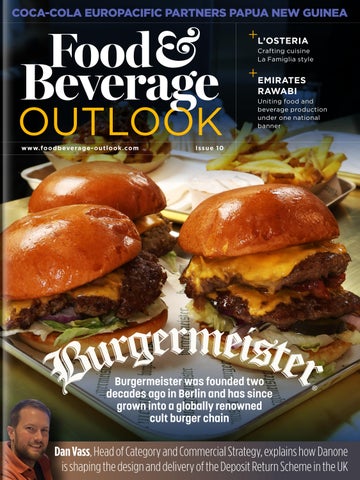
Burgermeister was founded two decades ago in Berlin and has since grown into a globally renowned cult burger chain
Dan Vass, Head of Category and Commercial Strategy, explains how Danone is shaping the design and delivery of the Deposit Return Scheme in the UK
RICHGLEN MAINTENANCE SERVICES
T R I - STA R CO N ST R U C T I O N
B R I T I S H P O R T S A S S O C I AT I O N
NATIONAL COMMERCIAL BANK JAMAICA LIMITED
EQUINOX GOLD
TURNER MINING GROUP
HUNTER VALLEY OPERATIONS
L O S
A N G E L E S
G E N E R A L
End-to-end solutions from exploration to extraction
Issue 82
PNG POWER LTD
w w w. e m e o u t l o o k m a g . c o m
Issue 73
www. northame ricaoutlookmag.com
Creating lasting value through responsible mining
Stefanutti Stocks is reshaping Southern Africa’s construction landscape through multidisciplinary expertise, digital innovation, and sustainable infrastructure solutions
Issue 38
On a coal mining mission to champion sustainable practices
EATON Resilience, reliability, and efficiency
VULCAN MOZAMBIQUE
HUNTSVILLE UTILITIES
M Resources delivers a suite of essential steelmaking raw materials, infrastructure, and mining and logistics services to steelmakers across the globe. Matt Latimore, Founder and President, details the company’s futurefacing approach to investment and market growth
The trustworthy utility steward
Trusted partners in technical excellence and expertise
The banker, the one that couldn’t fail
Rita Apell Akot, CIO at Stanbic Bank Uganda, outlines an ambitious initiative to make banking technology more connected and interoperable across the continent
For Maersk Canada, the box is only the beginning; connected logistics, intelligent technology, and resilient networks are transforming complex journeys into seamless supply chains
GERMAN DATACENTER ASSOCIATION
AMP BANK
At the helm of Europe’s data centre future
Across Asia Pacific, Hitachi Energy’s focus is on the priorities utilities are wrestling with. Massimo Danieli, Executive Vice President and CEO – Grid Automation Business Unit, reveals more
MARTIN-BAKER AMERICA , INC . • CEMENTIS GROUP
Michael Hanisch, Head of Technology Germany, discusses Amazon Web Services’ significant cloud infrastructure investments
A M A Z O N B U S I N E S S • U N I L E V E R • G E P • O R I TA I N
COCA-COLA EUROPACIFIC PARTNERS PAPUA NEW GUINEA
On a mission to be a leading integrated green coal mining operation
Thermo Fisher Scientific has reinforced its position as a trusted biologics manufacturing partner
Jason Bontempo, CEO of Gladiator Metals, discusses the resurgence of the Whitehorse Copper Belt in Canada’s historic Yukon mining district
Satellites on Fire detects, alerts, and monitors fires from the earliest moments, as we learn from co-Founder and CEO, Franco Rodríguez Viau
MBA ENERGY & INDUSTRIAL
DIALOG FITZROY
NEBRASKA PUBLIC POWER DISTRICT
Crafting cuisine La Famiglia style
EMIRATES RAWABI
w w w. s u p p ly c h a i n - o u t l o o k . c o m
Issue 14
EUROPEAN SUBSEA CABLES ASSOCIATION
Uniting food and beverage production under one national banner www.foodbeverage-outl ook.com
Iss ue 1 0
Bringing humanoid robots to the factory floor and reshaping industrial automation
BRITISH PORTS ASSOCIATION
Our latest catch-up with the British Ports Association and CEO, Richard Ballantyne OBE, outlines the strong investment in decarbonisation and infrastructure across UK ports in recent years
Chris Pattinson, CEO, tells us how SAESL has become an indispensable component of the Singapore aerospace ecosystem, keeping airlines flying to connect the world
Steven Johnson, Managing Director, UKIE, Nordics, and Eastern Europe Network Operations, explains why operations leadership is critical Network Operations, explains why operations leadership is critical Steven Johnson, Managing Director, UKIE, Nordics, and Eastern Europe
of the Singapore aerospace ecosystem, keeping airlines flying to connect the world Chris Pattinson, CEO, tells us how SAESL has become an indispensable component
decarbonisation and infrastructure across UK ports in recent years Richard Ballantyne OBE, outlines the strong investment in Our latest catch-up with the British Ports Association and CEO,
and reshaping industrial automation Bringing humanoid robots to the factory floor
Traditional Automation and Virtual Worlds Humanoid: Bridging the Beyond Real
Group CEO, John Freeman, shifts the narrative to reflect on how the platform has evolved
Jacob Latter, CEO, discusses Sitzler’s next phase of growth, and continuing a legacy of resilience, capability, and confident delivery
Built for resilience
Traditional Automation
solutions optimized packaging More efficient,
Partnerships built on trust and thinking outside the box
Digital Edge DC
ATEC FACADES
RADIANT LOGISTICS
More efficient, optimized packaging solutions
UPRITE CONSTRUCTION www.sustainabilityoutlookmag.com • I s s u e 3
STEFANUTTI STOCKS
BUILT WITH CONFIDENCE
Delivering advanced medicines from Australia to the world
SHORR PACKAGING
Powering Nebraska’s future
OUTLOOK
Duratec’s newly established specialist arm
THERMO FISHER SCIENTIFIC
Bridging the Beyond Real Humanoid: and Virtual Worlds
W W W .CONST RUCT ION-OUT L OOK.COM • ISSUE 5
The multidisciplinary construction group with a difference
Connecting nations and driving innovation
Garry Edwards, VP EMEA at Wolters Kluwer, emphasises the need for formalised, organisation-wide frameworks to ensure responsible use of artificial intelligence
M E T R O P O L I TA N WAT E R D I S T R I C T O F S A LT L A K E & S A N DY
L’OSTERIA
ISSUE 11
www.mfg-outlook.com
ASSOCIATION BRITISH PORTS
Burgermeister was founded two decades ago in Berlin and has since grown into a globally renowned cult burger chain
Dan Vass, Head of Category and Commercial Strategy, explains how Danone is shaping the design and delivery of the Deposit Return Scheme in the UK is shaping the design and delivery of the Deposit Return Scheme in the UK Dan Vass, Head of Category and Commercial Strategy, explains how Danone
Colliers combines project management discipline, cost intelligence, and sustainability expertise to help occupiers and asset owners deliver capital projects that work harder beyond completion
We discuss the Shubh Mint programme and its impact on farming communities in India with Mars Snacking in The 1-2-1
to help occupiers and asset owners deliver capital projects that work harder beyond completion Colliers combines project management discipline, cost intelligence, and sustainability expertise
farming communities in India with Mars Snacking in The 1-2-1 We discuss the Shubh Mint programme and its impact on
cult burger chain grown into a globally renowned decades ago in Berlin and has since Burgermeister was founded two
PACKAGING SHORR
capability, and confident delivery continuing a legacy of resilience, Sitzler’s next phase of growth, and Jacob Latter, CEO, discusses
Built for resilience
CONFIDENCE BUILT WITH
LOGISTICS RADIANT Australia to the world medicines from Delivering advanced
TELL US YOUR STORY, AND WE’LL TELL THE WORLD
SCIENTIFIC FISHER THERMO
specialist arm established Duratec’s newly
Issue 14
ASSOCIATION SUBSEA CABLES EUROPEAN
w w w. s u p p ly c h a i n - o u t l o o k . c o m ISSUE 11
the platform has evolved the narrative to reflect on how Group CEO, John Freeman, shifts
ATEC FACADES
innovation nations and driving Connecting
www.mfg-outlook.com
www.foodbeverage-outl ook.com
Digital Edge DC
with a difference construction group The multidisciplinary
Iss ue 1 0
banner under one national beverage production Uniting food and
RAWABI EMIRATES
STOCKS STEFANUTTI
W W W .CONST RUCT ION-OUT L OOK.COM • ISSUE 5
OUTLOOK
COCA-COLA EUROPACIFIC PARTNERS PAPUA NEW GUINEA
and thinking outside the box Partnerships built on trust
CONSTRUCTION UPRITE DISTRICT PUBLIC POWER NEBRASKA
L’OSTERIA
A M A Z O N B U S I N E S S • U N I L E V E R • G E P • O R I TA I N
www.sustainabilityoutlookmag.com • I s s u e 3
future Powering Nebraska’s
La Famiglia style Crafting cuisine
MARTIN-BAKER AMERICA , INC . • CEMENTIS GROUP
Modernising and transforming health systems
ARGO NATURAL RESOURCES
L’Osteria is transforming Europe’s culinary landscape by focusing on creating a distinctive Italian dining destination where guests feel at home
DIALOG FITZROY
Five years of institutional reform
www.healthcare-outlook.com
www.mining-outlook.com • Issue 16
EMIRATES RAWABI Uniting food and beverage production under one national banner
Responsible for generating, transmitting, distributing, and retailing electricity in Papua New Guinea
GALIANO GOLD
EASTERN CAPE DEPARTMENT OF HEALTH
w w w. a p a c o u t l o o k m a g . c o m
Issue 122
STEFANUTTI STOCKS
Meeting the dynamic demands of the Ghanaian mining industry
C E N T E R
ST. JOSEPH’S HEALTH SYSTEM
Elevating the patient experience
DIGITAL HEALTH ASSOCIATION
w w w. a f r i c a o u t l o o k m a g . c o m
PAMICOR LIMITED
M E D I C A L Issue 15
WEIR
MBA ENERGY & INDUSTRIAL
DIALOG FITZROY
M E T R O P O L I TA N WAT E R D I S T R I C T O F S A LT L A K E & S A N DY
Africa Outlook, APAC Outlook, EME Outlook, North America Outlook, Mining Outlook, Healthcare Outlook, Manufacturing Outlook, Supply Chain Outlook, Food & Beverage Outlook, Construction Outlook, and Sustainability Outlook are digital publications aimed at boardroom and hands-on decision-makers, reaching an audience of more than 800,000 people around the world. With original and exclusive content compiled by our experienced editorial team, we look to promote the latest in engaging news, industry trends, and success stories from across the globe. Your company can join the leading industry heavyweights enjoying the free exposure we provide across our platforms with a free marketing brochure, extensive social media saturation, enhanced B2B networking opportunities, and a readymade forum to attract new investment and help you grow your business. Visit www.outpb.com/work-with-us for details on how your company can feature for free in one of our upcoming editions.
www.outpb.com/work-with-us
WELCOME FROM THE EDITOR
EDITORIAL Head of Editorial: Jack Salter jack.salter@outpb.com Deputy Head of Editorial: Lucy Pilgrim lucy.pilgrim@outpb.com Senior Editor: Lily Sawyer lily.sawyer@outpb.com Editor: Ed Budds ed.budds@outpb.com Editor: Rachel Carr rachel.carr@outpb.com Copy Editor: Lauren Kania lauren.kania@outpb.com DESIGN & PRODUCTION Art Director: Stephen Giles steve.giles@outpb.com Senior Designer: Devon Collins devon.collins@outpb.com Designer: Louisa Martin louisa.martin@outpb.com Production Manager: Alex James alex.james@outpb.com Digital Marketing Director: Fox Tucker fox.tucker@outpb.com Senior Website Content Manager: Oliver Shrouder oliver.shrouder@outpb.com Social Media Executive: Jake Crickmore jake.crickmore@outpb.com Digital Content Executive: Tara Steele tara.steele@outpb.com BUSINESS Chief Executive Officer: Ben Weaver ben.weaver@outpb.com Managing Director: James Mitchell james.mitchell@outpb.com Chief Technology Officer: Nick Norris nick.norris@outpb.com Content Director: Neil Perry neil.perry@outpb.com Global Head of Media: Lewis Hammond lewis.hammond@outpb.com Global Media Executive: Kai Boyle-Vennard kai@outpb.com ADMINISTRATION Finance Director: Suzanne Welsh suzanne.welsh@outpb.com Finance Manager: Victoria McAllister victoria.mcallister@outpb.com FOOD & BEVERAGE OUTLOOK Norvic House, 29-33 Chapelfield Road Norwich, NR2 1RP, United Kingdom Sales: +44 (0) 1603 804 445 Editorial: +44 (0) 1603 804 431 SUBSCRIPTIONS Tel: +44 (0) 1603 804 431 jack.salter@outpb.com www.foodbeverage-outlook.com Follow us on LinkedIn: @foodbeverageoutlook Follow us on X: @outlookpublish
BUN INTENDED Welcome to our 10th edition of Food & Beverage Outlook magazine. Served with a side of fries, Burgermeister’s highquality, low-cost burgers are this issue’s main course. The company curiously started out two decades ago from a repurposed public toilet tucked under a U-Bahn bridge in Berlin, Germany and has since grown into a globally renowned cult burger chain. This is not just a colourful anecdote – it captures something essential about the brand, which is now targeting new markets and bringing that same spirit to more cities across Germany and Europe. Maintaining quality and staying true to its roots is the central challenge of scaling; the Burgermeister identity is rooted in a specific story, place, and set of values regarding quality and authenticity. “I want Burgermeister to be a brand that never loses sight of where it started,” affirms René Haehnen, COO. Whilst Coca-Cola may be a global brand, Coca-Cola Europacific Partners Papua New Guinea (CCEP PNG) beverages are proudly made by, and for, Papua New Guineans. CCEP PNG has been part of everyday life in the country for generations, but maintaining that connection requires far more than producing some of the world’s most recognisable beverages. “What makes the Coca-Cola brand proudly Papua New Guinean is not only where its beverages are enjoyed, but the people and local capability behind every bottle,” outlines Tim Solly, Country Director at CCEP PNG, who we last spoke to in April 2024. Promoting communal dining and authentic Italian dishes, brand identity is integral to L’Osteria as it shapes the restaurant’s overall perception and experience. CEO, Jacek Trybuchowski, believes Italian food is not just a trend, but a craft based on simplicity, quality, and hospitality. “Italian kitchen culture is at the centre of everything we do. Our dishes are inspired by Italian cuisine and adapted to our concept’s operational standards,” he tells us. There are many other leading food and beverage brands within this issue, including CPM|Crown, Emirates Rawabi, and SalMar. We hope that you enjoy your read. Jack Salter Head of Editorial, Outlook Publishing Food & Beverage Outlook Issue 10 | 3
31 THE THOUGHT LEADER James Young Vice President of Agriculture, McCain Foods
1 0 / C ON T E N T S
Farm Resilience is Food Industry Resilience
18
6 THE 1-2-1 Dan Vass
18 Guinness Clubhouse
Head of Category and Commercial Strategy, Danone
The Premier League and Guinness under one roof
Giving farmers confidence in the future
A Reimagined Matchday Experience
Building a Circular Beverage Industry Shaping the design and delivery of the Deposit Return Scheme
FO O D & BEVERAGE I N S IG H TS
32
12 Absolut Vodka Absolut XCX
36 THE QUESTION
A two-year partnership with Charli XCX
Tech Evolution: What emerging technology will shape the future of the food and beverage industry?
25
25 THE DISRUPTOR FuelHub Fuelling the High-Protein Revolution
12
4 | Food & Beverage Outlook Issue 10
The disruptive shift from calorie counting to filling, nutrient-dense food
36
FOOD & BEVERAGE OUTLOOK CONTENTS
F E AT U R E S
EUR OP E & MIDDLE EAST
50 Burgermeister Genius Between the Buns Delicious scenes for Germany’s cult burger chain
60 L’Osteria
98 BNG Trading
Pizza, Pasta, People: Inside L’Osteria’s Formula for Growth
Strengthening Papua New Guinea’s Food Future
Crafting cuisine La Famiglia style
Elevating local capabilities in Papua New Guinea
72 Emirates Rawabi The UAE’s Premier Integrated AgriFood Group Uniting food and beverage production under one national banner
78 SalMar Passion for Salmon Sustainability, local value creation, and salmon welfare
ASI A PAC I F I C
86 Coca-Cola Europacific Partners Papua New Guinea Proudly Papua New Guinean People and local capability behind every bottle
98 N O R TH A M E R I C A
104 CPM|Crown Enacting Change in Edible Oils A leader in edible oilseed processing and extraction
104
112 Virginia Tech Dining Services Shaping the Student Experience Diverse dining concepts
86
60
74
112
Food & Beverage Outlook Issue 10 | 5
THE
1-2-1
Building a Circular Beverage Industry As the UK prepares for the nationwide roll-out of the Deposit Return Scheme, Dan Vass, Head of Category and Commercial Strategy for Danone in Northern Europe, explains how retailers can drive participation and consumer engagement, and how the company is helping shape the design and delivery of the scheme in the UK Writer: Lily Sawyer
6 | Food & Beverage Outlook Issue 10
THE 1-2-1 DAN VASS
Food & Beverage Outlook (FB): Firstly, what do you think 2026 demands from food and beverage businesses as changing consumer expectations and regulations continue to reshape the industry? Dan Vass, Head of Category and Commercial Strategy (DV): Consumers are increasingly looking for products and brands that align with their values, whether that’s supporting healthier choices, reducing environmental impact, or demonstrating transparency. At the same time, businesses are navigating a rapidly evolving regulatory landscape. Success depends on balancing both, continuing to innovate whilst responding to changing expectations and regulatory requirements. That means looking beyond compliance and focusing on how change is delivered to consumers. Whether it’s product innovation, packaging, evolving shopping habits, or new regulations, the businesses that will be best placed to succeed are those that stay agile, anticipate change early, and keep the consumer experience at the centre of their decisions. FB: What role can companies like Danone play in driving sustainable consumption and packaging? DV: Sustainability has become an important priority because it’s increasingly shaping how consumers, customers, and policymakers assess businesses and the products they buy. People want to make choices that are better for their health and the environment, and they want the confidence that businesses are taking meaningful action to reduce their impact. At the same time, sustainability is driving innovation across the food and beverage sector, from product development and packaging to how goods are produced, distributed, and consumed. Companies like Danone have an important role to play in helping make more sustainable choices easier and more accessible. That includes investing in packaging innovation, increasing the use of recycled materials, reducing waste, and working across the sector to help improve circularity. Whilst no single organisation can solve these challenges alone, businesses can be powerful catalysts
for change by collaborating with partners, sharing expertise, and helping create the conditions for more sustainable consumer behaviours at scale. FB: Can you briefly outline what the Deposit Return Scheme is, how Danone is supporting it, and what it sets out to achieve? DV: The national Deposit Return Scheme (DRS) will introduce a small refundable deposit on eligible plastic drinks containers. Consumers will pay the deposit when they purchase a drink and receive it back when they return the empty container to a designated return point, such as in supermarkets or convenience stores. The scheme aims to increase recycling rates, reduce litter, and ensure more valuable materials are collected and recycled back into new packaging. As a founding member of the UK Deposit Management Organisation (DMO), Danone is helping shape the design and delivery of the scheme, whilst also supporting retailers with consumer engagement and implementation planning ahead of launch.
Companies like Danone have an important role to play in helping make more sustainable choices easier and more accessible”
Food & Beverage Outlook Issue 10 | 7
We’re drawing on our experience from established international DRS markets and have developed insights from our consumer trial of a reverse vending machine pilot at the Wimbledon Championships Qualifying Competition. These learnings are helping us understand how UK consumers interact with return infrastructure and what is needed to make participation as simple and straightforward as possible from day one.
This points to a real opportunity to turn container returns into wider shopping visits and create additional value for both customers and retailers. Experience from established DRS markets shows that success will depend on how seamlessly the scheme fits into the overall shopping journey. Retailers that plan ahead and make returns simple, convenient, and easy to understand will be best placed to make the most of that opportunity.
FB: With just under a year to go until UK-wide DRS implementation, what opportunities can retailers leverage as participation becomes a more regular part of consumers’ shopping routines?
FB: How can retailers best integrate DRS into existing shopping journeys in a way that feels simple and convenient for shoppers?
DV: DRS represents a commercial opportunity for retailers as well as an environmental one. As participation becomes part of everyday shopping habits, retailers have an opportunity to strengthen customer engagement whilst encouraging repeat visits to store. Our research found that 68 percent of consumers would be likely to return drinks containers during a grocery shopping trip once DRS is introduced, whilst 55 percent say they would be likely to spend a depositrefund voucher in store.
8 | Food & Beverage Outlook Issue 10
DV: To become part of consumers’ everyday routines, DRS needs to feel like a natural extension of the shopping journey. Return points should be easy to find, straightforward to use, and positioned in locations that customers already pass as part of their visit. Retailers should think about the entire customer experience – from clear instructions and deposit redemption to ensuring sufficient capacity at busy times and having staff who can answer questions with confidence.
THE 1-2-1 DAN VASS
DRS IMPLEMENTATION TIMELINE As the UK moves towards a unified circular economy, the anticipated DRS timeline establishes critical regulatory milestones: • Phase 1 launch: September 2026 – Exchange for Change opened the initial business registration. • Compliance deadline: December 2026 – The final date for participating retailers to complete mandatory Phase 1 onboarding is the last day of the year, 31st December 2026. • Product integration: January 2027 – Phase 2 data submission commences. • Inventory finalisation: July 2027 – The absolute deadline for the registration of all in-scope single-use beverage containers is 9th July 2027. • Go-live infrastructure: October 2027 – Full scheme activation across England, Scotland, Wales, and Northern Ireland is expected on 1st October 2027.
It’s also important to plan for practical considerations, such as how rejected containers are handled and what happens if a machine is temporarily unavailable. Ultimately, the easier and more seamless the experience is, the more likely consumers are to incorporate DRS into their regular shopping habits. FB: Your research suggests DRS could create opportunities beyond recycling, with 55 percent of consumers saying they would be likely to spend a deposit refund voucher in store. What could this mean for retailers in terms of shopper engagement? DV: For retailers, DRS represents an opportunity to turn container return into a wider shopping visit, helping to drive footfall, shopper engagement, and in-store spend. There are reputational benefits too, with 61 percent of consumers saying they feel more positively about retailers that provide recycling or deposit return facilities. With 55 percent of consumers saying they would be likely to spend a deposit refund voucher in store, retailers
have a clear opportunity to build on existing consumer willingness to participate. Making the process simple, convenient, and wellintegrated into the shopping journey can help encourage repeat visits and create value for both shoppers and retailers. FB: What role can retailers play in encouraging regular participation in DRS, and what do you think will be the most important aspects to make DRS points easy to use for consumers? DV: Retailers will play a critical role in helping make DRS part of consumers’ everyday routines. As the primary point of interaction for many shoppers, they have an important opportunity to build awareness, encourage participation, and help consumers develop new habits around returning drinks containers. Making the process as simple and convenient as possible will be key. Our research suggests that a lack of recycling infrastructure remains a barrier to recycling on the go, with one-third of consumers saying they cannot find recycling facilities when they need them. Return points therefore need to be prominent, easy to find, and supported by clear communications so consumers understand exactly how the scheme works and what they need to do. Retailers should also focus on delivering a reliable experience, from ensuring sufficient capacity at busy times to providing support when containers are rejected or equipment is unavailable. Testing the customer journey before launch and removing potential points of friction will help build confidence, encourage repeat participation, and make DRS a natural part of the shopping experience. FB: This summer, Danone piloted its reverse vending machine at Wimbledon. What lessons from the pilot should UK retailers be aware of as they prepare for wider DRS implementation? DV: We partnered with the All England Lawn Tennis and Croquet Club and Exchange for Change – the organisation responsible for managing the UK’s DRS – to test reverse vending machines in a real-world setting at the Wimbledon Championships Qualifying Competition. We gained an early understanding of how UK consumers interact with return infrastructure ahead of DRS implementation. One of the key learnings for retailers was that introducing DRS is as much about changing behaviours as introducing new infrastructure.
Food & Beverage Outlook Issue 10 | 9
Consumers need to understand what is expected of them, why they are participating, and how the process fits into their existing routines. Building that familiarity early will be an important part of driving participation. The pilot also highlighted the value of looking at the end-to-end customer experience. Retailers that take the time to understand how shoppers interact with return points, collect their deposits, and navigate the process will be better placed to create an experience that feels straightforward and encourages repeat use.
In the long term, DRS has the potential to accelerate the UK’s transition to a more circular economy by increasing both the quantity and quality of material collected for recycling”
FB: Finally, how will DRS change the way the UK approaches packaging, recycling, and the circular economy in the long term? What role will Danone play in aiding this transition?
FB: How important will collaboration between producers, retailers, policymakers, and consumers be to ensuring the long-term success of DRS? DV: From our experience in Ireland, where the scheme has already been rolled out, we know that early collaboration is crucial. We have seen the value of producers, retailers, government, and scheme operators working together early to identify challenges, give businesses time to prepare, and build consumer confidence. Ireland’s DRS increased recycling rates from 49 to over 90 percent, with 78 percent of containers collected directly through the scheme, demonstrating what can be achieved when stakeholders work together to deliver a simple and convenient consumer experience. Consumers are equally important to the scheme’s success. Ultimately, DRS will only deliver its full potential if people understand how it works and choose to participate regularly. Long-term success will depend not only on effective collaboration behind the scenes, but also on building a scheme that consumers trust, understand, and are willing to use as part of their everyday lives.
10 | Food & Beverage Outlook Issue 10
DV: In the long term, DRS has the potential to accelerate the UK’s transition to a more circular economy by increasing both the quantity and quality of material collected for recycling. A more effective collection system can help create a stronger supply of high-quality recycled plastic, reducing reliance on virgin materials and making it easier for businesses to keep valuable packaging materials in use for longer. At Danone, we see DRS as an important enabler of that transition. We’ve already reduced our reliance on virgin plastic, with Evian and Volvic bottles in the UK now made from 100 percent recycled Polyethylene terephthalate (PET) - excluding caps and labels – and DRS can help provide the high-quality recycled material needed to support initiatives like these at scale. By sharing learnings from established markets, supporting successful implementation, and working with partners across the industry, we hope to help build a system where more bottles are collected, recycled, and turned back into new bottles, strengthening circularity across the beverage sector.
www.danone.com
SUBSCRIBE NOW TO OUR DIGITAL MAGAZINE
Exclusive, earth-friendly content, straight to your inbox As organisations worldwide confront unprecedented change, embracing technological innovations and incorporating critical environmental sustainability agendas, now more than ever is the time to showcase the strides being taken in this dynamic sector. A multi-channel brand, Sustainability Outlook brings you the positive developments driven by organisations across the global sustainability industry through its various platforms. Discover exclusive content distributed through the brand’s website, online magazine, social media campaigns, and digital dispatches, delivered straight to your inbox with a bi-weekly newsletter. Through these compelling media channels, Sustainability Outlook will continue to foreground the movers and shakers of the industry. To participate as a featured company and join us in this exciting endeavour, contact one of our Project Managers today.
www.sustainabilityoutlookmag.com
ABSOLUT XCX
© Mekeila Morris
ABSOLUT VODKA FOOD & BEVERAGE INSIGHTS
© Myles Hendrik
© Myles Hendrik
Absolut Vodka and Charli XCX are joining forces for a two-year partnership blending music, nightlife, fashion, and fan culture through a series of limited-edition releases and experiences Writer: Lily Sawyer
A
bsolut Vodka (Absolut) is teaming up with one of contemporary pop’s most influential and creative voices, Charli XCX, for a new two-year partnership designed to bring together music, nightlife, and community. Announced last month, the collaboration, aptly named ‘Absolut XCX’, unites two names with distinctive identities and a shared appetite for challenging convention. Rather than following a traditional brand partnership formula, Absolut and Charli XCX are setting out to create something more spontaneous with an emphasis
on experimentation, creative expression, and audience participation. For Charli XCX, whose career in the music industry has been defined by reinvention and a willingness to move between the experimental and mainstream, the partnership offers another opportunity to extend her creative influence beyond music. Absolut, meanwhile, continues to build on its longstanding association with people and movements that push culture forwards. Food & Beverage Outlook Issue 10 | 13
ABSOLUT VODKA FOOD & BEVERAGE INSIGHTS
Indeed, the collaboration represents an effort to create experiences beyond simple marketing that reflect the energy of contemporary pop culture, with fans set to play an active role in shaping the collaboration as it develops.
FROM THE STAGE TO THE STREETS
AUDIENCE-LED APPROACH Over the next two years, Absolut and Charli XCX’s partnership will unfold through a series of limited-edition releases, collectable items, custom glassware, and fan events.
© Mekeila Morris
© Mekeila Morris
The partnership had already received a subtle introduction before it was officially announced, with Charli XCX giving fans an early glimpse of what was to come during her soldout Los Angeles shows at the Kia Forum in mid-October, where ‘ABSOLUT XCX’ flashed on stadium screens. In true pop style, photographs shared across her social media channels featured the artist wearing an ‘I ♥ Absolut’ T-shirt, offering an initial hint at the collaboration two days before its official announcement. By utilising a classic, souvenir-style graphic tee, the campaign cleverly merged digital social media teasers with physical street fashion, leaning into the raw, casual aesthetic that has defined Charli XCX’s recent visual eras.
The partnership also made its way onto the stage during her performances of ‘Card Declined’ over the same weekend, with the star’s dancers wearing their own ‘I ♥ Dirty Martini’ T-shirts – a playful reference to the artist’s preferred cocktail. Transforming these corporate logos into immediate live stage costumes allowed the roll-out to feel like an extension of the show itself rather than a forced commercial interruption. These early appearances established the visual direction of the collaboration, bringing together recognisable pop culture imagery, fashion, and Absolut’s established brand identity.
From left
Mekeila os 1 and 7 © to right: phot
os 3, Morris; phot
les Hendrik 4, and 6 © My
ABSOLUT VODKA FOOD & BEVERAGE INSIGHTS
THE ABSOLUT XCX DIRTY MARTINI Devised by Charli XCX herself, this dirty martini recipe updates a nightlife classic with an unapologetically bold twist. It promises to be ‘Extra dirty. Extra olive. Extra Charli.’:
INGREDIENTS: • 45 millilitres (ml) Absolut Vodka • 10 ml dry vermouth
METHOD: • Rinse the glass – Add 10 ml of dry vermouth to a mixing glass. • Build the base – Pour in 45 ml of Absolut. • Make it dirty – Add 15 ml of olive brine. • Chill – Fill the mixing glass to the top with ice cubes.
• 15 ml olive brine
• Stir – Use a bar spoon to stir the mixture thoroughly until well-chilled.
• Three green olives
• Serve – Strain the liquid smoothly into a classic martini glass.
• Ice cubes
• Garnish – Drop in three green olives to finish.
© Mekeila Morris Food & Beverage Outlook Issue 10 | 15
ABSOLUT VODKA FOOD & BEVERAGE INSIGHTS
However, rather than presenting a fully predetermined programme, the campaign’s decision-makers are leaving room for the collaboration to evolve. The intention behind this decision is to create something that moves beyond typical promotional activity and allows the artist’s creative world and her fandom to influence what happens next. This audience-led approach places community at the centre of the partnership, recognising the role fans play in shaping contemporary music and culture. It also creates opportunities for the collaboration to develop organically, with new experiences and releases emerging along the way. For Absolut, the partnership reflects its wider
commitment to bringing people together through music, nightlife, and shared experiences. Part of the global spirits group Pernod Ricard – which also owns Jameson, Beefeater, Chivas Regal, Havana Club, and more – Absolut continues to explore ways of connecting its identity with contemporary culture. As a multiple BRIT and Grammy award winner, Charli XCX brings an equally distinctive creative perspective to the collaboration, having established herself as a deeply influential figure across music, fashion, and the arts. Together, and with two years of collaboration ahead, Absolut and Charli XCX are setting the stage for a partnership that promises to be anything but conventional.
© Mekeila Morris 16 | Food & Beverage Outlook Issue 10
ABSOLUT VODKA FOOD & BEVERAGE INSIGHTS
rik s Hend © Myle
©H enr yR edc liffe
GUINNESS CLUBHOUSE ASIA PACIFIC
A REIMAGINED MATCHDAY EXPERIENCE
Set across three immersive stories, Guinness Clubhouse brought together the worlds of football and Guinness under one roof for an experience every fan could enjoy. We check in for a football-themed stay with Sean O’Donnell, Marketing Director of HEINEKEN Malaysia, and Pei Wen Loy, Marketing Manager – SEA Beer at Diageo WRITER: GEORGE MARSDEN
Pei Wen Loy, Marketing Manager – SEA Beer, Diageo
18 | Food & Beverage Outlook Issue 10
Sean O’Donnell, Marketing Director, HEINEKEN Malaysia
GUINNESS CLUBHOUSE ASIA PACIFIC
W
hen the final whistle blows, and your team has just won, all you are left wishing is that the night could go on. Indeed, sports watching culture is changing and it’s time for venues to catch up. Guinness Clubhouse in Kuala Lumpur, Malaysia offered a visionary answer, providing an all-exciting, all-inclusive taste of the future of sports. A uniquely rustic-shaped, three-story building, the venue offered an experience beyond the beautiful game. Everyday within the space was ‘A Lovely Day for a Guinness’, with the brand embedded in everything from the food you ate to the rooms you slept in. Whether you follow every football match closely or simply enjoy the atmosphere the game brings, Guinness Clubhouse was a football-themed stay crafted for all. As the official beer of the Premier League, Guinness is always looking for ways to bring fans closer to the game, and Guinness Clubhouse was one way of doing that. “In Malaysia, many Premier League matches take place late at night, often after midnight. We saw an opportunity to design something around that reality, a space where fans can come together during those hours when most public venues are no longer open,” opens Sean O’Donnell, Marketing Director of HEINEKEN Malaysia.
INTIMATE SETTING With many of the biggest Premier League matches often taking place after midnight in markets like Malaysia, Guinness Clubhouse offered a more personal setting. Rather than a bar or stadium, the venue reimagined the matchday experience by shifting it from public venues into a more intimate, shared environment. Fans could enjoy the smooth and creamy Guinness Draught they would typically order at a bar in a shared space, giving fans a comfortable area to gather, watch matches, and stay the night. “Guinness Draught in Can was an important part of that experience, giving fans a way to enjoy the unmistakably smooth and creamy Guinness Draught experience in an at-home setting. Guinness Clubhouse brought that occasion to life around football, giving fans a space to watch, connect, and enjoy the match together,” O’Donnell sets out. The venue brought together Malaysian fans who typically watch games at home, gather at late-night eateries, or connect with friends throughout the game in one cohesive place. Fans were encouraged to engage with one another – rather than a quick outing, Guinness Clubhouse offered a private space designed entirely around match day, from live screenings and match-night food to interactive elements. 20 | Food & Beverage Outlook Issue 10
WHAT COULD GUESTS LOOK FORWARD TO AT GUINNESS CLUBHOUSE? • A giant projector with surround sound, recreating the atmosphere of a football stadium where live Premier League matches could be enjoyed on selected match nights. • Indulging in a bite from the fully stocked kitchen pantry, featuring Guinness-infused snacks and match-night essentials – a foodie’s heaven. • Battling it out in the play zone with foosball, table football, and a pool table. • Football-branded bedrooms that could house up to 20 guests, complete with a starter pack featuring Guinness Draught in a can for those who wanted to continue the celebrations after the final whistle.
GUINNESS CLUBHOUSE ASIA PACIFIC
“Guests could move between spaces, spend time with their group, and enjoy the freedom of not having to cut the night short or head elsewhere,” O’Donnell insights. The first floor was ‘where it happens’, as guests could catch live Premier League matches on a large projector with surround sound, recreating the energy of a football stadium in the living room. This was complemented by a fully stocked kitchen and pantry featuring Guinness-infused snacks, match-night essentials, and Guinness Draught in Can. The second floor was a more interactive space, designed as a play zone. It featured foosball and a pool table, giving fans a chance to engage, compete, and connect beyond the screen.
“At its core, Guinness Clubhouse reflected what matchday is really about – the conversations, shared reactions, and rituals that bring people closer to the game and each other” – S E A N O ’ D O N N E L L , M A R K E T I N G D I R E C TO R , H E I N E K E N M A L AY S I A
“In this way, Guinness Clubhouse became a home ground for all kinds of fans – from the diehard to the social viewer – bringing everyone together under one roof,” outlines O’Donnell.
THREE-STOREY IMMERSIVE EXPERIENCE Guinness Clubhouse offered three immersive storeys which brought together Premier League and Guinness fans under one roof, each designed to elevate a different part of the matchday experience.
Above: Football-themed sleeping area accommodating for overnight stays Right: Fridge stocked with Guinness Draught in a can
GUINNESS CLUBHOUSE ASIA PACIFIC
The third and final floor offered a more relaxed setting with Guinness and football-inspired bedrooms that could accommodate up to 20 guests, allowing fans to settle and stay after the final whistle was blown. “By building the experience around an overnight stay, Guinness Clubhouse removed the usual constraints of late-night viewing, bringing together great football, great company, and Guinness in a way that made match night worth staying up for,” O’Donnell emphasises.
THE GREATER SHIFT Globally, the football viewing experience is evolving, changing from large, social viewing occasions into a more flexible format that better fits different routines and group dynamics. “What we are seeing is not a move away from large, social viewing occasions, but an expansion of how matchday is experienced,” notes Pei Wen Loy, Marketing Manager – SEA Beer at Diageo. When games are played late at night or early in the morning, it naturally changes how fans choose to watch and, whilst pubs and public screenings remain an important part of football culture, there is a growing demand for more flexible formats that are more suited to different routines and group dynamics.
“What we are seeing is not a move away from large, social viewing occasions, but an expansion of how matchday is experienced” – P E I W E N L OY, M A R K E T I N G M A N A G E R – S E A B E E R , D I A G E O
Outdoor lounge area for guests to relax between matches Top left: Play zone featuring foosball and a pool table for friendly competition Middle: Social seating area within the kitchen space at Guinness Clubhouse
Food & Beverage Outlook Issue 10 | 23
GUINNESS CLUBHOUSE ASIA PACIFIC
Fans today are creating their own matchday moments – whether heading out, staying in, or bringing a group together in a more private setting. “Guinness continues to play a role across both settings, whether in bars or at home, with Guinness Draught in a can allowing fans to enjoy the same distinctive experience together across different matchday occasions,” Loy tells us. What remains is the desire for connection – sharing the highs, lows, and everything in between, even as the way people choose to consume media is changing. “Guinness Clubhouse reflected this shift. It offered an alternative way to experience matchday, one that complemented traditional settings whilst staying true to what Guinness stands for: bringing people together over great football and a pint,” enthuses Loy.
ENCOURAGING SIGNS Every available slot at Guinness Clubhouse was fully booked throughout the campaign period. This highlights a clear appetite for a different kind of matchday experience, one that goes beyond convenience and focuses more on how fans want to spend time together. Increasingly, fans are not just looking for a place to watch the game, but a setting that allows them to enjoy it meaningfully with their friends. This is also reflected in guest feedback, where many highlight the sense of togetherness as a standout. “The space brought together different types of fans, from diehard supporters to more casual viewers, all sharing the same moments, reactions, and conversations throughout the night,” O’Donnell says. 24 | Food & Beverage Outlook Issue 10
“For Guinness, this reinforces the role we want to play, creating spaces where football, connection, and shared experiences come together to make it ‘A Lovely Day for a Guinness’,” Loy concludes. Guinness Clubhouse is a taste of what is to come – epitomising the future of sports experiences by curating a space where the night does not end at the final whistle.
CLUBHOUSE
N E W P E R S P EC T I V ES O N T H E F U T U R E OF BU S I N ES S
FACT FILE BUSINESS NAME: FUELHUB YEAR FOUNDED:
2019
LOCATION:
Warrington, Cheshire, UK
High-protein ready meals, calorie-controlled meals, FuelHub Lite, and bespoke meal solutions for athletes and businesses through FuelHub Pro
KEY PRODUCTS:
FUELLING THE HIGH-PROTEIN REVOLUTION FuelHub COO, James Laithwaite, explores the disruptive shift from calorie counting to filling, nutrient-dense food - and what it means for a market built around convenience Writer: Neil Perry
Food & Beverage Outlook (FB): Firstly, how is FuelHub challenging the ready meal market? James Laithwaite, COO (JL): Most ready meals are designed around speed, and not much else. We started from a different position, asking what a meal actually needs to do for the person eating it. Every FuelHub meal is designed by nutritionists, macro-controlled, and produced entirely in-house, which gives us full control over quality and consistency, from the recipe to the portion to the packaging. We came from elite sport, where the margin for error is small, and we’ve applied those same standards to anyone managing a full schedule who wants to eat well without overthinking it. That customer – the professional, the working parent, the person
26 | Food & Beverage Outlook Issue 10
training around a demanding job – needs the same rigour. They just need real food made easy. FB: What is the traditional ‘diet meal’ getting wrong? JL: The traditional diet meal was built around one metric, and that metric was calories, with everything else becoming secondary, including whether you actually felt full.
ABOUT FUELHUB Founded in 2019 by Michelle and James Laithwaite, FuelHub is a UK-based ready meal company specialising in convenient, nutritionally balanced meals. The business draws on Michelle’s background in fashion and James’ experience as a professional rugby league player. Its range focuses on high-protein, macrocontrolled meals designed for consumers seeking convenient alternatives to home cooking. James Laithwaite, COO
THE DISRUPTOR FUELHUB
Food & Beverage Outlook Issue 10 | 27
The result is familiar to most people who’ve tried them: small portions, thin sauces, and a meal that fits your targets on paper but leaves you in the snack drawer by mid-afternoon. Selling healthy eating through restriction has never been a sustainable approach, and the category has paid for it in trust. A low number on the front of the pack isn’t, by itself, a good meal.
I would still be cautious about treating protein as the new single number to optimise. Products leading on high protein already crowd the market, and consumers are getting wiser to claims not backed by a balanced, wellmade meal. FB: What are customers telling you they want from their food? JL: Broadly, they want to make fewer decisions. What our customers lack is time to plan, shop, cook, and portion every day. A meal that removes several of those decisions at once carries real value beyond the food itself. They also want the meal to taste like something they’d genuinely choose to eat. Nobody wants to feel like they’re working through a supplement with a fork. FB: What makes a meal feel supportive rather than restrictive? JL: A supportive meal fills you up, tastes like something you’d choose anyway, and fits your goals without requiring extra mental effort. I think about it in terms of friction: restrictive eating adds it, and supportive eating removes it. If the protein, portion, and calories are already right, you stop managing your food and get on with your day. It also has to hold up on imperfect days, because perfect weeks don’t exist for most people.
“THE REAL SHIFT IS NOT FROM ONE NUMBER TO ANOTHER, BUT FROM COUNTING ONE THING TO UNDERSTANDING THE WHOLE PLATE” FB: Is protein replacing calories as the key selling point? JL: Protein is not replacing calories, but it has become the more meaningful starting point for many consumers. People feel the effect of a protein-rich meal in a way they do not always feel the effect of a calorie target, and that tangibility matters. Many customers are now looking for a meaningful amount of protein in each meal, which is why our meals typically deliver around 50 to 60 grams. The real shift is not from one number to another, but from counting one thing to understanding the whole plate.
28 | Food & Beverage Outlook Issue 10
FB: Why are shoppers willing to pay more to feel full? JL: A meal that doesn’t satisfy you doesn’t stop costing you at the point of purchase, because you buy something else an hour later. Shoppers have become sharper about that calculation, particularly with budgets under pressure, and value increasingly means what a meal actually delivers rather than what it costs upfront. Satiety is one of the most immediate and honest tests a meal can pass. Our subscriber base grew from 866 to more than 3,000 over three years, at a premium price point, through a difficult economic period. People pay more when the product genuinely does the job. FB: How does FuelHub Lite avoid the usual diet-meal compromises? JL: FuelHub Lite was developed in response to growing
THE DISRUPTOR FUELHUB
Food & Beverage Outlook Issue 10 | 29
demand for lighter meals, but without the familiar tradeoffs of smaller portions, less flavour, and protein stripped out alongside the calories. We built it the other way around: lower in calories, still nutrient-dense, with protein kept at a level that maintains satisfaction. The same nutritionists and chefs that work on Lite also work on our core range. Being vertically integrated means we can test and refine the formulation ourselves, without waiting on third parties to get the balance right.
Protein gets people interested. Everything else about the meal is what brings them back. FB: What must mainstream ready meal brands do to keep up? JL: They need to stop treating protein as a single formulation target and start thinking about the meal as a whole. Mainstream brands have real advantages in scale, distribution, and shopper familiarity, but many have not yet updated the brief. Speed and price still matter, but consumers now expect nutrition that stands up to closer scrutiny. When we partnered with Holland & Barrett to become the first meal prep company on its online marketplace, it reinforced what we were already seeing more broadly. Health-conscious shoppers are looking for real food solutions, not just supplements. For mainstream ready meal brands, that means designing for satiety, investing in taste, and being far more transparent about what the product actually delivers. FB: Finally, what will the next generation of ready meals look like?
“PROTEIN GETS PEOPLE INTERESTED. EVERYTHING ELSE ABOUT THE MEAL IS WHAT BRINGS THEM BACK”
JL: Less noise on the pack and more substance in the meal. Products will be judged as complete eating occasions, protein will be assumed, and what differentiates brands will be balance, ingredient quality, and honesty about what’s actually in the box. Convenience will also mean something broader than saving time, with the best meals removing nutritional decisions as well as cooking ones. For us, that means scaling without compromise, doubling production capacity, and growing our business-to-business (B2B) work, whilst holding to the same standards we started with in elite sport.
FB: Is the protein trend driving better food or better marketing? JL: Both, if we’re being honest. The protein boom has made nutrition more visible and accessible, but it’s also put a lot of products on shelves where the recipe was built around hitting a number rather than making something worth eating. Consumers are increasingly able to tell the difference, and as ‘high protein’ becomes a baseline expectation rather than a differentiator, brands relying on the claim alone will find it harder to hold attention.
30 | Food & Beverage Outlook Issue 10
fuelhub.co.uk
THE
THOUGHT LEADER Farm Resilience is Food Industry Resilience James Young,
Vice President of Agriculture at McCain Foods GB&I
Giving farmers confidence in the future
THE THOUGHT LEADER JAMES YOUNG
Farm Resilience is Food Industry Resilience Policy certainty, investment, and regenerative agriculture are essential to securing British farming’s future. James Young, Vice President of Agriculture at McCain Foods GB&I, explores why Writer: Neil Perry
T
he past year has been a stark reminder of the pressures facing British farming. One of the hottest and driest summers on record has forced farmers across the country to adapt to increasingly unpredictable conditions. At the same time, rising input costs, policy uncertainty, and global disruption are making it harder to plan and invest for the future. This is a key moment to hear directly from Britain’s farmers about how these challenges are affecting their businesses and livelihoods, and what needs to change. That’s what McCain Foods’ (McCain) second annual Farmdex report seeks to do. It reveals a sector under significant pressure, but one that continues to demonstrate resilience and determination to adapt. The findings highlight the toll this uncertainty is taking on farmers, whilst identifying two areas where progress could make a meaningful difference: greater policy certainty to support planning and investment in new technologies, and practical assistance to build resilience through regenerative agriculture.
32 | Food & Beverage Outlook Issue 10
Food & Beverage Outlook Issue 10 | 33
THE THOUGHT LEADER JAMES YOUNG
Achieving these goals requires action across the sector. Farmers, food businesses, industry bodies, and policymakers all have a role to play in providing the certainty and support needed to invest, adapt, and build long-term resilience.
THE COST OF UNCERTAINTY According to Farmdex, 86 percent of farmers say the current level of uncertainty makes it harder to plan for their farm’s future, whilst 40 percent question whether they will still be farming in 10 years’ time. Meanwhile, 87 percent say rising input costs have significantly affected their farm’s profitability.
FARMDEX 2026: FIVE CALLS TO ACTION McCain’s Farmdex 2026 report highlights the challenges facing UK potato growers, including rising costs, unpredictable weather, and economic uncertainty. It calls for coordinated action to strengthen farming resilience and long-term food security. McCain is calling on the government, policymakers, and industry leaders to: 1. Commit to investment that reflects the full value of food and farming, recognising ‘food security as national security’. 2. Support wider adoption of regenerative farming to strengthen food security and farm profitability. 3. Prioritise water resilience to protect farm productivity and long-term food security. 4. Drive technology adoption and the upskilling of the farming workforce to build a more productive, resilient sector. 5. Secure fairtrade deals that hold imports to the same standards as British produce.
34 | Food & Beverage Outlook Issue 10
Behind these figures are businesses and families making long-term decisions in an increasingly difficult environment. More than half of British farmers are making a loss, breaking even, or operating on profit margins of five percent or less, underscoring the financial pressures facing the sector. When farmers cannot plan or invest with certainty, the consequences extend beyond individual businesses to the resilience of the wider food system.
CONDITIONS FOR AGRICULTURAL INVESTMENT Farmers themselves recognise the scale of the challenge, with 91 percent believing more investment in British farming is needed to safeguard long-term food security. However, investment depends on the right conditions. Farmers need greater certainty, practical support, and a fair environment in which to compete. That starts with a clearer, more stable long-term policy environment. Trade policy emerged as farmers’ top priority for the government this year, with 53 percent identifying better trade policies to protect British farmers as the single most important action policymakers could take. Our position is simple: trade policy should support British farmers’ ability to build viable, resilient businesses in the long term. Faced with growing uncertainty from unpredictable weather and geopolitical disruption, farmers are also looking to technology and sustainability as practical foundations for resilience. However, whilst technology has significant potential to improve efficiency and address practical challenges, upfront costs and access to knowledge and training remain barriers.
THE THOUGHT LEADER JAMES YOUNG
supporting their transition to regenerative agriculture. Alongside this, our UK Farm of the Future is testing and demonstrating regenerative practices in partnership with the University of Leeds, providing real-world insights that can help reduce the risks associated with the transition for growers. The principle behind both initiatives is simple: resilience must be built with farmers, not simply expected from them.
THE FUTURE OF BRITISH FARMING No single group can secure the future of British farming alone.
Policy certainty is therefore only part of the picture. Building long-term resilience also requires practical support from across the food industry to help farmers invest, adapt, and adopt new technologies and innovative approaches.
BUILDING RESILIENCE THROUGH REGENERATIVE AGRICULTURE Regenerative agriculture is an important part of building a more resilient food system. The McCain Farmdex report shows that 64 percent of farmers see sustainable practices as essential to Britain’s agricultural future, with farmers also recognising their potential to support long-term profitability. However, adoption depends on farmers having the confidence and support to make changes that work for their individual businesses. The economic case also matters. A recent report by Demos, supported by McCain, estimates that adopting sustainable farming methods could increase UK farm profits by £1.6 billion annually by 2050. Sustainability will only scale if it works economically as well as environmentally.
FOOD INDUSTRY PARTNERSHIPS This is where long-term partnerships across the food industry matter. At McCain, our £30 million Grow with Us package, developed in collaboration with our network of 250 UK growers, combines fair pricing, capital support for on-farm infrastructure, and improved payment terms. It is designed to help growers navigate rising input costs, climate pressures, and market volatility whilst
Sustainability will only scale if it works economically as well as environmentally”
Farmers, food businesses, industry bodies, and policymakers all have a role to play in creating greater certainty, a level playing field, and the conditions for sustained investment. That means listening to farmers, sharing what works, and recognising that resilience is a long-term commitment rather than a short-term intervention. If we get that right, we can support profitable farms today, give the next generation greater confidence in farming’s future, and strengthen the resilience of Britain’s food system for years to come.
ABOUT McCAIN Founded in 1957 in Florenceville-Bristol, New Brunswick, Canada, McCain is a family-owned food manufacturer specialising in frozen potato products, prepared appetisers, and snacks. Its products are sold in more than 160 countries through retail and foodservice channels. The company employs approximately 22,000 people, operates 49 production facilities across six continents, and works with 4,400 farmers worldwide. McCain generates annual sales exceeding CAD$16 billion.
Food & Beverage Outlook Issue 10 | 35
TH E Q U E STION
Tech Evolution: What emerging technology will shape the future of the food and beverage industry? In each edition, we invite business leaders from across the food and beverage sector to give their views on the same question 36 | Food & Beverage Outlook Issue 10
THE QUESTION TECH EVOLUTION
RICHARD DAVIES Retail Development Director, Smurfit Westrock One of the most significant technologies shaping food and beverage will be the rapid automation of the physical supply chain. We are already seeing retailers move beyond automated storage towards systems that de-layer inbound pallets, handle individual cases, sequence them, and automatically rebuild store-ready pallets or roll cages. That changes the role of packaging fundamentally. A corrugated case or shelf-ready pack is no longer simply something that protects the product from factory to store; increasingly, it becomes a component within an automated system. Machines cannot compensate for a leaning pallet, distorted case, inconsistent footprint, or shelf-ready packaging that catches or collapses in the way an experienced warehouse operator can.
For food and beverage manufacturers, this means packaging will increasingly need to be designed for the automation environment of the customer it is supplying. Different retailers will deploy different technologies, but they will have a common requirement: consistency and predictability. Compression strength, dimensional accuracy, pallet stability, surface friction, and the ability of a case to survive de-layering, conveying, robotic handling, and automated pallet rebuilding will all become increasingly important design considerations. The interesting challenge for our industry is therefore not simply how we automate warehouses, but how we engineer packaging to work reliably within them. I believe we will increasingly move from testing whether packaging can survive distribution to proving that it is ‘automation ready’. For packaging designers and food and beverage suppliers, that is going to become an important part of designing for the supply chain of the future – and that future is already arriving. www.smurfitwestrock.co.uk
CORINNE BONADEI Vice President of Precision Services, dsm-firmenich Animal Nutrition & Health The future of food and beverage will be shaped by the convergence of IoT solutions like animal or end product measurement devices, connected farm management platforms, AI, and sustainability analytics. For example, modern dairy farms generate data from milking systems, activity sensors, rumination collars, feeding systems, climate sensors, and veterinary records. Historically, these data streams existed in silos; the next wave of innovation is connecting them into a single digital decision ecosystem. AI moves the industry from reactive management to predictive management, letting producers ask natural language questions and receive actionable recommendations. On dairy farms, predictive models can identify early indicators of mastitis, lameness, metabolic disorders, fertility challenges, and nutritional deficiencies. Farmers can intervene before clinical symptoms appear, reducing treatment costs and production losses. For food and beverage companies, this connected data ecosystem extends the value beyond the farm. Accurate farm-level data enables them to measure, track, and improve environmental performance, whilst better animal health supports higher productivity and reduced antibiotic dependence.
For consumers, the value lies in how their food is produced, with enhanced animal welfare, improved resource efficiency, and a lower environmental impact. Connecting farm, animal, and sustainability data will help food companies deliver and track these improvements in the dairy products people buy. www.dsm-firmenich.com/anh/home.html
Food & Beverage Outlook Issue 10 | 37
THE QUESTION TECH EVOLUTION
CONRAD VOLKMANN Director Manufacturing Industries, Avanade AI agents are already transforming the food and beverage industry. Crucially, this technology is helping connect activity on the factory floor with the systems manufacturers rely on every day to operate efficiently, safely, and compliantly. On the flip side, many manufacturers still record critical production data manually on paper, creating opportunities for information to be lost or entered incorrectly. AI-powered language and image recognition can simplify how this data is captured and entered into
PATRICIA FRANCISCO DE OLIVEIRA Principal Applied Food Engineer, PA Consulting AI will transform the future of the food and beverage industry, particularly when combined with advances in data analysis, biomanufacturing technologies, and automated production systems. It is already accelerating ingredient identification and product development, whilst improving manufacturing efficiency, supply chain resilience, and food safety. Some fast-moving consumer goods (FMCG) companies are using generative AI to shorten product ideation and development timelines, whilst others are applying AI and digital twins to optimise manufacturing performance, reduce waste, and improve asset utilisation. AI-enabled forecasting can help businesses improve supply chain accuracy, reduce inventory costs, and respond effectively to demand volatility. Meanwhile, manufacturers face growing pressure from
38 | Food & Beverage Outlook Issue 10
enterprise resource planning (ERP) systems; identifying errors and process inconsistencies before they create larger operational or quality issues. AI will act as the ultimate connective layer across manufacturing operations, helping businesses input, then interpret and act on real-time production data in their ERP. Employees can now simply “talk” to these systems in natural language to retrieve information, initiate processes, and generate reports, reducing the administrative burden without needing to replace existing processes entirely. The next step for food and beverage manufacturers to reach real AI maturity will be to build AI agents that can help them partially or fully automate complex workflows. This will transform processes that usually require a series of manual steps or have stringent compliance requirements.
www.avanade.com/en
climate uncertainty, geopolitical instability, and increasing scrutiny of ultra-processed foods. AI can help navigate these challenges by identifying alternative ingredients, predicting agricultural yield risks, strengthening food safety, and optimising resource use. By enabling manufacturers, research institutions, and regulators to accelerate ingredient and product development and model production processes, AI can help accelerate commercialisation of the next-generation proteins and functional ingredients. As the industry balances affordability, nutrition, and sustainability, successful organisations will be those that combine AI-driven insights with scientific innovation. Those that fail to harness high-quality data and robust governance risk missing one of the biggest opportunities for productivity and innovation in decades. www.paconsulting.com
THE QUESTION TECH EVOLUTION
MARK RICHARDS Sales Manager UK and Ireland, Beckhoff Automation The next major shift in food and beverage manufacturing will come from technologies that make automation more flexible, intelligent, and responsive. One technology I expect to play an increasingly important role is magnetic levitation, or maglev, transport. Unlike conventional conveyors, maglev systems can move, position, rotate, and stop individual products independently, with every movement controlled through software. This gives manufacturers greater flexibility when dealing with increasing product variety, shorter production runs, and changing consumer demand. It can also bring significant hygiene, efficiency, and maintenance benefits by eliminating mechanical points of contact. But the evolution is about more than one technology. The future factory will increasingly connect motion, robotics, vision, software, and data through a unified automation platform. We are already seeing this in applications such as Ocado’s Automated Frame Loader, where Beckhoff control technology is enabling vision, motion, and functional safety to work together to automate grocery loading up to 350 totes per hour. For food and beverage manufacturers, the goal is not simply to automate more – it is to build systems that can adapt, communicate, and optimise themselves as requirements change. That combination of intelligent control and flexible automation will be fundamental to the next generation of food and beverage production. www.beckhoff.com/en-gb
STEPHEN TAGG Global Application Sales Manager Software, Markem-Imaje The technology that will shape the future of food and beverage manufacturing is not one machine or software – it is a solution that helps create a single source of production information by connecting enterprise systems with operational technology. Many manufacturers already have advanced ERP, manufacturing execution system (MES), and warehouse management system (WMS) environments, yet packaging, coding, labelling, and verification can still rely on disconnected equipment and manual intervention. Manual data entry accounts for approximately 20 percent of production mistakes, including packaging and printing errors. The opportunity is to create a connected flow of information from approved enterprise sources directly to the line. Operators should not need to re-enter existing data; coding and labelling systems should receive the correct job information in real time, whilst vision and verification systems confirm the right information has been applied and production events are reported back to business systems. The benefits are measurable. Connected packaging automation can reduce manual data entry and message data maintenance costs by up to 90 percent, cut changeover duration by 50 percent, saving hundreds of hours each year, support 100 percent compliant finished products, and help reduce total running costs by up to 15 percent. For manufacturers, the future is connected, automated, and data-led across the entire production environment. www.markem-imaje.com
Food & Beverage Outlook Issue 10 | 39
THE QUESTION TECH EVOLUTION
CONNIE KUO Senior Product Manager, ColorWorks, Epson America One technology trend that will have a growing impact on the food and beverage industry is digital, on-demand labelling. As brands contend with changing consumer preferences, shorter product lifecycles, and greater pressure to reduce waste, the ability to respond quickly is becoming increasingly important. Digital label printing solutions, such as ColorWorks colour label printers, give brands more flexibility in how and when they produce labels. Instead of printing large quantities and storing them until needed, brands can produce the right labels in the right quantities at the right time. This can be particularly valuable for personalised packaging, seasonal products, limited-edition offerings, and products that require multiple languages or frequent content changes. Digital printing also eliminates the need for traditional printing plate requirements and can reduce setup time, helping simplify workflows and reduce material waste. When combined with automation and robotics, digital labelling can also become part of a connected production environment, helping streamline workflows and respond faster to demand. Ultimately, on-demand labelling reflects a broader shift in food and beverage production: moving from forecasting demand to responding to it. That agility can help brands operate more efficiently whilst reducing excess inventory and supporting sustainability goals. epson.com/usa
FREDRIK CARLEGREN VP, Business Development, Toshiba Global Commerce Solutions Computer vision will be one of the most transformative technologies in food and beverage over the next decade and will fundamentally change how the industry runs. After years of digitising transactions and workflows, computer vision brings something entirely new to the picture with real-time operational intelligence. This means spotting and addressing issues the moment they occur, such as monitoring food quality, verifying order accuracy, identifying bottlenecks in kitchens and drive-thrus, tracking inventory, and supporting food safety compliance. What once relied on manual checks and periodic audits can now happen continuously and at scale. When applied, computer vision technologies can improve quality control, quickly detect issues, and provide live operational visibility. But the biggest impact may be on the guest experience. Better visibility means more accurate orders, more consistent food quality, shorter wait times, and fewer operational errors. Guests may never know computer vision is working behind the scenes, but they’ll notice when their experience consistently improves. Combined with artificial intelligence (AI) and edge computing, computer vision will help operators make smarter decisions, empower employees, and deliver better outcomes for the business and the customer. The future is a restaurant that can actually see, understand, and respond to what’s happening in the moment. commerce.toshiba.com
40 | Food & Beverage Outlook Issue 10
THE QUESTION TECH EVOLUTION
DERRICK RICHARDSON President and CEO, UNOX North America Operators are being asked to deliver more output, whilst simultaneously dealing with challenges like expanded menus, varied staff skill levels, and limited space. Speed, efficiency, and consistency from equipment are essential to meet the demand. However, equipment that goes beyond expectations and makes the kitchen easier to run will push the industry forward.
As a result, the emerging technology I believe will shape the future of food and beverage is one that has huge potential to improve kitchen performance: intelligent cooking technology. The future will be defined by solutions that help teams work faster, maintain consistent results, and adapt to changing demand without adding complexity. That includes equipment capable of combining multiple cooking operations into fewer steps and reducing the number of touchpoints required from staff. For multi-location operators, IoT-enabled connected equipment and standardised programmes can extend that control across a fleet of locations, allowing teams to push recipe updates and monitor energy use, wash cycles, and cooking performance from a centralised dashboard. At UNOX, we believe the standard for foodservice is performance under pressure. By utilising smart and connected equipment, operators can meet the needs of modern kitchens whilst supporting throughput and protecting profitability. www.unox.com/us_us
Food & Beverage Outlook Issue 10 | 41
THE QUESTION TECH EVOLUTION
NIGEL LEMMON Global CIO, Tosca The biggest change is that secondary packaging has become a source of data, not just something to move and protect products. In the past, packaging was simply bought, used, and replaced. Now, with Internet of Things (IoT) and radio frequency identification (RFID) technology, reusable packaging gives real-time updates on where assets are, how they move, and conditions like temperature, humidity, and vibration. This data helps companies spot products at risk before problems happen, reduce waste, find hidden bottlenecks,
IÑIGO CANALEJO Chief Sustainability Officer and Vice President, Strategic Marketing, IFCO The technology that will most shape the future of the food and beverage industry is the convergence of AI, IoT connectivity, and digital track-andtrace solutions. Together, these technologies are creating smarter, more transparent, and more resilient food supply chains. What makes this transformation particularly powerful is the ability to connect physical assets with real-time data. At IFCO, our digital track-and-trace technology enables greater visibility of reusable packaging assets throughout the supply chain, improving food traceability, inventory accuracy, and operational efficiency. Combined with IoT-enabled cold chain monitoring, businesses can identify temperature deviations in real time, helping to reduce food losses, maintain product quality, and strengthen food safety. Beyond primary/secondary food packaging, the same technologies can transform the management of other supply chain assets.
42 | Food & Beverage Outlook Issue 10
and use assets more efficiently. In a business where quality and loss depend on timing, having this visibility is just as important as automation. The other piece is automation. Robotics and AI get most of the attention, but automation is only as reliable as what’s moving through it. Standardised, reusable packaging helps automated systems run consistently at scale, whilst inconsistent, single-use materials can introduce variability and slow things down. Even small inconsistencies can create disruptions that reduce throughput. The biggest near-term impact won’t come from one flashy technology, but from the physical infrastructure, packaging included, finally being built to support the data and automation layers now being added on top of it.
www.toscaltd.com
Platforms such as TRLLN extend track-and-trace capabilities to any type of reusable asset, including roll cages, totes, or pallets, providing end-to-end visibility and actionable insights across increasingly complex logistics networks. Ultimately, the greatest impact will come from turning real-time data into smarter decisions, helping the industry reduce waste, improve transparency, strengthen resilience, and ensure more fresh food reaches consumers whilst using fewer resources. www.ifco.com
THE QUESTION TECH EVOLUTION
SHADI BAKOUR CEO and co-Founder, PATH Water For me, it starts with data and analytics, and AI is taking that to a whole new level. The brands that win going forward will be the ones that understand their numbers in real time and act fast. At PATH Water, we’re using that intelligence across the business. Demand planning is a big one. At our scale, knowing what’s going to sell, where, and when is the difference between full shelves and wasted inventory. Shipping is another. Smarter logistics means fewer wasted miles and faster delivery, which matters a lot when sustainability is your mission. Customer service is evolving too; tech helps us respond quicker and learn from every interaction. At the end of the day, it’s all about leveraging technology to deliver a higher standard for our customers. That’s the bar, and it keeps rising. drinkpathwater.com
JULIEN LEVESQUE Chief Product and Design Executive, Bevi Connected products are giving food and beverage companies a clearer view of how people actually behave. When machines are internet-connected, every interaction can provide useful information about customer preferences. Companies can then combine that behavioural data with direct feedback and back-end analytics to make better product decisions. The technology itself has been around for some time, but the ability to connect and analyse these different signals is becoming much more sophisticated. That sophistication gives companies a unique opportunity to ask better questions and get answers faster. What are customers choosing? What do they come back to? What are they ignoring? These behaviours can show where preferences are moving. Customer feedback adds another layer of context. Together, these signals create a more complete picture of what people want and a faster feedback loop for product teams. Technology will also enable more personalisation across the food and beverage experience. Products can better reflect individual tastes, preferences, and routines; that personalisation should feel simple for the consumer. People want experiences that are intuitive, convenient, and relevant to them in the moment. For companies, the opportunity is to listen and learn at a much larger scale. Technology can help connect different signals and identify patterns that might otherwise be missed. Those insights can inform what companies build, improve, and introduce next. bevi.co
Food & Beverage Outlook Issue 10 | 43
THE QUESTION TECH EVOLUTION
CRISTINA KENZ CEO, air up® Innovation in food and beverage has traditionally been expressed through ingredients, whether by reducing sugar, introducing functionality, reformulating flavour, or improving nutritional profiles, and those advances will remain fundamental. What is beginning to change, however, is the breadth of the innovation toolkit, with neuroscience, scent, and behavioural science opening up new ways to influence how products are experienced. Flavour is not produced by the tongue in isolation; much of what we interpret as taste is shaped by retronasal smell and the brain’s integration of multiple sensory signals. At air up®, our Scentaste® technology applies this principle by using natural aroma to create taste by scent – delivering a flavour experience with no sugar, no artificials, just water. What excites me most is how this technology can drive good habits. At air up®, we exist to help people drink more water. In hydration, consumers who want to avoid sugar or artificial additives are often left with one obvious choice: plain water. Whilst awareness that water is one of the purest and most effective ways to hydrate is already well established, drinking enough of it consistently remains a challenge. The greatest opportunity lies in making healthier choices feel sufficiently enjoyable and intuitive that they become habits rather than obligations. Emerging technology will have the greatest impact when it helps close that gap between knowing what is good for us and genuinely wanting to repeat it every day. shop.air-up.com/gb/en
44 | Food & Beverage Outlook Issue 10
THE QUESTION TECH EVOLUTION
PAUL BRADLEY Senior Director of Product Marketing, TraceGains The most transformative technology in food and beverage may be the one consumers never see: a connected digital thread running from ingredient to finished product. Food companies have vast amounts of information on suppliers, ingredients, specifications, compliance, and quality, but that intelligence often remains fragmented across systems and organisations. As traceability technology and connected data become more sophisticated, this information can start working together in real time. A truly connected supply chain could help companies identify an emerging supplier risk, understand which products and markets could be affected, find compliant ingredient alternatives, and take action before a disruption becomes a recall.
That is where connected data becomes predictive intelligence. Instead of using traceability to reconstruct what happened after a problem occurs, companies can use information flowing across the supply chain to identify patterns, anticipate risks, and act whilst there is still time to prevent them. The future of food and beverage will depend on how well companies connect the information they already have. When supplier, ingredient, compliance, and quality data can move seamlessly across the product lifecycle, the supply chain becomes more than a record of what happened: it becomes an intelligent system that can help companies see what is coming next.
tracegains.com
Food & Beverage Outlook Issue 10 | 45
THE QUESTION TECH EVOLUTION
EDDY MASSAAD Founder, Swiss Butter The technology that will shape our industry is not necessarily one you will see in the dining room. It is AI in the back office, and I say that as someone who runs 21 restaurants across seven countries on one dish. A few years ago, I asked operations for last month’s sales and got one number; I asked finance and got a different one. Neither was wrong – that is the real problem in many restaurant groups: not a lack of data, but a lack of one version of the truth. AI can help us get there, but only if the processes and data behind it are right. Applied to forecasting, purchasing, scheduling, cost control, and reporting, it can remove unnecessary work and give our teams the clarity to make better decisions. We are building this through I MANAGE because consistency at scale is a choice, not an accident. I do not want technology replacing hospitality. A memorable evening comes from a person taking care of you. Our job as leaders is to give our teams the tools, training, and support to do that exceptionally well. My rule for any new tool is simple: it must remove steps, not add them. If it adds three steps to remove one, it has failed, whatever the demo looked like. Fix the process first, then find the technology that makes it scalable. swissbutter.com
46 | Food & Beverage Outlook Issue 10
THE QUESTION TECH EVOLUTION
DAVE LEE CEO, Planday
BEN HEATH Implementation Director, Virtualstock Agentic commerce is set to transform how food and beverage retailers respond to changing consumer demand. Take September: warmer weather kept shoppers buying ice cream (up 11.7 percent), whilst ambient soup sales fell 5.4 percent. When demand shifts that quickly, retailers can’t afford to be left with shelves full of products shoppers no longer want. AI agents will help them spot these changes sooner and adjust their ranges whilst the opportunity is still there. But spotting demand is only half the battle – retailers also need to get the right products to customers. Combined with dropship, agentic commerce will make it easier to introduce specialist or seasonal lines without holding additional stock, with home delivery and click and collect extending what’s available beyond store shelves. None of this works without reliable data. AI agents need live visibility of stock availability and order status across suppliers to make informed decisions. With that foundation in place, they will increasingly handle inventory checks, adjust orders, and flag delivery issues before they cause disruption. This will free up teams to focus less on fixing problems and more on bringing new products to market and growing their businesses.
Our 2025 research found that 94 percent of hospitality managers believe their employer should be investing in AI. But that investment needs to make managers’ working days easier. Hospitality depends on its people, and staffing decisions affect everything from the pressure on the kitchen to the welcome a customer receives. Having yet another dashboard to check won’t help when someone calls in sick before the lunch rush, which is why one of the biggest opportunities for AI is helping managers get their staffing right. Anyone who’s worked a busy service knows what happens when staffing goes wrong. The team is stretched, customers are kept waiting, and the manager is firefighting. Businesses already hold much of the information that could help, from sales patterns to staff availability, but it’s often scattered across different systems. Connected AI assistants that are already embedded in workflows could bring it together and act on it, helping managers anticipate busy periods and adjust rotas without jumping between tools. The real promise here is taking the manual work out of staffing decisions and giving managers more time on the floor to spot who needs support before the pressure builds. AI should give people more space to lead their teams and look after their customers. www.planday.com
virtualstock.com
Food & Beverage Outlook Issue 10 | 47
Exclusive, appetising content, delivered straight to your inbox As organisations worldwide confront unprecedented change, embracing technological innovations and incorporating critical environmental sustainability agendas, now more than ever is the time to showcase the strides being taken in the food and beverage sector. A multi-channel brand, Food & Beverage Outlook serves up all the positive global developments driven by companies across the food and beverage industry. Discover exclusive content presented through its website, social media channels and dispatches, delivered straight to your inbox with a bi-weekly newsletter. Through this compelling venture, Food & Beverage Outlook foregrounds the movers and shakers of the industry by confronting unprecedented change, showcasing technological innovations and incorporating critical environmental sustainability agendas. To participate as a featured company and join us in this exciting endeavour, contact one of our Project Managers today.
SUBSCRIBE NOW TO THE DIGITAL MAGAZINE
www.foodbeverage-outlook.com
GENIUS BETWEEN THE BUNS Burgermeister was founded two decades ago in Berlin and has since grown into a globally renowned cult burger chain. René Haehnen, COO, reflects on how the German brand has achieved its legendary status Writer: Ed Budds | Project Manager: Presley Smith
T
he origin story of Burgermeister is not just a colourful anecdote – it captures something essential about the brand. Established in 2006 by Cebrail Karabelli, the company curiously started out from a repurposed public toilet tucked under a U-Bahn bridge at Schlesisches Tor in the Kreuzberg district of Berlin, Germany. Karabelli’s motto was simple – ‘If you want to do something best, you have to do it yourself’. He wanted a better burger than
50 | Food & Beverage Outlook Issue 10
what was available in Berlin at the time, and he built it. “That ethos of quality without compromise has stayed with us as we have grown from one kiosk to our current network of locations across Germany,” introduces current COO, René Haehnen. “Our menu is deliberately focused – burgers, made well, at a price that is affordable to everyone. Our customer base reflects that, as our food is enjoyed by students, professionals, families, and tourists.”
BURGERMEISTER EUROPE & MIDDLE EAST
Food & Beverage Outlook Issue 10 | 51
BURGERMEISTER EUROPE & MIDDLE EAST
Today, the brand has a strong following in Berlin but is also expanding across the rest of Germany and beyond, one location at a time.
NAVIGATING THE INDUSTRY With more than 30 years of experience across the food, hospitality, and quick service industries, Haehnen brings deep operational expertise to Burgermeister, with a focus on strengthening processes, scalable structures, and operational excellence as the business continues to grow. “What has always driven me is the challenge of making complex systems work at scale, and the restaurant industry is one of the most demanding environments you can find for that,” Haehnen describes. “Burgermeister in particular sits at the intersection of food culture, real estate, technology, and logistics, and getting all of those pieces to work together consistently, across many locations and at high volume, is a difficult but genuinely exciting problem,” he highlights. Undoubtedly, this is an industry that is demanding in ways that are easy to underestimate from the outside. The market is mature enough that you cannot coast on novelty, but also dynamic enough that the brands willing to invest in technology and operational excellence are pulling away from those who are not. “What excites me most right now is how much technology can change the economics of running a restaurant well. “When I look at where Burgermeister was three or four years ago, the systems we were running on and the manual processes in the kitchen and at the point of sale (POS) – compared to where Burgermeister is today, it is a different business,” affirms Haehnen.
OPERATIONAL DISCIPLINE With the goal of serving the best burger at the best price, whilst 52 | Food & Beverage Outlook Issue 10
keeping quality high but prices low, operational discipline is the key for Burgermeister. “A focused and slim menu gives us purchasing leverage and kitchen consistency. We are not trying to
do everything; instead, we focus on doing what we do very well,” Haehnen sets out. The bigger lever, one the company currently spends the most time on, is technology and team development.
HOW DOES BURGERMEISTER FOCUS ON CUSTOMER NEEDS, PREFERENCES, AND SATISFACTION? René Haehnen, COO: “Consistency is probably the most important word I would use here. “The Burgermeister customer is not looking for a different experience every time; they come back because the last experience was fantastic, and they want that again and again. “So, our focus on customer satisfaction starts with operational reliability and excellence: the right burger, prepared correctly, served fast, every time. “That is harder to achieve than it sounds when you are running at volume across multiple locations. Beyond that, delivery has become an increasingly important channel for us, and we take the ratings and feedback from delivery platforms seriously as live operational data. “If something is consistently flagged, we treat it as a process problem to fix. We also pay close attention to how menu preferences evolve, not by chasing every trend, but by understanding our core customer and making thoughtful adjustments.”
BURGERMEISTER EUROPE & MIDDLE EAST
“I want Burgermeister to be a brand that never loses sight of where it started, under a U-Bahn bridge in Berlin, whilst bringing that same spirit to more cities across Germany and Europe” – RENÉ HAEHNEN, COO, BURGERMEISTER
As Burgermeister has grown, its operational infrastructure has at times struggled to keep pace. POS systems were decades old,
manual processes in the kitchen created bottlenecks and waste, and inventory management relied on guesswork as much as data.
“Modernising all of that – migrating to a new POS system, digitising kitchen operations with screen-based order management, building delivery platform integrations that actually work – has given Burgermeister real efficiency gains,” notes Haehnen. Those gains translate directly into Burgermeister’s ability to hold prices down without squeezing quality. The technology transformation Burgermeister has been through over the past few years deserves an enormous amount of credit. Food & Beverage Outlook Issue 10 | 53
BURGERMEISTER EUROPE & MIDDLE EAST
None of this is visible to the customer, but it is the foundation that makes everything else possible. “Burgermeister has also invested in internal training platforms that allow us to onboard and develop people across our growing network consistently. “That kind of investment in people infrastructure does not make headlines, but it is what differentiates the brands that scale well from those that do not,” Haehnen continues. Looking ahead, Burgermeister has laid the foundations of the natural 56 | Food & Beverage Outlook Issue 10
“A focused and slim menu gives us purchasing leverage and kitchen consistency. We are not trying to do everything; instead, we focus on doing what we do very well” – RENÉ HAEHNEN, COO, BURGERMEISTER
next direction as the business matures into European markets.
STRATEGY FOR SUCCESS Finding and securing the right locations, at the right commercial
terms, in the right parts of a city, is as strategically important as the product itself. “The relationship between quickservice restaurant (QSR) operators and property owners and investors
RENÉ HAEHNEN
BURGERMEISTER EUROPE & MIDDLE EAST
is complex, and I think the most successful expansions happen when there is a genuine alignment of interests rather than an adversarial negotiation,” acknowledges Haehnen. Burgermeister has worked hard to build credibility as a serious, long-term tenant across its German footprint, and that reputation matters as the company targets new markets. “The operational and technological investment we’ve made is also an
58 | Food & Beverage Outlook Issue 10
argument we make to landlords. A Burgermeister that runs on modern infrastructure is a reliable tenant,” he continues. On a personal level, this expansion phase is one Haehnen feels wellplaced to lead having grown through the operational side of the business, possessing a clear view of where the strategic and commercial opportunities lie – in new markets, fresh formats, and how to build the brand.
EUROPEAN EXPANSION Maintaining quality and staying true to its brand roots is the central challenge of scaling, one that Haehnen thinks about constantly. The Burgermeister identity is not just a logo or a menu – it is rooted in a very specific story, place, and set of values regarding quality and authenticity. “As we open in Poland, Austria, or the UK, that story still needs to come through. What I have learnt is that the
BURGERMEISTER EUROPE & MIDDLE EAST
way to protect brand quality at scale is through operational systems and culture,” he expands. “The investment we have made in technology, training, and standardised processes is ultimately an investment in the brand. Karabelli’s founding instinct – ‘Do it yourself and do it right’ – must be embedded in every part of how we operate, not just the kitchen,” Haehnen asserts. Right now, the company’s focus is on executing its domestic expansion to the best of its ability, encompassing the development of new locations, completed to the Burgermeister
standard, with the operational infrastructure to support them. Alongside this, the business is excited to be meticulously establishing its first international markets across Poland, Austria, and others. “In the medium term, our focus is on continuing to grow across Germany whilst expanding selectively into neighbouring European markets. Entering the UK is another important step for us, and preparations are already underway,” Haehnen excites. Underpinning all of this is Burgermeister’s continued investment in technology and people.
The operational foundation the company has built is what makes growth realistic rather than reckless. “I want Burgermeister to be a brand that never loses sight of where it started, under a U-Bahn bridge in Berlin, whilst bringing that same spirit to more cities across Germany and Europe,” he concludes with pride.
burgermeister.com Food & Beverage Outlook Issue 10 | 59
L’OSTERIA EUROPE & MIDDLE EAST
60 | Food & Beverage Outlook Issue 10
PIZZA, PASTA, PEOPLE: INSIDE L’OSTERIA’S FORMULA FOR GROWTH L’Osteria is transforming Europe’s culinary landscape by focusing on creating a distinctive Italian dining destination where guests feel at home. CEO, Jacek Trybuchowski, highlights the brand’s impressive growth, emphasising how the restaurants don’t just serve delicious dishes; they foster a sense of family WRITER: RACHEL CARR PROJECT MANAGER: PRESLEY SMITH
Jacek Trybuchowski, CEO
Food & Beverage Outlook Issue 10 | 61
L’OSTERIA EUROPE & MIDDLE EAST
D
ating back centuries, osteria refers to a traditional place for food, wine, and socialising, which still exists today. The term describes a casual, affordable restaurant with a welcoming atmosphere and home-style cuisine. L’Osteria, a distinguished Italian restaurant brand, embodies this concept, promoting communal dining and authentic Italian dishes. Established in 1999 in Nuremberg, Germany, it quickly gained popularity amongst locals for its inviting ambience and delectable offerings. What began as a small restaurant soon grew into an ambitious vision for its founders, Friedemann Findeis and Klaus Rader, to expand. After the success of its inaugural location, L’Osteria opened additional restaurants in Rosenheim, Regensburg, and Munich. In a significant milestone for the company, 2009 marked the launch of its first franchise restaurant in Neumarkt in der Oberpfalz, Bavaria,
signalling a new era of growth. Also in 2009, L’Osteria opened its first freestanding restaurant in Augsburg. The expansion trajectory moved beyond Bavaria’s borders, paving the way for a broader presence across Germany. In 2011, L’Osteria embarked on an exciting international adventure in Austria, partnering with gastronomy entrepreneur Maria Klara Heinritzi. Subsequently, the company ventured into nine more European markets, including Switzerland, England, the Czech Republic, the Netherlands, France, Luxembourg, Poland, Spain, and Denmark, enriching its culinary influence across the continent. Currently, L’Osteria operates over 220 locations in 11 countries and employs nearly 9,000 people. “At L’Osteria, success and sympathy go hand in hand – within ‘La Famiglia’, cooperation between suppliers, partners, and employees is the highest maxim,” introduces Jacek
Trybuchowski, CEO. “This also benefits guests: service and hospitality are top priorities. The reliable quality of products such as the ‘best, best pizza and pasta d’amore’, along with the pleasant atmosphere in the restaurants, completes the concept.” At the heart of L’Osteria’s remarkable journey is a strong commitment to a values-based culture, emphasising the continuous optimisation of operational processes and employee development. This has helped to solidify its reputation not just as a restaurant, but as a beloved dining destination. The company is based on a three-pillar system: company-owned restaurants, joint-venture restaurants in which the parent company, FR L’Osteria SE, holds at least a 50 percent stake, and traditional franchise restaurants. In 2025, FR L’Osteria SE acquired a majority stake in Pizza Pilgrims, a British restaurant brand specialising
L’OSTERIA EUROPE & MIDDLE EAST
in Neapolitan pizza. This was the next step in building a Europe-wide Italian brand platform for casual dining.
THE GUEST EXPERIENCE All L’Osteria restaurants follow the same operational framework, covering everything from ingredient specifications and kitchen processes to hospitality standards. “We believe consistency stems from clear standards, strong leadership, and continuous training. We invest significantly in developing our team because well-trained staff, rather than manuals, create exceptional guest experiences,” Trybuchowski informs. “Providing a uniform guest experience across a diverse portfolio demands discipline, training, and trust in local teams. Guests are not concerned with organisational charts or market structures; they expect the same outstanding L’Osteria experience, regardless of which restaurant they visit.” When entering any L’Osteria
restaurant, whether in Munich, Vienna, or Prague, Trybuchowski believes the food, atmosphere, and hospitality should be instantly recognisable – a standard he aims to maintain as the company expands throughout Europe. Another key element of the quality strategy is a centralised supply chain, storing and distributing most products from two logistics hubs in Germany to supply all L’Osteria restaurants across Europe. This approach ensures consistent product quality across all its markets whilst creating significant purchasing efficiencies. “We locally source only a select number of beverages and ultra-fresh items, such as fruits and vegetables, to guarantee maximum freshness,” assures Trybuchowski.
CRAFTING AUTHENTICITY Brand identity is integral to L’Osteria as it shapes the restaurant’s overall perception and experience.
HOW DO YOU INTEGRATE SUSTAINABILITY INTO YOUR OPERATIONS, PARTICULARLY WITH YOUR FRESH PRODUCTS, INGREDIENT SOURCING, AND WASTE MANAGEMENT? Jacek Trybuchowski, CEO: “For us, sustainability is not just a separate initiative; it is an integral part of our daily operations. It begins with the products we offer. “We prepare dishes fresh to order, which allows us to deliver high-quality food whilst minimising unnecessary waste. We source ultra-fresh produce, such as fruits and vegetables, locally in each country to ensure maximum freshness and shorter transportation routes. “Responsible sourcing is another key priority. As part of our Sustainability Roadmap 2030, we are committed to sourcing 25 percent of our ingredients from certified organic agriculture or aquaculture and 25 percent of our animal-based products from farms that meet higher animal welfare standards. “Reducing waste is equally important to us. Through careful purchasing, forecasting, and inventory management, supported by digital tools, we are continuously working to improve efficiency and reduce food waste with a goal of decreasing it by 25 percent before 2030. “We believe that sustainability and operational excellence go hand in hand. Responsible business practices are essential for long-term success and for creating value for our guests, employees, and partners.”
Food & Beverage Outlook Issue 10 | 63
L’OSTERIA EUROPE & MIDDLE EAST
UNITING FLAVOURS, CREATING A LEGACY The company aims to establish and expand an Italian brand platform with one core principle: L’Osteria and Pizza Pilgrims will be managed and developed independently to build on their respective strengths and individual identities. “Both concepts share a passion for Italy, its cuisine, and special joie de vivre, authentically embodying these values, yet expressing them through their own distinct character and unique personality,” acknowledges Trybuchowski. FR L’Osteria SE intends to leverage this shared foundation significantly and strategically for both brands.
“Italian kitchen culture is at the centre of everything we do. Our dishes are inspired by authentic Italian cuisine and adapted to our concept’s operational standards. To find the right ingredients and culinary influences, we work closely with our suppliers and partners from Italy,” Trybuchowski notes proudly. “To this day, around a third of our ingredients still come directly from there, which enables us to maintain the quality and credibility our guests have come to expect from us.” Trybuchowski believes that Italian food is not just a trend; it is a craft based on simplicity, quality ingredients, and hospitality. This philosophy is reflected in L’Osteria’s well-known classic dishes, generous portions, and easy-to-understand dishes, whilst allowing for seasonal specials on its ever-changing menu della casa. “We have made a conscious decision not to follow every food trend, but rather to pick up on the 66 | Food & Beverage Outlook Issue 10
“We intend to grow with discipline, a clear brand identity, and the ambition to create restaurants that people actively want to return to” – JAC E K T RY B U C H OWS K I , C E O, L’OSTERIA
ones that genuinely fit with our brand identity. We then take our time to adapt them properly to our system,” he explains. L’Osteria sets itself apart by having a clear understanding of its identity. Standing for authentic Italian casual dining, generous hospitality with great value for money, and a lively, warm, and accessible atmosphere, the combination of iconic food, emotional relevance, and operational scale makes the brand distinctive.
“Pizza Pilgrims in Germany can draw on existing structures in purchasing and logistics, such as through joint negotiations with producers and suppliers – a major advantage. In addition, we see potential for synergies in HR development, training, digitalisation, and site development or expansion. “In some cases, locations not ideally suited to one concept may offer interesting opportunities for the other. Both brands can equally benefit from exchanging expertise, knowledge, and experience, best practices, and common tools across markets,” he states. The goal is to become the leading casual dining brand in Europe by 2030 through disciplined expansion and enhanced support systems, growing FR L’Osteria SE in current and select new European markets whilst partnering with those who share its culture. “We are investing in digital tools, logistics, training, and supply chain resilience to support sustainable growth. Additionally, we are building an Italian brand platform focused on sustainably creating value, exemplified by our investment in Pizza Pilgrims,” Trybuchowski shares.
L’OSTERIA EUROPE & MIDDLE EAST
“Our guests recognise us immediately thanks to our oversized pizzas, high-quality pasta, open kitchens, beautiful restaurants, and welcoming La Famiglia vibe,” smiles Trybuchowski. In a competitive market, L’Osteria knows product quality alone is not enough. Guests remember the whole restaurant experience and how a place makes them feel, which is why hospitality remains its strongest point of difference.
“If we stay true to our Italian heritage whilst making the dining experience easier, warmer, and more consistent, I believe L’Osteria will remain highly relevant across Europe”
BLENDING TRADITION WITH TECHNOLOGY
a clear brand identity, and the ambition to create restaurants that people actively want to return to,” he reports emphatically. “If we stay true to our Italian heritage whilst making the dining experience easier, warmer, and more consistent, I believe L’Osteria will remain highly relevant across Europe.” Indeed, artificial intelligence (AI) is becoming an increasingly important enabler in restaurant operations, and L’Osteria already uses data-driven
Trybuchowski believes that continuing to invest in areas that will strengthen the L’Osteria experience, such as digital guest journeys, simpler restaurant operations, better planning tools, and training, will help teams spend more time with guests. Whilst technology is important to the company, it should support, rather than replace, hospitality. “We intend to grow with discipline, 68 | Food & Beverage Outlook Issue 10
– JAC E K T RY B U C H OWS K I , C E O, L’OSTERIA
forecasting and planning tools to optimise labour scheduling and cost of sales, improve purchase accuracy, control costs, and manage restaurant reservations. “AI tools enable our teams to make better decisions faster, freeing up managers’ time to focus on leadership, team development, and the guest experience,” reveals Trybuchowski. In addition, L’Osteria continues to invest in modern kitchen equipment, digital operating systems, and integrated restaurant technologies that simplify processes, increase consistency, and enhance efficiency without compromising on hospitality.
CULTURE AT THE CORE Successful expansion requires L’Osteria’s culture to grow alongside its restaurants. “We have dedicated many years to building a strong company culture, which is why employee development is central to our growth strategy,” Trybuchowski declares.
More than a distributor: How T&R Global Food creates tailor-made solutions together with its customers Partnership instead of off-the-shelf products Headquartered in Münster, Germany, T&R Global Food GmbH & Co. KG has established itself as an international partner for the import and export of frozen and chilled raw materials, including meat, seafood, dry goods, and vegan convenience products. In addition to its headquarters in Germany, the company operates locations in Vietnam, Israel, and Romania, ensuring close access to global sourcing markets while enabling efficient communication and streamlined decision-making processes. As a full-service partner, T&R Global Food supplies customers across wholesale, foodservice, the food industry, and the retail sector. A broad product portfolio, proprietary brands, and a high degree of flexibility form the foundation of the company’s success. What truly distinguishes T&R Global Food, however, goes far beyond traditional food distribution. Rather than acting as a conventional supplier, the company positions itself as a development partner for its customers. Instead of offering standard products, T&R Global Food works closely with its customers to develop tailor-made solutions that meet their exact requirements. From the initial concept to the final market-ready product, the company supports every stage of the development process, combining market expertise, product know-how, and international sourcing capabilities.
Brand portfolio Under the T&R Global Food umbrella, a portfolio of strong brands covers a wide range of product categories: • Mas Mar offers an extensive selection of premium fish and seafood products.
T&R Global Food T&R Global Food is an internationally operating specialist in the import and export of frozen and chilled raw materials, dry goods, and vegan convenience products, with frozen products accounting for the vast majority of its business. Headquartered in Münster, Germany, the company serves customers in wholesale, foodservice, the food industry, and the retail sector. With a team of 50 employees and a global network of trusted suppliers, T&R Global Food handles more than 16 million kilograms of products every year, providing reliable sourcing solutions and building long-term partnerships with customers around the world.
Customized product development as a competitive advantage The long-standing partnership with the restaurant chain L’Osteria demonstrates how this collaborative approach works in practice. Products are continuously refined, tested, and optimized until they meet the desired standards in terms of quality, taste, and performance. The focus is not on selling an existing product but on jointly developing a solution that perfectly meets each customer’s individual requirements. For companies in the foodservice sector, this approach provides a significant competitive advantage. Tailormade products help businesses differentiate themselves, strengthen their brand identity, and stand out in an increasingly competitive marketplace. At the same time, customers benefit from working with an experienced partner that understands global sourcing markets and reliably supports every stage of the product development process. As Managing Director Tamer Sadik summarizes the company’s philosophy: “We are more than just a distributor.” T&R Global Food sees itself as a service provider, development partner, and solution provider, committed to creating products that not only meet market demands but are precisely tailored to each customer’s specific needs. This close collaboration is what makes T&R Global Food a partner that goes far beyond the traditional role of a food distributor.
• Celeste Superiore stands for premium canned specialties inspired by traditional recipes. • Tyson is renowned for its high-quality, great-tasting poultry products and offers a wide range of innovative solutions for the foodservice industry. • Rico Rancho represents premium meat products, combining exceptional quality, sustainable production, tailor-made solutions, and outstanding taste. • T&R Culinasia offers authentic Asian food products, combining high quality standards with a broad and diverse product portfolio.
Tizian.Wanders@global-food.de www.global-food.de
L’OSTERIA EUROPE & MIDDLE EAST
“We utilise a company-wide competency model that outlines clear core competencies and transparent development paths for every role, from kitchen and bar staff to service staff, shift leaders, restaurant managers, and C-suite executives.” The model gives employees direction, helping them understand their current position, the skills they possess, and the steps required for 70 | Food & Beverage Outlook Issue 10
the next stage in their career. “What matters to us is not someone’s formal background, but their potential, attitude, motivation, and willingness to grow. Our goal is to create fair opportunities for people with a wide range of backgrounds and experiences,” he sets out. “That’s why we prioritise internal promotion. 90 percent of our future leaders and managers will come from
within our own teams because they will understand our restaurants, our guests, and culture from the ground up. Besides that, nothing motivates people more than giving them room to grow.” L’Osteria acknowledges that growth can lead to increased complexity. As a diverse organisation, it brings people together from various nationalities across different countries
L’OSTERIA EUROPE & MIDDLE EAST
Freshness with a system
Founded in 2018, we supply restaurant chains across Germany with ultra-fresh food – from procurement to the last mile, all from a single source. We bundle suppliers and articles, cut fresh daily in our own
production, and deliver next-day nationwide via our packing centre in Essen and cross-docking hubs. Identical specification and quality in every store, from Kiel to Konstanz – with fixed seasonal prices instead of weekly spot rates.
Die Frischwerker GmbH, Lützowstraße 28c, 45141 Essen T+49 20154548922 | E team@frischwerker.de www.frischwerker.de
and functions. Whilst this diversity is a significant strength, it also necessitates clear standards, effective leadership, and empathy. The five company values – teamwork, empowerment, mindfulness, focus, and a hunger for success – serve as the foundation for feedback, development conversations, and career decisions. “Our values help us preserve our La Famiglia culture whilst giving people the structure and support they need to develop,” states Trybuchowski. “Ultimately, we want every employee to feel they have a genuine opportunity at L’Osteria, regardless of their background or how they joined us. If we can foster a sense of fairness, belonging, and opportunity whilst continuing to grow, our organisational culture will remain strong.”
BALANCING GROWTH WITH HOSPITALITY A primary focus for the coming year
is to continue profitable growth whilst staying true to L’Osteria’s identity, reflected in the five key areas that will guide the company’s strategy for 2026-2028. “First, we want to support and promote our La Famiglia because people form the foundation for everything else. Second, we’re embracing digitalisation and using AI to lead our business, employing smarter tools for a leaner, more efficient organisation. “Third, we aim to turn guests into fans by delivering the hospitality and consistency that keep them returning. Fourth, we are developing an international growth platform for Italian brands, expanding our presence thoughtfully rather than opportunistically. “Fifth, we are committed to improving our margins to ensure growth is not only rapid but also healthy and sustainable. Together, these areas guide every decision we make – growth must always
strengthen the brand and never overstretch it,” Trybuchowski outlines. Hospitality remains at the heart of everything the company does. Whilst technology, expansion, sustainability, and operational excellence are all important, they are only valuable if they enhance guests’ experiences and create better working environments. “L’Osteria has grown because people form an emotional connection when they visit us. Maintaining this whilst growing across Europe is one of our key responsibilities,” Trybuchowski resolutely concludes.
Tel: +49 89 38989890 office@losteria.de
losteria.net/de Food & Beverage Outlook Issue 10 | 71
THE UAE’S PREMIER INTEGRATED AGRI-FOOD GROUP
As one of the United Arab Emirates’ leading and most diversified integrated agri-food groups, Emirates Rawabi proudly unites dairy, poultry, juice, and feed production under one national banner. Mazen Al Refae, Group CEO, tells us more about the company’s newest innovations Writer: Lauren Kania | Project Manager: Presley Smith
Shaping the future of food means building an organisation capable of supporting the United Arab Emirates’ (UAE) long-term food security whilst remaining commercially competitive, innovative, sustainable, and scalable. Food security is not achieved through one project or by maintaining strategic stock alone. It requires a productive local ecosystem covering feed, breeding, farming, processing, technology, logistics, talent, and strong consumer brands.” This statement, as postulated 72 | Food & Beverage Outlook Issue 10
by Mazen Al Refae, Group CEO of Emirates Rawabi, reflects the company’s philosophy when it comes to providing high-quality, reliable, and sustainable food and beverage products across the UAE. Headquartered in Dubai, the group has deep roots in the nation’s food and agricultural sector. It was established through the combination of Al Rawabi Dairy and Emirates National Food, with Green Fields for Feed Industries (Green Fields) subsequently joining the portfolio. Today, Emirates Rawabi operates
EMIRATES RAWABI EUROPE & MIDDLE EAST
and consumer brand development. This integration gives us greater control over quality, traceability, product availability, and operational resilience,” informs Al Refae. Emirates Rawabi’s ambition is to position itself as a leading integrated food-security and agribusiness platform in the region. The company is strengthening its established businesses whilst exploring growth across complementary verticals where it can create a genuine competitive advantage and contribute to the UAE’s long-term food-security objectives. “Our mission is clear: to nourish the nation whilst shaping the future of food. This means producing safe, nutritious, and accessible food today whilst investing in the infrastructure, technology, talent, and innovation the country will require tomorrow,” Al Refae explains.
NOURISHING LOCAL COMMUNITIES
across an integrated farm-to-fork value chain. Its principal businesses include Al Rawabi, one of the UAE’s most recognised dairy and juice brands; Al Rawdah, a leading producer of fresh and value-added poultry products; Green Fields, which manufactures animal feed; and Al Salwa Breeders farm, which supports poultry breeding operations. “Our capabilities extend from animal feed, breeding, farming, and hatcheries to dairy and poultry production, food processing, quality assurance, logistics, distribution,
remain resilient through economic cycles and market disruptions.” For Al Refae, the food and beverage industry has particular significance because it touches every household and contributes directly to the resilience and strength of the national economy. In the UAE, developing local food production also carries a strategic responsibility, supporting food security, creating employment, developing national capabilities, strengthening local supply chains, and reducing exposure to global disruption. That mix of commercial opportunity, operational complexity, and national purpose has kept him passionate about the industry. Today, as Group CEO, Al Refae’s responsibility is to lead the group through its next stage of transformation and build a stronger, more resilient, and future-ready agrifood organisation that meaningfully contributes to the continued growth of the UAE economy.
Having spent more than 24 years working across fast-moving consumer goods (FMCG), food manufacturing, dairy, poultry, animal feed, agriculture, logistics, and distribution, Al Refae’s career has been driven by growth and transformation. Over the course of his career, he has led businesses through growth, transformation, restructuring, operational challenges, and changing market conditions. “I have always been attracted to environments where meaningful change is required,” he elaborates. “Growth is not simply about increasing revenue or capacity; it is about building stronger organisations, improving productivity, developing people, strengthening brands, and ensuring the business can Food & Beverage Outlook Issue 10 | 73
EMIRATES RAWABI EUROPE & MIDDLE EAST
CAN YOU TELL US ABOUT EMIRATES RAWABI’S DECISION TO UTILISE BIOGAS AND THE IMPORTANCE OF CREATING A CIRCULAR ECONOMY? Mazen Al Refae, Group CEO: “We are a pioneer in agricultural sustainability and operate the only biogas facility on a dairy farm in the UAE. This reflects our belief that responsible food production must address not only what we produce, but also how we manage energy, water, waste, and natural resources. “Our biogas operation converts organic farm waste into renewable energy. Instead of treating this material as waste, we use it as a productive resource. This reduces dependence on conventional energy, lowers our environmental impact, and supports a more efficient, circular operating model. “The remaining organic material can also be treated and reused for applications such as composting and soil improvement. Creating a circular economy is both an environmental responsibility and a commercial necessity. Resources such as water, energy, and agricultural inputs are valuable and increasingly constrained. Using them more efficiently reduces waste, improves resilience, and protects the business against future cost and supply pressures. “Sustainability should not sit separately from the business. It must be embedded within daily operations, capital investment, procurement, production, and long-term planning. That is the approach we are taking.”
74 | Food & Beverage Outlook Issue 10
Emirates Rawabi is working towards this goal by expanding local production capacity, modernising its farms and factories, strengthening biosecurity and quality systems, improving water and energy efficiency, and developing healthier, more convenient products. It is also building a digitally connected organisation that can use reliable data to improve planning, productivity, traceability, and decision-making. In parallel, the company is looking beyond traditional categories, using its strength to pursue growth across carefully selected adjacent verticals where there are clear consumer needs and strategic benefits for the nation. “Our ambition extends beyond the UAE, but the country will always remain our foundation. We want
to build a scalable agri-food model that can support selective regional and international expansion whilst demonstrating the quality, innovation, and capability of UAE food production,” Al Refae explains.
SHAPING THE FUTURE OF FOOD
For Emirates Rawabi, its greatest differentiator is the depth of the company’s integration. “We are not simply a dairy company, poultry producer, or animal feed manufacturer. We bring these capabilities together within one group, covering much of the value chain from feed and breeding through to farming, production, processing, distribution, and the finished consumer product,” Al Refae explains”.
“Growth is not simply about increasing revenue or capacity; it is about building stronger organisations, improving productivity, developing people, strengthening brands, and ensuring the business can remain resilient through economic cycles and market disruptions” – M A Z E N A L R E FA E , G R O U P C E O , E M I R AT E S R AWA B I
“This gives us greater visibility and control over quality, traceability, supply continuity, and operational performance. It also strengthens our ability to respond when markets, input costs, or global supply chains become disrupted.” Another important distinguisher is Emirates Rawabi’s local understanding, which enables it to combine international developments in nutrition, technology, and convenience with products that remain relevant to local lifestyles and cultural preferences. Additionally, the company operates with a wider sense of responsibility, with the balance between commercial discipline and national purpose central to its mission. Emirates Rawabi’s unique abilities are further highlighted by the recent initiatives it is engaging in. Specifically, its new dairy farm in Abu Dhabi is one of the group’s most strategically important investments. It expands
local milk production, strengthens operational resilience, and provides a scalable platform for future growth. “The farm has been developed with a focus on modern animal housing, environmental controls, efficient feeding and milking systems, strong biosecurity, animal welfare, and responsible resource use,” Al Refae adds. In addition to this new farm, Emirates Rawabi is developing its existing poultry farms, strengthening both broiler and breeder operations. Its newer broiler farms are improving production capacity, supply consistency, and resilience, whilst the expansion of its breeder operations is intended to increase the local availability of hatching eggs and reduce dependence on external sources. Once fully operational, the breeder expansion is expected to add approximately 15 million hatching eggs annually.
Ultimately, these initiatives contribute to the organisation’s investment in future-ready capabilities, long-term infrastructure, and scalable agribusiness excellence. “A major element of this transformation is the implementation of SAP S/4HANA as the group’s integrated digital backbone. This will provide a single digital backbone connecting planning, procurement, Food & Beverage Outlook Issue 10 | 75
EMIRATES RAWABI EUROPE & MIDDLE EAST
CAN YOU EXPAND UPON EMIRATES RAWABI’S SHOWCASE AT GULFOOD 2026? Mazen Al Refae, Group CEO: “Gulfood 2026 was an important opportunity to demonstrate how we are evolving from a traditional food producer into a more innovation-led and consumer-focused agri-food group. “Our showcase centred on the intersection of wellness, functionality, taste, and regional relevance. Amongst the innovations presented were Date Milk made with real dates, highprotein Greek yoghurt, kefir, lactosefree options, and our Greek yoghurt ice cream concept. “Our approach is therefore not to follow wellness trends superficially. We want to create products that address genuine consumer needs and can realistically become part of people’s daily lives. “A nutritionally strong product will only succeed if consumers enjoy it, trust it, and can easily access it. Date Milk is a particularly good example of our direction. It brings together the nutritional appeal of dairy with an ingredient deeply connected to the UAE’s heritage and identity. “Gulfood 2026 also allowed us to engage directly with customers, distributors, foodservice operators, suppliers, and potential international partners. It reinforced our belief that UAE-developed food innovation has significant regional and international potential.”
76 | Food & Beverage Outlook Issue 10
production, quality inspection, maintenance, sales, logistics, finance, and human resources,” continues Al Refae. In practical terms, this means better demand forecasting, stronger production planning, improved inventory visibility, more disciplined procurement, faster access to reliable information, and clearer performance accountability. It will also provide the foundation for advanced analytics, automation, and the responsible use of artificial intelligence (AI).
SCALABLE AGRIBUSINESS EXCELLENCE
As Emirates Rawabi looks towards the future, its first priority is operational excellence. Growth must be supported by reliable production, strong quality, healthy
animals, disciplined costs, improved service levels, and consistent product availability. Secondly, the organisation is working to continue expanding local production capability, including ramping up the new Abu Dhabi dairy farm, progressing the poultry breeder expansion, improving broiler performance, and strengthening integration between feed, farming, and food-production businesses. Additionally, Emirates Rawabi will continue its digital transformation, alongside accelerating consumer innovation and advancing brand and packaging transformation. The company also intends to expand through new channels, stronger e-commerce and foodservice capabilities, a more effective regional presence, and carefully selected
EMIRATES RAWABI EUROPE & MIDDLE EAST
Premium Eggs | Hatched For Excellence. Reliable Supply
Best Quality
On-time Delivery
Customer Satisfaction
HATCHED FOR EXCELLENCE
Aviatech is solidifying its position as one of the leading players in the UAE sector, demonstrating strong competitive capability in premium hatching eggs and high-quality fresh table eggs. The company delivers consistent excellence supported by robust partnerships with major regional poultry and egg producers. With dependable supply, superior egg specifications, and dedicated technical support, Aviatech stands out as a preferred choice for customers seeking reliable, high-performance hatching eggs across the United Arab Emirates.
“Our mission is clear: to nourish the nation whilst shaping the future of food. This means producing safe, nutritious, and accessible food today whilst investing in the infrastructure, technology, talent, and innovation the country will require tomorrow” – M A Z E N A L R E FA E , G R O U P C E O , E M I R AT E S R AWA B I
export opportunities. This is in parallel to its commitment to ensuring sustainability will remain embedded in investment decisions. “Our ambition is to build Emirates Rawabi into one of the region’s most respected integrated food and agribusiness groups, recognised
Bin Shabib Mall – B3 Floor 4, Office 422, Al Qusais Industrial First, Dubai www.aviatech-mena.com info@aviatech-mena.com +971 52 449 4472 +966 59 840 5133 +971 50 990 3564 +966 50 077 4764
for its performance, innovation, sustainability, and contribution to food security,” Al Refae emphasises. “The most important point is that food security is ultimately built through people.” Infrastructure, technology, and capital are essential for successful companies, but they only create value when supported by capable teams, strong governance, and a culture of accountability. Emirates Rawabi’s progress is the result of people working across farms, factories, laboratories, warehouses, distribution routes, commercial teams, and corporate functions on a daily basis. Since the UAE’s government has created an environment that encourages investment, innovation, advanced agriculture, local manufacturing, and longterm thinking, Emirates Rawabi’s responsibility as a national food group is to convert that opportunity into stronger local capability and
measurable economic value. “Emirates Rawabi is proud of its heritage, but we are equally focused on what comes next. We are building an organisation capable of feeding a growing population, adapting to changing consumer expectations, and representing the quality of UAE food production in regional and international markets,” Al Refae concludes. “In simple terms, we are born in Dubai and made for the UAE. We nourish the nation whilst helping shape its future.”
Tel: +971 4 704 3000 info@emiratesrawabi.ae
www.emiratesrawabi.ae Food & Beverage Outlook Issue 10 | 77
PA S S
FO
SALM
SalMar has progressed to become producer. Speaking to Mats Wærøe L Maria Gaasø, Business Developer, w journey and how sustainability, local remain foundational to
Writer: Lucy Pilgrim | Proje
78 | Food & Beverage Outlook Issue 10
SION
SALMAR EUROPE & MIDDLE EAST
OR
MON
the world’s second-largest salmon Langseth, Head of Sustainability, and we learn more about the company’s l value creation, and salmon welfare o its continued growth
ect Manager: Presley Smith
Food & Beverage Outlook Issue 10 | 79
SALMAR EUROPE & MIDDLE EAST
T
he Norwegian aquaculture sector holds a strong position in both the national economy and global food production. Indeed, protein production at sea is seeing high international demand and strongly endorsed by leading health and sustainability organisations due to its nutritional value, low climate footprint, limited freshwater consumption, low land use requirements, and significant scalability. “How often do you find a product that is very popular whilst also being widely recognised for its health and sustainability benefits? How often do you find a food product that is tasty, healthy, versatile, sustainable to produce, and acknowledged as an important contributor to feeding future generations? We have a remarkable product on our hands!” exclaims Mats Wærøe Langseth, Head of Sustainability at SalMar – the second-largest salmon producer in the world. The company is proud to have established itself as a frontrunner in this space, harvesting just over 300,000 tonnes (t) of Atlantic salmon in 2025, and aims to produce 350,000 t in 2026. Since its inception in 1991, SalMar has always been driven by entrepreneurship, continuously challenging industry norms to innovate and develop the sector whilst remaining grounded in fish welfare.
SCHOOLMASTER OF SALMON SalMar is also continuously focused on quality, emphasised by its fully integrated value chain – from roe to harvest – which enables precision and world-class products across all stages of production. “Salmon roe is carefully selected and nurtured until hatching. Juveniles are then closely monitored in controlled environments to ensure their needs are met during the early 80 | Food & Beverage Outlook Issue 10
“The sustainable development we have achieved over time is the result of the hard work and dedication of more than 3,500 employees. Understanding how longterm value is created, and how sustainability contributes to that, is central to our strategic priorities” – M AT S WÆ R Ø E L A N G S E T H , H E A D O F S U S TA I N A B I L I T Y, S A L M A R
growth stages and our salmon are raised in healthy, sea-based environments until harvest,” Maria Gaasø, Business Developer, outlines. Alongside quality, “Sustainability in Everything We Do” is one of SalMar’s core cultural tenets. Case in point, at the World Economic Forum in January 2026, the company was recognised by Corporate Knights as the world’s most sustainable food producer. A year earlier, it was also acknowledged by TIME and Statista as a leading company for sustainable growth. Yet, for SalMar, its environmental priorities go far beyond gaining industry recognition. “For us, sustainability is about taking a holistic view of how longterm value can be created whilst
supporting local communities, respecting nature, and building on our vision of ‘Passion for Salmon’,” Langseth urges. Compared to other food production sectors, salmon farming is a highly resource-efficient way of producing healthy food at scale. Reason being, salmon requires only about 1.2 kilograms (kg) of feed per kg of biomass growth, contributing to its low carbon footprint. From an already low baseline, SalMar has achieved significant reductions in its climate emissions over the past five years, including a decrease of 20+ percent in greenhouse gas (GHG) emissions and more than 40 percent in emissions per unit of production. This puts the company on track to achieve its emissions reduction targets in line with the Paris Agreement. SalMar is simultaneously reporting its highest salmon survival rate in more than 15 years, an achievement it is deeply proud of. “The sustainable development we have achieved over time is the result of the hard work and dedication of more than 3,500 employees. Understanding how long-term value is created, and how sustainability contributes to that, is central to our strategic priorities,” Langseth highlights.
LOCAL VALUE CREATION Local value creation has been part of SalMar’s identity from the outset. Founded in Frøya, a coastal community in Central Norway, the company’s first objective was to create eight full-time jobs locally. Since then, contributing to thriving coastal communities has remained part of SalMar’s DNA. Over the last three decades, the company has expanded beyond Frøya to other parts of Norway, as well as Iceland and the UK. Despite this growth, its founding principles remain the same.
SALMAR EUROPE & MIDDLE EAST
“Successful companies depend on strong communities, and strong communities benefit from successful companies. We are interdependent and must work together to foster open dialogue and a shared understanding of how both sides can contribute to long-term engagement and value creation,” notes Gaasø. SalMar’s focus on the latter also extends to its local processing operations; instead of only exporting salmon as a whole fish to markets around the world, it delivers ready-toeat fillets, portions, and loins directly to customers, therefore reducing the need for additional handling and processing further down the value chain. This ultimately creates greater employment opportunities in its processing facilities, enhances quality assurance, and generates a lower carbon footprint for its products. “SalMar is also strongly committed to increasing public knowledge and understanding of salmon farming. We operate six salmon exhibition centres that offer free tours of our sea sites and educational experiences,” Langseth adds.
SALMAR’S CULTURAL VALUES - What we do today, we do better than yesterday. - The job is not done until the person you are doing it for is satisfied. - Focus on the solution. - The job we do today is vital to the success of us all. - We care. - Sustainability in everything we do.
82 | Food & Beverage Outlook Issue 10
Social Media: TikTok: FroyaSalmon Instagram: FroyaSalmon
www.froyasalmon.com
Erik Lidahl, International Sales Manager
Gunvor Collier, International Sales Director
E: Erik.lidahl@lofoten.no M: +47 92 63 10 00
E: Gunvor.collier@lofoten.no M: +47 98 23 69 88
Success in the kitchen. Every time. FRØYA® Salmon is for those who know that exceptional food begins with exceptional ingredients. It is salmon for people who never compromise expecting a clean, fresh taste, a firm texture, and complete confidence in how their food is produced. Every fish is individually inspected and graded. Only flawless, Superior-grade salmon become FRØYA® Salmon. We carefully select the loin, the finest part of the fillet, and assess every piece for colour, texture, and overall
quality. Anything that falls short of our standards is removed from the Frøya® selection. Our home on the island of Frøya is no coincidence. Strong tides provide a constant flow of fresh, oxygen-rich seawater, creating natural conditions that cannot be replicated. We have monitored these waters for years, and continue to do so every day. This uncompromising approach is what makes FRØYA®, FRØYA®.
SALMAR EUROPE & MIDDLE EAST
SALMAR EUROPE & MIDDLE EAST
On top of this, the company operates the SalMar Fund, which contributes to community development across the core focus areas of fellowship, diversity, sports, culture, innovation, value creation, and sustainability.
FORGING FISH FARMING INNOVATION The industry has significantly evolved since SalMar’s inception, particularly as aquaculture transitions from an experience-based approach to datadriven – which the company is keenly adopting. “Today, we can gather highly sophisticated data from our farms, providing a broader understanding of salmon’s biological needs and the environment in which it lives. Better information leads to better decisionmaking,” Gaasø informs us. The Norwegian salmon industry’s leading global position is attracting growing international attention, with many companies worldwide interested in contributing to its development. For instance, SalMar recently partnered with Tidal, a spinout of X, Google’s Moonshot Factory, to accelerate the deployment of automated feeding and enable realtime, industrial-scale farm intelligence. The partnership’s objective is to further improve fish welfare and environmental performance through artificial intelligence (AI) and autonomous systems. It also reflects the company’s commitment to sustainable aquaculture and represents one of several development initiatives across its value chain. SalMar is also actively involved in developing the Salmon Living Lab, a global research and innovation initiative that brings together industry, research institutions, academia, non-governmental organisations (NGOs), and authorities. The aim is to share knowledge, pool resources,
“Our vision, ‘Passion for Salmon’, puts fish welfare and human motivation at the heart of our operations and serves as a key driver of operational efficiency, precision, and performance” – MARIA GAASØ, BUSINESS DEVELOPER, SALMAR
projects that further enhance its ability to operate on salmon’s terms. “Salmon farming is complex, and there is no one-size-fits-all approach. The optimal technology and production strategy depend on the local environment at each site and the biology of the fish,” he affirms. AI and automation have already begun to play a vital part in SalMar’s operations, and their application is likely to expand in the near future. Looking ahead, SalMar’s ambition is to continue developing aquaculture on the terms of the salmon, environment, and communities in which it operates. For the company, progress is not defined by growth alone, but by its ability to combine strong biological performance, responsible innovation, and longterm value creation across the coastal regions it calls home. “What we do today, we do better than yesterday,” concludes Langseth.
and address complex challenges that cannot be solved by individual stakeholders alone. “The Salmon Living Lab has already attracted some of Norway’s leading research institutions as partners and has several industry-relevant projects underway,” excites Langseth.
STRIVING FOR SALMON EXCELLENCE For SalMar, being the world’s best salmon producers means understanding the complexity of its operations and striving for excellence in everything it does. “Our vision, ‘Passion for Salmon’, puts fish welfare and human motivation at the heart of our operations and serves as a key driver of operational efficiency, precision, and performance,” GaasØ smiles. Over the next five years, the company will invest in new technologies and development
Tel: +47 72447900 salmar@salmar.no
www.salmar.no
Food & Beverage Outlook Issue 10 | 85
P R O U D LY PA P UA N E W GUINEAN Coca-Cola Europacific Partners Papua New Guinea is combining local manufacturing, sustainable logistics, recycling initiatives, and community partnerships to build the next chapter of its long-standing presence in the country. We find out more in a refreshing catch up with Tim Solly, Country Director Writer: Lily Sawyer | Project Manager: Andrew Marjoram
86 | Food & Beverage Outlook Issue 10
COCA-COLA EUROPACIFIC PARTNERS PAPUA NEW GUINEA ASIA PACIFIC
Food & Beverage Outlook Issue 10 | 87
COCA-COLA EUROPACIFIC PARTNERS PAPUA NEW GUINEA ASIA PACIFIC
“W
hat makes the Coca-Cola brand proudly Papua New Guinean is not only where its beverages are enjoyed, but the people and local capability behind every bottle.” Coca-Cola Europacific Partners Papua New Guinea (CCEP PNG) has been part of everyday life in Papua New Guinea (PNG) for generations, but maintaining that connection requires far more than producing some of the world’s most recognisable beverages. Across PNG, 545 CCEP PNG employees spanning two production plants and four distribution centres produce, package, sell, and distribute some of the country’s best-known brands, serving customers and communities nationwide.
“Being proudly local means being accountable for the impact we make. This responsibility is shaping how the business operates and grows,” outlines Country Director, Tim Solly, who we last spoke to in April 2024. Whilst Coca-Cola may be a global brand, CCEP PNG’s beverages are proudly made by Papua New Guineans, for Papua New Guineans.
GLOBAL RESOURCES, LOCAL EXPERTISE CCEP PNG’s local operating model combines vast production capabilities with sales, distribution, and infrastructure designed to serve its customers across the country.
WAYS OF WORKING CCEP PNG’s approach to its workforce is shaped by its four core ‘Ways of Working’, which set out the behaviours the company looks to cultivate. • CUSTOMER AND CONSUMER-FOCUSED – Putting customers and consumers first, with an emphasis on acting with speed and agility to respond to their needs. • CURIOUS AND CARING – Encouraging people to keep learning, challenge the status quo, and explore new ideas whilst showing consideration for colleagues and those around them. • EMPOWERING – Building trust and working collaboratively, whilst valuing different perspectives and supporting others to succeed. • PASSIONATE FOR GROWTH – Taking ownership, striving for excellence, and maintaining a commitment to both personal development and the growth of the wider business. Together, these principles provide a framework for how CCEP PNG expects its people to approach their roles, relationships, and responsibilities. They also reflect the company’s desire to create a working environment where employees can contribute ideas, collaborate, and take ownership of their impact.
88 | Food & Beverage Outlook Issue 10
CONNECTED OPERATIONAL INTELLIGENCE FOR PAPUA NEW GUINEA
VISIBILITY that
KEEPS PNG MOVING. For over 17 years, MasterSystem Technologies has been delivering connected fleet, fuel, safety and asset intelligence.
RECOGNISED BY COCA-COLA EUROPACIFIC PARTNERS PNG AS A KEY OPERATIONAL PARTNER CONTRIBUTING TO THEIR SUCCESS STORY.
MasterSystem Technologies provides CCEP PNG with connected fleet visibility, AI-enabled driver-safety systems, container tracking, 24/7 monitoring, intelligent alerts and operational reporting across Papua New Guinea.
IVMS & JOURNEY MANAGEMENT Real-time fleet and journey visibility.
AI DASHBOARD CAMERA SYSTEMS Driver monitoring, event video and safety alerts.
CONTAINER TRACKING Visibility across containers and logistics assets.
24/7 MONITORING Continuous oversight, alerts and incident escalation.
OPERATIONAL REPORTING Daily, weekly and monthly operational insights for increased ROI.
The same operational intelligence, built for Smart Mining.
DISCOVER HOW MST CAN support
YOUR OPERATIONs today www.mastersystems.com.pg
askim@mastersystems.com.pg
+675 472 7022 | +675 323 3363
/mastersys16
/master-system-technologies-ltd/
COCA-COLA EUROPACIFIC PARTNERS PAPUA NEW GUINEA ASIA PACIFIC
CCEP – AT A GLANCE CCEP is the world’s largest independent Coca-Cola bottler by net revenue. A leading global consumer goods company, it operates as a multinational bottling partner marketing, manufacturing, and distributing beverages across 31 countries spanning Western Europe, Australia, New Zealand, Indonesia, and the Philippines. The group serves over 600 million consumers and manages an expansive portfolio of more than 50 brands – including Coca-Cola, Sprite, Fanta, Monster Energy, plus various waters, coffees, and ready-to-drink alcohol options. Supported by a comprehensive network of around 39,000 employees and 85 manufacturing sites, CCEP is estimated to generate over €20 billion in annual revenue.
CCEP PNG – AT A GLANCE CCEP PNG is key part of the group’s network in PNG, with operations spanning manufacturing, distribution, and customer service across the country and the wider Pacific region. Based in Lae, the company operates two production facilities and four distribution centres, supporting a comprehensive distribution network. In addition to PNG, CCEP PNG serves customers in the autonomous region of Bougainville and the Solomon Islands with a distribution footprint that extends across the entire country, connecting its production and warehouse infrastructure with both major urban centres and remote locations.
90 | Food & Beverage Outlook Issue 10
This kind of breadth is important in the fast-moving consumer goods (FMCG) market, where consumer preferences continue to develop and reliable availability is essential. The company’s role therefore extends beyond manufacturing and includes coordinating procurement, production, logistics, and customer relations whilst maintaining quality and efficiency. Previously, Solly highlighted the resilience required to operate in PNG, particularly given challenges around infrastructure and the wider operating environment. CCEP PNG’s response was to build an organisation capable of adapting whilst continuing to prioritise safety, product quality, and service – a local focus supported by CCEP’s global scale. Across the wider group, CCEP combines multinational resources with local market expertise, operating across both Europe and Asia Pacific. This creates opportunities for knowledge sharing whilst ensuring each business remains connected to the market it serves. In this way, CCEP PNG’s ongoing development is not defined by a single initiative but a series of investments spanning manufacturing, distribution, sustainability, and community engagement.
LOWER-CARBON DELIVERY OPTIONS Manufacturing remains central to CCEP PNG’s role in the country as producing beverages locally gives the business greater control over quality, consistency, and availability. Since we last featured CCEP PNG, the company has continued to invest in the local capabilities required to operate effectively in a changing market, including a greater focus on sustainability within its logistics network. “Localness and sustainability are inseparable to us. We are proud to
Tel: +675 4757294/4757292 Mob: +675 72680483 salaslae@tlcholdings.com.pg www.tlcholdings.com.pg
LIFTING EXCELLENCE, SECURING SUCCESS With a company name that stands for Total, Lifting and Company, TLC Holdings is committed to treating every customer, employee, and business partner with professionalism, respect, and genuine care.
This integrated capability enables TLC Holdings to provide complete ‘one-stop’ material handling solutions.
Founded by Cherry Gacayan, TLC Holdings was incorporated in 2014 in Lae City, Papua New Guinea, and is registered with the Investment Promotion Authority of Papua New Guinea. It was established with a vision to deliver world-class material handling solutions backed by exceptional customer service.
Customers and Industry Partnerships
Vision
• •
TLC Holdings aspires to: • Become one of Papua New Guinea’s leading providers of machinery and material handling equipment. • Be a trusted specialist in the repair and maintenance of heavy machinery and industrial equipment. • Be the preferred partner for customers, suppliers, and stakeholders. • Develop a workplace that promotes equal opportunity, professional growth, and excellence.
Growth and Development
The company began as a supplier of industrial packaging materials and personal protective equipment. In 2016, it expanded into the repair and maintenance of light vehicles and forklifts before diversifying into forklift sales, rentals, leasing, and comprehensive after-sales support. Today, TLC Holdings has become one of the country’s leading material handling service providers, managing long-term forklift leasing programmes for major organisations.
Technical Expertise
TLC Holdings employs a highly skilled team of Filipino expatriate mechanics with extensive international experience, supported by Papua New Guinean technical personnel. The company operates a fully equipped workshop capable of providing services, including forklift repair and maintenance, preventive maintenance programmes, machining services, hydraulic hose fabrication and crimping, mechanical and electrical repairs, spare parts supply, and equipment refurbishment.
TLC Holdings is proud to serve some of Papua New Guinea’s leading organisations, including: •
• • • • •
Coca-Cola Europacific Partners (CCEP) Trukai Industries Limited Associated Mills Limited (formerly Goodman Fielder) Air Niugini Limited Nestlé PNG Limited Pagini Kainantu Limited Hugo Canning Company Ltd Chemcare Group Ltd
• • • • • • • •
Frabelle PNG Limited Zenag Chicken (Highland Products Ltd) Lae Biscuit Company Vodafone PNG Schlumberger Seaco Inc. PNG Ramu Agri-Industries Ltd Prima Smallgoods Taylor Pacific Ltd
Authorised HELI Forklift Dealer
TLC Holdings is the authorised dealer of HELI Forklifts and genuine spare parts. The company is certified by the Road Traffic Authority to conduct forklift sales and distribution, ensuring customers receive equipment supported by qualified technical personnel and comprehensive after-sales service.
Supporting CCEP’s Success
As a trusted supplier to Coca-Cola Europacific Partners, TLC Holdings plays an important role in supporting operations. Through its commitment to equipment reliability, safety, and responsive service, TLC helps maximise fleet uptime, improve operational efficiency, and contribute to CCEP’s continued success. For more than a decade, TLC Holdings has remained committed to delivering dependable material handling solutions built on quality, innovation, and lasting partnerships. Guided by its core values, the company continues to support Papua New Guinea’s leading industries whilst contributing to the country’s economic growth and development.
COCA-COLA EUROPACIFIC PARTNERS PAPUA NEW GUINEA ASIA PACIFIC
make beverages locally, employ local people, and grow alongside PNG whilst working to protect the environment and create lasting value for generations to come,” Solly affirms. In June 2025, CCEP PNG partnered with Express Freight Management to introduce five electric delivery trucks into its logistics operations – the first electric delivery fleet of its kind in PNG. Four fully electric vehicles (EVs) were allocated to Lae and one to Port Moresby, supporting deliveries within a 300-kilometre radius. The EVs are supported by charging infrastructure at CCEP PNG’s Badili yard in Port Moresby and warehouse in Lae. The introduction of EVs represents a practical example of how sustainability can be integrated into day-to-day operations, rather than treated as a standalone corporate objective. In addition, by working with local 92 | Food & Beverage Outlook Issue 10
logistics partners to introduce new technology into the local market, CCEP PNG is helping to develop the infrastructure and operational experience required to support lowercarbon delivery options in PNG. As the fleet develops, it has the potential to contribute to the company’s environmental and operational objectives and reduce reliance on conventional fuel. This approach aligns with CCEP’s
CCEP PNG – IN NUMBERS • 21 provinces served • 545 employees • 6,400 customers • TWO production facilities • FOUR distribution centres
wider sustainability strategy, which seeks to reduce environmental impact whilst continuing to grow the business.
CIRCULAR APPROACH Packaging represents another important area of CCEP PNG’s sustainability agenda, with the company’s overarching ambition to help create a more circular approach. Together with Branis Recycling, CCEP PNG collects polyethylene terephthalate (PET) beverage bottles to help divert plastic from landfill, waterways, and the wider environment. Since the partnership began in 2023, more than 50 million bottles have been collected, including over 29 million in Lae and Port Moresby during 2025. This equates to approximately 791 tonnes (t) of plastic – a significant result which illustrates the impact of a structured collection
COCA-COLA EUROPACIFIC PARTNERS PAPUA NEW GUINEA ASIA PACIFIC
Fueling Hospitality Every Day
BOC is the trusted partner for Papua New Guinea’s hospitality industry, delivering reliable gas solutions that keep the kitchens cooking and the drinks flowing.
Our LPG provides efficient, consistent energy for commercial cooking, while our Carbon Dioxide ensures perfect carbonation for soft drinks and beers. Backed by proven expertise, dependable supply, and exceptional customer support, BOC helps businesses serve customers with confidence every day. Email: sales.png@boc.com Phone: Lae: 472 0059 | Port Moresby: 325 3866
More than Meets the Eye.
Consistent Product Quality Engineered for precision. Built for performance.
Precision Built Into Every Closure. Behind every beverage closure lies precision engineering, advanced manufacturing, and an unwavering commitment to quality. Since 2015, Dynapack has partnered with Coca-Cola Europacific Partners to deliver reliable closure solutions backed by consistent quality, responsive support, and continuous lightweight innovation.
Strong Manufacturing Capability Advanced technology. Scalable excellence. Trusted every day.
Because true value isn’t always visible; it’s engineered into every closure we produce.
Continuous Lightweight Closure Innovation
Proud Partner of
Less material. Same strength. Greater impact. A better future.
Since 2015 Visit www.dynapackasia.com |
Connect with Dynapack Asia
Food & Beverage Outlook Issue 10 | 93
COCA-COLA EUROPACIFIC PARTNERS PAPUA NEW GUINEA ASIA PACIFIC
system in a region where plastic waste management remains an environmental challenge. “We are not aware of any other company working to actively recycle PET as we are, and we continue to build momentum with 29 million bottles already collected by the end of August this year,” Solly acclaims. CCEP PNG’s ambition is to collect
94 | Food & Beverage Outlook Issue 10
and recycle the equivalent of every bottle it brings to market by 2030. The company is also engaging stakeholders across Port Moresby to build awareness, strengthen cooperation, and encourage shared responsibility for waste. “We know progress requires collaboration across industry, government, civil society, and
communities. Alongside our commitment to carbon neutrality across our value chain by 2040, these partnerships are helping turn ambition into practical action,” he reflects. Importantly, the initiative is not restricted to Coca-Cola packaging, which creates an opportunity for broader industry participation.
COCA-COLA EUROPACIFIC PARTNERS PAPUA NEW GUINEA ASIA PACIFIC
Food & Beverage Outlook Issue 10 | 95
COCA-COLA EUROPACIFIC PARTNERS PAPUA NEW GUINEA ASIA PACIFIC
strengthen both business resilience and wider economic participation. It also supports the company’s ability to introduce new technologies and ways of working. The transition towards EVs, for example, requires more than simply purchasing vehicles; it demands trained drivers, charging infrastructure, operational planning, and a willingness to adapt. The same principle applies across manufacturing, sustainability, sales, and distribution, so by investing in both its people and physical infrastructure, CCEP PNG is building the capabilities required to support its next stage of development.
“ W H AT M A K E S T H E C O C A - C O L A B R A N D P R O U D LY P A P U A N E W G U I N E A N I S N O T O N LY W H E R E I T S B E V E R A G E S A R E E N J O Y E D , B U T T H E P E O P L E A N D LO C A L C A PA B I L I T Y B E H I N D E V E RY B OT T L E ” – T I M S O L LY, C O U N T R Y D I R E C T O R , C O C A - C O L A E U R O P A C I F I C P A R T N E R S PA P U A N E W G U I N E A
For CCEP PNG, the longterm objective remains closely connected to its wider sustainability commitments – increasing collection, supporting recycling infrastructure, and moving towards a system in which packaging has continued value beyond its initial use.
POWERED BY PEOPLE Whilst technology, infrastructure, and sustainability are all major components of CCEP PNG’s strategy, the company’s ability to deliver them ultimately depends on its people. In 2024, we discussed the company’s focus on employee development, which included on-thejob mentoring, formal education, and localised technical academies, whilst internship, graduate, and apprenticeship programmes were also on offer to develop future talent. “Our local footprint is strengthened 96 | Food & Beverage Outlook Issue 10
by the opportunities we create for our people. Through technical academies, mentoring, internships, graduate pathways, and apprenticeship programmes, we are building capability and equipping Papua New Guineans to lead the business into the future,” Solly sets out. CCEP PNG’s emphasis on talent development has continued, with its 2026 annual business conference welcoming 40 senior managers under the theme ‘Further Together’ to discuss collaboration, capability building, and sustainable growth. People and culture remain a key priority, with the company continuing to position itself as an employer of choice whilst raising capability across areas including the supply chain and workforce training. Such investment is particularly important in a market where developing local expertise can
CELEBRATING NATIONAL IDENTITY At the heart of CCEP PNG’s strategy is its relationship with consumers. Few examples demonstrate this more clearly than the company’s growing involvement in rugby league, which occupies a unique position in PNG, connecting communities and generations through a shared passion for the sport. CCEP PNG has used its presence within rugby league to build connections that go beyond conventional advertising. In September 2026, it became the premier sponsor of the PNG Chiefs under a multi-year agreement ahead of the club’s entry into the PNG National Rugby League (NRL) in 2028, with Coca-Cola branding featuring on the team’s playing sleeves, alongside matchday media and hospitality. “Our commitment to PNG is reflected in our support for the country’s cultural and sporting traditions. From sponsoring cultural shows that bring communities together to recently becoming the premier sponsor of the PNG Chiefs rugby league team, we are proud to support the moments and institutions that unite the nation,” Solly smiles.
COCA-COLA EUROPACIFIC PARTNERS PAPUA NEW GUINEA ASIA PACIFIC
The global resource for supply chain professionals and organisations
Committed to Quality and Service Perfection Polytech Indo Hausen is a trusted manufacturer of flexible plastic packaging in Indonesia. We provide Heavy Duty FFS Rolls and Bags, Collation Shrink Film, and MDPE Blue Liner for the food, beverage, and consumer goods industries. With a commitment to quality, innovation, and reliable supply, we are proud to have supported Coca-Cola for more than a decade in Indonesia and Papua New Guinea.
www.supplychain-outlook.com/work-with-us
SUBSCRIBE NOW TO THE DIGITAL MAGAZINE
The partnership builds on CCEP PNG’s long-standing involvement with the NRL in the country and provides another platform through which the company can engage with communities. For CCEP PNG, rugby league provides a way to celebrate national identity, support community activity, create opportunities for young people, and participate in moments that matter to consumers across PNG.
THE NEXT CHAPTER Looking ahead, CCEP PNG enters its next chapter with a strategy shaped by the same principles that have underpinned its development over recent years – local relevance, operational resilience, sustainability, people development, and meaningful community engagement. The business is operating within an increasingly complex food and beverage landscape, but its response has been to continue investing so it
can serve customers effectively. Its sustainability programme is already producing measurable results, with the collection of more than 29 million PET bottles during 2025 providing a clear indication of what can be achieved when infrastructure, partnerships, and consumer participation work together. The introduction of an EV delivery fleet adds another dimension to this journey, demonstrating how new technologies can be adapted to accommodate PNG’s unique needs. Continued investment in people, meanwhile, has strengthened CCEP PNG from within, creating the skills and leadership capabilities needed to support future growth. As PNG continues to develop as a nation, its food and beverage sector will face its own evolving combination of challenges and opportunities. For CCEP PNG, the response is increasingly visible across its operations – from the PET bottles
polytechindohausen.com | info@polytechindohausen.com
it collects to the electric trucks it deploys and local communities and sports it supports. By combining the reach of a global beverage business with a distinctly local approach, CCEP PNG is positioning itself not only to meet the demands of today’s market, but to play a role in shaping a more resilient, sustainable, and connected future for the country. “Our ambition is to grow in a way that creates lasting value for PNG – reducing our environmental impact, strengthening the communities we serve, and contributing to a healthier, more sustainable future,” concludes Solly.
www.cocacolaep.com Food & Beverage Outlook Issue 10 | 97
STRENGTHENING PAPUA NEW GUINEA’S FOOD FUTURE We catch up with Kevin Wright, Group Marketing and Export Manager at BNG Trading, who updates us on the company’s mission to elevate the local capabilities of Papua New Guinea’s food and consumer production through a nationwide distribution network and expanding brand portfolio Writer: Lucy Pilgrim | Project Manager: Andrew Marjoram
D
espite maintaining a clear level of resilience in the face of economic and logistical hurdles, Papua New Guinea’s (PNG) fast-moving consumer goods (FMCG) industry has become more demanding in recent years. Customers are increasingly valueconscious, whilst retailers expect reliable supply, competitive pricing, and stronger promotional support. At the same time, foreign exchange (FX) constraints, freight costs, infrastructure limitations, and the 98 | Food & Beverage Outlook Issue 10
high cost of utilities continue to place pressure on imported goods and regional manufacturing. “This environment has reinforced the importance of local production, wider national distribution, and disciplined stock planning,” opens Kevin Wright, Group Marketing and Export Manager at BNG Trading (BNG). “The company has responded by investing in its branch network, cold chain, and manufacturing capabilities, alongside our own-brand portfolio so that we can improve availability
and offer products designed for PNG consumers,” he asserts. Having operated in PNG since 1924, BNG’s growth has been achieved by combining its century-long heritage with a strong willingness to invest, innovate, and take a long-term view. As one of the country’s most established importers, distributors, marketers, and manufacturers of food and consumer products, the company’s nationwide team and customer relationships are fundamental to the business.
BNG TRADING ASIA PACIFIC
“Whether we are introducing a global brand, manufacturing a local product, opening a branch in a remote market, or developing a new agricultural industry, the objective is the same: to provide dependable products and services relevant to PNG,” he states. “We are proud to be creating employment, building local capability, and contributing to a more resilient food and consumer goods supply chain.” Indeed, BNG represents major
international brands whilst also developing locally relevant businesses across the grocery, beverages, bakery, frozen and chilled foods, cleaning products, personal care, packaging, and food service markets. Through Papua Niugini Freezers, BNG is also a major manufacturer and supplier of meat and smallgoods, supported by a nationwide cold chain. “Our customers include supermarkets, wholesalers, trade stores, hotels, restaurants, bakeries, caterers, institutions, and mining
operations. We supply more than 600 outlets nationally, operate nine branches and distribution points, and employ approximately 1,000 people across the group,” details Wright.
GROWING FOOTPRINT Since last speaking to BNG at the end of 2023, the company has significantly expanded its distribution footprint – a decision that was central to improving product availability outside of its two largest commercial centres. Food & Beverage Outlook Issue 10 | 99
BNG TRADING ASIA PACIFIC
BNG now operates across Port Moresby, Lae, Mount Hagen, Kokopo, Alotau, Kiunga, Manus Island, Goroka, Wewak, and Buka. These locations allow the company to hold stock closer to customers, shorten replenishment timelines, and provide a more consistent service across PNG’s most challenging supply routes. “The Buka operation is a good example: it was established to give Bougainville customers more dependable access to essential food products and the same major brands that were available in Port Moresby. “The network also supports our merchandising teams, customer relationships, and national roll-out of both international and BNG-owned brands,” Wright insights. In parallel, BNG is also expanding its manufacturing capabilities beyond its
established smallgoods and meatprocessing base into a broader range of convenient, locally made goods. These include bakery products such as hot pies and croissants, alongside further developing related ingredients. “Our objective is to produce more
CAN YOU TELL US MORE ABOUT THE GROWTH OF BOTH YOUR INTERNATIONAL AND OWN-BRAND PRODUCTS? Kevin Wright, Group Marketing and Export Manager: “We continue to add selected international brands where they fill a genuine market need, whilst placing greater emphasis on the development of our own. These include SunBrite, 5 Masks, Top Chef, Bakery Delights, Peanutter, and SeaKai. “Although our own-brand products can provide improved profitability, their greater strategic value is in the fact that we control the specification, packaging, pricing, and marketing. This enables us to respond more quickly to PNG consumers’ needs and reinvest in local manufacturing, distribution, and brand development. “We are also working on categories such as instant noodles, biscuits, flavoured water, and additional bakery and convenience products, whilst continuing to strengthen our partnerships with established global suppliers.”
100 | Food & Beverage Outlook Issue 10
everyday products in PNG, improve freshness and availability, reduce dependence on imported finished goods, and build local skills and employment,” he notes. To achieve this, the company is planning additional manufacturing capacity in both Port Moresby and Lae, with investment focused on modern facilities and production lines that support national distribution. Despite the major longterm benefits offered by local manufacturing, operating costs in PNG today remain high. “Manufacturers must manage expensive and sometimes unreliable power and water supplies, imported machinery and spare parts, specialist maintenance, freight and packaging inputs, and limited access to FX. “Additionally, imported finished products can arrive at a price that is difficult for a local manufacturer to match, particularly when overseas producers benefit from much larger production volumes,” outlines Wright. The challenge, therefore, is to build sufficient scale, maintain strict quality and food-safety standards, improve efficiency, and source more inputs locally where practical. “BNG views manufacturing as a strategic investment in food security, local employment, and a more resilient supply chain, not simply as a short-term profit margin exercise,” he reflects.
BNG TRADING ASIA PACIFIC
“ O U R O B J E C T I V E I S T O P R O D U C E M O R E E V E R Y D AY P R O D U C T S I N P N G , I M P R O V E F R E S H N E S S A N D AVA I L A B I L I T Y, R E D U C E DEPENDENCE ON IMPORTED FINISHED GOODS AND BUILD LOCAL S K I L L S A N D E M P LOY M E N T ” – K E V I N W R I G H T, G R O U P M A R K E T I N G A N D E X P O R T M A N A G E R , B N G T R A D I N G
PNG PROTEIN PARK Supporting its expanding capabilities, PNG Protein Park (PX3) is BNG’s agricultural and food-security initiative at Koitaki Farm on the Sogeri
Plateau – just a one-hour drive from Port Moresby. The project is developing the locally adapted sheep-meat industry using improved animal husbandry,
breeding, and feeding systems. The farm includes elevated ‘sheep sheds’ to keep the livestock dry and fodder production using the drought-tolerant Redlands leucaena shrub. Food & Beverage Outlook Issue 10 | 101
BNG TRADING ASIA PACIFIC
“ B N G V I E W S M A N U FA C T U R I N G A S A S T R AT E G I C I N V E S T M E N T I N F O O D S E C U R I T Y, L O C A L E M P L O Y M E N T, A N D A M O R E R E S I L I E N T S U P P LY C H A I N , N O T S I M P LY A S A S H O R T-T E R M P R O F I T M A R G I N E X E R C I S E ” – K E V I N W R I G H T, G R O U P M A R K E T I N G A N D E X P O R T M A N A G E R , B N G T R A D I N G
“Our homegrown ToeaKina sheep are being bred for PNG conditions, with the longer-term aims of increasing domestic red meat production, reducing reliance on imports, and creating opportunities for rural farmers,” Wright informs us. Over the last three years, the farm has expanded its breeding capacity and infrastructure, having now doubled in size. Moreover, the recent birth of lambs from sheep born and raised in the PX3 programme is an important milestone. “It demonstrates the flock 102 | Food & Beverage Outlook Issue 10
is adapting, reproducing, and progressing through successive generations under local conditions. We have developed a third generation of sheep and continue to grow the number of breeding ewes, sheep sheds, and managed grazing areas,” he highlights. Going forward, PX3 aims to become both a production hub and practical training centre that can transfer knowledge, breeding stock, and proven systems to participating communities. As such, the project’s next stage
will focus on increasing scale in a controlled way whilst maintaining animal health, genetics, nutrition, and accurate production records. “Our ambition is to build a sustainable breeding hub that can ultimately support a much wider PNG sheep industry rather than simply operating as one isolated farm,” Wright envisages.
STRENGTHENING PRODUCTION AND DISTRIBUTION Alongside PX3, BNG is investing in several projects that strengthen PNG’s
BNG TRADING ASIA PACIFIC TeaTime_Papua NG_160x97mm.pdf
1
19/07/2026
1:02 PM
C
M
Y
CM
MY
CY
CMY
K
supply chain and production capacity. These include new manufacturing facilities and lines in Port Moresby and Lae; continued expansion of cold storage, warehousing, and national distribution; and the development of local food brands tailored to PNG households. The company is also progressing agricultural opportunities involving crops and livestock, alongside expanding export capability through Antap International Pty Ltd to connect PNG-made products with customers across the Pacific. “Through related group businesses, we continue to develop logistics, packaging, food service, and connectivity services that support customers beyond traditional FMCG distribution. Each investment is assessed against the same priorities: reliable supply, local employment, import replacement, and long-term commercial sustainability,” shares Wright.
Looking to the future, BNG’s priorities for 2027 are to continue growing its national distribution reach, improve service levels and product availability, and accelerate the contribution of BNG and PNGowned brands. The company is equally targeting further growth through local manufacturing, stronger execution in stores, and closer partnerships with major customers. Another key focus will be progressing new manufacturing capacity in Port Moresby and Lae, including bakery, convenience, and dry-grocery categories, whilst maintaining the quality and food-safety standards expected across the group. “We also intend to expand PX3’s breeding and training capability, strengthen our export programme, and develop our people so that the organisation has the operational and leadership capacity required for its next stage of growth,” closes Wright.
Tel: +675 303 6500 info@bngtrading.com
www.bngtrading.com.pg
Food & Beverage Outlook Issue 10 | 103
Enacting Change in Edible Oils CPM|Crown has grown over the last 146 years to become a leader in edible oilseed processing and extraction. We sit down with the company’s senior leadership team, who shed light on how CPM|Crown’s focus on innovation is helping it shape the future of the industry Writer: Lucy Pilgrim | Project Manager: Molly Foss
A
s a trusted global leader in oilseed extraction, CPM|Crown provides advanced technologies, processing equipment, services, and solutions for industries including food, feed, aqua, energy, industrial, and specialty products. More specifically, these markets focus on oilseed processing, including the extraction of soybeans, canola, sunflower, and other oilseeds; green energy and renewable fuels, such as biodiesel and renewable diesel; food, feed, and aquaculture, comprising food-grade processing, specialty proteins, animal feed, and aqua feed; and chemical and pharmaceutical applications, which utilize specialized solid-liquid separation, refining, and specialty processing across many diverse products. 104 | Food & Beverage Outlook Issue 10
The company offers a comprehensive portfolio of oilseed processing and refining solutions. Prior to refining, oil must be extracted from the oilseeds, which involves seed preparation, solvent extraction, and desolventization processes. Seed preparation includes cleaning, dehulling, conditioning, cracking, and flaking, each critical to enabling effective extraction. Next, the extraction process uses a counter-current flow where prepared flakes and liquid solvent wash in opposite directions inside an efficient and reliable, patented Crown extractor. The liquid stream yields a rich mixture of oil and solvent called miscella, alongside the solvent-wet solid meal. The meal is desolventized and toasted for use as a feed ingredient,
while the miscella is pumped to the distillation process to separate the solvent from the crude oil. The solvent is subsequently reused in the process. Meanwhile, the oil undergoes a stripping process to remove any residual solvent – making it available as crude oil feedstock for further refining.
CPM|CROWN NORTH AMERICA
In the oil refining process, the first step involves degumming the oil to remove phospholipids and other components. From there, neutralizing steps remove free fatty acids and bleaching removes color bodies and residual impurities, creating a lighter appearance. Deodorizing strips volatile
compounds to secure a stable, palatable flavor profile, while also improving the color. Finally, crude filtration and winterizing involve the removal of solid impurities and wax fractions, respectively. “This detailed refining process ensures the customer can provide high-quality products on a consistent
basis,” opens Bill Morphew, VP Sales – Liquids Segment. CPM’s vast global structure is supported by over 1,700 employees from its international headquarters and Global Innovation Center in Blaine, Minnesota, as well as worldwide locations such as the UK, Netherlands, Argentina, Brazil, and China. Food & Beverage Outlook Issue 10 | 105
CPM|CROWN NORTH AMERICA
FEEDING A CHANGING WORLD Increasing biofuel demand, feedstock volatility, tighter quality standards, and evolving sustainability expectations are continuing to shape the edible oil refining sector in North America. As a result, food applications remain essential, while other sectors such as renewable diesel, biodiesel, and sustainable aviation fuel compete for soybean oil, canola oil, used cooking oil, animal fats, and other feedstocks. This restricted supply environment is pushing refiners to improve yield, flexibility, uptime, and feedstock optionality, and adapt to changing products, where oil has gained strategic importance, and the food produce markets move more independently. Within this landscape, CPM|Crown plays a key role. Crown is a brand division of the CPM organization whose systems support core refining steps such as degumming, neutralizing,
106 | Food & Beverage Outlook Issue 10
bleaching, deodorizing, winterizing, dewaxing, enzymatic degumming, hydrogenation, fractionation, and fat modification. By helping refiners process variable crude oils, remove key impurities, protect yield, and maintain product stability, CPM|Crown supports the industry’s move toward more flexible, efficient, and sustainable refining capacity. “CPM|Crown’s full suite of solutions positions the company as a strategic partner in a market where food, fuel, and sustainability priorities increasingly overlap,” Morphew outlines.
SUSTAINABLE AND ECONOMICAL In October last year, CPM|Crown launched Monarc Clean Oilseed Processing™ (Monarc™) – a revolutionary alcohol-based solvent extraction technology. Monarc™ provides customers with a competitive advantage because it
solves the central trade-off that has limited the clean oilseed processing sector for decades. “Processors have wanted safer, more sustainable, clean-label alternatives to petroleum-derived hexane, but alcohol-based systems historically struggled to match hexane’s economics at commercial scale. Monarc™ changes that by combining a patented ethanol-based extraction process with the scale, economic viability, and familiar plant configuration customers expect from modern Crown crush and protein plant offerings,” highlights Marc Ulery, Global Product Director – Monarc™. Historically, hexane became the industry standard because of its efficient, high-volume, and affordable oil extraction qualities. However, Monarc™’s use of ethanol maintains these attributes while also ensuring cleaner production, with a process that is on par from both a capital investment and an operational cost perspective.
CPM|CROWN NORTH AMERICA
“CPM|Crown’s holistic process solutions integrate custom process engineering, technical expertise, equipment supply, material handling, automation, and turnkey delivery
CAN YOU TALK ABOUT THE COMPANY’S LONG-STANDING SUPPLY CHAIN OPERATIONS AND HOLISTIC PROCESS SOLUTIONS?
capabilities into a single coordinated offering – providing endto-end support from initial planning through to equipment delivery and commissioning. “Lifecycle360™ single-source support services are designed to help customers optimize and extend the full lifecycle of their
Kris Knudson, President: “CPM|Crown leverages more
facilities from pre-engineering to
than 75 years of industry experience to provide end-to-end
revitalizing aging plants.
operational solutions for the global oilseed, renewable fuel, and specialty extraction sectors.
“This approach is designed to minimize plant downtime,
“Its supply chain management approach includes strategic
sustain equipment
sourcing, supplier risk analysis, purchased materials planning,
performance, and provide
and logistics optimization across international manufacturing
customers with a trusted,
branches. These capabilities help customers reduce project
proven partner across the
complexity while maintaining consistent engineering quality,
full operating life of their
delivery performance, and operational reliability.
processing assets.”
This allows Monarc™ to be positioned as much more than a niche sustainability upgrade, but a commercially viable platform for mainstream oilseed processors. The technology’s aforementioned characteristics also make adoption easier for processors, investors, and engineering teams because it does not ask them to choose between sustainability and economics. Moreover, the design and operation of Monarc™ oilseed processing facilities are very similar to Crown’s
existing crush or protein plant systems. This makes the solution more familiar to customers evaluating retrofits, brownfield improvements, or greenfield construction and presents it as an evolution of established extraction infrastructure rather than a risky departure to an unfamiliar processing platform. “Crown provides the process know-how needed to make ethanol extraction economically viable while leveraging established and well-known technologies. This
combination reduces perceived technology risk and improves our ability to win strategic projects,” Ulery points out.
CLEAN-LABEL MOVEMENT The clean-label movement continues to permeate the food and beverage industry, with consumer awareness around food production processes growing, and the edible oil sector playing a key part in this increased focus. Fortunately, Monarc™ closely aligns with the consumer-driven shift.
“Monarc™ aligns closely with the clean-label movement by enabling processors to respond to growing consumer awareness around what people consume and how those products are made. As expectations on food manufacturers continue to rise, Monarc™ creates a market-facing advantage by supporting the production of high-value, clean-label ingredients and products, including the potential for organic labeling, where supply chain and regulatory compliance permits” – MARC ULERY, GLOBAL PRODUCT DIRECTOR – MONARC CLEAN OILSEED PROCESSING™, CPM|CROWN
Food & Beverage Outlook Issue 10 | 107
“As expectations on food manufacturers continue to rise, Monarc™ creates a market-facing advantage by supporting the production of high-value clean-label ingredients and products, including the potential for organic labeling, which are permitted by supply chain and regulatory compliance,” Ulery says. The technology’s use of ethanol, which is already associated with food and beverage applications, gives processors a more consumeraligned processing story compared to petroleum-derived hexane. This also supports the goals of brand owners and ingredient suppliers as they seek to communicate simpler processing, cleaner ingredients, and more responsible production. Such advantages extend across a broad range of markets, including
108 | Food & Beverage Outlook Issue 10
oils, meals, white flakes, protein concentrates, animal nutrition products, and biofuel-related value chains, all of which can benefit from a hexane-free processing narrative. “The potential for clean manufacturing strengthens CPM|Crown’s value proposition beyond equipment sales by giving customers a scalable route into premium, differentiated markets and helping them advance broader growth strategies tied to cleaner, more responsible manufacturing,” he expands.
CIRCULAR CARBON MODEL As a clean oilseed processing technology, Monarc™ also offers a meaningful environmental step forward by enabling ethanol extraction as an alternative to petroleum-derived hexane. Because ethanol can be produced
from plant-derived renewable sources, the technology enables processors to better align extraction operations with corporate sustainability goals, renewable energy strategies, and broader industry decarbonization commitments, while also being more scalable, efficient, and economical. Renewable ethanol additionally supports a departure from fossilbased extraction solvents in favor of a more circular carbon model. “Alcohol-based extraction can draw on agricultural or bio-based ethanol supply, reducing exposure to fossil-carbon inputs while allowing producers to maintain scale. Rather than introducing additional petroleum-derived solvent demand into the production chain, alcohol extraction draws on an agriculturalbased ethanol supply, helping processors reduce exposure to fossilcarbon inputs,” explains Ulery. This ultimately supports decarbonization while allowing producers to maintain the processing scale their businesses require. Monarc™’s alcohol-based approach also creates practical advantages for permitting and environmental review. In the US, hexane appears on the Environmental Protection Agency’s List of Hazardous Air Pollutants. Ethanol is not identified as such, making it better-positioned for facilities facing tighter air emissions targets, regulatory uncertainty, or heightened community scrutiny. Furthermore, for producers located in populous areas or markets
CPM|CROWN NORTH AMERICA
Upper Consulting, Inc. (UCI) is an experienced process mechanical engineering firm located in America’s heartland. We provide detailed process mechanical design services to the oilseed, renewable fuels, food, chemical and mineral industries. We have extensive experience in full process plant design and have executed brownfield and greenfield projects in more than 30 states and six countries.
Relationship with CPM|Crown: UCI has worked with both CPM and Crown Iron Works since the very early 1990s on many brownfield retrofit projects in oilseed preparation, solvent extraction, oil processing, meal processing, biofuel pretreatment, biodiesel, plant-based protein processing. We have worked with the CPM|Crown team on a few new greenfield facilities as well. From extraction plant retrofits; deodorizer replacements; seed types system upgrades - UCI has worked closely with Crown on these type projects over the last 35 years and look forward to the next 35 years collaborating with the leader in oilseed processing. Upper Consulting, Inc | 1400 North 30th Street | Suite 3 | Quincy, Illinois 62301 217-221-4634 | www.upperconsulting.com
where permitting timelines and public acceptance can influence project viability, using ethanol can support a smoother path through environmental approvals and reduce the perceived risk associated with new extraction capacity.
SAFETY ADVANTAGES Monarc™ also offers myriad workplace safety advantages, helping customers transition from petroleumbased hexane exposure risks to an
alcohol-based process, which has more favorable safety and handling properties. “By eliminating toxic hexane exposure concerns, the technology can improve plant safety profiles and essentially remove the risks of processing with hydrocarbons, which are traditionally used to strip or clean any residual hexane from the oil,” Ulery tells us. On top of this, ethanol is non-toxic and not classified as a carcinogen,
thus reducing worker health risks during operations, maintenance, material handling, and storage. It also provides an added fire safety advantage because the chemical’s autoignition temperature of 363 degrees Celsius (°C) is significantly higher than hexane’s at 223°C, creating a wider margin against unintended ignition. Furthermore, since water is miscible in ethanol, sprinkler or deluge systems can both cool and dilute it, while water
“The Global Innovation Center connects innovation with execution. It gives producers a state-of-the-art production plant for innovation, real-world testing before implementation, engineering, ROI analysis, confidential product sampling, and workforce training” – ALEX DANELICH, CCO, CPM|CROWN
Food & Beverage Outlook Issue 10 | 109
applied to hexane can only provide cooling and cannot dilute the solvent. These advantages support customer goals around worker safety, operational risk reduction, and responsible manufacturing. As such, for processors facing growing expectations around safety, the operating profile of Monarc™ can become a meaningful project driver. “By enabling safer, more confident day-to-day operations, the technology creates an opportunity for increased employee engagement, stronger safety culture, and improved conditions for successful plant performance,” Ulery notes.
CONNECTING INNOVATION AND EXECUTION CPM|Crown’s Global Innovation Center provides a low-risk path to develop, validate, scale, and commercialize new products and processes. Located at its Blaine headquarters in Minnesota, the 15,000-squarefoot pilot plant, analytical lab, and 110 | Food & Beverage Outlook Issue 10
training facility replicate production environments while providing expert support, confidential testing space, and full-scale processing insight. The company’s world-class value comes from combining production capability with deep technical expertise. With systems for preparation, extraction, and liquids refining, customers can progress from feasibility work to continuous pilotplant testing with data representative of commercial operations. The Global Innovation Center operates 24 hours a day, five days a week, enabling scale-up testing under real-world production conditions. It offers a complete innovation ecosystem with an analytical lab, engineering, fabrication, piloting, and R&D teams translating results into process designs, equipment selections, and return on investment (ROI) analysis for efficient implementation. Through the Center, CPM|Crown combines forward-thinking, proprietary technology, engineering
knowledge, aftermarket experience, and full-scale support to help customers anticipate megatrends, improve continuously, and bring products to market with confidence. The facility also strengthens workforce readiness through classroom and hands-on training in controlled environments that mirror plant realities while reducing risk and disruption. “The Global Innovation Center connects innovation with execution. It gives producers a state-of-the-art production plant for innovation, realworld testing before implementation, engineering, ROI analysis, confidential product sampling, and workforce training,” surmises Alex Danelich, CCO.
ADDITIONAL PRIORITIES With Monarc™ moving from the development stages into commercial execution, the first commercial plant contract was awarded to Elian in Barcelona, Spain in August last year. CPM is supplying equipment for Elian’s commercial-scale facility
CPM|CROWN NORTH AMERICA
A TRUSTED ADVISOR CPM’s internal culture of help, support, and collaboration is embedded into its teams’ daily activities. Because the company’s engineering, operations, field service, training, R&D, and commercial departments work together as one team, customers encounter the same experience externally through responsiveness, technical guidance, active listening, and a commitment to staying engaged from early discussions through implementation, start-up, training, optimization, and long-term support. This creates a value-added company culture that is easily able to solve complex challenges in oilseed processing, food, renewable fuels, specialty extraction, and industrial operations. “Our customers are seeking a trusted advisor who understands their process, constraints, requirements, and business goals. The Global Innovation Center and Lifecycle360™ both demonstrate this customer-facing culture by providing them access to collaborative expertise, piloting, testing, training, field service, maintenance, optimization, and support across the full lifecycle of their facility,” Danelich affirms.
expansion to produce soy protein concentrate at the Port of Barcelona, supporting clean-label, plant-based protein production capacity using Monarc™’s alcohol-based extraction system. Elsewhere, the company is continuing to advance equipment innovations that improve reliability and optimization in oilseed processing plants. For example, Crown’s Flexible Control Tray™ Oil Stripper maximizes active tray areas while reducing the risk of fouling and plugging that can lead to costly shutdowns. Initially focused on stripping hexane from crude oil, the technology is expanding into additional applications where improved stripping performance, uptime, and energy efficiency are priorities. “Compared with conventional disc-and-donut style systems, it can deliver a 35 percent or greater reduction in energy requirements while maintaining or improving residual hexane performance, and
its adjustable orifice layout provides flexibility across different plant conditions and operational rates,” details Danelich. With customers looking to purify and pretreat renewable oil feedstocks for sustainable aviation fuel and renewable diesel production, CPM|Crown’s projects demonstrate how it is positioning its technologies to support both conventional oilseed processors and emerging renewable fuel markets.
EXCITING NEW ERA Looking ahead, Rosebank Industries’ recent acquisition of CPM marks an important new chapter for the company, bringing a renewed focus on long-term growth, commercial discipline, and the customer experience across the full plant lifecycle. “As CPM becomes part of Rosebank Industries, the transition is an opportunity to strengthen its core commitments. The coming year will be defined by a clearer emphasis on
helping customers maximize the value of their equipment well beyond the original sale with practical support that keeps their operations running confidently, reliably, and efficiently,” says Kris Knudson, President. The acquisition will be most visible in the company’s aftermarket support – comprising service, parts, components, technical expertise, rapid downtime response, and refurbishment – which will lead to clearer processes, stronger parts planning, and reduced lead times. Utilizing Rosebank Industries’ resources, CPM will strengthen its delivery across key markets by combining local expertise with its broader engineering, technology, and technical network to help customers extend equipment life, improve uptime, and reduce unplanned downtime. Customers will also benefit from a stronger CPM that has a greater ability to support equipment performance over time. The organization’s future priorities are aimed at extending equipment life, improving uptime, and delivering more predictable support through better processes and planning. “With Rosebank Industries’ backing, CPM is positioned to combine commercial focus, local service, global resources, and technical expertise in a way that reinforces its commitment to longterm customer value,” Danelich concludes.
Tel: 651-639-8900 crownsales@cpm.net contact@onecpm.com
onecpm.com Food & Beverage Outlook Issue 10 | 111
VIRGINIA TECH DINING SERVICES NORTH AMERICA
SHAPING THE
STUDENT EXPERIENCE The ultimate goal of Virginia Tech Dining Services is to create an environment where students not only eat, but also grow, connect, and thrive as members of the Hokie community. After nearly 40 years at the department, Brian Grove, Director, discusses his legacy Writer: Jack Salter | Project Manager: Harry Thurlow
V
irginia Tech is the commonwealth’s most comprehensive university and leading research institution, with around 38,000 students and 280 undergraduate and graduate degree programs. As a core part of daily life at the university, Virginia Tech Dining Services (Dining Services) makes a meaningful impact on the student experience. 112 | Food & Beverage Outlook Issue 10
“Every innovation, enhancement, and interaction contributes to creating memorable dining experiences for our students,” introduces Brian Grove, Director. “Being part of an organization that helps shape campus life through food, hospitality, and community engagement is what makes this work so rewarding.” Dining Services is an award-winning dining program spanning nine distinct
buildings that offers an unparalleled variety of culinary experiences through 36 unique retail dining concepts, ranging from national brands to chef-driven. Complementing its retail portfolio are two all-you-care-to-eat dining centers featuring 19 diverse dining concepts, delivering an exceptional array of cuisines, flavors, and experiences. “Together, these venues create a
ALL PHOTOGRAPHY BY DARREN VAN DYKE, VISUAL PRODUCTION MANAGER
dynamic foodservice program widely recognized for its quality, variety, innovation, and commitment to meeting the evolving needs of our campus community,” Grove outlines.
TRUSTED TO LEAD Grove himself started out as a student employee at Dining Services in January 1988, working his way up to Associate Director by April 2007. Then, when the COVID-19 pandemic
hit, the department’s operations pivoted and Grove was made Senior Associate Director by Ted Faulkner, who was Director of Dining Services at the time. “I was trusted to lead the department out of the final stages of the pandemic and completely humbled and honored that Ted and others had full faith in me,” recalls Grove. “He became my greatest mentor
prior to and during this period of my career. When I moved into my new office, there was a handwritten note – “Wishing you great success in your new role!... The keys to the finest automobile are yours.” – I share this because it’s really where I thought about what my legacy would be for Dining Services and Virginia Tech.” Grove became Director of Dining Services in January 2024 and now oversees and heads the department. Food & Beverage Outlook Issue 10 | 113
VIRGINIA TECH DINING SERVICES NORTH AMERICA
“ B E I N G P A R T O F A N O R G A N I Z AT I O N T H AT H E L P S S H A P E C A M P U S L I F E T H R O U G H F O O D , H O S P I TA L I T Y, A N D C O M M U N I T Y E N G A G E M E N T I S W H AT M A K E S T H I S W O R K S O R E WA R D I N G ” – B R I A N G R OV E , D I R E C TO R , V I R G I N I A T E C H D I N I N G S E RV I C E S
His vision is for Dining Services to be the leader in collegiate dining by delivering exceptional food, innovative facilities, meaningful programs, and outstanding service that enriches the student experience. “I firmly believe we can achieve this by continuously adapting to student needs, creating welcoming spaces that foster connection and belonging, investing in student and employee development, and embracing innovation that enhances convenience, sustainability, and operational excellence,” Grove sets out. After more than 35 years with Dining Services, Grove recognizes his role today is as much about preparing for the future as it is about leading the present. “I want to leave the organization stronger than I found it by developing future leaders, modernizing our facilities and programs, and creating a culture that embraces innovation while staying true to our commitment to students,” he affirms. “My goal is to ensure that 10 years from now, Dining Services is still recognized as a national leader – not because of any one person, but because we have built an organization that continuously develops its people, adapts to changing student needs, and creates exceptional dining 114 | Food & Beverage Outlook Issue 10
experiences that strengthen the Hokie community.”
LEAVING A LEGACY People are the first of three focus areas for Dining Services, creating opportunities for professional growth, leadership development, and succession planning so the next generation of leaders is prepared to continue advancing its mission. The department’s success has always been driven by its talented and dedicated employees, of which there are 2,200, so ensuring it cultivates future leaders is essential. “My goal is to foster a culture of
leadership development, continuous improvement, and empowerment that prepares the next generation of Dining Services leaders for success,” Grove emphasizes. “If our team is stronger, more capable, and better-positioned to thrive because of the investments we make today, then we will have built a solid foundation for the future. “Our operation serves as a livinglearning environment where students gain leadership, customer service, teamwork, and professional skills through employment opportunities. We should continue investing in training, mentorship, and leadership
development programs that prepare students for success beyond Virginia Tech,” he tells us. As well as student staff, Dining Services offers the same type of training and professional development for its full and part-time staff, preparing them to take the next step in the organization as supervisors and management. Second is the continued evolution of the department’s facilities and dining environment. Today’s students have different expectations than they did even a few years ago, and those will continue to change. By strategically planning renovations, new concepts, and flexible dining spaces, its facilities will remain relevant, welcoming, and supportive of student engagement. The third and final focus area is Dining Services’ commitment to fostering a culture of innovation and continuous improvement. “I want us to remain proactive rather than reactive – embracing change, testing new ideas, and consistently seeking ways to enhance the student experience,” urges Grove. “I hope to leave Dining Services with a strong foundation that balances tradition with innovation. While we should continue to evolve and adapt to changing student needs, we must also preserve the
SOUTHGATE FOOD CENTER The Southgate Food Center (Southgate) has served as the centralized warehouse, bakery, and food production facility for Dining Services, providing critical support to dining operations across campus. The warehouse receives, stores, and distributes food and beverages and supplies campus dining locations, while the on-site bakery produces a wide variety of fresh-baked items including cakes, cookies, brownies, donuts, and other specialty desserts. Now, Southgate is to be replaced by a single-story, high-bay facility on university-owned property on Research Center Drive, near Virginia Tech Montgomery Executive Airport (BCB). The project scope envisions shifting all food production and preparation to a modern, fully equipped, commercial food preparation facility with both cold and dry storage capacity.
Food & Beverage Outlook Issue 10 | 115
VIRGINIA TECH DINING SERVICES NORTH AMERICA
WHAT IS PERRY PLACE AND HOW DOES IT FUNCTION AS A PHYSICAL AND CULTURAL BRIDGE BETWEEN LEARNING AND LIVING ON CAMPUS? BRIAN GROVE, DIRECTOR OF DINING SERVICES: “Perry Place is located in the heart of the newly completed Hitt Hall, a 100,000-square-foot multipurpose facility that pairs cutting-edge construction labs with destination dining. “It was developed as a next-generation dining destination to support Virginia Tech’s planned enrollment growth, expand dining access for offcampus and upper-division students, and enhance the overall student experience. “As the university prepared to add approximately 5,000 students over five years, existing dining facilities – particularly in the North Academic District – faced increasing capacity pressures. Rather than expanding traditional dining halls, Virginia Tech invested in a flexible, retail-focused food hall model that can adapt to demand, offer extended service hours, and meet the diverse preferences of today’s students. “The primary goals of the project included expanding seating capacity and access, increasing culinary variety and choice, improving the speed of service and peak period throughput, and creating a branded destination dining experience. “The final project addressed these goals by delivering a two-level food hall with 629 seats, nine distinct dining concepts, and a centralized production kitchen. Perry Place supports approximately 36,400 daily transactions and generates more than $10.5 million in annual sales. Eight of the nine concepts were developed internally by Virginia Tech, reinforcing institutional brand ownership while offering broad culinary appeal. “Concept development was informed by direct student input and national best practice research, while operational decisions were grounded in throughput, labor efficiency, and scalability. This combination of vision and execution ensured Perry Place delivered immediate impact upon opening while remaining flexible enough to evolve with future enrollment growth, menu innovation, and changing student expectations. “Sustainability was incorporated from design through to daily operation. Perry Place uses energy-efficient kitchen systems, demand-controlled ventilation, and data-driven production practices to reduce food waste. AMP Coffee Bar emphasizes responsibly sourced ingredients, reinforcing environmental and social responsibility within everyday student choices. The dining center also uses all compostable to-go containers.”
116 | Food & Beverage Outlook Issue 10
VIRGINIA TECH DINING SERVICES NORTH AMERICA
DISPOSABLES WORTHY OF VIRGINIA TECH Since 2023, Terravive has proudly supported Virginia Tech with BPI Certified compostable foodservice products guided by a simple belief: what touches your food matters. Made in the USA from plants, Terravive’s products are free from Forever Chemicals and are designed to compost without generating microplastics, delivering the performance campus dining expects while reflecting the same care and quality as the meals they serve. Their products are designed to be worthy of every meal, every student, faculty member, and guest they reach.
www.terravive.com
“ I WA N T T O L E AV E T H E O R G A N I Z AT I O N STRONGER THAN I FOUND IT BY DEVELOPING FUTURE LEADERS, M O D E R N I Z I N G O U R FA C I L I T I E S A N D P R O G R A M S , A N D C R E AT I N G A C U LT U R E T H AT E M B R A C E S I N N O VAT I O N W H I L E S TAY I N G T R U E T O O U R C O M M I T M E N T T O STUDENTS” – B R I A N G R OV E , D I R E C TO R , V I R G I N I A T E C H D I N I N G S E RV I C E S
values that have made us successful – our commitment to excellence, hospitality, teamwork, and the student experience. “If my legacy is that I helped to develop future leaders, strengthen our culture, and position our staff and organization for continued success, then I would consider that my greatest accomplishment,” he prides.
PRIORITIES FOR FUTURE SUCCESS While Dining Services has built a strong foundation, several opportunities and challenges will shape its future. Workforce development remains a top priority; recruiting, developing, and retaining talented and dependable employees is essential to
the department’s long-term success. “We will continue investing in leadership development, employee engagement, and succession planning to ensure we have a strong team prepared to meet future needs,” Grove confirms. At the same time, there are ongoing financial pressures facing the industry to navigate, including rising costs for food, labor, utilities, and supplies. Maintaining operational efficiency and sound financial stewardship will be critical as Dining Services delivers the high-quality dining experiences its students and guests expect. “Today’s customers expect exceptional food quality, convenience, technology-driven solutions, and strong value. We will continue enhancing the dining experience through customer-focused service, expanded technology offerings, and flexible dining options that meet the changing needs of our campus Food & Beverage Outlook Issue 10 | 117
VIRGINIA TECH DINING SERVICES NORTH AMERICA
WHAT MAKES THE DINING PROGRAM SPECIAL? SUSTAINABILITY INITIATIVES • Homefield Farm – The farm is the only certified organic operation owned by a university in Virginia. A partnership between Dining Services, the College of Agriculture and Life Sciences, and the School of Plant and Environmental Sciences, it is also a site for outreach and experiential learning, with various classes and departments utilizing the farm for educational experiences. • Waste minimization – Composting, food diversion, recycling, and polystyrene-free dining. • Local and sustainable sourcing – Dining Services strives to support local agriculture and source campus-raised ingredients produced by the College of Agriculture and Life Sciences. • Reusable To-Go – An innovative program that makes Virginia Tech a more sustainable place to live and work.
SPECIAL EVENTS More than 100 take place per year, including culinary demos, cultural events, study monotony breaks, holiday events, and customer appreciation events. • International Café – Highlight countries around the world through food, drink, and education of cultural customs and traditions. • Chili Challenge – A tradition in which students eat a bowl of chili that becomes progressively hotter over five days. • Oyster Day – Showcasing the diversity of Virginia’s oyster industry, it has become one of Dining Services’ most anticipated and popular annual events. • Diwali – Educates students about Indian cuisine, cultural traditions, and customs through interactive dining experiences.
PROFESSIONAL DEVELOPMENT OPPORTUNITIES FOR STAFF Dining Services is a living-learning environment where staff and student staff gain leadership, customer service, teamwork, and professional skills through employment opportunities. The department invests in training, mentorship, and leadership development programs that prepare students for success beyond Virginia Tech.
118 | Food & Beverage Outlook Issue 10
VIRGINIA TECH DINING SERVICES NORTH AMERICA
community,” assures Grove. Health, wellness, and sustainability will also remain important areas of focus, with students increasingly seeking fresh ingredients, allergenfriendly options, locally sourced products, and environmentally responsible practices. This is exemplified by the introduction of a certified top nine allergen-free dining concept in D2 at Dietrick Hall, opening in fall 2026. A new menu, alongside existing favorites, will be served by committed and trained staff, with all recipes tested and reviewed by students. “The concept reinforces our commitment to students selfidentifying with food allergies and promotes success, well-being, and a sense of belonging on the Virginia Tech campus,” Grove highlights. Innovation and continuous improvement, meanwhile, will be central to the department’s future success. “Whether through consumer waste technology, robotics, datadriven decision-making, new dining concepts, facility enhancements, or operational efficiencies, we will continue looking for ways to evolve and improve,” he states. As one of the largest auxiliary enterprises on campus, Dining Services also plays an important role in student satisfaction, community engagement, and the overall Virginia Tech experience. “We will continue to strengthen that impact by providing welcoming spaces and meaningful connections for students and the broader campus community,” closes Grove.
Tel: 540-231-3933 dining@vt.edu
www.dining.vt.edu Food & Beverage Outlook Issue 10 | 119