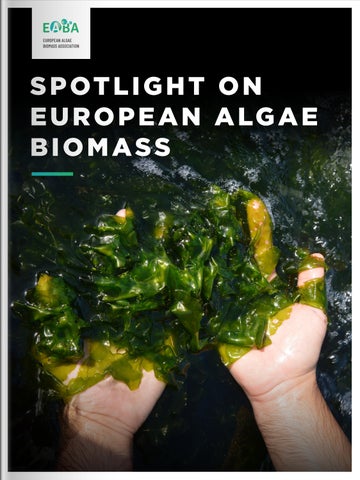
S P OT L I G H T O N E U R O P E A N A LG A E BIOMASS
S P OT L I G H T O N E U R O P E A N A LG A E BIOMASS As Europe’s algae biomass sector expands, the versatile resource is emerging as a cornerstone of the continent’s blue bioeconomy, driving sustainability and innovation and backed by ambitious EU policy Writer: Lily Sawyer | Project Manager: Eva Van Leeuwen All photography © EABA
2 | EME Outlook Issue 73
EUROPEAN ALGAE BIOMASS ASSOCIATION INDUSTRY SPOTLIGHT
P
laying a critical role in Europe’s renewables industry, algae biomass is a highly versatile feedstock driving the European Green Deal – a comprehensive policy framework launched by the European Commission (EC) in 2019 to make the region the world’s first climate-neutral continent by 2050. It also fuels the circular bioeconomy and creates employment in coastal communities, bolstering Europe’s reputation as a modern, resourceefficient, and competitive economy. A primary application for European algae is in the food and nutraceuticals market, where the focus is on high-value dietary supplements, alternative plant-based proteins, and nutrientdense species like spirulina and chlorella. It is also a major contributor to the cosmetics sector, where its uses range from functional skincare extracts to UV protection. However, its advantages span much wider than this, with algae capable of contributing to food security, sustainable agriculture, health, renewable chemicals, and climate resilience. Indeed, the resource’s positive impact on the environment and sustainability is notable, acting as an efficient biological absorber of carbon dioxide and thereby assisting the EU in achieving its climate-neutrality and emissions-reduction targets. Elsewhere, algae’s use in bioremediation sees it naturally filter pollutants, excess nitrogen, and phosphorus from industrial wastewater and runoff. The EC is actively promoting the use of algae biomass through a dedicated policy framework – yet the industry faces various challenges before it can achieve full, continent-wide adoption. Obstacles include the costly infrastructure required to cultivate algae biomass, stringent EU food regulations and pharmaceutical manufacturing standards that currently inhibit its widespread use, and digestibility concerns surrounding the use of some microalgae species in animal feedstock. Looking ahead, progressing the algae industry is an active political and economic priority for Europe, spearheaded by the EU4Algae initiative and the EC’s backing. Indeed, the EU’s official roadmap targets 23 crucial actions to transition the sector into the cornerstone of the region’s blue bioeconomy, focusing on improving governance and legislation, creating business support mechanisms, driving knowledge and innovation, and raising market awareness. EME Outlook Issue 73 | 3
INTERVIEW:
E U R O P E A N A LG A E B I O M A S S A S S O C I AT I O N Seeking to accelerate the development of a sustainable, innovative, and competitive algae sector, the European Algae Biomass Association brings together scientists, industry, and policymakers to unlock the resource’s potential as a key pillar of Europe’s future bioeconomy, as we find out from President, Carlos Unamunzaga EME Outlook (EO): Firstly, could you talk us through the origins and primary goals of the European Algae Biomass Association? Carlos Unamunzaga, President (CU): Founded in June 2009, the European Algae Biomass Association (EABA) is dedicated to advancing the algae biomass sector by fostering collaboration amongst scientists, industry professionals, and policymakers. EABA was created with a very clear vision – to bring together everyone working with algae across Europe, and to help transform algae from a promising scientific field into a thriving industrial sector. 4 | EME Outlook Issue 73
EUROPEAN ALGAE BIOMASS ASSOCIATION INDUSTRY SPOTLIGHT
When EABA was founded, the algae industry was still in its infancy. There were many excellent research groups and a handful of pioneering companies, but collaboration between stakeholders was limited and there was no common voice representing the sector at European level. Today, EABA has evolved into the largest European network dedicated exclusively to algae and algae biomass. We represent companies, universities, research institutes, technology providers, public organisations, consultants, and entrepreneurs working across the entire algae value chain. Our mission goes far beyond simply representing our members. We aim to accelerate the development of a sustainable, innovative, and competitive algae sector in Europe by promoting collaboration, facilitating knowledge exchange, supporting research and innovation, and engaging with policymakers to create an enabling regulatory environment. One of our greatest strengths is that we bring together people from very different backgrounds. Within EABA, scientists interact directly with industrial companies, startups exchange ideas with multinational corporations, and policymakers have access to technical expertise from the sector itself. This multidisciplinary approach is essential because algae are incredibly versatile.
They can contribute to sustainable food systems, aquaculture, animal nutrition, pharmaceuticals, cosmetics, agriculture, renewable materials, wastewater treatment, carbon capture, and even advanced biomanufacturing. Very few biological resources have such a broad range of applications. Our objective is therefore not only to support individual sectors but also to help position algae as one of the key pillars of Europe’s future bioeconomy. Ultimately, EABA exists to help the continent unlock the enormous potential of algae whilst ensuring scientific excellence is translated into successful industrial applications that generate economic growth, skilled employment, and environmental benefits. EO: Who is EABA membership open to, and what are the key benefits of membership? CU: One of the defining characteristics of EABA is that we are an open and highly diverse community. Membership is available to virtually any organisation with an interest in algae. This includes industrial companies ranging from start-ups to large corporations, universities, research institutes, technology developers, engineering companies, investors, consultants, public bodies, and innovation clusters, including individual members. Our membership represents the entire algae ecosystem. EME Outlook Issue 73 | 5
Some cultivate microalgae or macroalgae. Others develop processing technologies, manufacture equipment, produce ingredients, conduct clinical research, work on regulatory affairs, or develop new commercial applications. This diversity creates enormous value. Members do not simply join an association; they become part of a collaborative ecosystem. One of the greatest benefits is networking. Many collaborations, European projects, commercial partnerships, and even company acquisitions have started through contacts made within EABA. Members also gain early access to information on European policies, regulatory developments, funding opportunities, and market trends. Through our working groups and committees, they can actively contribute to shaping the future of the sector rather than simply reacting to regulatory changes after they happen. Another important benefit is visibility. EABA provides members with opportunities to present their work through conferences, webinars, publications, and international events. For young companies in particular, this exposure can be invaluable. Perhaps most importantly, members become part of a collective voice. When EABA engages with the EC or other institutions, we represent the expertise and experience of the entire community. That collective representation carries much greater weight than any individual organisation could achieve on its own.
EO: What is your take on the biomass and renewables landscape in Europe, and how have you seen it evolve over the course of your career? Would you say it’s currently a particularly exciting or challenging space? CU: I would actually say everything in our sector is both exciting and challenging at the same time. Over the past 20 years, Europe has undergone a remarkable transformation. When I started working in this field, biomass and BioTech were often viewed as niche technologies. Today, they are recognised as strategic components of the European Green Deal, bioeconomy strategy, and industrial strategy. We have seen enormous advances in BioTech, synthetic biology, fermentation, precision agriculture, and circular economy approaches. At the same time, awareness of climate change and resource scarcity has fundamentally changed the way governments and industries think about biological resources.
EABA – KEY BENEFITS OF MEMBERSHIP Being a member of EABA provides unique opportunities to participate in Europe’s algae biomass sector, such as: 1. Representation at industry and scientific events at national level. 2. Spreading key knowledge about algae biomass and its benefits. 3. An opportunity to make algae research relevant in public debate. 4. Promoting investment and financial support in the field. 5. Helping to structure and plan research and industrial development around algae. 6. Fostering scientific freedom and responsibility.
However, despite this progress, Europe still faces significant challenges. Scientific excellence has never been our problem as the continent produces world-class research. The real challenge is converting innovation into industrial-scale production.
EUROPEAN ALGAE BIOMASS ASSOCIATION INDUSTRY SPOTLIGHT
Can we enable efficient algae cultivation? Yes! PBR system / microalgae plant: Algalif, Iceland; Photo: Valentin Brandes
SCHOTT AG, Erich-Schott-Strasse 14, 95666 Mitterteich, Germany Phone +49 (0)9633 80-304, fritz.wintersteller@schott.com
Too many promising technologies remain stuck in the so-called “valley of death” between laboratory success and commercial deployment. Investment remains difficult, permitting and regulatory procedures are often lengthy, regulation can be fragmented, and scaling manufacturing continues to be expensive. Meanwhile, international competition is becoming increasingly intense. Countries such as the US, China, South Korea, Japan, and several Gulf countries are investing heavily in BioTech and algae production. Europe cannot afford to fall behind. The encouraging news is that European policymakers increasingly recognise BioTech as a strategic industrial sector. Recent initiatives, including the European Biotech Act and support for biomanufacturing, demonstrate that the political momentum is moving in the right direction. More specifically, we now have the EU Algae Initiative. For algae specifically, I believe we are approaching an important turning point. The science is mature. The applications are also expanding rapidly, and market demand continues to grow. What we now need is faster industrial deployment.
EO: How important is the cultivation of algae biomass in helping Europe meet legally binding climate neutrality targets? How heavily are you involved in the EU Algae Initiative, for example? CU: Algae can make an important contribution to Europe’s climate neutrality objectives, although I think it is important to be realistic. Algae alone will not solve climate change; there is no single technology capable of doing that. However, algae can contribute simultaneously to several European priorities – they capture carbon through photosynthesis and are cultivated without competing for fertile agricultural land. Many species can grow using seawater, brackish water, or industrial process water. They can recycle nutrients, contribute to wastewater treatment, and integrate with industrial carbon emissions. Beyond carbon capture, algae can replace fossilbased materials, provide sustainable proteins, produce valuable bio-based ingredients, and support more circular production systems. This multifunctionality is perhaps their greatest strength. EME Outlook Issue 73 | 7
Regarding the EU Algae Initiative, EABA has been closely involved since it was developed by the DirectorateGeneral for Maritime Affairs and Fisheries (DG MARE). The EU4Algae forum is tackling all 23 actions included in the EU Algae Initiative.
We are part of the consortium forming EU4Algae and highly involved and representative of the EU algae sector. We have worked with the EC by providing technical expertise, industry feedback, and practical recommendations based on the experience of our members. This role, engaging directly with the EC through EU4Algae and the EU Algae Initiative, is one of the most relevant contributions EABA makes on behalf of the sector. The EU Algae Initiative represented an important milestone because it recognised, for the first time at the European level, that algae deserves a dedicated policy framework. Of course, publishing an initiative is only the beginning. The real challenge now is implementation. We need to reduce regulatory barriers, facilitate investment, support demonstration facilities, improve market access, and create stronger links between research and industry. EABA intends to remain an active partner throughout this process.
EUROPEAN ALGAE BIOMASS ASSOCIATION INDUSTRY SPOTLIGHT
“ I G E N U I N E LY B E L I E V E T H AT A L G A E A R E N O L O N G E R A N I C H E TO P I C . T H E Y A R E B E C O M I N G PA R T O F T H E S O L U T I O N TO MANY OF THE WORLD’S BIGGEST CHALLENGES, AND EABA IS C O M M I T T E D T O H E L P I N G M A K E T H AT V I S I O N A R E A L I T Y ” – C A R L O S U N A M U N Z A G A , P R E S I D E N T, E U R O P E A N A L G A E B I O M A S S A S S O C I AT I O N
EO: As an association that serves as a link between scientific research, industrial applications, and political decision-making, how extensively is EABA involved in promoting policy, mutual exchange, and cooperation to foster synergies amongst scientists, industrialists, and decision-makers? CU: This bridging role is probably one of EABA’s most valuable contributions. Innovation rarely happens in isolation, and successful innovation requires continuous dialogue between researchers, companies, and policymakers. That is exactly the environment EABA tries to create. We organise conferences, workshops, webinars, and technical meetings throughout the year where members exchange knowledge and identify opportunities for collaboration. Many Horizon Europe consortia and international partnerships have originated through these interactions. At policy level, we regularly engage with the EC, members of the European Parliament, and national
authorities. We exchange and serve as a networking point with national algae associations, which brings coordination and harmonisation amongst all member states. Our objective is always to provide evidence-based recommendations grounded in scientific knowledge and industrial experience. For example, EABA has actively contributed to consultations on BioTech policy, food regulations, sustainability, industrial strategy, and the European Biotech Act. Internally, our Scientific Committee and Industrial Committee bring together experts from different disciplines to identify common priorities and develop coordinated positions. This internal dialogue ensures that our policy recommendations genuinely reflect the diversity of the algae sector. Ultimately, we see ourselves not only as an association but as a platform for collaboration. Our role is to connect people who otherwise might never have worked together.
EME Outlook Issue 73 | 9
EUROPEAN BIOTECH ACT Proposed by the EC in December 2025, the European Biotech Act aims to strengthen the competitiveness of Europe’s BioTech and biomanufacturing sectors. The proposal forms part of wider EU efforts to close the innovation gap and make it easier for promising technologies to progress from research to commercial deployment. Suggested measures include: 1. Supporting strategic health BioTech and biomanufacturing projects to strengthen Europe’s industrial capacity and value chains. 2. Improving access to finance through a proposed EU health BioTech investment pilot, developed with the European Investment Bank Group and others. 3. Simplifying and strengthening the regulatory environment for novel health BioTech products, whilst reducing barriers to bringing innovative products to market. 4. Supporting the use of AI and data in BioTech whilst introducing measures aimed at preventing the misuse of BioTech and strengthening biosecurity. As of August 2026, the act remains under consideration. The EC has also begun work on a second European Biotech Act focused on industrial BioTech and biomanufacturing, with a proposal expected later this year.
10 | EME Outlook Issue 73
EO: Can you talk about your involvement in the upcoming algae conference, AlgaEurope 2026, and what key topics are on the agenda to discuss? CU: AlgaEurope 2026 is undoubtedly the flagship event of the European algae community. Our annual conference has become the leading event in the algae sector with over 400 participants and growing every year. AlgaEurope is the perfect spot to learn from science, industry, and technology. Every year it brings together researchers, industry leaders, investors, policymakers, and technology developers from around the world. As President of EABA, I am very much looking forward to this year’s conference in Valletta, Malta between 8th and 11th December. AlgaEurope is unique because it covers the entire value chain, from fundamental biology and cultivation technologies to industrial applications, investment opportunities, and regulatory developments. We dedicate specific sessions to industrial developments and key research topics, and have an EC-dedicated session with key policymakers and members from the commission. Europe has outstanding research, but the discussion is increasingly focused on how we translate scientific breakthroughs into commercially successful businesses.
EUROPEAN ALGAE BIOMASS ASSOCIATION INDUSTRY SPOTLIGHT
“ U LT I M AT E LY, E A B A E X I S T S T O H E L P T H E C O N T I N E N T U N L O C K T H E E N O R M O U S P OT E N T I A L O F A LG A E W H I L ST E N S U R I N G S C I E N T I F I C E X C E L L E N C E I S T R A N S L AT E D I N T O S U C C E S S F U L I N D U S T R I A L A P P L I C AT I O N S T H AT G E N E R AT E E C O N O M I C G R O W T H , S K I L L E D E M P L O Y M E N T, A N D E N V I R O N M E N TA L B E N E F I T S ” – C A R L O S U N A M U N Z A G A , P R E S I D E N T, E U R O P E A N A L G A E B I O M A S S A S S O C I AT I O N
Other important topics include biorefinery concepts, novel foods, animal nutrition, aquaculture, cosmetics, pharmaceuticals, BioTech, carbon utilisation, sustainability assessment, life-cycle analysis, and advances in cultivation technologies. Artificial intelligence (AI), digitalisation, and automation are also beginning to play a much larger role in algae production. But the most important aspect of AlgaEurope is networking. Many collaborations begin during informal conversations at the conference. This is why we have extended time for coffee breaks and networking activities that propel mutual interexchange. Bringing together people from academia, industry, and government in the same room creates opportunities that simply cannot be replicated elsewhere. For EABA, AlgaEurope is much more than an annual conference. It is the most important event you could attend in the algae sector.
investors, and public authorities will be essential. Fourth, we want to increase public awareness. Many people still only associate algae with seaweed on beaches or dietary supplements. In reality, algae are becoming a strategic renewable resource capable of contributing to food security, sustainable agriculture, health, advanced materials, renewable chemicals, and climate resilience. Finally, we want Europe to become the global leader in algae BioTech. The continent already possesses exceptional scientific knowledge. If we combine that with supportive policies, industrial investment, and strong collaboration, Europe has every opportunity to lead the next generation of sustainable BioTech. I genuinely believe that algae are no longer a niche topic. They are becoming part of the solution to many of the world’s biggest challenges, and EABA is committed to helping make that vision a reality.
EO: Finally, what are EABA’s key priorities for the future? CU: Our priorities are very much aligned with what Europe needs to build a strong bioeconomy. First, we want to accelerate industrial deployment. The continent has outstanding research capabilities, but we now need more commercial production facilities, more investment, and faster scale-up. From EABA’s market-driven perspective, optimising production capacity to the technical and environmental carrying capacity is a priority, but it is even more important to develop the market so the sector grows in value and not only in production capacity. Second, we want to improve the regulatory environment. Innovation should be supported by regulations that are science-based, proportionate, and predictable. Reducing unnecessary administrative complexity will help companies innovate more quickly. Third, we want to strengthen collaboration across the entire value chain. No single organisation can develop this sector alone. Partnerships between academia, industry,
Tel: +39 055 3241132 info@eaba-association.org eaba-association.org/en
EME Outlook Issue 73 | 11
Tel: +39 055 3241132 info@eaba-association.org eaba-association.org/en
PRODUCED BY EME OUTLOOK MAGAZINE