B R I T I S H P O R T S A S S O C I AT I O N
w w w. e m e o u t l o o k m a g . c o m
Issue 73
EMIRATES RAWABI Uniting food and beverage production under one national banner
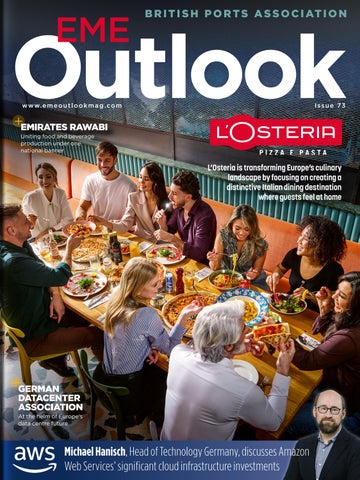
L’Osteria is transforming Europe’s culinary landscape by focusing on creating a distinctive Italian dining destination where guests feel at home
GERMAN DATACENTER ASSOCIATION At the helm of Europe’s data centre future
Michael Hanisch, Head of Technology Germany, discusses Amazon Web Services’ significant cloud infrastructure investments
GLADSTONE AREA WATER BOARD
D E S I M O N E CÔT E D ’ I VO I R E
B R I T I S H P O R T S A S S O C I AT I O N
N E B R A S K A P U B L I C P OW E R D I S T R I C T
G A S TO N E L E C T R I C A L
TURNER MINING GROUP
HUNTER VALLEY OPERATIONS
L O S
A N G E L E S
G E N E R A L
End-to-end solutions from exploration to extraction
w w w. a f r i c a o u t l o o k m a g . c o m
M E D I C A L Issue 15
WEIR
C E N T E R
ST. JOSEPH’S HEALTH SYSTEM
Elevating the patient experience
DIGITAL HEALTH ASSOCIATION Issue 121
B2GOLD NAMIBIA Proudly operating the nation’s largest and most successful underground gold mine, B2Gold Namibia continues to flourish with exciting plans in the pipeline
Drop Access works at the intersection of healthcare and clean energy, as we learn from Norah Magero, co-Founder and CEO
w w w. a p a c o u t l o o k m a g . c o m
Issue 81
ALTRAD
w w w. e m e o u t l o o k m a g . c o m
Issue 73
www. northame ricaoutlookmag.com
Keeping airlines flying to connect the world
Issue 37
www.healthcare-outlook.com
www.mining-outlook.com • Issue 16
EMIRATES RAWABI
SAESL
One of Australia’s most recognised industrial service providers
MBA ENERGY & INDUSTRIAL
Uniting food and beverage production under one national banner
On a coal mining mission to champion sustainable practices
MARTIN-BAKER AMERICA, INC. Seat and safety vanguards for the defense sector
ARGO NATURAL RESOURCES
THE 1-2-1 • THE QUESTION • TURBOCAM
Michael Hanisch, Head of Technology Germany, discusses Amazon Web Services’ significant cloud infrastructure investments
• THE 1-2-1 • THE QUESTION
On a mission to be a leading integrated green coal mining operation
Thermo Fisher Scientific has reinforced its position as a trusted biologics manufacturing partner
The ultimate goal of Virginia Tech Dining Services is to create an environment where students not only eat, but also grow, connect, and thrive as members of the Hokie community
At the helm of Europe’s data centre future
THE THOUGHT LEADER
VULCAN MOZAMBIQUE
M Resources delivers a suite of essential steelmaking raw materials, infrastructure, and mining and logistics services to steelmakers across the globe. Matt Latimore, Founder and President, details the company’s futurefacing approach to investment and market growth
GERMAN DATACENTER ASSOCIATION
Unearthing coal potential in Australia, Argo Natural Resources champions sustainable mining practices
Brendan Tritton, Managing Director and CEO of Valiant Gold, a Western Australian gold company, discusses advancing the restart of two historic mining centres in the Murchison Goldfields
Mark Scott, General Manager of Pinto Valley Mining Corp., delves into Capstone Copper’s Pinto Valley Mine and its importance in Arizona’s Globe-Miami mining district
CO O P L A N DS B A K E RY • D N AG RA R • B RA K E B U S H
KOLEKTOR CONSTRUCTION
Garry Edwards, VP EMEA at Wolters Kluwer, emphasises the need for formalised, organisation-wide frameworks to ensure responsible use of artificial intelligence
Jason Bontempo, CEO of Gladiator Metals, discusses the resurgence of the Whitehorse Copper Belt in Canada’s historic Yukon mining district
VECA ELECTRIC & TECHNOLOGIES
N O F A R
E N E R G Y
R O M A N I A
K I N G S PA N
Family-run, proudly Canadian
DANONE ROMANIA
w w w. s u p p ly c h a i n - o u t l o o k . c o m
W W W .CONST RUCT ION-OUT L OOK.COM • ISSUE 4
Real Estate Solutions of the Future
www.foodbeverage-outl ook.com
Locked and loaded
Bridging the Real and Virtual Worlds
Enhancing all outdoor recreation adventures
Real estate solutions of the future
VP of Sustainable and Regenerative Agriculture, discusses PepsiCo’s collaborative regenerative farming initiative Over the last year, Saulsbury has expanded its position as one of North America’s leading engineering, procurement, and construction contractors
As a subsidiary of Dassault Systèmes, DELMIA is on track to shape the manufacturing industry of the future. We speak to Guillaume Vendroux, CEO Jan Diekmann, Head of Business Development and Manufacturing at Ericsson Enterprise Wireless Solutions, explores how private 5G is transforming the factory floor
Enterprise Wireless Solutions, explores how private 5G is transforming the factory floor Jan Diekmann, Head of Business Development and Manufacturing at Ericsson
Packsize is the global leader in packaging automation. We unbox the company’s right-sized approach with Brian Reinhart, Chief Revenue Officer company’s right-sized approach with Brian Reinhart, Chief Revenue Officer Packsize is the global leader in packaging automation. We unbox the
Johan van Jaarsveld, Managing Director of Montego Pet Nutrition, tells us about the pet care brand’s promise of ‘Better Every Day’ tells us about the pet care brand’s promise of ‘Better Every Day’ Johan van Jaarsveld, Managing Director of Montego Pet Nutrition,
YY Group Holding operates an artificial intelligence-native workforce solutions and integrated facility management platform. CEO, Mike Fu, discusses the company’s established capabilities
Simon Thompson, VP Northern Europe at JAGGAER, explains why artificial intelligence-powered data infrastructure is becoming essential
facility management platform. CEO, Mike Fu, discusses the company’s established capabilities YY Group Holding operates an artificial intelligence-native workforce solutions and integrated
intelligence-powered data infrastructure is becoming essential Simon Thompson, VP Northern Europe at JAGGAER, explains why artificial
procurement, and construction contractors as one of North America’s leading engineering, Over the last year, Saulsbury has expanded its position
We speak to Guillaume Vendroux, CEO track to shape the manufacturing industry of the future. As a subsidiary of Dassault Systèmes, DELMIA is on
and Virtual Worlds Bridging the Real
Issue 2
Margaret Henry,
From humble potatoes to gourmet crisps, SAVOURSMITHS is transforming snacking with bold flavours and a rich family heritage
LIPPERT
CBRE www.sustainabilityoutlookmag.com
Iss ue 9
SAVOURING THE FLAVOUR OF THE CRISP PARADIGM SHIFT
CBRE’s multidimensional perspective helps businesses find greater success with real estate facilities. John Kirkman, Senior Managing Director and Supply Chain Leader, gives us the full story
LOCKHEED MARTIN
Contributing to the nation’s net zero goals
OUTLOOK
Contributing to a healthier world Issue 12
N O R D I C S
GREEN BUILDING COUNCIL OF AUSTRALIA
OSMOW’S SHAWARMA ISSUE 10
www.mfg-outlook.com
initiative regenerative farming PepsiCo’s collaborative Agriculture, discusses and Regenerative VP of Sustainable
a rich family heritage with bold flavours and transforming snacking SAVOURSMITHS is to gourmet crisps, From humble potatoes
adventures outdoor recreation Enhancing all
LIPPERT
SHIFT PARADIGM OF THE CRISP THE FLAVOUR SAVOURING
Locked and loaded
MARTIN LOCKHEED
gives us the full story Director and Supply Chain Leader, John Kirkman, Senior Managing success with real estate facilities. helps businesses find greater CBRE’s multidimensional perspective
Margaret Henry,
TELL US YOUR STORY, AND WE’LL TELL THE WORLD the Future Solutions of Real Estate
www.mfg-outlook.com
www.foodbeverage-outl ook.com
Iss ue 9
Issue 12
healthier world Contributing to a
w w w. s u p p ly c h a i n - o u t l o o k . c o m ISSUE 10
ROMANIA DANONE
Canadian Family-run, proudly
W W W .CONST RUCT ION-OUT L OOK.COM • ISSUE 4
OUTLOOK
www.sustainabilityoutlookmag.com
Issue 2
THE THOUGHT LEADER
• THE 1-2-1 • THE QUESTION
CO O P L A N DS B A K E RY • D N AG RA R • B RA K E B U S H
of the future Real estate solutions
CBRE
nation’s net zero goals Contributing to the
AUSTRALIA COUNCIL OF BUILDING GREEN
SHAWARMA OSMOW’S
THE 1-2-1 • THE QUESTION • TURBOCAM
Modernising and transforming health systems
ARGO NATURAL RESOURCES
Delivering construction with integrity and expertise
L’Osteria is transforming Europe’s culinary landscape by focusing on creating a distinctive Italian dining destination where guests feel at home
KOLEKTOR CONSTRUCTION
VECA ELECTRIC & TECHNOLOGIES
N O F A R
E N E R G Y
R O M A N I A
K I N G S PA N
N O R D I C S
Africa Outlook, APAC Outlook, EME Outlook, North America Outlook, Mining Outlook, Healthcare Outlook, Manufacturing Outlook, Supply Chain Outlook, Food & Beverage Outlook, Construction Outlook, and Sustainability Outlook are digital publications aimed at boardroom and hands-on decision-makers, reaching an audience of more than 800,000 people around the world. With original and exclusive content compiled by our experienced editorial team, we look to promote the latest in engaging news, industry trends, and success stories from across the globe. Your company can join the leading industry heavyweights enjoying the free exposure we provide across our platforms with a free marketing brochure, extensive social media saturation, enhanced B2B networking opportunities, and a readymade forum to attract new investment and help you grow your business. Visit www.outpb.com/work-with-us for details on how your company can feature for free in one of our upcoming editions.
www.outpb.com/work-with-us
WELCOME FROM THE EDITOR
MADE WITH L’OVE
EDITORIAL Head of Editorial: Jack Salter jack.salter@outpb.com Deputy Head of Editorial: Lucy Pilgrim lucy.pilgrim@outpb.com
Welcome to our 73rd edition of EME Outlook magazine.
Senior Editor: Lily Sawyer lily.sawyer@outpb.com
Italian osterias, traditional taverns that historically focused
Editor: Ed Budds ed.budds@outpb.com
on serving wine and simple local food, date back centuries
Editor: Rachel Carr rachel.carr@outpb.com Copy Editor: Lauren Kania lauren.kania@outpb.com PRODUCTION Art Director: Stephen Giles steve.giles@outpb.com Senior Designer: Devon Collins devon.collins@outpb.com Designer: Louisa Martin louisa.martin@outpb.com Production Manager: Alex James alex.james@outpb.com Digital Marketing Director: Fox Tucker fox.tucker@outpb.com Senior Website Content Manager: Oliver Shrouder oliver.shrouder@outpb.com Social Media Executive: Jake Crickmore jake.crickmore@outpb.com
Trainee Digital Content Executive: Tara Steele tara.steele@outpb.com BUSINESS Chief Executive Officer: Ben Weaver ben.weaver@outpb.com Managing Director: James Mitchell james.mitchell@outpb.com Chief Technology Officer: Nick Norris nick.norris@outpb.com Content Director: Neil Perry neil.perry@outpb.com Global Head of Media: Lewis Hammond lewis.hammond@outpb.com
and still exist today. L’Osteria, the distinguished Italian restaurant brand established in Germany, embodies this concept on our latest front cover, promoting communal dining and authentic Italian dishes. What began as one restaurant has since expanded to over 220 locations across 11 European countries, having quickly gained popularity for its inviting ambience and delectable offerings. “Italian kitchen culture is at the centre of everything we do. Our dishes are inspired by authentic Italian cuisine and adapted to our concept’s operational standards,” outlines Jacek Trybuchowski, CEO of L’Osteria. Germany is a central hub for Amazon Web Services (AWS), where it has been present since October 2014 when it launched the AWS Europe (Frankfurt) Region. AWS has made significant cloud infrastructure investments in Germany, including the recent launch of the AWS European Sovereign Cloud in January. “We’re building an entirely separate sovereign cloud for our customers in Europe, and that of course comes with physically separate infrastructure,” explains Michael Hanisch, Head of Technology Germany, who also discusses Amazon’s extensive sustainability efforts.
Global Media Executive: Kai Boyle-Vennard kai@outpb.com
Our latest catch-up with the British Ports Association (BPA) and CEO, Richard
A D M I N I S T R AT I O N
investment in decarbonisation and infrastructure at UK ports in recent years.
Finance Director: Suzanne Welsh suzanne.welsh@outpb.com Finance Manager: Victoria McAllister victoria.mcallister@outpb.com E M E O U T LO O K Norvic House, 29-33 Chapelfield Road Norwich, NR2 1RP, United Kingdom Sales: +44 (0) 1603 804 445 Editorial: +44 (0) 1603 853 874 SUBSCRIPTIONS Tel: +44 (0) 1603 853 874 jack.salter@outpb.com www.emeoutlookmag.com Follow us on Linkedin: EME Outlook Magazine Follow us on X: @OutlookPublish
Ballantyne OBE, who we last spoke to in July 2022, likewise outlines the strong
“Investment across UK ports remains strong. Over recent years, we have seen significant spending on quay infrastructure, deep-water berths, logistics parks, digital technologies, passenger and cargo handling equipment, fuel and maritime services, and facilities supporting offshore wind and other clean energy industries,” he updates us. It’s not just Italian, infrastructure, and investment on the menu – indulge in interviews with Burgermeister, the German Datacenter Association, Emirates Rawabi, and others. We hope that you enjoy your read. Jack Salter Head of Editorial, Outlook Publishing EME Outlook Issue 73 | 3
EME OUTLOOK CONTENTS
TOP I C A L F OC U S
22 Food & Beverage Restore and Reuse
73|CONTENTS
Safer, more efficient kitchens designed to last
EV EN T F OC U S
REGULARS
6 EXPERT EYE Sensory science for savouring the flavour
BUS INE SS INSIGHTS
8 Nokia Intelligent Networks by Design
26 ProcureCon Europe Europe’s pioneering procurement conference
I N D U ST RY SP OTL I G H TS
30 British Ports Association Investment in decarbonisation and infrastructure across UK ports
Resilient networks designed for scale, security, and sustainability
40 German Datacenter Association
HEALT HCA RE
At the helm of Europe’s data centre future
16 Dexcom Personalised, Proactive, and Preventative
52 British Franchise Association
Why personalisation is becoming central to diabetes care strategy
A sophisticated engine of economic growth
4 | EME Outlook Issue 73
62
62 European Algae Biomass Association A cornerstone of the continent’s blue bioeconomy
72 European Subsea Cables Association Connecting nations and driving innovation
162 THE FINAL WORD Which abilities are most crucial when it comes to leadership and why?
EME OUTLOOK CONTENTS
116
124
F E AT U R E S F O O D & BEVERAGE
88 L’Osteria Pizza, Pasta, People: Inside L’Osteria’s Formula for Growth Crafting cuisine La Famiglia style
154
116 SalMar
O I L & G AS
Passion for Salmon
140 Descon Engineering
Sustainability, local value creation, and salmon welfare
Built to Deliver Building integrated capabilities
124 CPM|Crown Enacting Change in Edible Oils A leader in edible oilseed processing and extraction
T EC HN OLOGY
132 AWS Germany Digital Sovereignty and Sustainability Significant cloud infrastructure investments
100 Burgermeister
140 CO N STR U C TI O N
Genius Between the Buns
148 APK Group
Delicious scenes for Germany’s cult burger chain
Creating the Cities of Tomorrow Next-generation smart cities
110 Emirates Rawabi
154 ATI Project
The UAE’s Premier Integrated AgriFood Group Uniting food and beverage production under one national banner
132
A Better Reality People and the environment at the centre of architecture and design
EME Outlook Issue 73 | 5
EXPERT EYE FOOD & BEVERAGE
Redefining Hydration F Cristina Kenz, CEO of air up®, considers how innovative sensory science and the art of taste can transform the mundane act of drinking water into an enjoyable experience, paving the way for healthier habits and sustainable choices Writer: Cristina Kenz, CEO, air up®
or much of my career, food and beverage innovation has started with the formulation: a new flavour, a different sweetener, an added functional ingredient or a new combination designed to respond to changing consumer needs. Having spent more than two decades across global fast-moving consumer goods (FMCG) businesses including PepsiCo, Kraft Heinz, and Danone, I have seen how successfully that model can create and reshape categories. However, that has now become quite iterative, leaving some of the most interesting opportunities in questioning not simply what goes into a drink or food, but how the experience of drinking it is created.
INNOVATION FOR EVOLVING CONSUMER EXPECTATIONS A new breed of expectations is coming to food and beverage as consumers want not only less sugar but also fewer artificial ingredients. Additionally, they are increasingly seeking functional responses from what they ingest. Yet, the industry’s traditional response to changing expectations has often been to add something else to the formulation. Sensory science offers another route. For example, around 80 percent of what we perceive as taste is influenced by retronasal smell, where aromas travel from the mouth to the olfactory system as we eat or drink. This principle sits at the centre of air up®’s Scentaste™ technology. Our system delivers Taste by Scent, creating the perception of taste whilst consumers drink plain water. In this way, a natural aroma from a pod travels through the mouth to the olfactory system as someone drinks, whilst the water itself remains water, without sugar, sweeteners, or flavouring dissolved into it. From an industry perspective, that technology’s significance goes beyond one bottle or one brand. It demonstrates that the composition 6 | EME Outlook Issue 73
EXPERT EYE FOOD & BEVERAGE
of a beverage and the sensory experience of consuming it don’t necessarily have to be treated as the same thing.
SAVOURING THE TASTE At air up®, our range of 25-plus taste pods illustrates the variety that can be created around the same underlying water. Any application to another beverage category would require its own development, testing, and evidence. Furthermore, hydration is where this technology is particularly compelling because the fundamental consumer problem is surprisingly straightforward. People generally know that they should drink water – more water, just water. Nevertheless, the challenge is that many find plain water boring. This reality means that hydration is not simply an education problem; it is a behavioural one. Therefore, the opportunity for technology is not to keep reminding people to drink more, but to make the behaviour they already know is good for them sufficiently enjoyable that it becomes habitual. Moreover, this is also why we do not believe the future of healthier beverages should be framed around demonising sugar. There is a meaningful difference between consciously choosing something sweet because you want to enjoy it and routinely consuming sugar or artificials through drinks without really thinking about them. Ultimately, consumers rarely maintain behaviours that continually feel like a compromise, regardless of how beneficial they are told they might be.
THE NEXUS OF INNOVATION AND BEHAVIOUR Start-ups are extremely good at challenging assumptions about how a category is supposed to work. Large consumer businesses are extremely adept at understanding the
discipline required for a product to move from initial trial into repeated, everyday behaviour. The next phase of beverage innovation needs both. When air up® launched in Germany in 2019, its first 80,000 bottles sold out in under six weeks, and the business is now active in 14 markets. Scientific novelty alone is not enough. However, a product can attract enormous attention because consumers have never seen anything like it before, but the more important question is what happens when that initial curiosity disappears. Does someone continue using it on an ordinary working day? That transition from novelty to habit should be one of the most important measures of successful consumer innovation. A reusable bottle, for example, is not simply packaging for a liquid. People may carry it all day, so its physical design, drinking experience, durability, and ease of use all influence whether the desired behaviour sticks. The science and intellectual property can be complex behind the scenes; consequently, the benefit should become simpler at the point of use. Functional and sensory propositions will become more sophisticated, but consumer trust will depend on businesses being extremely precise about what their technology actually does. Claims need evidence, limitations need to be understood, and innovation should clarify the consumer proposition rather than surround it with unnecessary complexity.
MEANINGFUL CHANGE I am interested not simply in how many products a hydration company can put into the market, but in whether those products materially change hydration behaviour. Helping people enjoy pure water is a much more meaningful ambition if we can ultimately understand how much more water people
drink and how many people build better hydration habits as a result. If technology solves a genuine human problem in a way that people enjoy enough to repeat, impact and commercial relevance should reinforce one another. Additionally, whilst formulation will remain fundamental and functional ingredients will continue to create important new categories, formulation should no longer automatically be the answer to every consumer need. The industry has spent decades becoming more sophisticated about what we can put into a drink. Sensory technology asks us to become equally sophisticated about what the human brain can perceive. Sometimes the route to a better drink may not be adding something else to the liquid at all. It may be using science to make something as familiar as water sufficiently enjoyable that choosing it becomes a fun habit.
ABOUT THE EXPERT Cristina Kenz is CEO of air up®, having previously served as Chairwoman of the Board. She brings extensive FMCG experience from senior roles at PepsiCo, Kraft Heinz, and Danone, where she worked across brand building, commercial strategy, and business transformation. At air up®, Kenz is leading the company into its next stage of growth, focusing on strengthening its global consumer proposition, expanding its omnichannel presence, and building a more integrated organisation. Her background combines category experience with a track record of scaling consumer brands.
EME Outlook Issue 73 | 7
Intelligent Networks by Design As Europe’s telecommunications sector enters a new era driven by artificial intelligence, industry giant, Nokia, is on hand to help operators build resilient networks designed for scale, security, and sustainability. John Harrington, Senior Executive Vice President and Head of Europe, tells us more Writer: Lily Sawyer All photography © Nokia
8 | EME Outlook Issue 73
NOKIA BUSINESS INSIGHTS
EME Outlook Issue 73 | 9
A
s one of the most important strategic priorities for Europe’s telecommunications (telecoms) sector, artificial intelligence (AI) has moved from being a feature that runs on top of the network to being the workload that defines it. Historically, every generation of connectivity – from voice to broadband to video – has been shaped by its dominant traffic type, and each time this kind of shift has occurred, network operators have had to rebuild around it.
“AI is no different, except the scale and speed of this shift are much greater,” introduces John Harrington, Senior Executive Vice President and Head of Europe for Nokia. Indeed, mobile data traffic is already 550 percent higher than in 2018 across Europe, and according to the Global System for Mobile Communications Association (GSMA), the region can expect a further 75 percent increase on this figure by 2030, driven largely by AI. “This isn’t a distant forecast, but
ABOUT JOHN HARRINGTON John Harrington is Senior Executive Vice President and Head of Europe for Nokia, where he manages and oversees the company’s sales organisation and overall business from his base in Amsterdam, Netherlands. Harrington has over 25 years of technical sales, customer relationship management, and business development experience in the telecoms industry across Asia, Europe, and North America. Prior to his current role, Harrington acted as Executive Vice President overseeing network infrastructure in the Europe, Middle East, and Africa (EMEA) and Asia Pacific (APAC) regions, driving cross-regional alignment and strategic growth initiatives. Before that, he was the Head of the APAC region for network infrastructure and the Customer Experience organisation based in Singapore between 2021 and 2024. He was also the General Manager and head of Nokia Japan, based in Tokyo between 2018 and 2020. Prior to his assignments in Asia, Harrington was the SVP of US Major Accounts, where he led sales for a diverse set of wireless, wireline, cable, and regional customers. He also spent several years as the Head of the AT&T Wireless account for Nokia and Alcatel-Lucent. An industry veteran, Harrington began his career at Motorola in the UK before moving to the US with Lucent Technologies. Born in England, he holds a Bachelor of Engineering in Electrical Engineering.
“In the AI era, the network isn’t a feature you add. It’s the architecture everything else depends on” – JOHN HARRINGTON, SENIOR EXECUTIVE VICE PRESIDENT AND HEAD OF EUROPE, NOKIA
10 | EME Outlook Issue 73
a trajectory that operators are now living through: this is why AI has moved from being an IT challenge to a boardroom priority,” he adds. Investment numbers are also increasing, with global corporate AI investment having reached USD$581.7 billion in 2025 – up 130 percent in a single year, according to Stanford University’s 2026 AI Index. “That capital is flowing into every layer of the stack – computing, networking, memory, power, and cooling – and Europe’s telecoms
NOKIA BUSINESS INSIGHTS
sector is where a large share of this growth must land if the continent wants to capture it rather than simply carrying the traffic for others,” Harrington outlines. Policies such as the European Commission’s Digital Networks Act (DNA), proposed in January this year, follow the same direction in terms of placing emphasis on accelerating investment in areas AI depends on, such as advanced 5G, 6G, fibre, and secure infrastructure. “Whilst the proposal contains good elements on spectrum management, it still requires a comprehensive revision by European co-legislators before being widely adopted to further cut the regulatory burden on European telecoms operators,” he posits. In addition, AI places heavy demands on networks as it requires low latency, high bandwidth, constant reliability, and efficient traffic management. Delivering on these requirements means accelerating investment, alongside implementing 5G, fibre, edge data centres, and internet protocol (IP)-optical backbone networks optimised for AI. In this way, AI-ready networks are quickly becoming critical economic infrastructure for Europe – arguably as important as energy or transport networks in the years ahead. Without the right foundations in place, however, economies will struggle to build sovereign AI capabilities, stay competitive, build secure digital services, and protect their critical industries.
RESILIENCE, INTEROPERABILITY, AND VISIBILITY According to Harrington, 2026 is the year AI, cloud computing, and data consumption become a reality for most operators in Europe who must be prepared for what is ahead. He reflects on how AI-native
COLLABORATIVE PARTNERSHIPS As Nokia witnesses genuine momentum amongst Europe’s telecoms providers, it is also seeing countless examples of how many are staying ahead of the curve through collaborative partnerships. In Germany, for example, Nokia and Deutsche Telekom have expanded their longrunning Innovation Cooperation Programme to accelerate cloud-based, AI-native, and open RAN technology. Elsewhere, in the UK and Finland, BT and Elisa are working with Nokia and NVIDIA on AI-RAN trials which seek to prove that AI inference and radio processing can run side by side on the same infrastructure. Over in Spain, meanwhile, Telefónica has selected Nokia as its exclusive partner to connect 17 new edge data centres, with 12 already live including Tecno-Alcalá – one of the largest in the world. Projects like this are bringing AI training and processing closer to where data is created, keeping it under Spanish control and protecting interests in data sovereignty. Efficiency is also improving as a result of Nokia’s involvement, with industrywide, AI-driven network optimisation delivering documented energy reductions of between 15 and 30 percent without affecting service quality.
networks need radio, core, IP, optical, and cloud layers to work together as one system to ensure coordination across domains, which is why trusted, high-quality data should be shared across the network rather than trapped in silos. Automation that can spot problems, test fixes, and learn from
outcomes – along with open, cloud-native, trusted, multi-vendor architecture – is also important when it comes to speeding up this kind of coordination as it enables new capabilities to exist with older, manual processes. With energy now one of the fastest-growing costs on an EME Outlook Issue 73 | 11
operator’s balance sheet, economics is also an important aspect that must be considered. Whilst 5G is far more energy efficient than 4G per gigabyte (GB) transmitted, 5G sites still draw two to three times the power of 4G overall, so AI-driven efficiencies – as opposed to just revenues – will be a priority for 2026. According to research from STL Partners, AI, automation, and analytics could save the average operator around USD$650 million per year in costs if carried out correctly, whilst adding a further USD$144 million in new revenue. “Perhaps the hardest aspect to plan for is uncertainty itself, with most infrastructure decisions made three or four years in advance, whilst AI technology is changing month to month,” Harrington warns. “By buying too little capacity, an operator can’t grow, but by buying too much, it ties up capital in infrastructure ill-suited to what actually arrives. “It’s a bit like the ‘ground rush’ skydivers describe – from the sky, the ground looks still, then suddenly, once you descend, the ground rushes up all too quickly,” he exemplifies. As such, although AI-native networks can feel like a distant concern for some, the operators best
placed to thrive in 2026 are those who are building enough resilience, interoperability, and visibility to adapt as the picture changes – rather than locking themselves into one version of the future.
THE RESILIENCE QUESTION When it comes to ensuring future network resilience, tools like Nokia’s automation, virtualisation, and analytics (AVA) Energy Efficiency platform are capable of dynamically balancing radio power, sleep states, and load. The direction of travel is clear, with Nokia’s own research across European telecoms providers showing that just over half of the companies surveyed currently report poor network performance, and 81 percent say customers are already requesting AI services their current networks can’t deliver. “This gap is precisely what’s driving the investment we’re now seeing,” Harrington observes. Beneath the surface, a growing focus on trust, data protection, and sovereignty is also emerging, as businesses want a clear view of where their data travels, who can access it, and the level of visibility they are guaranteed. They need to know not only when a decision was made but, more crucially, how it happened.
“This is as much a resilience question as a security one, and it’s a big part of why we see data protection and sovereignty as central to staying ahead,” he reflects. From a regulatory perspective, 2026 represents both challenges and opportunities as operators will have to prepare for upcoming regulatory frameworks from the EU, such as final decisions on the AI Act, DNA proposal, and Cybersecurity Act 2 (CSA2). “The latter should be embraced and anticipated by telecoms operators, as it seeks to prohibit high-risk vendor components in all telecoms networks,” Harrington advises. As considerable investment into communications infrastructure is required to fully deploy 5G and cope with AI workloads, Nokia believes operators should use the opportunity to do a comprehensive overhaul of their networks and start phasing out all high-risk vendor components. “This will enable them to offer high-performing, secure, and trusted connectivity for the transmission of confidential AI-related data, sensitive defence communications, and to be ready to embark on the path towards 6G,” he explains. Additionally, there are signs that the European Commission has become more favourable towards reassessing the application of its merger rules. “This will allow telecoms operators to consolidate, thus reducing the number of operators within national telecoms markets, enabling them to achieve economies of scale, improve efficiency, and increase infrastructure investments,” Harrington tells us.
ENGINEERING TO DELIVER As operators look to remain competitive, sustainable, and futureready, it is no longer enough for them to rely on traditional network architectures for myriad reasons. 12 | EME Outlook Issue 73
NOKIA BUSINESS INSIGHTS
“This isn’t really a choice between old and new architecture on technical grounds alone, but instead a question of whether an operator’s network can stay commercially competitive, energy-sustainable, and compliant with tightening EU rules on resilience, trust, and security” – J O H N H A R R I N G TO N , S E N I O R EX E C U T I V E V I C E P R E S I D E N T A N D H EA D O F E U RO P E , N O K I A
“AI traffic doesn’t behave like the traffic existing networks were built for – traditional architectures were designed around predictable, largely human-driven demand, such as people making calls, browsing, and streaming,” Harrington sets out. Indeed, AI has introduced machine-to-machine, autonomous interactions that are far larger in scale, less predictable, and, in many cases, require near-instant responses that older networks weren’t engineered to deliver. This issue cannot be solved by simply adding more capacity, as scaling networks that aren’t designed for AI can create a bigger version of the same problem. “Network complexity is easy to underestimate – setting up a single 5G
network across 10,000 base stations can mean updating more than 100,000 pieces of equipment and countless settings,” he urges. Such an undertaking could amount to hundreds of hours of manual work – or, alternatively, automation could be deployed to reduce this labour to a matter of minutes. “Automation isn’t only about volume of output, but also rapid response time. A robot working in a warehouse, for example, requires a fast response within a tightly defined window, which is why a traditional network can still fail – despite having plenty of bandwidth – if it can’t guarantee when the data will arrive,” Harrington divulges. When it comes to sustainability,
the case for new infrastructure is felt just as keenly, as 5G is by far more energy efficient per GB than 4G. With energy now representing a growing share of an operator’s running costs, networks that can’t automate their own efficiency will carry that cost indefinitely. “This isn’t really a choice between old and new architecture on technical grounds alone, but instead a question of whether an operator’s network can stay commercially competitive, energy-sustainable, and compliant with tightening EU rules on resilience, trust, and security,” he surmises. In the AI era, traditional architecture cannot do all three at once, however well it has served the industry until now. EME Outlook Issue 73 | 13
MAJOR TURNING POINT As it helps telecoms providers across Europe prepare for the next generation of connectivity, Nokia’s AI-driven networking solutions are leading the way. The company’s focus is on giving operators a practical, step-by-step pathway towards AI-native networks, with a clear focus on AI-RAN. In 2026, therefore, Nokia launched what it believes to be the industry’s first commercial AI-radio access networks (RAN) platform, built on its anyRAN software and NVIDIA’s Aerial AI-RAN platform, targeting more than 100 percent spectral efficiency gains 14 | EME Outlook Issue 73
by 2028. Designed to extract significantly more capacity from spectrum and radio assets operators already own without needing a traditional hardware refresh cycle, the technology builds on the progress Nokia announced at Mobile World Congress (MWC) 2026. “We demonstrated GPUaccelerated AI-RAN with operators including BT, Elisa, Vodafone Group, and NTT DOCOMO, validating that AI inference workloads and radio processing can run concurrently on shared infrastructure,” Harrington prides.
As Nokia carries out programmes of this nature in Germany and Spain, underpinning it all is the company’s autonomous network fabric, which brings data, AI, security, and automation together across multiple domains, and vendors into one shared intelligence layer instead of locked inside separate systems. Looking ahead, Nokia anticipates AI-native 6G as the next major turning point and is deliberately building towards it rather than waiting for it to arrive. “Our AI-RAN platform is designed so today’s investment carries operators deep into the 6G era rather
NOKIA BUSINESS INSIGHTS
than becoming another hardware refresh cycle,” he details. Indeed, Nokia’s own leadership in the technology space has pointed to 2026 as the first year of commercial trials for 6G, with commercial release targeted for next year. Longer term, the company’s ambition is to be the trusted partner that unifies intelligence across every layer of the network – RAN, core, IP, and optical. “We want them to work as one coordinated system, with transparency, traceability, and safety controls built in from design, not added afterwards,” Harrington
explains. Nokia believes this is what trust looks like at a system level and what will be the deciding factor to determine which vendors and operators lead in the next decade of connectivity. “We also believe the industry’s journey, from today’s assisted operations towards full, Level 4 autonomous networks, will only accelerate as AI becomes more embedded in daily operations. “Our role is to make sure that journey is open, interoperable, and built on data and automation operators can trust, so that as
networks take on more decisionmaking themselves, they remain secure, predictable, and accountable by design. “In the AI era, the network isn’t a feature you add; it’s the architecture everything else depends on,” he confidently concludes.
Tel: +358 10 4488 000
www.nokia.com EME Outlook Issue 73 | 15
16 | EME Outlook Issue 73
DEXCOM HEALTHCARE
Personalised, Proactive, and Preventative Alex Moussa, Senior Vice President and Managing Director EMEA at Dexcom, discusses why personalisation is becoming central to diabetes care strategy and what this shift means for Type 2 diabetes management across Europe and the UK WRIT ER: JACK SALTER
One of the biggest misconceptions about Type 2 diabetes care is that it primarily happens in the clinic. In reality, people spend almost all of their lives managing their condition away from healthcare professionals (HCPs), making countless decisions every day that influence their health outcomes.” Across Europe, the Middle East, and Africa (EMEA), healthcare systems are facing growing pressure from the increasing prevalence of Type 2 diabetes and the long-term complications associated with the condition. Clinicians are managing rising caseloads whilst healthcare budgets remain stretched; at the same time, millions of people spend the majority of their diabetes journey with only periodic clinical intervention. “To improve outcomes and reduce pressure on healthcare systems, we need to find ways to better engage and support people between
appointments,” asserts Alex Moussa, Senior Vice President and Managing Director EMEA at Dexcom. “That means not only giving them access to data about their glucose levels and health, but also providing personalised guidance about what that data means and how to act on it.” Indeed, when people can understand what their data is telling them and how different choices may influence their health, they are better equipped to make informed decisions and take a more active role in managing their condition every day. “I believe we are approaching a tipping point where the moments between appointments represent some of the greatest opportunities to improve both health outcomes and quality of life,” affirms Moussa.
SHIFTING MODEL Historically, Type 2 diabetes management, particularly for those not managing their condition with
intensive insulin, has often been reactive, relying on periodic clinical reviews and retrospective data. Today, it’s moving towards a model that is much more personalised, preventative, and behaviour-led, with successful diabetes management not simply about what happens during a clinical appointment. Rather, it’s about helping people understand how their everyday choices influence their health and giving them the tools to act on those insights in real time. EME Outlook Issue 73 | 17
“Advances in technology are making that possible. By providing a clearer understanding of the relationship between glucose levels and behaviours, we’re moving beyond retrospective assessment towards more informed, proactive decisionmaking,” Moussa explains. “Ultimately, the focus is increasingly on helping people better understand their own health patterns and take meaningful action based on that knowledge.” Healthcare has progressively moved away from the idea that the same intervention works equally well for everyone. People increasingly expect healthcare to be as personalised as other aspects of their lives, which is driving demand for tools and 18 | EME Outlook Issue 73
“People want to better understand how their own behaviours affect their glucose levels and receive information that is relevant to them as an individual, supporting more informed decision-making in everyday life” – A L E X M O U SSA , S E N I O R V I C E P R E S I D E N T A N D M A N AG I N G D I R E C TO R E M E A , D E XCO M
technologies that can adapt to individual circumstances rather than expecting individuals to adapt to a standardised approach. “As a result, there is growing demand for approaches that provide meaningful, actionable insights, rather than generic recommendations,” insights Moussa. “People want to better understand how their own behaviours affect their
glucose levels and receive information that is relevant to them as an individual, supporting more informed decision-making in everyday life.”
CUSTOMISABLE APPROACH Dexcom believes personalised care is fundamental to helping people achieve the best possible outcomes from both their treatment and glucose monitoring technology.
DEXCOM HEALTHCARE
HOW IS YOUR NEW CGM FOR TYPE 2 DIABETICS, DEXCOM FLEX, DESIGNED TO PROVIDE MORE PERSONALISED GLUCOSE INSIGHTS AND SUPPORT MORE INFORMED DAY-TO-DAY DECISION-MAKING? Alex Moussa, Senior Vice President and Managing Director EMEA: “We designed Dexcom Flex around a simple idea: people with Type 2 diabetes deserve technology that reflects where they are in their treatment journey. “This new CGM system is designed specifically for adults with Type 2 diabetes who are not using intensive insulin therapy. It’s intended for people using basal insulin, oral medications, or GLP-1 receptor agonists. “Dexcom Flex also specifically supports our ambition to expand access to CGM technology across a broader Type 2 population and provide more personalised support earlier in the diabetes journey. “It combines real-time glucose readings on a smartphone, smartwatch, or receiver with features designed to help people better understand the relationship between their everyday choices and glucose levels. “Optional food and activity logging can provide greater context around glucose patterns, whilst personalised insights help users connect diet, activity, and medication decisions with glucose outcomes. The system also includes customisable alerts and simplified tracking tools that support informed decision-making. “Ultimately, Dexcom Flex is designed to answer the question many people living with Type 2 diabetes ask every day: ‘What does this mean for me?’. By helping people connect their actions to their glucose levels, it can support more informed decisions, greater confidence, and sustainable behaviour change over time.”
The reality is no two people experience Type 2 diabetes in exactly the same way. Glucose levels are influenced by a wide range of factors including diet, physical activity, sleep, stress, medication, and daily routines, which means each diabetes journey is unique. “That’s why we don’t believe a one-size-fits-all approach is the future of diabetes care. To get the greatest value from continuous glucose monitors (CGMs) and treatment, people need an approach that is customisable to their lifestyle and health goals,” Moussa tells us. “When people can see how their own choices and experiences influence glucose levels, they’re better equipped to make informed decisions that work for them. Our focus is therefore not simply on providing more data, but delivering a customisable experience with personalised insights that are relevant, meaningful, and actionable.” By helping people understand the relationship between their everyday behaviours and glucose levels, Dexcom supports greater confidence, stronger engagement, and more informed self-management. For example, Dexcom Flex combines real-time glucose monitoring with optional food and activity logging, personalised glucose insights, and customisable glucose alerts. Together, these features can help people and their healthcare providers see how food, exercise, daily routines, and medication decisions are linked to glucose patterns, making the information more practical and relevant to the individual. “That’s the true promise of personalisation: turning information into understanding and understanding into better health decisions,” states Moussa. EME Outlook Issue 73 | 19
MCLAREN GOLF MANUFACTURING
PERSONALISED EXPERIENCE A truly personalised CGM experience can play an important role in improving engagement, supporting stronger self-management, and helping people make more informed decisions every day. The reason is simple: when people can see what is happening with their glucose in real time and understand how daily choices influence those patterns, diabetes management becomes more visible, practical, and actionable. For example, findings from 20 | EME Outlook Issue 73
Dexcom’s CONNECT study, one of the largest randomised controlled CGM trials in adults with Type 2 diabetes not using insulin, demonstrated a 0.9 percent reduction in HbA1c alongside approximately five additional hours per day spent in target glucose range. Importantly, when people understand what’s happening and why, they’re often more motivated to stay engaged with their care journey.
“Our LIFE-ONE real-world study showed that even with no significant time spent on education, Dexcom CGM use was associated with improvements in glucose management, as well as increased confidence, greater satisfaction, and a stronger ability to anticipate fluctuations in glucose levels,” outlines Moussa. Other research has also associated CGM use with reductions in both diabetes-related hospitalisations and long-term complications such as cardiovascular risk.
MCLAREN DEXCOM GOLF MANUFACTURING HEALTHCARE
“One of the biggest misconceptions about Type 2 diabetes care is that it primarily happens in the clinic. In reality, people spend almost all of their lives managing their condition away from HCPs, making countless decisions every day that influence their health outcomes” – A L E X M O U SSA , S E N I O R V I C E P R E S I D E N T A N D M A N AG I N G D I R E C TO R E M E A , D E XCO M
As evidence continues to build, there is growing recognition that technology can play a central role in helping people better understand and manage their health. The greatest opportunity lies not simply in collecting more health data, but translating that data into meaningful insights that empower people to take a more active role in their care – supporting earlier intervention and helping prevent health crises, rather than simply diagnosing or managing them once they occur. In fact, this perspective is increasingly shared by HCPs themselves. The 2026 Dexcom State of Type 2 Report found that surveyed HCPs continue to see access to CGM amongst the top three factors that have the greatest potential for helping people manage Type 2 diabetes over the next 10 years, ranking above
better, more effective diabetes medications. “89 percent of HCPs believe CGM helps them assess whether patients are following their treatment plan between visits and, amongst current users, more than half say they have followed their treatment plan more closely since starting CGM. “To me, that reflects a broader shift in thinking. Whilst medications will continue to play an important role, the future of Type 2 care will increasingly focus on helping people understand their health, engage with their condition daily, and make informed decisions based on realtime, personalised insights. “Ultimately, I think the future of Type 2 care will be defined not by how much data we can collect, but how effectively we can help people understand and act on it,” Moussa closes.
“What we’re beginning to see is that when people understand how their everyday choices influence their health, they are better equipped to manage their condition effectively. Over time, that has the potential to improve outcomes, reduce the risk of complications, and help ease pressure on healthcare systems,” he notes.
THE FUTURE OF TYPE 2 Moussa believes the future of Type 2 diabetes care will be increasingly personalised, proactive, and preventative. EME Outlook Issue 73 | 21
TOPICAL FOCUS FOOD & BEVERAGE
RESTORE AND REUSE As the UK’s hospitality sector navigates rising costs and growing sustainability pressures, Nella Cutlery Services is helping over 40,000 commercial kitchens work smarter and more sustainably. James Ward, Sales Director, tells us more about how the company is helping operators to achieve safer, more efficient kitchens designed to last Writer: Lily Sawyer
A
s the UK’s hospitality and food service sector continues to evolve, businesses operating in this space have faced both challenges and opportunities in recent years. Indeed, the industry is currently entering a new era of survival in which cost margins are tighter than ever and business leaders are looking for innovative and new solutions to stay ahead of the curve. “Rising costs, staff shortages, and tighter margins have pushed operators to look much harder at where every penny goes,” introduces James Ward, Sales Director at Nella Cutlery Services (Nella). At the same time, tightening corporate reporting laws, stricter government buying standards, and climate-driven supply chain risks have triggered an industry-wide paradigm
shift around what sustainability means and how it can be best implemented. “Sustainability has moved from a nice-to-have to something guests and procurement teams actively ask about,” Ward outlines. “Kitchens are under pressure to cut costs and waste. Nella provides two main services to help support this: knife sharpening and chopping board resurfacing. Restoring and sharpening equipment instead of replacing it becomes a better option.” As a business that has built its offering around sharpening knives, resurfacing chopping boards, and servicing and extending the life of essential kitchen equipment, the renewed industry focus on sustainability, recycling, and reuse aligns perfectly with Nella’s philosophy.
ENSURING FOOD SAFETY Nella believes simple changes to essential kitchen equipment can make a significant difference when it comes not only to sustainability, but also safety, efficiency, and hygiene. “A properly sharpened knife changes a kitchen’s day; chefs work faster and safer because a sharp blade requires less force and therefore causes fewer accidents than a blunt one,” insights Ward. “Chopping boards work in a similar way – once a board gets deeply scored, it becomes a place for bacteria to hide, no matter how well it’s cleaned. So, resurfacing it restores a genuinely hygienic, food-safe surface rather than masking the problem.” In this way, Nella’s services are crucial when it comes to ensuring food safety for both staff and customers. EME Outlook Issue 73 | 23
COMMERCIAL COLLABORATIONS Nella continues to expand its network of commercial partners, including recent collaborations with: • London Stock Exchange • Thermo Fisher Scientific • Invesco • Databricks • Bird & Bird • Transport for London • British Academy of Film and Television Arts
“Ultimately, our goal is the same as it’s been for over a century: help kitchens run safely and efficiently, without the waste of constantly replacing equipment that can simply be restored” – J A M E S WA R D , S A L E S D I R E C T O R , NELLA CUTLERY SERVICES
“Across a busy kitchen doing hundreds of covers a day, these are impactful changes; they remove a recurring source of risk and inefficiency that operators would otherwise have to manage on an ad hoc basis – whether that’s dealing with an injury, hygiene issue, or unplanned purchase,” he emphasises.
INDUSTRY-WIDE RELIABILITY With an ethos centred around ‘restore and reuse’, Nella is acutely aware of the increasing importance of reducing waste and operating costs for businesses, many of whom face scrutiny in these areas.
TOPICAL FOCUS FOOD & BEVERAGE
“Our approach is to extend the life of essential kitchen equipment, rather than customers purchasing replacements,” Ward sets out. “We sharpen knives, resurface boards, and service equipment on a regular cycle, so kitchens always have tools that perform like new without the capital cost of buying new products.” This matters because it takes reactive, ad hoc decision-making around ordering kitchen equipment – such as new knives and cutting boards – and turns it into a planned, managed programme. “Ultimately, we’re removing a genuine operational headache for kitchen and procurement teams whilst also cutting waste and keeping cash in the business – exactly the combination hospitality groups are chasing right now,” explains Ward. As a company that works with businesses ranging from independent restaurants and pubs to major hotel chains and hospitality groups, Nella has learned a lot about the changing needs of professional kitchens during its 125 years in operation. “The biggest shift we’ve seen in recent years is that kitchens now sit across a much wider range of settings than just a few years ago,” he reflects. From independent restaurants to hospital catering to stadium hospitality, each client has different volume requirements, compliance pressures, and budgets – yet they all want the same thing: reliability they don’t have to think about. “We’ve responded by building services around each vertical rather than offering one generic package. So, whether we’re working with a hotel group or an NHS trust, both get something tailored to how their kitchens actually run – not a one-sizefits-all contract,” Ward tells us.
BROADENING IMPACT The company’s recent collaborations span major names such as Databricks, Deloitte, and Bird & Bird – which have
SUSTAINABILITY SPOTLIGHT Every Monday, Nella showcases the sustainability efforts of one of its partner brands as part of its Sustainability Spotlight series. Recent examples include: • Deloitte – Following a single site visit to exchange chopping boards, Nella’s resurfacing service prevented 486.2 kilograms of plastic waste from going to landfill. • Four Seasons Hotel Hampshire – By resurfacing its chopping boards with Nella, Four Seasons Hotel Hampshire reduces waste and avoids unnecessary replacement costs, all whilst maintaining the highest standards for the kitchen. • Hilton London Metropole – For the UK’s largest Hilton hotel, keeping its kitchen operations running efficiently is essential. Resurfacing its chopping boards lowers waste, extends the life of kitchen equipment, and ensures safer, more hygienic food preparation.
enabled it to broaden the impact of its work. “Working with organisations like these shows that what we do isn’t just relevant to traditional hospitality; it’s relevant anywhere there’s a corporate kitchen or staff catering operation that cares about sustainability and cost control,” highlights Ward. These partnerships have helped Nella prove its model works beyond restaurants and hotels and opened conversations with businesses who may not have previously considered knife sharpening or board resurfacing to be part of their sustainability agenda. Looking ahead, Nella plans to continue shaping safer, more efficient, and sustainable kitchens across the UK and Europe’s
hospitality and food service sector. “We’re focused on growing our presence across every part of the UK and European hospitality sector – from independents through to major groups,” he insights. The company also plans to bring its ‘restore and reuse’ ethos to sectors that may not have fully discovered it yet. As sustainability reporting becomes more important to customers across the hospitality industry, Nella makes it easier for them to show real, measurable impact. “Ultimately, our goal is the same as it’s been for over a century: help kitchens run safely and efficiently, without the waste of constantly replacing equipment that can simply be restored,” Ward passionately concludes. EME Outlook Issue 73 | 25
ProcureCon Europe Europe’s pioneering procurement conference, ProcureCon Europe, recently returned in Cologne, Germany, bringing together over 650 of the continent’s leading procurement decision-makers Writer: Jack Salter
26 | EME Outlook Issue 73
P
rocureCon Europe is the premier gathering of Chief Product Officers (CPOs) and senior procurement leaders. The conference has established itself as the premier forum for procurement professionals looking to measure performance, exchange practical insights, and redefine procurement’s role as a driver of enterprise-wide value.
PROCURECON EUROPE EVENT FOCUS
When: Tuesday 22nd – Thursday 24th September Where: Cologne, Germany This year’s event, which recently took place from 22nd-24th September in Cologne, Germany at the Congress-Centrum Koelnmesse, welcomed more than 650 of Europe’s most influential procurement leaders for three days of strategic discussion, peer-to-peer learning, and industry collaboration. They included 400 procurement buyers from global brands such as
DHL, Nike, Unilever, Maersk, Roche, Asahi, Zurich Insurance, and many more. With a dynamic mix of keynotes, more interactive workshops and roundtables than ever before, and live demonstrations, this year’s ProcureCon Europe provided a unique platform to benchmark against peers, tackle shared challenges, and leave with actionable strategies to elevate
procurement’s strategic impact.
NAVIGATING DISRUPTION At a time when procurement leaders are being asked to deliver far more than cost savings, ProcureCon Europe 2026 explored how the function can navigate unprecedented levels of disruption whilst accelerating business growth, resilience, and transformation.
EME Outlook Issue 73 | 27
Senior leaders gained practical strategies and real-world case studies focused on the issues shaping the future of procurement, including: • Adopting agility to navigate a fastchanging business environment. • Using AI to streamline procurement workflows and improve operational efficiency. • Adopting a ‘value architect’ mindset to support enterprise-wide transformation. • Responding to cost inflation and geopolitical uncertainty whilst strengthening supplier resilience. • Positioning procurement as a strategic business partner through effective stakeholder management. As procurement teams face growing pressure to deliver strategic impact amidst economic uncertainty, operational complexity, and rapid technological change, this year’s theme – ‘Harnessing Agile Procurement Practices to Drive Business Value’ – reflected the priorities shaping the function today. The theme was built around two pillars central to modern procurement: • Agility – Focuses on procurement’s ability to adapt quickly, from navigating complex stakeholder demands, redesigning workflows,
28 | EME Outlook Issue 73
and operating models to doing more with leaner teams and managing supplier relationships in a volatile macroeconomic and geopolitical environment. • Business value – Highlights procurement’s role in securing cost savings and positioning the function as a strategic contributor to enterprise priorities such as risk mitigation, harnessing AI and data, supplier co-innovation, and crossfunctional collaboration. The 2026 programme at ProcureCon Europe featured over 20 hours of content delivered through keynote presentations, executive panel discussions, interactive workshops, peer-led roundtables, CPO boardroom sessions, and live technology demonstrations.
Attendees heard directly from some of Europe’s most respected procurement leaders as they shared practical lessons, transformation journeys, and proven approaches to overcoming today’s most pressing challenges. There was a wide range of speakers at the event, from Advisory Board members to CPO leaders, procurement professionals, IT procurement professionals, guest speakers, and industry thought leaders, who engaged in candid discussions sharing real challenges and strategies to drive business success.
PROCURECON EUROPE EVENT FOCUS
PROCURECON IT SOURCING Embedded within ProcureCon Europe is a dedicated track that brings together IT procurement leaders to tackle today’s biggest challenges, including:
THE PROCURECON EUROPE DIFFERENCE GET CONNECTED – Uniting the ‘who’s who’ from the Europe’s procurement community to connect major players from the world’s largest companies and build lasting relationships. INTERACT – Benchmark with the best and brightest minds by participating in small-group interactive formats, including roundtables and workshops. With a focus on tangible case studies, ProcureCon Europe eliminates the possibility of “so what?” superficial presentations. UNIQUE INSIGHTS – Join solution-focused sessions led by senior primary procurement leaders, inspired by interviews with procurement professionals to gain practical insights on how to lead procurement into the future.
• Bringing software-as-aservice (SaaS) spend under control through stronger governance. • Increasing procurement’s influence across IT decisionmaking.
AI APPLICATION A major focus of this year’s event was the application of AI across procurement. From AI-powered sourcing and procurement orchestration to autonomous agents, supplier intelligence, and workforce optimisation, attendees gained first-hand insight into how leading organisations are successfully deploying emerging technologies to improve performance and create measurable business outcomes. Beyond the conference programme, ProcureCon Europe offers unparalleled networking opportunities, connecting procurement leaders with peers facing similar challenges, innovative technology providers, and industry thought leaders. Through facilitated networking sessions, interactive discussions, and informal meetings, attendees will build valuable relationships that extend well beyond the event itself. ProcureCon Europe 2026 provided senior procurement professionals with a unique opportunity to benchmark against leading organisations, discover innovative
• Measuring the real value of AI capabilities. • Accelerating supplier negotiations and commercial outcomes. • Unlocking savings without compromising security or functionality.
solutions, exchange ideas with peers, and return to their organisations with actionable strategies to strengthen procurement’s contribution to business success. As procurement continues its evolution from cost controller to strategic value creator, ProcureCon Europe remains the essential meeting place for leaders committed to shaping the future of the function.
www.procurecon.eu
EME Outlook Issue 73 | 29
UK PORTS S P OT L I G H T UK ports are constantly evolving to meet changing demand, underlining the sector’s resilience and continuing role at the heart of the nation’s trade and supply chains Writer: Jack Salter | Project Manager: Deane Anderton
30 | EME Outlook Issue 73
BRITISH PORTS ASSOCIATION INDUSTRY SPOTLIGHT
T
he UK ports industry has demonstrated remarkable resilience over recent years. Since the COVID-19 pandemic, the sector has continued to adapt to changing global trading patterns, geopolitical uncertainty, inflationary pressures, supply chain disruption, and evolving regulatory requirements. At the same time, ports have become increasingly central to delivering national priorities. Indeed, they are playing an essential role in supporting offshore wind, handling new energy products, facilitating the transition to net zero, and strengthening supply chain resilience. Further, as the UK government looks at national resilience, ports are increasingly seen as vital hubs that can also support military defence and mobilisation. The industry additionally continues to invest at significant levels; since the pandemic, UK port investments have exceeded £1 billion a year on average. Unlike many countries, most UK ports operate commercially without routine government subsidies, reinvesting profits into infrastructure and services. That commercial model has enabled billions of pounds of private investment across the sector, although planning, consenting, grid connections, and wider infrastructure remain challenges that need continued attention. The importance of ongoing investment in port infrastructure is demonstrated by the growth in container traffic at UK ports in 2025, which increased by 10 percent to 66.9 million tonnes (t). This was driven by strong import demand and additional capacity at DP World London Gateway, the UK’s most advanced integrated logistics hub. Overall, UK ports handled 428.3 million t of freight last year – a slight decrease of less than one percent compared to 2024. Despite overall freight volumes remaining broadly stable, significant changes in the types of cargo moving through UK ports reflect wider shifts in trade, energy, and the economy. Whilst consumer traffic increased, liquid bulk traffic fell by two percent due to continued declines in crude oil movements linked to changing North Sea production and refinery activity. Roll-on/roll-off (Ro-Ro) traffic likewise decreased by two percent last year, although it remained the secondlargest cargo category handled by UK ports. Dry bulk traffic also shrank by three percent, continuing longer-term reductions in traditional bulk commodities such as coal and ores. However, the decline in these traditional bulk cargoes reflects structural changes in the wider economy, rather than the performance of the ports themselves. EME Outlook Issue 73 | 31
INTERVIEW:
BRITISH PORTS A S S O C I AT I O N Our latest catch-up with the British Ports Association and CEO, Richard Ballantyne OBE, outlines the strong investment in decarbonisation and infrastructure across UK ports in recent years
32 | EME Outlook Issue 73
BRITISH PORTS ASSOCIATION INDUSTRY SPOTLIGHT
Our aim is to ensure public policy recognises the strategic importance of ports whilst allowing the sector to continue investing and operating on a commercial basis. Unlike other trade organisations, we are open to all and have an inclusive membership approach, accessible outlook, and strong rules on governance and accountability. EO: How does BPA represent the interests of British ports to the UK and international governments? RB: We engage with ministers, parliamentarians, civil servants, and regulators across a wide range of government agencies and departments on behalf of our members, both in Westminster and the devolved assemblies. That includes following transport, trade, energy, planning, environment, border policy, security, marine and fisheries, tourism, and employment issues, reflecting the breadth of activities that ports support. BPA also works closely with the UK government, the devolved administrations in Northern Ireland, Scotland, and Wales and, where appropriate, international organisations and governments on issues affecting maritime trade. We respond to consultations, provide technical expertise, organise industry working groups, and facilitate dialogue between policymakers and the sector.
EME Outlook (EO): We previously featured the British Ports Association in July 2022. Could you reintroduce us to the association and your aims? Richard Ballantyne OBE, CEO (RB): The British Ports Association (BPA) is the national trade association for ports and harbours across the UK and the voice of the ports industry. Our members range from the country’s largest commercial ports handling global trade through to smaller regional ports, passenger gateways, fishing and community harbours, and specialised terminals. Collectively, they are responsible for 88 percent of the UK’s seaborne trade. BPA’s role is to represent the interests of the sector to governments and regulators, provide a forum for collaboration across the industry, and promote the importance of ports to the wider economy. Ports are critical national infrastructure, supporting around 95 percent of the UK’s international trade by volume, facilitating energy security, offshore renewables, manufacturing, fishing, tourism, and regional economic growth.
BPA’S GOALS • Be the voice of the UK’s ports sector to policymakers and beyond. • Dedicate resources to representing a wide variety of UK port interests to government in the UK and internationally. • Provide a resource for its members on legislative and policy issues, as well as a forum for the exchange of knowledge and development of best practices. • Work towards achieving an equitable and transparent ports industry and a level playing field throughout Europe. • Promote the use of ports and shipping as an environmentally sustainable mode of transport.
EME Outlook Issue 73 | 33
Q&A
with Mike Barlow, Regional Sales Director
network will provide flexible and reliable connectivity for the growing network of autonomous transport, video and sensor-driven processes. It will also enable Hamburg Port to test and deploy future digital innovations across the port, creating a scalable blueprint for the next generation of smart port operations. What is the next wave of mobile, and how will it transform ports and drive innovation? A misconception of mobile innovation is that it is defined simply by delivering faster speeds. But connectivity has become the critical platform that automation, AI and operational intelligence is built upon. We increasingly observe this at Ericsson, where the biggest value for our customers often comes from the unplanned use cases that emerge postdeployment.
Firstly, could you please introduce Ericsson, its services and products, mission and vision, and a brief history of the company? Ericsson is the global leader in mobile connectivity, combining creativity, expertise and technology to keep operations moving across people, devices and locations, and supports in resolving some of the most pressing business challenges. This year, Ericsson celebrates 150 years of innovation in communications technology, and there’s plenty of successes to reflect on. The business was founded in 1876 in Sweden, originally supplying telephone equipment to telecommunications companies. After decades of innovating across infrastructure, software and services and increasingly working with enterprises to deploy private cellular connectivity, Ericsson now generates approximately $23 billion in annual revenues. In the UK Ericsson provides network infrastructure for every mobile network – so if you’ve used your mobile today – you have used Ericsson. Our evolving focus on 5G leadership and digital transformation for industries worldwide uniquely positions us to support the next generation of connected industries, including ports.
How is Ericsson advancing its technologies building the digital foundation for modern ports? Ports are constantly under pressure to adapt and accommodate new and growing industries and evolving export and import requirements. For example, the port of Lowestoft is being developed to support the Sizewell C nuclear power station, and in the North East, ports are adapting their infrastructure to handle ultra-heavy offshore wind components. Ensuring connectivity in these situations is difficult. Public mobile networks don’t provide adequate coverage to support scaling operations, and while fibre can work in specific areas, the vast civil engineering works required every time a site changes makes cabling slow, expensive and inflexible. Private 5G changes this dynamic. Instead of waiting months to install new fibre infrastructure, port organisations can quickly and easily provision new SIMs, allowing connectivity to move with operational requirements. For instance, Hamburger Hafen und Logistik AG (HHLA) has chosen Ericsson to provide a private 5G network for one of Europe’s most advanced automated container terminals. The high-performance
Our original project with Port of Tyne provided cellular connectivity for AI-enabled CCTV to monitor PPE compliance on site. This capability then unlocked road surface inspection via vehicle cameras and drone asset inspection in hazardous environments to help keep workers safe. Organisations can also unlock unexpected benefits for customers and the workers themselves in the process of a project – and that’s the mark of real mobile innovation. Our work with Rotterdam Port is a great example of this. By connecting remote-controlled cranes, Rotterdam could remove the physical constraints associated with traditional crane operation, helping to broaden their recruitment base; attract younger workers, women and people who may previously have been excluded because of physical requirements. What would you say sets Ericsson apart from the competition? Ericsson is wholly focused on mobile networking and enabling communications in industrial environments. That said, our differentiation isn’t simply about network performance. Many organisations start by looking through a technology lens, meanwhile Ericsson starts by understanding business’ different operational priorities and outcomes. This means solutions are built which actually benefit enterprise operations and solve real pain points.
Our work with Belfast Harbour demonstrates there’s no “one-size-fitsall” approach to digital transformation. Ericsson originally identified 51 potential private 5G use cases, which were then prioritised into the five most valuable opportunities to build a practical business case. However, even ports owned by the same operator often arrive at completely different priority use cases that unleash the greatest value for each entity. The objective isn’t simply to deploy a network but to create a platform that can continue evolving as new operational requirements emerge. Finally, what is the future of communication and connectivity, and how will it enhance people’s lives? The future is about creating resilient digital platforms that transform how industries operate and how people work and live. Realising that vision starts with dispelling common misconceptions
about Private 5G. The first is that it is simply an extension of public 5G. In reality, organisations operate their own network, and control the spectrum, radios and SIMs to deliver the security, resilience and performance their operations demand. Effectively they become their own localised Mobile Network Operator. The second misconception is that Wi-Fi can deliver the same operational outcomes. While Wi-Fi suits many office environments, operational environments like ports require predictable performance at scale which Wi-Fi simply can’t efficiently achieve. Private 5G enables reliable connectivity across vast industrial environments without the complexity and disruption of deploying hundreds of access points. By providing the digital foundation for automation, AI and real-time decisionmaking, private 5G will help create safer workplaces, more resilient supply chains and smarter, more sustainable industries.
Mobile: +44 7794 920228 Email: mike.barlow@ericsson.com www.ericsson.com
BRITISH PORTS ASSOCIATION INDUSTRY SPOTLIGHT
“ D E C A R B O N I S AT I O N I S O N E O F T H E D E F I N I N G C H A L L E N G E S A N D O P P O R T U N I T I E S FA C I N G T H E P O R T S S E C T O R ” – R I C H A R D B A L L A N T Y N E O B E , C E O , B R I T I S H P O R T S A S S O C I AT I O N
In terms of our wider reach, we have indirect representation at EU and UN/International Maritime Organisation (IMO) level. Also within our network are a number of ports located in the Crown Dependencies and a host of specialist industry advisers, suppliers, and consultancies, adding to the strength of knowledge we provide across our sector. One of our strengths is that we represent ports of every type of ownership model and size. This allows us to present a balanced industry perspective whilst ensuring the needs of different types of ports are understood. We do this for all UK ports, even the handful that are outside BPA. 36 | EME Outlook Issue 73
EO: Can you tell us more about the decarbonisation of British ports and what role BPA plays in this? RB: Decarbonisation is one of the defining challenges and opportunities facing the ports sector. Every port is different, with varying cargoes, business models, and operational requirements, so there is no single pathway to net zero. Many ports are investing in equipment electrification, renewable energy generation, alternative fuels, shore power, and more efficient buildings and vehicles, whilst also enabling the wider energy transition by supporting offshore wind, carbon capture, hydrogen, and other emerging industries.
BRITISH PORTS ASSOCIATION INDUSTRY SPOTLIGHT
From offshore wind and decommissioning to oil and gas and general cargo, Montrose Port is a trusted, strategic hub for the UK’s energy supply chain. As the world’s largest chain and anchor port, we’re helping customers move projects forward efficiently and sustainably. +44 (0)1674 672302 info@montroseport.co.uk www.montroseport.co.uk
Kilkeel Three automated cradles
Complete Vessel Repair and Refit Services Northern Ireland Fishery Harbour Authority is Northern Ireland’s premier vessel repair facility on the east coast, catering for fishing vessels and all classes of work boats – wood, steel and composite hulls, multi hulls and flat bottoms.
Up to 9m beam, 25m OAL and 350T displacement Flat-bottom vessels up to 40m OAL may be accommodated on request. Kilkeel: Tel: 028 4176 2287 Mobile: 075 9278 6138 Email: norman.bridges@nifha.co.uk
We offer a full range of experienced skilled engineering support services available on site and locally.
Portavogie
These include diesel fitting, steel fabrication, shipwrights, hydraulics, electrics/electronics, refrigeration and painting services.
Up to 9m beam, 30m OAL and 570T displacement
We support all types of vessel visits, from cleaning, painting and surveying through to full vessel refits. Licensed vessel dismantling and disposal services are also available by special agreement.
One automated cradle
Portavogie: Tel: 028 4277 1470 Mobile: 077 1207 4609 Email: neil.warnock@nifha.co.uk
EME Outlook Issue 73 | 37
BRITISH PORTS ASSOCIATION INDUSTRY SPOTLIGHT
“ O V E R R E C E N T Y E A R S , W E H AV E S E E N S I G N I F I C A N T S P E N D I N G O N Q U AY I N F R A S T R U C T U R E , D E E P - WAT E R B E R T H S , L O G I S T I C S P A R K S , D I G I TA L T E C H N O L O G I E S , P A S S E N G E R A N D C A R G O H A N D L I N G E Q U I P M E N T, F U E L A N D M A R I T I M E S E R V I C E S , A N D FA C I L I T I E S S U P P O R T I N G O F F S H O R E W I N D A N D OT H E R C L E A N E N E R GY INDUSTRIES” – R I C H A R D B A L L A N T Y N E O B E , C E O , B R I T I S H P O R T S A S S O C I AT I O N
Encouraging our varied types of customers to match the pace has been a challenge and the high electricity prices in the UK puts the ports sector at a competitive disadvantage. BPA works closely with government and industry with the aim of ensuring public policy supports these investments. We facilitate knowledge sharing between ports, engage on funding and regulation, contribute to the development of national decarbonisation strategies, and advocate for practical approaches that recognise commercial realities. We also work to ensure policy reflects the diversity of UK ports, rather than adopting a one-size-fits-all approach.
BPA’S MEMBERS BPA’s members represent a very broad crosssection of the UK port industry, ranging from large cargo handling ports and terminal operators to small leisure ports. Full membership is available to all port authorities and groups, whilst associate membership is available to terminal operators and industry-related organisations. Ports typically fall into one of three types of ownership – privatised, local authority, or trust. All three models are equally open to market forces and run independently as stand-alone, self-financing commercial enterprises, free from systematic government support or subsidies. BPA is an inclusive ports trade association representing its members’ interests, irrespective of ownership, activity, or size.
38 | EME Outlook Issue 73
EO: What developments and investments have there been in ports and logistics infrastructure? RB: Investment across UK ports remains strong. Over recent years, we have seen significant spending on quay infrastructure, deep-water berths, logistics parks, digital technologies, passenger and cargo handling equipment, fuel and maritime services, and facilities supporting offshore wind and other clean energy industries. Many ports are also expanding warehousing and distribution facilities to improve supply chain efficiency and support manufacturing and exports. Investment in automation, digitalisation, and security is helping ports improve productivity whilst maintaining resilience. However, investment decisions increasingly depend on efficient planning processes, timely regulatory decisions, and supporting infrastructure such as road, rail, and electricity networks. Ensuring these wider systems keep pace with private investment is becoming ever more important.
BRITISH PORTS ASSOCIATION INDUSTRY SPOTLIGHT
Telephone: +44 (0)191 262 9614 | Email: headoffice@shepherdoffshore.com www.shepherdoffshore.com
ENERGISING INDUSTRY TO SUPPORT LOCAL, REGIONAL AND GLOBAL BUSINESSES
Neptune Energy Park
Swans Energy Park
The global resource for supply chain professionals and organisations
Offshore Technology Park
Offshore Technology Park Shepherd Offshore is one of the North East’s leading service providers, developers and enablers, operating across more than 200 acres of strategically valuable deepwater and high-value facilities. We enable the co-location, establishment and growth of a thriving, worldclass advanced manufacturing and educational cluster, along with its supply chains, on the banks of the River Tyne. Shepherd Offshore has more than 60 acres of development-ready land available for inward investment and expansion opportunities on
the banks of the River Tyne. With direct access to deep-water quaysides and extensive port infrastructure, we can facilitate co-location opportunities and support the delivery of stateof-the-art facilities tailored to the needs of advanced manufacturing, offshore energy and maritime businesses.
Address: Offshore Technology Park, 1 Rendle Road, Walker, Newcastle upon Tyne, NE6 3NH, United Kingdom
www.supplychain-outlook.com/work-with-us
SUBSCRIBE NOW TO THE DIGITAL MAGAZINE
EO: How do you see the British ports industry developing by the end of the decade?
EO: Lastly, what are BPA’s key priorities in order to continue representing the interests of British ports?
RB: I expect UK ports to become increasingly diversified. Traditional cargo handling will remain fundamental, with a greater focus on unitised activities, but ports will also become major hubs for renewable energy, advanced manufacturing, logistics, offshore maintenance, and lowcarbon fuels. Digital technologies and greater automation will continue to improve efficiency, whilst resilience and security will remain high priorities given the increasingly uncertain global trading environment. The industry will continue investing, but maintaining competitiveness will require proportionate regulation, efficient planning systems, and policies that encourage private investment. If these conditions are in place, UK ports will continue to play a vital role in supporting economic growth and achieving the UK’s wider industrial and environmental ambitions.
RB: Our priorities remain focused on ensuring that ports can continue to invest, compete, and support economic growth. That means working with governments on planning reform, infrastructure investment, border policy, decarbonisation, energy, skills, security, and regulation. We also want to ensure policymakers fully recognise the commercial nature of the UK ports sector and the significant private investment that underpins it. At the same time, we will continue supporting our members through events, training, technical working groups, and opportunities to share best practices. As the industry continues to evolve, BPA’s role in bringing ports together and providing a strong, unified voice will become even more important. Tel: +44(0)20 7260 1780 info@britishports.org.uk news@britishports.org.uk www.britishports.org.uk
EME Outlook Issue 73 | 39
S P OT L I G H T O N G E R M A N DATA CENTRES Germany is positioned at the helm of Europe’s data centre future, balancing artificial intelligence-driven growth and market leadership with the growing importance of decarbonising operations Writer: Lucy Pilgrim | Project Manager: Joseph Perfitt
40 | EME Outlook Issue 73
GERMAN DATACENTER ASSOCIATION INDUSTRY SPOTLIGHT
H
istorically, Germany has maintained a strong reputation for manufacturing excellence and precision engineering expertise. It is therefore no wonder the country is home to Europe’s top infrastructure markets and a thriving data centre industry, supported by its central location in the continent, strong economy, and political stability. This leading position is further driven by multi-billion-euro investments from both the private and public sectors, whilst the rise of cloud computing and hyperscale facilities across the country further aid industry growth. Geographically, Frankfurt has emerged as a central hub for data centre development thanks to its financial importance and presence of vital international interconnection services, underpinning the region’s central role in Europe’s data centre market. Germany is no stranger to the accelerating emergence of artificial intelligence (AI) and its importance as a significant growth engine. Indeed, the country is central to unlocking the power of generative AI, cloud services, and high-performance computing. However, each of these elements require extensive processing capacity and large specialised facilities – attributes Germany is well positioned to cater for. The growth of AI is simultaneously taking place alongside the industrywide shift towards decarbonisation and greener digital infrastructure. This is primarily demonstrated by recently introduced regulatory measures such as the Energy Efficiency Act (EnEfG) and the government’s Data Centre Strategy, which prioritise waste heat recovery and aim to make Germany one of the leading global hubs for sustainable data centres. Looking ahead, the nation’s data centre industry must navigate the delicate balance between rising digital demand and lower environmental impact. As AI continues to shape the landscape, Germany aims to further expand its capacity to meet the needs of Europe’s evolving digital economy whilst facilitating a highly sustainable sector. EME Outlook Issue 73 | 41
INTERVIEW: G E R M A N DATAC E N T E R A S S O C I AT I O N Since its founding in Frankfurt in 2018, the German Datacenter Association (GDA) has worked to provide the country’s data centre industry with a strong, coordinated voice. Martin Kohoutek, Director General, talks us through the intricacies of the industry and how the association forges a path for its progressive growth EME Outlook (EO): Firstly, could you introduce us to the German Datacenter Association (GDA) and outline its founding principles? Martin Kohoutek, Director General (MK): For me, the strength of GDA lies in the diversity of the organisations it 42 | EME Outlook Issue 73
brings together – right now more than 320. Our members include operators, investors, technology providers, engineering firms, law firms, energy companies, research institutions, and municipalities. Each of them contributes a different perspective, but they are united by the understanding that data centres have become essential infrastructure for the economy, public services, and society as a whole. From the outset, our objective has been to improve the framework conditions for digital infrastructure, represent the sector in political and regulatory discussions, and bring together the organisations that collectively enable digital infrastructure. I see our role as translating the operational experience of our members into practical policy recommendations and helping to create conditions for secure, sustainable, and predictable infrastructure development.
GERMAN DATACENTER ASSOCIATION INDUSTRY SPOTLIGHT
EO: What is your take on the German digital infrastructure sector at the moment, particularly as energy access demand increases with the growing prominence of AI? MK: Few sectors are currently evolving as rapidly as digital infrastructure and in my view, Germany does not have a demand problem; it has a delivery challenge. Demand for cloud services, AI, and data-driven applications continues to grow rapidly. However, demand alone does not create digital infrastructure. The decisive question is whether new capacity can be delivered within a predictable timeframe. For me, one of the most important measures of a digital infrastructure location is its ‘time to capacity’: how quickly demand can be translated into capacity that is permitted, powered, connected, and ready for operation – which goes far beyond the construction period of an individual facility. It includes access to land and power, grid connection procedures, planning and permitting, connectivity, regulatory certainty, and the coordination of all relevant
public and private stakeholders. A market may have strong demand and significant energy potential, but investors ultimately need deliverable capacity within a credible timeframe. Power potential attracts interest whilst deliverable capacity attracts investment. AI reinforces this development. During the cloud era, connectivity was often the primary location factor. In the AI era, power availability has become equally important, which fundamentally changes how digital infrastructure is planned and where future investment will flow. Germany benefits from strong industrial demand, excellent connectivity, engineering expertise, and political stability. I believe we have everything it takes to remain one of Europe’s leading digital infrastructure markets. The key challenge is whether we can align energy planning, grid expansion, permitting, and regulation quickly enough to keep pace with demand. Demand tells us where the market wants to grow. Time to capacity determines whether that growth can actually be realised.
EME Outlook Issue 73 | 43
Building the Infrastructure Behind Tomorrow's Digital Economy Artificial intelligence is fundamentally changing how digital infrastructure is designed, deployed, and operated. Higher rack densities accelerated deployment schedules, liquid cooling, and increasingly complex GPU clusters require a different level of engineering expertise than traditional enterprise infrastructure. Founded in Germany, Gatti Services was established to help organisations meet this new reality. As an engineering services company specialising in the design, deployment, commissioning, and long-term operation of AI and mission-critical digital infrastructure, Gatti Services brings together specialist engineering disciplines that are too often delivered by multiple independent providers. Today, Gatti Services supports hyperscalers, enterprises, OEMs, and colocation providers across Europe, helping customers deploy resilient, scalable AI infrastructure while reducing complexity, improving operational reliability, and accelerating time to production.
As a Prime Partner of the German Data Center Association (GDA), Gatti Services is proud to contribute to Germany's growing leadership in digital infrastructure. The partnership reflects a shared commitment to advancing innovation, promoting engineering excellence, and supporting the continued growth of the data centre industry in Germany and internationally. While projects now span multiple continents, the company's engineering philosophy remains firmly rooted in the principles that have defined German engineering for generations: precision, accountability, quality, and long-term thinking. Every engagement is built on technical excellence, close collaboration, and a commitment to delivering infrastructure that performs not only on day one, but throughout its operational lifecycle.
From initial planning through Day 2 operations, Gatti Services provides customers with one engineering partner across the entire infrastructure lifecycle. Reference architecture validation, mechanical engineering, rack integration, deployment, commissioning, and operational support are delivered as connected disciplines rather than isolated workstreams, creating greater consistency from design through production.
Engineers at Gatti Services validate reference architectures, review bills of materials, optimise rack layouts, and design structured cabling with power, cooling, maintainability, and scalability in mind. Deployment extends through rack integration, InfiniBand and Ethernet fabric implementation, direct liquid cooling (DLC) commissioning, firmware configuration, logical cluster bring-up, acceptance testing, and multi-day burn-in, ensuring every environment is fully production-ready before handover.
e
100,000+ GPUs Deployed Delivering high-performance GPU infrastructure across hyperscale and enterprise environments worldwide. 14 Production GPU Clusters Delivered Supporting complex deployments with proven experience delivering large-scale AI infrastructure. 40,000+ GPUs Under Active Day 2 Support Providing continuous operational expertise through GPU-specialised onsite engineers and a dedicated global support organisation. ISO 9001 & ISO 27001 Certified Delivering secure, compliant, vendor-agnostic engineering services backed by internationally recognised quality and information security standards.
Behind Gatti Services is Founder and CEO Christof Stührmann, whose career has been built around infrastructure, cloud environments, and complex deployment operations. Through years of supporting large-scale infrastructure programmes, Christof recognised that many organisations struggled not because of technology, but because engineering responsibility was fragmented across multiple vendors. The result was unnecessary complexity, slower deployments, inconsistent delivery, and increased operational risk. Driven by the belief that infrastructure projects require greater accountability and a more integrated approach, he founded Gatti Services to bridge the gap between engineering, deployment, and longterm operations.
Gatti Services believe organisations need more than technology providers. They need engineering y partners capable of delivering certainty from design through deployment and into long-term operations.
By combining engineering expertise with specialist teams, Gatti Services helps customers build resilient, high-performance AI infrastructure that is ready for today's workloads and prepared for tomorrow's innovations.
"The future of AI infrastructure will not be defined solely by the technology organisations deploy, but by how effectively they execute. Success comes from combining engineering expertise, operational excellence, and accountability across the entire infrastructure lifecycle." Christof Stührmann Founder & CEO, Gatti Services Gatti Servicesʼ approach remains rooted in Germany's tradition of precision engineering, and long-term partnership, bringing those values to every project, every customer, and every deployment.
EO: With some highly notable and globally leading names in its member base, how does GDA help its members evolve and progress in the German data centre market? MK: Today, delivering digital infrastructure has become a collaborative effort as no single company, regardless of its size, can solve the industry’s biggest challenges alone. A data centre operator can optimise the design and efficiency of a facility, but cannot independently accelerate grid expansion, simplify permitting procedures, or establish regional heat infrastructure. These challenges require alignment between industry, policymakers, utilities, municipalities, and regulators. This is where I believe GDA creates real value for its members: we bring together all relevant stakeholders, identify where projects lose time, and help improve the framework conditions that determine whether investment can actually be realised. We also provide guidance through Germany’s federal structures, regulatory framework, and regional stakeholder landscape as, often, understanding who is responsible for what is often just as important as understanding the regulation itself. Our objective is never to advocate for individual projects or companies. Our objective is to improve the environment 46 | EME Outlook Issue 73
“ U LT I M AT E LY, O U R R O L E I S T O ENSURE POLITICAL DECISIONS A R E I N F O R M E D B Y O P E R AT I O N A L REALITY AND THE EXPERTISE OF OUR MEMBERS CONTRIBUTES C O N S T R U C T I V E LY T O S H A P I N G G E R M A N Y ’ S D I G I TA L F U T U R E ” – M A R T I N KO H O U T E K , D I R E C TO R G E N E R A L , G E R M A N D ATA C E N T E R A S S O C I AT I O N
in which every member operates. If we can shorten permitting timelines, improve planning certainty, or create better regulatory conditions, the entire ecosystem benefits. EO: How do GDA’s working groups encourage members to participate in the sustainable growth of the industry? MK: One of GDA’s greatest strengths is the expertise of its members. Our working groups provide the structure through which this expertise is brought together and translated into concrete outcomes.
GERMAN DATACENTER ASSOCIATION INDUSTRY SPOTLIGHT
They are not discussion forums; they are where the association develops its positions, consultation responses, and industry initiatives. Experts from across the data centre value chain contribute their operational experience, challenge each other’s perspectives, and work towards common recommendations. A good example is our politics working group, which coordinates GDA’s political and regulatory work by developing common positions on issues at municipal, state, federal, and European level. Topics range from grid connections, energy efficiency, and heat reuse to permitting, electricity costs, and data centre strategies. Recent examples include GDA position papers on the EnEfG, grid connection reform, Frankfurt’s municipal heat planning, and Hesse’s regional data centre strategy. Another example is the annual Open Data Centre Day which has been developed together with our members, it has become an important initiative to improve public understanding of digital infrastructure by opening data centres to citizens, students, and local communities. For me, these working groups demonstrate what an industry association should do: transform the practical expertise of its members into solutions that benefit the entire ecosystem. EO: Can you tell us more about the German Datacentre Conference (GDACon) 2026 and how it created a forum to discuss the key issues facing the industry right now?
48 | EME Outlook Issue 73
MK: This year marks the fifth anniversary of GDACon, reflecting how the conference has evolved alongside Germany’s rapidly changing digital infrastructure sector. When GDACon started, discussions focused primarily on technology and market growth. Today, the agenda is much broader. Over the past five years, the industry has changed significantly. AI, energy availability, digital sovereignty, and resilience have moved to the centre of strategic discussions, making it increasingly clear that technology, energy, and regulation can no longer be considered separately. GDACon therefore brings together stakeholders who do not always engage in the same discussions, including operators, technology providers, energy companies, investors, policymakers, municipalities, and researchers. Alongside keynote sessions, workshops and interactive
GERMAN DATACENTER ASSOCIATION INDUSTRY SPOTLIGHT
formats focus on practical implementation, examining how improvements could be made across coordination energy systems, permitting, financing, and infrastructure planning. Many of the industry’s current challenges are not primarily technical. They arise where different planning and decision-making processes fail to progress in a coordinated manner. For me, GDACon has become much more than an industry conference: it is a platform where different parts of the digital infrastructure ecosystem can develop a shared understanding of the challenges ahead and, hopefully, common solutions. EO: As one of the industry’s biggest hurdles currently, GDACon 2026 also addressed questions surrounding efficient energy supply and reuse. How do you believe this can be resolved and in what ways is GDA supporting its members working towards this? MK: In my view, energy has become the defining strategic issue for the future of digital infrastructure. It is no longer simply an operational consideration – it has become one of the key determinants of investment. Energy access is also one of the main factors influencing time to capacity. A site may be technically suitable and commercially attractive, but without a reliable grid
connection and a credible delivery timeline, it cannot become operational capacity. Addressing this challenge requires much closer coordination between developers, grid operators, energy suppliers, and public authorities. More transparent grid connection procedures, continued investment in electricity networks and generation capacity, competitive energy conditions, and earlier planning are all part of the solution. Heat reuse is a good example of why this coordinated approach matters. A data centre can provide a reliable source of residual heat, but successful implementation also depends on suitable heat networks, local demand, financing models, and long-term contractual certainty. None of these elements can be developed in isolation. This illustrates a broader lesson as the future competitiveness of digital infrastructure will depend less on optimising individual assets and more on connecting different infrastructure systems effectively. The real challenge is not whether Germany has electricity, but whether electricity, permitting, and infrastructure planning evolve at the same pace. At GDA, we support this process by bringing operational experience into legislative discussions, facilitating dialogue between industry, energy stakeholders, and municipalities, therefore advocating for practical framework conditions that improve both sustainability and investment certainty. EME Outlook Issue 73 | 49
“GERMANY BENEFITS FROM STRONG INDUSTRIAL DEMAND, E X C E L L E N T C O N N E C T I V I T Y, ENGINEERING EXPERTISE, A N D P O L I T I C A L S TA B I L I T Y. I B E L I E V E W E H AV E E V E R Y T H I N G I T TA K E S T O R E M A I N O N E O F E U R O P E ’ S L E A D I N G D I G I TA L INFRASTRUCTURE MARKETS” – M A R T I N KO H O U T E K , D I R E C TO R G E N E R A L , G E R M A N D ATA C E N T E R A S S O C I AT I O N
This is why I do not see sustainability and implementation speed as competing objectives. Better coordination strengthens both. In fact, many future efficiency gains will not come from the data centre itself, but from the interfaces between energy, digital infrastructure, and urban development. Ultimately, decarbonisation is not just about building better facilities but better systems. EO: As data centres transition from commercial entities to critical national infrastructure, how important is it that efficient regulatory frameworks and strategies are put in place?
EO: Can you provide more detail on why you believe efficient and interconnected infrastructure is so crucial to the evolution of the data centre landscape, particularly as the industry strives to decarbonise and improve its environmental footprint? MK: Efficient and interconnected infrastructure is essential both for decarbonisation and improving time to capacity. No data centre develops in isolation – every project depends on a broader infrastructure ecosystem that extends well beyond the facility itself. Successful development depends on electricity networks, generation capacity, fibre connectivity, planning authorities, construction supply chains, and, where appropriate, district heating infrastructure. If these systems evolve independently, projects become slower, more expensive, and less sustainable. If they are planned together from the outset, we can accelerate delivery whilst improving energy efficiency, heat reuse, and the integration of digital infrastructure into regional energy systems. 50 | EME Outlook Issue 73
MK: With data centres increasingly becoming recognised as critical national infrastructure, the expectations placed on regulation inevitably change. Regulators must protect security, resilience, and sustainability whilst also enabling the timely deployment of the digital infrastructure on which modern economies increasingly depend. In my view, this is not about choosing between growth and regulation but creating regulation that enables responsible growth. That requires rules that are clear, proportionate, technologically informed, and, above all, predictable. Planning certainty is the prerequisite; time to capacity is the result. Investors can adapt to ambitious requirements when they are transparent and consistently applied. What creates uncertainty is overlapping responsibilities, fragmented decision-making, and approval processes without reliable timelines. Every unnecessary delay ultimately extends the time it takes to bring new digital infrastructure online. This is why regulation has become a competitive factor. Countries that provide planning certainty will be better positioned to attract investment because they can deliver
GERMAN DATACENTER ASSOCIATION INDUSTRY SPOTLIGHT
capacity more predictably and more quickly. Ultimately, effective regulation is not measured by how many rules it creates, but by whether it delivers secure, sustainable, and predictable outcomes. EO: Following on from this, how does the GDA act as voice for its membership in front of governing bodies? MK: Effective policymaking starts with understanding how digital infrastructure is actually planned, financed, and delivered. Providing that practical perspective is one of GDA’s most important responsibilities. In my experience, policymakers and industry often pursue the same objectives: secure, sustainable, and resilient digital infrastructure. The challenge is translating those shared objectives into regulation that also works in practice. This is where GDA acts as a bridge. Through our working groups and continuous dialogue with members, we identify where projects encounter delays, uncertainty, or conflicting regulatory requirements, translating this operational experience into evidence-based positions, consultation responses, and recommendations for ministries, parliaments, regulators, municipalities, and network operators.
Our objective is not simply to argue for faster procedures or fewer rules but to help create better regulation through better dialogue. Ultimately, our role is to ensure that political decisions are informed by operational reality and that the expertise of our members contributes constructively to shaping Germany’s digital future. EO: Finally, how would you define the outlook for the German data centre community in 2026 and beyond? MK: I am optimistic about the future of Germany’s data centre industry because the long-term demand for digital infrastructure is beyond question. Cloud computing, AI, and the digital transformation of industry and public services will continue to drive investment for many years to come. The defining question for the coming decade is therefore no longer whether additional digital infrastructure is needed, but whether we can deliver new capacity with sufficient speed, reliability, and planning certainty. Germany starts from a position of strength. We have many of the fundamentals required for continued growth: a strong industrial base, excellent connectivity, engineering expertise, and a highly innovative digital infrastructure ecosystem. Our challenge is to bring these strengths together more effectively. The most competitive locations will not necessarily be those with the greatest energy resources or the largest number of announced projects. They will be those that align energy, connectivity, permitting, regulation, and execution into one coordinated delivery model. If Germany succeeds in creating a more predictable and coordinated environment for infrastructure development, we will not only attract more investment – we will also strengthen industrial competitiveness, digital sovereignty, and sustainable economic growth. I am convinced the country has everything it takes to remain one of Europe’s leading digital infrastructure markets and lead its next phase of growth. Whether we succeed will depend less on ambition than on execution.
Tel: +49 69 130 134 70 info@germandatacenters.com https://www.germandatacenters.com/
EME Outlook Issue 73 | 51
UK FRAN S
52 | EME Outlook Issue 73
BRITISH FRANCHISE ASSOCIATION INDUSTRY SPOTLIGHT
NCHISING SPOTLIGHT Franchising offers opportunities across a wide range of industries. Within this global landscape, the UK franchise market is a dynamic and multifaceted sector that has evolved from a simple business model into a sophisticated engine of economic growth Writer: Ed Budds | Project Manager: Deane Anderton
F
ranchising is a business arrangement where a company allows an independent owner to run a local branch using its name, brand, and operating system. One of the greatest strengths of franchising is the sheer breadth of businesses that operate through the model. This encompasses everything from drain cleaning and domiciliary care to pet services, children’s activities, professional services, hospitality, and property. Franchising operates successfully across both business-to-consumer (B2C) and businessto-business (B2B) markets, as well as an extraordinary number of sectors. That diversity is important because it means there isn’t one single ‘type’ of franchise anymore. Instead, people can find opportunities that suit their experience, interests, investment level, and lifestyle, which makes franchising accessible to a broad range of aspiring business owners who want the independence of running their own company without having to start completely from scratch. On the flip side, one of the biggest changes happening across the industry is the continuing evolution of who becomes a franchisee. The old perception of franchising as something people do at the end of a corporate career simply doesn’t reflect the sector anymore. Today, it now concerns younger entrepreneurs, more women, and people looking for portfolio careers. Alongside a greater range of franchisors, prospective investors are asking better questions, undertaking more due diligence, and looking more closely at culture, values, support, and the relationship they will have with the franchisor – not simply assessing the financial opportunity. Technology and artificial intelligence (AI) are obviously another major trend, as franchise businesses are looking at how they can use technology to improve productivity, marketing, recruitment, customer experience, and the support they provide across their networks. The challenge, but equally the opportunity, is ensuring technology is used to strengthen human relationships rather than replace them, because franchising remains fundamentally a people business. Within this vast realm, the UK franchise sector is extremely well respected internationally and continues to thrive.
EME Outlook Issue 73 | 53
INTERVIEW: BRITISH FRANCHISE ASSOCIATION
For over 40 years, the British Franchise Association (BFA) has been helping entrepreneurs of all kinds make vital contacts, supporting and educating franchisors and franchisees at every level of their development – from newcomers to household names. We learn more with CEO, Pip Wilkins 54 | EME Outlook Issue 73
BRITISH FRANCHISE ASSOCIATION INDUSTRY SPOTLIGHT
was a really special milestone, particularly when I think back to that 19-year-old who first walked through the doors. Because I joined the BFA at such a young age, I wouldn’t say there was one particular moment when I became interested in franchising. Instead, I grew up professionally within the industry. The more I learned about franchising, the people behind it, and the opportunities it can create, the more passionate I became about its potential. Today, I am incredibly focused on franchising, particularly ethical franchising and ensuring the sector continues to grow in the right way, with strong standards, sustainable business models, and positive relationships between franchisors and franchisees. I’ve had the privilege of seeing the industry evolve enormously over the course of my career, and I remain just as dedicated to championing its growth, protecting its reputation, and helping more people understand the opportunities that franchising can offer. EO: What, for you, continues to distinguish the association and stand out as its key attributes?
EME Outlook (EO): Firstly, could you provide us with some insight into your career at the BFA to date and explain how you became interested in the franchising industry? Pip Wilkins, CEO (PW): I’ve worked at the BFA for pretty much my entire career. I joined at the age of 19 as a Business Services Assistant and have been fortunate enough to grow both my career and understanding of franchising alongside the organisation. Over the years, I have held a number of roles within the BFA, including Events Manager, Client Services Manager, Business Development Manager, Operations Manager, and Head of Operations, before taking on the role of CEO in April 2016. I recently celebrated 10 years in the position, which
PW: For me, what continues to differentiate the BFA is the combination of our heritage, standards, and the trust we have built across the sector. We are the oldest and largest standards-based organisation for franchising in the UK, and ethical franchising has been at the heart of the association since its inception. That gives us a very clear purpose – we’re not simply a membership body; we exist to protect, promote, and strengthen franchising by setting standards and helping businesses operate in the right way. Internationally, the BFA also has a very strong reputation. We’re represented within both the World Franchise Council and the European Franchise Federation, which gives us a voice in the development of franchising standards and policy beyond the UK and allows us to bring global insight back to our members. That is why I often describe the BFA as the home of franchising in the UK. Whether someone is looking to franchise their business, invest in a franchise, grow an existing network, or simply understand what good franchising looks like, I want the BFA to be the place they naturally turn to. EO: What part of the association are you most proud of? PW: When I joined the BFA back in 1999, it was a very different organisation and franchising was a very different environment. I was often the only woman in the room at meetings, and it was a hugely male-dominated industry which, at times, could feel quite hostile to women. EME Outlook Issue 73 | 55
The Gadget Lover’s Dream Franchise
Take the first step towards owning and operating a successful Ce franchise, the gadget lover’s dream that brings unrivalled returns
A
multi-award-winning and publicly acclaimed retail business, CeX trades in a focused yet complementary range of secondhand technology, gadgets, and digital entertainment products. CeX buy, sell, and exchange items such as mobile phones, video games, DVDs, Blu-ray films, computers, TVs, monitors, CDs, and more. With over 40,000 product lines bought and sold across 10 countries. CeX customers can access the CeX website to find prices for all the products on the database, meaning they don’t even have to go into a store to get a valuation.
Along with its best-in-class website, which enables customers to get up-to-the-minute prices, CeX has developed a set of bespoke computer tools that simplify the process of buying and selling goods. These bespoke tools integrate with the other internal systems of the operating model, ensuring controls are in place to maximise the performance of the business.
Constantly reviewing product supply and demand curves and adjusting prices, CeX uses its extensive experience as well as artificial intelligence (AI) input.
This limits potential depreciation and enables CeX to achieve two optimal positions on the products: an optimal
selling price that is competitive in comparison to buying the same product new, and an optimal purchasing price which brings stock into stores.
FRANCHISE OPPORTUNITY CeX has continued to build upon the success of its operating model, expanding its network of stores from the UK to Spain, Ireland, Poland, Portugal, Italy, India, Australia, Malaysia, and Mexico.
Since opening the first store in London in 1992, it has grown to more than 600 across the world, more than half of which are franchised. A CeX franchise is backed by almost 35 years of experience and development, with opportunities to roll out the brand in these territories.
Following the successful operation of its master franchise operations in Malaysia, CeX is looking for an experienced local partner or partners to develop the CeX brand as master franchisees, area developers, or joint venture (JV) partners globally. To maximise the potential of the opportunity, the following skills or experience are preferred but not essential:
• A track record in the management of medium-to-large national retail businesses. • A desire to grow the brand via
multiple outlets and the financial means to do so.
• Extensive marketing, sales, and recruitment experience, knowledge of the key product lines. • A willingness to complete six months of training in Australia, the UK, or Europe.
CEX SUPPORT AND BENEFITS CeX franchisees receive extensive support and numerous benefits from the company.
Franchise license: Includes a 10year renewable licence, exclusive territorial rights, the right to use CeX trademarks, know-how, operating methods and systems, and the ability to sub-license these rights within the granted territory. The package also includes electronic franchisee owner manuals, electronic master franchisor manuals, and operations
Quick franchisee stats
• Average monthly turnover: USD$84,0
• Achievable Gross Margins: 34 to 45 p • Average setup cost: USD$300,000.
• Initial franchise fee: Varies dependin
• Royalty: Five to eight percent depend • Marketing fees: One percent.
eX s
manuals, complemented by various online tools and systems.
Training and launch support: This includes pre- and post-opening store support programmes, guidance on store location, and online training for internal systems and store operations. The franchise package includes: · Initial training and ongoing support · Limited competition
· Stock and pricing advice from experts ·
Ongoing support including intranet and business services
· Hands-on store identification, design, and outfit
· Bespoke EPOS designed especially for buying, selling, and exchanging goods IT solution: Support covers developing a localised CeX website, procuring and setting up
000 per store.
percent, growing over time.
ng on the size of the granted territory.
ding on final terms.
necessary equipment, providing email addresses and intranet access, and ongoing assistance from the dedicated CeX IT support department.
Design and build support: A complete turnkey solution is offered, covering compliance and comprehensive project management for each store development. In addition, the CeX marketing department provides guidance and can produce bespoke marketing materials. Commercial services: The dedicated CeX commercial department manages performance reviews, pricing strategy, stock turns, stock placement, and the introduction of new product lines. CeX is a gadget lover’s dream franchise, bringing unparalleled returns. Some of the company’s benefits include: · 655 stores worldwide · 390 stores in the UK
· 34 years of experience · Huge potential market
· 280 franchised stores in the UK
· Recession-resistant business model
TRAINING PROGRAMME We offer a wide range of training to ensure franchise owners and staff are equipped with the tools for success. This includes a seven-stage
comprehensive training programme which is supported with access to online training tools, manuals, and assessments. These include:
• Sales assistant store placement and online training. • Supervisor in-store and online training.
• Store management in-store and online training.
• Advanced store management and administration. • Operations management. • Franchise management.
• Sub-franchise management.
The training programme therefore provides practical on-site experience covering aspects of retail and sales principles, technical and bespoke point-of-sale systems and operational procedures, supervisor and store management competencies, and general franchise and business ownership principles. You will gain valuable experience across corporate and franchised stores to ensure you are fully competent in running a CeX store.
Contact Cex today to take your first step towards owning and operating a successful franchise with CeX!
“I DO THIS BECAUSE I GENUINELY LOVE FRANCHISING – I LOVE THE PEOPLE IN IT AND BELIEVE ENORMOUSLY IN WHAT IT CAN DO FOR PEOPLE” – P I P W I L K I N S , C E O , B R I T I S H F R A N C H I S E A S S O C I AT I O N
As I progressed through the association and found myself in a position where I could influence change, I became determined to help create an organisation where everyone felt they could belong. For me, that means creating an inclusive environment for people of different backgrounds, cultures, races, religions, and sexual orientations, as well as those with mental health challenges, neurodivergences, or physical disabilities. I believe everyone should be able to be their authentic selves and have the same opportunity to succeed. One of the things I am particularly proud of is launching our Empowering Women in Business (EWIB) event 12 58 | EME Outlook Issue 73
BRITISH FRANCHISE ASSOCIATION INDUSTRY SPOTLIGHT
RECENT BFA PROJECTS • The National Franchise Survey sponsored by NIC Local – The BFA’s National Franchise Survey is one of the most important pieces of research it undertakes. The last survey, carried out in 2024, gave the BFA an incredibly detailed picture of the UK franchise landscape, and the organisation is now beginning the next research cycle, with new findings due to be published in early 2027. The data helps understand not just how big franchising is, but who is buying franchises, their age and gender, how profitable franchise businesses are, which sectors are growing, and how the profile of franchising is changing over time. • Taking franchising into education – The BFA is now developing a franchising educational resource pack, which members can download and take into schools, colleges, and universities. The resource will provide an accessible introduction to franchising, including basic facts, an explanation of how the model works, video testimonials from people within the sector, and the opportunity for presenters to incorporate their own entrepreneurial story. The BFA hopes to launch the resource by the end of 2026.
years ago. It started from a desire to create a space where women could come together, learn from one another, build confidence, and celebrate their achievements. Today, it has grown into one of the most successful flagship events in our sector. Seeing what it has become, and the community that has grown around it, is heartwarming. More broadly, though, I think what I am most proud of is how much the BFA itself has changed. We have worked hard to become a much more open, inclusive, and progressive association, whilst continuing to champion the highest standards in ethical franchising. That change hasn’t happened overnight, and there is always more work to do, but I am proud to have played a part in moving us forward. I am also enormously grateful to our Board and my colleagues. Meaningful change only happens when people are prepared to come on the journey with you, and they have given me the support and freedom to evolve and change the association enormously. I certainly don’t take that for granted.
• Next generation of entrepreneurs – Alongside its recent education work, the association is also taking franchising into spaces where it hasn’t traditionally had a strong presence. In September 2026, the BFA attended Ideas Fest, often described as the ‘Glastonbury for business’, where it hosted a dedicated Franchise Launch Pad and delivered four presentations across the two-day event.
EME Outlook Issue 73 | 59
EO: Could you describe some of the notable recent achievements that have contributed to the ongoing growth of the sector? PW: I don’t think I could point to one single achievement and say that’s what has driven the growth of franchising. For me, everything the BFA does is ultimately about helping to move the dial for the sector, and it is the cumulative impact of lots of activity that makes the difference. Our role is to create the conditions in which good franchising can thrive. That means maintaining and promoting high standards, supporting our members to build stronger businesses, educating prospective franchisees, providing research and insight, creating opportunities for people to connect and learn from one another, and representing franchising at a national and international level. Our PR activity is an important part of that. Last year alone, we achieved an audience reach of 6.7 billion, helping us take positive messages about franchising far and wide.
UK FRANCHISING KEY STATISTICS The BFA’s last National Franchise Survey, which was sponsored by NIC Local, found that: • Franchising contributes £19.1 billion to the UK economy. • The BFA has had a failure rate for franchisees of less than six percent for over 25 years, compared to 50 percent of all businesses failing within their first three years. • Today, there are over 1,000 franchise systems in the UK operated by 50,421 franchisees and employing over 770,000 people.
Every time we secure positive coverage for franchising, challenge an outdated perception, or put credible information about the sector in front of a new audience, we are increasing awareness and confidence in the model. EO: In terms of creating a lasting legacy in the sector, what does that entail? PW: I do this because I genuinely love franchising – I love the people in it and believe enormously in what it can do for people. If, along the way, I can help raise standards, open franchising up to new audiences, create opportunities for people who might never otherwise have considered business ownership, and leave the sector a little stronger than I found it, then I will be incredibly proud of that. I also think legacy is rarely about one person or big achievement. It is about the things you build that continue to have an impact; the people you have supported, relationships you have created, and opportunities that exist because you were prepared to keep pushing for them. EO: What are some of the challenges you have encountered recently and how were they overcome? PW: Many of the challenges we face as an association are a direct reflection of the challenges our members are experiencing. Changes in government policy, employment legislation, taxation, and the wider economic environment can all have a significant impact on businesses, and therefore on both franchisors and franchisees. Our role is not necessarily to remove those challenges – often they are outside of anyone’s control – but to make sure our members are informed and supported to respond to them. That means constantly listening to what our members are telling us and understanding where the pressure points are, so we can ensure they have access to the right information, education, and expertise at the right time. Whether that is through webinars, specialist seminars, events, or direct member support, we need to be agile enough to respond quickly when the landscape changes. Ultimately, our job is to help our members navigate change with confidence – we can’t control the environment they are operating in, but we can make sure they don’t have to navigate it alone. EO: What are your key priorities for the coming year? PW: Looking ahead, 2026 is a particularly significant year for the BFA as we prepare to celebrate our 50th anniversary in 2027. It gives us an opportunity not only to
60 | EME Outlook Issue 73
BRITISH FRANCHISE ASSOCIATION INDUSTRY SPOTLIGHT
“ULTIMATELY, OUR JOB IS TO HELP OUR MEMBERS NAVIGATE CHANGE WITH CONFIDENCE – WE CAN’T CONTROL THE ENVIRONMENT THEY ARE OPERATING IN, BUT WE CAN MAKE SURE THEY DON’T HAVE TO NAVIGATE IT ALONE” – P I P W I L K I N S , C E O , B R I T I S H F R A N C H I S E A S S O C I AT I O N
reflect on five decades of championing ethical franchising in the UK but, more importantly, to think about what the next 50 years should look like. Engaging the next generation with franchising is a must for us. We want more young people to understand that it is a credible and exciting route into entrepreneurship and business ownership, and our educational resources and outreach will be an important part of achieving that. Alongside this, I want to see us continue to grow the BFA’s representation of UK franchisors. The stronger this is, the stronger our collective voice becomes, whether we are advocating for the sector, setting standards, sharing best practice, or protecting the reputation of ethical franchising. Ultimately, our ambition is for the BFA to represent the majority of the UK’s franchise sector and for membership to be seen as the natural home for any business serious about franchising well. Research will also be a major focus. Our next National Franchise Survey will give us a fresh picture of the size, performance, and changing profile of UK franchising, and we will be launching those new statistics through the next
edition of the British Franchise Journal. I am particularly excited to see what has changed since our last research in 2024 and what that tells us about where the sector is heading next. So, whilst our 50th anniversary will rightly be a moment to celebrate everything the BFA and its members have achieved, I want it to be equally focused on the future. Our priorities are about building the next generation of franchisees, representing more of the sector, continuing to provide the evidence and insight that helps it grow, and ensuring the BFA remains as relevant and influential for the next 50 years as it has been for the last 50.
Tel: 01235 820470 mailroom@thebfa.org www.thebfa.org
EME Outlook Issue 73 | 61
S P OT L I G H T O N E U R O P E A N A LG A E BIOMASS As Europe’s algae biomass sector expands, the versatile resource is emerging as a cornerstone of the continent’s blue bioeconomy, driving sustainability and innovation and backed by ambitious EU policy Writer: Lily Sawyer | Project Manager: Eva Van Leeuwen All photography © EABA
62 | EME Outlook Issue 73
EUROPEAN ALGAE BIOMASS ASSOCIATION INDUSTRY SPOTLIGHT
P
laying a critical role in Europe’s renewables industry, algae biomass is a highly versatile feedstock driving the European Green Deal – a comprehensive policy framework launched by the European Commission (EC) in 2019 to make the region the world’s first climate-neutral continent by 2050. It also fuels the circular bioeconomy and creates employment in coastal communities, bolstering Europe’s reputation as a modern, resourceefficient, and competitive economy. A primary application for European algae is in the food and nutraceuticals market, where the focus is on high-value dietary supplements, alternative plant-based proteins, and nutrientdense species like spirulina and chlorella. It is also a major contributor to the cosmetics sector, where its uses range from functional skincare extracts to UV protection. However, its advantages span much wider than this, with algae capable of contributing to food security, sustainable agriculture, health, renewable chemicals, and climate resilience. Indeed, the resource’s positive impact on the environment and sustainability is notable, acting as an efficient biological absorber of carbon dioxide and thereby assisting the EU in achieving its climate-neutrality and emissions-reduction targets. Elsewhere, algae’s use in bioremediation sees it naturally filter pollutants, excess nitrogen, and phosphorus from industrial wastewater and runoff. The EC is actively promoting the use of algae biomass through a dedicated policy framework – yet the industry faces various challenges before it can achieve full, continent-wide adoption. Obstacles include the costly infrastructure required to cultivate algae biomass, stringent EU food regulations and pharmaceutical manufacturing standards that currently inhibit its widespread use, and digestibility concerns surrounding the use of some microalgae species in animal feedstock. Looking ahead, progressing the algae industry is an active political and economic priority for Europe, spearheaded by the EU4Algae initiative and the EC’s backing. Indeed, the EU’s official roadmap targets 23 crucial actions to transition the sector into the cornerstone of the region’s blue bioeconomy, focusing on improving governance and legislation, creating business support mechanisms, driving knowledge and innovation, and raising market awareness. EME Outlook Issue 73 | 63
INTERVIEW:
E U R O P E A N A LG A E B I O M A S S A S S O C I AT I O N Seeking to accelerate the development of a sustainable, innovative, and competitive algae sector, the European Algae Biomass Association brings together scientists, industry, and policymakers to unlock the resource’s potential as a key pillar of Europe’s future bioeconomy, as we find out from President, Carlos Unamunzaga EME Outlook (EO): Firstly, could you talk us through the origins and primary goals of the European Algae Biomass Association? Carlos Unamunzaga, President (CU): Founded in June 2009, the European Algae Biomass Association (EABA) is dedicated to advancing the algae biomass sector by fostering collaboration amongst scientists, industry professionals, and policymakers. EABA was created with a very clear vision – to bring together everyone working with algae across Europe, and to help transform algae from a promising scientific field into a thriving industrial sector. 64 | EME Outlook Issue 73
EUROPEAN ALGAE BIOMASS ASSOCIATION INDUSTRY SPOTLIGHT
When EABA was founded, the algae industry was still in its infancy. There were many excellent research groups and a handful of pioneering companies, but collaboration between stakeholders was limited and there was no common voice representing the sector at European level. Today, EABA has evolved into the largest European network dedicated exclusively to algae and algae biomass. We represent companies, universities, research institutes, technology providers, public organisations, consultants, and entrepreneurs working across the entire algae value chain. Our mission goes far beyond simply representing our members. We aim to accelerate the development of a sustainable, innovative, and competitive algae sector in Europe by promoting collaboration, facilitating knowledge exchange, supporting research and innovation, and engaging with policymakers to create an enabling regulatory environment. One of our greatest strengths is that we bring together people from very different backgrounds. Within EABA, scientists interact directly with industrial companies, startups exchange ideas with multinational corporations, and policymakers have access to technical expertise from the sector itself. This multidisciplinary approach is essential because algae are incredibly versatile.
They can contribute to sustainable food systems, aquaculture, animal nutrition, pharmaceuticals, cosmetics, agriculture, renewable materials, wastewater treatment, carbon capture, and even advanced biomanufacturing. Very few biological resources have such a broad range of applications. Our objective is therefore not only to support individual sectors but also to help position algae as one of the key pillars of Europe’s future bioeconomy. Ultimately, EABA exists to help the continent unlock the enormous potential of algae whilst ensuring scientific excellence is translated into successful industrial applications that generate economic growth, skilled employment, and environmental benefits. EO: Who is EABA membership open to, and what are the key benefits of membership? CU: One of the defining characteristics of EABA is that we are an open and highly diverse community. Membership is available to virtually any organisation with an interest in algae. This includes industrial companies ranging from start-ups to large corporations, universities, research institutes, technology developers, engineering companies, investors, consultants, public bodies, and innovation clusters, including individual members. Our membership represents the entire algae ecosystem. EME Outlook Issue 73 | 65
Some cultivate microalgae or macroalgae. Others develop processing technologies, manufacture equipment, produce ingredients, conduct clinical research, work on regulatory affairs, or develop new commercial applications. This diversity creates enormous value. Members do not simply join an association; they become part of a collaborative ecosystem. One of the greatest benefits is networking. Many collaborations, European projects, commercial partnerships, and even company acquisitions have started through contacts made within EABA. Members also gain early access to information on European policies, regulatory developments, funding opportunities, and market trends. Through our working groups and committees, they can actively contribute to shaping the future of the sector rather than simply reacting to regulatory changes after they happen. Another important benefit is visibility. EABA provides members with opportunities to present their work through conferences, webinars, publications, and international events. For young companies in particular, this exposure can be invaluable. Perhaps most importantly, members become part of a collective voice. When EABA engages with the EC or other institutions, we represent the expertise and experience of the entire community. That collective representation carries much greater weight than any individual organisation could achieve on its own.
EO: What is your take on the biomass and renewables landscape in Europe, and how have you seen it evolve over the course of your career? Would you say it’s currently a particularly exciting or challenging space? CU: I would actually say everything in our sector is both exciting and challenging at the same time. Over the past 20 years, Europe has undergone a remarkable transformation. When I started working in this field, biomass and BioTech were often viewed as niche technologies. Today, they are recognised as strategic components of the European Green Deal, bioeconomy strategy, and industrial strategy. We have seen enormous advances in BioTech, synthetic biology, fermentation, precision agriculture, and circular economy approaches. At the same time, awareness of climate change and resource scarcity has fundamentally changed the way governments and industries think about biological resources.
EABA – KEY BENEFITS OF MEMBERSHIP Being a member of EABA provides unique opportunities to participate in Europe’s algae biomass sector, such as: 1. Representation at industry and scientific events at national level. 2. Spreading key knowledge about algae biomass and its benefits. 3. An opportunity to make algae research relevant in public debate. 4. Promoting investment and financial support in the field. 5. Helping to structure and plan research and industrial development around algae. 6. Fostering scientific freedom and responsibility.
However, despite this progress, Europe still faces significant challenges. Scientific excellence has never been our problem as the continent produces world-class research. The real challenge is converting innovation into industrial-scale production.
EUROPEAN ALGAE BIOMASS ASSOCIATION INDUSTRY SPOTLIGHT
Can we enable efficient algae cultivation? Yes! PBR system / microalgae plant: Algalif, Iceland; Photo: Valentin Brandes
SCHOTT AG, Erich-Schott-Strasse 14, 95666 Mitterteich, Germany Phone +49 (0)9633 80-304, fritz.wintersteller@schott.com
Too many promising technologies remain stuck in the so-called “valley of death” between laboratory success and commercial deployment. Investment remains difficult, permitting and regulatory procedures are often lengthy, regulation can be fragmented, and scaling manufacturing continues to be expensive. Meanwhile, international competition is becoming increasingly intense. Countries such as the US, China, South Korea, Japan, and several Gulf countries are investing heavily in BioTech and algae production. Europe cannot afford to fall behind. The encouraging news is that European policymakers increasingly recognise BioTech as a strategic industrial sector. Recent initiatives, including the European Biotech Act and support for biomanufacturing, demonstrate that the political momentum is moving in the right direction. More specifically, we now have the EU Algae Initiative. For algae specifically, I believe we are approaching an important turning point. The science is mature. The applications are also expanding rapidly, and market demand continues to grow. What we now need is faster industrial deployment.
EO: How important is the cultivation of algae biomass in helping Europe meet legally binding climate neutrality targets? How heavily are you involved in the EU Algae Initiative, for example? CU: Algae can make an important contribution to Europe’s climate neutrality objectives, although I think it is important to be realistic. Algae alone will not solve climate change; there is no single technology capable of doing that. However, algae can contribute simultaneously to several European priorities – they capture carbon through photosynthesis and are cultivated without competing for fertile agricultural land. Many species can grow using seawater, brackish water, or industrial process water. They can recycle nutrients, contribute to wastewater treatment, and integrate with industrial carbon emissions. Beyond carbon capture, algae can replace fossilbased materials, provide sustainable proteins, produce valuable bio-based ingredients, and support more circular production systems. This multifunctionality is perhaps their greatest strength. EME Outlook Issue 73 | 67
Regarding the EU Algae Initiative, EABA has been closely involved since it was developed by the DirectorateGeneral for Maritime Affairs and Fisheries (DG MARE). The EU4Algae forum is tackling all 23 actions included in the EU Algae Initiative.
We are part of the consortium forming EU4Algae and highly involved and representative of the EU algae sector. We have worked with the EC by providing technical expertise, industry feedback, and practical recommendations based on the experience of our members. This role, engaging directly with the EC through EU4Algae and the EU Algae Initiative, is one of the most relevant contributions EABA makes on behalf of the sector. The EU Algae Initiative represented an important milestone because it recognised, for the first time at the European level, that algae deserves a dedicated policy framework. Of course, publishing an initiative is only the beginning. The real challenge now is implementation. We need to reduce regulatory barriers, facilitate investment, support demonstration facilities, improve market access, and create stronger links between research and industry. EABA intends to remain an active partner throughout this process.
EUROPEAN ALGAE BIOMASS ASSOCIATION INDUSTRY SPOTLIGHT
“ I G E N U I N E LY B E L I E V E T H AT A L G A E A R E N O L O N G E R A N I C H E TO P I C . T H E Y A R E B E C O M I N G PA R T O F T H E S O L U T I O N TO MANY OF THE WORLD’S BIGGEST CHALLENGES, AND EABA IS C O M M I T T E D T O H E L P I N G M A K E T H AT V I S I O N A R E A L I T Y ” – C A R L O S U N A M U N Z A G A , P R E S I D E N T, E U R O P E A N A L G A E B I O M A S S A S S O C I AT I O N
EO: As an association that serves as a link between scientific research, industrial applications, and political decision-making, how extensively is EABA involved in promoting policy, mutual exchange, and cooperation to foster synergies amongst scientists, industrialists, and decision-makers? CU: This bridging role is probably one of EABA’s most valuable contributions. Innovation rarely happens in isolation, and successful innovation requires continuous dialogue between researchers, companies, and policymakers. That is exactly the environment EABA tries to create. We organise conferences, workshops, webinars, and technical meetings throughout the year where members exchange knowledge and identify opportunities for collaboration. Many Horizon Europe consortia and international partnerships have originated through these interactions. At policy level, we regularly engage with the EC, members of the European Parliament, and national
authorities. We exchange and serve as a networking point with national algae associations, which brings coordination and harmonisation amongst all member states. Our objective is always to provide evidence-based recommendations grounded in scientific knowledge and industrial experience. For example, EABA has actively contributed to consultations on BioTech policy, food regulations, sustainability, industrial strategy, and the European Biotech Act. Internally, our Scientific Committee and Industrial Committee bring together experts from different disciplines to identify common priorities and develop coordinated positions. This internal dialogue ensures that our policy recommendations genuinely reflect the diversity of the algae sector. Ultimately, we see ourselves not only as an association but as a platform for collaboration. Our role is to connect people who otherwise might never have worked together.
EME Outlook Issue 73 | 69
EUROPEAN BIOTECH ACT Proposed by the EC in December 2025, the European Biotech Act aims to strengthen the competitiveness of Europe’s BioTech and biomanufacturing sectors. The proposal forms part of wider EU efforts to close the innovation gap and make it easier for promising technologies to progress from research to commercial deployment. Suggested measures include: 1. Supporting strategic health BioTech and biomanufacturing projects to strengthen Europe’s industrial capacity and value chains. 2. Improving access to finance through a proposed EU health BioTech investment pilot, developed with the European Investment Bank Group and others. 3. Simplifying and strengthening the regulatory environment for novel health BioTech products, whilst reducing barriers to bringing innovative products to market. 4. Supporting the use of AI and data in BioTech whilst introducing measures aimed at preventing the misuse of BioTech and strengthening biosecurity. As of August 2026, the act remains under consideration. The EC has also begun work on a second European Biotech Act focused on industrial BioTech and biomanufacturing, with a proposal expected later this year.
70 | EME Outlook Issue 73
EO: Can you talk about your involvement in the upcoming algae conference, AlgaEurope 2026, and what key topics are on the agenda to discuss? CU: AlgaEurope 2026 is undoubtedly the flagship event of the European algae community. Our annual conference has become the leading event in the algae sector with over 400 participants and growing every year. AlgaEurope is the perfect spot to learn from science, industry, and technology. Every year it brings together researchers, industry leaders, investors, policymakers, and technology developers from around the world. As President of EABA, I am very much looking forward to this year’s conference in Valletta, Malta between 8th and 11th December. AlgaEurope is unique because it covers the entire value chain, from fundamental biology and cultivation technologies to industrial applications, investment opportunities, and regulatory developments. We dedicate specific sessions to industrial developments and key research topics, and have an EC-dedicated session with key policymakers and members from the commission. Europe has outstanding research, but the discussion is increasingly focused on how we translate scientific breakthroughs into commercially successful businesses.
EUROPEAN ALGAE BIOMASS ASSOCIATION INDUSTRY SPOTLIGHT
“ U LT I M AT E LY, E A B A E X I S T S T O H E L P T H E C O N T I N E N T U N L O C K T H E E N O R M O U S P OT E N T I A L O F A LG A E W H I L ST E N S U R I N G S C I E N T I F I C E X C E L L E N C E I S T R A N S L AT E D I N T O S U C C E S S F U L I N D U S T R I A L A P P L I C AT I O N S T H AT G E N E R AT E E C O N O M I C G R O W T H , S K I L L E D E M P L O Y M E N T, A N D E N V I R O N M E N TA L B E N E F I T S ” – C A R L O S U N A M U N Z A G A , P R E S I D E N T, E U R O P E A N A L G A E B I O M A S S A S S O C I AT I O N
Other important topics include biorefinery concepts, novel foods, animal nutrition, aquaculture, cosmetics, pharmaceuticals, BioTech, carbon utilisation, sustainability assessment, life-cycle analysis, and advances in cultivation technologies. Artificial intelligence (AI), digitalisation, and automation are also beginning to play a much larger role in algae production. But the most important aspect of AlgaEurope is networking. Many collaborations begin during informal conversations at the conference. This is why we have extended time for coffee breaks and networking activities that propel mutual interexchange. Bringing together people from academia, industry, and government in the same room creates opportunities that simply cannot be replicated elsewhere. For EABA, AlgaEurope is much more than an annual conference. It is the most important event you could attend in the algae sector.
investors, and public authorities will be essential. Fourth, we want to increase public awareness. Many people still only associate algae with seaweed on beaches or dietary supplements. In reality, algae are becoming a strategic renewable resource capable of contributing to food security, sustainable agriculture, health, advanced materials, renewable chemicals, and climate resilience. Finally, we want Europe to become the global leader in algae BioTech. The continent already possesses exceptional scientific knowledge. If we combine that with supportive policies, industrial investment, and strong collaboration, Europe has every opportunity to lead the next generation of sustainable BioTech. I genuinely believe that algae are no longer a niche topic. They are becoming part of the solution to many of the world’s biggest challenges, and EABA is committed to helping make that vision a reality.
EO: Finally, what are EABA’s key priorities for the future? CU: Our priorities are very much aligned with what Europe needs to build a strong bioeconomy. First, we want to accelerate industrial deployment. The continent has outstanding research capabilities, but we now need more commercial production facilities, more investment, and faster scale-up. From EABA’s market-driven perspective, optimising production capacity to the technical and environmental carrying capacity is a priority, but it is even more important to develop the market so the sector grows in value and not only in production capacity. Second, we want to improve the regulatory environment. Innovation should be supported by regulations that are science-based, proportionate, and predictable. Reducing unnecessary administrative complexity will help companies innovate more quickly. Third, we want to strengthen collaboration across the entire value chain. No single organisation can develop this sector alone. Partnerships between academia, industry,
Tel: +39 055 3241132 info@eaba-association.org eaba-association.org/en
EME Outlook Issue 73 | 71
S P OT L I G H T ON EUROPEAN SUBSEA CABLES Increasingly integral to people’s daily lives, subsea cables play a vital role in advancing Europe’s energy and digital sectors, highlighting their importance in connecting nations and driving innovation Writer: Rachel Carr | Project Manager: Ben Weaver
72 | EME Outlook Issue 73
EUROPEAN SUBSEA CABLES ASSOCIATION INDUSTRY SPOTLIGHT
T
he European subsea cable industry is rapidly evolving, driven by the increasing demand for high-speed data transmission, cloud computing, hyperscale data centres, and international internet connectivity. Subsea cables serve as essential connectors and enablers in our daily lives, forming the backbone of the dynamic energy and digital sectors. These complex networks, often extending deep beneath the ocean’s surface, transmit electricity and data across vast distances. In particular, the European subsea cable industry plays a crucial role in this infrastructure, connecting countries and facilitating advancements in technology and renewable energy initiatives. Through these underwater connections, resources can be harnessed and information shared more efficiently than ever, fostering innovation and connectivity in our interwoven world. Indeed, the subsea cable market is projected to reach USD$13.30 billion by 2033, growing at a compound annual growth rate (CAGR) of 7.39 percent from 2026 to 2033. Key drivers include the rapid expansion of offshore wind energy projects, deployment of submarine communication cable systems, and rising investments in cross-border electricity interconnectors. Additionally, technological advancements in highvoltage cable systems, high-voltage direct current transmission, and durable cable insulation materials are enhancing project efficiency and reliability. To safeguard these vital connections, the EU is actively investing in legal, technological, and military measures. However, achieving resilience requires coordinated action across member states, private operators, and international partners to protect connectivity, economic stability, and security. European subsea cables face several risks and threats of damage, including abrasion, ocean currents, and seismic activity. Accidental damage also often results from fishing equipment or ship anchors, whilst the risk of intentional threats and cybersecurity have increased attention of governments in recent years. These cables carry trillions of dollars in daily financial transactions, support military communications, and enable cross-border energy flows, making them critical infrastructure. Therefore, the resilience and advancement of the European subsea cable industry is vital not only for technological progress and renewable energy integration, but also maintaining global connectivity and security in an increasingly interdependent world. EME Outlook Issue 73 | 73
INTERVIEW: EUROPEAN SUBSEA C A B L E S A S S O C I AT I O N We sit down with the European Subsea Cables Association to explore the integral role of the subsea cable industry in meeting Europe’s evolving energy needs and dynamic digital demands. Featuring insights from Executive Director, John Wrottesley, and Chair, Steve Holden, we uncover the strategies driving the future of subsea infrastructure 74 | EME Outlook Issue 73
T
he European Subsea Cables Association (ESCA) is a forum for companies involved in the ownership, operation, installation, maintenance, and supply of submarine cables in European and nearby waters, focusing on telecommunications (telecoms), power, and offshore renewables. As a non-commercial, member-led association, ESCA promotes marine safety and protects submarine cables from hazards. Its members have interests across the Baltic Sea, North Sea, Irish Sea, Atlantic approaches, and Mediterranean.
EUROPEAN SUBSEA CABLES ASSOCIATION INDUSTRY SPOTLIGHT
ESCA holds Observer Status with the OSPAR Commission and is a member of the Seabed User & Developer Group (SUDG), which promotes cross-sector cooperation for sustainable development in increasingly busy marine spaces, advocating for early communication between marine industries and good practices to minimise conflicts. The association provides technical evidence to the European Commission and national regulators and manages the Kingfisher Information Service – Offshore Renewable & Cable Awareness (KIS-ORCA), a free cable awareness resource for fishermen and mariners in Northwest Europe. ESCA is run by a small, experienced Secretariat, whose lean structure draws on its members’ expertise, under an elected Executive Committee. It collaborates with governments, regulators, and policymakers to share technical expertise and ensure decision-makers have accurate information. When taking a public stance, the association invites others to collaborate. Addressing the complexities of subsea cables that cross national boundaries, ESCA engages with the European Commission and national government departments, maintains its OSPAR Observer Status, and supports the Valentia Island Symposium on Subsea Cable Security and Resilience. In addition, ESCA works closely with other subsea cable associations such as the International Cable Protection Committee (ICPC), Danish Cable Protection Committee (DKCPC), and wider stakeholder groups for other marine industry groups across Europe to support collaboration. Moreover, the association partners with academic and scientific organisations to ensure access to quality, neutral data concerning subsea cables in the marine environment, focusing on evidence rather than specific conclusions. EME Outlook (EO): Firstly, could you talk us through the origins of ESCA, its inception, and initial mission and vision? ESCA: It is worth starting a little earlier than ESCA itself, because the industry we represent began in European waters. The first successful permanent transatlantic telegraph cable ran from Valentia Island in County Kerry, Ireland to Heart’s Content in Newfoundland, Canada at the western end, completed in 1866 after the celebrated failure of 1858. The questions operators of that cable faced about protection, repair, and coexistence with other sea users are recognisably the issues the industry still works on today. ESCA’s roots run back much further than its name. The first international body dedicated to protecting undersea cables, the Cable Damage Committee, formed in 1958,
HELEN McENTEE TD, IRISH MINISTER FOR FOREIGN AFFAIRS AND TRADE AND MINISTER FOR DEFENCE, AT THE VALENTIA ISLAND SYMPOSIUM ON SUBSEA CABLE SECURITY AND RESILIENCE
became the ICPC in 1967. Four decades later, it became clear that European waters, amongst the busiest and most contested stretches of seabed anywhere in the world, needed a regional forum of their own. The UK Cable Protection Committee was established in 1999 by companies that own and operate cables in UK waters. It became Subsea Cables UK in 2011 and, in 2016, adopted its present name to reflect a membership and workload that had long since stopped at the UK’s territorial limit. The founding mission has barely changed – promoting marine safety and safeguarding submarine cables from man-made and natural hazards. Those two aims sit together deliberately. When fishing gear snags a cable, the result is not only a service outage; it’s a serious risk to the life of the crew aboard that vessel, and commercial fishing remains one of the most dangerous occupations in Europe. Preventing cable faults and keeping people safe at sea are, in practice, the same piece of work. EME Outlook Issue 73 | 75
EUROPEAN SUBSEA CABLE SPOTLIGHT · INTERVIEW
ULTRAMAPGLOBAL
In conversation with Martin Connelly
Co-Founder & Commercial Director, UltramapGlobal Europe's repair fleet is stretched, the seabed is getting busier and the 1885 Act is finally being replaced. Martin Connelly on what a cable owner can control, and what to ask before appointing a monitoring provider. ESCA and IMCA have both warned about Europe's repair capacity. What does that mean for the owner of a cable? We sit at the prevention end of it. ESCA and IMCA have been warning about the state of the repair fleet since August last year, and no owner can do much about how many vessels Europe has. What we can change is how often you need to send for one. How does an alert about a high-risk vessel turn a cable into one that does not get hit? The vessel alert comes off a behavioural assessment. An analyst looks at what the vessel is doing and how vessels usually behave on that route, then contacts the vessel or its operator. Speed matters, but so does avoiding crying wolf. An operator who's been woken for nothing three times stops answering. What should an owner ask a monitoring provider before appointing one? Ask who responds to alerts for their cable, by name, and what happens at three in the morning on a Sunday. Ask how far back the behavioural data goes. Anyone can show you a map with vessels on it. What you're buying is the judgement applied to it.
Martin Connelly, Co-Founder & Commercial Director, UltramapGlobal
“UltramapGlobal focuses on reducing subsea cable strikes – to zero. It’s a goal I’m comfortable setting.”
The ICPC puts 70 to 80 per cent of telecommunications cable faults down to accidental human activity. Does that match what you see? It does. Most of what we see is a crew who had unintentionally got too close to the cable that was under them, doing the same job they did last week and the week before. Nobody set out to cause damage. An accident is preventable in a way a deliberate act is not. The government said in May it will replace the Submarine Telegraph Act 1885, with duties on operators modelled on the Telecommunications (Security) Act 2021. What should owners take from that? The Act dates from 1885 and it shows. Its replacement will criminalise reckless damage as well as intentional, and place security duties on operators. For an owner the question is evidential. If you must show that you prevent, detect and respond, you need a record of having done so. That's where we come in.
ESCA describes a seabed that is getting busier, with cables, offshore wind, fishing and shipping in the same space. What does that change operationally? More assets in an area means more vessels working near them, and nearly all of that traffic is doing an honest job. What we are judging is which one is not behaving like the rest, and that comes from knowing what normal looks like on that route.
Better Informed, Means Better Protected. UltramapGlobal monitors subsea assets in every ocean.
ultramapglobal.com
SUBSEA CABLE AND PIPELINE MONITORING SINCE 2009
Reducing subsea cable strikes. To zero.
100%
of customers see fewer cable strikes
60%+
have zero cable strikes since appointing us
Protection can cost 1/1000th of 1% of the cost of one single strike — and a cable gives no warning it has been hit. FIVE MODULAR CORE SERVICES · TOGETHER OR SEPARATELY
AssetMonitor® Software
Global Monitoring Teams
Intelligent rules honed over 15 years detect threatening vessel behaviour
Our own highly trained teams respond to every alarm, around the clock
Global Data
Marine Liaison
DAS
Nobody has gathered more data, for longer, than us
Cable awareness delivered at targeted locations, in person and in real time
Real-time seabed detection, hardware independent
Tell us which assets you need watched. We will talk you through how the watch would run on your routes. info@ultramapglobal.com · +44 (0)191 233 6351 · ultramapglobal.com
REQUEST A DEMO TODAY
For telecoms, offshore wind, oil and gas, power interconnectors and defence. UltramapGlobal, Newcastle upon Tyne, United Kingdom. Members of ESCA. ICPC member since 2010.
What has changed is the breadth of the membership. ESCA began as a telecoms body and today brings together telecoms and data cables, power interconnectors, offshore transmission owners (OFTOs), island and festoon systems, offshore renewables export and inter-array cables, and the supply chain that installs, maintains, and repairs all of them, alongside government and regulator participants from a number of European countries. ESCA is a non-commercial forum focused on sharing technical information and best practices, not a marketplace or lobby group. It provides decision-makers with the technical input necessary for informed decisions without campaigning for commercial outcomes. Steve Holden, Chair (SH): We were founded on an idea that hasn’t dated, which is that protection of subsea cables and protection of lives at sea and maritime safety go hand in hand. Protect the cable and, through active liaison, safeguard the crew of all inshore and offshore maritime users, and everything downstream of that cable benefits. Everything else we do flows from these basic principles. EO: How is the subsea cable industry addressing the growing demand for digital connectivity and energy security? ESCA: Two demand curves are rising at once, and they are sharing the same seabed. On the digital side, subsea cables carry over 99 percent of intercontinental data traffic, and the current wave of investment in artificial intelligence (AI) and cloud infrastructure is driving both new cable systems and far higher capacity on existing routes, with hyperscalers now investing directly alongside carriers. On the energy side, Europe has around 39 gigawatts (GW) of offshore wind capacity installed, and WindEurope expects roughly a further 34 GW of offshore build from 2026 to 2030, alongside a steady increase in interconnectors. None of that reaches shore without subsea cables.
78 | EME Outlook Issue 73
Geography shapes where the pressure falls. Ireland sits at the western edge of Europe, and its exclusive economic zone, seven times the size of its land area, carries most transatlantic data traffic to the continent. The Baltic and North Seas combine dense shipping, extensive fishing activity, and Europe’s fastest offshore wind buildout. The Mediterranean carries the routes linking Europe to Africa, the Middle East, and Asia. Each of these has a different mix of users, regulators, and risks, which is one reason a European forum is more useful than a purely national one. The industry’s response has three strands. The first is promoting diversity by design – more routes, landing points, and system-level redundancy, so cable faults do not disrupt the end user. The second is investment in capacity, meaning manufacturing, installation vessels, and long-term maintenance agreements. The third, and the one ESCA is directly concerned with, is coordination. Policy has moved quickly to keep pace. The EU Action Plan on Cable Security, adopted in February 2025, has since produced the Cable Security Toolbox, a list of 13 Cable Projects of European Interest (CPEI) to guide investment over the next 15 years. ESCA contributes technical input to that work and consultations run by European bodies, and its consistent message is that measures need to be designed alongside the operators who will have to deliver them. This is where ESCA stands out. It is one of the very few places where telecoms, power, and offshore renewables collaborate, and where these sectors engage with governments to exchange technical advice and information. Historically, they have used the same seabed with different regulators, standards, and vocabularies. When a wind farm export cable and transatlantic cable system want to deploy in the same area or close to each other, or
EUROPEAN SUBSEA CABLES ASSOCIATION INDUSTRY SPOTLIGHT
when an offshore wind farm export cable has to cross an in-service interconnector, these types of situations need to be resolved technically and early. ESCA’s Guidelines do exactly that, covering the proximity of offshore renewable energy installations to cable infrastructure, rock placement, power cable installation and repair, crossing arrangements, and much more. Energy and digital security have become the same conversation in government. It helps that, within ESCA, they have already been the same conversation in industry for a decade. John Wrottesley, Executive Director (JW): Connectivity and energy security now depend on the same seabed and a limited supply of vessels and people. It is vital to consider the differences, but treating them as entirely separate policy areas can create bottlenecks in both. EO: What specific challenges does the industry face in enhancing this critical infrastructure? ESCA: There are several, but three come up consistently. First, repair and maintenance capacity: in 2025, ESCA and the International Marine Contractors Association (IMCA) issued a joint statement warning of emerging gaps in Europe’s ability to repair its own undersea infrastructure. The repair vessel fleet is ageing, strategic spares and equipment reserves need investment, and the sector faces a generational transition in a specialised offshore workforce. Power cable repairs are particularly complex, and inconsistent processes between neighbouring states can hold up cross-border repairs. Building new cable is only half of the resilience picture; the other half is repairing it quickly. Secondly, regulatory fragmentation and permitting. Rules made for other purposes, whether environmental permitting, maritime spatial planning, or maritime transport, routinely produce unintended consequences for cables. Complex authorisation procedures can delay new systems and, more seriously, slow emergency repairs where no expedited route exists. A cable that crosses four exclusive economic zones can encounter four different consenting regimes, four sets of environmental conditions, and four different definitions of what counts as an emergency. ESCA has consistently asked for two practical things: designated single points of contact for subsea cable policy
at member state level, and consultation with operators whilst rules are being drafted rather than after they are made. That is how you arrive at resilience measures that are technically feasible and proportionate. Government departments from a number of countries are members of ESCA, and those countries have seen good outcomes from being part of the discussions that take place within industry and becoming aware of challenges naturally, rather than being informed only once a serious problem has arisen. Lastly, seabed congestion – marine protected areas, offshore wind, aggregates extraction, fishing, aquaculture, defence activity, and carbon storage are all competing for space. Marine spatial planning needs to account for a characteristic unique to cables: they are linear rather than confined to a single footprint. The best spatial plans incorporate the needs of future cable installation and repair from the outset. Framing is also an important consideration; since the incidents in the Baltic Sea, undersea cables have become a prominent security issue in the headlines. Whilst the increased attention on this sector is welcome and long overdue, the daily risk profile for the things which commonly damage cables has not changed. Policies based on sensational headlines rather than data often overlook the measures that could prevent most faults. However, the heightened focus has led to greater collaboration between industry and governments, which benefits everyone involved.
EO: What are some of the potential risks or threats to subsea cables, and how does ESCA monitor and protect them? ESCA: The hazard list is long, and most of it is either accidental or natural in origin: commercial fishing gear, ship anchors, other human activities on the seabed, earthquakes and turbidity currents, underwater landslides, seabed mobility and abrasion, weather and climate effects, and collateral damage from marine incidents. ICPC records about 150 to 200 submarine telecoms cable faults globally each year, of which 70 to 80 percent are caused by accidental human activity, mainly fishing and anchors. The UK government says 97 percent of faults affecting UK cables result from fishing or anchor dragging. In practical terms, a subsea cable is damaged somewhere in the world roughly every three days. That frequency does
not indicate a crisis; it reflects a well-understood operating condition the industry is built to absorb. It is worth separating three kinds of risk, because each calls for a different response – direct damage to the cable; impeded access to the water column and seabed, which delays repair; and clustering of systems, or limited access for future routing, which magnifies the consequences of both. ESCA should clarify its role here: it does not operate cables or monitor them in real time. Members do that, and national authorities lead on maritime security. ESCA brings a collective voice for the industry, improves the quality of information available to everyone with operational responsibility, shares experience between members, engages with all stakeholders, and helps improve safety, coordination, and cable awareness. In practice, that means promoting the charting and dissemination of route information through the hydrographic offices and KIS-ORCA, sustained awareness and education work with fishermen, mariners, offshore operators, and divers, a library of technical guidelines developed by member experts, structured liaison, and the provision of accurate technical evidence to governments, regulators, and European institutions. EO: What measures ensure the integrity and resilience of subsea cables, and how do you respond to detected issues to minimise disruption? ESCA: Protection begins long before installation. A desk study and detailed route survey identify hazards and other users of the area. Burial is the single most effective protection measure, and how deep to bury is an engineering judgement that balances cable protection, cost, and the route’s risk profile. After installation, the toolkit largely focuses on separation and information: separation distances from other activities, crossing agreements with other asset owners, cable protection zones, corridors where national frameworks provide for them, proper representation in marine spatial planning, and accurate charting through the hydrographic offices and KIS-ORCA. Behind all of that sits a legal framework of civil and criminal liability, supported by maritime guidance such as Marine Guidance Note (MGN) 661 and ESCA’s own guidance. When a fault occurs, the network itself is the first line of defence. Resilience and diversity of design, i.e. multiple systems, routes, and landings, mean most single faults never reach the end user. Repair vessels are then mobilised, usually under a standing maintenance agreement, and the cable is recovered, jointed, tested, and reburied.
80 | EME Outlook Issue 73
EUROPEAN SUBSEA CABLES ASSOCIATION INDUSTRY SPOTLIGHT
“A C A B L E I S S T I L L R E P A I R E D AT S E A , B Y A C R E W, B R I N G I N G C H A L L E N G E S O F W E AT H E R , MARITIME TRAFFIC, AND ALL OF THE COMPLEXITIES OF WORKING IN THE OCEANS” – J O H N W R O T T E S L E Y, E X E C U T I V E D I R E C T O R , E U R O P E A N S U B S E A C A B L E S A S S O C I AT I O N
This is normally an emergency response because you can’t plan for the unexpected incidents that typically damage cables, so readiness is key. New technology is changing detection, not repair. Vessel behaviour analytics built on automatic identification system data can flag loitering or anchor dragging near a route in near real time. Distributed acoustic sensing and state-of-polarisation monitoring can support understanding of activities around the cable, and power cables increasingly carry distributed temperature sensing for condition monitoring. Improved seabed mobility modelling is making burial decisions smarter. The EU has recognised the need for further funding to support the subsea cable ecosystem, with close to €350 million committed in February 2026. Of that, €60 million is earmarked for cable repair equipment, €20 million for monitoring tools that can detect damage, and a further €20 million for faster repairs, with the Baltic Sea as the pilot region for rapid repair capability. JW: There is a lot of interest in what technology can do for cable protection, and rightly so. What we would add is that a cable is still repaired at sea, by a crew, bringing
challenges of weather, maritime traffic, and all of the complexities of working in the oceans. Investment in monitoring is one thing, but it is vital to invest in people, skills, and typical cable protection techniques in policy and practice. EO: What notable projects, events, or key initiatives is ESCA currently involved in? ESCA: KIS-ORCA – Managed by ESCA with Seafish’s Kingfisher department, KIS-ORCA provides free, accurate, and regularly updated information on subsea cables and offshore renewable infrastructure to mariners and fishermen. It covers the North Sea, English Channel, Bristol Channel, Irish Sea, west of Scotland, and more widely across Europe and down to the Mediterranean, and is distributed as charts, plotter-compatible files, an interactive website, and the Kingfisher Bulletin app. Full members include their operational cable data in the system, with annual data calls managed through ESCA and Seafish. It is one of the clearest examples of the industry collectively funding the prevention of incidents that would otherwise fall to individual operators. EME Outlook Issue 73 | 81
BARONESS LIZ LLOYD, UK MINISTER FOR DIGITAL ECONOMY WITH ESCA NEXTGEN AT THE BT TOWER 2026
Valentia Island Symposium on Subsea Cable Security and Resilience – ESCA has supported the symposium since its inception and remains one of its strongest supporters. Hosted by the Valentia Transatlantic Cable Foundation at the historic Valentia Transatlantic Cable Station, it brings government, industry, and academia together over several days and has become one of Europe’s most productive dialogues for working through the harder questions of cable security and resilience. Then-Tánaiste, Micheál Martin, addressed the inaugural symposium in October 2024, and the resulting report was launched on European Maritime Day in Cork, Ireland in May 2025. The second symposium, held in April 2026 on the theme of restoration and repair, was addressed by the Minister for Defence and Minister for Foreign Affairs and Trade, Helen McEntee, who set out Ireland’s National Maritime Security Strategy and intention to put maritime security and subsea infrastructure on the European agenda during its Presidency of the Council of the EU. The location is not incidental; Valentia Island has historical significance as the site of the first permanent transatlantic telegraph cable. The station buildings remain in remarkable condition, and the two sites together are the subject of a transnational UNESCO World Heritage bid, the Transatlantic Cable Ensemble, which sits on Ireland’s tentative list and is working towards formal nomination. For a largely invisible industry, having a physical place where its origins can be seen and visited matters more than 82 | EME Outlook Issue 73
it might sound and gives discussions about the network’s future an unusually long perspective. JW: Valentia Island is a remarkable place, and it works because industry, academia, and government are together across multiple days in a unique and historic location. The focus is on practical, shared dialogue, not just talking sessions. ESCA has supported it from the outset for exactly that reason. ESCA: Fishing Liaison Best Practice Guidelines – Launched in June 2026 and formally endorsed by the Minister for Digital Economy, Baroness Liz Lloyd, at a Royal United Services Institute (RUSI) Whitehall Briefing on Subsea Cable Resilience. The guidelines were developed with fishing organisations and government departments through joint workshops in York and Cardiff and set out how early dialogue and open information sharing should work across the whole lifecycle of a cable project. Two plenary meetings each year – These are members’ meetings rather than commercial conferences. They bring together cable owners, operators, and the supply chain from across the industry, with governments, regulators, and policymakers attending as participants rather than an audience. Subsea Cable Awareness Workshop – ESCA’s dedicated forum for sharing information freely on how cables are installed and repaired and scientific evidence is a great place to start if you want to learn about subsea cables.
EUROPEAN SUBSEA CABLES ASSOCIATION INDUSTRY SPOTLIGHT
Engagement with European institutions – The association responds to European consultations, contributes technical evidence to the European Commission’s work on cable security, and maintains working relationships with national departments and regulators across Europe. Several government departments are ESCA members in their own right, which means the technical conversation happens continuously rather than only when something goes wrong. Observer Status with the OSPAR Commission – Allows ESCA to contribute technical expertise and evidence to discussions on marine environmental protection and keep members informed of emerging policy. SUDG membership – Much of the cross-sector work with other marine industries happens here with a key focus on sustainable development. Sub-Groups and Working Groups – Six standing groups do the substantive work: the Maritime Sub-Group, Technical and Regulatory Sub-Group, Renewables and Power Cables Sub-Group, Next Generation Sub-Group, the Subsea Cable Decommissioning Working Group, and Southern Europe Sub-Group. NextGen – ESCA’s NextGen programme supports early-career professionals through training, outreach, and mentorship. In July 2026, ESCA’s Subsea Cables Summer Reception at BT Tower in London brought around 120 students and early-career professionals together with Baroness Lloyd, The Crown Estate, and industry leaders to talk about routes into the sector, including graduate schemes, apprenticeships, and vocational and technical training. There is no single way in, and the sector needs all of them.
ESCA FACTS AND FIGURES • Over 99 percent of intercontinental data traffic travels on subsea cables. • Approximately 150 to 200 submarine telecoms cable faults occur per year globally, of which 70 to 80 percent are caused by accidental human activity. • A subsea cable is damaged somewhere in the world roughly every three days. • 97 percent of faults affecting UK cables result from fishing or anchor dragging. 64 cables serve the UK, £1.4 trillion of daily UK transactions depend on the sector, and the average repair response time is eight days. • The UK plans to replace 140-year-old legislation with a modern criminal and security framework, with a white paper expected in 2026. • Ireland holds the Presidency of the Council of the EU from July 2026 and has named subsea cable resilience amongst its digital priorities. • Ireland’s exclusive economic zone is seven times the size of its land area and carries the majority of transatlantic data communications. • Ireland’s National Maritime Security Strategy was set out at the 2026 Valentia Island Symposium on Subsea Cable Security and Resilience, alongside €1.7 billion of capital defence investment over five years. • The recovery impacts of cable decommissioning are typically localised, short-lived, and smaller than installation impacts, and materials are over 95 percent
EO: How does ESCA support its members in adopting sustainable practices and minimising their ecological footprint? ESCA: The physical footprint of a subsea cable is small. A telecoms cable is roughly the diameter of a garden hose and buried wherever the seabed allows, but small is not the same as evidenced, and ESCA’s position is that decisions about the marine environment should rest on neutral, independent data rather than assumptions in either direction. Where evidence has been thin, precaution has often filled the gap. That is understandable, but it is not a substitute for data. ESCA’s Observer Status with the OSPAR Commission allows the association to contribute technical expertise directly to discussions on marine environmental protection and help ensure guidance reflects how cables are actually designed, installed, and maintained.
recyclable. • A 35-year synthesis of 67 peer-reviewed studies from 1990 to 2024 found measurable biological responses to EMFs alongside significant gaps in chronic and population-level effects. • A published library of 21 ESCA Guidelines covers fishing liaison, UK Home Office liaison, navigational aids, offshore liaison, proximity to offshore renewables, rock placement, decommissioning, cable fouling incidents, research vessel safe working distances, anchor fault reporting, fishing compensation, power cable installation, power and renewable cable repair, cable testing, marine aggregate extraction proximity, vessel notifications, and power cable mechanical handling, together with a statement on EMFs and subsea cables.
EME Outlook Issue 73 | 83
Where ESCA believes existing guidance has not kept pace with modern practice, it has consistently offered to help bring it up to date. The more important work sits upstream of any guideline – improving the evidence itself. ESCA works with academic and scientific organisations across Europe to support better availability of independent data on subsea cables in the marine environment. Two recent examples show why this matters. A global assessment of the environmental considerations of subsea cable decommissioning, led by the National Oceanography Centre and published in late 2025, found the impacts of cable recovery are typically localised, short-lived, and substantially smaller than those of installation; modern cables remain structurally sound after decades on the seabed, and their materials are over 95 percent recyclable. Separately, a 2026 synthesis of existing research into EMF, to provide a technical summary of the topics, and support the knowledge base as well as where there may be uncertainty. ESCA maintains its own statement on EMFs and subsea cables and wants to close those gaps, whichever way the findings fall. In practical terms, members are supported through ESCA Guidelines on rock placement and decommissioning, through the Subsea Cable Decommissioning Working Group’s work on end-of-life regulatory, environmental, and practical questions and shared best practices on route planning that avoids sensitive habitats and minimises seabed intervention. JW: We are not asking regulators to take our word for anything. We are asking for the science to be done properly and independently, and we will help whoever does it. Filling an evidence gap with assumptions harms the marine environment and infrastructure. EO: What are the most significant benefits members receive, and how are these tailored to different types of organisations? ESCA: ESCA offers two categories: full membership is open to submarine cable owners and operators and includes voting rights, full participation in governance, eligibility to stand for the Executive Committee, Chair, or Vice Chair, and inclusion of operational cables and offshore renewable infrastructure within KIS-ORCA. The other category is associate membership, open to government departments, suppliers, consultants, and wider industry stakeholders, with full participation in SubGroups, Working Groups, and meetings. The common benefits are straightforward: access to 84 | EME Outlook Issue 73
peers across telecoms, power, and renewables; shared technical, environmental, legal, and regulatory expertise; collective engagement with governments, regulators, and European institutions; reduced operational risk through initiatives such as KIS-ORCA; and a public demonstration of commitment to safety and responsible operation. Tailoring happens through the Sub-Groups, which is where most of the work is done. An offshore wind developer or OFTO will gravitate towards the Renewables and Power Cables Sub-Group; a telecoms operator tends to find most value in the Technical and Regulatory SubGroup and Maritime Sub-Group. A vessel operator or supplier gains direct access to the technical debate that shapes the standards they will be asked to work to and the people specifying that work. A government department or regulator gets something hard to obtain elsewhere: a neutral, non-commercial technical channel into the industry it regulates and a view of what is happening in neighbouring member states. Members in Southern Europe and the Mediterranean have the Southern Europe Sub-Group, early-career staff have NextGen, and organisations facing end-of-life decisions have the Decommissioning Working Group. Membership is deliberately accessible. Associate membership is currently £1,500 a year with a £500 oneoff joining fee, and full membership is currently £3,500 a year with a £1,000 joining fee, pro-rated for those joining mid-year. SH: The value members talk about most is the relationships. Working alongside people across the sector over several years builds trust, and that allows issues to be resolved quickly and sensibly when they do arise. EO: Finally, what is the anticipated outlook for ESCA and the broader industry over the next five years? ESCA: Five things look reasonably certain. Volume – Demand from AI and cloud infrastructure on the digital side, and from European electrification and offshore wind on the energy side, means the demand for subsea cables continues to increase. Regulation catching up – The EU Action Plan on Cable Security has moved from communication to delivery, and Ireland has named subsea cable resilience amongst the digital priorities of its Presidency of the Council of the EU, which runs from July 2026. In the UK, the government has announced plans to replace legislation dating back over 140 years with a modern criminal and security framework, with a white paper expected in 2026. The direction of travel is right, and the detail will determine whether it helps or hinders, which is precisely where ESCA’s technical input matters.
EUROPEAN SUBSEA CABLES ASSOCIATION INDUSTRY SPOTLIGHT
“ W E W E R E F O U N D E D O N A N I D E A T H AT H A S N ’ T D AT E D , W H I C H I S T H AT O F S U B S E A C A B L E S A N D P R OT E C T I O N O F L I V E S AT S E A A N D M A R I T I M E S A F E T Y G O HAND IN HAND” – S T E V E H O L D E N , C H A I R , E U R O P E A N S U B S E A C A B L E S A S S O C I AT I O N
Repair capacity as the binding constraint – If one issue defines the next five years, it will be whether Europe invests in the vessels, equipment reserves, and workforce needed to fix what it is so enthusiastically building. People – The generational transition in the offshore workforce is real. NextGen exists because a sector that cannot recruit cannot be resilient, no matter how much cable it lays. A maturing evidence base – Independent science on decommissioning, EMFs, seabed mobility, and coexistence is improving quickly. Better evidence should mean more proportionate regulation and better environmental outcomes. For ESCA specifically, expect a broader geographic footprint through the Southern Europe Sub-Group, deeper government participation, and more cross-sector work through SUDG and with the fishing industry. The association has grown from a UK cable protection
committee into a European forum spanning three industries, and that trajectory continues. SH: Five years from now, there will be more subsea cables on the European seabed, more sectors sharing that space, and more political attention on all of it. Our job is to make sure the decisions taken in that environment are informed by the people who actually install, operate, and repair this infrastructure.
secretary@escaeu.org https://www.escaeu.org/
EME Outlook Issue 73 | 85
Exclusive, appetising content, delivered straight to your inbox As organisations worldwide confront unprecedented change, embracing technological innovations and incorporating critical environmental sustainability agendas, now more than ever is the time to showcase the strides being taken in the food and beverage sector. A multi-channel brand, Food & Beverage Outlook serves up all the positive global developments driven by companies across the food and beverage industry. Discover exclusive content presented through its website, social media channels and dispatches, delivered straight to your inbox with a bi-weekly newsletter. Through this compelling venture, Food & Beverage Outlook foregrounds the movers and shakers of the industry by confronting unprecedented change, showcasing technological innovations and incorporating critical environmental sustainability agendas. To participate as a featured company and join us in this exciting endeavour, contact one of our Project Managers today.
SUBSCRIBE NOW TO THE DIGITAL MAGAZINE
www.foodbeverage-outlook.com
L’OSTERIA FOOD & BEVERAGE
88 | EME Outlook Issue 73
PIZZA, PASTA, PEOPLE: INSIDE L’OSTERIA’S FORMULA FOR GROWTH L’Osteria is transforming Europe’s culinary landscape by focusing on creating a distinctive Italian dining destination where guests feel at home. CEO, Jacek Trybuchowski, highlights the brand’s impressive growth, emphasising how the restaurants don’t just serve delicious dishes; they foster a sense of family WRITER: RACHEL CARR PROJECT MANAGER: PRESLEY SMITH
Jacek Trybuchowski, CEO
EME Outlook Issue 73 | 89
L’OSTERIA FOOD & BEVERAGE
D
ating back centuries, osteria refers to a traditional place for food, wine, and socialising, which still exists today. The term describes a casual, affordable restaurant with a welcoming atmosphere and home-style cuisine. L’Osteria, a distinguished Italian restaurant brand, embodies this concept, promoting communal dining and authentic Italian dishes. Established in 1999 in Nuremberg, Germany, it quickly gained popularity amongst locals for its inviting ambience and delectable offerings. What began as a small restaurant soon grew into an ambitious vision for its founders, Friedemann Findeis and Klaus Rader, to expand. After the success of its inaugural location, L’Osteria opened additional restaurants in Rosenheim, Regensburg, and Munich. In a significant milestone for the company, 2009 marked the launch of its first franchise restaurant in Neumarkt in der Oberpfalz, Bavaria,
signalling a new era of growth. Also in 2009, L’Osteria opened its first freestanding restaurant in Augsburg. The expansion trajectory moved beyond Bavaria’s borders, paving the way for a broader presence across Germany. In 2011, L’Osteria embarked on an exciting international adventure in Austria, partnering with gastronomy entrepreneur Maria Klara Heinritzi. Subsequently, the company ventured into nine more European markets, including Switzerland, England, the Czech Republic, the Netherlands, France, Luxembourg, Poland, Spain, and Denmark, enriching its culinary influence across the continent. Currently, L’Osteria operates over 220 locations in 11 countries and employs nearly 9,000 people. “At L’Osteria, success and sympathy go hand in hand – within ‘La Famiglia’, cooperation between suppliers, partners, and employees is the highest maxim,” introduces Jacek
Trybuchowski, CEO. “This also benefits guests: service and hospitality are top priorities. The reliable quality of products such as the ‘best, best pizza and pasta d’amore’, along with the pleasant atmosphere in the restaurants, completes the concept.” At the heart of L’Osteria’s remarkable journey is a strong commitment to a values-based culture, emphasising the continuous optimisation of operational processes and employee development. This has helped to solidify its reputation not just as a restaurant, but as a beloved dining destination. The company is based on a three-pillar system: company-owned restaurants, joint-venture restaurants in which the parent company, FR L’Osteria SE, holds at least a 50 percent stake, and traditional franchise restaurants. In 2025, FR L’Osteria SE acquired a majority stake in Pizza Pilgrims, a British restaurant brand specialising
L’OSTERIA FOOD & BEVERAGE
in Neapolitan pizza. This was the next step in building a Europe-wide Italian brand platform for casual dining.
THE GUEST EXPERIENCE All L’Osteria restaurants follow the same operational framework, covering everything from ingredient specifications and kitchen processes to hospitality standards. “We believe consistency stems from clear standards, strong leadership, and continuous training. We invest significantly in developing our team because well-trained staff, rather than manuals, create exceptional guest experiences,” Trybuchowski informs. “Providing a uniform guest experience across a diverse portfolio demands discipline, training, and trust in local teams. Guests are not concerned with organisational charts or market structures; they expect the same outstanding L’Osteria experience, regardless of which restaurant they visit.” When entering any L’Osteria
restaurant, whether in Munich, Vienna, or Prague, Trybuchowski believes the food, atmosphere, and hospitality should be instantly recognisable – a standard he aims to maintain as the company expands throughout Europe. Another key element of the quality strategy is a centralised supply chain, storing and distributing most products from two logistics hubs in Germany to supply all L’Osteria restaurants across Europe. This approach ensures consistent product quality across all its markets whilst creating significant purchasing efficiencies. “We locally source only a select number of beverages and ultra-fresh items, such as fruits and vegetables, to guarantee maximum freshness,” assures Trybuchowski.
CRAFTING AUTHENTICITY Brand identity is integral to L’Osteria as it shapes the restaurant’s overall perception and experience.
HOW DO YOU INTEGRATE SUSTAINABILITY INTO YOUR OPERATIONS, PARTICULARLY WITH YOUR FRESH PRODUCTS, INGREDIENT SOURCING, AND WASTE MANAGEMENT? Jacek Trybuchowski, CEO: “For us, sustainability is not just a separate initiative; it is an integral part of our daily operations. It begins with the products we offer. “We prepare dishes fresh to order, which allows us to deliver high-quality food whilst minimising unnecessary waste. We source ultra-fresh produce, such as fruits and vegetables, locally in each country to ensure maximum freshness and shorter transportation routes. “Responsible sourcing is another key priority. As part of our Sustainability Roadmap 2030, we are committed to sourcing 25 percent of our ingredients from certified organic agriculture or aquaculture and 25 percent of our animal-based products from farms that meet higher animal welfare standards. “Reducing waste is equally important to us. Through careful purchasing, forecasting, and inventory management, supported by digital tools, we are continuously working to improve efficiency and reduce food waste with a goal of decreasing it by 25 percent before 2030. “We believe that sustainability and operational excellence go hand in hand. Responsible business practices are essential for long-term success and for creating value for our guests, employees, and partners.”
EME Outlook Issue 73 | 91
L’OSTERIA FOOD & BEVERAGE
UNITING FLAVOURS, CREATING A LEGACY The company aims to establish and expand an Italian brand platform with one core principle: L’Osteria and Pizza Pilgrims will be managed and developed independently to build on their respective strengths and individual identities. “Both concepts share a passion for Italy, its cuisine, and special joie de vivre, authentically embodying these values, yet expressing them through their own distinct character and unique personality,” acknowledges Trybuchowski. FR L’Osteria SE intends to leverage this shared foundation significantly and strategically for both brands.
“Italian kitchen culture is at the centre of everything we do. Our dishes are inspired by authentic Italian cuisine and adapted to our concept’s operational standards. To find the right ingredients and culinary influences, we work closely with our suppliers and partners from Italy,” Trybuchowski notes proudly. “To this day, around a third of our ingredients still come directly from there, which enables us to maintain the quality and credibility our guests have come to expect from us.” Trybuchowski believes that Italian food is not just a trend; it is a craft based on simplicity, quality ingredients, and hospitality. This philosophy is reflected in L’Osteria’s well-known classic dishes, generous portions, and easy-to-understand dishes, whilst allowing for seasonal specials on its ever-changing menu della casa. “We have made a conscious decision not to follow every food trend, but rather to pick up on the 94 | EME Outlook Issue 73
“We intend to grow with discipline, a clear brand identity, and the ambition to create restaurants that people actively want to return to” – JAC E K T RY B U C H OWS K I , C E O, L’OSTERIA
ones that genuinely fit with our brand identity. We then take our time to adapt them properly to our system,” he explains. L’Osteria sets itself apart by having a clear understanding of its identity. Standing for authentic Italian casual dining, generous hospitality with great value for money, and a lively, warm, and accessible atmosphere, the combination of iconic food, emotional relevance, and operational scale makes the brand distinctive.
“Pizza Pilgrims in Germany can draw on existing structures in purchasing and logistics, such as through joint negotiations with producers and suppliers – a major advantage. In addition, we see potential for synergies in HR development, training, digitalisation, and site development or expansion. “In some cases, locations not ideally suited to one concept may offer interesting opportunities for the other. Both brands can equally benefit from exchanging expertise, knowledge, and experience, best practices, and common tools across markets,” he states. The goal is to become the leading casual dining brand in Europe by 2030 through disciplined expansion and enhanced support systems, growing FR L’Osteria SE in current and select new European markets whilst partnering with those who share its culture. “We are investing in digital tools, logistics, training, and supply chain resilience to support sustainable growth. Additionally, we are building an Italian brand platform focused on sustainably creating value, exemplified by our investment in Pizza Pilgrims,” Trybuchowski shares.
L’OSTERIA FOOD & BEVERAGE
“Our guests recognise us immediately thanks to our oversized pizzas, high-quality pasta, open kitchens, beautiful restaurants, and welcoming La Famiglia vibe,” smiles Trybuchowski. In a competitive market, L’Osteria knows product quality alone is not enough. Guests remember the whole restaurant experience and how a place makes them feel, which is why hospitality remains its strongest point of difference.
“If we stay true to our Italian heritage whilst making the dining experience easier, warmer, and more consistent, I believe L’Osteria will remain highly relevant across Europe”
BLENDING TRADITION WITH TECHNOLOGY
a clear brand identity, and the ambition to create restaurants that people actively want to return to,” he reports emphatically. “If we stay true to our Italian heritage whilst making the dining experience easier, warmer, and more consistent, I believe L’Osteria will remain highly relevant across Europe.” Indeed, artificial intelligence (AI) is becoming an increasingly important enabler in restaurant operations, and L’Osteria already uses data-driven
Trybuchowski believes that continuing to invest in areas that will strengthen the L’Osteria experience, such as digital guest journeys, simpler restaurant operations, better planning tools, and training, will help teams spend more time with guests. Whilst technology is important to the company, it should support, rather than replace, hospitality. “We intend to grow with discipline, 96 | EME Outlook Issue 73
– JAC E K T RY B U C H OWS K I , C E O, L’OSTERIA
forecasting and planning tools to optimise labour scheduling and cost of sales, improve purchase accuracy, control costs, and manage restaurant reservations. “AI tools enable our teams to make better decisions faster, freeing up managers’ time to focus on leadership, team development, and the guest experience,” reveals Trybuchowski. In addition, L’Osteria continues to invest in modern kitchen equipment, digital operating systems, and integrated restaurant technologies that simplify processes, increase consistency, and enhance efficiency without compromising on hospitality.
CULTURE AT THE CORE Successful expansion requires L’Osteria’s culture to grow alongside its restaurants. “We have dedicated many years to building a strong company culture, which is why employee development is central to our growth strategy,” Trybuchowski declares.
More than a distributor: How T&R Global Food creates tailor-made solutions together with its customers Partnership instead of off-the-shelf products Headquartered in Münster, Germany, T&R Global Food GmbH & Co. KG has established itself as an international partner for the import and export of frozen and chilled raw materials, including meat, seafood, dry goods, and vegan convenience products. In addition to its headquarters in Germany, the company operates locations in Vietnam, Israel, and Romania, ensuring close access to global sourcing markets while enabling efficient communication and streamlined decision-making processes. As a full-service partner, T&R Global Food supplies customers across wholesale, foodservice, the food industry, and the retail sector. A broad product portfolio, proprietary brands, and a high degree of flexibility form the foundation of the company’s success. What truly distinguishes T&R Global Food, however, goes far beyond traditional food distribution. Rather than acting as a conventional supplier, the company positions itself as a development partner for its customers. Instead of offering standard products, T&R Global Food works closely with its customers to develop tailor-made solutions that meet their exact requirements. From the initial concept to the final market-ready product, the company supports every stage of the development process, combining market expertise, product know-how, and international sourcing capabilities.
Brand portfolio Under the T&R Global Food umbrella, a portfolio of strong brands covers a wide range of product categories: • Mas Mar offers an extensive selection of premium fish and seafood products.
T&R Global Food T&R Global Food is an internationally operating specialist in the import and export of frozen and chilled raw materials, dry goods, and vegan convenience products, with frozen products accounting for the vast majority of its business. Headquartered in Münster, Germany, the company serves customers in wholesale, foodservice, the food industry, and the retail sector. With a team of 50 employees and a global network of trusted suppliers, T&R Global Food handles more than 16 million kilograms of products every year, providing reliable sourcing solutions and building long-term partnerships with customers around the world.
Customized product development as a competitive advantage The long-standing partnership with the restaurant chain L’Osteria demonstrates how this collaborative approach works in practice. Products are continuously refined, tested, and optimized until they meet the desired standards in terms of quality, taste, and performance. The focus is not on selling an existing product but on jointly developing a solution that perfectly meets each customer’s individual requirements. For companies in the foodservice sector, this approach provides a significant competitive advantage. Tailormade products help businesses differentiate themselves, strengthen their brand identity, and stand out in an increasingly competitive marketplace. At the same time, customers benefit from working with an experienced partner that understands global sourcing markets and reliably supports every stage of the product development process. As Managing Director Tamer Sadik summarizes the company’s philosophy: “We are more than just a distributor.” T&R Global Food sees itself as a service provider, development partner, and solution provider, committed to creating products that not only meet market demands but are precisely tailored to each customer’s specific needs. This close collaboration is what makes T&R Global Food a partner that goes far beyond the traditional role of a food distributor.
• Celeste Superiore stands for premium canned specialties inspired by traditional recipes. • Tyson is renowned for its high-quality, great-tasting poultry products and offers a wide range of innovative solutions for the foodservice industry. • Rico Rancho represents premium meat products, combining exceptional quality, sustainable production, tailor-made solutions, and outstanding taste. • T&R Culinasia offers authentic Asian food products, combining high quality standards with a broad and diverse product portfolio.
Tizian.Wanders@global-food.de www.global-food.de
L’OSTERIA FOOD & BEVERAGE
“We utilise a company-wide competency model that outlines clear core competencies and transparent development paths for every role, from kitchen and bar staff to service staff, shift leaders, restaurant managers, and C-suite executives.” The model gives employees direction, helping them understand their current position, the skills they possess, and the steps required for 98 | EME Outlook Issue 73
the next stage in their career. “What matters to us is not someone’s formal background, but their potential, attitude, motivation, and willingness to grow. Our goal is to create fair opportunities for people with a wide range of backgrounds and experiences,” he sets out. “That’s why we prioritise internal promotion. 90 percent of our future leaders and managers will come from
within our own teams because they will understand our restaurants, our guests, and culture from the ground up. Besides that, nothing motivates people more than giving them room to grow.” L’Osteria acknowledges that growth can lead to increased complexity. As a diverse organisation, it brings people together from various nationalities across different countries
L’OSTERIA FOOD & BEVERAGE
Freshness with a system
Founded in 2018, we supply restaurant chains across Germany with ultra-fresh food – from procurement to the last mile, all from a single source. We bundle suppliers and articles, cut fresh daily in our own
production, and deliver next-day nationwide via our packing centre in Essen and cross-docking hubs. Identical specification and quality in every store, from Kiel to Konstanz – with fixed seasonal prices instead of weekly spot rates.
Die Frischwerker GmbH, Lützowstraße 28c, 45141 Essen T+49 20154548922 | E team@frischwerker.de www.frischwerker.de
and functions. Whilst this diversity is a significant strength, it also necessitates clear standards, effective leadership, and empathy. The five company values – teamwork, empowerment, mindfulness, focus, and a hunger for success – serve as the foundation for feedback, development conversations, and career decisions. “Our values help us preserve our La Famiglia culture whilst giving people the structure and support they need to develop,” states Trybuchowski. “Ultimately, we want every employee to feel they have a genuine opportunity at L’Osteria, regardless of their background or how they joined us. If we can foster a sense of fairness, belonging, and opportunity whilst continuing to grow, our organisational culture will remain strong.”
BALANCING GROWTH WITH HOSPITALITY A primary focus for the coming year
is to continue profitable growth whilst staying true to L’Osteria’s identity, reflected in the five key areas that will guide the company’s strategy for 2026-2028. “First, we want to support and promote our La Famiglia because people form the foundation for everything else. Second, we’re embracing digitalisation and using AI to lead our business, employing smarter tools for a leaner, more efficient organisation. “Third, we aim to turn guests into fans by delivering the hospitality and consistency that keep them returning. Fourth, we are developing an international growth platform for Italian brands, expanding our presence thoughtfully rather than opportunistically. “Fifth, we are committed to improving our margins to ensure growth is not only rapid but also healthy and sustainable. Together, these areas guide every decision we make – growth must always
strengthen the brand and never overstretch it,” Trybuchowski outlines. Hospitality remains at the heart of everything the company does. Whilst technology, expansion, sustainability, and operational excellence are all important, they are only valuable if they enhance guests’ experiences and create better working environments. “L’Osteria has grown because people form an emotional connection when they visit us. Maintaining this whilst growing across Europe is one of our key responsibilities,” Trybuchowski resolutely concludes.
Tel: +49 89 38989890 office@losteria.de
losteria.net/de EME Outlook Issue 73 | 99
GENIUS BETWEEN THE BUNS Burgermeister was founded two decades ago in Berlin and has since grown into a globally renowned cult burger chain. René Haehnen, COO, reflects on how the German brand has achieved its legendary status Writer: Ed Budds | Project Manager: Presley Smith
T
he origin story of Burgermeister is not just a colourful anecdote – it captures something essential about the brand. Established in 2006 by Cebrail Karabelli, the company curiously started out from a repurposed public toilet tucked under a U-Bahn bridge at Schlesisches Tor in the Kreuzberg district of Berlin, Germany. Karabelli’s motto was simple – ‘If you want to do something best, you have to do it yourself’. He wanted a better burger than
100 | EME Outlook Issue 73
what was available in Berlin at the time, and he built it. “That ethos of quality without compromise has stayed with us as we have grown from one kiosk to our current network of locations across Germany,” introduces current COO, René Haehnen. “Our menu is deliberately focused – burgers, made well, at a price that is affordable to everyone. Our customer base reflects that, as our food is enjoyed by students, professionals, families, and tourists.”
BURGERMEISTER FOOD & BEVERAGE
EME Outlook Issue 73 | 101
BURGERMEISTER FOOD & BEVERAGE
Today, the brand has a strong following in Berlin but is also expanding across the rest of Germany and beyond, one location at a time.
NAVIGATING THE INDUSTRY With more than 30 years of experience across the food, hospitality, and quick service industries, Haehnen brings deep operational expertise to Burgermeister, with a focus on strengthening processes, scalable structures, and operational excellence as the business continues to grow. “What has always driven me is the challenge of making complex systems work at scale, and the restaurant industry is one of the most demanding environments you can find for that,” Haehnen describes. “Burgermeister in particular sits at the intersection of food culture, real estate, technology, and logistics, and getting all of those pieces to work together consistently, across many locations and at high volume, is a difficult but genuinely exciting problem,” he highlights. Undoubtedly, this is an industry that is demanding in ways that are easy to underestimate from the outside. The market is mature enough that you cannot coast on novelty, but also dynamic enough that the brands willing to invest in technology and operational excellence are pulling away from those who are not. “What excites me most right now is how much technology can change the economics of running a restaurant well. “When I look at where Burgermeister was three or four years ago, the systems we were running on and the manual processes in the kitchen and at the point of sale (POS) – compared to where Burgermeister is today, it is a different business,” affirms Haehnen.
OPERATIONAL DISCIPLINE With the goal of serving the best burger at the best price, whilst 102 | EME Outlook Issue 73
keeping quality high but prices low, operational discipline is the key for Burgermeister. “A focused and slim menu gives us purchasing leverage and kitchen consistency. We are not trying to
do everything; instead, we focus on doing what we do very well,” Haehnen sets out. The bigger lever, one the company currently spends the most time on, is technology and team development.
HOW DOES BURGERMEISTER FOCUS ON CUSTOMER NEEDS, PREFERENCES, AND SATISFACTION? René Haehnen, COO: “Consistency is probably the most important word I would use here. “The Burgermeister customer is not looking for a different experience every time; they come back because the last experience was fantastic, and they want that again and again. “So, our focus on customer satisfaction starts with operational reliability and excellence: the right burger, prepared correctly, served fast, every time. “That is harder to achieve than it sounds when you are running at volume across multiple locations. Beyond that, delivery has become an increasingly important channel for us, and we take the ratings and feedback from delivery platforms seriously as live operational data. “If something is consistently flagged, we treat it as a process problem to fix. We also pay close attention to how menu preferences evolve, not by chasing every trend, but by understanding our core customer and making thoughtful adjustments.”
BURGERMEISTER FOOD & BEVERAGE
“I want Burgermeister to be a brand that never loses sight of where it started, under a U-Bahn bridge in Berlin, whilst bringing that same spirit to more cities across Germany and Europe” – RENÉ HAEHNEN, COO, BURGERMEISTER
As Burgermeister has grown, its operational infrastructure has at times struggled to keep pace. POS systems were decades old,
manual processes in the kitchen created bottlenecks and waste, and inventory management relied on guesswork as much as data.
“Modernising all of that – migrating to a new POS system, digitising kitchen operations with screen-based order management, building delivery platform integrations that actually work – has given Burgermeister real efficiency gains,” notes Haehnen. Those gains translate directly into Burgermeister’s ability to hold prices down without squeezing quality. The technology transformation Burgermeister has been through over the past few years deserves an enormous amount of credit. EME Outlook Issue 73 | 103
BURGERMEISTER FOOD & BEVERAGE
None of this is visible to the customer, but it is the foundation that makes everything else possible. “Burgermeister has also invested in internal training platforms that allow us to onboard and develop people across our growing network consistently. “That kind of investment in people infrastructure does not make headlines, but it is what differentiates the brands that scale well from those that do not,” Haehnen continues. Looking ahead, Burgermeister has laid the foundations of the natural 106 | EME Outlook Issue 73
“A focused and slim menu gives us purchasing leverage and kitchen consistency. We are not trying to do everything; instead, we focus on doing what we do very well” – RENÉ HAEHNEN, COO, BURGERMEISTER
next direction as the business matures into European markets.
STRATEGY FOR SUCCESS Finding and securing the right locations, at the right commercial
terms, in the right parts of a city, is as strategically important as the product itself. “The relationship between quickservice restaurant (QSR) operators and property owners and investors
RENÉ HAEHNEN
BURGERMEISTER FOOD & BEVERAGE
is complex, and I think the most successful expansions happen when there is a genuine alignment of interests rather than an adversarial negotiation,” acknowledges Haehnen. Burgermeister has worked hard to build credibility as a serious, long-term tenant across its German footprint, and that reputation matters as the company targets new markets. “The operational and technological investment we’ve made is also an
108 | EME Outlook Issue 73
argument we make to landlords. A Burgermeister that runs on modern infrastructure is a reliable tenant,” he continues. On a personal level, this expansion phase is one Haehnen feels wellplaced to lead having grown through the operational side of the business, possessing a clear view of where the strategic and commercial opportunities lie – in new markets, fresh formats, and how to build the brand.
EUROPEAN EXPANSION Maintaining quality and staying true to its brand roots is the central challenge of scaling, one that Haehnen thinks about constantly. The Burgermeister identity is not just a logo or a menu – it is rooted in a very specific story, place, and set of values regarding quality and authenticity. “As we open in Poland, Austria, or the UK, that story still needs to come through. What I have learnt is that the
BURGERMEISTER FOOD & BEVERAGE
way to protect brand quality at scale is through operational systems and culture,” he expands. “The investment we have made in technology, training, and standardised processes is ultimately an investment in the brand. Karabelli’s founding instinct – ‘Do it yourself and do it right’ – must be embedded in every part of how we operate, not just the kitchen,” Haehnen asserts. Right now, the company’s focus is on executing its domestic expansion to the best of its ability, encompassing the development of new locations, completed to the Burgermeister
standard, with the operational infrastructure to support them. Alongside this, the business is excited to be meticulously establishing its first international markets across Poland, Austria, and others. “In the medium term, our focus is on continuing to grow across Germany whilst expanding selectively into neighbouring European markets. Entering the UK is another important step for us, and preparations are already underway,” Haehnen excites. Underpinning all of this is Burgermeister’s continued investment in technology and people.
The operational foundation the company has built is what makes growth realistic rather than reckless. “I want Burgermeister to be a brand that never loses sight of where it started, under a U-Bahn bridge in Berlin, whilst bringing that same spirit to more cities across Germany and Europe,” he concludes with pride.
burgermeister.com EME Outlook Issue 73 | 109
THE UAE’S PREMIER INTEGRATED AGRI-FOOD GROUP
As one of the United Arab Emirates’ leading and most diversified integrated agri-food groups, Emirates Rawabi proudly unites dairy, poultry, juice, and feed production under one national banner. Mazen Al Refae, Group CEO, tells us more about the company’s newest innovations Writer: Lauren Kania | Project Manager: Presley Smith
Shaping the future of food means building an organisation capable of supporting the United Arab Emirates’ (UAE) long-term food security whilst remaining commercially competitive, innovative, sustainable, and scalable. Food security is not achieved through one project or by maintaining strategic stock alone. It requires a productive local ecosystem covering feed, breeding, farming, processing, technology, logistics, talent, and strong consumer brands.” This statement, as postulated 110 | EME Outlook Issue 73
by Mazen Al Refae, Group CEO of Emirates Rawabi, reflects the company’s philosophy when it comes to providing high-quality, reliable, and sustainable food and beverage products across the UAE. Headquartered in Dubai, the group has deep roots in the nation’s food and agricultural sector. It was established through the combination of Al Rawabi Dairy and Emirates National Food, with Green Fields for Feed Industries (Green Fields) subsequently joining the portfolio. Today, Emirates Rawabi operates
EMIRATES RAWABI FOOD & BEVERAGE
and consumer brand development. This integration gives us greater control over quality, traceability, product availability, and operational resilience,” informs Al Refae. Emirates Rawabi’s ambition is to position itself as a leading integrated food-security and agribusiness platform in the region. The company is strengthening its established businesses whilst exploring growth across complementary verticals where it can create a genuine competitive advantage and contribute to the UAE’s long-term food-security objectives. “Our mission is clear: to nourish the nation whilst shaping the future of food. This means producing safe, nutritious, and accessible food today whilst investing in the infrastructure, technology, talent, and innovation the country will require tomorrow,” Al Refae explains.
NOURISHING LOCAL COMMUNITIES
across an integrated farm-to-fork value chain. Its principal businesses include Al Rawabi, one of the UAE’s most recognised dairy and juice brands; Al Rawdah, a leading producer of fresh and value-added poultry products; Green Fields, which manufactures animal feed; and Al Salwa Breeders farm, which supports poultry breeding operations. “Our capabilities extend from animal feed, breeding, farming, and hatcheries to dairy and poultry production, food processing, quality assurance, logistics, distribution,
remain resilient through economic cycles and market disruptions.” For Al Refae, the food and beverage industry has particular significance because it touches every household and contributes directly to the resilience and strength of the national economy. In the UAE, developing local food production also carries a strategic responsibility, supporting food security, creating employment, developing national capabilities, strengthening local supply chains, and reducing exposure to global disruption. That mix of commercial opportunity, operational complexity, and national purpose has kept him passionate about the industry. Today, as Group CEO, Al Refae’s responsibility is to lead the group through its next stage of transformation and build a stronger, more resilient, and future-ready agrifood organisation that meaningfully contributes to the continued growth of the UAE economy.
Having spent more than 24 years working across fast-moving consumer goods (FMCG), food manufacturing, dairy, poultry, animal feed, agriculture, logistics, and distribution, Al Refae’s career has been driven by growth and transformation. Over the course of his career, he has led businesses through growth, transformation, restructuring, operational challenges, and changing market conditions. “I have always been attracted to environments where meaningful change is required,” he elaborates. “Growth is not simply about increasing revenue or capacity; it is about building stronger organisations, improving productivity, developing people, strengthening brands, and ensuring the business can EME Outlook Issue 73 | 111
EMIRATES RAWABI FOOD & BEVERAGE
CAN YOU TELL US ABOUT EMIRATES RAWABI’S DECISION TO UTILISE BIOGAS AND THE IMPORTANCE OF CREATING A CIRCULAR ECONOMY? Mazen Al Refae, Group CEO: “We are a pioneer in agricultural sustainability and operate the only biogas facility on a dairy farm in the UAE. This reflects our belief that responsible food production must address not only what we produce, but also how we manage energy, water, waste, and natural resources. “Our biogas operation converts organic farm waste into renewable energy. Instead of treating this material as waste, we use it as a productive resource. This reduces dependence on conventional energy, lowers our environmental impact, and supports a more efficient, circular operating model. “The remaining organic material can also be treated and reused for applications such as composting and soil improvement. Creating a circular economy is both an environmental responsibility and a commercial necessity. Resources such as water, energy, and agricultural inputs are valuable and increasingly constrained. Using them more efficiently reduces waste, improves resilience, and protects the business against future cost and supply pressures. “Sustainability should not sit separately from the business. It must be embedded within daily operations, capital investment, procurement, production, and long-term planning. That is the approach we are taking.”
112 | EME Outlook Issue 73
Emirates Rawabi is working towards this goal by expanding local production capacity, modernising its farms and factories, strengthening biosecurity and quality systems, improving water and energy efficiency, and developing healthier, more convenient products. It is also building a digitally connected organisation that can use reliable data to improve planning, productivity, traceability, and decision-making. In parallel, the company is looking beyond traditional categories, using its strength to pursue growth across carefully selected adjacent verticals where there are clear consumer needs and strategic benefits for the nation. “Our ambition extends beyond the UAE, but the country will always remain our foundation. We want
to build a scalable agri-food model that can support selective regional and international expansion whilst demonstrating the quality, innovation, and capability of UAE food production,” Al Refae explains.
SHAPING THE FUTURE OF FOOD
For Emirates Rawabi, its greatest differentiator is the depth of the company’s integration. “We are not simply a dairy company, poultry producer, or animal feed manufacturer. We bring these capabilities together within one group, covering much of the value chain from feed and breeding through to farming, production, processing, distribution, and the finished consumer product,” Al Refae explains”.
“Growth is not simply about increasing revenue or capacity; it is about building stronger organisations, improving productivity, developing people, strengthening brands, and ensuring the business can remain resilient through economic cycles and market disruptions” – M A Z E N A L R E FA E , G R O U P C E O , E M I R AT E S R AWA B I
“This gives us greater visibility and control over quality, traceability, supply continuity, and operational performance. It also strengthens our ability to respond when markets, input costs, or global supply chains become disrupted.” Another important distinguisher is Emirates Rawabi’s local understanding, which enables it to combine international developments in nutrition, technology, and convenience with products that remain relevant to local lifestyles and cultural preferences. Additionally, the company operates with a wider sense of responsibility, with the balance between commercial discipline and national purpose central to its mission. Emirates Rawabi’s unique abilities are further highlighted by the recent initiatives it is engaging in. Specifically, its new dairy farm in Abu Dhabi is one of the group’s most strategically important investments. It expands
local milk production, strengthens operational resilience, and provides a scalable platform for future growth. “The farm has been developed with a focus on modern animal housing, environmental controls, efficient feeding and milking systems, strong biosecurity, animal welfare, and responsible resource use,” Al Refae adds. In addition to this new farm, Emirates Rawabi is developing its existing poultry farms, strengthening both broiler and breeder operations. Its newer broiler farms are improving production capacity, supply consistency, and resilience, whilst the expansion of its breeder operations is intended to increase the local availability of hatching eggs and reduce dependence on external sources. Once fully operational, the breeder expansion is expected to add approximately 15 million hatching eggs annually.
Ultimately, these initiatives contribute to the organisation’s investment in future-ready capabilities, long-term infrastructure, and scalable agribusiness excellence. “A major element of this transformation is the implementation of SAP S/4HANA as the group’s integrated digital backbone. This will provide a single digital backbone connecting planning, procurement, EME Outlook Issue 73 | 113
EMIRATES RAWABI FOOD & BEVERAGE
CAN YOU EXPAND UPON EMIRATES RAWABI’S SHOWCASE AT GULFOOD 2026? Mazen Al Refae, Group CEO: “Gulfood 2026 was an important opportunity to demonstrate how we are evolving from a traditional food producer into a more innovation-led and consumer-focused agri-food group. “Our showcase centred on the intersection of wellness, functionality, taste, and regional relevance. Amongst the innovations presented were Date Milk made with real dates, highprotein Greek yoghurt, kefir, lactosefree options, and our Greek yoghurt ice cream concept. “Our approach is therefore not to follow wellness trends superficially. We want to create products that address genuine consumer needs and can realistically become part of people’s daily lives. “A nutritionally strong product will only succeed if consumers enjoy it, trust it, and can easily access it. Date Milk is a particularly good example of our direction. It brings together the nutritional appeal of dairy with an ingredient deeply connected to the UAE’s heritage and identity. “Gulfood 2026 also allowed us to engage directly with customers, distributors, foodservice operators, suppliers, and potential international partners. It reinforced our belief that UAE-developed food innovation has significant regional and international potential.”
114 | EME Outlook Issue 73
production, quality inspection, maintenance, sales, logistics, finance, and human resources,” continues Al Refae. In practical terms, this means better demand forecasting, stronger production planning, improved inventory visibility, more disciplined procurement, faster access to reliable information, and clearer performance accountability. It will also provide the foundation for advanced analytics, automation, and the responsible use of artificial intelligence (AI).
SCALABLE AGRIBUSINESS EXCELLENCE
As Emirates Rawabi looks towards the future, its first priority is operational excellence. Growth must be supported by reliable production, strong quality, healthy
animals, disciplined costs, improved service levels, and consistent product availability. Secondly, the organisation is working to continue expanding local production capability, including ramping up the new Abu Dhabi dairy farm, progressing the poultry breeder expansion, improving broiler performance, and strengthening integration between feed, farming, and food-production businesses. Additionally, Emirates Rawabi will continue its digital transformation, alongside accelerating consumer innovation and advancing brand and packaging transformation. The company also intends to expand through new channels, stronger e-commerce and foodservice capabilities, a more effective regional presence, and carefully selected
EMIRATES RAWABI FOOD & BEVERAGE
Premium Eggs | Hatched For Excellence. Reliable Supply
Best Quality
On-time Delivery
Customer Satisfaction
HATCHED FOR EXCELLENCE
Aviatech is solidifying its position as one of the leading players in the UAE sector, demonstrating strong competitive capability in premium hatching eggs and high-quality fresh table eggs. The company delivers consistent excellence supported by robust partnerships with major regional poultry and egg producers. With dependable supply, superior egg specifications, and dedicated technical support, Aviatech stands out as a preferred choice for customers seeking reliable, high-performance hatching eggs across the United Arab Emirates.
“Our mission is clear: to nourish the nation whilst shaping the future of food. This means producing safe, nutritious, and accessible food today whilst investing in the infrastructure, technology, talent, and innovation the country will require tomorrow” – M A Z E N A L R E FA E , G R O U P C E O , E M I R AT E S R AWA B I
export opportunities. This is in parallel to its commitment to ensuring sustainability will remain embedded in investment decisions. “Our ambition is to build Emirates Rawabi into one of the region’s most respected integrated food and agribusiness groups, recognised
Bin Shabib Mall – B3 Floor 4, Office 422, Al Qusais Industrial First, Dubai www.aviatech-mena.com info@aviatech-mena.com +971 52 449 4472 +966 59 840 5133 +971 50 990 3564 +966 50 077 4764
for its performance, innovation, sustainability, and contribution to food security,” Al Refae emphasises. “The most important point is that food security is ultimately built through people.” Infrastructure, technology, and capital are essential for successful companies, but they only create value when supported by capable teams, strong governance, and a culture of accountability. Emirates Rawabi’s progress is the result of people working across farms, factories, laboratories, warehouses, distribution routes, commercial teams, and corporate functions on a daily basis. Since the UAE’s government has created an environment that encourages investment, innovation, advanced agriculture, local manufacturing, and longterm thinking, Emirates Rawabi’s responsibility as a national food group is to convert that opportunity into stronger local capability and
measurable economic value. “Emirates Rawabi is proud of its heritage, but we are equally focused on what comes next. We are building an organisation capable of feeding a growing population, adapting to changing consumer expectations, and representing the quality of UAE food production in regional and international markets,” Al Refae concludes. “In simple terms, we are born in Dubai and made for the UAE. We nourish the nation whilst helping shape its future.”
Tel: +971 4 704 3000 info@emiratesrawabi.ae
www.emiratesrawabi.ae EME Outlook Issue 73 | 115
PA S S
FO
SALM
SalMar has progressed to become producer. Speaking to Mats Wærøe L Maria Gaasø, Business Developer, w journey and how sustainability, local remain foundational to
Writer: Lucy Pilgrim | Proje
116 | EME Outlook Issue 73
SION
SALMAR FOOD & BEVERAGE
OR
MON
the world’s second-largest salmon Langseth, Head of Sustainability, and we learn more about the company’s l value creation, and salmon welfare o its continued growth
ect Manager: Presley Smith
EME Outlook Issue 73 | 117
SALMAR FOOD & BEVERAGE
T
he Norwegian aquaculture sector holds a strong position in both the national economy and global food production. Indeed, protein production at sea is seeing high international demand and strongly endorsed by leading health and sustainability organisations due to its nutritional value, low climate footprint, limited freshwater consumption, low land use requirements, and significant scalability. “How often do you find a product that is very popular whilst also being widely recognised for its health and sustainability benefits? How often do you find a food product that is tasty, healthy, versatile, sustainable to produce, and acknowledged as an important contributor to feeding future generations? We have a remarkable product on our hands!” exclaims Mats Wærøe Langseth, Head of Sustainability at SalMar – the second-largest salmon producer in the world. The company is proud to have established itself as a frontrunner in this space, harvesting just over 300,000 tonnes (t) of Atlantic salmon in 2025, and aims to produce 350,000 t in 2026. Since its inception in 1991, SalMar has always been driven by entrepreneurship, continuously challenging industry norms to innovate and develop the sector whilst remaining grounded in fish welfare.
SCHOOLMASTER OF SALMON SalMar is also continuously focused on quality, emphasised by its fully integrated value chain – from roe to harvest – which enables precision and world-class products across all stages of production. “Salmon roe is carefully selected and nurtured until hatching. Juveniles are then closely monitored in controlled environments to ensure their needs are met during the early 118 | EME Outlook Issue 73
“The sustainable development we have achieved over time is the result of the hard work and dedication of more than 3,500 employees. Understanding how longterm value is created, and how sustainability contributes to that, is central to our strategic priorities” – M AT S WÆ R Ø E L A N G S E T H , H E A D O F S U S TA I N A B I L I T Y, S A L M A R
growth stages and our salmon are raised in healthy, sea-based environments until harvest,” Maria Gaasø, Business Developer, outlines. Alongside quality, “Sustainability in Everything We Do” is one of SalMar’s core cultural tenets. Case in point, at the World Economic Forum in January 2026, the company was recognised by Corporate Knights as the world’s most sustainable food producer. A year earlier, it was also acknowledged by TIME and Statista as a leading company for sustainable growth. Yet, for SalMar, its environmental priorities go far beyond gaining industry recognition. “For us, sustainability is about taking a holistic view of how longterm value can be created whilst
supporting local communities, respecting nature, and building on our vision of ‘Passion for Salmon’,” Langseth urges. Compared to other food production sectors, salmon farming is a highly resource-efficient way of producing healthy food at scale. Reason being, salmon requires only about 1.2 kilograms (kg) of feed per kg of biomass growth, contributing to its low carbon footprint. From an already low baseline, SalMar has achieved significant reductions in its climate emissions over the past five years, including a decrease of 20+ percent in greenhouse gas (GHG) emissions and more than 40 percent in emissions per unit of production. This puts the company on track to achieve its emissions reduction targets in line with the Paris Agreement. SalMar is simultaneously reporting its highest salmon survival rate in more than 15 years, an achievement it is deeply proud of. “The sustainable development we have achieved over time is the result of the hard work and dedication of more than 3,500 employees. Understanding how long-term value is created, and how sustainability contributes to that, is central to our strategic priorities,” Langseth highlights.
LOCAL VALUE CREATION Local value creation has been part of SalMar’s identity from the outset. Founded in Frøya, a coastal community in Central Norway, the company’s first objective was to create eight full-time jobs locally. Since then, contributing to thriving coastal communities has remained part of SalMar’s DNA. Over the last three decades, the company has expanded beyond Frøya to other parts of Norway, as well as Iceland and the UK. Despite this growth, its founding principles remain the same.
SALMAR FOOD & BEVERAGE
“Successful companies depend on strong communities, and strong communities benefit from successful companies. We are interdependent and must work together to foster open dialogue and a shared understanding of how both sides can contribute to long-term engagement and value creation,” notes Gaasø. SalMar’s focus on the latter also extends to its local processing operations; instead of only exporting salmon as a whole fish to markets around the world, it delivers ready-toeat fillets, portions, and loins directly to customers, therefore reducing the need for additional handling and processing further down the value chain. This ultimately creates greater employment opportunities in its processing facilities, enhances quality assurance, and generates a lower carbon footprint for its products. “SalMar is also strongly committed to increasing public knowledge and understanding of salmon farming. We operate six salmon exhibition centres that offer free tours of our sea sites and educational experiences,” Langseth adds.
SALMAR’S CULTURAL VALUES - What we do today, we do better than yesterday. - The job is not done until the person you are doing it for is satisfied. - Focus on the solution. - The job we do today is vital to the success of us all. - We care. - Sustainability in everything we do.
120 | EME Outlook Issue 73
Social Media: TikTok: FroyaSalmon Instagram: FroyaSalmon
www.froyasalmon.com
Erik Lidahl, International Sales Manager
Gunvor Collier, International Sales Director
E: Erik.lidahl@lofoten.no M: +47 92 63 10 00
E: Gunvor.collier@lofoten.no M: +47 98 23 69 88
Success in the kitchen. Every time. FRØYA® Salmon is for those who know that exceptional food begins with exceptional ingredients. It is salmon for people who never compromise expecting a clean, fresh taste, a firm texture, and complete confidence in how their food is produced. Every fish is individually inspected and graded. Only flawless, Superior-grade salmon become FRØYA® Salmon. We carefully select the loin, the finest part of the fillet, and assess every piece for colour, texture, and overall
quality. Anything that falls short of our standards is removed from the Frøya® selection. Our home on the island of Frøya is no coincidence. Strong tides provide a constant flow of fresh, oxygen-rich seawater, creating natural conditions that cannot be replicated. We have monitored these waters for years, and continue to do so every day. This uncompromising approach is what makes FRØYA®, FRØYA®.
SALMAR FOOD & BEVERAGE
SALMAR FOOD & BEVERAGE
On top of this, the company operates the SalMar Fund, which contributes to community development across the core focus areas of fellowship, diversity, sports, culture, innovation, value creation, and sustainability.
FORGING FISH FARMING INNOVATION The industry has significantly evolved since SalMar’s inception, particularly as aquaculture transitions from an experience-based approach to datadriven – which the company is keenly adopting. “Today, we can gather highly sophisticated data from our farms, providing a broader understanding of salmon’s biological needs and the environment in which it lives. Better information leads to better decisionmaking,” Gaasø informs us. The Norwegian salmon industry’s leading global position is attracting growing international attention, with many companies worldwide interested in contributing to its development. For instance, SalMar recently partnered with Tidal, a spinout of X, Google’s Moonshot Factory, to accelerate the deployment of automated feeding and enable realtime, industrial-scale farm intelligence. The partnership’s objective is to further improve fish welfare and environmental performance through artificial intelligence (AI) and autonomous systems. It also reflects the company’s commitment to sustainable aquaculture and represents one of several development initiatives across its value chain. SalMar is also actively involved in developing the Salmon Living Lab, a global research and innovation initiative that brings together industry, research institutions, academia, non-governmental organisations (NGOs), and authorities. The aim is to share knowledge, pool resources,
“Our vision, ‘Passion for Salmon’, puts fish welfare and human motivation at the heart of our operations and serves as a key driver of operational efficiency, precision, and performance” – MARIA GAASØ, BUSINESS DEVELOPER, SALMAR
projects that further enhance its ability to operate on salmon’s terms. “Salmon farming is complex, and there is no one-size-fits-all approach. The optimal technology and production strategy depend on the local environment at each site and the biology of the fish,” he affirms. AI and automation have already begun to play a vital part in SalMar’s operations, and their application is likely to expand in the near future. Looking ahead, SalMar’s ambition is to continue developing aquaculture on the terms of the salmon, environment, and communities in which it operates. For the company, progress is not defined by growth alone, but by its ability to combine strong biological performance, responsible innovation, and longterm value creation across the coastal regions it calls home. “What we do today, we do better than yesterday,” concludes Langseth.
and address complex challenges that cannot be solved by individual stakeholders alone. “The Salmon Living Lab has already attracted some of Norway’s leading research institutions as partners and has several industry-relevant projects underway,” excites Langseth.
STRIVING FOR SALMON EXCELLENCE For SalMar, being the world’s best salmon producers means understanding the complexity of its operations and striving for excellence in everything it does. “Our vision, ‘Passion for Salmon’, puts fish welfare and human motivation at the heart of our operations and serves as a key driver of operational efficiency, precision, and performance,” GaasØ smiles. Over the next five years, the company will invest in new technologies and development
Tel: +47 72447900 salmar@salmar.no
www.salmar.no
EME Outlook Issue 73 | 123
Enacting Change in Edible Oils CPM|Crown has grown over the last 146 years to become a leader in edible oilseed processing and extraction. We sit down with the company’s senior leadership team, who shed light on how CPM|Crown’s focus on innovation is helping it shape the future of the industry Writer: Lucy Pilgrim | Project Manager: Molly Foss
A
s a trusted global leader in oilseed extraction, CPM|Crown provides advanced technologies, processing equipment, services, and solutions for industries including food, feed, aqua, energy, industrial, and specialty products. More specifically, these markets focus on oilseed processing, including the extraction of soybeans, canola, sunflower, and other oilseeds; green energy and renewable fuels, such as biodiesel and renewable diesel; food, feed, and aquaculture, comprising food-grade processing, specialty proteins, animal feed, and aqua feed; and chemical and pharmaceutical applications, which utilise specialised solid-liquid separation, refining, and specialty processing across many diverse products. 124 | EME Outlook Issue 73
The company offers a comprehensive portfolio of oilseed processing and refining solutions. Prior to refining, oil must be extracted from the oilseeds, which involves seed preparation, solvent extraction, and desolventisation processes. Seed preparation includes cleaning, dehulling, conditioning, cracking, and flaking, each critical to enabling effective extraction. Next, the extraction process uses a counter-current flow where prepared flakes and liquid solvent wash in opposite directions inside an efficient and reliable, patented Crown extractor. The liquid stream yields a rich mixture of oil and solvent called miscella, alongside the solvent-wet solid meal. The meal is desolventised and toasted for use as a feed ingredient,
whilst the miscella is pumped to the distillation process to separate the solvent from the crude oil. The solvent is subsequently reused in the process. Meanwhilst, the oil undergoes a stripping process to remove any residual solvent – making it available as crude oil feedstock for further refining.
CPM|CROWN FOOD & BEVERAGE
In the oil refining process, the first step involves degumming the oil to remove phospholipids and other components. From there, neutralising steps remove free fatty acids and bleaching removes colour bodies and residual impurities, creating a lighter appearance. Deodorising strips volatile
compounds to secure a stable, palatable flavour profile, whilst also improving the colour. Finally, crude filtration and winterising involve the removal of solid impurities and wax fractions, respectively. “This detailed refining process ensures the customer can provide high-quality products on a consistent
basis,” opens Bill Morphew, VP Sales – Liquids Segment. CPM’s vast global structure is supported by over 1,700 employees from its international headquarters and Global Innovation Center in Blaine, Minnesota, as well as worldwide locations such as the UK, Netherlands, Argentina, Brazil, and China. EME Outlook Issue 73 | 125
CPM|CROWN FOOD & BEVERAGE
FEEDING A CHANGING WORLD Increasing biofuel demand, feedstock volatility, tighter quality standards, and evolving sustainability expectations are continuing to shape the edible oil refining sector in North America. As a result, food applications remain essential, whilst other sectors such as renewable diesel, biodiesel, and sustainable aviation fuel compete for soybean oil, canola oil, used cooking oil, animal fats, and other feedstocks. This restricted supply environment is pushing refiners to improve yield, flexibility, uptime, and feedstock optionality, and adapt to changing products, where oil has gained strategic importance, and the food produce markets move more independently. Within this landscape, CPM|Crown plays a key role. Crown is a brand division of the CPM organisation whose systems support core refining steps such as degumming, neutralising,
126 | EME Outlook Issue 73
bleaching, deodorising, winterising, dewaxing, enzymatic degumming, hydrogenation, fractionation, and fat modification. By helping refiners process variable crude oils, remove key impurities, protect yield, and maintain product stability, CPM|Crown supports the industry’s move towards more flexible, efficient, and sustainable refining capacity. “CPM|Crown’s full suite of solutions positions the company as a strategic partner in a market where food, fuel, and sustainability priorities increasingly overlap,” Morphew outlines.
SUSTAINABLE AND ECONOMICAL In October last year, CPM|Crown launched Monarc Clean Oilseed Processing™ (Monarc™) – a revolutionary alcohol-based solvent extraction technology. Monarc™ provides customers with a competitive advantage because it
solves the central trade-off that has limited the clean oilseed processing sector for decades. “Processors have wanted safer, more sustainable, clean-label alternatives to petroleum-derived hexane, but alcohol-based systems historically struggled to match hexane’s economics at commercial scale. Monarc™ changes that by combining a patented ethanol-based extraction process with the scale, economic viability, and familiar plant configuration customers expect from modern Crown crush and protein plant offerings,” highlights Marc Ulery, Global Product Director – Monarc™. Historically, hexane became the industry standard because of its efficient, high-volume, and affordable oil extraction qualities. However, Monarc™’s use of ethanol maintains these attributes whilst also ensuring cleaner production, with a process that is on par from both a capital investment and an operational cost perspective.
CPM|CROWN FOOD & BEVERAGE
“CPM|Crown’s holistic process solutions integrate custom process engineering, technical expertise, equipment supply, material handling, automation, and turnkey delivery
CAN YOU TALK ABOUT THE COMPANY’S LONG-STANDING SUPPLY CHAIN OPERATIONS AND HOLISTIC PROCESS SOLUTIONS?
capabilities into a single coordinated offering – providing endto-end support from initial planning through to equipment delivery and commissioning. “Lifecycle360™ single-source support services are designed to help customers optimise and extend the full lifecycle of their
Kris Knudson, President: “CPM|Crown leverages more
facilities from pre-engineering to
than 75 years of industry experience to provide end-to-end
revitalising aging plants.
operational solutions for the global oilseed, renewable fuel, and specialty extraction sectors.
“This approach is designed to minimise plant downtime,
“Its supply chain management approach includes strategic
sustain equipment
sourcing, supplier risk analysis, purchased materials planning,
performance, and provide
and logistics optimisation across international manufacturing
customers with a trusted,
branches. These capabilities help customers reduce project
proven partner across the
complexity whilst maintaining consistent engineering quality,
full operating life of their
delivery performance, and operational reliability.
processing assets.”
This allows Monarc™ to be positioned as much more than a niche sustainability upgrade, but a commercially viable platform for mainstream oilseed processors. The technology’s aforementioned characteristics also make adoption easier for processors, investors, and engineering teams because it does not ask them to choose between sustainability and economics. Moreover, the design and operation of Monarc™ oilseed processing facilities are very similar to Crown’s
existing crush or protein plant systems. This makes the solution more familiar to customers evaluating retrofits, brownfield improvements, or greenfield construction and presents it as an evolution of established extraction infrastructure rather than a risky departure to an unfamiliar processing platform. “Crown provides the process know-how needed to make ethanol extraction economically viable whilst leveraging established and well-known technologies. This
combination reduces perceived technology risk and improves our ability to win strategic projects,” Ulery points out.
CLEAN-LABEL MOVEMENT The clean-label movement continues to permeate the food and beverage industry, with consumer awareness around food production processes growing, and the edible oil sector playing a key part in this increased focus. Fortunately, Monarc™ closely aligns with the consumer-driven shift.
“Monarc™ aligns closely with the clean-label movement by enabling processors to respond to growing consumer awareness around what people consume and how those products are made. As expectations on food manufacturers continue to rise, Monarc™ creates a market-facing advantage by supporting the production of high-value, clean-label ingredients and products, including the potential for organic labelling, where supply chain and regulatory compliance permits” – MARC ULERY, GLOBAL PRODUCT DIRECTOR – MONARC CLEAN OILSEED PROCESSING™, CPM|CROWN
EME Outlook Issue 73 | 127
“As expectations on food manufacturers continue to rise, Monarc™ creates a market-facing advantage by supporting the production of high-value clean-label ingredients and products, including the potential for organic labelling, which are permitted by supply chain and regulatory compliance,” Ulery says. The technology’s use of ethanol, which is already associated with food and beverage applications, gives processors a more consumeraligned processing story compared to petroleum-derived hexane. This also supports the goals of brand owners and ingredient suppliers as they seek to communicate simpler processing, cleaner ingredients, and more responsible production. Such advantages extend across a broad range of markets, including
128 | EME Outlook Issue 73
oils, meals, white flakes, protein concentrates, animal nutrition products, and biofuel-related value chains, all of which can benefit from a hexane-free processing narrative. “The potential for clean manufacturing strengthens CPM|Crown’s value proposition beyond equipment sales by giving customers a scalable route into premium, differentiated markets and helping them advance broader growth strategies tied to cleaner, more responsible manufacturing,” he expands.
CIRCULAR CARBON MODEL As a clean oilseed processing technology, Monarc™ also offers a meaningful environmental step forward by enabling ethanol extraction as an alternative to petroleum-derived hexane. Because ethanol can be produced
from plant-derived renewable sources, the technology enables processors to better align extraction operations with corporate sustainability goals, renewable energy strategies, and broader industry decarbonisation commitments, whilst also being more scalable, efficient, and economical. Renewable ethanol additionally supports a departure from fossilbased extraction solvents in favour of a more circular carbon model. “Alcohol-based extraction can draw on agricultural or bio-based ethanol supply, reducing exposure to fossil-carbon inputs whilst allowing producers to maintain scale. Rather than introducing additional petroleum-derived solvent demand into the production chain, alcohol extraction draws on an agriculturalbased ethanol supply, helping processors reduce exposure to fossilcarbon inputs,” explains Ulery. This ultimately supports decarbonisation whilst allowing producers to maintain the processing scale their businesses require. Monarc™’s alcohol-based approach also creates practical advantages for permitting and environmental review. In the US, hexane appears on the Environmental Protection Agency’s List of Hazardous Air Pollutants. Ethanol is not identified as such, making it better-positioned for facilities facing tighter air emissions targets, regulatory uncertainty, or heightened community scrutiny. Furthermore, for producers located in populous areas or markets
CPM|CROWN FOOD & BEVERAGE
Upper Consulting, Inc. (UCI) is an experienced process mechanical engineering firm located in America’s heartland. We provide detailed process mechanical design services to the oilseed, renewable fuels, food, chemical and mineral industries. We have extensive experience in full process plant design and have executed brownfield and greenfield projects in more than 30 states and six countries.
Relationship with CPM|Crown: UCI has worked with both CPM and Crown Iron Works since the very early 1990s on many brownfield retrofit projects in oilseed preparation, solvent extraction, oil processing, meal processing, biofuel pretreatment, biodiesel, plant-based protein processing. We have worked with the CPM|Crown team on a few new greenfield facilities as well. From extraction plant retrofits; deodorizer replacements; seed types system upgrades - UCI has worked closely with Crown on these type projects over the last 35 years and look forward to the next 35 years collaborating with the leader in oilseed processing. Upper Consulting, Inc | 1400 North 30th Street | Suite 3 | Quincy, Illinois 62301 217-221-4634 | www.upperconsulting.com
where permitting timelines and public acceptance can influence project viability, using ethanol can support a smoother path through environmental approvals and reduce the perceived risk associated with new extraction capacity.
SAFETY ADVANTAGES Monarc™ also offers myriad workplace safety advantages, helping customers transition from petroleumbased hexane exposure risks to an
alcohol-based process, which has more favourable safety and handling properties. “By eliminating toxic hexane exposure concerns, the technology can improve plant safety profiles and essentially remove the risks of processing with hydrocarbons, which are traditionally used to strip or clean any residual hexane from the oil,” Ulery tells us. On top of this, ethanol is non-toxic and not classified as a carcinogen,
thus reducing worker health risks during operations, maintenance, material handling, and storage. It also provides an added fire safety advantage because the chemical’s autoignition temperature of 363 degrees Celsius (°C) is significantly higher than hexane’s at 223°C, creating a wider margin against unintended ignition. Furthermore, since water is miscible in ethanol, sprinkler or deluge systems can both cool and dilute it, whilst water
“The Global Innovation Center connects innovation with execution. It gives producers a state-of-the-art production plant for innovation, real-world testing before implementation, engineering, ROI analysis, confidential product sampling, and workforce training” – ALEX DANELICH, CCO, CPM|CROWN
EME Outlook Issue 73 | 129
applied to hexane can only provide cooling and cannot dilute the solvent. These advantages support customer goals around worker safety, operational risk reduction, and responsible manufacturing. As such, for processors facing growing expectations around safety, the operating profile of Monarc™ can become a meaningful project driver. “By enabling safer, more confident day-to-day operations, the technology creates an opportunity for increased employee engagement, stronger safety culture, and improved conditions for successful plant performance,” Ulery notes.
CONNECTING INNOVATION AND EXECUTION CPM|Crown’s Global Innovation Center provides a low-risk path to develop, validate, scale, and commercialise new products and processes. Located at its Blaine headquarters in Minnesota, the 15,000-squarefoot pilot plant, analytical lab, and 130 | EME Outlook Issue 73
training facility replicate production environments whilst providing expert support, confidential testing space, and full-scale processing insight. The company’s world-class value comes from combining production capability with deep technical expertise. With systems for preparation, extraction, and liquids refining, customers can progress from feasibility work to continuous pilotplant testing with data representative of commercial operations. The Global Innovation Center operates 24 hours a day, five days a week, enabling scale-up testing under real-world production conditions. It offers a complete innovation ecosystem with an analytical lab, engineering, fabrication, piloting, and R&D teams translating results into process designs, equipment selections, and return on investment (ROI) analysis for efficient implementation. Through the Center, CPM|Crown combines forward-thinking, proprietary technology, engineering
knowledge, aftermarket experience, and full-scale support to help customers anticipate megatrends, improve continuously, and bring products to market with confidence. The facility also strengthens workforce readiness through classroom and hands-on training in controlled environments that mirror plant realities whilst reducing risk and disruption. “The Global Innovation Center connects innovation with execution. It gives producers a state-of-the-art production plant for innovation, realworld testing before implementation, engineering, ROI analysis, confidential product sampling, and workforce training,” surmises Alex Danelich, CCO.
ADDITIONAL PRIORITIES With Monarc™ moving from the development stages into commercial execution, the first commercial plant contract was awarded to Elian in Barcelona, Spain in August last year. CPM is supplying equipment for Elian’s commercial-scale facility
CPM|CROWN FOOD & BEVERAGE
A TRUSTED ADVISOR CPM’s internal culture of help, support, and collaboration is embedded into its teams’ daily activities. Because the company’s engineering, operations, field service, training, R&D, and commercial departments work together as one team, customers encounter the same experience externally through responsiveness, technical guidance, active listening, and a commitment to staying engaged from early discussions through implementation, start-up, training, optimisation, and long-term support. This creates a value-added company culture that is easily able to solve complex challenges in oilseed processing, food, renewable fuels, specialty extraction, and industrial operations. “Our customers are seeking a trusted advisor who understands their process, constraints, requirements, and business goals. The Global Innovation Center and Lifecycle360™ both demonstrate this customer-facing culture by providing them access to collaborative expertise, piloting, testing, training, field service, maintenance, optimisation, and support across the full lifecycle of their facility,” Danelich affirms.
expansion to produce soy protein concentrate at the Port of Barcelona, supporting clean-label, plant-based protein production capacity using Monarc™’s alcohol-based extraction system. Elsewhere, the company is continuing to advance equipment innovations that improve reliability and optimisation in oilseed processing plants. For example, Crown’s Flexible Control Tray™ Oil Stripper maximises active tray areas whilst reducing the risk of fouling and plugging that can lead to costly shutdowns. Initially focused on stripping hexane from crude oil, the technology is expanding into additional applications where improved stripping performance, uptime, and energy efficiency are priorities. “Compared with conventional disc-and-donut style systems, it can deliver a 35 percent or greater reduction in energy requirements whilst maintaining or improving residual hexane performance, and
its adjustable orifice layout provides flexibility across different plant conditions and operational rates,” details Danelich. With customers looking to purify and pretreat renewable oil feedstocks for sustainable aviation fuel and renewable diesel production, CPM|Crown’s projects demonstrate how it is positioning its technologies to support both conventional oilseed processors and emerging renewable fuel markets.
EXCITING NEW ERA Looking ahead, Rosebank Industries’ recent acquisition of CPM marks an important new chapter for the company, bringing a renewed focus on long-term growth, commercial discipline, and the customer experience across the full plant lifecycle. “As CPM becomes part of Rosebank Industries, the transition is an opportunity to strengthen its core commitments. The coming year will be defined by a clearer emphasis on
helping customers maximise the value of their equipment well beyond the original sale with practical support that keeps their operations running confidently, reliably, and efficiently,” says Kris Knudson, President. The acquisition will be most visible in the company’s aftermarket support – comprising service, parts, components, technical expertise, rapid downtime response, and refurbishment – which will lead to clearer processes, stronger parts planning, and reduced lead times. Utilising Rosebank Industries’ resources, CPM will strengthen its delivery across key markets by combining local expertise with its broader engineering, technology, and technical network to help customers extend equipment life, improve uptime, and reduce unplanned downtime. Customers will also benefit from a stronger CPM that has a greater ability to support equipment performance over time. The organisation’s future priorities are aimed at extending equipment life, improving uptime, and delivering more predictable support through better processes and planning. “With Rosebank Industries’ backing, CPM is positioned to combine commercial focus, local service, global resources, and technical expertise in a way that reinforces its commitment to longterm customer value,” Danelich concludes.
Tel: 651-639-8900 crownsales@cpm.net contact@onecpm.com
onecpm.com EME Outlook Issue 73 | 131
D I G I TA L S AND SUST
Michael Hanisch, Head of Technology Germany, discusses Amazon Web Services’ significant cloud infrastructure investments in the country, including the recent launch of the AWS European Sovereign Cloud, and Amazon’s extensive sustainability efforts such as its water stewardship and corporate power purchase agreements Writer: Jack Salter | Project Manager: Faraz Mukaddam
132 | EME Outlook Issue 73
S OV E R E I G N T Y TA I N A B I L I T Y
S
ince launching two decades ago in 2006, Amazon Web Services (AWS) has developed industry-leading cloud capabilities and expertise. Today, AWS provides highly reliable, scalable, and low-cost IT services in the cloud that powers hundreds
of thousands of businesses in 190 countries around the world. In Europe, Germany is a central hub for the company, home to two AWS Regions as well as multiple development centres and cuttingedge artificial intelligence (AI) research.
AWS GERMANY TECHNOLOGY
AWS has been present in Germany since October 2014 when it launched the AWS Europe (Frankfurt) Region, which provides three Availability Zones – separate clusters of data centres – and serves as one of the continent’s most established AWS Regions.
EME Outlook Issue 73 | 133
AWS GERMANY TECHNOLOGY
The company invested €9.6 billion in that infrastructure from 2014 to 2023, contributing an estimated €18.4 billion to GDP – with more investment to come. “We’re going to spend an additional €8.8 billion between 2024 and the end of this year, so it’s fairly rapid growth,” reveals Michael Hanisch, Head of Technology Germany at AWS, who has worked at the company since 2011. This investment is helping to meet growing customer demand for cloud services in Germany, adding another
estimated €15.4 billion to GDP over those three years. “We continue building up our infrastructure and data centre capacity to meet the growth we see in Europe and Germany in particular,” he outlines.
SOVEREIGN CLOUD Germany’s second AWS Region, the AWS European Sovereign Cloud, was recently launched in January 2026 in Brandenburg. This new, independent cloud is separate from other existing AWS
Regions, with infrastructure located wholly within the EU. The AWS European Sovereign Cloud is designed to help public sector organisations and customers in highly regulated industries meet their evolving sovereignty needs. Its unique approach provides the only fully featured, independently operated sovereign cloud backed by strong technical controls, sovereign assurances, and legal protections designed to meet the needs of European governments and enterprises for sensitive data. “We’re building an entirely separate sovereign cloud for our customers in Europe, and that of course comes with physically separate infrastructure,” Hanisch explains. “To achieve this level of independence, we’re essentially copying what our customers love about the AWS Cloud – the same portfolio of services, the same highly secure design operations, the same resilience and high availability – run by European staff within Europe, and to host this infrastructure we’re building up a new, separate AWS Region. “You might ask, ‘Why are we building a separate cloud for Europe?’ – we’ve been sovereign by design since day one; every AWS Region already gives customers control over where their data resides and who can access it. “But we listened to customers in highly regulated industries and the public sector who told us they need an additional option: a cloud that meets the most stringent European data residency and operational autonomy requirements, without compromising on capability or innovation. That’s what the AWS European Sovereign Cloud is,” he informs us. That need has only become more urgent as geopolitical events – not least Russia’s war against Ukraine – have put resilience and digital sovereignty firmly at the top of the agenda. Indeed, many governments, regulators, and even customers
AWS GERMANY TECHNOLOGY
GIVEN THE CURRENT DISCUSSIONS AROUND DIGITAL SOVEREIGNTY, CAN YOU SHED LIGHT ON HOW AWS CAN PROVIDE A DIGITAL SOVEREIGN SOLUTION, DESPITE BEING AN US-HEADQUARTERED COMPANY? Michael Hanisch, Head of Technology Germany: “AWS is the first provider to introduce the concept of AWS Regions, allowing customers to choose where their data is placed and processed, which defines the jurisdiction, data residency, and so on. “In the last couple of years, with all the supply chain shocks, crises, and wars unfolding, there have been a lot of questions around what this means in terms of resilience. “What kind of dependencies does it have? Who operates the infrastructure? How is it operating? How long will it continue to operate if there’s a longer crisis? What if, for instance, there is a largescale attack on internet infrastructure globally and some European countries are shut off from the rest of the world?
themselves are looking to increase their resilience against these kinds of shocks. “How can we be less dependent on global supply chains and supply providers without going back to the on-premises IT of 20 years ago or sacrificing the innovation power and comprehensive service portfolio only a large cloud provider like AWS can deliver?” questions Hanisch. “That’s how we came up with this sort of design, especially for customers that need additional resilience.” The company plans to invest €7.8 billion in the AWS European Sovereign Cloud through to 2040, reflecting its long-term commitment to meeting the continent’s digital sovereignty needs.
“That’s how we came up with the idea of the AWS European Sovereign Cloud, which has the same service portfolio, architecture, and security as existing AWS Regions, but is entirely located in the EU, in Germany, with zero operational control outside EU borders. “It’s run by EU-based teams that need to be physically present within the EU to do their job. We’re actually moving this model from only EU residents to only staffing this infrastructure with EU citizens, so we’re going a step further. “We’ve also established a dedicated European corporate structure, with a parent company and subsidiaries incorporated in Germany, led by EU citizens who are legally bound to act in the best interest of the AWS European Sovereign Cloud. “So, it’s ultimately still owned by a US-headquartered company, but it’s a separate legal entity that clearly operates under the local laws applicable in Germany and the EU. It also has local leadership that is beholden to local corporate and criminal liability laws, which helps with the legal segregation between the AWS European Sovereign Cloud and, say, our US-headquartered companies that are part of the wider Amazon group. “With the AWS European Sovereign Cloud, we’ve introduced a tonne of different sovereignty controls. There are no critical external dependencies for this entire infrastructure, so whatever happens outside the EU, it will continue to operate. “It’s certainly a challenging space, but one that aligns with my strengths in leadership, strategy, and people-driven impact.”
EME Outlook Issue 73 | 135
AWS GERMANY TECHNOLOGY
CARBON FOOTPRINT Another important aspect for many customers is understanding and reporting the carbon footprint of their AWS infrastructure. In March this year, the company launched its AWS Sustainability console, a free, standalone service that shows customers the environmental impact associated with their AWS usage. “What we do is basically take the carbon intensity of providing our services and break down the energy consumption, and secondary factors that go into that, by AWS Region,” Hanisch tells us. “Let’s say Frankfurt – what data centres in Frankfurt do your files actually reside in? How is the power contributed? Does it mostly come from renewable energy or not?
136 | EME Outlook Issue 73
“We continue building up our infrastructure and data centre capacity to meet the growth we see in Europe and Germany in particular” – MICHAEL HANISCH, HEAD OF T E C H N O L O G Y G E R M A N Y, A M A Z O N WEB SERVICES
We break down the overall power consumption and carbon emissions of our operations so you can really see how big the carbon footprint of a certain IT workload is.” AWS helps customers benefit from the high utilisation of its infrastructure, which is typically a lot greater than what they can achieve if they just run their own.
“A report conducted by Accenture confirms that AWS data centres are 4.1 times more efficient than average on-premises instances, and customers can reduce up to 99 percent of their optimised workloads running in the AWS Cloud,” acclaims Hanisch. “That’s the benefit many customers like to see – they have to report, and for that they need the kind of data the AWS Sustainability console provides.”
WATER POSITIVE Since July, customers have also been able to view annual water withdrawals data associated with their AWS workloads on the AWS Sustainability console. Water withdrawal is the total volume of water drawn associated with the AWS services they use. In 2022, the company announced
AWS GERMANY TECHNOLOGY
AI TRANSFORMATION IN GERMANY Hanisch has seen first-hand the cloud and AI transformations, the latter of which will have an even more profound impact on the nature of business. “It will change business models and many industries over time, so it’s an exciting space to be in, and Germany is in an interesting position,” he observes. “On the one hand, it’s not the fastest-growing country, but it also has a couple of things going for it. Germany is a big manufacturing market, for instance, with high-end machinery, a large automotive sector, and companies with a lot of engineering knowledge. “That’s where I think AI can unlock a new era of business because it can influence all processes, from engineering and manufacturing through to field maintenance. That can be a differentiator going forwards if companies use that data and help transform the industry, and we’ll see the same in other sectors that are more service-focused,” Hanisch elaborates. In Germany, where an ageing population means fewer people are entering the workforce, AI can help businesses do more with less – maintaining productivity and competitiveness despite a shrinking labour pool.
its commitment to being ‘water positive’ by 2030 – that means returning more water to communities and the environment than it uses in its data centre operations. “We are already 75 percent of the way to reaching this goal globally. Our data centres are seven times more water efficient than the global industry average and up to 4.1 times more energy efficient than on-premises sites,” says Hanisch. “We are committed to using as little water as possible for our operations and therefore use technologies that help us reach that goal. In Germany, AWS data centres use no water for cooling purposes for over 95 percent of the year, instead using free-air cooling, and have a water usage effectiveness of 0.17 litres (L) per kilowatt hour (kWh), well below the
EME Outlook Issue 73 | 137
AWS GERMANY TECHNOLOGY
Amazon Solar Farm Farm Ohio - Yellowbud
Climate Neutral Data Centre Pact target of 0.4 L/kWh. “For the few days and hours a year when we do use water, we prioritise on-site harvested rainwater and the reuse of water in the cooling system, as we keep the use of ground water to an absolute minimum,” he adds. The methodologies AWS uses to reduce water withdrawals vary from site to site – which approach works best depends on factors like the local climate, available water sources, and regional conditions. At most sites, the company uses a combination of different strategies, such as reprocessing wastewater and collecting rainwater, tailored to local conditions. “We always think hard about how we can do the most to reduce water withdrawals and reuse it as much as possible so we don’t waste water,” affirms Hanisch. “Besides working on our own efficiency, we take our responsibility a step further and invest in projects that help increase water efficiency, restoration, and replenishment.” In Germany, AWS recently announced two water replenishment projects – an innovative urban leak detection initiative in Frankfurt and a wetland restoration project in the Spessart Forest upstream of the city. Together, the two projects are expected to return more than 138 | EME Outlook Issue 73
“We’re building an entirely separate sovereign cloud for our customers in Europe, and that of course comes with physically separate infrastructure” – MICHAEL HANISCH, HEAD OF T E C H N O L O G Y G E R M A N Y, A M A Z O N WEB SERVICES
370 million L of water annually to the community once completed, contributing to AWS’ goal to be water positive by the end of the decade.
CLEAN POWER Alongside being water positive, AWS continues to make progress towards net zero carbon emissions by 2040. To achieve this, the company continues to invest in the amount of carbon-free energy available from the German grid. Amazon as a whole is the largest corporate purchaser of carbon-free energy in Europe and one of the leading purchasers worldwide. In Germany, AWS has entered into a number of long-term corporate power purchase agreements (CPPAs). “We basically guarantee consumption of electric capacity and power over a certain time, which then allows providers to finance, build,
and operate things like wind farms,” Hanisch highlights. “There’s quite a lot of offshore wind power that’s plentiful in the North Sea and Baltic Sea, so we’ve signed five CPPAs for offshore wind in Germany alone.” This includes a CPPA signed in February 2026 with RWE for 110 megawatts (MW) from its German Nordseecluster B offshore wind farm – enough to power the equivalent of more than 139,000 German households annually. Altogether, Amazon sources power from offshore wind farms and solar installations with a total capacity of over 1.3 gigawatts (GW) — enough to power 1.8 million German households once operational. “In 2025, we again matched 100 percent of the electricity consumption of our operations with carbon-free energy. That covers electricity consumption across Amazon’s global operations, including AWS data centres as well as facilities such as Amazon fulfilment centres,” insights Hanisch.
PARTNER ECOSYSTEM The AWS Partner Network (APN) is a global, interconnected community of organisations that leverage AWS technologies, programmes, funding, and tools to build solutions and provide services for customers. This expansive ecosystem is made up of over 130,000 partners across more than 200 countries, including Germany, ranging from software and technology providers and system integrators through to customer consultants. AWS Competency Partners in particular specialise in building software or delivering services across specific industries, use cases, and workloads. To receive this designation, APN partners undergo rigorous technical validation related to industry-specific technology, as well as an assessment
AWS GERMANY TECHNOLOGY
of the security, performance, and reliability of their AWS solutions. As a result, customers benefit from an easier way to identify the right partner from the APN to support their business growth and innovation. “If a customer wants to have, for example, a cloud or AI project, they can look at the APN and figure out what kind of partner they want to work with,” Hanisch expands. “Do you want to have a small, boutique, AI-focused partner, or do you want to benefit from having a large global partner that specialises in AI security or whatever it is you require? We can help find the right kind of partner.
AWS Water Positive video
“We often operate together with those partners, making sure that, as a team, we can deliver on the value the customer is aiming for,” he asserts.
DATA ANALYTICS A big focus area for AWS next year is helping customers make sense of the AI story, navigate the AI landscape, and create the infrastructure they will need to benefit from it. “I’m not just talking about lots of GPUs to run inference for AI models; I’m also talking about helping them create the data analytics infrastructure,” Hanisch sets out. Data analytics converts raw data into actionable insights, using a range
of tools, technologies, and processes to find trends and solve customer problems. This enables companies to gain more visibility and a deeper understanding of their processes and services, which can improve decisionmaking and foster business growth. “It’s ensuring they make the most out of their data, which can be a unique differentiator for their business, and turning it into AI-driven business models, products, or service capabilities they can then offer to their customers,” Hanisch states. “That’s something we started a couple of years ago, and we’re seeing that speed up, especially with
the advent of generative AI. Now, of course, everybody is focused on agentic AI, which can also automate processes, machinery, and workflows. “We’re working with our customers across the stack, making sure we have the compute to run these models, that we have the proper models, but also making the most of their data, figuring out how to incorporate that into their overall workflow, and hopefully transforming their business or at least getting value out of their AI investments, be it more efficiency, higher output, bigger growth, or whatever their business priorities are,” he closes. AWS is very much a fast-growing business driven by further cloud adoption and the AI transformation happening in Germany, which is driving up consumption in terms of compute and storage.
aws.amazon.com EME Outlook Issue 73 | 139
DESCON ENGINEERING OIL & GAS
140 | EME Outlook Issue 73
BUILT TO
DELIVER
As Descon Engineering expands its global footprint, CSO, Kinan Raslan, explains how strategic partnerships and local expertise are building integrated capabilities and driving sustainable, long-term growth for the company Writer: Lily Sawyer Project Manager: Seif Faour
H
aving joined Descon Engineering (Descon) in 2019 as Business Development Manager for the United Arab Emirates (UAE) market, Kinan Raslan brings over a decade of engineering and project management experience from the oil and gas industry to the company. “I leveraged this deep knowledge base to transition into commercial and strategic leadership at Descon, translating technical and project expertise into business development, market growth, and strategic opportunities,” he opens. During his first year at Descon, Raslan completed his MBA, further EME Outlook Issue 73 | 141
DESCON ENGINEERING OIL & GAS
strengthening his business acumen and broadening his understanding of business management and corporate strategy. He subsequently took on progressively broader responsibilities across business development and strategy, contributing to the company’s growth agenda and strategic direction, which ultimately culminated in his appointment as CSO. Over the course of Raslan’s career, the regional industrial services sector has changed considerably, with clients today looking for much more than manpower or execution capacity. Today, reliability, safety, and technical capability remain fundamental, but there is a much greater emphasis on integrated solutions, local capability, supply chain resilience, productivity, and the ability of contractors to understand an asset over its complete lifecycle. “We’re also seeing clients increasingly expect their strategic contractors to anticipate issues rather
than simply respond to them. “That means understanding their operational priorities, being able to mobilise quickly, developing local supply chains, bringing specialist partners into an integrated solution, and continuously improving the way work is delivered,” Raslan sets out. For Descon, that evolution plays to an important strength, since the company has spent decades working in operating plants. “That experience gives us a very practical understanding of what dependable execution means to an asset owner,” he adds.
DEPENDABLE, LONG-TERM PARTNER Descon was established in 1977 as an engineering firm and has since evolved into a world-class engineering, procurement, and construction (EPC) company. Its capabilities span EPC, engineering, construction, manufacturing, commissioning, industrial services, maintenance,
STANDING OUT FROM THE CROWD When it comes to setting itself apart from the competition, three powerful qualities enable Descon to demonstrate its industry appeal: INTEGRATION – Descon combines EPC, manufacturing, and industrial services capabilities, providing the company with visibility across much more of the project lifecycle and allowing it to take greater ownership of execution. OPERATING EXPERIENCE – The company has spent decades working in live industrial environments where safety, scheduling, and reliability are critical and brownfield modifications, shutdowns, and turnarounds leave very little room for error – experience that has built an execution culture based on preparation, responsiveness, and discipline. LONGEVITY OF RELATIONSHIPS – Descon’s client relationships often span decades, with some going back over 20 years and others extending more than four decades. The company believes it has sustained these relationships by not only winning projects, but also delivering consistently and being there when the client needs it most. “For us, differentiation is not one individual technology or service. It is the combination of engineering depth, field execution capability, regional experience, and the ability to remain a reliable partner over the long term,” Raslan asserts.
142 | EME Outlook Issue 73
shutdowns and turnarounds, asset performance, and selected operations and management services across sectors including oil and gas, petrochemicals, chemicals, fertiliser, power, infrastructure, and other process industries. “An important aspect of our model is the breadth of capability we retain within the organisation,” Raslan asserts. Descon’s ability to engineer, procure, manufacture, construct, and maintain facilities enables it to provide clients with integrated solutions rather than isolated services. Operating across various global markets including the UAE, Qatar, Saudi Arabia, Oman, Kuwait, Iraq, Pakistan, South Africa and, most recently, Azerbaijan, the organisation employs nearly 22,000 people globally.
DESCON ENGINEERING OIL & GAS
“We believe a strong culture is built by creating opportunities, developing people, and ensuring diverse perspectives are heard and valued” – KINAN RASLAN, CSO, DESCON ENGINEERING
Its client portfolio includes many leading national and international energy and industrial companies, with a number of these relationships built over decades – particularly in the Gulf region. “Our objective is not simply to execute an individual contract, but to become a dependable long-term partner to our clients,” he insights.
INTERNATIONAL GROWTH Descon’s recent geographical expansion into Azerbaijan was a very deliberate step in the company’s international growth journey due to the country’s well-established energy market, strong oil and gas infrastructure, and long-term requirements across engineering, EPC, maintenance, and shutdown services. It was therefore a natural fit between the needs of the market and the capabilities Descon has developed over several decades. EME Outlook Issue 73 | 143
“We have now formally established our presence in the capital, Baku, making Azerbaijan our ninth geography,” Raslan prides. Descon is not approaching the market as a short-term opportunity; rather, it has established an office, local organisation, and long-term local supply chain capabilities there to create a sustainable presence. “Our approach to new geographies is quite measured. We want to understand the market properly, build relationships with clients and partners, develop local talent, and then grow on the back of successful execution,” he informs us. Azerbaijan also provides an opportunity to take Descon’s experience from some of the world’s most demanding energy markets and apply it in another geography with a strong energy and industrial future. “We believe there is considerable long-term potential, but credibility has to be earned project by project,” Raslan says.
STRATEGIC CAPABILITY As Descon looks to strengthen its long-term client relationships across the Gulf with a focus on enhancing procurement expertise and supply chain capability, Raslan believes procurement cannot be viewed simply as purchasing. “Procurement has a direct impact on schedule, cost, quality and, ultimately, the client’s confidence in the contractor,” he points out. Indeed, whilst a design may be technically perfect, the entire project can be affected if critical equipment arrives late, vendor documentation is delayed, materials do not meet specifications, or logistics are poorly coordinated. Procurement must therefore be integrated with careful consideration around engineering, planning, quality, commercial management, and construction from the beginning. 144 | EME Outlook Issue 73
DESCON ENGINEERING OIL & GAS
“This becomes even more important as projects increase in size and complexity – hence, global supply chains introduce risks that need to be identified much earlier,” he emphasises. Therefore, for Descon, procurement capability means understanding the supplier market, selecting the right vendors, building competitive tension where appropriate, managing technical interfaces, expediting effectively, and developing contingency options before a problem reaches the site. “There is also a regional dimension; across the Gulf, localisation and in-country value are becoming increasingly important,” Raslan urges. In this way, a contractor with a deeper understanding of local manufacturers, suppliers, and service providers can create value for the client whilst improving resilience and
“Our objective is not simply to execute an individual contract, but to become a dependable long-term partner to our clients” – KINAN RASLAN, CSO, DESCON ENGINEERING
responsiveness. “Our ambition is therefore to develop procurement and supply chain management as a strategic capability, not simply an administrative function. If done well, it becomes a genuine differentiator in project execution,” he affirms.
COLLABORATIVE ECOSYSTEM With access to an extensive ecosystem of specialist subcontractors, original equipment manufacturers (OEMs), and service providers, Descon delivers complex EPC and industrial projects whilst maintaining the highest standards of quality, reliability, and execution.
“No EPC contractor delivers a complex project entirely on its own – what matters is how effectively that wider ecosystem is selected, integrated, and managed,” Raslan considers. Thus, whilst Descon maintains significant capabilities in-house, it also complements them with specialist subcontractors, OEMs, technology providers, and manufacturers where their expertise creates additional value. “The role of the main contractor is to bring those parties together under one execution framework,” he outlines. This requires early alignment on engineering interfaces, quality, EME Outlook Issue 73 | 145
DESCON ENGINEERING OIL & GAS
International Women’s Day celebration
EMBEDDING SUSTAINABILITY As an EPC company, sustainability is deeply embedded in how Descon’s projects are designed and executed, rather than treated as a separate initiative. The company’s QHSE governance is its starting point, with environmental considerations also forming an important part of its project planning, operating procedures, and risk management. Depending on the project, this can include areas such as waste management, energy, resource efficiency, responsible material usage, and compliance with client and regulatory requirements. Descon also has a broader sustainability dimension to the work it performs as a considerable part of its industrial services portfolio involves maintaining, upgrading, debottlenecking, and extending the useful life of existing assets. Indeed, improving asset performance and efficiency has created significant environmental and economic value for its clients. The company is also increasingly considering sustainability across its wider supply chain and governance practices. For example, Descon recently achieved Accredited Silver Supplier status from Achilles Middle East and Africa, with a sustainability score of 75 and a 4-star rating across areas including environmental stewardship, governance, social responsibility, and financial integrity. “We see this as a journey of continuous improvement. The expectations of clients, regulators, and society are moving quickly, and our systems and practices need to move with them,” Raslan acknowledges.
146 | EME Outlook Issue 73
health, safety, and environment (QHSE) requirements, scheduling, documentation, and accountability. The company also places considerable importance on supplier and subcontractor qualification because it believes the performance of every member of the supply chain ultimately reflects on the wider organisation and, more importantly, clients’ projects. “Our regional operating experience is valuable here, as long-standing relationships with suppliers and specialist service providers give us insight into their capabilities, whilst our own engineering and execution teams allow us to manage interfaces closely rather than simply pass responsibility down the supply chain,” Raslan notes. As such, for Descon, the end goal is a collaborative ecosystem with very clear ownership. “Collaboration should improve execution; it should never dilute accountability,” he states.
SCALING CAPABILITIES As it strengthens and scales its existing EPC capabilities, Descon is capitalising on its unique advantage of having access to best-in-class EPC, manufacturing, commissioning, and industrial capabilities. “Our strategic opportunity today is to bring those capabilities together even more effectively and move further up the value chain,” Raslan says. Increasingly targeting larger and more complex projects, Raslan reflects on how the wider organisation must also evolve. “Large EPC execution requires very strong project governance, front-end planning, procurement capability, contract and risk management, engineering integration, and digital visibility across the project. “Our focus is therefore not simply on winning bigger contracts, but building the systems, people,
DESCON ENGINEERING OIL & GAS
TSS4U ME — Solar Power You Can Trust
Engineered In-House. Proven in the Field. Built for Off-Grid Industrial Applications. When critical infrastructure depends on uninterrupted power in the harshest environments on earth, there is no room for compromise. TSS4U Middle East delivers customized PV Solar and PV Solar-Hybrid Energy Systems engineered specifically for off-grid industrial applications, from remote well-head sites to offshore platforms and telecom towers standing alone in the desert. Engineered In-House, Controlled from Start to Finish What sets TSS4U ME apart is our control over the complete system lifecycle, Design, Engineering, system integration, Production, assembly, testing Supply, commissioning support and After sales and Service are managed by our experienced team, with production and integration carried out at our facility in ICAD - Abu Dhabi,UAE. Our in-house capabilities include engineering and assembly of control panels and associated electrical equipment, enabling us to maintain rigorous quality standards throughout the complete system. This integrated approach provides our customers with faster response and project execution, consistent engineering and quality control, solutions customized to specific site conditions, a single point of responsibility, long-term technical and after-sales support.
partnerships, and governance required to execute them predictably,” he explains. Descon also wants to be selective as it believes sustainable growth in EPC comes from choosing projects where its capabilities, client relationships, and risk appetite are closely aligned. “Scale by itself is not the objective, but is profitable, repeatable, and highquality growth,” he adds.
PLATFORM FOR GROWTH As a multinational engineering company, diversity is both a cultural priority and a business advantage for Descon. “We have a workforce representing more than 30 nationalities, bringing diverse experiences, technical expertise, and perspectives to our operations across various geographies,” Raslan reveals. It is also focused on increasing participation in engineering,
Phone Number: +971 2 550 2165 Email Address: Info@tss4ume.ae | Website: tss4ume.ae
One team. One solution. One accountable partner throughout the system lifecycle. Engineered for Extreme Conditions TSS4U ME’s own-developed charge controllers are rated to operate in temperatures of up to 85°C, backed by a proprietary battery management system with unique passive cooling. System architectures can incorporate dual redundancy, providing enhanced availability and continuity of power for critical loads in the event of a component or array-side failure. With a life expectancy of 20 years or more, these are systems built to outlast the conditions they’re deployed in, supported by unique in-house R&D and engineers with real, practical field experience. More than 20 years of proven experience Since 2003, TSS4U has developed more than two decades of experience delivering reliable, highperformance solar power solutions for industrial applications. Today, more than 8,000 customized PV Solar and PV Solar-Hybrid systems have been installed across ADNOC fields and facilities and other sites in the MENA region, supporting critical applications including: Wellhead Control Panels • SCADA Systems • Cathodic Protection Systems • RTUs • Chemical Injection
particularly through its female trainee and apprenticeship programmes, supported by broader diversity, equity, and inclusion (DEI) initiatives. Professional development is another key priority for the company, with a graduate training programme, leadership competency framework, and master trainer programme designed to build technical capability, develop future leaders, and strengthen its internal learning culture. “We believe a strong culture is built by creating opportunities, developing people, and ensuring diverse perspectives are heard and valued,” he highlights. Looking ahead, Descon’s key priorities include strengthening its position in its core markets whilst accelerating its geographical expansion into targeted and recently entered regions. “We will focus on building a strong and sustainable market presence, developing strategic partnerships,
Systems • Remote Instrumentation & Control This extensive installed base demonstrates our ability to engineer and deliver dependable off-grid power solutions on scale. TSS4U solutions have supported projects for major international and national energy companies, including ADNOC, Saudi Aramco, Shell, TotalEnergies, PETRONAS, Kuwait Oil Company, Petroleum Development Oman and QatarEnergy, together with leading EPC contractors including Galfar, Descon, NMDC Energy, Target Engineering, Samsung Engineering and Larsen & Toubro. Our track record has been built through performance, reliability and repeat business. Certified. Reliable. Ready. TSS4U ME’s quality and safety management systems are independently certified, and the company holds In-Country Value (ICV) certification in the UAE, backed by ISO 9001:2015 standards. TSS4U ME designs the right solution for the site, its location, and its solar insolation Always.
TSS4U Middle East — A NovaTech Company. Solar Power You Can Trust.
and translating our capabilities and track record into new growth opportunities,” Raslan details. Of equal importance is the company’s drive to remain the partner its clients can rely on in all circumstances, delivering consistently on quality, execution, and trust. “Ultimately, our ambition is to continue strengthening the Descon brand across our key geographies and the industrial markets we serve, whilst creating a platform for sustainable, diversified, and long-term growth,” he passionately concludes.
descon@descon.com
www.descon.com EME Outlook Issue 73 | 147
Creating the Cities of Tomorrow APK Group is spearheading an exciting wave of stateof-the-art infrastructure development across Europe. We speak to co-Owner and executive board member, Ward Kerkhofs, about strengthening the ‘veins of society’ and building nextgeneration smart cities Writer: Ed Budds Project Manager: James Melton
N
owadays, infrastructure is the prime tool used to tackle the various challenges of the 21st century, such as digitisation, the ongoing energy transition, and dealing with the increasing prominence of climate change. Undoubtedly, its importance across myriad industries cannot be understated. Making waves across Europe, APK Group (APK) has grown significantly since its founding in 1960 into a multidisciplinary group and wellrespected titan of the infrastructure industry. 148 | EME Outlook Issue 73
APK GROUP CONSTRUCTION
EME Outlook Issue 73 | 149
APK GROUP CONSTRUCTION
TELL US ABOUT THE FLEXIBILITY APK HAS DEVELOPED WHEN ADAPTING TO CLIENT NEEDS? Ward Kerkhofs, co-Owner: “Across the entire APK group, over time, we have seen clients consolidate, meaning they have become larger and have created their own communities. At the same time, they have also become more demanding in terms of how professionally contractors can plan, manage, and follow up on job sites. “Our very slim organisational structure allows us to quickly adapt to any client needs. We are very flexible, hence our many sites, which helps us avoid slow decision-making and ‘ivory tower syndrome’. “We are still as flexible and adaptive as we have always been, which is something clients continue to value. However, behind the scenes, we have also professionalised the business so we can control and monitor the entire process much more effectively. “That development has been taking place over the past 10 to 20 years, and it is a positive evolution because our clients’ projects have also become much larger. “Where a client may once have been managing 100 km of infrastructure, they may now be responsible for constructing and afterwards maintaining 800 km. To support that level of growth and complexity, you need different tools, stronger processes, and contractors who are able to follow-up properly.”
150 | EME Outlook Issue 73
The company specialises in a wide range of infrastructure works for water pipelines and installations, energy grids, telecommunications (telecom) networks, and road construction. In addition, skills in environmental and landscape architecture, trenchless techniques, civil engineering, and recycling have provided the group with added value. Thanks to its gradual expansion and various smart acquisitions, APK is active today in Belgium, the Netherlands, Germany, and Luxembourg.
“APK connects people, businesses, and governments – we install smart and sustainable infrastructure for underground and above-ground construction with the aim of making cities future-proof, safe, and accessible,” introduces co-Owner and executive board member, Ward Kerkhofs. The company is based in the Blue Banana region of Europe, centred around the intersection of Belgium, the Netherlands, and Germany – it currently employs around 2,700 staff and generates an annual turnover of approximately €600 million.
APK GROUP CONSTRUCTION
“APK connects people, businesses, and governments – we install smart and sustainable infrastructure for underground and above-ground construction with the aim of making cities futureproof, safe, and accessible” – WA R D K E R K H O F S , C O - O W N E R , A P K G R O U P
Half the group specialises in installation and maintenance field services, whilst the other half focuses on cables and ducts, trenchless techniques, and road construction. “We believe strongly in having sites that are close to both our customers and our employees, and we now have more than 60 sites spread across an area of around 70,000 square kilometres,” he states. Today, the company’s client base mainly consists of operators and owners managing widely dispersed assets, particularly across energy, water, telecoms, mobility, and landscaping.
NAVIGATING THE MARKET Across Europe, there are two major trends which continue to have a prominent influence on the infrastructure industry today, both of which are technical but environmentally driven. “The first relates to machinery – there is a great deal of discussion around electric machinery, zeroemission working practices, and similar developments, although this is partly being driven by legislation,” Kerkhofs sets out. “This can be challenging, because contractors may be required to
purchase electric machines even when they are not yet the most efficient option for a particular job.” For example, in horizontal directional drilling, companies can use either a conventional dieselpowered drilling rig or an electric rig. However, waiting times for electric rigs have increased drastically because demand is so high. In some cases, waiting for an electric machine can create more emissions overall than completing the project quickly with conventional equipment, especially when the project itself will ultimately quickly deliver long-term emissions savings. “This is one area where legislation can create uncertainty and a kind of bullwhip effect in the market,” he surmises. The second major trend relates to water use – many of APK’s techniques involve significant amounts of water, whether for soil excavation, drilling fluids, or other site processes. EME Outlook Issue 73 | 151
APK GROUP CONSTRUCTION
“Innovation in this area is helping to reduce water consumption, which means using less water at the start of the process and producing less waste at the end. That is a win for the environment, technology, and construction site.” The ability to recycle and reuse working water is therefore becoming an important trend for businesses such as APK, and it is one that will continue to be supported by ongoing technological development. This is in addition to the household recycling businesses of APK, which focus on reusing excavated soils and processing construction and demolition waste into aggregates for reuse as raw material or in concrete. The business believes that in this way, it’s all about closing the circle.
HOUSEHOLD NAME With a vast and invigorating portfolio of projects in development, one clear priority for APK is its focus on the 152 | EME Outlook Issue 73
“As a Belgium-based company working across Europe, it is always special to set a record in our home country” – WA R D K E R K H O F S , C O - O W N E R , APK GROUP
Netherlands. “Last year, there was a major tendering procedure there, which takes place roughly every eight to 10 years and leads to very long-term contracts. We were able to secure a number of those, which gives us a challenging but exciting growth path in the Netherlands,” Kerkhofs excites. “This specific geography is also interesting because the market is strong at shifting more of the design responsibility towards contractors. People often talk about design and build, or design, build, finance,
maintain (DBFM), and other similar concepts, but the Dutch are very good at applying those models on a large scale,” he explains. This can lead to much faster delivery and a much higher pace of construction for projects. “Meanwhile, in other countries, including Belgium and Germany, projects often move much more slowly and can take many years before they are realised. The lessons we learn in the Netherlands may eventually become best practice for everyone.” Kerkhofs believes APK is operating in and expanding a very exciting space, especially the Blue Banana region. Being so densely populated, this is an area where many different types of infrastructure intersect, creating both complexity and opportunity. Moreover, the ongoing energy transition and need for additional grid capacity have really ramped up activity across the entire industry. At the same time, challenges
APK GROUP CONSTRUCTION
around maintaining groundwater levels, preserving freshwater reserves, and dealing with extreme rainfall and drought are keeping everyone busy. “Hydrogen and CO2 pipelines have faced some difficulties and delays, but they will eventually become a reality. However, the changing attitude of governments has sometimes created bullwhip-like movements in the market – something we aim to avoid in the future,” Kerkhofs adds.
TUNNELLING TO SUCCESS One of the company’s most exciting and ambitious projects to date, last year, APK completed the largest microtunnel in Belgium beneath the Scheldt River in Antwerp. “As a Belgium-based company working across Europe, it is always special to set a record in our home country,” Kerkhofs prides. The tunnel has an inner diameter of three metres and a total length of approximately 1.5 kilometres (km),
built to serve a wide range of utilities. Most importantly, it transports steam generated from a waste-toheat plant on one side of the river to the chemical industrial cluster on the opposite bank. This delivers significant emissions savings whilst also providing an energy supply that is independent from geopolitical instability. “With this tunnel, we crossed not only the naval entrance to the Port of Antwerp, but also dozens of chemical pipelines, a nuclear emergency highvoltage grid line, multiple railways, and a busy industrial highway carrying heavy traffic,” he details. “It was a highly complex project involving many stakeholders, but we completed the work on time and to the highest quality standards.” Because it is such a specialised niche, the microtunnelling side of APK’s business provides a strong gateway into new locations such as Ireland, Italy, Switzerland, Morocco, and
Scandinavia. Many of these fresh markets are also seeing growing demand for infrastructure, which creates clear opportunities for the company. “However, developing those markets takes time. Travelling around may sound romantic, but a great deal of time and effort goes into visiting potential markets and building key relationships,” Kerkhofs clarifies. “We already have the contacts, technology, and people in place – all the vital ingredients are there. Now, it is about bringing everything together and getting things moving towards an exciting future for the group,” he enthusiastically concludes.
apkgroup.eu EME Outlook Issue 73 | 153
A BETTER REALITY Putting people and the environment at the centre of architecture and design, ATI Project represents the industry’s fast-moving future. We revisit the company with Branko Zrnic, President, and Giulia Carravieri, Head of International Business Development Writer: Lauren Kania Project Manager: James Melton
We make people and the environment central by embedding sustainability and human needs into the DNA of every project.” This core philosophy underscores the fundamental shift the architecture and construction industry is currently undergoing, driven by rapid technological advances and the growing need to balance innovation with sustainable initiatives. ATI Project not only embodies this transformation but is leading the way in human-focused construction, as highlighted by Giulia Carravieri, Head of International Business Development. 154 | EME Outlook Issue 73
ATI PROJECT CONSTRUCTION
New Turin North Hospital
Since we last featured ATI Project in 2022, the company has undergone a period of intense growth and consolidation. It has established specialised units focused on medical planning, sustainability, comfort, and façade design to strengthen its architecture and engineering backbone, whilst also expanding its footprint in the private sector to complement its public work alongside officially opening a new headquarters inside Pisa’s North Tower in May 2026. With the sector being more dynamic than ever, the firm has observed the entire supply chain shifting towards a more collaborative, integrated model fuelled by rapid 156 | EME Outlook Issue 73
technological advances, which it continuously researches and folds into its design process. “What truly drives us is understanding architecture’s real social impact on people’s lives. Our core challenge today – and our main source of inspiration – is creating spaces that actively promote well-being and inclusion,” states Carravieri. “Tackling modern crises and climate change through sustainable, resilient design gives real purpose to our work as we shape the future of the built environment.” To accomplish these goals, ATI Project’s Sustainability & Comfort team joins at the earliest concept stage, using bioclimatic analysis and whole-lifecycle environmental testing to shape the architecture. At the same time, the company puts people first through datadriven and participatory design. It also goes beyond basic comfort to create spaces that actively support
physical and mental well-being, naturally boosting focus, creativity, and performance.
CUTTING-EDGE INNOVATION Founded in 2011, ATI Project began as a research-driven venture into bioclimatic architecture and renewable energy, developing into an international firm with over 350 team members across eight offices. The company’s headquarters in Pisa and its Milan office cover full-service offerings, whilst collaborating seamlessly with its Belgrade hub, which concentrates on integrated design. “Our work revolves around two core pillars: integrated design – which unites architecture, structural engineering, and mechanical, electrical, and plumbing (MEP) systems – and tender and construction management, covering everything from bid support and value engineering to site supervision,” states Branko Zrnic, President.
ATI PROJECT CONSTRUCTION
CAN YOU TELL US ABOUT YOUR COMMITMENT TO BEING A SPOKESPERSON FOR POSITIVE TRANSFORMATION BY ACTIVATING SHARED GOOD PRACTICES? Giulia Carravieri, Head of International Business Development: “For us, being a spokesperson for positive transformation means turning our experience into something that can be shared, replicated, and continuously improved. We believe that meaningful change happens when knowledge moves beyond individual projects and becomes part of a wider culture of collaboration.
“What truly drives us is understanding architecture’s real social impact on people’s lives. Our core challenge today – and our main source of inspiration – is creating spaces that actively promote well-being and inclusion” – G I U L I A C A R R AV I E R I , H E A D O F I N T E R N AT I O N A L B U S I N E S S D E V E L O P M E N T, AT I P R O J E C T
“We operate natively in building information modelling (BIM), effortlessly aligning specialised disciplines. Supporting this entire ecosystem is our internal Research & Development (R&D) department, which builds proprietary tech tools to continuously refine quality and speed up delivery timelines.” This setup provides the studio with the credibility to work across both the public and private sectors. Beyond its core strengths in healthcare, education, residential projects, and heritage restoration, the practice is actively expanding into high-growth sectors such as hospitality, infrastructure, sports
venues, data centres, logistics, and industrial facilities. “What really sets ATI Project apart is how we balance cutting-edge scientific innovation with a deeply human-centred culture,” Zrnic enthuses. On the one side, the company’s heavy, ongoing investment in R&D turns its research team into a strategic engine, keeping it ahead of industry shifts and driving project development. On the other, ATI Project firmly believes excellence starts with people; it nurtures its team through internal career pathways, fostering a work culture where everyone can thrive.
“As an international practice, we have the opportunity - and the responsibility – to connect different perspectives, expertise, and ways of working across countries and disciplines. Through dedicated training, workshops, and our R&D activities, we actively share knowledge across our teams, transforming lessons learnt and innovative approaches into common practices that can benefit every project. “But this commitment also extends beyond our own organisation. Through collaboration with clients, partners, and the wider industry, we aim to contribute to a more responsible and forwardlooking built environment, where innovation and sustainability are not isolated ambitions, but shared practices capable of generating lasting positive impact.”
ATI PROJECT CONSTRUCTION
North Tower
158 | EME Outlook Issue 73
EME Outlook Issue 73 | 159
ATI PROJECT CONSTRUCTION
CAN YOU EXPAND UPON THE SUSTAINABLE INITIATIVES ATI PROJECT ENGAGES IN AND THEIR IMPACT? Branko Zrnic, President: “For us, social responsibility is a natural extension of our core values into the community. We turn this mindset into real action by partnering with organisations like ‘i Bambini delle Fate’ to support social inclusion initiatives for persons with disabilities. “Alongside this, our ‘Support a Child’ initiative with ActionAid sustains children in underserved regions in the name of each ATI Fellows member, which counts more than 80 persons – providing access to education, healthcare, and nutrition. “Beyond these social initiatives, we have also successfully completed an independent assessment of our environmental, social, and governance (ESG) practices. This external validation recognises our commitment to environmental stewardship, social responsibility, and transparent governance, providing tangible and verifiable evidence of our responsible business practices.”
“That balance of advanced methodology and genuine investment in people defines who we are,” continues Zrnic.
EMBEDDING HUMANITY INTO EVERY PROJECT For ATI Project, utilising a BIM environment allows the company to integrate processes and ensure control of all design phases. “BIM isn’t just modelling software – it’s the foundation where every project takes shape. We’ve broken down traditional silos to connect architects, engineers, and specialists in real time through a single ‘digital brain’. Design becomes a fluid, predictive conversation: clashes are spotted and resolved before construction ever starts, whilst costs and environmental metrics update dynamically as the design evolves,” Zrnic insights. Using a common data environment (CDE), every decision stays transparent, building a digital history that manages the facility long after construction ends. The impact of this approach is observable through ATI Project’s most recent developments, illustrating where the company’s design methodology is heading. Firstly, there is the firm’s North Tower in Pisa, which exists as the city’s first true corporate tower, with the company’s headquarters occupying the top seven floors. “It’s an ambitious urban renewal project that turned an abandoned
“What really sets ATI Project apart is how we balance cutting-edge scientific innovation with a deeply human-centred culture” – B R A N K O Z R N I C , P R E S I D E N T, AT I P R O J E C T
structural skeleton into a vibrant, multidisciplinary hub open to the city. Targeting LEED certification and designed around workplace wellness principles, the building stands as a physical expression of our commitment to sustainability, transparency, and efficiency,” Zrnic details. There’s also the Pisa Training Centre, a major sports infrastructure project that will become the new beating heart of Pisa Sporting Club’s football and administrative activities. Spanning more than 120,000 square metres (sqm), it blends highperformance, eco-friendly design into the local landscape. More than just a state-of-the-art technical facility, it was designed as a community hub where sports, culture, and daily life converge. “Finally, the New Turin North Hospital – a 60,000 sqm cuttingedge medical complex that marks a major milestone for our firm. Building on our international experience with the New Odense University Hospital in Denmark, the New Turin North Hospital is one of our first major projects in Italy to fully reflect our vision for modern healthcare design,” continues Zrnic. Highly sustainable and innovative, this project reconnects the urban and natural surroundings, keeping patient and staff well-being at the heart of every space.
DATA AT THE FOREFRONT As is the case with many industries in the midst of transformation, the architecture and construction sector is being heavily shaped by the emergence of new technology and data. “The conversation in our industry tends to focus on artificial intelligence (AI) as a set of tools. We think the real shift is quieter and deeper: it will be about who owns their data, structures it, and knows how to use it,” Zrnic states. “Everything we design eventually becomes tangible – a hospital, a
ATI PROJECT CONSTRUCTION
Building exclusive content, straight to your inbox.
www.construction-outlook.com/work-with-us
SUBSCRIBE NOW TO THE DIGITAL MAGAZINE
stadium, a tower – but the most valuable asset we generate along the way is intangible: thousands of coordinated models, performance simulations, cost and carbon datasets, and the accumulated experience of hundreds of delivered projects. The practices that treat that as an asset rather than a by-product will set the pace for the next decade; the others will end up renting intelligence from someone else’s platform.” ATI Project recognises that a building today produces information across its entire life, from the first bioclimatic analysis to decades of operational performance, and the party that controls that information controls a large part of the value. Specifically, in Europe, with the EU AI Act now in force, traceable and auditable data governance is shifting from a virtue to a requirement. For clients in healthcare, public
infrastructure, and institutional work, being able to demonstrate where knowledge comes from, how it is handled, and who controls it will become part of the professional offer itself, not a compliance formality. “This is also where we see the clearest distinction of ATI Project in the design sector. We are young enough as a practice to understand what this new element really means, and large enough to meet it with a level of investment, mindset, and scope that smaller studios cannot realistically sustain,” Carravieri details. Since the company has operated natively in BIM from the very beginning, and already has a rich experience in integrating AI into its design processes, it is not starting from scratch but rather building on a proprietary body of structured knowledge that is its own. It’s the same capability that
many international brands are now approaching the studio for because of its ability to bring routine technology adoption and internal data management into sectors that have never had it. “The impact of technology on our sector may prove so disruptive that, in a few years, we will look back at what we said in the summer of 2026 and be struck by everything we did not see coming. That is not an argument for waiting; it is precisely why we keep investing in research,” concludes Zrnic.
Tel: +39 050578460 press@atiproject.it
atiproject.com EME Outlook Issue 73 | 161
THE FINAL WORD To round off each issue, we ask our contributing business leaders for their views on the same question
W H I C H A B I L I T I E S A R E M O ST C R U C I A L W H E N I T CO M E S TO L E A D E R S H I P A N D W H Y ? Jacek Trybuchowski CEO, L’Osteria “The three most important leadership skills are clarity, empathy, and consistency. Teams can move with confidence only when they understand the direction, so clarity is essential. “Empathy is important because gastronomy is a people business, and leaders need to understand both guests and employees. Consistency is also vital because company culture is built through repeated actions, not speeches. “In a growing company, leadership means creating conditions that enable people to take responsibility, make good decisions, and feel connected to a shared purpose.”
Michael Hanisch Head of Technology Germany, Amazon Web Services “Given the times we’re operating in, where there’s a lot of external stressors and uncertainty, especially with artificial intelligence (AI) becoming more capable and important, I think what’s crucial for leadership is to first of all have a growth mindset – an open mind that helps a leader think not just within their fixed frame of mind, but also outside the box. “So, how is my environment going to change? How is the nature of my business or team going to change? And then also leading by example, making sure your teams have the right mindset to deal with the increasing pace of change and that you don’t see change as a threat, but you actually look forward to how to make the most of it.” 162 | EME Outlook Issue 73
Mazen Al Refae Group CEO, Emirates Rawabi “The most important leadership abilities are clarity, courage, accountability, adaptability, and the ability to listen. Clarity gives people direction; a leader must ensure that everyone understands the objective, the priorities, and what is expected of them. “Courage is necessary because leadership often requires difficult decisions before every detail is certain. Delaying a necessary decision can sometimes be more damaging than making a carefully considered decision and adjusting as new information becomes available. “Accountability begins with the leader; you can’t demand ownership from others if you are unwilling to take responsibility for outcomes yourself. “Adaptability is equally important because markets, technology, consumer behaviour, and operating conditions are changing faster than ever. Leaders must remain firm on purpose but flexible in how they achieve it. “Finally, listening is essential. The people closest to an operation often understand its challenges best; a strong leader creates an environment where people can speak honestly, challenge assumptions, and contribute solutions. “For me, leadership is defined not by position or authority, but the ability to unite people behind a clear purpose, make the right decisions, remove obstacles, and turn strategy into measurable results.”
Kinan Raslan CSO, Descon Engineering “For me, effective leadership starts with four things: clarity, judgement, trust, and adaptability. “A leader must create clarity around where the organisation is going and, equally importantly, why. “But strategy alone is not enough. Leadership requires sound judgement – the ability to identify which opportunities to pursue, which risks to take and, sometimes most importantly, what not to do. “Trust is what turns direction into execution. People need to know that expectations are clear, decisions are consistent, and leaders are willing to take accountability for outcomes. Without trust, even the best strategy struggles to translate into results. “I would also emphasise adaptability. Our markets are changing rapidly, driven by technology, geopolitics, supply chain disruption, and evolving client expectations. Leaders can’t be attached to yesterday’s answers; they need to remain curious, open-minded, and willing to adapt. “Ultimately, I believe the strongest leaders combine conviction about the destination with the humility to keep learning, listening, and adapting along the way. That balance is what enables leaders to create confidence, inspire performance, and deliver sustainable results.”
Are you a CEO or Director with a company story to tell? Contact EME Outlook now!
Crafting cuisine La Famiglia style... See page
88
B R I T I S H P O R T S A S S O C I AT I O N
w w w. e m e o u t l o o k m a g . c o m
Issue 73
EMIRATES RAWABI Uniting food and beverage production under one national banner
L’Osteria is transforming Europe’s culinary landscape by focusing on creating a distinctive Italian dining destination where guests feel at home
L’Osteria has told its story. Now, why not tell yours? Our bi-monthly magazine EME Outlook is essential reading for business executives wanting to keep up with the latest in global news and trends affecting European and Middle Eastern businesses across all industries. Reaching an audience of over 395,000 readers, your company can take advantage of exposure in EME Outlook with a FREE article and FREE digital brochure, as well as access to further digital and print-based marketing tools that could transform your business.
GERMAN DATACENTER ASSOCIATION At the helm of Europe’s data centre future
Michael Hanisch, Head of Technology Germany, discusses Amazon Web Services’ significant cloud infrastructure investments
To share in this unrivalled opportunity, contact one of our project managers today!
www.emeoutlookmag.com/work-with-us
Our expertise lies in customizing zeolites for various applications, offering our customers unparalleled flexibility and the ability to optimize processes for maximum success. From catalysts in refining and petrochemical processes to sustainable applications like renewable fuels and plastic circularity, our versatile zeolite products cater to diverse industries.
An exceptional line of zeolite products curated to drive progress in the renewable fuels industry and revolutionize catalytic technologies, leaving a considerable mark on Renewable Fuels production. A portfolio of zeolites for advanced plastic recycling applications, delivering substantial value by enabling precise control of the end products and lowering energy requirements of pyrolysis processes. At the forefront of developing customized zeolite products across various industries. Our expertise extends to tailoring zeolite materials and catalysts to meet the specific requirements of customer processes.
Zeolyst International offers a large selection of zeolites and Catalysts tailored to Refining and Aromatics processing, Emission Control, Clean Water and Adsorption, and many more applications.
Contact us and learn more on www.zeolyst.com