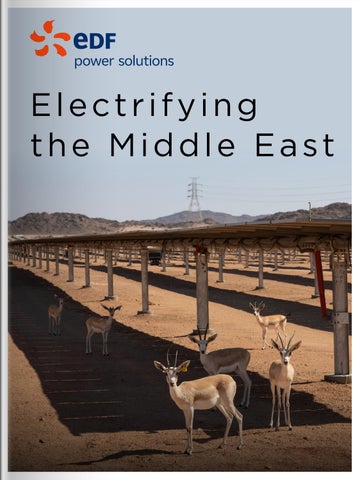
Electrifying the Middle East
EDF MIDDLE EAST ENERGY & UTILITIES
Electrifying the Middle East We explore how EDF Middle East is powering the region’s energy transition with CEO, Luc Koechlin, who discusses the company’s low-carbon projects and how it is addressing energy challenges such as grid stability Writer: Jack Salter | Project Manager: Seif Faour
A
leading energy supplier with one of the world’s largest decarbonised generation fleets, EDF has been present in the Middle East for more than three decades. Eight years ago, EDF Middle East began its investment journey in the region, winning its first project in Dubai with the 800-megawatt alternating current (MWac) DEWA III facility. This was the third phase of the Mohammed bin Rashid Al Maktoum Solar Park, which is one of the world’s most powerful solar projects. Since then, EDF Middle East has grown extremely fast to become the region’s leading foreign developer of low-carbon power, with an energy generation portfolio of around 17 gigawatts (GW). “What makes us very different to other developers in the region is that we operate across the value chain, from design and engineering to
operation,” opens Luc Koechlin, CEO of EDF Middle East. “We have the in-house ability to perform all these activities, so we have a long-term view when we invest.” Another significant differentiator is that EDF Middle East is active across technologies supporting the energy transition, including nuclear, solar photovoltaic (PV), wind, battery, and hydropower.
THE OMANI BOOM In the Middle East, three countries – the Kingdom of Saudi Arabia (KSA), the United Arab Emirates (UAE), and the Sultanate of Oman – are driving the energy market and its growth. “Oman in particular is currently booming, with a lot of new projects and tenders, and is moving fast compared to previous years,” Koechlin observes.
EDF Middle East’s first project in the country, Manah 1, was inaugurated in January 2025 and is Oman’s largest solar power plant. Manah 1 has a concentrated generating capacity of 500 MWac – enough to power over 60,000 Omani households – strengthening energy security and sustainability in the Sultanate. In August this year, the company reached financial close for the 120MW Jaalan Bani Bu Ali (JBB) Wind Independent Power Project (IPP), an important milestone towards the delivery of one of Oman’s largest onshore wind farms. “We’re also actively working on the development of a green ammonia project close to Salalah, the Al Kamil Solar PV IPP, and the Jabal Abyad Pumped Hydro Energy Storage (PHES) Project,” reveals Koechlin.
“Oman in particular is currently booming, with a lot of new projects and tenders, and is moving fast compared to previous years” – LU C KO E C H L I N , C E O, E D F M I D D L E E AST
EME Outlook Issue 74 | 3
EDF MIDDLE EAST ENERGY & UTILITIES
The latter is set to be the largest PHES project in the Middle East and will provide long-term energy storage capacity, playing a critical role in enhancing grid stability and enabling higher penetration of renewable energy sources across Oman. Beyond its contribution to the power sector, the Jabal Abyad PHES Project is expected to generate substantial in-country value through local procurement, job creation, and support for Oman’s construction industry and small to medium-sized enterprises (SMEs).
ADDRESSING GRID STABILITY Grid stability has become an increasing challenge for utilities such as EDF Middle East. To address this, the company is focused on four complementary areas, the first of which is developing more low-carbon generation. “We need more low-carbon generation, and this is the case all over the world. Solar, hydro, nuclear, renewables – all of these need to be further developed,” Koechlin acknowledges.
“To enable this, we need more transmission, so the second focus for us is to develop and support the development of large transmission lines, whether that’s submarine or inland, onshore or offshore. We have about 300 engineers in the region who specialise in transmission.” EDF Middle East is currently developing a first-of-its-kind subsea transmission system in the region for
EDF MIDDLE EAST’S CLEAN ENERGY ACTIVITIES • Nuclear energy • Renewables and hydropower • Thermal energy and carbon capture • Clean hydrogen • Transmission networks • Distribution networks • Energy services
the Abu Dhabi National Oil Company (ADNOC), which is expected to reduce the carbon footprint of ADNOC’s offshore operations by more than 30 percent. “We are very proud to be commissioning the project, which will be announced in the coming months,” he tells us. The third focus is to shift customer demand from carbon-intensive to low-carbon energy, i.e. electricity. Lastly, more storage is needed to ensure grid stability. EDF Middle East has three main ways of storing electricity – batteries, PHES, and distributed storage. “Batteries are the easiest way of storing electricity, and we can see that more and more tenders in the region are combining solar and batteries, so they are an important focus,” affirms Koechlin. “PHES can also be extremely useful and complement batteries; we’ve demonstrated this at the Hatta Pumped Storage Hydropower Station in the UAE, which has been in operation since July, and are pursuing several other opportunities in the region.
EDF MIDDLE EAST ENERGY & UTILITIES
“We need more low-carbon generation, and this is the case all over the world. Solar, hydro, nuclear, renewables – all of these need to be further developed” – LU C KO E C H L I N , C E O, E D F M I D D L E E AST
“When you have the right topography to build PHES, you need to do it; France and China are building a lot more,” he notes. There are also some interesting distributed storage technologies, such as distributed electric vehicle (EV) charging to store electricity. “That’s a domain which needs to be further explored and developed in the Middle East,” Koechlin sets out. EDF Middle East is very active in distributed energy activities through Emerge, its market-leading joint venture with Masdar, the UAE’s
state-owned renewable energy company. Evidently, energy storage is becoming just as important as energy generation. “Most of the generation developed now is intermittent, so if you want to supply the demand, you have to combine storage and low-carbon energy,” he emphasises.
is bright for EDF Middle East in the region. There are plenty of new projects, tenders, and opportunities for the company to further develop its portfolio and support partners towards the energy transition. “We have almost 200 people dedicated to project development, who are supported by a lot of engineering and technical personnel based in France. That is really the power and the engine of EDF – the skills and experience of our staff; they’re our main asset. We have the best teams, the landmark projects, and we take care of our people,” Koechlin highlights. “The health and safety of our people is our main priority, and we are very proud to have more than 65 million safe hours on our projects in the Middle East, which is an amazing figure and the result of a huge amount of work,” he concludes.
BRIGHT FUTURE Having grown its energy generation portfolio from 0 MW to 17 GWac over the past eight years, the future
alexandra.taleva@edf-power.com
www.uae.edf.com EME Outlook Issue 74 | 5
alexandra.taleva@edf-power.com
www.uae.edf.com
PRODUCED BY EME OUTLOOK MAGAZINE