MBA ENERGY & INDUSTRIAL
WWW.C ON S T RUC T I O N- OU TLO OK . COM • ISS U E 5
DIALOG FITZROY
OUTLOOK
STEFANUTTI STOCKS
The multidisciplinary construction group with a difference
ATEC FACADES Duratec’s newly established specialist arm
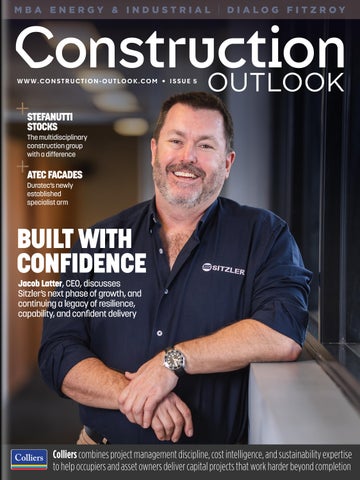
BUILT WITH CONFIDENCE Jacob Latter, CEO, discusses Sitzler’s next phase of growth, and continuing a legacy of resilience, capability, and confident delivery
Colliers combines project management discipline, cost intelligence, and sustainability expertise to help occupiers and asset owners deliver capital projects that work harder beyond completion
RICHGLEN MAINTENANCE SERVICES
T R I - STA R CO N ST R U C T I O N
B R I T I S H P O R T S A S S O C I AT I O N
NATIONAL COMMERCIAL BANK JAMAICA LIMITED
EQUINOX GOLD
TURNER MINING GROUP
HUNTER VALLEY OPERATIONS
L O S
A N G E L E S
G E N E R A L
End-to-end solutions from exploration to extraction
Issue 82
PNG POWER LTD
w w w. e m e o u t l o o k m a g . c o m
Issue 73
www. northame ricaoutlookmag.com
Creating lasting value through responsible mining
Stefanutti Stocks is reshaping Southern Africa’s construction landscape through multidisciplinary expertise, digital innovation, and sustainable infrastructure solutions
Issue 38
On a coal mining mission to champion sustainable practices
EATON Resilience, reliability, and efficiency
VULCAN MOZAMBIQUE
HUNTSVILLE UTILITIES
M Resources delivers a suite of essential steelmaking raw materials, infrastructure, and mining and logistics services to steelmakers across the globe. Matt Latimore, Founder and President, details the company’s futurefacing approach to investment and market growth
The trustworthy utility steward
Trusted partners in technical excellence and expertise
The banker, the one that couldn’t fail
Rita Apell Akot, CIO at Stanbic Bank Uganda, outlines an ambitious initiative to make banking technology more connected and interoperable across the continent
For Maersk Canada, the box is only the beginning; connected logistics, intelligent technology, and resilient networks are transforming complex journeys into seamless supply chains
GERMAN DATACENTER ASSOCIATION
AMP BANK
At the helm of Europe’s data centre future
Across Asia Pacific, Hitachi Energy’s focus is on the priorities utilities are wrestling with. Massimo Danieli, Executive Vice President and CEO – Grid Automation Business Unit, reveals more
MARTIN-BAKER AMERICA , INC . • CEMENTIS GROUP
Michael Hanisch, Head of Technology Germany, discusses Amazon Web Services’ significant cloud infrastructure investments
A M A Z O N B U S I N E S S • U N I L E V E R • G E P • O R I TA I N
COCA-COLA EUROPACIFIC PARTNERS PAPUA NEW GUINEA
On a mission to be a leading integrated green coal mining operation
Thermo Fisher Scientific has reinforced its position as a trusted biologics manufacturing partner
Jason Bontempo, CEO of Gladiator Metals, discusses the resurgence of the Whitehorse Copper Belt in Canada’s historic Yukon mining district
Satellites on Fire detects, alerts, and monitors fires from the earliest moments, as we learn from co-Founder and CEO, Franco Rodríguez Viau
MBA ENERGY & INDUSTRIAL
DIALOG FITZROY
NEBRASKA PUBLIC POWER DISTRICT
Crafting cuisine La Famiglia style
EMIRATES RAWABI
w w w. s u p p ly c h a i n - o u t l o o k . c o m
Issue 14
EUROPEAN SUBSEA CABLES ASSOCIATION
Uniting food and beverage production under one national banner www.foodbeverage-outl ook.com
Iss ue 1 0
Bringing humanoid robots to the factory floor and reshaping industrial automation
BRITISH PORTS ASSOCIATION
Our latest catch-up with the British Ports Association and CEO, Richard Ballantyne OBE, outlines the strong investment in decarbonisation and infrastructure across UK ports in recent years
Chris Pattinson, CEO, tells us how SAESL has become an indispensable component of the Singapore aerospace ecosystem, keeping airlines flying to connect the world
Steven Johnson, Managing Director, UKIE, Nordics, and Eastern Europe Network Operations, explains why operations leadership is critical Network Operations, explains why operations leadership is critical Steven Johnson, Managing Director, UKIE, Nordics, and Eastern Europe
of the Singapore aerospace ecosystem, keeping airlines flying to connect the world Chris Pattinson, CEO, tells us how SAESL has become an indispensable component
decarbonisation and infrastructure across UK ports in recent years Richard Ballantyne OBE, outlines the strong investment in Our latest catch-up with the British Ports Association and CEO,
and reshaping industrial automation Bringing humanoid robots to the factory floor
Traditional Automation and Virtual Worlds Humanoid: Bridging the Beyond Real
Group CEO, John Freeman, shifts the narrative to reflect on how the platform has evolved
Jacob Latter, CEO, discusses Sitzler’s next phase of growth, and continuing a legacy of resilience, capability, and confident delivery
Built for resilience
Traditional Automation
solutions optimized packaging More efficient,
Partnerships built on trust and thinking outside the box
Digital Edge DC
ATEC FACADES
RADIANT LOGISTICS
More efficient, optimized packaging solutions
UPRITE CONSTRUCTION www.sustainabilityoutlookmag.com • I s s u e 3
STEFANUTTI STOCKS
BUILT WITH CONFIDENCE
Delivering advanced medicines from Australia to the world
SHORR PACKAGING
Powering Nebraska’s future
OUTLOOK
Duratec’s newly established specialist arm
THERMO FISHER SCIENTIFIC
Bridging the Beyond Real Humanoid: and Virtual Worlds
W W W .CONST RUCT ION-OUT L OOK.COM • ISSUE 5
The multidisciplinary construction group with a difference
Connecting nations and driving innovation
Garry Edwards, VP EMEA at Wolters Kluwer, emphasises the need for formalised, organisation-wide frameworks to ensure responsible use of artificial intelligence
M E T R O P O L I TA N WAT E R D I S T R I C T O F S A LT L A K E & S A N DY
L’OSTERIA
ISSUE 11
www.mfg-outlook.com
ASSOCIATION BRITISH PORTS
Burgermeister was founded two decades ago in Berlin and has since grown into a globally renowned cult burger chain
Dan Vass, Head of Category and Commercial Strategy, explains how Danone is shaping the design and delivery of the Deposit Return Scheme in the UK is shaping the design and delivery of the Deposit Return Scheme in the UK Dan Vass, Head of Category and Commercial Strategy, explains how Danone
Colliers combines project management discipline, cost intelligence, and sustainability expertise to help occupiers and asset owners deliver capital projects that work harder beyond completion
We discuss the Shubh Mint programme and its impact on farming communities in India with Mars Snacking in The 1-2-1
to help occupiers and asset owners deliver capital projects that work harder beyond completion Colliers combines project management discipline, cost intelligence, and sustainability expertise
farming communities in India with Mars Snacking in The 1-2-1 We discuss the Shubh Mint programme and its impact on
cult burger chain grown into a globally renowned decades ago in Berlin and has since Burgermeister was founded two
PACKAGING SHORR
capability, and confident delivery continuing a legacy of resilience, Sitzler’s next phase of growth, and Jacob Latter, CEO, discusses
Built for resilience
CONFIDENCE BUILT WITH
LOGISTICS RADIANT Australia to the world medicines from Delivering advanced
TELL US YOUR STORY, AND WE’LL TELL THE WORLD
SCIENTIFIC FISHER THERMO
specialist arm established Duratec’s newly
Issue 14
ASSOCIATION SUBSEA CABLES EUROPEAN
w w w. s u p p ly c h a i n - o u t l o o k . c o m ISSUE 11
the platform has evolved the narrative to reflect on how Group CEO, John Freeman, shifts
ATEC FACADES
innovation nations and driving Connecting
www.mfg-outlook.com
www.foodbeverage-outl ook.com
Digital Edge DC
with a difference construction group The multidisciplinary
Iss ue 1 0
banner under one national beverage production Uniting food and
RAWABI EMIRATES
STOCKS STEFANUTTI
W W W .CONST RUCT ION-OUT L OOK.COM • ISSUE 5
OUTLOOK
COCA-COLA EUROPACIFIC PARTNERS PAPUA NEW GUINEA
and thinking outside the box Partnerships built on trust
CONSTRUCTION UPRITE DISTRICT PUBLIC POWER NEBRASKA
L’OSTERIA
A M A Z O N B U S I N E S S • U N I L E V E R • G E P • O R I TA I N
www.sustainabilityoutlookmag.com • I s s u e 3
future Powering Nebraska’s
La Famiglia style Crafting cuisine
MARTIN-BAKER AMERICA , INC . • CEMENTIS GROUP
Modernising and transforming health systems
ARGO NATURAL RESOURCES
L’Osteria is transforming Europe’s culinary landscape by focusing on creating a distinctive Italian dining destination where guests feel at home
DIALOG FITZROY
Five years of institutional reform
www.healthcare-outlook.com
www.mining-outlook.com • Issue 16
EMIRATES RAWABI Uniting food and beverage production under one national banner
Responsible for generating, transmitting, distributing, and retailing electricity in Papua New Guinea
GALIANO GOLD
EASTERN CAPE DEPARTMENT OF HEALTH
w w w. a p a c o u t l o o k m a g . c o m
Issue 122
STEFANUTTI STOCKS
Meeting the dynamic demands of the Ghanaian mining industry
C E N T E R
ST. JOSEPH’S HEALTH SYSTEM
Elevating the patient experience
DIGITAL HEALTH ASSOCIATION
w w w. a f r i c a o u t l o o k m a g . c o m
PAMICOR LIMITED
M E D I C A L Issue 15
WEIR
MBA ENERGY & INDUSTRIAL
DIALOG FITZROY
M E T R O P O L I TA N WAT E R D I S T R I C T O F S A LT L A K E & S A N DY
Africa Outlook, APAC Outlook, EME Outlook, North America Outlook, Mining Outlook, Healthcare Outlook, Manufacturing Outlook, Supply Chain Outlook, Food & Beverage Outlook, Construction Outlook, and Sustainability Outlook are digital publications aimed at boardroom and hands-on decision-makers, reaching an audience of more than 800,000 people around the world. With original and exclusive content compiled by our experienced editorial team, we look to promote the latest in engaging news, industry trends, and success stories from across the globe. Your company can join the leading industry heavyweights enjoying the free exposure we provide across our platforms with a free marketing brochure, extensive social media saturation, enhanced B2B networking opportunities, and a readymade forum to attract new investment and help you grow your business. Visit www.outpb.com/work-with-us for details on how your company can feature for free in one of our upcoming editions.
www.outpb.com/work-with-us
WELCOME FROM THE EDITOR
EDITORIAL Head of Editorial: Jack Salter jack.salter@outpb.com Deputy Head of Editorial: Lucy Pilgrim lucy.pilgrim@outpb.com Senior Editor: Lily Sawyer lily.sawyer@outpb.com Editor: Ed Budds ed.budds@outpb.com Editor: Rachel Carr rachel.carr@outpb.com Copy Editor: Lauren Kania lauren.kania@outpb.com PRODUCTION Art Director: Stephen Giles steve.giles@outpb.com Senior Designer: Devon Collins devon.collins@outpb.com Designer: Louisa Martin louisa.martin@outpb.com Production Manager: Alex James alex.james@outpb.com Digital Marketing Director: Fox Tucker fox.tucker@outpb.com Senior Website Content Manager: Oliver Shrouder oliver.shrouder@outpb.com Social Media Executive: Jake Crickmore jake.crickmore@outpb.com Digital Content Executive: Tara Steele tara.steele@outpb.com BUSINESS CEO: Ben Weaver ben.weaver@outpb.com Managing Director: James Mitchell james.mitchell@outpb.com Chief Technology Officer: Nick Norris nick.norris@outpb.com Content Director: Neil Perry neil.perry@outpb.com
HIGH-PROFILE INFRASTRUCTURE Welcome to our fifth edition of Construction Outlook magazine. This year marks Sitzler’s 50th anniversary of delivering high-profile infrastructure across Australia. Having started from humble beginnings, our cover star has found continuous success through upholding the highest standards of execution and reliable delivery of quality, sustainable, and safe outcomes. One of the most significant recent milestones in its journey has been the appointment of Jacob Latter – the face of this issue – as CEO. “Especially in construction, 50 years is an impressive feat and one that we’re incredibly proud of. We’re in great shape, with a healthy pipeline and legacy we are committed to building on through thoughtful, innovative changes that position the company for the future,” Latter insights. Drawing on more than 80 years of combined construction heritage, Stefanutti Stocks brings together a broad range of 12 specialist construction disciplines to provide world-class services to clients across diverse markets. This multidisciplinary expertise has cemented its position at the forefront of the construction industry in South Africa, offering end-to-end capabilities with a transparent delivery model. “Our multidisciplinary model brings the key construction interfaces together under one accountable delivery structure,” states Russell Crawford, CEO.
Global Head of Media: Lewis Hammond lewis.hammond@outpb.com
Since we spoke to MBA Energy & Industrial (MBA) in September last year,
Global Media Executive: Kai Boyle-Vennard kai@outpb.com
the industrial construction services provider has continued to expand and strengthen its footprint, recently completing its largest facility to date.
A D M I N I S T R AT I O N Finance Director: Suzanne Welsh suzanne.welsh@outpb.com Finance Manager: Victoria McAllister victoria.mcallister@outpb.com C O N TA C T
At roughly 800,000 square feet, it is a testament to the company’s vast capabilities and project management skills. “When one of our biggest clients needed a mission-critical data center not only designed but constructed with almost unrealistic speed without sacrificing
Construction Outlook Norvic House, 29-33 Chapelfield Road Norwich, NR2 1RP, United Kingdom Sales: +44 (0) 1603 804 445 Editorial: +44 (0) 1603 804 431
quality and safety, they turned to MBA to be the architect and get the all-
SUBSCRIPTIONS
We also showcase the vast capabilities of Atec Facades, DIALOG Fitzroy,
Tel: +44 (0) 1603 804 431 jack.salter@outpb.com www.construction-outlook.com Follow us on Linkedin: @constructionoutlook
important shell and grey space constructed,” outlines Phil Garner, Vice President of Business Development. De Simone Côte d’Ivoire, and more elsewhere in his issue. We hope that you enjoy your read. Jack Salter Head of Editorial, Outlook Publishing Construction Outlook Issue 5 | 3
CONSTRUCTION OUTLOOK CONTENTS
CON ST R U C T I ON I N S I G H TS
12 Colliers
05
CONTENTS REGULARS
TH E 1 -2-1
7 Nigel Thomas National Projects and Specification Manager, ABB Electrification
Closing Construction’s Compliance Gap
Delivering Purpose-Driven Projects Across Asia Pacific Stronger workplace outcomes
T HE D I SR U P TOR
17 Paebbl No Stone Left Unturned From captured carbon dioxide to carbon-negative building material
23
How the industry can close its awareness gap
TH E TH O U G H T L E A DE R
23 Chris Newman Head of Industry and Market Intelligence, Mitsubishi Electric Living Environmental Systems UK
7
4 | Construction Outlook Issue 5
Now is the Time to Consider Commercial Buildings
17
How to future-proof commercial buildings through decarbonisation
CONSTRUCTION OUTLOOK CONTENTS
FEATURES
80 Locus Property Growth by Design Communities built to last
ASIA PACIFIC
28 Sitzler Built with Confidence Precision in construction, confidence in delivery
AFRICA
88 Stefanutti Stocks Re-Engineering Africa’s Built Environment The multidisciplinary construction group with a difference
156 N O R TH A ME R I C A
156 MBA Energy & Industrial Unparalleled Service, Regardless of Scope Delivering construction with integrity and expertise
166 Gaston Electrical 88
46 Atec Facades Custom Design and Functional Façades Duratec’s newly established specialist arm
Engineering Ongoing Electrical Evolution New England’s trusted speciality contractor
120 De Simone Côte d’Ivoire Turning Innovative Solutions into Reality Landmark projects changing the skyline
130 Cementis Group Cementing a Sustainable Future Building the infrastructure of tomorrow
166 46
174 Uprite Construction Relationship-Driven Success Partnerships built on trust and thinking outside the box
56 DIALOG Fitzroy A Journey from Local Roots to International Impact Trusted partners in technical excellence and expertise
130
140 Tri-Star Construction Star of the Show
E U R O P E & MI DD L E E AST
184 ATI Project A Better Reality People and the environment at the centre of architecture and design
Tri-umphant construction across South Africa
148 Raubex Building 56
Better Ways to Build Innovation and excellence in every project
64 KDL Property Group Redefining Queensland’s Property Development Landscape
184
Strategic land development, construction expertise, and innovative housing models
192 APK Group
72 Cushman & Wakefield From Design to Delivery More than traditional project management
148
Creating the Cities of Tomorrow Next-generation smart cities
Construction Outlook Issue 5 | 5
SUBSCRIBE NOW TO THE DIGITAL MAGAZINE
As organisations worldwide confront unprecedented change, embracing technological innovations and incorporating critical environmental sustainability agendas, now more than ever is the time to showcase the strides being taken in the construction sector. A multi-channel brand, Construction Outlook brings you the positive developments driven by organisations across the global construction industry through its various platforms. Discover exclusive content distributed through its website, online magazine, social media campaigns and digital dispatches, delivered straight to your inbox with a bi-weekly newsletter. Through these compelling media channels, Construction Outlook will continue to foreground the movers and shakers of the industry. To participate as a featured company and join us in this exciting endeavour, contact one of our Project Managers today.
www.construction-outlook.com/work-with-us
THE
1-2-1 AN IN-DEP TH INTERVIEW WITH
NIGEL THOMAS, NATIONAL SPECIFICATION AND PROJECTS SALES MANAGER AT ABB ELECTRIFICATION
A product being on the market does not automatically mean it is compliant”
Construction safety and compliance standards evolve worldwide
Closing Construction’s Compliance Gap As construction safety and compliance standards evolve worldwide, Nigel Thomas, National Specification and Projects Sales Manager at ABB Electrification, discusses how the industry can close its awareness gap Writer: Neil Perry
Construction Outlook (CO): Firstly, as safety standards evolve worldwide, where is construction struggling to keep pace? Nigel Thomas, National Projects and Specification Manager (NT): Safety standards are often lost somewhere between the commitment to installing to specification and actually proving it has been done. We’ve seen the consequences of this play out in real life. Regulators worldwide are moving towards traceable, evidence-based accountability, where safety must be designed in and documented from concept to handover. This is often accompanied by strict deadlines and digital systems that must be updated continuously. Despite this, many firms still treat compliance as endof-project paperwork. That attitude must change. The UK is a useful example. I encouraged one of my customers to ask their supply chain for third-party test certificates to assess preparedness for recent updates to the Building Safety Act (BSA). Only two out of 10 understood what was being requested. Despite the BSA raising the bar from ‘installed to specification’ to ‘proven to be competent, coordinated, and compliant’, many businesses have yet to become fully proactive about safety certification throughout their supply chains.
8 | Construction Outlook Issue 5
CO: What is driving the gap between changing regulations and industry awareness? NT: Industry professionals who have seen many regulatory updates may assume this is simply another change to add to the pile. Previous changes have largely involved adjustments to technical guidance rather than regulatory reform. The basic obligation to build in accordance with building regulations has not changed since 2010. What has changed is the scrutiny, accountability, and consequences. Too often, responsibility is pushed elsewhere, whether to the client, manufacturer, or duty holder. This highlights the knowledge gap further. The fact is that everyone involved in a construction project, from architects to on-site workers, has responsibilities relating to safety and compliance. CO: How can businesses prove compliance rather than simply claim it? NT: When sourcing materials or technologies for a project, the onus is on you to request independent evidence. A product being on the market does not automatically mean it is compliant. Manufacturers have misled the market before.
THE 1-2-1 NIGEL THOMAS
Specifiers and designers share responsibility for their choices, so they should request third-party test certificates against relevant standards. If a manufacturer cannot provide one, that should raise concerns. Records matter just as much. Evidence of how work was designed, procured, installed, tested, changed, and handed over must be created as it happens, not assembled at completion. Competence needs the same treatment. The regulator expects it to be demonstrated, and appointments without supporting evidence are a recurring reason applications fail. CO: What were the key takeaways from your industry compliance events? NT: Our July panel on the BSA included experts from the Chartered Institution of Building Services Engineers (CIBSE) Fire Safety Group, Skanska, and the Building Controls Industry Association (BCIA). Everyone agreed that the changes themselves are not particularly complex, but poor awareness remains a major issue. As such, compliance must now run alongside project delivery rather than sit at the end of it.
A product being on the market does not automatically mean it is compliant”
That means allowing more time for design reviews, competence checks, and engagement with the regulator, with budgets that reflect the work involved. Supply chain partners need to demonstrate their skills, knowledge, experience, and behaviours (SKEB) at the tender stage – not after appointment. CO: Which forthcoming compliance requirements most need explaining? NT: The Building Safety Regulator became a standalone body in England in January 2026, with the amendment regulations made in March 2026. Main compliance requirements apply from 24th March 2027, with higher-risk building provisions following on 24th September 2027.
Construction Outlook Issue 5 | 9
Three areas need particular attention: • Gateway 2 – This is a hard stop before construction. Work cannot begin without Building Safety Regulator approval. For a submission, the design effectively needs to reach Royal Institute of British Architects (RIBA) Stage 4, including contractordesigned portions. Project programmes and fees must reflect this, whilst late changes during construction can trigger redesign or approval delays. • The Golden Thread – The digital evidence trail must be developed throughout project delivery. It cannot be reconstructed afterwards. • Building Safety Levy – This has applied to major residential schemes since 1st October 2026. Developers of homes for market sale should now be factoring it into project financials.
WHAT CONSTRUCTION LEADERS WORLDWIDE CAN LEARN FROM THE UK’S EXPERIENCE • Responsibility extends throughout the supply chain – Subcontractors and suppliers are also expected to demonstrate competence. • Enforcement has serious consequences – In the UK, penalties can include unlimited fines and up to 15 years’ imprisonment for gross negligence. Operation Northleigh – the investigation into the Grenfell Tower tragedy – has examined the actions of 15,000 people across 700 organisations. • Early design maturity and digital records improve delivery – Fewer late surprises mean fewer delays, alongside stronger compliance. • Awareness requires deliberate effort – Don’t assume the wider market has caught up with regulatory changes.
10 | Construction Outlook Issue 5
Many firms still treat compliance as end-ofproject paperwork. That attitude must change”
CO: Why should manufacturers such as ABB lead industry education in this area? NT: Because we see the gaps first-hand, and many manufacturers have a responsibility to do better. The Grenfell Tower tragedy involved misleading product claims, and the testing and certification weaknesses that allowed them have been widely criticised. Manufacturers should be transparent about what their products can and cannot do, backed by independent evidence. Education is part of earning trust. That’s why ABB works closely with customers and strives to ensure its product safety certifications are comprehensive. We won’t put something on the market before those certifications are in order. CO: What expertise can ABB bring, and where do partnerships make a difference? NT: ABB brings product and standards knowledge, particularly around the electrical systems that support building safety. Automatic transfer switches (ATS) are a good example because they maintain power to critical systems when the main supply fails. In the UK, an ATS serving life safety loads should comply with BS 8519:2020 and BS EN 60947-6-1. It should use switch technology rather than circuit breakers or contactors and comprise a single component with an integrated controller from the same manufacturer. Therefore, specifiers should ask these questions and request supporting test certificates. Partnerships provide expertise we cannot offer alone. Contractors such as Skanska understand how requirements translate into practice on-site, whilst organisations such as CIBSE and the BCIA contribute fire safety and building systems expertise. Together, we can turn guidance into practice.
THE 1-2-1 NIGEL THOMAS
ABOUT NIGEL THOMAS Nigel Thomas is National Specification and Projects Sales Manager at ABB Electrification. He has spent 18 years working across specification and sales for the company’s UK infrastructure, building services, and data centre projects. Thomas’ background includes building management and energy systems, lighting solutions, and medium- and low-voltage switchgear. His work focuses on the specification of adaptive, people-centric smart buildings and technologies supporting net zero objectives.
If an ATS fails, emergency lighting, firefighting lifts, fire detection, and smoke extraction systems may not function when they are needed most. Following the Grenfell Tower tragedy, reports found that emergency lighting had not been properly maintained or tested, leaving some escape routes unlit. CO: Finally, what should businesses do now to stay ahead of changing standards? NT: It’s not just about the consequences of noncompliance. Getting these things right today puts businesses in a stronger position tomorrow, helping them deliver better projects, build trust, and establish stronger industry partnerships. • Build continuous digital records of decisions and designs from day one. Failing to do so could create problems later. • Question your supply chain partners and don’t assume they are compliant. Third-party testing and certification should be standard requirements. • Strengthen procurement processes by including compliance clauses in tenders and contracts and refuse to work with suppliers unable to demonstrate product safety. • Take a broader view of safety – fire, structural, environmental, and electrical safety must all be considered when assessing supply chain partners.
CO: How can project partners turn compliance knowledge into safer on-site decisions? NT: Understanding compliance is fundamental. Whether you’re designing, building, managing, or installing electrical equipment, the safety of future occupants must remain a priority. Clarify responsibility for each design package early and verify competence through respected third parties rather than taking it on trust. Procurement is where many projects encounter problems. Don’t purchase mechanical, electrical, and plumbing (MEP) packages on price alone and request evidence afterwards. Include evidence requirements in tenders and contracts and treat late substitutions and on-site changes as safety decisions requiring approval, not simply procurement matters. It’s also important to remember that electrical systems are integral to fire safety.
• Plan MEP systems early. The consequences of noncompliance can be significant, so identify suitable solutions at the design stage and ensure they are installed as specified.
ABOUT ABB ELECTRIFICATION ABB Electrification is a division of global technology company ABB, providing electrical distribution, control, and energy management solutions. Its work supports the management and distribution of electricity across buildings, infrastructure, and industrial operations, with a focus on operational efficiency, productivity, and sustainability.
Construction Outlook Issue 5 | 11
COLLIERS CONSTRUCTION INSIGHTS
PHOTOGRAPHY © COLLIERS
12 | Construction Outlook Issue 5
Delivering PurposeDriven Projects Across Asia Pacific Colliers combines project management discipline, cost intelligence, and sustainability expertise to help occupiers and asset owners deliver capital projects that work harder beyond completion. We speak to Bastiaan van Beijsterveldt, Managing Director, and Wing Yan Chang, Head of Project Management for Colliers Singapore WRITER: LUCY PILGRIM
A
cross Asia Pacific (APAC), project delivery increasingly requires a broader view of real estate. Decisions made at the planning stage can influence everything from cost exposure and operational continuity to workplace performance and long-term asset value. For Colliers, this means bringing project management closer to the way clients make business decisions, rather than treating delivery as a standalone process. Whilst many real estate firms are structured around individual transactions, Colliers’ project management practice is built around long-term client partnerships. By understanding each client’s operating
model, portfolio priorities, and internal processes, the team can tailor advice, anticipate delivery challenges, and provide the level of professional guidance needed to support decisions well beyond a single project.
PROJECT DELIVERY WITH PURPOSE Colliers’ Project Management team delivers more than programme oversight. Its professionally qualified project managers support clients through fully integrated project management and advisory. The focus is practical: protect budget, manage risk, keep stakeholders aligned, and deliver spaces that are ready to perform from day one. Instead of applying a fixed delivery
Construction Outlook Issue 5 | 13
COLLIERS CONSTRUCTION INSIGHTS
model, the team adapts its role to the assignment, from full project management to targeted advisory support. Technology-enabled tools provide structure, whilst local judgment and close client coordination help keep projects moving through each stage. Rather than imposing a separate operating model, Colliers works within each client’s existing governance
framework and functions as an extension of their in-house team. “Our approach is grounded in data, guided by expertise, and driven by purpose. Every decision we support is calibrated to our clients’ strategic goals, enabling smarter, more resilient outcomes that are not only effective today but adaptive for tomorrow,” says Wing Yan Chang, Head of Project Management at Colliers Singapore.
HOW DO COLLIERS’ PROJECT MANAGEMENT EXPERTS MEET THE UNIQUE NEEDS OF EACH CLIENT? Wing Yan Chang, Head of Project Management: “Every client’s needs are unique, so there is no one-size-fits-all approach. Our role is to understand what matters most to their business and provide advice that reflects their specific goals, challenges, and opportunities. “What helps us do that is the combination of our people, market knowledge, and data. We draw on deep local expertise across APAC, supported by proprietary insights and advanced analytics that enable us to forecast trends, assess potential risks and opportunities, and deliver advice that enables clients to stay ahead of the market. “Our partnership with Google Cloud further strengthens those capabilities, giving our experts access to world-leading artificial intelligence (AI) and data-driven insights. Whilst technology is at the forefront, it is only part of the equation; the real value comes from combining those insights with the experience and networks of our people. “Ultimately, clients choose Colliers because they want advice that is informed and unique to their needs. That’s where we believe we make the greatest impact.”
“Our approach is grounded in data, guided by expertise, and driven by purpose. Every decision we support is calibrated to our clients’ strategic goals, enabling smarter, more resilient outcomes that are not only effective today but adaptive for tomorrow”
14 | Construction Outlook Issue 5
PHOTOGRAPHY © COLLIERS
From Singapore, the Project Management team now supports work across Malaysia, Taiwan, and India, with experience spanning corporate workplaces, industrial facilities, chemical plants, and data centres. Under Chang’s leadership, the team has built its regional reach around technical rigour, transparent delivery, and close client alignment. This way of working is reflected in repeat appointments from organisations including Arrow Electronics, QBE Insurance, and Digital Realty, where Colliers has supported clients across markets, sectors, and project types whilst maintaining consistent delivery controls. The team’s recent work with Murex, a global leader in capital markets technology, offered a different but equally complex brief. After
COLLIERS CONSTRUCTION INSIGHTS
PHOTOGRAPHY © COLLIERS
12 years in its previous premises, the company engaged Colliers to support its relocation to a new APAC headquarters, with the project requiring careful coordination across programme, workplace experience, business continuity, and sustainability considerations.
THE COST IMPERATIVE IN CAPITAL PROJECTS In 2026, cost performance has become one of the clearest tests of capital project leadership. For corporate occupiers managing portfolios, success depends on more than keeping spend inside an
approved budget. It requires delivery models that give leadership visibility across markets whilst allowing project teams to respond to local conditions, procurement realities, and operational constraints. Colliers applies that discipline from early planning through to closeout, examining each stage through cost optimisation, operational resilience, and measurable value. AI is playing a transformative role in how teams optimise scheduling, leverage AI-driven insights, and make faster decisions, but for Colliers the value comes from combining those tools with experienced project judgment and market-specific knowledge.
BUILDING LONG-TERM VALUE Colliers believes project delivery is one part of a broader value equation. A project that opens on Construction Outlook Issue 5 | 15
COLLIERS CONSTRUCTION INSIGHTS
time but does not support its people, manage operating risk, or advance sustainability commitments has only delivered part of the brief. Clients are increasingly measuring success by how well a completed space performs after handover. Colliers’ sustainability strategy, Built to Last, gives that work a clear framework: helping clients manage decarbonisation and climate resilience, creating workplaces and communities where people can thrive, and upholding strong standards of ethics, transparency, and accountability. “As sustainability expectations become more performance-driven, our focus is on delivering outcomes that fortify, de-risk, and create lasting
PHOTOGRAPHY © COLLIERS
value within our own operations and our clients,” says Bastiaan van Beijsterveldt, Managing Director of Colliers Singapore.
HELPING CLIENTS STAY AHEAD Colliers combines local expertise with the strength of a global platform, enabling its professionals to make informed decisions and deliver value for clients. Backed by market-leading research, technology and a culture of collaboration, teams are well positioned to identify opportunities, navigate change, and help clients stay ahead in an evolving market. “By investing in our people, research, and technology, we’re able to bring together expertise from across our business to solve complex challenges and create value for clients,” Beijsterveldt outlines.
“As sustainability expectations become more performance-driven, our focus is on delivering outcomes that fortify, de-risk, and create lasting value within our own operations and our clients”
Colliers’ 2025 Global Sustainability Report shows how that framework is being put into practice, with progress across emissions intensity, renewable electricity, workplace experience, governance, and the responsible adoption of AI. In APAC, Colliers achieved a 41.3 percent reduction in Scope 1 and 2 emissions intensity compared to five years earlier, alongside a 9.26 percent year-on-year improvement. It also sourced 36 percent of electricity for its APAC portfolio from renewable energy and recorded more than 7,260 volunteer hours across the region. “We are proud of the progress our professionals in Singapore and across APAC are making and the way Built to Last is sharpening how we deliver impact for our clients, people, and communities. It reflects where we are today and the practical action needed to keep creating value over the long term,” Beijsterveldt concludes. PHOTOGRAPHY © COLLIERS
Bastiaan van Beijsterveldt, Managing Director, Colliers Singapore
colliers.com 16 | Construction Outlook Issue 5
N EW PERSPECT I V ES O N T H E FUT UR E O F B U SI NESS
NO STONE LEFT UNTURNED
FACT FILE BUSINESS NAME: PAEBBL YEAR FOUNDED:
2021
LOCATION:
Stockholm, Sweden; Rotterdam, Netherlands
KEY PRODUCTS:
Paebbl Rebond 300
From captured carbon dioxide to carbon-negative building material
NO STONE LEFT
UNTURNED Ana Luisa Vaz, VP Products at Paebbl, explains how the revolutionary company is turning captured carbon dioxide into a permanent, carbonnegative building material Writer: Lily Sawyer
Construction Outlook (CO): Firstly, why does Paebbl believe decarbonising cement and concrete has become one of the construction industry’s biggest priorities, and what role can innovative materials play in accelerating this transition?
Slag, fly ash, calcined clays, and now carbon-storing SCMs all contribute to creating a more resilient built environment, although slag and fly ash supply will decrease over the next decades as the coal and steel industries decarbonise.
Ana Luisa Vaz, VP Products (AV): Cement production alone accounts for around eight percent of global carbon emissions, and concrete is the most widely used human-made material on Earth. Unlike many other sectors, construction cannot simply reduce its output to reduce its footprint: the world’s building stock is expected to double by 2060. Given that trajectory, the only viable route forwards is to change what the industry builds with by accelerating the innovation already taking place within it. What has shifted in recent years is that the case for innovation no longer rests on solely environmental grounds. Cement is, by design, a highly energy-intensive product, making it uniquely vulnerable to global disruption. Recent geopolitical tension has demonstrated this repeatedly, with supply chain shocks and energy price volatility landing directly on producers’ and contractors’ balance sheets, and those costs tend to stay elevated long after the immediate disruption has passed. Supplementary cementitious materials (SCMs) address both problems at once. They cut embodied carbon and give the industry the ability to flex across different feedstocks depending on regional and commercial viability.
CO: You recently launched Paebbl Rebond 300. Can you tell us about the product, the challenges it was designed to solve, and why it represents such an important milestone for the company?
18 | Construction Outlook Issue 5
AV: Paebbl Rebond 300 (Rebond 300) is the newest product in our Rebond series of carbon-negative SCMs. Like its predecessor, the Paebbl Rebond 200, it uses captured carbon dioxide (CO2) as a raw material, converting it into a mineral that becomes part of the concrete itself. Rebond 300 requires no changes to a producer’s equipment or production infrastructure, functioning as a drop-in replacement within existing ready-mix and precast workflows (up to 30 percent of cement in concrete mixes). However, three advances make this generation a genuine milestone rather than just an incremental step. The first is carbon performance – Rebond 300 has seen a significant improvement on our secondgeneration material. A tenfold improvement in carbon efficiency, it has a verified carbon footprint of -149 kilograms (kg) of CO2 equivalent per tonne across its full lifecycle, including raw materials, transport, and manufacturing. The second is aesthetics – Rebond 300 has a
THE DISRUPTOR PAEBBL
near-white appearance, whereas most SCMs are grey or dark in appearance. Architectural and design work demands concrete that looks the part as much as it performs, so this development finally brings the material within reach of that standard. The third is carbon efficiency. Rebond 300 cuts embodied carbon by up to 40 percent, further reducing the carbon footprint of the built environment Together, these three advances mean Rebond 300 isn’t an iteration on other construction materials; it’s a new category entirely, one that uses CO2 as a raw material input rather than a problem to be dealt with afterwards. Every structure built with the material becomes a permanent carbon store, contributing to Scope 3 targets through the physical chemistry of the material itself, not through accounting adjustments made after the fact.
The bridge project delivered with Heijmans in the Netherlands tested structural viability and, to bring the project to life, we gathered a consortium of pioneers. Along with Heijmans, who provided the project leadership and construction expertise, we also worked with HCM Cement, who supplied the optimised cement formulation; Van der Kamp B.V., who managed concrete production; CarStorCon® Technologies, who contributed biochar integration; and Urban Mine, who provided recycled aggregates. As a consortium, we set a new standard for circular, carbon-neutral structural concrete in the Netherlands.
CO: Paebbl has achieved several significant milestones over the past year, from delivering the world’s first carbon-neutral bridge to commercial floor slab trials in Germany. How do these projects demonstrate the realworld potential of your technology? AV: Each of our projects demonstrates the material’s strength through different applications; together, they build a fuller picture of what this technology can do in real conditions.
Construction Outlook Issue 5 | 19
Much of the enthusiasm for emerging low-carbon binders has, until now, been channelled into decorative or non-structural applications, where the consequences of underperformance are limited. A pedestrian bridge carries no such tolerance. The material replaced 30 percent of the Portland cement within a mix containing 75 percent circular raw materials, the highest substitution rate achieved in any structural application at that point, and the concrete met its structural requirements in full. The commercial floor slab trials delivered in Germany with Holcim and Goldbeck tested something different – whether the material could pass through a standard industrial value chain unchanged, with the results confirming that it could. Paebbl supplied the carbon-storing SCM, Holcim’s plant integrated it into a standard ready-mix design, and Goldbeck managed placement using conventional methods. Workability, setting time, and finishing behaviour were confirmed equivalent to the reference, whilst meeting the full C30/37 strength specification with no change to construction timelines. From initial concept to completed pour, it all took less than six months. We’ve completed around 20 customer projects to
20 | Construction Outlook Issue 5
date. They confirm our materials perform according to industry standards and across a wide range of applications through the industry’s existing infrastructure, without requiring anyone to change how they work. CO: Partnerships have played a key role in Paebbl’s progress, including collaborations with major construction companies such as Holcim, Heijmans, Goldbeck, and Hakkers. How important have these relationships been? AV: Paebbl’s collaborations with major stakeholders in the construction sector have opened up different corners of the industry we couldn’t have reached alone. With Heijmans, the project was structural: a loadbearing bridge, built to test whether the material meets the strength requirements needed for the application. With Holcim and Goldbeck, it was standard commercial production – proof the material could move from batching plant to job site without disrupting an existing value chain. With Hakkers, it was maritime infrastructure, a demanding environment few low-carbon materials have entered.
THE DISRUPTOR PAEBBL
Most recently, with AGILIS, a subsidiary of the NGE Group, our partnership enabled the integration of our material into slipform concrete: a stiff, dense mix historically resistant to modification, extending our reach into one of the hardest applications in the industry to decarbonise. Our work with Amazon Web Services (AWS) represents a different kind of milestone. Serving as one of our first commercial collaborators, AWS used Paebbl’s materials to build the world’s first carbonstoring data centre in Spain. With the accelerated buildout of data centres pushing a historically slow-moving industry towards faster change, the project represented a significant opportunity for the construction industry as a whole. Hyperscalers are a driving force of the new building ‘supercycle’ and need materials that offset embodied carbon emissions without slowing construction down. Materials like Rebond 300 speed that process up by requiring no changes to a producer’s existing equipment or workflow, showing lower-carbon construction materials can be used at scale without adding a single day to its build schedule. Beyond the data centre project itself, the ongoing relationship with AWS has allowed us to continually refine our operations. Through AWS’s cloud infrastructure and artificial intelligence (AI) tools, Paebbl can pull data from every reactor and piece of lab equipment into one place for rapid analysis, allowing us to save time on work that would traditionally take a large team the best part of a year to complete. CO: How is Paebbl helping the construction sector reduce embodied carbon without compromising performance, and what impact are you seeing from early deployments? AV: Performance is treated as a prerequisite in our product roadmap. Any material that reduces carbon but fails to match the strength, workability, or durability standards a project requires will not be adopted – regardless of how strong its carbon-storing case appears, and the industry is right to hold that line. Rebond 300 is designed with this in mind as it integrates into formulations that producers already use, rather than requiring them to adopt new processes or equipment. The clearest evidence of its impact so far comes from demand; requests for the material currently far outstrip what Paebbl can produce.
“TOGETHER, THESE THREE ADVANCES MEAN REBOND 300 ISN’T AN ITERATION ON OTHER CONSTRUCTION MATERIALS; IT’S A NEW CATEGORY ENTIRELY, ONE THAT USES CO2 AS A RAW MATERIAL INPUT RATHER THAN A PROBLEM TO BE DEALT WITH AFTERWARDS”
Construction Outlook Issue 5 | 21
This gap points to a supply constraint rather than any hesitation about the technology. Demand for the material already exceeds what current production capacity allows, and closing that gap – rather than convincing the market – is now the primary challenge. CO: Finally, what does the future hold for Paebbl, and how do you see your technology evolving as demand grows for lower-carbon construction materials and more sustainable infrastructure projects? AV: We grew production capacity hundredfold within our first 18 months of operations, bolstered in part by the data and AI tools we use through our partnership with AWS. Looking ahead, Paebbl is focused on building on this scale and achieving price parity. Our aim is to close the cost gap between our product and conventional cement within the next 10 years, following a trajectory similar to renewable energy’s own path to cost leadership. However, this progress will be tightly coupled with maintenance and further improvement of the technical performance. From the AWS data centre in Spain to the bridge in the Netherlands, each deployment has been a test of our technical performance – and that discipline will not change as we scale. The good news is that scaling won’t have to happen against the grain of the market as demand is building from three colliding forces.
22 | Construction Outlook Issue 5
“PAEBBL’S COLLABORATIONS WITH MAJOR STAKEHOLDERS IN THE CONSTRUCTION SECTOR HAVE OPENED UP DIFFERENT CORNERS OF THE INDUSTRY WE COULDN’T HAVE REACHED ALONE”
The first is the data centre buildout: hyperscalers have a direct incentive to build with high-performance materials that require less energy to produce, since efficiency gained in construction becomes capacity freed up elsewhere. Our work with AWS has already shown this dynamic in practice. Second is rising resilient infrastructure spending, which increasingly includes concrete infrastructure such as breakwaters and military installations, and new sustainability requirements attached to that spending are pushing demand towards lower-carbon materials. The third is the EU’s carbon border adjustment mechanism, which is gradually eroding the price advantage cheap, high-carbon imported materials have historically held in European markets. Together, these forces are accelerating demand for exactly the kind of sovereign material we’re building.
www.paebbl.com
THE
THOUGHT LEADER Now is the Time to Consider Commercial Buildings Chris Newman Head of Industry and Market Intelligence at Mitsubishi Electric Living Environmental Systems UK
How to future-proof commercial buildings through decarbonisation
Now is the Time to Consider Commercial Buildings Chris Newman, Head of Industry and Market Intelligence at Mitsubishi Electric Living Environmental Systems UK, explores how heat pumps and building retrofits can accelerate commercial decarbonisation and future-proof the UK’s built environment Writer: Lily Sawyer PHOTOGRAPHY ©ROBERTO CAUCINO
24 | Construction Outlook Issue 5
THE THOUGHT LEADER CHRIS NEWMAN
example, the Warm Homes Plan provides funding for homeowners to invest in heat pumps and other renewable alternatives – but to date largely excludes commercial buildings. The sector ultimately needs firmer direction to incentivise businesses to act now.
FUTURE-PROOFING BUILDINGS Whilst progress still needs to be made, there are some regulatory standards in place which are supporting change in the commercial sector – and it’s important businesses are compliant. For example, the Future Homes and Buildings Standards are expected to raise the bar on operational emissions, whilst the Minimum Energy Efficiency Standards will tighten for existing buildings.
About Mitsubishi Electric Living Environmental Systems UK
T
he Seventh Carbon Budget, which has now been passed into UK law, proposes a legally binding target to cap the total emissions the nation can produce. Initiatives such as the Warm Homes Plan are also driving significant progress in decarbonising housing stock and helping to future-proof the built environment. Yet the commercial sector – including our schools, offices, and shops – risks being left behind. There are currently around 2.1 million non-domestic buildings in the UK, and over half are over 50 years old. These must be retrofitted if we are to reduce emissions and prevent buildings from becoming ‘stranded assets’ – structures that have a negative impact on both economic growth and the environment.
The company provides innovative solutions for heating, cooling, ventilation, and building controls across residential, commercial, and industrial environments. As part of Mitsubishi Electric Europe, it offers a comprehensive range of technologies designed to improve energy efficiency, reduce carbon emissions, and lower running costs. Its solutions include air source heat pumps, air conditioning systems, heat-recovery ventilation, and chillers, supporting businesses and building owners in creating more sustainable, comfortable indoor environments. Through continued investment in technology and a commitment to sustainability, Mitsubishi Electric Living Environmental Systems UK helps address the nation’s building decarbonisation challenges and supports the transition towards a lower-carbon future.
THE DECARBONISATION CHALLENGE Whilst the opportunity to decarbonise the commercial sector is vast, momentum to date has been too slow. Heating accounts for a fifth of the UK’s emissions, but heat pumps currently only make up five percent of commercial heating products sold annually. Analysis from the UK Green Building Council has found the wider built environment is also falling behind when it comes to meeting emissions reduction pathways. This reiterates the importance of ensuring both existing and new commercial buildings do not contribute to this further. A lack of clear policies to incentivise and drive adoption in the sector is a significant challenge. For
Construction Outlook Issue 5 | 25
However, without subsequent updates to the National Calculation Methodology, it’s difficult to quantify how much the bar has been raised in comparison to requirements for Part L – a legally mandatory section of the Building Regulations in England and Wales. Under the former, new non-domestic buildings are now expected to use energy sources with significantly lower carbon intensity, supporting the wider transition towards electrification. In practice, this means renewable alternatives such as heat pumps will become the predominant solution for meeting future compliance requirements. Not acting now to retrofit buildings to meet these standards means they could become non-compliant further down the line. This could lead to buildings
26 | Construction Outlook Issue 5
becoming stranded assets which cannot be let or are unappealing to tenants with high environmental standards to adhere to. There are a number of ways to prevent this from happening, including moving to systems that use refrigerants with lower global warming potential. Another factor to consider is embodied carbon; retrofitting existing buildings with new, lower-emission equipment is one way of decreasing the total carbon use of a building over its lifecycle.
HEAT PUMPS ARE THE SOLUTION Transitioning to heat pumps is another way of reducing carbon use in commercial buildings. For example, Exchange Quay – an office hub in Manchester built in the 1980s – needed to upgrade one of its buildings to reduce its energy use and carbon footprint. By replacing the building’s gas boilers with air source heat pumps, its energy performance certificate rating improved from E to B. Another important factor to consider is the current imbalance in the price of electricity and gas, or the ‘Spark Gap’.
THE THOUGHT LEADER CHRIS NEWMAN
At present, electricity costs remain linked to the cost of gas, despite a growing share of generation coming from renewables. This artificially inflates electricity costs and means both the commercial and residential sectors will find renewable alternatives have higher running costs than if the price was decoupled. The perceived complexity of installation also remains a barrier. For offices, retail spaces, and schools, ensuring building occupants are not disturbed for prolonged periods of time during installation is critical. However, it’s important to remember renewables like heat pumps can be designed in a modular approach, making the installation process quick and manageable. Adoption can also be phased over time, where a heat pump is installed alongside the existing system and changed over gradually.
LOOKING TO THE FUTURE The UK cannot meet its climate targets without decarbonising the commercial sector. We need to see greater backing and clarity in the form of policies and incentives that support building owners in making these changes in a way that reflects the support being given to homes. This is also not just an environmental necessity, but an economic one too. In doing so, it will future-proof our buildings, reduce costs for businesses, and build a resilient low-carbon economy.
AUTHOR BIO Chris Newman is Head of Industry and Market Intelligence at Mitsubishi Electric Living Environmental Systems UK, where he contributes to the company’s understanding of industry developments and market trends. Newman’s role focuses on industry and market intelligence, supporting informed perspectives on the challenges and opportunities shaping the heating, cooling, and wider built environment sectors. As the UK works towards its decarbonisation targets, industry insight is increasingly important for understanding the changing regulatory landscape, the adoption of low-carbon technologies, and future of commercial buildings. Newman brings this industry perspective to the discussions on building decarbonisation and the role of heat pumps.
Construction Outlook Issue 5 | 27
B U I LT W I T H CONFIDENCE Providing precision in construction and confidence in delivery, Sitzler is known for delivering quality, high-profile projects across Australia. Jacob Latter, CEO, discusses Sitzler’s next phase of growth, and continuing a legacy of resilience, capability, and confident delivery Writer: Lauren Kania | Project Manager: Sam Thomas
28 | Construction Outlook Issue 5
SITZLER ASIA PACIFIC
Construction Outlook Issue 5 | 29
SITZLER ASIA PACIFIC
A
s construction specialists for over half a century, Sitzler is known for delivering quality, high-profile, and complex projects that create lasting value for both clients and local communities. With roots dating back seven decades, the company has grown from its Northern Australian origins into a trusted partner combining capability, scale, and a deep understanding of client needs to deliver successful outcomes across the country. “Sitzler is a truly exciting place to be. We are a proudly Australian-owned, private company, celebrating our 50th anniversary, and we’ve experienced significant growth over the past five years,” introduces Jacob Latter, CEO. “We’re now a top 10 defence contractor in the country, which is a monumental feat for us. Over the years, we’ve expanded our footprint across Australia whilst staying true to the values and practical approach that have shaped our success from the beginning.”
One of the ways Sitzler has achieved this goal is through strategically resourced teams across the country, supplemented by industry professionals with technical expertise and experience to ensure the company remains a low-risk partner.
With experienced teams based throughout Australia, Sitzler combines local knowledge with national capability to deliver projects across a diverse range of sectors and locations. Backed by strong project management, technical knowledge, and a practical approach to delivery,
HOW DOES SITZLER MAINTAIN SUPPLIER RELATIONSHIPS ACROSS REMOTE AREAS OF THE COUNTRY? Jacob Latter, CEO: “Our supply chain is critical to our success. We value our suppliers and subcontractors and do our best to bring them along the journey of growth with us, where we can. “In remote areas, it is critical to be able to trust that people will not only show up, but also do the job with reliable delivery. Sitzler spends a significant amount of effort and resource level nurturing our relationships with subcontractors and our supply chain to ensure we have the right people in the right places. It’s this priority that is a significant part of our business and what continues to set us apart from the rest.”
30 | Construction Outlook Issue 5
Sitzler provides clients with confidence from planning through to completion. The company differentiates itself in a variety of ways – one of which is its treatment of people, who remain at the centre of Sitzler’s success. For Latter, one of the company’s defining strengths is its genuine commitment to its people. “Our approach to people is really extraordinary. After nearly 30 years in the industry, I can wholeheartedly say that Sitzler has a genuine interest in its people, and they remain at the core of the business,” expresses Latter. That same philosophy extends to the company’s approach to project delivery. Known for taking on technically complex projects in remote and challenging environments, Sitzler has built a reputation for delivering where
“ W E ’ R E C R E AT I N G A N E N V I R O N M E N T W H E R E T H E T E A M I S R E A D Y, S O W H E N C H A N G E C O M E S , W H I C H I T I N E V I TA B LY W I L L , T H E Y DON’T SEE IT AS A CHAL L ENGE BUT JUST A N O T H E R D AY ” – J A C O B L AT T E R , C E O , S I T Z L E R
capability, experience, and meticulous planning are essential. “We’re not a high-volume, highrise residential builder or basic civil contractor. We work on technically challenging design and construction projects, such as galleries, convention centres, correctional facilities, hospitals, and complex civil infrastructure,” he specifies. Sitzler’s ability to deliver projects in remote and challenging locations remains one of its defining strengths.
Backed by experienced teams, strong local partnerships, and proven logistics capability, the company is trusted to deliver where planning, adaptability, and execution matter most.
CONSTRUCTION IN AUSTRALIA With nearly three decades of proven leadership expertise in heavy infrastructure, maintenance, and engineering, Latter prioritises delivering projects to the highest possible standards. Construction Outlook Issue 5 | 31
DRIVING AUSTRALIA’S MOST CRITICAL ASSETS For over 26 years, Endfire Engineering has built a reputation for protecting some of Australia’s and New Zealand’s most critical assets. From defence installations and major transport infrastructure to petrochemical facilities and special-hazard environments, tertiary hospitals, bulk fuel storage facilities, data centres, and landmark public buildings, the Australian-owned specialist fire protection contractor delivers integrated fire protection systems where protection, dependability, and operational efficiency are paramount.
Established in 2000, Endfire Engineering has successfully delivered more than 1,400 projects, supporting clients across Australian and international defence, healthcare, transport, industrial, specialist hazards, and major infrastructure. Today, operating throughout Australia and New Zealand, the company is recognised for delivering technically complex fire protection solutions in challenging environments that demand robust engineering, dependable protection, and uncompromising performance. Whilst the technology, complexity, and scale of projects have evolved significantly over the past two decades, the company’s philosophy has remained remarkably consistent: invest in people, embrace innovation, build lasting
relationships, and deliver every project with professionalism, integrity, and technical excellence. Behind every successful project is more than engineering expertise. It is the relationships developed over years of working alongside clients, consultants, builders, and project partners who share the same commitment to delivering quality outcomes. Among those relationships, the partnership between Endfire Engineering and Sitzler represents an important chapter in the company’s journey, one built over more than 15 years through collaboration, mutual respect, and the consistent delivery of successful projects together.
AN ENDURING PARTNERSHIP WITH SITZLER Endfire Engineering’s growth has never been driven by chasing the biggest projects or the fastest expansion. Instead, it has been built project by project and relationship by relationship, earning the confidence of clients through consistent delivery, technical capability, and a willingness to take on increasingly complex challenges. The company’s entry into the Northern Territory market marked a defining moment in that journey. In 2011, Endfire partnered with Sitzler to deliver the Northern Territory Secure Facilities, establishing not only its first project with Sitzler but also the beginning of a long-standing presence in the Territory. Like many successful partnerships within the construction industry, the relationship developed through delivery rather than declaration. Every completed project strengthened mutual confidence, creating a shared understanding of expectations, communication, and quality that only develops through years of working together. As project complexity increased, so too did the trust placed in both organisations.
Since then, Endfire Engineering and Sitzler have collaborated on numerous significant projects, including AIR7000 across RAAF Darwin and RAAF Base Tindal, Darwin Private Hospital, and other high priority defence project. Whilst each project presented different technical challenges, all reinforced the same principles that continue to define the partnership today: professionalism, collaboration, and a shared commitment to delivering exceptional outcomes. As Sitzler celebrates its 50th anniversary, Endfire Engineering is proud to have shared part of that journey. More importantly, this partnership reflects something both organisations understand well – exceptional projects are not built by individual companies alone, but by teams who trust one another, work collaboratively, and remain committed to delivering excellence long after construction is complete. PROJECTS THAT DEFINE CAPABILITY The breadth of Endfire Engineering’s experience is best demonstrated through the diversity of projects it has helped protect. Each project reflects a commitment to delivering integrated fire protection systems tailored to the unique
operational requirements of the niche environment. Across AIR7000 projects in Darwin, Tindal, and Townsville, Endfire has delivered specialist fire protection systems for infrastructure supporting advanced maritime surveillance and aviation capability. Looking across the country, there is Project Caymus – the Northern Territory’s largest fuel storage facility, which required Endfire to deliver a highly complex fire protection system designed for the specific risks associated with large-scale fuel storage. Additionally, Endfire has built an impressive portfolio across multiple sectors through Australia, New Zealand, and Malaysia. For example, within the healthcare industry, projects such as Christchurch Hospital Acute Services Building demonstrate the company’s capability within the live environment. The company’s experience also extends into critical digital infrastructure, as seen through the NEXTDC Darwin Data Centre, alongside architecturally significant public facilities such as the National Performing Arts Venue. Together, these diverse projects illustrate the breadth of Endfire’s ability to deliver reliable solutions across some of the globe’s most crucial sectors. Regardless of sector, every project shares a common objective: protecting the people,
1800 24 FIRE
infrastructure, and operations that communities, industries, and governments rely upon every day. LOOKING FORWARD Whilst technology and project delivery continue to evolve, Endfire believes lasting success is still built on the fundamentals: experienced people, trusted relationships, and consistently delivering quality outcomes. Those principles have guided the business for more than 26 years and continue to shape every project undertaken today.
Australia | New Zealand
enquiries@endfireengineering.com.au
www.endfireengineering.com.au
A MESSAGE FROM THE DIRECTOR For nearly three decades, Endfire Engineering has been committed to delivering fire protection systems for projects where safety, reliability, and performance matter most. Whilst our business has continued to grow, the values that define us have remained unchanged – integrity, technical excellence, collaboration, and the strength of the relationships we build. Every project presents new challenges, but what remains constant is our commitment to delivering quality outcomes through experienced people, practical engineering, and a genuine desire to do the job properly. One of the greatest strengths of our business has always been the partnerships we’ve built along the way. Our relationship with Sitzler is a wonderful example of this. Since first working together on Northern Territory Secure Facilities in 2011, we’ve had the privilege of collaborating across a range of significant defence, commercial, healthcare, and infrastructure projects throughout the Northern Territory. As Sitzler celebrates this remarkable milestone, Endfire Engineering is proud to acknowledge the journey we have shared. On behalf of our entire team, congratulations to everyone who has contributed to 50 years of success. We thank Sitzler for the trust placed in us and look forward to continuing our partnership for many years to come.
Mat Farmer Director
Having entered the CEO role at Sitzler in March 2026, he is working to lead the company into its next era of business evolution by leveraging his experience in problem-solving through innovative solutions and tenacity to drive long-term sustainable growth. Currently, Latter views the industry as one particularly exciting to work in, especially from a technical perspective. “As young engineers and construction professionals come out of training, whether in trade craft or construction, building things is always interesting. You can look at the substantial amount of construction work going on globally, where countries are grappling with what the future looks like in the midst of evolving economies,” he insights. Specifically, Australia is coming to grips with what it means to build Olympic venues concurrent with critical transportation links to provide connectivity of the three largest 36 | Construction Outlook Issue 5
SITZLER’S SERVICES – AT A GLANCE • Construction and civil contracting • Design and construct • Delivery of quality client outcomes • Major public and private infrastructure projects • Project management • Roadworks and bridgeworks • Guaranteed project outcomes • Client support throughout the journey • Construction management • Property development • Protection of client and stakeholder interests • On-time delivery, every time
population centres of Melbourne, Sydney, and Brisbane in a resourceconstrained industry. Making these opportunities attractive to the workforce and looking after people as they’re away from their support network, whilst still delivering value for money for clients, is the key. “What’s challenging in the construction industry is navigating the expectations of work-life balance, family, and career versus home, because what we do is fast-paced, remote, and sometimes requires relocation to get to project sites,” Latter details. “It is an exciting industry to be a part of. Despite its challenges, construction continues to offer rewarding career opportunities and the chance to deliver projects that create lasting value for communities across Australia.” The industry’s ongoing demand for skilled workers presents both
SITZLER ASIA PACIFIC
a challenge and an opportunity, reinforcing the importance of investing in training, development, and career pathways for future construction professionals.
50 YEARS OF CONSTRUCTION EXPERTISE Notably, 2026 marks Sitzler’s 50th anniversary of delivering high-profile infrastructure across Australia. Having started from humble beginnings, the company has found continuous success through upholding the highest standards of execution and reliable delivery of quality, sustainable, and safe outcomes. “Especially in construction, 50 years is an impressive feat and one that we’re particularly proud of. We’re in great shape, with a healthy pipeline and legacy we are committed to building on through thoughtful, innovative changes that position the company for the future,” Latter insights. One of the most significant recent milestones in that journey has been the appointment of Latter as the company’s first CEO. “The role was introduced to help guide the company’s continued growth and provide greater clarity
and focus as the business evolves. We are immensely proud of our ability to support a Northern Territory (NT) business and extend its reach to other regions in Australia. This is a great export story for our region, providing opportunities for NT locals to show and develop their skills on a bigger stage,” he notes.
This approach is just one example of the importance to both Sitzler and its leadership of the people behind the company. Latter believes the company’s strength lies in its people and relationships built across the business, project teams, and communities in which it operates.
Textum won multiple safety awards for their commitment to OH&S standards on the INPEX Oil and Gas project, with works including over 30,000m² of roof sheeting, 15,000m² of wall cladding and 7000m² of soffit sheeting.
TEXTUM: LEADING ROOFING AND CLADDING EXPERTS IN THE NT
W
hen it comes to Australian conditions, cyclones, extreme heat and torrential downpours sit at the pointy end of the ‘difficult’ scale, but it’s these challenges that make the successful delivery of multimillion-dollar projects and satisfied return clients all the sweeter for Northern Territory-based roofing specialists, Textum. Established in Darwin in 1987, the company has gone from strength to strength, steadily becoming a major player in the Top End’s residential and commercial roofing market, before segueing into the defence sector. Majority of their current projects now specialise in defence, and with a recent delivery list that includes living-in accommodation at RAAF Tindal, and Delamere Air Weapons Range for the Australian Airforce, plus current projects at Robertson Barracks for the United States, Textum general manager Darren Mullan is busier than ever. Construction Outlook Magazine (CO): Welcome to Construction Outlook Magazine, Darren. Textum has dominated in the defence scene for over three decades, and is now one of the most trusted roofing and cladding contractors across Northern Australia. Was this something you envisioned when you first began 35 years ago?
Darren Mullan (DM): Textum’s come a long way from its humble beginnings, but some things have remained a constant; a focus on quality workmanship, delivering on our commitments and long-term relationships. We always had a vision of what the company could be, and along with plenty of hard work, this success is a genuine reflection of the people in our team. People remain our greatest strength, and we’re extremely proud to have longserving employees that have reached 20, 18, 12 and 10 years of service. I’ve been with the company since 1992, and the breadth of knowledge and experience within our team is invaluable. As a manager, I think it reflects a strong safety culture, exceptional workmanship and enduring client relationships.
Palmerston Regional Hospital: A 15-month project supporting the construction of a major regional healthcare facility, utilising 16,760m2 of roof sheeting and a combination of external wall cladding.
It takes a strong team of skilled specialists to work in these complex environments. As well as the capability to manage large-scale projects, our team is experienced working safely at extraordinary heights, in extreme weather conditions, in some of the most remote parts of Australia.
A trusted delivery partner in defence, the team at Textum consistently meet the rigorous quality, safety and security standards for defence infrastructure, while working in live operational bases.
CO: In the early years, Textum played a significant role in Indigenous housing rectification programs throughout the Northern Territory. That chapter of the business was a completely different direction to the projects you work on today, but I expect it was a foundational experience? DM: It was a great introduction to the unique conditions and vastness of the Top End, travelling through wetlands and deserts in outback Australia to some of the most remote communities. This 10 year project took the Textum team down to the Red Centre, across to the West Australian border, north to the islands across the Top End, and throughout Arnhem Land. We also worked on extensive residential roofing and cladding projects within Darwin city and suburbs, Palmerston, and the nearby towns of Katherine, Kununurra and Gove. Those projects really set the tone for Textum’s future direction, honing the logistics expertise and resilience that still underpins the business today.
Over the years, our portfolio has included critical infrastructure projects for Power and Water Corporation, refurbishment of major water storage tanks in Darwin and Katherine, the INPEX Ichthys LNG Project, works at Ranger Mine and McArthur River Mine, and numerous commercial and industrial developments throughout Northern Australia. Other project highlights include rebattening the uniquely-shaped Mindil Beach Casino before recladding with Colourbond, roofing the new Warradjan Aboriginal Cultural Centre in the isolated but spectacular Kakadu National Park and a highly complex roof and façade at the Darwin Convention Centre.
Delamere Air Weapons Range: Recent roofing and cladding works were completed ahead of schedule for the Royal Australian Air Force during the NT’s biggest wet season on record.
CO: What prompted the company’s transition into commercial and industrial sectors? DM: We saw a clear demand for more infrastructure to help meet the needs of the Territory’s booming population, which grew by about 30,000 people in our first decade in business. As well as targeted opportunities to grow the business alongside Northern Australia’s infrastructure needs, we continued investing in the Top End, using a local workforce, a Territory-first procurement model, and private investments to deliver complex projects that strengthen the NT’s future, its people and its infrastructure.
Katherine Ground Water Tank: The roof removal and reinstallation on the Katherine 9ML ground water tank was a multi-faceted delivery for Power Water, involving over 17,000m2 of aluminium roof sheets and over 1965 lineal metres of aluminium purloins. These critical refurbishment works were delivered on time and to specification — ensuring minimal disruption to essential water services.
Defence capable contractors: As a trusted delivery partner for defence, the Textum team have worked on extensive structures to protect all manner of military aircraft, including the F35 jets.
CO: Northern Australia has a longstanding defence presence, and Textum has collaborated on many projects across the Australian and United States bases. Was it straightforward to move into this space? DM: I’ve always believed anything worth doing is worth doing well, whether it’s replacing a house roof in the outback or a specialist commercial contract delivering complex defence projects. I wouldn’t say it was straightforward, but it was an excellent direction for our company, and the skills, experience and capability of our team. As a strategic gateway to the Indo-Pacific, Darwin has always had a strong defence presence and multiple military bases throughout the region. The major expansion of Robertson Barracks during the 1990s marked a significant period of growth that kept Textum actively engaged in defence construction projects.
RAAF Darwin Joint Health Command Building: A complex but highly-rewarding project featuring products from the Lysaght Zenith architectural cladding range, completed during an exceptionally heavy wet season.
As well as being CAL accredited for all NT Government projects, and NCIP compliant for federal government projects, all Textum workers have DCAC passes to enable easy access to defence critical job sites, ensuring a swift start to projects. We’ve successfully delivered roofing and cladding works at RAAF Base Darwin, RAAF Base Tindal, Delamere Air Weapons Range, Larrakeyah defence Precinct and Robertson Barracks, and consistently meet the rigorous quality, safety and security standards required for defence infrastructure, while working within live operational bases. Supporting Australia’s defence estate has paved the way for many professional highlights. We’re continually looking for opportunities to contribute within this industry and strengthening the strong working relationships we’ve developed on these projects.
CO: Can you share some of those highlights within the defence sector? DM: There have been many over the years, but more recently the NACC 8000 F-35 Joint Strike Fighter Squadron Facilities and the AIR 7000 Phase 1B MQ-4C Triton Remotely Piloted Aircraft System Facilities, both at the RAAF Base Tindal, are prime examples of Textum’s quality workmanship and scope. These nationally significant projects showcase our specialist roofing and cladding systems, and our drive to support Australia’s sovereign defence capability and critical operational infrastructure. CO: Looking to the future, can you share what’s in the pipeline for Textum? DM: We’ve recently been awarded two further defence projects: the Santaka Defence Project at Shoal Bay and the NAVFAC American P949 Project at RAAF Base Darwin. These projects are again a reflection of our hard-working team. We’re proud to be a trusted delivery partner for defence and allied infrastructure programs, bringing local knowledge, disciplined delivery and a strong safety culture to complex, high-security environments. CO: For those who haven’t visited Darwin, there are two distinct seasons – the Dry and the Wet. I imagine those severe climatic conditions, including cyclones, high humidity and monsoonal rain, must prove challenging at times? DM: The harsh weather certainly factors into our planning, workflow and product choices, but after
decades of experience living and working in such conditions, we’ve gained a reputation for delivering high-spec projects on time and on budget. Over the years, we’ve carefully refined our techniques to undertake demanding work in the NT’s extreme weather conditions. CO: As well as roofing and cladding, what else does Textum offer? DM: We provide expertise across all areas of roofing, cladding, flashings, section J compliant insulation systems, vapour barriers, soffit lining, architectural cladding and insulation systems and permanent height safety and access systems. We also install single and double stage wall louver systems, vent ridge systems, and can supply and install all aluminium and stainless steel purloins and components, as showcased in the Power Water critical infrastructure upgrades. Holding a Commercial Builder’s License also adds another layer of professionalism to the Textum offering, and we’re passionate about building the infrastructure that builds the Territory. We warmly welcome new clients to get in touch via our website www.textum.au With more than 35 years of proven performance, 48 Northern Territory construction awards, an experienced workforce and an unwavering commitment to quality, safety and delivery, Textum provides specialised roofing and cladding solutions for government, defence, commercial and industrial clients across Northern Australia.
WWW.TEXTUM.AU
RAAF Base Tindal: Textum’s roofing upgrades help protect the Air 7000 drones from the harsh NT elements.
SITZLER ASIA PACIFIC
“There has long been a perception that capability needs to be brought into the NT. What we’re seeing today is the opposite. We have developed exceptional people, skills, and expertise here, and we’re now taking that capability into other parts of Australia as the business continues to grow,” he outlines. By creating an environment that brings together diverse skills, experiences, and perspectives, Sitzler boasts a workplace that thrives on innovation, problem-solving, and collaboration. “We’re maintaining our commitment to our people and looking after the supply chain whilst growing and educating the next generation of the construction workforce. That’s really close to my heart because the industry doesn’t survive without new people,” impassions Latter. 42 | Construction Outlook Issue 5
DELIVERING WITH CONFIDENCE Sitzler has built a reputation for delivering high-profile, complex projects that create lasting value for clients and communities. With the capability and resources to deliver projects across Australia, the company has a long history of success in the defence and space, civil infrastructure, community and commercial, and industrial sectors. It remains focused on projects aligned with its expertise, but thrives on delivering bespoke projects with a high level of complexity, such as the space surveillance telescope delivered in remote Western Australia. “One of the best measures of our reputation is the work we’ve delivered across often complex, technically challenging, and remote environments, requiring strong
planning, collaboration, and delivery expertise. These projects are a great example of how Sitzler creates lasting value for our clients and the communities in which we operate,” Latter details. “The defence sector has provided opportunities to deliver some of the most complex and technically demanding projects in our portfolio. These demonstrate our ability to plan, adapt, and deliver successful outcomes in remote locations and under challenging conditions.” Another example of Sitzler’s proven expertise is the Royal Darwin Hospital Mental Health Inpatient Facility in the NT. Currently under construction, the new three-storey facility is designed to provide a safe, modern, and therapeutic environment for patients requiring acute mental health care.
No matter where work takes you, we’ll make it feel like home Discovery Workstay understands that business happens everywhere, not just in the big cities. With a diverse network of properties in regional and remote locations across Australia, Discovery Workstay offers flexible accommodation for project teams of all sizes. From specialised camp management services to project-based accommodation solutions Discovery Workstay is well positioned to support your workforce needs. At the end of a long day, we know your team needs a comfortable place to rest, recover and reset.
discoveryworkstay.com.au
SCAN FOR MORE INFO
SITZLER ASIA PACIFIC
“ W E ’ R E M A I N TA I N I N G O U R C O M M I T M E N T T O O U R P E O P L E A N D L O O K I N G A F T E R T H E S U P P LY C H A I N W H I L S T G R O W I N G A N D E D U C AT I N G T H E N E X T G E N E R AT I O N O F T H E C O N S T R U C T I O N W O R K F O R C E . T H AT ’ S R E A L LY C L O S E T O M Y H E A R T B E C A U S E T H E INDUSTRY DOESN’T SURVIVE WITHOUT NEW PEOPL E” – J A C O B L AT T E R , C E O , S I T Z L E R
44 | Construction Outlook Issue 5
SITZLER ASIA PACIFIC
The project incorporates specialised clinical areas, secure patient accommodation, and supporting infrastructure that must meet rigorous healthcare design and construction standards. As the NT government’s incumbent health contractor over the past decade, Sitzler is delivering the facility with a focus on safety, quality, and long-term functionality for clinicians, patients, and the wider community. Additionally, across the country, Sitzler has delivered a diverse portfolio of projects, including highquality, high-footfall facilities such as convention centres and art galleries as well as road infrastructure required to endure extreme climatic conditions. This infrastructure is critical for remote communities, particularly across Northern Australia, to combat what used to be months of isolation during the monsoonal season. Opportunities for those who live locally to the site are embedded within the company’s delivery teams, leaving a legacy of a more capable delivery capacity for ongoing maintenance long after handover is achieved. “That’s our mission: we will not only build what the community uses, but also build up the community by supporting local community groups and charitable initiatives in addition to the development of our own people and those of our supply chain. We are a part of the community in which we operate and don’t shy away from the role we play in helping them thrive,” expands Latter.
MAKING A LASTING IMPRESSION Of the utmost importance to Sitzler is working with the communities in which it operates. The company provides ongoing support for various charitable organisations, sporting clubs, training initiatives, Indigenous employment pathways, and community projects.
One example is its partnership with the Rirratjingu Aboriginal Corporation (RAC) based in Nhulunbuy through Rirratjingu Project Management (RPM), a long-term joint venture established to support the futureproofing and economic selfsustainability of the local community with the closure of bauxite mining operations, which the town has relied upon for the past 50 years. Through the partnership, RPM combines local knowledge and Indigenous participation with project management expertise to help deliver infrastructure projects, strengthen regional capability, and create employment and training opportunities for Yolngu people. “These partnerships are more than just business and revenue; it’s community support and interaction,” Latter notes. As Sitzler continues to look forwards to future success and further milestones, it is keeping these community relationships at the forefront, along with reshaping the company to be not just prepared for the future but leading the charge. “This year is about stabilising and solidifying our approach to take the business forwards. We’ve had a successful year in terms of winning work and have a solid pipeline of forward orders booked, which we’d like to expand upon and ensure we have the right people in the right places,” confidently concludes Latter. “We’re creating an environment where the team is ready, so when change comes, which it inevitably will, they don’t see it as a challenge but just another day.”
Tel: +61 8 8922 4000 marketing@sitzler.com.au
www.sitzler.com.au Construction Outlook Issue 5 | 45
The NT Art Gallery in its construction phase, June 2026
ATEC FACADES ASIA PACIFIC
CUSTOM DESIGN AND FUNCTIONAL FAÇADES
Grant Oliver, National Façade Manager at Duratec, introduces us to the company’s newly established specialist arm, Atec Facades, which he heads up as Managing Director Writer: Jack Salter | Project Manager: Sam Thomas
Grant Oliver, Managing Director
D
uratec is a leading Australian contractor providing assessment, protection, remediation, and refurbishment services to a broad range of assets and infrastructure. The company’s innovative, costeffective, and customised solutions extend the life of infrastructure and assets, which are being pushed harder and further than ever before, increasing demand for fully integrated lifecycle solutions. Since it was established in 2010,
Duratec’s operations have expanded to every state and territory in Australia, delivering high-quality, safe, predictable, and cost-effective projects across a wide range of sectors. Over the past seven to eight years in particular, the company has delivered specialist, major modern façade remediation projects involving glass, cladding, and curtain wall systems across the country through its Building & Façade division. This includes the successful completion of the Central Park façade
refurbishment in Perth, a flagship project of unprecedented scale and complexity that now serves as a benchmark across the remediation industry. In that time, Duratec developed strong façade design expertise through exposure to a broad range of remediation systems, whilst also enhancing its building information modelling (BIM) capability, procurement approaches, installation methods, and relationships with key local and international suppliers and manufacturers. Construction Outlook Issue 5 | 47
ATEC FACADES ASIA PACIFIC
“We saw an opportunity to establish a dedicated façade subcontracting business that could deliver façade supply and installation packages as a specialist subcontractor nationwide,” outlines Grant Oliver, National Façade Manager at Duratec and Managing Director of the company’s newly established specialist business, Atec Facades (Atec). A cabinet maker by trade, Grant has worked in both remedial and new-build façade construction across his career, spanning everything from smaller complex works to major façade developments. Those experiences with materials, buildability, and logistics are crucial in shaping how Duratec is building Atec today.
END-TO-END PROJECT DELIVERY Atec’s full capability covers every stage of a project’s lifecycle: EARLY CONTRACTOR INVOLVEMENT - Early engagement providing conceptual design input/development. TENDER – Façade solutions are accurately priced using digital insights to assess risk, constructability and cost certainty. DESIGN – Designs are translated into compliant, buildable façade systems through coordinated design and digital engineering. FABRICATION – Façade components are manufactured to precise tolerances using BIM data to ensure quality, consistency and performance. LOGISTICS – Materials and components are planned, tracked, and sequenced to align deliveries with site access, project programmes, and installation requirements. INSTALLATION – Façade systems are installed safely and efficiently using engineering methodologies that ensure quality, accuracy, and programme
FORMALISED CAPABILITY
certainty.
Atec was recently launched within Duratec’s Building & Façade division to formalise the company’s maturing capability and focus on specialist commercial and institutional façade projects as a supply-and-install contractor. Delivering high-quality façade builds for complex commercial and institutional construction projects, the Western Australia (WA)-based subsidiary brings deep technical expertise across the full project lifecycle, from conception through to completion. Indeed, whereas façade subcontractors commonly navigate complex project environments, with dispersed stakeholders depending on disconnected platforms and manual processes, Atec redefines the façade delivery model – spanning design, procurement, fabrication, and installation. This enables Duratec to deliver design-led façades end-to-end, extending beyond remediation alone. The aim is a bespoke, better-value service for clients and a clearer pathway from concept to installation.
QUALITY ASSURANCE AND CONTROL – Each stage of delivery is rigorously
50 | Construction Outlook Issue 5
inspected, tested, and verified by Atec’s team of specialists to ensure compliance with design, performance, and regulatory requirements.
BIM model of the NT Art Gallery
2,200,000 m2/year Production Capacity
100,000 m2 Total Land Area
Your Trusted Vietnamese Façade Partner for Global Projects As a leading Vietnamese façade company, BM Windows delivers end-to-end solutions through an integrated platform covering engineering, design development, manufacturing, quality control, and project delivery. Beyond its domestic foundation of over 650 completed projects, the company operates internationally as a high-performance manufacturing and supply partner for general contractors, consultants, and local stakeholders across Australia, New Zealand, North America, Europe, and the Middle East. Australia stands as a primary strategic market for BM Windows, anchored by landmark developments such as 55 Pitt Street, a 55-storey Sydney commercial tower aiming for top-tier 6-Star Green Star, NABERS Energy, and WELL Core & Shell Platinum sustainability ratings. The company’s footprint in the region extends through prominent projects in Sydney and Canberra, including 133 Liverpool Street – Hyde Metropolitan, The Grande, 15 Sydney Avenue, and 1A Constitution Avenue.
In North America, BM Windows is actively shaping urban skylines by contributing to Toronto’s first supertall building, the 85-storey One Bloor West, as well as SkyLiving at Surrey City Centre and ongoing projects across the United States. Combining large-scale production with globally connected logistics, the company efficiently executes complex, demanding façade systems for international clients. Underpinning this international reach is the newly operational BM Windows Chau Duc Factory, a 100,000-square-meter facility built to LEED Gold environmental standards. Ranking among Southeast Asia’s largest façade manufacturing plants, it offers a production capacity of up to 2,200,000 square meters of façades. The facility is equipped with German Elumatec production lines, five-axis CNC machinery, and advanced automation systems to maintain rigorous quality standards. Through this combination of manufacturing power, technical precision, and end-to-end service, BM Windows delivers high-performance, sustainable façade solutions for modern cities around the globe.
Phone: +84 91 124 12 33 | Email: chau.huynh@bmwindows.vn | https://bmwindows.vn/en/about-us
ATEC FACADES ASIA PACIFIC
“Duratec typically works as a head contractor engaged directly by the client, whilst Atec generally operates as a specialist subcontractor delivering façade works on behalf of the builder,” explains Grant.
DIGITAL ENGINEERING FOR SMARTER DECISION-MAKING
Display model for a higher education facility, built in Atec’s warehouse
Atec leverages advanced digital engineering practices to connect workflows and integrate global supply chains, delivering façade solutions that are precise, efficient, and transparent at every stage. High-level commercial façades are complex systems where tolerances are tight and interfaces are critical. Through digital
“BIM continues to transform the façade industry, creating meaningful efficiencies throughout the design process” – GRANT OLIVER, MANAGING DIRECTOR, ATEC FACADES AND NATIONAL FAÇADE MANAGER, DURATEC
engineering, façade systems can be fully modelled in 3D, giving early warning to constructability challenges before they impact project timelines. This early visibility results in fewer design changes during construction, reduced rework and defects, and greater confidence for all stakeholders. Digital engineering also enables accurate quantity measurement, material tracking, and installation sequencing directly from the 3D model, which delivers improved cost certainty and supports more reliable programming across the project lifecycle. Combined, these capabilities provide greater precision, stronger collaboration, and smarter decision making – delivering consistent, high-quality outcomes at every stage of façade delivery.
52 | Construction Outlook Issue 5
Façades shape the identity of a building and are often the feature people notice and remember most. Think function and fashion – they protect occupants from the environment, such as harsh weather, loud noise, and fire spread, whilst also defining the property’s appearance. The experienced team at Atec specialises in façade projects that involve bespoke designs, complex geometries, distinctive material selections, and tailored delivery strategies. “We work closely with clients to understand their objectives, develop practical and buildable design solutions, and provide early guidance on elements that may present challenges during delivery,” he tells us. “Because many of our projects are driven by custom design outcomes, we are also able to offer clients a wider range of procurement options, including both local and international supply pathways.”
FAÇADE PROJECTS Today, Atec is completing the façade installation of an art gallery in the Northern Territory (NT), featuring a modular anodised aluminium cladding system designed for Darwin’s cyclonic conditions. The building will form a major part of the city’s revitalisation, bringing together art and architecture whilst imbuing a distinct sense of place. Once the initial design concept had been presented, Duratec was engaged to review the design from a constructability perspective. “We reviewed the original architectural façade and provided advice on buildability and delivery efficiency. The initial concept featured a significant amount of primary and secondary steel framing, together with face-fixed red anodised cladding panels,” Grant informs us. “In response, we developed an alternative modular solution that substantially reduced the extent of
The NT Art Gallery
primary steel, secondary framing, and face-fixing requirements.” The client adopted Duratec’s revised design, which delivered cost savings, improved procurement and fabrication efficiencies, reduced installation time on-site, and maintained a high-quality architectural outcome. “The completed design includes custom aluminium extrusion modular framing, solid aluminium panels with a red anodised finish, high-performance glazing, two-stage performance louvre systems, perforated screening, modular external screening, and internal architectural linings,” he sets out. Along with the art gallery façade, Atec is delivering the design, supply, and installation of the façade package for a highly complex higher education lab facility located in WA. Construction Outlook Issue 5 | 53
ATEC FACADES ASIA PACIFIC
The works on this facility include bespoke curtain and window walling, stainless steel and aluminium sun-shading systems, glazed louvres, unitised balustrades, highperformance skylights, frameless lift glazing, and architectural cladding. “This project is unique due to the custom design elements for almost every scope of work, including the size of the panels and structural requirements to satisfy the architectural intent,” highlights Grant. “We have completed the design and procurement phases and are on track to complete installation by September 2026.”
BIM WORKFLOWS As the construction industry continues to evolve, Atec demonstrates how specialist subcontractors can lead the way, using digital technology to foster stronger collaboration, smarter 54 | Construction Outlook Issue 5
“We saw an opportunity to establish a dedicated façade subcontracting business that could deliver façade supply and installation packages as a specialist façade subcontractor nationwide” – GRANT OLIVER, MANAGING DIRECTOR, ATEC FACADES AND NATIONAL FAÇADE MANAGER, DURATEC
project execution, and improved outcomes. All design-led façades are developed in 3D, supported by industry-standard 2D documentation. End-to-end BIM workflows enable enhanced visualisation, greater control over materials, quantities, and costs, and earlier design-for-manufacturer decisions, whilst also accelerating research and development (R&D) across
materials, fabrication techniques, and installation methodologies. “BIM continues to transform the façade industry, creating meaningful efficiencies throughout the design process,” Grant enthuses. Duratec and Atec have been investing in internal BIM capability and collaborating with software providers to strengthen the link between concept design models and fabrication documentation.
ATEC FACADES ASIA PACIFIC
Turn Glass Into Glory
GLASS AND ALUMINUM SUPPLY Trusted for 25 years Since 2001, Shenzhen King Glass & Hardware has supplied glass and building products to over 7,000 projects across 50 countries, delivering glass and cladding solutions for buildings worldwide.
Melbourne Convention and Exhibition Centre
Our extensive product range includes flat and bent tempered, laminated, low-E, and insulated glass units, as well as cladding systems for commercial and residential facades. We manage the full supply chain from production to delivery, working closely with builders, contractors, and facade specialists to ensure quality, compliance, and on-time delivery. Tailored solutions, responsive service, and competitive pricing come as standard. With 25 years of specialised expertise, King Glass is a trusted global partner, providing glass and facade solutions that meet design, budget, and schedule requirements for construction projects around the world. SHENZHEN KING GLASS & HARDWARE CO., LTD
“This is delivering clear benefits across design coordination, procurement, fabrication, installation, and overall project tracking. I expect this capability to keep evolving in Australia, enabling the delivery of increasingly complex façade solutions,” he notes. Duratec’s investment in BIM began in 2020, initially focused on improving visibility across design development, material procurement, and installation progress. As both the technology and the company’s internal capability have advanced, BIM is now embedded throughout the full project lifecycle – from early concept and detailed design through to shop, fabrication, and assembly drawings, clash detection, procurement, fabrication tracking, logistics, installation progress, material non-conformance reports, and overall quality management. “By integrating this information
|
Skycity Casino
Architectural Glass
New Space - University of Newcastle
Star City Casino
|
Aluminum Products
+86 (755)2682 8897 / info@kghglass.com
into our BIM models, we enable project teams to deliver with greater efficiency, accuracy, and control,” acclaims Grant. “On completion, these models are handed over to the facility owner to support ongoing facility management, providing access to detailed information such as material specifications, exact dimensions, product data, and replacement requirements where needed.”
STRENGTHEN, GROW, EXPAND Atec is strengthening its BIM and broader digital capabilities, which it believes will deliver significant efficiencies for clients from early concept through to site delivery. Another key priority is growing Duratec’s Perth-based team whilst establishing an Atec presence in Queensland and New South Wales over the next two to four years. “More broadly, we are targeting
|
|
Construction Hardware
https://kghglass.com
opportunities with clients delivering high-rise projects that require custom façade designs, complex geometry, and high-performance façade solutions,” Grant closes. Atec continues to expand whilst also supporting Duratec’s Building & Façade division on projects nationwide. In addition, Duratec and its subsidiaries are delivering live projects and maintaining a strong future pipeline across the defence, mining, marine, energy, infrastructure, and industrial sectors.
Tel: 08 6206 6900 info@duratec.com.au
www.duratec.com.au/atec-facades Construction Outlook Issue 5 | 55
A JOURNEY FROM LO C A L R O OT S TO I N T E R N AT I O N A L I M PAC T DIALOG Fitzroy has transformed from a regional contractor into a leading provider of integrated technical solutions across a wide range of industries, including an extensive history in services for oil and gas facilities. Managing Director, Kerry Williamson, discusses the company’s long-term partnerships and how it continues to evolve alongside its clients Writer: Rachel Carr | Project Manager: Eddie Clinton
W
ith more than 65 years of experience, DIALOG Fitzroy has become a leading engineering, procurement, and construction (EPC) contractor, earning a strong reputation for technical excellence, expertise, and reliability. Founded in 1959 as Fitzroy Engineering in New Plymouth, in the Taranaki region of New Zealand (NZ), the company has grown from its regional Taranaki origins into a diversified project delivery partner. It serves clients across multiple sectors, including energy, infrastructure, storage terminals, food and beverage, industrial, and manufacturing. Today, DIALOG Fitzroy employs over 500 people spanning a network 56 | Construction Outlook Issue 5
of offices, workshops, and project sites across New Zealand’s North Island and Australia’s East Coast. Its core capability is providing endto-end solutions, bringing together engineering, fabrication, construction, and maintenance services through a single delivery partner. This includes delivering pressure vessels, tanks, piping systems, structural steel, process equipment, modular systems, and other specialist industrial components through DIALOG Fitzroy’s integrated workshops and client site-based operations. This enables DIALOG Fitzroy to support clients’ process plants and assets from initial concept through construction and into ongoing operation.
“A defining point in our history was joining the DIALOG Group (DIALOG) in 2011, combining Fitzroy Engineering’s construction and maintenance expertise with DIALOG’s engineering, tankage, and terminal capabilities. “DIALOG is a leading integrated technical services and energy infrastructure group, with upstream, storage terminals, asset management, and EPC services across Southeast Asia. Being part of DIALOG enables us to offer clients a broader integrated solution from concept through to ongoing operations and maintenance,” introduces Kerry Williamson, Managing Director of the major multidisciplinary service provider.
DIALOG FITZROY ASIA PACIFIC
DIALOG FITZROY ASIA PACIFIC
Indeed, in recent years, the Taranaki energy sector has undergone significant transformation, prompting companies to adapt their business models to meet evolving client demand. As a Taranaki-based company, DIALOG Fitzroy has achieved this seamlessly, diversifying its client base across industrial sectors and establishing key regionally focused positions. However, Williamson admits that clients increasingly want fewer interfaces and greater accountability. Rather than managing multiple contractors, many companies are looking for strategic partners who can take full responsibility for EPC services and ongoing maintenance. “In response, we have evolved from a traditional contractor model into a business that designs, builds, and maintains critical industrial infrastructure. We call it ‘End-to-End’
“WHILST WE EXPECT CONTINUED GROWTH, OUR FOCUS IS LESS ON CHASING SIZE AND M O R E O N B U I L D I N G A S T R O N G E R P L AT F O R M FOR THE FUTURE. WE ARE INVESTING I N P E O P L E , S Y S T E M S , FA C I L I T I E S , A N D C A PA B I L I T Y TO E N S U R E W E C A N C O N T I N U E D E L I V E R I N G C O N S I S T E N T LY A S O U R B U S I N E S S E X PA N D S ” – K E R R Y W I L L I A M S O N , M A N AG I N G D I R E C TO R , D I A LO G F I T Z R OY
delivery. We are not a consultant; we design, build, and maintain and continue to invest in engineering capability, project delivery systems, regional infrastructure, and specialist technical expertise so we can support our clients across the full asset lifecycle,” he explains. “Technology continues to play an important role in our business. We have advanced fabrication technologies, digital project
management systems, 3D design tools, and modern quality and project controls that improve safety, productivity, and delivery certainty for our clients.” Importantly, DIALOG Fitzroy’s focus on relationships has remained constant, with the company positioning itself as a long-term partner rather than simply a contractor delivering a single scope of work.
WHAT ARE THE MAIN INDUSTRY CHALLENGES CURRENTLY FACING DIALOG FITZROY, AND HOW ARE YOU ADDRESSING THEM? “Many of our strongest client relationships have developed over years and continue to grow because we consistently deliver safe, reliable, and practical outcomes,” Williamson declares.
A PATH TO SUSTAINABLE GROWTH DIALOG Fitzroy’s success has primarily been driven by long-term client partnerships, consistent execution, and a demonstrated ability to deliver complex industrial projects with certainty. “Many of our longest-standing client relationships started with relatively small pieces of work. We did a good job, developed an understanding of our clients’ businesses, and over time earned their trust to take on larger and more complex projects. “We have focused on staying close to our clients, understanding their long-term challenges, and investing ahead of demand in the capabilities they require,” Williamson outlines.
KERRY WILLIAMSON, MANAGING DIRECTOR: “Firstly, a major issue facing the sector is workforce capability. The demand for skilled people continues to grow whilst major projects across Australia and NZ compete for the same resources. Our response is to build capability across a regional operating model, focusing on early client engagement to understand short and medium-term needs. We effectively develop and deploy expertise where our clients need it most. “The second is balancing growth with service quality. As clients undertake larger and more complex projects, it is important that we do not lose sight of the long-term relationships and maintenance work that form the backbone of our business. We focus on balancing our portfolio so we can deliver the same level of service to both new major projects and long-standing regional clients. “Finally, we continue to see pressure from increasingly price-driven procurement models. Whilst up-front cost will always be important, our focus is on helping clients achieve the best outcomes. We differentiate ourselves through demonstrating safety, quality, reliability, and the ability to support assets throughout their lifecycle. In the long term, that creates greater value than selecting a contractor on price alone.”
Construction Outlook Issue 5 | 59
Therefore, rather than chasing every opportunity, the company has concentrated on building long-term partnerships that create sustainable value for both parties. It has also diversified its portfolio across industries and geographies, reducing reliance on any single market sector. As DIALOG Fitzroy builds the road ahead, its strategic direction emphasises strengthening the
company’s foundation rather than merely increasing its scale. “Whilst we expect continued growth, our focus is less on chasing size and more on building a stronger platform for the future. We are investing in people, systems, facilities, and capability to ensure we can continue delivering consistently as our business expands. “Additionally, we are noticing opportunities in the energy transition, industrial infrastructure, asset integrity, and major capital projects where clients are looking for integrated delivery partners,” Williamson observes.
KEY TO A RESILIENT SUPPLY CHAIN Established relationships are essential for maintaining a stable supply chain at DIALOG Fitzroy. “Long-standing relationships with suppliers and subcontractors are critical to our success. Just like with our clients, many of these partnerships have been built over decades. Trusted suppliers enable us to respond quickly, uphold quality standards, and deliver consistency across multiple projects and locations. “The best outcomes occur when clients, contractors, and suppliers work together as an integrated team, all focused on a common objective,” Williamson points out.
Meanwhile, with a strong and growing presence across Australasia, DIALOG Fitzroy must ensure effective communication and collaboration amongst its teams in such diverse locations. As a result, it will continue to implement, maintain, and foster a collaborative company culture across its international offices as communication and alignment become increasingly important to organisational growth. “Over the past few years, we have implemented a regional operating model that brings decision-making closer to our clients and people whilst maintaining consistency across the business,” he highlights. “Regular leadership forums, monthly company-wide safety meetings, and a strong focus on shared values help maintain alignment across our operations. Whether someone is working in Brisbane, Whangārei, Taupo, Wellington, Sydney, or New Plymouth, we want our people to feel part of the same team with shared objectives, which include empowerment, common standards, company values, and a one-company mindset.” Ultimately, the relationships within DIALOG and DIALOG Fitzroy are built around delivering the best outcome for the client, regardless of where the capability sits within the broader group.
DIALOG FITZROY ASIA PACIFIC
Photo credit: Surveyor G. Finlayson
GOING THE EXTRA MILE
EVERY SINGLE DAY. The Hawk Ellery Project Division is dedicated to the safe and efficient transport of oversized and out-of-gauge (OOG) cargo, delivering solutions tailored to the specific needs of even the most complex logistical challenges. From oversized specialised machinery to vessel chartering and heavy lifting projects and everything in between, our experienced team will manage every step of the process with attention and care, from origin to destination with thorough route planning, transport equipment, and project management to ensure each move is safe and on schedule. Whatever challenge your cargo may present, whether it be weight, access, or dimensional, the Hawk Ellery team will deliver reliable, expert end-to-end logistical solutions and open communication with clients every step of the way to maximise efficiency and minimise risk. We value every client and project and will consistently deliver a successful outcome across a wide range of industries and locations, no matter the challenge. Hawk Ellery Freight Services Level 1, 76 Montgomerie Rd Manukau 2150, Aukland Airport, New Zealand Phone office: 09 275 8080
Website URL: www.hawkellery.co.nz LinkedIn: Hawk-Ellery NZ Limited
Email: ops@hawkellery.co.nz projects@hawkellery.co.nz Alex@hawkellery.co.nz Mobile phone: +64 (27) 221 9520
Photo credit: Surveyor B. Moyle
ENGINEERED FOR THE JOB. BUILT TO LAST.
EWING ENGINEERING CONTRACTORS - Industrial Tank and Pipework Specialists. Serving the Oil and Gas, Chemical, Pulp and Paper, and Water Storage Industries Across New Zealand and Australia since 1991. Ewing Engineering Contractors designs, fabricates, and erects tanks to API 650, and delivers inspection, repair, and reconstruction to API 653, including full hydro testing and certification. ISO 9001, ISO 14001, and ISO 45001certified, we give CEOs confidence in delivery, project engineers technical precision, and procurement teams reliable timelines and budgets.
Proudly family-run, Elca Stainless provides quality stainless and mild steel engineering solutions across New Zealand. From general engineering, stainless steel and structural steel fabrication to sheet metal, conveyor systems, site installations, and maintenance - from workshop to site, we’ve got you covered!
Quality workmanship. Practical solutions. Reliable service.
From concept to commissioning, we manage complexity. Contact us today.
Get in touch with the team at Elca Stainless for all your engineering needs
Cell: +64 21 222 1669 | Phone: +64 3389 5999 | Email: g.ewing@ewings.co.nz
ian@elca.co.nz | 0272773173 | admin@elca.co.nz | 0278477457 Website: www.elcastainless.co.nz
www.ewings.co.nz
Construction Outlook Issue 5 | 61
DIALOG FITZROY ASIA PACIFIC
INNOVATIONS IN INDUSTRIAL EXCELLENCE DIALOG Fitzroy’s strength lies in delivering construction-led engineering solutions for complex industrial projects, which is a key differentiator. Indeed, the company operates in sectors where safety, quality, technical capability, and delivery certainty are critical. Moreover, its clients increasingly value having engineering, fabrication, construction, and maintenance expertise available through a single provider. “We are particularly strong in heavy steel fabrication, tankage, terminals, industrial infrastructure, towers remediation, and complex brownfield environments where understanding how an operating facility actually functions, and its associated risks, are just as important as the engineering design itself,” Williamson notes. Furthermore, DIALOG Fitzroy’s practical construction experience helps it engineer construction-led solutions that can be delivered effectively on client sites, reducing risk and creating value for clients. By delivering End-to-End industrial project services across a wide range of sectors, the company exhibits strong evidence of its growing capability. This is demonstrated by recent and significant investments in new workshops and offices and exemplified by key projects, including delivering storage infrastructure for the Royal New Zealand Air Force’s (RNZAF) Base Ōhakea, conversion of Channel Infrastructure’s Tank 06, working with Southern Oil Refinery in New South Wales, and the Good Earth Green Hydrogen and Ammonia (GEGHA) project, led by Hiringa Energy and Sundown Pastoral Company. Collectively, these projects highlight DIALOG Fitzroy’s expanding footprint, scalability, and performance in delivering infrastructure 62 | Construction Outlook Issue 5
development and innovative energy projects through regional delivery centres.
FOUNDATION FOR THE FUTURE DIALOG Fitzroy’s evolution from a regional contractor to a recognised
industry leader has been built on trust, partnerships, and technical excellence. With a strong focus on long-term client relationships and continuous innovation, the business is wellpositioned to meet the changing
DIALOG FITZROY ASIA PACIFIC
Protecting Australia’s Steel Assets
Tranzblast is one of Australia’s leading abrasive blasting and protective coating specialists. We deliver workshop and onsite solutions that protect and preserve critical infrastructure across the Mining and Resources, Commercial and Industrial, Civil Infrastructure, Transportation (road and rail), Energy and Power, Oil and Gas, Water and Utilities, and Defence sectors.
Services: • Abrasive Blasting • Industrial Coatings • On-Site Surface Preparation and Painting • Transportation • Cranage T (07) 3271 3100 E office@tranzblast.com.au www.tranzblast.com.au
demands of the market. Looking ahead, DIALOG Fitzroy’s priorities are clear: complete its regionalisation strategy, strengthen and streamline the supply chain, and continue building capability across engineering, construction, and maintenance whilst supporting clients to deliver critical projects. “We want to continue helping clients deliver strategic projects whilst never losing sight of the fundamentals: safety, operational excellence, and customer service. As we grow, maintaining the quality, culture, and performance that have driven our success remains essential,” Williamson informs. Looking ahead to the next five years, DIALOG Fitzroy continues to see opportunities in energy security, industrial infrastructure, asset life extension, tank storage and terminals, and practical renewables energy solutions. As the industry shifts towards
“MANY OF OUR STRONGEST CLIENT R E L AT I O N S H I P S H AV E D E V E L O P E D OV E R Y E A R S A N D CO N T I N U E TO G R OW B E C A U S E W E C O N S I S T E N T LY D E L I V E R SA F E , R E L I A B L E , A N D P R AC T I C A L O U TCO M E S ” – K E R R Y W I L L I A M S O N , M A N AG I N G D I R E C TO R , D I A LO G F I T Z R OY
integrated delivery models, DIALOG Fitzroy is positioned to provide far more than construction and maintenance services. “Our role is not simply to build or maintain assets; it is to help clients solve complex challenges across the full lifecycle of their plant, infrastructure, and projects. This is where DIALOG Fitzroy creates real value,” Williamson confidently concludes. This client-focused approach strengthens DIALOG Fitzroy’s reputation as a trusted partner
and provides a solid foundation for continued growth in an increasingly competitive market.
Tel: AUS: 07 3900 4500; NZ: 06 759 5252 contact@dialogfitzroy.com
www.dialogfitzroy.com Construction Outlook Issue 5 | 63
Redefining Queen Development Land As demand for affordable housing continues to grow across Southeast Queensland, KDL Property Group combines strategic land development, construction expertise, and innovative housing models to support delivery at scale. Kent Leicester, Managing Director, tells us more Writer: Lucy Pilgrim | Project Manager: Sam Thomas
64 | Construction Outlook Issue 5
nsland’s Property dscape
KDL PROPERTY GROUP ASIA PACIFIC
F
ounded in 2012 on the belief that property development could be done differently, KDL Property Group (KDL) is a fast-growing Queensland residential property developer with an increasingly integrated approach to land development and housing delivery. Headquartered in Broadbeach, the company’s land development and housing delivery operations are primarily focused on high-growth regions across Southeast Queensland. “At its core, KDL identifies and acquires well-located development sites, manages planning and approvals, and designs communities. We then oversee the civil works required to create serviced residential lots, taking projects through registration, sales, and settlement,” opens Kent Leicester, Managing Director. KDL’s wholly owned construction arm, Ryse Construction, adds the capability to deliver completed homes across selected projects. This integrated model gives KDL a broad customer and partner base. Alongside traditional builders, the business is increasingly working with government, institutional investors, and community housing providers to deliver large-scale affordable housing programmes. KDL is also expanding into community-focused projects such as childcare, medical, and neighbourhood centres that complement its residential developments. The KDL and Ryse Construction team now totals 26 people, supported by a long-standing network of civil contractors, planners, engineers, and other specialist consultants. The company has a pipeline of approximately 3,700 lots, with approximately AUD$2.5 billion in value across its land and housing development pipeline.
RYSE CONSTRUCTION With a growing portfolio of projects underway and planned, Ryse Construction has become an Construction Outlook Issue 5 | 65
KDL PROPERTY GROUP ASIA PACIFIC
important part of KDL’s integrated delivery model. “Ryse Construction connects KDL’s property development knowledge with what happens on-site every day,” says Leicester. The division allows KDL to consider housing design, procurement, and trade capacity earlier in the development process. It also provides direct feedback from construction teams that can help improve the planning and delivery of future stages. “The advantage of having KDL and Ryse Construction working collaboratively is that we can test lot dimensions, driveway locations, and general buildability early in the process before the design is locked in. That reduces wasted land, avoids unnecessary construction costs, and generally produces a more functional home,” he sets out. This designed-by-builders
66 | Construction Outlook Issue 5
philosophy means layouts are more practical, specifications can be better controlled, and the company has repeatable systems that support volume without making every home the same. It can also reduce some of the delays and complexity associated with traditional retail building, including repeated design variations and fragmented administration. Leicester says this is an important point of difference for the business. “Ryse Construction isn’t trying to be a traditional retail home builder. We don’t carry a huge catalogue of designs or deal with individual variations. “Our point of difference is that homes can be designed around the land and project requirements from day one. That is particularly valuable when delivering hundreds of homes through affordable housing programmes,” he outlines.
SUPPORTING CRITICAL DEMAND KDL’s capabilities are increasingly relevant to one of Southeast Queensland’s major challenges: delivering enough housing to meet population growth and demand, including affordable housing. “I believe the industry still has to overcome a difficult delivery equation. It’s not just about affordability – it’s about identifying the right land, zoning more land, and getting it approved with the right mechanisms and supportive infrastructure in place to achieve completion,” says Leicester. Amongst the major constraints are the timing and availability of enabling infrastructure. New housing depends on the coordinated delivery of roads, water, sewers, and other essential services, with sufficient capacity to support growing communities. Infrastructure such as this therefore
HOW HAS KDL STAYED TRUE TO ITS FOUNDING PRINCIPLES WHILST EVOLVING TO MEET THE NEED FOR MORE DIVERSE AND AFFORDABLE HOUSING? Kent Leicester, Managing Director: “When I founded KDL in 2012, the guiding principle was that property development could be done differently, with a strong focus on people, processes, and partnerships. “KDL began as a land subdivision business with a small team focused on identifying growth locations early. “Looking for well-located land, we were guided by straightforward principles: anticipate where people want to live, plan with purpose, and create spaces that retain value beyond settlements. “The principles haven’t changed – but the way we apply them has evolved. We’ve moved from smaller subdivisions into larger projects and more complex land amalgamations, as well as more recent government and institutional housing partnerships. “The launch of Ryse Construction in 2022 was a major step because it allowed us to connect land planning with the design and delivery of completed homes and take a more integrated, design-led approach. “That allows us to consider the end housing product earlier and work backwards through the development process. The affordable housing challenge has reinforced the importance of finding efficiencies without compromising design or quality. “Affordability shouldn’t be achieved through poorer design or short-term thinking. It requires smarter land use, disciplined delivery, and a long-term view of the communities we create.”
requires effective planning and swift delivery to support the timely development of new land. “Infrastructure delays don’t just affect the developer. They can delay a builder’s start, a buyer’s home, and ultimately the date a resident can move in. When you’re delivering housing at scale, those delays can have a significant impact,” he states. KDL is also broadening the housing mix across its pipeline to help deliver greater choice and make efficient use of well-located land. “Instead of just delivering
“Our point of difference is that homes can be designed around the land and project requirements from day one. That is particularly valuable when delivering hundreds of homes through affordable housing programmes” – K E N T L E I C E ST E R , M A N AG I N G D I R E C TO R , K D L P R O P E R T Y G R O U P
detached housing, we’re looking at smaller more efficient homes, townhouses, and dual-key designed homes where standardised layouts and procurement allow more
properties to be constructed in the same areas,” informs Leicester. Whilst the housing mix is becoming more diverse, Leicester says quality remains a priority. Construction Outlook Issue 5 | 67
KDL PROPERTY GROUP ASIA PACIFIC
“Improving affordability shouldn’t mean reducing quality. The opportunity is to remove waste from the process, use land intelligently, and shorten the time between land registration and construction by designing homes earlier and making them efficient to build and economical to live in,” he says.
DYNAMIC HOUSING OPPORTUNITY With the Queensland government recently announcing a target to build one million homes by 2044, Leicester sees an opportunity for the public and private sectors to work together to overcome the housing demand challenge. “For KDL, it creates an opportunity to deliver affordable housing programmes at scale. We have a substantial pipeline of land, and Ryse Construction gives us another capability to help translate that pipeline into a broader range of completed homes,” Leicester highlights. The company is already participating in major affordable housing initiatives involving government, institutional, and community housing partners. For example, in collaboration with the Housing Australia Future Fund (HAFF), KDL and Ryse Construction are currently delivering 359 homes across four different communities in 68 | Construction Outlook Issue 5
“Our business is ultimately about communities. We want our contribution to extend beyond just the physical development of homes by supporting organisations that promote wellness and a sense of connection – K E N T L E I C E ST E R , M A N AG I N G D I R E C TO R , K D L P R O P E R T Y G R O U P
Logan City and the City of Moreton Bay. The housing mix includes a range of bedroom configurations and dwelling types, including dual-key homes. “Dual-key housing allows two selfcontained dwellings to be delivered on one residential lot, creating greater flexibility in the mix of one, two, three, and four-bedroom homes we can provide,” notes Leicester. The approach can increase housing choice within established suburban areas and make more efficient use of residential land. “The real advantage of this model is that we can produce a different kind of dwelling mix that’s well-designed
and supportive of dual-key living homes, delivering what we call ‘gentle density’ – increasing the number of residents in a house without changing the character or standards of a suburban neighbourhood,” he explains. This allows projects to cater for a wider range of households, including couples, families, key workers, older residents, and multi-generational households. KDL is also the exclusive land partner in the Everyone’s Place affordable housing initiative, with 291 of the company’s lots supporting the delivery of 483 homes across four communities.
KDL PROPERTY GROUP ASIA PACIFIC
THE EXPERIENCE YOU DESERVE
Building Stronger Communities Through Partnership Since 1974, Burchills Engineering Solutions has brought expertise, practical thinking and a collaborative approach to shaping communities across Queensland. Our people work closely with clients and consultants, building relationships based on trust and finding practical solutions that deliver quality outcomes. For more than five years, Burchills has been proud to work alongside KDL Property Group (KDL), building a relationship based on a commitment to quality communities.
Our relationship has seen us deliver Elridge Estate, whilst we are currently involved in four developments - three in Ripley and one in Toowoomba. Collectively, these projects represent approximately 1,900 allotments and medium-density development, progressing through Development Approval. What sets KDL apart is their collaborative approach. They have a clear vision and work closely with their consultant team to achieve quality outcomes. We value our relationship with KDL and are proud to contribute to their success. We look forward to more successful projects together.
Phone: 07 5509 6400 Email: admin@burchills.com.au www.burchills.com.au
Signature Joinery is a trusted Gold Coast-based manufacturer specialising in highquality kitchens and bespoke cabinetry for homes across the Gold Coast, Brisbane and surrounding regions. From our Burleigh Heads factory, our experienced team designs, builds and installs custom solutions that combine craftsmanship, functionality and contemporary style. With decades of industry expertise and a commitment to precision, we deliver exceptional results for residential builders, developers and homeowners seeking durable, beautifully finished cabinetry that elevates every space.
07 5522 0686 | admin@signaturejoinery.net.au | www.signaturejoinery.net.au |
Construction Outlook Issue 5 | 69
KDL PROPERTY GROUP ASIA PACIFIC
STRATEGIC, COORDINATED GROWTH KDL’s multi-billion-dollar pipeline is the result of long-term acquisition and planning, with the business focused on sustainable growth rather than growth for its own sake. “We’re not a company that needs to grow as quickly as possible – we need to grow sustainably, which is why we’re focused on expanding in the areas that reflect our model and what we do. “It’s very easy to get distracted in property development, but we have stayed true to our core product – residential, low-density housing,” affirms Leicester. KDL is further distinguished by its ability to manage the entire project lifecycle, which offers numerous advantages.
THE IMPORTANCE OF PARTNERSHIPS KDL’s projects rely on strong, long-standing relationships with consultants, civil contractors, builders, and financiers, together with government, institutional investors, and community housing providers. “It’s really important to acknowledge our close relationships with our partners. They are an extension of our team and critical to our process,” Leicester acknowledges. “Indeed, our growth hasn’t come from trying to be the biggest developer in the field, but from consistently delivering projects off the back of good people and partnerships. “We are invited into larger opportunities because our partners know that we can execute efficiently – and that trust has been built over time,” he says.
70 | Construction Outlook Issue 5
Bringing acquisition and planning, development, sales, and construction under a common strategy can improve coordination and allow decisions to be made with the completed home and future resident in mind. “There are many parties involved in our projects – developers, consultants, civil contractors, sales teams, and others. Alignment helps everyone work towards the same outcome and can improve both speed and certainty. “For the end buyer, that can mean greater consistency, clearer accountability, and shorter delivery times. We’re seeing that when the different parts of the process work together, we can deliver a more reliable and efficient product that is suited to the land,” Leicester observes. Oversight across the complete development lifecycle also improves
visibility of civil works, titles, procurement, and construction, allowing potential cost and delivery issues to be identified earlier.
FORGING STRONG COMMUNITY BONDS Supporting the communities in which it operates has been part of KDL’s philosophy since its founding. “Our business is ultimately about communities. We want our contribution to extend beyond just the physical development of homes by supporting organisations that promote wellness and a sense of connection,” Leicester emphasises. The company has built strong connections with notable charity organisations across Southeast Queensland, including the Ronald McDonald House Charities and OneWave – a not-for-profit surfing
KDL PROPERTY GROUP ASIA PACIFIC
charity that offers meaningful mental health programmes across the community. KDL also supports a number of sporting organisations, such as the Bond University Rugby Club and Queensland rugby union pathway programmes. The company is particularly proud to be a naming-rights sponsor for the Emerging Reds Cup in collaboration with Queensland Rugby Union. “We look for partnerships that have a real tangible local impact and where the organisation’s values align with our own. We also try to involve our team and industry partners because shared participation creates more impact than just a corporate donation,” Leicester expands.
SCALING AND EXECUTION EXCELLENCE Having built a substantial pipeline of approximately 3,700 lots, KDL’s priority is now to convert that pipeline into approvals, serviced lots, and completed homes at a reliable and consistent pace. This includes the continued delivery
of its Housing Australia Future Fund (HAFF)-supported projects, with the current programme expected to be completed by the end of Q1 2027. The company is also progressing projects across Logan, Moreton Bay, Ipswich, and Toowoomba, with a continued focus on quality and delivery. Another priority is the responsible growth of Ryse Construction, with hundreds of homes in its forward pipeline alongside its commercial projects. “We want to invest in experienced leadership, build stronger systems, have more disciplined procurement and trade capacity relationships, and make sure growth is controlled,” Leicester adds. KDL also plans to expand selectively in emerging residential growth areas and continue building its capability to deliver community infrastructure alongside housing. Waraba and Ripley are major focus areas, with KDL having assembled a substantial long-term development pipeline across Ripley and South Ripley already.
“We’re proud that we can design and deliver these projects the right way through major product diversifications. Alongside the acquisition and purchase of more land, our primary focus is on the sustainable, responsible scaling and execution of what we have in our pipeline,” concludes Leicester.
Tel: +61 7 5676 5034 info@kdlproperty.com.au
kdl.com.au
Construction Outlook Issue 5 | 71
FROM DESIGN TO D E L I V E RY The Project & Development Services teams at Cushman & Wakefield deliver end-to-end solutions globally. We learn about its work across Australia and New Zealand, headed by Todd Hanrahan and Hutch Bykerk Writer: Jack Salter | Project Manager: Sam Thomas
“P
roject & Development Services (PDS) has become far more than traditional project management.” The PDS teams at global commercial real estate services leader, Cushman & Wakefield, manage every phase of the project lifecycle, delivering end-to-end solutions. “Clients are increasingly looking for 72 | Construction Outlook Issue 5
strategic advisors who can help them navigate complex property decisions, from the earliest stages of planning through to delivery and long-term asset performance,” continues Todd Hanrahan, Head of PDS – Australia and New Zealand (ANZ). Project delivery has become significantly more complex over the past few years, with clients also asking
Cushman & Wakefield to become involved much earlier in the project lifecycle. Indeed, they’re often seeking advice before sites are acquired, designs are finalised, and funding decisions have been made. “Today’s projects are being delivered against a backdrop of rising construction costs, evolving
CUSHMAN & WAKEFIELD ASIA PACIFIC
N Y procurement models, artificial intelligence (AI) impacts, planning reform, and changing occupier expectations. Early strategic advice has become just as valuable as the delivery phase itself,” insights Hutch Bykerk, Head of PDS – Australia. At the same time, clients are after advisers who understand the bigger picture.
“They’re not simply asking us to deliver a building – they’re asking us to help them achieve broader business, investment, and operational outcomes,” Hanrahan sets out. “That’s where being part of Cushman & Wakefield makes a real difference. We can draw on expertise from across our capital markets, leasing, valuation, research, and asset
services teams to provide advice that extends well beyond project delivery.”
INTERNATIONAL EXPERTISE, LOCAL KNOWLEDGE The breadth of PDS is one of Cushman & Wakefield’s greatest strengths. As part of a global business with a significant presence across Asia Pacific (APAC), it combines Construction Outlook Issue 5 | 73
CUSHMAN & WAKEFIELD ASIA PACIFIC
international expertise with deep local knowledge. “Our clients benefit from both the scale of a global organisation and responsiveness of teams that understand their local markets,” Hanrahan states. That national capability is particularly important in Australia, where clients are delivering increasingly complex projects across multiple locations and sectors. “Our teams operate across every major market, giving us the ability to deliver consistent outcomes whilst still tailoring our approach to local conditions,” outlines Bykerk. “It’s also the diversity of our expertise that sets us apart. Whether it’s workplace, industrial and logistics, government, healthcare, education, data centres, or emerging living sectors, we’re applying lessons from one market to another and helping clients make better-informed decisions.”
74 | Construction Outlook Issue 5
Complementing the PDS platform is Building Consultancy, which has become an increasingly important part of Cushman & Wakefield’s offering. Clients are looking for integrated advice throughout the entire lifecycle of an asset, from acquisition and technical due diligence through to redevelopment, repositioning, and ongoing capital planning. “Building Consultancy strengthens our ability to provide that end-to-end advice,” Hanrahan clarifies. Having those technical specialists working alongside Cushman & Wakefield’s project delivery teams enables it to identify risks earlier, improve decision-making, and ultimately deliver better outcomes.
“It provides a more holistic service offering and reinforces our position as trusted advisors rather than simply project managers,” explains Bykerk.
INDUSTRY APPEAL Having spent nearly three decades working across construction, infrastructure, and the built environment, Hanrahan joined Cushman & Wakefield seven years ago. Since then, he has had the opportunity to lead PDS in Japan and ANZ, working across everything from major commercial developments and workplace projects through to infrastructure and emerging sectors. Projects such as Salesforce Tower and the Porsche Experience Centre in Japan have been particular highlights, whilst more recently, PDS has been expanding into areas such as digital infrastructure and social infrastructure.
“What attracted me to commercial real estate was really the complexity of it. Property sits at the intersection of investment, development, construction, and the way people ultimately use buildings – you’re constantly solving different problems and working with clients to turn an idea or business requirement into something tangible,” Hanrahan tells us. For Bykerk, who has spent more than 28 years across property development and construction, the appeal has always been that no two projects are quite the same. “There’s a very practical side to development and construction, but there’s also a strategic and commercial element,” he notes. “The challenge is understanding what a client is ultimately trying to
“Clients are increasingly looking for strategic advisors who can help them navigate complex property decisions, from the earliest stages of planning through to delivery and long-term asset performance” – TO D D H A N R A H A N , H E A D O F P R OJ E C T & D E V E LO P M E N T S E RV I C E S – A U S T R A L I A A N D N E W Z E A L A N D , C U S H M A N & WA K E F I E L D
achieve, then finding the best way to deliver it, manage risk, and create long-term value.”
SIGNIFICANT OPPORTUNITY Currently, the commercial real estate industry in ANZ is at an interesting point in the cycle. Greater clarity is returning to
the market, but clients remain very disciplined around where and how they deploy capital. Across the region, that means there is a much stronger focus on the fundamentals of a project: location, infrastructure, feasibility, delivery risk and, ultimately, the resilience of the asset. Construction Outlook Issue 5 | 75
CUSHMAN & WAKEFIELD ASIA PACIFIC
At the same time, the definition of commercial real estate is broadening. Traditional office, industrial, and retail remain incredibly important, but some of the strongest areas of growth are increasingly around data centres,
WHAT SETS PDS APART? THE RIGHT PEOPLE – Experienced teams take ownership of each project, surpassing expectations by aligning closely with a client’s culture and goals to shape the built environment together. CONFIDENT DELIVERY – PDS excels in providing end-to-end solutions – from insight to endproduct – to ensure a consistent vision. BUSINESS OUTCOMES – Clients are offered complete support with strategies, practical implementation, and risk management, empowering them to confidently bring their business goals to life, no matter the complexity of the project.
76 | Construction Outlook Issue 5
living, healthcare, education, and social infrastructure. “For our PDS business, that creates a significant opportunity because these are often highly complex projects where clients need specialist development, cost, programme, and delivery expertise,” highlights Hanrahan. “Cushman & Wakefield’s 2026 Australian outlook similarly points to structurally supported demand across key asset classes, whilst emphasising asset selection, infrastructure readiness, and income durability.” From an Australian perspective, clients are being much more forensic about projects before they commit. Construction costs, funding, programmes, procurement, and risk all have a much greater influence on whether a project proceeds and how it is structured. However, that doesn’t mean activity has stopped; in many respects, it has made good advice and project management more important. “Clients want to understand the risks earlier, test feasibility properly, and make informed decisions before significant capital is committed,” Bykerk acknowledges. The built environment is also
responding to some very significant structural changes, from population growth and housing demand through to digital infrastructure, sustainability, and the changing requirements of occupiers. That is creating opportunities across a much broader range of sectors than what is traditionally considered part of the commercial property market. “The challenge for our industry is making sure we have the skills and capability to deliver that next generation of assets,” he affirms.
DATA CENTRE GROWTH Data centres continue to be one of the most significant growth sectors across the APAC region. This is underpinned by cloud computing, AI, and the rapid expansion of digital infrastructure. “ANZ is well-positioned within that broader regional growth story, and we’re seeing increasing demand from both local and international investors seeking experienced project partners,” Hanrahan observes. From a delivery perspective, data centres are amongst the most technically demanding assets in the market.
PROCORE.COM
List the top three RFI or Submittal bottlenecks causing delays.
AI built for construction.
“Today’s projects are being delivered against a backdrop of rising construction costs, evolving procurement models, AI impacts, planning reform, and changing occupier expectations. Early strategic advice has become just as valuable as the delivery phase itself” – H U TC H BY K E R K , H E A D O F PROJECT & DEVELOPMENT SERVICES - AUSTRALIA, C U S H M A N & WA K E F I E L D
78 | Construction Outlook Issue 5
CUSHMAN & WAKEFIELD ASIA PACIFIC
Every project requires careful coordination around power, resilience, commissioning, security, and operational continuity. “Our teams have developed considerable experience managing those complexities whilst helping clients balance speed to market with long-term performance,” assures Bykerk. They’re also active across the industrial and logistics and emerging living sectors. Industrial and logistics continues to evolve rapidly, particularly in markets such as Sydney where land constraints are driving more innovative development solutions, including multi-level industrial facilities. Meanwhile, there is significant momentum across student accommodation, build-to-rent, co-living, and senior housing as developers respond to demographic
change and Australia’s ongoing housing supply challenges. “What links all of these sectors is increasing complexity. Clients are looking for advisers who understand not only how to deliver projects, but also the commercial drivers behind them,” Hanrahan explores. “Whether it’s logistics, living, or social infrastructure, success depends on aligning delivery with long-term operational outcomes.”
BIGGEST OPPORTUNITIES Cushman & Wakefield’s focus is on continuing to build a connected ANZ business that’s closely aligned with its broader APAC platform whilst investing in the sectors experiencing the strongest long-term growth. “We’ll continue expanding our capabilities in areas such as data centres, industrial and logistics,
infrastructure, and living, whilst ensuring clients have access to the best expertise from across our global network,” reveals Hanrahan. At the same time, the company will continue investing in its people, technical capability, and project delivery expertise. “As projects become more complex, clients increasingly value advisers who can combine strategic thinking with practical delivery experience – that’s exactly where we see our greatest opportunity,” Bykerk closes.
Tel: +61 2 8243 9999
www.cushmanwakefield.com
Construction Outlook Issue 5 | 79
G R OW T H BY D E S I G N Against the backdrop of Western Australia’s continually evolving housing market, Locus Property combines disciplined investment, thoughtful design, and long-term vision to deliver communities built to last. We sit down with Cameron Alder, Director, to learn more Writer: Lily Sawyer | Project Manager: Sam Thomas
80 | Construction Outlook Issue 5
LOCUS PROPERTY ASIA PACIFIC
A
s the property development landscape in Western Australia (WA) continues to present both challenges and opportunities, it is an exceptionally exciting time for the industry. Indeed, Perth’s combined population growth, influx of employment opportunities, and lifestyle appeal have resulted in a growing recognition that the city requires a broader range of housing choices. “A significant demand for welldesigned homes in established locations has arisen – particularly apartments and medium-density housing that allows people to remain connected to their communities as their circumstances change,” introduces Cameron Alder, Director of WA’s privately-owned,
diversified property investment and development group, Locus Property (Locus). At the same time, delivering new housing at this scale has proven complex, with construction capacity, labour availability, cost escalation, infrastructure coordination, approval timeframes, and access to development funding all influencing whether a project is commercially viable. For capable and disciplined developers like Locus, however, these conditions create opportunity. “Demand alone does not make a successful project. Developers need to select the right locations, understand their customers, maintain financial discipline, and assemble experienced teams capable of navigating the full development
process,” Alder points out. “We remain optimistic because WA has strong longterm fundamentals. Our focus is on creating developments that respond to genuine housing and community needs rather than simply following short-term market cycles,” he adds.
CREATING LASTING VALUE Established in 2015 and headquartered in Cottesloe, WA, Locus’ current portfolio spans residential, mixed-use, retail, and industrial property. Its residential portfolio includes projects such as Harbour Sorrento, Harbour Hillarys, Monument East in Fremantle, Park Lane in Stirling, Norfolk Residences in Cottesloe, and Altimo Wembley.
Construction Outlook Issue 5 | 81
LOCUS PROPERTY ASIA PACIFIC
“Our commercial and investment portfolio includes assets such as the Alkimos Gateway Shopping Centre, Woodvale Boulevard Shopping Centre, and Hutton Street precinct in Osborne Park,” Alder informs us. As a company that places considerable emphasis on transparency, communication, and alignment throughout the investment and development process, Locus’ clients and stakeholders include residential purchasers, private investors, wholesale investors, joint venture (JV) partners, retailers, and commercial tenants. “Our core operations are currently concentrated in WA, particularly metropolitan Perth, where we deliberately maintain a relatively focused and experienced
internal team, supported by specialist consultants, architects, builders, planners, engineers, sales professionals, and other delivery partners,” he explains. Combining the discipline of an investment business with the creativity and customer focus of a property developer, Locus seeks to be recognised for the quality of its decisions, the places it creates, and the value it delivers to investors, purchasers, and communities. The company is highly selective about the opportunities it pursues, carefully considering the location, planning environment, customer profile, capital structure, delivery risk, and long-term relevance of the proposed development before
acquiring a site. “That discipline continues through design, approvals, funding, construction, marketing, and settlement,” clarifies Alder. Placing quality before quantity, Locus is supported by three fundamental principles – daring to be different, maintaining a strong local focus, and creating lasting value. Further setting it apart from the competition is the company’s investment in high-quality design, alongside its ability to maintain close relationships with investors, customers, and project partners. “Decisions are made by people who are directly invested in the outcome and accountable for delivering it,” he confirms.
WHAT DOES SUCCESSFUL PROPERTY DEVELOPMENT MEAN TO LOCUS? CAMERON ALDER, DIRECTOR: “An important part of the Locus story is that we view property as a long-term responsibility. “A development is not successful simply because it obtains approval, achieves sales, or reaches completion. The true test is how it performs over time – that residents enjoy living there, it contributes positively to the streetscape, businesses succeed within it, and investors receive the outcomes they were promised. “That perspective influences the way we approach site selection, design, funding, and delivery. We are willing to spend more time getting the fundamentals right because the consequences of poor development decisions can remain visible for generations. “We also believe developers in WA have a significant role to play in addressing the housing challenge. That does not mean delivering the same product everywhere but understanding the diverse needs of firsttime buyers, families, downsizers, renters, and investors, and providing a range of housing types in appropriate locations. “For Locus, successful development is about balancing commercial performance with design quality and genuine community benefit. “We do not see those objectives as competing with one another; when a project is properly conceived and executed, these objectives strengthen each other.”
82 | Construction Outlook Issue 5
LOCUS – IN NUMBERS Locus’ current portfolio spans residential, mixed-use, retail, and industrial property, comprising:
“ O U R F I R ST R E S P O N S I B I L I T Y I S TO L I ST E N . T H I S I N C LU D E S E N G AG I N G W I T H NEIGHBOURS, LOCAL AUTHORITIES, C O M M U N I T Y R E P R E S E N TAT I V E S , A N D R E L E VA N T O R G A N I S AT I O N S D U R I N G PLANNING AND DESIGN” – C A M E R O N A L D E R , D I R E C TO R , LO C U S P R O P E R T Y
FULL DEVELOPMENT LIFECYCLE With an integrated approach that maintains continuity and accountability across the entire lifespan of a project, Locus is involved from initial site identification and due diligence through to acquisition, construction, marketing and, where relevant, asset management. “That continuity is important because decisions made at the beginning of a project can have significant consequences several years later; a planning assumption can affect construction efficiency, a design decision can affect
marketability, and a procurement decision can affect quality and cost,” Alder cautions. As Locus remains involved in the full development lifecycle, it can assess these decisions in the context of the overall project instead of treating each stage in isolation. Rather than dealing with disconnected advisors responsible for only one component, investors and project partners have access to a clear point of accountability throughout. “Our team coordinates the various disciplines and maintains the project’s strategic direction, from acquisition through to delivery,” he prides.
• Four completed projects • Eight projects under management • AUD$1.14 billion total project value • AUD$380 million assets under management across 10 property funds
Locus’ development, funds management, and syndication capabilities also allow it to structure opportunities around the particular characteristics of each project, including bringing together aligned investors, providing regular reporting, and ensuring commercial objectives remain connected to the development strategy.
MAJOR STEP FORWARD Harbour Sorrento represents a major step forward for Locus and is an important part of its long-term vision for the gateway to Hillarys Boat Harbour. Construction Outlook Issue 5 | 83
“ O U R G O A L I S N O T S I M P LY T O A C C U M U L AT E P R OJ E C TS B U T TO B U I L D A R E S P E C T E D, E N D U R I N G WA P R O P E R T Y C O M P A N Y K N O W N F O R Q U A L I T Y, I N T E G R I T Y, A N D T H E A B I L I T Y TO D E L I V E R O N CO M M I T M E N TS ” – C A M E R O N A L D E R , D I R E C TO R , LO C U S P R O P E R T Y
Comprising 83 premium residences with an estimated value of approximately AUD$166 million, the development was designed by Hillam Architects to be a high-quality coastal development offering ocean views, residential amenities, and direct connectivity to the harbour. “Our involvement has extended across the complete development process, from site acquisition through to sales and construction planning. “One of the most important elements has been ensuring the design responds sensitively to its coastal setting, with the building form, landscaping, material palette, and apartment orientation developed to create an appropriate transition 84 | Construction Outlook Issue 5
between the coast, harbour, and surrounding residential community,” Alder emphasises. Although a commercially significant property for Locus, Harbour Sorrento’s importance goes beyond monetary value, demonstrating the company’s capacity to deliver larger, design-led developments whilst establishing the foundations for the broader harbour precinct. “The strong market response to Harbour Sorrento also reinforces our view that there is genuine demand for high-quality apartment living in established coastal locations – particularly amongst people who want to downsize without leaving the area and community in which they
have built their lives,” he adds. Harbour Hillarys, meanwhile, has reached an important milestone, having recently received development approval in June this year. It comprises two multi-storey buildings containing 87 premium residences, a substantial ground floor retail and commercial complex incorporating food and beverage premises, landscaping, and public realm improvements. The project is valued at approximately AUD$220 million and expected to enter the market in 2027. Like Harbour Sorrento, the design of Harbour Hillarys has been carefully considered to optimise ocean views whilst creating a welcoming gateway to Hillarys Boat Harbour. Together, Harbour Sorrento and Harbour Hillarys represent a transformational investment, offering greater housing diversity, new retail services, and employment opportunities whilst strengthening the connection between the surrounding community and harbour. For Locus, receiving development
LOCUS PROPERTY ASIA PACIFIC
Four developments. One trusted supply partnership
x
A partnership built to last
Locus Developments partners with Retravision Commercial to deliver premium Bosch, Nero and Neff fitouts across every stage of residential development — from concept to completion, on time and to spec.
Park Lane, Stirling
Nero Tapware
Monument, East Fremantle
Bosch Appliances, Nero Tapware
Harbour, Sorrento
Nero Tapware, Neff Appliances
Every project delivered with the support of our trusted suppliers — BSH Home Appliances and Nero Tapware. This is what a long-term supply partnership looks like, built project by project across the WA market.
approval for Harbour Hillarys is not only a significant achievement, but also the beginning of the next phase. “Our focus now turns to detailed design and project delivery to ensure the development fulfils the quality and community outcomes we set out to achieve,” details Alder.
LONG-TERM RELATIONSHIPS Fundamental to Locus’ daily activities are its investors, partners, and suppliers. “Property development is not an individual pursuit. Every successful project depends on the collective expertise of investors, architects, planners, engineers, builders, trades, sales teams, local authorities, community representatives, and other stakeholders,” Alder sets out. Indeed, Locus’ investors provide more than just capital – they bring long-term relationships, commercial experience, and an understanding of the WA market.
Hillarys
Nero Tapware, Neff Appliances
Talk to us about your next development 1300 738 266 | commercial.retravision.com.au
LOCUS PROPERTY ASIA PACIFIC
A DIVERSE PORTFOLIO With several projects demonstrating the diversity of its portfolio, Locus is proud to present: • Monument East, Fremantle – A major urban renewal project within the evolving Knutsford precinct. The approximately AUD$89.5 million development comprises 57 two-storey homes, 24 apartments, and commercial tenancies across a 1.4-hectare site. Construction is underway, with completion currently anticipated in 2027. Monument East is particularly important because it brings new housing diversity into an established inner-urban location whilst responding to Fremantle’s distinctive character, demonstrating how former industrial land can be progressively transformed into a connected residential community. • Park Lane, Stirling – A collection of 22 premium townhouses positioned beside a park. The development reflects Locus’ sustained interest in thoughtfully designed, medium-density housing in established suburbs and is targeted for completion later this year. • Joondalup site – Yet to be announced, this development in Joondalup, Perth is set to include 300 townhouses, 150 apartments, and a mixed-use retail development. Alongside its burgeoning property development portfolio, Locus has continued to expand its commercial and investment activities, including JVs across the: • Alkimos Gateway Shopping Centre. • Woodvale Boulevard Shopping Centre. • Hutton Street precinct in Osborne Park. These investments allow Locus to apply its development and asset management expertise across different sectors whilst creating diversified opportunities for investors. Across all projects, the common theme is disciplined acquisition and active management. Whether the property is residential, retail, mixed-use, or industrial, Locus looks for opportunities where its team can improve the asset, address a genuine market need, and create sustainable value.
The company’s syndication model brings together aligned investors and seeks to create a transparent environment in which they remain informed and have confidence in the project strategy. “Local consultants and suppliers understand the characteristics of building in WA – from planning and climate considerations to construction conditions and buyer expectations. Their knowledge helps us identify risks earlier, make more informed decisions, and create projects that are appropriate to their location,” he reflects. As a company that values longterm relationships over transactional ones, Locus chooses partners who understand the way it works, enabling a more collaborative and efficient project timeline. “We also believe that supporting WA businesses allows more of the economic benefit generated by our developments to remain within the local community,” asserts Alder. With its developments becoming a central part of local neighbourhoods for many decades, community engagement is central to Locus’ approach. “Our first responsibility is to listen. This includes engaging with neighbours, local authorities, community representatives, and relevant organisations during planning and design. “Constructive engagement can identify issues that may not be apparent from a technical review alone and can help produce a better project,” he adds. Locus also seeks to support local organisations and community initiatives through sponsorship, participation, and direct contribution.
BUILDING QUALITY AND INTEGRITY Fostering a genuine and connected relationship with the places in which it operates, Locus’ goal is to create 86 | Construction Outlook Issue 5
developments that contribute positively to their surroundings. “Our published community commitment is based on transforming urban landscapes through sustainable and considered design and maintaining active involvement with local groups and initiatives,” Alder states. In this way, the company’s ambition going forward is to remain disciplined, sustainable, and consistent with its values. Recognising the significant opportunities in established metropolitan locations where new housing, retail services, and urban renewal can create lasting community value, Locus intends to expand its portfolio across residential, mixed-use, and commercial property whilst maintaining a strong focus on WA. As such, the company will continue building its funds management and investment platform, giving investors access to carefully selected opportunities supported by rigorous due diligence, transparent communication, and active management. Locus also seeks to increase the scale and complexity of the projects it can deliver, exemplified
by developments such as Harbour Sorrento and Harbour Hillarys. Growth in project size, however, will not come at the expense of attention to detail or financial discipline. “Our goal is not simply to accumulate projects but to build a respected, enduring WA property company known for quality, integrity, and the ability to deliver on commitments. “We will continue investing in our people and relationships because the strength of our business ultimately depends on the quality of our team, partners, and the confidence placed in us by our investors and customers,” Alder passionately concludes.
Tel: +61 488 333 288 Info@locusproperty.au
www.locusproperty.au
Construction Outlook Issue 5 | 87
RE-ENGINEERING A F R I C A’ S B U I LT ENVIRONMENT
88 | Construction Outlook Issue 5
G
STEFANUTTI STOCKS AFRICA
Stefanutti Stocks is reshaping Southern Africa’s construction landscape through multidisciplinary expertise, digital innovation, and sustainable infrastructure solutions. Russell Crawford, CEO, tells us how the group continues to navigate challenges whilst building for future growth Writer: Lucy Pilgrim | Project Manager: James Melton
T
he construction industry in South Africa (SA) has evolved alongside the country’s built environment and urban growth, demonstrating resilience through successive periods of economic, social, and technological change. Since the 19th century, the construction industry has had a profound impact on SA’s socioeconomic makeup, driven by the changing needs of the nation’s infrastructure and rapid technological change. Construction has been closely linked to SA’s mining sector for more than a century, supporting industrialisation, urbanisation, labour mobility, and infrastructure development since the late 1800s. Indeed, the growing mining industry at the time generated greater demand for critical infrastructure such as railways and bridges, logistics and transport, industrial buildings, roads, and evolving urban settlements. The expansion and diversification of the construction industry was therefore not an isolated event, as it evolved in the early 1900s from local building activity into an increasingly multidisciplinary landscape concerning labour movement, transport, materials, and urbanisation. The discovery of gold on the Witwatersrand in 1886 led directly to the founding of Johannesburg, which within a decade had become the country’s largest town. Into the 20th century, deep-level mining and a growing manufacturing base drove sustained investment in transport, industrial, and urban infrastructure. Once again, this highlighted the construction industry’s position as an economic driver, forging a connection between mines, ports, manufacturing facilities, and housing, thus helping to physically connect the emerging industrial landscape. By the late 20th century, SA had developed a substantial infrastructure and construction base, spanning civil Construction Outlook Issue 5 | 89
STEFANUTTI STOCKS AFRICA
CAN YOU PROVIDE KEY DETAILS ABOUT STEFANUTTI STOCKS’ FIVE-YEAR ORGANISATIONAL RESTRUCTURING AND HOW THIS WILL HELP BOOST THE GROUP’S CAPABILITIES? Russell Crawford, CEO: “The restructuring was both financial and operational. Its successful completion removed a prolonged period of uncertainty, settled historic lender arrangements, and established a more sustainable capital structure. “Operationally, we simplified the organisation around empowered regions, specialist disciplines, and streamlined shared services. This more focused structure strengthens accountability, accelerates decisionmaking, and enables technical expertise, specialist resources, plants, and systems to be deployed more effectively across the group. “It also enables us to build on and expand our strengths in targeted subsectors whilst ensuring best practices and specialist knowledge are shared throughout the group and deployed on projects where required. “Most importantly, management can now focus fully on safe execution, disciplined growth, operational excellence, and longterm value creation rather than legacy restructuring matters.”
90 | Construction Outlook Issue 5
engineering, energy infrastructure, complex water systems, and modern urban planning, although Apartheidera policies severely restricted labour mobility and skills development across the sector. Following the 1994 democratic elections, the sector became central to redressing housing shortages and infrastructure inequality, with the Reconstruction and Development Programme driving a significant phase of public investment in housing and services.
INDUSTRY OBSTACLES Fast forward to the 2020s, and the past five years have tested SA’s construction industry, which faced declining fixed investment, the aftermath of the COVID-19 pandemic, and severe loadshedding that disrupted project delivery until mid-2025. Reduced investment A prolonged period of fixed investment instability resulted in the industry operating in an environment with limited financial backing for many years. In 2024, real fixed investment across the South African economy declined by 3.7 percent (after growing by 3.9 percent in 2023) and construction output contracted by 5.1 percent, the sector’s eighth consecutive annual decline. More recent Construction Industry Development Board (CIDB) data shows gross fixed capital formation in construction fell a further 5.4 percent in 2025. This reduced infrastructure investment had tangible consequences for the construction sector: when fewer factories, housing developments, mines, and renewable energy projects proceed,
contractors face a smaller pipeline of work. At the same time, the public sector’s construction pipeline also reduced, with significant delays in roads, hospitals, schools, and water and rail infrastructure ultimately restricting the industry’s contributions to national GDP. In 2026, Infrastructure South Africa reported that fewer than 30 percent of advertised public construction tenders had been awarded, with the remainder either cancelled or not concluded. Addressing an infrastructure delivery forum in September 2026, Minister of Public Works and Infrastructure, Dean Macpherson, noted that only one in six public infrastructure tenders had been concluded in the past 12 months, stating: “This is simply not good enough.” COVID-19 pandemic aftermath During the COVID-19 pandemic, clients across both the public and private sectors held back on their original investment decisions, and 70 percent of industry professionals surveyed reported that construction projects were being cancelled (Musonda & Rakolote, Acta Structilia, 2022). That caution persisted well beyond the pandemic. The pandemic impacted project economics, with direct consequences on material shortages and price fluctuations, labour disruptions, changes to contractual obligations, delays, and substantial health and safety requirements, all culminating in greatly reduced activity, increased costs, and limited revenues. Other obstacles Although SA has now recorded more than 500 consecutive days without loadshedding, years of frequent power disruption left a lasting mark on the sector, resulting in lost working time and complicating project scheduling.
Combined with logistics constraints, cost volatility, and criminal disruption on construction sites, this has placed contractors under sustained pressure. Site disruption has since become a national priority. Following the Durban Declaration in November 2024 (which brought together the Department of Public Works and Infrastructure, South African Police Service (SAPS), National Treasury, and CIDB, the South African cabinet approved the Integrated Social Facilitation Framework in July 2026 as a binding national policy to prevent disruptions before they occur. Since September 2025, 52 contractors have been blacklisted. Meanwhile, the failure of several major domestic contractors has reduced local capacity, and international firms have increased their presence in selected markets, intensifying competition for largescale work. For contractors that have remained in the market, this has created a clear opportunity. Clients increasingly require partners with proven delivery records, strong local knowledge, and the multidisciplinary capability to manage complex projects across SA.
A MULTIDISCIPLINARY APPROACH With more than 80 years of delivery
across SA’s economic cycles, Stefanutti Stocks understands the challenges the industry has faced and has the multidisciplinary capability to deliver through them. “I am cautiously optimistic. The country’s water, energy, transport, mining, and digital infrastructure needs are substantial, and there is encouraging activity in private sector investment and publicprivate collaboration,” opens Russell Crawford, CEO. Public-private partnerships are gaining traction across the sector, which bring with them significant budget improvements, particularly for transport logistics, water, sanitation, and renewable energy projects such as expanded solar, wind, and power grid capacities. “Sustainable growth will however depend on converting announced pipelines into bankable, properly procured projects and ensuring fair competition, payment discipline, and accountable delivery,” he says. The Stefanutti side traces its roots to 1971, when Gino Stefanutti and Ivo Bressan began building bridges and culverts in KwaZulu-Natal. The group’s heritage also incorporates Stocks & Stocks, whose origins date back to 1945, which later became Stocks Limited. Stefanutti & Bressan (S&B) listed on the Johannesburg Stock Exchange (JSE) in August 2007 and
merged with Stocks Limited in 2008 to form Stefanutti Stocks. The group therefore draws on more than 80 years of combined construction heritage.
12 DISCIPLINES UNDER ONE ROOF Today, the group brings together a broad range of 12 specialist construction disciplines to provide world-class services to clients across diverse markets. These disciplines span building, civils, geotechnical, roads and earthworks, marine, renewable energy, data centres, electrical and instrumentation, mechanical, oil and gas, concrete rehabilitation and repairs, and mining services. Decades of experience afford the group unique insight into the business challenges faced by the sectors it serves, and this supports its ability to propose innovative, project-specific solutions. The building discipline offers the full scope of traditional and niche building expertise (airports, hospitals, and data centres) to local and international clients and has pioneered international project development trends in Africa by offering the traditional building market (including industrial, retail, residential, office accommodation, and hotels) alternative procurement options. Construction Outlook Issue 5 | 91
Demolition and Excavation A FAMILY BUSINESS CHANGING HOW SITES ARE DEVELOPED
DEMEX (Pty) Ltd brings together specialist demolition, bulk earthworks, civil construction, mining, load and haul, crushing and screening, and material recovery. Its work spans the removal of existing structures, mass excavation, road and service construction, and the processing of aggregates and minerals, alongside material recovery and reuse. The aim is to give clients a coordinated operation that takes a site through the demanding early stages of development while making better use of the resources already there. DEMEX forms part of a second-generation, family-owned group of companies with a 25-year operating history. The group includes DEMEX, Hamilton Plant Hire, Rock & Soil Recycling and Umkhombe Mining Services. Together, these businesses connect construction, plant hire, recycling and mining services, supported by a fleet of 180 pieces of plant and the teams required to operate, transport and maintain them. Based in the Western Cape, the group has grown around practical experience in moving ground, handling difficult materials and delivering work in demanding environments. Under Ryan
Plasket’s leadership, that experience is being combined with a clear ambition to change how the industry works. DEMEX is developing an approach in which specialist equipment, coordinated services and a substantial recycling footprint are part of the construction plan from the beginning.
SPECIALIST DEMOLITION FROM PRECISION WORK TO IMPLOSION
Demolition is a core DEMEX capability. The company undertakes mechanical demolition and implosions, with methods selected around the structure, its surroundings and the required outcome. Its offering extends from precision work in restricted spaces to the removal of substantial buildings and industrial structures, followed by breaking, sorting, loading and site clearance. The demolition equipment available includes high-reach excavators, remote-controlled excavators and a range of specialist attachments. Shears, hydraulic hammers, concrete munchers and selector grabs allow teams to cut, break, reduce and separate material using equipment suited to the task. Highreach machines provide access to elevated structures, while remote-controlled equipment gives the team options for work
capability extends to the work around the event: preparing the structure, organising the site, and dealing with the resulting material. The implosion is one stage of a broader demolition operation that must also deliver a cleared site for the client’s next phase. Material recovery is planned alongside demolition. Selector grabs help separate different streams, concrete can be reduced for processing, and recoverable metals can be handled separately. Where project conditions and specifications allow, suitable concrete and masonry can be crushed for reuse. This links the demolition operation directly to the material requirements of the development that follows.
CRUSHING AND SCREENING FOR AGGREGATES AND MINERALS
where positioning an operator directly at the workface would be difficult or undesirable. This range of equipment supports a considered demolition sequence. Concrete and steel require different tools; a confined work area changes machine selection; and retained structures or neighbouring activities influence how the job is approached. DEMEX can combine demolition plant with loading equipment and transport so that material moves away from the workface and the site remains organised as the structure comes down. Implosion adds another specialist dimension. These projects require detailed engineering, preparation, a planned collapse sequence and carefully managed exclusion areas. DEMEX’s
Crushing and screening form a dedicated part of the group’s operation, serving both aggregate producers and the mining and minerals sector. DEMEX has access to specialised equipment, including jaw and cone crushers, mobile screens, conveyors and the excavators and loaders needed to feed them. The offering covers aggregate production, the size reduction and screening of mineral feedstocks, and the recovery of suitable construction and demolition material. The equipment is arranged around the feed material and the product required. Crushing trains combine primary reduction, further crushing and screening to achieve the specified size distribution. Screening and scalping can separate usable fractions and remove oversize material before the next processing stage. For aggregates and minerals alike, the plant configuration depends on feed size, hardness, composition, required grading and production volume. The operation also has to work as a complete production system. Loading capacity must keep pace with the processing plant, conveyors need to move the output effectively, and stockpiles must be organised so finished products remain separate. DEMEX’s access to plant, haulage and maintenance support helps it manage those connections rather than treat the crusher as an isolated machine.
Mobile processing creates opportunities to use material close to where it is generated. Rock excavated during site preparation and suitable demolition arisings can be assessed for processing into products needed on the same project. Reuse remains subject to the relevant specification and testing, but where it is appropriate, it can reduce material sent away and replacement aggregate brought back. This is especially valuable on projects with substantial excavation or demolition volumes. A processing plan established early can influence the excavation sequence, stockpile areas, haul routes and programme. It gives the client a clearer understanding of which material can be retained, how it will be processed and where it can be used, with disposal reserved for streams that require a different destination.
MINING AND LOAD AND HAUL
Mining and load and haul are a key focus for the group. Through Umkhombe Mining Services and the group’s shared plant resources, the offering brings together excavation, loading, hauling, drilling and blasting, and material handling for mining and quarrying operations. This connects the movement of material at the mining face with the requirements of the processing plant and stockpile areas. Fleets of excavators, articulated dump trucks, dozers and loaders can be configured around the material, haul distance and required output. Load and haul planning balances excavator capacity with truck cycle times, haulroad conditions and the receiving point. The objective is a steady flow of material that keeps the excavation fleet and processing equipment productive while controlling unnecessary waiting and rehandling. The ability to combine load and haul with specialised crushing and screening gives clients a coordinated service from excavation through to a sized product. Whether handling rock for aggregate production or mineral feed for a mining operation, the work is organised around agreed tonnage, product specifications and site requirements. Workshop, transport and operational support across the group help sustain the equipment and logistics behind that service.
BULK EARTHWORKS ROADS AND CIVIL SERVICES
DEMEX undertakes heavy-duty earthmoving and mass bulk excavation, using fleets of articulated dump trucks, dozers, excavators, loaders and compaction equipment. Its capability covers cutting, loading, hauling, filling, shaping and compacting material to create development platforms and prepare sites for construction. The work can range from confined excavations to large operations requiring coordinated fleets and substantial daily production. The focus is on balancing the full earthmoving cycle. Excavators need enough haulage to remain productive, haul routes need to support the movement of loaded trucks, and the receiving area needs the capacity to spread and compact incoming material. DEMEX plans these elements together, selecting equipment around the ground conditions, haul distance and required programme. Civil construction extends the offering into roads, services and associated infrastructure. This allows the business to follow bulk excavation and platform preparation with the next stages of site development. Coordinating these packages helps manage handovers, access and material requirements as a site moves from demolition or open ground towards a functioning development. The broader service range includes rock breaking, dynamic compaction, asbestos removal, landfill management and mine rehabilitation. Rehabilitation connects these earthmoving and material handling skills with reshaping disturbed ground and preparing it for the agreed end use.
RECYCLING BUILT INTO THE CONSTRUCTION PROCESS
Rock & Soil Recycling gives the group a substantial recycling footprint and a practical route for recovering suitable construction and demolition materials. The ambition is to make recycling part of how a job is planned and executed. That starts with understanding the material before it is mixed, damaged or transported to a destination that removes the opportunity for reuse.
On site, this means separating recoverable streams, identifying suitable concrete and rock, and planning where material can be stored and processed. Crushing and screening can then produce material for an approved use. Where suitable recovered products can replace imported material, the project may benefit from fewer transport movements, reduced demand for virgin aggregate and less pressure on disposal facilities. The same thinking applies across demolition, earthworks and rehabilitation. Material removed from one part of a site may have a useful role elsewhere, provided it meets the engineering and environmental requirements. DEMEX’s connected capabilities allow these options to be considered while the project is being planned, with the processing equipment and earthmoving fleet available to put an approved material strategy into practice.
A COMPLETE SERVICE FROM SITE CLEARANCE TO PRODUCTION
Clients can engage the group for an individual service or a combined package covering demolition, excavation, load and haul, crushing and screening, civil works and rehabilitation. The scope can follow the full material cycle: removing a structure or excavating rock, moving material to the processing area, producing a specified product and placing suitable recovered material where it is needed. For mining and quarrying clients, the emphasis is on reliable material movement and processing. For developers and contractors, it is on clearing sites, undertaking mass excavation, preparing platforms and constructing roads and services. Specialist machines and attachments, coordinated
fleets and workshop support provide the resources behind these services. Investment in electric equipment also supports the group’s focus on efficient site delivery. DEMEX’s drive to change established practices is rooted in how it delivers the work. Planning demolition alongside material recovery, combining load and haul with processing, and reusing suitable material on site can make the operation more efficient and reduce unnecessary transport and disposal. The focus remains on meeting the client’s programme, quantities and specifications. After 25 years as a family group, the next generation is building on established experience with a broader, more connected service offering. With 180 pieces of plant and specialist businesses across construction, mining, plant hire and recycling, the group brings the equipment and operational support needed to take on demanding site and production work.
021 790 1001 tenders@hamiltonplanthire.co.za www.hamiltonplanthire.co.za
STEFANUTTI STOCKS AFRICA
Its civils discipline supports major infrastructure and industrial projects, with capabilities spanning water and wastewater treatment works, reservoirs and dams, transport infrastructure, bridges, rail and marine facilities, industrial civils, caisson construction, desalination infrastructure, and precast concrete solutions. The geotechnical discipline’s complementary services include piling in all soil conditions, design and construction support, lateral support, rock anchoring, shotcrete, void fill, specialist grouting, dolomitic treatment, and sinkhole remediation and repairs. Stefanutti Stocks is also subSaharan Africa’s leading concrete repair and rehabilitation specialist, with the discipline applying proven concrete repair, rehabilitation, and maintenance strategies to keep infrastructure assets performing for their full intended lifespan and beyond.
STEFANUTTI STOCKS’ 12 CONSTRUCTION DISCIPLINES - BUILDING - CIVILS - GEOTECHNICAL - CONCRETE REHABILITATION AND REPAIR - ROADS AND EARTHWORKS - MARINE - RENEWABLE ENERGY - DATA CENTRES - ELECTRICAL AND INSTRUMENTATION - MECHANICAL - OIL AND GAS - MINING SERVICES
96 | Construction Outlook Issue 5
The roads and earthworks discipline delivers road construction and rehabilitation, bulk earthworks, bulk civil services and infrastructure, large earth dam construction, rail and water infrastructure, pipeline installation, crushing and screening, tailings storage facilities construction, and agricultural land preparation. The group’s mining services discipline is focused on two principal areas: materials handling and tailings operations. Its services include dump reclamation, screening, blending, placement, slurry disposal, final dump rehabilitation, waste rock dump management, tailings storage facility design, construction and operation, digital monitoring and reporting, and hydraulic mining or reclamation. Stefanutti Stocks’ extensive
mechanical, electrical, and piping (MEP) capability covers control systems, field instrumentation, materials handling systems, mechanical equipment, switchgear and motor control centres, overland and underground pipelines, process plant construction, process piping, structural steel and pipe support fabrication and erection, pipe spool fabrication and installation, tank and tank farm construction, turnarounds, shutdowns, maintenance, and commissioning support. The group’s electrical and instrumentation service offering supports high-, medium- and low-voltage installations, electrical step-down facilities, control and instrumentation systems, industrial process plants, shutdown and
“Our success is measured not only by the completion of a structure, but also by its safe delivery, lasting capability, and the fact we leave clients and communities with infrastructure that performs as intended” – R U S S E L L C R AW F O R D , C E O , S T E FA N U T T I S T O C K S
maintenance projects, data centre fit-outs, and renewable energy infrastructure. Its oil and gas capability further strengthens this multidisciplinary platform, supporting pipe-spool fabrication, bulk tank construction, petrochemical plant work, refinery upgrades, maintenance, and related industrial infrastructure. Moreover, the group’s renewable
energy discipline delivers civil and electrical balance of plant (BoP) services for wind and solar projects, including main transmission substations, independent power producer (IPP) substations, solar photovoltaic (PV) balance of system works, battery energy storage systems (BESS), medium-voltage reticulation networks, and overhead lines.
The data centre discipline provides a one-stop solution for large-scale data centre rollouts, covering earthworks, civil, structural, and architectural (CSA) works, MEP services, in-house 3D modelling, building information modelling (BIM), and specialist fitout support. Since 2018, the group has continuously delivered fasttrack projects for hyperscale and colocation clients and has to date delivered 70 megawatts (MW) of IT capacity. The marine discipline has delivered complex port, wharf, and marine infrastructure projects across Africa, supported by its wider civil, geotechnical, roads and earthworks, mechanical, and digital delivery expertise. Construction Outlook Issue 5 | 97
Slow in moving but impressive on arrival
W
hat started as a vision in 2005 has grown into one of the leading names in plant hire, with operations stretching across South Africa and, more recently, into Zambia. Founded by Wynand Botha, Dzombo Civils and Plant Hire forms part of the Dzombo Group of Companies, proudly based in Lephalale, Limpopo.
From the beginning, the company was built on a hands-on approach and a belief in taking ownership of every aspect of the work. “Since starting our company in 2005, we first concentrated on doing developments in the domestic housing and commercial retail markets and believed in doing the levelling of building sites, preparation of platforms for construction, installation of
water and power services and the construction of roads, ourselves,” says Wynand Botha. This philosophy of doing things properly, investing in the right equipment and developing the right skills has remained at the heart of Dzombo’s growth. Over the years, the company has expanded its capabilities significantly and today operates a fleet of more than 150 CAT machines.
More than
150
CAT machines in the fleet For this reason, we carefully select our operators to ensure that every member of our team meets the high standards of skill, experience and commitment that our clients have come to expect. By placing the right people behind our machines, we are able to provide our clients with a reliable, efficient and quick service, whilst maintaining the quality of work that Dzombo is known for. Whilst Dzombo has grown from a small civil construction business into a company with an extensive fleet and an expanding international footprint, its success has always been about more than machinery. Whilst proudly rooted in Limpopo, Dzombo’s footprint extends across South Africa, where the company provides plant hire services to projects in a wide range of industries with their focus now in mining. The business has also recently taken an important step beyond South Africa’s borders, establishing operations in Zambia after a client approached Dzombo to supply earth moving equipment for its operations. The expansion into Zambia represents an exciting new chapter for the company and demonstrates the confidence that major industry players place in Dzombo’s equipment, expertise and ability to deliver. The name Dzombo carries a special history and meaning. Dzombo was one of the legendary Magnificent Seven elephant bulls that once roamed the Kruger National Park. The name also originates from the Xitsonga word for a stream that moves slowly, but leaves a lasting impression upon arrival. It is a fitting description of the company’s journey - built steadily over time through dedication,
hard work and perseverance, before growing into the powerful and respected business it is today. One of Dzombo’s greatest strengths lies behind the machines. The company employs its own qualified mechanics and invests in the development of future generations through apprenticeship training. By training young mechanics and creating opportunities for practical experience, Dzombo is not only maintaining its own equipment but also contributing to the development of valuable technical skills. The company’s in-house technical capabilities extend even further. Dzombo carries out its own machine rebuilds, including the rebuilding of engines and transmissions. This level of self-sufficiency allows the company to maintain a high standard across its fleet whilst ensuring that equipment remains reliable and ready to perform in demanding environments. At Dzombo, we understand that even the best equipment is only as good as the people operating it.
Behind every project, every machine and every achievement is a dedicated team of people who work tirelessly to keep the business moving forward. “Our team is hardworking, committed and plays an essential role in everything we do. Without them, Dzombo would not be where it is today.” From carefully selected operators and skilled mechanics to workshop teams, management and support staff, the people of Dzombo remain the driving force behind the business. As the company continues to grow across South Africa and expand into Africa, Dzombo Civils and Plant Hire remains committed to the values on which it was founded: hard work, reliability, quality, self-sufficiency and a determination to always keep moving forward. From a steady stream to a powerful force, Dzombo continues to make its mark - one project, one machine and one dedicated team at a time.
Phone: +27 83 586 8120 Email: admin@dzombo.co.za
STEFANUTTI STOCKS AFRICA
EXCELLENCE IN EXECUTION Stefanutti Stocks’ multidisciplinary expertise has cemented it at the forefront of the construction industry in SA, offering end-toend capabilities with a transparent delivery model. From the outset, the group offers clients a range of procurement and delivery options tailored to each project’s requirements, including conventional contracting, turnkey and design-and-build solutions, early contractor engagement, and project management support. Its multidisciplinary structure allows buildability, sequencing, risk allocation, and cost considerations to be addressed early, with CSA and MEP inputs coordinated through a single delivery platform. Supported by BIM, 3D modelling, and specialist technical expertise, this approach strengthens design coordination, improves constructability and provides clearer accountability across the project lifecycle, from planning and procurement through to construction, commissioning, and handover. “Our multidisciplinary model brings the key construction interfaces together under one accountable delivery structure,” says Crawford.
THE STEFANUTTI STOCKS WAY FOUNDER’S MENTALITY - OWNER’S MINDSET: All staff members are so invested that they feel and act like owners. - FRONTLINE OBSESSION: Every employee is driven to support the success of Stefanutti Stocks’ construction sites. - AGILITY: The group collectively makes good decisions, adapts to change quickly, and reduces bureaucracy. - RESILIENCE: Stefanutti Stocks deals with difficulties and challenges effortlessly, bouncing back in the face of adversity and never giving up. FLAWLESS EXECUTION - ACCOUNTABILITY: The group is responsible for its performance and outcomes when delivering excellence. - PROFESSIONALISM: Its employees are competent, disciplined, reliable, and meticulous. - INNOVATION: Stefanutti Stocks uses new processes, techniques, and ideas to seek continual improvement. - STAKEHOLDER ALIGNMENT: In the best interests of its projects, a common understanding is developed and maintained by Stefanutti Stocks amongst clients, vendors, and communities. CLIENT RELATIONSHIPS - CLIENT CENTRIC: Stefanutti Stocks creates the best experiences for its clients through focused and continuous engagement. - SOLUTIONS-DRIVEN: It assists clients by creating value and helping them solve problems. ENERGISED AND ENGAGED EMPLOYEES - PEOPLE AND FAMILY: The group’s colleagues are its family and main differentiator.
A SINGLE POINT OF ACCOUNTABILITY
- SERVANT LEADERSHIP: Leaders and managers are responsible for helping employees learn, grow, and perform to their full potential.
Depending on the scope of the project, the group can combine earthworks, geotechnical works, civils, structural, and architectural delivery with mechanical, electrical, and instrumentation services, as well as offering commissioning support and digital modelling. This substantially reduces client interface risk through a single counterparty model, which means each customer only works with one contracting entity that is accountable for coordinating and delivering the integrated scope.
- CELEBRATE SUCCESS: The business celebrates victories, recognises excellence, shows appreciation, and provides motivation.
100 | Construction Outlook Issue 5
- HIRE AND DEVELOP THE BEST PEOPLE: Stefanutti Stocks employs, grows, and promotes the best.
This model allows risks to be identified earlier, improves constructability and sequencing, and reduces the gaps that often arise between separate contractors, thereby significantly improving the client experience. Moreover, Stefanutti Stocks’
multidisciplinary model means regional teams remain close to clients and local supply chains where they are most needed, whilst group disciplines, shared systems, and specialist resources can be easily deployed wherever required.
“For the client, the result is clearer accountability, fewer interfaces, and more predictable safety, quality, cost, and programme outcomes,” states Crawford. Stefanutti Stocks operates across all of SA’s provinces. Beyond its borders, the group’s businesses in Botswana, Eswatini, and Zambia are established local contractors; it has numerous cross-border operations, including in Namibia and Zimbabwe, and the ability to mobilise across selected sub-Saharan African countries. The group is a Level 1 Broad-Based Black Economic Empowerment (B-BBEE) contributor, and its CIDB Grade 9 rating allows it to tender for projects without restriction on size.
SOLUTIONS THAT ENRICH PEOPLE’S LIVES Stefanutti Stocks is guided by a
“Our objective is not to replace engineering judgement, but to equip our people with better information, reduce rework and manual effort, strengthen controls, and improve the predictability and efficiency of project delivery” – R U S S E L L C R AW F O R D , C E O , S T E FA N U T T I S T O C K S
clear vision: to re-engineer the built environment. This is underpinned by its mission of being a multidisciplinary construction group delivering exceptional engineering solutions that enrich people’s lives. “We give practical meaning to this by delivering infrastructure that supports economic activity and communities across water and sanitation, energy, transport, mining, industrial facilities, public buildings, and digital infrastructure,” explains Crawford.
The group works hard to combine technical excellence with local employment, skills and enterprise development, responsible procurement, and environmental stewardship. “Our success is measured not only by the completion of a structure, but also by its safe delivery, lasting capability, and the fact we leave clients and communities with infrastructure that performs as intended,” he shares. Construction Outlook Issue 5 | 101
Service is our pride. Briefly introduce BPCR Steel Fabrication BPCR Steel Fabrication (Pty) Ltd started from humble beginnings in Secunda, Mpumalanga as Notefull Engineering in the year 2000. In 2007 our BEE partner acquired the business, as Brian, one of the current directors, needed to relocate to Gauteng. Together with a new BEE partner, Brian registered BPCR Trading Enterprise in 2008 and in 2019 converted to a (PTY) LTD with a name change to BPCR Steel Fabrication. The company manufactures heavy structural steel, cast in items, bolts, chutes, conveyors etc for the mining and construction industries. We can work with various types of steel, if you have the drawing, we can manufacture it!
What differentiates BPCR Steel Fabrication from the competition? I think the fact that we have a small but very dedicated and efficient team differentiates us from the competition. We have 30 plus years of experience, we’ve been around the block!
Our team understands the urgency of each clients order, weather it’s a few bolts or a full scale project. We focus on meeting the clients requirements and getting the details right while building lasting customer relationships through personal service and accountability.
Could you elaborate on your partnership with Stefanutti Stocks? Stefanutti Stocks is an exceptional company and our largest, valued client with whom we have built a strong relationship. Our partnership with them started some 18 odd years ago. We have been privileged to be able to offer on site advise to them in the manufacturing process as well as with site installation of various structures that we have built, while also gaining knowledge from them. Our complementary strengths lie in bringing fabrication expertise to their construction requirements.
For Stefanutti Stocks, we offer direct access to a dedicated fabrication team, with hands-on involvement from reviewing requirements through to manufacture and inspection. For BPCR, the relationship provides valuable ongoing business and opportunities to develop our capabilities in line with the expectations of a major construction company. We place great value on the trust they put in us. Our priority is to continue earning that trust through quality workmanship, responsive service and close attention to their project requirements.
Are there any recent projects or investments you would like to highlight? We are very excited and blessed to be involved in the project which Stefanutti is running in Zambia – the Lumwana Expansion Project. This is a significant ongoing project for which we have been supplying approximately 60 tonnes of steel components per month.
Our scope includes cast in plates ranging from 10mm to 40mm thick , cast in frames, chutes, tunnel components and holding down bolts ranging from M16 to M80 The tunnel work includes large cast in plate assemblies for a 12 x17metre long concrete beam. This project has been a great challenge!
Looking ahead, what are BPCR Steel Fabrication’s key priorities? Our key priorities are to stay consistent, putting clients first and offering the best turnaround time for any order. We strive to keep the business sustainable so that employees can build a future for themselves. We train as much as we can from the bottom up and are proud of those who have been with us for 11 years and more. We believe that behind every successful company, there is a team of dedicated people and leaders that keep operations running and solve problems, making it possible and for that we salute our team.
OFFICE: +27 11 818 1222 BRIAN: +27 82 383 9814 BIANCA: +27 64 522 9831 EMAIL: brian@bpcrtrading.co.za EMAIL: bianca@bpcrtrading.co.za
STEFANUTTI STOCKS AFRICA
AWARDS AND ACCOLADES The same five years that tested SA’s construction industry also tested every contractor’s ability to deliver. Between 2021 and 2025, through the aftermath of the pandemic, severe loadshedding, and constrained investment, Stefanutti Stocks’ project teams across SA, Botswana, Eswatini, and Zambia were recognised by clients, industry bodies, and independent judges for quality, safety, sustainability, and innovation. Recognition has continued into 2026. At the Master Builders South Africa (MBSA) National Health and Safety Awards in September, the group’s Western Cape Region won first place in two categories: the Paarl WWTW (Civil Engineering Works) and the Philippi Potable Water Treatment Works (ZAR100 million to ZAR250 million). Both projects had also placed first at the Master Builders’ Association Western Cape Regional Health and Safety Awards, where the region received the special award for Best Company Safety Practice and three further entries were highly commended. At the same national awards, the Coastal Region was recognised across five projects. It won the Plant Yards and Workshop category and, with the Transnet National Ports Authority (TNPA) Fire Protection System at Island View Berth 9, the ZAR40 million to ZAR100 million category. The region also received nine accolades at the FEM Health and Safety Awards of Excellence 2026. Furthermore, Stefanutti Stocks has been named a finalist in the 2026 Avetta Customer Awards, a global programme recognising organisations that set the standard in safety, sustainability, and operational performance. Other recent awards include: • Kusile Contractor of the Year Award – The Kusile Civil Works Joint Venture received the 2025 Kusile Contractor of the Year Award for its contribution of exceptional value. • Sasol P&E SHE Recognition Award – Stefanutti Stocks
This ethos is further supported by the group’s long-standing operating philosophy – the Stefanutti Stocks Way. This central pillar has guided the business since its inception, ultimately always putting stakeholders first. “It brings together an owner’s mindset and frontline obsession, client-centric and solutions-driven 104 | Construction Outlook Issue 5
Coastal Region’s DSP Pipeline Protection team was recognised in 2025 for outstanding performance in a high-risk operating environment. • Construction Company of the Year Award – Stefanutti Stocks Zambia received the Construction Company of the Year Award in 2024 at HSE Nations’ sixth African Safety Award for Excellence. • World Luxury Hotel Awards – The Radisson Blu Mosi-OaTunya, Livingstone Resort, constructed by Stefanutti Stocks Zambia, received three accolades at the World Luxury Hotel Awards in 2024: Luxury Family Resort (Regional), Luxury New Resort (Continent), and Luxury Riverside Resort (Continent). • Steel Awards – The Nelson Mandela Cruise Terminal (constructed by the group’s Coastal Region) was nominated in the Innovation, Light Steel Frame, and Metal Cladding category for the Steel Awards 2024. • SAPOA Property Development Awards for Innovative Excellence – Bridge City Shopping Centre in KwaMashu, KwaZulu-Natal won the Refurbishment Award at the South African Property Owners Association (SAPOA) Property Development Awards for Innovative Excellence in 2024. • 6-Star Green Star – Stefanutti Stocks Botswana delivered the country’s first as-built 6-Star Green Star building in 2023 at the Bank of Botswana Redevelopment Project. • Highest Rated Building Award – The Bank of Botswana Redevelopment Project also received the Highest Rated Building Award from the Green Building Council of South Africa (GBCSA) in 2023. • Service Provider of the Year – Stefanutti Stocks Eswatini was named Service Provider of the Year at the 2023 Southern African Development Community (SADC) Quality Awards. • Biodiversity Offset Award – Stefanutti Stocks Eswatini received the Biodiversity Offset Award in the Construction category at the Temvelo Environmental Awards for four consecutive years – 2022, 2023, 2024, and 2025 – with recognition also received in 2021.
relationships, flawless execution, and energised and engaged employees,” Crawford details. “Putting stakeholders at the centre does not mean compromising execution; it improves it.” The Stefanutti Stocks Way additionally helps to foster early alignment with clients, employees, suppliers, and communities, resulting
in shared expectations, faster decision-making, and stronger accountability. Internally, leaders support their teams through professional development, recognition, and a visible presence on site. With clients, meticulous pre-planning, transparent communication, and a solution-based culture protect safety,
quality, programme, and commercial outcomes. This set of values helps maintain client relationships and cements the group’s industry-leading position. “I believe long-term relationships are earned through consistent delivery. Our values require us to understand each client’s objectives, raise risks early, propose practical solutions, and honour our commitments,” says Crawford. A combination of technical depth, local experience, disciplined execution, and transparent engagement has helped Stefanutti Stocks build repeat business and maintain its standing as one of SA’s prominent listed construction and engineering groups.
REGIONAL RESPONSIVENESS In a market shaped by logistics constraints and cost volatility, procurement is a delivery discipline in its own right. Stefanutti Stocks organises its procurement regionally, with four principal teams supporting its Inland, Coastal, Western Cape, and Africa operations within a common group governance framework. This keeps decisions close to projects, suppliers, and site requirements, whilst allowing the group to coordinate strategic sourcing where its scale creates value. “Standard controls cover approved specifications, delegated authority, safety and environmental requirements, quality, cost, delivery, ethical conduct, and preferential
procurement,” Crawford tells us. Supplier relationships are managed through Stefanutti Stocks’ vendor management system (VMS), a central database of supplier information, compliance records, and B-BBEE certification that integrates with the group’s accounting systems. The VMS allows Stefanutti Stocks to identify expired documentation, manage supplier risk, and track procurement spend and B-BBEE performance down to site level, supporting both the group’s transformation objectives and clientspecific compliance requirements. The result is a procurement model that secures the right goods and services at the right time, without compromising governance or transformation goals. Construction Outlook Issue 5 | 105
STEFANUTTI STOCKS AFRICA
STEFANUTTI STOCKS’ KEY STRENGTHS Positioned as an industry leader in civil construction, the group’s strengths include its: • Solutions-based culture, diversity, and strategic positioning. • Ability to seamlessly mobilise across the group. • Technologically advanced approach to managing production sites. • Single point of accountability on projects, thus removing any interface risk from the client’s domain. • Wealth of experience used to create supportive project infrastructure, even in the harshest environments. • Track record of successful recruitment and upskilling of local community members. • Unwavering commitment to sustainability and transformation.
106 | Construction Outlook Issue 5
INNOVATING PROJECT DELIVERY As the construction industry evolves alongside SA’s economy, digital innovation, artificial intelligence (AI), and the rapid growth of data centre development are reshaping how projects are planned and delivered. At Stefanutti Stocks, digitalisation is a core part of business transformation rather than a standalone technology initiative. BIM is embedded in the group’s project processes, creating a trusted single source of project information that supports clash detection, improves constructability, and enables 3D and 4D planning. “We are progressing towards ISO 19650-aligned information management and expanding our use of digital surveying, drone mapping, common data environments, automated workflows, project dashboards, and digital assurance,” highlights Crawford. AI is being introduced in a governed and practical manner to automate routine tasks, improve reporting,
identify trends, and support faster decision-making. These capabilities are underpinned by the group’s ISO 27001-certified information security management system, which provides a structured framework for protecting information, managing cyber and data risks, and supporting secure digital collaboration. “Our objective is not to replace engineering judgement, but to equip our people with better information, reduce rework and manual effort, strengthen controls, and improve the predictability and efficiency of project delivery,” he says.
THE FOREFRONT OF DATA CENTRE CONSTRUCTION Data centres underpin SA’s cloud services, digital commerce, and growing data-driven economy, and Stefanutti Stocks has established itself as a mission-critical contractor in this market, delivering fast-track data centre developments and associated infrastructure for hyperscale and colocation clients.
POWERING WHAT AFRICA BUILDS. More than Electrical Supply. Your Electrical Solutions Partner. From the cable beneath the ground to the infrastructure above it, ARB delivers the products, technical expertise, national capability and project support that keep Africa moving.
Tel: 0861 272 835 | Email: info@arb.co.za
www.arb.co.za
STEFANUTTI STOCKS AFRICA
The group offers a one-stop, end-to-end service that brings together earthworks, piling and geotechnical works, CSA works, MEP services, in-house 3D modelling, and quantity surveying. This provides clients with a single point of accountability from breaking ground through to Level 3 commissioning and integrated systems testing, removing interface risk from the client’s domain. The group’s in-house modellers use 3D modelling and BIM platforms to coordinate on-site and deliver an as-built digital model on completion. Specialist partners for heating, ventilation, and air conditioning (HVAC), cabling, fire protection, security, and racking are integrated into a single delivery structure, reducing interfaces and supporting safe, timely, and 108 | Construction Outlook Issue 5
high-quality delivery in technically demanding environments. “Data centres demand higher standards of coordination, energy resilience, information management, and delivery certainty. Given our multidisciplinary capability, digital expertise and experience in this market, Stefanutti Stocks is well-placed to deliver on these requirements,” Crawford acclaims.
AVENUES FOR GROWTH
Mining The mining industry also remains a major growth market for Stefanutti Stocks. “Our diversified offering enables us to support both new mine developments and stay-in-business requirements with one accountable multidisciplinary team,” explores Crawford.
The group’s current mining construction portfolio includes work associated with the expansion of the USD$2 billion Lumwana copper mine in Zambia. The wider expansion aims to double the mine’s copper-processing capacity, whilst Stefanutti Stocks’ awarded scopes include camp infrastructure, bulk earthworks, and civil works for the dry plant, stockpile, and reclamation areas. “The project demonstrates our ability to mobilise multidisciplinary teams and specialist resources at scale across our established African footprint,” says Crawford. Elsewhere, Stefanutti Stocks is constructing DRDGOLD’s regional tailings storage facility (TSF) for the Far West Gold Recoveries (FWGR) project near Fochville in SA.
MOVING INDUSTRIES. DELIVERING SOLUTIONS. Your logistics partner from point A to point B – and everything in between – True Motives CC is a stalwart in Africa’s supply chain industry We offer national professional shuttle services, logistics, warehousing, local waste removal and comprehensive supply chain management, tailored to meet the specific requirements of each client. Our competitive advantage is strengthened by Mr. P.J. Naidoo’s expertise as a Mechanical Engineer, ensuring that our fleet is professionally managed, meticulously maintained and subjected to rigorous, ongoing inspections to ensure reliability and operational efficiency. True Motives provides a full turnkey solution, managing the supply chain from transportation and warehousing through to delivery and related logistics requirements. We have developed strong relationships with high-profile clients and remain committed to delivering reliable, professional and cost-effective services, with customer satisfaction as our priority.Our established client portfolio includes leading organisations such as Eskom, ACTOM John Thompson, Stefanutti Stocks, and MSC, reflecting our commitment to delivering dependable service to major industrial and infrastructure organisations.
Our Services
National Professional Shuttle Services
Logistics & Warehousing Solutions
011 436 9028 | 082 875 9468 info@truem.co.za www.truem.co.za
Local Waste Removal Services
Supply Chain Management
25 TRUCKS ESTABLISHED 2007 LOCAL & CROSS-BORDER CAPABILITY TRUE MOTIVES CC
Turnkey Logistics Solutions
Your logistics partner from point A to point B - and everything in between.
MILESTONE RENEWABLE ENERGY PROJECTS The Renewable Energy team boasts an impressive portfolio of experience gained within the renewable energy sector, having participated in the construction of projects that total more than 4 GW of generation capacity. Recent highlights include: 450 MW Ummbila Emoyeni Wind Energy Cluster • Various early works packages consisting of geotechnical investigations, detailed design work, and long-lead equipment procurement. • BoP engineering, procurement, and construction (EPC) contract for the Ummbila Emoyeni One – 155 MW Wind Energy Facility (25 x 6.2 MW Goldwind turbines), undertaken for Goldwind New Energy South Africa (EPC contractor) for developer Seriti Green which commenced in June 2024. • BoP EPC contract for the Ummbila Emoyeni Two – 155 MW Wind Energy Facility (25 x 6.2 MW Goldwind turbines), undertaken for Goldwind New Energy South Africa (EPC contractor) for developer Seriti Green which commenced in August 2025. • BoP EPC contract for the Ummbila Emoyeni Three – 155 MW Wind Energy Facility (25 x 6.2 MW Goldwind turbines), undertaken for Goldwind New Energy South Africa (EPC contractor) for developer Seriti Green which commenced in November 2025. Scope of Works: Civil
Electrical
• 130 kilometres (km) of gravel roads
• Three IPP 33/132 kilovolt (kV) substations consisting of six 95 megavolt-ampere (MVA) transformers
• 75 hardstands • Drainage works • Cable trenching • Upgrading of surfaced intersection
• Eskom self-build works including 17 km of 132 kV overhead line and a 132 kV switching station • 33 kV overhead lines • 33 kV underground cable • Meteorological masts • Operation and maintenance building
148 MW-peak (MWp) Bolobedu Solar Plant The contract to build Voltalia’s 148 MWp Bolobedu Solar Plant in Limpopo was undertaken in a joint venture with H.E. Jackson and included civil, mechanical, and electrical scope, with the consortium building the entire plant from site clearance all the way through to commissioning.
110 | Construction Outlook Issue 5
Civil
Mechanical
Electrical
• Site preparation and temporary facilities
• Micro-pile foundations
• Direct current (DC) cabling
• Site earthworks • Internal and access roads • Platforms and storage areas • Cable trenching • Drainage systems
The cluster consists of:
• 75 reinforced concrete wind turbine generator (WTG) foundations
Scope of Works:
• Upgrading of surfaced intersection
• Erection of tracker system
• Meteorological station
• Mounting PV modules
• Transformer stations
• Junction boxes
• Medium-voltage (MV) inverters • MV system – 51 748 metres (m) • Low-voltage (LV) cabling – 400,000 m • Communication network
• San Kraal and Phezukomoya wind farms – Supporting the Koruson 1 project, Stefanutti Stocks provided civil and building works, including earthworks, layerworks for the substation platforms, and Eskom substation buildings, alongside drainage, landscaping, and site rehabilitation. The project was completed in December 2024. • Nxuba wind farm – Stefanutti Stocks supplied the 799 precast concrete segments for the 100-m-high concrete towers in September 2021. The contract required it to construct and commission the factory warehouse for the wind farm, install all the services and equipment, and align the moulds and reinforcement templates. In total, 2,380 t of reinforcement cages were assembled in the reinforcement template to ensure accuracy and precision upon the project’s completion. Moreover, 15,745 cubic metres were cast using a detailed method and sequence to minimise cold joints and segregations on the tower shell. • Grootegeluk coal mine – Part of Exxaro’s Grootegeluk GG6 Project, Stefanutti Stocks’ activities included the complete construction – including fire detection, electrical installation, structural steel, and HVAC design and installation – of the small coal substation, pump station substation, south substation, and free-standing transformer bays. • Kathu Solar Park – Stefanutti Stocks was contracted to conduct the civil works on the Kathu Solar Park’s underground systems, steam generators, heat exchangers, and rack foundations at its thermoelectric generation plant in March 2018. Completed one month ahead of schedule, the project called upon the group’s vast capabilities, ranging from large monolithically constructed concrete foundations in the steam generator area to several deep in-situ manholes for the underground system. • Ilanga-1 concentrated solar power plant – Contracted by Dankocom (Pty) Ltd, Stefanutti Stocks completed the power block foundation for Ilanga-1 in October 2017. The group had to overcome many hurdles to reach project completion, including working to limited timelines, demanding skills development, and sourcing specialist materials for thermal tank foundations. Nevertheless, the team gained valuable experience working with international clients, with the project completed on schedule.
SERVICE YOU CAN TOUCH
GLOBAL FREIGHT MANAGEMENT GLOBAL FREIGHT MANAGEMENT +27 86 100 6342 (MEGA) | info@megafreight.co.za
+27 86 100 6342 (MEGA) | info@megafreight.co.za | megafreight.co.za megafreight.co.za
STEFANUTTI STOCKS AFRICA
“The renewable and wastewater markets address two of Southern Africa’s most pressing needs: energy security and water security. For Stefanutti Stocks, these two areas allow us to diversify our order book whilst using skills and resources that already exist across the group; for the industry, they represent a shift towards infrastructure that is more integrated, sustainable, and performance-driven” – R U S S E L L C R AW F O R D , C E O , S T E FA N U T T I S T O C K S
Set to span approximately 1,000 hectares, the facility is designed to store up to 800 million tonnes (t) of mine tailings upon completion. “The FWGR TSF is widely recognised as one of the largest lined tailings depositories of its kind in the Southern Hemisphere and is frequently cited as one of the largest plastic-lined tailings facilities in the world,” Crawford notes. The Blinkwater 2 TSF is a key infrastructure expansion project taking place at the Mogalakwena platinum 112 | Construction Outlook Issue 5
mine in the Limpopo province. It involves a major tailings expansion to sustain the mine’s capacity as the nearby Blinkwater 1 facility reaches its closure window in 2028. On top of this, the Mareesburg TSF is a multi-phase deposition facility in Mpumalanga, which serves the concentrator plant of the Mototolo platinum mine owned by Valterra. Currently in Phase 5, Stefanutti Stocks’ participation in the project has so far included roads and earthworks, civils, and geotechnical services.
The mining sector portfolio is supported by repeat tailings management work for established mining clients. Energy, Water, and Marine Renewable energy and water infrastructure address two of Southern Africa’s most pressing needs, and both draw on capabilities that already exist across Stefanutti Stocks’ disciplines. The group’s renewable energy discipline self-executes all civil works and the majority of electrical BoP works for wind and solar farms, high-voltage substations, and BESS, including substation construction, underground cable networks, and overhead lines. “Our team’s collective experience spans more than four gigawatts (GW) of generation capacity,” Crawford says. For water and wastewater projects, the group combines civil, structural, mechanical, electrical, and process capabilities, including specialist water
STEFANUTTI STOCKS AFRICA
clarification and sludge handling solutions. “The renewable and wastewater markets address two of Southern Africa’s most pressing needs: energy security and water security. For Stefanutti Stocks, these two areas allow us to diversify our order book whilst using skills and resources that already exist across the group; for the industry, they represent a shift towards infrastructure that is more integrated, sustainable, and performance-driven,” he explains. At Seriti Green’s Ummbila Emoyeni Wind Energy Cluster in Mpumalanga, planned as SA’s largest hybrid renewable energy cluster at more than 900 MW, Stefanutti Stocks has delivered multidisciplinary BoP works across three phases totalling 465 MW. “The first phase has been completed and commissioned, whilst the other two are currently under construction,” Crawford confirms. In the Western Cape, the group is delivering Phase 2 of the Paarl Wastewater Treatment Works (WWTW), which combines complex water infrastructure with a centralised sludge handling facility and the 114 | Construction Outlook Issue 5
“Infrastructure is ultimately about people: those who build it, those who benefit from it, and the communities whose long-term prospects are improved by it” – R U S S E L L C R AW F O R D , C E O , S T E FA N U T T I S T O C K S
potential for future biogas-based electricity generation. In KuGompo City (formerly East London), Stefanutti Stocks is using BIM-supported construction to restore the historic Latimer’s Landing quay in a constrained marine environment. “Together, these projects demonstrate our ability to deliver technically complex infrastructure across energy, water and marine markets whilst creating enduring economic and community value,” he says.
BUILDING BEYOND THE SITE For Stefanutti Stocks, investing in people and communities is central to how the group operates.
Its corporate social investment (CSI) and socioeconomic development activities focus on education, skills development, community upliftment, and local economic participation, often in the communities surrounding its construction sites. Eye health in schools is a longstanding focus. Through its partnership with the Vision 4 Change charity and its own Framing the Future programme, the group funds eye screening and prescription spectacles for primary school learners whose poor eyesight is a barrier to learning. “Since its inception, the initiative has screened approximately 10,000 learners and provided almost 600 pairs of prescription spectacles, enabling those affected to participate more and act confidently in the classroom,” shares Crawford. The group also supports educational facilities, communitybased training, local contractor development, and initiatives that assist vulnerable children and families, contributing time, skills, and materials. “Infrastructure is ultimately about people: those who build it, those who benefit from it, and the communities whose long-term prospects are improved by it,” he reflects. In August 2024, Stefanutti Stocks handed over a fully equipped physical and life sciences laboratory at St David’s Marist Inanda’s Alexandra Campus, converting an unused classroom into a facility intended to inspire learners towards careers in science and engineering. In the Western Cape, the group’s long-standing partnership with The Umtshayelo Foundation’s Komani social enterprise (meaning ‘queen’ in isiXhosa) addresses period poverty, a common reason young women miss school. Komani provides reusable, hygienic, and environmentally friendly menstrual packs, together
Your Trusted Partner in Mining and Heavy Engineering
B
uilt around quality, precision and dependable service, U&L Engineering delivers comprehensive, one-stop engineering solutions to the mining industry. Supporting both surface and underground mining operations, our experienced team specialises in heavy-duty earthmoving equipment and the components that keep your operation moving. Our capabilities cover hydraulic cylinder repairs and new cylinder manufacturing, with every cylinder stripped, inspected, repaired, assembled, tested and quality checked before dispatch. Our automated digital cylinder test benches provide documented test results, helping ensure reliable workmanship and functionality under pressure. When downtime matters, U&L Engineering offers service exchange cylinders, with a stock holding of more than 540 cylinders available for rapid replacement solutions. This helps reduce waiting periods and keeps equipment operational whilst repairs and overhauls are completed. Our engineering and machining capabilities include heavy engineering, boring mills, general machining, CNC precision manufacturing and in-house fabrication. With 26 centre lathes, seven horizontal boring mills, two vertical boring mills and 12 milling machines, our workshop is equipped to handle demanding component requirements. Our CNC department uses Mastercam alongside SolidWorks design and drafting for accurate, consistent and repeatable production. We manufacture and supply hardened and ground pins and bushes to OEM specifications, with heat treatment processes completed on-site. We also keep a range of pins, bushes and toggle links in stock for convenient access. For earthmoving equipment, U&L Engineering provides new fabrication and repairs for buckets, booms, sticks, H-frames, A-frames and undercarriage components. We undertake minor
and major repairs, including cutting edges, wear strips, line boring, crack repairs, sandblasting, NDT and stress relieving. Our specialist component services extend to axles, final drives, hubs, circles and blades, including repairs, refurbishment, maintenance and replacement. We also provide welding and fabrication services across structural and repair work, cylinders, track frames, wheel hubs, axles, sticks, booms and grader components. U&L Engineering’s laser cladding workshop provides advanced surface engineering and repair solutions. Using high-precision laser technology and wear-, corrosion- and heat-resistant alloys, we help restore critical components, extend service life and reduce replacement costs. For customers who need support where the equipment operates, our mobile service offering includes mobile line boring, hydraulic hose repair and supply, on-site welding repairs, vibratory stress relieving (VSR), and NDT testing including MPI, DPI and ultrasonic testing. Quality is at the heart of everything we do. U&L Engineering operates with an ISO 9001:2015 Certified Quality Management System and focuses on reliable, efficient and compliant engineering solutions tailored to client requirements. We also provide transport solutions and maintain an in-house drafting office with experienced draughtsmen using SolidWorkscompatible design software and Mastercam CNC workflows. From assessment and design through machining, repair, testing, finishing and dispatch, our integrated approach helps simplify projects and gives clients one reliable engineering partner. Contact U&L Engineering today to discuss your next repair, manufacturing or engineering requirement. We are ready to support your operation when it matters most with reliable service.
011 968 9815 | info@ulengineering.co.za | www.ulengineering.co.za
STEFANUTTI STOCKS AFRICA
with education on period health. At Ihlumelo Secondary School in Paarl, nominated by the group’s client Drakenstein Municipality, Stefanutti Stocks sponsored almost 1,000 Komani packs, one for every female learner at the school.
ENERGISED AND ENGAGED EMPLOYEES Alongside its CSI, the development of the group’s people is of equal importance. “At Stefanutti Stocks, our employees are our greatest investment; they are our colleagues, our family, and our differentiator. Without their commitment, resilience, and dedication, we would not have successfully navigated our recent restructuring plan,” Crawford says. An engaged and energised workforce is one of the group’s strategic drivers, and its most recent employee engagement survey achieved a score of 90 percent. “We are also proud of the role we play in social transformation, with 92 116 | Construction Outlook Issue 5
percent of South African employees deemed previously disadvantaged individuals,” he proudly states. In the past financial year, the group invested approximately ZAR13 million in skills development and supported 271 bursaries, learnerships, and apprenticeships. Its accredited Stefanutti Stocks Academy offers 134 courses, including 32 specialist earthmoving equipment mechanic apprenticeship modules, delivering industry-relevant curricula, sitespecific skills, and operational training that maintain performance standards across the group’s disciplines. A comprehensive employee wellness programme supports health and well-being at work and at home, offering telephone and face-to-face counselling, trauma counselling, and financial and legal advice. This is complemented by benefits including medical aid, retirement funding, children’s educational cover, and funeral cover.
SAFETY, QUALITY, AND ENVIRONMENT Safety remains central to how Stefanutti Stocks operates, guided by its commitment to zero harm. In FY26, the group recorded zero fatalities, a lost-time injury (LTI) frequency rate of 0.06 against a benchmark of 0.10, and 31.6 million LTI-free hours. “These numbers were achieved through a shared culture of accountability, vigilance and continuous improvement, supported by visible leadership and planning,” says Crawford. The group’s safety, health, environment, and quality (SHEQ) management system is certified to ISO 9001:2015 (quality), ISO 45001:2018 (occupational health and safety), and ISO 14001:2015 (environmental management), and applied across all operations to manage the risks inherent in construction and continuously improve standards. Stefanutti Stocks’ board and senior
STEFANUTTI STOCKS AFRICA
At MercServ Truck Repair Centre, we understand that vehicle downtime costs your business money. Trusted since 2011, we provide top-quality commercial vehicle and LDV servicing to keep your fleet moving safely and efficiently.
Contact MercServ today at info@mercserv.co.za or call 083 463 0546 / 083 719 5008 to keep your fleet performing at its best.
Website: www.mercserv.co.za
Our expert mechanics handle everything from routine maintenance to major inhouse engine, gearbox, and differential rebuilds. We service all major commercial vehicle brands and trailer combinations, offering comprehensive computer diagnostics, chassis lubrication, and electrical fault finding. We also provide wheel alignment and dedicated Mercedes-Benz Sprinter and Vito repairs.
BUILT TO KEEP TRUCKS ROLLING Experience guaranteed workmanship at a fair price.
We offer 24/7 breakdown assistance and towing within a 200 km radius of our Alrode workshop, backed by an extensive network to handle breakdowns beyond 200 km.
“Our partnership with Stefanutti involves:”
STRAIGHTER. STRONGER. SAFER.
1. Chassis modifications / extensions 2. Refurbishment of vehicles ie. · Sandblasting, Respraying 3. Fitment of loadbodies & hydraulics
We keep your fleet on the road.
PRECISION. INTEGRITY. PERFORMANCE. CHASSIS STRAIGHTENING
CHASSIS MODIFICATIONS
MINOR AND MAJOR REPAIRS
Bent frame? We’ll make it straight as new.
Need a longer, shorter or tougher chassis? We do it - warranty intact.
From quick welds to insurance approved accident repairs and rebuilds - we fix it all.
OUR SERVICES • Chassis Straightening • Chassis Modifications
SAFER ON THE ROAD
EXPERT TECHNICIANS
QUALITY GUARANTEED
MINIMAL DOWNTIME
Stronger chassis. Safer journeys.
Skilled team with industry expertise.
Precision work. Trusted results.
Fast turnaround. Back on the road sooner.
GET YOUR FLEET ROAD-READY!
SCAN TO VISIT OUR WEBSITE
• Minor and Major Repairs • Wheel Alignment • Load Body Conversions • Trailer Refurbishment
011 908 1916/7 info@tstruck.co.za www.tstruck.co.za 15 Buwbes Road, Sebenza, Edenvale, Gauteng, South Africa
Quality repairs. Reliable performance. That’s the TST promise.
YOUR FLEET. OUR PRIORITY.
Construction Outlook Issue 5 | 117
STEFANUTTI STOCKS AFRICA
management apply the principles of the King IV Code on corporate governance: an ethical culture, strong performance, effective control, and legitimacy. A flat management structure and hands-on leadership style enable the group to respond quickly to opportunities and challenges, both on-site and with clients. Visible felt leadership is central to the group’s culture, with senior leaders engaging regularly with construction teams on-site. “In construction, leadership must be visible. You need to spend time on sites, understand the detail, recognise good performance, and intervene early when safety, quality, programme, or commercial outcomes are at risk,” Crawford says. “Ultimately, leadership is about aligning people behind a common objective and giving them the clarity, support, and confidence to execute.” 118 | Construction Outlook Issue 5
SUSTAINABLE, PROFITABLE GROWTH Over the next 12 months, Crawford has a clear set of priorities. Top of the list is executing Stefanutti Stocks’ existing order book safely and efficiently whilst protecting quality, strengthening cash conversion, and maintaining disciplined risk management. “I will continue to support selective investment in our people, plant, and digital capabilities, including BIM and the practical use of data and AI,” Crawford sets out. The group’s growth focus will remain on sectors where it has proven expertise and can add meaningful value, including water and wastewater, renewable energy, data centres, mining infrastructure, marine works, roads, and rail, together with the continued development of design-and-build solutions. Alongside this, Stefanutti Stocks
aims to deepen its established presence across Southern Africa, evaluating new opportunities selectively based on client demand, appropriate risk allocation, and sustainable returns. “We are not pursuing turnover or growth for its own sake. Our focus is on securing profitable projects where our experience, multidisciplinary capability, and solutions-driven approach give us a clear competitive advantage. “The objective is sustainable, profitable growth underpinned by disciplined project selection and execution,” concludes Crawford.
Tel: +27 (0)11 571 4300 holdings@stefstocks.com
www.stefanuttistocks.com
STEFANUTTI STOCKS AFRICA
DEMANDING ENVIRONMENTS REQUIRE RUGGED SOLUTIONS. WELCOME TO PREFAB SPROUT. We manufacture precision-engineered prefabricated structures tailored for the mining sector.
For over a century, Engen has developed and supplied high-performance fuels, chemicals and lubricants for the harsh mining conditions in Africa. We are always moving to provide solutions to keep your mining operations sustainable. #EngenAlwaysMoving Always moving starts here. Scan for more.
From durable workforce housing and turnkey site offices to hygienic, high-capacity ablution blocks, we build for the toughest conditions.
Skip the construction delays. Our modular units are built in flatpack format to strict safety standards, rapidly deployed, and fully operational in weeks.
Prefab Sprout.
RAPID DEPLOYMENT. INDUSTRIAL DURABILITY.
Built for the bedrock of your industry. +27 87 7001 389 (Office) | +27 82 770 3143 Adrian | +27 62 097 6725 Kevin
Email: salesadmin@prefabsprout.co.za www.prefabsprout.co.za
Engen. a Vivo Energy brand
WHY CHOOSE US Edmar Agencies, established in 1973, has built a legacy of excellence and reliability over the decades. Authorised distributor for Yumak Air Brake Systems
Supply and erecting of formwork in the construction industry.
Wide range of parts High-quality parts Competitive prices After-sales and technical support
011 616 6150 | 011 615 6391 | 082 447 1333 | 082 953 5353 manny@edmar.co.za | martin@edmar.co.za | stanley@edmar.co.za
PHYSICAL ADDRESSES Unit No. 50, Sunnyrock Mini Factories Phase 3 5 Sunrock Close, Sunnyrock, Germiston 322 Jules Street, Malvern, Johannesburg
+27 21 493 1639
Construction Outlook Issue 5 | 119
TURNING INNOVATIVE SOLUTIONS INTO REALITY Changing the skyline with landmark projects, De Simone Côte d’Ivoire offers nearly three decades of infrastructure solutions expertise. We speak to Alberto Comazzi, General Manager of Operations, to learn more Writer: Lauren Kania | Project Manager: Josh Whiteside
120 | Construction Outlook Issue 5
DE SIMONE CÔTE D’IVOIRE AFRICA
Construction Outlook Issue 5 | 121
DE SIMONE CÔTE D’IVOIRE AFRICA
of companies actively ready to face these changes with reliability, confidence, and a passion for innovation. One such company leading the charge in this new way forward is De Simone CI. As a contract mining solutions provider, including load and haul, drill and blast, crushing and screening, and equipment rental, the company is a stalwart in mining throughout West Africa. With the ability to offer any client the full project lifecycle for multidisciplinary projects, De Simone CI turns innovative solutions into reality. “Our main services include earthworks, haulage, and various contract mining services covering drilling, loading, and hauling, in
addition to concrete and structural, mechanical, platework, and piping (SMPP) activities. As a growing organisation, we employ a dedicated team of skilled professionals committed to delivering exceptional service,” Comazzi details.
LEADERS IN WEST AFRICA Comazzi began his career at age 23, supervising construction sites, before quickly being assigned the first mining site construction in Ghana. “Today, a couple of decades later, I still have the same enthusiastic approach to the mining industry. Fast-moving, high expectations and difficult locations are all challenges that allow us to prove who we are,” he expands.
PHOTOGRAPHY @ DESIMONELTD.COM
The mining industry is currently undergoing a significant transformation driven by technological advancements, sustainability demands, and evolving market dynamics, with increased investment in higher efficiency and modernisation of equipment and services. The contractors that proactively adapt to these changes and prioritise innovation are well-positioned for growth.” This insight, provided by Albert Comazzi, General Manager of Operations at De Simone Côte d’Ivoire (De Simone CI), highlights the unparalleled shift this crucial sector is currently facing – and, more importantly, the necessity
122 | Construction Outlook Issue 5
PHOTOGRAPHY @ DESIMONELTD.COM
DE SIMONE GROUP – AT A GLANCE
“WE STRIVE TO MEET OUR CLIENTS’ NEEDS BY EMPHASISING OUTSTANDING SERVICE AND EXCELLENT WORKMANSHIP”
The group has expanded its
– A L B E R T O C O M A Z Z I , G E N E R A L M A N A G E R O F O P E R AT I O N S , DE SIMONE CÔTE D’IVOIRE
operations in several West African countries, with entities established in Côte d’Ivoire, Burkina Faso, Liberia, Nigeria, and more: • De Simone CI • De Simone Limited • Monterosa Construction Limited • De Simone Burkina Faso S.A. • De Simone Liberia • Eastern Quarries Limited • Monolo Plant Limited • De Simone Mining Services
Bringing his ample expertise and passion to De Simone CI every day, Comazzi has helped transform the company into a future-ready, innovation-centred expert in all things mining. Specifically, De Simone CI is a part of the larger De Simone Group, which boasts over 60 years of experience in civil, mining, residential, and commercial construction throughout West Africa. What started as a small Ghanaian construction company established by Giovanni De Simone in 1964 has strategically expanded its presence
throughout the continent, with operations currently in Côte d’Ivoire, Burkina Faso, Liberia, Nigeria, and more. Additional operations include registered entities in Zambia and Mauritius, alongside Togo and Guinea, which are currently in progress. The group has built a reputation for delivering high-end construction products for the full construction project lifecycle. It maintains the highest standards of management and workmanship, ensuring projects are staffed with highly experienced and qualified construction professionals. Construction Outlook Issue 5 | 123
SUPPLER OF QUALITY PRODUCTS FOR WORKER PROTECTION
Can you introduce EPCI? Founded in 2014, EPCI is an Ivorian company specialising in Health, Safety, and Environmental (HSE) solutions for the mining, industrial, oil and gas, energy, construction, as well as public and private sectors. Our portfolio includes Personal Protective Equipment (PPE), workwear, respiratory protection equipment, portable and fixed gas detection systems, fire safety equipment, fire extinguishers, first-aid equipment, Automated External Defibrillators (AEDs), safety signage, and a wide range of industrial safety solutions. To provide our customers with the best solutions available, we work in partnership with internationally recognised manufacturers such as Dräger, MSA Safety, Honeywell, Portwest, Safety Jogger, Coverguard, UVEX, Dunlop, ANAF, Gloria, and ZOLL. Beyond supplying equipment, EPCI offers a comprehensive range of services, including technical consulting, installation, commissioning, inspection, preventive and corrective maintenance, testing, calibration, training, and aftersales support. We are an authorised distributor and service provider for fire extinguishers, as well as an authorised service centre for Dräger, MSA Safety, and Honeywell, providing maintenance, inspection, and calibration services for both portable and fixed gas detection systems.
For more than 10 years, we have been supporting our customers with solutions that comply with international standards, combining technical expertise with a strong commitment to protecting people, assets, and facilities.
What differentiates EPCI from its competitors? Our competitive advantage lies in the combination of our technical expertise, strong partnerships with leading international manufacturers, and ability to provide complete safety solutions. Beyond equipment distribution, we support our customers throughout the entire lifecycle of their safety systems by offering installation, maintenance, inspection, calibration, and after-sales services. Our manufacturer authorisations, expertise in advanced safety technologies, and close customer relationships have established EPCI as a trusted partner for companies operating in demanding environments, particularly in the mining, industrial, and energy sectors.
Can you tell us about your partnership with De Simone CI? Our partnership with De Simone CI reflects a shared commitment to promoting the highest standards of health and safety within the mining industry. EPCI supports De Simone CI by supplying Personal Protective Equipment (PPE), respiratory protection solutions, portable and fixed gas detection systems, fire safety equipment, and technical support provided by our experienced teams. By combining De Simone CI’s operational expertise with EPCI’s technical knowhow in safety solutions, we help enhance workforce protection, prevent operational risks, and meet the highest safety requirements of the mining sector.
These investments enable us to provide our customers with increasingly efficient services that fully comply with international standards.
What are EPCI’s key priorities for the coming years? Our ambition is to strengthen EPCI’s position as one of West Africa’s leading providers of health and safety solutions. We will continue to invest in innovation, technical expertise, strategic partnerships with world-leading brands, and the continuous improvement of our services. Our priority remains to support our customers with reliable, innovative, and internationally compliant solutions that contribute to protecting people, assets, and operations in the most demanding working environments.
Are there any recent projects or investments you would like to highlight? EPCI continues to expand its business by strengthening partnerships with leading international manufacturers and investing in the continuous development of its technical capabilities. We are also enhancing our authorised maintenance, calibration, and after-sales services while expanding our portfolio of solutions in fire safety, gas detection, personal protective equipment, and emergency response.
07 77 77 26 77 | epci@epci-ci.com | www.epci-ci.com
DE SIMONE CÔTE D’IVOIRE AFRICA
Equally, it contracts with only prequalified and reliable subcontractors that have previous track records in the industry. Such market knowledge means the group’s clients all receive efficient performance, exceeding expectations with every project delivered. “What sets us apart from the competition is our commitment to safety, quality, and client satisfaction. We leverage our extensive experience in the region and focus on maintaining strong relationships with our clients through transparency and reliable service delivery,” Comazzi prides.
INVESTING IN NEW TECHNOLOGY
DE SIMONE GROUP’S NINE DEPARTMENTS • PROJECTS • FINANCE • HAULAGE AND MINE SERVICES • PROCUREMENT AND STORES • MECHANICAL WORKSHOP • CARPENTRY WORKSHOP • EASTERN QUARRIES LIMITED • MONOLO PLANT LIMITED • DE SIMONE BURKINA FASO S.A.
PHOTOGRAPHY @ DESIMONELTD.COM
As one of West Africa’s leading mining construction companies, De Simone CI strives to maintain and improve its performance by demonstrating
outstanding service to its diverse clientele, which includes corporate entities, governments, and private citizens. “We strive to meet our clients’ needs by emphasising outstanding service and excellent workmanship,” explains Comazzi. “Our project management teams ensure every project adheres to the highest standards, and we continually seek feedback to refine our processes and services.” The company provides client infrastructure solutions in the mining, earthworks, and transport industries with paid solutions from an in-country fleet comprising mobile cranes ranging from 75 tonnes (t) to 450 t, and a further diverse range of earthmoving plant equipment, complete with operators and maintenance support.
126 | Construction Outlook Issue 5
COMMITTED TO THE FUTURE Of crucial significance to De Simone CI are the health and safety measures it takes to ensure a safe working environment for all. The company values the lives of all employees and visitors on site and works closely with clients, consultants, and subcontractors to guarantee everyone returns home safely each workday. Additionally, De Simone CI readily acknowledges the significance of its workers to its continued success. “We recognise that our employees are our greatest asset. We focus on empowering them through training and development programmes, fostering a culture of recognition where contributions are celebrated. Engaged and motivated staff are
PHOTOGRAPHY @ DESIMONELTD.COM
In recent years, De Simone CI has completed over 10 tailings storage facility (TSF) construction projects across six different clients in Côte d’Ivoire. Its new investments are directed towards building up capacity to undertake contract mining activities alongside construction activities. “In addition, we have invested in new machinery to enhance our operational efficiencies and expand our capabilities. This investment not only improves productivity but also reinforces our commitment to employing advanced technologies in our operations,” insights Comazzi. Alongside these projects, of equal importance to the company are its supply chain operations and the relationships it maintains with its partners. “Our supply chain operations are crucial to our success; we prioritise building strong relationships with partners and suppliers to ensure reliability and quality in our service delivery. This collaborative approach allows us to navigate challenges effectively and maintain operational continuity,” Comazzi affirms.
“WE BELIEVE IN RESPONSIBLE MINING PRACTICES THAT BENEFIT BOTH OUR CLIENTS AND THE COMMUNITIES IN WHICH WE OPERATE” – A L B E R T O C O M A Z Z I , G E N E R A L M A N A G E R O F O P E R AT I O N S , DE SIMONE CÔTE D’IVOIRE
essential for achieving our business objectives,” details Comazzi. In parallel, De Simone CI emphasises its commitment to its neighbouring communities and environments. “We believe in responsible mining practices that benefit both our clients and the communities in which we operate,” Comazzi highlights. It is through these commitments and passion for creating a safe, collaborative environment that De Simone CI is able to assert itself as an unparalleled leader within the industry and maintain its reputation for excellent workmanship and on-time delivery dates – elements which are too often overlooked in today’s mining and construction businesses. As the company continues to look towards the future of the
rapidly changing mining industry, it is prioritising the stabilisation of its core mission objectives whilst highlighting the need for innovation and technological progress. “Looking ahead, our key priorities include expanding our operations and pursuing diversification opportunities within the mining sector. We have specific targets aimed at enhancing our market position and increasing our capacity to take on larger projects,” confidently concludes Comazzi.
Tel: +22 527 2135 9973 info@desimoneltd.com
www.desimoneltd.com Construction Outlook Issue 5 | 127
Importer / Distributor Tyres & Accessories Car Batteries - Motor Oils 1. COMPANY COMPANYHISTORY HISTORY The company KABALANE & CIE was founded in 1968 by Mr. Joseph Kabalane, initially focusing solely on the distribution of spare parts. While it started with a total headcount of eight (8) employees during its early years, its payroll now stands at ninety-seven (97) operators. Unlike other private enterprises, it secured the majority of its contracts with the State. This strategic partnership with the public sector catalyzed rapid corporate growth. However, given the State’s highly diversified requirements—ranging from facilities management to the maintenance of administrative fleets—the company’s automotive workshop was established in the 1980s to address this specific demand. This robust performance prompted executive management to approve a capital increase in 1983. The equity capital expanded by forty million CFA francs, representing an approximate sixty percent increase of the initial share capital. The capital underwent a second restructuring in 1993, rising to one hundred and fifty million CFA francs. 2. CORE BUSINESS ACTIVITIES The corporate strategy of KABALANE & CIE centers on diversifying its business scope to capture maximum market share. Consequently, the company plays a pivotal role in the supply chain and remains continuously aligned with customer specifications. In pursuit of this growth roadmap, the company secured an official dealership agreement in 1993 with a global leader in tyre manufacturing: the premium American brand Goodyear. Over the subsequent decades, it demonstrated its scaling capabilities by importing a comprehensive portfolio of tyres. Furthermore, this sustained operational growth generated new partnerships through the import rights of additional tyre brands such as Alliance, Galaxy, Primex, alongside Doublestar, Aeolus and Petlas. Today, the company’s portfolio also includes battery wholesale, importing the Dongah brand, and lubricants through the import of the Gemaoil brand. The company also operates a specialized tyre service center dedicated to tyre condition assessments, pressure checks, mounting, demounting, wheel alignment, balancing, headlight calibration, and rim refurbishing. The mechanical workshop delivers high performance driven by decades of field experience, state-of-the-art tooling, and cutting-edge infrastructure. Service capabilities encompass
general mechanics, automotive electronics, electrical diagnostics, bodywork, painting, upholstery, HVAC servicing, and oil changes. It also manages vehicle pre-inspection and handling for mandatory roadworthiness tests 3. THE TYRE SECTOR Tyre distribution covers all application segments:
�� KABALANE & CIE : Performance Partner for
Mining Operations In the mining industry, every minute of asset downtime triggers massive operational losses. Confronted with highly abrasive underfoot conditions and extreme payloads, KABALANE & CIE safeguards your site productivity. We distribute a rigorous selection of world-renowned OTR (Off-The-Road) brands for rigid haul trucks, wheel loaders, and excavators, featuring advanced, high-performance tread designs. Our commitment to dynamic fleet management (inflation pressure monitoring, TKPH/TKH calculations, tyre rotation optimization) aims to transform site constraints into a sustainable competitive advantage across all operations we support.
�� Our Brand Portfolio & Specialized Tread Profiles in Stock
1 GOODYEAR: The Global Premium Tyre Reference • Segment: High-performance premium OTR. Flagship Tread Designs: E4 (e.g., RL-4H/GP-4D): Ultra-deep tread pattern for rigid dump trucks. Engineered to maximize tyre life on abrasive haul roads. L5 (e.g., RT-5D): Ultra-deep rock profile for heavy wheel loaders operating at the pit face. • Key Available Dimensions: 29.00R25, 27.00R49, 35/65R33… • Customer Value Proposition: Maximum hourly service life and the lowest cost-per-hour (CPH) on the market over the asset lifecycle.
Boulevard Félix Houphouët Boigny (ancien VGE) Treichville zo Tél.: (+225) 27 21 75 93 50 - Cél: (+225)
2. AEOLUS: Robustness & Optimized Total Cost of Ownership (TCO) • Segment: Tier-2 / Superior quality. • Flagship Tread Designs: E4/L4 (e.g., AE47): Dual-purpose OTR profiles with high load capacity, ideal for articulated dump trucks (ADTs) and loaders. Superior thermal dissipation. • Key Available Dimensions: 23.5R25, 26.5R25, 29.5R25… • Customer Value Proposition: Heavy-duty endurance paired with an optimized initial capital expenditure (CapEx). 3. ALLIANCE & GALAXY : Off-Road Application Specialists • Segment: Specialized OTR (Off-The-Road) Severe duty. • Flagship Tread Designs: E4/L4: Massive block configurations designed for ancillary equipment and earthmoving excavators. • Key Available Dimensions: 17.5R25, 20.5R25, 23.5R25, 29.5R25… • Customer Value Proposition: Optimum tractive grip and high lateral stability in soft underfoot or severe rock conditions
value from your tyre assets, KABALANE & CIE deploys field engineers directly to your mining concessions: Inflation Pressure Optimization: Eliminates thermal build-up (the primary driver of ply and belt separation) to preserve casing integrity for retreading... Performance Metrics & TKPH Tracking: Granular analysis of cost-per-kilometer and cost-per-hour to optimize your global TCO. Tyre Rotation Programs: Planned asset rotations (e.g., front-to-rear axle matching) to ensure uniform tread wear across the fleet.
�� Other Product Lines
SOME ACTIVITIES
tyre installation
In addition to specialized mining and earthmover tyres, KABALANE & CIE supplies tyre fitments across all commercial segments: passenger cars (PCR), 4x4/SUVs, light commercial vehicles (LCV), heavy commercial trucks (TBR), material handling, agricultural, and forestry equipment...
tyre pressure
�� Beyond the Product: Dynamic Tyre
Fleet Management Supplying the correct tread compound and profile is only the first step. To extract maximum diagnostic car scan mechanic
car bodywork and painting
one 1 - 05 BPM 1248 Abidjan 05 - Email: info@kabalane.com 07 07 09 57 56 - (+225) 07 07 07 83 61
CEMENTING A S U S TA I N A B L E FUTURE On a mission to help build a more prosperous, resilient, and sustainable Indian Ocean for future generations, Cementis Group is the leading regional producer and supplier of cement and construction solutions. We discover more with Urs Straub, Group CEO Writer: Lauren Kania | Project Manager: James Melton
Across the Indian Ocean region, population growth, urbanisation, tourism development, and major public infrastructure programmes continue to generate strong demand for construction. Governments are investing in roads, desalination plants, renewable energy infrastructure, and affordable housing, whilst private 130 | Construction Outlook Issue 5
developers increasingly seek higherquality, longer-lasting, and more sustainable building solutions.” This insight into the transformative era that the construction industry is currently experiencing, provided by Urs Straub, Group CEO of Cementis Group (Cementis), highlights the necessity for companies ready to pave the way for this innovation-driven future.
One such business that has already proved itself a stalwart within the industry is Cementis – a leading regional producer and supplier of cement and construction solutions across the Indian Ocean islands, with operations in Mauritius, Réunion, Mayotte, Comoros, and Seychelles. “This October marks our fifth anniversary. Although the group itself
CEMENTIS GROUP AFRICA
is relatively young, the businesses that form Cementis have been supporting construction and infrastructure development in their respective markets for decades. During the past five years, we have successfully integrated these operations under a single regional vision whilst preserving the strength, heritage, and identity of each local business,” states Straub.
Today, Cementis operates through a portfolio of well-established local brands that have become benchmarks in their particular fields. This collective of specialist knowledge is advantageous as the construction industry fundamentally redefines itself, with environmental performance, digitalisation, circular economy
principles, and customer-centric innovation becoming the new drivers of competitiveness. This evolution is especially meaningful in island territories where Cementis primarily operates. “Across the regions we work in, environmental challenges are not abstract concepts debated in boardrooms; they are lived realities. Construction Outlook Issue 5 | 131
CEMENTIS GROUP AFRICA
HOW IS CEMENTIS CREATING SYNERGY BETWEEN MAURITIUS, MAYOTTE, RÉUNION, SEYCHELLES, AND COMOROS WHILST CEMENTING A SUSTAINABLE FUTURE? Urs Straub, Group CEO: “One of the greatest advantages of being a regional company is our ability to connect our islands rather than operate them independently. Each territory has its own market dynamics, regulatory environment, and customer needs. However, many of the challenges we face, such as logistics, sustainability, supply chain resilience, and skills development, are shared across the region. “Our strategy is therefore based on intelligent collaboration. Technical knowledge developed in Mauritius benefits Seychelles. Operational improvements introduced in Réunion can be transferred to Mayotte. Engineering expertise from one island supports projects in another. We increasingly share people, industrial capabilities, commercial best practices, and innovation across the group. “These synergies also support sustainability. By developing local blending capabilities, increasing the use of supplementary cementitious materials, and producing more products closer to customers, we reduce transportation requirements, lower carbon emissions, and improve resilience across the supply chain. “In many ways, Cementis acts as a bridge between our islands, strengthening regional cooperation whilst respecting each market’s unique identity.”
As an industrial group, we therefore have a responsibility that extends beyond supplying construction materials. We believe our role is to help shape a construction industry capable of supporting economic development whilst preserving the exceptional natural environment that defines our islands,” he expands. This philosophy sits at the heart of the company’s strategic roadmap as it works to transform Cementis from a traditional cement supplier into a 132 | Construction Outlook Issue 5
provider of sustainable construction solutions that combine technical excellence with environmental responsibility.
PASSION WITH PERFORMANCE Having begun his career at General Motors, where he got his first exposure to how large and complex international organisations operate across multiple markets, Straub quickly found himself across the globe working for notable companies, such
as Cemento Polpaico, Holcim, Aljabor Cement, and LafargeHolcim’s Indian Ocean cluster, alongside founding Factum Intelligence. In 2025, he was appointed CEO of Cementis, overseeing operations across numerous islands. “Today, our ambition is to become the leading provider of sustainable, performance-driven construction solutions across the Indian Ocean. This transformation is about strengthening our industrial capabilities, accelerating
CEMENTIS GROUP AFRICA
“OUR VISION IS S I M P L E : TO H E L P BUILD A MORE PROSPEROUS, R E S I L I E N T, A N D S U S TA I N A B L E I N D I A N OCEAN FOR FUTURE G E N E R AT I O N S ” – URS STRAUB, GROUP CEO, CEMENTIS GROUP
innovation, developing lower-carbon products, empowering our people, and placing customers at the centre of everything we do,” Straub highlights. Alongside Cementis’ strong brand portfolio, its activities extend beyond cement distribution. It operates cement terminals, blending facilities, bagging plants, three ready-mix concrete operations, one precast manufacturing facility, and advanced R&D laboratories. Every day, the company serves major infrastructure developers, multinational contractors, local construction companies, distributors, and individual builders across the region. However, what truly defines Cementis is not only what it produces, but its partners and where it is going. “Our vision is simple: to help build a more prosperous, resilient, and sustainable Indian Ocean for future generations,” asserts Straub. Several factors distinguish and assist the company in achieving its vision, but its greatest strengths are its multicultural teams and combination of regional integration, local expertise, and long-term vision. Unlike other competitors operating within a single market, Cementis has built a truly regional platform spanning five island economies, enabling the company to optimise logistics, transfer expertise, accelerate innovation, and create synergies that improve operational efficiency and customer service. Construction Outlook Issue 5 | 133
YOUR RELIABLE PARTNER FRENCH BASED TRADING COMPANY SPECIALIZING IN THE CEMENT RELATED PRODUCTS Global Transit Trading, a successful French based trading company. Operation Started in Marseille, France in 2001. Global Transit have grown to become the market leader for Cementitious trading, have invested in cement manufacturing plant in Vietnam, running a successful bag’s cement distribution network in Asia, Africa and Indian Ocean.
FORWARD THINKING We are driven by ambition and a focus on future opportunities, constantly seeking to grow, to learn, and pioneer markets solutions that are best-in-class in cost, quality and logistics. RELIABLE We are accountable for our decisions and actions, executing with precision and taking pride in our work to deliver on our promises to all stakeholders. CUSTOMER FOCUS We build our success on a deep understanding of our customers’ unique needs, ensuring we deliver tailored solutions that meet their specific challenges.
ABOUT US
18+
Million tons of goods transported per annum
25+
Years of experience
8
Trading offices in Marseille, Singapore, Dubai, Istanbul, Miami, Madrid, Hanoi, Bangladesh
200
More than 200 ships chartered per year
$1+ billion
FLEXIBLE We apply common sense and a meritocratic approach to navigate market complexities, leveraging our extensive global network and experience to adapt our strategies and execution, ensuring we can seize opportunities and meet our clients’ evolving needs.
Total turnover
MARSEILLE - FRANCE Les Docks, 10 Place de La Joliette, Atrium 10.6, 13002 Marseille +33 (0) 4 95 04 52 98 contact@globaltransit.fr www.global-transit.fr
CEMENTIS GROUP AFRICA
CEMENTIS’ PARTNERSHIP WITH PENETRON A key milestone in Cementis’ transformation has been its strategic partnership with Penetron in 2025, a global leader in crystalline waterproofing technology and advanced concrete durability solutions. Through its regional partner, Penetron (Mauritius) Ltd., Cementis has gained access to world-class waterproofing expertise, enabling the group to expand its portfolio beyond traditional cement products and deliver greater value to customers across the Indian Ocean. The flagship achievement of this collaboration is the development and launch of BAOBAB PROTECH+, the region’s first cement with PENETRON ADMIX technology already incorporated into the product. This innovative solution simplifies construction by providing integral waterproofing directly within the cement, improving durability, extending the lifespan of structures, and reducing maintenance requirements. By combining Cementis’ regional
A prime differentiator for the business lies in its strategic transformation. “Historically, the cement industry has competed largely on production capacity and price. Our roadmap deliberately moves beyond this model. We are shifting from products to integrated construction solutions, from volume to value, from commodity markets to technical specifications, and from reacting to market demand to actively shaping it,” he explains. 136 | Construction Outlook Issue 5
“Ultimately, we do not simply want to be recognised as the largest cement supplier. We want to become the preferred technical partner for everyone involved in designing and building the infrastructure of tomorrow.”
INNOVATION AT THE CORE Responsibility is deeply embedded in Cementis because the infrastructure the company helps to build will serve communities for generations. “Every day, our products contribute
manufacturing expertise with Penetron’s internationally recognised technology, the partnership represents a significant step forward in delivering high-performance, sustainable construction solutions tailored to the unique challenges of island environments faced by small and medium-sized contractors.
CEMENTIS GROUP AFRICA
taking place across the business. “One of the most strategic initiatives is the development of new grinding and blending facilities in Mayotte. These projects will enable us to manufacture multiple cement grades locally whilst significantly reducing clinker consumption through the incorporation of locally available mineral components. This will represent both an environmental and economic opportunity,” expands Straub. In Mauritius, Cementis continues to invest in upgraded and highly efficient bagging facilities, digital commerce, artificial intelligence (AI), and valueadded construction products that extend its offering beyond traditional cement. Meanwhile, in Réunion, the company is focusing on developing specialised mortars and supporting major infrastructure projects through innovative, low-carbon solutions. Finally, in Seychelles, it is strengthening logistics infrastructure, modernising industrial facilities, and expanding the distribution network to improve customer service. “Collectively, these investments are aligned with one strategic objective – transforming Cementis from a cement supplier into a regional construction solutions company,” he notes.
SHAPING THE FUTURE to the construction of schools, hospitals, roads, bridges, and homes throughout the Indian Ocean. That gives us a responsibility that extends well beyond manufacturing cement. Our vision is based on a simple conviction: long-term economic performance and environmental responsibility must progress together,” Straub details. Across its operations, Cementis has already made important decisions that reflect this philosophy, with a prime example being its transition from polypropylene bags to kraft
paper bags across Mauritius, Réunion, and Mayotte. In parallel, the company is investing heavily in lower-carbon cements, industrial efficiency, responsible sourcing, and innovation. Beyond environmental initiatives, Cementis is prioritising employee development, governance, safety, and technical expertise because sustainable companies are built on strong people as much as strong industrial assets. Additionally, the company is embarking upon a variety of initiatives which illustrate the transformation
As Cementis continues to look towards the future, the company recognises that sustainability is no longer a separate corporate social responsibility (CSR) initiative; it has become one of the fundamental drivers of its business strategy. In 2024, Cementis became one of the first building materials companies in the Indian Ocean to complete a comprehensive carbon assessment covering all of its operations. “This gave us a detailed understanding of our direct and indirect emissions, energy consumption, and logistics footprint, Construction Outlook Issue 5 | 137
CEMENTIS GROUP AFRICA
CEMENTIS’ PARTNERSHIP WITH HOLCIM SPAIN Another key step in Cementis’ strategy to expand its value-added solutions has been its partnership with Holcim Spain, a recognised expert in the development of high-performance mortars and construction systems. Backed by decades of international experience and a strong culture of innovation, Holcim Spain has developed one of the industry’s most comprehensive mortar portfolios, combining technical expertise with solutions tailored to every stage of the construction process.
“ U LT I M AT E LY, W E D O N O T S I M P LY WA N T TO B E R E CO G N I S E D AS T H E L A R G E ST C E M E N T S U P P L I E R . W E WA N T T O B E C O M E T H E P R E F E R R E D T E C H N I C A L PA R T N E R F O R E V E R Y O N E I N V O LV E D I N D E S I G N I N G AND BUILDING THE INFRASTRUCTURE OF TO M O R R OW ” – URS STRAUB, GROUP CEO, CEMENTIS GROUP
enabling us to identify where we can achieve the greatest reductions,” Straub recalls. In Réunion, Cementis is currently the only cement manufacturer offering a locally produced CEM-V cement incorporating slag and pozzolanic materials. The blended cement technology has been successfully used throughout Europe for many years and combines excellent mechanical performance with approximately 30 percent lower carbon emissions compared with 138 | Construction Outlook Issue 5
traditional cement production. This is not an experimental product; it is fully CE and Norme Française (NF) certified, carries the PM-ES designation for marine and sulphate-resistant environments, and has already been selected for major construction projects including residential developments for Icade and the future Lycée des Métiers de la Mer in Réunion. “This demonstrates that environmental performance and technical excellence are not
Through this collaboration, Cementis has developed the C’MIXÉ range, now available across its five island markets. The portfolio includes tile adhesives, levelling, and finishing products, as well as a selection of technical mortars designed for applications such as structural repair, grouting, and waterproofing, enabling customers to address both everyday construction needs and more demanding technical projects. By combining Cementis’ regional manufacturing and distribution capabilities with Holcim Spain’s internationally recognised know-how in mortar technology, this partnership strengthens Cementis’ ability to deliver reliable, high-quality solutions adapted to the specific requirements of construction across the Indian Ocean. It reflects Cementis’ commitment to making worldclass expertise accessible to builders and contractors throughout the region.
CEMENTIS GROUP AFRICA
increasing the use of regional mineral resources, strengthening its research laboratories, and accelerating the development of innovative products and services. “Ultimately, our objective is not simply to reduce carbon emissions. It is to demonstrate that sustainable construction can simultaneously deliver greater technical performance, longer infrastructure life, and stronger economic value for our customers and communities,” proudly concludes Straub.
mutually exclusive. On the contrary, they reinforce one another,” he emphasises. Equally, Cementis’ strategic roadmap is centred around one clear ambition – transforming the company into the leading provider of sustainable construction solutions across the Indian Ocean. Over the coming years, it will invest in market
intelligence, commercial excellence, customer experience, and innovation whilst expanding its portfolio of lower-carbon products. An important milestone will be the deployment of additional blended cement technologies across the company’s territories. At the same time, it will expand local blending capabilities in Mayotte and Comoros,
Tel: 230 465 2210 contact@cementis.io
www.cementis.io
Construction Outlook Issue 5 | 139
TRI-STAR CONSTRUCTION AFRICA
Brooklyn House
140 | Construction Outlook Issue 5
STAR OF THE SHOW
W
Established in 1979, Tri-Star Construction is a private, management-owned business that has evolved into a successful, sustainable, multi-disciplined, and reputable construction company. CEO, Derek Wheals, shares the full story Writer: Ed Budds | Project Manager: James Melton
Construction Outlook Issue 5 | 141
TRI-STAR CONSTRUCTION AFRICA
T
he construction industry across Africa presents both significant opportunities and considerable challenges. Whilst the market remains buoyant in many regions, operating within the continent requires resilience, adaptability, and a deep understanding of local conditions. One of the primary challenges is the availability of resources, including both human capital and construction materials. Meanwhile, logistics can be complex, and the process of sourcing and transporting materials across vast geographic areas often requires careful planning and execution. “Construction in Africa is certainly not an environment for the fainthearted,” opens Derek Wheals, CEO of Tri-Star Construction (Tri-Star). South Africa (SA), by comparison, offers a more structured and efficient operating environment. Much of the infrastructure, logistics networks, and supply chains that support projects elsewhere on the continent are routed through SA, making it a strategic gateway into the broader African market. Tri-Star has responded to this by establishing a procurement company called Supply Sphere Solutions,
which procures material and goods for export to Africa using its logistics partners to ensure reliable and competitive supply into the greater African continent. “That said, SA faces its own challenges – prolonged economic pressures over recent years have resulted in a shortage of skilled human capital. Many experienced professionals have emigrated, semigrated, or sought employment opportunities abroad as expatriates. “In addition, the government’s ability to provide basic skills and artisanal training is hopelessly short of what the industry requires, putting the responsibility for training and education into the contractor’s hands,” he sets out. As a result, there is now an increasing shortage of experienced construction professionals and artisanal skills within the local industry. Despite these challenges, Wheals believes that the construction industry in SA has reached the bottom of its cycle and is now showing positive signs of recovery. “Improved political and economic stability, together with increased investment and population growth, are creating renewed momentum within the sector, but overall, the outlook for construction in the nation is encouraging,” he predicts.
DIVERSE CAPABILITIES As a diversified construction group that operates across a broad spectrum of construction sectors, Tri-Star has been growing for more
than 45 years and has evolved largely through organic expansion. Many senior managers and directors have spent decades within the business, helping to establish a strong culture, deep institutional knowledge, and long-term stability. The company operates across residential, commercial, retail, hospitality, and student accommodation sectors – diversification which enables Tri-Star to manage market fluctuations and benefit from opportunities across different sectors of the construction industry. “Today, Tri-Star directly employs approximately 700 people, whilst indirectly employing a further 7,000 people on its sites daily through its subcontractors,” Wheals reveals. “We recognise our responsibility to employees, subcontractors, suppliers, and communities and remain committed to maintaining a sustainable long-term business,” he tells us. Additionally, the company promotes from within wherever possible. Many directors began their careers as site agents, foremen, or contract managers before progressing into leadership roles, whilst short-term and long-term incentive programmes assist with staff retention and development. “Employing people from local communities, training them, and building small, medium, and micro enterprises (SMMEs) has become an essential and critical part of our DNA,” he enthuses.
“We are particularly proud of the loyalty and dedication demonstrated by our employees – the longevity of our management team has enabled us to build a culture of reliability and accountability, positioning Tri-Star as a trusted and dependable construction partner” – D E R E K W H E A L S , C E O , T R I - S TA R C O N S T R U C T I O N Derek Wheals, CEO
142 | Construction Outlook Issue 5
FOUNDATIONAL EXPERIENCE Wheals’ career in the construction industry began shortly after completing national service at the age of nineteen, whereby he was fortunate to receive a scholarship from Stocks & Stocks, a construction company that sponsored his studies towards a quantity surveying degree at the University of Natal, now known as the University of KwaZulu-Natal. “This opportunity provided the foundation for what has become a lifelong career in construction and property development,” he recalls fondly. During his university years, Wheals worked for Stocks & Stocks during holiday periods and, upon graduation, continued employment with the company whilst fulfilling the service commitment associated with the scholarship. “These formative years provided valuable practical exposure to the construction industry and helped develop both my technical and commercial understanding of the sector,” Wheals informs. Indeed, Wheals has been the driving force behind Tri-Star’s success
for over 29 years. His unwavering dedication, industry expertise, and passion for excellence continues to propel the company forwards, delivering innovative construction solutions and building a strong industry reputation.
DEPTH OF KNOWLEDGE One of Tri-Star’s greatest strengths is the consistency, experience, and stability of its leadership team. “Of our 12 directors, the average tenure within the company is approximately 22 years, whilst most have accumulated around 30 years of experience within the construction industry,” acclaims Wheals. This depth of knowledge provides confidence in Tri-Star’s ability to deliver projects successfully and consistently. “Working with and including local communities in the construction process by creating employment opportunities, training, mentorship, and building is a critical and important part of our success story,” he continues. Furthermore, Tri-Star’s extensive experience enables it to maintain
Ninety One staircase
high standards in quality assurance, project delivery, productivity, contract management, and client service. “We are particularly proud of the loyalty and dedication demonstrated by our employees – the longevity of our management team has enabled us to build a culture of reliability and accountability, positioning TriStar as a trusted and dependable construction partner,” prides Wheals. Construction Outlook Issue 5 | 143
TRI-STAR CONSTRUCTION AFRICA
The Westcliff Hotel
NINETY ONE HEAD OFFICE One of Tri-Star’s most notable recent projects was the refurbishment and conversion of the Ninety One head office in Cape Town. A milestone in sustainable construction, the project involved the complete transformation of a ninestorey commercial office building where the structure was fully stripped internally and rebuilt to meet modern workplace requirements. In addition, the entire external façade was reclad, resulting in a highly efficient and visually striking building. “The project was completed over an eighteen-month period and achieved a prestigious 5-star Green Star rating. The quality of workmanship and level of finishing required were exceptionally high, making this one of the projects we are most proud of,” Wheals excites. “Rather than demolish and rebuild, the existing building was retained and substantially refurbished, an approach that required careful planning and coordination whilst avoiding the embodied carbon associated with a new structure.” Delivering a major refurbishment while preserving the building’s structure takes considered work at 144 | Construction Outlook Issue 5
TRI-STAR LANDMARK PROJECTS At any given time, Tri-Star is typically engaged in between 30 and 40 active projects across Gauteng Province and the Western Cape. Amongst these, several projects stand out for their scale, complexity, and significance: The Westcliff Hotel – Johannesburg This luxury hospitality project demanded an exceptionally high standard of construction and finishing. Delivered over approximately 18 months, the project showcased Tri-Star’s ability to execute premium hospitality developments where quality, precision, and attention to detail are paramount. Brooklyn House Student Accommodation – Pretoria Brooklyn House represents one of SA’s premier student accommodation developments. Having successfully completed Phases 1, 2, and 3, the company is currently engaged in Phase 4, which will add a further 300 student beds. Upon completion, the development will comprise more than 1,000 beds in total. The project has established itself as a benchmark for high-quality student accommodation and remains one of Tri-Star’s flagship developments. Riverside Mega-City Development The Riverside Mega-City Development is one of the largest residential projects undertaken alongside one of Tri-Star’s strategic development partners. The development comprises a fully integrated mega-city, including more than 10,000 residential units, schools, shopping centres, and supporting community infrastructure. To date, Tri-Star has completed approximately 80 percent of the development and is currently approaching the final phases of the project. It has been an immensely rewarding journey and stands as a testament to the value of long-term partnerships and consistent project delivery.
Becks Masonry Products Simplicity in a block
Becks Masonry Products trading as BMP, is engaged in the manufacture and distribution of quality masonry building and landscaping products, and sandstone bricks. BMPMasonry is situated in Johannesburg, but ship nation wide at fantastic rates. We manufacture high-quality designer building blocks with the latest in nanotechnology-based pre-sealants added into the mix. This helps prevent water absorption, protecting the blocks against salt damage, water damage, and surface growth. We offer a lifetime guarantee on all our blocks. Our ranges include: A smooth stain finish “Fairface” block in a range of natural colours in the M200, M150 and the M100. A textured split face “executive” block in the same natural colour range and sizes and in our brick size. An individually bolstered rock face “Cottage” block that also comes in our same range colours and sizes. Our recent addition is our terrazzo, cut face, “Burnished”
block that comes in the same sizes as well as in our brick range. Our retainers and their capping are also a rough rock face. The breeze block range comes in five stunning designs and faces, coming in a range of colours and styles. All our breeze blocks are available as a terrazzo face as well. We are a family-owned and family-run business. Although we have been in the industry for around fifteen years, we have recently undergone significant changes and a rebrand, offering our clients top quality customer service as well as high-end blocks made to last a life time. We have been a part of award-winning contracts such as Club Med Balito, Waterfall Hills retirement village and many more.
0794499789 | Instagram: bmp.masonry | info@becksmasonry.co.za | www.becksmasonry.co.za
TRI-STAR CONSTRUCTION AFRICA
Riverside Mega-City Development
The Herringbone
Riverside Mega-City Development
JOSHCO unit
every stage, from planning through to execution. “For our team, the project demonstrates how construction can extend the life of existing buildings and support a lower-carbon built environment,” he adds. In addition to the Ninety One head office project, Tri-Star has completed 23 Lower Long, a 10-storey apartment building in Cape Town central business district. The development incorporates a borehole water treatment and distribution system together with rooftop solar installations that support the building’s energy requirements.
SHAPING THE BUILT ENVIRONMENT For Tri-Star, a key strategic objective for the future is the continued improvement of systems, governance, and operational excellence. The company is pursuing enhanced quality management practices and 146 | Construction Outlook Issue 5
“From my beginnings as a young quantity surveying student to my current role as CEO of Tri-Star, my career has been shaped by a passion for building, developing people, and delivering quality projects” – D E R E K W H E A L S , C E O , T R I - S TA R C O N S T R U C T I O N
ISO-aligned standards to strengthen consistency, efficiency, and client service, whilst artificial intelligence (AI) is being incorporated into the business to assist with efficiency across the board. With these goals in place, today, Tri-Star continues to play a significant role in shaping communities throughout SA. “From my beginnings as a young quantity surveying student to my current role as CEO of Tri-Star, my career has been shaped by a passion for building, developing people, and delivering quality projects,” Wheals affirms.
“Supported by an experienced leadership team, strong strategic partnerships, and a diverse portfolio of projects, we remain committed to delivering exceptional construction solutions whilst contributing meaningfully to the growth of the built environment,” he concludes.
Tel: +27 12 687 1000 info@tri-star.co.za
www.tri-starconstruction.co.za
TRI-STAR CONSTRUCTION AFRICA
PROVIDING THE RIGHT EQUIPMENT, AT THE RIGHT TIME. FOR EACH AND EVERY JOB.
Santana Lifting Projects is a leading mobile crane hire company based in Johannesburg, South Africa, with over two decades of industry experience. Established in 2003, we are a Level 2 B-BBEE company contributing to South Africa’s infrastructure growth while fostering economic empowerment. We offer one of the largest and most diverse mobile crane fleets, ranging from
CONTACT US For tailored lifting solutions and unparalleled service, reach out to Santana Lifting Projects today. Ph: 010 220 5185 | E: info@santanaprojects.co.za www.santanaprojects.co.za
8-tonne (t) to 275-t cranes, with access to mobile cranes up to 750 tons and crawler cranes up to 1,600 t. Operated by highly qualified professionals, our equipment is maintained to the highest standards. We deliver tailor-made lifting solutions for a wide variety of projects, ensuring the right equipment for any project size or complexity.
EESCO
Turnkey Energy Solutions
Building exclusive content, straight to your inbox.
Since 2009
From high-capacity heat pumps and turnkey infrastructure solutions to district heating and self-contained water systems, EESCO delivers integrated heating solutions that maximize efficiency, ensure long-term reliability, and support sustainable performance.
Our locally manufactured split design enables
Every installation includes remote monitoring and a
installations with remote evaporator coils,
full five-year maintenance warranty.
alongside custom heating and cooling units, container hot water plants and plug-and-play systems.
www.construction-outlook.com/work-with-us
SUBSCRIBE NOW TO THE DIGITAL MAGAZINE
Proven since 2009 – energy efficiency, engineered your way.
EESCO. Built to perform.
+27 11 334 3728
info@eesco.co.za
www.eesco.co.za
EESCO Elemental Energy · Turnkey energy solutions since 2009
+27 11 334 3728 · info@eesco.co.za · www.eesco.co.za
Construction Outlook Issue 5 | 147
BETTER
WAYS TO
BUILD Raubex Building delivers quality construction solutions that stand the test of time, driven by innovation and excellence in every project. Barend Badenhorst, Managing Director, updates us on the latest developments, including its design-and-construct approach, modular methodology, and National Assembly reconstruction project Writer: Ed Budds | Project Manager: Andrew Marjoram
O
Barend Badenhorst, Managing Director
148 | Construction Outlook Issue 5
ver the last decade, Raubex Building has meticulously pieced together a reputation as one of the leading construction companies in South Africa (SA). The scope of its commercial work includes both public and private projects as well as partnership initiatives between government and the private sector. Raubex Building is an integral part of the Raubex Group, one of SA’s leading infrastructure development and construction materials supply groups.
RAUBEX BUILDING AFRICA
Construction Outlook Issue 5 | 149
RAUBEX BUILDING AFRICA
The Raubex Group was established in 1974 and boasts 50 years of experience across the construction industry. It now operates successfully in countries across Southern Africa and consists of five divisions – Materials Handling and Mining, Construction and Materials, Roads and Earthworks, Australia, and Infrastructure, which Raubex Building forms part of. “Today, in the construction industry, there are a lot of opportunities, but
SOCIOECONOMIC DEVELOPMENT PREFERENTIAL PROCUREMENT – Raubex Building strives to empower those who have been previously disadvantaged. The company is committed to procuring products and services centred on empowering both the local community as well as those committed to Black economic empowerment. ENTERPRISE DEVELOPMENT – It is common practice for Raubex Building to implement enterprise development when these needs are recognised during projects. However, this should only be implemented if it is going to benefit the sustainability of small to medium-sized enterprises. SKILLS DEVELOPMENT – Raubex Building aspires to edify and develop its employees by providing training opportunities that will equip them with the skills necessary to optimally perform the tasks assigned to them. EMPLOYMENT EQUITY – The company is committed to a brighter future for SA, and its corporate social responsibility focuses on social investment, support for local projects, and community outreach programmes.
150 | Construction Outlook Issue 5
it often feels as though nobody is making money. Developers, contractors, and professional teams are all under pressure. “Therefore, I think a reset is needed in the SA market in terms of how projects are procured and executed,” introduces Barend Badenhorst, Managing Director of Raubex Building, who we last spoke to in December 2024. Keen to address this, the company is now spearheading a reset and leading the way for a new continuum of innovative construction methods for the nation. Meanwhile, the company has diversified further with Raubex Building Cape, a subdivision that carries the Raubex Group’s lineage into the Western Cape with a dedicated local company, under the expert leadership of Badenhorst. The coastal building specialist is now developing shopping centres, hospitals, hotels, student accommodation, and some of the country’s largest housing programmes. Raubex Building Cape was formed in July 2020 to give the Cape regions
a building contractor that is run from the Western Cape – with the backing of one of SA’s largest listed construction groups.
ADJUSTING THE MODEL Drawing on the vast amount of experience he has accrued throughout a plethora of roles within the construction industry across both SA and the US – including managing high-end residential projects and learning about procurement – Badenhorst was presented with the exciting opportunity to start Raubex Building 14 years ago. “We began with existing clients we knew in the industry and delivered several housing projects, and from there the business started growing steadily. Then, because we had the financial backing of the Raubex Group and wanted to expand, we began looking for additional resources,” Badenhorst recalls. Influenced by his time working in the US, and studying the procurement methods he witnessed there, Badenhorst identified that many tenders were being delivered on a design-and-construct basis.
“Our modular drive has brought a great deal of new energy into the business and we’re now seeing opportunities to approach clients directly, knowing we can deliver a better product if they come to us on a design-and-construct basis” – B A R E N D B A D E N H O R S T, M A N A G I N G D I R E C T O R , R A U B E X B U I L D I N G
“We are now working to promote that approach and show clients, developers, and listed funds that the traditional SA model can sometimes lose value,” he expands. Under the current approach, clients assemble professional teams who go through many design and cost permutations without necessarily producing the most value-optimised product. “We are therefore trying to demonstrate that involving the contractor at an early stage can create better value in the finished product and setting up an in-house design team, including a full architectural team, to deliver bespoke designand-construct projects can shorten
delivery timelines, simplify the process, and provide better value for clients, developers, and end users,” elaborates Badenhorst.
MODULAR CONSTRUCTION At present, Raubex Building is focusing strongly on construction technology, particularly modular construction – a method of breaking a complex system down into smaller, self-contained, and independent parts known as modules that connect using standardised interfaces. This transformative methodology is where buildings are created off-site in a factory using repeatable volumetric sections or panels then transported and assembled on location.
“We see a major opportunity in SA, especially in housing, where modular elements can reduce time on-site and improve efficiency and quality. We are also very interested in applying this approach to student housing,” Badenhorst excites. “Our modular drive has brought a great deal of new energy into the business and we’re now seeing opportunities to approach clients directly, knowing we can deliver a better product if they come to us on a design-and-construct basis.” Because Raubex Building has developed intellectual property in modular delivery, the company now believes it can offer clients a better deal and a stronger overall product, which has created a lot of momentum and energy across the whole business. There are numerous key benefits associated with this method of construction, such as speed of completion – projects typically finish 20 to 50 percent faster than traditional methods. Construction Outlook Issue 5 | 151
Turning Security and Building Technology into a Business Advantage Providing industry-leading turnkey solutions, iOCO Security and Building Technologies has been trusted for over three decades to implement, integrate, and optimise world-class electronic security, workforce, and building management solutions across every sector SOLUTIONS THAT DRIVE YOU FORWARD For most organisations, electronic security and building management systems are a grudge purchase: access control, CCTV, and fire detection are installed because they have to be. iOCO Security and Building Technologies (iOCO SBT) shows that these systems can do far more. When they are integrated into a single ecosystem and powered by analytics and artificial intelligence (AI), they become a source of measurable business value. With a track record of more than 30 years, iOCO SBT is a leading electronic security, workforce, and building management systems integrator. The company is a division of iOCO Technology Group – a listed technology company on the JSE – and implements, integrates, and optimises Tier 1, enterprise-grade solutions for public sector organisations, blue-chip enterprises, campuses, and estates. Its portfolio ranges from time and attendance, access control, and surveillance to the latest AI-enabled facial and object recognition. iOCO SBT’s strength lies in bringing these elements together as turnkey solutions for organisations in every sector, including construction and infrastructure. The company serves markets including the public sector, mining, industrial, corporate, banking, insurance, healthcare, pharmaceutical, property management, and education sectors.
SAVING YOU MONEY Converged security systems can be cost-saving tools rather than a sunk expense. Integrating individual product sets such as access control, surveillance, and building management into one ecosystem removes duplicated effort and provides organisations with clearer insight into how their sites and assets are used. iOCO SBT’s flexibility also protects existing investment. Third-party hardware can be used with various levels of integration. Where direct integration is not possible, iOCO SBT can, in most cases, integrate at the database level, so clients do not have to replace working equipment.
IMPROVING EFFICIENCY AT LARGE iOCO SBT brings more than 30 years of workforce management experience to the table. Its team of over 60 employees serves more than 500 clients, over 200 of whom use its building and enterprise security (BES) Workforce Management solutions. Automated time and attendance monitoring, combined with access control, helps organisations manage people accurately and with less administration. On the technology side, iOCO SBT’s solutions unify realtime video analytics, access control, and autonomous response in a single pane of glass. Security operations teams can then work from one view instead of juggling disconnected systems. The result is faster decisions, less manual effort, and a boost to productivity across the business.
MEETING COMPLIANCE REQUIREMENTS WITH EASE Accurate records of who is on site, when they arrived, and what they were authorised to access are the foundation of workplace compliance. iOCO SBT’s workforce management and access control solutions provide that reliable, auditable data, helping organisations demonstrate accountability on their sites. For organisations that handle identity, iOCO SBT’s Digital Identity Management Platform (DIMPL) capability extends this further. It focuses on building trusted digital identities, helping organisations onboard customers in seconds, and defend against threats ranging from identity theft to the safeguarding of minors. Specifically, DIMPL – the organisation’s most advanced solution yet – incorporates Vigilate AI, offering precise facial recognition across all demographics, vehicle and license plate identification, iris recognition, weapon detection, and even tattoo matching for facilities requiring maximum security and fraud protection. Equally, DIMPL can be
REDUCING RISKS FOR YOUR COMPANY iOCO SBT’s electronic security solutions help organisations avert both internal and external threats and safeguard their assets. Modern businesses must protect more than physical equipment. Robust physical security measures guard valuable assets against unauthorised access and potential threats, protecting a company’s reputation as well as its bottom line. Through DIMPL, iOCO SBT fuses multimodal identity and security intelligence into unified capabilities for defence, national security, and public safety. These include next-generation AI video intelligence, threat detection, and rapid response for law enforcement and smart cities. The same intelligence strengthens security for enterprises, campuses, and project sites. Through DIMPL, clients are able to confidently prevent fraud, onboard customers in seconds, and defy emerging threats – from identity theft to safeguarding minors. Unifying SecOps with adaptive smart security enables real-time video analytics, access control, and autonomous response in a single pane of glass.
PROVEN PERFORMANCE. STRATEGIC ADVANTAGE iOCO SBT’s purpose is to create technology solutions that matter. Discipline and resilience are embedded in how the company partners with clients to solve the most complex challenges and deliver measurable results.
This dedication can be seen in iOCO’s FY2026 results, which emphasise the company’s continued growth. In FY2026, the company’s revenue grew organically, and earnings grew materially faster, with headline earnings per share up 42 percent, and clients committing R2.1 billion in new multi-year contracts. Now, iOCO’s focus has moved to capital allocation, i.e., deploying capital where it earns the highest longterm returns and backing leaders who build resilient, cash-generative businesses. The company’s success showcases its vision that technology should deliver clear results – a belief at the heart of iOCO’s new chapter. The company is proud to be a partner that is focused, accountable, and built for action. Its teams work alongside you, applying practical innovation to turn strategic goals into sustainable growth.
YOUR TRUSTED PARTNER FOR THE LONG TERM iOCO SBT knows that modern businesses have to protect more than just physical equipment, which is why it has developed robust physical security measures to protect all valuable assets from unauthorised access and potential threats, protecting customers’ reputation – and bottom line – in the process. For construction companies such as Raubex – which operate across multiple, often remote sites – integrated security and workforce technology is a practical operational tool. iOCO SBT combines three decades of integration and workforce management experience with AI-enabled innovation. That makes the company a trusted partner for organisations wanting to save money, work more efficiently, meet their compliance obligations, and reduce risk. Ultimately, iOCO SBT’s prime differentiator is its expertise in creating a single system out of the individual electronic security components. The results are enhanced situational awareness and lower total cost of ownership. For unparalleled, tailored services that will exceed your expectations every time, contact iOCO SBT today.
Waterfall Office Park 2 Augrabies Road Midrand, 1685
sbt.ioco.tech
RAUBEX BUILDING AFRICA
Additionally, modular construction avoids delays relating to adverse weather conditions such as extreme rain, snow, or temperature delays. Modular construction also means less waste, as a controlled environment reduces material waste by up to 50 percent compared to traditional building sites, and a higher level of quality control as repeatable processes in a factory lead to stricter quality and safety standards across the board.
“Much of our success is attributable to the fact we value relationships and place great importance on how we engage with clients and professionals – ultimately, we are a solutions-driven business” – B A R E N D B A D E N H O R S T, M A N A G I N G D I R E C TO R , R AU B E X B U I L D I N G
GUIDED LEADERSHIP For Raubex Building, mentorship is a major focus, particularly when it comes to growing people internally rather than simply looking externally for new talent. In this way, the company tries to map out clear career paths for its staff. “We prefer to look within the business, identify people with potential, mentor them, work through 154 | Construction Outlook Issue 5
any areas where they need support, and empower them to overcome those challenges,” Badenhorst emphasises. “Beyond that, we have developed a strong training programme in partnership with a training facility we have worked with for some time, supported by our internal HR managers.”
Badenhorst believes that respect is the most crucial characteristic to mentorship within the company. “I always handle people with respect, not for their position, but for who they are as a human being,” he affirms. Alongside its staff, another key reason for Raubex Building’s growth since it was established in 2012 are partnerships and relationships. “Much of our success is attributable to the fact we value relationships and place great importance on how we engage with clients and professionals – ultimately, we are a solutions-driven business,” acknowledges Badenhorst.
THIRST FOR INNOVATION Agile and responsive to new emerging industry trends within the realm of construction, Raubex Building is always ready to embrace fresh innovation.
RAUBEX BUILDING AFRICA
bringing our architectural team fully on board, and developing a range of products for the housing market,” he sets out. The aim is to have these products designed and ready for market so the company can offer clients designand-construct and potentially turnkey solutions. “Meanwhile, we will consolidate our current projects and continue to progress the National Assembly towards completion,” Badenhorst closes. For example, it recently sent a team to China, including one of its newly appointed architects and three senior colleagues, on a fact-finding trip to explore the best and latest building materials currently emerging from the Chinese market. On top of this relentless drive for innovation, the next year will be an extremely busy period for the
business. “Raubex Building was awarded the National Assembly reconstruction project, which is progressing well – we look forward to delivering a cleverly designed building that reflects our nation’s heritage,” Badenhorst enthuses. “Over the next 12 months, we will focus specifically on product design,
Tel: 011 325 0730 building@raubex.com
www.raubexbuilding.com Construction Outlook Issue 5 | 155
UNPARALLELED SERVICE
REGARDLESS OF SCOPE 156 | Construction Outlook Issue 5
MBA ENERGY & INDUSTRIAL NORTH AMERICA
Delivering more than just results, but construction with integrity and expertise, MBA Energy & Industrial is trained, equipped, and ready to perform in any environment. We speak with Phil Garner, Vice President of Business Development, to catch up with the company and how it is cementing itself in an ever-changing industry Writer: Lauren Kania | Project Manager: Scarlett Burke
H
aving come to fruition when the founders noticed a gap in the construction industry and decided to fill it with grit, precision, and purpose, MBA Energy & Industrial (MBA) was built to offer cost-conscious design-build service without ever cutting corners. Today, the nationwide company
based just outside of Houston, Texas, boasts over two decades of hands-on experience and a deeply integrated team of architects, engineers, designers, and construction managers for a true end-to-end design-build experience, no matter how complex. With a strong track record for safety, MBA brings consistency, control, and
confidence to every build – whether a project is around the corner or hundreds of miles from the nearest hub, the same level of care and commitment is brought to every site. What started as a shared vision in Magnolia, Texas has since expanded into a national operation trusted across North America.
Construction Outlook Issue 5 | 157
MBA ENERGY & INDUSTRIAL NORTH AMERICA
Since featuring MBA in September 2025, the company has continued to expand and strengthen its footprint across the country. “The last 12 months have continued to be a great time to be working in construction. Although some aspects of the industry are down due to interest rates or other factors, the projects in our wheelhouse continue to accelerate. We have had significant growth in headcount and in contracts since we were last featured,” introduces Phil Garner, Vice President of Business Development. “Headwinds continue to be finding enough skilled workforce, a change in public sentiment about the benefits of data centers has emerged, and constraints and lead-times across the supply chain continue to be felt.” As a design-build industrial construction services provider focusing its efforts in the vast industrial, energy, and manufacturing
158 | Construction Outlook Issue 5
sectors, MBA ensures every project is an exercise in precision, shaped by a clear commitment to operational excellence, jobsite safety, and clientdriven results. Through these values, the company is proudly cementing itself as a stalwart within the crucial industry.
INDUSTRIAL CONSTRUCTION SOLUTIONS One of the company’s primary differentiators is ‘the MBA Advantage’, where it doesn’t just show up but takes ownership. Providing straight answers, tight timelines, and a crew that knows how to deliver, MBA doesn’t wait for problems to show themselves; it looks ahead, clears the path, and keeps projects moving before the first delay has a chance to land. “Our customers rely on the MBA Advantage because it means they get the same safety, quality, and speed
they have come to expect, wherever the job may be and whatever we are constructing,” details Garner. “On top of that, through decades of work, we have built a foundation that allows for the physical construction of the artificial intelligence (AI) revolution. In other words, we did not ‘go after’ the remote data center and power generation construction work; it came to us because we were already doing it.” MBA has been building remote facilities with high-quality and highspeed requirements for 20 years, constructing water treatment, gas gathering, and power generation facilities for as long as the company has been in business. During this time, MBA has been assembling the pieces needed to make mission-critical remote projects a reality. Through its turnkey facility construction services, the company’s in-house team offers
MBA ENERGY & INDUSTRIAL NORTH AMERICA
“FOR THE LAST TWO DECADES, MBA HAS GARNERED A STERLING R E P U TAT I O N F O R R E M O T E C O N S T R U C T I O N E X C E L L E N C E . T H I S C O M E S F R O M N O T O N LY D O I N G J O B S I N T H E D I S TA N T C O R N E R S O F T H E U S , B U T A L S O C A R R Y I N G O U T T H O S E P R O J E C T S W I T H S T E L L A R S A F E T Y, Q U A L I T Y, A N D S P E E D D E S P I T E T H E D I F F I C U LT L O C AT I O N S ” – PHIL GARNER, VICE PRESIDENT OF BUSINESS DEVELOPMENT, MBA ENERGY & INDUSTRIAL
design, engineering, procurement, construction, project management, and will commission projects in any location. Whether the job calls for work in a remote destination or under harsh conditions, MBA’s process stays grounded in quality control, technical rigor, and a relentless pursuit of success – all of which have contributed to its long-standing reputation. “For the last two decades, MBA has garnered a sterling reputation for remote construction excellence.
“This comes from not only doing jobs in the distant corners of the US, but also carrying out those projects with stellar safety, quality, and speed despite the difficult locations,” Garner expands. “One of the largest differentiating factors for us is our on-site superintendents and the MBA culture they bring to every job.”
MBA’S SERVICES – AT A GLANCE • INDUSTRIAL STRUCTURES – Industrial design-build construction experts. • DATA CENTERS – Where critical infrastructure meets operational confidence. • RENEWABLE ENERGY FACILITIES – The power behind renewable infrastructure. • BIOGAS AND RNG CONSTRUCTION – Constructing the future of sustainability. • CRUDE OIL AND NATURAL GAS CONSTRUCTION – Oil and gas construction that lasts. • HYDROGEN AND CARBON CAPTURE – Constructing the future of sustainability. • OPERATION AND MAINTENANCE – From smallscale projects to grandiose building projects. • WATER SYSTEMS – Highperformance solution for oil recovery and well management. • INDUSTRIAL PROCESS DESIGN - Build engineering experts
Roofing the Next Generation of Critical Infrastructure LOA Roofing & Construction has built the field capacity, technical depth, and operating discipline required for large industrial and mission-critical construction. A COMMERCIAL OPERATION BUILT FOR A DIFFERENT SCALE
LOA Roofing & Construction is a Texas-based commercial roofing and exteriorenvelope contractor built on a straightforward principle: take care of people, own the work, and deliver what was promised. That foundation has helped the company grow from a respected regional roofing business into an established partner for large commercial, industrial, and mission-critical construction.
“The larger and more demanding the project, the more valuable planning, communication, and field execution become.” — Steven Sartory, Vice President, Commercial Division
Today, LOA supports projects that demand far more than the installation of a roof system. Large campuses, accelerated schedules, remote locations, changing construction sequences, and coordination
LOA AT A GLANCE
• 2M+ SF | Various roofing assemblies installed in 2025 • PROJECT EXPERIENCE | Data centers • Industrial • Critical infrastructure • Military • Institutional • ROOFING + SPECIALTY EXTERIOR ENVELOPE | Commercial roofing and specialty exterior-envelope experts
among multiple trades require a contractor that can plan ahead, mobilize decisively, and communicate clearly. In 2025 alone, LOA installed more than two million square feet of roofing assemblies across Texas, with operational reach extending into Oklahoma and other markets supported by established client relationships. LOA’s commercial operation combines experienced field leadership with dedicated estimating, project management, safety, procurement, and qualitycontrol resources. Its capabilities span low-slope and metal roofing, wall cladding, sheet metal, and related exteriorenvelope systems. More important than any individual system is LOA’s ability to plan the work, mobilize the necessary resources, coordinate with surrounding trades, and remain accountable for the outcome.
Working as an Extension of the Project Team On complex construction programs, LOA Roofing & Construction manages the roofing scope as part of the broader project plan—not as an isolated trade. EXECUTION THAT SUPPORTS THE ENTIRE PROJECT
On large industrial and missioncritical projects, roofing performance affects far more than dry-in. Material releases, deck readiness, site access, equipment availability, weather, manpower, safety controls, and the sequencing of surrounding trades can all influence production and downstream milestones.
LOA works with project teams to identify those constraints early and develop an installation plan around the needs of the overall schedule. That involvement begins before crews arrive on site and continues through procurement, mobilization, installation, inspection, and closeout. The objective is to give the general contractor clear information about upcoming needs, current production, emerging risks, and the steps
LOA is taking to address them.
The company’s work alongside MBA Energy & Industrial is one example of this approach in practice. On demanding projects, LOA coordinates its field operations with the priorities of the broader construction team while remaining accountable for the performance of its own scope. Remote locations and accelerated schedules add
“The best trade partners do more than install their scope. They understand how their work affects the entire project and take responsibility for keeping it moving.” — Steven Sartory, Vice President, Commercial Division
another layer of complexity.
Workforce travel, housing, material staging, equipment access, and field supervision must be planned alongside installation activities. When project priorities or turnover dates change, LOA can adjust manpower, sequencing, and working hours to focus resources where they provide the greatest value to the schedule. Communication is central to that process. LOA’s role is not simply to report a problem after it affects production. The company’s project and field leaders are expected to identify the issue, explain its potential impact, and bring forward a workable response.
That operating model allows LOA to function as an extension of the construction team while giving clients a clear point of accountability for a critical portion of the building envelope.
Mission-Critical Performance Multibuilding mission-critical programs test more than installation capability. They test a contractor’s discipline, repeatability, field capacity, and ability to perform as project conditions change. PERFORMING AT SCALE ACROSS ACTIVE CONSTRUCTION PROGRAMS
LOA Roofing & Construction supports large-scale missioncritical developments where schedule certainty, consistent execution, and operational discipline are essential. LOA’s completed, active, and scheduled data-center work encompasses approximately 679,000 square feet across 33
data halls at two Texas facilities. As of September 2026, LOA has completed roofing installations on 17 data halls—three in West Texas and 14 in North Texas—with 16 additional North Texas data halls active or included in the company’s scheduled backlog. Programs at this scale require substantial field capacity, repeatable installation standards, and consistent quality control as production moves from one structure to the next.
DATA-CENTER EXPERIENCE
• 17 DATA HALLS COMPLETED | 3 West Texas + 14 North Texas
• 16 ADDITIONAL DATA HALLS | Active or included in scheduled backlog
• 2 TEXAS FACILITIES | Multibuilding data-center construction
• WEST TEXAS | 159,000 SF • 3 Data Halls completed
• NORTH TEXAS | 520,000 SF total scope • 14 of 30 Data Halls completed as of September 2026 Project status as of September 2026.
“Mission-critical projects demand more than roofing expertise. They demand discipline, adaptability, and trust.” — Steven Sartory, Vice President, Commercial Division
Multibuilding programs require crews to adapt as turnover priorities, access, site congestion, and weather conditions change. LOA maintains consistent field leadership, material controls, inspection points, and documentation while adjusting sequencing, staffing, and safety measures to match the operating environment.
Quality is managed throughout installation through manufacturer requirements, defined inspection points, field documentation, and prompt corrective action. Whether production shifts between buildings or working hours expand, those standards remain unchanged.
Mission-critical environments also require teams to operate within project-specific access, documentation, safety, and security protocols. LOA incorporates those requirements into its planning and field operations while maintaining responsibility for production and workmanship.
Proven in the Work. Built for What’s Next. Completed industrial work demonstrates LOA Roofing & Construction’s ability to execute at scale, while its growing institutional and federal portfolio reflects the technical range supporting the company’s next phase. INDUSTRIAL-SCALE EXECUTION IN GEORGETOWN GTX Building 2 provides a public example of LOA’s ability to execute a coordinated roofing and exterior-envelope scope at industrial scale. The 415,000-square-foot project combined a mechanically attached TPO roof with extensive sheet-metal, facade, and cladding work.
“We are building LOA to take on larger and more complex work without losing the responsiveness and accountability that built our reputation.” — Steven Sartory, Vice President, Commercial Division
EXPERIENCE ACROSS ESSENTIAL FACILITIES
At Fort Hood, LOA’s work on the UEPH 1st Cav Barracks and UEPH 69th ADA encompasses approximately 70,000 square feet of standing-seam metal roofing, gypsum substrate board, R-30 insulation, highdensity cover board, and metal soffit. Together, these projects demonstrate LOA’s ability to adapt its operations and technical capabilities to industrial, institutional, and military construction environments.
GROWTH SUPPORTED BY PEOPLE AND SYSTEMS
LOA is expanding deliberately alongside clients who value accountability, communication,
SELECTED COMPLETED + ONGOING PROJECTS
• GTX BUILDING 2 | 415,000 SF; approximately 30,000 SF per active construction day; May 8–24 dry-in; peak crew of 32; TPO + exterior-envelope scopes • SELMA INDUSTRIAL BUILDING 3 | 430,000 SF membrane roofing; sheet-metal flashing + trim • CFA SUPPLY COLD-STORAGE CONVERSION | 215,000 SF membrane-roofing scope; existing space converted to cold storage • NATALIA ISD PROP A | TPO roofing; metal wall panels; soffit panels + sheet-metal flashing • UEPH 1ST CAV + 69TH ADA | Approximately 70,000 combined SF; standing-seam roofing; R-30 insulation; cover board + metal soffit and execution. Continued investment in people, field capacity, safety, quality control, and project-management systems is supporting that growth without weakening the responsiveness that built the company’s reputation.
As LOA takes on larger and more complex work, its measure of success remains the same: whether clients trust the company to take ownership, communicate clearly, and deliver.
LOA ROOFING & CONSTRUCTION | SALES@LOACONSTRUCTION.COM | 512-375-3654 WWW.LOACONSTRUCTION.COM/COMMERCIAL-ROOFING/
MBA ENERGY & INDUSTRIAL NORTH AMERICA
“ D U E T O O U R E X C E P T I O N A L R E P U TAT I O N A N D R E S U LT S , M B A C O N T I N U E S T O G R O W B Y A D D I N G N E W C U S T O M E R S A N D E X PA N D I N G WORK WITH EXISTING CUSTOMERS. OVER 7 0 P E R C E N T O F O U R W O R K I S F O R R E P E AT CUSTOMERS, WHICH SPEAKS VOLUMES TO THE WORK THE ENTIRE TEAM IS DOING BECAUSE PEOPLE CONTINUE TO COME BACK FOR MORE” – PHIL GARNER, VICE PRESIDENT OF BUSINESS DEVELOPMENT, MBA ENERGY & INDUSTRIAL
SHAPED BY PRECISION Recently, MBA completed its largest facility to date at roughly 800,000 square feet (sqft) – a testament to the company’s vast capabilities and project management skills. “When one of our biggest clients needed a mission-critical data center not only designed but constructed with almost unrealistic speed without sacrificing quality and safety, they turned to MBA to be the architect and get the all-important shell and grey space constructed,” describes Garner. Relying on previous experience, 164 | Construction Outlook Issue 5
top-of-market relationships with vendors, and in-house design capabilities, MBA installed the first column in December 2025 and celebrated the final beam installation in a top-out ceremony in April 2026. “That is only 127 calendar days to put up almost 800,000 sqft worth of steel. Without our long-standing relationships with best-in-class subcontractors, suppliers, and travelling superintendents, this would not have been possible,” prides Garner. However, despite this momentous achievement, MBA is currently
contending with a unique challenge – educating the public about data centers and fighting miscommunication. In September 2025, Damian Rockett, CEO, discussed how many data centers take utilities into their own hands and build them behind the meter. MBA has been involved for years, even though issues such as moratoriums on growth have only occurred in recent months. “Some of the fear is understandable, as no one wants to run out of water or live next to a giant sound machine. However, the reality doesn’t match the fear tactics that are being spread online. “For one, modern data centers use closed-loop cooling, which uses about as much water a year as a few residential homes or a single McDonald’s. When it comes to sound issues, proper sound attenuation on the equipment or building, along with proper sound walls, can significantly reduce any noise coming from the site,” Garner informs. As with almost every construction challenge faced over the past two centuries, when there is an economic, environmental, or safety issue, it can almost always be overcome through experience, innovation, and technology.
BUILDING ACROSS THE US MBA is an industrial construction services provider that has always prided itself on offering clients a variety of solutions for their construction needs. Ultimately, the company’s goal is to be the preferred contractor and partner for all current and future projects. It recognizes the crucial role its employees play in this continued success, especially the impact proper training can have on long-term retention. “About eight years ago, we changed the way we were recruiting and hiring, and it is now paying off, as we have a fantastic bench
MBA ENERGY & INDUSTRIAL NORTH AMERICA
Electrical Expertise That Keeps Projects Moving For general contractors looking for electrical work to elevate an entire project, Bunkley Electric provides quality, reliable solutions with minimal project oversight, based on diverse and deep experience with the latest technology, giving our clients peace of mind that they can complete projects on time and within budget. Bunkley Electric has worked on Residential, Commercial, Civil/ Government, NonProfit, and Industrial projects for 62 years. Our future vision involves staying on the cutting edge of technology and ensuring we remain available for years to come to help you keep the lights on.
(325) 677-4460 | contact@bunkleyelectric.com | www.bunkleyelectric.com
MBA’S SAFETY CULTURE Safety is more than just a slogan for the company; it’s how it operates, tangible in the way it plans, trains, and looks out for its crew. Zero incidents isn’t just a box to check – it’s the result of being relentless, prepared, and accountable every single day. The company builds in environments that demand precision and pressure, which is exactly why it doesn’t cut corners but leads with awareness, communicates with clarity, and stops the work if something’s off. Because no deadline is worth someone not making it home.
of young talent, almost entirely trained in-house, taking the reins and performing great. We continue to invest in training, coaching, and mentoring of our teams to ensure they can deliver the exceptional results our customers expect,” Garner details. Equally, as MBA looks towards the future, it is continuing its growth in revenue and employee numbers. Most recently, the company’s largest growth has been from data centers and power generation facilities, but it is also experiencing fantastic expansion in carbon capture, renewable natural gas (RNG), petrochemicals, manufacturing, and water treatment facilities. “Due to our exceptional reputation and results, MBA continues to grow by adding new customers and expanding work with existing customers. Over 70 percent of our work is for repeat customers, which speaks volumes to the work the entire team is doing because people continue to come
back for more projects,” explains Garner. Although a significant amount of MBA’s projects for the following year are tied up in data centers and power generation, the company is excited to see the breadth of the future work that will take place across the entire industrial supply chain. “From petrochemicals to manufacturing, we are seeing a lot of growth that is no longer directly tied to data centers. It gives me a lot of encouragement for the state of the US construction industry,” concludes Garner.
Tel: 832-299-4844 sblackhurst@mba-nrg.com
www.mba-nrg.com Construction Outlook Issue 5 | 165
ENGINEERING ONGOING ELECTRICAL EVOLUTION Gaston Electrical’s progress over the last year has reinforced its position as an industry leader in electrical, low-voltage, and fire alarm contracting services. We sit down with Brian Jasinski, Vice President of Preconstruction and Business Development, to discuss the company’s continued excellence Writer: Lily Sawyer | Project Manager: Ben Weaver
P
rominent New England electrical contractor Gaston Electrical (Gaston) provides full-service electrical construction, low-voltage systems, and fire alarm installations for commercial, life-sciences, and institutional clients. Established in 1934 and acquired by EMCOR in 2022, the company continues to leverage its near century-long reputation of excellence, supported by EMCOR’s expertise, to operate efficiently within the electrical construction services segment. Since we last spoke to Gaston in 2025, Brian Jasinski has moved into a new leadership role as Vice President of Preconstruction and Business 166 | Construction Outlook Issue 5
Development – having previously served as Project Executive. Jasinski shares his observations of the current Boston and New England markets, along with some of Gaston’s best practices for building and maintaining strong client relationships. “The Boston and New England construction markets continue to be very competitive. Many projects are being bid from incomplete progress documents while other projects undergo frequent updates and addendums – resulting in multiple rounds of bidding. This puts a significant strain on estimating resources,” Jasinski opens.
GASTON ELECTRICAL NORTH AMERICA
GASTON ELECTRICAL NORTH AMERICA
Fortunately, concerns over tariff uncertainty appear to be subsiding to some extent, with most vendors implementing plans to hedge or otherwise include these costs in their pricing. A greater disrupting market factor for companies like Gaston is the boom in data center construction, which has created longer lead times for some materials and key components. “Generators in certain sizes, medium-voltage cables, fiber-optic cables, and cable trays have all seen significant lead time and cost increases due to the scarcity created by the demand for data center construction,” he adds. On a more positive note, however, Gaston’s Estimating Team continues to receive steady project bidding opportunity solicitations and its backlog of work remains strong. “With today’s competitive market conditions, it is more important than ever to communicate, bring value, and remain innovative in order to win work from existing and new clients alike,” Jasinski reveals. Indeed, Gaston is communicating scope gaps, bringing value
engineering ideas to the table, and sharing useful information relating to potential lead time issues. These best practices, paired with years of project experience, help define that value and innovation with its general contractor partners and end-user customers. “While it is more difficult to successfully win project awards in this market than it has been in recent years, we find the strong relationships we’ve built, along with the solid past performances of our field teams, have helped us get to the finish line and secure top projects in the region!”
SUPPORT AND STRATEGIC DIRECTION As a full-service union electrical, lowvoltage, and fire alarm contractor, the majority of Gaston’s work is in the Boston and Cambridge markets, with a growing percentage taking place in Central Massachusetts (MA), New Hampshire, and Rhode Island. It recently began its fire alarm division, which is experiencing significant growth and exclusively performs fire alarm system installation, service, testing, and maintenance.
In addition, Gaston has started a controls division in response to a steady stream of requests to support its heating, ventilation, and air conditioning (HVAC) trade partners. “While controls can be considered a specialty trade, we see it as a natural progression and complimentary service to our core offerings,” Jasinski states. As part of EMCOR, Gaston has benefited from the support and strategic direction of the specialty contracting giant since it was acquired in 2022. “From the beginning of our merger, EMCOR has been very supportive, taking the time to truly understand our market, company history, and vision for the future,” he smiles. EMCOR has also provided Gaston with additional resources which the company has used to increase overall efficiency and effectiveness. “From personnel training and materials to safety training and support, among other intangibles, EMCOR’s systems and processes have allowed us to be more competitive in our increasingly saturated and competitive marketplace,” Jasinski adds.
“WITH TODAY’S COMPETITIVE MARKET CONDITIONS, IT IS MORE IMPORTANT THAN EVER TO COMMUNICATE, BRING VALUE, AND REMAIN INNOVATIVE IN ORDER TO WIN WORK FROM EXISTING AND NEW CLIENTS ALIKE” – BRIAN JASINSKI, VICE PRESIDENT OF P R E C O N S T R U C T I O N A N D B U S I N E S S D E V E LO P M E N T, G A S TO N E L E C T R I C A L
168 | Construction Outlook Issue 5
INNOVATIVE JOBSITE SOLUTIONS With jobsite temporary power becoming a significant part of modern-day projects, Gaston’s custom-built temp power skids are an example of the company’s continuous improvement. “The days of multiple extension cords and limited temp lights are over – today, sophisticated projects have full and complex temporary power needs,” Jasinski outlines. For instance, jobsites now require
everything they need to construct the building until the permanent service can be energized, such as Occupational Safety and Health Administration (OSHA)-required lighting levels and power for a full spectrum of large and small equipment. Many of Gaston’s projects in metropolitan areas are high-rise buildings, meaning it frequently has a need for mixed voltages across multiple floors. “This is what prompted us to
create uniform temp power skids – custom-built to specific criteria at our 25,000-square-foot (sqft) prefabrication shop,” he tells us. As such, the company now has a large fleet of custom temp power skids that are safe, mobile, and perfect for its needs. “We include provisions for almost any requirement in the field – making them much more efficient and safer for our field teams to install, maintain, and re-condition for use on the next project,” says Jasinski. Construction Outlook Issue 5 | 169
Do what you do best. We got the rest. Knowing how to get the job done is power. A partner who helps your business run smoothly is electric. NorthEast Electrical is a full-service electrical distributor providing products and services to electrical contractors, industrial, OEM, utility, and institutional customers to help you work more efficiently.
NorthEast Electrical operates in more than 40 branches strategically located throughout six New England states. We’re more than an electrical distributor. We understand your needs and challenges, and we are dedicated to providing exceptional service to our customers.
650+
employees
40+
locations
6
states
1998 est.
We are Aligned with Your Market Needs Lighting
Residential
OEM
Industrial
Commercial
Utilities
Government
Healthcare
Other
We Offer Expert-driven Services & Solutions Let your skilled installers focus, while we handle those tasks that slow you down or cause bottlenecks. Efficient solutions give you the flexibility to react quickly to changes, and higher productivity means your team can take on more while improving jobsite safety. Assembly Services
Renewable Solutions
Lighting Solutions
Wire Services
Project Solutions
And More
needco.com
GASTON ELECTRICAL NORTH AMERICA
DESIRE FOR THE COMPANY AND OTHERS TO SUCCEED As a company that places social responsibility at the center of its culture, Gaston is proud to make a positive impact on the areas in which it operates through its support of various non-profits and volunteer organizations in the Boston area. Boston Parters in Education (BPIE), for example, provides academic mentoring services to over 1,200 Boston Public Schools students every year. “We see this work as an important part of overall workforce development and a way to empower the next generation – especially in the 60th year of BPIE, which was founded in 1966,” Jasinski informs us. Indeed, Gaston’s Senior Director of Marketing and Business Development, Tim West, is on the Board of Directors for this important non-profit, reflecting the company’s close ties to the organization and overall support for its mission.
172 | Construction Outlook Issue 5
PROJECT SPOTLIGHT – FM GLOBAL SCIENCE AND TECHNOLOGY CENTER Commissioned by FM Global, the new 320,000 sqft Science and Technology Center in Norwood, MA is a state-of-the-art, all-electric R&D campus on a redeveloped 17-acre site. The project was led by Hobbs Brook Real Estate, with architect PAYETTE and general contractor Shawmut Design and Construction also playing a crucial role. Gaston served as the key electrical subcontractor, partnering with these companies to build the high-performance electrical infrastructure.
PROJECT HIGHLIGHTS
• Sustainable design – Features 221 geothermal wells with a depth of over 600 feet, targeting Leadership in Energy and Environmental Design (LEED) Gold and WELL Building Standard Bronze certifications. • Campus features – Research labs, corporate offices, high-performance façades, and a 930-space pre-cast parking garage linked by a prefabricated canopy. • Timeline – Despite including major structural milestones such as topping out and lifting mega canopy panels, the project was still completed ahead of the planned 2026 date.
“LEADERS TODAY MUST BE ABLE TO SHARE INFORMATION CLEARLY AND LISTEN ACTIVELY – GOOD COMMUNICATION CAN ENSURE ALIGNMENT OF GOALS, ELIMINATE CONFUSION, AND REDUCE LOST TIME” – B R I A N J A S I N S K I , V I C E P R E S I D E N T O F P R E C O N S T R U C T I O N A N D B U S I N E S S D E V E L O P M E N T, G A S T O N E L E C T R I C A L
Looking to the future, Jasinski’s belief in the crucial nature of communication in leadership defines Gaston’s desire to succeed not only when it comes to delivering project excellence but also truly listening to its customers’ needs. “Leaders today must be able to share information clearly and listen actively – good communication can ensure alignment of goals, eliminate confusion, and reduce lost time,” he
reflects. He points out that another critical skill is the ability to evaluate data in order to make informed and timely decisions, particularly as a large contractor working on some of the most significant projects in the region. “When project delays can impact schedules, budgets, or overall outcomes, the worst action is no action,” Jasinski boldly concludes.
Tel: 781.255.8881 marketing@gastonelectrical.com
www.gastonelectrical.com
Construction Outlook Issue 5 | 173
RELATIONSHIPDRIVEN SUCCESS Delivering a strong portfolio of industrial and commercial construction projects, Uprite Construction continues to overcome obstacles through partnerships built on trust and thinking outside the box. We catch up with Brad Kollar, Executive Vice President of Industrial and Strategic Markets Writer: Lucy Pilgrim | Project Manager: Ben Weaver
174 | Construction Outlook Issue 5
UPRITE CONSTRUCTION NORTH AMERICA
The general contracting industry has continued to evolve over the past year, but one thing hasn’t changed – we’ve become accustomed to navigating uncertainty. That’s simply the nature of our business today.” The opening words of Brad Kollar, Executive Vice President of Industrial and Strategic Markets at Uprite Construction (Uprite), aptly summarize its perseverance against
adversity and skill in overcoming industry obstacles since we last spoke to the company 14 months ago. For instance, increasing concerns surrounding tariffs have created significant market uncertainty and price volatility, further driven by ongoing global geopolitical conflicts. “The circumstances may change, but the challenges are often the same – material availability, labor pressures,
longer procurement timelines, and cost escalation. None of this is new to the industry anymore,” he continues. “The contractors who continue to succeed are those who know how to adapt, communicate proactively with their clients, and make informed decisions before issues become project delays.”
Construction Outlook Issue 5 | 175
UPRITE CONSTRUCTION NORTH AMERICA
The consolidation of construction partnerships is becoming equally as important, as national owners and developers are increasingly seeking firms that can deliver a consistent experience across several markets while still bringing strong local relationships and expertise. Uprite has experienced this firsthand, having expanded into several new markets since we last spoke to the company, including Colorado, Tennessee, Michigan, and Ohio, while actively pursuing opportunities in additional regions across the country. “We’ve remained focused on building long-term relationships by combining national reach with local expertise and maintaining executive involvement throughout every project. “Construction has always been, and will continue to be, a relationship business. Markets will fluctuate and technology will continue to evolve, but trust, accountability, and delivering on your commitments will always be the foundation of lasting partnerships,” Kollar insights.
COMBATTING COMPLEXITY While Uprite’s core markets have remained centered around industrial and commercial construction, project complexity has increased significantly. Indeed, many of its clients are building highly specialized facilities that demand a much deeper level of planning, coordination, and technical expertise compared to traditional industrial construction. “We’ve continued to evolve alongside those clients by investing heavily in our people, preconstruction capabilities, and geographic reach. 176 | Construction Outlook Issue 5
HOW HAVE RECENT CHALLENGES ENABLED YOU TO EVOLVE AS A COMPANY? Brad Kollar, Executive Vice President of Industrial and Strategic Markets: “Growth is exciting, but it also has a way of exposing areas where you need to improve. “We experienced that first-hand over the past year. We had a project where a combination of staffing challenges, turnover, and not having the right people in the right roles impacted both the project and, more importantly, our relationship with the client. We took that very seriously. “Rather than treating it as an isolated issue, we viewed it as an opportunity to evaluate ourselves as an organization. We wanted to put everything on the table, have honest conversations about where we fell short, and determine what we needed to do to become a better company. “One of the biggest conclusions from those discussions was that we have to hold ourselves to an exceptionally high standard. Every person on our team has a direct impact on our clients’ experience, culture, and ultimately reputation. “That led us to evaluate our organization from top to bottom and ask a difficult question. Are we giving every employee the training, support, and resources they need to perform at the highest level? Where the answer was yes, we continued to invest in them. Where additional coaching or development was needed, we committed ourselves to helping them succeed. “Leadership is not about avoiding hard conversations. It’s about having them before they become bigger problems. Those decisions were not easy, but we recognized that maintaining a championship calibre organization requires a commitment to excellence at every level. “That period of introspection made us stronger, reinforcing the importance of accountability, communication, and surrounding ourselves with people who share our values and commitment to excellence.”
“Whether it’s advanced manufacturing, cold storage, mission-critical logistics facilities, self-storage, office environments, or complex tenant improvements, our approach remains the same – we become an extension of our clients’ teams from the earliest stages of planning through to project completion,” details Kollar. One of the biggest challenges Uprite has seen over the past year is the growing importance of preconstruction, as successful projects are no longer defined solely by what happens in the field. “They’re won or lost months before construction begins through thoughtful budgeting, value engineering, procurement strategies, constructability reviews, and risk identification. That’s an area where we’ve continued to invest because it provides tremendous value to our clients,” he outlines.
The company has equally expanded its presence into additional US markets to better support national owners and developers, thereby combining local expertise with the resources and experience of a national contractor. As Uprite has grown over the last 12 months, its biggest evolution has been its commitment to remaining relationship-driven. “We never want to become a company where clients feel like they’re simply a number. Executive involvement, accessibility, and accountability remain fundamental to how we operate, regardless of the size, location, or complexity of the project. “We believe that’s one of the reasons so many of our clients continue to trust us with increasingly complex work across the country,” Kollar affirms.
A PARTNERSHIP BUILT ON TRUST Uprite’s motto ‘A Partnership Built on Trust’ is even more relevant than it was 14 months ago. As the industry proves to be more competitive, trust has become the deciding factor for owners choosing who they want to build long-term relationships with. “For us, trust is not something that is established when the contract is signed. It is built every day through honest communication, transparency, accountability, and consistently delivering on our commitments. “We have always believed construction should be a collaborative process rather than an adversarial one. Our goal is to become an extension of our clients’ teams, working together to solve problems, manage risk, and create successful outcomes for everyone involved,” elaborates Kollar. Construction Outlook Issue 5 | 177
UPRITE CONSTRUCTION NORTH AMERICA
“We’ve always believed the best projects are built on strong partnerships, mutual respect, and a shared commitment to doing the right thing. Those relationships are among our greatest strengths, and we’ll continue investing in them for years to come” – BRAD KOLLAR, EXECUTIVE VICE PRESIDENT OF INDUSTRIAL AND STRATEGIC MARKETS, UPRITE CONSTRUCTION
As the company has continued to grow into new geographic markets, maintaining that philosophy has become even more important. For instance, customers have direct access to Uprite’s leadership team, and its executives remain actively engaged throughout every project, therefore reinforcing accountability and demonstrating how far the business is invested in its clients’ success. “Many of our strongest client relationships today were not built on a single successful project but on years of consistently doing what we said we were going to do. “Anyone can be a great contractor when everything is going according to plan; the real measure is how they respond when things do not go according to plan. That philosophy 178 | Construction Outlook Issue 5
continues to shape our culture and remains the foundation of every relationship we build.” Indeed, Kollar believes that many of Uprite’s projects would not achieve success without the trade partners, architects, engineers, consultants, and clients involved. “At the end of the day, we’re still a company that believes relationships matter, trust has to be earned, and every new project is another opportunity to prove ourselves. I hope that’s something that never changes,” he reflects.
STRENGTHENING CONSTRUCTION CAPABILITIES Uprite is currently in the design and preconstruction phase of an indoor vertical farm project for Australian AgriTech company Stacked Farm, one
of the most technically challenging and rewarding projects it has undertaken. The project has been submitted for plan check, with groundbreaking anticipated in September, and will help bring an innovative concept to life. The farm will have significant environmental benefits. By growing produce in a highly controlled indoor environment, it will have the ability to dramatically reduce water consumption, eliminate many of the variables associated with traditional agriculture, shorten transportation distances by locating production closer to consumers, and produce fresh food throughout the year without being restricted by changing weather conditions. “We aren’t simply constructing a building, we’re creating a highly controlled agricultural and food production environment where lighting, irrigation, refrigeration, heating, ventilation, and air conditioning (HVAC) systems, process piping, automation, water treatment, power distribution, and environmental controls all have to function together seamlessly,” Kollar explains. Projects such as these force Uprite to think differently, whereby traditional construction methods are combined with a much deeper understanding of complex building systems and how they interact. This requires greater collaboration between the company’s preconstruction, engineering, operations, and field teams long before construction begins, therefore encouraging Uprite to expand its capabilities further. “One of the biggest lessons we’ve taken from the design and preconstruction process is the importance of integrating every stakeholder early. Success depends on bringing together the owner, designers, engineers, trade partners, equipment suppliers, and
UPRITE CONSTRUCTION NORTH AMERICA
GIVING BACK Uprite is proud to be part of the communities where it builds, creating jobs, supporting local contractors and suppliers, and contributing to the long-term growth of the area. The company encourages its staff to engage with causes that are meaningful to them, including nearby charities, industry organizations, educational programs, and community events. “Rather than taking a one-sizefits-all approach, we believe our teams are in the best position to identify where they can make the greatest impact,” Kollar notes. One initiative that has been especially meaningful to Uprite this year has been its partnership with FrontSight Military Outreach. Through fundraising efforts and a recent charity golf tournament, the company has worked with the charity to provide critical services and resources to military veterans and their families. “We see community involvement as an extension of the relationships we build every day. Whether it’s supporting a local nonprofit organization, mentoring the next generation of construction professionals, or delivering projects that create lasting economic value, we believe success should be measured by the positive impact we leave behind as well as the buildings we construct,” he informs.
180 | Construction Outlook Issue 5
construction team to solve problems collectively rather than sequentially. “The more collaboration that happens during preconstruction, the smoother the execution becomes in the field,” he shares. The indoor vertical farm project has also reinforced the company’s belief that the future of industrial construction will continue to involve increasingly sophisticated facilities, including indoor agriculture, cold storage, advanced manufacturing, and highly automated logistics centers, which require far more complex environments than traditional industrial buildings.
“For Uprite, projects like this continue to expand our knowledge and strengthen our capabilities. Each one teaches us something new, and those lessons make us a better builder for the next client and the next challenge. “If those projects also contribute to a more sustainable future, we’re excited to be part of that journey,” Kollar tells us,
IMPROVING ENVIRONMENTAL FOOTPRINT Sustainability has become an increasingly important topic across the industry as more owners and
UPRITE CONSTRUCTION NORTH AMERICA
“Construction is a relationship business, but it’s also a people business. At the end of the day, our clients aren’t hiring a logo; they’re hiring the people behind it” – BRAD KOLLAR, EXECUTIVE VICE PRESIDENT OF INDUSTRIAL AND STRATEGIC MARKETS, UPRITE CONSTRUCTION
developers are asking Uprite to analyze alternative materials, building systems, and construction methods that can improve a project’s long-term environmental performance. As such, the company’s responsibility is to help clients make informed decisions around energy efficient building systems, renewable energy integration, lower carbon materials, and water conservation strategies. “In many cases, these options require a greater upfront investment than conventional solutions. That doesn’t mean they aren’t worthwhile but that they need to be evaluated within the overall financial objectives of the project. “Every owner has to determine whether the additional initial cost aligns with the anticipated long-term return on investment, operating savings, or broader sustainability goals.
“Our role is not to make that decision for the client but to provide accurate information, reliable pricing, and practical guidance so they can make the decision that’s right for their business,” Kollar posits.
A HOME-GROWN TEAM People continue to be the foundation of Uprite’s continued prosperity – something which Kollar believes will never change. “Construction is a relationship business, but it’s also a people business. At the end of the day, our clients aren’t hiring a logo; they’re hiring the people behind it,” Kollar smiles. Indeed, Uprite has always believed in promoting from within whenever possible, as it has seen first-hand the benefits of growing within a company – a deep understanding of the culture, strong relationships across the organization, and a genuine sense of ownership in the success of the business. In line with these strengths, it is currently working on the development of Uprite University – an idea born from asking the question: how does the company help people become great? “We have a tremendous amount of knowledge throughout this business, and we want to do a better job of sharing it. Whether someone is just starting their career or preparing for a leadership role, we want to give them the tools, mentorship, and support to continue growing. Construction Outlook Issue 5 | 181
UPRITE CONSTRUCTION NORTH AMERICA
182 | Construction Outlook Issue 5
UPRITE CONSTRUCTION NORTH AMERICA
“Ultimately, buildings are the product of what we do, but people are the reason we succeed. If we continue attracting great people, investing in them, and creating an environment where they can do their best work, projects and client relationships will take care of themselves,” he states.
ON THE HORIZON Over the next 12 months, Uprite wants to continue building a company its clients trust, employees are proud to be part of, and the industry respects. Uprite will maintain its growth in strategic markets where it can support both existing and new clients. At the same time, the company is focused on growing its presence in more technically demanding sectors such as cold storage, food production, advanced manufacturing, and other complex industrial facilities.
Internally, one of its biggest priorities is continuing to invest in its people – whether through leadership development, Uprite University, recruiting exceptional talent, or creating new opportunities for the existing team. “We’re equally committed to preserving the culture that has helped us get to where we are today. Growth is important, but only if we can maintain the responsiveness, accountability, and personal relationships our clients have come to expect. We never want to become so large that we lose what has made us successful,” affirms Kollar. In parallel, the increasingly complex projects Uprite is delivering would not be possible without the trusted relationships it has built over many years. “That includes the subcontractors
and trade partners who work alongside us every day, architects and engineers who collaborate with us to solve complex challenges, and clients who place their confidence in all of us to bring their vision to life. “We’ve always believed the best projects are built on strong partnerships, mutual respect, and a shared commitment to doing the right thing. Those relationships are among our greatest strengths, and we’ll continue investing in them for years to come,” he closes.
Tel: (949) 877-8877 brad.kollar@upriteco.com
www.upriteco.com Construction Outlook Issue 5 | 183
A BETTER REALITY Putting people and the environment at the centre of architecture and design, ATI Project represents the industry’s fast-moving future. We revisit the company with Branko Zrnic, President, and Giulia Carravieri, Head of International Business Development Writer: Lauren Kania Project Manager: James Melton
We make people and the environment central by embedding sustainability and human needs into the DNA of every project.” This core philosophy underscores the fundamental shift the architecture and construction industry is currently undergoing, driven by rapid technological advances and the growing need to balance innovation with sustainable initiatives. ATI Project not only embodies this transformation but is leading the way in human-focused construction, as highlighted by Giulia Carravieri, Head of International Business Development. 184 | Construction Outlook Issue 5
ATI PROJECT EUROPE & MIDDLE EAST
New Turin North Hospital
Since we last featured ATI Project in 2022, the company has undergone a period of intense growth and consolidation. It has established specialised units focused on medical planning, sustainability, comfort, and façade design to strengthen its architecture and engineering backbone, whilst also expanding its footprint in the private sector to complement its public work alongside officially opening a new headquarters inside Pisa’s North Tower in May 2026. With the sector being more dynamic than ever, the firm has observed the entire supply chain shifting towards a more collaborative, integrated model fuelled by rapid 186 | Construction Outlook Issue 5
technological advances, which it continuously researches and folds into its design process. “What truly drives us is understanding architecture’s real social impact on people’s lives. Our core challenge today – and our main source of inspiration – is creating spaces that actively promote well-being and inclusion,” states Carravieri. “Tackling modern crises and climate change through sustainable, resilient design gives real purpose to our work as we shape the future of the built environment.” To accomplish these goals, ATI Project’s Sustainability & Comfort team joins at the earliest concept stage, using bioclimatic analysis and whole-lifecycle environmental testing to shape the architecture. At the same time, the company puts people first through datadriven and participatory design. It also goes beyond basic comfort to create spaces that actively support
physical and mental well-being, naturally boosting focus, creativity, and performance.
CUTTING-EDGE INNOVATION Founded in 2011, ATI Project began as a research-driven venture into bioclimatic architecture and renewable energy, developing into an international firm with over 350 team members across eight offices. The company’s headquarters in Pisa and its Milan office cover full-service offerings, whilst collaborating seamlessly with its Belgrade hub, which concentrates on integrated design. “Our work revolves around two core pillars: integrated design – which unites architecture, structural engineering, and mechanical, electrical, and plumbing (MEP) systems – and tender and construction management, covering everything from bid support and value engineering to site supervision,” states Branko Zrnic, President.
ATI PROJECT EUROPE & MIDDLE EAST
CAN YOU TELL US ABOUT YOUR COMMITMENT TO BEING A SPOKESPERSON FOR POSITIVE TRANSFORMATION BY ACTIVATING SHARED GOOD PRACTICES? Giulia Carravieri, Head of International Business Development: “For us, being a spokesperson for positive transformation means turning our experience into something that can be shared, replicated, and continuously improved. We believe that meaningful change happens when knowledge moves beyond individual projects and becomes part of a wider culture of collaboration.
“What truly drives us is understanding architecture’s real social impact on people’s lives. Our core challenge today – and our main source of inspiration – is creating spaces that actively promote well-being and inclusion” – G I U L I A C A R R AV I E R I , H E A D O F I N T E R N AT I O N A L B U S I N E S S D E V E L O P M E N T, AT I P R O J E C T
“We operate natively in building information modelling (BIM), effortlessly aligning specialised disciplines. Supporting this entire ecosystem is our internal Research & Development (R&D) department, which builds proprietary tech tools to continuously refine quality and speed up delivery timelines.” This setup provides the studio with the credibility to work across both the public and private sectors. Beyond its core strengths in healthcare, education, residential projects, and heritage restoration, the practice is actively expanding into high-growth sectors such as hospitality, infrastructure, sports
venues, data centres, logistics, and industrial facilities. “What really sets ATI Project apart is how we balance cutting-edge scientific innovation with a deeply human-centred culture,” Zrnic enthuses. On the one side, the company’s heavy, ongoing investment in R&D turns its research team into a strategic engine, keeping it ahead of industry shifts and driving project development. On the other, ATI Project firmly believes excellence starts with people; it nurtures its team through internal career pathways, fostering a work culture where everyone can thrive.
“As an international practice, we have the opportunity - and the responsibility – to connect different perspectives, expertise, and ways of working across countries and disciplines. Through dedicated training, workshops, and our R&D activities, we actively share knowledge across our teams, transforming lessons learnt and innovative approaches into common practices that can benefit every project. “But this commitment also extends beyond our own organisation. Through collaboration with clients, partners, and the wider industry, we aim to contribute to a more responsible and forwardlooking built environment, where innovation and sustainability are not isolated ambitions, but shared practices capable of generating lasting positive impact.”
ATI PROJECT EUROPE & MIDDLE EAST
North Tower
188 | Construction Outlook Issue 5
Construction Outlook Issue 5 | 189
ATI PROJECT EUROPE & MIDDLE EAST
CAN YOU EXPAND UPON THE SUSTAINABLE INITIATIVES ATI PROJECT ENGAGES IN AND THEIR IMPACT? Branko Zrnic, President: “For us, social responsibility is a natural extension of our core values into the community. We turn this mindset into real action by partnering with organisations like ‘i Bambini delle Fate’ to support social inclusion initiatives for persons with disabilities. “Alongside this, our ‘Support a Child’ initiative with ActionAid sustains children in underserved regions in the name of each ATI Fellows member, which counts more than 80 persons – providing access to education, healthcare, and nutrition. “Beyond these social initiatives, we have also successfully completed an independent assessment of our environmental, social, and governance (ESG) practices. This external validation recognises our commitment to environmental stewardship, social responsibility, and transparent governance, providing tangible and verifiable evidence of our responsible business practices.”
“That balance of advanced methodology and genuine investment in people defines who we are,” continues Zrnic.
EMBEDDING HUMANITY INTO EVERY PROJECT For ATI Project, utilising a BIM environment allows the company to integrate processes and ensure control of all design phases. “BIM isn’t just modelling software – it’s the foundation where every project takes shape. We’ve broken down traditional silos to connect architects, engineers, and specialists in real time through a single ‘digital brain’. Design becomes a fluid, predictive conversation: clashes are spotted and resolved before construction ever starts, whilst costs and environmental metrics update dynamically as the design evolves,” Zrnic insights. Using a common data environment (CDE), every decision stays transparent, building a digital history that manages the facility long after construction ends. The impact of this approach is observable through ATI Project’s most recent developments, illustrating where the company’s design methodology is heading. Firstly, there is the firm’s North Tower in Pisa, which exists as the city’s first true corporate tower, with the company’s headquarters occupying the top seven floors. “It’s an ambitious urban renewal project that turned an abandoned
“What really sets ATI Project apart is how we balance cutting-edge scientific innovation with a deeply human-centred culture” – B R A N K O Z R N I C , P R E S I D E N T, AT I P R O J E C T
structural skeleton into a vibrant, multidisciplinary hub open to the city. Targeting LEED certification and designed around workplace wellness principles, the building stands as a physical expression of our commitment to sustainability, transparency, and efficiency,” Zrnic details. There’s also the Pisa Training Centre, a major sports infrastructure project that will become the new beating heart of Pisa Sporting Club’s football and administrative activities. Spanning more than 120,000 square metres (sqm), it blends highperformance, eco-friendly design into the local landscape. More than just a state-of-the-art technical facility, it was designed as a community hub where sports, culture, and daily life converge. “Finally, the New Turin North Hospital – a 60,000 sqm cuttingedge medical complex that marks a major milestone for our firm. Building on our international experience with the New Odense University Hospital in Denmark, the New Turin North Hospital is one of our first major projects in Italy to fully reflect our vision for modern healthcare design,” continues Zrnic. Highly sustainable and innovative, this project reconnects the urban and natural surroundings, keeping patient and staff well-being at the heart of every space.
DATA AT THE FOREFRONT As is the case with many industries in the midst of transformation, the architecture and construction sector is being heavily shaped by the emergence of new technology and data. “The conversation in our industry tends to focus on artificial intelligence (AI) as a set of tools. We think the real shift is quieter and deeper: it will be about who owns their data, structures it, and knows how to use it,” Zrnic states. “Everything we design eventually becomes tangible – a hospital, a
ATI PROJECT EUROPE & MIDDLE EAST
Building exclusive content, straight to your inbox.
www.construction-outlook.com/work-with-us
SUBSCRIBE NOW TO THE DIGITAL MAGAZINE
stadium, a tower – but the most valuable asset we generate along the way is intangible: thousands of coordinated models, performance simulations, cost and carbon datasets, and the accumulated experience of hundreds of delivered projects. The practices that treat that as an asset rather than a by-product will set the pace for the next decade; the others will end up renting intelligence from someone else’s platform.” ATI Project recognises that a building today produces information across its entire life, from the first bioclimatic analysis to decades of operational performance, and the party that controls that information controls a large part of the value. Specifically, in Europe, with the EU AI Act now in force, traceable and auditable data governance is shifting from a virtue to a requirement. For clients in healthcare, public
infrastructure, and institutional work, being able to demonstrate where knowledge comes from, how it is handled, and who controls it will become part of the professional offer itself, not a compliance formality. “This is also where we see the clearest distinction of ATI Project in the design sector. We are young enough as a practice to understand what this new element really means, and large enough to meet it with a level of investment, mindset, and scope that smaller studios cannot realistically sustain,” Carravieri details. Since the company has operated natively in BIM from the very beginning, and already has a rich experience in integrating AI into its design processes, it is not starting from scratch but rather building on a proprietary body of structured knowledge that is its own. It’s the same capability that
many international brands are now approaching the studio for because of its ability to bring routine technology adoption and internal data management into sectors that have never had it. “The impact of technology on our sector may prove so disruptive that, in a few years, we will look back at what we said in the summer of 2026 and be struck by everything we did not see coming. That is not an argument for waiting; it is precisely why we keep investing in research,” concludes Zrnic.
Tel: +39 050578460 press@atiproject.it
atiproject.com Construction Outlook Issue 5 | 191
Creating the Cities of Tomorrow APK Group is spearheading an exciting wave of stateof-the-art infrastructure development across Europe. We speak to co-Owner and executive board member, Ward Kerkhofs, about strengthening the ‘veins of society’ and building nextgeneration smart cities Writer: Ed Budds Project Manager: James Melton
N
owadays, infrastructure is the prime tool used to tackle the various challenges of the 21st century, such as digitisation, the ongoing energy transition, and dealing with the increasing prominence of climate change. Undoubtedly, its importance across myriad industries cannot be understated. Making waves across Europe, APK Group (APK) has grown significantly since its founding in 1960 into a multidisciplinary group and wellrespected titan of the infrastructure industry. 192 | Construction Outlook Issue 5
APK GROUP EUROPE & MIDDLE EAST
Construction Outlook Issue 5 | 193
APK GROUP EUROPE & MIDDLE EAST
TELL US ABOUT THE FLEXIBILITY APK HAS DEVELOPED WHEN ADAPTING TO CLIENT NEEDS? Ward Kerkhofs, co-Owner: “Across the entire APK group, over time, we have seen clients consolidate, meaning they have become larger and have created their own communities. At the same time, they have also become more demanding in terms of how professionally contractors can plan, manage, and follow up on job sites. “Our very slim organisational structure allows us to quickly adapt to any client needs. We are very flexible, hence our many sites, which helps us avoid slow decision-making and ‘ivory tower syndrome’. “We are still as flexible and adaptive as we have always been, which is something clients continue to value. However, behind the scenes, we have also professionalised the business so we can control and monitor the entire process much more effectively. “That development has been taking place over the past 10 to 20 years, and it is a positive evolution because our clients’ projects have also become much larger. “Where a client may once have been managing 100 km of infrastructure, they may now be responsible for constructing and afterwards maintaining 800 km. To support that level of growth and complexity, you need different tools, stronger processes, and contractors who are able to follow-up properly.”
194 | Construction Outlook Issue 5
The company specialises in a wide range of infrastructure works for water pipelines and installations, energy grids, telecommunications (telecom) networks, and road construction. In addition, skills in environmental and landscape architecture, trenchless techniques, civil engineering, and recycling have provided the group with added value. Thanks to its gradual expansion and various smart acquisitions, APK is active today in Belgium, the Netherlands, Germany, and Luxembourg.
“APK connects people, businesses, and governments – we install smart and sustainable infrastructure for underground and above-ground construction with the aim of making cities future-proof, safe, and accessible,” introduces co-Owner and executive board member, Ward Kerkhofs. The company is based in the Blue Banana region of Europe, centred around the intersection of Belgium, the Netherlands, and Germany – it currently employs around 2,700 staff and generates an annual turnover of approximately €600 million.
APK GROUP EUROPE & MIDDLE EAST
“APK connects people, businesses, and governments – we install smart and sustainable infrastructure for underground and above-ground construction with the aim of making cities futureproof, safe, and accessible” – WA R D K E R K H O F S , C O - O W N E R , A P K G R O U P
Half the group specialises in installation and maintenance field services, whilst the other half focuses on cables and ducts, trenchless techniques, and road construction. “We believe strongly in having sites that are close to both our customers and our employees, and we now have more than 60 sites spread across an area of around 70,000 square kilometres,” he states. Today, the company’s client base mainly consists of operators and owners managing widely dispersed assets, particularly across energy, water, telecoms, mobility, and landscaping.
NAVIGATING THE MARKET Across Europe, there are two major trends which continue to have a prominent influence on the infrastructure industry today, both of which are technical but environmentally driven. “The first relates to machinery – there is a great deal of discussion around electric machinery, zeroemission working practices, and similar developments, although this is partly being driven by legislation,” Kerkhofs sets out. “This can be challenging, because contractors may be required to
purchase electric machines even when they are not yet the most efficient option for a particular job.” For example, in horizontal directional drilling, companies can use either a conventional dieselpowered drilling rig or an electric rig. However, waiting times for electric rigs have increased drastically because demand is so high. In some cases, waiting for an electric machine can create more emissions overall than completing the project quickly with conventional equipment, especially when the project itself will ultimately quickly deliver long-term emissions savings. “This is one area where legislation can create uncertainty and a kind of bullwhip effect in the market,” he surmises. The second major trend relates to water use – many of APK’s techniques involve significant amounts of water, whether for soil excavation, drilling fluids, or other site processes. Construction Outlook Issue 5 | 195
APK GROUP EUROPE & MIDDLE EAST
“Innovation in this area is helping to reduce water consumption, which means using less water at the start of the process and producing less waste at the end. That is a win for the environment, technology, and construction site.” The ability to recycle and reuse working water is therefore becoming an important trend for businesses such as APK, and it is one that will continue to be supported by ongoing technological development. This is in addition to the household recycling businesses of APK, which focus on reusing excavated soils and processing construction and demolition waste into aggregates for reuse as raw material or in concrete. The business believes that in this way, it’s all about closing the circle.
HOUSEHOLD NAME With a vast and invigorating portfolio of projects in development, one clear priority for APK is its focus on the 196 | Construction Outlook Issue 5
“As a Belgium-based company working across Europe, it is always special to set a record in our home country” – WA R D K E R K H O F S , C O - O W N E R , APK GROUP
Netherlands. “Last year, there was a major tendering procedure there, which takes place roughly every eight to 10 years and leads to very long-term contracts. We were able to secure a number of those, which gives us a challenging but exciting growth path in the Netherlands,” Kerkhofs excites. “This specific geography is also interesting because the market is strong at shifting more of the design responsibility towards contractors. People often talk about design and build, or design, build, finance,
maintain (DBFM), and other similar concepts, but the Dutch are very good at applying those models on a large scale,” he explains. This can lead to much faster delivery and a much higher pace of construction for projects. “Meanwhile, in other countries, including Belgium and Germany, projects often move much more slowly and can take many years before they are realised. The lessons we learn in the Netherlands may eventually become best practice for everyone.” Kerkhofs believes APK is operating in and expanding a very exciting space, especially the Blue Banana region. Being so densely populated, this is an area where many different types of infrastructure intersect, creating both complexity and opportunity. Moreover, the ongoing energy transition and need for additional grid capacity have really ramped up activity across the entire industry. At the same time, challenges
APK GROUP EUROPE & MIDDLE EAST
around maintaining groundwater levels, preserving freshwater reserves, and dealing with extreme rainfall and drought are keeping everyone busy. “Hydrogen and CO2 pipelines have faced some difficulties and delays, but they will eventually become a reality. However, the changing attitude of governments has sometimes created bullwhip-like movements in the market – something we aim to avoid in the future,” Kerkhofs adds.
TUNNELLING TO SUCCESS One of the company’s most exciting and ambitious projects to date, last year, APK completed the largest microtunnel in Belgium beneath the Scheldt River in Antwerp. “As a Belgium-based company working across Europe, it is always special to set a record in our home country,” Kerkhofs prides. The tunnel has an inner diameter of three metres and a total length of approximately 1.5 kilometres (km),
built to serve a wide range of utilities. Most importantly, it transports steam generated from a waste-toheat plant on one side of the river to the chemical industrial cluster on the opposite bank. This delivers significant emissions savings whilst also providing an energy supply that is independent from geopolitical instability. “With this tunnel, we crossed not only the naval entrance to the Port of Antwerp, but also dozens of chemical pipelines, a nuclear emergency highvoltage grid line, multiple railways, and a busy industrial highway carrying heavy traffic,” he details. “It was a highly complex project involving many stakeholders, but we completed the work on time and to the highest quality standards.” Because it is such a specialised niche, the microtunnelling side of APK’s business provides a strong gateway into new locations such as Ireland, Italy, Switzerland, Morocco, and
Scandinavia. Many of these fresh markets are also seeing growing demand for infrastructure, which creates clear opportunities for the company. “However, developing those markets takes time. Travelling around may sound romantic, but a great deal of time and effort goes into visiting potential markets and building key relationships,” Kerkhofs clarifies. “We already have the contacts, technology, and people in place – all the vital ingredients are there. Now, it is about bringing everything together and getting things moving towards an exciting future for the group,” he enthusiastically concludes.
apkgroup.eu Construction Outlook Issue 5 | 197
S A L I T G R O U P OF COM P A N I E S
REINFORCING the Lower Mainland since 2002 ACCURACY • ATTENTION TO DETAIL • ON-TIME DELIVERY
7660 Vantage Way, Delta, BC V4G 1A7 • 604-574-7432 • midvalleyrebar.ca