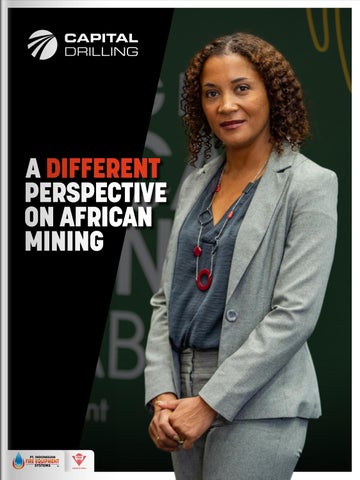
A DIFFERENT PERSPECTIVE ON AFRICAN MINING
A DIFFERENT PERSPECTIVE ON AFRICAN MINING In conversation with Nina Chihambakwe-McKenzie, General Manager, Central and West Africa at Capital Limited, we reflect on how the mining industry is evolving across Central and West Africa, why local content is becoming increasingly strategic, and what she believes responsible partnerships between government and industry should look like Writer: Lily Sawyer Project Manager: Josh Whiteside
2 | Africa Outlook Issue 121
CAPITAL LIMITED MINING
Africa Outlook Issue 121 | 3
CAPITAL LIMITED MINING
M
ining may begin with geology, but for Nina ChihambakweMcKenzie, its real value lies in what it can leave behind. As General Manager, Central and West Africa at Capital Limited (Capital), Nina works across some of Africa’s most dynamic and fastevolving mining jurisdictions. Based in Libreville, the capital of Gabon, her role spans government engagement, strategic partnerships, and business development, alongside supporting drilling operations across the region. Raised between Zimbabwean and Dutch cultures, Nina studied Economics at the University of Chicago before beginning her career in international finance. Drawn by the opportunity to combine commercial strategy with tangible economic impact, she made the move into mining – an industry where business, government, and community development intersect every day. Today, Nina’s work regularly takes her from remote exploration camps to ministerial offices, meeting with governments, investors, mining companies, universities, and local businesses. This breadth of experience has shaped her belief that mining’s greatest opportunity lies not only in developing world-class projects, but in helping build stronger local businesses, skills, and institutions that continue creating value long after a mine has closed.
We sit down with Nina to dig deeper into Central and West Africa’s evolving mining landscape and the instrumental role Capital plays within it. Africa Outlook (AO): Over the course of your career, how would you say Africa’s drilling and mining landscape has evolved, particularly in Gabon and West Africa? Nina Chihambakwe-McKenzie, General Manager, Central and West Africa (NCM): People often assume mining is about rocks. The longer I’ve worked in the industry, the more I’ve realised it’s really about people. Yes, geology, equipment, and production matter, but what I’ve come to enjoy most are the conversations that happen around a project: about how a mine can create opportunities for local businesses, develop local skills, attract investment, and leave something behind long after the drilling has finished or the mine has reached end of life. That’s become a much bigger part of my job over the last few years.
“What I’ve come to enjoy most are the conversations that happen around a project: about how a mine can create opportunities for local businesses, develop local skills, attract investment, and leave something behind long after the drilling has finished or the mine has reached end of life” – NINA CHIHAMBAKWE-MCKENZIE, GENERAL MANAGER, C E N T R A L A N D W E ST A F R I C A , C A P I TA L L I M I T E D
4 | Africa Outlook Issue 121
One of the things I enjoy most about my role is that no two weeks look the same. A few days ago, I was standing beside one of our drill rigs at a remote site. Not long before that I was in Moanda, Gabon, at a workshop on local content with government, mining companies, banks, universities, and small to medium-sized enterprises (SMEs). Next week, I’ll probably be somewhere else entirely – a sense of variety gives you a really interesting perspective on how the industry is changing. When I first became involved in mining, most conversations centred on the project itself – the resource, drilling programme, or timeline.
ADVANCED FIRE SUPPRESSION SYSTEMS FOR HEAVY MINING EQUIPMENT In the mining industry, protecting worker safety, equipment, and productivity is paramount to keeping operations safe and efficient. Fires can strike without warning due to fuel leaks, hydraulic system failures, electrical faults, or overheated components. Therefore, a reliable fire detection and suppression system is a critical component in protecting any heavy machinery fleet. Even a single fire incident can cause significant equipment damage, costly downtime, production delays, and endanger personnel safety.
IFES – Protecting Your Equipment. Protecting Your People. Securing Your Productivity. FOR HEAVY MINING EQUIPMENT Mining operations demand reliable fire protection to safeguard people, valuable equipment, and business continuity. IFES designs and manufactures advanced fire detection and suppression systems engineered specifically for heavy mobile equipment operating in the world’s toughest mining environments. Designed in accordance with AS 5062:2022 and certified by TÜV Rheinland, IFES systems deliver rapid fire detection, dependable suppression performance, and long-term reliability for mining and industrial applications.
www.fire-equipmentsystems.com
Why Choose IFES? · Designed in accordance with AS 5062:2022 · TÜV Rheinland-Certified
· Engineered for Heavy Equipment · Reliable, High-Quality Components
· Foam and Dry Chemical Powder (DCP) Systems
TRUSTED EXPERIENCE
· Rapid Fire Detection and Suppression
For more than 10 years, IFES has proudly supported the fire suppression requirements of Capital Drilling and Capital Mining Services across mining operations in multiple countries.
· Engineering and Technical Support
· Easy Installation and Maintenance
This long-standing partnership reflects our commitment to delivering reliable fire protection solutions and responsive technical support to the global mining industry.
APPLICATIONS
• Dozers
• Mining Trucks
• Drill Rigs
• Excavators
• Underground Mining Equipment
• Wheel Loaders
• Any Turbocharged Mobile Equipment Branch Office
Head Office
JL. Soekarno Hatta, Ruko Grand Viko, No. 9 Magelang, Jawa Tengah, Indonesia
JL. Marsma R. Iswahyudi No. 299 RT. 5 Kec. Balikpapan Selatan 76115 Kalimantan Timur, Indonesia
Phone: +62 293 321 8666 Website: www.fire-equipmentsystems.com
Phone: +62 542 546 6025
Email: info@fire-equipmentsystems.com
CAPITAL LIMITED MINING
asking how mining can help build a stronger economy and support local communities more broadly. I think that’s a healthy evolution and, for companies involved in the mining sector, expands their role. AO: Can you outline the role Capital plays in Central and West Africa’s mining and mining services landscape? What is the company’s perspective on building meaningful local content?
Whilst those things are still important, increasingly, I’m finding that the conversations are more about everything that sits around the mine: how do local businesses participate? How do you build technical skills required for mining in the local workforce? How do you create opportunities that last beyond the life of the project? How do governments capture more value from their mineral resources? To me, that’s a really positive shift. The workshop in Moanda was a good example, as I expected most of the discussion to focus 6 | Africa Outlook Issue 121
on procurement targets or local spending requirements. Instead, what struck me was how practical the conversations were. People were talking about access to finance for SMEs, supplier development, vocational training, better collaboration between industry and government, and creating an environment where local businesses can actually compete successfully. I’ve had very similar discussions elsewhere in the region, whether in Gabon, Guinea, or Côte d’Ivoire. Countries still want investment – that hasn’t changed – but they’re also
NCM: Capital is obviously there to deliver safe, high-quality drilling or mining services, which is our core business and always will be. Increasingly, mining and mining services companies are expected to contribute beyond their core operations. This may include developing local suppliers, investing in training, or sharing technical expertise – ultimately, it’s a matter of taking the time to understand what governments are trying to achieve and working out how we can best support those objectives. For Capital, this approach is really business 101. In some countries, however, there is an increasingly aggressive push to define local content primarily through mandatory equity ownership or by reserving work exclusively for 100 percent indigenous companies. Whilst ownership has a role to play, this approach can concentrate the benefits amongst a relatively small number of shareholders without necessarily building the broader capabilities needed to support a sustainable mining industry. Local content should be measured by the lasting economic capacity it creates, with a focus on developing competitive local suppliers, expanding in-country manufacturing and maintenance capabilities, transferring technical knowledge, and providing practical training that enables people of all ages to establish and grow their own businesses.
These businesses can then support mining companies and mining service providers, create employment, and generate a broader and more sustainable tax base for the host country. Foreign investment by multinational mining and mining services companies should therefore be viewed as an important part of this development. These companies bring capital, specialist skills, and international experience alongside access to global expertise, technology, and equipment development. They also create opportunities for local employees and businesses to gain experience across different operations and, in Capital’s case, different countries – broadening their skills, experience, and future opportunities. Whilst this type of contribution is increasingly being mandated through legislation, it has been part 8 | Africa Outlook Issue 121
of Capital’s operating philosophy from the beginning. We have consistently invested in training, knowledge transfer, and the longterm career development of our people. At many of our established operations, including Egypt, people who began their careers with Capital in junior roles have progressed into senior operational and management positions. This is meaningful local content – building skills, careers, businesses, and leadership capability that remain in the country and support the continued growth and development of the mining sector. One thing I’ve learnt is that governments and mining companies often want the same outcome: projects that are successful, stable, and investable. Sometimes they just approach those objectives from different starting points. Once you
understand that, the conversations become much more constructive. Indeed, Gabon is a good example of this. It’s already well known for manganese, but there’s growing interest in iron ore, gold, and other critical minerals. At the same time, I’m seeing a real willingness from government to think about mining in a broader context – not just as a source of revenue, but as a way of developing skills, supporting entrepreneurs, and strengthening local industry. I find that genuinely encouraging. Africa has never lacked mineral potential, but what we’re starting to see now is much more discussion about how countries can capture more of the value that comes with it. To me, that’s where some of the biggest opportunities lie over the next decade – not just developing more mines but building stronger businesses and local economies alongside them.
CAPITAL LIMITED MINING
PEGAMI – Your Partner in Energy, Mining & Marine Operations PEGAMI is an international indigenous company specialized in the oil, gas, and mining sectors, offering comprehensive expertise in inspection and maintenance (Diving, ROV, IRM, UWI, anti-corrosion treatment, NDT, UT, PT). It also provides marine assistance with AHTS, PSV, barges, crew boats, and tugboats. Leveraging its know-how in integrated logistics, PEGAMI coordinates transport, handling, and storage for major companies. Its recent successful operations with CAPITAL MINING and ENIVA PETROLEUM highlight its reliability and recognized expertise in managing complex projects, while meeting deadlines and complying with HSE standards. Office Line:+241 011 72 88 57 Whatsapp:+241 (0) 60 35 36 58 Email: p.mouguengui@pegami-international.com Email: info@pegami-international.com www.pegami-international.com
AO: Could you give us a brief overview of Capital’s existing projects and operations, client base, number of employees, and primary locations? NCM: Capital started as a drilling company, and that is still very much part of what we do, but one of the reasons I joined the business is that it has evolved well beyond that. Today, we support companies across the mining value chain, from exploration drilling through to production drilling and mining services. Through our laboratory business, MSALABS – an innovative assay services organisation – we provide assay laboratory services, whilst collaboration with other businesses and strategic investments have brought new and emerging technologies to our clients, enabling us to
support them from the early stages of a project right through to production. The company’s operations are global and, in total, we have a presence in more than 20 countries with established sites across Africa, the Middle East and North Africa (MENA) region, and Pakistan, with additional MSALABS locations in Canada, the US, Europe, and Latin America, and corporate offices in Mauritius, the UK, United Arab Emirates (UAE), and Australia. Our clients range from junior exploration companies through to some of the world’s largest mining groups. In Egypt, we’ve been operating for more than
two decades at the Sukari Gold Mine, now operated by AngloGold Ashanti, where we have provided everything from exploration drilling and drill and blast, through to waste mining load and haul services. Through MSALABS, we also established the country’s first commercial laboratory offering fire assay and other analysis services in Marsa Alam.
“Capital’s legacy is measured by the relationships we’ve built, opportunities we’ve helped create, and people we’ve supported that continue to make a difference in the years ahead” – NINA CHIHAMBAKWE-MCKENZIE, GENERAL MANAGER, C E N T R A L A N D W E ST A F R I C A , C A P I TA L L I M I T E D
Africa Outlook Issue 121 | 9
CAPITAL LIMITED MINING
In Tanzania, we also have a 20-year operating history and long-term relationships with Barrick at North Mara and Bulyanhulu Gold Mines and AngloGold Ashanti at the Geita Gold Mine. My role covers Central and West Africa, so I spend a lot of time moving between countries and projects. One thing I have found is that no two markets are quite the same, which keeps the role interesting. In our part of Africa, we are predominantly focused on gold and iron ore and support projects across both commodities in Gabon, whilst our global portfolio also includes large copper projects. Côte d’Ivoire is also a particularly exciting market for us as we continue to build a strong drilling footprint there. We’ve previously provided mining services in the country as well and, with MSALABS already operating a laboratory in Yamoussoukro and two further labs under construction, we are developing a much broader platform to support mining companies across the country and wider region.
Our business portfolio also includes a strategic partnership with training organisation International Apprenticeship and Competency Academy (IACA). Across our global operations, we employ approximately 3,800 people – the vast majority of whom are nationals. In 2025, 94.3 percent of our employees were from our operational host countries – a number that is even higher in reality due to the number of Africans now working as expats across our sites, sharing their skills and knowledge. Developing local capability is a big part of how we operate. Whether through training, creating opportunities for local suppliers, or supporting local communities, I think these investments make the business stronger over the long term. AO: Can you provide any further details around the training you provide and recent investments or collaborations? NCM: IACA is the first training facility providing internationally accredited
technical and trades training in Tanzania – not just for Capital employees, or even just for the mining sector, but also for other industries including oil and gas and agriculture, too. Through IACA training, more than 2,000 Tanzanians and Ugandans now hold recognised qualifications, and we’re looking to roll out these facilities in other African countries as well. Another part of our business looks at new technologies, and, in 2024, we invested in a company called Eco Detection, who’s unique technology provides real-time water quality monitoring and intelligence which has enormous potential to help both mining operators and governments alike ensure water quality for local communities. Our most recent addition is an investment into Portable PPB, a relatively new technology that significantly accelerates exploration activity by giving same-day gold results with lower detection limits than PhotonAssay, facilitating significantly faster and more agile exploration programmes. Portable PPB’s results are also now approved for Australian Securities Exchange (ASX) and Toronto Stock Exchange (TSX) reporting, where many African mining companies are listed. AO: You are actively looking to grow the drilling industry in Gabon. Can you tell us more about Capital’s projected growth in this area and how you intend to achieve this? NCM: I think the opportunities in Gabon are very exciting – the country has excellent geology, political stability, and, perhaps most importantly, a government that is genuinely committed to developing the mining sector. Those are strong foundations, and the next step is creating an environment where investment can move more quickly and companies
10 | Africa Outlook Issue 121
have the confidence to commit for the long term. Of course, we’d like Capital to grow alongside that and have already worked on a number of projects in Gabon. These include the Belinga Iron Ore project which is delivering drilling and load and haul services, the Gabon and Oxygenation of Earth – Drilling Early Earth Project’s (GOE-DEEP) scientific drilling programme, and a number of exploration drilling projects, so we already have a good understanding of what it takes to operate successfully here. As more exploration projects move into development and production, there will naturally be greater demand for drilling, mining services, and laboratory support – opportunities we are well positioned to take on. We prioritise delivering a consistent, high-quality, and safe service which, when combined with the breadth of our capabilities, means we have a lot to offer exploration and mining companies in Gabon. We add value to projects, use modern rigs and equipment, have teams that are well-trained and good at what they do, are reliable, and make sure project timelines don’t slip – this is what will help us win new work and we have a long history of delivering for clients. What we’ve found on many occasions is that we’ll commence a contract with a client and, as they experience working with us and the quality of our service, they’ll either extend to using more of the services we provide or ask us to deliver the same type of service across their different sites. Our approach to supporting local communities also helps – for Capital, that means continuing to invest in local people through employment, building long-term careers, and maintaining a genuine presence in the community.
AO: How is Capital making a genuine and lasting difference in the areas in which it operates? NCM: We don’t see ourselves as simply delivering a drilling programme and moving on; we want to be part of building a stronger mining sector and making a positive impact on the local economy. This is what meaningful local content is about – transferring knowledge, developing skills, and creating opportunities so that, one day, local people may even own and operate their own drilling rigs. The story of Rig 85 in Gabon
demonstrates what this can achieve. Kennedy and Ndong joined us with no previous mining experience – Kennedy was a qualified mathematics teacher who found himself out of work due to ongoing strikes. With the support of our project manager, they learned the fundamentals of drilling through practical, hands-on experience. We also provided formal training, and both are now working towards an internationally recognised Certificate III in Drilling Operations (RII31820) through an Australian training provider. Africa Outlook Issue 121 | 11
CAPITAL’S VISION, PURPOSE, AND VALUES VISION – To be recognised as the mining industry’s premier service provider of exploration and mining services, setting the standard with comprehensive solutions that prioritise safety, compliance, and sustainability. PURPOSE – To help its customers achieve their business objectives through the application of the company’s knowledge, experience, and end-to-end service proposition. VALUES • Safety – Seeks to uphold its exceptional health and safety standards with a focus on well-being. • Respect – Respects colleagues, clients, the environment, cultures, and communities in which it operates. • Unity – Operates as a fully inclusive global team. • Integrity – Prioritises being frank, honest, and open, and seeing projects through to completion. • Sustainability – Seeks to identify, develop, and implement initiatives to lessen its environmental impact. • Excellence – Takes ownership of being responsive, innovative, and entrepreneurial.
12 | Africa Outlook Issue 121
Since joining us, Kennedy and Ndong have worked across several projects and clients, including at the Belinga Iron Ore project, GOE-DEEP, and, most recently, an exploration programme. They have progressed from offsiders to drillers and are now taking responsibility for operating Rig 85 and delivering drilling programmes. It is an incredible transition. In just a few years, they have built meaningful, long-term careers that were previously not on their radar. Soon, they will hold internationally recognised qualifications, opening the door to even greater opportunities and the potential to become future leaders of Gabon’s mining industry. This is how we make a genuine and lasting difference – by investing in Gabonese people, transferring knowledge, and building local capability that benefits individuals, communities, and the country’s mining sector as a whole. AO: As a prominent advocate for the Women in Mining movement, how do you think we can shift away from the narrative of meeting diversity quotas to embedding women into high-impact roles across the sector? NCM: I’ve never really wanted to be seen as “the female mining executive.” I’d much rather be seen as someone who’s good at what she does. Of course, representation matters. When young women can see people who look like them working in operational and leadership roles, it helps them believe those careers are possible – but I don’t think that’s enough on its own. What matters is making sure women have access to the same opportunities, challenging assignments, and visibility as everyone else – that’s how careers are built. Mining career opportunities today go far beyond traditional operational roles. Whether it’s engineering,
CAPITAL LIMITED MINING
finance, environmental, social, and governance (ESG), geology, technology, or government relations, there are so many different ways to build a meaningful career in this industry. I’ve also found that some of the most valuable support I’ve received has come from people who simply backed me because they believed I could do the job. They weren’t trying to tick a box; they were investing in potential – I think that’s the mindset we need more of. Ultimately, I’d like us to reach a point where we’re talking less about whether someone is a woman in mining and more about the contribution they’re making. When people are recognised because of the value they bring, rather than their gender, that’s probably when we’ll know we’ve made real progress At Capital, we are increasingly seeing women taking roles that have traditionally been male dominated – operating the drill rigs and becoming mechanics, for example – as well as having an increased presence in the broader support functions like human resources (HR), finance, and safety. In Tanzania, we have some allfemale drill crews who perform very well, and we have supported two of our female drillers to attain Certificate III in Drilling Operations (RII31820) from an Australian recognised training institution, representing not only the first women to attain this formal qualification for Capital in Tanzania, but the first in the country – something I’m really proud to see. Here in Gabon, we are also seeing increasing female participation in what would not traditionally be considered women’s roles, with two ladies working as offsiders, another as an electromechanic, and one as a health, safety, and environment (HSE) site officer on site. And the trend is only increasing; in 2025, we saw a 52 percent rise in the number of women working for
Capital, representing 11 percent of our workforce, which is good progress. And it’s not just at the operational level – 29 percent of our board are also female. We do acknowledge that there is still a way to go, and we’ll keep working on growing our female workforce participation, however these numbers represent positive momentum towards more women having long-term career opportunities in our industry, increasing their visibility in a broad range of roles – not just ticking boxes or meeting quotas. AO: What does corporate social responsibility (CSR) mean to Capital, and what steps have you taken towards leaving a legacy that is transformative for local communities? NCM: I think the biggest contribution companies in our sector can make is to leave something behind that lasts long after the project itself. Of course, community initiatives have an important role to play but, for me, real impact comes from building local capability: employing and training local people, helping local businesses grow, and creating
opportunities for suppliers to become part of the mining value chain. Governments increasingly want to see mining act as a catalyst for broader economic development; it’s no longer just about extracting resources but asking how the industry can help strengthen local economies. That’s one of the reasons I’ve become so interested in local content. When it’s done well, it’s not simply about meeting targets but creating businesses, developing skills, and giving people opportunities that continue long after a mine has closed. At Capital, CSR is embedded in our approach to our work – it always has been – and is reflected in the way we invest in local teams and work with our clients and partners. We know that successful mining projects depend on strong relationships with the communities where we operate, and local employment drives socioeconomic growth in our host countries and is the main way we can leave a long-term legacy. As such, we prioritise hiring from the local areas where we work and invest in training and development to build local capability and skills transfer. Africa Outlook Issue 121 | 13
CAPITAL LIMITED MINING
Currently, we employ more than 320 Gabonese, Guineans, and Ivorians – not only is that 320 individuals supported to develop their careers, but 320 families supported with reliable incomes and spending into their local communities. This is where the impact is multiplied. Significantly, dozens of our locally recruited employees are now working as expats for the company in other countries. Indeed, we have around 50 Tanzanians, as well as Mauritanians, Ivorians, Egyptians, and Guineans, not only working for our operations
CAPITAL – AT A GLANCE 20+ Years of experience
135+ Drill fleet
55+ Mining fleet
20+ Operational countries
3,200+ employees
30+ Laboratories
14 | Africa Outlook Issue 121
globally in places like Pakistan, Saudi Arabia, the US, and other African countries, but also becoming soughtafter professionals, recruited by other companies around the world who recognise their competency and skill, which is a direct reflection of our investment in their training and development. These opportunities are what create that long-term legacy and genuinely transform the lives of local people. We also collaborate with our clients to support their community development projects and, where appropriate, initiate our own CSR activities to support local community needs. For example, we provide educational scholarships for school students in multiple countries including Egypt and Zambia, we’ve built a maternity ward at the Kamanga Health Centre in rural Tanzania, and we support numerous local sporting clubs across our African operations. In Gabon, we’ve partnered with Ivindo Iron and local education authorities to provide supplies
to the M’Vhadi School and Mayibouth 1 & 2 Schools close to our drilling operations in Ivindo. In Côte d’Ivoire, we sponsor a Taekwondo athlete, Nabintou Koné, through the Lvolution Academy in Abidjan. Our sponsorship provides opportunities for her to compete nationally and internationally at the highest levels, and it also supports her ongoing studies. This ensures she can not only concentrate on becoming a successful athlete but can achieve university qualifications whilst competing. These are the types of grassroots initiatives we do to make an ongoing difference to the people in our local communities. Supporting local businesses is another way for us to contribute meaningfully to local communities. In Côte d’Ivoire for example, 47 percent of purchases for our drilling operations come from local businesses, and we will continue to foster partnerships with suppliers from the region wherever we can. Personally, I’d like to think Capital’s legacy is measured by the relationships we’ve built,
opportunities we’ve helped create, and people we’ve supported that continue to make a difference in the years ahead. AO: Looking to the future, what key priorities, targets, and goals do you have in place? Do you have plans to expand or diversify at all? NCM: One of my biggest priorities is continuing to build a stronger regional presence across Central and West Africa. We’re already active across multiple countries and business lines, and I see significant potential to leverage our integrated service capability and expertise to add further value for clients across the region. Clients are increasingly looking for partners who understand the broader mining value chain rather than providing just one service in isolation – an exciting direction for Capital because it allows us to bring together the strengths of our different businesses. I’d also like to see us continue investing in countries where we already have a presence. There’s enormous potential across the region, and I think being committed to a market over the long term is just as important as entering new ones. One thing I have noticed since joining Capital is that we do not approach projects with a shortterm mindset, but we invest time in understanding the countries where we work, building local teams and developing relationships with governments, suppliers, and communities. In my experience, those relationships matter just as much as the technical work because successful mining projects do not happen in isolation. We’ve done this very successfully in places like Egypt and Tanzania, where Capital has had a presence for more than 20 years.
We’ve built world-class infrastructure and developed the workforce to the point many of our team who joined years ago are now leaders in our business, operating in expat roles across Africa or globally, or being recruited by others who recognise their level of capability. That’s the impact I’d like to see us continue to make in this region, alongside expanding operationally. Personally, I’d also like to continue strengthening the relationships we’ve built with governments, industry, and local businesses. These kinds of partnerships create opportunities that simply don’t come from responding to tenders alone and help us understand where the industry is heading and how we can contribute to its growth. Ultimately, success for me isn’t just about expanding into more countries – it’s about building a business that’s trusted, develops local capability, and people want to work with because of the quality of delivery and the relationships we’ve built. If we achieve that, I think growth will follow naturally.
partnerships that are based on trust rather than shortterm objectives. For me, that’s what good mining looks like and, working at Capital, that aligns very well with how our business operates. Strong technical delivery will always be important, but the projects that have the greatest impact are the ones that leave behind stronger local businesses, more skilled people, and lasting relationships. I’m excited to be part of that journey with Capital, and I think the opportunities for both the company and the region are only just beginning.
AO: Finally, are you optimistic about the future of the mining in Africa? NCM: I’m genuinely optimistic about where African mining is heading. Across the region, I’m seeing governments, investors, and mining companies having much more constructive conversations about how to create long-term value. Of course, there are still challenges, but there’s also a growing recognition that mining can be a catalyst for broader economic development if done well. Working across Central and West Africa has reminded me that every country is different, there isn’t a blueprint that works everywhere and that’s part of what makes the job so interesting. The key is listening, understanding local priorities, and building
Tel: +241 066 11 30 52 nina.mckenzie@capdrill.com
www.capdrill.com Africa Outlook Issue 121 | 15
Tel: +241 066 11 30 52 nina.mckenzie@capdrill.com
www.capdrill.com
PRODUCED BY AFRICA OUTLOOK MAGAZINE