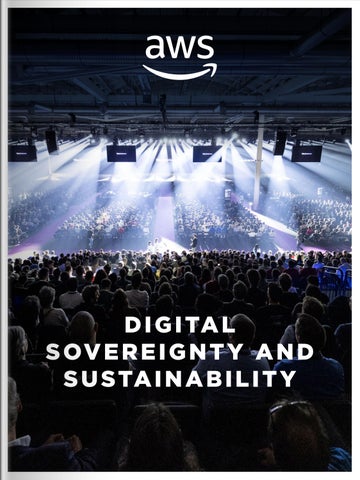
D I G I TA L S OV E R E I G N T Y A N D S U S TA I N A B I L I T Y
D I G I TA L S AND SUST
Michael Hanisch, Head of Technology Germany, discusses Amazon Web Services’ significant cloud infrastructure investments in the country, including the recent launch of the AWS European Sovereign Cloud, and Amazon’s extensive sustainability efforts such as its water stewardship and corporate power purchase agreements Writer: Jack Salter | Project Manager: Faraz Mukaddam
2 | EME Outlook Issue 73
S OV E R E I G N T Y TA I N A B I L I T Y
S
ince launching two decades ago in 2006, Amazon Web Services (AWS) has developed industry-leading cloud capabilities and expertise. Today, AWS provides highly reliable, scalable, and low-cost IT services in the cloud that powers hundreds
of thousands of businesses in 190 countries around the world. In Europe, Germany is a central hub for the company, home to two AWS Regions as well as multiple development centres and cuttingedge artificial intelligence (AI) research.
AWS GERMANY TECHNOLOGY
AWS has been present in Germany since October 2014 when it launched the AWS Europe (Frankfurt) Region, which provides three Availability Zones – separate clusters of data centres – and serves as one of the continent’s most established AWS Regions.
EME Outlook Issue 73 | 3
AWS GERMANY TECHNOLOGY
The company invested €9.6 billion in that infrastructure from 2014 to 2023, contributing an estimated €18.4 billion to GDP – with more investment to come. “We’re going to spend an additional €8.8 billion between 2024 and the end of this year, so it’s fairly rapid growth,” reveals Michael Hanisch, Head of Technology Germany at AWS, who has worked at the company since 2011. This investment is helping to meet growing customer demand for cloud services in Germany, adding another
estimated €15.4 billion to GDP over those three years. “We continue building up our infrastructure and data centre capacity to meet the growth we see in Europe and Germany in particular,” he outlines.
SOVEREIGN CLOUD Germany’s second AWS Region, the AWS European Sovereign Cloud, was recently launched in January 2026 in Brandenburg. This new, independent cloud is separate from other existing AWS
Regions, with infrastructure located wholly within the EU. The AWS European Sovereign Cloud is designed to help public sector organisations and customers in highly regulated industries meet their evolving sovereignty needs. Its unique approach provides the only fully featured, independently operated sovereign cloud backed by strong technical controls, sovereign assurances, and legal protections designed to meet the needs of European governments and enterprises for sensitive data. “We’re building an entirely separate sovereign cloud for our customers in Europe, and that of course comes with physically separate infrastructure,” Hanisch explains. “To achieve this level of independence, we’re essentially copying what our customers love about the AWS Cloud – the same portfolio of services, the same highly secure design operations, the same resilience and high availability – run by European staff within Europe, and to host this infrastructure we’re building up a new, separate AWS Region. “You might ask, ‘Why are we building a separate cloud for Europe?’ – we’ve been sovereign by design since day one; every AWS Region already gives customers control over where their data resides and who can access it. “But we listened to customers in highly regulated industries and the public sector who told us they need an additional option: a cloud that meets the most stringent European data residency and operational autonomy requirements, without compromising on capability or innovation. That’s what the AWS European Sovereign Cloud is,” he informs us. That need has only become more urgent as geopolitical events – not least Russia’s war against Ukraine – have put resilience and digital sovereignty firmly at the top of the agenda. Indeed, many governments, regulators, and even customers
AWS GERMANY TECHNOLOGY
GIVEN THE CURRENT DISCUSSIONS AROUND DIGITAL SOVEREIGNTY, CAN YOU SHED LIGHT ON HOW AWS CAN PROVIDE A DIGITAL SOVEREIGN SOLUTION, DESPITE BEING AN US-HEADQUARTERED COMPANY? Michael Hanisch, Head of Technology Germany: “AWS is the first provider to introduce the concept of AWS Regions, allowing customers to choose where their data is placed and processed, which defines the jurisdiction, data residency, and so on. “In the last couple of years, with all the supply chain shocks, crises, and wars unfolding, there have been a lot of questions around what this means in terms of resilience. “What kind of dependencies does it have? Who operates the infrastructure? How is it operating? How long will it continue to operate if there’s a longer crisis? What if, for instance, there is a largescale attack on internet infrastructure globally and some European countries are shut off from the rest of the world?
themselves are looking to increase their resilience against these kinds of shocks. “How can we be less dependent on global supply chains and supply providers without going back to the on-premises IT of 20 years ago or sacrificing the innovation power and comprehensive service portfolio only a large cloud provider like AWS can deliver?” questions Hanisch. “That’s how we came up with this sort of design, especially for customers that need additional resilience.” The company plans to invest €7.8 billion in the AWS European Sovereign Cloud through to 2040, reflecting its long-term commitment to meeting the continent’s digital sovereignty needs.
“That’s how we came up with the idea of the AWS European Sovereign Cloud, which has the same service portfolio, architecture, and security as existing AWS Regions, but is entirely located in the EU, in Germany, with zero operational control outside EU borders. “It’s run by EU-based teams that need to be physically present within the EU to do their job. We’re actually moving this model from only EU residents to only staffing this infrastructure with EU citizens, so we’re going a step further. “We’ve also established a dedicated European corporate structure, with a parent company and subsidiaries incorporated in Germany, led by EU citizens who are legally bound to act in the best interest of the AWS European Sovereign Cloud. “So, it’s ultimately still owned by a US-headquartered company, but it’s a separate legal entity that clearly operates under the local laws applicable in Germany and the EU. It also has local leadership that is beholden to local corporate and criminal liability laws, which helps with the legal segregation between the AWS European Sovereign Cloud and, say, our US-headquartered companies that are part of the wider Amazon group. “With the AWS European Sovereign Cloud, we’ve introduced a tonne of different sovereignty controls. There are no critical external dependencies for this entire infrastructure, so whatever happens outside the EU, it will continue to operate. “It’s certainly a challenging space, but one that aligns with my strengths in leadership, strategy, and people-driven impact.”
EME Outlook Issue 73 | 5
AWS GERMANY TECHNOLOGY
CARBON FOOTPRINT Another important aspect for many customers is understanding and reporting the carbon footprint of their AWS infrastructure. In March this year, the company launched its AWS Sustainability console, a free, standalone service that shows customers the environmental impact associated with their AWS usage. “What we do is basically take the carbon intensity of providing our services and break down the energy consumption, and secondary factors that go into that, by AWS Region,” Hanisch tells us. “Let’s say Frankfurt – what data centres in Frankfurt do your files actually reside in? How is the power contributed? Does it mostly come from renewable energy or not?
6 | EME Outlook Issue 73
“We continue building up our infrastructure and data centre capacity to meet the growth we see in Europe and Germany in particular” – MICHAEL HANISCH, HEAD OF T E C H N O L O G Y G E R M A N Y, A M A Z O N WEB SERVICES
We break down the overall power consumption and carbon emissions of our operations so you can really see how big the carbon footprint of a certain IT workload is.” AWS helps customers benefit from the high utilisation of its infrastructure, which is typically a lot greater than what they can achieve if they just run their own.
“A report conducted by Accenture confirms that AWS data centres are 4.1 times more efficient than average on-premises instances, and customers can reduce up to 99 percent of their optimised workloads running in the AWS Cloud,” acclaims Hanisch. “That’s the benefit many customers like to see – they have to report, and for that they need the kind of data the AWS Sustainability console provides.”
WATER POSITIVE Since July, customers have also been able to view annual water withdrawals data associated with their AWS workloads on the AWS Sustainability console. Water withdrawal is the total volume of water drawn associated with the AWS services they use. In 2022, the company announced
AWS GERMANY TECHNOLOGY
AI TRANSFORMATION IN GERMANY Hanisch has seen first-hand the cloud and AI transformations, the latter of which will have an even more profound impact on the nature of business. “It will change business models and many industries over time, so it’s an exciting space to be in, and Germany is in an interesting position,” he observes. “On the one hand, it’s not the fastest-growing country, but it also has a couple of things going for it. Germany is a big manufacturing market, for instance, with high-end machinery, a large automotive sector, and companies with a lot of engineering knowledge. “That’s where I think AI can unlock a new era of business because it can influence all processes, from engineering and manufacturing through to field maintenance. That can be a differentiator going forwards if companies use that data and help transform the industry, and we’ll see the same in other sectors that are more service-focused,” Hanisch elaborates. In Germany, where an ageing population means fewer people are entering the workforce, AI can help businesses do more with less – maintaining productivity and competitiveness despite a shrinking labour pool.
its commitment to being ‘water positive’ by 2030 – that means returning more water to communities and the environment than it uses in its data centre operations. “We are already 75 percent of the way to reaching this goal globally. Our data centres are seven times more water efficient than the global industry average and up to 4.1 times more energy efficient than on-premises sites,” says Hanisch. “We are committed to using as little water as possible for our operations and therefore use technologies that help us reach that goal. In Germany, AWS data centres use no water for cooling purposes for over 95 percent of the year, instead using free-air cooling, and have a water usage effectiveness of 0.17 litres (L) per kilowatt hour (kWh), well below the
EME Outlook Issue 73 | 7
AWS GERMANY TECHNOLOGY
Amazon Solar Farm Farm Ohio - Yellowbud
Climate Neutral Data Centre Pact target of 0.4 L/kWh. “For the few days and hours a year when we do use water, we prioritise on-site harvested rainwater and the reuse of water in the cooling system, as we keep the use of ground water to an absolute minimum,” he adds. The methodologies AWS uses to reduce water withdrawals vary from site to site – which approach works best depends on factors like the local climate, available water sources, and regional conditions. At most sites, the company uses a combination of different strategies, such as reprocessing wastewater and collecting rainwater, tailored to local conditions. “We always think hard about how we can do the most to reduce water withdrawals and reuse it as much as possible so we don’t waste water,” affirms Hanisch. “Besides working on our own efficiency, we take our responsibility a step further and invest in projects that help increase water efficiency, restoration, and replenishment.” In Germany, AWS recently announced two water replenishment projects – an innovative urban leak detection initiative in Frankfurt and a wetland restoration project in the Spessart Forest upstream of the city. Together, the two projects are expected to return more than 8 | EME Outlook Issue 73
“We’re building an entirely separate sovereign cloud for our customers in Europe, and that of course comes with physically separate infrastructure” – MICHAEL HANISCH, HEAD OF T E C H N O L O G Y G E R M A N Y, A M A Z O N WEB SERVICES
370 million L of water annually to the community once completed, contributing to AWS’ goal to be water positive by the end of the decade.
CLEAN POWER Alongside being water positive, AWS continues to make progress towards net zero carbon emissions by 2040. To achieve this, the company continues to invest in the amount of carbon-free energy available from the German grid. Amazon as a whole is the largest corporate purchaser of carbon-free energy in Europe and one of the leading purchasers worldwide. In Germany, AWS has entered into a number of long-term corporate power purchase agreements (CPPAs). “We basically guarantee consumption of electric capacity and power over a certain time, which then allows providers to finance, build,
and operate things like wind farms,” Hanisch highlights. “There’s quite a lot of offshore wind power that’s plentiful in the North Sea and Baltic Sea, so we’ve signed five CPPAs for offshore wind in Germany alone.” This includes a CPPA signed in February 2026 with RWE for 110 megawatts (MW) from its German Nordseecluster B offshore wind farm – enough to power the equivalent of more than 139,000 German households annually. Altogether, Amazon sources power from offshore wind farms and solar installations with a total capacity of over 1.3 gigawatts (GW) — enough to power 1.8 million German households once operational. “In 2025, we again matched 100 percent of the electricity consumption of our operations with carbon-free energy. That covers electricity consumption across Amazon’s global operations, including AWS data centres as well as facilities such as Amazon fulfilment centres,” insights Hanisch.
PARTNER ECOSYSTEM The AWS Partner Network (APN) is a global, interconnected community of organisations that leverage AWS technologies, programmes, funding, and tools to build solutions and provide services for customers. This expansive ecosystem is made up of over 130,000 partners across more than 200 countries, including Germany, ranging from software and technology providers and system integrators through to customer consultants. AWS Competency Partners in particular specialise in building software or delivering services across specific industries, use cases, and workloads. To receive this designation, APN partners undergo rigorous technical validation related to industry-specific technology, as well as an assessment
AWS GERMANY TECHNOLOGY
of the security, performance, and reliability of their AWS solutions. As a result, customers benefit from an easier way to identify the right partner from the APN to support their business growth and innovation. “If a customer wants to have, for example, a cloud or AI project, they can look at the APN and figure out what kind of partner they want to work with,” Hanisch expands. “Do you want to have a small, boutique, AI-focused partner, or do you want to benefit from having a large global partner that specialises in AI security or whatever it is you require? We can help find the right kind of partner.
AWS Water Positive video
“We often operate together with those partners, making sure that, as a team, we can deliver on the value the customer is aiming for,” he asserts.
DATA ANALYTICS A big focus area for AWS next year is helping customers make sense of the AI story, navigate the AI landscape, and create the infrastructure they will need to benefit from it. “I’m not just talking about lots of GPUs to run inference for AI models; I’m also talking about helping them create the data analytics infrastructure,” Hanisch sets out. Data analytics converts raw data into actionable insights, using a range
of tools, technologies, and processes to find trends and solve customer problems. This enables companies to gain more visibility and a deeper understanding of their processes and services, which can improve decisionmaking and foster business growth. “It’s ensuring they make the most out of their data, which can be a unique differentiator for their business, and turning it into AI-driven business models, products, or service capabilities they can then offer to their customers,” Hanisch states. “That’s something we started a couple of years ago, and we’re seeing that speed up, especially with
the advent of generative AI. Now, of course, everybody is focused on agentic AI, which can also automate processes, machinery, and workflows. “We’re working with our customers across the stack, making sure we have the compute to run these models, that we have the proper models, but also making the most of their data, figuring out how to incorporate that into their overall workflow, and hopefully transforming their business or at least getting value out of their AI investments, be it more efficiency, higher output, bigger growth, or whatever their business priorities are,” he closes. AWS is very much a fast-growing business driven by further cloud adoption and the AI transformation happening in Germany, which is driving up consumption in terms of compute and storage.
aws.amazon.com EME Outlook Issue 73 | 9
aws.amazon.com
PRODUCED BY EME OUTLOOK MAGAZINE