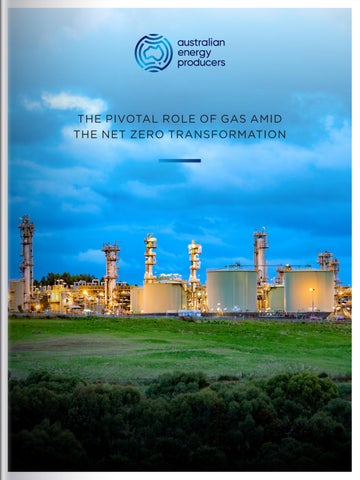
THE PIVOTAL ROLE OF GAS AMID THE NET ZERO TRANSFORMATION
AUSTRALIAN ENERGY PRODUCERS INDUSTRY SPOTLIGHT
PHOTOGRAPHY © AUSTRALIAN ENERGY PRODUCERS
2 | APAC Outlook Issue 66
S P OT L I G H T O N E N E R GY I N AU S T R A L I A As the world decarbonises to address climate change and meet commitments under the Paris Agreement, gas will continue its critical role in Australia Writer: Jack Salter | Project Manager: Dave West
I
n the Australian economy, oil and gas plays a fundamental role, providing essential energy to power businesses and homes both Down Under and across the world. Billions of dollars are invested by the sector to produce reliable, secure, and cleaner energy, creating jobs and economic growth for the communities in which it operates. Through the Long-Term Emissions Reduction Plan, the Australian government aims to achieve net zero by 2050 in a practical, responsible way. The plan outlines how Australia will drive down the cost of low emissions technologies, deploy these technologies at scale, help regional industries and communities seize
economic opportunities in new and traditional markets, and work with other countries on the technologies needed to decarbonise the world’s economy. For the transformation of the energy system in Australia and the region, natural gas is crucial to providing the firm dispatchable energy needed to unlock the potential of renewables in the country. It is also pivotal in powering Australian industries, including those processing minerals that are critical to net zero. Gas is evidently the safety net for Australia’s energy system and key to providing reliable and affordable power to households and businesses. Investment in new gas supply is therefore needed to underpin the net zero transition.
APAC Outlook Issue 66 | 3
APAC Outlook (AO): Firstly, could you talk us through the origins of Australian Energy Producers – when was it founded, and what is your mission? Samantha McCulloch, Chief Executive (SM): Australian Energy Producers represents the nation’s explorers, 4 | APAC Outlook Issue 66
developers, and producers of essential energy – oil and gas and lower-emission fuels. Our members account for about 95 percent of Australia’s upstream oil and gas exploration and production, ensuring energy security in Australia and the Asia Pacific region and delivering substantial economic benefits to Australians while helping to create a cleaner energy future. We are focused on ensuring the role of our industry in the net zero energy transformation. That includes unlocking new supply for affordable and reliable domestic energy for households and businesses, as well as delivering liquefied natural gas (LNG) to valued international partners and customers in Asia, where demand continues to present an extraordinary economic opportunity for Australia.
PHOTOGRAPHY © AUSTRALIAN ENERGY PRODUCERS
Australian Energy Producers, the peak body of the oil and gas industry, supports the net zero transition. Samantha McCulloch, Chief Executive, discusses the importance of natural gas in the country’s energy system transformation
PHOTOGRAPHY © AUSTRALIAN ENERGY PRODUCERS
INTERVIEW: A U S T R A L I A N E N E R GY PRODUCERS
Samantha McCulloch, Chief Executive
AUSTRALIAN ENERGY PRODUCERS INDUSTRY SPOTLIGHT
Established in 1959 and known as the Australian Petroleum Production and Exploration Association (APPEA) until September 2023, the name change reflects the growth and evolution of the industry and its long-term role in enabling the transformation of the national and regional energy system. Our industry is now at the forefront of the net zero energy transformation, unlocking low-carbon hydrogen production and carbon capture utilisation and storage (CCUS) technologies. Our members include great Australian and international companies such as Woodside Energy, Origin Energy, Santos, Beach Energy, Cooper Energy, Tamboran Resources, Central Petroleum, Comet Ridge, Denison Gas, and Senex Energy, as well as global companies such as Mitsui E&P Australia, ConocoPhillips, Shell, ExxonMobil Australia, and Chevron Australia.
LNG terminal, Darwin Port
Over the past six decades, we have held our annual industry gathering, now known as the Australian Energy Producers Conference and Exhibition, the largest of its kind in the Southern Hemisphere. This year’s event will be held in Perth from 20th to 23rd May. AO: What is your current take on petroleum production and exploration in Australia? Is it a particularly exciting or challenging environment to work in? SM: Investment in gas supply will be needed by 2050 and beyond to deliver affordable and reliable energy under net zero pathways, according to a new independent Ernst & Young (EY) report commissioned by Australian Energy Producers in November.
APAC Outlook (AO): Could you introduce us to Empire Energy? Alex Underwood, Managing Director (AU): Empire Energy is an Australian oil and gas company. We have assets in the US and Australia, but our key focus is in Australian, in the Beetaloo Basin one of the largest shale gas deposits on Earth. Our focus is on moving these assets from the exploration and appraisal phase into the production phase over the next 12 to 18 months. AO: What are some of the ongoing or recent projects that you are most interested in showcasing? AU: We have a very large asset base in Australia where we own nearly 29,000,000 acres of leases. Over the last five years since I started running the company, we have moved our
assets forward significantly. We have carried out two seismic surveys and drilled four wells, two of which were horizontally drilled and fracture stimulated. We have identified a resource that we believe exceeds the economic thresholds to move into development and are now in the process of moving into the production phase. We have acquired a gas processing plant from another Australian company, AGL, and subject to approvals will be installing that facility in the field later this year. The plant is fit for purpose for our pilot project, where we are looking to produce up to 25,000,000 cubic feet per day. This plant has a design capacity of 42,000,000 cubic feet per day so it’s a great acquisition for us. We will then look to drill up to another three development wells with the gas processed and transported into an existing pipeline that runs
through our tenements. We are targeting ‘first gas’ in 2025. It’s been a lot of hard work to get to this point and we are very pleased with the results we have achieved. The gas market conditions in Australia and the Northern Territory specifically are currently in a dire state. We are experiencing very high gas prices in Australia, and significant looming shortfalls on Australia’s East Coast. It’s a very good time to be bringing production into the market. AO: What, for you, differentiates your business from the competition? AU: If you look at Empire’s results to date, we
have been very focused as a small company on delivering our projects successfully in terms of technical goals but doing so in a cost-effective manner. To date, we have executed our work programmes for around two-thirds of the cost of some of our neighbours in the Beetaloo basin. We also have a very strong focus on moving into production and cash flow, which tends to differentiate smaller companies from bigger companies in this industry. We believe we’ve carried out these activities in quite a capital-efficient manner while also working in an entrepreneurial way to get up the technical learning curve, with the goal of commercial success on all projects.
AO: What are your major ambitions going forward and how will these goals be achieved?
AO: What are you most proud of in terms of the company overall?
AU: We are a very focused company, and we are focused on our project in the Beetaloo Basin. Given the scale of this resource and the market demand-supply outlook not only in the near term but also in the medium to long term, we see this site as a critical source of gas for Australia. Furthermore, the Beetaloo has very low concentrations of resident CO2 gas. Empire has less than one percent CO2 in our reservoir and we believe that as the world becomes increasingly carbon-constrained, this will be a competitive advantage for this basin.
AU: I’m extremely proud of the way in which our hard-working and dedicated team, go about the process of bringing all the key stakeholders along with us. We recognise that we operate as guests on the land owned and operated by others, farmers and the traditional owners. Both are very important stakeholder groups in the Northern Territory. We also believe that to be a good corporate citizen, we need to ensure that the benefits of this project can spread widely to all the people of the Northern Territory and ultimately Australia as a whole. We have a very significant focus on local content in our contracting, which means working with local companies. We have invested more than $100 million in the Northern Territory over the last five years with our projects and we foresee a very significant future for the people of the area going forward. It is great to see the approach that our team brings working in partnership with all stakeholders.
We have been going through consultation with the traditional owners for over 12 years now and have scheduled meetings with them at least once a year. Every time I meet with them, the first thing I say is, “this is your land, and we are operating as guests”. I think that this approach demonstrates to them that we do respect them and that we have a responsibility to act in a professional and environmentally appropriate way. AO: How do you empower your staff and reward the valuable contributions that they make?
AO: Could you tell us more about any environmental initiatives that you have in place? AU: I’m very proud of our environmental track record as a company. We operate under one of the strictest regulatory regimes in the world for shale gas development. The Northern Territory government has put a very robust regulatory system in place. Australia has some of the strictest environmental regulations around gas development in the world and is a significant trading partner with some of the major Asian economies that rely on our gas to power their growth. To that end, this gas deposit that we are developing is likely to be one of the most environmentally robust gas projects in the world. As we move into production, our project will be net zero for scope one emissions from day one, and we believe that this gives us an advantage in terms of the environmental impact of our gas. AO: How important are people to the success of the company? AU: It’s safe to say that without a good team working for us, we wouldn’t have progressed to where we are today. More broadly, regarding the stakeholders that we work with, whether it’s local pastoralists, local traditional owners, or the people of the surrounding communities, all these groups remain critical to our success.
AU: We have a great workforce and we’ve seen very little turnover over the last few years. It’s vital to have a team that is fundamentally aligned with the corporate goals of the company, our people are motivated and take ownership of their roles. The nation-building potential of this project has resulted in great outcomes so far and I think that ultimately, to have an effective team we need to be able to give our people the ability to maximise their level of responsibility. AO: What does the next 12 months look like for the business? AU: We have a very busy schedule ahead of us. We are in the process of moving towards a final investment decision on our pilot project by the middle of this year and we will shortly be lodging all the regulatory approval documentation. We are in the process of negotiating our first gas sales agreement now, marking our entrance into a market that is very attractive. We are working through the various financing options that we have at our disposal, and in the event that we can pull all that together and reach a final investment decision at the board level by the middle of this year, that would see a very active work programme in the second half of this year and deliver gas in 2025.
empireenergygroup.net
AUSTRALIAN ENERGY PRODUCERS INDUSTRY SPOTLIGHT
Karratha Gas Plant, North West Shelf Project
as the US and Qatar ramp up investment. Australia has damaged investment confidence in recent years with compounding regulatory interventions, while being far too slow to act to fix the nation’s broken offshore regulatory system, threatening energy security for Australia and our trading partners. Australia’s petroleum exploration expenditure has also fallen by more than 80 percent in the last decade, and the release of new offshore oil and gas acreage is long overdue. Investment in exploration is key to ensuring the long-term gas supply needed to support energy security and the net zero transformation in Australia and our region. AO: What fundamental role does the oil and gas sector play in the Australian economy, and how pivotal is natural gas to the country’s energy system transformation? SM: Our industry is fundamental to Australia’s economy and is playing a wider role in the energy transformation. Gas companies delivered an estimated AUD$16.2 billion in revenue to Australian state and federal governments in 2022-23, helping to build hospitals, schools, and roads. But direct payments to governments are far too narrow
PHOTOGRAPHY © AUSTRALIAN ENERGY PRODUCERS
EY examined around 350 net zero pathways globally and recommended Australia should prepare for multiple gas production scenarios due to the uncertainty of the energy transformation. They mapped three scenarios specifically for Australia, including finding gas production equivalent to 30 percent above current levels could be required in 2050 if renewables are not able to be rolled out at the rapid scale and pace envisaged in some scenarios. Even under a faster renewable rollout, Australia would still need 56 percent of current gas production levels in 2050. The study shows gas is a safety net for Australia’s energy transition, and the country needs to plan for both strong domestic and international demand for gas to secure the associated emissions reduction and economic opportunities. Our industry can also enable decarbonisation technologies and fuels, such as CCUS and low-carbon hydrogen production. However, Australia is at risk of missing out on the opportunity of gas and these emissions reduction technologies as other countries and regions race ahead with clear and targeted policy frameworks that provide the certainty needed for these significant investments. There is increasing competition in the global LNG market
“ I N V E S T M E N T I N G A S S U P P LY W I L L B E N E E D E D B Y 2 0 5 0 A N D B E YO N D TO D E L I V E R A F F O R DA B L E A N D R E L I A B L E E N E R GY U N D E R N E T Z E R O P AT H WAY S ”
PHOTOGRAPHY © AUSTRALIAN ENERGY PRODUCERS
– SAMANTHA McCULLOCH, CHIEF EXECUTIVE, AUSTRALIAN ENERGY PRODUCERS
of a lens to appreciate the full scope of what our industry contributes economically to Australia and the region. Our members also spent AUD$45 billion with Australian businesses in 2022-23, around 80,000 nationals are directly or indirectly employed in upstream exploration and production, and gas unlocks so many other economic benefits – supporting tens of thousands of jobs in other sectors such as mining and manufacturing, including the processing of the critical minerals required for net zero. Gas provides about 27 percent of Australia’s primary energy use and about 40 percent of the energy used in manufacturing. Gas is also one of the main sources of electricity generation. As coal exits the system on the east coast, we will need more gas to step up and be that reliable back-up to renewable generation, so we will see gas increasingly become that safety net to ensure the lights are kept on.
AO: How does Australian Energy Producers represent the country’s upstream oil and gas exploration and production industry? SM: Our industry and members are a critical partner in delivering the new energy economy and have an important and long-term role in enabling the transformation of the energy system. Our sector has committed to net zero targets across the economy, and as key enablers and partners, we are focused on how to achieve them. We work collaboratively and in partnership with the community, thought leaders, and decision makers. We work to support Australian and international decarbonisation and energy security. Collectively, we have the workforce, expertise, and infrastructure to help ensure secure, reliable, and lower-emission energy and technology. APAC Outlook Issue 66 | 11
AUSTRALIAN ENERGY PRODUCERS INDUSTRY SPOTLIGHT
AO: Equally, how important is the role of your members in producing around 95 percent of Australia’s oil and gas? SM: We help to keep the lights on in Australia, from coast to coast. The country’s electricity system is in a fragile position at the moment. We have just seen a winter in Western Australia (WA) where gas generation was up around 30 percent in the June quarter due to lower generation from coal and renewables. This echoed what east coast Australians experienced the previous winter. We are also supplying around 40 percent of the energy needs of Australia’s manufacturing sector, including making the bricks, glass, and fertilisers that are so important for everyday life and our economy. This is why it is crucial that policy settings support the investment in new gas supply needed for Australian households and industry. AO: How does Australian Energy Producers support net zero across the economy by 2050, consistent with the objectives of the Paris Agreement? SM: Australia’s oil and gas industry is committed to net zero emissions across the economy by 2050. The industry is investing in key emissions reduction technologies and renewables.
CCUS and low-carbon hydrogen production are two core focuses. In 2024, the Moomba CCS Project, a joint venture between Santos and Beach Energy, is due to begin operating as the second major carbon capture site in Australia. The nation’s first site, Chevron Australia’s Gorgon CCS Project at Barrow Island off WA, has already captured one year’s worth of emission reductions required for all 215 facilities under the Commonwealth Safeguard Mechanism. Other members are also investigating carbon capture projects across Australia and developing low-carbon fuels such as hydrogen. AO: How do you see the Australian energy sector developing over the coming years? SM: Achieving net zero by 2050 requires a fundamental and unprecedented transformation of our energy system, and the role of gas will grow and evolve through this transformation. Gas will continue to be needed to support the growing uptake of renewables in electricity generation and to provide the high-temperature heat and feedstock needed for manufacturing. In parallel, new opportunities to use gas are emerging in the form of low-carbon hydrogen, with natural gas combined with CCUS currently the most affordable pathway to low-carbon hydrogen production.
“ O U R I N D U S T R Y I S F U N D A M E N TA L T O A U S T R A L I A’ S E C O N O M Y A N D I S P L AY I N G A W I D E R R O L E I N T H E E N E R G Y T R A N S F O R M AT I O N ” – SAMANTHA McCULLOCH, CHIEF EXECUTIVE, AUSTRALIAN ENERGY PRODUCERS
PHOTOGRAPHY © AUSTRALIAN ENERGY PRODUCERS
The gas industry is also set to play a pivotal role in delivering net zero technologies for Australia, including CCUS. CCUS projects will increasingly be part of our industrial landscape, not just for the oil and gas industry, but hard-toabate sectors across the economy as well, such as cement. Australia has the opportunity to be a decarbonisation powerhouse, and the best way to get there is through collaboration between industries and regions. This kind of collaboration featured in an Australian Energy Producers study identifying nine Net Zero Zones across the country. By sharing infrastructure – carpooling carbon emissions – Australia can accelerate emissions reduction and attract new investment.
PHOTOGRAPHY © AUSTRALIAN ENERGY PRODUCERS
AO: Finally, what are Australian Energy Producers’ key priorities as the peak national body of essential energy explorers, developers, and producers? SM: As the EY report found, new gas supply is critical, and the current logjam of projects – energy supply, decommissioning, and carbon capture plans – stuck in the regulatory approval process is of great concern. Even when members have received approvals from the national offshore regulator, these have been overturned in court from subsequent legal actions. Regulations that provide clarity and certainty for industry and Traditional Owners while maintaining comprehensive and meaningful consultation with stakeholders are urgently needed.
States such as Victoria and New South Wales also must recognise that new onshore supply is needed, and the politics, bans, and regulatory uncertainty have to stop if their residents and businesses are to avoid the risk of blackouts. WA’s energy security is also at risk with growing demand for gas and projected supply shortfalls. We have urged the government to review its ban on onshore producers accessing larger export markets. This ban makes it harder to unlock much-needed new supply because fewer projects are commercially viable if they are limited to the domestic market. Policymakers also need to understand the importance of net zero technologies. We are calling for a national CCUS roadmap to provide clear policy direction, identify and progress priority hubs for low emissions projects, and promote Australia as a regional carbon storage leader. Similarly, the discrimination against different colours of hydrogen is also unhelpful when we will need all pathways to get to net zero. It makes sense to include gas combined with CCUS because it is the most affordable and mature pathway to low-carbon hydrogen production. AUSTRALIAN ENERGY PRODUCERS Tel: 02 6247 0960 contact@energyproducers.au
energyproducers.au
APAC Outlook Issue 66 | 13
AUSTRALIAN ENERGY PRODUCERS GPO Box 2201 CANBERRA ACT 2601 Phone: 02 6247 0960 contact@energyproducers.au www.energyproducers.au
PRODUCED BY APAC OUTLOOK MAGAZINE