w w w. a f r i c a o u t l o o k m a g . c o m
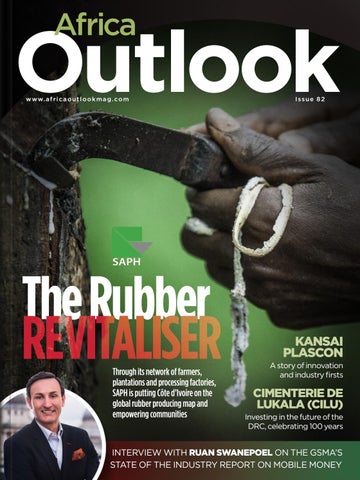
The Rubber REVITALISER Through its network of farmers, plantations and processing factories, SAPH is putting Côte d’Ivoire on the global rubber producing map and empowering communities
Issue 82
KANSAI PLASCON
A story of innovation and industry firsts
CIMENTERIE DE LUKALA (CILU)
Investing in the future of the DRC, celebrating 100 years
INTERVIEW WITH RUAN SWANEPOEL ON THE GSMA’S STATE OF THE INDUSTRY REPORT ON MOBILE MONEY
travel magazine T
he unrelenting demand to travel, both for business and leisure purposes, is showing no signs of slowing up, and for Outlook Publishing, the growing extent to which we are covering this industry across our existing titles has led to the launch of Outlook Travel magazine.
ISSUE 03
OMAN
The major component of the publication takes the form of our Outlook Travel Guides, providing executives, avid travellers and our existing 575,000 international subscribers with the ultimate rundown of all the major economic drivers and thriving hubs across the world, with exclusive input from tourism industry associations and stakeholders – the people who know these places the best.
SIMPLE WAYS TO TRAVEL MORE SUSTAINABLY
Desert views and Bedouin culture
MALAWI
Africa’s warm heart
You can join the vast numbers of tourism sector players enjoying the exposure we provide across our digital and print platforms with a range of options, from advertising through to free-of-charge editorials, extensive social media saturation, enhanced B2B networking opportunities, and a readymade forum to attract new investment and increase exposure.
Five easy tips
YOUR TRAVEL GUIDE TO
ROMANIA
Interview with Stu McKenzie, award-winning photographer, army veteran and Fellow of the Royal Geographical Society
THAILAND TRAVEL GUIDE
THAILAND
MALAYSIA TRAVEL GUIDE
This Southeast Asian country is a perennial favourite, thanks to an intoxicating combination of beautiful beaches, world-renowned cuisine and incredible temple complexes
M A L AYS I A
Writer: Dani Redd | Project Manager: Jordan Levey
K
nown as the ‘Land of Smiles’, Thailand is a friendly country that welcomed 38.27 million tourists to its shores last year. There are plenty of reasons why this Southeast Asian destination is so popular. For a start, there’s the beaches. In the south, Thailand’s two coastlines stretch for miles, populated by swathes of icing-sugar soft sand, the bays speckled with dramatic limestone formations. Thailand is also home to 1,430 islands, ranging from full moon party spots like Koh Pha Ngan to the more off the beaten track Similan Islands, a national marine park popular with scuba divers. Then, there’s the food. Thailand’s noodles, stir fries and curries are beloved around the
world, characterised by the fragrant taste of lemongrass, kaffir lime leaves and tulsi. Every town is bursting at the seams with floating markets, street food stalls and high-end restaurants where you can try delicious local dishes. Thailand’s rich spiritual heritage also attracts tourists. Golden temples and larger-than-life Buddha statues can be found across the country. Visitors can experience colourful religious festivals in the northeast of the country or explore the underground cave shrines in Kanchanaburi and Phetchaburi. Despite Thailand’s popularity, it’s easy to find a quiet corner to relax, be it on a deserted island or an eco-retreat in the craggy mountains north of Chiang Mai.
Malaysia is a melting pot with a unique culture, a world-renowned food scene and a spectacular landscape of islands, ancient rainforest and mountains Writer: Dani Redd Project Manager: Joe Palliser
NAMIBIA TRAVEL GUIDE
T
here are many reasons why Malaysia is a tourist favourite. For a start, there’s the landscape. Imagine 878 islands, ringed with white sand beaches leading down to translucent waters. Vibrant coral reefs lie just offshore, home to a profusion of marine life. Inland are ancient rainforests, the shaded canopy seemingly impenetrable. Take a guided walk to learn about this habitat’s astonishing biodiversity. You might even catch sight of a tapir, or a silver-leafed monkey swimming through the jungle canopy. Outdoor enthusiasts will also relish tackling some of region’s towering granite mountains or exploring the intricate networks of limestone caves. Then, there’s the culture. Malaysia
is a melting point of Malay, Indian, Chinese and aboriginal groups (Orang Asli). There’s a packed calendar of religious festivals, including Wesak, or Buddha’s birthday, celebrated with processions of flowers and candles. Cities such as Melaka and Georgetown boast fascinating heritage districts where you can experience this fascinating fusion for yourself. Make sure you take time out to try Malaysia’s delicious cuisine, which reflects its multicultural population. Of course, Malaysia has a modern side too. It can be found in the SEYCHELLES malls, skyscrapers and fine dining TRAVEL restaurants in larger cities, such as the GUIDE capital Kuala Lumpur.
S E YC H E L L E S Most people visit this archipelago in the Indian Ocean for the beaches, but it has much more to offer than that Writer: Dani Redd | Project Manager: Jordan Levey
D
escribing the Seychelles, it’s easy to veer into cliché. These picture-perfect islands are blessed with white sand beaches lapped by translucent water, fringed with palm trees and interesting rock formations. The dramatic sunsets, laidback atmosphere and a wide range of luxury accommodation make them a popular spot for honeymooners. The Seychelles consists of 115 islands and some small islets, located
NAMIBIA Namibia is a country of rugged, otherworldly landscapes; a desert realm with a complex history and culturally diverse inhabitants Writer: Dani Redd | Project Manager: Joe Palliser
N
amibia is known for its sparse, otherworldly landscapes. It gets its name from the Namib, the world’s oldest desert; a sparse, windswept region extending 1,900 kilometres down Africa’s Atlantic coast. The desert is characterised by its red dunes, which plunge down towards the ocean at Sandwich Harbour and Skeleton Coast. It’s also known for its white clay and salt pans, such as Deadvlei, where there are hundreds of ossified trees. Another scenic spot in the desert is Moon Landscape, named after its eerie, pockmarked topography. But sightseeing in Namibia isn’t just about deserts. Inland you’ll find the green-gold grasslands of the Kalahari, and rugged mountains such as the Brandberg, Spitzkoppe and Damaraland.
Tourists flock to Namibia to experience its remote corners. Hot air ballooning, sand boarding and offroad quad bike excursions are all popular activities. When it comes to safaris, Namibia offers some unrivalled experiences – head to Etosha National Park to see big cats, elephants and black rhinos. Namibia has a fascinating history. It was inhabited as early as 25,000 BC, with tribes such as Ovambo and Herero gradually migrating into the country. In the “Scramble for Africa” Namibia became a German colony, known as German South West Africa, in 1884. After over a century of bloody battles, Namibia finally gained independence in 1990. These days it’s a country rich in historical attractions and cultural diversity; a country with plenty of stories to tell.
www.outlooktravelmag.com
in the Indian Ocean at a crossroads between Asia and Africa. Most of the action is concentrated around the three major islands: Mahé, La Digue and Praslin. Mahé is the largest and most populous; home to the capital, Victoria, and transport hub to the rest of the islands. La Digue is renowned for having some of the best beaches in the archipelago. Praslin, meanwhile, is home to the idyllic Vallée de Mai nature reserve. But there’s more to the Seychelles
than just the beaches. Trek through the granite mountains and lush rainforests of the Morne Seychellois National Park. Try some of the island’s traditional Creole dishes at a local restaurant. Or if you’re a nature lover, head to Bird Island to observe its population of fairy terns and common noddies, as well as the giant Aldabra tortoises endemic to the archipelago. You’ll be bowled over by what the Seychelles has to offer.
WELCOME
Staying Connected
EDITORIAL Editorial Director: Tom Wadlow tom.wadlow@outlookpublishing.com Deputy Editor: Jonathan Dyble jonathan.dyble@outlookpublishing.com PRODUCTION Art Director: Stephen Giles
Another month, and another period unlike many of us will have witnessed in our lifetimes.
steve.giles@outlookpublishing.com Senior Designer: Devon Collins devon.collins@outlookpublishing.com
All across the world, public and commercial life continues to be far from normal, the meaning of that very word perhaps about to be redefined once COVID-19 finally passes.
Junior Designer: Matt Loudwell matt.loudwell@outlookpublishing.com BUSINESS Managing Director: Ben Weaver ben.weaver@outlookpublishing.com Sales Director: Nick Norris nick.norris@outlookpublishing.com Operations Director: James Mitchell james.mitchell@outlookpublishing.com PROJECT DIRECTOR Joshua Mann joshua.mann@outlookpublishing.com TRAINING & DEVELOPMENT DIRECTOR Eddie Clinton eddie.clinton@outlookpublishing.com HEADS OF PROJECTS Callam Waller callam.waller@outlookpublishing.com Vivek Valmiki vivek.valmiki@outlookpublishing.com SALES MANAGERS Donovan Smith donovan.smith@outlookpublishing.com Josh Hyland josh.hyland@outlookpublishing.com PROJECT MANAGERS Kyle Livingstone kyle.livingstone@outlookpublishing.com Lewis Bush lewis.bush@outlookpublishing.com Sam Love sam.love@outlookpublishing.com
ADMINISTRATION Finance Director: Suzanne Welsh suzanne.welsh@outlookpublishing.com Finance Manager: Sophia Curran sophia.curran@outlookpublishing.com Office Manager: Daniel George daniel.george@outlookpublishing.com CONTACT Africa Outlook East Wing, Ground Floor, 69-75 Thorpe Road, Norwich, Norfolk, NR1 1UA, United Kingdom. Sales: +44 (0) 1603 959 652 Editorial: +44 (0) 1603 959 657 SUBSCRIPTIONS Tel: +44 (0) 1603 959 657 Email: tom.wadlow@outlookpublishing.com www.africaoutlookmag.com Like us on Facebook: facebook.com/africaoutlook Follow us on Twitter: @africa_outlook
The rise in home working, recalculation of how key workers are valued and heightening awareness of the importance of hygiene – one thing which the pandemic has taught societies is that things can and perhaps should be done differently. Once more this issue covers the ins and outs of the coronavirus and how governments and businesses in Africa are responding. Be it through our company features or news section, we bring you a flavour of what organisations are doing to tackle one of the greatest challenges of this generation. Our cover story this issue explores the world of rubber production. Today, the natural rubber industry serves as a critical socioeconomic enabler in West Africa, especially in Côte d’Ivoire, which is the world’s fourth largest rubber producing nation, recording 780,000 tonnes of production in 2019. In an in-depth interview, we caught up with Marc Génot, General Manager of Société Africaine de Plantations d’Hévéas (SAPH), the nation’s leading player in the sector. “Planting and maintaining trees, working with farmers, building and operating factories in rural areas are challenging, but very rewarding activities,” he tells us. “But it goes beyond that… Natural rubber is green and getting greener.” Before this you will find an exclusive Q&A with the world’s leading mobile association, the GSMA. The COVID-19 outbreak has revealed how critical connectivity is to sharing information, tracking the spread of the virus and keeping people working as best as possible from home – in Kenya, for example, Safaricom has reported a jump in data use of some 70 percent. Access to mobile money is more important than ever too, and this is the topic of our interview with GSMA’s Head of Mobile Money Programme Ruan Swanepoel. Other exclusive insights this issue come from Advent Construction, Allianz Global Corporate & Specialty Africa, HeidelbergCement’s DRC division and Cash Converters, while we also have a fascinating insight from GuineaBissau’s Minister of Public Health, Dr Magda Robalo, on the critical nature of vaccination programmes. Enjoy the read! Tom Wadlow Editorial Director, Outlook Publishing Africa Outlook issue 82 | 3
CONTENTS
16
12 6 REGULARS
6 NEWS Around Africa in seven stories
8 EXPERT EYE How sustainable vaccination programmes can lift a country
State of the Industry Report on Mobile Money 2019 Copyright © 2020 GSM Association
BUSINESS INSIGHT
12 Finance
A Risky Business An interview with Thusan Mahlangu, CEO of Allianz Global Corporate & Specialty Africa
16 Leadership focus
Construction, Unparalleled
8 22
How Advent Construction remains an industry trailblazer
TOPICAL FOCUS
22 Connectivity
Mobile Money Talks Analysing the GSMA’s latest State of the Industry Report on Mobile Money
94 THE FINAL WORD What or who has been a source of inspiration for you during your career?
4 | Africa Outlook issue 82
22
AFRICA OUTLOOK MAGAZINE
48
F E AT U R E S
26 SHOWCASING LEADING COMPANIES
64 Dangote Cement Zambia
Tell us your story and we’ll tell the world
Delivering Excellence, Enabling Empowerment
MANUFACTURING
Building a lasting legacy in Zambia’s Copperbelt province
28 Société Africaine de Plantations d’Hévéas
74 CPC Engineering
The Rubber Revitaliser
Building the Ivorian industry for the betterment of communities
38 Kansai Plascon Coated in Trust
A story of innovation and industry firsts
CONSTRUCTION
48 Cimenterie de Lukala Building Country and Community
In it for the Long Haul
Continuing to deliver at home and abroad
RETAIL
80 Cash Converters Open for Business
Ready to serve the ‘recommerce’ era
FOOD & DRINK
86 Kenchic
Feeding a Nation Exploring Kenya’s potential for poultry
Investing in the future of the DRC, celebrating 100 years
38
28
64 74
Africa Outlook issue 82 | 5
NEWS Around Africa in seven stories… COV I D -1 9
TECHNOLOGY
AFRICAN DEVELOPMENT BANK UNVEILS $10 BILLION CRISIS FUND T H E AFRICA N Development Bank has announced the creation of the COVID-19 Response Facility to assist regional member countries in fighting the pandemic. The Facility is the latest measure taken by the organisation to respond to the pandemic and will be the institution’s primary channel for its efforts to address the crisis. It provides up to $10 billion to governments and the private sector. Akinwumi Adesina, President of the African Development Bank Group, said: “Africa is facing enormous fiscal challenges to respond to the coronavirus pandemic effectively.
Safaricom records surge in data use amid virus lockdowns
Akinwumi Adesina “The African Development Bank Group is deploying its full weight of emergency response support to assist Africa at this critical time. We must protect lives. This Facility will help African countries to fast-track their efforts to contain the rapid spread of COVID-19.”
FINANCE
IMF approves emergency aid packages for Ghana and Senegal
6 | Africa Outlook issue 82
G HA N A A N D Senegal are the latest African nations to receive emergency aid from the International Monetary Fund (IMF) as the region tackles the economic impact of the coronavirus pandemic. The former is set to receive $1 billion in relief, with Senegal receiving $442 million so they can respond effectively to the rapidly developing spread of the COVID-19 virus. According to the IMF, Ghana is particularly at risk of debt distress, the emergency aid helping it to address fiscal requirements and balance of payments needs. The organisation has been providing assistance to several other African countries, including Gabon and Tunisia, among others.
K E N YA’ S L E A D I N G telco Safaricom has reported a 70 percent rise in data usage as consumers stay at home in an attempt to halt the spread of COVID-19. There are now several hundred cases in the country, which has introduced lockdown measures such as the closure of schools and a night-time curfew to help tackle the pandemic. Workers are also being encouraged to work from home where possible, which is another explanatory factor in the data usage surge. Safaricom is by far Kenya’s most widely used internet and mobile provider, supplying fibre connectivity to 300,000 homes and almost all of population’s mobile data.
A G R I C U LT U R E
FINANCE
Sudan to purchase 200,000 tonnes of wheat via World Food Programme T H E S UDANESE government is set to buy 200,000 tonnes of wheat as part of plans to boost food reserves and address shortages caused by the coronavirus outbreak. The move is designed to support bakeries and bread makers, who currently procure flour from millers which receive 75 percent subsidy on the cost of flour. Rising food prices last year were caused by difficulties raising the currency required to import wheat, COV I D -1 9
African-Arab initiative to support developing countries T H E INTERN ATIONAL Islamic Trade Finance Corporation (ITFC) and its partners have unveiled the Arab Africa Trade Bridges (AATB) Programme to support African and Arab countries in light of the COVID-19 pandemic. AATB has the mandate of driving regional economic integration between the African and Arab regions and strengthening SME export
SA’S CAPITEC REPORTS 19 PERCENT PROFIT INCREASE
a series of events which resulted in mass protests and the toppling of Sudan’s government. Former President Omar al-Bashir’s tenure lasted three decades.
development across key sectors. With the healthcare and pharmaceutical sectors prioritised, immediate measures include supporting the network of laboratories in West Africa with the supply of COVID-19 testing kits, lab equipment and personal -protection equipment (PPE) for medical and para medical staff. In tandem with material and financial aid, African laboratories will be able to access critical knowhow through a range of capacity building and knowledge sharing programmes including online trainings, protocols and standard operating procedures to diagnose and manage the coronavirus.
S O U TH A F R I C A N lender Capitec reported strong annual profit growth of 19 percent, but has decided against paying out to shareholders amid the COVID-10 crisis. In a statement, the company said: “After extensive deliberation, the board decided to support the guidance of the Reserve Bank and decided against the declaration of the final ordinary dividend.” Capitec would ordinarily pay out 40 percent of its profits to shareholders, the bank now South Africa’s sixth largest in terms of assets following a year of growth. The decision to scrap dividend payouts follows advice from the South African Reserve Bank. OIL & GAS
NIGERIA TO CLOSE REFINERIES AS PART OF UPGRADE PROGRAMME TH E N I G E R I A N National Petroleum Corporation (NNPC) has made the decision to close all of its oil refineries to allow upgrade work to take place. Its three sites have been subject to mixed performance and efficiencies and are prohibitively expensive to operate, the company now taking steps to make the investments needed to “get them back on stream”, according to boss Mele Kyari. Despite being Africa’s largest oil producer, price caps have forced NNPC to import vast quantities of fuel that Nigerians use. In January 2020, the country produced 1.776 million barrels of oil per day, according to OPEC sources.
Africa Outlook issue 82 | 7
EXPERT EYE
How sustainable vaccination programmes can lift a country Guinea-Bissau’s Minister of Public Health, Dr Magda Robalo, explains how vaccines do not just save lives, but transform countries by allowing more children to be educated and more people to thrive Written by: Dr Magda Robalo, Minister of Public Health of Guinea-Bissau
O
ne in 10 children worldwide do not receive any vaccinations. That means that a tenth of children do not benefit from health improvements brought about by centuries of scientific research. This is a figure that increases to one in five in Africa, a shocking number that has no place in the 21st century. In Guinea-Bissau we have been working to change the trajectory of the unvaccinated children curb, with the support of the Gavi Alliance. Together, not only have we been able to start the journey towards implementing a sustainable and equitable immunisation programme, but by doing so, we have also started shaping the future of Guinea-Bissau’s children. After all, vaccines do not just save lives, they transform countries by allowing more children to be educated, and more people to thrive physically and economically. In 2008, the Gavi Alliance funded the introduction of new vaccines in my country, including the ‘five in one’ vaccine – which protects against diphtheria, tetanus, whooping cough, polio and Haemophilus influenzae type b disease – combined with increased vaccination outreach services and a more restrictive wastage policy. In two years alone, from 2007 to 2009, vaccination coverage increased from 73 percent to 81 percent, which is a promising step towards reaching our goal of 90 8 | Africa Outlook issue 82
ABOUT THE EXPERT Dr. Magda Robalo is the Minister of Public Health of GuineaBissau. Her vision for the sector is to achieve “More and Better Health for All”, on a strong drive toward universal health coverage. She has a rich blend of nearly 30 years of professional experience, forged in WHO, Plan International, UNICEF and her home country government, working with grassroot communities, academia, national authorities and donors to improve maternal and child health, promote sexual and reproductive rights, fight communicable diseases, prepare for, prevent and control disease outbreaks and strengthen health systems. Her gender equality activism is transcontinental, and she is a founding member of the Lusophone Initiative of the Women in Global Health’s Portuguese Chapter. Dr Robalo is an Adjunct Associate Professor in the School of Medicine, Griffith University, Australia.
percent. Through this programme we made great gains that will benefit my country, and Africa, for generations to come.
I’ve found that for any programme to be sustainable and equitable, the community must be involved. Communities are as unique as individuals, and each must be treated as such. The variation in attitudes towards immunisation is particularly prevalent in my country. Among Guinea-Bissau’s Regions, the percentage of fully vaccinated children ranges from 89.1 percent in Canchungo in the Cacheu Region, to 48.3 percent in Pirada, Gabú Region. Across Africa, in 29 of 52 nations studied, coverage of the DPT3 vaccine varied by more than 25 percent at the department or district level. This discrepancy shows that each region requires different considerations. After all, with increasing freedom of movement, what good is complete immunisation in one region, if their neighbours are at risk? Luckily, the public and private sectors are realising this, and more than ever before, vaccinations are reaching people who need them. Throughout the last decade, known as the ‘decade of vaccines’, we have seen more people get vaccinated, and more lives saved. The World Health Organization’s Global Vaccine Action Plan 2011 to 2020 continues this work through collaboration with key stakeholders. It is important to celebrate these victories, to recognise the importance of the work done, and to push forward to achieve even more. While a lot
has been done the journey is not yet complete, and African countries should look to prioritise the funding of such programmes with locally raised domestic resources. Later this year, the Gavi Replenishment Conference will bring together political leaders, civil society, public and private donors, vaccine manufacturers and governments to support the global vaccination body Gavi, the Vaccine Alliance. This organisation has done great work, and has protected 700 million children in countries like Malawi, Haiti and Cameroon from diseases such as measles, whooping cough and pneumonia since 2000. Vaccines are one of the most successful and cost-effective health investments in history. However, this is only true when we collaborate across
“VACCINES ARE ONE OF THE MOST SUCCESSFUL AND COST-EFFECTIVE HEALTH INVESTMENTS IN HISTORY. HOWEVER, THIS IS ONLY TRUE WHEN WE COLLABORATE ACROSS COUNTRIES, ACROSS MINISTRIES AND ACROSS SECTORS”
countries, across ministries and across sectors. We have seen the power that the global community has against disease through the Global Fund Replenishment Forum Conference in September, when global leaders raised over $14 billion to fight AIDS, tuberculosis and malaria. Not only did we break records, we ensured that over the next three years, those who needed help were in an even better position than before. From leaders to health workers, we all have a role to play. Let’s unite for a successful GAVI replenishment.
Outlook Creative Services Complementing the production of Africa Outlook, Asia Outlook and EME Outlook magazines, Outlook Publishing’s award-winning in-house team is now utilising these same specialist production skills to offer a full and bespoke range of editorial, design and marketing services via its new Outlook Creative Services division. For more information on how we can work with you in providing a plethora of completely flexible and customisable production services, please visit: www.outlookpublishing.com/creative-services
DESIGN: Stephen Giles +44 (0) 1603 959 656 steve.giles@outlookpublishing.com
E D I TO R I A L : Tom Wadlow +44 (0) 1603 959 657 tom.wadlow@outlookpublishing.com
Devon Collins +44 (0) 1603 959 661 devon.collins@outlookpublishing.com
Jonathan Dyble +44 (0) 1603 959 660 jonathan.dyble@outlookpublishing.com
ALLIANZ RISK BAROMETER
T
A RISKY BUSINESS
oday’s environment is a volatile one. Not only is the rising tide of coronavirus threatening both businesses and lives, there’s also the fiscal uncertainty of Brexit and the devastation caused by Australia’s bushfires, which decimated over five million square hectares of land. More and more businesses are searching for smart solutions to overcome and manage an increasingly complex series of risks. This is where Allianz Global Corporate & Specialty comes in. AGCS is a business unit of Allianz Group which provides risk consultancy, transfer and insurance solutions across 10 sectors of business, ranging from private individuals to some of the world’s largest consumer brands. It operates in 33 countries, including South Africa. Thusang Mahlangu is the Chief Executive Officer of Allianz Global Corporate & Specialty (AGCS) Africa – a challenging yet rewarding role he took on in February 2017. “I first joined AGCS Africa in 2013 as Head of Market Management, focussing on developing sales and distribution across Africa. I subsequently became Head of Property in 2014 and grew the portfolio in key African countries,” the CEO says. With more than two decades of experience in insurance and risk management, Mahlangu is well-placed to answer our questions. He begins by discussing the Allianz Risk Barometer, an annual survey of thousands of experts across the world, who assess and rank the biggest threats to business. 12 | Africa Outlook issue 82
Thusang Mahlangu, CEO of Allianz Global Corporate & Specialty Africa, discusses risks businesses in Africa face in 2020 Writer: Dani Redd
“The annual survey on global business risks incorporates the views of a record 2,718 experts in over 100 countries including CEOs, risk managers, brokers and insurance experts. Respondents were questioned during October and November 2019,” Mahlangu continues. “The survey focused on large and small- to mid-sized enterprises. Respondents were asked to select the industry about which they were particularly knowledgeable and to name up to three risks they believed to be of the most importance.” The final survey featured experts from 22 different industry sectors, and 50 percent of the answers (1,348 respondents) referred to large businesses with a revenue of more than $500 million. Mid-sized enterprises with a $250 million to $500 million revenue contributed 521 respondents (19 percent), while small enterprises with a revenue of $250 million produced 849 respondents (31 percent). Their responses were evaluated to produce a barometer of global risk. Of course, considering the responses were written at the end of 2019, nobody could have imagined that COVID-19 was looming on the horizon. However, while the epidemic might not feature by name on the Risk Ba-
rometer, it will lead to multiple instances of business interruption – such as workers being unable to access their workplace, disruptions to the supply chain – which is listed as the second top global risk, on a list of 10. But African companies also face business interruptions unrelated to COVID-19. “Business interruption, or BI, is an increasing concern for companies as more complex losses continue unabated,” says Mahlangu. “BI also ranks among the top three risks in Tanzania, Nigeria, South Africa and Cameroon. “Usually driven by property damage, newer triggers like digital platforms and supply chains, political risks and environmental factors are increasing. Contingent business interruption events, or CBI – where a company suffers a loss due to an event at a customer or supplier – are bigger and more far-reaching than they were historically, triggered by natural catastrophes, fires and cyberattacks. “Risk trends in the BI space include losses triggered by data vulnerabilities due to technological glitches or cyber-events which could create a chain reaction impacting multiple companies; political risk exposures like riots, civil unrest, strikes and terrorism – whether the business suffers physical damage or not – which can cause huge, costly BI disruptions such as we’ve seen recently in Chile and Hong Kong. “A third BI trend is physical damage caused by extreme weather around the world, driven by globalisation and supply chain dependencies. Such
FINANCE
THE TOP 10 GLOBAL BUSINESS RISKS THE NINTH ALLIANZ RISK BAROMETER HIGHLIGHTS THE TOP 10 GLOBAL BUSINESS RISKS AS FOLLOWS: CYBER INCIDENTS
39
PERCENT
BUSINESS INTERRUPTIONS
37
PERCENT
CHANGES IN LEGISLATION AND REGULATIONS
27
PERCENT
NATURAL CATASTROPHES
21
PERCENT
MARKET DEVELOPMENTS
21
PERCENT
FIRE, EXPLOSION
19
PERCENT
CLIMATE CHANGE
17
PERCENT
LOSS OF REPUTATION OR BRAND VALUE
15
PERCENT
NEW TECHNOLOGIES
13
PERCENT
MACROECONOMIC DEVELOPMENTS
11
PERCENT
Africa Outlook issue 82 | 13
ALLIANZ RISK BAROMETER
extreme weather can also wreak havoc in modern food supply chains. Droughts, heatwaves and floods in recent years have impacted yields, including vegetables, wheat and milk, affecting supplies for food manufacturers and retailers.” The automotive, manufacturing and pharmaceutical sectors are particularly vulnerable to business interruptions, despite highly efficient supply chains, but other industries are also becoming increasingly affected. However, Mahlangu believes that one positive consequence has emerged from a rise in business interruptions: CBI and BI insurance is becoming increasingly tailored to help protect the assets of individual company, thanks to data-driven insights. But the greatest risk to businesses – both globally and in Africa – is cyber incidents. These not only include cybercrimes and data breaches, but also IT failure, fines and penalties. The average cost of a cyber incident is on the rise, thanks to more stringent regulations and greater ramifications of data loss upon a business. Affected consumers 14 | Africa Outlook issue 82
Luckily, Mahlangu is just as wellversed in outlining the solution as he is the problem. “Cyber risks are best mitigated through preparation and training, and business partners are becoming maintaining secure data back-ups increasingly litigious. and sound business continuity “Trends we are seeing include planning, provided it is regularly increasingly larger and more tested, practiced and reviewed,” he expensive data breaches – so-called continues. “Insurance has a vital role ‘mega breaches’ involving over a to play in helping companies recover million records are more frequent if all other measures are insufficient, and costly; the growing threat of but it should not replace strategic ransomware campaigns; increasing risk management. numbers of spoofing or business email “Investing in employee awareness, compromise,” says Mahlangu. together with updating and “Furthermore, political differences continuous monitoring of systems being played out in cyber space is should definitely be at the top of any also an increasing risk for companies, company’s cyber to-do list.” which are being targeted for Another one of the top 10 global intellectual property or by groups risks is climate change, which intent on causing disruption or is a new entrant – according to physical damage. For example, Mahlangu, its inclusion has been growing tensions in the Middle East driven by experts in Ghana, South have seen international shipping Africa, Tanzania and Cameroon. They fear an increase in physical targeted by spoofing attacks, while oil and gas installations have been losses (such as factories and hit by cyberattacks and ransomware other corporate assets) thanks to campaigns.” increased flooding, droughts and
FINANCE
“THERE IS A GROWING AWARENESS AMONG COMPANIES THAT THE NEGATIVE EFFECTS OF GLOBAL WARMING ABOVE TWO DEGREES CELSIUS WILL HAVE A DRAMATIC IMPACT”
rising seas. This might lead to the need for relocation, as well as threatening transport and energy links that comprise the supply chain. Mahlangu believes it is imperative that businesses in Africa and beyond consider the impacts of climate change upon their businesses. “There is a growing awareness among companies that the negative effects of global warming above two degrees Celsius will have a dramatic impact,” he explains. “Failure to take action will trigger regulatory action and influence decisions from customers, shareholders and business partners. “Ignoring climate risk is more costly than grappling with it. Therefore, every company has to define its role, stance and pace for its climate change transition – and risk managers need to play a key role in this process alongside other functions.”
Looking ahead, further on into 2020, Mahlangu believes that both critical infrastructure blackouts and macroeconomic developments are increasing in prominence. He cites statistics, drawn from Africa Energy Outlook 2019, that show an average Nigerian firm experienced more than 32 electrical outages in 2018 – outages which last anything from under an hour to over a day, and can cost firms up to a quarter of potential annual turnover. A final risk to watch out for, he believes, is fire. “Explosion is the number one cause of financial losses based on the results of insurance claims analysis by AGCS,” he says. “Such events have caused in excess of $15.7 billion worth of losses over a five-year period through 2018 – accounting for almost a quarter (24 percent) of the value of more than 470,000 claims examined.” Although he admits many large companies have reduced this risk with better protection and management, he highlights the importance of keeping up to date with mitigation practices onsite and among employees.
Mahlangu concludes our discussion with a word of advice – in all business emergencies, speed of response is the key factor in minimising damage, as is being able to access services provided by a crisis consultant. “Companies can secure this direct access across the globe and around the clock by taking out corresponding insurance policies which not only provide subsequent monetary compensation for the loss sustained, but also include preventative crisis consultancy services as part of the scope of cover,” he explains. “By offering these services, specialised insurance solutions help to minimise the impact of political violence on employees, investments and revenues before, during and after the loss event.” And Allianz Global Corporate & Specialty is one such provider, renowned for making global business much less risky. Africa Outlook issue 82 | 15
ADVENT CONSTRUCTION
CONSTRUCTION UNPARALLELED T
he past decade has witnessed a dramatic growth in the Tanzanian construction sector. In 2008, it accounted for only 8.8 percent of the country’s GDP – a figure which rose to 15.6 percent in the first quarter of 2018. One reason for this growth is the Tanzanian government’s current economic strategy to modernise the country through building more infrastructure, housing and energy developments. 16 | Africa Outlook issue 82
Advent Construction remains at the forefront of the Tanzanian civil and building industry thanks to its unwavering standards and staff empowerment programmes Written by: Dani Redd | Project Manager: Eddie Clinton
However, Tanzanian companies are not always the beneficiaries of this growth. The construction sector has been dominated by foreign contractors, some of whom have better access to materials and state subsidies, and can therefore tender better budgets. A second challenge is a shortage of local skilled talent – an issue faced by many sectors within a developing economy. Despite these challenges, Dhruv Jog,
LEADERSHIP FOCUS “All these goals – coupled with an overarching objective of increasing local capacity and developing skills within the country – mean that construction companies in Tanzania look forward to an exciting period of growth and capacity development.” Jog is also very much behind the current government’s anti-corruption drive, which he believes has levelled the playing field for construction companies. “Our current government’s zero tolerance policy to corruption and inefficiency has finally created an environment where competition is equal,” he continues. “It is only the quality of one’s project delivery and efficiency that decide how successful a construction company can be.” And Advent Construction is perfectly poised for success. “We have a 25-year-old heritage of transparency, best practice in compliance and first world standards of quality,” the Managing Director adds. Since its inception in 1995, Advent Construction has worked hard to become one of Tanzania’s largest, trusted and most well-respected construction firms. Now with a workforce of more than a thousand, it has worked on everything from large scale manufacturing works and infrastructure projects to boutique five-star lodges.
ABOUT ADVENT CONSTRUCTION Established in Dar es Salaam in 1995 and currently operating out of offices in Dar es Salaam (H.O) and branch offices in Kenya and Uganda, Advent is one of the region’s largest civil and building construction companies.It was the first construction firm in Tanzania to become ISO-certified, proof of a desire to meet global quality control standards. The company has participated in a variety of civil and building projects: port works, oil and gas supply bases and distribution hubs, airports, water distribution and storage projects, extraction sites, retail builds and much more. MISSION: To provide customers and stakeholders with an unparalleled service at every stage of their interaction with the company, resulting in the efficient delivery of a high-quality product. VISION: In the short term, to be the top solution for any construction-related activity in Africa. In the long term, to translate this vision to the global market, resulting in becoming a world construction leader.
Managing Director of Advent Construction, believes that the industry is a dynamic one to be involved in. “A strong population that incrementally grows into the middle class, a determined government that wants to expand the national infrastructure in every segment including roads, railways, water and airports, and a national strategy aimed at enabling the private sector to industrialise the nation – these are just some of the reasons why the Tanzanian construction sector is an exciting industry to be involved in at the moment,” he says. Africa Outlook issue 82 | 17
ADVENT CONSTRUCTION
It also performs the role of main contractor on large construction projects in Tanzania, acting as a local representative for global contracting groups, and bringing together multidisciplinary teams. So how has Advent succeeded in thriving for 25 years in a changing market? Jog believes it is down to the company’s adherence to high quality standards. “Advent has always been known for quality and reliability,” he says. “Those have been the cornerstones of the company’s success over the 25 years of its existence. 18 | Africa Outlook issue 82
“2020 is actually our 25th anniversary, and a year that we reinforce the foundations of our philosophy, while committing further to our mantra of constant innovation and consistent increase of our value proposition to our clients. “These underlying principles have helped ensure Advent is at the helm of progress in our sector, and is always an industry leader known for excellent quality, unequalled value for investment and a transparent and honest relationship with our clients in helping ensure their project development goals are always the priority.”
“HIGH GROWTH ENVIRONMENTS OFTEN CREATE SHORT TERM SUCCESS STORIES, BUT CONSISTENT DELIVERY OF QUALITY AND RELIABILITY IS WHAT CREATES A 100-YEAR BUSINESS” – DHRUV JOG, MANAGING DIRECTOR
LEADERSHIP FOCUS
CSR IN FOCUS
CHANIKA CHILDREN’S SHELTER Advent believes that taking care of children is the first step in taking care of the nation. So, for one of its many CSR contributions, the company partnered with the Human Welfare Trust to generate funds for Chanika Children’s Shelter, a home for street children. Advent funded a new dormitory, increasing housing capacity to 150. It also enabled construction of a library and community kitchen.
Jog is also aware of the importance of adhering to global standards of quality and best practice in such a technical industry as construction. In 2012, the company began its drive for ISO certification, which it achieved in 2015. While such international standardisation wasn’t well known in Tanzania, Jog believes it has allowed Advent to stand out from the pack, as the company is able to assure certified quality. Advent continues to renew its ISO certifications and comply with the latest standards, and currently remains the only construction company in
The firm hosted a Christmas party for 94 orphans at the children’s shelter, handing out school bags, clothes, shoes and other items that encourage children to stay in school. In the midst of the ongoing coronavirus pandemic, Advent was also a forerunner in engaging with the national crisis management committee and has allocated transport, storage and logistics resources to the Prime Minister’s office to help with the national drive to minimise the impact of the pandemic in Tanzania.
This year marks Advent Construction’s 25-year anniversary, a period which has seen it complete a large variety of projects Tanzania to be up to date with 2018 certifications in quality management, occupational health and safety and environmental management systems. “High growth environments often create short term success stories, but consistent delivery of quality and reliability is what creates a 100-year business,” the Managing Director comments. Jog believes another way to ensure the success and sustainability of a business is to invest in, and empower its staff. “Our staff are the key to our success, and our training and development Africa Outlook issue 82 | 19
ADVENT CONSTRUCTION
programmes are geared towards reinforcing that position,” he comments. “Staff development is consistently driven home as a key goal of the company, and the number of staff members who have grown to the top of their verticals by starting right from the bottom of the departments is amazing. “It gives us great pride to foster such an environment of growth, improvement and shared ownership and it is evident in the performance of the company as a whole.” Advent’s interest in empowerment extends beyond its staff to local communities. Indeed, the company is also proud of its participation in various corporate social responsibility programmes. 20 | Africa Outlook issue 82
“We have a strong CSR strategy that focusses on education and healthcare, as these are two of the key areas of development needed in our region,” says Jog. “We continue to invest in the regions we operate in to develop capacity and increase the living standards of the population of our country. “A great example is the classrooms we have built for Oysterbay Primary School and the ongoing school improvement project we have running in Zanzibar.”
Alongside direction donation programmes, Advent also engages in capacity development initiatives, providing training – and, subsequently, employment – for local communities. “We truly believe that the real development for our region will come from people being able to develop their talents and skills and therefore increase their living standards in a
LEADERSHIP FOCUS
LONDON STOCK EXCHANGE AWARD Last year Advent Construction was recognised as one of the London Stock Exchange’s Companies to Inspire Africa, the only Tanzanian firm and sole East African construction company to achieve the accolade. “The award from the London Stock exchange as a Company to inspire Africa 2019 was an amazing recognition,” comments Jog. “Being one of the 60 companies finally chosen from the entire African continent, from an initial nomination list of over 4,000, and also being the only East African construction company on the list, made it that much more special!”
Dhruv Jog expects the the Tanzanian construction industry to grow strongly in the coming decade, a trend which bodes well for Advent Construction
sustainable manner, instead of relying on ad hoc assistance programmes,” Jog explains. After discussing Advent’s ambitious CSR schemes, the Managing Director moves on to reveal some ambitious plans for the future, including several important infrastructure projects to be launched towards the end of 2020. To facilitate these projects, the company is undertaking an aggressive expansion plan. It is currently investing into upgrading its already extensive fleet of plants and equipment, and bringing on board industry experts in the specific areas it seeks to grow into. “It is an exciting period in the growth path of the company and we are really looking forward to the successful execution of our five year strategy,”
Jog expresses confidently. Such a strategy is one of expansion and capacity building. Currently active in three East African countries, the Managing Director would like to increase that to five by Q4 of 2022. “We are working on enhancing project management capacity and the core strengths of the company to be able to scale to that level, while still maintaining our personal and close relationships with all our clients,” Jog says. “We are also enhancing our capacity into specialised areas of construction such as the water sector, and post-tensioned heavy RCC structures.” With its ambitious plans for expansion, cohesive training and development programmes and high, unre-
lenting standards of quality, the future looks bright for Advent – and it is therefore no surprise that Jog concludes our interview on a positive note. “We foresee extremely strong growth in the coming decade, and are very optimistic of coming closer to our corporate vision of being the solution for any construction-related needs across the African continent,” he says.
ADVENT CONSTRUCTION Tel: +255 22 2701093 info@adventconstructions.com www.adventconstructions.com
Africa Outlook issue 82 | 21
TOPICAL FOCUS
T
MOBILE MONEY TALKS
here is no doubt that 2019 was a big year for mobile money. Worldwide there are now more than a billion registered accounts, with almost $2 billion being transacted a day on average – and for the first time digital transactions represented the majority of mobile money interactions. In March 2020, the GSMA unveiled its 2019 State of the Industry Report on Mobile Money, offering a view of the mobile money landscape and highlighting the impact that greater financial inclusion has on lives, economies and innovation, especially in emerging markets. To find out more about the study’s key findings, we put questions to the GSMA’s Head of Mobile Money Programme Ruan Swanepoel. Africa Outlook (AfO): You report that digital transactions for the first time represent more than half of mobile money transactions. What exactly does this mean and how important a milestone is it? 22 | Africa Outlook issue 82
Following the recent release of the GSMA’s latest State of the Industry Report on Mobile Money, we caught up with the association’s Head of Mobile Money Programme Ruan Swanepoel
tances, savings, credit, pay-as-you-go utilities – and relying less on cash. Primarily, this milestone is a by-product of the industry becoming a more integral part of the financial ecosystem. In most markets, customers can transfer money between accounts held with different mobile money providers and with other financial system players such as banks. This peak in digital transaction also shows that providers are taking big steps in making these services more accessible to third parties, fostering local entrepreneurialism and innovation.
Edited by: Tom Wadlow
AfO: How important is mobile money in a time of COVID-19 lockdown in many parts of the world?
Ruan Swanepoel (RS): This is a signal of growing relevance and the shift from cash to digital that the industry has been waiting for. Not only are more people using their mobile money accounts more often, they are also using a breadth of services – for school fees, ecommerce, international remit-
RS: In the past few weeks, mobile money providers across the world in collaboration with governments have come up with ways to encourage the adoption of digital payments, in an effort to potentially slow the spread of the virus by reducing cash handling and physical contact. These efforts
CONNECTIVITY include reduced or waived transaction fees, and increased transaction limits. We have also seen KYC requirements being relaxed in some markets, to allow SIM registration information to be used for opening accounts. Given the reach and scale of these services globally, and specifically across Africa and Asia, we see the industry playing an important role in slowing the spread of COVID-19. AfO: What have been the keys to increasing consumer trust in mobile money? RS: The mobile money industry of today has moved on from its early days and has a host of seasoned providers with a broad set of operational capabilities, a full suite of products and a global reach. Mobile money was originally a very niche product, mainly used for sending money back home. As the industry scaled up and with more use cases that address the daily needs of consumers being launched, the uptake of the service organically grew and the level of consumer trust enhanced. In addition, the success of mobile money
of today is in large parts due to regulation that enables low-cost services for the financially excluded. Also, as providers mature, integrate with other industries, and broaden the scope and scale of their offering, the importance of corporate responsibility has come to the fore. In recognition of this, the GSMA has led the industry to develop the Mobile Money Certification scheme, providing a comprehensive risk management and consumer protection framework. Certification enhances trust with local regulators, attracts commercial business partners and merchants, encourages other financial institutions to integrate and assures customers that their rights are protected. Since its launch in April 2018, 13 leading mobile money providers have become certified, providing safe and reliable services to 204 million registered customers globally. AfO: Are you finding that mobile money is taking on new use cases more widely? What are people paying for via mobile now that they didn’t a year ago?
RS: In addition to mobile money providers driving product innovation and launching new customer-centric products, by opening their APIs they have also provided an opportunity to developers and startups to drive innovation. As a result, we have seen uptake of mobile money for salary and government aid disbursements as well as more opportunities to pay bills, from utilities to school fees, personal tax and driver’s license fees. We have also seen a considerable uptake in ecommerce transactions facilitated by mobile money, especially in Sub-Saharan Africa where a growing number of small businesses and micro-entrepreneurs are moving towards marketing and selling their products across digital channels. AfO: How big a challenge is financial inclusion still, especially in Africa? RS: An astonishing 1.2 billion adults have obtained an account with a bank or mobile money service since 2011, representing great strides in escaping poverty and boosting prosperity. However, according to the lastet Findex
“WE HAVE SEEN UPTAKE OF MOBILE MONEY FOR SALARY AND GOVERNMENT AID DISBURSEMENTS AS WELL AS MORE OPPORTUNITIES TO PAY BILLS...”
Africa Outlook issue 82 | 23
TOPICAL FOCUS
report in 2017, 1.7 billion people remain financially excluded. Progress has been most notable in Sub-Saharan Africa, where account ownership increased from 23 percent in 2011 to 43 percent in 2017. We know that this great achievement can be attributed in large part to the incredible growth of mobile money. However, there is still a tremendous opportunity to unlock growth and increase financial inclusion in the 24 | Africa Outlook issue 82
continent’s mobile money sleeping giants: Nigeria, Ethiopia and Egypt. Home to a combined adult population of over 242 million, Africa’s three most populated countries have had limited availability of mobile money services and low rates of financial inclusion. But this won’t be the case for long. In 2018, Nigeria and Egypt softened their policies to allow new players to offer mobile money, including mobile network operators. Ethiopia’s central
CONNECTIVITY
“WE BELIEVE THE COVID-19 PANDEMIC HAS HIGHLIGHTED THE NEED FOR REGULATORS AND POLICYMAKERS TO ACCELERATE STRATEGIES TOWARDS DIGITAL FINANCIAL INCLUSION, ESPECIALLY IN DEVELOPING COUNTRIES”
bank also recently issued regulations allowing non-banks to offer basic financial services, potentially opening the door for mobile network operators. Sub-Saharan Africa is the enduring epicentre of mobile money; in fact, most of the global growth in 2019 came from Africa. The region added over 50 million registered accounts in 2019, processing about 24 billion transactions with a value of $456 million.
journey toward a cashless society. We have definitely taken a decisive step towards a digital future for all; however, there is still much to be done to close the digital divide and bring more people into the financial system. For this vision to become a reality, the underlying support structures or the building blocks should be in place. Tackling challenges such as digital literacy and creating economies of scale to reach the last mile remain key in driving digital financial inclusion.
AfO: How are or should mobile money providers continue to evolve their services?
AfO: What trends do you expect to see emerging over the next 12 months?
RS: Last year, the GSMA – with input from the broader industry – came up with a vision on potential pathways for evolving the mobile money business model. Accordingly, a renewed ‘payments as a platform’ strategy was developed, articulating how mobile money providers can adapt to a platform-based approach and remain sustainable as online and fintech platforms expand. The ‘payments as a platform’ involves lowering barriers for partnerships or creating a more accessible environment for third parties, and moving away from one-on-one negotiations and oneoff third-party integrations. It also enables a diversified revenue model supplemented by monetisation from adjacent services, businesses and governments. All this ultimately unlocks more targeted services for individuals, businesses and communities, and creates a more engaged user base for providers. In 2019, we saw more providers take additional steps towards a ‘payments as a platform’ model, expanding the digital ecosystem and adjacent services like mobile money-enabled credit, insurance and savings.
RS: We believe the COVID-19 pandemic has highlighted the need for regulators and policymakers to accelerate strategies towards digital financial inclusion, especially in developing countries. We also expect to see more initiatives from both service providers and policymakers to encourage the adoption of mobile money services by the informal sector, moving beyond the individual’s needs to address those of SME’s and other informal traders that are today dependant on cash. We expect to see a growth in the digital presence with a focus on social commerce in these informal economies.
AfO: Are we, in your opinion, on our way to cashless society? RS: In my view, it is important to first reflect upon where we are on the Africa Outlook issue 82 | 25
Tell us your story and we’ll tell the world. AFRICA OUTLOOK is a digital and print product aimed at boardroom and hands-on decision-makers across a wide range of industries on the continent. With content compiled by our experienced editorial team, complemented by an in-house design and production team ensuring delivery to the highest standards, we look to promote the latest in engaging news, industry trends and success stories from the length and breadth of Africa. We reach an audience of 185,000 people across the continent, bridging the full range of industrial sectors: agriculture, construction, energy & utilities, finance, food & drink, healthcare, manufacturing, mining & resources, oil & gas, retail, shipping & logistics, technology and travel & tourism. In joining the leading industry heavyweights already enjoying the exposure we can provide, you can benefit from FREE coverage across both digital and print platforms, a FREE marketing brochure, extensive social media saturation, enhanced B2B networking opportunities, and a readymade forum to attract new investment and to grow your business. To get involved, please contact Outlook Publishing’s Managing Director, Ben Weaver, who can provide further details on how to feature your company, for FREE, in one of our upcoming editions.
FREE
SOCIÉTÉ AFRICAINE DE PLANTATIONS D’HÉVÉAS (SAPH)
w w w. a f r i c a o u t l o o k m a g . c o m
MANUFACTURING
The Rubber REVITALISER
Issue 82
Marketi ng Oppo rtunity
Through its network of farmers, plantations and processing factories, SAPH is putting Côte d’Ivoire on the global rubber producing map, activity which is providing crucial incomes for communities across the country Writer: Tom Wadlow | Project Manager: Kyle Livingstone
V
The Rubber REVITALISER Through its network of farmers, plantations and processing factories, SAPH is putting Côte d’Ivoire on the global rubber producing map and empowering communities
ulcanised rubber, as with many inventions, was created by accident. In 1839 American inventor Charles Goodyear accidentally dropped some natural rubber mixed with sulphur on a hot stove, and so discovered vulcanisation, the chemical process by which the physical properties of natural rubber are improved. Goodyear, whose name inspired the well-known tyre manufacturer, had stumbled across a game-changing discovery, one which has aided the development of an industry now worth $30 billion a year. But while many companies made millions from his invention, he suffered for it. Not only did Goodyear have to fight numerous patent infringements in the courts, he was imprisoned in 1855 for debt in Paris and died with arrears of $200,000. Today, the natural rubber industry serves as a critical socioeconomic enabler in West Africa, especially in Côte d’Ivoire, which is the world’s fourth largest rubber producing nation, recording 780,000 tonnes of production in 2019. It is also a historically volatile industry, with the majority of natural rubber
KANSAI PLASCON
A story of innovation and industry firsts
CIMENTERIE DE LUKALA (CILU)
Investing in the future of the DRC, celebrating 100 years
2 | Africa Outlook issue 82
Marc Genot, General Manager 18 - 20 words please inc name , job title and bit of back info or fact xxx xx xxxxx xxxxxxxxxxxx
produced being sold to tyre manufacturers who appreciate its hysteresis, or capacity to diffuse heat, compared to synthetic counterparts. Prices are currently still low, but the Ivorian industry is starting to blossom at the right time – indeed, some 900,000 tonnes of natural rubber are expected to be produced during the course of 2020, a significant jump on last year’s output. And not only is it an economic stimulator. Beyond this the sector also serves a wide-reaching, sustainable purpose. “Natural rubber is a fascinating industry,” comments Marc Génot, General Manager of Société Africaine de Plantations d’Hévéas (SAPH). “Planting and maintaining trees, working with farmers, building and operating factories in rural areas are challenging, but very rewarding activities. “But it goes beyond that – in plantations, we have a huge diversity of jobs and knowhows. We plan, build and maintain roads, villages, hospitals, guesthouses and restaurants, treat water and effluents, collect and sort garbage, compost, recycle and create a circular economy on plastic
BUILDING THE IVORIAN INDUSTRY FOR THE BETTERMENT OF COMMUNITIES
Africa Outlook issue 82 | 3
INTERVIEW WITH RUAN SWANEPOEL ON THE GSMA’S STATE OF THE INDUSTRY REPORT ON MOBILE MONEY
www.africaoutlookmag.com/get-involved
SOCIÉTÉ AFRICAINE DE PLANTATIONS D’HÉVÉAS (SAPH)
28 | Africa Outlook issue 82
MANUFACTURING
The Rubber REVITALISER Through its network of farmers, plantations and processing factories, SAPH is putting Côte d’Ivoire on the global rubber producing map, activity which is providing crucial incomes for communities across the country Writer: Tom Wadlow | Project Manager: Kyle Livingstone
V
ulcanised rubber, as with many inventions, was created by accident. In 1839 American inventor Charles Goodyear accidentally dropped some natural rubber mixed with sulphur on a hot stove, and so discovered vulcanisation, the chemical process by which the physical properties of natural rubber are improved. Goodyear, whose name inspired the well-known tyre manufacturer, had stumbled across a game-changing discovery, one which has aided the development of an industry now worth $30 billion a year. But while many companies made millions from his invention, he suffered for it. Not only did Goodyear have to fight numerous patent infringements in the courts, he was imprisoned in 1855 for debt in Paris and died with arrears of $200,000. Today, the natural rubber industry serves as a critical socioeconomic enabler in West Africa, especially in Côte d’Ivoire, which is the world’s fourth largest rubber producing nation, recording 780,000 tonnes of production in 2019. It is also a historically volatile industry, with the majority of natural
Marc Genot has been involved in the rubber industry since 2004, joining SAPH in 2011 having moved to West Africa in 1986
rubber produced being sold to tyre manufacturers who appreciate its hysteresis, or capacity to diffuse heat, compared to synthetic counterparts. Prices are currently still low, but the Ivorian industry is starting to blossom at the right time – indeed, some 900,000 tonnes of natural rubber are expected to be produced during the course of 2020, a significant jump on last year’s output. And not only is it an economic stimulator. Beyond this the sector also serves a wide-reaching, sustainable purpose. “Natural rubber is a fascinating industry,” comments Marc Génot, General Manager of Société Africaine de Plantations d’Hévéas (SAPH). “Planting and maintaining trees, working with farmers, building and operating factories in rural areas are challenging, but very rewarding activities. “But it goes beyond that – in plantations, we have a huge diversity of jobs and expertise. We plan, build and maintain roads, villages, hospitals, guesthouses and restaurants, treat water and effluents, collect and sort garbage, compost, recycle and create a circular economy on plastic Africa Outlook issue 82 | 29
SIDMATE & SERVICES OFFERS A GROWING PORTFOLIO OF BEARINGS AND MECHANICAL POWER TRANSMISSION PRODUCTS AND SERVICES Call +225 21 28 51 53 Email info@sidmateservices.com
SOCIÉTÉ AFRICAINE DE PLANTATIONS D’HÉVÉAS (SAPH) waste, and extract and sell wood and woodchips from our old trees. Natural rubber is green and getting greener.” Génot has been involved in the trade since 2004, the Frenchman initially moving to West Africa in 1986 before transferring to SAPH in 2011. The company is Cote d’Ivoire’s largest natural rubber manufacturer, producing 187,000 tonnes in 2019. Its main activities involve operating industrial plantations, purchasing rubber from and providing technical assistance to tens of thousands of Ivorian farmers, and processing said rubber from its five factories which provide work for around 1,400 people. Génot is hoping to reach an output
of 225,000 tonnes this year, a goal which is achievable thanks to renewed investment in plantations and processing facilities in recent years. “We are constantly improving our plantations,” he adds. “These were initially planted between the 1960s and the 1980s, so they are in need of renewal, and we replant between 800 and 1,000 hectares a year with the finest planting material and best planting techniques. “Our goal is to obtain the best plantations possible, with fast growth and excellent density and homogeneity. The development of those techniques was a challenge, but it is now mastered.
SAPH – THE BASICS Established in 1956, Société Africaine de Plantations d’Hévéas (SAPH) is West Africa’s number one producer of natural rubber. It is part of SIPH, which also has rubber interests in Ghana (GREL), Nigeria (RENL) and Liberia (CRC). In turn, SIPH is owned since 1999 by SIFCA Group, a leading figure in West Africa’s agribusiness that focusses on three business segments of Africa’s economy – oil palm, sugar cane and natural rubber. SAPH activities concern four major areas: INDUSTRIAL PLANTATIONS: These sites are plantations privatised by the government in the 1990s and spread across Côte d’Ivoire, covering 25,000 hectares of planted areas and employing around 3,400 people. Major activities are linked to tapping and replanting in order to keep them producing, with current production levels at 32,000 tonnes per annum. This figure should increase in the future due to ongoing replanting efforts. PURCHASING: SAPH’s procuring of rubber from farmers employs in excess of 200 people who operate purchasing centres in all large producing areas. In 2019, SAPH purchased almost 160,000 tonnes of rubber from 14,000 farmers, and 98 percent of such purchases are traceable to the farm where the product was produced. PROCESSING: SAPH has five factories processing rubber which employ around 1,400 people. In 2019, the sites processed 187,000 tonnes, which were sent through the two Ivorian ports to customers worldwide. Clients include tyre producers such as Michelin and Bridgestone. TECHNICAL ASSISTANCE: Provided by 500 personnel to 80,000 smallholders within the frame of FIRCA contracts, the agricultural capacity building and research fund.
32 | Africa Outlook issue 82
Conceptor Industry
We are very happy and grateful to be associated with SAPH. It is a great recognition of the value of our services for this important company which is positioned as an African and global leader in the rubber production industry. Conceptor Industry has established itself as the best in the manufacturer and supplier of dry rubber machining process equipment. It has contributed to the supply and installation of more than 80 percent of the equipment concerning pre-processing, pregranulation, granulation and packaging processes, including storage racks for finished product stores for all new plants installed since 2014. Our expertise has even been sought in the sub-region for all the other companies in the SIFCA group to which SAPH belongs, in order to supply and install equipment for new plants. CONCEPTOR INDUSTRY has also developed its expertise in various sectors of the industry, such as agribusiness, agri-food, cement, oil and chemicals. We have been involved in the construction or expansion of the plants in these various sectors because we have the capacity to study, design, manufacture and install equipment for these processes – we can also build the infrastructure and superstructures to accommodate the equipment, both in civil and metallique engineering construction. That’s why we unpacked the concept through our slogan “your factories are in good hands”, as expressed by the acronym of our logo.
www.conceptor-industry.com
ANALYSIS - DESIGN MANUFACTURING - INSTALLATION MAINTENANCE
CONCEPTOR INDUSTRY was created on February 02, 2012, under the inspiration of a business leader engineer in Electromechanics, who worked for many years in the engineering of several major industrial companies. It presents itself as a dynamic company working in industrial engineering, where she specialized in consulting, project studies, design, manufacturing of industrial or agricultural equipment, and assembly of factories. OUR SKILLS CONCEPTOR INDUSTRY has developed advanced engineering expertise, with logistics and high-performance modern production equipment, with well-organized departments composed of young engineers and technicians, well trained and highly experienced, it offers its various partners, its skills in Consulting, Studies, Design and Construction of works and industrial equipment, but also maintenance in all areas of the industry. Thus, it has diversified its services in various activities that are: • • • • •
Metal or mechanical-welded construction (frame, storage racks, and other structures). Construction of steel, stainless steel or PVC piping systems Construction of tanks, silos and other closed storage systems The construction of buildings in prefabricated sandwich panels, converted containers or civil engineering. Industrial maintenance (machine troubleshooting, pumps and other electromechanical systems)
conceptor@conceptor-industry.com conceptorindustry@yahoo.fr Tel +225 23486081 Mob +225 09825220 PO box 23 BP 825 ABIDJAN 23 Ivory Coast Facebook conceptor industry www.conceptor-industry.com
SOCIÉTÉ AFRICAINE DE PLANTATIONS D’HÉVÉAS (SAPH) “We have also invested a lot in our factories in the last six years and were able to double our capacity on existing sites with state-of-the-art equipment. “In Bongo and Rapides-Grah, we built two of the three largest rubber factories in Africa, and we are currently preparing the construction of a new factory in the western part of the country to take advantage of the fast-growing farmers’ production.” SAPH’s recent growth and development has not been without challenges, however. The aforementioned volatility continues to create a degree
STRENGTH IN SUPPLIERS As well as its farmers, SAPH also relies on many other firms to keep its operations running on a daily basis. Asked how critical these relations are, Génot says: “Our customers are industrial companies with high technical expertise and very precise expectations about the product, not only in terms of quality, but also in terms of delivery and documentation. “Without highly efficient suppliers and partners in the area of energy, power generation, transportation, transit, packaging materials, parts and other supplies, we would not be able to deliver the expected service to the customers. “On the other hand, we work in a very challenging market with highly fluctuating commodity prices and long periods of low results, as is the case now. We therefore need to tie long term relations with our suppliers and partners in order to deliver the service at a reasonable cost.”
34 | Africa Outlook issue 82
of uncertainty, and prices have stayed relatively low since 2014 when it became clear that agricultural production outstripped demand. For Génot and SAPH, it is therefore crucial to mitigate this uncertainty as much as possible for the betterment of its stakeholders, from employees and industrial clients to farmers and other suppliers. Farmers, for example, provide some 85 percent of the raw materials processed by the company. Ensuring their operations are sustainable both environmentally and financially is therefore
paramount, and a core focus for the General Manager and his team. “It is very important for us as a member of the Global Platform for Sustainable Natural Rubber, and for our customers, that our farmers work in a sustainable manner,” he explains. “The first issue is that their farms must be profitable and productive enough in order to reduce land pressure. This is the reason why we are so involved in technical assistance, which is not a margin generating business for us. We are going further by investing into programmes
MANUFACTURING
A family business created by Luc JACQUELIN, the TECHNICAL WORKSHOP OF REPAIR is today made up of more than 330 employees. Created in 1999, the TECHNICAL WORKSHOP of REPAIR is in full evolution and relies on 20 years of know-how to offer a global and personalized service in the fields of transport, handling and lifting.
SERVICES
• Transport • Handling
• Lifting • Nacelles
info@atrci.com | www.atrci.com
Outlook Creative Services
Outlook Publishing’s award-winning in-house team is now utilising its extensive production skills to offer a full and bespoke range of editorial, design and marketing services via its new Outlook Creative Services division.
F O R M O R E I N F O R M AT I O N V I S I T: www.outlookpublishing.com/creative-services
Africa Outlook issue 82 | 35
SOCIÉTÉ AFRICAINE DE PLANTATIONS D’HÉVÉAS (SAPH)
which make sure that the social and environmental impacts of their activities are under control.” Génot also highlights how key customer Michelin has been supporting SAPH through its Rubberway application. This enables the organisation to identify major sustainability challenges in the rubber supply chain, issues which are then addressed through the creation of policies, which in turn are relayed to farmers via various associations who represent their interests. As well as farmers, SAPH invests significantly in the wellbeing and development of its own personnel. A yearly training programme covering technical and managerial skills is based on the needs identified by individual departments within the business, while various management tools also help to improve performance and maintain healthy relations between SAPH leadership and a motivated workforce. 36 | Africa Outlook issue 82
SAPH produces natural rubber, highly sought after by tyre producers
“We are also committed to the fight against discrimination and for gender balance in an industry which is traditionally male dominated,” adds Génot. “We welcome diversity in our workforce and try to find the optimum mix between external recruitment and internal promotion.” The General Manager also highlights important work which looks out for the welfare of both employees and the wider community. For example, since 2006 SAPH has been actively running an initiative to combat AIDS, including a mother and child programme which has proven to be tremendously successful. This is shown by a prevalence rate of 0.45 percent, well below the national
average of 2.7 percent, with just three HIV positive births from 141 HIV positive pregnancies since 2011. Health is just one of several key development areas SAPH focusses on with its community work, the others being education and culture, the environment, and sport. Much of these efforts are channelled into investment in basic social infrastructure such as schools, medical centres, water adduction and canteens. Other programmes focus on developing entrepreneurial skills through the support of agricultural training for young community members and women’s associations, activities which will help these groups start their own agribusinesses. In the
MANUFACTURING
Transit Transport Services
T+225 21 75 40 70 | F+225 21 24 87 07 | E n.kouassi@tts-ci.com area of environmental protection, SAPH continues to preserve forests on its lands and has 520 hectares safeguarded at present. “Because we maintain plantations on large tracts of land, we need to deal very responsibly with the neighbouring communities,” says Génot. “SAPH has been engaged in our parent SIFCA Group’s Sustainable Development Policy since 2007, placing people and environment at the heart of its concerns. As a corporate citizen and responsible company, SAPH contributes to the development of the regions that host it. “To this end, we are proud to continue setting up socioeconomic initiatives aimed at improving the living and working conditions of our employees and the surrounding communities.” Such programmes as those already described are planned and actioned with careful consultation from the local people themselves, the idea being that they take full ownership of projects
with SAPH providing the resources required to get them off the ground. And such cohesion, whether it be with communities or within SAPH and its supply chain, is going to be critical for all parties moving forwards into a sustainable, profitable future. Indeed, Génot is certainly an optimist when looking ahead to the next chapter in the organisation and wider industry’s development, and with good reason. According to research presented in a recent company presentation, the natural rubber market looks set for a sustained period of growth. Global production volumes are set to reach more than 17.2 million tonnes by 2030, a rise of 27 percent on 2018, with Côte d’Ivoire estimated to grow output by 47 percent in this time. Génot concludes: “The world rubber market has been depressed since 2014, as agricultural production grew too fast after an intensive planting episode in previous years. However, we
should see the market improve, even if it seems that 2020 may remain low. “We are also concerned by the present COVID-19 crisis that will probably have dramatic impacts on the one hand for our employees and their families, and on the other hand for our suppliers and customers. “It will certainly affect production adversely, but we continue to be positive for the longer term and see growth opportunities in terms of volumes with the fast-increasing agricultural production. I also believe price correction is likely to happen in the coming years, and that should give us a much-needed financial rest.”
SOCIÉTÉ AFRICAINE DE PLANTATIONS D’HÉVÉAS (SAPH) Tel: +225 21757676 / 21757625 www.groupesifca.ci
Africa Outlook issue 82 | 37
KANSAI PLASCON
COATED IN
TRUST Kansai Plascon has been producing industry leading paints and coatings across Africa for almost 130 years, a standing built on constant innovation and unwavering trust in the brand’s quality Writer: Tom Wadlow | Project Manager: Eddie Clinton
38 | Africa Outlook issue 82
MANUFACTURING
Africa Outlook issue 82 | 39
KANSAI PLASCON I get my inspiration from those who adventure into the unknown and inspire change in our world. I love innovation and the constant drive to push boundaries and discover, with the aim of changing and improving people’s lives. “I am a naturally curious person and question everything, and chemistry is something that touches our everyday lives all the time and has many of the answers. “I also love brands, and Plascon is an iconic South African brand that is interwoven into our existence – the homes we live in, the buildings we work in and the roads we drive on. The combination of these two and a company that inspires possibilities and enables change made it an attractive proposition.” For Alan Cotton, there was a touch of fate about embarking on journey with Plascon. Joining the paints and coatings manufacturer in the mid-1990s, he now serves as a Director and Group
Head of Marketing and Sales, his role being to help write the next chapter in its already illustrious story, a history which dates back almost 130 years to when Herbert Evans set up a paint production operation in Johannesburg. Plascon was officially formed in 1949 and renamed Kansai Plascon in 2012 after Kansai Paints bought the business from Freeworld Coatings the previous year. Today, the company operates through an extensive network of facilities across Southern, East and West Africa, with 15 manufacturing plants and more than 3,000 dedicated employees producing paints and coatings, which are distributed to over 20 countries on the African continent and Indian Ocean islands. From project work and home decoration to preservation of infrastructure and painting of vehicles, Plascon’s superior ranges of paint have become a mainstay in homes, showrooms, roads and cityscapes all over the region.
Engen Petroleum Base Chemicals Solutions for a strong business core Engen Petroleum is more than just an energy company. Engen Base Chemicals, a division within Engen, is one of the largest marketers in South Africa and sub-Saharan Africa of hydrocarbon solvents, medium to heavy aromatic solvents, and specialised blends. All of the blends mentioned are locally manufactured at our Engen refinery and blend plants, together with imported specialties such as fluids, chemical intermediates, dyes, and white oils sourced from ExxonMobil Chemical and other leading multinational suppliers. Apart from quality, service through our national integrated supply chain, and sustainability, we are focused on technology, innovations, and newgeneration environmentally-friendly solutions in the markets we supply. Our markets include: • Food and agriculture • Paint; coatings and inks • Household; consumer and personal care • Mining and industrial applications • Tyre and rubber • Pulp and paper • Packaging • Chemical manufacturing and petroleum
Plascon’s superior ranges of paint have become a mainstay in homes, showrooms, roads and cityscapes all over the region. Much of this is down to dedicated research activities which investigate the latest technologies, trends and products, helping to keep Kansai Plascon one step ahead 40 | Africa Outlook issue 82
www.engenoil.com
A solid foundation for great solutions With our solution-based thinking and expert capabilities, we’re more than just petroleum. We offer specialist expertise that’s critical to numerous businesses. During the turbulent times being faced globally, Engen are committed to ensuring that our customers remain at the core of everything we do. That’s why, Engen Base Chemicals has been deemed as an essential service and we are therefore able to supply our valued customers with their hydrocarbon, medium to heavy aromatic solvents and specialist blends, essential to the running of their business. For more information please contact the Engen Customer Service Centre Phone: 08600 36436 or +27 21 403 5090 (outside RSA) Email: 1call@engenoil.com Website: www.engenoil.com
KANSAI PLASCON MOVING WITH THE TIMES But what has enabled Kansai Plascon to remain at the coatings industry forefront for well over a century? For Cotton, it is a constant drive for innovation and quality, an approach to operating which has built up an enormous degree of trust in the brand over time.
Q: How does the company attract and develop the skills it needs to succeed? ALAN COTTON: “We believe our company is an attractive destination for the best talent as we are the leader in our industry and part of a top 10 global coating company, Kansai Paints. “We also have a research centre at the Stellenbosch University through which we offer student grants and bursaries. Our presence at the campus puts us in touch with leading research and high-quality candidates that can enter our industry.”
“Our rich history is filled with firsts as we have introduced new coatings solutions to the market,” he says. “Plascon has been pursuing innovation and has built a reputation of trust and reliability that has defined us as the experts in paint coatings. “We have built this reputation together with our loyal customers, many of whom have literally spent their entire lives with us. And our innovation does not only focus on products, but also the way we make paint.” Cotton cites the current process using regular high-speed dispersion technology, something which has been in the industry for a very long time. However, Kansai Plascon has brought it into the 21st century thanks to its adoption of new in-line dispersion technology that not only processes paint three times faster than conventional methods, but with less energy consumption and waste generation. “This new state-of-the-art system was introduced at our main decorative plant in Johannesburg and has become the new benchmark in paint making – this was the first installing of this technology in a decorative plant in Africa,” Cotton adds.
BASF We make today’s challenges tomorrow’s solutions Innovative and more sustainable solutions help paints and coatings manufacturers to advance their formulations. BASF develops, produces and markets a comprehensive selection of raw materials for highly demanding paints and coatings formulations used for architectural coatings, automotive and industrial coatings. At BASF, we combine extensive knowhow and industry expertise with a diverse portfolio of high-performance products including dispersions, resins, and additives. Our solutions not only improve surface properties such as appearance and enable unique effects but also enhance durability and aesthetics for instance. At the same time, our products meet the growing needs for more sustainable paints and coatings. With our Sustainable Solution Steering method, our portfolio has been systematically evaluated under sustainability criteria. This allows us to assess the sustainability performance of each of our products within its specific application. For more information please visit our website on www.basf.co.za or www.grow-africa.co.za
www.basf.co.za Alan Cotton
42 | Africa Outlook issue 82
www.grow-africa.co.za
KANSAI PLASCON
KRONOS KRONOS Worldwide, Inc. created industrial titanium dioxide pigments in 1916. As one of the world’s leading manufacturers of TiO2 to date, KRONOS leads the industry in process innovation and product quality while maintaining a strong patent and trademark position. With a major annual share of TiO2 supplied into Africa, KRONOS is a proud and reliable supplier into the market for more than 50 years. Our sales agents will be pleased to answer any questions about the KRONOS products to enable their full potential in your formulation. Learn more at www.kronostio2.com
Plant operations
“The in-line disperser has also changed the way we formulate paint. By harnessing the technology, Plascon is able to produce better quality paint faster and at a lower cost than before.” Further still, the company has enhanced productivity by incorporating robotics into its new filling lines, machines which will fill paint faster and at double the capacity of the previous manual process, meaning it can fulfil customers’ orders in less time. Indeed, moving with the times and remaining relevant has been central to Plascon building such a longstanding reputation, reflected by the recent decision to embark on a rebranding exercise. This includes the new Plascon logo, a vision of the future designed to tell an inspiring and confident story, as well as several new product initiatives which place sustainability at their core. “Understanding and interpreting changing consumer needs in our 44 | Africa Outlook issue 82
fast-paced digital world of today, we decided that a reinvention of the brand was needed to see us into the new decade,” Cotton explains. “Plascon is embracing 2020 with gusto and a phalanx of gamechanging products that are set to lead the coatings industry with outstanding first-to-market innovations available through renewed operations, logistics and distribution.” Cotton highlights Plascon Professional Hygiene™ Low Sheen paint as a an example of the forward-thinking development of products that are relevant to the market’s needs and demands. Designed for environments where infection control and anti-microbial performance are essential, it is uses Plascon’s unique BIODEFENCE™ silver technology, which actively inhibits microbial growth to provide protection against bacteria such as E. coli and Staphylococcus aureus.
www.kronostio2.com
Ystral With our comprehensive knowledge and many years of experience in process and application technology, we offer cross-sector, targeted and customer-oriented solutions – from laboratory equipment though to production machines and plant. We work with you to develop concepts and roll-outs for your individual applications, bringing you immediately achievable and quantifiable added value. We support you at every stage of the process with passion and complete commitment. It is part of our philosophy to go above and beyond what’s required of us, and apply great dynamism to considering how you can apply each of the processes in your own way.
www.ystral.com
MANUFACTURING
FIRST CHOICE FOR A BRIGHTER LIFE
KRONOS Titanium Dioxide Excellence in all applications
www.kronostio2.com
Rethink your production process
Create process system value with customized mixing equipment:
ystral.com
Constant production parameters Reproducible higher product quality High output on small footprint Lower energy costs per ton product produced Reduction of raw material consumption
Africa Outlook issue 82 | 45
KANSAI PLASCON
Q: How critical are relationships with your suppliers to the smooth running of the business, and what do you look for in a potential partner company? ALAN COTTON: “We look for suppliers who can partner with us and strengthen our brand. Having an innovative and forward-thinking approach as well as having similar corporate values are key to us. “Suppliers are a critical stakeholder in our business. We foster and build relationships with partners that can identify and build the Plascon brand. Over the years the organisation has built up a loyal supplier base that has worked with the company through good and bad times. “Looking ahead, Kansai Plascon continuously looks to develop new suppliers into the coatings sector through its BBBEE level 3 contribution in South Africa. We have an established programme that favours previously disadvantaged suppliers and assists them with knowhow and access to market. “Suppliers are continuously challenged to look for new technology and products, and to explore ways that business between the two entities can be improved through cost down projects, supply chain integration or innovation.”
46 | Africa Outlook issue 82
Laboratory building
Within six hours it reduces E. coli count by 99.9 percent and Staphylococcus aureus by 99 percent, far quicker than conventional alternatives which can take two to four times as long. “Plascon Professional Hygiene is low VOC and low odour,” adds Cotton. “This allows doctors and patients to move in soon after the building’s been painted, making it ideal for hospitals, doctor’s rooms, catering establishments, clinics, frail care facilities, veterinary hospitals or any other space where infection control is paramount.” Customers gain not only from the quality paint products but can also benefit from the Plascon 360 Partnership Pledge. This is a bespoke service solution offering coatings specifications, application monitoring and maintenance service coordination for property investment portfolios, built to help extend the life expectancy of building coatings, helping to keep long-term maintenance costs under control. “Whether residential, commercial or industrial, maintaining a building in pristine condition is critical to preserving the asset, protecting the occupants and ensuring that the resale
Main office building value is the best it can be,” Cotton says. “The Kansai Plascon Quality Assurance with a 360 Partnership Pledge project not only covers the product guarantee, but also the contractor workmanship.”
SUSTAINABLE, RESPONSIBLE Kansai Plascon customers are provided further peace of mind by knowing that many of the company’s products meet and exceed the strict criteria laid down by the Green Building Council of South Africa’s Green Star rating system. Paints which meet these requirements carry the Ecokind Low VOC
MANUFACTURING
One of KZN’s leading distributors of Solvents and chemical raw materials. We service and supply multiple industries, including Automotive, Paint and Coatings, Ink Manufacture Adhesive and Printing industries.
T 031 464 0713 • C 0846772385 • E info@swiftchemicals.co.za
“WE WANT TO CONTINUE TO BE A STEADY BUT DRIVING FORCE IN THE COATINGS SEGMENT AND WILL CONTINUE TO CONTRIBUTE TO THE GROWTH IN SOUTHERN AFRICA...” logo on their packaging, just one way in which the firm is acknowledging its commitment and responsibility to protect the environment. “That’s why we cultivate a culture dedicated to creating quality products in a progressive and sustainable way,” comments the Group Head of Marketing and Sales. “We continually strive to find ways to decrease our impact on natural resources and follow manufacturing protocols of the highest international standards. “We implement sustainability into our manufacturing operations through our business systems and processes, and our product lines are continuously reviewed and innovated to ensure alignment with
international legislation. This enables us to always be industry leading and environmentally aware.” Kansai Plascon is also socially aware. Not only is it a level 3 BBBEE contributor, it helps to drive local empowerment through investment in education. Here, the company increases access to education by providing financial support to employees’ children and dependents up to a tertiary level, while in South Africa it has run a scheme where schools can apply for paint donations to transform their learning environments. This responsible, sustainable approach to business has laid down a marker for the future, one which Cotton believes will see Kansai Plascon contribute even more economically,
socially and environmentally across all the markets in which it operates. Though recognising the current volatility in both South Africa and further afield, in no small part due to the coronavirus pandemic, he concludes in an upbeat manner. “It is true that we find ourselves in an incredibly turbulent and volatile time, not only in South Africa but around the world. We want to continue to be a steady but driving force in the coatings segment and will continue to contribute to the growth in Southern Africa and the rest of the African continent in a sustainable way that improves people’s lives.”
KANSAI PLASCON Tel: +27 11 951 - 4500 advice@plascon.co.za www.plascon.com
Africa Outlook issue 82 | 47
CIMENTERIE DE LUKALA (CILU)
BUILDING COUNTRY AND COMMUNITY HeidelbergCement’s Cimenterie de Lukala is investing in the future of not only its plant, but also the DRC and local community in Lukala, the company nearing 100 years in operation Writer: Tom Wadlow | Project Manager: Josh Mann
A
round 566 million years ago, an enormous geological formation of Shisto-Limestone emerged in the territory of Mbanza-Ngungu, nestled in the west of modern-day Democratic Republic of Congo. Home to an immense limestone deposit, it wasn’t until 1892 when field studies were carried out in the region 48 | Africa Outlook issue 82
Andreas Bischofberger, Managing Director
that geologists discovered the potential to mine the resource and create cement, a building material which was becoming mainstream having been discovered earlier in the 19th century. The nearest settlement is Lukala, 220 kilometres southwest of Kinshasa on the road to Matadi, near the KinshasaMatadi railway line. Today, the quarry
CONSTRUCTION
remains the largest such reserve in the DRC, its clean and pure limestone perfectly suited to the manufacture of high-quality cement products. Enter Cimenterie de Lukala, commonly known as CILU and a division of Germany’s HeidelbergCement Group. Beginning exploration activities and operation of its plant in 1921, the
company has emerged as one of the most emblematic organisations in the country, its reliable cement and social commitments playing a central role in the building of a nation and development of a local community. Indeed, the DRC’s economy as a whole appears to be heading in the right direction. In 2018, it emerged
from economic recession and expanded by 4.1 percent, much of this down to increasing activity in the resources sector, which will continue to provide the resource-rich nation vital revenue streams. But it would be wrong to paint a picture of a plain sailing backdrop for companies like CILU. Africa Outlook issue 82 | 49
I ND U ST R I A L
SPA R E S
A F R I C A
Provider of quality products and services to support the Mining, Manufacturing, Construction, Automotive, Transport and associated industries in the DRC.
Kinshasa (Siège Social) 1082, Av/ Bobozo, 15ème Rue, Poids Lourds, Q/ Kingabwa, C/ Limete, Kinshasa, R.D. Congo
Lubumbashi 115, Av/ Kigoma, Q/ Industriel, C/ Kampemba, Lubumbashi, R.D. Congo
Kolwezi 1, Av/ Kamina, Q/ Mutoshi, C/ Manika, Kolwezi, R.D. Congo
Likasi 5003, Boulevard Kamanyola, C/ Likasi, Likasi, R.D. Congo
OUR PRODUCTS Lubricants
Fuchs is the world’s largest independent lubricant manufacturer, supplying superior products and services to many diverse market sectors. Fuchs, as a major producer of lubricants and industrial fluids, is fully committed to producing high quality products whilst striving to reduce our environmental impact in purchasing, manufacturing, distribution, waste generation, energy consumption and disposal.
Filtration
Baldwin filters' goal is to design filters that meet or exceed OEM specification. All Baldwin filters are tested in a state-of-the-art technical center and undergo extensive field testing. Baldwin filters is a Global provider of heavy duty air, ai lube, fuel, coolant, transmission and hydraulic filtration products.
Automated Lubrication Systems
Fire Extinguisher
Through Lincoln and Raasm, ISA offers complete lubrications system technology and equipment solutions serving the mining, automotive, agriculture, construction, chimical, engineering and manufacturing sectors.
Activate Fire Safety is a fire safety solutions division under ISA Sarl.
Hydraulic Hoses ISA’s qualified engineers ensure you the most applicable product recommendations to ensure effective solutions.
+243 823 612 300
CIMENTERIE DE LUKALA (CILU)
CILU covers the costs of medical coverage, schooling and more for all its employees
“The DRC’s cement industry is very challenging,” comments Andreas Bischofberger, the firm’s Managing Director and industry veteran of more than 30 years. “Companies are not able to operate at full capacity, largely because of illegal imports coming into the market from nearby countries which are avoiding the high port charges and other taxes which we have to pay.” Bischofberger goes on to explain that CILU is subject to no fewer than 77 different forms of taxation, the company also mandated to cover medical, schooling and other costs of living for its employees, creating a heavy cost 52 | Africa Outlook issue 82
CILU’s three major lines are Portland Cement (32.5R and 42.5R), Calcilu and Calcilu Agro
base which hampers its prospects of being competitive on price. It is a state of affairs which the firm continues to actively lobby at a governmental level, with fresh elections at the end of 2018 providing a new wave of optimism. “Despite what I call the dark side of the cement industry here, I am very positive about the overall picture,” Bischofberger continues. “We have an extremely low cement consumption per capita in the country, around 13 to 15 kilos, which is far lower than some neighbouring countries that typically have around 80 to 85 kilos of cement per capita.
CIMENTERIE DE LUKALA (CILU) “There is therefore a massive opportunity to push these numbers up and build up the country. The new government is committing to more projects, and this will only help consumption to increase – we are here to supply any growth in demand.” The Managing Director arrived at CILU a little over two years ago. Always eager to travel and work abroad, his 30-year industry CV has covered many countries in Europe and the Americas, the venture into Africa being the latest chapter in his story. “I couldn’t have foreseen my journey into the DRC, but this is
how it happens in the industry,” Bischofberger says. “When you work on very large projects or assignments, once they are completed you find yourself on the move again. “I was in Switzerland and overnight I got the call to work in Ivory Coast, so that was my first venture into Africa, and once that assignment had finished, I moved into Tanzania before heading back to Switzerland. Shortly after that, a Heidelberg contact in Tanzania opened up the opportunity to head up the DRC business, and following an interview in Germany, here I am!
CONTIAG CONTINENTAL INTERIM AGENCY, “CONTIAG” in acronym, is a company established in the DRC since 2010. It specialises in human resources management (staff subcontracting, placement, recruitment, interim); and in the subcontracting of several services (bagging and handling, cleaning and guarding). Within this framework of activities, the company takes care of placement, monitoring, personnel management and technical management of the activities entrusted to it in order to help its partners focus on their objectives. Its services provided to partners are able to acquire the experience and the competence to study, plan and lead or support a project from the study phase to its completion. CONTIAG is represented throughout the DRC in the following regions: Boma, Kikwit, Lubumbashi, Goma, Bukavu, Kisangani, Beni, Lubumbashi, Likasi, Kolwezi, Kalemie, Mbandaka, Kananga, Bukavu, Uvira, Bunia, Goma, Matadi, Kimpese, Lukala, Moanda, Aru, Durba, Lukala. As part of our partnership with CILU since 2018, CONTIAG offers the following services: bagging, handling and personnel placement. CONTIAG puts at the disposal of CILU an experienced team made up of strong and qualified young people capable of working round the clock for the coverage of these services. Always concerned to provide quality service to its partners, CONTIAG places the interests of its customers at the centre of its activities. To this end, CONTIAG provides all its expertise for the benefit of CILU in order to guarantee success for a long-term partnership. We thank and congratulate the leadership in place for the knowhow and the good organisation that allowed us to quickly adapt to the system that we consider impeccable and we wish success and success.
www.contiag-rdc.com
54 | Africa Outlook issue 82
ALWAYS A STEP AHEAD
Tel +243 82 000 41 51 www.contiag-rdc.com
CIMENTERIE DE LUKALA (CILU)
The company employs around 150 staff to produce and pack cement “Every country is different, and I very much enjoy being here and working with the people of Lukala. The work is rewarding and challenging, but I wouldn’t have it any other way.”
WINNING ON QUALITY Bischofberger will lead CILU into its centenary year in 2021, the landmark anniversary highlighting the company’s durability and stature within the DRC. Its major advantage over the illegal import trade is its location and production of a superior quality product, CILU cement being known all over the country, much like how vacuum cleaners are referred to as Hoovers and jet baths Jacuzzis. “It is fair to say that the DRC was built from CILU cement,” Bischofberger adds. “We will celebrate the 100-year event with our employees and want to thank our customers 56 | Africa Outlook issue 82
for their business and loyalty. We want everyone to know that CILU, together with HeidelbergCement, is a reliable business partner for the future. “But being in business for 100 years does not guarantee you will be here for another 100 years. Three years ago, around the time I joined, we were facing such an uphill battle to remain operational and sustainable. We must always stay on our toes and never be complacent in this market.” Today the company employs around 150 staff and supports many indirect jobs spanning customs clearance, security and quarry operations. Its three major product lines are Portland cement (32.5R and 42.5R), Calcilu and Calcilu Agro, all of which are above local and imported standards and being produced in growing quantities, the Managing Director expecting further growth in output this year.
The pleasure of serving you
Why choose GECOTRANS? Its membership in a proven global network: GLOBALINK (a network of more than 150 members made up of shippers, forwarders, customs agents, movers). His mastery of the local particularities of the country of destinations and the handling of all customs formalities. Its proximity service; door to door moving the use of suitable packaging for each shipment. The delivery times of the effects are very reasonable and satisfactory: 1 month (Africa). 2 months (France and Belgium). 3 months (the United States, Asia and Australia).
OUR SERVICES MARITIME AGENT Representation of ships for their handling at the ports of Matadi, Boma and Banana. Maritime transhipment of goods through chartered vessels serving the ports of Pointe-Noire, Matadi and vice versa. CLEARANCE Handles on behalf of the client the formalities of entry or exit of goods according to Congolese customs legislation WAREHOUSING AND DISTRIBUITION Custom storage solutions and strategically located distribution centers boost your productivity and increase your flexibility FREIGHT FORWARDER Ensures the routing of goods by air, sea or multimodal from a given country to the DRC and vice versa via a global network of partners. The relocation of personal effects from packaging to delivery to the country of destination.
+243 82 08 55 590 / +243 99 99 72 072 | sales@gecotrans.com | www.gecotrans.com
CIMENTERIE DE LUKALA (CILU)
Socodam Founded in 1986 by Jean-Paul Dambana, Socodam is a leading light in the Democratic Republic of Congo, with import and exports being its core business activities. The ensuing years have seen its service portfolio greatly expand in order to deal with varying and evolving customer requirements. Today, its services include: freight handling (incoming sea freight, incoming air freight, outgoing shipments, air freight and surface); cargo storage; customs clearance; warehousing; and other services connected to shipments originating from, consigned to and routed through and/or moved within the geographic areas of Matadi and Kinshasa, including all suburbs of DR Congo. The company also has a packing and unpacking goods service and also a protocol service. As well as 12 offices spread throughout the country, Socodam has bonded warehouses location in Kinshasa, Lubumbashi and Mwene Ditu, their capacity ranging from 600 square metres up to 1,500 square metres.
CILU’s parent HeidelbergCement has provided important investment in facilities “The cement business is destined for a long duration,” Bischofberger adds, paying tribute to the ongoing commitment of its partners and suppliers. “Therefore, CILU is interested in developing even stronger supplier relationships that last for many years with both local and international companies. Such partnerships work both ways, and it is critical we continue to support each other.” Parent company HeidelbergCement has also invested in the long term, providing funding for a sweeping series of upgrades which has effectively created a brand-new plant at Lukala. This includes installation of a new raw material crusher, preheater, kiln, cooler, cement mill and dispatch facility, all fitted with state-of-the-art equipment and backed up by expertise, training and remote operation 58 | Africa Outlook issue 82
capabilities from Germany. The process has been three years in the making and is set to deliver enormous benefits to the CILU operation for years to come. For Bischofberger, equipment reliability is a game-changer, as the company can seriously reduce the number of breakdowns and downtime, tighten up on costs and compete even more strongly in the DRC market. “Fuel is another area where we are benefitting,” he adds. “Not only are we more energy efficient, we are now able to look into many alternative fuel options away from coal such as biowaste, palm kernels, sawdust, plastic waste and biofuels, waste oil and more. We have the potential to provide a sustainable knock-on effect by providing a recycling service for other industries and consumers.
The company has been working with CILU since 2013, with services including customs clearance, storage of goods in warehouses, and transfer and transport of all packages located in Kinshasa to Lukala. Further, Socodam also offers moving services for CILU agents who leave Kinshasa to live in Lukala. Why choose Socodam? “Socodam has the ability to pre-finance operations and we are experts in the logistics field in the DRC – we are there for every step of our customers’ logistics journey, from consulting to carrying out operations and follow up once operations have finished.”
CEO Socodam Jean-Paul Dambana
www.socodam.cd
With more than 30 years experience we are the experts in our field • INSURANCE • CUSTOM CLEARANCE • MIMING LOGISTICS • PACKING & UNPACKING • STORAGE • TRANSPORT • CONSULTING
www.socodam.cd
Headoffice +243 828 182 480 | info.dg@socodam.cd
CIMENTERIE DE LUKALA (CILU)
THE POWERFUL PARENT Keeping up with technological advances is vital in order to remain competitive in the cement industry, and this is where CILU’s parent company HeidelbergCement Group adds tremendous value. Globally the company employs 57,000 people across 3,000 locations in more than 50 countries, making it one of the world’s largest building materials companies. “Our investments need to be evaluated in depth and their financial impact carefully assessed,” says Bischofberger. “Fortunately, CILU is backed by the HeidelbergCement Group. “The group has a technical centre in Germany that is constantly carrying out research and providing support to us on trends, technology, training and commercial aspects of the industry. We also have remote support, which is especially useful during the coronavirus pandemic that is limiting the travel of our other partners from countries such as China. “Not only is the technical and financial expertise hugely beneficial, but also the strict compliance to standards. We play by the rules and follow the law and group protocols regarding product quality, governance, anticorruption, the environment and more.”
60 | Africa Outlook issue 82
Engen DRC Your supplier of quality fuels and lubricants everywhere in DR Congo. With us you are number one!
Engen is an oil company focusing on the downstream refined petroleum products market and related businesses. The company’s core functions are the refining of crude oil, the marketing of our primary refined petroleum products and the provision of convenience services via our extensive retail network.
Our Products include: • • • • • •
Automotive fuels and lubricants Industrial fuels and lubricants Aviation fules and lubricants Marine fuels and lubricants Bitumen Chemicals and special products
www.engen.co.za
CIMENTERIE DE LUKALA (CILU)
Distri Congo Based in the Democratic Republic of Congo, Distri Congo is a company focussed on the transportation of container and conventional goods. It works with leading freight forwarding firms to ensure a smooth flow of imports and exports to and from the country. By offering regular and secure transport at very competitive prices, Distri Congo, in line with its vision, facilitates the free movement of goods between different provinces of the country, its operations underpinned by several key values: professionalism, transparency, good character, healthy competitiveness and the spirit of innovation.
T +243 812000455 - 818134929 Many employees spend their entire working life at CILU “These various projects have cost significant sums – the industry is capital intensive, but that means we are here for the long haul and want to deliver value on that investment, not just for the company but for the country and local community around us. We are built to last, as the saying goes.”
BUILDING FUTURES And this gets to the crux of why Bischofberger and CILU are here. Of course, functioning as a profitable enterprise, contributing taxes and supplying nationwide construction endeavours form a large part of the organisation’s raison d’être, but its purpose stretches far beyond this. In Lukala, CILU is the sole significant employer, and most employees spend their entire working life at the plant, their quality of living also intertwined with the activities of the company in a number of other ways. 62 | Africa Outlook issue 82
It stands as vital pillar in the community, not least in the area of education, where it supports a 700pupil school which has been named among the best in the whole of the DRC. The firm is also sponsoring the training of two student teachers from a neighbouring village. Further, CILU supports a stadium for sport activities, a local music band and a foundation
run by local nuns. Among other projects spearheaded are plans for a caterpillar farm (this is a DRC delicacy), a fish farm and a reforestation nursery. Recently CILU has built toilets and a parking lot serving Lukala’s local market, while a pedestrian bridge is currently under construction providing a safe crossing of the creek.
CONSTRUCTION
In September 2019, the company began planting fields of elephant grass as part of a biofuel experiment to help provide sustainable fuel for the kiln operations.
“For me, one of the most rewarding and important aspects of what we are doing is involving the community of Lukala,” Bischofberger states proudly. “CILU is a big contributor both economically and socially to the area, and many people depend on us to sustain their livelihoods, but I want to involve them more. We want people here not just to be reliant on CILU, but to help build their own future, and many of our projects are designed with this in mind.” Maintaining and growing a profitable, sustainable commercial operation will help the Managing Director and CILU to continue building socioeconomic opportunity in the local area, Bischofberger outlining four very clear objectives for the year ahead which will enable it to do so. These include providing an outstanding customer service, supporting the government with infrastructure projects, maintaining consistent high quality of output, and
reaching every corner of the country with CILU cement. Bischofberger concludes: “Considering the development the country still needs, CILU is well prepared to provide strong support and quality products. There is no need for cheap cement imports that harm the industry, don’t pay taxes and don’t support the labour market. “As more projects get started, I am optimistic that the future for CILU and the country will be more prosperous. CILU is a connected partner for the community that is helping to bring hope and an outlook for the future for many people.”
CIMENTERIE DE LUKALA (CILU) Tel: +243 996 030 600 alain.nsadisi@cilurdc.com www.cilu.cd
Africa Outlook issue 82 | 63
DANGOTE CEMENT ZAMBIA
DELIVERING EXCELLENCE, ENABLING EMPOWERMENT 64 | Africa Outlook issue 82
CONSTRUCTION By continuing to supply the Zambian construction industry with industry-leading cement products, Dangote is able to build a lasting legacy in the country’s Copperbelt province Writer: Tom Wadlow | Project Manager: Josh Mann
T
he year 2011 marked a major breakthrough in the development of Zambia. After several years of impressive economic growth, averaging 7.4 percent a year between 2004 and 2014, the World Bank declared it a middle-income country, its copper mining and construction sectors contributing enormously to national GDP. Indeed, investment in largescale infrastructure projects is one of Zambia’s key strategies to fuel economic growth, the building sector witnessing something of a boom in recent years, despite overall economic growth slowing to four percent in 2018 and two percent in 2019 if estimates from the African Development Bank are proven correct. Since 2015, Dangote Cement Zambia has been a major supplier to the landlocked nation’s construction market. Part of the Dangote Cement family, the division is one of 10 country-based operations which between them form West Africa’s leading cement producer, turning over in excess of $2.2 billion and providing employment for 24,000 people. And the Zambia business hit the local market at just the right time, although the sector has reached an important crossroads according to Country Head and CEO Agostinho Henriques. “The cement industry in Zambia is going through a challenging period of time,” he says. “We have enjoyed a boom in the construction industry over the last two years that allowed the sector to work with high occupancy rates, but since the last quarter of 2019 we saw a clear downtrend in the volumes sold. “The boom was based on government debt that fuelled big infrastructure projects – however, right now, the Zambian government is rethinking its strategy and putting on hold new projects. Therefore, in a country with an overcapacity of two million tonnes Africa Outlook issue 82 | 65
LOGO_CFAO_VEHICLE_CENTRE_ZAMBIA_couleur_HD.pdf
C
M
J
CM
MJ
CJ
CMJ
N
1
11/01/2018
09:10
vehicle centre Zambia cfao group
Contact Us: Tel: +260 211 378 500-06 ford.vehicle-centre-zambia.com
Lusaka: 1. Plot 9558, Sheki Sheki Road, Emmasdale 2. Stand 209/210, Spectra Filling Station, Salama Park Twin Palms 3. Stand 14089, Next to Castle Mall, Behind Puma Filling Station, Makeni
Kitwe: Plot 1554/7, Independence Avenue
Livingstone: Plot 699, Industrial Road, Industrial Area
Solwezi: Plot 1001292/1, Shop 2, Kansanshi Mine Road
Kabwe: Plot No. 1961, Kwacha Road, Off Butungwa Road, Light Industrial Area
DANGOTE CEMENT ZAMBIA
Dangote leadership receiving an award of cement, we are seeing toughening competition for market share.” Henriques arrived at the company in 2019, having served as Chief Financial Officer for Dangote Cement Senegal and CEO of Volvo’s Mozambique business since 2015. Raised and educated in Portugal, he was destined to work abroad after beginning his professional working life at the world’s leading cork producer Group Amorim, a tenure which the multilingual executive describes as the perfect springboard to an international career. “In 2007 I made my entrance into the cement world when I joined Secil Group,” Henriques recalls. “With them I participated in two big projects in Lebanon and in Tunisia, and this adaption to diverse multicultural environments is what I believe pushed Dangote to invite me into their Pan African organisation.” 68 | Africa Outlook issue 82
“WE ARE OPTIMISTIC IN THE LONG TERM. THE CEMENT CONSUMPTION PER CAPITA IN ZAMBIA IS LESS THAN 90 KILOS, ONE OF THE LOWEST IN THE WORLD” BUILT ON QUALITY And, having been at the helm in Zambia since October last year, he has witnessed enough to be optimistic about the prospects for Dangote and the national cement industry more widely. “We are optimistic in the long term,” he continues. “The cement consumption per capita in Zambia is less than 90 kilos, one of the lowest in the world. Our industry is closely linked with the economic performance of the country, so consequently in the short term we are expecting some challenges. “But we expect after the 2021 Presidential election that there will be
a new uptrend. Zambia will become the regional platform for the cement supply in the sub-region that includes Malawi, Burundi and Zimbabwe.” Dangote is also very well-placed to compete for the tightening market share that Agostinho earlier referred to. The Country Head and CEO outlines several pillars to the company’s strategy which has enabled it to differentiate itself from competitors, the first and most important being the production of a premium product at an affordable price. Dangote’s cement, not only in Zambia but in all of its markets, is
Vehicle Centre Zambia – a trusted Ford partner Vehicle Centre Zambia Ltd is the exclusive distributor of Ford Motor Company in Zambia, selling a wide range of light commercial, and passenger vehicles under the Ford brand. Broad local reach to guarantee efficiency
Well-equipped workshops Vehicle Centre Zambia workshops are fully equipped with all the recommended manufacturer equipment for the maintenance of your vehicle, together with the latest Ford diagnostic tools.
Based in Lusaka, Vehicle Centre Zambia Ltd provides cross-country coverage. Through its branches in Kitwe, Livingstone, Kabwe and Solwezi, Vehicle Centre Zambia Ltd can offer its customers greater responsiveness and availability.
Staff trained with the latest technology
Successful customer-focused organisation
Fast service – Quick Lane
Vehicle Centre Zambia Ltd leverages the logistics capabilities of the CFAO Group, in particular its storage platforms throughout the world, to ensure availability and short delivery lead times for vehicles and spare parts. Our local Zambian team of over 150 highly qualified, competent professionals work together to deliver customer satisfaction complying with the international standards of manufacturers.
An additional plus, is the ability for our clients to service any make or model of vehicle, through Vehicle Centre Zambia’s Quick Lane facilities. Vehicle Centre Zambia currently maintains the largest Quick Lane outlet in sub-Saharan Africa, with one of its three (3), while you wait Lusaka-based branches having eight (8) service bays.
Why should I choose Vehicle Centre Zambia? Transparency: clear prices Unsurprisingly, prices are displayed throughout our workshops. Our packages include replacement parts and labour.
The technical development of vehicles requires welltrained staff to ensure customer service quality. That’s why Vehicle Centre Zambia technicians regularly receive specialised training.
Through its Quick Lane branches specialised in tyre and suspension care with the Maxxis brand, routine maintenance service and battery replacements, Vehicle Centre Zambia promises an immediate welcome and advice from a technician, with no appointment needed.
OEM parts Original parts were submitted to thousands of hours of research and control of hundreds of patents and crash testing to ensure the quality of the vehicle and driver safety. By entrusting the maintenance of your FORD by CFAO vehicle, you are sure to buy original spare parts, providing driving performance and maximum safety.
LOGO_CFAO_VEHICLE_CENTRE_ZAMBIA_couleur_HD.pdf
C
M
J
CM
MJ
CJ
CMJ
N
1
11/01/2018
09:10
vehicle centre Zambia
T +260 211 378 500-06 | ford.vehicle-centre-zambia.com
cfao group
DANGOTE CEMENT ZAMBIA
Dangote’s own transport fleet of 300 trucks allows for a highly efficient logistics operation widely considered to be the best available, the Zambian plant producing 42.5R cement to compete against lower grade but more common 32.5R products. It is located in Ndola in the country’s Copperbelt province, the main industrial heartland where the copper mining industry is based. Served by a formidable limestone reserve of more than 240 million tonnes, the facility is able to produce 1.5 million tonnes of cement a year thanks to the work of its 1,150 employees. Major clients include importers from the likes of the DRC and wholesalers 70 | Africa Outlook issue 82
and retailers, a service which is also reliant on Dangote’s own transport fleet of 300 trucks, allowing products to reach their final destination in an efficient and accountable manner. This prompts Henriques to praise the important role played by the firm’s network of suppliers and partners, companies without which it would not be able to operate smoothly on a day to day basis. “We are a company that empowers local producers,” he says. “Therefore, the logistics chain is crucial for us. For example, we have to bring north 15,000 tonnes of coal per month, and our truck fleet can only transport 30 percent of those volumes. “Therefore, we have put in place
a partnership with Zambia Railways and several local transport companies to fulfil the remaining delivery requirements. And because Zambia is landlocked, we are also reliant on regional logistical routes to supply our plant with all of the spare parts that we cannot procure locally.” Henriques highlights the importance of transporting coal to the plant in Ndola, something which he is actually hoping to reduce as the company further utilises the power of alternative fuels. In a bid to reduce its carbon footprint, Dangote Cement Zambia is making use of other sources of energy, including sawdust, tyres, used oil and even damaged paper bags.
IN AFRICA MORE TO THE WORLD At Access Bank, we invest in projects that help improve the lives of individuals and the economy as a whole. Fuel your capacity to grow beyond limits and experience more than banking with us. .
DANGOTE CEMENT ZAMBIA “WE ARE FULLY ENGAGED WITH THE LOCAL COMMUNITY AND HAVE AN ANNUAL CORPORATE SOCIAL RESPONSIBILITY PLAN TO EMPOWER THE SURROUNDING AREA THROUGH SOCIAL ACTIONS”
Packing plant at Dangote Cement Zambia
“We also decided to start the massive project of a tree plantation,” Henriques adds. “During the first few months of 2020, we already planted more than 5,000 trees as part of our strides to neutralise our carbon impact. We know that it’s a long and challenging path, but we are resolute about following it.” Indeed, a major objective for the remainder of 2020 and beyond is to make further progress towards becoming a truly sustainable entity. Its target is to replace 15 percent of its coal consumption by 2021, and plant well in excess of 5,000 new trees a year for many years to come.
COMMUNITY CUSTODIAN As well as operating with an environmentally sustainable mindset, the company is also serving as an 72 | Africa Outlook issue 82
School pupils before touring the cement plant important community contributor. The most obvious means is through direct employment, with 95 percent of its workforce being Zambian nationals who have the opportunity to work their way up the organisation thanks to empowerment-based management succession programmes. The Country Head and CEO is one of 34 expats at the firm. The others are
responsible for key technical positions, half of which Henriques is aiming to have filled by Zambians by 2022. This commitment is enshrined in a memorandum of understanding with the Chiefdom of Masaiti community, Dangote also helping to deliver socioeconomic prosperity in a number of other ways away from its business at the cement plant.
CONSTRUCTION
Installation of a borehole in a remote community, another example of a Dangote CSR programme
Dangote has also been responding to the outbreak of the coronavirus, helping the local community with sanitisation and providing educational sessions on how to safeguard against picking up COVID-19
“We are fully engaged with the local community and have an annual corporate social responsibility plan to empower the surrounding area through social actions,” Henriques says. “These include community road repairs, water projects and supplying fertiliser to farmers, as well as school building works and other projects.” As part of International Women’s Day celebrations, the company donated an assortment of products to a local cooperative group, as well as sanitary pads to secondary schoolgirls, many of whom lack access to such products meaning they often miss out on valuable time in class.
Dangote has also been responding to the outbreak of the coronavirus, helping the local community with sanitisation and providing educational sessions on how to safeguard against picking up COVID-19. The outbreak has and will continue to provide challenges at a national and local level, and Henriques concludes by restating his admiration for the Zambian people and determination to improve lives. “I would like to mention the resilience of the Zambian people,” he says. “They are at the heart of Africa continent, far away from the coast, but they see themselves has the true
representatives of the African spirit capable of overcoming any difficulties. “Dangote Cement Zambia wants to embrace that tenacity and work for a better society here in Ndola, nestled in this beautiful country.”
DANGOTE CEMENT ZAMBIA Tel: +260 971 260 400 info@dangote.com www.dangote.com
Africa Outlook issue 82 | 73
CPC ENGINEERING
In it for the
Long Haul CPC is committed more than ever to its long-term relationships with clients, the company continuing to deliver on projects in Asia, Africa and at home in Australia Writer: Tom Wadlow | Project Manager: Donovan Smith
N
o matter what part of the world you are in, 2020 looks set to be defined by the progression of and fallout from the global coronavirus pandemic. From China where the outbreak began to Italy where the disease has taken a particularly strong grip on the older population, consumers, businesses and governments are having to work together in a wartime-like spirit to ensure life goes on. The knock-on effect on industry is and will continue to be enormous. For many organisations an important balancing act is taking place, decisions which must take into account employee and societal welfare alongside the longevity of their enterprises. For Perth-based CPC Engineering, these conversations are happening almost daily. “Quite a few of our plans, as with many organisations, have gone out of the window,” comments CEO Glen Weir. “We’re sitting down on a very regular basis to discuss and evolve our COVID-19 management plan and mitigate the impacts it will have on our business. “It has the potential to severely impact us, so we’re looking at the 74 | Africa Outlook issue 82
CEO Glen Weir has been leading CPC Engineering for 17 years
services we can offer to clients who are also impacted by the virus. For instance, we had one customer who contacted us to say they are moving their plant’s workforce to a two weeks on, two weeks off roster, so we’ve put forward a proposal to supply additional personnel to fill the gap.” This is a typical example of why CPC is a longstanding, reputed mid-tier provider of engineering design, construction and maintenance services to the minerals resource sector around the world. It is nearing 50 years in operation, a reputation built on long-term relationships with clients and supplier networks, and one which will no doubt stand it in good stead as it seeks to navigate the uncertainty that lies ahead. Weir has been CEO of the organisation for the past 17 of these years, joining the firm in 2003 in what he saw as a once in a career opportunity. “Back then CPC was much smaller with about 30 people on its books, and I thought if I don’t do it now then I probably will never do it, so I decided to take the plunge,” he recalls. “I took the job on and it has been a fantastic journey – we’ve grown from 30 staff
“We’re sitting down on a very regular basis to discuss and evolve our COVID-19 management plan”
CONSTRUCTION
and a turnover of $7 or $8 million to 300 people and revenue of $80 to $100 million. “Our workshop and office networks have greatly increased, as has our portfolio both in terms of locations and the industries we serve.”
FIRM FOUNDATIONS Indeed, in 2019 we spoke with General Manager of CPC Project Design Rod Davies, who outlined plans to consolidate recently acquired growth by completing and taking on new
projects at home and abroad, and this is exactly what has been happening. An important milestone for CPC in Africa came with the completion of the Balama graphite mine in the Cabo Delgado province of northern Mozambique in 2017, by far the largest graphite plant in the world and which at full capacity can produce up to 350,000 tonnes of concentrate a year. The client in question is Melbournebased Syrah Resources. As well as delivering the front-end engineering design (FEED) study for the project,
CPC was also awarded the engineering and procurement contract for the mine’s design phase, a process which was completed inside 12 months and managed from the company’s Perth office. Following the completion of the engineering phase, a team from CPC joined the Syrah construction and commissioning teams on site to ensure smooth project delivery. “This was a landmark development for CPC and our African project design office,” Weir says. “This was the first Africa Outlook issue 82 | 75
CPC ENGINEERING
Drytech Drytech was established with the purpose of providing tailored thermal drying solutions for the mineral, chemical and food industries. The company has developed over the last 38 years into a leading thermal process engineering company offering its clients tailored designed solutions and equipment to meet their processing requirements. This philosophy extends from pilot plant development and testing through to turnkey installations.
CPC’s main locations of operation are in Australia and Africa tender we won through a competitive process, and from our perspective the job went extremely well, especially as we faced technical challenges over equipment selection for a graphite plant of that size.” The success at Balama played a significant part in CPC securing work with Black Rock Mining, another Australian firm with operations on the African continent, this time in Tanzania. Weir describes how the company has completed important studies for the Mahenge Project in the country’s Ulanga district, around 300 kilometres southwest of Dar es Salaam. “Part of this involved operating a pilot plant in Canada and providing technical expertise for a second pilot plant campaign in China,” he says. “Black Rock has worked proactively with the Tanzanian government to come to agreements and the signs are good. When it proceeds, we will secure the role of client engineer, providing engineering design and 76 | Africa Outlook issue 82
managing the interfaces between local and international suppliers. “The plant will be built in four separate million-tonne-per-annum modules which will produce around 85,000 tonnes of concentrate a year, with each module to be operational for a year before moving onto the next. When it gets off the ground it will be a very significant project for us.” CPC is also looking to establish itself as an active supporter of local African businesses. In South Africa, it has entered into an alliance with three companies with the aim of helping them to bring their services to market. While the Africa Project Partnerships is in its early stages, if successful CPC will be able to open up what could be game-changing international opportunities, the South African firms in question being Power Plant Electrical Technologies Pty Ltd, Steel Services and Allied Industries Pty Ltd and Strutfast Pty Ltd.
Through the years Drytech has developed a wealth of in-house expertise along with an extensive laboratory and pilot plant facility, where continual research and development of improving existing and developing new technologies are tested. Drytech has successfully developed numerous complex thermal processes ranging from mineral concentrate flash dryers to high-temperature reduction kilns and continuous vacuum dryers. Drytech has developed a strong reputation, both on the local market and international arena, for providing innovative design solutions to thermal processing problems and a reputation for providing robust and durable processing equipment. Drytech is unique in the industry in that it is not dedicated to any particular type of equipment or process, so it is not restricted in its approach to solving client process requirements. Drytech prides itself on solving processing problems using ‘a first principles’ design and development approach. This allows Drytech to offer a wide range of processing solutions Cost-effective, flexible, reliable, customised solutions are what you can expect when Drytech becomes your thermal processing partner!
www.drytech.co.za
drytech
INTERNATIONAL HOLDINGS
Room 104 A Moka Business Centre Mount Ory Road Bon Air, Moka, Mauritius info@drytech-int.com
WORLD LEADERS IN - Thermal Processing - Mineral Concentrate Drying
Products Calciners Conveyor Dryers Custom Designed Dryers Flash Dryers Fluid Bed Dryers Fluidised Bed Combustors Rotary Dryers Spray Dryers Vacuum Dryers
Cost-effective, flexible, reliable, customised solutions are what you can expect when drytech international becomes your thermal processing partner!
Services Consultancy & Feasibility Studies Dryer Audits System Upgrades Product Testing / Process Piloting Process Development & Research Conceptual System Design Specification Development Design & Supply of State of Art Equipment Supervision of Erection Commissioning Services Full Turnkey Projects Global Representation
www.drytech.co.za
CPC ENGINEERING
ADVANCING IN AUSTRALIA Closer to home, the company continues to be busy across a number of study and design developments for various clients, especially in Kalgoorlie (WA), a place very close to the CEO’s heart. “I was actually born here before moving to Perth when I was six years old,” says Weir, who recalls how stories from his father, an underground miner, inspired his curiosity in the sector. “When I finished my degree at what is now Curtin University, I secured a job as a graduate electrical engineer with Western Mining Corporation. “My first job was therefore back in Kalgoorlie in 1979, and I couldn’t have asked for a timelier introduction to the industry, as that was the year gold prices went from about $220 to $560. It was a fantastic time to be a young graduate, and I was directly involved in 78 | Africa Outlook issue 82
“WE ARE PART OF THE COMMUNITY WE LIVE IN AND IT IS SO IMPORTANT WE CONTINUE TO ENGAGE AND SUPPORT, ESPECIALLY IN THE TESTING TIMES EVERYONE IS FACING” the reopening of the Golden Mile.” Back in the present day, CPC is engaged in a number of studies for projects in Kalgoorlie, including for Norton Gold Fields at its Paddington mine, the exploration area for which covers some 1,056 square kilometres. “Norton wants to develop its facilities by putting in a heap leach plant and upgrading the gold processing plant by adding ultra-fine grinding and flotation capacity,” adds Weir. “We’re working with them on the study for this and are already looking to carry out some preliminary design.”
Another interesting development coming to the gold province has its origins in Malaysia. Lynas, the world’s second largest rare earths producer, currently operates one of the largest and most modern rare earths separation plants, located on the Gebeng Industrial Estate near Kuantan. However, as part of its compliance with Malaysia’s Atomic Energy Licensing Board, the firm must make plans to build a cracking and leaching facility abroad to transfer and process away waste from its current plant, and
CONSTRUCTION
CPC has a longstanding relationship with First Quantum Minerals – indeed, it has been working with some clients and suppliers for 50 years Kalgoorlie has been identified as the ideal location. The new site will compliment Lynas activities already happening at its Mt Weld mine and concentration plant near Laverton (WA), with CPC in talks about providing assistance on the project including various compliance documentation.
RELIANT ON RELATIONSHIPS Another client with a base in Perth is First Quantum Minerals, a company which CPC has a longstanding relationship with, having completed many works together. CPC recently carried out design work for the non-process infrastructure at its Cobre Panama project which involved 40 CPC engineering personnel for two years, the company currently completing an ancillary crushing plant at the same location. “First Quantum has been a great client of ours and shows the value of long-term collaboration,” Weir says. “Relationships are everything, not only with clients but also suppliers, many of whom have been with us for 50 years since the Golden Mile days. “For new suppliers we do go through due diligence to make sure we align on key values, the aim very much being to develop lasting partnerships. Our growth journeys are entangled, so we need to ride the ups and downs together.”
And this collective spirit, from CPC employees and management to suppliers and clients, will be at the heart of the company’s ongoing efforts to emerge stronger out of 2020 and the obvious challenges that lie ahead. Weir concludes: “We started off in a small country town and wouldn’t be where we are without the help of local communities and local people. We are part of the community we live in and it is so important we continue to engage and support, especially in the testing times everyone is facing.” As well as clients and suppliers, Weir also highlights the critical nature of building relationships with communities, not least through its office and workshop network which all employ and upskill local people, something which the company has prided itself on ever since going into business in 1970.
CPC ENGINEERING Tel: +61 8 9365 0300 CPCprojects@cpceng.com.au www.cpcengineering.com.au
Africa Outlook issue 82 | 79
CASH CONVERTERS
I
n a time of unprecedented global and regional challenges, making the most of what you have is more important than ever. The ongoing battle to contain and emerge from the global coronavirus pandemic has and will continue to see lives lost and economies strained, testing the resolve of societies all over the world as they battle to return to some degree of normality. With budgets stretched and incomes squeezed, businesses and consumers are having to make their resources last, what Cash Converters’ Adeola Adetunji has labelled a period of ‘recommerce’. “There is no doubt that times are tough in South Africa and the Southern African region, but our brand has shown tremendous resilience and entrepreneurial spirit, and the business continues to operate successfully,” he says. “This is the ideal time to re-evaluate how we consume goods and how we protect the world by reducing, reusing and recycling. “Our second-hand goods are going to be in huge demand as production closes off or slows down, which is a welcome good news story – people will have the opportunity to get 100 percent of the utility for around half of the cost.” Adetunji has been brought on board as a partner in a joint venture to expand the Cash Converters brand into the rest of Africa, ably supporting CEO Richard Mukheibir as the company looks to futureproof itself by expanding into regional markets outside of its Southern Africa stronghold.
REMAINING RESILIENT Beyond this, in South Africa and further afield, Cash Converters has a vital role to play in keeping the wheels of the economy moving during times of difficulty. Not only has the coronavirus dented economic activity and created an 80 | Africa Outlook issue 82
Open for
Business Cash Converters continues to create sustainable wealth for its franchisees, the second-hand retail brand determined to keep the regional economy moving through challenging times Writer: Tom Wadlow | Project Manager: Josh Hyland
RETAIL
Africa Outlook issue 82 | 81
CASH CONVERTERS emergency health crisis, the South African business backdrop is also having to cope with political flux, oil price volatility and the ever-likely threat of financial recession. “Africa is extremely resilient, and we will collectively emerge stronger from this period,” Adetunji says. “We must be there for our franchisees and suppliers who continue to support us and keep us going, whether they be our store owners, bag manufacturers or laptop technicians. “Of course, we must also act responsibly in the situation we find ourselves in with regards to hygiene, but Cash Converters has huge opportunities to grow, and as a company it is up to us to keep producing positive news. This crisis will pass, and we will move into a functioning, lively economy on the other side.” And this is exactly what the company has been doing. Always looking for new franchisees to join its South African network, Cash Converters continues to appeal to those seeking to move from a traditional corporate environment to one of business ownership, providing the infrastructure and support needed to make what could otherwise be a daunting transition.
A JOINED-UP EFFORT Cash Converters is determined to keep the second-hand economy moving in South Africa and beyond with its imminent move into new markets, Adetunji being the first to recognise that this is a team effort that involves franchise partners and other vital suppliers in the network. “As always our partners and suppliers are crucial, and the coronavirus outbreak has highlighted this ever more,” he comments. “Our franchisees are the coalface of our business and their success is our success. Customers are our lifeblood – they are our suppliers too, so customer care and experience are crucial. We also have a network of smaller suppliers who supply individual stores, and are reliant on these firms to keep the wheels moving. “We are guided by our values, and we strive to sustain partnerships this way.”
Adeola Adetunji, Partner
82 | Africa Outlook issue 82
RETAIL
Angola, Botswana, Eswatini, Ghana, Kenya, Lesotho, Malawi, Mozambique, Namibia, Nigeria, Tanzania, Zambia, Zimbabwe, Angola, Botswana, Eswatini, Ghana, Kenya, Lesotho, Malawi, Mozambique, Namibia, Nigeria, Tanzania, Zambia, Zimbabwe, Angola, Botswana, Eswatini, Ghana, Kenya, Lesotho, Malawi, Mozambique, Namibia, Nigeria, Tanzania, Zambia, Zimbabwe, Angola, Botswana, Eswatini, Ghana, Kenya, Lesotho, Malawi, Mozambique, Namibia, Nigeria, Tanzania, Zambia, Zimbabwe, Angola, Botswana, Eswatini, Ghana, Kenya, Lesotho, Malawi, Mozambique, Namibia, Nigeria, Tanzania, Zambia, Zimbabwe, Angola, Botswana, Eswatini, Ghana, Kenya, Lesotho, Malawi, Mozambique, Namibia, Nigeria, Tanzania, Zambia, Zimbabwe, Angola, Botswana, Eswatini, Ghana, Kenya, Lesotho, Malawi, Mozambique, Namibia, Nigeria, Tanzania, Zambia, Zimbabwe, Angola, Botswana, Eswatini, Ghana, Kenya, Lesotho, Malawi, Mozambique, Namibia, Nigeria, Tanzania, Zambia, Zimbabwe, Angola, Botswana, Eswatini, Ghana, Kenya, Lesotho, Malawi, Mozambique, Namibia, Nigeria, Tanzania, Zambia, Zimbabwe, Angola, Botswana, Eswatini, Ghana, Kenya, Lesotho, Malawi, Mozambique, Namibia, Nigeria, Tanzania, Zambia, Zimbabwe, Angola, Botswana, Eswatini, Ghana, Kenya, Lesotho, Malawi,
ADVERTISE
YOUR BRAND ACROSS ANY MARKET IN AFRICA
Print • Radio • Television • Outdoor • Online Media Strategy • Media Buying • Media Planning • Media Landscapes
Print • Radio •TV • Outdoor • Online
Tel: + 27 11 789 6614 • www.marnox.co.za
Africa Outlook issue 82 | 83
CASH CONVERTERS
RETAIL Indeed, the last time we caught up with Mukheibir in 2019, the CEO highlighted how the firm is poised to help rebuild and grow the South African economy once again. “Every store that we open generates its own microeconomy around it,” he told us, “and further digitisation and expansion will only increase the positive impact of our brand, not just in South Africa but other Sub-Saharan countries we are looking at investing in.” This is where Adetunji takes centre stage. Locally based and armed with extensive local knowledge of how to expand into new markets, the company’s newest partner also has an impressive track record working with global brands. “Cash Converters has been working on an African expansion plan for the past year and I am excited to be playing my part in making this happen,” Adetunji says. “We are at the implementation stage and are looking to open new stores across West Africa in the second half of 2020. “The idea is to take our learnings from South Africa and combine this with an appreciation of the local cultures and customs, adapting what we do to suit the local retail markets. This is a huge opportunity for us, as nothing like this exists on the continent in the way we have packaged it.”
PERFECTLY POISED Internally, the company is also wellplaced to carry out this expansion and take advantage of the recommerce era. This has involved streamlining various processes and investing in technology, activity which is geared towards enabling franchise partners to fully maximise their Cash Converters opportunity. In 2019 Mukheibir spoke of the point of sale system named CCPOS, a solution which is hosted over the Microsoft stack platform. One of the major benefits described at the time was the potential to utilise the power
“ALTHOUGH THE ENVIRONMENT IS DIFFICULT, WE ARE PROUD OF WHAT WE HAVE ACHIEVED AND ARE AS CONVINCED AS EVER IN OUR MODEL AND ITS SOUND OPERATIONS” of information, the data stored by the system allowing operators to monitor customer trends and stock levels. Now CCPOS is fully in place, the company is ready to move online in the future. However, for Mukheibir, the authenticity of the in-store experience must and will never be compromised, and ecommerce is viewed as a means to build on the customer experience. “Although we have built out a central database and IT platform, and are perfectly positioned to utilise the data contained within our systems, the thrill of the treasure hunt in one of our stores will never be entirely replaced by an online offering,” he says. “Online marketplaces create fantastic convenience for our customers, so while it does not replace the physical, it certainly enhances it.” Indeed, the move to online represents a new era for Cash Converters and is another example of how the firm continues to adapt to an
ever-changing environment in South Africa and elsewhere in Africa. By embracing new ways of thinking, new ways of supporting franchise partners and encouraging an era of recommerce, the company is now better placed than ever to deal with the challenges of the day, be it the coronavirus pandemic or other causes for uncertainty. Mukheibir concludes buoyantly: “Although the environment is difficult, we are proud of what we have achieved and are as convinced as ever in our model and its sound operations. Our message is that we remain very much open for business.”
CASH CONVERTERS Tel: +27 87 820 4060 ilsem@cashconverters.co.za www.cashconverters.co.za
Africa Outlook issue 82 | 85
KENCHIC LTD
86 | Africa Outlook issue 82
AGRICULTURE
Feeding a Nation
An introduction to Kenchic, and how Kenya’s leading poultry enterprise is part of an industry with huge potential to transform the country’s agricultural fortunes Project Manager: Ben Weaver
Africa Outlook issue 82 | 87
KENCHIC LTD
T
he world is, undeniably, rearing and eating more and more meat. In 2011 almost 300 million tonnes of meat were produced, a figure which is estimated to rise to around 465 million tonnes by the time we reach the midpoint of this century. And in the 40 years between 1977 and 2017, production tripled to 600 billion pounds, far outstripping population growth, which measured 81 percent during the same period. Furthermore, approximately 70 billion domestic animals are raised for
KENCHIC – A BRIEF HISTORY Some key dates in Kenchic’s story to date include: 1983: Kenchic operations begin after it acquires assets from British American Tobacco 1995: Construction of Narresho breeder farm is completed, operations commence 1997: Construction of Kisaju breeder farm is completed, operations commence 2000: Purchase and installation of Bucki incubators at the Athi river hatchery 2010: Kisaju breeder farm converted into a broiler farm. Relocation of Head Office to Exsan House, Nairobi 2013: Grand parent operations moved to Zambia 2016: Kenchic closes Kenchic Inns to concentrate on the core business of processed chicken and day-old chicks 2017: Launch of first Kenchic self-run butchery. Expansion of marinated product range 2018: Introduction of broiler chick vaccination for the Kenyan market
88 | Africa Outlook issue 82
food consumption purposes every year, a process which accounts for a quarter of all water use in agriculture. Meat production is then, in short, a massive business and critical source of nutrition for populations the world over. According to the Food and Agriculture Organization of the United Nations (FAO), people in developing countries consume just over 70 pounds of meat annually; far less than the 176 pounds eaten by the average person in a developed nation. Chicken is the second most popular meat consumed in the world, with 99.7 million tonnes consumed annually according to FAO figures (pork, the world’s most popular meat, stands at 121 million tonnes). In the USA, the average consumer eats some 43 kilos of poultry a year. In Africa, poultry is an economical and vital source of protein for millions of people. Take Kenya. Its huge agriculture sector accounts for around a quarter of the East African nation’s entire gross domestic product, and poultry in turn generates 30 percent of this revenue. Chicken and eggs are staples of Kenyan diets, not least because of various health risks associated with red meat and restrictions on pork. However, the sector has enormous potential to grow and develop. For example, most poultry production uses less productive breeds of hens, with other challenges including inadequate production information for smallholders, expensive feeds, unstructured markets for indigenous chicken, medication and low return on investment all barriers to growth.
INTRODUCING KENCHIC Efficient, structured and knowledgeable poultry enterprises are therefore critical to realising the full potential of the Kenyan industry, and this is where vastly experienced companies such as Kenchic come in.
Bimeda Bimeda Limited, headquartered in Nairobi, is one of the largest veterinary pharmaceutical manufacturers and distributors in Eastern and Central Africa, and is part of the wider Bimeda AMEA business which has a physical presence in Kenya, Zambia, Uganda, Tanzania and China, and an export division which serves the entire AMEA region. Bimeda’s broad range includes products for cattle, sheep, pigs, poultry, camels, goats, horses and dogs. Our portfolio includes an array of product categories, such as acaricides, anthelmintics, antimicrobials, vaccines, hormones, nutritional products, bull semen, antiinflammatories, anti-East Coast Fever injections and more. Bimeda Limited is a leading supplier of Kenchic Ltd in Kenya, Tanbreed in Tanzania and Hybrid Chic in Zambia. We also distribute Phibro poultry vaccines.
Phibro Phibro plays a big role by contributing to a healthy, affordable food supply by helping farmers responsibly care for their animals. With determination and integrity, we have grown into a global company. Our commitment to excellence is demonstrated every day by members of our team. Our broad portfolio of products, backed by in-house manufacturing, innovative research and exceptional service, are the core of our partnerships with farmers and veterinarians. With a growing line of natural, sustainably produced products, we offer responsible solutions to help support the health of all animal species, including cattle, poultry, swine and aquaculture. Our future is guided by the same commitment to integrity and hard work. Our beliefs and responsibilities are core to our daily operations.
PHIBRO VACCINES Proven Provenexpertise. expertise. Proven Provenresults. results.
SalmAbic ® | V.H. | M.B. | V.H.+H-120 ®
®
HEALTHY ANIMALS. HEALTHY FOOD. HEALTHY WORLD.® HEALTHY ANIMALS. HEALTHY FOOD.
SalmAbic ® | V.H.® | M.B.® | V.H.+H-120
KENCHIC LTD
Hendrix Genetics Hendrix Genetics is a multi-species worldwide operating breeding company. Poultry breeding is in the heart of the business. Next to breeding laying hens that are marketed under the brand names of ISA, Bovans, Dekalb, Shaver, Babcock and Hisex, Hendrix Genetics is also breeding traditional colored Broilers (SASSO) and turkeys (Hybrid).
‘THE SECOND STAGE OF THE FARM TO FORK PROCESS IS THE HATCHERY’
Besides investing in strong partnerships with local distributors, Hendrix Genetics is investing in breeding and distribution at the African continent via the SAPPSA project. The goal is to improve access to improved poultry breeds that are bred to perform under difficult circumstances in various climates. A brighter life tomorrow, starts with better breeding today.
www.isa-poultry.com
Hy-Line Commencing operations in 1983, Kenchic Limited’s main activity started out as the production of broiler and layer day old chicks. Over the years, the company has expanded its remit to include processed chicken and further processed products, directly helping to supply consumers with a valued source of nutrition for their diets. Today, Kenchic is the leading producer of poultry in East and Central Africa. Its head office is in Nairobi, with the integrated poultry operation specialising in day-old chicks, processed chicken meat, smoked sausages, choma sausages and more. Central to its extensive operations is strict adherence to bird welfare and standards, its practices not only conforming to Kenyan levels but those of the European Union and World Health Organization – important international examples which could 90 | Africa Outlook issue 82
serve as a template for the wider Kenyan poultry industry. Indeed, Kenchic states that every aspect of its activities aligns to what it refers to as Farm to Fork, a quality guarantee made to its customers up and down the value chain. This occurs in three key stages, the first being at the breeder farm level. The company’s multiple farms are home to the parent stock birds that are reared in a highly bio-secure environment – they are provisioned with high quality feed, housing, litter, utilities and veterinary services from a dedicated team who adhere to the highest standards of animal husbandry. The second stage of the Farm to Fork process is the hatchery. This is where the eggs of parent stock birds are taken (in a fully traceable system), incubated and hatched over the course of a three-week period.
Make more profit with the Hy-Line Brown, the world’s profit-leading brown egg layer gaining market share in Africa. Learn about prolific egg numbers, feed efficiency, exceptional livability and superior egg color and quality from the world’s most balanced brown egg layer at www.hyline.com. Hy-Line delivers accelerated genetic progress in birds for every market – every climate, every housing system, every country.
E info@hyline.com www.hyline.com
AGRICULTURE
A GLOBAL SUPERSTAR The ISA Brown is recognized all over the world for its proven performance. As a result, the ISA Brown is the market leader in Africa already for many years. Because of her exceptional productivity, her robustness and feed efficiency she has proven herself to be a profitable Brown egg layer, well suited for various environments. • Proven worldwide • A reliable and economic winner • High production and great persistency • The efficient and robust brown egg layer • High livability
isa-poultry.com layinghens@hendrix-genetics.com
ACCELERATED genetic progress
W-80
Pink
Brown
W-36
Sonia
Silver Brown
Get more saleable eggs from balanced layers suited for every market. Contact your local Hy-Line representative to learn which variety is best for you. Hy-Line International Email: info@hyline.com | www.hyline.com
Africa Outlook issue 82 | 91
KENCHIC LTD
VISION, MISSION AND VALUES Underpinning Kenchic’s company vision and mission are a set of values and principles which define its day to day operations. VISION: “To provide our customers with their chicken of choice.” MISSION: “To deliver ‘chicken of choice’ wherever we operate, exceeding our customers’ expectations through outstanding product quality and efficient service at all times. Kenchic is proud to be the largest integrated poultry operation in East and Central Africa. At Kenchic we place the highest priority of the birds we farm. Our farming practices conform not only to Kenyan standards but also to European Union and World Health Organisation requirements. Every aspect of our business is aligned to a programme we call Farm to Fork, which takes the principles of good animal husbandry to the next level.” VALUES: Efficiency, teamwork, customer engagement, focus on quality, honouring promises, and taking responsibility are all hallmarks of Kenchic’s company culture. These values are summarised into a single abbreviation – PECKS: • People: “We work as one indivisible team. One people” • Efficiency: “We are focused on efficiency” • Customers: “We actively engage our customers” • Kaizen: “We live it. We breathe it” • Safety: “We never compromise on product quality, security, safety and service”
92 | Africa Outlook issue 82
Each site has a dedicated full-time veterinary doctor registered by the Kenya Veterinary Board (KVB) Once hatched, the day-old chicks are either reared for meat on Kenchic broiler farms or sold to broiler, layer and Kenbro farmers for subsistence and commercial farming. Importantly, these chicks are vaccinated against lethal viral diseases such as gumboro, infectious bronchitis and Newcastle disease before leaving the hatchery site and arriving at farms. The third and final stage of the process occurs at a Kenchic Poultry Center, dedicated one-stop shop sites scattered around Kenya which serve as important industry hubs for supplies and farmer support. As well as locales where farmers can acquire day-old chicks, Poultry Centers also supply a full range of feeds, disinfectants, and rearing equipment. Each site has a dedicated full-time veterinary doctor registered by the Kenya Veterinary Board (KVB) to provide free technical advice to farmers and chicken post mortems. The centres – located in Nairobi, Mombasa, Mtwapa, Kisumu, Nakuru, Nyeri, Meru, Ruiru, Ikinu and Ruai – also host weekly training and quarterly seminars to ensure farmers remain informed on the latest best practices.
A RESPONSIBLE PARTNER Realising its important role as a contributor to national and regional economy, Kenchic also makes it its business to operate in an open and transparent manner. This centres around several key ethical values and what the company terms “an ingrained respect for people and for the communities we serve”, both on a social and environmental footing. There are several examples of these principles in action, best shown by its extensive corporate social responsibility initiatives, activities which are chosen to deliver sustainable benefit to society writ large and have varied from education and sport to charitable donations over the years. As the company and industry continues to develop, this responsible and caring approach to society will only continue to define a Kenchic legacy that has already endured over almost three decades. By sticking to its values and dedication to quality, the next chapter in Kenchic and the Kenyan poultry industry appear to be in very safe hands.
AGRICULTURE
C
M
Y
CM
MY
CY
CMY
K
Africa Outlook issue 82 | 93
THE FINAL WORD To round off each issue, we ask our contributing business leaders for their views on the same question
What or who has been a source of inspiration for you during your career? Glen Weir Chief Executive Officer, CPC Engineering “I have had a number of mentors through my journey, but the first chief engineer I worked for in Kalgoorlie in 1979, a chap called John Willis, was a bit of a legend. I still catch up with him for lunches every so often. Another influential figure helping shape my career was Bob Crew, who worked with me at my last job on the Olympic Dam project for Western Mining. He was fantastic. “In terms of my time here at CPC, our Chairman Peter Bowman is a brilliant individual and a very smart businessman and leader of people. You can tell he loves working with others.”
Andreas Bischofberger Managing Director, Cimenterie de Lukala “I couldn’t have foreseen my journey into DRC, but this is how it happens in the industry – when you work on very large projects, once they are completed you find yourself on the move again. I was on Switzerland and overnight I got the call to work in the Ivory Coast, so that was my first venture into Africa. “I have always enjoyed living in different countries, visiting their points of interest, learning about new cultures and religions. Another driver of my career was being part of five major cement plant projects. This is a fastpaced job that requires special skills of highly professional people. It is very dynamic and absolutely fascinating.” 94 | Africa Outlook issue 82
Agostinho Henriques Country CEO, Dangote Cement Zambia “I get my inspiration from people with a cultural gap that succeed in a different environment. It can come to us from a number of different sources, in a variety of different forms. I could point to big names or wellknown CEOs like Elon Musk, Satya Nadella or Carlos Ghosn. People from a different cultural background that were successful in adapting their action in another one. The perfect international manager is one that sees their managerial role without frontiers. It is how I see myself – an international manager without frontiers.”
Alan Cotton Group Head – Sales & Marketing Director, Kansai Plascon “I am a naturally curious person and question everything, and chemistry is something that touches our everyday lives all the time and has most of those answers. I get my inspiration from those who adventure into the unknown and inspire change in our world. I love innovation and the constant drive to push boundaries and discover with the aim to change people’s lives and improve our quality of life.”
Are you a CEO/Director with a company story to tell? Contact Africa Outlook now!
Building the Ivorian industry for the betterment of communities... SOCIÉTÉ AFRICAINE DE PLANTATIONS D’HÉVÉAS (SAPH)
MANUFACTURING
The Rubber REVITALISER
See page
36 28
Through its network of farmers, plantations and processing factories, SAPH is putting Côte d’Ivoire on the global rubber producing map, activity which is providing crucial incomes for communities across the country Writer: Tom Wadlow | Project Manager: Kyle Livingstone
V
ulcanised rubber, as with many inventions, was created by accident. In 1839 American inventor Charles Goodyear accidentally dropped some natural rubber mixed with sulphur on a hot stove, and so discovered vulcanisation, the chemical process by which the physical properties of natural rubber are improved. Goodyear, whose name inspired the well-known tyre manufacturer, had stumbled across a game-changing discovery, one which has aided the development of an industry now worth $30 billion a year. But while many companies made millions from his invention, he suffered for it. Not only did Goodyear have to fight numerous patent infringements in the courts, he was imprisoned in 1855 for debt in Paris and died with arrears of $200,000. Today, the natural rubber industry serves as a critical socioeconomic enabler in West Africa, especially in Côte d’Ivoire, which is the world’s fourth largest rubber producing nation, recording 780,000 tonnes of production in 2019. It is also a historically volatile industry, with the majority of natural rubber
BUILDING THE IVORIAN INDUSTRY FOR THE BETTERMENT OF COMMUNITIES
produced being sold to tyre manufacturers who appreciate its hysteresis, or SOCIÉTÉ AFRICAINE DE PLANTATIONS D’HÉVÉAS (SAPH) capacity to diffuse heat, compared to synthetic counterparts. and prices keptbut rela- the paramount, and a core focus for the Prices areuncertainty, currently stillhave low, tively low since 2014 when it became General Manager and his team. Ivorian industry isagricultural starting to blos- “It is very important for us as a clear that production outstripped demand. member of the Global Platform for som at the right time indeed, someSustainable Natural Rubber, and for For Génot and– SAPH, it is therefore crucial toof mitigate this uncertainty as are our customers, that our farmers work 900,000 tonnes natural rubber much as possible for the betterment of in a sustainable manner,” he explains. stakeholders, from employees andthe “The first issue is that their farms expected toitsbe produced during industrial clients to farmers and other must be profitable and productive course of 2020, a significant jump on suppliers. enough in order to reduce land Farmers, for example, provide some pressure. This is the reason why we last year’s output. 85 percent of the raw materials proare so involved in technical assistance, Marc Genot, General cessedis byit thean company. Ensuring their which is not a margin generating And not only economic operations are sustainable both envibusiness for us. We are going further Manager 18 - 20 words stimulator. Beyond this the sector ronmentally and financially is thereforealso by investing into programmes please inc name , job serves a wide-reaching, sustainable title and bit of back purpose. STRENGTH IN info or fact xxx xx SUPPLIERS “Natural rubber is a fascinating xxxxx xxxxxxxxxxxx As well as its farmers, SAPH also comments Marc Génot, industry,” relies on many other firms to General Manager of Société Africaine keep its operations running on a daily basis. de Plantations d’Hévéas (SAPH). Asked how critical these relations “Planting and maintaining trees, are, Génot says: “Our customers are industrial companies with with farmers, building and working high technical expertise and operating very precise expectations about factories in rural areas the product, not only in terms are challenging, but very rewarding of quality, but also in terms of delivery and documentation. activities. “Without highly efficient “But it goes beyond that – in plansuppliers and partners in the area of energy, power tations, generation, we have a huge diversity of transportation, transit, packaging jobs materials, parts and otherand knowhows. We plan, build supplies, we would not be able to and maintain roads, villages, hospideliver the expected service to the customers. tals, guesthouses and restaurants, “On the other hand, we work in treat water and effluents, collect and a very challenging market with garbage, compost, recycle and highly fluctuatingsort commodity prices and long periods of low create a circular economy on plastic results, as is the case now. We “We have also invested a lot in our factories in the last six years and were able to double our capacity on existing sites with state-of-the-art equipment. “In Bongo and Rapides-Grah, we built two of the three largest rubber factories in Africa, and we are currently preparing the construction of a new factory in the western part of the country to take advantage of the fast-growing farmers’ production.” SAPH’s recent growth and development has not been without challenges, however. The aforementioned volatility continues to create a degree of
therefore need to tie long term relations with our suppliers and partners in order to deliver the service at a reasonable cost.”
2 | Africa Outlook issue 82
MANUFACTURING
A family business created by Luc JACQUELIN, the TECHNICAL WORKSHOP OF REPAIR is today made up of more than 330 employees. Created in 1999, the TECHNICAL WORKSHOP of REPAIR is in full evolution and relies on 20 years of know-how to offer a global and personalized service in the fields of transport, handling and lifting.
SERVICES
• Transport • Handling
• Lifting • Nacelles
info@atrci.com | www.atrci.com
KYD Activity Côte d’Ivoire
T +225 59 33 97 53 | kydactivity@gmail.com
Africa Outlook issue 82 | 3
8 | Africa Outlook issue 82
Africa Outlook issue 82 | 9
Société Africaine de Plantations d’Hévéas has told its story. Now, why not tell yours? Our monthly magazine Africa Outlook is essential reading for business executives wanting to keep up with the latest in global news and trends affecting African businesses across all industries. With a monthly coverage of over 185,000 readers, your company can take advantage of exposure in Africa Outlook with a FREE article and FREE digital brochure, as well as access to further digital and print-based marketing tools that could transform your business. To share in this unrivalled opportunity, contact one of our project managers today!
w w w. a f r i c a o u t l o o k m a g . c o m
Issue 82
www.africaoutlookmag.com/get-involved
Complementing the production of Africa Outlook, Asia Outlook and EME Outlook magazines, Outlook Publishing’s award-winning in-house team is now utilising these same specialist production
Outlook Creative Services
skills to offer a full and bespoke range of editorial, design and marketing services via its new Outlook Creative Services division. For more information on how we can work with you in providing a plethora of completely flexible and customisable production services, please visit: www.outlookpublishing.com/creative-services
DESIGN:
E D I TO R I A L :
Stephen Giles +44 (0) 1603 959 656 steve.giles@outlookpublishing.com
Tom Wadlow +44 (0) 1603 959 657 tom.wadlow@outlookpublishing.com
Devon Collins +44 (0) 1603 959 661 devon.collins@outlookpublishing.com
Jonathan Dyble +44 (0) 1603 959 660 jonathan.dyble@outlookpublishing.com