w w w. a f r i c a o u t l o o k m a g . c o m
Issue 78
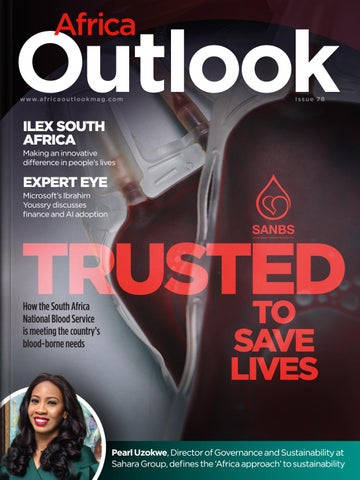
ILEX SOUTH AFRICA
Making an innovative difference in people’s lives
EXPERT EYE
Microsoft’s Ibrahim Youssry discusses finance and AI adoption
TRUSTED TO How the South Africa National Blood Service is meeting the country’s blood-borne needs
SAVE LIVES
Pearl Uzokwe, Director of Governance and Sustainability at Sahara Group, defines the ‘Africa approach’ to sustainability
travel magazine T
he unrelenting demand to travel, both for business and leisure purposes, is showing no signs of slowing up, and for Outlook Publishing, the growing extent to which we are covering this industry across our existing titles has led to the launch of Outlook Travel magazine. The major component of the publication takes the form of our Outlook Travel Guides, providing executives, avid travellers and our existing 575,000 international subscribers with the ultimate rundown of all the major economic drivers and thriving hubs across the world, with exclusive input from tourism industry associations and stakeholders – the people who know these places the best. You can join the vast numbers of tourism sector players enjoying the exposure we provide across our digital and print platforms with a range of options, from advertising through to free-of-charge editorials, extensive social media saturation, enhanced B2B networking opportunities, and a readymade forum to attract new investment and increase exposure.
www.outlooktravelmag.com
WELCOME
In Good Health
EDITORIAL Editorial Director: Tom Wadlow tom.wadlow@outlookpublishing.com Deputy Editor: Jonathan Dyble jonathan.dyble@outlookpublishing.com PRODUCTION Art Director: Stephen Giles steve.giles@outlookpublishing.com
T
Senior Designer: Devon Collins devon.collins@outlookpublishing.com Junior Designer: Matt Loudwell matt.loudwell@outlookpublishing.com
Operations Director: James Mitchell james.mitchell@outlookpublishing.com PROJECT DIRECTOR Joshua Mann joshua.mann@outlookpublishing.com TRAINING & DEVELOPMENT DIRECTOR Eddie Clinton eddie.clinton@outlookpublishing.com HEAD OF PROJECTS Callam Waller callam.waller@outlookpublishing.com SALES MANAGER Donovan Smith donovan.smith@outlookpublishing.com PROJECT MANAGERS Josh Hyland josh.hyland@outlookpublishing.com Kyle Livingstone kyle.livingstone@outlookpublishing.com Lewis Bush lewis.bush@outlookpublishing.com Sam Love sam.love@outlookpublishing.com Vivek Valmiki vivek.valmiki@outlookpublishing.com BUSINESS TRAVEL Director: Joe Palliser joe.palliser@outlookpublishing.com Sales Manager: Jordan Levey jordan.levey@outlookpublishing.com Sales Manager: Krisha Canlas krisha.canlas@outlookpublishing.com Sales Manager: Matt Cole-Wilkin matt.cole-wilkin@outlookpublishing.com
ADMINISTRATION Finance Director: Suzanne Welsh suzanne.welsh@outlookpublishing.com Finance Manager: Sophia Curran sophia.curran@outlookpublishing.com Office Manager: Daniel George daniel.george@outlookpublishing.com CONTACT Africa Outlook East Wing, Ground Floor, 69-75 Thorpe Road, Norwich, Norfolk, NR1 1UA, United Kingdom. Sales: +44 (0) 1603 959 652 Editorial: +44 (0) 1603 959 657 SUBSCRIPTIONS Tel: +44 (0) 1603 959 657 Email: tom.wadlow@outlookpublishing.com www.africaoutlookmag.com Like us on Facebook: facebook.com/africaoutlook Follow us on Twitter: @africa_outlook
From ensuring hospitals have adequate supplies
to testing and distributing to patients, specialist
BUSINESS Managing Director: Ben Weaver ben.weaver@outlookpublishing.com Sales Director: Nick Norris nick.norris@outlookpublishing.com
ransportation of blood is fundamental to the successful running of any health service.
organisations exist all over the world to provide vital blood-related support to healthcare setups. The South African National Blood Service (SANBS) is one such example. Established more than 80 years ago, the not-for-profit provides the delivery of safe blood to all South Africans and is led by CEO Jonathan Louw. “Being a clinician trained in anaesthetics, I have always had a good understanding of transfusion medicine, as well as a number of friends and colleagues who are transfusion specialists themselves,” he reveals. “Even before starting here, they would say to me that the good thing about SANBS is the fact that it ensures that blood is safe. But the problem is there’s not enough. “I came in with that understanding, and we have set about trying to address that problem ever since.” Louw’s interview forms this month’s cover story, one of three features dedicated to African healthcare, the other two comprising insight from ILEX South Africa and MedHealth. Before this you will find an extensive conversation with Pearl Uzokwe, Director of Governance and Sustainability at Sahara Group. A UK-educated and trained lawyer, she moved back to her beloved Nigeria a decade ago and is now in charge of strategising all things sustainable at the multinational energy firm. Among the other industries explored this issue include mining, manufacturing, retail and construction, along with a look at the first private pan-African education network in the form of Honoris United Universities. In the technology sphere, Microsoft’s Ibrahim Youssry explains how the financial services industry is ahead of the curve when it comes to adopting pioneering solutions. This will also be the final edition of Africa Outlook which houses our travel guides. Owing to the popularity of these features, Outlook Publishing is proudly launching a new standalone title, Outlook Travel, in December. For now, however, be sure to check out what Tanzania, the South African province of Mpumalanga and Botswana have to offer in this edition. Enjoy the issue! Tom Wadlow Editorial Director, Outlook Publishing Africa Outlook issue 78 | 3
CONTENTS
46
10 REGULARS
6 NEWS
14
22 Tanzania
8 EXPERT EYE
Africa’s most adventurous country
How advanced technologies continue to revolutionise the financial services industry
BUSINESS INSIGHT
10 Energy & Utilities Talking Sustainability
An interview with Pearl Uzokwe, Director of Governance and Sustainability at Sahara Group
18
14 Education
Education-led Impact
4 | Africa Outlook issue 78
A South African province and a naturelover’s dream
46 Botswana The wildlife safari capital
EVENT FOCUS
144 9th Practical Nigerian Content A premier showcase of Nigeria’s oil and gas industry
146 DRC Power, Oil & Gas Conference and Exhibition
TOPICAL FOCUS
Exploring opportunities in the Democratic Republic of Congo
Unlocking Africa’s Potential
36
36 Mpumalanga
A look at the first private pan-African higher education network
18 Transport Links
22
BUSINESS TRAVEL GUIDES
Around Africa in seven stories
Analysing the socioeconomic role of key transit corridors
148 Mining Indaba Bigger, better and bolder in 2020
150 THE FINAL WORD What will be the biggest trend impacting your industry in 2020?
AFRICA OUTLOOK MAGAZINE
F E AT U R E S
66 SHOWCASING LEADING COMPANIES
MANUFACTURING
Tell us your story and we’ll tell the world
Gearing Up for Growth
HEALTHCARE
118 Supreme Spring
Putting the spring in SA’s automotive step
68 South African National Blood Service (SANBS)
124 Conver-Tek, Davis & Deale and Sure Sight
A cornerstone of South African healthcare services
Helping to uphold South Africa’s entrepreneurial ecosystem
84 ILEX South Africa
RETAIL
Making an innovative difference in people’s lives
Gaining Traction
Trusted to Save Lives
Transforming Treatment
90 MedHealth
Harmonising Healthcare Helping build a better, brighter Malawi
SUPPLY CHAIN
96 Groupe Heavymat Industry Togo’s Machine Mover
Supplying vital machinery to industrial endeavours across Francophone Africa
MINING
SA’s Entrepreneurial Trifecta
118
128 Hi-Q
Winning trust with quality tyre products
ENERGY & UTILITIES
134 Kelvin Power
Keeping Joburg Switched On The private entity providing much-need grid stability
CONSTRUCTION
140 Raubex Infra
134
Built on Diversity
South Africa’s champion of multifaceted construction
104 BEAKE Afrika Group The Mining Moderniser
Championing R&D to offer cutting edge mining engineering services and solutions
112 Puckree Group
Leaving the Right Legacy
140
South Africa’s responsible coal miner
96
90 Africa Outlook issue 78 | 5
NEWS Around Africa in seven stories… T E L E C O M M U N I C AT I O N S
Orange unveils eightcountry network in West Africa
ENERGY
SOUTH AFRICAN GOVERNMENT SETS AMBITIOUS RENEWABLE ENERGY TARGETS T H E SOUTH African government has ambitious plans to build over 22 GW of new wind, solar and storage capacity by 2030. Its new integrated resource plan envisages wind accounting for 18 percent of the energy mix, six percent solar and two percent of storage – the remainder would comprise hydro (eight percent) coal (59 percent), nuclear (five percent) and gas (two percent).
South African Wind Energy Association Chief Executive Ntombifuthi Ntuli said: “We are happy with the wind energy’s apportionments in the energy mix, as we transition to a clean energy future. “With the bulk of the increase coming from renewable sources, it is a promising sign for our country as it faces pressure to reduce its carbon emissions and provide cheaper power.”
ECONOMY
IMF resumes lending to Congo T HE I N T ER N AT I O N A L Monetary Fund and Democratic Republic of Congo’s government have agreed a financial assistance package allowing the IMF to resume trading to Congo for the first time since 2012. 6 | Africa Outlook issue 78
TE L E CO MM U N I C ATI O N S G I A N T Orange recently announced the construction of a new international backbone network in West Africa. Built around a terrestrial fibre optic network, coupled with submarine cables, it will offer high levels of resilience and seamless availability. It will link up all the major capitals in the region – including Dakar, Bamako, Abidjan and Lagos – and connect to the rest of the world. Jérôme Barré, CEO of Orange Wholesale and International Networks, said: “Through this project, Orange is clearly demonstrating its leadership and expertise in the design, deployment and operation of international network infrastructure.” The commercial launch of the West African network is scheduled for the second quarter of 2020.
The IMF suspended its last loan programme to Congo – worth more than $500 million – after the government failed to provide enough detail on the sale of state mining assets. IMF delegation leader Mauricio Villafuerte explained that as part of the deal, Congolese authorities had agreed to reinforce macroeconomic stability and address the country’s difficult business climate.
CONSTRUCTION
TECHNOLOGY
Dubai’s DP World to develop business park in Namibia G LO B AL TRA DING company DP World has signed a memorandum of understanding with Nara Namib Free Economic Industrial Zone to develop a business park in Walvis Bay, a port town in Namibia. The park will be a ‘free economic zone’ for industry and logistics and will initially cover 50 hectares. Suhail Al Banna, CEO for Middle East and Africa at DP World, said: “We believe the country has great potential to expand its role as a hub for the region. The Namibian government’s FINANCE
Morocco’s Attijariwafa Bank receives $5 billion from China’s ExportImport fund T H E STATE- OWNED Export-Import Bank of China (ExIm) has agreed with Morocco’s Attijariwafa Bank to set up a $5 billion fund to promot e
KENYA PASSES CRUCIAL DATA PROTECTION LAW
recent legislation on free zones and efforts to facilitate greater business provides an attractive environment for investment.”
African exports to China, as well as industrial zones on the continent. China’s ExIm will finance the fund, which will invest in the 14 African countries where Attijariwafa Bank operates, including Tunisia, Burkina Faso and Senegal. Attijariwafa Bank reported a 4.9 percent year-on-year rise in its 2019 first half net profit, $303 million of which is attributable to shareholders.
TH E K E N YA N President Uhuru Kenyatta approved a data protection law complying with EU standards, in the aim of bolstering investment in its information technology sector. Although the country has attracted interest from foreign firms, officials say lack of safeguarding in personal data handling has prevented it from reaching its full potential. Joe Mucheru, Minister for Information, Technology and Communication, said: “Kenya has joined the global community in terms of data protection standards.” The new law restricts how much personal data can be handled, stored and shared, and complies with the EU’s General Data Protection Regulation. TOURISM
SUDAN PLANS TO ATTRACT MORE TOURISTS TO ITS PYRAMIDS S U DA N P L A N S to restore and develop its pyramids as a tourist destination after decades of neglect. Under the previous ruler, Omar alBashir, conflicts and crises – as well as a tough visa regime and lack of infrastructure – made Sudan an unlikely tourist destination. Now he has lost power, relaxed visa rules mean an increase in tourist numbers. Thanks to a $135 million donation from Qatar and German expertise, a visitor centre has been set up at Meroe. For the first time, visitors will be able to venture inside the pyramids, and soon go into the tombs underneath. Several pyramids will be restored after decades of neglect.
Africa Outlook issue 78 | 7
EXPERT EYE
How advanced technologies continue to revolutionise the financial services industry Microsoft’s Ibrahim Youssry reveals how the realm of finance is leading the way when it comes to progressing with AI adoption Written by: Ibrahim Youssry, Regional General Manager Middle East & Africa Multi-Country Region, Microsoft
ABOUT THE EXPERT Ibrahim Youssry is the Regional General Manager in the Middle East & Africa (MEA) Multi-Country Cluster at Microsoft. This region consists of 67 countries from North, West, East and Southern Africa and the Levant countries including Pakistan. Youssry has built a 12-year career at Microsoft which consists of leading several regional subsidiaries as a general manager as well as heading up sales, marketing and technical public sector teams across the MEA region. He is passionate about building organisational capabilities, attracting talents and people development, and leading large organisations to achieve their full potential.
I
n Africa, technology has long played a defining role in the development of the financial services industry (FSI). The early days of the internet ushered in online banking and ecommerce, forever expanding and evolving age-old business practices. The boom in mobile phone penetration saw the introduction of mobile money, capturing a significant portion of the unbanked. And blockchain is fast gaining steam among financial firms, given its potential to increase efficiency and streamline processes. Today, we’re at the cusp of another seismic shift, driven by the defining technologies of our time – the cloud and artificial intelligence. With these technologies, not only are centuries-old banks becoming increasingly agile, but we’re seeing a fertile ground for completely new types of fintech. MaTontine in Senegal, as an example, is bringing traditional African savings circles into the digital world, preserving 8 | Africa Outlook issue 78
a local culture of saving money while expanding its benefits. Although a large number of institutions are still getting started with these technologies, the industry as a whole already has very high expectations of the potential impact of digital transformation. In recent Microsoft-EY research, covering the Middle East and Africa, FSI ranked as the second highest of all industries in its expectation for AI to drive fundamental changes, redefine customer interactions and create alternative revenue streams. The study shows that already FSI has progressed more than any other business sector, with 38 percent of report respondents using AI in their daily operations. The industry’s speedy uptake of emerging technology has been largely fueled by fierce market competition, accelerated AI programmes and generally stronger foundations in data management and technology adoption.
Decoding data to understand customers At the crux of accelerated digital transformation in the FSI industry is access to exponentially more data about what consumers do and want. This presents an amazing opportunity for smart businesses that understand how to use analytics to give customers exactly what they demand. The challenge is that there is an overwhelming amount of data that businesses need to be able to filter and analyse. Financial institutions are also shifting towards intelligent cloud and AI-enabled systems to process this plethora of data and meet rising customer expectations. Consumers want customised, flexible, easy-to use tools and services which banks cannot provide without a centralised, intelligent customer view – services such as greater personalisation. South African insurance provider Discovery has had significant success in harnessing data to improve customer experience. The company draws on data sets and AI to deliver a more personalised offering to clients by, for example, creating tailored health goals and flagging customer interactions that display negative sentiment for follow-up. Through the recent launch of Discovery Bank, the company plans to bring the same level of personalisation and customer-centricity to the banking industry. The combined power of data and
analytics is also enabling more interactive real-time banking services. Ecobank for example, a leading independent regional banking group in Western and Central Africa, with affiliates in some 33 countries, opted for Microsoft Power BI, a business analytics service which provides interactive visualisations and business intelligence capabilities. Access to crucial data anytime and from any place is also of utmost importance for a banking business of the size of Ecobank. Thanks to its mobile apps, Microsoft Power BI provides users with the ability to access data, whether on a PC, a tablet or a smartphone, anytime and anywhere, as long as they have an internet connection. The instant access to data on a daily basis, such as the total volume of our transactions or the total value of transactions, and the performance of
“FORWARD-THINKING FSI COMPANIES SHOULD BE ADOPTING CLOUD TECHNOLOGIES TO REDUCE COSTS, ANALYSING DATA TO CREATE MORE PERSONALISED SERVICES” a particular affiliate, is also vital to the bank’s own decision-making process.
Harnessing the cloud to drive innovation The Nutanix Enterprise Cloud Index Report reveals there’s a rapid increase in hybrid cloud adoption in FSI. According to the report, hybrid cloud deployment reached 21 percent, which is above the global average of 18.5 percent.
FSI companies like Nedbank are migrating their operations to the Microsoft cloud to increase data privacy and security in a highly regulated industry. The South African bank utilises all three clouds: Microsoft Azure, Office 365 and Dynamics 365, leveraging the benefits of all three as a seamless and integrated experience, including layers of security and data residency to ensure compliance with local regulations. This has enabled rapid progress in the bank’s transformation journey and is driving its African growth strategy. Similarly, Standard Bank – the largest bank in Africa – has created a centre of excellence based on Microsoft technologies. By drawing on the power of Office 365, the bank’s various business units are able to quickly create apps and solutions in areas such as ATM management. At the end of the day, the bank will be able to transform its processes, increase efficiencies and completely change the way it operates. More importantly, partnerships like these will help to move the financial industry forward. It’s clear that through the adoption of new technology, digital transformation can help drive growth of FSI. Fintech on the continent has been forecast to grow from $200 million in value in 2018 to close to $3 billion by 2020. For this to happen, companies need to think about how to use technology to create new opportunities and drive customer growth. Forward-thinking FSI companies should be adopting cloud technologies to reduce costs, analysing data to create more personalised services, and using customer-focused channels to effectively reach their customers. When this happens, we’ll see growth, not only of the financial services industry, but of the continent’s digital economy as a whole. Africa Outlook issue 78 | 9
SAHARA GROUP
Pearl Uzokwe, Director of Governance and Sustainability at Sahara Group, discusses the definition of and ‘Africa approach’ to sustainability Writer: Tom Wadlow
TALKING SUSTAINABILIT A whole bunch of youthful exuberance and optimism brought me back to Nigeria. “Between my husband and I we had probably spent around 30 years outside of Africa, which exposed us to different ways of learning and working. “I think I was fortunate to meet someone with a similar mindset to 10 | Africa Outlook issue 78
myself, which is that having benefitted greatly from this experience we wanted to come back home and contribute the skills we have to our home countries, and essentially help to develop our continent.” Pearl Uzokwe can scarcely believe that it has been a decade since she decided to return to Africa.
Graduating in law from the University of Bristol and obtaining a postgraduate diploma from the College of Law in London, the next five years were spent gaining experience in legal practices in the UK capital before the lifechanging decision to relocate was made. Today, Uzokwe serves as Director
ENERGY & UTILITIES
TY
of Governance and Sustainability at Sahara Group. A leading international energy and infrastructure conglomerate with operations in over 38 countries across Africa, Middle East, Europe and Asia, the company being one of relatively few African-owned multinationals operating on the global energy stage.
For Uzokwe, who has worked her way up the ranks from Legal Manager, the decision to leave the UK has been more than vindicated. “It has certainly been a journey,” she quips. “There have been challenges along the way, but also an immense amount of satisfaction in contributing to the development of the company. “Sahara has allowed me to make a real contribution and a difference that I believe is far reaching – I feel my voice is heard and that my experience from other places is valued.” And the company has grown in tandem. During the past decade its headcount has increased by a factor of three to 4,000, while key business areas such as the legal department have also expanded alongside entry into new markets around the world. Uzokwe has been in her current position for roughly a year, but why did she cross law with sustainability? “Again, this is about making an impact, and the remit of sustainability and governance definitely enables that,” she answers. “Sustainability takes all that I know from a legal perspective into a whole new dynamic, and this is exciting for me. It is about building relationships and joining up stakeholders right across the organisation and the industry. I have found this to be a great fit for my skills but also discovered I had skills that I never knew I had.” So, the million-dollar question – what is Uzokwe’s definition of sustainability? “There is so much theory around sustainability and what it actually is, but we have to try and communicate this to people,” she says. “For me the key word is continuity. Whether it be from an environmental standpoint, a financial standpoint or a social standpoint, sustainability to me means ensuring continuity for generations to come.” A simple, yet unusually clear answer, Uzokwe and Sahara have also enacted what the Director of Governance and
Sustainability describes as an Africa approach to the issue, one defined by effective and genuine engagement of people. This is all about communication. “One thing we have learned is that when it comes to ensuring you have a sustained impact in countries, the first thing you have to do is listen effectively to the people who will feel the impact,” Uzokwe explains. “If you look at something like the progression of the UN’s Sustainable Development Goals with a critical eye, you can argue that the solutions put forward are not exactly what is needed in these communities. “The beauty of what we have here, a foundation which has been in place for the past 22 years, is that we have people on the ground who speak the local language, who interact with people and don’t engage superficially. We
FACT FILE: SAHARA GROUP • Year founded: 1996 • Consolidated revenue: More than $10 billion • Total number of staff: More than 4,000 • Number of countries present: 38 • Households serviced: More than one million • Current installed capacity: 2,040 MW • Target capacity for 2023: 5,000 MW • Vision: To be the provider of choice wherever energy is consumed
Africa Outlook issue 78 | 11
SAHARA GROUP
COUNTERING CORRUPTION Tackling the issue of corruption both at an organisational and societal level is another critical part of Uzokwe’s remit as Director of Governance and Sustainability at Sahara Group. “We are partnered with the World Economic Forum’s Partnering Against Corruption Initiative (PACI) and are encouraging other private businesses to do the same,” she adds. “We want to change the narrative.” PACI has become the leading business voice on anti-corruption and transparency and is one of the World Economic Forum’s most impactful efforts, working closely with business leaders, international organisations and governments to improve transparency via a global anti-corruption agenda. The initiative launched in 2004 and has around 90 CEO signatories from different sectors across the globe. Sahara became a partner in 2015, a move which has helped to create a platform for raising the bar for other African businesses, sending a strong global signal of the unfolding paradigm shift towards anti-corruption across the continent.
speak with leaders in the local community – be they religious leaders, female leaders, youth leaders – because we know the importance of getting buy-in to what we are doing.” This leads into the next part of Sahara’s sustainability approach, which is making sure it is fit for purpose. Here, 12 | Africa Outlook issue 78
Uzokwe brings up the example of talking about climate change in Nigeria. “We can’t have the same discussions at our office in Lagos as we do when we go into local communities,” she continues. “People are living on very small incomes and have more immediate
and pressing needs in their day-today lives, so we have to look at the language and simplify what we are talking about. This means we need to present sustainability in a way that will make people care.” Relating to identifiable topics such as flooding is one such way, Uzokwe highlighting how people can relate to the fact they have witnessed an increase in flood activity, and that this can be linked to climate change. Other issues such as affordability also need to be taken into account, with many Nigerian citizens not in a position to shift to a more sustainable lifestyle for purely altruistic reasons – in these cases, other benefits to participation in things like recycling programmes need to be factored in. However, once the explanation hurdle has been cleared, the way has been paved for stakeholders in government, private enterprise and other parts of civil society to mobilise action. “One way we have helped do this is through our support of Enactus, which
ENERGY & UTILITIES is the world’s largest experiential learning platform,” Uzokwe says. “This focusses on helping people to solve problems in their own communities. Every year there is a competition in Nigeria for students to come up with ideas, with the winning solutions being backed financially. One of the recent winners was a project which involved a bio-digester converting waste to energy.” But what of the bigger sustainable energy picture in Nigeria, and indeed Africa at large? While the region only accounts for around four percent of global emissions, developing a responsible energy mix is still of paramount importance given the continent has yet to develop the industrial capacity of the likes of Europe, Asia and America. “When you further consider that half the continent still lacks proper access to power, you have to think even harder about what the energy mix should be,” Uzokwe adds. “When I think about renewables the word I use is transition – nothing will happen overnight, so it is about laying the groundwork.” Given so many people lack access to power because they live in difficult to
“THE CAPACITY FOR GROWTH IN NIGERIA IS MASSIVE, BUT WE NEED TO CURATE THE ENVIRONMENT TO ENCOURAGE THIS GROWTH”
Pearl Uzokwe reach places, off-grid solutions will undoubtedly come to the fore, especially given Africa’s abundant potential to produce solar energy. “Each country must also play to its own strengths though,” says Uzokwe. “If you take Nigeria, where we are headquartered, around 15 percent of energy is generated using renewable sources, and almost all of this derives
from hydroelectric power that was set up in the 1970s and 1980s. “The potential for Nigerian hydro is around 15,000 MW, which is a significant amount of power given that around 4,000 MW is produced via hydro at the moment. My point is that we must look at our own strengths and what we can maximise first.” Other factors such as government subsidies and disposable incomes of consumers must also be taken into account when evaluating the prospects of developing a certain power solution, but Uzokwe is adamant of Nigeria’s potential to go green. Rounding off the conversation, she concludes: “The capacity for growth in Nigeria is massive, but we need to curate the environment to encourage this growth. We believe hands down that access to power will be the defining factor in moving Nigeria from where it is now to where it should be. “The potential is there and there are pockets of development occurring – now the country needs to ensure the legislation follows to help the private sector invest. “I am cautiously optimistic. There are 200 million people in Nigeria, and when we get it right, the impact will be enormous.”
Sahara Group Tel: +234 1 279 3800-4 sahara@sahara-group.com www. sahara-group.com
Africa Outlook issue 78 | 13
HONORIS UNITED UNIVERSITIES
EDUCATION-LED IMPACT
J
ust one in 20 people of the relevant age group in Africa have access to higher education, five times less than the global average. This is a monumental problem. Higher education is the gateway to many facets of sustainable development, and given the continent’s projected population growth (set to double to an unprecedented 2.4 billion by 2050), making effective and efficient use of its relatively untapped 14 | Africa Outlook issue 78
Honoris United Universities, also known as the first private pan-African higher education network, casts light on the continental challenges surrounding tertiary learning Writer: Jonathan Dyble
human resource base will be crucial in allowing the region to flourish. “Local people are key to transforming the continent, and the youth are its most valuable asset,” states Luis Lopez. “Africa is home to the world’s youngest population and the working age demographic is estimated
to grow by 70 percent to 450 million people by 2035. The mandate is clear – knowledge and skills are critical for sustainable social and economic development.” A philanthropist by nature, Lopez is one individual acutely aware of the true power of education. The bulk of his career and creden-
EDUCATION educating the next generation of African leaders and professionals.”
MOVING WITH THE TIMES Now heading up this collaborative, agile organisation, renowned as the first private pan-African higher education network, as the CEO, Lopez is playing a leading role in attempting to address the ongoing challenges posed by a lack of advanced learning. And Honoris’s active alignment with Agenda 2063 is a crucial part of those endeavours.
Within the framework laid out by the heads of state and governments of the African Union (comprising 55 member states), one of its goals is to promote future solutions-oriented leaders and professionals through the development of science, technology and innovation (STI) skills and soft skills. “A skills-driven approach can buoy Africa’s youth potential to gain a competitive advantage in a complex, globalised, and increasingly digital jobs market,” Lopez states. “We have developed a pan-African immersion
PREPARING AFRICA FOR THE MODERN WORLD OF WORK Honoris United Universities is committed to ensuring that African students and entrepreneurs are prepared for 21st century jobs, accomplishing this through a variety of initiatives. These include, but are not limited to:
Honoris Collective Lab Launched across every institution in the network, each Collective Lab will be an open access physical site to meet, learn, connect, create, share and inspire – for current students and for alumni. Stemming from the launch of its iLeadLAB at REGENT Business School in South Africa, the labs will empower students with core skills and competencies to creatively bridge the gap between education and the demands of the 21st century workplace. iLeadLAB in particular will promote familiarity with elements such as programming, 3D printing, project management, public speaking, and more.
iTeachLAB This is an extension of the MANCOSA School of Education in South Africa, set to be a world-class training simulation resource to develop teachers highly skilled and competitive in the global labour market, adept with the influence and nuances of industry 4.0. tials can be found at Laureate International Universities, having helped to build what is now a global education network during a 13-year stint. “It was during my time at Laureate that I accumulated a broad exposure to post-secondary education, especially in growth markets,” he recalls. “I am a strong believer in the transformative nature of learning, from the level of the individual to nation building. “Because of this, I was particularly drawn to Honoris United Universities because of its pioneering pan-African vision, and the tangible commitment its founders display to preparing and
Honoris Medical Simulation Centre Based in Tunisia, this has been developed to maximise graduate employability and skillsets. Designed in coordination with international experts, using advanced technologies to create an impressive 2,500-square-metre site in the heart of Tunis, it is equipped with four simulation types, including advanced mannequin technologies in a hospital setting, scenario-based simulations, actor-based simulations and cutting-edge virtual reality technologies.
Honoris Academic Council Launched in 2019, the Academic Council acts as a means of ensuring that all students within the Honoris network benefit from strong academic leaders and their expertise. It has established foundational guidelines for soft skills and digital literacy to incorporate into educational outcomes.
Africa Outlook issue 78 | 15
HONORIS UNITED UNIVERSITIES
CEO Luis Lopez (right) signing an agreement
with world-class academic and experiential learning to act as one catalyst in this framework. “Moreover, Agenda 2063 points to the linear relationship between prosperity, high-quality economic growth and employment opportunities for all – especially women and youth. “We are an important stakeholder in supporting this agenda and seek different avenues to do so, from the formal academic offer to high school leavers and working adults to supporting women’s leadership via WIA’s Project 54 in which we are the knowledge partner. “In short, we seek to support and educate world-class African human capital able to transform the continent.” 16 | Africa Outlook issue 78
iLeadLab - Regent Business School, South Africa
EDUCATION
Indeed, this combined emphasis on equality and critical subjects such as STEM is contributing towards the current development demands of the continent, equipping people from all backgrounds to become part of Africa’s self-sufficient aspirations. And Honoris’s own curricular reflects such, recognising the need for a modernised, agile learning ecosystem. “STEM cannot stand still – it is ever changing,” Lopez states. “As educators, we’re focused on helping African students tap into scientific inventions and discoveries that are being made right now, each and every day. “Living through the emergence of the fourth industrial revolution, with automation, AI, fintech and the
cutting-edge thinking in the fields of physics, chemistry, biology, medicine and economics,” Lopez affirms. Honoris has also been successful in its efforts to empower women in particular – in Tunisia, for example, 62 percent of its student population is female. Meanwhile, in South Africa, Honoris’s distance learning model has been reinforced with a wider geographical footprint, and in Morocco it has ensured that tuition levels reflect the household reality of families. “We’re further proud of the fact that our campus sites in urban areas like Casablanca, Tunis and Johannesburg, are located right in the heart of the cities, making the learning environments accessible with respect to time, transportation and cost,” Lopez adds. Just a handful of ways in which Honoris is striving to make a real difference to the education situation in Africa; its overriding vision speaks volumes of the size of the overall impact that it is looking to make. “Through all these exciting projects, as well as through our continued growth, Honoris and its leaders have set an initial goal of impacting 100,000 students in Africa, each of whom has a family and community that will, in turn, be positively impacted,” Lopez affirms in what can only be described as a internet of things, our evolving world buoyant concluding statement. is becoming defined by digital or “The people of Honoris share a prodisruptive innovations.” found belief in Africa’s future and its potential for human and economic deINSPIRED BY A VISION velopment. It is why we are passionate Propelled by this approach, the about our network and education. organisation is taking great strides in “We acknowledge the challenges meeting its mission of preparing future that young people face in Africa but African innovators, most recently are optimistic that education will be announcing plans to sponsor the the reason for leapfrogging ahead to a continent’s leading young scientists better future. And I’m incredibly proud via its partnership with the Council of the individuals that we are supportand Foundation for the Lindau Nobel ing and advocating for. Laureate Meetings. “My vision for Honoris has always “Through its annual meetings in been that the impact we make and the Germany with 600 of the brightest ecosystem that we build assures sucminds in the world and more than 50 cess for our students, and the journey Nobel Laureates, African scientists thus far has been inspiring in Honoris’s will be able to learn and contribute to movement toward this vision.” Africa Outlook issue 78 | 17
TOPICAL FOCUS
UNLOCKING AFRICA’S POTENTIAL
18 | Africa Outlook issue 78
TRANSPORT LINKS Home to more than a third of the world’s landlocked countries, intra-continental trade routes and agreements are becoming increasingly important to the socioeconomic success of the entire continent Writer: Jonathan Dyble
F
or centuries, even millennia, the sea has been the source of both conflict and prosperity among
people and civilisations. From the First Anglo-Dutch War of the 1650s that was driven by a desire to consolidate lucrative ocean-based spice trade routes in Asia to the Opium Wars of the mid-1800s, instigated by the British in an attempt to maintain access to China, countless clashes have been fought at sea throughout history. Even today, in what is largely a more peaceful global society, the roots of globalisation are still firmly planted in the maritime industry. It is of little surprise therefore that,
with few exceptions, the world’s 45 landlocked countries are poor. Of the 15 lowest ranking countries in the human development index, eight of these have no coastline at all, while the GDP per capita of landlocked countries is roughly 40 percent lower than that of their maritime neighbours. The challenges are numerous. From dependence on the transit networks of other countries to increased costs and waiting times surrounding the import of oil, food and other goods, barriers to trade have a great domino effect on growth and development.
Africa Outlook issue 78 | 19
TOPICAL FOCUS
For 16 of Africa’s 55 countries, this rings particularly true. Yet despite the problems, resolutions are beginning to come to the fore. In March 2018, the continent cast its vote for more and better internal trade through the signing of the African Continental Free Trade Area Agreement (AfCFTA), committing to remove tariffs on 90 percent of goods, as well as liberalising trade services and addressing non-tariff barriers. This has subsequently made Africa the largest free trade area in the world, serving more than one billion consumers with a GDP of $3 trillion. Coupling this, a number of new cross-border transit corridors are under construction or expansion – intra-continental transport routes that 20 | Africa Outlook issue 78
KEY INTRA-CONTINENTAL CORRIDORS EAST AND SOUTHERN AFRICA: Nacala Corridor; Mtwara Corridor; Mombasa-Addis Ababa Corridor; Nairobi Lukasa Corridor CENTRAL AFRICA: Brazzaville-Libreville Corridor; Douala-N’djamena Corrdior; Douala-Bangui Corridor; Cameroon-Nigeria Corridor WEST AND NORTH AFRICA: Bamako-San Pedro Corridor; DakarBamako-Ouagadougou-Niamey Corridor; Dakar-Abidjan; AbidjanLagos Corridor; Lome- Ouagadougou Corridor; Tema- Ouagadougou Corridor; Trans-Tunisia Corridor
will prove to be crucial in both capitalising on the benefits provided by the AfCFTA and facilitating improved internalisation of the continent’s landlocked countries. “By removing physical barriers to cross-border trade and expanding
markets beyond national boundaries, international road corridors foster a conducive environment for the private sector and for attracting foreign direct investments,” stated Amadou, Director of the Infrastructure & Urban Development Department of the African
TRANSPORT LINKS Development Bank (AfDB), in the organisation’s recently published Cross-Border Road Corridors: The Quest to Integrate Africa report. “In addition to enhancing trade and strengthening regional integration, cross-border road corridors contribute to poverty reduction by increasing access to markets and social services.” Indeed, the AfDB itself, mandated to spur sustainable economic development and social progress across the continent, has contributed significantly to the development of these networks. Over the past 12 years, the Bank has financed nearly $8 billion of regional transport projects, helping to create 13,000 kilometres of regional highways on 17 road corridors along 26 one-stop border post facilities. And, as is demonstrated by numerous case studies, these corridors are beginning to fulfil their purpose. Take the Bamako-Dakar highway, for example. Costing $400 million back in 2008, the route now carries more than half of Mali’s import and export goods to and from the Port of Dakar, enabling the country to diversify its trade routes. Further, the AfDB estimates that the country has been able to reduce costs by more than 20 percent and increase international trade by 10 percent as a result. “In Southern Africa, the Nacala Corridor connects Zambia and Malawi to the Mozambican Port of Nacala,” Oumarou stated in the report, eluding to a second crucial case study. “Despite being the shortest route to a seaport, it was under-used
CONTRIBUTIONS OF THE AFDB EAST AND SOUTHERN AFRICA TOTAL INVESTMENT: $4 billion KILOMETRES OF ROAD FINANCED: 4,781 PEOPLE IN PROJECT AREAS: 94 million ONE-STOP BORDER POSTS BUILT: 9 CENTRAL AFRICA TOTAL INVESTMENT: $1.6 billion KILOMETRES OF ROAD FINANCED: 2,216 PEOPLE IN PROJECT AREAS: 35 million ONE-STOP BORDER POSTS BUILT: 5 WEST AND NORTH AFRICA TOTAL INVESTMENT: $2.6 billion KILOMETRES OF ROAD FINANCED: 5,682
because of many missing links which made the journey long and difficult. Most international shippers preferred to make the journey to the Port of Durban in South Africa, much further away than Nacala. “The Bank injected $420 million to finance approximately half of the total 1,900-kilometre corridor between Lusaka and Nacala, facilitating regional trade among the three countries. Official port statistics show an average annual growth rate of 6.2 percent at Nacala port between 2012 and 2016.” A third example comes from East Africa’s Mombasa-Nairobi-Addis Ababa corridor – a route that has received more than $1 billion in funding from the AfDB. Serving a similarly important purpose, it has enabled Ethiopia to trade roughly 20 percent of its freight more competitively through the Port of Mombasa, and bilateral trade between Ethiopia and Kenya has increased 400 percent. Yet these three corridors form what is just a small sample of the continent’s expanding transport networks. They constitute part of the Trans-Africa Highway network that comprises numerous other transcontinental road projects, backed by the African Union and United Nations Economic Commission for Africa (UNECA), spanning more than 56,000 kilometres in total. Combine them with similarly critical ongoing rail projects, from the Isaka-Kigali Standard Gauge Railway spanning Tanzania and Rwanda to the existing Assia Ababa-Djibouti Railway, and Africa’s trade-facilitated development situation looks set to improve in the coming years.
PEOPLE IN PROJECT AREAS: 110 million ONE-STOP BORDER POSTS BUILT: 12
Africa Outlook issue 78 | 21
TANZANIA
22 | Africa Outlook issue 78
BUSINESS TRAVEL GUIDE
TANZANIA
With its snow-capped mountains, tropical islands, vast plains and powdery beaches, Tanzania is a country just waiting to be explored Writer: Dani Redd | Project Manager: Jordan Levey
T
anzania is one of Africa’s most stunning and diverse countries. From the vast grasslands of the Serengeti to its miles of tropical coastline, there’s so much to explore. The country also boasts Africa’s highest point – snow-capped Kilimanjaro, which is climbed by around 20,000 people every year. And don’t forget its offshore islands, including magical Zanzibar and the more off-the-beaten-track Mafia Island. If you’re interested in outdoor activities, there’s no shortage of things to do in Tanzania. Trek through tropical forests, alpine meadows and ice fields. Take to the ocean to surf or go scuba diving through coral gardens. Explore overland on quad bike or horseback.
When it comes to safaris, Tanzania is unrivalled. There’s a huge variety of wildlife here – visitors flock to the Serengeti every year to observe the Great Annual Migration of wildebeest and zebras. But there’s more to Tanzania than just wildlife. It also has a vibrant culture and friendly inhabitants. You’ll receive a warm welcome from everyone, be they indigenous Maasai warriors or inhabitants of tropical metropolis Dar es Salaam. Whether you’re looking for a laidback beach break or a trekking adventure, a trip to Tanzania is an experience that will stay with you for years to come.
Africa Outlook issue 78 | 23
TANZANIA’S BEST KEPT SECRETS www.serenahotels.com
Serena Mivumo River Lodge
SERENA HOTELS SAFARI LODGES AND CAMPS HOTELS • RESORTS
Arusha Serena Hotel Resort & Spa
Serengeti
Serena Sales Office, Dar es Salaam Tel: +255 22 2118114 & +255 22 2118113 Cell: +255 786 999062 & +255 786 999065 Email: sales@serena.co.tz Blog: www.theserenaexperience.com
Selous Serena Camp
Zanzibar Serena Hotel
Lake Manyara Serena Safari Lodge
TANZANIA
The Business End TANZANIA HAS A predominantly agrarian economy, with around 40 percent of the workforce employed in the agricultural sector. The most lucrative exported cash crops include coffee and cotton, while the island of Zanzibar produces around a tenth of the world’s cloves. The economy is also reliant on mining. Diamonds, tanzanite and gold are all mined in the country. International countries have been exploring petroleum resources both onshore and offshore. Tourism is also important to the Tanzanian economy. According to World Travel Tourism Council, in 2017 tourism made a nine percent contribution to Tanzania’s GDP – a number predicted 26 | Africa Outlook issue 78
to rise with every passing year. Indeed, last year saw a record number of 1.5 million tourists setting foot in the country. What explains Tanzania’s increasing appeal? At a conference in 2018, Professor Adolf Mkenda, Minister of Tourism, suggested that “the development is largely explained by the ongoing extensive promotional efforts coupled with beautiful tourist attractions in the country”. Decisive measures to combat poaching in national parks and game reserves have also increased the appeal of Tanzania’s great outdoors. The country continues to develop its travel and business infrastructure, which will also boost tourism.
FACTS & FIGURES
Languages: Swahili, English Area: 947,303 km2 Population (2018): 52,423,000 GDP (2018): $56, 852 million Currency: Tanzanian Shilling (TZS) Time zone: East Africa Time Dialling code: +255 Internet TLD: .tz Climate: Tropical Highest recorded temperature: 38.9˚C
BUSINESS TRAVEL GUIDE
In Focus: Dar es Salaam DAR ES SALAAM is Tanzania’s largest city, with a population of more than four million. Although not the country’s capital, it’s the seat of government, industrial centre and largest port in the country. Many leisure travellers pass through Dar es Salaam on their way to attractions such as Zanzibar Island, but it’s worth stopping by for the food alone. A multicultural population means that cuisines from all around the world are available. The city is renowned for its Indian food, ranging from sweet chai to kebabs, and it’s possible to pick up African and Turkish street food. Dar es Salaam also has its fair share of upmarket restaurants and high-end bars,
if you enjoy travelling in style. The city’s architecture reflects its colonial past, with buildings incorporating Swahili, German and Asian styles. Learn more about the country’s past with a visit to The National Museum. Head to Mwenge Woodcarvers Market to pick up Makonde carvings – a traditional style of woodworking unique to Tanzania. Dar es Salaam is a rapidly developing hub for MICE tourism. Business travellers will find an array of conference facilities, luxury hotels, and good transport connections to the surrounding area and the rest of the world.
Africa Outlook issue 78 | 27
TANZANIA
The Hotels Association of Tanzania
Nura-Lisa Karamagi LAST YEAR, AFRICA Outlook interviewed the Hotels Association of Tanzania (HAN) about the growth of the tourism sector, and how the organisation is helping to promote and preserve the industry. The Hotels Association of Tanzania was formed in 2004, with the goal of helping the private accommodation sector navigate a relationship between the public sector and other stakeholders. As was revealed to us last year, “our ultimate objective is to make the Tanzanian hospitality industry competitive globally, and viable for the investors, employers, employees, local communities, suppliers and the government”.
28 | Africa Outlook issue 78
We caught up with Nura-Lisa Karamagi, HAN’s CEO, to discuss the most recent developments in the association.
country. A positive result from this work is that finally, a Sector Skills Council is in the process of being set up.
Africa Outlook (AfO): It has been around a year since we last caught up. How would you describe the past 12 months’ activity at the association?
AfO: How would you say Tanzania has developed in the past year or so as a travel hub, and what are the key reasons behind its growing appeal?
Nura-Lisa Karamagi (N-LK): The association’s mandate has remained the same: to advocate for fair laws and practices for the interest of both the members, and those who will benefit from the tourism sector. Our focus these past 12 months has been on engaging the government to understand first-hand the challenges facing our members and trying to find the best ways to resolve those challenges. We have worked well with the Ministry of Natural Resources and Tourism on this. They are engaging us more and more before implementing new regulations. The challenge remains to coordinate with other government agencies, but it’s in progress. Skills development also remains a key issue. We continue to work with various stakeholders to address some of the skills gap issue in the
N-LK: Tanzania continues to grow as a travel hub. This is partly due to the positive press it continues to have with regards to its attractions, and partly because of the continued efforts by public and private stakeholders to advertise the destination. Security is of paramount importance to a country’s appeal, and this government continues to do well in that arena. AfO: Why, in your opinion, should someone visit Tanzania? N-LK: Tanzania is blessed with every type of attraction someone would
BUSINESS TRAVEL GUIDE wish to see, not simply wildlife and beautiful beaches. We have lots of diverse attractions. Some are harder to find than others, but uncovering a hidden gem is always rewarding. There is really something for everyone here; it’s one of the few countries in the world I can think of that would tick most of the boxes for different types of tourism products. Above all, it’s authentic. Having had the privilege to visit many other countries in the world, I have realised that something which makes Tanzania stand out as a destination is the friendliness of its people. Tanzania and its residents are amazing hosts. AfO: Are there any specific attractions, landmarks or places to eat and drink that you would recommend? N-LK: I believe that there are so many unique attractions and properties in Tanzania. The south of the country is a rising star and has much to offer. Onsea House in Arusha has a longstanding reputation in fine dining. The Gran Melia in Arusha, which recently opened, offers a variety of fine dining restaurants and bars on its property.
AfO: What trends are transforming the tourism industry in Tanzania at present? How are you responding to these trends? N-LK: More and more tourists are conscious of eco-friendly and conservation practices as a means of protecting the surrounding environments in places they visit. For a long while now operators have appreciated this and want to make their properties as eco-friendly as possible. It is a selling point. AfO: How do you see Tanzania developing as a tourism and travel hub over the next year to two years? N-LK: The continuing improvements in infrastructure are opening up more areas in the country. This is in line with the government’s aim to diversify tourism products and expand tourism to every corner of the country, not only the northern regions and Zanzibar. You will start to see other areas become popular attractions – not only Kilimanjaro, Ngorongoro, Serengeti and Zanzibar. As I said, Tanzania has much to offer, and the government is working on facilitating investments in other areas to help them develop.
AfO: Are there any plans or projects in the pipeline that you wish to highlight? N-LK: A large portion of the Selous Game Reserve – which is a world heritage site – was recently directed by His Excellency President Magufuli to become a national park. This offers a great opportunity. In the future, more hunting grounds will become photogenic conservation areas. Tanzania’s commitment to conservation must be highly commended. AfO: Are you optimistic about the future of the tourism industry in Tanzania? N-LK: I believe tourism in Tanzania will improve in value so long as conservation, environmental practices and a fertile business environment continue to be fostered. The will and efforts continue to be present for that in the country: therefore, I am optimistic.
Africa Outlook issue 78 | 29
TANZANIA
Outlook Recommends “Wildlife, beaches, friendly people, fascinating cultures, Serengeti, Ngorongoro, Mt Kilimanjaro, Zanzibar Archipelago – Tanzania has all these and more wrapped up in one adventurous, welcoming package” - Lonely Planet
HOTE L S
RESTAURANTS
Plantation Lodge This safari hotel is located near Ngorongoro Conservation Area. It’s nestled in tropical, landscaped gardens, home to around 140 different bird species. There’s also a restaurant and an outdoor pool – the perfect spot for a sundowner. Accommodation is provided in opulent rooms and suites overlooking the garden.
Serena Hotels Serena Hotels operates a chain of upmarket hotels, tented safari camps and lodges across South Africa, including 10 properties in Tanzania. Whether you’re looking for an ocean-facing hotel in Zanzibar, or a camp in the stunning Serengeti, you’ll find your perfect accommodation with the company. The fantastic Kirawira Serena Camp offers 25 lavish tents, with private balconies overlooking the Serengeti plains. They offer a unique bush dinner on the plains, with campfires, Maasai dances and a five-course feast prepared on the barbecue. There’s also an outdoor pool, and game drives taking you in search of the ‘Big Five.’
30 | Africa Outlook issue 78
The Rock Karembezi Café Akemi Revolving Restaurant Flame Tree Lounge BARS
High Spirit Lounge The Slow Leopard O’Donovan’s Reggae Bar M USEUM S
Sultan’s Palace Museum The Tanzanite Experience Four Seasons Safari Lodge Serengeti Zuri Zanzibar
Maasai Cultural Museum National Museum of Tanzania
Like a green oasis, The Plantation Lodge rests on the red-brown hills. The individually furnished rooms and suites melting harmoniously into the flowering garden offer comfort and relaxation. Everywhere you look, you can see and even feel the personal atmosphere of this owner-run lodge with furnishings that were selected with great attention to detail. The Plantation Lodge’s cordial service leaves no wish unfulfilled. The lodge’s location promises maximum safari enjoyment: a stone’s throw from the entrance to the Ngorongoro Conservation Area and the Lake Manyara national park, and just a short journey from the Tarangire national park and the Serengeti.
NUMBER OF ROOMS SUITES Standard rooms: 15 Family units (with two bedrooms): 1 Suites: 7 Family suites (with two bedrooms): 1 ROOM AMENITIES • No one room is like another. The rooms at The Plantation Lodge are individually designed and vary in size. • All rooms are equipped with: • Naturally lit bathrooms with shower and/or bath tub, hair dryer, bath robe(s), toiletries • Veranda or terrace with a view of the garden • Mosquito nets • Windows protecting against the ingress of insects • Safe • Kettle, selection of teas and coffees
RESTAURANT AND BAR The restaurant offers a four-course menu every evening. Fruit, vegetables and salad are grown on the premises or are sourced from local suppliers, as is the meat. The bar, with its wine cellar and large terraced area, is a popular haunt. AMENITIES AND SERVICES • Free WLAN internet access • Laundry service • Souvenir shop • Pool with chaises longues and towels • Massage • Manicure, pedicure • Afternoon tea, coffee and cake • All major credit cards are accepted. Phone: + 255 784 260 799 (Office) | + 255 753 743 378 (Reservations) Email: reservation@plantation-lodge.com | account@plantation-lodge.com
WWW.EMEOUTLOOKMAG.COM
31
TANZANIA
Tanzania Society of Travel Agents Moustafa Khataw
Africa Outlook (AfO): It has been around a year since we last caught up. How would you describe the past 12 months’ activity at TASOTA? Moustafa Khataw (MK): TASOTA has been having regular meetings for its members – including its suppliers, service providers and airlines – with a view of enhancing their efficiency. They are also able to avail a wide range of products to their clientele at large. It has been indeed a busy year. AfO: How would you say Tanzania has developed in the past year or so as a travel hub, and what are the key reasons behind its growing appeal? MK: With the revival of Air Tanzania – the country’s national carrier – which has taken delivery of eight brand new aircraft, and the opening of Terminal 3 at Julius Nyerere International airport, Dar es Salaam is poised to become a regional hub.
TANZANIA SOCIETY OF Travel Agents (TASOTA) was formed in 1980 with the intention of bringing all IATA-accredited travel agents in Tanzania under one umbrella, so they could speak with a single voice. Last year we spoke to TASOTA’s chairman, Moustafa Khataw, about how the organisation has grown and changed since inception. Now we sat down with him to discuss the organisation’s most recent developments and their aspirations for the future.
There’s also the world-famous Ngorongoro Crater, Gombe National Park (boasting unique chimpanzees), Zanzibar, Pemba Island and diving spots in Mafia, to mention just a few. AfO: Are there any specific attractions, landmarks or places to eat and drink that you would recommend? MK: For Dar es Salaam, the Makonde Carving and Village Museum are a must to visit. Many restaurants are there, offering variety of cuisines. The Slipway is a place to be for a sundowner.
MK: Tourism is growing exponentially, and the country has a target to reach 1.5 million tourist arrivals by 2020. Tourism contributes at least 20 percent of Tanzania’s GDP, and provides employment to over a million people. AfO: Are there any plans or projects you have in the pipeline that you wish to highlight?
AfO: Why, in your opinion, should someone visit Tanzania?
AfO: What trends are transforming the tourism industry in Tanzania at present? How are you responding to these trends?
MK: Tanzania has the best attractions, be they safaris, beach holidays and other unexplored parks and game reserves. Tanzania has been named as one of the top destinations in Africa and a must-visit country. It boasts Mount Kilimanjaro – the highest freestanding mountain in Africa – and the great Serengeti Plains with the amazing wildebeest migration.
MK: The Tanzania Tourist Board (TTB) has been organising various road shows in China and India with a view to tapping into these markets. They have been participating heavily at trade fairs such as WTM and ITB as well. TTB has been on a campaign to advertise in UK, Europe and Americas, attempting to increase the number of tourists visiting from these countries.
32 | Africa Outlook issue 78
AfO: How do you see Tanzania developing as a tourism and travel hub over the next year to two years?
MK: TASOTA Is encouraging its members to move towards embracing digital technologies. This will allow them to reach their audience in an easy and cost-effective manner. AfO: Are you optimistic about the future of the tourism industry in Tanzania? MK: There is no doubt that tourism will be the number one foreign exchange earner for the country for the foreseeable future. With government support, its growth is all but guaranteed.
BUSINESS TRAVEL GUIDE
Africa Outlook issue 78 | 33
TANZANIA
Transport Links THERE ARE MANY ways to explore Tanzania. If you’re pushed for time, taking flights is the quickest way to cross the country’s vast expanse. A decent domestic flight network connects major travel hubs such as Dar es Salaam, Arusha and Zanzibar, as well as major national parks. Flight carriers include Air Tanzania and Air Excel. Air Tanzania also provides international connections. The busiest international airport is at Dar Es Salaam, which sees an average of 2.5 million passengers a year. This is expected to rise to nine million, following the
34 | Africa Outlook issue 78
completion of a major new terminal in June 2019. Tanzania can also be explored on water. Ferries operate routes across Lake Victoria, between Dar es Salaam and Zanzibar and from Pemba to Tanga. It’s also possible to visit these destinations on traditional sailing boats known as dhows, which have been converted for tourist travel – local tour operators will help you book a private charter. Another scenic option is to take the train. Tanzania has two railway lines, one linking Dar es Salaam to New Ka-
piri Mposhi (in Zambia), and the other running between Dar es Salaam and Mwanza. There is also a long-distance bus network. For shorter distances, the best option is to take a taxi or a ‘dalla-dalla’; a shared minibus taxi.
BUSINESS TRAVEL GUIDE
Landmark Attractions ZANZIBAR
MOUNT KILIMANJARO
“It has always had white sand, blue seas and green forests (in 1856 the British explorer Richard Burton described it as a place where ‘earth, sea and sky all seemed wrapped in a soft and sensuous repose’) and some of the most beautiful dive sites on earth” – Condé Nast Traveller
“At 5,895 m, Kilimanjaro is the highest point in Africa. This volcanic massif stands in splendid isolation above the surrounding plains, with its snowy peak looming over the savannah. The mountain is encircled by mountain forest. Numerous mammals, many of them endangered species, live in the park” UNESCO
LAKE VICTORIA
SERENGETI PLAINS
“Tanzania’s half of Africa’s largest lake sees few visitors, but the region holds many attractions for those with a bent for the offbeat and a desire to immerse themselves in the rhythms of local life beyond the tourist trail” – Lonely Planet
“Famous for its jaw-dropping annual wildebeest migration, Serengeti National Park is the perfect place to see Africa’s wildlife superstars, and experience the continent’s most epic landscapes” - Wanderlust
Africa Outlook issue 78 | 35
MPUMALANGA
Mpumalanga With its plunging canyons, soaring mountains and vast veldts, South Africa’s Mpumalanga province boasts some of the country’s most spectacular scenery Writer: Dani Redd | Project Manager: Joe Palliser
36 | Africa Outlook issue 78
BUSINESS TRAVEL GUIDE
S
outh Africa is a beautiful country, and Mpumalanga is its most breath-taking province. It’s located in the east of the country, nudging against the borders of Mozambique and Eswatini – Mpumalanga means “the place where the sun rises” in Swazi and Xhosa. Mpumalanga attracts nature lovers and thrill seekers in droves, thanks to its soaring mountains, lush forests and the vast expanse of the lowveld. These can be explored on horse-
back, by hiking or biking. One of the province’s most iconic landmarks is the Blyde River Canyon. It’s the world’s third-largest canyon, with a glassy turquoise river that has carved a deep rift through the Drakensberg Escarpment. The views from some of the highest vantage points are nothing short of incredible. There are lots of interesting towns scattered through the region, giving you an insight into the local culture and heritage. One of the most popular
is Barberton, a town founded during the gold rush. It’s a compact, walkable town with well-preserved historic buildings, set against the striking backdrop of the De Kaap Valley, which boasts some of the oldest sedimentary rock formations in the world. Thanks to its natural scenery, wide range of outdoor activities and cultural attractions, Mpumalanga is an unmissable stop on any South African itinerary.
Africa Outlook issue 78 | 37
MPUMALANGA
The Business End MPUMALANGA IS A predominantly agricultural province. The contrasting climates between Highveld and the Lowveld regions mean a wide variety of crops can be grown here – examples include soybeans, sugarcane, coffee and citrus fruits. 14 percent of the land area is used for livestock grazing. The province also exports macadamia nuts
FACTS & FIGURES
Languages:
Swazi, Zulu, Tsonga, Ndebele, Area: 76,495 km2 Population (2016): 4.4 million GDP (2017): $27.9 million Currency: South African Rand Time zone: South African Standard Time Dialling code: +27 Internet TLD: .za Climate: Subtropical Highest recorded temperature: 32.7˚C
– a fast-growing sector. Companies such as McCain, Nestlé and Pepsico rely on the province’s rich agricultural produce. Mining is another profitable activity for Mpumalanga, with over 80 percent of coal production occurring in the province. Other minerals, such as chromite, magnetite and vanadium, are found here in significant quantities. Meanwhile, Nkomati Mine is the only nickel mine in South Africa. The local government has ambitious plans to expand the industrial base of the economy, with a focus on agri-processing and value change development. It is also trying to increase foreign investment from these sectors into the area. Tourism is also a major economic driver in the region. The Kruger National Park is a particularly popular
attraction, drawing in thousands of tourists every year. Organisations such as Mpumalanga Tourism and Parks Agency are keen to grow tourism sustainably, conserving the natural resources and ecosystems of the province.
B
U
S
I
N
E
S
S
T
R
A
V
E
L
BUSINESS TRAVEL GUIDE
MBOMBELA (FORMERLY NELSPRUIT) is the business centre of the Lowveld Region. It’s best known for being a gateway to the Kruger National Park – this, and plenty of other wilderness areas, are easily accessible from the city. However, Mbombela is also a thriving metropolis with fantastic infrastructure, such as hotels, conference centres and banks. One of Mbombela’s attractions as a business destination is its accessibility and transport links to the rest of South Africa. There are, for example, seven daily flights from Johannesburg. It’s an easy four to five-hour drive from Pretoria.
The city boasts over 1,568 graded hotel rooms, including 54 five-star rooms, and several convention centres. For a unique conference experience, delegates can stay in safari lodge convention centres just outside the city, such as the Eco Eden Bush Lodge. Mbombela boasts several large malls, bars and a thriving food scene, with restaurants serving cuisine from around the world. North of the city centre you’ll find Lowveld National Botanical Garden, a sun-dappled park with a profusion of tropical flora and fauna, home to almost 250 bird species.
Expansion of the Rob Ferreira Provincial Hospital
Iconic landmark overlooking the city
Africa Outlook issue 78 | 39
ALL PHOTOS BY WERNERMEIRINGVDM AT ENGLISH WIKIPEDIA, CC BY 3.0
In Focus: Mbombela
MPUMALANGA
The Mpumalanga Tourism and Parks Agency THE MPUMALANGA TOURISM and Parks Agency was born out of a merger between the now defunct Mpumalanga Parks Board and the Mpumalanga Tourism Agency in 2005. The initial vision of the entity is to foster, promote, sustainably develop and market tourism. Furthermore, the agency is tasked with managing the biodiversity conservation in the province. We sat down with Xolani Mthethwa, the Executive Manager, to find out more. Africa Outlook (AfO): Since inception, how has the Mpumalanga Tourism and Parks Agency developed and progressed in terms of its key objectives and the messages it tries to get across? Xolani Mthethwa (XM): The agency has made tremendous strides to meet its key objectives since inception. This includes developing tourism and
Kruger National Park 40 | Africa Outlook issue 78
increasing tourist arrivals, particularly international arrivals. Our biggest drive is to increase the number of domestic tourists visiting the province, because domestic tourism is the core of the travel industry. AfO: How would you say Mpumalanga and its parks have developed in recent years as a hub for conservation and biodiversity? XM: Our goal is to provide an effective conservation of biodiversity and ecosystems in the province by developing and effectively managing protected areas, conserving natural resources and implementing the People and Parks programme. The overall aim of this is to address issues at the interface between conservation and communities – in particular, to provide tangible benefits to communities displaced to pave the way for the establishment of protected areas. Hundreds of jobs
have been created, allowing local people to benefit economically while improving the infrastructure of our national parks. Earlier this year we collaborated with the Department of Tourism to run an accredited training programme for local tourism monitors. Recently, 210 students graduated – they will ensure visitor safety and service excellence at attractions in the province. AfO: What, if anything, is the Mpumalanga Tourism and Parks Agency doing to ensure the appeal of the province as a business travel destination? XM: Within the organisation, strides are being made to focus on business travel. In 2016, an internally based Mpumalanga Convention Bureau was launched. Since then many meetings, conferences and incentives have been held in the province. The leading
BUSINESS TRAVEL GUIDE business travel venue for the province is the Nombolo Mdluli Conference Centre at Skukuza in the Kruger National Park. AfO: Why, in your opinion, should someone visit Mpumalanga? XM: The province offers what we call WASCH: Wildlife, Adventure, Scenery, Culture and Heritage. Visitors will find these offerings in abundance in Mpumalanga. Wildlife can be found in the well-known Kruger National Park and Sabi Sands Private Game Reserves. For adventure, we offer abseiling, river rafting, fly fishing, rockclimbing and bush walks; for scenery, we have the third largest and the greenest canyon in the world (Blyde River Canyon), Three Rondavels, God’s Window, Barberton Makhonjwa Mountains (the first World Heritage Site for Mpumalanga). For culture, we have the famous Ndebele painter, Dr Esther Mahlangu; and for heritage, we have the liberation heritage routes in Gert Sibande and Nkangala
regions. Furthermore, we are a riot of colours from different nations, each calling Mpumalanga home. This includes the Swazi, the Ndebele, the Tsonga, the Pedi, the Zulu, the Afrikaans and English-speaking people. There are a variety of places to eat and drink across the province. I would recommend a taste of township lifestyle at Chaf ZAR in KaNyamazane just outside Mbombela. AfO: What trends are transforming the tourism industry in Mpumalanga at present? How are you responding to these trends? XM: One current trend is that the many international tourists have a ‘wait and see’ attitude and do their bookings closer to their travelling time. We make provisions for last minute bookings through the travel packages that are posted online for a longer period. AfO: How do you see Mpumalanga developing as a business travel hub over the next year to two years?
XM: There are more new events scheduled to happen in the province in the future, including some signature events. In 2018, an events strategy was approved to guide the organisation in the development of new business travel initiatives, which included guidance on bidding for the new events. AfO: Are there any plans or projects in the pipeline that you wish to highlight? XM: The agency is finalising the appointment of an investor who will build and operate a skywalk project at God’s Window, a scenic area offering a panoramic view of the Lowveld. The skywalk will be the area’s newest attraction, modelled on the skywalk concept found at the USA’s Grand Canyon. If all goes well, the project should be completed towards the end of 2020. All in all, the future of the tourism industry looks bright not only for Mpumalanga but for the whole of South Africa. Tourism is the new ‘gold’ for South Africa.
Africa Outlook issue 78 | 41
MPUMALANGA
Outlook Recommends “Mpumalanga is one of South Africa’s smallest provinces and one of its most exciting. Visually, it’s as beautiful as it is diverse, with mountain vistas, lush green valleys, arid bush, subtropical plantations and cool-climate towns” – Lonely Planet
HOTE L S
R E STAUR A N T S
Mercuré Lodge Nelspruit
OUTD OOR ACTI V I TI ES
Kruger Pride Safaris Skyway Trails
Mrs Simpson’s Geiger’s Camp
Canimambo Restaurant Graskop
Indunaa Adventures M USEUM S
Masorini Village Museum Protea Hotel Kruger Gate Crocodile Bridge Safari Lodge 42 | Africa Outlook issue 78
Mahoi’s Restaurant Pickles and Things
Barberton Local History Museum White River History and Motor Museum
BUSINESS TRAVEL GUIDE
Mercure Hotel Nelspruit welcomes you to experience the excellent Lowveld hospitality from our friendly staff. We are the ideal homebase for conference, corporate and leisure travel in and around the Lowveld, including the nearby Kruger National Park and Sudwala Caves. It is adjacent to the Ilanga Mall for the shopaholics. Apartment-style suites offer guests self-catering, room service, or dine-in restaurant options. Enjoy cocktails at the pool while you take advantage of the complimentary Wi-Fi and the excellent weather. Join Rewards Program “ALL” which guarantees you the best rate online. Contact details for reservation and conferencing: H2918@accor.com.
BOOK NOW
Outlook Creative Services
Outlook Publishing’s award-winning in-house team is now utilising its extensive production skills to offer a full and bespoke range of editorial, design and marketing services via its new Outlook Creative Services division.
F O R M O R E I N F O R M AT I O N V I S I T: www.outlookpublishing.com/creative-services
Africa Outlook issue 78 | 43
MPUMALANGA
Transport Links THE REGION’S MAIN airport is Kruger Mpumalanga International Airport, which opened in 2001 and has seen three million passengers pass through its doors (around 260,000 per annum). The airport is the gateway to the Kruger National Park and is serviced by airlines such as British Airways and South African Airways. There are a few scheduled flights a day to Johannesburg – a transport hub for many international flights. The smaller Hoedspruit Airport also operates scheduled flights to Cape Town and Johannesburg. The city of Mbombela (formerly 44 | Africa Outlook issue 78
known as Nelspruit) is a transport hub for the region. The city has a good network of long-distance buses and shuttle services, connecting you to different destinations in and around the region. City Bug, for example, operates shuttles to Durban, Pretoria and Bloemfontein. However, outside of main destinations, there is little in the way of public transport. Many tourists get around by hiring a car. There are rental agencies, such as Avis, in Mbombela. Roads are of good quality overall, although you might encounter potholes on smaller roads.
BUSINESS TRAVEL GUIDE
Landmark Attractions BERLIN FALLS
PHOTO BY BY MARCO SCHMIDT [1] - OWN WORK, CC BY-SA 2.5
“These falls tumble down in a single drop for some 80 metres, or about 260 feet, before crashing dramatically into a round basin that is an irresistible jade colour. Seeing the green waters set off by the red cliffs around them is something quite unforgettable and is best enjoyed from the observation platform above” – S.A Venues
BLYDE RIVER CANYON “The canyon’s scale and beauty make a trip here a memorable experience, especially if you’re lucky enough to visit on a fine day. Epic rock formations tower above the forested slopes and eagle-eye views abound at the dramatic meeting of the Drakensberg Escarpment and the lowveld” – Lonely Planet
PILGRIM’S REST
THE THREE RONDAVELS “Named after Chief Maripi Mashile’s three wives: Magabolie, Magoladikwe and Maseroto, the ‘Three Rondavels’ are three astonishing peaks which resemble rondavels (a rounded traditional dwelling with a slightly pointed roof)…Forming part of the spectacular Panorama Route, the lookout point to view the peaks offers sweeping vistas towards the northern edges of the Drakensberg” – Rooms for Africa
PHOTO BY GEORGIO
“Pilgrim’s Rest is situated on the magnificent Panorama Route in the Kruger Lowveld region of the Mpumalanga province of South Africa. The area is richly imbued with a diversity of natural, cultural and historic gems. The uniqueness of this historic village is vividly evident in its museums and historic sites” – Pilgrim’s Rest Website
Africa Outlook issue 78 | 45
BOTSWANA
B
otswana’s wild landscapes attract nature lovers from around the world. Visitors are captivated by its dramatic vistas, from the undulating dunes of the Kalahari Desert to the lush Okavango Delta. Clusters of ancient baobab trees and shimmering salt plains also draw in the crowds.
With its standout safaris, luxury lodges and the cosmopolitan capital of Gaborone, Botswana has a lot to offer the discerning business traveller
A landlocked country slightly larger than France, Botswana shares borders with Namibia, South Africa and Zimbabwe. Over a third of its land is reserved for wildlife parks and game reserves. Botswana boasts an abundance of wildlife, including the black-maned lion and Cape buffalo. As a result, it’s
BOTSW 46 | Africa Outlook issue 78
Writer: Dani Redd | Project Manager: Matt Cole-Wilkin
BUSINESS TRAVEL GUIDE one of Africa’s top safari destinations, renowned for its luxury tented camps and lodges. While English is the official language, most Botswanans speak Setswana. Over 20 languages are in use, including Afrikaans, Kalanga and Kgalagadi – an indicator of the coun-
try’s ethnic diversity. Botswana is also a country steeped in traditional culture and folklore. The Maitisong Festival is a major cultural arts festival in Gaborone. But the country’s most legendary event is the Toyota Kalahari Botswana 1000 Desert Race – an adrenaline-fuelled car race
spanning a thousand kilometres of the Kalahari Desert. With its warm climate, luxurious accommodation and breath-taking landscapes, Botswana is an inviting tourist destination.
WANA
Africa Outlook issue 78 | 47
Machaba, come alive again. MACHABA SAFARIS welcomes you to experience 8 superb luxury safari camps in prime locations in Hwange National Park, Mana Pools, Chobe National Park and the Okavango Delta
V I S I T W W W. M A C H A B A S A FA R I S .C O M F O R F U R T H E R I N F O E M A I L E N Q U I R I E S @ M A C H A B A S A FA R I S.C O M
BOTSWANA
FACTS & FIGURES
The Business End IN THE 1960S, Botswana was a British protectorate known as Bechuanaland. It was one of the world’s poorest nations, but its independence in 1966 sparked the beginnings of rapid economic growth. In 1967, diamonds were discovered in the town of Orapa, which became the largest diamond-producing mine in the world. This allowed the government to invest heavily in primary and secondary infrastructure – it also improved social services and education. Between the 1960s and 1990s, Botswana had the highest rate of economic growth in the world. The per capita GDP has increased almost elevenfold since independence. Botswana’s consumers now constitute a high net worth market. 50 | Africa Outlook issue 78
Today, Botswana is Africa’s most long standing democracy. It is renowned for its lack of corruption, political stability and low crime rates. The economy continues to expand, with half of all government revenue coming from diamond exports. Tourism is also big business in Botswana. In 2018, the travel and tourism economy exceeded $2.5 billion, and the sector supports 84,000 jobs. Around 96 percent of tourists were travelling for leisure, with the remaining four percent visiting for business reasons. The government are keen to promote Botswana as a business destination. The capital, Gaborone, is an up-and-coming MICE hub with conference centres, upmarket hotels and restaurants.
Languages: English, Setswana Area: 581,730 km2 Population (2018): 2,289,000 GDP (2018): $18.616 billion Currency: Pula Time zone: Central Africa Time (GMT+2) Dialling code: +267 Internet TLD: .bw Climate: Semi-arid
BUSINESS TRAVEL GUIDE
In Focus: Gaborone BOTSWANA’S CAPITAL CITY, Gaborone, is a laidback metropolis with a population of 232,000. Construction began on the city in 1964, and was completed three years later. The country’s government buildings are all located here, alongside universities, shopping malls and upmarket hotels. Gaborone has a growing number of conference centres and business hotels, and good transport links to the rest of the country. The city centre is characterised by Main Mall, a pedestrianised strip of shops, restaurants and other amenities. Many of Barone’s bars and restaurants are located in indoor malls dotted around the city. Business travellers will discover plenty to entertain them.
‘Nowhere else has digital communication spread as quickly as it has in Africa, which is the region of the world with the most to gain from this digital renaissance’ Despite its modern appearance, Gaborone is a great place to learn more about the country’s traditional culture. Botswanacraft is the country’s largest craft emporium, selling handicrafts made by Botswanan and African artisans. Gaborone’s most well-known
landmark is The Three Digkosi Monument, bronze statues of the three chiefs who pleaded with Britain for independence. Gaborone is surrounded by nature reserves, including the Molokodi Game Reserve, and is home to animals such as giraffes, ostriches and wildebeest. It’s also an ideal jumping-off point to explore the vast Kalahari Desert.
Gaborone’s CBD (Commercial Business District) claims its place as the heart of the city, realising a vision that was conceived more than 20 years ago
Africa Outlook issue 78 | 51
EXPERIENCE THE SPIRIT OF THE KGALAGADI
THE KGALAGADI The Kgalagadi (Kalahari) Desert is a large arid to semi-arid sandy area in Southern Africa extending 900,000 square kilometers, covering 84% of Botswana and parts of Namibia and South Africa. The Kgalagadi is part of a huge sand basin into which sediments have continually been deposited and covered with sand. Kgalagadi, meaning “the great thirst” in Setswana is the largest continuous area of sand on earth, touching nine African countries. With an approximate area of 2.5 million km², it extends through 30 degrees of latitude and embraces several ecological zones. The sand masses in the Kgalagadi were created by the erosion of soft stone formations. The wind shaped the sand ridges, which are so typical of the landscape in the Kgalagadi. The Kgalagadi Desert is therefore not a true desert in the sense that it is well vegetated and receives copious but very unpredictable rainfall. It does however hold no permanent surface water and has resulted in fascinating ecological challenges for flora, fauna and the people of the Kgalagadi who have inhabited the area for thousands of years. The Kgalagadi Transfrontier Park is one of five (5) national parks set aside within Botswana’s vast share of the Kgalagadi desert. It is one of the largest conservation areas in the world, and one of the last truly unspoilt ecosystems. The KTP was the first formally declared Transfrontier park in Africa and was established with the support and encouragement of the Peace Park Foundation. In the words of Nelson Mandela: “I know of no political movement, no philosophy, no ideology, which does not agree with the peace parks concept as we see it going into fruition today. It is a concept that can be embraced by all. In a world beset by conflicts and division, peace is one of the cornerstones of the future. Peace parks are a building block in this process, not only in our region, but potentially in the entire world.” Ta Shebube has opened the doors to this vast and pristine wilderness landscape to novice travellers who wish to explore remote desert destinations. It is the first development of its kind on the Botswana side of the Kgalagadi Transfrontier Park (KTP). Notwithstanding the above, Ta Shebube is true to Botswana’s concept of high quality and low impact tourism hence the area will remain small and exclusive assuring that all guests experience the tranquillity and solitude of the desert. The arid river environment is the perfect setting for showing off wildlife. The
84 water holes along the Nossob and Aoub rivers create close up vantage points for photographers. There are 60 species of mammals and 300 species of birds including birds of prey making the park a bird watchers paradise. Predators such as the ultimate black maned lion and the cheetah are the area’s big attraction, while impressive herds of plains game, such as oryx, springbok, eland and wildebeest, litter the valleys. Distinct Attributes • Pristine desert wilderness; red rolling sand dunes; vast open grassland and expansive Acacia savannahs; horizonless landscape; • Predator-rich fossil river environment; impressive herds of desert antelopes; a bird watcher’s paradise; • Star studded sky, magnificent sunsets; • Spectacular thunder storms. All camps promote high quality, low density tourism. Each lodge is large enough to cater for groups of family and friends, yet small enough to ensure that all guests will experience the tranquillity and solitude feel that make Kgalagadi such a desirable holiday destination. Rooiputs Lodge Rooiputs is located about 25 km north of Two Rivers along the Nossob River Valley. The lodge is perched along a vegetated red sand dune offering extensive panoramic views of a valley of acacia savannah and grassy plains. Lions are frequent visitors to the adjacent waterhole. Accommodation comprises of nine (9) chalets, one (1) family unit and one (1) luxury desert suite or honeymoon suite all under thatch. A private concession area allows for exclusive game drives and sun downers although the main game is found along the Nossob valley. Game Viewing Through Ta Shebube’s range of expert and personalised desert interpretation and game activities, guests learn about the area’s fascinating and specially adapted flora and fauna. They will also be able to experience the Kgalagadi’s stark beauty and remote desert and solitude feel.
The dry riverbeds show predators and antelopes off at a premium and provide excellent photographic opportunities. Sixty species of mammals have been recorded in the park including the majestic gemsbok, blue wildebeest, springbok, red hartebeest, eland (the world’s largest antelope) and steenbok. Predators are the area’s big attraction and include the black maned Kgalagadi lions, leopard, brown and spotted hyena, jackal and wildcat. The area is one of Africa’s best parks for the cheetah, which thrive by hunting in its fossil river valleys and the surrounding Kgalagadi dunes. Eighty well established water holes along the Auob and Nossob Rivers attract large numbers of desert plains game and predators and their proximity to the game drive roads make them an ideal close-up vantage point for photography. Polentswa Polentswa lodge is located 222 km from Two Rivers along the predator rich Nossob Valley on the Botswana side of the Kgalagadi Transfrontier Park. The camp is nestled amongst tall trees and dwarf scrubs overlooking the Polentswa Pan with its waterhole and exciting game. In contrast to Rooiputs, Polentswa accommodation is a classic tented camp capturing the romance of a nostalgic bygone era. A comfortable veranda screened from the next-door neighbours allows every guest to enjoy the glorious Kgalagadi sky in the privacy of their own tented accommodation. The camp comprises of six classic safari tents, one family unit and one luxury desert suite/honeymoon suite all built on raised wooden platforms and under huge canvas roofs that also encompass a private veranda. The tents are furnished with an enormous bed which allows for exciting and far sweeping views of the Polentswa pan, normally littered by antelopes in the early mornings. The Polentswa pan is also known for its magnificent sunsets. Each tent has a sleeping area, a desk, en-suite bathroom, and a surprising yet exhilarating outside shower open to the desert and to the stars. The family unit and the desert suite/honeymoon suite are bigger and allows for a small sitting area. The tents are not ideal for twin beds. The main building consists of a spacious lounge area with a splendid view of the vegetated pen. Here the guests can either recline with a sun downer and a good book, watch the water hole and visiting game or merely contemplate the desert. In addition, there is a viewing deck with a telescope, a bar, a dining room, a BOMA and a restful reading area. The main building
is originally furnished to reflect the spirit and essence of an authentic tented safari camp. The Nossob riverbed is rated one of the best places in Southern Africa to view raptors particularly during the summer months when large numbers of migratory eagles, kites and falcons move through the park. Of the 80 raptors recorded in Southern Africa, 52 have been recorded in the KTP, specifically, Polentswa which is a haven for birders with migratory birds passing through the Polentswa pan, offering rich opportunities for avi tourism. Apart from the 300 species of birds found in the area, antelopes and predators are plentiful at Polentswa as in the rest of the park with over 60 species of mammals having been recorded. These include the majestic gemsbok, blue wildebeest, springbok, red hartebeest, eland (the world’s largest antelope) and steenbok. Predators are the area’s big attraction and include the black maned Kgalagadi lions, leopard, cheetah, brown and spotted hyena, jackal and wildcat. Safari packages Guests are provided with a complete package including transport, exquisite accommodation, catering facilities, library, knowledgeable staff, and a plunge pool. It also includes excellent service, game viewing, photographic opportunities and a breath-taking experience rarely equalled during day and evening drives under the sky of the Kgalagadi. Self-drive packages are also offered.
www.tashebube.co.bw
BOTSWANA
Botswana Tourism Organisation BOTSWANA TOURISM ORGANISATION was established in 2009. Its mission: to develop Botswana into a popular tourist destination, thereby increasing the sector’s contribution to the nation’s economic growth. The organisation is committed to sustainable tourism and collaborating with local and international communities. We spoke to the CEO, Myra Sekgororoane, about Botswana Tourism Organisation’s past development and future goals.
54 | Africa Outlook issue 78
Africa Outlook (AfO): Since inception, how has Botswana Tourism Organisation developed and progressed in terms of its key objectives and the messages it tries to get across? Myra Sekgororoane (MS): Botswana Tourism Organisation was set up by the government to market tourist products, grade tourist accommodation and promote investment in the tourism sector. The organisation has successfully managed to introduce
high standards and develop tourism strategies that exceed customer expectations, while building customer confidence around the world. The organisation aims to increase the tourism sector’s contribution to Botswana’s economic growth. It does so by promoting Botswana as a destination of choice at both regional and international exhibitions, such as World Travel Market London.
BUSINESS TRAVEL GUIDE AfO: How would you say Botswana has developed in recent years as a business travel hub and what are the key reasons behind its growing appeal? MS: Botswana has experienced significant growth in the business travel sector. This is largely due to major developments in infrastructure, such as improved conference facilities, airports and roads. An increase in hosting major events is a second contributing factor. AfO: Why, in your opinion, should someone visit Botswana? MS: Botswana is one of Africa’s top
tourist destinations. This is thanks to its rich culture, stable democracy, biodiversity and varied landscapes. In Botswana you will find one of the world’s largest inland deltas, vast rivers, grassy plains, deserts and salt pans. AfO: Are there any specific attractions, landmarks or places to eat and drink that you would recommend? MS: Botswana is renowned for having some of the best wilderness areas on the continent, such as the stunning Kalahari Desert and the lush Okavango Delta. Sites of historic interest include the Tsodilo Hills and Goo Moremi
Gorge. In recent years, cities such as Gabarone have improved the quality of their services, offering high-end hotels, restaurants and bars. AfO: What are the best ways of getting around the country? MS: There are various ways you can explore Botswana: by air, rail and road. Our national carrier is Air Botswana, which operates a scheduled network between Gaborone, Francistown, Maun and Kasane. You can also take small 6-12 seater planes to more remote camps in the Delta, Kalahari and Chobe regions. These are normally organised by private tour operators
Africa Outlook issue 78 | 55
A Catalyst for Innovation & Transformation... The Botswana International University of Science and Technology (BIUST) is a research-intensive University. It aims to be a catalyst in providing knowledge and solutions that impact on local,national, regional and international environments. BIUST is positioned to be one of the key drivers for transforming Botswana’s economy from a resource-based to a knowledgedriven economy. Not only is the country now able to produce its own scientists and engineers, BIUST is becoming to be known as a destination of choice, learning, research and providing such skills in the local, regional and international market space. The objective is to make an impact not only in the immediate neighborhood, but at regional and international level. The University provides solutions to local community problems and in this way playing a key leadership role in developing Botswana’s knowledge economy. BIUST’s position nationally is transcending regional integration and our collaborations in the STEM fields are aimed at solving African and global problems. Through the utilization of international talent and the transfer and adoption of global knowledge, the University can adapt solutions to local needs and provide industry and tertiary level education and research institutions with much-needed information. One of the outcomes is the formulation of four strategic priorities that can be related to key performance indicators that will allow BIUST to fulfill its mission of producing world-class research and innovation in the fields of STEM. The four strategic areas are: (a) Natural Resource Management, (b) Climate & Society, (c) Frontiers in Science, and (d) Innovative Technological Products and Services for Economic Development BIUST have also been involved with the AVN project of Square Kilometer Array (SKA) in housing facilities that will be used to develop the capacity to operate and maintain an antenna for the telescope. In fact, a key mandate of any research university is to perform research that has developmental impact so that society realizes the benefits of the research it conducts. This is primarily through turning research findings into tangible technological products and services. One such patent developed by BIUST, is a farmyard monitoring system, which includes automatic livestock counting and access control to enhance the efficiency of livestock management. Another one is an electrical switching system for a building or installation, which is designed to optimize power consumption, just to mention, but a few.
BOTSWANA and depart from Maun and Kasane. We also have a growing rail network. Many tourists elect to drive in Botswana. The country has a good road network, especially in towns and between major cities. AfO: What trends are transforming the tourism industry in Botswana at present? How are you responding to these trends? MS: China is the leading generator of outbound travel in both figures and expenditure, with many destinations vying for a portion of the market. Botswana is no exception to this emerging, lucrative trend. Plans are under way to intensify entry and penetration of the Chinese market. We have already participated at the International Travel Expo (ITE-Hong
58 | Africa Outlook issue 78
Kong) and are conducting market research into what Chinese consumers look for from a destination. We are also interested in attracting the millennial travel market. Since many millennials organise their travel online, developing web-based strategies to optimise the market is crucial. We are also committed to developing inclusive tourism so that people of all ages, abilities and sexual orientation will enjoy visiting Botswana. Finally, we are proponents of sustainable tourism, responding to demands from tourists themselves. AfO: How do you see Botswana developing as a business travel hub over the next year to two years? MS: The events industry is a dynamic and fast-growing sector with obvious synergies with tourism. Events
BUSINESS TRAVEL GUIDE planning has over the years proved to have the potential to grow the tourism economy, provide media exposure, promote development, and stimulate infrastructure developments. The Botswana Tourism Organisation has therefore successfully hosted events to help grow the tourism industry, as part of a broader strategy.
communities around these projects are expected to actively participate and directly benefit from the dam tourism initiative, which will be carried out in collaboration with other relevant stakeholders.
AfO: Are there any plans or projects in the pipeline that you wish to highlight?
MS: The Government of Botswana is committed to growing the tourism industry as part of its economic diversification strategy. Tourism plays a significant role in the national economy, creates jobs and exhibits enormous potential for future growth. The future is positive for the industry in Botswana – we seek to expand tourism in the country by adding more products and increasing geographic spread.
MS: In a bid to diversify and expand the tourism industry, the Government of Botswana has established the Dams Initiative. The project will diversify Botswanan tourism and improve the economic livelihoods of local communities through the development of lodges, campsites and outdoor activities. The
AfO: Are you optimistic about the future of the tourism industry in Botswana?
Africa Outlook issue 78 | 59
BOTSWANA
Outlook Recommends “Blessed with some of the greatest wildlife spectacles on earth, Botswana is one of the great safari destinations in Africa” - Lonely Planet
UNI V ERSI TI ES
HOTE L S & HOS P ITA L I TY
Botswana International University of Science and Technology
Ta Shebube Ta Shebube consists of two lodges located in the undiscovered Kgalagadi Transfrontier Park. Take a safari between the encampments, traversing vast savannahs and red-gold dunes. Look out for herds of oryx and wildebeest, as well as predators like the black maned lion. Spend your evenings in comfort, watching dramatic sunsets give way to starry skies. The Rooiputs camp consists of luxurious thatched chalets with ensuite bathrooms. There’s a spacious bar and dining area. Polentswa may look like a camp from a bygone era, but it has all the mod cons. Each private tent has an ensuite, a private veranda and an outdoor shower.
Regent Select Hotel Boosting 36 executive rooms and three executive boardrooms with the maximum sitting capacity of 25 people, the Regent Select Hotel is the perfect place to go when you are ready to leave behind the hustle of the city. The hotel is very much designed to act as a home from home.
Dinaka
University of Botswana
Deception Valley Lodge
Imperial School of Business and Finance
Planet Baobab 60 | Africa Outlook issue 78
Ranked fourth in the country, Botswana International University of Science and Technology (BIUST) specialises in engineering, science and technology. It occupies an ecologically diverse 2,500-hectare site near Palapye. It boasts well-equipped faculty buildings, modern halls of residence and sports facilities, including a football pitch and gymnasium. BUIST is driven by a mission to contribute to Botswana’s economic development by using education to facilitate a move towards a knowledge-based economy. It aims to conduct pioneering and innovative research, and hopes to attract more local and international researchers in the future.
New Era College
Regent Group Hotels is a 100% Citizen owned chain operating in Botswana. It first opened its doors with Regent Select Hotel (Opposite University of Botswana) in 2014, then followed by Regent Hotel Kgale which opened its doors in 2016. At Regent Group Hotels we are consistently aiming to improve and personalize our services to meet our customers demands and expectations. Regent Select Hotel and Regent Hotel Kgale offer professional service and luxurious convenience for the executive business traveler and weekend makers as they are ideally located close to GABORONE Central Business District (CBD).
Manong Game Lodge which is the flagship of the group opened its doors in 2017, situated 17km from Lobatse along the Ramatlabama boarder road. It has the luxuries of an Exclusive Bush Camp and is the first to offer a Spa & Wellness Centre in the Southern Region. The Lodge also boasts an 80 seater conference room, Segway Tours, Paint Ball, a Rough & Tough Obstacle Course and Pool set in the beautiful gardens.
Regent Hotel Kgale
Manong Game Lodge
Regent Select Hotel
T: 267 3904536 F: 267 3904534 E: kgale@regentgrouphotels.com W: www.regentgrouphotels.com
T: +267 3713806 M: +267 7550747 E: manong@regentgrouphotels.com
T: +267 3182572 F: +267 3182573 M: +267 75364305 E: info@regentgrouphotels.com E: reservations@regentgrouphotels.com
BOTSWANA
Outlook Recommends OU TDO O R AC T IV IT I E S
AI RL I NES
Machaba Safaris
Air Botswana Blue Sky Airways South African Airways Air Namibia This family-owned company has three safari camps located in Botswana. One of them, Machaba Camp, won the 2019 World Luxury Hotel Awards for the best luxury tented safari camp. With its lavish tented accommodation, private swimming pool and onsite spa therapist, it’s easy to see why. But these luxurious camps also offer a world-class safari experience. You’ll be taken on morning and afternoon game drives, nature walks and trips in dugout canoes. You can take a self-drive safari between the camps, while the Machaba Blue Safari couples a Botswanan safari with a seven-night trip to the Seychelles.
FOOD & D RI NK
The Courtyard Restaurant @ Botswanacraft Caravela Restaurant Bull & Bush Pub
Kalahari Safari
Chobe Boat Cruises Tawana Self Drive
62 | Africa Outlook issue 78
Dusty Donkey Café
BUSINESS TRAVEL GUIDE
YOUR GATEWAY TO THE OKAVANGO DELTA
Maun Lodge is a 140 room hotel offering different styles of accommodation that cater for both international, local tourists and people visiting Maun on business. With Various dining options and conference facilities on offer, which can seat up to 500 delegates. Maun Lodge aims to meet the best standards and has quickly become a first choice for the diverse market, from local government officials, residence and to international tourists.
Outlook Creative Services
Outlook Publishing’s awardwinning in-house team is now utilising its extensive production skills to offer a full and bespoke range of editorial, design and marketing services via its new
CONTACT US
Land Line: +267 686 3939 • Fax:+267 686 3969 Cell: +267 71 363 986 • Cell:72 881 581 Email: maun.lodge@info.bw Visit us: www.maunlodge.com Follow us on:
ENDURANCE TRAVEL
B o t s w a n a
We will take you there!
Outlook Creative Services division.
“ THE GOVERNMENT OF BOTSWANA HAS ESTABLISHED THE DAMS INITIATIVE. THE PROJECT WILL DIVERSIFY BOTSWANAN TOURISM AND IMPROVE THE ECONOMIC F O R M O R E I N F O R M ATOF I O N VLOCAL I S I T: LIVELIHOODS COMMUNITIES www.outlookpublishing.com/creative-services THROUGH THE DEVELOPMENT OF LODGES, CAMPSITES AND OUTDOOR ACTIVITIES”
We at Endurance Travel specialise in personalised, custom-made trips that guarantee our clients a very special, once in a lifetime experience. Allow us to show you the wild side of Africa, join us on a magical journey that you will never forget!
Tel: +267 686 3643 | endurancetravel@gmail.com www.endurancetravels.com
Africa Outlook issue 78 | 63
BOTSWANA
Transport Links
IM YH EB N TO
L-O WN W OR K / OPE
B OTSWA N A
NSTREETMAP GEO DATA
., CC
BY-S A2
Tourists can also travel the country by rail or road. A railway runs from Lobatse to Francistown, passing through several towns including Gabarone. There is one service a day from each station, which departs in the evening and arrives the next morning. A variety of buses connect Botswana’s main towns. They are an inexpensive way to travel, often used by locals. Taxis and minibuses are the best way to travel within towns and villages. Self-driving is also popular in Botswana. The roads are in relatively good condition, although you’ll want a 4x4 if you’re planning to visit more remote locations.
AG
.0
THERE ARE FEW direct flights to Botswana outside South Africa. Most international visitors will have a stopover at Johannesburg Airport or Windhoek Airport in Namibia. Botswana’s main airport is Sir Seretse Khama International Airport, located 11 kilometres from the capital, Gabarone. Botswana has invested heavily in transport infrastructure, making it possible to explore the country using various modes of transport. The national air carrier, Air Botswana, flies between the four largest towns: Gabarone, Francistown, Maun and Kasana. Charter flights operate out of Maun and Kasane, taking passengers to safari lodges and camps located in the Kgalagadi Desert and the Chobe River. These are often organised by tour operators.
PHOTO BY SHOSHOLOZA - OWN WORK, CC BY-SA 3.0 64 | Africa Outlook issue 78
BUSINESS TRAVEL GUIDE
Landmark Attractions GCWIHABA CAVES “Certainly one of the wildest and most remote destinations in Botswana, Gcwihaba is a fascinating underground labyrinth of caverns and pits, linked passages, fantastical stalagmite and stalactite formations, and beautifully coloured flowstones that appear like waterfalls of rock” – Botswana Tourism Board
CHIEF’S ISLAND “The combination of reed-fringed waters, grasslands and light woodlands makes for game viewing that can feel like a BBC wildlife documentary brought to life. Not surprisingly, the island is home to some of the most exclusive lodges and tented camps in Africa” – Lonely Planet
BAINES’ BAOBABS
MAKGADIKAGI NATIONAL PARK
“Located in the south of Nxai Pans National Park are the seven baobabs known as Baines’ Baobabs or the Sleeping sisters. This stunted cluster of Africa’s most iconic tree was immortalized by the paintings of Thomas Baines, a British landscape artist commissioned by the Royal Geographic Society” – Discover Africa
“The shimmering salt pans of Makgadikgadi along with the Nxai Pans are believed to be the largest in the world. Most of the time they appear as glaring, white, endless plains. During the rainy season they are one of the most important wetland areas in Botswana - when they transform and come alive into stunning grass-plains” – Siyabona Africa
Africa Outlook issue 78 | 65
Tell us your story and we’ll tell the world. AFRICA OUTLOOK is a digital and print product aimed at boardroom and hands-on decision-makers across a wide range of industries on the continent. With content compiled by our experienced editorial team, complemented by an in-house design and production team ensuring delivery to the highest standards, we look to promote the latest in engaging news, industry trends and success stories from the length and breadth of Africa. We reach an audience of 185,000 people across the continent, bridging the full range of industrial sectors: agriculture, construction, energy & utilities, finance, food & drink, healthcare, manufacturing, mining & resources, oil & gas, retail, shipping & logistics, technology and travel & tourism. In joining the leading industry heavyweights already enjoying the exposure we can provide, you can benefit from FREE coverage across both digital and print platforms, a FREE marketing brochure, extensive social media saturation, enhanced B2B networking opportunities, and a readymade forum to attract new investment and to grow your business. To get involved, please contact Outlook Publishing’s Managing Director, Ben Weaver, who can provide further details on how to feature your company, for FREE, in one of our upcoming editions.
FREE
SOUTH AFRICAN NATIONAL BLOOD SERVICE (SANBS)
w w w. a f r i c a o u t l o o k m a g . c o m
Issue 78
ILEX SOUTH AFRICA
HEALTHCARE
TRUSTED
Marketi ng Oppo rtunity
TO SAVE LIVES From drones to data to digital journeys, SANBS is leveraging the latest technologies and best practices to ensure it meets the blood-borne needs of South Africa’s healthcare scene
Making an innovative difference in people’s lives
EXPERT EYE
Writer: Jonathan Dyble | Project Manager: Callam Waller
Microsoft’s Ibrahim Youssry talks of finance and AI adoption
TRUSTED TO How the South Africa National Blood Service is meeting the country’s blood-borne needs
Imagine being a regular blood donor. Then imagine receiving an SMS text message telling you that today your blood was used to save the life of a 14-year-old child that was suffering from leukaemia. “Saving a life is the greatest gift that anyone can give, and to let donors know that they are doing this would be truly special. It’s part of the reason why we’re looking to create a digital journey and act as a corridor in better connecting them with patients.” Around the world, almost every industry is tapping into the transformative world of technology. In South Africa’s medical sector, this is no different. The opening quote comes from Jonathan Louw, an individual who has been the Chief Executive Officer of the South African National Blood Service (SANBS) since January 2018.
SAVE LIVES
68 | Africa Outlook issue 78
A CORNERSTONE OF SOUTH AFRICAN HEALTHCARE SERVICES
Africa Outlook issue 78 | 69
Pearl Uzokwe, Director of Governance and Sustainability at Sahara Group, defines the ‘Africa approach’ to sustainability
www.africaoutlookmag.com/get-involved
SOUTH AFRICAN NATIONAL BLOOD SERVICE (SANBS)
TRUSTED
TO SAVE LIVES From drones to data to digital journeys, SANBS is leveraging the latest technologies and best practices to ensure it meets the blood-borne needs of South Africa’s healthcare scene Writer: Jonathan Dyble | Project Manager: Callam Waller
68 | Africa Outlook issue 78
HEALTHCARE
Imagine being a regular blood donor. Then imagine receiving an SMS text message telling you that today your blood was used to save the life of a 14-year-old child that was suffering from leukaemia. “Saving a life is the greatest gift that anyone can give, and to let donors know that they are doing this would be truly special. It’s part of the reason why we’re looking to create a digital journey and act as a corridor in better connecting them with patients.” Around the world, almost every industry is tapping into the transformative world of technology. In South Africa’s medical sector, this is no different. The opening quote comes from Jonathan Louw, an individual who has been the Chief Executive Officer of the South African National Blood Service (SANBS) since January 2018. Africa Outlook issue 78 | 69
TM
ank B d oo l eB th f o r e t r ppo Proud su
our mission is to
integrate our customer’s needs with superior service combined with the latest technology. Together as a team we strive to exceed customer requirements and drive improvement.
HEAD OFFICE TEL. +27 21 001 7188 | CAPE TOWN TEL. +27 21 555 6777 | JOHANNESBURG TEL. +27 11 928 8300 WWW.COURIERIT.CO.ZA
SOUTH AFRICAN NATIONAL BLOOD SERVICE (SANBS) In the near-two years since, he has helped to make a number of strategic adjustments that have seen the organisation modernise not just technologically but in a vast multitude of ways. “Being a clinician trained in anaesthetics, I have always had a good understanding of transfusion medicine, as well as a number of friends and colleagues who are transfusion specialists themselves,” Louw reveals. “Even before starting here, they would say to me that the good thing about SANBS is the fact that it ensures that blood is safe. But the problem is there’s not enough.
“I came in with that understanding, and we have set about trying to address that problem ever since.”
REAPING THE REWARDS OF BOLD CHANGE Quickly formulating a new strategic mission, the organisation has already taken great strides in making the present situation more manageable during the course of the past 22 months. Adhering to global recommendations from the World Health Organization, SANBS has expanded its accessible blood reserves from just one or two days’ cover to five days’
cover, doing so through the pursuit of numerous initiatives. “We’ve partnered with Nespresso to provide free, good tasting coffee in our donor centres, and now offer iron supplements free of charge, for example,” Louw states. “And we’re also placing a stronger emphasis on the role of our mobile units.” In relation to the latter, SANBS has actively been leveraging data and new analytics capabilities, geo-mapping where particularly plentiful donor pools might be across South Africa and positioning its mobile units in these locations, making it easier for
INSIDE SANBS 82 years in the making, the South African National Blood Service is a notfor-profit organisation that provides the delivery of safe blood to all South Africans. Its responsibilities include managing the entire blood transfusion value chain from collections, testing and processing to distribution to patients, its footprint spanning 185 sites around the country that are manned by more than 2,600 individuals. The SANBS tests all blood donated for transfusion-transmissible diseases, blood grouping and patient compatibility using sophisticated processes and equipment to ensure the safety of blood, and it is rated amongst the best in the world in the provision of blood and blood-related products and services, as well as for its training and research efforts.
“EVEN BEFORE STARTING HERE, THEY WOULD SAY TO ME THAT THE GOOD THING ABOUT SANBS IS THE FACT THAT IT ENSURES THAT BLOOD IS SAFE”
72 | Africa Outlook issue 78
Excellence in Motion: Moving Parcels, Ideas and Communities into the 21st Century
C
ourierIT SA (Pty) Ltd (“Courierit”) is a South African courier business operating 13 branches country wide and an extensive network of integrated partners. In 2019, we were recognised as one of the leading express parcel businesses in our market, with virtually unmatched customer satisfaction and service integration. We have been in business for 18 years and from humble beginnings now operate one of the biggest, proudly South African courier businesses. We service South Africa, Africa and the world. Our business strategy is to integrate seamlessly with our customers, serving their express parcel needs with flexibility, accuracy and customer centric business intelligence. This combination makes for long term mutually beneficial customer relationships and we pride ourselves on our customer retention. Some of our customers have been with us for our entire existence and are still going strong. As a testament to Courierit’s customer centricity, we service the complete spectrum of clients, from small online start-ups and individuals to multi nationals and the public sector.
ability, parcel lifecycle visibility and reporting is tailored to each client’s specific needs. As a result, bespoke solutions are not the exception in our business, they are the norm. We are very good at what we do, but that is not what makes us unique. What makes Courierit unique is its unmatched ability to unlock the value of our people. We encourage and incentivise solution based behaviour from our teams and in return we reap unmatched innovation and loyalty. Our teams value each other and in turn, our customers. We are exceptionally proud of our employee retention and development – most of our executives started life in our business, as drivers, data capturers and operations people. When we look to the future, we use as dual guiding lights our “Why” – To Inspire and Empower so that We Improve Lives and Communities – and our motto – ‘Excellence in Motion’ – to navigate the path to sustainable valuable growth. Our ‘Why’ serves as our moral compass and our motto as a reminder that change is the only constant. How can we help you?
We take information and information centricity very seriously. We realised as a business (and perhaps ahead of the curve) that in the knowledge economy of the information age, the key to adding value to a client’s supply chain was not necessarily information – rather, it is the ability to give the client information which is relevant to it and its own value proposition. In other words, give the customer the information which will enable it to maximise its value proposition, not a generic “one size fits all” solution. Our tracking
HEAD OFFICE +27 21 001 7188 | CAPE TOWN +27 21 555 6777 JOHANNESBURG +27 11 928 8300 | www.courierit.co.za
SOUTH AFRICAN NATIONAL BLOOD SERVICE (SANBS)
RAM Hand-to-Hand Couriers
Circulating blood for the SANBS Ensuring an adequate supply of safe blood is one of the major objectives of a National Blood Service. Efficient distribution and delivery of blood therefore becomes one of the key pillars to achieving this. When it comes to delivering blood, RAM Hand-to-Hand Couriers has proudly partnered with the SANBS to deliver life-saving parcels for the nation.
those who are interested in backing the not-for-profit’s efforts to do so. Combine this with the ongoing digital journey that Louw eludes to, not to mention efforts to provide new digital channels from which donors can interact with the organisation digitally, and recent innovations have proven to be particularly fruitful. “If we look at 2018, we had about 440,000 donors,” Louw states. “Today, we’re looking at numbers closer to 570,000 annual donors. “Resultantly, we’re now able to maintain five days’ cover, and even seven to 10 days’ cover in some cases. Where before doctors weren’t getting the volumes of blood they required as often as 10 percent of the time due to shortages, we’re now proud to say that we’ve had zero cutbacks in the past nine months. “Today, what the doctor needs is what the doctor gets.” This achievement is all the more 74 | Africa Outlook issue 78
impressive considering the increase in demand that the organisation has experienced, up 15 percent already for 2019. Yet it is not the only benefit that has been reaped from the organisation’s revolutionised model. Internal operations have also become both less frantic and more secure. The CEO continues: “We’re now less frenzied, less hand to mouth, when it comes to collecting blood, not having to quickly run it through our systems before couriering reserves around the country in a relatively expensive way. “We’ve been able to slow down. We don’t have to run overtime and night shifts consistently; we don’t have to work every public holiday and every Sunday. There’s less propensity to make mistakes and our costs have come also down, making us much more sustainable as a not-for-profit than we have been historically. “It’s been a pretty good chapter to our story of late.”
Due to the temperature-sensitive nature of parcels within this channel, timely transport of blood and blood products is a critical component within the SANBS value chain, directly impacting service delivery to patients. To this end, RAM-Hand-to-Hand’s fleet of validated, temperaturecontrolled vehicles, which are constantly monitored using calibrated temperature probes, are cool enough to maintain the conditions required for this life-saving healthcare resource. Each of the RAM fit-for-purpose vehicles are manned by trained drivers and are fully compliant with the National Road Traffic Act. In addition, RAM Hand-to-Hand’s real-time monitoring and reporting, prioritisation of time-sensitive deliveries and sophisticated track and trace capability allow us to have full visibility of each SANBS multi-hamper during transit. This allows RAM to guarantee fast response times and security of their parcels. “Working within this vertical, and supplying critical parcels that help save lives is particularly close to our hearts,” says Gail Mkele, Executive Director at RAM. “As a vessel to the safe and reliable transportation of SANBS parcels, we are committed to delivering this precious resource on time and within the specified temperature.”
www.ram.co.za
SOUTH AFRICAN NATIONAL BLOOD SERVICE (SANBS)
Franklin Covey FranklinCovey South Africa is part of the global FranklinCovey Partner network. We are a leader in performance improvement, we help organisation get results that require a change in human behaviour.
FOUR METRICS, ONE MISSION Jonathan Louw outlines the meaning and motivation behind the four key metrics from which SANBS evaluates its success. These are: 1) COST: “We benchmark the cost of our operations against the best players globally, leveraging programmes to reduce overheads through the use of technology, smarter processes and reduced wastage.” 2) QUALITY: “This pertains to blood safety by ensuring that patients get the appropriate quality blood, upheld though testing, new technologies, our donors and significant investment in existing processes and facilities.” 3) RELIABILITY: “This is to say, you wake up in the morning and you turn the tap on, and water comes out of it. Blood must be the same. You go to the petrol station in the knowledge that you will be able to refuel your vehicle. Blood must be the same.” 4) COVERAGE: “This speaks to universal healthcare, where every South African citizen must have equal access to blood. It is because of this metric that our drone task team was born.”
76 | Africa Outlook issue 78
Our passion and mission is to enable greatness in people and organisations everywhere. Over a period of nearly 3 decades, we have been privileged to work with thousands of organisations striving to achieve greatness. We have gone deep inside the operations of more than 500 of these organisations, examined and synthesised the data from more than 225,000 survey respondents, and worked with and analysed more than 2,000 work teams. We wanted to understand what constitutes great performance, what gets in the way of it, what conditions are necessary for it, and what a leader’s role is in achieving it. Through this process, we have learned a lot about the topic of organisational greatness and what does and doesn’t matter in getting there. Great performers simply did more with the hand they were dealt. There are pockets of great performance in every organisation, and the great performers didn’t typically have more basic know-how than good performers. Great performers were simply much more successful at institutionalising what they did know. They were better at execution; better at reducing inconsistency and getting the middle 60 percent of their operations their core performers - to operate at levels much closer to that of their top performers. The South African National Blood Services is an organisation with whom we are currently working with. We are assisting the Medical Director and her to team to implement The 4 Disciplines of Execution™ process (4DX) . The 4DX is a codified process that help teams execute on their Wildly Important Goal . The WIG for the Medical Directors team is to improve Patient Outcomes by improving maternal mortality due to obstetric haemorrhaging. To Achieve this WIG the team is engaged in 3 key battles i.e. Improve Patient Blood Management, Operationalise Innovation by developing novel products and services and adherence to SANBS regulations across the organisation.
BUILD CAPABILITY. DRIVE RESULTS. CAPABILITIES
Our Winning Culture roadmap is a framework to build the capabilities of effective individuals and develop great leaders who execute consistently on an organization’s highest priorities, deliberately creating a winning culture.
RESULTS
DISTINCTIVE CONTRIBUTION
GREAT LEADERS (LEADERSHIP DEVELOPMENT)
ORGANIZATIONAL FOCUS & EXECUTION
WINNING CULTURE
(STRATEGIC INITIATIVES)
ENGAGED EMPLOYEES
LOYAL CUSTOMERS
EFFECTIVE INDIVIDUALS (SKILLS AND CAPABILITY DEVELOPMENT)
SUSTAINED PERFORMANCE
EFFECTIVE INDIVIDUAL CHALLENGES
GREAT LEADERS CHALLENGES
ORGANIZATIONAL FOCUS & EXECUTION CHALLENGES
• • • • • • • • • • •
• • • • • • • • •
• Increasing Customer Loyalty • Increasing Sales • Inability to Execute Strategy in the Face of Day-to-Day Urgencies
Doing More With Less Juggling Conflicting Priorities Distraction Burnout Managing Projects Low Emotional Intelligence Influencing Others Conflict Resolution Avoiding Accountability Writing or Presenting Effectively Lack of Business Acumen
Not Enough “Ready Now” Leaders Low-Team Trust or Engagement Transitioning to a Leadership Mindset Silos or Slow Decision Making Translating Strategy into Action Prioritizing Coaching and Mentoring Engaging, Motivating, and Retaining Talent Leading Millennials Innovation
FRANKLINCOVEY ALL ACCESS PASS® The FranklinCovey All Access Pass is an annual subscription that comes complete with our tools, assessments, videos, digital learning modules, and FranklinCovey’s work sessions — available live in-person and live online. Designed for the most pressing issues your organization will face today — and tomorrow — you can use FranklinCovey content and our implementation specialists to benefit your organization in a wide variety of ways. All Access Pass provides the ultimate flexibility, support, impact, and value for clients who want to build leadership and individual capabilities while delivering consistent results.
FLEXIBILITY
Access FranklinCovey content across multiple delivery formats.
SUPPORT
Utilize your implementation specialist to design impact journeys for behavior change and results.
ALL ACCESS PASS
IMPACT
VALUE
Organize FranklinCovey content around specific business-related needs.
®
Dramatically increase the number of people you can reach at a lower price per person.
TEL +27 12 940 0658 INFO@FRANKLINCOVEYSA.CO.ZA WWW.FRANKLINCOVEYSA.CO.ZA
SOUTH AFRICAN NATIONAL BLOOD SERVICE (SANBS)
INNOVATIVELY ADDRESSING CRITICAL ISSUES Prompted by talk of financial sustainability, Louw turns his attention to some meaningful investments that SANBS has been freed up to make of late, owed to its renewed, more flexible approach. Unsurprisingly, the drone project has recently been taking the spotlight in this domain. Launched to provide better coverage – one of the organisation’s four key metrics of success alongside reliability, cost and quality – the drone programme harbours the sole purpose of transporting life-saving blood to needy patients in hard to reach, rural areas and address critical incidents within the golden hour. Indeed, SANBS already has extensive coverage, its footprint spanning 78 | Africa Outlook issue 78
185 sites (including 84 blood banks) across South Africa. But for those regions that it has struggled to service until now, the drone programme is set to become game changing. “We’re hopeful that the services provided by drones will be particularly useful in meeting the needs of remote hospitals that house midwifery units, where the presence of maternal mortality in South Africa is particularly high,” Louw affirms. “Our country is 121st out of 138 countries on this metric, with 123 deaths per 100,000 lives – this needs to change.” With the drone programme awaiting the imminent completion of its proof of concept before seeking civil aviation approval next year, the organisation has meanwhile been developing and implementing what it calls smart fridges – a second innovation that has a similar purpose.
LABScreen Screening LABScreen PRA LABScreen Single Antigen LABScreen Single Antigen ExPlex LABScreen MICA
HLA Locus A
Full gene
LABScreen HNA Trali
HLA Locus B
Full gene
HLA Locus C
Full gene
HLA Locus DRB1
Exon 2 - Intron 3
HLA Locus DRB345 Exon 2 - Intron 3 HLA Locus DQA1
Full gene
HLA Locus DQB1
Exon 2 - Intron 3
HLA Locus DPA1
Full gene
HLA Locus DPB1
Exon 2 - 3’ UTR
A Thermo Fisher Scientific Brand
SOUTH AFRICAN NATIONAL BLOOD SERVICE (SANBS)
Willis Towers Watson Remotely piloted aircraft (RPAS) / drone / aviation insurance “We offer tailored risk and insurance strategies THAT WORK” Willis Towers Watson is recognised as a world-leading specialist insurance broker, working, amongst other industries, with airlines, aerospace companies and the general aviation / RPAS / drone clients. We provide innovative solutions for exposures such as accident loss, damage or disappearance. For risks that are insurable, we perform the core duty of an insurance broker, which is to arrange risk transfer and placement of insurance policies in the best markets, at the most competitive terms and premiums. Willis Towers Watson is proud to be the appointed SANBS risk advisor and insurance broker and to support their unique initiative of using drones to deliver blood to those in critical need.
www.willistowerswatson.com
“These are essentially ATMs that dispense blood,” Louw reveals. “It’s not feasible that we can have a blood bank in every corner of the country, but we can fit these ATMs at smaller hospitals and send codes via SMS text messages to local healthcare workers. They can then dispense the appropriate amount and type of blood for the specific needs of any patient.”
FOSTERING PROGRESSIVE COLLABORATION Indeed, SANBS is certainly heading in the right direction by pursuing such initiatives. But the organisation cannot take all the credit for them, its suppliers having played an equally crucial role in facilitating these developments. From the technology powering the testing of every single blood donation for communicable diseases such as HIV to those supplying reagents used to separate blood into its various components, to the courier firms that assist in the transportation of products, 80 | Africa Outlook issue 78
SANBS is highly reliant on the fruitful relations it has with its partners across the board. “The role of our partners is critical,” Louw affirms. “They each need to respond to our countrywide footprint just as we do, and so are a crucial part of the journey when it comes to making sure blood is available all the time. They’ve really embraced our four metrics and
strategy and for that we are grateful.” Similar praise is also directed to the company’s staff – a team the CEO describes as dedicated and diversified. “Investment in our workforce is a major focus here,” Louw continues. “We make sure we recognise their contributions and give back wherever possible. “We have a fully-fledged learning and development department that
HEALTHCARE
Your Trusted Risk Advisor
We offer tailored risk and insurance strategies that work
Contact us to discuss your needs www.willistowerswatson.com t: +27 11 535 5400 Willis South Africa (Pty) Ltd is an authorised Financial Services Provider (FSP267)
Dynamic Emergency Medical Services operates primarily as a ADVANCED LIFE SUPPORT PRIVATE ambulance service in the Eastern Cape.
• Inter hospital and inter facility medical transfers.
We offer the following services: • 24 hour Emergency Medical Response.
• Training in First-Aid, American Heart Foundation Courses and CPD courses for AEA’s and BAA’s.
• Medical event management for sporting and other gatherings.
AN INNOVATIVE PARTNER
bringing quality and dedication to the in-vitro diagnostics arena.
MEDICAL SERVICES 043 726 2225 082 317 6235
Tel: +27 (0)11 804 4004 | www.ilex.co.za
Africa Outlook issue 78 | 81 SANBS Ilex Quarter page ad Nov19.indd 1
2019/11/04 13:28
SOUTH AFRICAN NATIONAL BLOOD SERVICE (SANBS)
LEADERSHIP FOCUS
JONATHAN LOUW With his grandfather a professor of obstetrics and gynaecology at the University of Cape Town, and father a general practitioner for many years, Jonathan Louw opted to follow in his family’s footsteps and train as a medical doctor. Upon graduating the University of Cape Town in 1993, he moved to the UK and worked in St Mary’s Hospital in Paddington, London in the department of anaesthesia until 1999. “At this point I had something of an early mid-life crisis and went to business school, completing an MBA,” Louw reveals. “Thereafter I joined the pharmaceutical industry with AstraZeneca – a job that took me all over the planet and eventually back to South Africa in Johannesburg.” Here he joined the pharmaceutical business of South African listed conglomerate Tiger Brands named Adcock Ingram Holdings Bty Ltd after being headhunted to look after the organisation’s business development strategy. Rising through the ranks to become CEO, he stayed with the company through its IPO until 2014 before diversifying into the private equity space for a few years, largely in Dubai. “Since that time, I’ve moved back to my home country once more to join the South African National Blood Service in January 2018 – a role I’ve held since then,” Louw states.
82 | Africa Outlook issue 78
is used to train our own phlebotomists, employ hundreds of nurses and numerous doctors, and even has a highly specialised in-house team of consultants – experts in cellular therapy, cancers therapies and more. “We also try to uplift local communities with an emphasis on broad-based black economic empowerment in our employment practices. And it’s an area we’ve made great strides in within recent years. We set a 2020 goal of having an 88 percent representation of previously disadvantaged groups and hit this earlier in 2019.” As the latter target suggests, social responsibility is a major part of SANBS’s remit, further evidenced by the organisation’s self-imposed role as a key proponent of national skills development. Not only does it support its own staff, but it also facilitates the training of other practitioners, particularly those in the public sector, on the provision of blood and blood transfusion
HEALTHCARE
Technolibra is a Johannesburg based technology consulting firm, that is driven by a passion to render premium consulting services.
OUR SERVICES OFFERINGS > SAP Implementation Services > SAP Project Rescue & Recovery Services > SAP Support & Managed Services > PMO Services > Data Migration Services > IBM Products Reseller & Implementation > Custom & Mobile Apps Development > SAP Cloud
011 615 0758 | Info@technolibra.co.za | www.technolibra.co.za
services, taking an active and engaging role in the wider community.
GOING ABOVE AND BEYOND Much like many of the organisation’s other initiatives, this is once again in the aim of ensuring the reliable, safe, widespread supply of blood and blood-related services across South Africa – SANBS’s overriding purpose, and the primary goal that it will continue to pursue moving forward. This is not the only way in which it is hoping to progress, however, Louw also eluding to plans for further diversification into additional therapies. “As the donor pool and amount of blood available has increased, we’ve naturally had to cater to more blood-related therapies, as well as increase our presence in cellular therapies such as those of stem cells,” he explains. “The pressure from this continues to rise, so it will be an area we’ll be looking to address in the coming months.” Further research efforts are also
being attributed to the communicable diseases space, SANBS looking to assist national and global efforts in finding cures to HIV. “And it’s so important that we do so,” the CEO continues, “both to help save lives and protect the donor pool. “In a market like South Africa where roughly 13.5 percent of the population is HIV positive, and there’s such a high burden of disease, the donor pool is actually much lower than the population might suggest, meaning we’re having to look increasingly hard for eligible donors.” Through continuing to collect more, continuing to improve coverage with innovative solutions, and journeying into new streams of cellular therapy products, the not-for-profit’s focus is broad to say the least for the coming year. Yet despite the challenges that will come with such a heavy load, there is great cause for optimism at SANBS. The organisation has achieved a great deal during its transformation over
the course of the past two years, and current rates of improvement are only expected to accelerate as similar efforts emerge in the future. “Obviously SANBS had been run a certain way for a great many years, but we’ve been experiencing a vast number of change processes – a lot of cultural change,” Louw reiterates in his concluding statements. “Historically, less than one percent of the South Africa’s 57 million citizens have been active donors. Yet thanks to this change and the hard work of our donors, partners, staff and the general public, we’re now poised to exceed this threshold.”
SOUTH AFRICAN NATIONAL BLOOD SERVICE (SANBS) Tel: +27 (0) 11 761 9000 www.sanbs.org.za
Africa Outlook issue 78 | 83
ILEX SOUTH AFRICA
TRANSFORMING TREATMENT For ILEX South Africa, making a difference in people’s lives is the mission, while agile, patient-centric innovation is the solution Writer: Jonathan Dyble | Project Manager: Callam Waller As a kid I was always very interested in the medical field. My mother worked in the operating theatre for most of her life, and based on the stories that she told me I decided I wanted to explore the diagnostic and in vitro diagnostic 84 | Africa Outlook issue 78
device (IVD) field, with the aim of bettering the lives of patients. “The difference one person can make at the end of the day is so motivating and inspiring – I would not change it for anything in the world.” Albeit a vastly complex and highly
skilled field of work, the medical sector is one primed for those with philanthropic tendencies. In South Africa, the average life expectancy of citizens improved by an astounding 8.9 years between 2008 (54.7 years) and 2018 (63.6 years),
HEALTHCARE on accurate and on-time diagnosis delivered by our instruments on a daily basis. “We carefully select and design products which provide solutions and fulfil the needs of our customers and the market. Above all we strive to make a difference in people’s lives.”
A PILLAR OF PROACTIVITY In many ways, the organisation has been successful to this end. The South African division, an entity in the ILEX group which has been 27 years in the making, has made numerous breakthroughs to the benefit of patients and practitioners alike over the years, maintaining the same vision throughout with its portfolio providing the proof thereof. The Panther – its blood screening and diagnostics platform – is but one example of this. It is a fully automated molecular system used for the screening of blood donations for HIV-1, HIV-2, HepB and HepC or for various diagnostic molecular tests like HIV Viral Load, Human Papillomavirus, Hepatitis B/Hepatitis C Viral Load and other sexually transmitted diseases. Blood transfusion screening, which is offered by ILEX South Africa, is one of the most sensitive methods to prevent potentially infected blood
owed to the commendable efforts of medical professionals, from the doctors on the ground to those innovating new, life-changing technologies. The latter can be said of JC Stoltz, the voice behind the opening statement, who today stands as the Managing Director and General Manager of ILEX South Africa – one of the major suppliers of IVD products in the country, with a strong emphasis on blood banks, molecular diagnostics, critical care products and laboratory information systems. “The main differentiator of ILEX is our dedication to the patient,” Stoltz affirms. “Patients are dependent
donations from causing infections in patients who have had a blood transfusion. “Most blood donations in our region go to mothers who have given birth, oncology patients and accident victims where the prevention of new infections is paramount,” Stoltz explains. “This technology has been used since 2005 to screen all blood transfusions in South Africa and is now also being used in Namibia, eSwatini and Mauritius, and will soon be rolled out across Botswana.” Alongside Panther, ILEX South Africa also offers Orsyx: eL@b, a powerful laboratory information management system that helps meet the challenges of modern multi-disciplinary clinical laboratories, as well as iSpot – a solution facilitating the transportation of specimens across vast regions without the need for cold storage using a DBS sample. “iSpot in particular has proven hugely successful in testing for early infant diagnosis of HIV, and the monitoring of infants on HIV anti-retrovirals,” the MD adds. “Our team has also developed SelfCerv, allowing women to self-collect a vaginal specimen for cervical cancer screening using our Panther instruments, developed specifically to support the necessity to increase screening for cervical cancer in those communities which need it most. “Meanwhile, Inova, the only system in the African market to consolidate autoimmune results on one platform, and Blood Gas, a test measuring the amount of oxygen and carbon dioxide in the blood, are two of our other key products.”
EMBRACING INDUSTRY 4.0
JC Stoltz, Managing Director and General Manager of ILEX South Africa
The sheer breadth of solutions offered by the company is impressive, its portfolio having grown with the times as ILEX continually endeavours to meet the most pressing medical needs of patients across the continent. And while past breakthroughs have Africa Outlook issue 78 | 85
G
rifols is a global healthcare company that since 1909 has enhanced the health and wellbeing of people around the world. Its four divisions - Bioscience, Diagnostic, Hospital and Bio Supplies - develop, produce and market innovative solutions and services in more than 100 countries. As pioneers in the plasma industry, Grifols is one of the largest plasma companies, with a growing network of donation centers worldwide. It develops this plasma into essential medicines used to treat rare, chronic and, at times, life-threatening conditions. As a recognized leader in transfusion medicine, Grifols also offers a comprehensive portfolio of solutions designed to enhance safety from donation through transfusion. And the company supplies tools, information and services that enable hospitals, pharmacies and healthcare professionals to efficiently deliver expert medical care. Grifols, with more than 22,000 employees in more than 30 countries, is committed to a sustainable business model that sets the standard for continuous innovation, quality, safety and ethical leadership in the industry.
An experienced and trusted partner, Grifols advances patient care with innovative diagnostic solutions that improve disease detection and management and simplify laboratory operations. Today, we empower customers with diagnostic products that span the healthcare continuum – from prevention, screening, diagnosis, and prognosis to disease and treatment monitoring. As a recognized leader in transfusion medicine, the Diagnostic Division offers a comprehensive portfolio of solutions designed to enhance safety from donation through transfusion. The division advances patient care with diagnostic solutions to improve disease detection and management as well as simplify laboratory operations. For further information, please visit www.grifols.com
DIAGNOSTIC DIVISION
ADVANCING TRANSFUSION SAFETY GLOBAL SOLUTIONS. FOCUSED CARE.
We advance transfusion safety through our:
Grifols transfusion medicine portfolio
Leadership: We apply our extensive global expertise across the transfusion continuum.
COLLECTION
History: We have a strong legacy of scientific discoveries and a powerful history of first-to-market innovations.
SCREENING
Commitment: The same commitment Dr. Grifols took in the 1920s to design a safer method for performing blood transfusions in Spain drives Grifols today towards ensuring safety within the transfusion chain, from donor to patient. It’s in the Grifols DNA. Partnership: How we work is just as important as what we deliver. Whether your center needs educational mentorship, expert workflow design, implementation support, user training or timely technical service, you have a partner that delivers support you can count on. Learn more at www.diagnostic.grifols.com
Blood collection, processing, & preservation
Infectious disease testing
TYPING Compatibility & pre-transfusion testing
TRANSFUSION Transfusion, transfer, & traceability
ILEX SOUTH AFRICA
continued to push the boundaries of the modern healthcare market, it is anticipated that the coming years will see innovation in the sector, once again, leap to new heights – an eventuality that both Stoltz and the ILEX South Africa team are more than prepared for. “The most exciting part of our industry at the moment is the dawn of the fourth industrial revolution,” the MD reveals. “It’s on our doorstep. The future is uncertain, albeit exciting, when it comes to cyber-physical systems with entirely new capabilities for both people and machines. “Innovation will have a new definition! The rapid changes in technology will change the face of healthcare as we know it.” Owing to company culture, adaptation and evolution at ILEX is a given, within this progressive environment. What is more important in the eyes of Stoltz, however, is how the firm will be able to maintain its customer-first approach while it navigates what is fast becoming a rapidly revolutionising space. Striking this balance will be critical. “Right now, our main investment and focus is in resources in order to support our growing customer base across the continent,” Stoltz states. “We continue to develop and upgrade 88 | Africa Outlook issue 78
our eL@b software, and there is a continued focus on finding innovative solutions to challenges our customers and patients face.” Likewise, committing time and funding to the coherent development of the company’s human resource base is equally a crucial part of this approach. Staff are rightly viewed as being of paramount importance to ILEX’s ability to provide reliable service. Offering regular, high quality training is a primary way in which the company is able to impart benefit to its employees, who in turn are better equipped
to impart benefit to the company’s clientele. “We believe in education and value the contribution it brings,” Stoltz iterates. “More than 80 percent of our staff are currently involved in formal and non-formal education. We allow engineering students to complete their 12-month practical with us, and we currently have one student that will complete his practical in December who has been offered permanent employment with us. “For the last two years, we’ve also assisted visually impaired learners by upskilling them as they gear up to enter the job market.”
PLAYING A VITAL ROLE IN PROGRESS As demonstrated by its commitment to employment efforts, giving back to local people is a huge part of ILEX South Africa’s overall remit. Indeed, the company’s operations have had a huge impact on the country and the wider continent at large. The company’s role as a socioeconomic champion does not end here; it is also engaged in a broad corporate social responsibility strategy.
Q: HOW CRUCIAL ARE YOUR SUPPLY CHAIN OPERATIONS AND RELATIONSHIPS WITH PARTNERS AND VENDORS? JC Stoltz: “In order to support our customers across the region we built a dedicated warehouse. This gives us flexibility and the control of our supply chain to fulfil customers’ needs, a crucial element when dealing with IVD equipment and reagents. This maximises our efficiency in getting products to customers at the right place, at the right time and in the right condition. “Partners and supplier relationships are very important for the success of our business. These long-term relationships are crucial, and our close cooperation with our partners contributes to our success. Logistics in our region is faced with its own unique challenges which can result in operational failures. Therefore, being in control of our supply chain, working closely with our long-term partners and employing staff with international supply chain knowledge, allows us to overcome these challenges.”
HEALTHCARE
09 Galaxy Ave Linbro Park Sandton Johannesburg
Currently we service 80% of the Diagnostic Industries distribution throughout South Africa, and we cover the rest of Africa and the world (in bound and out bound) via an international third party.
Pathteq QPL Logistics was established in September 2000 with the aim to service the Pathology and Medical markets.
Local deliveries are done through owner drivers. Warehousing facilities are also available which offer: - Warehousing - Picking and packing - Distribution
As part of this, the firm supports Rise Against Hunger – an international hunger relief organisation that distributes food and life-changing aid to the world’s most vulnerable – on an annual basis. “Every year the entire company gets together to pack food parcels,” Stoltz affirms. “This year we packed 10,000 meals to support this worthy cause. “We also back the SAME foundation which partners with hospitals and clinics to supply the equipment and infrastructure they need in order to service large communities.” More recently, beginning in 2018, the company has been working in conjunction with Hologic and the Clinton Health Access Initiative on the launch of the Global Access Initiative, allowing for increased access to HIV-1 Viral Load testing in countries across Africa for patient monitoring. One of ILEX’s key priorities for the coming year is the expansion of access to its HIV monitoring and diagnosis
tools via its Panther systems. “We’re actively aligning ourselves with the UNAIDS 90-90-90 global goals,” Stoltz explains, pointing to the global ambition striving to ensure 90 percent of people living with HIV know their status, 90 percent of those diagnosed receive treatment, and 90 percent of people receiving treatment have viral suppression by 2020. “Increased access to and support of our Panther system specifically addresses the first and third goal, through increased access to HIV diagnosis and the subsequent monitoring of viral load suppression of people receiving anti-retroviral treatment.” And while ILEX South Africa continues to play its part in bolstering the current healthcare environment, so too does the wider community and public sector – a source of great optimism in the eyes of the MD. For this reason, he is able to conclude in buoyant fashion: “The arena is changing with the dawn of
National Health Insurance (NHI) that will reshape healthcare and give equal access to healthcare to millions of people in need in South Africa. “The ambitious nature of this project means it will require creativity, dedication and commitment from stakeholders in order to ensure it succeeds, however, we are ready for such commitment and we’re looking forward to being part of the solution. “At this time in our country’s history, it is exciting to be able to make a meaningful contribution to the future of healthcare, both in South Africa and across the African continent.”
ILEX SOUTH AFRICA Tel: +27 (0) 11 804 4004 mail@ilex.co.za www.ilex.co.za
Africa Outlook issue 78 | 89
MEDHEALTH
HARMONISING
Healthcare Tapping into new technologies and advocating universal access to healthcare across Malawi, MedHealth continues to help build a better, brighter future for the country Writer: Jonathan Dyble | Project Manager: Callam Waller
90 | Africa Outlook issue 78
HEALTHCARE spoke with MedHealth just two weeks prior to this announcement – one of the country’s leading medical schemes and an organisation that represents the optimism of the entire country surrounding the September 14 unveiling. “In the document, there is a proposed National Health Insurance (NHI) scheme which has excited all Malawians,” its COO Dr. Macfenton Shariff affirms. “The policy has come at a time when medical schemes in Malawi have themselves come up with a Draft Constitution of Association of Healthcare Funders of Malawi (AFHM), one of the objectives of which is to represent healthcare stakeholders in supporting or opposing proposed legislation. “We hope to play a role in collaborating with the Government of Malawi and Ministry of Health and Population in achieving the expected health delivery in numerous areas, not just national health insurance and universal health coverage, but equally strengthening
INTRODUCTION TO MEDHEALTH MedHealth is a Malawi-based medical scheme that took over the operations of the South African Metropolitan Health scheme through a management buyout in October 2016, placing it on the fast track to becoming a promising player in the industry. With the advantage of a legacy of experience, dating back to the entry of South Africa’s Momentum Health into Malawi in 2009, followed by its merger with Metropolitan Health in 2012, MedHealth is now an indigenous company with an international perspective.
S
eptember 14, 2018 marked a progressive step in the history of Malawi. It was on this day that the small, landlocked Southern African nation launched a National Health Policy for the first time, aimed at improving the health status of all Malawians and taking steps towards the attainment of universal health coverage. Interestingly, Africa Outlook last
VISION: ‘To enhance the lifetime financial wellness of people, their communities and businesses.’ That is why we treat clients like family members, with dignity and respect in all interactions. We produce assurance and peace of mind for those who are part of our diverse family. MISSION: ‘To be a preferred lifetime financial wellness partner, with a reputation for innovation and trustworthiness.’ With this we aim to expand its client base to facilitate extensive medical aid security for the Malawian people. The provision of quality service which is affordable, reliable and sustainable is our mandate.
Africa Outlook issue 78 | 91
MEDHEALTH
Eris Properties Eris Properties Mw Limited (EPML) was formed in 2017 as a joint venture between NICO Holdings PLC (NHL) of Malawi and Eris Property Group (EPG) of South Africa. Since its formation, EPML has quickly established itself as a key player in the property market and is at the forefront of transforming Malawi’s built environment. Anchored by NHL and EPG’s years of expertise, EPML strives to deliver world class service underpinned by a drive for excellence across the board.
www.erismalawi.com
Bright Kamanga, CEO the health system and promoting social compact agreements for public-private sector collaboration.” And that is exactly what the healthcare environment in Malawi is becoming – collaborative, transparent and progressive.
ALIGNED WITH ADVANCEMENT The backdrop of the National Health Policy and AFHM is not the only cause for celebration at MedHealth right now, however. During the course of the past year, the business successfully realised many of its sales, marketing, finance, administrative and operational goals, including the implementation of its Health Information Platform (HIP) – a medical administrative solution acquired from South Africa. “HIP has enabled a more superior management and administration of the MedHealth fund with its enhanced 92 | Africa Outlook issue 78
service levels to members and all stakeholders,” Shariff explains. “With it we have managed, among other things, to achieve full audit trails, real-time, centralised enquiries, somehow maintain a relatively lowered administration and IT costs, and speed up information delivery and speedy query resolution.” A staffing restructure has also occurred in accordance with HIP, as well as greater emphasis having been placed on the improvement of operational efficiency. “On top of this, there has been a decentralisation of membership management at a satellite office, enabling us to better cater for clients in the southern regions of Malawi. And we’re in the process of adopting a Fraud, Waste and Abuse (FWA) policy as part of our cost reduction programmes,” Shariff adds. These efforts echo similar strides taken by MedHealth in previous years, the company still driven by proactivity
and a willingness to embrace emerging global trends. Technology adoption, for example, is a field that the medical scheme is spearheading in a national sense, HIP being just one of a multitude of recent focus areas. “As the medical scheme and health sector go through a technological revolution, we found it imperative to align ourselves with modern advancements that combine industry best practice and thought leadership technology
https://www.eris.co.za HEALTHCARE
Eris Properties Mw Limited (EPML) is a property services company which provides a range of commercial property services in Malawi including Property Development, Property Management, Property Valuation, Consultancy, Leasing and Brokerage. The company is owned by NICO Holdings plc (NHL) of Malawi and Eris Property Group (Pty) Limited (EPG) of South Africa.
www.erismalawi.com E: info@eris.co.mw BLANTYRE (HEAD OFFICE) 19 Glyn Jones Road Chibisa House P.O. Box 648 T: +265 (0) 1 828 012 F: +265 (0) 1 821 617 LILONGWE Suite 16 NICO Centre P.O. Box 912 T: +265 (0) 1 751 085 F: +265 (0) 1 751 617
Outlook Creative Services
Outlook Publishing’s awardwinning in-house team is now utilising its extensive production skills to offer a full and bespoke range of editorial, design and marketing services via its new Outlook Creative Services division.
Healthcare is still lacking in many parts of Africa. Aeroworx has developed a product to provide Peace of Mind in the event that local medical facilities can not provide the appropriate life saving treatment. This emergency medical evacuation product, provides the member with Evacuation, Hospitalisation and Repatriation. There is access to a network of 8000 private healthcare facilities and the member will be transported to the nearest most appropriate medical facility. This life line to critically ill or injured patients, could mean the difference between Life or Death. Our bed-to-bed Africa air ambulance services are designed to take care of everything on your behalf, providing peace of mind to both you and your loved ones.
F O R M O R E I N F O R M AT I O N V I S I T: www.outlookpublishing.com/creative-services
Office number: +27110838884 Whatsapp: +447853112907 www.africaevac.com
Africa Outlook issue 78 | 93
MEDHEALTH
FROM HEALTHCARE TO SOCIETAL CARE Aside from the medical services that MedHealth offers to Malawi, the organisation is involved in a wider range of charitable initiatives that include, but are not limited to: • Paying for the tuition of underprivileged students from the Malawi College of Medicine and Mzuzu University. • Sponsoring fundraising activities for the Ndimoyo palliative cancer centre for cancer patients. • Fundraising for under privileged students through Kamuzu Academy Music Concert, nicknamed the Eton of Africa due to its influence as a prestigious school in Malawi.
94 | Africa Outlook issue 78
with features that deliver high levels of efficiency, sustained consistency and good governance in all areas of management, security, member, provider, compliance, product, content management, finance, claims, case management, and communications modules,” Shariff reveals. In the case of FWA, the organisation is developing tools for use in detection, for example. Meanwhile, in 2020, it plans to embark on the launch of an electronic data interface, transferring the format of its submission claims from paper to digital. Not only will such a transition further eliminate costs, it will simultaneously reduce the amount of time and number of resources spent on the claims processing cycle, freeing up the medical scheme’s administrative staff to pursue alternative initiatives. “Overall, we’re experiencing improved efficiency and reduced expenses across the board,” Shariff adds.
COLLECTIVE CONTRIBUTION At this point, the Chief Operations Officer once again points to the role of his staff in helping to maintain the upward trajectory of the medical scheme, reiterating that they are crucial to the company’s ongoing success. The relationship between staff and enterprise is not a one-way street, however. Contributions are recognised and rewarded regularly. “Admiration of long serving employees, part of MedHealth’s conditions of service, is practiced to award loyal members as a way of motivation and retention,” Shariff affirms. “A number of staff members are also provided with the opportunity to go to both local and international training institutions of higher learning to hone their skills in health risk management, supervision and medical schemes administration – part of our pursuit of housing a world class workforce.” It is because of these strategies and the excellence of the MedHealth
HEALTHCARE team that the business won a Service Excellence Award from the Chartered Institute of Customer Management in the Medical Scheme category in Malawi last year. Indeed, the firm has also been nominated for this same award in 2019. But what of the relationships with and role of MedHealth’s esteemed suppliers? These remain as fruitful as ever in the eyes of Shariff. “Our partners have and will continue to improve our health service delivery at all levels, helping us to uphold satisfaction among all stakeholders involved in the business,” he declares. “From the sharing and usage of mobile apps and web portals and a willingness to negotiate on tariffs to the introduction of AHFM and the government’s willingness to collaborate with medical schemes in the areas of National Health Insurance, we’re grateful for the efforts of everyone involved with the organisation.”
MAINTAINING MOMENTUM Empowered by these partners, employees and technological innovations, continued growth is exactly what MedHealth can expect looking ahead. Moving into 2020, the organisation aims to have its medical and administrative solution integrated fully and its FWA policy implemented by the year’s end. And coupling this, new product developments will be rolled out that will further consolidate MedHealth’s position as a flagship of quality healthcare in Malawi. “We will launch new innovations for the benefit of our members as we strive to be the ultimate healthcare solution at affordable and cost-effective rates,” Shariff affirms. It is arguably the Chief Operations Officer’s opening statements that provide the greatest source of excitement for the coming year, however,
Maya Kafwamba (Business Centre Manager)
Gerald Chilongo - Awardee of long service - 10 years
MedHealth poised to play a critical role in the country’s increasingly cooperative, progressive medical field. Shariff concludes, reiterating this optimism: “We hope that the implementation of National Health Insurance should provide financial risk protection to all Malawians, achieving sustainable and affordable universal access to quality healthcare services. “We also hope that the Medical Schemes Bill will be passed in parliament in the next year, and that full collaboration between the AHFM, Government of Malawi and other stakeholders bears many fruits for our nation.”
“WE HOPE THAT THE IMPLEMENTATION OF NATIONAL HEALTH INSURANCE SHOULD PROVIDE FINANCIAL RISK PROTECTION TO ALL MALAWIANS, ACHIEVING SUSTAINABLE AND AFFORDABLE UNIVERSAL ACCESS TO QUALITY HEALTHCARE SERVICES”
MEDHEALTH www.medhealth.mw
Africa Outlook issue 78 | 95
GROUPE HEAVYMAT INDUSTRY
96 | Africa Outlook issue 78
SUPPLY CHAIN
Togo’s Machine Mover Family-run Groupe Heavymat Industry continues to supply vital machinery to industrial projects across Francophone Africa, the company recognised for its quick turnaround times and service Writer: Tom Wadlow | Project Manager: Josh Mann Africa Outlook issue 78 | 97
GROUPE HEAVYMAT INDUSTRY
N
estled between Benin and Ghana, Togo has emerged as an ideal gateway into West Africa. Its capital city, Lome, is now home to the leading container port in the region, overtaking Lagos thanks to its rapid growth in business in recent years. Container traffic has increased by a factor of three since 2013, with 1.1 million 20-foot containers passing through in 2017. And the pattern looks set to continue. The Togolese government is doubling down on reform and investment plans which it hopes will transform the country into a critical transit hub in the Gulf of Guinea, and for companies based here such as Groupe Heavymat Industry, an exciting period lies ahead. “Through the vision of our President H.E. Faure Gnassingbe, there has also been a very strong period of construction projects over recent years to update the national infrastructure,
including the port at Lome,” explains David Rozand, the family firm’s Deputy Managing Director. “This has resulted in new and renewed roads, a new airport, an additional seaport terminal and new border offices, and has encouraged the private sector to invest and develop more and more, especially towards our export market, since Togo is perfectly located to be a logistics hub for the region.” Set up in 2006, Heavymat Industry is headquartered in Lome, its portside base covering 22,000 square metres and dedicated to the semi knocked down assembly and duty-free storage of machinery used in heavy industrial applications. From bulldozers, road rollers and forklifts to tankers, buses and excavators, the company stocks more than 100 pieces of exclusively brand-new equipment and distributes them via its network of seven distribution branches
CORPORATE CITIZEN Heavymat Industry looks out for local communities in a number of ways, the first being through direct employment. Its 200 staff spread around seven countries are predominantly local nationals, people who Rozand describes as the company’s most important assets. Indeed, some of its employees hold more than 30 years of experience in the field, passing down knowledge to younger recruits. “Though it is always a challenge to hire and keep the best skilled people in a business, our staff turnover is low compared to the market and this is partially due to our favourable work conditions,” the Deputy MD adds. The firm also contributes to communities through an active CSR programme, supporting several social development initiatives. Rozand continues: “We have partnerships with several schools and associations, thus we continuously hire interns for training, and sponsor historic events like Le Tour du Togo or new events like Lome Urban Race. It is very satisfying to be a partner of successful schemes that have an impact beyond the region and continent, and even more so when they match our company’s vision.”
100 | Africa Outlook issue 78
David Rozand, Deputy Managing Director
in Benin, Burkina Faso, Cote d’Ivoire, Guinea, Mali, Niger and home country Togo. Each of these sites houses a welltrained team of maintenance and service experts, Heavymat Industry serving clients covering a wide array of disciplines including construction, manufacturing, oil and gas, brewing, transport, the public sector and the military. Rozand joined the firm straight out of his studies and intern experience in Europe in 2010, answering the call from his father to support the family business. “That was not my initial plan,” he admits, “but nine years later I do realise that I was right to capture this opportunity. Having grown up with a Togolese and French dual culture, it has not been a big challenge to come back to my mother’s country after seven years spent far away from it.
SUPPLY CHAIN
“I was hoping I could adapt myself quite quickly to the specificities of working in Sub-Saharan Africa, while implementing what I’ve learned in Europe. And through these years we have been able to build a strong notoriety in terms of our teams’ professionalism through the whole region. “It has been such an exciting period developing our company’s skills, partnerships, image and results, and now being at the top management level of the group, it is another exciting adventure that lies ahead.”
TRENDSETTING Indeed, Heavymat Industry is unique in that it is the only international group in its segment that is truly Sub-Saharan African, the company backed by African and private capital. For Rozand, this offers an immediate advantage. “The difference with big foreign dealers establishing branches in the region
“WE HAVE A MUCH LONGER VISION THAN THAT... BECAUSE HEAVYMAT INDUSTRY IS BUILT TO SURVIVE FOR THE PEOPLE WHO CREATED IT, AND WE WANT TO GROW ALONGSIDE OUR CUSTOMERS THAT WE PREFER TO CALL PARTNERS”
is mostly about reactivity, flexibility and competitiveness on pricing,” he explains. “We are in opposition to most of them and are not afraid to bring huge stock on the ground – this allows us to give the best delivery time to our customers. “Also, we are much more involved in social development through hiring and training, while many trading companies focus on optimising their resources for immediate profit. We have a much longer vision than that, because Heavymat Industry is built to survive for the people who created it, and we want to grow alongside our customers that we prefer to call partners.” On the subject of partners, this leads Rozand to highlight the hugely significant role played by Heavymat Industry’s suppliers, chiefly the Chinese OEMs who it imports from. According to the Deputy MD, Heavymat is the first West African company to import and sell Chinese-made Africa Outlook issue 78 | 101
GROUPE HEAVYMAT INDUSTRY
heavy machinery, proving that they are up to the standards set by more established competitors from the likes of Japan, Europe and the US. Other major brand dealers have followed suit, and the relationship Heavymat Industry has with its Chinabased manufacturers is a defining factor in its success story to date. “Our partners are leaders in their industry at national and international level, and the main difference they have compared to western brands is that they keep producing simple technologies,” Rozand says. “This is what most African 102 | Africa Outlook issue 78
contractors are after, hence we have been able to bring consistent solutions to our market by working with the Chinese factories, which have responded very efficiently to our demands and technical feedback from the ground. “In a very short time, some of our products became references against premium brands’ models, and this is the result of a close relationship with our suppliers.” Another big advantage cited by Rozand is volume. For instance, key supplier Sinotruk can produce 400 trucks a day, while the likes of Yutong
can manufacture approximately 250 buses on a daily basis.
SCALING UP This could be important as Heavymat Industry eyes up expansion in the near future. Its existing model in Lome has proven itself as a cost-efficient operation, a process which has led to potential partners enquiring about the possibility of the company duplicating its setup in other parts of Africa. While Rozand reveals that he is considering the idea closely, he also recognises the importance of continued
SUPPLY CHAIN
investment in Togo in order to anchor its footprint and improve on its current service offering to clients all around the region. “For the next two years Heavymat will continue to consolidate its leadership position in West African French speaking countries and highly increase its sales volume,” he says. “We will bring a huge enhancement to our distribution network by 2020 and our sales forecasts are very promising. From there we may develop two new hubs in order to cover at least 10 additional countries, spanning Western and Central Africa.”
These ambitions reflect the Deputy MD’s optimism about the wider trade scene around the West African coast and inland, activity which he believes will prompt even further investment in infrastructure and provide Heavymat with new opportunities to grow. “We also feel the impact of competition between foreign countries to become privileged partners of Africa, this being due to the abundance of natural resources,” he remarks in his concluding comments. “This phenomenon will lead to many new initiatives in industry, energy, culture, health, sport, social development
and tourism, and that will unconditionally require construction. Heavymat Industry is connected to the market evolution and will always propose quality and cost-effective products and services.”
GROUPE HEAVYMAT INDUSTRY Tel: (228) 22 71 22 78/79 contact.group@heavymat.com www.heavymat-industry.com
Africa Outlook issue 78 | 103
BEAKE AFRIKA GROUP
THE MINING MODERNISER How a strong commitment to R&D has enabled BEAKE Africa Group to offer cutting edge engineering services and solutions to mining clients across the region Writer: Tom Wadlow | Project Manager: Donovan Smith
104 | Africa Outlook issue 78
R
MINING
O
f all the industrial endeavours occurring across Africa, few change the lives of people more than mining. If carried out responsibly, mining projects have the potential to transform entire communities for the better, be it through direct employment, training, CSR activities or development of critical infrastructure such as roads, schools, sanitation and hospitals. And it is big business, a massive contributor to national economies up and down the continent. In 2016, for example, West Africa supplied 22.6 percent of the world’s rutile (titanium oxide), 11.5 percent of its bauxite, 9.4 percent of its gold and 5.6 percent of its uranium. In 2017, the region exported minerals worth $16.1 billion, 26.3 percent more than the previous year, mainly as a result of the large increase in Guinea’s exports. South Africa’s mining industry is also growing. The historical backbone of the nation’s economy, mining for the year ending June 2019 generated R529 billion ($35.78 billion), an increase of nine percent on the previous period. For companies such as BEAKE Afrika Group, a leading provider of engineering services and steel solutions to the SA industry, opportunities are aplenty. “The industry has survived a lot of challenges and it has developed many pioneering technologies over the years,” comments Abrey Moagi, the company’s Managing Director. “There is still room for improvement to eliminate fatalities and injuries by developing more sophisticated technologies – this will also help to render the industry relevant to tackle global challenges.” Moagi’s entry into the industry was dictated by his academic ability. The MD explains that, having grown up in a rural area near the South
FACT The mining industry, especially in Africa, has the potential to change our people’s lives by developing the infrastructure in the places where it operates. For example, building schools, medical centres, training schools and other facilities
Abrey Moagi, Managing Director
African capital Pretoria, he received little career guidance, his results in mathematics and science steering him towards pursuing metallurgy, which has since formed the foundation of his career. But while Moagi did not chose this path at the time, he has developed an ingrained passion for the industry in the ensuing years. “As you know, mining plays a very important role in the South African economy,” he says. “The inspiration is to create a sustainable, productive mining environment and create much needed jobs in our economy. “The mining industry, especially in Africa, has the potential to change our people’s lives by developing the infrastructure in the places where it operates. For example, building schools, medical centres, training schools and other facilities.” Employment is arguably the most significant impact. Set up in 2013, BEAKE Arika Group employs 60 people across its three divisions – BEAKE Engineering Solutions, BEAKE Manufacturing and BEAKE Mining. Africa Outlook issue 78 | 105
DELE Automation
• Control systems design • Programmable logic controllers • Industrial networks • SCADA software design
BEAKE AFRIKA GROUP BEAKE Engineering Solutions is an interface vehicle which ensures that the company is always present with mining clients to solve their day to day challenges, its key services being continuous process equipment maintenance, plant design and equipment installations. BEAKE Manufacturing is a steel fabrication entity which specialises in structural steel and plate work.
The third entity, BEAKE Mining, is the group’s investment wing responsible for looking into buying stakes in smalland medium-sized mining companies.
A PROUD PARTNER Though a relatively young company by South African mining industry standards, BEAKE has built up a sound reputation as a reliable partner to many operators in the country.
PRODUCT SNAPSHOT
REMOTE CONTROLLED WINCH AND CLOSURE MONITORING SYSTEM BEAKE Africa Group has developed a range of innovative products designed to serve the underground mining sector. Among them is a remote controlled winch system, a fully automatic machine designed to work without an operator, thereby improving safety and efficiency. It uses a wireless connection and can only be used by authorised personnel via a key control or RFID, and will not start up if other workers are in its path. The solution is monitored by a closure monitoring system, which detects any faults and notifies users when maintenance is required. The ultimate mission for BEAKE is to develop solutions which remove the physical effort of mining by having remote controlled and robotic machines carry out the work in what is still a conventional mining layout, linked via a network to form a single navigable system to plan, organise, lead and control operations.
108 | Africa Outlook issue 78
Detailing some of the company’s recent project work, Moagi says: “We are currently building underground dams for Northam Platinum Mine in the Brits region of South Africa. “The scope is engineering design, concrete works, concrete sealing and commissioning. This project is very important as the client is on the critical path of the mine development and is looking to be able to manage all the underground water.” For Tharisa, a European headquartered integrated resource group, BEAKE recently designed, constructed and commissioned a 15 tonnes per hour ultra-fine chrome recovery plant at its Vulcan project, also in Brits. This is a pilot project being undertaken by Tharisa which, if successful, will lead to the construction of a full-scale plant that will provide significant employment opportunities for the local community. Developments such as this further provide a boost for the supply chain, often offering local companies the opportunity to impart their expertise. BEAKE relies on a network of partners and suppliers which help it to successfully operate on a day to day basis, something which Moagi is quick to recognise. “Our partners and all stakeholders are very important to our business as they add much needed value, be it suppliers who ensure that our deliveries are done on time, or customers who ensure that we keep on giving them our services,” he explains. “This means it is important that we work with the right suppliers. To ensure this, we carry out a due diligence programme, a process which is guided by our internal contractor management policy.” Such partners also extend into the world of academia. “We are busy with a research and development project in partnership with University of Johannesburg,” continues Moagi. “The aim of this is to develop new technology to treat refinery effluent
BEAKE AFRIKA GROUP in such a way that near zero metals are pumped into the rivers and wetlands. We are glad to announce that we are already at the advanced stages, and we believe this will have a major impact in our nature conservation and will help to maintain healthy water streams.”
STANDING APART Indeed, this dedication to research and development is, in the eyes of Moagi, a key differentiator between BEAKE and other mining and engineering service providers. The firm is continuously looking at innovative ways to do things differently, critical if mining industry players are to move with the times and endure in the long term. “It is a tricky balancing act that owners and users of production facilities strive to achieve every day,” Moagi comments. “To achieve this feat, only innovative and responsive engineering solutions will hold up, and this is what we promise to provide.
“BEAKE is also a value driven organisation that enables clients to meet their business objectives through delivery of responsive mining and engineering services and products, using methods and means that demonstrate respect for our physical and social environment.” This can be translated into six key promises which form the basis of the company’s value proposition to clients – safety, a one-stop shop experience, client-centricity, quality, speed and innovation. All of this is made possible by BEAKE’s team of 60 employees, people who Moagi is quick to recognise as the lifeblood of the business. To ensure skills are honed and developed, each individual embarks on a well-structured training and career progression plan, the firm also determined to fill all vacancies locally before looking elsewhere for candidates. As well as continuing to provide employment opportunities for local
PRODUCT SNAPSHOT
THE RISE OF AI Innovation and R&D are fundamental activities at BEAKE Afrika Group. Asked what trend will impact the industry the most over the course of 2020, Moagi points to the role that artificial intelligence has to play in boosting standards across the board. He says: “As the ore grades are depleting and our mines are going deeper, the major focus will be on safety, efficiency and metal recoveries, and these will be driven by AI.” The statistics back up the Managing Director’s prediction. According to a recent study by Accenture, 82 percent of mining executives in the global mining industry expect to increase investment in digital solutions over the next three years. Among the surveyed execs, 54 percent will be prioritising spend in robotics and automation, with other significant spend areas being drones and UAVs, remote operations centres and wearables. The research also showed that at least 70 percent of companies in the mining sector are using some form of machine learning in at least one part of their operations.
110 | Africa Outlook issue 78
MINING
Outlook Creative Services
Outlook Publishing’s award-winning in-house team is now utilising its extensive production skills to offer a full and bespoke range of editorial, design and marketing services via its new Outlook Creative Services division.
F O R M O R E I N F O R M AT I O N V I S I T: www.outlookpublishing.com/creative-services
continent,” he says. “There are vast opportunities and untapped mineral reserves that need to be exploited, and we are looking for partnerships to develop and grow Africa’s economy.” communities, the MD is targeting a ramped up R&D operation in 2020, as well as the successful delivery of a continuous improvement programme which he hopes will lead to BEAKE’s fabrication workshop achieving ISO 9001, ISO 14001 and ISO 10721 certification.
Developments like this will only help to elevate the regional mining sector to new and improved standards, and Moagi concludes the conversation by declaring that the continent and its mining industry are open for business. “I would like to urge global investors not to be afraid to invest in our
BEAKE AFRIKA GROUP Tel: +27 764 22 4114 info@beake.co.za www.beake.co.za
Africa Outlook issue 78 | 111
PUCKREE GROUP
112 | Africa Outlook issue 78
MINING
LEAVING THE RIGHT LEGACY Puckree Group is imparting responsible practice onto its coal sites in South Africa, the company looking ahead to a promising pipeline of projects Writer: Tom Wadlow | Project Manager: Donovan Smith
D
espite facing adversity, Rajen Puckree was destined to set up a mine in South Africa. The South African-born 55-year-old businessman today manages a portfolio which is largely comprised of investments in the mining industry, an ambition which stems all the way back to the 1980s. “I recall sitting in my economics history class at the University of Natal, Pietermaritzburg and learning that people like me, my father and grandfather, were by law prevented from participating in the mining industry,� he says.
Africa Outlook issue 78 | 113
PUCKREE GROUP “I thought this was rather unfair and I decided on that very day I would own a mine. When my decision was made to invest in mining, South Africa was still very much a resource-based economy, and so it made sense to enter this industry.” Now CEO of Puckree Group, a 100-percent BEE coal-focussed company engaged primarily in mining, exploration and development, the entrepreneur is determined to impart a positive long-term legacy in and around its active mine at Bultfontein, as well as develop a sustainable pipeline of future assets. Puckree Group was not his first venture into the field, however. “Sam Tolmay, a retired geologist, was my mentor and partner in my first three mining deals,” Puckree explains. “Sam, who is 24 years older than me, was only interested in doing very short life of mine projects. “Having a much longer-term
114 | Africa Outlook issue 78
outlook, I started Puckree Group in 2006 and successfully applied for several prospecting rights in the Mpumalanga coalfields. I used the proceeds from previous deals for funding and to prove financial ability, which is one of the prerequisites to obtaining a prospecting right in South Africa.” Puckree never looked back, the company now standing as a responsible coal miner in what is, by the CEO’s own admission, a tough industry backdrop. “It’s a difficult time to be in the coal industry at the moment,” he continues. “Eskom is very important to the coal industry, both as an off-taker and service provider. But it has serious challenges and if Minister Gordhan and the Eskom board are unable to turn things around, the South African economy and the general coal industry will, in my opinion, be entering a very turbulent period. The recent downgrade to negative by ratings agency Moody’s does not bode well for South Africa.
“That said, the trade war between the US and China seems to be influencing demand for South African coal, and another positive is that I still see coal as the cheapest fuel in SA for base load electricity production for the next 10 years.”
MINING FOR SOUTH AFRICA Puckree Group’s assets therefore still have an important role to play in supplying the raw materials to generate affordable power. The company’s largest operation is the Bultfontein Colliery, situated 40 kilometres south of Middleburg, where it is currently mining 65,000 tonnes of coal a month under a contract model. Inala Mining is acting as the load and haul contractor, with drill and blast work being carried out by Solar Mining Services and ENPROTECH responsible for processing, the latter also commissioning the 100-tonne-per-hour wash plant in December 2019.
MINING
GEOVICON ENVIRONMENTAL (PTY) LTD GEOLOGICAL & ENVIRONMENTAL CONSULTANTS Environmental and Geological consultancy company working in the arena of Environmental Impact Assessment, Environmental Management report compilation, Environmental monitoring and auditing, Integrated Water Use Licence Application compilation, Water use Licence Auditing and all other environment related activities, procedures and applications principally aimed at the mining sector.
geovicon@iafrica.com | www.geovicon.co.za
SERVICES • Environmental Authorization Applications • Environmental Risk Assessments • Environmental Management • Mining Right Applications • Prospecting Right Applications • Mining Permit Applications • Integrated Water Use License Applications • Integrated Waste And Water Management Plans • Geological, Pedological, Hydrological Investigations
MR. TSHEPO SHAKWANE 082 498 1847 | MR. GLADMAN TEFU 082 554 5261 MRS. RIANA BATE 082 359 5604 | MR. MICHAEL BATE 082 442 2192
Geology Exploration Mining Evaluation Consulting Services • Geological resource modelling and resource reporting • Competent Person’s Reports • Geological database services • Exploration management, core logging and sampling • Desktop studies • Coal Resource Specialists
Your One Stop Geological Consultancy www.gemecs.co.za
Our core business provides occupational health and wellness screening to mines and industries. • Health and Wellness screening for fitness to work at mines and industries • Wellness campaigns on-site • Dover Vienna testing for operators • Health and Safety Induction to mine employees • First Aid Training • Mobile Occupational Health Services for selected clients 3 Nicol Street Witbank 54 Beukes Street Hendrina Contact: Bertha van der Spuy-Lombaard Witbank 013 656 2020 Contact: Charity Mtimkhulu Hendrina 081 795 0772
Gemecs (Pty) Ltd 292 Walter Sisulu Street Middelburg Mpumalanga South Africa E-mail: gemecs@gemecs.co.za Tel: +27 13 243 0869
Africa Outlook issue 78 | 115
PUCKREE GROUP
First coal production at Bultfontein, April 2018
“We currently have just over 190 people working at Bultfontein but this will increase to over 200 when the plant is up and running,” Puckree adds.
KEY SUPPLIERS
Partner Power Puckree has already mentioned the important role that suppliers and contractors play in the day-to-day functioning of the group’s assets and activities. The company relies on a network of esteemed partners up and down the value chain, something which is not lost on the CEO. Puckree comments: “Relationships are everything! We believe that our suppliers are our partners. We believe that when you treat people fairly, they become the right people to work with.”
116 | Africa Outlook issue 78
“Bultfontein started off as a 3.5-million-tonne open cast reserve but with the recent acquisition of adjacent properties and after the completion of a successful initial drilling programme, we hope to increase its mining reserves to around 10 million tonnes.” At the Vaalbank Colliery, Puckree Group commenced production in May 2019 and has so far produced more than 550,000 tonnes of coal, a performance which has attracted interest from other parties, the company agreeing to sell the asset in order to concentrate on developing Bultfontein and other interests. “Another successful venture we had was with the Witrand Colliery,” adds Puckree. “This asset was mined in 2017, and while we only sold 129,000 tonnes of high-quality coal, this was a profitable little project for us. In addition, we are also very proud of the environmental rehabilitation that was completed at the mine.” Indeed, this commitment to sound practice is the hallmark of the
company, Puckree determined to execute what he describes as two central components to responsible mining. The first is ensuring that the firm’s people are safe, a feat which has been achieved thanks to Puckree Group’s proud maintenance of an impeccable health and safety record of zero lost time injuries. Second is minimising the impact on the surrounding environment, as highlighted at Witrand. “Quite naturally there will be damage to the environment, but we have rehabilitation policies and procedures to rectify that,” the CEO explains. “Our SHEQ programme is regularly updated and we are obliged to submit it to the Department of Minerals and Energy for compliancy purposes. External consultants also provide oversight on our systems.” The responsible remit can also be extended to Puckree Group’s Social and Labour Plan, a system which ensures fair and ethical employment of all workers based on their individual merits. Full support of South Africa’s Mining
MINING
Mobile 00 27 82 321 4417 andries@preconsurvey.co.za
Precon Survey Services is a Mining Consultancy and Survey Company that was established in 2009, specializing in consulting on projects in the Mining Sector, Quarrying Sector and the Mine Surveying Sector. In our capacity as mining consultants, we are prepared to meet the needs of the vital, demanding and constantly changing Mining Industry both domestically and internationally while continuing to satisfy our client’s needs in a procreative, professional, and ethical manner. Sanusha Govender Attorneys Inc. is a niche law firm with main practice areas in general commercial, corporate law, mining regulatory, environmental law, notarial and conveyancing.
SERVICES • MINING CONSULTANCY SERVICES
The Firm’s mission is to provide top tier law firm quality and efficient services to its clients at affordable rates.
• TECHNICAL OPERATIONS
The Firm has engaged with specialised lawyers as consultants to enable it to offer a full service to its clients and to assist them with their day to day business needs. The Firm does not have a text book approach and endeavours to understand its clients business so that it can provide practical legal advise and solutions to problems.
• GEOLOGICAL SERVICES • SURVEY, DRAFTING AND PLANNING SERVICES • AERIAL SURVEYING
We aim to “add value to your business”
T +27 (0) 10 534 8451 | info@govenderattorneys.co.za www.govenderattorneys.co.za
Charter is also important, as this helps to provide opportunities to previously disadvantaged and local citizens, vital if local economies and communities are to benefit from mining operations in their area. “We also offer fit for purpose training in various disciplines, be it mining, engineering, finance, or another function,” Puckree adds. “In the near future we hope to offer bursaries and scholarships to tertiary level students and on completion of their studies employ them on our mines.”
PROMISING PIPELINE In the future, such graduates may be employed on one of several sites being prepared for production or explored by the company. The Boschkrans Colliery is situated roughly 20 kilometres southeast of the Bultfontein mine, a 35-million-tonne reserve that will be mined via open cast and underground mining
methods. The mining right was issued in 2018, Puckree now just waiting to be granted the water use license in order to commence production. In the same position is the Argent Colliery, a 4.5-million-tonne open cast reserve in the Delmas area close to Eskom’s Kendal and Kusile power stations. Both licenses have been issued for the Schickfontein Magnetite Mine, nestled 15 kilometres east of Heidelberg in Gauteng. Here, Puckree has delineated 40 million tonnes of contained magnetite in the first 30 metres of the orebody, with exploration drilling to depths of more than 200 metres indicating a continued presence of the minerals. This could prove an important discovery for South Africa’s coal industry – magnetite is used as dense media in wash plants, the supply of which is subject to instability and considered a possible threat to the sector. These activities leave Puckree and
the company in a confident mood as 2020 dawns, the CEO reflecting such in his concluding comments. “Our prospecting and exploration activities are ongoing, whether they be for local, near mine drilling for reserve definition and expansion, or for new targets,” he says. “The future pipeline is indeed encouraging as we have recently identified a new potential resource. Unfortunately, I currently cannot reveal more details on this project, but hopefully it will be my pleasure to share more information in the near future.”
PUCKREE GROUP Tel: +27 (0) 11 615 9279 info@puckree.co.za www.puckree.co.za
Africa Outlook issue 78 | 117
SUPREME SPRING
118 | Africa Outlook issue 78
MANUFACTURING Automotive OEM supplier Supreme Spring is readying itself for an increase in activity, investing in equipment and people at its manufacturing plants in Nigel, Johannesburg, Gauteng Writer: Tom Wadlow | Project Manager: Kyle Livingstone
GEARING UP FOR GROWTH
The industry is in an extremely exciting phase at the moment. “If you compare South Africa to competitors like India and Thailand, we are a fairly small market, producing around 600,000 vehicles a year, but there is a great opportunity to grow, especially in the areas of passenger vehicles with German OEMs and light commercial vehicles, or “pickups” as we call them. “In the next four to five years, driven mostly by international exports into the likes of Europe and Asia, the volume will grow to between 800,000 and 900,000 vehicles a year, which is hugely significant.” South Africa’s automotive industry is poised to accelerate. The above words of Christo Hechter, Commercial Director at Supreme Spring, reflect a wave of optimism that is reverberating through the country’s automotive supply chain, a direction of travel that is being firmly supported by the national government. Indeed, the Automotive Production and Development Programme (APDP) is providing incentives for investment into SA automotive players, especially exporters. “This looks ahead to 2035 and plans to increase local content within the country’s automotive sector to 60 percent, up from the 38 to 40 percent it is sitting at currently,” Hechter adds. “Localisation becomes a big focus, and it provides a brilliant opportunity for smaller players than us – these companies we call enterprise development suppliers – and they will be Africa Outlook issue 78 | 119
SUPREME SPRING providing tens of thousands of jobs through the South African Automotive Masterplan (SAAM 2035) vision.”
CAPACITY BUILDING Supreme Spring is one of the larger suppliers to South Africa’s automotive industry. With three plants closely located in Nigel, a small gold mining town in southern Gauteng, the company produces high quality coil springs and torsion bars (Plant 1), leaf springs (Plant 2) and stabiliser bars (Plant 3) for a range of customers, including OEMs Ford, Toyota, Isuzu and Nissan.
For Hechter, it is this variety of specialisms that helps to stand the company apart, not just among SA suppliers but those it is competing with on the international stage. “We have unique technologies and processes within our manufacturing plants, which combine to make Supreme Spring something of a onestop shop,” he explains. “There are a lot of European competitors who predominantly focus on one technology – for example coil springs, stabiliser bars or leaf springs – whereas we can produce all of these. “For example, for Toyota we have
Aveng Trident Steel Aveng Trident Steel offers valueadded services to the automotive steel industry. The company is a proven supplier of automotive steel solutions in South Africa, supplying into all major hubs within the country. Its extensive services portfolio includes angle cutting, blanking, cutto-length processing, cropping, bright bar peeling, edge dressing, slitting and tool cutting. Aveng Trident Steel also has a specialist division which provides a range of carbon, alloy and specialty spring steel products. The company’s operations are based in Cape Town, Port Elizabeth, Durban, Rosslyn and Roodekop.
www.avengtridentsteel.co.za
ABOUT SUPREME SPRING Founded in 1963 as a division of Powerlines, Supreme Spring today employs around 550 people at its hub in Nigel, Gauteng. It supplies major OEMs such as Toyota, Ford, Isuzu and Nissan, which between them account for 90 percent of the firm’s revenue. Its major product lines are (all IATF16949 accredited): • Coil springs (1.8 million made per annum, hot and cold formed) • Leaf springs (510,000 made per annum, hot formed) • Stabiliser bars (400,000 made per annum, 12 mm to 34 mm diameters, hot and cold formed) • Torsion bars (210,000 made per annum, hot formed) Supreme Spring also makes specialised products. For example, it produced a DRC bar for Range Rover in a project which spanned nine years and involved close collaboration with Delphi engineers in France and the UK.
120 | Africa Outlook issue 78
gone into additional products outside of the core range because the technology required is very similar to what we use for our stabiliser bars, and this can be integrated with our torsion bar technology. They have asked us to develop more products, recognising that we can serve them as a one-stop shop.” Further, Supreme Spring’s relationship with the likes of Ford, Isuzu, Toyota and Nissan begins at the product development stage. It works with Ford engineers in Australia, as well as specialists from Japan for the other three major OEM customers. And such work, according to Hechter, is due to ramp up by the end of 2020. Anticipating a new wave of activity as new product lifecycles come around, the Commercial Director has set his sights on gearing up Supreme Spring’s capacities and capabilities over the course of next year to meet this demand.
MANUFACTURING
CONTACT DETAILS: BRANCHES:
Roodekop (011) 861 7111 | (011) 861 7107 Rosslyn (012) 541 2116 Durban (031) 913 2300 Port Elizabeth (041) 405 6200 Cape Town (021) 907 1600
Service Centre Products & Services • Cut-to-length • Slitting • Pressed Blanks • Guillotining • Angle Cuts
• Bright Bar Peeling • Cropping • Long Products • Blanking • Speciality Products
CERTIFICATIONS
• Coil Products • Lipchannels • Tube • Roofsheeting • Sheet & Plate
• ISO TS 16949 Automotive • ISO 14001 Environment • ISO 18001 Health & Safety • BBBEE Level 2
ROODEKOP DIVISIONS: Coil Processing Division (011) 861 7107 Export Trading (011) 861 7107 Speciality (011) 864 7126 Tube (011) 861 7107 Automotive (011) 861 7197 Projects (011) 861 7046
TESTED TRUSTED
TRIDENT
Africa Outlook issue 78 | 121
SUPREME SPRING
“This has already started,” he says. “We have invested significantly in recent times, most notably in a reinvestment into our leaf spring production facility by upgrading a second production line which doubles our capacity in this area. “Equipment generally has been the main focus of our investments. In order to be ready for growth, we are ensuring that we update and upgrade our existing machinery so we can continue to be globally competitive with companies in Asia and Europe.” This has involved embracing ideas from staff, ideas which have in some cases enabled output to be increased by as much as 50 percent across coil spring, stabiliser bar, leaf spring and torsion bar lines.
EMPOWERMENT As Supreme Spring readies itself for 122 | Africa Outlook issue 78
a busy period ahead, Hechter also points to the increasingly crucial role that the company’s own supply chain will play. The firm is a proud champion of black economic empowerment, recognised as a BBBEE Level 1 organisation thanks in no small part to its effective implementation of a preferential procurement policy. This requires Supreme Spring to source locally as much as possible, not only with larger companies (such as steel producers), but also smaller firms, which are classified as microenterprises (up to R10 million turnover) and small enterprises (up to R50 million turnover). “What we are doing is helping these companies to develop from scratch,” says Hechter. “This is quite a sizeable priority for us in our sourcing decisions – we are giving ourselves a target of
three new enterprises a year. “There are many ways we can help these companies, one being through an incubation centre that a couple of firms have got involved with. For 2020, we want to formalise this incubation centre setup, which will give them a platform to build up their business and receive help in areas such as financial management and procurement.” Currently, around nine to 10 percent of all Supreme Spring procurement spend is through small and microenterprises, a proportion that Hechter wants to grow, the Commercial Director recognising the value of building up local expertise to SA’s wider automotive supply chain industry. Direct employment is another way in which the company is contributing to its surrounding community. “We believe in putting back into our communities, and employment is the
MANUFACTURING
biggest way we can make a difference,” Hechter continues. “We have a whole compliment of interns and trainees across the spectrum of what we do, people who make up around eight to 10 percent of our staff intake. “A lot of people will hold qualifications but may not have the job opportunities to make the most of them, so we are participating in what is called the YES (Youth Employment Scheme) programme. Here we take youngsters without real work experience and get them into the production scene at Supreme Spring, and once they develop themselves through our systems, they could be offered a permanent position with us. “By qualifying people and putting them into the industry, be it at our company or elsewhere, we are helping to develop a wider skills base in South Africa.”
This will be crucial as the sector moves forwards, especially with the rise of new technologies and processes which are revolutionising the automotive manufacturing industry. For Hechter, embracing such innovation will play a key part in the development of Supreme Spring, the Commercial Director explaining that technological advancement will be the defining trend of 2020, enabling the production of new, enhanced products. “Light commercial vehicles are becoming lighter, as has been the case with passenger vehicles in recent times, and that means we must come up with innovative ways to support these objectives towards a reduced carbon footprint,” he says. “For example, on our side, stabiliser bars are moving from solid steel to tubular products in order to lose weight, and other component
manufacturers are also having to achieve efficiencies in this way.” The overriding objective for Supreme Spring, however, is ensuring it is ready to meet the expected growth in business from OEMs in 2021 and 2022. Hechter concludes: “We must compete globally, not just locally, and in order to do this we must achieve higher volumes within our existing framework, and this requires investment. Next year will be a year of consolidation, making sure we are ready for the growth in activity that we anticipate from OEM manufacturers.”
SUPREME SPRING Tel: +27 11 739-9200 sales@supremespring.co.za www.supremespring.co.za
Africa Outlook issue 78 | 123
CONVER-TEK, DAVIS & DEALE AND SURE SIGHT
SA’s Entrepreneurial TRIFECTA Pursuing a diversified range of ventures with Conver-Tek, Davis & Deale and Sure Sight, Bevan Davis is helping to uphold South Africa’s entrepreneurial ecosystem Writer: Jonathan Dyble | Project Manager: Kyle Livingstone
124 | Africa Outlook issue 78
MANUFACTURING
E
ntrepreneurs are crucial to the success of any economy. In South Africa, this is no different. The country is home to a rising venture capital scene and a growing recognition from both the private and public sector that startups are crucial to solving the challenges created by sluggish economic growth – something it has been suffering with of late. Further, a shift towards broadbased black economic empowerment
legislation has also made greater funds available for skills and enterprise development, as well as bolstering both the number and diversity of successful entrepreneurs. The result? South Africa’s startup ecosystem (currently home to 28 percent of all of Africa’s startups) has been and will continue to be a major source of innovation, technology and healthy competition, many of the country’s most successful companies
having started from this same position. Take Davis & Deale, for example. Starting out in 1980, this company developed the now renowned micro-irrigation concept for citrus and sub-tropical fruit and vineyards that has come to be used the world over. “My passion has always been related to water and technical plastics,” irrigation engineer Bevan Davis reveals – the mastermind behind the concept and the company’s Founder and CEO. “When we came up with the micro-irrigation idea, we took over the plastics and tool making company doing our production in order to consolidate our intellectual property as well as development and production, keeping all facets under one roof.” Indeed, Davis & Deale is proof that ideas can be actualised as business success stories. Today, the firm also lays claim to the first successful engineering polymer water meter for the leading meter manufacturer in Europe. This was to replace brass water meters, and Davis & Deale exports many of its other products widely across the African market – a market where water development infrastructure remains crucial to socioeconomic development. Away from the irrigation space, Davis’s entrepreneurial efforts in fact predate that of Davis & Deale, having also harnessed plastic’s proclaimed properties in an alternate venture named Conver-Tek. He explains: “A company with roots stemming back to 1975, we bought Conver-Tek in partnership with an enterprise named Kreep Krauly to specialise in precision plastic engineering developments and production. “Today, Conver-Tek has a world class toolroom and production facility housing 24 injection moulding machines. We manufacture tools for production across the medical, motor, irrigation and armaments industries, as well as pool cleaners, water meters, electrical packaging, boxes and more.” For Davis, the engineering plastics Africa Outlook issue 78 | 125
CONVER-TEK, DAVIS & DEALE AND SURE SIGHT
industry has been the vehicle of entrepreneurial thinking – a vehicle he has capitalised upon, embracing its dynamism and challenges through the launch of meaningful concepts, designs and products through these two ventures. “We are innovative leaders; the developers of new ideas,” he adds. “Others have followed and copied our ideas, but we continuously look to develop and produce new cutting-edge, dynamic products, driven
BUILT ON BOLD PRODUCTS Some of the most famed products produced by ConverTek, Davis & Deale and Sure Sight over the years include: • Micro-irrigation sprinklers • Kreepy Krauly products (for 25 years) • Polymer water meters • Sure Sight bow sights • Submersible borehole pump impellors • High-tech moulding for armaments • High-tech polymer muffler car exhausts
126 | Africa Outlook issue 78
by our mindset and our people.”
POWERED BY PARTNERS AND EMPLOYEES Indeed, this latter point relates to the firms’ staff, a human resource base viewed as an integral part of the strategic efforts of both businesses throughout the course of their historic developments. The companies’ emphasis on innovation is also testament to the work of its employees, who are encouraged to bring creativity to the table on a daily basis. “We ask our staff to think outside the box; to make informed decisions without the constraints of corporate policies and restrictive decision making,” Davis reveals. “We encourage people to study and will pay for their studies providing they pass. We have a very low staff turnover which is an indication that people are happy in their jobs.” Staff are not the only source of excellence for Conver-Tek and Davis & Deale, however, the pair are also heavily reliant on the role of suppliers, vendors and
partners. Here, close relationships are similarly valued as being of massive importance. “Supply chain operations are critical to our success,” Davis affirms. “Whether it be specialised polymers, computer aided design software, pigments and masterbatches, toolroom machines, toolmaking cutters, injection moulding machines, rapid prototyping, or tool steel suppliers, it remains critical for us to work together. All these facets require different inputs, trust and partnerships, so the support of our partners is key.” The result of the combination between loyal suppliers, esteemed staff and an innovative spirit is the optimism of a bright future for both companies, Davis citing a number of upcoming developments on the horizon. The first of these is a new range of plumbing fittings for PEX and PEX ALU PEX piping – products that have the potential to be ground-breaking. Meanwhile, the group is also putting the final touches to a hybrid hot water/photovoltaic system that its planning to launch by mid-2020. “We’re optimistic about both these undertakings,” Davis states. “Initial trials and testing have put them into a league of their own.”
BROADENING BOUNDARIES, OVERCOMING HURDLES Looking ahead, further cause for optimism can also be found in the group’s latest venture – Sure Sight. A high-tech, fully automatic electronic bow sight, Davis and his teams have been developing this innovation over the course of the past five years in South Africa. Now on the market, the product has already been received with great interest on the global stage. “This highly technical, robust, automatic sight resolves all the
MANUFACTURING
Mercury Plastics MERCURY PLASTICS(PTY)LTD
Manufacturer of masterbatches and pigments
Mercury Plastics was founded in 1990 and was the first supplier of masterbatch and pigments to be accredited with ISO 9001. We supply only the highest standard of masterbatches, pigments, and additives to the plastics industry.
Website: www.mercuryplastics.co.za
By utilizing the latest colour matching technology along with experienced and skilled staff, we will satisfy all your colour matching requirements.
Mercury Plastics strives to ensure industry leading production and colour matching lead times , while making every effort to ensure a top quality product is produced at a competitive price. We offer superb after sales services as well as technical support. You have tried the rest - Now try the best!
Proud supplier to Conver-Tek
Tel: +2711 824 0350 www.mercuryplastics.co.za
time-consuming inaccuracies found when using conventional fixed pin bow sights, and takes bow hunting to another level of accuracy, speed and ease of use,” the Chief Exec adds. “Our quality Sure Sight product, on a shootout with a world-branded, opposition automatic bow sight, has come out leagues ahead in all aspects…. and is 40 percent cheaper. “While we have otherwise tended to focus on Africa, a continent which aligns with our plastics and water business interests, with Sure Sight we’re targeting the 20 million bow hunters in the US and Europe, who are already responding positively to our new sight.”
Indeed, this diversified, three-pronged business portfolio will ensure that the group continues to take strides as an entrepreneurial and innovative force. Yet Davis is quick to urge caution, pointing to the economic hardships and political downfalls of the country that threaten to curb against major progress. It is this that forms the basis of his conclusion: “South Africa has unfortunately been tainted with massive government corruption. Hundreds of billions earmarked for development has been misappropriated via state capture, fraud and corruption, which directly affects business confidence and investment.
“Sadly, the worst affected are the masses, who could have substantially benefitted from better education, hospitals, housing and infrastructure, instead of the political elite mismanaging, squandering and stealing our hard earned taxes. “South Africa’s financial ratings have accordingly slipped to a concerningly low level. I sincerely hope the country can rectify this, as businesses and people are suffering as a direct result of the lacklustre political will to fix obvious problems.”
CONVER-TEK, DAVIS & DEALE AND SURE SIGHT Tel: +27 (0)11 827 2460 info@convertek.co.za info@suresight.co www.convertek.co.za www.suresight.co www.davisanddeale.co.za
Africa Outlook issue 78 | 127
HI-Q
128 | Africa Outlook issue 78
RETAIL
GAINING TRACTION Hi-Q is both capitalising upon and helping to uphold the slipstream of innovation in SA’s automotive market, bringing quality products to the masses via its trusted, specialised team
Writer: Jonathan Dyble | Project Manager: Josh Hyland
S
outh Africa’s automotive industry is at a crossroads. Faced with new regulations calling for CO2 emission reductions, fluctuating exchange rates and shifts in consumer behaviour, combined with an economic climate that has been challenging of late, the sector is faced with a number of challenges. In spite of these, however, many entities still embody the industry’s traditionally innovative characteristics, attempting to explore new opportunities and bring diversified solutions to market. Hi-Q, South Africa’s number one tyre retailer, is at the heart of this. 20 years in the making, its success lies in a deep understanding of the needs of customers and a knowledge of market trends, often helping to find diamonds in the rough. “The automotive industry in South Africa has a very mature aftermarket component with many suppliers boiling the same water,” explains Managing Director Sean Harrison. “This creates opportunity for more flexible companies to offer unique bespoke solutions to their target markets, thus differentiating themselves.”
Sean Harrison Whilst completing his tertiary studies at University, Harrison secured a part time job at a company known as Philipps Carbon Black, supplying carbon black to local tyre manufacturers. This marked the beginning of what has been a long, fruitful career in the automotive industry, Harrison then joining General Motors as a graduate in training. “Some 25 years later, I have come full circle to head up Hi-Q Automotive – a franchise network supplying tyres and related products and services,” he adds.
A franchise network that has expanded to more than 100 dealerships across the country, Hi-Q’s rapid growth and reputation is built upon a diversified multi-brand, multi-product offering, its portfolio including tyres, tyre related services, shocks, brakes, batteries and exhausts. Its customers are the beneficiaries of this approach, readily positioned to access the latest developments from both established and emerging market players, including those that come from Hi-Q itself. “We’re a one-stop shop experience for tyres and around the wheel products,” Harrison states, “and back this up with our own solutions such as TyreSurance – a road hazard guarantee that protects the Hi-Q customer against unplanned road damage. Africa Outlook issue 78 | 129
HI-Q
LEADERQUIP LEADERQUIP AUTO SERVICES’ footprint stretches from the southern tip of Africa to the equator, with an outstanding track record of sales, service and remote support. As appointed distributor for Hunter Engineering Company (U.S.A.) in Sub-Saharan Africa and the Indian Ocean Islands for 16-plus years, LEADERQUIP offers a complete A-Z service with expert advice, layout designs and cutting edge wheel alignment systems, vibration control systems, wheel balancers, tyre changers, brake lathes, vehicle lifting equipment, wheel alignment pit racks and related automotive service equipment. LEADERQUIP AUTO SERVICES… EVERY INDUSTRY HAS A LEADER!
www.leaderquip.co.za
Willard Batteries “Hi-Q is the only tyre fitment network in South Africa that offers this on all brands of tyres sold. Tyres purchased through our network have a two-year period under which if they incur accidental damage a credit is passed to the customer for tread not used.” This position as the high street showcase of innovative tyre solutions, providing customers with the widest choice of brands and products, is crucial to the firm’s reputation. Yet it is not the only trait that has come to characterise the business. It is similarly proud of its promise of providing expert yet friendly service – a combination that Harrison himself describes as a winning formula. “The biggest differentiator for Hi-Q is the brand pyramid that we believe in,” he affirms. “You can trust our friendly team 130 | Africa Outlook issue 78
who are passionate, around-the-wheel experts with genuine integrity and thorough professionalism to put the safety and convenience of our customers first.” Indeed, this forms the basis of the company’s strapline, ‘the one you can trust’, which is further supported by the company’s status as the number one Icon Brand. Harrison explains: “Hi-Q continually outperforms its competitors in the Tyre Fitment Centre category of the Icon Brands Survey – a survey conducted by an independent market researcher in South Africa seeking to define those brands to which South Africans are loyal, and where commitment is proven by those which ‘put their money where their mouth is’. “This is the 10th year that Hi-Q has participated in the survey, and we’re
Willard® has been Hi-Q’s official and trusted battery brand since it opened its doors in 1999. Well entrenched in the hearts of South Africans, Willard® Batteries has earned a coveted reputation for excellence in product quality. Rated amongst consumers as their favourite battery brand of choice, Willard® Batteries is the preferred supplier of a broad range of premium quality automotive batteries to the replacement market. As the number one tyre retail outlet in South Africa, Hi-Q remains one our most trusted partners. A relationship forged with Hi-Q over the years, this is one which Willard® intends strengthening well into the future.
www.willard.co.za
RETAIL
3876_Willard HI-Q Africa Outlook Advert_97x160mm_PRINT.pdf 1 10/29/2019 1:39:58 PM
C
M
Y
CM
MY
CY
CMY
K
Africa Outlook issue 78 | 131
HI-Q
delighted to have been voted number one for nine of these.”
BUILDING A BRAND Indeed, developing such a highly esteemed image doesn’t happen by chance. It is owed to the hard work of all Hi-Q’s stakeholders, employees and partners alike in listening to and meeting the diverse range of demands that come with operating in the automotive environment. “Supplier relationships are critical,” Harrison affirms, pointing to the latter. “We as the franchisor go to great lengths to accredit our supplier partners based on stringent service level agreements that include service deliverables, price points and rebate 132 | Africa Outlook issue 78
structures. These rebates are invested into local, regional and national marketing initiatives promoting our wide range of brands and products, driving down the overall cost of marketing and increasing brand exposure for our suppliers – a true win-win scenario.” The same can be said of the company’s workforce, Hi-Q reaping the benefits of what is an expert, highly specialised network of franchisees. But how does the enterprise ensure that each of these representatives reflect and maintain its bold values? This crucial question is answered by an in-depth vetting procedure. “We are always looking at new ways to expand the network,” Harrison affirms. “However, we must ensure the viability of current network partners.
Potential Hi-Q franchisees go through a strict application process as a result, with criteria that includes, but is not limited to, location, demographics of the area, market dynamics, traffic flow and expansion possibilities. “People are the cornerstone of our business. We look for individuals who have business acumen and entrepreneurial skills; those who are energetic team players.” Employee development is also held in high regard. The firm supports each of its franchisee’s upskilling efforts by providing various training courses year after year, while associates are provided with individual development programmes and clearly structured, progressive career plans that help to bolster talent retention.
RETAIL
“Additionally, we search for new talent through our Graduate in Training initiative, where currently two university graduates are completing a two-year course in the view that they will eventually secure permanent employment with us,” the MD adds.
DRIVING FORWARD Combining dedicated franchise and staffing development initiatives, customer-centric product developments and an unrivalled market reputation, the future looks bright for Hi-Q. Its ambitions include further expanding its network footprint, the enterprise looking to further build upon the dramatic growth experienced in the past two decades in an effort to garner a greater overall share
of South Africa’s lucrative automotive market. “We’re even exploring new business opportunities in select Southern African countries,” Harrison states, revealing unprecedented international aspirations. “Aside from our geographical remit, positioning ourselves to best leverage the potential of the fourth industrial revolution through integrated systems also remains a priority. “Online retailing currently forms a small part of the aftermarket sector, for example, and is an area that is expected to grow as access to cheaper broadband is rolled out in South Africa.” For all these reasons, the MD is able to deliver relative positivity in his
concluding statements – something that’s been somewhat hard to come by in South Africa of late. He affirms: “Realistically, we are cautiously optimistic in regard to growth potential of South Africa’s automotive industry. Indeed, our car parc is older than most car parcs in Europe. But this presents a growth opportunity in around the wheel services and related products.”
HI-Q Tel: +27 (0) 11 663 2431 naomi_claassen@hiqmail.co.za www.hiq.co.za
Africa Outlook issue 78 | 133
KELVIN POWER
KEEPING JOBURG
Switched On Kelvin Power represents much-needed grid stability for South Africa’s largest city, operating as the only large privately-owned coal power plant in the country Writer: Tom Wadlow | Project Manager: Lewis Bush
J
ohannesburg, despite its relatively young age, is Africa’s most prosperous and developed metropolis. In 1886, then President Paul Kruger declared what is now known as George Harrison Park as open for digging, signalling the start of the Witwatersrand Gold Rush and precursor to the construction of an entire city that started out in the form of a tent-based mining camp.
134 | Africa Outlook issue 78
The Witwatersrand Basin is the largest known gold deposit in the world, its riches helping to fast-track Johannesburg’s development into South Africa’s largest city and economic beating heart. Such heavy mining and industrial endeavours, not surprisingly, consumed enormous amounts of energy, much of it being provided by nearby coal mines and power stations.
ENERGY & UTILITIES
Africa Outlook issue 78 | 135
KELVIN POWER
Sebenzana Sebenzana and its current clients are greatly encouraged by the early fruits of better investment, operations, and maintenance decisions on critical assets underpinned by Sebenzana’s Smart Asset Management Platform (SAMP). Two years ago Sebenzana set out with the audacious task of bringing traditionally “offline” data, information and expert insights into relevant augmented data sets for use with “online” process data to enhance predictive asset analytics. Sebenzana’s offering to the energy and industrial sectors is to leverage our traditional consulting expertise and expert network with our evolving Smart SAMP Platform to get better, value adding, decisions made and implemented on clients’ critical physical assets. With our existing clients we have witnessed significant business value creation and savings where we have honed in on critical assets to get them “producing” better.
However, over the past 30 years the regional economy has gradually transitioned away from its historical dependence on energy-intensive mining and manufacturing sectors towards a more diverse, increasingly services-related range of activities. Today, more than 600 companies are listed on the Johannesburg Stock Exchange, while almost all SA financial services firms and many of the large mining houses still base their headquarters in the city. But while heavy industry is no longer the consumer of energy it once was, 136 | Africa Outlook issue 78
modern-day Joburg still requires huge amounts of electricity to function on a daily basis – coal dominates the picture both here and in South Africa as a whole, accounting for 59 percent of the country’s energy supply. In Johannesburg, the major power station is under increasing pressure to provide the power needed for the city to continue growing. “The shortage of supply is hampering economic development,” comments Paul Collier, General Manager at Kelvin Power. “The energy supply of the country is constrained with the planned additional capacity struggling to meet the demand. Further, the deferral of maintenance to try and compensate for the shortage of supply is proving to be costly and plants are out for longer with intermittent maintenance. “The Department of Minerals Resources and Energy needs to provide policy certainty to address the diversification of the energy
mix to address the climate change challenges. Eskom is currently heavily reliant on coal generation plants and with the increasing costs of coal, the electricity tariff is becoming unaffordable to a majority of residents and it is unattractive to investors.”
STABILISING SUPPLY Enter Kelvin Power. The largest privately-owned coal-fired plant in the whole of South Africa, its facility currently provides enough electricity to fulfil up to 12 percent of Johannesburg’s energy demands and introduces much-needed competition to what is a highly monopolised industry. “It is very important that the government brings in new industry players on a significant scale to help build new power stations,” Collier continues. “This will create competition amongst the players with different technologies, which in turn will help bring the cost of electricity down.
ENERGY & UTILITIES
Office: +27 11 447 8843 Email: enquiries@sebenzana.com Woodmead Office Park, 26 Stirrup Lane, Woodmead, 2191, South Africa www.sebenzana.com
Sebenzana has transitioned to an engineering technology service provider that serves the owner-operators of critical high-value assets. Based on our years as a leading independent engineering advisory services firm we have established a Smart Asset Management Platform which leverages our plant specialists and operations and maintenance engineering experts to create business value through better investment, operations, maintenance and production decisions on critical assets. We assist with the management of physical assets across a wide range of industries including power, manufacturing, petrochemical, oil and gas, and heavy engineering.
Sebenzana’s SAMP enables owner-operators of critical, high-value assets to integrate deep engineering expertise with insights from analytics using a broad base of relevant data sets to inform investment, operations and maintenance and production decisions to maximise the business value created by these assets.
Outlook Creative Services
Outlook Publishing’s awardwinning in-house team is now utilising its extensive production skills to offer a full and bespoke range of editorial, design and marketing services via its new Outlook Creative Services division.
Is the supplier and distributor of water treatment chemicals, activated carbon, ion exchange resin, reverse osmosis membranes, plant & equipment to municipal water purification, mining, Breweries, industrial water purification and various other applications.
F O R M O R E I N F O R M AT I O N V I S I T: www.outlookpublishing.com/creative-services
www.negchem.co.za
Africa Outlook issue 78 | 137
KELVIN POWER
OFF-GRID Of South Africa’s installed capacity of 51,309 MW, renewables account for just 4,533 MW, well under 10 percent. There is thus a huge opportunity to diversify the country’s supply, and with that comes the possibility of exploiting off-grid solutions. Collier comments: “Battery storage is one of the many options Kelvin will be considering during the technical studies to be conducted in the near future. This will be with a view to assist the city with peak demand electricity, as the power is located closer to the city’s network infrastructure. “Disruptive technology such as off grid renewable technologies, including storage, will be a defining trend in 2020. They have the advantage of being commissioned quickly and can be decentralised from the main grid. The input cost for electricity generation is minimal, except for the capital required to put up the plant.”
138 | Africa Outlook issue 78
“It will also attract much needed investment into the country and thereby create opportunities of employment for local communities. This will help enable the government to deploy resources in other sectors of the economy where it is needed the most, such as education and healthcare.” Kelvin Power, which is majority owned by Anergi, is situated in Ekurhuleni, Kempton Park. The power generated from the plant is supplied to City Power Johannesburg (SOC) under a Power Purchase Agreement, commonly known as a PPA. The site is made up of two stations (Kelvin A and Kelvin B) although at present only the latter is operating, producing energy at an average output of 200 MW, enough to provide stability to Johannesburg’s grid. In terms of headcount, around 290 permanent staff are employed, a figure which Collier expects to remain constant for the foreseeable future. Kelvin also relies on a range of partners in its day-to-day operations, ranging from coal suppliers to technical contractors who have the necessary skills to work on an older plant. Collier himself arrived at the company having gained experience in other African nations, initially starting out in the UK.
ENERGY & UTILITIES
“It happened more by chance,” Collier recalls when asked how he began in the energy industry. “I was on medical leave from the army when I saw an advert in the paper for positions at two power stations operated by National Power. “My father worked in power stations all his life, so I was familiar with the processes. I applied and after a lengthy evaluation process, I was offered a position in operations at Drax Power Station near Selby, in north Yorkshire. “During the training the plant was acquired by AES, an American power company. At the time they had over a hundred businesses in about 40 different countries. They did things a bit differently to what we were used to in the UK, with a lot of opportunities to travel and grow in experience. “I went to Cameroon on a seven-week assignment that ended up lasting two and a half years. Since then I have worked back in the UK for a few years, but predominantly my time has been spent in Africa. I have been in Ghana and Kenya, but a majority of the time has been here in SA.”
FUELLING THE FUTURE ENERGY MIX The priority for the GM now is very much to lead Kelvin Power into a new-generation future, one which
could be defined by a conversion into a gas-fired station. In August 2018, it initiated a $1.3 million feasibility study led by South African natural gas company NOVO Energy, the assessment being funded by US Trade and Development Agency (USTDA) grant and looking into the possibility of converting the plant into a 450-600 MW operation. The results of the study are expected by the end of 2019, with Kelvin Power also in the process of commissioning a development company to look into all other options regarding the future of the site. But Collier remains hopeful of the prospects to convert to gas and bring some highly anticipated diversification into Johannesburg’s power supply. He adds: “The study mainly concentrates of the infrastructure and the logistics required to bring gas to the Kelvin site from either export or local markets. It is focused on the security of supply and pricing point to ensure an affordable and competitive electricity tariff.” Developing Kelvin into a gas distribution hub for the Gauteng region, South Africa’s industrial heartland, is also being assessed, a move which could pave the way for it to become even more strategically important in the years to come.
For now, however, Collier’s immediate priorities rest with maximising the coal-fired operation already in place, the GM’s concluding remarks reflecting both this and the excitement that lies ahead. “My priority for 2020 is to ensure a mutually beneficial relationship with our key customer by meeting and exceeding an agreed objective of ensuring the citizens of Johannesburg have a sustainable security of supply of electricity, now, and in the future,” he says. “Embedded in the relationship is the consistent and cost-effective electricity tariff. “Beyond this, I am optimistic about the future of Kelvin Power and will strive to maintain the partnership with the City of Johannesburg in our quest to transform the regional energy picture. “The Kelvin site and the infrastructure around it are key to the development of a new power generation plant.”
ELVIN POWER K Tel: +27 (0) 11 573 2500 info@kelvinpower.com www.kelvinpower.com
Africa Outlook issue 78 | 139
RAUBEX INFRA
BUILT ON DIVERSITY Having successfully navigated a tough construction industry backdrop, South Africa’s Raubex Infra is now looking ahead to a busier, diversified future thanks to its wide-ranging expertise Writer: Tom Wadlow | Project Manager: Eddie Clinton
140 | Africa Outlook issue 78
CONSTRUCTION
S
outh Africa’s construction industry is, albeit tentatively, starting to emerge out of the darkness. October 2019 marked an important breakthrough in the form of approval for the government’s latest Integrated Resource Plan (IRP), while the fifth procurement round of the Renewable Energy Independent Power Procurement Programme (REIPPP) looks set to move forwards. The IRP is particularly significant. Designed to support a diverse energy mix, it sets out nine policy interventions to ensure the security of South Africa’s electricity supply. It builds on the 2010 IRP. Since this was put into legislation, around 18,000 MW of new generation capacity has been developed across the country, including 9,564 MW of coal power,
1,333 MW of water pumped storage, 6,422 MW of renewable energy and 1,005 MW of open cycle gas turbine peaking plants. For diversified construction companies such as Raubex Infra, this presents a stream of opportunity to capitalise on. Indeed, the industry backdrop has brightened since Africa Outlook last spoke with Managing Director Ean Steenkamp in early 2019. “It has been a challenging but exciting year for us,” he says. “We were privileged to secure some excellent projects within the renewable energy space, as well as infrastructure and road projects. We managed to stay focussed on what we do well, and this contributed to our success. “We can also confirm that we
RAUBEX INFRA – AN INTRODUCTION Raubex Infra was established in July 2012 by founders Louis Raubenheimer and Dirk Lourens, who had a vision to create a leading company in both South Africa and across the rest of the continent. The founders believed hard work would make this a reality and wanted to leave a legacy for future generations of professionals. Today, Raubex Infra is a success story built on shared values and ambition, recognised for excellence in the construction industry. The firm has grown substantially over the years after starting as a small company, diversifying constantly and following the market. Raubex Infra offers: • Turnkey civil and general infrastructure solutions. • Electrical and renewable energy specialist contracting, the company being a major role-player in the REIPPP programme. • Solutions for the rollout of telecommunication and fibre networks. The company is also a proud carrier of ISO 9001, ISO 14001 and OSHAS 18001 international standards certificates, able to exploit the expertise and presence of its powerful parent firm. Steenkamp comments: “Diversification in operations, its people, and having the backing of the Raubex Group behind it and specialists in many varied working environments stand us apart. We embrace new technologies and are future focussed and driven. We are a BEE level 1 company embracing change and are striving to develop future construction industry specialists.”
Africa Outlook issue 78 | 141
RAUBEX INFRA
The ability to undertake projects across an array of specialisms is one of Raubex Infra’s key differentiators
Ean Steenkamp, Managing Director currently have our largest order book since our establishment in 2012. This is directly related to the passionate and hardworking staff that are part of the Raubex Infra family and wider Raubex Group.”
DIVERSIFICATION PAYS DIVIDENDS Indeed, the fact the company is busier than every before is testament to the wide-ranging expertise housed within the organisation. 142 | Africa Outlook issue 78
The renewable energy business is arguably the busiest cohort at present. Steenkamp outlines several ongoing projects, including three solar farms with a 75 MW capacity in locations near Kimberley (Northern Cape), Leeudoringstad and Vryburg (both North West Province). Two more renewable projects are also progressing well, these being windfarms in the Northern Cape at Copperton and Roggeveld. “We are very optimistic with the
approval of the new Integrated Resource Plan that outlays the planned energy allocation for the next 10 years,” Steenkamp adds. “We will have a quiet second half in 2020 with regards to renewable energy, but we expect that the new rollout will commence in 2021.” Steady activity in Raubex Infra’s other business areas will offset any temporary slowdown, the MD highlighting numerous projects ongoing across its remaining divisions. “We are also in the finishing phases
CONSTRUCTION
PERI FORMWORK SCAFFOLDING ENGINEERING (PTY) LTD
www.peri.co.za of a Flisp housing project in George, where we expect to deliver 176 units to the client by the end of November 2019,” Steenkamp continues. “Our infrastructure business unit is busy in Gauteng with another residential development of around 700 stands as well as a five-kilometre-long, 900-millimetre diameter steel water pipeline in the Mall of Africa area. Meanwhile, the roads and bulk earthworks business unit is currently busy with three roads in the Northern Cape and one road in the Free State.” For Steenkamp, this ability to take on projects across an array of specialisms is what has enabled the company to operate successfully through the course of 2019 in what has been a challenging environment despite the recent political breakthroughs. And this multi-disciplined approach will be critical once more as it navigates towards 2020, the Managing Director identifying the renewable energy gap before the fifth round of
REIPPP procurement kicks off as the greatest challenge facing Raubex Infra in the year ahead. “We are well positioned in the infrastructure and roads business units and there are possibilities of new telecommunication rollouts in Africa that we will focus on,” he says. “We are going to focus on the same opportunities that we focussed on in 2019. We need to grow our relationships with our current clients and serve them with the same passion and quality as we have been doing. Therefore, we will, amongst other things, focus hard on supporting our current and new clients with their bid preparation and submissions for the round five procurement process.” Next year should also, according to economic forecaster Fitch Solutions, see a recovery in financials for South Africa’s construction industry following years of contraction. Many companies have been forced to cut back or shut down, but those
that have survived can finally look to a more positive operating environment following the introduction of a fresh government and public investment plans. Steenkamp concludes: “As previously mentioned, the industry is definitely picking up. We will have difficult times in the first quarter of 2020, but we still believe that the government will start to spend on infrastructure and water supply programmes. “This will have a positive impact on all our business units, and we have already aligned ourselves to be ready for that.”
RAUBEX INFRA Tel: +27 (0)51 011 1593 info.infra@raubex.com www.raubexinfra.co.za
Africa Outlook issue 78 | 143
EVENTS
9th Practical Nigerian Content December 2-5 | Yenagoa, Bayelsa, Nigeria | www.cwcpnc.com
A premier showcase of Nigeria’s oil and gas industry TH E 9T H Annual Practical Nigerian Content (PNC) Forum, organised by CWC Africa and Levmora Services in partnership with the Nigerian Content Development & Monitoring Board, will take place from December 2-5 in Yenagoa, Bayelsa, Nigeria. PNC continues to be the must-attend forum to discuss the most pertinent issues and untapped opportunities surrounding Nigerian content implementation. The official annual meeting welcomes over 500 delegates and is recognised as the leading platform
144 | Africa Outlook issue 78
to engage government and industry players from across the value chain to maximise business opportunities and increase Nigerian content implementation. Convene with senior government representatives and the entire oil and gas value chain to discuss the keys to unlocking the industry’s potential through Nigerian content. To enquire about a media partnership, please contact Natalia Kuniewicz on +44 207 978 0000 or email pnc@thecwcgroup.com.
EVENTS
DRC Power, Oil & Gas Conference and Exhibition Decemberr 10-12 | Kinshasa, DRC | www.drcoilandgas.com
Exploring opportunities in the Democratic Republic of Congo
DR C POWER, Oil & Gas Conference and Exhibition, the first international major power, oil and gas conference and exhibition to be held in Democratic Republic of Congo (DRC) this year, will be launched in Kinshasa from December 10-12. This is the first time a major international expo has been held in the DRC capital Kinshasa to shine the spotlight on the whole spectrum of this sector. Topics include oil and gas upstream to downstream developments, renewable energy such as hydropower and solar power, utilities and smart electricity solutions. Held under the auspices of the DRC Ministry of Hydrocarbons, this inaugural event aims to be the region’s 146 | Africa Outlook issue 78
most prominent power and oil and gas event to attract regional and global industry stakeholders, investors, banks, equipment and service providers to invest in the country and region.
What to expect DRC Power, Oil & Gas Conference and Exhibition has a separate two days of conference, with a free-to-attend exhibition, hosting the region’s leading companies and technology providers as well as post conference site-tours. More than 600 attendees, 45 exhibitors and 30 speakers are expected to converge in Kinshasa for this flagship showcase. Key government ministers and officials are also expected to be at the event to share on the latest gov-
ernment policies. DRC has been synonymous with mining over the last few years thanks to its global dominance of cobalt supply, but it is a country with tremendous market potential for energy, power and oil and gas companies given its low rural and urban energy access rates and growing energy demand from mining companies. There are opportunities to sponsor, exhibit, speak or simply attend as a delegate for this event. Special government and early bird rates are also available. Enquiries can be sent to Mahesh. babu@spire-events.com or you can also call us at +65 9351 4651.
P WER OIL & G S
CONFÉRENCE ET EXPOSITION SUR L’ÉNERGIE, LE PÉTROLE ET LE GAZ 10 - 12 December 2019 Kinshasa, Democratic Republic of the Congo @DrcOilandGas
FELIX TSHISEKEDI
President Government of Democratic Republic of Congo, DRC
DRC Power Oil and Gas Expo
SYLVESTRE ILUNGA ILUKAMBA
Prime Minister Government of Democratic Republic of Congo, DRC
DRC Power Oil and Gas Expo
RUBENS MIKINDO MUHIMA Minister Ministry of Hydrocarbons, DRC
DRC Power Oil and Gas Expo
DESIRE NGOY MASUKA
Secretary General Ministry of Hydrocarbons, DRC
SPONSORS
OFFICIALLY SUPPORTED BY
ORGANISED BY
LOCAL PARTNER
www.drcoilandgas.com Take Advantage of our Special Offer to Attend and Sponsor Today! Contact Mahesh at +65 9351 4651 | mahesh.babu@spire-events.com
EVENTS
Mining Indaba February 3-6, 2020 | Cape Town, South Africa | www.miningindaba.com
Bigger, better and bolder in 2020 I N VE ST ING IN African Mining Indaba is solely dedicated to the successful capitalisation and development of mining interests in Africa, also known as Mining Indaba. Succeeding for over 25 years, Mining Indaba has a unique and widening perspective of the African mining industry, bringing together visionaries and innovators from across the spectrum. We are also dedicated to supporting education, career development, sustainable development and other important causes in Africa. Attracting more junior, mid-tier and major mining companies, more investors and as always, the largest gathering of mining Ministers in Africa. We’ve got no plans of slowing down, bringing you an even bigger Mining Indaba in 148 | Africa Outlook issue 78
2020. We may even surprise you with a President or two! This coupled with the enhanced business matchmaking and expanded IR team means meeting your next business partner just got easier. Meet everybody who’s anybody, from the world’s biggest industry giants to tomorrow’s barrier-breaking disruptors, everyone who is anyone is here for you to connect with and learn from – transforming the trajectory of your business. Mining Indaba is that space – where the high-impact networking is unmissable, and the opportunities and conversations are endless to land deal after deal. Register today to secure the early bird rate, ends November 24.
Reserve your spot & save up to £596 Early bird rate ends 24 November
HEAR FIRST-HAND FROM AN UNPRECEDENTED LINE UP OF PAN-AFRICAN MINISTERS, MINING CEOS AND GLOBAL INVESTORS TOP SPEAKERS CONFIRMED SO FAR INCLUDE:
Hon. Gwede Mantashe Minister of Energy & Mineral Resources Republic of South Africa
Hon. Lelenta Hawa Baba Ba Minister of Mines & Petroleum Mali
Hon. Gesler E. Murray Minister of Mines & Petroleum Ethiopia
Hon.Samuel Urkato Vice President Exploration Shell Upstream
Robert Friedland Founder & Executive Co-Chairman Ivanhoe Mines
Peter Major Head of Mining Mergence Corporate Solutions
Caroline Donally Managing Director Denham Capital
Mark Bristow President & CEO Barrick Gold Corporation
Sébastien de Montessus CEO & President Endeavour Mining
Clive Govender CEO & Founder CGC Consulting
Mark Cutifani Chief Executive AngloAmerican
Neil Hume Resources Editor Financial Times
See the full list at www.miningindaba.com Want to increase your brand exposure? Start the conversation today with Fred Noce: fred.noce@miningindaba.com
THE FINAL WORD
What will be the biggest trend impacting your industry in 2020?
To round off each issue, we ask our contributing business leaders for their views on the same question
Bevan Davis CEO, Conver-Tek, Davis & Deale and Sure Sight “South Africa has unfortunately been tainted with massive corruption from the government and hundreds of billions have been stolen, misappropriated, or mismanaged. The country’s financial ratings have slipped to a concerning junk level. “It has the power and ability to be Africa’s top industrial and financial hub, but without the political will to fix the obvious problems, investors are, and will turn to other African countries that are showing signs of financial and political stability. This does not bode well for businessmen, our nation, and investors into our region. “I sincerely hope our State President will rectify this, as the country, businesses, and people are suffering as a direct result.”
Ean Steenkamp Managing Director, Raubex Infra “Our biggest challenge will be to secure new work, to cover the gap before the round five renewable energy projects start again. We are well positioned in the infrastructure and roads business units and there are possibilities of new telecommunication rollouts in Africa that we will focus on. “We are going to focus on the same opportunities that we focussed on in 2019. We need to grow our relationships with our current clients and serve them with the same passion and quality as in 2019.”
David Rozand Deputy Managing Director, Groupe Heavymat Industry “Several projects will have a direct impact on our sales next 150 | Africa Outlook issue 78
year, and our main opportunity comes from the competition between our customers. Indeed, to be competitive and win projects, our customers must be equipped with competitive machineries and vehicles. Many have been reluctant to work with Chinese brands because of doubts on performance, reliability and image, but today all professionals are convinced that many Chinese brands, including those distributed by Heavymat, match with market expectations. “I am very optimistic because sub-regional trade is very active, and the future will gradually see intra-regional flows. That will justify permanent investments in infrastructures and facilities. We also feel the impact of competition between foreign countries to become privileged partners of Africa, this being due to the abundance of natural resources.
This phenomenon will lead many new initiatives in industries, energy, culture, health, sport, social development and tourism that will unconditionally require construction.”
Paul Collier General Manager, Kelvin Power “Disruptive technology such as off grid renewable technologies including storage will be a transformative trend. They have the advantage of being commissioned quickly and can be decentralised from the main grid. The input cost for electricity generation is minimal except for the capital required to put up the plant.” Are you a CEO/Director with a company story to tell? Contact Africa Outlook now!
A cornerstone of South African healthcare services... See page
68 36
South African National Blood Service has told its story. Now, why not tell yours? Our monthly magazine Africa Outlook is essential reading for business executives wanting to keep up with the latest in global news and trends affecting African businesses across all industries. With a monthly coverage of over 185,000 readers, your company can take advantage of exposure in Africa Outlook with a FREE article and FREE digital brochure, as well as access to further digital and print-based marketing tools that could transform your business. To share in this unrivalled opportunity, contact one of our project managers today!
w w w. a f r i c a o u t l o o k m a g . c o m
Issue 78
www.africaoutlookmag.com/get-involved ILEX SOUTH AFRICA
Making an innovative difference in people’s lives
EXPERT EYE Microsoft’s Ibrahim Youssry talks of finance and AI adoption
Complementing the production of Africa Outlook, Asia Outlook and EME Outlook magazines, Outlook Publishing’s award-winning in-house team is now utilising these same specialist production
Outlook Creative Services
skills to offer a full and bespoke range of editorial, design and marketing services via its new Outlook Creative Services division. For more information on how we can work with you in providing a plethora of completely flexible and customisable production services, please visit: www.outlookpublishing.com/creative-services
DESIGN:
E D I TO R I A L :
Stephen Giles +44 (0) 1603 959 656 steve.giles@outlookpublishing.com
Tom Wadlow +44 (0) 1603 959 657 tom.wadlow@outlookpublishing.com
Devon Collins +44 (0) 1603 959 661 devon.collins@outlookpublishing.com
Jonathan Dyble +44 (0) 1603 959 660 jonathan.dyble@outlookpublishing.com