w w w. a f r i c a o u t l o o k m a g . c o m
Issue 77
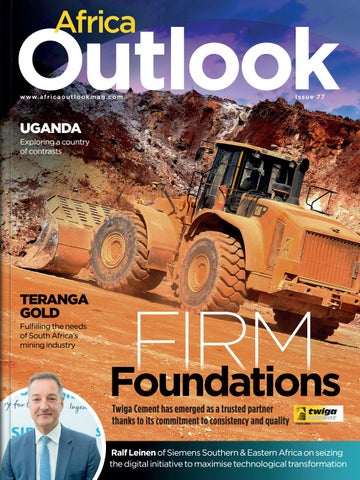
UGANDA
Exploring a country of contrasts
TERANGA GOLD Fulfilling the needs of South Africa’s mining industry
FIRM Foundations Twiga Cement has emerged as a trusted partner thanks to its commitment to consistency and quality
Ralf Leinen of Siemens Southern & Eastern Africa on seizing the digital initiative to maximise technological transformation
travel magazine T
he unrelenting demand to travel, both for business and leisure purposes, is showing no signs of slowing up, and for Outlook Publishing, the growing extent to which we are covering this industry across our existing titles has led to the launch of Outlook Travel magazine. The major component of the publication takes the form of our Outlook Travel Guides, providing executives, avid travellers and our existing 575,000 international subscribers with the ultimate rundown of all the major economic drivers and thriving hubs across the world, with exclusive input from tourism industry associations and stakeholders – the people who know these places the best. You can join the vast numbers of tourism sector players enjoying the exposure we provide across our digital and print platforms with a range of options, from advertising through to free-of-charge editorials, extensive social media saturation, enhanced B2B networking opportunities, and a readymade forum to attract new investment and increase exposure.
www.outlooktravelmag.com
WELCOME
Seizing the Opportunity
EDITORIAL Editorial Director: Tom Wadlow tom.wadlow@outlookpublishing.com Deputy Editor: Jonathan Dyble jonathan.dyble@outlookpublishing.com PRODUCTION Art Director: Stephen Giles steve.giles@outlookpublishing.com Senior Designer: Devon Collins devon.collins@outlookpublishing.com
I
n recent issues many of our construction industry success stories have gone against the grain of the market, like an underdog victory to apply a sporting context.
Junior Designer: Matt Loudwell matt.loudwell@outlookpublishing.com BUSINESS Managing Director: Ben Weaver ben.weaver@outlookpublishing.com Sales Director: Nick Norris nick.norris@outlookpublishing.com Operations Director: James Mitchell james.mitchell@outlookpublishing.com PROJECT DIRECTORS Joshua Mann joshua.mann@outlookpublishing.com Tom Cullum tom.cullum@outlookpublishing.com HEAD OF PROJECTS Callam Waller callam.waller@outlookpublishing.com TRAINING & DEVELOPMENT DIRECTOR Eddie Clinton eddie.clinton@outlookpublishing.com SALES MANAGER Donovan Smith donovan.smith@outlookpublishing.com PROJECT MANAGERS Josh Hyland josh.hyland@outlookpublishing.com Kyle Livingstone kyle.livingstone@outlookpublishing.com Lewis Bush lewis.bush@outlookpublishing.com Sam Love sam.love@outlookpublishing.com Vivek Valmiki vivek.valmiki@outlookpublishing.com BUSINESS TRAVEL Director: Joe Palliser joe.palliser@outlookpublishing.com Sales Manager: Jordan Levey jordan.levey@outlookpublishing.com Sales Manager: Krisha Canlas krisha.canlas@outlookpublishing.com Sales Manager: Matt Cole-Wilkin matt.cole-wilkin@outlookpublishing.com
ADMINISTRATION Finance Director: Suzanne Welsh suzanne.welsh@outlookpublishing.com Finance Manager: Sophia Curran sophia.curran@outlookpublishing.com Office Manager: Daniel George daniel.george@outlookpublishing.com CONTACT Africa Outlook East Wing, Ground Floor, 69-75 Thorpe Road, Norwich, Norfolk, NR1 1UA, United Kingdom. Sales: +44 (0) 1603 959 652 Editorial: +44 (0) 1603 959 657 SUBSCRIPTIONS Tel: +44 (0) 1603 959 657 Email: tom.wadlow@outlookpublishing.com www.africaoutlookmag.com Like us on Facebook: facebook.com/africaoutlook Follow us on Twitter: @africa_outlook
The troubles faced by many countries’ building industries are serious, forcing companies to adapt, innovate and in many cases cut back to survive – however, this edition’s lead interview takes places against a far more upbeat backdrop. Tanzania’s construction sector is on the up. According to the country’s National Bureau of Statistics, it is the biggest driver of gross domestic product, registering a growth rate of 13.2 percent in the first quarter of 2019. This is good news for suppliers such as Twiga Cement, a subsidiary of global giant Heidelberg. Speaking to us in an exclusive interview, Commercial Director Yves Mataigne describes the scene: “Growth is aggressive and is mainly down to the amount of construction projects going on – the government has rolled out a clear strategy whereby the further industrialisation of Tanzania is to be accelerated, and one of the key facilitators of this is the implementation of infrastructure.” Another industry producing optimistic signals is mining in Senegal. Here, Teranga Gold is helping to deliver tremendous socioeconomic benefit from the nation’s sizable gold reserves in Sabodala, a small rural township situated in the southeast of the country. We spoke to CEO Richard Young about the company’s work here and in Burkina Faso. These are just two of many success stories in this packed issue, with other industry insights covering manufacturing, healthcare, supply chain, retail and finance. Technology also forms a strong focus to this magazine, with exclusive interviews from Schneider Electric and Uganda’s Roke Telkom. Before this you will find a doubled-up topical focus section homing in on education and how technology should and is being used to deal with issues such as the digital skills gap. Microsoft and BT are our contributing voices to these articles. Rounding off our tech-centric front section is an interview with Siemens Senior Vice President Digital Industries for Southern and Eastern Africa, Ralf Leinen. Be sure to also visit a busy travel guide supplement, featuring in-depth insights to the tourism offerings in Uganda, Botswana and the Gauteng region of South Africa, each destination with their own story to tell. Enjoy the issue! Tom Wadlow Editorial Director, Outlook Publishing Africa Outlook issue 77 | 3
CONTENTS
178
54 REGULARS
6 NEWS
10
22 Uganda
8 EXPERT EYE
A country of contrasts
Why the African Continental Free Trade Area agreement presents bountiful opportunities
BUSINESS INSIGHT
10 Technology
Seizing the Digital Initiative An interview with Siemens Senior Vice President Digital Industries for Southern and Eastern Africa, Ralf Leinen
TOPICAL FOCUS
14
Education 14 Closing the Digital Divide A Q&A with BT on how to deal with Africa’s digital skills gap
18 Unlocking the Limits of Learning
Empowering Africa with connectivity, digital literacy and technological proficiency
22 4 | Africa Outlook issue 77
BUSINESS TRAVEL GUIDES
Around Africa in seven stories
42 Gauteng From the cities to the mountains
EVENT FOCUS
192 Africa Oil Week Bringing deal-making into sharp focus
194 6th Mozambique Gas Summit A platform for discussion in a fast-growing LNG hotspot
196 DRC Power, Oil & Gas Conference and Exhibition Exploring opportunities in the Democratic Republic of Congo
198 THE FINAL WORD Why, in your opinion, is corporate social responsibility so important?
AFRICA OUTLOOK MAGAZINE
F E AT U R E S
52 SHOWCASING LEADING COMPANIES
116 Universal Paper & Plastics
Tell us your story and we’ll tell the world
Converting operational excellence into purposeful profit
CONSTRUCTION
54 Twiga Cement Firm Foundations
Championing quality and consistency to support Tanzanian construction
68 Hitachi Construction Machinery Africa
Machine Maintenance Made Smart Providing intelligence-driven aftersales and support solutions
78 SVA International
A Multidisciplined Approach to Architecture
Hygiene with High Purpose
124 Belgotex
Culture of Care
Rewriting the Ecommerce Narrative
132 Schneider Electric
Powering an Always-on Africa Providing the backbone to digital transformation projects
138 Roke Telkom
The Connectivity Revolution Moving with the times at Uganda’s homegrown telco
144 Cepheid
178 FMI
Inspiring Insurance-led Impact Protecting incomes by positioning purpose above profit
184 Unity Finance Making Life Easy OIL & GAS
150 Wellness Warehouse
Mining Made Simple
East Africa’s premier mining contractor
ENERGY & UTILITIES
MANUFACTURING
160 Lesedi Nuclear Services
84
FINANCE
Changing the face of Zambian finance
Epitomising the role of independent retail
Helping to form an innovative future
The perfect blend of online and physical retail in Nigeria
Leading the fight against TB with advanced diagnostic solutions
Healthy, Happy
Shaping the Automotive Mould
172 Konga
The Diagnostics Revolutionary
102 Caspian Tanzania
110 Atlantis Foundries
Delivering software solutions from an industry perspective
TECHNOLOGY
HEALTHCARE
Entering a new, ambitious chapter directed by fresh frontiers
The Digital Companion
RETAIL
MINING A Golden Opportunity
166 Forte Supply Chain Consulting
Futureproofing business through human mindfulness
Executing projects from east to west
84 Teranga Gold
SUPPLY CHAIN
188 Neconde Energy Limited Petroleum Power
Nigeria’s proudly indigenous upstream specialist
Bringing Excellence to EPC
Providing bespoke solutions to power, mining and oil and gas entities alike
184
138 Africa Outlook issue 77 | 5
NEWS Around Africa in seven stories… ECONOMY
Uganda says economy is 11.6 percent larger than previous estimate
R E TA I L
PICK N PAY RECORDS H1 REVENUE RISE OF 9.5 PERCENT S O UT H AFRICA N retailer Pick n Pay has recorded a strong set of first half financial results. Despite challenges in Zambia and Zimbabwe, the company posted a 9.5 percent rise in H1 earnings. CEO Richard Brasher said: “At the core of our result is a very strong performance from our South Africa division. Our South African sales growth – comprising our Pick n Pay
and Boxer stores – was 6.5 percent. This is a very pleasing performance, ahead of overall growth in the market, and achieved against a strong base. “In this environment, retailers have found it difficult to balance their two key objectives: delivering solid sales growth while maintaining profit margins. I am very pleased that we have succeeded in growing both our sales and our profits.”
OIL & GAS
Shell to start new Egypt operations in H2 2020 R OYA L D U TC H Shell has said it will begin operating at its new concessions in Egypt during the second half of 2022. The oil and gas major won three oil and two gas concessions in February, joining the likes of Eni, BP and Exxon6 | Africa Outlook issue 77
TH E U G A N DA N government has claimed its economy is more than 11 percent larger than it previously thought. Having rebased its calculations, the Uganda Bureau of Statistics told Reuters that the original 2018/19 fiscal year figure of 109.9 trillion shillings ($33 billion) now stands at 122.7 trillion shillings ($33 billion). Several Southern African nations have been rebasing their economies in order to capture the output of industries such as IT and entertainment, Uganda’s last rebasing taking place in 2014. Another addition to the country’s economy will be the production of crude oil, set to commence in 2022 from fields in the west.
Mobil in Egypt’s bid to take advantage of major discoveries. According to Reuters, Shell is also interested in drilling in the Red Sea, the company applying to take part in the bidding round and further declaring interest in activities in the Mediterranean. Interest in Egypt sparked in 2015 when Eni discovered gas reserves thought to be around 30 trillion cubic feet in the Zohr field.
MINING
ECONOMY
Zimbabwe eyes massive diamond production increase by 2023 MINER A L- RICH ZIMBABW E wants to more than treble diamond production by 2023. Ministers have set an annual output goal of 11 million carats, a figure that is markedly up from the 3.2 million carats produced in 2018 and expected to earn the country $12 billion annually. Gold is currently the nation’s largest single export, Zimbabwe eager to attract investors who are said to be concerned about dollar shortages. The country’s President Emmerson Mnangagwa has promised more TRANSPORT
Uber pilots boat service in Lagos RIDE-H A ILING GIANT Uber has began testing a new boat-based service in Lagos. The service, named UberBOAT, is being managed in conjunction with local boat operator Texas Connection Ferries and the Lagos State Water-
IMF RELEASES LATEST ANALYSIS OF SSA ECONOMY
favourable investment conditions as part of a bid to become open for business.
ways Authority. Lagos is built on a massive lagoon, and it is thought that boat travel could be a viable means of cutting road congestion, a problem the city has become notorious for and one which is thought to cost it more than $30 million a month. The United Nations also predicts that Nigeria’s population will surpass 400 million by 2050.
TH E I N TE R N ATI O N A L Monetary Fund (IMF) has published its latest analysis of Sub-Saharan Africa’s economic landscape. Warning that the region’s economies face difficulties from a slowdown in global growth, which will hit exports, the organisation does state that public debt load is stabilising. Abebe Aemro Selassie, Director of the IMF’s African Department, added: “Going forward I expect it to remain stable provided countries implement the budgets that they’ve formulated.” However, several African nations are in a state of debt distress, among them Zimbabwe, South Sudan and Mozambique. ENERGY & UTILITIES
RWANDA’S MARA GROUP RELEASES FIRST ‘MADE IN AFRICA’ SMARTPHONE RWA N DA N P R E S I DE N T Paul Kagame has hailed Mara Group as the first smartphone manufacturer in the country following the release of two new devices. The Mara X and Mara Z are now available on the market, respectively costing around $190 and $130 and both using Google’s Android operating system. While reportedly being the first ‘Made in Africa’ smartphone, it is not the cheapest available to consumers, with Samsung selling handsets for as cheap as $54. According to Mara Group CEO Ashish Thakkar, the company’s $24 million factory can produce up to 1,200 phones a day.
Africa Outlook issue 77 | 7
EXPERT EYE
Analysing the AfCFTA The African Continental Free Trade Area agreement presents bountiful opportunities for the region, providing the right approach to implementation is adopted Written by: Bohani Hlungwane, Regional Head of Trade & Working Capital (excluding South Africa), Absa Group
T
he new African Continental Free Trade Area agreement (AfCFTA) presents a unique opportunity to grow intra-Africa trade as a proportion of total African trade, and diversify the continent’s exports to the rest of the world. At a point in time when Africa is poised to become a hotspot for global growth (currently boasting six of the fastest growing economies in the world), AfCFTA will ensure that African countries are able to maximise the benefit of this growth by becoming suppliers of various goods and services across the continent. The trade agreement is the biggest of its kind since the World Trade Organisation was established in 1994, and represents Africa’s most significant step towards the regional economic integration already achieved elsewhere. As communicated at the launch, the agreement will be fully supported with well-defined rules of origin; schedules of tariff concessions in trade of goods; an online continental non-tariff barrier monitoring and elimination mechanism; and a Pan-African digital payments and settlement platform as well as an African Trade Observatory portal. The AfCFTA has the potential to boost intra-Africa trade to much higher levels, to the benefit of the continent’s economic ecosystem. Intra-Africa trade currently remains low compared to other global regions, amounting to an average of 15 percent of global trade across both imports 8 | Africa Outlook issue 77
ABOUT THE EXPERT Bohani Hlungwane is the Regional Head of Trade & Working Capital (excluding South Africa) at Absa Group. Prior to re-joining Absa in 2018, he worked for the likes of HSBC, Barclays Bank and Standard, this having already spent four years at Absa between 2006 and 2010. Hlungwane graduated in economics from the University of South Africa in 2001, before completing a degree in financial and monetary economics from the University of Johannesburg.
and exports as of 2017. With customs procedures eased under the CFTA, intra-Africa trade is expected to grow to 21.9 percent by 2022 and at least 53 percent by 2040, thus effectively contributing in the region of $70 billion to the continent’s GDP. This growth will ensure that an increasing proportion of Africa’s more than $2 trillion economy is traded internally. To support the expected increase in intra-Africa trade of $119.6 billion by 2022 will require nearly $40 billion in trade financing alone. This is a big challenge for African banks in particular. The African Development Bank already estimates that there is a trade-financing deficit of at least $90 billion in Africa as of 2018. African banks, especially regional banks like Absa Group, Standard Bank and Ecobank, will need to adopt new ways of assessing risk in trade in order to support corporates as they look to capitalise on the new era of growth and trade opportunity. Experience warns this to be crucial: strong regional banks have proven a vital ingredient of progress
on the matter of intra-regional trade in other areas of the world. Given South Africa’s anaemic economic growth over the past few years, as well as its persistently high unemployment rate, the timing couldn’t be better – in addition to hopes of broader and deeper regional economic integration, AfCFTA will specifically open up new markets for South African exporters. Because of its sophisticated economy and relatively more established industrial base, South Africa will be in a unique and advantageous position to grow and diversify its exports to the rest of Africa, as trade and tariff and non-tariff barriers are eventually relaxed or removed entirely. AfCFTA is expected to increase regional value chains, enhancing opportunities for goods and services consumed in Africa to be produced and manufactured there too. The rest of the continent is already the second largest and fastest
growing destination for South African exports after Asia (26.2 percent in 2017). This is a much larger share of the whole than for imports (just 9.9 percent). The pattern follows from South Africa’s distinct position as Africa’s most industrialised economy – its exports to the rest of the continent are comprised mainly of manufactured goods (84 percent in 2017), in contrast to its Asian exports much of which are minerals (59 percent). When it comes to imports however the pattern is largely reversed, with most of South Africa’s imports from the rest of Africa (51 percent) being minerals, mainly crude oil from Nigeria and Angola. The removal of tariffs and other constraints will benefit South Africa on this side of the ledger too. By enabling other African countries to develop their manufacturing capacity in line with their inherent competitive advantage, the agreement will also
“THE CONTINENT WILL ALSO HAVE TO MAKE SURE THAT THE BENEFITS DO NOT ONLY ACCRUE TO BIGGER ECONOMIES SUCH AS SOUTH AFRICA, NIGERIA, EGYPT, ANGOLA AND KENYA IF IT WANTS TO AVOID ITS OWN ‘BREXIT’” help South Africa reduce its dependency on expensive manufactured imports from regions further afield such as Europe and Asia. Growth aside it is also expected that the AfCFTA will help diversify South Africa’s export destinations within the continent, given that more than 85 percent of South Africa’s exports to Africa are destined for the Southern Africa Development Community (SADC) and thus concentrated in just a handful of countries. Exports to the other two largest economies in Sub-Saharan Africa (Angola and
Nigeria) together accounted for just 4.3 percent of South Africa’s total exports to the rest of Africa in 2017. Additionally, and partly in response to the growing risk of global trade protectionism, South Africa will increasingly prioritise the development of its trade with the rest of Africa, a goal laid out in the 2018/19 Industrial Policy Action Plan and the National Development Plan (NDP). As it is with any agreement involving many different countries, the key will be in implementation and the speed of execution. There is no doubt that some elements of the AfCFTA will erode member governments’ powers to design and implement national policies, in the process reducing the politicians’ powers to influence electoral results in their own countries. There will have to be a willingness to lose in the short term in order for the continent to benefit through increased intra-Africa trade and bigger markets in the medium and long term. The continent will also have to make sure that the benefits do not only accrue to bigger economies such as South Africa, Nigeria, Egypt, Angola and Kenya if it wants to avoid its own ‘Brexit’ from some of the countries as the agreement matures. This will require a careful balancing between opening markets up and protecting smaller players. At the end of the day, the AfCFTA’s success will boil down to political will, discipline in execution, and the active management of conflicts that arise as implementation continues. Africa Outlook issue 77 | 9
SIEMENS
SEIZING THE DIGITAL INITIATIVE
10 | Africa Outlook issue 77
TECHNOLOGY Siemens has just published its Dawn of Digitalization report, the company looking to help the region maximise the potential of technology transformation Writer: Tom Wadlow
T
here aren’t too many parts of the world where Siemens hasn’t made its mark. Turning over more than $92.5 billion in 2018 and employing almost 380,000 people around the world, the company is unrecognisable in terms of size and scale compared to when Werner von Siemens established it in 1840s Berlin. Defined by innovation and German engineering ingenuity, today’s Siemens is a beacon of modernity and renowned for providing immense career development opportunities, a view very much reflected by organisation veteran Ralf Leinen. “Siemens is a great employer,” he says. “With its global operations, it provides numerous opportunities for personal growth. Having been to many countries including USA, and now in Africa, this has helped me develop a broad spectrum and understanding of markets, business drivers and cultures. “Previously I was on a delegation to the USA and now to Africa. My passion lies in the vision of Siemens, operating in the communities we serve – working on topics that matter to society means we can actively make a change.” Having begun at the company in a sales role in his hometown Cologne in 1990, Leinen has enjoyed a long relationship with his employer, one defined by opportunity and introductions to different cultures, and typified by the chance to move out to South Africa. “Based on my vast experience in global markets, this was a
Africa Outlook issue 77 | 11
SIEMENS
DAWN OF DIGITALIZATION A SUMMARY
Manufacturing remains a marginal player struggling to make a bigger impact on country GDPs
Key observations from the Dawn of Digitalization and its Impact on Africa can be summarised through the four sectors studied, as follows: MANUFACTURING: “While the most mature in its transformation and adoption of digital technologies in Africa, manufacturing remains a marginal player struggling to make a bigger impact on country GDPs. The question governments need to ask themselves is how they align a ‘here-and-now’ emphasis on job creation with the necessary focus on digitalisation. This will enable Africa to create a niche within the global economy. If we fail to proactively select our place within the global manufacturing industry, we run the risk of continuing on this path of non-industrialisation.” WATER: “In the water industry, expenditure in water infrastructure has been low when compared to the global average. Inadequate investment in infrastructure coupled with poor water utility management has resulted in a greater need for development of the water sector.” MINING: “In the mining industry which has been witnessing subdued investment, rising cost pressures and increasing labour issues, a combination of mechanisation, efficient extraction of resources and better use of data can make it easier for mine operators to cut costs and create a leaner and more efficient mining operation. As such, the successful incorporation of technology will be possible through collaborative efforts of technology providers, industry, research institutes and organisations that work for uplifting the mining industry.” FOOD AND BEVERAGE: “The urban population in Africa is expected to grow to 56 percent in 2050, from 35 percent in 2010. This rapid urbanisation combined with preference shifts towards formal retail will drive demand for FMCG products. Food and beverage manufacturers must consider many factors: a consistently high level of product quality, maximum plant availability, optimum resource efficiency – and, increasingly, the greatest possible flexibility in order to meet more and more individual customer requirements. Mastering all these challenges today and in the future is possible only with digitalisation.”
12 | Africa Outlook issue 77
joint decision between global management and me to move to South Africa,” continues Leinen, who now serves as Senior Vice President of Digital Industries for Southern and Eastern Africa. “I find great passion in working with different cultures and customers. “Despite the challenges that lie ahead, I find that South Africans have a can-do attitude, and this is truly inspiring. We have achieved many milestones and in the Siemens world, the South African division is well respected, and I am truly proud to be part of a high-performance team.” While it outlines some of the challenges in implementing digital technologies to these industries, the study also points to many ways in which Siemens is actively helping to make a difference. Leinen points to the automotive space, where in South Africa the company supports in some way around 57 percent of total local production, or 341,600 cars annually. Of these cars produced using Siemens technology, some 252,500 were exported. “In the area of food and beverage, Siemens solutions automate and
TECHNOLOGY
The mining industry has been witnessing subdued investment, rising cost pressures and increasing labour issues
Expenditure in water infrastructure has been low when compared to the global average
FAST FAC TS SUB-SAHARAN AFRICA ECONOMY SSA IS THE WORLD’S LARGEST FREE TRADE AREA HOME TO A MARKET OF 1.2 BILLION PEOPLE WORLD BANK GROWTH FORECAST FOR 2019 – 2.6 PERCENT GROWTH OF SSA IN 2018 – 2.5 PERCENT SSA GDP IN 2018 $1.699 TRILLION HOME TO FOUR OF THE FASTEST GROWING ECONOMIES IN THE WORLD (IVORY COAST, ETHIOPIA, GHANA, AND RWANDA) 416 MILLION AFRICANS STILL LIVE IN EXTREME POVERTY
intelligently control bottling lines at some of the largest carbonated soft drink bottling plants in the country,” he adds. “In 2016, Siemens technology supported approximately 79 percent of the total local production of 4.2 billion litres.” Further, in the utilities market, over the last four years Siemens flow meters have accurately measured the flow of around 3.7 million megalitres of water. Leinen continues: “Driving growth and investment in our local operations and strengthening our market leadership position remain crucial to us becoming the partner of choice to our local customer base, and truly contributing to local society by creating opportunities.” The Siemens stalwart is also fully aware that the creation of such opportunities has and will continue to be challenging at the same time. Indeed, Leinen says that the adoption of digital technologies, innovation as well as a range of digital customer offerings are expected to remain varied across industries, markets and
geographies. He also foresees that the extent and impact of digital technologies varying in the future, favouring businesses and industries that seek relevance and increasing contribution in international markets in addition to existing domestic markets. “In the wake of changing business dynamics, rapidly evolving technology and increasing competition, collaborative efforts between governments, industry, businesses (local and international), labour and academia is vital for creating an environment that is conducive to developing sustainability of local businesses, encourages technology upskilling, innovation, knowledge sharing and execution,” Leinen adds. “For the first time in history we have an incredible opportunity to use smart technology to transform entire economies at an unprecedented rate. “Africa needs to get efficient strategies in place now. Digitalisation is providing the continent with the opportunity to accelerate growth and rapidly expand struggling economies – but it’s a small window and decision-makers must get a strategy in place now in order to succeed.”
Africa Outlook issue 77 | 13
TOPICAL FOCUS
14 | Africa Outlook issue 77
EDUCATION
CLOSING THE DIGITAL DIVIDE Bernadette Wightman, Managing Director for the Asia, Middle East and Africa (AMEA) region at BT, shares her insight on the skills gap issue and how it can be addressed Edited by: Tom Wadlow
S
ub-Saharan Africa (SSA) has rightly been identified as one of the world’s most exciting economic growth prospects over the mid to long term. Home to a market of 1.2 billion people and counting, the region’s GDP hit almost $1.7 trillion in 2018, the World Bank forecasting growth of 2.6 percent this year. Indeed, SSA is home to four of the world’s fastest growing economies at the moment (Ivory Coast, Ethiopia, Ghana, and Rwanda), and the potential for this economic picture to be further transformed by digitisation is massive. Almost all major multinational tech companies are active on the continent, and for good reason. BT is one such corporation looking to impart the benefits of digital onto African economies, not least through through efforts to pass on skills to locals, as evidenced by its work in South Africa in particular. This is vital in ensuring the region’s
workforce is futureproofed and ready for the digital economy, the well-documented skills gap presenting a significant challenge to SSA fully realising its industry 4.0 potential. Here, Bernadette Wightman, Managing Director for the Asia, Middle East and Africa (AMEA) region at BT, answers our questions on the issue. Africa Outlook (AfO): A bit about yourself to start with – what attracted you to a career in the telecommunications industry and to working at BT more specifically? Bernadette Wightman (BW): I have always held a strong passion for technology and the potential it has to change lives and better the world. I am also very passionate about people and the development of talent. The passion for both drew me to the field of technology and with a particular focus on people and change management. Throughout my career, I have been able to work within corporates who
Africa Outlook issue 77 | 15
TOPICAL FOCUS
share this vision, which is also what led me to join BT. I have continued to place a strong focus on people and culture, which has resulted in industry-wide recognition – including best place to work awards. I regard myself as a champion for inclusion and in particular driving diversity initiatives, including co-creating a programme consisting of workshops, mentoring, peer networking and group support, which over 1,000 women have benefitted from globally. AfO: Why, in your opinion, is it such an exciting industry for Africa at the moment? BW: The telecommunications (and technology) industry is exciting across Africa as it is a high growth market filled with ample opportunity that can be leveraged on to change lives. As the world catapults towards a more connected society, Africa has the opportunity to learn from global markets, to leapfrog ahead and invest in technology transformation strategies that can empower real and positive change. Digital literacy, improved healthcare and access to even the most basic of needs can be made possible through 16 | Africa Outlook issue 77
technological innovation across Africa. Telecommunications in Africa can transform the lives of hundreds and even thousands of people – the potential is almost unimaginable. The possibilities that technology opens up for Africa are exciting, and it is what drives our passion. AfO: Could you introduce the problem of skills shortages on the continent? What is the size of the challenge that is being faced? BW: The technology skills shortage is not unique to Africa, but is one that is far reaching, impacting countries across the globe. Technology is evolving at such a rate that it is almost impossible to keep up, meaning that with each year that passes the skills gap is only widening. Furthermore, an aging workforce only adds another element of strain to this existing challenge.
Global research that BT carried out in 2017, based on a survey conducted by the Economist Intelligence Unit (EIU), noted that 75 percent of global CEOs were confident about their digital strategy, yet it also highlights that the biggest barriers to achieving this are inflexible technology, lack of technology skills and security concerns. The result of this is that many companies today, regardless of their efforts to transform digitally to benefit from the technology advances available, don’t possess the right skills needed to leverage digital technologies effectively. This can impact the company’s ability to innovate and achieve sustainable growth in what is not only a volatile, but competitive market. AfO: Equally, what needs to be done to begin to address this problem? Does the education curriculum need to be revisited? BW: There are a number of areas that require focus to change this current
EDUCATION younger generations – the millennials and generation Z – to find and retain the best skills and talent for continued business success. The generations that are growing up with technology at their fingertips and don’t know or understand a world without tech. AfO: Do businesses also need to do more by providing the opportunities for personal development?
‘THE YOUNGER GENERATION WORKER OF TODAY DOESN’T JUST WANT FLEXIBILITY AND JOB SECURITY – THEY ALSO WANT TO ACHIEVE PERSONAL GOALS’ reality. Universities, businesses and industry experts need to work together to ensure that the technology skills needed for the future are being incorporated into education programmes, as a means to slowly improve on closing this gap. Digital skills are critical to the growth and survival of economies, however, fixing the digital and technology skills shortage requires effort from public and private entities. Further to education programmes, businesses preparing for the digital future need to ensure that they are also investing in and spending time and effort on developing solid training programmes, to not only ensure that staff are fully equipped to drive the digital strategy forward, but that new skills are continuously being taught and knowledge gained. Over and above these critical steps, businesses also need to look to the
BW: When targeting the younger generation of worker, there are a number of aspects a business needs to consider. This generation of worker is not the ‘traditional worker’ many businesses have become accustomed to. Businesses have the opportunity to capture the hearts and minds of the younger generation now, and this means understanding their needs, aspirations and goals, and being able to amicably meet these, to ensure their ‘buy in’ to the business. The younger generation worker of today doesn’t just want flexibility and job security – they also want to achieve personal goals. The Deloitte Global Millennial Survey 2019 found that travel and seeing the world was at the top of millennials’ list of aspirations. What is also interesting is that this survey noted that millennials were also attracted to making a positive impact in their communities or society at large (46 percent) over having children and starting families (39 percent). The survey by Deloitte also shows that dissatisfaction with pay, along with a lack of advancement and development opportunities, are still the top reasons why millennials and gen Z change jobs as often as they do. This supports the notion that personal development opportunities are important and an area that businesses must consider when seeking talent from the generation pool.
BW: Absolutely. BT in South Africa recently unveiled a fully equipped computer lab at the Sibusisiwe Comp Tech High School in Kwa-Zulu Natal. The sponsorship of this computer lab for the Sibusisiwe Comp Tech High School and its learners’ forms part of our priority to build a culture of tech literacy and to invest in digital skills to improve lives, supporting us to achieve our desired vision around ICT skills development. Furthermore, and on a global scale, in 2018 BT joined forces with universities, businesses and industry experts to tackle the digital skills gap challenge in the UK. BT forms part of a consortium that received government funding for a new Institute of Coding (IoC) to train the next generation of digital specialists. AfO: Looking ahead, are there any forecasts that you can make? Are you optimistic? BW: I am optimistic that, together, the IT skills shortage challenge around the world can be overcome. To futureproof organisations, businesses need to work on their recruitment and retention strategies of younger generations, and their preferences, now. By understanding what millennials and gen Zs want, we can look at how to better attract them into our organisations. Global organisations are already supporting international assignments and job swaps as ways to ensure skills and business knowledge are available and shared where required. And while being important tools to generate developmental opportunities, what is becoming evident is that these steps are making the companies the preferred choice to work for.
AfO: Is BT itself partaking in any CSR or other initiatives in an attempt to solve the problem of skills shortages? Africa Outlook issue 77 | 17
TOPICAL FOCUS
UNLOCKING THE LIMITS OF LEARNING Driven to empower every student and every teacher on the planet, Microsoft is taking great strides in Africa by imparting crucial skills related to connectivity, digital literacy and technological proficiency Writer: Jonathan Dyble
T
he fourth industrial revolution. Expected to bring about more technologically enabled advancements in the next 10 years than those seen in the previous 250, industry 4.0’s ability to galvanise both social and industrial prosperity is not to be understated. Yet, while each awe-inspiring step forward will continue to be greater than the last, so too will be the socio-
18 | Africa Outlook issue 77
economic challenges that accompany these monumental progressions. Take the labour market, for example. A vertical that has already been subject to a number of major disruptions, the continual death and simultaneous birth of new occupations will lead to an ever-greater shift in skills requirements and a rising strain on both education and training. Indeed, this strain is particularly
pronounced in developing regions such as Africa, Microsoft MEA’s Senior Director of Education Harb Bou-Harb being one individual who recognises such a reality. “A lot of light has been shone on the issues brought about by Africa’s growing digital skills gap,” he states, “and closing it will require a number of elements. “For governments, it is about
EDUCATION
acknowledgement. There is plenty of support coming from the World Bank, United Nations and a number of privatised business such as PwC, but it is crucial that governments themselves continue to take similar steps.” Crucially, in the eyes of Bou-Harb, these steps need to be focused primarily on the development of both soft skills and technological expertise, moving away from traditional educa-
tion to ensure that today’s students are prepared for tomorrow’s jobs. Pointing to a report from PwC revealing that more than 90 percent of African CEOs cite skills shortages as the biggest threat to the future of their organisations, he highlights coherent education as a proactive solution to curbing the escalation of major challenges. “Figures like this are really quite
scary when you think about the wider implications that they could have,” the Director affirms. “Education must be upgraded for learners to thrive. Roughly 50 percent of jobs will be lost to automation, while 30 to 40 percent of future jobs will leverage technology much more readily as an enabler, instead requiring softer skills.”
Africa Outlook issue 77 | 19
TOPICAL FOCUS
Q: What do you most enjoy about working at Microsoft? HARB BOU-HARB: “Come January, I’ll be in my 14th year with the company. And I’m just as enthusiastic today as I was when I first joined. “Why? The one thing that I say to my colleagues, friends, family, is that Microsoft gives you the space and freedom to work with an entrepreneurial mindset; to treat the company as your own. “There’s a fantastic culture of openness that actively encourages each and every individual to bring their unique skills and experiences to the table, something that’s honestly proven itself to be a fantastic way of nurturing talent.”
Harb Bou-Harb
20 | Africa Outlook issue 77
A GLOBAL VISION Microsoft is one organisation that has tasked itself with helping to meet the demand for these next-gen skills. Mandated with a global mission to empower every student on the planet, the firm is striving to raise educational standards with a number of initiatives built upon inclusive ideals. “For every child that thrives naturally in an educational environment there’s another who struggles,” BouHarb states. “Unfortunately, the education systems and teachers in Africa often aren’t equipped with the necessary resources to be able to deal with such eventualities, and many children are left behind as a result.” It is this realisation that founded the basis for the building of Microsoft’s Inclusive Classroom initiative. Harnessing its globally renowned
365 products as crucial educational tools, the company has been working to provide a platform from which students and teachers alike can collaborate, communicate and thrive. “Here, the benefits of technology have really revealed themselves,” Bou-Harb continues. “We’ve found our tools have provided an additional resource, both helping to stimulate the learning of students in new ways, as well as providing teachers with a greater opportunity to work with each pupil, particularly those that are learning at slower rates, on a one-to-one basis.”
EXPANDING AN INCLUSIVE IMPACT A relatively new initiative, Microsoft has grand ambitions for Inclusive Classroom in the long term, hoping it will act as the driving force of its
EDUCATION
Microsoft’s 365 Education Solutions Some of Microsoft’s 365 education tools include, but are not limited to: OFFICE 365: Provided free to all students and teachers.
global mission. “We’re made significant progress, but we’re only really just getting started,” the Director affirms. This ambition will not just be limited to individual classrooms, however. The company has begun to work more closely with governments and Ministers of Education in the aim of promoting the reformation of schooling on a broader scale across a multitude of countries. To this end, it signed a memorandum of understanding with the Zimbabwean Minister of Primary and Secondary Education during the 2018 edition of Innovation Africa, Bou-Harb himself having been a panellist at the conference, and a similar agreement with the Botswanan government geared towards promoting the role of the modern classroom. Right now, such developments
remain in their relative infancy. But the Director is hopeful that their impact will be seen far and wide in years to come. He concludes, buoyantly: “I tend to relate to back to a forecast from the World Economic Forum; that digital work is expected to contribute an additional $2.7 trillion to the global economy by 2025. For Africa to be a part of this, and truly take its place in the 21st century, the core ingredients it needs to source stem from enhanced schooling. “In doing so, the continent will see connectivity, digital literacy and technological proficiency come to propel sustainable economic development and allow the region to capitalise on its true potential. “In this sense, education is without a doubt more important today than it has ever been before.”
IMMERSIVE READER: Empowers people of all abilities, including those with dyslexia, ADHD, emerging readers and non-native speakers to enjoy literary learning. MINECRAFT EDUCATION EDITION: The world-famous game with reading signs and boards that include different languages, helping students to learn in engaging ways. MICROSOFT FORMS: An online survey creator that allows educators to create surveys and quizzes with automatic marking. MICROSOFT WHITEBOARD: An active, free-form platform for classroom collaboration, allowing classrooms to ideate and create visually in the cloud.
Africa Outlook issue 77 | 21
UGANDA
W
inston Churchill once referred to Uganda as the “Pearl of Africa”, and it’s easy to see why. According to the Ugandan Tourism Board, this East African country “offers some of the continent’s most diverse wildlife viewing, dramatic landscapes, and immersive
cultural experiences”. It’s where you’ll discover Africa’s largest mountain range, the snow-capped Rwenzori Mountains, and vast Lake Victoria, the source of the River Nile. Uganda is home to more than half the world’s population of mountain gorillas. Trekking to observe them
in their indigenous habitat, Bwindi Impenetrable Forest, tops many bucket lists. Head to the remote Kidepo Valley National Park to come face with “The Big Five” – lion, leopard, rhino, elephant and buffalo – on safari. Jinja
With its glacial peaks, vast lakes and primeval forests, Uganda is a country of contrasts Writer: Dani Redd | Project Manager: Joe Palliser
22 | Africa Outlook issue 77
BUSINESS TRAVEL GUIDE is East Africa’s adventure capital, and a renowned spot for white water rafting on the Nile. For hundreds of years, Uganda has been a cultural melting pot with more than 50 distinct ethnic groups, speaking an array of indigenous languages. The country’s oldest inhabitants are
Batwa and Bambuti people – descendants of ancient hunter-gatherer cultures. As a result, Ugandans have a diverse cultural life which permeates everything from food to festivals – their national dish is matooke, steamed and mashed green banana served with groundnut sauce and meat.
Uganda was named by UK Business Insider as the “world’s most welcoming country to raise a family.” Tourists are also guaranteed a warm welcome here, and there’s something for everyone, whether you’re interested in visiting ancient monuments or adrenaline-fuelled safaris.
Africa Outlook issue 77 | 23
UGANDA
The Business End SINCE THE 1990S, following a period of political instability, Uganda’s economy has been growing rapidly. The country has been praised for its high rates of growth by organisations such as the World Bank. In 1997 it was selected as one of only a few countries to receive debt relief, thanks to its economic reforms. This has allowed Uganda to focus on eradicating poverty and expanding its infrastructure. Uganda’s economy is predominantly agricultural. However, tourism is also a major part of the economy, with visitors flocking to experience the country’s diverse landscapes and abundant wildlife. It accounts for 7.7 percent of the country’s GDP, and is also a major source of employment, accounting for more than 667,600 jobs.
Bwindi Impenetrable National Park is a popular tourist attraction
FACTS & FIGURES The tourism sector continues to expand. The number of visitors to Uganda increased from 1.4 million in 2017 to over 1.5 million in 2018, the Uganda Tourism Board (UTB) also aiming to expand into emerging markets such as
Languages: English, Swahili Area: 241,551 km2 Population (2018): 38,787,000 GDP (2015): $25.89 billion Currency: Ugandan Shilling Time zone: East Africa Time Dialling code: +256 Internet TLD: .ug Climate: Tropical Highest recorded temperature: 38.5˚C 24 | Africa Outlook issue 77
Japan and increase provision for both budget and luxury travellers. However, according to the organisation’s CEO, Lily Ajarova, the board also wants ‘to promote domestic tourism and have more Ugandans visit Uganda”.
Refresh, Relax, Enjoy. ACTIVITES
• Safaris in Lake Mburo National Park • Night safari (game drive) • Walking Safari • Boat trip on Lake Mburo • Birding in Lake Mburo National Park • Horse Riding • Sport fishing • Hiking in and around the park • Bush picnics
Mburo Safari Lodge boasts of its excellent accommodations which comprises the main Lodge, cottages and honeymoon house all raised on a wooden platform and covered by a grass-thatched roof, perfectly blending with the natural environment, stylishly and thoughtfully designed for your absolute comfort, convenience, and pleasure. Each is equipped with clean private bathrooms with hot showers and toilets, private balconies, handcrafted wooden furniture, comfortable king-sized beds, mosquito nets and wardrobes all opening out to their private balconies. Some cottages have a full kitchen. All rooms are privately situated, making it an ideal place to relax and enjoy the natural beauty that surrounds you.
www.mburosafarilodge.com
UGANDA
Top Community Experiences
1
2
3
4
COMMUNITY TOURISM EXPERIENCES, such as village walks and cultural performances, allow visitors a unique insight into Ugandan society, while buying local crafts and food products also contributes to the economic wellbeing of communities. Africa Outlook recommends the following projects.
1. RIDE 4 A WOMEN This organisation was set up in 2009 to empower women in the Buhoma sector of Bwindi Impenetrable Forest through learning skills and developing careers. The programme initially began by renting bicycles to tourists to generate capital. Tourists can now visit 26 | Africa Outlook issue 77
the organisation’s lodges to learn how to cook Ugandan dishes, harvest crops and pedal sew from local women.
2. THE BATWA EXPERIENCE The Batwa tribe no longer live in their ancestral home of Bwindi Impenetrable Forest, but visitors can still learn about their heritage and traditions on a rainforest hike with Batwa guides. Learn how the tribe lived, hunted and foraged, and listen to their ancient songs and legends.
3. BUNYANGABU BEEKEEPERS COOPERATIVE This organisation in Rubona promotes sustainable beekeeping for economic
development. Visitors to the apiary will learn about the beekeeping process, and how it benefits the community. Tours also include a beeswax candle-making workshop and a honey tasting session.
4. RWENZORI TURACO VIEW VILLAGE WALK Mihunga is a village in the foothills of the Rwenzori Mountains, inhabited by the Bakonzo tribe for over three centuries. The local community tourism group, Turaco View, takes visitors on a cultural tour of the village. The tour includes a demonstration from a traditional healer, a trip to the local school and a basket-weaving demonstration.
East africa container terminal ltd is a cargo bond working hand in hand with the uganda revenue authority.
Experience exclusive and tastefully-appointed luxury at Laburnam.
Hotel & Apartments mixed hotel rooms & long stay luxurious apartments of 1 bedroom, 2 bedroom, 3bedroom & 4 bedroom. We have exclusive studios for the Hotel located in the heart of kampala city at plot 3-11 Akii Bua close, Nakasero Kampala.
laburnamcourts.com | info@laburnamcourts.com | Reception@Laburnamcourts.com | +256 -204-000205 / 200
Oasis Shopping Mall located in the heart of Kampala City, offering a great shopping experience for All. Featuring – Carrefour Supermarket, Banking facilities of 10 leading banks, Different shopping areas, recreation facilities, restaurants, Cinema etc. With fully secured & ample parking facilities.
UGANDA
Uganda Tourism Board THE UGANDA TOURISM Board was established in 1994. It aims to promote and market Uganda across the region and internationally. It is also tasked with promoting quality assurance in tourist facilities through training, grading and classification, promoting tourism investment, supporting and acting as the liaison for the private sector in the development of tourism. The broader goals of UTB are to increase the contribution of tourism earnings and GDP; improve Uganda’s competitiveness as an international tourism destination; and increase Uganda’s share of Africa’s and World tourism market. Here, Ajarova answers our questions.
efforts, especially the mountain gorilla, which has come off the ‘critically endangered’ list in our country. We also aim to highlight Uganda’s stunning natural landscapes and the array of outdoor activities on offer, including trekking, game safaris and white-water rafting. AfO: How would you say Uganda has developed in recent years as a business travel hub and what are the key reasons behind its growing appeal?
LA: Our tourism industry has grown steadily over the years, and we have had remarkable developments in the sector. Currently, tourism is the number one foreign exchange earner for the country and one of the key sectors offering employment. The tourism sector is expanding, and we should see even more growth as we begin to put into effect the key focus areas identified in the Tourism Master Plan.
Africa Outlook (AfO): Since inception, how has the Uganda Tourism Board developed and progressed in terms of its key objectives and the messages it tries to get across? Lily Ajarova (LA): One of UTB’s key objectives is to promote the country’s abundant wildlife and conservation
AfO: Why, in your opinion, should someone visit Uganda? LA: Uganda is one of the most beautiful countries in Africa, offering some of the continent’s most diverse wildlife viewing, dramatic landscapes, and immersive cultural experiences. Safari opportunities are abound in savannah, forest, and wetland settings throughout 10 national parks. Visitors can come face to face with “The Big Five” – lion, leopard, rhino, elephant, and buffalo – as well as giraffe, zebra, chimpanzee, hippopotamus, crocodile, and more than half of all bird species found in Africa. 28 | Africa Outlook issue 77
BUSINESS TRAVEL GUIDE
The World Tourism Organisation has ranked Uganda third among the world’s top 10 most promising tourism destinations
AfO: Are there any specific attractions, landmarks or places to eat and drink that you would recommend? LA: Among Uganda’s extraordinary natural attractions are the snowcapped Ruwenzori Mountains, expansive Lake Victoria, which forms the source of the Nile River; and Murchison Falls National Park. The unspoilt Kidepo Valley National Park was voted the third best national park in Africa by CNN in 2013. Jinja is East Africa’s adventure capital, home to some of the world’s best white-water rafting. A visit to our capital, Kampala, is also recommended. It has some
great attractions, such as Kabaka’s Palace and Uganda Museum. AfO: What are the best ways of getting around the country? LA: Uganda has several domestic scheduled operators who fly to various locations across the country. Public and private transport is available to various parts of the country, including marine transport on Lake Victoria. The railway line is also currently being redeveloped to foster transport within the East African region. AfO: What trends are transforming the tourism industry in Uganda at present? How are you responding to these trends? LA: We are aiming to increase revenue from domestic tourism by finding ways of making travel easy and affordable for Ugandans. The challenge we had in the past was that many Ugandans felt that tourism was only for foreigners. We are thus looking at changing this mind-set.
Internationally, our focus is on promoting Uganda to different source markets: United Kingdom, North America, and the German-speaking countries; Germany, Austria, and Switzerland. We are also ensuring that we have a presence in emerging markets, such as the Gulf States, Japan and China. We are moving away from a sole focus on high-end tourists, to Africa Outlook issue 77 | 29
UGANDA
expanding provision for budget and mid-level travellers, as well as FITs (free independent travellers). AfO: How do you see Uganda developing as a business travel hub over the next year to two years? LA: Uganda is positioning as a MICE (meetings, incentives, conferences and events) destination. We have conference venues spread over the entire country and are also in the process of setting up a convention bureau. Between February 4-6, 2020, we will be hosting our annual Pearl of Africa Tourism Expo. The expo brings together tourism and travel trade partners from Uganda, East Africa and the world over to foster tourism knowledge and business exchange. AfO: Are there any plans or projects 30 | Africa Outlook issue 77
in the pipeline that you wish to highlight? LA: We will focus on developing tourism across the country, reaching out to various stakeholders to ensure every Ugandan is involved in tourism through either investment or service provision. This is with the key objective to increase foreign exchange, development and employment. In April 2020, we will launch a strategic plan targeting marketing, product development, investment and quality assurance. We believe this will drive our sector and ultimately the economy forward onto where we aspire to be. AfO: Are you optimistic about the future of the tourism industry in Uganda? LA: Year-on-year growth in the number of tourist arrivals has been steadily
increasing and our aim is to maintain this momentum. In the short term, our target is to grow numbers from the current 1.7 million tourists per year to four million by 2021. We have lots of diversity which other countries do not have. The World Tourism Organisation has ranked Uganda third among the world’s top 10 most promising tourism destinations. Both CondÊ Nast Traveler and National Geographic have praised our national parks, and we won a Gold Award for best exhibitor at the Africa Travels Indaba Fair in South Africa. We believe we are on the right path to helping Uganda achieve her economic aspirations. Uganda Tourism Board Tel: +256 785 489 481 info@ugandatourismassociation.org
BUSINESS TRAVEL GUIDE
Rafiki Lodge Is Located In Sipi Falls, Kapchorwa & Offers A Wide Range Of Rooms
Mutanda Lake Resort Mutanda Lake Resort offers comfortable accommodation combined with the most beautiful views on the planet. The resort makes a perfect base for gorilla trackers, volcano hikers and bird lovers, as well as those looking for a secluded place in nature.
www.mutandalakeresort.com info@mutandalakeresort.com
illatrips.net g o rSASO UGANDA SAFARIS P.O.Box 33461
Kampala - Uganda
SASO Uganda Safaris is a Ugandan based Tours and Safari Company established to deliver enriching African holiday experiences to tourists visiting Uganda and Rwanda.
WE ARE SPECIALISTS IN: • Gorilla treks • Chimpanzee treks • Game viewing Safaris /drives • Birding safaris • Photo safaris • Cultural tours • Nature safaris • Adventure safaris • safari car hire services • Hotel accommodation bookings • Booking Gorilla and chimpanzee permits
Opening Hours: Monday - Saturday, 9am - 6pm T+256 775 564 060 | info@gorillatrips.net sasougandasafaris@gmail.com www.gorillatrips.net
Rafiki Lodge Sipi consists of Family Cottages, Bandas and Basic Rooms accommodations for our guests, each individually designed with a thoughtful perspective view of Sipi Falls. Within this picturesque setting you will experience intimate fireside dining, a comfortable reading lounge, an airy veranda, and a bar stocked with beers, wines, and a fine selection of single malt whisky.
T +256 757 449 360 | +256 783 817 748 | info@rafikilodgesipi.com www.rafikilodgesipi.com
avannah Resort Hotel is located between Bwindi Impenetrable National Park, 43km away and Queen Elizabeth National ParkIshasha sector, 8km away, the hotel is the perfect launch pad for viewing two of the world’s rare animals: mountain gorillas and the tree climbing lions.
Added attractions are 18 Hole golf course, swimming pool, sauna and steam bath, bird watching in our extensive gardens and games for children.
Savannah Resort Hotel Reservations office, 4th Floor, Nakawa House, UAP Business Park Nakawa, Kampala M: +256 753 486 207 | +256 753 486 208 E: reservations@savannahresorthotel.com Savannah Resort Hotel, P.O. Box 30 Kihihi, Kanungu- Uganda L: +256 777 076 086 |+256 751 382 916 W: www.savannahresorthotel.com
Africa Outlook issue 77 | 31
UGANDA
In Focus: Kampala KAMPALA IS SITUATED in the heart of the former Buganda Kingdom, on the shores of Lake Victoria. Once built across seven hills, it is now one of Africa’s most rapidly expanding cities, with a population of over 1,650,000. The ancient and the modern collide in this bustling, multicultural city. Visit the UNESCO-designated Kasubi Tombs, where the Buganda Kings were buried in buildings with large thatched roofs. Browse the ethnological and natural history exhibitions at the Uganda Museum, where you can learn about the country’s colourful past. The city is also home to numerous cultural festivals, including the Bayimba International Festival of Music and Arts.
32 | Africa Outlook issue 77
The Ugandan capital is renowned for its nightlife, offering everything from cocktail bars to salsa clubs. Centenary Park, with its maze of bars and central location, is a popular haunt for locals and tourists, while the city also has a great dining scene, whether you’re looking for local street food or international restaurants. Head away from the crowded city centre to Nakasero Hill, the city’s most affluent neighbourhood. In this leafy suburb you’ll find some of the capital’s most upmarket hotels and state buildings. Kampala is a popular East African MICE hub, as it offers an array of accommodation and conference facilities.
Market in Kampala city centre
Baha’i Temple on Kikaaya Hill
BUSINESS TRAVEL GUIDE
(Mobile & WhatsApp) +256 782816554 | +256 773204364 | +256 759214947 E-mail: reservations@bellavistasafaris.com
Tel +256 773 204364 | +256 759 214947 | +256 701 508462 | +256 700 1631008 E-mail: booking@lodgebellavista.com
“Beautiful View”
LET’S HAVE AN ADVENTURE!
WWW.BELLAVISTASAFARIS.COM
www.lodgebellavista.com
Africa Outlook issue 77 | 33
UGANDA
Outlook Recommends “With a tapestry of landscapes, excellent wildlife watching and welcoming locals, Uganda packs a lot into one small country” – Lonely Planet
ACCOM MO DAT IO N
Laburnam Courts
This luxury hotel is located next to State House Nakasero in Kampala. It boasts state of the art facilities, including a spa, outdoor pool and restaurant. The upmarket rooms and studios are decorated in a neutral palette, with ensuite bathrooms, air conditioning and balconies. It’s the perfect spot to explore the capital.
34 | Africa Outlook issue 77
Mboro Safari Lodge Mboro Safari lodge is a luxurious and eco-friendly lodge, nestled in Lake Mboro National Park. Accommodation is provided in thoughtfully designed cottages, with comfortable king-sized beds and traditional grass-thatched roofs. Each cottage has a private balcony, offering panoramic views of the national park and a chance for wildlife spotting.
BUSINESS TRAVEL GUIDE
Mahogany Springs is located in Buhoma, Bwindi, Uganda, the home of the Mountain Gorillas Stay in luxurious comfort with the highest levels of service in an unparalleled setting
‘An Unforgettable experience’.
Mahogany Springs Head Office: UK: +44 (0) 208 736 0713 Email: info@mahoganysprings.com www.mahoganysprings.com Follow us on Instagram mahoganysprings
Are you ready for a walk on the wild side? From an unforgettable Savannah sunrise, to the vibrant orange of a perfect sunset, it’s no wonder Uganda is described as “The Pearl in Africa’s Crown.” Overlooking Lake George with the snow-capped Rwenzori mountains in the distance, Marafiki Safari Lodge, proves the perfect gem for visitors looking for a truly authentic African experience.
T +256 (0) 775 941189 / +256 (0) 784 056831 E Info@marafikisafaris.com | MarafikiSafaris.com
Africa Outlook issue 77 | 35
UGANDA
Outlook Recommends ACCOMMODATION
FO O D A N D DRI NK – KAM PALA
Uganda Cultural Lodges
2K Restaurant Uganda
The Lawns
Otter’s Bar
Cayenne
Bella Vista Safaris and Lodge
Marifiki Safari Lodge Mahogany Springs Rafiki Lodge Sipi 36 | Africa Outlook issue 77
BUSINESS TRAVEL GUIDE
“Out of Africa, there is always something new”
Pliny the Elder
YOUR SAFARI WITH US It begins with listening to your dreams and what you have visualized as the starting point. Crafting a truly personalized itinerary is the key to making it real. Our staff are experts at knowing what is possible, practical and advisable. In today’s world, this knowledge is priceless. Every detail, from check in, to managing all transportation is handled with poise and grace.
www.ugandasafarichapter.com
AFFORDABLE AND FLEXIBLE GROUP TOURS info@churchillsafaris.com www.churchillsafaris.com BOOK YOUR ACCOMODATION IN THE SOUTHERN SECTOR OF BWINDI
Lake Mulehe Gorilla Lodge
ACCESSIBILITY TO LAKE MULEHE GORILLA LODGE Kisoro - Lake Mulehe - 13km Mulehe - Rushaga - 23km Mulehe - Nkuringo - 24km 0704671286/8 +256 704671288 +256 704671285 bookings@ugandaculturallodges.com
www.ugandaculturallodges.com Africa Outlook issue 77 | 37
UGANDA
Outlook Recommends OUTDOOR ACTIVITIES
Saso ‘Gorilla Trips’ Uganda
C ULT UR A L AT TRACTI ONS
Mengo Palace
Igongo Cultural Centre Uganda Safari Chapter
Destination Jungle Ltd Engagi Safaris Terrace Safaris and Tours 38 | Africa Outlook issue 77
32° East Ugandan Arts Trust
Social Innovation Museum
BUSINESS TRAVEL GUIDE
DISCOVER THE BEST ATTRACTIONS IN
East Africa
with Engagi Safaris
ENGAGI SAFARIS, is an African based Tour Agency, offering the best safaris in mainly Uganda, Rwanda,Burundi,Tanzania and Democratic Republic of Congo and other neighboring countries. We have over 10 years experience in the tourism industry, and our main objective is to provide our clients with the best quality services at affordable prices. WWW.AFRICAGORILLASAFARIS.NET
Centrally located hotel in Kampala Welcome to the Hilton Garden Inn, Kampala, located in Uganda’s vibrant capital city. Situated on Plot 72 Kira Road opposite the British High Commission, our hotel is within walking distance to the Acacia mall, Uganda Golf Course & Museum and many business and government offices. We are within easy reach of Mulago Hospital and Makerere University, within one hour drive from Entebbe International Airport and only a short cab ride from many major attractions. At a glance
MV Kazinga This is one of the latest water vessel in Uganda’s water for tourism with a maximum capacity of 56 people. The boat offers scenic cruises on Lake Edward and along the Kazinga Channel with morning and afternoon cruise and an eye catching evening Sun-downers on the boat. On this cruise guests are guaranteed of excellent wildlife sightings including large schools of hippopotamus, Nile crocodiles, buffaloes, elephants and multitude of birds. On board services such as a minibar and a place of convenience are available. The boat can be booked in advance for exclusive private parties and events. Tel: +256 (0) 393 267 153 | +256 (0) 701 426 368 | info@ugandalodges.com
• Within one hour drive from Entebbe International Airport • 96 guestrooms with complimentary Wi-Fi • Restaurant, bar, 24-hour room service and convenience store • Business center and meeting space which seats 150 people • Fitness center and outdoor pool Call us on: +256 313 800 800
Reserve online at www.hiltongardeninn3.hilton.com
Africa Outlook issue 77 | 39
UGANDA
Transport Links IT’S EASY TO travel to Uganda by air. The country’s largest airport, Entebbe International Airport, is serviced by various international carriers including KLM, Qatar Airways and Emirates Airlines. Uganda recently revived its national carrier, Uganda Airlines, beginning with routes from Entebbe to Nairobi, Dar es Salaam and Mogadishu.
40 | Africa Outlook issue 77
In the future it will be expanding to more African destinations. The country also has several domestic scheduled flight operators, offering flights to different locations within the country. Fly Uganda serves remote destinations such as Kidepo National Park, with flights leaving from Kajjansi Airfield. Transport within Uganda is very affordable. There are several intercity buses in Uganda, including Post Bus, most of which depart from the capital Kampala. The best way to travel within cities is by private taxi or shared minibuses, which run on a fixed route. Uganda has a good road
Entebbe International Airport network, making car hire a possibility. Several companies offer self-drive safaris, where tourists can rent a 4 x 4 vehicle to go off the beaten track. It’s also possible to explore Uganda via railway – there are two lines, one from Kampala to Port Bell, and the other from Kampala to Tororo on the Kenyan Border.
BUSINESS TRAVEL GUIDE
Landmark Attractions
A PE RFECT OME HOME AWAY FROM H
We are a Tours and Travel Company driven by the desire to host tourists from the world over, to share all that Uganda, this amazing country, has to offer – in life-altering experiences. Our success is measured by visitors who choose to return again and again with us, and who encourage their friends and family to experience the country for themselves.
Plot 126 Kirabo Comple, 1st Floor, Bukoto-Kisasi Road, Uganda T +(256) 775 811 609 info@terracesafaris.com
Facilities offered 24 hours room service, Airport transfer,conference hall hire, Restaurant and Bar, Free WiFi available and Laundry services etc.
Maries Royal Hotel, Bunga Soya Ggaba Road P.O.BOX 70275, Kampala Uganda Tel: +256392176181 | +256705362377 Email: mariesroyalehotel@gmail.com www.mariesroyalehotelkampala.com
BWINDI IMPENETRABLE NATIONAL PARK “This swath of steep mountains covered in thick, steamy jungle is just as magnificent as it sounds. The 331-square-kilometre World Heritage–listed Bwindi Impenetrable National Park is one of Africa’s most ancient habitats, even surviving the last Ice Age as most of the continent’s other forests disappeared” – Lonely Planet
KIBALE NATIONAL PARK “What awaits is one of the world’s most awesome arrays of wild chimpanzee packs, and you can see these majestic simians of Central Africa trawling through the undergrowth and commanding the canopies on game drives and safari excursions of all different types” – The Crazy Tourist
Africa Outlook issue 77 | 41
GAUTENG
GAUTENG
42 | Africa Outlook issue 77
BUSINESS TRAVEL GUIDE A South African province of two cities, renowned for both its mountains and museums, Gauteng offers a complete package for tourists Writer: Dani Redd | Project Manager: Jordan Levey
G
auteng is a wealthy province packing a lot into a relatively small geographic area. From the cities of Pretoria and Johannesburg to the craggy ranges of the Magaliesberg, the region offers a multitude of cultural and outdoor attractions. Pretoria is one of South Africa’s three capital cities; a genteel metropolis of colonial architecture and Jacaranda-lined avenues. It’s here you’ll find the sprawling buildings of the South African government, and the towering granite Voortrekker Monument. Johannesburg is a dynamic city experiencing something of a renaissance after decades of economic decline. The district of Maboneng was named one of the world’s coolest neighbourhoods by Forbes magazine in 2018. The city also boasts world-class museums, such as Nelson Mandela’s House and the Apartheid Museum, which delves deep into South Africa’s turbulent past. Outside its urban areas, the province has a lot to offer. The Magaliesberg is a mountain range renowned for its hot air ballooning and skydiving opportunities. Meanwhile, the Cradle of Humankind is one of South Africa’s eight World Heritage Sites – a rolling grassland where the earliest ancestors of modern humans were discovered. Gauteng is a destination of choice for those who want both the city and the great outdoors at their fingertips. Beyond being home to the Crade of Humankind, Gauteng carries with it a varied an interesting history, much of it defined by mining activities over the past century. Gold was discovered on the farm Langlaagte in 1886, heralding a gold rush that led to the formation of Johannesburg itself. A fascinating melting pot of history, culture and nature, Gauteng has it all. Africa Outlook issue 77 | 43
GAUTENG
The Business End
FACTS & FIGURES
GAUTENG PROVINCE IS the economic epicentre of South Africa, contributing over a third of the country’s GDP. Its name in Sotho-Tswana even means “place of gold.” This is because gold was discovered in the region in 1886, leading it to become the single largest gold producer in the world. But it hasn’t all been plain sailing. South Africa is still recovering from the effects of the global economic downturn in 2008. While the GDP is growing year on year, they are still exploring new avenues of growth. One of these is tourism. As the President Cyril Ramaphosa stated in 2018, “there is no reason why [the tourism sector] can’t double in size. We have the most beautiful country in the world and the most hospitable people.” Tourists seem to agree. Gauteng is the most visited province in South Africa, and Johannesburg is the most frequented city on the African continent. The South African government aims to increase its tourist arrival targets under their 5-in-5 campaign, which aims to attract five million more tourists to South Africa over the next five years. Out of these arrivals, the share allocated to Gauteng is 1.4 million – the government believes this is an achievable goal.
IMAGE MAP BY TUBS
Languages: English, Tswana, Zulu, Afrikaans Area: 18,176 km2 Population (2018): 13.774 million GDP (2016): $102.13 billion Currency: South African Rand Time zone: South Africa Standard Time Dialling code: +27 Internet TLD: .za Climate: Subtropical Highest recorded temperature: 33.8˚C
44 | Africa Outlook issue 77
South African Reserve Bank, Pretoria
Jacaranda trees lining the street in Pretoria
BUSINESS TRAVEL GUIDE
In Focus: Johannesburg JOHANNESBURG IS A city experiencing a renaissance. Once blighted by apartheid and the economic downturn, it is reviving its most deprived neighbourhoods, with spectacular results. Maboneng, which means ‘Place of Light’, has transformed into Johannesburg’s hippest district, with sculpture gardens, art collectives, and one-of-a-kind shops, restaurants and bars. Something else putting Johannesburg on the map is its sheer amount of historical attractions. Head to Vilikazi Street, in the heart of Soweto Township, where you’ll find the former houses of Nobel Laureates Desmond Tutu and Nelson Mandela. It’s possible to take a tour of the former.
Constitution Hill is a former prison complex and military fort, now a living museum. Numerous notable figures were held inside its walls: Nelson Mandela, Mahatma Gandhi and Fatima Meer. Explore the Old Fort and the notorious Number Four, a jail for nonwhite prisoners. On a lighter note, Johannesburg also offers plenty for the discerning business traveller in terms of conference venues and luxury hotels. It’s also a fantastic place to try cuisine from all around Africa, be it a Mozambican piri-piri stall or a Somali café. There’s also an abundance of South African braai (slow-cooked barbecue) restaurants. Johannesburg has a laidback, unstuffy atmosphere and welcomes
Enjoy a glass or three at the Winter Sculpture Fair at Nirox Sculpture Park, Johannesburg visitors with open arms. You’ll love delving into the city’s neighbourhoods and checking out the local attractions. Jo’burg, as it is commonly known, is also the ideal base from which to base a trip into the region’s natural wilderness.
Africa Outlook issue 77 | 45
GAUTENG
Outlook Recommends “Gauteng, the place where gold was discovered, is the commercial and industrial powerhouse of South Africa and indeed the whole of Southern Africa. It might be the smallest of the nine provinces, but is also the wealthiest, and entertainment is high on its list of priorities – people here work and play hard” – South Africa Venues
ACCOM MO DAT IO N
FOOD & D RI NK
The Maslow Time Square Hotel
Johannesburg Yeoville Dinner Club Marble Restaurant Saigon Suzy Kitchener’s M USEUM S
Apartheid Museum The Satyagraha House The newly opened Maslo Time Square Hotel offers more than just upmarket accommodation. It’s also the site for Pretoria’s largest casino, business conference facilities and a state-of-the-art concert arena. There are 16 bars and restaurants to choose from, including Altitude, a rooftop restaurant and champagne garden.
Fair Lawns Boutique Hotel & Spa The Winston Hotel Oxwagon Lodge 46 | Africa Outlook issue 77
The Origins Centre Museum Mandela House
SUN5370
IT’S HIGH TIME BUSINESS MEETS LEISURE
Situated in the heart of Menlyn Maine, The Maslow Time Square is Sun International’s 238-room specialist business hotel. Not only a destination for professionals, but a portal for travellers. Boasting 17 floors that offer everything from business to leisure with tempting eateries, a relaxing business lounge and 13 bespoke conference rooms. For the perfect balance of business and pleasure, be our guest.
THE MASLOW TIME SQUARE
209 Aramist Avenue, Pretoria, Gauteng, South Africa Tel: 0860 846 377 / 0860 TIMESQ Central Reservations: +27 11 780 7800 timesquare.reservations@suninternational.com
WWW.EMEOUTLOOKMAG.COM
47
GAUTENG
Gauteng Tourism Association THE GAUTENG TOURISM Authority began in 1996 as an agency of the provincial government. From 2009 its goal has been to become the primary driver of sustainable tourism in the country. It aims to use tourism as a catalyst for development, transforming historically disadvantaged areas into places of positivity for tourists to visit. We sat down with Yoland Kona, the Gauteng Tourism Association’s CEO, and spoke to her about how the association is putting the province on the map.
ince is not a traditional tourist destination. However, the agency has become the key driver of our national heritage, promoting it to visitors. The agency has raised awareness of Gauteng’s political sites and historical landmarks. We have seen neighbourhoods like Maboneng transformed as part of the inner-city revitalisation project in Johannesburg. It has now become one of the world’s coolest destinations, according to Forbes magazine. This shows how revitalisation projects can help benefit tourism.
AfO: Since inception, how has the Gauteng Tourism Authority developed and progressed in terms of its key objectives and the messages it tries to get across?
AfO: How would you say Gauteng has developed in recent years as a business travel hub, and what are the key reasons behind its growing appeal?
Yoland Kona (YK): The Gauteng Prov-
YK: Johannesburg is a city that has been built by the toil of immigrants,
like many other global cities. So a business-making culture has been part of our DNA since inception. Johannesburg grew up around mining, with many people from around the world setting up global mining offices – this is how business travel began in the city. They needed conference facilities and other infrastructure. This is where we draw our inspiration to become a business destination. After the 2010 FIFA World Cup was held in Johannesburg, we were able to increase our inventory of conferencing and events facilities. Africa’s only highspeed train is available in Gauteng, surrounded by a plethora of hotels, all within walking distance. AfO: Why, in your opinion, should someone visit Gauteng?
“WE HAVE SEEN NEIGHBOURHOODS LIKE MABONENG TRANSFORMED AS PART OF THE INNERCITY REVITALISATION PROJECT IN JOHANNESBURG”
48 | Africa Outlook issue 77
BUSINESS TRAVEL GUIDE YK: International tourism helps the city emerge from the shadow of its own past. Direct investment and travel into the country allows it to move forward. But it’s also the fact that South Africa is one of the most beautiful countries in the world. In Gauteng we have the mountains, but most of all we have the people. They are warm, interactive and able to embrace everyone. This country is the cradle of all human origins, and everyone should visit their ancestral home at least once in their lives.
Above: Diverse young people smiling and conversing on a picnic blanket at the Winter Sculpture Fair at the Nirox Sculpture Park. Left: Water feature and outside paved area of mall of Mandela Square in Sandton City AfO: Are there any specific attractions, landmarks or places to eat and drink that you would recommend? YK: Gauteng is the only place in the world which had two Nobel Laureates living on the same street: Desmond Tutu and Nelson Mandela. Visit Vilakazi Street in Soweto Township to explore the homes of both laureates. Gauteng Province is a great space for outdoor activities, especially skydiving or hot air ballooning over the Magaliesberg Mountains. There are lots of attractions within a small geographic space, from cities to safari parks. AfO: What are the best ways of getting around the region? YK: Johannesburg is one of the most well-connected African cities, with a rail network connecting each of its five main areas. It also allows you to connect to other parts of the country. Johannesburg airport also has a lot of international connections. Our inter-
city bus system has also expanded to include a lot of destinations in South Africa. AfO: What trends are transforming the tourism industry in Gauteng at present? How are you responding to these trends? YK: We are very much aware of the trends transforming the industry, such as building data platforms with multiscreen capabilities – something we are aiming to do. We are ensuring our website is multifunctional, for both businesses and consumers. User-generated platforms are key in facilitating the growth of tourism, and we are responding to this. We are also interested in using more geo-tech. We want tourists to visit locations and be able to pull up the history of landmarks on their phones, thereby moving beyond the confines of a tour guide.
Melrose Arch shopping complex, at the main intersection. There are 20 restaurants and coffee shops arranged around the square and piazza AfO: Are you optimistic about the future of the tourism industry in Gauteng? YK: We are optimistic about tourism here. We believe the country is emerging from the shackles of its past history. Sometimes we underestimate the effect colonisation has had on our history, and on the potential of our country. But with the future beckoning, we have the opportunity to improve tourism and make a greater contribution to the country’s economy. Gauteng Tourism Association Tel: +27 (0)11 085 2500 dumisani@gauteng.net www.gauteng.net Africa Outlook issue 77 | 49
GAUTENG
Transport Links THE PROVINCE OF Gauteng is accessible by air, via Johannesburg’s O.R. Tambo Airport. It’s African’s busiest airport, handling over 21 million passengers in 2017, and offers direct flights to Europe, Asia and other parts of Africa. It also serves as the hub for South African Airways. It’s easy to travel both within and between Johannesburg and Pretoria. Johannesburg has been improving its transport infrastructure, beginning with the installation of the Rea Vaya bus network linking the city centre to the suburbs. Minibus taxis and tuk tuks are also available. The Gautrain is an intercity rail service offering a 15-minute link to O.R. Tambo Airport from Sandton Station. It also services the city of Pretoria. The BRT bus system also links Johannesburg with Pretoria.
50 | Africa Outlook issue 77
Some tourist attractions, such as the Cradle of Humankind, are not well-serviced by public transport. They can be reached via private taxi or self-drive car rental. The province has a good road system, which it continues to improve and expand upon.
BUSINESS TRAVEL GUIDE
Landmark Attractions “The Magaliesberg, a World Biosphere Reserve, is an ancient mountain range that lies on the north-west border between Gauteng and North West provinces. Stretching 120 kilometres north of Johannesburg, the range was formed about two billion years ago, and is home to some of the oldest mountains on Earth, at 2,300-million years old, 100 times older than Mount Everest” – Gauteng Tourism Authority
CRADLE OF HUMANKIND “It’s a 47,000-hectare area of rolling grasslands, gently undulating hills and rocky outcrops, it was here some three million and more years ago that hominins, the early ancestors of humans, roamed, made fire and fashioned stone tools” – Gauteng Tourism Authority
THE APARTHEID MUSEUM “The Apartheid Museum illustrates the rise and fall of South Africa’s era of segregation and oppression, and is an absolute must-see. It uses a broad variety of media to provide a chilling insight into the architecture and implementation of the apartheid system, as well as inspiring stories of the struggle towards democracy” – Lonely Planet
NEIGHBOURGOODS MARKET “The market features over 100 local speciality stalls including gourmet food and desserts, mason jar drinks, craft beers, vintage clothing stores, jewellery and live music. The vibe of this urban-style, hipster-crawling, Instagram-worthy market sums up everything the new Joburg is about!” – Atlas Obscura
Africa Outlook issue 77 | 51
PHOTO BY ANDROSTACHYS - OWN WORK, PUBLIC DOMAIN
IMAGE BY OLGA ERNST - OWN WORK, CC BY-SA 4.0
THE MAGALIESBERG
Tell us your story and we’ll tell the world. AFRICA OUTLOOK is a digital and print product aimed at boardroom and hands-on decision-makers across a wide range of industries on the continent. With content compiled by our experienced editorial team, complemented by an in-house design and production team ensuring delivery to the highest standards, we look to promote the latest in engaging news, industry trends and success stories from the length and breadth of Africa. We reach an audience of 185,000 people across the continent, bridging the full range of industrial sectors: agriculture, construction, energy & utilities, finance, food & drink, healthcare, manufacturing, mining & resources, oil & gas, retail, shipping & logistics, technology and travel & tourism. In joining the leading industry heavyweights already enjoying the exposure we can provide, you can benefit from FREE coverage across both digital and print platforms, a FREE marketing brochure, extensive social media saturation, enhanced B2B networking opportunities, and a readymade forum to attract new investment and to grow your business. To get involved, please contact Outlook Publishing’s Managing Director, Ben Weaver, who can provide further details on how to feature your company, for FREE, in one of our upcoming editions.
FREE
TWIGA CEMENT
w w w. a f r i c a o u t l o o k m a g . c o m
CONSTRUCTION
Marketi ng Oppo rtunity
Issue 77
UGANDA
Exploring a country of contrasts
TERANGA GOLD Fulfilling the needs of South Africa’s mining industry
FIRM Foundations Twiga Cement has emerged as a trusted partner thanks to its commitment to consistency and quality
FIRM
Foundations
Twiga Cement has emerged as a trusted partner thanks to its commitment to consistency and quality, the company seeking to expand its capacity beyond 2.3 million tonnes per annum Writer: Tom Wadlow | Project Manager:Donovan Smith
2 | Africa Outlook issue 77
C
ontrary to many markets in Sub-Saharan Africa, Tanzania’s construction industry has a great deal going for it. According to the country’s National Bureau of Statistics, the sector is the biggest driver of gross domestic product, registering a growth rate of 13.2 percent in the first quarter of 2019.
Such activity is a significant factor behind the fact that the Tanzanian economy as a whole is growing steadily at between six and seven percent a year, a trend which is helping the nation reduce its poverty rate and better prepare for steep rises in population. The sizable growth figures for Q1 2019 are attributed to an uptick in local
production of construction materials, among them iron, steel and cement. Enter global giant Heidelberg and its Tanzania subsidiary Twiga Cement. Established as a trusted partner and supplier to the country’s construction sector, the company has been catering to growing demand in line with the wider industry’s expansion.
CHAMPIONING QUALITY AND CONSISTENCY TO SUPPORT TANZANIAN CONSTRUCTION
Africa Outlook issue 77 | 3
Ralf Leinen of Siemens Southern & Eastern Africa on seizing the digital initiative to maximise technological transformation
www.africaoutlookmag.com/get-involved
TWIGA CEMENT
FIRM Foundations
Twiga Cement has emerged as a trusted partner thanks to its commitment to consistency and quality, the company seeking to expand its capacity beyond 2.3 million tonnes per annum Writer: Tom Wadlow | Project Manager:Donovan Smith
54 | Africa Outlook issue 77
CONSTRUCTION
C
ontrary to many markets in Sub-Saharan Africa, Tanzania’s construction industry has a great deal going for it. According to the country’s National Bureau of Statistics, the sector is the biggest driver of gross domestic product, registering a growth rate of 13.2 percent in the first quarter of 2019.
Such activity is a significant factor behind the fact that the Tanzanian economy as a whole is growing steadily at between six and seven percent a year, a trend which is helping the nation reduce its poverty rate and better prepare for steep rises in population. The sizable growth figures for Q1 2019 are attributed to an uptick in local
production of construction materials, among them iron, steel and cement. Enter global giant Heidelberg and its Tanzania subsidiary Twiga Cement. Established as a trusted partner and supplier to the country’s construction sector, the company has been catering to growing demand in line with the wider industry’s expansion.
Africa Outlook issue 77 | 55
Metal fabrication is a complex art coupled with customer-specific requirements. In the world of metal fabrication and industrial automation, the requirement is defined, specific and complex meaning experience plays a pivotal role in the delivery of fabrication and automation projects. At Alpha Fabricators, we comprehend metal fabrication and industrial automation like the back of our hands. As technology is advancing swiftly, we invest in the latest technology and training to empower our teams with the proper skills for continuous customer service satisfaction and delivery. At Alpha Fabricators, we perform general maintenance activities, fabrication and erection of metal structures, installation of plant machinery, engineering designs,
supply of engineering-related material and equipment, provision of technical personnel, design fabrication, delivery of customized design. We perform all types of welding i.e. argon, tig, mig and HDPE welding. Alpha Fabricators offers ground support and engineering operations in the mining sector. We offer a variety of skilled workmen in the mining industry for short or long-term hire. We also offer skilled fabricators who work with a variety of materials as per customer requirement. Over the years we have prototyped, designed and fabricated silos, pressurized tanks, erected steel structures, hydraulic ramps and more supporting customers like Twiga Cement, Serengeti Breweries, Pepsi and the local government of Tanzania.
6th Floor, Mwalimu House, Ilala District PO Box 79838, Dar es salaam - TZ Email: info@alphafabricators.co.tz Web: alphafabricators.co.tz Tel: 255-222 - 203 008 Mob: 255-753 - 335 399
TWIGA CEMENT
Twiga is operating in a lively Tanzanian construction industry “At the moment, compared to last year, we are seeing an increased consumption of around 14 percent for cement,” observes Commercial Director Yves Mataigne. “Growth is aggressive and is mainly down to the amount of construction projects going on – the government has rolled out a clear strategy whereby the further industrialisation of Tanzania is to be accelerated, and one of the key facilitators of this is the implementation of infrastructure.” “The impact is visible. A few weeks ago, I was travelling near Lake Victoria and saw a major road being constructed which will drastically reduce the cost of transportation. Airports, ports, and rail (old and new), as well as hydropower, are all being developed. An example of the latter is a dam on the Rufiji River, a project which will require over two million cubic metres of concrete.” Twiga is not just serving a rapidly expanding construction industry in Tanzania, however. 58 | Africa Outlook issue 77
“GROWTH IS AGGRESSIVE AND IS MAINLY DOWN TO THE AMOUNT OF CONSTRUCTION PROJECTS GOING ON – THE GOVERNMENT HAS ROLLED OUT A CLEAR STRATEGY WHEREBY THE FURTHER INDUSTRIALISATION OF TANZANIA IS TO BE ACCELERATED...” Yves Mataigne
Mataigne also notes how the company is operating in a sector which is maturing, the Commercial Director commenting on how he has witnessed a shift in the way building activity is being conducted. “For example, the industry is invest-
ing in additional bulkers and batching plants because we are moving away from the more traditional ways of building with small blocks,” Mataigne says. “We are developing towards larger, more professional batching plants and construction methods.
W
hen you contact Alpha Fabricators, about your project, there is a team of people ready to support you all the way answering your queries – not a receptionist, not a call centre. Included in that team is the Managing and Technical Directors. When a client calls or emails about a project, we provide regular progress communication updates, per our project responsibilities, for every task and every milestone. We deliver progress reports either by email or by phone depending entirely on the client’s preference. We make decisions based on creating and fostering long-term relationships with our clients as we are part of your success delivering team. We treat our work with diligence, integrity, and honesty, searching for the best solutions for our clients’ fabrication requirements. When you have complex projects, you need people you can trust to help you identify and run your project hassle-free. With Alpha Fabricators, you get corporate-level expertise coupled with excellence in service! At Alpha Fabricators, we perform general maintenance activities, fabrication and erection of metal structures, installation of plant machinery, engineering designs, supply of engineering-related material and equipment, provision of technical personnel, design fabrication, delivery of customised design. We perform all types of welding i.e. Argon, Tig, Mig and HDPE welding.
Alpha’s Partnership with TPCC In 2015, Tanzania Portland Cement Company entered a partnership with Alpha Fabricators to carry out all mechanical maintenance activities on all plants, fabricate new mechanical parts and repair existing machines and tools while supplying engineering related material and equipment at Wazo hill, Tegeta Dar es salaam. As the market leaders in cement production in the country, Tanzania Portland Cement company offering to Alpha Fabricators is a daunting task which requires the highest degree of precision and timely delivery as TPCC can not afford to lose its place in the market due to an incompetent contractor, especially one which works on the production line servicing, repairing machines alongside fabricating parts and components. Four years on, we have delivered on our contractual obligation with flying colours at the pleasure of our client. With an onsite office location and skilled personnel working alongside TPCC’s team, the results of the partnership have delivered smooth production without outages on the production line. We are delivering on our promise perfectly every day. We believe our partnership with TPCC is the beginning of a long fruitful journey of success together, delivering cement to all building sites in the region.
When you think fabrication think Alpha Fabricators.
T + 255 222 203 008
|
E info@alphafabricators.co.tz | alphafabricators.co.tz
TWIGA CEMENT “The whole landscape is changing thanks to the big investment in infrastructure, which will only benefit the country, its people and companies in the long run.” Mataigne himself moved to Tanzania during the middle of 2017 after being presented the opportunity by parent company Heidelberg back in Belgium. Having worked within the organisation as a product manager, account manager and marketing manager, the opportunity to lead an entire commercial team was too good to turn down. “I jumped at the chance because I knew we had a substantial operation
in the country,” he continues, “and our Belgian colleagues have always had a strong connection with our people over there as working together started a long time ago. Wherever Heidelberg is operating we are rarely a minor actor, and our goal is to be in the top three. “And it has been an extremely rewarding experience so far. The Tanzanian people are incredibly friendly and helpful, and what is amazing is the level of security here – I feel like I can move around the country with my family safely, and on top of that the nature here is astonishing.”
QUALITY CONTROL To ensure its cement is of the highest standard, Twiga makes use of a range of technology and laboratory equipment. This includes: • Modern X-Ray fluorescence (XRF) to determine major and minor oxide in clinker, cement and raw materials such as limestone sand and other additives. • X-Ray diffraction (XRD) system to accomplish chemical phase analysis for more complete characterisation of the sample. Clinker phase analysis ensures consistent clinker quality. The system also has the capability of measuring quartz in raw meal, free lime in cement. • Carbon-sulfur determinator (Leco) to analyse calcite and sulphur content in cement and particles size distribution. • Mastersizer-3000 is used for particle size analysis to optimise and enhance further cement quality. • Cross belt analysers based on prompt gamma neutron activation technology are installed direct on Twiga conveyor belts, measuring the entire material stream continuously in real time to troubleshoot issues.
60 | Africa Outlook issue 77
BUILT ON TRUST Mataigne and Twiga are based in the Tanzanian economical capital and key port settlement Dar es Salaam. The area in and around Dar represents the company’s major market, served by its plant around 25 kilometres away from the city centre which is currently reaching a production of two million tonnes of cement on an annual basis. By the end of 2019 the operation will have reached another production year record with the Commercial Director explaining that ssome days, close to 8,000 tonnes are produced, and over 300 trucks move in and out of the plant, which houses everything from the quarry and kilns to cement mills and packing plants. Indeed, manufacturing and selling cement has been Twiga’s principal activity ever since it was established more than 50 years ago. Also known as the Tanzania Portland Cement Public Limited Company, it produced its first bag of cement off of the production line at Wazo Hill in the middle of 1966, the firm becoming nationalised in 1978 before reprivatisation in 1998. Today Twiga trades on the Dar es Salaam Stock Exchange, with Heidelberg holding 69.25 percent of shares and the rest being with the general public of the United Republic of Tanzania. The company currently produces high quality cement through five different brands, all in accordance with quality parameters set by the Tanzania Bureau of Standards: Twiga Ordinary (CEM I 42.5N), Twiga Plus (42.5N), Twiga Extra (32.5R), Twiga Super (32.5N), and Twiga Jenga (MC 22.5X). Outside of its home market, Twiga is also a brand leader in neighbouring countries, responsible for the majority of Tanzania’s cement exports to these nations. The key, Mataigne says, lies in consistency of product, something which is engrained in Heidelberg writ large. “Heidelberg is number two in the
• ELECTRICAL • MECHANICAL • HEATING & VENTILATION • CONTRACT MAINTENANCE
The Wheel for Africa Excellence and innovation describe the reputation, which we expect will become synonymous with the name Mega Link Company Ltd. Driven to achieve a legacy through a professional approach based on integrity and satisfaction, building unsurpassed relationships, creating innovative and sustainable solutions. Because of our ability to generate unique and creative solutions to complex problems, we have notable accomplishments in many aspects of different industries
T +255 784 779545 | info@megalink.co.tz | www.megalink.co.tz
TWIGA CEMENT world and that gives strength and competency across all of our operations – quality and consistency become part of your DNA,” he explains. “Twiga is a brand leader in Tanzania and elsewhere for this reason, and that goes right across the entire customer experience. At every touchpoint there is the same consistency, respect and professionalism, from production and delivery through to finance and whereby even HR can advise and help our customers.” Next year will see the Twiga operation expand thanks to a $20 million series of carefully thought out investments. The company knows it must increase capacity in order to fulfil growing sales volumes, instead of adopting a drastic wholesale equipment replacement approach. Mataigne and his colleagues in production are setting a range of smaller changes and enhancements in motion to optimise what is already available.
62 | Africa Outlook issue 77
The rehabilitation exercise, once complete by mid-2020, will see capacity increase by an expected 300,000 tonnes per year. And the process is already making an impact, as described by Mataigne who refers to an investment made at the time of our conversation. “A good example was this week, when we spent $10,000 on enhancing a process which has resulted in us reducing loading time of a truck by more than half,” he says. “Just by doing the small things on a daily basis and challenging the status quo, we will ensure we continue to go further.” Indeed, Twiga’s plans stretch far beyond maximising the potential of its existing setup. “Beyond the $20 million, over the next three to five years, Twiga is looking into options to expand its footprint in Tanzania,” Mataigne continues.
KNOWLEDGE IS POWER A further growth of its operations would also entail a sustained pro-
PanAfrican PanAfrican Energy Tanzania (PAET) provides reliable and affordable energy which powers Tanzania Portland Cement Company, the country’s largest cement producer. In fact, PAET powers 40 of Tanzania’s leading private industries, from breweries to hotels to factories that employ thousands across every sector of the economy. At the same time, we provide vital energy capacity to the nation’s power grid, allowing Tanzania to provide electricity to millions of new homes across the country. Together with our government partners, we are harnessing Tanzania’s natural gas resources to drive Tanzania’s industrial revolution.
www.panafricanenergy.com
CONSTRUCTION
Powering the companies building Tanzania
www.panafricanenergy.com PanAfrican Energy Tanzania is proud to provide the energy that Tanzania Portland Cement Company needs to maintain the largest cement manufacturing operation in Tanzania. In fact, PanAfrican Energy provides Tanzanian natural gas from Songo Songo Island to power 40 of the country's largest manufacturers, helping to drive Tanzania's industrial transformation with affordable, reliable energy. The company has also helped bring power to thousands of homes by supplying gas to power the national grid, making the Songo Songo project the most successful gas development venture in Tanzania.
Trucking forms an integral part of the African economy and the development of the African continent’s infrastructure & business. SWIFT Motors Ltd is a LOGISTICS Company since 2004 and the first Transport company in Tanzania to be awarded ISO-9001 Our high profile brand has been built over the years on the strength of the drivers, quality of the fleet, customer service, health & safety and environmental challenges. We have more than 300 trucks & trailers in our fleet located at our 440,000 Sq Ft site in Mbagala, Dar es Salaam. We provide transport & clearing services to our clients within Tanzania & neighbouring countries; Zambia, Malawi, DR Congo, Rwanda and Burundi.
Mohamed Dewji – Mohd@swiftmotors.co.tz +255-683-786 265 Imran Dewji –
Imran@swiftmotors.co.tz +255-685-333 333 Chirag Thakkar –
Chirag@swiftmotors.co.tz +255-787-900 814
Africa Outlook issue 77 | 63
TWIGA CEMENT
gramme of recruitment, the company already employing over 1,300 people at its current plant, which is a mix of direct employees and subcontractors. Of the 1,300 on the books, just a few are expats, Twiga determined to build up local knowledge which will only serve to develop Tanzania’s construction skills base and leave a lasting legacy. Key to this, according to Mataigne, is “sharing in transparency in order to create value”. “People ultimately make the difference at Heidelberg and Twiga in every aspect and department,” he explains. “We approach training and development as a daily collaboration and sharing of knowledge. There is a lot of interaction that takes place between employees – for example, our GM this morning spent an hour in a sales meeting talking to our staff, who are not disconnected from management 64 | Africa Outlook issue 77
in a hierarchical sense. “We are also trying to knock down the silos across departments and utilise the expertise within the Heidelberg
group. An example of this is that, as we speak, we have four colleagues from abroad assisting us with maintenance procedures on some of our equipment.
CONSTRUCTION
E A P
B
EAST AFRICAN POLY BAG INDUSTRIES LTD P. O. Box 2339, Dar es Salaam, Tanzania, Email:eapb@eapb.co.tz
INSURANCE BROKERS
FBN Insurance Brokers is an Independent Insurance Consultant providing all classes of Insurance. We Handle Insurance portfolios for large corporation in all Specialized and Non Specialized Risks.
Our Services Include:
Your Product,
Our Package
• • • • • • • • • • •
Group Life, Individual and Health Insurance +255 (0) 22 2701 699 Aviation Insurance +255 762 205 153 Equipment and Machinery Insurance Contractors All Risk Insurance info@fbn-insurance.co.tz Marine Insurance fikky@fbn-insurance.co.tz Motor Fleet and Individual Motor Insurance omary@fbn-insurance.co.tz Public and Product Liability Insurance www.fbn-insurance.co.tz Employers Liability Director and Officers Liability Insurance Goods In Transit and Haulers Liability Event Cancellation, Postponement or Interruption Insurance
These and many more insurance covers are available. With FBN Insurance Brokers you will always get the best terms for your Insurance and Value for Money claims Services. Our Dedicated team is available to service you around the clock and we have the best turnaround time for your short notice request.
Africa Outlook issue 77 | 65
TWIGA CEMENT “It is our goal to grow as quickly and efficiently as possible, and so communication between all areas of the business is absolutely critical.” Mataigne’s strong focus on empowerment through knowledge also translates into Twiga’s approach to corporate social responsibility. Almost all of the company’s CSR work centres around providing schools with free bags of cement and IT equipment. Each year it supports anywhere between 30 and 40 different schools, helping them to provision a modernised learning programme for their pupils. “It is our opinion that everything starts with education,” says Mataigne. “IT is an essential tool for schools, and we know one day these pupils start working for the community, and they will have to be able to use a laptop or PC in order to do so. “This is why we invest so much in education. When you build a cement operation, you are not there for five years – you are there for 30 to 50 years, and I firmly believe Tanzania and the world at large will benefit from our investments into the community during this time.” Another important aspect of Twiga Cement’s responsible approach to business is its stance on protecting biodiversity.
Its cement plant and quarry operations, unsurprisingly, impact on the surrounding land and the wildlife living within it. But the company does its utmost to give back to nature once land has been used. To do this, it draws on the assistance of experts from around the world who provide advice on how best to rehabilitate areas in and around the site.
FUTURE FOUNDATIONS Looking ahead, such knowledge and expertise will be pivotal in Twiga’s bid to reliably supply Tanzania’s current and future pipeline of construction projects, as well as developments in neighbouring countries.
Mataigne is doubtlessly optimistic as the company heads towards 2020, a year which sees Tanzania return to the polls in the form of a presidential election, a vote which could signal another wave of confidence in the nation’s already thriving building industry. Commenting on the firm’s major priorities and outlook for the year ahead, the Chief Commercial Officer says: “Twiga Cement will continue to help supply the large infrastructure projects going on in Tanzania and our neighbouring countries in a consistent manner, in the Heidelberg way. We are also looking beyond the large projects as well and into all options in a bid to increase our footprint.
PROTECTING PARTNERS As well as Twiga’s employees, Mataigne is quick to praise the key role played by its various suppliers and partners, companies which ensure its day-to-day operations can run smoothly. Commenting on how the firm approaches these vital relationships, he says: “Partners and suppliers are as important as our customers. “Squeezing them to the last dollar is not going to be helpful to anybody in the long-term, and Heidelberg does not operate with this mindset or approach to doing business. Of course, we try to be as economical as possible and provide value to customers, but we know that you will be rewarded for being loyal to your suppliers. We must give them a reason to accept our custom on a repeated basis, and we fully understand that our partners have to ensure they run profitable businesses as well. “The majority of our suppliers, over 75 percent, are local, and we are proud to be supporting local enterprise here in Tanzania. The remainder is usually made up of the more technical elements such as spare parts for equipment, which we have to procure from abroad.”
66 | Africa Outlook issue 77
CONSTRUCTION
METALLURGICAL ENGINEERING WORKS Metallurgical Engineering Works is a local Tanzania’s custom fabricator, with the most complete steel fabrication and machining facility. The company was established in the year 2004 to serve the need for locally sourced metal & materials engineering support. Our reputation for quality workmanship and customer service has led to continued growth with repeat customers around the country. The company is supported by total Tanzanian ownership surrounded by highly qualified professionals ready to meet the need of local industries. METALLURGICAL ENGINEERING WORKS TEGETA MAGEREJI P.O.BOX 45954 DAR-ES-SALAAM TEL - +255 784613326 / +255 784613340 / +255 754613340 EMAIL - engineeringmetallurgical@gmail.com
“Another important event coming up are the elections. It is without doubt that Tanzanians will elect the leader who will continue with policies of investments which will help the country to keep building itself up.” And Twiga Cement will be ready to contribute positively to whatever events take place by sticking to its unwavering guiding principles. Mataigne concludes: “From a Twiga perspective, the future is not about rocket science. Everything is carried out with common sense and with an ambition of building up partnerships with customers, opening up a dialogue and challenging each other to be the best we can be.”
Tel: +255 746 810 930 info@twigacement.com www.twigacement.com/en
A to Z Textile Mills Limited
A to Z Textile Mills Ltd., combines over 50 years of textile manufacturing and plastic extrusion expertise to produce the highest quality PP woven bags, Garments and Mosquito Bed Nets with state-of-the-art machinery.
w w w. a z p f l . c o m
Africa Outlook issue 77 | 67
HITACHI CONSTRUCTION MACHINERY AFRICA
Machine Maintenance
Made Smart Hitachi Construction Machinery Africa has invested heavily in technology to provide a more streamlined, intelligence-driven offering to its industry customers Writer: Tom Wadlow | Project Manager: Donovan Smith
I
t’s no secret that industry in South Africa has faced slowdowns in recent years. Reduced output across sectors has resulted in lower government spend on infrastructure, which in turn has led to challenges in the country’s construction sector, a damaging cycle which is only just starting to show signs of reversing. One particularly worrisome trend for machine manufacturers such as Hitachi has been the tendency to use non-OEM parts and push equipment beyond its expected lifespan in a bid to trim overheads.
68 | Africa Outlook issue 77
CONSTRUCTION
Africa Outlook issue 77 | 69
HITACHI CONSTRUCTION MACHINERY AFRICA
However, challenges are almost always accompanied by opportunities, and for Hitachi Construction Machinery Africa (HCAF), the current situation presents an opportunity to excel at after-sales and support services. “Even though there is an economic slowdown and loss in local buying power, there are strategic businesses that need to sustain key industries for maintaining the country’s key infrastructure and income from exports such as coal, power generation, and agricultural products,” explains Philip Smith, the company’s Parts General Manager. “This is forcing the customers involved to either extend the life of capital equipment, rebuild, repair or do extensive maintenance to ensure they can keep up with the required demand to keep these key industries running.” Having the agility to serve these ever-changing needs is essential for navigating this challenging environment. Indeed, customers are now looking to OEMs for solutions to help re70 | Africa Outlook issue 77
“EVEN THOUGH THERE IS AN ECONOMIC SLOWDOWN AND LOSS IN LOCAL BUYING POWER, THERE ARE STRATEGIC BUSINESSES THAT NEED TO SUSTAIN KEY INDUSTRIES FOR MAINTAINING THE COUNTRY’S KEY INFRASTRUCTURE AND INCOME FROM EXPORTS SUCH AS COAL, POWER GENERATION, AND AGRICULTURAL PRODUCTS” Phillip Smith, Parts General Manager, HCAF
duce operational costs and increase efficiencies, inspiring technological innovation for the integration of data analysis, the internet of things, and ICT into day-to-day industrial operations. And this is exactly what HCAF has been doing. HCAF has served customers across a multitude of industries – including mining, construction, quarry and forestry – with reliable, high-quality machinery and after-sales support solutions for several decades. The company supplies an extensive range of products, parts and services to clients across the region, establishing a solid reputation for technological capability and excellent customer service, which has seen it become a reliable partner to many businesses. HCAF also recognises that each of these businesses carries different requirements, working closely with dealers in every country it operates in to supply the full range of products and services in bespoke packages.
MOVICORTES ANGOLA, Equipamentos & Serviços, Lda.
MINING AND CONSTRUCTION EQUIPMENTS
Parque Movicortes · Pólo Industrial de Viana · Viana · Luanda · Tel. 222 014 892 · Fax 222 014 872 · movicortesangola@movicortes.pt · www.movicortesangola.com
HITACHI CONSTRUCTION MACHINERY AFRICA INVESTING IN INNOVATION Investment in innovation is key to an OEM’s ability to adapt to changing customer needs, improve safety and efficiency, and reduce environmental load. For Hitachi, this latest wave of technological advancement is the culmination of decades of innovation and heightening demand. “Throughout all of the industrial phases up to the present time, the impact of technological advancements in the field has been a consideration in terms of their effects on human settlements – by noise and dust pollution, for example – and, of course, with regard to safety,” explains Marius Weber, Sales and Marketing General Manager at HCAF. “This has prompted yet another level of demand, whose challenges have been met in the digital age with greater levels of innovation in shorter
72 | Africa Outlook issue 77
“THROUGHOUT ALL OF THE INDUSTRIAL PHASES UP TO THE PRESENT TIME, THE IMPACT OF TECHNOLOGICAL ADVANCEMENTS IN THE FIELD HAS BEEN A CONSIDERATION IN TERMS OF THEIR EFFECTS ON HUMAN SETTLEMENTS” Marius Weber, Sales and Marketing General Manager, HCAF timespans than were seen throughout the combined preceding decades of industrial advancement. “Modern excavation equipment, for example, uses enhanced hydraulic system designs, with advanced electronic controls on hydraulic pumps, improving response and economic control of the pump for greater efficiency and system operation. It also means lower fuel consumption and operating costs.” Sustainability has also entered the conversation more prominently in recent decades, with OEMs increasingly looking to combine technological
solutions and environmentally friendly practices, making their machines run as efficiently as possible. Hitachi’s telemetry system, ConSite, is a perfect example of this. A solution that monitors machines’ operational status, it sends periodical reports and real-time emergency alarms to both customers and the OEM itself. Such updates can be received anytime via email or a smart device application, providing clients’ service teams with an easy-to-understand dashboard of their equipment’s performance.
MOVICORTES ANGOLA & MOVICORTES MOÇAMBIQUE
After-sales service
Reliable partners
an enabler of added business value, recognised by its clients.
M
OVICORTES ANGOLA and MOVICORTES MOÇAMBIQUE are both companies within the same organisation
The quality of after-sales service is another major advantage of MOVICORTES ANGOLA and MOVICORTES MOÇAMBIQUE, and The after-sales services of the companies consist of: • Technical assistance
(MOVICORTES S.A.) and the same core business, each of them
• Parts
dealing with their own respective market. Both companies
• On-site assistance
represent and distribute renowned brands of construction,
• Training
mining, public works and agricultural equipment, in Angola and in Mozambique. MOVICORTES ANGOLA and MOVICORTES MOÇAMBIQUE are reliable companies, able to provide tailored
Technical assistance
solutions to meet any customer’s requirements.
MOVICORTES ANGOLA and MOVICORTES MOÇAMBIQUE technical assistance combines years of experience in the
The market recognition of the represented brands’ quality and
industry with in-depth knowledge of the market and training
services positions MOVICORTES ANGOLA and MOVICORTES
provided by its brands. Technical assistance is organised quickly
MOÇAMBIQUE as one of the most well prepared companies
and efficiently across its geographical footprint, ensuring fast
to answer to the needs of the construction and mining sectors,
response times in the field.
both in Angola and Mozambique. The same brands have been represented in Portugal for several years, confirming therefore a strong relation between companies and a special technical
Parts
knowledge of the equipments.
MOVICORTES ANGOLA and MOVICORTES MOÇAMBIQUE provides original spare parts at competitive prices. These
The company’s headquarters (MOVICORTES ANGOLA in Viana,
parts and components guarantee better performance of the
Luanda; MOVICORTES MOÇAMBIQUE in Matola, Maputo),
machines, with less downtime and lower operating costs,
are approximately 10,000 square metres each and comprise
providing customers with the solutions they need at the best
modern buildings with administrative facilities, well-equipped
price and in the shortest possible time.
workshops, spare parts services and large outdoor areas to display machines.
Technical and operational training service
The success and strong presence of MOVICORTES ANGOLA
MOVICORTES ANGOLA and MOVICORTES MOÇAMBIQUE
and MOVICORTES MOÇAMBIQUE are the result of close
provides a technical and operational training programme, in
relationships with its clients. The market recognises our
order to prepare maintenance technicians, senior operators and
permanent availability, flexibility and technical know-how to
managers about the best way to operate a piece of equipment,
solve problems in the field, no matter how demanding they
assistance and maintenance procedures and equipment
may be.
management on site.
MOVICORTES ANGOLA
MOVICORTES MOÇAMBIQUE
PARQUE MOVICORTES - PÓLO INDUSTRIAL DE VIANA - VIANA - LUANDA
PARQUE MOVICORTES - EN 4, N.º 470 MATOLA - MAPUTO
TEL. (+244) 222 014 892
TEL. (+258) 841 848 001
MOVICORTESANGOLA@MOVICORTES.PT
MOVICORTESMOCAMBIQUE@MOVICORTES.PT
HITACHI CONSTRUCTION MACHINERY AFRICA
Johan Erasmus, HCAF’s Product and Dealer Support General Manager, elaborates: “Key features include detailed analysis from the onboard data – as an example, engine idle time can have an adverse effect on engine life as excessive idling can result in fuel dilution of the engine oil. “The ConSite report will indicate the amount of time spent idling and enable the customer to address this and assist in prolonging engine life. Idling time could also be an indicator of inefficient operational practices which lead to increased production costs.” ConSite has also recently been expanded to serve the oil sector, offering an industry-first onboard oil quality monitoring system. It uses highly specialised sensors to monitor parameters such as viscosity and water or fuel contamination, alerting the customer when oil degrades. “The abilities of ConSite differentiates Hitachi from its competitors, and truly puts the customers’ interests first 74 | Africa Outlook issue 77
which ultimately enables us to live up to our slogan of “Reliable Solutions”,” adds Erasmus. “Customers – especially those who run remote sites – have received the ConSite system with high praise. ConSite has enabled customers to reduce operational costs and downtime, and extend machine life, all of which are crucial factors in an already challenging industry.” ConSite is part of Hitachi’s wider Solution Linkage interoperable platform, designed to help customers integrate new vendors into their existing infrastructures. This helps to simplify the connectivity between systems, to eliminate operational silos and enable end-to-end visibility and control across the value chain. Another customer-driven development, and one which also helps to optimise repair and maintenance processes, is HCAF’s investment in the expansion of its spare parts inventory – today the firm and its three group
Marco du Randt
“WE PREFER TO EMPLOY DYNAMIC INDIVIDUALS WHO HAVE A PASSION FOR GROWING THE AFRICAN FOOTPRINT AND WHO ARE WILLING TO TAKE ON CHALLENGES WITHOUT FEAR OF FAILURE” Marco du Randt, Human Resources Manager, HCAF
MOVICORTES MOÇAMBIQUE, Equipamentos & Serviços, Lda.
MINING AND CONSTRUCTION EQUIPMENTS
Parque Movicortes · EN4, n.º 470 · Matola · Maputo · Tel.: +258 841 848 001 · movicortesmocambique@movicortes.pt
HITACHI CONSTRUCTION MACHINERY AFRICA “OUR MAIN PRIORITY IS TO CONSIDER OUR CUSTOMERS’ INTEREST FIRST. ONCE WE ESTABLISH AND RECONFIRM THIS, WE START TAILORING SOLUTIONS AROUND THEIR EVER-CHANGING REQUIREMENTS”
76 | Africa Outlook issue 77
CONSTRUCTION
companies (South Africa, Zambia and Mozambique) hold stock worth R1.3 billion ($88 million).
A FUTURE POWERED BY PEOPLE This customer-focused ethos is further reflected in HCAF’s approach to recruitment: employees are recognised for the critical role they play in growing the company’s footprint and brand credence in Sub-Saharan Africa. Enter Marco du Randt, HCAF’s Human Resources Manager for the past five years and a vital conduit between staff and management. Responsible for developing and presenting an industry-leading value package to all employees, his role is critical in ensuring that HCAF attracts high-calibre individuals with the skills and mindset required to propel the business forward. “We prefer to employ dynamic individuals who have a passion for growing the African footprint and who are
willing to take on challenges without fear of failure,” says du Randt. “We attract, maintain and develop young, talented individuals through various recruitment techniques. Our recruitment values include hiring the right candidates in the right positions globally, through intercompany transfer policies, and offering these individuals highly competitive remuneration packages. If we care for our employees, they will care for our customers and go the extra mile.” Such care also involves promotion from within and developing pathways up the company, a process du Randt identifies as paramount to the futureproofing of HCAF. He continues: “We develop a pipeline and grow future leaders through various intern and learnership programmes, as well as focusing on skills transfer from our highly experienced expatriates to develop and grow future leaders. “We use and leverage our current
capabilities by ensuring we create a culture of learning and sharing – thus we are always developing future leaders and building their capabilities for sustainable growth.” While identifying and nurturing the talent required to lead the business will ensure its own longevity, the primary motivation remains the customer, a message which du Randt reiterates as the conversation draws to a close. He concludes: “Our main priority is to consider our customers’ interest first. Once we establish and reconfirm this, we start tailoring solutions around their ever-changing requirements.”
HITACHI CONSTRUCTION MACHINERY AFRICA Tel: +27118417700 www.hitachicm.co.za
Africa Outlook issue 77 | 77
SVA INTERNATIONAL
A Multidisciplined Approach to
ARCHITECTURE SVA International is actively delivering projects across many disciplines not only in its home market South Africa, but all over the continent Writer: Tom Wadlow | Project Manager: Eddie Clinton
78 | Africa Outlook issue 77
CONSTRUCTION
Africa Outlook issue 77 | 79
SVA INTERNATIONAL
F
lexibility and adaptability are key to a business successfully navigating through a challenging domestic market. Whether it be broadening expertise and offerings or reaching out to clients in other markets, the ability to spread risk can be critical to a company’s longevity, not least when conditions are tough. Take South Africa’s building industry. Experiencing a well-documented decline in recent years, it is arguably the sector hit hardest by a national economy that has been treading water lately, with the green shoots of recovery only just starting to be seen. But optimism does exist, and architecture and urban design firm SVA International is poised to serve the South African market as its recovery takes shape. A major reason for this is the fact it has sought work outside of the country to safeguard itself against such a challenging domestic backdrop.
80 | Africa Outlook issue 77
“We are fortunate to have opportunities outside of South Africa across the continent and are able to service many sectors in countries that have smaller economies, but much better growth potential,” comments Mike Rossiter, Executive Director at the firm. “Partnering with developers and consultants in these countries, South Africa can offer specialised skills in retail, hospitality, commercial offices, multi-unit residential developments, as well as infrastructure projects such as hospitals. In country partnerships and local knowledge are key to the success of working on the continent.” Rossiter’s journey with SVA spans two decades, the Executive Director beginning his involvement with the company when it merged with his former employer. For him, architecture is a labour of love, a career built on a passion for planning, environment and art, a passion which trickles down into the arteries of the organisation.
Kansai Plascon Kansai Plascon has a proud history of over 130 years in the supply of decorative, professional, industrial and automotive products across Africa. Premium brands considered benchmarks in the industry include Double Velvet, Wall & All and Micatex. The Professional Range, designed to offer a complete coatings system, exceeds the specifying architect, developer and contractors’ expectations and meets The Green Building Council of South Africa’s green building certification requirements. The Plascon 360 Partnership Pledge is a service solution offering coatings specifications, application monitoring and maintenance service coordination for property investment portfolios.
www.plascon.com
CONSTRUCTION
We’ve got your property portfolio covered: APPLICATION QUALITY GUARANTEE 1 SPECIFICATION 2 COLOUR ASSISTANCE 3 ASSISTANCE 4 MANAGEMENT 5 & MAINTENANCE
The Plascon 360º Partnership Pledge is a comprehensive, tailored service solution offering you coatings specifications, application monitoring and maintenance service co-ordination for your property portfolio. All at no additional cost to you. FOR MORE INFORMATION GET IN TOUCH WITH US ON 0860 20 40 60 OR WWW.PLASCON.COM
Project Guarantee Terms and Conditions apply. © Kansai Plascon (Pty) Ltd. All rights reserved. No part of this work may in any form or by any means be reproduced without the prior written permission of the copyright owner. Plascon is the registered trademark of Kansai Plascon (Pty) Ltd.
THE SVA STORY Hellmut Stauch, Bauhaus trained architect, founded SVA International when he set up a practice in Pretoria in 1943. Growing steadily in terms of expertise and project quantity over the ensuing decades, it was in 1998 when the company merged with Rossiter’s former employer Mwamuka O’Malley Moses (MOM), a small setup based in South Africa specialising in retail developments and executing many projects in Zimbabwe. “The journey with SVA has essentially been about transformation,” Rossiter adds. “When I joined SVA, it was a mature establishment company in the South African market but had fragmented into six separate entities located in major South African centres and Maputo, Mozambique. New strategies were difficult to implement in this arrangement and the companies needed a different model for growth and innovation. “In 2011 the regional entities merged into a new national company and simultaneously Gibb Engineering acquired a majority shareholding. Today we are part of the GIBB Group, a proudly African, staff owned multidisciplinary group of companies, operating in the architecture, multi-sector engineering, environmental, mining and power markets. “SVA has modernised its delivery, HR, and financial systems and is today also one of the leading BIM practitioners on the continent.”
Indeed, SVA employs around 100 dedicated professionals who work out of offices in Cape Town, Durban, Johannesburg and Port Elizabeth, the past 10 years seeing it work in around three quarters of African countries across a vast array of projects, from shopping malls and offices to residential and mixed-use developments. “We have had a strong focus on West Africa and have designed and built many projects in Nigeria and Ghana,” Rossiter explains. “At the moment we have renewed interest in East Africa as well as some of the Southern African countries, like Zambia and Botswana.”
PROJECT PRIDE In Rwanda, SVA is fully engaged in a landmark mixed-use project in the Kinyinya suburb of Kigali. It comprises precinct with a large residential element made up of several multi-storeyed units (eight to 12 storeys) for family housing and Africa Outlook issue 77 | 81
SVA INTERNATIONAL some standalone villas, this first phase providing enough accommodation for 10,000 people. A shopping centre, hotel, offices, community buildings and a parking basement form the other components. “The developers and contractors are using a precast concrete construction system, and SVA is working with the Chinese client to improve the existing designs and unlock efficiencies and architectural opportunities,” he adds. “The project is important as it indicates a different relationship between developers and contractors from China working on the continent with architects and shows that working in partnership can and will benefit both parties.” Arguably SVA’s strongest suit in recent years has been the retail space. Rossiter cites a swathe of greenfield and brownfield developments which demonstrated the company’s leadership status in the area of design innovation, many such projects being award-winning, environmentally responsible and financially sustainable. While the practice has successfully completed many award winning regional malls, projects recently have tended to be mid-sized neighbourhood shopping centres with a strong lifestyle component, such as Kyalami Corner in Johannesburg and the Sanctuary development in Capetown He says: “We have been involved on some retail projects over an extended period of time where we have been responsible for the many evolutions of a building’s lifecycle, for example with Cavendish Square in Cape Town and
Greenacres Mall in Port Elizabeth, and it has been rewarding to be working on buildings that the company designed historically. “Retail projects on the continent such as The Palms phase two and Lekki Mall in Lagos, as well as many others, have contributed to the development of the retail industry in Africa. “Commercial office projects such as BCX Head Office, headquarters of an ICT institution, have been one of our larger developments in this space which brought together efficient space planning concepts and innovative collaborative spaces. Another flagship commercial office project is Wings Towers in Lagos, a landmark development on the in Nigeria.” Given the economic stagnation in South Africa, brownfield projects have become important in all sectors as clients have moved to protect and improve existing assets. Recently SVA won awards for an office and retail
SVA’s portfolio includes a swathe of greenfield and brownfield developments in the retail space, projects that have won numerous awards
82 | Africa Outlook issue 77
redevelopment at 33 Baker Street, Rosebank, Johannesburg.
UNRIVALLED KNOWLEDGE Key to the delivery of such an extensive pipeline of projects and establishment of SVA as an industry leader is a formidable network of skills both inside and outside of the organisation. This is identified as a major differentiator by Rossiter, who points to a national footprint of specialised skills across the group, not least in the area of BIM, its cloud-based working methods giving the company flexibility in terms of resourcing and including external parties onto project teams when needed. “We generally operate in an environment of skills shortages and compete with many others for the same skills,” the Executive Director explains. “We have a developed HR recruitment process, and potential recruits are interviewed by relevant specialists
and technical posts are tested for BIM skills. “We have a permanent and continuous internal training programme where we train BIM skills as well as the application of these into workflows. Young talent is recruited mainly through our student employment and bursary programme and we bring new
CONSTRUCTION
“CURRENTLY OUR FOCUS IS ON CONSOLIDATION OF OUR SOUTH AFRICAN REVENUE BASE AS WELL AS TO RENEW OUR FOCUS ON EAST AFRICA” skillsets into the business through this initiative.” This is complemented by a range of employee retention programmes, initiatives which assist in maintaining a stable staff compliment. Rossiter also praises the critical role played by people outside of SVA, its network of suppliers and partners fundamental to the successful delivery of projects and continuously introducing the firm to new ideas. “We are always on the lookout for new and innovate products and
building solutions, but need to be wary of untried products,” he says. “We develop performance specifications to international standards for most projects, particularly those outside of South Africa in order to safeguard our clients and ourselves and to ensure that the right products are used and properly installed. “We have dedicated people in the business who research products and interact with suppliers, arranging demonstrations with members of staff and creating libraries of samples and brochures.” Another key appointment at SVA will also help to steer its future direction. The firm’s board recently appointed Sandi Mbutuma to the role of Managing Director – a qualified quantity surveyor, she is an accomplished businesswoman who Rossiter believes will take the business to the next level in the coming years. Such work involves the implementa-
tion of a strategic plan which includes a renewed market sector and continent-wide focus, as the Executive Director explains in his closing remarks. “Currently our focus is on consolidation of our South African revenue base as well as to renew our focus on East Africa. West Africa, in spite of the problems that the oil-based economies experienced a few years ago, remains important to us and we will continue to be active there. “Together with our partners in Gibb, we will continue to develop our Africa strategy and continue to develop our partners and networks on the continent.”
SVA INTERNATIONAL Tel: +27 11 268 6090 www.svarchitects.com/ sva-jhb@svarchitects.com
Africa Outlook issue 77 | 83
TERANGA GOLD
84 | Africa Outlook issue 77
MINING
Golden Opportunity Well on its way to becoming a mid-tier, multi-jurisdictional gold producer in West Africa, Teranga Gold is entering an exciting new chapter directed by an ambitious strategy and pipeline of assets that has the potential for tremendous organic growth Project Manager: Donovan Smith
Africa Outlook issue 77 | 85
Owner Representation Project Management Construction Support Commissioning Management Audit / Review / Due Diligence Scoping
We work together to develop your mineral project into a mining asset. Contact us for more information. www.metifex.com.au
Project Data Sheet
Project :
Wahgnion Gold Project
Client :
Teranga Gold Corporation
Project Scope :
2.3 Mtpa Greenfield CIL Gold Project Mine services area, process facilities, tails management facility, power station, camp and on-site infrastructure Off-site infrastructure Community resettlement infrastructure
Services : Owner Representative Services for the Project Scope Delivery strategy and oversight Metallurgical coordination from testwork through to start-up Project set-up, reporting and management Project services, controls, procurement, and contracts Establishment and management of on-site Owner scope Commissioning readiness and management Ramp up support Highlights :
Project delivered LTI free 5.3 Million site manhours Commissioned 2 months ahead of Schedule On budget
Contact :
T : +61 7 3391 8888 E : metifex@metifex.com.au
6 Arne Street, Woolloongabba, Brisbane, 4102, Queensland, Australia www.metifex.com.au
TERANGA GOLD
G
old. From the richly endowed coffins of the Ancient Egyptian era to the treasure of leprechauns cited in Irish mythology, this precious metal has become the posterchild of global riches, beauty and rarity. Fast forward to the present day, and gold’s intrinsic value remains unwavering. Acting as a reliable counterweight for investors, the price of gold rose to a six-year high earlier this year in the face of a weakening dollar, global political tensions and falling bond yields. The majority of analysts remain bullish about gold’s performance in the near term. The World Gold Council, for example, has forecast demand for the highly sought-after metal to
PROJECT SNAPSHOT
SABODALA GOLD OPERATIONS LOCATION: Southeast Senegal GEOLOGY: West African Birimian Greenstone Belt FIRST GOLD POUR: 2009 PROVEN AND PROBABLE GOLD RESERVES: 2.4 million ounces (as at December 31, 2018) MEASURED AND INDICATED GOLD RESOURCES: 4.1 million ounces (as at December 31, 2018) FORECAST MINE LIFE: 11 years AVERAGE ANNUAL PRODUCTION: 213,000 ounces (first five years of mine profile 2018-2022) AVERAGE ANNUAL ALL-IN SUSTAINING COSTS: $885 per ounce (first five-year life of mine profile 2018-2022)
88 | Africa Outlook issue 77
remain robust, driven by the expectation that investors and central banks will continue their net purchasing trends regardless of fluctuations in the consumer market. Against this prosperous global context, the current climate is bright for gold mining companies in West Africa. The continent has roughly 30 percent of the world’s remaining mineral resources; its world-class iron ore, bauxite, diamond, phosphate, uranium and gold deposits have helped to elevate the region’s economy in recent years. “We wanted to get involved in Africa, in particular in the western regions of the continent,” Richard Young, President and CEO of Teranga Gold states, highlighting his and company Chairman Alan Hill’s strategy back in
2009. “West Africa has modern mining codes, mining-friendly governments and relatively unexplored regions that are geologically similar to the prolific gold belts found in Quebec and West Australia.” These cornerstones provided the foundation for Teranga Gold to embark on its vision of building a mid-tier gold producer in West Africa. Since its IPO back in December 2010, the company’s now 2,000-strong workforce have led this dynamic Canadian company to operate successfully in the West African gold mining space, benefiting from the region’s prolific resources, while sharing the benefits of responsible mining within the countries Teranga Gold operates.
M
etifex provides consulting and owners representation services for mining companies, project developers and project financers in the mining industry. Metifex works with these groups to define, scope, manage, coordinate, control, review and audit projects in a variety of ways ranging from individual consulting services, supplementation, or a complete management team depending on the group’s needs.
From project initiation, definition, project delivery, commissioning and through to production, Metifex can assist with the following services;
Metifex was incorporated in 2006 to specifically provide services to the mining industry for owners. Metifex comprises a team of experienced personnel covering executive and principal level skill sets in key technical and project management disciplines. The Metifex team has wide and varied expertise and individually have undertaken various roles in project development at all phases of study from concept to full feasibility then ultimately through to project delivery, commissioning and production. Partnerships with several consultants in the industry enhance the capabilities of Metifex across a range of process technologies and delivery services.
• Project management: Owner representation, strategy, planning, project controls, coordination, scheduling.
Metifex is able to adapt to client specific requirements. Every project has its own points of differentiation, which need to be identified and understood and Metifex works with their clients to determine these aspects and plan accordingly. Metifex has the experience and quality people that projects require to enable development and delivery of a considered plan that manages risks, seeks opportunities and truly adds value.
T +61 7 3391 8888
|
• Project definition: Study management, project conceptualisation, options establishment/review, scoping, optimisation. • Review/audit: Due diligence, asset evaluation, strategy review, project review, technical review, operational performance.
• Metallurgical: Testwork, scoping, coordination. • Engineering: Scoping, review, optimisation, value analysis. • Procurement/contracts: EPC/EPCM coordination, long lead/key equipment, logistics, consultants. • Construction site support: System development, set-up, support, review, status, monitoring. • Pre-operations readiness: Strategy, timeline, supply/consumables, coordination, status review, training support. • Commissioning management: Support, coordination, operations interface. • Ramp up: Support, performance testing, training support. Metifex assists projects across a variety of commodities including gold, copper, lead/zinc, coal and industrial minerals in locations ranging from Africa, Europe, Asia, Australia, and to the Americas. The company continues with its founding philosophy of assisting their clients to develop their mineral project into a mining asset.
E metifex@metifex.com.au
|
www.metifex.com.au
PW commenced mobilisation to Wahgnion site in January 2018 and the following works were completed within the contract schedule: • • • •
Tailings Management Facility and Decant Water Harvest Dam River pump station pocket and access Earthworks and drainage to: • • • • •
Process Plant Area Mine Services Area Power Station Resettlement Village 1 Resettlement Village 2
• Local, plant and mine roads including rehabilitation of 50km of public road accessing the lease • Batching and placing of 2,000m3 of concrete for miscellaneous buildings, culverts and assorted civil structures Most of the material for the civils works was generated from mining adjacent pits and PW are continuing pit development in association with Wahgnion Gold Operations.
Tel: +233 30518112 pwm@pwmil.com www.pwmil.com
TERANGA GOLD
PROJECT SNAPSHOT
WAHGNION GOLD MINE LOCATION: Southwest Burkina Faso GEOLOGY: Paleoproterozoic Birimian Senoufo Belt FIRST GOLD POUR: 2019 PROVEN AND PROBABLE GOLD RESERVES: 1.6 million ounces (as at December 31, 2018) MEASURED AND INDICATED GOLD RESOURCES: 2.4 million ounces (as at December 31, 2018) FORECAST MINE LIFE: 13 years AVERAGE ANNUAL PRODUCTION: 132,000 ounces (first five years of life of mine profile 2020-2024) AVERAGE ANNUAL ALL-IN SUSTAINING COSTS PER OUNCE: $761 (first five years of life of mine profile 2020-2024)
92 | Africa Outlook issue 77
PAVING THE WAY FOR NEW GROWTH The company began operating a decade ago at its Sabodala Gold Operations situated in southeast Senegal, close to the country’s border with Mali. This is where Teranga Gold’s vision of gaining a foothold on the continent came to fruition. Teranga established a now thriving multi-pit mine backed by a central mill and carbon-in-leach processing plant. The mine license covers 291 square kilometres with an additional 629 square kilometre exploration land package. Sabodala was the first industrial gold processing facility to operate in Senegal, and to this day remains the largest gold operation in the country. “Sabodala has produced 1.8 million ounces of gold to date,” Young reveals. “And, it is by no means nearing the end of its life. Rather, our recently updated feasibility study estimates that the gold mine still has 2.4 million ounces in mineral reserves.” Following two on-site mill expansions in 2012 and 2016, the Sabodala plant is now able to process up to 4.5 million tonnes per annum, nearly double its initial capacity. The result is reliable, stable cash flows that have
powered the development of a more expansive growth pipeline. In March 2018, Young revealed to Africa Outlook that Teranga was poised to capitalise on an organic growth pipeline that had the potential to take it to mid-tier producer status over the next five years. Fast forward 18 months and it seems now that this landmark transition is in full swing, owed to the recent commissioning of its second mine, Wahgnion Gold Operations.
A MULTI-JURISDICTION GOLD MINER Located in Burkina Faso, Wahgnion Gold Operations (formerly known as the Banfora gold project) was initially purchased by Teranga Gold through its acquisition of Gryphon Minerals Limited in June 2016. With this acquisition, the company increased its total proven and probable reserve base by 35 percent to 3.7 million ounces at that time. Teranga has continued to move swiftly in the three years since, coming to realise the mine’s true potential in the process. “By way of background, when we initially acquired Gryphon, Wahgnion had a proven reserve of roughly 800,000 ounces,” Young explains.
MINING
A selection of images from Teranga Gold’s Wahgnion Gold Mine in the southwest of Burkina Faso. The mine achieved its first gold pour in 2019, with a forecast life of 13 years
Africa Outlook issue 77 | 93
TERANGA GOLD
HMR Engineering HMR Engineering Pty Ltd (HMR) provided specialist services and tools to Teranga Gold (Teranga), for the installation of the SAG and ball mill at the Wahgnion Gold Project. HMR was engaged through EPC firm Lycopodium and worked collaboratively with all parties to complete the installation of both mills. HMR’s collaborative working relationship with Teranga and its construction contractors resulted in safe project completion, on time, within budget and meeting all OEM quality standards - hence ensuring warranty of equipment was maintained.
Richard Young, CEO
“However, through modest drill programmes we increased that estimate first to 1.1 million ounces and then again more recently to 1.6 million ounces.” With debt financing in place, Teranga began construction of Wahgnion in spring 2018. Mining began in parallel, and first pour was achieved in August 2019, two months ahead of the original schedule. Currently, Wahgnion’s four initial deposits are not drilled off, and there are more than a dozen additional target areas in the local vicinity, all within trucking distance to the mill. Young continues: “Wahgnion’s current mine life is estimated to be 13 years, which by industry standards is considered long for a gold mine, and we estimate that it will ultimately reach somewhere between 15 and 20 years with continued exploration success.” While Wahgnion’s plant capacity is lower than the capacity at Sabodala, Wahgnion is a much lower cost operation. Looking at the figures, Sabodala is expected to produce an average of 213,000 ounces of gold per year over the course of a five-year period ending 94 | Africa Outlook issue 77
2022, generating total free cash flow of $230 million in the process. Wahgnion, meanwhile, is forecast to produce an average of 132,000 ounces of gold per year and, with its lower cost profile, is expected to generate a total of $311 million in free cash flow between 2020 and 2024. Young adds. “While company-wide production increases by about 50 percent with Wahgnion coming online, free cash flow more than doubles. It’s a quality operation that has a lot of potential for growth.”
POWERED BY PARTNERS AND PEOPLE As our conversation progresses to the mine’s construction and completion, Young turns his attention to Teranga’s large network of suppliers and contractors – partners that have been key in championing Wahgnion’s success. Not only was Wahgnion’s associated infrastructure completed under budget and ahead of the original construction schedule, but over 5.3 million hours were worked without any lost time injuries.
HMR provided a site project manager and site technical support in the form of an experienced installation crew who supervised the mill installation personnel while working with and engaging in upskilling of the local labour workforce. During the project, HMR was also engaged to assist with technical problems and additional work scopes, which highlights HMR’s capacity and capability to go above and beyond for our clients. HMR has performed mill installations in Burkina Faso and several other African countries, and we enjoyed being a part of the Wahgnion Gold Project and working with local support companies and personnel. Our global workforce of over 50 personnel ensures that we are able to offer experienced installation, maintenance and technical consulting services in multiple countries for primarily crushing, grinding and power transmission equipment and systems.
For more information, please contact: Projects Team - Australia T +61 8 6460 4615 E solutions@hmr-engineering.com
www.hmr-engineering.com
HMR Engineering has been undertaking SAG and Ball Mill Installations in Africa since 2013. Our professional and knowledgeable staff will deliver your installation safely, on time and on budget. We strive to deliver our services in a flexible manner, with communication with our Clients and other service providers being key to our installation success. 2019 Teranga GoldWahgnion Gold Project
SERVICES • Construction Services o Mill installation o General mechanical • On Site Fabrication o Steel erection o Lube systems o Tanks • Asset management and consulting o Ongoing operational support Please contact us for a customised quote and further details on what we can offer that will suit your upcoming project. PROJECTS TEAM Australia T: +61 8 6460 4615 E: solutions@hmr-engineering.com www.hmr-engineering.com
2013 Endeavour MiningAgbaou Gold Project
2017 Endeavour MiningHounde Gold Project
2018 Endeavour MiningITY CIL Project
TERANGA GOLD
Lycopodium In November 2016, Teranga engaged Lycopodium to complete a Feasibility Study for the Wahgnion Gold project process plant and infrastructure portions, with a scope of work that included detailed technical and economic assessments of the feasibility of developing a 2.0 to 2.7 Mtpa (average LOM throughput rate of 2.5 Mtpa) gold mining operation. The Plant design is based on a conventional carbon-in-leach (CIL) gold process flowsheet consisting of primary crushing, semi autogenous grinding and ball milling, with a pebble crusher, CIL gold extraction, elution, electrowinning, and gold smelting to produce doré on site.
“There’s no question that such achievements would not be possible without these relationships,” Young affirms, highlighting the likes of Lycopodium, Metifex, HMR Engineering, ECG Engineering, Summa NK Contracting Company, PW Mining, Haald Engineering and others. “They make a real difference to our company, and for that we are particularly grateful.” Suppliers and partners are not alone on this front; Teranga is also very appreciative of the role of local governments and communities in supporting its vision, ensuring that the relations between country and company remain mutually beneficial. Testament to its contribution to the country, the company provides the evidence of its most recent employment statistics. In 2018, 95 percent of its Sabodala workforce was Senegalese with the majority of employees sourced from the surrounding communities. “Sabodala is a rural operation, based 96 | Africa Outlook issue 77
roughly 650 kilometres east of Dakar, and providing employment to local people is something that we focus on,” Young explains. “With this comes a certain level of responsibility. For example, many of our truck drivers had never driven a car before we hired them. As a result, we have a number of ongoing training programmes, helping to upskill local people in line with best practices.” At Wahgnion, Teranga Gold is taking a similar approach. Approximately 92 percent of its workforce is Burkinabe, with 30 percent directly employed from locally impacted communities. Certain Wahgnion staff have benefited from internships at Sabodala, where they trained on machinery and learned critical processes, bringing back their newly found expertise to Wahgnion. “Our hiring practices are paramount to us,” Young affirms. “We spend a lot of time developing human resources in Africa. It’s all about having the right people.”
In 2017, Teranga awarded Lycopodium a contract to provide EPCM services for the process design, engineering design, procurement, construction management and commissioning of the process plant for Wahgnion. Engineering design was also completed for support infrastructure including the accommodation village.’ The EPCM for the treatment plant was successfully completed by Lycopodium in August 2019. “We are very excited to report that construction is complete and that we have achieved first gold pour at Wahgnion, two months ahead of schedule. This moves us a step closer to reaching our goal of becoming a mid-tier gold producer in West Africa,” said Richard Young, President and Chief Executive Officer.
www.lycopodium.com.au
TECHNICAL EXCELLENCE & SURETY IN DELIVERY
PRECIOUS METALS
BATTERY METALS
BASE METALS
INDUSTRIAL MINERALS
Lycopodium is an internationally recognised engineering and project delivery group servicing global mineral resource projects and associated mine infrastructure. Lycopodium’s capabilities extend worldwide and across project size, process complexity and commodity. Coupled with our reputation in precious and base metals, we have now grown to be a widely recognised services provider to the iron ore, battery metals and industrial minerals industries.
Our demonstrated commitment and proven ability to safely deliver projects on schedule and on budget, quickly ramping up to meet project performance targets, is the cornerstone of our success and repeat client base. Lycopodium has a diverse team of Industry experts delivering fit-for-purpose and innovative solutions across all commodity types. On time. On spec. On budget.
IRON ORE
E minerals@lycopodium.com.au P +61 8 6210 5222 www.lycopodium.com.au
TERANGA GOLD PROACTIVE IMPACT INVESTMENT Employment is just one element of Teranga’s focus on social responsibility. Likewise, impact investment is at the forefront of the organisation’s portfolio, driven by four key pillars – good governance, mitigating the impact, sharing the benefits, and people and culture – and a simple mission of ensuring that each area in which it operates is better off after it leaves.
“The entire industry does a very good job when it comes to social responsibility and sustainability,” Young states. “But it’s a real point of emphasis here at Teranga. From the board-level down, we take a grassroots approach. Improvements to food security, water and healthcare are three priorities of the local communities. We have taken it upon ourselves to take significant steps to address these concerns while still establishing sustainable
ECG Engineering ECG Engineering is an expert provider of electrical engineering solutions to a range of industries across the African continent, with particular strengths in mining, utilities and materials handling. Its stated mission is to provide engineering innovation and integrity in partnership, with the ultimate aim “to be an engineering partner that exceeds client expectations through innovation and the highest standards of service and support”. Headquartered in Australia, ECG has a long and established presence working for clients in Africa, with an emphasis in the mining and utilities sectors.
www.ecg-engineering.com.au
income-generating opportunities, training programmes and support for education.” In partnership with the near-mine communities, Teranga has put in place local market gardens and drilled boreholes. “The boreholes and market gardens make a world of difference,” Young states. “They offer access to clean, potable drinking water, they can alleviate food security issues and worries, and they lead to an improvement in overall general health. About 25 percent of the food grown is consumed, leaving a significant amount to be sold. This puts money into the pockets of local families and boosts the wellbeing of the wider region.” Beyond market gardens, the company assists local farmers with maintenance activities and vaccination of livestock. Teranga also has many programmes focused on youth and education, income generating activities for women, and other projects 98 | Africa Outlook issue 77
MINING
Electrical & Controls Global
ECG Engineering Pty Ltd A 2-10 Adams Drive, Welshpool, WA, 6106 T +61 (0) 8 6164 3400, E info@ecg-engineering.com.au www.ecg-engineering.com.au
ECG – Delivers Australian expertise at home and abroad From its home base in Perth Western Australia and offices in Brisbane and Manila, ECG services the electrical needs of the Mining, Utilities and Material Handling Industries. Our electrical engineering expertise covers feasibility studies, project management, procurement, construction management, site support and specialist electrical system audits, power system studies, grid connections and powerstations. Talk to us and get our highly qualified and experienced team adding value to your project.
Engineering innovation & integrity in partnership
Africa Outlook issue 77 | 99
TERANGA GOLD
Summa We, Summa N.K. Contracting Co., Ltd. were founded in 1986. Since then, company’s expertise have developed towards an international standard, which can be proved by our consistently qualified performance. Among all of our clients, we’ve become well known as a ‘committed builder’ as we provide the most cost effective and high quality services, in order to achieve our clients’ highest satisfaction. The category of our services provided shall be dedicated but not limited to: • Fabrication and erection work • Piping and insulation work • Machine installation
www.summa.co.th
chosen by the communities. Through the two resettlements currently in progress, both at Sabodala and at Wahgnion, Teranga is also building new and improving existing infrastructure. “In general, social responsibility and sustainability, and specifically
PROJECT SNAPSHOT
GOLDEN HILL LOCATION: Southwest Burkina Faso GEOLOGY: Houndé Belt LAND AREA: Three permits over 468 km2 2019 EXPLORATION BUDGET: $7 million NUMBER OF DRILL TARGETS IDENTIFIED: 11
100 | Africa Outlook issue 77
providing tangible benefits to the local communities, is something that drives us as a company,” Young adds.
FOCUSED ON GROWTH With the 2016 acquisition of Gryphon Minerals, Teranga also acquired the Golden Hill project, which is now an advanced exploration project, comprising three exploration permits spanning 468 square kilometres on the world-renowned Houndé Belt. “We are moving Golden Hill to the feasibility stage of development with the outlook that this will become our third mine in West Africa,” Young states. “The benefit of having a sequential pipeline of assets is the ability to self-fund our growth. With the addition of Wahgnion, we will have free cash flow from two operational gold mines to assist with our organic growth.” Looking ahead, Young also points to a number of early-stage exploration projects underway in Côte d’Ivoire
that Teranga is planning to finance more aggressively with new drill programmes, metallurgical testing and environmental work. “In addition to being excited about Teranga Gold’s growth prospects, we are optimistic about the industry as a whole and the direction it is heading,” he adds. “Mining companies are looking to make a sustainable difference and are extremely well placed to do that. I’m confident that we can do the same as we strive to achieve our vision to become a mid-tier, multi-jurisdictional West African gold producer.”
TERANGA GOLD Tel: +1 416 594 0000 investor@terangagold.com www.terangagold.com
MINING
63/9 (45/5) Moo 3 Soi Pathumthani 20 (PoonSuk), Rungsit-Pathumthani Rd Tambol Bangpoon, Amphoe Muang -Pathumthani, Pathumthani 12000 Thailand Tel : 66 2 567 1341 Fax : 66 2 567 1346
Focusing on the World Goal with the Real Commitment
Fabrication and Erection Work Machine Installation Civil work Piping & Installation Electrical work
be dedicated but not limited to : vices provided shall Conveyors Fabrication gory of our ser ool RubberLine p S e p i P ** The Cate eel Fabrication Structural St
Ausenco Service Pty Ltd Kwale Mineral Sands Project
Platework Fa brication
Nui Phao Minning Company Ltd. Pipe Spool Rubber Line
Terra Nova Technologies, Inc. Nordgold Gross Project Terra Nova Technologies, Inc. Spence - Growth Options Project
Lycopodium Minerals Pty Ltd ITY CIL Project
Lycopodium Minerals Pty Ltd Wahgnion Gold Project
Website :
Email : marketing @summa.co.th ; summa@summa.co.th ; factory@summa.co.th
AFRICAN SOCIETY OF CONSTRUCTION AND TRANSPORT OF ENERGY, SACOTEN is a limited liability company engaged in the construction of infrastructures, the elaboration of plans, calculations and the construction of electric lines.
Services Sale of equipment Public lighting Telecom Networks Energy networks Support networks Air networks Contact: +226 25 34 00 67 | sacoten@fasonet.bf | www.sacoten.com
Africa Outlook issue 77 | 101
CASPIAN TANZANIA
102 | Africa Outlook issue 77
MINING
Mining Made
SIMPLE Offering a range of life-of-mine services, Caspian has consolidated its reputation as a dependable, high-quality contractor Writer:Jonathan Dyble | Project Manager: Donovan Smith
T
he African continent is blanketed by optimism right now, an aura that’s largely owed to the mining industry. Mining firms spent $8.4 billion on exploring new metal deposits last year according to a study from S&P Global Marketing Intelligence, up 15 percent on 2016. Further, the report also forecast that exploration spending could rise a further 20 percent during 2019. Combine this surge in mining pursuits with similarly buoyant M&A activities, and the stage is firmly set for Africa, the home of roughly one third of the world’s known mineral reserves, to thrive for years to come. “Mining is a primary industry. It’s never going to go anywhere,” states Akram Aziz, the Managing Director of Caspian Tanzania – East Africa’s premier mining contractor. “There isn’t really one segment of our lives that isn’t touched by some form of mining. Whether it’s bauxite going into airplanes or the extraction of iron for the manufacture of automobiles, I don’t think a lot of people realise that fact. “It’s truly an exciting, futureproofed industry.” Indeed, Caspian is one company that has managed to establish itself as
a spearhead of this eternal sector. Founded by the current MD’s older brother Rostam in the mid-1980s as Mbeya Earhmovers, the business spent much of its early life working on various rural construction projects such as road building, dam building and alike. Owed to an emphasis on diversification, capitalisation and growth, however, 1998 marked a new, prosperous period in Caspian’s illustrious timeline – a transition from which it hasn’t looked back. “It was the year that Caspian secured a contract on De Beers’ Williamson diamond mine in northern Tanzania,” Aziz reveals. “The contract started as just a two-year deal, but we later invested in improved machinery and secured a longer-term agreement that really sparked the company’s foray into mining contracting.”
MINING MARVEL Fast forward to the present day, and Caspian is still working closely with De Beers’ on the Williamson mine, the companies having maintained and nurtured a fruitful, two-decade long relationship. This project is not the sole accomplishment of the former’s mining contracting endeavours, however.
Africa Outlook issue 77 | 103
UNLOCK YOUR PRODUCTIVITY GAINS TO MAKE FACT-BASED DECISIONS CONNECT TO 365 MY SANDVIK DIGITAL SERVICE SOLUTIONS
PROUDLY KEEPING YOU ON TRACK Read more at ROCKTECHNOLOGY.SANDVIK/DIGITALSERVICES
S
andvik Mining and Rock Technology is a key supplier of the state-of-the-art equipment used by Caspian, East Africa’s premier mining contractor, in Tanzania, helping to empower its highly desired services. “Sandvik are a world-renowned manufacturer of drill rigs. Our relationship with them stretches back more than a decade,” states Simon Mayer, Business Development Manager of Caspian Tanzania, outlining the two companies’ fruitful connection. “They provide us with great after service support, and that isn’t something that all manufacturers do in this part of the world.” Mayer’s appreciation for Sandvik’s commitment to service excellence is most recently evidenced by Caspian’s latest order of a Sandvik Pantera DP1500i. A hydraulic, diesel-powered, self-propelled surface top hammer drill rig, this machine will drastically enhance Caspian’s production and pre-split drilling on open mine pits and other relevant projects. “The Sandvik Pantera DP1500i is an intelligent, selfpropelled, self-contained, crawler-based surface drilling rig equipped with a cabin and rod changer,” explains Peter Kihedu, Key Customer Manager at Sandvik. “With practical intelligence built in, it is perfect for production drilling in large quarries, open pit mines and construction work sites, and well suited to wall control and development works. The rig can be customised and equipped with a variety of options to meet any unique requirement.”
user interface, an easily adjustable control system, excellent stability due to an optimised centre of gravity, remote access and low fuel consumption. “We’re proud that Caspian has not only selected to purchase the DP1500i from us, but also that it has asked for our aftermarket support in a 12-month on-site expertise service agreement,” reveals Kihedu, echoing Mayer’s own statements. “Our highly skilled Sandvik service specialists will work by Caspian 365 days a year to share expertise and help the customer to solve any challenges that it may face.” From maintenance scheduling, parts planning and forecasting to equipment audits and technical training, Sandvik’s expertise on site service is a crucial part of its offering, setting the business apart through dedicated, coherent customer care. The DP1500i, now on site, will add to Caspian’s existing fleet of DP1500 surface drills, the customer already having experienced major benefit from Sandvik’s products. “We already have three machines of the same model, so it makes sense that we continue to source the same equipment,” Mayer affirms. “Practically, this has huge benefits for us, from operator training to the consignment of spare parts. “We will continue to use Sandvik’s machines for as long as they offer us their fantastic in country support and have the correct sized machines for the projects that we are working on.”
Not only this, the DP1500i also offers the highest power in its class for improved penetration rates, and produces comprehensive drilling information, from the condition of the drill to the level of work performed. Its other advantages include an advanced
For more information contact: sandi.zaranyika@sandvik.com
CASPIAN TANZANIA
Indeed, Caspian has amalgamated an enviable portfolio since it leaped into the sector, further evidenced by its role in the development of the Golden Pride Gold Mine. Famed as the Tanzania’s first modern commercial gold mine since its opening in 1999, Caspian conducted the drilling, blasting, loading and hauling functions of the Nzega District-based open pit project, providing heavy earth moving services to Australian firm Resolute Mining Limited. In total, Golden Pride produced more than 2.2 million ounces of gold in its 15 years of operation before closing in late 2013. Meanwhile, 2004 also saw Caspian sign a major deal with PANGEA Minerals Ltd, a wholly owned subsidiary of Barrick Gold, to provide mining services at the Tulawaka Gold Mine in Biharamulo in north-western Tanzania. 106 | Africa Outlook issue 77
“WE’RE AN AMBITIOUS LOCAL COMPANY WITH TANZANIAN SHAREHOLDERS, A DYNAMIC WHICH ENABLES US TO STRIKE THE BALANCE BETWEEN HAVING THE KNOWLEDGE TO NAVIGATE THE COUNTRY’S SOMETIMES TRICKY WATERS...” Operating as both an open pit and underground mine between 2005 and 2013, this site produced nearly a million ounces of gold – a figure almost double that suggested by the original feasibility study – after being brought to life by the expert capabilities of the country’s largest contractor. “We’ve worked on the vast majority of major mines in this country,” Aziz declares. “Sometimes we’ll operate as the complete mining contractor and other times we’ll conduct major earthworks and civil works – we’re ultimately flexible in meeting the requirements
of our customers. “And I believe the reason we’ve been so successful in doing so over the years is simply because we’re Tanzanian. “We’re an ambitious local company with Tanzanian shareholders, a dynamic which enables us to strike the balance between having the knowledge to navigate the country’s sometimes tricky waters while simultaneously upholding the world-class standards that our customers, the likes of Barrick Gold and AngloGold Ashanti, have come to expect.”
DRIVING TECHNOLOGY
DELIVERING PRODUCTIVITY Our underground loaders and haul trucks are engineered for safety, productivity and reliability in your toughest mining applications. Rugged, compact and highly maneuverable, the ergonomic equipment offers enormous capacity for its size and returns a low cost per ton. Sandvik LH517 is a high-capacity, 17-metric-ton loader designed for three-pass loading of our Sandvik TH551 underground truck to optimize your ore-moving process. Sandvik Mining and Construction Tanzania Ltd Plot 18 Block KK, Nyakato Temeke,Industrial Area, Mwanza Tanzania Tel : +255 282 570 779/4 Email: sandi.zaranyika@sandvik.com
WWW.ROCKTECHNOLOGY.SANDVIK
CASPIAN TANZANIA
A COMMUNITY COMPANY This combination of modernity and locality defines the essence of Caspian’s culture. With an employee base constituting 98 percent Tanzanian citizens, Aziz is quick to admit that the firm prefers to offer working and upskilling opportunities to the surrounding communities in which it operates. “We generally look to offer internal promotions and run lengthy in-house training initiatives,” he affirms. “With our vehicle operators, for example, we will start them off on trucks and train them up to be able to drive and operate more complicated vehicles as we and they see fit. “There’s no vocational training or external bodies for mining contracting education in Tanzania. We’re the lead108 | Africa Outlook issue 77
“WE’RE DEFINITELY DIVERSIFYING. WE’D HAD TO ADAPT TO MARKET CONDITIONS, BUT WE’VE GOT A WHOLE LOT OF MACHINERY, EXPERTISE AND A GREAT TEAM THAT ARE MAKING THIS EASY” ing such business here, so we’ve had to provide education internally – something we’re ultimately proud of.” Owed to this emphasis on employee development, Caspian has established a reputation as a community company, many of its staff having spent their entire careers with the business. For Aziz himself, this has been apparent since the company’s foundation over three decades ago. “The amount of people who have led long, fruitful careers here is quite incredible,” he declares. “Whether it’s on site or at the head office in Dar es
Salaam, from members of the management team to the mechanics team and even those who make cups of tea, many have been here for 10, 15, even 20 years.”
DRIVEN BY DIVERSIFICATION To some extent, it is this close-knit, long-standing team that provides Aziz with optimism for the future. “To reiterate, it is our local workers and local management team that provide us with our major competitive advantage,” he continues. “Where a lot of foreign competitors are scared away
MINING
New investments will see Caspian enter a period of diversification by Tanzania’s operating environment and regulations, we’re still comfortable working, investing here and taking on new challenges.” Looking ahead, new investments will see Caspian enter a period of diversification in the coming months, the firm aiming to expand and consolidate its revenue streams in a variety of new ways. It is currently partnered with Yapi Merkezi, for example, a Turkish enterprise that is overseeing the construction of the Standard Gauge Railway in Tanzania – set to become the fastest railway in East Africa, stretching 1,224 kilometres to connect Uganda, Rwanda, Democratic Republic of Congo and Tanzania itself. “We’ve been doing a lot of plant hire work with them, and are also looking
at potentially developing our own mining projects,” Aziz adds, pointing to this latter ambition as a particularly exciting long term prospect. “We’ve got all the necessary equipment available, so it makes sense. “Currently we’re looking at a number of different potential projects in Tanzania, with acquisition opportunities having improved in the past three to four years, and we’re already considering a few different commodities to target. “Nothing has come of it yet, but we’re not in a hurry. You don’t build a mine overnight after all.” Coupling this with numerous other targets, from future mining contracting jobs to the reprocessing of tailing stumps at older mines, it’s hard to argue against the fact that the years
ahead look bright for Caspian. Aziz concludes, inciting confidence: “We’re definitely diversifying. We’d had to adapt to market conditions, but we’ve got a whole lot of machinery, expertise and a great team that are making this easy. “For somebody who understands the risks, there’s an opportunity to pick up projects and move them forward – this is the position that we feel we are in.”
CASPIAN TANZANIA www.linkedin.com/company/caspian-ltd
Africa Outlook issue 77 | 109
ATLANTIS FOUNDRIES
Shaping the Automotive Mould T
here’s never a dull day in the automotive industry. A sector that’s seemingly in a permanent state of disruptive transition, auto manufacturers are consistently being pushed to new limits by fast-changing consumer needs, evolving technologies and environmental regulations, subsequently meeting demands by continuously raising the bar with ever improving solutions. And while big brand manufacturers often take the plaudits in the eye of the public, this industry-wide mentality has trickled down throughout a range of different subsectors, now embraced by a vast array of original equipment manufacturers. “Globally, the auto industry is on the cusp of change, with new technologies and battery driven vehicles being the hot topic of today,” states Mervin Moodley, the CEO of Atlantis Foundries – a South African company changing the state of play in the automotive castings segment.
110 | Africa Outlook issue 77
One of the world’s largest foundry networks, this global castings player and local socioeconomic stalwart is helping to form an innovative future for the auto manufacturing market Writer: Jonathan Dyble Project Manager: Kyle Livingstone
Mervin Moodley, CEO
“Being part of an industry where innovation is the driver is exciting. It allows us to play a part in developing groundbreaking solutions for the rest of the world.” A key proponent of industry progression, the views of Moodley – an individual who has been with the business for six years – match up with Atlantis Foundries’ wider mandate, mission and ethos focused on combining innovation and operational excellence. He explains: “The automotive industry maintains the highest of industry standards. The servicing of premium brands can only be successful if a culture of excellence is adopted, and this is what we strive to achieve. “Innovation has also been a key part of our success. I believe that we are pioneers of the “smart foundry” in the way that we have embraced the fourth industrial revolution, using big data and artificial intelligence to improve our quality and efficiency.”
MANUFACTURING
Africa Outlook issue 77 | 111
ATLANTIS FOUNDRIES
A BRIEF HISTORY Atlantis Foundries, formerly known as FerroForm Foundry, was established in 1980 in order to support Atlantis Diesel Engines (Pty) Ltd (ADE), a commercial truck engine assembly company owned by the Industrial Development Corporation. In 1985, ADE then acquired Ferroform Foundry under the brand of Atlantis Foundries. 14 years later in 1999, Daimler AG acquired 100 percent of Atlantis Foundries’ shares, with ADE then being merged with the complete existing operations to form one company in 2002. “We’re now established as a niche foundry, casting commercial engine blocks for the blue-chip automotive industry with both casting and machining capabilities,” Moodley explains. “Presently we are a key supplier to Daimler AG and Detroit Diesel Engines for the heavy-duty engine platform blocks for its flagship engines that go into its Actros and Freightliner trucks.”
112 | Africa Outlook issue 77
Putting such approaches into practice, the company has been the architect of its own meteoric rise, now standing as one of the largest foundry networks in world serving esteemed global brands including the likes of Daimler AG and Detroit Diesel.
GLOBALISATION LOCALISED Based 50 kilometres outside of Cape Town, this global reputation is upheld by a state-of-the-art plant, allowing the firm to supply premium products and services to flexibly meet the alternate demands of its clientele. And while the organisation’s global outlook remains crucial to its overall success, the firm equally stands as a grounded figurehead within a local context. “Atlantis Foundries’ endeavour is to support the local market,” Moodley affirms. “We are proudly South African and have worked tirelessly to establish an extensive local procurement network. “Due to the specialised nature of our business, a lot of this was conducted abroad previously. But over the years we have worked with our suppliers on localising their production, thereby protecting our cost base while simultaneously providing benefit to the South African economy.” As a result, Atlantis Foundries has often been the cornerstone from
Lahnwerk Henry Ford once remarked: “Getting together is a start, sticking together is progress, working together is a success.” For more than 15 years we have accompanied Atlantis Foundries on its way. Shaped by a close connection to land and people. Shaped by trust and honesty. In their success is a small piece of Biedenkopf/Germany, a piece of our vigor and drive. That fills us with contentment and an understanding: Working together is a success, celebrating success together is even better. We’re sure that the next level is yet to come. “A supplier with a wealth of knowledge, strong practical experience and who is willing to go the extra mile, a must for any business to stay competitive. Our relationship with Lahn Werk brings that benefit.” – Cordell Rautenbach, Senior Manager at Atlantis Foundries
MANUFACTURING
FROM DESIGN TO SERIAL PRODUCTION We create high quality tools for the production of your products, such as cylinder blocks or cylinder heads for cars and trucks, brake discs, crankshafts, axle box and much more. Since 1946 we have been developing processreliable and production-optimised concepts in close dialogue with our customers. Our competent and experienced employees realize your product completely in 3D with the native systems Creo, Siemens NX und Catia V5.
Lahnwerk GmbH – Industriestr. 6 – Germany-35216 Biedenkopf fon +49 6461 7007 0 – mail info@lahnwerk.de www.lahnwerk.de
Africa Outlook issue 77 | 113
ATLANTIS FOUNDRIES
ATLANTIS FOUNDRIES BY THE NUMBERS EMPLOYEES: 800 FOOTPRINT: 940,000 square metres REVENUE: R2 billion ($130 million) CORES MADE PER DAY: 10,000 TONNES OF MOLTEN IRON MELTED PER DAY: 478 CAST PARTS MOULDED PER DAY: 740 (improved recovery from melting)
114 | Africa Outlook issue 77
which many small businesses have been able to establish themselves, its procurement network now exceeding a local content of 70 percent. “We’ll only source materials internationally when they are unavailable otherwise, yet at the same time we see all of our partners and suppliers as equal parties,” Moodley adds, pointing to the numerous long term relationships that it has developed over the years as fundamental foundations for the business. Maintaining close collaborations wherever possible, the business is able to uphold the highest product standards and on-time delivery, as well as readily resolving issues as they arise.
A SOUND INVESTMENT OUTLOOK Proactivity, further evidenced by the firm’s ambitious investment strategy, is a common trait of Atlantis Foundries. The company is seeking to propel itself to pioneer status in the way of
smart foundry development, incorporating and implementing technologies such as robotics and data analytics in the aim of better monitoring and controlling the multitude of variables at play on the operational front of the business. “We are really excited about the opportunities that such disruptions will provide for years to come,” Moodley adds. Investments are not just limited to technological enhancements, however. Equally, the business spends a considerable amount of time and money to support the skills development of its staff. Through an emphasis on training and education, it has successfully positioned itself as something of an employer of choice within SA, encouraging its workforce to excel beyond any boundaries. “We support our people with educational bursaries, either to grow within the organisation or to pursue personal
MANUFACTURING development,” Moodley reveals. “We also back local education institutions and are one of the largest employers of artisan apprentices, offering practical experiences to youngsters through our operations.” This education-driven emphasis further forms a major part of Atlantis Foundries’ corporate social responsibility efforts. The company acts as the primary sponsor of Hope at Atlantis, a mathematics and science tutoring programme set up in conjunction with the University of Stellenbosch to offer courses to senior level school students during their vacations, helping to set them on the path to enrolling in tertiary education. “I was also personally involved in the roll-out of the Partner for Possibility peer support programme in 2018,” the Chief Exec continues. “It is a one to one initiative where principals work with business leaders to develop leadership, communication and resource management skills, and ultimately take schools to the next level. “We have just taken our second school on board for 2019/2020, and have also been supporting such institutions on a number of adhoc projects, providing bursaries for staff and top students who have the passion and drive for education but lack financial resources.”
Atlantis Foundries has established itself as a key supplier to OEMs around the world
FACTS Operations at Atlantis Foundries are divided into two main business units. The first of these is the Foundry and the second is the Machining Facility. Annually, approximately 129,000 high quality products are sold, using in excess of 46,000 tonnes of cast iron. Atlantis ships products to Europe and the Americas.
Our expertise, your solution
Industrial and Mining
Consumer Specialities
Paper and Leather
Atlantis Foundries’ history can be dated back to 1980 when it first set up as FerroForm Foundry.
Construction and Refractory
Foundry and Timber board
Head Office 200 Bergrivier Drive, Chloorkop, Kempton Park. P.O. Box 12055, Chloorkop, 1624, South Africa. Tel: 011 922 1600 Alt. Tel: 0861 299 912 / 0871 513 349 With branches in all major centers in South Africa. www.chemsystems.co.za
DRIVING PROGRESS With an eye to social and community-centric initiatives, it seems that Atlantis Foundries’ continued successes will have a fantastic impact ahead. Moving forward, the firm remains committed to the development of its localised procurement network and CSR efforts, recently partaking in other activities including sponsorship of a local rugby team, Orion – an arts and culture foundation for disabled individuals – and local soup kitchens. This is not all, however, the CEO further outlining the company’s targets for the coming year. “Diversification into new markets is high on our agenda,” he states. “We feel that we can take our excellence in the automotive industry and apply it, alongside our strides into the fourth industrial revolution, to new opportunities.” And it seems that the conditions are ripe in South Africa for such a transition to take place.
Owed to the emergence of a structured initiative built to stimulate growth within the national market, Moodley concludes by citing his optimism for the future. “Masterplan 2035 is a bold statement that has come from the government to grow the automotive industry, with the primary aim of doubling South Africa’s capacity,” he states. “Atlantis Foundries sees itself as a key player in the success of this plan. We are one of few South African tier one suppliers and have a proven track record and capabilities, and we’re ready to work closely with automotive OEMs in achieving these objectives.”
ATLANTIS FOUNDRIES Tel: +27 21 573 7200 info@atlantisfoundries.com www.atlantisfoundries.com
Africa Outlook issue 77 | 115
UNIVERSAL PAPER & PLASTICS
Hygiene with HIGH PURPOSE Universal Paper & Plastics is on a mission to uplift hygiene standards across South Africa, its profits enabling it to invest in its surrounding communities Writer: Tom Wadlow | Project Manager: Kyle Livingstone Making money is simply a means to allow us to have a greater purpose in society. “The family business of tissue paper manufacturing was a great platform from which I could best utilise my resources best to make a dent in the fight against the poor state of sanitation in impoverished local communities. I believe there is immense opportunity in South Africa and Africa to make a positive impact on the state of hygiene.” For David Sher, business is a means to making a positive difference to
116 | Africa Outlook issue 77
David Sher of Universal Paper & Plastics (UPP), worked his way through the ranks of UPP after joining in 2009, assuming the role of Director in 2014
people’s lives. As Director of his family firm Universal Paper & Plastics (UPP), he left university in his hometown of Pretoria at the age of 22 in 2009, full of ideas as to how he could enhance the business with the ultimate ambition of being able to give back to society. “Together with my brother Jonathan, we started from the ground up, working through all facets of the company to understand where the greatest challenges were,” he recalls. “The dynamic and fast-paced environment we
MANUFACTURING found ourselves in really empowered us to make our mark. “We are the fourth generation in the business and have been brought up inside it from when we were young. Spending our holiday time packing boxes in the serviette factory, spending time with our grandfather and father on the floor and getting up to mischief were amongst some of the things we used to do.” UPP today focusses on the manufacture of high-quality printed serviettes/napkins, bathroom tissue and household towels from its hub in Ga-Rankuwa in Gauteng, around 45 minutes northwest of Pretoria. Major brands under its portfolio include; Dinu (household tissue), Dinu Professional (commercial products) and Diamond (napkins). Its 386-strong team helps to produce with a capacity of 3,000 tonnes of product a month, supplying major retailers across Southern Africa such as Checkers, Pick n Pay, Spar, Woolworths, Clicks, Food Lovers Market
and Makro, as well as independent wholesalers, hotels, fast food chains, airlines and catering and hygiene companies. “The fact that we produce a product that everybody needs makes it even more relevant for myself to develop the company for the greater good,” adds Sher. “I believe that the future of our business will be built on a foundation of goodwill created through our CSR programmes.”
PROFIT WITH A PURPOSE Indeed, this commitment to the community is evidenced by the fact that UPP has a 20-strong team dedicated to CSR activities, known as The Universal Angels. Set up in 2016, the group includes employees from all areas of the business who are mandated to build a social outreach initiative in order to help establish strong social relationships with local people living in and around
Ga-Rankuwa. Detailing further the premise behind this extensive CSR programme, Sher adds: “The industrial park in Ga-Rankuwa is surrounded by densely populated townships, that within its region of Tshwane hold 25 percent of the city’s population. This is a staggering number considering the harsh realities faced by a high percentage of youth unemployment in the country. “We believe that there is an important role for us to play in working on solutions to help alleviate poverty and improve the state of hygiene in the city. We have taken part in various initiatives from donating products to the underprivileged schools, old-age homes, orphanages and special needs facilities in our areas. “Several of our staff members have taken time out to share stories and lessons learnt in life with
Africa Outlook issue 77 | 117
UNIVERSAL PAPER & PLASTICS groups at a few secondary schools. These group sessions have helped motivate and encourage teenagers to focus on their studies and develop personal career plans that are essential to realising a successful future.” This sort of work is what motivates Sher to ensure UPP operates as a sustainable, profitable business. A key differentiator and competitive advantage realised by the firm is the degree to which it controls processes, a feature which enables it to pay uncompromising attention to detail. For example, for a number of UPP products, the company also manufactures the raw material and wa-
ter-based printing inks. Processes further down the chain are also handled in-house, such as storage, distribution and aftersales support for customers across the Southern Africa region. As well as internal HR and design departments, UPP also has its own metal fabrication workshop that handles all engineering modifications across all areas of the company, while its mechanical workshop and diesel mechanical team deals with all repairs and modifications of equipment and vehicles. These are all served by an inhouse electrical facility. “We believe this provides us with the ability to efficiently adapt and
COMPANY HISTORY
UPP – A FAMILY ENTERPRISE Henry Sher, David’s great grandfather, set in motion the development of UPP when he bought a small stationery business in Pretoria in 1950. Joined by his two sons in 1952, it was David’s grandfather Phillip who bought out the company and identified the potential to produce tissue paper products, buying a new serviette machine from America in 1955. “Each generation of this family business experienced different challenges and overcame them in a very resilient manner with a persevering attitude,” adds David Sher. “From our humble beginnings of basic serviette product conversion, we developed our production machines to operate more efficiently, and then focussed on expanding our product ranges. “This business has been through three lifecycle changes, and each time we evolved and adapted accordingly to grow. The family has always had the goal of growth in mind and aims to keep the business within the family for future generations. Our vision is to become the preferred supplier of tissue paper products in Southern Africa by listening and responding to our customers’ needs.” Sher worked his way through the ranks of UPP after joining in 2009, assuming the role of Director in 2014. He is committed to making a positive difference in his local community by actively participating in development programmes with local schools in the Ga-Rankuwa district, also serving as a member of the Tshwane Executive Business Forum that focuses on improving economic growth in the city.
UPP’s facility in Gauteng, South Africa
118 | Africa Outlook issue 77
MANUFACTURING
UPP has been a Sher family business since 1952 overcome challenges as they present themselves,” says Sher. “We have a decades-long successful track record with major retailers that does differentiate us in terms of our reputation for reliable and efficient supply in the market.”
THE HUMAN-MACHINE DYNAMIC Continuous investment in both technology and people, assets that symbiotically work side-by-side, enables UPP to maintain its competitive advantage. “Our inspired and skilled people uti-
lise the latest technologies, processes and systems to create products that are second to none in quality and the solutions they offer,” Sher continues. “Developing innovative everyday products that satisfy the creative mind and hygienic needs of our customers is our mission. “Not only do we strive to provide a leading range of products that will improve the state of hygiene across the country, but we also intend to become the preferred tissue supplier in South Africa. With UPP, people and
UNIVERSAL PAPER & PLASTICS
ideas matter and we aim to deliver with excellence and integrity.” In the area of tech investment, UPP has been investing at crucial intervals ever since the first serviette machine was purchased in 1955. Serving to both upscale and diversify the company’s production, this equipment facilitates consistent quality of product – a key factor in the purchasing decision-making of retailers. The year Sher joined the firm, 2009, saw a vital investment decision made. He explains: “In 2006 we spotted a gap in the market for a printed toilet paper product which generated a substantial increase in paper usage for the business. At the time we were purchasing tissue paper from Sappi but were restricted to a limited monthly tonnage. “This limitation was the main reason 120 | Africa Outlook issue 77
“OUR INSPIRED AND SKILLED PEOPLE UTILISE THE LATEST TECHNOLOGIES, PROCESSES AND SYSTEMS TO CREATE PRODUCTS THAT ARE SECOND TO NONE IN QUALITY AND THE SOLUTIONS THEY OFFER” for investing in four new Chinese paper machines in 2009. The process of making tissue paper was quite a challenge within the business as we were well-established as a converting company but had little continuous production process experience. We persevered and continued to develop a unique form of papermaking which helped us to realise growth for the business on a level we had never experienced before.” Such growth was accelerated in
2017 thanks to the acquisition of a state-of-the-art European tissue paper machine, a device which carries twice the capacity of all four of the Chinese machines bought in 2009. This year (2019) has also seen two additional roll converting units and a napkin wrapper installed. “We established a research and development department in 2012 which has helped the company to improve in many areas of the business’s opera-
MANUFACTURING
SUPPLY CHAIN
SUSTAINABLE SOURCING Hard wood (or short fibre) is UPP’s main raw material that its sourcing team procures from Mondi Ltd. Responsibly grown, it means that the firm is one of few tissue paper companies in South Africa to comply with strict regulations and be certified by the globally recognised Forest Stewardship Council (FSC). Sourcing materials from FSC-certified partners is standard UPP practice. Speaking about the vital role all partners and suppliers play, Sher comments: “Selecting the right partners to do business with is a very important part of what I do at the company. I dedicate a certain amount of time each month to meeting with key suppliers with the purpose of building long term relationships. “It is the way my grandfather and father have always done things, and you could say it has been ingrained in the culture of the business as an important practice. If we don’t have the right partners to work with, we will not be able to realise the intended targets we set to achieve each year. Continuous improvement in the quality of supply is an essential ingredient to the future success of our business.”
Africa Outlook issue 77 | 121
UNIVERSAL PAPER & PLASTICS
tions,” says Sher. “We believe the key to continuous improvement is to fully understand the problem you are trying to solve by investing in the correct resources and utilising a structured method of analysis, diagnosis, research and implementation.” Indeed, a key priority for the Director over the course of 2020 is to simplify processes and improve efficiency even further, at the same time increasing capacity and introducing smart designs which encourage learning about the importance of hygiene. Another area of focus will be improv122 | Africa Outlook issue 77
“WE HAVE A VERY WELL-STRUCTURED AND EFFECTIVE RECRUITMENT PROCESS THAT STARTS WITH SUCCESSION AND DEVELOPMENT PLANS FROM OUR LOWEST GRADE LEVEL TO SENIOR MANAGEMENT”
ing the employee value proposition within the company, with a particular emphasis on training and development. “We have a very well-structured and effective recruitment process that starts with succession and development plans from our lowest grade level to senior management,” Sher explains. “The purpose of these plans is to develop individuals to realise their unique potential and path within the business. Each employee has a unique path that is determined by their level of aptitude, experience and goodwill created within the business.” Promoting staff internally is iden-
MANUFACTURING
tified by the Director as the key to sustaining a positive staff morale – if an existing position becomes available, UPP will always look inwardly and advertise the position before seeking an outside appointment. Not only does it open up opportunities for employees, it also reveals what would otherwise be hidden pockets of talent within the organisation. Indeed, Sher himself sits in every final interview to ensure candidates meet all the requirements of the job in question, looking in detail at their ability to perform tasks and track record within the company if applicable.
And looking ahead to the future objectives, centred around sustainable growth and creating products that tackle the issue of hygiene, it is more important than ever that UPP hires and promotes the right individuals. Sher concludes, citing the importance of culture in fulfilling these ambitions. “We place a great deal of importance on whether the individual has lived our company values during their tenure before we promote them. Living our values starts with nominating other individuals which usually leads to nominations and then rewards.
“This is an important honour at our company. We believe that when our people live the values, they start to realise their true potential and excel in their efforts to grow within the business.”
UNIVERSAL PAPER & PLASTICS Tel: +27 012 703 5530 info@upap.co.za www.upap.co.za
Africa Outlook issue 77 | 123
BELGOTEX
124 | Africa Outlook issue 77
MANUFACTURING The reason why I got involved with the business is 100 percent heart. “It is something I have lived and breathed in as a third-generation family member, and my grandfather and father have put the company above pretty much everything else in their lives. I grew up surrounded by a ridiculous passion for the business and the industry in South Africa.” For Edward Colle, following in the footsteps of his forefathers was almost a sense of duty. Inspired to honour their legacy and positively contribute to society, he was never going to turn the opportunity down when it presented itself. “I always felt proud of the organisation, so when my dad asked if I wanted to be a formal part of the company around 12 years ago, it felt like the beginning of a new life,” he continues.
BELGOTEX THE BASICS
Culture of Care Belgotex continues to champion a culture centred around human mindfulness, the company also expanding its export activity in order to navigate a challenging domestic backdrop Writer: Tom Wadlow | Project Manager: Vivek Valmiki
Belgotex designs, manufactures and delivers quality floors that endure the speed of life. Its vision is to be a world-class African brand showcase through the deep connection it shares with people, product and planet, the three pillars of its sustainability strategy. The company’s state-of-the-art manufacturing operation, based in KwaZulu-Natal province, can be divided into three major product categories: CARPET: Serving residential and commercial customers, this remains the core pillar of business for Belgotex. VINYL: Producing a range of specialised items, from cushions to luxury tiles. ARTIFICIAL GRASS: Main customer segments include sports, hospitality and residential gardens.
Africa Outlook issue 77 | 125
BELGOTEX “Being part of the journey and carrying on the legacy is what I am here to do, and I am driven by the same engrained passion that my father and grandfather had.” The family firm in question is Belgotex. A one-stop shop flooring operation supplying residential and commercial customers all over South Africa, the company is a member of the wider
LEARNING FROM PARTNERS Belgotex relies on many companies up and down the supply chain to ensure it runs smoothly on a day to day basis. Colle explains how the approach to such partnerships has evolved: “We have had partners since day one, and what we are doing is ensure that we avoid a scenario that turns out to be one-sided in that we just think about what is in this for us. “Whereas before the idea of control may have been important, what we want to do is hand over control – we want to learn from suppliers and put the onus on them to teach us something new and challenge us. It is about having the courage to be curious and acknowledge that we don’t know everything. “If we apply this to the Belgotex Foundation, for example, one of our partners called The Clothing Bank has done incredible work in the way they help bring dignity to people’s lives. We know nothing about clothing, but we are keen to unlock dignity and learn how we can do so using carpet and other materials that we make in the factory.”
126 | Africa Outlook issue 77
Belgotex International group which is home to seven divisions across four continents. Having spoken to Africa Outlook approximately a year ago in the summer of 2018, Colle soon turns to exciting recent developments which have seen the South African operation grow in a number markets around the world, a move necessitated by a tough economic climate at home. “We are operating in an extremely challenging South African market at the moment,” he says. “The building industry is enduring a very testing period, and we don’t see it turning around in a big way anytime soon, which obviously impacts major suppliers to the industry like ourselves. “However, we must navigate this by continuing to innovate and bring new ideas to the table, acting as a beacon of hope and sticking to the belief we have in our product category.” Such belief has been demonstrated particularly strongly in the export side of the business. As well as selling to African firms, Belgotex has increased its business in India, Australia, New Zealand, Dubai and Saudi Arabia, Colle enjoying the challenge that breaking into emerging markets brings. He adds: “We have been able to unlock new markets thanks to the creative expertise and equipment we have, bringing something different to other countries. “I like emerging markets and being able to take what we have learned in South Africa into a new context and backdrop – areas such as Europe and the US would present greater challenges to us as they are much more mature environments with long-established ways of doing things.” In terms of the products being sold, Belgotex has stayed true to the proven formula that has worked in its home country, at the same time recognising that flexibility around price points and other finer details are essential in establishing itself elsewhere.
Trützschler Trützschler Man-Made Fibers – first address for carpet yarn plants Where do we come from – where do we go? These questions are on everybody’s mind. In relation to carpets the where-does-it-comefrom question is easy to answer: many carpets come from BCF extrusion systems by Truetzschler Man-Made Fibers. We tailor-make your carpet yarn plant according to your requirements – from extruder and spinning down to texturing, drawing and winding. And with the new MO40 4-end BCF machine high productivity, efficiency and product quality go hand in hand.
www.trutzschler.com
Indeed, the ability to identify cultural nuances and avoid approaching new markets with the same one size fits all business model approach has been key to its ongoing success abroad.
MINDFULNESS This is not to suggest that Colle or Belgotex have lost faith in their beloved South Africa – far from it. “I believe very strongly in South Africa in the long term,” the CEO says. “The upside will come and there are many tremendous stories still to be told not only in our country, but across the whole region. We are a very capital-intensive business and therefore must be patient.” For Colle, it is vital that the company focuses on developing the controllable elements while it navigates through a difficult domestic climate. In this case it is internal culture. The topic formed the cornerstone of our last conversation, and the period since has seen Belgotex make promising
MANUFACTURING
w w w.truet zschler.com
Trützschler Man-Made Fibers State-of-the-art extrusion systems for carpet (BCF) yarns Top-quality BCF system solutions for: • PA6, PA66, PP, PET, R-PET • Low dpf, coarse and spun-dyed yarns • Tufted and woven carpets as well as for automotive applications
Flexible BCF plant configurations for • 2 end process mono- and tri-colour • 3- and 4-end process monocolour
190930_AZ_Belgotex_160x97_GB.indd 1
30.09.19 10:37
Outlook Creative Services
Outlook Publishing’s awardwinning in-house team is now utilising its extensive production skills to offer a full and bespoke range of editorial, design and marketing services via its new Outlook Creative Services division.
F O R M O R E I N F O R M AT I O N V I S I T: www.outlookpublishing.com/creative-services
Africa Outlook issue 77 | 127
BELGOTEX strides in its bid to instil mindfulness across the whole organisation, not least in the area of individual empowerment. “We are continuing to unpack and implement our new culture programme, a process which continues to deliver both highs and lows,” Colle says. “It is difficult to measure progress in empirical terms, as culture is something which constantly evolves and is always alive – however, some of the higher highs have been people coming forward and really taking charge of their personal growth. “By facilitating conversation, we have been allowing our people to grow for themselves, overcoming issues and growing as a person, and that will ultimately benefit the business as well. If we can help create more mindful humans, then our culture drive has been a success.” As Colle hints, however, it has not been a process without challenges. “The difficult aspects have involved intervening in some disciplinary cases,” he adds, “where upholding our company values is more important than the bottom line. While having the
128 | Africa Outlook issue 77
guts to do it is definitely a high point, it can lead to some tough decisions being made.” The pursuit of mindfulness also trickles down into Belgotex’s approach to CSR, another one of the controllable elements Colle refers to. Determined to make a meaningful mark beyond what he describes as one-off feel-good projects, the CEO is quick to point out that there is far more to being in business than making money. Rather, it is about how you use the position of relative power. “We want to identify and support the poorest of the poor and there are many different things we are putting in place which will help people climb out of poverty and restore their dignity,” Colle explains. “Society has left many people behind, and I feel there is almost a brain freeze going on at the moment in terms of how to help them. What I do know is that we are in a position to do something about it.” This is where the Belgotex Foundation comes in. Established to ensure that the com-
“THE FOUNDATION PROMOTES THE THEORY OF THOUGHT THAT AN INDIVIDUAL’S SELF-BELIEF IS FUNDAMENTAL TO THEIR QUALITY OF LIFE. THIS IS KEY FOR HUMANS TO MOVE FROM DEPENDENCY TO DIGNITY, PROUDLY PROCLAIMING: I CAN DO THIS!” pany’s CSR approach is values-driven and integrated across the entire business, it is responsible for a number of programmes and projects which are anchored in economic inclusion and social wellbeing. Its mantra can be summarised by the following: “Choice is where dignity starts and the world will only change when we view truly low-income individuals as participants in their local economies, as consumers and producers rather than as passive recipients of charity.” This quote is taken from C. K. Prahalad’s book The Fortune at the Bottom of the Pyramid, and has become a reference against which all investment decisions are made. Belgotex has always looked to form deep connections with people, product and the planet – The Foundation is contributing to resilient and economically active communities by investing in ecosystems of change, rather than ecosystems of chance. By embracing the concept of occupational intelligence and using robust tools such as the Poverty Stoplight, The Foundation promotes the theory of thought that an individual’s self-belief is fundamental to their quality of life. This is key for humans to move from dependency to dignity, proudly proclaiming: I CAN DO THIS!
MANUFACTURING
Africa Outlook issue 77 | 129
BELGOTEX
The learning materials, projects and programmes have been geared around real income opportunities, human optimisation and thriving small and micro entrepreneurship. Collaboration with likeminded partners who value the fundamentals of healthy ecosystems of change has been the key to success. For Belgotex, poverty eradication is not something that can be done in insolation and requires volition and diversity of thought.
A SUSTAINABLE FUTURE Another important focus for Colle over the course of 2018 and 2019 has been sustainability. Here, Belgotex has been able to 130 | Africa Outlook issue 77
“THERE IS STILL SO MUCH POTENTIAL TO LEARN, DEVELOP AS A COMPANY AND IMPACT PEOPLE’S LIVES. THIS WON’T LAND IN OUR LAPS – WE MOST GO OUT THERE AND USE SOME CREATIVITY TO FIND IT” celebrate a number of HSE successes, including the award of OHSAS 18001 and ISO 50001 energy management certifications. 2019 also saw the company set a target to derive 10 percent of its manufacturing energy requirements from renewable sources. In order to fully embrace sustainability, however, three key pillars (people, product and planet) must work in harmony.
“It is easy to say things about sustainability, but we must be able to live it and not just talk about it,” explains Colle. “In order to do that we must build up proper structures and a team to evolve and progress our green journey. We recently appointed a sustainability officer in a consultancy role with a view to develop a full-blown sustainability team who live, breath and sleep sustainability.
MANUFACTURING
“What we have at the moment is a group of passionate people and buzzwords but not a coherent structure to put this passion into action. We’ve achieved some great things, but now is time to make sure this cuts through the whole organisation. “The conversation is going to be taken to all of our stakeholders, who need to be asked what sustainability means to them, and what they expect from us.” By engraining sustainable values and practices into the Belgotex DNA, the company is helping to futureproof itself further against a backdrop that Colle believes will grow tougher before getting easier.
Indeed, the CEO looks 10 years ahead, outlining ways in which the firm can slowly build momentum. He concludes: “Understanding our distribution channels in a more meaningful way and engaging our supply chain is a priority for us, seeing how we can extend the service offering on both sides. For example, the areas of online retail and franchising as ways of marketing our business is something I would like to explore. “We also sat down last year and said that things are shaping up to get tough, and we need to stay patient and continue working on ourselves as humans. At the end of the day, this is what we can control, and we have
done well in sticking to that task and not getting too distracted. “There is still so much potential to learn, develop as a company and impact people’s lives. This won’t land in our laps – we most go out there and use some creativity to find it.”
BELGOTEX www.belgotex.co.za
Africa Outlook issue 77 | 131
SCHNEIDER ELECTRIC
POWERING AN ALWAYS ON AFRICA Schneider Electric, through its Secure Power Solutions division, is providing a crucial backbone to digital transformation projects across the Anglophone region Writer: Tom Wadlow | Project Manager: Donovan Smith
I
t is no longer a secret that Africa is a hotbed of technology investment and innovation. Seen as key to unlocking the region’s undoubted economic potential, waves of digitisation and connectivity drives are transforming the way people live and businesses run. Many of the world’s largest multinationals are present on the continent, evidence of the confidence in the region which is widely seen as the next major growth frontier. Schneider Electric is one such company heavily invested in Africa. “We are seeing a lot of investment into the technology sector in the Anglophone region, particularly in the areas of datacentres and IoT,” explains George Senzere, Pre Sales Manager Anglophone for the firm’s Secure Power Solutions division. “Some of the internet giants today have arrived on our shores already and some are soon to do so. These are exciting times for us. We see startup companies building colocation datacentres which are hosting other businesses’ IT infrastructure – big and small, they are coming in droves.” The benefits of IoT, need for low latency, cost of bandwidth and regula-
132 | Africa Outlook issue 77
tory requirements are all leading to a demand for what Senzere describes as a “kind of distributed IT infrastructure environment”, the Pre Sales Manager pointing to the move towards local and regional edge datacentres as essential in order to properly support Africa’s digital drive.
KEEPING AFRICA ALWAYS-ON Senzere himself has been at Schneider Electric for over a decade. An experienced datacentre professional, he knows better than most the ins and outs relating to cooling, power, physical threats monitoring and data centre infrastructure management systems. And Schneider is the perfect match, the company’s unrelenting innovation efforts key to its overriding objective – to keep Africa always-on as it journeys through the opportunities presented by the likes of IoT and other means of boosting digital connectivity. “In the Secure Power Division, we do this through our award winning, industry-leading and highest quality products and solutions, including UPS, cooling, rack systems, DCIM and related services,” Senzere says.
TECHNOLOGY
Africa Outlook issue 77 | 133
SCHNEIDER ELECTRIC “In this new digital era, we see a world that is always-on. Always on to meet the needs of the highest notion of access to goods and services. Always on to be the solid, reliable foundation of digital transformation for businesses. “Our mission is very simple – to empower the digital transformation of our customers by ensuring their critical networks, systems and processes are highly available and resilient.” Senzere’s geographic remit is a sizable one, covering all English-speaking countries in Southern, Eastern and Western Africa. Based in Johannesburg, the Anglophone operation has further offices Cape Town, Durban, Nairobi, Lagos and Port Harcourt, a network from which operations in 24 countries are managed by around 1,000 highly skilled employees. Building up this knowledge is, by Senzere’s own admission, an ongoing challenge. “Technology has been changing at a very rapid pace, however, our educational institutions have not been able to keep pace and adapt their educational curriculars,” he explains. “Only recently have we seen adjustment in
some of this content in a few of the institutions, and what this means is that in certain areas of the technological divide there are serious shortages of relevant skills. “Skills migration has not helped either. Other, more developed parts of the world are sucking up skills from anywhere and everywhere they can find them.
“The industry we play in is very dynamic and fairly new. It also requires skills combinations that have not really been catered from the ground up by our various institutions. Take, for instance, a datacentre engineer – this is a new breed of specialists that are multi-skilled and may need a bit of electrical, mechanical and software competencies.” Recognising the severity of the skills gap issue, Schneider Electric is proactively tackling the challenge head on. The company is filling these voids, allowing new and existing industry professionals to acquire new skills that will bolster them in their everyday jobs. This entails participation in Schneider’s Datacenter Science University and Energy University, programmes which are accessible to people all over the industry. Internally, employees have access to a maze of learning and development opportunities. “Once in Schneider Electric, one starts on a never-ending journey of lifelong learning,” Senzere adds. “This is what Schneider Electric stands for.” The Pre Sales Manager is also quick to recognise that keeping Africa always-on also relies on expertise
George Senzere, Pre Sales Manager Anglophone for the firm’s Secure Power Solutions division 134 | Africa Outlook issue 77
TECHNOLOGY
It’s time. Plan your end of year functions & events. www.lithacommunications.co.za
We will
“We create events and experiences that become lasting memories.”
• Source and book your venue • Negotiate competitive rates • Design invitations • Provide RSVP management
• Arrange audio-visual equipment • Manage travel & accommodation • Event day onsite management
- Beaulah du Toit, Creative Director
CGS Corporate Group Services
Your link to service excellence
Security Guarding Services Cleaning Services Training Center Specialized Services
With a presence in 26 African countries. Your travel programme can take you a lot further than you think. www.renniesbcdtravel.com sales@renniesbcdtravel.com +27 11 4072800
T +27 12 546 9483 | info@cgscorpserv.co.za | www.cgscorpserv.co.za
Africa Outlook issue 77 | 135
SCHNEIDER ELECTRIC outside of the company, the Secure Power Division being a channel-driven business made up of a strong network of partners and suppliers. For example, such partners become an extension of the Schneider business where the firm is not physically present, and even in the territories where it is, such collaborations enable the firm to reach every corner and connect with end-users.
CORPORATE CITIZEN Schneider Electric gives back to the communities it operates in in various ways. Senzere offers a flavour of this activity which is helping to transform lives: “First and foremost, we are enabling marginalised communities that have no access to electrical energy to get access to clean energy around the world. The energy gap is still quite huge, and Schneider Electric is doing its bit to reduce this through training in energy management for the most underprivileged. “Secondly, through various foundations, Schneider Electric is helping to tackle fuel poverty in mature economies through information and awareness campaigns and social innovation. Schneider Electric has over 130 foundations in more than 75 countries including Kenya and South Africa. Globally, in 2015, Schneider Electric set aside over €4 million. “Training is another key pillar in Schneider Electric’s corporate social responsibility programme. To date there are over 800 volunteer teachers worldwide giving back to the communities.”
136 | Africa Outlook issue 77
“Our channel partner programme is one of the best and recommended by a lot of our already existing partner base,” Senzere says. “It is a multi-tiered channel programme, with the highest level being what we call elite business partners. These are partners that can buy directly from us and enjoy the best discounts that we offer. “Second to these are premier partners who also buy directly from us at discounted prices. The last two partner categories (select and registered) buy from us either through the elite and premier partners or through our distribution channel. To qualify as one of the partners requires rigorous training and meeting of business goals.” Bolstering this network is a series of collaborations with big names in the industry, allowing Schneider to offer full turnkey solutions to its end-users. These include organisations that provide active IT equipment, systems integrators and even other original equipment manufacturers.
IDENTIFIED BY INNOVATION Leveraging the knowledge and expertise of partners is just one way in which Schneider Electric is able to keep up with the times as Africa continues to digitalise.
Investing in R&D and innovation is the cornerstone of its own activities, something which lured Senzere to the company all the way back in 2009. “Innovation is at the very heart of everything we do,” he says. “A significant portion of our annual revenue is reinvested into R&D on a consistent basis – to give you an idea of our dedication to this, in a previous year we were able to launch 365 products, the equivalent of one product a day for a full 12 months.” Tying all of this together is EcoStruxure, an IoT solution which brings all of Schneider’s innovative solutions to the next level by connecting its own and third party products to a common platform. “This allows data aggregation firstly in what we call the edge control layer to allow centralised monitoring, alerting and reporting,” Senzere continues. “This data is then fed into the third layer where the real magic happens. In this third layer, we have all the artificial intelligence, the apps, the analytics and algorithms that carry out all the data crunching. “The idea is to ensure that data-driven insights are generated, and that these are ultimately made available to the end-user to use in their deci-
TECHNOLOGY
“WHATEVER WE DO AT SCHNEIDER ELECTRIC WE WOULD LIKE TO DO IN A SUSTAINABLE WAY THAT PRESERVES OUR ENVIRONMENT AND RESOURCES FOR FUTURE GENERATIONS”
sion-making process. So, everything we do cuts across EcoStruxure.” This includes a recently deployed innovation in the form of a high-performance range of uninterruptible power supply systems. Designed to help customers optimise their total cost of owning UPSs by drastically reducing the operational cost through high efficiencies, the suite of solutions features an array of industry unique features such Econversion mode, a smart charger test, four-level inverter and smart power test. For Senzere, this is a perfect example of how Schneider Electric’s R&D activities are underpinned by sustainability.
He adds: “Sustainability is everything, as our planet has finite resources. Whatever we do at Schneider Electric we would like to do in a sustainable way that preserves our environment and resources for future generations. “Sustainability in our world means looking out for our environment, and it extends to everything we do including running a green supply chain, addressing the energy gap and engaging in sustainable people practices.”
A BRIGHT OUTLOOK Indeed, Schneider’s unwavering approach to R&D investment and sustainable grounding will prove vital
if the company is to continue in its bid to keep Africa always-on. Senzere is a stout optimist when it comes to looking ahead to the future, the Pre Sales Manager eager to finish the conversation in buoyant fashion as he shares his thoughts on the direction of travel. He concludes: “Industry analysts are predicting a huge growth in the number of connected devices. We have already seen the entrance of regional colocation datacentres from some of the big names in technology, and growth in our own homegrown technology companies. “This is really an exciting time for us to be doing business on this continent. We are already geared up for the edge computing revolution knocking on our doorsteps with tailor made solutions, and IoT has already shaped our lives today in one form or another, and will continue to do so in to the foreseeable future. “We think that the future is very bright – we see a continent that will be fully connected with distributed energy and a future we will all share.”
SCHNEIDER ELECTRIC Tel: +27 11 230 5712 zakiyyah.imam@schneider-electric.com
www.schneider-electric.co.za
Africa Outlook issue 77 | 137
ROKE TELKOM
The Connectivity
Revolution Roke Telkom is responding to technological trends in its beloved Uganda, the company broadening its expertise and reach to the benefit of business and consumers Writer: Tom Wadlow | Project Manager: Vivek Valmiki
138 | Africa Outlook issue 77
TECHNOLOGY
D
igital transformation is pressing ahead in Uganda. According to the GSMA, around 40 million citizens (or 44 percent of the population) have a mobile subscription, with around 10 million mobile internet connections established across the country. And it is a trend that needs to continue gathering momentum if the East African nation is to move towards the UN Sustainable Development Goals (SDGs) and its Uganda Vision 2040, the rise of digital connectivity seen as crucial in realising almost all of the SDGs. For Michael Mukasa, Chief Commercial Officer at national telco Roke Telkom, the industry has reached a critical juncture. “Several things are happening at the same time,” he says. “First, the traditional voice and mobile services are largely low margin commodities, and the dominant players from that space are looking for new opportunities in financial services and data. “Secondly, there have been a large number of ISP players that had different specialised market niches, yet this is also changing where you find traditionally wholesale companies are now entering the retail and corporate market. “Lastly, there is a shift from only providing connectivity towards giving total solutions to customers including voice, television and online media.” Roke has been in operation since 2006, the company expanding beyond the remit of its Public Service Provider license in 2010 when it secured a Public Infrastructure Provider license from the Uganda Communications Commission. In 2013 it obtained telecommunications services licenses in Zambia and the Democratic Republic of Congo.
ADAPTING WITH THE TIMES The changing dynamics of the industry highlighted by Mukasa present both opportunities and challenges for Roke.
Roke Telkom’s Chief Executive Officer, Roger Sekaziga (left), Chief Commercial Officer, Michael Mukasa (Middle) and Chief Financial Officer, Edwin Kyambadde during Customer Service Week 2019 at one of the Kampala offices
“In such a situation, a business needs to transform itself constantly in order to differentiate from the pack,” he adds. “This is done by aligning the entire organisation towards innovation, and we have made this a core value. “Additionally, we participated in the Stanford University SEED programme that gears companies towards exponential growth trajectories and allows exchange of ideas between medium sized and growing firms in the Sub-Saharan Africa region. “This exchange of ideas allows us to find ways around challenges in accessing cost effective capital, and also technological and social challenges such as unstable power supply that tend to be common between countries.” Conversation has also transpired in action, Roke investing in several emerging technologies and establishing itself as a go-to provider and authority in many different areas. This includes cloud solutions and virtualisation of IT infrastructure and applications, the company responding to customer feedback and market research which suggests clients are seeking a provider which can offer a one-stop shop solution beyond simply internet connectivity. Another value-added service which Roke is making inroads into is the SDWAN space. Africa Outlook issue 77 | 139
ROKE TELKOM The firm is conducting several trials with clients, the technology allowing customers to have flexibility with their connectivity, described as a real gamechanger by Mukasa as it will redefine the way companies structure their networks and facilitate uptake of cloud services. “The global telecommunications industry is at an inflection point, in that the technologies that have been dominant for the last few years are being replaced,” he adds. “Roke Telkom has always prided
itself on being an early adopter and forward-looking organisation in regard to technology, as has been evidenced by being the first company in our market to provide a commercially viable hotspot solution.”
GIVING BACK As well as technology, Mukasa eagerly describes the way in which the company has been investing in people, both internally through training and development and externally via corporate social responsibility activities.
NC Bank We would like to thank Roke Telkom for choosing NC Bank as their trusted financial partner. We are grateful for your continued patronage and loyalty as our customer. Wishing you success in all your future endeavours.
ROKE TELKOM SERVICES BROADBAND: Using fibre, wireless and VSAT technologies to connect customers that are within the Roke infrastructure footprint at very affordable rates. Roke Telkom has fibre connectivity to local and regional internet exchange points and offers very low latency to its broadband customers. WI-FI: Roke offers public Wi-Fi under the trade name Rokespots. An innovative Wi-Fi service that greatly amplifies the quality, accessibility and affordability of the internet for users all around Uganda, it is made possible by a stretch of wireless signal points (Rokespots). With over 600 Rokespots countrywide, customers are able to access the service in malls, hostels, restaurants and public places through different price categories according to individuals’ budgets. MPLS VIRTUAL PRIVATE NETWORKS (VPNS): Roke delivers in country VPNs using fibre and wireless technologies in all locations that are covered by its infrastructure. It operates points of presence in Kampala, all over Uganda, and throughout the East African region which we can deliver point to point as well as point to multipoint connections. Roke delivers international VPNs to 650 destinations around the world through its international carriers. VOICE SERVICES: Roke offers premium and carrier class voice routes on VoIP, with routes in Uganda through its head office in Kampala and worldwide through its point of presence in London. All routes are guaranteed carrier class standards with High ASR and ACD, Full CLI, 24-seven support, 99.9 percent SLA on uptime and competitive rates. Additionally, for retail customers Roke offers IP trunk lines that service their existing PBX setups, while it also hosts virtual PBX setups for firsttime customers that want to take advantage of cloud architecture. CLOUD SERVICES: Roke offers a variety of cloud services to customers such as hosting, co-location and productivity applications. This gives businesses and individuals the chance to be flexible and scale their requirements as their needs grow.
140 | Africa Outlook issue 77
www.nicgroup.com
For the CCO, giving back to the community in these ways is motivation to succeed at a business level, a virtuous cycle when it comes to finding talented local people to grow inside the organisation. “Africa is more impacted by the shortage of skilled labour than the rest of the world, partly because we can’t offer the same salaries or benefits as more advanced economies,” Mukasa explains. “In particular, the trend of highly educated technicians to work outside the region creates a challenge to identify, recruit and retain talent. “At Roke we have used a variety of strategies to mitigate this issue, first of all by identifying talented students and engaging them as interns before they complete their studies – many of the current staff joined our company through this internship programme. Once staff are on board, we also offer a very generous continuing education scheme and constant training on new technologies.”
TECHNOLOGY
HARD WORK NEVER LOOKED SO EASY With constructive solutions and asset tnancing, we ensure your business’ foundation keeps growing strong.
ENJOY THE CONVENIENCE OF PAYING ALL YOUR
INSURANCE PREMIUMS IN FLEXIBLE INSTALLMENTS
With NC Bank Insurance Premium Financing, we take care of all your insurance premium needs by paying the full amount up front and allowing you to pay back in convenient and easy installments. Sign up today and get to enjoy; Competitive financing rates Financing for amounts as low as UGX 1,000,000 Payment of all your insurance premiums at one go Contact us for more information. Terms and Conditions Apply.
Enjoy 5% subsidy on every purchase of the JCB machines.
Call:0800222123 (Toll free) Email:ncbankcustomercare@nicgroup.com www.nicgroup.com Chat with us
ncbankuganda Operating in Uganda, Kenya and Tanzania Regulated by Bank of Uganda
Call:0800222123 (Toll free) Email:ncbankcustomercare@nicgroup.com www.nicgroup.com Chat with us
ncbankuganda Operating in Uganda, Kenya and Tanzania Regulated by Bank of Uganda
You need ideas that WORK
advertising@movingads.co.ug www.movingads.co.ug
Africa Outlook issue 77 | 141
ROKE TELKOM
Roke Telkom’s CEO, Roger Sekaziga (left), Former Business to Business Lead, Steven Segawa and CCO, Michael Mukasa attend International Telecoms Week Conference 2018 in Chicago
STANDING OUT That Roke has been able to build itself up against multinational competition over the past 13 years is no mean feat, the company seeking to expand beyond Uganda in coming years. Mukasa puts its success down to a philosophy summarised by the acronym SOLID: Superior customer service; Open mindedness; Leaders in innovation; Integrity; Dependability. “We live these values every day in all the actions taken by our individual staff and we consistently reinforce the message as senior management,” he says. “This is our real differentiator because it puts the customer at the centre of everything we do, and market surveys consistently rank Roke as ahead of our competitors in customer service.”.
142 | Africa Outlook issue 77
In the way of CSR, Roke is also changing lives for the better. Every October for the last four years the company has dedicated itself to community upliftment through its Roke Gives Back initiative. Through this, it has developed lifechanging relationships with charitable organisations involved in taking care of sick children and orphans, the most prominent example being the work with Bless A Child Foundation, a local initiative to provide support to families of children that come to the main national hospital for cancer treatment. “This is especially relevant because Uganda has one of the highest per capita incidences of cancer in the entire world and children in particular are affected by it,” says Mukasa. “CSR plays an important role in our com-
pany, particularly as we are a locally owned firm and therefore deeply rooted in the communities we serve.”
EXTENDING REACH Increasing its impact on local communities, both in terms of CSR and connectivity coverage, lies at the heart of Roke’s plans for the coming years. Although regional expansion is an important objective, the CCO wants to extend the company’s network to all areas of Uganda, especially the marginalised and underserved areas. For example, it is currently working closely with international agencies in charge of taking care of the large refugee population being hosted in Uganda. Another grow opportunity lies in the consumer retailer space. “For the last few years we have built a strong customer base in the
TECHNOLOGY
“CSR PLAYS AN IMPORTANT ROLE IN OUR COM PANY, PARTICULARLY AS WE ARE A LOCALLY OWNED FIRM AND THEREFORE DEEPLY ROOTED IN THE COMMUNITIES WE SERVE” enterprise and SME markets and now we have shifted focus to the residential market,” Mukasa says. “The rapid drop in connectivity prices around the region has opened up new possibilities to give a competitive offer to home users, and this is especially relevant now given that most entertainment content has shifted online. “Making this change within our company is not easy, however, as it requires a completely different approach to support, customer service, payments and customer acquisition compared to the business market.” This shift will rely on deep cooperation with suppliers, a combination of brining on new partners and expanding relationships with existing companies who continue to reliably serve Roke. Mukasa continues: “Suppliers are
critical to our success because they enable us to provide services to our customers, as well as providing guidance on the direction we should take with our purchasing decisions. “We usually look for suppliers we believe can provide us with the right kind of advice for the future, especially as they are usually more informed about trends and opportunities in their areas of expertise. Additionally, we look for suppliers that can facilitate our growth by providing credit facilities that release our cash flow to ease operations.” And it is the prospect of a growthfuelled future that leaves Mukasa bullish about the future, not only in the context of Roke Telkom but also Uganda’s wider digital development. In an upbeat end to the conversation, he concludes: “Connectivity
drives development in developing countries like the ones where we operate. We believe that the current economic growth trends and favourable regulatory environment are conducive to our business and encourage further investment in developing our infrastructure. “As previously mentioned, there are still several areas of the country that are marginalised in terms of broadband connectivity, and our ambition is to reach all of them.”
ROKE TELKOM Tel: +256 2050 00123 sales@roketelkom.co.ug www.roketelkom.co.ug
Africa Outlook issue 77 | 143
CEPHEID
144 | Africa Outlook issue 77
HEALTHCARE
The Diagnostics Revolutionary Cepheid is helping to deliver lifesaving diagnostic solutions across Africa, its GeneXpert System widely recognised as a game-changer in the fight against tuberculosis Writer: Tom Wadlow | Project Manager: Callam Waller
T
uberculosis (TB) is one the world’s top 10 causes of death. In 2017 10 million people fell ill with TB, a million of these being children, while 1.6 million died from the disease. Transmitting from person to person through the air, it only takes the inhalation of a few germs for someone to become infected, and around a quarter of the world’s population have what is known as latent TB, their chances of falling ill with the disease standing at anywhere between five and 15 percent. Tuberculosis is also becoming more difficult to eradicate. Multidrug-resistant TB (MDR-TB) remains a public health crisis and a health security threat, the World Health Organization (WHO) estimating that in 2017 there were 558,000 new cases with resistance to rifampicin, the most effective first-line drug. It is one of healthcare’s greatest conundrums, and something the United Nations through its Sustainable Development Goals is treating extremely seriously. By 2030, for example, it wants to end the TB epidemic. And progress is being made. Between 2000 and 2017 some 54 million lives were saved through diagnosis and treatment, the vast majority of
these lifesaving activities taking place in developing nations where more than 95 percent of TB cases are found. In Africa, the disease is especially potent. It is South Africa’s single greatest killer, taking the lives of more than 300 people in the country every day, a problem exacerbated by the HIV epidemic (80 percent of people who died in 2016 were also infected with HIV). “Tuberculosis is the leading cause of death from a single infectious agent, ranking above HIV and AIDS,” comments Rika Dutau, Vice President and General Manager of EMEA Commercial Operations for molecular diagnostics pioneer Cepheid. “In 2016, 2.5 million people fell ill with TB in the African region, accounting for a quarter of new TB cases worldwide.”
TAKING ON TB Cepheid is determined to wipe out the disease, 2020 marking the 10-year anniversary of its official Commitment to TB. “In 2010, Cepheid introduced our first molecular TB test, Xpert MTB/ RIF, and the WHO endorsed it as a game-changer for TB and MDR-TB care delivery,” Dutau continues. “South Africa was the first community to commit to universal screening
Africa Outlook issue 77 | 145
CEPHEID
CEPHEID IN BRIEF Established in 1996 in California, USA, Cepheid has been setting the standard for innovation in automated molecular diagnostics. Proprietor of the largest installed base of any molecular platform, the company’s technology has been widely recognised by medical experts around the world as game-changing, with constant innovation and evolution of capabilities at the heart of what Cepheid does every day. Its ultimate goal is to enable a better way for clinical institutions of any size, from small medical clinics to high-volume reference laboratories and major hospitals, to access the power of molecular diagnostics. Its GeneXpert System, for example, delivers fast, scalable and accurate diagnostic results while Cepheid’s expanding Xpert® test menu spans multiple clinical applications such as healthcare-associated infections, sexual health, critical infectious disease, virology, and oncology. More information can be found at www.cepheid.com
146 | Africa Outlook issue 77
using the GeneXpert System, beginning with an initial pilot in 2011 and moving to a high-burden area roll-out in 2012 and full roll-out in 2014.” GeneXpert provides rapid molecular testing as a screening tool for many infectious diseases and hospital acquired infections. In the case of TB, the solution allows medical providers to identify and treat the condition early, save lives and reduce transmission. In terms of the company’s physical establishment on the continent, Cepheid set up a direct presence in South Africa in 2012, the company currently expanding its presence across Africa to better serve the needs of communities which suffer from TB and other molecular diseases. Plans are also afoot to build a direct presence in Zimbabwe, the firm looking to commence local sales, service and marketing operations in other parts of Africa from 2020 onwards. “Service delivery is challenging across the continent of Africa,” adds Dutau. “High rates of unemployment coupled with huge demands on families and extended families to provide for basic needs puts tremendous stress on everyday life. In many areas it is challenging to get to medical services and difficult to attend multiple appointments for different services. “The GeneXpert platform helps to enhance the delivery of healthcare by
providing a tool that facilitates rapid diagnosis, enabling treatment and counselling to be provided at a single visit, thereby reducing loss to follow up and improved patient care.” The undoubted success of GeneXpert does not mean that Cepheid is standing still, however. Always striving to improve the performance of its technologies and testing solutions, the firm has been busy introducing enhanced versions of its diagnosis tests in recent years. A pertinent example of this came in 2017 when it introduced its Xpert MTB/RIF Ultra, an improved version of its TB test thanks to increased sensitivity for the detection of Mycobacterium tuberculosis in specimens with low numbers of bacilli. It has been particularly effective in pediatric specimens, extra-pulmonary specimens and smear-negative, culture-positive specimens, such as those from people with HIV co-infection. Dutau adds: “Dr Mario Raviglione, the Director of the WHO Global TB Programme, said that innovations in technology and the strong science behind it have brought significant breakthroughs in TB diagnosis over the last 10 years. “He also said that achieving the targets in the WHO End TB Strategy necessitates urgent scale-up of these innovations at all levels and in all settings for early and rapid diagnosis
HEALTHCARE
We strive to make the lives of millions of people better by bringing best in class technologies from across the world to East Africa.
Kenya
Uganda
Karen Plaza, Off Karen Road, Nairobi
Plot 16 Matyr’s Way, Nitinda, Kampala
Tanzania
Rwanda
Umosa Complex, Nyerere Road, Dar Es Salaam
Gatenga, Kicukiro, Kigali
Tel: +254 709 225000 | Email: info@carogadx.com
Your Results. Guaranteed.
Analytical Technology and Chemical Supply Pty Ltd (Anatech Namibia), is a business entity registered as 2006/112 in 2006. Some of Anatech’s core functions are distributing testing laboratory equipment and medical devices, ensure availability of consumables and spare parts, provision for support services (installation, maintenance and training) as well as presenting innovative and sustainable diagnostic solutions to customers. The targeted sectors for such testing instruments are Health, Agriculture, Mining, Fishing and Education. One of Anatech Namibia’s success stories since its inception, it is when it partnered with Cepheid in 2013, to distribute genexpert instrument, a game changer machine within the global health sector from the human diseases testing perspective.
Tel: +264 61 213 423/426 | Fax: +264 61 213 427 | www.anatech.com.na Julia Shimwino jshimwino@anatech.com.na | Geoffrey Kauta anatech@iway.na
Suppliers of diagnostic equipment and consumables into Africa, having registered offices in eight countries, are proud to be the official distributors of Cepheid in Lesotho and Malawi.
T +27 11 646 8111 | E info@mmafricantech.com 94 Greenway Rd, Greenside (Entrance In Hoylake Rd), South Africa P O Box 84581, Greenside, 2034 South Africa
mmafricantech.com Africa Outlook issue 77 | 147
CEPHEID of TB and rifampicin resistance in all persons with signs or symptoms of TB. “To continue our commitment, we are now working on Xpert MTB/XDR, our next-generation test to address the need for a multi and extensively drug-resistant tuberculosis (M/XDRTB) diagnostic for patients in settings with a high-burden of drug-resistant tuberculosis (DR-TB).”
LOCALISED ACCESS
TB – THE WHO RESPONSE The World Health Organization aims to tackle tuberculosis through six core functions. In its own words, these are: • Providing global leadership on matters critical to TB. • Developing evidence-based policies, strategies and standards for TB prevention, care and control, and monitoring their implementation. • Providing technical support to member states, catalysing change, and building sustainable capacity. • Monitoring the global TB situation, and measuring progress in TB care, control, and financing. • Shaping the TB research agenda and stimulating the production, translation and dissemination of valuable knowledge. • Facilitating and engaging in partnerships for TB action. In its 2014-released End TB Strategy, it outlines global targets to reduce new cases by 80 percent and cut TB deaths by 90 percent by 2030. To meet these targets the WHO has identified three strategic pillars, each of which requiries government, community and civil society cooperation with global collaboration between nation states. The three pillars are: • Integrated patient-centred care and prevention. • Bold policies and supportive systems. • Intensified research and innovation.
148 | Africa Outlook issue 77
To date, more than 10,000 GeneXpert Systems have been installed in lowand middle-income countries around the world, mainly focussing on the diagnosis of TB. However, because all of Cepheid’s tests run from the same platform, the already installed systems can also be used to run diagnostics on a range of other conditions. There are 27 in total, from healthcare-related infections through to women’s health, sexual health and virology. This is helping to improve access to lifesaving diagnosis and treatment for many African citizens, contributing towards global goals relating to the likes of HIV and TB. “Global health organisations and other stakeholders have been encouraging and supporting a more integrated, efficient use of diagnostics to work toward WHO targets for eliminating diseases such as HIV, tuberculosis, HCV and cervical cancer,” says Dutau. “Control of global health threats are often hampered when testing is performed in centralised labs far from where patients live. Patients commonly travel long distances for diagnostic testing, or their samples must be transported, which may delay test results and impact patient care. Results may even get lost or never make it back to the patients.” Cepheid’s work is reducing these risks by bringing services closer to communities, another major breakthrough coming in July 2018 when the company announced a reduction in cost of several testing procedures.
HEALTHCARE
F.O.Bs Scientific Limited is a multi-trading company specialized in the Importation and Distribution of Laboratory and Hospital Equipment, Reagents and Consumables as well as provision of Sanitary Services. F.O.Bs Scientific Limited is a registered company established in September 2009 under Act.38 of the laws of the Republic of Zambia with offices in Lusaka and Kitwe. F.O.Bs Scientific Ltd was initially founded as a medical and laboratory equipment, reagents and consumables supplying company, as its founder members are laboratory scientists by profession. By the end of 2015, we hope to have expanded our portfolio to include Agriculture, Industrial as well as Mining implements. Our products fall under these categories: • • • • • • • • • •
Cepheid has introduced enhanced versions of its diagnostics tests in recent years
This fell under the HBDC Access Program, which saw Cepheid lower the price of Xpert tests used for molecular diagnosis of HIV, viral hepatitis (HCV & HBV) and human papilloma virus (HPV), to make the tests more accessible to lower-income countries.
COUNTERING CANCER Another area of focus for Cepheid in Africa centres around the fight against cancer. Here, the company is invested in two major projects, the first being to evaluate the effectiveness of a breast cancer diagnostic process (Xpert Breast Cancer STRAT4) on the GeneXpert System. If it can prove that this is
Microbiology Molecular Biology Histology, Hematology Biochemistry Labware Pharmaceuticals Surgicals Medical Equipment and consumables Industrial Chemicals Agriculture Inputs
House No. 9, Plot 3510, Matandani Close, Off Lagos Road, Rhodes Park, Lusaka, Zambia Hotline: 00260-972 466464 Office: 00260-966 587186 Mobile: 00260-974 964462 Email: pike@fobsscientific.com (Pike Mwamba) | info@fobsscientific.com
a more effective method than what is currently commonplace across African countries, then it could become another game-changing moment. “These studies will assist with the selection of a subgroup of cancer patients for targeted treatment,” says Dutau. “Breast cancer is one of the most common cancers in women worldwide and is the most common cause of cancer-related deaths among women in developing countries.” The second project relates to cervical cancer, in particular its association with HPV. “Every year, cervical cancer associated with HPV infection causes over 250,000 deaths,” Dutau contines. “Some 83 percent of cases are in resource-limited countries and it is the most common cancer in Sub-Saharan Africa. “Cepheid is initiating a number of studies across Africa looking at the feasibility of implementing cervical cancer screening on existing GeneX-
pert platforms using self-collected and clinician collected samples, enabling short turn-around and one-stop test and treat programmes to avoid the complexities of re-calling patients who test positive.” As the company continues to grow its physical presence across the region and introduce pioneering diagnosis methods for some of Africa’s most potent illnesses, hope of attaining the various Sustainable Development Goals relating to disease will doubtlessly grow. Cepheid, it is clear to see, is applying an age-old saying to lifesaving effect – that prevention is better than cure.
www.cepheid.com/en
Africa Outlook issue 77 | 149
WELLNESS WAREHOUSE
Healthy Happy
Meeting the growing demand for consumer-conscious products, Wellness Warehouse is taking exciting new strides across South Africa’s health retail sector Writer: Jonathan Dyble | Project Manager: Callam Waller
150 | Africa Outlook issue 77
HEALTHCARE
A
universal trend that has been gaining increasing traction year after year, health and wellness is now an internationalised industry worth $4.2 trillion. Combining the accumulative global values of fitness, nutrition, preventative medicine and personal care products, amongst others, this sum equates to 5.3 percent of global economic output.
Yet, despite these already astronomical numbers, it seems that this is only just the beginning for an industry that is currently growing almost twice as fast as global GDP, according to non-profit Global Wellness Institute. Mental wellness, consumer consciousness and environmental sustainability have become defining trends of 2018 and 2019, while many new shoots continue to sprout across
the sector year after year as people become more aware of the dos and don’ts associated with modern-day consumerism. “It’s an industry that’s really caught the imagination,” states Simon Alston. “People are recognising that their general wellbeing and overall health is very much linked to what they’re eating and the supplements they’re taking. This may sound like an obvious
Africa Outlook issue 77 | 151
WELLNESS WAREHOUSE statement today, but funnily enough it hasn’t always been this way. Consumers are waking up to the importance of preventative health, which tends to start with what you eat.” Now the Chief Executive Officer of Wellness Warehouse, a South African retailer that has quickly risen to pre-eminence as a champion of the wellness sphere following its inception in 2007, Alston himself remains a relative newcomer to the trade. In fact, he spent much of his career in the corporate finance and private equity space, both in London and South Africa. But the opportunity to get involved in what was quickly becoming a thriving and meaningful line of work was too good to turn down. “It was in 2015 that I gained a real appreciation for the health and wellness space, when we invested in a health food and supplement manufacturer,” he reveals. “I quickly realised what was happening – the industry was moving firmly into the mainstream, with huge room for growth. This also coincided with my growing personal interest
in the space. Although I have always valued being physically active, starting a family changed my perspective on health in a fundamental way.” A year later, Alston was introduced to Wellness Warehouse during a private equity investment into the business, coming on board as a shareholder representative and Non-Executive Director thereafter. And it was this role that allowed him to really gain an understanding of the company’s inner workings and true potential. “The two years during which I worked with the team in that capacity really enabled me to appreciate what was being done at the business,” he affirms. “It’s a company characterised by huge amounts of passion, care and innovation. “If you look at the products we’re encountering – from supplements to plant-based alternatives – everything’s happening at a very rapid pace. As the recent Beyond Meat IPO in the US demonstrates, it’s not just the technology sector that is moving at speed and attracting investor interest.”
Environ® Skin Care About Environ® Skin Care We believe that skin has a life and that vitamin A is the oxygen it needs to look beautiful and healthy for life. It is for this reason that we actively pursue skin care science to skilfully and consistently develop best-inclass, scientifically researched and developed products that work with skin. Our unique and highly effective Vitamin STEP-UP SYSTEM™ helps skin to become gradually more comfortable with increasing dosages of vitamin A and other ingredients thereby reducing the likelihood of a skin reaction. It is for this reason that Environ Skin Care products should only be purchased from trained and authorised professionals. The introduction of vitamin A into skin care formulations was a groundbreaking development in skin care. Dr Des Fernandes, rated amongst the top five plastic surgeons in the world, was a pioneer in this field in the 1980s. He was the first to use vitamin A in high enough doses that help counteract the harmful effects of the environment, pollution and stress and create radiant, visibly improved skin. Since he founded Environ in 1990, vitamin A has become the cornerstone ingredient in the Environ skin care philosophy. It is an essential skin nutrient that has to be replenished every day for skin to appear healthier and more resilient. To find out more information when purchasing your product, ask for the Environ professional in your Wellness Warehouse store, or visit our website at www.Environskincare.com.
www.environskincare.com
152 | Africa Outlook issue 77
your skin
REBORN BEAUTIFUL
Vitamin A is an essential skin nutrient that has to be replenished every day for skin to appear healthier and more resilient. But when you combine vitamin A with other essential skin nutrients like antioxidants and peptides, that’s when you begin to see - and feel beautiful skin through science. Available at selected Wellness Warehouse stores.
WELLNESS WAREHOUSE ENERGETIC ENGAGEMENT Indeed, Wellness Warehouse’s own rise personifies this tempo. In little over a decade, the retailer has successfully established a footprint spanning 28 (soon to be 31) stores across South
HEALTH-DRIVEN Simon Alston, CEO, sums up the qualities of Wellness Warehouse which help it to stand out from the crowd: “We’re very serious about the fact that the products we sell and the services we offer help people to live life well. Health is at the core of what we do. Sometimes business can get carried away by trends and the servicing and supplying thereof, but not actually meet its original purpose. “Take the plant-based diet, for example. A lot of conventional retailers and fast food chains are moving into this space, but often not with health at the centre of what they’re offering. It’s perceived to be healthy because there’s this aura around it, but often the steps that need to be taken to ensure a product is genuinely healthy, or better for the environment, are not there. We are big supporters of the movement towards more plantbased diets, but our emphasis is on healthy living. “I think our focus on authenticity – backed by our in-house experts who spend their days sourcing and researching products to ensure that they address genuine health needs – is what helps to set us apart. This will always be a differentiator for us. We’re not trend-driven, we’re health-driven.”
154 | Africa Outlook issue 77
Africa, offering a similarly expansive product offering. From herbal and homoeopathic remedies to Ayurvedic and supplement solutions, Wellness Warehouse merchandises an array of complementary therapeutic and preventative health, food and fitness products, as well as natural body care products and eco-conscious home cleaning supplies – establishing an unrivalled portfolio in the South African market. “I think the reason that the business model created by founders Sean and Carlos Gomes was so well received early on was because it was always values-driven, even if it was ahead of its time,” explains the CEO. “Sean is a medical doctor and Carlos an experienced retailer, and together they recognised that the concept of living life well requires a holistic and sustainable approach to wellness. In many ways, Wellness Warehouse operates at the intersection between personal health and planetary health.
B-logic In today’s economy, business owners face many challenges and need to focus on the growth of their company. Take the stress and hassle out of IT in your business by partnering with a leading IT managed service provider. Focussing on mid-sized companies, B-Logic provides IT managed services and solutions for any and all IT challenges, there is no service too small or project too big. From security assessments and cloud storage, to IT budgets and strategy, we save you money, optimise your workflow and take your business to new heights.
E info@b-logic.co/za T 0861 26 26 24 www.b-logic.co.za
Phyto-Force Phyto-Force celebrates its 20th anniversary this year as a leading supplier of natural herbal products countrywide in South Africa. We are proud to be have been associated with Wellness Warehouse since its inception back in 2007. Wellness Warehouse encompasses natural and organic products thus making it the best place to showcase our range of 250 different herbal tinctures, blends, capsules and essential oils.
www.phyto-force.co.za
HEALTHCARE
Let us look after the wellness of your IT so you can focus on your business. IT Maintenance & Support Modern IT Solutions Business Process Optimisation Cloud Services Cyber Security Services Business-IT Alignment
www.b-logic.co.za
I
G¡LLl*:!fG.
info@b-logic.co.za
I
0861262624
Africa Outlook issue 77 | 155
WELLNESS WAREHOUSE “Preventative health and happy living will almost always be inextricably linked to awareness about the impact that our lives are having on the planet. Having a purpose driven by these two elements was a core differentiator of
FULLY STOCKED Wellness Warehouse’s portfolio comprises a vast array of different product categories. These include: HEALTH: A comprehensive offering of vitamin and supplement ranges, as well as herbal, Ayurvedic and Chinese herbs and homeopathic remedies. SPECIALITY FOODS: Industryleading wellness lifestyle choices, including free-from (gluten-, dairy-, wheat- and sugar-free), plant-based and organic, as well as a wide selection of healthy artisanal treats. BEAUTY: Natural, organic and cruelty-free personal skin and body care ranges that include aromatherapy oils, bath and shower amenities, feminine care, hair care and make-up. ECO HOME: A selection of sustainable and eco-friendly cleaning products, as well as environmentally friendly options like glass straws and reusable coffee cups. CLEAN FITNESS: Protein, weight management and workout supplements and superfoods free from artificial ingredients and added sugars. BABY: Natural and organic baby body care and nutrition products.
156 | Africa Outlook issue 77
the business back then, and is possibly even more so now.” The subject of differentiators also leads Alston to quickly point to the company’s staff, a team that truly champions Wellness Warehouse’s goal of providing not just an unmatched retail service, but also advice and information to help their customers live life well. “It’s a major part of our value proposition,” he continues. “We have trained wellness consultants in store, for example – in some cases people with 10 to 15 years of experience in niche health subjects, and a range of different qualifications between them. They are our representatives who engage with customers every day.” These specialists are supported by a number of retail assistants – individuals that the organisation also invests in heavily via its in-house Wellness Training Academy. Blended learning modules are offered with the aim of improving knowledge, ensuring new
members of the team quickly become well versed in their fields of speciality and capable of ensuring an unsurpassed customer experience. “The Wellness Training Academy has been a major focus of our investment strategy, particularly in the last 18 months,” states Alston. “Our customers do their research and often, understandably, aren’t willing to compromise. They’re looking .for clear health benefits and environmentally-friendly products, so efficacy has to be evinced – by the products themselves, but also by our team members.”
FILLING GREATER BOOTS Unlike other retail sectors, health and wellness is a high engagement segment, something that is widely understood by the SA-based enterprise. Healthy Happenings is a prime example of how Wellness Warehouse is working to elevate consumer awareness around health and wellbeing. A series of in-store events held across the country,
HEALTHCARE
Mineralife® Liquid Ionic Minerals – Optimum Nutritional Delivery The Way Nature Intended
Good ingredients, Great Flavours
• Ensure high levels of absorption and utilization, the critical keys to effective supplementation • Angstrom-sized, water soluble minerals (IsoIonic™) provide the greatest absorption and utilization in the body. • Formulated with patented, clinically tested professional grade CHD-Fulvic Acid to further increase absorption, enhancing overall well-being and providing natural anti-viral, anti-bacterial, antiinflammatory and detoxification properties. • 100% natural, vegan and vegetarian friendly.
Good Hope International Beverages (Pty) Ltd.
“You can trace every sickness, every disease, and every ailment to a mineral deficiency.” - Dr. Linus Pauling, winner of two Nobel Prizes.
Tel: +27 (0)21 529-3980 info@ghib.com www.ghib.com
® heather@mineralifesa.co.za
www.mineralifesa.co.za
Africa Outlook issue 77 | 157
WELLNESS WAREHOUSE
158 | Africa Outlook issue 77
HEALTHCARE
it offers advice and insight from experts from a range of relevant fields. “We’ve seen a great uptake with these meetups,” Alston reveals, “and we’re very excited about the feedback we’re receiving. We love engaging with our customers and the industry – it’s very much a two-way, win-win relationship.” The business is also driving its customer loyalty programme forward, trialling a store-within-a-store concept centred around a plant-based lifestyle, and expanding its ecommerce presence in a gradual yet coherent manner. These initiatives are further helping it to stand out from the crowd in what is becoming an increasingly competitive retail environment. “We’re not alone in navigating these seas,” Alston states. “We have fantastic relationships with a range of partners and suppliers, both locally and internationally, who are quick to react to global trends. We’ve spent the past 10 years working closely with them, guiding them as to what our customers are looking for. They also have a great
understanding of what we’ll tolerate in terms of ingredients and practices, and uphold Wellness Warehouse’s own values. “Our growth cycles have been very closely linked to many of these businesses, where they’ve supported us, and we’ve supported them. As a retail business, logistics and supply chain is everything, so we recognise how crucial it is to invest in the right kinds of relationships. Our suppliers are critical to our success.” Looking at the here and now, this success is propelling a growth phase for Wellness Warehouse. Set to expand its presence into Durban for the first time in October 2019, the company is well on its way to consolidating a national footprint. Yet, much like the forecast trajectory of the industry itself, Alston is optimistic that this is just the beginning of a new, even more prosperous era for the business. “We’ll reach the 30-store milestone by the year’s end, but in the longer term we see ourselves potentially doubling this,” he states. “In support of this, sup-
ply chain development and own-brand development will be two key focus areas for us moving forward.” “These ambitions aren’t unrealistic either. We’re not naïve to the fact that it’s a tough retail environment for many brick-and-mortar retailers right now. Without a doubt, retail is changing, but the way we rationalise it is by saying that businesses that are relevant will succeed. And, honestly, we believe that with the growth we’re seeing and the feedback we’re getting from our customers, what we’re offering is relevant. “We’re proud to be working at a much higher level of customer engagement than others – there’s certainly a role in this industry for independent retailers like ourselves.”
Tel: +27 (0) 21 003 3552
www.wellnesswarehouse.com
Africa Outlook issue 77 | 159
LESEDI NUCLEAR SERVICES
BRINGING EXCELLENCE TO EPC An agile organisation in the midst of an extensive transformation programme, Lesedi Nuclear Services is branching out into new industries and regions alike, its success founded in bespoke customer-centric attitudes Writer: Jonathan Dyble | Project Manager: Lewis Bush
F
ission. A relatively new word in the vast context of history, but one that has had a transformative impact on many fronts. Owed to the studies of physicist Enrico Fermi in 1934, and German scientists Otto Hahn and Fritz Stassman beginning 1938, its discovery provided proof of Einstein’s mass-energy equivalence theory (E=MC²) almost 35 years after his theory was first proclaimed. By 1942, a group of scientists led by Fermi had gathered at the University of Chicago in the United States and begun their attempt to create self-sustaining nuclear fission through the development of the world’s first nuclear reactor. And they were successful, propelling the world into the nuclear age. Fast forward to the 21st century, and the properties of atomic energy have since become both more fully understood and, in many ways, celebrated. Being a relatively low cost and clean source of power, producing 10 million times more energy per atom than the burning of fossil fuel alternatives, 160 | Africa Outlook issue 77
nuclear has been hailed for its massive potential – potential that was recognised by Shane Pereira back in 2005. “Having always been interested in the energy space, I was excited when an opportunity came along to join the marketing department of Lesedi,” he explains. “It seemed like the ideal entry into the industry with my background in marketing and communications, and looking at Lesedi’s business value proposition which was, at that time, focused solely on nuclear, I could foresee the growth journey that the company was about to embark on.” Indeed, Pereira’s premonition of the business’s upward trajectory has since come to fruition. Owed to an ongoing transformation strategy, underpinned by a recent rebranding exercise, Lesedi is now firmly established as a leading provider of effective engineering, project management and maintenance solutions for a variety of sectors, having leveraged its solid grounding in providing specialised nuclear EPC services to diversify into other power
ENERGY & UTILITIES
Africa Outlook issue 77 | 161
LESEDI NUCLEAR SERVICES generation segments, as well as mining and oil and gas. “Lesedi is currently one of very few players operating in these niche EPC environments,” Pereira, now the company’s Business Development Executive, continues. “There have been turbulent waters recently which have led many companies to failure or exit in these markets. But by sticking to our game plan and altering our navigational course in an agile manner we have been able to and will continue to grow.”
A BESPOKE APPROACH Pursuing a proactive and progressive path, the firm’s offering remains as unique today as it was 14 years ago. “Quite often we’re one of very few bidders for specific EPC contracts,” Pereira affirms, pointing to the evidence in the form of Lesedi’s current Medupi coal-fired power station EPC contract for the balance of plant (BOP) for all the low pressures systems undertaking, where it was the sole tenderer in 2009.
COMPANY BACKGROUND
Established in 2001, Lesedi is firmly positioned as a leading South African EPC contractor, executing various turnkey projects in nuclear, coal, gas, renewables, mining, oil and gas and other arenas.
Further, Lesedi also performs specialised nuclear maintenance services (valves, pumps, refuelling) at Koeberg but also exports these services abroad to nuclear plants in the USA, UK, France, Spain and Brazil where since 2006 there has already been in excess of 75 separate interventions globally. Today, it stands as a majority Black Owned Level 4 Broad Based Black Empowerment Enterprise
162 | Africa Outlook issue 77
Macsteel Fluid Control operates throughout various industry sectors. It supplies a comprehensive range of valves, actuators, liquid level gauges, filter systems, valve interlock systems and a full range of steam products including traps, strainers and control valves. Valves supplied range from basic brass gate valves to advanced technical control systems. Macsteel Fluid Control is the sole franchise holder in Southern Africa for a wide range of well-known product brands. Macsteel Fluid Control employs highly skilled technical personnel, its reputable products found in diverse markets, ranging from irrigation and agriculture to petrochemical and nuclear energy.
Inside Lesedi Nuclear Services
Nuclear activities currently represent 35 percent of the firm’s revenue, its role as a main contractor at Eskom’s Koeberg power plant where it has completed over 150 separate modifications to date, including the current contract for the replacement of the Steam Generators related to the extension of the plant life for a further 20 years.
Macsteel
Macsteel Fluid Control is ISO 9001:2008 certified.
www.macsteel.co.za
(BBBEE), employing approximately 330 people across a multitude of professions, from engineers, project managers and technicians to cost control, planning and quality assurance specialists as well as in house commercial and project development teams. VISION: To be the leading engineering, procurement and construction enterprise recognised for empowering and energising the enrichment of the African continent. MISSION: Give people the freedom to create in a purposeful culture, never compromising on safety and/or quality, while improving lives by empowering local communities and being sensitive towards the environment. VALUES: Integrity, accountability, quality and safety.
Further, the same can also be said of the company’s delivery of 14 150 MW open cycle gas turbines to South African national utility Eskom in Atlantis (Ankerlig) and Mossel Bay (Gourikwa) in the Western Cape. Again, Lesedi was the exclusive bidder on the BOP contract back in 2006. Yet it is not only the specialist environments in which Lesedi operates that stands the organisation apart. Equally the EPC player differentiates itself by ensuring a close marriage between both the engineering and procurement functions – something often undervalued by industry contractors. “Generally speaking, there is a lack of appreciation for these two elements,” Pereira affirms. “What we try to do differently is mitigate our EP risk with in-house engineering, covering all disciplines in detail, which is complemented with appropriate project management, procurement, planning, legal and proposals departments.”
ENERGY & UTILITIES
Each of Lesedi’s individual departments remain agile and adaptable, readily able to align with the requirements and briefs of any clientele, upholding the company’s core principles built upon professionalism, superior expertise and a bespoke approach. Resultantly, owed to this structure, the firm has amalgamated a sizeable, diversified project portfolio. “The Koeberg PTR Tank replacement project is one that we’re particularly proud of,” the Business Development Executive responds when asked to outline some particular highlights. Here, Lesedi was mandated to design, procure, construct and commission two complete 1,800-cubic-metre stainless steel tanks for the reactor cavity and spent fuel pool cooling system (PTR) at Koeberg Nuclear Power Station, in consortium with Group Five. The installation includes the decontamination and removal of the old tanks as well as the removal and re-
MAKING A TANGIBLE IMPACT
Shane Pereira
placement of the PTR tank room roofs. “Across more than 450 nuclear reactors around the world, such an undertaking had never been done before,” Pereira adds.
The company’s own operational structure is not alone in powering such projects, however, the firm also heavily reliant on the pivotal role of its suppliers and partners. Often operating in environments that are subject to intense legislative scrutiny, Lesedi is required to not only undertake strong corporate governance in its own operations, but equally ensure that its suppliers adhere to similar practices – something that the company is grateful for. “We work with over 1,000 vendors in our supply chain, and value meaningful relationships highly throughout this network,” Pereira explains. “In South Africa, there are also a number of preferential procurement topics related to black economic empowerment and local procurement, and when we’re working with state owned entities, these are even more prevalent. “Because of this we proactively Africa Outlook issue 77 | 163
LESEDI NUCLEAR SERVICES pursue and support supply chain development initiatives.” Such initiatives include enterprise development programmes run by Lesedi itself, alongside an annual supplier day where the firm invites partner businesses to discuss upcoming opportunities and provide an indication as to where Lesedi’s interests lie. Meanwhile, the firm pursues similarly sensical investments to the benefit of its human resources, directly or indirectly, namely via the Lesedi Skills Academy. Launched three years ago in the
164 | Africa Outlook issue 77
town of Atlantis near the Koeberg Power Station in Cape Town, this particular facility has assisted the company greatly in ensuring that artisans are fully qualified and capable before undertaking any job. “The Lesedi Skills Academy is one of the very few MERSETA accredited centres offering learnerships and apprenticeships across a variety of different disciplines,” Pereira adds. “It was originally for our own purposes, but we opened it up to industry late last year – something that’s proven to be an exciting development of late.
“Further, as of October, the Lesedi Skills Academy also became an accredited trade test centre for mechanical artisans.” Indeed, these people-centric practices are extended into a multitude of other areas, Pereira pointing to the firm’s corporate social investment policy as a second example of community-driven empowerment. “In the town of Lephalale in the Limpopo province where we are in the final stages of our contract at Medupi, we often venture into the surrounding areas to see how we can make an
ENERGY & UTILITIES eluding to similarly bright prospects in the wider power segment. “The recently implemented carbon tax has placed pressures on companies to address their carbon footprints, and Lesedi is well placed to assist in this regard too. Meanwhile, we’re also looking to capitalise on a number of fuel storage, biomass and waste to energy projects that are in the pipeline.” Gaining traction in each of these areas via a continued transformation programme will see the firm pursuing an increasing number of priorities moving forward. And while the EPC environment remains relatively cut-
“WE’RE EXCITED ABOUT A NUMBER OF NUCLEAR RELATED OPPORTUNITIES THAT WE ARE LOOKING AT IN AFRICA, SAUDI ARABIA, FINLAND AND THE UK” impact, and previously delivered a water purification plant to an orphanage,” he explains. “Meanwhile, we’ve also donated a number of screens and projectors to needy schools in Cape Town and supported non-profits organisations such as ORION in Atlantis that assist a variety of disabled children. “We always try to ensure that these initiatives are sustainable. It’s not about handouts, but rather committing to meaningful investments that will make a tangible, long term difference to people’s daily lives.”
A NEW, TRANSFORMATIVE CHAPTER Be it corporate social responsibility, employment and supply chain excellence, or Lesedi’s ever-growing portfolio of diversified services and project
Lesedi is upbeat about the prospects of the nuclear industry in the markets it is operating in and targetting successes, the Business Development Executive remains optimistic about the business’s outlook for 2020. And rightfully so. “We’re excited about a number of nuclear related opportunities that we are looking at in Africa, Saudi Arabia, Finland and the UK,” he states, also
throat, there is a level of confidence that the company’s client-centric, bespoke approach to challenges will continue to bear fruit in the long run. “We recognise how much risk we’re able to take on, and what our financial limitations are,” Pereira affirms. “Yet at the same time, we’re not afraid to shy away from risks that we know how to manage with our expertise. “It’s something that’s helped to set us apart, and we’re hopeful that it will continue to do so moving forward.”
Tel: +27 21 525 1300 info@lesedins.co.za www.lesedins.co.za
Africa Outlook issue 77 | 165
FORTE SUPPLY CHAIN CONSULTING
The Digital
I
dentifying a problem and delivering a solution is the cornerstone of entrepreneurialism. Often born out of personal experiences, a staggering 100 million businesses are launched annually according to figures from the Global Entrepreneurship Monitor, around three every second. For Renko Bergh, Chief Operating Officer of Forte Supply Chain Consulting, the eureka moment came during his first period of employment after
166 | Africa Outlook issue 77
Companion majoring in logistics. Having already found a passion for the industry during his undergraduate studies at the University of Stellenbosch, he stumbled across a problem that bugged him – one which would transform his career. “My employer at the time tasked me with the implementation of some
transport management software, and this was my first true exposure to software applications,” Bergh recalls. “My experience with implementation of the system, on behalf of my employer, was full of frustration and I soon realised that there was an opportunity to implement logistical software, but
SUPPLY CHAIN
from an industry perspective. “I have always enjoyed problem solving, and it was then that myself and my business partner founded Forte Supply Chain Consulting, with the vision to breach the gap between industry expectations and software developers within different sectors of the supply chain.” Today the company operates through four independent divisions: Forte Data Solutions, Forte Transport Solutions, Forte Warehouse Solutions
By approaching software implementation and utilisation through an industry lens, Forte Supply Chain Consulting continues to tackle the practical issues faced by organisations through its esteemed network of technology partners Writer: Tom Wadlow | Project Manager: Josh Mann
and Forte Inventory Solutions. Each caters to its own niche, the latter three working closely with carefully selected software developer partners to deliver bespoke solutions to clients. And Bergh is in no doubt about the size of the opportunity, with industry beginning to exploit digitisation and the technologies deriving from the fourth industrial revolution. “The logistics sector within Africa, including South Africa, has traditionally been late adopters of software,”
Africa Outlook issue 77 | 167
FORTE SUPPLY CHAIN CONSULTING he says. “Poor connectivity and lack of skill to deploy software have been reasons for this slow adoption, but the situation has changed in recent years and logistics companies understand that software is an enabler and fundamental to be competitive. “Digitalisation is different for each company and varies on the level of complexity. However, without any digitisation, the ability to extract value out of data being captured daily, to make decisions, is very hard or impossible.”
FORTE’S FOUR DIVISIONS Headquartered in Cape Town, Forte Supply Chain Consulting comprises four main divisions operating as separate registered entities, each with its own structure and major software partners. FORTE DATA SOLUTIONS provides integration platformas-a-service, or iPaaS, via its cloud-based platform FLOW. This enables users to connect applications regardless of whether they’re on-premise or in the cloud without having to add layers to their infrastructure, all presented though a user-friendly customer web portal interface. FORTE TRANSPORT SOLUTIONS through its Datatim software partner, delivers customisable
168 | Africa Outlook issue 77
THE INDUSTRY PERSPECTIVE Where Forte comes in is through the approach it takes to software adoption. Thanks to Bergh’s own background in the logistics sector, the company’s industry-centred modus operandi has provided it a crucial point of difference, a way of doing business which is supported by a cultural balance between people, process and systems. “It is our opinion that software implementation can only truly be
transport management software to efficiently manage day-today operations within different subsectors and nodes of the transport industry. Additionally, implementation and support are offered for CargoWise One, which is a deeply integrated software solution for logistics service operators that provides modules like forwarding, customs clearance and enterprise capabilities among others. FORTE WAREHOUSE SOLUTIONS serves approximately 60 clients in Cape Town, Johannesburg, KwaZulu-Natal, and Namibia offering sales, implementation and support as the accredited provider of Ador4 warehouse management systems and Macro warehouse and container management systems. FORTE INVENTORY SOLUTIONS provides inventory control services for retailers in Namibia. Specialising in outsourced stock take events on a periodical basis according to client needs, the division works with more than 100 stores across the country. Each stock take event is performed with their own hardware scanners and stock take software application.
Providing iventory control solutions for retailers
www.micol.co.za
ABOUT US Mobile Inventory Collation (MIC) provides specialised stock counting services, trusted by South African retail businesses since 2002 to keep their stock count events simple, accurate, efficient and effective.
FOOTPRINT MIC footprint is African and currently operates in twelve countries. Our work force and contractors are highly trained and experienced, resulting in many cost benefits to our clients.
APPROACH Every stock count event is scheduled and follows well controlled procedures with clear accountability and SLA’s. All events are signed off with management and a complete audit trail, with reports made available to the client. Count result file is electronically interfaced with Client system.
RELATIONSHIP We provide the objective services and reliable relationships to keep you on track with tried and tested stock counting processes, systems and equipment.
Dana Conradie +27 824962602 Dana@micol.co.za
6 Botano Building, 1285 Embankment Street, Centurion Gauteng, South Africa
Phone +27 12 688 3036 Fax +27 86 623 5329 enquiries@micol.co.za
FORTE SUPPLY CHAIN CONSULTING
POWERED BY PARTNERS As eluded to by Bergh, Forte is a company built on progressive partnerships with software companies, the parties developing industry-centric solutions for its three main client bases: FORTE TRANSPORT SOLUTIONS DATATIM: A South African market mainstay of the past three decades, Datatim specialises in the development of highly customisable transport management software. CARGOWISEONE: Developed by WiseTech Global, CargoWiseOne is a deeply integrated software solution for logistics service providers that provides modules such as forwarding, customs clearance and enterprise capabilities. FORTE WAREHOUSE SOLUTIONS ADOR4: This is a South African developed warehouse management software that has been in the market for over a decade. Ador4 is a costeffective, turnkey solution for inventory management and processing for all functions within the four walls of a warehouse. Bergh describes a key partnership with Arch in collaboration with Ador4: “With Arch’s experienced software development, FWS in conjunction with Ador4 WMS has created a standard interface between Ador4 and ARCH point of sale and stock forecasting to offer the retail industry, a complete offering. MARCO WMS: Provides software to manage warehouse processes with specific focus on cold store and general cargo management, covering in-house and third-party operations. FORTE INVENTORY SOLUTIONS MIC: In partnership with MIC, Forte provides stocktake software, SU and BIN labels, scanners, and complete outsourced staff for retail customers across Namibia. Bergh comments: “MIC understands the retail market, pertaining stock management extremely well and, with their hardworking outsource stock counters, remains a valuable mentor for Forte Inventory Solutions.”
170 | Africa Outlook issue 77
impactful if the balance between staff being trained exceptionally (people), the understanding of the desired outcome (process) and the best software (system) are achieved for a collective outcome,” the COO adds. This is why Forte recruits from the industries it serves. Opting to impart technical training onto sector experts as opposed to training software specialists in the nuances of supply chain (Forte Data Solutions being the exception), the company is able to stand in the shoes of its customers and identify with them at an operational level. Further, the firm is reflecting this industry-first ethos in the form of its Learners Enrichment Achievers’ Program (LEAP). Again, this is about breaching the divide between theory and industry, grounded in providing students the opportunity to experience the working world first-hand. “Our observation is that young logistics graduates do not receive enough exposure into the different offerings and software services within the industry before selecting permanent employment,” explains Bergh. “We offer such exposure to graduates in an internship environment, with top talent receiving the opportunity to become permanent team members.” Such industry-focussed expertise also enables Forte to steer conversations with its network of software partners which it sells, implements and provides aftersales support on behalf of. “We want our software partners to work to their strength, which is development,” Bergh continues. “It is a complete, full-circle integrated relationship. We gather in feedback from our commercial teams and send this onto our software partners, who will work with us to respond to our customers’ comments and observations. The clients are the ones who know their industry and what they need from their technology. “Partnerships are the cornerstone
SUPPLY CHAIN
of our business, and without these relationships Forte wouldn’t exist. It is also important to note that our inhouse piece of software, FLOW, does not compete but rather complements the work of our partners.”
EXPANSIVE HORIZONS Another important facet of Forte’s supplier network is that each of its partners cater to their own particular audience, thereby not existing in competition with one another. FLOW, developed in-house by Forte Data Solutions, supplements this by providing an integration platform designed to create visibility across all software applications within different segments of the supply chain. And it is through this that Bergh hopes to expand the company’s range of software solutions. The COO outlines ambitions to build more divisions in the future as part of the group’s wider mission, also known as its massive transformation purpose
“WE GATHER IN FEEDBACK FROM OUR COMMERCIAL TEAMS AND SEND THIS ONTO OUR SOFTWARE PARTNERS, WHO WILL WORK WITH US TO RESPOND TO OUR CUSTOMERS’ COMMENTS AND OBSERVATIONS” (MTP), which is to make supply chain software impactful. He concludes: “I want Forte to be able to offer software within each main step of the supply chain, with software partners in each segment and the ability to integrate and create visibility across all software partners’ applications.
“For us the supply chain is extremely broad, from cradle to grave which is from production to delivery. Within that entire value chain, we want to be able to deliver software to each and every segment beyond what we do for transport, warehouse and inventory at the moment. “For example, there is production, shipping, containers, manufacturing, yard management – all of these we envisage providing quality software through partners, companies who we must keep offering an attractive proposition to. The ultimate end goal is then to connect all of these solutions via FLOW.”
Tel: +27 72 373 5206 info@forteconsulting.co.za www.forteconsulting.co.za
Africa Outlook issue 77 | 171
KONGA
Rewriting the Ecommerce Narrative Having come under new ownership in 2018, Konga has stepped up its efforts to provide the perfect blend of physical and online shopping options to Nigerian consumers Writer: Tom Wadlow | Project Manager: Josh Hyland
I
t is believed that anywhere between 95 and 98 percent of Nigeria’s retail industry is classified as informal. Street trading and small, independent shops have long dominated consumer shopping habits, with formal retail and ecommerce currently occupying around three percent of activity that is thought to be worth around $300-500 billion every year. But while access to disposable income and low levels of internet penetration have helped to entrench the informal market, the picture is starting to change. “What is important to note is the huge potential for growth,” comments Nnamdi Ekeh, Co-CEO of Nigerian ecommerce and retail store chain, Konga. “Consumer spending in the country, driven by population growth and a growing middle class, is expected to hit a trillion dollars by 2025. A recent McKinsey report predicts that 172 | Africa Outlook issue 77
ecommerce will capture about eight percent of that market size, which is approximately $75 billion. “Regardless of the current challenges we face today, we remain optimistic and try to keep our eyes on the future, by focusing on developing a great platform and distribution reach that will allow us to scale.” The informality of Nigeria’s retail industry has always fascinated Ekeh. Having studied in the UK and witnessed the opposite end of the shopping spectrum first-hand, the young CEO saw a massive gap in his home market and Africa as a whole, setting up multichannel retail brand Yudala on his return in 2014 before it merged with Konga in 2018. “Basic things people outside Africa take for granted like retail credit, device insurance and product warranty were almost non-existent, which made shopping an increasingly frustrating experience for the average African,” Ekeh says. “Shortly after moving back to Nigeria after my undergraduate studies, I launched Yudala with the support of my family and colleagues. We tasked ourselves with becoming the engine of commerce in Africa and this is what
still drives us under the Konga brand.” Increasing reach, both online and through physical stores, was the catalyst behind the operational merger. At the time Yudala sold first party products alongside a select few products from merchant partners, while Konga had half a million traders on its platform and a formidable brand reputation to draw on. Konga had also invested heavily in proprietary technology and in-house applications, including a Central Bank of Nigeria-licensed mobile money company, in-built logistics management and tracking systems.
STRIKING A BALANCE The marriage has already paid enormous dividends.
RETAIL
CSR
Since the operational merger, the newly formed company has been able to reduce costs by 65 percent and grow revenue by a factor of eight yearon-year. “We have also added new business units to the family with the introduction of Konga Travels in February 2019, with Konga Health having launched in October 2019 and Konga Foods launching in December 2019,” adds Ekeh. “As we strive to be the contact point for whatever our customer needs, we will continue to come up with new ideas to meet them at every touch-point of their buying process.” Recognising the need for both physical and online shopping options in a unified offering has been key to the success of Yudala and now Konga.
GIVING BACK Alongside the growth of Konga has been an increasing contribution to the communities where the company is present. Describing the Konga Kares programme, Ekeh says: “CSR for a developing country like Nigeria is a no-brainer. It would amount to a form of evil to exist in an environment and not give back to the society, and Konga is a Nigerian company so it is even more vital for us. “We launched our Konga Kares CSR outreach initiative which focuses on youth. We do this by reaching out to local orphanages and providing them with basic needs, organising training programmes to develop young people on skills they could leverage to become entrepreneurs or find jobs in the marketplace, as well as many other activities. We pride ourselves on these initiatives and hope to increase our reach and our impact as the company grows.”
Africa Outlook issue 77 | 173
KONGA Indeed, global ecommerce giants Amazon and Alibaba followed suit in transforming themselves into genuine omnichannel retailers, the companies realising the benefits of establishing additional touch-points with consumers and generating further brand trust. In Nigeria, the importance of trust cannot be understated. “A physical store acts as a face for the brand,” Ekeh states. “With low internet penetration rates, it also acts as an ordering centre for customers. Since we launched order in-store functionality last year, we have seen a
2,000 percent increase in orders made from our physical locations. “Furthermore, we keep a limited inventory of fast-selling items in our stores so our customers can make such purchases quicker.” Perhaps the greatest benefit on offer, however, is the click and collect concept, what Konga calls Buy Online Pick in Store (BOPIS). This allows customers to pick up items at their convenience, a factor which has helped increase fulfilment rates while also providing opportunities for store staff to cross-sell in the process.
KEY ASSETS
STRENGTH IN SUPPLIERS Ekeh also recognises the critical role played by supply chain partners up and down Nigeria, the CEO outlining some of the collaborative work taking place. “Our merchants and suppliers are at the heart of our business,” he says. “They are also our customers. Without them, we do not exist. We continue to find ways to reward our active and top merchants and find ways to sieve out the bad eggs so as not to affect the customer experience. “We also give our merchants added benefits. Recently, we rolled out a programme to provide loan facilities to our active merchants with unbeatable interest rates, improving the range and depth of products they are able to offer on our platform.”
MegaLectrics MEGALECTRICS LIMITED is a dynamic broadcasting and communication company operating four brands; The Beat FM, Classic FM, Naija FM and Lagos Talks FM stations. We have established our brands in Lagos, Abuja, Port Harcourt, Ibadan and London. Our 12 stations are The Beat 99.9 FM Lagos; Beat 97.9 FM Ibadan, The Beat 97.9FM Abuja, The Beat 99.9 FM Port Harcourt and The Beat 103.6 FM London; Naija102.7 FM Lagos, Naija 102.7 FM Ibadan, Naija 92.7 Port Harcourt; Classic 97.3 FM Lagos, Classic 94.3 FM Abuja; Classic 91.1 FM Abuja and Lagos Talks 91.3 FM. Our brands are strategically designed to cater for different niche audiences and we have attracted the right listeners to our various channels. The Beat FM is targeted at the urban youth; open minded, outgoing, trendy, very dynamic individuals, specifically those between the ages of 15-35. Classic FM listenership ranges between the age of 35-60; typically senior professionals and executives, decision makers, opinion leaders who love a certain type of music that evokes nostalgia. Naija FM is earmarked at the aspirational, low income group, which forms the majority of the population from the ages 15-50. And Lagos Talks FM is aimed at opinion leaders, young professionals and a matured audience around the ages 20-60. As an organisation, our vision to be a world class broadcasting entity has propelled our brands to be the most widely recognised in the industry. Our core values have empowered us to broadcast quality content to entertain inform and educate our target audiences.
www.megalectrics.com
174 | Africa Outlook issue 77
99.9 Lagos 97.9 Ibadan 99.9 PH 103.6 London
97.3 Lagos 91.1 PH
102.7 Lagos 102.7 Ibadan 92.7 PH
91.3 Lagos
Listen Live from Anywhere
26, KefďŹ Street, Off Awolowo Road, Ikoyi, Lagos www.megalectrics.com
KONGA BROADENING HORIZONS Konga currently offers this service across its network of 30 outlets in Nigeria, the company planning to hit 100 by the end of 2020. “Our vision is to be the engine of commerce in Africa, and in five years we aim to be in 10 countries,” says Ekeh. “Having said that, however, we want to ensure we get it right and are able to provide customers with the same level of experience our customers in Nigeria have grown accustomed to.” Beyond geographic expansion, the company is also expanding into the aforementioned areas of travel, food and health, while other important investments have come in warehousing infrastructure, with two new facilities in the north and southeast of Nigeria. In the field of logistics, Konga has
176 | Africa Outlook issue 77
KongaPay, launched in August 2015, is Konga’s solution to facilitate uptake of cashless electronic payments. With over 80 million mobile internet users in Nigeria, Konga has made online payment easy with its delivery payment option embraced by its numerous users
grown the operation of its delivery subsidiary Kxpress, a unit which manages 95 percent of Konga orders and transports orders via trucks, vans and motorcycles. “Payment is another major investment area,” adds Ekeh. “Payment failure rates in Nigeria are as high as 70 percent, so to ensure our customers are able to transact with us, we continue to innovate around payment through our Central Bank of Nigeria-registered payment platform, Konga Pay. “Over the last year, investments in these key levers have contributed to our current growth and will play a big part in our future trajectory.” So too will Konga’s dedicated team of people, from management and IT experts through to customer-facing
RETAIL
store personnel. Known as Konganians, Ekeh is quick to point to their role in the continuing success of the company, highlighting how the firm invests heavily in training and development. “We strive to recruit only the best of the best and train them not only on their roles and internal processes, but also to be able to assimilate the Konga culture,” he explains. “Our culture is something we have worked hard to build and will continue to develop, and because ecommerce is just a seven-year-old industry in Nigeria and brain drain remains a very difficult problem, we do our best to develop our people. “For instance, we have a cadet programme where we bring in sharp minds across Nigeria within the fields of marketing, technology and production and bring our people up to industry standard. Those who are able to pass through our rigorous six-
month training programme are then employed. In summary, we commit huge investments in developing our people and we ensure that we give our staff the best possible experience working for Konga.” Another priority for the CEO is to continue utilising technology to navigate potential barriers to the development of Nigeria’s retail industry. For example, its Buy Now, Pay as you Earn scheme has been extremely popular, offering customers generous payment terms so they don’t feel priced out of making a purchase. This, along with further penetration of its payment platform Konga Pay, are seen as big priorities for the company in the near future. Ekeh’s final comments centre around rebuilding the reputation of technology and ecommerce. This is critical in view of recent unsavoury events surrounding a major compet-
itor. Konga is determined to prove the value digital solutions can add to economies and societies across both Nigeria and the wider continent. He concludes: “Our competition’s indiscretions have come to tarnish the image of credible African companies pushing to solve problems with technology. “I implore people around the world to open their minds to the opportunities available in this fertile land and, most importantly, we must never discount Africa in any discussion about technology or growth.”
KONGA Tel: +234 708 063 5700 help@konga.com www.konga.com
Africa Outlook issue 77 | 177
FMI The insurance industry is built on a wonderful combination between the heart and the mind. “It’s a sector that’s able to truly help people during tough times of loss, for example by paying a monthly income when an individual can’t work due to injury or illness. There’s a real satisfaction of knowing we’re making a positive difference in people’s lives,” says Brad Toerien, FMI CEO. “At the same time, it’s an incredibly complex industry which offers a real intellectual challenge. The extensive blend of inter-industry disciplines requires a real diversity of people to succeed, from medical doctors and actuaries to marketing and salespeople, which in itself is fascinating.” Toerien fell into the insurance sector by chance. Yet, being something of a philanthropist, this happy accident revealed itself to be a perfect fit. Opting to complete an actuarial degree at the University of KwaZulu-Natal, owed to the interesting fusion of maths, science and economics that it offered, he soon after secured an interview with FMI, a Division of Bidvest Life Ltd – South Africa’s fastest-growing life insurer as of Q4 2018.* “The big appeal to me at the time was staying in Durban,” Toerien explains, “but after I joined FMI, I became captivated by its culture and ambition. Three or four years on, I was then given the chance to take a major step up as the CEO – something that I embraced and have enjoyed ever since.” Now having stood as the CEO of the company for more than a decade, his enthusiasm has only been enhanced, the firm recently having come face to face with a pivotal point in its history. “Why am I excited right now?” Toerien continues. “As an industry, we’re experiencing a wave of innovation that’s really offering the chance to change the status quo in terms of how insurance is delivered, and alter the relationship between customer and provider for the better.” 178 | Africa Outlook issue 77
Inspiring Insurance-led
IMPACT For life insurer FMI, the insurance industry is all about protecting incomes and positioning purpose above profit, motivating its people to champion an admirable customer-first culture Writer: Jonathan Dyble | Project Manager: Sam Love
FINANCE
PLACING PURPOSE ABOVE PROFIT In many ways, FMI is spearheading this national transition. A business motivated by the simple mission of protecting incomes, backing risk takers, entrepreneurs and breadwinners across South Africa, the firm has developed three key benefits (disability cover, critical illness cover and life cover) that are set up to do just this. “We want to safeguard the mon-
ey that our customers haven’t had the chance to earn yet; their future incomes,” Toerien affirms. “Fundamentally, we believe that the way to do this is to offer monthly income payments rather than a single lump sum. It’s the core of our philosophy, and our products have been developed accordingly, going against common industry habits that have traditionally used a once off payment to solve problems in an unsustainable way.”
This ethos has not changed in the past 24 years since FMI’s establishment. Starting out as a brokerage and administrator, the firm has maintained its outlook at every stage of its meteoric rise, now renowned as one of South Africa’s leading fully-fledged life insurance businesses with an extensive suite of products. “As a product provider, it’s tempting to say that our solutions make us Africa Outlook issue 77 | 179
FMI different,” Toerien states. “And to some extent, I think this is true. Our offering is significantly different to the vast majority of our competitors as far as our Income First philosophy goes. “What I really believe sets us apart, however, based on the feedback I have received internally and externally, is the people and the culture that we have. It might sound like a cliché, but we have a great heart here. Every single FMI employee is driven every single day to make a difference.”
HIGHLIGHTING THE IMPORTANCE OF PARTNERS Asked about the importance of the company’s relationships with partners and suppliers, Toerien is quick to point to three key parties. “Our advisers around the country are pivotal to the success of our operation,” he states. “They are the ones promoting our products, and we work to nurture and build upon these relationships every single day. “From a corporate level, we are similarly grateful for the role of our shareholder Bidvest and reinsurer Reinsurance Group America (RGA). Bidvest acquired us three and a half years ago, and they’ve been unbelievable, acting as the catalyst and rocket fuel for our recent growth. We couldn’t have achieved as much as we have without them, that goes without saying. “RGA, meanwhile, have been one of the most loyal partners that we could have wished for. Our growth curve right now is phenomenal, but this hasn’t always been the case. We’ve had some tough years, and they’ve been with us every step of the way, acting as much more than just our reinsurer.”
180 | Africa Outlook issue 77
AN ADMIRABLE CULTURE Here, the CEO points to the fact that claim payments are celebrated by the business – a trait that is relatively unique in an environment often viewed as being driven by figures. But money is not the primary motivation for FMI. In many ways, profit is supplemented by purpose, the business striving to help create a better socioeconomic situation for the whole of South Africa. “There are challenges with maintaining such ideals,” Toerien explains. “When I first took on the role of CEO, I was fully aware of the fact that we already had a special culture, and so one of the first tasks I took on was embracing it, sitting down with each and every staff member. “Today, however, we’re the fastest growing life insurer in SA.* In the past three years our sales volumes have more than doubled and our employee base has nearly tripled.”
Brad Toerien, CEO, FMI
Owed to this latter point, the company’s workforce now harbours a powerful operational blend, balanced between experienced experts and bright-eyed individuals with big ideas and undeniable passion. Yet in the midst of this upward curve, it has also had to work hard to ensure that its ethos doesn’t become dampened, instilling its culture of care within every new and existing employee. “We believe that every person needs to take ownership of our values and become a custodian of them,” Toerien affirms. “And one way in which we do this is through our culture panel. “The last leg of our recruitment process will see five or six individuals from all over the business meet potential candidates and get to know them, understanding their own values and ideas. It’s an endeavour to work out if individuals will fit into our family, and that decision is final.”
FINANCE
The First and Leading Independant Broker Conulting Services Company in South Africa. IFAnet is committed to providing exceptional service to our Independant Risk and Investment Financial Advisors. Without compromising you independence, through our national team of broker consultants and out dedicated administrators. IFAnet offers the most effective support across multiple brands and products through one single point of call.
Saving you time and money Contact us on 011 484 9454 or e-mail jacques@ifanet.co.za for further information or you can visit our website at www.ifanet.co.za
CELEBRATING COMMUNITIES As expected, such a culture translates into esteemed service. Yet it’s embedded throughout the business from top to bottom, further evidenced by the firm’s fruitful corporate social responsibility activities. “I’m thankful that CSR is something that we’ve always undertaken,” the CEO states. “We take it seriously, but because of the business that we are and the people that we have, it comes naturally. We don’t have to push for it. Rather, it comes from the inside-out.” The LEARN (Let’s Education A Rainbow Nation) Project is one engagement initiative that the firm is helping to support. Here, FMI actively backs the non-profit’s vision to put a book in the hand of every learner in South Africa. Most recently, for example, it sponsored the development of a library within a community school. In addition, Toerien also points to
It’s real people’s stories, like FMI #21Lives policyholder, Alby Van Der Walt, that inspire and drive FMI to continuously improve
Africa Outlook issue 77 | 181
FMI
the organisation’s collaboration with the Vukukhanye Children’s Foster Home – a partnership that’s been built up over a 10-year period. “We help to organise annual Christmas functions for the children as well as offering gifts and partaking in maintenance,” he states, pointing to a recent home makeover on Mandela Day, where FMI helped to redecorate, refurnish and repaint the house. “We’ve gotten to know a lot of the children fairly well over the years, so much so that two children who spent time at the home now work for FMI as adults. The foster home is really important to us; we’ve been involved with them for a long time.”
STRIDING AHEAD In many ways, such efforts are merely 182 | Africa Outlook issue 77
an extension of FMI’s overriding mandate of making a real difference to community and economy alike across SA. And it is this mission that will captivate much of the company’s attention as it moves into a new chapter. “From a product point of view, we feel like we’re finally where we want to be,” Toerien states. “We need to work on our solutions to maintain their relevance, but the innovation is there and we’re pretty pleased at the moment. “With this base, what we’re now looking to do is understand how we can make those solutions available to a greater number of people, and really drive a change in behaviour and attitudes, breaking down the barriers and stereotypes between insurer and consumer.” A major digital transformation initia-
FINANCE tive will prove crucial in achieving this. The company is currently seeking to empower its employees and advisers with the end goal of creating a richer connection with FMI’s customers. “It’s cliché, because everyone’s talking about digital transformation right now,” the Chief Exec adds. “But we’re really trying to enable the intermediary rather than disintermediate. Too often, people are seeing technology as a way to cut out human interaction, and we disagree with that.” Coupled with this, the firm is hoping
to continue to expand its advisory footprint. The vast majority of the company’s business is derived from financial advisers, yet it currently services 20-25 percent of such practitioners across the country – an area ripe for growth. “Our strategic ambitions aside, we’ve set similarly aggressive growth targets,” Toerien continues. “We’re looking to grow our sales volumes by roughly 80 percent year on year, numbers that we’re on target to achieve.” And indeed, it would be a major
FMI prides itself on positively impacting the communities where it operates, doing so through supporting non-profit organisations
At FMI, we host national events and workshops, throughout the year. These inform, educate and inspire our Independent Advisers to continue making an impact in the lives of their clients by protecting their Income First
achievement. The South African economy remains ridden with headwinds, and the insurance industry is expected to remain relatively flat for the foreseeable future. Yet, despite the challenges that remain, Toerien is acutely optimistic. “The South African economy is in a tricky place at the moment, and it’s hard for any industry to really get away from that fact,” he states. “Despite this, I think that the South African life insurance industry is incredibly innovative. It’s got pedigree and has often led the world in terms of product development. In this sense there is cause for optimism and I’m very proud to be part of an industry that offers an unbelievable service and is incredibly advanced. We’re a world leader in many many ways.
“There’s also a genuine shift occurring among a lot of industry players, who are becoming increasingly transparent by working closer with customers to raise awareness around the benefits of insurance. “There are some incredibly smart, good people driving our sector forward, and I’ve got every confidence that it will succeed as a result.” *NMG 2018 Q4 Results: subject to participating providers
Tel: +27 (0) 86 010 1119 clientcare@fmi.co.za www.fmi.co.za
Africa Outlook issue 77 | 183
UNITY FINANCE
Making Life
EASY Unity Finance is not only helping to change the face of Zambian banking. Equally, the company is upholding impactful initiatives to benefit customer and community alike Writer: Jonathan Dyble | Project Manager: Sam Love To build a career that one can define as successful, it’s important to take any opportunity you can to increase your awareness about the world of work and your place in it. “I was always good with numbers and liked to solve problems that involved them. It was a career and industry I felt would offer a fast-paced environment and always be challenging to me. “As time went by, I began to realise that solving numerical problems could also impact my surroundings in a wider sense, offering solutions that may be missing in a market, or making changes for good. I was also lucky to surround myself with the right people, the believers, and thinkers, and creators who inspired me to take risks and push myself even when I didn’t see it.” Emil Paul has led an enviable career in the financial industry during the past decade. From his first job at accounting firm Moore Rowland Chartered Accountants in Lusaka, Zambia to the auditing department of EY in Abu Dhabi, he has held a multitude of different roles in 184 | Africa Outlook issue 77
different contexts, now standing front and centre of the sector as the CEO of Unity Finance. “The financial industry is experiencing a revolution with an influx of new technologies and big data disruptions,” Paul continues. “The services we can offer today are not the same as those which were available to consumers 15 years ago. “Financial corporations are changing the way the world works. And right now, I can safely say that the shifts we have seen in recent times are as slow as they will ever be, with changes expected to be rapid in the coming year.” Indeed, the progressions that Paul eludes to are expected to have the greatest impact in Africa. The continent is ripe for fintech disruption, its largely unbanked population primed to benefit both socially and economically from the technological leapfrogging expected to be brought about by mobile money and other emerging financial tools. And Unity Finance itself is one company helping to facilitate this transition in Zambia. Driven by a mission of making
people’s lives easier with simple, smart microfinance solutions, the firm that was founded in 2006 truly epitomises modern financial agility. “Our main product is salary advances for formally employed persons in the government and private sectors,” Paul explains. “We believe our advances offer financial aid when our clients need it most – in a medical emergency, for example – and we are committed to conducting responsible lending.
FINANCE
“At the moment we process around 35,000 loans per month, more than any other financial institution in Zambia, including banks.”
FROM STARTUP TO FINANCIAL STALWART A company that has risen rapidly to become a national stalwart in merely 13 years, much of Unity Finance’s success can be derived from its emphasis on technology.
Leveraging modern solutions to enhance both efficiency and customer experience, the firm continues to position itself ahead of the curve at every opportunity, most recently showcased by the launch of its latest product, Uniapp. “Uniapp is an application that allows clients to transact across all major mobile networks,” Paul explains. “It makes it easier for our clients to access our services and saves them time, because
they don’t have to queue at one of our branches to, for example, make their loan repayments.” Handset financing also provides evidence of the organisation’s emphasis on innovation. Working closely with one of its many esteemed partners, it has been able to bring credit to people who have never had access to finance before. “A ground-breaking feature of the service is the fact that we utilise our Africa Outlook issue 77 | 185
UNITY FINANCE partner’s technology to lock a device that goes into default,” Paul explains. “So, instead of charging a client that fails to pay late fees or higher interest rates, the phone is simply locked. “This service is a first of its kind in the Zambian market and allows people to start building a good credit history, thereby unlocking access to finance.” Without question, technology is the cornerstone of the company’s vision of providing universal financial solutions. Yet, at the same time, maintaining a genial, humanised approach is of paramount importance to its overall offering. “In this digitally driven day and age, we are committed to never losing our personal touch,” Paul adds, pointing to the company’s client interaction as a core differentiator. “When our clients walk into any of our 20 Zambian branches, they receive warm, friendly service, a free cold drink, and are treated with dignity and respect, no matter who they are. We take time to listen to our clients and look for ways to add value to their lives.” In recent times, the company has upped the ante with this open-arm approach. It now provides a 25-kilogram
bag of maize meal to each and every new customer, helping to dampen the effects associated with skyrocketing price of the Zambian dietary staple, and has written off over 300,000 kwacha ($22,700) in loans via its Excuse My Loan radio competition.
PUTTING PROMISE INTO ACTION Clients are not the only individuals to benefit from Unity Finance’s responsible efforts, however. In the way of its staffing practices, the business is an admirable champion of empowerment, providing an unrivalled platform for employee development. “We are committed to uncovering the tremendous talent Zambia has to offer and to nurturing this talent into leadership positions,” Paul affirms. “Female employment and empowerment have always been very important to us. Of our 170 staff members, 150 are women.” Further, the company spearheads a number of community-based corporate social responsibility initiatives, engaging with people on the ground in order to understand what they desire and how it can make a meaningful impact at any given moment. To this end, it has delivered on
everything from helping to upgrade various school buildings and donating books to school children to offering blankets and bedsheets to the University Teaching Hospital in Lusaka. “Because we operate so closely to communities across the country, we recognise the role we can play in changing people’s lives,” Paul states. “It has simply become good practice to acknowledge the impact one has on the world around you, and people want to do business with companies that share this value. For Unity Finance in particular, corporate social responsibility is an opportunity to put our promise of making life easy into action.”
ON THE RIGHT TRACK Indeed, as Unity Finance continues to grow at an unprecedented pace, so too will the firm’s ability to partake in a greater number of impactful projects for clients, communities and employees alike moving forward. This forms the basis of much of the company’s current ambition. “We will be enlarging our geographic footprint by opening more branches across the country, as well as rolling out a project that will allow our clients to make their loan repayments at even greater ease. Given Unity Finance’s
COLLABORATION IS CRUCIAL Unity Finance works with an array of different payments, suppliers and vendors, each of which are crucial to success of the company’s renowned operation. Here, CEO Paul Emil pays homage to the role of these relationships: “Unity Finance has many partners and suppliers from various sectors that include banking, IT, construction and telecommunications. Our partners help us to ensure that our
186 | Africa Outlook issue 77
operations run smoothly and that we can offer the highest possible quality of client service. “We understand that effective supply chain management is all about providing customers with the right product, at the right time, in the right place and for the right price, which is why we always form partnerships with organisations that can help us make this a reality.”
FINANCE
success, we see our solutions not only touching lives in Zambia, but also elsewhere in Africa. We are part of a larger group, Unifi, which operates in South Africa and Tanzania, with plans to expand further. Our ambition is to be making life easy for one million people in Africa by 2025,” he explains. And it seems that the conditions for such strides are forecast to improve, the Chief Exec acknowledging the challenges and citing optimism about the current economic and financial landscape within which Unity Finance continues to operate. He concludes, buoyantly: “The financial sector in Zambia, though not quite yet on par with the first-world developments in terms of technological changes, is moving in the right di-
rection, taking smaller steps to achieve the goal of providing the best possible service towards consumers. “The current economic climate in the country is volatile, as seen with inflation rising as well as a weakening kwacha over the past years. “However, the mood is bullish and companies in this sector are adamant that things will improve. I firmly believe instead of worrying about what you cannot control, shift your energy to what you can and identify what can be done to make things better. Unity has weathered many different types of storms in the past. Our brand has never been stronger or more relevant. Our development of new products and cutting-edge innovation has never been more important. Our long-term
commitment to providing an experience with Unity is resolute towards our clients. Our growth plans for the future of our company will not be impacted by the turmoil of the markets and the primary reason for our current and future success; a great team will ensure Unity gives the best solutions in the Zambian market.”
UNITY FINANCE Tel: +260 211 360 600 info@unityfinance.co.zm www.unityfinance.co.zm
Africa Outlook issue 77 | 187
NECONDE ENERGY LIMITED
Petroleum
Power A major player in Nigeria’s upstream sector, Neconde Energy Limited is simultaneously developing the national oil and gas industry and providing substantial benefit to the local economy Project Manager: Lewis Bush
188 | Africa Outlook issue 77
OIL & GAS
P
etroleum is a major facilitator of economic prosperity in Nigeria. Accounting for approximately 91 percent ($42.8 billion) of national exports, according to 2017 figures from the Observatory of Economic Complexity, the country is currently Africa’s largest oil producer, its sizeable oil and gas reserves providing a base from which the industry has been able to thrive. Indeed, one company harnessing this platform is Neconde Energy Limited – an independent industry player serving as a special purpose vehicle for the acquisition and development of petroleum assets. Incorporated on November 26, 2010, the firm has spent the past near decade focused on exploring and advancing the national industry, leveraging saleable crude and gas stocks from Nigeria’s abundant natural sources. And it has been able to do so owed to an enviable asset portfolio powered by OML 42. Consisting of seven oil fields and five undeveloped discoveries, this 814-square-kilometre site located in the western part of Delta State has been a crucial fountain of revenue for Neconde since 2012, the company having agreed a collaborative understanding with NPDC to rehabilitate many of OML 42’s remaining shut-in fields and reopen roughly 80 wells for production. “Production in OML 42 commenced in 1969 and attained a peak gross production rate of about 250,000 barrels of oil per day (bpd) in 1974,” Neconde explains on its website, eluding to the region’s illustrious history. “Production, primarily of oil, from Egwa, Batan, Ajuju, Odidi and Jones Creek fields continued until early 2005 when the producing fields were shut in due to security issues in the Niger Delta area. At this time production stood at 50,000 bpd and 80 million standard cubic feet per day (MMScf/d) of natural gas. “In February 2011, Batan and Ajuju Africa Outlook issue 77 | 189
NECONDE ENERGY LIMITED
CORE VALUES
SOCIALLY REPUTABLE Neconde Energy Limited’s social impact initiatives are driven by seven core values: ASSURED PERFORMANCE – taking an active role in corporate governance practices, ethics and transparency policies. INTERCONNECTED MANAGEMENT – guaranteeing an integrated social responsibility management roadmap. VIABLE GROWTH – meeting ambitions in line with environmental guidelines set by both Nigeria and the United Nations, contributing to sustainable development. HUMAN RIGHTS – recognising, respecting and supporting internationally acknowledged human rights. CULTURAL INTEGRATION – furthering the principles of nondiscriminatory labour. LABOUR principles – the successful elimination of the use of degrading child labour in all areas of the supply chain. WORKFORCE COMMITMENT – remaining dedicated, passionate and devoted to social responsibility on a local level.
fields, producing 15,000 bpd, were rehabilitated and re-opened by Shell (SPDC) before the divestment of its 45 percent interest to Neconde, while the 55 percent interest belonging to the Nigerian National Petroleum Corporation (NNPC) was assigned to the Nigeria Petroleum Development Company (NPDC), NNPC’s exploration and production subsidiary.” Indeed, the company has benefitted greatly from the development and sale of OML 42’s oil reserves in the seven years since it acquired this stake. Most recently, it has begun to capitalise on the site’s wider potential, producing and delivering gas to the domestic market for the first time on November 5, 2018 – a feat described by Dr Ernest Azudialu-Obiejesi, Neconde’s Chairman, as a major milestone for all local operators alike. “The fact that a wholly indigenous joint venture has progressively revived this asset speaks to the capacity of indigenous companies in the oil and gas sector if given the right opportunities,” he said.
EYEING A SUSTAINABLE FUTURE Indeed, this indigenous status is something that the business prides itself on, emphasising the importance of providing benefit to the local economy in a multitude of ways. And such is no better reflected than by the firm’s extensive corporate social responsibility plan. “To Neconde Energy Limited, social responsibility is the integrated, ethical, and transparent management of its business interests and activities and of its relationships with all of its stakeholders, furthering best business practices, respecting human and cultural diversity, working to eradicate discrimination, degrading work, child and forced labour, and contributing to sustainable development and to reduce social inequality,” the firm states. In line with this, it adheres to seven core principles, each geared towards 190 | Africa Outlook issue 77
OIL & GAS
CHE INC.
Outlook Creative Services
Outlook Publishing’s awardwinning in-house team is now
CHRISTOHOUSTON ENERGY INC.
utilising its extensive production skills to offer a full and bespoke range of editorial, design and marketing services via its new Outlook Creative Services division.
At CHRISTOHOUSTON ENERGY INC our mission as a service provider in the Oil and Gas sector is to excel in our core areas of operation by providing jobs and services of high international standard in tandem with our foreign partners. F O R M O R E I N F O R M AT I O N V I S I T: www.outlookpublishing.com/creative-services
ensuring internationally recognised best practices are maintained across the board, from cultural integration and human rights to labour principles and commitments to its workforce. Yet best practices are not only applied in CSR. Equally, the firm is driven to compete internationally in regard to service delivery, maintaining world-class standards. “Unmatched quality service is consistent at every point in our delivery process,” the firm states. “We know this is the only way we can successfully drive the company to push boundaries and deliver shareholder value.” This position is underpinned by the firm’s recently secured medium-term loan facility agreement, signed with a consortium of seven local and international lenders and valued at N2.3 trillion ($640 million). Agreed on June 17, 2019, the funding was committed after the 20-year
Contact Us: (877) 778-8279, +234-908-206-5651, +1(832) 660-8462 Houston, TX 77084 Info@christohoustonenergy.com | www.christohoustonenergy.com
“UNMATCHED QUALITY SERVICE IS CONSISTENT AT EVERY POINT IN OUR DELIVERY PROCESS... WE KNOW THIS IS THE ONLY WAY WE CAN SUCCESSFULLY DRIVE THE COMPANY TO PUSH BOUNDARIES AND DELIVER SHAREHOLDER VALUE”
renewal of the company’s oil mining license became effective, the loan refinancing consolidating the company’s role as a leading player in the upstream segment. “This restructuring frees up capital for Neconde to invest in more development activities that will result
in production increase,” Dr Azudialu-Obiejesi stated in response. As a result, 2020 looks to be an exciting year for the business. Its OML 42 joint venture alone is anticipated to see production rise from 50,000 bpd to 100,000 bpd, while other recent developments such as a newly implemented alternative crude evacuation system will be pursued more aggressively in the aim of improving asset cash flows. All of this, combined with the firm’s overriding ethos of making a socioeconomic difference to the entirety of Nigeria, will undoubtedly see Neconde offer internal and external prosperity in a multitude of ways moving forward. Africa Outlook issue 77 | 191
EVENTS
Africa Oil Week November 4-8 | Cape Town, South Africa | www.africa-oilweek.com
Bringing deal-making into sharp focus in Cape Town FO R MORE than a quarter of a century, Africa Oil Week has acted as a central hub for decision makers in the African oil and gas sector, bringing together delegates from Marrakech and Maputo to Lagos and Lusaka in Cape Town each November. Following consultation with two expert advisory boards, and countless interviews with the industry, the 2019 programme has been crafted to put deal-making front and centre of the agenda for the 1,800 attendees. Among the features of the 2019 edition of the conference are a Ministerial and VIP Programme. This is expected to play host to 180 CEOs, VPs and senior government representatives, including Alan Winde, Premier of the Western Cape and Steven Winber, US Assistant Secretary for Fossil Energy. Kael O’Sullivan, Head of Investor 192 | Africa Outlook issue 77
and VIP Relations, commented: “A key aim of ours for the 2019 summit is to ensure that capital is connected to the right opportunities. “The Ministerial and VIP Programme is key to these efforts and will bring together the top 180 decision-makers and influencers in the African upstream space for investment and deal-making. This core group, we believe, will play a major role in the future development of the sector and, by extension, the economic development of Africa.” Another feature optimised for deal-making is the Prospect Forum. After a successful launch last year, it returns to the conference in an extended format for 2019. The data revealed at the forum will help industry leaders make big investment decisions, based on world class geophysical findings.
Expect speakers from organisations including: The Gambia, Ivory Coast, PGS, Tullow Oil and Savannah Petroleum. The unique mix of governments, financiers, operators, geo-service companies and more make Africa Oil Week a unique environment for networking and deal-making. This is an element of the conference that organisers are keen to maximise with a calendar of nine social functions, from waterfront drinks to gala dinners. You never know when you’ll bump into your next big opportunity.
STILL IN TIME TO SAVE £325 ON DELEGATE PASSES Register now at www.africa-oilweek.com
Your opportunity to network and make deals with the entire upstream value chain
1500+ DELEGATES
LEAD PARTNER:
200+
WORLD-CLASS SPEAKERS
400+
C-SUITE/DIRECTORS
TITANIUM SPONSORS:
GOLD SPONSORS:
BRONZE SPONSORS:
24+
GOVERNMENT MINSTERS
PLATINUM SPONSORS:
SILVER SPONSORS:
KNOWLEDGE PARTNER:
CONTENT PARTNER:
CONTRIBUTING PARTNERS:
SPONSOR OF STUDENT PROGRAMME:
EVENTS
6th Mozambique Gas Summit November 13-14 | Maputo, Mozambique | www.mozambique-gas-summit.com
A platform for discussion in a fast-growing LNG hotspot WIT H A second FID in just two years, Mozambique has officially positioned itself as a key player in the global gas and LNG market for years to come. The latest FID on the $20 billion Mozambique LNG project, makes it the largest sanction ever in Sub-Saharan Africa oil and gas. Described by His Excellency President Nyusi as “one of the most important and transformational projects in the country’s history”, it is set to be a game-changer for this East African nation of 31 million people. According to Wood Mac, from the early 2030s state revenue from Mozambique LNG alone will reach $3 billion per annum, single-handedly doubling today’s revenue as calculated by the IMF and World Bank. And this is not the only mega-LNG project on the drawing board. ExxonMobil’s Rovuma LNG project, which 194 | Africa Outlook issue 77
envisages a 15 million tpa two-train facility taking gas from its offshore area four block, is also lined up to take FID. Meanwhile, Italy’s ENI is already moving ahead with its 3.4 million tpa floating LNG facility, which will draw on five TCF of gas in waters more than 2,000 metres deep with first gas due in mid-2022. “With strong LNG demand growth out of Asia, now is Mozambique’s time,” said Jon Lawrence, an analyst with Wood Mackenzie’s Sub-Saharan Africa upstream team, as news broke of the Anadarko FID. With FIDs signed, the projects are now moving from the planning into the implementation phase. Hundreds of contracts are expected to be tendered for the construction, infrastructure and services needed to build and develop the megaprojects.
It makes this the ideal time to participate at the 6th Mozambique Gas Summit & Exhibition, in partnership with ENH, taking place on November 13-14 in Maputo. The event is the official platform to hear from key decision-makers in this fast-emerging LNG hotspot, including key government figures, policy makers and all the major project stakeholders who will be in attendance. The event is organised with support from MIREME, INP stakeholders ExxonMobil, ENI, Total Mozambique LNG, Siemens, TechnipFMC, FNB, Sasol, Baker Hughes, Standard Bank and G4S.
Driving Mozambique’s Gas & LNG Industry from Planning to Implementation Produced By:
In Partnership With:
EMPRESA NACIONAL DE HIDROCARBONETOS, E.P.
13 - 14 NOVEMBER 2019 MULTI-USE HALL, JOAQUIM CHISSANO CONFERENCE CENTRE, MAPUTO, MOZAMBIQUE
Take Advantage of Exciting New Features to Maximise Your Insights & Networking
Live Interview with Dr. Omar Mithá, CEO & Chairman, ENH
Technical & Operational Practical Seminars
LNG Trends Spotlight Session
New Programme with Local Content on all Sessions
B2B Corner for New Business Opportunities
Interactive Live App
Promoting a More Inclusive Industry
Industry Roundtable Discussions
SME Special Area Showcasing Products & Services
Industry Success Testimonials
3rd Mozambique Gas & LNG Awards
4th University Essay Contest
Gold Sponsors:
Supported By
Silver Sponsors:
Bronze Sponsors:
Reserve Your Place at the Official Gas Event
Get in touch with Shaun Quinn on +44 20 7978 0086 or email Mozambique@thecwcgroup.com
mozambique-gas-summit.com #CWCMozambique
EVENTS
DRC Power, Oil & Gas Conference and Exhibition December 10-12 | Kinshasa, DRC | www.drcoilandgas.com
Exploring opportunities in the Democratic Republic of Congo DR C POWER, Oil & Gas Conference and Exhibition, the first international major power, oil and gas conference and exhibition to be held in Democratic Republic of Congo (DRC) this year, will be launched in Kinshasa from December 10-12. This is the first time a major international expo has been held in the DRC capital of Kinshasa to shine the spotlight on the whole spectrum of this sector. Topics include oil and gas upstream to downstream developments, renewable energy such as hydropower and solar power, utilities and smart electricity solutions. 196 | Africa Outlook issue 77
Held under the auspices of the DRC Ministry of Hydrocarbons, this inaugural event aims to be the region’s most prominent power and oil and gas event to attract regional and global industry stakeholders, investors, banks, equipment and service providers to invest in the country and region.
What to expect DRC Power, Oil & Gas Conference and Exhibition has a separate two days of conference, with a free-to-attend exhibition, hosting the region’s leading companies and technology providers as well as post conference site-tours.
More than 600 attendees, 45 exhibitors and 30 speakers are expected to converge in Kinshasa for this flagship showcase. Key government ministers and officials are also expected to be at the event to share on the latest government policies. DRC has been synonymous with mining over the last few years thanks to its global dominance of cobalt supply, but it is a country with tremendous market potential for energy, power and oil and gas companies given its low rural and urban energy access rates and growing energy demand from mining companies. There are opportunities to sponsor, exhibit, speak or simply attend as a delegate for this event. Special government and early bird rates are also available.
P WER OIL & G S
CONFÉRENCE ET EXPOSITION SUR L’ÉNERGIE, LE PÉTROLE ET LE GAZ 10 - 12 December 2019 Kinshasa, Democratic Republic of the Congo @DrcOilandGas
FELIX TSHISEKEDI
President Government of Democratic Republic of Congo, DRC
DRC Power Oil and Gas Expo
SYLVESTRE ILUNGA ILUKAMBA
Prime Minister Government of Democratic Republic of Congo, DRC
DRC Power Oil and Gas Expo
RUBENS MIKINDO MUHIMA Minister Ministry of Hydrocarbons, DRC
DRC Power Oil and Gas Expo
DESIRE NGOY MASUKA
Secretary General Ministry of Hydrocarbons, DRC
SPONSORS
OFFICIALLY SUPPORTED BY
ORGANISED BY
LOCAL PARTNER
www.drcoilandgas.com Take Advantage of our Special Offer to Attend and Sponsor Today! Contact Mahesh at +65 9351 4651 | mahesh.babu@spire-events.com
THE FINAL WORD
Why, in your opinion, is corporate social responsibility so important?
To round off each issue, we ask our contributing business leaders for their views on the same question
Michael Mukasa Chief Commercial Officer, Roke Telkom “CSR plays an important role in our company, particularly because we are locally owned and therefore deeply rooted in the communities we serve. Every year for the last four years we have dedicated the month of October to community service under the theme “Roke Gives Back”. Through this effort we have developed lasting relationships with different charitable organisations involved in taking care of sick children and orphans. In particular, we work with Bless A Child Foundation, which is a local initiative to provide support to families of children that come to the main national hospital for cancer treatment. This is especially relevant because Uganda has one of the highest per capita incidences of cancer in the entire world and children in particular are affected by it.”
Nnamdi Ekeh CEO, Konga “CSR for a developing country like Nigeria is a no-brainer. It will amount to a form of evil to exist in an environment and not give back to society, and Konga is a Nigerian company so it is even more vital for us. We pride ourselves on these initiatives and hope to increase our reach and our impact as the company grows.”
George Senzere Pre Sales Manager Anglophone, Secure power Solutions, Schneider Electric “Like an individual would need an image and a character, a company needs the same. What is important is that a company operates in a community, in a city. Schneider Electric in no excep198 | Africa Outlook issue 77
tion to this, and has an obligation to give back to our communities through our corporate social responsibility programme.”
David Sher Director, Universal Papers & Plastics “We established a CSR team called The Universal Angels three years ago. This team consists of 20 people at different levels from various areas within the business, and was created to serve as the social outreach initiative we felt was necessary in order to build better relationships with the surrounding
community. The industrial park in Ga-Rankuwa is surrounded by densely populated townships that within its region of Tshwane hold 25 percent of city’s population. This is a staggering number considering the harsh realities faced by a large unemployment percentage of youth in the country. We believe that there is an important role for us to play in working on solutions to help alleviate poverty and improve the state of hygiene in the city.” Are you a CEO/Director with a company story to tell? Contact Africa Outlook now!
Championing quality and consistency to support Tanzanian construction... TWIGA CEMENT
CONSTRUCTION
See page
54 36 TWIGA CEMENT
FIRM Foundations
CHAMPIONING QUALITY AND CONSISTENCY TO SUPPORT TANZANIAN CONSTRUCTION
Twiga Cement has emerged as a trusted partner thanks to its commitment to consistency and quality, the company seeking to expand its capacity beyond 2.3 million tonnes per annum Writer: Tom Wadlow | Project Manager:Donovan Smith
“The whole landscape is changing thanks to the big investment in infrastructure, which will only benefit the country, its people and companies in the long run.” Mataigne himself moved to Tanzania during the middle of 2017 after being presented the opportunity by parent company Heidelberg back in Belgium. Having worked within the organisation as a product manager, account manager and marketing manager, the opportunity to lead an entire commercial team was too good to turn down. “I jumped at the chance because I knew we had a substantial operation
in the country,” he continues, “and our Belgian colleagues have always had a strong connection with our people over there as working together started a long time ago. Wherever Heidelberg is operating we are rarely a minor actor, and our goal is to be in the top three. “And it has been an extremely rewarding experience so far. The Tanzanian people are incredibly friendly and helpful, and what is amazing is the level of security here – I feel like I can move around the country with my family safely, and on top of that the nature here is astonishing.”
QUALITY CONTROL To ensure its cement is of the highest standard, Twiga makes use of a range of technology and laboratory equipment. This includes: • Modern X-Ray fluorescence (XRF) to determine major and minor oxide in clinker, cement and raw materials such as limestone sand and other additives.
C
ontrary to many markets in Sub-Saharan Africa, Tanzania’s construction industry has a great deal going for it. According to the country’s National Bureau of Statistics, the sector is the biggest driver of gross domestic product, registering a growth rate of 13.2 percent in the first quarter of 2019.
• X-Ray diffraction (XRD) system to accomplish chemical phase analysis for more complete characterisation of the sample. Clinker phase analysis ensures consistent clinker quality. The system also has the capability of measuring quartz in raw meal, free lime in cement. • Carbon-sulfur determinator (Leco) to analyse calcite and sulphur con-
Mataigne and Twiga are based in the Tanzanian economical capital and key port settlement Dar es Salaam. The area in and around Dar represent the company’s major market, served by its plant around 25 kilometres away from the city centre which is currently reaching a production of two million tonnes of cement on an annual basis. By the end of 2019 the operation will have reached again a production year record with the Commercial Director explaining that some days we are close to 8,000 tonnes produced and over 300 trucks move in and out of the plant, which houses everything from the quarry and kilns to cement mills and packing plants. Indeed, manufacturing and selling cement has been Twiga’s principal activity ever since it was established more than 50 years ago. Also known as the Tanzania Portland Cement Public Limited Company, it produced its first bag of cement off of the production line at Wazo Hill in the middle of 1966, the firm becoming nationalised in 1978 before reprivatisation in 1998. Today Twiga trades on the Dar es Salaam Stock Exchange, with Heidelberg holding 69.25 percent of shares and the rest being with the general public of the United Republic of Tanzania. The company currently produces high quality cement through five different brands, all in accordance with quality parameters set by the Tanzania Bureau of Standards: Twiga Ordinary (CEM I 42.5N), Twiga Plus (42.5N), Twiga Extra (32.5R), Twiga Super (32.5N), and Twiga Jenga (MC 22.5X). Outside of its home market, Twiga is also a brand leader in neighbouring countries, responsible for the majority of Tanzania’s cement exports to these nations. The key, Mataigne says, lies in consistency of product, something which is engrained in Heidelberg writ large. is number two in the | “Heidelberg 3
Such activity is a significant factor production of construction materials, tent in cement and particles size distribution. • Mastersizer-3000 is used for particle size analysis to optimise and enbehind the fact that the Tanzanian among them iron, steel and cement. hance further cement quality. economy as a whole is growing• steadglobal giant Heidelberg Cross belt analysers Enter based on prompt gamma neutron activation tech- and its nology are installed direct on Twiga conveyor belts, measuring the entire ily at between six and seven percent a Tanzania subsidiary Twiga Cement. material stream continuously in real time to troubleshoot issues. year, a trend which is helping the naEstablished as a trusted partner and tion reduce its poverty rate and better supplier to the country’s construction prepare for steep rises in population. sector, the company has been catering The sizable growth figures for Q1 to growing demand in line with the 2019 are attributed to an uptick in local wider industry’s expansion.
2 | Africa Outlook issue 77
Africa Outlook issue 77
• ELECTRICAL • MECHANICAL • HEATING & VENTILATION • CONTRACT MAINTENANCE
BUILT ON TRUST
The Wheel for Africa Excellence and innovation describe the reputation, which we expect will become synonymous with the name Mega Link Company Ltd. Driven to achieve a legacy through a professional approach based on integrity and satisfaction, building unsurpassed relationships, creating innovative and sustainable solutions. Because of our ability to generate unique and creative solutions to complex problems, we have notable accomplishments in many aspects of different industries
T +255 784 779545 | info@megalink.co.tz | www.megalink.co.tz
8 | Africa Outlook issue 77
Twiga Cement has told its story. Now, why not tell yours? Our monthly magazine Africa Outlook is essential reading for business executives wanting to keep up with the latest in global news and trends affecting African businesses across all industries. With a monthly coverage of over 185,000 readers, your company can take advantage of exposure in Africa Outlook with a FREE article and FREE digital brochure, as well as access to further digital and print-based marketing tools that could transform your business. To share in this unrivalled opportunity, contact one of our project managers today!
w w w. a f r i c a o u t l o o k m a g . c o m
Issue 77
www.africaoutlookmag.com/get-involved UGANDA
Exploring a country of contrasts
Complementing the production of Africa Outlook, Asia Outlook and EME Outlook magazines, Outlook Publishing’s award-winning in-house team is now utilising these same specialist production
Outlook Creative Services
skills to offer a full and bespoke range of editorial, design and marketing services via its new Outlook Creative Services division. For more information on how we can work with you in providing a plethora of completely flexible and customisable production services, please visit: www.outlookpublishing.com/creative-services
DESIGN:
E D I TO R I A L :
Stephen Giles +44 (0) 1603 959 656 steve.giles@outlookpublishing.com
Tom Wadlow +44 (0) 1603 959 657 tom.wadlow@outlookpublishing.com
Devon Collins +44 (0) 1603 959 661 devon.collins@outlookpublishing.com
Jonathan Dyble +44 (0) 1603 959 660 jonathan.dyble@outlookpublishing.com