T R I - S TA R CO N S T R U C T I O N
w w w. a f r i c a o u t l o o k m a g . c o m
Issue 122
STEFANUTTI STOCKS GALIANO GOLD
Creating lasting value through responsible mining
PAMICOR LIMITED
Meeting the dynamic demands of the Ghanaian mining industry
EASTERN CAPE DEPARTMENT OF HEALTH
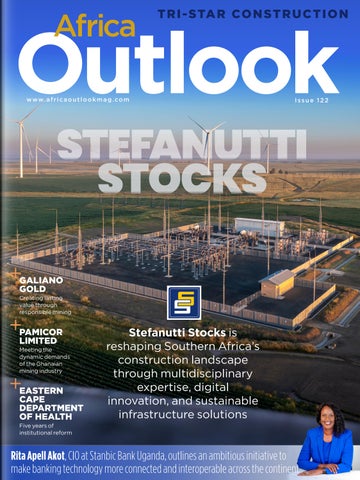
Stefanutti Stocks is reshaping Southern Africa’s construction landscape through multidisciplinary expertise, digital innovation, and sustainable infrastructure solutions
Five years of institutional reform
Rita Apell Akot, CIO at Stanbic Bank Uganda, outlines an ambitious initiative to make banking technology more connected and interoperable across the continent
RICHGLEN MAINTENANCE SERVICES
T R I - STA R CO N ST R U C T I O N
B R I T I S H P O R T S A S S O C I AT I O N
N E B R A S K A P U B L I C P OW E R D I S T R I C T
G A S TO N E L E C T R I C A L
TURNER MINING GROUP
HUNTER VALLEY OPERATIONS
L O S
A N G E L E S
G E N E R A L
End-to-end solutions from exploration to extraction
Issue 82
PNG POWER LTD
w w w. e m e o u t l o o k m a g . c o m
Issue 73
www. northame ricaoutlookmag.com
Issue 37
Creating lasting value through responsible mining
Stefanutti Stocks is reshaping Southern Africa’s construction landscape through multidisciplinary expertise, digital innovation, and sustainable infrastructure solutions
MBA ENERGY & INDUSTRIAL
On a coal mining mission to champion sustainable practices
MARTIN-BAKER AMERICA, INC. Seat and safety vanguards for the defense sector
VULCAN MOZAMBIQUE
GERMAN DATACENTER ASSOCIATION
AMP BANK The banker, the one that couldn’t fail
MARTIN-BAKER AMERICA , INC . • CEMENTIS GROUP
Michael Hanisch, Head of Technology Germany, discusses Amazon Web Services’ significant cloud infrastructure investments
A M A Z O N B U S I N E S S • U N I L E V E R • G E P • O R I TA I N
Thermo Fisher Scientific has reinforced its position as a trusted biologics manufacturing partner
The ultimate goal of Virginia Tech Dining Services is to create an environment where students not only eat, but also grow, connect, and thrive as members of the Hokie community
At the helm of Europe’s data centre future
Across Asia Pacific, Hitachi Energy’s focus is on the priorities utilities are wrestling with. Massimo Danieli, Executive Vice President and CEO – Grid Automation Business Unit, reveals more
On a mission to be a leading integrated green coal mining operation
M Resources delivers a suite of essential steelmaking raw materials, infrastructure, and mining and logistics services to steelmakers across the globe. Matt Latimore, Founder and President, details the company’s futurefacing approach to investment and market growth
Trusted partners in technical excellence and expertise
Five years of institutional reform
Mark Scott, General Manager of Pinto Valley Mining Corp., delves into Capstone Copper’s Pinto Valley Mine and its importance in Arizona’s Globe-Miami mining district
CO O P L A N DS B A K E RY • D N AG RA R • B RA K E B U S H
KOLEKTOR CONSTRUCTION
Garry Edwards, VP EMEA at Wolters Kluwer, emphasises the need for formalised, organisation-wide frameworks to ensure responsible use of artificial intelligence
Jason Bontempo, CEO of Gladiator Metals, discusses the resurgence of the Whitehorse Copper Belt in Canada’s historic Yukon mining district
VECA ELECTRIC & TECHNOLOGIES
N O F A R
E N E R G Y
R O M A N I A
K I N G S PA N
Family-run, proudly Canadian
DANONE ROMANIA
w w w. s u p p ly c h a i n - o u t l o o k . c o m
Issue 14
EUROPEAN SUBSEA CABLES ASSOCIATION
W W W .CONST RUCT ION-OUT L OOK.COM • ISSUE 4
Contributing to the nation’s net zero goals
OUTLOOK
CBRE www.sustainabilityoutlookmag.com
Contributing to a healthier world
www.foodbeverage-outl ook.com
N O R D I C S
GREEN BUILDING COUNCIL OF AUSTRALIA
OSMOW’S SHAWARMA ISSUE 11
www.mfg-outlook.com
Issue 2
Real estate solutions of the future
Iss ue 9
Connecting nations and driving innovation
THERMO FISHER SCIENTIFIC
Delivering advanced medicines from Australia to the world
RADIANT LOGISTICS
Built for resilience
Bridging the Beyond Real Humanoid: and Virtual Worlds
Traditional Automation
SHORR PACKAGING
More efficient, optimized packaging solutions
Bringing humanoid robots to the factory floor and reshaping industrial automation
BRITISH PORTS ASSOCIATION
Steven Johnson, Managing Director, UKIE, Nordics, and Eastern Europe Network Operations, explains why operations leadership is critical Network Operations, explains why operations leadership is critical Steven Johnson, Managing Director, UKIE, Nordics, and Eastern Europe
of the Singapore aerospace ecosystem, keeping airlines flying to connect the world Chris Pattinson, CEO, tells us how SAESL has become an indispensable component
Margaret Henry,
VP of Sustainable and Regenerative Agriculture, discusses PepsiCo’s collaborative regenerative farming initiative
From humble potatoes to gourmet crisps, SAVOURSMITHS is transforming snacking with bold flavours and a rich family heritage
Over the last year, Saulsbury has expanded its position as one of North America’s leading engineering, procurement, and construction contractors
Johan van Jaarsveld, Managing Director of Montego Pet Nutrition, tells us about the pet care brand’s promise of ‘Better Every Day’ tells us about the pet care brand’s promise of ‘Better Every Day’ Johan van Jaarsveld, Managing Director of Montego Pet Nutrition,
decarbonisation and infrastructure across UK ports in recent years Richard Ballantyne OBE, outlines the strong investment in Our latest catch-up with the British Ports Association and CEO,
and reshaping industrial automation Bringing humanoid robots to the factory floor
Traditional Automation and Virtual Worlds Humanoid: Bridging the Beyond Real
SAVOURING THE FLAVOUR OF THE CRISP PARADIGM SHIFT
Our latest catch-up with the British Ports Association and CEO, Richard Ballantyne OBE, outlines the strong investment in decarbonisation and infrastructure across UK ports in recent years
Chris Pattinson, CEO, tells us how SAESL has become an indispensable component of the Singapore aerospace ecosystem, keeping airlines flying to connect the world
solutions optimized packaging More efficient,
ASSOCIATION BRITISH PORTS
PACKAGING SHORR
Built for resilience
LOGISTICS RADIANT Australia to the world medicines from Delivering advanced
YY Group Holding operates an artificial intelligence-native workforce solutions and integrated facility management platform. CEO, Mike Fu, discusses the company’s established capabilities
Simon Thompson, VP Northern Europe at JAGGAER, explains why artificial intelligence-powered data infrastructure is becoming essential
facility management platform. CEO, Mike Fu, discusses the company’s established capabilities YY Group Holding operates an artificial intelligence-native workforce solutions and integrated
intelligence-powered data infrastructure is becoming essential Simon Thompson, VP Northern Europe at JAGGAER, explains why artificial
procurement, and construction contractors as one of North America’s leading engineering, Over the last year, Saulsbury has expanded its position
initiative regenerative farming PepsiCo’s collaborative Agriculture, discusses and Regenerative VP of Sustainable
a rich family heritage with bold flavours and transforming snacking SAVOURSMITHS is to gourmet crisps, From humble potatoes
SHIFT PARADIGM OF THE CRISP THE FLAVOUR SAVOURING
Margaret Henry,
TELL US YOUR STORY, AND WE’LL TELL THE WORLD
SCIENTIFIC FISHER THERMO
innovation nations and driving Connecting
www.mfg-outlook.com
Issue 14
ASSOCIATION SUBSEA CABLES EUROPEAN
www.foodbeverage-outl ook.com
Iss ue 9
healthier world Contributing to a
w w w. s u p p ly c h a i n - o u t l o o k . c o m ISSUE 11
ROMANIA DANONE
Canadian Family-run, proudly
W W W .CONST RUCT ION-OUT L OOK.COM • ISSUE 4
OUTLOOK
www.sustainabilityoutlookmag.com
Issue 2
A M A Z O N B U S I N E S S • U N I L E V E R • G E P • O R I TA I N
CO O P L A N DS B A K E RY • D N AG RA R • B RA K E B U S H
of the future Real estate solutions
CBRE
nation’s net zero goals Contributing to the
AUSTRALIA COUNCIL OF BUILDING GREEN
SHAWARMA OSMOW’S
MARTIN-BAKER AMERICA , INC . • CEMENTIS GROUP
Modernising and transforming health systems
ARGO NATURAL RESOURCES
Delivering construction with integrity and expertise
L’Osteria is transforming Europe’s culinary landscape by focusing on creating a distinctive Italian dining destination where guests feel at home
DIALOG FITZROY
Rita Apell Akot, CIO at Stanbic Bank Uganda, outlines an ambitious initiative to make banking technology more connected and interoperable across the continent
www.healthcare-outlook.com
www.mining-outlook.com • Issue 16
EMIRATES RAWABI Uniting food and beverage production under one national banner
Responsible for generating, transmitting, distributing, and retailing electricity in Papua New Guinea
GALIANO GOLD
EASTERN CAPE DEPARTMENT OF HEALTH
w w w. a p a c o u t l o o k m a g . c o m
Issue 122
STEFANUTTI STOCKS
Meeting the dynamic demands of the Ghanaian mining industry
C E N T E R
ST. JOSEPH’S HEALTH SYSTEM
Elevating the patient experience
DIGITAL HEALTH ASSOCIATION
w w w. a f r i c a o u t l o o k m a g . c o m
PAMICOR LIMITED
M E D I C A L Issue 15
WEIR
KOLEKTOR CONSTRUCTION
VECA ELECTRIC & TECHNOLOGIES
N O F A R
E N E R G Y
R O M A N I A
K I N G S PA N
N O R D I C S
Africa Outlook, APAC Outlook, EME Outlook, North America Outlook, Mining Outlook, Healthcare Outlook, Manufacturing Outlook, Supply Chain Outlook, Food & Beverage Outlook, Construction Outlook, and Sustainability Outlook are digital publications aimed at boardroom and hands-on decision-makers, reaching an audience of more than 800,000 people around the world. With original and exclusive content compiled by our experienced editorial team, we look to promote the latest in engaging news, industry trends, and success stories from across the globe. Your company can join the leading industry heavyweights enjoying the free exposure we provide across our platforms with a free marketing brochure, extensive social media saturation, enhanced B2B networking opportunities, and a readymade forum to attract new investment and help you grow your business. Visit www.outpb.com/work-with-us for details on how your company can feature for free in one of our upcoming editions.
www.outpb.com/work-with-us
WELCOME FROM THE EDITOR
EDITORIAL Head of Editorial: Jack Salter jack.salter@outpb.com Deputy Head of Editorial: Lucy Pilgrim lucy.pilgrim@outpb.com
DIVERSE DISCIPLINES
Senior Editor: Lily Sawyer lily.sawyer@outpb.com
Welcome to our 122nd edition of Africa Outlook magazine.
Editor: Ed Budds ed.budds@outpb.com
Our multidisciplinary cover star, Stefanutti Stocks, brings together a broad range of 12 specialist construction disciplines to provide world-class services to clients across diverse markets.
Editor: Rachel Carr rachel.carr@outpb.com Copy Editor: Lauren Kania lauren.kania@outpb.com PRODUCTION Art Director: Stephen Giles steve.giles@outpb.com Senior Designer: Devon Collins devon.collins@outpb.com Designer: Louisa Martin louisa.martin@outpb.com Production Manager: Alex James alex.james@outpb.com Digital Marketing Director: Fox Tucker fox.tucker@outpb.com Senior Website Content Manager: Oliver Shrouder oliver.shrouder@outpb.com Social Media Executive: Jake Crickmore jake.crickmore@outpb.com Trainee Digital Content Executive: Tara Steele tara.steele@outpb.com BUSINESS CEO: Ben Weaver ben.weaver@outpb.com Managing Director: James Mitchell james.mitchell@outpb.com Chief Technology Officer: Nick Norris nick.norris@outpb.com Content Director: Neil Perry neil.perry@outpb.com Global Head of Media: Lewis Hammond lewis.hammond@outpb.com Global Media Executive: Kai Boyle-Vennard kai@outpb.com ADMINISTRATION Finance Director: Suzanne Welsh suzanne.welsh@outpb.com Finance Manager: Victoria McAllister victoria.mcallister@outpb.com CONTACT Africa Outlook Norvic House, 29-33 Chapelfield Road Norwich, NR2 1RP, United Kingdom Sales: +44 (0) 1603 804 445 Editorial: +44 (0) 1603 804 431 SUBSCRIPTIONS Tel: +44 (0) 1603 804 431 jack.salter@outpb.com www.africaoutlookmag.com Follow us on Linkedin: @africa-outlook-magazine Follow us on X: @outlookpublish
These disciplines span building, civils, geotechnical, roads and earthworks, marine, renewable energy, data centres, electrical and instrumentation, mechanical, oil and gas, concrete rehabilitation and repairs, and mining services. Stefanutti Stocks’ multidisciplinary expertise has cemented it at the forefront of the construction industry in South Africa, offering end-to-end capabilities with a transparent delivery model. “Our multidisciplinary model brings the key construction interfaces together under one accountable delivery structure,” states Russell Crawford, CEO. For Michael Cardinaels, COO of Galiano Gold, his introduction to mining showed him a discipline that combines technical problem-solving with tangible, realworld outcomes. Galiano Gold’s flagship asset, the Asanko Gold Mine (AGM), hosts a number of orogenic gold deposits and has contributed to Ghana’s established gold mining industry for more than a decade. “When I think about the AGM’s significance within Ghana, it is not just the gold we produce; it is also the operating capability, employment, skills, and local supply chain that have developed around the mine over many years,” notes Cardinaels. Likewise meeting the dynamic demands of the Ghanaian mining industry is Pamicor Limited (Pamicor), a leading Indigenous partner for complex underground mining services. What differentiates Pamicor is its discipline and foresight. “Together, with 33 years of mining industry experience and a deep understanding of West African ground conditions, our discipline and foresight give us the focus and attention to detail planning to deliver safely; this is what sets Pamicor apart,” emphasises Kofi Peter Amponsah-Mensah, Chief Opportunities Executive. We also showcase the expertise of Tri-Star Construction, Raubex Building, and the Eastern Cape Department of Health in their respective disciplines, amongst others. We hope that you enjoy your read. Jack Salter Head of Editorial, Outlook Publishing Africa Outlook Issue 122 | 3
AFRICA OUTLOOK CONTENTS
14 Manufacturing From Xhosa Roots to Paris Runway Prestige
122| CONTENTS
Culture and craftsmanship at the core of a curated collection
20
REGULARS
TO P I C A L F O C U S
6 EXPERT EYE
20 Sustainability
Shared infrastructure supporting digital ambitions
Ending Extreme Poverty Through Entrepreneurship Helping families in rural Africa start small businesses
BUS INE SS INSIGHTS
8 Finance Beyond Traditional Banking At the intersection of healthcare and clean energy
14
148 THE FINAL WORD Which abilities are most crucial when it comes to leadership and why?
AFRICA OUTLOOK CONTENTS
F E AT U R E S CO NSTRUCTION
28 Stefanutti Stocks Re-Engineering Africa’s Built Environment The multidisciplinary construction group with a difference
60 Tri-Star Construction Star of the Show Tri-umphant construction across South Africa
68 Raubex Building Better Ways to Build Innovation and excellence in every project
MINING
78 Galiano Gold Supporting Ghana’s Mining Future Creating lasting value through responsible mining
108 Pamicor Limited World-Class Mining Services on African Soil Meeting the dynamic demands of the Ghanaian mining industry
116 Asante Gold A Blueprint for Sustainable, Localised Mining A dominant force in West African mining
H E A LTH C A R E
126 Eastern Cape Department of Health Architecting Health System Transformation Five years of institutional reform
134 Mitchells Plain Hospital At the Heart of Mitchells Plain A steadfast commitment to compassionate patient care
O I L & G AS
142 Simam Côte d’Ivoire Energy for All Côte d’Ivoire’s premier energy supplier
142
68
108
126
126
116
Africa Outlook Issue 122 | 5
What Dakar 2026 Means for Senegalese Connectivity As Dakar prepares to host Africa’s first Olympic sporting event, Fatoumata Mbaye, Managing Director of Helios Towers, Senegal, explores how resilient, shared infrastructure can meet surging data demand and support Senegal’s long-term digital ambitions Writer: Fatoumata Mbaye, Managing Director, Helios Towers, Senegal
W
hen the Youth Olympic Games begin in Senegal’s capital city, Dakar, this October, conversations will rightly focus on the country’s young people and the historic significance of hosting the first Olympic sporting event on African soil. Such a landmark event will excite and inspire the nation. It will also cause an enormous spike in mobile data usage as people across the country go online to follow and stream the Games. All of this will place additional pressure on Senegal’s mobile networks. Large numbers of people will be concentrated around venues and public spaces, whilst demand for mobile data rises. People have become accustomed to being able 6 | Africa Outlook Issue 122
to get online when and where they need to, and those expectations don’t disappear when networks are at their busiest. The country already has considerable experience of managing these fluctuations. Every year, major religious gatherings such as the Grand Magal and Gamou bring huge numbers of people together. During one annual event, the host city’s population can increase from around 800,000 to six million in a matter of days, placing significant additional demand on networks. The Youth Olympic Games are a very different occasion, but the pressure they place on telecommunications infrastructure is very much the same. When
large numbers of people need to communicate, transact, and access information at the same time, operators need networks that can handle sudden demand spikes and infrastructure that keeps performing reliably underneath them. That is why, for those of us working in the sector, resilience is something we think about every day.
MEETING RISING DIGITAL DEMAND Since Helios Towers entered Senegal, the average downtime of the infrastructure we operate has fallen from almost six minutes per tower per week to effectively zero. The significance of that improvement becomes clearest during periods of intense demand, when operators need infrastructure they can rely on as they add capacity and respond to changing patterns of network use.
EXPERT EYE TECHNOLOGY
Those periods of exceptional demand sit within a much broader change in how Senegal uses mobile networks. Data consumption is increasing, the country’s young population is driving demand for digital services, and operators are continuing to expand and modernise their networks. As a result, infrastructure requirements are changing, including greater use of rooftop sites and indoor connectivity alongside traditional towers. Meeting this demand efficiently will require greater use of shared infrastructure. Without this approach, building new masts every time an operator needs to expand can increase costs and slow deployment. By allowing multiple operators to use the same sites, tower sharing can support additional coverage and capacity whilst reducing unnecessary duplication. The requirements vary considerably across the country. In Dakar and other densely populated areas, operators may need to add capacity in places where networks already reach large numbers of people. By contrast, in rural communities, the economics of network expansion can be more challenging, and the priority may still be extending mobile broadband to people who remain underserved. Shared infrastructure can help operators address both more efficiently.
EXTENDING CONNECTIVITY BEYOND THE GAMES Expanding networks is one part of widening participation in Senegal’s digital economy. Despite progress in mobile broadband coverage, 54 percent
of the population is covered by mobile broadband but does not use mobile internet. Global System for Mobile Communications Association (GSMA) research points to affordability, limited digital skills, and the cost of smartphones amongst the barriers. Infrastructure investment cannot solve each of these issues, but reliable, widely available networks provide the foundation for greater digital participation. This matters far beyond how people experience the Youth Olympic Games. Connectivity increasingly shapes how people communicate, learn, make payments, access services, and participate in the economy. For a young person, it can mean studying online or accessing new opportunities; for a small business, it can mean reaching customers and accepting mobile payments; and for families, it can be as simple as staying in touch. Making those opportunities available more widely will require coordination across the telecommunications sector. Infrastructure providers can help operators expand more efficiently and maintain resilient sites. Operators will continue investing in coverage, capacity, and services, whilst government plays an important role in creating the conditions for investment and supporting the country’s broader digital development. Senegal’s New Deal for Technology provides an important framework for that work, with ambitions around digital infrastructure, access, and the development of the country’s digital economy. Delivering those ambitions will depend on sustained cooperation between the public and private sectors as demand increases and the country’s networks continue to evolve.
Ultimately, Dakar 2026 will bring an unusual concentration of people and data demand to Senegal, but the work of strengthening the country’s networks will continue long after the Games end. Mobile use will keep growing, operators will keep expanding their networks, and more aspects of daily life will depend on reliable connectivity.
ABOUT THE EXPERT Fatoumata Mbaye was appointed Managing Director of Helios Towers, Senegal, in 2025 after serving as Deputy Managing Director. Since joining the company in 2021, she has played a pivotal role in laying the financial and operational foundations, driving its rapid expansion. Mbaye built and led the finance team, embedding strong governance and financial discipline from the outset, then broadened her responsibilities to include project delivery, property, and health, safety, quality, and environment (HSQE). Her versatility, commitment to operational excellence, and proven track record of delivering results have been central to the company’s success in Senegal. Before joining Helios Towers, Mbaye spent more than nine years at Société Générale Sénégal, where she held several senior financial roles.
Africa Outlook Issue 122 | 7
B E YO N D TRADITIONAL BANKING
STANDARD BANK FINANCE
Africa’s largest bank, Standard Bank, has been working on an ambitious initiative to make banking technology more connected and interoperable across the continent, as outlined by Rita Apell Akot, CIO at Stanbic Bank Uganda Writer: Jack Salter
“O
ur approach is to build a strong common foundation across the group, with flexibility to respond to local needs.” As client expectations, regulation, infrastructure, and digital maturity differ across African markets, Standard Bank shares a common direction whilst adapting how it delivers in each country. A key part of that foundation is the bank’s common application programming interface (API) architecture, informed by the Banking Industry Architecture Network (BIAN). “It gives our teams a shared language for defining banking services, making it easier to connect systems, reduce duplication, and reuse capabilities,” continues Rita Apell Akot, CIO at Stanbic Bank Uganda, who is also a BIAN board member. “If we build a capability in one market, we should be able to adapt it for another without starting from scratch.” Standard Bank already has BIANaligned APIs in production in South Africa (SA), Uganda, Kenya, Zambia, and Botswana. Those implementations give the bank practical lessons to draw on as it scales. “Locally, we start with how our clients live and transact. In Uganda,
for example, mobile money is central to everyday payments, whilst connectivity, affordability, and digital literacy influence how people access banking,” Akot explains. That shapes Standard Bank’s priorities: simpler customer journeys, integration with local partners, and reliable services through familiar channels. “Ultimately, I judge transformation by its outcomes: is banking easier for our clients, are they using the services, and can we deliver change faster and more reliably? The group provides scale and shared capabilities; our role in each market is to translate those strengths into meaningful local value,” she outlines.
COMMON TECHNOLOGY STANDARDS Common technology standards help in two very practical ways: they make delivery more consistent and enable Standard Bank to move faster. Internally, they give its teams a shared language and common foundation for designing services and APIs, which means less time spent reinventing the basics or resolving differences between systems. Teams can build on what already exists, which reduces rework and makes delivery more predictable. Africa Outlook Issue 122 | 9
STANDARD BANK FINANCE
“That’s particularly valuable across multiple countries. If we develop a capability in one market, we should be able to reuse and adapt it in another whilst accommodating local regulation and client needs; that’s how consistency translates into speed – each market can benefit from the work and experience of others,” notes Akot. BIAN provides that shared framework for banking capabilities. When teams have a common understanding of what an account or payment service does, it becomes easier to connect systems and reuse services, even where the underlying technology differs. “The bigger payoff comes when we work with other organisations. Banks, FinTechs, mobile money operators, and technology providers all need to connect; if everyone works from
10 | Africa Outlook Issue 122
“As a CIO and BIAN board member, I see shared standards as an important foundation for collaboration and making cross-border banking simpler, more reliable, and more accessible across Africa” – Rita Apell Akot, CIO, Stanbic Bank Uganda
different models, each connection requires translation and custom integration,” she points out. That adds time, cost, and complexity; greater alignment reduces that friction and helps new services reach clients sooner. “One of our biggest learnings is that adopting a standard within one organisation only takes you so far. Its
value grows as the wider ecosystem starts speaking the same language. “That’s why growing BIAN awareness and adoption across Africa matters to me, both as a CIO and as a BIAN board member,” Akot affirms. Standards need to become part of how teams actually work, supported by skills, clear ownership, and governance.
STANDARD BANK FINANCE
What have you learnt from moving from an architectural framework to something that is actually operating at scale? Rita Apell Akot, CIO: “Two lessons stand out for me. The first is that standards have to prove their value in practice. “Frameworks and architecture diagrams give us direction, but seeing BIAN-aligned APIs running in production builds confidence in the approach. It also gives us practical lessons we can share across markets as we scale. “The second is that adoption depends as much on people as on technology. There’s a learning curve, and teams need support to translate the framework into everyday delivery. “That’s why we’ve embedded BIAN coaches within business units and introduced training across our African subsidiaries; it helps teams build confidence and take ownership of the approach. “Ultimately, it’s the combination of working implementations, stronger skills, and organisational change that makes adoption sustainable. The real test is whether teams can use BIAN to deliver reusable capabilities more consistently and respond faster to business needs.”
The result Standard Bank is looking for is faster delivery, less duplication, and a more consistent, reliable experience for clients.
GREATER INTEROPERABILITY Cross-border financial services remain a major opportunity for Africa, and greater interoperability between banks and payment systems can help make moving money across the continent faster and more seamless. Interoperability is about making the whole payment journey work better for the client. “A cross-border payment passes through several institutions and systems. When those systems
exchange information consistently, we can reduce manual intervention, simplify reconciliation, and give clients better visibility of their money, which supports faster processing and a more seamless experience,” enlightens Akot. From a Ugandan perspective, this matters for businesses trading across borders and people sending money to their families. Connecting banks, mobile money operators, and payment networks more effectively can make those services easier to access and use. “We’re seeing the practical relevance through the Pan-African Payment and Settlement System
(PAPSS), where BIANaligned APIs within Standard Bank support our internal payment functionality,” Akot insights. “BIAN provides a common framework for banking services, making it easier to connect our capabilities to wider payment infrastructure.” The technology also needs to work alongside regulatory requirements, compliance controls, and settlement arrangements. Reliability matters throughout – clients need confidence that their payment will reach its destination and any exceptions will be resolved promptly. Africa Outlook Issue 122 | 11
STANDARD BANK FINANCE
“That’s why broader collaboration is essential. Banks, payment networks, technology providers, regulators, and standards bodies all have a role,” acknowledges Akot. “As a CIO and BIAN board member, I see shared standards as an important foundation for collaboration and making cross-border banking simpler, more reliable, and more accessible across Africa.”
“If we develop a capability in one market, we should be able to reuse and adapt it in another whilst accommodating local regulation and client needs; that’s how consistency translates into speed – each market can benefit from the work and experience of others” – Rita Apell Akot, CIO, Stanbic Bank Uganda
COLLABORATION IS CENTRAL Industry-wide collaboration is important in driving digital transformation across African financial services, particularly when it comes to the adoption of common technology standards. “Collaboration is central because common standards become more valuable as more organisations adopt them,” asserts Akot. “When banks and their partners work from a shared framework, it becomes easier to connect services, reuse capabilities, and bring new ideas.” When Standard Bank first adopted BIAN internally, awareness amongst peer banks across Africa was
12 | Africa Outlook Issue 122
relatively limited. It therefore made communitybuilding part of the journey. “We hosted BIAN member meetings in Cape Town, bringing together architects from banks, insurers, and technology providers. That engagement helped lead to the creation of the BIAN Africa Chapter, with a network of 185 members,” Akot tells us. “Of course, the responsibility goes beyond adopting standards within our own bank. As technology leaders, we also need to share practical lessons, build local capability, and help others understand the business
value. There is an opportunity to bring more African banking leaders and technology providers into that conversation. “Some of our biggest challenges from cross-border payments to resilience require collective action. We can collaborate on the foundations whilst continuing to compete through the quality of our services; that gives us a stronger basis for delivering simpler, more reliable banking across Africa,” she states.
CONNECTED JOURNEY Banking and insurance are increasingly interconnected in many African markets. The biggest opportunity is to make it feel like one connected journey for the client, from identifying a need and taking out cover to paying premiums and making a claim. Banks bring client relationships and distribution, insurers bring protection expertise, and technology providers help connect those capabilities. “We saw the potential when we assessed BIAN. It covered roughly 80 percent of the insurance capabilities we needed, but insurance products weren’t formally represented in the reference architecture,” Akot weighs up. “We took that gap to the BIAN community, which led to the Insurance Product Working Group. Standard Bank chairs the group, bringing together five insurers, six banks, and Astute, an insurance data exchange in SA.
STANDARD BANK FINANCE
Key gaps to address include consistent definitions of customer, policy, and claims information, and reliable connections between banking and insurance systems. Shared APIs can help reduce repeated data capture, simplify premium reconciliation, and improve visibility of a claim’s progress, whilst clear consent and data protection arrangements are equally essential. “The lesson is that we should use these gaps as opportunities to collaborate. By developing common approaches together, we can reduce duplication and make insurance easier to access and service through the banking channels clients already use,” Akot sets out.
CONVENIENCE AND TRUST As digital financial services continue to evolve across Africa, there is also the opportunity to make banking fit more naturally into clients’ everyday lives. Whether someone is paying a supplier, sending money across borders, or taking out insurance, the experience should be simple, connected, and reliable. That starts with removing friction: fewer steps, less repeated information, and a smooth transition between digital channels and human support. A client should be able to start a journey on their phone and continue with a relationship manager without having to start again.
“Our work on APIs and BIANaligned architecture helps us connect and reuse services, so we can introduce new capabilities faster and integrate more easily with mobile money operators, FinTechs, and insurers,” assures Akot. “Data and artificial intelligence (AI) offer further opportunities to personalise services and reduce manual processes, including the work we’ve been exploring on AI-assisted know your customer (KYC) reviews. We also need to design for different levels of connectivity and digital confidence, whilst building security and resilience into the experience. “Convenience and trust have to go together,” she concludes.
MAXHOSA AFRICA MANUFACTURING
FROM XHOSA R O OT S TO PA R I S R U N WAY PRESTIGE In the City of Light, MaXhosa Africa threads heritage through fashion’s grandest stage, weaving cultural identity, contemporary craft, and global ambition into Paris Fashion Week, marking a milestone for African design and creativity Writer: Rachel Carr
F
or centuries, Paris has defined the story of style and dominated designers’ dreams. Twice a year, its grand avenues, historic venues, and intimate salons host Paris Fashion Week (PFW), where haute couture tradition meets the momentum of contemporary fashion. At its pan-African Spring/Summer 2027 (SS27) show, MaXhosa Africa took to the global stage. The luxury knitwear house, known for translating the patterns, colours, and symbolism of Xhosa beadwork into contemporary design, opened PFW. The Fédération de la Haute Couture et de la Mode (FHCM), which sets the official schedule, approved the brand for a full runway show this year – no other South African label has been granted this privilege. However, the
label’s Womenswear Ready-toWear collection marked its sixth season in Paris. Founded by Laduma Ngxokolo, MaXhosa Africa combines premium craftsmanship with cultural authenticity. Moreover, by sourcing local mohair and wool and retaining manufacturing control on the continent, the brand protects its creative integrity whilst reinforcing the value of ‘Made in Africa’. The label’s appearance at the show aims to translate international visibility into long-term commercial growth for the 16-year-old design house, which has dressed beloved celebrities such as Beyoncé and Alicia Keys. Titled ‘Izihlwele Zivumile’, an isiXhosa phrase meaning ‘the ancestors have approved’, the event signalled a defining moment in the company’s journey. Africa Outlook Issue 122 | 15
MAXHOSA AFRICA MANUFACTURING
More than a celebration of progress, the show honoured the people, traditions, and experiences that carried MaXhosa Africa from its beginnings to international recognition. It followed five seasons of My Conviction, first presented during PFW in 2024. Whilst that collection expressed the courage required to begin, Izihlwele Zivumile considered the significance of arrival. Returning to the same venue as its Paris debut, the brand transformed a place of introduction into a stage of progression, honouring the generations and communities that continue to shape its creative direction.
THE HERITAGE NARRATIVE This season, MaXhosa Africa embraced a cleaner, more contemporary visual language. A striking monochrome palette stripped the collection to its essentials, highlighting silhouette, textile, construction, and the artistry behind each look to emphasise form, texture, and cultural storytelling.
16 | Africa Outlook Issue 122
MAXHOSA AFRICA MANUFACTURING
The restrained colours let the craftsmanship take centre stage. Forwardlooking yet rooted in the brand’s foundations, the clothes presented heritage not as something static, but as a living language that can be reinterpreted and carried into new spaces. African-inspired accessories added depth and character, and Adidas footwear completed selected looks, whilst the creative and production teams ensured that every detail contributed to the wider MaXhosa Africa story.
The spectacle began a week before the models reached the runway when MaXhosa Africa unveiled its invitation as a passport. More than an entry document, it became a symbol of movement, memory, and belonging, reflecting the places the brand has travelled, the landscapes that shaped its identity, and the ancestors connected to them.
The passport carried the MaXhosa Africa emblem and crest, each element rich with cultural meaning. The human figure at its peak represents uMuntu – a person, and symbolises Ubuntu, or humanity, one of the brand’s central pillars. Iimpondo Zenkomo, or cattle horns, reference the Mpondo clan and the founding family’s roots, whilst a shield and spears evoke protection, and Cape aloes connect the emblem to South Africa’s Eastern Cape, where the brand originated. Together, these symbols create a crest of culture, diplomacy, and regalia. By reimagining the visual codes of travel and identity, MaXhosa Africa turned the passport into a declaration of heritage, carrying African history and creative expression onto the world stage.
A RUNWAY OF RHYTHM AND RITUAL South African artist Sjava, a longtime supporter of MaXhosa Africa, brought music, movement, and Africa Outlook Issue 122 | 17
MAXHOSA AFRICA MANUFACTURING
ritual to the runway with a medley of Umcebo and Amakehla. These songs explore wisdom, prayer, and ancestral protection, connecting faith with the knowledge and skills required to sustain what one hopes to achieve. Dressed in a custom-made iBheshu, apparel rooted in Zulu culture, Sjava added another dimension to the presentation. His performance transformed the runway into an immersive meeting of fashion, music, and cultural memory. The set, created by South African multidisciplinary artist Xander Ferreira, drew inspiration from ikhukho, traditional African mats handwoven from grass and reeds. Used in domestic and ceremonial life, including marriage and initiation, they carry histories of land, labour, and knowledge passed through generations of women. Ferreira used the mats as the set’s sole material, creating a fragment of the traditional African home in the heart of Paris. After the show, they became the backdrop for the collection’s lookbook, extending their purpose beyond a temporary runway installation.
18 | Africa Outlook Issue 122
MAXHOSA AFRICA MANUFACTURING
The set brought African heritage, contemporary design, and low-waste production into one physical environment. Furthermore, it reflected the Lindelwa Foundation, MaXhosa Africa’s social-impact initiative. Named after Ngxokolo’s mother, the foundation honours women, motherhood, legacy, and sustainability through artisanal knowledge, including modelling masterclasses, beadwork and textile workshops, and business and entrepreneurship training. Its mission is to empower individuals with the skills and opportunities to thrive whilst preserving cultural identity, strengthening local economies, and fostering long-term community growth. Additionally, Kenyan artist Cyrus Kabiru’s sculptural eyewear highlighted sustainability by transforming discarded, overlooked objects into wearable art, bringing upcycling to the runway whilst creating a dialogue between South African fashion and Kenyan contemporary art. Guests also received reusable MaXhosa Africa tote bags instead of conventional single-use gifts. Designed as African flags, the bags carried the show’s cultural narrative beyond the venue, with handcrafted rings by Marche Noir and Jamtaan completing selected looks.
AFRICA, BY ITS OWN DESIGN The finale featured a poem by South African branding authority Thebe Ikalafeng, celebrating Africa’s history, resilience, diversity, and identity whilst acknowledging the continent’s experiences of colonialism, conflict, poverty, and corruption. Its message also serves as a call to action for African people to take responsibility for building, protecting, and investing in the continent, rather than waiting for others to do so. It declared belonging, accountability,
and commitment to the continent’s future. The spirit captured MaXhosa Africa’s progression from intimate Paris presentations to its first full runway show. For the brand, PFW represents more than entry into another international market; it is part of a wider ambition to build a globally recognised African luxury fashion house and create space for African culture, identity, and creativity on their own terms. Fashion has long served as a vehicle for MaXhosa Africa’s cultural diplomacy. Through relationships with the Department of International Relations and Cooperation (DIRCO), diplomatic missions, and international
INSIDE MAXHOSA AFRICA’S HISTORIC RUNWAY HERITAGE FOCUS – 54 looks translated Xhosa beadwork-inspired patterns into contemporary silhouettes using wool, cotton, silk, and chiffon. SYMBOLIC PIECES – A wool dress featured knitted tassels bearing the names of every African country. Whilst a black-and-grey outfit featured a large outline of Africa on the front, with other continents on the back and sleeves, nodding to the UN’s rescaled map of Africa. ACCESSORIES – Shell-covered headpieces, isicholo-inspired hats, oversized earrings, wooden hair clips, and upcycled experimental eyewear by Kenyan artist Cyrus Kabiru, made from wood and metal. NARRATIVE – Izihlwele Zivumile expresses the idea that the collection’s achievements have received ancestral approval, connecting inherited traditions with present-day innovation.
commerce, the brand has shown how creative industries can open doors for African talent and cross-border collaboration. Supported by the South African Embassy in France and Minister Plenipotentiary Nthabiseng Makuwa, the brand’s Paris journey began with an intimate presentation in the courtyard of the South African Ambassador to France’s official residence. Six seasons later, MaXhosa Africa returned to the same landmark venue for its first full Paris runway show, transforming it into a symbol of how far the label had travelled, from an emerging presence in Paris to a growing force in international fashion. Ultimately, the Izihlwele Zivumile collection reflects that journey and heralds what comes next. At its heart is a story of belonging, perseverance, and collective achievement; as Ngxokolo himself described it, the show celebrated African unity and craftsmanship whilst advancing MaXhosa Africa’s mission to place African heritage on fashion’s most prestigious stages. Africa Outlook Issue 122 | 19
Hair salon
TOPICAL FOCUS SUSTAINABILITY
Ending Extreme Poverty Through Entrepreneurship Sazini Mojapelo is the first Africa-based CEO of Village Enterprise, a non-profit working to end extreme poverty by helping families in rural communities start small businesses. She talks to us about empowering women, forging development through results, and why the continent’s future must be led from within Africa Writer: Ed Budds | Photography: Jjumba Martin
Africa Outlook (AO): Firstly, why is entrepreneurship the best approach for achieving your aim of ending extreme poverty? Sazini Mojapelo, CEO (SM): People living in extreme poverty do not lack ambition, ideas, or the determination to build better lives. What they too often lack is a genuine opportunity – access to the resources and support needed to turn their abilities into a sustainable livelihood. That is what makes entrepreneurship so powerful. In many of the rural communities where we work, formal jobs are scarce. Emergency aid can be lifesaving, particularly during a crisis, but aid alone cannot provide a lasting source of income or give families greater control over their futures.
Sazini Mojapelo, CEO
Entrepreneurship can – it enables people to earn a reliable income, build assets, withstand unexpected setbacks, and create choices for themselves and their children. It can be transformative, but success requires the right foundation. Giving someone money and simply telling them to start a business is not enough, particularly for a person living in extreme poverty. Village Enterprise uses a poverty graduation model that brings together the support first-time entrepreneurs need to be successful. Participants form companies in groups of three, develop a business plan, and receive training, start-up cash, and a year of mentoring. They also join business savings groups, where they save together, access loans, and support one another. Africa Outlook Issue 122 | 21
TOPICAL FOCUS SUSTAINABILITY
The entrepreneurs own and run the companies themselves, and many go on to launch more businesses, diversify their income, invest in their families, and sometimes even create jobs for others in their communities. Our role is not to determine their futures for them – it is to help remove the barriers that stand between them and the future they are capable of building. AO: Aid budgets are being cut across the West. How big of a setback is that for ending extreme poverty? SM: The cuts are a serious setback. When aid budgets shrink, proven programmes reach fewer people at a time when conflict, climate shocks, and rising costs are pushing more families into extreme poverty. African governments cannot fill that gap overnight, and international donors
Tailoring school
22 | Africa Outlook Issue 122
and philanthropists remain essential. At the same time, ending poverty across the continent requires a more sustainable, African-led model. Governments have the reach and infrastructure to bring proven approaches to national scale. In Rwanda and Kenya, for example, governments are investing in poverty graduation and building teams to deliver their own programmes. Village Enterprise is helping them develop the skills and systems to do that successfully. This is not a choice between international support and African leadership. Donor funding can help build evidence, strengthen government systems, and support early implementation. Governments can then embed successful programmes within national systems and sustain them at scale.
TOPICAL FOCUS SUSTAINABILITY
“The most important lesson is that refugees are not passive recipients of aid. With the right support and access to markets, they can build successful businesses, support their families, and strengthen the local economies around them” – SA Z I N I M OJA P E LO, C E O, V I L L AG E E N T E R P R I S E
AO: Your Delivering Resilient Enterprises and Market Systems (DREAMS) programme works with refugees. What have you learned from this? SM: Refugees are often treated as though displacement is temporary and emergency assistance is all they need. Yet, many of the people in our programmes have lived in refugee settlements for years and will most likely remain there for years to come Meeting immediate needs is essential, but refugees also need opportunities to earn, save, and build sustainable livelihoods. DREAMS, which we deliver with Prosper Global in Uganda and Ethiopia, has reached more than 22,000 refugee and host-community
households. Independent, randomised, controlled trials found participating households had higher monthly income and consumption than households in the control groups. Across both countries, savings rose by more than 90 percent and household assets increased by between 20 and 24 percent. Those gains mean more nutritious food, education for children, healthcare, and greater protection from future shocks. The most important lesson is that refugees are not passive recipients of aid. With the right support and access to markets, they can build successful businesses, support their families, and strengthen the local economies around them.
Africa Outlook Issue 122 | 23
TOPICAL FOCUS SUSTAINABILITY
“When I meet the rural women in our programmes today, I see my mother in them – hardworking, resilient, and devoted to their children and families” – SA Z I N I M OJA P E LO, C E O, V I L L AG E E N T E R P R I S E
AO: Why do you believe women make up about 80 percent of the entrepreneurs you work with? SM: The reason is simple. When a woman has the ability to earn an income, she invests her earnings back into her family. The money goes straight to food, school fees, and healthcare. Backing women is one of the most reliable ways to lift a whole household out of extreme poverty. AO: Why does it matter that Village Enterprise is now led from Africa? SM: Being closer to the communities we serve shapes how we understand
24 | Africa Outlook Issue 122
challenges, build relationships, and make decisions. A policy or programme that appears sound on paper can look very different when put into practice. Africa-based leadership brings that context and proximity into our decision-making from the beginning. I also believe that African leaders should be setting the direction for African development. As Village Enterprise’s first Africa-based CEO, I can work closely with the entrepreneurs, staff, governments, and partners whose knowledge and experience should shape our strategy. This transition builds on the
strong foundation established by the leaders who came before me. It brings our leadership closer to our work and strengthens our ability to develop African-led solutions that governments can adopt and scale. AO: What would you ask of the business leaders reading this? SM: I would ask business leaders to consider the role their companies can play in ending extreme poverty. Financial support remains essential: it enables organisations like Village Enterprise to reach more entrepreneurs, test new approaches, and demonstrate what works. However, businesses can also contribute expertise, technology, networks, and access to markets. That could mean bringing rural entrepreneurs into your supply chains, offering professional advice, or even providing tablet devices and data for digital training.
TOPICAL FOCUS SUSTAINABILITY
Farming
AO: Finally, what makes this work personal for you? SM: I grew up in Zimbabwe. My mother had me when she was a teenager, and no matter how hard she worked, money was always tight. We took the bus everywhere, and I would look at families passing us in their cars and wonder why life appeared so much easier for them. Nobody could give me a clear answer. I wanted to understand why hard work led to such different outcomes, and that childhood question has been the golden thread throughout my career.
When I meet the rural women in our programmes today, I see my mother in them – hardworking, resilient, and devoted to their children and families. They do not lack ambition or effort. What they need is a fair chance – start-up cash, training, mentoring, and the support to turn their abilities into sustainable livelihoods.
villageenterprise.org Africa Outlook Issue 122 | 25
Adding to the success of its regional titles; Africa Outlook, EME Outlook, APAC Outlook, and North America Outlook, Outlook Publishing is proud to introduce a new platform dedicated to the construction sector. A multi-channel brand, Construction Outlook brings you the positive developments driven by organisations across the global construction industry through its various platforms. Discover exclusive content distributed through its website, online magazine, social media campaigns and digital dispatches, delivered straight to your inbox with a bi-weekly newsletter. Through these compelling media channels, Construction Outlook will continue to foreground the movers and shakers of the industry. To participate as a featured company and join us in this exciting endeavour, contact one of our Project Managers today.
SUBSCRIBE NOW TO THE DIGITAL MAGAZINE
www.construction-outlook.com/work-with-us
RE-ENGINEERING A F R I C A’ S B U I LT ENVIRONMENT
28 | Africa Outlook Issue 122
G
STEFANUTTI STOCKS CONSTRUCTION
Stefanutti Stocks is reshaping Southern Africa’s construction landscape through multidisciplinary expertise, digital innovation, and sustainable infrastructure solutions. Russell Crawford, CEO, tells us how the group continues to navigate challenges whilst building for future growth Writer: Lucy Pilgrim | Project Manager: James Melton
T
he construction industry in South Africa (SA) has evolved alongside the country’s built environment and urban growth, demonstrating resilience through successive periods of economic, social, and technological change. Since the 19th century, the construction industry has had a profound impact on SA’s socioeconomic makeup, driven by the changing needs of the nation’s infrastructure and rapid technological change. Construction has been closely linked to SA’s mining sector for more than a century, supporting industrialisation, urbanisation, labour mobility, and infrastructure development since the late 1800s. Indeed, the growing mining industry at the time generated greater demand for critical infrastructure such as railways and bridges, logistics and transport, industrial buildings, roads, and evolving urban settlements. The expansion and diversification of the construction industry was therefore not an isolated event, as it evolved in the early 1900s from local building activity into an increasingly multidisciplinary landscape concerning labour movement, transport, materials, and urbanisation. The discovery of gold on the Witwatersrand in 1886 led directly to the founding of Johannesburg, which within a decade had become the country’s largest town. Into the 20th century, deep-level mining and a growing manufacturing base drove sustained investment in transport, industrial, and urban infrastructure. Once again, this highlighted the construction industry’s position as an economic driver, forging a connection between mines, ports, manufacturing facilities, and housing, thus helping to physically connect the emerging industrial landscape. By the late 20th century, SA had developed a substantial infrastructure and construction base, spanning civil Africa Outlook Issue 122 | 29
STEFANUTTI STOCKS CONSTRUCTION
CAN YOU PROVIDE KEY DETAILS ABOUT STEFANUTTI STOCKS’ FIVE-YEAR ORGANISATIONAL RESTRUCTURING AND HOW THIS WILL HELP BOOST THE GROUP’S CAPABILITIES? Russell Crawford, CEO: “The restructuring was both financial and operational. Its successful completion removed a prolonged period of uncertainty, settled historic lender arrangements, and established a more sustainable capital structure. “Operationally, we simplified the organisation around empowered regions, specialist disciplines, and streamlined shared services. This more focused structure strengthens accountability, accelerates decisionmaking, and enables technical expertise, specialist resources, plants, and systems to be deployed more effectively across the group. “It also enables us to build on and expand our strengths in targeted subsectors whilst ensuring best practices and specialist knowledge are shared throughout the group and deployed on projects where required. “Most importantly, management can now focus fully on safe execution, disciplined growth, operational excellence, and longterm value creation rather than legacy restructuring matters.”
30 | Africa Outlook Issue 122
engineering, energy infrastructure, complex water systems, and modern urban planning, although Apartheidera policies severely restricted labour mobility and skills development across the sector. Following the 1994 democratic elections, the sector became central to redressing housing shortages and infrastructure inequality, with the Reconstruction and Development Programme driving a significant phase of public investment in housing and services.
INDUSTRY OBSTACLES Fast forward to the 2020s, and the past five years have tested SA’s construction industry, which faced declining fixed investment, the aftermath of the COVID-19 pandemic, and severe loadshedding that disrupted project delivery until mid-2025. Reduced investment A prolonged period of fixed investment instability resulted in the industry operating in an environment with limited financial backing for many years. In 2024, real fixed investment across the South African economy declined by 3.7 percent (after growing by 3.9 percent in 2023) and construction output contracted by 5.1 percent, the sector’s eighth consecutive annual decline. More recent Construction Industry Development Board (CIDB) data shows gross fixed capital formation in construction fell a further 5.4 percent in 2025. This reduced infrastructure investment had tangible consequences for the construction sector: when fewer factories, housing developments, mines, and renewable energy projects proceed,
contractors face a smaller pipeline of work. At the same time, the public sector’s construction pipeline also reduced, with significant delays in roads, hospitals, schools, and water and rail infrastructure ultimately restricting the industry’s contributions to national GDP. In 2026, Infrastructure South Africa reported that fewer than 30 percent of advertised public construction tenders had been awarded, with the remainder either cancelled or not concluded. Addressing an infrastructure delivery forum in September 2026, Minister of Public Works and Infrastructure, Dean Macpherson, noted that only one in six public infrastructure tenders had been concluded in the past 12 months, stating: “This is simply not good enough.” COVID-19 pandemic aftermath During the COVID-19 pandemic, clients across both the public and private sectors held back on their original investment decisions, and 70 percent of industry professionals surveyed reported that construction projects were being cancelled (Musonda & Rakolote, Acta Structilia, 2022). That caution persisted well beyond the pandemic. The pandemic impacted project economics, with direct consequences on material shortages and price fluctuations, labour disruptions, changes to contractual obligations, delays, and substantial health and safety requirements, all culminating in greatly reduced activity, increased costs, and limited revenues. Other obstacles Although SA has now recorded more than 500 consecutive days without loadshedding, years of frequent power disruption left a lasting mark on the sector, resulting in lost working time and complicating project scheduling.
Combined with logistics constraints, cost volatility, and criminal disruption on construction sites, this has placed contractors under sustained pressure. Site disruption has since become a national priority. Following the Durban Declaration in November 2024 (which brought together the Department of Public Works and Infrastructure, South African Police Service (SAPS), National Treasury, and CIDB, the South African cabinet approved the Integrated Social Facilitation Framework in July 2026 as a binding national policy to prevent disruptions before they occur. Since September 2025, 52 contractors have been blacklisted. Meanwhile, the failure of several major domestic contractors has reduced local capacity, and international firms have increased their presence in selected markets, intensifying competition for largescale work. For contractors that have remained in the market, this has created a clear opportunity. Clients increasingly require partners with proven delivery records, strong local knowledge, and the multidisciplinary capability to manage complex projects across SA.
A MULTIDISCIPLINARY APPROACH With more than 80 years of delivery
across SA’s economic cycles, Stefanutti Stocks understands the challenges the industry has faced and has the multidisciplinary capability to deliver through them. “I am cautiously optimistic. The country’s water, energy, transport, mining, and digital infrastructure needs are substantial, and there is encouraging activity in private sector investment and publicprivate collaboration,” opens Russell Crawford, CEO. Public-private partnerships are gaining traction across the sector, which bring with them significant budget improvements, particularly for transport logistics, water, sanitation, and renewable energy projects such as expanded solar, wind, and power grid capacities. “Sustainable growth will however depend on converting announced pipelines into bankable, properly procured projects and ensuring fair competition, payment discipline, and accountable delivery,” he says. The Stefanutti side traces its roots to 1971, when Gino Stefanutti and Ivo Bressan began building bridges and culverts in KwaZulu-Natal. The group’s heritage also incorporates Stocks & Stocks, whose origins date back to 1945, which later became Stocks Limited. Stefanutti & Bressan (S&B) listed on the Johannesburg Stock Exchange (JSE) in August 2007 and
merged with Stocks Limited in 2008 to form Stefanutti Stocks. The group therefore draws on more than 80 years of combined construction heritage.
12 DISCIPLINES UNDER ONE ROOF Today, the group brings together a broad range of 12 specialist construction disciplines to provide world-class services to clients across diverse markets. These disciplines span building, civils, geotechnical, roads and earthworks, marine, renewable energy, data centres, electrical and instrumentation, mechanical, oil and gas, concrete rehabilitation and repairs, and mining services. Decades of experience afford the group unique insight into the business challenges faced by the sectors it serves, and this supports its ability to propose innovative, project-specific solutions. The building discipline offers the full scope of traditional and niche building expertise (airports, hospitals, and data centres) to local and international clients and has pioneered international project development trends in Africa by offering the traditional building market (including industrial, retail, residential, office accommodation, and hotels) alternative procurement options. Africa Outlook Issue 122 | 31
Demolition and Excavation A FAMILY BUSINESS CHANGING HOW SITES ARE DEVELOPED
DEMEX (Pty) Ltd brings together specialist demolition, bulk earthworks, civil construction, mining, load and haul, crushing and screening, and material recovery. Its work spans the removal of existing structures, mass excavation, road and service construction, and the processing of aggregates and minerals, alongside material recovery and reuse. The aim is to give clients a coordinated operation that takes a site through the demanding early stages of development while making better use of the resources already there. DEMEX forms part of a second-generation, family-owned group of companies with a 25-year operating history. The group includes DEMEX, Hamilton Plant Hire, Rock & Soil Recycling and Umkhombe Mining Services. Together, these businesses connect construction, plant hire, recycling and mining services, supported by a fleet of 180 pieces of plant and the teams required to operate, transport and maintain them. Based in the Western Cape, the group has grown around practical experience in moving ground, handling difficult materials and delivering work in demanding environments. Under Ryan
Plasket’s leadership, that experience is being combined with a clear ambition to change how the industry works. DEMEX is developing an approach in which specialist equipment, coordinated services and a substantial recycling footprint are part of the construction plan from the beginning.
SPECIALIST DEMOLITION FROM PRECISION WORK TO IMPLOSION
Demolition is a core DEMEX capability. The company undertakes mechanical demolition and implosions, with methods selected around the structure, its surroundings and the required outcome. Its offering extends from precision work in restricted spaces to the removal of substantial buildings and industrial structures, followed by breaking, sorting, loading and site clearance. The demolition equipment available includes high-reach excavators, remote-controlled excavators and a range of specialist attachments. Shears, hydraulic hammers, concrete munchers and selector grabs allow teams to cut, break, reduce and separate material using equipment suited to the task. Highreach machines provide access to elevated structures, while remote-controlled equipment gives the team options for work
capability extends to the work around the event: preparing the structure, organising the site, and dealing with the resulting material. The implosion is one stage of a broader demolition operation that must also deliver a cleared site for the client’s next phase. Material recovery is planned alongside demolition. Selector grabs help separate different streams, concrete can be reduced for processing, and recoverable metals can be handled separately. Where project conditions and specifications allow, suitable concrete and masonry can be crushed for reuse. This links the demolition operation directly to the material requirements of the development that follows.
CRUSHING AND SCREENING FOR AGGREGATES AND MINERALS
where positioning an operator directly at the workface would be difficult or undesirable. This range of equipment supports a considered demolition sequence. Concrete and steel require different tools; a confined work area changes machine selection; and retained structures or neighbouring activities influence how the job is approached. DEMEX can combine demolition plant with loading equipment and transport so that material moves away from the workface and the site remains organised as the structure comes down. Implosion adds another specialist dimension. These projects require detailed engineering, preparation, a planned collapse sequence and carefully managed exclusion areas. DEMEX’s
Crushing and screening form a dedicated part of the group’s operation, serving both aggregate producers and the mining and minerals sector. DEMEX has access to specialised equipment, including jaw and cone crushers, mobile screens, conveyors and the excavators and loaders needed to feed them. The offering covers aggregate production, the size reduction and screening of mineral feedstocks, and the recovery of suitable construction and demolition material. The equipment is arranged around the feed material and the product required. Crushing trains combine primary reduction, further crushing and screening to achieve the specified size distribution. Screening and scalping can separate usable fractions and remove oversize material before the next processing stage. For aggregates and minerals alike, the plant configuration depends on feed size, hardness, composition, required grading and production volume. The operation also has to work as a complete production system. Loading capacity must keep pace with the processing plant, conveyors need to move the output effectively, and stockpiles must be organised so finished products remain separate. DEMEX’s access to plant, haulage and maintenance support helps it manage those connections rather than treat the crusher as an isolated machine.
Mobile processing creates opportunities to use material close to where it is generated. Rock excavated during site preparation and suitable demolition arisings can be assessed for processing into products needed on the same project. Reuse remains subject to the relevant specification and testing, but where it is appropriate, it can reduce material sent away and replacement aggregate brought back. This is especially valuable on projects with substantial excavation or demolition volumes. A processing plan established early can influence the excavation sequence, stockpile areas, haul routes and programme. It gives the client a clearer understanding of which material can be retained, how it will be processed and where it can be used, with disposal reserved for streams that require a different destination.
MINING AND LOAD AND HAUL
Mining and load and haul are a key focus for the group. Through Umkhombe Mining Services and the group’s shared plant resources, the offering brings together excavation, loading, hauling, drilling and blasting, and material handling for mining and quarrying operations. This connects the movement of material at the mining face with the requirements of the processing plant and stockpile areas. Fleets of excavators, articulated dump trucks, dozers and loaders can be configured around the material, haul distance and required output. Load and haul planning balances excavator capacity with truck cycle times, haulroad conditions and the receiving point. The objective is a steady flow of material that keeps the excavation fleet and processing equipment productive while controlling unnecessary waiting and rehandling. The ability to combine load and haul with specialised crushing and screening gives clients a coordinated service from excavation through to a sized product. Whether handling rock for aggregate production or mineral feed for a mining operation, the work is organised around agreed tonnage, product specifications and site requirements. Workshop, transport and operational support across the group help sustain the equipment and logistics behind that service.
BULK EARTHWORKS ROADS AND CIVIL SERVICES
DEMEX undertakes heavy-duty earthmoving and mass bulk excavation, using fleets of articulated dump trucks, dozers, excavators, loaders and compaction equipment. Its capability covers cutting, loading, hauling, filling, shaping and compacting material to create development platforms and prepare sites for construction. The work can range from confined excavations to large operations requiring coordinated fleets and substantial daily production. The focus is on balancing the full earthmoving cycle. Excavators need enough haulage to remain productive, haul routes need to support the movement of loaded trucks, and the receiving area needs the capacity to spread and compact incoming material. DEMEX plans these elements together, selecting equipment around the ground conditions, haul distance and required programme. Civil construction extends the offering into roads, services and associated infrastructure. This allows the business to follow bulk excavation and platform preparation with the next stages of site development. Coordinating these packages helps manage handovers, access and material requirements as a site moves from demolition or open ground towards a functioning development. The broader service range includes rock breaking, dynamic compaction, asbestos removal, landfill management and mine rehabilitation. Rehabilitation connects these earthmoving and material handling skills with reshaping disturbed ground and preparing it for the agreed end use.
RECYCLING BUILT INTO THE CONSTRUCTION PROCESS
Rock & Soil Recycling gives the group a substantial recycling footprint and a practical route for recovering suitable construction and demolition materials. The ambition is to make recycling part of how a job is planned and executed. That starts with understanding the material before it is mixed, damaged or transported to a destination that removes the opportunity for reuse.
On site, this means separating recoverable streams, identifying suitable concrete and rock, and planning where material can be stored and processed. Crushing and screening can then produce material for an approved use. Where suitable recovered products can replace imported material, the project may benefit from fewer transport movements, reduced demand for virgin aggregate and less pressure on disposal facilities. The same thinking applies across demolition, earthworks and rehabilitation. Material removed from one part of a site may have a useful role elsewhere, provided it meets the engineering and environmental requirements. DEMEX’s connected capabilities allow these options to be considered while the project is being planned, with the processing equipment and earthmoving fleet available to put an approved material strategy into practice.
A COMPLETE SERVICE FROM SITE CLEARANCE TO PRODUCTION
Clients can engage the group for an individual service or a combined package covering demolition, excavation, load and haul, crushing and screening, civil works and rehabilitation. The scope can follow the full material cycle: removing a structure or excavating rock, moving material to the processing area, producing a specified product and placing suitable recovered material where it is needed. For mining and quarrying clients, the emphasis is on reliable material movement and processing. For developers and contractors, it is on clearing sites, undertaking mass excavation, preparing platforms and constructing roads and services. Specialist machines and attachments, coordinated
fleets and workshop support provide the resources behind these services. Investment in electric equipment also supports the group’s focus on efficient site delivery. DEMEX’s drive to change established practices is rooted in how it delivers the work. Planning demolition alongside material recovery, combining load and haul with processing, and reusing suitable material on site can make the operation more efficient and reduce unnecessary transport and disposal. The focus remains on meeting the client’s programme, quantities and specifications. After 25 years as a family group, the next generation is building on established experience with a broader, more connected service offering. With 180 pieces of plant and specialist businesses across construction, mining, plant hire and recycling, the group brings the equipment and operational support needed to take on demanding site and production work.
021 790 1001 tenders@hamiltonplanthire.co.za www.hamiltonplanthire.co.za
STEFANUTTI STOCKS CONSTRUCTION
Its civils discipline supports major infrastructure and industrial projects, with capabilities spanning water and wastewater treatment works, reservoirs and dams, transport infrastructure, bridges, rail and marine facilities, industrial civils, caisson construction, desalination infrastructure, and precast concrete solutions. The geotechnical discipline’s complementary services include piling in all soil conditions, design and construction support, lateral support, rock anchoring, shotcrete, void fill, specialist grouting, dolomitic treatment, and sinkhole remediation and repairs. Stefanutti Stocks is also subSaharan Africa’s leading concrete repair and rehabilitation specialist, with the discipline applying proven concrete repair, rehabilitation, and maintenance strategies to keep infrastructure assets performing for their full intended lifespan and beyond.
STEFANUTTI STOCKS’ 12 CONSTRUCTION DISCIPLINES - BUILDING - CIVILS - GEOTECHNICAL - CONCRETE REHABILITATION AND REPAIR - ROADS AND EARTHWORKS - MARINE - RENEWABLE ENERGY - DATA CENTRES - ELECTRICAL AND INSTRUMENTATION - MECHANICAL - OIL AND GAS - MINING SERVICES
36 | Africa Outlook Issue 122
The roads and earthworks discipline delivers road construction and rehabilitation, bulk earthworks, bulk civil services and infrastructure, large earth dam construction, rail and water infrastructure, pipeline installation, crushing and screening, tailings storage facilities construction, and agricultural land preparation. The group’s mining services discipline is focused on two principal areas: materials handling and tailings operations. Its services include dump reclamation, screening, blending, placement, slurry disposal, final dump rehabilitation, waste rock dump management, tailings storage facility design, construction and operation, digital monitoring and reporting, and hydraulic mining or reclamation. Stefanutti Stocks’ extensive
mechanical, electrical, and piping (MEP) capability covers control systems, field instrumentation, materials handling systems, mechanical equipment, switchgear and motor control centres, overland and underground pipelines, process plant construction, process piping, structural steel and pipe support fabrication and erection, pipe spool fabrication and installation, tank and tank farm construction, turnarounds, shutdowns, maintenance, and commissioning support. The group’s electrical and instrumentation service offering supports high-, medium- and low-voltage installations, electrical step-down facilities, control and instrumentation systems, industrial process plants, shutdown and
“Our success is measured not only by the completion of a structure, but also by its safe delivery, lasting capability, and the fact we leave clients and communities with infrastructure that performs as intended” – R U S S E L L C R AW F O R D , C E O , S T E FA N U T T I S T O C K S
maintenance projects, data centre fit-outs, and renewable energy infrastructure. Its oil and gas capability further strengthens this multidisciplinary platform, supporting pipe-spool fabrication, bulk tank construction, petrochemical plant work, refinery upgrades, maintenance, and related industrial infrastructure. Moreover, the group’s renewable
energy discipline delivers civil and electrical balance of plant (BoP) services for wind and solar projects, including main transmission substations, independent power producer (IPP) substations, solar photovoltaic (PV) balance of system works, battery energy storage systems (BESS), medium-voltage reticulation networks, and overhead lines.
The data centre discipline provides a one-stop solution for large-scale data centre rollouts, covering earthworks, civil, structural, and architectural (CSA) works, MEP services, in-house 3D modelling, building information modelling (BIM), and specialist fitout support. Since 2018, the group has continuously delivered fasttrack projects for hyperscale and colocation clients and has to date delivered 70 megawatts (MW) of IT capacity. The marine discipline has delivered complex port, wharf, and marine infrastructure projects across Africa, supported by its wider civil, geotechnical, roads and earthworks, mechanical, and digital delivery expertise. Africa Outlook Issue 122 | 37
Slow in moving but impressive on arrival
W
hat started as a vision in 2005 has grown into one of the leading names in plant hire, with operations stretching across South Africa and, more recently, into Zambia. Founded by Wynand Botha, Dzombo Civils and Plant Hire forms part of the Dzombo Group of Companies, proudly based in Lephalale, Limpopo.
From the beginning, the company was built on a hands-on approach and a belief in taking ownership of every aspect of the work. “Since starting our company in 2005, we first concentrated on doing developments in the domestic housing and commercial retail markets and believed in doing the levelling of building sites, preparation of platforms for construction, installation of
water and power services and the construction of roads, ourselves,” says Wynand Botha. This philosophy of doing things properly, investing in the right equipment and developing the right skills has remained at the heart of Dzombo’s growth. Over the years, the company has expanded its capabilities significantly and today operates a fleet of more than 150 CAT machines.
More than
150
CAT machines in the fleet For this reason, we carefully select our operators to ensure that every member of our team meets the high standards of skill, experience and commitment that our clients have come to expect. By placing the right people behind our machines, we are able to provide our clients with a reliable, efficient and quick service, whilst maintaining the quality of work that Dzombo is known for. Whilst Dzombo has grown from a small civil construction business into a company with an extensive fleet and an expanding international footprint, its success has always been about more than machinery. Whilst proudly rooted in Limpopo, Dzombo’s footprint extends across South Africa, where the company provides plant hire services to projects in a wide range of industries with their focus now in mining. The business has also recently taken an important step beyond South Africa’s borders, establishing operations in Zambia after a client approached Dzombo to supply earth moving equipment for its operations. The expansion into Zambia represents an exciting new chapter for the company and demonstrates the confidence that major industry players place in Dzombo’s equipment, expertise and ability to deliver. The name Dzombo carries a special history and meaning. Dzombo was one of the legendary Magnificent Seven elephant bulls that once roamed the Kruger National Park. The name also originates from the Xitsonga word for a stream that moves slowly, but leaves a lasting impression upon arrival. It is a fitting description of the company’s journey - built steadily over time through dedication,
hard work and perseverance, before growing into the powerful and respected business it is today. One of Dzombo’s greatest strengths lies behind the machines. The company employs its own qualified mechanics and invests in the development of future generations through apprenticeship training. By training young mechanics and creating opportunities for practical experience, Dzombo is not only maintaining its own equipment but also contributing to the development of valuable technical skills. The company’s in-house technical capabilities extend even further. Dzombo carries out its own machine rebuilds, including the rebuilding of engines and transmissions. This level of self-sufficiency allows the company to maintain a high standard across its fleet whilst ensuring that equipment remains reliable and ready to perform in demanding environments. At Dzombo, we understand that even the best equipment is only as good as the people operating it.
Behind every project, every machine and every achievement is a dedicated team of people who work tirelessly to keep the business moving forward. “Our team is hardworking, committed and plays an essential role in everything we do. Without them, Dzombo would not be where it is today.” From carefully selected operators and skilled mechanics to workshop teams, management and support staff, the people of Dzombo remain the driving force behind the business. As the company continues to grow across South Africa and expand into Africa, Dzombo Civils and Plant Hire remains committed to the values on which it was founded: hard work, reliability, quality, self-sufficiency and a determination to always keep moving forward. From a steady stream to a powerful force, Dzombo continues to make its mark - one project, one machine and one dedicated team at a time.
Phone: +27 83 586 8120 Email: admin@dzombo.co.za
STEFANUTTI STOCKS CONSTRUCTION
EXCELLENCE IN EXECUTION Stefanutti Stocks’ multidisciplinary expertise has cemented it at the forefront of the construction industry in SA, offering end-toend capabilities with a transparent delivery model. From the outset, the group offers clients a range of procurement and delivery options tailored to each project’s requirements, including conventional contracting, turnkey and design-and-build solutions, early contractor engagement, and project management support. Its multidisciplinary structure allows buildability, sequencing, risk allocation, and cost considerations to be addressed early, with CSA and MEP inputs coordinated through a single delivery platform. Supported by BIM, 3D modelling, and specialist technical expertise, this approach strengthens design coordination, improves constructability and provides clearer accountability across the project lifecycle, from planning and procurement through to construction, commissioning, and handover. “Our multidisciplinary model brings the key construction interfaces together under one accountable delivery structure,” says Crawford.
THE STEFANUTTI STOCKS WAY FOUNDER’S MENTALITY - OWNER’S MINDSET: All staff members are so invested that they feel and act like owners. - FRONTLINE OBSESSION: Every employee is driven to support the success of Stefanutti Stocks’ construction sites. - AGILITY: The group collectively makes good decisions, adapts to change quickly, and reduces bureaucracy. - RESILIENCE: Stefanutti Stocks deals with difficulties and challenges effortlessly, bouncing back in the face of adversity and never giving up. FLAWLESS EXECUTION - ACCOUNTABILITY: The group is responsible for its performance and outcomes when delivering excellence. - PROFESSIONALISM: Its employees are competent, disciplined, reliable, and meticulous. - INNOVATION: Stefanutti Stocks uses new processes, techniques, and ideas to seek continual improvement. - STAKEHOLDER ALIGNMENT: In the best interests of its projects, a common understanding is developed and maintained by Stefanutti Stocks amongst clients, vendors, and communities. CLIENT RELATIONSHIPS - CLIENT CENTRIC: Stefanutti Stocks creates the best experiences for its clients through focused and continuous engagement. - SOLUTIONS-DRIVEN: It assists clients by creating value and helping them solve problems. ENERGISED AND ENGAGED EMPLOYEES - PEOPLE AND FAMILY: The group’s colleagues are its family and main differentiator.
A SINGLE POINT OF ACCOUNTABILITY
- SERVANT LEADERSHIP: Leaders and managers are responsible for helping employees learn, grow, and perform to their full potential.
Depending on the scope of the project, the group can combine earthworks, geotechnical works, civils, structural, and architectural delivery with mechanical, electrical, and instrumentation services, as well as offering commissioning support and digital modelling. This substantially reduces client interface risk through a single counterparty model, which means each customer only works with one contracting entity that is accountable for coordinating and delivering the integrated scope.
- CELEBRATE SUCCESS: The business celebrates victories, recognises excellence, shows appreciation, and provides motivation.
40 | Africa Outlook Issue 122
- HIRE AND DEVELOP THE BEST PEOPLE: Stefanutti Stocks employs, grows, and promotes the best.
This model allows risks to be identified earlier, improves constructability and sequencing, and reduces the gaps that often arise between separate contractors, thereby significantly improving the client experience. Moreover, Stefanutti Stocks’
multidisciplinary model means regional teams remain close to clients and local supply chains where they are most needed, whilst group disciplines, shared systems, and specialist resources can be easily deployed wherever required.
“For the client, the result is clearer accountability, fewer interfaces, and more predictable safety, quality, cost, and programme outcomes,” states Crawford. Stefanutti Stocks operates across all of SA’s provinces. Beyond its borders, the group’s businesses in Botswana, Eswatini, and Zambia are established local contractors; it has numerous cross-border operations, including in Namibia and Zimbabwe, and the ability to mobilise across selected sub-Saharan African countries. The group is a Level 1 Broad-Based Black Economic Empowerment (B-BBEE) contributor, and its CIDB Grade 9 rating allows it to tender for projects without restriction on size.
SOLUTIONS THAT ENRICH PEOPLE’S LIVES Stefanutti Stocks is guided by a
“Our objective is not to replace engineering judgement, but to equip our people with better information, reduce rework and manual effort, strengthen controls, and improve the predictability and efficiency of project delivery” – R U S S E L L C R AW F O R D , C E O , S T E FA N U T T I S T O C K S
clear vision: to re-engineer the built environment. This is underpinned by its mission of being a multidisciplinary construction group delivering exceptional engineering solutions that enrich people’s lives. “We give practical meaning to this by delivering infrastructure that supports economic activity and communities across water and sanitation, energy, transport, mining, industrial facilities, public buildings, and digital infrastructure,” explains Crawford.
The group works hard to combine technical excellence with local employment, skills and enterprise development, responsible procurement, and environmental stewardship. “Our success is measured not only by the completion of a structure, but also by its safe delivery, lasting capability, and the fact we leave clients and communities with infrastructure that performs as intended,” he shares. Africa Outlook Issue 122 | 41
Service is our pride. Briefly introduce BPCR Steel Fabrication BPCR Steel Fabrication (Pty) Ltd started from humble beginnings in Secunda, Mpumalanga as Notefull Engineering in the year 2000. In 2007 our BEE partner acquired the business, as Brian, one of the current directors, needed to relocate to Gauteng. Together with a new BEE partner, Brian registered BPCR Trading Enterprise in 2008 and in 2019 converted to a (PTY) LTD with a name change to BPCR Steel Fabrication. The company manufactures heavy structural steel, cast in items, bolts, chutes, conveyors etc for the mining and construction industries. We can work with various types of steel, if you have the drawing, we can manufacture it!
What differentiates BPCR Steel Fabrication from the competition? I think the fact that we have a small but very dedicated and efficient team differentiates us from the competition. We have 30 plus years of experience, we’ve been around the block!
Our team understands the urgency of each clients order, weather it’s a few bolts or a full scale project. We focus on meeting the clients requirements and getting the details right while building lasting customer relationships through personal service and accountability.
Could you elaborate on your partnership with Stefanutti Stocks? Stefanutti Stocks is an exceptional company and our largest, valued client with whom we have built a strong relationship. Our partnership with them started some 18 odd years ago. We have been privileged to be able to offer on site advise to them in the manufacturing process as well as with site installation of various structures that we have built, while also gaining knowledge from them. Our complementary strengths lie in bringing fabrication expertise to their construction requirements.
For Stefanutti Stocks, we offer direct access to a dedicated fabrication team, with hands-on involvement from reviewing requirements through to manufacture and inspection. For BPCR, the relationship provides valuable ongoing business and opportunities to develop our capabilities in line with the expectations of a major construction company. We place great value on the trust they put in us. Our priority is to continue earning that trust through quality workmanship, responsive service and close attention to their project requirements.
Are there any recent projects or investments you would like to highlight? We are very excited and blessed to be involved in the project which Stefanutti is running in Zambia – the Lumwana Expansion Project. This is a significant ongoing project for which we have been supplying approximately 60 tonnes of steel components per month.
Our scope includes cast in plates ranging from 10mm to 40mm thick , cast in frames, chutes, tunnel components and holding down bolts ranging from M16 to M80 The tunnel work includes large cast in plate assemblies for a 12 x17metre long concrete beam. This project has been a great challenge!
Looking ahead, what are BPCR Steel Fabrication’s key priorities? Our key priorities are to stay consistent, putting clients first and offering the best turnaround time for any order. We strive to keep the business sustainable so that employees can build a future for themselves. We train as much as we can from the bottom up and are proud of those who have been with us for 11 years and more. We believe that behind every successful company, there is a team of dedicated people and leaders that keep operations running and solve problems, making it possible and for that we salute our team.
OFFICE: +27 11 818 1222 BRIAN: +27 82 383 9814 BIANCA: +27 64 522 9831 EMAIL: brian@bpcrtrading.co.za EMAIL: bianca@bpcrtrading.co.za
STEFANUTTI STOCKS CONSTRUCTION
AWARDS AND ACCOLADES The same five years that tested SA’s construction industry also tested every contractor’s ability to deliver. Between 2021 and 2025, through the aftermath of the pandemic, severe loadshedding, and constrained investment, Stefanutti Stocks’ project teams across SA, Botswana, Eswatini, and Zambia were recognised by clients, industry bodies, and independent judges for quality, safety, sustainability, and innovation. Recognition has continued into 2026. At the Master Builders South Africa (MBSA) National Health and Safety Awards in September, the group’s Western Cape Region won first place in two categories: the Paarl WWTW (Civil Engineering Works) and the Philippi Potable Water Treatment Works (ZAR100 million to ZAR250 million). Both projects had also placed first at the Master Builders’ Association Western Cape Regional Health and Safety Awards, where the region received the special award for Best Company Safety Practice and three further entries were highly commended. At the same national awards, the Coastal Region was recognised across five projects. It won the Plant Yards and Workshop category and, with the Transnet National Ports Authority (TNPA) Fire Protection System at Island View Berth 9, the ZAR40 million to ZAR100 million category. The region also received nine accolades at the FEM Health and Safety Awards of Excellence 2026. Furthermore, Stefanutti Stocks has been named a finalist in the 2026 Avetta Customer Awards, a global programme recognising organisations that set the standard in safety, sustainability, and operational performance. Other recent awards include: • Kusile Contractor of the Year Award – The Kusile Civil Works Joint Venture received the 2025 Kusile Contractor of the Year Award for its contribution of exceptional value. • Sasol P&E SHE Recognition Award – Stefanutti Stocks
This ethos is further supported by the group’s long-standing operating philosophy – the Stefanutti Stocks Way. This central pillar has guided the business since its inception, ultimately always putting stakeholders first. “It brings together an owner’s mindset and frontline obsession, client-centric and solutions-driven 44 | Africa Outlook Issue 122
Coastal Region’s DSP Pipeline Protection team was recognised in 2025 for outstanding performance in a high-risk operating environment. • Construction Company of the Year Award – Stefanutti Stocks Zambia received the Construction Company of the Year Award in 2024 at HSE Nations’ sixth African Safety Award for Excellence. • World Luxury Hotel Awards – The Radisson Blu Mosi-OaTunya, Livingstone Resort, constructed by Stefanutti Stocks Zambia, received three accolades at the World Luxury Hotel Awards in 2024: Luxury Family Resort (Regional), Luxury New Resort (Continent), and Luxury Riverside Resort (Continent). • Steel Awards – The Nelson Mandela Cruise Terminal (constructed by the group’s Coastal Region) was nominated in the Innovation, Light Steel Frame, and Metal Cladding category for the Steel Awards 2024. • SAPOA Property Development Awards for Innovative Excellence – Bridge City Shopping Centre in KwaMashu, KwaZulu-Natal won the Refurbishment Award at the South African Property Owners Association (SAPOA) Property Development Awards for Innovative Excellence in 2024. • 6-Star Green Star – Stefanutti Stocks Botswana delivered the country’s first as-built 6-Star Green Star building in 2023 at the Bank of Botswana Redevelopment Project. • Highest Rated Building Award – The Bank of Botswana Redevelopment Project also received the Highest Rated Building Award from the Green Building Council of South Africa (GBCSA) in 2023. • Service Provider of the Year – Stefanutti Stocks Eswatini was named Service Provider of the Year at the 2023 Southern African Development Community (SADC) Quality Awards. • Biodiversity Offset Award – Stefanutti Stocks Eswatini received the Biodiversity Offset Award in the Construction category at the Temvelo Environmental Awards for four consecutive years – 2022, 2023, 2024, and 2025 – with recognition also received in 2021.
relationships, flawless execution, and energised and engaged employees,” Crawford details. “Putting stakeholders at the centre does not mean compromising execution; it improves it.” The Stefanutti Stocks Way additionally helps to foster early alignment with clients, employees, suppliers, and communities, resulting
in shared expectations, faster decision-making, and stronger accountability. Internally, leaders support their teams through professional development, recognition, and a visible presence on site. With clients, meticulous pre-planning, transparent communication, and a solution-based culture protect safety,
quality, programme, and commercial outcomes. This set of values helps maintain client relationships and cements the group’s industry-leading position. “I believe long-term relationships are earned through consistent delivery. Our values require us to understand each client’s objectives, raise risks early, propose practical solutions, and honour our commitments,” says Crawford. A combination of technical depth, local experience, disciplined execution, and transparent engagement has helped Stefanutti Stocks build repeat business and maintain its standing as one of SA’s prominent listed construction and engineering groups.
REGIONAL RESPONSIVENESS In a market shaped by logistics constraints and cost volatility, procurement is a delivery discipline in its own right. Stefanutti Stocks organises its procurement regionally, with four principal teams supporting its Inland, Coastal, Western Cape, and Africa operations within a common group governance framework. This keeps decisions close to projects, suppliers, and site requirements, whilst allowing the group to coordinate strategic sourcing where its scale creates value. “Standard controls cover approved specifications, delegated authority, safety and environmental requirements, quality, cost, delivery, ethical conduct, and preferential
procurement,” Crawford tells us. Supplier relationships are managed through Stefanutti Stocks’ vendor management system (VMS), a central database of supplier information, compliance records, and B-BBEE certification that integrates with the group’s accounting systems. The VMS allows Stefanutti Stocks to identify expired documentation, manage supplier risk, and track procurement spend and B-BBEE performance down to site level, supporting both the group’s transformation objectives and clientspecific compliance requirements. The result is a procurement model that secures the right goods and services at the right time, without compromising governance or transformation goals. Africa Outlook Issue 122 | 45
STEFANUTTI STOCKS CONSTRUCTION
STEFANUTTI STOCKS’ KEY STRENGTHS Positioned as an industry leader in civil construction, the group’s strengths include its: • Solutions-based culture, diversity, and strategic positioning. • Ability to seamlessly mobilise across the group. • Technologically advanced approach to managing production sites. • Single point of accountability on projects, thus removing any interface risk from the client’s domain. • Wealth of experience used to create supportive project infrastructure, even in the harshest environments. • Track record of successful recruitment and upskilling of local community members. • Unwavering commitment to sustainability and transformation.
46 | Africa Outlook Issue 122
INNOVATING PROJECT DELIVERY As the construction industry evolves alongside SA’s economy, digital innovation, artificial intelligence (AI), and the rapid growth of data centre development are reshaping how projects are planned and delivered. At Stefanutti Stocks, digitalisation is a core part of business transformation rather than a standalone technology initiative. BIM is embedded in the group’s project processes, creating a trusted single source of project information that supports clash detection, improves constructability, and enables 3D and 4D planning. “We are progressing towards ISO 19650-aligned information management and expanding our use of digital surveying, drone mapping, common data environments, automated workflows, project dashboards, and digital assurance,” highlights Crawford. AI is being introduced in a governed and practical manner to automate routine tasks, improve reporting,
identify trends, and support faster decision-making. These capabilities are underpinned by the group’s ISO 27001-certified information security management system, which provides a structured framework for protecting information, managing cyber and data risks, and supporting secure digital collaboration. “Our objective is not to replace engineering judgement, but to equip our people with better information, reduce rework and manual effort, strengthen controls, and improve the predictability and efficiency of project delivery,” he says.
THE FOREFRONT OF DATA CENTRE CONSTRUCTION Data centres underpin SA’s cloud services, digital commerce, and growing data-driven economy, and Stefanutti Stocks has established itself as a mission-critical contractor in this market, delivering fast-track data centre developments and associated infrastructure for hyperscale and colocation clients.
POWERING WHAT AFRICA BUILDS. More than Electrical Supply. Your Electrical Solutions Partner. From the cable beneath the ground to the infrastructure above it, ARB delivers the products, technical expertise, national capability and project support that keep Africa moving.
Tel: 0861 272 835 | Email: info@arb.co.za
www.arb.co.za
STEFANUTTI STOCKS CONSTRUCTION
The group offers a one-stop, end-to-end service that brings together earthworks, piling and geotechnical works, CSA works, MEP services, in-house 3D modelling, and quantity surveying. This provides clients with a single point of accountability from breaking ground through to Level 3 commissioning and integrated systems testing, removing interface risk from the client’s domain. The group’s in-house modellers use 3D modelling and BIM platforms to coordinate on-site and deliver an as-built digital model on completion. Specialist partners for heating, ventilation, and air conditioning (HVAC), cabling, fire protection, security, and racking are integrated into a single delivery structure, reducing interfaces and supporting safe, timely, and 48 | Africa Outlook Issue 122
high-quality delivery in technically demanding environments. “Data centres demand higher standards of coordination, energy resilience, information management, and delivery certainty. Given our multidisciplinary capability, digital expertise and experience in this market, Stefanutti Stocks is well-placed to deliver on these requirements,” Crawford acclaims.
AVENUES FOR GROWTH
Mining The mining industry also remains a major growth market for Stefanutti Stocks. “Our diversified offering enables us to support both new mine developments and stay-in-business requirements with one accountable multidisciplinary team,” explores Crawford.
The group’s current mining construction portfolio includes work associated with the expansion of the USD$2 billion Lumwana copper mine in Zambia. The wider expansion aims to double the mine’s copper-processing capacity, whilst Stefanutti Stocks’ awarded scopes include camp infrastructure, bulk earthworks, and civil works for the dry plant, stockpile, and reclamation areas. “The project demonstrates our ability to mobilise multidisciplinary teams and specialist resources at scale across our established African footprint,” says Crawford. Elsewhere, Stefanutti Stocks is constructing DRDGOLD’s regional tailings storage facility (TSF) for the Far West Gold Recoveries (FWGR) project near Fochville in SA.
MOVING INDUSTRIES. DELIVERING SOLUTIONS. Your logistics partner from point A to point B – and everything in between – True Motives CC is a stalwart in Africa’s supply chain industry We offer national professional shuttle services, logistics, warehousing, local waste removal and comprehensive supply chain management, tailored to meet the specific requirements of each client. Our competitive advantage is strengthened by Mr. P.J. Naidoo’s expertise as a Mechanical Engineer, ensuring that our fleet is professionally managed, meticulously maintained and subjected to rigorous, ongoing inspections to ensure reliability and operational efficiency. True Motives provides a full turnkey solution, managing the supply chain from transportation and warehousing through to delivery and related logistics requirements. We have developed strong relationships with high-profile clients and remain committed to delivering reliable, professional and cost-effective services, with customer satisfaction as our priority.Our established client portfolio includes leading organisations such as Eskom, ACTOM John Thompson, Stefanutti Stocks, and MSC, reflecting our commitment to delivering dependable service to major industrial and infrastructure organisations.
Our Services
National Professional Shuttle Services
Logistics & Warehousing Solutions
011 436 9028 | 082 875 9468 info@truem.co.za www.truem.co.za
Local Waste Removal Services
Supply Chain Management
25 TRUCKS ESTABLISHED 2007 LOCAL & CROSS-BORDER CAPABILITY TRUE MOTIVES CC
Turnkey Logistics Solutions
Your logistics partner from point A to point B - and everything in between.
MILESTONE RENEWABLE ENERGY PROJECTS The Renewable Energy team boasts an impressive portfolio of experience gained within the renewable energy sector, having participated in the construction of projects that total more than 4 GW of generation capacity. Recent highlights include: 450 MW Ummbila Emoyeni Wind Energy Cluster • Various early works packages consisting of geotechnical investigations, detailed design work, and long-lead equipment procurement. • BoP engineering, procurement, and construction (EPC) contract for the Ummbila Emoyeni One – 155 MW Wind Energy Facility (25 x 6.2 MW Goldwind turbines), undertaken for Goldwind New Energy South Africa (EPC contractor) for developer Seriti Green which commenced in June 2024. • BoP EPC contract for the Ummbila Emoyeni Two – 155 MW Wind Energy Facility (25 x 6.2 MW Goldwind turbines), undertaken for Goldwind New Energy South Africa (EPC contractor) for developer Seriti Green which commenced in August 2025. • BoP EPC contract for the Ummbila Emoyeni Three – 155 MW Wind Energy Facility (25 x 6.2 MW Goldwind turbines), undertaken for Goldwind New Energy South Africa (EPC contractor) for developer Seriti Green which commenced in November 2025. Scope of Works: Civil
Electrical
• 130 kilometres (km) of gravel roads
• Three IPP 33/132 kilovolt (kV) substations consisting of six 95 megavolt-ampere (MVA) transformers
• 75 hardstands • Drainage works • Cable trenching • Upgrading of surfaced intersection
• Eskom self-build works including 17 km of 132 kV overhead line and a 132 kV switching station • 33 kV overhead lines • 33 kV underground cable • Meteorological masts • Operation and maintenance building
148 MW-peak (MWp) Bolobedu Solar Plant The contract to build Voltalia’s 148 MWp Bolobedu Solar Plant in Limpopo was undertaken in a joint venture with H.E. Jackson and included civil, mechanical, and electrical scope, with the consortium building the entire plant from site clearance all the way through to commissioning.
50 | Africa Outlook Issue 122
Civil
Mechanical
Electrical
• Site preparation and temporary facilities
• Micro-pile foundations
• Direct current (DC) cabling
• Site earthworks • Internal and access roads • Platforms and storage areas • Cable trenching • Drainage systems
The cluster consists of:
• 75 reinforced concrete wind turbine generator (WTG) foundations
Scope of Works:
• Upgrading of surfaced intersection
• Erection of tracker system
• Meteorological station
• Mounting PV modules
• Transformer stations
• Junction boxes
• Medium-voltage (MV) inverters • MV system – 51 748 metres (m) • Low-voltage (LV) cabling – 400,000 m • Communication network
• San Kraal and Phezukomoya wind farms – Supporting the Koruson 1 project, Stefanutti Stocks provided civil and building works, including earthworks, layerworks for the substation platforms, and Eskom substation buildings, alongside drainage, landscaping, and site rehabilitation. The project was completed in December 2024. • Nxuba wind farm – Stefanutti Stocks supplied the 799 precast concrete segments for the 100-m-high concrete towers in September 2021. The contract required it to construct and commission the factory warehouse for the wind farm, install all the services and equipment, and align the moulds and reinforcement templates. In total, 2,380 t of reinforcement cages were assembled in the reinforcement template to ensure accuracy and precision upon the project’s completion. Moreover, 15,745 cubic metres were cast using a detailed method and sequence to minimise cold joints and segregations on the tower shell. • Grootegeluk coal mine – Part of Exxaro’s Grootegeluk GG6 Project, Stefanutti Stocks’ activities included the complete construction – including fire detection, electrical installation, structural steel, and HVAC design and installation – of the small coal substation, pump station substation, south substation, and free-standing transformer bays. • Kathu Solar Park – Stefanutti Stocks was contracted to conduct the civil works on the Kathu Solar Park’s underground systems, steam generators, heat exchangers, and rack foundations at its thermoelectric generation plant in March 2018. Completed one month ahead of schedule, the project called upon the group’s vast capabilities, ranging from large monolithically constructed concrete foundations in the steam generator area to several deep in-situ manholes for the underground system. • Ilanga-1 concentrated solar power plant – Contracted by Dankocom (Pty) Ltd, Stefanutti Stocks completed the power block foundation for Ilanga-1 in October 2017. The group had to overcome many hurdles to reach project completion, including working to limited timelines, demanding skills development, and sourcing specialist materials for thermal tank foundations. Nevertheless, the team gained valuable experience working with international clients, with the project completed on schedule.
SERVICE YOU CAN TOUCH
GLOBAL FREIGHT MANAGEMENT GLOBAL FREIGHT MANAGEMENT +27 86 100 6342 (MEGA) | info@megafreight.co.za
+27 86 100 6342 (MEGA) | info@megafreight.co.za | megafreight.co.za megafreight.co.za
STEFANUTTI STOCKS CONSTRUCTION
“The renewable and wastewater markets address two of Southern Africa’s most pressing needs: energy security and water security. For Stefanutti Stocks, these two areas allow us to diversify our order book whilst using skills and resources that already exist across the group; for the industry, they represent a shift towards infrastructure that is more integrated, sustainable, and performance-driven” – R U S S E L L C R AW F O R D , C E O , S T E FA N U T T I S T O C K S
Set to span approximately 1,000 hectares, the facility is designed to store up to 800 million tonnes (t) of mine tailings upon completion. “The FWGR TSF is widely recognised as one of the largest lined tailings depositories of its kind in the Southern Hemisphere and is frequently cited as one of the largest plastic-lined tailings facilities in the world,” Crawford notes. The Blinkwater 2 TSF is a key infrastructure expansion project taking place at the Mogalakwena platinum 52 | Africa Outlook Issue 122
mine in the Limpopo province. It involves a major tailings expansion to sustain the mine’s capacity as the nearby Blinkwater 1 facility reaches its closure window in 2028. On top of this, the Mareesburg TSF is a multi-phase deposition facility in Mpumalanga, which serves the concentrator plant of the Mototolo platinum mine owned by Valterra. Currently in Phase 5, Stefanutti Stocks’ participation in the project has so far included roads and earthworks, civils, and geotechnical services.
The mining sector portfolio is supported by repeat tailings management work for established mining clients. Energy, Water, and Marine Renewable energy and water infrastructure address two of Southern Africa’s most pressing needs, and both draw on capabilities that already exist across Stefanutti Stocks’ disciplines. The group’s renewable energy discipline self-executes all civil works and the majority of electrical BoP works for wind and solar farms, high-voltage substations, and BESS, including substation construction, underground cable networks, and overhead lines. “Our team’s collective experience spans more than four gigawatts (GW) of generation capacity,” Crawford says. For water and wastewater projects, the group combines civil, structural, mechanical, electrical, and process capabilities, including specialist water
STEFANUTTI STOCKS CONSTRUCTION
clarification and sludge handling solutions. “The renewable and wastewater markets address two of Southern Africa’s most pressing needs: energy security and water security. For Stefanutti Stocks, these two areas allow us to diversify our order book whilst using skills and resources that already exist across the group; for the industry, they represent a shift towards infrastructure that is more integrated, sustainable, and performance-driven,” he explains. At Seriti Green’s Ummbila Emoyeni Wind Energy Cluster in Mpumalanga, planned as SA’s largest hybrid renewable energy cluster at more than 900 MW, Stefanutti Stocks has delivered multidisciplinary BoP works across three phases totalling 465 MW. “The first phase has been completed and commissioned, whilst the other two are currently under construction,” Crawford confirms. In the Western Cape, the group is delivering Phase 2 of the Paarl Wastewater Treatment Works (WWTW), which combines complex water infrastructure with a centralised sludge handling facility and the 54 | Africa Outlook Issue 122
“Infrastructure is ultimately about people: those who build it, those who benefit from it, and the communities whose long-term prospects are improved by it” – R U S S E L L C R AW F O R D , C E O , S T E FA N U T T I S T O C K S
potential for future biogas-based electricity generation. In KuGompo City (formerly East London), Stefanutti Stocks is using BIM-supported construction to restore the historic Latimer’s Landing quay in a constrained marine environment. “Together, these projects demonstrate our ability to deliver technically complex infrastructure across energy, water and marine markets whilst creating enduring economic and community value,” he says.
BUILDING BEYOND THE SITE For Stefanutti Stocks, investing in people and communities is central to how the group operates.
Its corporate social investment (CSI) and socioeconomic development activities focus on education, skills development, community upliftment, and local economic participation, often in the communities surrounding its construction sites. Eye health in schools is a longstanding focus. Through its partnership with the Vision 4 Change charity and its own Framing the Future programme, the group funds eye screening and prescription spectacles for primary school learners whose poor eyesight is a barrier to learning. “Since its inception, the initiative has screened approximately 10,000 learners and provided almost 600 pairs of prescription spectacles, enabling those affected to participate more and act confidently in the classroom,” shares Crawford. The group also supports educational facilities, communitybased training, local contractor development, and initiatives that assist vulnerable children and families, contributing time, skills, and materials. “Infrastructure is ultimately about people: those who build it, those who benefit from it, and the communities whose long-term prospects are improved by it,” he reflects. In August 2024, Stefanutti Stocks handed over a fully equipped physical and life sciences laboratory at St David’s Marist Inanda’s Alexandra Campus, converting an unused classroom into a facility intended to inspire learners towards careers in science and engineering. In the Western Cape, the group’s long-standing partnership with The Umtshayelo Foundation’s Komani social enterprise (meaning ‘queen’ in isiXhosa) addresses period poverty, a common reason young women miss school. Komani provides reusable, hygienic, and environmentally friendly menstrual packs, together
Your Trusted Partner in Mining and Heavy Engineering
B
uilt around quality, precision and dependable service, U&L Engineering delivers comprehensive, one-stop engineering solutions to the mining industry. Supporting both surface and underground mining operations, our experienced team specialises in heavy-duty earthmoving equipment and the components that keep your operation moving. Our capabilities cover hydraulic cylinder repairs and new cylinder manufacturing, with every cylinder stripped, inspected, repaired, assembled, tested and quality checked before dispatch. Our automated digital cylinder test benches provide documented test results, helping ensure reliable workmanship and functionality under pressure. When downtime matters, U&L Engineering offers service exchange cylinders, with a stock holding of more than 540 cylinders available for rapid replacement solutions. This helps reduce waiting periods and keeps equipment operational whilst repairs and overhauls are completed. Our engineering and machining capabilities include heavy engineering, boring mills, general machining, CNC precision manufacturing and in-house fabrication. With 26 centre lathes, seven horizontal boring mills, two vertical boring mills and 12 milling machines, our workshop is equipped to handle demanding component requirements. Our CNC department uses Mastercam alongside SolidWorks design and drafting for accurate, consistent and repeatable production. We manufacture and supply hardened and ground pins and bushes to OEM specifications, with heat treatment processes completed on-site. We also keep a range of pins, bushes and toggle links in stock for convenient access. For earthmoving equipment, U&L Engineering provides new fabrication and repairs for buckets, booms, sticks, H-frames, A-frames and undercarriage components. We undertake minor
and major repairs, including cutting edges, wear strips, line boring, crack repairs, sandblasting, NDT and stress relieving. Our specialist component services extend to axles, final drives, hubs, circles and blades, including repairs, refurbishment, maintenance and replacement. We also provide welding and fabrication services across structural and repair work, cylinders, track frames, wheel hubs, axles, sticks, booms and grader components. U&L Engineering’s laser cladding workshop provides advanced surface engineering and repair solutions. Using high-precision laser technology and wear-, corrosion- and heat-resistant alloys, we help restore critical components, extend service life and reduce replacement costs. For customers who need support where the equipment operates, our mobile service offering includes mobile line boring, hydraulic hose repair and supply, on-site welding repairs, vibratory stress relieving (VSR), and NDT testing including MPI, DPI and ultrasonic testing. Quality is at the heart of everything we do. U&L Engineering operates with an ISO 9001:2015 Certified Quality Management System and focuses on reliable, efficient and compliant engineering solutions tailored to client requirements. We also provide transport solutions and maintain an in-house drafting office with experienced draughtsmen using SolidWorkscompatible design software and Mastercam CNC workflows. From assessment and design through machining, repair, testing, finishing and dispatch, our integrated approach helps simplify projects and gives clients one reliable engineering partner. Contact U&L Engineering today to discuss your next repair, manufacturing or engineering requirement. We are ready to support your operation when it matters most with reliable service.
011 968 9815 | info@ulengineering.co.za | www.ulengineering.co.za
STEFANUTTI STOCKS CONSTRUCTION
with education on period health. At Ihlumelo Secondary School in Paarl, nominated by the group’s client Drakenstein Municipality, Stefanutti Stocks sponsored almost 1,000 Komani packs, one for every female learner at the school.
ENERGISED AND ENGAGED EMPLOYEES Alongside its CSI, the development of the group’s people is of equal importance. “At Stefanutti Stocks, our employees are our greatest investment; they are our colleagues, our family, and our differentiator. Without their commitment, resilience, and dedication, we would not have successfully navigated our recent restructuring plan,” Crawford says. An engaged and energised workforce is one of the group’s strategic drivers, and its most recent employee engagement survey achieved a score of 90 percent. “We are also proud of the role we play in social transformation, with 92 56 | Africa Outlook Issue 122
percent of South African employees deemed previously disadvantaged individuals,” he proudly states. In the past financial year, the group invested approximately ZAR13 million in skills development and supported 271 bursaries, learnerships, and apprenticeships. Its accredited Stefanutti Stocks Academy offers 134 courses, including 32 specialist earthmoving equipment mechanic apprenticeship modules, delivering industry-relevant curricula, sitespecific skills, and operational training that maintain performance standards across the group’s disciplines. A comprehensive employee wellness programme supports health and well-being at work and at home, offering telephone and face-to-face counselling, trauma counselling, and financial and legal advice. This is complemented by benefits including medical aid, retirement funding, children’s educational cover, and funeral cover.
SAFETY, QUALITY, AND ENVIRONMENT Safety remains central to how Stefanutti Stocks operates, guided by its commitment to zero harm. In FY26, the group recorded zero fatalities, a lost-time injury (LTI) frequency rate of 0.06 against a benchmark of 0.10, and 31.6 million LTI-free hours. “These numbers were achieved through a shared culture of accountability, vigilance and continuous improvement, supported by visible leadership and planning,” says Crawford. The group’s safety, health, environment, and quality (SHEQ) management system is certified to ISO 9001:2015 (quality), ISO 45001:2018 (occupational health and safety), and ISO 14001:2015 (environmental management), and applied across all operations to manage the risks inherent in construction and continuously improve standards. Stefanutti Stocks’ board and senior
STEFANUTTI STOCKS CONSTRUCTION
At MercServ Truck Repair Centre, we understand that vehicle downtime costs your business money. Trusted since 2011, we provide top-quality commercial vehicle and LDV servicing to keep your fleet moving safely and efficiently.
Contact MercServ today at info@mercserv.co.za or call 083 463 0546 / 083 719 5008 to keep your fleet performing at its best.
Website: www.mercserv.co.za
Our expert mechanics handle everything from routine maintenance to major inhouse engine, gearbox, and differential rebuilds. We service all major commercial vehicle brands and trailer combinations, offering comprehensive computer diagnostics, chassis lubrication, and electrical fault finding. We also provide wheel alignment and dedicated Mercedes-Benz Sprinter and Vito repairs.
BUILT TO KEEP TRUCKS ROLLING Experience guaranteed workmanship at a fair price.
We offer 24/7 breakdown assistance and towing within a 200 km radius of our Alrode workshop, backed by an extensive network to handle breakdowns beyond 200 km.
“Our partnership with Stefanutti involves:”
STRAIGHTER. STRONGER. SAFER.
1. Chassis modifications / extensions 2. Refurbishment of vehicles ie. · Sandblasting, Respraying 3. Fitment of loadbodies & hydraulics
We keep your fleet on the road.
PRECISION. INTEGRITY. PERFORMANCE. CHASSIS STRAIGHTENING
CHASSIS MODIFICATIONS
MINOR AND MAJOR REPAIRS
Bent frame? We’ll make it straight as new.
Need a longer, shorter or tougher chassis? We do it - warranty intact.
From quick welds to insurance approved accident repairs and rebuilds - we fix it all.
OUR SERVICES • Chassis Straightening • Chassis Modifications
SAFER ON THE ROAD
EXPERT TECHNICIANS
QUALITY GUARANTEED
MINIMAL DOWNTIME
Stronger chassis. Safer journeys.
Skilled team with industry expertise.
Precision work. Trusted results.
Fast turnaround. Back on the road sooner.
GET YOUR FLEET ROAD-READY!
SCAN TO VISIT OUR WEBSITE
Quality repairs. Reliable performance. That’s the TST promise.
• Minor and Major Repairs • Wheel Alignment • Load Body Conversions • Trailer Refurbishment
011 908 1916/7 info@tstruck.co.za www.tstruck.co.za 15 Buwbes Road, Sebenza, Edenvale, Gauteng, South Africa
YOUR FLEET. OUR PRIORITY.
Africa Outlook Issue 122 | 57
STEFANUTTI STOCKS CONSTRUCTION
management apply the principles of the King IV Code on corporate governance: an ethical culture, strong performance, effective control, and legitimacy. A flat management structure and hands-on leadership style enable the group to respond quickly to opportunities and challenges, both on-site and with clients. Visible felt leadership is central to the group’s culture, with senior leaders engaging regularly with construction teams on-site. “In construction, leadership must be visible. You need to spend time on sites, understand the detail, recognise good performance, and intervene early when safety, quality, programme, or commercial outcomes are at risk,” Crawford says. “Ultimately, leadership is about aligning people behind a common objective and giving them the clarity, support, and confidence to execute.” 58 | Africa Outlook Issue 122
SUSTAINABLE, PROFITABLE GROWTH Over the next 12 months, Crawford has a clear set of priorities. Top of the list is executing Stefanutti Stocks’ existing order book safely and efficiently whilst protecting quality, strengthening cash conversion, and maintaining disciplined risk management. “I will continue to support selective investment in our people, plant, and digital capabilities, including BIM and the practical use of data and AI,” Crawford sets out. The group’s growth focus will remain on sectors where it has proven expertise and can add meaningful value, including water and wastewater, renewable energy, data centres, mining infrastructure, marine works, roads, and rail, together with the continued development of design-and-build solutions. Alongside this, Stefanutti Stocks
aims to deepen its established presence across Southern Africa, evaluating new opportunities selectively based on client demand, appropriate risk allocation, and sustainable returns. “We are not pursuing turnover or growth for its own sake. Our focus is on securing profitable projects where our experience, multidisciplinary capability, and solutions-driven approach give us a clear competitive advantage. “The objective is sustainable, profitable growth underpinned by disciplined project selection and execution,” concludes Crawford.
Tel: +27 (0)11 571 4300 holdings@stefstocks.com
www.stefanuttistocks.com
STEFANUTTI STOCKS CONSTRUCTION
DEMANDING ENVIRONMENTS REQUIRE RUGGED SOLUTIONS. WELCOME TO PREFAB SPROUT. We manufacture precision-engineered prefabricated structures tailored for the mining sector.
For over a century, Engen has developed and supplied high-performance fuels, chemicals and lubricants for the harsh mining conditions in Africa. We are always moving to provide solutions to keep your mining operations sustainable. #EngenAlwaysMoving Always moving starts here. Scan for more.
From durable workforce housing and turnkey site offices to hygienic, high-capacity ablution blocks, we build for the toughest conditions.
Skip the construction delays. Our modular units are built in flatpack format to strict safety standards, rapidly deployed, and fully operational in weeks.
Prefab Sprout.
RAPID DEPLOYMENT. INDUSTRIAL DURABILITY.
Built for the bedrock of your industry. +27 87 7001 389 (Office) | +27 82 770 3143 Adrian | +27 62 097 6725 Kevin
Email: salesadmin@prefabsprout.co.za www.prefabsprout.co.za
Engen. a Vivo Energy brand
WHY CHOOSE US Edmar Agencies, established in 1973, has built a legacy of excellence and reliability over the decades. Authorised distributor for Yumak Air Brake Systems
Supply and erecting of formwork in the construction industry.
Wide range of parts High-quality parts Competitive prices After-sales and technical support
011 616 6150 | 011 615 6391 | 082 447 1333 | 082 953 5353 manny@edmar.co.za | martin@edmar.co.za | stanley@edmar.co.za
PHYSICAL ADDRESSES Unit No. 50, Sunnyrock Mini Factories Phase 3 5 Sunrock Close, Sunnyrock, Germiston 322 Jules Street, Malvern, Johannesburg
+27 21 493 1639
Africa Outlook Issue 122 | 59
TRI-STAR CONSTRUCTION CONSTRUCTION
Brooklyn House
60 | Africa Outlook Issue 122
STAR OF THE SHOW
W
Established in 1979, Tri-Star Construction is a private, management-owned business that has evolved into a successful, sustainable, multi-disciplined, and reputable construction company. CEO, Derek Wheals, shares the full story Writer: Ed Budds | Project Manager: James Melton
Africa Outlook Issue 122 | 61
TRI-STAR CONSTRUCTION CONSTRUCTION
T
he construction industry across Africa presents both significant opportunities and considerable challenges. Whilst the market remains buoyant in many regions, operating within the continent requires resilience, adaptability, and a deep understanding of local conditions. One of the primary challenges is the availability of resources, including both human capital and construction materials. Meanwhile, logistics can be complex, and the process of sourcing and transporting materials across vast geographic areas often requires careful planning and execution. “Construction in Africa is certainly not an environment for the fainthearted,” opens Derek Wheals, CEO of Tri-Star Construction (Tri-Star). South Africa (SA), by comparison, offers a more structured and efficient operating environment. Much of the infrastructure, logistics networks, and supply chains that support projects elsewhere on the continent are routed through SA, making it a strategic gateway into the broader African market. Tri-Star has responded to this by establishing a procurement company called Supply Sphere Solutions,
which procures material and goods for export to Africa using its logistics partners to ensure reliable and competitive supply into the greater African continent. “That said, SA faces its own challenges – prolonged economic pressures over recent years have resulted in a shortage of skilled human capital. Many experienced professionals have emigrated, semigrated, or sought employment opportunities abroad as expatriates. “In addition, the government’s ability to provide basic skills and artisanal training is hopelessly short of what the industry requires, putting the responsibility for training and education into the contractor’s hands,” he sets out. As a result, there is now an increasing shortage of experienced construction professionals and artisanal skills within the local industry. Despite these challenges, Wheals believes that the construction industry in SA has reached the bottom of its cycle and is now showing positive signs of recovery. “Improved political and economic stability, together with increased investment and population growth, are creating renewed momentum within the sector, but overall, the outlook for construction in the nation is encouraging,” he predicts.
DIVERSE CAPABILITIES
Derek Wheals, CEO
62 | Africa Outlook Issue 122
As a diversified construction group that operates across a broad spectrum of construction sectors, Tri-Star has been growing for more than 45 years and has evolved largely through organic expansion. Many senior managers and directors have spent decades within the business, helping to establish a strong culture, deep institutional knowledge, and long-term stability. The company operates across residential, commercial, retail, hospitality, and student accommodation sectors
– diversification which enables TriStar to manage market fluctuations and benefit from opportunities across different sectors of the construction industry. “Today, Tri-Star directly employs approximately 700 people, whilst indirectly employing a further 7,000 people on its sites daily through its subcontractors,” Wheals reveals. “We recognise our responsibility to employees, subcontractors, suppliers, and communities and remain committed to maintaining a sustainable long-term business,” he tells us. Additionally, the company promotes from within wherever possible. Many directors began their careers as site agents, foremen, or contract managers before progressing into leadership roles, whilst short-term and long-term incentive programmes assist with staff retention and development. “Employing people from local communities, training them, and building small, medium, and micro enterprises (SMMEs) has become an essential and critical part of our DNA,” he enthuses.
FOUNDATIONAL EXPERIENCE Wheals’ career in the construction industry began shortly after completing national service at the age of nineteen, whereby he was fortunate to receive a scholarship from Stocks & Stocks, a construction company that sponsored his studies towards a quantity surveying degree at the University of Natal, now known as the University of KwaZulu-Natal. “This opportunity provided the foundation for what has become a lifelong career in construction and property development,” he recalls fondly. During his university years, Wheals worked for Stocks & Stocks during holiday periods and, upon graduation, continued employment with the company whilst fulfilling the service
“We are particularly proud of the loyalty and dedication demonstrated by our employees – the longevity of our management team has enabled us to build a culture of reliability and accountability, positioning Tri-Star as a trusted and dependable construction partner” – D E R E K W H E A L S , C E O , T R I - S TA R C O N S T R U C T I O N
commitment associated with the scholarship. “These formative years provided valuable practical exposure to the construction industry and helped develop both my technical and commercial understanding of the sector,” Wheals informs. Indeed, Wheals has been the driving force behind Tri-Star’s success for over 29 years. His unwavering dedication, industry expertise, and passion for excellence continues to propel the company forwards, delivering innovative construction solutions and building a strong industry reputation.
DEPTH OF KNOWLEDGE One of Tri-Star’s greatest strengths
is the consistency, experience, and stability of its leadership team. “Of our 12 directors, the average tenure within the company is approximately 22 years, whilst most have accumulated around 30 years of experience within the construction industry,” acclaims Wheals. This depth of knowledge provides confidence in Tri-Star’s ability to deliver projects successfully and consistently. “Working with and including local communities in the construction process by creating employment opportunities, training, mentorship, and building is a critical and important part of our success story,” he continues. Furthermore, Tri-Star’s extensive
Ninety One staircase
experience enables it to maintain high standards in quality assurance, project delivery, productivity, contract management, and client service. “We are particularly proud of the loyalty and dedication demonstrated by our employees – the longevity of our management team has enabled us to build a culture of reliability and accountability, positioning TriStar as a trusted and dependable construction partner,” prides Wheals. Africa Outlook Issue 122 | 63
TRI-STAR CONSTRUCTION CONSTRUCTION
The Westcliff Hotel
NINETY ONE HEAD OFFICE One of Tri-Star’s most notable recent projects was the refurbishment and conversion of the Ninety One head office in Cape Town. A milestone in sustainable construction, the project involved the complete transformation of a ninestorey commercial office building where the structure was fully stripped internally and rebuilt to meet modern workplace requirements. In addition, the entire external façade was reclad, resulting in a highly efficient and visually striking building. “The project was completed over an eighteen-month period and achieved a prestigious 5-star Green Star rating. The quality of workmanship and level of finishing required were exceptionally high, making this one of the projects we are most proud of,” Wheals excites. “Rather than demolish and rebuild, the existing building was retained and substantially refurbished, an approach that required careful planning and coordination whilst avoiding the embodied carbon associated with a new structure.” Delivering a major refurbishment while preserving the building’s structure takes considered work at 64 | Africa Outlook Issue 122
TRI-STAR LANDMARK PROJECTS At any given time, Tri-Star is typically engaged in between 30 and 40 active projects across Gauteng Province and the Western Cape. Amongst these, several projects stand out for their scale, complexity, and significance: The Westcliff Hotel – Johannesburg This luxury hospitality project demanded an exceptionally high standard of construction and finishing. Delivered over approximately 18 months, the project showcased Tri-Star’s ability to execute premium hospitality developments where quality, precision, and attention to detail are paramount. Brooklyn House Student Accommodation – Pretoria Brooklyn House represents one of SA’s premier student accommodation developments. Having successfully completed Phases 1, 2, and 3, the company is currently engaged in Phase 4, which will add a further 300 student beds. Upon completion, the development will comprise more than 1,000 beds in total. The project has established itself as a benchmark for high-quality student accommodation and remains one of Tri-Star’s flagship developments. Riverside Mega-City Development The Riverside Mega-City Development is one of the largest residential projects undertaken alongside one of Tri-Star’s strategic development partners. The development comprises a fully integrated mega-city, including more than 10,000 residential units, schools, shopping centres, and supporting community infrastructure. To date, Tri-Star has completed approximately 80 percent of the development and is currently approaching the final phases of the project. It has been an immensely rewarding journey and stands as a testament to the value of long-term partnerships and consistent project delivery.
Becks Masonry Products Simplicity in a block
Becks Masonry Products trading as BMP, is engaged in the manufacture and distribution of quality masonry building and landscaping products, and sandstone bricks. BMPMasonry is situated in Johannesburg, but ship nation wide at fantastic rates. We manufacture high-quality designer building blocks with the latest in nanotechnology-based pre-sealants added into the mix. This helps prevent water absorption, protecting the blocks against salt damage, water damage, and surface growth. We offer a lifetime guarantee on all our blocks. Our ranges include: A smooth stain finish “Fairface” block in a range of natural colours in the M200, M150 and the M100. A textured split face “executive” block in the same natural colour range and sizes and in our brick size. An individually bolstered rock face “Cottage” block that also comes in our same range colours and sizes. Our recent addition is our terrazzo, cut face, “Burnished”
block that comes in the same sizes as well as in our brick range. Our retainers and their capping are also a rough rock face. The breeze block range comes in five stunning designs and faces, coming in a range of colours and styles. All our breeze blocks are available as a terrazzo face as well. We are a family-owned and family-run business. Although we have been in the industry for around fifteen years, we have recently undergone significant changes and a rebrand, offering our clients top quality customer service as well as high-end blocks made to last a life time. We have been a part of award-winning contracts such as Club Med Balito, Waterfall Hills retirement village and many more.
0794499789 | Instagram: bmp.masonry | info@becksmasonry.co.za | www.becksmasonry.co.za
TRI-STAR CONSTRUCTION CONSTRUCTION
Riverside Mega-City Development
The Herringbone
Riverside Mega-City Development
JOSHCO unit
every stage, from planning through to execution. “For our team, the project demonstrates how construction can extend the life of existing buildings and support a lower-carbon built environment,” he adds. In addition to the Ninety One head office project, Tri-Star has completed 23 Lower Long, a 10-storey apartment building in Cape Town central business district. The development incorporates a borehole water treatment and distribution system together with rooftop solar installations that support the building’s energy requirements.
SHAPING THE BUILT ENVIRONMENT For Tri-Star, a key strategic objective for the future is the continued improvement of systems, governance, and operational excellence. The company is pursuing enhanced quality management practices and 66 | Africa Outlook Issue 122
“From my beginnings as a young quantity surveying student to my current role as CEO of Tri-Star, my career has been shaped by a passion for building, developing people, and delivering quality projects” – D E R E K W H E A L S , C E O , T R I - S TA R C O N S T R U C T I O N
ISO-aligned standards to strengthen consistency, efficiency, and client service, whilst artificial intelligence (AI) is being incorporated into the business to assist with efficiency across the board. With these goals in place, today, Tri-Star continues to play a significant role in shaping communities throughout SA. “From my beginnings as a young quantity surveying student to my current role as CEO of Tri-Star, my career has been shaped by a passion for building, developing people, and delivering quality projects,” Wheals affirms.
“Supported by an experienced leadership team, strong strategic partnerships, and a diverse portfolio of projects, we remain committed to delivering exceptional construction solutions whilst contributing meaningfully to the growth of the built environment,” he concludes.
Tel: +27 12 687 1000 info@tri-star.co.za
www.tri-starconstruction.co.za
TRI-STAR CONSTRUCTION CONSTRUCTION
PROVIDING THE RIGHT EQUIPMENT, AT THE RIGHT TIME. FOR EACH AND EVERY JOB.
Santana Lifting Projects is a leading mobile crane hire company based in Johannesburg, South Africa, with over two decades of industry experience. Established in 2003, we are a Level 2 B-BBEE company contributing to South Africa’s infrastructure growth while fostering economic empowerment. We offer one of the largest and most diverse mobile crane fleets, ranging from
CONTACT US For tailored lifting solutions and unparalleled service, reach out to Santana Lifting Projects today. Ph: 010 220 5185 | E: info@santanaprojects.co.za www.santanaprojects.co.za
8-tonne (t) to 275-t cranes, with access to mobile cranes up to 750 tons and crawler cranes up to 1,600 t. Operated by highly qualified professionals, our equipment is maintained to the highest standards. We deliver tailor-made lifting solutions for a wide variety of projects, ensuring the right equipment for any project size or complexity.
EESCO
Turnkey Energy Solutions
Building exclusive content, straight to your inbox.
Since 2009
From high-capacity heat pumps and turnkey infrastructure solutions to district heating and self-contained water systems, EESCO delivers integrated heating solutions that maximize efficiency, ensure long-term reliability, and support sustainable performance.
Our locally manufactured split design enables
Every installation includes remote monitoring and a
installations with remote evaporator coils,
full five-year maintenance warranty.
alongside custom heating and cooling units, container hot water plants and plug-and-play systems.
www.construction-outlook.com/work-with-us
SUBSCRIBE NOW TO THE DIGITAL MAGAZINE
Proven since 2009 – energy efficiency, engineered your way.
EESCO. Built to perform.
+27 11 334 3728
info@eesco.co.za
www.eesco.co.za
EESCO Elemental Energy · Turnkey energy solutions since 2009
+27 11 334 3728 · info@eesco.co.za · www.eesco.co.za
Africa Outlook Issue 122 | 67
BETTER
WAYS TO
BUILD Raubex Building delivers quality construction solutions that stand the test of time, driven by innovation and excellence in every project. Barend Badenhorst, Managing Director, updates us on the latest developments, including its design-and-construct approach, modular methodology, and National Assembly reconstruction project Writer: Ed Budds | Project Manager: Andrew Marjoram
O
Barend Badenhorst, Managing Director
68 | Africa Outlook Issue 122
ver the last decade, Raubex Building has meticulously pieced together a reputation as one of the leading construction companies in South Africa (SA). The scope of its commercial work includes both public and private projects as well as partnership initiatives between government and the private sector. Raubex Building is an integral part of the Raubex Group, one of SA’s leading infrastructure development and construction materials supply groups.
RAUBEX BUILDING CONSTRUCTION
Africa Outlook Issue 122 | 69
RAUBEX BUILDING CONSTRUCTION
The Raubex Group was established in 1974 and boasts 50 years of experience across the construction industry. It now operates successfully in countries across Southern Africa and consists of five divisions – Materials Handling and Mining, Construction and Materials, Roads and Earthworks, Australia, and Infrastructure, which Raubex Building forms part of. “Today, in the construction industry, there are a lot of opportunities, but
SOCIOECONOMIC DEVELOPMENT PREFERENTIAL PROCUREMENT – Raubex Building strives to empower those who have been previously disadvantaged. The company is committed to procuring products and services centred on empowering both the local community as well as those committed to Black economic empowerment. ENTERPRISE DEVELOPMENT – It is common practice for Raubex Building to implement enterprise development when these needs are recognised during projects. However, this should only be implemented if it is going to benefit the sustainability of small to medium-sized enterprises. SKILLS DEVELOPMENT – Raubex Building aspires to edify and develop its employees by providing training opportunities that will equip them with the skills necessary to optimally perform the tasks assigned to them. EMPLOYMENT EQUITY – The company is committed to a brighter future for SA, and its corporate social responsibility focuses on social investment, support for local projects, and community outreach programmes.
70 | Africa Outlook Issue 122
it often feels as though nobody is making money. Developers, contractors, and professional teams are all under pressure. “Therefore, I think a reset is needed in the SA market in terms of how projects are procured and executed,” introduces Barend Badenhorst, Managing Director of Raubex Building, who we last spoke to in December 2024. Keen to address this, the company is now spearheading a reset and leading the way for a new continuum of innovative construction methods for the nation. Meanwhile, the company has diversified further with Raubex Building Cape, a subdivision that carries the Raubex Group’s lineage into the Western Cape with a dedicated local company, under the expert leadership of Badenhorst. The coastal building specialist is now developing shopping centres, hospitals, hotels, student accommodation, and some of the country’s largest housing programmes. Raubex Building Cape was formed in July 2020 to give the Cape regions
a building contractor that is run from the Western Cape – with the backing of one of SA’s largest listed construction groups.
ADJUSTING THE MODEL Drawing on the vast amount of experience he has accrued throughout a plethora of roles within the construction industry across both SA and the US – including managing high-end residential projects and learning about procurement – Badenhorst was presented with the exciting opportunity to start Raubex Building 14 years ago. “We began with existing clients we knew in the industry and delivered several housing projects, and from there the business started growing steadily. Then, because we had the financial backing of the Raubex Group and wanted to expand, we began looking for additional resources,” Badenhorst recalls. Influenced by his time working in the US, and studying the procurement methods he witnessed there, Badenhorst identified that many tenders were being delivered on a design-and-construct basis.
“Our modular drive has brought a great deal of new energy into the business and we’re now seeing opportunities to approach clients directly, knowing we can deliver a better product if they come to us on a design-and-construct basis” – B A R E N D B A D E N H O R S T, M A N A G I N G D I R E C T O R , R A U B E X B U I L D I N G
“We are now working to promote that approach and show clients, developers, and listed funds that the traditional SA model can sometimes lose value,” he expands. Under the current approach, clients assemble professional teams who go through many design and cost permutations without necessarily producing the most value-optimised product. “We are therefore trying to demonstrate that involving the contractor at an early stage can create better value in the finished product and setting up an in-house design team, including a full architectural team, to deliver bespoke designand-construct projects can shorten
delivery timelines, simplify the process, and provide better value for clients, developers, and end users,” elaborates Badenhorst.
MODULAR CONSTRUCTION At present, Raubex Building is focusing strongly on construction technology, particularly modular construction – a method of breaking a complex system down into smaller, self-contained, and independent parts known as modules that connect using standardised interfaces. This transformative methodology is where buildings are created off-site in a factory using repeatable volumetric sections or panels then transported and assembled on location.
“We see a major opportunity in SA, especially in housing, where modular elements can reduce time on-site and improve efficiency and quality. We are also very interested in applying this approach to student housing,” Badenhorst excites. “Our modular drive has brought a great deal of new energy into the business and we’re now seeing opportunities to approach clients directly, knowing we can deliver a better product if they come to us on a design-and-construct basis.” Because Raubex Building has developed intellectual property in modular delivery, the company now believes it can offer clients a better deal and a stronger overall product, which has created a lot of momentum and energy across the whole business. There are numerous key benefits associated with this method of construction, such as speed of completion – projects typically finish 20 to 50 percent faster than traditional methods. Africa Outlook Issue 122 | 71
Turning Security and Building Technology into a Business Advantage Providing industry-leading turnkey solutions, iOCO Security and Building Technologies has been trusted for over three decades to implement, integrate, and optimise world-class electronic security, workforce, and building management solutions across every sector SOLUTIONS THAT DRIVE YOU FORWARD For most organisations, electronic security and building management systems are a grudge purchase: access control, CCTV, and fire detection are installed because they have to be. iOCO Security and Building Technologies (iOCO SBT) shows that these systems can do far more. When they are integrated into a single ecosystem and powered by analytics and artificial intelligence (AI), they become a source of measurable business value. With a track record of more than 30 years, iOCO SBT is a leading electronic security, workforce, and building management systems integrator. The company is a division of iOCO Technology Group – a listed technology company on the JSE – and implements, integrates, and optimises Tier 1, enterprise-grade solutions for public sector organisations, blue-chip enterprises, campuses, and estates. Its portfolio ranges from time and attendance, access control, and surveillance to the latest AI-enabled facial and object recognition. iOCO SBT’s strength lies in bringing these elements together as turnkey solutions for organisations in every sector, including construction and infrastructure. The company serves markets including the public sector, mining, industrial, corporate, banking, insurance, healthcare, pharmaceutical, property management, and education sectors.
SAVING YOU MONEY Converged security systems can be cost-saving tools rather than a sunk expense. Integrating individual product sets such as access control, surveillance, and building management into one ecosystem removes duplicated effort and provides organisations with clearer insight into how their sites and assets are used. iOCO SBT’s flexibility also protects existing investment. Third-party hardware can be used with various levels of integration. Where direct integration is not possible, iOCO SBT can, in most cases, integrate at the database level, so clients do not have to replace working equipment.
IMPROVING EFFICIENCY AT LARGE iOCO SBT brings more than 30 years of workforce management experience to the table. Its team of over 60 employees serves more than 500 clients, over 200 of whom use its building and enterprise security (BES) Workforce Management solutions. Automated time and attendance monitoring, combined with access control, helps organisations manage people accurately and with less administration. On the technology side, iOCO SBT’s solutions unify realtime video analytics, access control, and autonomous response in a single pane of glass. Security operations teams can then work from one view instead of juggling disconnected systems. The result is faster decisions, less manual effort, and a boost to productivity across the business.
MEETING COMPLIANCE REQUIREMENTS WITH EASE Accurate records of who is on site, when they arrived, and what they were authorised to access are the foundation of workplace compliance. iOCO SBT’s workforce management and access control solutions provide that reliable, auditable data, helping organisations demonstrate accountability on their sites. For organisations that handle identity, iOCO SBT’s Digital Identity Management Platform (DIMPL) capability extends this further. It focuses on building trusted digital identities, helping organisations onboard customers in seconds, and defend against threats ranging from identity theft to the safeguarding of minors. Specifically, DIMPL – the organisation’s most advanced solution yet – incorporates Vigilate AI, offering precise facial recognition across all demographics, vehicle and license plate identification, iris recognition, weapon detection, and even tattoo matching for facilities requiring maximum security and fraud protection. Equally, DIMPL can be
REDUCING RISKS FOR YOUR COMPANY iOCO SBT’s electronic security solutions help organisations avert both internal and external threats and safeguard their assets. Modern businesses must protect more than physical equipment. Robust physical security measures guard valuable assets against unauthorised access and potential threats, protecting a company’s reputation as well as its bottom line. Through DIMPL, iOCO SBT fuses multimodal identity and security intelligence into unified capabilities for defence, national security, and public safety. These include next-generation AI video intelligence, threat detection, and rapid response for law enforcement and smart cities. The same intelligence strengthens security for enterprises, campuses, and project sites. Through DIMPL, clients are able to confidently prevent fraud, onboard customers in seconds, and defy emerging threats – from identity theft to safeguarding minors. Unifying SecOps with adaptive smart security enables real-time video analytics, access control, and autonomous response in a single pane of glass.
PROVEN PERFORMANCE. STRATEGIC ADVANTAGE iOCO SBT’s purpose is to create technology solutions that matter. Discipline and resilience are embedded in how the company partners with clients to solve the most complex challenges and deliver measurable results.
This dedication can be seen in iOCO’s FY2026 results, which emphasise the company’s continued growth. In FY2026, the company’s revenue grew organically, and earnings grew materially faster, with headline earnings per share up 42 percent, and clients committing R2.1 billion in new multi-year contracts. Now, iOCO’s focus has moved to capital allocation, i.e., deploying capital where it earns the highest longterm returns and backing leaders who build resilient, cash-generative businesses. The company’s success showcases its vision that technology should deliver clear results – a belief at the heart of iOCO’s new chapter. The company is proud to be a partner that is focused, accountable, and built for action. Its teams work alongside you, applying practical innovation to turn strategic goals into sustainable growth.
YOUR TRUSTED PARTNER FOR THE LONG TERM iOCO SBT knows that modern businesses have to protect more than just physical equipment, which is why it has developed robust physical security measures to protect all valuable assets from unauthorised access and potential threats, protecting customers’ reputation – and bottom line – in the process. For construction companies such as Raubex – which operate across multiple, often remote sites – integrated security and workforce technology is a practical operational tool. iOCO SBT combines three decades of integration and workforce management experience with AI-enabled innovation. That makes the company a trusted partner for organisations wanting to save money, work more efficiently, meet their compliance obligations, and reduce risk. Ultimately, iOCO SBT’s prime differentiator is its expertise in creating a single system out of the individual electronic security components. The results are enhanced situational awareness and lower total cost of ownership. For unparalleled, tailored services that will exceed your expectations every time, contact iOCO SBT today.
Waterfall Office Park 2 Augrabies Road Midrand, 1685
sbt.ioco.tech
RAUBEX BUILDING CONSTRUCTION
Additionally, modular construction avoids delays relating to adverse weather conditions such as extreme rain, snow, or temperature delays. Modular construction also means less waste, as a controlled environment reduces material waste by up to 50 percent compared to traditional building sites, and a higher level of quality control as repeatable processes in a factory lead to stricter quality and safety standards across the board.
“Much of our success is attributable to the fact we value relationships and place great importance on how we engage with clients and professionals – ultimately, we are a solutions-driven business” – B A R E N D B A D E N H O R S T, M A N A G I N G D I R E C TO R , R AU B E X B U I L D I N G
GUIDED LEADERSHIP For Raubex Building, mentorship is a major focus, particularly when it comes to growing people internally rather than simply looking externally for new talent. In this way, the company tries to map out clear career paths for its staff. “We prefer to look within the business, identify people with potential, mentor them, work through 74 | Africa Outlook Issue 122
any areas where they need support, and empower them to overcome those challenges,” Badenhorst emphasises. “Beyond that, we have developed a strong training programme in partnership with a training facility we have worked with for some time, supported by our internal HR managers.”
Badenhorst believes that respect is the most crucial characteristic to mentorship within the company. “I always handle people with respect, not for their position, but for who they are as a human being,” he affirms. Alongside its staff, another key reason for Raubex Building’s growth since it was established in 2012 are partnerships and relationships. “Much of our success is attributable to the fact we value relationships and place great importance on how we engage with clients and professionals – ultimately, we are a solutions-driven business,” acknowledges Badenhorst.
THIRST FOR INNOVATION Agile and responsive to new emerging industry trends within the realm of construction, Raubex Building is always ready to embrace fresh innovation.
RAUBEX BUILDING CONSTRUCTION
bringing our architectural team fully on board, and developing a range of products for the housing market,” he sets out. The aim is to have these products designed and ready for market so the company can offer clients designand-construct and potentially turnkey solutions. “Meanwhile, we will consolidate our current projects and continue to progress the National Assembly towards completion,” Badenhorst closes. For example, it recently sent a team to China, including one of its newly appointed architects and three senior colleagues, on a fact-finding trip to explore the best and latest building materials currently emerging from the Chinese market. On top of this relentless drive for innovation, the next year will be an extremely busy period for the
business. “Raubex Building was awarded the National Assembly reconstruction project, which is progressing well – we look forward to delivering a cleverly designed building that reflects our nation’s heritage,” Badenhorst enthuses. “Over the next 12 months, we will focus specifically on product design,
Tel: 011 325 0730 building@raubex.com
www.raubexbuilding.com Africa Outlook Issue 122 | 75
Discover our exclusive content, delivered straight to your inbox As mining organisations worldwide confront unprecedented change, embracing technological innovations and incorporating critical environmental sustainability agendas, now more than ever is the time to showcase the strides being taken in this dynamic sector. A multi-channel brand, Mining Outlook brings you the positive developments driven by organisations across the global mining industry through its various platforms. Discover exclusive content distributed through its website, online magazine, social media campaigns and digital dispatches, delivered straight to your inbox with a bi-weekly newsletter. Through these compelling media channels, Mining Outlook continues to foreground the movers and shakers of the industry. To participate as a featured company and join us in this exciting endeavour, contact one of our Project Managers today.
SUBSCRIBE NOW TO THE DIGITAL MAGAZINE
www.mining-outlook.com
SUPPORTING GHANA’S MINING FUTURE At Ghana’s Asanko Gold Mine, Galiano Gold is combining operational excellence, environmental stewardship, and meaningful investment in local communities as it advances the next phase of growth. COO, Michael Cardinaels, discusses the company’s operations, priorities, and plans for the future Writer: Rachel Carr | Project Manager: Josh Whiteside
78 | Africa Outlook Issue 122
GALIANO GOLD MINING
Africa Outlook Issue 122 | 79
GALIANO GOLD MINING
B
eneath Africa’s sweeping landscapes lies extraordinary geological wealth, including some of the world’s largest and most productive gold deposits. Across the continent, largescale mining operations produce substantial volumes of gold each year, making Africa an important contributor to the global gold supply. On the continent’s western coast, Ghana is Africa’s largest gold producer. Its mineral-rich terrain supports both underground and open-pit mining operations, and in 2025, Ghana ranked as the sixthlargest gold-producing country globally. Yet, gold’s importance to Ghana extends far beyond its economic contribution. Woven into the country’s cultural identity, particularly that of the Ashanti people, gold has symbolised wealth, status, and prosperity for centuries. This enduring connection reflects the important role gold has played throughout Ghana’s history and its continued significance to the country today. Indeed, Ghana’s position amongst the world’s largest gold-producing countries reflects a rich mining history spanning centuries, including the longstanding knowledge, craftsmanship, and cultural traditions of the Ashanti people. Beyond its mineral riches, Africa’s gold mining industry makes an important economic contribution, creating employment, attracting investment, supporting infrastructure development, and contributing to local communities, whilst strengthening the continent’s role in the global gold market. Today, Ghana’s gold mining industry operates at multiple scales, from large commercial mines to smaller artisanal operations. Collectively, the sector supports employment, investment, infrastructure development, and local 80 | Africa Outlook Issue 122
economic activity, reinforcing gold’s long-standing importance to the country’s development. Within this established mining industry, Galiano Gold operates its flagship asset, the Asanko Gold Mine (AGM). Located within the Asankrangwa Gold Belt in Ghana’s Kumasi Basin, the AGM hosts a number of orogenic gold deposits. Stretching approximately 200
kilometres (km) long and 20 km wide, the belt itself hosts numerous significant gold deposits and occurrences, highlighting both its established mineral wealth and considerable exploration potential. Within this comparatively underexplored region of Central Ghana, the AGM encompasses an extensive land package, covering approximately 476 square km.
HOW DOES GALIANO GOLD MANAGE ITS SUPPLY CHAIN OPERATIONS TO ENSURE EFFICIENCY AND RELIABILITY? Michael Cardinaels, COO: “Our supply chain is critical to the day-to-day operation of the AGM. We have a dedicated supply chain team covering procurement and logistics, contracts, and materials management. “From an operational perspective, the priority is making sure the equipment, parts, consumables, and services we rely on are available when they are needed so that we can keep the mining and processing operations running safely and reliably. “That requires good planning and close coordination between our operating and supply chain teams and our business partners. We review supplier performance, inventory requirements, and critical items to identify potential issues early and minimise disruption to operations. “Our business partners are an integral part of the operation, supporting areas including mining, drilling, explosives, equipment and maintenance, logistics, and many other areas. The best relationships are those where they understand the operation and our safety and performance expectations, and work alongside our teams to solve problems as they arise. “We also source extensively within Ghana. In 2025, approximately USD$300 million of our procurement spend went to Ghanaian-registered suppliers and service providers, representing about 95 percent of total procurement spend. We also work with Ghanaian and communitybased businesses to help develop their capabilities and increase their participation in the supply chain.”
GALIANO GOLD MINING
“When I think about the AGM’s significance within Ghana, it is not just the gold we produce; it is also the operating capability, employment, skills, and local supply chain that have developed around the mine over many years” – MICHAEL CARDINAELS, COO, GALIANO GOLD
Through its established operations and ongoing investment in exploration and development, Galiano Gold continues to contribute to Ghana’s well-established gold mining industry. The AGM is a multi-deposit
complex comprising several deposits, including Abore, Esaase, Nkran, and Miradani North, along with a number of satellite deposits. The operation is supported by a central processing plant with an annual capacity of 5.8 million tonnes. Since entering commercial
production in 2016, the AGM has produced approximately two million ounces (oz) of gold. “Today, Galiano Gold’s principal mining areas are Abore, Esaase, and Nkran, and we process ore through our centrally located processing facility,” introduces Michael Cardinaels, COO of Galiano Gold. “From an operational perspective, one of the strengths of the AGM is the infrastructure and team we already have in place. We have a very experienced workforce that is almost entirely Ghanaian, with a lot of knowledge of the operation built up over many years,” he continues. Africa Outlook Issue 122 | 81
Building a Long-Term Technology Partnership with Asanko Gold When Asanko Gold began working with DataSaint in 2013, the operation in Western Africa was considerably smaller than it is today. Over the years, the relationship has grown alongside the operation, with the technology and support provided adapting as Asanko’s requirements have changed. Following the acquisition of DataSaint by Matrix Design Group and its integration into Matrix Design Africa, the relationship has continued under the Matrix name, building on more than a decade of shared experience.
The relationship itself has an interesting beginning. It followed a professional journey that began with experience supporting mining operations in Botswana and Tanzania, eventually leading to Asanko Gold (Asanko) in Ghana. When the relationship with Matrix began, Asanko had a corporate office in Vancouver, a South African office in Johannesburg, a finance office in Accra, and a developing open-pit operation in Ghana. From those early beginnings, Asanko expanded its operations and user base, whilst additional entities were brought into its DeltaERP environment. Today,
hundreds of active system users across the multiple business units rely on Matrix offerings. At the centre of the relationship is DeltaERP, with Asanko using a broad range of modules including financial management, budgeting, procurement, inventory management and enterprise asset management. The platform has also been adapted to meet requirements specific to the operation, with Matrix developing non-standard functionality such as customised financial workflow approvals for both operational and project expenditure. Matrix also developed an interface with Asanko’s EPCM contractor, DRA, supporting supply chain processes,
workflow approvals, inventory, and CAPEX reporting. An advanced consolidated reporting platform was also developed to bring non-financial information from external sources into a single view across the operation. The relationship has extended beyond software implementation. Matrix has also provided specialised outsourced system support and continues to operate the helpdesk supporting the Matrix solutions deployed at Asanko. Additionally, Asanko has implemented ppe2go®, Matrix’s PPE issuing solution, to support the controlled and efficient distribution of personal protective equipment across the organisation. The DeltaERP environment has continued to evolve over the course of the relationship. In 2024, Asanko began the first phase of its transition from an on-premises environment to DeltaERP’s cloud-based platform, followed by a second phase in 2025. The transition marked another step in the
ongoing development of the technology environment supporting Asanko’s operations. For Matrix Design Africa, the Asanko relationship illustrates the value of working closely with a client over the long term. Rather than approaching technology as a once-off implementation, the relationship has developed through ongoing support, enhancements, and the introduction of additional solutions as new requirements have emerged. Matrix Design Africa is part of Matrix Design Group, a global mining technology company with capabilities spanning safety, software, communications, analytics, and automation. The wider group was founded in 2006 and has developed solutions including IntelliZone®, OmniPro®, ppe2go®, DeltaERP, and Saminco traction drives, serving mining operations across North America, South Africa, Australia, and other mining regions.
Through continued investment in automation, communications, artificial intelligence (AI), and integrated technology platforms, Matrix remains focused on helping customers build safer, smarter, and more productive operations. For Matrix Design Africa, however, the focus remains firmly on understanding the needs of the operations it supports. The Asanko relationship is one example of how that approach can develop over time: from an initial implementation to a broader technology partnership supporting financial management, procurement, assets, PPE, reporting, and ongoing operational enhancements. After more than a decade, the partnership continues to move forward. As Asanko’s operations continue to change, Matrix remains focused on supporting the technology behind it and building on the relationship for the years ahead.
SOFTWARE THAT GROWS WITH YOUR BUSINESS As organisations grow, requirements change. should Processes become Your business changes. Your software beevolve, readyoperations to change with it. more complex, teams grow, and new challenges emerge. The right software should support that journey rather than stand in its way.
Integrated enterprise management for the way your business works. Financial Management Budgeting Procurement Inventory Management Enterprise Asset Management
Smarter PPE issuing. Better control. A digital solution supporting the controlled and efficient distribution of personal protective equipment across your organisation. See it. Plan it. Control it.
MORE THAN SOFTWARE Explore Matrix Design Africa’s wider portfolio of mining technology and specialist services.
AI-powered collision warning for mobile equipment, helping operators detect people and vehicles in blind spots and hazardous zones.
Proximity detection technology designed to enhance worker safety around mobile equipment.
SPECIALIST SERVICES Advanced electrical solutions that power underground mining equipment and locomotive drives.
Financial Modelling Quantitative Risk Analysis Non-Financial Reporting Market Research
ONE TECHNOLOGY PARTNER. MULTIPLE OPERATIONAL NEEDS. Bringing together software, safety technology, communications, analytics and automation to support the changing needs of mining operations.
+27 12 807 9100 mda@matrixteam.com www.matrixteam.africa
WOMEN IN MINING Galiano Gold is committed to supporting an inclusive workplace where women can contribute their expertise, develop their skills, and pursue long-term careers in mining. Central to this commitment is the company’s support for Asanko Women in Mining (WIM), a chapter of WIM Ghana focused on supporting women’s participation and professional development within the mining sector. The initiative supports opportunities for women through professional development, engagement, and activities focused on economic empowerment, health, and community participation. With support from Galiano Gold, Asanko WIM provides a platform for women at the AGM and in surrounding communities to connect, develop their capabilities, and participate in opportunities associated with the mining industry.
86 | Africa Outlook Issue 122
“Mining is very much a team effort. Every day, people across mining, processing, maintenance, technical services, and many other areas work together to keep the operation running safely and reliably. Our business partners are an important part of that as well” – MICHAEL CARDINAELS, COO, GALIANO GOLD
In terms of technology, Galiano Gold takes a practical approach, focusing on where technology can improve safety, productivity, equipment management, and the reliability and performance of the processing plant. For example, three radars are used to actively scan pit walls to monitor geotechnical stability. “For me, the focus is on ensuring we operate the AGM safely and efficiently, deliver the mine plan, and continue improving the operation as we prepare for the next phase of mining,” explains Cardinaels.
GHANA’S GOLD MINING LEGACY In 2025, Ghana ranked as the world’s sixth-largest gold-producing country and the largest in Africa, reflecting its long-established gold mining industry. For more than a decade, the AGM has contributed to this established industry, generating employment, developing local skills, creating commercial opportunities, and supporting economic activity in Ghana. The AGM is now entering its next phase of development. In the near term, production is expected to benefit as mining progresses to the
GALIANO GOLD MINING
lower elevations of the Abore pit, where higher-grade ore is anticipated. At the same time, Galiano continues to invest across the operation to support its longer-term production profile. The mine’s impact, however, extends far beyond the gold recovered from the ground. With Ghanaian nationals comprising 99.9 percent of its workforce, the AGM has built a highly experienced local team with strong operational and technical capabilities. In 2025, more than 3,500 people worked across the AGM and its business partner network, bringing the experience and capability needed to keep the operation running safely and efficiently each day. “I believe that one of the important things about the AGM is what has been built around the mine over that time. We have an established processing plant and infrastructure, an experienced Ghanaian operating team, and long-standing relationships
with the business partners and suppliers that support the operation,” Cardinaels tells us. Alongside employment and commercial activity, the AGM makes a direct financial contribution to Ghana through taxes, royalties, and other statutory payments, extending the economic contribution of the operation beyond employment and local procurement. “Since 2016, the mine has contributed hundreds of millions of dollars to the Government of Ghana through these payments, and we expect that support to continue to grow as the operation develops,” says Cardinaels. The AGM also supports an extensive network of Ghanaian companies that supply the materials, equipment, expertise, and services required to operate a large-scale mine. This local supply chain creates opportunities for Ghanaian businesses whilst strengthening domestic mining capabilities.
“When I think about the AGM’s significance within Ghana, it is not just the gold we produce; it is also the operating capability, employment, skills, and local supply chain that have developed around the mine over many years,” notes Cardinaels. The AGM’s contribution also extends across the 35 communities surrounding the mine. Through sustained engagement and investment, the AGM supports initiatives spanning education, healthcare, water and sanitation, infrastructure, skills development, and livelihood support. Together, these programmes are designed to build local capacity and create lasting opportunities that extend beyond the life of the operation. “For us, community investment is part of the broader relationship we have built with our partner communities and reflects the role the AGM plays beyond the operation itself,” he emphasises.
Africa Outlook Issue 122 | 87
About Us Geocrest is an Africa-focused geoservices, engineering consultancy and project management company providing integrated solutions across mining and construction sectors. We combine local experience with international standards to deliver safe, cost-effective, results-driven outcomes.
Our Services Engineering and Construction (E&C)
Geoservices
Environmental Assessment
Our Core Values Teamwork
Integrity
Professionalism
Safety
Through effective communication and respect for each other, we are able to maximize shared knowledge to the benefit of our clients.
Honesty, trust, and consistency is very important to us as a business, and in serving our clients.
We engage the right skills set, good judgement and emotional intelligence when working with clients.
Our people are our most valuable assets, making safety a core value. Our goal is: Zero Harm, Zero Injuries. This is embedded in our company’s culture and supported through Values and Rules.
Smart Engineering solutions. sustainable value.
Project Portfolio ANGLOGOLD ASHANTI, OBUASI GOLD MINE, GHANA TSF Construction Management and Technical Support Services IAMGOLD, ESSAKANE GOLD MINE, BURKINA FASO TSF CQA & Instrumentation CQA SOPAMIB, TAPARKO GOLD MINE, BURKINA FASO TSF Detailed design and Construction management ANGLOGOLD ASHANTI, IDUAPRIEM GOLD MINE, GHANA TSF Construction Management and Technical Support Services MANSA RESOURCES, KOUROUSSA GOLD MINE, GUINEA GSI For TSF Design TOUBANI RESOURCES, KOBADA PROJECT, MALI TSF Construction Management ASANKO GOLD GHANA LIMITED, OBOTAN GOLD MINE • On-site laboratory testing performed to verify QC/QA compliance of construction materials • Tailings dam Construction supervision of an embankment raise, rock buttress, decant Causeway, Rock ring raise and HDPE liner installation • Bathymetry Survey of the TSF • Quarterly TSF Monitoring Instruments Audit and Servicing to ensure a robust TSF monitoring framework PREDICTIVE DISCOVERY, BANKAN GOLD PROJECT Ground (Geotechnical & Hydrogeological) investigations for the design TSF, process plant, access roads and other mine infrastructure ANGLOGOLD ASHANTI, SIGUIRI GOLD MINE TSF construction supervision and material testing services ATLANTIC LITHIUM, EWOYAA LITHIUM PROJECT Scoping and feasibility studies for new Lithium Mine JONES AND WAGENER, OBUASI GOLD MINE TSF Geotechnical site investigations GOLD FIELDS GHANA, TARKWA GOLD MINE TSF Telemetry system installation and servicing NEWMONT GHANA, AHAFO SOUTH GOLD MINE Open pit drilling and instrumentation GOLD FIELDS GHANA, DAMANG MINE TSF Instrumentation ALLIED GOLD, BONIKRO MINE TSF Instrumentation FORTUNA, SEGUELA GOLD MINE Onsite material testing IAMGOLD, ESSAKANE GOLD MINE TSF Construction Quality Management Services NORDGOLD, BISSA & BOULY GOLD MINES CPTu for TSF and Heap Leach JONES AND WAGENER, AGA SIGUIRI MINE TSF Construction Quality Management Services TOUBANI RESOURCES, KOBADA GOLD PROJECT Geotechnical Site Investigation
+233 20 169 3909 info@geocrestgroup.com www.geocrestgroup.com
ANGLOGOLD ASHANTI, AGA SIGUIRI MINE TSF Construction Management Services Smart Engineering solutions. sustainable value.
GALIANO GOLD MINING
RESPONSIBLE MINING, RESILIENT COMMUNITIES For Galiano Gold, responsible mining means balancing operational performance with careful environmental stewardship and meaningful community development. At the AGM, sustainability is integrated throughout the operation, informing decisions from mine planning and mining operations to mineral processing, land rehabilitation, and eventual closure. Environmental management forms an integral part of the mine’s daily activities, providing a structured approach to managing environmental impacts and supporting compliance with applicable regulatory requirements. “We have an Environmental Management System covering our operations at the AGM, which provides the framework for managing areas such as water, waste, tailings, rehabilitation, and other environmental risks,” Cardinaels says.
90 | Africa Outlook Issue 122
WHAT ARE THE MAIN CHALLENGES GALIANO GOLD FACES IN THE GHANAIAN MINING SECTOR, AND HOW ARE YOU ADDRESSING THEM? Michael Cardinaels, COO: “Mining is a complex business, and operating a mine like the AGM means managing a number of things every day, from safety and mine planning to equipment availability, plant performance, costs, and making sure we have the right people and materials in place. “For us, the approach is to stay focused on the things we can control. That means having a disciplined mine plan, maintaining the reliability of our mining and processing operations, and working closely with our teams and business partners to identify issues early on and address them. “Ghana has some real advantages; it has a long-established mining industry and a deep pool of experienced mining professionals. We have also operated the AGM for more than a decade; therefore, our team and the business partners that support the mine have built a lot of knowledge and experience. “There will always be challenges in mining; however, the key is how you manage them. You need to plan well, respond when conditions change, and keep safety and operational discipline at the centre of the decisions you make.”
“Operationally, the key is building environmental considerations into mine planning and day-to-day decision-making. Whether we are mining, processing, managing water or tailings, or rehabilitating disturbed areas, those requirements have to be considered alongside safety and operating performance.” Galiano Gold uses defined environmental targets and ongoing performance monitoring to identify potential issues and continually strengthen its practices. In addition, the company is progressing towards ISO 14001 certification for its Environmental Management System. This approach extends beyond the boundaries of the mine. Galiano Gold works closely with its environmental specialists, regulatory authorities, and neighbouring communities to understand and manage the environmental impacts associated with its activities.
“For me, responsible mining means making environmental management part of the operation rather than treating it as a separate activity. It needs to be considered from the way we plan and operate the mine today through to rehabilitation and ultimately closure” – MICHAEL CARDINAELS, COO, GALIANO GOLD
“We work closely with our environmental team and the Ghana Environmental Protection Authority (EPA), as well as our host communities, particularly on areas such as water management, rehabilitation, and other activities that can have an impact beyond the mine site. “For me, responsible mining means making environmental management part of the operation rather than treating it as a separate activity. It needs to be considered from the
way we plan and operate the mine today through to rehabilitation and ultimately closure,” Cardinaels observes. However, Galiano Gold’s sustainability approach is not limited to environmental stewardship. The company also recognises its responsibility to support the people and communities surrounding the AGM, with a focus on creating opportunities that can extend beyond the life of the mine. Africa Outlook Issue 122 | 91
Global Reach. Local Capability. For more than three decades, Caldor has supported mining operations across Africa with grinding media, mineral processing reagents and specialist consumables. Through Caldor Trading and Caldor Africa, the Group combines an established international supply chain with growing infrastructure and operational capability on the ground in Ghana.
Partnerships built for the long term Caldor’s relationship with Asanko Gold reflects the partnership-led approach that has defined the business for over 30 years. Supplying grinding media and mineral processing reagents, Caldor combines international procurement with local stockholding and delivery to ensure reliable, responsive service. Being nominated by Asanko Gold as a key partner for this feature is recognition Caldor particularly values, reflecting a longstanding relationship built on reliability, responsiveness and long-term support.
Proud to be nominated by Asanko Gold as a key partner.
Together, Caldor Trading and Caldor Africa provide an integrated supply model connecting established international manufacturers with mining operations on the ground.
One Group. Complementary Capabilities.
Caldor Trading
Caldor Africa. Investing In Ghana
Caldor Trading manages the international supply of grinding media, mining reagents and specialist consumables, supported by long-established manufacturing and supplier partnerships across Asia, South Africa and Ghana.
Caldor Africa provides the local infrastructure behind that international network. With warehousing, storage, stockholding and in-house logistics, Caldor Africa can manage the supply chain through to delivery at customers’ mine sites.
From procurement and quality assurance through to shipping and international logistics, Caldor Trading focuses on the fundamentals that matter to mining operations: quality, reliability and continuity of supply.
International sourcing • Grinding media • Mining reagents • Quality assurance • Global logistics
Contact: Email enquries@caldor.co.uk Web www.caldor.co.uk
Continued investment at Pretea, including the development of Caldor Africa’s factory and supporting infrastructure, further demonstrates the Group’s long-term commitment to Ghana and its mining industry.
Ghana operations • Warehousing • Storage • Local stockholding • In-house logistics • Mine-site delivery • Investment in local production
Central to this commitment is developing Ghanaian talent. By prioritising local employment, practical training, and long-term career development, the company is building a skilled workforce that can support both the AGM and Ghana’s wider mining industry. As one of the area’s major employers, the AGM also provides pathways for people to develop their skills and progress into increasingly skilled roles across the operation. “Having local capability is very important because we need people with the skills and experience to operate and maintain the mine, and we also need to keep developing the next generation of people who can move into more skilled roles over time. “That is why we put a lot of emphasis on training and development. We have graduate training, apprenticeship, and vocational programmes, and we work with our business partners to give young people from our host communities practical experience 94 | Africa Outlook Issue 122
in the industry. Since 2016, around 700 people have participated in our vocational training programmes,” details Cardinaels. Galiano Gold’s relationship with its host communities extends far beyond employment. Regular engagement enables the company to better understand local priorities and direct its investment towards initiatives that respond to identified community needs. Its Five-Year Socio-Economic Development Plan encompasses 35 communities and supports projects across education, skills development, agriculture, healthcare, water and sanitation, and local enterprise. By investing across these interconnected areas, the plan is intended to build local capacity, support more diverse livelihoods, and expand economic opportunities beyond those directly associated with the mine. “We currently support 31 STEM tertiary scholarships and continue to invest in community infrastructure
GALIANO GOLD MINING
and livelihood programmes,” says Cardinaels. “The connection between the operation and communities around us is very important. We want local people to have the skills and opportunities to participate in the mine, whether directly with the AGM, through our business partners, or via other organisations that support the operation. At the same time, we want to support opportunities and livelihoods that don’t depend solely on mining.”
FORGED FROM EXPERIENCE Cardinaels’ leadership at Galiano Gold is grounded in a career spent close to the operational realities of mining. From working underground in Australia to managing complex African operations, each stage of his journey has deepened his
technical knowledge, broadened his operational experience, and shaped his practical, people-focused approach to leadership. Cardinaels’ path into the industry began at The University of Queensland, where he completed a Bachelor of Engineering in Mining. During his first year, he initially considered pursuing chemical, mechanical, or materials engineering, but an introduction to mining showed him a discipline that combines technical problem-solving with tangible, real-world outcomes. “Once I learnt about mining, I knew that was the path for me. It is a very tangible industry – you can see the direct link between technical decisions and what happens in the field. I was drawn by the challenge of solving complex operational problems in real environments.
“I began at the operational end of the industry in underground gold mining in Queensland, working as an operator. That early experience was important because it gave me a practical appreciation for safety, production discipline, teamwork, and the realities of running a mine day to day, which can be very different from what you learn at university,” recalls Cardinaels. Working underground gave Cardinaels an immediate understanding of the physical demands, operational pressures, and teamwork required to run a mine safely. Rather than observing operations solely through plans and calculations, he experienced firsthand how decisions made by engineers and managers affect the people carrying them out in the field.
Africa Outlook Issue 122 | 95
Your mine, moving forward.
M
ining in Africa has never been more demanding than in recent times. Rising production targets, increasingly complex ore bodies, and growing stakeholder expectations around safety, local content, and environmental responsibility are placing unprecedented pressure on mine operators. The cost of downtime, operational inefficiencies, and contractor underperformance is significant and often irreversible. To succeed, mining companies require more than equipment and manpower. They need a trusted partner with the experience, capability, and scale to consistently deliver results. RABOTEC Group provides integrated mining services across the full mining lifecycle, from project development and construction through production and rehabilitation. Combining local knowledge, operational excellence, and a proven track
record, we help mining companies operate safely, efficiently, and sustainably while maximizing long-term value.
COMPANY INTRODUCTION
At RABOTEC Group, we recognize that a mine’s success is driven by the strength of the partnerships that support its operations. Headquartered in Accra, Ghana, we are a leading pan-African mining services, engineering, construction, and transport company operating across more than 10 countries on the continent. With a workforce of over 4,000 professionals and a fleet exceeding 190 mining and support assets, we deliver reliable, safe, and high-performance solutions throughout the mining lifecycle. Our capabilities span exploration support, mine planning, engineering, construction, production, and mine
closure and rehabilitation, enabling us to serve as a trusted partner to mining companies across Africa. By combining operational expertise, modern equipment, and a commitment to safety and sustainability, we help our clients improve productivity, optimize costs, and achieve long-term project success. Rabotec has a proven track record of delivering mining and support services safely, efficiently, and competitively across West Africa. Our current portfolio includes operations at Asanko Gold Mine and Perseus Mining Ghana Limited (Edikan Mine) in Ghana, and the Kiniero Gold Project in Guinea for Sycamore Mining / Robex Resources. The recent award of a four-year contract mining and support services extension at Asanko, valued at approximately US$400 million, underscores our clients’ confidence in our ability to deliver safe, reliable, and high-performance operations. Through strong partnerships and operational excellence, we continue to help our clients maximize value from their mining investments. At RABOTEC Group, safety is a core value and is never compromised for productivity. Our Zero Lost Time Injury (LTI) record demonstrates a sustained commitment to safe, disciplined, and high-performance operations. We believe successful mining projects should create shared value. Accordingly, we build our workforce from the communities in which we operate, achieving a 97% local employment rate on key projects. Through targeted investments in healthcare and community development initiatives, we continue to make a meaningful contribution to the long-term wellbeing and economic growth of our host communities.
CAPABILITIES Our integrated mining services offer: • • • •
Contract mining solutions that scale with your business needs, eliminating the capital burden of fleet ownership and maintenance. Drilling and blasting services that deliver safe, precise, and efficient rock fragmentation. Overburden removal using modern equipment to maximize ore exposure while minimizing environmental impact. Mine planning and scheduling supported by datadriven strategies that optimize productivity across every phase of production.
• • • • •
Crushing and screening services delivered by experienced teams focused on efficiency, reliability, and product quality. Tailings Storage Facility (TSF) construction and maintenance designed to ensure structural integrity, operational reliability, and environmental compliance. Mine infrastructure development, including plant upgrades, tailings facilities, and surface and underground piping systems. Process and power plant construction, from site preparation through installation, commissioning, and handover. Flexible project delivery models, including Progressive Design-Build, CMGC, and Construction Management, tailored to project requirements.
OUR PARTNERSHIP APPROACH: Why Partner with RABOTEC Group? • • • • • • •
Rapid mobilization through a company-owned fleet and proven field teams. Flexible operating models that scale with your production requirements. Lower capital exposure and reduced equipment ownership risk. Strong local content performance and community participation. Industry-leading safety culture that safeguards people, assets, and reputation. A single point of accountability across mining, engineering, construction, and transport services Whether you are developing a new mine or optimizing an established operation, RABOTEC Group delivers the people, equipment, and expertise to help you achieve your production goals safely, efficiently, and sustainably.
Contact info@rabotecgroup.com or visit rabotecgroup.com for more information.
+233 30 291 5215
GALIANO GOLD MINING
GALIANO GOLD’S VISION, MISSION, AND VALUES VISION Focused on building a sustainable business capable of long-term value creation for its stakeholders. Galiano Gold achieves this through a combination of the development of mineral properties, exploration, accretive acquisitions, and the disciplined deployment of its financial resources.
MISSION • Provide a safe, healthy working environment for all employees. • Develop organisational capabilities to achieve business and growth objectives. • Use all assets responsibly, competitively, and efficiently.
Over the following decade, Cardinaels progressed through technical services, mine planning, contractor, and owner-operator roles across Australia, primarily within the open-cut coal sector. This varied experience enabled him to develop a broad understanding of the mining lifecycle, from planning and budgeting to operational execution and continuous improvement. In 2011, Cardinaels’ career took him to Africa, marking a new chapter in his professional journey. Working across a range of operating environments exposed him to different cultures, operating conditions, and leadership challenges, broadening his perspective on what is required to build capable teams and deliver consistent results. “It brought a whole new set of challenges and gave me the opportunity 98 | Africa Outlook Issue 122
to grow as an engineer, leader, and person. I spent over five years at a copper mine in the Democratic Republic of the Congo (DR Congo). After that, I took that hard-earned experience and knowledge and went to Côte d’Ivoire to further my career and knowledge with another new experience of starting up a greenfield gold operation, where I later served as the general manager.” Cardinaels’ time in the DR Congo strengthened his ability to navigate complex operational environments, whilst the greenfield development in Côte d’Ivoire presented the distinct challenge of helping develop a new gold mine from the ground up. Together, these experiences required technical expertise, adaptability, cultural awareness, and the ability to bring teams together around shared operational objectives.
• Foster cooperation with all stakeholders to achieve shared goals, emphasising environmental stewardship and local community engagement. • Pursue accretive merger and acquisition opportunities.
VALUES • Caring • Integrity • Teamwork • Innovation • Commitment • Transparency
MSO Engineering Limited Driving Ghana’s Mining Sector Forward MSO Engineering Limited is a Ghanaian company providing mining and industrial services, offering reliable, affordable solutions to mines and heavy industries across Ghana. Built on technical skill and a practical approach to service, MSO has become a trusted partner for operators needing equipment, materials, and manpower to keep production running.
MSO Engineering Limited is a Ghanaian company providing mining and industrial services, offering reliable, affordable solutions to mines and heavy industries across Ghana. Built on technical skill and a practical approach to service, MSO has become a trusted partner for operators needing equipment, materials, and manpower to keep production running.
Load & Haul, Mining and Blasting
At the heart of MSO’s services is a complete load-and-haul operation, supporting mine operators with the machines and expertise needed to move material efficiently from the pit to the plant. MSO also offers support for mining and blasting operations to help clients maintain safe, efficient extraction from drill to dump.
Heavy earthmoving Equipment for Hire
Large fleets are not always the best way for operators to expand services. MSO’s heavy earthmoving equipment rentals give clients access to machinery for excavation, hauling, and on-site work - without the costs and hassle of ownership, maintenance, and depreciation.
Crushing Services
MSO’s crushing services convert run-of-mine material into sizes needed for later processing, helping operators meet production goals reliably and on time.
Labour Supply
Beyond equipment, MSO provides skilled and semi-skilled workers to mine sites, helping operators adjust their workforce flexibly to handle ongoing projects and peak production times.
Supply of Consumable Chemicals
MSO is a trusted supplier of vital process chemicals to the mining industry, including: • Caustic soda • Flocculants • Activated carbon These chemicals are key for gold processing and water treatment, and MSO guarantees a steady, timely supply to keep operations running smoothly.
Proven Track Record
MSO has demonstrated its capabilities through long-term partnerships with major operators, including an established supply record with Newmont Ghana that meets international safety standards and handles large volumes under strict corporate oversight; ongoing supply of earthmoving equipment tires to Asanko Mines; and vehicle tire supply to the Ghana Railway Authority. MSO also has a strategic fleet support partnership with Metro Mass Transit Limited, highlighting its dependability as a long-term provider across mining and transport sectors.
Why Partner with MSO Engineering?
MSO Engineering Limited combines equipment, expertise, and vital supplies, offering mining operators a single, dependable point of contact for all services needed to keep production on schedule. From moving material and renting machinery to crushing ore, resourcing sites, and supplying process chemicals, MSO delivers with the speed and technical knowledge that the industry requires.
Get in Touch To learn more about how MSO Engineering can support your operations, visit us on the below.
Website: www.msoengineering.com LinkedIn Kindly use the below email address for all official communication.
Email: msoengineeringltd@gmail.com
Civil Engineering | Electrical Installation | Fabrication and Welding Tanks Rubber Lining and Sand Blasting | Painting | Mechanical Services and Supply of Materials
GALIANO GOLD MINING
One of the most demanding periods of Cardinaels’ career came during the COVID-19 pandemic when international travel restrictions meant he remained at the mine site for five months. Far from home, he and the leadership team faced the dual responsibility of protecting the workforce and maintaining a safe, reliable operation. “It was an uncertain time for everyone – people worried about their families, travel restrictions changed constantly, and we had to keep the operation running whilst protecting our workforce. It was a totally new challenge, with problems to solve that I had never faced before. “As a leadership team, we focused heavily on communication, calm decision-making, and maintaining morale. 100 | Africa Outlook Issue 122
“Once I learnt about mining, I knew that was the path for me. It is a very tangible industry – you can see the direct link between technical decisions and what happens in the field. I was drawn by the challenge of solving complex operational problems in real environments” – MICHAEL CARDINAELS, COO, GALIANO GOLD
We put practical controls in place, kept people informed, and made sure the team felt supported. Despite the uncertainty, the site not only continued operating safely, but we thrived, and by maintaining strong morale we went on to break records in both safety and production,” he recalls. The experience reinforced the importance of leadership when
established routines are disrupted and teams are required to adapt to rapidly changing circumstances. In that environment, clear communication, visible support, and consistent decision-making became as important as technical knowledge, helping the workforce navigate uncertainty whilst continuing to operate safely and effectively.
One partner. The whole technology picture. Advise, build, manage, and protect Today’s business demands more from technology, and even more from its partners. We advise, build, and manage enterprise IT environments through a comprehensive suite of services delivered worldwide. At Terra Dygital, we partner with our clients to manage the technology foundation that elevates their business strategy through integration, optimisation and modernisation, including corporate and operational technology solutions. One partner, accountable across all of it. A DV I S E
M A N AG E
Governance, risk and compliance management, AI governance and enablement, and fractional CIO and CISO leadership through the CyberSurance CIO Programme. The structure and oversight of a full CIO office, without the full-time cost.
Monitoring, patching, alerting and service desk. Managed and co-managed models that add capacity exactly where your internal team needs it, whilst your people stay in control.
P R OT E C T
BUILD
Dynamics 365 Business Central and Customer Engagement, Power Platform, Fabric and Power BI reporting, Copilot and AI. Designed, procured and deployed to your specifications.
Layered cybersecurity with continuous oversight, compliance readiness, incident response, remediation and restoration.
By the numbers
24/7
99.9%
$102.7B
2.4B+
Security operations centre monitoring
Uptime across managed infrastructure
Client assets under cyber protection
Cyber threats blocked across client environments
Talk to an advisor — terradygital.com terradygital.com · sales@terradygital.com · +1 (888) 241-3850 (CA) · +1 (888) 391-8397 (US) · linkedin.com/company/terradygital · Vancouver · Toronto
GALIANO GOLD MINING
“I learnt that a lot of what made us successful during that time and the problems we solved really had nothing to do with mining. The fundamental core of engineering is problem-solving, and that never changes no matter what role you are in, even as you progress through your career and tend to get further from your original discipline, but you never stop learning,” outlines Cardinaels. Forged through underground operations, open-cut mines, greenfield development, and periods of unprecedented disruption, Cardinaels’ leadership philosophy is rooted in experience. Each challenge has reinforced the importance of building capable teams, investing in people, setting clear expectations, and remaining composed when conditions change. Today, those lessons guide his approach at Galiano Gold, where 102 | Africa Outlook Issue 122
“Having local capability is very important because we need people with the skills and experience to operate and maintain the mine, and we also need to keep developing the next generation of people who can move into more skilled roles over time” – MICHAEL CARDINAELS, COO, GALIANO GOLD
safety, operational discipline, continuous improvement, and collective responsibility remain central to delivering consistent results.
DIGGING DEEPER, AIMING HIGHER Galiano Gold is laying the foundations for its next phase of growth, combining the continued development of the AGM with a disciplined approach to longer-term growth opportunities. Across its Ghanaian portfolio, the
company is advancing several deposits focused on accessing higher-grade ore, extending the AGM’s productive life and making effective use of its established processing infrastructure. Central to these plans is Nkran Cut 3. “We are advancing the pre-stripping to open up the next phase of the Nkran orebody. It is a significant mining programme – effectively three years of pre-stripping – and the work we are doing now is critical to accessing the higher-grade ore and supporting the future mine plan,” Cardinaels reports.
GALIANO GOLD MINING
2025’S ENVIRONMENTAL HIGHLIGHTS – IN NUMBERS The programme will progressively remove the substantial volume of material overlying the orebody, providing access to higher-grade ore expected to become an increasingly important part of the AGM’s production profile. Its scale requires disciplined planning, dependable equipment and close coordination across the mine’s operational teams. Beyond the next stage of open-pit mining, Nkran also has longer-term underground potential. Alongside Nkran Cut 3, Galiano Gold is advancing opportunities at Esaase and Abore. “At Esaase, the expanded drilling programme is focused on resource 104 | Africa Outlook Issue 122
conversion and increasing the openpit mineral reserve, which could provide additional ore for future mine plans. Elsewhere, we are evaluating the mineralisation below the existing open pit at Abore and the potential for underground development, including planning and permitting for an exploration adit.” Together, these deposits could provide additional ore sources, increase flexibility within the mine plan and support the AGM’s longerterm production profile. One of the AGM’s principal advantages is its established operational platform. The centrally located processing plant can receive
• ZERO significant environmental incidents. • 96 percent recycled water used in the process plant. • 78 hectares of land under active rehabilitation. • 95 percent MinCom certification score for environmental auditing conducted by the Minerals Commission. • TWO percent increase in the proportion of solar energy consumed from the national grid compared to 2024.
Fatigue Management, Collision Avoidance & Fuel Monitoring with Reben Ghana Established in 2010, Reben Ghana Limited is a leading provider of realtime AI Video Telematics solutions serving Mining, Oil & Gas, Commercial, and Logistics sectors across West Africa. The company partners with organizations such as Rocksure International, Asanko Gold Mine, and Rabotec to improve fleet safety, driver performance, and operation visibility.
We deliver deep detailed driving data and video insights to enhance fleet safety and driver behavior through realtime coaching, and advanced analytics. Our systems detect vehicles, lanes, and road hazards, predicting collisions, lane deviations, and pedestrian risks to help operators take preventive action.
Our Operator Alertness System (OAS) and Collision Avoidance System (CAS) reduce fatigue- related incidents and accidents. By integrating Advanced Driver Assistance Systems (ADAS), Driver Monitoring Systems (DMS), and Blind Spot Detection (BSD), we help prevent collisions and improve safety.
Our mission is to eliminate serious injuries and fatalities by leveraging AI algorithms to identify abnormal driving behaviors such as fatigue, distraction, or seatbelt neglect, whilst also monitoring fuel consumption to combat theft. Our fatigue-detection and driver alert systems help prevent incidents by warning drivers in real-time to enable timely intervention.
Managing Director - Benjamin Nartey Benjamin.nartey@rebengh.com +233 244 256 715
Operations Manager - Bright Obeng bright.obeng@rebengh.com +233 242 037 393
Admin - Hannah Mensah Hannah.mensah@rebengh.com +233 542 871 797
Head of Technicians - Joseph Darko joseph.darko@rebengh.com +233 244 217 805
106 | Africa Outlook Issue 122
GALIANO GOLD MINING
Reliable performance
SME – Technical Expertise with Practical Solutions SME is a specialist mine geotechnical consulting business striving to provide clients with premium services.
for all mining applications
SME was established to provide high-end technical expertise with a practical application approach. We are a small group of experts providing the best practical solutions to technical problems. We are not focused on keeping a team busy but on helping the client determine what is critical and then delivering.
Meet us @ We work across all commodities anywhere in the world. SME – Technical Expertise with Practical Solutions Contact us: enquiries@smegeotechnical.com.au Cell +61 412 027 583 Whats App +61 412 027 583
ore from multiple deposits and was enhanced by the addition of a secondary crushing circuit in late 2025. “We already have the processing plant and much of the infrastructure in place, so the opportunity is to develop additional sources of ore, sequence them effectively through the mine plan, and make the best use of the infrastructure we already have.” Realising this potential will require disciplined execution whilst maintaining reliable day-to-day production. “We need to continue delivering from our existing mining areas and maintain reliable performance through the processing plant. That means staying disciplined around mine planning and sequencing, equipment availability, maintenance and plant performance, and working closely with our teams and business partners to keep the operation
For West Africa please contact Resitech Ltd.
www.resitech-gh.com / sales@resitech-gh.com / www.kaeser.com
running consistently.” Safety remains fundamental throughout this work. Cardinaels’ immediate priorities are to execute the mine plan, advance Nkran Cut 3, maintain reliable mining and processing performance, and continue advancing opportunities at Esaase and Abore for potential inclusion in future mine plans. Underpinning every stage of this work are the people who translate the mine plan into safe and reliable operations. The AGM has operated for more than a decade, during which time Galiano Gold has assembled a highly experienced Ghanaian workforce and built long-standing relationships with the contractors, suppliers, and communities surrounding the mine. “Mining is very much a team effort. Every day, people across mining, processing, maintenance, technical services, and many other areas work
together to keep the operation running safely and reliably. Our business partners are an important part of that as well. “We have a lot of work ahead of us as we move into the next phase of the AGM, but we also have a strong operating foundation from which to build. From my perspective, the focus is on continuing to develop our people, improving how we operate, and making sure we execute well on the opportunities in front of us,” Cardinaels concludes.
Tel: Toll-Free (North America): 1-855-246-7341 info@galianogold.com
galianogold.com Africa Outlook Issue 122 | 107
WO R L D - C L A S S MINING SERVICES ON AFRICAN SOIL
Meeting the dynamic demands of the Ghanaian mining industry, Pamicor Limited provides underground contract mining services, geotechnical works, tailings, and water treatment services to the crucial sector. Kofi Peter Amponsah-Mensah, Chief Opportunities Executive, opens up about the company’s specialist skills Writer: Lauren Kania | Project Manager: Josh Whiteside
108 | Africa Outlook Issue 122
PAMICOR LIMITED MINING
“W
e were founded in 1993 on a simple but, at the time, radical conviction: that Ghanaians could build and run world-class mining services on African soil.” This powerful determination, as voiced by Kofi Peter AmponsahMensah, Chief Opportunities Executive at Pamicor Limited (Pamicor), demonstrates the admirable and steadfast foundation on which the company was built – a determination
which still rings true today. Pamicor is a wholly Ghanaianowned company, fully compliant with Ghana’s local content regulations (L.I. 2431). It is headquartered in Accra, with operations in Ghana and Burkina Faso and a project track record that also extends to Guinea. It began as a pioneer in civil and construction works and has since evolved into a leading Indigenous partner for complex underground mining services. Some of the
company’s clients and partners include AngloGold Ashanti, Asante Gold, Endeavour Mining, Underground Mining Alliance, and Master Drilling. “Our portfolio covers contract mining, raise boring and shaft sinking, production and exploration drilling, geotechnical and hydrogeological investigations, tailings storage facility (TSF) construction and management, water treatment, mining equipment leasing, and labour management,” Africa Outlook Issue 122 | 109
PAMICOR LIMITED MINING
“The challenge is capacity – skills, equipment, capital, and safety systems – and that is where companies like Pamicor must step up. The opportunity is real, but only for those who prepared for it early” – KO F I P E T E R A M P O N SA H - M E N SA H , C H I E F O P P O R T U N I T I E S E X E C U T I V E , PA M I C O R L I M I T E D
expands Amponsah-Mensah. The mining industry is currently going through one of the most exciting periods AmponsahMensah has ever seen in his career – particularly for indigenous operators in Ghana and West Africa. Commodity fundamentals, especially for gold, have given mine owners the confidence to invest in development and expansion, and much of that growth is going underground. At the same time, the policy environment has shifted decisively. “Ghana’s local content regulations and the Minerals Commission’s push for greater Indigenous participation across the value chain mean the question is no longer whether Ghanaians will run mining services, but how well they will run them,” Amponsah-Mensah states. “The challenge is capacity 110 | Africa Outlook Issue 122
– skills, equipment, capital, and safety systems – and that is where companies like Pamicor must step up. The opportunity is real, but only for those who prepared for it early.”
PROVIDING COMPLEX SERVICES Amponsah-Mensah first began his career at the very bottom – at the production face, as a production hand – which fundamentally shaped everything he has experienced since. “I worked my way up through technical operations and management. Along the way, I served as Group Manager for New Business Development and Strategic Planning, where I worked on mergers and acquisitions, and ultimately as General Manager of the Bibiani mine,” he informs. Alongside founding and leading
Pamicor, Amponsah-Mensah is Director of Nsoromma Resources, a Fellow of the West African Institute of Mining, Metallurgy, and Petroleum, and sits on the advisory board of the Accra Mining Network. Additionally, he has previously chaired the management board of CSIR-Water Research Institute and was Director of Asanko Gold. “Over three decades, I have served on boards in mining, education, banking, and research – but I have never lost the perspective of the person at the face,” he cements. Now, at Pamicor, AmponsahMensah uses his vast expertise to assist the company in developing its four main focus areas, namely contract mining, drilling, tailings, and water processing. Specifically, contract mining is the company’s primary service,
HOW DOES PAMICOR BRIDGE THE GAP BETWEEN GLOBAL ENGINEERING STANDARDS AND LOCAL EXECUTION IN WEST AFRICA? Kofi Peter Amponsah-Mensah, Chief Opportunities Executive: “We combine global technology and standards with local knowledge and people. The majority of our underground fleet is made up of Sandvik’s i-series machines, including tele-remote underground equipment that lets operators work from a safe distance – and, just as importantly, we have the Ghanaian expertise to run them. “Our long-standing technician training partnership with Sandvik means the people operating and maintaining this equipment are trained to OEM standards, which underpins high mechanical availability and safe operation. “In geotechnical investigation, Pamicor acquired a CPTu (piezocone penetration testing) machine with SPTu capability – the first of its kind in Ghana. It gives clients precise, real-time ground data to international standards without having to bring in equipment and specialists from abroad. Our JV with Master Drilling adds world-class raise boring and shaft sinking fleets to that capability. “On standards, we operate to ISO 45001:2018 and work comfortably alongside international engineering consultants – at Houndé, for example, we executed to Knight Piésold;’s design and quality requirements. On the local side, we understand West African terrain, ground conditions, regulations, and communities, and can mobilise safely and quickly with people who live and work in the region. Global methods, local execution – that is the bridge.”
where it manages the full mining cycle for clients. In January 2026, it commenced an underground development mining contract with Asante Gold at Bibiani and took on full development mining of an underground decline for another partner mine. “For drilling, we deliver underground development and long hole production drilling, as well as surface reverse circulation, diamond, and blast hole drilling. Through our strategic joint venture (JV) with Master Drilling, we offer turnkey raise boring and shaft sinking, combining a world-class fleet with full localcontent compliance,” AmponsahMensah explains. Additionally, Pamicor’s tailings service comprises constructing and maintaining compliant TSFs, with Africa Outlook Issue 122 | 111
PAMICOR LIMITED MINING
its Burkina Faso operation having recently handed over a reinforcedconcrete TSF diversion channel at Endeavour Mining’s Houndé gold mine. Furthermore, the company recognises that water management is central to responsible mining. Therefore, it operates a mine-site water treatment plant at AngloGold Ashanti’s Obuasi mine, supported by its specialist technology partner PROXA.
LEADING WITH INTENT For Pamicor, what differentiates the company is its discipline and foresight. “Discipline, because in mining, time is money and our clients cannot afford to wait. When a client needs us, we move on schedule safely and with speed,” Amponsah-Mensah emphasises. “On a recent drilling contract, the clients asked for immediate mobilisation, and we had the rig and crew on-site before the definitive contract was even signed – and exceeded the meterage plan in the first days of operation.”
112 | Africa Outlook Issue 122
PAMICOR’S CSR INITIATIVES The company’s support has ranged from water provision to refurbishing school facilities and providing a school canteen for young children. In Burkina Faso, Pamicor recently completed two boreholes in the villages of Dangona, in the Kona department, and Pani, in the Pompoï department, serving communities of 3,600 and 350 people, respectively. Until then, residents had relied on unlined wells, rivers, and a handful of broken-down boreholes for their water. In the village of Somona, in the Bana department, the company supplied 50 school desks and over 300 school bags with stationery kits for pupils. The projects were completed in October 2026 and celebrated by the communities at an inauguration ceremony, where residents pointed to other nearby areas in urgent need of safe water. In Ghana, Pamicor joined Asante Gold Chirano on the ‘My First Day at School’ initiative, distributing school bags, books, and learning materials to new pupils at St. Patrick’s Basic School in Akaaso. The company’s community work was also recognised with a Citation in Honour at the AngloGold Ashanti Obuasi Mine Contractor CSR Excellence Awards in December 2025.
“We were founded in 1993 on a simple but, at the time, radical conviction: that Ghanaians could build and run worldclass mining services on African soil” – KO F I P E T E R A M P O N SA H - M E N SA H , C H I E F O P P O R T U N I T I E S E X E C U T I V E , PA M I C O R L I M I T E D
Engineering Safety. Securing Ground. Sustaining Production. Phone: 0542552019 / 0277565105 | Email Address: cstwire@gmail.com / info@cstafrica.company | www.cstafrica.company
CST LIMITED is a specialist geotechnical and mining services contractor focused on where risk meets rock: Geohazard Management, Slope and Highwall Stabilisation, and Underground Development. Headquartered in Ghana with operational capability across West Africa, we partner with mines, quarries, civil infrastructure developers and energy projects to make unstable ground safe, productive and compliant.
OUR CORE COMPETENCIES 1. Geohazard and Rockfall Hazard Mitigation
2. Slope and Highwall Stabilisation
Uncontrolled rockfall is a threat to life, equipment and licence to operate. CST provides full-cycle mitigation — from hazard mapping and kinematic analysis to engineered installation.
We stabilise what others avoid. For open pits, road cuts, dam abutments and waste dumps, we deliver integrated stabilisation that keeps walls standing and mines moving.
- Rockfall risk assessment, LiDAR and drone slope scanning, trajectory modelling
- Geotechnical investigation and slope stability analysis
- Scaling, trim blasting and loose removal
- Highwall support: soil nails, ground anchors, pattern bolting, cable anchors
- Rockfall barriers, attenuators, drapery systems, draped mesh and hightensile netting
- Shotcrete and fibre-reinforced shotcrete
- Shotcrete, rock bolting, cable lashing, buttressing
- Slope monitoring with prisms, radar and extensometers
- Catchment ditch design, berm management and monitoring instrumentation
Result: steeper, safer, more economical pit designs and reduced geotechnical downtime.
We don’t just install protection. We engineer risk out.
3. Drilling Services — Production, Exploration and Grade Control Precision drilling is production. - Production Drilling: High-efficiency rotary and DTH drilling for blasting, optimised for fragmentation and wall control. - Exploration Drilling: Diamond core and RC drilling for resource definition with strict QA/QC and core recovery. - Grade Control Drilling: Fast, accurate RC drilling to define ore/waste boundaries and maximise mill feed value.
- De-watering and drainage systems
4. Underground Development From first cut to production. - Access Portal Development: Portal establishment, box-cut excavation and support - Production and Excavation: Decline, drive, crosscut and stope development - Support and Reinforcement: Rock bolting (split set, resin, cable), wire mesh, shotcrete, steel sets, lattice girders, and grouting for ground consolidation
Our fleet is maintained for availability, our crews are trained for safety, and our drilling is measured by metres and by accuracy.
We bring surface discipline to underground complexity — ventilation control, ground control management plans, and zero-harm execution.
WHY CST LIMITED?
OUR PROMISE
- Safety First, Always: ISO-aligned SHEQ systems, JSA/TRA for every task, zero-compromise supervision.
At CST LIMITED, we don’t just work on the ground — we secure it.
- Specialist Expertise: Chartered geotechnical engineers, geologists and experienced drill and blast crews — not generalists.
Whether you need to prevent a rockfall, reclaim a failing highwall, drill for ounces or open an underground mine safely, we are the partner that gets in, stabilises, and gets production back.
- Equipment Ready: Purpose-built rigs for highwall, slope and underground work — including limited-access rigs for critical slopes. - Local Knowledge, Global Standard: We understand Birimian geology and tropical weathering, and we work to international codes — Eurocode 7 and 8, Australian and Canadian pit slope guidelines. - Measured Performance: We deliver on metres drilled, square metres stabilized, and days without incident. SATISFIED CLIENTS:
CST LIMITED — Hold the Highwall. Control the Hazard. Advance the Mine.
PAMICOR LIMITED MINING
Foresight means preparing for where the industry is headed, not where it has been. Long before local content became a directive, the company was building the Indigenous capability it now demands. Pamicor formed its JV with Master Drilling to bring raise boring and shaft sinking technology into Ghanaian hands. Additionally, the company partnered with Sandvik to train its technicians. Ultimately, foresight allows Pamicor to be ready; speed lets it deliver. “Together, with 33 years of mining industry experience and a deep understanding of West African ground conditions, our discipline and foresight give us the focus and attention to detail planning to deliver safely; this is what sets Pamicor apart,” prides Amponsah-Mensah. Further cementing the company’s steadfast reputation are several milestones it has recently accomplished. Specifically, it commenced an underground development mining project with Asante Gold at Bibiani – a landmark contract for an Indigenous operator. The company also expanded its drilling footprint with a production drilling contract at a partner mine, showcasing its latest fleet acquisitions and geotechnical capabilities at the Minerals Commission’s Local Content Summit. Additionally, Pamicor is actively building an ultra-modern rock testing laboratory in Kumasi. “When complete, it will be the only ISO-certified laboratory of its kind in Ghana and one of only a few in West Africa. Today, many mines send rock samples abroad for testing, which adds costs and delays to mine design and ground support decisions. The Kumasi laboratory will put that capability on Ghanaian soil, giving mine owners faster, internationally credible results to support safer, better-engineered operations,” Amponsah-Mensah states. 114 | Africa Outlook Issue 122
SURPASSING EXPECTATIONS To meet the sector’s evolving challenges whilst consistently surpassing client expectations, Pamicor prioritises its team’s skill sets. Its technician training programme with Sandvik has developed a cadre of original equipment manufacturer (OEM)-trained Ghanaian technicians,
and the company continuously invests in learning so its people can operate and maintain modern equipment safely. Equally, Pamicor looks beyond its own walls – having invited the Mining Engineering Department of the University of Mines and Technology to collaborate on innovation and help close the gap
PAMICOR LIMITED MINING
CAN YOU TELL US ABOUT YOUR MISSION OF BUILDING A STRONG INDIGENOUS INTEGRATED MINING, CIVIL, AND CONSTRUCTION SERVICES IN AFRICA THAT IS PROFESSIONALLY AND EFFICIENTLY MANAGED?
between academia and industry. This year, Amponsah-Mensah was honoured with the opportunity to chair the AusIMM Tarkwa Student Chapter’s annual conference on building the workforce of the future. “Mindset is also crucial. I want every person at Pamicor to own the outcome – the ‘NET’ mindset of No Excuses and Tomorrow. We give supervisors and crews the authority to solve problems at the face and hold everyone accountable for safety first,” he expands. “Finally, there is care. Fair labour practices, respect, and recognition keep people motivated; when our people feel valued and capable, surpassing client expectations becomes the natural result.” Pamicor’s values are exemplified through its commitment to the communities where it works. It runs corporate social responsibility (CSR) programmes in both Ghana and Burkina Faso, with two clear priorities: access to safe water and education. Clean water transforms health and daily life in host communities, and education provides the next generation the opportunity to build careers – including in mining. The company’s support has ranged from water provision to refurbishing school facilities and providing a school canteen for young children. “Mining must leave communities better than it found them,” AmponsahMensah closes emphatically.
Kofi Peter Amponsah-Mensah, Chief Opportunities Executive: “Our mission is to prove that an African company can be a global partner and the collaborative choice – not the local content choice – for complex mining work. ‘Indigenous’ means Ghanaian ownership, Ghanaian leadership, and a workforce developed here. “‘Integrated’ means open to collaboration in the mining space we operate: underground development, drilling, raise boring, civil works, tailings, water, and labour, rather than coordinating multiple contractors. ‘Professionally and efficiently managed’ is the part that earns trust; it means certified safety systems, disciplined planning and cost control, transparent reporting to clients, and strong governance at board level. “It also means managing our people well – we take labour relations, fair agreements, and workforce welfare seriously, because an engaged workforce is a productive and safe one. Ultimately, every successful project we deliver strengthens the case that the value created from Africa’s mineral resources can be retained and multiplied in Africa – in jobs, skills, supply chains, and capital.”
“I would also like to thank our clients and partners – Asante Gold, AngloGold Ashanti, Endeavour Mining, Master Drilling, Sandvik, and Underground Mining Alliance – and above all, our people, who have carried Pamicor for 33 years.”
Tel: 0244357782 | 0552544611 enquiry@pamicor.com
www. pamicor.com Africa Outlook Issue 122 | 115
A BLUEPRINT FOR SUSTAINABLE, LOCALISED MINING
116 | Africa Outlook Issue 122
ASANTE GOLD MINING
With a bold vision to become West Africa’s preferred Tier 1 mining company and leverage mineral resources as a critical vehicle for delivering meaningful and sustainable value to all stakeholders, Asante Gold is digging its way to continued prosperity Writer: Ed Budds | Project Manager: Josh Whiteside
Africa Outlook Issue 122 | 117
ASANTE GOLD MINING
A
sante Gold (Asante) is a gold production, exploration, and development company with a high-quality portfolio of mines and projects in Ghana. The West African country stands approximately 600 kilometres (km) north of the equator on the Gulf of Guinea, bordered by Burkina Faso to the north, Côte d’Ivoire to the west, and Togo to the east. Ghana is the largest and safest gold producer in Africa, ahead of South Africa, and ranks amongst the top producers globally. The mining sector is the backbone of the Ghanaian economy, contributing over one-third of total export revenues and attracting more than half of the country’s foreign direct investment (FDI). Today, Asante is focused on
operating, developing, and managing gold mines and projects, including the Bibiani Gold Mine (Bibiani), Chirano Gold Mine (Chirano), and Kubi development project located on the prolific Bibiani and Ashanti Gold Belts. Moreover, Asante is rapidly positioning itself as a dominant force in West Africa’s mining sector, leveraging a highly localised strategy to transform a portfolio of historical assets into modern engines of wealth along Ghana’s premier gold belts. Headquartered in Vancouver, Canada, but fundamentally rooted within the communities it impacts, the dual-listed enterprise has seamlessly transitioned its operational scope from an exploration junior into an aggressively expanding mid-tier producer with a multi-asset footprint across 80 prospective km.
ASANTE’S SUSTAINABILITY MODEL Asante is committed to conducting its business operations in a socially responsible and environmentally sustainable manner. Recognising sustainability’s importance in the modern business landscape, Asante aims to integrate environmental, social, and governance (ESG) principles into its core business strategies. The company’s sustainability model outlines its approach to sustainability, highlighting key initiatives and practices aimed at fostering long-term value creation whilst minimising negative impacts on the environment and society:
PEOPLE Asante prioritises the well-being and development of its people, including employees, local communities, and stakeholders.
GOVERNANCE The company upholds high standards of corporate governance, transparency, and ethical conduct in all its business practices.
ENVIRONMENT Asante is committed to minimising its environmental footprint and promoting biodiversity conservation in all its operations.
INNOVATION AND TECHNOLOGY Embracing innovation and technology to drive sustainability is key to improving operational efficiency.
118 | Africa Outlook Issue 122
TURNAROUND STRATEGY Asante’s most modern chapter in its story began in earnest in 2021 when it executed a series of bold acquisitions, targeting historic assets on the SefwiBibiani and Ashanti Gold Belts. By breathing new life into these dormant projects, Asante bypassed the lengthy lead times typical of greenfield operations. Today, its solid operational backbone relies on two highly productive, interlocking flagship mines. Bibiani features a robust nineyear life of mine (LOM) and hosts an estimated 2.06 million ounces (oz)
of measured and indicated (M&I) resources alongside 1.53 million oz of proven and probable reserves. Chirano, which adjoins Bibiani, encompasses a multi-deposit openpit and underground mining complex and a seven-year LOM, housing 2.53 million oz of M&I resources and 1.3 million oz of reserves. Meanwhile, beyond its producing engines, Asante is advancing the Kubi Gold Project on the main section of the Ashanti Gold Belt, whilst managing a high-potential greenfield exploration pipeline that includes the Keyhole, Fahiakoba, and Betenase
prospects, all adjoining or along strike of major gold mines near the centre of Ghana’s Golden Triangle.
OPERATIONAL SCALE AND FINANCIAL VELOCITY The successful ongoing strategic consolidation of these assets has triggered explosive financial and operational growth for Asante. Furthermore, the company’s latest mid-year data reveals an upward curve of scaling at rapid velocity, driven by enhanced throughput and operational efficiencies at both main mine sites.
During the first half of 2026, Asante produced 117,076 gold equivalent oz, representing a sharp 46.1 percent increase year-over-year. This operational surge, coupled with favourable gold pricing, has sent revenues skyrocketing, fuelling overall ambitions across the board and promising no end to the company’s success. Looking ahead, Asante’s management has set an aggressive full-year production guidance of 275,000 to 300,000 oz, further reinforcing that its upward scaling trend is far from over. Africa Outlook Issue 122 | 119
ASANTE GOLD MINING
SAFE AND RESPONSIBLE Safety is one of Asante’s core values, and to strengthen and embed this commitment across its operations, the company has introduced the Asante Safety and Value Awards. These awards celebrate individuals and teams who demonstrate an outstanding commitment to Asante’s core values. By recognising their efforts, the company reinforces its belief that everyone has a role to play in keeping workplaces safe. Across every facet of Asante, safety is part of how people work every day, everywhere. The company remains committed to responsible mining, which means operating profitably whilst upholding clear principles that guide the business. These principles include working safely, practising environmental stewardship, and treating colleagues, communities, and stakeholders with dignity and respect. 120 | Africa Outlook Issue 122
HISTORY OF BIBIANI 1892 – 1913 – Exploration of the shallow oxide mineralisation. 1927 – 1958 – Mining activities continued, developed, and operated by foreign investors until nationalised in 1958. 1958 – 1973 – Underground mining by the State Gold Mining Company. 1973 – 1995 – Ghana Libyan Arab Mining Company and International Gold Resources Corporation carried out tailings reclamation and surface exploration, yielding positive results for open-pit mining around the historic underground Bibiani site. 1995 – 2008 – Ashanti Goldfields Company/AngloGold Ashanti redeveloped the mine as an open-pit operation with a modern processing plant. 2008 – 2013 – Central African Gold /Noble Mineral Resources in operation. 2014 – 2021 – Mine owned and operated by Mensin Gold Bibiani, a subsidiary of Resolute Mining Limited, which conducted significant exploration on the project during this period. 2021 – PRESENT – In August 2021, Asante finalised the purchase of Bibiani. The mine is owned by Asante Gold Bibiani Limited, a wholly owned subsidiary of Asante. Open-pit mining and processing has been ongoing since February 2022.
UNLOCK MORE GOLD WITH OXYGEN RIKAIR ONSITE PSA/VPSA OXYGEN SOLUTIONS FOR GOLD MINES In gold processing, every percentage point of recovery matters. Every hour of downtime has a cost. Every opportunity to improve process efficiency can have a direct impact on your operation’s bottom line. Rikair Company Limited provides engineered onsite PSA/VPSA oxygen generation and precision oxygen injection solutions designed specifically for gold cyanidation and leaching circuits.
TURN OXYGEN INTO A RECOVERY ADVANTAGE Rikair’s onsite oxygen solution provides a reliable, controlled oxygen supply directly at your mine site, helping optimise cyanidation performance and support improved gold recovery.
1. OUTRIGHT PURCHASE
operations across Ghana and West Africa.
Own your oxygen plant.
Our systems deliver approximately 93 percent ±3 oxygen purity. Typical results include:
3. OPERATE, MAINTAIN & REPAIR YOUR EXISTING PLANT
• Five to eight percent recovery uplift
Already have a PSA Oxygen Plant? We can support it.
YOUR GOLD RECOVERY. OUR OXYGEN EXPERTISE. Whether your objective is to optimise cyanidation, improve gold recovery, reduce chemical consumption, stabilise operating costs, or strengthen oxygen availability, Rikair provides the technology, engineering expertise, and onsite support to help your operation achieve its objectives.
• Reduced cyanide consumption • Elimination of hydrogen peroxide • Predictable operating costs • Reliable onsite oxygen availability • 24/7 onsite technical support • Safe, environmentally friendly operation FLEXIBLE OXYGEN SOLUTIONS BUILT AROUND YOUR MINE At Rikair, we understand that every mining operation has different production requirements, investment structures, and operational priorities. That is why we offer flexible options for accessing and managing PSA/VPSA oxygen generation systems.
2. PSA OXYGEN PLANT LEASING Access technology without the upfront investment.
FLEXIBLE PAYMENT TERMS Rikair offers flexible payment arrangements, including instalment payment options, subject to agreed commercial terms. Whether you choose to purchase, lease, or outsource the operation and maintenance of your PSA Oxygen Plant, our objective is to provide a solution that aligns with your mine’s requirements. 24 HOURS ON-SITE SUPPORT Mining never stops and neither should the support behind your critical processing systems. Rikair provides 24/7 on-site support, backed by locally based, trained engineers and technicians who understand the demanding realities of mine
POWERING GHANA’S MINES - RELIABLY, SAFELY, EXPERTLY.
Phone: 050 779 0835/050 764 8090 LinkedIn - RIKAIR COMPANY LIMITED Facebook - RIKAIR COMPANY LIMITED Instagram - RIKAIR COMPANY LTD YouTube - RIKAIR COMPANY LIMITED Email: info@rikair.com Website: www.rikair.com
ASANTE GOLD MINING
Asante believes transparent, sustainable practices and good corporate citizenship are central to the long-term success of its business, and it seeks to build enduring relationships with local communities and stakeholders, whilst addressing shared social challenges through meaningful partnerships. Through this approach, Asante aims to create lasting value for all stakeholders.
SUSTAINABLE, LOCALISED MINING Today, what truly distinguishes Asante from its global peers is the company’s 122 | Africa Outlook Issue 122
strict adherence to a localised operating model. Built on a foundation of international benchmarks – including International Finance Corporation (IFC) Performance Standards and International Council on Mining and Metals (ICMM) Mining principles – the company operates with deep domestic roots. Additionally, out of a total workforce of roughly 1,500 people, more than 99 percent are Ghanaian nationals. This resolute focus on local inclusion extends beyond employment to environmental and social stewardship and care for its
local communities. For example, Asante has also committed to a 10-year reforestation initiative across 800 hectares of the Tano-Suraw Forest Reserve, whilst simultaneously funding community infrastructure and educational scholarships through the Chirano Sefwiman Foundation. By combining its financial success directly with the environmental and socioeconomic health of its host nation, Asante is proving the future of mid-tier mining lies in deep, local partnership and that it is bright for all involved.
ASANTE GOLD MINING
A JOURNEY OF TRANSFORMATION: HOW EPIROC AND ASANTE GOLD ARE SHAPING THE FUTURE OF MINING IN WEST AFRICA
A
s mining operations extend deeper underground, the industry faces increasing challenges in maintaining productivity, safety, and sustainability. To address these demands, Epiroc Ghana is helping transform underground mining through a combination of electrification, automation, connectivity, and digital technologies. More than an equipment supplier, Epiroc is partnering with forward-looking mining companies to build the smart, safe, and sustainable mines of the future. One of the most significant shifts underway is the industry’s transition toward a zeroemission underground environment. Epiroc has committed to offering a complete range of emission-free solutions, with battery-electric technology playing a central role in reducing diesel emissions, improving air quality, lowering ventilation requirements, and creating healthier working conditions underground. From loaders and haul trucks to drilling equipment, Epiroc’s growing battery-electric portfolio is redefining what sustainable mining looks like. Safety remains another critical driver of innovation. Through advanced automation and remote operation technologies, Epiroc is helping remove personnel from hazardous underground environments and placing them in safer, surface-based control rooms. Autonomous and teleremote machines can continue operating during shift changes and post-blast clearance periods, significantly improving productivity while reducing exposure to underground risks.
solutions. Through the implementation of Epiroc’s digital technologies and connected equipment, the mine has enhanced operational monitoring, asset management, and workforce safety. Among the key achievements delivered in West Africa are the successful commissioning of automated Load-Haul-Dump (LHD) machines, allowing operators to control equipment remotely from the surface. Epiroc has also deployed a 3D situational awareness system within the control room, providing real-time tracking of underground personnel and equipment to strengthen safety management. In addition, an underground navigation system for mobile assets has improved traffic management and operational efficiency, while advanced telemetry solutions continuously monitor machine performance, supporting predictive maintenance and higher equipment availability. These technologies are not only improving productivity; they are fundamentally changing how mines operate by creating connected ecosystems where people, equipment, and information work together seamlessly.
The digital transformation of mining is equally important. Epiroc is integrating intelligent equipment, connectivity platforms, and real-time operating systems that provide mine operators with unprecedented visibility and control over their operations. By transforming data into actionable insights, mining companies can make faster decisions, improve equipment utilization, and optimize overall performance.
As the mining industry continues its digital evolution, Epiroc remains committed to helping customers unlock safer, smarter, and more sustainable operations. Through strategic partnerships such as the one with Asante Gold’s Chirano Mine, Epiroc Ghana is proud to be contributing to the next generation of underground mining and shaping the future of the industry across the region.
A strong example of this transformation can be found at Asante Gold’s Chirano Mine, where Epiroc has partnered with the operation to deploy a range of smart mining
Together, Epiroc and its customers are proving that the future of mining is electric, automated, connected, and safer than ever before.
Knight Piesold Ghana Ltd. provides specialist engineering, environmental and materials testing services to the mining sector within Ghana and neighbouring West African countries.
Discover our exclusive content, delivered straight to your inbox
OUR EXPERTISE: Engineering: Civil Engineering, Geotechnical Engineering, Water Resources Engineering, Structural Engineering.
SUBSCRIBE NOW TO THE DIGITAL MAGAZINE
Environmental: Baseline Studies, Water Quality Studies, Environmental Management Plans and Monitoring, Environmental and Social Impact Studies, Closure and Reclamation, Environmental Auditing, Social Studies and Community Engagement. Geosciences: Hydrology, Hydrogeology, Geochemistry. Management and Testing: Construction Supervision and QA/QC, Soils and Materials Testing, Geographic Information System, Data Management, Project Management.
Tel: +233 30 702 1155 +233 540 106 691
www.mining-outlook.com
Email: accra@knightpiesold.com www.knightpiesold.com
Africa Outlook Issue 122 | 123
Brand new exclusive content, delivered safely to your inbox As organisations worldwide navigate the new healthcare landscape, defined by technological innovation in the wake of the COVID-19 pandemic, now is the time to showcase the strides being taken in this critical sector. A multi-channel brand, Healthcare Outlook brings you the positive developments driven by organisations across the healthcare industry through its various platforms. Discover exclusive content distributed through its website, online magazine, social media campaigns and digital dispatches, delivered safely to your inbox with a bi-weekly newsletter. Through these compelling media channels, Healthcare Outlook continues to foreground the movers and shakers of the industry. To participate as a featured company and join us in this exciting endeavour, contact one of our Project Managers today.
SUBSCRIBE NOW TO THE DIGITAL MAGAZINE
www.healthcare-outlook.com
ARCHITECTING H E A LT H S Y S T E M T R A N S F O R M AT I O N How do you transform one of South Africa’s most complex provincial health systems under severe fiscal and operational constraints? Dr Rolene Wagner, Head of Department, reflects on five years of institutional reform inside the Eastern Cape Department of Health – and the thousands of public servants who built it Writer: Dr Rolene Wagner, Head of Department, Eastern Cape Department of Health Project Manager: Ben Weaver
W
hen I accepted the responsibility of leading the Eastern Cape Department of Health (ECDH) in 2021, my ambition extended beyond improving annual performance indicators. Lasting public value comes not from isolated projects, but from institutions that grow stronger and more resilient regardless of who occupies leadership positions. The transformation agenda we built was therefore deliberately systemic: governance reform, financial sustainability, infrastructure renewal, workforce stabilisation, and digital innovation, integrated into one programme rather than pursued as disconnected initiatives. Better governance would improve financial discipline; improved finances would fund people and infrastructure; modern infrastructure would support better clinical outcomes – each reinforcing the next. That conviction was tested directly. 126 | Africa Outlook Issue 122
Between October 2023 and August 2024, I was moved out of the Department for close to a year, seconded to a provincial support unit in the Office of the Premier, where I worked on cross-government interventions including the education turnaround and scholar transport reform. Away from ECDH, the continuity we had spent two years building faltered, and accruals and payables grew significantly by an additional ZAR1.5 billion, putting pressure on the provision of basic supplies like surgical consumables and medicines. Additionally, from leaving in a position where we were able to employ staff, there was now a deficit of ZAR900 million to pay staff salaries and benefits. I returned in August 2024 after the National Treasury, National Department of Health (NDH), and Office of the Premier convened to address the deterioration directly.
I raise this not to relitigate a difficult year, but because it makes the point of this article better than I can. It was never about any one person occupying this office; it was about whether the institutions we were building could hold without them. For 10 months, that question had a real, measurable answer. What follows is not a catalogue of achievements, but a reflection on institutional transformation in one of South Africa’s largest, most fiscally constrained health systems.
EASTERN CAPE DEPARTMENT OF HEALTH HEALTHCARE
But, before turning to what was built, it is worth pausing on who built it. Institutions that Outlast Individuals Every figure in this article – every rand recovered, every audit finding cleared, every appointment made – is a proxy for something else: thousands
of people choosing, every day, to show up. ECDH spans 777 clinics, more than 90 hospitals, 85 emergency medical services (EMS) bases, and nine districts across some of the most demanding terrain in the country. No single leader runs a system that size. It is run by doctors and nurses treating patients through unreliable water and power; by pharmacists, therapists, community health workers, and emergency personnel reaching patients other systems cannot; by administrators, finance, and supply chain officials keeping a multibillion-rand department moving; and by cleaners, security officers, and maintenance teams whose work
never appears in an annual report but without which no hospital functions at all. The results that follow are not a personal scorecard; they are what became possible when thousands of public servants, many working in extraordinarily difficult circumstances, stayed committed to a shared purpose for five straight years. My role has been to build the governance and financial conditions in which that commitment could translate into outcomes. The credit for the outcomes belongs to the people who deliver the care. Africa Outlook Issue 122 | 127
EASTERN CAPE DEPARTMENT OF HEALTH HEALTHCARE
BUILDING THE FOUNDATIONS OF A MODERN PUBLIC HEALTH SYSTEM When I assumed office as Accounting Officer in 2021/22, the Department faced a defining moment. The COVID-19 pandemic had redirected infrastructure programmes towards emergency response, backlogs had accumulated, and fiscal pressure had intensified – just as demand for modern, equitable healthcare facilities had never been greater. We repositioned infrastructure as a long-term investment rather than a collection of construction projects. Expenditure rose to approximately ZAR1.09 billion in 2021/22 alone, resuming hospital revitalisation, critical maintenance, equipment replacement, and stalled COVID-19 capital projects. By 2022/23, ECDH had completed every statutory infrastructure planning instrument and prepared 111 Project Initiation Reports – well beyond target – building one of the most comprehensive infrastructure pipelines in ECDH’s history. That planning translated into delivery. Six major hospital developments advanced, including Greenville and St Elizabeth, alongside new and replacement primary healthcare facilities across several districts. Khutsong and Siphethu Hospitals achieved targeted upgrades; five further hospitals were refurbished, with parallel investment in water, sanitation, power, lifts, and mortuaries addressing years of deferred maintenance. By 2023/24, 10 major projects were under construction and eight had been completed, spanning seven districts at once. Facilities matter beyond clinical function, too: a ZAR33 million clean-up programme reached 80 facilities, and a ZAR82.9 million security upgrade – fencing, guardhouses, lighting – reached 29 more. 128 | Africa Outlook Issue 122
The International Labour Organisation’s preliminary assessment has already found measurable improvements in workplace safety at participating sites. Specialised care has grown alongside general infrastructure. A linear accelerator and dedicated radiotherapy bunker at Nelson Mandela Academic Hospital, one of the Department’s most significant single investments in this period, will open in October 2026. As climate variability and ageing municipal systems raise the stakes, the infrastructure programme now builds in water security, energy resilience, and lifecycle asset planning as standard, not exception. The most enduring achievement, though, isn’t any single building – it’s
the transformation of infrastructure governance itself: stronger planning systems, deeper technical capability, and a genuine pipeline of future investment. The Health Facility Revitalisation Grant achieved 99.9 percent expenditure in 2022/23 and has sustained that discipline through to 2025/26. None of this was about building more for its own sake; it was about a health system that’s more accessible and better able to meet the needs of the Eastern Cape. Infrastructure isn’t the goal here – it’s the foundation everything else depends on. The Terrain ECDH Builds In Four realities shape every infrastructure decision in the province: • Extreme terrain and roads – In
THE LAST FIVE YEARS AT ECDH – IN NUMBERS • ZAR2+ billion saved in medico-legal settlements over four years, with annual payouts down 60 percent from over ZAR900 million to ZAR340-400 million. • Contingent medico-legal liabilities almost halved from ZAR38 billion to below ZAR20 billion since 2020/21. • An unqualified audit opinion in 2024/25, ending six straight years without one. • Recent confirmation of an unqualified audit opinion for 2025/26, with zero issues of non-compliance. This is ECDH’s sixth unqualified audit opinion confirming credible annual financial statements. • In-year irregular expenditure reduced by 97 percent from ZAR197 million a year to below ZAR6 million. • Around ZAR699 million saved on goods and services over the past two financial years. • 1,700+ posts being filled through a new ZAR415 million recruitment drive, with over 220 doctors and 248 EMS staff already appointed in 2025/26. • 43 facilities live on HMS2, ECDH’s own digital health platform, built in-house with zero licence fees. • 60 percent fewer claims against ECDH since litigation peaked in 2018.
“Every figure in this article – every rand recovered, every audit finding cleared, every appointment made – is a proxy for something else: thousands of people choosing, every day, to show up” – D R R O L E N E WA G N E R , H E A D O F D E P A R T M E N T, E A S T E R N C A P E D E P A R T M E N T O F H E A LT H
deep-rural municipalities like Mbhashe, Alfred Nzo, Joe Gqabi, and O.R. Tambo, unpaved roads become unmotorable in heavy rain, cutting off villages and construction vehicles alike. • Utility backlogs – Rural facilities often need their own boreholes and septic systems simply to secure water, whilst cellular backlogs hamper the digital systems described later in this article. • Century-old buildings – Many rural health outposts still operate from missionary-era structures, forcing expensive rehabilitation of foundations that predate modern healthcare standards. • Staffing resistance – Even a fully
built facility can sit chronically understaffed: clinical staff resist deep-rural postings without safe accommodation, security and schooling for their children. Building Around the Constraints, Not Against Them Rather than wait for roads or municipal grids to catch up, the Department began deploying selfcontained health hubs. The ZAR64million Cebe Clinic in Centane runs on off-grid solar, its own borehole, and septic systems – keeping vaccine cold chains uninterrupted, independent of municipal reliability. The same logic applies to people. Modern project blueprints now
standardise premium, secure on-site accommodation for nurses and doctors alongside the clinical facilities themselves, turning remote postings from a hardship into a viable career step. Centralised electronic medical records, alongside our own HMS2 platform, are closing the information gap that isolation used to guarantee. The lesson for leaders anywhere: resource constraints should never dictate the boundaries of innovation.
RESTORING GOVERNANCE AND PUBLIC CONFIDENCE Institutional transformation begins with governance. Public confidence is earned when organisations Africa Outlook Issue 122 | 129
EASTERN CAPE DEPARTMENT OF HEALTH HEALTHCARE
demonstrate integrity and accountability consistently, not occasionally. Strengthening governance, decision-making, and accountability was one of our earliest priorities. Internal controls were strengthened, governance structures reviewed, and executive oversight extended to strategic programmes, with particular attention to audit readiness, procurement, infrastructure, and contract management. Governance failures, after all, tend to show up eventually as poorer services for patients. The results: an unqualified audit opinion in 2024/25, only ECDH’s fifth since 2000 – following 2002/03, 2015/16, 2016/17 and 2017/18 – and the end of six consecutive years without one. This one landed in the middle of the most fiscally constrained period in the Department’s recent history. ECDH also recently received confirmation that it has obtained an unqualified audit opinion for 2025/26, with zero issues of non-compliance. This is the Department’s sixth unqualified audit opinion confirming credible annual financial statements. Irregular expenditure tells a similar story from a different angle. The historic balance is down more than 95 percent – from ZAR279 million in 2021/22 to below ZAR13 million by 2024/25. In-year irregular expenditure – new instances identified within the reporting year itself – is down 97 percent, from ZAR197 million in 2020/21 to below ZAR6 million a year for the past three years; of every ZAR100 once lost this way, ZAR97 no longer is. Fruitless and wasteful expenditure dropped 81 percent in a single year from ZAR78.7 million to ZAR15.2 million; departmental debt growth slowed accordingly. Accountability, in other words, has become an organisational value, not a box to tick. 130 | Africa Outlook Issue 122
“Buildings, systems, and strategies do not deliver healthcare – people do” – D R R O L E N E WA G N E R , H E A D O F D E P A R T M E N T, E A S T E R N C A P E D E P A R T M E N T O F H E A LT H
Remaining Challenges and the Period Ahead The focus now is supply chain management reform – procurement tracking, e-quotations, and e-tendering – and rebuilding HR capacity through training. A clean audit within five years will require further digital investment; ECDH is working with the National Treasury, Provincial Treasury, and NDH on a reform and investment plan intended to position the Eastern Cape as a model of multi-level collaboration for national health sector reform. Two developments show the work becoming institutional rather than project-based. The Provincial Occupational Health and Safety
Forum was reactivated on 16th July 2026, with a multilateral structure for organised labour launching 28th July – a formal channel to resolve concerns and improve working conditions before they become industrial action. From 8th-10th July, a joint workshop with both treasuries, the NDH, and the Department of Justice and Constitutional Development (DJCD) worked through ECDH’s two highest-priority reforms: debt restructuring and continued medicolegal reform.
STRENGTHENING FINANCIAL STEWARDSHIP Leading a public health system under sustained fiscal constraint demands
EASTERN CAPE DEPARTMENT OF HEALTH HEALTHCARE
Quality Healthcare Supplies You Can Trust
Medical Supplies Jasuki Enterprise is a supplier of hospital linen, blankets, patient, nurses and doctors clothing, and medical and surgical consumables to government and privately owned entities. Jasuki is currently contracted to supply the Eastern Cape Department of Health.
Ph: 082 851 6248 E: chico@jasuki.co.za W: www.jasuki.co.za
PLUMBING, CONSTRUCTION, AND MAINTENANCE Bowitorque (Pty) Ltd is a proudly family-owned South African company providing trusted construction, maintenance, and infrastructure solutions. We specialise in plumbing, electrical services, roofing, carpentry, waterproofing, renovations, and general facility maintenance, with extensive experience in the healthcare sector. For more than a decade, we have supported the Eastern Cape Department of Health, helping keep healthcare facilities safe, functional, and operational. Guided by trust, integrity, and quality workmanship, we build resilient facilities and lasting client partnerships. Call: 041 371 1104 ( Office ) Cell: 071 889 8500 ( Nigel Marsh ) 071 889 8501 ( Surekha Marsh ) Email: surekha@bowitorque.co.za Website: www.bowitorqueservices.co.za Facebook: Bowitorque Services
Africa Outlook Issue 122 | 131
disciplined management has protected infrastructure spending and investment through some of ECDH’s most constrained years.
INVESTING IN THE PEOPLE WHO DELIVER CARE Resolving it, alongside medico-legal reform, is one of two priorities identified as central to long-term sustainability.
difficult choices. Sustainability isn’t just about spending less; it’s about protecting frontline services whilst making every rand go further. Financial Discipline in Practice The results are concrete: ZAR849 million saved on goods and services over two years, debt growth roughly halved from 31 percent to 16 percent, and a further ZAR200 million recovered from accruals and payables, redirected to frontline care rather than lost to inefficiency. None of this was free. Strict controls on employee compensation kept that budget line on target, but at the cost of a net staff reduction in 2024/25 and 2025/26, the trade-off the recruitment drive later in this article exists to reverse. Accruals and payables remain a structural risk, not an administrative footnote: unpaid bills in one year mean less for medicines, maintenance, and equipment the next, and can push the Department towards paying suppliers late. 132 | Africa Outlook Issue 122
Medico-Legal Reform: Stopping the Financial Bleeding Few reforms link governance, finance, and patient care as clearly. ECDH now spends roughly 40 cents for every rand it once spent settling medicolegal claims – annual payouts are down from more than ZAR900 million in 2020/21 to ZAR340–400 million a year, cumulatively saving more than ZAR2 billion. Contingent liabilities have nearly halved from ZAR38 billion to below R20 billion since 2020/21. New claims are down 60 percent since their 2018 peak, supported by parallel investment in safer pregnancy and childbirth care and declining maternal mortality. This is not only a financial reform. In March 2026, ECDH appealed to the Constitutional Court of South Africa to uphold the Griffiths judgment, which allows the public system to provide future medical care to successful claimants directly rather than through lump-sum settlements, protecting the services on which 6.5 million Eastern Cape residents depend whilst still honouring what claimants are owed. The Department’s own e-liability system, built into HMS2, now makes that case management auditable rather than paper-based. Financial sustainability remains a journey, not a destination, but
Health systems are ultimately built by people. Buildings, technology, and equipment create opportunity; healthcare professionals turn that opportunity into outcomes. Workforce stability came under real pressure over the past two years: fiscal consolidation and reduced donor funding drove a net staff reduction in 2024/25 and 2025/26, the direct cost of the compensation controls described above. Ministerial intervention followed, refocused on strengthening primary healthcare: eliminating clinics staffed by a single professional nurse and capacitating mobile outreach, community health centres, and hub hospitals. With finances more stable, ZAR415 million has been allocated to appoint more than 1,700 employees, alongside replacing critical staff lost since February. Block advertisements ran in June and again on 17th July 2026 prioritised one-nurse clinics, mobile outreach, and hub hospitals. 220+ doctors and 248 EMS practitioners were appointed in 2025/26 alone – enough to activate 31 additional EMS vehicles – before counting nurses and support staff still being appointed against the wider target. Filling vacancies was never the real goal. The goal is an environment where dedicated public servants are equipped and supported to do the work only people can do.
DIGITAL TRANSFORMATION AS A CATALYST FOR BETTER HEALTHCARE Digital transformation is one of the defining features of a modern health system – and, like infrastructure and
EASTERN CAPE DEPARTMENT OF HEALTH HEALTHCARE
Complex public challenges require leadership that crosses organisational boundaries whilst holding firmly to accountability for results.
LEADERSHIP AS STEWARDSHIP
people, far easier to buy than to build well. The Department chose to build. HMS2, its electronic medical record and hospital management platform, was originally developed at Frere Hospital in 2013 and rolled out provincially within one month of my taking office in August 2021. Five years on, HMS2 runs in 43 facilities, with 20 more in a second phase already under way. Because ECDH owns it outright, there are no third-party licence fees, no recurring costs scaling with every new site, and no vendor dictating the roadmap. Its modules now cover medico-legal case management through e-liability, revenue collection, emergency services, adverse-event reporting, and theatre performance. The platform’s relevance now extends past the province: the Free State has adopted it and, following a Council for Scientific and Industrial Research (CSIR) assessment, at least three more provinces are considering the same. A system built to solve one province’s problem is becoming a candidate for solving the country’s. Electronic procurement is being extended across districts in parallel to strengthen transparency.
DELIVERING BETTER CARE THROUGH SYSTEM INTEGRATION The purpose of every governance reform, infrastructure investment,
and financial decision in this article is the same: a better experience for patients and communities. Primary healthcare, oncology capacity, emergency care, and clinical technology have all advanced together over the past five years – supported by infrastructure, stronger district systems, and closer integration between planning and clinical governance. Transformation in healthcare rarely comes from one intervention; it shows up in a patient triaged faster and treated closer to home by a system whose parts finally talk to one another.
PARTNERSHIPS AS MULTIPLIERS OF PUBLIC VALUE No public institution succeeds in isolation. Partnerships with national government, the Provincial Treasury, implementing agents, academic and research institutions, the private sector, and development partners have extended capability, mobilised expertise, and accelerated delivery across every area of this transformation – infrastructure, digital innovation, workforce, and specialised care. The July 2026 joint reform workshop with both treasuries, the NDH, and DJCD is a recent example: collaborative in design but ultimately answerable to one department for the outcomes it delivers.
Leadership in the public sector is an act of stewardship measured not by the number of projects initiated, but by the strength of the institutions left behind. I do not regard infrastructure, governance, financial management, digital innovation, and workforce reform as separate achievements. Together, they are the architecture of a stronger institution – one better equipped to serve the Eastern Cape despite unprecedented fiscal pressure and persistent structural challenge. The most enduring legacy of any public leader is never a single building, programme, or policy; it is an institution more resilient, accountable, and capable than the one that leader inherited. That has been the purpose of this journey. I did not set out to manage a department; I set out to help build one capable of delivering quality healthcare for generations to come. None of it was mine to build alone, and none of the credit is mine to keep alone. It was carried by the thousands of people this article opened with – the doctors, nurses, pharmacists, community health workers, finance officials, cleaners, and security officers – who chose, every day for five years, to show up. Buildings, systems, and strategies do not deliver healthcare – people do. That has not changed and is the clearest measure of what the Department’s future still depends on.
www.echealth.gov.za
Africa Outlook Issue 122 | 133
At the Heart of Mitchells Plain
Mitchells Plain Hospital is strengthening healthcare across its growing community through clinical excellence, innovation, education, and a steadfast commitment to compassionate patient care. We sit down with Evan Swart, CEO, who explores how the hospital is responding to the region’s evolving needs Writer: Lily Sawyer | Project Manager: Ben Weaver
Evan Swart, CEO
S
outh Africa (SA) utilises a two-tiered healthcare system designed to provide medical care to all citizens, with a wellresourced private sector serving between 15 and 20 percent of the population and a public framework catering to the vast majority. Within this space, Mitchells Plain Hospital (MPH) is a large public district hospital located in Lentegeur, Cape Town, operating as one of the busiest in the region and functioning as a vital clinical training site for the University of Cape Town (UCT). Having qualified as a pharmacist in 2000 before completing his MBA and postgraduate diploma, Evan Swart, CEO, has spent the majority of his career in healthcare leadership roles. 134 | Africa Outlook Issue 122
Hired by MPH in 2020, Swart brings a wealth of expertise to the hospital having spent six years working as a general manager in the private healthcare space prior to his appointment. During this time, he witnessed the incredible sophistication of SA’s private healthcare space, alongside cost escalations, an ageing population, and the COVID-19 pandemic, which placed additional pressures on state-provided health services. “This has since pushed the universal health coverage (UHC) discussion further into the country, stimulating conversations around how best to achieve a unified health ecosystem,” Swart opens. There has been subsequent focus on moving from hospital-centric,
illness-focused models towards embracing a community-oriented primary care approach integrated across communities and within the home. “This will keep our communities healthy with a preventative approach, as opposed to a treatment-focused, reactive approach,” he adds.
AT THE CENTRE OF COMMUNITIES With more than 415 beds, MPH is a major contributor to healthcare in SA, offering emergency, medical, surgical, orthopaedic, paediatric, obstetrics, gynaecology, and acute psychiatric services, as well as outpatient clinics in several disciplines. Mitchells Plain, which has developed into a 900,000-strong catchment area, commemorates
MITCHELLS PLAIN HOSPITAL HEALTHCARE
MPH
TCC
its 50th anniversary this year and is proud to have MPH at its centre. Prior to the hospital being built in 2013, the community was serviced by the 24-hour Mitchells Plain Community Health Centre and Maternity Obstetric Unit. Since its inception, MPH has heralded countless healthcare advantages for the local population. “The hospital has evolved to meet
more of the community’s needs closer to home, such as the introduction of hip and knee replacements,” Swart shares. Today, MPH receives more than 5,000 emergency centre (EC) visits per month and accepts referrals from various primary healthcare clinics in the community, making it the busiest facility in the province. When tertiary services are required, the hospital
refers to Groote Schuur Hospital (GSH) in Cape Town. Linked with eight other clinics in the geographical area that work together to improve health outcomes, MPH does not function as a sole entity but as part of a comprehensive healthcare ecosystem, which helps when it comes to tackling the high levels of disease burden faced by the Western Cape. Africa Outlook Issue 122 | 135
MITCHELLS PLAIN HOSPITAL HEALTHCARE
“Our province and catchment area face amongst the highest incidences of tuberculosis (TB) cases in SA, and our medical wards are constantly fighting new or recurring TB outbreaks,” reflects Swart. “Whilst we understand there are socioeconomic factors driving these infection rates, we are doing our utmost from a medical standpoint to work in unison with clinics and local non-governmental organisations
(NGOs) to track and trace TB cases, with an aim of reducing loss and ensuring adherence to the highest standards of care.” Naturally, this is one of MPH’s ongoing priorities as it seeks to play a crucial role in countering the major health issues facing SA today.
STEMMING THE TIDE In addition to TB, HIV rates persist in local communities, further
MPH DEALS WITH A NUMBER OF MAJOR HEALTH PROBLEMS FACING SA ON A DAILY BASIS. COULD YOU OUTLINE WHAT THESE PROBLEMS ARE AND EXPLAIN HOW THE ORGANISATION IS WELL-EQUIPPED TO COMBAT THEM? Evan Swart, CEO: “I’ve mentioned infectious diseases such as HIV and TB, which we manage as part of a continuum of care in partnership with local PHCs. “Then, there are non-communicable chronic diseases such as diabetes, hypertension, and associated complications, which form the bulk of our EC admissions. “Together with eight clinics in our network, we discussed the main driver for diseases such as these at a recent population hub meeting. “We concluded that we must focus on prevention and keeping our patients on their treatment plans, which is why we are starting an intervention at the EC to link patients to post-discharge care pathways. “We see about 160 patients daily, of which 50 to 60 may require admission – however, the other 100 will just be going home, so we want to catch them upon leaving the EC and provide follow-up care such as ensuring they have appointments in place and are adhering to treatment. “Maternal and child health issues are another major health problem that is wellmanaged at our facility in partnership with our clinics. “We do however still have high teenage pregnancy rates in our community, which is why our PHC is coordinating with the Western Cape Education Department to launch a programme whereby QR codes are placed in schools to get teenagers and young adults to seek related services and care. “When it comes to trauma injuries, interpersonal violence, homicide, and road accidents, our EC unfortunately sees many cases of these incidents, which is why MPH sits on many boards, forums, and teams to address this, in addition to working with law enforcement and government departments.”
136 | Africa Outlook Issue 122
exacerbated by the withdrawal of international aid in 2025. Despite this, MPH has worked hard to ensure patients continue to be treated; campaigns and education on prevention are ongoing, and morale amongst healthcare workers remains high in the battle against HIV and AIDS. “There is significant coordination between primary healthcare (PHC) campaigns and the hospital to ensure TB and HIV are treated as integrated services rather than separate,” Swart observes. “When combining TB, HIV, and the prevalence of other chronic diseases in our community, it’s no wonder our EC patient numbers are high.” Indeed, MPH admits up to 40 patients a day who are experiencing chronic conditions, which is why a focused, linked care pathway is now in place to ensure patients are followed up with in the community by PHCs and NGOs. “We must focus our efforts on prevention with our communities to stem this tide,” he asserts. Another unfortunate occurrence in the region is violence against women and children, the consequences of which MPH treats at its EC. As such, it has recently constructed a Thuthuzela Care Centre (TCC) – a dedicated centre for survivors of sexual assault, rape, and genderbased violence offering support and care – on the hospital grounds. The TCC has been curated in partnership with the National Prosecuting Authority and MOSAIC – a local NGO funded by the Networking HIV and AIDS Community of Southern Africa (NACOSA) and The Global Fund to Fight AIDS, Tuberculosis, and Malaria. “In order to give dignified care to victims and try to convict offenders, we have a good working relationship with the police services and law enforcement in this regard.” To maintain high standards within
Mosaics are a proud feature of MPH
the facility despite the high and continuous volume of patients, MPH’s senior clinicians and nurses drive quality care whilst holding both management and their colleagues to account. “We also take our National Quality Standards seriously, complying with annual audits and recently receiving compliance status in the Office of Health Standards Compliance external audit,” he tells us. The quality management system
in the hospital is actively managed, recording incidents, complaints, and serious incidents, investigating and responding to authorities, and conducting quality improvement plans with the relevant monitoring and evaluation.
INNOVATION ACROSS THE BOARD As a busy, patient-focused hospital, innovation is at the heart of MPH, whose staff are dedicated to
improving conditions for themselves, their patients, and the system itself. “As leaders, we embrace this spirit and endeavour to support ideas coming from our teams,” emphasises Swart. Indeed, the hospital’s emergency medicine specialists have taken it upon themselves to develop the Hospital and Emergency Centre Triage and Information System (HECTIS) for MPH’s EC so they can track patients in real time. Africa Outlook Issue 122 | 137
MITCHELLS PLAIN HOSPITAL HEALTHCARE
“As HECTIS has developed, more information has been captured, meaning the system has now become akin to an electronic patient record, indicating triage status and enabling us to track a patient’s journey,” he details. The HECTIS Implementation Team won the Gold Award for Best Digital Innovation at the Western Cape Government Service Excellence Awards for the innovative solution. MPH’s Dr Moosa Parak is currently rolling out HECTIS to all public sector 24-hour ECs in the Western Cape province. Elsewhere, an MPH specialist has developed an innovative electronic discharge programme to ensure patients are followed up by their local clinic post-discharge from the hospital. “There has been a huge uptake of this programme; it has been extended to other departments and rolled out further to the rest of the province,” Swart prides. The hospital is also trailing an advanced transitional care space due to the high numbers of medical patients and shortage of beds. “This space is designed to allow lower-acuity patients to be moved and cared for in lower-cost wards whilst they await transfer to stepdown facilities or TB hospitals, complete courses of parenteral antibiotics, or even receive palliative care,” he shares. This system is designed to improve flow through MPH and alleviate pressure at its EC.
TRAINING THE FUTURE OF HEALTHCARE As a hospital aligned with the UCT Medical School, MPH welcomes medical students, interns, registrars, nursing, and allied health workers in training. It is proud to be a facility where interns and registrars request to be placed and one of the most 138 | Africa Outlook Issue 122
“Part of our duty is to cultivate good healthcare professionals for our country and health system, which is why we are proud to welcome medical interns and community service doctors from all over the country” – E VA N S WA R T, C E O , M I T C H E L L S P L A I N H O S P I TA L
sought-after destinations for junior doctors. Medical students from UCT rotate through the hospital across various departments, with specialists often overseeing both student examinations and research work, bringing fulfilment to the work environment. The Western Cape is lucky to be home to three universities in terms of local talent, namely UCT, the University of the Western Cape (UWC), and Stellenbosch University (SU). “We also have students from UWC and SU rotating through our hospital and have a good relationship with these institutions, as well as the Western Cape Department of Health and Wellness,” Swart insights. “Part of our duty is to cultivate good healthcare professionals for our country and health system, which is why we are proud to welcome medical interns and community service doctors from all over the country.”
MPH is likewise a choice destination for medical students from abroad due to the exposure to various conditions that interns can experience at the hospital. “We currently have a waiting list of students from Europe to attend our hospital as part of their course,” he confirms. Coordinated by the EC and UCT, interest from international students is also a source of revenue for the hospital board academic fund, which enables local doctors to embark on training courses and attend conferences. There are also community colleges in the area offering courses in administrative and technical competencies which, when paired with the internships in people management, finance, and supply chain, and technical disciplines offered by MPH, provide a supported career pathway for young people in the province.
summary
MITCHELLS PLAIN HOSPITAL HEALTHCARE
COMPANY REGISTRATION NO: 2017/165391/07
Madge Computers is an established IT and office automation supplier founded in Cape Town in 2010. They specialize in hardware, software, office consumables, maintenance contracts, and comprehensive networking solutions.
THE BIXOLON PARTNERSHIP & GOVERNMENT PROJECTS
Madge Computers maintains a close partnership with Bixolon to deliver specialized hardware and automation systems. They actively deploy these solutions across key Government Projects in the Western Cape, ON specifically targeting: • Healthcare: Supplying reliable printing and data systems for medical facilities. • Law Enforcement: Assisting with public safety infrastructure and uters a QSE company that was established in 2010. equipment. • City of Cape Town: Supporting municipal operations and urban uters changed from a Close Corporate to a Private Company in 2017 governance initiatives.
eller of IT and Printer hardware, printer and computer consumables and BRANDS & OPERATIONS data media supplies and office consumables. Madge Computers are an • Supported Brands: Along with Bixolon, their product ecosystem ffering best of breed brands, superior stock availability via the Distribution features leading global brands like Adobe Acrobat, Samsung, gether with a professional andAcer, efficient sales delivery service enabling our Canon, Dell, Lenovo, andand Asus. rely on us as an extension of their organisation. •
Commitment: The company employs a dedicated, specialized staff focused on delivering long-term value, skills development, and
uters is recognisedup-to-date as a Level 2 contributor with a BBBEE procurement industry solutions to both corporate clients and public vel of 125% with 51 % Black Shareholding and 51% Black Women sector institutions.
T+27 21 982 0722 | +27 828536360 magdaspies@mweb.co.za
mer service and quality parameters in all aspects of our business to ensure that s receive the highest possible service level in our industry.
N
r customers with industry-leading products backed up by world-class service at icing levels.
mance-based culture that recognises entrepreneurship and promotes equality, lopment, enthusiasm and respect for the individual.
Africa Outlook Issue 122 | 139
MITCHELLS PLAIN HOSPITAL HEALTHCARE
In addition, MPH’s nursing department has partnered with NGOs to train community healthcare workers, who can be placed within the hospital for practical training before being sent out into the community.
THE GREATER GOOD Swart highlights how MPH’s greatest asset is its staff, who have an innate understanding of the pressures presented by a hospital setting and therefore support each other. “This can be clearly witnessed in the strong working relationships our doctors and nurses have with one another, along with the senior clinicians from different departments working for the greater good rather than seeking personal comfort,” he observes. “This stood us in great stead during the COVID-19 pandemic and is something I cherish amongst the top aspects of the daily functioning of the hospital.” MPH’s doctors also go on courses and attend conferences and learning exchanges across the world in their field of study. 140 | Africa Outlook Issue 122
“We support our staff by granting time away from the workplace for continued professional development and subsidise a portion of their costs via our training budget or hospital board academic fund” – E VA N S WA R T, C E O , M I T C H E L L S P L A I N H O S P I TA L
“We support our staff by granting time away from the workplace for continued professional development and subsidise a portion of their costs via our training budget or hospital board academic fund,” Swart shares. In addition, MPH provides senior clinicians with the opportunity to work with UCT in forums around the province, adding an important dimension to their work-life balance. The hospital’s largest contingent of staff are its nurses, many of whom have undertaken leadership courses in recent years.
“Our nurses also ensure their ward staff enjoy health and wellness events to keep them motivated,” he outlines. An area of improvement for MPH is its allied health services, which have so far struggled to keep pace with the increase in bed numbers. “Whilst this is an area we must work on, there is a positive collegiate
MITCHELLS PLAIN HOSPITAL HEALTHCARE
relationship between the allied health service and the respective clinical teams, who often attend conferences and courses run by the allied health services,” shares Swart. Elsewhere, MPH has been implementing policy frameworks around harassment in the workplace, which are focused on understanding human rights and the code of conduct. “We are proud to have active union representatives who host a management and labour caucus every month where staff can discuss issues,” he expands. MPH also has departmental employee health and wellness support systems in place, through which staff can disclose matters causing stress, alongside occupational health and wellness support nurses who attend to workplace injuries or incidents. “Whilst we have our share of staff complaints, we attempt to address these fairly and equitably. For example, I host regular town hall meetings to update staff on new policies or systems, where they can ask questions to the management team,” Swart exemplifies.
MEETING FUTURE HEALTH NEEDS In a world where sustainability is becoming increasingly important, another exciting development from MPH is its effort to be more environmentally conscious. As such, it is completing an energy-saving initiative relating to the hospital’s lights and energy consumption and has recently installed a Newster NW50 ecomedical waste heat treatment sterilisation system to manage its clinical waste, reducing the environmental impact of typical incineration processes. “As a result of our sustainability efforts, we are even seeing some financial savings. This will be a continual process and we will soon look to identify other areas of the facility that require improvement,” Swart sets out. Looking ahead, MPH strives to continue meeting the health needs of the community it serves, which will include installing high-care beds at the facility. Despite being designed as a district hospital service at the time of
commissioning, MPH plans to work together with its tertiary service hospital, GSH, to install high-care beds to benefit the wider community. As its service offering has grown, the hospital often has to take care of critical care patients post-EC, which requires a dedicated space, equipment, and staff. MPH must find a solution for the increasing number of medical patients waiting to be admitted to hospital, overcrowding in the EC, and increasing patient waiting times. “We will have to find space for these patients to be kept outside the EC whilst they wait to be admitted, which will also mean increasing the bed capacity of the hospital,” Swart firmly concludes.
Tel: +27 21 377 4306 service@westerncape.gov.za
www.westerncape.gov.za Africa Outlook Issue 122 | 141
E N E R GY FOR ALL Simam Côte d’Ivoire is the country’s premium energy supplier and a major player in the distribution of petroleum products. We revisit the company with Karim Ousmaes, General Administrator, to hear about its latest advancements Writer: Lauren Kania | Project Manager: Josh Whiteside 142 | Africa Outlook Issue 122
W
hether an individual, professional, or public sector actor, Simam Côte d’Ivoire (Simam CI) is the energy supplier of choice in the country. As a major player in Côte d’Ivoire’s petroleum product distribution since 2005, with more than 3.5 million bottles in circulation, choosing Simam CI means opting for practical,
SIMAM CÔTE D’IVOIRE OIL & GAS
accessible energy for everyday comfort. “Simam CI represents 20 years of expertise serving the energy needs of the Ivorian people and has established itself as the leader in packaged butane gas in Côte d’Ivoire. Our story is one of exceptional growth,” introduces Karim Ousmaes, General Administrator. Driven by Ousmaes’ leadership,
the company has proudly grown from a volume of 50 tonnes (t) per month in 2012 to over 700 t per day in 2026. Its operations cover the full spectrum of energy needs, including butane gas packaged in B6 cylinders for households, B12 gas, bulk gas, diesel, and a comprehensive range of lubricants for professionals and industrial clients under the EUROLUB
brand, for which it is the official and exclusive distributor in the country. Equally, Siman boasts a powerful industrial and logistical infrastructure. Its operational hub is located in the Yopougon Industrial Zone in Abidjan, housing both its headquarters and filling plant. “This site underwent a twophase modernisation involving an Africa Outlook Issue 122 | 143
SIMAM CÔTE D’IVOIRE OIL & GAS
HOW HAS SIMAM CI GROWN INTO A MAJOR NATIONAL ENERGY SUPPLIER SERVING BOTH HOUSEHOLDS AND INDUSTRIAL CUSTOMERS SINCE ITS INCEPTION IN 2005? Karim Ousmaes, Director General: “For over 20 years, we have held a clear vision – to become a key player in the energy sector in Côte d’Ivoire. We have pursued this vision with rigour: a business model tailored to the Ivorian market, massive industrial investments, and an obsession with service quality. “Naturally, this is achieved by realising a long-held vision: to be a key player in Côte d’Ivoire’s energy sector. We have implemented our strategy through a business model designed and tailored to better serve our customers. “Growing from 50 t per month to 700 t per day is not a matter of luck; it is the execution of a deliberate strategy.”
investment of over €20 million and highlights a storage capacity of 2,600 t. We are also preparing for the future. Between 2026 and 2028, we will construct a new storage sphere, effectively doubling our logistical capacity,” details Ousmaes. Beyond Abidjan, the company’s network of depots covers the entire country, supported by a fleet of over 100 trucks operated by its group partner, Ivoire Transport, ensuring daily supply. The company proudly serves households, businesses, industrial clients, and public sector entities through a nationwide network of over 4,000 retailers, with approximately three million cylinders in circulation. Equally, Simam CI’s strength lies in its people and commitment to excellence. Comprising approximately 1,000 employees, the company has a young workforce averaging 34 years of age. “It is a team dedicated to serving both households and the country’s largest industries with the same high standards. This commitment to excellence was rewarded with ISO 9001:2015 certification, obtained in 2023. Our next steps are getting the ISO 14001 certification for the environment and ISO 45001 for safety,” Ousmaes furthers.
ENERGY SUPPLIER OF CHOICE Since last speaking to Ousmaes in 2024 about Simam CI’s objectives and priorities, the company’s vision has evolved since successfully concluding its previous strategic plan in 2025, driven by the vision ‘SIMAMCI 2025: The Benchmark for Energy Suppliers’. Additionally, the company has found success in the business-toconsumer (B2C) market, having proudly become a go-to brand for Ivorian households and earning both an award and a consumer label for bottled gas for households from The Label of African Consumers. Notably, 94 percent of its customers have 144 | Africa Outlook Issue 122
been satisfied with its products and services for five consecutive years. “Today, the oil and gas sector is more exciting than ever because the biggest challenge lies ahead – transforming B2C success into business-to-business (B2B) leadership,” enthuses Ousmaes. “We have a major asset to help us achieve this: a 94 percent customer satisfaction rate for five consecutive years. That is the perfect foundation for tackling the next stage.” What sets Simam CI apart from the competition is its unique business model, where it has chosen to never sever the link with the end customer. Whilst many competitors rely on intermediaries, Simam CI has built an integrated model. This strategic decision was made in order to maintain contact with the company’s end customers, better understand their needs, and respond with aligned products and services. Thanks to its retailers and plethora of cylinders in circulation, the company is close to households in their daily lives. Such proximity enables the company to understand actual needs and respond with a perfectly aligned product and service. Ultimately, Simam CI meets all of the country’s and its customers’ energy needs through supplying gas cylinders, fuel cylinders, bulk gas, diesel oil, lubricants, additives, and biocide for various industries.
FINDING MAXIMUM DAILY COMFORT Currently, Simam CI is focused on a particularly strategic project for the coming years – the construction of a new 5,000-t storage sphere housed within a protective enclosure, which represents an investment of approximately USD$27 million and will significantly boost the company’s logistics capacity. This project is crucial on two levels. The first is industrial, as it will lift the ceiling on the company’s current
SIMAM CÔTE D’IVOIRE OIL & GAS
“Today, the oil and gas sector is more exciting than ever because the biggest challenge lies ahead – transforming B2C success into B2B leadership” – K A R I M O U S M A E S , G E N E R A L A D M I N I S T R AT O R , S I M A M C Ô T E D ’ I V O I R E
product capacity. The second is financial, with the project enabling Simam CI to generate millions of dollars in savings on its processing costs. “This project is highly strategic for us. It will not only address the issue of the current plant’s maximum production capacity limits but also generate savings in processing costs estimated at approximately USD$7 million per year. This investment secures our leadership and profitability for the future and is what
will allow us to approach the market with confidence,” Ousmaes states. Equally as important to the company are its staff, whose daily contributions comprise Simam CI’s continued success. The company is steadfast in its belief that its people are the greatest asset it possesses – which is more than just a slogan. “We have a young, ambitious workforce that has driven the company’s growth. Every year, all of our teams undergo continuous evaluation, and internal promotions
are prioritised. As Siman CI grows, our employees grow with us,” expands Ousmaes.
SAFE, EFFICIENT NETWORK Crucial to Simam CI are the corporate social responsibility (CSR) practices it participates in, such as the Fondation Atef Omaïs (FATOM). The company’s commitment is tangible and local, notably driven by this significant foundation. Its achievements to date consist of participation in the renovation and construction of schools in North Abidjan in order to provide better learning conditions for students. Soon, this initiative will be extended to South Abidjan as well. Additionally, the company is aiming to allocate a 2027 budget to fund initiatives in collaboration with the Africa Outlook Issue 122 | 145
SIMAM CI’S VALUES • HEALTH AND SAFETY FIRST – Demonstrating safe behaviour in every activity, ensuring that all work and travel are carried out safely, and promoting safety and health in the workplace. • EMPLOYEE ACHIEVEMENT – Continue to develop oneself and others, seek solutions to help, be socially responsible, and contribute to social well-being. • TEAM SPIRIT AND COLLABORATION – Treating colleagues as one would like to be treated, trusting in the abilities of others, actively seeking different points of view, and breaking down barriers between professions. • EXCELLENCE AND CONTINUOUS IMPROVEMENT – Respect the commitments made, have the will to be a leader, act like an entrepreneur, have the courage to be innovative whilst taking reasonable risks, have the curiosity for the opinions of others, and communicate in an understandable way. • CLIENT SATISFACTION – Put the customer at the heart of concerns, respond to customer needs by taking into account their expectations and complaints, and offer added value in all customer interactions.
146 | Africa Outlook Issue 122
National Commission on Combatting Climate Change – a unit within the Ministry of the Environment, Sustainable Development, and Ecological Transition. For the company, being an energy leader also means acting responsibly. As Simam CI is planning for the upcoming year, its primary objective is to fully focus on the sphere construction project, without losing sight of its business development goals in line with its strategic plan. “This serves as the foundation that will enable us to confidently roll out the next phase of our strategic plan – capturing the B2B market whilst consolidating our leadership in the B2C sector,” Ousmaes insights. Ultimately, Simam CI’s 20 years of success boil down to what lies behind its impressive figures; a truly Ivorian human story. “Simam CI is an Ivorian company that believed in Côte d’Ivoire. Over the past two decades, we have built a
SIMAM CÔTE D’IVOIRE OIL & GAS
“Simam CI represents 20 years of expertise serving the energy needs of the Ivorian people and has established itself as the leader in packaged butane gas in Côte d’Ivoire. Our story is one of exceptional growth” – K A R I M O U S M A E S , G E N E R A L A D M I N I S T R AT O R , S I M A M C Ô T E D ’ I V O I R E
national leader, creating 1,000 direct jobs for young Ivorians and thousands of indirect jobs through our retailers. “Our ambition goes beyond gas as we aim to contribute to our country’s energy sovereignty and demonstrate that a national champion can compete with multinationals by staying closer to its customers,” confidently concludes Ousmaes. “When you choose Simam CI, you are choosing high-quality Ivorian energy that is accessible to everyone. I would also like to take this opportunity to thank our 4,000 retailers and 1,000 employees, without whom none of this would be possible.”
simam.ci/en Africa Outlook Issue 122 | 147
THE FINAL WORD To round off each issue, we ask our contributing business leaders for their views on the same question and new perspectives, whilst also advocating for those depending on you. “Lastly, especially in our context, be ethical, maintain your values, and steer clear from corruption.”
Which abilities are most crucial when it comes to leadership and why? Russell Crawford CEO, Stefanutti Stocks “Effective leadership starts with setting a clear direction, making decisions, and taking accountability for the result. People need to understand what is expected, why it matters, and how success will be measured. I believe in maintaining momentum, addressing issues directly, and keeping the team focused on delivery, whilst remaining accessible and listening to the people closest to the work. “In construction, leadership must be visible. You need to spend time on sites, understand the detail, recognise good performance, and intervene early when safety, quality, programme, or commercial outcomes are at risk. Strong leaders build capable teams, encourage practical challenges, and create an environment where concerns are raised early and resolved quickly. “Ultimately, leadership is about aligning people behind a common objective and giving them the clarity, support, and confidence to execute.”
Michael Cardinaels COO, Galiano Gold “For me, the most crucial leadership abilities are communication, consistency, accountability, and building strong teams. 148 | Africa Outlook Issue 122
“Leadership starts with listening, understanding what people see on the ground, and communicating clear priorities and standards. This matters especially in complex, high-pressure environments like mining. “Consistency builds trust by keeping standards steady under pressure, whether in safety, production, or how people are treated. Leaders must also take ownership, set expectations, and use accountability to encourage learning, improvement, and strong performance. “Finally, sustainable results come from empowered, capable teams. Good leaders set direction, uphold standards, build trust, and give people the confidence and tools to succeed.”
Evan Swart CEO, Mitchells Plain Hospital “To be a good leader in the healthcare space, one has to have system thinking capabilities and try to see the big picture. There are so many nuances within the facility, geographical area, and the wider metro and province. This needs to be coupled with strategic sensemaking and understanding the resources. “None of the above is useful if you cannot work with people and ensure good working relationships. Nothing can be achieved without working together with people in your own hospital, your own department, other departments, non-governmental organisations, and private companies. You need the confidence to be humble, open to new ideas, new thinking,
Karim Ousmaes General Administrator, Simam Côte d’Ivoire “1. A clear, yet executable vision. Everyone has a vision; the crucial skill lies in making it simple and actionable for 1,000 people. Our vision was never simply ‘to be big’; it was ‘to be the benchmark for every Ivorian household’. Every employee – from the truck driver to the filling plant worker – understands this. “2. An obsession with being on the ground. This is our DNA and what sets us apart. A leader cannot run the energy market from an air-conditioned office in Abidjan because, in Côte d'Ivoire, the market is won through proximity, not theory. “3. Financial and industrial resilience. In our industry, everything can come to a halt – be it a logistics crisis or a price fluctuation. The most underrated capability is knowing how to invest when times are tough. Whilst many leaders manage the present, very few prepare for the future; that is the difference between a company that merely survives and a leader that has endured for 20 years. “4. Developing others. This is the most important point; we prioritise internal promotion because we believe you cannot ask someone to champion a vision if they don’t see a future for themselves within it. Why is this crucial? Because a young company like ours cannot simply buy all its talent; it must cultivate it. When your teams grow, your company grows.” Are you a CEO/Director with a company story to tell? Contact Africa Outlook now!
A multidisciplinary construction group with a difference... See Seepage page
68 28
Stefanutti Stocks has told its story. Now, why not tell yours? Our bi-monthly magazine Africa Outlook is essential reading for business executives wanting to keep up with the latest in global news and trends affecting African businesses across all industries. Reaching an audience of over 185,000 readers, your company can take advantage of exposure in Africa Outlook with a FREE article and FREE digital brochure, as well as access to further digital and print-based marketing tools that could transform your business. To share in this unrivalled opportunity, contact one of our project managers today!
www.africaoutlookmag.com/work-with-us
T R I - S TA R C O N S T R U C T I O N
w w w. a f r i c a o u t l o o k m a g . c o m
Issue 122
STEFANUTTI STOCKS GALIANO GOLD
Creating lasting value through responsible mining
PAMICOR LIMITED
Meeting the dynamic demands of the Ghanaian mining industry
EASTERN CAPE DEPARTMENT OF HEALTH
Stefanutti Stocks is reshaping Southern Africa’s construction landscape through multidisciplinary expertise, digital innovation, and sustainable infrastructure solutions
Five years of institutional reform
Rita Apell Akot, CIO at Stanbic Bank Uganda, outlines an ambitious initiative to make banking technology more connected and interoperable across the continent
Consulting firm in business law tax and customs
JCW is a legal and tax consultancy firm. JCW has been assisting several mining companies in the exploration and exploitation phases for several years. In addition to mining companies, JCW also assists mining subcontracting companies. We are based in Côte d’Ivoire. However, we also operate in Burkina Faso, Mali, Guinea Conakry, Niger, and the Democratic Republic of Congo through our local partners. For the past 10 years, JCW has been an active member of the Groupement Professionnel des Miniers de Côte d’Ivoire (GPMCI). We provide advice and support in the areas of business law, taxation and customs.
Our firm stands out for: • • •
T +225 25 22 00 34 57 T +225 05 45 00 50 82 E info@jcw-ci.com E jwognin@jcw-ci.com E adoukoure@jcw-ci.com E nzia@jcw-ci.com
• •
The diverse experience of our managers. The youth and dynamism of our team. Expertise in the variety and complexity of the work we do. Perfect knowledge of the business environment. The diversity of our clients’ business sectors.
www.jcw.ci