AFRICA IMPROVED FOODS
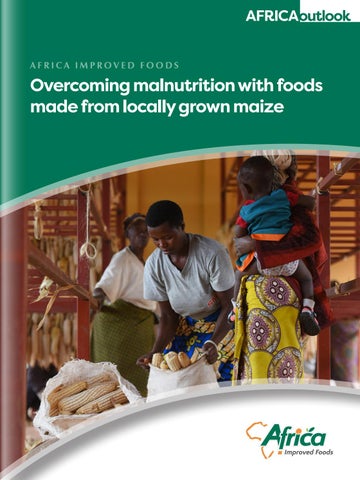
Overcoming malnutrition with foods made from locally grown maize
A F R I C A
I M P R O V E D
F O O D S
Nourishing NATIONS AIF produces high-quality nutritious foods made from maize grown by over 35,000 Rwandan farmers that treat and prevent malnutrition across East Africa Writer: Jonathan Dyble Project Manager: Josh Mann
2
Like a lot of people, I was climbing the corporate ladder and ended up working as the Vice President of Marketing for a $2 billion travel technology company in the UK. However, I kept asking myself, what am I really doing here? Where’s the value that’s created for society by what I’m doing? “A lot of the work conducted in high-end economies is often focused on marginal optimisations of customer value, yet at the same time, there’s billions of people in the world who are
WWW.AFRICAOUTLOOKMAG.COM
struggling with the very basics. “I decided I wanted to get into something that would make more of a meaningful impact and quickly became passionate about the agri-foods space, looking at how the global food system works, or doesn’t in many cases. “I enjoy business, don’t get me wrong – the strategic, the day to day, the commercial is all fascinating to me. But each of these elements become particularly rewarding when they’re applied to causes in Africa, where there’s a lot to be done.”
F
O
O
D
&
For Amar Ali, Africa Improved Foods (AIF) provided the perfect platform to use his skills and make a tangible difference. An organisation set up with the single goal of helping to address malnutrition across East Africa with food made in Africa, AIF has been operating out of a state-of-the-art facility in Kigali, Rwanda for close to three years, helping to raise the overall quality of food in a region where 36 percent of all children under five are stunted. “State-of-the-art has almost become
D
R
I
N
K
Amar Ali, CEO, Africa Improved Foods
AFRICA
a cliché that people use a lot, but this facility truly is,” Ali, now CEO of AIF, states boldly. “We’ve had a lot of interest from visitors, dignitaries, multinationals, and they’ll all agree that it’s of the highest international standard. And there’s a reason for that. A lot of the food consumed by people here on a daily basis is unsafe, even harmful, and that’s in part due to a lack of hygiene, safety and other issues in the supply chain. Our facility is helping to change that.”
WWW.AFRICAOUTLOOKMAG.COM
3
A F R I C A
I M P R O V E D
F O O D S
THE AIM OF AIF Globally, two billion people suffer from malnutrition, with almost half of them going to bed hungry every night. Further, 22 percent of children around the world (151 million) suffer from stunted growth, preventing them from reaching their full cognitive potential. As a result, these children face learning difficulties in school, earn less as adults and face other challenges both physically and mentally.
A $1 billion impact Invigorating social inspiration in this Indeed, the direct impact that sense constitutes one part of the firm’s AIF’s processing facility is having wider overall impact, an impact that on the value chain is not to be has recently been measured in dollarunderestimated. Yet it is not the only terms by the University of Chicago. way in which the company is helping Evaluating AIF’s contribution to local to address the systemic problem of economic development in Rwanda, malnutrition. developing the local food system Having welcomed the President of the and its value chain, and its efforts World Bank, the President of the World to combat malnutrition, the report Food Programme, delegations from the concluded that the firm is set to create Swiss and New Zealand parliaments and just shy of $1 billion in social benefit by five African Presidents, not to mention 2031. an array of influential multinational “It’s a huge number, but it shouldn’t organisations, the Kigali plant is equally be much of a surprise,” Ali states. raising awareness and changing “The objective of our nutritional perceptions. programmes is to bring “It’s demonstration down the stunting effect; a flagship,” Ali rates in Rwanda from affirms. 38 percent to 32 “Of course, receiving percent. This doesn’t recognition is nice for sound like a lot, but us, but the bigger point when you consider the to make is that it helps cost of malnutrition to to show what can and a country’s economy should be done. It derived from increased shows how a country healthcare costs, like Rwanda can reduced education become a shining light potential, lower for not only the region, productivity, etc., it’s but equally the world – Prosper Ndayirageije, Country massive.” and why shouldn’t it?” Manager, AIF Rwanda
4
WWW.AFRICAOUTLOOKMAG.COM
The economic consequences of malnutrition are serious too, estimated to be up to 11 percent of GDP in Africa and Asia each year. Meanwhile, well-nourished children are 33 percent more likely to escape poverty as adults, and preventing malnutrition delivers approximately a return on investment of $16 for every $1 spent. A public-private partnership set up between DSM, the Government of Rwanda, the International Finance Corporation, CDC Group and Dutch Development Bank FMO, the goal of AIF is to contribute to a reduction in these stunting rates by producing and making available nutritious, high quality foods to those who need it most.
A localised approach
It is at this point that Prosper Ndayiragije, Rwanda’s Country Director for AIF, enters the conversation, highlighting the company’s work with 35,000 smallholder farmers across the country as key to this $1 billion domino effect. “Sourcing maize locally is a massive part of what we’re trying to achieve here,” he reveals. “Working with smallholder farmers, we’re able to
F
O
O
D
&
D
R
I
N
K
North East Foods
P.O Box 40372, Kanengo, Kanengo Market Rd, Lilongwe. MALAWI Call/whatsapp: +265991575888 | kettiechisambi@yahoo.com
WWW.AFRICAOUTLOOKMAG.COM
5
A F R I C A
I M P R O V E D
support and create jobs, provide knowledge transfer and offer an abundance of benefits beyond just being a food and beverage company.” With this being so crucial to the company’s vision, AIF has even altered its processes to ensure it can help smallholders maintain quality and secure consistent, reliable business from AIF. “In the beginning, we were sometimes forced to reject grains that were coming in because of a lack of quality,” Ndayiragije continues. “But the smallholders didn’t actually have the means of adhering to our standards.
F O O D S
“To solve this, we began to work with them on the ground, providing equipment and training, and altered our buying processes, instead purchasing cobs and extracting the maize by undertaking the post-harvest handling ourselves.” There are downsides to these methods, of course, the company having incurred extra costs to ensure that its vision and purpose remain strictly on track. Yet over the coming years, AIF is anticipating that smallholders will begin to adopt best practices to increase their own yields and margins. “We’re focused on the long-term, on
THE NOOTRI RANGE Since the launch of AIF’s Kigali facility, the firm has developed a range of different products to help combat malnutrition amongst young children and mothers. These products, branded Nootri, are a set of porridge flours that have been enriched with relevant vitamins, minerals and proteins to improve and maintain the health of its consumers. “This began with Nootri Mama, a product created to provide the necessary nutrients to pregnant and breastfeeding mothers, and Nootri Toto, a complementary product suited to children from six months of age,” Ndayiragije reveals. “Later we introduced Nootri Family, a product providing the same dietary outcomes for the whole family. In the coming months, we’ll be looking to diversify each of these ranges, introducing different flavours for example.”
6
WWW.AFRICAOUTLOOKMAG.COM
socioeconomic stability,” Ndayiragije affirms.
Championing change
Looking ahead, the firm’s shortterm objectives, such as promoting its Nootri-branded products, will contribute to achieving these goals. “It’s our plan to look at how these can be marketed to ensure that they are consumed and have their desired impact,” Ndayiragije states. “We understand that it may take time for consumers to understand that our products offer a solution to malnutrition, but that is why we’ll be taking steps to help people
F
O
O
D
&
D
R
I
N
K
info@primeintlcarriers.com www.primeintlcarriers.com Prime International Carriers is one of the world’s leading providers of end-to-end supply chain solutions Prime International Carriers offers logistic consulting, warehousing, air and sea freight and road transport services customised to the needs of customers and their whole supply chain. By working with all the leading international carriers, we are able to offer a complete range of very competitive shipping services for both full and part load shipments to and from most destinations.
• INLAND TRANSPORTATION • WAREHOUSING • OCEAN FREIGHT • DOOR TO DOOR DELIVERY • AIR FREIGHT • INSURANCE www.primeintlcarriers.com • CUSTOMS CLEARANCE
also know that 50,000 jobs need to be created in Africa every day for the next 35 years just to absorb the rapid population growth. “In that context, it seems perverse that development organisations would import food into East Africa from OECD countries for humanitarian purposes. While in some cases, it might cost a bit more to buy from local differentiate between nutritious standards become the expectation. farmers here, not doing so creates a products and unhealthy products.” I’m proud that we’re helping to false economy. The CEO echoes Ndayiragije’s catalyse this in the food industry “It’s a systemic problem and one general sense of optimism, highlighting more specifically, and we’re already that needs to be addressed, not only the fact that Rwanda is currently beginning to see it spread across to combat malnutrition but equally to moving at a very fast pace. Rwanda and indeed Uganda and Kenya proactively encourage self-sufficiency “Yes, it’s a relatively small economy to some extent.” across Africa.” right now, but it’s adjacent to many At the same time, however, the CEO major countries, is relatively businessis quick to iterate that mindsets need friendly and corruption-free, and has a to change if East Africa is to thrive in progressive government at its helm,” Ali the long term. Africa Improved Foods reveals. “Volkswagen just established a He passionately concludes: “The footprint here, for example. importance of local sourcing has gone Tel: +250 788 389 516 “What I’m particularly optimistic off the radar slightly as an issue, but info@africaimprovedfoods.com www.africaimprovedfoods.com about, however, is Rwanda becoming it shouldn’t. Agriculture is by far the known as a centre for quality as higher biggest employer of people, and we Africa Improved Foods is set to create just shy of $1 billion in social benefit by 2031, owed to its contribution to economic development and efforts to combat malnutrition
WWW.AFRICAOUTLOOKMAG.COM
7
Africa Improved Foods Rwanda Limited P.O. Box 766 Kigali, Rwanda Kigali Special Economic Zone, Agri-Park, Silos Site, Plots No: E3 F2 Kigali, Rwanda Tel: +250 788 389 516 info@africaimprovedfoods.com www.africaimprovedfoods.com
www.outlookpublishing.com