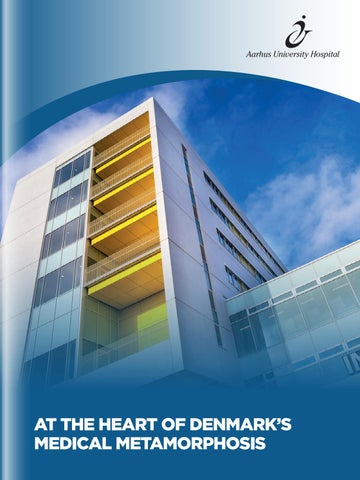
AT THE HEART OF DENMARK’S MEDICAL METAMORPHOSIS
AARHUS UNIVERSITY HOSPITAL Manning Denmark’s single largest medical hub, Aarhus University Hospital is at the epicentre of a masterplan exuding optimisation and transformation across the country’s rapidly progressing healthcare sector Writer: Jonathan Dyble | Project Manager: Callam Waller
RISING TO THE
D
enmark. A Nordic archipelago nation spanning 43,000 square kilometres, dwarfed by Sweden and Norway to the north and Germany to the south, its size is relatively modest compared to its European neighbours. For the historic home of the Vikings, however, the phrase good things come in small packages springs to mind. Described by the World Bank as a supporter of international efforts to promote human and economic development, reduce poverty and boost shared prosperity around the world, it is a commendable country, ranked 11th of the 189 states on the United Nations Development Programme’s Human Development Index (HDI). Ranking each country on education, GDP per capita and healthcare, it is the latter of these key HDI metrics that is particularly interesting in Denmark. In 1999, the country was home to 98 hospitals. Today, that figure has fallen to 21. Indeed, this sheer drop may indicate a declining Danish healthcare system, but the vast change is in fact courtesy of a unique, calculated, two-decade long centralised improvement strategy.
2 | EME Outlook issue 34
ALL IMAGES COURTESY OF AARHUS UNIVERSITY HOSPITAL
HEALTHCARE
EME Outlook issue 34 | 3
AARHUS UNIVERSITY HOSPITAL “Our country has found a structure for healthcare where a handful of major hospitals now act as the engine for quality medical assistance in their respective regions,” explains Poul Blaabjerg, CEO at Aarhus University Hospital. “By merging the operations of multiple hospitals into flagship centres, we’ve created a network of facilities that offer almost all the healthcare specialities you can find in Denmark under one roof. If you develop one illness and face subsequent complications that require alternate treatments, they can now almost always be sourced from the same centre. “Cooperation between different departments becomes easier,
Why does the healthcare sector provide a compelling line of work? Poul Blaabjerg: “I’m pretty new in the healthcare sector, but it’s a line of work that I’ve been interested in for many years. Not once have I woken up in the morning and asked myself why I’m doing this. The purpose is quite clear – the sector is meaningful from start to finish.” Lars Ganzhorn: “You can read in the news daily about how healthcare systems around the world are struggling to cope. And you might ask, why stay in a sector that’s under pressure? “I recently asked some of my colleagues the same sort of question – why are we employed here, and not in a technology company like Google or Apple? And a similar sort of answer came back from them all, that it’s difficult to get out of this industry because you feel that you’re doing something very important for society.”
4 | EME Outlook issue 34
benefitting both the professional and the patient. And this is necessary. As demands on healthcare continue to go up, the system has to become more efficient and effective in the way that it operates in order to keep pace.”
A MAMMOTH TASK Blaabjerg is better placed than most to comment on the subject as the Chief Executive Officer of Aarhus University Hospital – an entity born out of a series of mergers precipitated by this blueprint. In 2004, the city of Aarhus and its surrounding region saw four local hospitals (Aarhus Municipality Hospital, Aarhus County Hospital, Marselisborg Hospital, Odder Sygehus and Samsø Sygehus) merge to become Aarhus Sygehus. Seven years later, Aarhus Sygehus was then integrated with Skejby Sygehus, establishing the current Aarhus University Hospital and the site for its headquarters and main
Aristo Pharma Aristo Pharma is headquartered in Berlin with over 1,500 employees and sales in 13 countries. Aristo Pharma GmbH initiated Aristo Pharma Nordic ApS in 2017. Our philosophy is to ensure: • Continuity of supply for pharmacies • Products of highest quality for our consumers • Affordable and competitive pricing • Support for customers and patient safety With patients in need, we believe that market cannot be left without stock of vital generics. Aristo aims to maintain continuity of supply through a threefold strategy: • Our own state-of-the-art European production facilities • Updating pipeline as per market needs • Market engagement
www.aristo-pharma.dk
HEALTHCARE
Aristo is now in the Nordics!
Ascom Myco 3 Ny smartphone designet til klinisk brug
01990-01 DK © Ascom. All rights reserved.
00 45 7070 7982 / info.nordic@aristo-pharma.dk / www.aristo-pharma.dk
Ascom har udviklet Myco 3 på baggrund af vores mange års erfaringer med at levere mobilløsninger til klinikeren. Myco 3 er udstyret med unikke specialiserede funktioner med henblik på at tilgodese netop klinikerens særlige behov.
ascom.dk
EME Outlook issue 34 | 5
AARHUS UNIVERSITY HOSPITAL
Poul Blaabjerg
Lars Ganzhorn
6 | EME Outlook issue 34
“THERE ARE CHALLENGES THAT PEOPLE DON’T THINK ABOUT BEYOND THE BUILDING WORKS – INTEGRATING DIVERSIFIED OPERATING MODELS AND OVERCOMING OTHER CULTURAL DIFFERENCES, FOR EXAMPLE” – POUL BLAABJERG
department. Later, a new hospital was built and rebuilt in connection to Skejby Sygehus, making the new Aarhus University Hospital one of the largest hospitals in Danmark from 2019. “For me, this hospital is particularly exciting,” Blaabjerg states. “It’s the embodiment of the Danish healthcare sector strategy, and its development will open doors to future possibilities for the region and country. “It’s extremely ambitious; an extremely tough undertaking. But it’s
fascinating to be part of it all the same.” Indeed, the statistics speak volumes of the Chief Exec’s analysis. Aarhus University Hospital is the workplace of more than 10,000 healthcare professionals, the local hospital of 400,000 people and the specialised hospital of 1.2 million Danes, comprising 41 different clinical departments and spanning more than 400,000 square feet that equates to a 2.8-kilometre round trip on foot, according to the CEO. “It’s easy to underestimate a project
HEALTHCARE
of this scale,” he adds. “There are challenges that people don’t think about beyond the building works – integrating diversified operating models and overcoming other cultural differences, for example. “In April 2019 we finalised the relocation, but it is expected to take a further two years to get the site running at full capacity as our workforce align in all of these senses.” It is here that Lars Ganzhorn, Senior Consultant of Innovation and Development, enters the conversation.
A large part of the need for cultural realignment stems from the implementation of new technologies, a key aspect of ensuring that the hospital is able to operate as efficiently and effectively as possible. At Aarhus University Hospital, much of this responsibility lay with Ganzhorn, who during the building phase of the new Aarhus University Hospital was tasked with ensuring that the right digital innovations were implemented in the right way on a consistent basis.
“I only recently got back from a summit in Shanghai actually,” he explains. “It was a conference that showcased a multitude of major strides that the healthcare sector is taking in making the most of data and delivering improved outcomes. “In my eyes, our industry is gearing up for massive investment into artificial intelligence and machine learning capabilities as it enters a phase of management by prediction. “The idea is to address existing issues by using resources and technologies that are already available in a better way, thereby delivering improved healthcare services for the same money. This will be critical in helping us out of the deadlock that we are in right now, where demand-induced pressures continue to rise, and financial and educational challenges are likewise broadening.”
COLLABORATION AND INNOVATION Speaking with Ganzhorn, it quickly became clear that partnerships are becoming increasingly important in overcoming these hurdles. EME Outlook issue 34 | 7
AARHUS UNIVERSITY HOSPITAL
SUPPORTING THE SDGS Ensuring that the pursuit of technological and operational progress is not to the detriment of the environment is critical to the modus operandi of Aarhus University Hospital, the organisation committed to upholding nine of the UN’s Sustainable Development Goals. “We’ve invested a lot in ensuring that our wastewater is clean before it is circulated back into the landscape, removing any contamination that quite often from any hospital, owed to medicines and unique materials, can have harmful effects,” Blaabjerg affirms. “In respect to sustainability, I believe we’re one of the leaders in Europe.”
8 | EME Outlook issue 34
In China, technology giant Alibaba is supporting the country’s national healthcare system, having rolled out a 24-hour medicine delivery service and online medical consultations, for example. In Denmark meanwhile, similar attitudes and efforts are emerging, Aarhus itself having partnered up with research organisations, universities and private entities via mutually beneficial consortiums. “We can’t do this alone anymore,” Ganzhorn reiterates. “It’s been possible to internally drive digital transformation to where it is now, and by all counts we are a highly digitalised entity with EMRAN 6 certification. But owed to the finances and work required for us to reach the next step, it might not be attainable nor sensical for us to pursue this path without outside assistance.” Locally, the hospital is working with Danish company Systematic – an
organisation delivering crucial components of highly advanced clinical information systems. Further afield, it is also working with renowned international entities such as Germany’s Fraunhofer Gesellschaft in finding practical applications for potentially game changing applied research. “This is not to say that vendors are always the answer, however,” Ganzhorn adds.
HEALTHCARE “Take our patient inflow and logistics operations for instance. Here, we have ideas about how our flow could be optimised, but it’s not possible to pursue these in our IT infrastructure as our systems providers have a lot of other hospitals to worry about and it’s not commercially viable for them to make minor tweaks for individual customers. “As a result, we’ve been investigating alternate paths in certain situations. In one area we have hired our own programmers, testers and digital architects, and we’re actually building IT systems ourselves. “We can see the agility that this approach gives us – it has had a great impact.”
REACHING NEW HEIGHTS Finding a new balance between leveraging greater benefit from partners and vendors while at the same time recognising the effectiveness of internal optimisations will be crucial to the organisation taking this next step. Without doubt, the successful completion of the Aarhus University Hospital merger will keep the organisation’s hands full for the coming 12 months. Yet looking beyond this, Blaabjerg shares many of his colleague’s views. “Internally, we do not have a technology transfer unit, and should startups from the local community wish to work with us, it has to date been hard for them to contact us as we haven’t had a transparent channel to deal with these kinds of requests,” the CEO affirms. “Moving forward, we’re going to both pursue our own ideas more actively, and also work more openly and collaboratively with other entities in developing ideas that can provide benefit in the healthcare sector.” Indeed, while the unprecedented nature of many of these ideas combined with the complexity of the field will make certain that no major innovations will happen overnight, it is hoped
“WHAT DO I EXPECT FROM THE NEXT FIVE YEARS? FOR ME, IT WILL BE A COMBINATION OF WORKFLOW AND PROCESS IMPROVEMENTS THAT WILL TAKE US TO THE NEXT STAGE IN OUR DIGITAL TRANSFORMATION” – LARS GANZHORN
that the organisation’s progressive digital journey will be transformative for the entire country for years to come. For this reason, much optimism surrounds Denmark’s national healthcare strategy and the efforts of Aarhus University Hospital alike. “What do I expect from the next five years?” Ganzhorn responds, offering his own outlook. “I think we will have achieved a bit on the AI side. And I think that we will have managed to raise our maturity in regard to workflow and processes. That’s something you see in other industries – dedication to optimising
and understanding operations. It’s an aspect we’re working on intensely now as we look to gain the efficiencies that are needed. “For me, it will be a combination of workflow and process improvements that will take us to the next stage in our digital transformation.”
AARHUS UNIVERSITY HOSPITAL Tel: +45 7845 0000 auh@rm.dk www.en.auh.dk
EME Outlook issue 34 | 9
AARHUS UNIVERSITY HOSPITAL Aarhus University Hospital Palle Juul-Jensens Boulevard 99 DK-8200 Aarhus N Tel: +45 7845 0000 auh@rm.dk www.en.auh.dk PRODUCED BY EME OUTLOOK MAGAZINE