SIGN UP FOR THE OUTLOOK WEEKLY NEWSLETTER DELIVERED FREE TO YOUR INBOX
NEWS AND INSPIRATION
#TuesdayTalk: Be still outlookmag.org/tuesdaytalkbe-still-and-other-remindersto-calm-down
What This Ship Was Built For outlookmag.org/what-this-shipthe-sda-church-was-built-forpart-2
THE GRACIOUSNESS OF GENEROSITY
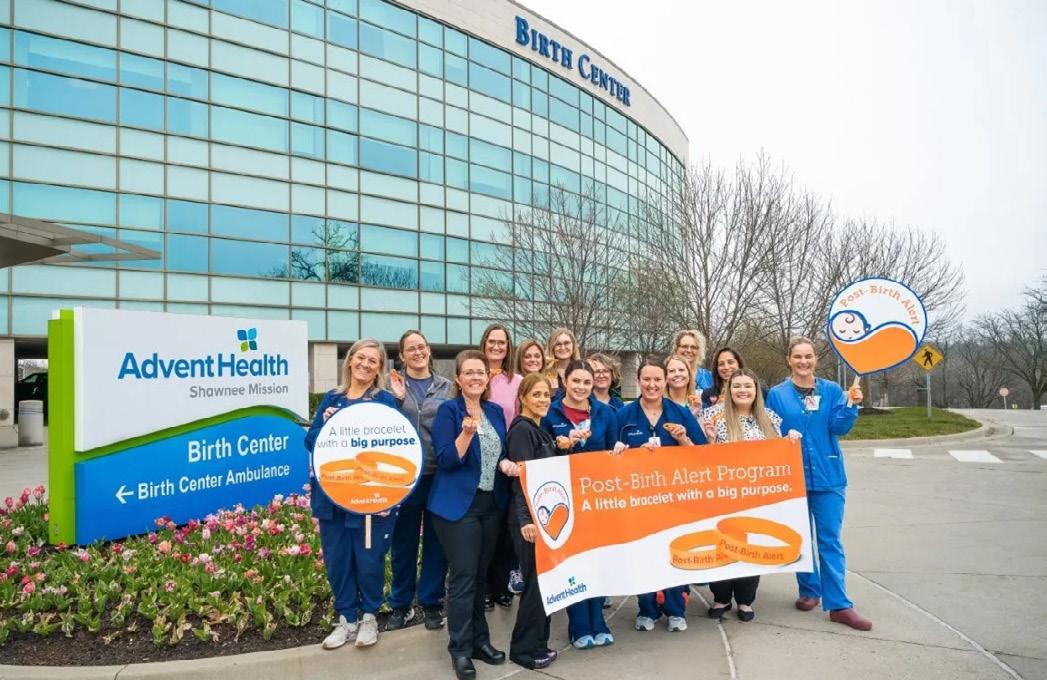
In this issue of OUTLOOK we’re focusing on the value of living generously. You’ll hear from our six conference presidents, along with other leaders and members who are thriving in their confidence in God’s faithfulness to provide everything they need. There’s also an inspiring story from AdventHealth (p. 29) highlighting the generosity of mission service.
Our Mid-America Union president, Gary Thurber, makes an important announcement on p. 5 and there’s a report from our MAUC executive committee on p. 13.
Change is always happening, but the mission of the Seventh-day Adventist Church in Mid-America continues to move forward!
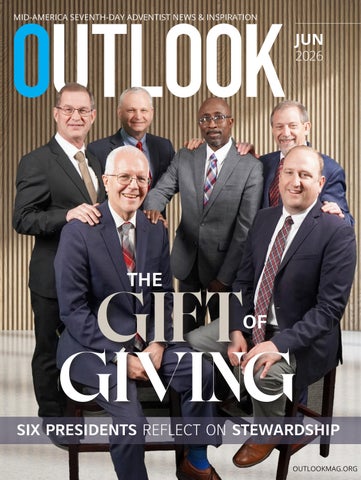
ON THE COVER READ OUTLOOK
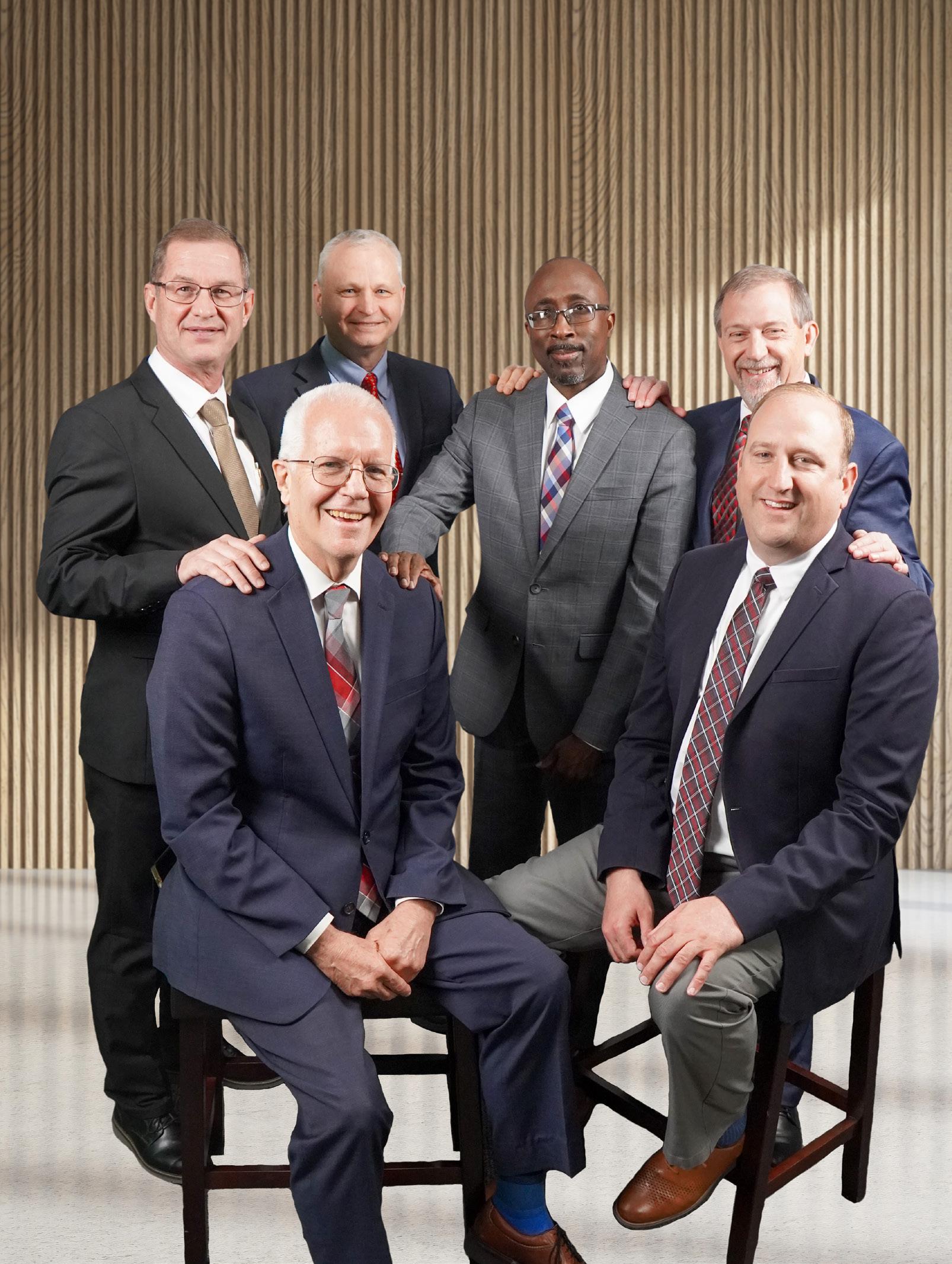
The six conference presidents in Mid-America have thoughts to share this month.
LEGAL NOTICE OF THE NINTH SESSION OF THE MID-AMERICA UNION CONFERENCE OF SEVENTH-DAY ADVENTISTS
Notice is hereby given that the tenth session of the Mid-America Union Conference of Seventh-day Adventists will be held Sept. 13, 2026, at the College View Seventh-day Adventist Church, Lincoln, Nebraska. This regular session is being held for the purpose of receiving reports, electing officers, adopting a constitution and bylaws, and transacting such business as may properly come before the session. The meeting will convene Sunday, Sept. 13, 2026 at 2 pm. The delegates to this session are the regularly elected delegates from the conferences and institutions in the territory of the MidAmerica Union Conference.
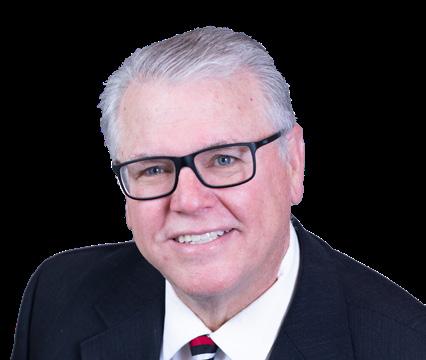
Gary Thurber, president Hubert J. Morel Jr., vice president for administration
Peace AND Thanks AMIDST TRANSITIONS
“And let the peace that comes from Christ rule in your hearts. For as members of one body, you are called to live in peace. And always be thankful.” —Col. 3:15
In this season of my journey, I find myself at a Col. 3:15 moment. Today, I have a deep and wonderful peace in my heart that I know comes from my Savior Himself.
For the past 11 years, I have had the distinct privilege of serving the wonderful people of Mid-America. I could not feel more blessed or more thankful to be part of this body of believers.
Yes, we have had our moments of disagreement. But for the most part, we have lived in peace with one another, just as Paul encourages us to. What a gift that has been. Let us continue to press together as one body, choosing encouragement over criticism, and unity over division.
Paul adds, “and always be thankful.” When I reflect on the opportunity I have been given to serve in this part of God’s vineyard, my gratitude knows no bounds. I love the Mid-America Union with all my heart. I love the beautiful fields of corn and soybeans, the incredible ranches, and the small towns scattered throughout our
territory. I love the majestic mountains, the lakes, and the rivers. We are also blessed with vibrant cities and diverse cultures. Most of all, I love the people of Mid-America.
And I am deeply thankful for your faithfulness in returning tithe month after month. Because of your commitment to supporting gospel ministers, I have been able to provide for my family, including healthcare and Christian education for my children. It is humbling to serve alongside people who are so generous toward God and His work. Thank you.
My wife, Diane, has also been a major blessing in my journey here. While she had more than full-time work as president of Christian Record Services, she found ways to travel with me and support my ministry as well. I am so grateful for the shared journey of ministry we have had together.
Bright hope for the future
I am planning to retire at our upcoming constituency session this September in
its work. Please join with me in prayer that the Lord will guide this process.
God has a mission for each of us God’s hand is on this union and on His work here. New leadership will come with fresh ideas and renewed energy to help fulfill our mission. These are exciting times. There has never been a more meaningful time to be part of this community of faith than right now.
Lincoln, Nebraska. I have reached what is known as F.R.A.—Full Retirement Age. When I began working for the church in 1982, I never imagined that the Lord would not have returned before this time. Yet I still believe He is coming soon, and that hope brings even greater peace to my heart.
As for what lies ahead for Mid-America, I am confident it will be exciting—better than ever. In preparation for our session on September 13, on August 2 the nominating committee (selected by the conferences) will meet and nominate names to serve as president, as well as the other MAUC officers to be voted at our session (vice-president for administration and vicepresident for finance).
Our North American Division president, Dr. G. Alexander Bryant, will be leading out as the nominating committee does
As we move forward, my prayer is that we never lose sight of why God has placed us here in Mid-America. We have been entrusted with a message of hope—a message that reveals the true character of God and points people to Jesus. There are still so many in our communities who do not know Him. May we each continue to find meaningful ways to reach them.
If there is anything I hope you remember from my time of service, it is this: keep your eyes on Jesus, and put your hand in His and let Him guide you each day. My heartfelt final plea is this: keep the cross of Christ at the center of your home, your workplace, your church and your community. May the love that led Jesus to the cross be the same love we share with one another and with a world that so desperately needs Him.
Love and peace to all, Gary Thurber
GARY THURBER is president of the Mid-America Union.
LIFE THE JOY AND FREEDOM OF A GENEROUS
Jesus spoke often, and candidly, about money— not because wealth itself is evil, but because of its unique power to shape the human heart. Again and again, He pointed beyond coins and possessions to a deeper spiritual reality: what we treasure ultimately determines who we become.
In the Sermon on the Mount, Jesus gives a clear and sobering warning: “Where your treasure is, there your heart will be also” (Matt. 6:21). Money, more than almost anything else, has a way of quietly capturing our loyalty. It promises security, comfort and control—things we naturally crave. Yet Jesus urges us to recognize that these promises are temporary at best, and deceptive at worst. Earthly wealth fades, breaks and slips away, but a heart anchored in God endures forever.
Perhaps the most direct statement comes when Jesus says, “You cannot serve both God and money” (Matt. 6:24). This is not presented as a mild caution but as a spiritual reality. Money makes a poor master. It demands attention, breeds anxiety, and
often pulls our focus away from trusting God. When our lives revolve around accumulating or protecting wealth, we may find that our faith slowly weakens, replaced by self-reliance and fear.
Jesus illustrated this danger in the story of the rich fool (Luke 12:16–21). This man had been blessed with abundance, yet instead of seeing his wealth as a gift to be shared, he hoarded it for himself. His plans were practical by worldly standards (build bigger barns, secure the future) but he failed to consider eternity. God’s response is striking: “You fool! This very night your life will be demanded from you.” The tragedy was not his wealth, but his misplaced trust. He was rich in possessions but poor toward God.
The power of generosity
And yet, alongside these warnings, Jesus offers a beautiful and liberating vision of generosity. “Give, and it will be given to you,” He says (Luke 6:38). This is not a transactional promise, but an invitation into a different way of living, a life marked by open hands rather than clenched fists. Generosity breaks the grip of materialism and reorients our hearts toward God and others.
We see this vividly in the story of the widow’s offering (Mark 12:41–44). While others gave large sums out of their abundance, she gave two small coins—everything
she had. Jesus honored her gift above all others, not because of its size, but because of its spirit. Her generosity reflected deep trust in God. She held nothing back, and in doing so, revealed a heart fully surrendered.
Generosity is not about the amount we give, but the posture of our hearts. It is an act of worship, a declaration that God, not money, is our provider. Each time we give, whether to support ministry, help a neighbor, or meet a need, we participate in God’s work and reflect His character.
In a world that constantly tells us to accumulate more, Jesus invites us to live differently. He calls us to loosen our grip on earthly wealth and to invest in what truly lasts. When we do, we discover a profound truth: the greatest blessing is not found in what we keep, but in what we give. May we heed His counsel, guarding our hearts against the subtle dangers of wealth, and embracing the joy and freedom that come through a generous life.
Ron Carlson, president, Kansas-Nebraska Conference
ENDLESS RICHES OR
When a rich young man asked Jesus how to gain eternal life, he addressed Jesus as “good teacher.” Knowing the young man would reject His answer, Jesus called attention to it.
“Why do you call me good?
God alone is good.” The implication: You’re not asking this question of a mere teacher. Nevertheless, the conversation ended when Jesus revealed to the rich man that the roadblock standing between him and eternal life was his stewardship.
I wonder what brings us to that decision point. Despite God’s clear instructions, we too often fail to recognize that we put ourselves in eternal danger by being unfaithful stewards. The cure is inviting God to transform our hearts, while also choosing to be intentional in how we model generosity to our children and fellow Christians. What might that look like?
Five small ways to model giving
1. Bring back allowance cans I’m grateful that my parents
emphasized financial faithfulness when I was single-digit young. I remember the day they introduced weekly allowance. They handed me 10 dimes and five tin cans with handwritten labels: Tithe, Offering, Savings, School Supplies, and Spending. Every week I divided the dimes: one dime for tithe, one for offering, two for savings, two for school supplies, and four for other spending—always in that order.
2. Form a hands-on habit
Each Sabbath I emptied my tithe and offering cans and took the dimes to church, not to pay tithe but to return it. With the gradual disappearance of cash, it’s harder to teach small children about giving. Some Sabbath schools don’t even collect offering any more. But neglecting this habit-forming practice leaves a devastating impact on the character of tender young minds.
3. Plan intentionally Thanks to the giving routine my parents instilled in me, half a century later I still return
tithe before anything else. And to ensure my offerings are more than just a reaction to the routine offering call, I purposely plan my gift to God each Friday, just as my parents showed me. This way, giving is a deeper act of worship.
4. Demonstrate faithful giving
As a parent and pastor, I have come to see the value in setting an example of my own stewardship. Online giving has advantages, but it’s largely invisible. That’s why I often choose to write a paper check, slip it into a tithe envelope, and place it in the offering plate. When people—especially children—see those they look up to being faithful stewards, it helps form their attitude toward giving.
5. Give the results to God
Sometimes we’re tempted to object, “What if my tithe is misused or misdirected? I will not return tithe unless I can trust where it goes.” Absolutely, we should expect our churches and conferences to handle funds wisely and
transparently. But for me personally, I choose to give freely, knowing the money is not mine but God’s. Even when He works through deficient humans, God can direct the offering and bless others in ways I might not comprehend. I may have only a small bucket of funds, but when we each add our one bucket to the stream, it swells to become a river of blessings. Jesus invites me to consecrate my bank account, my time, and my abilities in service to Him. In return, He opens the windows of heaven to bless me now (Mal. 3:10), and He opens the eyes of my heart to see the glorious riches of our future inheritance (Eph. 1:18).
As for the rich young ruler who turned his back on Jesus? He’s long dead. His money is useless. I hope his mind cleared before it was too late. By choosing life with Jesus instead of fleeting treasure, he would have inherited infinitely unimaginable wealth.
Jeff Scoggins, president, Minnesota Conference
THE Offering THAT EXPOSED EVERYTHING
Luke 21:1–4 offers one of the most arresting scenes in the gospels. Amid the business in the temple courts, there is a quiet moment where Jesus observes people giving. What first appears to be a simple commendation of generosity becomes, upon closer examination, a penetrating critique of religious systems and a call to discernment for God’s people.
Jesus watches as the wealthy deposit large sums into the temple treasury. Their gifts are impressive and visible; however, they come from abundance. Then a poor widow approaches, unnoticed by most, and drops in two small copper coins—insignificant in value yet representing her entire livelihood. Jesus turns to His disciples and declares, “…This poor widow has put more into the treasury than all the others.” His reasoning overturns conventional thinking: the rich gave from surplus, but she gave from poverty—everything she had to live on.
The context is crucial. Just prior, Jesus condemns the scribes for their hypocrisy, accusing them of exploiting the vulnerable, even “devouring widows’ houses” (Luke 20:45-47). Immediately after, He foretells the destruction of the temple (Luke 21:5-6). This placement suggests the widow’s act is not merely ideal giving but is embedded within
a broader indictment of a corrupt religious system. The temple, once a place of divine encounter, has become a structure that burdens and exploits those it was meant to protect.
Some interpreters, such as John MacArthur, emphasize this narrative flow, arguing that Jesus is exposing religious hypocrisy rather than praising sacrificial generosity. The widow’s offering, in this light, becomes both tragic and admirable, as she gives everything into a system under divine judgment. The parallel account in Mark 12:41-44 reinforces this tension, showing how her devotion is caught in a structure that takes more than it gives.
Traditionally, the widow has been upheld as the ultimate example of selfless faith. Her gift is often used to teach that God measures generosity not by amount, but by proportion and sacrifice. While this remains true, a contextual reading invites us to go deeper. Jesus does not explicitly command others to imitate her, nor does He directly commend the system that receives her offering. Instead, He highlights the contrast—abundance versus poverty, comfort versus sacrifice—and invites reflection. Modern scholarship encourages reading this passage through a lens of justice. The widow’s “more” is not simply devotion but reveals
disproportionate sacrifice amid inequality. Her act exposes a system where the vulnerable give beyond their means while the powerful remain comfortable. In this sense, the story becomes a warning against supporting structures that perpetuate injustice under the guise of religion.
Aligning with God’s purposes
Today, this passage speaks with challenge and clarity. It calls us to examine not only how we give, but also where and why. God is not impressed by outward displays of generosity if they flow from surplus and leave the heart unchanged. Nor does He desire that His people impoverish themselves to sustain empty or exploitative systems.
True worship, as Scripture consistently teaches, is inseparable from justice. Caring for the widow, the orphan, and the marginalized is not optional, but faith’s very expression. The widow forces us to ask: Are we attentive to those who are overlooked? Do our practices uplift the vulnerable or unintentionally burden them?
At the same time, her act reflects deep trust in God. She gives all she has, not knowing what tomorrow holds. This kind of faith points beyond the temple system to the heart of God—a God who sees, values differently, and who ultimately provides.
As a community of believers, we are called to adopt Jesus’ perspective. We must learn to see beyond appearances, value sincerity over spectacle, and steward our resources with integrity. Generosity is not merely about giving more but aligning our hearts with God’s purposes.
In the end, this passage points to Christ. He, too, gave not out of abundance, but from self-emptying love. In Him, we see the ultimate offering—one that redeems, restores and redefines what it means to give.
Resources:
Graetz,Geschichte d. Juden (1863) III, 94, 123f.; A. Edersheim, The Temple (1874), 26f.; The Mishnah, Shekalim; J. S. Kennard, Render to God... (1950), 62ff.
Joseph Jacobs, Judah D. Eisenstein; Temple, Administration and Service of: Jewish Encyclopedia.com (2002-2021).
Susan Sorek: Render Unto Ceasar? Pilate’s Acquisition of Temple Funds; Eras Journal, School of Philosophical, Historical and International Studies: Edition Four - December 2002.
Vernon Herholdt, president, Dakota Conference
Grace A PRACTICAL LESSON OF
Ibelieve returning tithe and offerings is all about grace. Grace? Really? Yes! Listen to what Paul writes in Eph. 2:6-9: “God raised us up with Christ and seated us with him in the heavenly realms in Christ Jesus, in order that in the coming ages, he might show the incomparable riches of his grace, expressed in his kindness to us in Christ Jesus. For it is by grace you have been saved, through faith – and this is not from yourselves, it is the gift of God – not by works, so that no one can boast.”
Plainly, God is in the business of showing you and me the “incomparable riches of his grace,” primarily through the life and ministry of Jesus Christ. He so wants us to understand that trust in Jesus and His mercy—grace—is how we are to be saved! And how does He teach us? Well, one way is by spending Sabbath with Him. In so doing, we learn that by devoting one-seventh of
our time (versus scratching, striving and exerting ourselves to either work for our survival or to distract ourselves through entertainment seven days a week) that true rest, peace and wholeness can only be found in His presence. I freely admit that I cannot take care of myself and my family with unceasing activity; rather I must rely on Him for a joyous and healthy existence.
In the same way, by giving tithes and offerings, I learn God’s lesson of grace that He will take care of my material needs. I cannot adequately take care of myself with 100 percent, but He will take my lesser portion and through His blessing, provide me with all that I need.
“Test Me”
How important is it to God that I learn this lesson? Listen once again to the ancient and well-known message of Mal. 3:10. This is what He says: “bring the whole tithe into the
store house that there may be food in my house. Test me in this,” says the Lord Almighty, “and see if I will not throw open the floodgates of heaven, and pour out so much blessings that there will not be enough room to store it.”
Did you hear the challenge, direct from God Himself?
“Test me” He says… it’s the only place in His Word where God invites me to test Him. When I hoard 100 percent of the resources that God has blessed me with, I am saying that I will depend on myself, my works, to take care of my needs. However, when I return tithes and offerings to God, I deliberately place myself in a position where I must receive His blessing for my needs to be met. Thus, I have learned that my salvation is also dependent on grace; there are no works that I can produce that will be sufficient to “provide for my salvation” anymore then if I retained all financial
resources and tried to adequately provide for my physical needs.
Finally, another aspect of this practice is that God trains me to live generously as a “new creation” and thus reflect the generosity of my Savior Christ Jesus. What a blessing and privilege this has been to me! And I am not alone. “God’s grace is sufficient” not just for our daily needs but for salvation itself. “Thank you, Jesus, for your love and grace for me!”
Dave VandeVere, president, Rocky Mountain Conference
TheALABASTER JAR EFFECT
“Meanwhile, Jesus was in Bethany at the home of Simon, a man who had previously had leprosy. While he was eating, a woman came in with a beautiful alabaster jar of expensive perfume and poured it over his head. The disciples were indignant when they saw this. “What a waste!” they said. “It could have been sold for a high price and the money given to the poor” (Matt. 26:6-8 NLT).
Jesus loves a willing giver
Can you imagine the scene?
Amid this gathering, while Jesus was literally eating his dinner, a woman comes with an offering of expensive perfume and pours it over His head. This woman is not responding to some offering appeal using fear as motivation for giving. There is no collection plate being distributed here because it’s not a church—just a woman who has been forgiven much, responding willingly to the love and grace received from Jesus. Bible scholars suggest that this was Mary Magdalene, whom Jesus had delivered from seven demons. She is not known to have
been wealthy, yet she gives an expensive to gift to the One who had delivered her from the hand of the enemy.
Jesus loves willing givers who respond out of love and gratitude for what He’s done for them. He doesn’t turn her away. He doesn’t chastise her for messing with his hair or touching and kissing his feet (Dr. Luke’s record). He affirms her gift and her worship.
Jesus loves a stubborn giver Apparently, Jesus’ own disciples (the pastors and elders of the new church) were very angry with this expensive gift to their Master. Instead of applauding the giving of Mary, they accuse
her of wasting this money on Jesus. That sounds neither logical nor spiritual. How can any amount of money spent on Jesus be considered a waste? I am thankful that Mary didn’t stop pouring the expensive perfume and close the bottle. Why? Because no human should ever interrupt or discourage our giving to God. John says that we love Him because He first loved us. And so, as Christians, the giving of our treasure, time, talents and body temples to God is the least we can do compared to what Jesus has done for us.
While Jesus is rebuking the naysayers in this narrative, I am certain that deep down He is smiling at the tenacity of Mary. She doesn’t only pour on his head, but she continues to wipe his feet and dry them with her hair. Let us be strong-willed enough, and yes, stubborn enough, to always bless the Lord and His work with our giving.
Jesus loves a cheerful giver “You must each decide in your heart how much to give. And don’t give reluctantly or in response to pressure. For God loves a person who gives cheerfully” (2 Cor. 9:7). This familiar text is a reminder that giving time should be a joyful and happy time in our Christian experience. According to Google AI, a cheerful person is “characterized by good spirits, optimism, and a noticeably happy demeanor, often brightening their surroundings and positively influencing others.” Mary is so excited to give that
even though Jesus and the disciples weren’t expecting it, she shifts the atmosphere and lights up the room with this powerful act of worship. “The room grew still as she made her way to Jesus…” sings Cece Winans.
Mary’s giving here, though public, reflected a cheerful spirit that was private. She couldn’t wait until the service when the priest or pastor would say “bring ye all the tithes into the storehouse.” No. She would give Jesus praise, honor, exaltation and glory before the “scheduled” time, demonstrating that the giving was clearly from her cheerful heart.
It is not coincidental that Mary became the first gospel minister: first to the tomb, first to speak with the Resurrected Gardner, first to send a message to the other disciples that the Lord had risen. May we always be like Mary—willing givers, stubborn givers and cheerful givers—so that God can use us fully for His cause. And finally, we will hear these words from our Savior: “Well done, good and faithful servant.”
Cryston Josiah, president, Central States Conference
TTrusting God
he concept and promotion of stewardship can be tricky. Those who present stewardship run the risk of coming across like a used car salesman—twisting arms to squeeze every nickel out of people. From the perspective of a conference president, when thinking about raising funds for ministries such as evangelism, Sunnydale Academy, and Camp Heritage, I understand that many of our churches are operating on budgets that continue to tighten as the costs of insurance and utilities rise.
Less than six months into pastoral ministry, I found myself sitting in the home of a couple who had attended a prophecy seminar our church had hosted. They had decided to follow Jesus, be baptized, and become members of the local church. They were excited. I was excited. The church was excited.
As we studied in preparation for this step in their lives, we came to the topic of tithe. I could see their uneasiness as we went from verse to verse. In my mind, I wondered what they were thinking. Were they seeing this as a step in their faith journey, or as a young pastor trying to fill the offering plate?
I didn’t have to wait long
BEYOND THE NUMBERS
for the answer. The looks on their faces revealed fear. They were mentally calculating how they would survive on an already tight budget if they gave 10 percent, plus offerings. They talked about car repairs, falling behind on bills, and simply trying to make ends meet on a fixed income.
I had already shared Mal. 3:10, where God invites us to bring the full tithe and trust Him to open the windows of heaven. As I sat there listening to them process their situation, God impressed something on my heart. He prompted me to tell them to try returning tithe and offerings for three months—and if they ended up in a worse financial position, I would make up the difference.
I resisted. “Lord, You want me to make up the difference? We’re a one income family with a baby, and our financial situation isn’t much better than theirs. How can You ask me to do this?”
But the Creator of the world was not going to yield
to my hesitation. This was His prompting, and I had to choose whether to follow. With hesitant and nervous faith, I made the appeal—and they accepted.
More with less
It was less than a month later when I realized God was teaching both this couple and a young pastor the true meaning of stewardship. They came to me at church and shared stories of what I have heard many times since: they couldn’t explain it other than as a miracle from God. They were able to do more with less. God had proven faithful. Since deciding that the first check they would write was for tithe and offerings, their money seemed to go further than before.
When we think about stewardship, we often think about money. In reality, stewardship is about faithfulness and trust—believing that God will take care of our every need. Stewardship is about trusting God when He asks us to do something that doesn’t seem
to make sense or add up on paper.
Words that don’t often appear in sermons on stewardship—but perhaps should—come from Prov. 3:5–6: “Trust in the Lord with all your heart, and lean not on your own understanding; in all your ways acknowledge Him, and He shall direct your paths.”
At times in our Christian walk, God will ask us to take steps of faith in many areas of life. Let us take those steps of faith in stewardship, trusting in His care over us.
Lee Rochholz, president, Iowa-Missouri Conference
WHY ADVENTIST EDUCATION IS ABOUT MORE THAN SCHOOL
If you’ve spent any time around kids, you already know something important: they are always learning. The real question isn’t if they’re being discipled, it’s who is discipling them and toward what. That’s where Adventist Christian education steps in. At its best, it’s not just about math facts, reading levels, or science projects. It’s about shaping hearts that know Jesus and lives that follow and serve Him.
Let’s be clear: education is never neutral. Every classroom is teaching a worldview. Every teacher is modeling values. Every system is forming habits. So the goal of Adventist education isn’t just to add a Bible class onto a regular school day; it’s to create an environment where everything points students toward a relationship with Christ. That’s true discipleship.
Ellen White puts it this way in her book Education: “True education means more than the pursual of a certain course of study… It has to do with the whole being, and with the whole period of existence
possible to man” (13). A few pages later she concisely clarifies this purpose: “The aim of education is to restore in man the image of his Maker” (15). That’s a big statement. That’s the end goal. Not just prepared students, but transformed lives. It reminds us that education isn’t just about what students know. It’s about who they become.
It’s about discipleship
Within the Dakota Conference, this commitment to transformation and discipleship is seen through intentional classroom experiences in each of our schools, where students have regular opportunities to actively engage in service outreach and giving. This helps shape a mindset where faith is lived, not just learned. Students conduct church services, raise money for missions, sing at their local nursing homes, or collect food and funds for their local food banks. Discipleship happens in both the planned and unplanned moments. It happens when a teacher
prays with a student who’s struggling. It happens when forgiveness is practiced instead of just talked about. It happens when students are encouraged to serve each other, not just succeed for themselves. That’s not accidental; that’s intentional.
A powerful reminder in Education says, “The work of education and the work of redemption are one” (30). If you miss that, you miss everything. Adventist education isn’t a side project to the mission of the church—it is the mission, lived out daily with young people. When a student learns to see God as their Creator in science class, that’s discipleship. When they learn integrity and honesty in their work, that’s discipleship. When they discover their gifts and how to use them for God’s kingdom, that’s discipleship.
And here’s the part we can’t ignore: kids today are being discipled everywhere else. Social media, entertainment, peer culture—they’re all shaping beliefs, identity and purpose. If we’re not intentional, those voices will drown out ours. Adventist education gives students something different. It creates space for them to ask real questions about faith. It
connects biblical truth to everyday life. It surrounds them with adults who are not just teaching subjects but modeling what it looks like to walk with Jesus daily. And modeling matters. Students don’t just remember what teachers say; they remember who teachers are. A caring teacher who reflects Christ can have an impact that lasts far beyond graduation. That’s why Adventist education places such a high value on the spiritual life of the teacher, not just their academic ability. So when we talk about Adventist Christian education, we’re not just talking about a school option; we’re talking about a discipleship pathway. A place where kids learn to think, yes, but also to believe. A place where they grow academically, but also spiritually. A place where Jesus isn’t just mentioned, but followed. And if we’re serious about raising up a generation that knows Christ and lives for Him, then we need environments that do more than inform. We must create and nurture environments that disciple for God. And that’s what Adventist education is all about.
Lynnette Struntz is education superintendent for the Dakota Conference.
Students across Dakota Conference schools spent the school year actively living their faith by engaging in ministry and outreach within their churches and communities, guided by intentional leadership of dedicated teachers and support staff.
Courtesy Lynnette Struntz
Mid-America Union Executive Committee Remains United in Service
Members of the MidAmerica Union Executive Committee gathered on April 23, 2026, for their regularly scheduled spring meeting to receive reports, vote ordination recommendations and vote on the proposed budget for 2026. The 37-member group is composed of institutional leaders, pastors, educators and lay members from all six conferences in the union.
The day began with biblical lessons presented by devotional speaker Vernon Herholdt, president of the Dakota Conference. Herholdt focused on the story of the woman Jesus healed while on His way to Jairus’ house.
During his remarks, MAUC president Gary Thurber mentioned highlights from the General Conference Spring Meeting earlier this month (including the OneVoice 2027 initiative), along with dates for upcoming constituency sessions. He also shared information regarding Loma Linda University’s upcoming presidential transition.
A motion was made and passed to approve the presented agenda for MAUC’s constituency session in September. Adding items to the agenda at a later date requires a two-thirds majority vote by constituency delegates.
Hubert J. Morel, Jr., MAUC vice president for administration, presented the union’s statistical report, which showed a slight overall increase YTD in membership.
The current membership total for the union is 67,512 as of December 31, 2025. Morel also presented 13 names for ordination and one name for emeritus/honorary ministerial credentials—all approved by the executive committee.
A new person was unanimously voted as the Compensation Committee chair, following the departure of the previous chair.
Cryston Josiah, president of the Central States Conference, will fill this position, effectively immediately.
At the beginning of his financial report, MAUC vice president for finance Roy Simpson introduced Karen Senecal, new undertreasurer, who began employment with the Mid-America Union on February 1 of this year. Simpson thanked her for her work and praised God for providing for the needs of the union.
Simpson reported a union-wide tithe gain of 1.98 percent YTD, as of December 2025. Simpson also presented the MAUC 2026 budget, which was unanimously approved.
Dr. Yami Bazan, president of Union Adventist University, spoke about their 2025-2028 strategic plan titled Onward. The plan has nine pillars with measurable goals including KPIs, action teams and built in accountability.
The first pillar focuses on enrollment growth. Data from eAdventist shows that 80 percent of Adventist students in Mid-America aged
14-19 are currently attending public schools. In response to this, Union’s alumni recently funded an associate chaplain whose responsibility will be to connect with these students in various ways.
“Collaboration will be key,” said Bazan.
AdventHealth Rocky Mountain Region chief executive officer Brett Spenst’s report showed how the organization is deeply motivated by their mission of extending the healing ministry of Christ. Dr. Dexter Thomas, president of Christian Record Services for the Blind, shared how they are launching a new initiative called The Quiet Crisis, aiming to meet people at the point of diagnosis of low vision by connecting with eye care specialists. Committee members were asked to complete a short survey during the presentation from the MAUC communication department led by Hugh Davis, asking for their input on topics to be addressed in the union’s OUTLOOK magazine. “Clarity builds trust,” said Davis, referring to their focus for the year.
The final agenda item was an announcement by Thurber of his intention to retire in September (see p. 5). “It’s been a great run,”
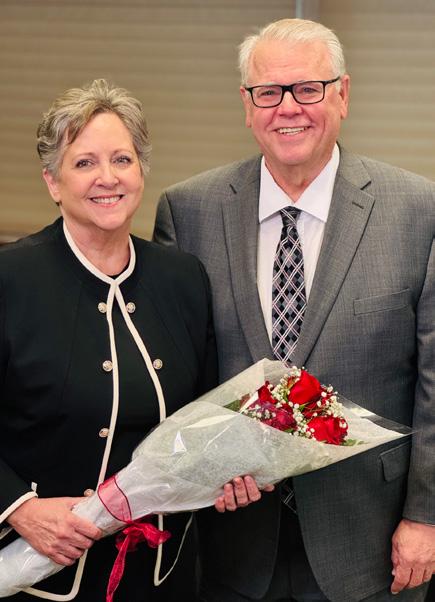
Diane and Gary Thurber
said Thurber, referring to his tenure as MAUC president. “It will be 11 years in September…I’ve gotten to work with the best presidents, the best committees. You’ve had courage to do hard things in the face of difficulties. To do the right things. It’s just been phenomenal for me and I can’t thank you enough.” The committee responded with a standing ovation in recognition of Thurber’s leadership.
The next Mid-America Union executive committee is scheduled for Nov. 19, 2026.
Brenda Dickerson is editor of OUTLOOK magazine.
Read more about Gary Thurber’s ministry and the process of selecting a new union president at: outlookmag.org/gary-thurberannounces-intention-to-retire
Hugh Davis
CENTRAL STATES CONFERENCE
V. Lindsay Celebrates Library and STREAM Lab Ribbon Cutting
A new chapter begins in Kansas City
On a day marked by joy, gratitude and renewed vision, V. Lindsay Seventh-day Adventist School celebrated the ribbon cutting of its newly renovated library and STREAM (Science, Technology, Reading, Engineering, Arts and Mathematics) lab, two spaces designed to transform the student learning experience and support the school’s continued growth.
What was once underutilized space has been reimagined into vibrant, student-centered environments that promote curiosity, creativity and academic excellence. The ribbon-cutting ceremony brought together students, families, staff and community members to witness not just the opening of new rooms, but the beginning of a new chapter in the school’s journey.
As the ribbon was cut, students eagerly stepped into the spaces, many wearing lab coats, ready to explore, question and engage. Their excitement was immediate and unmistakable. The STREAM lab, designed to support hands-on, inquiry-based learning, reflects a commitment to preparing students for a rapidly evolving world while grounding their education in faith-based principles.
Central States Conference president Elder Cryston Josiah was among those in attendance, and his words captured what many felt in the room:
“In all my years of visiting schools, and even as a parent with children who attended here, I have never seen a lab like this. The integration of STREAM, especially the inclusion of reading and the arts alongside STEM, is truly
exceptional. From the microscope stations to the maker space and 3D printing, this is a powerful example of what intentional, forward-thinking education can look like.”
His remarks affirmed what many experienced firsthand. This was not just a renovation, but a reimagining of what learning can look like.
The STREAM lab gives students access to tools and resources that support innovation and discovery: 3D printers, microscopes, experimental tables, building and maker stations, manipulatives and virtual reality glasses. From exploring the human body in virtual reality to designing and building with engineering tools, students are already discovering new ways to think, create and problem solve.
On the library side, the newly redesigned space offers a warm, welcoming environment that encourages literacy, reflection and discovery. With flexible seating, a reading nook tree, and dedicated areas for individual and collaborative reading, the library invites students to grow both academically and spiritually.
For a school that had books on site for years without a fully functioning library space, this transformation carries particular meaning.
Literacy remains a cornerstone of V. Lindsay’s mission. School leaders understand that reading is foundational to student success, and they
are committed to helping students grow in literacy across every subject—not only in academic achievement, but in self-confidence and Christlike character as well.
This milestone is also part of a larger vision for continued growth. Future plans include expanding outdoor play areas, upgrading classroom technology, and pursuing STREAM certification to further strengthen academic programming and student outcomes.
The renovation reflects the broader values of the Central States Conference and its commitment to quality Christian education. By investing in schools like V. Lindsay, the conference is demonstrating that excellence is possible and expected even in smaller settings.
At its core, this celebration reflects the mission of Adventist education: to nurture the whole child— mind, body and spirit—while preparing students to serve and lead. As students filled the rooms with energy and excitement on that March afternoon, one thing was unmistakably clear: the investment in these spaces is already shaping the culture of learning at V. Lindsay Seventh-day Adventist School.
And this is only the beginning.
Schari Fontus is education superintendent for the Central States Conference.
“To Be Like Jesus and Be With Jesus”
“
T hen the king will say to those on His right hand, “Come ye blessed of My Father, inherit the kingdom prepared for you from the foundation of the world: For I was hungry and you gave Me food; I was thirsty and you gave Me drink; I was a stranger and you took Me in; I was naked and you clothed Me; I was sick and you visited Me; I was in prison and you came to Me” (Matt. 25:34-36).
The first line of the current Central States Conference mission statement that was developed over 10 years ago states that we “exist to LIVE and proclaim the Three Angels Message…” Something that I have realized in my 26 years of full-time gospel ministry and 50+ years of my Seventh-day Adventist existence is that as a church we have done a pretty good job preaching the everlasting gospel, but have been lacking in living the gospel. Therefore, without realizing it, we didn’t truly recognize that being like Jesus is the prerequisite to being with Jesus eternally. Thus, it follows that if we want to be like Jesus, we should do what He did, live as He lived, and be obedient to what He says.
Of course, we are aware that the overall vision of the Godhead was to save humanity from the penalty of sin. But when Jesus, the Son of God, arrived in the flesh, He read His mission statement that would give us all a glimpse into what His ministry would entail. He would preach the gospel to
the poor; heal the brokenhearted; proclaim liberty to the captives; recover the sight of the blind (physically and spiritually) and set at liberty those who are oppressed (Luke 4:18).
In other words, Jesus did not just come to correct our theology; He came to be a blessing to humanity. Jesus came and modeled what true Christianity was supposed to look like. What a blessing that He didn’t just leave us with words and concepts, but with a practical ministry that demonstrated everything He spoke about in His mission statement. We must love God and love our neighbor as ourselves. This passion that our conference embodies, I sincerely believe, comes from the Spirit of Christ Himself. Jesus did not only begin His ministry with this passion but then tells us at the end of His ministry that for His followers to inherit the kingdom of heaven, they too must do what He did.
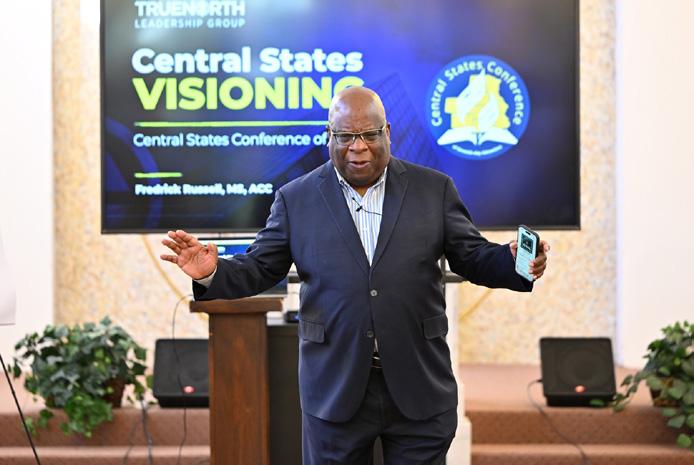
With this essence in our conference DNA, the Central States Conference executive committee members came together in person for the first time since before the COVID-19 pandemic to pray and develop a strategic plan so we can effectively accomplish our mission. Dr. Freddie Russell of the True North Leadership Group led us through this process, and we realized that we had a solid goal, but we needed to focus on some growth areas that would help us to fulfill the mission. Our SWOT analysis led us to develop the following four SMART Goals.
1. Develop innovative ministry approaches to reach and sustain youth and young adults in our local churches. Our youth and young adult director and leadership team are already training churches in this area, with more to come.
2. Create a non-pastor dependent ministry model—which means Total Member Involvement (TMI) for maximum mission impact.
3. Create a standardized and unified form of bi-directional communication between the conference and the local church. This will allow us to remain on the same page and be in one accord.
4. Implement a debt reduction program to pay off the CSC debt by 2028. This will free up more resources to fund the mission.
In closing, I am convicted that the internal theme of the North American Division in 2026, Pentecost and Beyond, is not coincidental but providential. A true Pentecostal experience is needed because it is the Holy Spirit who gives the Laodicean church better eyesight to see its spiritual malnourishment and nakedness. It is the Holy Spirit, who gives the five wise virgins the extra strength needed to be ready to meet the Bridegroom after they too had fallen asleep. And it is also the Holy Spirit who gives those on His right the passion to be a blessing to the least of these in Matthew 25.
May we not become cynical and dismayed by those even within Christendom who might be blinded or confused by those amongst us who have a form of godliness but demonstrate no Holy Ghost power. Consequently, may we be more driven to spend time every day being filled with the Spirit, so that we can be more like Jesus, and ultimately spend eternity with Jesus. Maranatha!
Cryston Josiah is president of the Central States Conference.
Trevor Barnes
When God Provides, Faith Replaces Fear
“Bring all the tithe into the storehouse…. ‘Test me now in this,’ says the Lord of hosts, ‘if I will not open for you the windows of heaven and pour out a blessing….’” Mal. 3:10.
Christian stewardship begins with a profound realization: nothing we possess is truly our own. Life, time, abilities, resources and even opportunities are gifts entrusted to us by God. This verse in Malachi reminds us we are not owners, but stewards—caretakers of the grace God has abundantly given. When this truth settles into the heart, it transforms how we live, give and trust. A life of stewardship is not merely about finances; it is about surrender. It is the daily acknowledgment that God is the source of all blessings and the sustainer of our lives. Every talent we exercise, every act of kindness we extend, and every resource we manage becomes an opportunity to reflect His character.
Stewardship is worship in action.
One of the greatest tests of stewardship is trust—particularly in the area of giving. Human nature often clings tightly to material security, fearing loss or uncertainty. Yet God continually invites us into a different experience: one where faith replaces fear. When we return to Him a portion of what He has given, especially through faithful tithing, we are making a declaration that we trust Him as our provider.
This principle is beautifully captured here: “He whose heart is aglow with the love of Christ will regard it not only as a duty, but a pleasure, to aid in the advancement of the highest, holiest work committed to man—the work of presenting to the
world the riches of goodness, mercy and truth” (Acts of the Apostles 338). This is not a transaction, but a relationship. God is not seeking our resources—He is seeking our hearts. Tithing and consistent giving loosen the grip of selfishness and strengthen our dependence on Him. They align our priorities with heaven and remind us that our security lies not in what we hold, but in who holds us.
Years ago, I received an especially poignant reminder of God’s faithfulness in fulfilling His promise in Malachi 3. I had been invited to Port Elizabeth, South Africa, to preach a series of evangelistic meetings. Financing the trip required a step of faith, living more conservatively to be able to fund the trip, and also selling off some investments in order to purchase plane tickets, a projector and other necessities for the series.
As our group made our way through several airports en route to Africa, news of a major financial crisis monopolized all television screens in the terminals. The mortgage crisis swung through the economy like a wrecking ball, the stock market crashed, the number of foreclosures skyrocketed, and major investment banks failed. Over the course of the next few weeks, a sobering realization settled into my mind that this was undoubtedly having a direct and damaging effect on my masonry contracting company.
During the four weeks I was in Africa, I received zero calls from prospective clients, which was far from usual. And for the next three months after I returned home, the only calls that came in were to cancel contracts for upcoming projects. We completed the project we were on, and the silence continued. Savings were dwindling, and I thought: So this is what a recession looks like for a contractor.
One particular afternoon as I was standing at the back of my truck with the tailgate down, cleaning out my toolbox, I was praying: “Father, thank you for such a beautiful day. Thank You for life and for so graciously providing as only You can. Lord, I know You have things under control and that You know our needs. Thank You for loving us and for your continued provision. In Jesus name, Amen.”
Ten seconds of silence followed. Then my phone vibrated on the tailgate. It was an answer from God’s storehouse of grace which provided work for the next four months and got us over the worst of the downturn.
May we, as faithful stewards, always live with open hands and trusting hearts, confident that the God who gives is also the God who sustains. He’s never failed us yet, and He never will!
Ron Wright serves the Bowman/Dickinson church district in North Dakota.
The Blessing of Faithful Giving
One family’s miracles
“If you are going to be a thief, you had better choose a different victim.” It always rankles my wife when I make this comment when commenting about stewardship. She twists her face up in a scowl and gives me that disapproving “hairy eye-ball” look. Of course we can find all sorts of flaws with my assertion, but it is a “tongue-in-cheek” reality check regarding our response to God’s rhetorical inquiry found in Mal. 3:8, “Will man rob God? Yet you are robbing me. But you say, ‘How have we robbed you?’ In your tithes and contributions.”
Don’t get me wrong, I am not a stranger to experiencing temptation to veer out of the straight and narrow road, but stewardship has never been my weakness. From my youth, I have always had a clear reality that one-tenth of all my increase belongs to the Lord. In this area, I have not strayed. I cannot afford unfaithful stewardship! The portion that remains in my family budget after tithe and offering has been returned has the blessing of the Almighty, and as a result, He provides unexpected ways for it to go further than if I had kept 100 percent and been guilty of stealing from God!
I recall one church where a parishioner placed a pumpkin in the offering plate and a box of lovingly preserved garden produce outside my church treasurer’s
office. The discussion went from my board, up the ladder, all the way to the GC treasury. “How do we handle and disburse tithed produce?” The answer came back: take it to the area pastors’ meeting and divide it amongst them. The giver had very little monetary means but an abundance of home-grown food, and a profound conviction to return tithe to the storehouse. Could that be a foreshadowing of things to come?
I also remember the time I accidentally “pre-tithed.” I generally use online giving at www.AdventistGiving.org. I put in the amount, hurriedly, and accidentally inserted an extra “0.” Those zeros make all the difference. Before the mistake was realized, I had clicked “make payment” and it was irreversible. I had enough money in the bank account to cover that mistake, but not enough to also pay our monthly bills. SoI knew the next day would bring all sorts of stress and grief when my mistake would cost me late fees and delayed payments. Even the grocery list would have to wait.
The next morning, however, I received a check from my dad. He had been impressed to help our family replace our car, and the Lord had put an amount on his heart to send us. It was the exact amount I had “accidentally tithed” the day before!
At one point, my wife and I were working with the bank to obtain a mortgage. The margins were desperately close—we were within a couple of dozen dollars of the amount the bank required for confirmation. Additionally, there was a qualifying hurdle we were struggling to accomplish and the bank was unwavering. Meet the qualifications, or no deal. The sellers would not consider an extension to the purchase offer and we were facing a firm deadline with seemingly impossible details to pull together.
The night before the deadline I knew the entire transaction was likely to fall apart the next day. We felt trapped. I was praying for the Lord to help untangle the scene and He pointed out that we had fallen behind in our tithing. I argued with God. If I use that money, then we won’t
meet the criteria for the bank. The Lord spoke back, “Will a man rob God?” I surrendered! I did the math, and late that night, went to online giving and settled my account with the Lord, knowing it would mean our family would not have the house we were planning on.
Early the next morning our mortgage broker called and said, “I could not sleep last night. I was awake most of the night and I have decided to waive these extra requirements for your approval.” What!?! I could not believe my ears!
So, whether my wife likes it or not, I still contend…if you are going to be a thief… best to choose another victim!
Nathan James serves the Custer/Hot Springs church district in South Dakota and is the Dakota Conference prayer ministries coordinator.
Piedmont Park Members and Friends Build a Church in Peru
It all started with a dream about two years ago.
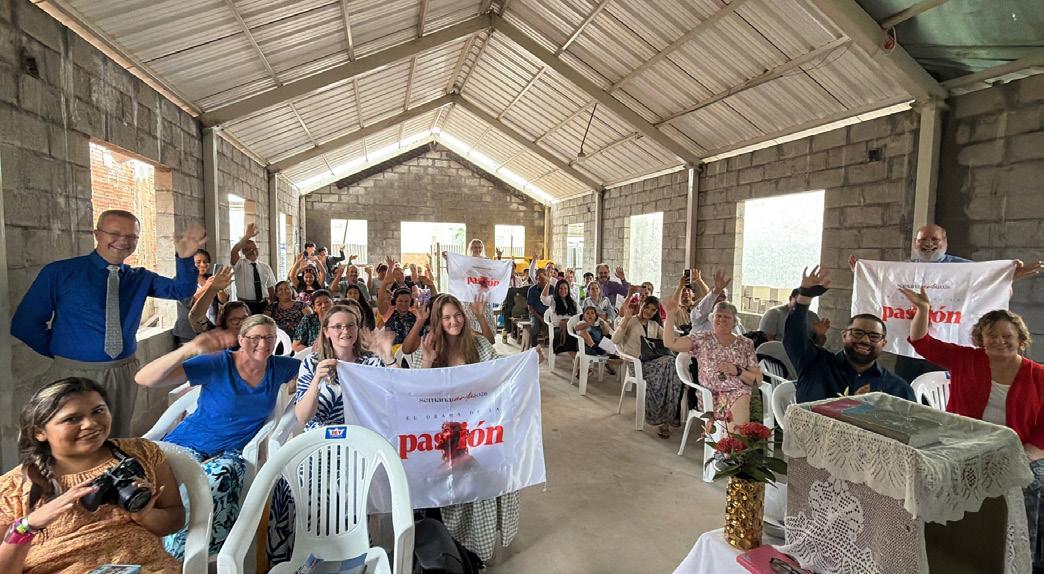
Pastor Smerdis Fuentes, youth and young adult pastor at Piedmont Park Church in Lincoln, Nebraska, felt impressed to create an opportunity for young people to experience serving God in a new and meaningful way—one that would inspire them to look beyond themselves. He connected with Valeree Krueger, who serves on the board of Maranatha Volunteers International. Together, they dreamed big: a mission trip to Peru. They began working on logistics— fundraising, vision casting, finding sponsors and coordinating travel—and before they knew it, the trip became a reality.
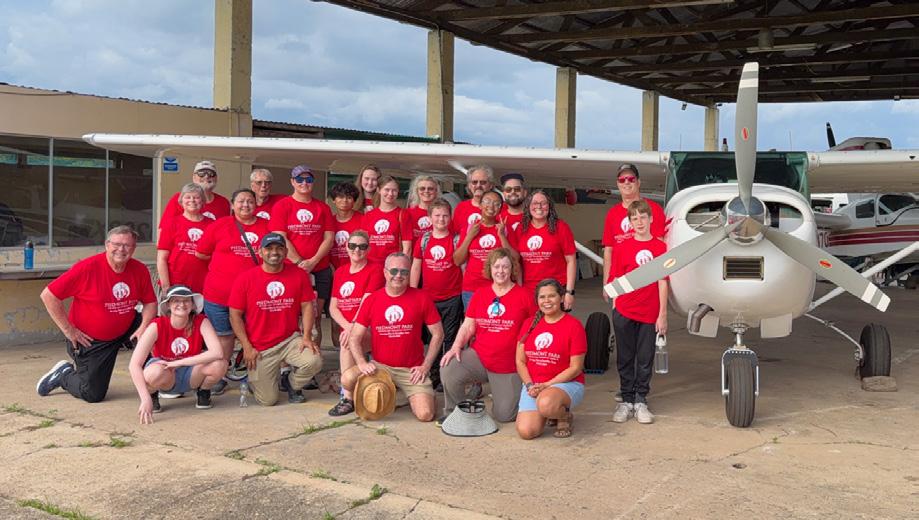
In March 2026, members of Piedmont Park, along with several families from other churches in Lincoln, traveled to Pucallpa, to build a church and share the gospel in the heart of the Peruvian jungle. Pucallpa, also known as the “Red Land” became their mission field for a little over a week.
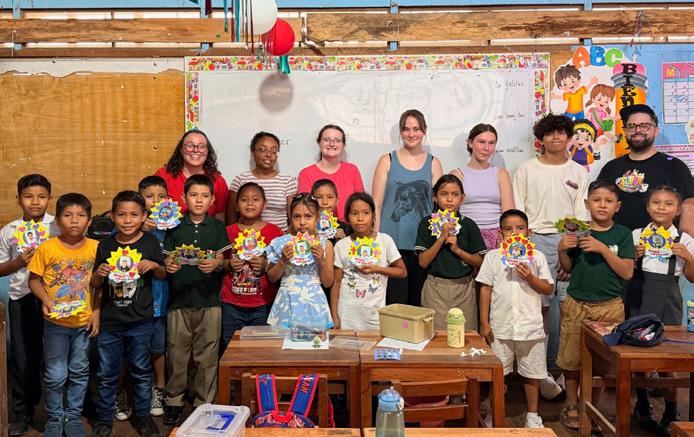
During their time there, the group led a Vacation Bible School program that reached over 400 children at a local public school, distributed food baskets to the community, visited Colegio Adventista Maranatha, built a church for the Villa Selva Adventist congregation, and immersed themselves in Peruvian culture. The Villa Selva congregation had been praying for 17 years for a church building. One of the church leaders, Eli Dávila López, shared what a
blessing this building would be. In their community, having a physical place of worship gives people a reason to gather. Many members had invited friends and family before, but without a building, some did not see the purpose of attending.
Throughout the week, the construction team worked diligently as the structure began to come to life. At the same time, the rest of the group poured into the lives of students and teachers, sharing the love and knowledge of God. By the end of the week, the group had the opportunity to worship in the church they helped build.
One highlight of the trip was visiting the Peru Projects Air Base, a ministry that Piedmont Park Church has supported for many years. In 1964, a deeply loved and remembered brother, Clyde Peters, became the first missionary pilot to arrive in Peru, launching what is
now known as Peru Projects. Today, that mission continues through the leadership of pastor and pilot Eben Espinoza, and vice president Bradley Church. Together with a dedicated team, they carry the gospel to remote communities—often under challenging conditions. It is inspiring to witness the Great Commission being lived out so faithfully.
Matt. 28:19–20 reminds us that this mission is an invitation for all of us. You don’t have to go abroad to share the gospel. You can do it right where you are—whether with neighbors, family members, coworkers or classmates. Every moment is an opportunity to share hope with someone who needs it.
Ilka J. Fuentes works at Union Adventist University and is an active member of Piedmont Park Church.
Hispanic Leaders and Spouses Learn and Fellowship at Retreat
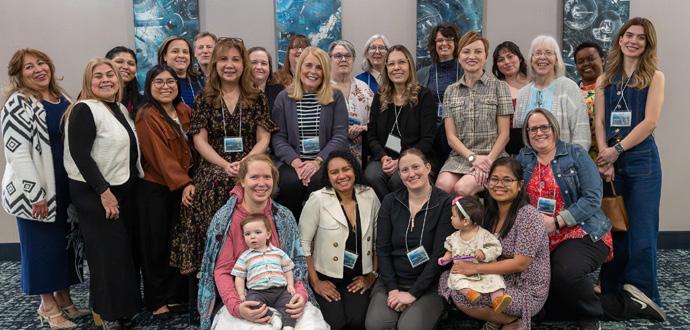
Last March, the KansasNebraska Conference hosted a weekend in Kearney filled with learning, fellowship and spiritual growth. Though each of the two groups had their own focus, both gatherings shared the same purpose: strengthening our churches, families and leaders for God’s mission.
Hispanic leadership training
Guest speaker Pastor Manuel Caro led a powerful weekend centered on how we can work more effectively together as a church through mission, leadership and practical strategies. Many of our leaders arrived with years of experience in evangelism and church work. Yet Pastor Caro reminded everyone that there are always new techniques and better approaches to the work God has called us to do.
One of the first principles he shared was the Golden Rule: treat others the way you would like to be treated. This simple but powerful reminder called
leaders to serve with compassion, humility and respect. He also emphasized that a true leader builds confidence in their team. Leadership isn’t about giving instructions; it’s about empowering others and cultivating trust.
We were also blessed by Pastor Edgar Luna, who joined us all the way from the Michigan Conference to lead worship for the weekend. His praise team created a reverent and uplifting atmosphere that helped prepare hearts to receive God’s message. It was a powerful time of unity and worship. Throughout the training, we explored how every church member has a role to play. Everyone matters in God’s eyes, and we are all called to evangelism. When we work together and use the gifts God has given us, the church becomes stronger and more effective in reaching others.
On Sunday, we held a special session for the secretaries and clerks of our Hispanic churches. This training
covered essential information for keeping member and non-member records current and accurate. It was a time full of questions, participation and practical learning. We highlighted how important it is that every member is counted and cared for, and we are deeply grateful for these dedicated volunteers who faithfully serve in addition to their other responsibilities.
Spouses retreat
Though the group was smaller, God’s presence was felt in every session. The speaker addressed topics that resonated
with many of the spouses, creating space for encouragement and spiritual growth.
Saturday night was especially moving. The ladies gathered for a special prayer meeting, sharing requests, gratitude and burdens for their families, children and personal lives. Together, they placed their fears into God’s hands. It was a sacred and impactful moment, and a beautiful close to a weekend full of blessings.
Jasmin Cortes is multilingüal ministries administrative assistant for the Kansas-Nebraska Conference.
Adventurer Bible Game Focuses on Strengthening Bonds
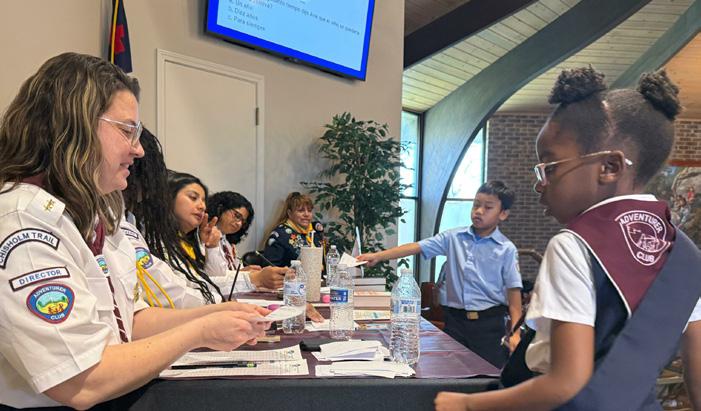
With God’s blessing, we successfully concluded March with our main Adventurer event: the 2026 Bible Game. Throughout the year, Adventurers studied diligently alongside their parents and teachers, focusing on six books featuring women of the Bible: Esther, Ruth and Naomi, Hannah,
Abigail, Deborah, and Mary and Elizabeth. Five clubs participated, comprising six Adventurer groups and six parent groups. The most gratifying aspect was fulfilling the fundamental purpose of Adventurer ministry: strengthening the bonds between parents, children and teachers.
A Chisholm Trail club director reviews answers with a young Adventurer.
Nelly Cruz
Ministerial spouses gather for a blessed weekend of encouragement, prayer and fellowship.
Saul Dominguez
Iowa-Missouri Conference Hosts Music Festival at Sunnydale Adventist Academy
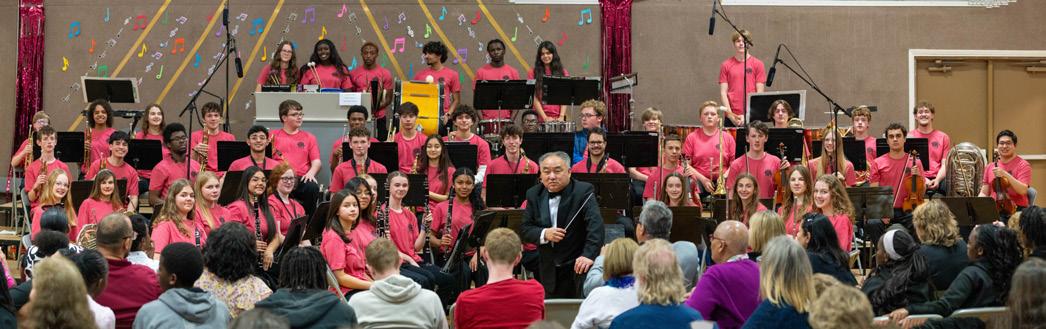
More than 200 student musicians from across the Iowa-Missouri Conference gathered at Sunnydale Adventist Academy in Centralia, Missouri, April 9–11 for the 2026 Iowa-Missouri Music Festival—a weekend of worship, artistry, and fellowship centered on the theme Our Hope Brings Us Together. Over 150 students participated in the festival choir and more than 50 in the festival band, representing schools from both states under the direction of accomplished Adventist educators and a world-class guest director.
The centerpiece of the weekend was the Music Festival Concert, held Saturday afternoon. Elder Lee Rochholz, Iowa-Missouri Conference president, opened the concert with a welcome and prayer before an audience that watched the assembled students perform a diverse and
moving program. The festival band—directed by Sunnydale Adventist Academy music director Mr. Joseph E. Choi performed works including “Fanfare and Flourishes ‘2’” by James Curnow, “Praises” by W. Francis McBeth, and “Celebration and Song” by Robert Sheldon. The festival choir delivered selections including “Gathered As One” by Deanna Light and Paul A. Tate, and “Keep Your Lamps” by Victor C. Johnson. The concert concluded with a combined choir and band performance of “When You Believe,” arranged by Audrey Snyder.
Participating schools included Andrews Christian Academy, Des Moines Adventist School, and Nevada Christian School from Iowa, and College Park Christian Academy, Hillcrest Seventhday Adventist School, Sedalia Seventh-day Adventist School, Springfield Adventist Academy, Summit View Adventist School, Sunnydale Adventist Elementary, and Sunnydale Academy from Missouri. Home school and public school students were also welcomed as guests — a reflection of the festival’s inclusive spirit.
The event was sponsored by the Iowa-Missouri Conference education department and made possible through the tireless work of Sunnydale Adventist Academy’s administrators, deans, staff and students— along with teachers, chaperones, parents and volunteers from across the conference. Read the full story at: outlookmag.org/im-musicfest-2026
Caleb Durant is communication director for the Iowa-Missouri Conference. AI was used for editing.
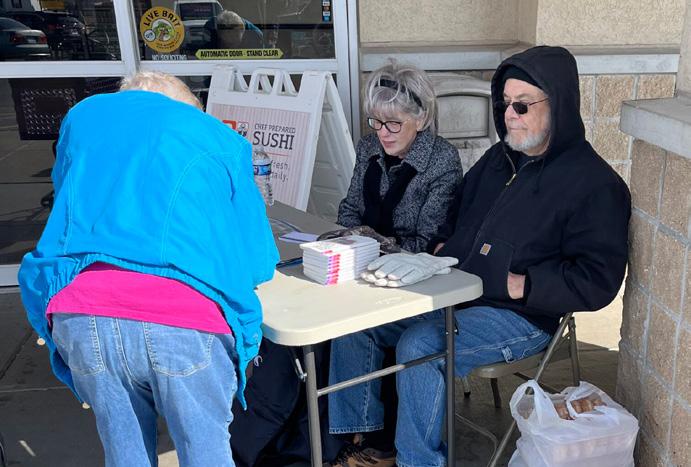
Sedalia Hosts Prayer Booth at Local Grocery Store
The Sedalia Church recently partnered with a local grocery store to offer prayer and gift cards for those in need. Not only were we able to bless 12 families with $25.00 gift cards, but he Lord also enabled us to share 12 Steps to Christ books and pray with and for multiple individuals and their families. Community connections were made as many filled out connection cards, which will allow our church to build relationships as we check in with each individual in the coming weeks.
David Webb is a member of the Sedalia Church in Iowa.
David Webb Caleb Durant
“IM Called” School of Evangelism: One Year Later
Nearly one year ago, a small group of church members walked through the doors of an Adventist Community Services building in Bridgeton, Missouri, with a shared conviction and more than a few nerves. They weren’t pastors or theologians. They were laypeople who felt the pull to do more—and had said yes to something that would change them.
The Iowa-Missouri Conference’s IM Called School of Evangelism and Discipleship launched on June 23, 2025, and concluded last September. In the months since, the fruit of that first class has continued to grow: dozens of lives touched and a new congregation now meeting every Sabbath in Wentzville, Missouri.
The idea began with a phone call. Conference president Lee Rochholz reached out to Pastor Jeremy Clark, who also serves as the conference’s Bible worker director, with a question that set everything in motion.
“He basically asked me, ‘What if we could start a school of evangelism to help our laity go out in the field and win souls for God’s kingdom?’” Clark recalled. “The prayer is always for laborers. We thought, what can we do to encourage and grow that base?”
Clark and co-instructor Rob Alfalla, the conference evangelist, designed the school around two pillars: theological depth and practical field experience. Classroom sessions ran on Mondays and Wednesdays, while Tuesdays
A Prophecies of Hope evangelistic campaign, led by conference evangelist Rob Alfalla, was recently hosted in Wentzville, Missouri. A small group now meets every Sabbath at a rented location in Wentzville, a growing community in the northwestern St. Louis metro area.
and Thursdays sent students door to door across St. Louis neighborhoods in partnership with a local church.
“Personal spirituality feeds everything else,” Alfalla said. “You could have every 28 fundamental belief memorized, but if you don’t have a relationship with Jesus, it doesn’t do anything.”
Lives shaped—from both sides of the door
Among the students whose stories stood out was Megan Cooper, whose path to Bible work was anything but conventional. After a decade of trafficking and exploitation, she was reached by a Christian agency called New Name, and later received a year of faithful weekly Bible studies from Elder Fred Schiller and his wife, Lynn, during Covid.
“It’s just a beautiful thing to see how God can bring things full circle,” Cooper said. “It really prompted me to want to be a Bible worker myself.”
By graduation, Cooper and her classmates had studied with people from different
denominations, prayed for strangers at gas stations, and knocked on doors in neighborhoods that tested their courage.
“Walking up to the door sometimes is hard,” one student said. “But I feel like I’ve gained more courage to do things.” Another recalled a return visit to a family who met them at the door with a smile, already waiting. “They were so happy to see us. That was just amazing.”
A campaign in Wentzville—and a church taking root
The school’s first year concluded with a Prophecies of Hope evangelistic campaign led by Alfalla in Wentzville, a growing community in the northwestern St. Louis metro area. The campaign reached people both through public meetings and through personal Bible studies conducted by the school’s students— resulting in 12 baptismal requests in total. By the final night, 24 guests had accepted Christ as their Lord and Savior, and five were baptized, joined by 19 who committed
to a new small group that would become the seed of a worshiping congregation.
As of May 2026, that group meets every Sabbath at a rented location in Wentzville, averaging 15 to 30 attendees. Each week includes a song, a prayer, and a small-group Bible study, while leadership searches for a more permanent home for the growing fellowship.
“We want to plant churches. We want to take God’s Word out,” Clark said. “We want to start a fire that cannot be put out. If not now, when?”
As IM Called approaches its one year anniversary, leadership is developing an “IM Called On The Road” model to bring training modules directly to congregations across the conference.
“The harvest is great,” Alfalla said, “but the laborers are few.”
Learn more, including information about future cohorts, at imsda.org/ imcalled.
Caleb Durant is communication director for the Iowa-Missouri Conference.
Caleb Durant
Adventist Education: Foundations for a Lifetime
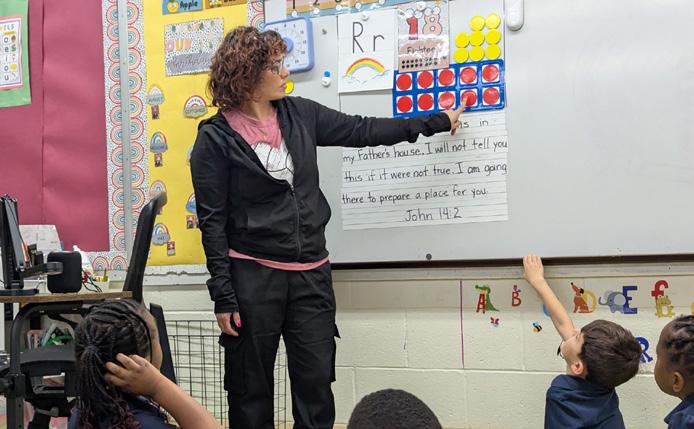
Our Adventist schools offer far more than academic readiness or emotional development. They nurture the whole child—mind, body and spirit—preparing young hearts to recognize God’s voice and respond to His love.
In one pre-kindergarten and kindergarten class at Minnetonka Christian Academy, six children, ages four to six, gathered around small desks for Bible class. Their teacher, Elaina Rivera, led them in a lesson centered on who God says they are. After reviewing the week’s memory verse, she invited the
students to recite it together, complete with hand motions. The room filled with joyful movement and confident repetition.
As the lesson closed, Rivera asked what they had learned and what they were thankful for. The responses were simple yet profound:
“I’m thankful God loves me.”
“Jesus made me.”
“Jesus wants to be my friend.”
“I’m valuable because God loves me.”
This is the quiet power of Adventist education.
Preparation in
disciple-making begins long before adulthood. It begins in classrooms where children learn not only how to read and reason but to understand who they are in Christ. Adventist education prepares students not only for successful lives here but for lives lived with eternity in view. In doing so, it often strengthens entire families—inviting parents and
caregivers into deeper conversations about faith.
To prepare others for God to work in their lives is the first step of disciple-making. Across Minnesota, our schools remain one of the most powerful tools God uses to lay that foundation.
Savannah Carlson is communication director for the Minnesota Conference. AI was used for editing.
The principal will cont act you to conduct a brief interview This is a great opportunity for you to get to know the principal and learn more about the programs and opportunities available at Maplewood Academy. 1. FILL OUT AN APPLICATION 2. INTERVIEW
You can do this online at www.maplewoodacademy.org/admissions or you can fill out the enclosed paper application
3. ACCEPTANCE LETTER
MWA Admissions Committee will notify you of your accept ance st atus by mail.
MAKE A FINANCIAL PLAN
Cont act our school office to speak with our VP of Finance to make a financial plan - vpf@maplewoodacademy.org or 320.587.2830 ext. 1 104
COMPLETE ENROLLMENT FORM
The last step in the application process is to complete the enrollment forms that will be mailed to you with your accept ance letter
ROCKY
Stewardship: It’s a Matter of Trust
Some years ago, I was watching a father teach his daughter to swim. She was holding onto the ladder that descended into the water at the shallow end where she was clearly able to stand with her head above the water. He was in the pool behind her, his hands reassuringly on her shoulders.
“Okay,” he said to her calmly, “let go of the ladder now. You can stand up.”
“No!” she shouted. “I’ll go under the water!”
“No, it’s very shallow, and you can stand. Besides, I am right here, and I have hold of you. Nothing can happen to you.”
She was not convinced. “I won’t let go!”
In his soft, soothing voice, Daddy patiently reasoned with her. “Remember when I taught you to ride a bike? I didn’t let you get hurt. Now you love to ride your bike. You will love to swim, too. But you can’t learn until you let go of the ladder.”
She remained resolute, but
silent. So, Daddy gave it one more try.
“Don’t you trust me?”
“I trust you, but I’m not letting go.”
That ended the lesson. He told her they would try again another time and took her to the wading pool where she was much happier.
That little girl was obviously scared of the deep water. However, I suspect her confidence grew as time went by, and by now she may have taught her own children to swim. It’s unlikely that she stayed stuck in her fears about the shallow end of the pool. If she really did trust her father, she learned to let go.
Of course, you are way ahead of me now, but I hope you keep reading while I make the obvious point. If we truly do trust our Father, won’t we learn to let go when He says He will hold us up?
Do you trust God enough to let go of tithes and offerings? You knew I was going to get to that, and you
The real reason to tithe is because of trust in God.
knew I was going to use this verse to support it. Mal. 3:10 tells us, “Bring the whole tithe into the storehouse, that there may be food in my house. Test me in this,” says the Lord Almighty, “and see if I will not throw open the floodgates of heaven and pour out so much blessing that there will not be room enough to store it” (NIV).
I’m going to say something now that might sound really mean about that scared little girl holding the ladder in the pool. No matter what she said, she really didn’t trust her father. He may have proven himself with bicycles, his firm grip may have been familiar to her from when he ran beside her holding her onto the bike, and he may have told the truth about the depth of the water just like he told the truth about how to ride down the sidewalk, but she would not let go. Her fear was bigger than her trust, no matter what she claimed. I’m not trying to be unkind. In fact, listening to her fear, I could not help but feel a great deal of empathy for her.
But there is a logical conclusion based on the evidence. In fact, it is an inevitable conclusion. In this case at least, almost up to her neck in water and her toes not quite touching the bottom of the pool, she did not truly trust her father.
If we say that we trust God, but we don’t let go of what He claims as His, what is the logical conclusion based on this
evidence? Has He not proven Himself trustworthy in our previous experiences with Him? Are His reassurances of blessings pouring out on us not believable?
I hope you believe in the mission of your church; but if you do, that’s not the reason to return tithe. I hope you believe that all you own belongs to Him anyway and you are just a steward; but that’s not the reason to tithe. I hope you have peace knowing that God will not accuse you of robbery; but that’s not the reason to tithe. I hope that you are so grateful for all He has provided that you want to show how you feel through your gifts; but that is not the reason to tithe.
Well, okay, those are some good reasons. Pretty good anyway. But let’s get down to the heart of it: God doesn’t need your money any more than that daddy needed his little girl to let go of the ladder. But he was there beside her, encouraging and reassuring her, because he wanted her life to expand into a whole new experience that would provide her with a lifetime of enjoyment. But that was impossible if she didn’t trust him enough to let go.
The real reason to tithe is a matter of trust. Letting go is not about supporting the work, or understanding ownership, or peace, or even gratitude. Letting go is about trusting.
Doug Inglish is RMC vice president for administration and stewardship director.
CJ Graglia of Pexels
Stewardship Sabbaths Invite Members to Surrender Every Part of Life to God
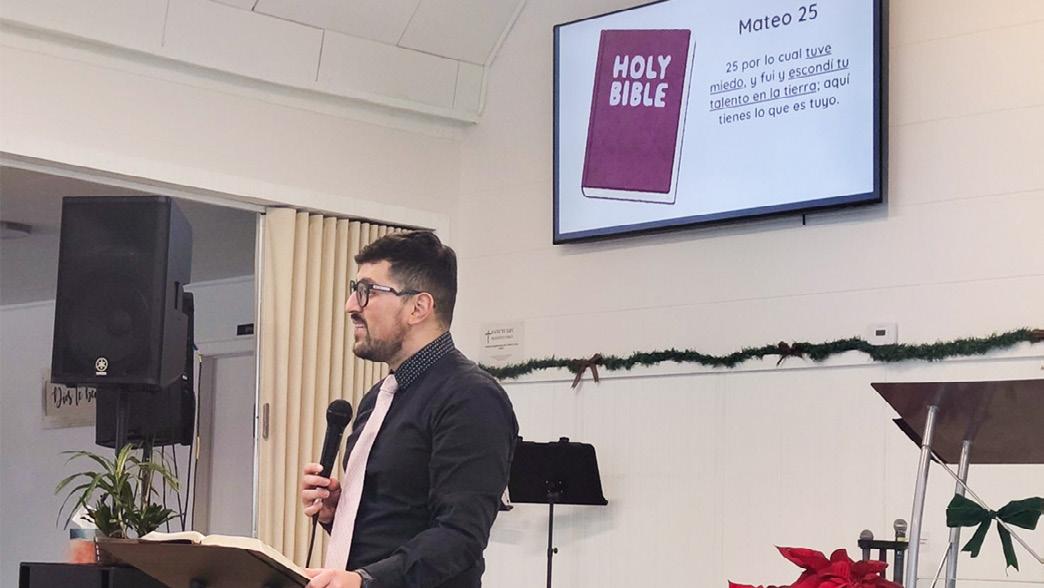
The Stewardship Department of the Rocky Mountain Conference recently spent two weekends visiting Westminster Hispanic and Gypsum Hispanic Seventh-day Adventist churches, leading Stewardship Sabbath sessions centered on a simple but challenging theme: surrendering every part of life to God. Both congregations welcomed Jose Briones, now former RMC pastor and stewardship content creator, with warm hospitality and well-attended services that reflected a genuine desire to explore what faithful stewardship truly means.
One of the presentations focused on the Bible passage of Matthew 25 and the parable of the talents, inviting members to consider what it means to steward what God has already placed in their hands. Briones emphasized that faithful stewardship requires courage—choosing not to bury our gifts out of fear—like the servant who hid his one talent, but instead trusting God enough to use, grow and invest the resources He has entrusted to us.
For both churches, the message highlighted that stewardship is not merely about money or budgeting but about releasing control of finances, health, time, relationships and spiritual priorities and allowing God to lead. Testimonies from
Jose Briones encourages congregations to renew their commitment with God.
local members added depth to the theme, showing how surrender has brought clarity, healing and renewed purpose in their own lives.
In Gypsum, church member Merari Morales said the weekend offered a meaningful reset for the congregation. “All the attendees had the opportunity to learn about the principles of stewardship and renew their commitment to God. It’s a privilege to have more presentations and understanding about this topic,” she shared.
Workshops and afternoon sessions created space for practical conversations. Families asked about managing household finances with faith in mind, young adults explored aligning career choices with spiritual calling,
and older members reflected on trusting God through health challenges and life transitions. The atmosphere remained open and communal, with participants sharing both struggles and victories.
As the Stewardship Sabbath sessions concluded, Briones encouraged both congregations to take time this year to prayerfully plan for every gift God has entrusted to them. He emphasized that intentional stewardship begins with reflection: identifying the resources already in our hands and seeking God’s direction for how to use them faithfully.
Jose Briones is a stewardship promotion and content creator in the Rocky Mountain Conference.
“Intentional stewardship begins with reflection: identifying the resources already in our hands and seeking God’s direction for how to use them faithfully.”
Rocky Mountain Conference
Three Graduates From the Class of 2026 Share Their Union Experiences
Gideon Logan
As a graduating international rescue and relief and biomedical science double major, Gideon Logan’s time at Union offered him countless adventures. When first starting college, Logan planned on becoming an ecologist. Around the time he realized a career in habitat restoration would actually keep him in an office, he started taking IRR’s EMT class. While in the class, Logan recalls being left with a lot of questions. He was learning how to treat a variety of issues, but he wasn’t learning the root causes. His curiosity drew him to rethinking his path and deciding to become a doctor.
During the IRR expedition in Malawi last year, he gained valuable first-hand experiences that confirmed his calling as a physician. “I did more than 100 hours of shadowing in clinical rotations,” Logan said. “I got to scrub in to assist with surgery. I had my first experience doing CPR on someone. I got to suture. I even delivered a couple babies ... there’s a little boy in Mozambique named ‘Gideon’ after me. It was a really good experience.”
Logan’s desire to be a compassionate person is very apparent. Whether it’s to be a listening ear or someone who offers wisdom-filled advice, Gideon’s primary goal is to be authentic and
Gideon Logan prepares for high-incline rope rescue practice. Union’s International Rescue and Relief Program provided him with opportunities for active learning, deep relationships, community service and adventure.
build real connections with people. Savannah Fortney, Logan’s fiancé, said, “When he worked as an EMT, he was known for not just getting the patient from point A to point B, but taking the time to hear their story and to get to know them even in a short ambulance ride. One thing that is pushing him to pursue this career path is the continued opportunity to get to know people who are hurting. He wants to be able to form relationships and trust with those that he interacts with.”
Yann Birasa
From his confident walk across campus, there is no indication in Yann Birasa’s relaxed stride that he hasn’t lived in the Midwest his whole life. Having grown up in Belgium and Rwanda, Nebraska wasn’t a place Birasa had ever intended to go. This changed, however, when his cousin told him about Maxwell Adventist Academy in Kenya. By attending an Adventist high school, Birasa’s life was turned around. Through God moments, he was baptized, and with a little help from Union’s own Pastor Rich Carlson, he made the decision to seek education across the ocean at Union.
Before ever making it on campus, Birasa had been messaging his soon-to-be teammates on the men’s basketball team. Pastor Carlson had connected him with men’s basketball coach Drew Mekelburg and students on the men’s team. Birasa said,
“It felt like I was already on campus without even being on US territory. It was insane.” So when he showed up as a wide-eyed international student, he was able to settle in with a ready-made circle of friends. Now, everybody knows Birasa. From being a freshman on the basketball bench, to being voted SA president and even receiving a campus celebrity award at this year’s spring banquet, Yann has become an important leader on campus. He’s everywhere. Whether it’s up front giving speeches or exploring Lincoln with his friends, Birasa is always offering a hello and a smile.
Graduating with a degree in business finance with a minor in psychology, Birasa is ready to take the next step of his life to Florida where he’ll be working for AdventHealth. He’s bringing with him a newfound love of golf, a mindset of curiosity and discovery, and an eagerness to explore the restaurants of Orlando.
Birasa’s memories — the days spent with friends, the long hours on the bus with the basketball team, and the time enjoying every homemade chocolate chip cookie he could get his hands on — will stick with him for the rest of his life. While reflecting on his years spent on Nebraska soil, Birasa said, “The best part of Union is the people. The people let you come as you are. You can come from far, you can come with a different culture, you can come different, and the
UNION ADVENTIST UNIVERSITY
Yann Birasa (left), along with Umeran Waktole, greets new students during orientation. Birasa had never heard of Nebraska before meeting Pastor Rich Carlson, but quickly became a leader at Union Adventist University.
Union community welcomes you and understands you. Even though we are different, at the end of the day, we are all God’s children.”
Kylie Wehling
In seventh grade, Nebraska native Kylie Wehling sat with her dad at Union’s Friday night vespers. The chords of the song “Oceans” drifted across the sanctuary as the pianist’s hands glided along the piano keys. Her dad turned to whisper to her, “One day, you’re going to play like that up there.” Wehling remembers thinking how unbelievable that seemed, but at the same time praying that what her dad said would turn out to be true.
Not long before that night, Wehling had suffered a massive hand and wrist
into a different area that God has called us into.”
Union ties run deep in the Wehling family, as does a commitment to the ministry of health care. Both of her parents, Dr. Merlin Wehling and Chere (Ray) Wehling, graduated from Union in 1997, and her brother, Caleb Wehling, graduated in 2024. While her brother followed in their mother’s footsteps to a career in nursing, Kylie is finishing her degree in biomedical science to follow her father’s path as a physician. She has been accepted to Loma Linda University School of Medicine, and will continue her studies in California after getting married this June. When she isn’t studying, snowboarding or playing cello, Wehling is leading her fellow students closer to Christ with a servant-hearted
attitude. Whether it’s on the volleyball court, hosting Bible studies, or planning and leading out in music for campus ministries events, it’s Wehling’s prayer that in everything she does, “Jesus would be glorified and that people would see Him through me.”
Wehling’s favorite Bible verse is Isaiah 43:2. It says that through the waters and fire, God is near. She has learned that this couldn’t be more true. Along with having successfully taken the MCAT and completing half-marathons, God brought her from a near-paralyzing injury to sitting at the piano in the College View Church playing and singing with fellow Union students, right where her dad said she would be.
Sami Hoffer is a biomedical science major from Minnesota.
injury. Shattered glass had severed nerves, tendons and arteries in her left hand, taking away her ability to play the instruments she loved.
Creating music with the piano, cello and French horn now seemed impossible, and Wehling wondered how this was a part of God’s plan.
Now a graduate from Union Adventist University, Wehling’s life has been filled with challenges, and with each one, her perspective grows. “I always go back to Scripture and have a solid, honest prayer with God,” she said. “Like, ‘hey, this kind of stinks. I failed, I hit a wall. I don’t know what You want me to do next. Lead me.’ And it kind of reframes my mindset that this is not necessarily a closed door, but an opportunity to go somewhere else until we walk
Kylie Wehling leads song service during vespers. Whether it’s on the volleyball court, hosting Bible studies, or planning and leading out in music for campus ministries events, it’s Wehling’s prayer that in everything she does, “Jesus would be glorified and that people would see Him through me.”
To read more stories of recent graduates, visit http://uau.edu/seniorfeatures
ADVENTHEALTH MID-AMERICA
AdventHealth Kansas City Celebrates Launch of Post-Birth Alert Bracelet Initiative
Every mother deserves to feel supported after leaving the hospital, which is why AdventHealth is celebrating the launch of the Post-Birth Alert Bracelet Initiative, focused on postpartum safety and care, at its regional birth centers.
In collaboration with AdventHealth’s Mother and Baby teams, the initiative equips every postpartum mother with an orange bracelet upon discharge from the hospital. The bracelet is intended to be worn for the first six weeks after delivery and will alert health care providers to potential complications or considerations for specialized care during the period when women are most susceptible to complications such as hypertensive crises, severe bleeding, infection or other obstetric-related concerns.
“The orange postpartum bracelet is a symbol of awareness and protection for mothers after childbirth and serves as a visual reminder that her health remains a top priority long after delivery,” said Raimonda Shelton, BSN, RN, chief nursing officer of AdventHealth Shawnee Mission. “The weeks after childbirth are a critical and vulnerable time for mothers. This initiative reflects AdventHealth’s commitment to whole-person care—body, mind and spirit—ensuring every mother feels supported beyond birth.”
The bracelets have already proven valuable to other AdventHealth hospitals.
AdventHealth Shawnee Mission team members celebrate the launch of the Post-Birth Alert Bracelet Initiative on April 1, 2026. New mothers are encouraged to wear the orange bracelets for six weeks, empowering postpartum mothers to care for their health and wellbeing, and empowering care teams to help postpartum mothers make the right care decisions at the right time.
Mothers wearing them have been quickly identified by EMS, emergency departments and community medical responders, ensuring timely, appropriate care.
“We’ve seen several patients arrive in our OB Emergency Department still wearing their bracelets,” added Lauren Evertt, director of nursing at The Baby Place at AdventHealth Gordon. “We’ve also had EMS transport postpartum patients directly to OB when needed. I’ve even seen moms wearing them out in the community—at baby showers, football games—you name it. It’s definitely working.”
Team members from AdventHealth’s regional birth centers and emergency departments, along with leaders from other birth centers and ERs in the greater Kansas City metropolitan area, gathered in early March to learn about the program and prepare for its official launch at AdventHealth on April 1. Beyond its clinical importance, the bracelet empowers mothers to prioritize their health and seek help when something does not feel right. It is a simple yet powerful way
to keep mothers safe, supported and seen during the crucial postpartum period.
“Not only are we empowering postpartum mothers to care for their health and wellbeing, we are empowering care teams to help postpartum mothers make the right care decisions at the right time,” said Shelton. “We are thrilled to be a part of this maternal wellbeing program that is quickly expanding across the country.”
AdventHealth
To learn more, visit AdventHealthKC.com/BirthAlert
Moments That Change You: Stories from Lesotho
Earlier this year, team members from AdventHealth’s Rocky Mountain Region traveled to Lesotho, Africa, with AdventHealth Global Missions, bringing care, compassion and expertise to communities in need while returning with a renewed sense of purpose.
For Harmony Furlong, chief development officer and foundation director for AdventHealth Parker and AdventHealth Castle Rock, the experience was filled with moments that were both joyful and humbling.
One encounter that stayed with her was a woman who received a pair of glasses through the Community Health Team. “She was so overjoyed, she sang ‘Heaven! Heaven!’ as she left the tent,” Furlong shared. Later that day, the team saw her again—walking with a baby on her back, smiling brightly and proudly wearing her new
glasses. “It touched my heart to know we had contributed to that joy.”
Through the Water Team, Furlong also witnessed entire villages celebrating the arrival of clean water systems— dancing and singing in gratitude. “Joy came so easily to many of the people we met,” she reflected. “It reminded me how powerful and simple joy can be.”
For Antje Oudakker, director of perioperative services at AdventHealth Parker, the trip was a return to Maluti Hospital after her first visit last year left a lasting impression.
“The staff provide incredible care with far fewer resources than we’re used to,” Oudakker said. “It’s a powerful reminder of what truly matters in medicine.”
During the week, the surgical team completed 25 procedures for patients who otherwise would not have had access to care. One
Antje Oudakker, director of perioperative services at AdventHealth Parker, enjoys time with a friend.
patient, diagnosed with aggressive breast cancer, will now receive chemotherapy thanks to donor support— treatment that would not have been possible otherwise.
Another patient’s story left a deep impact. Living with HIV, tuberculosis and advanced colorectal cancer, she chose to share her experience—not for herself, but to educate others and reduce stigma in her community.
“Her bravery was humbling,” Oudakker said. “Moments
for AdventHealth Parker and AdventHealth Castle Rock, relaxes with AdventHealth team members and Lesotho community members.
like that remind you this work is about far more than surgery. It’s about dignity, compassion and human connection.”
For Miranda Schick, director of the mom and baby unit at AdventHealth Avista, the impact of Global Missions was seen in the success of long-term partnerships.
Serving on the Helping Mothers and Babies Survive (HMBS) team, Schick helped train local providers on tools to improve neonatal outcomes. During this visit, she learned that a baby’s life had been saved just days before their arrival because a midwife used a device introduced on a previous trip.
“The baby wasn’t breathing and they were ready to pronounce death,” Schick said. “But the midwife used the device, detected a heartbeat and resuscitated the baby for over 15 minutes. That baby lived. Seeing that impact was incredibly rewarding.”
Now on her eighth mission trip, Schick says these experiences continue to shape her perspective. “I always come back grounded in gratitude. The connections we build across the globe truly change how you see the world.”
Together, these experiences highlight the profound impact of Global Missions, not only for the patients and communities served, but for the team members who carry those lessons forward.
Learn more about mission trips like this one at www.adventhealth.com/ global-missions
Harmony Furlong, chief development officer and foundation director
FAREWELL
Bizzett-Johnson, Abby, b. Mar. 4. d. July 15, 2025. Member of Fergus Falls (MN) Church. Survivors include husband Jay; daughter Lisa Hengel; stepdaughters Angie and Julie; stepsons Chris and Jeff; 1 sister; 3 brothers. Helped established the Prospect House & Civil War Museum in Battle Lake, MN.
Deschner, Mildred Edwina, b. Jan. 25, 1935 in Galena, KS. d. Mar. 5, 2026 in Cheyenne, WY. Member of Fort Collins (CO) Church. Preceded in death by husband Robert. Survivors include daughters Judy Cvetkovich and Jan Hofmann; son Jeff; 1 brother; 4 grandchildren; 2 great-grandchildren.
Gardiner, Charlotte V., b. Mar. 3, 1947 in Salina, KS. d. Mar. 30, 2026 in Topeka, KS. Preceded in death by 1 sister;
June
2026
1 brother. Survivors include 2 sisters; 1 brother.
Haas, Norman W., b. Jan. 17, 1928 in Cleveland, ND. d. Feb. 9, 2026 in Loveland, CO. Member of Loveland Church. Preceded in death by wife Alice E. (Fischer); 5 sisters; 3 brothers. Survivors include daughter Susan Dupper; son Richard; 5 grandchildren; 1 great-granddaughter.
Koppelmann, Gary W., b. Oct. 4, 1944 in San Antonio, TX. d. Mar. 4, 2026 in Denver, CO. Member of the Littleton (CO) Church. Preceded in death by 1 brother. Survivors include wife Karen; daughters Monica and Kelly Waller; son Zachery; 2 grandchildren. Served in the U.S. Navy. Led Pathfinders, served as head elder, taught Sabbath school classes, and held Bible studies as part of a prison ministries program.
Kranz, Delores Jean (Eckard), b. Aug. 24, 1948 in Ord, NE. d. July 7, 2025. Member of Broken Bow (NE) Church. Preceded in death by sons John Mark, Ronald Eugene, and Gary Lee; 4 sisters; 1 brother. Survivors include husband Dwain; 1 brother; 2 grandchildren.
Mangum, James K., b. Apr. 4, 1942. d. Apr. 3, 2026. Member of Wichita South (KS) Church.
Provorse, John Marvin, b. Aug. 3, 1941. d. Nov. 24, 2025 in El Dorado, KS. Member of El Dorado Church. Preceded in death by wife Mary Louise; 3 grandchildren. Survivors include daughters Vicki Redman, Janet Provorse, Susan Mileham, and Pam Schelske; 2 brothers; 8 grandchildren; 1 great-granddaughter.
July 2026
Red Feather, Sheris, b. Feb. 2, 1951. d. Mar. 19, 2026 in Rapid City, SD. Member of Rapid City Church. Preceded in death by son Patrick. Survivors include daughter Tasha Pizarro.
Sauer, Wayne Everette , b. June 1, 1936 in Carson, ND. d. Mar. 27, 2026 in Lemmon, SD. Member of Dakota Conference Church. Preceded in death by wife Shirley; son John; 1 brother; 1 granddaughter; 1 great-grandson. Survivors include daughters Anette Tomac and Stephanie Stoller; son Craig; 1 sister; 2 brothers; 12 grandchildren; 11 great-grandchildren. Served in the U.S. Army. Served his church as Sabbath school leader and head elder.
SERVICES
Apex Moving & Storage:
Move with an award-winning agency. Apex Moving & Storage partners with the General Conference to provide quality moves at a discounted rate. Call us for all your relocation needs! Adventist beliefs uncompromised. Contact Marcy Danté at 800.766.1902 for a free estimate. Visit us at www. apexmoving.com/Adventist
FREE PODCASTS LifeTalk
Radio offers stellar programs as on-demand podcasts featuring Wintley Phipps, Gary Gibbs, Debleaire Snell, John Bradshaw plus health and longevity programs. Learn while you work, play or drive. Listen online or download our APP at: LifeTalk.net
Summit Ridge Retirement Village: An Adventist community in a rural setting that offers affordable homes or apartments and caring neighbors with a fellowship you’ll enjoy. On-site church-planned activities and transportation as needed. Also, Wolfe Living Center offering independent living and nursing home. Website: www.summitridgevillage. org or call Bill Norman at 405.208.1289.
FOR SALE
Authors, transform your manuscript into a globally distributed book. Get FREE evaluation from trusted SDA publisher (42 years). If accepted, we edit, design, layout, market & distribute world-wide. Submit today:
www.teachservices.com
Look for red “Submit Manuscript” button top of homepage. We buy/sell used SDA books www.LNFbooks.com 706.504.9192.
EMPLOYMENT
Small 1-8 Church School in Central Kansas is looking for students. This quite peaceful town of 15,000 with a small church is in an agricultural setting with a community college and Hospital. Call 620.791.7314 for more information.
Southern Adventist University continuously seeks qualified candidates to fill positions around campus, including faculty, salaried staff, and hourly staff positions. We encourage you to view the positions that are currently open at sau.catsone.com/ careers and apply as God leads. To view current open educational positions Pre-K through college, please visit jobs.adventisteducation.org
Southern Adventist University seeks a full-time teaching faculty member for The School of Engineering and Physics in the area of electrical engineering. The ideal candidate will be proficient in developing and teaching undergraduate engineering courses, including both lecture and laboratory components. Master’s degree in electrical engineering or related area required. Doctorate preferred. Prior higher education teaching experience and/or relevant industry experience preferred. For
a full job description and desired qualifications please visit www.southern.edu/jobs
EVENTS
Memphis Adventist Academy, if you attended or graduated from Memphis Adventist Academy or Memphis Junior Academy in Memphis, TN, we would like to get in touch with you in order to develop an alumni organization. Please contact us at Julie.Smith@ memphisjunioracademy.com
New Date: Sandia View Academy Alumni Weekend, September 18-19, 2026 in Corrales, New Mexico. For details: 505.898.0717; Email: SVArocks@gmail.com
ASI Mid-America Convention, ‘Now is the Time’ with speaker John Bradshaw, president of It Is Written. May 7-10, 2026, in Westminster, CO. Register at asimidamerica.org/events
Oak Park Academy Alumni Weekend September 11-12, 2026
Alumni, former faculty and staff are invited to this reunion weekend. Honor Classes are: 1946, 1951, 1956, 1961, 1966, 1971, 1976. Location: Gates Hall, 825 15th St., Nevada, IA. Plan now to attend. For more information: Allayne Petersen Martsching, 402.312.7368 or email: allaynemartsching@ gmail.com
Special Oak Park Academy Alumni potluck on Sunday, June 28, 2026 from 11 am-3 pm @ College View SDA Church, 4801 Prescott Ave. Lincoln, NE. Heartland Hall. All alumni, former faculty, and staff are invited. Contact: Lindy Jo Quam Markeson 402.238.8535 or lindyjomar@ aol.com
Please email information to Barb Engquist: Barb.Engquist@maucsda.org or mail letter to: OUTLOOK magazine PO Box 6128 Lincoln, NE 68506
Launch your leadership journey!
Leadership Internship and Residency
AdventHealth’s Leadership Internship and Residency programs offer real‑world, hands‑on experience for college students ready to grow in business areas such as management, finance, marketing and more. Work on meaningful projects and grow within a mission‑focused culture.