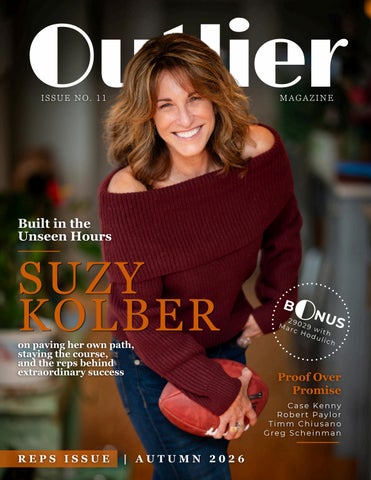
Outlier ISSUE NO. 11
MAGAZINE
Built in the Unseen Hours
SUZY KOLBER on paving her own path, staying the course, and the reps behind extraordinary success
ONUS
B
29 Ma 029 w rc Ho ith du lic
h
Proof Over Promise Case Kenny Robert Paylor Timm Chiusano Greg Scheinman
REPS ISSUE
| AUTUMN 2026
Be an Outlier
see who you can become
Join a Community of Inspired Individuals. theoutlierproject.live
TABLE OF CONTENTS 05
LETTER FROM THE PUBLISHER
06
What are Your Reps?
19
BUILT ON REPS: ROBERT PAYLOR
Mastering Mental Reps
31
Rebuilding from the Ground Up
44
BUILT ON REPS: GREG SCHEINMAN
BONUS FEATURE: MARC HODULICH Transformational Endurance Culture
2
BUILT ON REPS: TIMM CHIUSANO Chasing Diverse Pursuits
54
COVER STORY: SUZY KOLBER Redefining the Rules
Midlife Reinvention Masterclass
71
BUILT ON REPS: CASE KENNY
84
LEGENDS OF 29029 Unfiltered Conversations with Real Outliers
OUTLIER MAGAZINE | AUTUMN ISSUE
TABLE OF CONTENTS 85
FUEL FOR YOUR OUTLIER MINDSET
87
Follow these Outliers who are Redefining what it Means to Truly Live an Outlier Life
Hand-Selected Nuggets for Your Noggin
88
QUOTABLE WISDOM Proof in the Reps
OUTLIER MAGAZINE | AUTUMN ISSUE
‘EM OUT(LIERS)...
89
OUTLIER POWERHOUSES Thought-provoking quotes from real outliers
3
OUTLIER outlier-magazine.com
contact@outlier-magazine.com
EDITORIAL PUBLISHER & EDITOR-IN-CHIEF SCOTT MACGREGOR MANAGING EDITOR KATHY LOVE COPY EDITOR MELISSA COHEN CONTENT & ART DIRECTOR VICTORIA WALLING DIRECTOR OF PHOTOGRAPHY LISA BOUSQUET CONTRIBUTING WRITERS MEGAN GROSS MICHELLE MACE CURRAN AMANDA MCCREIGHT ANTONIO NEVES JARED ARMSTRONG PETER SCHALLER AMANDA SELLERS CHRIS SCHEMBRA MANDOLEN MULL, PH.D. KOFI DOUHADJI
Oscar- and multi-Grammy-winning musician, Juilliard-trained pianist, and genre-defying composer dedicated to soulful storytelling, cultural connection, and musical innovation
Jon Batiste Photo Credit: Douglas Mason/Getty Images
Outlier Magazine celebrates the courageous and creative people who dare to show up differently, color outside the lines and take the path less traveled.
Follow us:
@outliermagazineofficial
@outliermagazineofficial
@outliermagazineofficial
For advertising interests, send an email to: SALES@OUTLIER-MAGAZINE.COM 4
OUTLIER MAGAZINE | AUTUMN ISSUE
WE CELEBRATE RESULTS.
The championship, the finish line, the career highlight reel. What we rarely see is everything that came before: the early mornings, the quiet repetition, the days when showing up was the only victory available. That’s what this issue is about. Autumn has always felt like a season of return, back to routines, back to work, back to the habits that carry us forward. It’s also harvest season, when we reap what we’ve planted. Both ideas sit at the heart of our “Reps” issue. Our cover subject, Suzy Kolber, has spent decades at the top of a demanding profession. Her success didn’t come from a single big moment. It came from thousands of small ones, done well and done again. Robert Paylor reminds us what reps look like when the stakes are everything: one step, then another, rebuilt from the ground up. Marc Hodulich and the 29029 community show that even Everest can be climbed one lap at a time. Case Kenny makes the case that our minds need training as much as our bodies. And Timm Chiusano, the “Mister Rogers of Corporate America,” has built a following of more than a million people by celebrating something most of us overlook: the beauty of the ordinary day.
OUTLIER MAGAZINE | AUTUMN ISSUE
LETTER FROM THE PUBLISHER His daily vlogs are a masterclass in reps, proof that the mundane moments aren’t in the way of a meaningful life. They are the meaningful life. Different paths, same truth: extraordinary lives are built in ordinary moments, repeated. So as you read these pages, ask yourself one question: What are your reps? What’s the small thing you could do today, and tomorrow, and the day after that, that would add up to something you’d be proud of? Nobody sees the reps. Everyone sees the results. Here’s to the work.
Scott MacGregor Publisher and Editor-in-Chief
5
BUILT ON REPS FEATURE NO. 01
with...
CASE KENNY Best-Selling Author, Keynote Speaker, Investor and Advisor, Mindfulness Expert
"PAIN IS THE EVENT. SUFFERING IS THE ADDITIVE STORY THAT YOU ADD TO IT ABOUT WHY IT HAPPENED."
6
OUTLIER MAGAZINE | AUTUMN ISSUE
Q: Case, you're an alum of one of the toughest schools to get into, Notre Dame, and you chose a pretty outlier-ish major. You studied linguistics, and I think it was Mandarin Chinese and Arabic in particular. So I'm curious, what drew you to those studies as a teenager? Yeah, certainly I wasn't in the same group as all my friends at Notre Dame. They were all business majors, and they all went into consulting and investment banking, and there I was, that guy doing this weird major. I kinda go back to my upbringing. I'm grateful to have been raised very creatively. I went to Waldorf school early on in my educational career, which is very much a learn-throughplay approach, focused on the creative lens of education. So I've always leaned into what had a hold on my heart and my soul and what really helped light a creative fire in me. And so, when I got to Notre Dame, luckily, I had the support of my parents to choose what I was interested in. I've always had a thing for languages.
Photo credit: Case Kenny’s Instagram
I've always loved language. I've always loved the study of how tweaking small words changes meaning. I've always had a keen appreciation and interest in how other cultures express things, whether that's an emotion or just a narrative. I've always found it to be very interesting. I was that guy in middle school and high school who took six years of Latin and was very good at it and enjoyed it. So when I got to Notre Dame, luckily they had these programs, and I was like, "Oh, let me choose two languages that are challenging, that kinda scratch that itch," but that
"OPTIMISM IS, BY DEFINITION, THE BELIEF THAT THINGS CAN CHANGE." -CASE KENNY
OUTLIER MAGAZINE | AUTUMN ISSUE
7
also, in my mind, had an opportunity within it for business postgraduation. So I looked at Chinese for the government, for the international business element, and Arabic for the government work. And yeah, I just threw myself into both completely. And then, of course, as life would have it, I never actually used those languages professionally, although I do now in all my teachings and workshops. I reference it quite heavily because it really is the foundation for how I think about linguistics.
advertising technology sales, and I was good at it. I worked my way up from an account executive to a regional vice president. I was making good money. I was leading a team.
But that was it. I pulled on that cord of passion and I was that guy every single day for four years going from Chinese class where it's a tonal language, it's very challenging, and you're reading left to right, and then I'd go next class to Arabic, which is an alphabet, and it's right to left. If you wanna talk about using all sides of your brain and all nooks and crannies of your brain, I think that really helped immensely.
And finally, the timing presented itself right after COVID for me to take a good look at my career versus what I was building and teaching on the side. And yeah, I took that leap. It was very difficult. It was leaving behind an identity.
Q: After a very successful corporate career, you stepped away to create content and to speak and write and change the world. How difficult was that decision? It was very difficult, admittedly. By the time I found my footing in my career, I was 30, 31. I dedicated 10 good years to it, finally found my footing in 8
But it didn't have that depth that I knew I wanted. And yeah, I felt that classic 30-something pull to finally do things according to my own expectations. Luckily, while I was working that job, I had started writing and I had started podcasting on the side to really scratch that itch of knowing myself.
It was also leaving behind financial security. I haven't looked back and I've been successful, and I'm very grateful for that, but it was a very difficult thing. Even at the time when I was working that job, and people were aware of what I was doing on the side, I had immense imposter syndrome and really downplayed it. People would ask me about it, and I would say, "Oh, no. That's silly. I don't really care about it," where the reality was, yes, I cared immensely about it. It was my soul's work. So I think
OUTLIER MAGAZINE | AUTUMN ISSUE
quitting that job helped me snap out of it and say, "This is important to me. Not only do I do it professionally, but this is the thing that I was put on the earth to do as a human." Talk about taking the leap and learning how to fly on the way down. I feel like I fit that criteria.
WATCH THIS NEXT PART! The world is grateful that you took the leap. You spend a lot of your time now talking about mindfulness and optimism, and those are two things we hear all the time, but I think sometimes people can't really define them. So I'm curious what they mean to you. Tune in to Scott and Case’s conversation about this question here:
Photo credit: Case Kenny’s LinkedIn
Q: Your appeal, I think, is that you come across as an everyday dude, not a clinical guru. How important has that been to amassing a following that's in the millions? It's important, because I try very hard not to be anyone other than I am, and I am a regular guy. I will say that, you know, some people know me just from Instagram. A lot of people know me from my keynotes and workshops, and those are the same person, but on the professional side, there's a lot of academic rigor that I put into the work. Like when I write a whimsical quote on Instagram, I really try to ground it in what I know the brain craves and wants. So I'm knee-deep every single day in the academia of the topic. I spend a lot of time, and I'm always in the process of writing a book, so I'm always working in neuroscience labs
OUTLIER MAGAZINE | AUTUMN ISSUE
9
and working with an EEG on my brain and doing a lot of research into the physiology of optimism. It's fascinating, fascinating, fascinating. I like to approach the topic with human language, 'cause I'm human, and you're human, and we're regular people, but that language applies very specifically to how the brain actually works. It's like you guide people to water, and then you get them to drink. You guide them there with relatability and a little bit of playfulness, a little bit of wit, a little bit of humor from every now and then. So I really try to do that. I think in my 20s, I was a little bit of a self-help skeptic 'cause, yeah, maybe to your point, you would hear some of these experts and gurus talking about these things, and they're great, super inspiring. I have just found, as someone who's really dedicated himself to this one singular topic for almost the past 15 to 20 years, is the more that I know, the more I realize I don't know, and it's a humbling craft.
Photo credit: Apple Podcasts
Q: Pretty good deal. You started your podcast in 2018. It's now a top-25 podcast with 40 million-plus listeners. I'm curious what the goal was eight years ago, and has that goal changed now? Most people podcast for eight months, not eight years.
I'm definitely a stubborn person I think whatever you're throwing your 'cause I've done 800 and some heart into, it will humble you. And the episodes. It's a lot of yapping. It's a result of that should be a bit of good question, though. The podcast humility and a bit of just being a was a real catalyst for me. So to my regular guy. So I try to let the work point, I was working that job. I was humble me because it means I'm really good at it, but I was frustrated learning, and then I get the immense because I had that job, and I knew privilege of just sharing it with people who I was as a regional vice president, and to make a living from it. I get to and I knew what I represented as make a living from helping people be “make money”, but I didn't know who more optimistic. I was outside of that. 10
OUTLIER MAGAZINE | AUTUMN ISSUE
I didn't know who I was as a human, as a man, as a brother, as a partner, and that really frustrated me. So that was the frustration that led me down this path. I started the podcast. The podcast was the first thing I ever did. I sat down and started just talking into a mic as a way to kind of force myself to develop perspective on life. Who am I? What do I want? What is my why? Those kinds of deep questions. And then I would just share them. I would share what I've learned. I would stand up with confidence, and I would just vocalize it. Talk about a creative way to know yourself. And that was in 2018, and it's changed my life fundamentally. I mean, there's something to be said about vocalizing emotions and vulnerabilities 800 times. Mindfulness is a muscle. Optimism is a muscle. It started very much as the podcast was for me to know myself, and it still is, even though I feel like I know myself pretty well. I'm 38 now. Who I was at 35 and 30 and 28, different guy. So it's always just been that creative arena that I could step into for 15 to 20 minutes per episode and just, for lack of a better word, yap about my feelings. Now, I will say the podcast is increasingly aligned with research. I really like to take research and do that the best I can to simplify it down into 15 minutes. Complex topics to 12
simplify down. So that's really kind of the way that I use the podcast now versus when I was younger and talking about a variety of topics. Now it's very pointed. It’s such a great outlet for me. And yeah, podcasting's difficult. A lot of people give up quickly. But for me, it's a habit, right? It's a habit. Twice a week. I do it twice a week, no matter what. I don't think I've ever missed an episode over almost nine years.
Q: Unbelievable. Tom Brady is always asked, "What's your favorite Super Bowl?" And I don't know if you know what his answer is, but I'm gonna ask you. You've written a bunch of bestsellers. Which is your favorite? Ooh. Unfortunately, the answer would be the one that's going to come out in February of 2027.
Q: That's a Tom Brady answer. It's the next one. Oh, that's classic. That's how he would answer that. Well, okay. Well, then I'm glad I wandered into a seemingly good answer. That is my answer, 'cause I'm very excited about that book. It's called The Language of Optimism, so it's everything that I'm
OUTLIER MAGAZINE | AUTUMN ISSUE
passionate about. I mean, it's funny, even talking now, I'm working on a book that's coming out in 2029 right now because I'm running it through a variety of third-party studies, and we're doing a lot of clinical work on it. So it's always the next thing, not as like a goalpost moving thing, but it's my best work is the next work, and I'm proud of what I've released, but I'm, I'm really, really proud of what I will release.
Q: Your work has landed you on the Today Show, Good Morning America, NBC, ABC, Forbes, Fortune, now Outlier Magazine. Can't miss that one. Were any of them the goal or had they just been kind of like icing on the cake?
Photo credit: Case Kenny’s LinkedIn
OUTLIER MAGAZINE | AUTUMN ISSUE
The honest answer is icing on the cake. I never set out to do this professionally, truly. I thought I was gonna be a, you know, chief revenue officer or CEO of a technology company. That was the path. I thought that's where I was going to go, 'cause I was just following kind of what I was good at and kind of where it led. Yet people have been overwhelmingly kind and nice and generous to me. So any time I've had a breakthrough moment, like being on the Today Show, Good Morning America, it's all because a producer followed me on Instagram and was like, "This is great." So, I never set out to do that. Obviously now, in the past five years that I do this full time, certainly it's part of the strategy. I would love to do these high-profile things. But it's always just been people being very, very kind to me. It really has, as much as I am in a very privileged position, it has helped strengthen my perspective on people and humanity. I have a very optimistic view of people and kindness and what goes around comes around. I take it all in stride and I'm very grateful. It's always been really cool to see these topics that I talk about resonate so much with other people. People come to me and say, "Oh, I went through the same thing," or, "I feel the same way," and it really has helped me realize how big and small
13
So I started off writing on cups and papers, and I lived downtown Chicago and I would put them up in real life. I would write in all kinds of different colors and materials. Eventually, though, to your point, I settled on red, which some people are like, "Oh my gosh, red is so triggering. It reminds me of my third grade English teacher." I see red as the most hopeful, vibrant color in the world. Photo credit: Case Kenny’s LinkedIn
life is. Big in sense of the variety of experiences that we have, but small in the sense that they're all the same experiences, just dressed up in different ways, and we could speak to them and we could find humanity in each other. Going on a show like the Today Show just reminds me of that immensely.
Q: Your signature handwritten red notes have gone viral. Where did that genius idea come from? I appreciate that. I started heavily focusing on Instagram in 2019, 2020, and my whole inclination there was to take some of these complex topics that I talk about on the podcast for 20 minutes and see if I could express them in 14 to 15 words. But I didn't want to fire up Photoshop and just do a digital quote. That felt so removed from life. I was like, “I want to put these learnings into context." 14
"Look here." It says, "Here's all this noise. Look here." And that's what sometimes we need, right? The whole work of optimism is about attention, training your attention to focus on the upside so that your behavior follows and your outcomes follow. So I have landed on red as my chosen color, as this idea of breaking through the clutter of my own mind or expectations or whatever it is. And certainly I'm not the only person who has used red, but I've kind of become known as the the guy who does red. And, I write on a piece of paper. It's real. I take a photo of it on my cell phone, on my iPhone, and I just brighten it up a little. I have stacks of paper. It's this analog creative thing that I do. It's kind of cool to have a signature color, I suppose. People are like, "Oh, that's Case. That's red." I've got a wide variety of red pens. It's arts and crafts here in my house most days.
OUTLIER MAGAZINE | AUTUMN ISSUE
So that's the story.
Q: Are you a Sharpie guy? I use a variety of pens depending on what I'm doing. Sharpie…
Q: They should be sponsoring you. Shout out Zebra Pen. They sponsor me. I use them for some of my finer work. They're these great pens. Sometimes I'll use a big fat one that I get at Blick Art Supply if I want to do something big and bold. It kind of depends on the canvas that I'm working with for the day.
Q: You do music and mindfulness DJ collabs, and that combination is pretty unique. What's the synergy between the two? I would say the following: I've always loved dance music. There's something about EDM. We're talking house music. We're talking the wide variety of genres there: techno, anything.There's something about the structure of dance music that is really cathartic and vulnerable to me. It's break, build, drop. Break, build, drop. It's very progressive. It has that rhythm to it. For me, anytime I write anything, whether it's an essay, whether it's a podcast, whether it's a book, whether it's Instagram, I'm always listening to house music.
OUTLIER MAGAZINE | AUTUMN ISSUE
It puts me in a state of vulnerability.Most people are like, "Oh, you probably... you know, it's like a Zen garden in Case Kenny's life." It's not at all. It is all house music. I've always leaned into that as a mechanism for me to be vulnerable. I always used to go to the shows and the clubs and really was into that. And funnily enough, my wife is a DJ and producer, so our whole house is music. But over the years I've been fortunate to work with a variety of artists just to bring this idea to life for fun. It's just a fun thing for me to do, for Martin Garrix or one of these larger commercial DJs to come on the podcast and they'll play a set, and then in the interludes I'll talk a little bit, and then it's back to the music. It's just a way to weave in mindfulness and music. I release those quite sparingly now, to be honest, but I like the medium as a reminder that mindfulness or therapy or vulnerability or writing in a journal doesn't have to be this sad, heavy endeavor. It's a celebration of life. It should be exciting to sit down and know yourself. What a gift. So I like combining it with music that brings its life, and in this case, it's dance music.
15
Q: I heard you say words are spells. Tell us more. I'm sure people have heard that phrase on the internet at some point. But it's actually quite backed by the way that the brain works. The brain is, you know... we talk about words are spells. We hear phrases like, "Words create reality." It's true.The brain is not only a processing machine, it's also a prediction machine. So when I think about the brain, I think about this thing that is an all-empowering force in our life that's always trying to answer the question of what will happen next? And what fuels that? Not only evidence from the past, right, the data points, but also what we tell it to look for next. And there's all kinds of interesting philosophy and linguistics and psychological overlap here, but overwhelmingly so, our words tell our brain what reality to look for. And of course, it's the same idea of, "Don't think of a yellow car." You think of a yellow car. You start spotting a yellow car. You start to construct your reality based upon what you tell your brain. It's not just wishful thinking. Truly, you can measure a lot of this, and it's so, so interesting to me.
literally see the way that your brainwaves, your alpha waves, your theta waves, your gamma waves, these are subconscious-level brainwaves, react to changes in language. So for me, it's not theoretical, it is not whimsy to say words are spells. They really do have an impact on the brain. They direct your attention. Your attention changes your behavior, your behavior changes outcomes, but it all starts with words.
Q: You talk about not playing a role in your own suffering. What do you mean by that? Yeah. I think, you know, we all have pain in life. We all have frustration in life. We all have randomness, things that happen to us that hurt us. There's a difference between pain and suffering, as a lot of people have pointed out over the years. Photo credit: Case Kenny’s LinkedIn
I've spent a lot of time in a lab with an EEG on my brain, and you could 16
OUTLIER MAGAZINE | AUTUMN ISSUE
you're falling short, it's also here, here, and here, pervasive across your whole life. And then the third and final P is it's personal. This is happening to you. Of course this would happen to you. Not them, but you. You have been chosen. You are being singled out. That is suffering, and that's all word choice. So if we could avoid the three Ps, again, usually in my world using language that supports the idea that things can change, this emotion is not permanent, it's temporary. Photo credit: Case Kenny’s LinkedIn
Pain is the event. Pain is the thing. You might have caused it; you might not have. It might have been random; it might have been unfair. Suffering is the additive story that you add to it about why it happened, right? The story you say that this always happens to me: suffering. This happened to me because I'm not worthy: suffering, right? It's a story that you tell to yourself, and again, that's an endeavor of words. The whole work of optimism, to borrow a little bit from the father of optimism, Martin Seligman, who really kind of pioneered positive psychology, it's the story you tell yourself that leads to suffering. And usually, it revolves around the three Ps. This is what causes suffering. It's telling yourself that the feeling that you're feeling is permanent.
OUTLIER MAGAZINE | AUTUMN ISSUE
This emotion is not pervasive, it's just here and it's just today. And certainly this emotion, this context, is not personal. This is not just you. It's not you against the world. That is how we stop the pain at pain, and we move away from it being this idea of suffering.
Photo credit: Case Kenny’s Instagram
17
Q: It's crazy that you've been at this for about a decade, and you've amassed a huge following, and you've impacted so many lives, but you're still so young. Do you look out five years, 10 years, 15 years? Do you have that longterm vision of where you want to see this go? I do in a sense. I want to help as many people as humanly possible in person. So five years from now, 10 years from now, I want to be doing stadium-level tours and gatherings of optimists. So my work right now is planting those seeds. Other than that, I don't really hold myself to a hard and fast plan or forecast or anything like that. Working for yourself, being an entrepreneur, being an artist, being an author, I think requires a lot of flexibility along the way. And I think that's really the gift that I've given myself over the years, is allowing myself to pivot, choosing my mission, which I have and I'm locked in and I don't think it'll ever change, spreading optimism, teaching optimism, but allowing the how to evolve.
optimism amplified with the person to your left and right and in front and behind you. I host a lot of my own events, and obviously I do a lot of corporate speaking. And just being in the rooms where the sole intention, even if it's just for 60 minutes, is to be optimistic, you can feel it. And I'm actually writing a book about what happens when our nervous systems are all the same wavelength around optimism. It's a fascinating subject. It actually does have a physiological ripple effect, and that's what I wanna help spread. So to answer your question, it’s yes and no, and I'm open to everything in between, and I'm lucky to be so stubborn. It's all I do. It's all I care about. I will always figure out a way. It's just the way that I'm built, and it drives me crazy some days 'cause I'm super ambitious and there's always more to learn. So yeah, we'll reconvene in five years and we can revisit the subject.
Photo credit: Siri Lindley’s Facebook
And right now, and the one thing I do want to see brought to life, is just the power of community, the power of gathering people and seeing 18
Photo credit: Case Kenny’s LinkedIn
OUTLIER MAGAZINE | AUTUMN ISSUE
BUILT ON REPS FEATURE NO. 02
with...
ROBERT PAYLOR Inspirational Speaker, Author, Quadriplegic on a journey to walk again
“THE ONE THING YOU’LL ALWAYS HAVE CONTROL OVER IS YOUR MINDSET.”
OUTLIER MAGAZINE | AUTUMN ISSUE
19
Q: Before May 6, 2017, who was Robert Paylor? What drove you as a player, and what did you think your path looked like at Cal? Before my injury, I really was the same person in so many ways, just with different goals. I'm a pretty positive guy now, and all my friends back then would have described me as the most positive guy that they know. That positivity is so ingrained in me, and my faith played a really big role in my upbringing, and certainly has helped me throughout my recovery. Photo credit: www.kcra.com
That's something that always guided me and helped me show that my life isn't just about me. It's really about how I use my life and gifts to serve others. So that was always something I held really close to my heart. But of course, when it came to my goals, it was all about athletics. I wanted to be the best athlete I could be. And then once I found rugby, I found, wow, I can be one of the best at this sport in the country. I'm gonna go for it. So, I'm competing over at Jesuit High School in Sacramento, California, which is the winningest
high school rugby program in America, with my eyes set on playing for UC Berkeley, by far the most successful rugby program in America, by far the most successful sports team in America when you look at that track record of 35 national championships in 46 years. I think the Harlem Globetrotters is the only team that's had more wins than that. And we're not playing the Washington Generals every week. This stuff is real. I think that focus of service, of positivity, just that zeal
“THE MOST POWERFUL FORCE IN MY LIFE IS NOT MY CIRCUMSTANCES. IT’S MY RESPONSE TO THEM.” -ROBERT PAYLOR
20
OUTLIER MAGAZINE | AUTUMN ISSUE
and joy for life, and really wanting to maximize all these gifts I had been given for that athletic success, and then giving it to others, were just kind of the hallmark or kind of trademarks that really kept me moving forward and defined me. I think they define me in so many ways still today, just with different goals and objectives.
Q: So walk me through the moment in the championship match. What do you actually remember, and how quickly did you understand what had happened and the gravity of it?
guys thrive, and I'm 6'5", 245 pounds. I'm put on the earth to move people. And we're just five meters out from scoring. I'm practically drooling on the field, thinking, "Let's go, Rob. Drive this thing in." But as I'm doing that, the opposing players start making illegal moves, and the referee's not calling anything. So first, three players enter in from the side, which are all infractions in rugby. You can't do that, but the ref's not calling it. Most critically, their number eight puts me in a headlock. He's got my chin pinned down to my chest. Now, normally in rugby, that's an automatic yellow or red card.
I remember everything. I remember more from that day than really any day in my life. I remember waking up extremely excited. I'm starting as a sophomore for the number one team in the nation, competing for our 32nd national championship. This is what you dream of as an athlete.
If you touch the head or neck, you're gone from the game, no questions asked. But the referee's not calling anything. And as I'm pinned in that position, another player chops me down by my legs. Another penalty. But that guy who's got that bind around my neck drags me down by my head, and I can't get my head up.
We're on national television, thousands of people are there in the stands. It's a day of legacy. And it's very early on in the game that I'm competing in a maul, which is when the bigger guys, we group up in one unit, and then we start pushing to advance the ball, which was my moment.
So I just close my eyes. I grit my teeth. I feel this God-awful crunch in my neck just snap, and then poof, can't move anything. Couldn't feel anything. That intense pins and needles buzzing sensation everywhere from my collarbone down. I knew in an instant that I broke my neck
It’s a boiler room. It’s where the big
I had a spinal cord injury, and my life
OUTLIER MAGAZINE | AUTUMN ISSUE
21
had forever changed in that moment. And what swept over me in that moment was just sheer terror, and it's a terror that I can't describe. It's that fight or flight moment. It's when you're looking death in the face is really what it felt like. And I played out a future in my head where I'm probably going to sit in a wheelchair, and my mom's gonna get me outside so I can have some fresh air or point me in front of a TV. She'll spoon feed me. One day she's going to die, and then I'll just have a caretaker kinda keeping me alive, and my life will be probably meaningless and hopeless, and I'll just be looking back to this moment where everything changed for the rest of my life. But I'm still holding onto this shred of hope that maybe it's gonna get better. And I go over to the hospital, we took all the medical imaging, Xray, CT scan, MRI. My doctor comes into the room, he's got a really bad look on his face, and he just says very matter-of-factly, "Robert, what happened is bad. It's really bad, and the reality is you'll never walk again. You'll never move your hands, but we're gonna do our best so that one day you can do something like pick up a piece of pizza and bring it to your face. And if you can do that, you made it. If you can just feed yourself, you beat 22
Photo credit: Robertpaylor.com
all the odds. And then he recommends a spinal fusion surgery to me, and he says that it's my best chance at stability and recovery, but I might not wake up from the surgery. It is potentially lifethreatening, and I have an hour to make a choice. So in this moment, I need to get my affairs together really quickly. I'm making a life or death decision, literally, and trying to fight for my best quality of life. Like I said earlier, my faith is very important to me, so the first phone call I make is to my spiritual director. I'm Catholic, so I wanted to get a priest in the room to get my last rites. I'm literally getting ready to die. So I call this guy who I knew who was going to become a priest soon, so we could get a priest
OUTLIER MAGAZINE | AUTUMN ISSUE
in the room here in Santa Clara where I was. He does that, but even equally as importantly, he gives me this piece of advice that's just carried me ever since, and it gave me a lot of power in what should've been a powerless situation in that hospital room. He said, "Robert, what happened to you is terrible, and throughout this journey there's gonna be a lot of things that you can't control, but the one thing you'll always have control over is your mindset. So your positivity, your ambition, your willingness to fight this is up to you, and this injury can't take that away from you." I look back to that moment and I think, I didn't have a lot. I didn't have the odds on my side, I didn't have a doctor saying that everything was going to be okay, and I had no signs of life showing up in my body. But I had this ability to make a decision and think that the most powerful force in my life is not my circumstances, it's really my response to them. And right now I need to drive out all that fear and anxiety so I can stay calm and collected, look forward, and make a clear decision on what I'm going to do about this surgery. That's when I decided to go in. So my brother holds my phone in front of
OUTLIER MAGAZINE | AUTUMN ISSUE
me. I FaceTime my best friends. I tell them what happened, that I might not see them again, but I love them. The priest comes into the room. I receive the sacrament with my family. They roll me into the operating room and put the anesthesia mask over my face. They say count down from 100. I think I made it to 97, and that concluded that big day for me, May 6, 2017.
Q: You went from being told that you'd be lucky to feed yourself to walking 500 yards. Tell us about what that dayto-day grind has been like. You know, at first it was so focused, and I have this team of people around me pushing me, which I meshed into very seamlessly because it was like an athletic type environment. I've got a schedule, I've got goals, I've got people who I'm working with, and kinda this player to coach problem-solving type of dynamic. So back then it was quite easy because I just had to answer the call. The schedule was laid out for me, I just had to do it. So from a mental capacity, there was some ease in that regard. I think it's now that I am, I gotta remember the day, I think it's 3,329 days that I'm out from my injury.
23
That's pretty tough. I think anybody could do what I've done for a day, a week, or a month, but 3,329, that's where you really need honed-in principles. You need to know what you're working towards. You need to have strong commitments. And I think that's what I'm most proud of, is just being able to show up every single day. But if I had to go back to, like, what's the one thing that keeps me going at it, it's because I'm not doing it just to go from point A to point B on my feet. It's that I recognize that by me getting up and giving my best effort today, I am able to make a difference in thousands, maybe even millions of lives. And there's people who when they go on their phone in the evening and are looking through their Instagram
stories, they're counting on seeing me getting up in my walker and keep moving forward, because they have their own challenges. And I know, Scott, you always give me the clapping hands and all that stuff on all those stories. That's what keeps me going, is knowing that there's people cheering for me, there's people counting on me, and what I'm doing in that is so much more important than just going from point A to point B on my feet. That's what keeps you going. It's not that selfish commitment, it's a selfless one.
WATCH THIS NEXT PART! One of the most remarkable things about you, and there's a lot of them, is your ability to forgive. That player and the team, I believe, never apologized for what happened. How did you get to the place where you could forgive? Tune in to Scott and Robert’s conversation about this question here:
Photo credit: robertpaylor.com
OUTLIER MAGAZINE | AUTUMN ISSUE
25
Q: When you walked across that stage to get your diploma, I think it was at the Greek… It was.
Q: What was going through your mind in that moment? I was thinking back to myself in the hospital bed years before, and how scared I was back then, wondering, "What's my life going to look like? Am I gonna be able to go back to school? Am I going to be able to see my friends? Am I going to walk across that stage? And am I going to have a job? Am I going to get married? Can I have a family?" Literally, every single one of those things has happened, and graduating across the stage was such a powerful moment because it's this visual representation of all these people who have supported me over these last nine years. There were 15,000 people filling the Greek Theatre that day. Every single person on their feet, cheering their butts off. In that moment, I got into my walker. I walked maybe about 10 steps and then my rugby coach handed me my diploma. I threw it into the air as high as I could. The whole crowd was going nuts. I mean, just nuts. I'll never forget it. Just the energy and the adulation and love that they're all pouring out, that's
26
Photo credit: Robert Paylor’s Facebook
enough to keep you going for 100 years. I'll never forget a moment like that.
Q: How has building a family reshaped you? It's changed so much. He just turned six months old yesterday, so you know, I'm still learning a lot. But I think it's really defined my life and my why better than anything I've ever gone through. I have this life that's totally dependent on me now and didn't ask to exist, you know? We brought him into the world, and it's just shaped the way that I wake up and give a full effort better than anything I've ever done because I want to give him the best life possible, and I want him to grow up with very strong values. Even though he's only six months old, I want to start laying that foundation of resilience and a positive mindset now because challenges will come his
OUTLIER MAGAZINE | AUTUMN ISSUE
Powerful. What’s the central idea that you want people to walk away with? Because it’s not about being physically paralyzed.
Photo credit: Robert Paylor’s Facebook
way in life, very significant challenges will happen to him. What's driven me in fatherhood is just trying to be the man that I want him to be. I want him to wake up in the morning, and I'm already up, and I'm going through my routine. I want him to see that. And when a challenge happens to me in my life, I don't wanna respond with yelling and with panic, but to be cool and collected and just to spend time with him too, and just to realize that, that he and my wife are my world and nothing will ever change that.
That's right. And when you look at the front cover, the top half is covered with all these words like grief, anxiety, doubt. Those are there for a reason, because that's really what paralyzes us in life. Yes, I have this journey of overcoming a physical paralysis, but we all have things that paralyze us mentally or emotionally, and truth is, the majority of what paralyzes me lies beneath the surface.
So I think living out those sensibilities that I want him to have in his life have really helped me to just be the best person I can be.
That's true for all of us. I think the most central question, and important question, that I ask in this book, it's in the introduction: What paralyzes you? What stops you from being your best? What's holding you back? I don't think we spend enough time thinking about those questions of what's stopping us, and a central thing that I want people to ask themselves is, "What's stopping me from making my optimal impact in the world?" So there's that, but I think the next step after that is just realizing you have agency, and no matter what you're going through, you can make a decision to keep moving forward.
Q: You wrote an unbelievable book called Paralyzed to
And just as when I was on that hospital bed being told I'll never walk
OUTLIER MAGAZINE | AUTUMN ISSUE
27
or move my hands for the rest of my life, I might not even live through the end of this day, but I can make a decision to keep moving forward, so can you. I share a plethora of tools.
home, I wake up at 7:00. I wish I could say I woke up at 5:00 or 4:00, but I need my beauty sleep. This just doesn't happen. So I get up, and the first thing I do is I get up and I pray.
Each chapter, there's 15 chapters, each one is a tool that I recommend people use in overcoming what paralyzes them, but it really all starts from realizing that you can make a decision to never give up. And as long as you're holding onto that, you're never out for the count.
I sit down and I thank God for this day. I go through some of the things that are coming in front of me in this day, and I pray for guidance on that. I pray for gratitude for the work that's on my plate right now.
Q: It's so powerful. Speaking of powerful, you went from somebody who moved people with brute force to somebody who now moves people through your writing, and you're moving people's minds and hearts and souls. What does a typical day look like for you as a speaker and as an author? I never thought I'd be doing this by the way, and I feel so grateful to be able to, and to take what should've been the worst thing that ever happened to me and turn it into a gift. And speaking and authorship is how I do that, to be able to share what I've learned in my journey of overcoming quadriplegia. So typical morning, if I’m here at 28
And no matter how busy I am, I try to remember that I prayed for this, this busyness, and what a blessing it is to be busy doing the work I once prayed for. When I'm home, I'm getting on the computer and I'm just thinking of, how can I inspire people today? I'm thinking of ideas that I can post on social media, or that I can speak about, or that I can write about. But my most exciting days are the ones when I have an event and I can go out and I can meet people and see them in person. I love being able to just travel across the country, and hopefully one day across the world, to meet people, to meet them in their challenges and to really open up my heart and put it in their soul so that they can keep moving forward. Those are the most exciting moments, when I can get on a stage
OUTLIER MAGAZINE | AUTUMN ISSUE
and pour my life out to a stranger, and by the end of that hour, we all feel like we're friends.
Q: You're inspiring so many people. You said you're in some ways grateful for what happened because of the meaning it's given your life. Do you still hold onto the goal of walking unassisted someday? And how do you balance chasing that with being at peace with where you are right now? That's such a good question. My answer is yes, I do hold onto the goal of being wheelchair independent. My goal on day one was to stand up out of my wheelchair one day and never sit back down into it. So I don't care if that's with a walker, crutches, a cane, or nothing at all, that's my goal. I fully 100% believe that's going to happen. It won't be today or tomorrow or the next day, but I just can't accept a reality where I give up on that goal, because I've had so much progress to date. I continue to progress. I really believe that's going to happen.
was to be wheelchair independent. I have not achieved that goal. And if you want to look at the science and the statistics, it heavily suggests that I will never achieve that goal. I ask myself, does that mean that I'm a failure? Does that mean that I failed? I think the answer is absolutely not, because I don't hold only those physical goals as my measure of success. What I really hold my success as, and I think everyone should do this, is three things. It's joy, it's gratitude, and it's meaning. I think if you have those three things, you have achieved success in your life. Are you waking up excited for a day and grateful for your life with a mission in your life? I think if you have that, it doesn't matter, in my case, whether I'm going from point A to point B on my feet, and it doesn't really matter if you've hit that weight loss goal or you've hit that annual revenue goal.
But this comes back to the last chapter of my book, I reflect on the fact that I am nine years out now and I am still in this wheelchair. My goal
OUTLIER MAGAZINE | AUTUMN ISSUE
29
That shouldn't be your true measure of success. It should be the joy, the gratitude, and the meaning that you have in your life. So go for those strict hard numbers, you know, the hard line quantitative things, go for that. That's a very good thing. But not at the expense of that joy, gratitude, and meaning. I think if you hold both of them together, you will live a very successful, very fulfilling life, and you won't have any regrets about anything you've done. Photo credit: Robert Paylor’s Facebook
30
OUTLIER MAGAZINE | AUTUMN ISSUE
BUILT ON REPS FEATURE NO. 03
with...
TIMM CHIUSANO Emmy Award-Winning Creative Executive, Storyteller, Author, & Leadership Specialist
"I WOULD RATHER FIND OUT HOW HARD THE BRICK WALL IS THAN NOT COME CLOSE TO RUNNING INTO IT."
OUTLIER MAGAZINE | AUTUMN ISSUE
31
Q: Tim, you went from about an $800,000 executive role to posting videos of yourself taking the trash out. What was the actual moment when you knew that the old version wasn't gonna work anymore? I don't know that I ever had that moment. It was more of, if I don't at least try this, at some point I'll die with regrets. And then once my wife really leaned into being the main catalyst for making sure that came to fruition... 'Cause you can have the realization, you can have the thoughts, you can have the questions, but then do you act on it, right? Just like anything else, it's like, oh, this sounds amazing—to go to this place, to pick up that hobby, to do this thing—but then how many of us actually do the thing? And you can contemplate those things for God knows how long before it actually starts to become real. So I don't know that I ever had, like, a singular moment where I thought, "This needs to change." Everything happened so fast over the four or five years that I was making content at the side of my desk while doing my
Photo credit: Timm’s Facebook
day job. It was really a combination of things and a very strategic approach to how I was unwinding myself from my job, as that led to where I am today. But there was no singular moment where I was like, "You know what? This is it." It was a lot of back and forth, and really my wife pushing me toward, "You gotta give this a shot."
"EXCELLENCE IS DOING WHAT YOU KNOW YOU NEED TO DO TO BE SUCCESSFUL CONSISTENTLY, EVEN WHEN IT’S HARD—AND EVEN WHEN IT’S BORING." -TIMM CHIUSANO 32
OUTLIER MAGAZINE | AUTUMN ISSUE
Q: We're all glad she did. You say that you responsibly fired yourself. What does that mean? That was a fun way to describe that this was not just a resignation. This was a very thoughtful approach to taking one of the four roles across a 450-person marketing department that was tied to a 3,000-person sales organization that was tied to a 100,000-person Fortune 100 company, and making sure that I left the right way. That meant the team was set up to be more than successful. The company wasn't in a position where they needed to do some sort of backfill that would potentially have other impact on head count or something else that would be an unintended consequence of this.
scenes. So by the time it came to talking about it publicly, I loved "responsibly firing myself" because it both gave the essence of how thoughtful I was about this, but in a quick way, and then also, to your earlier question, that this was about firing myself mentally. This was like, "Get out. You're not welcome anymore here. You need to change." The funny or ironic part of how I was phrasing it is that I didn't get the benefit of actually being fired, 'cause when you get fired, you get a severance package, and you get to keep your stock, and a whole bunch of perks along those lines. But really, it was a resignation. So it was like, "Cool, your last day, you're out."
And I had built that team from the ground up. Literally got brought in the Thursday before my first day to be told, "You're gonna have to fire all 100 people that you're inheriting, and you're gonna have to start this department from scratch. That's gonna happen in your first six weeks on the job. Godspeed."
I spent so much time responsibly firing myself, I literally did not even have my own laptop by the time I left the company. I was like, three days to go, I'm still working on budget decks and wrapping up things here and there because I cared about the people, and I really did care about that job more than I could probably ever fully describe.
And then, 11 years later, if I was gonna walk out the door, especially under these circumstances, it had to be done the right way. And that took literally almost 18 months behind the
Especially considering most people would be like, "Wait a minute, dude. That was at the cable company in this super weird aspect of their business." But it meant a lot to me,
OUTLIER MAGAZINE | AUTUMN ISSUE
33
so responsibly firing myself felt like the right way to phrase it.
Q: Your content has gone absolutely viral. And it's deliberately ordinary. It could be leftovers, it could be laundry, it could be a school drop-off. What made you bet that ordinary would cut through the noise? I wish I was that smart to say that there was a bet strategically on that. I was literally just thinking before this call, as I was wrapping up a piece of content for American Express while texting somebody that's gonna be at my house after this meeting to make another piece of content, all these things. I can make an argument that I'm the world's worst content creator. And I say that because, on most days, I don't know what I'm gonna post, which is so dumb, right? Like, I should have a strategy at some point. I know I have a vision, I have a million thoughts, but I overthink everything. And then it usually just comes back to literally what's in my brain at the moment, and does it feel like there's something resonant there? Does it feel authentic, and do I feel like it can pay something forward?
Photo credit: https://timm.work
And I've got this desktop background that says, "Does it serve their purpose?" There is something very strategic once I get in and once I think through something of, does it meet the audience where they need to be met? When it comes to a large audience, that can then become a very debilitating question to ask yourself, because then you're like, "Is this for the 16-year-old sneakerhead? Is this for the 58-year-old, brand-new grandmother who stopped you on the sidewalk last week and said how much she loved your stuff?" Like, who is this for? But I lean into the simple. I lean into
34
OUTLIER MAGAZINE | AUTUMN ISSUE
Q: You've had an incredible corporate career, and you've, in posts, called for, I'd call it, an NBA-style salary cap to close the gap between the C-suite and other workers. Tell us a little bit more about that But also, does it add some value? Am philosophy. truly where our ability to notice and value the small things in our worlds can bring something to our days that makes them that much more enjoyable, especially considering how the world can just be a huge flaming piece of crap sometimes.
I saying something about the mundane that is going to get somebody to look at something differently, help them from a broader career growth perspective for whatever reason?
I firmly believe that there is the ability to create this truly NBA-like approach, where the health of the organization and the league overall is more important than how you can reward the best stars, to avoid the same thing that the NBA looks to avoid, or that any professional sports organization looks to avoid.
But overall, I am just a hot mess when it comes to, what am I doing tomorrow? How does that then thread through the rest of it? And I keep defaulting back to some of the What do they want? They want same things and, you know, I've been fairness across the board. They want an equal playing field so that all very fortunate. markets and all teams have the same opportunity to grow and to thrive. Look underneath the hood at the They want to be able to put things in data, and some of it would say that there are days where things perform place so that nobody can just be like, "Cool, I'm gonna go get all the most super well, and there are months where you go backwards, and there expensive, all the highest paid, all the greatest stats, you know, all the are years where you have explosive greatest players," and put that growth. together. I try to just be empathetic to the person who is watching it. How do I either brighten their day a little or add some value that will make them feel a bit more comfortable and confident as they go through their own journey and try to do whatever they want to do with their lives?
OUTLIER MAGAZINE | AUTUMN ISSUE
It's a strategic move to create fairness and balance, to establish a more competitive landscape. And I do think that there's elements of that that, if put into place in corporate America— and I know this is a long shot too, right?—could make a difference. Like,
35
this is likely never going to happen, certainly in my lifetime. And it's also not anti-capitalism, you know? And when I've gotten that backlash, people are like, "Well, you know, that's a very socialist approach to things." First, I'm like, "Okay, so that's a whole different conversation relative to how you would define those terms." But also, LeBron James exists in a salary cap world, right? But that doesn't stop him from having a bazillion side hustles. So, making this up: What if C-level people had their salaries capped at, like, $10 million a year? But you can go do whatever side hustles you want to do. You tell me that those people aren't smart enough to still go aggregate as much wealth as they wanted to with side hustles? And yes, I'm making a lot of gross
Photo credit: Timm Chiusano’s Facebook
36
assumptions here, and things that can you can have counterarguments against. But I just love the idea that there is a way to create greater fairness across the board so that the companies can stay competitive, and you just don't have this ridiculous wealth discrepancy that just continues to exacerbate itself. And I couldn't help but think, as I would go out and grab my lunch on any given day in Midtown, there is, I don't know, a 10-, 15-, 20x salary difference between myself and the person that's serving me lunch, let alone within my own team in an entry-level position or whatever that number is. It just doesn't make sense to me. And then some of it is just, you know, you kind of get in your own head about some of these things from a philosophical perspective. But never before in the history of mankind— and I think that this is something that can be substantiated—have we truly had all of the resources at our disposal to fix every global problem that there is. We never had this much wealth. We never had this much both human power and now artificial intelligence power as well, to truly just go out and be like, "Cool, let's start to check some boxes." Yet in a lot of regards, we go backwards.
OUTLIER MAGAZINE | AUTUMN ISSUE
When I think about our own world, so to speak, and just the broader health of this country and corporate America, and knowing how many people are suffering from mental health issues, substance abuse issues, et cetera, et cetera, one place that we could potentially start is just a more equal and fair system across the board. And again, these are delusions of grandeur to think that this is something that would actually come to fruition, but I like it as a thought starter. It's one of those big, weird thought starters that hopefully starts a conversation, gets people to look at things differently. And also, who knows? I say that there's 10,000 people out there that are gonna change the world forever, potentially in ways we could have never fathomed. And those 10,000 people are the top 20 of the Fortune 500 companies that are right now, like, 24, 25 years old, and who knows what they're going to be brilliant enough and capable enough to end up impacting. Part of the reason why I hope to help the skeptics along the way too is because so many people are like, "Why do I ever want to become a manager? That sounds terrible. Why would I ever want to have my career grow when this is the outcome from a mental health perspective and
OUTLIER MAGAZINE | AUTUMN ISSUE
Photo credit: Timm Chiusano’s Facebook
some of the other downsides to it?" I'm like, "But you don't know the impact you can have," right? And it's part of the reason why I worked my ass off too. It's like, even if me "grinding" that much more at 4:00 in the morning would lead to my greater control over how well our P&L was being managed, which then led to even a 4% increase in total merit that I could then spread across 240 that's impacting people's lives. So yes, this NBA salary cap for corporate America is kind of a wild and, in some regards, a bit of a dumb thing to be like, "Cool, this is something we should go after." But I just try to never hold back from putting my biggest, weirdest ideas on the table in hopes that there's at least an open conversation like, "Well, what do you mean by that?" Versus, like, "You're an idiot. Get out of here."
37
WATCH THIS NEXT PART! You spent a lifetime managing hundreds and hundreds of people, and to a very, very high degree of success. What were some of your outlier-ish approaches to managing your teams? Tune in to Scott and Timm’s conversation about this question here:
You know, you're working out of your home, you're working out of a second office. Some days you're like, "I don't even know how to dress today." The rhythm, and even with all the stress that was out there, the rhythm and the systems and the people and the process and the healthcare and the benefits, it’s not even close. That was a way easier existence. That was a way easier job. The stress levels were still super, super high, but the level of difficulty behind this, especially to be able to consistently manage, maintain, look to grow, be your own finance team, your own HR team, your own strategy team, your own everything, is nuts. Part of the reason why I make a lot of the content that I do is to be like, "Don't rush to get out of corporate America. Are you nuts? Stay there and learn."
Q: You built a marketing team of several hundred people, then you walked away to build an audience of millions alone. It’s college, only you're getting paid. What's harder, leading people You can literally flip that around and be like, "This is where I come to learn or building trust with strangers every day." on the internet? Building trust with strangers on the internet by a country mile. Doing this on my own, the way we had the conversation where I've had half a meal today, I've got, you know, other things lined up throughout the afternoon. I'm consistently like, “I don't know what to post contentwise.” 38
Photo credit: https://timm.work
OUTLIER MAGAZINE | AUTUMN ISSUE
Why Not Try SomethingNew? Record 8 8 consecutive consecutive American American Business Business Awards Awards Record for Innovation Innovation for Highest Net Net Promoter Promoter Score Score on on record record of of 94.4% 94.4% Highest (Industry average average 28.0%) 28.0%) (Industry
TrySomethingNewNow.com
And you get paid for it. Yes, it's stressful, and it's different than what most people's college existences are, but I literally do think you can flip that narrative around and be like, "I'm now paid to learn, so why don't I go get paid to learn for, like, 10-plus years or so and accrue an incredible amount of skills, and then go do whatever I want to do?" Everyone's not an entrepreneur, everyone's not for corporate America, but in my humble opinion, it's an amazing place to grow and to learn and to do cool things despite all of the BS. It really is just in your head: what you create environment-wise, how you see things in that narrative. And it's a whole different ball of wax when it's just a blank sheet of paper every single day for yourself.
Q: Tell us about the Mr. Rogers comparison Going back to my earlier comment about the dumbest content creator on the planet, it's a call to arms, a call to action. It's a lofty goal that I will never fully achieve. He's arguably one of the top five, top 10 greatest creators ever, especially in modern history, based off of the impact that he had, the thoughtfulness that he put into everything, the strategy, the media 40
conglomerate of sorts that he created, the volume of content that he pumped out. I don't think a lot of people know that he put out, like, I don't know, like, 2,000 episodes or something nuts in that ballpark. He was just an icon and a legend that was just super quirky, but just an absolutely exquisite human being. And I'll never get there, but it's a really nice... A, it's just a way to simplify what people get when they come to my channel, quote, unquote, but also it is a lofty goal for me to consistently point myself towards in regards to what does good look like in all of this, right? And what am I really trying to do? It's trying to come close to the impact that that human being had. So it's a simple way to keep my focus as narrow as it should be, and also a lovely way to keep my aspirations as deep and as far as I would like them to be.
Q: You're a TEDx speaker, a marathoner, an NHL emergency backup goalie. This is all in your second act. Is that range a strategy, or is it just refusing to be one thing? Both. I'm strategic in trying to align with those things that you would
OUTLIER MAGAZINE | AUTUMN ISSUE
always aspire to do but might have seemed impossible. But why not still chase them? And also aligning with what makes the most sense relative to loftiness and then the potential vertical to actually get there. And I'll correct you on one thing. It's —and this is with all due respect to TEDx speakers—actually a TED speaker, because that was a TED event. That was something that blew my mind. Even to just, like, walk into the room and just see the TED logo standing there was just a crazy experience in and of itself. And all of these things are just... it's bringing back some of the dreams and aspirations that I had when I was 13 and literally being like, "Okay, cool. Like, I can..." I've done a good job over my career of finding interesting ways into rooms through back doors, and everything that you just mentioned was kind of a backdoor job to a certain extent, but also built off of decades of busting my ass and being okay with the fact that 4:00 AM to 10:00 PM, in 15-minute increments, balancing all of the things and the impossible balance of work and life, may not go anywhere, may not pay off whatsoever, and I may run into a brick wall. But I would rather find out how hard the brick wall is than not come close
OUTLIER MAGAZINE | AUTUMN ISSUE
to running into it. And that's not for everybody, which is totally cool, but it was strategic in the tiny little bits and pieces along the way of, like, "Ooh, this might lead to that. That could lead to this, but who knows?" But also just pure inner child not wanting to give up and seeing that there, for some reason, was a second, third, fourth, fifth, sixth, seventh, eighth act out there. I might be in a position where all of a sudden I'm staring down the slap shot of Ryan McDonagh in a Tampa Bay Lightning practice, which will forever be one of the craziest things that I'm able to say. It's just one of the crazy stories I'm able to tell at this point, and it just all seems fake. So I look forward to, at some point—I don't feel like I've done it yet—taking at least, like, two or three days of just lying down somewhere...
Photo credit: Timm Chiusano’s Facebook
41
It could be in my house, and just staring at the ceiling and contemplating, like, what has actually transpired since August of 2019 when I made that first stupid TikTok? 'Cause it is a baffling amount of stuff, but also hopefully a testament to don't care where things are going, but have dreams and aspirations and a vision, and be willing to just do all the things in between. And you just never know.
Q: The Timm that was climbing the ladder at ESPN back in the day, what would he think if he was watching the content that you're creating today? I think he would be super proud of the corporate stuff because there are a lot of life lessons learned then that I've actually lived up to and said "Oh, if I ever get in a position to do blank, I will or will not do these things." And I've stayed true to those, and I'm super, super proud of that. I think overall that version would be wildly perplexed as to where all the tattoos came from, 'cause that wasn't until I was in my mid-to-late 30s, and very, very intimidated. I think that person would be very intimidated of, like, "Wait a minute. How hard is it gonna be to try to get to where you are now?" 42
Photo credit: https://timm.work
So I'm proud of that as well, but I'm most proud to say that that version of me would be like, "Wow, the promises that you made to yourself relative to how you would treat a department, the things you would do during a reorg, how you would stick to rules, break rules, all that kind of stuff..." probably in 9.9 out of 10 instances, I stayed true to the words that I was making to myself back when I was in my late 20s, early 30s, you know, fumbling through that growth era and trying to make myself promises that, if I ever get to this place, this is how I would do it. And I'm pretty comfortable and confident to say that I've lived up to those promises.
OUTLIER MAGAZINE | AUTUMN ISSUE
research that I did over the past three Q: You've got a baller book idea coming out in the fall. Tell years to be able to say, "Here's how it works. Here's how it can help with us whatever you can about it.
How to Get Addicted to Appreciation is the title of the book. It is built on the concept that is very corroborated, and I substantiate it in the book, that appreciation is different from gratitude, and that gratitude is amazing. It is everything that everybody says about it, but it's transactional, whereas appreciation can be foundational and an actual disposition that you teach yourself. I think that there's half of the world that could read it and be like, "Wow, this substantiates everything that I've ever believed, and this is taking what I already thought that I saw and helping me elevate it to a whole nother level."
your self-esteem. Here's how it can help with your relationships. Here's how it can help you build the life that you want, make the most of your time, build your purpose, and help you troubleshoot when you're stuck in a rut."
I truly believe that it is a handbook, an actual handbook, to living a happier life, which I know is a huge promise to make as a writer, especially a rookie writer. But it's a handbook to living a happier life with very specific ways that are easy to digest, written in a way that combines a little bit of J.D. Salinger with a little bit of Brené Brown, but 100% who I am as a human being.
And then I think the other half of the world would read it and think, "I now have so many reasons to look at things in a kinder, lighter sense that's going to make me live a happier and more fulfilled life simply because I'm noticing and valuing the things in my world in a different way than before I read the book." It's a mix of stories from my life. It's stories, then substantiated by psychological research or something that I pulled from, the likes of Harvard Business Review studies and some really, really, really deep
OUTLIER MAGAZINE | AUTUMN ISSUE
43
BUILT ON REPS FEATURE NO. 04
with...
GREG SCHEINMAN Founder of Midlife Male, Entrepreneur, Author, & Performance & Longevity Expert
"WHEN PEOPLE TRUST YOU AND THEY'RE WILLING TO INVEST IN YOU, IT RAISES YOUR LEVEL OF RESPONSIBILITY AND COMMITMENT TO DELIVER."
44
OUTLIER MAGAZINE | AUTUMN ISSUE
Q: Greg, tell us a little bit about your background, including your journey as an entrepreneur. You've had two exits for, I think, seven figures. Give us just a little bit of the Greg Scheiman background. I started in film and entertainment. Right out of college, my first job was I ran Harvey Weinstein's office for two years, and I had the, I guess... I don't know what the right word is for this. I was able to tell Harvey to fuck off 30 years before the rest of the world was. And I thought I wanted to be in the film business and be a film producer and dedicate a movie to my dad and have his name up on the screen. These were important things to me at the time. You know, that's what I saw my life as. It didn't occur to me, Scott, you know, I think this is so perfect for the outliers. It didn't occur to me that when I told Harvey to fuck off and I didn't like the way I was being treated there at the time, it didn't occur to me that I still couldn't be in the film business. That I still couldn’t go out and be an
independent film producer, that anybody could stop me, and maybe that was, you know, narcissism. Maybe that was reckless youth. Maybe that was ego, whatever those things were. But I never understood that argument or that position from people, that if I didn't do this, then I would not be that... that one person could ever control your outcome, your destiny, or your future. So that's what I did. I left there young. I raised some money. I produced a couple of pretty good independent films. And then I ultimately decided that that wasn't my future. Be careful what you wish for. It wasn't the healthiest lifestyle, it wasn't what I really wanted to do, but I accomplished that goal. I got my dad's name up on the screen at the New York Film Festival. I went to South by Southwest. I did all the cool shit back then. And it taught me a lot. Then ultimately moving down here to Houston, where my wife is from, and getting married and having our first child, I knew how to make things. I was the outlier, always the
"IF YOU CHANGE YOUR MINDSET, YOU REALLY CAN CHANGE YOUR LIFE." -GREG SCHEINMAN
OUTLIER MAGAZINE | AUTUMN ISSUE
45
entrepreneur in spirit. You know, there was no family business to go into. I never wanted to follow the traditional path of all the Long Islanders that I grew up with, and ended up down in Houston, Texas, being married to a Texan. And if you would've told me that I'd be married with two kids living in Houston, Texas, I would've told you to bet the under, 30 years ago. But it should've been a safe bet, and, and here we are, though. When we had our first son, I remember sitting at home watching Baby Einstein DVDs, and I didn't have a job at the time. We were living off some of the film money, some of my past shit. I said, "Okay, we got a couple of years worth of runway, and then it's gonna get really bad," you know, ‘cause we got a lot of life ahead of us, and I don't know anybody in the state of Texas, much less Houston. We better figure some things out pretty quickly. And I'm watching Baby Einstein, and in the corner I've got picture-in-picture on. If you remember back in the day, when you had the first big screens, they were, like, 700 pounds, and you had picture-in-picture. And in the little screen, I would have ESPN on, 'cause that's what I wanted to watch as a dad and as a sports fan. And I'm looking at these two things, Scott, and one day I go, "Holy 46
shit, I could just put these together." Like, why can't I just make a Baby Einstein about sports, basically? I don't care about this classical music and these puppets, you know, and this other stuff. And that's how I formed Team Baby Entertainment, and we became a sports video company for kids, raising the next generation of fans. I went to all the leagues and got deals with the NBA and Major League Baseball and the NCAA and even NASCAR. Nobody had ever asked them to use their footage like this before, and they thought I was nuts. I showed them Baby Einstein Sport, and boom. We're gonna teach color, shapes, numbers, but we're gonna do it through your mascots, your logos, your teams, your players, your stuff. And they said, "Go ahead, dude. Do whatever you want. Knock yourself out.” And that's what I did, and I started selling DVDs out of the trunk of my car outside of football stadiums and on college campuses and at different places, and recruiting all my son's playgroups, you know, to show up and dress them up in all these uniforms. Long story short, I spent all my money on PR, and we started getting written about in different newspapers, local, regional, national. Michael Eisner read one of those articles in the LA Times, and he had
OUTLIER MAGAZINE | AUTUMN ISSUE
left Disney and he called me up and he said, "I want in on this." And he flew to Houston. I thought it was complete and utter bullshit that he was ever gonna show up. My office was in a room in an MRI facility that my friend had loaned me, so that every time they used the MRI machines, our computers would flicker on and off and shit like that. It was crazy. He shows up, walks in. I think he's gonna turn around when he sees this, you know, my conference table being held up by milk crates in this one-room thing. And we ended up talking for, like, two, three hours, and as he flew out, he said, "I'll be in touch." And I thought I'd never hear from him again. By the time he landed in New York, I had a $2 million offer. I built the company up for seven years as partners. Ultimately, the world changed and DVDs kinda went away. Apps became a thing. Pediatricians started telling parents not to put their kids in front of TVs. All of our stores, a lot of them went the way of Toys R Us, Borders, KB Toys, Circuit City. They're all gone. So that was my first exit, if you will, riding that wave, you know, up and down and through. And then the second one was, I was tired of taking so much risk, feeling
OUTLIER MAGAZINE | AUTUMN ISSUE
Photo credit: Greg Scheinman’s LinkedIn
like such an outlier. And I said, "What's the opposite of risk-taking?" This is how my simple mind works. Well, the opposite of risk-taking would be risk managing. So I went into the risk management business, knowing nothing about it. I called the guys that I was a client of in the insurance and risk management business, and I said, "Hey, I’ve got nothing to do, but I know people. know how to make stuff and do stuff, and I want something stable.” I've never had a paycheck, if you will. I've never had benefits. I've never had any of these. Now I have two kids. I'm back to the same position. I have some runway, but I don't have FU money. I'm young, I gotta do something.
47
And they said, "Yeah, come over here. You know, you line 'em up and we'll knock 'em down, and we'll teach you about this." And the smart thing I did, one the few, was I just negotiated not taking any money from them upfront. I said, "Look, I'll go full draw. I'll pay for my own license. I'll figure out if I like this, you know, overall. But if I hit certain metrics, I get a seat at the table, I get to buy in." And that's what I did, and I ended up there for 14 years. We went from 45 people to almost 200 people. I built a multimillion-dollar book of business, and I did it like an outlier. What I mean by that is I didn't know about insurance, but I knew entrepreneurship, I knew relationships, I knew business. I knew I could get people to trust me. So I started a TV show, because interviewing, what else? Risk-takers, entrepreneurs. People like me, outliers, rebels, people that I wanted to get to know and potentially wanted to represent. I put it on PBS, Houston PBS. I went to them and I said, "Hey, I have a TV show, all these entrepreneurs and risk-takers. Here are the names. I'm gonna do it, produce it, give it to you. All you need to do is give me the airtime." And they're like, "You're gonna do what?" I'm like, "Yeah, that's it. You give me the airtime." They're like, "Okay, we'll 48
give you Thursdays at 7:30." I go, "Great. Can I get that on a piece of paper?" Then I took it, went to all the people I said I was going to interview, and said, "It's Greg from PBS. I interview entrepreneurs and risktakers. My show is every Thursday at 7:30. Can I come spend some time with you?" And 80% of those people became clients, or referred me to other clients. So I built my book and bought in, and ultimately, in 2020, we sold the firm to a publicly traded company. And I went back at that time from having probably $26,000 in my checking account, living paycheck to paycheck, but on a lot of money. We were moving, man. We had kids in private school, we had the milliondollar house. We were doing it. The next day, $1,026,000 sitting in my checking account, and a bunch of stock that I had to sit on for years. And then they fired me. We were supposed to stay a year, all of us partners and everything else, and they said, "You don't wanna be here, and we don't really want you here." And they were absolutely right.
Q: How old were you at that point? Oh, man. It was 2020, so what's this… OUTLIER MAGAZINE | AUTUMN ISSUE
2026 and I'm 53, so what is that, 47? And that was the time when I had the whole midlife thing. I'm 47. I'm the same age as when my father passed away. I got the office on the 24th floor overlooking downtown Houston. I got the multimillion-dollar book of business. I'm drinking too much. I don't like the clothes I'm wearing. I don't wanna be a corporate guy. I can't believe it's been, you know, all these years. I can't stay here forever, but we hadn't sold just yet. What do I do? Do I quit, follow my passion? By the way, I don't even know what that is. If I quit, there's no more money coming in. I have all this equity, everything else. It was that moment, and I'm like, "What do I do now?"
How do I work through this? And I was fortunate enough that that's when I got my first coach, somebody to help me not ruin this. That's when my wife was like, "Hey, you can't blow this for us." Basically, "You think you're unhappy now, wait until you just quit. See how unhappy you're gonna be when they stop sending you checks." And I spent 47 to 50, Scott, reinventing myself, if you will, saying, "Okay, I don't have to quit this, but I need to do it better. I need to live my life better. I need to go back, quite frankly, to being an outlier. I need to dress the way I want. I need to meet with who I want. I wanna represent who I wanna represent. I need to get healthy again, stop drinking, get up early." All the things. And that's when I started interviewing guys like you. And Jesse, and Laird, and Troy Aikman, and titans of industry, and CEOs, and founders, and authors, because I had a big network and I knew I wanted to change, but I didn't know how, and I thought all these guys were doing it better than me. And because of COVID, they all had the time.
Photo credit: Greg Scheinman’s LinkedIn
OUTLIER MAGAZINE | AUTUMN ISSUE
So, I did all these interviews. Then I wrote about what happened to me. Then I took the interviews and what
49
happened to me, and I put them together, and that became the book. The book led to the coaching, the coaching led to the speaking, the newsletter, that became the newsletter. That's grown to 55,000, and here I am at 53, living my message with Adventure Club, and coaching clients, and conversations with you on a Friday that I look forward to, and talking about which mountains we're gonna climb. So, long answer to your two exit question, that's the journey, was on all different things, all of the man. Fs.
Q: You have so much credibility in this space. I mean, you've been featured in The Wall Street Journal, The New York Times, Esquire, Men's Health. So much expertise. For all different things. Wall Street Journal was getting acquired by Eisner, Team Baby Entertainment. Risk Management Magazine was for becoming broker of the year in an industry that I didn't even know anything about when I had started.
Q: Let's talk about those Fs. In Midlife Male, in your book, and just in everything that you do today, you talk about these six Fs. Tell us what they are. Family, fitness, finance, food, fashion, and fun.
And that's what I wrote down on a yellow pad. I drew a circle, and I wrote down in that circle, and basically made a pie chart of what was important to me, or what I wanted to get better at and learn more about. Esquire was on financial planning and And how can I shift this definition of wealth and success from salary and middle age, and how to extend your title to something that felt more runway, and what to do when you organic, more authentic, more have some money, but not the FU money, like these guys that are in the holistic? middle, and so many of us are. So, it Those were the things I wanted to get 50
OUTLIER MAGAZINE | AUTUMN ISSUE
all those things. And fun, I just wasn't having a lot of fun. Like a lot of guys in middle age, the hobbies were gone. The fun was gone. The kind that I wanna do was replaced with what we're supposed to do.
Photo credit: Greg Scheinman’s LinkedIn
better at, and they were personal. They've now expanded to other people and other things, but they were personal, because family's always number one. You know, how do I be the best husband? How do I be the best father? How do I live longer and happier, and healthier, and wealthier, and stronger than my own dad? You know, the fitness. If you're not healthy, what good is anything else? The finance, you know, how do you do what you want, with who you want, for as long as you want? That became the definition of real wealth. The food, the nutrition you put in your body. Why was it drinking, and shitty diets, and going out late? What could I do better here, too? The fashion I didn't like. You know, I don't wanna wake up and put a suit on every day. Some guys feel great in a power suit. It never worked for me. I'm a dad cap and T-shirt guy, you know? So how do I do that better, and still look like you give a shit, and care and
OUTLIER MAGAZINE | AUTUMN ISSUE
Q: Which one do you think is neglected the most? Oh man, the fun, 100%. I mean, that's why we're having so much success with the Adventure Club, in real life experiences. I think that's why you have so much success. I've got a saying right now, "If it's not fun, then I'm done." What's the point of any of this if we're not having fun?
People ask me all the time what I do for fun. This is something I do for fun. I get to talk to you and learn, and we'll flip this around in 30 minutes. To me, that's exciting when I see this stuff on the calendar. Most guys are not as miserable about their jobs, I'll just say this, they're not miserable about their jobs, their careers, their lives as they think they are. They're just not having enough fun. They're not using the proceeds from that career, that job, their other thing… They just need a mindset shift. If you change your mindset, you really can change your life.
51
WATCH THIS NEXT PART! This stuff is resonating so much. In a short period of time, you've amassed a huge subscriber base, 55,000 plus and growing. What do you think is resonating the most? Tune in to Scott and Greg’s conversation about this question here:
Q: Where do you see Midlife Male in the future? Where do you see it going? Is there an aspiration that you're looking towards? Yeah, I wrote this down the other day, and I'll fumble it a little bit. Maybe I'll get the quote to you afterwards, but I'm not building Midlife Male to scale.
52
important. I have a midlife action plan. That's my map. Midlife Male as a business is one aspect of that midlife action plan. But where it fits in there is, again, am I having fun? Am I doing what I enjoy? Does that feel right? I think we're gonna do a lot more in real life experiences. You know, dinner series, getting guys around the table, and our excellent adventures doing cool shit with cool guys. That really fires me up, and that creates great stories, great memories, great stories that we can continue to write about that are in there. I wanna add more contributors. You know, I do have a vision where I maintain my column, 'cause I'll always be a writer and a storyteller, I think first at this point. But I would love us to get to a place where there's my letter at the front, and it's introducing all these other great individuals to our audience. We just launched a subscription model, a Midlife Male Premium, and we've had hundreds of…
I’m building Midlife Male to live.
I jumped all over that bad boy.
Whatever happens beyond that happens. I think there's a lot of emphasis on having, you know, a business plan, if you will. And I do say this all the time, I think it's very
I know you did, and I'm grateful for that. We've had a few hundred people sign up in the first two weeks. And when you put something like that out there, it's really scary. You don't know, like, this might be OUTLIER MAGAZINE | AUTUMN ISSUE
crickets. But the idea of writing, I want that responsibility, if that makes sense. And when people trust you and they're willing to invest in you, it's a different level of responsibility, and that's one of the reasons I wanted to do it. It was time. What value do we really have? What are we providing to individuals? How can we quantify that? And then how can I also raise the level of responsibility that I have and commitment to deliver? Photo credit: Greg Scheinman’s Facebook
OUTLIER MAGAZINE | AUTUMN ISSUE
53
Where There’s a Will:
Suzy Kolber on Redefining the Rules Photo Credit: Lisa Bousquet
54
OUTLIER MAGAZINE | AUTUMN ISSUE
COVER STORY WITH SUZY KOLBER
"How do you make something go away? You don't talk about it." -Suzy Kolber
In this exclusive Autumn cover story, legendary broadcaster Suzy Kolber reflects on a career defined by going against the grain and stepping confidently into spaces where few had walked before. From her early days as a young girl playing on all-boys sports teams to becoming one of the most trusted and respected voices in NFL history, Kolber’s path has always been that of an outlier. Yet, her journey was never about simply breaking molds for the sake of it; it was about belonging, earning her seat at the table through relentless drive, and proving that passion knows no boundaries. Behind the seamless on-air presence lies an incredible depth of preparation, integrity, and unwavering focus. In this interview, Kolber opens up about the thousands of hours of unseen work that built her formidable reputation, the quiet resilience required to navigate high-stakes environments, and how staying true to her standards allowed her to thrive on her own terms. Her story serves as a masterclass in trailblazing, a powerful reminder that true authority isn't given; it’s cultivated through respect, relentless preparation, and the courage to chart your own course.
- Scott MacGregor
OUTLIER MAGAZINE | AUTUMN ISSUE
55
“We believe anyone can be ordinary, but we all have the power to choose to be extraordinary.”
- Scott MacGregor
SEE WHO YOU CAN BECOME... Join us in a community like no other. theoutlierproject.Live
You tried out for the boys football team when you were 10 years old, this is in the '70s, and you made the team. So I'm curious, and I'm sure our readers are curious, what made you want to do that? And what did that experience leave you with? Suzy: As I've described many times, I felt like there was something about football, and specifically NFL football, that was just in my soul. When I was eight years old, I was watching it by myself in the house if nobody else wanted to. I was allowed to stay up till halftime of Monday Night Football so I could watch Howard Cosell do all the highlights, and then I would place my IHOP little mini football helmets on a cardboard cutout board by division ranking each week. I wasn't interested in reading the box scores. I liked the highlights. But it was deeper than that. I was always athletic and I always loved sports, and that was the sport that I really connected to. While I was playing all the others, this was the one that I felt so connected to that, at eight years old, my excuse for getting a helmet and shoulder pads was that I wanted to wear it for Halloween. So that's how I first got the helmet and shoulder pads. That next year, we went to district registration, the
OUTLIER MAGAZINE | AUTUMN ISSUE
Photo credit: Lisa Bousquet
school district registration for peewee football, and they told me I was too late. So the following year, we showed up really early and they really couldn't deny me. And then as practices started, and you have to go through, you know, training camp for peewee practices and tryouts, I
57
was clearly athletic, and as a 10 year old girl, I was stronger than most of the boys. Little girls develop quicker. I was stronger. I really wanted to be the quarterback, but it was so hard to be out there in that environment when they were asking, "What position do you want to play?" I just couldn't quite get my hand up for quarterback or wide receiver or running back, and in my mind I'm thinking, "I don't wanna wind up on the offensive line." Tight end was the last skill position, and I got my hand up, so I was a tight end. And I not only made the team, I made the A squad, the, the higher squad. And the coaches saw I was out there for all the right reasons. They saw I really loved it. They saw I could play. The boys also, they saw I was tough. They saw I could play. But the parents had an issue, and the parents threatened to shut down the league if I played. It became a news story, so media outlets were out there following me around on the field, and I was not willing to cut my hair. I always had really long hair, so I was easy to identify. "There's Suzy, long ponytail coming out of her helmet." I hated the media following me. I resented that because I didn't want any attention, I just wanted to play football. 58
And in the end, things got so nasty that I didn't want the little boys not to have their season, so we didn't continue the fight. We stepped away. And the coach felt so bad. He never gave anybody their playbook or their jersey, but he gave all of that to me, and I still have, fairly untouched in my little workout room, the helmet with my name still taped across it, and the playbook. I was the headline of the Philadelphia Bulletin and the Philadelphia Inquirer. The Bulletin was the paper of record in the city, and I was above the president. "Suzy wants to play football. Boys are for it, not adults." So I always look back at those moments as this incredible foreshadowing of going after things you want, even when you have never seen anyone else do it, and that I was going to be in this environment with the boys. It was gonna be me and the boys, and I believed I belonged there and I fit in.
That's the story of your life. We could do mic drop right now and... Done. You were the first on-air hire at ESPN2 when it launched in 1993. What was that experience like for you, both personally and professionally? OUTLIER MAGAZINE | AUTUMN ISSUE
Suzy: At the time, I was working in West Palm Beach. I was the weekend sports anchor in West Palm. I had only been on the air there a year and a half, and it turned out it was a great place for executives from the Northeast to see you. And all at the same time, I wound up interviewing for ESPN, the launch of ESPN2, CNN Sports, which was a real thing back then, and an affiliate in Atlanta. And I really just wanted to be a reporter in a big market. That was sort of the thing I was really going for. But I was a sports fan, so I was an ESPN junkie as well. When I interviewed for all of them, the natural, wonderful fit actually felt like CNN. The interview felt like a big hug, and ESPN was very intense. So I was offered the CNN job. I accepted it, and ESPN followed up on their initial interview with me and said, "We really like you. We want to bring you back for your audition." And I said, "Well, I told you that I was going to interview at other places. I did accept the position at CNN." And there was silence on the other end of the phone. Al Jaffee, who was renowned in the industry as a talent recruiter for ESPN said, "Have you signed anything?" I said, "No." And he said, "Don't do anything." That evening he called back and he said, "Forget the audition. We know we wanna hire you, and we'll triple your salary."
OUTLIER MAGAZINE | AUTUMN ISSUE
Photo credit: Suburbanlifemagazine.com
So that was it. CNN easily stepped away because my station that I was working at wanted a buyout of my contract, and ESPN was willing to do that as well. So here we go. We're gonna launch this brand-new network. You know what? When I look back on it, and I've seen old video of the giant press conference announcing the launch of this new network, I don't recall any of that. I feel like I never really kind of put together how big this was, that we were launching a new network for ESPN. I think I've always approached things as, head down, work hard, and here we were, trying to figure out what it actually even was. They didn't want it to be a copycat of ESPN. They wanted it to feel youthful and irreverent, and I think in the end the only thing that was irreverent were the promos that said we were irreverent. There was nothing super irreverent about it. I went out on the very first shoots.
59
I think we went to shoot Jerry Tarkanian in Las Vegas, and pretty much the direction was, "Just tilt the camera." We didn't know how we were making it different…I mean, it was a cool experience because all of us, as a family unit, were trying to launch this new thing under the umbrella of ESPN. We were all sort of on this crazy journey together. We launched in a garage in the parking lot of ESPN. There was a wild, wild party happening outside, which again, I have no idea about how big the party was. We were launching a network. We tried lots of different formulas: we're a threehour show, we're on three days a week, we're a two-hour show, we're on five days a week, we're a one-hour show. We tried everything, and because I was on the launch of a new network also, we were at every major event, but in a smaller way. We were at the Final Four. We were at the college football championship. We were at these things, and I was just gaining experience being at these big events without actually being on the big network. In the end, we just folded into ESPN and they put me onto SportsCenter, and the X Games became my thing because that was on my resume tape from West Palm. So I continued this great sort of journey of 60
versatility, getting to do lots of different things. The experience of launching a network was something that I continued throughout my career. I felt like I was always launching something. I helped Fox Sports launch Fox Sports Net. When Monday Night Football came from ABC over to ESPN, I was part of that, and I was on the original X Games. I did the sales tape for the X Games because they had recognized that these types of alternative sports were on my resume. They asked me if I would want to go do it, and they handed me a script. We went up to Rhode Island. I knew more about the sports than what was written in the script. We tossed away the script and we shot all this great stuff, and the rest was history with that because the advertisers loved it. So, that was one of my favorite experiences with ESPN2, with ESPN, the ability to launch that.
You spent 30 years in a very male-dominated field. Was there a moment early on that made you realize the importance of female pioneers like yourself? Suzy: I think people would find it surprising that, again, I was always head down, do your work.
OUTLIER MAGAZINE | AUTUMN ISSUE
Preparation was my calling card, and I never really saw myself as different. I would be in press conferences with 250 men, and I would sit in the front row in the middle seat and ask the first question. I always felt comfortable. I never felt like I shouldn't have a seat at the table, and I think I carried myself in a certain way that everybody around me accepted that. I can't really recall moments of disrespect throughout my career, whether it was in a locker room or anywhere else, because, I always felt like I showed respect first. If I'm prepared and I respect you, then you will respect me, and you act professionally and dress professionally, all of those things together. I don't think I really appreciated the pioneering aspect so much until I was laid off, because also, when social media became more and more of a thing, I refused to engage. Especially for women in sports, it's a very nasty place to be, and it's a lot of negative energy that I never had time for, and it takes a lot of discipline to never look and not Google. And I wanna be there. I'm following a show title so I can be on Twitter and I can be on these sites because some of the information is great, but I don't engage. I barely post.
OUTLIER MAGAZINE | AUTUMN ISSUE
I keep to myself and do my job. The only time I actually read what people were saying was the day I was laid off, and friends said to me, "No, Suzy, you need to read it." Like, "You need to look." And I really felt that love and the appreciation, and was really thrilled that I had been inspiring people.
WATCH THIS NEXT PART! Talk about that preparation piece, because I think people are used to seeing talented people like yourself on the air, and they have no idea what goes into it. And it reminds me of our mutual friend Meryl Hodge telling me a story once, when he was doing the show with Jaworski back in the day. I think he said he would prepare, you know, three, four, five hours to do a very short segment. Tune in to Scott and Suzy’s conversation about this question here:
61
As you mentioned, you covered everything: the NFL Draft, the X Games, Wimbledon… you name it. How did that range of experiences shape your identity as a journalist? Suzy: The ability to be able to research and learn to the level where you can talk to... part of the audience are going to be the people who are just tuning in for the first time, and part of the audience are going to be the super hardcore folks. And that goes back to that respect factor of I need to respect the people that are passionate about this sport and love it, and show them that I care just as much and I am too. Doing the tennis majors, I mean, so much work leading up to that because if that's not your world and you are suddenly thrown into it, or the Triple Crown horse racing, whatever it is… NASCAR, I hosted NASCAR. To be able to just really throw yourself into it. A big part for me was not just the reading, but also the listening and finding interviews, because that's how you know you get the names right. It's so important to get the pronunciation of names right. If you’re covering a sport and you mispronounce something, that's it. You lost the credibility right there.
62
Photo credit: Lisa Bousquet
Everybody knows. So every little detail, and that was just part of the game for me. If I'm gonna cover it, I'm all in. I could never do this halfway. It was the only way I knew how to approach things.
In 2006, you were the first female to win the Maxwell Club Sports Broadcaster of the Year. What was that moment like for you? Or was it like, "Ah, no big deal. On to the next?" Suzy: No, I never took any of those moments for granted, and the Maxwell, that's Ron Jaworski, who is a lifelong friend. My dad was in marketing and advertising in Philadelphia, so as a little kid I was lucky enough to actually have relationships with some of the Philly athletes. Ron Jaworski happened to be one of
OUTLIER MAGAZINE | AUTUMN ISSUE
moments in sports TV history. What did you take away from being in the center of something that was so unscripted and chaotic?
Photo credit: Bill McCay/Getty Images
them, and years later he wound up going to play for the Dolphins before he retired, and I was working in the market, and it was like, "Oh, a familiar face," you know? It was a relationship that lasted forever, and then he and I wound up on the set together for that Match Up show, which was crazy how life comes together. So Ron Jaworski is very heavily involved in the Maxwell Awards, and I had hosted the event before as well. That audience, those hardcore people, it's about high school level. It's about coaching at the grassroots level all the way to the very top. To be a part of that, to be recognized as part of that organization... Anything that I ever received like that, I always cherished. I never took anything along the way for granted.
The Joe Namath sideline moment became probably one of the most talked about OUTLIER MAGAZINE | AUTUMN ISSUE
Suzy: The funny part about it is, it was not chaotic to me at the moment. The perception of what it was to what it actually was are incredibly different. We had double broadcasts that weekend. We had back to back for, I believe it was Sunday Night Football. They were celebrating an anniversary of the Jets, so all the guys were upstairs celebrating in one of the luxury suites. We had in our broadcast the list of the top name guys that we wanted to talk to throughout the game. So it was maybe close to halftime, the biggest, you know, like, the glamour spot that they brought Joe down. And things are moving fast, and I'm working the sideline, and they brought Joe over, but he wouldn't stand still. So I never got a chance to chat with him beforehand. The play ends, producer says, "Go," boom. The camera's on us. I locked my arm into his because he hadn't stood still prior to that, and I started the interview, and the question and answer part is well-documented. But as soon as it ended, I just sort of rolled my eyes and looked at our photographer, and probably had to
63
talk to the coach at halftime. Whatever it was, that was as long as I thought about it, was an eye roll. Didn't, wouldn't have given it a second thought. We all loaded the bus, because now as a production team of 200-something, we're going to Indianapolis for the next game, and our director who records everything pops in a tape of the moment. We're all on the bus, and it's already late at night, and we all just laughed. Because if you know me, it was just, like, it was, more of a silly thing than anything else. And again, I wouldn't have given it another thought after that. And when I was awakened the next morning in Indianapolis, it was everywhere, and everyone wanted to talk about it. And one of our executives was with us on the road, and I said to him, "I will never talk about this. You want to run interference, you do it, but I'm not going to do any interviews. Zero." Because everyone wanted to talk to me. Every publication, every late night talk show, you name it. When we got to the field for the pregame in Indy, the players were talking about it on the field. They were asking me. I could hear people yelling from the stands. The officials were talking about it. And again, I said, "I will not talk 64
about it." So Joe had to call me to “apologize”, I'm putting that in big air quotes. And when we got on the phone a couple days later, I said to him, "First four seconds on the record." And he said, "I'm sorry." I said, "I accept." And then we probably talked for 45 minutes. And I said to him, "There will be a silver lining." And he was too humiliated at the moment to believe that, but you know, he had a drinking problem, and he had lost custody of his daughters. And that was the last time he ever had a drink. He happened to hit low on national TV, which was a shame. But my whole point was: how do you make something go away? You don't talk about it. And I never spoke about it until many, many years later. HBO was doing a documentary on his life, and the producers had contacted me, and I even said to them, I won't talk about it unless Joe says it's okay. Joe said fine. I talked about it for the first time on camera. After it aired, Bob Costas wound up calling me in a hotel room. I was... Whatever game I was covering, and he said to me, "I always admired you. I always admired your work, but I have true respect for you for how you handled this and never spoke about it for all these years."
It changed his life. I mean, OUTLIER MAGAZINE | AUTUMN ISSUE
he attributes his sobriety to that moment. Suzy: It was a really good guy having a bad moment. It happened to be captured in that way. The producer, who was in my ear, was a huge fan of his, you know? And nobody could quite figure out in the moment what was happening and sort of the magnitude of it. They're saying to me, "Keep going." When he first started to speak, it was cold out, and I, in my mind, was thinking, "Is he cold? Is he okay? Did something happen? Did he have a stroke?" Because he was talking very slow and deliberate. But like I said, we never got to speak ahead of time so that I could sort of catch that he had too much to drink. It was not apparent initially as we put him on camera. So that was a very long answer, but my point is it doesn't sound chaotic in the moment because it wasn’t.
It's so interesting to hear that perspective. Let's talk about life-changing moments. So mid-career, you had your brilliant daughter. How did that change your life? Suzy: I always had my priorities in place, and it's very hard to do a very
OUTLIER MAGAZINE | AUTUMN ISSUE
high-level job at the highest level when now your priority is in another place. But I will say, thanks to the fabulous village of people, including my parents, who could be onhand at any time, and a lot of really other wonderful families and other people in our lives, it made it possible for me to still go on the road. And I'll also credit my daughter, too. From almost the earliest imaginable age, she was just super independent, and I could be sitting and working, and she could be sitting and playing, and we could be in the same room, and she'd be happy. She didn't have to be entertained. It was just us, our time together and being together. And if any sort of trip was a little bit longer or extended, my mom was awesome about jumping on the plane with me, so my daughter could go with me, which she did to a number of different hotels in different places. There's a handful of Super Bowls that she was there in the hotel, and Super Bowl combined with Pro Bowl, it's a longer stay so that she would be able to go. And always on the first flight out, so that I missed as little time as possible. First flight out, first flight back. I would have lots of parents in the community say to me, "How, how do you not miss anything? How are you here? You were just there." But where there's a will, there's a way. If you wanna make it happen,
65
you can. And I always felt that she gained a tremendous amount of independence because I left, but I came back, and our relationship was always super close. It helped shape her, and also just a great example of a woman who was doing what she loved at the highest level, but still there for her family. Photo credit: Lisa Bousquet
2023, ESPN lets you go after 30 years, and I'm curious: How do you reconcile decades of loyalty and excellence with an industry that can end that with a memo or a phone call? Suzy: I never took for granted for the biggest chunk of my career that I was going to sign another deal. I felt like I was always preparing. I did a good job of saving and planning, because of the fickle nature of the industry. So I never, ever took that for granted. I'll say the one thing that was surprising toward the end, though, was, given the nature of the industry and how things were changing, I had gone from working seven days a week to, at the tail end, mostly just doing Monday Night Football and the draft, very specific NFL things, where I wasn't working as many... And when I signed my last deal, they 66
offered a 40% pay cut. And I had to make the decision of, you know what? I still love it. I still love what I'm doing. I'm looking at how much it is for medical insurance and all the different things that come along with, okay, I have to accept it. My one pushback was that I work yearround. My daughter and I have never gone anywhere for spring break 'cause I'm prepping for the draft. You know, there's lots of these types of things. I've never really had an offseason. Give me my life back if I'm taking a giant cut. I want my life back. So at that point, I signed a three-year deal. I thought it would take me to the end. It almost did, one year short, when the layoff happened, and I recognized that it was just about the money. It was, "We need to put this
OUTLIER MAGAZINE | AUTUMN ISSUE
thing that bothered me, it was they never acknowledged it publicly. Because they knew it was a crappy thing to do, so they never ever released anything.
Photo credit: Lisa Bousquet
many people for tax purposes from this column over here to this column," 'cause how crazy, they still had to pay me the last year of my deal and I was just home. Nothing changed. The paycheck showed up every week, medical, everything. Nothing changed. So I recognized that it wasn't personal. That it was strictly a business decision. It made me feel a little better that I was laid off the same time as Steve Young, who's a Hall of Fame quarterback and one of the best in the industry, I had sat next to for years. Other great people like Matt Hasselbeck, who I thought had his best season of his career on TV. Lots of people like that. And we were joining the thousands of people who had been a part of rolling layoffs for years leading up to that, so it's not like it was a surprise. Now I was joining them. I think, if there was one
OUTLIER MAGAZINE | AUTUMN ISSUE
They never said, "Suzy, thank you for the 30 years and, and launching ESPN2, and the X Games, and Monday Night Football," and just an acknowledgement that I was part of it. They never did that. They said that day, "We're not going to say anything." So I posted myself. I had two crying moments. A few weeks before, there was an article in the paper using my face as sort of the poster child for the layoffs, and I sat down next to my daughter in the kitchen and I said to her, "I know I say this a lot, like, this could be happening, but I think this is actually happening," and I cried. And then the day I was laid off and I hit send on my post, when I saw it go live, I had a good probably fiveminute cry, and then… I didn't own my own laptop. I had always had an ESPN laptop. I didn't have my own email. The only email I ever had was suzy.kolber@espn.com. It's a lot of work to undo 30 years of every part of your life that is somehow connected to this. That to me was almost more traumatic. It took me a few months to set up every new account imaginable. It's easy to change a
67
password. It's not easy to change an email. It was a big deal for me.
Let's talk about this new chapter. What are you working on, and what are you excited about? Suzy: Almost instantly, because that's sort of how I am, I had been working on a give back project before I was laid off, and I even said to the president of ESPN when we had chatted prior to my layoff, like, "I've got this project. I think it'd be great for Disney, and whether I'm working for Disney or not, I wanna do this." So it was a cool thing, it was a give back project for coaches in underserved communities that I just immediately started. I had to learn a whole different part of the industry. A buddy of mine who had been laid off a couple years before me, who was terrific, he jumped into this with me. And, because of our experience in the industry, it felt like it was really accelerated and we got meetings with great people, and teamed up with Omaha Productions, which is Peyton Manning's production company.
we were doing that, you're making connections. That's what the industry is all about. And most recently, as part of all of those connections, I connected with Scripps Sports who are launching a new streaming sports service called Fast. They already have lots of different types of sports networks, like ION, which is one of the farthest reaching sports networks, and they've also really leaned into women's sports and new leagues, and giving those leagues a place to grow and be seen. So they're looking for original programming for the new streaming network. And connection through connection, I have hosted a show which is launching in September of 2026, called The Originals with Suzy Kolber, where I interview people who have taken unconventional paths to their success. They have followed their passion, they have gone against the grain, and they have done things that nobody thought they could, and found success and happiness doing that.
In the end, it's crazy. All we're trying to do is, do a good project to help people, and we couldn't seem to get the thing off the ground. But while Photo credit: Lisa Bousquet
OUTLIER MAGAZINE | AUTUMN ISSUE
69
Sounds like outliers. Suzy: Sounds like outliers, and it sounds like me. I had Lisa Salters, whose fabulous interview… we sort of interview each other, is one of the episodes. Jesse Cole, who created the Savannah Bananas, that is such an unbelievable sensation, and really at the core of it is treating fans right, doing things right, let's not make it about the money, and made $500 million in the process. Jon Gruden is a guest, who was one of the youngest at the time, offensive coordinator, head coach to win a Super Bowl. And the passion for football is unmatched. Steve Young, who was the first lefty inducted into the Hall of Fame. Not only did he accomplish so many unbelievable things throughout his life and on the field, post-career he runs a billiondollar private equity business. But nobody knew during all of that time that he was suffering from debilitating anxiety that he pushed through. And we dedicate a show to women's hockey. We dedicate a show to flag football, which is the new hottest sport. So it's been really fun. It's fun to be out there and interviewing, and then part of production and putting things together. And Scripps has a
lot of great plans for the future, and I'm so happy about that relationship and the the types of things, and, I've never given up on the give back project for the coaches, and I am determined to make that happen as well. So I've been just busy enough.
Photo credit: Lisa Bousquet
70
OUTLIER MAGAZINE | AUTUMN ISSUE
ONUS
B
MARC HODULICH Founder of 29029, Entrepreneur, & Visionary Creating Transformational Experiences
OUTLIER MAGAZINE | AUTUMN ISSUE
71
Photo credit: www.innervoice.life
Marc, let's start with your background, and I'm talking about background pre-29029. And let's not forget about the Wall Street Decathlon and the Beer Miles and all... Give us your background. Marc: I would say I grew up with a very tight household. I'm still very close with my parents, who were just in town last week. I was a pretty good student, and ran high school and then was lucky enough to run college track at Auburn for a few years. I would say I always just had a curiosity of what my life would be like had I gone to a different college. I loved going to Auburn, but it was kind of expected growing up in Birmingham—you’re gonna go to Alabama or Auburn. I had an opportunity to go to a few Ivy League schools and didn't.
72
Right after school, I moved to New York, and I think I always had a little bit of that hustler mentality: make your own luck. I was always trying something, whether it was T-shirt brands or worked in a catering company on weekends. I worked at Thomas Pink selling dress shirts on weekends, even when I had a full-time management consulting job, 'cause I wanted to go out at night and do things that my current income didn't afford. I was always willing to put myself in that place to learn new skills, try new things, maybe fail. And over time, a college buddy of mine and I started this thing that became the Wall Street Decathlon, which became an unbelievable fundraiser for Memorial Sloan Kettering Cancer Center and pediatric cancer research.
OUTLIER MAGAZINE | AUTUMN ISSUE
It was kind of the CrossFit Games before the CrossFit Games existed. It was for a very specific audience of Wall Street traders, hedge funders, private equity execs, and I got into the world of really curated events at a higher price point, albeit this was a fundraiser. And when we decided to part ways, he wanted to expand the series, which was a phenomenal thing, and I wanted to focus on other things. That brought me to the world of BeerFit, which was nuts. That was when CrossFit was blowing up, and I'd say that was also at a time, Scott, when anything and everything that you could throw on a human or put them through, like soap, mud, glitter, colored cornstarch with the Color Run… all those concepts were blowing up, and I was really into the idea of earning your… whatever luxury it was at the time. For me, I really like craft beer. And so I was going on really hard runs and then really enjoying a beer afterwards. An idea came up around the fact that, having run track in college, my mile time wasn't that impressive, but people were always much more interested in what my beer mile time was. And it was at a time where people didn't even know what a beer mile was, which is four laps, a beer before every lap, and your total cumulative time. So you're gonna run a mile and drink four beers, and I was able to do that in under seven minutes, which at the time seemed pretty impressive. Now people go under low fours. It's insane. It was like, "Well, maybe this will be a thing." And it was for a hot minute. We partnered with craft breweries across the country, came up with a way through toll booths to run thousands of people
OUTLIER MAGAZINE | AUTUMN ISSUE
being able to do this in an afternoon. And look, I learned a lot. I think the main thing I learned through that was not only incredible event production, met a lot of people that are on our team that are fantastic, but I also learned what I don't want to do. And as much as that was a great marketing hook and stuff, it didn't have that same impact, like raising money for pediatric cancer research did, accomplishing an incredible goal, which people did at the Decathlon. And certainly that led to a springboard in partnering with Jesse and Colin and doing 29029. It was like, I want to do something much more impactful. I want to surround myself with the kind of people that I aspire to be like, and not that we didn't have some of them at BeerFit, but it was a lot more of a party, and that wasn't the scene that I wanted to be in. As much as I enjoyed live events and experiences, I wanted to create something that felt much more curated, much more impactful, and much more lasting, and that I was personally passionate about as well. And luckily, that became 29029, which we've been doing for nine years now.
Let's talk about that. You didn't have a roadmap to follow because nobody's ever done anything like it. How did you guys get the idea, and then when did you decide, "We're gonna do this in 2017 in Vermont"? Marc: Sure. So the original idea of gaining 29,029 feet came from a cycling club in New Zealand. It was not my original idea. Cyclists had been doing this for years, where they would just pick a hill, go up it and ride their bike down. I was kind of fascinated by the challenge of it, but I wasn't a cyclist and I was just kind of
73
curious as I was going on trail runs and getting much more into ultra-running. I was much more interested in vertical feet gained and Jesse and Colin are, you know, avid adventurers, each in their own right. In us starting a partnership, we started to think a lot about the idea of Everest. It seemed from an IP perspective, crazy enough, pretty ownable to own the numbers and no one did. So the branding guy in me, and the marketer, really liked the idea that we felt like we could own something around Everest. But hiking and ultra-endurance sports were just coming of age, and I really felt like there wasn't anything that was turnkey. I’d just signed up for an Ironman and I remember complaining to Jesse that all the logistics are overwhelming, and I just wanted something where… It's gonna sound bad, but can I pay a party more money to do all this for me? My training, get me a coach, book my hotel room, what restaurants do I go to, I need a massage, all this kind of stuff. And I was like, "Man, I would love to just have something." And that idea of Everest being the story and the hook, the challenge of climbing 29,000 feet, which seemed doable on foot if you took a gondola down, was a solve that we needed. And then taking those components that were missing from an experience I was going through for Ironman, just wanting to make it a little more seamless and frictionless for someone who wanted to take on that challenge but didn't want to get overwhelmed with all the logistical components. That's really how that basis kind of came together year one.
74
Photo credit: 29029.co
And then how do we do it? At a certain point in time, it was just like, we gotta pick a date and go. And then you just announce a date, you put it out in the world, and you figure a lot out as you go, 'cause you can spend all the time trying to create something that's perfect, and it's the enemy of ever getting started. I think a lot of people get stuck in the place of wanting to perfect something, and get feedback, and do focus groups and all this type of stuff, when the best way to learn is just put something out there, give it your best shot, and then learn and iterate from there. We did a lot of that between 2017 and I would say 2021, 2022. It was still a lot of testing to kind of figure out the formula, and we still iterate on things now, nine years into it.
OUTLIER MAGAZINE | AUTUMN ISSUE
WATCH THIS NEXT PART! It's a perfect segue to my next question. Your attention to detail is legendary. I was very fortunate to be able to do the first 29029 in 2017 in Stratton, Vermont, with my wife Meg. And I never forget at the end of that, I was saying the whole time, "This is the best event I've ever been to in my entire life." It was life-changing, and I just thought the attention to detail was unbelievable. I remember saying to you afterwards how great I thought it was, and you said to me, "I think we can do better." And I was like, "What is he talking about? This is the best thing I've ever done in my life." But I have seen, as somebody who's volunteered numerous times and done it a few, I have seen those iterations, and I think that's one of the things that makes 29029 world-class. What did you find in 2017 that you were like, "Oh, we really have something. This really works"? And then what have you tweaked along the way to make it such a world-class event? Tune in to Scott and Marc’s conversation about this question here:
OUTLIER MAGAZINE | AUTUMN ISSUE
You've seen hundreds, if not probably thousands, of transformational moments over the years. Are there a few that stick out to you and you just look back on fondly? Either that made you laugh or made you cry. Marc: Both. I think that it's overwhelming sometimes to think about how many times I've had someone come up to me and say, like, "This event changed my life." It's not something I take lightly, and those are moments that I don't really document with the phone or video, and I kind of just hold them close to my heart. There's conversations that I've had that I just never expected to be able to have with another human being, much less someone I may have just met that weekend. There are a few that really stick out. Chris Deveraux is a gentleman who hiked with us and was in remission from a brain tumor, and it came back, and a year later he'd signed up and he passed away before he got a chance to climb again. A group of his close friends came out and spread his ashes at Vermont. That's just something I never thought I would be a part of, that gentlemen who are all very successful and impressive fathers and husbands and entrepreneurs and business owners would choose our mountain that they had just hiked the year before as a place to honor someone. I think that level of connection to people, and people in that group are those I still text, we still DM. There's a close connection there. And so those are some moving moments. There's also just a few special moments where I think about days before
75
we had coaches. A gentleman named Kyle McClung, who early on in Utah had not done a lap in Utah faster than about an hour and 45 minutes, needed to do a sub-one-hour lap his last lap to finish. I just remember impulsively sprinting down the mountain because I was standing at the finish being like, "This guy can't make it by himself without someone pacing him." And so I ran down and met him at aid station one and started pacing him, and then Brent did the same thing. It was his first year coaching with us, and Coach Brent Peace ran down, and thankfully, he's the real coach. He met him about two-thirds of the way up, and I stepped back and let Brent do his job, and he finished with about 30 seconds to spare.
It was just one of those moments where you say you're going to care the most, you say you're going to invest in people and do everything you can to help them, and then you have a moment where you're like, "No one's there to help." We didn't say we were gonna pace people. We didn't say we were going to coach them on the mountain. And then it was like, well, why wouldn't we have coaches on the mountain? How can we make sure that if people are gonna be close, we can help them and pace them? Now this weekend in Sun Valley, we're gonna have seven coaches on the mountain. I mean, that's an incredible amount of people to have hiking with you and helping you, never knowing who's going to need that help or motivation. And so there's a lot of moments, but I feel like a few of those
Photo credit: 29029.co
76
OUTLIER MAGAZINE | AUTUMN ISSUE
really sit with me, conversations I had at the summit and instances where I saw team members of mine create a deep connection with someone that they're going to remember forever on both sides. I just was lucky and privileged enough to be in that situation and create the environment to where it got to happen.
You guys, a few years in, got a pretty nice offer from iFIT to buy 29029 and then decided, "We want to buy it back." Tell us a little bit more about that. Marc: Yeah, I think the moment in which we got approached, and I got approached to sell the business, we were coming out of COVID, and we had a year where we had to cancel three events in 2020. We hadn't hosted an event in '21 yet, and it seemed like the safest way to shore up the business. Jesse and I had self-funded this business. Colin joined early on. It was one of those things where you just didn't know what was ahead. There were different strains and variants out there, and I was like, "Man, we have something that's really great." And this is a great owner of a business. This is a great partner. They own NordicTrack. There's a pretty seamless fit of, like, people walking on incline trainers and then presenting an event in front of them, and they were gearing up to go for an IPO. That was a very interesting time for me, as an entrepreneur and the CEO, to say, like, "I'm unhireable." Right? I've been on my own for a long time. I wouldn't hire me. I have no boss, no board of directors. I do things my own way. I have partners who support me. To then selling and having a very real boss and other opinions in the
OUTLIER MAGAZINE | AUTUMN ISSUE
Photo credit: Marc Hodulich’s Instagram
room. I pretty quickly realized that while they're a great company full of really good people, it's not what would be the best thing long-term for 29. If I was able to buy it back, that's what I wanted to do. And so it felt like the right idea to sell it at the time, and I don't regret it. At the same time, when there was an opportunity to buy it back, I was less concerned with getting the best deal and more concerned with getting an asset and a brand and protecting a community and truly something I was really passionate about and working with my partners on again. I think that journey for me showed a lot of patience. It removed a lot of ego from something, and ended up buying it back from private equity and learned a lot of lessons there, too. I think that it was a great learning journey, but I felt like if I got it back and was able to do it with my same partners, there was gonna be no downside, and I think that's proven to be true for us over the last couple years. 'Cause I knew, I think, more than anyone
77
"No, I own this now," and you're like, "Oh, wait, maybe our visions aren't gonna align." And if they don't, I'm easily disposable, right? You can just get rid of me. Realizing that I wanted a situation where, if I cared about it that much, I needed to make sure that the final decisions would rest with me and not with someone else.
Talk just a little bit about some of the rituals that I think have now become iconic. The bibs, the hats, the gondolas. I mean, on and on.
Photo credit: Marc Hodulich’s Instagram
what we could do with it if we could shepherd it. It wasn't about growth or profit. It was about impact and longevity. And look, I'll give them a lot of praise in the fact that, 18 months we were there, they didn't change one thing. I mean, did we try a few activations with treadmills at sites and some of their personalities, and did we film some stuff? Sure. The price point didn't change. The scope didn't change. We didn't add events. We didn't expand. We didn't cobrand with anything. We didn't change the bibs or, you know, like, they really let us keep the soul of what it was because they respected what we had. I started—I realized, man, maybe naively when I sold it, oh, I'm staying on as the CEO. I'm signing a long-term deal. I'm gonna be able to protect this. And then get in one meeting where someone says,
78
Marc: Yeah. Look, I think I've always been a romantic at heart. I like setting a stage, a situation, the lighting, the smell of a room, a candle. Before this, I saved my coffee for the day to have this right now, right? And I think a lot of it is just the intention of the importance. This is the most important conversation I'm having today. I want to be focused for it. I want to enjoy something while I'm doing it. I think a lot of what 29 was was to say, like, each hike's gonna be really tough, and each summit is gonna be something you should celebrate. For me, it was very important early on, if it's not gonna be a race, you couldn't have chip timing. The second you put chips on people, it becomes comparing to someone else. It needed to be self-scored. And we went through a lot of iterations, like, what can you take from the summit and bring down to the base? And then you start thinking about, like, well, are we gonna have hundreds of people grabbing rocks from the summit? How's that gonna work? We went through a lot of different iterations. But the things
OUTLIER MAGAZINE | AUTUMN ISSUE
that worked were, first and foremost, branding the board. Taking a custom cattle brand and burning wood, and that smell is something you remember, right? Smell is one of the most memory-inducing things that we have in this world, and I can still smell the brand all the time and remember it was, like, my first brand of an event and the last brand. Other things we felt were important is that, if you're able to route the hiking route underneath the gondola, how are you gonna know when someone's on their final hike and they're about to finish? That became the red bib, and it became saying, "Hey, yes, does it lead to a little waste that I wish we didn't have?" But everyone has two bibs. The first is a white bib that has their name on the front and the back, and you then check off each one of the seven summits that they've gotten to and accomplish as interim touch points.
And I think it creates a more memorable experience, 'cause you can look back at the board and remember, like, oh, it was raining on brand four. That's why mine's not any good. Oh, I was really tired and sleep-deprived on brand seven. That's why it's sideways. I think it just creates a little bit better story, and I think you look forward to completing each lap a little bit more because there is a reward waiting on you, and that's a great thing to do. And then that bib and red hat kind of cap off that process.
Is there something that, universally, you think surprises participants more than anything else about the event? Marc: It's way harder than people think it's gonna be.
Then they have an identical red bib that they wear on their final climb. And, you know, for a lot of people, they may earn their red bib and not get to finish. They may time out, but they earn their red bib, and that's very special to them. And then the red hat is something that is a marker for a lot of people of their achievement. That is what finishers get at our mountain events. It's a finisher scarf and a belt buckle at Trail, which is our three mountains and three mountain marathons in three days challenge. But in both cases, it's really about a ritual. It's about slowing things down a little bit. It's way more analog than digital.
OUTLIER MAGAZINE | AUTUMN ISSUE
79
Photo credit: Marc Hodulich’s LinkedIn
It's doable. And that is the thing. I mean, I'm talking to you, my friend. You know it well. You've done it multiple times. But you'll forget, too, and you'll be like, "I've done this before, and I don't remember it being that bad." And then you've been doing it for 12 hours, and it's Friday afternoon, and you're like, "We're not halfway there yet." I just think that's one of those things you just can't prepare your mind to get fully wrapped around how long it's going to take. And what does that length mean? It really means that you need to have much more of a focus on staying present and staying in the current moment and not getting overwhelmed by what's left, and that's true for so many other aspects of our life. But it also means you're gonna have to eat food you don't want to eat for longer. You're gonna have to wear shoes and clothing you don't want to wear for longer. Go longer without a shower. And it's just delaying those things you either want to or do not want to have to do, and you want to
80
fast-forward to when you're comfortable and it's over with. And then it's over with, and you want those moments back again where you were in the middle of it. And I think that's the part that I cannot explain to people, is just saying you're gonna be surprised by how long and hard this is. Going out and running a 10K may be way more physically demanding anaerobically, and you may feel way worse during that than you ever do at a 29, but it may be over in 40 minutes or 45 minutes or 55 minutes. You're still on lap one at a 29. And that's the thing that, universally, event after event, people come back, and that's what keeps them coming back, is the fact that it's not a given. It is hard. There's a lot of moments of doubt and opportunities to quit on yourself. And that was not done purposely year one. I think we lucked into the fact a little bit that the loop system that we have, every single time you come to the base is an
OUTLIER MAGAZINE | AUTUMN ISSUE
never run a marathon, much less anything that is gonna take 24 to 30 hours. They trust us a lot in our training and our advice, It's easier to stop and quit on yourself. And I and they put themselves in a situation think every time you choose not to, you get where they don't know what the outcome's gonna be. I wanted to do that those little wins, and you're proud of same thing this year. yourself. And it's needed because it is gonna take longer and be a little bit harder And I got it way more than I thought I was than most people think. going to get. It's the hardest I've trained in 9 or 10 years, but it wasn't a given. And it You just completed something took longer than I thought. And just like I that I'm pretty sure is a one-off, was telling you before, it was harder than I the 29029 triple. Tell everybody thought. opportunity to go back to your tent or the hotel room or shower, do what you want.
what in the world that is.
Marc: Yeah, Jesse, Colin, myself, Chris Hauth, one of our coaches, and a handful of friends did 29,000 feet three different ways. Over about a day and a half, we climbed 29,029 feet on a bike. We rode up a mountain, and then we actually took minivans and cars down, 'cause some people actually rode their bikes down, but I don't like descending on a road. Then the next day, we swam 29,029 feet in a lake outside of Whistler. That's a little over five and a half miles of open water swimming. And then the next day, we did a 29029 event, a mountain event, at Whistler, where we had to hike up Blackcomb Mountain eight times and take the gondola down to climb 29,029 feet. So over about four and a half days, we biked up 29,000 feet, we swam 29,029 feet, and then we hiked it. It was really something for us to do as partners and as friends to put a big challenge out there. And I think, for me, it was an opportunity to put myself in a vulnerable position like so many of our participants do. The majority of our participants have
OUTLIER MAGAZINE | AUTUMN ISSUE
I had to eat more than I thought. There were so many other challenges that came in, but I was also able to really live the words that I've been telling people, which is to not wish the moments away. And doing a hike, of which I'll do Stratton again later this year, they're not easy for me. They're not a given. I've done our event 21 times, and not once has it been easy. But it's a little easier for me not to wish the moments away, 'cause I know what I'm getting into. The swim and the bike, I had no idea, and it would've been very easy to have detached from it and fast-forward to the hike, get to the weekend, get to the red-eye, get to when I get home and can enjoy my wife and kids and me making pancakes on Sunday morning. But I actually told Brent last week, I was most proud of the fact that I stayed in every moment. I just sat in it, and I didn't allow my mind to go anywhere but appreciate the current place that I was in. It actually had so much more of a deeper meaning to me because I just absorbed so much more of what was going on, and I didn't allow my mind to project anything
81
forward. It felt really good to live those words that I tell people, and I feel I can more confidently share that with people. I know it's the right advice, but I just got to live it in a very deep and meaningful way. It felt really authentic to me, and it felt needed at this stage, kind of like my endurance life, to need to feel that again, because it had maybe been a little too long since I had.
Last question. You really have built something that is lifechanging, and you're now selling out 9, 10 events in 20 minutes. What do you see as the future of 29029? I think the most important thing is that we stay humble and paranoid. That's why I think you constantly see that iterative approach to looking for feedback from our customers, trying to figure out other ways we can support our participants in their journey. And also be there for them, and I mean this, after they do our event. You and I have a connection whether you'll ever come back to an event. I wanna support you in whatever you're doing with Outlier
or whatever other businesses you have in any way that I can because I appreciate you being there year one just like I appreciate people being here year nine. Where are we going to go? I think the biggest thing is I look in, like, 5- and 10year chunks, and the growth is gonna continue to be very slow and methodical, and it's going to be highlighted by things that I'm curious about and want to do together as a community. So going to Verbier is not a business decision. It is a curiosity and a pure passion decision because I love European ski towns, and I've been fortunate enough to do it with my family a few times. I want to bring our community there. I want to hike a mountain there. I don't want to do it by myself. I wanna do it with our community. I think that there are areas of the world and places I wanna explore that I hope we can do together as a community and that people understand that so much of what I want out of this is to protect what we already have. So much of the future is going to look like continued reinvestment in our community and the things that are working, and then an exploration of just what other types of things we can do together that have that same impact and transformative experience for all of us.
Photo credit: 29029.co
82
OUTLIER MAGAZINE | AUTUMN ISSUE
6/6/24 10:26 AM
LEGENDS OF 29029
Colleen Rue
Joannie Rich
Colleen Rue is the host, MC, and beloved "Voice of the Mountain" for 29029, renowned for bringing tireless energy, personal connection, and unwavering encouragement to every climber on the summit.
Joannie Rich is a legendary, pioneering 29029 endurance athlete who has completed 24 mountain events since participating in the inaugural 2017 challenge in Stratton, Vermont.
In this interview...
In this interview...
Colleen shares how she became the "Voice of the Mountain," how she manages the mental and physical demands of 15-hour days on the slopes, and why 29029’s supportive, noncompetitive spirit helps participants unlock their true potential.
Tune in to Scott and Colleen’s conversation here:
84
29029 legend and pioneer Joannie Rich shares how her "why" evolved from conquering a raw physical challenge to becoming a proud guide for others, the unspoken power of community on the slopes, and why stripping away timing clocks creates a space for genuine personal transformation.
Tune in to Scott and Joannie’s conversation here:
OUTLIER MAGAZINE | AUTUMN ISSUE
FUEL FOR YOUR OUTLIER MINDSET HAND-SELECTED NUGGETS FOR YOUR NOGGIN
OUTLIER MAGAZINE | AUTUMN ISSUE
85
CHOP WOOD CARRY WATER JOSHUA MEDCALF
“Greatness isn't a single big moment; it’s falling in love with the quiet, daily grind. This book is the ultimate manual for mastering your reps, because an Outlier knows that long before anyone sees the result, you have to embrace the work.” OM Staff pick-Lisa
ATOMIC HABITS JAMES CLEAR
“If you want to understand how tiny reps compound into extraordinary transformations, this is the blueprint. Clear breaks down the science of habit formation with practical clarity, proving that Outliers aren't born overnight—they’re built 1% at a time. It’s an essential read for anyone ready to master their daily routines.”
OM Staff Pick-Melissa
TED TALK: WHY BEING BORED IS THE KEY TO EXCELLENCE BRIAN BARTES “We celebrate gold medals and big victories, but Brian Bartes delivers a refreshing reality check: true excellence isn't what happens in the spotlight, but in doing the boring, repetitive tasks really well when no one is watching.” OM Staff Pick-Scott
THE SURPRISING THING ALL SUCCESSFUL PEOPLE ARE GREAT AT ROB MOORE
“We often assume high achievement requires constant excitement, but Rob Moore gently flips that script: true success comes from falling in love with the unglamorous. A warm, grounding reminder for Outliers that the quietest reps often build the most extraordinary lives.” OM Staff pick-Victoria
86
OUTLIER MAGAZINE | AUTUMN ISSUE
‘em out(liers)...
Follow these outliers.
Madeline James
Mr. Beast
Meet the dreamers, the doers, and the visionaries who are living proof that the most extraordinary lives are often built on the foundations of the unconventional. Support these four incredible outliers who are redefining what it means to truly live an outlier life.
Jenny Cova
Sam Parr
OUTLIER MAGAZINE | AUTUMN ISSUE
87
Reps
QUOTABLE WISDOM
Timeless Wisdom on Proof in the
"I hated every minute Success isn’ t of training, but I said, always about 'Don't quit. Suffer now greatness. It’ s about and live the rest of your "It’s not what we do consistency. life as a champion.'" once in a while that MUHAMMAD ALI
Consistent hard work shapes our lives. It’s leads to success. what we do Greatness will come." consistently."
88
Tony Robbins
DWAYNE “THE ROCK” JOHNSON
"You do not rise to the level of your goals. You fall to the level of your systems."
"Small disciplines repeated with consistency every day lead to great achievements gained slowly over time."
James Clear
JOHN C. MAXWELL
OUTLIER MAGAZINE | AUTUMN ISSUE
OUTLIER POWERHOUSES In each issue, we spotlight legendary figures and inspiring outliers who have been recent guests in The Outlier Project. Get ready for thought-provoking quotes that will ignite your spirit.
OUTLIER MAGAZINE | AUTUMN ISSUE
89
MICHAEL COLES The Outlier Project Guest - July 21, 2026
Co-Founder of Great American Cookie Company & Former CEO of Caribou Coffee, 3x Transcontinental Cycling World Record Holder, Author of TIME TO GET TOUGH
"YOU CAN PLAN FOR EVERYTHING, AND THE DIFFERENCE BETWEEN SUCCESS AND FAILURE IS WHAT YOU DON'T PLAN FOR. IT'S HOW YOU DEAL WITH THE UNEXPECTED."
DR. ALOK TRIVEDI (Dr. Rewire) The Outlier Project Guests - August 13, 2026
“POSITIVE THINKING IS THE GREATEST CAUSE OF DEPRESSION IN OUR SOCIETY.”
Founder of Dr. Rewire, Mind-Body Performance Expert, Neuroscience-Based Leadership Strategist, International Speaker & Author
SIRI LINDLEY The Outlier Project Guest - September 22, 2026
2-Time World Champion -PALAK PATEL Triathlete, Former #1-Ranked Athlete in the World, International Speaker, Coach, Author, Animal Advocate
90
"WHEN YOU'RE GOING THROUGH A REALLY DIFFICULT TIME, DON'T STACK ALL YOUR DOUBTS. STACK YOUR PROOF."
OUTLIER MAGAZINE | AUTUMN ISSUE
THE OUTLIER PROJECT MEETUPS 2026 FEB
HUMANITARIAN EXPEDITION NO. 03 NICARAGUA
19-23 MAR
HUMAN HIGHLIGHT AWARDS GALA WITH DOMINIQUE WILKINS | ATLANTA, GA
06 MAR
ATLANTA, GA
07 MAR
NEW YORK, NY
28 APR
WASHINGTON, DC
17 MAY
BAY FC WITH BRANDI CHASTAIN | SAN JOSE, CA
16 JUN
LONDON, ENGLAND
5 JUL
CHICAGO, IL
10 AUG
POLO MATCH | GREENWICH, CT
23 SEP
18-20 OCT
FORT LAUDERDALE, FL
22 NOV
13 DEC
07
RUNNINGMAN WITH JESSE ITZLER | ATLANTA, GA
AUSTIN, TX
ROCKEFELLER CENTER | NEW YORK, NY
REST IN PEACE
NIRMAL “NIMSDAI” PURJA JULY 25, 1983- JULY 30, 2026
“YOU HAVE TO TAKE THE LEAP BEFORE YOU CAN FLY.”
Photo Credit: www.hodinkee.com
REST IN PEACE
DOLLY REBECCA PARTON JAN. 19, 1946 - AUG. 25, 2026
“FIND OUT WHO YOU ARE AND DO IT ON PURPOSE.”
Photo Credit: RCA Records
REST IN PEACE
GLORIA STEINEM MAR. 25, 1934 - SEP. 2, 2026
“REMEMBER, THE CONSTITUTION DOESN’T BEGIN WITH, ‘I, THE PRESIDENT.’ IT BEGINS WITH, ‘WE, THE PEOPLE.’ ”
Photo Credit: Jack Mitchell, Getty
An
ICONIC OUTLIER "Never die easy. Why run out of bounds and die easy? Make that linebacker pay. It carries into all facets of your life." - WALTER PAYTON
Photo Credit: Alchetron.com
Are you an Outlier?
Scan or click to subscribe for FREE.