MONTANA’S INMATE FIRE CREW GUARDIANS OF THE LAST BEST PLACE WILDLIFE MOVEMENT IN COSTA RICA
GALLERY: EDGE OF ENDURANCE
MONTANA’S INMATE FIRE CREW GUARDIANS OF THE LAST BEST PLACE WILDLIFE MOVEMENT IN COSTA RICA
GALLERY: EDGE OF ENDURANCE



r e
f
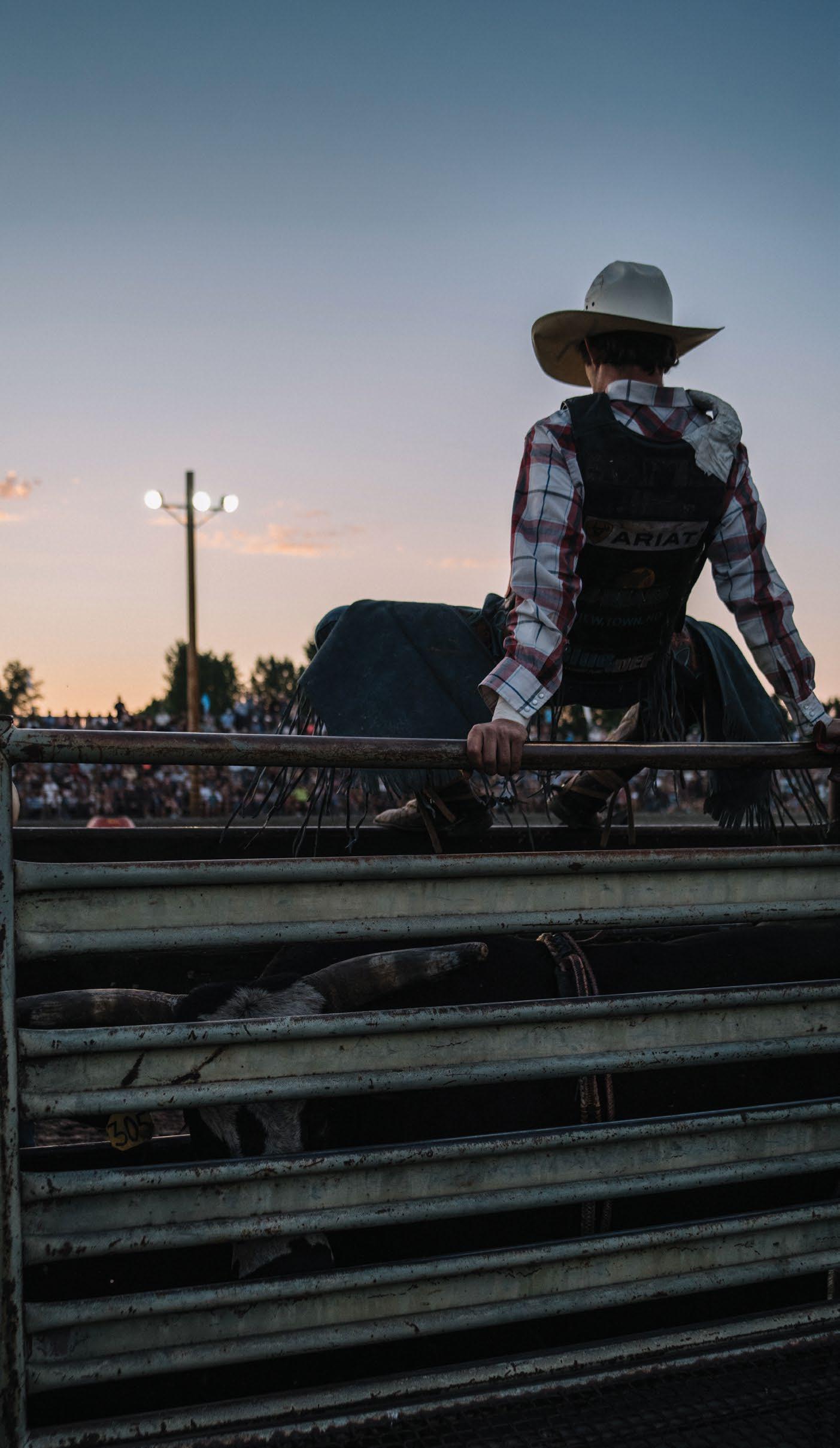
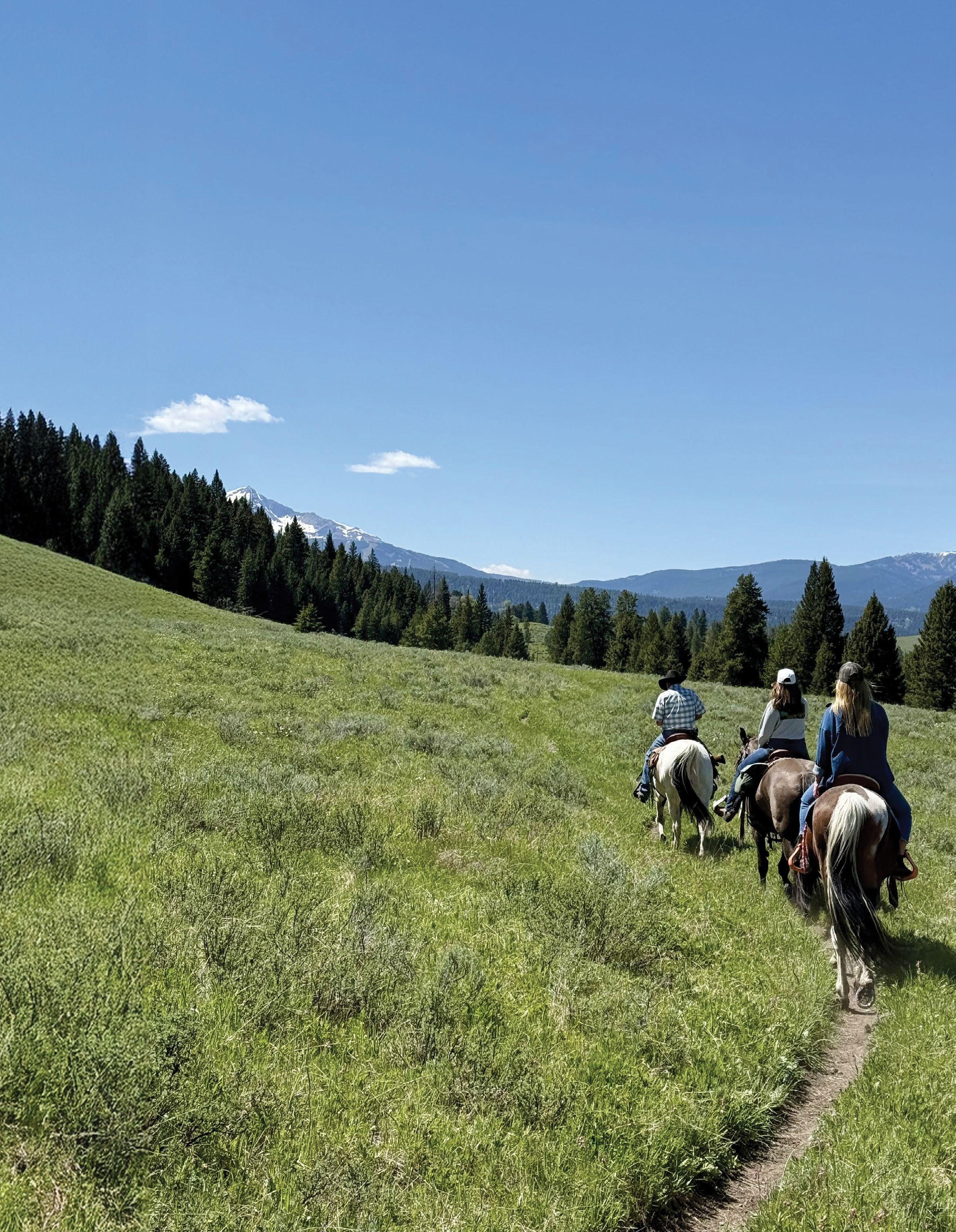
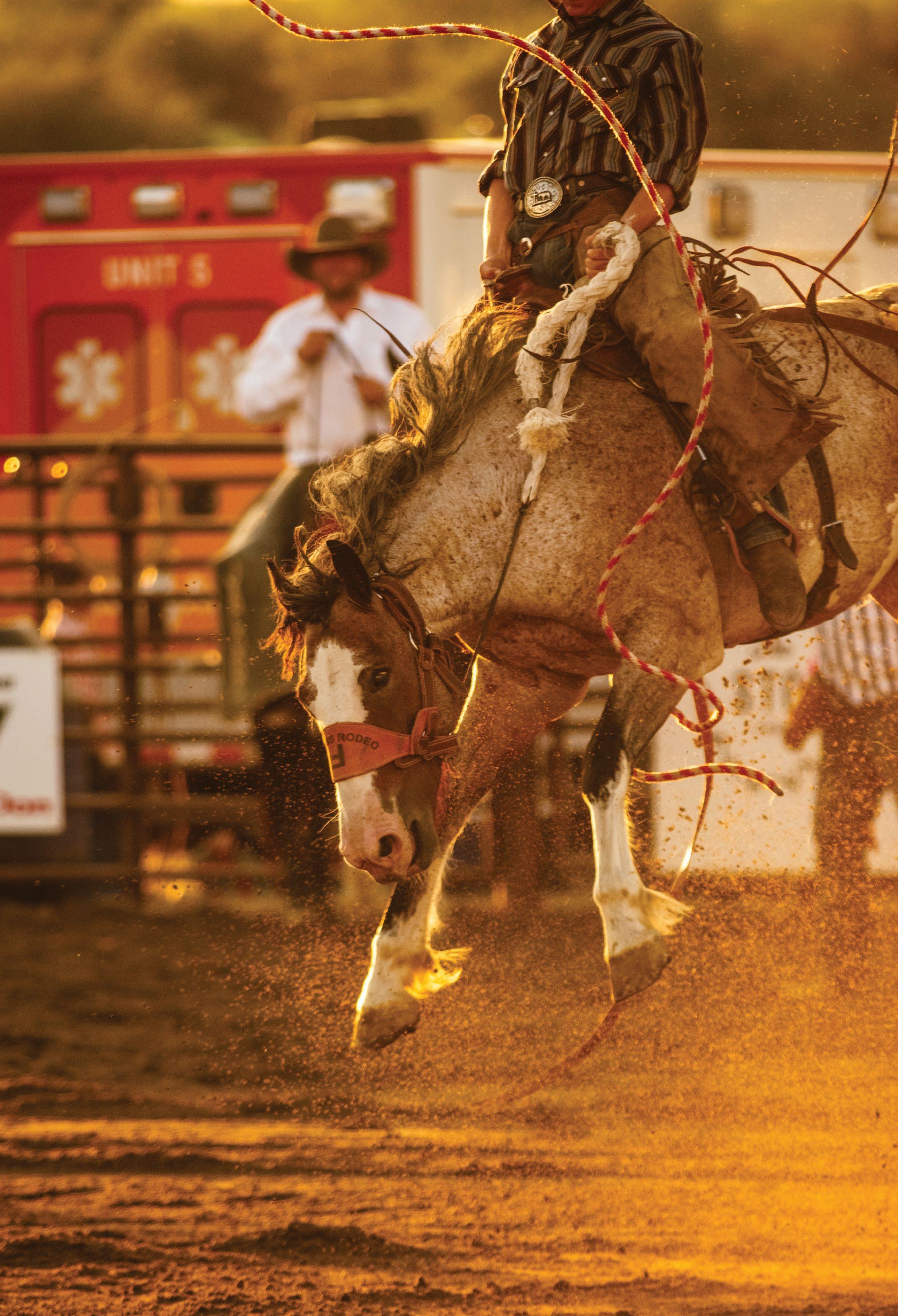
In Ennis, women and girls on horseback act as parking attendants. In the sold-out stands of Livingston’s Roundup, a pair of pickup men act as search and rescue team with horses as helicopters. This is Montana rodeo, a summerlong tradition that runs deeper than dust and belt buckles. From bronc and bull riding to barrel racing and roping, rodeo is a culture unto itself.
In Costa Rica, a country renowned for its biodiversity, roads pose a growing threat to wildlife. Researcher Fernanda Teixeira and the Center for Large Landscape Conservation are working to change that by building canopy bridges, underpasses and new national guidelines that will require all future roads to account for wildlife. Stitch by stitch, they are working to reconnect the landscape.
Montana's inmate fire crew, consisting of 15 prisoners selected from Deer Lodge, fights wildfires alongside professional crews each summer, earning their Red Cards and a rare taste of freedom in the process. The program, rooted in a World War II California tradition, asks dangerous work in exchange for purpose and an opportunity to become someone new.




15 Letter Stillness in Motion
18 Trailhead Our editor’s picks, from books to bites
23 Shorts GYE news in brief
24 Dart Toss Exploring Bearcreek, Montana
28 Recipe An Ale Works pork chop with all the sides
32 The Edge of Endurance Images of community and grit
46 Adventure Guide Road trip through New Zealand
52 The Shifting Wild of Adventuring with Kids Raising kids outdoors
62 Boot-Top Deep in Montana Rodeo Guide to a let `er buck summer
70 More Than 26.2 Miles A mother’s journey to racing Boston
LAND
78 Floating Through Old Water Conflicts Reflections from the Smith River
84 Turning Down the Lights Conserving dark skies in the GYE
90 Poem A Prayer for the Grasses
94 A Thousand Stitches Building wildlife crossings in Costa Rica
104 The Essence Experiencing the magic of Patagonia
114 Shaking the Glass Ball Old and new saloon culture
124 Gallatin Gateway Inn, A History Through the years
130 Columbia Gardens Butte’s 68 acres of heaven
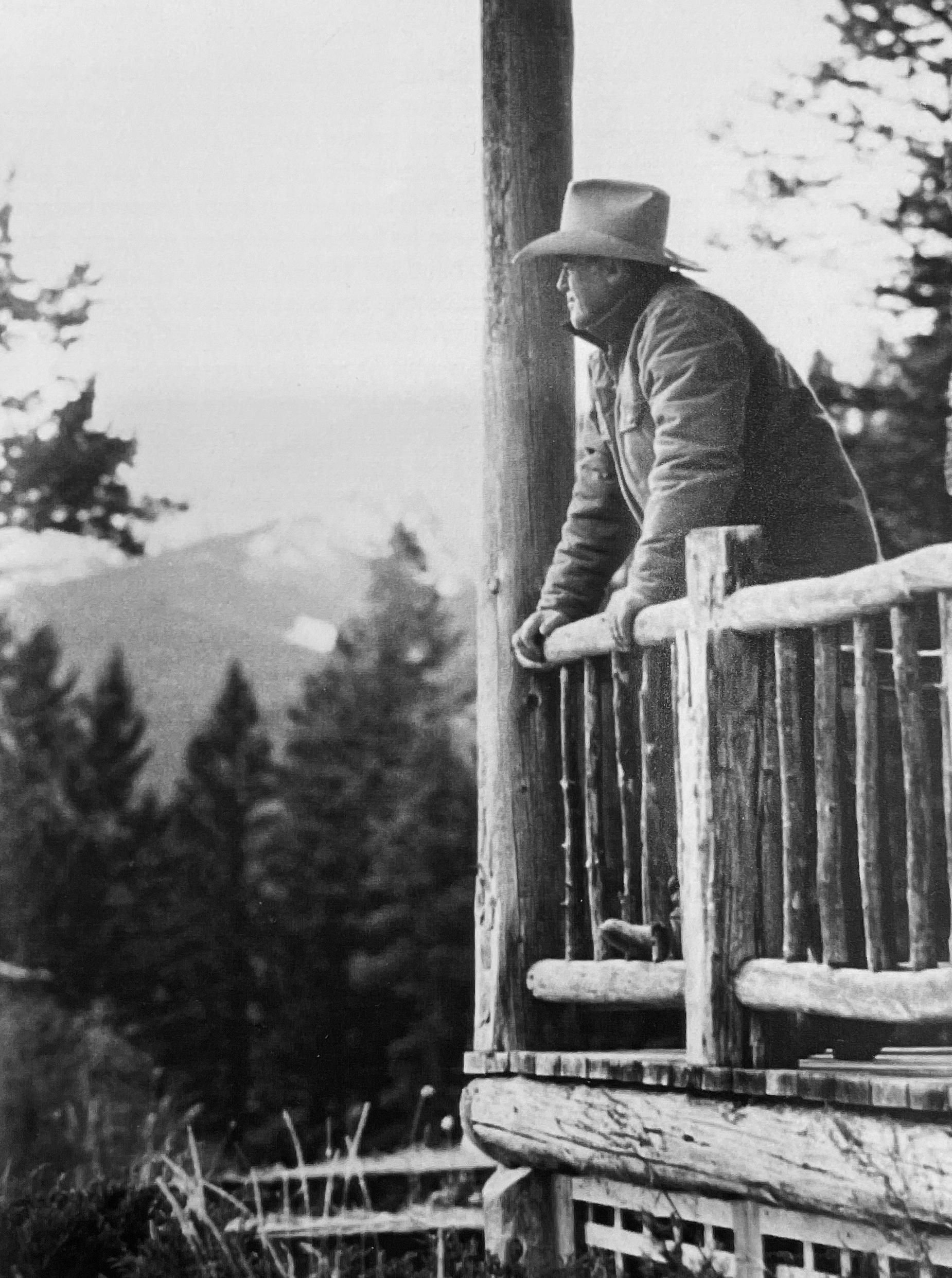
138 Guardians of the Last Best Place Inductees of the Montana Outdoor Hall of Fame
150 The River, An Opera The legacy of the Gallatin
156 Men to Match Our Mountains Inmates become wildfire fighters
168 The Race of Every Runner’s Dreams The MT Cup is quintessential Montana
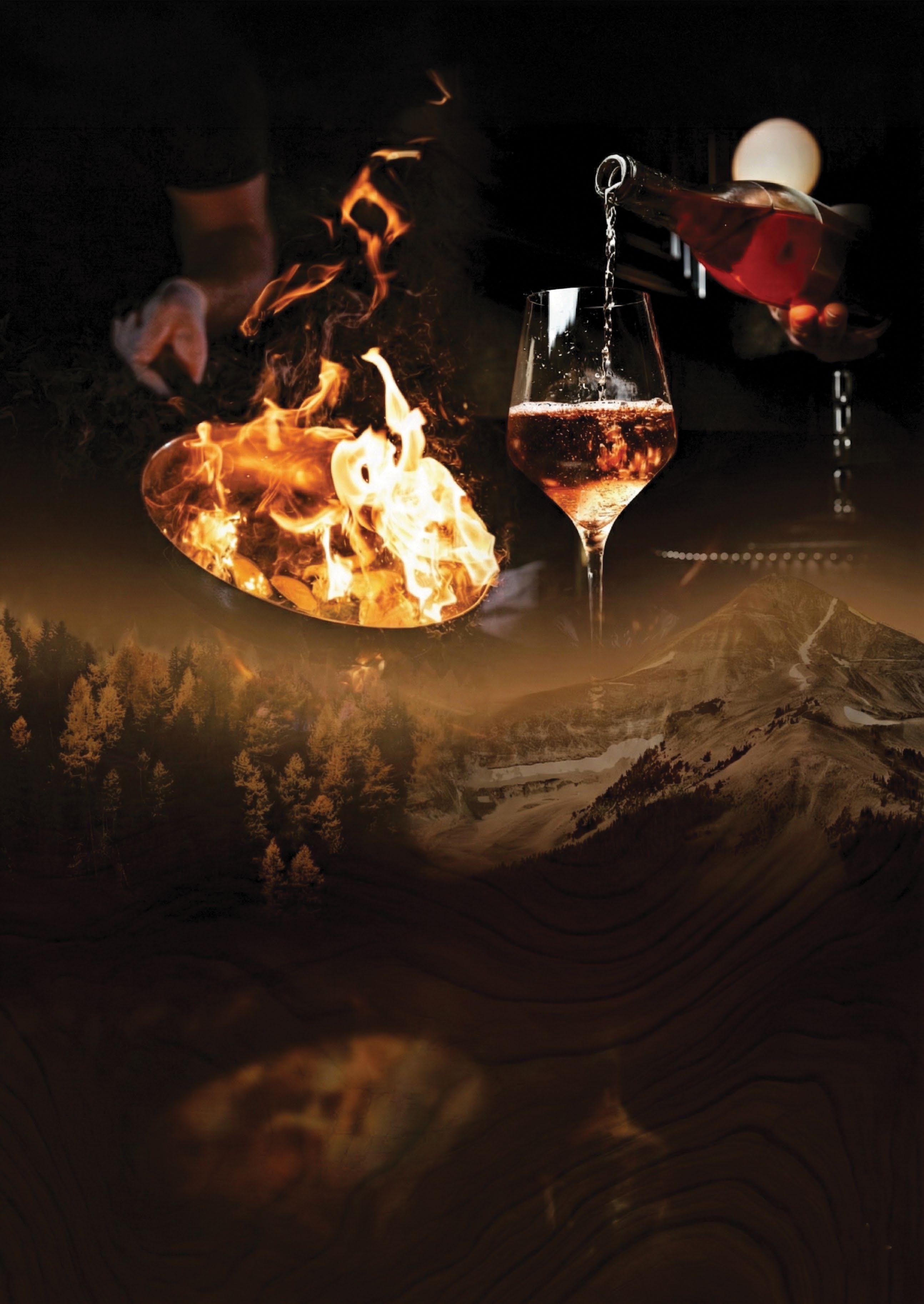
174 One&Only Local ingredients shape Moonlight Basin menu
178 A Health Revolution: Bozeman turns toward food as medicine
182 Alara Jewerly More than Montana sapphires
186 Wide Open Q&A with LeAnn Rimes
192 Where mountain goats roam

Owned and published in Big Sky, Montana
PUBLISHER
Eric Ladd
VP MEDIA
Mira Brody
MANAGING EDITOR
Sophie Tsairis
ART DIRECTOR
Robyn Egloff
COPYEDITOR
Carter Walker
ART PRODUCTION
Megan Sierra
Griffin House
Luke Breum
SALES & ADVERTISING
Ellie Boeschenstein
Ersin Ozer
Patrick Mahoney
Nic Thoman
ACCOUNTING
Tana White
Sara Sipe
Kaitlin Malcom
CHIEF OPERATING OFFICER
Josh Timon
CHIEF MARKETING OFFICER
Megan Paulson
VP DESIGN & PRODUCTION
Hiller Higman
DISTRIBUTION
Ennion Williams
Visit outlaw.partners to meet the entire Outlaw team.
CONTRIBUTING WRITERS
Rick Bass, Kaley Burns, Fischer Genau, Canyon Hohenstein, Carli Johnson, Butch Larcombe, Jeremy Lurgio, Jack Reaney, Emily Senkosky, Maggie Slepian, Yetta Rose Stein, Katie Thomas, Toby Thompson, Emily Walter, Ken Younger
CONTRIBUTING PHOTOGRAPHERS/ARTISTS
Kaley Burns, Sara Byrne, Phil Chester, Justine Jane Esslinger, Carli Johnson, Torkel Korling, Kelsey Lechman, B. Linfield, Jeremy Lurgio, Hannah Maldon, Becca Mitchell, Seth Neilson, Isaias Miciu Nicolaevici, Erika Peterman, Jack Reaney, Matt Roberts, Inés Azofeifa Rojas, Noah Rosenthal, Emily Senkosky, Charles Stemen, Angela Temp, Madeline Thunder, Anastasia Wilde, Ben Weyer, Ken Younger
Subscribe now at mtoutlaw.com/subscriptions.
Mountain Outlaw magazine is distributed to subscribers in all 50 states, including contracted placement in resorts and hotels across the West. Core distribution in the Northern Rockies includes Big Sky, Bozeman and Missoula, Montana, as well as Jackson, Wyoming, and the four corners of Yellowstone National Park.
To advertise, contact Ersin Ozer at ersin@outlaw.partners or Patrick Mahoney at patrick@outlaw.partners.
OUTLAW PARTNERS & Mountain Outlaw
P.O. Box 160250, Big Sky, MT 59716 (406) 995-2055 • media@outlaw.partners
© 2026 Mountain Outlaw Unauthorized reproduction prohibited
Check out these other Outlaw publications: Subscribe to and read Mountain Outlaw online.

ON THE COVER
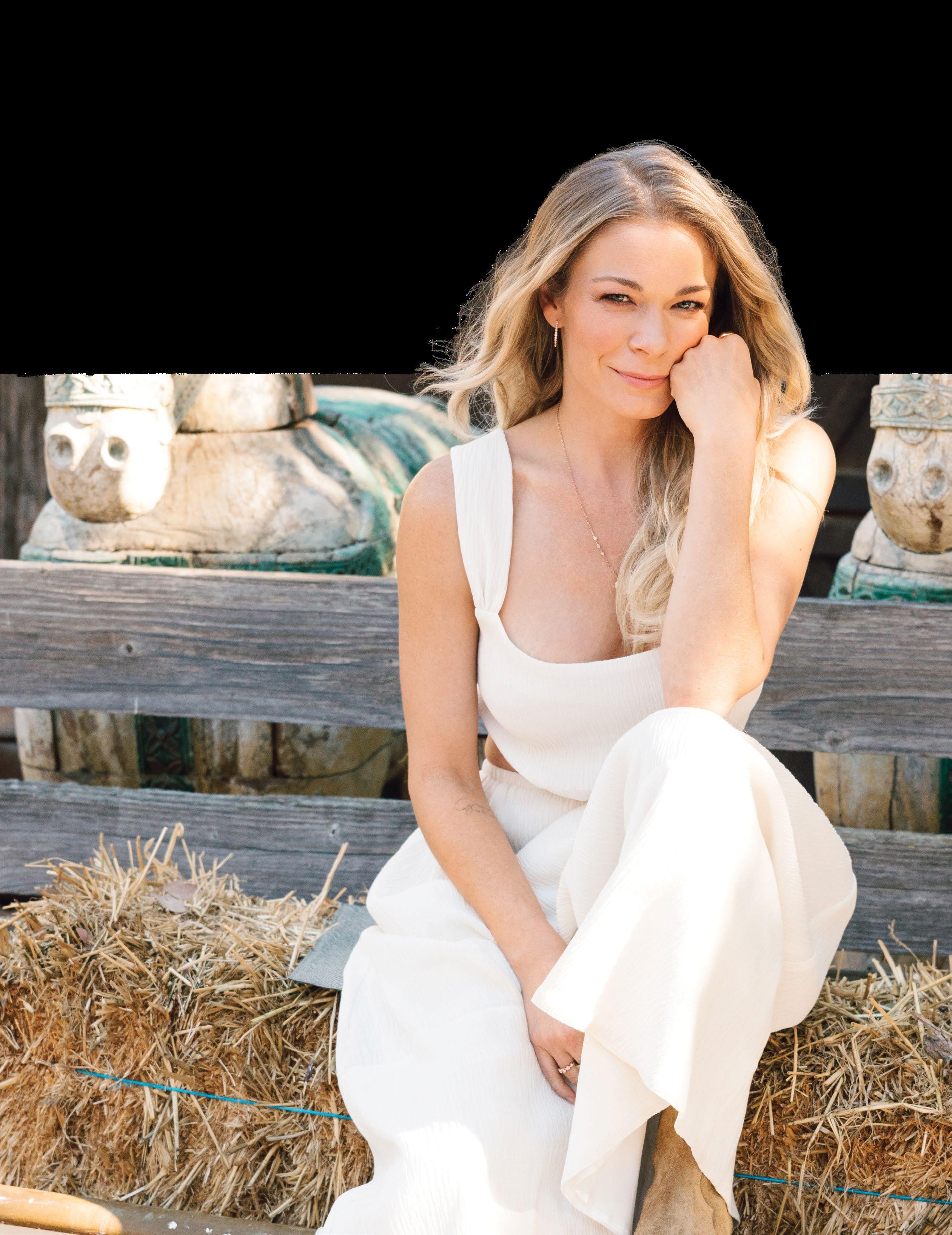
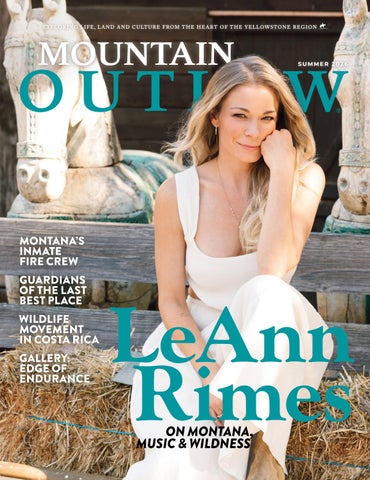
LeAnn Rimes rose to fame as a teen country prodigy, evolving into a Grammy-winning versatile artist with lasting presence in music and on stage. On pg. 186, ahead of her show in Big Sky, Rimes talks to Mountain Outlaw about her ties to Montana. Photo by Sara Byrne via Prodigy Entertainment
Turning Down the Lights | p. 84
Maggie Slepian is an award-winning Bozeman-based writer with work at the intersection of the outdoors, environment, travel, and culture. Her essays, narratives, and reporting have appeared in the New York Times, Longreads, Lonely Planet, Outside, New York Magazine, and she has been featured on NPR, the BBC, and in the London Times. When she isn't writing, Maggie is most likely on her bike, in the mountains, or traveling abroad in search of her next diving destination.
A Prayer for the Grasses | p. 90
Emily Walter (she/her) lives and writes in Missoula. Originally from Michigan, Emily has had poetry and nonfiction published in 32 Poems, High Country News, and Colorado Book Review, among others. She currently teaches poetry and works at the Missoula Writing Collaborative as well as at The Missoula Public Library. She writes “My educational history and my professional careers have been diverse, yet all driven by creative pursuits. My avocations have become my vocation, because as a poet, it’s a necessity.” From teaching English to six-year-olds in Poland to teaching creative writing courses to college students in Northern Michigan, Emily thrives in creating an engaged classroom as well as out in the wilds with her husband, daughter and dog, Eddy.
Boot-Top Deep in Montana Rodeo | p. 62
Ken Younger is a physician who has lived in Bozeman for over 50 years. After retiring from his ophthalmology practice, he has pursued freelance writing and photography. His stories and photos are featured frequently in Outside Bozeman Magazine. Although he's never competed in rodeo, that doesn’t mean he's never been bucked off a horse. You’ll find him in his kayak in the summer and on his skis in the winter. He’s done a lot; there’s more to do.
Men to Match Our Mountains | p. 156
Canyon Hohenstein is a Montana-born author and former wildland firefighter. His debut novel, Who Tames the Flames?, is drawn from his experience leading Montana's inmate crew on a wildfire. His writing focuses on legacy, redemption, and the stewardship of our planet and its people. He has been featured in Montana Quarterly, Wildfire Today, and interviewed Ernest Hemingway's son Patrick for a Bozeman Daily Chronicle. He is currently working on his second novel.
A Thousand Stitches | p. 94
Fischer Genau is the Digital Media Lead for Explore Big Sky newspaper and a freelance writer and filmmaker. He enjoys finding ways to combine his twin passions for visual and written storytelling, and in his spare time, he likes to read, run, play drums in his band, and take trips back to his home state of Michigan to jump in a Great Lake.
Anastasia Wilde
Outbound Gallery: The Edge of Endurance | p. 32
Anastasia Wilde is a Montana-based adventure photographer who specializes in capturing athletes and their stories in the remote wilderness. She discovered photography in 2015 and partially attributes her style and perspective to growing up in Ukraine and Russia. Prior to becoming a fulltime photographer, Anastasia taught music, which means her creative spirit runs deep. She enjoys capturing moments at all race distances but the 200+ mile distance is her favorite. Along with ultramarathon coverage, she works with brands such as Patagonia, The North Face, Yeti, ON Running, Protect Our Winters, Ultra Running Magazine, Runners World, and others to share their products in new ways with the world.
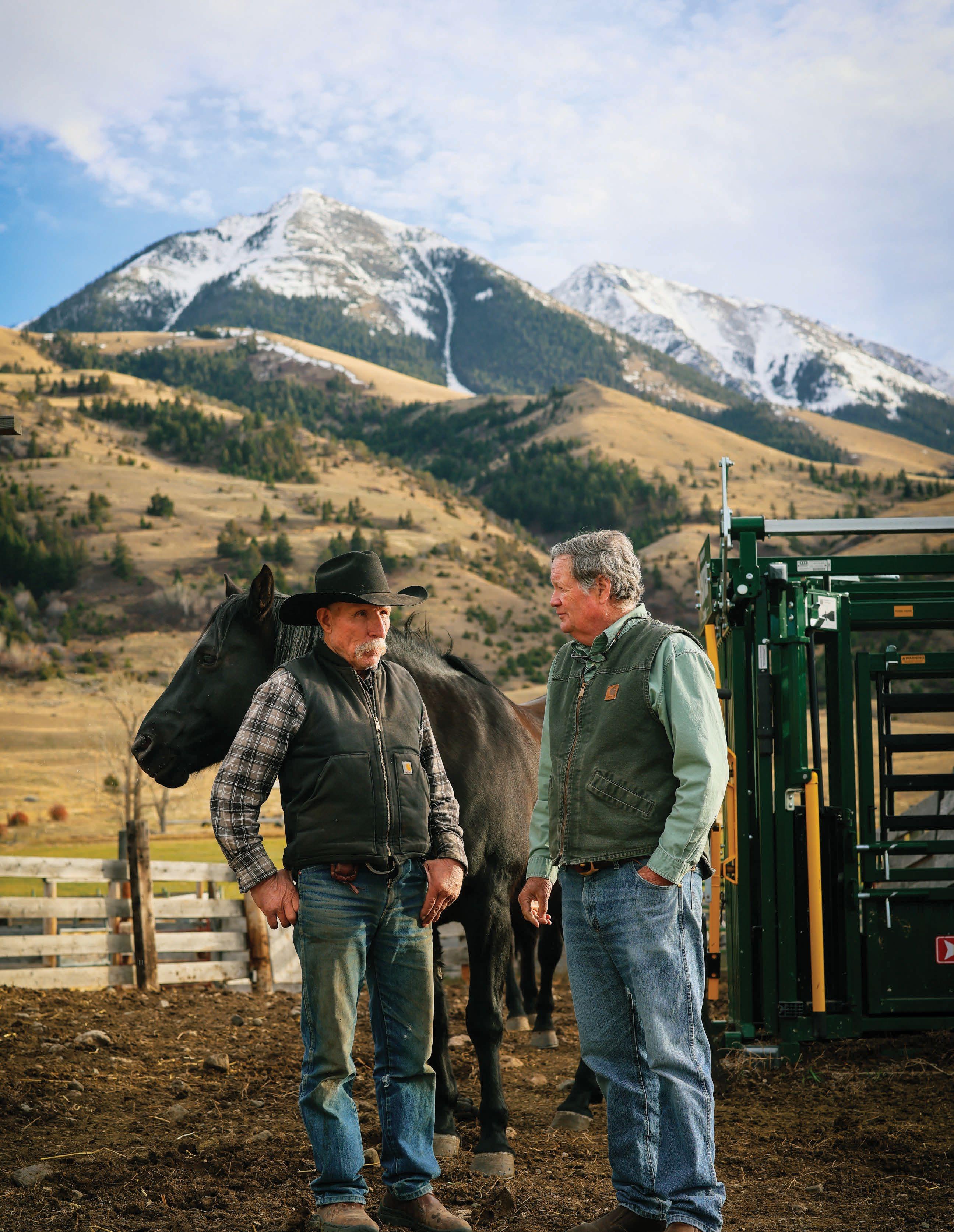
Nearly a third of the Greater Yellowstone Ecosystem is private ranchland. Out here, ranchers are as important as park rangers in keeping elk, grizzlies, and pronghorn moving freely across the region. PERC is a different kind of conservation organization—one that champions the stewards keeping these lands intact, wild, and working. Learn more at PERC.org
There is something that happens when you push your body to its limit, float a meandering river or walk into a burning forest with purpose. It’s something older than all of us, a stillness that persists even in motion, a presence we once defaulted to naturally. As time and technology move ever more quickly, finding that stillness has become more of an art in and of itself. This issue of the magazine came together around that idea without us entirely planning it. We call it by many names: sometimes presence, flow state, awareness, attunement. It is this particular clarity we are rewarded with when all distraction falls away and the focus is on the here and now.
The stories in these pages move across many landscapes, from mountain trails and river canyons to prison yards and concert stages, historic saloons and wildlife corridors, but they are all connected by this presence and community. In these pages, rodeo cowboys and cowgirls must stay perfectly focused (p. 62), their lives dependent on it. Inmates become wildfire fighters, living not in the past or future, but finding purpose and unlikely belonging in the present (p. 156). For the conservationists fighting to protect dark skies above the Greater Yellowstone Ecosystem, it means looking up and refusing to let the night sky become another thing we lose without noticing (p. 84). And in a poem written as a prayer for the grasses (p. 90), or the ongoing legacy of a beloved Montana novel finding new life as an opera (p. 150), it is the value of paying attention to a place, to its history and to each other.
Reader, amid the busyness that summer months often bring in the West, as we cram in long days on the river, in the mountains and in tents, we hope the stories in this issue help bring you a sense of presence and clarity.
Happy reading,
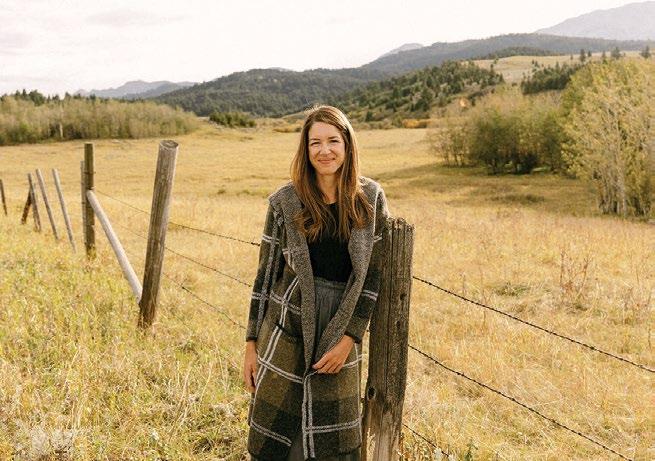

Mira Brody, VP of Media
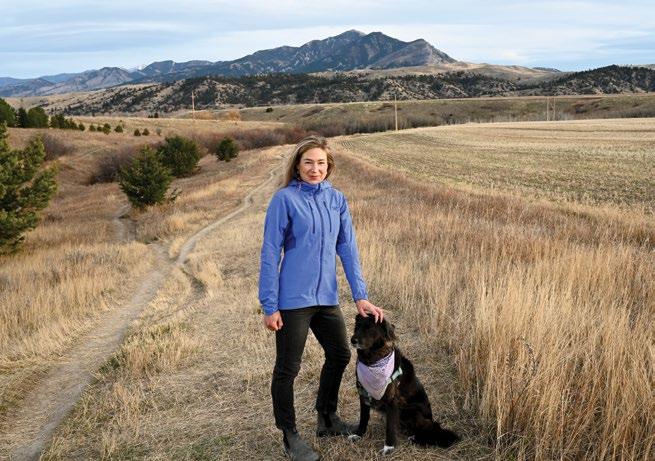
Sophie Tsairis, Managing Editor
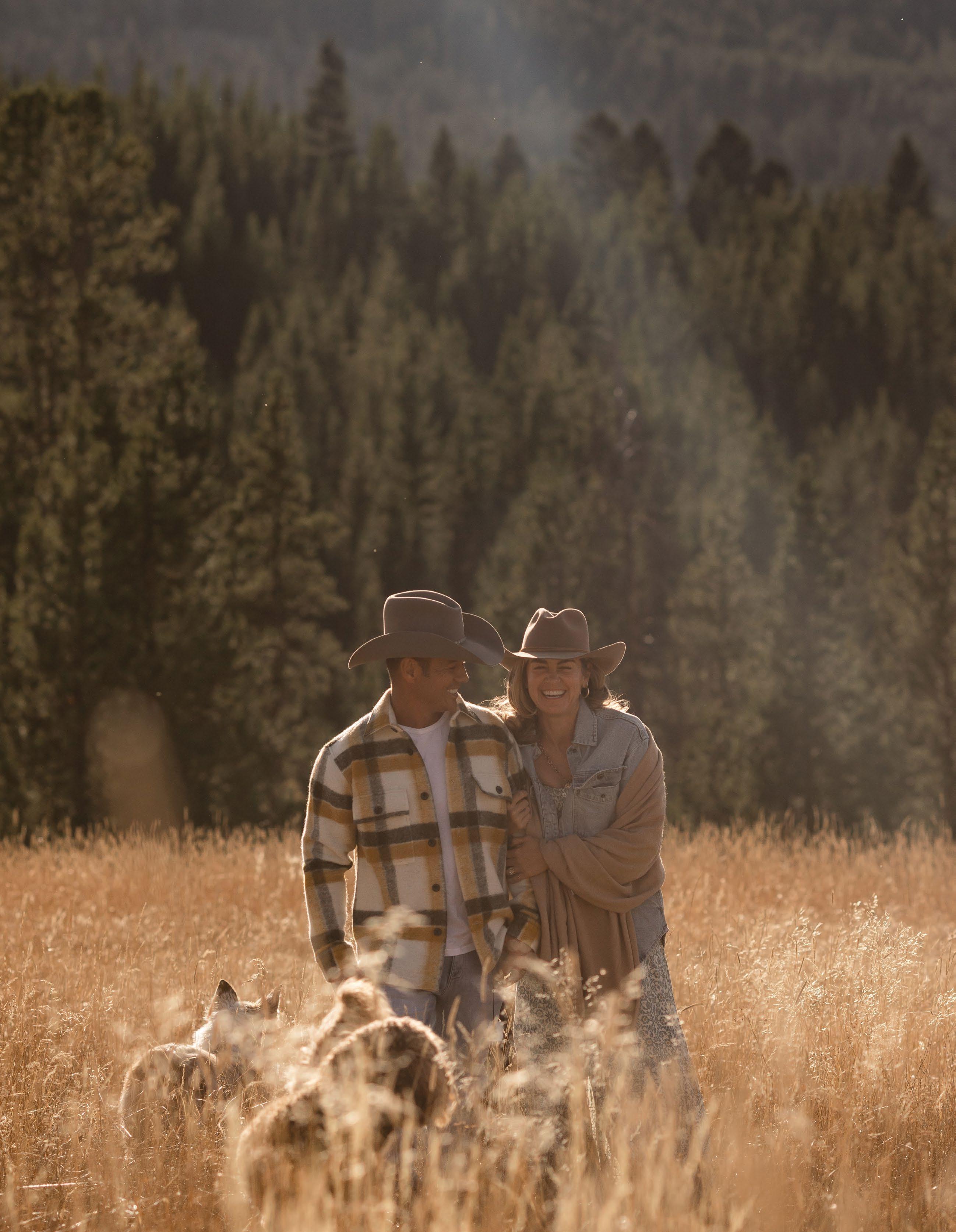
Every great adventure starts at the trailhead. Our editors have curated some favorite discoveries across the Greater Yellowstone Ecosystem, spotlighting page-turning reads, delicious eats and more.
–The Editors
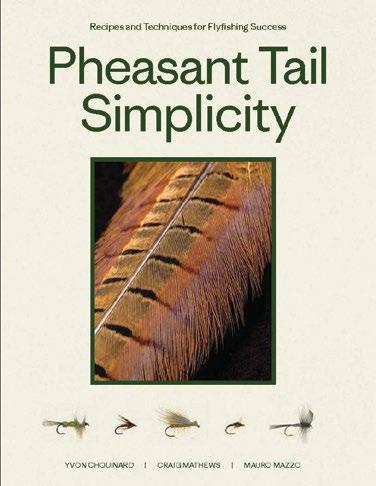
By Yvon Chouinard, Craig Mathews and Mauro Mazzo
Leave it to the founder of Patagonia, Yvon Chouinard, West Yellowstone’s own Craig Mathews of Blue Ribbon Flies and fly-fishing legend Mauro Mazzo to argue that you don’t need a fly shop’s worth of patterns to fool a trout. In Pheasant Tail Simplicity they distill 200 years of combined experience on rivers like the Madison and beyond down to the staple ingredients, both tangible and metaphorical. The book is beautifully photographed and includes step-by-step illustrated instructions as well as QR codes that take readers to video tutorials. The secret to successful fly fishing, they contend, is not more flies but deeper knowledge of the ones you have.

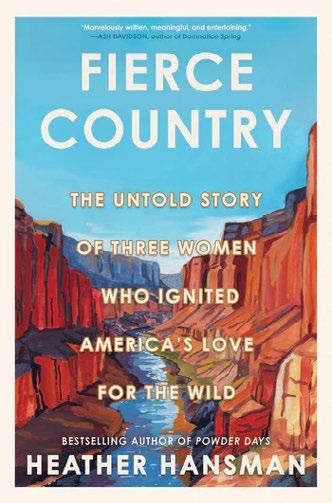
By Heather Hansman
You may know Heather Hansman from her work in these pages. The award-winning journalist and Outside magazine environmental columnist has long written about the landscapes and communities of the Mountain West with a sharp eye and deep respect. Her forthcoming Fierce Country turns that lens on three women the outdoor world has largely overlooked. Georgie White spent her life bringing people through the Grand Canyon, kickstarting river running and the recreation industry. Anne LaBastille protected endangered species and predicted climate change impacts from an off-grid cabin in the Adirondacks. Dolores LaChapelle developed an environmental philosophy that shaped the radical environmental movement of the 1970s. At its core, the book is about overlooked women in recreation and conservation, the idea of heroes and all the ways the natural world shapes us.
By Sean Sherman, Kate Nelson and Kristin Donnelly
Turtle Island: Foods and Traditions of the Indigenous Peoples of North America is the follow-up to Oglala Lakota chef Sean Sherman’s James Beard Award-winning debut, The Sioux Chef’s Indigenous Kitchen. Written with Kate Nelson and Kristin Donnelly, the book spans the continent from Mexico to Alaska, tracing diverse Indigenous foodways through more than 150 recipes built around the plants, animals and traditions that have sustained Native communities for generations, deliberately leaving out colonial ingredients like wheat, dairy and cane sugar. Named one of the best cookbooks of 2025 by The New York Times, The Washington Post and Vogue, it arrives at a meaningful moment for Montana. Sherman's nonprofit NATIFS has announced plans to open an Indigenous Food Lab in Bozeman, with a long-term vision to anchor a restaurant rooted in the foods of the Blackfeet, Buffalo Nation and Salish and Kootenai tribes.
Missoula-based Megan Torgerson grew up on her family’s farm and ranch near Dagmar, Montana, which means she knows firsthand that passing land to the next generation is never as simple as a legal transaction. In the fourth season of her award-winning documentary podcast Reframing Rural, Torgerson follows five Montana farm and ranch families from Malta to Ekalaka to Winnett, through the often-unspoken process of succession. “Without a transition plan, there’s just no way that a farm or ranch can stay in a family, and that would be a devastating loss,” said one of her guests. For the countless ranching families wrestling with the same questions of who gets the land, who wants it and what happens to a community when nobody does, this one will resonate.
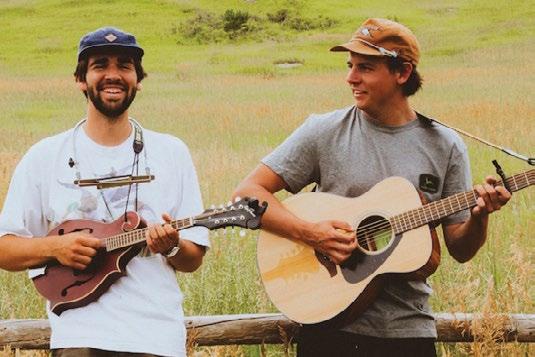
Even without a full album under their belt, Buffalo Traffic Jam, a musical duo hailing from Bozeman, has taken the folk genre by storm, effortlessly selling out most dates on their first North American tour. With a sound inspired by the southwest Montana landscape, Frankie Cassidy (vocals/guitar) and Nathan Ross (guitar/mandolin/vocals) first released a selftitled debut EP, which gained them internet fame and resulted in a record deal with Arista Records. They’re currently on tour with rising country musician Dylan Gossett, including a stop at the BottleRock Napa Valley music festival in Napa, California, and continue their songwriting momentum with two hit singles, “Strangers Now” and “Milestone.” Amid their busy touring schedule, Mountain Outlaw sat down with Cassidy and Ross before their show at Missoula’s Top Hat Lounge for an exclusive interview ahead of yet another busy stretch on the road. You can read that interview at mtoutlaw.com.
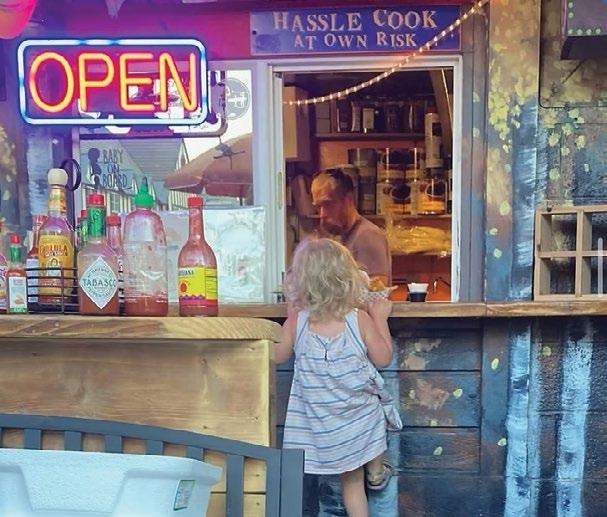
Locally owned and unpretentious, Down on Glen (D.O.G. to the locals) has been cooking up breakfast burritos for Jackson Hole for more than 20 years. Weighing between 14 and 16 ounces, it’s no surprise their burritos are a favorite in this active mountain town. Always on the menu are vegetarian or meat with mild or spicy options. Over the years a variety of sandwiches and changing specials have also been on rotation, as well as a kid’s menu and sweet treats. Open from 6:30 a.m. to 10:00 p.m., D.O.G. wants everyone to feel welcome on their deck and at their ordering station. Grab a legendary Meat Spicy burrito to go or pull up a seat and watch downtown Jackson wake up. Either way, you won’t leave hungry.
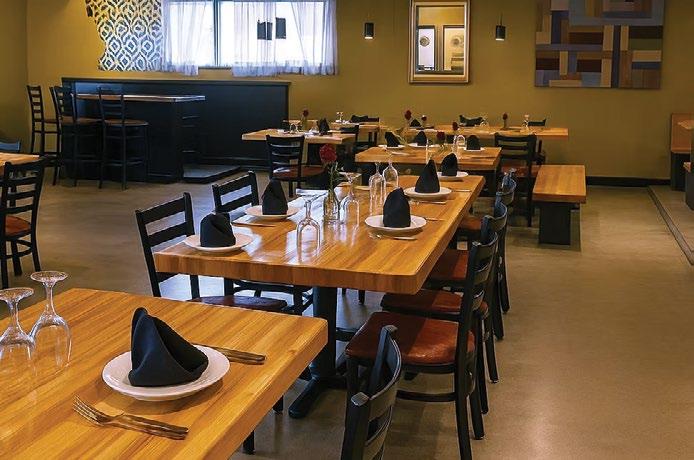
Named for the coastal district of Southern Thailand where the family’s recipes were born, Khanom Thai brings a corner of the country rarely represented in Montana to a small strip on West Haley Springs Road in Bozeman. The menu is built from scratch, with curry pastes ground in-house, coconut-based sauces made fresh daily and ingredients sourced locally whenever possible. The flavors here are distinctly Southern Thai, employing fermented shrimp paste, turmeric, fresh chili and rich coconut curries that carry the bold, spice-forward character of Surat Thani province. This is not a menu that meets you halfway. Since opening its first location last year, Khanom has become a Bozeman favorite, so it comes as no surprise, but much celebration, that a second location near Montana State University is on the way.
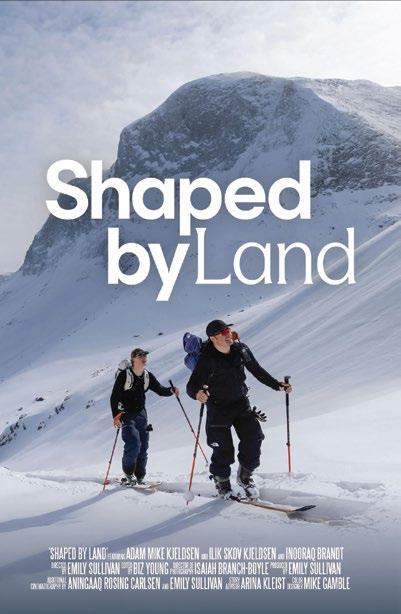
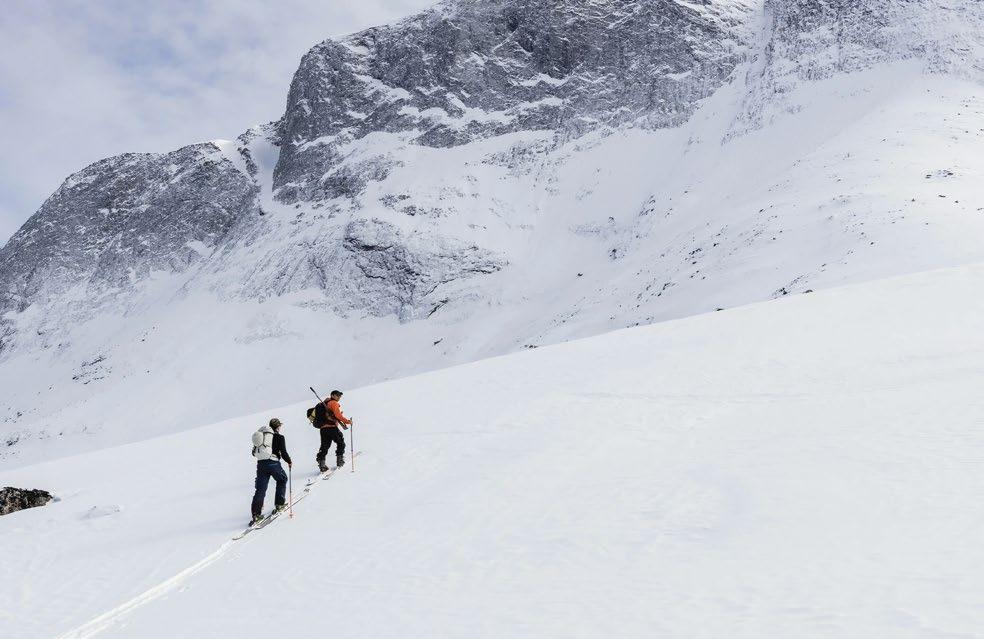
Shaped by Land is not just another ski film. In a destination increasingly dominated by foreign-owned guide services, Adam Kjeldsen is charting a different course as one of the only Inuit ski guides operating in Greenland. Released in November 2025, Shaped by Land is a short documentary directed by Emily Sullivan that follows Kjeldsen’s pursuit of a more sustainable, locally-rooted vision for ski tourism. Beyond the skiing itself, he hopes to give visitors a meaningful connection to the land and exposure to the culture and people of Greenland. The film was a finalist at Banff Mountain Film Festival, and a jury winner at Anchorage International Film Festival, and has earned praise for its power and authenticity and the reminder that the most compelling stories in the mountains are often the ones shared by local voices.
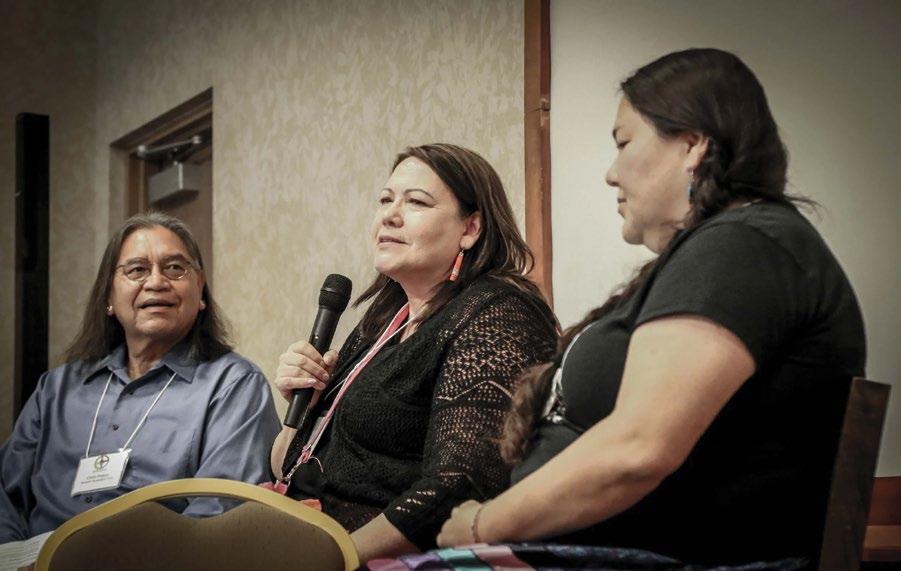
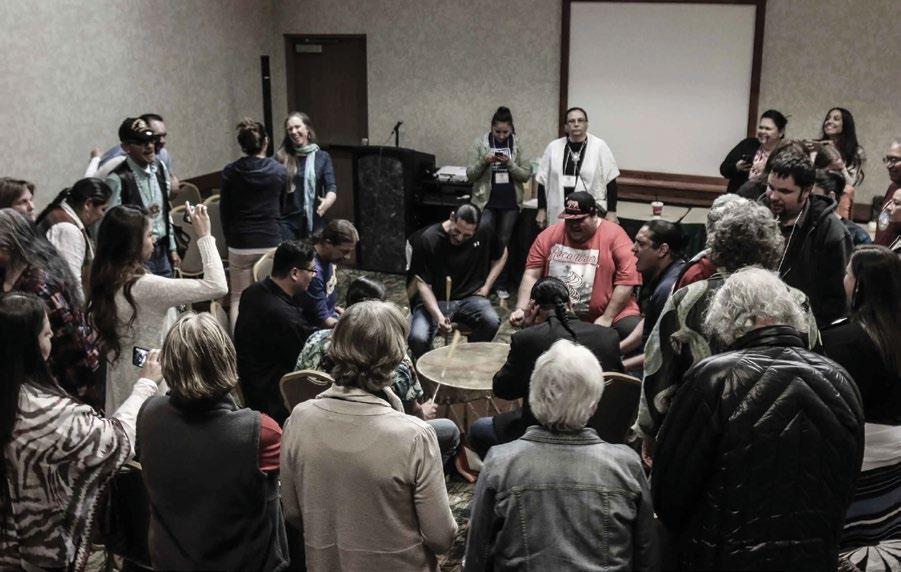
Bozeman-based Hopa Mountain has spent decades working toward the goal of investing in rural and tribal citizen leaders who are actively improving their communities. A significant portion of that work centers on supporting emerging organizations and businesses led by rural and tribal leaders. They also support youth leaders, through programs like Scholars of Promise, which helps rural and tribal high school students prepare for college, and the Medical Mentorship Program which supports students pursuing careers in the health sciences. Working primarily across the Northern Rockies and Great Plains, Hopa Mountain’s work spans early education, college access, ecological health, food access and nonprofit development. As the organization puts it, “the possibilities for sustained improvements in economic, environmental, and social health lie in the strength, innate wisdom, and creativity of local people—in their relationships with each other and the land.”
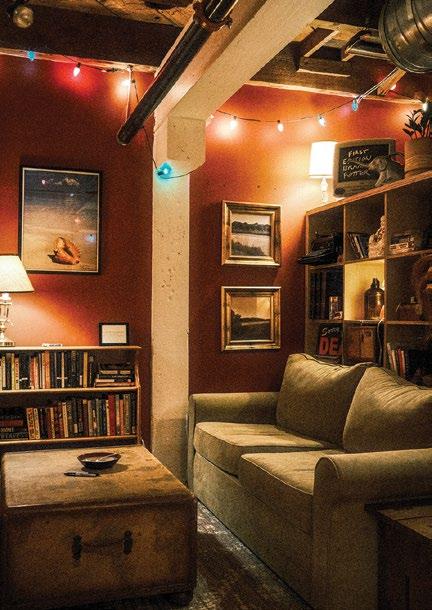
Night-owls rejoice. Tucked into the historic Gallatin Valley Seed Co. complex on South Wallace Avenue, Pulphead is Bozeman’s first late-night literary lounge and an act of resistance against an increasingly digital age, or perhaps just a quiet refuge from it. Founded in 2024 by writer and publisher Mike Somerby, the 500-square-foot room glows with string and lamp light, its warm red walls lined with maps, magazines, and borrowed books. For a flat $5, writers, readers and conversationalists can settle in from 6 p.m. to 2 a.m., Wednesday through Saturday, with unlimited “OK” coffee and tea, corn nuts, and good company.
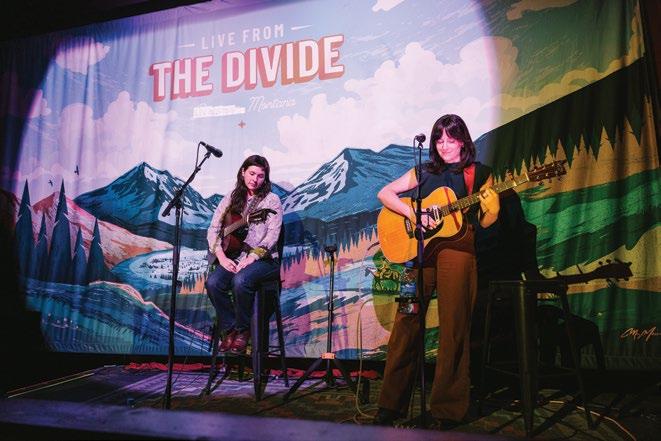
What began in 2009 as a 50-seat listening room inside a century-old cold storage building in Bozeman has grown into one of the most respected songwriter venues in American roots music. Founded by fourth-generation Montana rancher and songwriter Jason Wickens, Live From The Divide has hosted more than 1,000 artists including Sturgill Simpson, Tyler Childers, and Billy Strings, before any of them were household names. In February 2026, the Divide opened a new chapter at the historic Empire Twin Theatre in downtown Livingston, reimagined as a 100-seat listening room that preserves the intimacy and reverence for craft that made the original space legendary. Every performance is also a radio recording, broadcast via PRX across seven states as part of the longrunning nationally syndicated program “A Celebration of the American Songwriter.”
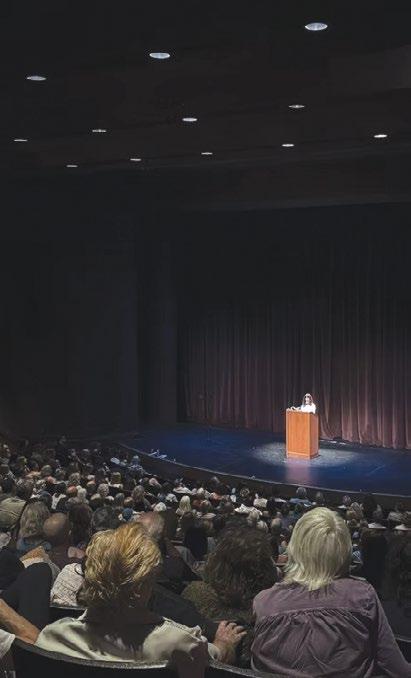
IndigiPalooza MT returns to Missoula for its second year July 31-Aug. 1, 2026. This year’s theme is Resistance 250+. Organized by Anna East of Chickadee Community Services, Selya Avila of the Missoula Public Library, and former Montana poet laureate Chris La Tray (Little Shell Chippewa), the two-day festival celebrates Indigenous arts and storytelling, including themes of language reclamation and relationships with land. This year’s event features an engaging lineup of Indigenous writers, activists and artists from across Turtle Island. Headlined by Robin Wall Kimmerer—author of the beloved Braiding Sweetgrass and founder of Plant, Baby, Plant, a grassroots movement of people taking meaningful, regenerative action to care for the Earth—and Indigenous punk band Dead Pioneers, it promises to be a memorable celebration of arts and culture.
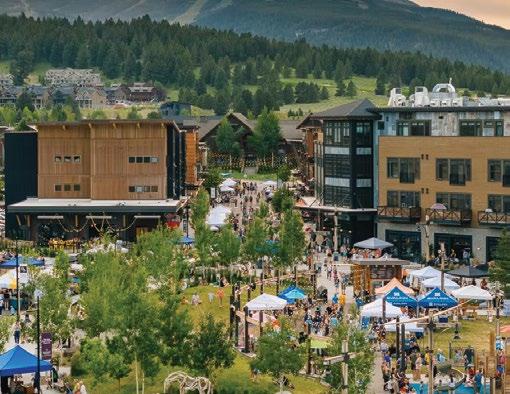
Now in its second year, the Lone Peak Film Festival returns to Big Sky September 17-20, 2026. Founded on the belief that film can spark genuine change, the festival screens an intentionally-curated mix of short and feature films organized around themes of resilience, conservation, Montana and Indigenous storytelling, with panel discussions, filmmaker Q&As, presentations by Indigenous allies, and a closing night concert of movie music. Past screenings have included Sing Sing, Bring Them Home/Aiskótáhkapiyaaya, and Lost Wolves of Yellowstone, with a filmmaker from each film being hosted in Big Sky to share their work directly with audiences. By bringing these stories to Big Sky, LPFF aims to “honor the goodness in humanity and build a nurturing community.” Beyond the festival itself, LPFF runs a year-long fellowship for early-stage local and Indigenous filmmakers and an artist retreat for attending filmmakers.

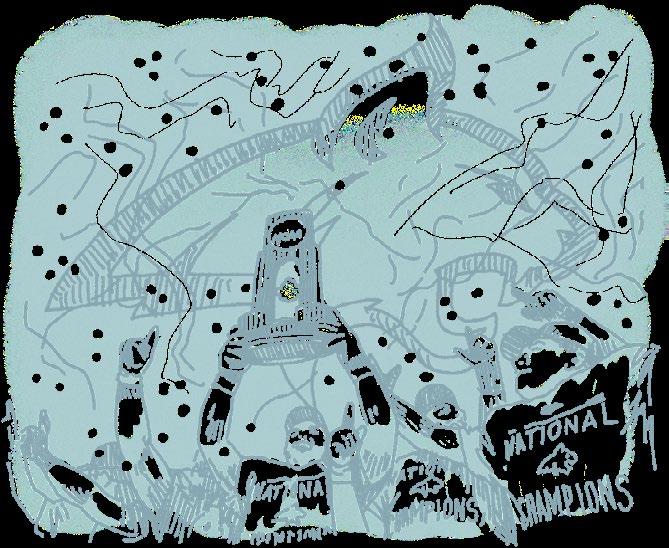
The Montana State Bobcats defeated the Illinois State Redbirds 35-34 in overtime Jan. 5 to win the Football Championship Subdivision title, the program’s first national championship since 1984. Montana State is the only program in the nation to win national championships on three different levels: the NAIA in 1956, NCAA Division II in 1976 and the NCAA Division I FCS in 1984 and 2025.
The 1941 MSU football team, which lost 10 members during World War II, was one of the inspirations for MSU’s No. 41 legacy number. At the championship game in Nashville, Tenn., with 41 stitched onto multiple players’ jerseys, the Bobcats won their first national championship in 41 years. The win marked Montana State’s third FCS Championship Game appearance in five seasons under fifth-year head coach Brent Vigen.
“When you see the amount of support we had in Nashville, the way our fans took over the city and the joy in the celebration, you understand the passion for Bobcat football,” Vigen said. “But it goes beyond just celebrating a championship. These fans fill our stadium every week, and have for years. All the former players who made the trip to support the team shows how much Bobcat football means to everyone involved in the program.”
Tsairis
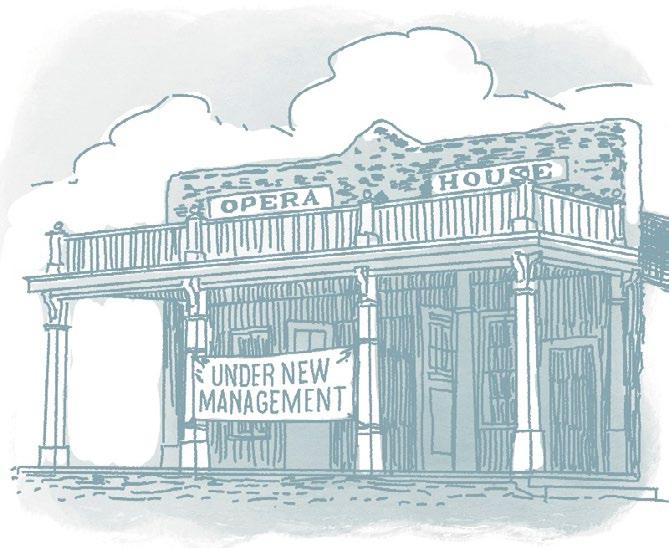
Since the State of Montana acquired the Bovey estate in 1997, an implicit agreement has shaped the town of Virginia City. The Montana Heritage Commission would preserve and manage the town’s historic properties, and in exchange, Virginia City would sustain the vibrant community a major tourist destination requires. That social contract held for nearly three decades but collapsed in December 2025 when the Montana Department of Commerce terminated nearly all leases held by businesses operating in state-owned properties.
The MDC’s decision was meant to offset a budget shortfall caused by the embezzlement of hundreds of thousands of dollars by a former MHC executive director. However, the new lease terms proved unaffordable for several longtime operators and The Opera House, Bob’s Place, The Star Restaurant and Bakery, and The Fargo have since temporarily closed and will reopen under new concessionaires.
Mayor Justin Gatewood said the town, which predates Montana statehood by 26 years, has faced hard times before.
“We have a long, rich and sometimes sordid history,” Gatewood said. “And throughout it all, we’ve become very astute at knowing who we are and, just as importantly, who to trust. Our community is strong and steadfast. Not only will we persevere, we’ll adapt and flourish.”
Sophie Tsairis is the managing editor of Mountain Outlaw
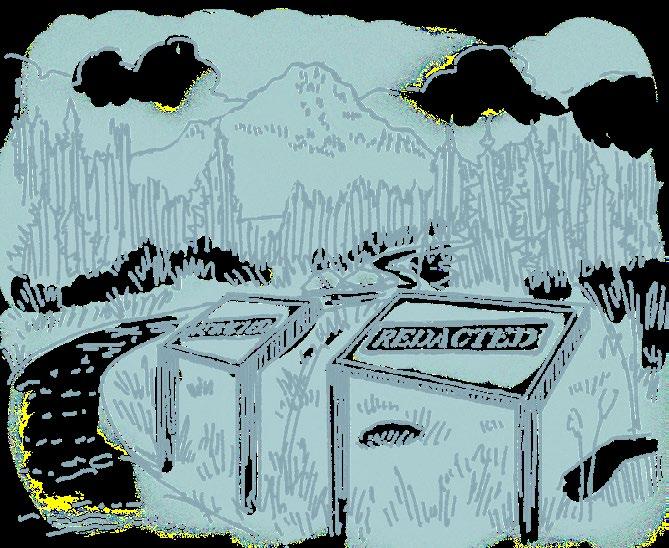
Some signs and exhibits referencing climate change and Indigenous history have been removed from Glacier National Park as part of a broader Trump administration effort to scrub scientific and historical content from national parks.
The Department of the Interior is implementing Secretary’s Order 3431, which carries out President Trump’s executive order on “Restoring Truth and Sanity to American History,” directing federal agencies to review interpretive materials for accuracy and alignment with national values. According to a DOI spokesperson, “in the vast majority of cases across the system, flagged materials remain unchanged.”
The removals have drawn sharp pushback. Kati Schmidt, communications director of the National Parks Conservation Association, said park staff work tirelessly to provide visitors with “a truthful accounting of the people and places at the center of that history, as well as proven science that informs conservation across the country.”
An NPCA poll found that more than 3 in 4 Americans agree that national parks should not remove materials that tell factual aspects of America’s history. The NPCA and a coalition of scientists, historians and advocates filed a motion for a preliminary injunction in March to halt the removals, represented by Democracy Forward.
Madeline Thunder is a freelance artist based in Bozeman, Montana. When she is not creating, she can usually be found playing outside.
By Jack Reaney
the Bear Creek Coal Field until it was discovered in 1866 by James “Yankee Jim” George.
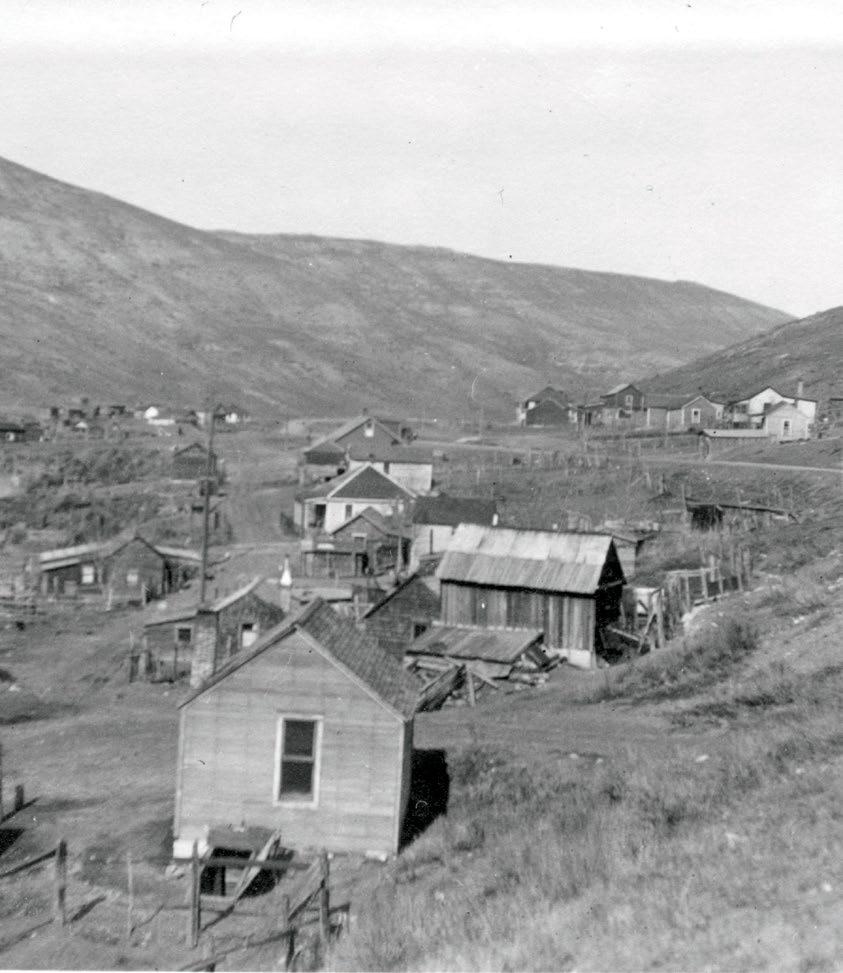
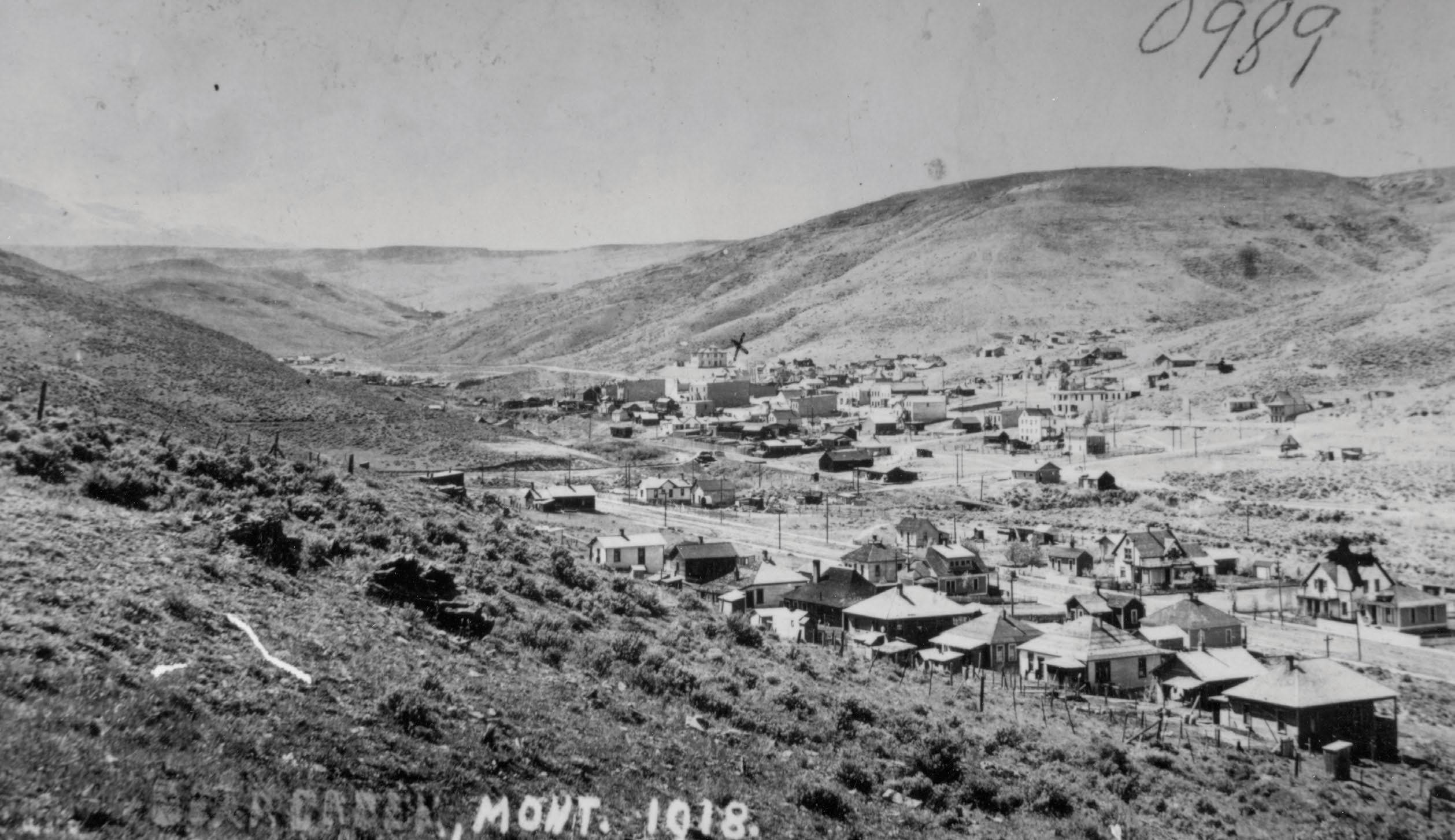
IIt’s incredible that a tiny, windswept ghost town can illuminate decades of American history. After booming, busting and withering into a pass-through bedroom community, Bearcreek today is known for one famous attraction: pig races at its last remaining saloon. Coal built Bearcreek, Montana, until the world left coal behind.
Blindfolded, I threw a dart at a six-foot-wide map of Montana to continue Mountain Outlaw ’s Dart Toss series. It landed on the border of Bearcreek and Belfry. Looking at Google Maps’ satellite view, my team agreed Bearcreek looked especially interesting for its tiny footprint between two valleys. I knew nothing. Perfect. My only goal: tell the story of a place.
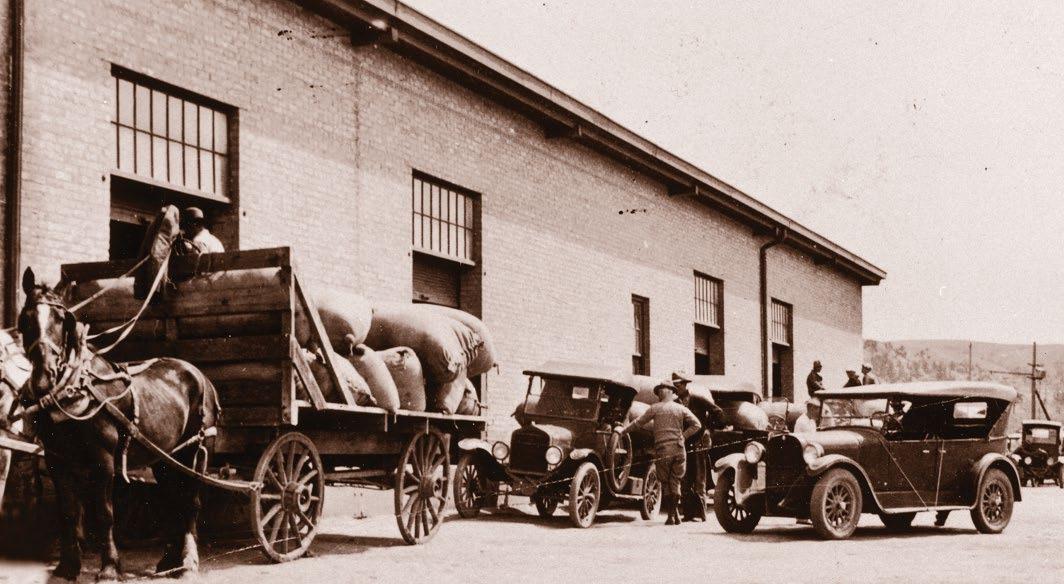
About 60 million years ago, more than 100 billion tons of coal began to develop within the Fort Union Formation across eastern and central Montana. By American standards in the late Industrial Revolution, some of Montana’s finest, most useful coal waited underground in
“Coal was the thing to own back in those days ... [Bearcreek] was an important source of coal for southern Montana and the country, I think, for probably 50 years or more,” said Bob Schalla, a geologist and historian based in Billings and Red Lodge who published his first book, Black Diamonds from the Treasure State, in 2024.
Before any companies could turn a profit pulling riches from the earth, they’d need a railroad—that, and an 1882 treaty agreement to extract valuable land from the Crow Reservation. Several railroad proposals had emerged by 1889, but it took 17 years of false starts and funding lapses, backstabbing and “pain and anguish,” Schalla explained, before the Montana, Wyoming and Southern Railroad connected Bridger to Bearcreek in 1906. Schalla unraveled that story obsessively, like a detective.
“It was all
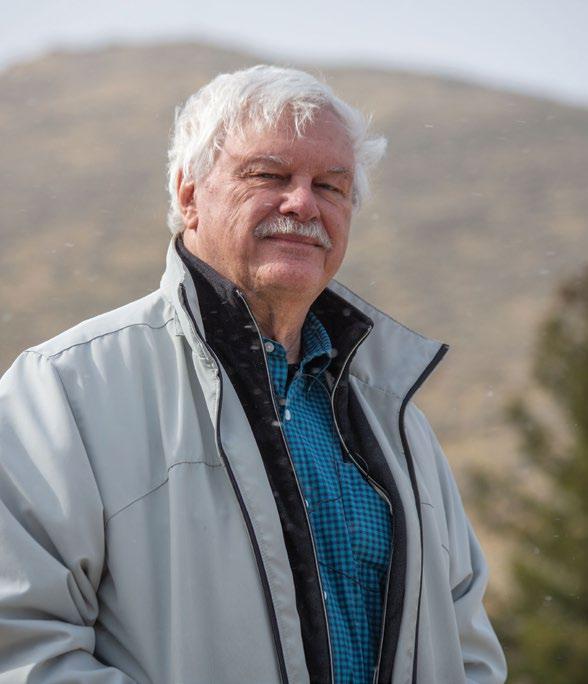
Bob Schalla spent his career as a geologist, but says his alter ego always wanted to be a writer. He explored this passion in his book, Black Diamonds from the Treasure State, which tells the surprisingly juicy story of Montana railroad development including the track into Bearcreek. Photo by Jack Reaney
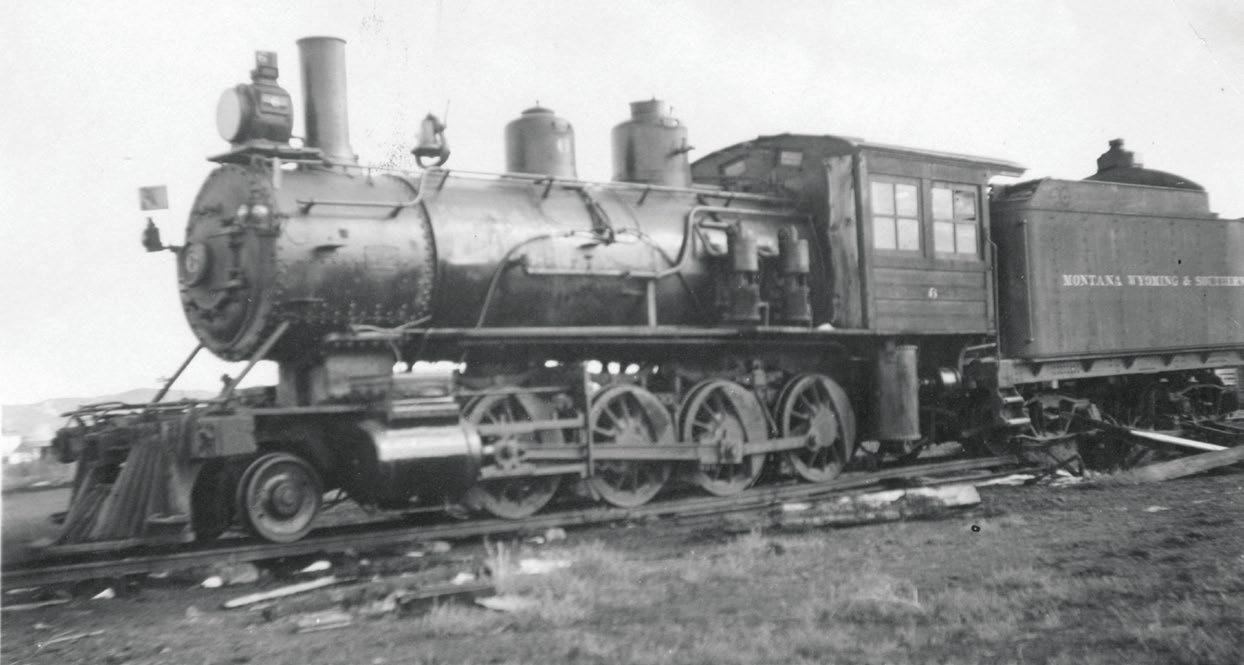
these different personalities and how they interacted and conflicted with each other that really made it interesting,” he told Mountain Outlaw after offering a tour of Bearcreek’s buried history on a blustery April afternoon. During his research, he learned that photos of the small railroad were archived far and wide, including the California State Railroad Museum, Southern Methodist University and Railroad Museum of Pennsylvania.
“From coast to coast, when you dig into the archives, there are pictures of this railroad ... I was really excited when I discovered all that,” Schalla said. With the 25-mile branch finally completed in 1906, the town sprang to life.
Within a year, infrastructure included telephones, city water and electric street lights. The Lamport Hotel opened in 1907 and became one of Montana’s finest accommodations. The Bearcreek Bank, now listed in the National Register of Historic Places, stands prominent
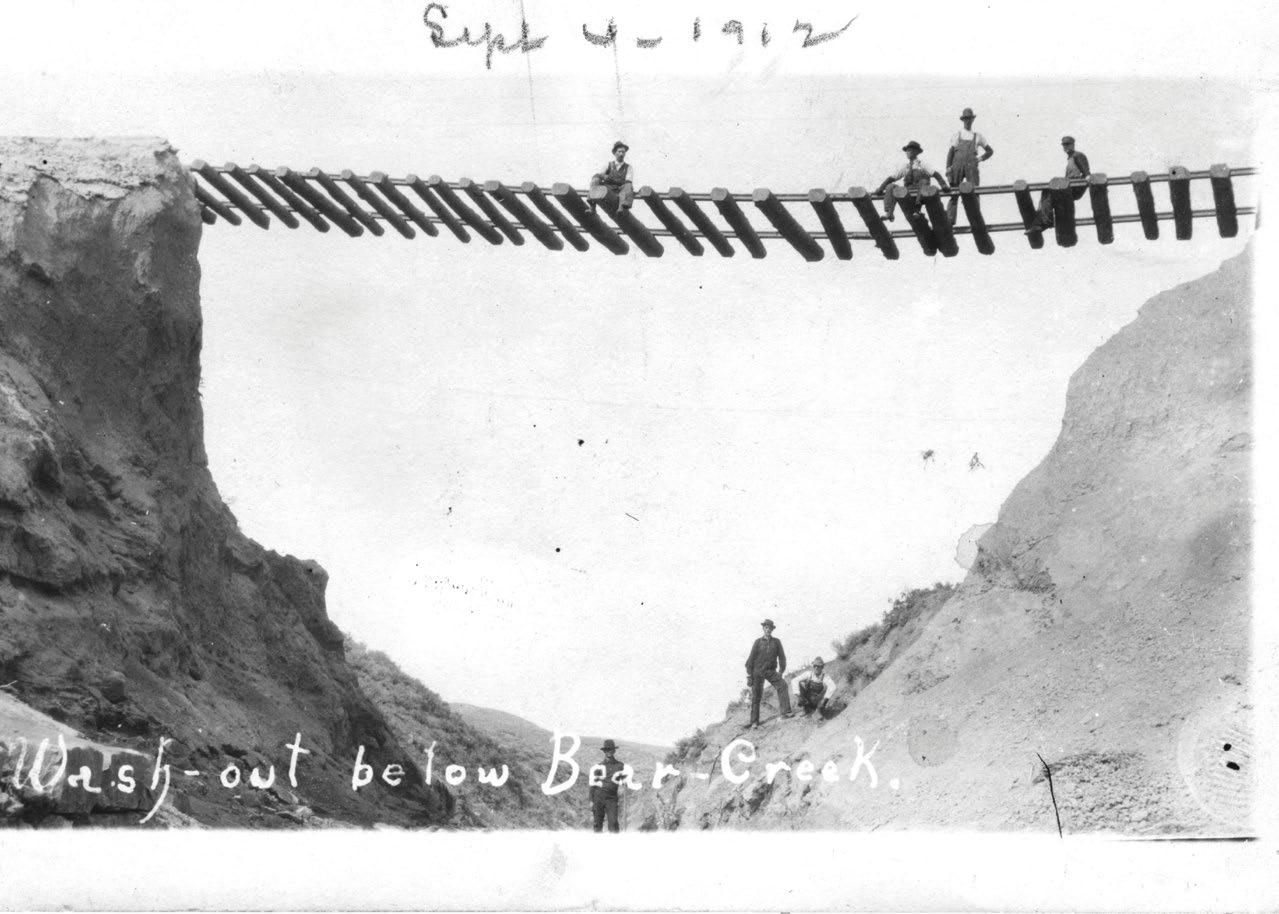
and sturdy today—it was built using local sandstone to symbolize confidence in the future. In 1928, Bearcreek High School went 13-0 to win the Yellowstone District Basketball League. Now, there’s no school to speak of.
“[Bearcreek] had banks, they had schools, they had a courthouse. And at its peak, it was about 3,000 people,” said Becky Van Horn, historical preservation officer with the Carbon County Historical Society and Museum. In the mid-1920s, Bearcreek’s peak population—including many immigrants—outnumbered Red Lodge, another mining town about seven miles west. Red Lodge has sustained its prominence thanks to tourism drawn by a large ski area, the Beartooth Highway and Yellowstone National Park.
Bearcreek’s annual coal production peaked in 1918, when industrial demands of World War I compelled all seven mining companies to produce a combined 692,000 tons of coal. Output spiked again in World War II, yielding 576,000 tons of high-grade coal in 1944 before demand dropped sharply.
In 1899, coal supplied 90 percent of U.S. energy. By 1947, that share fell to 50 percent as natural gas and nuclear energy took hold. Furthermore, the development of open-pit mining was cheaper compared to Bearcreek’s underground room-and-pillar style of mining. The Northern Pacific Railway transitioned from coal-fired engines to diesel-powered trains, and Bearcreek’s railroad was removed in 1954. One mine lingered into the 1970s.
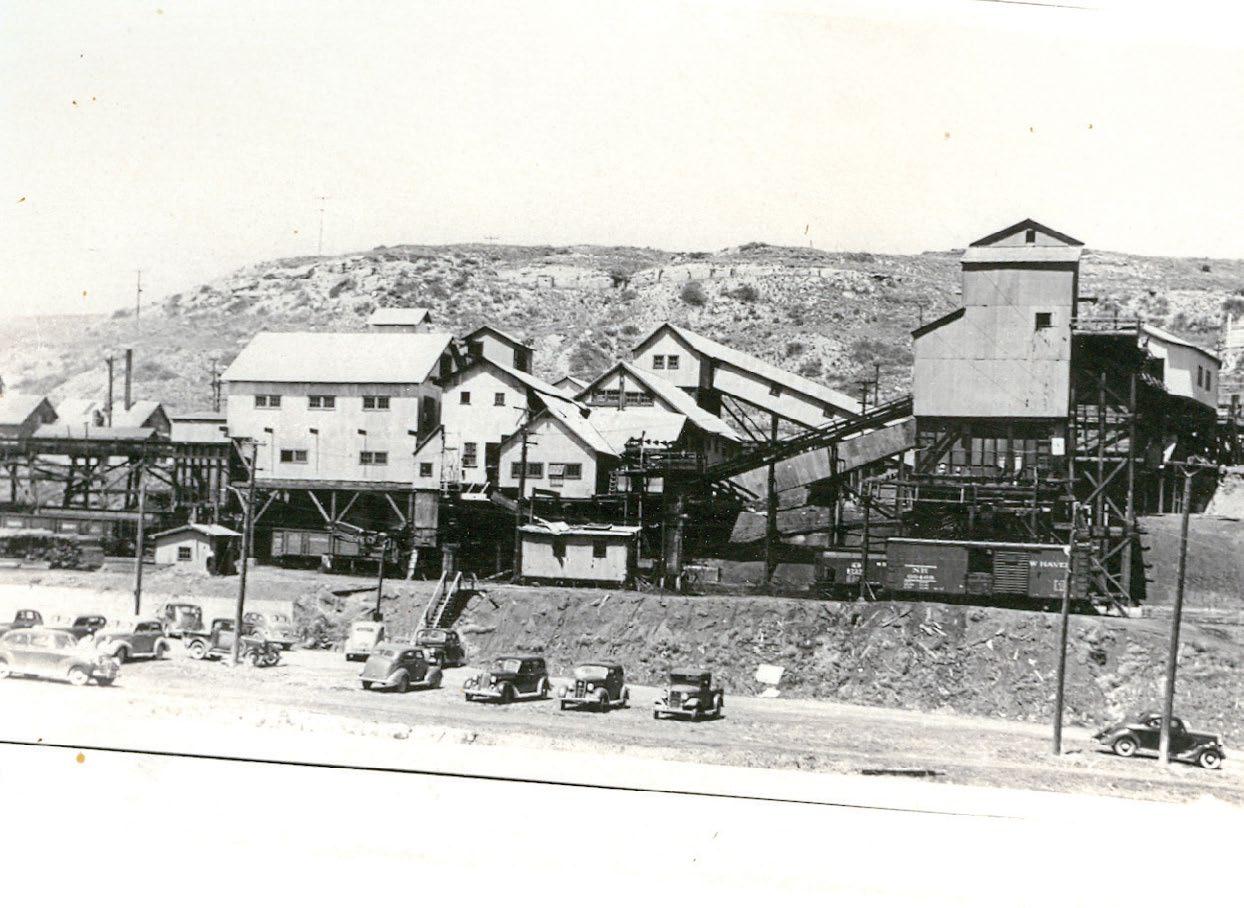
Parking his SUV around the silent town, Schalla pointed to scars in the land—a rotting trestle, flattened land where railroad spurs once ran into the sage-covered coulees— as evidence of an industrial engine for Montana, once upon a time.
“It was a pop-up town that kind of popped right back down when it became ineffective, financially ... The decline happened pretty swiftly, probably within a decade,” Van Horn said.
Tragedy struck late one Saturday morning, Feb. 27, 1943. An explosion claimed 74 souls and sealed the Smith Mine’s fate as the only operation whose remains can still be seen.
Historians believe the Smith Mine Disaster hastened Bearcreek’s decline, but did not cause it. It was depressing for residents and families of victims, Van Horn said, paired with the demise of coal in the post-war era, when almost all of Bearcreek’s mines were completely deconstructed and removed. Some families loaded homes onto trailers; others took them apart brick-by-brick. Federal investigation by the U.S. Bureau of Mines concluded that roughly 200,000 cubic feet pent-up methane gas—a substance as combustible as gasoline vapor—was contained in an underground chamber of Smith Mine No. 3.
During inspection in November 1942, Loren Newman, a foreman and fire boss, offered a recommendation to mitigate the well-known hazard: “I suggested they shoot a hole through there and open up the circulation—get some air in there,” Newman later told investigators, according to documents displayed at Carbon County Historical Society’s museum. “But the federal inspectors decided to seal off the gas instead. I guess I should have kicked up a bigger fuss than I did.”
Trapped by the cave-in, four men left a note: “We try to do our best but we couldn’t get out.” Another two miners scribbled, “Walter & Johnny. Good-bye. Wives and daughters. We died an easy death. Love from us both. Be good.”
Six days and no survivors later, grim news on the front page of Carbon County News : “CONCEDE 74 DEAD IN COAL MINE DISASTER.” It remains the deadliest coal mining incident in Montana history.
Still, many visitors drive right past the historical markers detailing this tragedy and the story of Bearcreek, merely glancing from the highway at the Smith Mine ruins, almost certainly unaware of the railroad, and the hundreds of homes once scattered across a now-barren landscape. All this, of course, because their imagination is captured by scampering piglets.
Bearcreek industry died, but the world-famous pig races of the Bear Creek Saloon & Steakhouse have rebranded the town: the Bear Creek Downs has been featured by outlets including “Good Morning America,” The Discovery Channel and The Wall Street Journal.
The bizarre tradition spawned in 1988, intended to lure tourists amid the 1988 Yellowstone Fires. Former saloon owners Pits and Lynn DeArmond came up with the idea over a bottle of Grand Marnier.
It wasn’t legal. Authorities shut it down until one Montana lawmaker, Rep. Alvin Ellis, championed the tailormade “Pig Racing Bill” to allow pig racing in small towns for the purpose of raising money for nonprofits.
The saloon has since raised more than $175,000 in postsecondary scholarship funds for Carbon County students. After a record-breaking 2025 raised $16,000, the Bear Creek Downs scholarship will now support an additional student, now from Stillwater County.
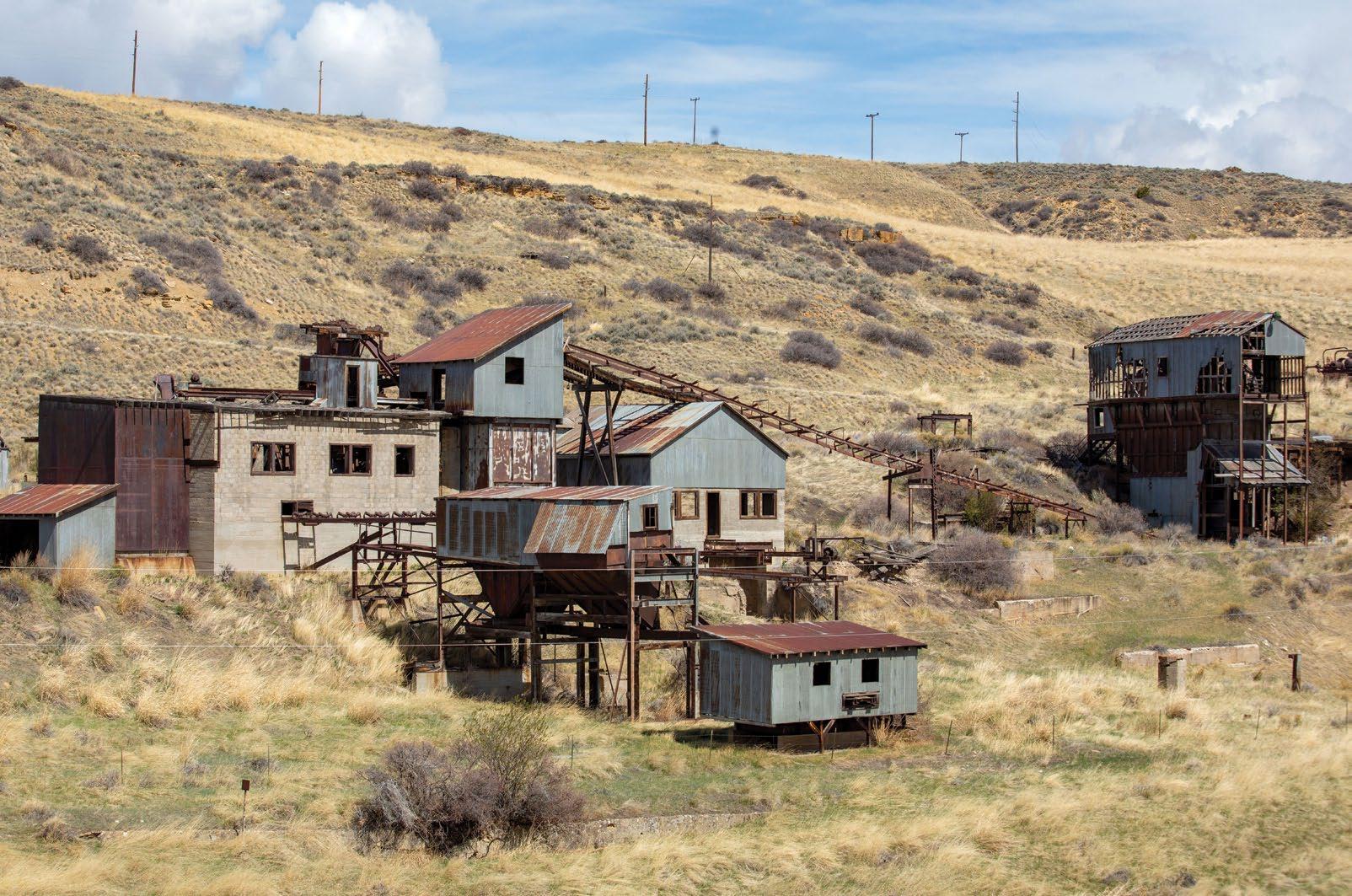
Piglets come from a farm in Park City, Montana, only about a week before lining up for the first races of the summer. If they finish, they are rewarded with “sweet feed” made of ground corn with molasses.
Half the money from wagers goes to the Bear Creek Downs scholarship fund; the other half goes to the winner.
Dawn DeVille and Tim Ryan purchased the century-old saloon in 2020. They reflected on the importance of running a business to keep Bearcreek’s spirit and economy alive.
Visible from Montana Highway 308 just west of Bearcreek, the Montana Coal and Iron Company’s Smith Mine was left intact as a historical site and memorial of the Smith Mine Disaster. Photo by Jack Reaney
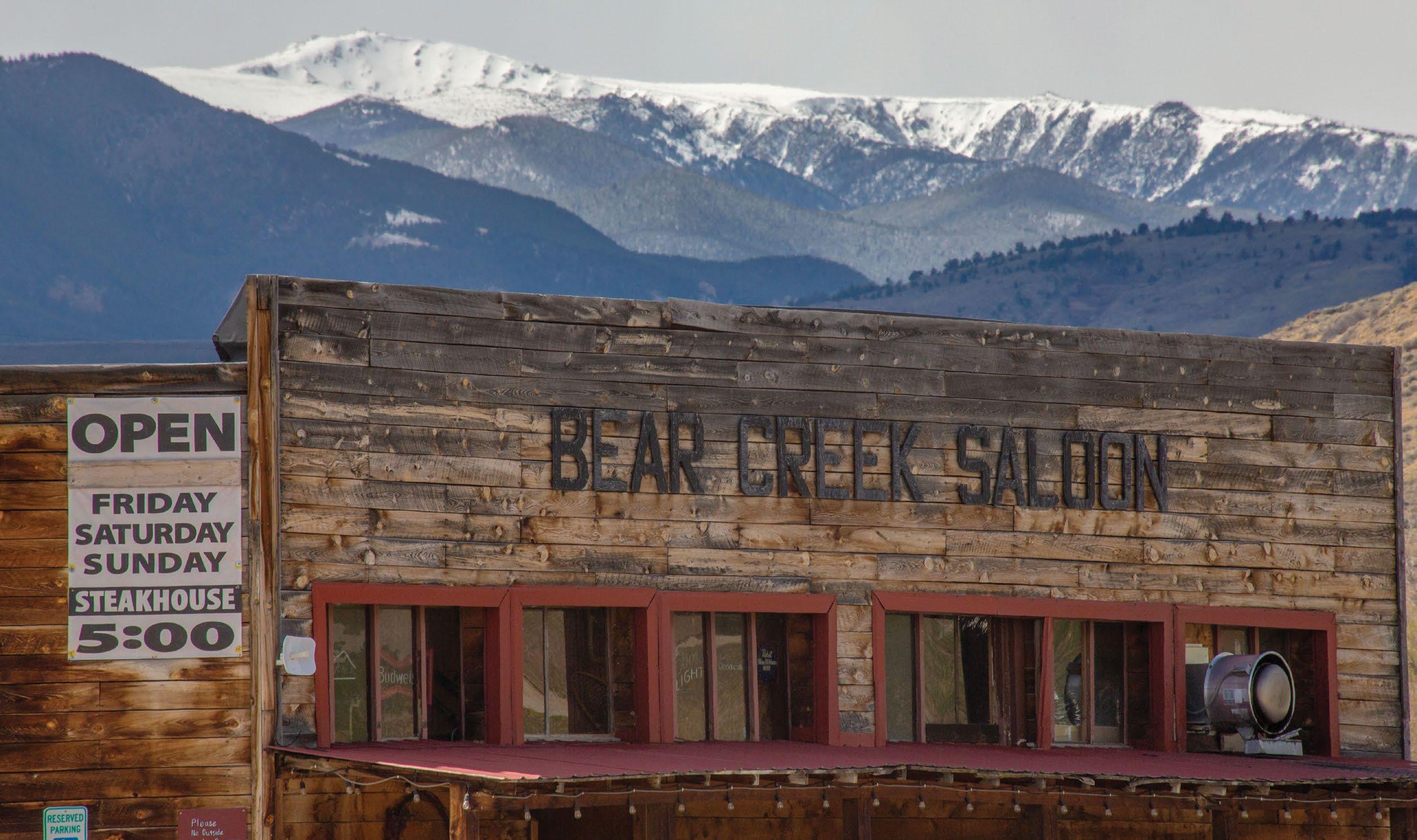
“We get a lot of feedback from the community that they’re glad it’s still here ... We didn’t re-invent the wheel, we just polished it up a little bit,” DeVille said.
Her grandfather was a mechanic, born in Bearcreek to French-Belgian immigrants. He played piano for silent films at the local theater. DeVille visited Bearcreek throughout her life and moved in full-time in 2002. It’s one of Montana’s smallest incorporated communities with fewer than 100 residents, mostly retirees and Red Lodge workers, she explained.
DeVille looks around her restaurant, pointing out the path of a stray bullet into the wooden pillars of an ornate, European-built bar purchased from the 1904 St. Louis World’s Fair. She doesn’t sugarcoat the history that left the saloon among Bearcreek’s few remains.
“There were tons of bars, brothels, restaurants, things like that. Never a church,” DeVille said. “ ... You know, I don’t want to make it sound like something that it wasn’t, but I think at one point it was just kind of a rowdy coal-minin’ town.”
When you learn the history of a place like Bearcreek, it stretches your imagination. Reporting alongside my filmmaking colleague Fischer Genau, we frequently theorized:
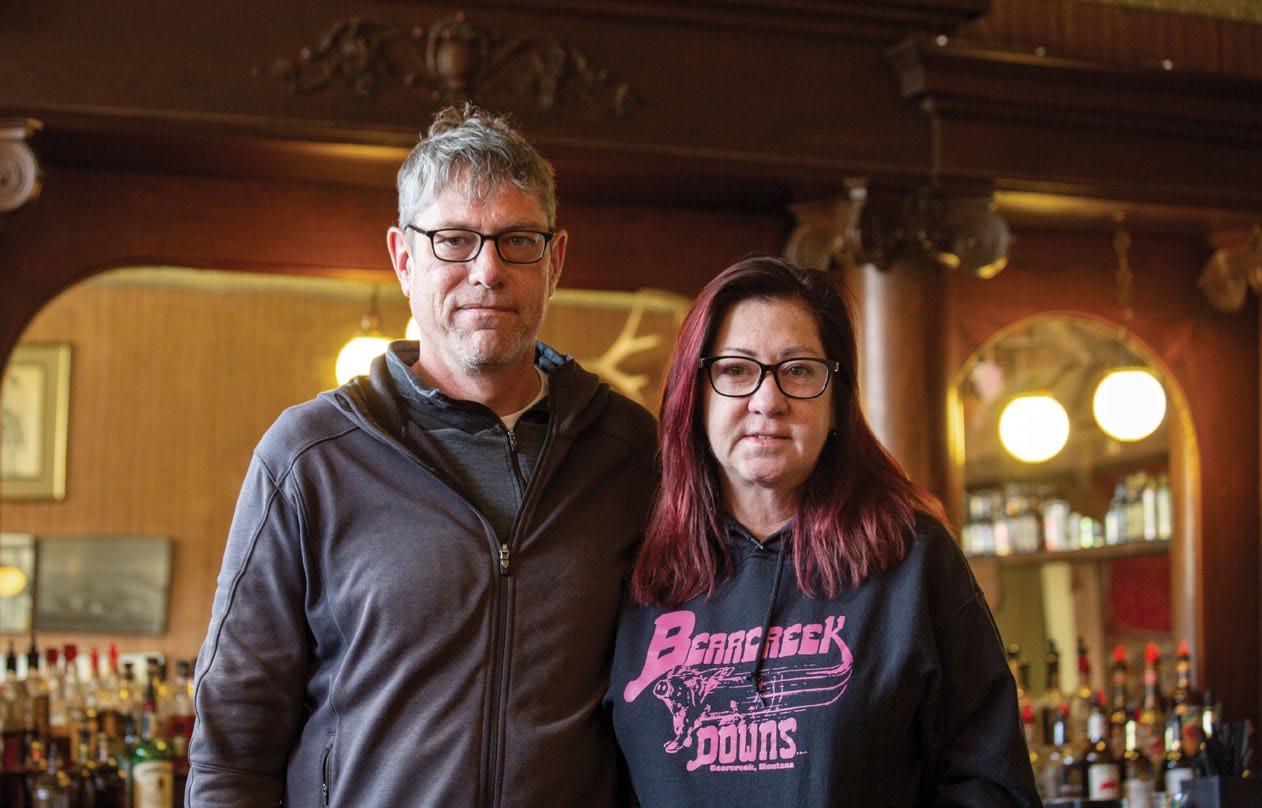
We guessed the purpose of some decrepit shack; we wondered where the miners entered the complex web of underground tunnels; and we tried to connect old photographs with today’s sleepy hills. As a writer lucky enough to meet some local experts, I can only hope that visitors drawn to the pig races will catch a glimpse into Bearcreek’s invisible, volatile past.
To start, I suggest examining the photographs hanging in Bearcreek’s lonely saloon. After all, that’s probably the only reason you’d find yourself in the Bear Creek Coal Field.
Jack Reaney is a writer and photographer based in Big Sky, Montana. He works as senior editor for the Explore Big Sky newspaper. Outdoors, he’s a skier, runner, baseball player and timid mountain biker.
For the accompanying film on “Dart Toss: Bearcreek, Montana,” and other Mountain Outlaw films, visit mtoutlaw.com.”
By Mira Brody
“Iwanted to be the reason people came to the restaurant,”
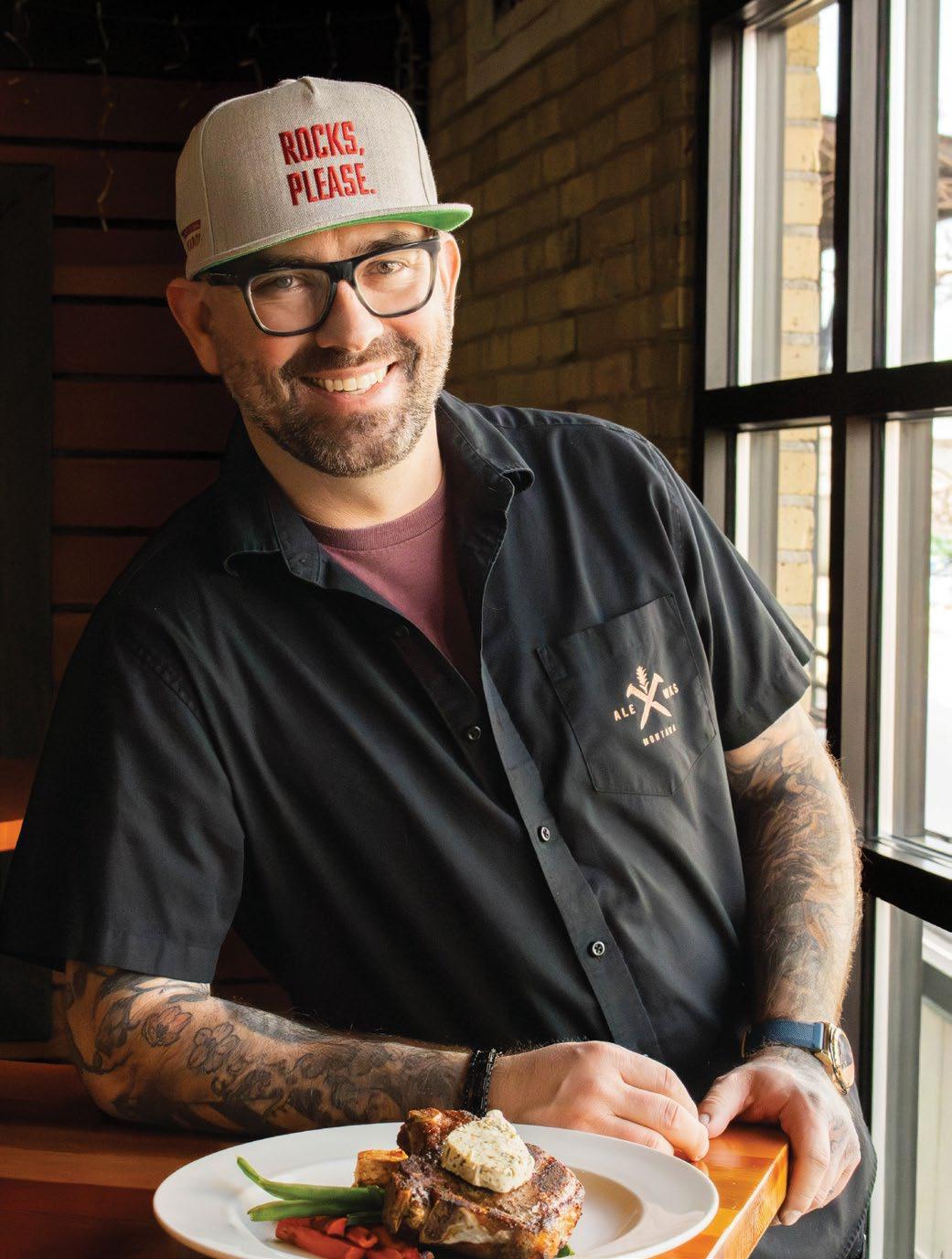
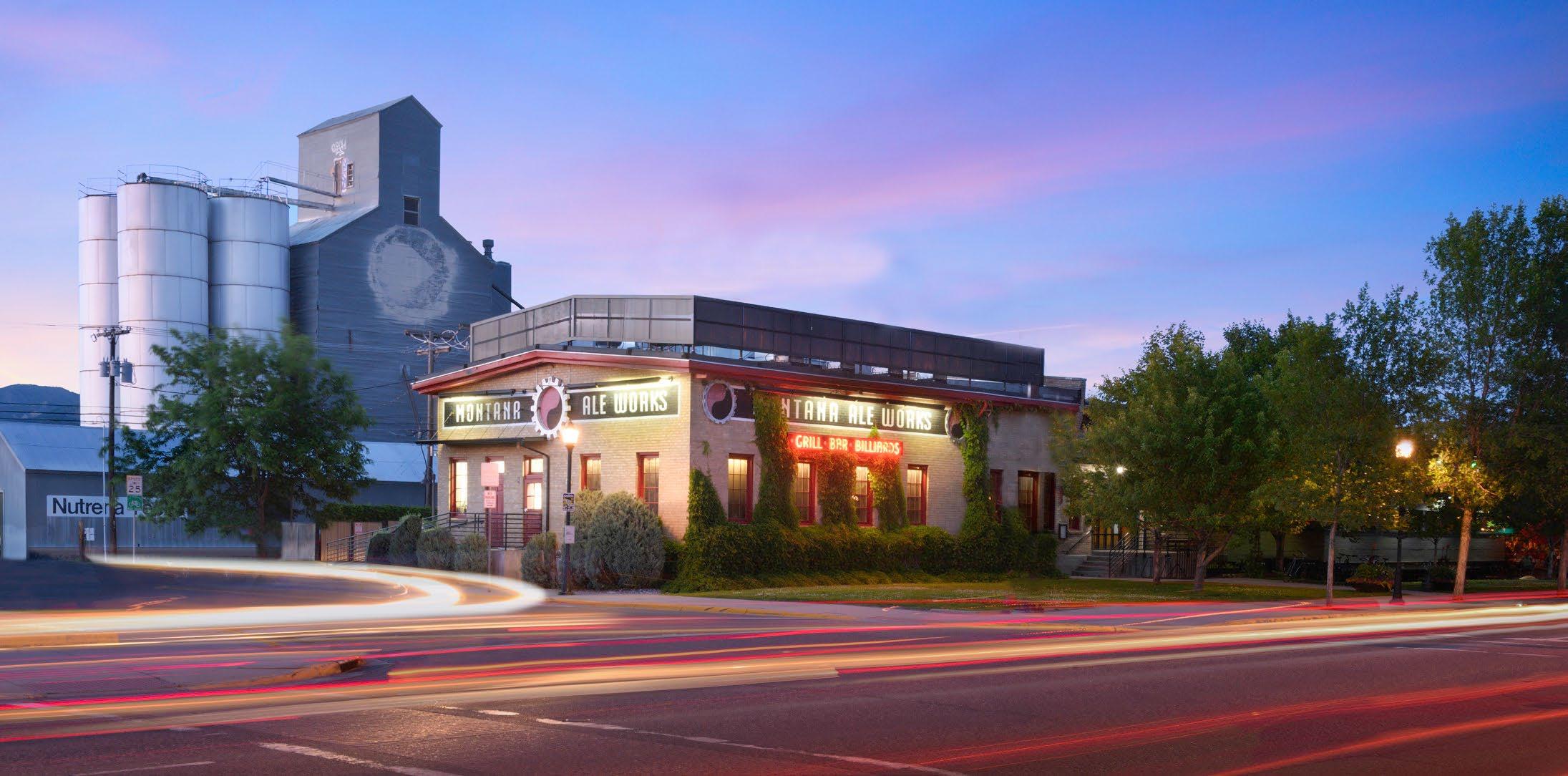
Montana Ale Works Executive Chef Jacob Huder said. He’s in the middle of recounting how he landed in this dining room when he pauses to look over the night’s specials, freshly printed and already marked up. Huder, Ale Works’ Executive Chef and the newest of five partners, is clearly not the only person double and triple-checking each detail.
It’s all in those details, Huder explains, picking up where he left off: the food, the work ethic, the community, management culture, and partnering with local producers to source ingredients. In the fast-growing city of Bozeman, Ale Works has built an ecosystem that keeps regulars returning while drawing in newcomers.
“What we do best here is supporting our community and doing it with consistency,” Huder said. “When you come in the door, I feel like we do a great job of making sure you feel welcomed and get the experience you want.”
The consistency Huder is talking about is built on a foundation that taps deep into Bozeman’s agricultural history from the 1880s. Set in a neighborhood that was once the hub for transporting goods produced in the fertile Gallatin Valley, the Ale Works building was originally a Northern Pacific freight house where those goods were stored before being shipped back East by rail. An active spur line still runs behind the restaurant, and part of the dining room is a refurbished railcar
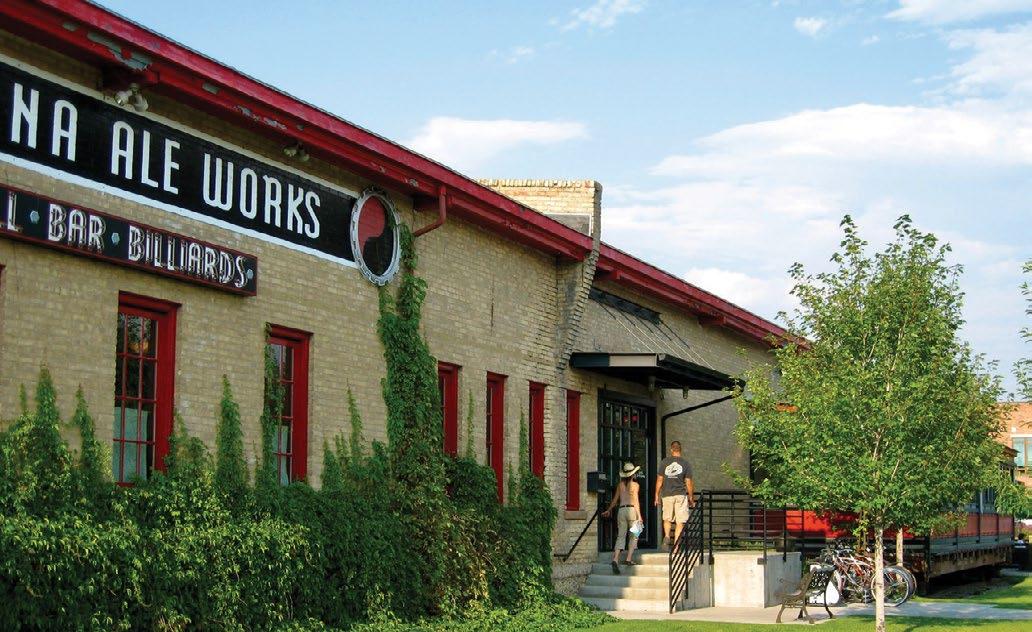
overlooking Main Street.
“The building struck me for sure the first time I walked in,” said Managing Partner Roth Jordan, describing the space known among many as Bozeman’s gathering place. “I mean, it’s hard not to walk in this building and not just kind of be in awe.”
Jordan came on as Executive Chef in 2005, building the foundation of from-scratch recipes Ale Works is known for. He handed the kitchen reins to Huder in 2021, who soon joined the ownership group, which currently consists of these two, plus Director of Operations Sean Faris and founding partners Mark Taché (CEO/CFO) and Christin Cooper-Taché (Concept, Culture and Messaging).
From the helm in his composed kitchen, Huder’s culinary stamp has only reinforced Ale Works’ reputation in the community.
“Being the calm in the storm I think is the important part, and keeping a level head and making sure the team is—even if they’re having a bad day or a rough night—still having fun doing it because cooking food is fun,” Huder said. Once you take care of the core team, he explained, that hospitality extends to
the guests.
“You never know why someone might be going out to dinner that night,” Jordan added. “It could be for a celebration. It could be because they had a bad day and they needed beer, badly, but they’ll stay for the hospitality, a local craft bourbon and a steak.”
That philosophy shapes everything that takes place inside and outside the restaurant, especially in the team’s long-term relationships with local producers.
Twenty years ago, Ale Works partnered with Matt and Jacy Rothschiller, owners of Gallatin Valley Botanicals, a local organic farm. The couple were interested in increasing their production while Ale Works needed a dependable local producer to meet its volume. A symbiotic partnership was born: Ale Works purchased harvest equipment for GVB and was paid back in veggies.
To learn how food is grown and spirits are made, employees take mandatory farm, brewery and distillery tours, and Huder finds creativity in crafting a menu with local, seasonal offerings. Today, 27 percent of menu ingredients are sourced locally, against an industry standard of just 3 percent.
Better food. A smaller carbon footprint. Supporting local agriculture. “Everything about the relationship is holistic,” Jordan said. “And that goes for our management philosophy too. It’s about sustainability, in life and work.”
This summer, the Ale Works patio will hum with hungry patrons, its outdoor bar alive with easy conversation, the sun slipping through vines of hops that frame the edge of the terrace. That familiar energy— and the crew behind it—is more than a seasonal scene. It’s become an intrinsic part of Bozeman.
“A long time ago we realized that we didn’t want to just be a business in the city of Bozeman,” Faris said. “We wanted to be a part of the community.”
By Jacob Huder
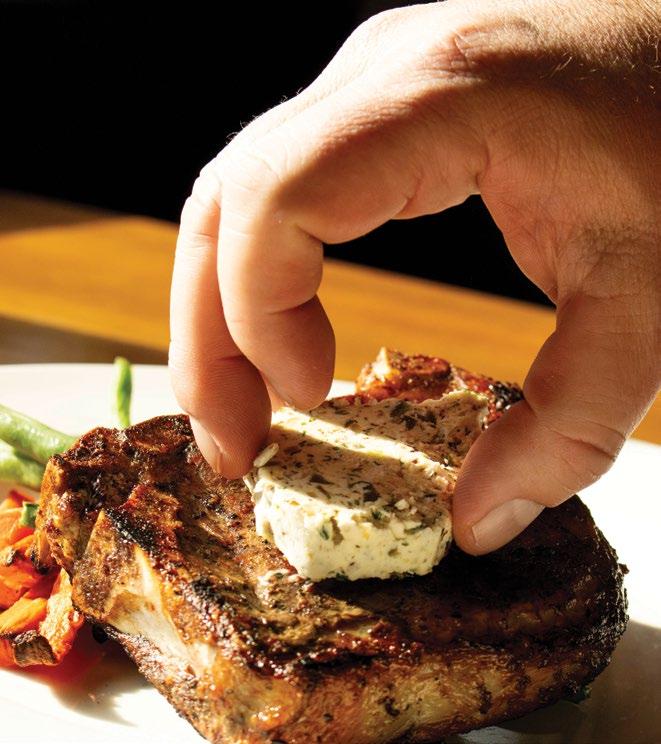
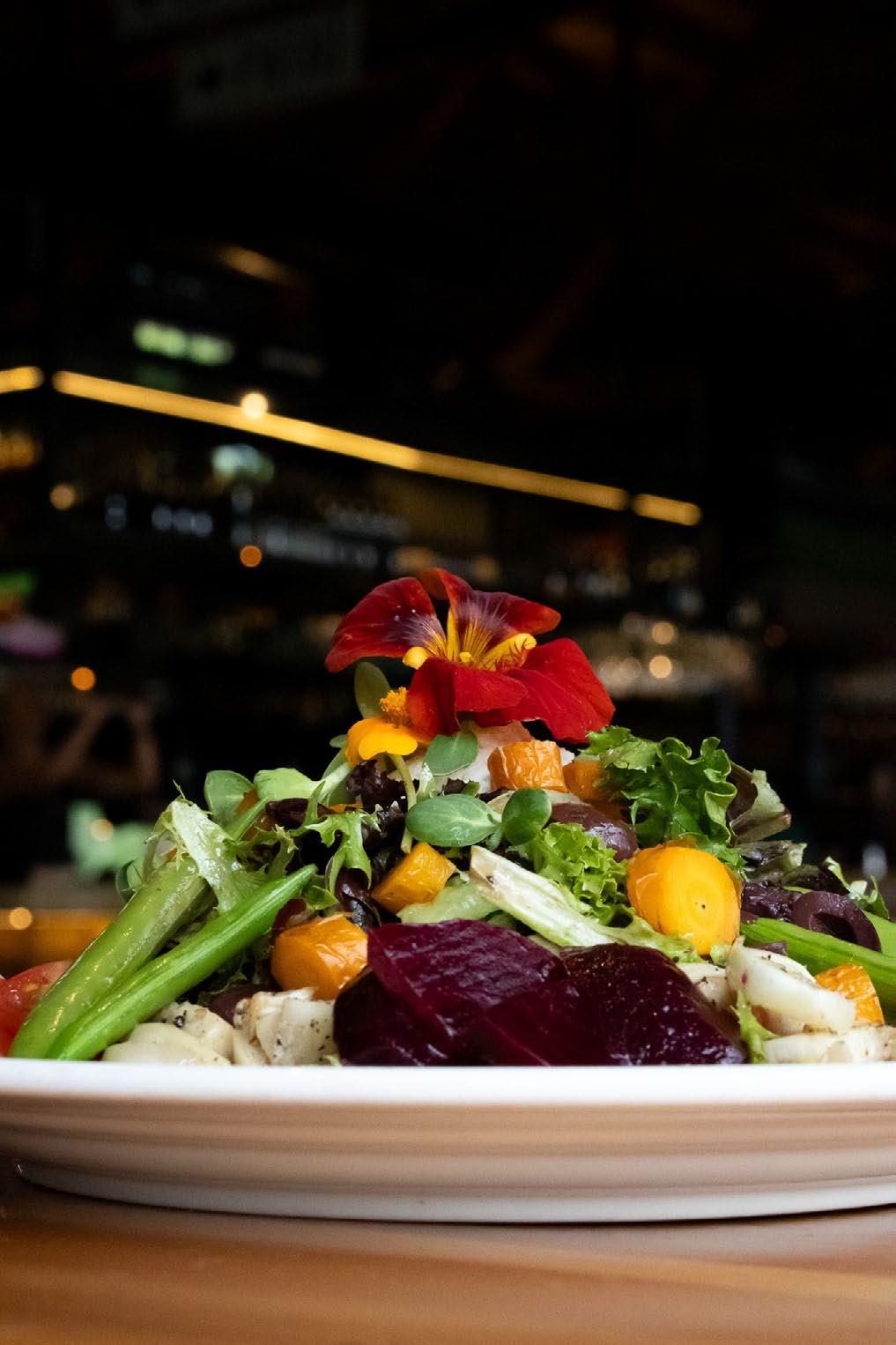
This dish was inspired by a trip to Ranchland, Ale Works’ local processing plant. After seeing the quality of the Montana pork being butchered, Huder and Jordan knew they wanted to feature a local chop on the Ale Works menu. Drawing on their Southern roots, the two decided to pair the chop with cornbread and a jalapeño butter to complete the dish.
Pork Chop Sous Vide
4 pork bone-in chops, seasoned with salt and pepper
½ cup + 1 tbsp melted bacon fat
1 tbsp minced garlic
1 tsp fresh rosemary
1 tsp fresh thyme
Place 1 tablespoon of bacon fat and all the herbs in a vacuum-sealed bag with pork chops. Reserve remaining bacon fat for the cornbread. Sous vide (or immerse the bag in 150° F water) for 4 hours, then place the bag in an ice bath to cool.
Jalapeño Honey Butter
¼ lb (1 stick) unsalted butter, softened
2 tbsp minced shallots
2 tbsp minced jalapeños
½ tsp each minced fresh garlic and fresh ginger
1 ½ tsp neutral oil
1 tbsp apple cider vinegar
1 tbsp whole grain mustard
½ cup fresh parsley, finely chopped
6 tbsp honey
½ tsp each salt and pepper
½ tsp Tabasco (green is best; red is fine)
1. Let butter fully soften in a big bowl at room temperature.
2. Cook shallots, jalapeños, garlic, and ginger in oil over low heat until slightly translucent. Let cool.
3. In a small pot, bring vinegar to a boil until reduced by half. Let cool.
4. Combine remaining ingredients with the cooled shallots and vinegar.
5. Whip softened butter using a hand or stand mixer on high speed to incorporate air, until volume increases by 25%.
6. With mixer still running, slowly add honey. Then add mustard, parsley and spices until well incorporated.
7. Roll the butter into a log and wrap in parchment paper or plastic wrap. Store in refrigerator.
1 cup flour
¾ cup cornmeal
½ cup sugar
1 ½ tbsp baking powder
½ cup melted bacon fat
(reserved from the sous vide prep)
½ can drained whole kernel corn
½ can creamed corn
3 eggs
1 ½ cups sour cream
1. Preheat an oven to 350° F.
2. Place cast iron pan in oven with 1 tablespoon of bacon fat.
3. Melt remaining bacon fat in pan on stove.
4. Place dry ingredients in a large mixing bowl.
5. Blend corn, eggs, sour cream and bacon fat into dry ingredients.
6. Pour mixture into warm, greased pan.
7. Bake for 40 minutes.
When cornbread is nearly baked, use the final 10 minutes to sear your chops— about 5 minutes per side, or to preferred doneness—on a hot grill or in a very hot pan. Place one thick slice of jalapeño honey butter atop each chop. Serve with a blissful scoop (or two) of cornbread casserole. Enjoy!
Fly Fishing in Montana can be a rugged, sometimes-tiring adventure—that’s why Madison Double R will be a welcome respite at the end of each day.
Located on the world -renowned Madison River south of Ennis, Madison Double R offers first- qualit y accommodations, outstanding cuisine, exper t guides, and a fly fishing lodge experience second to none Now accepting bookings for the 2025 season.
ANASTASIA WILDE CAPTURES COMMUNITY AND BELONGING AT THE LIMITS OF HUMAN EFFORT
Photos by Anastasia Wilde | Words by Sophie Tsairis
Previous
AAnastasia Wilde didn’t grow up equating the outdoors with recreation or sport. In Russia, where she was born and spent her early years, time outside was spent picking mushrooms in the woods or tending land with purpose. When she came to the United States she first lived in New Jersey; then, as a “troubled teenager,” was sent to a ranch in Montana. The wide open spaces changed her perspective and how she viewed herself in the landscape. The freedom she felt in the mountainous terrain did something to her nervous system, she said. It slowed it down. It let her settle.
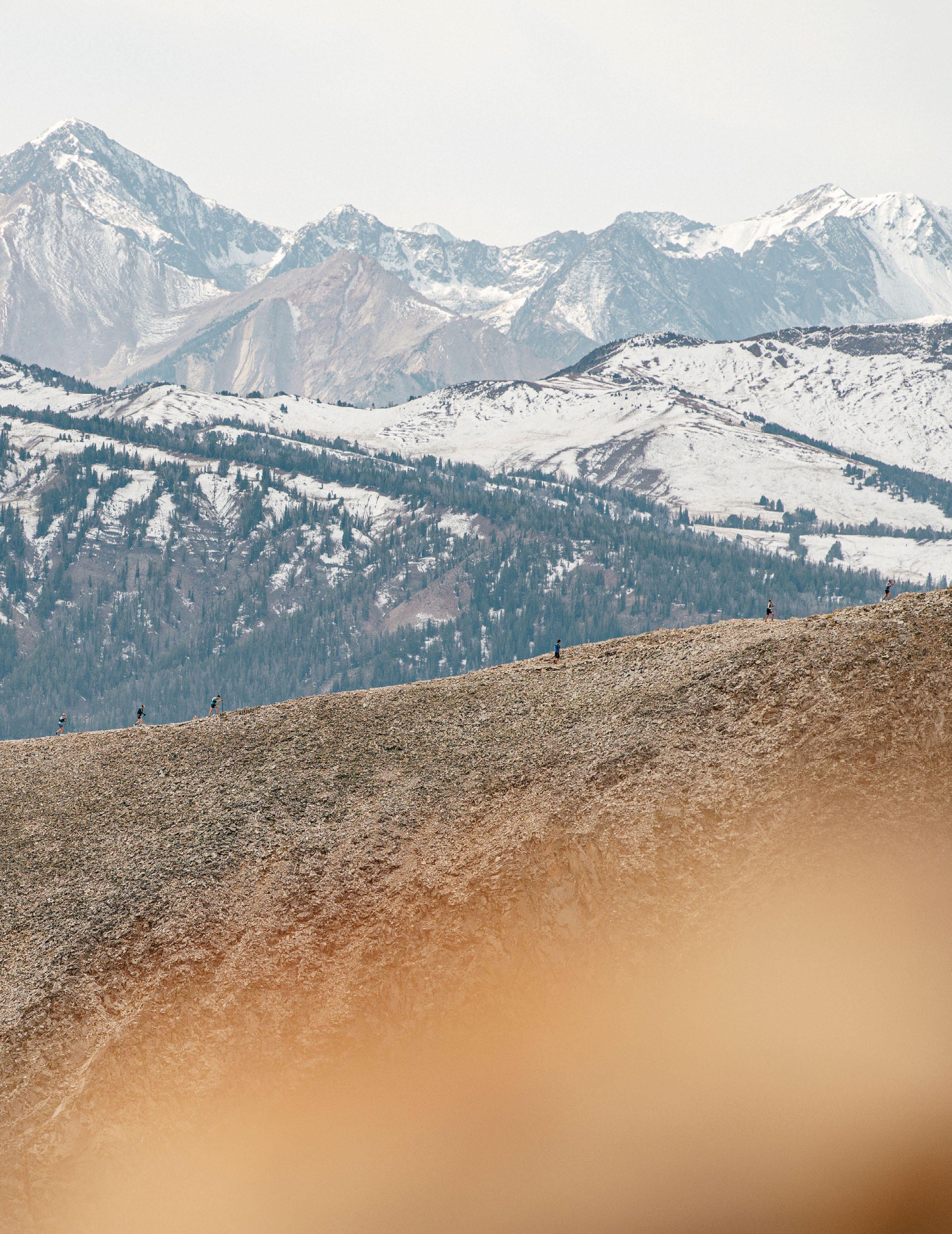
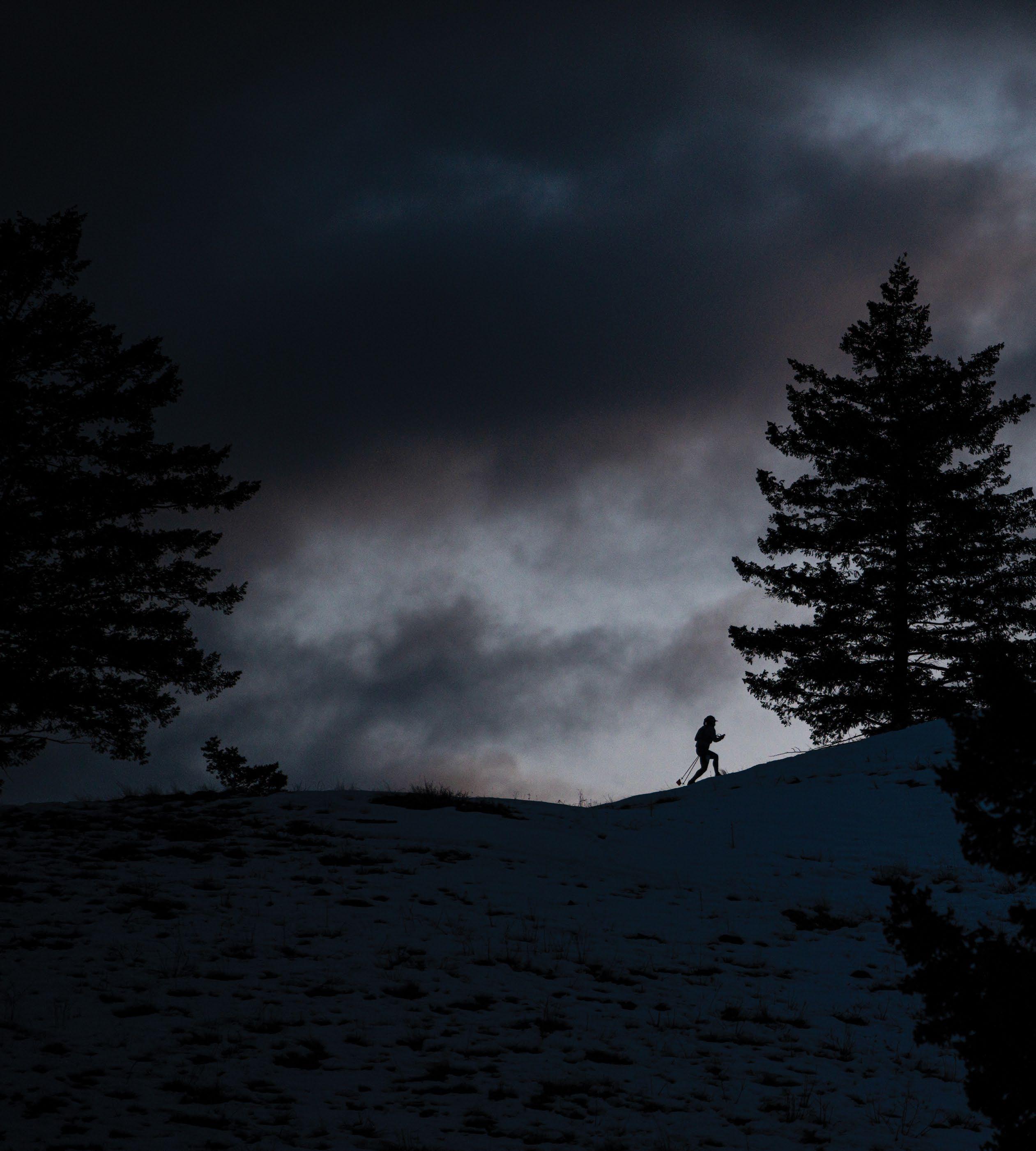
Decades later, Wilde is one of Montana’s most compelling outdoor adventure photographers. Specializing in ultra running, she captures the intimate moments that test the limits of the human body and mind, often in rugged and remote landscapes. She shoots footraces of all distances but is particularly inspired by the 200-mile races where athletes run for four consecutive days, sleeping as little as they can manage. To capture these events, she hikes out before dawn—sometimes with upwards of 30 pounds of gear, including her camera equipment, water, food and warm layers—to reach a ridge by sunrise. She shoots until the last light fades and does it again the next day. She sleeps in her car. She gets lost. She figures it out.
“When I’m in job mode, it doesn’t matter if I don’t eat, don’t sleep, don’t drink,” Wilde said. “I’m all in.”
The fortitude is not unlike that of the athletes she photographs, but it didn’t come naturally or all at once. Her first overnight shoot, following a friend’s FKT (fastest known time) attempt through a route in the Beartooth Mountains, was a revelation. She didn’t know people did things like that, or that she could play a role in their journey. Her first 200-mile race, Destination Trail’s Bigfoot 200 in the Mount St. Helens area of Washington, sent her hiking alone into the dark at 3 a.m., hearing things rustling in the bushes, terrified and completely captivated. “I slept maybe 12 hours over five days,” she recalled, “because I was just so excited.”
Wilde describes herself as introverted, but she’s found a sense of belonging in the ultra running and outdoor adventure community, especially where she lives, in Missoula. At endurance events, there are no pretenses. People take care of each other. Runners stop mid-race to ask if she has enough water. Strangers become familiar faces across a season of events. The
shared suffering strips away everything but primal, basic needs, and has a way of bringing people together in ways that ordinary life rarely manages to do. It’s an individual sport, but it doesn’t feel that way.
“You really get to build these special relationships,” Wilde said. “Everybody involved, whether they’re volunteering or running, is so lovely, so down to earth. In that moment, you’re just focused on that one thing, and I feel like that connects all of us.”
While Wilde said she has no intention of jumping into the competitive world of ultra running herself, she holds close the adventure it provides her. “I still get to be there, and I get to experience all those highs and lows,” she said. “And it’s like I still get to be a part of that community.”
What draws people to seek out long, strenuous pursuits in the backcountry, she believes, is the rare combination of solitude, scale, and self-discovery that ordinary life rarely offers. “It’s mostly about mental strength. After a certain point, your body either wants to do it or it doesn’t.”
For her, the connection runs even deeper than community to include the land itself. Montana’s mountains—the Beartooths, the Crazies, the ridgelines above Big Sky—are, in her words, dear to her. Through her lens, she gives her subjects and the landscape they move through the attention of someone who understands what it means to arrive in a place that demands something from you and embrace its challenges with an open heart.
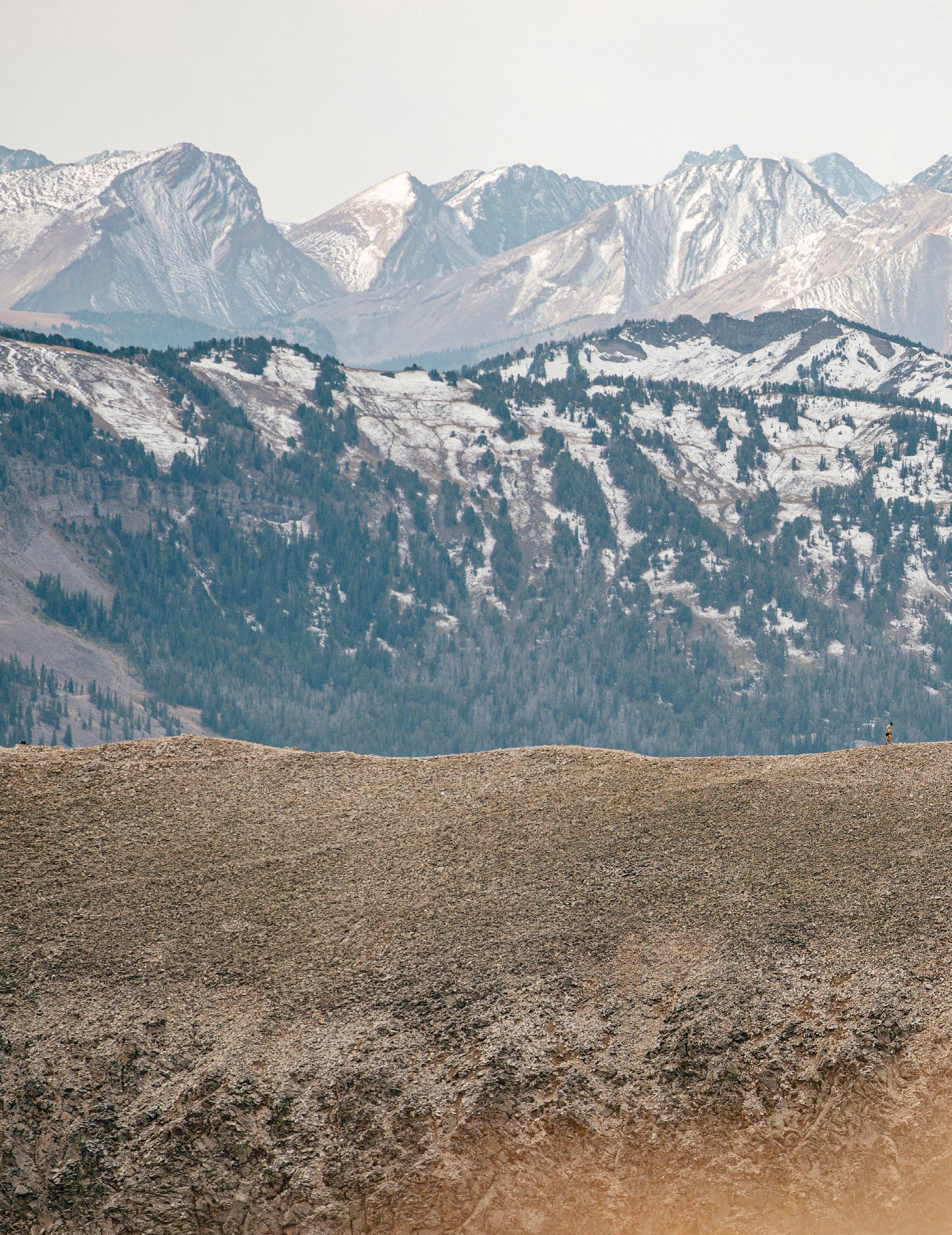
In her work, human figures appear small against vast, rugged terrain. They’re tiny specks against bonecrusher ridgelines, dwarfed by mountains and sky. These landscapes don’t care how fast you run or how much you’ve trained. They ask only one question: Do you have a strong enough reason to keep going?
Wilde has spent the last decade documenting the people who answer “Yes.”
Anastasia Wilde is an adventure photographer specializing in ultra trail running. Over the past five years, she has documented more than 20 races of 200-plus miles and hopes to continue capturing these remarkable feats of human resilience and strength. Wilde is based in Missoula, Mont., where she lives with her husband and German Shepherd.
Sophie Tsairis is the managing editor of Mountain Outlaw.
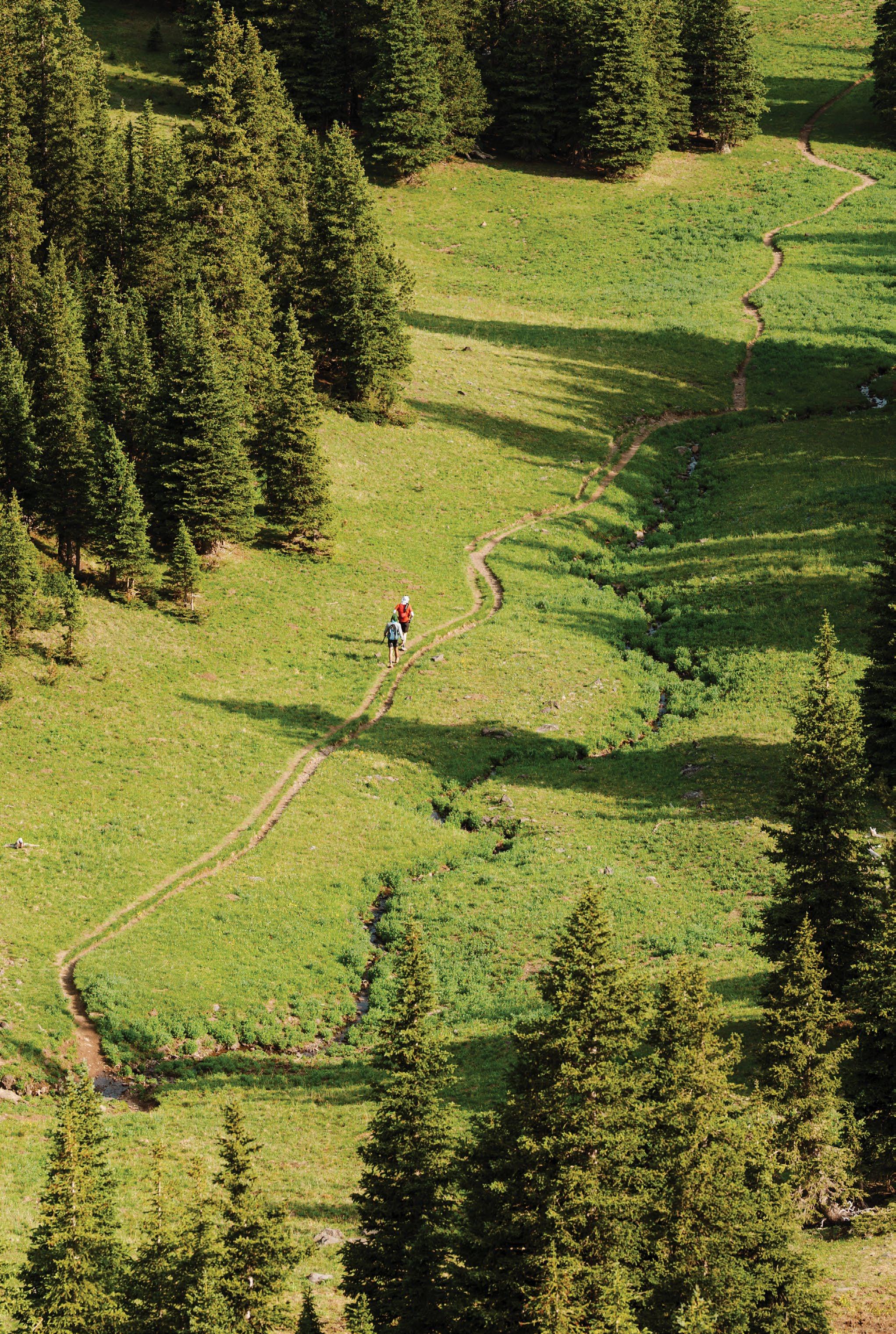
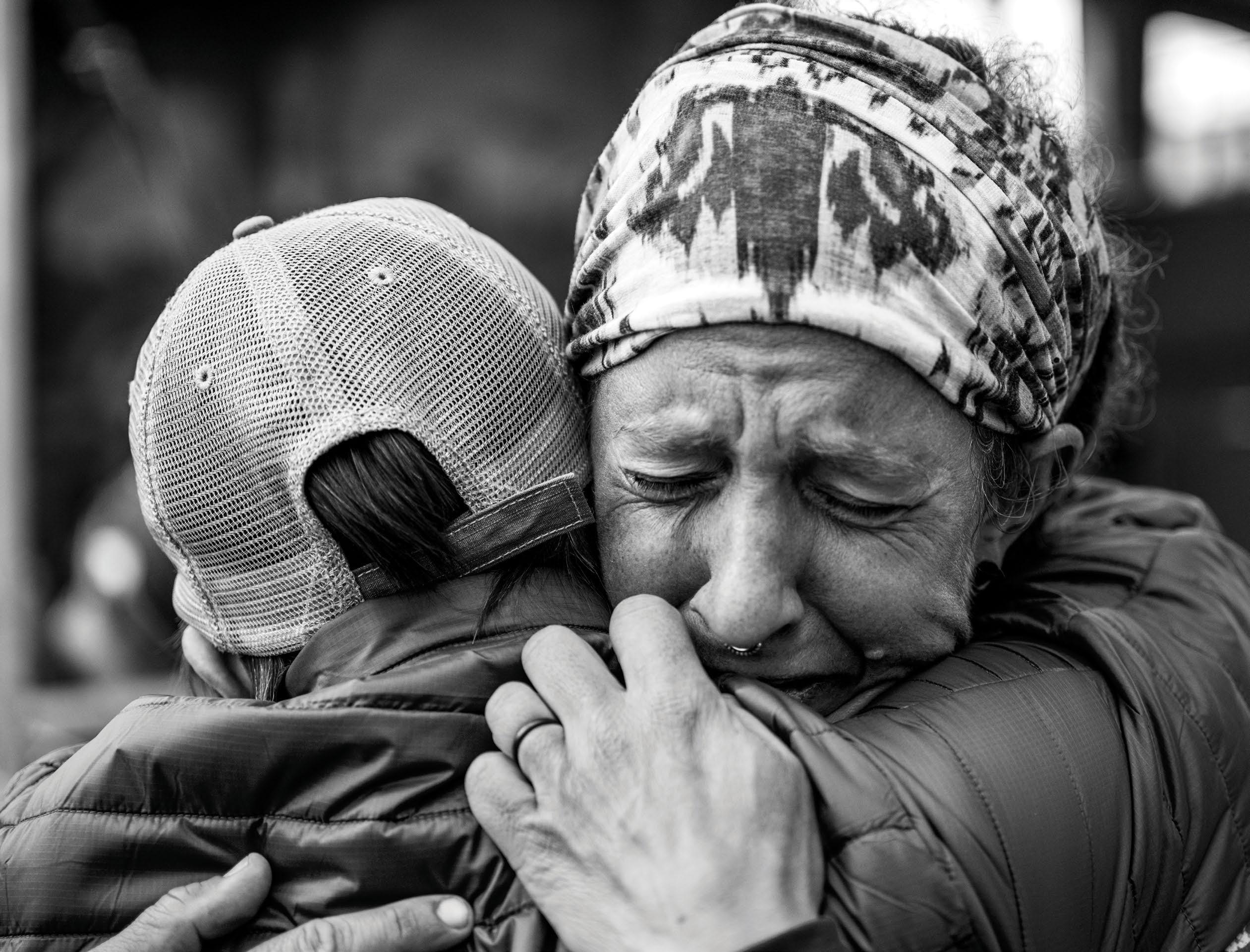
Runners make their way up Blackmore Trail in Hyalite Canyon, climbing roughly 3,600 vertical feet over 5.5 miles to earn sweeping 360-degree views at the summit of Blackmore Peak. After 108 hours of racing, Deserae Clarke grows emotional upon finishing the Cocodona 250 in downtown Flagstaff, Ariz. For many runners, the arrival can be an overwhelming experience physically, spiritually and emotionally.
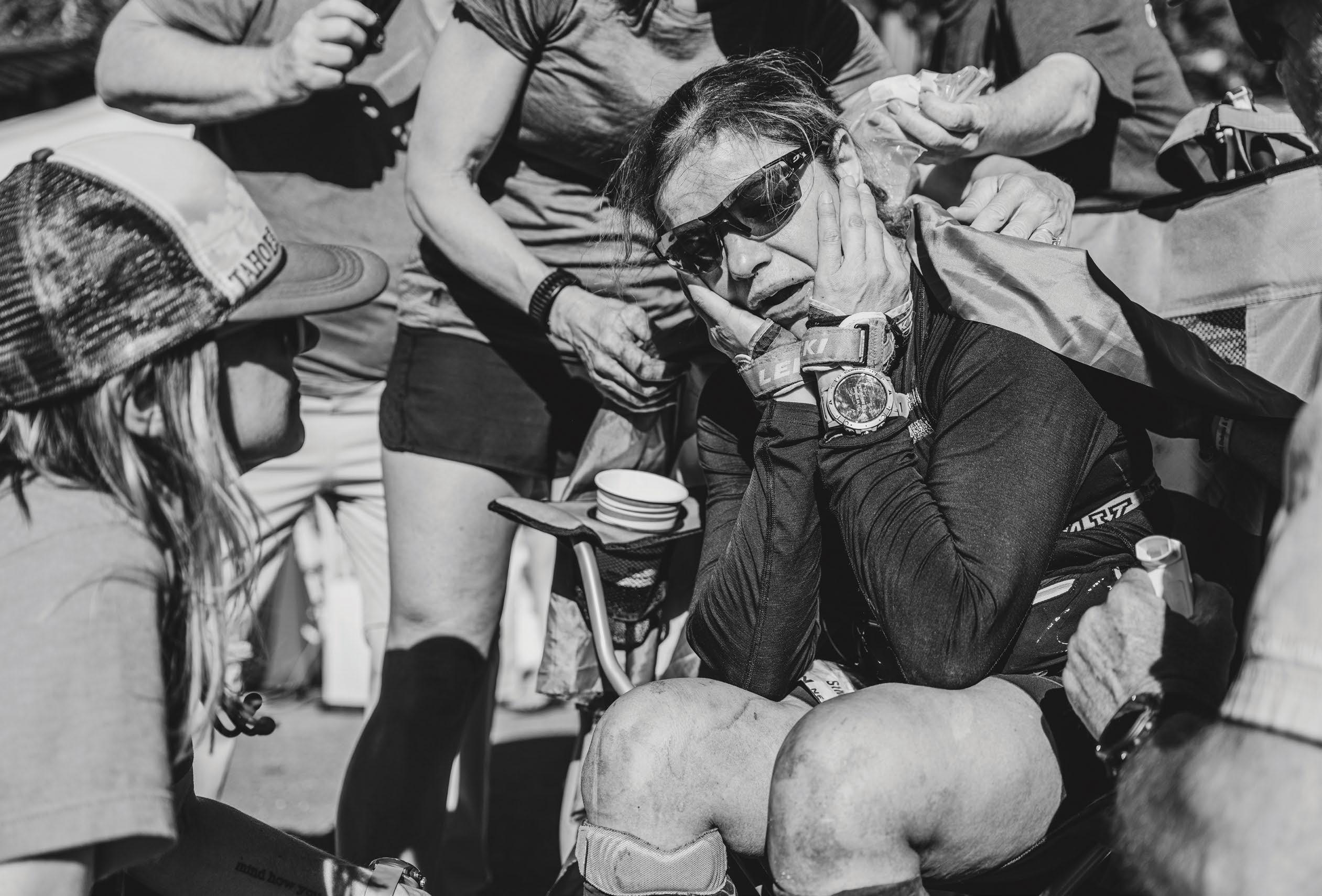
Simone Valentin Austin finished the Tahoe 200 as the final runner, charging across the finish line with fewer than 15 minutes until the 105-hour cutoff before collapsing from exhaustion. Austin, who has asthma and struggled to breathe on much of the course, is surrounded by the community in support moments after her official finish.
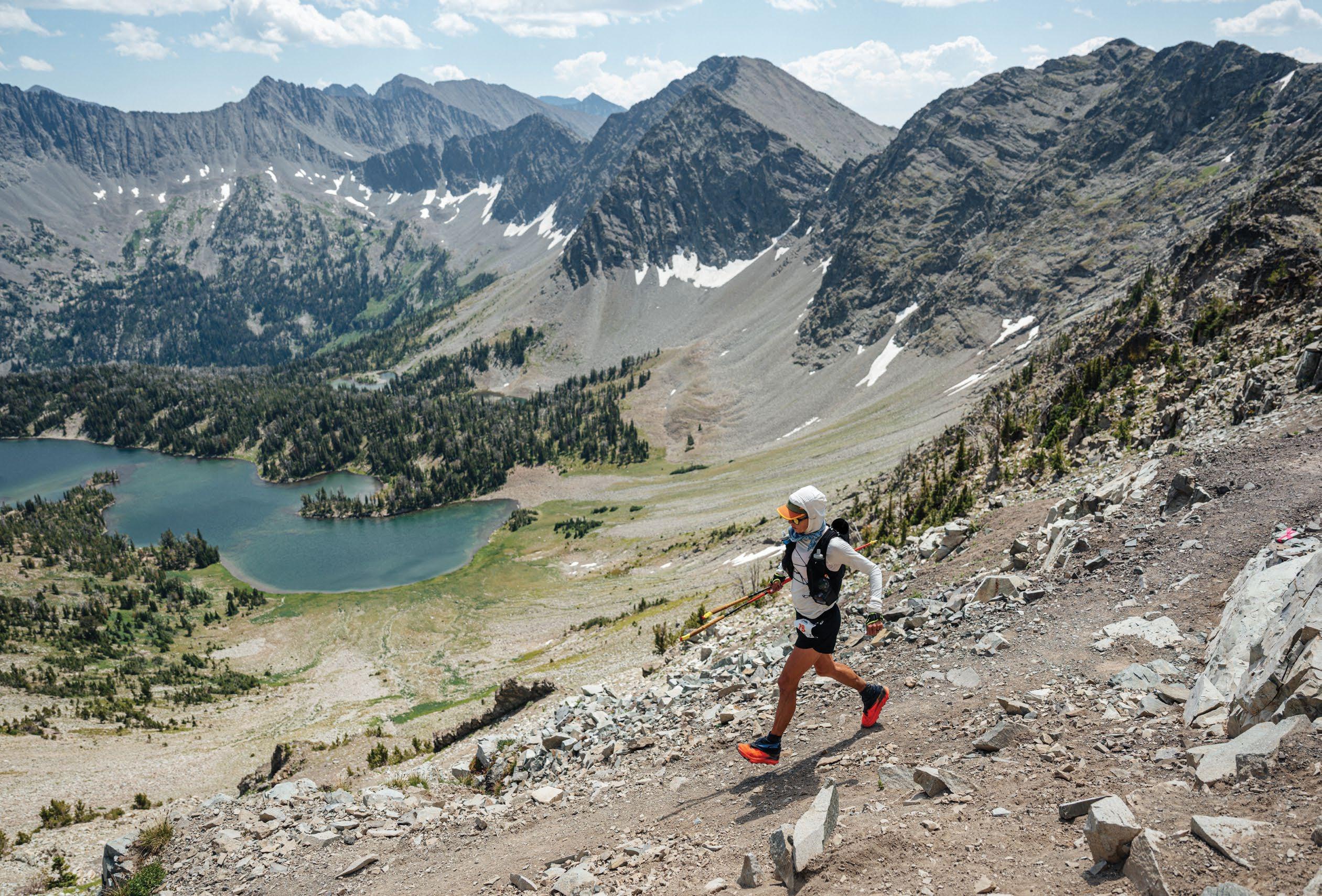
Amy Hume cruises up and over Campfire Lake divide during the 2025 Crazy Mountain 100 trail race. With stunning vistas and a strong breeze, runners welcome the break from climbing as they descend toward Campfire Lake below.
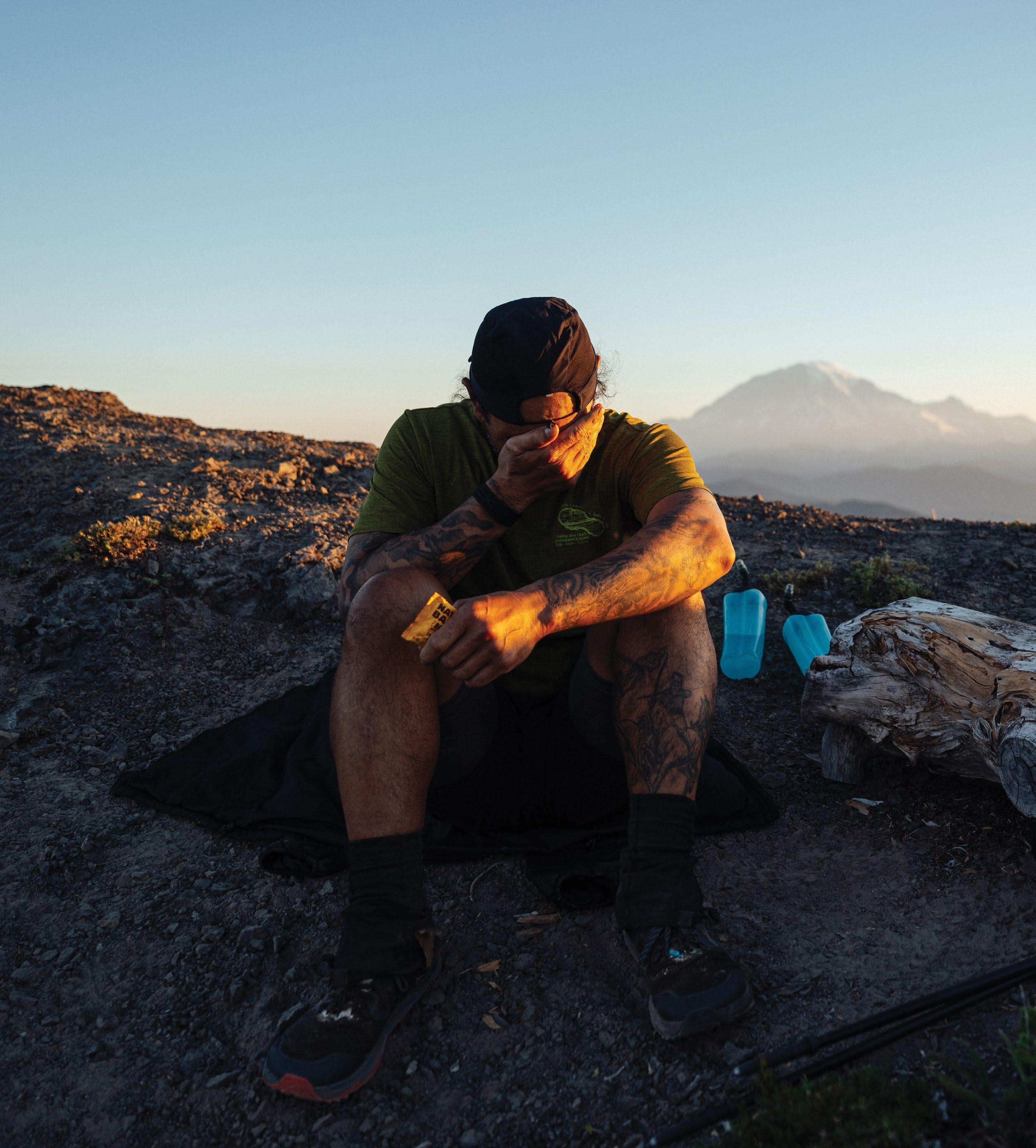
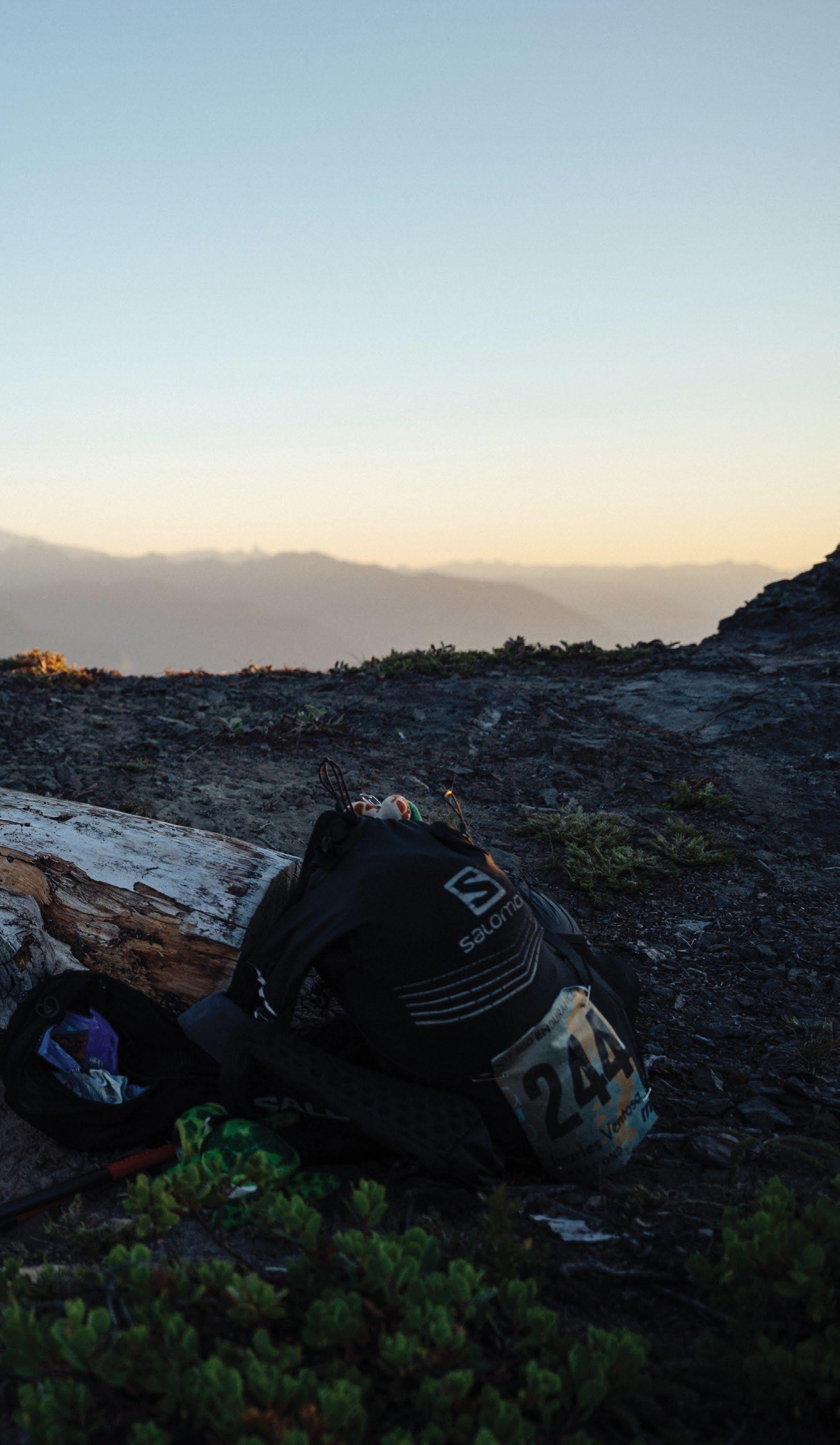
Charles Ventosa pauses atop Pompey Peak to take in the final sunrise of the Bigfoot 200, with Mt. Rainier visible in the background. This marks Ventosa's fifth finish of the race, which traverses the slopes of Mount St. Helens on its opening day.
Adventure Guide: Into the fiords, peaks and coastlines of New Zealand’s South Island
Essay: The Shifting Wild of Adventuring with Kids
Feature: Boot-Top Deep in Montana Rodeo
Essay: More Than 26.2 Miles: A Mother’s Road to Boston
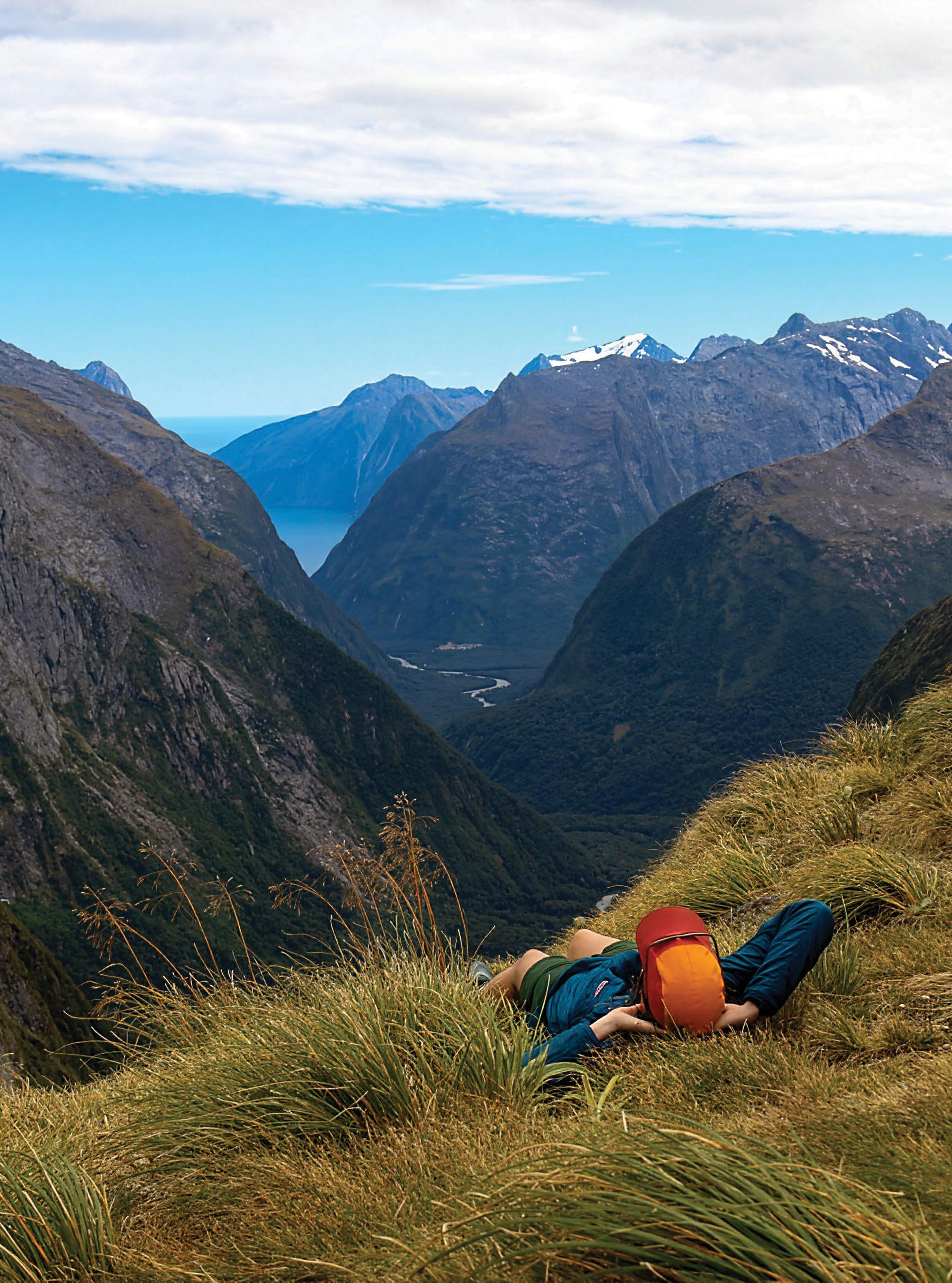
The hike up to Gertrude's
requires patience, endurance and some hand-over-foot climbing, but the view of Milford Sound from above is well worth the trek. Read about planning and executing a road trip through New Zealand on p. 46.
Words and photos by Carli Johnson
New Zealand feels like a utopia at the edge of the world— two islands adrift in the South Pacific, thousands of miles from their nearest neighbors. Unlike many places with landscapes this wild, the country has no large land predators, no venomous snakes and few dangerous insects. The most notorious troublemaker is the mischievous weka, a chickenlike bird known for stealing unattended food from campsites.
Even though it had been a warm and dry winter, the Southern belle in me was craving a sunny vacation. The solution felt obvious: Fly south. A college friend quickly agreed, and we began planning a road trip across New Zealand’s South Island.
Getting there from Montana requires patience. Nearly 20 hours into the journey, exhaustion turned the sprawling terminals of the Sydney Airport into a blur of fluorescent lights and rolling suitcases. With one final passport scan and a visa checkmark, the last leg of the journey awaited: a short flight to Queenstown.
Sleep came in fragments as my head bumped against the airplane window. Just before descent, a flight attendant paused
beside the seat and gestured toward the shuttered window. “Trust me,” she said in a cheerful Kiwi accent. “You won’t want to miss this view.” Bleary-eyed after nearly 24 hours of travel, I lifted the shade. Sunlight flooded the cabin as the plane descended through a thick blanket of cloud.
Then the clouds began to break. Green valleys appeared first, stitched between jagged alpine peaks. Rolling hills stretched to the horizon, dotted with tiny white specks that slowly resolved into sheep. Long before European explorers arrived, the Māori people called these islands Aotearoa —“the Land of the Long White Cloud.” Looking down beneath the wing of the plane, the name felt perfectly fitting. Minutes later we touched down in Queenstown beneath the skyline of The Remarkables, a steep and rugged mountain range on the South Island.
Adventure tourism has made Queenstown famous for bungee jumping, jet boats and ski resorts. For road-trippers it serves another purpose: It’s the final outpost of big grocery stores, gear shops and gas stations before the wilderness begins.

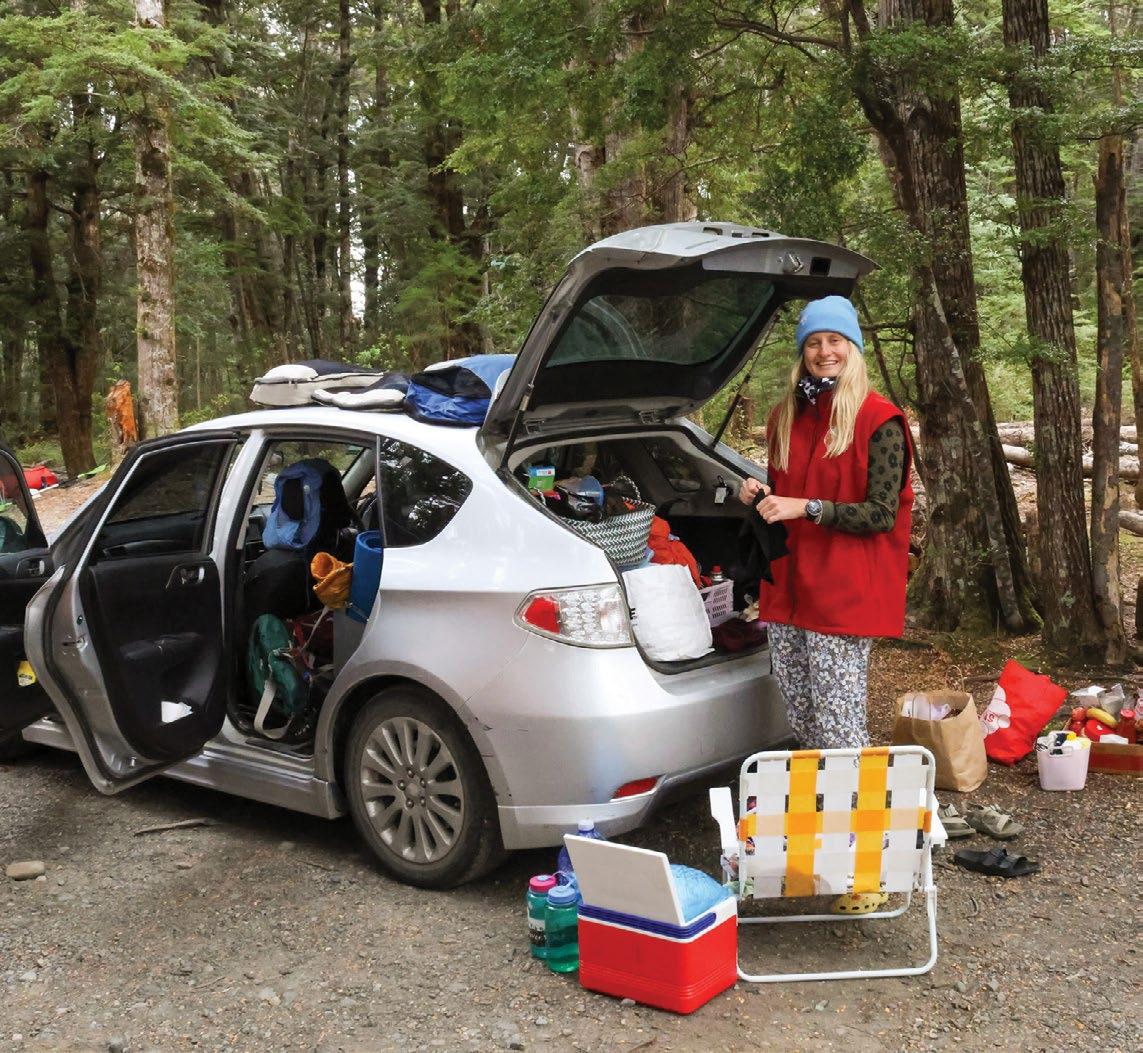
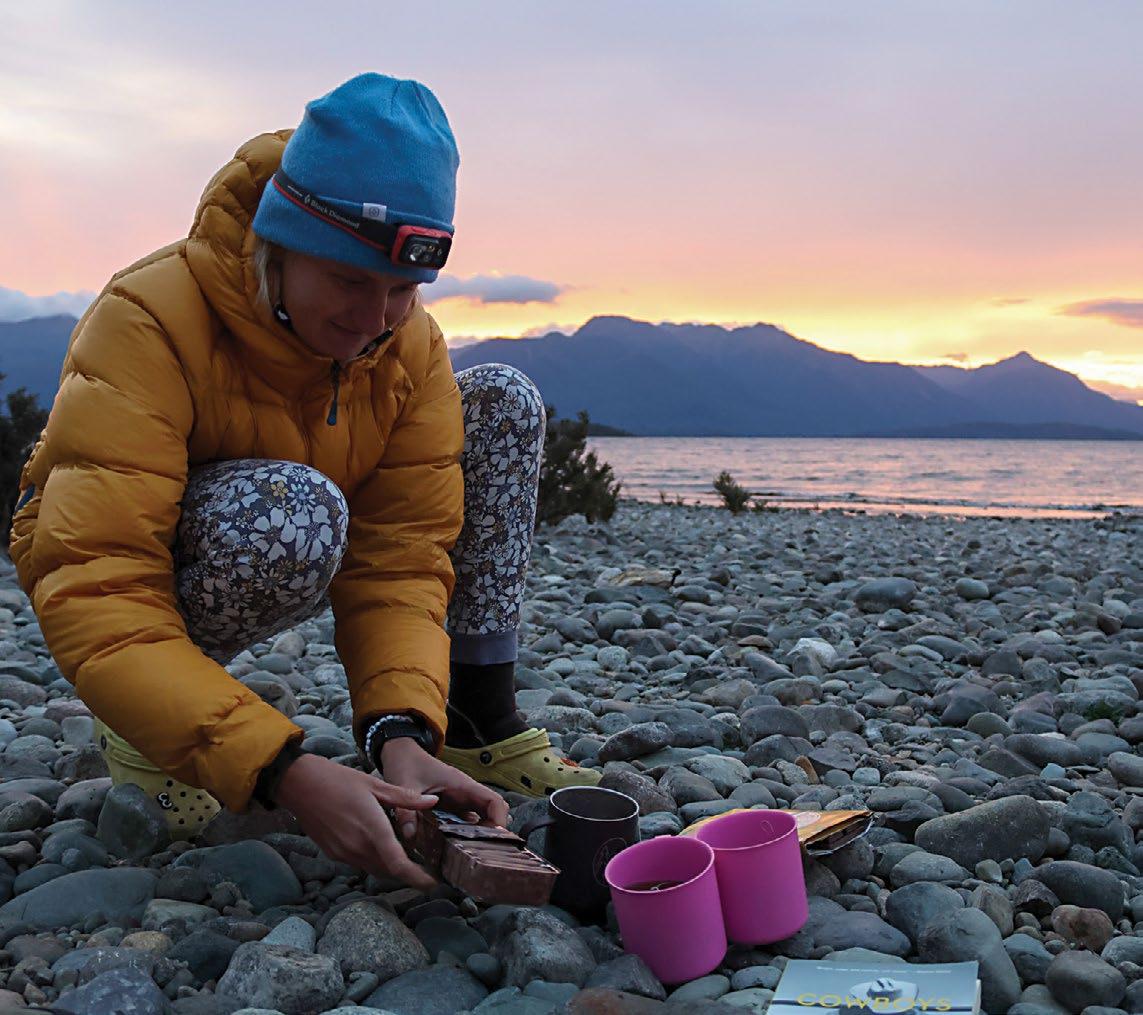
The next morning began with a quick reality check in driving on the left side of the road. The car hugged the shoreline of Lake Wakatipu, a lightning-bolt-shaped lake carved by ancient glaciers and surrounded by steep cliffs. The Southland unfolded slowly. By evening we reached Henry Creek Campsite on the shores of Lake Te Anau. Much of New Zealand’s public land camping is managed by the Department of Conservation, with simple lakeside sites costing about $10-15 NZD (roughly $6-$9 USD) per person. Our backpackers bolognese simmered on a small stove as the sunset painted the mountains pink and violet across the lake.
The next morning we drove into Fiordland National Park. Covering 1.2 million hectares, the park was established as part of Te Wahipounamu World Heritage Area in the 1990s. It means “place of the greenstone” in Māori. The dramatic glacial landscape, home to hundreds of the world’s most active glaciers, felt almost prehistoric.
We planned two excursions for the day: hike Gertrude’s Saddle and make it to our boat tour through Milford Sound. To get to the saddle, we crossed a boulder-filled riverbed, then climbed steep granite slabs that occasionally required scrambling on hands and feet. Finally we were rewarded with a sweeping view into Milford Sound. We scrambled back down the mountain and made it to the car with barely enough time to drive the curving pass to meet our boat tour.
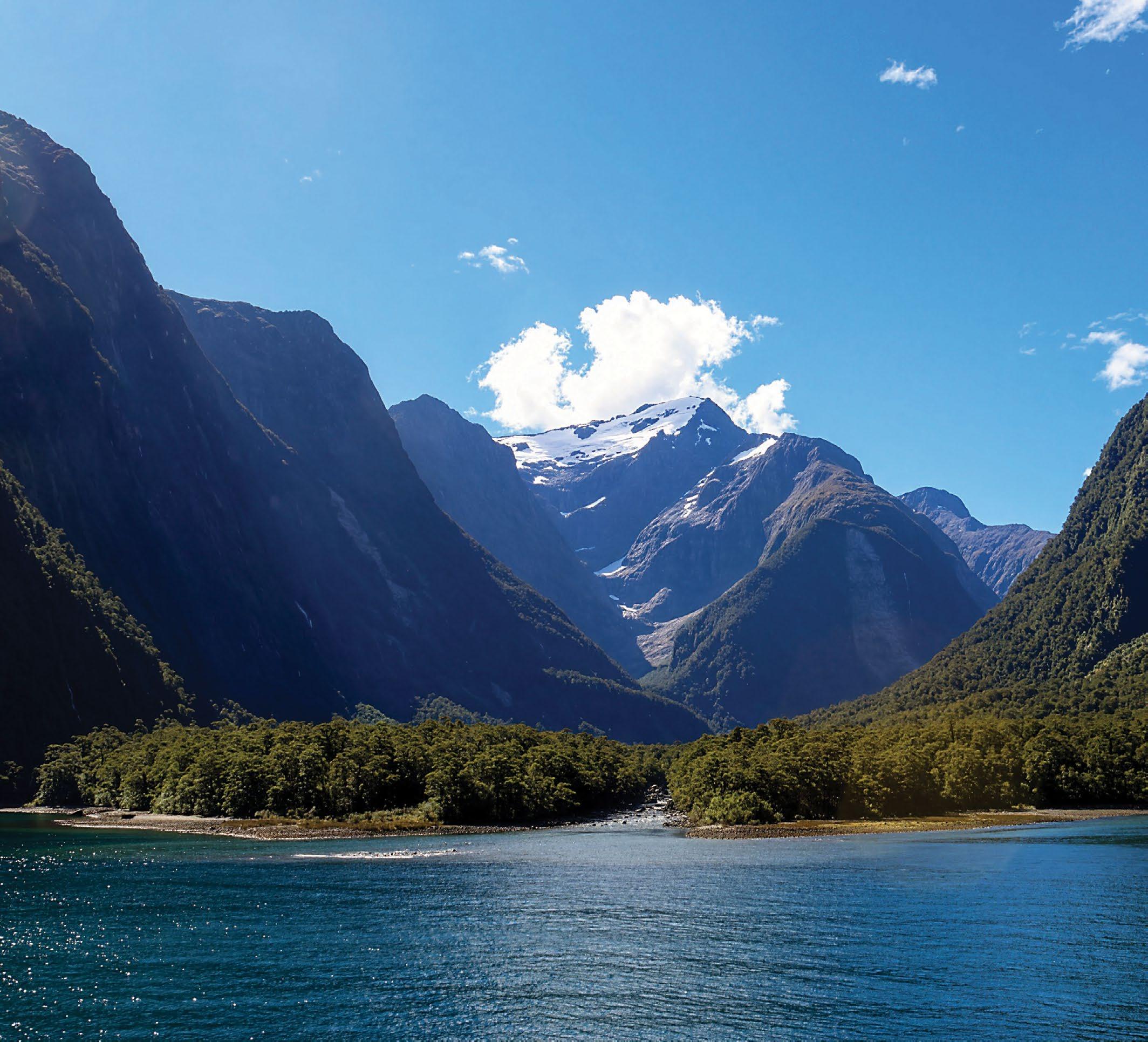
Despite its name, Milford Sound is actually a fiord, carved by glaciers rather than rivers. The landscape is striking, with cliffs rising more than 3,200 feet above the sea and waterfalls cascading down every surface after rainfall. With up to 23 feet of rain each year, Fiordland ranks among the wettest places on Earth.
The boat carried us beneath towering fiord walls while seals lounged on rocky outcrops and mist drifted down from Mitre Peak, one of the tallest sea cliffs in the world.
After a long drive back north and a quick resupply in Queenstown, we turned toward Aoraki/Mount Cook National Park. We found a free, dispersed campsite where we could car camp for the next two nights as we explored the park. On the way there we drove alongside Lake Pukaki, whose surreal turquoise color comes from glacial flour suspended in the water.
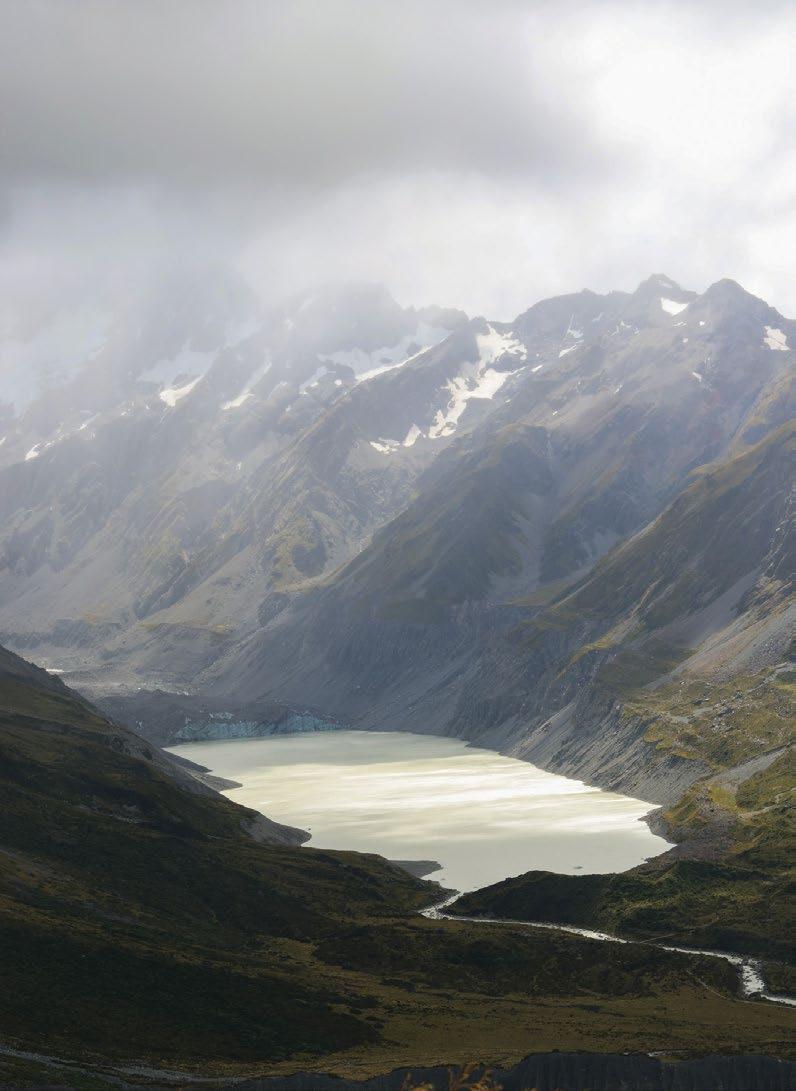
At the trailhead, low clouds hid Aoraki/Mount Cook, the tallest peak in the country at 12,218 feet. Still, we continued climbing up the Sealy Tarns Track toward it. Aptly nicknamed
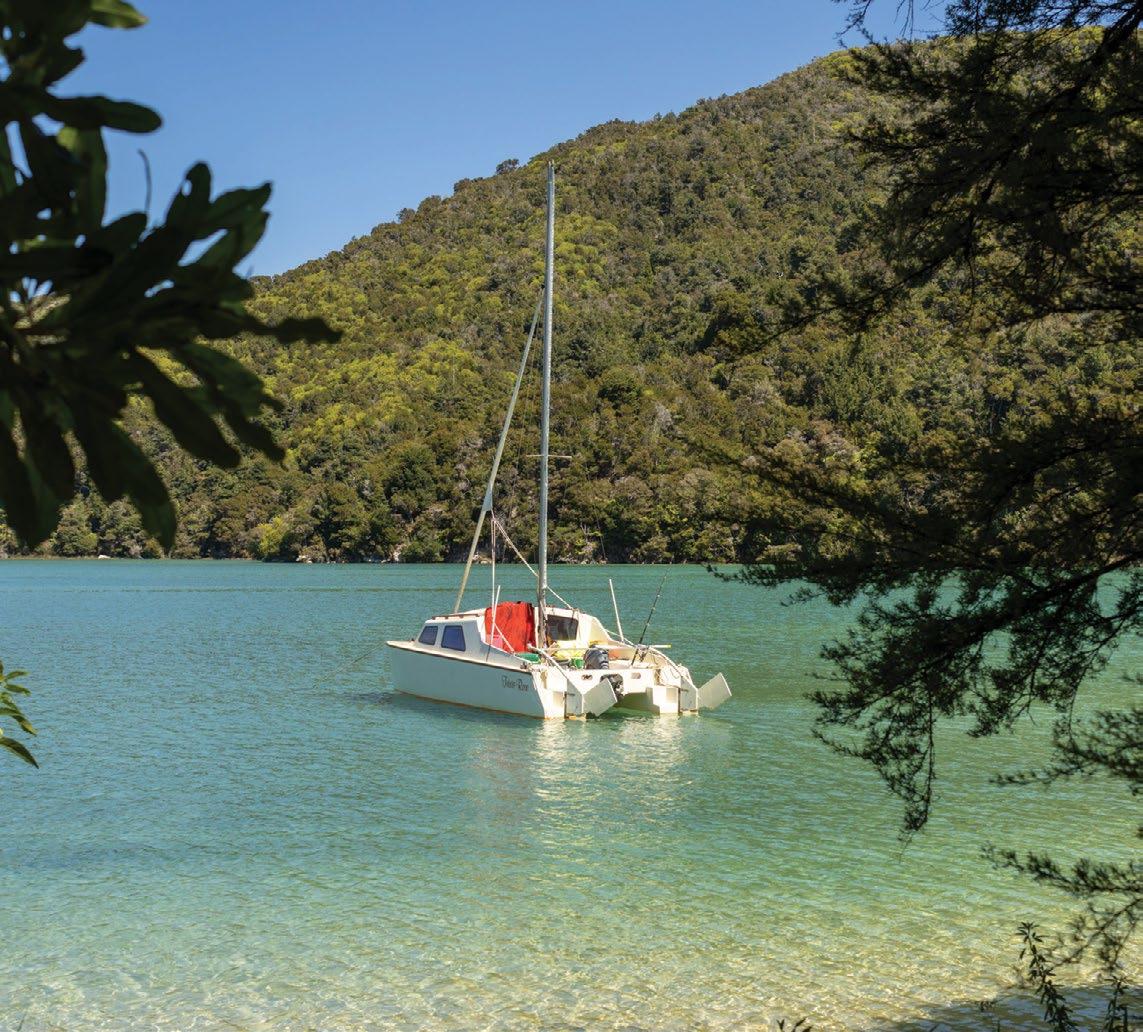
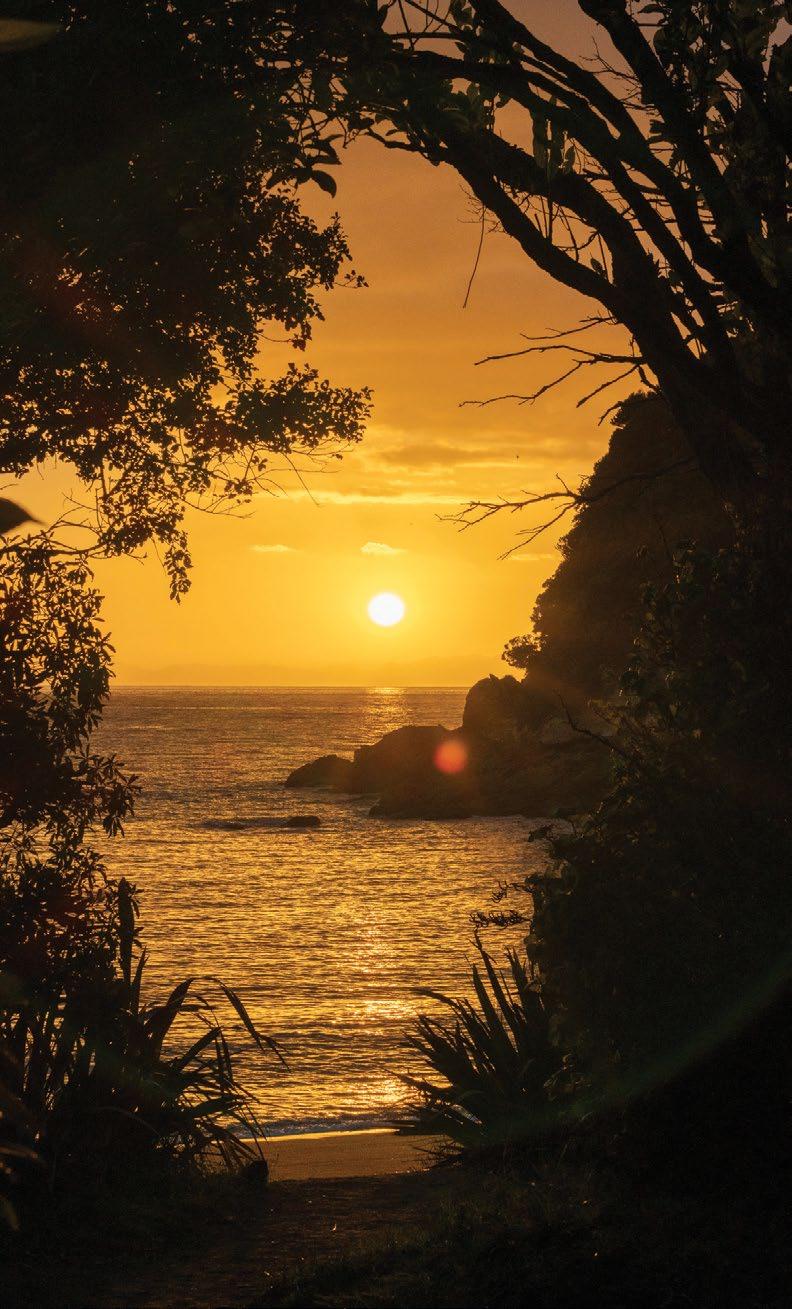
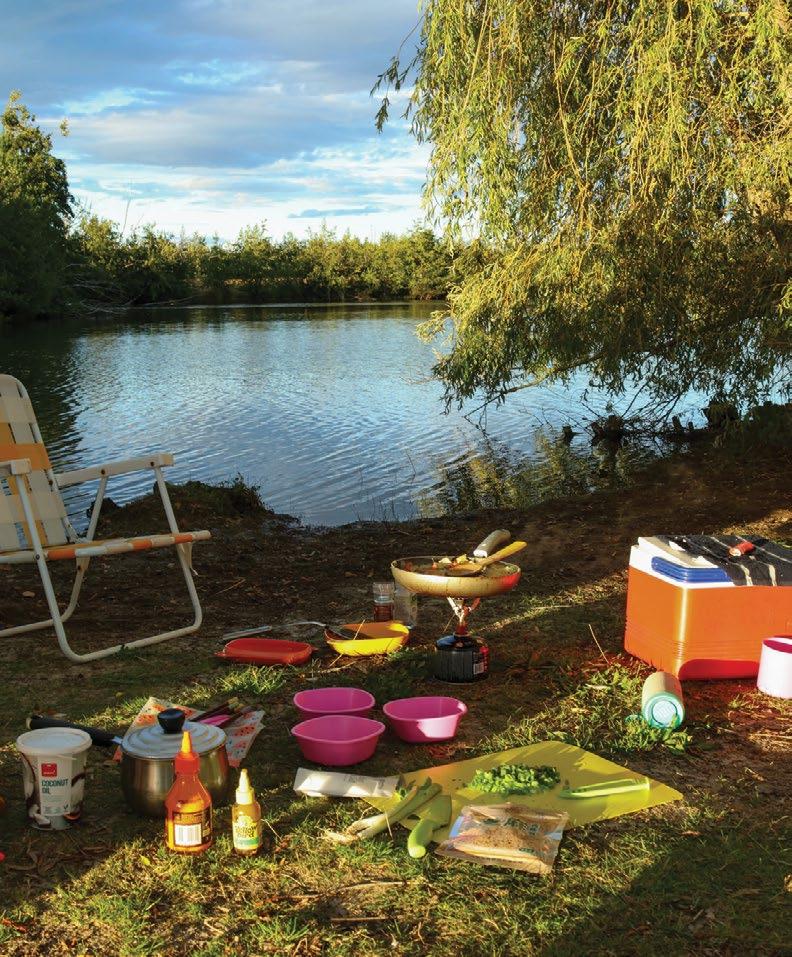
Opposite page: Despite its name, the iconic Milford Sound is geologically a fiord. Glacial erosion during the Ice Age formed its steep cliffs and U-shaped valley, best viewed from the water on a boat tour. This page from top: A small hatchback holds everything we need, from our cooking stove and backpacks to sleeping bags and more. I A lone sail boat floats idly in Torrent Bay along the Abel Tasman Track. I On our first night camping, we watch the sunset and partake in the New Zealand tradition of a Tim Tam slam, where you dip a Tim Tam cookie in a hot beverage like tea or hot chocolate.
the “Stairway to Heaven,” the trail climbs more than 2,000 wooden steps to a sweeping alpine viewpoint. On this day the reward was rain, fog, and a lesson in New Zealand weather: It changes constantly.
Eventually the clouds parted just long enough for a sunny patch of grass, a quick peanut butter and jelly sandwich, and a well-timed nap before returning to camp.
We continued our journey north through the Southern Alps to the quiet valley town of Murchison, where a tiny bunkhouse at Riverside Holiday Park provided an unexpectedly luxurious night off the ground. From there we drove the winding road west toward the Tasman Sea and the tiny coastal village of Mārahau, gateway to Abel Tasman National Park. Golden beaches and rainforest trails define this corner of the country. A water taxi dropped us at Bark Bay, one stop along the nearly 40-mile Abel Tasman Coast Track. We wandered the trail along forested cliffs and hidden coves where turquoise water meets soft sand. To one side stretches the Tasman Sea; on the other, dense coastal rainforest is threaded with freshwater streams.
Few places capture the wild beauty of New Zealand quite like Abel Tasman with mountains that dissolve into ocean.
Rather than returning inland immediately, we continued along the
South Island’s rugged West Coast. Over two days the highway weaved through rainforest valleys, past windswept beaches, and beneath towering cliffs before eventually crossing the Southern Alps once more. Our final destination: Wānaka.
The last day unfolded quietly with a hike, a swim in the river and the realization that the road trip had nearly come full circle. From above, the South Island had first appeared through long white clouds, and now, from the ground, we could see those same mountains, lakes, and rivers. Now, they felt more tangible, but still surreal.
New Zealand had delivered exactly what I needed with its sun-warmed air, impossibly blue water and dramatic landscapes. Around every bend in the road a new view awaited, making the flight attendant’s advice on that long plane ride feel like a promise fulfilled. The view truly was remarkable.
Carli Johnson is a writer and photographer based in Bozeman, chasing adventure wherever the wind blows her. She currently works full-time as a staff writer for Explore Big Sky and prioritizes time on the trail with her dog or on rivers with friends.
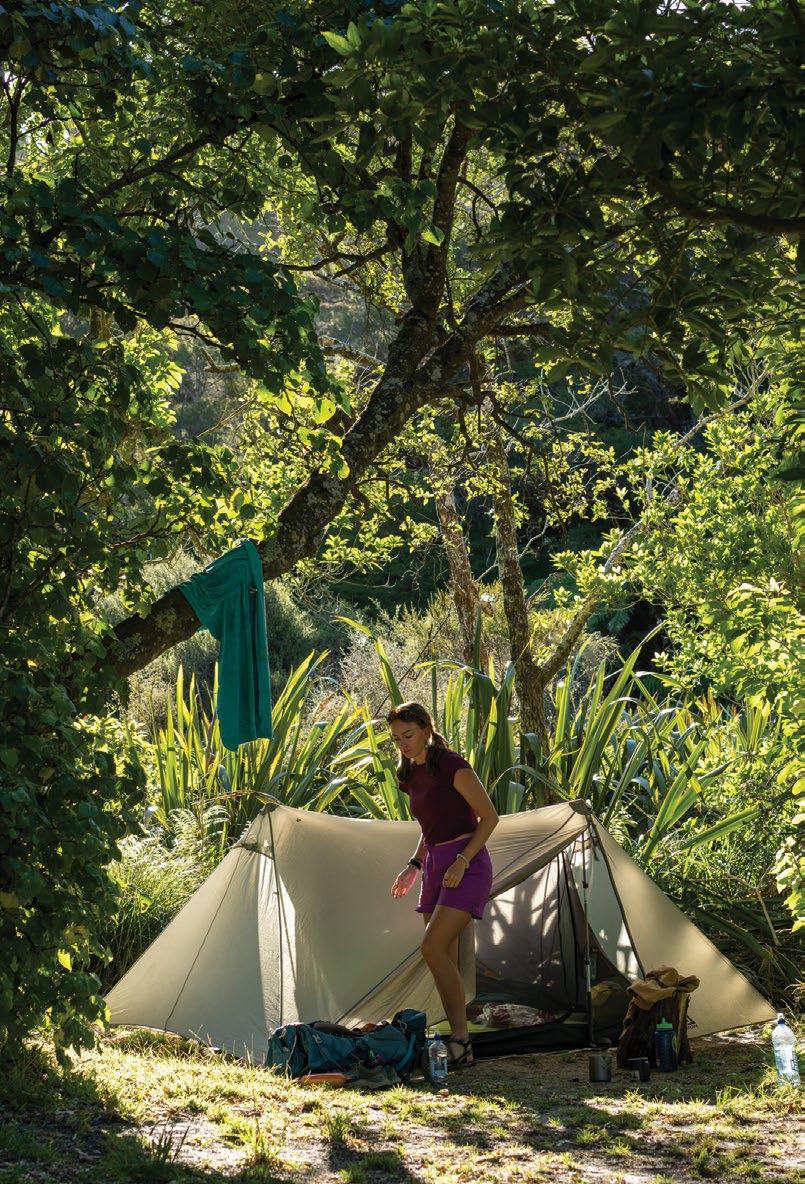
Clockwise from top left: A lush, verdant campsite along the Abel Tasman Track provides welcome foliage next to a tropical bay. | As we pack up camp in the morning, the sunrise casts a rich yellow hue over the small bay. | The evening light illuminates our kitchen table as we prepare dinner. | Though Mt. Cook hides behind the fog, the Sealy Tarns Track hike still offers sweeping views over a misty Lake Mueller.
Book your flight early and give yourself time to plan; the flight is the most expensive part.
Take more time if you have it: Two weeks was enough for just a taste of what this country has to offer but left me wanting more.
The currency conversion fluctuates but it currently sits at $0.60 NZD is equivalent to $1 USD. The USD goes a long way.







Words and Photos by Jeremy
Lurgio
We opened the large double-sided map of the Absaroka-Beartooth Wilderness and splayed it across our dining room table. With approximately 944,000 acres, 700 miles of trails, 1,000 lakes and 120 peaks above 10,000 feet, the map covered every inch of our table. My wife, Caroline, and I looked at our two kids and joked, “Ok, where do you want to go?”
Caroline had led a week-long trip to the Beartooths for high school students with a program called Classroom Without Walls. She thought a good option might be a 5.5-mile hike to Island Lake for base camp and then a 14-mile round-trip adventure to Froze to Death Plateau.
Our son Lachlan interjected quickly, “No offense guys, but that sounds miserable.” Amelia nodded in agreement. Pitching other routes and destinations was met with teenage shrugs: No, too far to hike; no, too many miles each day; no, too many days …
The map detailed countless routes and places
to explore. Planning and executing a successful four-day trip with our two kids, one a teenager and one just shy of her teenage years, ushered us into a new era—one of democratic process and discussion, compromise and consensus. We are an active family that skis, bikes, rafts, and surfs. The kids are avid soccer players and are both fit enough to take on big adventures. These days, the hard thing to pinpoint and subsequently adjust our expectations to, is how the allure of the natural world has shifted for them over the years.
When I was that age, I didn’t yearn for long hikes, heavy backpacks and wild places either. In my twenties, I caught the bug and explored places around the world from Alaska to the Annapurna Circuit in the Himalayas. In my 30s and 40s, I became more of a weekend warrior, adventuring right outside my door in Missoula, Montana. My wife and I have always enjoyed the long alpine days on the trail or in the backcountry on skis. When we had kids, adventure ground to a halt.
+ Plunging off rocks into pristine mountain lakes
+ Hammock time
+ Camp desserts
+ Above tree line time
+ Lake-to-lake navigation
+ Beartooth beauty
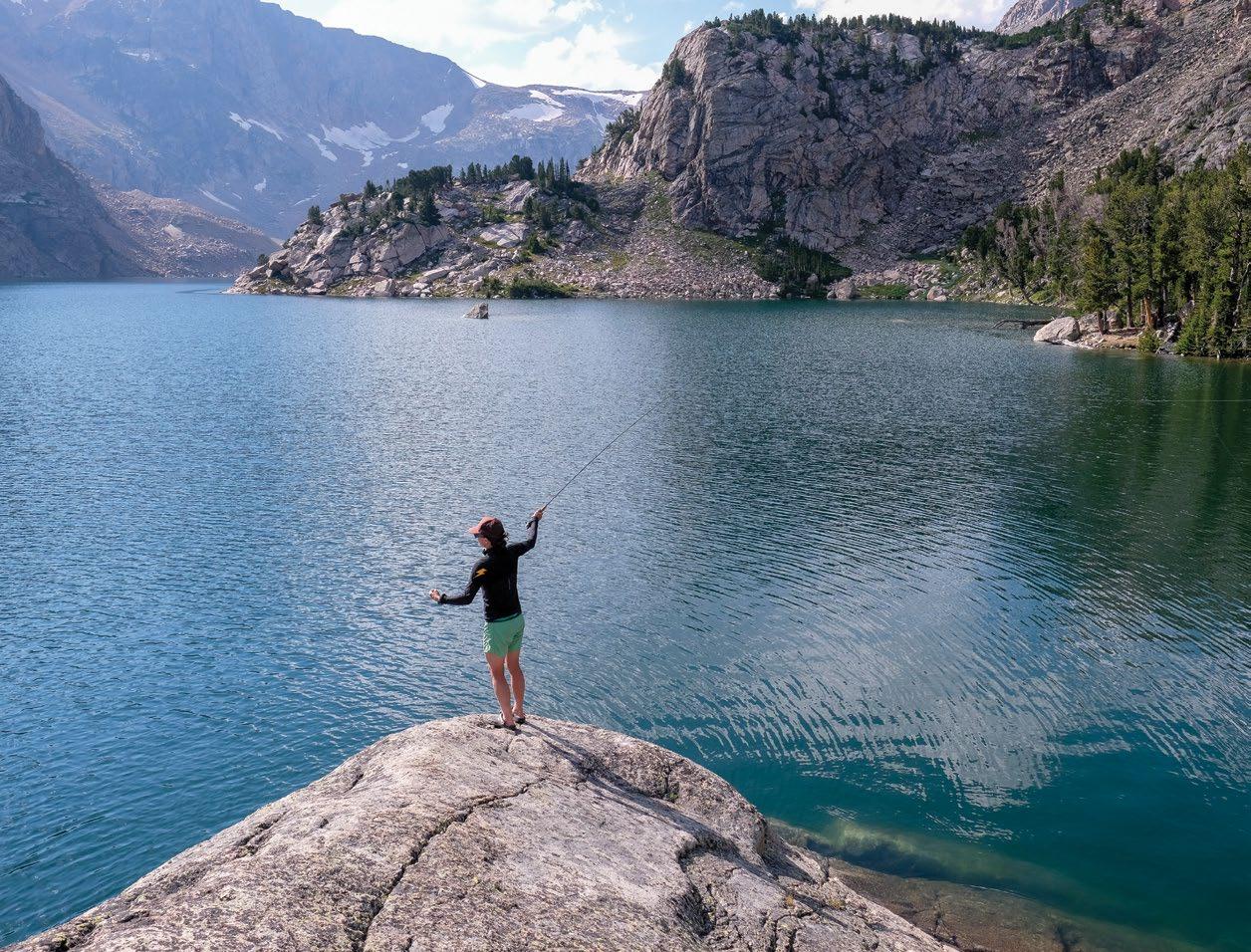
+ Alpine lake fishing
+ Base camp chill time
+ Upper lake exploration
+ Majestic views
+ Away from people
+ Off-trail excursions
+ Time for fetch
+ Loves swimming, hates being wet
+ Wild scents
+ Rocks for sunbathing
+ Sleeping bag cuddles
+ Chipmunk chasing
Diapers, naps, feeding, and sleep became the barometer of the day. Yet, raising little ones, despite all the challenges, was magical.
When they were young, we camped a lot. A wolf stuffed animal and four days exploring Yellowstone captivated them. We gradually introduced short hikes, mountain biking, fishing, skiing, surfing and, eventually, backpacking. The allures—sleeping in a tent, fishing for mountain trout, building fires, stars and camp food. The aversions—hiking, mosquitos, carrying a pack and, well, more hiking.
As parents, we haven’t always chosen the right distances, routes and destinations. There have been a few forced marches and the occasional summer folly, like a June 28 adventure through a foot of snow to a fire lookout at 8,000 feet—that soured their spirits before the lookout’s magic rescued the trip.
As we planned this trip, for the first time we all had equal say in the decision-making. Lachlan wanted alpine lake
fishing and lots of time at camp to do it. Amelia liked the idea of a base camp where she could jump off rocks into the water and sit in the hammock. My wife wanted a lake-tolake route on the plateau. She wanted us to experience the full beauty of the place. If we were covering less ground, I wanted to be surrounded by the awe and power of peaks, cirques and the high alpine. In the center of the Venn Diagram emerged two things: a great base camp with good fishing and access for off-trail adventures to more alpine lakes.
I phoned a friend who has backpacked the Beartooths extensively. He threw out more ideas and we returned to the map. We settled on Glacier Lake—a steep 2.2-mile hike with 1,700 vertical feet of gain. The lake stretches nearly a mile long, and beyond it sit four higher-elevation lakes. After studying the map, we packed up and stepped on the bathroom scale—making sure we were all pulling our weight.
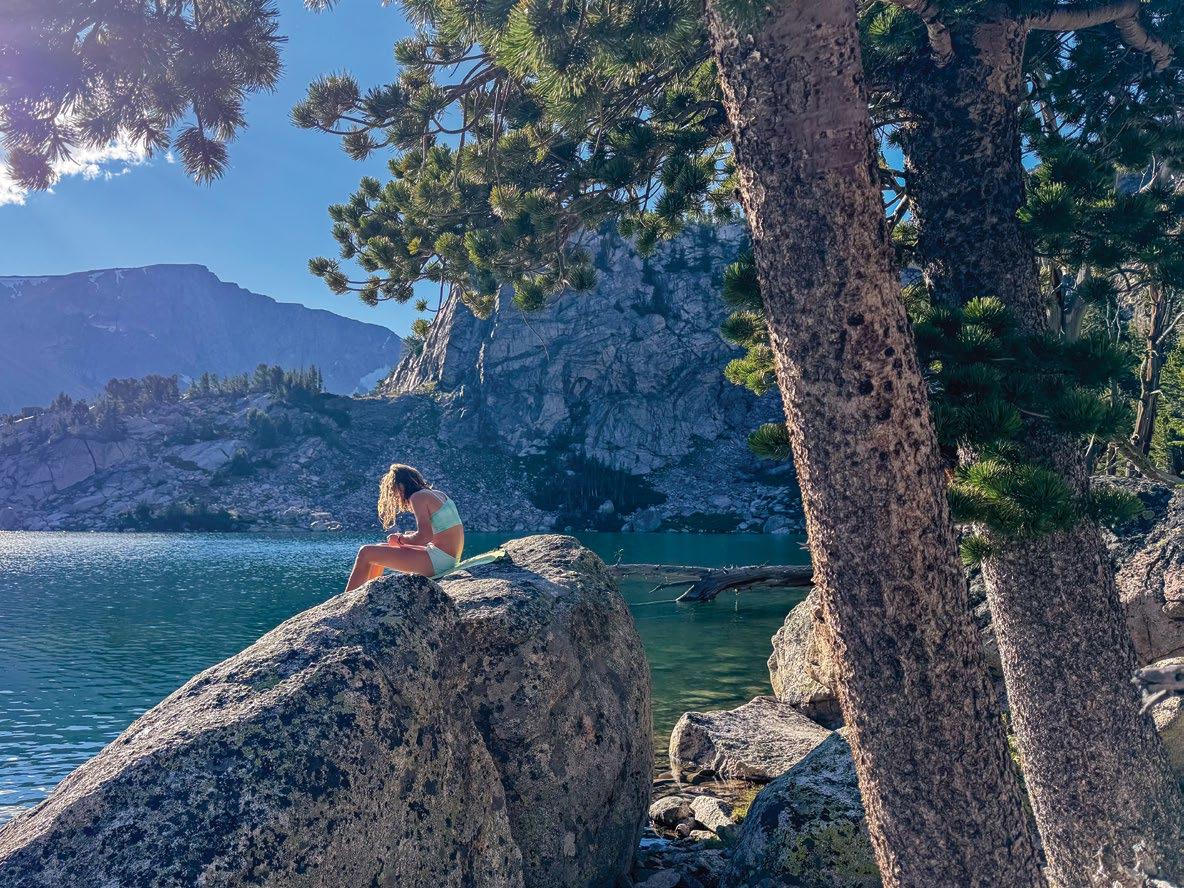
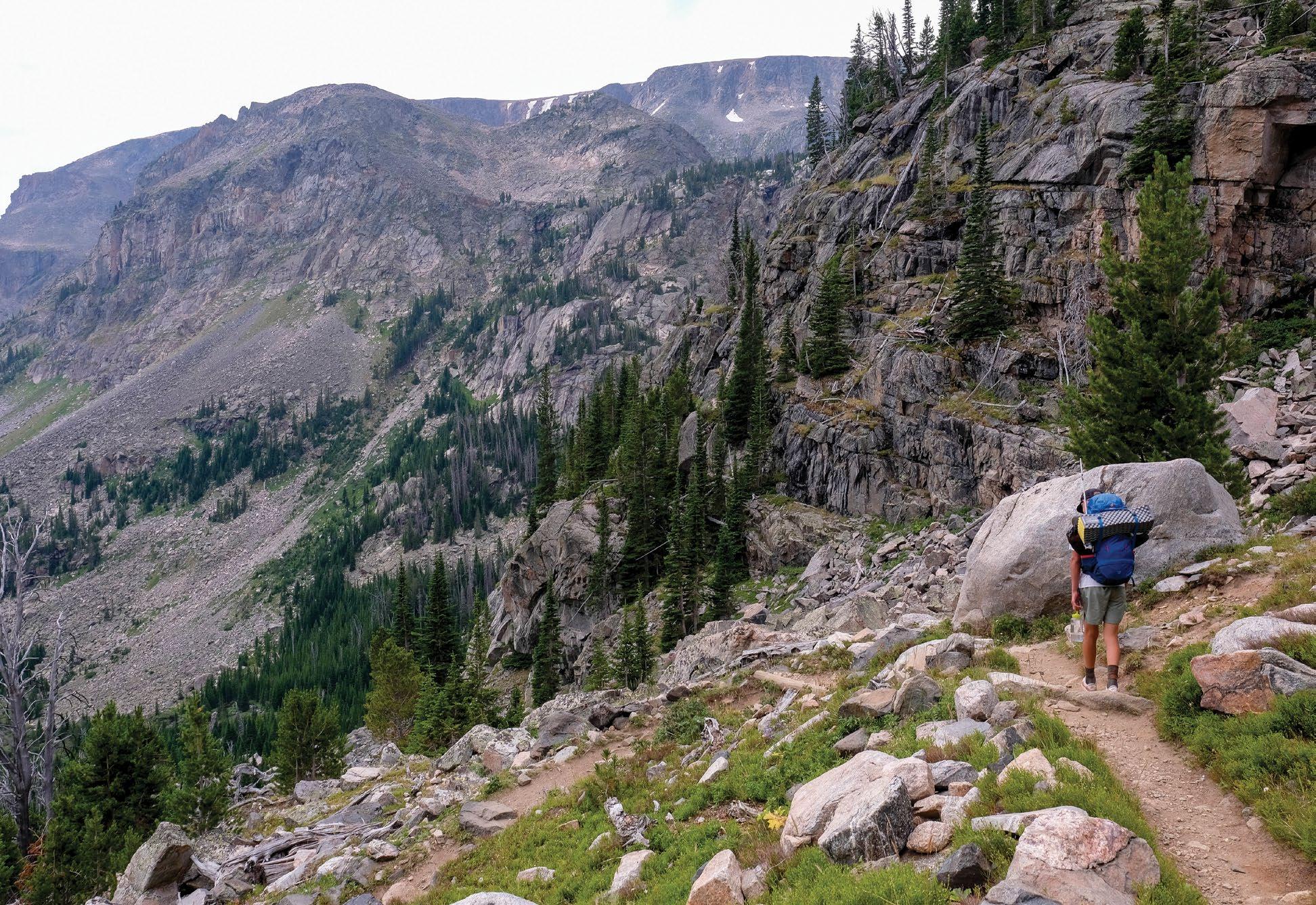
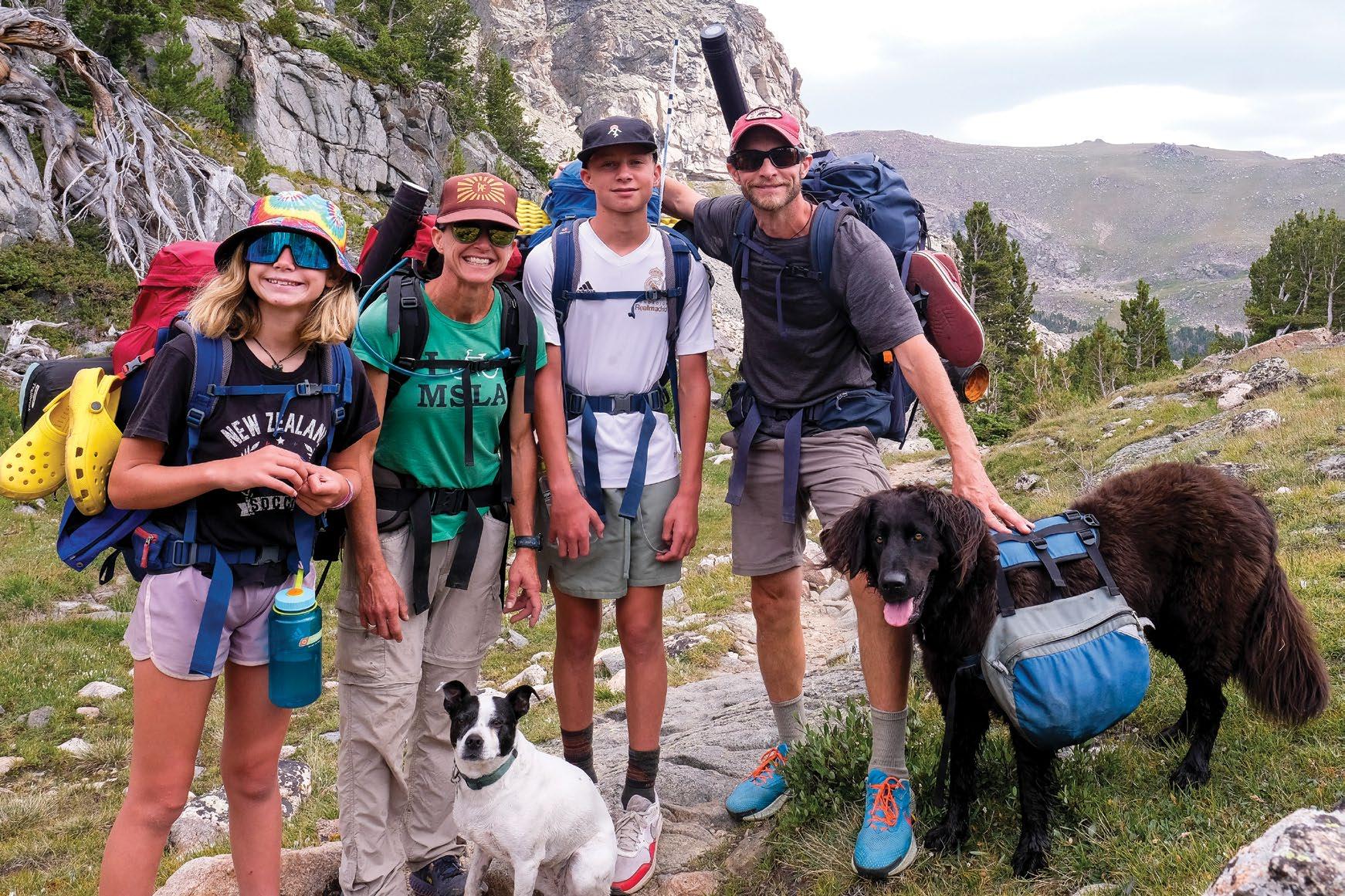
On a hot August day, the four of us and our two dogs hopped out of the truck at the trailhead. From the first step the scenery was spectacular and the trail steep. We found ripe huckleberries as we climbed to a bridge across Moon Creek.
A mile and a half in, we encountered Patrice, a hiker who had rolled her ankle badly while hiking with a women’s group. She couldn’t bear weight, and standing made her woozy. Drawing on some wilderness first aid training, I helped one of the trip leaders splint her ankle and get her comfortable in the shade while they waited for search and rescue. She later texted to thank us and to let us know it had been a broken leg. Our kids were patient throughout and picked up a lesson about the importance of stopping to help someone on the trail and always being prepared in the backcountry.
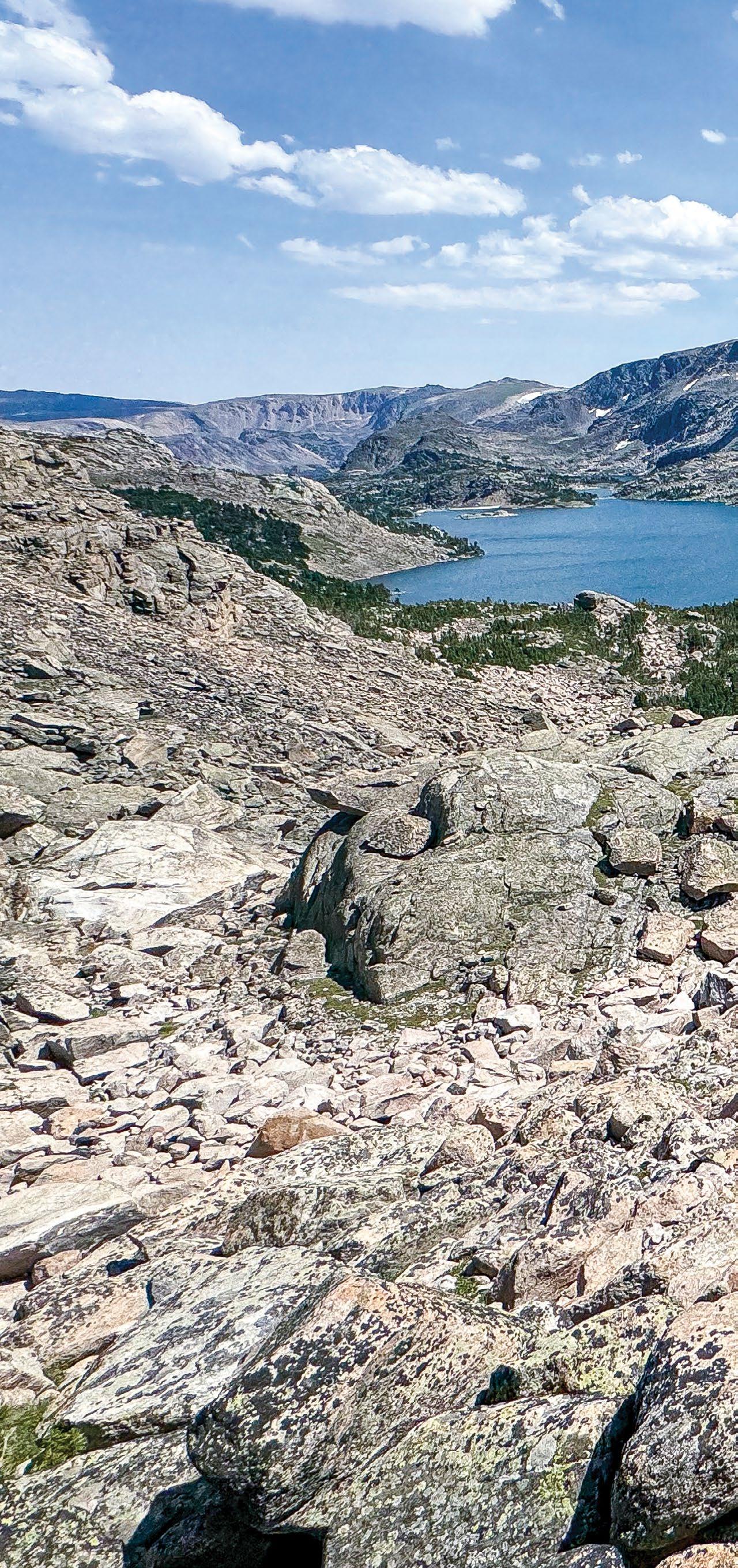
Twenty minutes later we crested the saddle and were rewarded with our first view of Glacier Lake and the steep walled cirque rising above the south shore. We descended to it and began the hunt for the perfect home base away from day-hiker traffic and closer to the upper lakes. We followed the faint path along the north side of the lake and bushwacked until we found two suitable camp spots on a bench above the lake.
One spot had everything we needed including a flat tent pad, a camp kitchen and fishing right at our feet. We dropped packs and got to work. Camp represented more than a safe spot with access to fishing and the upper lakes. It was a compass orienting us back to the intangible values we find in the wilderness: escape from the digital world, self-reliance, connection to each other, solace, and a healthy fear and heightened awareness that comes with sleeping in grizzly country.
Now that the kids are older, camp represented another value we hadn’t anticipated: freedom— freedom to explore and freedom to chill. Our daily modern lives can often feel scripted. Up here there was no agenda. The magic was slowing down in this sweeping landscape.
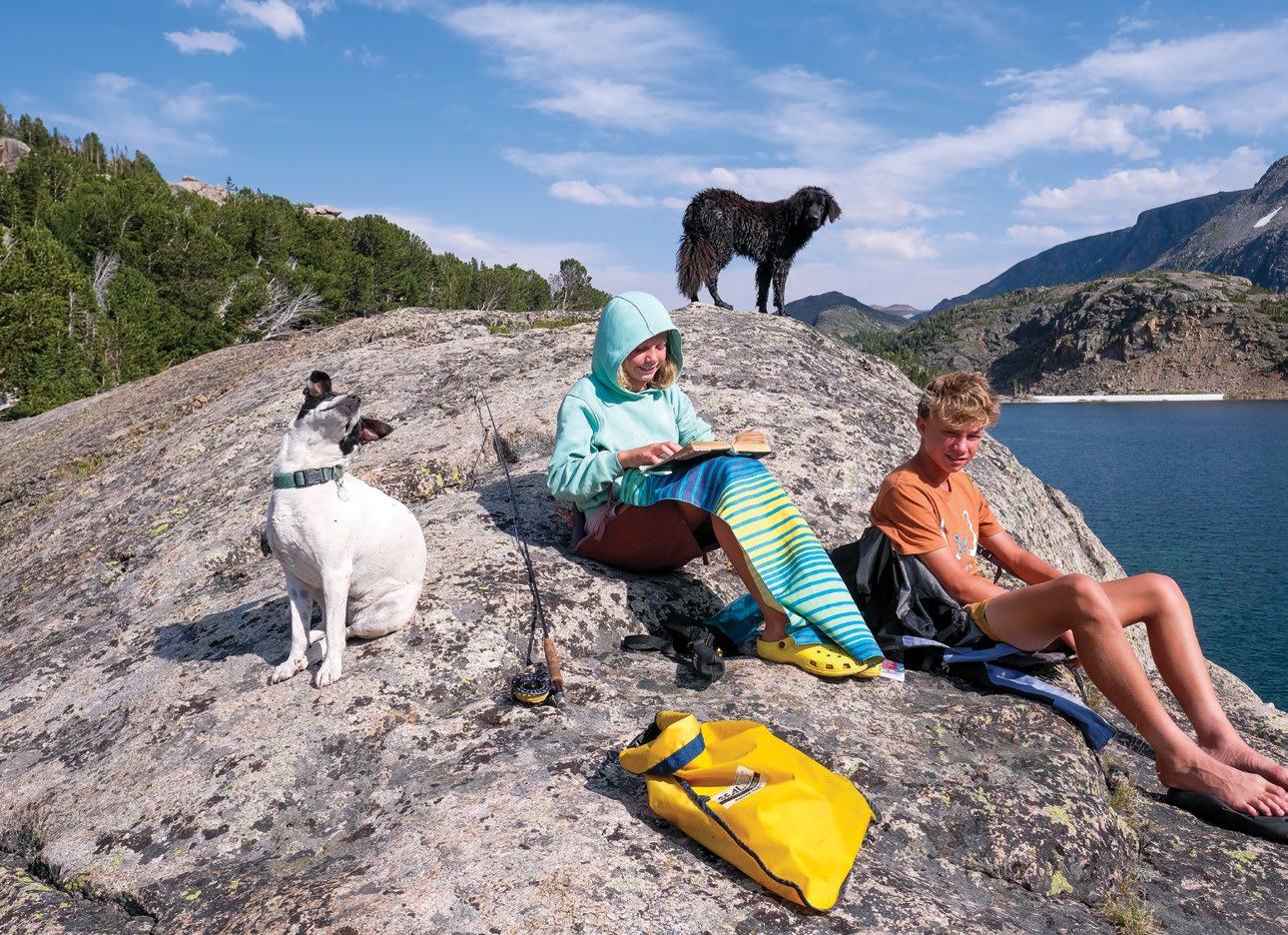
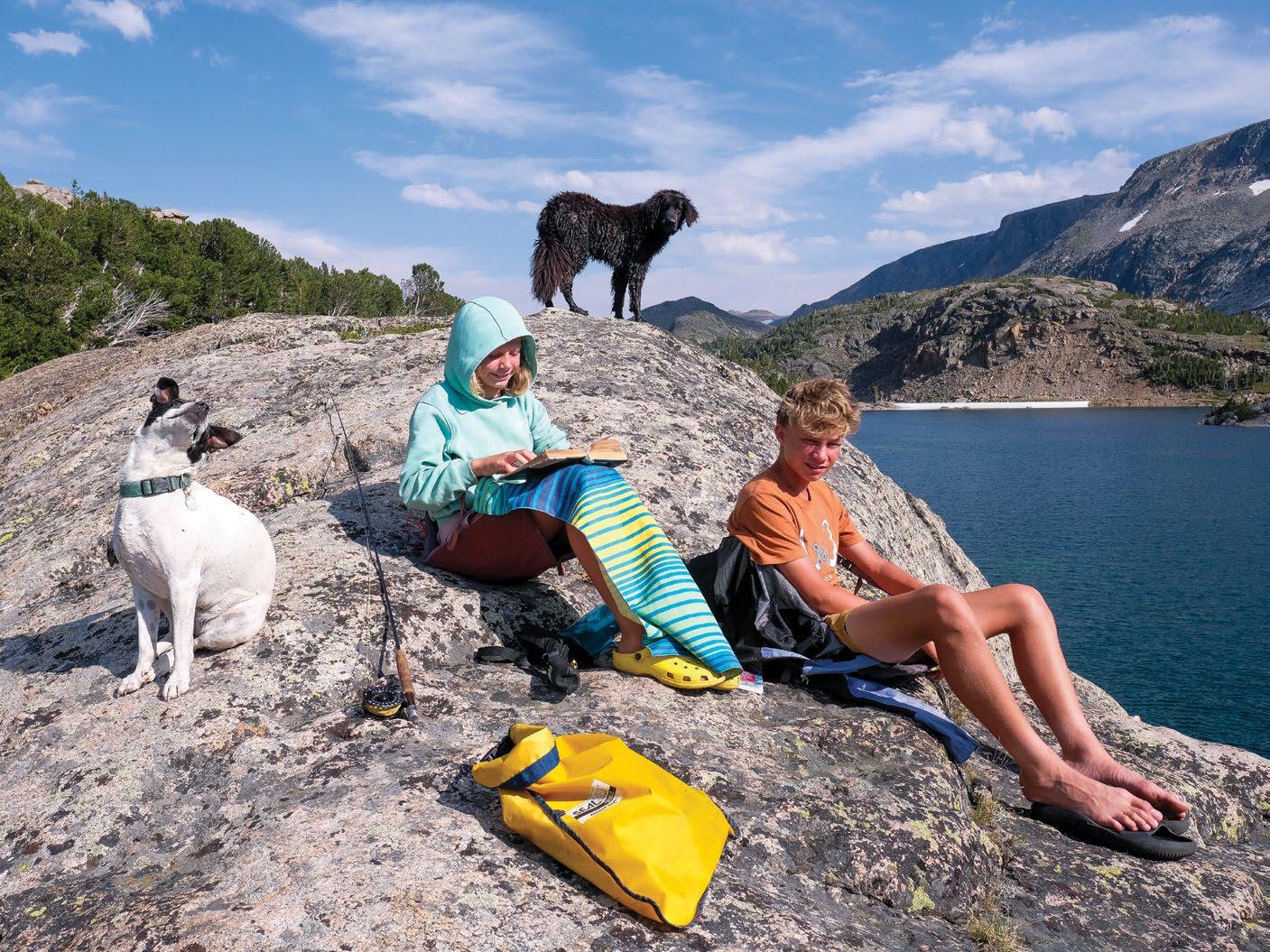
Over the next four days, we fished a lot, mostly fly fishing. We jumped into the frigid water and immediately jumped out. We took turns filtering water, cooking camp food and cleaning camp. We read books, did riddles and gazed at the sublime mountain cathedral encircling us.
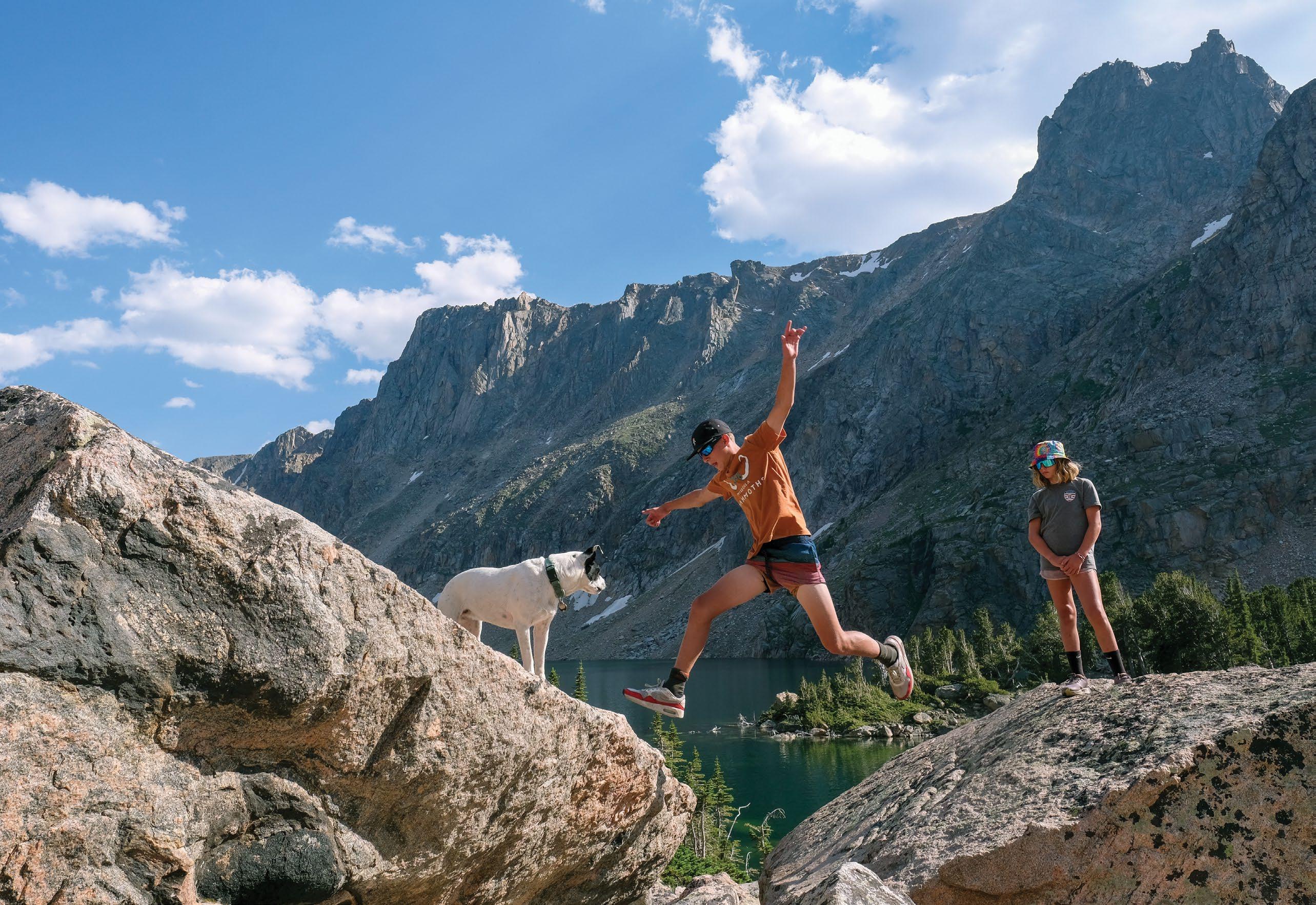
We bushwacked and boulder-hopped to Triangle Lake and farther to Sheep and Goat lakes. At
finding a
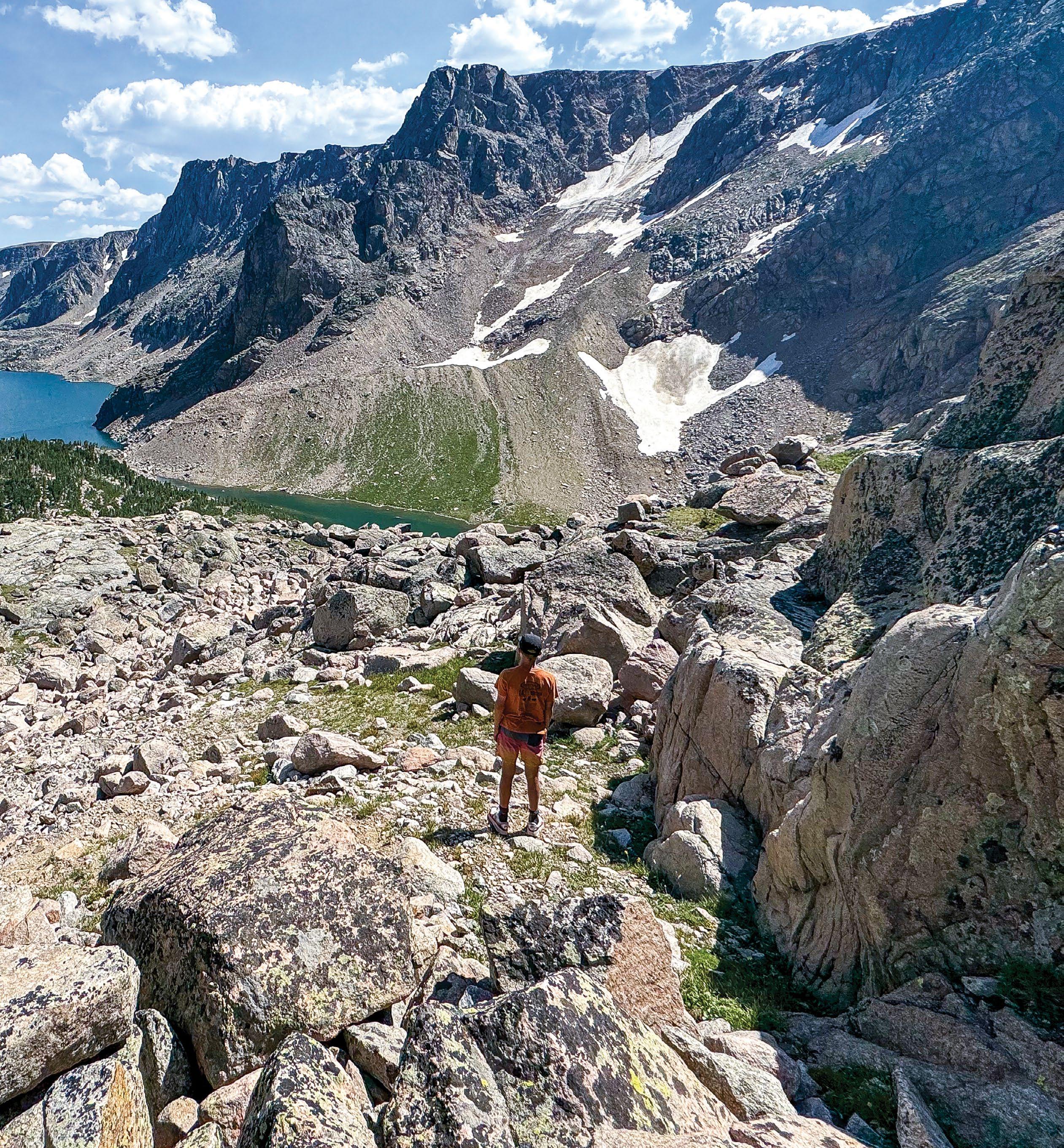
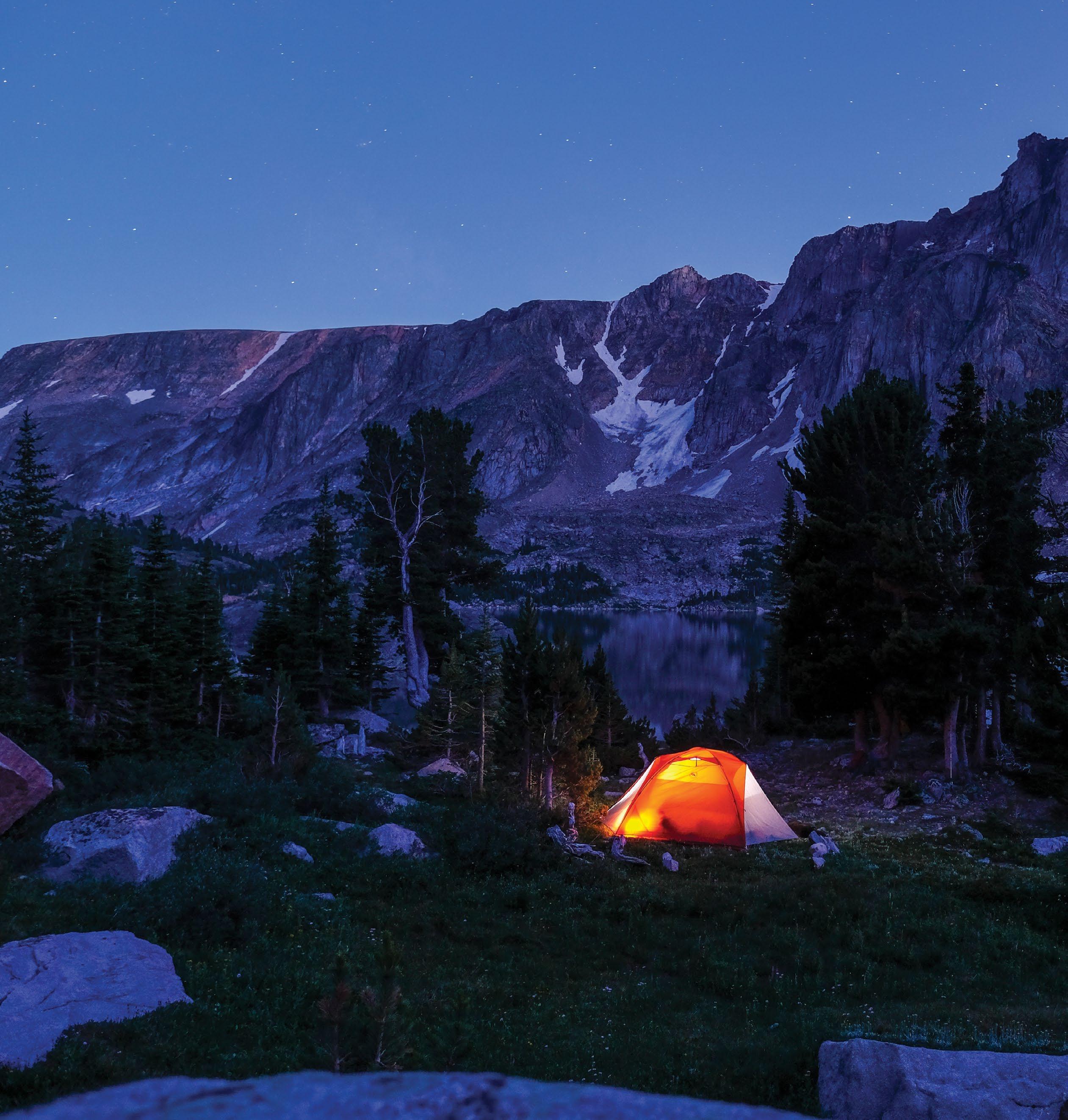
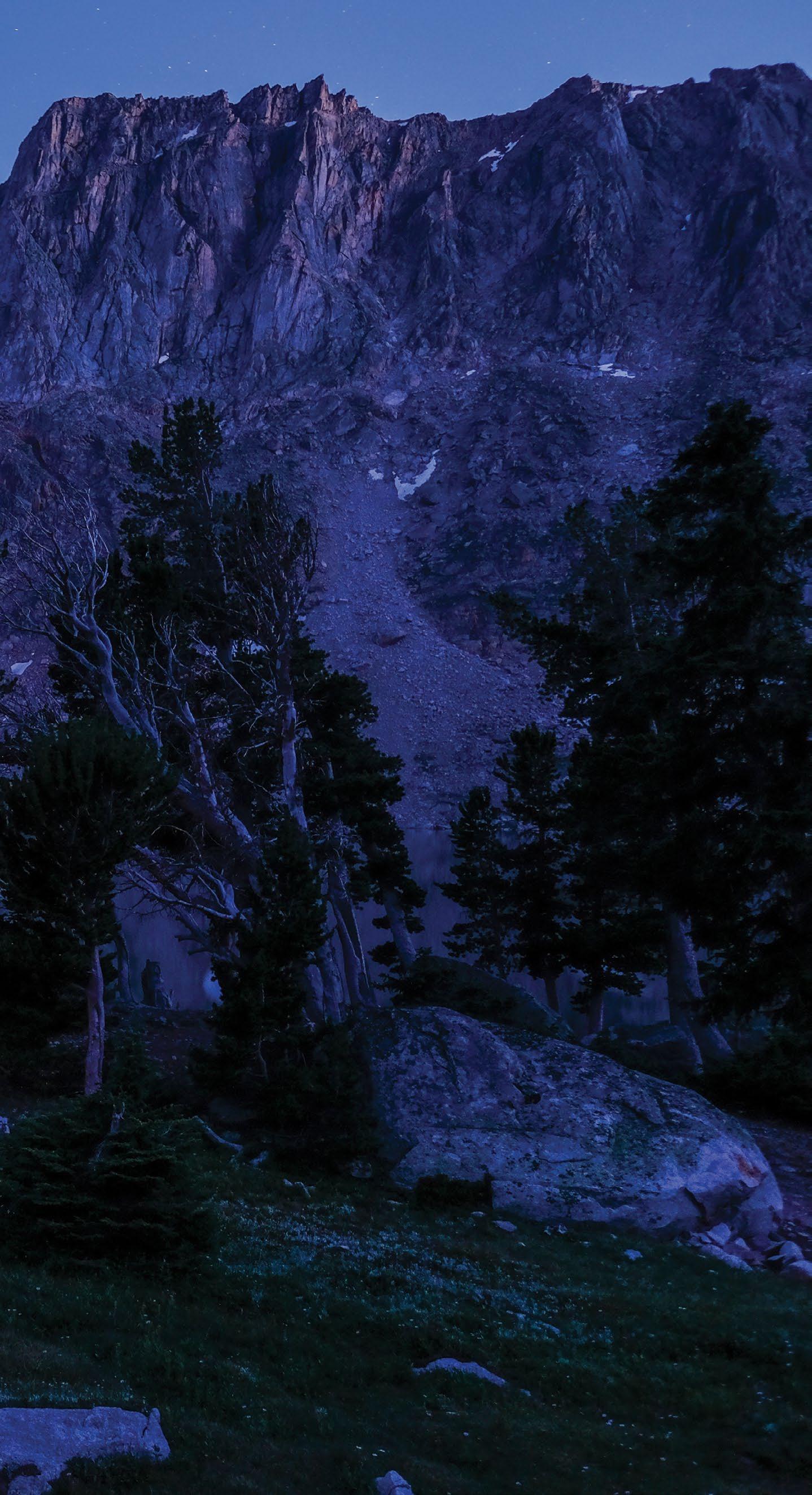
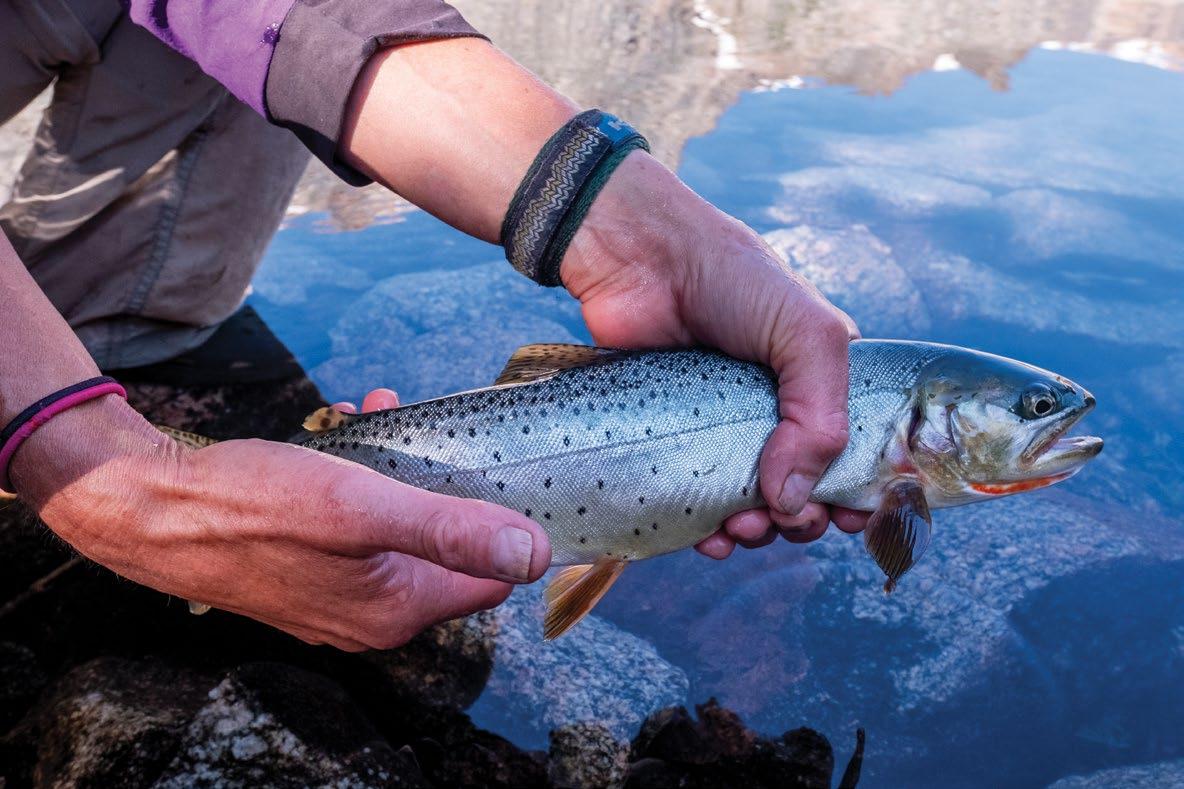
Goat Lake my son and I watched a large cutthroat cruise the shore looking for bugs. Lachlan had been excited to go off trail and find the best route to the mysterious upper lakes. His smile glowed. The exploration, though rigorous, scratched his curiosity and wanderlust. We hadn’t seen anybody else in two days.
At camp, Amelia and Lachlan sorted through our backcountry provisions and planned dinner. Amelia waded knee-deep in the water and they both started skipping rocks across the rippled surface of the lake. Sometimes they’d switch games and see who could throw a rock high in the air and pierce the water with the smallest splash. We call it the “no-splash” game.
On this trip, we slowed down and sank a bit deeper into this wild place—finding a space where the kids could cultivate the aspects of the outdoors they truly enjoy.
Although the future of our family backpack trips will continue to morph, as parents, we hope the evolution of those escapades, in whatever form they take, will keep fostering their love of mountain adventures and their reverence for the natural world.
After dinner, we hung bear bags and took one more look at the majestic mountains.
As twilight gave way to darkness, we crawled into our tent. We knew we were the only humans sleeping with the wild creatures in this basin tonight—the simple gift of solitude.
Jeremy Lurgio is a freelance photographer and filmmaker based in Missoula, Montana, and a professor of Photojournalism and Multimedia Storytelling at the University of Montana School of Journalism. In his downtime he enjoys skiing, mountain biking, cyclocross racing, fly fishing and exploring the wilds of Montana with his family and dogs.
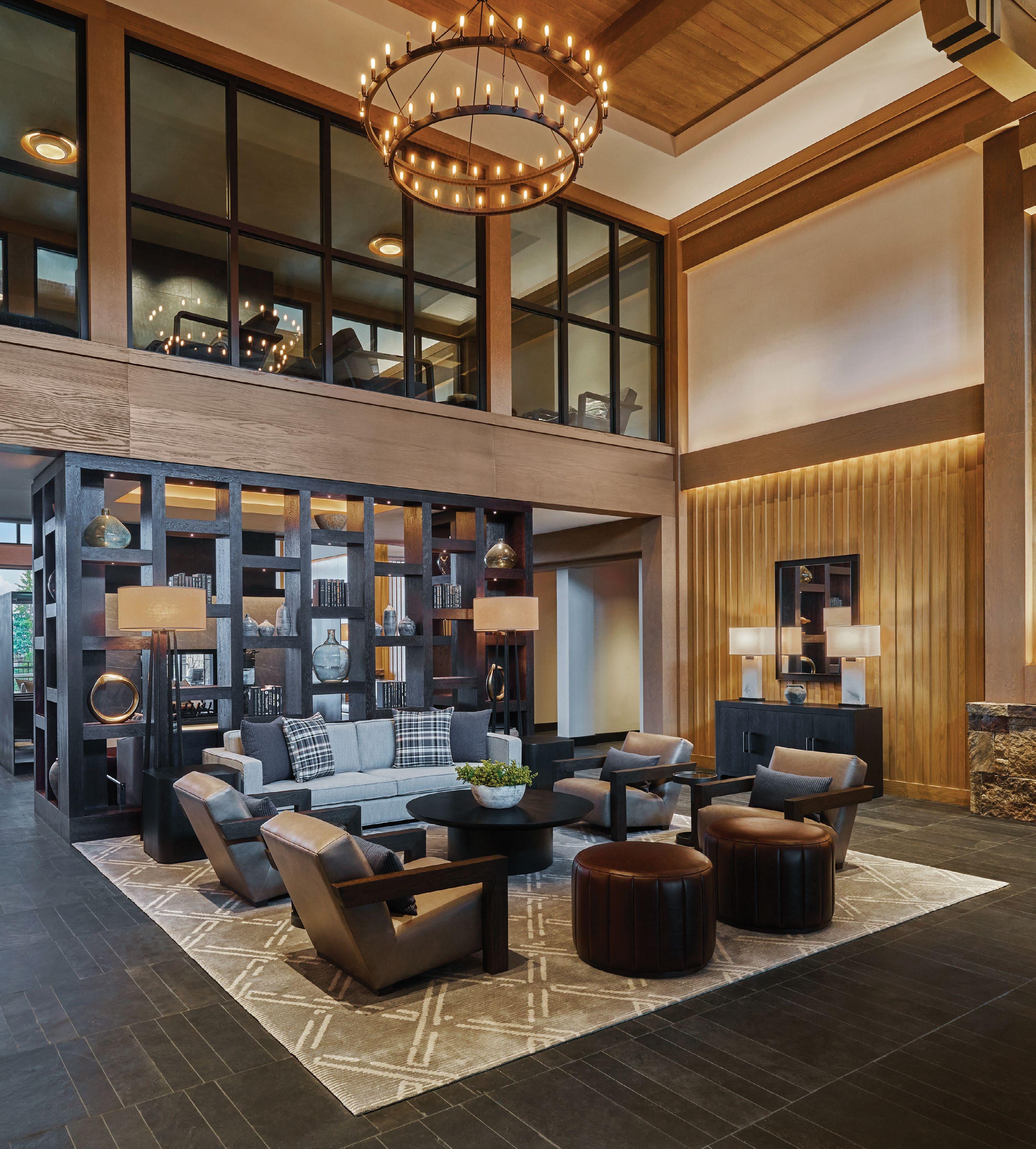

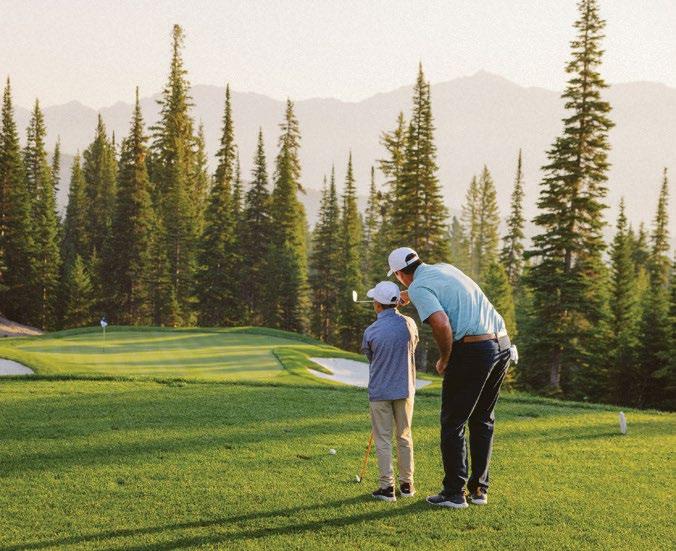
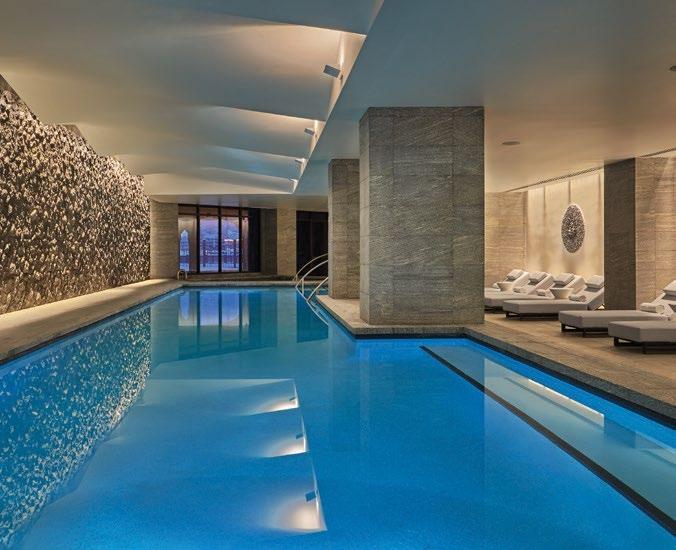
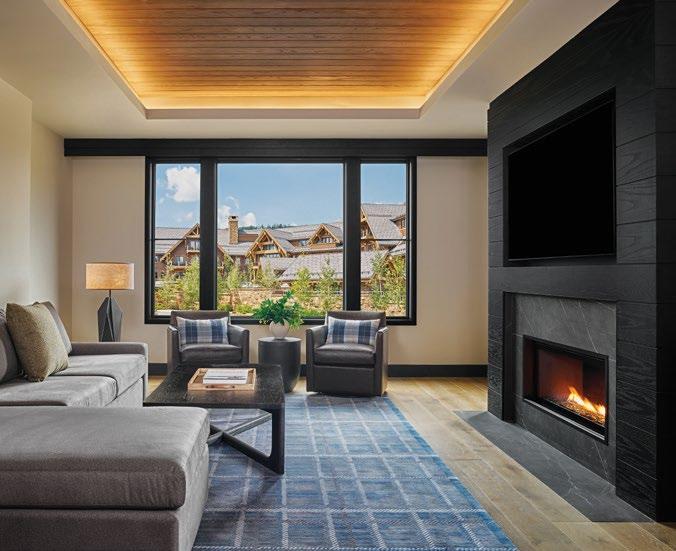
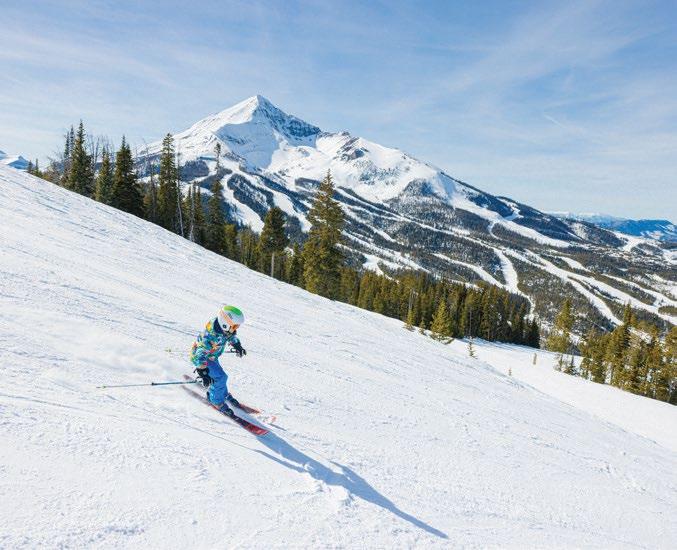
Ownership at The Inn is offered in deeded, one-quarter ownership interests, giving you 90 days of turnkey, fully-managed ownership in Big Sky. These 32 fullyfurnished three- and four-bedroom Residences with connected lock-off suite provide a unique second home ownership opportunity in a luxury Residence steps from Montage Big Sky. Connected by an underground pathway, Owners will enjoy access to the resort's many amenities including five dining establishments, Signature Spa Montage, a bowling alley, golf and sports simulator room, and indoor and outdoor pools, plus ski-in, ski-out access to Big Sky Resort.
Owners will also enjoy the benefits of membership at Spanish Peaks Mountain Club, which includes private concierge services, an 18-hole Tom Weiskopf Championship Golf Course, a new 10-hole Par 3 course, clubhouse, upcoming Aspire Lodge, and a year-round calendar of special, member-only events and experiences.
THE CONTESTANTS SHOW THEIR SKILLS, GET AND GIVE THRILLS AND, IF THINGS GO RIGHT, THEY EARN A POCKET OF PRIZE MONEY.
- By Ken Younger -
Stand if you are able. Remove cover. Hand over your heart. Get ready to sing. The anthem is not for listening. Sing. With the first notes of “O say can you see,” a beautiful cowgirl on a beautiful horse rides Old Glory around the perimeter of the arena at a lope. You are surrounded by mountain majesty and big sky. You are breathing fresh Montana air. “Land of the free, home of the brave.” This is Montana rodeo. Let ‘er buck.
Nothing is more cowboy or cowgirl than rodeo. The hats and the boots, the dust and the leather. Southwest Montana alone hosts dozens of rodeos from early June into September, as pickups and horse trailers make a circuit from one small-town venue to another.
A town of 917 will likely fill the bleachers with a couple thousand fans. The contestants show their skills, get and give thrills and, if things go right, they earn a pocket of prize money. Rodeo is a special brand of entertainment for those of us in the stands.
There are two main sanctioning organizations in Montana: the Northern Rodeo Association (NRA); and the Pro Rodeo Cowboy Association (PRCA). The
NRA events are usually in less populated towns, and the contestants are often home grown. Think Gardiner, Three Forks, Twin Bridges, Ennis, Wilsall, Townsend or Boulder. By definition, almost every population center in Montana might qualify as a “small town.” But the PRCA events are more big time, drawing competitors countrywide, offering a large purse, and featuring larger crowds. Livingston, population about 9,000, holds a Fourth of July weekend rodeo, the Livingston Roundup. This event is second to none, with nationally ranked contestants, premium livestock, and a big fireworks show. For other rodeo opportunities, there’s the WPRCA
for women; the NPIRA, Northern Plains Indian Rodeo Association, high school and youth associations, and don’t forget the MSU Spring Rodeo in April. There are independent events as well, such as the Guts N Glory rodeo in Jardine, and the West Yellowstone Rodeo, held five or six days a week all summer long. In Montana, we are boot-top deep in rodeo.
there are things to consider when planning an outing to watch rodeo. Chief among these seems to be what to wear. If you work on the ranch or the farm, finish up your chores, get in the truck and go as you are. If you’ve lived in Montana for a while, but work at a bank or hardware store or doctor’s office, you undoubtedly own some Western wear. Dig your duds out of the closet, put them on, look in the mirror, and snap those shirt buttons. If you’re not local, you can get outfitted with a trip to the boutique or even the ranch supply store, but be careful. It might be a mistake to look like you were generated by artificial intelligence. Then again, how often do grownups
get to play dress up? So, you might as well have some fun. But do remember: You can go to live in France, but that won’t make you a Frenchman.
Approaching Ennis for the Fourth of July Rodeo, you think you’re arriving early, but the road is already lined with cars, like ants marching to a picnic. The parking experience gives the first evidence that you’re someplace uniquely Western. The “parking lot attendants” are girls and women mounted on horseback. As you pull in, you follow the following end of a horse down the grassy aisle. Like obedient livestock, you’re passed on to another rider who guides your metallic horse into position. The rider gives a nod, whirls her pony in a 180, and trots off to her next assignment.
Wilsall, north of Clyde Park and south of Ringling, provides a fine rodeo weekend. Started in 1953 by “a few local boys with the rodeo bug,” this June rodeo sets the tone for the summer. The two-day event starts with rodeo Saturday night. If you’re too wound up to go home after the rodeo, stick around. There’s music and a chance to show off your Texas
two-step right at the rodeo grounds. Or, take your dancing boots into town for another band and a street dance. Sunday morning is time for the firemen’s breakfast. Why do those pancakes taste better than what Momma flips at home? In our family, we have always had a life philosophy: Never miss a wedding, never miss a funeral, and never miss a firemen’s pancake breakfast. There’s church service at the rodeo grounds, 9 a.m. sharp. A parade, sponsored by Women of Wilsall, commences at noon. It’s rodeo time again at 2 p.m.
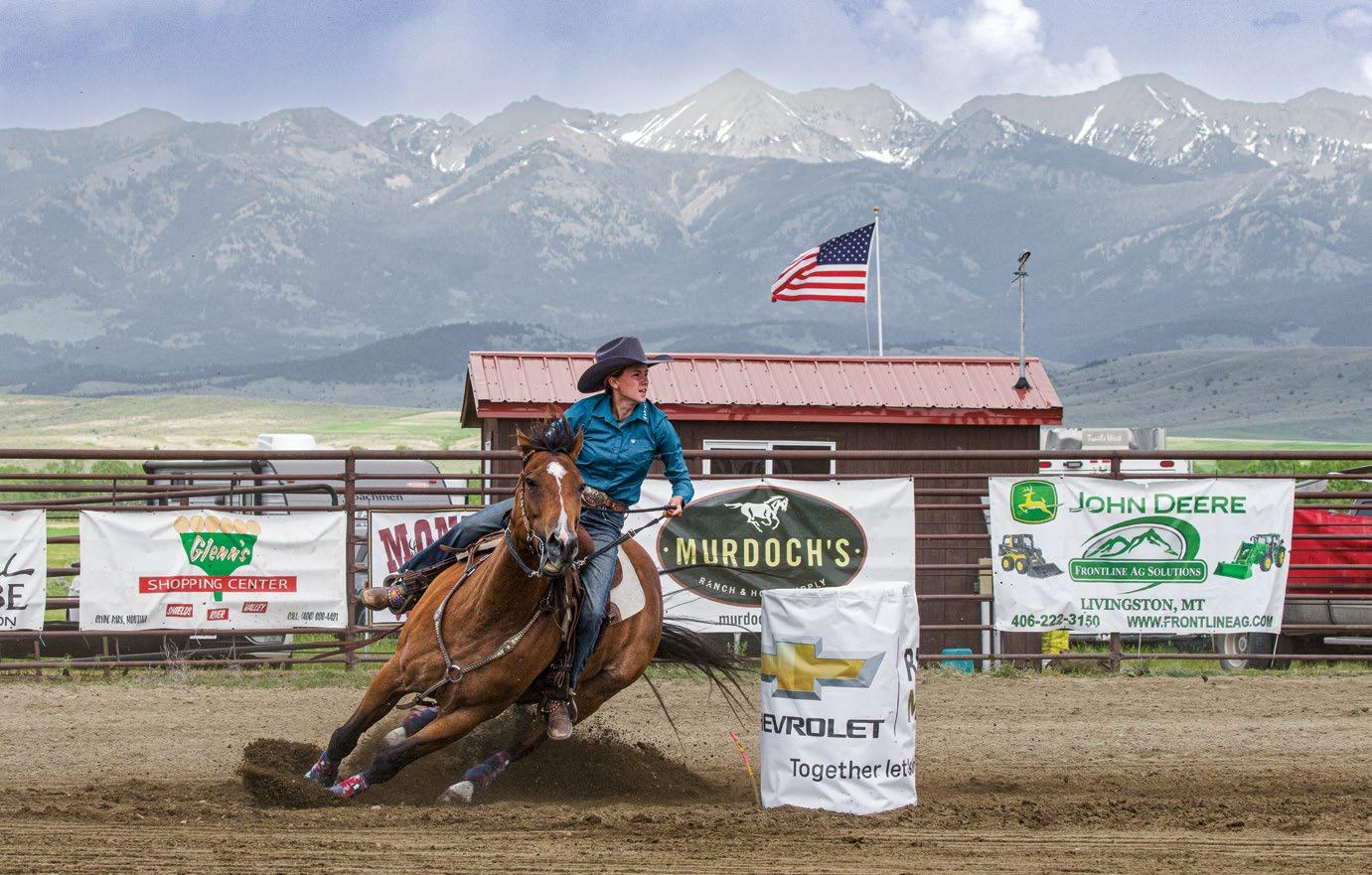
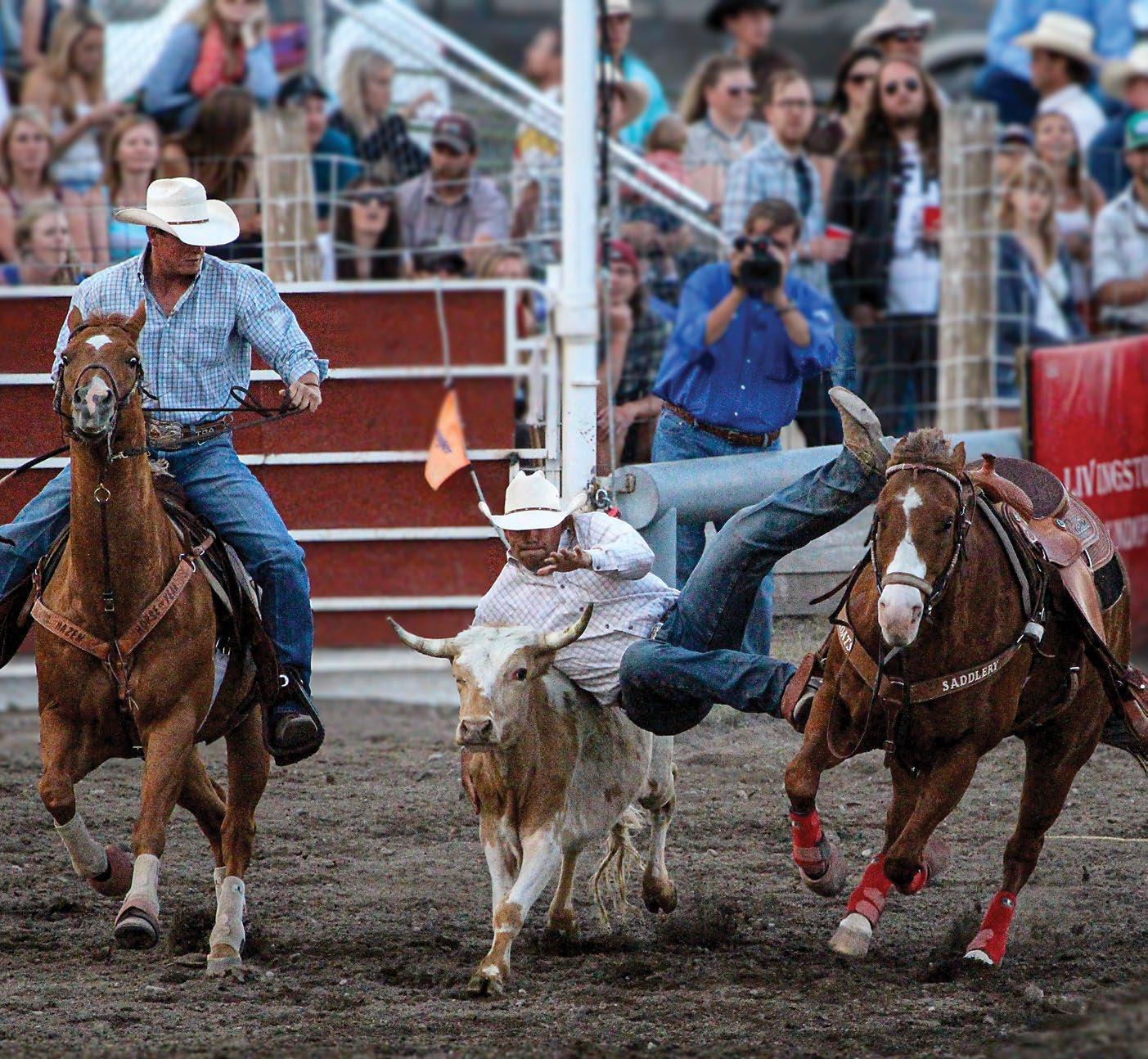
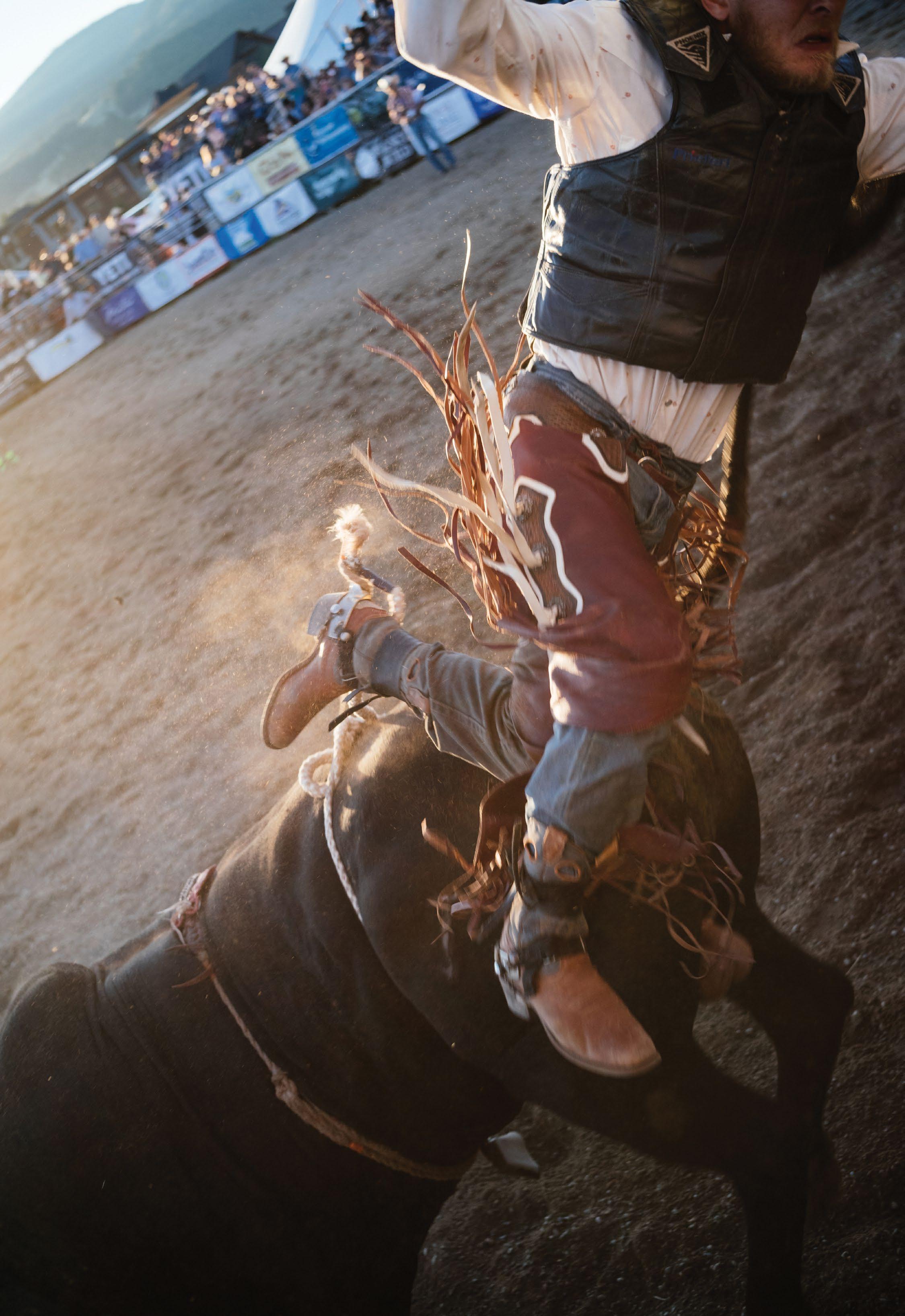
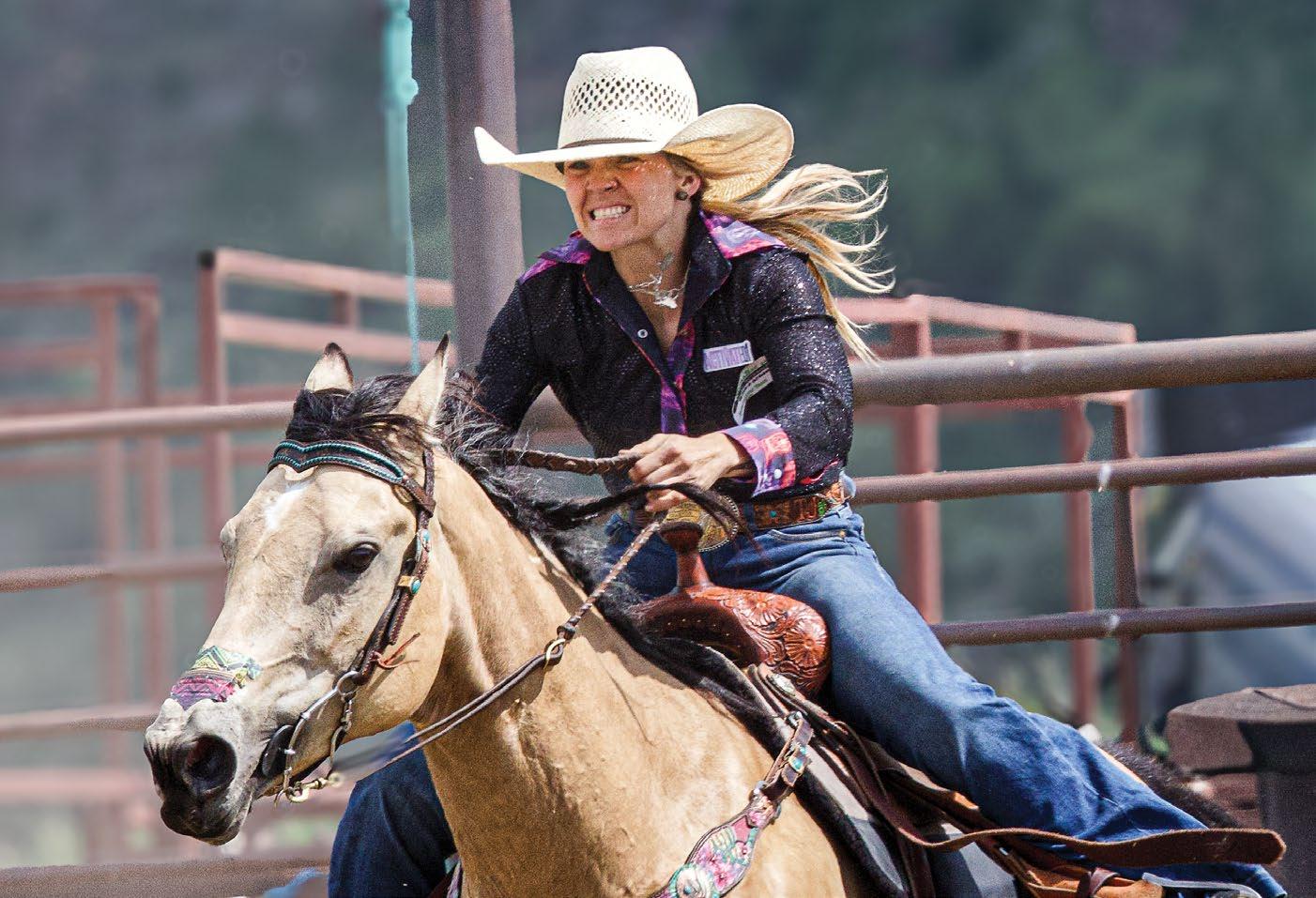
rodeo events are of two types: roughstock and timed events. Your mental image of rodeo is likely of the roughstock events: bareback bronc riding, saddle bronc riding and bull riding—the cowboy’s arm pointed northwest, his boots and spurs aimed southeast. Likewise, the horse’s hind legs are high and forelegs low. Hang on for eight seconds and you’re awarded points. Timed events are steer wrestling, team roping, calf roping, ladies barrel racing and breakaway roping. These events require cowboys and cowgirls to race against the clock and their competitors’ times. The crowd is a participant in each event, roaring encouragement and approval during
the ride, or applauding in consolation to the rider who made a premature exit.
If you’re lucky, there will be some other events of high entertainment value: the children’s calf scramble, for instance. This hilarious event is some variation of a ribbon tied to the tail of a calf, and a free-for-all mob of kids. The object is to be the kid who grabs the ribbon. The calves do not cooperate, believe me. Another children’s event is mutton busting. Use your imagination on that one.
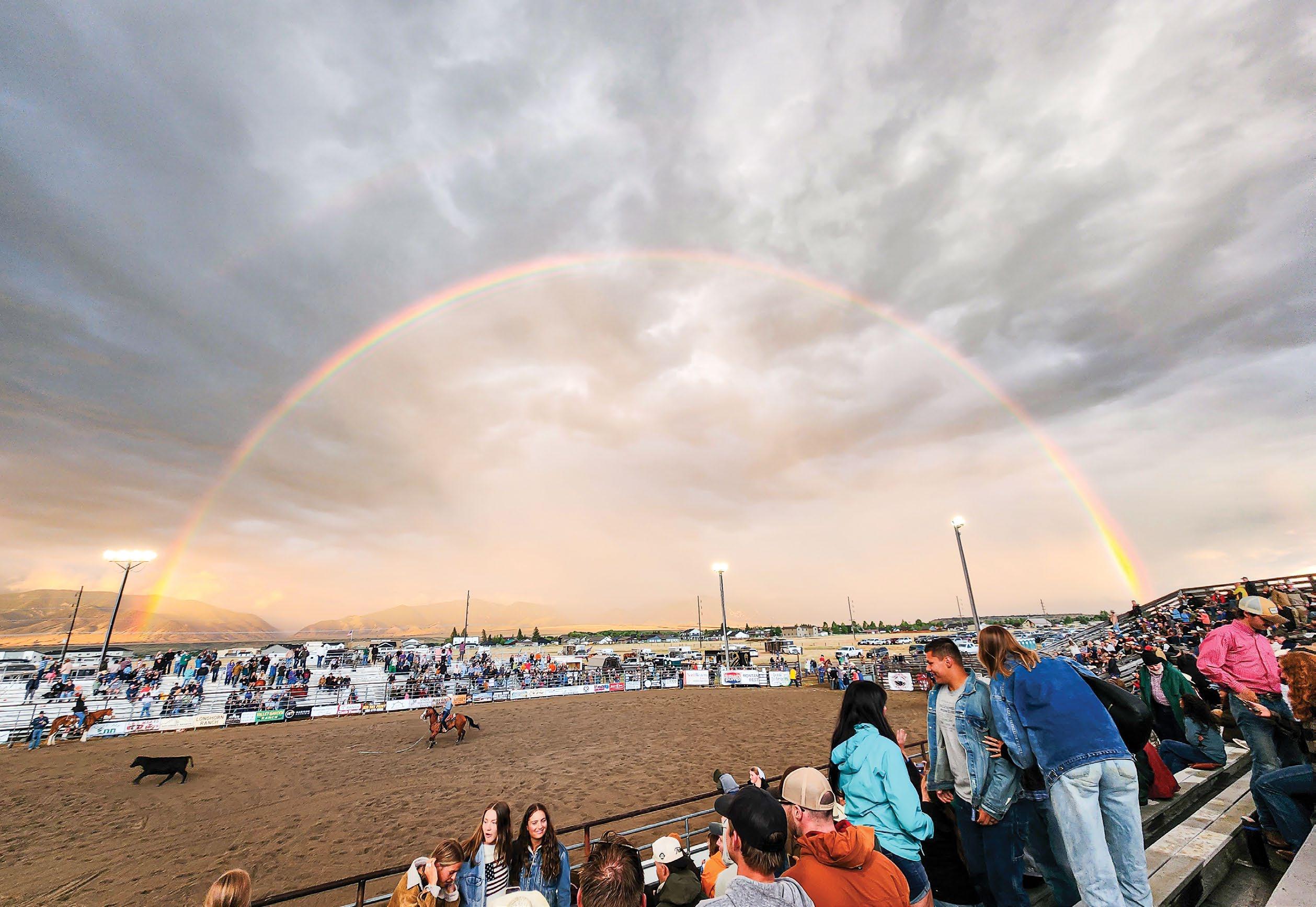
Over the Fourth of July, Livingston’s Roundup pro rodeo offers a chance for a visit to the major leagues. While there are PRCA rodeos in Billings and Great Falls and other places, you can’t beat the venue in Livingston. Get tickets ahead of time; this place sells out every year, with about 5,000 spectators each performance. The rodeo is even sometimes featured on the Cowboy Channel. On-site parking is limited, so you and fellow rodeo fans will have to parade through the surrounding side streets toward the Yellowstone River and the fairgrounds entrance. The rodeo is a four-day affair, beginning on Wednesday, and ending this year on Saturday, July 4. There’s a parade on July 2nd. The Park County Fairgrounds open at
“BRONK RIDERS AND BULL DOGERS ARE ALL HART ABOUVE THE WAST BAND BUT IT’S A GOOD BET THERE’S NOTHING UNDER THARE HAT BUT HAIR.”
- CHARLIE RUSSELL
5:30 p.m., with the contests starting at 8:00 p.m.
You know you’re at a Montana rodeo when, as you pass through the gate, the very first concession booth you encounter is selling whiskey. There are a multitude of other vendors hawking all the usual fare, such as corn dogs, burgers, brats, and barbecue. If you think your taste buds can handle it, you might find some deep-fried items that perhaps shouldn’t be deep fried, like pickles and Oreos. Other booths offer belts, buckles, boots, and hats.
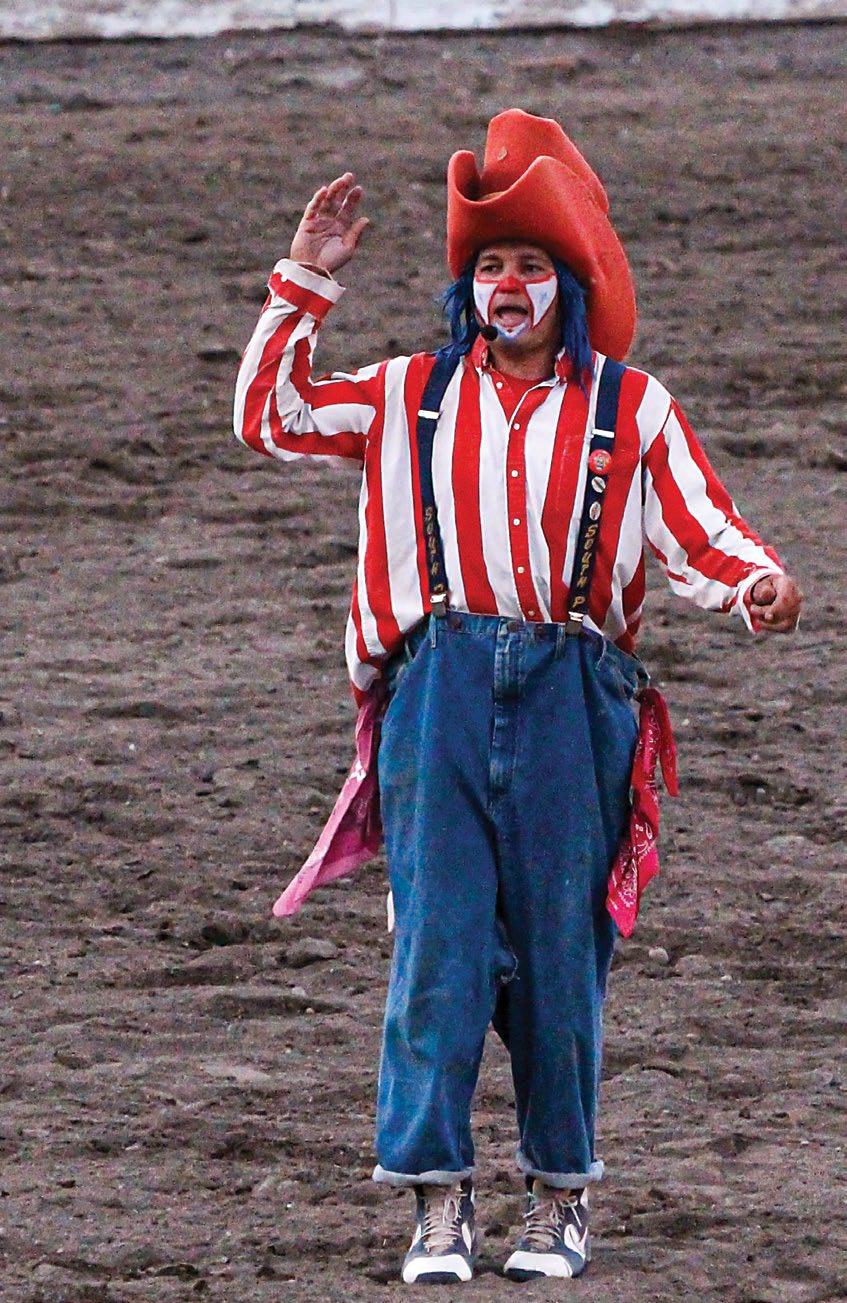
If you’ve been to the Livingston Roundup before, you’ll recognize the distinctive voice and manner of the announcer. He is Steve Kenyon, who’s been behind the microphone for more than 20 years. It is said that every pilot wants his voice from the cockpit to sound like Chuck Yeager, the test pilot who first broke the sound barrier. Well, every rodeo announcer would like to sound like Kenyon. His narrative and banter with the rodeo clowns is especially distinctive. These rodeo clowns are equal parts entertainment and heroism. Imagine trying to distract a raging bull intent on trampling a cowboy while wearing a hat that is three sizes too big, pants that are five sizes too big and a nose that is painted red. Brave souls. Now, let me call attention to an aspect of the competition that one might overlook. A pair of pickup men are the rodeo equivalent of a search and rescue team, with horses for helicopters. They hover at the periphery of the arena on their quarter horses, engines running. A cowboy has just spent eight seconds, more or less, trying to stay attached to a writhing, lunging, galloping, bucking mass of livestock. The rapid transit from horseback to the ground amidst flailing hooves is hazardous business. The only way it could be more dangerous is if the landing zone were a rattlesnake nest. Despite the chaos and peril, the pickup men evoke a strictly business demeanor with their starched shirts, bright chaps over their jeans, and all the while maintaining perfect posture. The pickup man pulls alongside the rider and mount, like a jet easing into formation. The cowboy leans and puts a bear hug around the pickup man. The two horses part, and the rider is settled back to earth. Another successful 911 call. If the hat is still there, the cowboy may touch the brim to salute the cheering crowd.
there is another kind of rodeo that’s a horse of a different color—the ranch rodeo. These events are held in the same arenas but on different weekends. The emphasis is not on the individual daredevil, but rather this is a team competition. The contests represent day-to-day ranchwork and the cowhands are locals; the four-person teams are often made up of hands from the same outfit. The events include branding, where a calf is roped, held and branded. There’s no smoke or smell of burning hair; they use chalk. Another event is doctoring. Don’t worry, there are no shots or castration—chalk again. The signature event of ranch rodeo is the final contest of the day, wild cow milking. Picture this: A 900-pound lactating cow is roped around the head by team member A. Team member B grabs the tail to hold the cow steady. Good luck with that. Member C milks the cow, aiming to get the milk into the narrow mouth of an old-fashioned Pepsi bottle. And team member D sprints across the arena to the judge and inverts the bottle to demonstrate the presence of prized fluid. Sometimes there’s a few drops, sometimes not.
While the spectators may have turned attention elsewhere, the pickup men have another high-speed, high-hazard rescue. Mister bronco is still on the loose. The next step is to remove the flank strap from the bronc and haze him through a gate and out of the arena. Again, two equine jets align, the rider leans and with a quick grab and tug, relieves the bucking horse of his tickle. The bronc is swiftly escorted out. The pickup men retake their observation posts at arena’s edge, and soon enough a new gate opens for the next rider and mount to begin their eight seconds of glory.
There is no doubt that the cowboys and cowgirls are taking on big risks for their own satisfaction and pride, and for your entertainment. The risk factor might be somewhere between NASCAR and Mixed Martial Arts. The contestants earn every bit of your applause. But when you watch a sentient being voluntarily climb on the back of a 1,700-pound bull and give the guy holding the gate a nod to turn the beast loose, you have to wonder: What is this guy thinking? There is a quote from Charlie Russell that gives the explanation: “Bronk riders and bull dogers are all hart abouve the wast band but it’s a good bet there’s nothing under thare hat but hair.”
Ride ’em cowboy.
Ken Younger is a physician who has lived in the Gallatin Valley for over 50 years. After retiring from his ophthalmology practice, he has pursued freelance writing and photography.
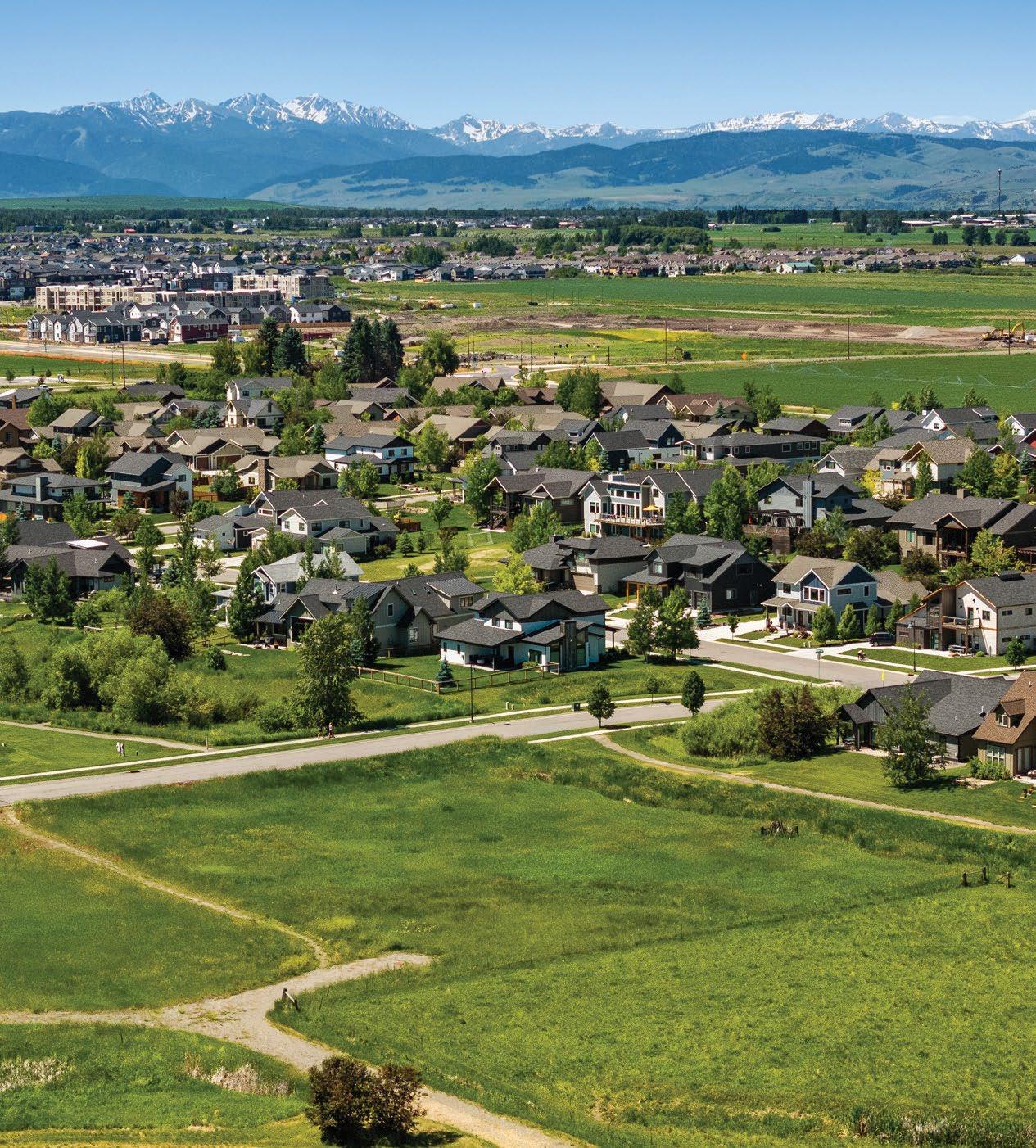


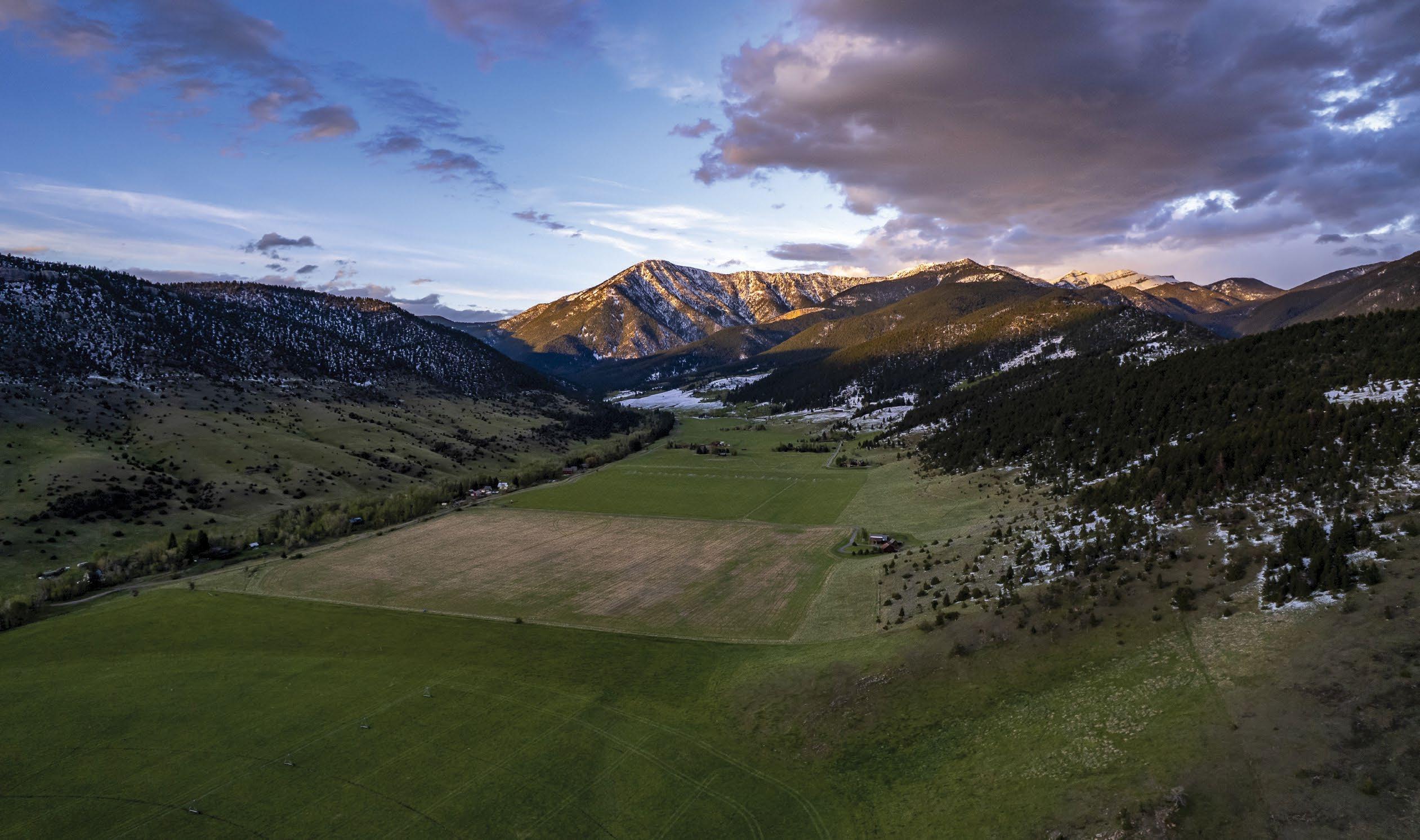








By Kaley Burns
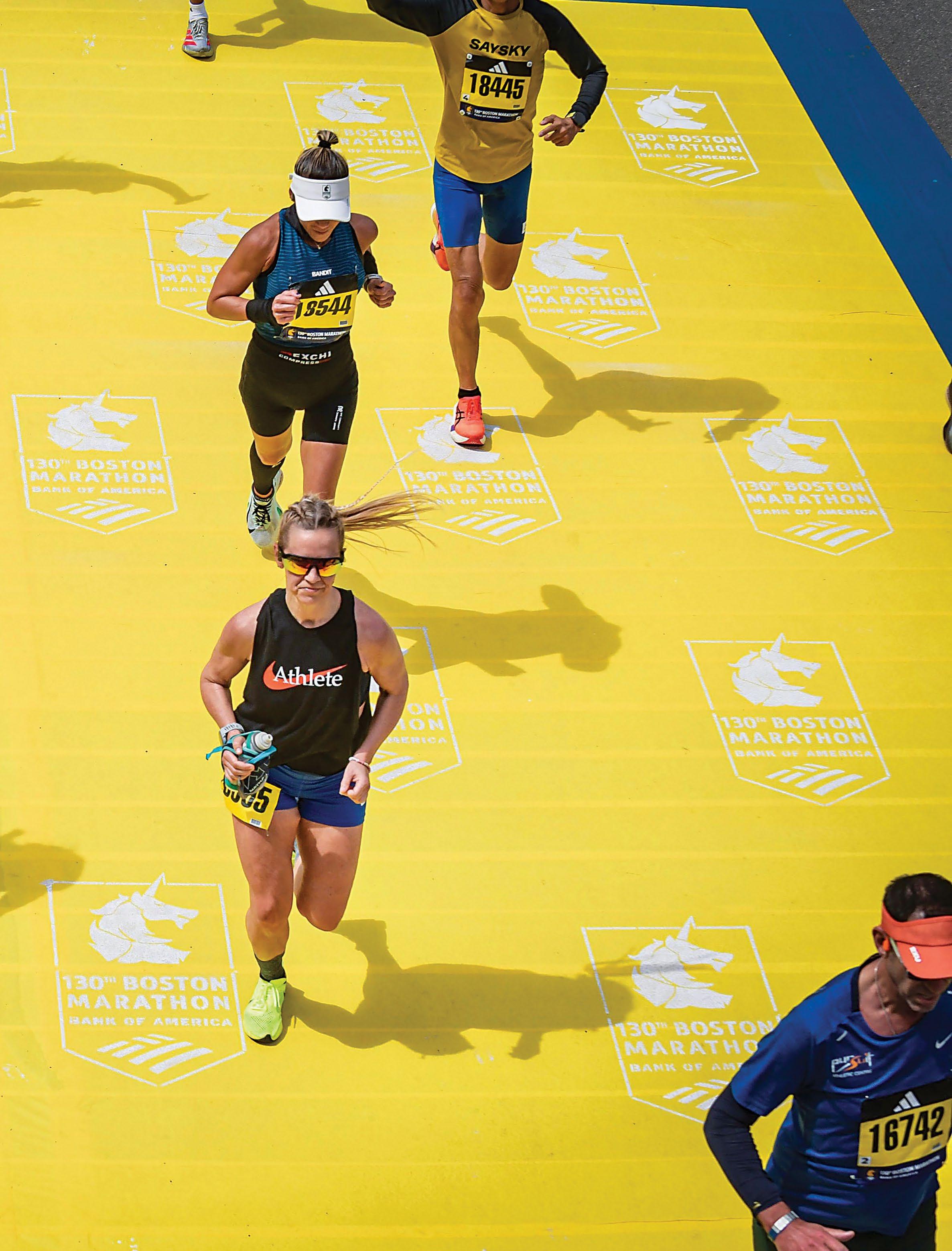
Ialmost didn’t go to Boston. Not because of the training. Not because of the distance. Not because the dream suddenly felt too big. I almost didn’t go because sometimes life asks a mother to choose between the finish line she’s chased for years and the place she’s needed most. In those moments, the meaning of 26.2 miles changes completely.
The Boston Marathon draws runners from across the world to one of the most storied courses in the sport. It’s about perseverance through pain, community in motion and triumph over adversity. For me, though, it became something deeper. It became a story about motherhood, and about everything I carry with me when I run.
Some runs change your pace. Some runs change your life. Every marathon begins with a decision. Before the training plans, the early mornings, the aching legs and long runs, there is a moment when a runner decides to try. That first step represents the willingness to begin even when the outcome is uncertain.
When I first set my sights on the Boston Marathon, I thought I understood what that meant. I thought the challenge would be the miles. Truthfully, I was never the kind of runner who dreamed of Boylston Street: the roar, the medal, the elusive finish line. But somewhere along the way, as our family navigated my son’s health challenges, Boston stopped being a race and became a reason to keep going. And so I found myself looking to the starting line; not chasing a dream, but refusing to let go of one.
Training for Boston demands discipline, consistency and sacrifice. It asks runners to organize their lives around miles, recovery, and mental grit. But life rarely unfolds according to a training schedule. As such, life shifted for me in a way no training plan could anticipate. Suddenly, I was thinking in dosages, symptoms and what-ifs. My mind was occupied by something else: caring for my baby as we searched for answers.
The steady rhythm of miles and workouts I had grown accustomed to gave way to an entirely different kind of endurance. It required me to shift my focus away from myself and toward the people who matter to me most. The runs I had carefully scheduled were replaced by long days of uncertainty, half-drunk cups of coffee, plans that dissolved by mid-morning. Motherhood took its rightful place ahead of any race on the calendar.
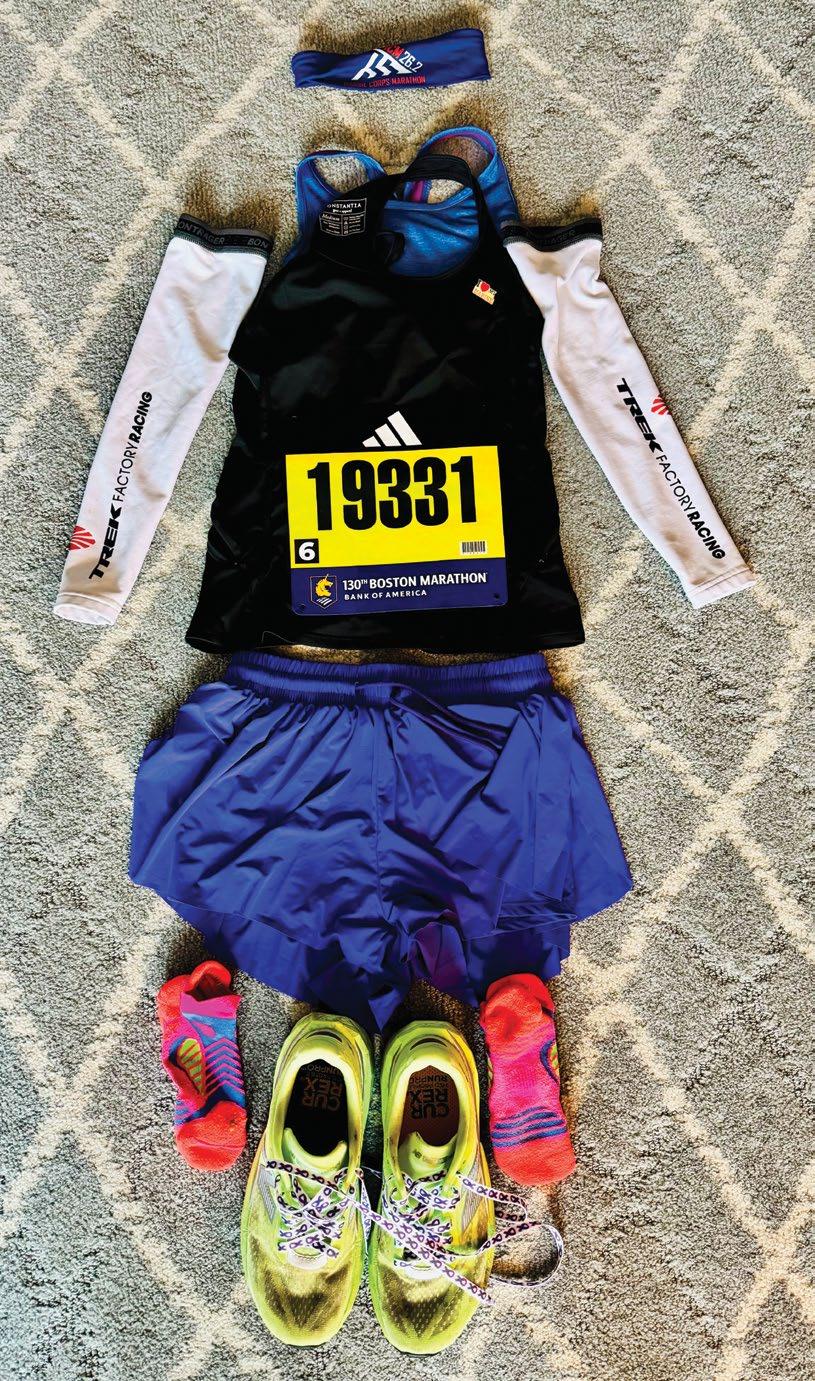
In that season, I wasn’t a runner chasing Boston. I was a mother showing up where I was needed most. The finish line that once felt so important no longer mattered in the same way. I stepped back from the idea of the race. Not because I failed, but because I chose something that was more important to me.
Running teaches something psychologists call distress tolerance. It teaches you to stay without panicking. Stay when your lungs burn. Stay when the miles stretch longer than you’d expected. Stay when your mind tells you to stop.
Discomfort does not always mean something is wrong; it can mean something is being worked through. Running has shown me I do not have to feel strong to keep going. There is a strength in the body of a mother, a strength built from sacrifice, love and relentless determination. There is power in showing up again and again, even when the path forward feels unknown; a refusal to be defined by our challenges. Even the heaviest days can grow lighter. Over time, life began to settle. Our family found its footing in our new
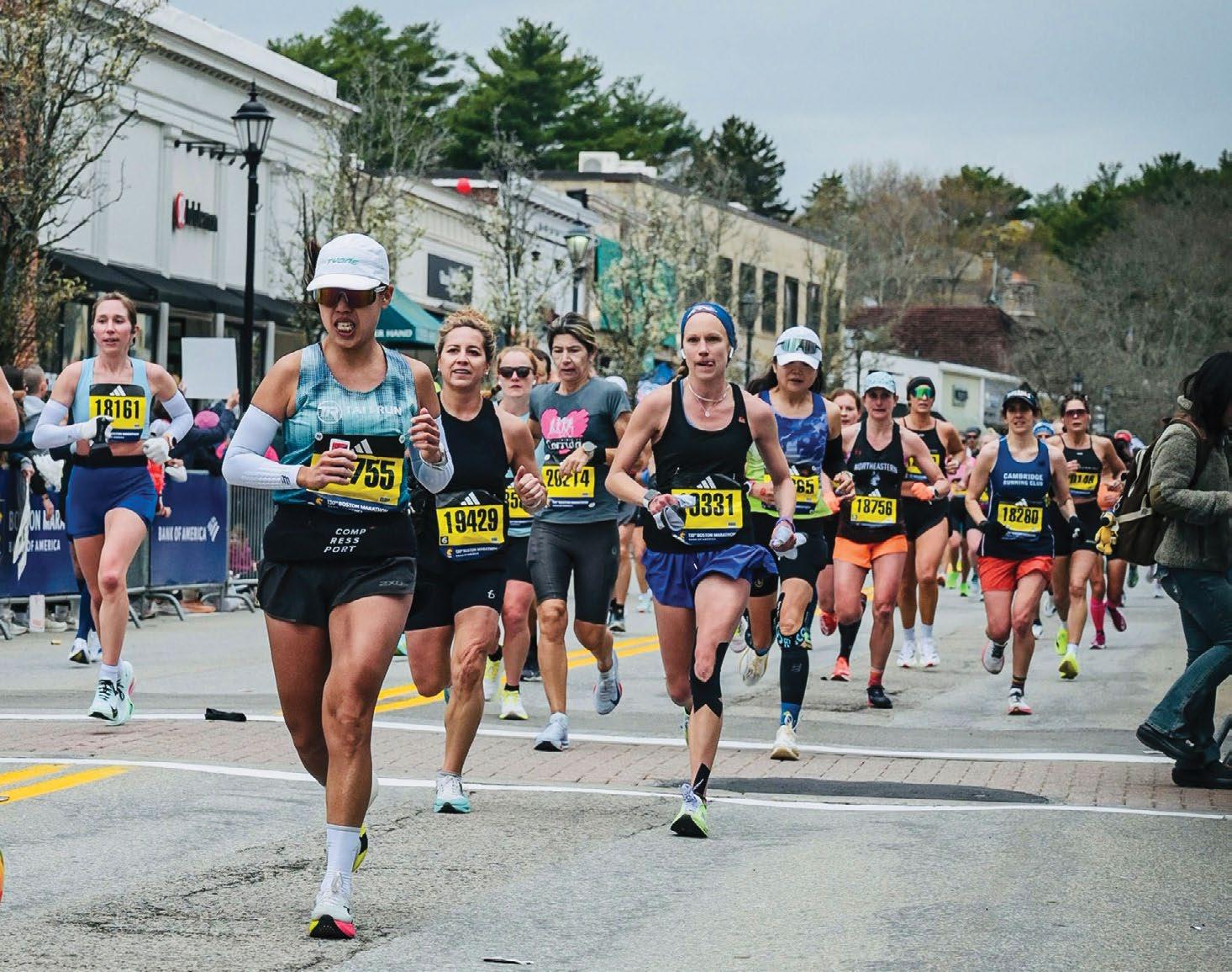
reality. And slowly, the miles returned. My husband, with a mission to keep a piece of me intact, resurfaced the notion of going to Boston.
Training looked different this time. These miles were shared. Tiny feet wanted to run beside me. Little hands clapped encouragement. My son rode along on runs with Elmo tucked under his arm, cheering me forward in his own small way.
There were days I cried through my run. My husband supported the journey with steady love. My family’s encouragement carried me through moments when the road felt long. Running stopped being a solitary pursuit. It became something collective, a family effort, a shared resilience. Each mile was a reminder that we truly can do hard things. I wasn’t leaving motherhood behind, I was expanding it. There is nothing a mother cannot hold.
We received our official diagnosis on the plane to Boston: a specific form of epilepsy. I remember staring at the
seatback in front of me, as if it might offer instructions for what to do next. It was strange to be suspended somewhere between where we had been and where we were going, holding news that would follow us long after we landed. I tried to make sense of it there, quietly, without answers, without a plan. And when I couldn’t, I did what running had always taught me to do: I kept moving. I carried it onto the course, letting each step hold a piece of what I didn’t yet know how to name.
The strength in the body of a mother is not the kind of strength that shows up on podiums or leaderboards. It lives in hospital rooms and early mornings. In the steady rhythm of showing up day after day. It lives in the choice to keep moving forward, even when the road looks different than you had imagined.
A marathon is never built in a single heroic moment. It’s constructed through countless small decisions: each training run, each rest day, each time you choose to keep going. The groundwork is laid mile by mile while overcoming setbacks and embracing opportunities.
On April 20, carbon-plated shoes toed the line as 30,000 runners from 190 countries set their sights on the infamous blue and yellow finish line. I’ve greeted many starting lines, but Boston was truly a unique experience.
There was not one foot of the course that wasn’t lined with spectators cheering, holding signs or giving out pickles and oranges. I ran through crowds that felt louder than anything I’d experienced in other races, yet the thoughts in my head were quieter than they’d been in weeks. It was unlike any energy I’ve seen in the racing world. But Boston is much more than a race. It is a symbol of the human spirit.
This race is a proving ground where discipline meets determination, and runners honor a tradition larger than themselves. Boston embodies a shared belief that perseverance can carry you through heartbreak, fatigue, doubt, and adversity. The crowds lining the streets, the roar of encouragement, the iconic final stretch were reminders of community, of unity and of what people can achieve together. Boston is
where personal dreams intersect with collective history.
The Boston Marathon will always be known as one of the world’s most iconic races. I ran this race for all mothers. All mothers with little sleep, with worries of their baby’s health, with mental weight that no one sees. For me it was choosing family over ego, honoring the body’s signals, understanding that strength isn’t measured only by pushing forward; sometimes it’s measured by stepping back.
Running didn’t disappear during those difficult months. It transformed. I carried the weight of it with me; sometimes in my chest, sometimes in the quiet space between breaths. It showed up in the miles I cut short, in the ones I finished anyway. I wasn’t running to get stronger. I was running to steady myself, to find a rhythm when everything else felt unpredictable. Each step became a way to move through what I couldn’t solve, to sit with discomfort without letting it take over.
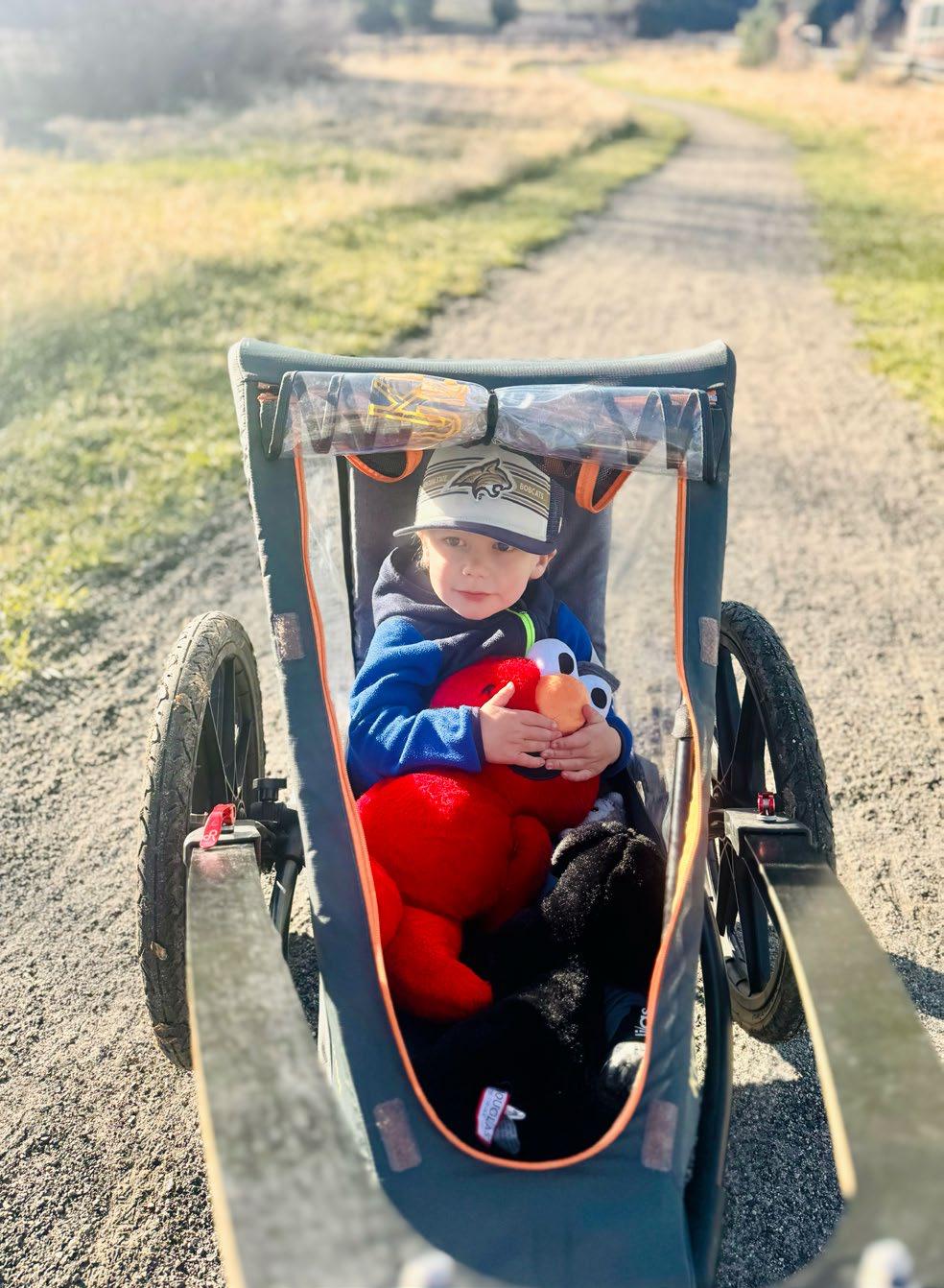
Now when I think about Boston, I think about more than the historic course or the roaring crowds on Boylston Street. I think about the journey that got us there. The uncertainty. The healing. The love that carried us forward. Holding ourselves together when it felt impossible.
The marathon mirrored our life. Life with a diagnosis has no set distance, no clear finish line. It asks the same thing, over and over: Keep going. In families living with epilepsy, love doesn’t wait for certainty; it’s steady, unrelenting, meeting each day without guarantees.
Out on the course, I began to understand that endurance isn’t fixed. Fear can narrow it. Love can stretch it further than you thought possible. And life teaches you that you don’t have to outrun what’s hard, you learn to carry it. We run marathons. We also live them. And neither asks you to be fearless, only willing to show up for the next mile.
Kaley Burns, ND is a naturopathic doctor, mother, and eight-time marathoner whose approach to health is shaped as much by the miles she’s run as the patients she serves.

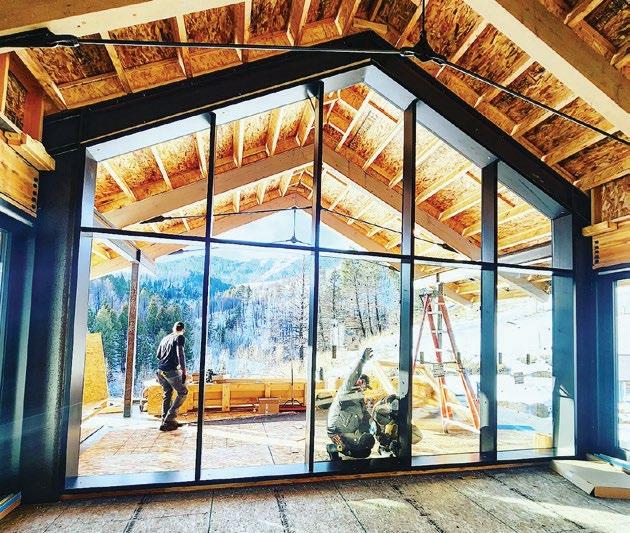












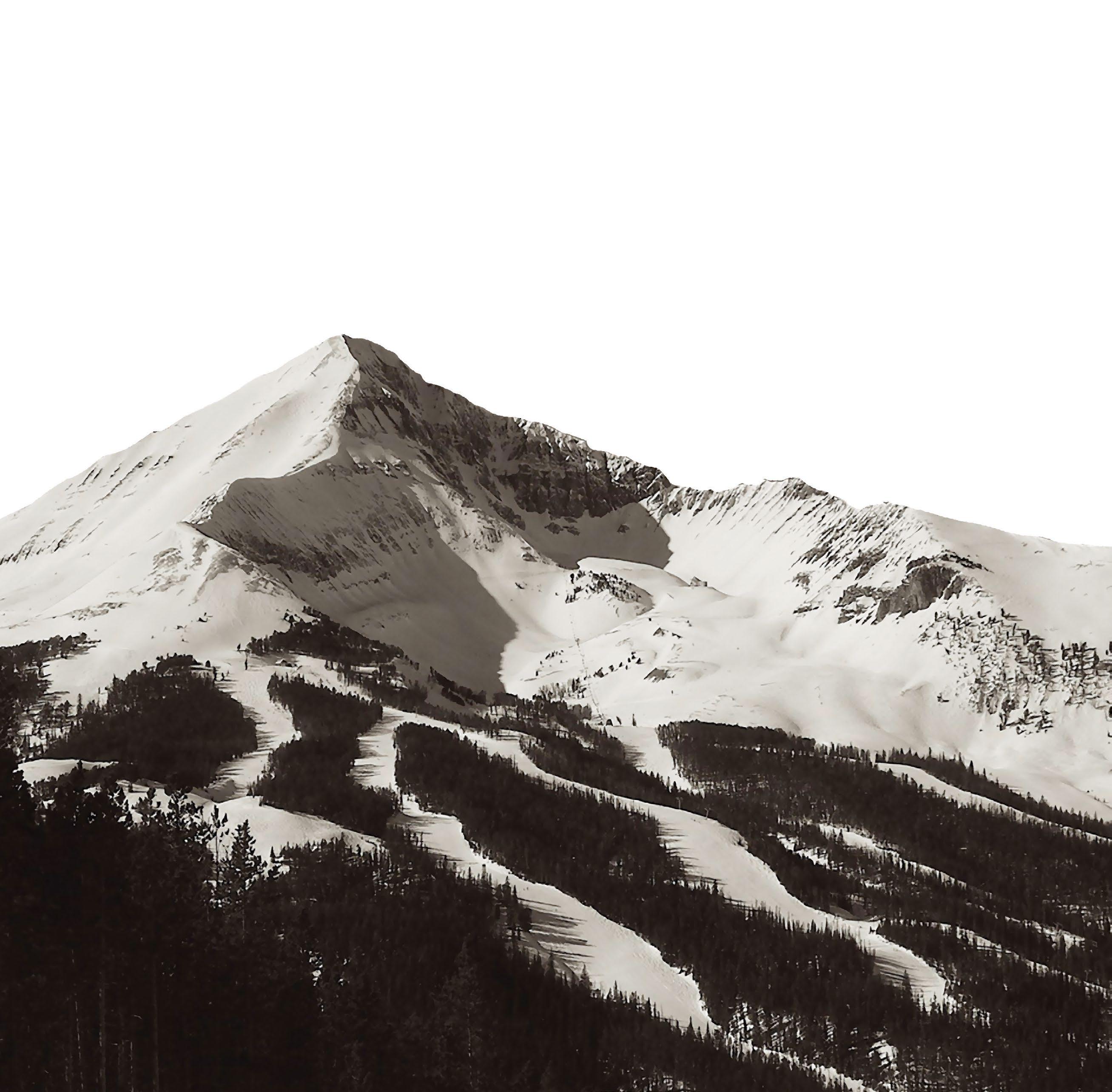
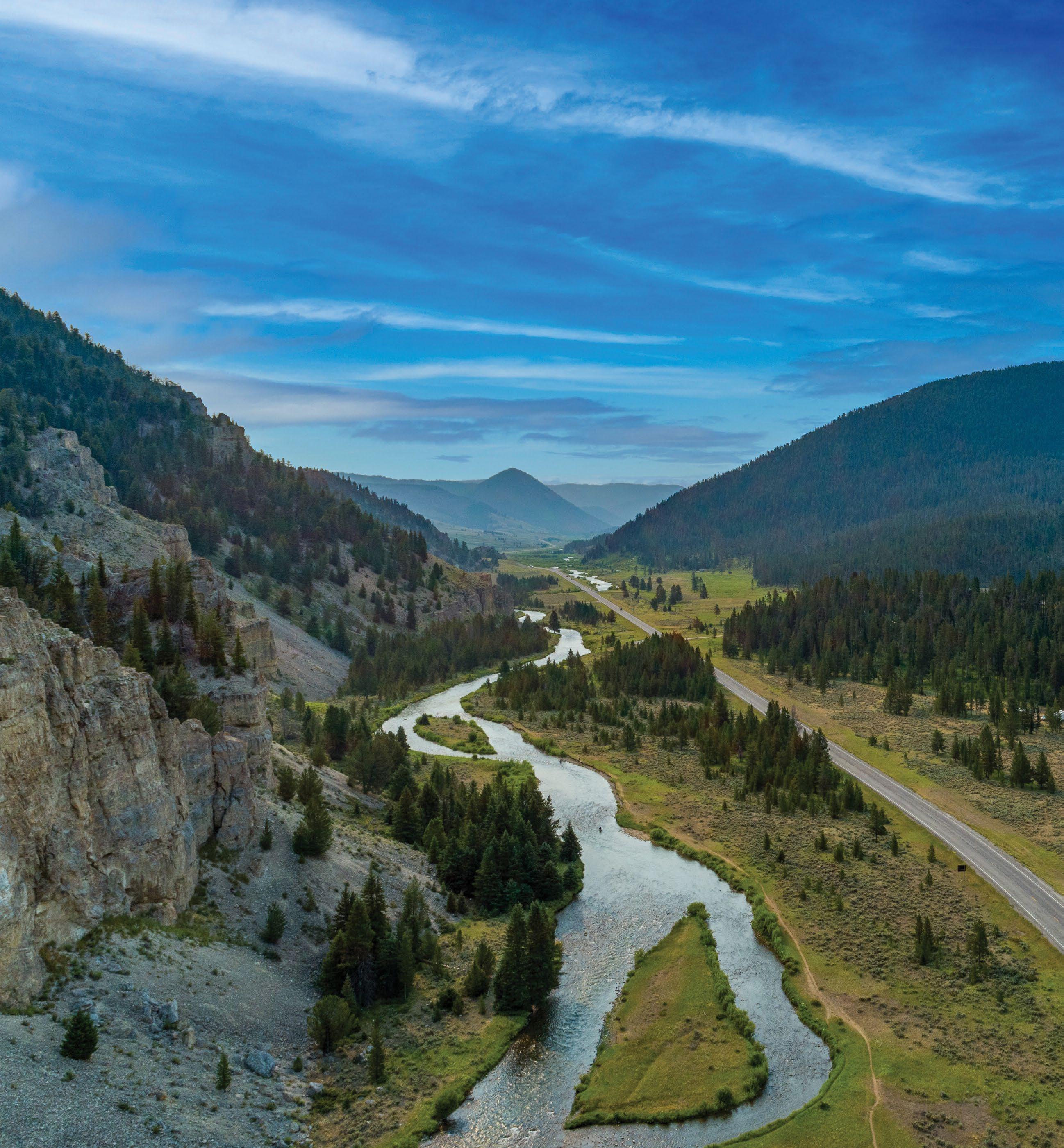



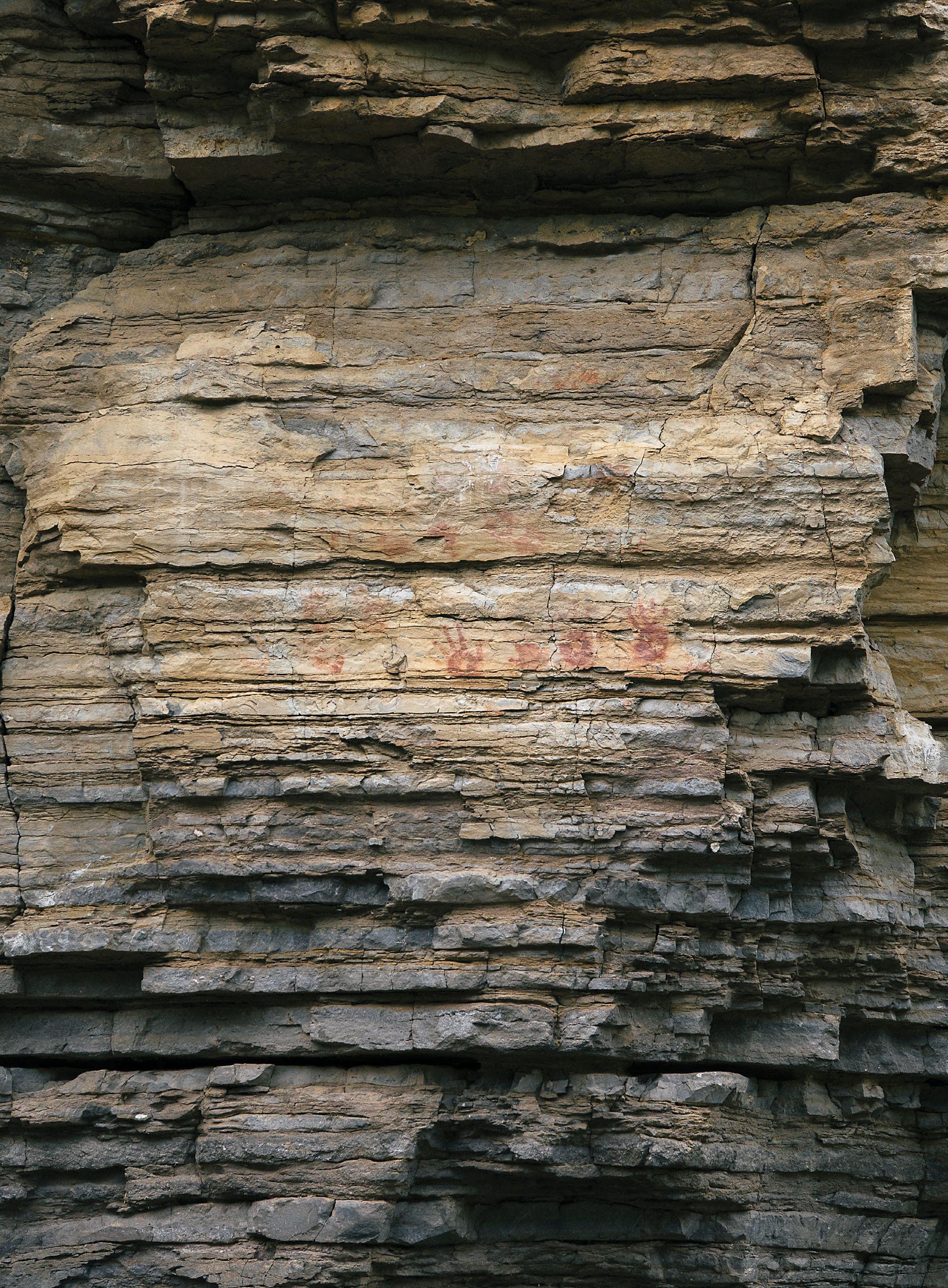
Words by Yetta Rose Stein
The Smith River is home to trout, owls, moose, and other early arrivals. It winds through a canyon deeper than the Grand. It is, in many ways, solitude exemplified: There is one public place to put in and one public place to take out along the 59-mile stretch of river between Camp Baker and Eden Bridge.
The Smith River emerges from the Castle Mountains near White Sulphur Springs, Montana, feeding the Missouri, storied and slow, and fed in turn by several tributaries including Sheep Creek and Hound Creek. The Tenderfoot acts opposite its name, dumping cold water into the Smith. Up the Tenderfoot, schools of whitefish and trout collect themselves in pockets of stillness. Deep Creek, later on, cascades along rocks and gushes into the widening river.
The Smith River is a belt notch for anglers across the country, a right of passage. Permits to float are hard to come by; roughly 10 percent of lottery
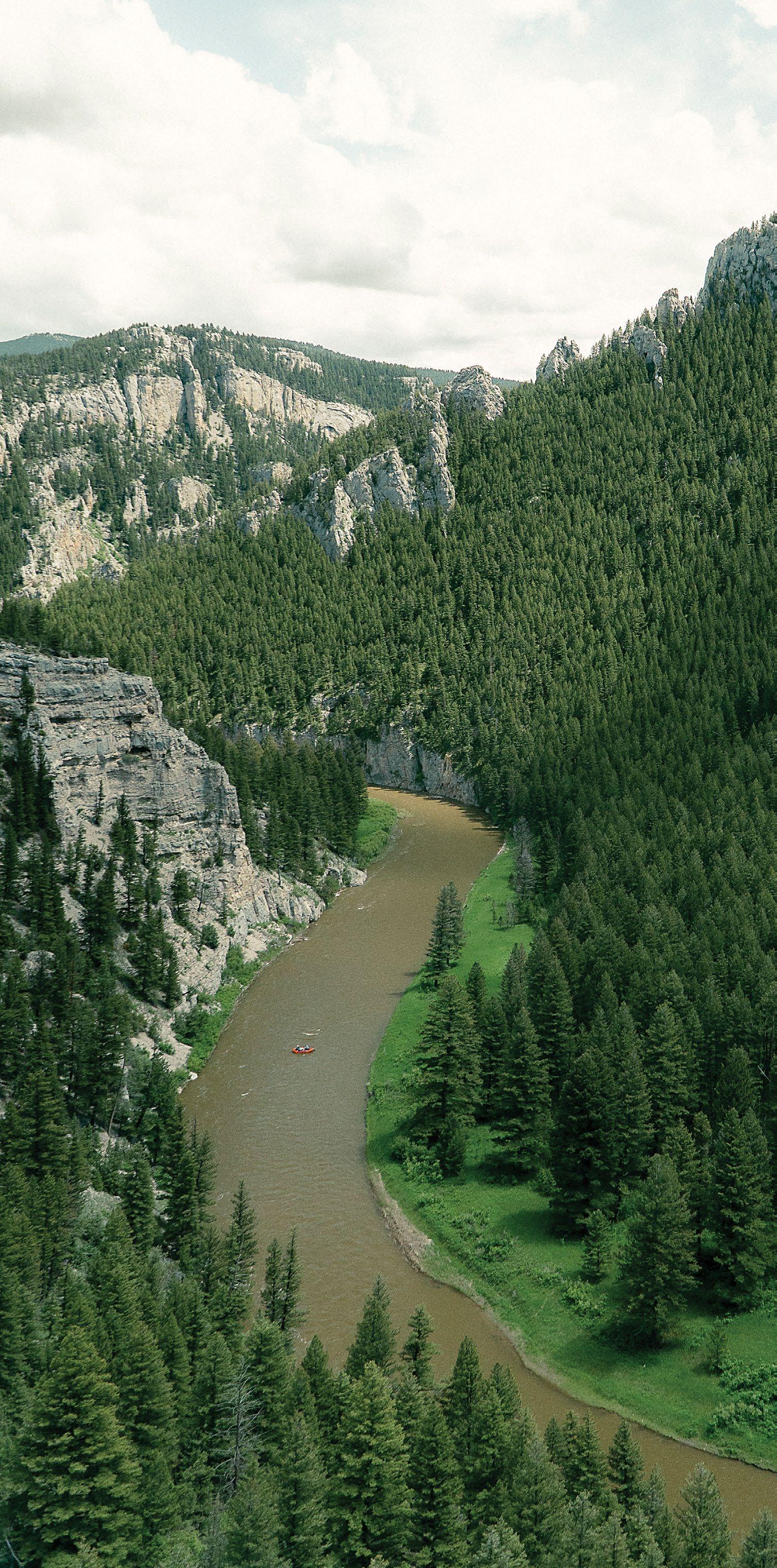
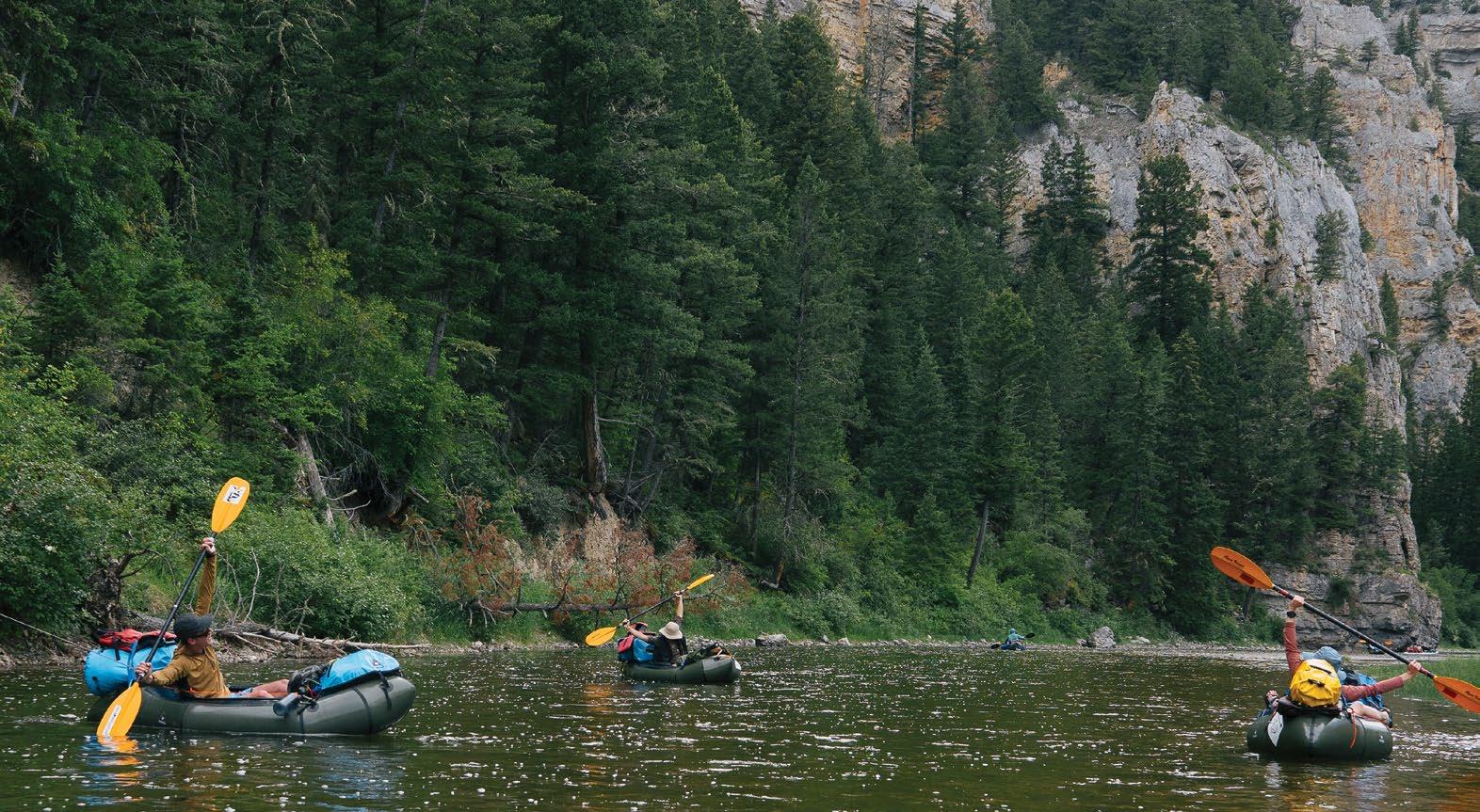
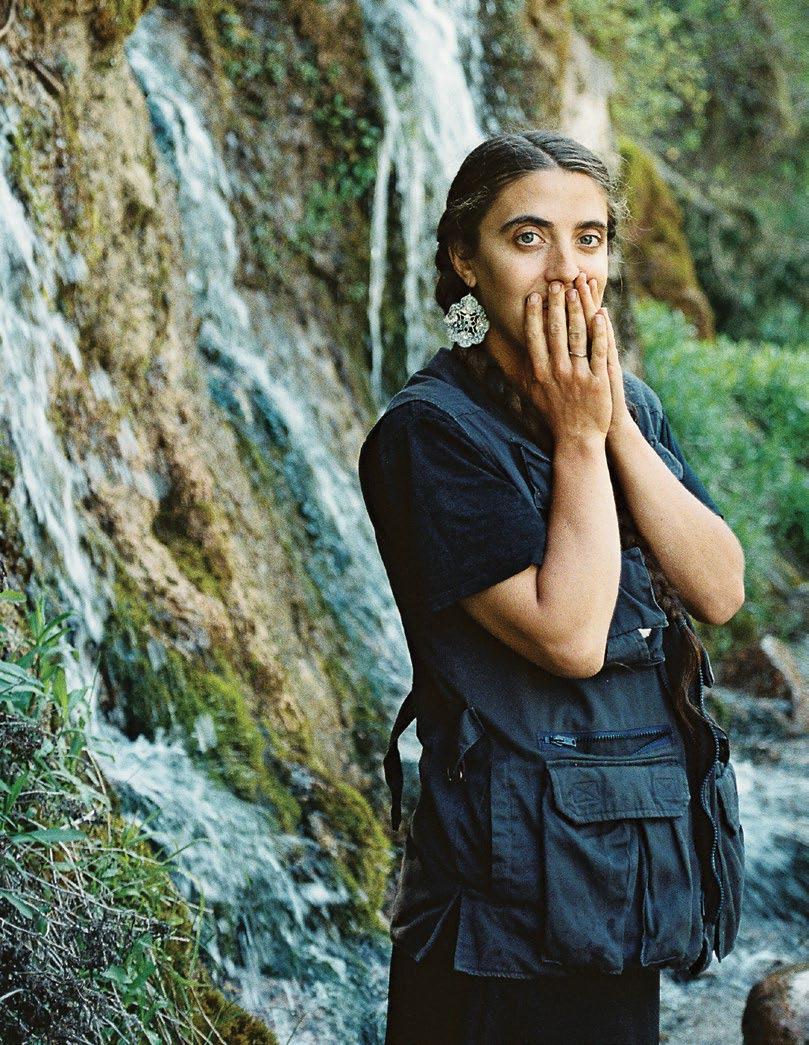
Clockwise from left: Pictographs and petroglyphs mark the canyon walls high above the Smith River, leading travelers to a cave where the shape of the water reveals itself. | On the Smith River, packrafters stretch their arms wide and greet the sky. | Author Yetta Stein stands at Indian Springs along the Smith River, awed by what lies beneath the earth.
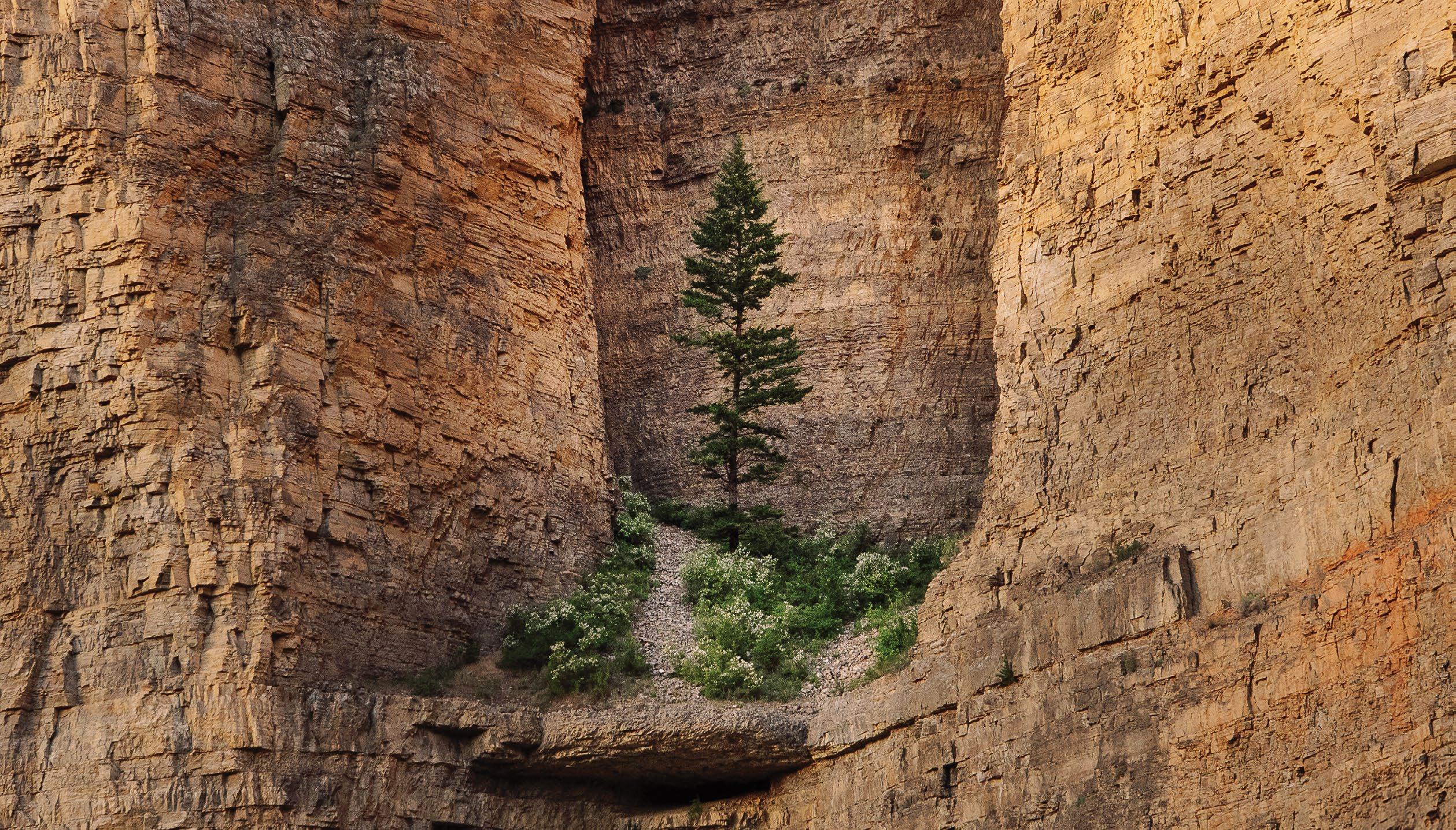
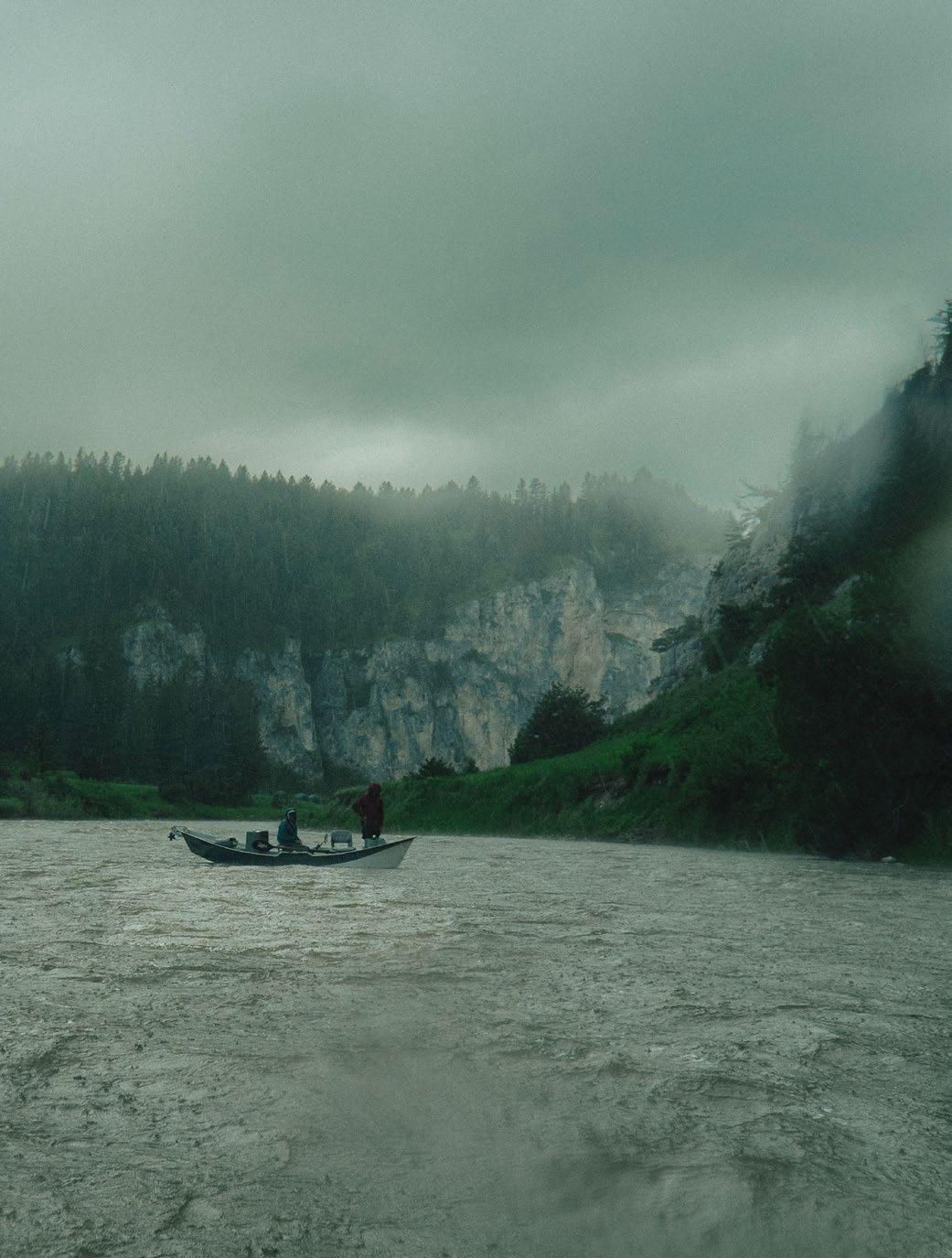
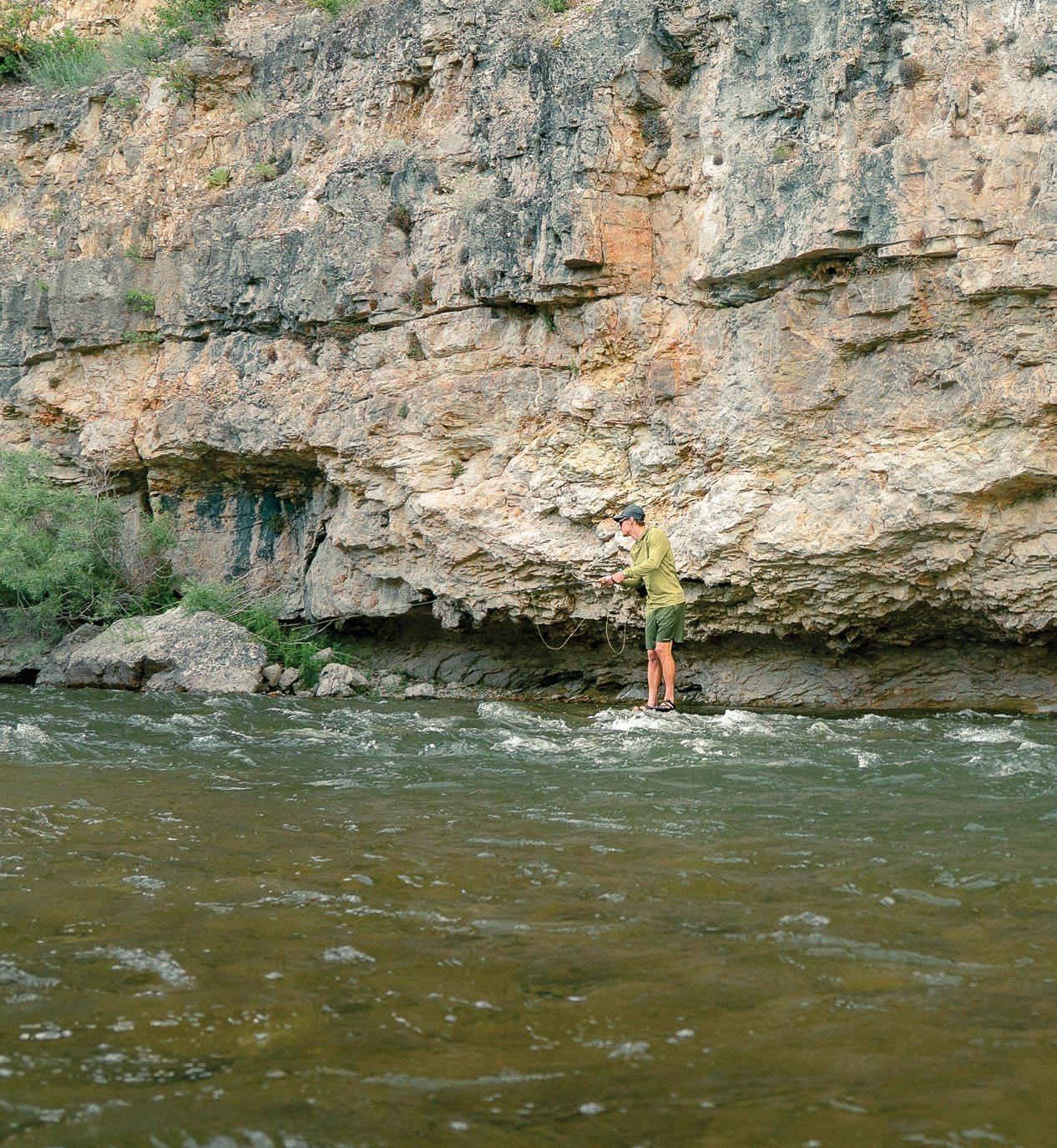
Clockwise from top: A lone fir grows straight from the walls of the Smith River canyon, a singular tree among limestone. | A fisherman watches life move beneath the surface of the Smith River. | Rain and weather roll in fast and vanish just as quickly on the Smith River. The durable boats float and hold steady.
applicants win a launch date each year. The owls, the moose, fret not for a permit. Eagles cram their nests high into canyon wall caverns. Whitetail deer eat grass along the banks. Rattlesnakes don’t pay rent for their sunbathing rocks.
The Smith River is old water. Native American pictographs from nearly 1,500 years ago line cliff walls along the river. A cave full of drawings sits high above the river, and river-weary wanderers can climb the steep trail to sit within the ancient art.
The Smith River is secretly swift. Once, after sitting in the meadow, after seeing a rubber boa move slowly, blood still cold in early June, I crossed the river on foot, back to our camp. The river had other plans and swept underneath me, my knees quickly kissed rocks, my arms sought assistance.
The Smith River is on a fast track to becoming neighbors with a copper mine, something to support our insatiable love of semiconductor chips and good plumbing. Sandfire Resources, an Australian company, is plotting and executing a large underground mine next to and beneath Sheep Creek.
The Smith River is, like us, a water creature. It winds and whistles. It rushes and chills. We can use the river as a clock, noticing the seasons shift from runoff in April and May to the slow trickle of July. The river runs so low in August that walking its river bottom is possible in most places. The Smith River’s copper mine will use Sheep Creek’s water for operations. At times during the year, Sheep Creek accounts for half the flow of the Smith River.
The Smith River understands what mining means for rivers because Montana’s history with mining is long: From gold mining at Grasshopper Creek to Butte’s Copper Kings, the land of “gold and silver” remains rich today even as the concept of wealth shifts and evolves.
The Smith River offers a choice Montanans have long been making between industry and preservation, between ambition and clean, clear water. In the 1980s, gold deposits were discovered near the Blackfoot River. A mine was proposed, and with it a 1,200-foot pit half a mile from the river. Montanans soon
learned that a mine so close to a river would require cyanide heap-leaching and could ultimately lead to devastation for human and non-human life. Montana opted to ban cyanide, the first state to do so.
The Smith River offers a choice Montanans have long been making. In 1989, Butte supplied 41 percent of the world’s copper. Anaconda housed the largest smelter in the world. Twenty years later—the blink of an eye in the history of the green-blue marble—the copper market crashed. Butte was left with a retired openpit copper mine full of acidic water.
The Smith River runs low and slow in July and into August. Maybe it’ll rain in September, increasing the river’s flow with ease. Maybe it’ll snow in October and we’ll forget about boats and floats until spring fever makes us sick with desire for oars and sand.
The Smith River isn’t about us, though. The Smith River doesn’t care about us. The odds the water wins, in the very long run, are high. Its mine could last 11 years, as committed to the public. Or 50 years, as noted to investors. Years are nothing to a river.
Years mean very much to fish. A trout lives three to seven years. A moose lives 12 years, maybe. We live, if we’re lucky, 70 years. If we’re lucky, we spend 10 days on a river a year. If we’re very lucky, we spend more than 30 days on a river a year. If we’re exceptional in every way, we spend five days a year on the Smith. If we floated the Smith River every year for our very average life, we’d spend 350 days in the canyon’s vortex. We’d spend a year on the river. One year. Years mean very much to us.
What is a river without water. What are we without our cords of wires, our ability to charge and chat.
Every May, the Smith River is loud. Winter’s water rushes into the canyon and beyond. Some day, that water won’t feed the river, it’ll feed us. It’ll taste metallic and new.
Yetta Rose Stein reads and writes in Livingston, Montana. She is a graduate of Hellgate High School and the daughter of Nancy and Gary.



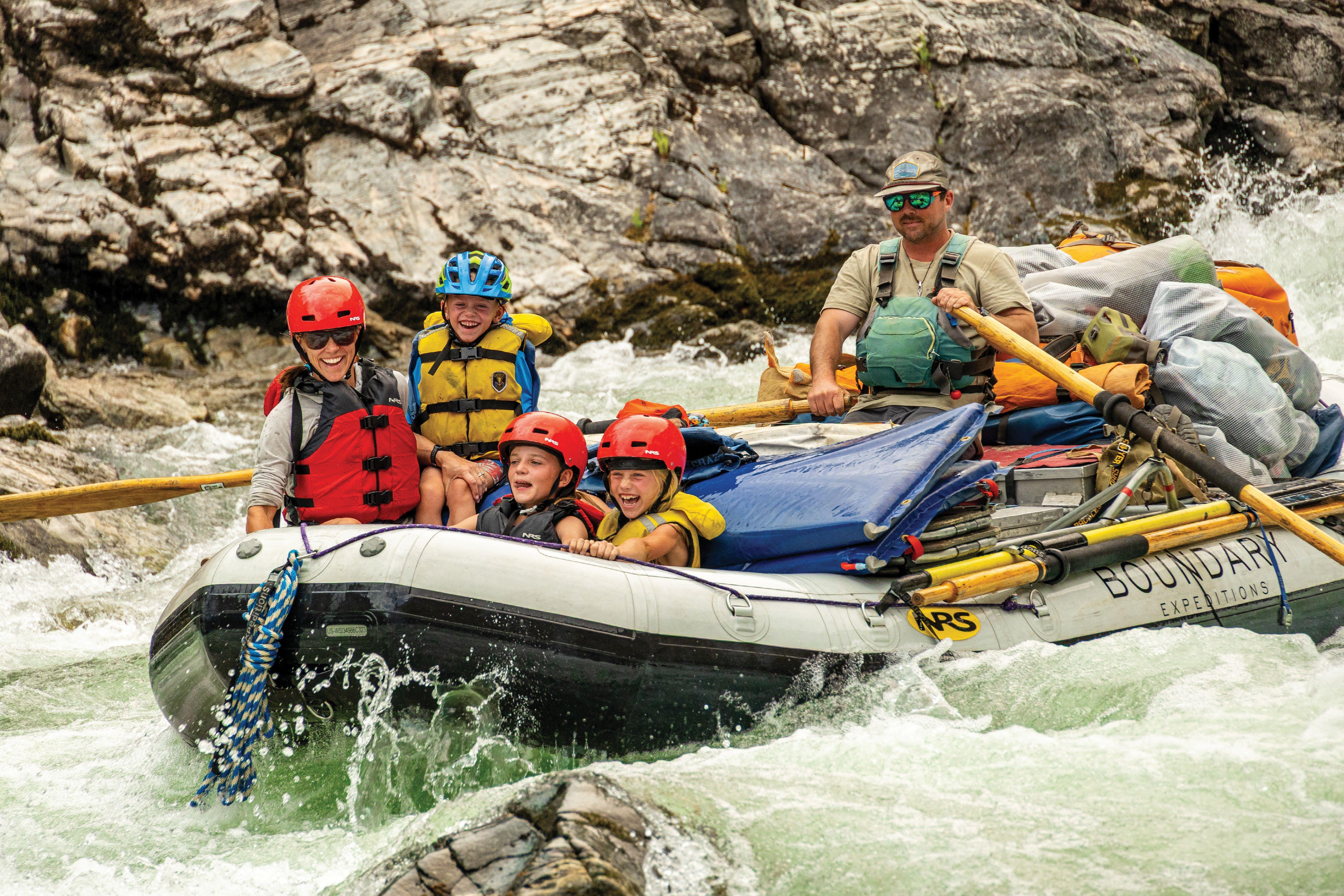
By Maggie Slepian
Take a flight out of Bozeman after dark, and it’s hard not to be startled by the town’s sprawling illumination. Floodlights over gravel pits give way to rows of lights along I-90 before blending into the gridded squares of subdivisions. It’s almost pretty—like an inversion of the night sky. But these swaths of light punctuating Montana’s natural darkness are a potent form of pollution, and unnatural light from even the smallest towns can travel over 120 miles from the source. This daylight-mimicking halo disorients migrating birds, and for nocturnal animals it can reduce options for hunting and foraging, and disrupt breeding rituals.
Artificial light probably isn’t the first thing that comes to mind when we think of pollution, but dark skies are integral to a healthy ecosystem, and they are disappearing at an alarming rate.
More than 80 percent of the world’s population lives under skyglow—the brightening of the night sky from artificial lights—which impacts our own circadian rhythms and physical processes. Densely populated urban areas have the most extreme skyglow, but even stargazing from Bozeman will only net about 500 visible stars. A more rural area like Gardiner, with around 800 residents, will show an estimated 5,000 stars, but a true dark sky entirely removed from anthropogenic light sources provides a dazzling three-dimensional display of
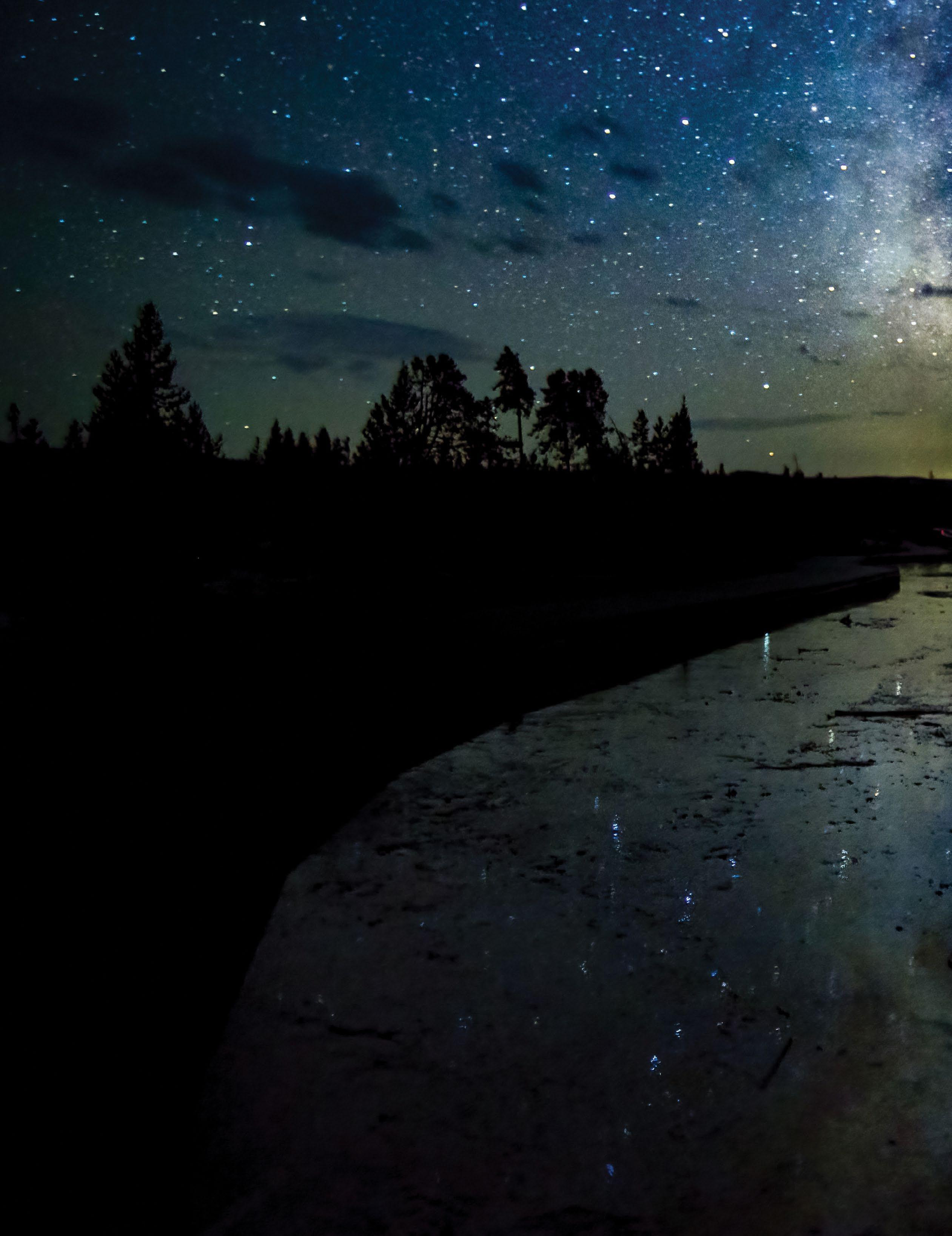
15,000 stars, planets, and the swirl of the Milky Way.
Light pollution is one of the easiest types of pollution to address (just turn off your lights!), but dark-sky conservation suffers from a lack of understanding and education. In the Greater Yellowstone Ecosystem, a group of dedicated conservationists is working to change that.
Photography guide and ecologist
Angela Tempo moved to Gardiner eight years ago for a Yellowstone National Park photography fellowship. As soon as she arrived, the expanse of stars reminded her of her childhood in Colombia and Italy, sitting under the night sky and listening to birds migrating in the dark.
Soon after, Tempo started looking for ways to protect this precious natural resource, and today, she is at the helm of the GYE Dark Skies Initiative. This community-led group is focused on reducing light pollution in the region, and their ultimate goal is to become a designated Dark Sky Community through DarkSky International.
“Eight years ago, I could take a picture from outside town and not see the mountains,” Tempo said, snapping a long-exposure shot under the February sky. She holds up the image, and sure enough, the flanks of distant peaks are illuminated from Gardiner’s glow.
“We take dark skies for granted, but 20 percent of our dark skies are being removed each year. In 10 years, we won’t have those dark skies in Paradise Valley.”
While Tempo initially aimed for a DarkSky designation for Park County, the idea has snowballed into something much larger. The goal is now to protect the night skies over Yellowstone National Park, Grand Teton National Park, Teton County, Park County, and the surrounding national forests. If it reaches its objective, the 20-million-acre
Greater Yellowstone Ecosystem Dark Sky Reserve will be the largest protected Dark Sky Territory in the world.
What it Takes to Obtain DarkSky International Certification
DarkSky International has been certifying communities and territories through the International Dark Sky Places program since 2001. Applications (and the eventual certification) include dedicated practices to reduce light pollution and educate community members about responsible lighting. Currently, the IDSP has certified more than 61,000 miles of protected night skies in 22 countries, many of which have become natural tourist attractions purely for their night skies.
Earning an IDSP designation is a lengthy process. The application
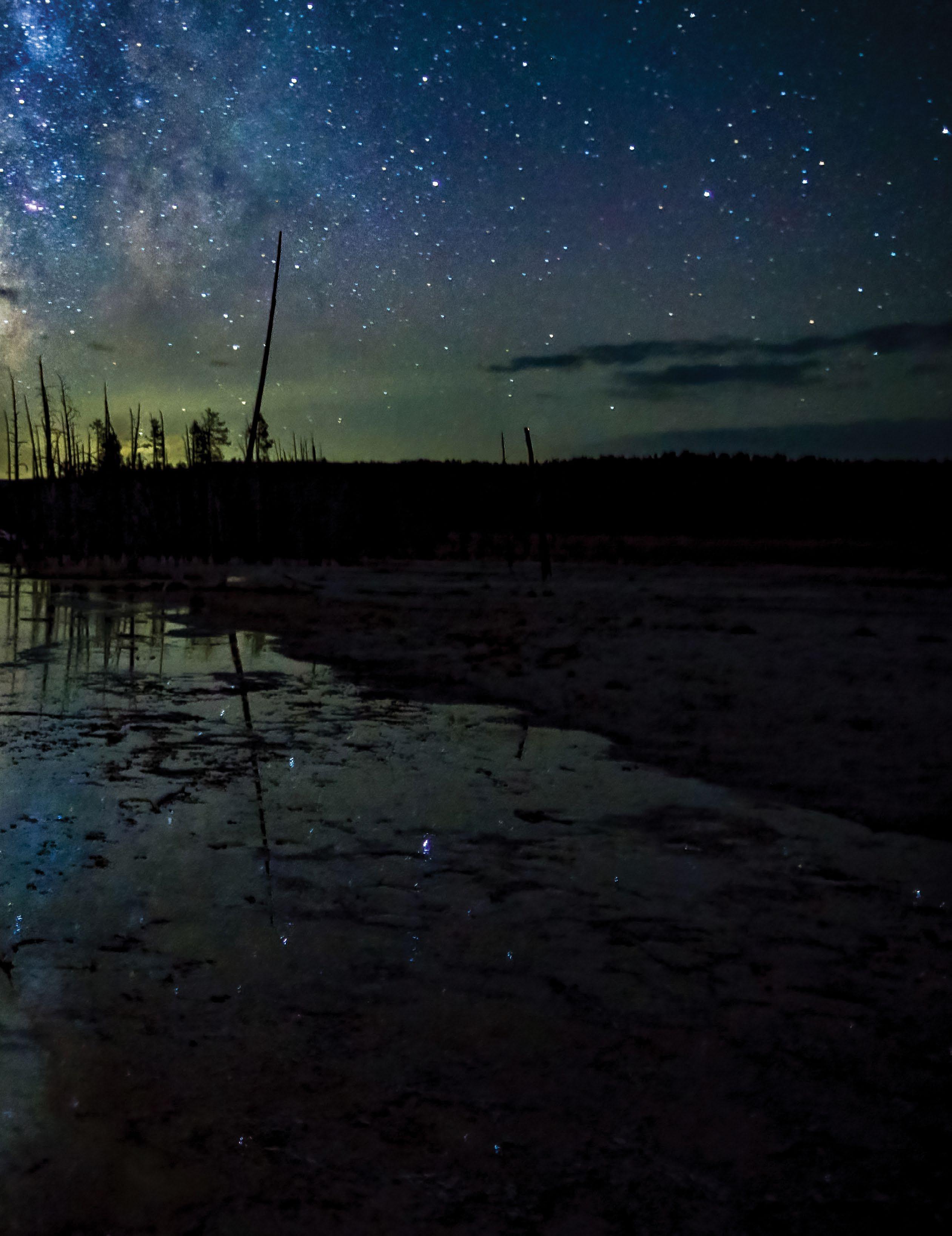
If it reaches its objective, the 20-million-acre
Greater Yellowstone Ecosystem Dark Sky Reserve will be the largest protected Dark Sky Territory in the world.

While protecting the night skies is as important as protecting the land beneath them, Singer acknowledges there’s still a disconnect.
Most people don’t think of dark night skies as a natural resource or consider the damage caused by light pollution.
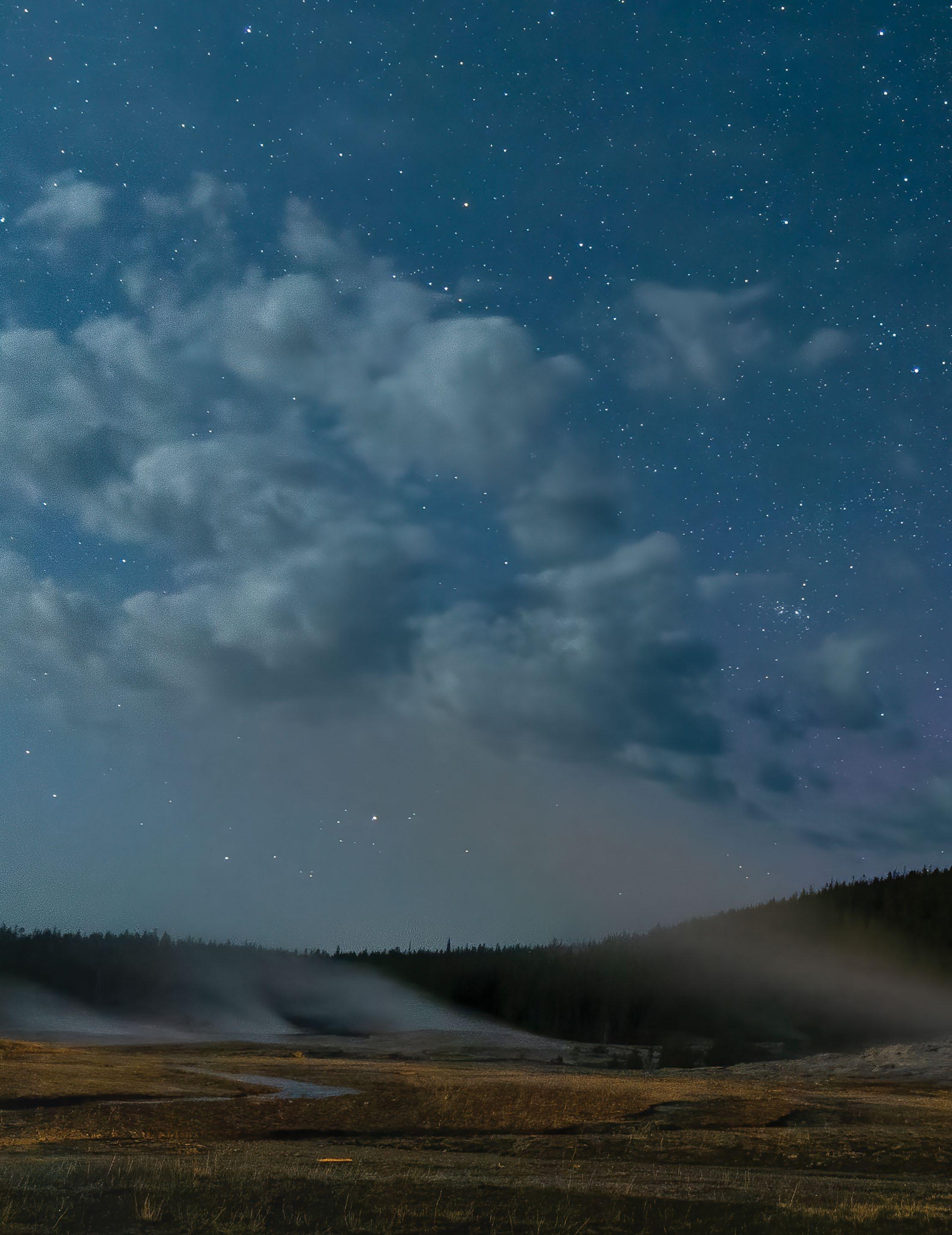
includes an exhaustive inventory of lights, including lumens, fixtures, warm versus cool, and protective shields. After the inventory, the group evaluates what needs to be fixed for output and glare reduction, then submits their application. From there, the community has a certain amount of time to make necessary improvements, though there is no finish line. The goal is to continue reducing light pollution and educating community members about night sky conservation.
The GYE Dark Skies Initiative has completed much of the background work for Gardiner and Yellowstone’s application: Yellowstone’s light inventory has been completed and Gardiner’s is well on its way. The group is also working to build a coalition of business owners and residents to help develop upcoming ordinances to limit light output and shield overhead lights.
It’s a massive endeavor, but Teton County’s eight-year effort greased the tracks for the Gardiner group. Jackson finalized their updated lighting standards in 2022 and became an official Dark Sky Community in 2025. Today, the lights in Teton County are DarkSky compliant, including restrictions on upward-facing light, glare reduction, and limited blue-light output.
“Now that we’ve finished up Teton County and the town of Jackson, I have my sights set on getting all of the GYE certified,” said Samuel Singer, founder
of Wyoming Stargazing and a strong supporter of Tempo’s efforts in Gardiner. While protecting the night skies is as important as protecting the land beneath them, Singer acknowledges there’s still a disconnect. Most people don’t think of dark night skies as a natural resource or consider the damage caused by light pollution. But as vacation rentals and developments push further into Paradise Valley, each new building comes with its own light sources. One by one, the visible stars fade, and the urgency to protect this resource becomes clearer. People gravitate toward this area for its proximity to Yellowstone and the surrounding landscapes, and like Jackson, Gardiner’s community members are on board. Tempo’s group even landed a dark-sky conservation strategy as part of the town’s most recent development plan, cementing community support.
It’s also important for Tempo that business owners and residents know their existing lights can be grandfathered into the ordinance, and that the financial burden won’t fall on them. Securing grants and outside funding will be key to offsetting the cost of shielding lights and updating light sources to meet DarkSky compliance requirements. The group hopes that once people learn about the effect of light pollution on the natural ecosystem, they’ll feel more motivated to help make the changes.
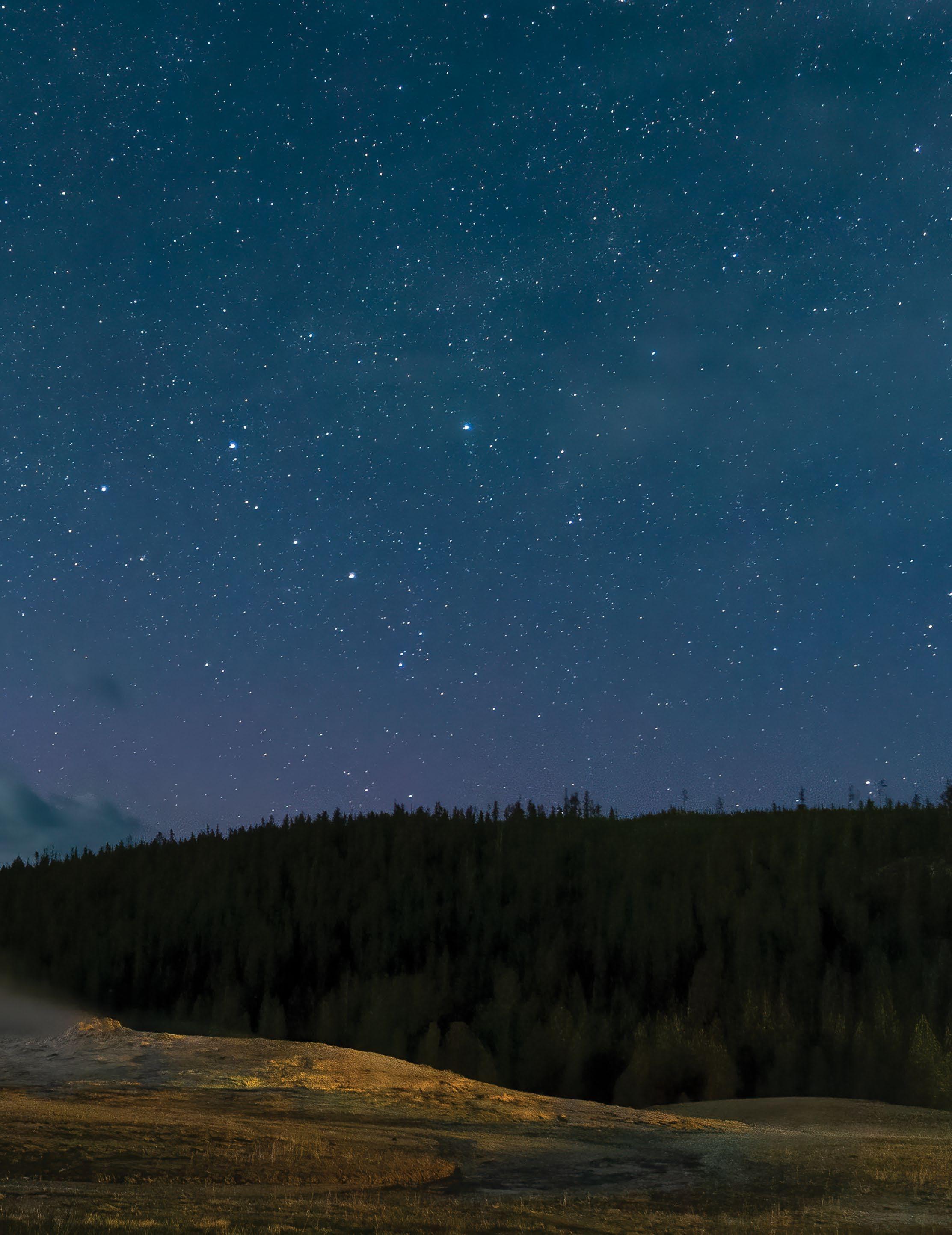
So what happens after the application has been approved? Much of the heavy lifting occurs during the application process, so the majority of changes after successful DarkSky designation focus on lighting restrictions and DarkSky-compliant practices, including light type, overhead shielding, color, and fixtures.
Flagstaff, Arizona, is the world’s first International Dark Sky City and has maintained strict lighting codes since 1999. The city remains safely lit, but uses amber lighting for roadways and parking lots, fully shields exterior lights, and limits the lighting on nonresidential properties. Eventually, Gardiner’s policies will look similar. Each protected area is different, and goals will vary, but all follow the same general parameters of reducing volume, color, and visibility of lights.
Unlike more insidious forms of ecosystem damage, reducing light pollution can be as simple as turning off lights. Even in large, brightly lit towns, very rarely is it too late to make a change. The challenge is convincing people to care about the night sky as much as they care about the mountains and rivers.
Even if your town or region isn’t a designated Dark Sky Community, every light makes a difference. Talk to neighbors about the importance of dark skies, start a grassroots stargazing program, or reach out to conservation nonprofits for help spreading the
word. You can take it a step further by surveying the lights in your neighborhood and comparing them to DarkSky-compliant light sources.
Replacing old bulbs with warmtone LEDs is a good first step toward reducing high-intensity blue light. Installing glare-reduction fixtures helps nocturnal animals’ eyes adjust back to the dark, and turning off all unnecessary outdoor lights after dark makes an immediate impact. Shielding is one of the most important elements of darksky conservation, effectively preventing light from shining directly into the night sky. This helps preserve the navigational abilities and vision of flying nocturnal animals and insects.
For those interested in pursuing DarkSky International certification, reviewing current International Dark Sky Places to see how they got started is a good first step. Read through those current lighting policies and development plans, and see the impact the updated regulations have made on the ecosystem.
Dark-sky conservation pulls double duty, bringing in revenue as a tourist attraction while letting people know there’s something worth protecting in the skies themselves. Once people view the night sky as a feature akin to a mountain or waterfall, appreciation can turn to action, one light at a time.
Maggie Slepian is an award-winning Bozeman-based writer with a focus on the outdoors, environment, and travel. Her work has appeared in The New York Times, Longreads, Outside Magazine, Lonely Planet, and more.
Medicine Rocks State Park: An International Dark Sky Sanctuary (highest designation) known for "Dinosaurs and Dark Skies" programs.
Glacier National Park: Certified International Dark Sky Park, hosting Logan Pass Star Parties.
Makoshika State Park:
Located in Glendive, the rugged badlands provide a dramatic backdrop for stargazing.
Bighorn Canyon National Recreation Area: Straddles the MT/WY border with exceptional night views.
Other Sites: Hell Creek Recreation Area (Fort Peck Lake), First Peoples Buffalo Jump State Park, Bannack State Park, and Ackley Lake State Park.
IDAHO
Central Idaho Dark Sky Reserve: The first and only Gold-tier reserve in the United States, covering 1,400 square miles. Cities within the Reserve include Ketchum, Sun Valley, Stanley, and Hailey.
Craters of the Moon National Monument: Certified International Dark Sky Park.
Yellowstone National Park: Actively working toward achieving International Dark Sky Association certification.
Sinks Canyon State Park: First International Dark Sky Park in Wyoming.
Teton County: Became the world's first county to be certified as an International Dark Sky Community in 2025.
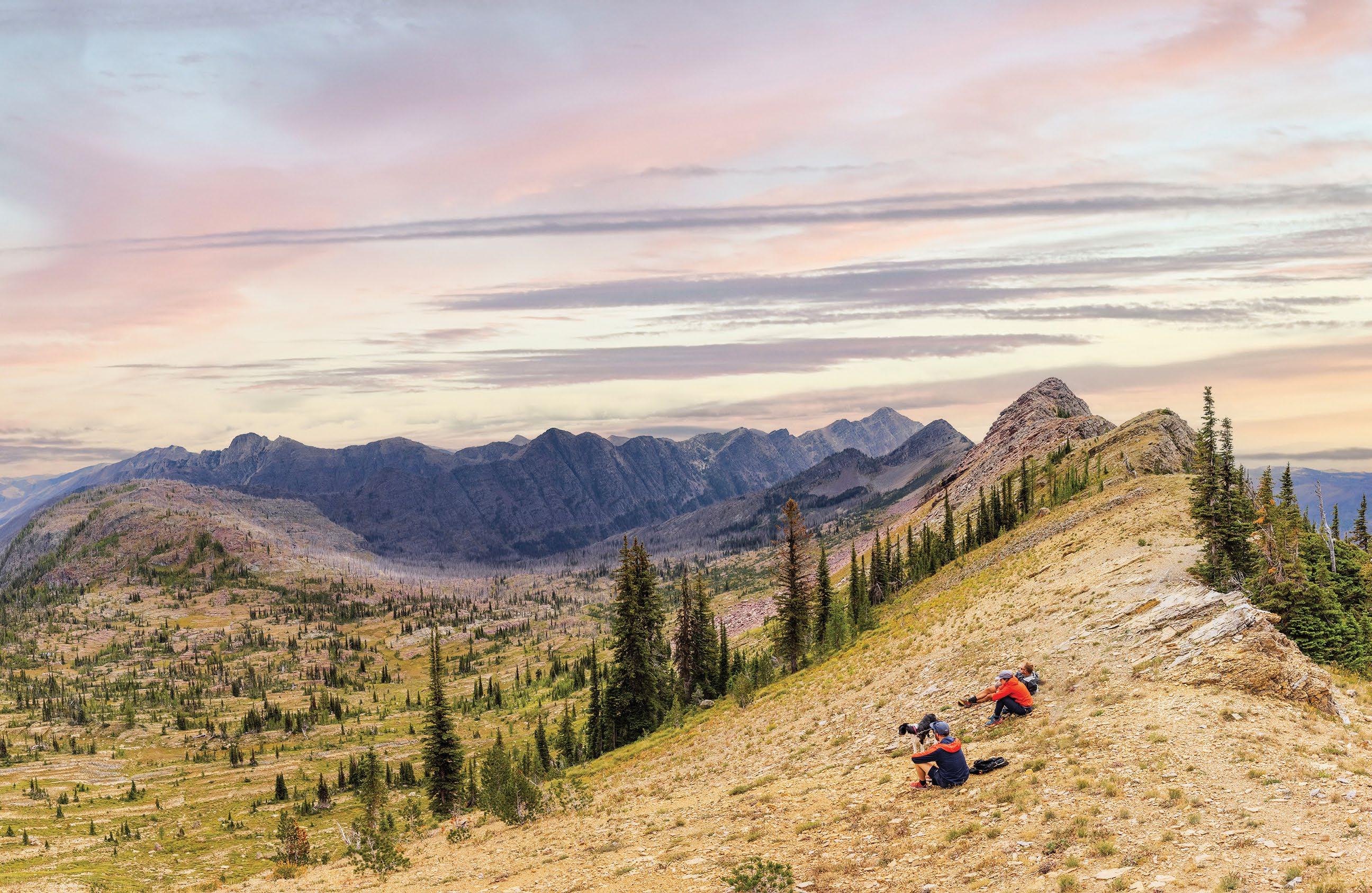

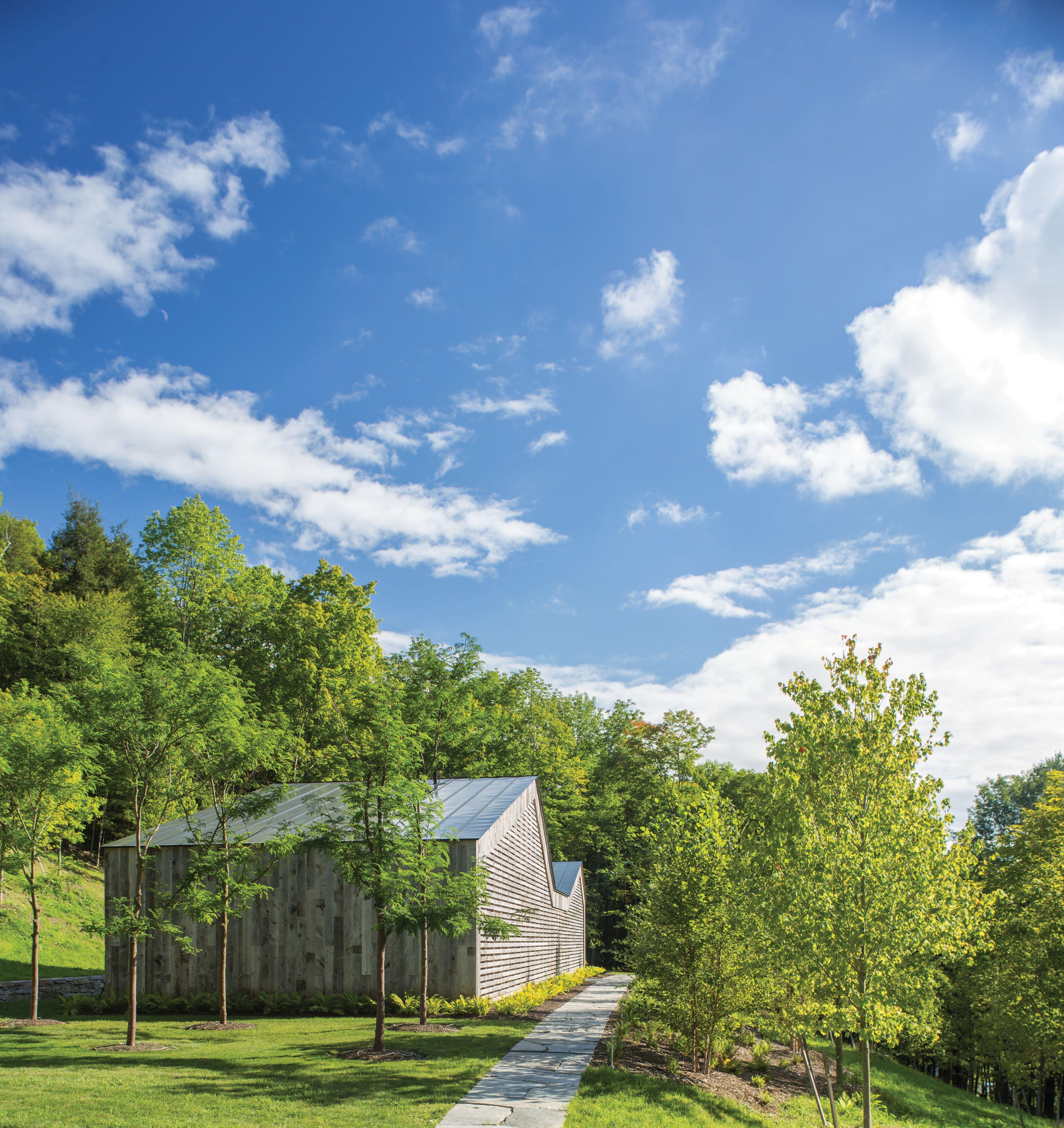
Words by Emily Walter
In the windswept hills of Three Forks lies a dale with ironclad horses. Statues on the leeward side. Some bold, some bent to the earth to will grasses, all exposed to unrelenting prairie winds. Farther west, five horses walk in a lazy line on the ridge. In biting winter or worn out sun, horses look tired unless moving. Even in Montana, horses saddled in cities look silly, reining the view of some curated white past. When will we begin to say we’re sorry? When will we begin to know it cannot be said in English? Maybe it isn’t said in words. Maybe it begins with a single blade of grass. Forgive us for holding what isn’t ours. Maybe then we can begin to look into the bold wide eye of a bison and say, forgive me.
Emily Walter (she/her) lives and writes in Missoula. Originally from Michigan, Emily has had poetry and nonfiction published in 32 Poems, High Country News, and Colorado Book Review, among others.
Erika Peterman is a Montana-based creative and founder of Public School Kids, a storytelling series exploring the role of public education in American life. A member of the Montana State Bar, she has also been paid to sing in one.
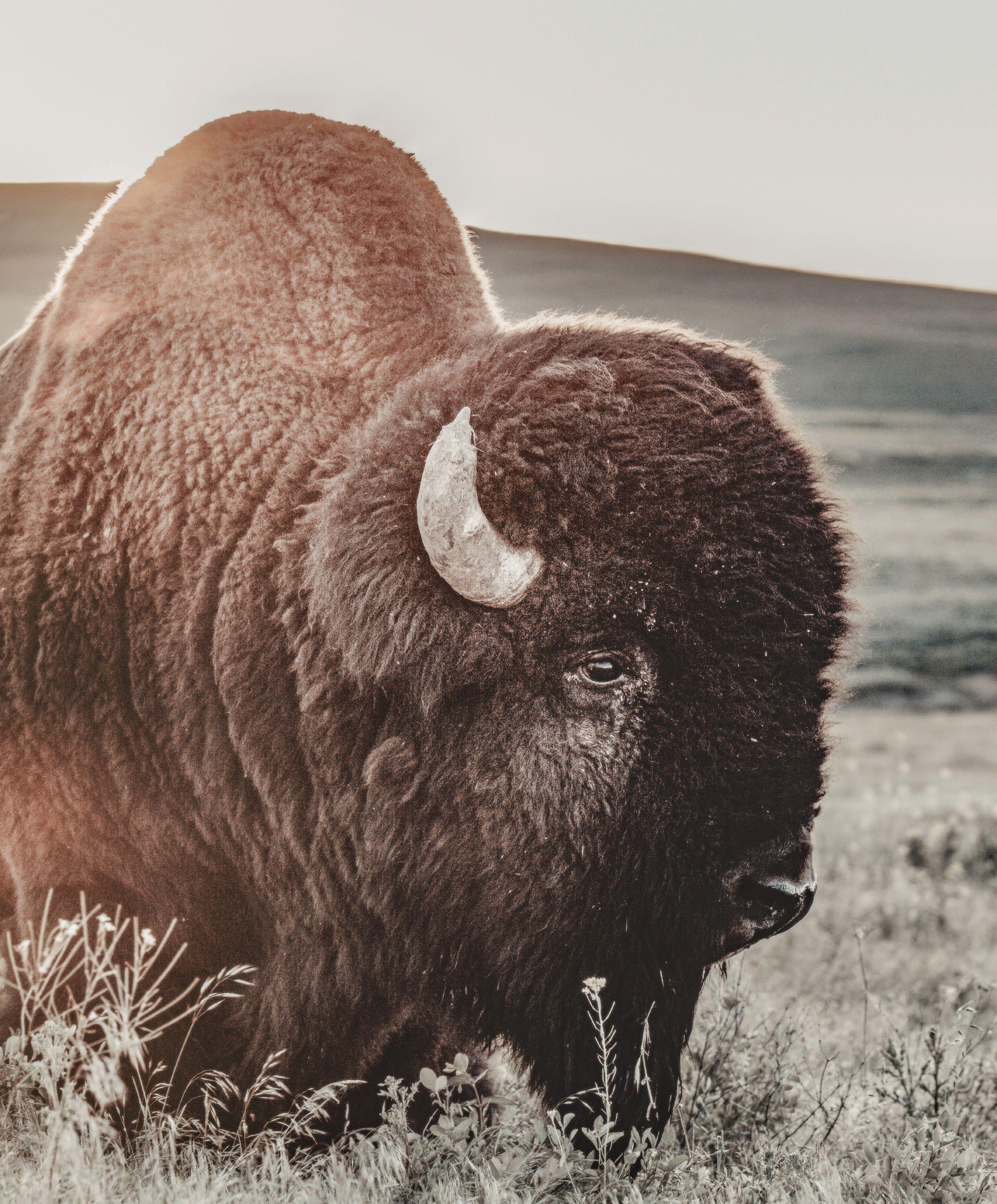
Thinking about living in Big Sky, Montana? Perhaps now’s the time.
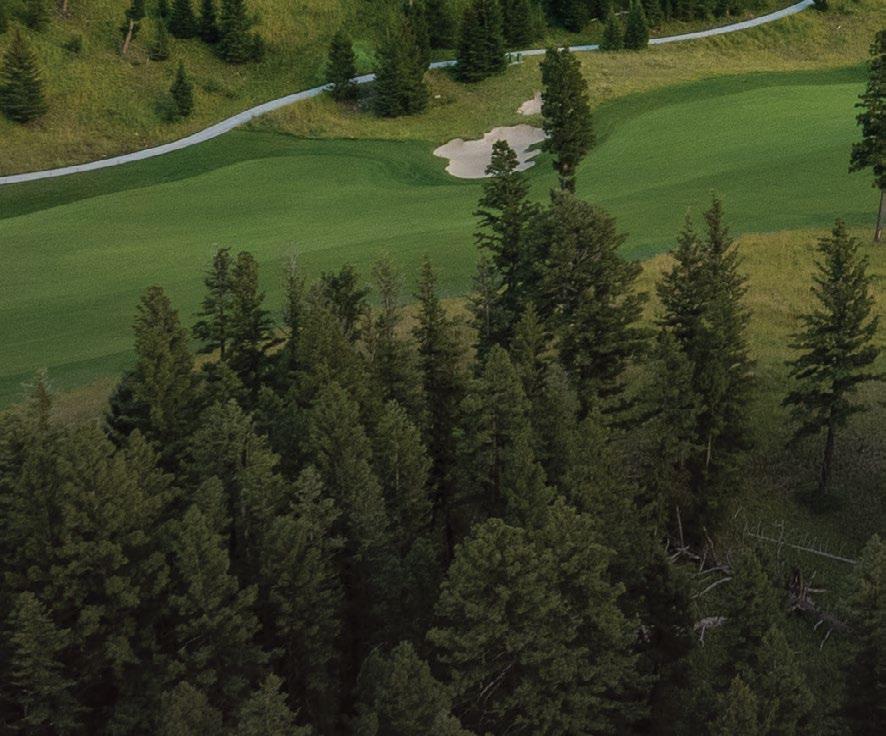
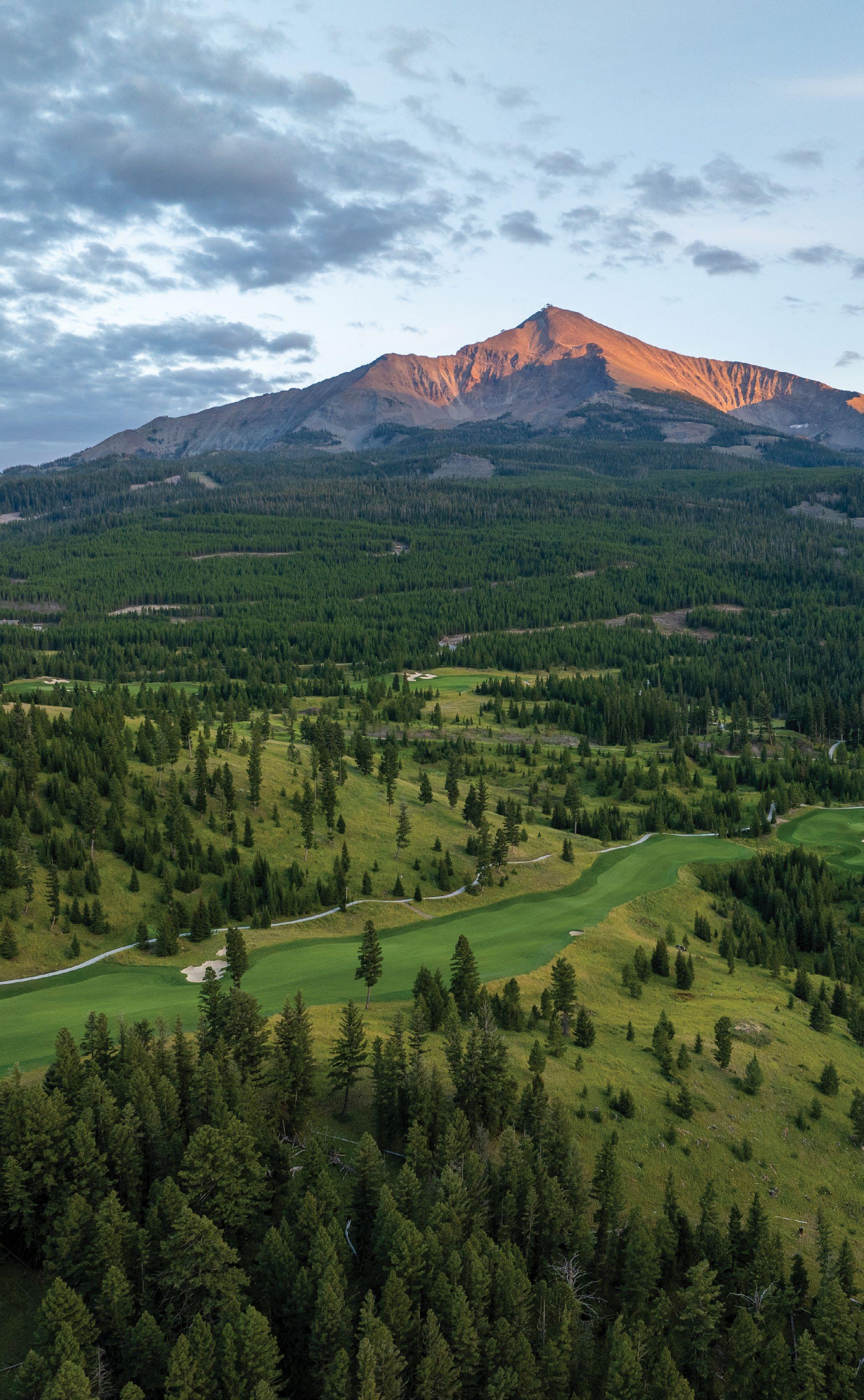
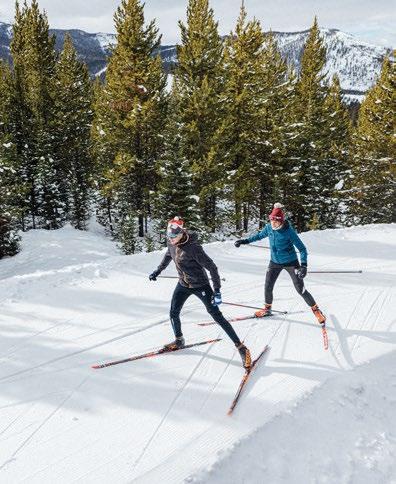
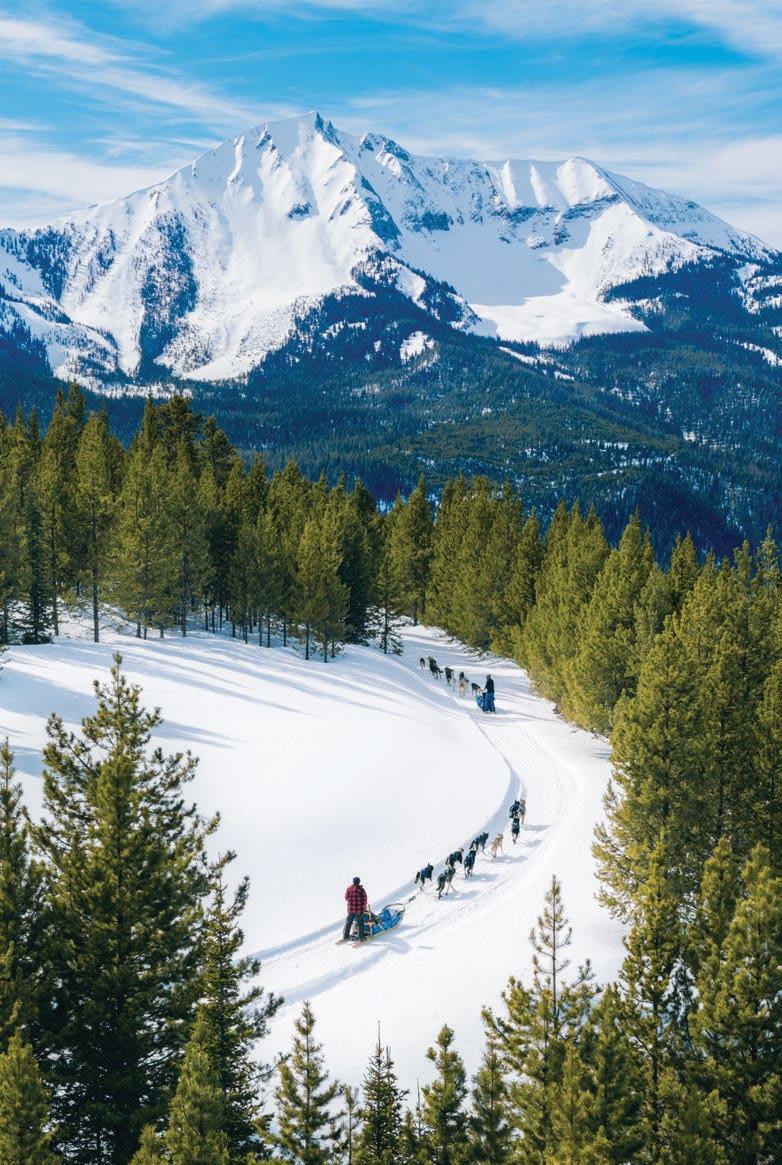
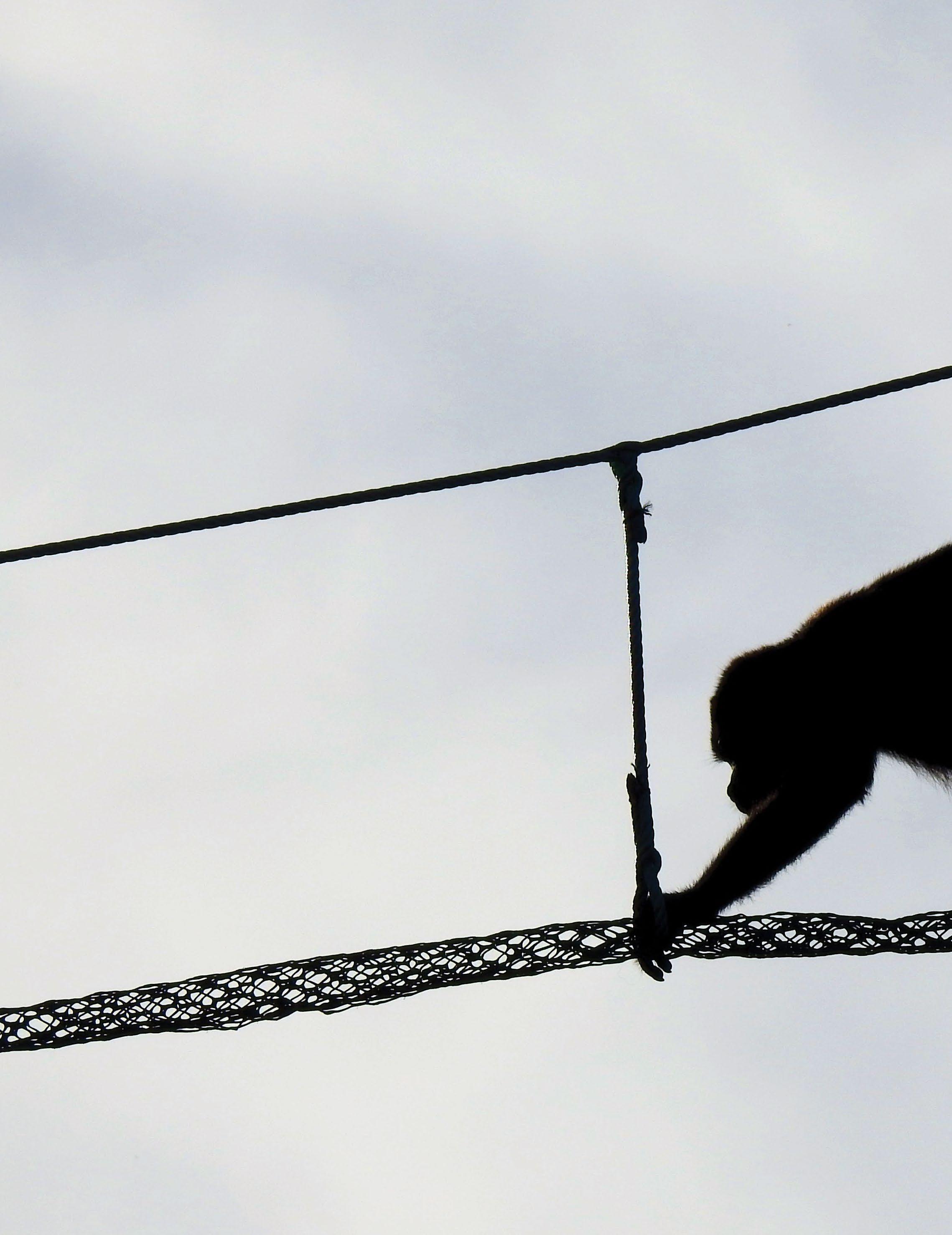
By Fischer Genau
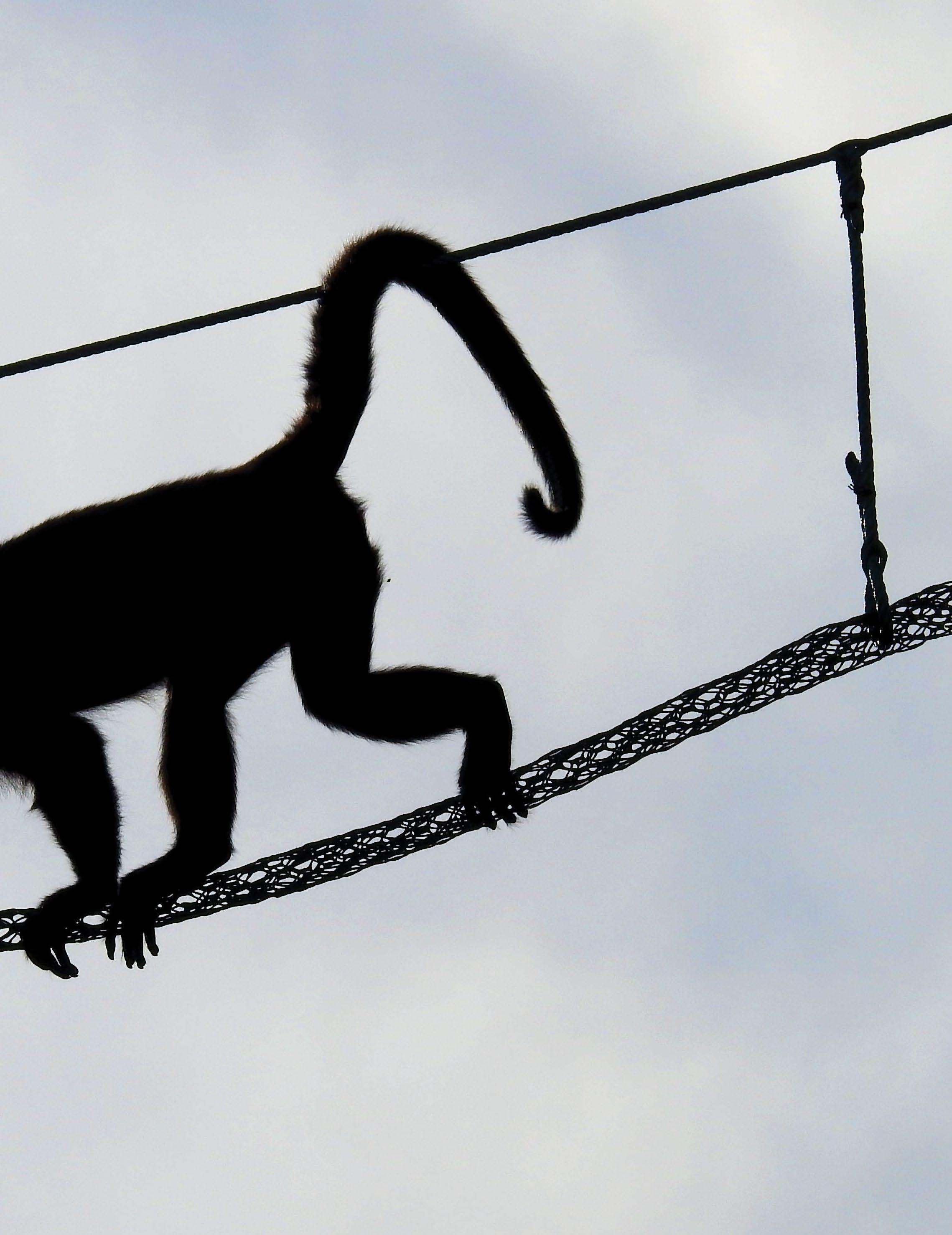

it’s not uncommon to see a long strand of mesh suspended high above a road, stretching from one side to the other and vanishing into the rainforest. These contraptions can look like a ship’s gangway, but they’re not designed for sailors. They’re made for monkeys.
These aerial structures are canopy bridges, and there are hundreds of them scattered across a country half the size of Kentucky. They’re built to provide monkeys and other tree-dwellers safe passage over roads while cars whiz past below, and they can be made from a variety of materials—ropes, wire mesh, and even electric cables. These treetop tightropes can be as heavy-duty as metal cables and chain-link mesh fixed to concrete or as simple as a single rope stretched between two trees, and they’re most often used by mantled howler monkeys. But capuchin monkeys, squirrels, kinkajous and opossums have also been spotted on canopy bridges, and many of these structures have center cables that allow two- and three-toed sloths to shimmy across them too.
For road ecologist Fernanda Teixeira, canopy bridges are a personal favorite. “That’s where I started in road ecology, so I’m super biased towards canopy bridges,” Teixeira said. She knew she wanted to work with animals, but not in captivity. After taking a field course in animal behavior in Argentina, she ruled that out too. “It’s boring to stay eight
hours underneath a monkey saying what it does every two minutes.” Eventually she found road ecology and never looked back. During her undergrad studies, Teixeira helped install canopy bridges in Brazil, where she grew fond of them for their practicality and low cost. Some kinds of canopy bridges can be constructed quickly, by almost anyone, and for relatively little money (a simple rope bridge costs a few hundred dollars and can be strung up in an afternoon), making them an efficient and accessible way to save animal lives. And saving animal lives is Teixeira’s main concern.
Teixeira works for the Center for Large Landscape Conservation (CLLC) as its linear infrastructure ecology advisor. She’s currently in the middle of an 18-month study commissioned by Costa Rica’s Ministry of Public Works and Transportation and funded by the Development Bank of Latin America and the Caribbean (CAF) to create a set of comprehensive guidelines for wildlife collision mitigation measures in the country. In the past 10 months, Teixeira and her colleagues have traveled across the peninsula, surveying canopy bridges and other structures, including dedicated underpasses, adapted culverts and fences. They’re also taking inventory of the country’s wildlife mitigation measures and identifying maintenance needs and areas for improvement. The final government document they’re preparing will include an overview of road impacts on wildlife, the environmental requirements for the construction or modification of roads, and a set of design standards for different types of mitigation, such as canopy bridges. After the document is complete and approved by the Ministry of Public Works and Transportation, every new road and road expansion in Costa Rica will have
CLLC founder Gary Tabor calls this fragmentation “death by a thousand cuts,” and the nonprofit is trying to stitch the landscape back together.
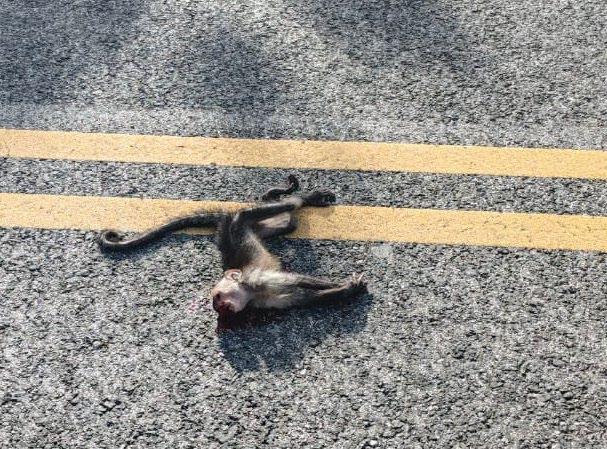
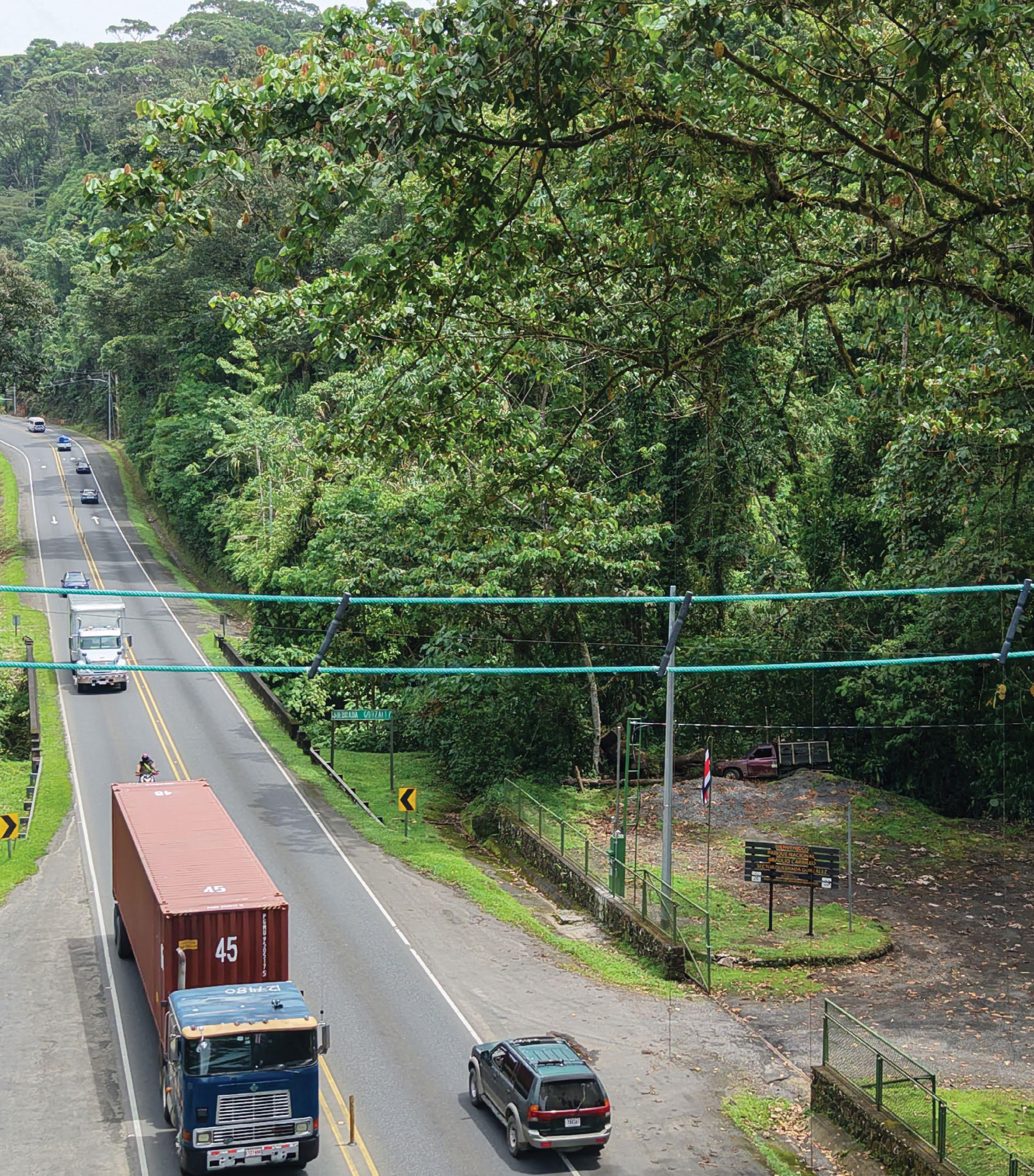
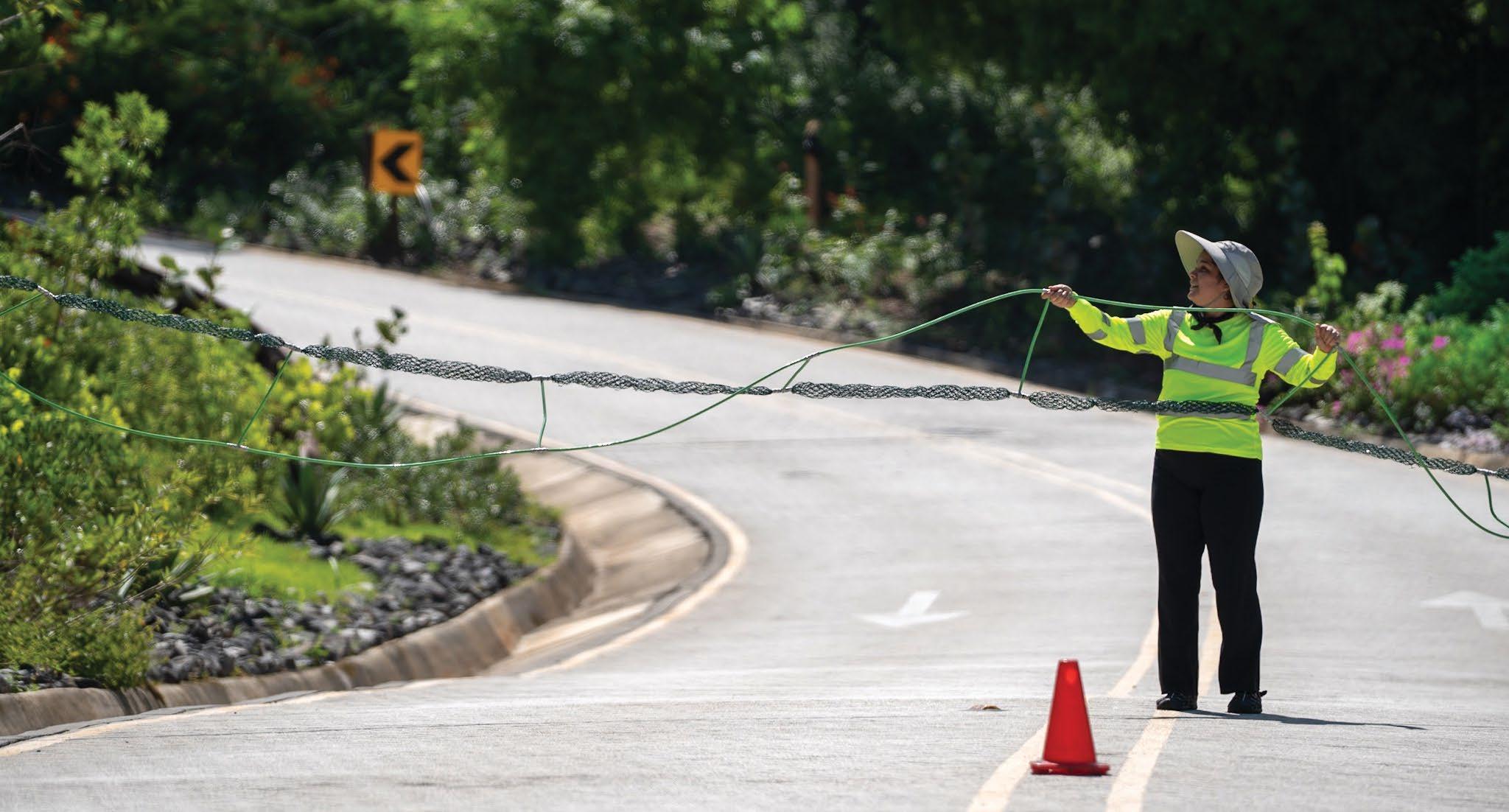
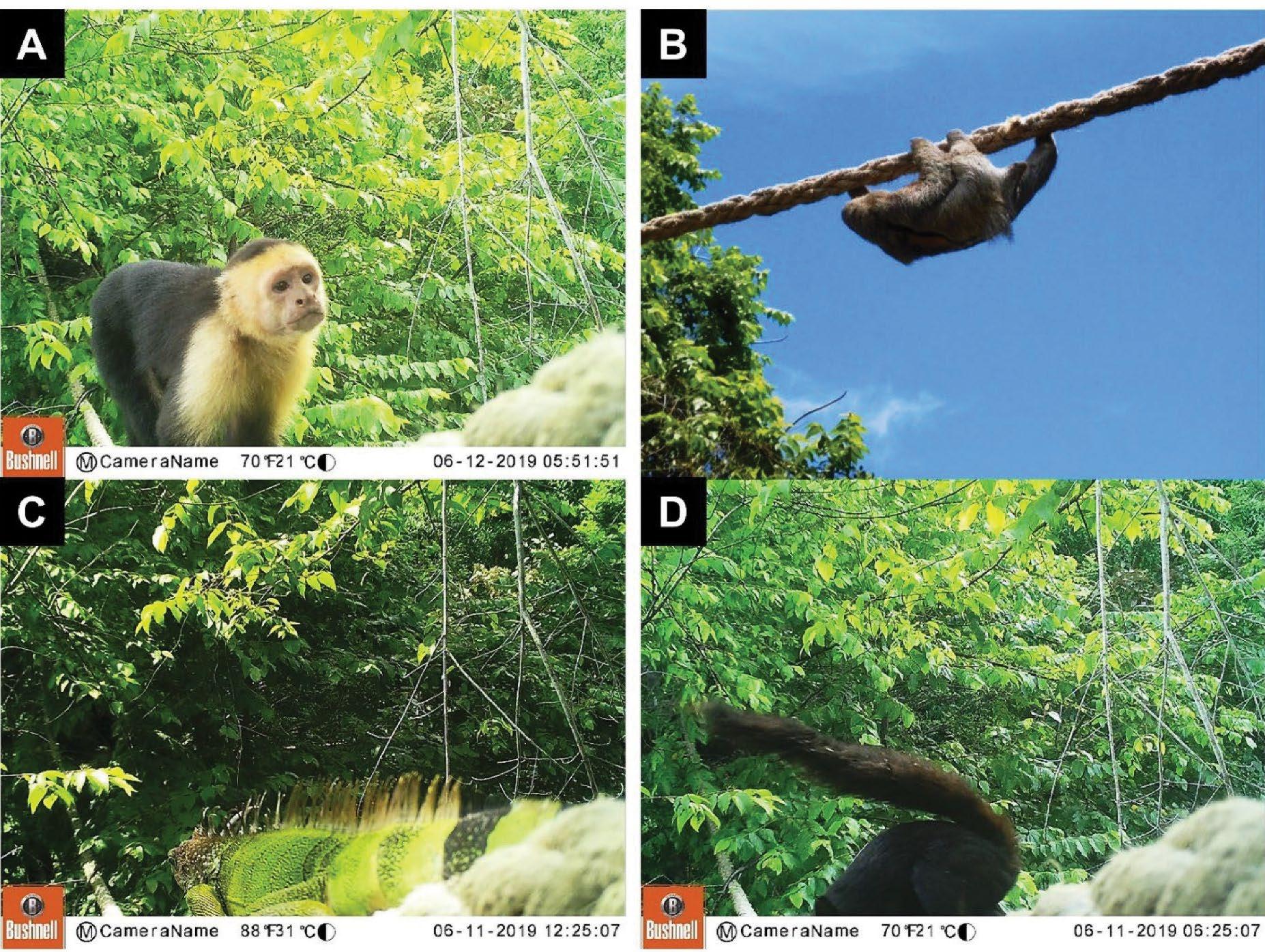
to follow its guidelines and build with wildlife in mind.
“There aren’t many countries that are acting in such a comprehensive manner,” said Deb Kmon Davidson, chief strategy officer for CLLC. “Costa Rica is definitely a leader on this internationally.”
Davidson joined CLLC in 2015, and in the past decade, the Bozeman-based nonprofit has worked on projects all over the world, from advising on Asian elephant crossings in Sri Lanka to developing infrastructure guidelines for snow leopards in Asia, as well as on wildlife connectivity in its own backyard. But no matter where they are, their goal is always the same: Find large-scale solutions to the habitat fragmentation caused by roads, railways, fences, and other human-made obstacles to animal movement. Wildlife must travel to find food, water, and mates, and roads isolate and weaken populations, disrupt their natural cycles, and kill millions of them each year. CLLC founder Gary Tabor calls this fragmentation “death by a thousand cuts,” and the nonprofit is trying to stitch the landscape back together.
In Montana, CLLC is pushing for wildlife crossings and other mitigation measures on busy roads like U.S. Highway 191 north of Big Sky and Highway 89 into Yellowstone. Both areas are hotspots for wildlife-vehicle collisions, and deer and elk are two of the most common casualties. The situation in Costa Rica is different. While in Montana, much of the support for wildlife crossings comes out of concern for drivers’ safety—a collision with an elk can total a car and send its occupants to the hospital—most of Costa Rica’s wildlife is smaller and poses less risk to people on the road, so the push to build wildlife crossings comes mainly from a desire to preserve the country’s biodiversity. Costa Rica has more than 500,000 distinct species representing about 6.5 percent of the world’s total biodiversity. And every one of those animals must navigate the country’s rapidly expanding road network.
From 2007 to 2016, the number of vehicles on roads in Costa Rica jumped by 80 percent according to a study by Programa Estado de la Nacion. As
wildlife casualties piled up, support for crossing structures grew, and in 2010, the country built its first official wildlife crossings in the Hacienda Baru National Wildlife Refuge. The government had announced plans to upgrade Route 34, a two-lane gravel road passing through the refuge, and the refuge manager requested that it include wildlife underpasses to protect animals from increased traffic. In response, the government built 33 crossing structures—29 underpasses and four canopy bridges—laying the foundation for wildlife connectivity in the country.
(a jungle cat that looks like a tiny jaguar with oversized ears) patrolling an area of 15 square miles, a new road cutting through its territory hinders its ability to hunt and reach breeding females in neighboring territories. According to Panthera and Las Pumas Rescue Center, about 50 ocelots are killed by cars each year in Costa Rica, and a handful end up in wild cat rescue centers like Las Pumas with injuries such as brain swelling, missing eyes and bone fractures. Roads have a similar effect on many other species, and the diversity of Costa Rica’s wildlife calls for an equally diverse array of solutions.
“When you go to Costa Rica, there’s such a huge diversity, and of course there are tapirs and jaguars, but there are like, less than five big species,” Teixeira said. “Most of the biodiversity are small … How do you solve the problem for those species?” In Costa Rica, wildlife crossings must be designed for a panoply of wildlife, including capuchin monkeys (as seen in “Indiana Jones” and “The
Night at the Museum”), coatis (sort of a mix between an opossum and a raccoon with a long snout and tail), northern tamandua (picture a cross between a sloth and an anteater), hairy porcupines (nature’s answer to the chihuahua), and a colorful assortment of birds, amphibians and other creatures.
The most common kind of wildlife crossing in Costa Rica after the canopy bridge is the underpass, most often used by smaller mammals like ocelots. These typically take the form of a square tunnel or circular culvert. Culverts usually measure six feet in diameter and are used mainly by small and medium mammals, and reptiles. They do double duty, as they also channel water to prevent erosion and flooding. Square tunnels are generally larger, and can accommodate bigger animals. Game cameras in the underpasses built in Hacienda Baru captured 21 distinct species, including ocelots, armadillos, coatis, and collared peccaries. A study published in the journal Diversity in 2022 found that roadkill deaths in that area dropped by 74 percent after the installation of underpasses and canopy bridges.
The national government has built 43 underpasses in the country, with more under construction, along with 41 canopy bridges, six bridges, 20 culverts adapted with dry ledges for wildlife, and a smattering of tunnels and viaducts. During its study, Teixeira’s team visited every single one. Research has consistently shown that underpasses are effective in reducing roadkill, but it’s mainly mammals that use them. In Costa Rica, the majority of species killed by cars are reptiles or amphibians. For a previous project in Costa Rica, Teixeira surveyed a 20-kilometer stretch of road for its impact on wildlife, and on her first day, she logged one dead bird. A few days later, it rained, and the road turned into a slick of slithering, hopping, and crawling life. “We couldn’t drive because there were hundreds of amphibians every hundred meters,” Teixeira said. “We would stop every meter, and we would get out of the car and there were like 20 or 30 amphibians killed.”
When it rains in Costa Rica, thousands of frogs, toads and salamanders emerge from under leaf
litter, logs, and burrows to feed or mate, and when they reach a busy road, it’s a bloodbath. Amphibian deaths go relatively unaddressed, but there are ways to prevent them. Fences made from black recyclable plastic can be dug into the ground along highways to keep amphibians away from cars, and these fences have been shown to reduce mortality for ground-dwelling frogs by almost 90 percent. Teixeira hopes that measures like these will eventually be explored in Costa Rica too—but they have begun building in safety measures for bats and birds. These species often fly directly into the path of oncoming cars, and the government has installed flight diverters on highway bridges to discourage birds and bats from flying near the road. Flight diverters consist of hundreds of vertical poles lined up next to each other, about four inches apart, and they force fliers to soar up and over the road rather than into it.
Yet another species with its own particular kind of crossing is the land crab, also known as the Halloween crab for its bright orange coloring. They used to migrate by the thousands in Costa Rica’s Nicoya Peninsula, scuttling from their inland burrows to the coastline to lay their eggs at the beginning of the rainy season, but their population has been hurt by traffic on busy roads. Teixeira and CLLC want to propose a crab overpass similar to one built in Christmas Island, Australia, to help the crabs migrate safely. The Christmas Island crabs scale a near-vertical 18-foot wall, then march over a busy highway on a 5-foot-wide bridge to reach their
breeding grounds, and Teixeira believes a similar design could be used on existing coastal roads in the country.
The solutions for wildlife connectivity in Costa Rica are as varied as the species that need them. “Sometimes I feel humbled because everything is so context specific,” Teixeira said. “It doesn’t matter how much knowledge I accumulate, every time I look to a project, I’m like, ‘This is different.’” Each species and location requires a tailored approach, but Teixeira also said the field of road ecology has developed a solid base of knowledge that practitioners can now refine and adapt as needed.
For Teixeira and CLLC, one lesson is clear: Factoring wildlife into the planning process early, before roads are built and land is developed, is one of the best ways to protect animals. And that’s one thing that the guidelines she’s working on aim to do.
will submit their proposed guidelines at the end of April, and a three-month
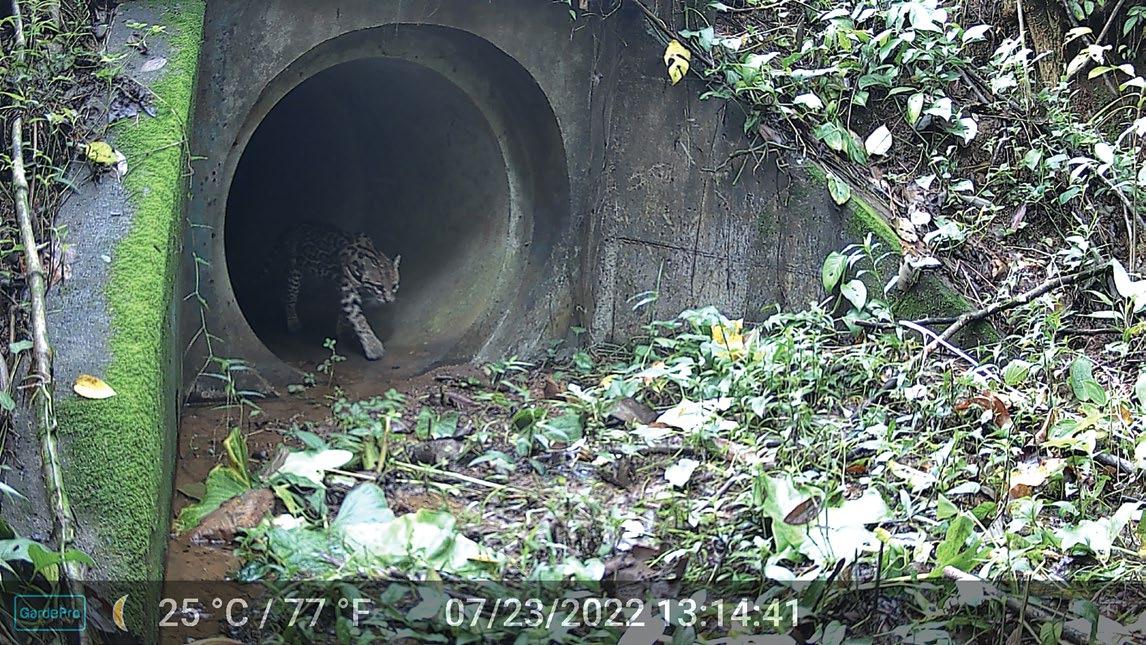
period of review and discussion will follow. Official approval is expected in July, after which Teixeira will spend three months sharing the new guidelines, talking with government staff, engineers, maintenance crews, and contractors about what the document means for all of them. She said she was struck by how participatory the entire process has been and how genuinely bought-in everyone seems to the importance of wildlife connectivity. “Of course some people might say, ‘This is too expensive,’” Teixeira said, referring to interviews she conducted with stakeholders at the start of the project. “But they don’t think it’s something that’s nonsense. And everywhere else I’ve worked, there’s some people who do.”
Costa Rica’s progress towards wildlife connectivity has been hard won. “It has been quite a challenge and a difficult journey; even to this day it remains a struggle,” said Andrea Avila Alfaro, who works in Costa Rica’s Ministry of Public Transportation in their environmental and social management program. She said it’s hard to secure the money and resources to build wildlife crossings, maintain them, and monitor their effects long-term; and successfully building infrastructure will require continued commitment. But, as CLLC’s Davidson will attest, Costa Rica has come a long way.
“I think in Montana, we value our wildlife, and our government does too, but taking it that one step further—that’s pretty amazing commitment,” Davidson said. She believes the U.S. could learn from Costa Rica’s approach. “Here’s a
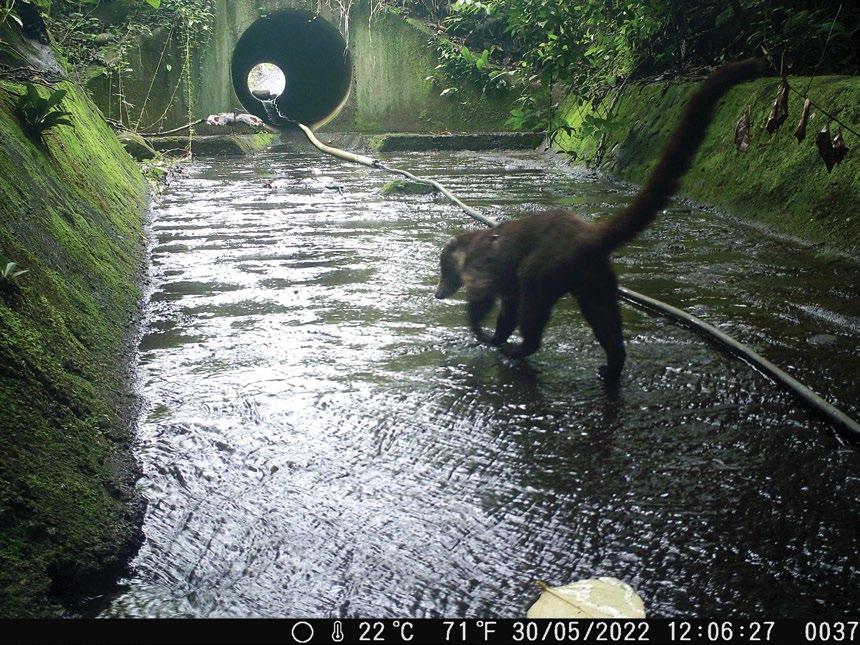
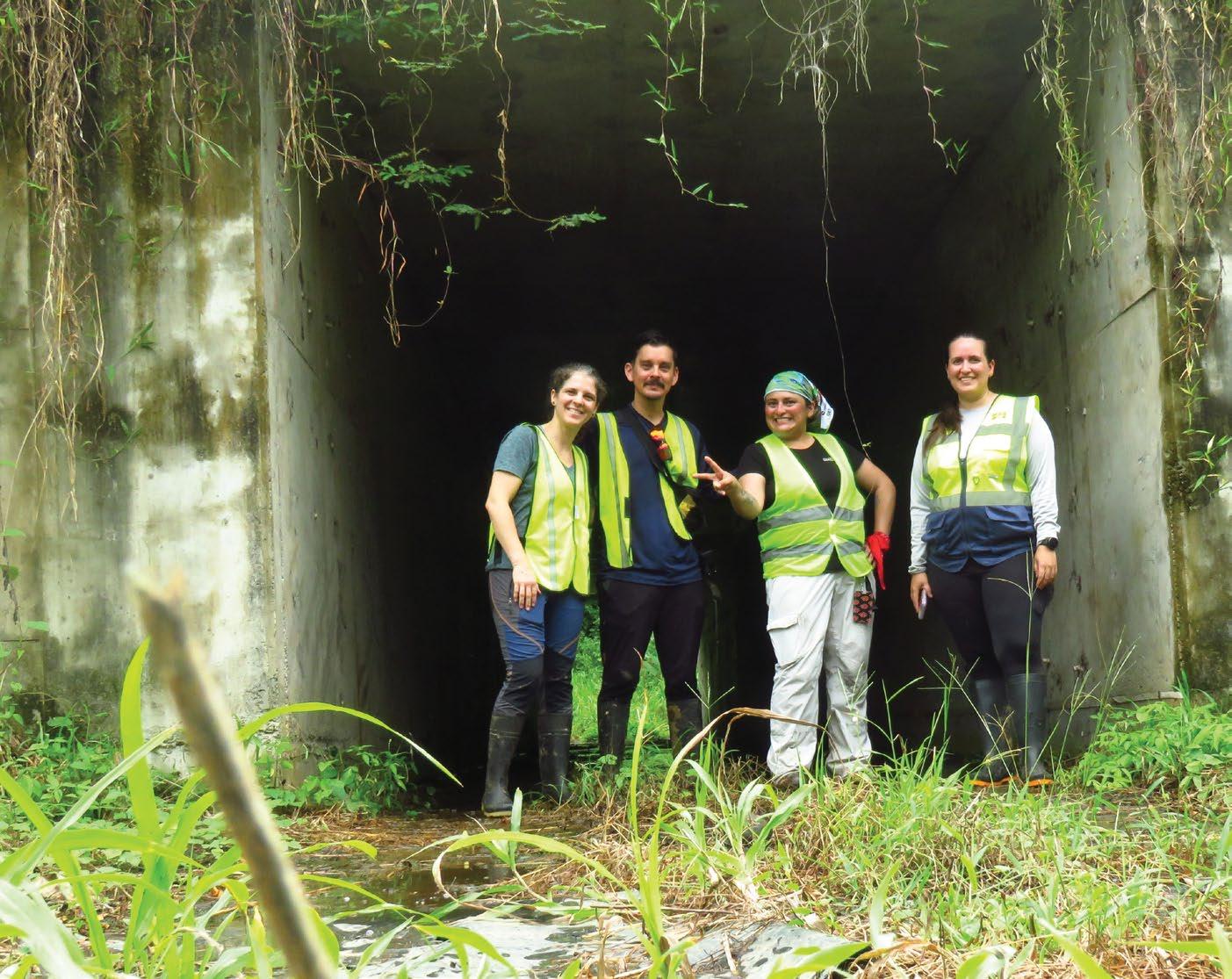
country who’s made a commitment to ensure that all new roads and upgrades, expansions, and paving incorporate wildlife needs,” Davidson said. “That’s huge. That would be an amazing goal for us to get to in the United States, and I think we have some examples of us stepping towards that … but they value their wildlife to such a degree that they have committed to this.”
Montana is making strides. In 2025, the state launched its Wildlife and Transportation Partnership, a program designed to reduce wildlifevehicle conflict and enhance wildlife connectivity across the state. Two CLLC staffers sit on the committee, working alongside Montana Fish, Wildlife and Parks and the Montana Department of Transportation to identify locations for wildlife crossings and other preventative measures. Elsewhere in the country, New York and Maryland are launching similar initiatives, and Colorado has constructed more than 100 wildlife crossings, including the I-25 Greenland Wildlife Overpass, the largest in the country at 200 feet wide and 209 feet long. Still, the United States has a long way to go. Its 4.1 million miles of public roads, the most in any country,
contribute to an estimated 365 million animal deaths per year. That’s about a million a day.
Davidson acknowledged that the United States and Costa Rica are structurally different. Montana alone is seven-and-a-half times larger than the Central American country, and there’s far more ground to cover. It’s also easier in a small country to get the ear of politicians and decision makers and turn research and ideas into action. But Davidson is hopeful. “I like the work we’re doing, because we’re trying to find practical and replicable solutions to this gnarly problem,” she said. “And there are solutions!” Her first eight years after college were spent in environmental advocacy, which she described as “constant fighting” and always defensive. The work she’s doing now feels different. “We know development is going to happen and roads are going to become busier. How can we make sure that happens in the right way and takes wildlife needs into account?” she said.
In the past 25 years, Costa Rica’s population has grown by 30 percent, and the country has one of the highest road densities in the world. But throughout that tumultuous change, and perhaps
Hundreds of new roads have cut through the habitat of Costa Rica’s wildlife, but with each new canopy bridge, culvert, and underpass, the landscape becomes a little more whole, knitted together by thousands of tiny stitches.
because of it, the country has made wildlife connectivity a priority as they build new roads and infrastructure. Teixeira argues that everyone needs to develop a broader perspective: When we build things, we should think about their impact on animals too. Traveling the country to visit its wildlife crossings, Teixeira caught a glimpse of what that could look like—families of howler monkeys dancing above traffic, ocelots slinking beneath highways and birds soaring safely over busy roads. Hundreds of new roads have cut through the habitat of Costa Rica’s wildlife, but with each new canopy bridge, culvert, and underpass, the landscape becomes a little more whole, knitted together by thousands of tiny stitches.
Fischer Genau is a writer, photographer and filmmaker based in Bozeman, Montana. He writes stories and shoots videos for Explore Big Sky as their digital media lead, and his writing has also appeared in Explore Yellowstone, Outside Bozeman, and The Boardman Review.

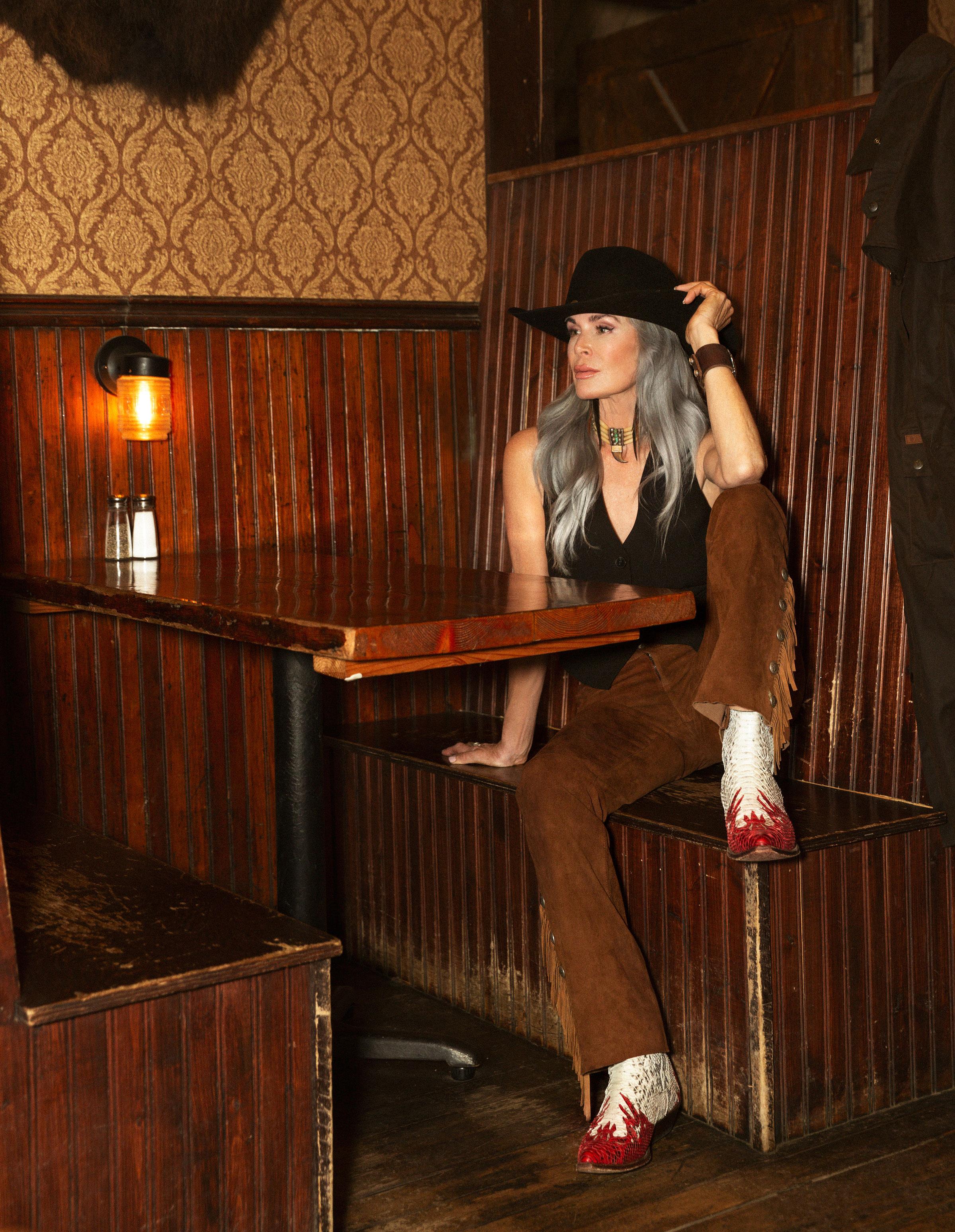
Words by Eric Ladd | Photos by Isaias Miciu Nicolaevici
Nearly 6,000 miles separate Bozeman, Montana, from Trevelin, Argentina. Two days of airports, dusty roads and the slow unfurling of the world as one mountain range gives way to another. From the Gallatin Range to the foothills of the Andes, you do not just travel across continents, but toward the essence of something.
From the air, the scene below looks almost unreal. A mosaic of gin-clear rivers curls through the steppe like glass ribbons. In many bends and pools, trout hang suspended in turquoise light, shadows shifting beneath the surface. For an angler, it is almost incomprehensible.
And then we land.
We stand knee-deep in the legendary Arroyo Pescado, a spring creek so clear it feels sacred. It’s the kind of water that humbles even seasoned anglers. It’s a river with a decades-long reputation, famous for the moments it creates.
I’m a fisherman from Montana, not born there but shaped by its rivers, and I stand in the current with eyes locked on a monster rainbow sliding along a weed bed. Years of casting in the Northern Rockies has taught me what good water looks like—but nothing could have fully prepared me for Patagonia. A breath. A cast. The perfect loop. A tiny beetle


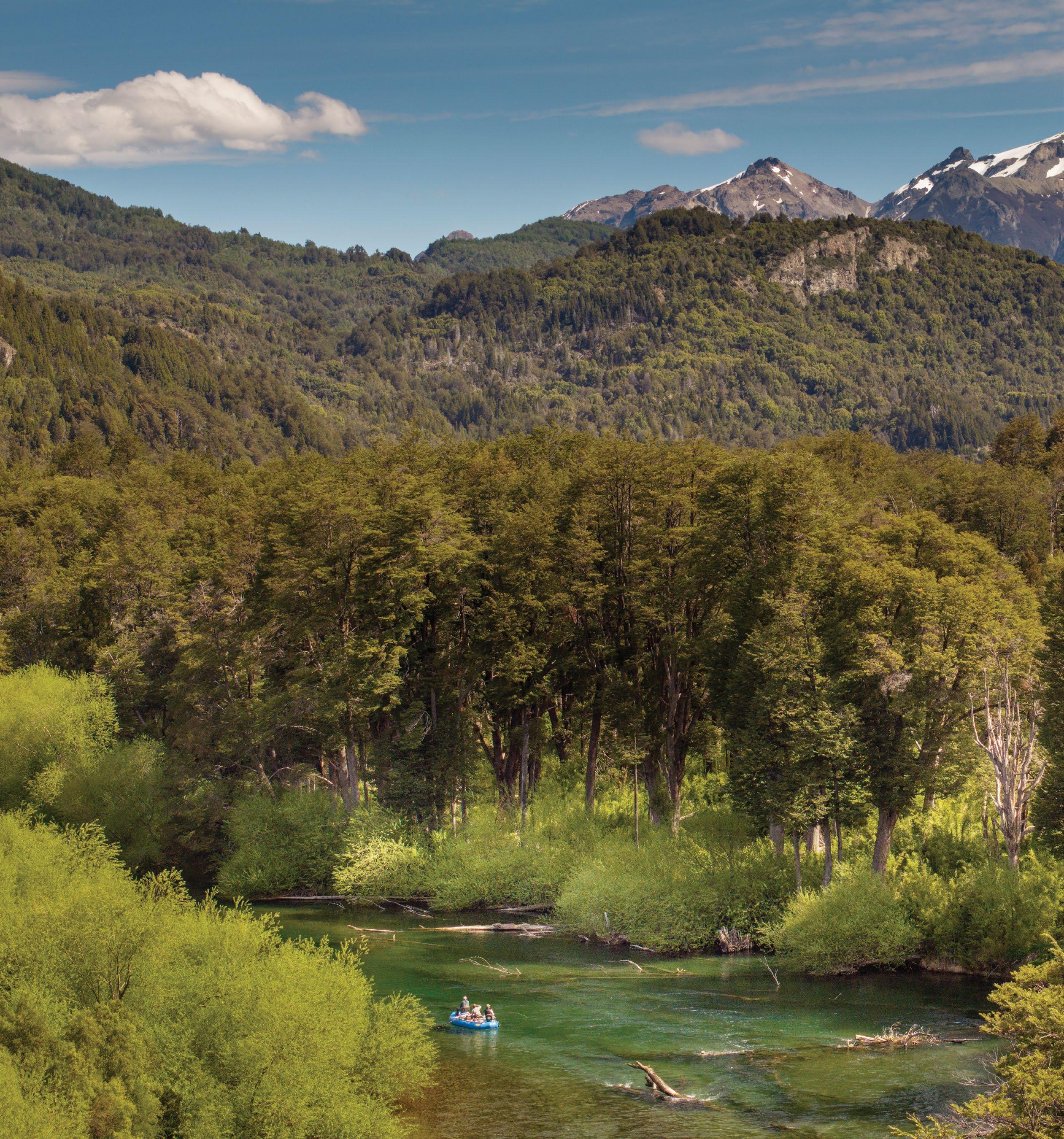

on 4X, landing softer than a thought. The drift is clean, the take sudden. An explosion of silver and sunlight as the fish cartwheels into legend.
Our guide, Alejandro Jones, watches quietly from the bank. As my line tightens and the reel begins to sing, he leans toward me and whispers almost as if to himself.
“This … this is the essence.”
In that electric second, line tight and lungs full, the world narrows to river, trout and sky, and everything makes sense.
In that electric second, line tight and lungs full, the world narrows to river, trout and sky, and everything makes sense.
Rance Rathie and Travis Smith grew up in Montana’s Ruby Valley, fishing the Big Hole, Beaverhead, Ruby and Jefferson rivers until they
knew their rhythms by heart. Patience came before algebra. Fly tying before first dates. The Madison showed up in their lives now and then.
The Yellowstone rarely, simply because it was far away.
Years of guiding and wandering eventually led to a question that would not let go: What if there was still a frontier for fly fishing, a place where rivers ran wild, fish grew old and unpressured, and adventure still felt real?
Patagonia answered.
In the early years, Rathie and Smith worked for an Argentine outfitter, learning the region river by river. Then came the 2001 Argentine economic collapse, and with it a hard lesson. At the end of the season, there was no money; they had worked an entire year without pay.
They returned to Montana bruised


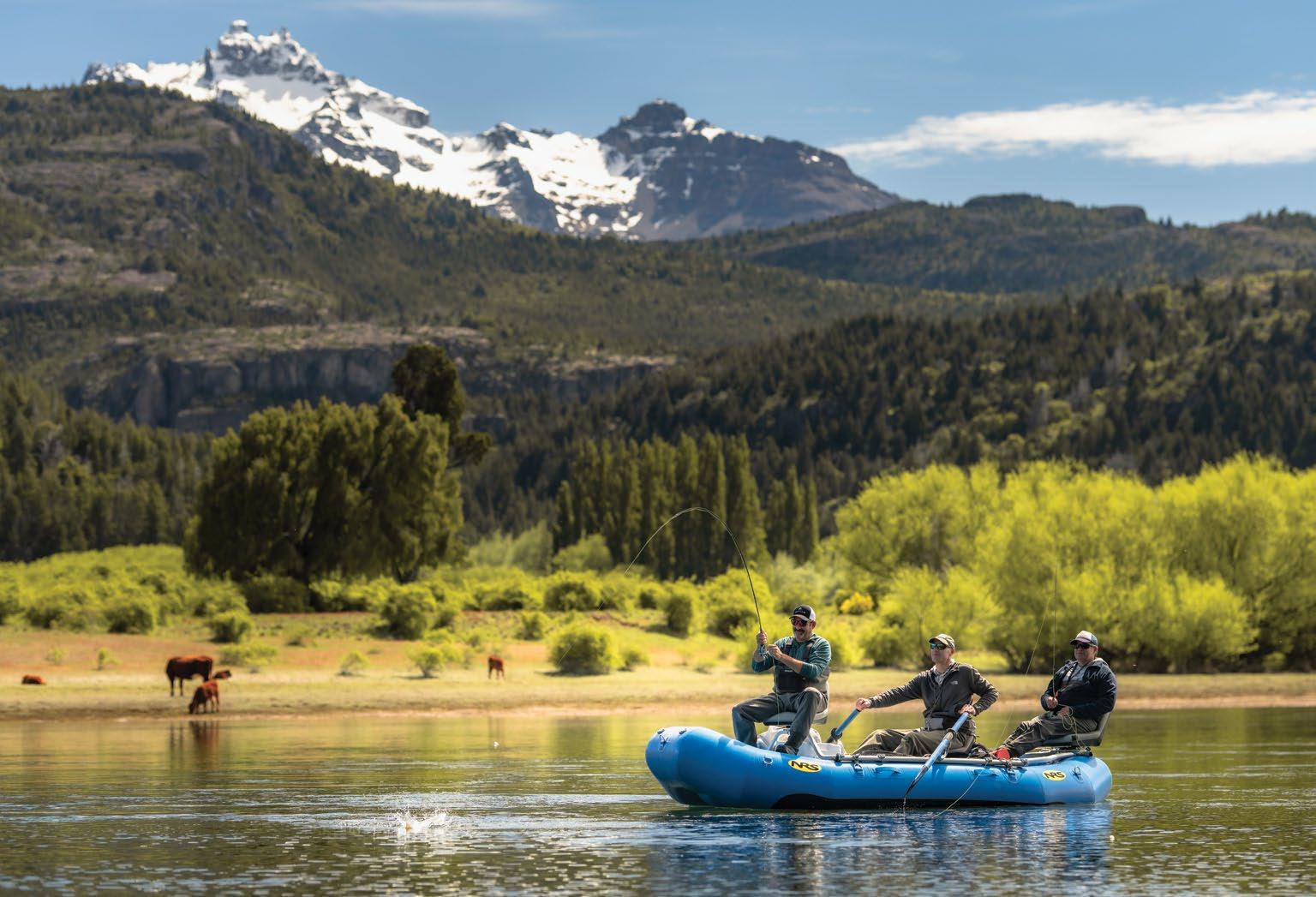
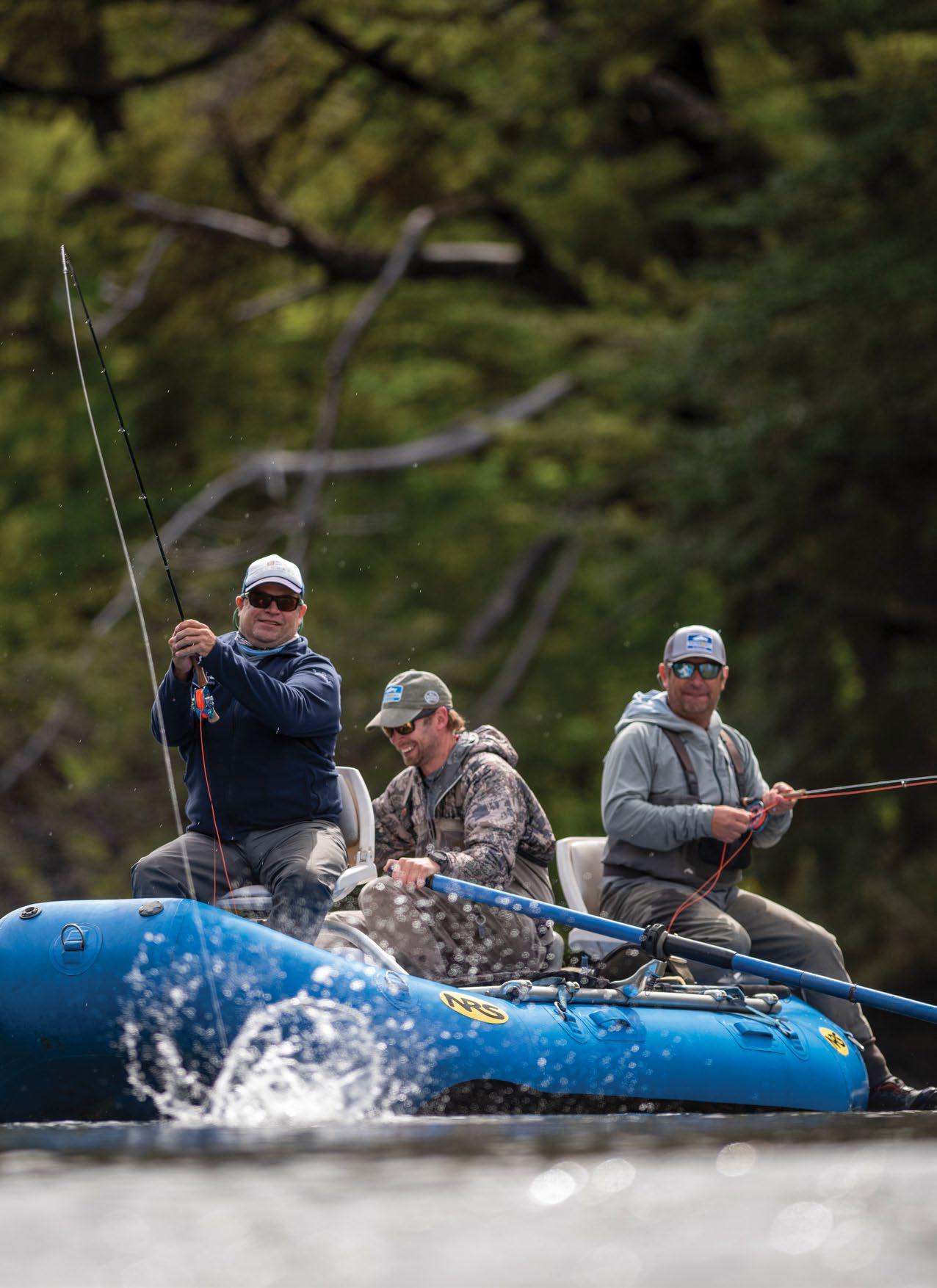


but not broken, and while Smith went back to college and Rathie considered engineering, the dream of Patagonia would not release its grip. Rathie built a sample brochure, named the vision Patagonia River Guides (PRG), and pitched it to his best friend.
To start the company, they each pulled $10,000 from cash-advance credit cards, emptied what little savings they had left, and committed fully. They drove south with everything they owned packed into their trucks: rafts, oars, frames, tables, chairs, rods, reels, waders, boots.
Rathie invented a foldable raft and storage system that fit into the back of the truck, eliminating the need for trailers and allowing access to waters no one else could reach efficiently. That system remains uniquely PRG.
The partners set up camp in Trevelin, a
Welsh-settled valley at the end of a dirt road, and began building something from nothing without a blueprint or safety net. All they had was grit, a strong belief in what they were doing and the solidity of their friendship.
The land did not make it easy, with unrelenting winds, dirt roads that dissolved into pastures, and a landscape that always rose abruptly into mountains—but that was the point.
After seven years of building the business, things came full circle. They purchased the remnants of the old Trevelin Lodge, which was in dire condition. It would have been easier
Every wall, every piece of reclaimed wood, every river map pinned in the bar carries the Montana code they brought south: Work hard, guide harder and leave things better than you found them.
to tear it down and start over, but the location was unrivaled, the dead center of the fly-fishing universe in the region. Every building was painstakingly remodeled and what emerged is now considered one of the most polished and respected fly-fishing lodges in the world.
Every wall, every piece of reclaimed wood, every river map pinned in the bar carries the Montana code they brought south: Work hard, guide harder and leave things better than you found them.
Today, PRG’s home waters stretch far beyond Trevelin, north toward San Martín and Junín de los Andes, and south into the Río Pico Valley, a system of spring creeks, small rivers and freestones that merge into something extraordinary. They guide in Tromenco, Las Mulas, Campamento, Las Pampas and Nielson. The Río Pico itself meanders east before falling into Chile, the valley dotted with dozens of lakes. To the north, the Corcovado and Tigre drainages hold some of the largest brook trout in the world in settings so remote they feel untouched by time.
Here, guides are not hobbyists but multigenerational anglers, children of gauchos and ranchers who turned fly fishing into a profession. They speak the language of wind and current
and become a part of the surrounding landscape. Their knowledge is inherited.
PRG also quietly built a guide apprentice program, PRG University— which has trained more than 100 young guides—where they are taught English, how to drive, professionalism, equipment maintenance, safety, hospitality, efficiency and eventually guiding.
Among them is Alex Roberts, now the lead guide at the Lodge at Trevelin. He started alongside his sister Melony, waiting tables at PRG’s first leased lodge, earned his place on the water, and now leads the program his father, John Roberts, helped shape years earlier.
Patagonia’s remoteness and Argentina’s fierce protection of its rivers have created something rare for anglers who are lucky enough to visit their waters, and every week, guests say the same things.
“This is how Montana and Idaho used to be.”
“Wouldn’t it be amazing if our rivers could rest and recover?”
Here, they are allowed that grace, and that too is part of The Essence.
From the terrace of the Lodge at Trevelin, water flows in every direction. Few places on Earth offer this kind of variety. Drive west into the Valdivian rainforest and sight-fish emerald rivers. Stay in the mountain valley and lose yourself beneath rugged Andean peaks. Head east into the Patagonian steppe, where desert dominates.
The Arroyo Pescado, Chubut, Gualjaina, Tecka, Corintios, Arrayanes, Rivadavia, Frey and Corcovado rivers each carry their own rhythm, offering something for both seasoned anglers and first timers. While one day demands technical precision, the next invites long drifts and open water. Every guest is touched by the place.
And when the fishing ends, another ritual begins with riverside cookouts of



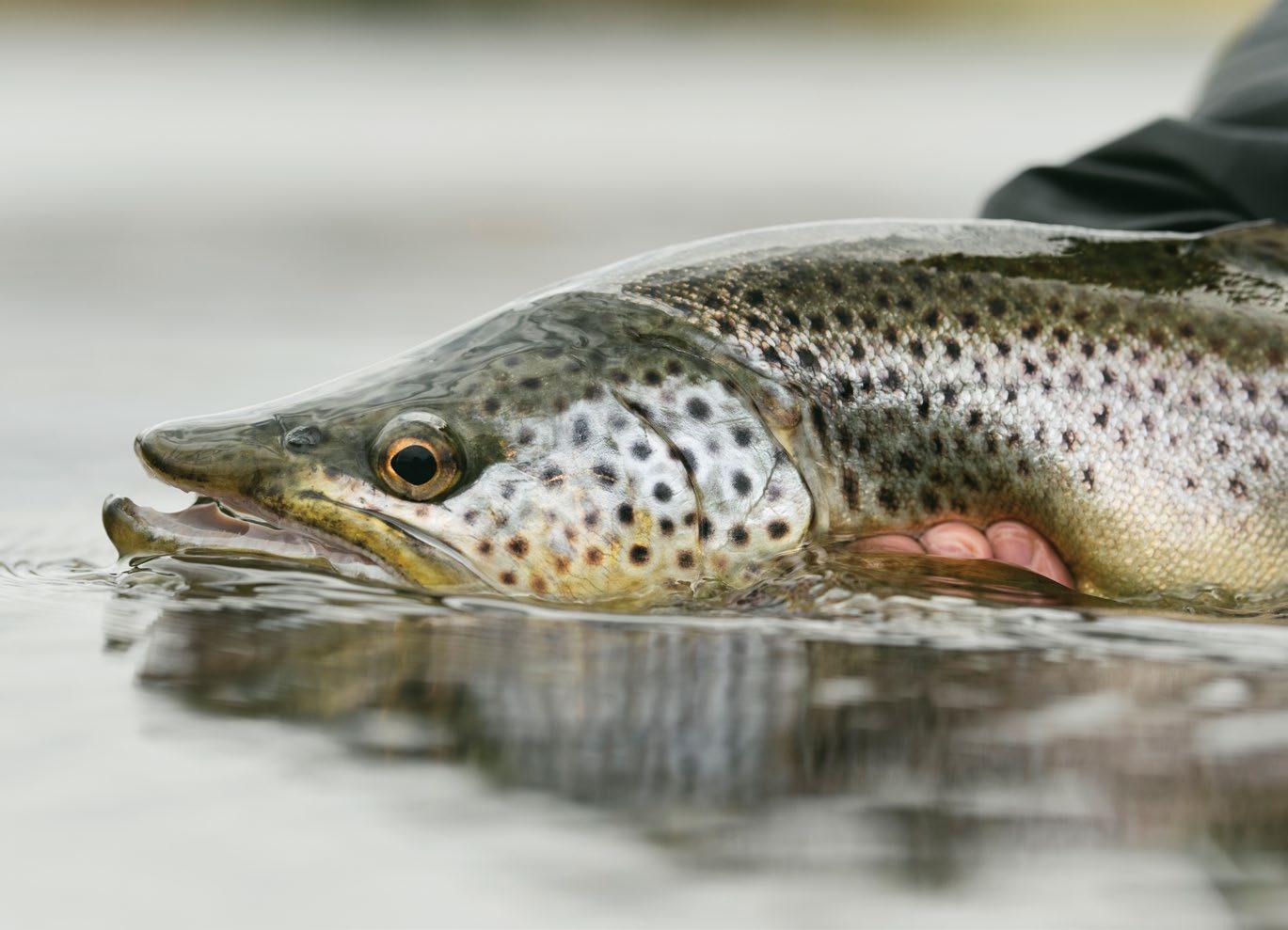
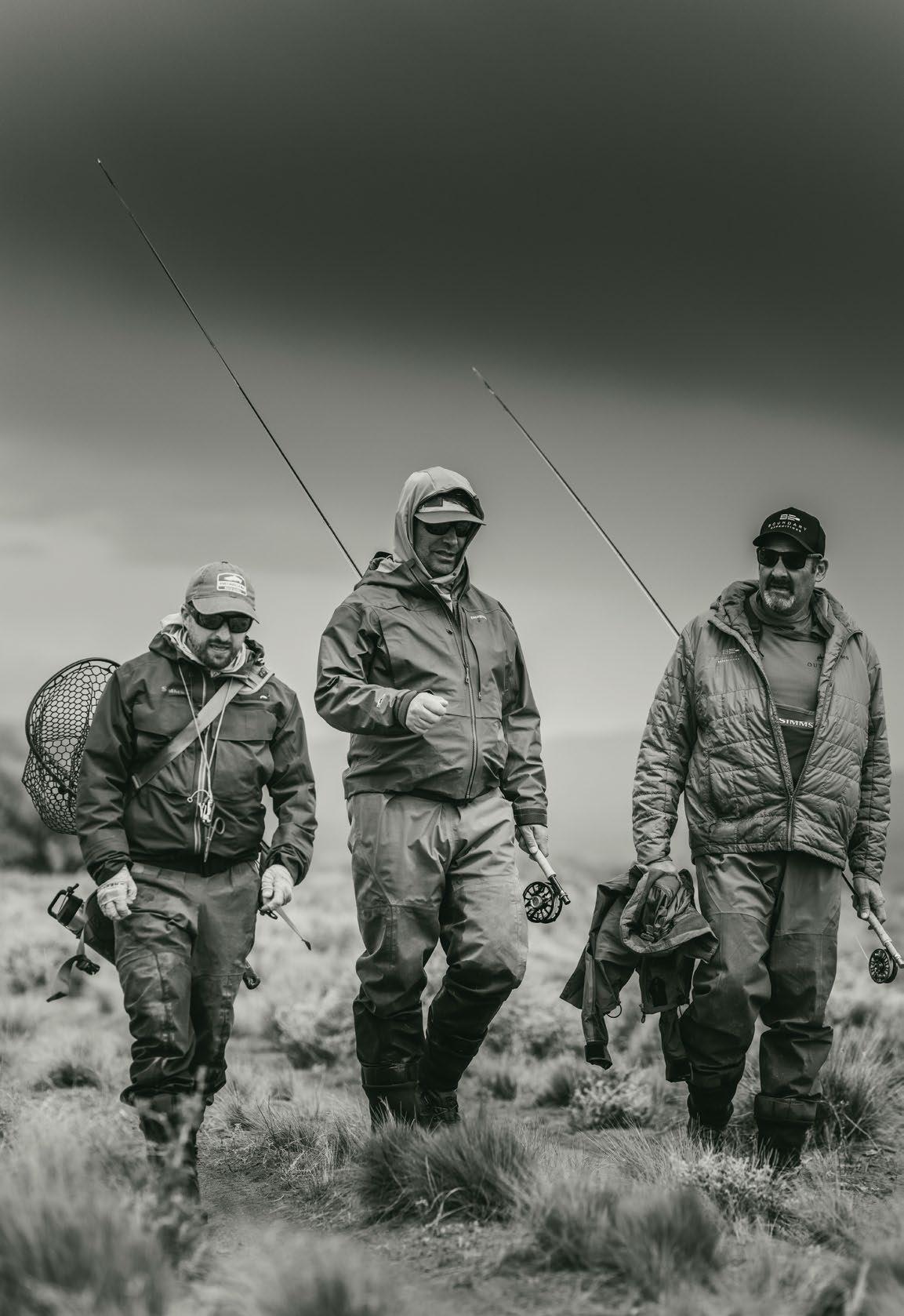
The
team is built on passion and decades of experience guiding rivers all over the world.
Opposite: PRG’s winery, Contra Corrientes, is chasing a 99-point vintage, and with the right climate producing the right sugar content, it may be possible in the near future.

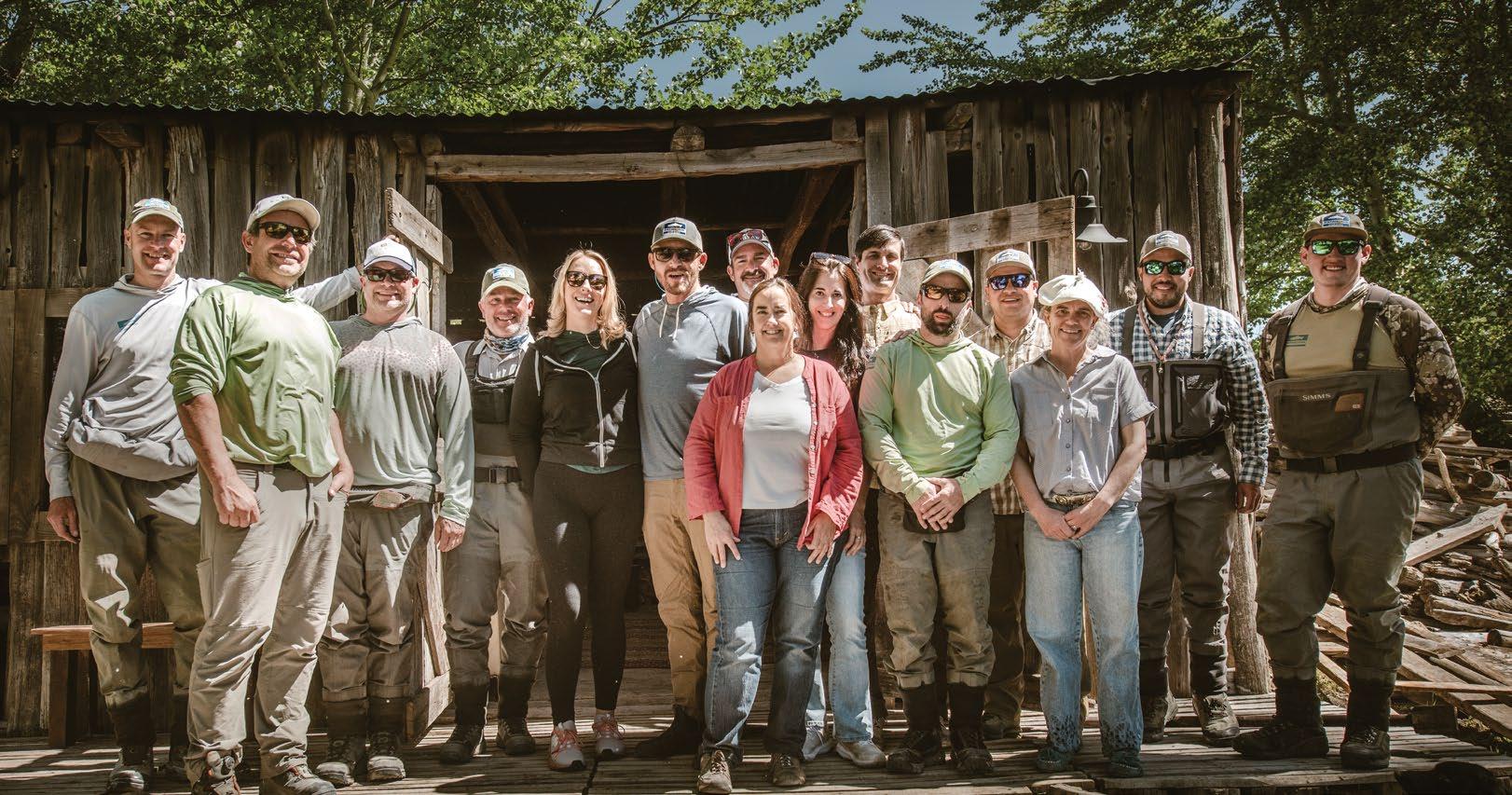
as a landscaping project until a passion for wine took over and their first vintage was bottled in 2018.


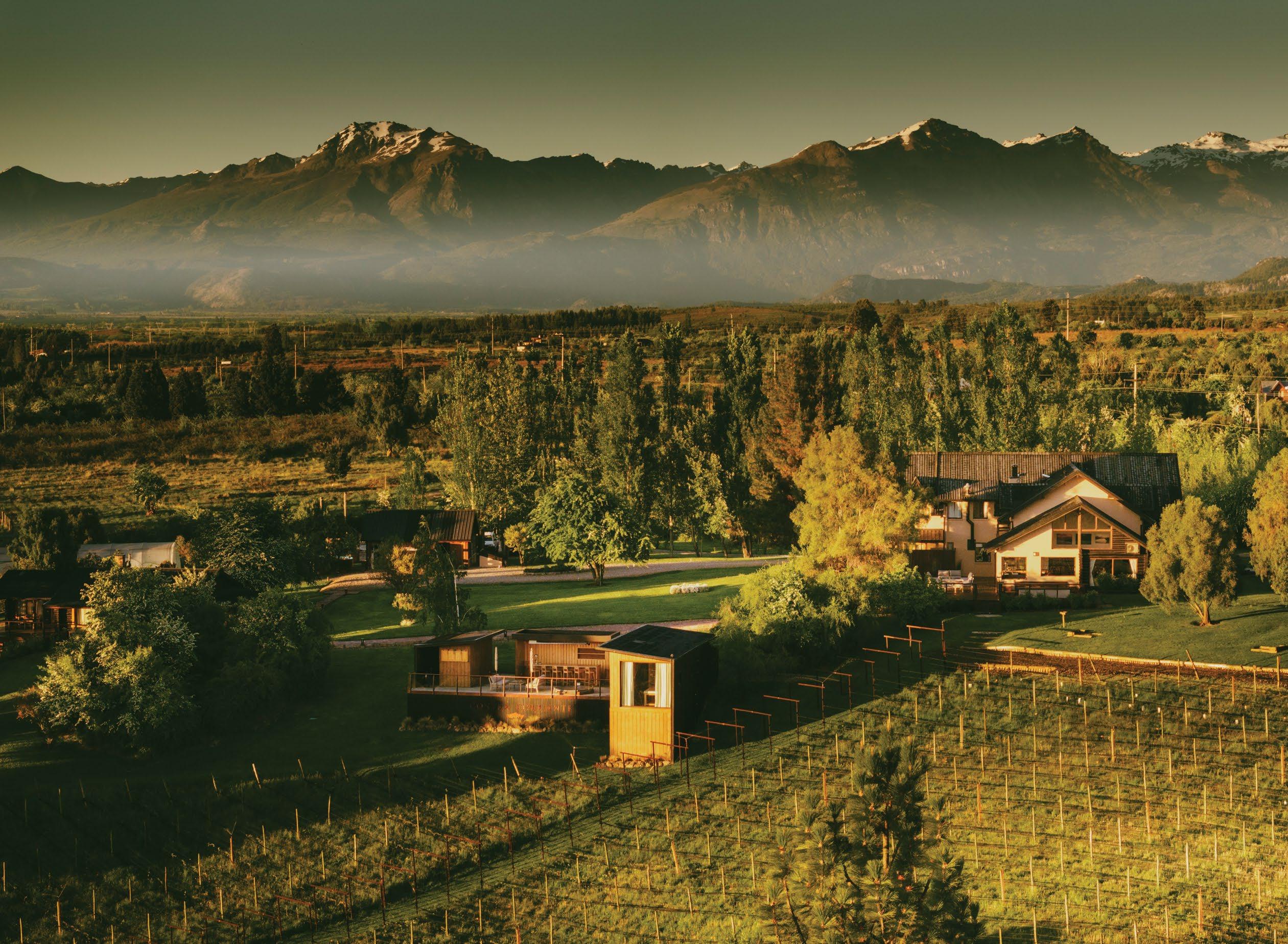

Argentine beef hamburgers and Malbec, tenderloin dinners and traditional Asado. The PRG kitchen, led by Martin Astorga, operates with the same finesse as the guiding operation, with elements of farm-to-table, from-scratch, organic vineyards, greenhouses, laying hens and composting, ensuring everything is fresh, local and gives back to the earth. This is what sets Patagonia River Guides apart; it’s not just one river or one lodge, but a kingdom.
Dinner at the Lodge at Trevelin carries its own rhythm. Firelight fuels conversation and the merry clink of glasses.

The vineyard outside began as a landscaping project, until it became something more. In their first year, vines died, irrigation was rebuilt, frost systems engineered, and an old garage was crafted into a winery. The first vintage was produced in 2018 through sheer persistence. The name Contra Corriente, Against the Current, fits perfectly.
PRG planted the first vineyard in the valley, among the southernmost in Argentina, pioneering a wine region few believed possible. Climate shifts, glacial retreat, and Pacific influence temper the valley, and Contra Corriente helped place Trevelin on the global wine map.
They did not hire a winemaker until after they had made, bottled and labeled their own wine. Eventually, the right people found them, and with the help of technological upgrades they built a winery equal to any in the world. Contra Corriente is currently chasing a 99-point vintage. If the climate gives them 23 brix—the measurement of sugar content in grapes at harvest—they believe it will happen.
But beyond the datapoints, the vines are alive, and their spirit is part of the PRG experience.
“You never really own it,” Rathie said, holding the glass to the light. “You just try to honor what it gives you.”
Inside the Lodge at Trevelin, Rance holds a glass of pinot noir grown steps from the table. It contains the landscape of a curated angling experience, the history of the lodge and guide company built from grit and supported by an unmatchable landscape.
It contains, as Alejandro Jones put it after that first cast upon our arrival—The Essence.
Eric Ladd is the publisher of Mountain Outlaw, as well as a husband and father. He advocates for clean rivers, conservation, and community whenever possible, including through his service on the board of American Rivers and his involvement with Big Sky Search and Rescue and AxeALS.

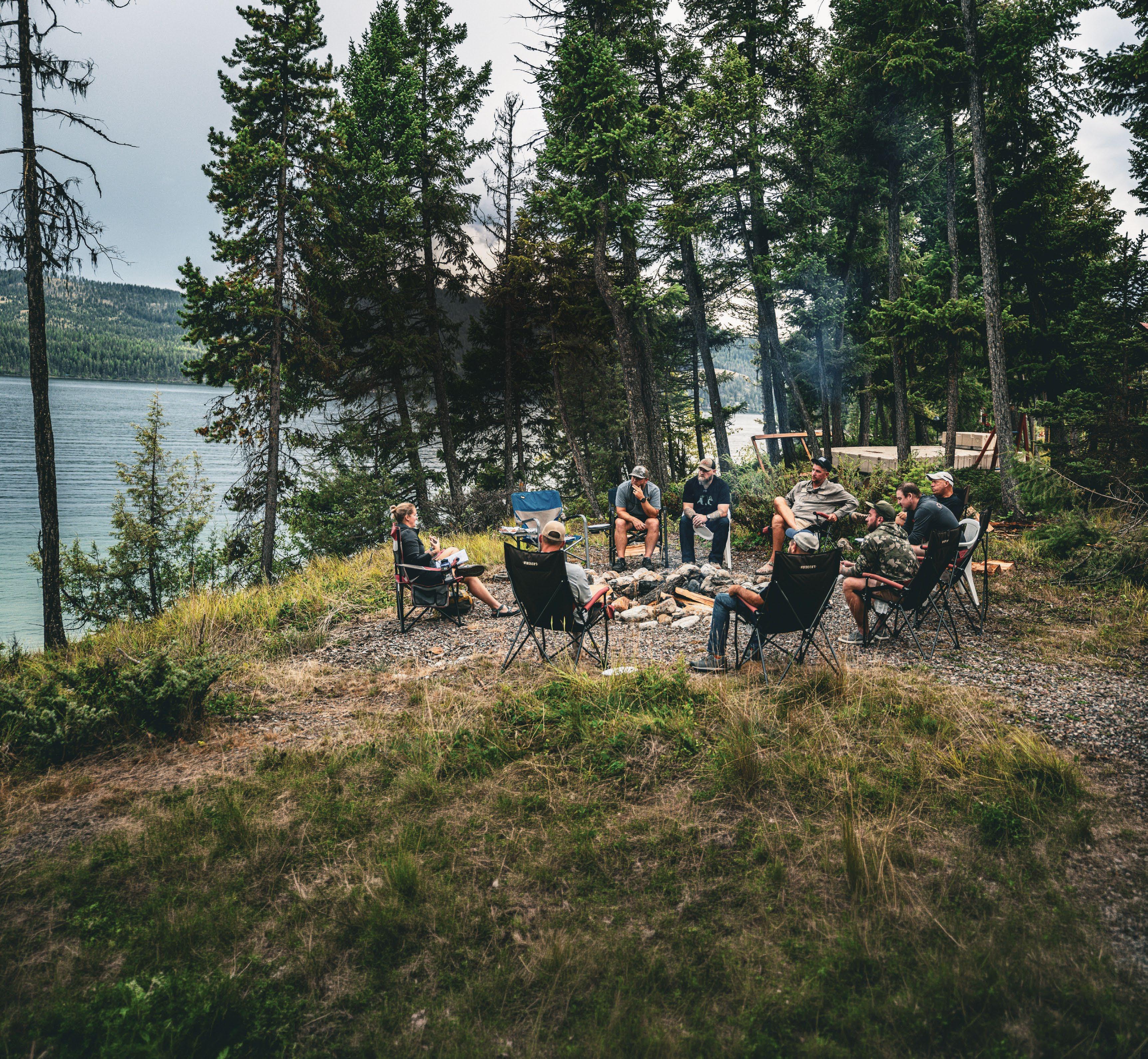
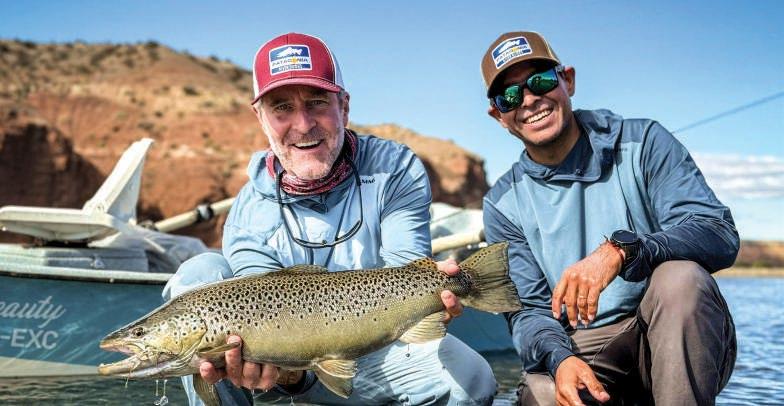
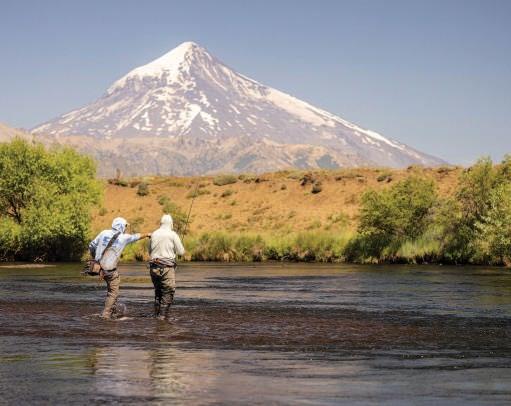
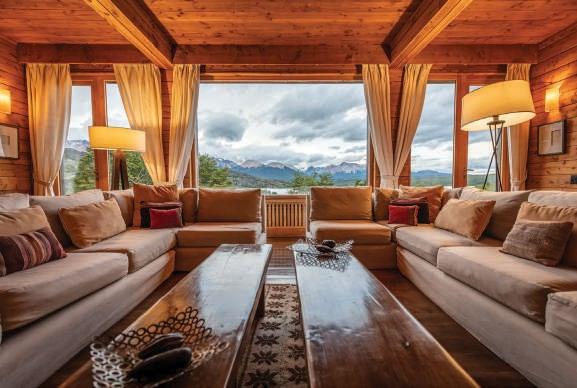
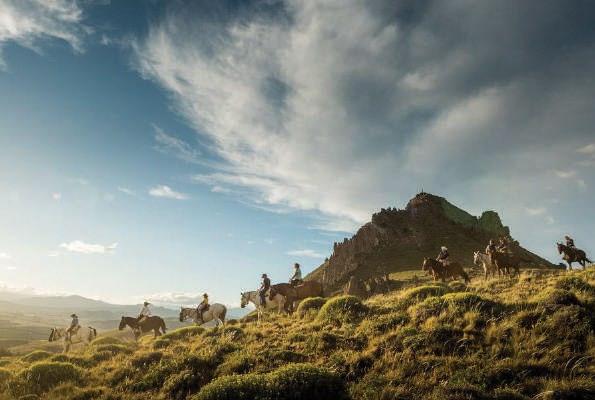
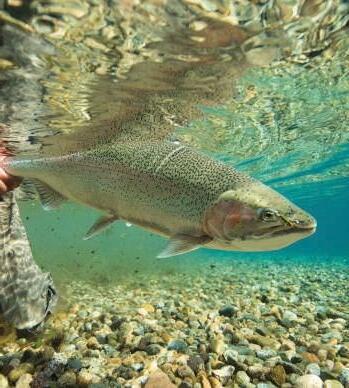
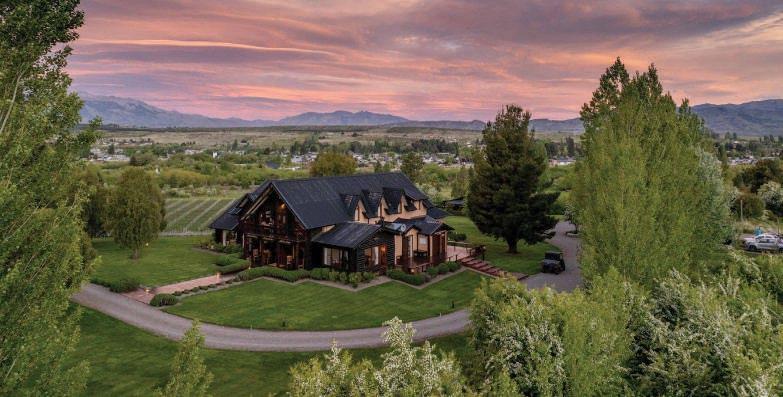
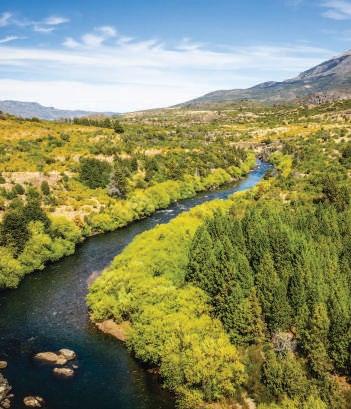
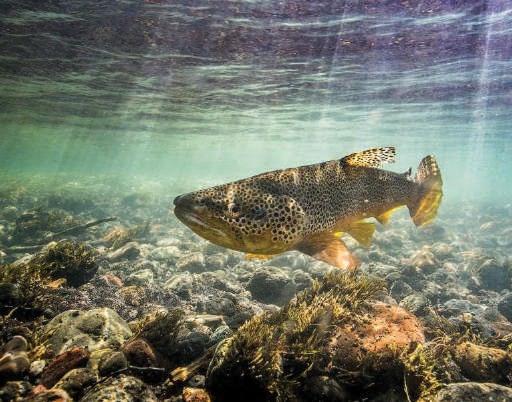
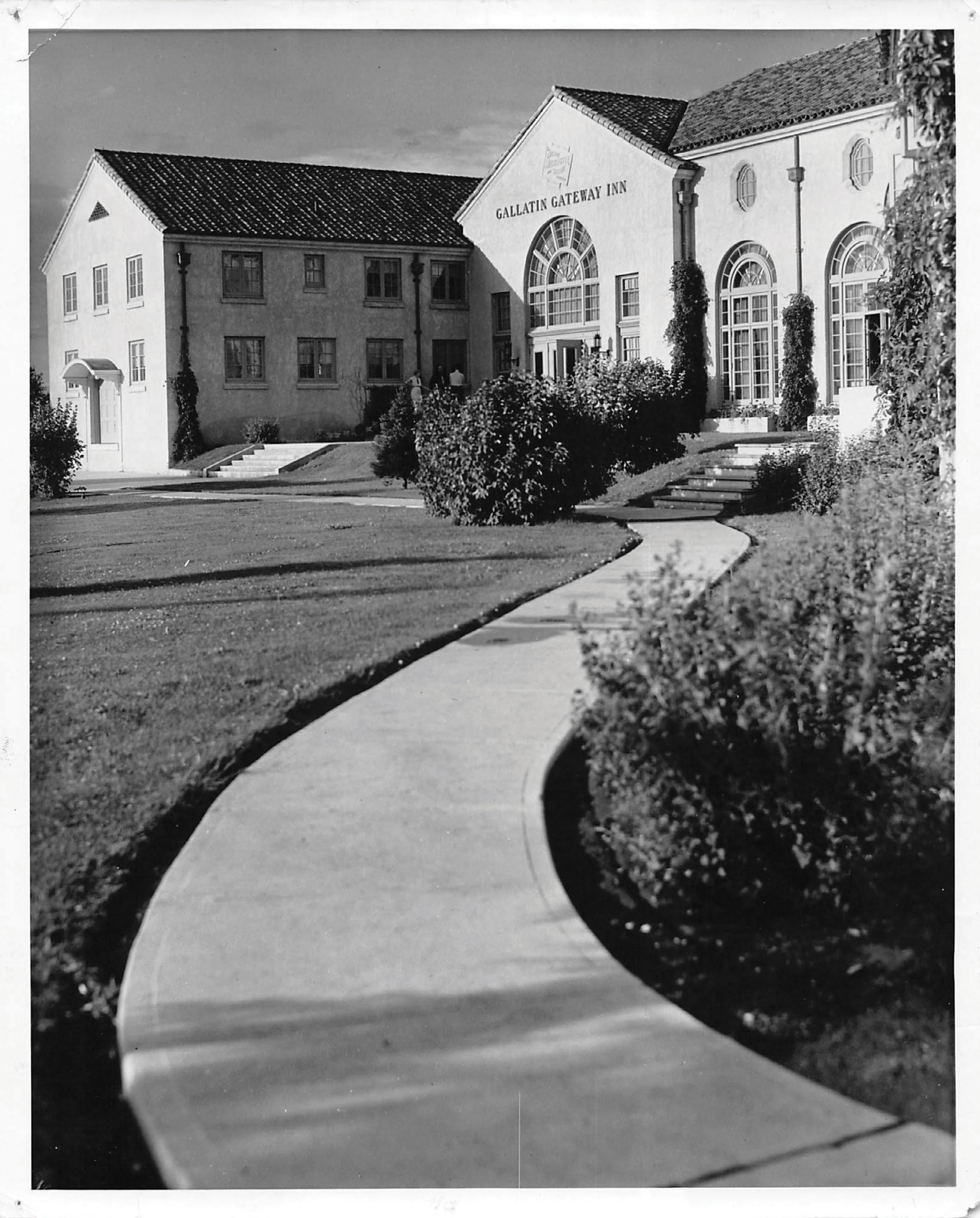
Feature: Shaking the Glass Ball
Report: Gallatin Gateway Inn, A History
Essay: Columbia Gardens: 68 Acres of Heaven
Report: Guardians of the Last Best Place
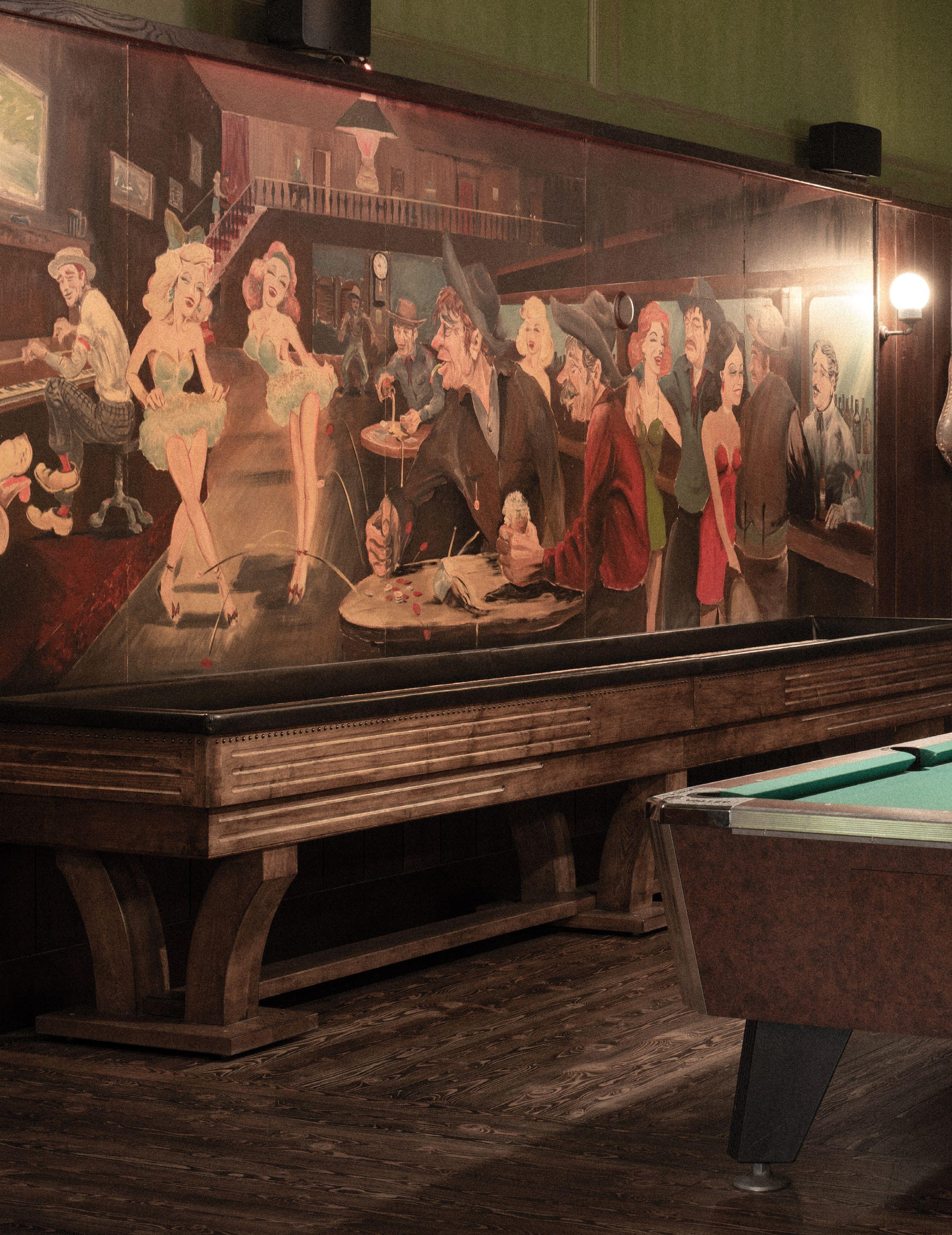


By Toby Thompson
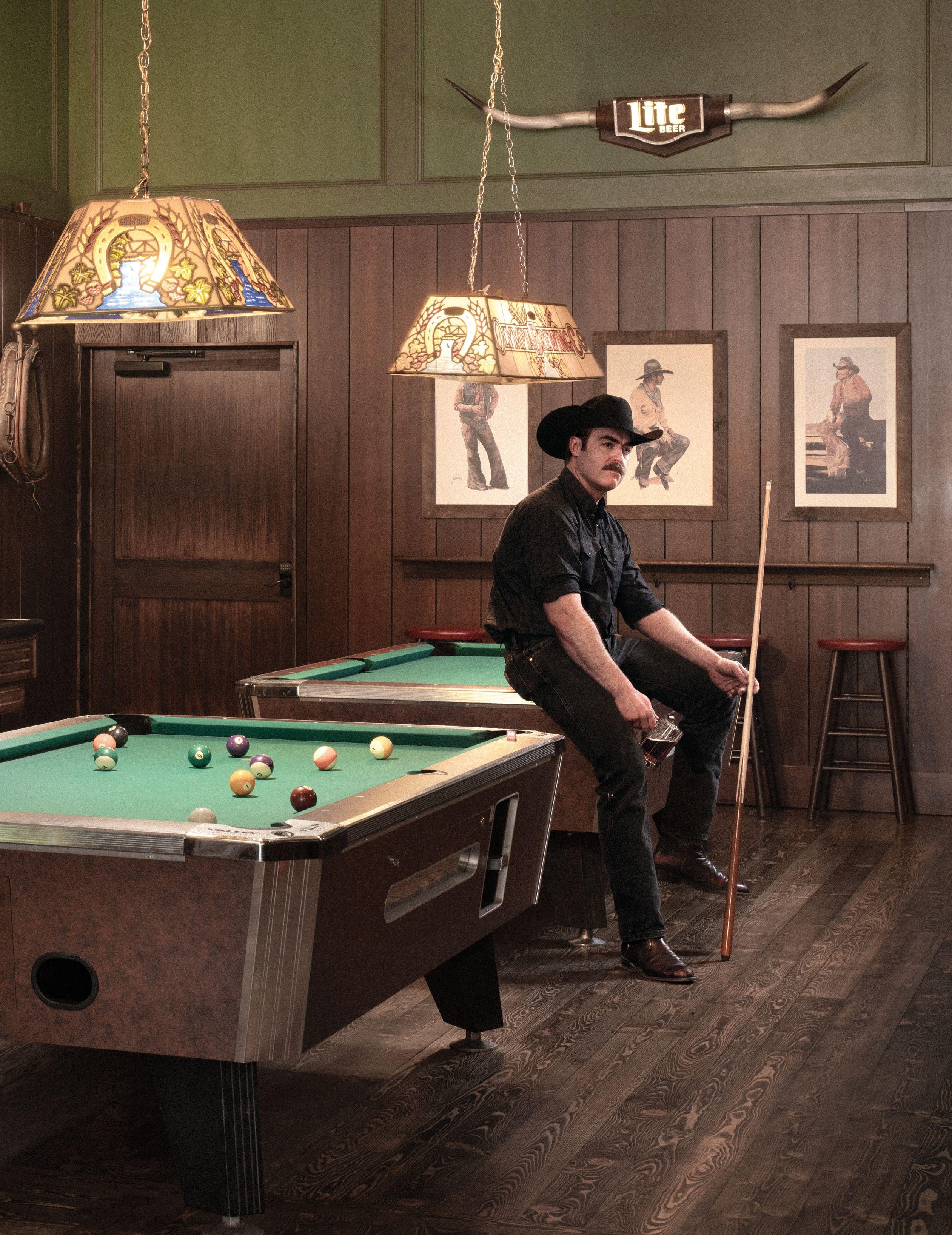
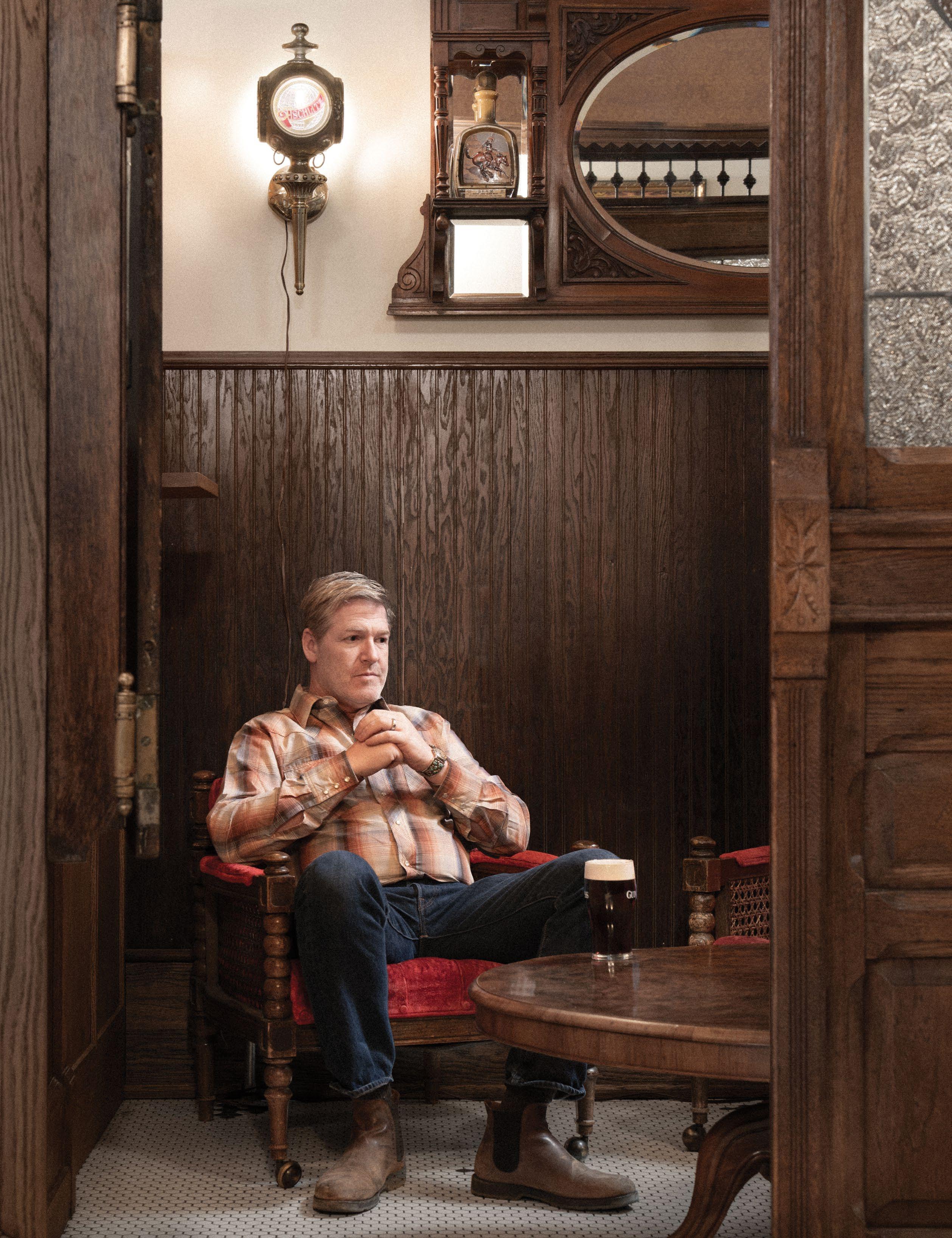
“I
wanted an appropriate place, not necessarily for cowboys, but for cattle barons, the businessmen. A space that was elevated. I see cowboys as the original punk rockers.”
–Brett Evje
The fair-haired and affable Brett Evje perches in his Irish snug, a compact bit of Victoriana designed to mimic a ladies’ parlor 120 years ago, but here at Stockman’s, beside the bar, proves a comfy and effective sound block against the saloon’s afternoon bustle. We’re chatting at 31 East Main in Bozeman, hard by the restaurant Plonk, which, with the fancy steakhouse J.W. Heist up the block, has elevated Evje and his business partner, Michael Ochsner, to 2026 James Beard Award semi-finalist status for outstanding restaurateurs.
“We weren’t expecting the award at all,” Evje says. “But it’s certainly an honor.”
Brett is a bar and restaurant veteran who restored and saved Emigrant’s Old Saloon (founded in 1902), which he owned until recently, and Stacey’s Old Faithful Bar (founded in 1937) at Gallatin Gateway, which he purchased in 2020. Last year, he added The Westerner next door to Stacey’s as a honkytonk Nirvana for dancers, and a taqueria, El Gallo Cantina, which is attached. Each of these establishments, though consciously retro, is muy cowpoke. But Stockman’s, with its mahogany front and back bar set, its brass cash register, its tile floor and coffered ceiling, is more consciously formal—upscale.
“I wanted an appropriate place, not necessarily for cowboys, but for cattle barons, the businessmen. A space that was elevated. I see cowboys as the original punk rockers,” he adds. “I grew up a skate-and-snowboarder and considered myself a punk.” During the 1970s, his father owned the Two Bit Saloon in Gardiner, and the 53-year-old Evje is a fifth-generation Montanan. His great-grandfather, J.W. Heist’s father, homesteaded in the Cinnabar Basin, ranched near Manhattan, and was a cattleman, “raising bulls.” Heads of comparable beasts decorate Stockman’s walls, with those of bighorn sheep, “shot by my grandfather.”
As for this saloon, Evje says, “I looked around Bozeman, and there was no bar with a Western feel. With this resurgence of Western culture, with people gravitating to cowboys and the Yellowstone bullshit, I thought, ‘Why not’?”
An earlier Stockman’s (1942-72) stood where Plonk stands now. The new space, in recent
years, had been the boot-and-gun room of Schnee’s, a business still open next door. “We have an entranceway from there into our bar,” Evje says, “so the places complement one another. You can buy a gun at Schnee’s, then come right here for a whiskey.” He laughs.
My interest in saloons dates to the early 1970s when, hysterically, I spent four years on the road, searching for the Great American Bar, leading to publication of my 1976 book, Saloon. Many greats were in Montana, and in fact Brett Evje modeled Stockman’s on The Montana in Miles City, which in my estimation, split the vote for best bar with Captain Tony’s in Key West.
“For Stockman’s,” Evje says, “I didn’t want to do a college bar, and I didn’t want to do a dive bar. The Montana was the model. It was perfect.”
In terms of historical elegance, The Montana remains the most pristine of early Western saloons. Founded in 1908, its front and back bar set, its vintage coolers and cigar cases, its Italian tile floor and trough urinal in the Gents, its brass piping buffed to a shine, spell perfection. The summer of 1972, I recall stopping there after what felt like a dune buggy ride across gravel highways the 48 miles between Watkins and Terry—Montana rangeland, cowboys, cattle, and heavy equipment crowding the coulees, everything recessed before the stark landscape. I’d set my watch back an hour at the Montana line, but 60 miles west of North Dakota, I was 100 years into the past.
During those months, I visited 30 bars a day, learning in my travels that the Mountain West – specifically Montana – held more saloons of the proper demeanor than any other region. My criterion for greatness in a bar was not the quality of food, drink, or music at a particular spot, but how well the bar fulfilled its primary function: that of relieving loneliness, boredom, and dread.
This was my drill: I’d study the exterior of a strange bar, its facade and structural demeanor, to decide whether I might find comfort there, or risk a step inside. I’d examine the bar’s architecture and its poise within its geographical setting, and the whole was a place mat properly or improperly laid. I required form to frame or isolate chaos. A great bar and its architecture were not unlike that fine crystal sphere, a paperweight if you will, or a child’s toy in a crib, that housed makebelieve snowstorms. Snowstorms were the chaos; you wanted storms. But a glass ball was needed
to contain them. And you wanted an interior adequately fixed to keep chaos in check. Front and back bars, antique furniture, dusty paintings, and tattered pool tables were the primary artifacts
My criterion for greatness in a bar was not the quality of food, drink, or music at a particular spot, but how well the bar fulfilled its primary function: that of relieving loneliness, boredom, and dread.
of an interior landscape. They were like tiny log cabins, snow-covered sleighs, and reindeer. You shook your glass ball as hard as the mood dictated. Or another something, faceless and edgy, shook it for you.
Today, saloons remain linked to a more ordered and formal past. This cultural moment, in and
out of bars, is comparable to that of the 1970s, the decade of my quest for great bars. That era was a time of turmoil, with the Vietnam War, a heightening of indulgence in sex, drugs, and rock ‘n’ roll, and Watergate politics happening way too quickly. As one friend has said, remembering that decade, “The culture came apart like a frag grenade.” I found 19th-century saloons, where they survived, to be an escape from cultural discord.
In small Western towns, during the 19th-century, saloons had been a touch of urbanity, of the city. Their elegant fixtures (front and back bar sets, cigar display cases, ice chests, and cuspidors) had arrived in wagons, on steamships, or on trains. Often, the saloon had been the first building in a cow town or mining camp. It served multiple duties as a barroom, church, civic hall, barbershop, mortuary, and brothel. More significantly, it was an escape from the societal uproar of a gold camp, say, like Deadwood, South
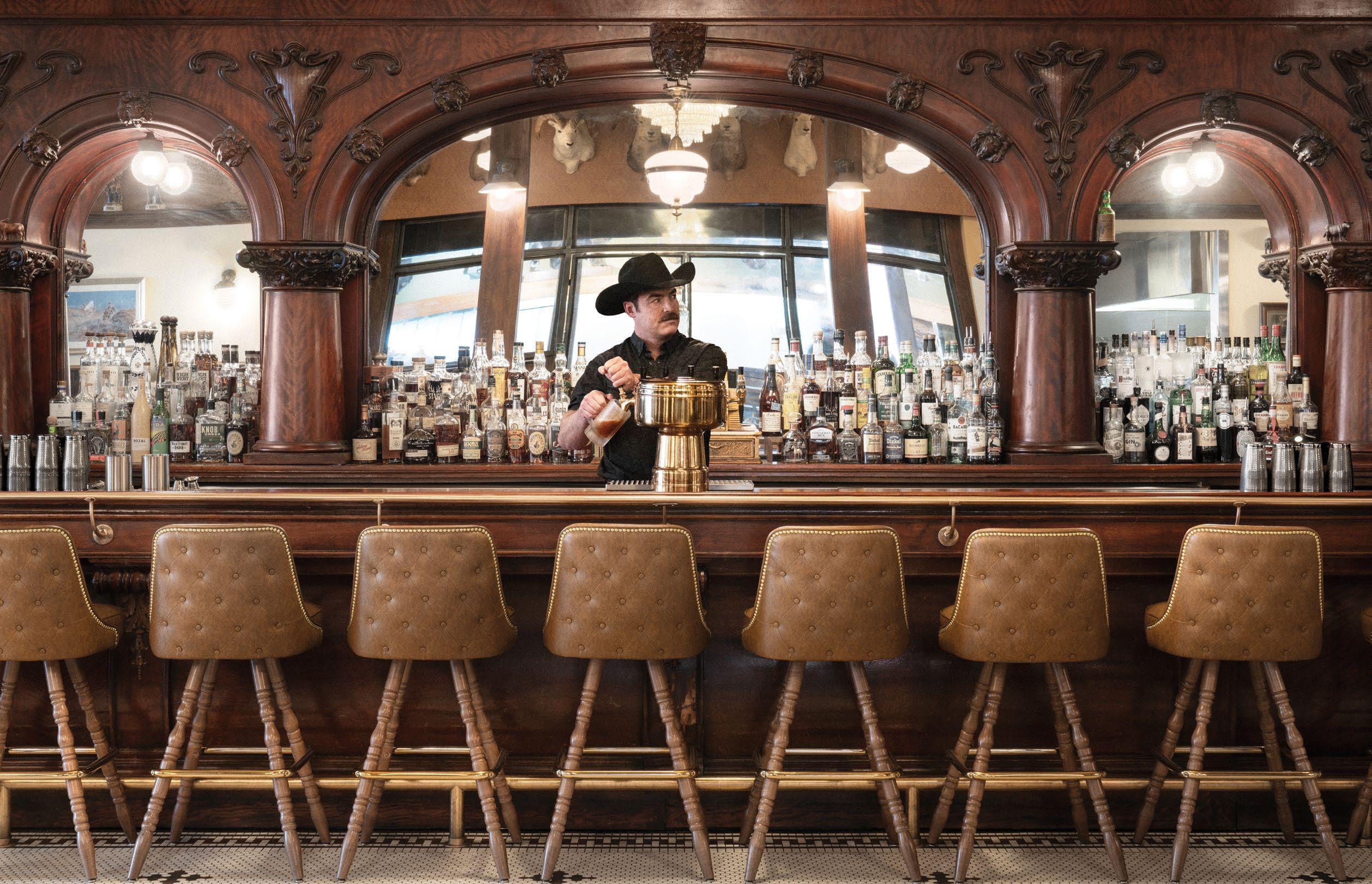
Dakota. Something about a saloon’s aesthetics and poise urged people to kibitz rather than confront.
The 19th-century saloon, with its cathedrallike fixtures, predominated until Prohibition (1920-1933), when the sale and production of alcoholic beverages became illegal in the United States, and the Jazz Age, with its whoop-de-doo, its extravagant cocktails, flapper culture, New Deal, and Art Deco décor, staid the saloon’s swinging doors. A few defiantly remained open; others became drug stores (with stiff tonics on the side), or ice cream parlors. Cocktail lounges, with their nods to Modernism, predominated, and the industry kowtowed. At Repeal, trade journals, such as a 1934 edition of Beer and Bar Equipment, urged revival of the 18th-century term, “tavern,” to replace “saloon,” arguing that it was “a good piece of merchandising, since it is at once evidence of the general desire of the country that we should create establishments that could not be associated with the old saloon … the world isn’t the same world that went into the World War … It’s a world
that has settled down to counting its blessings.”
Evje admits, “Technically, I don’t know the difference between a bar and a saloon, but this feels like 1900. It’s a saloon, and it’s elevated. I want to make it seem like it’s been here since the turn of that century.”
Before Stockman’s, Evje says, “I’d spent time in old bars: The New Atlas in Columbus, the Montana in Miles City, The Old Saloon in Emigrant. I’ve always loved old Western Montana.” Stockman’s, as Evje has designed it, is a step back in time, not just with its period fixtures, but with its studied lack of technology. Here, patrons aren’t glued to their phones: “They talk to one another,” Evje says. Stockman’s has only a small TV at the end of the bar, “usually looping ‘Lonesome Dove,’” he points out. At the Old Saloon, he played neither CNN nor Fox News, but the Cowboy Channel for rodeos. “When tradition’s your focus, and you’re following that line, it doesn’t include huge TVs at every corner of the room.”
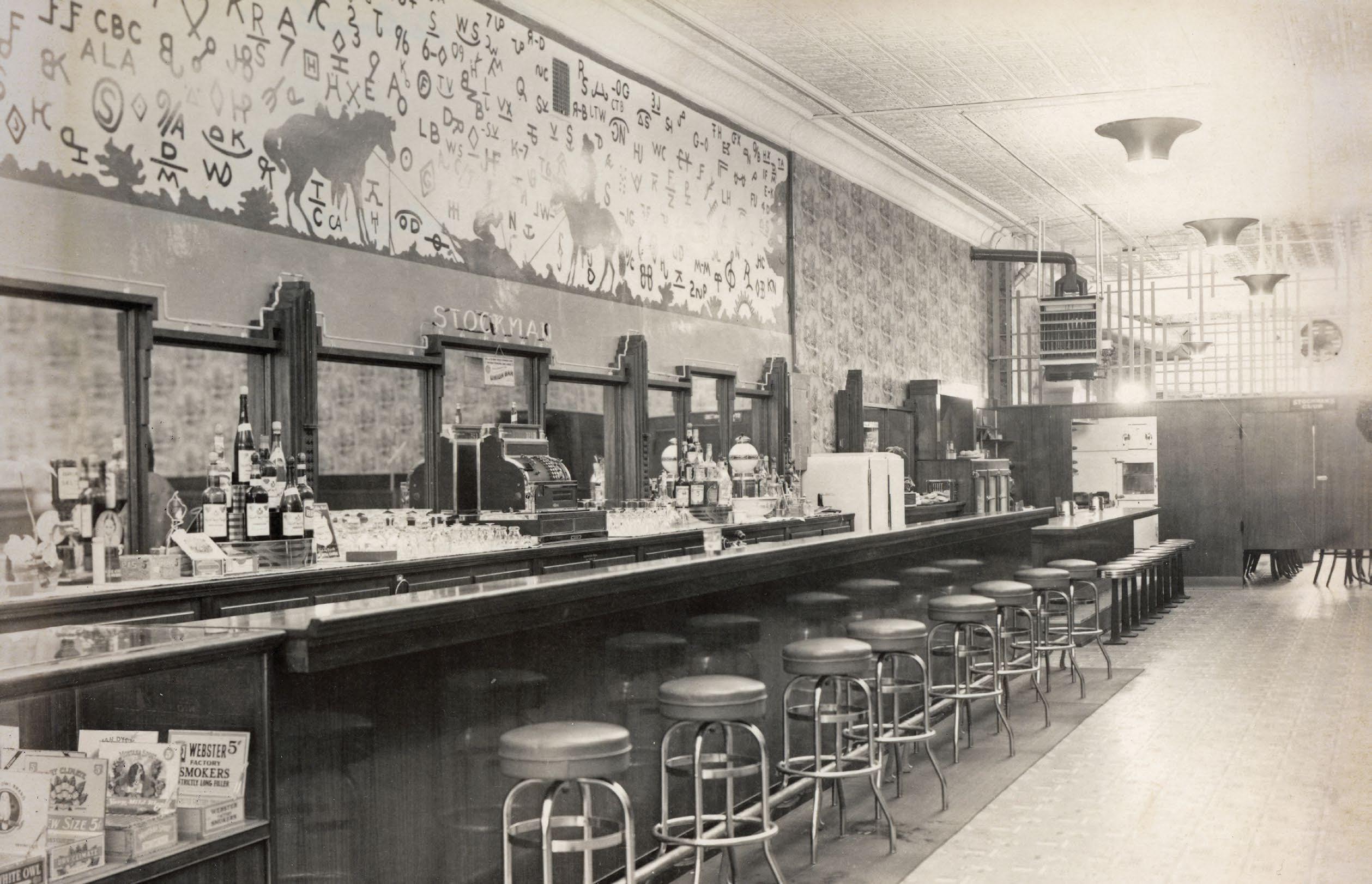
The Stockman’s back bar is top-of-the-line, a 1900-era Brunswick-Balke-Collender, Mount Oro (“mountain of gold”), from a San Francisco restaurant, for which Evje paid six figures. “I’ve owned a couple of Brunswick bars now,” Evje says, “and there’s a small community of people that deal in and restore them, and kind of collect them.”
In fact, there’s an entire subculture of dealers and aficionados who treasure old saloon fixtures.
Parley Pearce is one of these. A retired veterinarian in Walla Walla, Washington, he’s a connoisseur of Brunswick bars, keeping “six or nine,” and having decorated a Pendleton, Oregon bistro (which formerly he owned) with a “Del Monte Type-two back bar,” for which he spent $60,000 in a back-alley transaction at Butte. During the sale, parties were “armed to the teeth,” and payment was rendered with cash in a shoebox. “A customer who was carving up the counter had been murdered with a shotgun,” Parley explains, “and there was blood all over the bar.” It was ineradicable. “We left that stain and put a finish right on top of it.” Recently, he sold Brett Evje
the panels for Stockman’s snug, and its antique brass cash register. “Parley’s an interesting figure,” Brett says. “An awesome guy.” Pearce is currently restoring an immaculately preserved brothel in Pendleton, which he’ll open as a hotel and rent “for special events.” He purchases 19th-century saloon fixtures at conclaves “like The Grass Valley, California, Old West Show,” he says, which include half a dozen stand-up roulette wheels. Raised on an Oregon ranch, Pearce adds, “I have a passion for the Old West.”
This appeals to Evje, who feels similarly. Standing before a wall-sized, honkytonk mural in Stockman’s pool room, he explains that he holds a history degree from the University of Montana, and as a boy, he’d enjoyed saloon trips with his parents. “I’d just climb the bar seat,” he says. “They’d visit this bar and that bar, and I’d always go.”
I’d had a comparable familiarity, as my parents were bar aficionados. At the outset of my search, I asked my mother which bar was the first I’d visited as a child. “I don’t know,” she said. “We took you everywhere.” Then, as if touched by the hand of a research god, I asked where I’d been conceived. She said, “At the St. Regis Hotel in New York City. Your father had just returned from
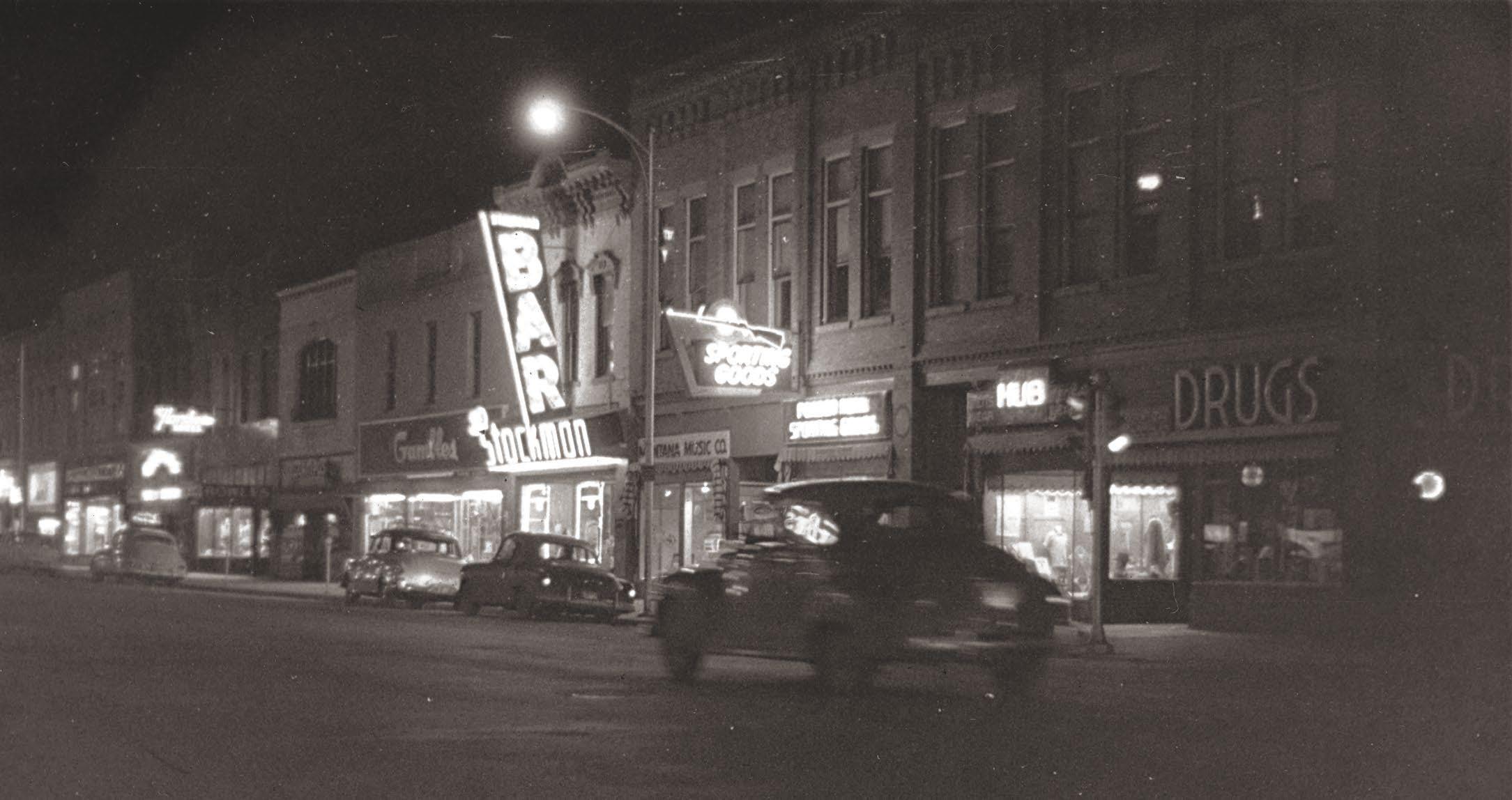
World War II and …”
“Okay, what was the first bar you visited afterward?”
“That’s easy. Next morning, we went to the King Cole Bar downstairs and had Bloody Marys.”
So: I’d premiered as a zygote, at the King Cole, with its starched-apron waiters and celebrated mural by Maxfield Parrish, at the St. Regis Hotel on Fifth Avenue.
Thereafter, I recall mornings with my dad at Washington’s Old Ebbitt Grill, its walls hung with wild boar and walrus heads, the latter sporting a Kaiser helmet, and afternoons eating oysters and watching him drink at Maine Avenue’s waterfront saloons. One night, on a bet, he swam across the Potomac, that river 1,000 feet wide and contaminated below the Tidal Basin. But the crabber men’s bars, post-dip, provided comfort.
My attraction to weathered barrooms had been fixed by my parents’ dalliances, so in 1972, while researching Montana’s saloons, I worked feverishly, enjoying afternoons and nights of drinking that approached states of bliss. There was dancing at Livingston’s Longbranch or Wrangler saloons; there was six-pack swimming outside Chico Hot Springs Saloon, and afternoons sipping mint juleps at the Old Saloon. I recall an evening in 1976 when Jimmy Buffett and I met friends there, carpooled to Gardiner and the Two Bit, boogied to a country band with which Jimmy sang “Livingston Saturday Night,” skinny-dipped in the Boiling River after closing, gathered as dawn broke over the deserted saloon where Buffett took a guitar and said, “There’s this new song I’ve written. Like you to hear it.”
It was “Margaritaville.”
Decades passed before I said adieu to the booze, but saloons stayed constants, whether dancing at Manhattan’s American Legion, Gallatin Gateway’s The Jump, or Livingston’s Murray on any night, summer or winter. In late middle age, however, I believed I’d become inured to the comfort of saloons. But not long ago, on a snowy December evening, I stopped at the New Atlas Saloon in Columbus. It was a dark season of my life, heavy with loss and regret. As I approached the mahogany bar, I saw lights hanging from antlers of mounted deer and along the carved entablature of the mirrored back bar. A string band was completing its set. I glanced toward a figure beside me but did not speak. The band finished, and its leader stepped between us. He called for a drink, nodded to each of us and began “Silent Night,” a cappella. We joined him without
hesitation or irony and sang heartily—three disheveled angels in a forgotten town on a frigid night, singing just to stay alive. At carol’s end, we embraced, shared a round, then hiked toward the blizzard, Christmas in our hearts.
At Stockman’s, the afternoon morphs into evening, and quickly Evje’s bar is thrumming with patrons’ conversations and orders. The menu, designed by John Thayer, Plonk’s and J.W. Heist’s culinary director, is simple but elegant—with sirloin and chicken-fried steaks, brisket sandwiches, loaded green salads, and à la carte items such as single eggs, range beans, pan
A great bar and its architecture were not unlike that fine crystal sphere, a paperweight if you will, or a child’s toy in a crib, that housed make-believe snowstorms. Snowstorms were the chaos; you wanted storms. But a glass ball was needed to contain them. And you wanted an interior adequately fixed to keep chaos in check.
biscuits, chili Guisado, and smoked beef sausage. “A cowboy breakfast,” Evje says. “You can build a meal here.” A Formica lunch counter, similar to ones in saloons like the old M&M in Butte, sits perpendicular to the bar, and a pool room with that wonderful honkytonk mural is active. The booths are filling, attractive patrons line the bar, and country music tinkles. If I’d felt an emotion anywhere close to loneliness, boredom, or dread upon entering Stockman’s, it had been assuaged.
“This place could go into the Smithsonian,” I say to Evje.
He smiles. “Not yet.”
The night is young.
Toby Thompson is the author of six books of nonfiction, including Positively Main Street, his biography of Bob Dylan, and Riding the Rough String: Reflections on the American West. He has written for publications as varied as Esquire, Vanity Fair, The New York Times, Outside, and Men’s Journal. His first job, in 1959, was as a ranch hand outside of West Yellowstone, Montana. He is a part-time resident of Livingston, and is an emeritus professor of English at Penn State University.
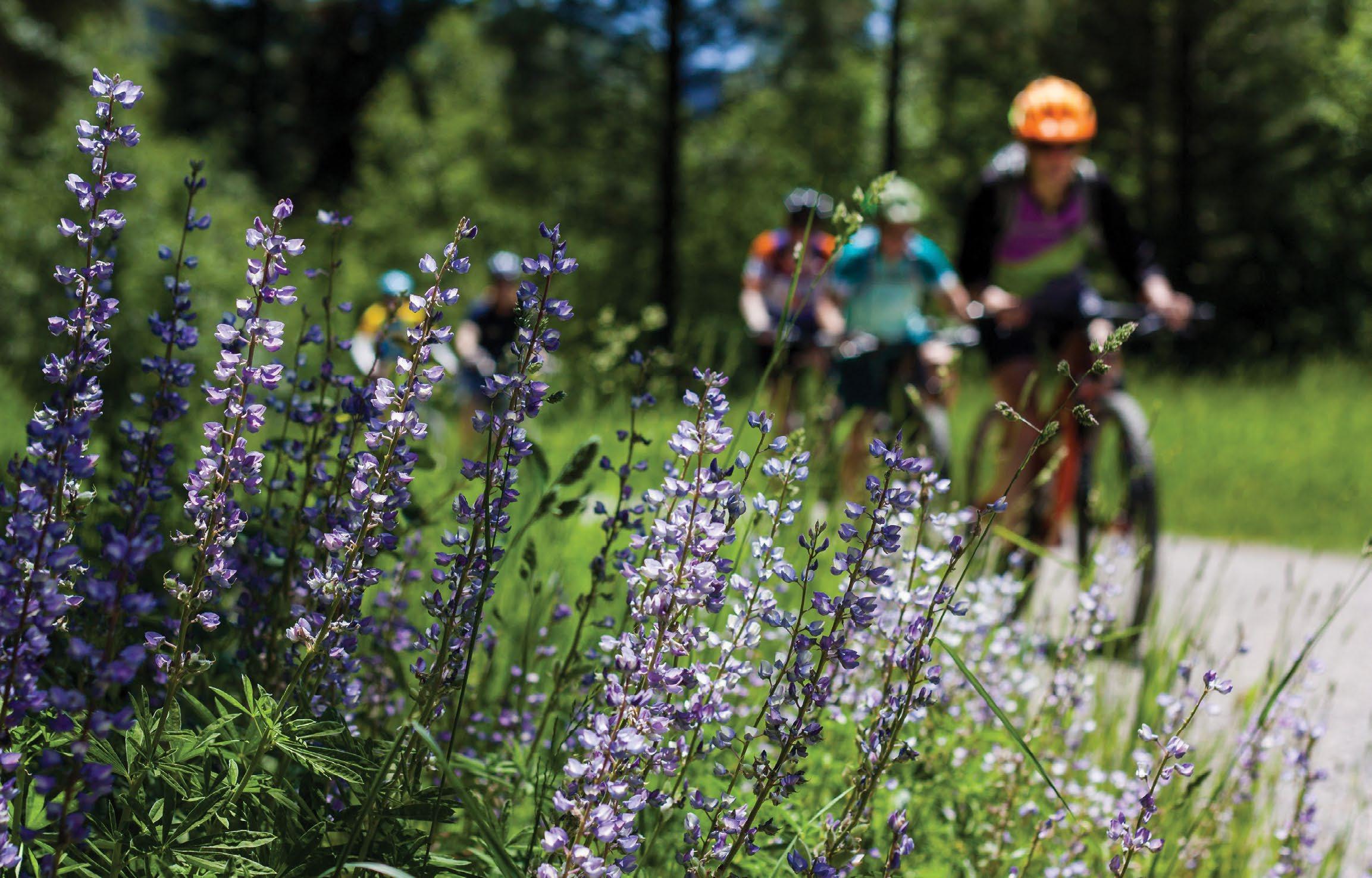
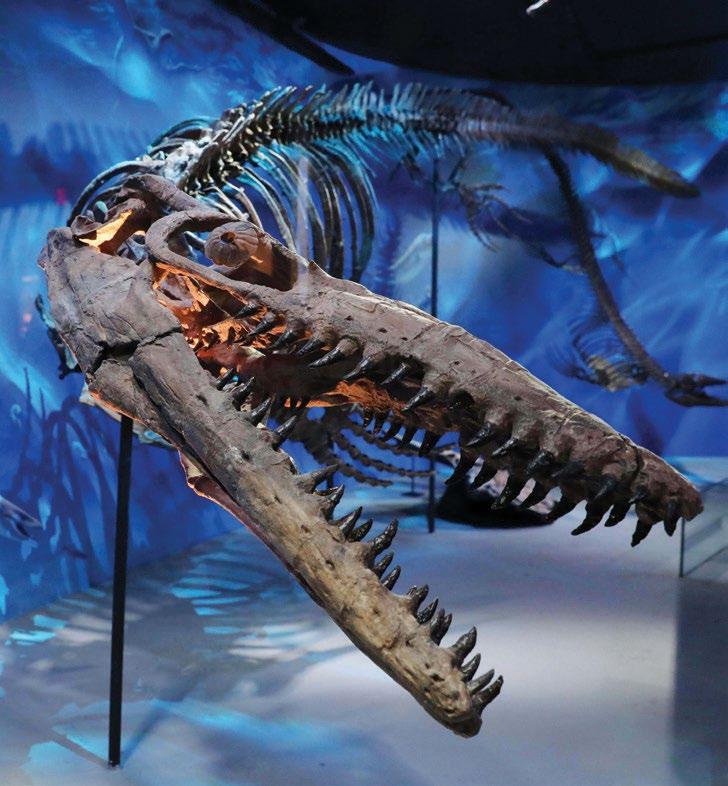
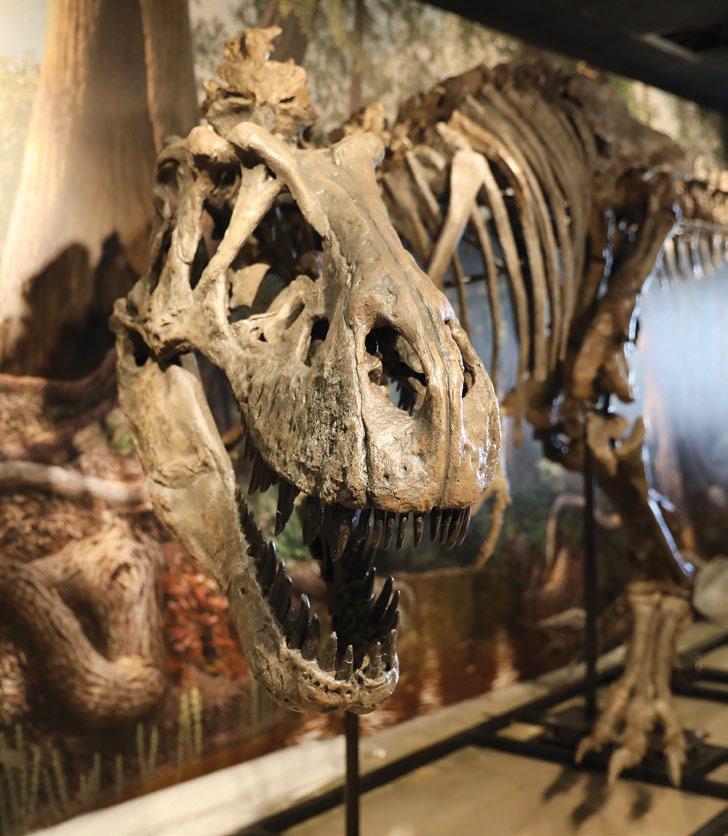

iled a new primary paleontology exhibition in 2025. Cretaceous Crossroads explores the time of transition, with a focus on three geologic formations in Montana (Two Medicine, Judith River, and Bearpaw) that span the period from 72 to 82 million years ago. The exhibit is comprised of real fossil material, 3D prints, casting, reproductions, murals, new paleo-art, AV interactives, an augmented reality piece, microscope stations, discovery drawers, and more.

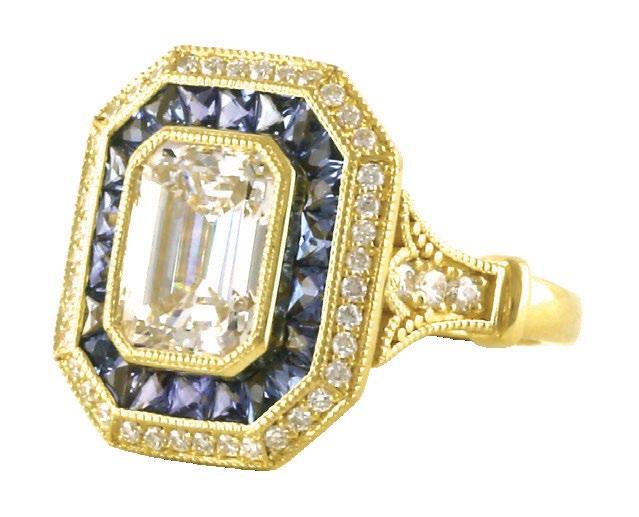
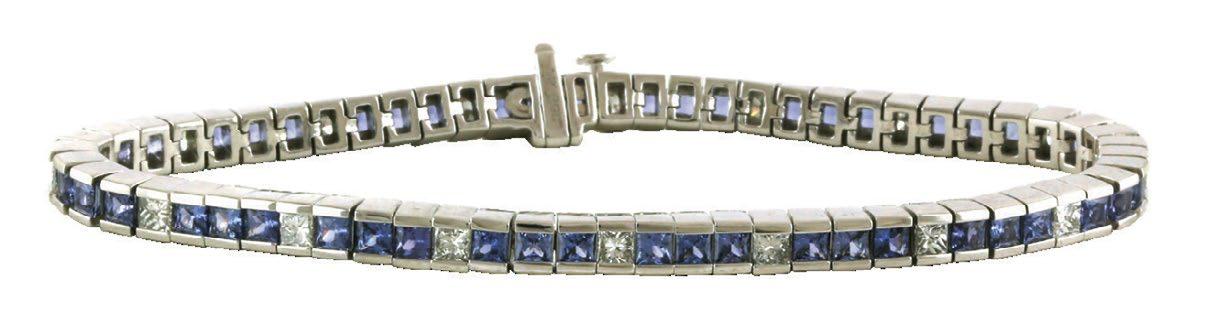
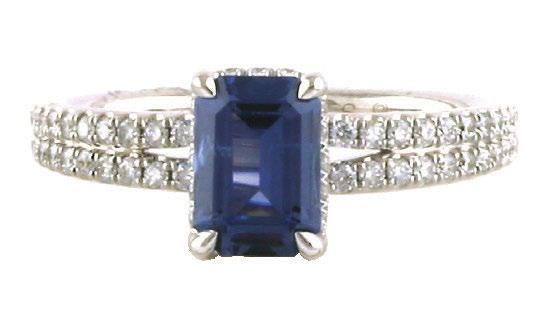

By Katie Thomas
It’s New Year’s Eve and snowing. A group of 21-year-olds dressed in crushed velvet and tuxedos pile into someone’s Jeep Commando, setting off toward the grandest party destination in the valley. When they pull up to an elegant, palatial hotel, the driver drops them off and they tiptoe around the corner to the exterior staircase and slip inside. The group blends into the crowd of swirling, laughing revelers and make themselves at home. That was me and my friends in 1998, indulging in our annual tradition: We dressed to the nines and sneaked into the Gallatin Gateway Inn for its New Year’s Eve ball.
The Gallatin Gateway Inn is a historic railroad hotel situated on U.S. Highway 191, just north of the town of Gallatin Gateway, Montana. On February 18, 1927, the Milwaukee Road railway company broke ground for one of the most sophisticated hotels of its time, on what it hoped would become the main rail transportation to Yellowstone National Park. Automobiles were not yet a common mode of transportation, and tourism to the park was growing. The Milwaukee sought to compete with Union Pacific Railroad’s facilities at West Yellowstone and Northern Pacific Railway’s in Gardiner.
The Milwaukee’s Pacific Extension ran east-west across Montana from 1908 until 1980, when it was finally abandoned. But things were bustling in 1927, and the electrified railroad’s main route had spur lines to Bozeman and Gateway. The Spanish Colonialstyle inn was built as a respite for Yellowstone-bound travelers before they boarded buses to the park. Construction took just four months to the tune of $500,000. The resulting 24,000-square-foot structure featured 28 original guest rooms, a sprawling lobby, a dining room featuring custom “Galatea” china, and telephones in every guest room—a cutting-edge luxury for its time. The grand opening was held June 17, 1927,

and drew more than 20,000 people.
The inn’s construction put the surrounding community on the map. Once known as “Slabville” for its cabins built from cast-off lumber mill pieces, the town was named Salesville in 1883 for Zachariah Sales, an early pioneer who had established a sawmill there. In 1927, Salesville was officially renamed Gallatin Gateway, to promote the region. Further publicity efforts included nationwide press releases, short features in the Milwaukee Magazine cheekily dubbed “Gallagrams”—in which hotel guests were nicknamed “Gallagaters”—and even a film called “Honeymoon at Gallatin Gateway Inn.”
The Milwaukee operated the hotel until 1951, when it sold due to declining business. Rail travel was falling fast, overtaken by the growing popularity of the automobile, and the inn was purchased by Butte businessman Paul Holenstein. He was the first in a long line of private owners who struggled to turn a profit, and most were more concerned with revenue than preservation. In 1969, a Minnesota couple converted the inn into an antique museum and removed one of the cathedral windows with a chainsaw to drive cars inside. The late 1970s subjected the inn to an owner who used it for raucous concerts, spraying
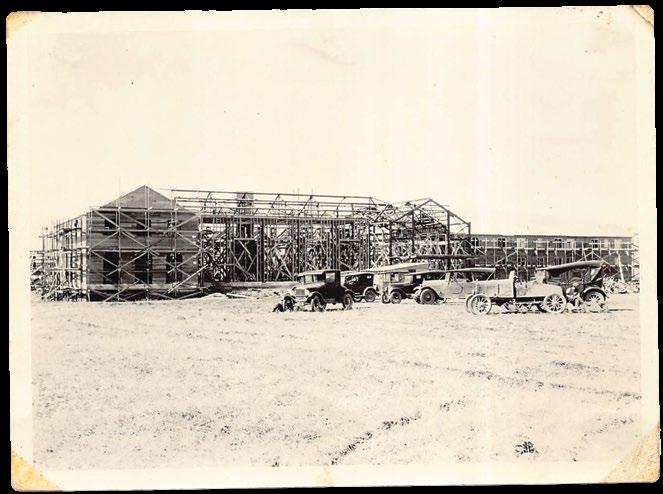
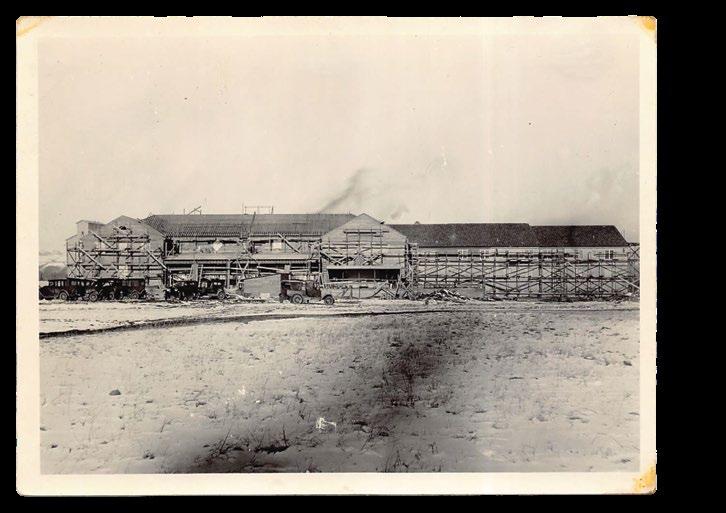
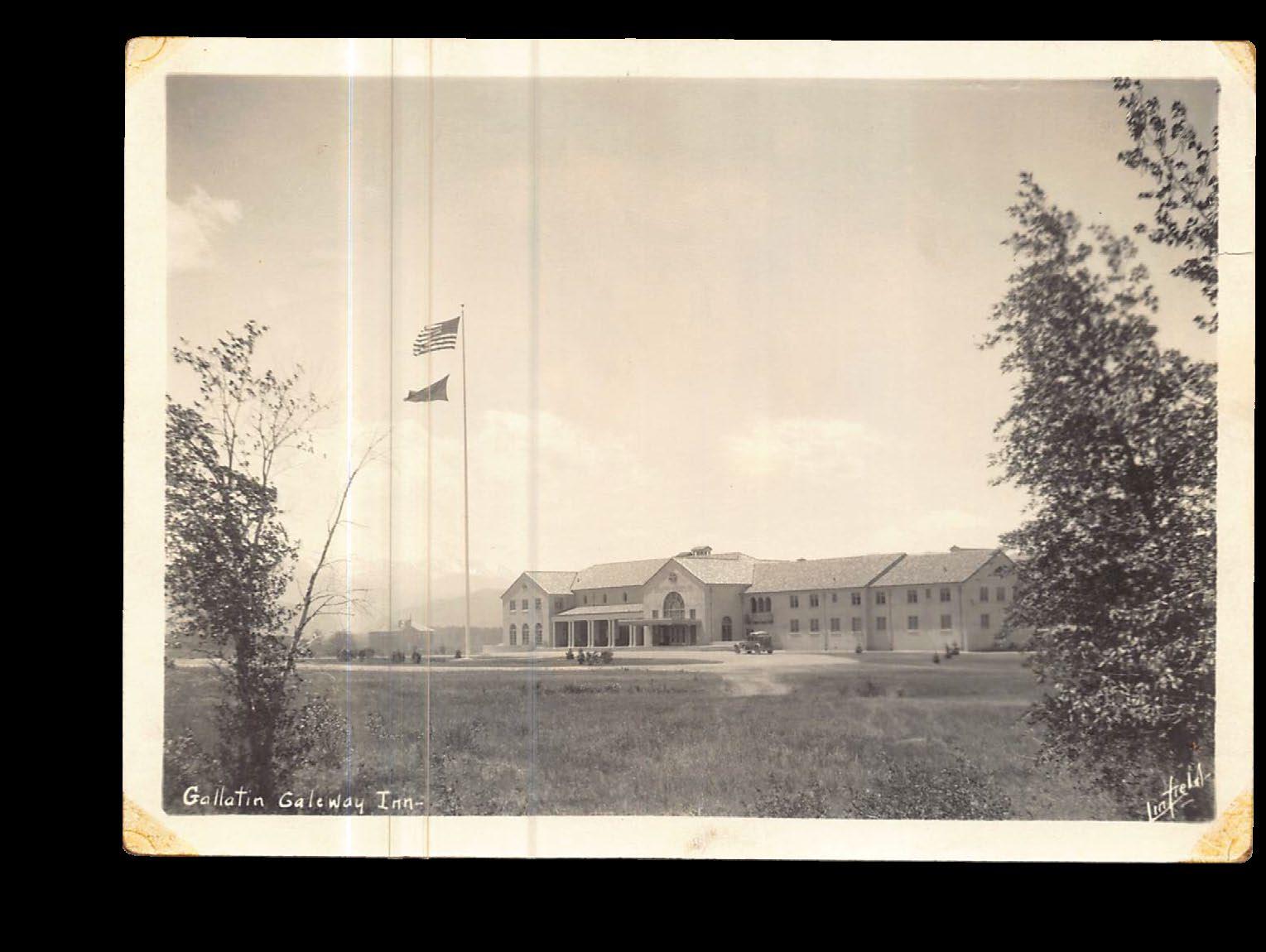
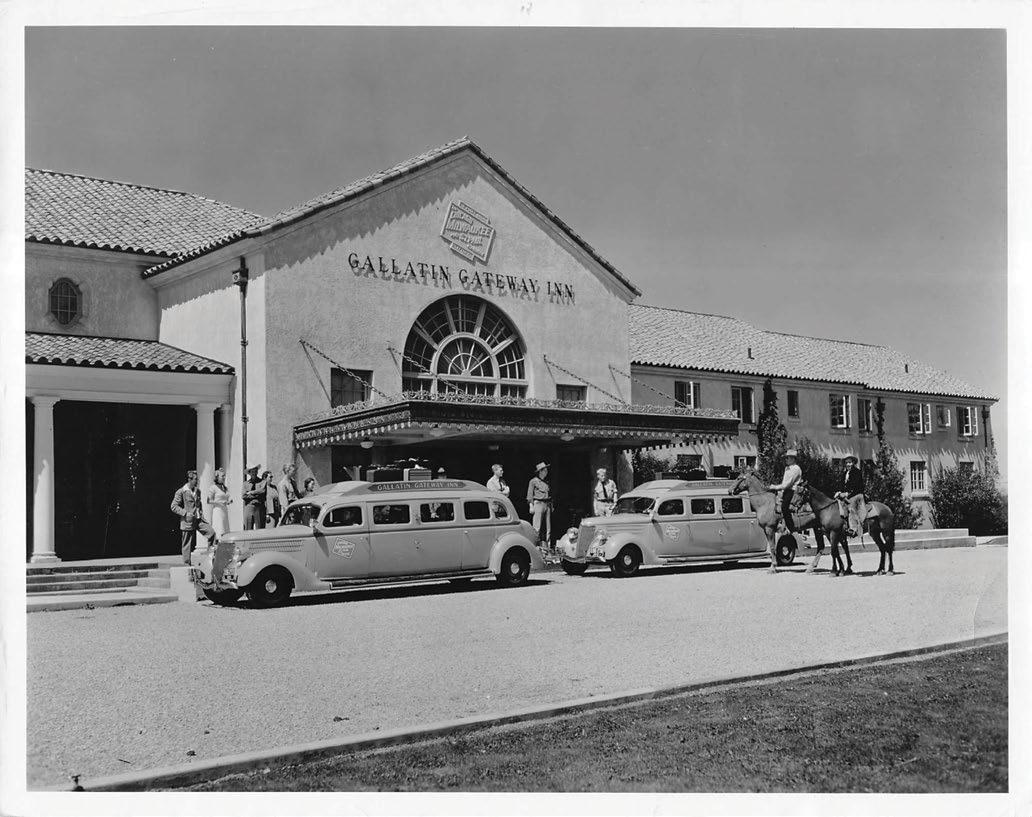

Opposite: Friends gather in the Porterhouse circa 1998. Courtesy of Katie Thomas This page: A series of photos showing the construction of, and completion of the Gallatin Gateway Inn circa 1927, as well as present-day and a Milwaukee Road advertisement. Photos courtesy of Yellowstone Club and Katie Thomas
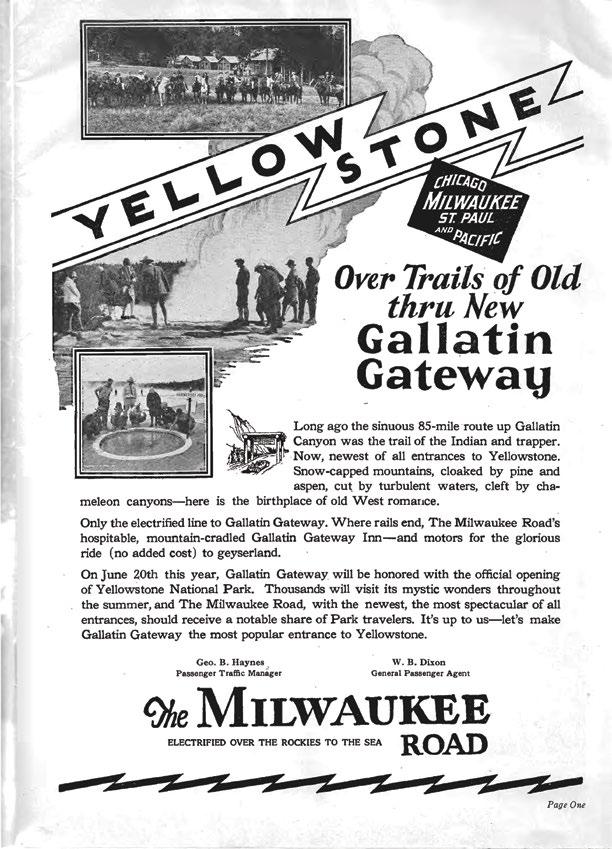
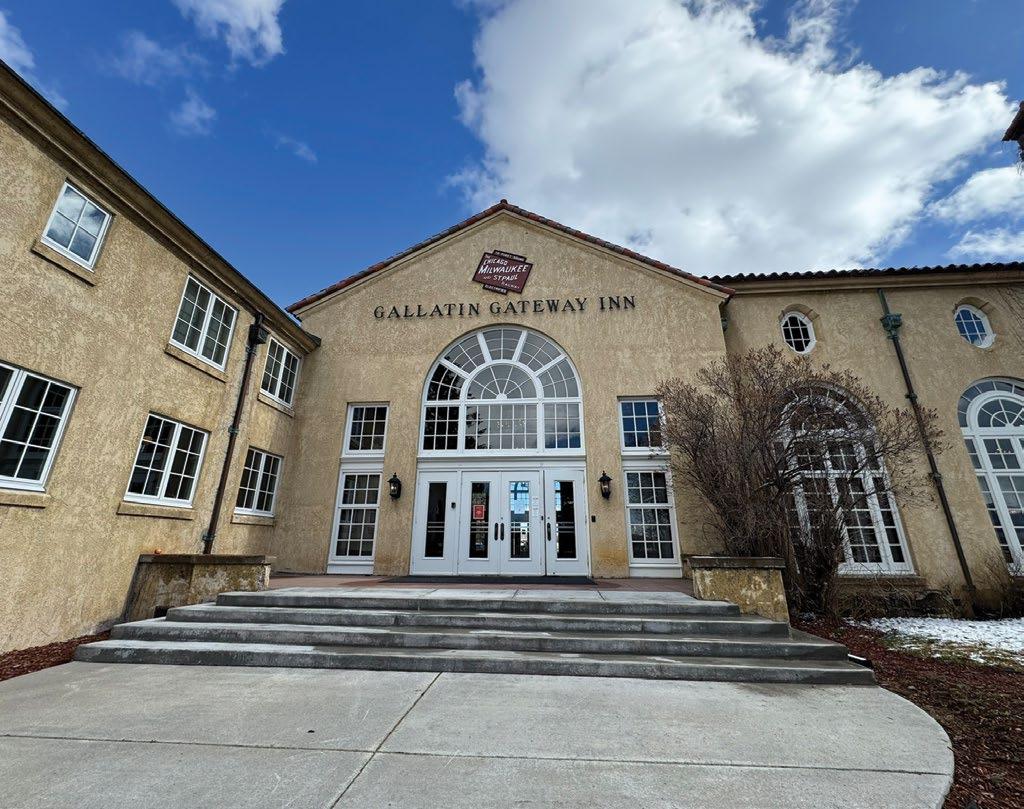
■ 1927: June 17, Grand Opening of the Gallatin Gateway Inn.
■ 1951: Milwaukee Railroad sells the inn to Butte businessman Paul Holenstein.
■ 1969: The Inn sells to Minnesota couple who converts it into an antique museum.
■ 1985: A young carpenter and his mother restore the hotel and in 1986 it wins the Montana Historic Preservation award.
■ 2014: Following a foreclosure in February, the Inn is purchased and renovated by M&M Hospitality.
■ 2015-current: the building is leased to the Yellowstone Club to provide housing for Yellowstone Club, Spanish Peaks Mountain Club and Moonlight Basin employees.
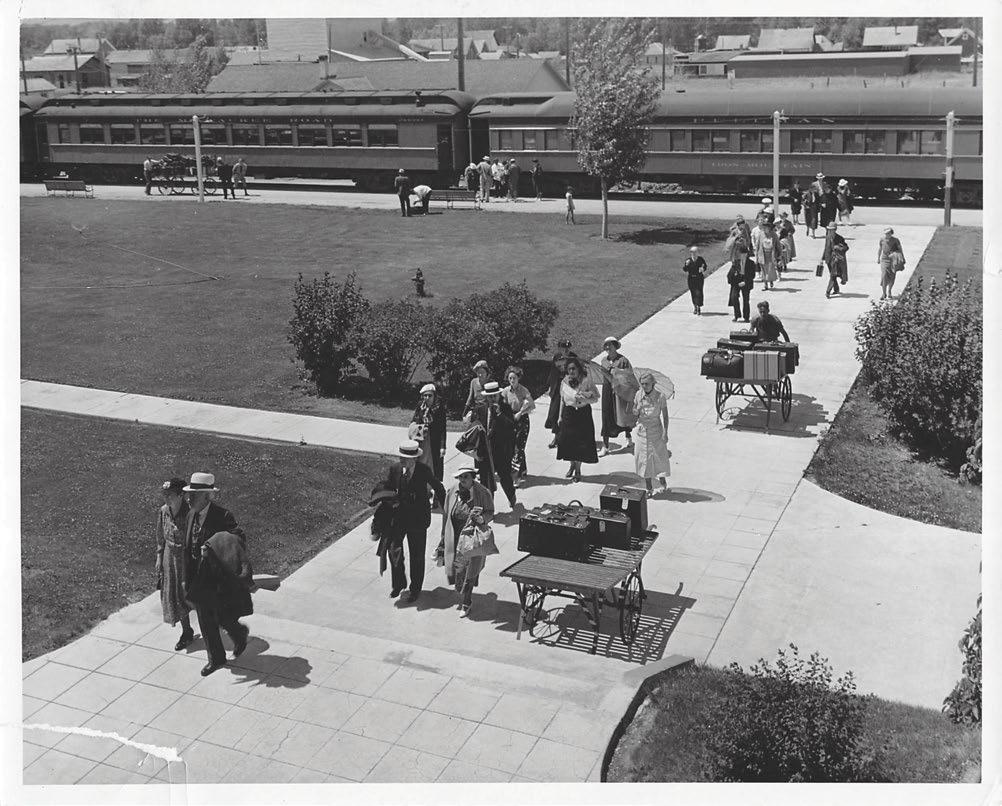
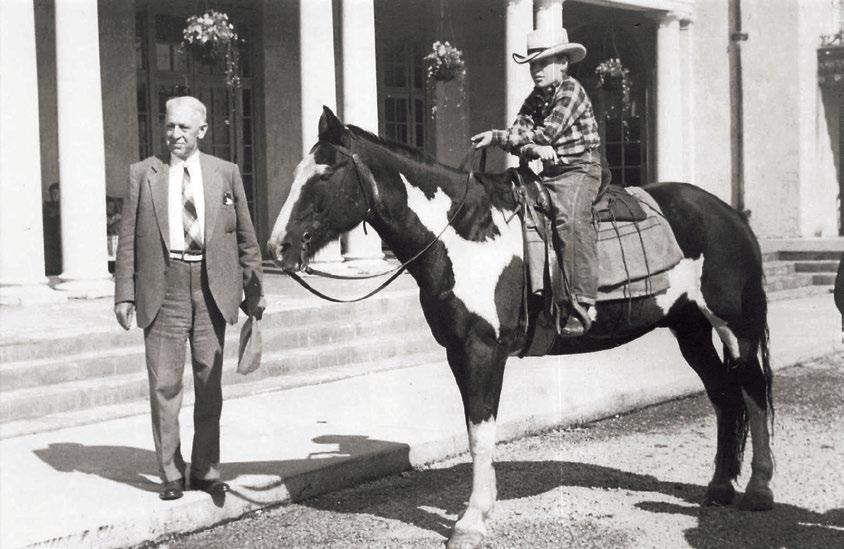
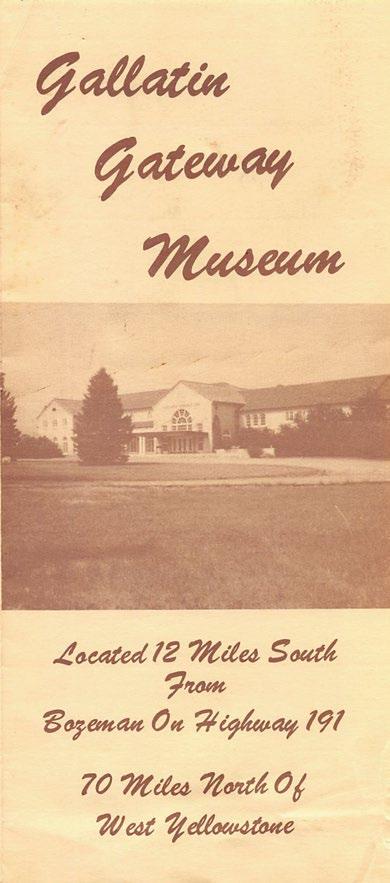
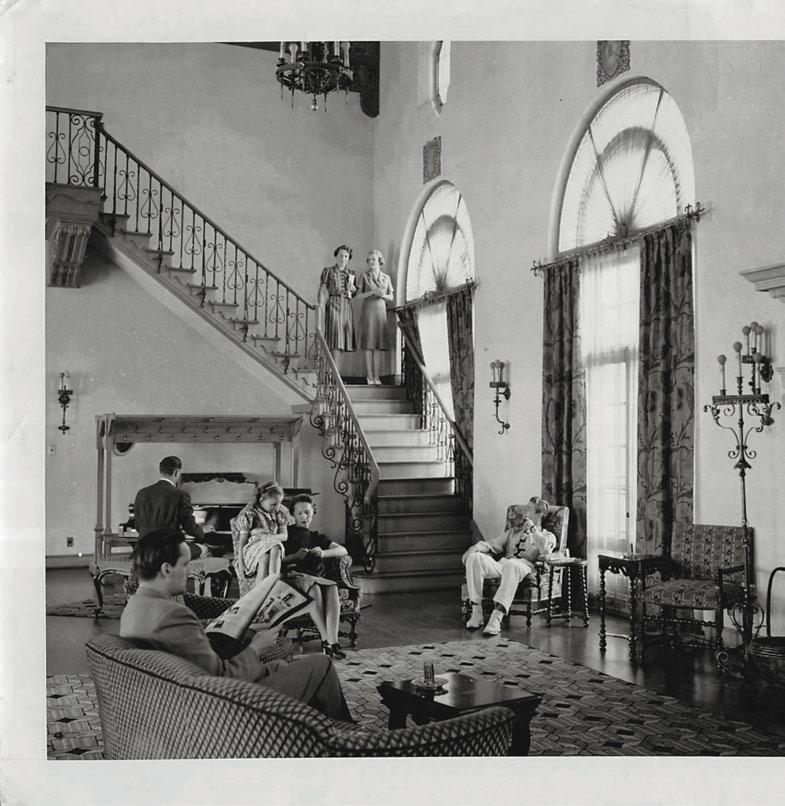
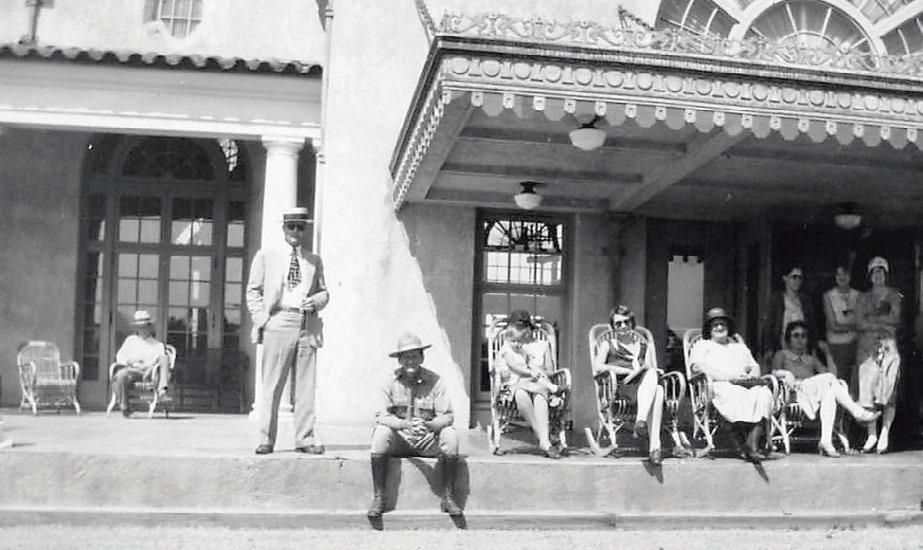
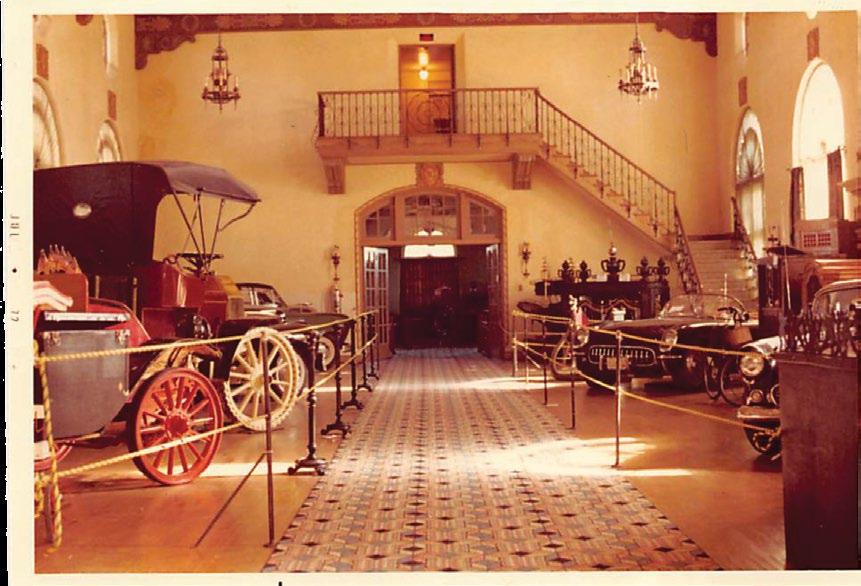
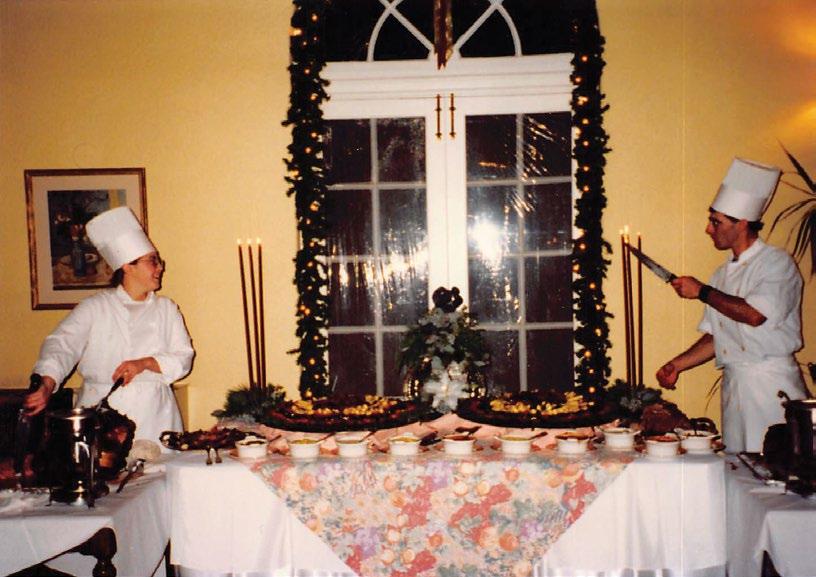
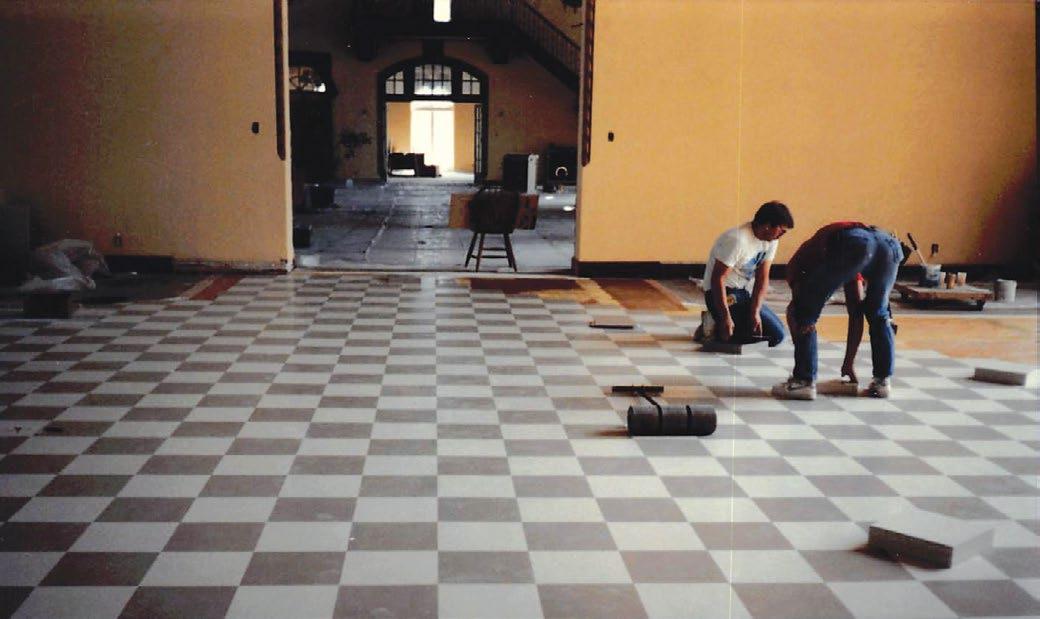

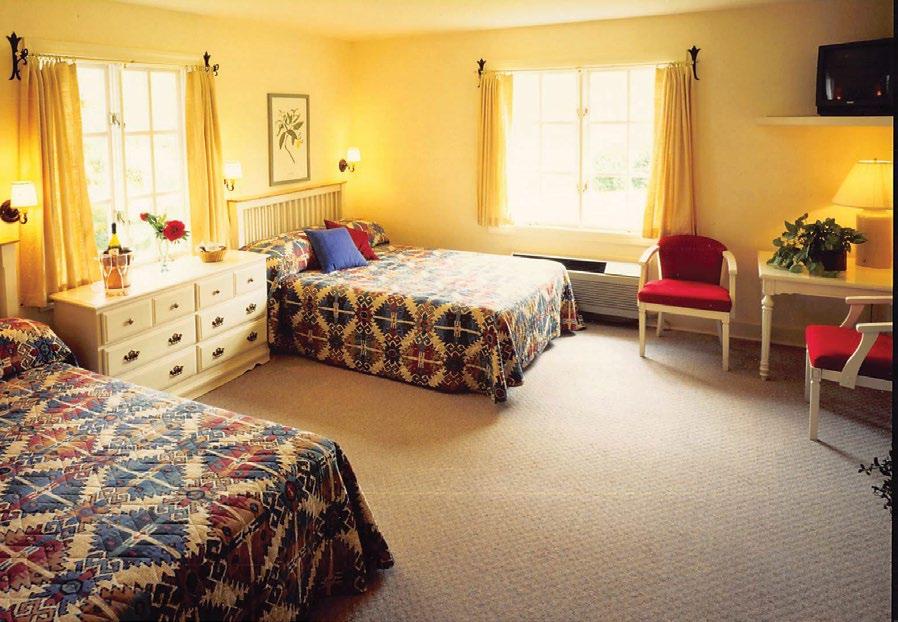
thick foam insulation on the walls and ceilings to improve acoustics. Women’s mud-wrestling matches involving Jell-O and chocolate pudding were a regular occurrence.
There was a silver lining to these indignities. A young carpenter moonlighting as a bartender during the shenanigans took note of the structure’s grandeur and hatched a plan. In 1985, he and his mother purchased the inn and began the daunting task of restoring the hotel. The beams alone required a tremendous amount of work. Foam was scraped away and years of grease and cigarette smoke were scrubbed off before the delicate rose stenciling could be repainted. Original furniture found in a dump behind the hotel was refinished and reupholstered. A new heating system was installed, as well as an outdoor swimming pool and hot tub. The inn reopened to great enthusiasm and earned the Montana Historic Preservation award in 1986.
The Gallatin Gateway Inn saw a few more owners over the next couple of decades. Then one day in 2013, the hotel staff arrived at work to discover padlocked doors and signs informing them the inn was closed until further notice.” Guests with reservations were not notified, and scheduled events were forced to find new venues. Local newspapers later reported that the owners, a couple from Las Vegas who had purchased the inn for $2.5 million in 2008, had filed a deed in lieu of foreclosure. Rocky Mountain Bank was the inn’s new owner.
In March of 2014, a Minnesota-based real estate group bought the hotel, and the Yellowstone Club in Big Sky began leasing the building for employee housing. Lone Mountain Land Company purchased the inn from the Minnesota group in 2015 and continues to lease it to the Yellowstone Club today. I’m happy to report that this paragon of style and history is in good hands: The checkered floor, windows, and mahogany beams still gleam. The original railroad clock in the lobby ticks on, marking current time. The old ticket booth and shoe-shine station remain intact, looking ready for use at any moment. The dramatic ballroom with its immense fireplace retains its historic flair and class. Schack’s Depot, named for James Schack, one of the inn’s architects, is the new employee café occupying the old dining room.
As the Gallatin Gateway Inn approaches its 100th year, its story is worth telling in full. That it remains upright and fully restored to its original splendor is a testament to its construction and the people who refused to let it disappear. This landmark has survived countless owners, incarnations and renovations. It was added to the National Register of Historic Places in 1980 and is listed as a Historic Hotel of America. It’s a monument to travel, technology, hospitality, the economy, and southwestern Montana. Cheers to its next 100 years!
Katie Thomas is the dining contributor for Bozeman Magazine and writes for many local publications about food, people, local history, and the outdoors. Her first fiction, the story Terraces, has been published in the mystery anthology Deadly Yellowstone.
1. Guests arriving at the west entrance. Photo by Torkel Korling 2. The lobby. Photo courtesy of Katie Thomas 3. Cover of the old restaurant menu. Photo courtesy of Katie Thomas 4. Horseback arrival. Photo courtesy of Lone Mountain Land Company 5. Guests getting sunshine on the front deck. Photo courtesy of Lone Mountain Land Company 6. A welcome flyer inviting passerby to stop in. Photo courtesy of Yellowstone Club 7. A flyer advertising the Gallatin Gateway Museum, now located in the Inn. Photo courtesy of Yellowstone Club 8. Inside the museum portion of the building. Photo courtesy of Lone Mountain Land Company 9. Brunch in the 1980s. Photo courtesy of Lone Mountain Land Company 10. Remodeling the floor. Photo courtesy of Catherine Wratherdece 11. One of the hotel’s accommodations, circa 1988. Photo courtesy of Lone Mountain Land Company

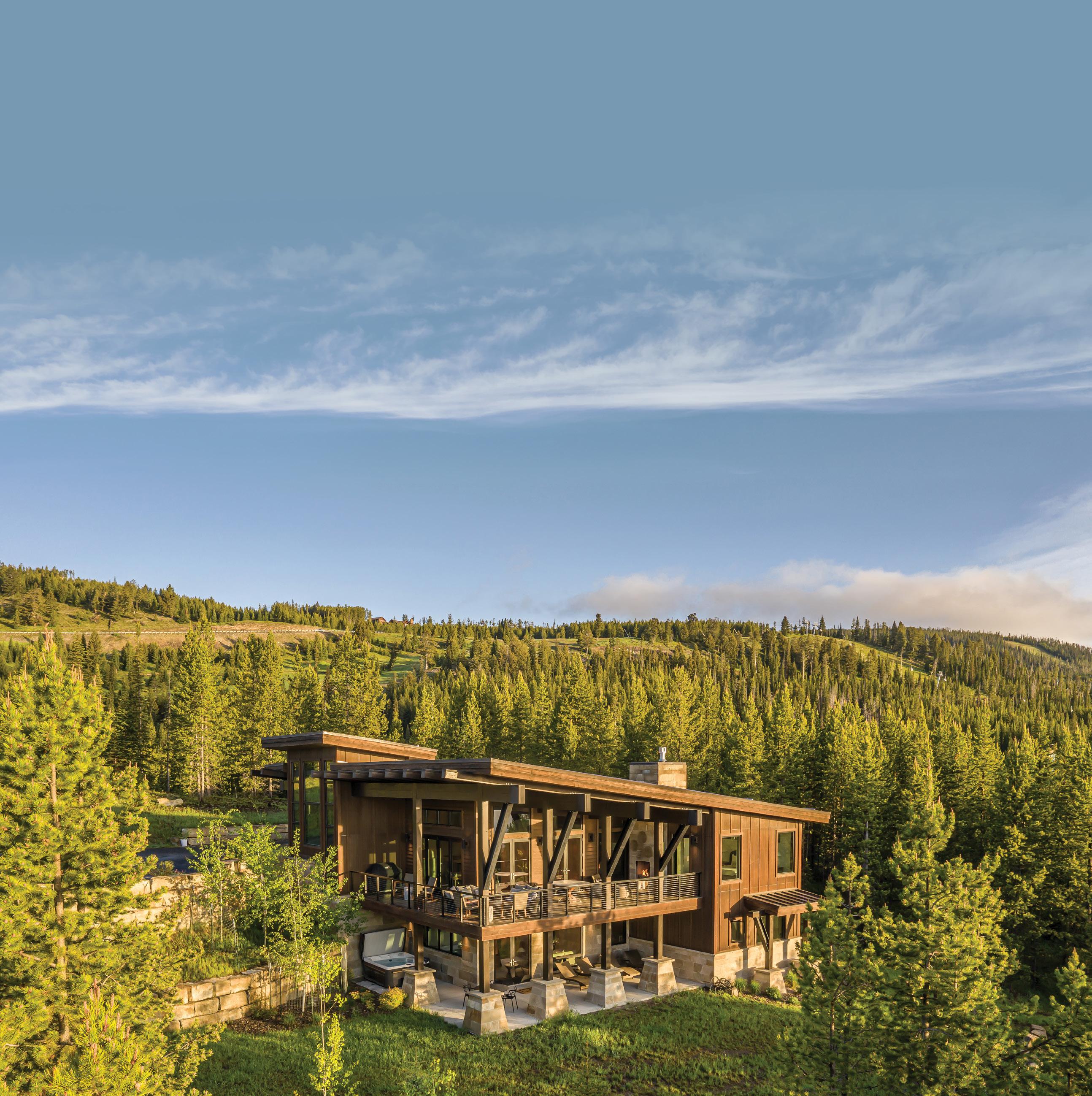
What does Natural Retreats offer homeowners? Resources, expertise and integrity. Together, we allow you to enjoy your vacation home while you’re here—and maximize its revenue potential while you’re away. What do we offer guests? The vacation of a lifetime.
Natural Retreats has cultivated a devoted following of travelers who know and love our brand. These are people who appreciate stunning homes in amazing destinations. And they want to book your home.

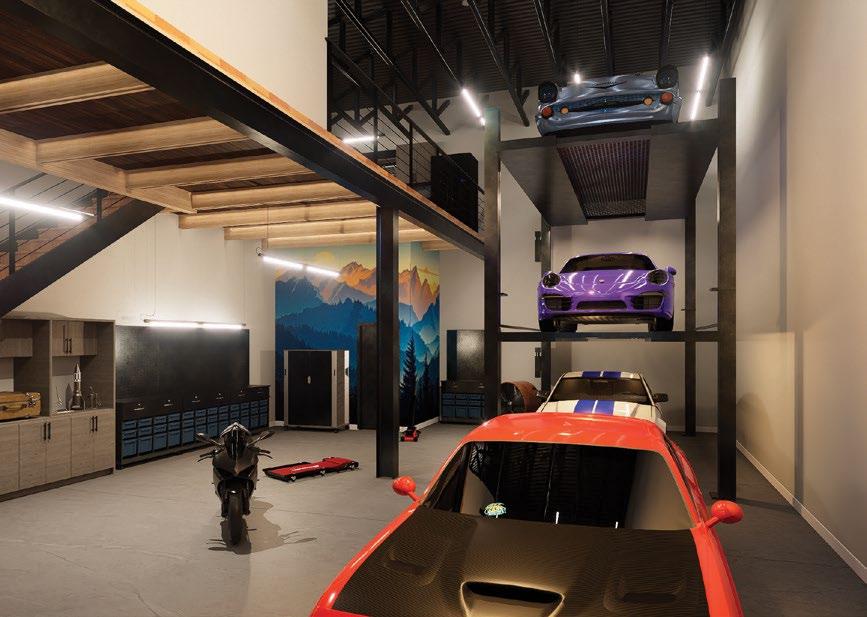
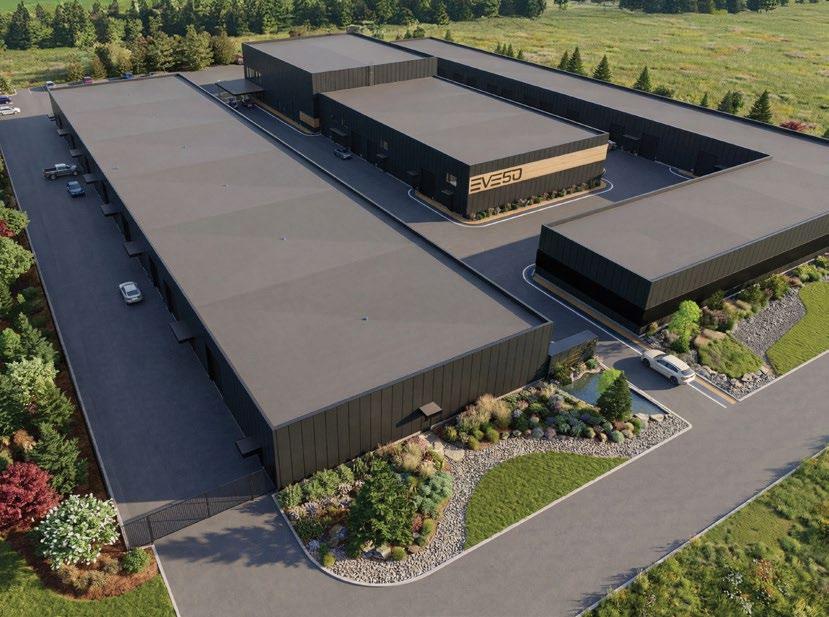





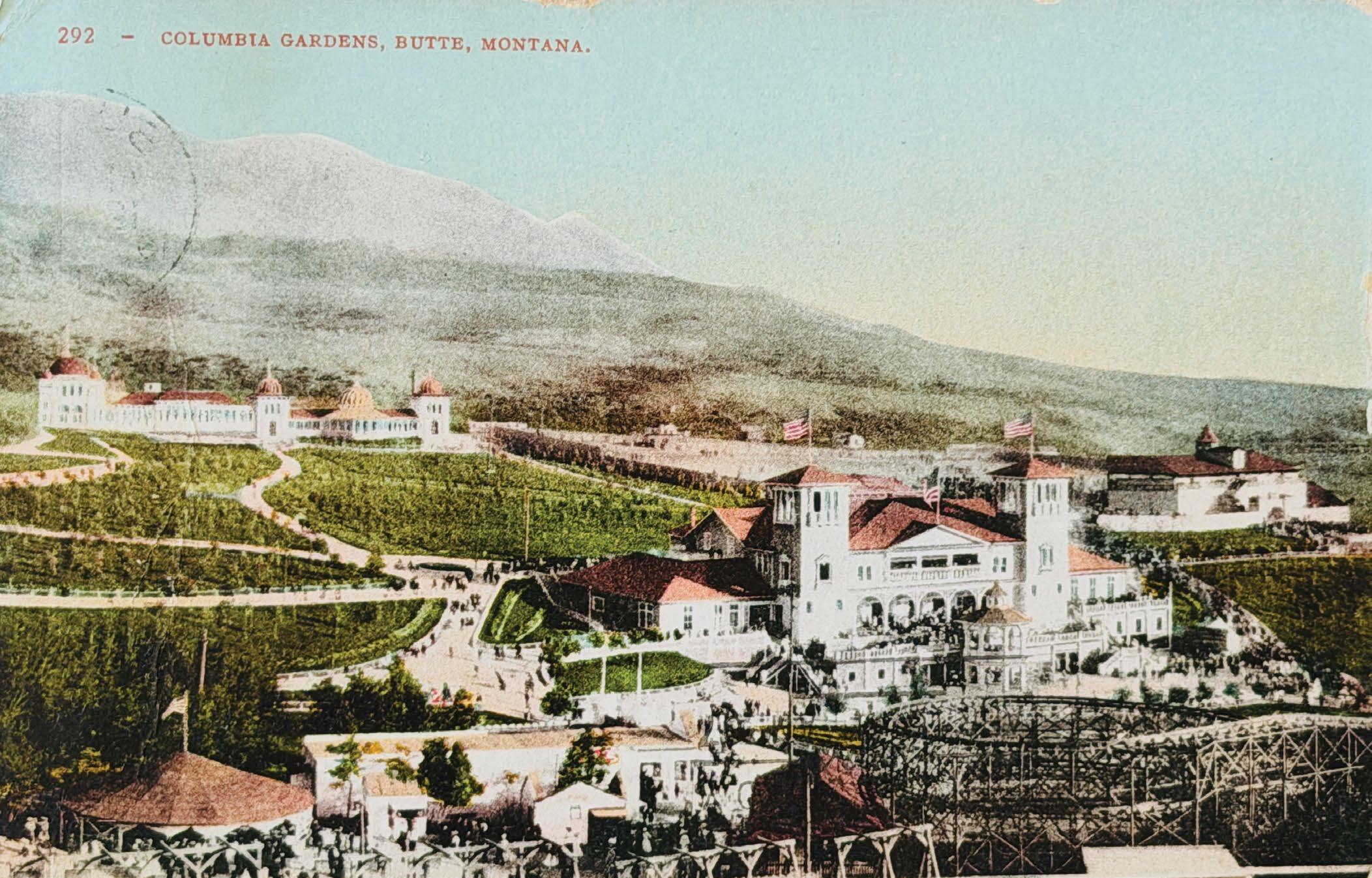
By Butch Larcombe
The history of Butte, Montana, is pockmarked with tragedy. An 1895 explosion at a warehouse storing mining explosives killed 58 people, including 13 firefighters. The funeral procession drew an estimated crowd of 20,000. The Granite MountainSpeculator fire in 1917 claimed 168 lives and remains the deadliest hard-rock mining incident in U.S. history. On a wintry November morning in 1950, a Northwest Airlines plane crashed on Butte’s East Ridge, killing 22, and claiming the sad title of
Montana’s worst air disaster.
Amid these tragedies, an unremarkable building fire on the outskirts of Butte in November 1973 is seared into the memories of generations of the city’s residents and Montanans across the state. The blaze in the Arcade building at the Columbia Gardens, a sprawling recreational park and social hub, destroyed 46 hand-carved and carefully painted wooden horses, the key pieces of the carousel that many regarded as the centerpiece of the Gardens, once described


as “68 acres of heaven just east of the Richest Hill on Earth.”
The carousel horses and pieces of other carnival-style rides, tabbed as “priceless” in a newspaper headline the day after the fire, represented the last filament of hope for the Gardens. About eight months before the fire, Robert Weed, the head of the Anaconda Company’s primary metals division, and for decades the owner and operator of almost all major mining operations in Butte, told attendees at a Rotary Club meeting that the upcoming summer would be the last season for the landmark park. The Gardens property, which sat near the massive Berkeley Pit, would become the site of an expanded copper mining operation, the East Pit. Weed also noted the company’s plans to expand the Berkeley Pit even closer to the city’s historic uptown and raised the possibility that the commercial center might eventually need to be relocated to make room for mine expansion.
While Columbia Gardens changed and evolved over the years, it remained a popular place for picnics, birthday parties, family gatherings and dances for all ages.


On Labor Day, an estimated 5,000 to 6,000 people made a final pilgrimage to the Gardens. In the coming fall days, the wooden carousel horses, pieces of a popular biplane ride and other items were stored in the Arcade building, with hopes they could land elsewhere in Butte. The fire two months later consumed those hopes.
A state fire marshal quickly ruled out arson, and the fire was officially blamed on a faulty electrical transformer. But a cloud of suspicion about the 1973 fire still hangs over Butte. In the days after the fire, letters to the editor in The Montana
Standard, Butte’s daily newspaper, expressed skepticism about the transformer explanation. Stories circulated in the city that electrical service to the building had been shut off at least a month before the fire.
Many fingers were pointed at the Anaconda Company, with allegations that the mining giant wanted the Columbia Gardens buildings and structures gone as soon as possible to speed development of the new open-pit mine. There were accusations of arson, a hot topic in Butte in the 1970s. In the first three years of that decade there were 28 major fires, many in uptown Butte. Just a few months before the fire at the Gardens, a spectacular blaze destroyed the ornate five-story Medical Arts Building, which sat prominently on the corner of Park and Main streets. That fire drew a crowd of several thousand onlookers.
Even in 2026, more than five decades after the Arcade building fire, a Facebook page dedicated to memories of the Columbia Gardens has a number of comments about the fire.
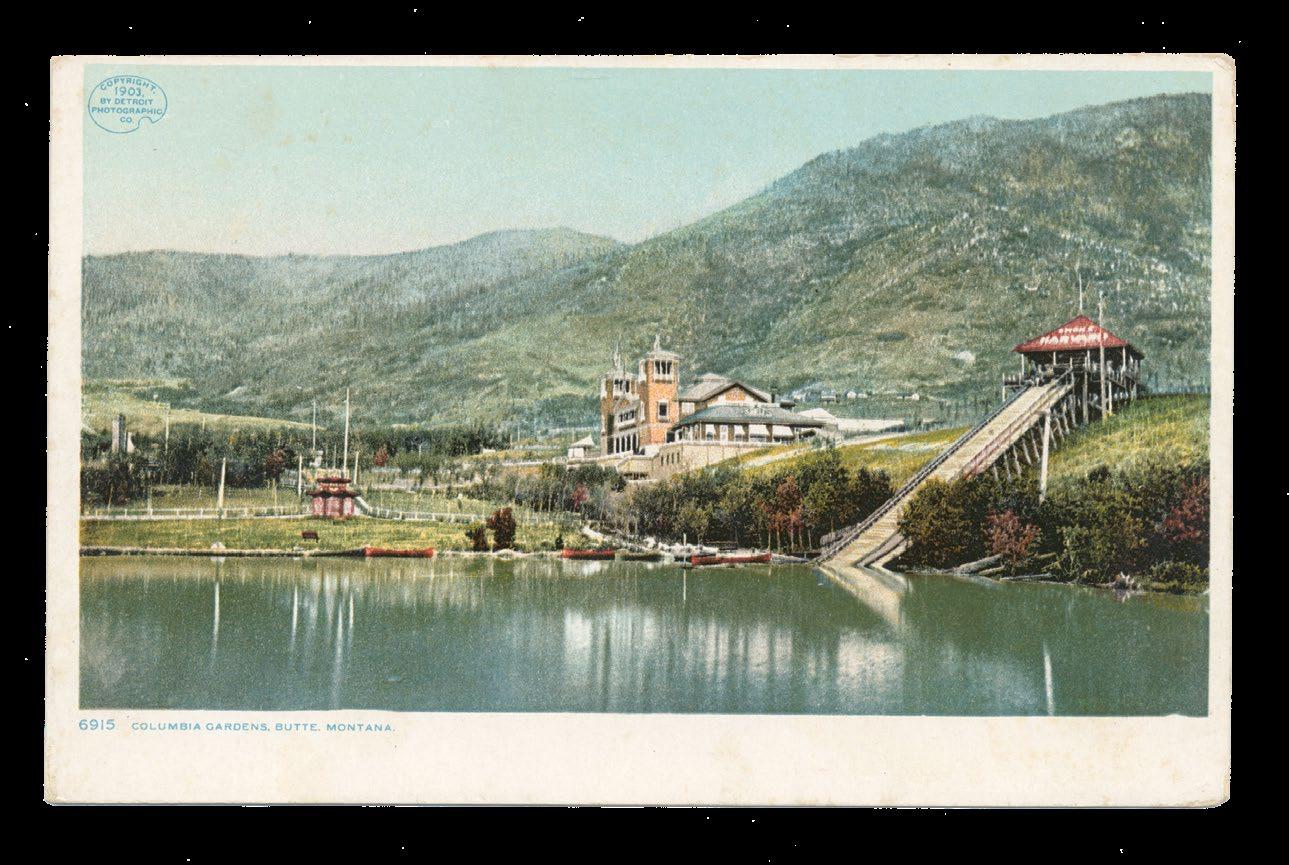

“Lots of cool memories were taken away by pure greed and the fire was not [the result of] a transformer,” one person wrote. “It was purposely set. Everyone knows this to be true.” Another social-media cynic doubted the transformer explanation, instead blaming “Anaconda Company goons, just like all the other totally non-suspicious fires that hit parts of uptown Butte that were later incorporated into the (Berkeley) pit.”
The 1973 fire and speedy demolition of the remainder of the Gardens made for a sad ending to a decades-long love story. The creator of the Gardens was an unlikely character—W.A. Clark, the often-reviled Butte Copper King. Clark in 1899 bought 23 acres for a reported $30,000,
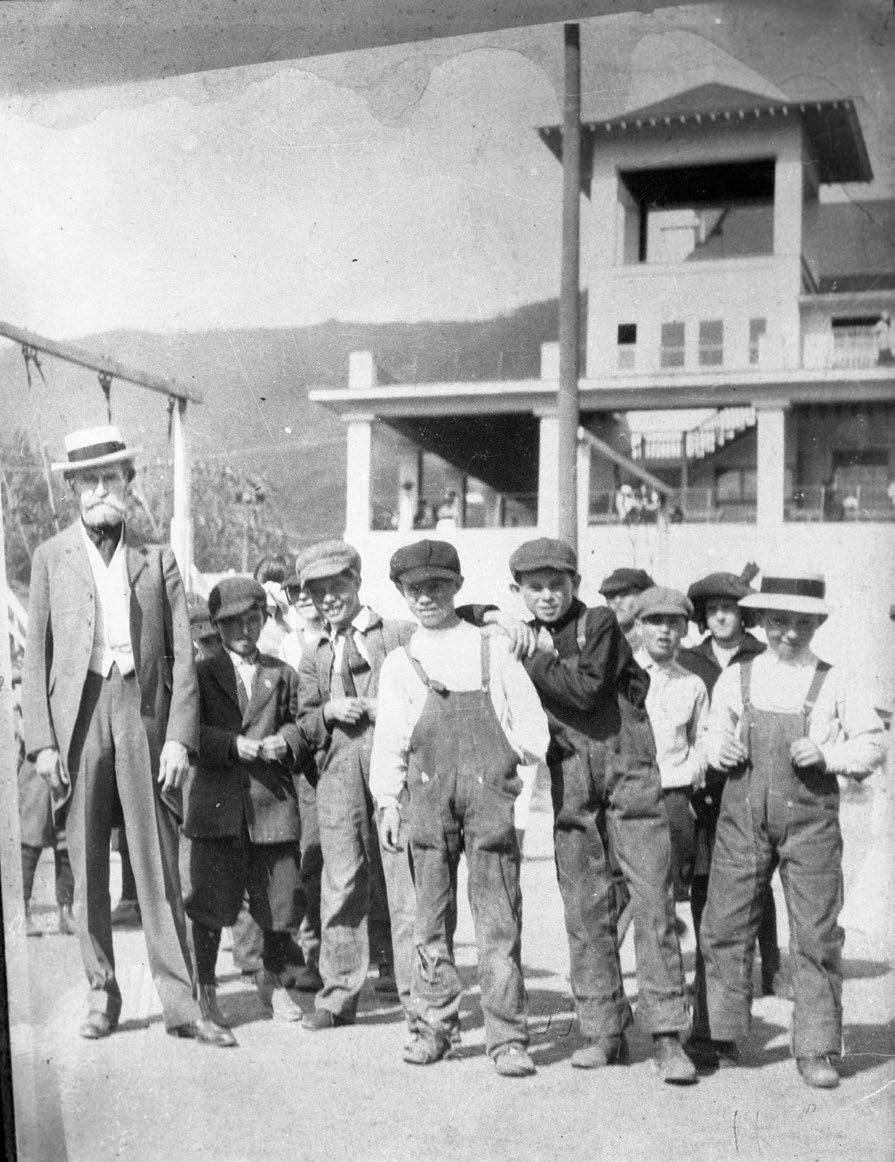
But to the community, which had endured fires, strikes and the downsizing of the Anaconda operations and workforce, the loss of Columbia Gardens was a staggering psychological blow and to some, a betrayal.
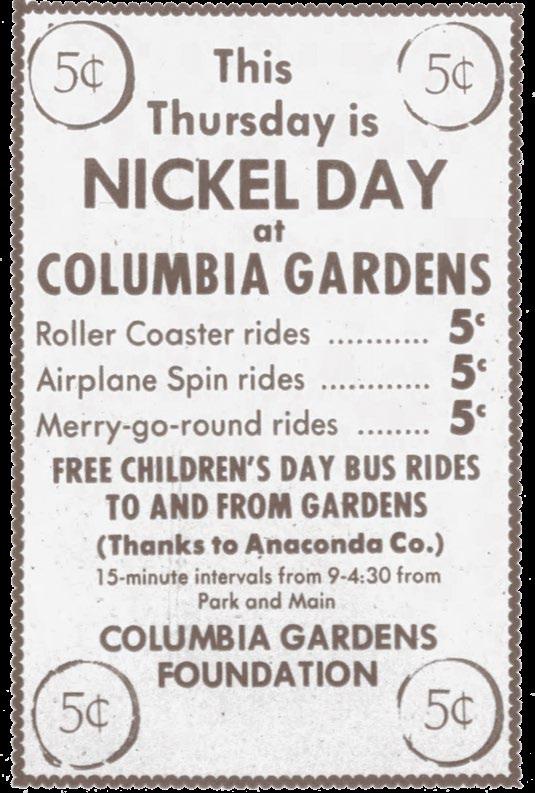
about 3.5 miles east of the Mining City’s uptown business district. He quickly set about developing what was later described as “one of the West’s most beautiful recreation spots.”
The early version of the Gardens featured a lake for swimming and boating, a fish hatchery, a zoo filled with Montana wildlife, a herbarium, greenhouses, a pavilion with a huge dance floor and acres of flower gardens, grass and trees. And there were the amusement rides, including the colorful carousel and a legendary threestory wooden roller coaster, likely the only permanent coaster ever built in Montana.
Clark, who reportedly spent more than $1 million to develop Columbia Gardens, also expanded his Butte Electric Railway Company to include a line running from the center of the city to ferry visitors to the site. On Arbor Day, in May 1901, a Butte newspaper reported that 15,000 people took advantage of free trolley rides to visit the fledgling Gardens. It quickly became an oasis in a gritty city where trees and grass were scarce, and mining dominated many facets of life.
In the ensuing years, a stadium at the Gardens played host to professional and amateur baseball games, football contests
Left:
when rides cost just five
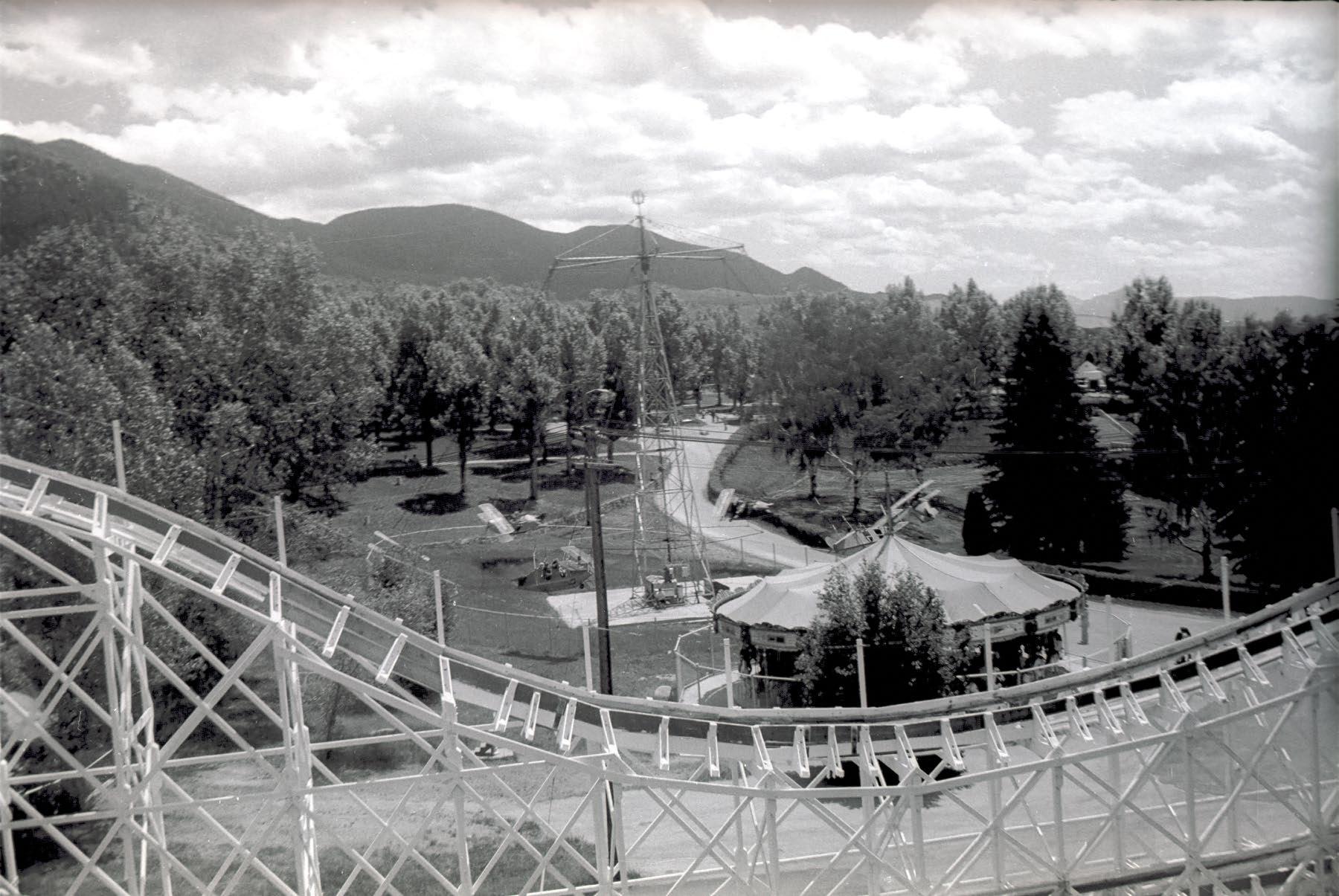
Left: The roller coaster and carousel were most popular attractions at the Gardens. Photo courtesy of Archives & Special Collections, Mansfield Library, Univ. of Montana
Bottom: A hot-air balloon release over the sprawling park, which included a dance pavilion, an arboretum, arcade and acres of flowers and trees. Photo courtesy of Archives & Special Collections, Mansfield Library, Univ. of Montana
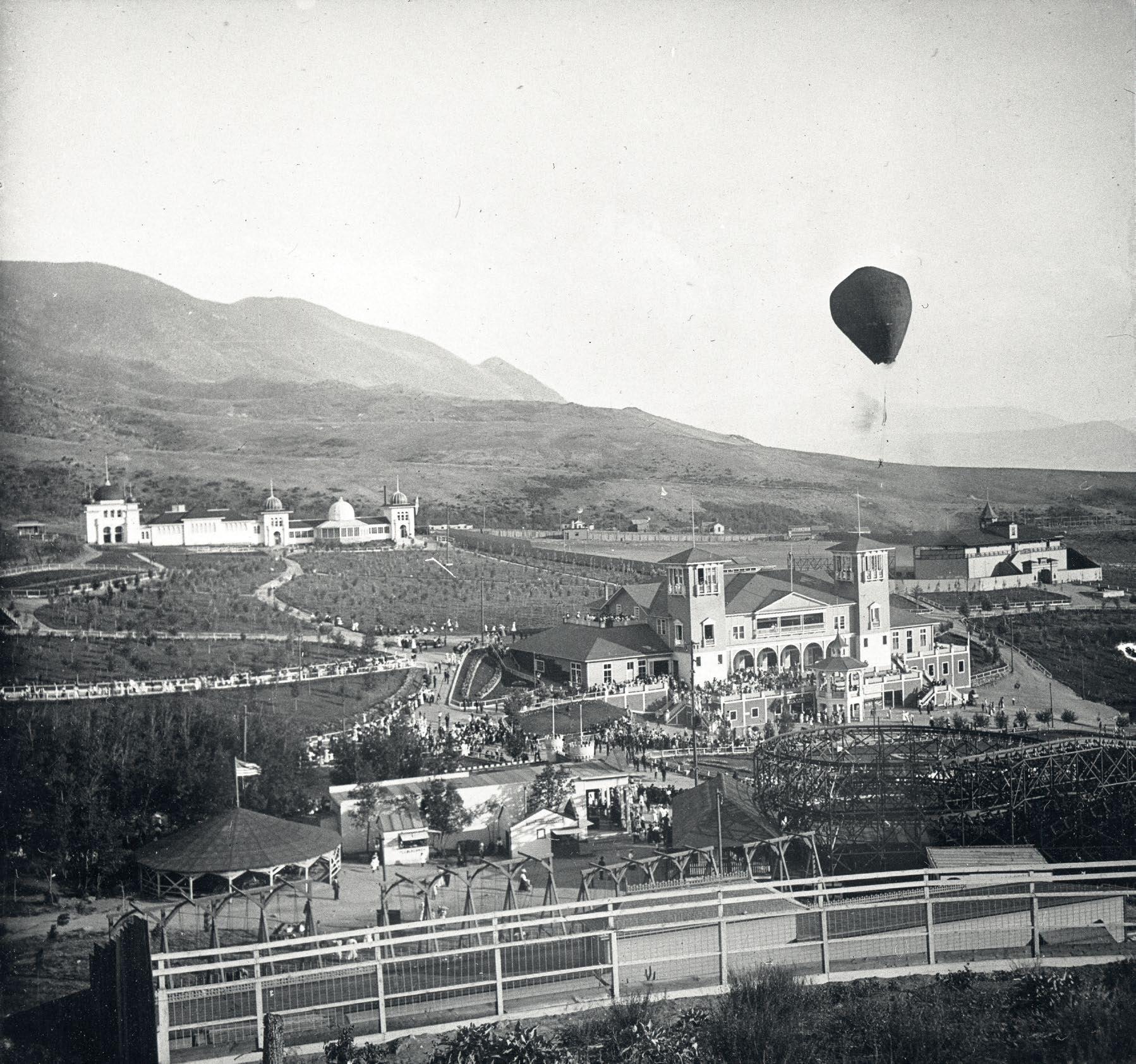
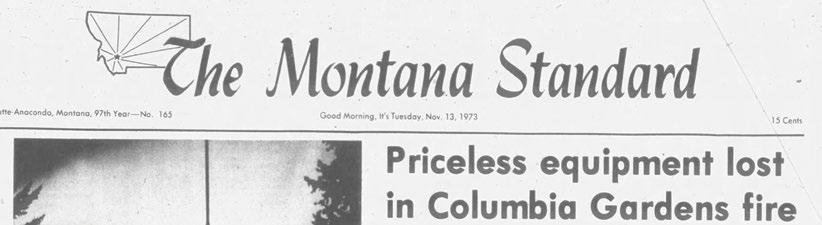
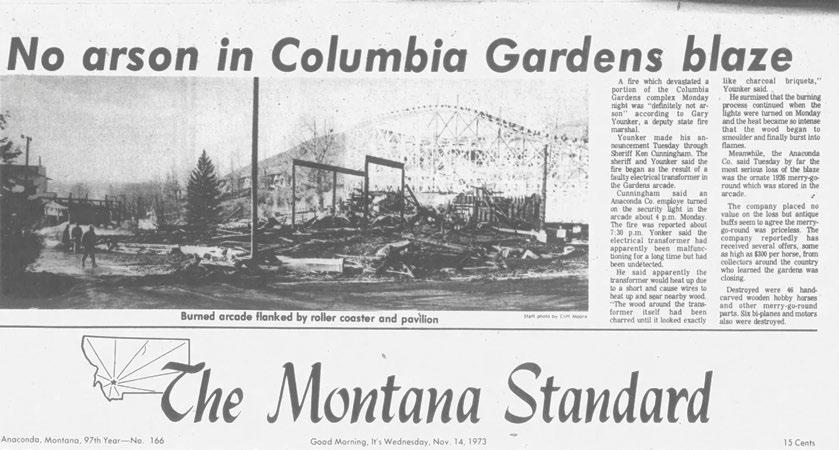
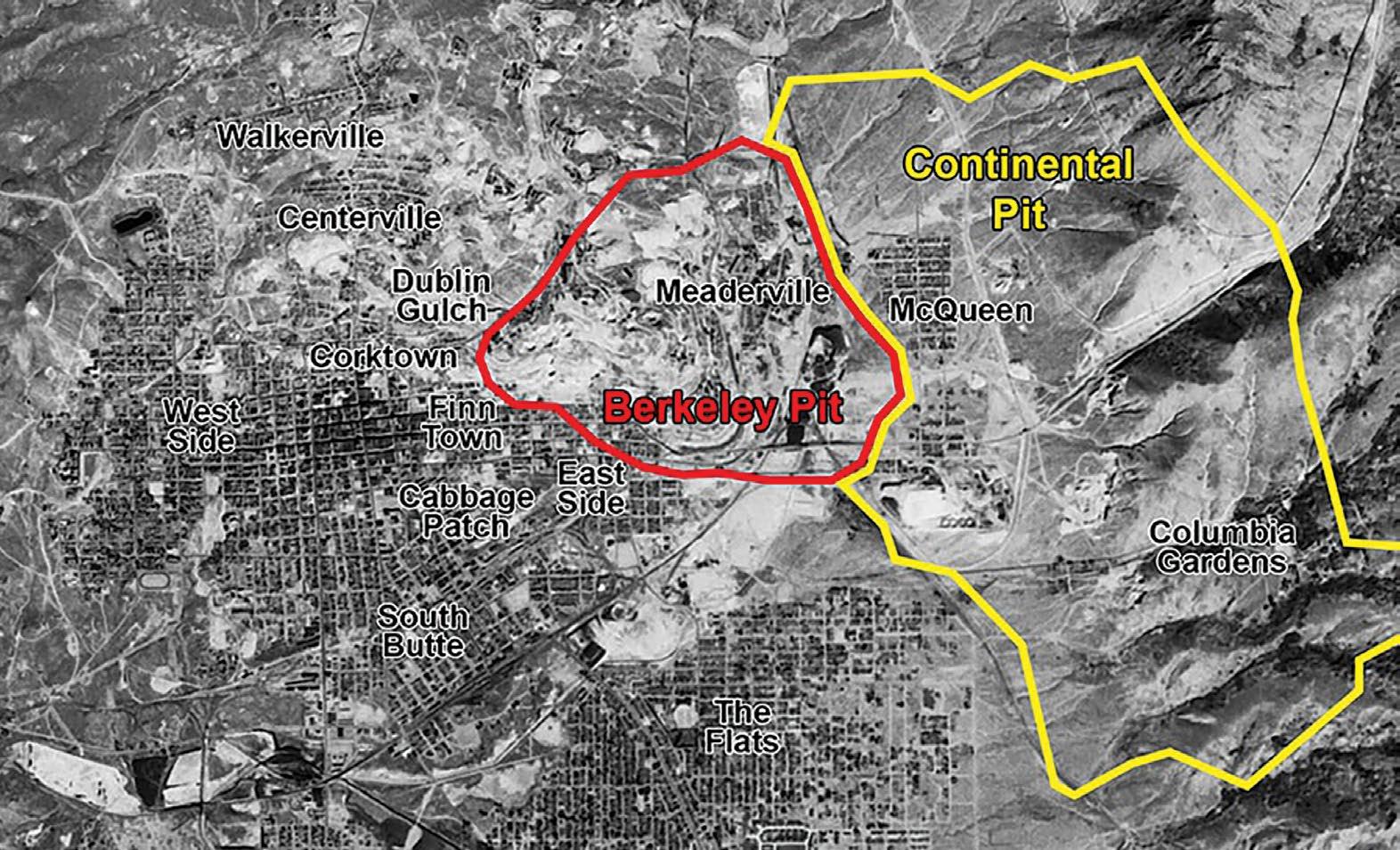
and other gatherings, including the popular Miners’ Union Day events. While Columbia Gardens changed and evolved over the years, it remained a popular place for picnics, birthday parties, family gatherings and dances for all ages. Clark set aside a day each week as a Children’s Day, offering free trolley rides and admission and reduced prices for park attractions. Children’s Day became a tradition that continued to the final days of the Gardens. Generations of Montanans were enthralled. Ellen Crain, a local historian who helped lead the ButteSilver Bow Public Archives, a repository for all things Butte, was a teenager when the Gardens disappeared.
“There was no place like it in Montana,” she told The Montana Standard 30 years after the Gardens closed.
“It was wonderful.”
Along with the disputed 1973 fire, another mystery simmers: Why did Clark, largely viewed as a ruthless capitalist who would become one of the wealthiest men in America thanks to ventures in mining, banking, railroads and real estate, invest heavily in a recreation area that offered little prospect of financial return?
Some believe that during a tour of Butte, the
Copper King was struck by the need for Butte children to have a safe place to play away from the city’s streets and alleys. A less charitable explanation revolves around Clark’s desire to serve in the United States Senate. His 1899 campaign to win Montana legislative appointment to a seat was tainted by a bribery scandal that forced his resignation. Some view his spending spree to develop the Gardens as an attempt to curry support for his continued political aspirations. Clark ultimately secured a Senate seat in 1901 and served one term.
Motives aside, Clark appeared to have genuine affinity for the Gardens. “The Columbia Gardens is my monument,” Clark said, according to an account in The War of the Copper Kings, a 1935 book by author C.B. Glasscock. “Of my many business enterprises it is the one I love the best, and it’s practically the only one on which I lose money.”
After his death in 1925, Clark’s heirs sold his Montana operations, including the Columbia Gardens, to the Anaconda Company. Along with maintaining the area, Anaconda added amusement attractions and refurbished the popular roller coaster. While the electric trolley was discontinued, the
company replaced it with bus service, at least for the weekly Children’s Day and other events.
Anaconda, at one point the fourth-largest company in the U.S. as measured in financial terms, appeared to operate the money-losing Gardens for decades as a community relations tool. But Anaconda’s fortunes took a serious hit in the early 1970s when its mines in Chile and Mexico were nationalized. By some estimates, those foreign operations accounted for threefourths of the company’s profits. With the Gardens losing more than $200,000 per year and Anaconda desperate to boost its domestic copper production with its Butte operations, the closure announcement early in 1973 wasn’t a big surprise. But to the community, which had endured fires, strikes and the downsizing of the Anaconda operations and workforce, the loss of Columbia Gardens, a treasured part of Butte for nearly 75 years, was a staggering psychological blow and to some, a betrayal. Butte-raised author Janet Finn summarized that sentiment in her 2023 book Tracing the Veins. “With the Gardens destruction,” she wrote, “many came to the troubling conclusion that nothing was sacred: Not even the very survival of the community was safe
“With the Gardens destruction, many came to the troubling conclusion that nothing was sacred: Not even the very survival of the community was safe from corporate consumption.”
-Janet Finn
from corporate consumption.”
Many still mourn the loss and likely agree with the late Pat Williams, Montana’s longestserving member of Congress and a Mining City native who described the loss of Columbia Gardens as “one of the greatest tragedies of Butte.”
Butch Larcombe worked for 30 years as a newspaper reporter and editor and as the editor of Montana Magazine. His book, Montana Disasters: True Stories of Treasure State Tragedies and Triumphs, was published in 2021. His most recent book, Historic Tales of Flathead Lake, was published in 2024. He lives near Bigfork.
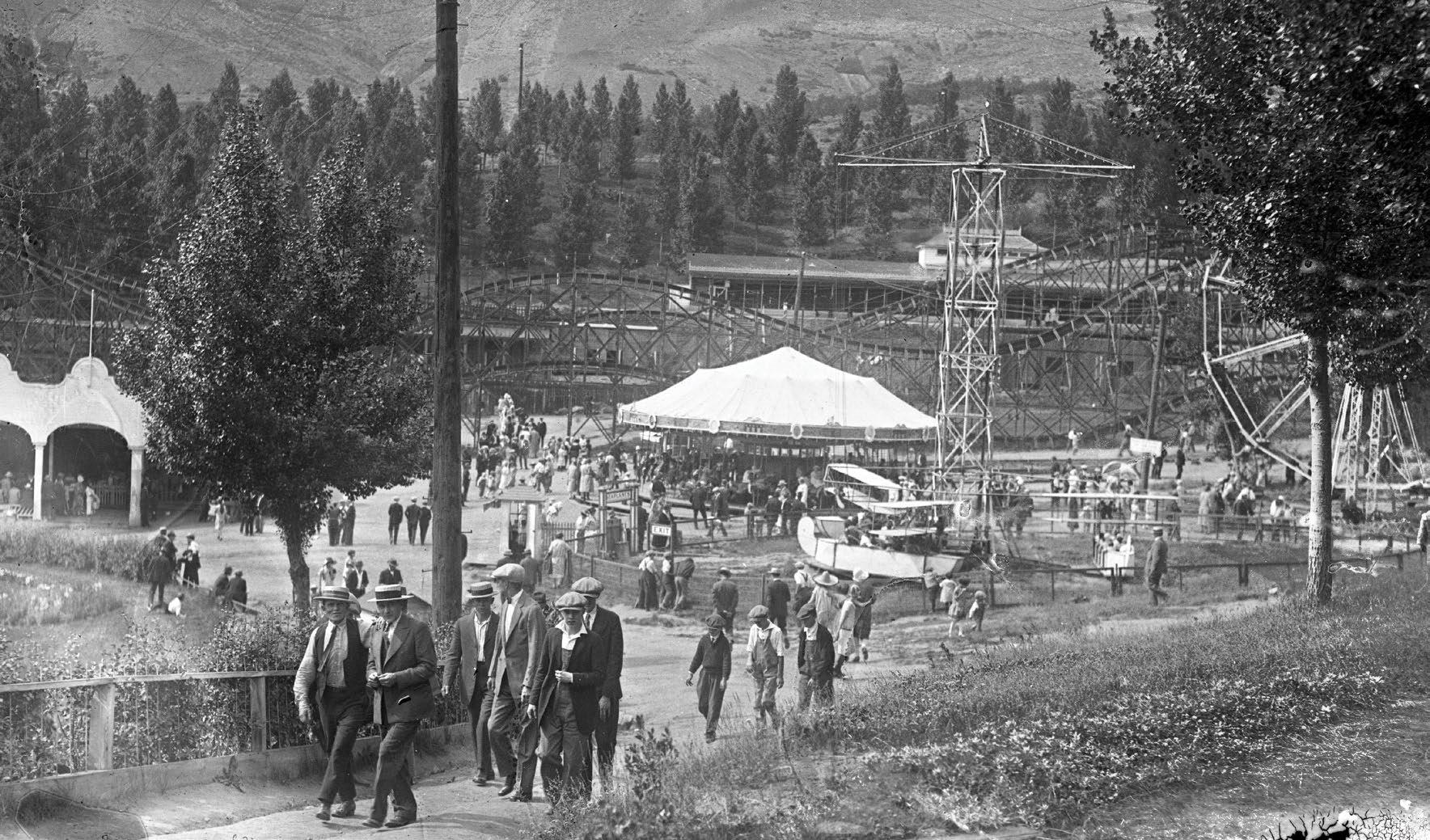
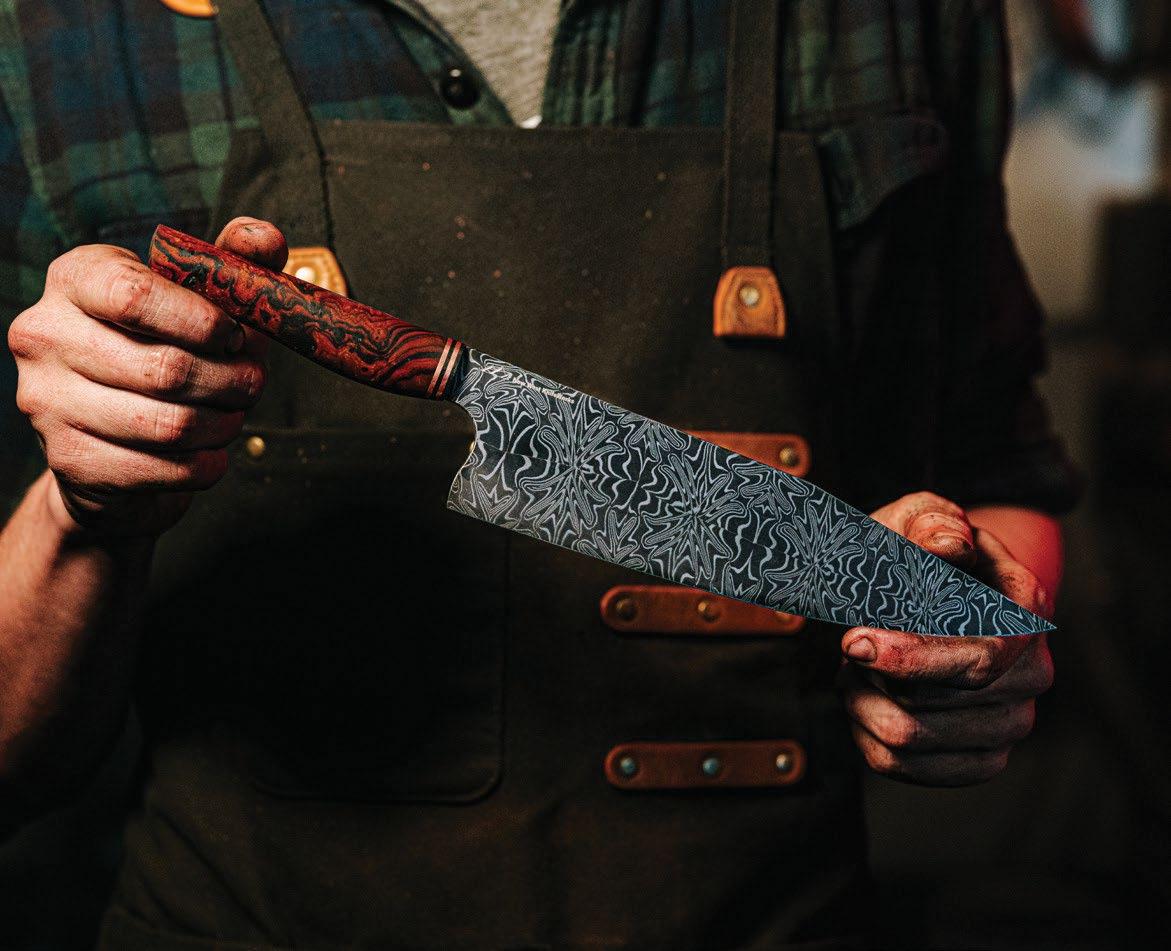
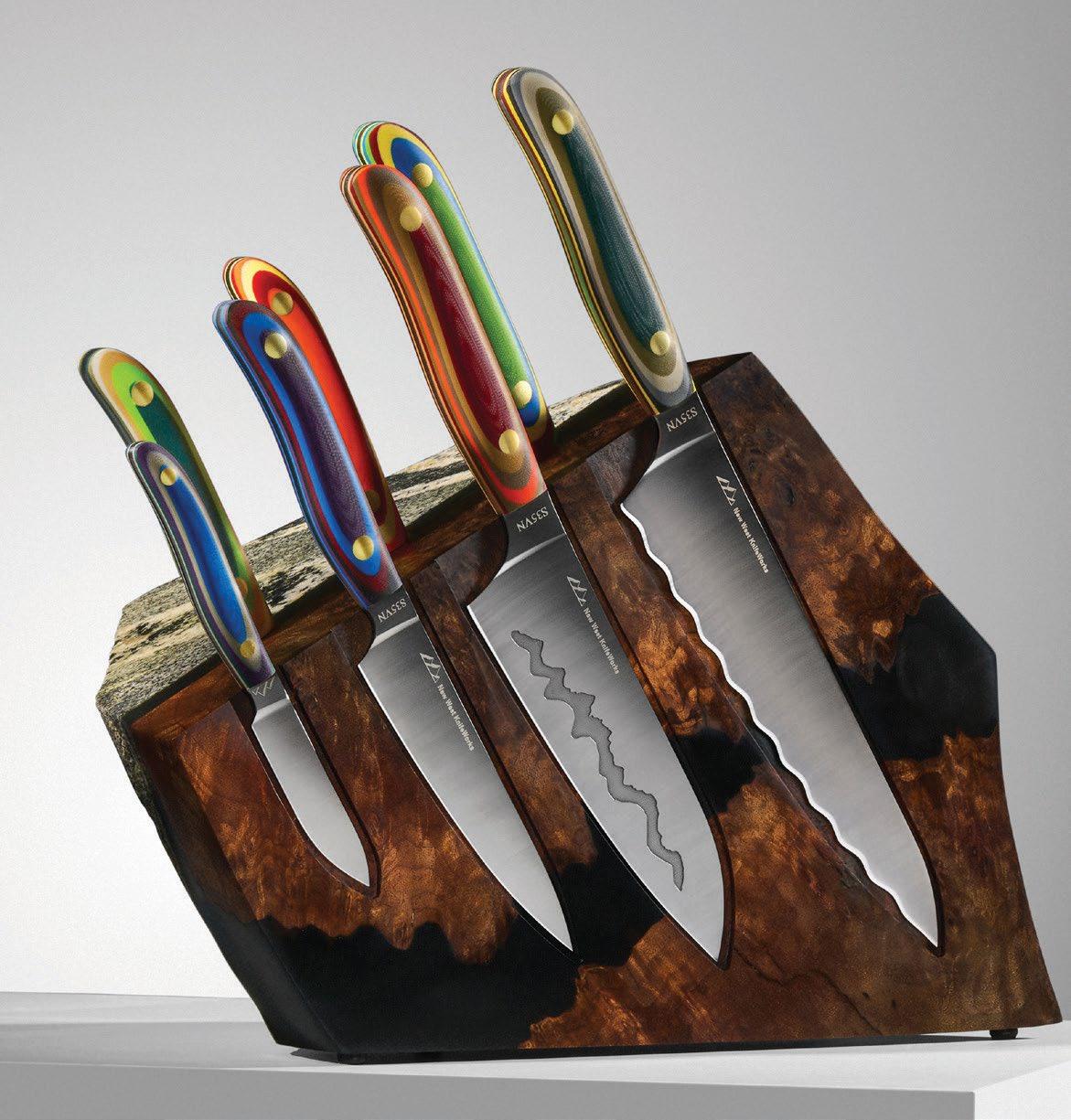
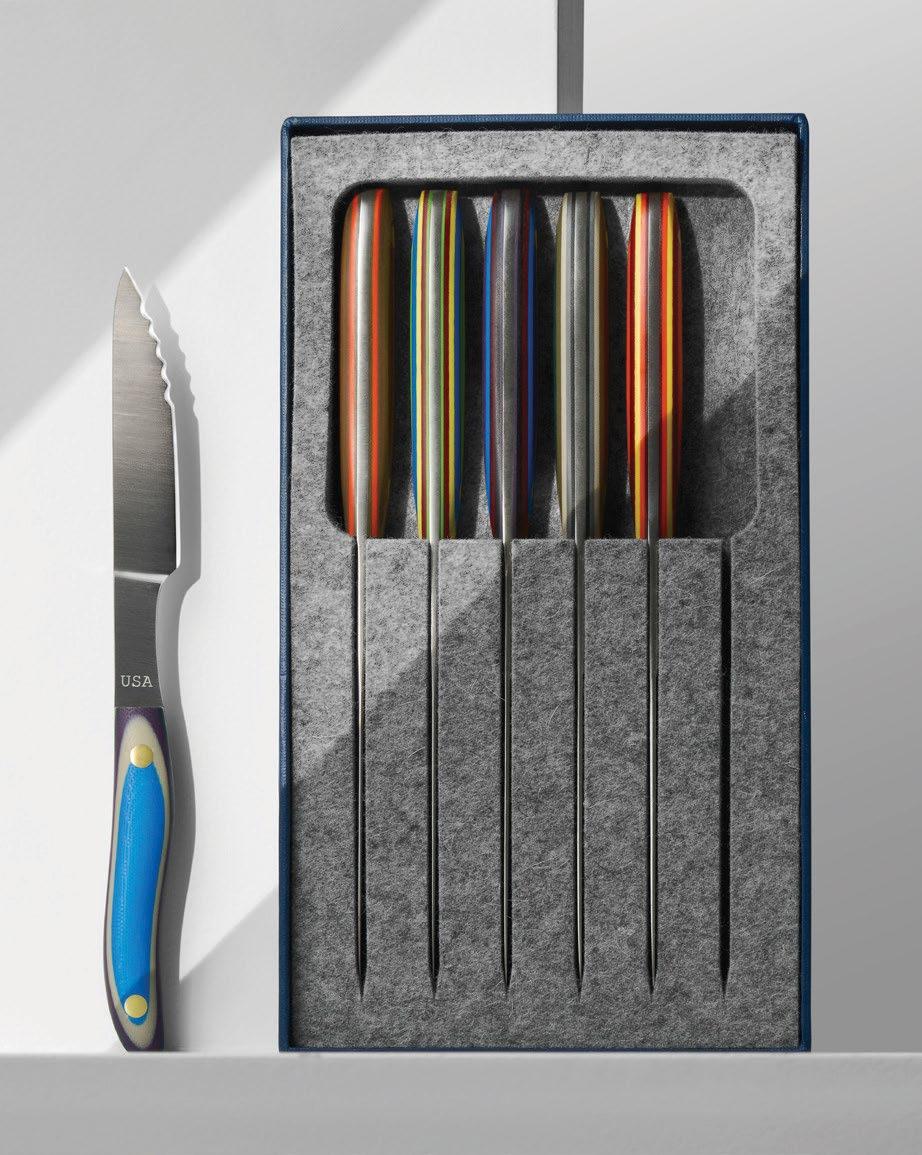



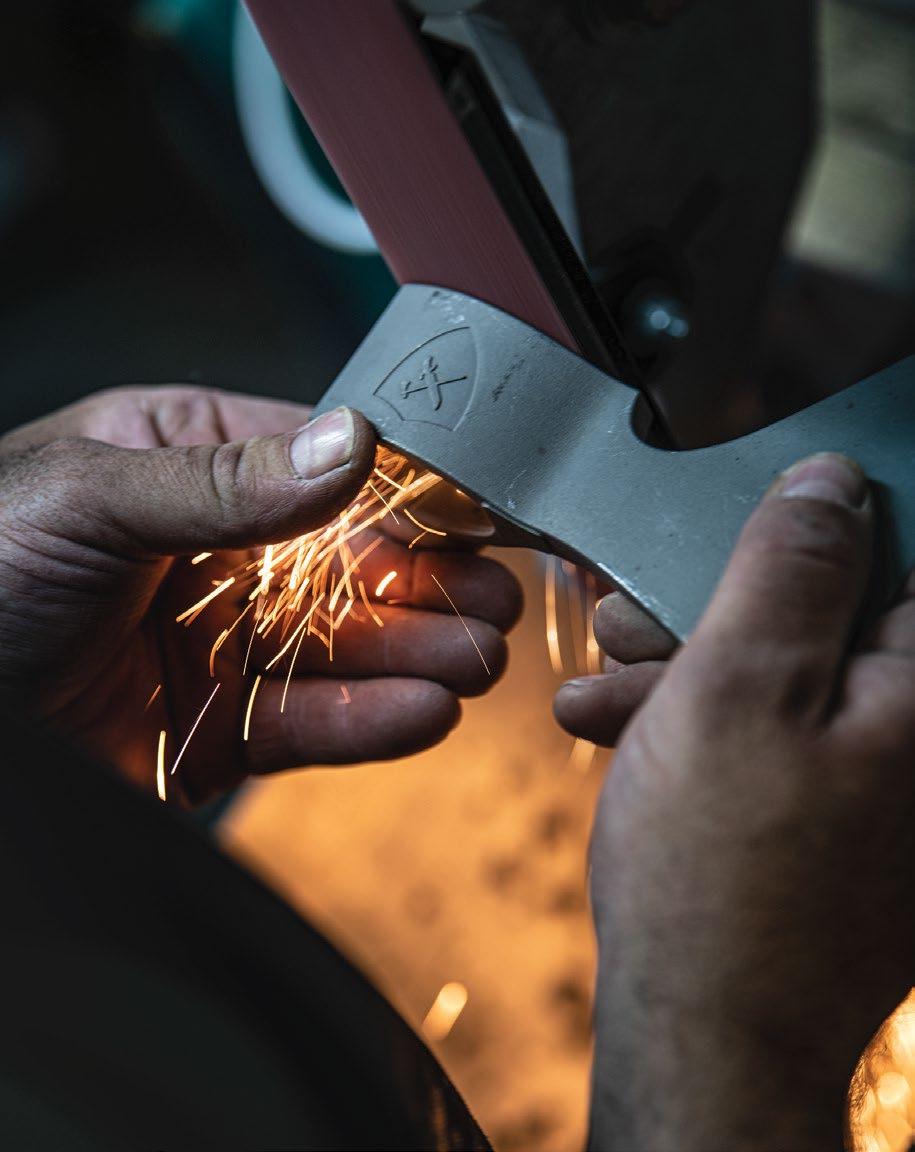
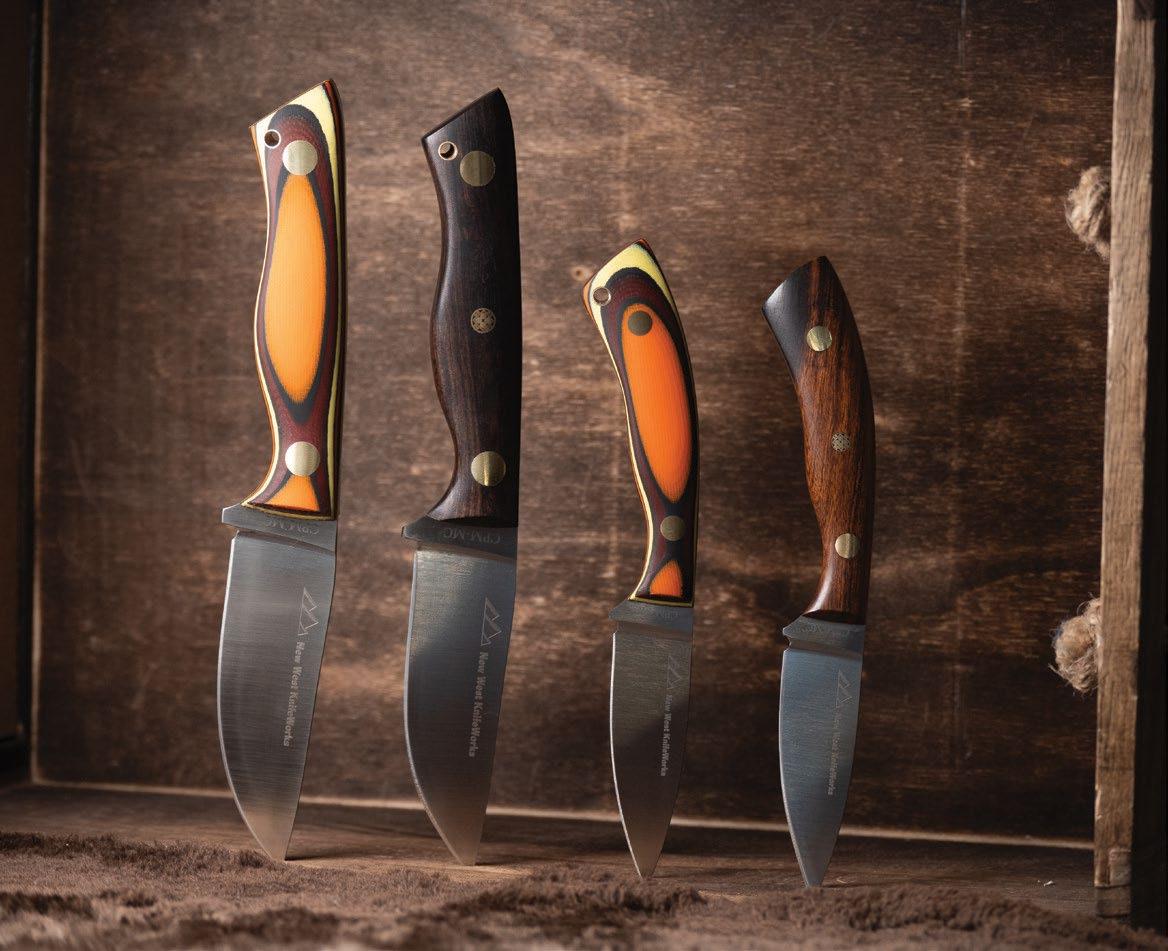
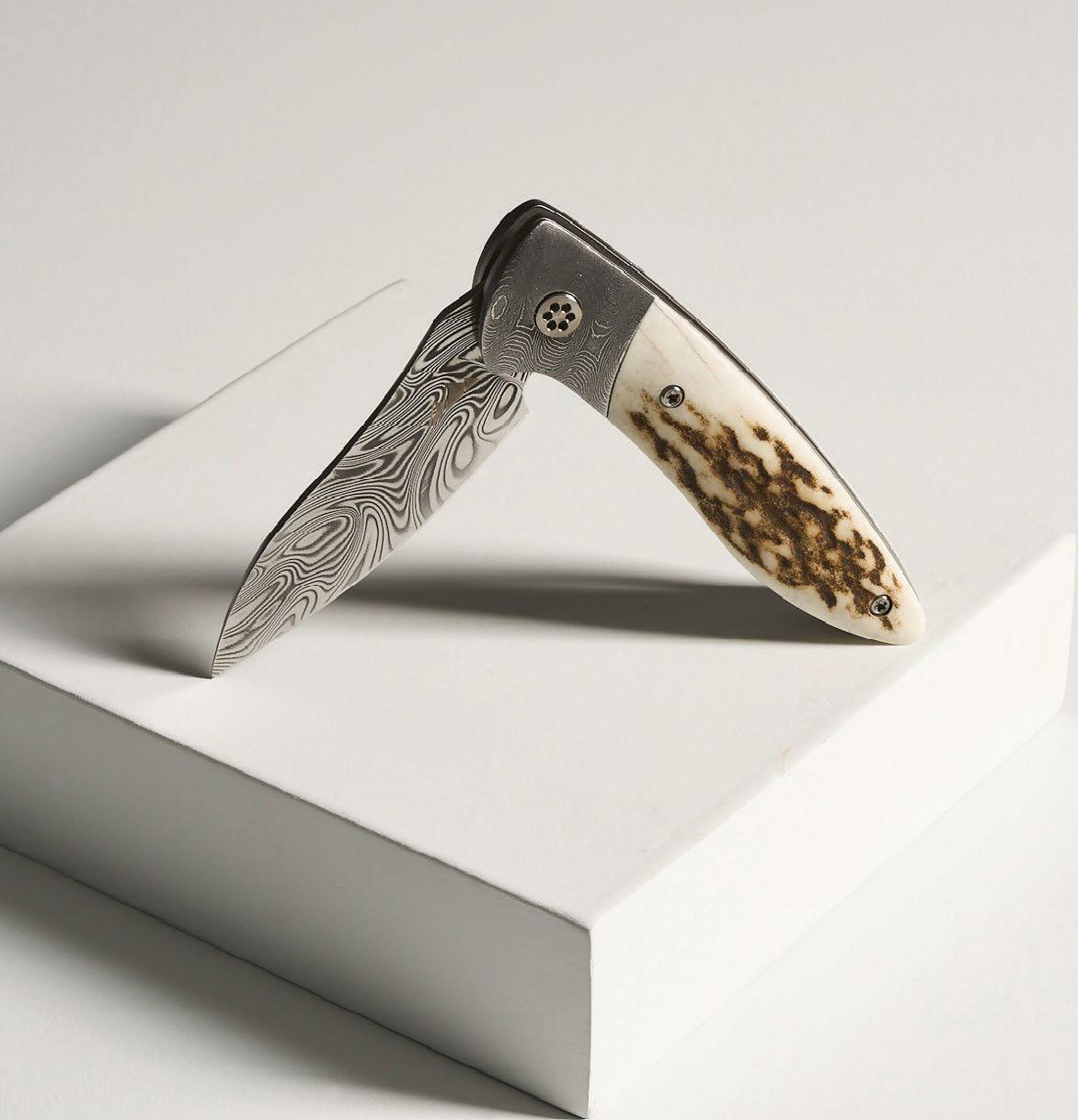
By Emily Senkosky
Montana’s reputation as the “last best place” has been echoed by legendary figures throughout the years. For those who have visited, but especially for those who live here, the sentiment is visceral—often lived out in the colorful and captivating day to day. Big Sky Country is not only flush with vistas, iconic wildlife, and essential natural resources, but boasts a culture shaped by Native American lifeways, ranching heritage and outdoor recreation that makes it an experience unlike anywhere else in the world. John Steinbeck summed this up after traveling through the state in the 1960s: “I’m in love with Montana. For other states I have admiration, respect, recognition, even some affection. But with Montana, it is love. And it’s difficult to analyze love when you’re in it.”
It is this pride of place that has driven some individuals to make it their life’s work to protect Montana’s natural inheritance—a premise that the Montana Outdoor Hall
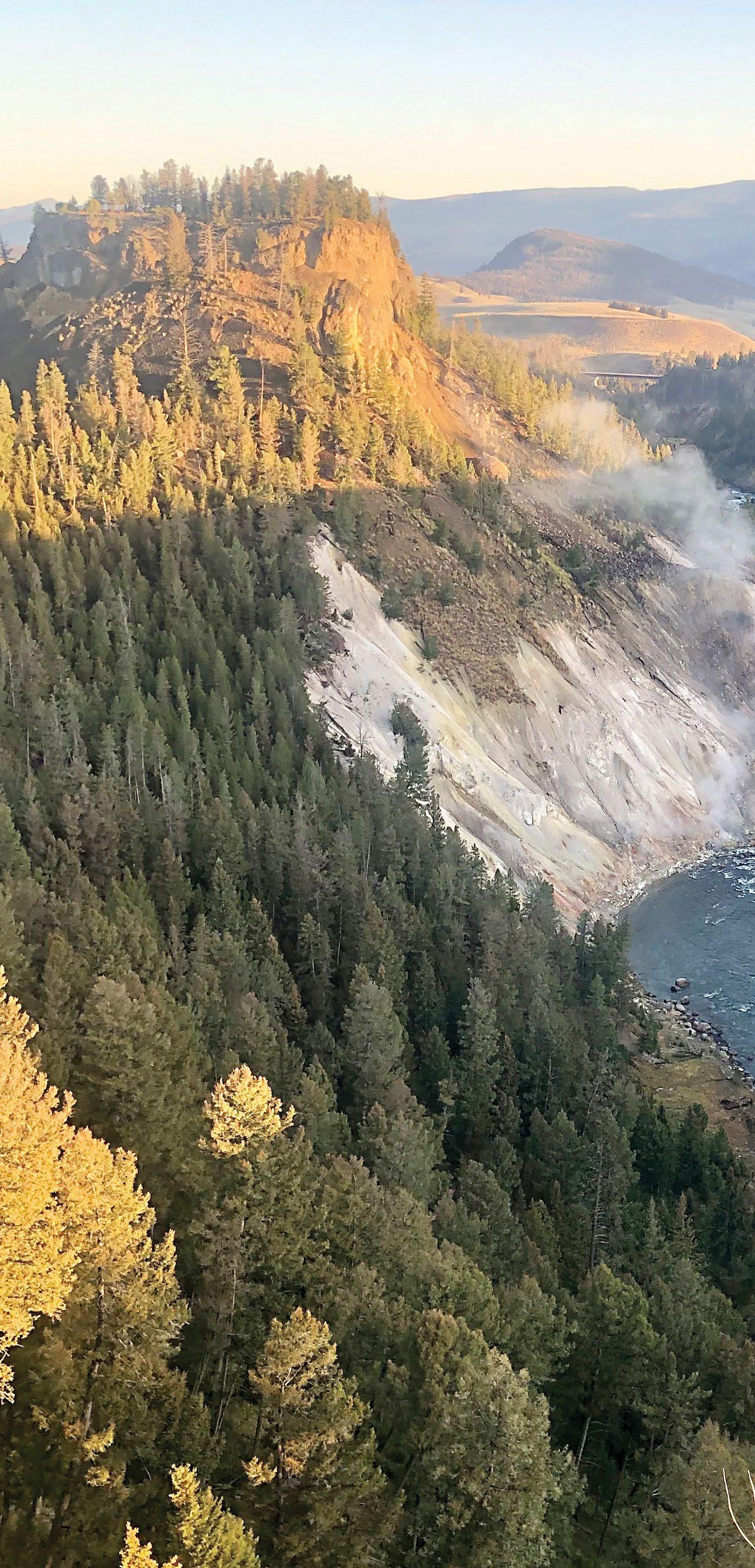
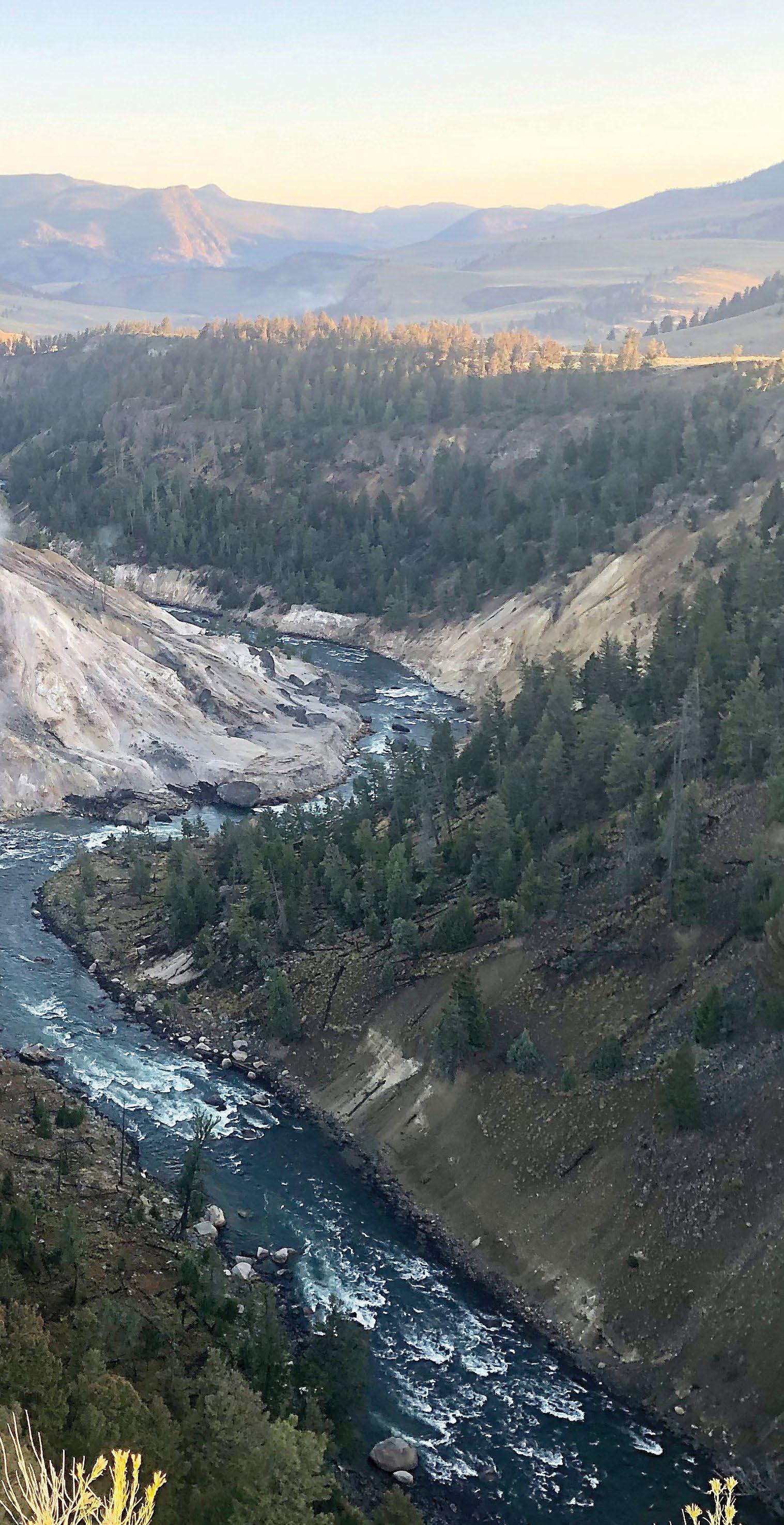
It is this pride of place that has driven some individuals to make it their life’s work to protect Montana’s natural inheritance—a premise that the Montana Outdoor Hall of Fame was built to honor.
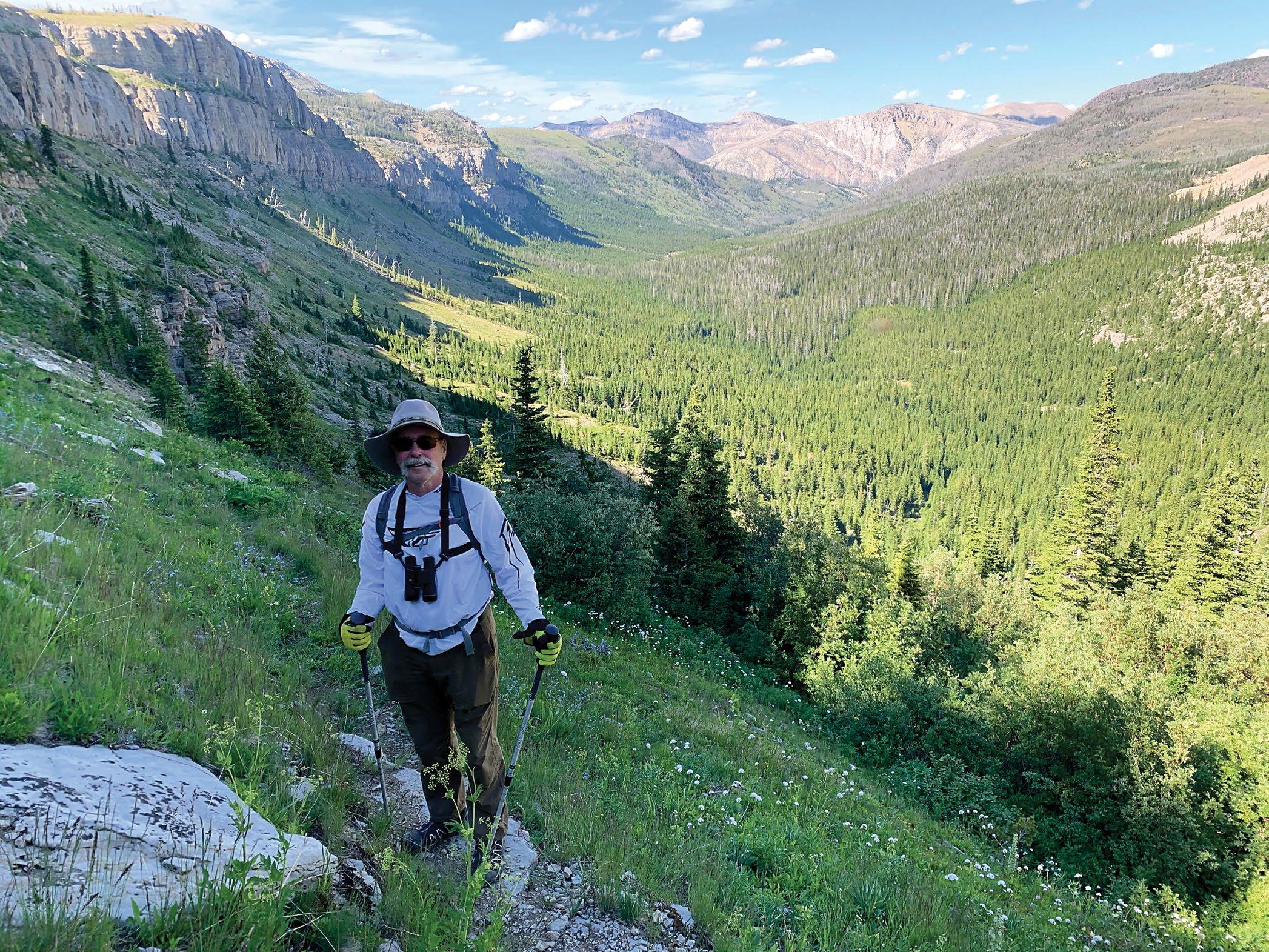
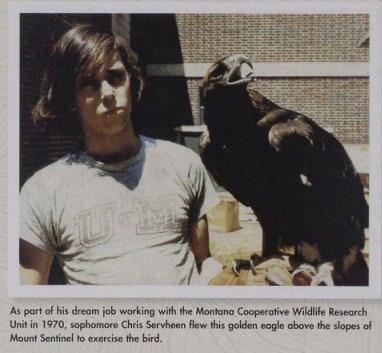
of Fame was built to honor. More than a decade ago, longtime conservationist Jim Posewitz returned from Wyoming’s Outdoor Hall of Fame celebration with the realization that his home state had no institution dedicated to commemorating the stories of its own conservation heroes.
Montana consists of more than 30 percent public lands and boasts terrain that the world covets—two national parks anchoring its borders, sprawling wilderness, cold rivers that provide a multitude of benefits from recreation to public health—but until 2014, the state had no formal record of the pioneers who have upheld the land and its traditions.
“So many people have contributed to conservation in the state of Montana as we know it today. Jim’s goal was really diversity in each year’s cohorts,” said Laura Parr, a member of MOHF board of directors. “He wanted diversity in geography across the state, diversity of each class living and deceased, and gender diversity, as well as diversity in types of conservation.”
And so the MOHF was born to honor those who built this conservation ethic piece by piece throughout history. Since its establishment, 81 individuals have been inducted into the hall—tracing a lineage that predates statehood. Inductees include early arrivals like Granville Stuart, who landed in Montana in 1857 at the age of 23, and marveled at the pristine peaks of the Rocky Mountain Divide laden with bands of elk, antelope and bighorn sheep. Stuart, and other giants like Theodore Roosevelt and Lee Metcalf, were founding fathers of state stewardship—helping to set a framework that has significantly enhanced the lives of Montanans, and many others throughout the country.
the programs and policies still discussed today: The Clean Water Act, aimed at protecting clean drinking water and healthy streams and rivers; the Wild and Scenic Rivers Act, which safeguards 13,400 miles of waterways; the Land and Water Conservation Fund, which allocates funds from offshore drilling to public access and ecosystem protection; and, of course, the Wilderness Act, which prevents development on more than 173,000 square miles of pristine nature. Here in Metcalf’s home state, many people honor his legacy through their own lifetime conservation achievements and MOHF ensures that those individuals are recognized.
Over the years, the MOHF has built an ecosystem of hunters, tribal leaders,
hope to share the stories of how those individuals or organizations went about protecting the Montana that we know and love.”
When Chris Servheen speaks about grizzlies, his eyes soften. He doesn’t describe them as brutes with gnashing teeth and claws, but rather as creatures that prefer solitude yet increasingly find themselves pressed against the edges of expanding towns, livestock fences and trailheads. “Bears don’t have a day off,” said Servheen. “They spend all day trying to listen for us and get out of our way.”
“I would like to see bears in all the normal places, not just on islands across the landscape. There is value in their existence. If we can restore them more fully then we’d be moving ahead.”
– Chris Servheen
Lee Metcalf embodies the MOHF’s mantra that the best conservation stories start with a single idea. His contributions to conservation set precedent for many of
teachers, writers, lawyers, ranchers, and scientists driven to protect what makes Montana, Montana. Inductees are honored every two years with an event that celebrates the state’s outdoor heritage. The Hall’s class of 2025 reflects the breadth of Montana’s conservation ethos. It includes the biologist who spearheaded grizzly bear recovery in the Northern Rockies to the tribal member who is restoring bison to their homelands to the woman who strengthened environmental laws and rallied voters to defend wild places.
“Their stories are meant to be inspiring for people who are working in conservation today, to help them continue the good fight,” said Parr. “We
For 35 years as the U.S. Fish and Wildlife Service’s grizzly bear recovery coordinator, Servheen worked to pull the species back from the brink—when fewer than 30 females remained in the Greater Yellowstone Ecosystem and the Selkirks were nearly vacant of them altogether.
When he began in the early 1980s, wildlife agencies operated in silos and recovery felt tenuous at best. Roads fragmented habitat and bears were drawn into conflict by communities that had not yet built considerations for coexistence. Without coordination, he warned, grizzlies would disappear from Yellowstone within years. This is why he helped to create the Interagency Grizzly Bear Committee, which brought state, federal and tribal partners together to “pull in the same direction.” His foundational work has allowed grizzly populations to rebound. Today, roughly 1,000 bears roam the Yellowstone and Northern Continental Divide ecosystems.
Recovery, Servheen emphasizes, is not protection without limits. A future with grizzlies is as much about managing people as it is about managing bears. But he says that public sentiment is often
more supportive than political rhetoric suggests. “People come to Montana because it’s a wild place, and because they want to see bears,” he said. “Living with bears is something, by and large, that we do—and that’s something to be proud of.”
The future, he believes, lies in connectivity between the grizzly’s disparate populations—not isolated “islands” of habitat, but linked ecosystems that ensure their genetic and climate resilience. Ultimately, he believes that having grizzlies on the landscape is a positive for Montana. “I would like to see bears in all the normal places, not just on islands across the landscape,” he said. “There is value in their existence. If we can restore them more fully, then we’d be moving ahead.”
That same ethos of restoring an emblematic species also drives Robbie Magnan, an enrolled member of the Assiniboine and Sioux tribes, whose life’s work has helped bring back an icon of the Great Plains.
On the Fort Peck Reservation, the bison’s significance is central to his tribe’s history and culture.
When Fort Peck first brought bison back in the 1990s, the aim was cultural reconciliation. Elders wanted to restore what boarding schools, federal policy and near-eradication of the buffalo had severed from tribes. Magnan began working at Fort Peck’s Game and Fish Department in 1989. By the time he took over the bison program, restoration meant managing far more than just a reconnection with the species. He was challenged with navigating tribal, county, state, and federal law while overcoming political resistance, especially around brucellosis fears tied to Yellowstone bison. “You’ve got tribal laws and you’ve got federal laws. And you got to be able to work with all of them,” he said.
In 2012, after years of what is still ongoing negotiation and litigation, Fort Peck received bison through Yellowstone’s quarantine program that they, and the InterTribal Buffalo Council, had pushed for. The transfer marked a turning point in conservation, ending the slaughter of bison that wandered outside of Yellowstone National Park. It also opened the door for tribes to bring bison back to their homelands. “Buffalo are a lot like the Native Americans,” Magnan said. “We were put onto reservations, and the buffalo were pushed off their lands in a similar way. I want to put buffalo back onto all of their native landscape.”
After some trial and error, Magnan helped facilitate two herds: one cultural, one business. The cultural herd supports ceremonies, education and the tribal
when supply chains faltered, Fort Peck harvested 40 animals to feed tribal members. When federal food programs stalled during government shutdowns this year, Fort Peck’s herd was again able to provide food to the people. “They took care of us at one point in time,” said Magnan. “They could do it again.”
His success and contributions to the bison conservation space stretch beyond his reservation’s boundaries. The Fort Peck bison program helped to restore the animal to more than two dozen tribes across 16 states.
“Buffalo are a lot like the Native Americans. We are put onto reservations, and the buffalo were pushed off their lands in a similar way. I want to put buffalo back onto all of their native landscape.”
– Robbie Magnan
food security, whereas the business herd sustains the program financially. Today, nearly 1,000 bison roam 33,000 acres of tribally-managed grasslands with wildlife-friendly fencing keeping their migration corridors intact. According to Magnan, the bison’s return has healed the land, and helped to restore species that disappeared when bison were removed from the ecosystem.
Magnan’s vision has helped to reconnect much of his tribal heritage that is tied to the bison, and even helped to bolster the reservation’s food sovereignty. During the COVID-19 pandemic,
Part of what has made efforts like Magnan’s possible is the policy scaffolding built by advocates like Jeanne-Marie Souvigney, another recipient of the MOHF award for 2025. Although her path into conservation wasn’t linear—her time volunteering with Massachusetts Audubon and the Connecticut River Watershed Council helped her find a deep-seated passion for wild places. “I’ve always really liked being outside,” said Souvigney. “I just have to stay busy.” Montana drew Souvigney west in part because of the University of Montana’s hands-on environmental studies program, with internships that embedded fieldwork that she says grounded her. She volunteered with the Forest Service near Missoula shortly after moving West, where she lived in a trailer at Bass Creek Campground and worked on every available crew including range, wilderness, trails, and fire. Souvigney describes this experience as the best summer of her life.
After graduate research on how natural resource taxation shapes environmental policy in Alaska, she returned to Montana to intern with the Northern Plains Resource Council at the legislature in 1981. Here, she learned
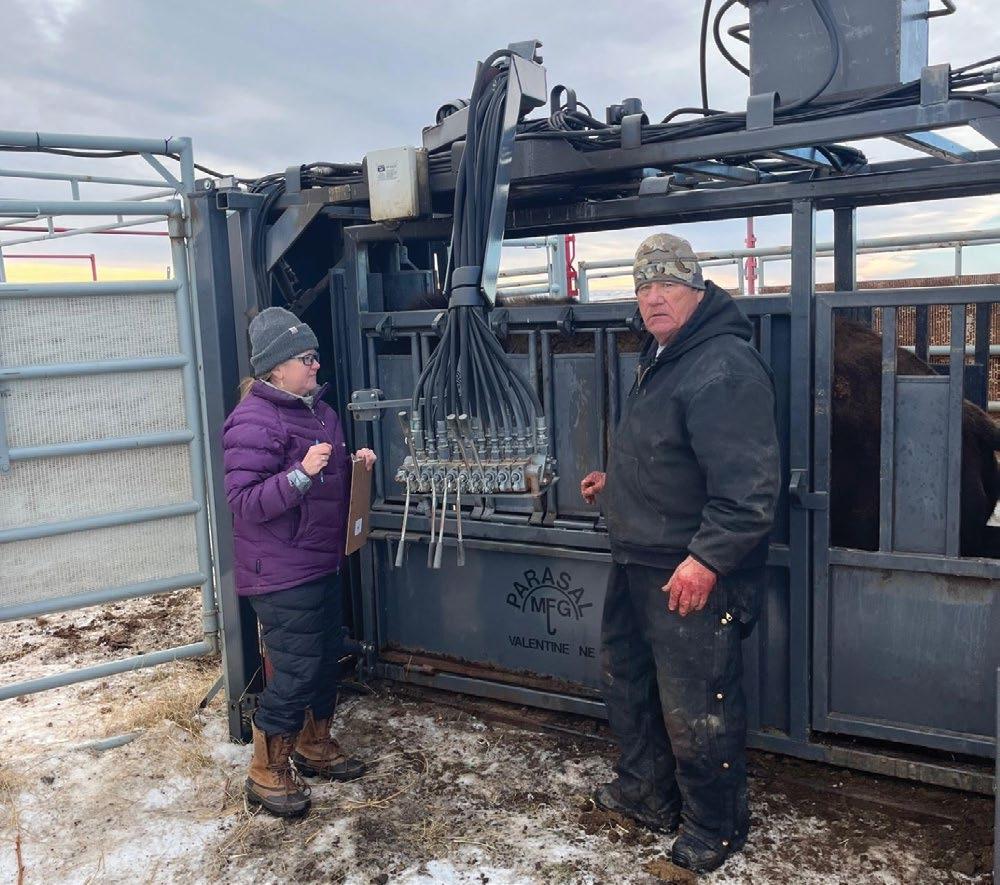
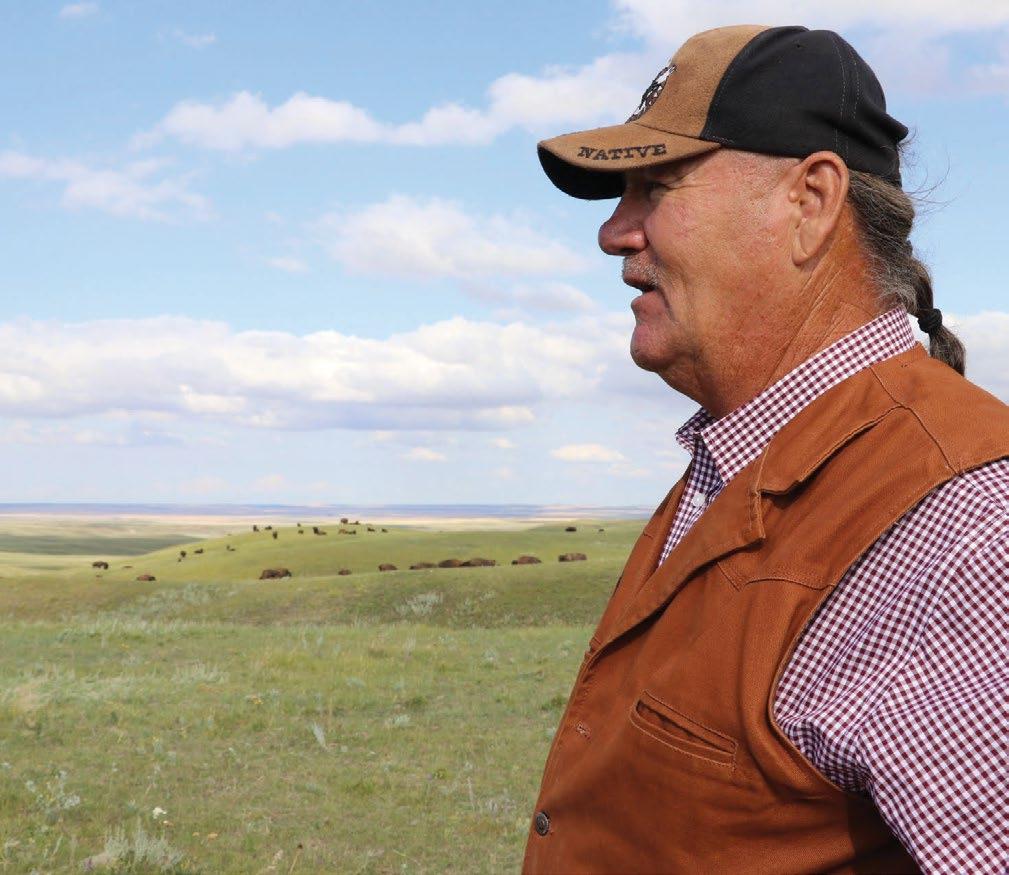
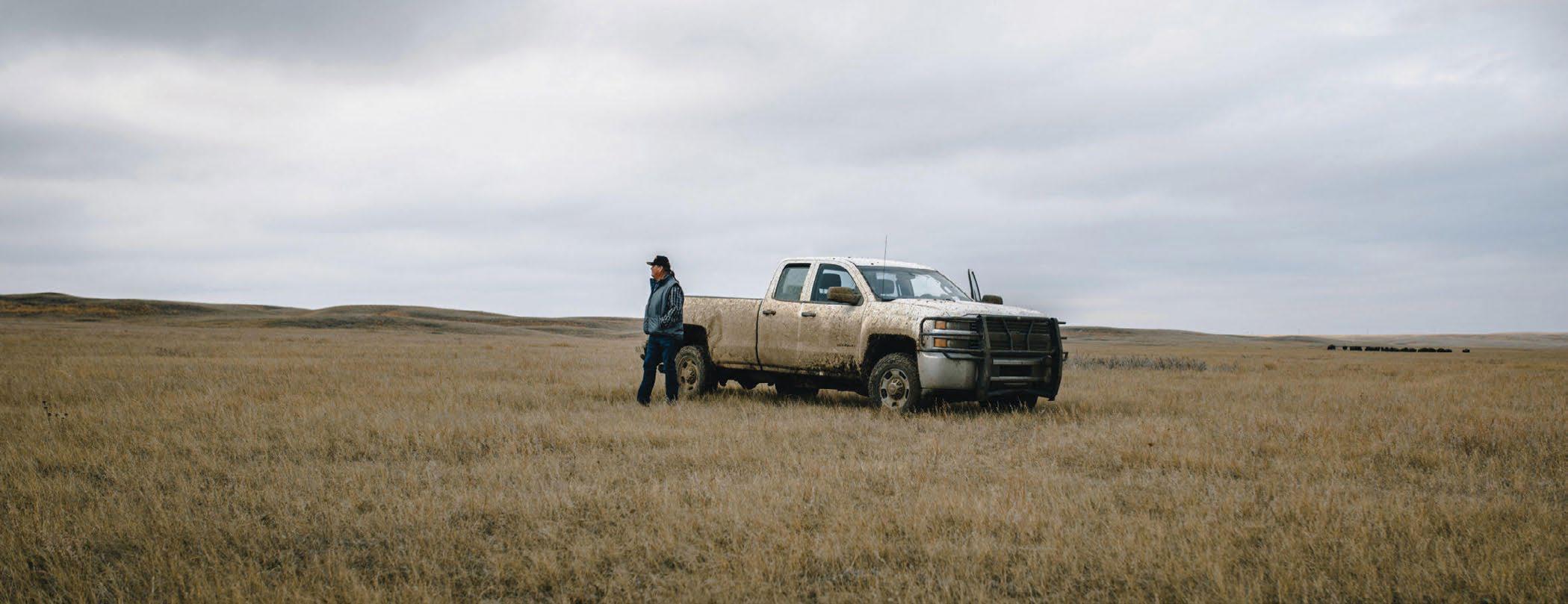
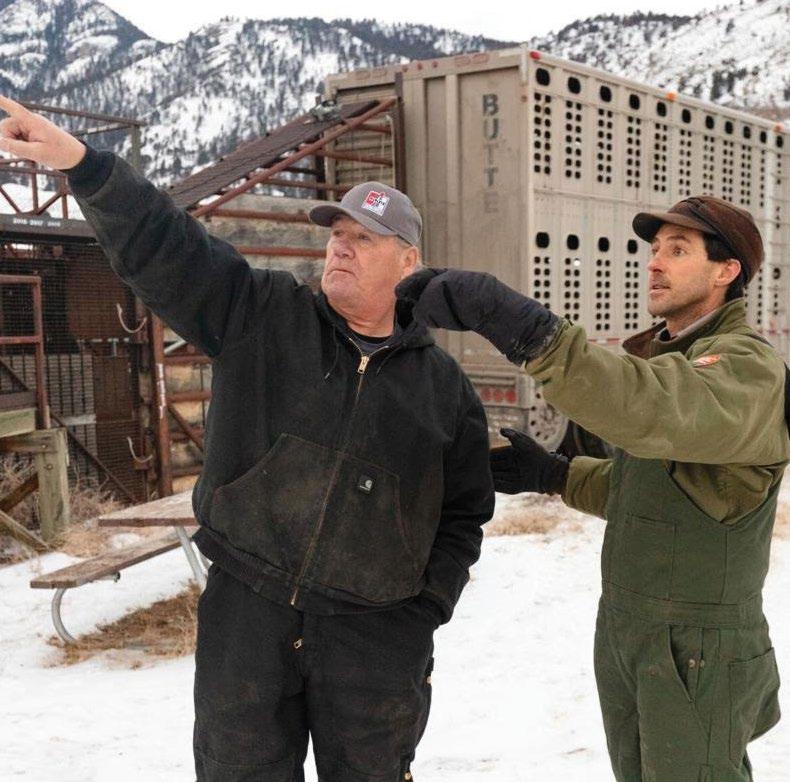
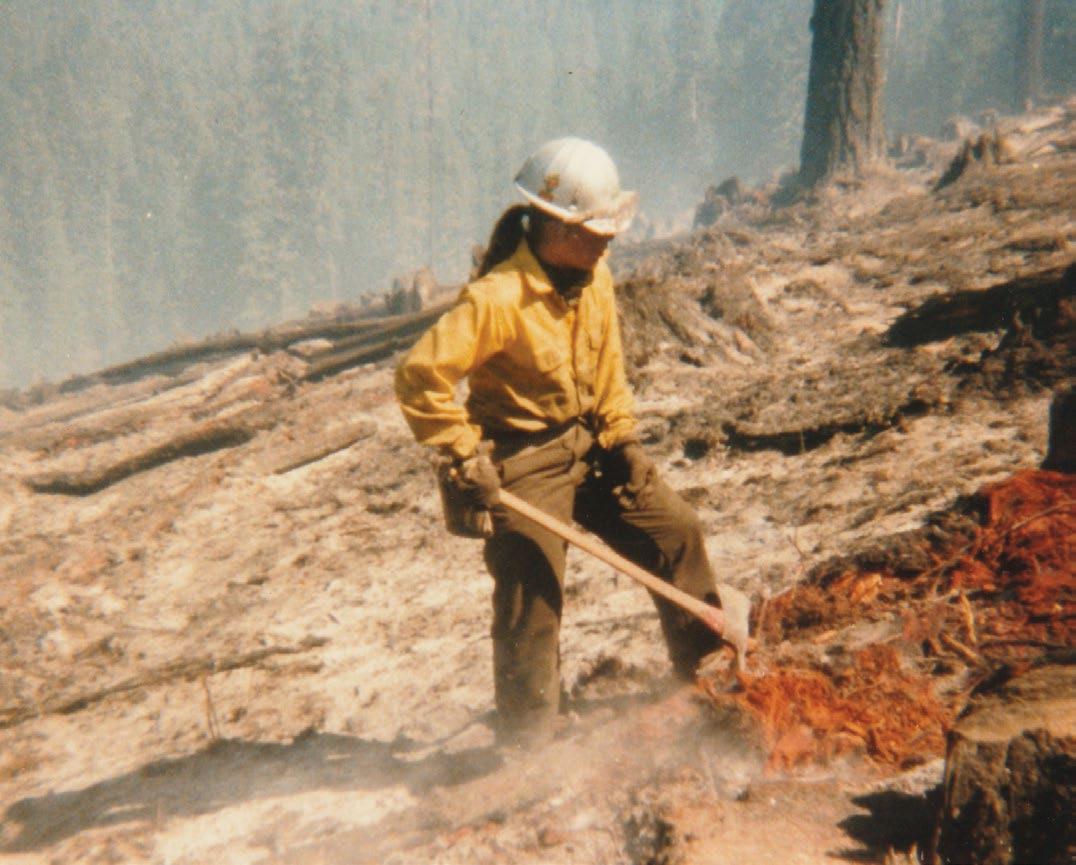
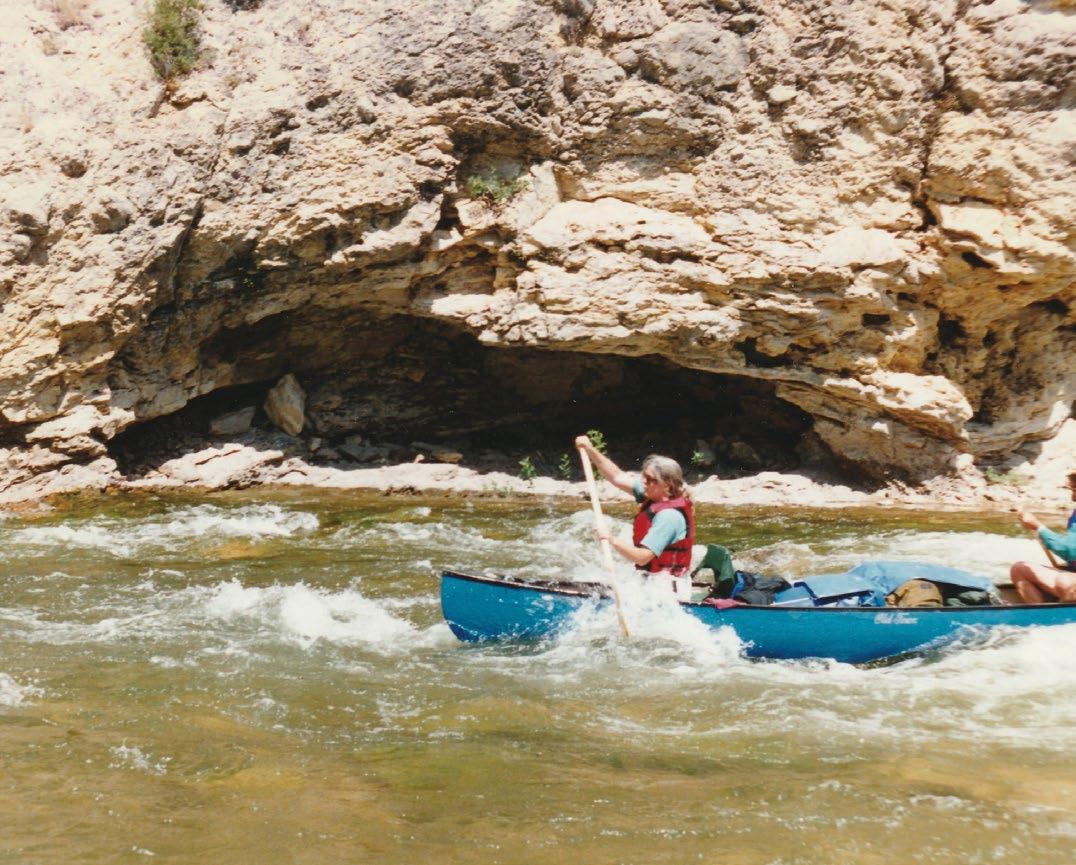
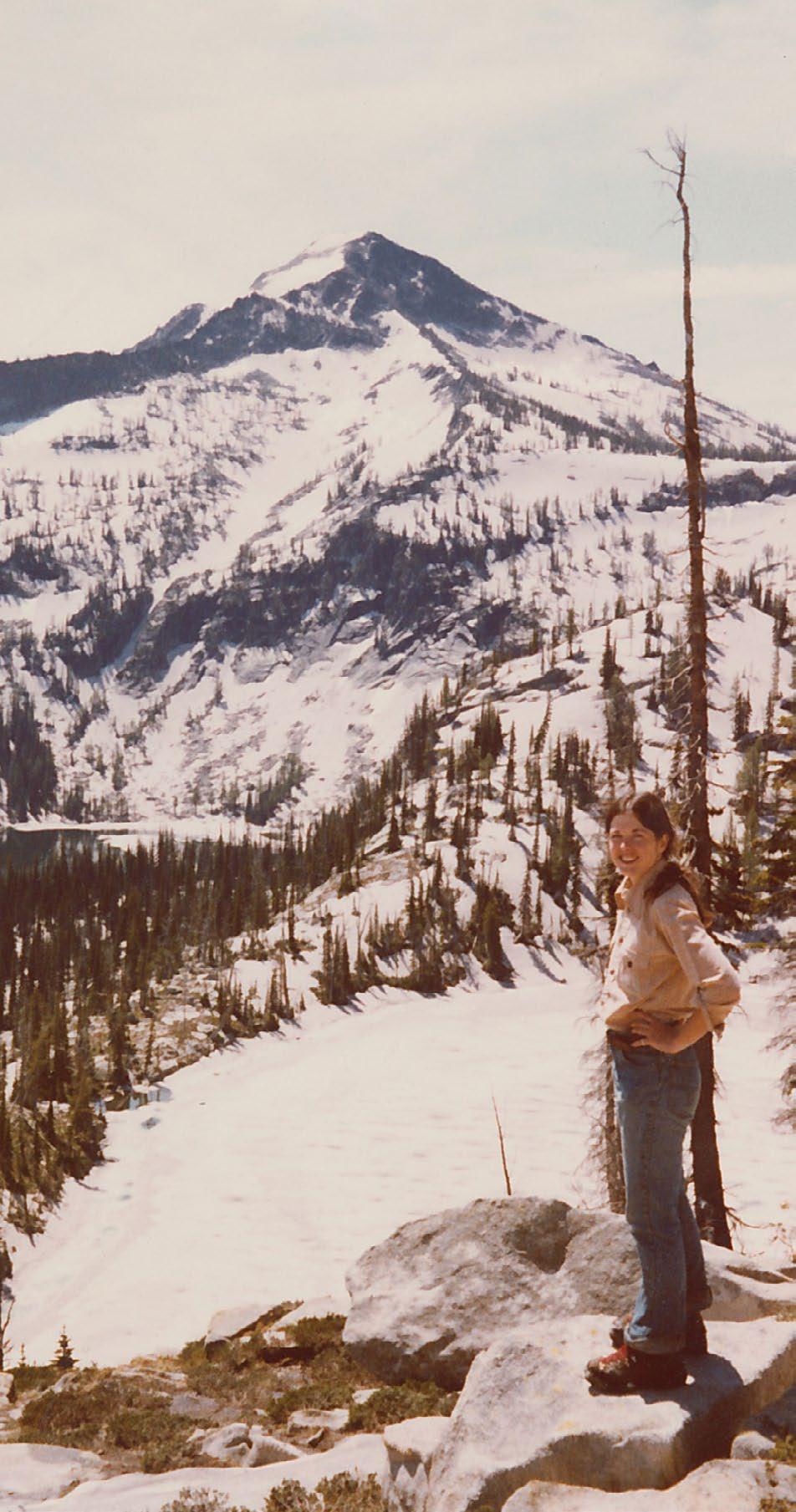
A collection of photos captures Souvigney in her element on the water, on the trail and on the fireline. A life lived outside has grounded her work for decades, fighting for wild places from both the field and the policy table, building the organizations and coalitions that continue to shape Montana’s conservation landscape today. Photos courtesy of MOHF
community organizing from farmers and ranchers who were navigating coal and hard-rock mining pressures. She then interned with Northern Plains Resource Council at the legislature in 1981. Here, she learned community organizing from farmers and ranchers who were navigating coal and hard-rock mining pressures. Next she completed graduate research on how natural resource taxation shapes environmental policy in Alaska and Montana, which poised her for her later work at the Greater Yellowstone Coalition, where she spent a decade working on some of Yellowstone’s most complicated challenges: geothermal protections, travel planning, and most notably, bison.
When Yellowstone bison began migrating beyond park boundaries in the late 1980s and early 1990s, the political response was lethal control. The justification centered on brucellosis transmission to cattle—a premise she and others argued was overstated, particularly when compared to elk.
center south to the Paradise Valley. She led an effort to clean up an abandoned landfill along the Yellowstone River, raising more than $50,000 to remove debris and restore the site to turn it into what is now a dog park. She also helps to mentor other young women in the conservation work and policy space in and around the Livingston area alongside former legislator Dorothy Bradley. “To me, it’s important that people be outside,” she said. “When people are out in it, and have access to it, they want to protect it. But you have to give people the tools to do things themselves, too.”
look like in the 21st century. “What they and their parents decided to do, to hold people accountable, they’ve set a standard that others have looked to,” said Parr. “They’re helping to slow down some of the things that are being done in this state, to hopefully preserve it the way it is.”
“I have been driven toward this because of the feeling I have something to say. When you have the science behind you, you can take the heat.”
– Jeanne-Marie Souvigney
Her work involved negotiating tolerance zones, pushing for limits on slaughter, and collaborating with early iterations of what became the InterTribal Buffalo Council—long before individual tribes secured direct transfers. Doing her homework on the science and policy was a rigor that became her shield in rooms where she was often one of few women. Although Souvigney is quick to deflect credit, her career spans the founding of a multitude of organizations central to Montana conservation, including Park County Environmental Council, Montana Conservation Voters, and lobbying the legislature for three decades. “I have been driven toward this because of the feeling I have something to say,” she said.“When you have the science behind you, you can take the heat.”
In recent years, her focus has shifted closer to home. She helped build Livingston’s trail system, including a bike path that now connects the town
Although the MOHF awards are typically lifetime achievements, the youth plaintiffs from Held v. Montana were given a first-of-its-kind honorary mention this year. The Hall is usually reserved for those who uphold Montana’s conservation ethics through many years of professional tenure, but the youth at the helm of Held showcased notable bravery in voicing their belief that healthy public lands are integral to the 1972 Montana Constitution’s promise to a “clean and healthful environment.”
For Parr, that drive to stand up for what is integral to Montana’s identity, values and quality of life fits squarely within the Hall’s guiding criteria. It also shows the transitioning definition of what conservation might increasingly
Parr says that each nominee is measured not only by tangible achievements, but by influence. How did their work change Montana? How did it strengthen stewardship? And most importantly: How did it inspire others to carry the ethic forward? “We are not just looking at one segment of work,” Parr said. “We’re trying to represent the whole.” Nonprofits talk often about inspiring the next generation, and so the MOHF has made that aspiration visible by inviting these young leaders into the banquet hall filled with those whose lifetime work helped pave the path they showed up in a courtroom to protect. In a moment when debates over public land, energy development, and federal authority once again roil the West, the Montana Outdoor Hall of Fame offers a reminder that this state’s identity, heritage, and outdoor culture run deeper than any administrative changes or mercurial politics. The methods may evolve, but the founding ethic of the Montana Outdoor Hall of Fame endures thanks to past, present and future conservation catalysts. Inductees’ names are enshrined on plaques but their work is cemented in the peaks and valleys of the “last best place”—preserving Montana’s wild character for generations to come.
Emily Senkosky is a writer with a master’s degree in environmental science journalism from the University of Montana. After making a life for herself in South America, she returned to the U.S. to report on the changing dynamics of her home in the American West.
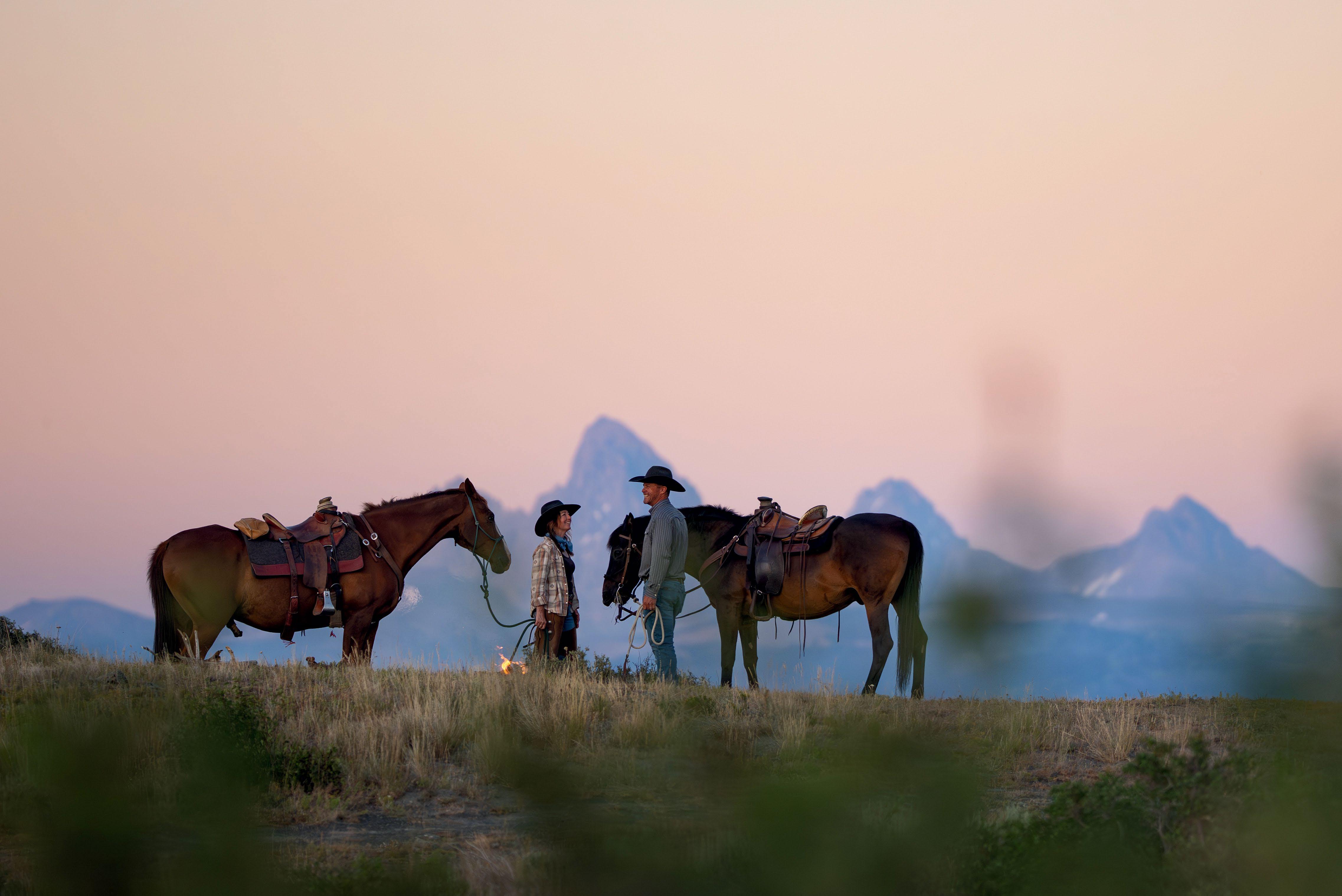
Beyond the towering peaks and unspoi led wi lderness lies the authentic heart of Eastern Idaho.


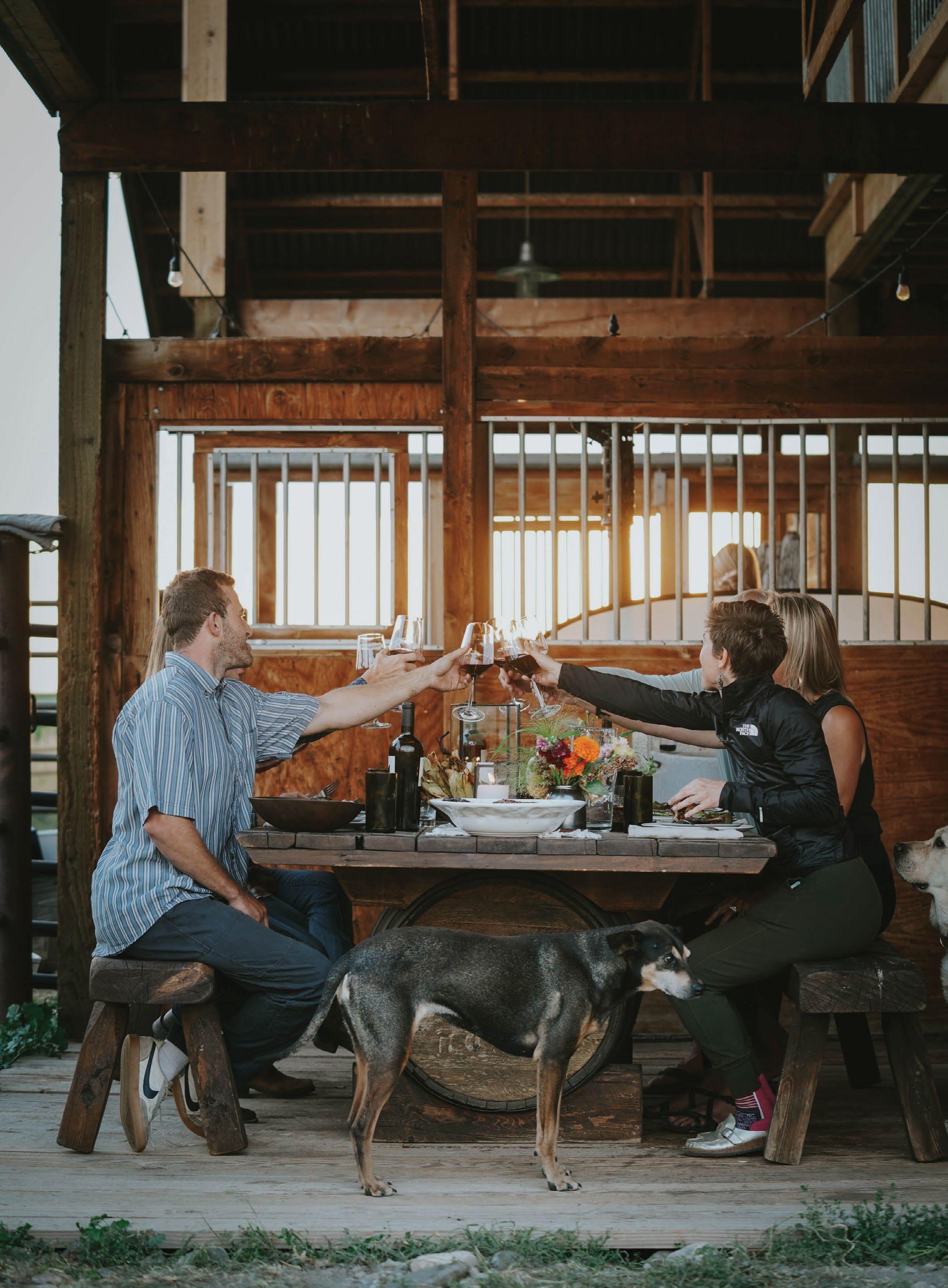
Friends gather over a meal of local cuts from RegenMarket, an online marketplace for Montana-grown regenerative food. Read more about the regenerative food moment happening in southwest Montana on p. 178. Photo by Justine
Words by By Rick Bass | Illustration by Seth Neilson
We know the beginning by rote: “In our family, there was no clear line between religion and fly fishing.” We examine and re-examine it, as if it is a sacred text.
It’s not a book about fishing, however, but about family and place. It’s what makes Norman Maclean’s novella such an enduring work, what made it such a great film, and what now, in the words of Opera Montana Artistic Director Michael Sakir, gives it “the makings of the next Great American Opera.” Says General Director Susan Miller: “It’s such a great feeling to be able to create something so positive for the community at a time when so many, many things feel the opposite.”
A River Runs Through It is Opera Montana’s first commissioned work. The nonprofit had the option to work with other production organizations but chose to take it on fully themselves, in large part to get it right for the most important audience of all: Montana. As Robert Redford and his team did with the 1992 film, Opera Montana met numerous times with Maclean’s family before developing the project.
Playwright Matt Foss—formerly a fire ecologist with the Montana Dept. of Fish, Wildlife & Parks—initially envisioned the novella as a play. But when Maclean’s family suggested it was better suited for an opera, and asked Foss if he knew of anyone who could execute that, he
gave a resounding yes: Opera Montana. Under the guidance of Sakir and Miller, Foss joined composer Zach Redler and librettist Kelley Rourke in a collaboration each describes as unlike any other. “Collaboration, like love, can be tough,” says Redler—yet the entire creative team calls it a transcendent experience from the start.
As with other sacred texts, each reader pulls something unique to their own journey even as larger themes proceed explicitly: that those who need help most are least likely to ask for or accept it, and that Montana’s wild open spaces act as a lodestone for healing. Redler describes the story simply as “struggling with love, and struggling with family.”
I’ve heard it said that no one lives in Montana because they have to; that all who are here are here by choice, not necessity; that one could
almost always make more money elsewhere. One of the most poignant moments in the story is when Norman gets a job that entails moving to Chicago, while Paul stays, informing him that he’ll never leave Montana. Of course in a way it’s Paul who ultimately leaves—and yet it’s Norman who, even from Chicago, keeps Montana alive through his storytelling and memories.
Painter Clyde Aspevig met with the Opera Montana team before painting the poster they commissioned. Beyond pursuing the river’s light, Aspevig was struck by the strong female presence the opera will amplify. “I chose to use the warmth and luminosity of the evening sky

as a symbol of the women’s dedication to their family,” he says. “The sunset casts a soft, warm, backlit glow which embraces the entire landscape. The palette of gray greens and warm purples suggests a melancholy that permeates the book, ending with the death of Paul, and how the family dealt. The brushwork, soft edges, and texture of the paint represent the complex emotions, and a somewhat blurred vision of reality. The only hard edge in the painting is the large rock on the far bank, which is Paul.”
Redford’s team, including writers and co-producers Bill Kittredge and Annick Smith, focused on the light as well. As Paul’s drinking and gambling escalate in the film, the river becomes even more luminous: its shapes and movements shadowed by the sinuous grace of the casts. The film gave the light center stage. Opera Montana intends to give that same role to sound, and song.
What are the characteristics of a foundational work? I’m not sure portability across generations is requisite. A foundational work can serve as a point of inflection in its time, redirecting the relentless flow of a culture—and whether by an inch or a mile may not matter. Change has been effected upon a living system, like a boulder placed in the headlong flow of energy. The change oxygenates the river further as it resumes its journey, more complex and more beautiful.
Maclean’s novella is portable across generations. But how to transfer a river across time? The best we can do is protect a river. But this also means protecting the mountains that are the river’s birthplace, and the rumpled land along either side of the river, and the animals that travel to and from it, and the towns that spring up alongside. Rivers, like forests, remind us that we are all in this together.
The opera has seven characters, none of whom is the character of Mabel, Paul’s Cheyenne girlfriend. She appears briefly in the novella, not like a ghost or a thread,
but a seed. She’s absent from the opera’s telling, so that foundation of Montana’s story remains unexamined here. But that isn’t Maclean’s work, or the opera’s; it’s ours.
We in Montana know that light is essentially a kind of music, and that sound is a kind of light—waves moving at different speeds. And geology, Maclean reminds us, is the slowest light wave, and slowest sound wave of all. But in art as in fly casting, in compression lies power, and we can’t talk about A River Runs Through It without speaking of song.
“There are at least 27 beautiful, slow, heartbreaking arias that did not get written,” says Rourke. “It takes a really long time to sing things,” she says, “and you want to leave room for the music to do the storytelling.” There will be a bluegrass tune in the opera, as well as a part for a guitar. Foss describes how he loves “listening and finding patterns in the work.” And he’s fond of quoting Richard Ford: “If loneliness is the disease, storytelling is the cure.”
Rourke’s not a fly fisher, but she has studied the craft carefully. “It’s about making contact with the Other, right? You can study and learn and practice, but at the end of the day, there’s still this impenetrable Other, right?”
We’re a little closer to that Other in Montana, and in our rivers. And now, this fall, if for but a mid-September afternoon, in the opera.
Rick Bass, the author of more than 30 books, has been awarded the Montana Governor’s Arts Award and lives in the Yaak Valley. Working with The Montana Project, he has helped curate several festivals that feature the Black Ram guitar.
Seth Neilson is a multidisciplinary creative director, illustrator, and photographer living in Utah. He returns to Montana as often as he can to make sure the trails, mountains, and rivers haven’t shuffled around too much in his absence.
Savor traditional Northern Italian cuisine with an elegant touch at Cortina, Montage Big Sky’s signature restaurant. Enjoy locally sourced ingredients and seasonal flavors in a warm, inviting setting, complete with an open-hearth wood-fired oven, morning and evening spreads of distinctive fare, fresh handmade pasta and an extensive wine list.

montage.com/bigsky | (406) 993-8368 @montagebigsky
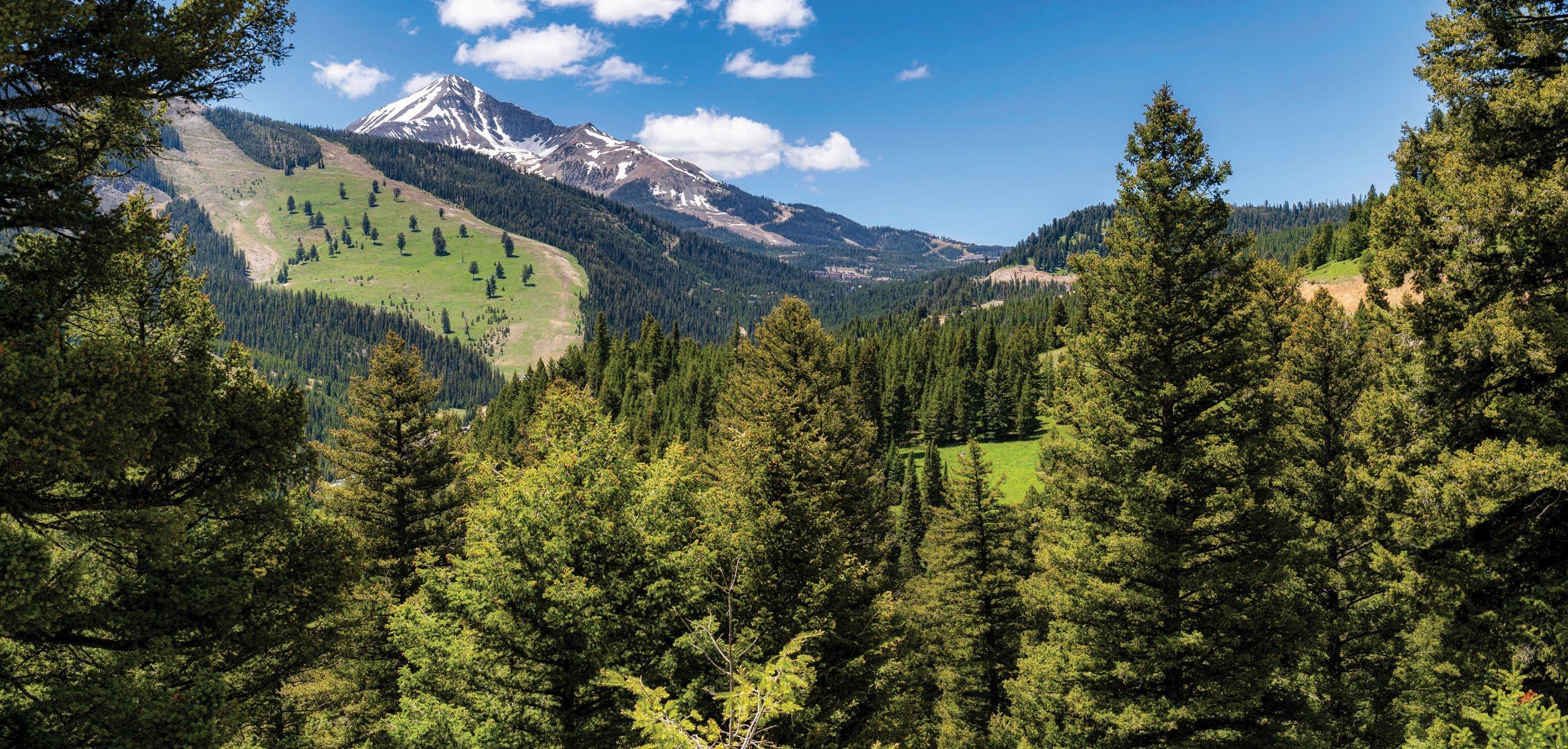
In a state where growth meets grandeur, it matters who you bank with. At Stockman Bank, our bankers bring Montana values and local insight to every project - big or small. Whether you’re building what’s next or investing in the future of our mountain towns, we’re here with flexible, innovative solutions and decisions made right here in the Montana communities we call home.
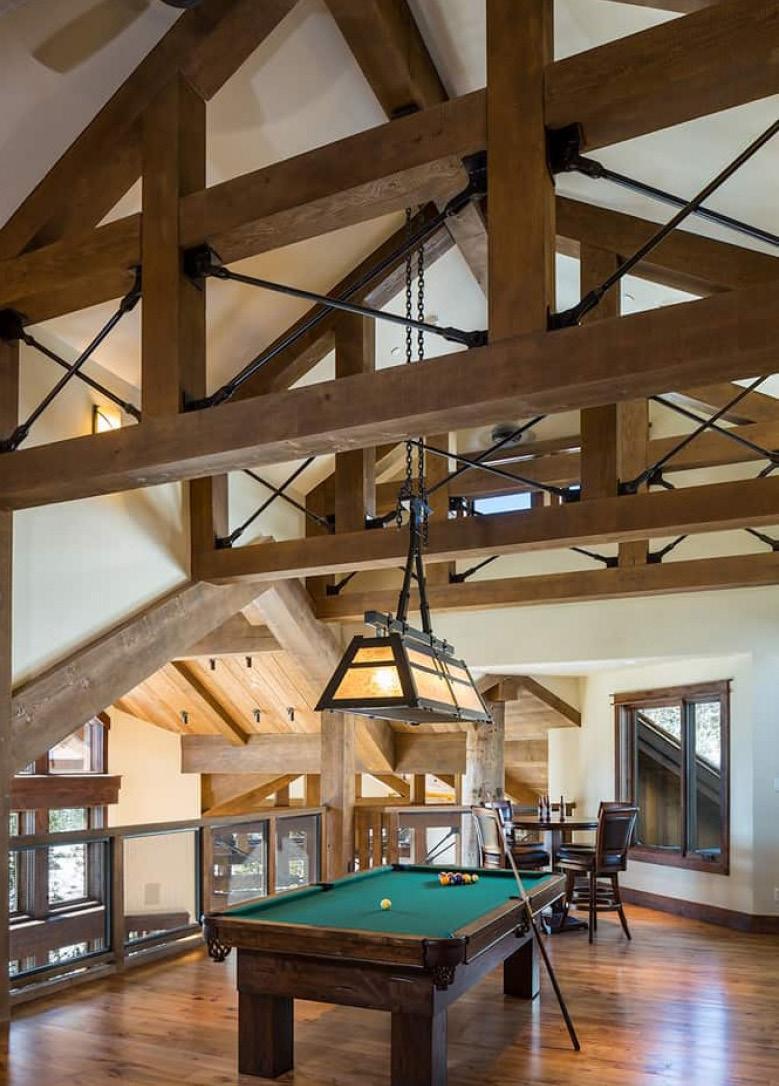

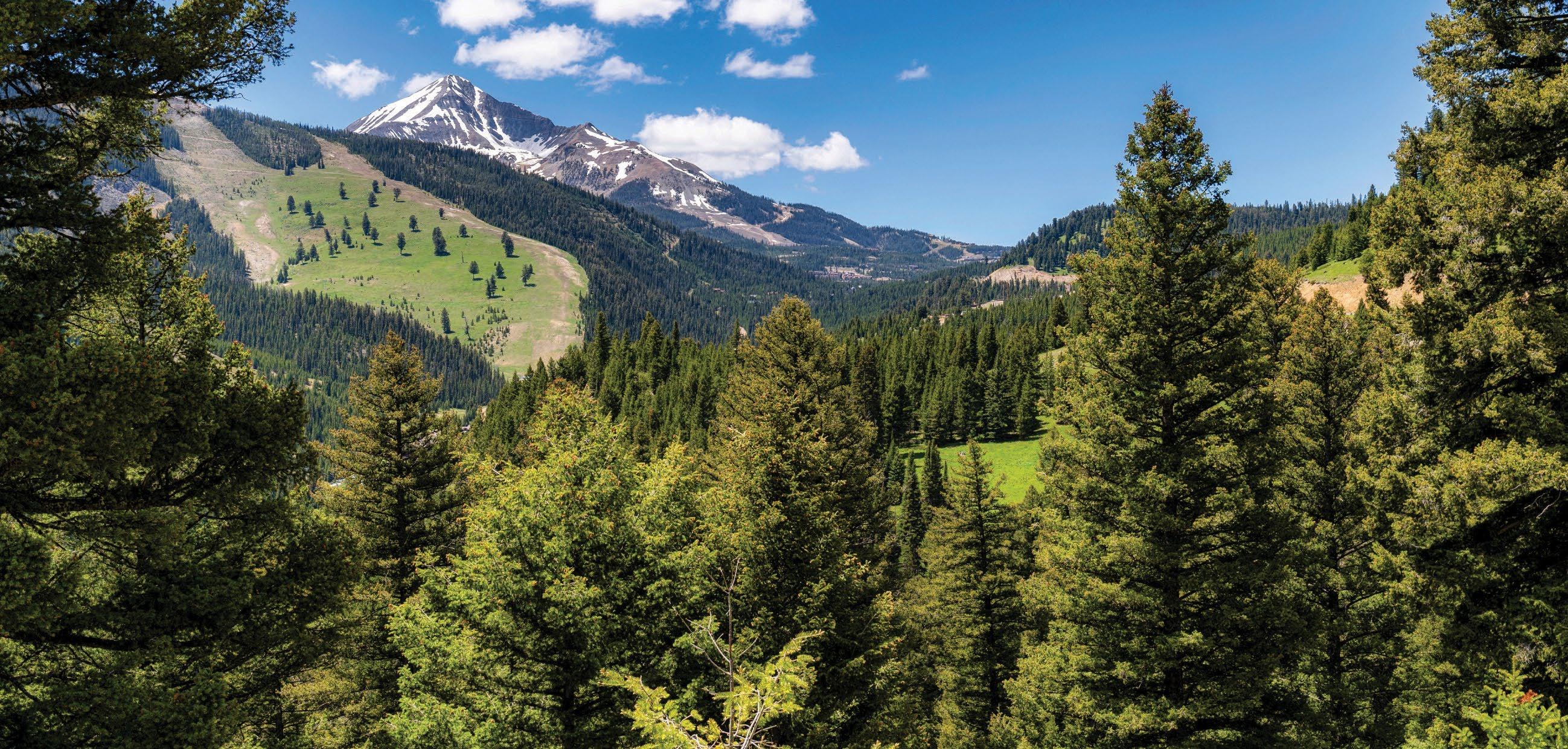

By Canyon Hohenstein
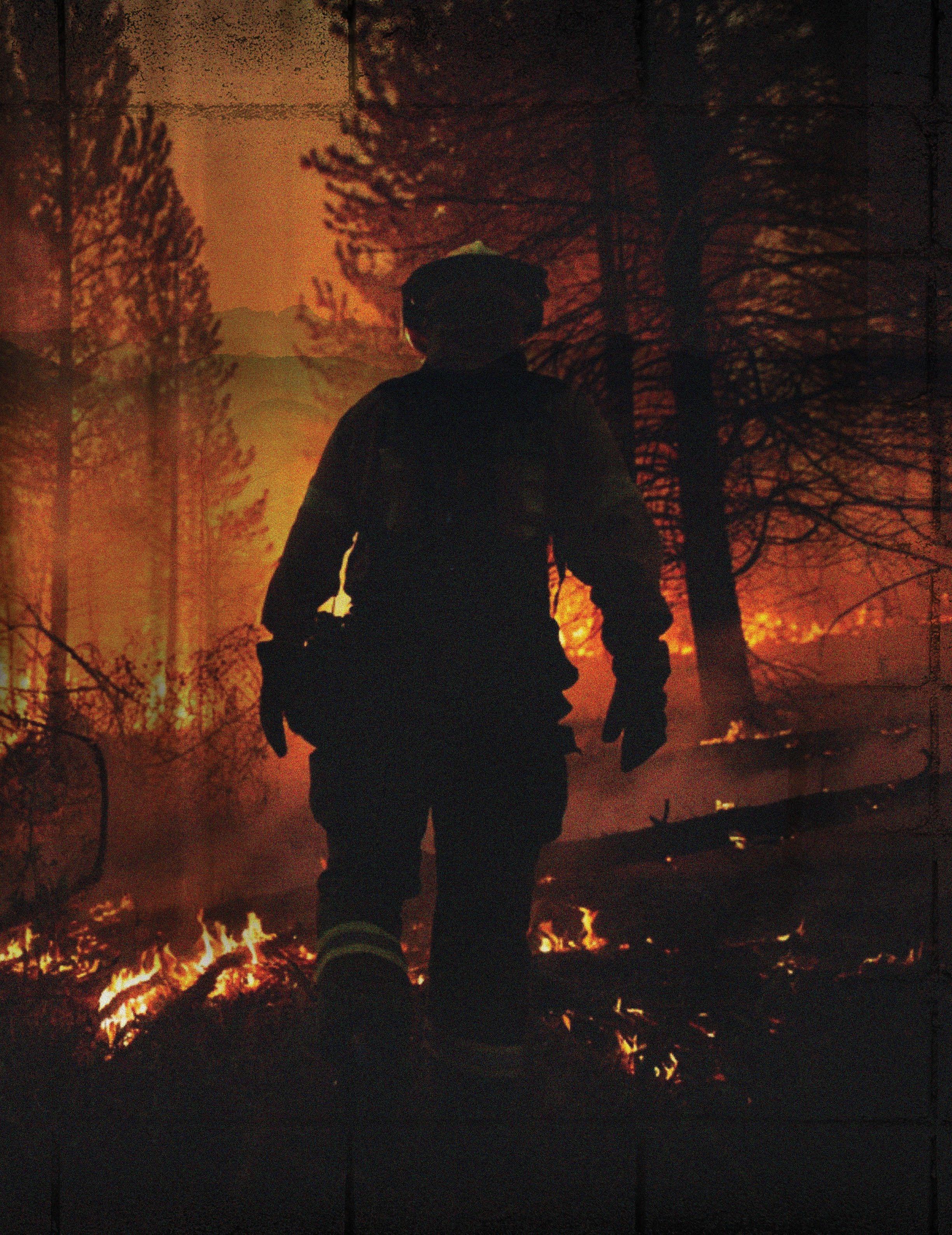
“BRING ME MEN TO MATCH MY MOUNTAINS, BRING ME MEN TO MATCH MY PLAINS,
MEN WITH EMPIRES IN THEIR PURPOSE, AND NEW ERAS IN THEIR BRAINS.”
-SAMUEL FOSS, THECOMINGAMERICAN
NOTHING of their rap sheet. It simply followed Mother Nature’s programming. Flames ran up the tree trunk, into the branches, and from there made easy work of the Douglas fir. Smoke rose high into the sky. The men lifted their chins to watch. They gazed up at the torching timber, admiring the flashing brilliance as dusk settled and smoke hung over the mountains.
When the trunk was just a blackened snag, they looked around at their fellow crew members, exchanging glances of disbelief. Collective wonder that came from confronting an inferno, but also, perhaps, from this shared sip of freedom after a long spell of confinement.
With tools in their hands—Pulaskis, rhinos and combis— they lowered their heads and continued digging handline around the spot fire. Each man grunted as he swung his tool, interrupted by the occasional crack of superheated wood and a revving chainsaw on a distant division. The fullness of fatigue was settling in. A 16-hour shift showed in their hollowed eyes, singed cheeks and dried sweat stains. But every prisoner would agree that wildland firefighting beat the hell out of being behind bars.
It was difficult to say why. They may not even have been able to explain it themselves. Perhaps because they, too, could rise like the smoke of a torching tree. Perhaps, by fighting wildfires, they already were.
THIS IS MONTANA’S inmate fire crew: prisoners selected from the Montana State Prison to partake in Big Sky Country’s yearly fire season. The penitentiary is in Deer Lodge, and so in radio communications and resource orders, they are called the Deer Lodge Crew.
As they should be. “Con crew” or “prison crew” are correct but feel obsolete. On a wildfire, competency matters more than a criminal record. And these individuals are fully trained to the standards set forth by the National Wildfire Coordinating Group. Each man has earned a Red
Card by passing all mandatory courses, obtaining medical clearance, completing the pack test, and getting trained to wield a chainsaw. This bright red slip of paper is the passport of the profession, showing a firefighter’s earned qualifications. Every firefighter must have one to engage in wildfire suppression. Offenders retain this card upon release, making it a bridge between their life serving time and their future freedom.
The program is run through a partnership between the Montana Department of Natural Resources and Conservation (DNRC) and the Department of Corrections (DOC). It’s a handcrew composed of 15 inmates, two DOC staff members, the fire crew supervisor, and a DNRC crew boss. The crew is a resource available for any incident in Montana, the same as a hotshot crew or a helicopter. Once deployed, the team can be out for a two-week stint plus travel days.
They have all the gear of the trade, such as the iconic yellow button-up shirts, green Nomex pants, gloves, a fireline pack with a fire shelter attached, and leather boots. Nothing in their physical appearance indicates their past transgressions except the orange hard hats bearing Deer Lodge stickers.
Inmate firefighting is an odyssey shaped by economic, mythological and legal incentives, creating the ideal conditions for a hero’s journey, where prisoners can voluntarily enter the belly of the beast. They won’t face a literal dragon, but they will certainly face its fire. Ask most inmates at Deer Lodge if they would join, and they’ll likely give the same answer: Decent pay, outdoor living, hard work with a dose of danger—sign them up.
STEVEN took on the challenge. Their time in Deer Lodge is not counted by tally marks on a concrete wall, but by the work they’ve done for Montana. Amuir knows the system. He has been an inmate since 1997 and has served more than a quarter of his centurylong sentence. He paused before answering every question,
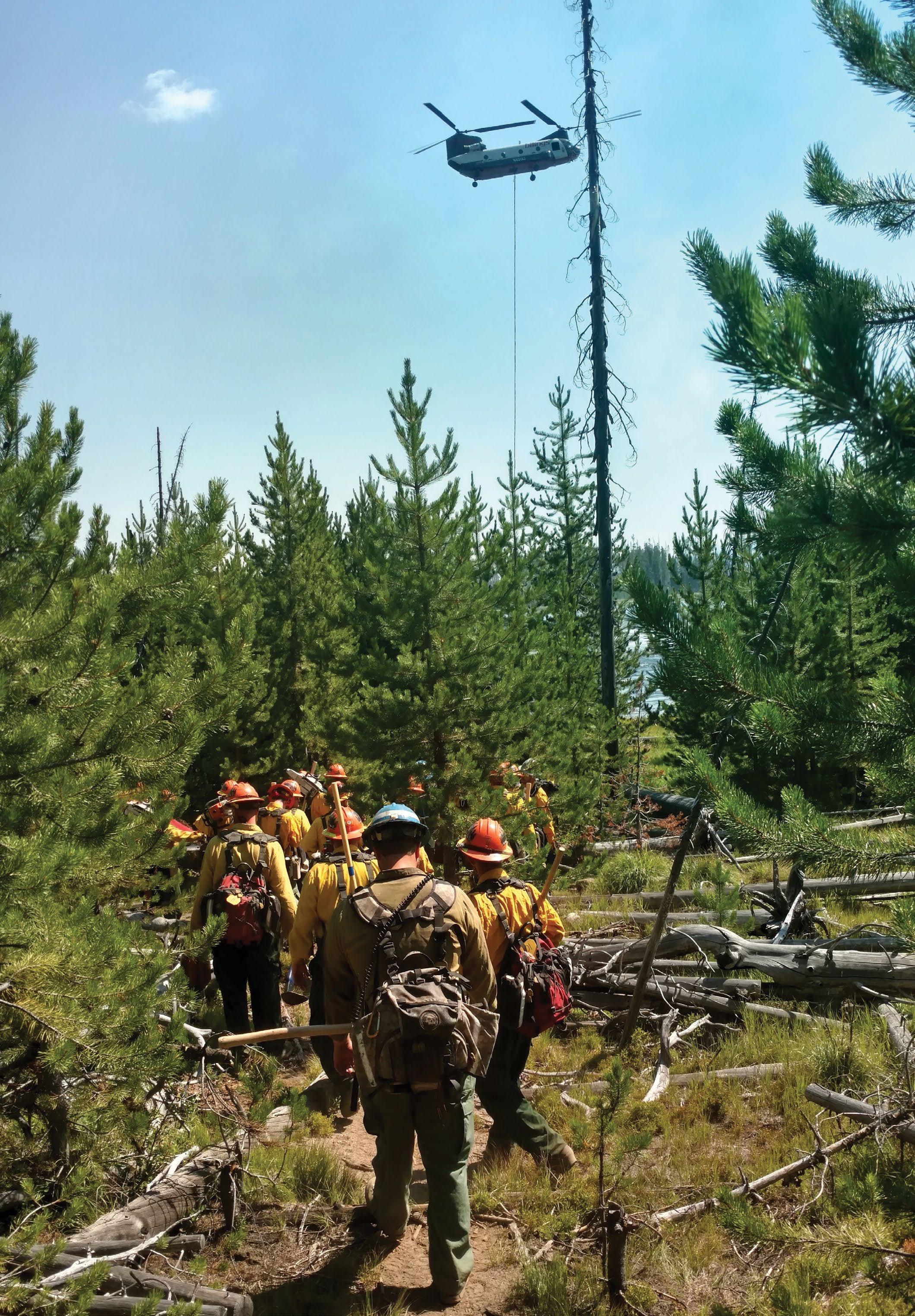

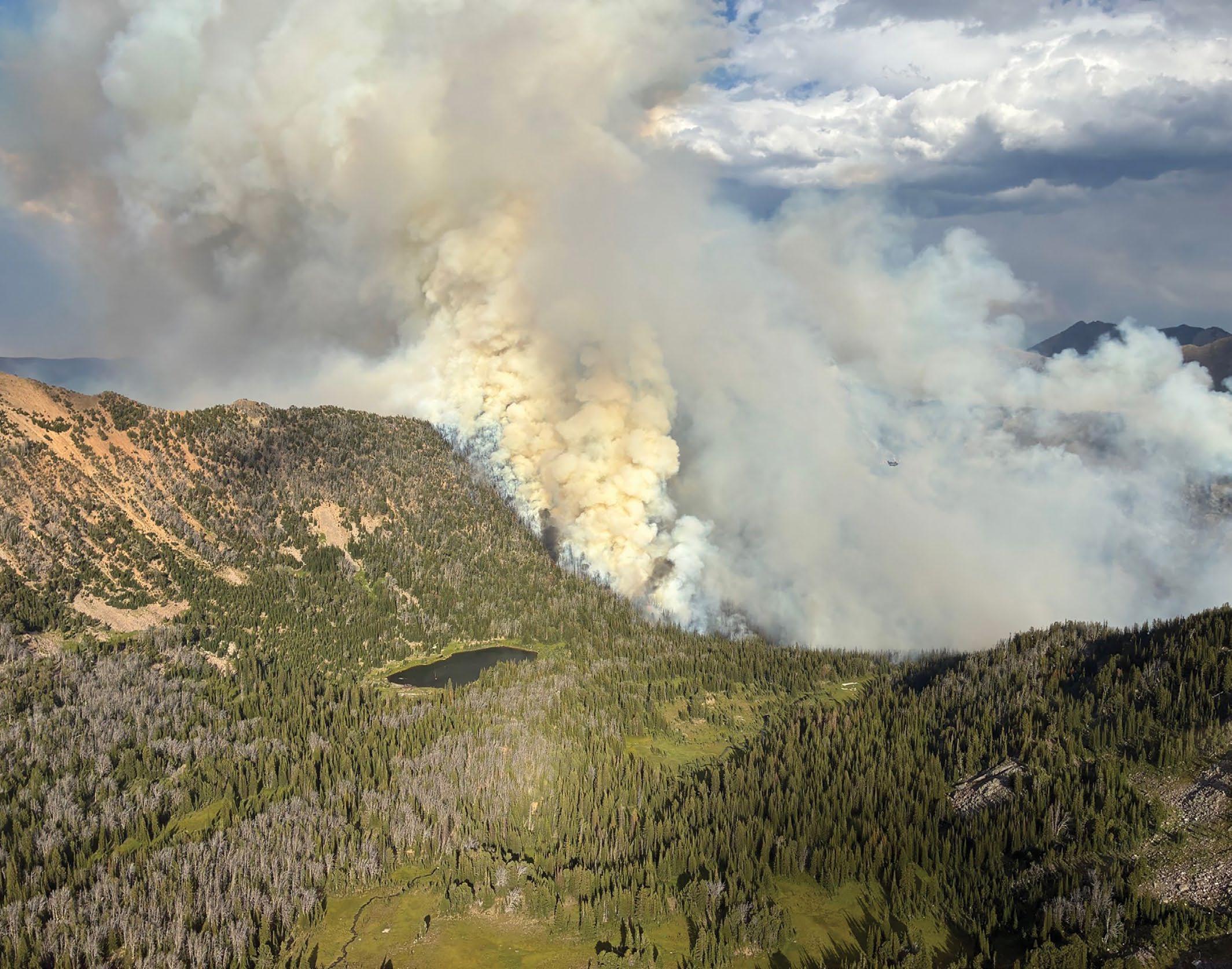

weighing each response. He understands the lay of two lands: the penitentiary and the fireline.
Nick is instinctually helpful—a vital trait in firefighting where missions are accomplished as a team. Unprompted, he offers to answer any future questions about prison or firefighting. The most detail he gives is about what it takes to become a firefighter. You don’t simply drift onto the crew. You must want it and work for it. He did both and has one year of firefighting under his belt.
Steven comes to the fire crew from a different path. A former correctional officer, he is now the fire supervisor. “Honored” is the only way he described his position. At 21, he’s more than 20 years younger than Amuir and Nick, but he talks like someone who already carries the responsibility of leadership. Steven started leading the crew in June 2025.
“Him being a former CO, the first thing he’s thinking about is security, security, security. But then once we’re in action and he sees our professionalism and how serious we take the job, it opens his eyes to like, ‘Dang, these guys aren’t just inmates. These guys are actually being firefighters.’ To get that kind of
appreciation from him helps us do a better job, go the extra mile, and work a little harder,” Amuir said of Steven.
Even over a phone call, the mutual respect between the two inmates and their supervisor is palpable. Age, race, background, none of that matters more than their shared profession.
“This is one of the highlights of the things that I’ve done through my incarceration,” Amuir said. “When we’re out on a fire, we’re firefighters. We go through the same training. We’re exposed to the same risks and dangers.”
As with prison, there can be deliberate destruction in firefighting—a burning of the forest’s dead to make room for fresh life after the smoke clears.
the only thing more exciting than a wildfire is one created by your hands. Burnouts are a strategy of using fire to fight itself. A handful of firefighters can completely level fresh fuel ahead of an incoming wildfire with a drip torch and a coordinated plan.
“Getting to do some back burning on a big slope to stop the
advance of the front of a fire on the Horn Fire south of Ennis— it’s a very powerful experience,” Nick said. “You’re trying to direct [it] and there’s a lot of variables. That’s a pretty cool thing to do.”
The gap between guards and the guarded breaks down on the line. A guard hands an inmate water, and the inmate points out a widowmaker. Everyone is tired and sore, relying on the person next to them to look up, down and around for potential hazards. Upslope, one man starts to drop fire, then another and another. From their anchor point they crawl across the mountainside, setting it aflame in one sweep. The crackling colors dance in a predictable yet untamed pattern, never leaving the tightly bound parameters in which they can burn.

“THIS IS ONE OF THE HIGHLIGHTS OF THE THINGS THAT I’VE DONE THROUGH MY INCARCERATION, WHEN WE’RE OUT ON A FIRE, WE’RE FIREFIGHTERS. WE GO THROUGH THE SAME TRAINING. WE’RE EXPOSED TO THE SAME RISKS AND DANGERS."
-AMUIR
Zoom out and this team is just one part of a coalition of other crews assisting in the burnout together. “When we’re out on a fire, they don’t look at us as inmates,” Amuir said. “Frankly, they probably don’t even know we’re inmates until they look at our helmets and see ‘inmate’ on there, but they treat us like we’re part of a team. It’s all good.”
isn’t as easy as volunteering. Certain standards are in place. Inmates nowadays have ample opportunity to work. In Deer Lodge, they can dabble in agriculture, furniture building, laundry, and work at a license plate factory. Five full-time members of the fire crew assist the DNRC with non-wildfire projects such as prescribed burns, pre-commercial thinning and fencing. The other 10 members work elsewhere when the crew isn’t deployed. All 15 are activated when a resource order comes in.
All work in the state prison is done through Montana Correctional Enterprises, an organization with three imperatives: “Teach. Train. Transform.” The program, “provides on-the-job training and work experience to inmates in industry, vocational and agricultural programs. Inmates training and working in these programs develop marketable job skills, a strong work ethic and self-esteem through a feeling of pride in their accomplishments, often for the first time in their lives.”
To be considered for the fire crew, offenders must apply to the fire crew supervisor and meet eligibility requirements: minimum-custody classification, within three years of parole
eligibility or discharge, enrolled in or having completed court-ordered treatment, acknowledgment and acceptance of responsibility for their crimes, and prior positive work evaluations. Staff compile candidate packets for review by the Administrative Review Committee and Community Screening Committee, including Criminal Justice Information Network checks and input from the sentencing judge, county attorney, and registered victims or their families.
“Accountability has to be number one,” Amuir said. “If you’re not holding yourself accountable to what brought you to prison, you probably won’t even be looked at for this position.”
Once accepted, crew members receive all the necessary wildland fire training from the DNRC.
Ross Wagner, bureau chief of the MCE, was present at Steven, Nick, and Amuir’s interview. He made an important point about the purpose of prison, one frequently lost in the debate over incarceration. The crew isn’t an endpoint for most, but a node in a chain that begins with an inmate’s imprisonment and ends, ideally, with their release. Everything done in MCE is geared towards getting these men out and ensuring they never return.
“The fire crew is a huge, huge asset. I’m an advocate for all these guys—keeping them moving forward, getting them ready for release, so when they’re released they have the training and the self-worth to know they can succeed. They don’t have to worry about, ‘Boy, if I do this I may go back.’ They’re not gonna think that. They’re gonna be like, ‘I’m gonna succeed. I’m staying out.’”
This unique fusion of wildfires and inmates didn’t start in Montana. The history of inmate firefighters extends even farther west and further back in time.
on the fireline began in California during World War II. The Japanese had attacked the mainland with floating incendiary balloons. Fire officials feared these could ignite California’s vast timber reserves and threaten watersheds, agriculture and military infrastructure across the state. Due to a shortage of able-bodied men, officials decided to put inmates to work in the war effort.

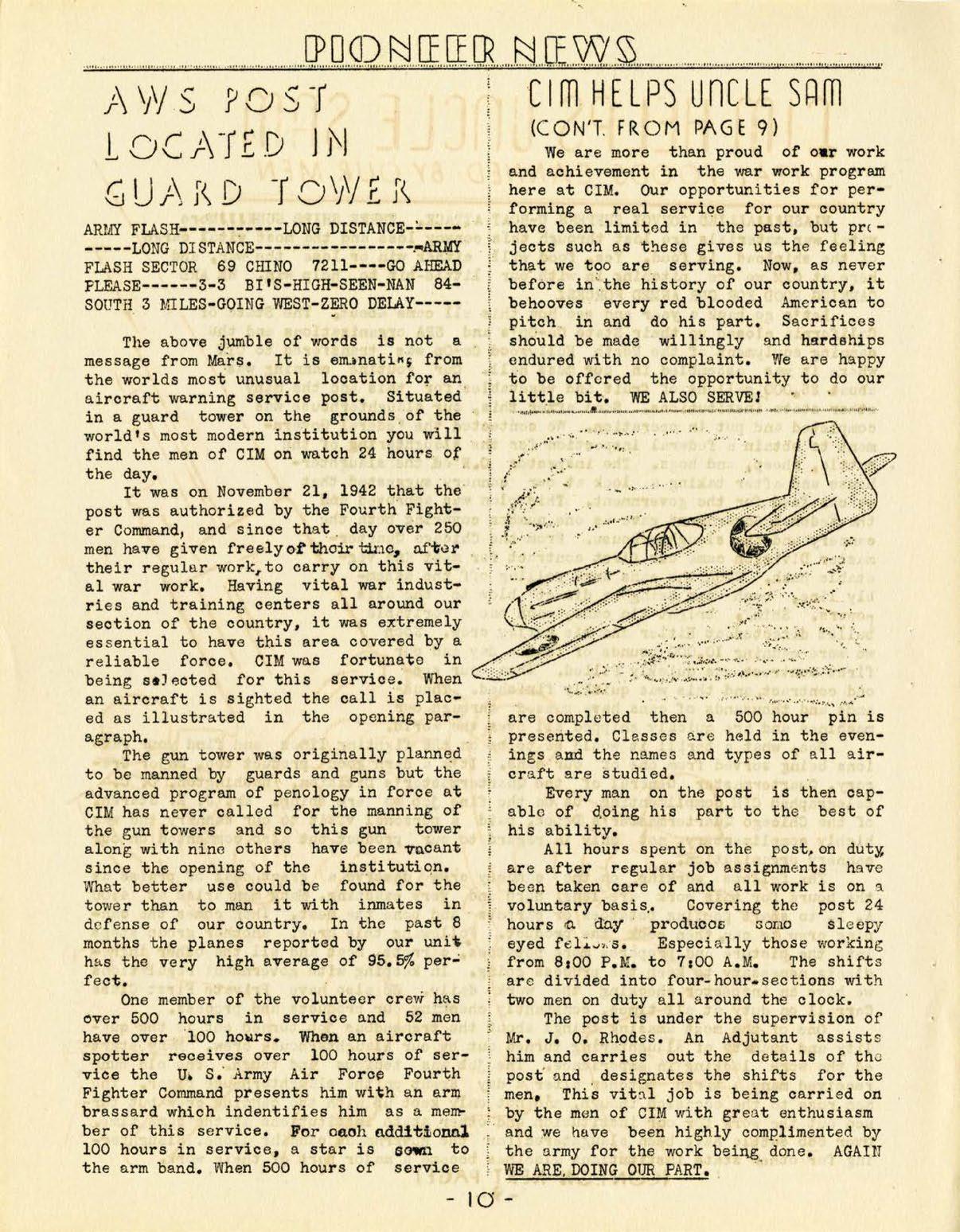
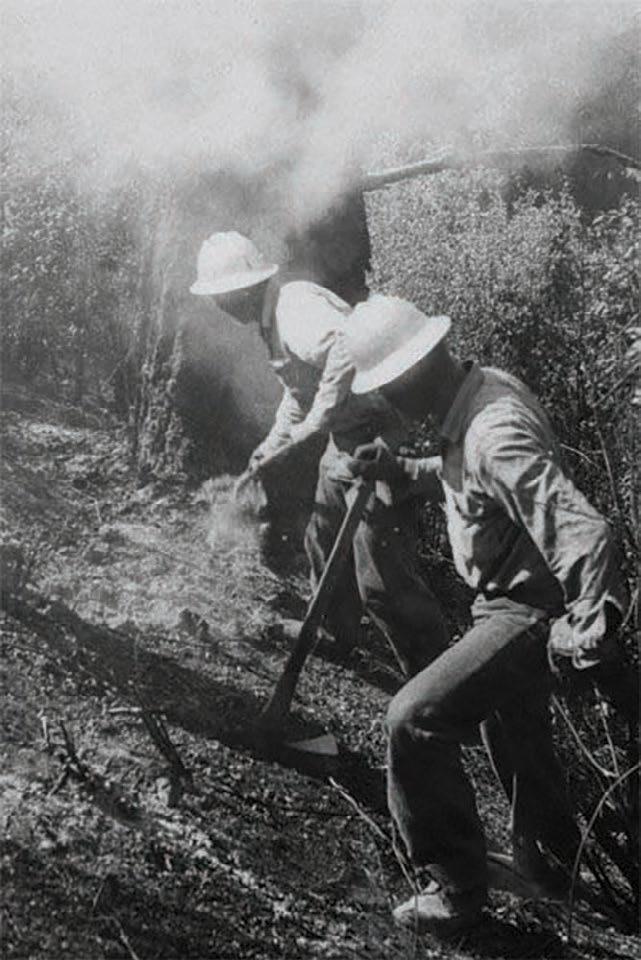
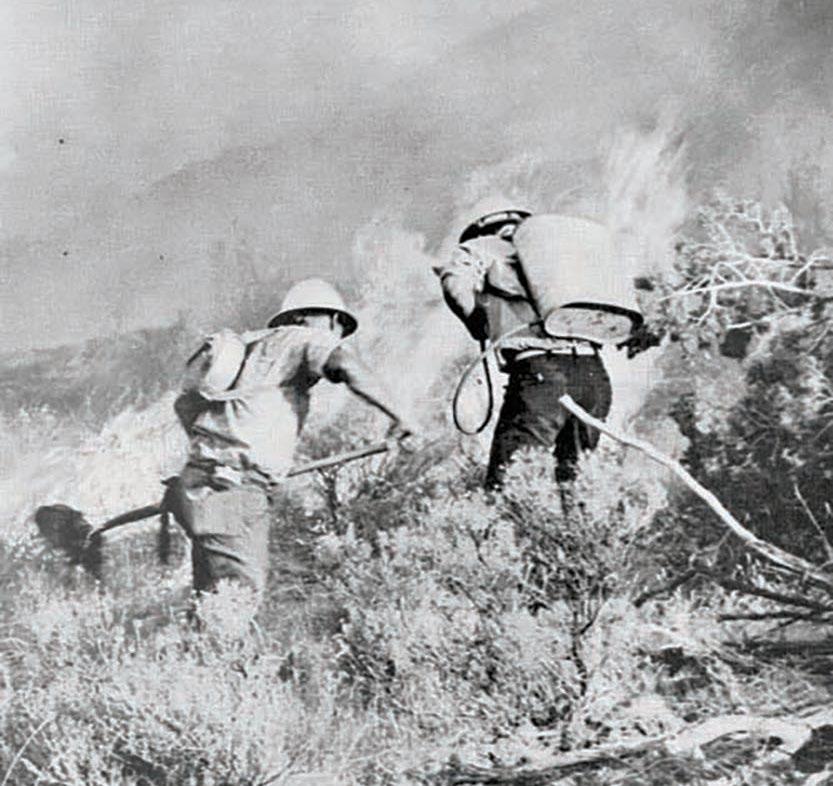
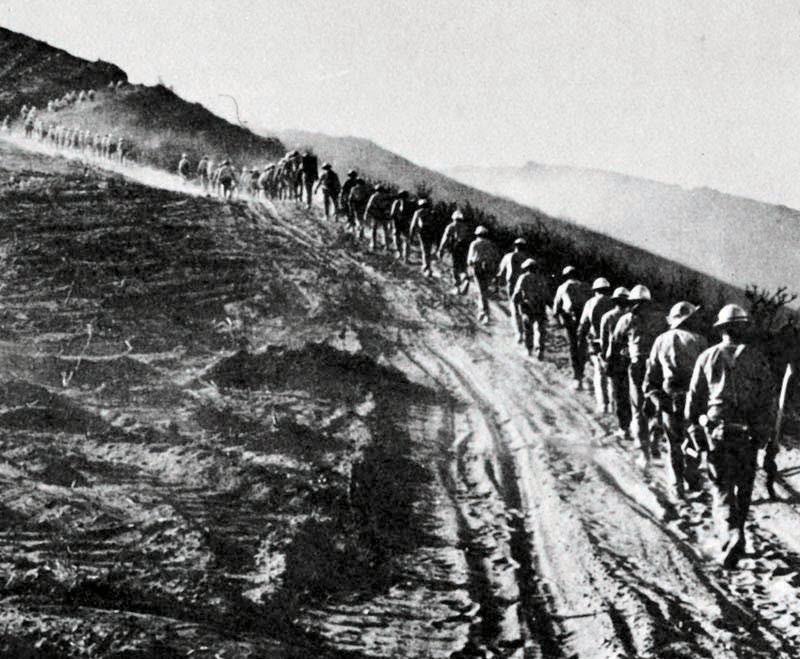
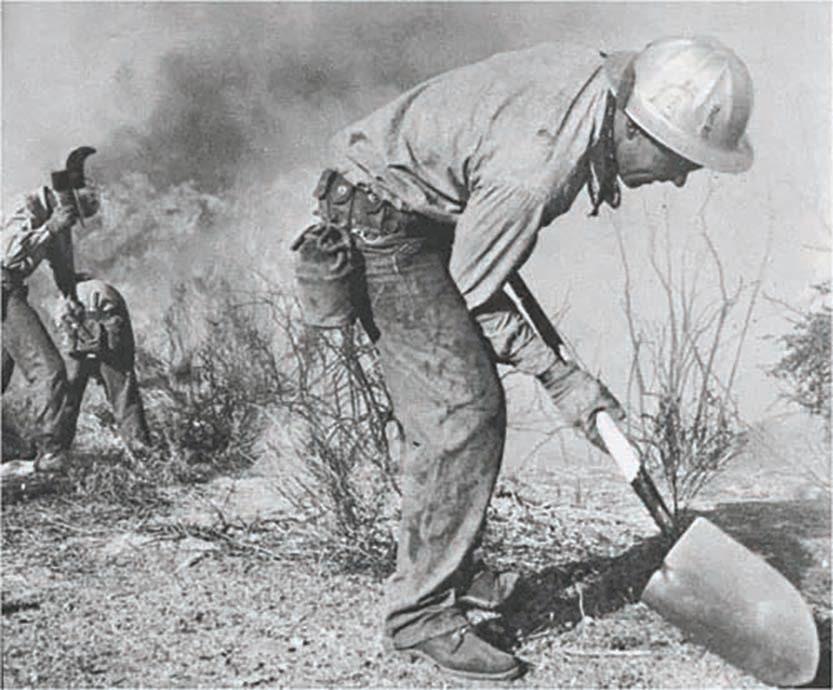

Dr. Volker Janssen, a history professor at California State University Fullerton, wrote When the ‘Jungle’ Met the Forest: Public Work, Civil Defense, and Prison Camps in Postwar California. In it, he wrote that prisoners had been transformed by the war from public enemies to public assets by contributing to seasonal harvests, forest camps and manufacturing industries at San Quentin and Folsom prisons.
The warden of San Quentin State Prison summed up the efforts: “The men inside the walls feel they are working shoulder to shoulder with fellow Americans on the outside.”
A 1944 newsletter from the California Institution for Men expressed the feeling of the inmates serving on the frontlines of wildfires: “On the ground fighting the smoke, flames, heat and fire bugs, will be found the fire crews of CIM … Millions of acres of valuable timber and grass and hundreds of homes have been saved through the efforts of our crews … Our men … are veritable gold to Uncle Sam, due to the manpower shortage.”
These camps were—and still remain—a liminal space between liberty and incarceration where the rules of prisons still applied but with less force the deeper one went into the flames. So says Dr. Janssen, “Even at their most orderly, camps lacked many of the boundaries and spatial regimentation of regular institutions.”
Inevitably, there were escape attempts, but far fewer than one would expect. The question is not why some prisoners would try to escape, but why most didn’t. The answer is simple. They had the carrot-and-a-stick promise of reduced sentences and better wages compared to other prison labor. Plus, no one wants to escape an institution that sees them as an asset and not an enemy. Battling blazes positioned prisoners as model citizens, not hardened criminals—exemplars of honorable action. The story of their lives was shaped by the forces of natural disaster, but also by their response to it. Who would walk away from such a mission and the praise that followed?
Praise was plentiful. An elderly woman in a letter to the governor captured public sentiment about these inmate firefighters, “I don’t care who they are. They helped save my house.”
More than 50 years later Amuir described the feeling from the other side. “Seeing people drive by, honking their horns and giving us little heart symbols. Stuff like that, it hits deep.”
systemic wildfire suppression followed the contours of the military. Nothing quite compares to firefighting. The valor is within the word itself. You fight fires, just as a soldier engages in battle. Prison crews partook in campaigns requiring a massive marshalling of manpower and resources. Once facing the inferno, they worked as a team to suppress and contain the enemy in a shifting field.
If a martial mindset and vocabulary was unavoidable, so too was the ethos most associated with service. To fight fires was an act of selflessness. There was something inherently heroic about people in professions where death is ever-present, regardless of the choices that led them to this career. No one ever doubted the heroism of soldiers in Normandy. That same belief applied
to inmates fighting fires in Northern California.
The rationale was darker than the heroism suggested. As Janssen wrote, the state understood that if a convict died on the line, it was not the worst outcome for all parties involved. “The inversion of capital punishment, prisoners’ willful sacrifice on the fire line, demonstrated the state’s capacity to shape, elevate, and direct life even to the point of ending it in manly civic duty.”
The inmate would go down as a hero, the state would be applauded for allowing it, and the public received cheap emergency services.
With World War II in the rearview mirror, California opened the Rainbow Conservation Camp in 1946, the first permanent male conservation camp, where incarcerated men entered as inmates and left as inmate firefighters.
camp programs are alive and well, even expanding in 1983 when the Rainbow Camp converted to a female camp, chronicled in Jamie Lowe’s book Breathing Fire. Roughly 1,800 inmates serve at any given time, about 30 percent of the state’s wildland firefighters. There have been policy changes and public outcry, yet the program endures and has inspired other states to follow.
Montana’s inmate fire crew is a mote compared to its mighty influences. It began in 2002 and is nothing like the institutional practice found in California. It’s simply one crew among the thousands working in Montana during the fire season. As Deer Lodge Prison puts it, the program “works with, not against, other crews in the state.”
Proper preparation is essential to that partnership. Injury and death are always possible in this line of work, though the DNRC has an excellent track record. To date, no major injury or death has occurred. Protocols are in place if any incident were to happen. No inmate enters the fray without first having crucial safety rules committed to memory: the 10 Standard Firefighting Orders, the 18 Watch Out Situations, LCES (Look out, communication, escape routes, and safety zones), and more. The final rule of the 10 Standard Firefighting Orders is, “Fight fires aggressively, having provided for safety first.”
Nothing happens on a wildfire without first establishing a safety plan. Lives matter more than trees or structures. That understanding is embedded into every aspect of fire operations. Nick has seen this firsthand. “I have concern for my safety, but I don’t feel I’m placed in any undue dangerous situations,” he said. “Steven communicates with us, and we are part of briefing every single day. We have our LCES in place, safety routes, escape routes, everything like that. Not only does Steven take that responsibility, but anybody we have been with on the DNRC puts the safety of our crew ahead of anything else.”
Steven agreed. “I know for me and the other staff members, we go throughout the day and make sure that everyone is taken care of.”
Participation is voluntary—inmates are not forced onto the crew, nor are they put in unnecessary danger. Still, not all inmate firefighters throughout history have had such positive outlooks. Amika Mota, a former inmate firefighter in California, wrote
about her experience in an article titled, “I Was an Incarcerated Firefighter. Here’s What I Want People to Know.” She wrote that while the work was rewarding and gave her a sense of purpose, “Neither I nor my work felt dignified or valued.”
Human dignity is a way of living, not a settled destination. And the way to live in America is through the almighty dollar, even in prison.
Incarceration creates direct costs for inmates, including lost income, long-term earning damage and ongoing financial penalties. Inmate firefighters in Montana earn $50 a day, but as the old adage goes, the only guarantees in life are death and taxes. They pay for hygiene items and personal clothing, victim restitution and court-ordered fines, child support, and to save for their release.
In his article “Confessions of an Inmate Firefighter,” Joshua Daniel Bligh wrote that despite the low wages, the work gave him something money couldn’t: “I learned valuable skills and through the experience was able to feel like I was giving back to the society which by my actions had wronged.”
“When I sense outrage and shock in the faces of the contract crews who hear how little we make for the work we do, I remember that I could have been sitting in a prison cell,” Bligh wrote. “I think a lot of inmate firefighters feel the same way. We work hard because we are grateful. We work hard because we are fallen and in need of redemption in the eyes of our community. We work hard not because we can support our families with the income, but to build the mentality we will need when we are released.”
This raises the question: Should equal risk be compensated with equal reward? If inmates are firefighters, then they should be paid the same as other firefighters. Or maybe not. An inmate on the line is also paying back the society they transgressed.
The base pay for a DNRC Wildland Firefighter Type 2 is $20.74 an hour, plus overtime and a 10 percent pay increase when supporting authorized emergency work. Two and a half hours into a shift, a firefighter will earn more than an inmate for the entire day.
“For more than 20 years, the partnership between the DOC and DNRC has offered a unique opportunity for incarcerated Montanans to build skills while also providing an essential service to the state,” Gov. Greg Gianforte said during the 2024 wildfire
season. “During this active fire season, we needed all hands on deck to approach each fire with an aggressive attack. I join all Montanans in thanking our fire crews.”
Governors praise their service. But their paychecks tell a quieter story. On the line, they are firefighters. On paper, they are still inmates. Their wages sit at the tension between penance and profession, for payment is measured not just in dollars but in the mentality, skills and experience they acquire.
The DOC frames it plainly: The Deer Lodge Crew gives DNRC needed work at a reasonable cost while giving inmates work experience, life skills and income to support their reentry into Montana communities.
What the state owes an inmate and what the inmate owes back resists simplicity. This is not merely a monetary issue. It is also a moral one, and problems of that nature cannot be solved in a budget.
partake in aerial firefighting, but even just witnessing it is awesome. Steven recalled seeing it for the first time. “One of the stories that will stick out to me, I shared this with my family: It was my first fire in Ennis, just seeing the helicopters. There was so much smoke in the sky as these helicopters were coming down and dropping water right next to us. And it was just pretty cool how fast they’d go back and forth to put the fire out.”
They’re on a hillside digging a cup trench. The sun is setting. Smoke mixes with the soft shades of dusk. As humidity increases, the fire dampens down. The crew continues digging. They need to get a line anchored in before complete darkness.
“PRISON IS NOT A DESTINATION FOR MYSELF AND A LOT OF PEOPLE IN HERE, IT’S A CHANGING POINT, AND THERE’S A LOT OF PEOPLE IN HERE LOOKING AT THIS AS AN OPPORTUNITY TO BETTER THEMSELVES AND TO LIVE A MORE INTENTIONAL LIFE. -NICK

Overhead, the helicopter is dropping bucket after bucket on the fire. They can’t help but look up as the mechanical marvel hovers over a torching tree and douses it. The noise of fire turned instantly to steam is satisfying—a great hiss. Wisps of water hit their faces. They bend down and rip out another chunk of land.
Across the way, another peak is burning. Live fire creeps tiredly instead of running. “For myself, it really reignited a passion for the outdoors,” Nick said. “It really invigorated my attitude and just because I’m here doesn’t mean I can’t have a purpose and provide a benefit.” That passion is incurable. In wildland firefighting, it’s called the fire bug.
And it’s highly infectious.
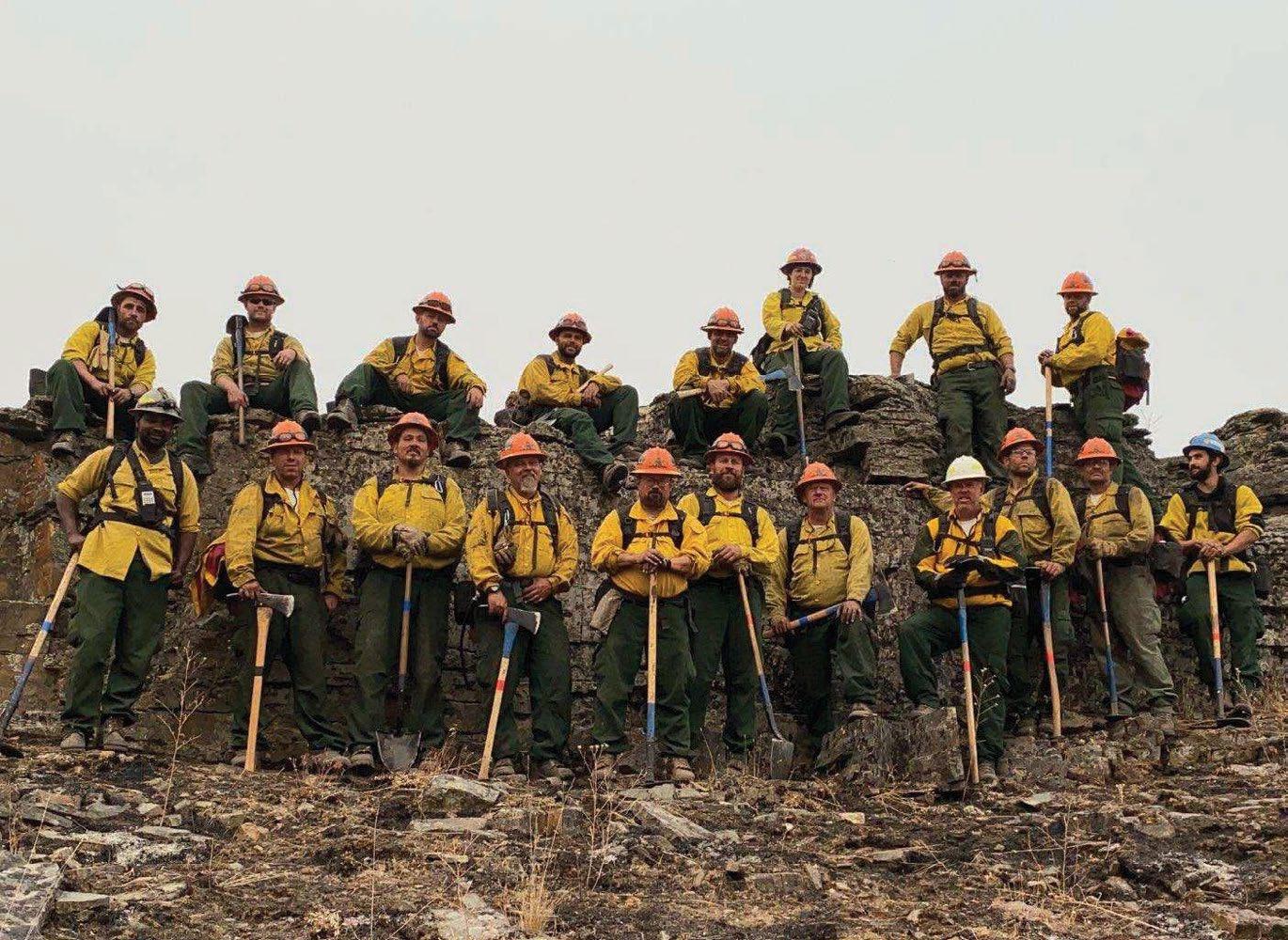
“CONSERVATION CAMP workfare united advocates of rehabilitation with those of punishment,” Janssen wrote. Debates around incarceration constantly fluctuate between the two. Inmate firefighters make up a small niche of American society, but their enduring success lies in the general bipartisan consensus over these programs.
A sparsely populated state like Montana serves as a microscope for the broader criminal justice system. There are thousands of inmate firefighters in the U.S. and just 15 in Montana, making it a contained case study with one crew, traceable outcomes and clear accountability lines.
Debates around prison reform will continue. And while they do, the focus must remain on individual inmates, equipping them with the tools to free themselves. Inmate firefighting is one such tool.
Personal responsibility must come first. Amuir and Nick know that. For them, systemic change would matter little without individual reckoning. Wildfire offers no refuge from yourself. Unforgiving and illuminating, flames expose every insufficiency. They will humble you. From that humility, something new can take root.
is a gray space. Ash covers the land and everything is quiet, save the occasional flutter of a bird’s wing as it dives for a roasted grub. The inmate fire crew patrols the line, arm’s length apart, shoulders sagging from the weight of the line gear. Their boots are chalky; their faces sunburned. All that remains are mop-up operations: leisurely search-and-destroy missions for any remaining hotspots.
The crew is tired after 14 days straight of grunt work. Friendly bullshitting usually flows effortlessly, but not now. Words come sparingly. Only so much can be said through all
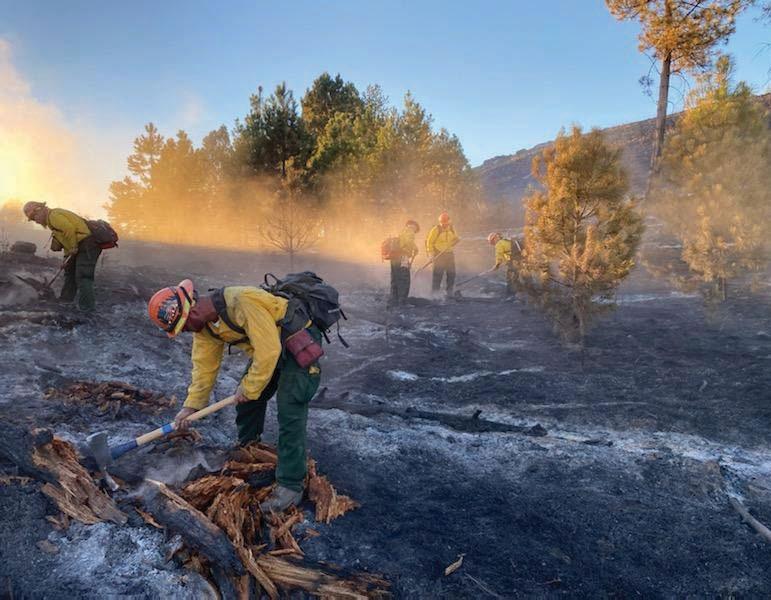
the hikes, hose laying, and line digging.
The inmates stop for a water break, soaking in the sunshine, planning what they will do back in the penitentiary, and preparing for when the state needs them again. They are fathers, friends, and now firefighters, a marker that may fade with time, but never completely disappear.
“Prison is not a destination for myself and a lot of people in here,” Nick said. “It’s a changing point, and there’s a lot of people in here looking at this as an opportunity to better themselves and to live a more intentional life. That’s a really big parallel with working on a fire crew ‘cause you have to have intention. You can’t just do your day recklessly, taking things as they come. You have to have a plan and of course be flexible in that plan, but execute it in the most productive way possible. That’s definitely a lesson I intend to take forth into the rest of my life once I’m able to be released.”
The wildfire is contained. Private property and grazing land have been saved. Houses have been buffered against fire danger with wildland-urban interface. And yet one can never completely prevent fires. Even on the most well-managed incidents, some land will always burn.
Beneath this charred duff are the seeds of tomorrow’s trees, ready to spring forth into a new forest flush with life. It will take time and patience. Roots, rhizomes, and buried buds will sprout green shoots. Grass blades will push through soot. Webs of fungi will spread through the seared soil.
But these changes don’t take decades. For those willing to witness the minute details, that transformation has already begun.
Canyon Hohenstein is the author of Who Tames the Flames?, a novel inspired by his time working with inmate firefighters. For more of his work, visit canyonhohenstein.com.

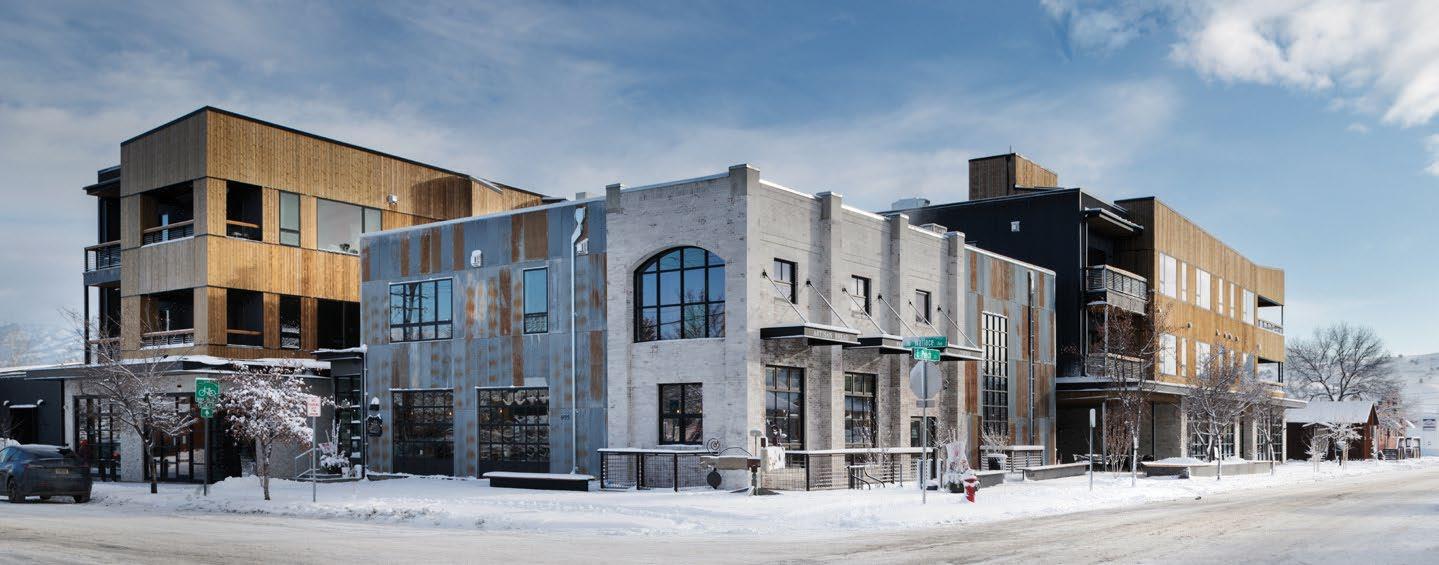

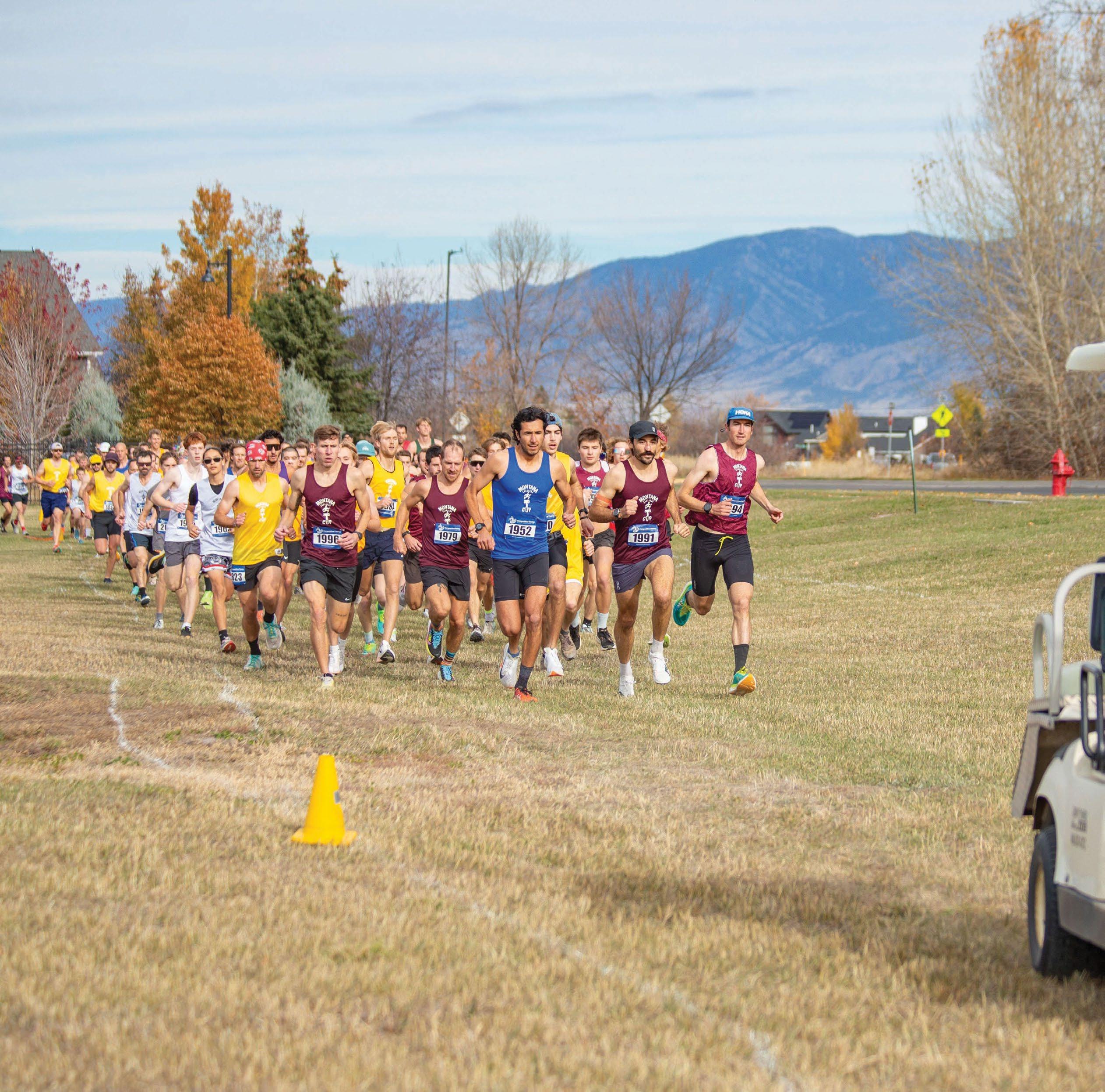
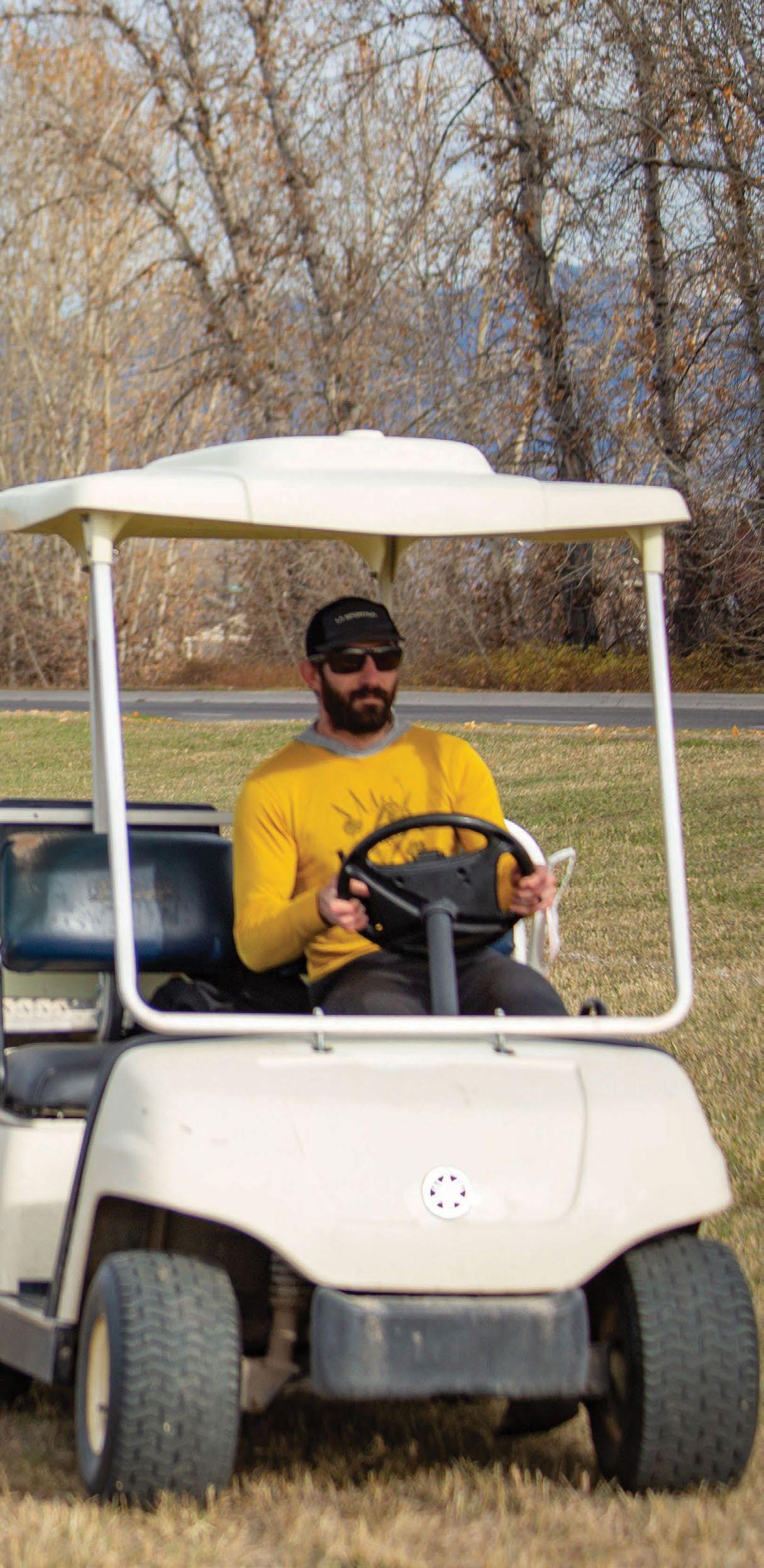

How the Montana Cup brings the state together and “makes you feel like a kid again”
Words and Photos by Jack Reaney
Nico Composto decided to pack his track spikes.
He had excelled in cross country in college, leading Columbia University to the Ivy League title in his senior season and earning All-American honors alongside his 30th-place finish at Division I nationals in a 253-runner field. But like most athletes, his competitive career ended with graduation. He spent a few months on the West Coast, headed home to Illinois for a year or two, and finally packed his bags for the Treasure State.
His dad saw him grab the spikes and questioned why he’d need those for adult life in Montana.
“I was like, ‘I don’t know,’” Composto recalled. “Brought ’em, and yeah—there’s a race to use them for every year.”
The Montana Cup is an annual cross-country style race, usually between 5 and 8 kilometers, that pits the Treasure State’s seven regions against each other in a team format— runners wear colors representing Billings, Bozeman, Butte, Great Falls, Helena, Kalispell and Missoula. Every fall, hundreds of Montanans, young and old, travel statewide for a down-to-earth tradition and a reunion with familiar faces. The fastest team drives home with the cup.
“Dude, it’s so sick. It makes you feel like a kid again,” Composto said.
It all started in 1992. Ray Hunt, a runner-turned-coach at University of Montana, was tasked with putting together a low-budget, “all-star race,” featuring the best runners from cities across the state to compete against the Grizzlies.
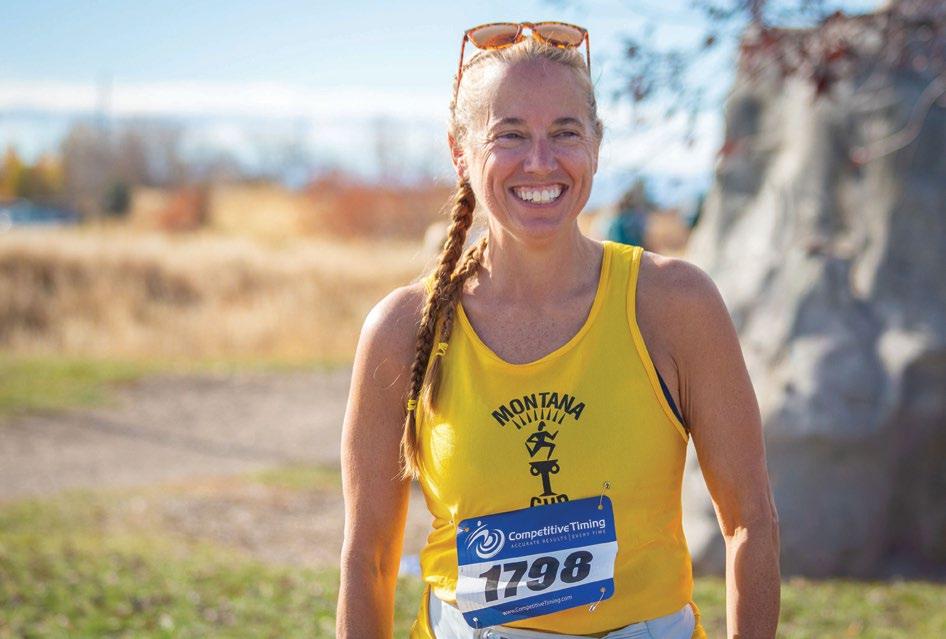
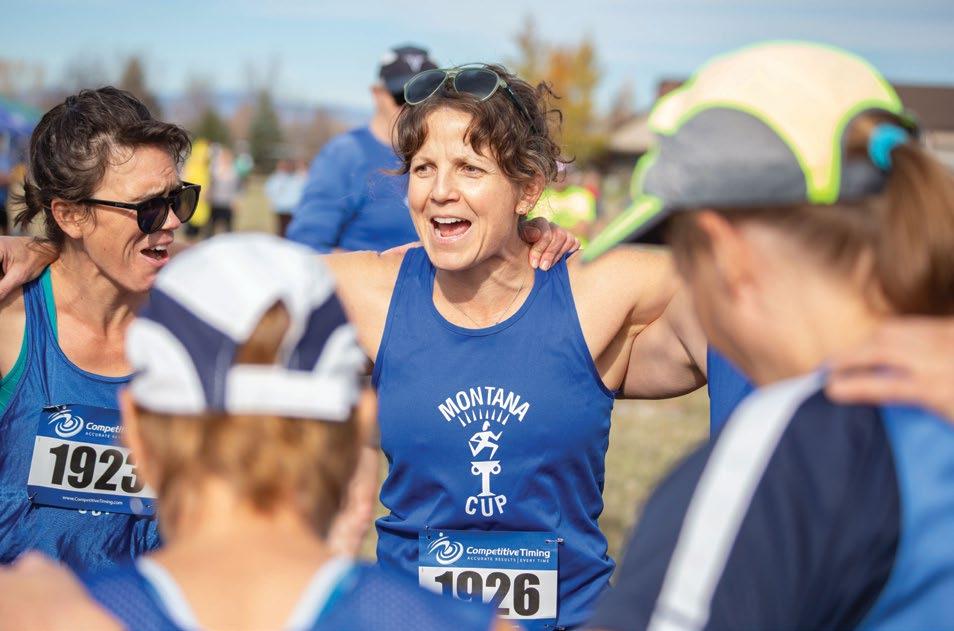
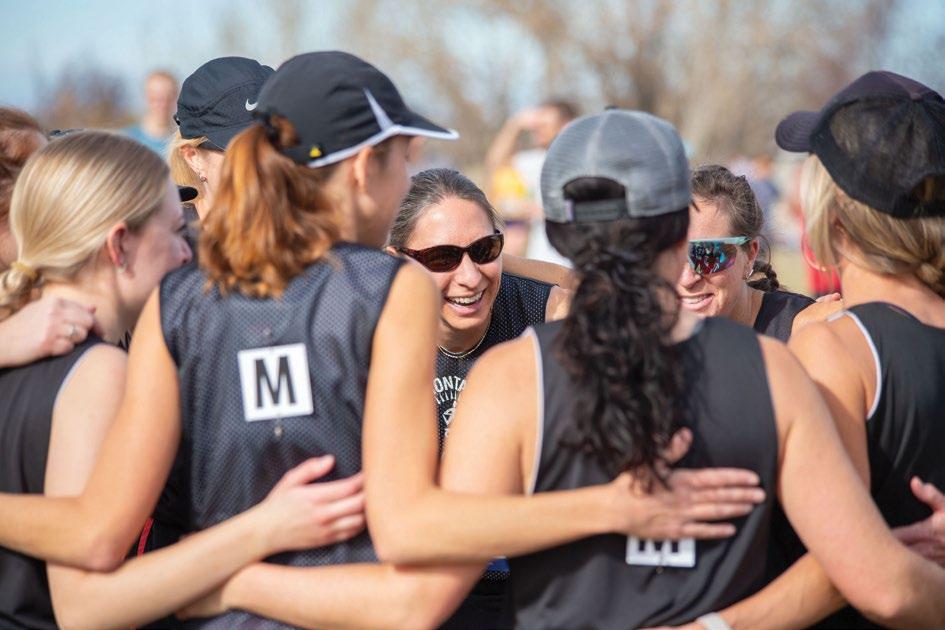
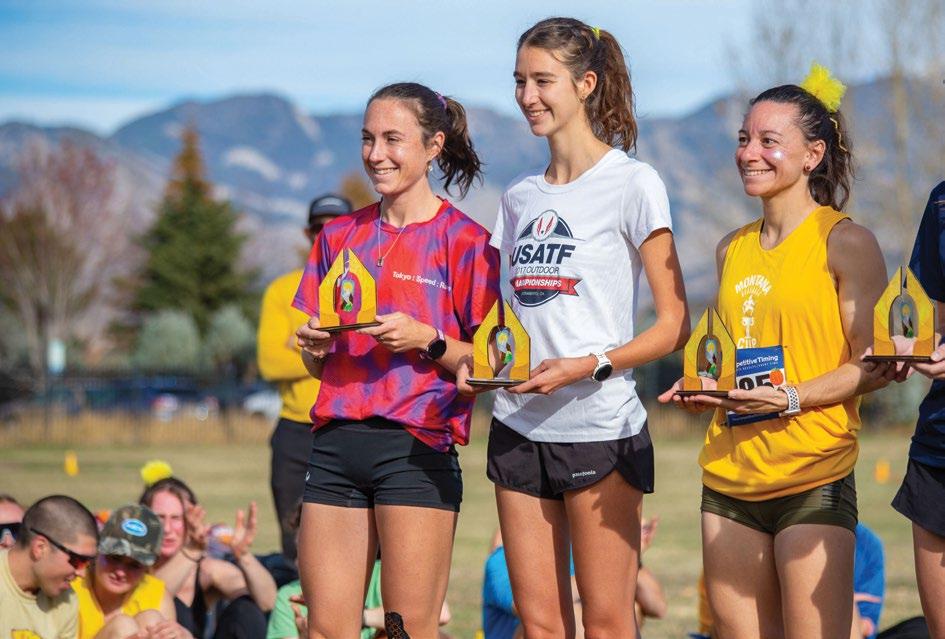

NCAA regulations, it turned out, prevented the Grizzlies from participating.
“We did it anyway,” Hunt said, just without the UM team.
The event, originally called the Montana Open Cross Country Race, stayed in Missoula for its first four years. Busy with graduate school in 1996, Hunt asked his friend Susan Kaluza to bring the event to Butte. By 2001, Helena had taken two turns hosting, and in 2002 the Montana Cup adopted a seven-year rotation around the state. Each region’s course is unique, with varying distances and terrain.
Hunt is proud to see the race grow. Over the years, it has drawn as many as 299 runners to a single race, a mark reached in 2016 in Bozeman. Fall Montana weather has made for a wide range of conditions—from 29 degrees Fahrenheit in Kalispell in 2019 to 73 degrees in Helena in 2008. And in 2013, the race in Deer Lodge started with a bullwhip in place of a starting gun.
“It was a really excellent way to see all of the cool hidden places in Montana where you could run a cross-country meet,” Hunt said. “There have been a handful of years where we’ve ended up someplace that was really fabulous.”
Composto became captain of the powerhouse Missoula men’s team. He won the event individually in 2017 and 2018.
In 2025, Composto raced for the eighth time and for him, the Montana Cup is a really big deal. “Our team captain here cares more about this race than anything in the world,” said Missoula runner Adam Peterman.
Peterman, 30, remembers his first Montana Cup in sixth grade, when he finished third to last. Now, he carries Composto’s squad. The Missoula native’s 15:32 won the 2025 race in Bozeman, hosted at Gallatin County Regional Park under exceptionally warm November skies.
A professional ultra-runner with Hoka, Peterman said the event resonates with runners who competed in high school or college and yearn for simpler times—donning a tattered, possibly smelly track pinny for a nonprofit race marked by colored flags and cones, and grinding toward a combined team score.
“It’s fun to come together with our seven teams and, like, actually represent something,” Peterman said. “It’s kind of like old-man cross country though. Nobody takes it too seriously.”
If anyone does, it’s the men in maroon. Missoula is the New York Yankees of the Montana Cup; the men have won in 23 of the event’s 32 years, dwarfing four wins apiece by the next best teams, Bozeman and Helena.
The Missoula women have dominated as well, with 17 titles. Bozeman’s women, however, have taken the past four. Helena
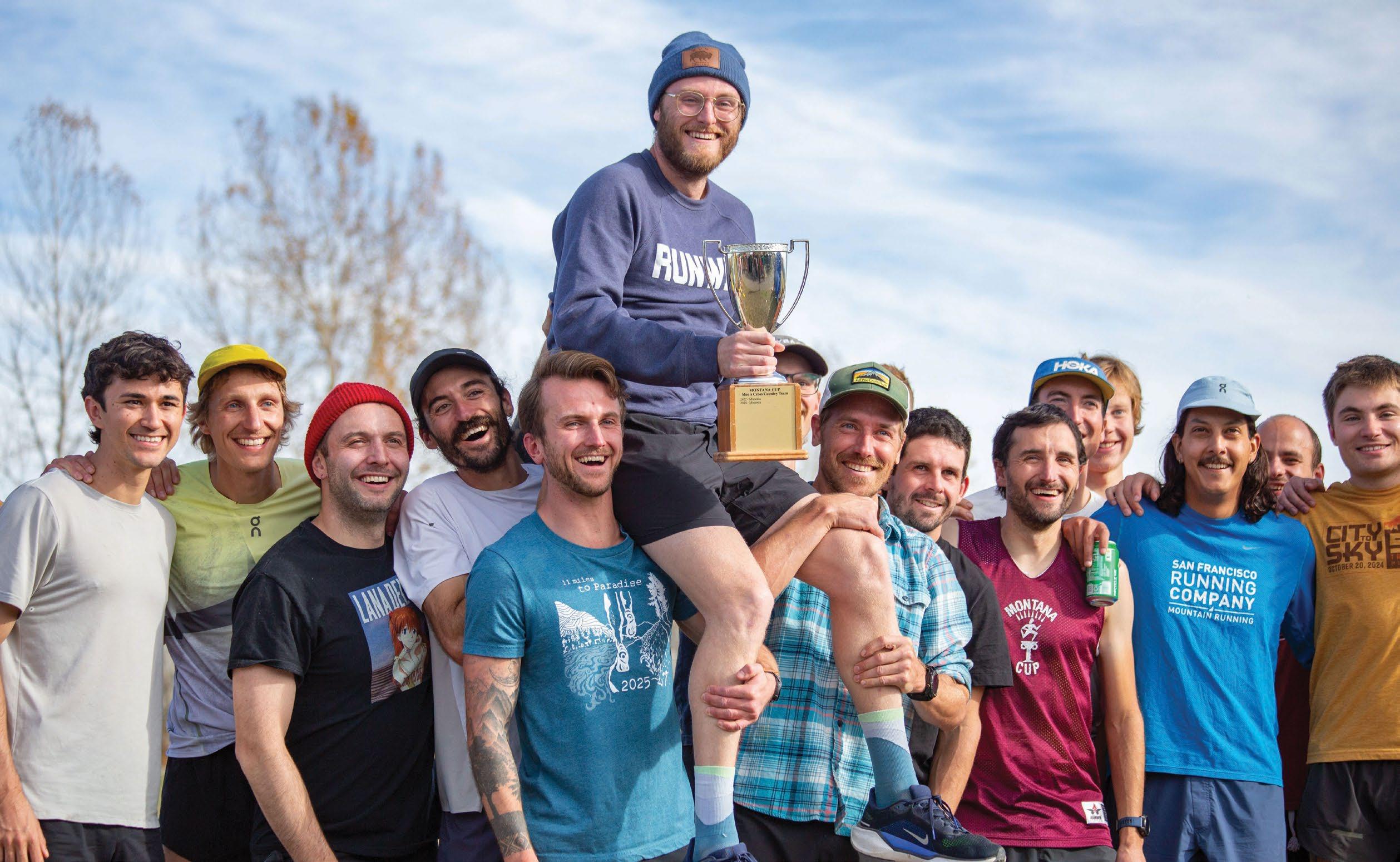
runners seem to age well; both the men and women have won the masters division seven times since the category opened in 2005.
Peterman is proud that enough Missoulians care about the Montana Cup to fill a yellow school bus. He also enjoys recognizing familiar faces from his days running for Hellgate High. “The guy who finished second today, he and I were high school rivals, and then we ran together in college,” Peterman said. “It’s kind of cool now that we’re a little older and still seeing the same people.”
That guy was Zach Perrin, 30, who ran for Flathead High School before sharing a dorm room with Peterman at University of Colorado (Boulder). Perrin is a talented runner—his second-place split was 16:09— but isn’t competing on a professional level. “This is such a cool community event,” Perrin said after his first Montana Cup. “Montana is obviously a big state, but the running community is really tight-knit.”
“It’s always such a special thing to see all of the runners in Montana come together ... It’s a cool event because you don’t get to run cross country, like, any other time as an adult.”
-Makena Morley
After the men wrapped up their 5K, Bozeman runner Makena Morley, 28, won the women’s race. She also ran for
CU Boulder and continues her professional career with Asics. A Bigfork native, Morley won the 2013 race in Butte when she was barely old enough to drive. She returned in 2025 for the first time in about a decade, posting a 17:02 and a staggering 93-second margin of victory on her familiar Bozeman training grounds.
“This was actually my favorite event in high school,” Morley said. “It’s always such a special thing to see all of the runners in Montana come together ... It’s a cool event because you don’t get to run cross country, like, any other time as an adult.”
It was her first time wearing Bozeman’s gold jersey, having grown up repping Kalispell white. She was pleased to see the event hadn’t changed much in the past 10 years. “The whole vibe is really similar, just a great community event in every single town,” Morley said.
The flat, fast Bozeman course was far more approachable than the 2024 venue, Zinn Ranch in Helena, a rugged course with 400 vertical feet of gain. That’s where Missoula newcomer
Alyssa Foote ran her first Montana Cup. She surprised herself by winning the whole thing, by a tenth of a second.
In the 2025 race, Foote finished second overall. It was enough to lead her new team, Butte, to a third-place finish, despite the green-clad women bringing only five finishers—the exact number required for a team score.
A former Division I runner at Oregon State, Foote hadn’t competed in a team-based race since college. When she moved to Montana, her Flathead Valley running group insisted that she sign up—although an October 2023 storm caused the first-ever weather-related cancellation, now immortalized in Montana Cup lore as “Snowpocalypse.” Foote got the point.
“They just had so much excitement and pride for their city and everything. I was like, ‘This is really cute,’” Foote recalled. She called the event “wholesome.”
“It is everything good about crosscountry with none of the frustration. It reminds me of, like, middle school cross country ... It’s something you don’t have to stress over. You’re literally just out there to push yourself and have fun.”
Just about anything organized by volunteers is going to be wholesome. Many organizers, like Patrick Judge, have been involved for decades. “I’m glad we have people who are that excited, because it would be so easy for a race like this to not survive,” Composto said. “But there are people who care about it, so I’m just excited that we get to do it every year.”
-Nico Composto
Judge first caught wind of the Montana Cup in 1994, in time for its third year. He hasn’t missed one since. “This is my 30th in a row,” the 55-year-old said. “And my times are showing it.”
He completed a 21:22 split on the fast Bozeman course in 2025. Back in 1994, he put Helena on the podium with his 16:33 in Missoula, just 10 seconds behind the top dog.
Judge has served as lead administrator of the Montana Cup since 2017 and still wears Helena blue. “It’s just such a unique concept of bringing together all of the different cities to run together in that cross-country team format that harkens back to high school or college, with the uniforms and everything,” he said. “This race inherently brings people from all over the state, and you have a chance to interact. It’s good fun, clean competition and camaraderie.”
Bozeman’s 2025 race director was Leigh Holleman, nominated by her peers. Judge said it’s a big lift, but she nailed it.
“I can’t say anything negative,” Holleman said as fellow volunteers packed her car full of race materials. She said her committee was “amazing” and volunteers really stepped up. “For me to be in charge of this race, and to run it, and I didn’t get stressed—it shows how much I love it ... It’s a lot of work, but I think if you have enthusiasm and a sense of organization and love for people and running, it makes it a little bit easier.”
Holleman first ran the 2009 race in Bozeman and became women’s team captain around 2015. This year, she was proud to see teams setting up tents side-by-side, mingling like one big party.
After the race, two runners were inducted into the Montana
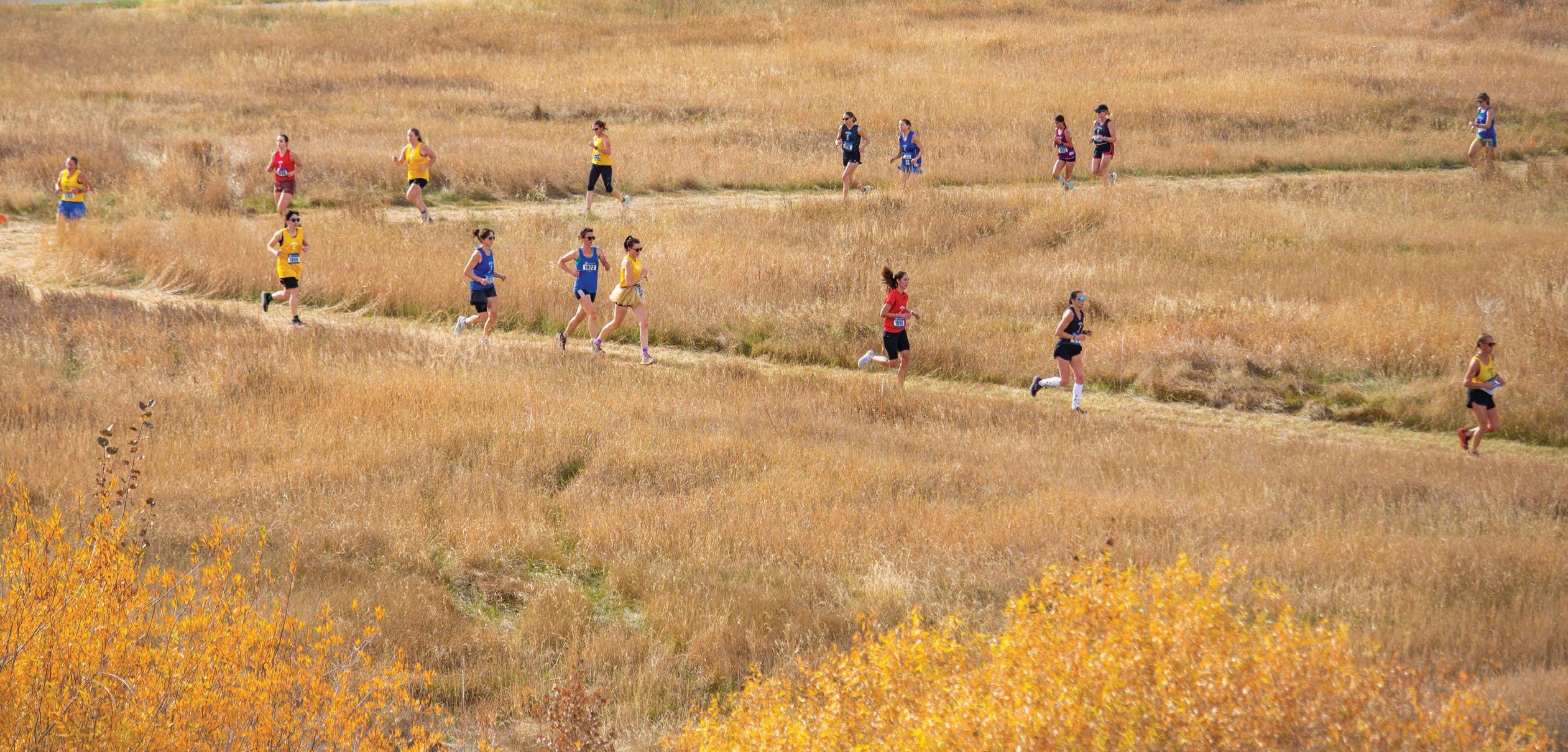
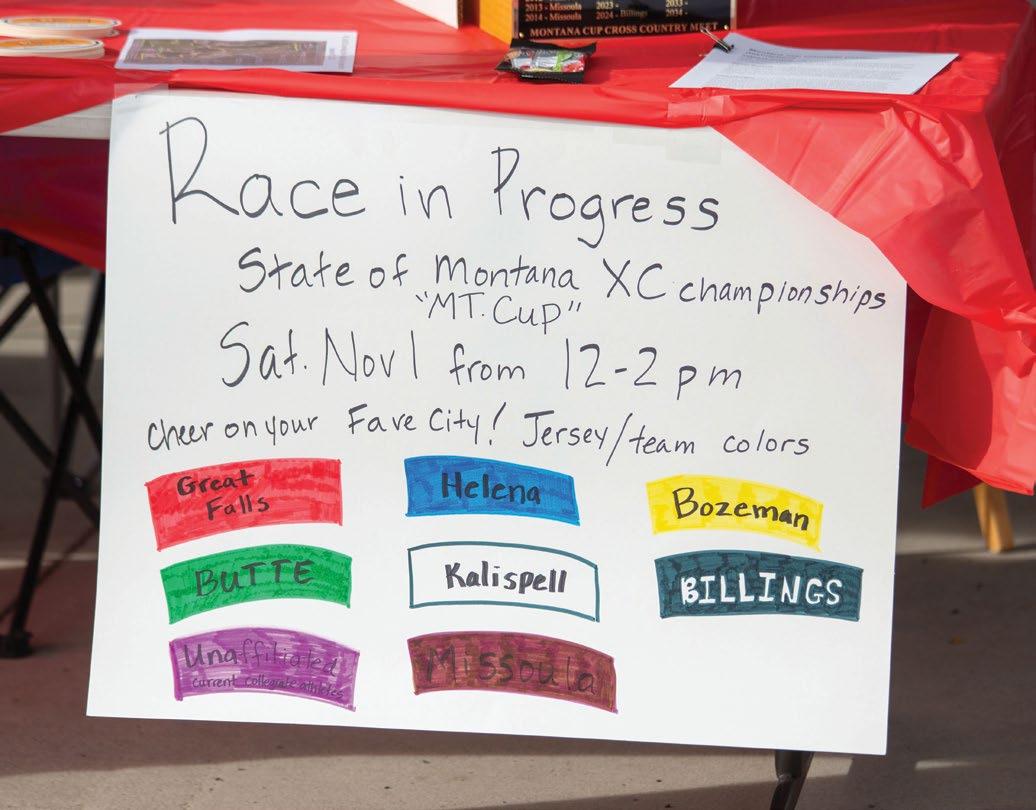
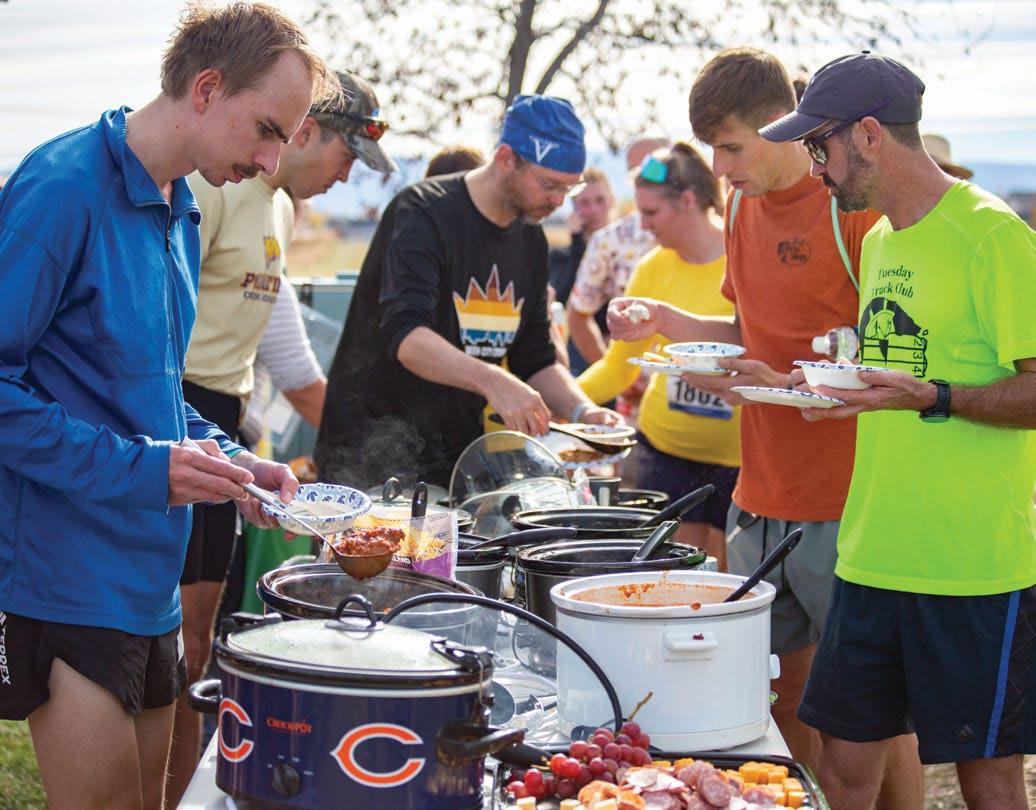

Cup Hall of Fame: Jamie Brusa and Nico Composto. Brusa was selected for leading the Bozeman squad to four straight victories. She was surprised and honored.
“I just really love the team aspect of it, and I love that it brings together everyone from across the state for a shared love of running and competing,” Brusa said. The 38-year-old is still in her prime, earning a top-seven finish each year since her first Cup in 2017, including a photo-finish in 2024 when she nearly outkicked Alyssa Foote for the win. She finished third in 2025.
Composto was recognized for his “fervent” commitment to the Montana Cup including his role as captain during Missoula’s six-peat, and for his courage speaking up about mental health struggles shared by distance runners. Through youth coaching and mentorship, as well as writing a popular LetsRun.com article in 2015, “Dealing with Depression: How I Got Past Suicidal Thoughts While Running in College,” he has made a sincere effort to help fellow runners who put too much pressure on themselves.
The Montana Cup, in that regard, is a dream compared to the high-stress world of competitive running. “Dude, it is the best environment in the world,” Composto said. “It is everything good about cross country with none of the frustration. It reminds me of, like, middle school cross country ... It’s something you don’t have to stress over. You’re literally just out there to push yourself and have fun.”
After a rough 2025 race for Composto, the Hall of Fame honor meant a great deal. “I put a lot of emphasis on the Montana Cup every year ... I think the Montana Cup is just the running event that makes me feel some of that love for the sport that I felt when I first started.”
Every runner knows it’s a lifelong sport. Former high school and college speedsters can still run public races, collecting gift cards and small prizes at nearby 5K and 10K road races, or tackling the endless buffet of brutal distances and gritty trail runs popular among adults. But the sport generally becomes individual pursuit, and the team aspect of running—the matching jerseys, the strategy, the pre-race pump-up speeches
before cramming into a tiny starting box spray-painted on grass, the mid-race encouragement to a struggling teammate you shouldn’t be catching up to, the awaiting of a cumulative score—can be hard to find.
Not in Montana. And it makes perfect sense.
The Montana Cup is the epitome of “The Last Best Place.” When country singers glamorize small-town American life, they’re talking about the way people treat each other when faces are familiar and everyone pitches in, even if some lyrics seem fixated on trucks, church and mass-produced beer. It’s traditions like Montana Cup where it counts. It’s the post-race potluck lunch: lasagna and baked ziti, hearty chili and salty chips, crock-pot soups and home-baked desserts galore; paper plates carried to picnic tables where the answer is, invariably, “Of course, have a seat.”
Montana is changing fast. The clash between multigenerational residents and wealthy out-of-staters has become a fixture of political campaigns, social media skirmishes and barstool grumblings. Some ranching families have spent many decades toughing out long winters and working the land, only to see condominiums spring up where the neighbors once farmed. The Brudi Brothers didn’t have to search far and wide for inspiration behind their 2025 hit, “Me More Cowboy Than You.”
Genuine traditions like the Montana Cup don’t solve that tension, but they can ease it.
Distance running isn’t a rodeo. It’s an imported and admittedly nerdy sport. But in this moment of rapid growth and change, the importance of down-home community gatherings that unite and welcome any and all Montanans— transplants and small-town farm kids like Ray Hunt alike—is hard to overstate. Especially when the entrance fee is $35 and comes with a meal shared with the competition.
Jack Reaney is a writer and photographer based in Big Sky, Montana. He works as senior editor for the Explore Big Sky newspaper. Outdoors, he’s a skier, runner, baseball player and timid mountain biker.
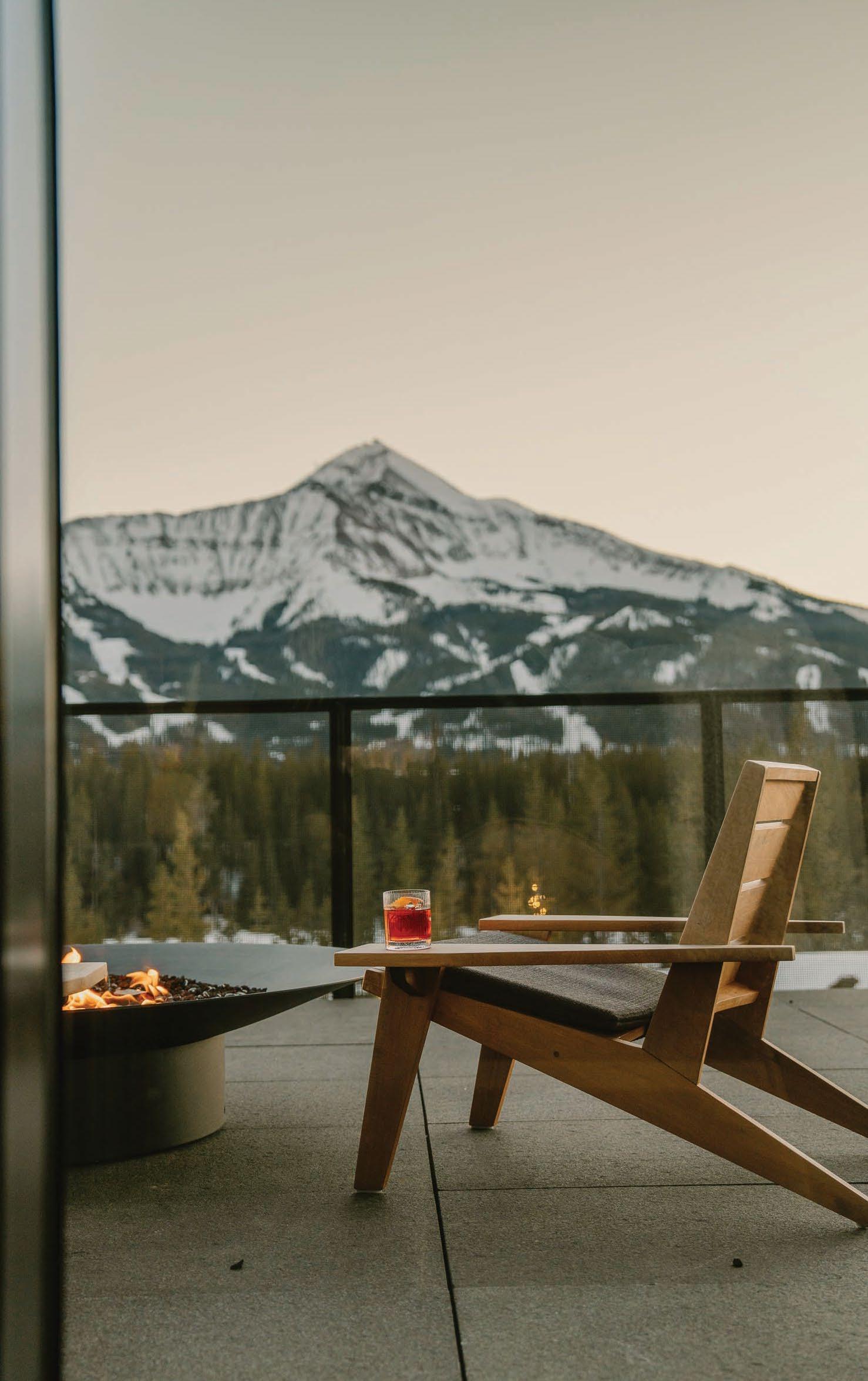
By Taylor Owens
The dining and bar programs at One&Only Moonlight Basin might carry the polish of a luxury resort, but its philosophy is rooted firmly in Montana. Local ingredients drive the menus, the seasons shape what appears on the plate and in glasses, and the restaurants and bars are open to anyone willing to make the drive up the mountain.
“Number one, we’re not private,” Matthew Dahlkemper, executive chef at One&Only Moonlight Basin, says. “I
think a lot of people think that we’re in Moonlight Basin and that we are not open to the public. Come one, come all—fill the dining rooms, come try the food.”
For locals in southwest Montana and visitors traveling through Big Sky, that open invitation is a big deal. The food program unfolding inside the resort isn’t just another luxury hotel dining lineup— it’s a culinary love letter to Montana.
Dahlkemper designed the resort’s culinary philosophy around one simple
idea: locality. “I have largely built this place and food program around locality,” he explains. “What we can get from Montana … those products are going to be the focal point. And we build menus around that.”
That sense of place carries beyond the kitchen and into the resort’s bar program. Erica Brown, curator of One&Only Moonlight Basin’s bar programs, says the landscape and local ingredients shape what guests drink just as much as what they eat. “Each bar has its own theme going on, and we try to stay very local,” Brown says. “We are trying to use as many local ingredients as we can.”
Sometimes that collaboration means working with the chef to utilize popular recipe ingredients in signature cocktails, Brown says, noting that the team is experimenting with techniques like a buffalo-fat-washed Old Fashioned for upcoming menus.
The surrounding wilderness doesn’t just inspire the view from the dining room, it dictates what lands on the plate. During summer months, the kitchens lean heavily on nearby producers like Chance Farms for produce and Native Fish Keepers for trout and whitefish from Flathead Lake. Nearly every ingredient that can come from Montana does. “All of our grains, our flours, our honey, our eggs, produce when available—basically every land animal that’s served in this hotel comes from Montana,” Dahlkemper says.
The result is a menu that evolves with the seasons and tells a distinctly local story. For Dahlkemper, authenticity means resisting the urge to turn a mountain resort into something it isn’t. “If people are coming to Montana, are you really expecting to have something that’s Michelin-star Italian?” he says with a laugh. Instead, the food aims to capture the feeling of Montana—comforting, bold and a little wild. “People are coming here largely to have something that’s fun, that’s approachable,” he says. “That’s Montana.”
The same philosophy appears in the resort’s cocktails. Brown says many drinks are designed to introduce visitors to flavors they’ll only find in the region. “In Montana, huckleberries are kind of the main staple berry here,” she says. “So we created a non-alcoholic cocktail that’s really visually beautiful—but you come in and you taste Montana the second you get here.”
The resort’s welcome drink—a huckle -
berry and spruce tip mocktail—captures that first impression.
The resort’s dining venues each interpret that philosophy in their own way:
- Wildwood—what Chef Matt calls “Montana Modern,” showcasing local ingredients in refined presentations.
- The Landing—an “American Alpine” concept designed for sharing and comfort.
- Akira Back—a Japanese-inspired dining experience.
- Dear Josephine—a prohibition-style cocktail bar with snacks.
- Moon Shack—an intimate hideaway in the woods where guests can stargaze through a telescope.
Each space has its own personality.
“The Landing is really approachable,” Brown says. “You get off the gondola and you want your après-ski cocktail, so we do fun twists on things like Bloody Marys and Aperol spritzes.”
For first-time visitors—locals included—Dahlkemper has a few must-order recommendations. At The Landing, start with two house legends: the chicken schnitzel and the beignet.
While the ingredients are rooted in Montana, the presentation sometimes leans toward the theatrical. Chef Matt enjoys a little shock value at the table— case in point, the now-famous schnitzel served at The Landing. “It’s a chicken schnitzel that’s about the size of two regulation NFL footballs—with this claw coming out of it,” he says. “It’s one of the most metal things you’ve ever seen.”
Wildwood, meanwhile, focuses heavily on regional spirits. “We really try to work with local distilleries and bring in all the different local flavors,” Brown says. “There are so many variations on huckleberry liqueur, vodka and whiskey made here.”
The menu at Wildwood changes monthly and dishes lean Western with playful touches—like beef tartare mixed tableside with an antler, or s’mores torched in the dining room. “You think about being in this cold-weather environment in the Rocky Mountains— Americana, s’mores,” he says.
At Wildwood, he suggests starting with foie gras croissants or a trout dip served with barley crackers made from Montana grains. Large-format dishes are another highlight—built to share across the table.
Think mixed grills featuring lamb, short rib, and pork ribs sourced from Montana ranches. “It’s built for three or four people,” Dahlkemper says. “It’s just a fun experience … a fun way to eat, especially if you’re dining here with a group.”
Dear Josephine is the resort’s most mixology-forward bar. “That’s where you’ll see a little more magic happening,” Brown says. Drinks like the Josephine cocktail, featuring beets, surprise guests with bright, unexpected flavors.
At Akira Back, the beverage menu pairs artfully with the food. “We try to capture a little bit more of the Japanese flavor there,” she says, noting ingredients like yuzu and cherry blossom alongside a large sake selection.
And then there is the Moon Shack, tucked quietly in the woods. “My favorite place is the Moon Shack,” Brown says. “Everything at the resort is really modern, but we brought this shack in from Idaho and rebuilt it in the woods. You walk in there and you really feel like a cowboy.”
Inside, the focus is on whiskey-forward cocktails and inventive techniques like clarification. “If you’re not a whiskey fan,” Brown adds with a laugh, “I’ve got a guy out there who will make you a whiskey fan.”
As the resort settles into its rhythm, Dahlkemper’s focus remains on one challenge: consistency. “One of the hardest things about this industry is creating consistency,” he says. “Before we go and do something new, we want to make sure we’re executing at the highest level.”
But the future is already taking shape—especially with summer cookouts planned around custom chuckwagon-style grills outside The Landing. The bar team is preparing for the warmer months, including expanded outdoor spaces and seasonal menus open to both locals and travelers. “Our whiskey shack used to be for guests and homeowners only, but we’ve opened it up to the public,” Brown says. “I think everyone needs to come up here and check it out —especially in the summer when the sun is up until 10 p.m.”
For now, though, the message is simple: The doors are open.
“Come here, share things, try things,” Dahlkemper says. “We want to have fun—and we want to see people coming back.”
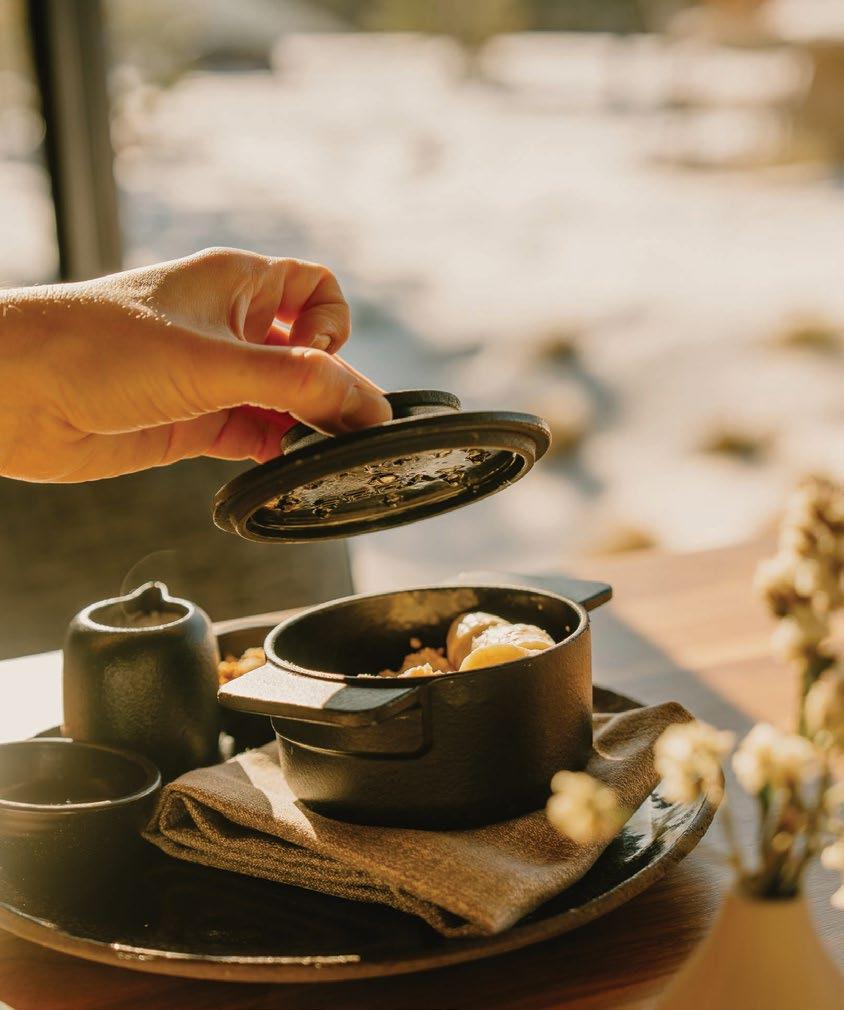
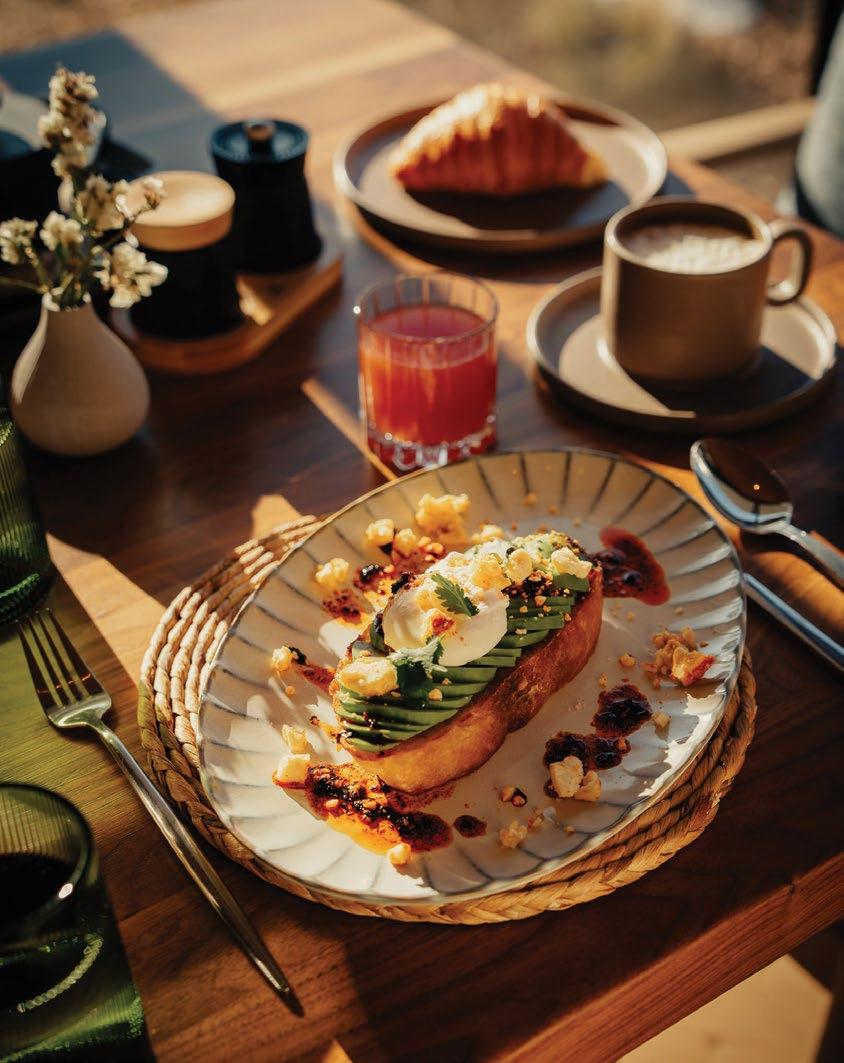
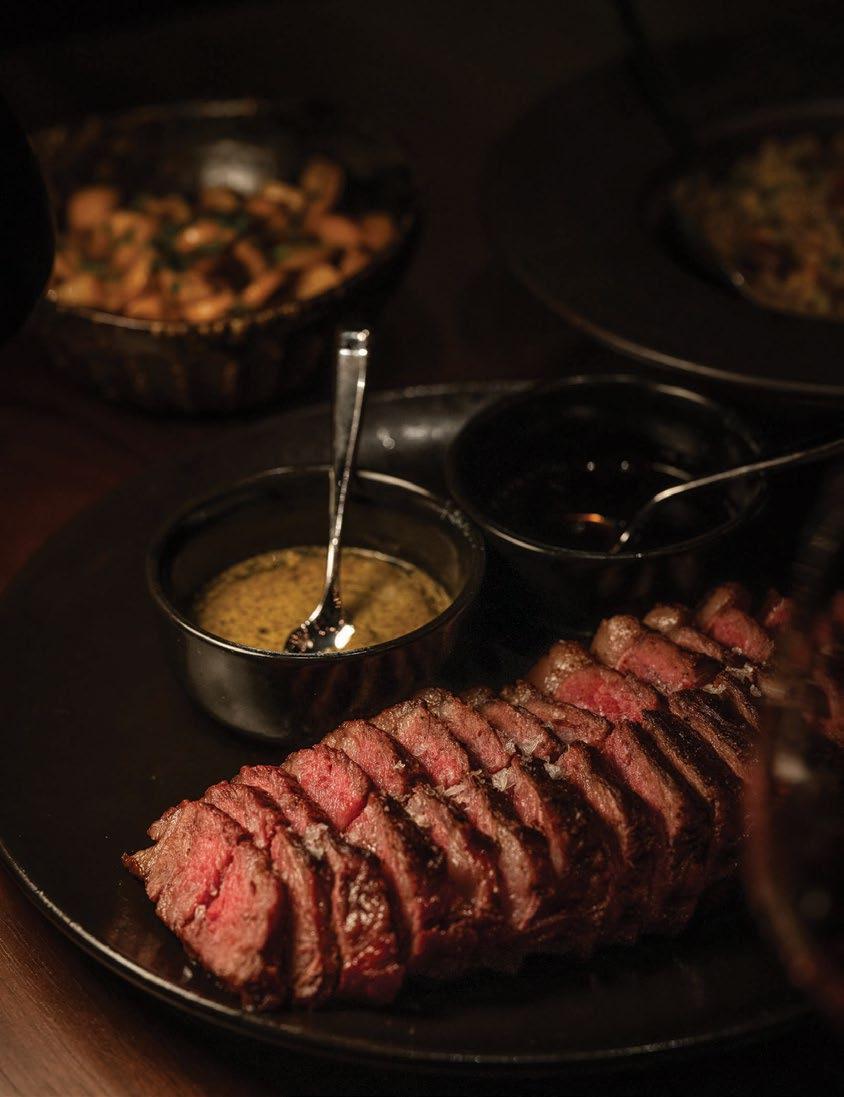


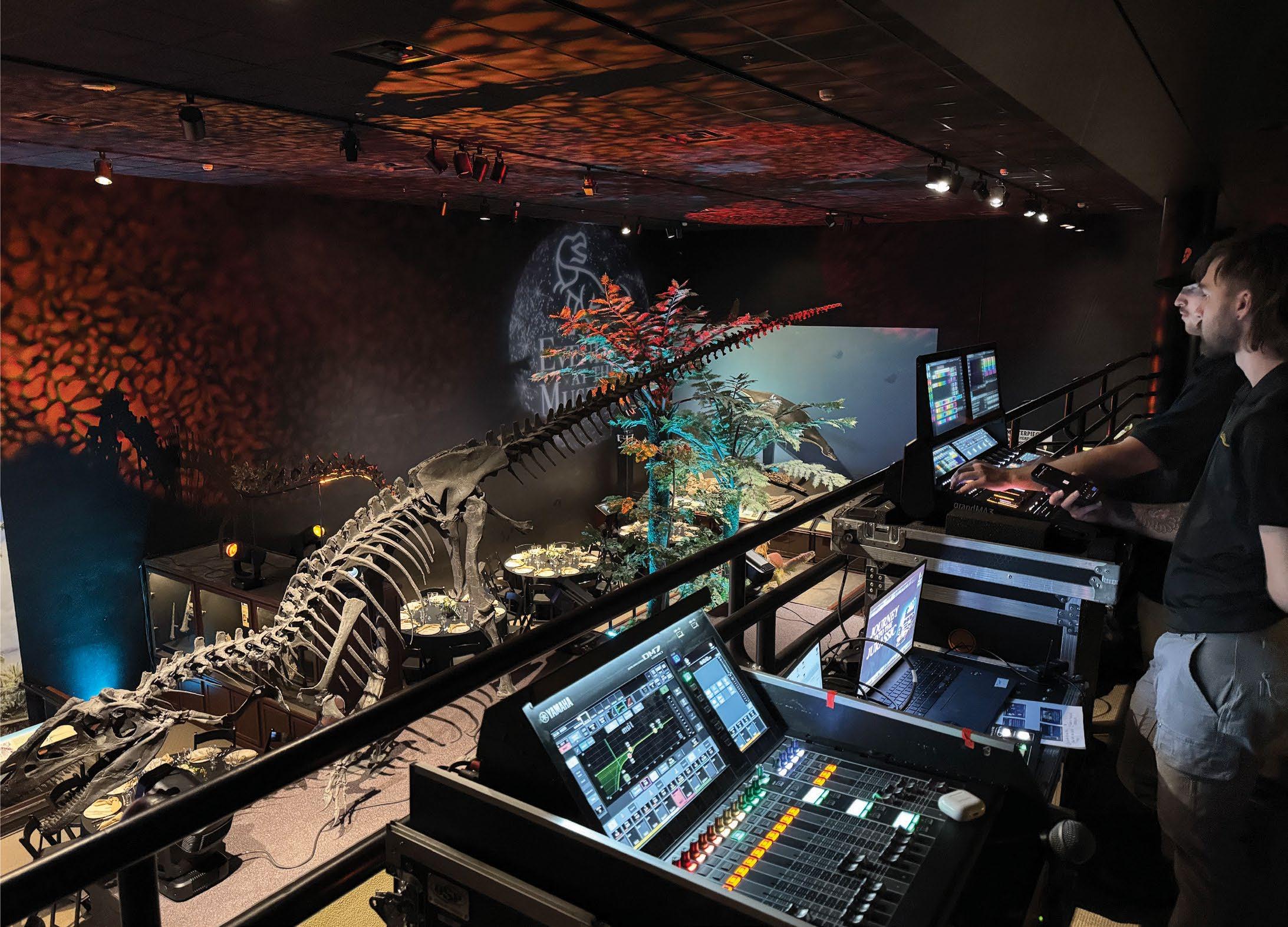
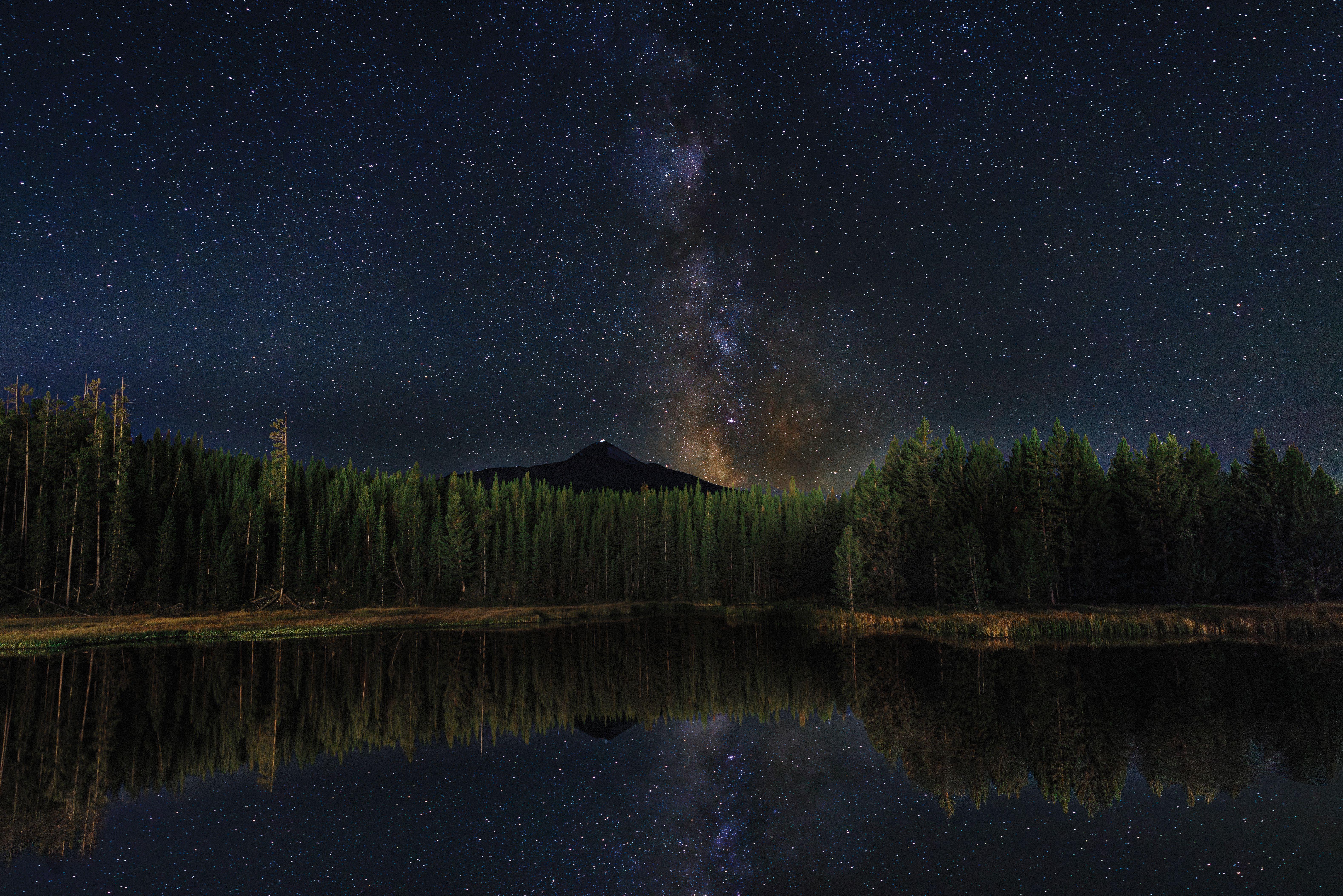
By Eric Ladd
There wasn’t a moment where we collectively decided to trade health for convenience. It happened slowly, one shortcut at a time. Days got busier. Screens replaced movement. Food got faster. Sleep became optional. And for a while, it felt like we were getting ahead, until we weren’t.
Today, we are living with the consequences of that trade. Fatigue, inflammation and chronic disease have quietly become the baseline. But perhaps we’ve reached a tipping point. Something is changing as people ask questions. We have built a world optimized for convenience and, in the process, created one that makes it increasingly difficult to stay healthy. People are starting to prioritize their health
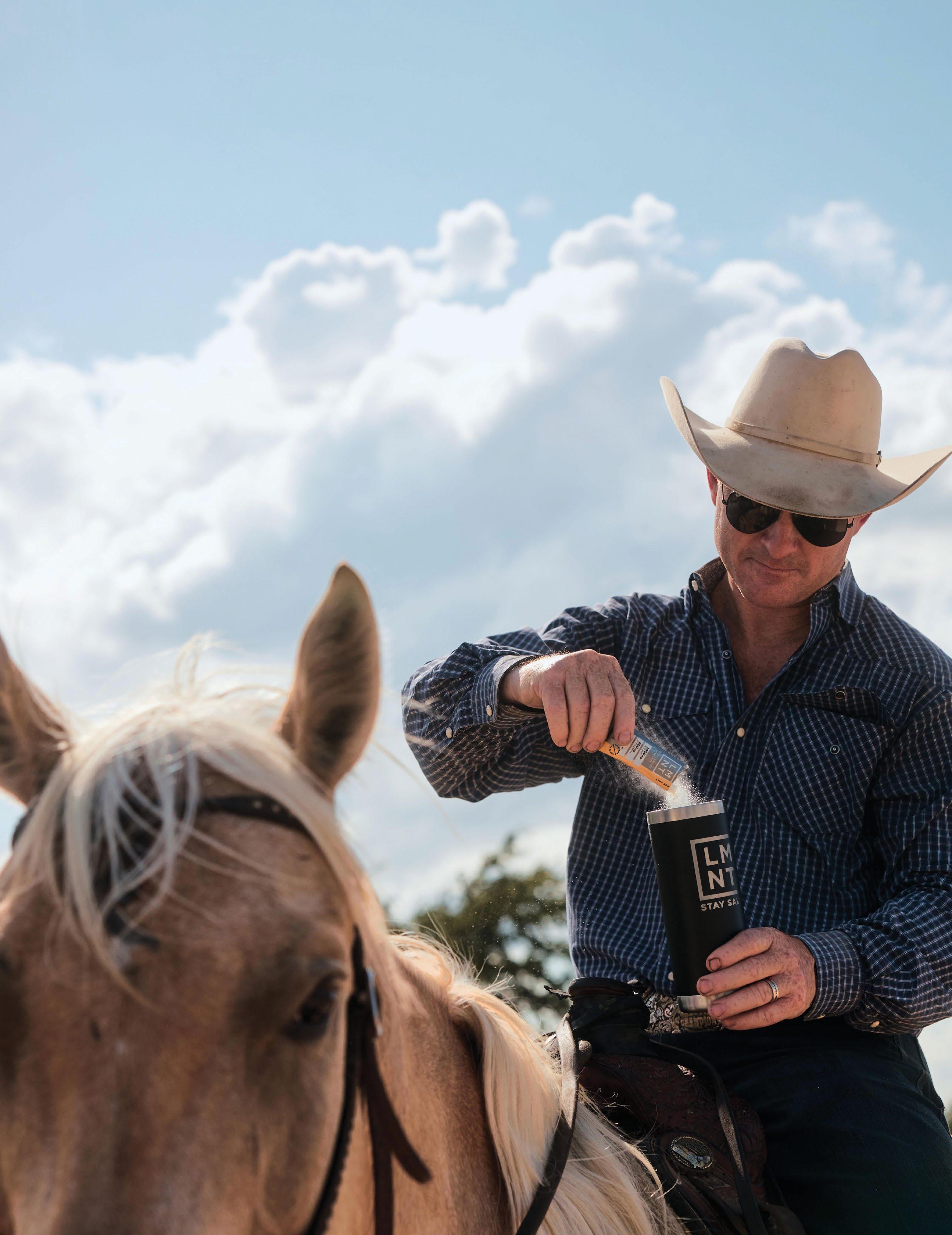
and correct decades of damage done by processed food, sedentary living and a healthcare system built to treat symptoms rather than causes.
If that correction is taking shape anywhere, it is happening in places like Bozeman, Montana. Set between Yellowstone National Park, the Gallatin River, and some of the most productive agricultural land in the region, Bozeman sits at a rare
intersection of access and awareness. Here, the environment demands a healthy lifestyle. What is emerging is not a single movement, but a convergence. Across town, a network of businesses and ideas is forming, each addressing a different piece of the same question: What does it actually mean to live well? It starts, as it should, with food.
For years, food was reduced to convenience, built on calories, shelf life and efficiency. As the pendulum swings back, what was once niche—grass-fed beef, pasture-raised proteins, clean-label dairy—is now one of the fastest growing segments in the food industry. At Regen Market, that shift begins below the surface. “Human health starts in the soil,” said Xan Jarecki, general manager at Regen. “Healthy soil produces more nutrient-dense plants, which support healthier animals and ultimately better food for people. In that sense, whole, properly-raised food is medicine, not just calories.”
“What’s good for the animal, the land and the consumer are actually aligned. They only diverge when the system optimizes for the wrong things.”
–Jeff Mroz
Regenerative agriculture reframes the system entirely, prioritizing soil biology, biodiversity and natural cycles over short-term output. When the soil is alive, the food shows results. “When that living system is diminished, everything downstream is impacted,” Jarecki explained. “But when animals are raised on biologically active landscapes, you see real differences in quality and nutrient density.”
That same rethinking is happening in dairy. “Milk is one of the most nutrient-dense foods we have,” said Jeff Mroz of Pioneer Pastures. “But not all dairy is created equal. Too many products today are loaded with added sugars, seed oils and unnecessary additives that undercut what makes milk valuable in the first place.” By focusing on A2 dairy—milk naturally free of the A1 beta-casein protein that many people find difficult to digest— clean sourcing and minimal processing, Pioneer Pastures’ model shifts back toward simplicity, producing food that is closer to its natural state and easier for the body to recognize. “What’s good for the animal, the land and the consumer are actually aligned,” Mroz said. “They only diverge when the system optimizes for the wrong things.” In a region surrounded by working farms and ranchland, this does not feel like innovation, but a return.
Awareness does not stop at food, but extends into how we fuel our bodies every day. The supplement industry, now approaching $70 to $80 billion dollars annually in the United States, is evolving rapidly, particularly in hydration and metabolic health. What was once reserved for elite athletes is becoming part of daily life.
Brands like LMNT sit at the center of that shift, a rapidly growing hydration company producing zero-sugar electrolyte drink mixes and ready-to-drink canned beverages, formulated with a precise balance of sodium, potassium and magnesium. “We’re in the middle of a major metabolic health crisis,” said LMNT co-founder Robb Wolf. “Something like 93 percent of American adults are metabolically unhealthy.”
Many people, he explained, especially those eating whole foods or living active lifestyles, are under-consuming salt. “Most people don’t need more sugar,” Wolf said. “They need better mineral balance.” It’s a philosophy that led to LMNT in the first place.
The concept grew out of personal experience. “I had improved my health dramatically, but my performance was suffering,” Wolf said. “The missing piece was sodium. Once I started replacing it, the difference was immediate. Then I started seeing the same pattern everywhere.” That pattern became the foundation of the company. “We built LMNT
by starting with the biology and working backward to the product,” he said. It’s an approach he has observed reflected in other industries including the medical system.
More people are moving beyond symptom management, seeking preventative care, deeper diagnostics and a clearer understanding of how their bodies function. The functional and integrative medicine space is projected to grow into a $100-billion-dollar market over the next decade. In communities like Big Sky, that shift is already here.
“We’re seeing more people come in not because they’re sick, but because they want to stay well. Health isn’t something you outsource. It is something you actively build.”
–Dr. Kaley Burns
At Big Sky Natural Health, demand continues to rise as patients look for answers around hormone balance, gut health, inflammation and metabolic performance. A growing part of that demand is centered around IV therapy. Once reserved for clinical settings, it is now becoming a sought-after tool for hydration, recovery, immune support and overall wellness.
By delivering vitamins, minerals and nutrients directly into the bloodstream, IV therapy bypasses the digestive system allowing for faster absorption and more immediate impact. For many, it has become a go-to for everything from post-travel recovery and altitude adjustment to immune support during peak seasons. For Dr. Kaley Burns, the foundation of health is simple.
“We’re seeing more people come in not because they’re sick, but because they want to stay well,” she said. “Health isn’t something you outsource. It is something you actively build.”
That philosophy extends beyond the clinic and into everyday life. Burns notes the growing 1,000 Hours Outside movement, focused on getting growing children outdoors and away from screens, but easily applied to adults as well. It’s a reminder that some of the most powerful health interventions are also the most accessible: time outside in natural light, moving your body.
It is equally evident inside the gym. Fitness is no longer just about intensity or aesthetics; there’s a growing focus on longevity, mobility and durability, especially in mountain communities where strength must translate into real-world capability. At Ascend Movement, that evolution is deeply personal. Founders Ben and Sarah Mazur moved to Bozeman not just to start a business, but to build a healthier life.
“There’s been a clear shift from performance-driven training to longevity-driven training,” Sarah said. “People are realizing that pushing harder is not always better, especially if it comes at the expense of long-term health.”
Their classes reflect that philosophy, bringing together elite athletes, individuals focused on staying active longer, and those recovering from injury. “A lot of people are simply tired of getting hurt,” Ben said. “They want to build strength in a way that actually supports their life.” The shift, they explained, is in how strength training applies outside of the gym. “We’re not just making people stronger. We are building bodies that can actually handle life outside the gym,” Ben said. Suddenly, fitness becomes less about how you look and more about what you can continue to do.
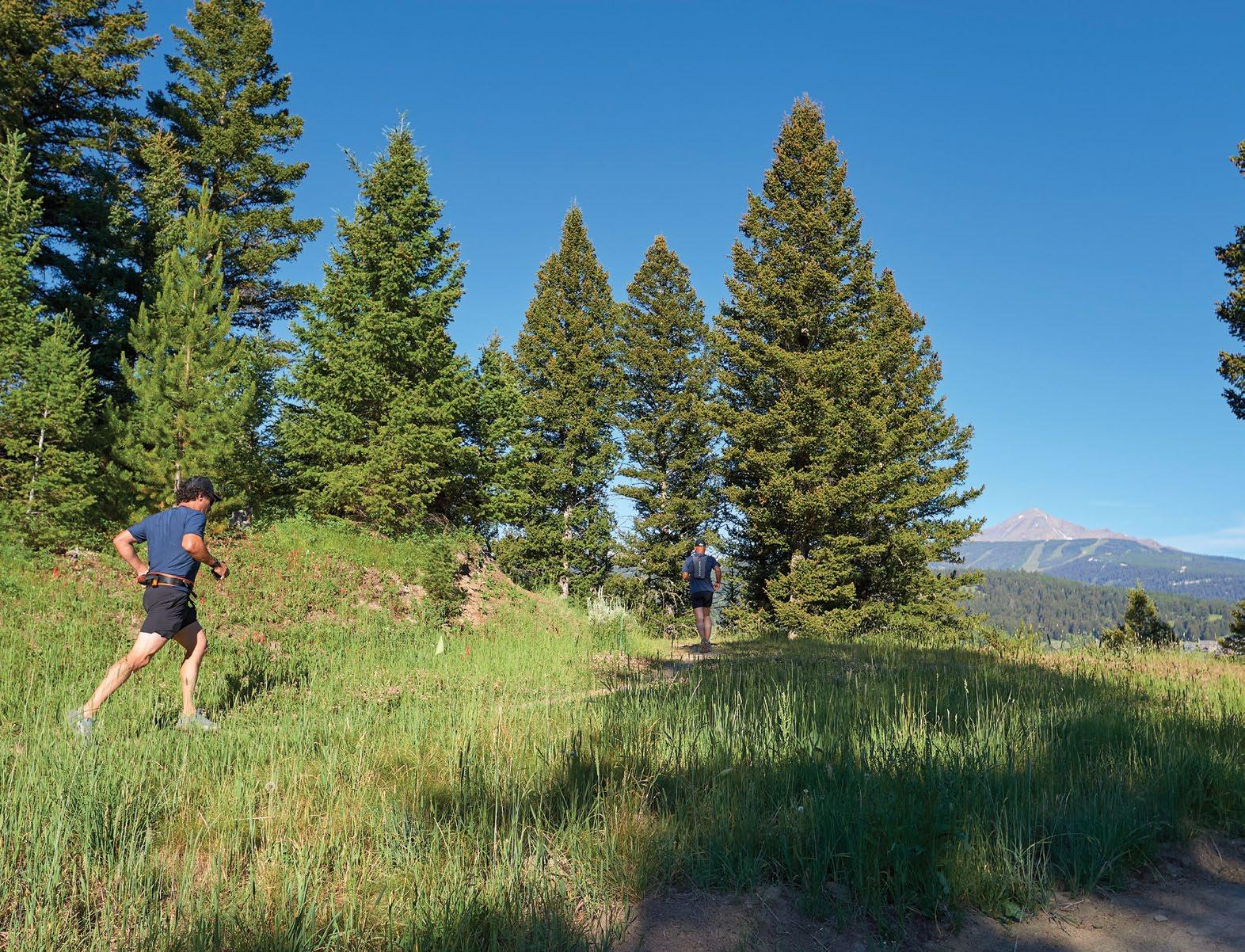
What was once niche—sauna, cold plunge and contrast therapy—is now moving into the mainstream. The global wellness economy has surpassed $5 trillion dollars, with thermal bathing and recovery practices among its fastest growing segments. In places like Bozeman, that shift is visible. At Portal Thermaculture, recovery is framed as something deeper.
“Connection is a foundation of
shaped by screens and constant stimulation, these spaces offer something different: a sense of shared experience.
“One of the most powerful aspects of these environments is that they are not skill-based or performance-driven,” Byrne said. “They become true third spaces where people from all backgrounds can come together, disconnect, and share a common experience.”

human health,” said Portal Thermaculture co-founder Rory MacMurdo. “Thermaculture offers connection to nature, to others, and to yourself, something that has been missing in a comfort-driven society.”
Portal’s Bozeman location reflects that evolution. In the city’s growing Northeast Neighborhood, the space blends ancient modalities like sauna and cold plunge with a clean, design-forward aesthetic, where experience and environment carry equal weight. And while you recover, you connect with others.
A similar concept is taking shape across town at Umvelt, a modern bathhouse rooted in centuries-old traditions.
“Bathhouse culture has existed for generations across Scandinavia, Japan and Europe,” Paul Byrne, Umvelt owner, explained. “What we’re seeing now is not something new, it is a re-emergence driven by a need for connection, a response to isolation, and a growing fatigue with technology.” In a world

“There’s been a clear shift from performance-driven training to longevitydriven training. People are realizing that pushing harder is not always better, especially if it comes at the expense of long-term health.”
While the physical benefits of heat and cold therapy are well documented, including improved circulation, reduced inflammation, enhanced recovery and even dopamine increases from cold exposure, the deeper impact is the physical connection gained away from your phone, conversing with others and being still. “Being in an intentional space, combined with heat and cold, acts as an equalizer,” Byrne said. “It helps people reconnect with a sense of shared humanity.”
– Sarah Mazur
In a mountain town where athleticism is a part of daily life, third spaces like Umvelt and Portal become a part of the rhythm. “We’ve gathered around fire since the beginning of time,” MacMurdo said. “We just put it in a small wooden room.”
Individually, each of these shifts—whether it be regenerative food, functional nutrition, strength training or recovery— represents a powerful equation. In places like Bozeman, surrounded by wild landscapes and rooted in working land, that alignment feels inevitable; a reflection of place.
When you live in a place that demands more of you, you begin to demand more of yourself. And that is where real change begins.
Eric Ladd is the publisher of Mountain Outlaw, as well as a husband and father. He advocates for clean rivers, conservation, and community whenever possible, including through his service on the board of American Rivers and his involvement with Big Sky Search and Rescue and AxeALS.



By Taylor Owens
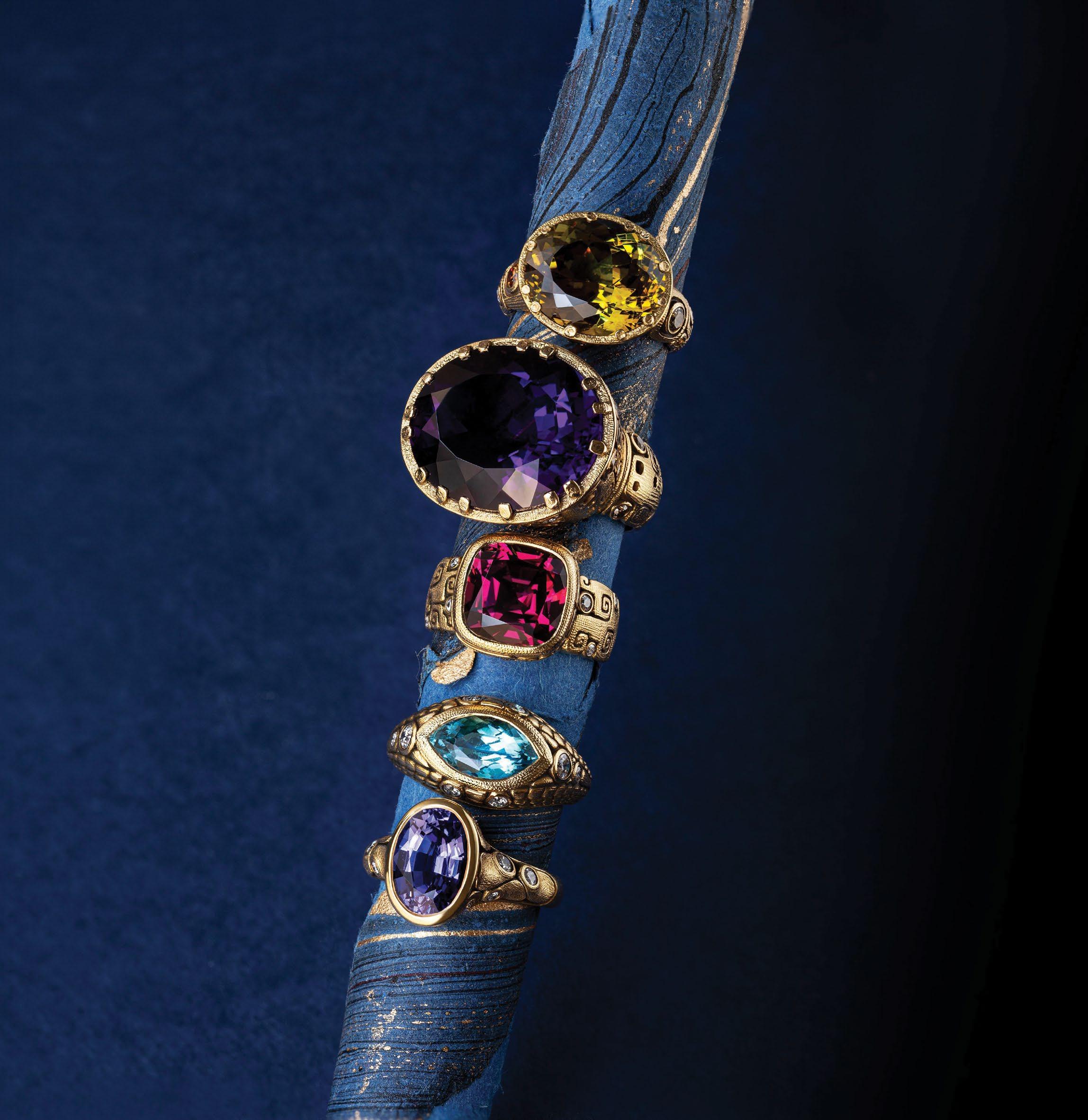
In downtown Bozeman, Alara Jewelry offers something that feels increasingly rare: a jewelry experience that’s as personal as the pieces themselves.
There’s no sharp divide between customer and counter, no pressure to perform a purchase. Instead, the space invites exploration—side by side, conversationdriven and grounded in curiosity. It’s a deliberate shift away from tradition, shaped by founder Babs Noelle’s early impression of the industry as “thoroughly entrenched in stuffiness.”
Her response wasn’t to tweak the model but instead it was to rethink it entirely.
“I was trying to turn what had become a very negative experience … into an experience that’s a lot more lighthearted and personal in spirit, but imbued with all the technical know-how,” she says.
That philosophy defines Alara today. The gallery feels open, even collaborative, echoing the small European jewelry spaces that first inspired Noelle. “The showcases aren’t some sort of physical barrier between the host and the guest,” she explains, but a place where people can discover pieces “side by side and together.”
It’s a subtle shift, but one that changes everything.
While Alara’s approach may feel unconventional, its sense of place is unmistakable.
After relocating from Denver more than two decades ago, Noelle found a home, and a community, in Bozeman.
“The moment I came downtown … it’s just an absolute precious little jewel,” she says. “And the welcome I received was very wholehearted.”
That connection
to Montana isn’t just about location, it’s embedded in the jewelry itself. Few elements capture that more clearly than Montana sapphires, which have become central to Alara’s identity.
“They are a tremendous source of artistic inspiration,” Noelle says. “Their color palette is unique in the sapphire world.”
Unlike traditional sapphires, Montana stones often lean into softer, more nuanced tones—subtle blues, smoky greens, slate-like grays.
“You don’t find some of these really … smokier, slate-ier, kind of calmer colors” elsewhere, she adds.
That distinction resonates with customers, especially those looking for something that feels personal rather than conventional. In recent years, Montana sapphires have become a defining feature of Alara’s custom work— particularly in engagement rings and wedding bands.
It’s a natural fit: a locally sourced stone, shaped into a piece that marks a major life moment.
Custom design sits at the heart of that process. Rather than steering customers toward a predetermined style, the team at Alara approaches each project as a collaboration and as an opportunity to create something that reflects the individual wearing it.
That philosophy carries through every interaction in the store, shaped in part by general operations manager and minority partner, Chantell Cazell.
“It really is more about the people,” she says.
“I’m a people person at heart … and that kind of puts me right in the middle of some really meaningful moments.”
Cazell’s path to Alara began at Montana State University, where she studied earth science with a focus on geology. Her introduction to the store came in an unexpected way—working as
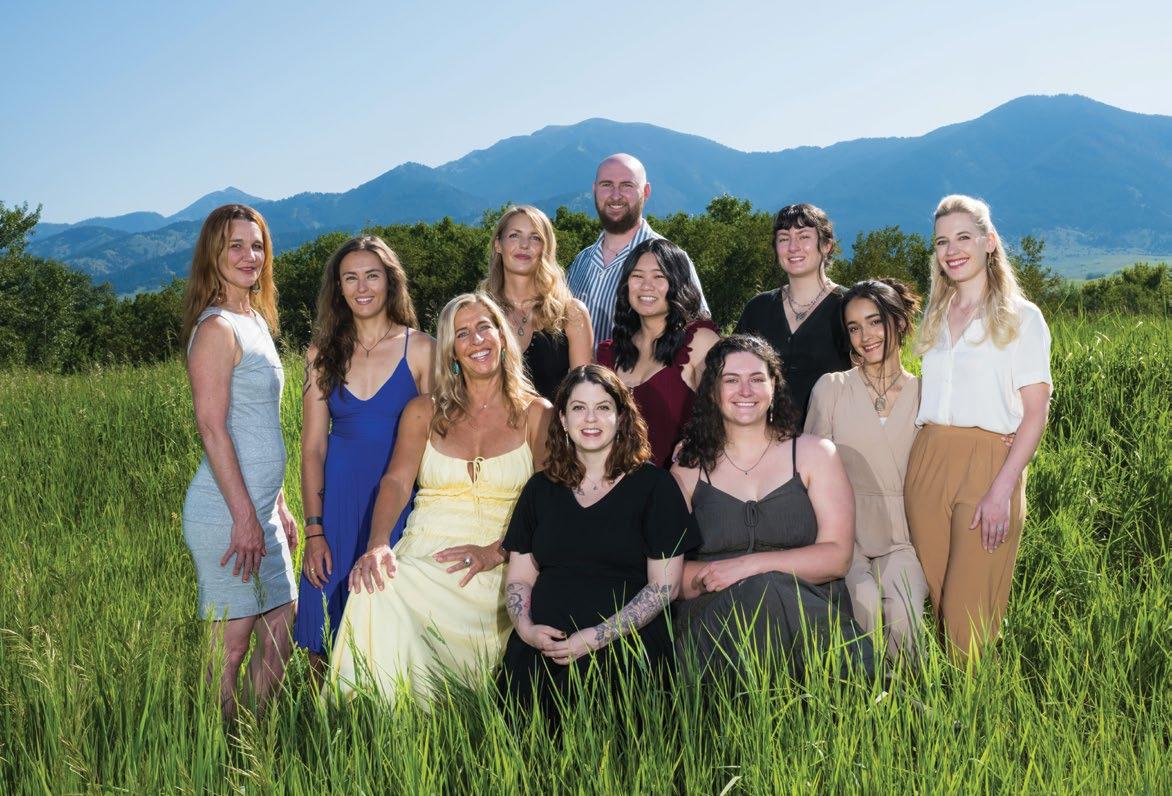
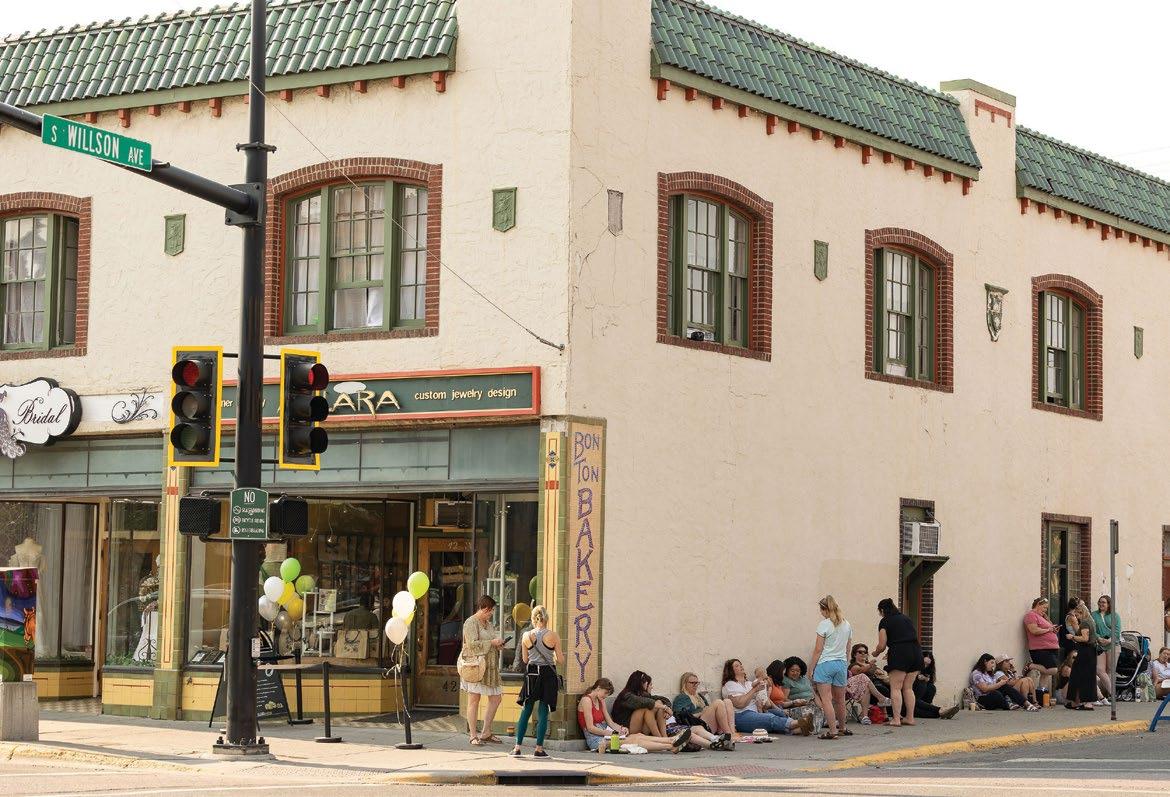
an “Alara elf” during the Christmas Stroll. What started as a seasonal role turned into a long-term career, and eventually, a partnership.
Today, her days reflect the dynamic nature of the business. “No two days are the same. Ever,” she says. “And honestly, that’s one of my favorite things about it.”
From sourcing stones to guiding customers through custom designs, the work is varied but the through line remains the same: connection.
That connection becomes especially meaningful in the context of bridal jewelry, which makes up a significant portion of Alara’s work.
“Helping couples navigate through the engagement ring buying and wedding band process … it never gets old,” Cazell says. Over time, those interactions build into something lasting. “It’s really nice to see returning faces over the years.”
For many customers, a first visit to Alara might be about an engagement ring. Years later, they return for anniversary gifts, redesigns, or new pieces that reflect a different chapter.
That continuity of relationships and stories is part of what defines the experience.
Underpinning it all is a commitment
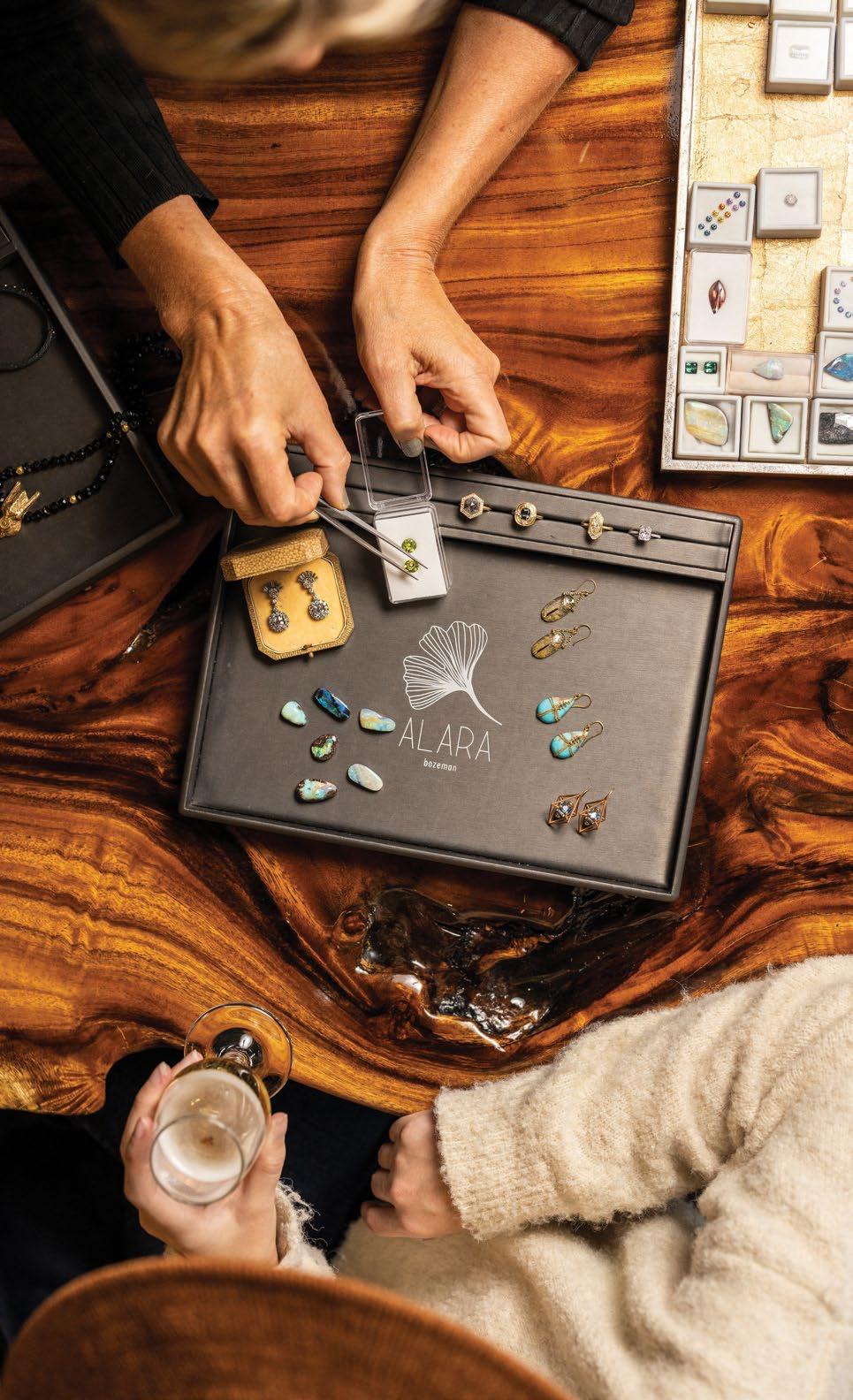
to ethical sourcing that has been part of Alara from the beginning, long before it became an industry trend.
“When I was looking at how most jewelers manufactured … they used gold that was strip-mined, when there was plenty to be found and refined and reused,” Noelle says. “It just seemed like a little something positive I could do.”
That “something small” has grown into a broader philosophy. Alara works with recycled metals, fair trade gemstones, and upcycled diamonds, while maintaining close relationships with designers to ensure transparency across the board.
For Cazell and the team, it’s not a feature but a baseline.
“We care deeply about where everything comes from,” she says. “If you don’t know where something comes from … it’s hard to represent that in the store.”
That clarity matters, especially for customers investing in pieces meant to last a lifetime or longer.
Step into Alara, and the atmosphere reflects all of these elements at once: creative, unpretentious and quietly vibrant.
“It’s very friendly … almost kind of neighborly,” Cazell says. The space
feels less like a showroom and more like a place you’re invited to spend time— browsing, asking questions or simply taking it all in.
There’s no rush, no expectation, just guidance when it’s needed.
“Our goal is to simply guide you through whatever brought you through the doors with just genuine enthusiasm.”
For Noelle, that sense of ease starts with the team itself.
“I encourage everyone to be who they are when they’re here,” she says. “Because then the service they’re giving is from the heart.”
It’s a simple idea, but one that shapes everything, whether it’s how customers are greeted to how pieces are designed and presented.
In a place like Bozeman, where individuality and landscape go hand in hand, that authenticity feels right at home.
And in an industry often defined by tradition, Alara stands apart not by rejecting jewelry’s significance—but by deepening it. Through local stones, thoughtful sourcing, and real human connection, it offers something more than adornment.
It offers meaning.


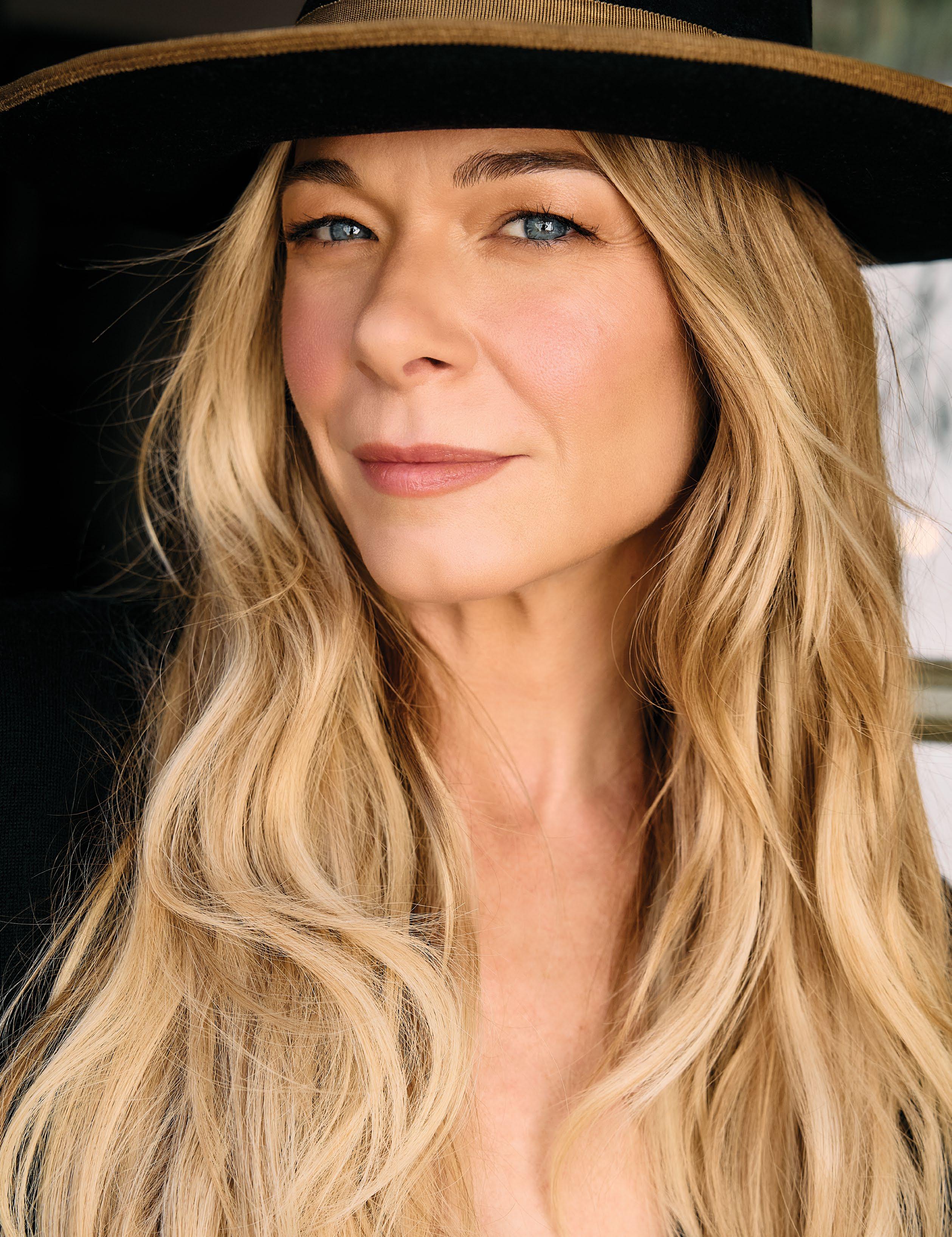
By Sophie Tsairis
LeAnn Rimes has sold more than 48 million records worldwide, won two Grammys at age 14, and spent three decades shapeshifting across country, pop, and Americana, expanding and evolving her sound but never losing her personal voice.
Born in Mississippi, raised in Texas, and launched into stardom with “Blue” at 13-years-old, she has long since outgrown any single lane the industry tried to put her in, and she’s spent the better part of the last decade making peace with that journey on her own terms, through music, and more recently, acting. Montana has been part of her reset for 15 years, a place she and her husband, Eddie Cibrian, return to annually, most notably for the Autumn Harvest Weekend at The Ranch at Rock Creek outside Philipsburg. We caught up with Rimes ahead of her performance at the Wildlands festival in Big Sky, and she told us about what Montana gives her, what 30 years in the music industry has taught her, and why, at this particular moment in her career, she’s done performing at people and far more interested in being with them.
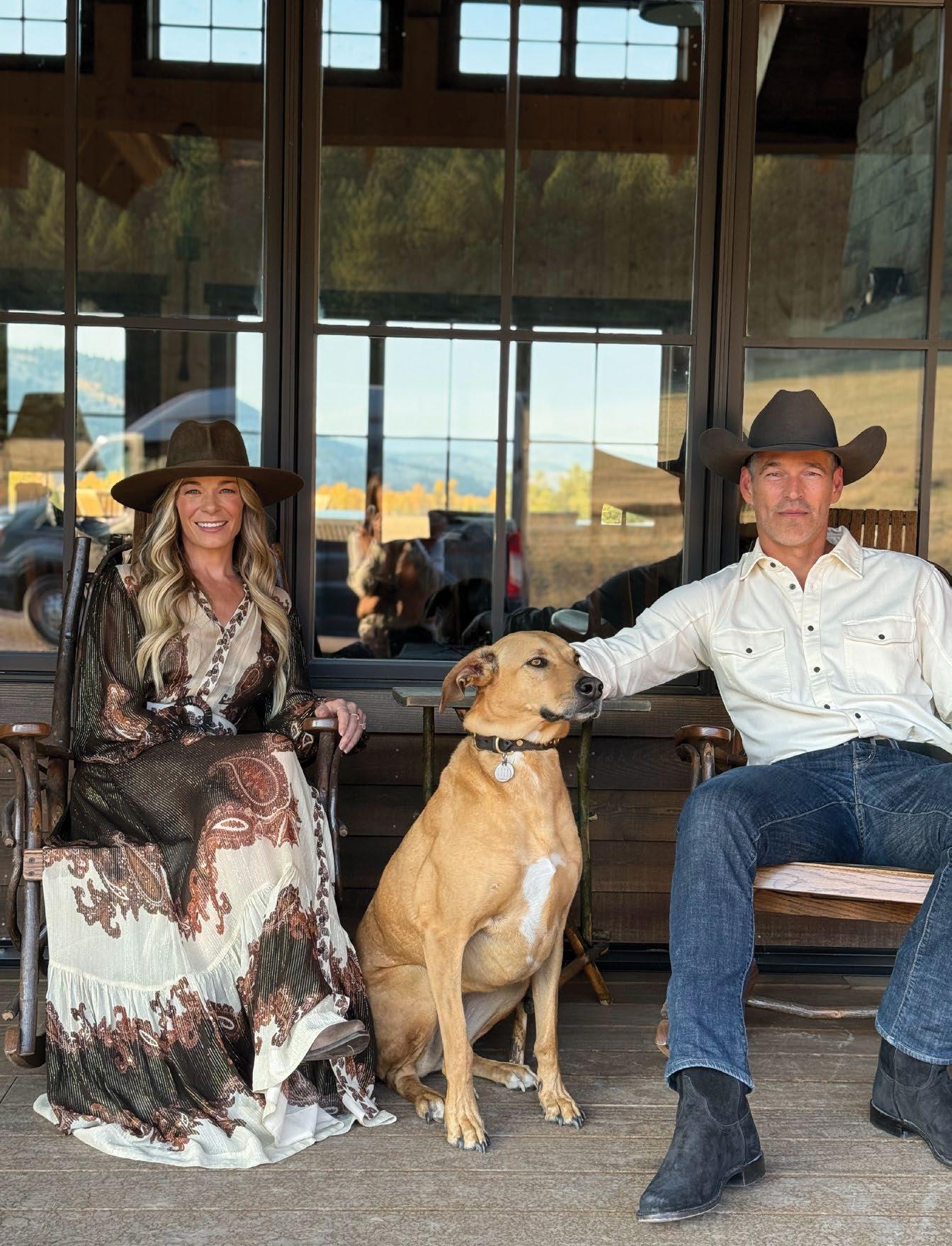
Mountain Outlaw: What connection, if any, do you have to Montana? What does this part of the country bring out in you or inspire in you?
LeAnn Rimes: My husband and I have been escaping to Montana for 15 years now. There’s something about it that just strips everything back. It’s quiet in a way that lets you hear yourself again. The land is so wide and open; it kind of asks you to be the same way.
MO: We’ve read that you come out to Montana annually to play at a ranch. Is that true? Do you feel connected to any part of Montana in some way? If so, can you describe that connection?
LR: Yes, it’s become something I really look forward to every year. It’s not just a show, it’s something really unique and special. I get to connect with people without all the layers and usual expectations, which is rare.
MO: What about playing at the Wildlands festival excites you? What about the venue, location or cause is meaningful to you?
LR: I love that it’s rooted in something bigger than just the music. There’s intention behind it … protecting the land, honoring where you are, that matters to me.
MO: How do you use music to connect with people, and how has that changed over the course of your career?
LR: In the beginning, I think I was just trying to sing things well … hit the notes, do it right. Over time, it’s become a lot less about perfection and a lot more about truth. Now it’s about letting people see where I actually am … messy, evolving, all of it. The real connection happens when you stop performing at people and start being with them.
MO: You started performing at 5, were touring at 9 and had a Grammy at 14. Looking back, what do you think that gave you and/or what did it cost you?
LR: It gave me a life I could have never imagined. It gave me purpose, really early. It also came with a lot of pressure before I even knew who I was. I had to grow up fast in a lot of ways, and then later, kind of go back and find the parts of me that didn’t get to grow naturally. But that’s been the work, you know? And I’m grateful for all of it now, even the hard parts.
MO: “Blue” came out when you were 13 years old. Now you’re celebrating its 30th anniversary. What does it mean to revisit that album at this point in your life?
LR: It feels like meeting a younger version of myself and actually being able to hold her with more understanding. Back then, I didn’t fully grasp what was happening. Now I can look at it with a lot more compassion … and honestly, a lot of gratitude. That record opened every door for me.
The more I’ve shared, the more I’ve seen how much we all carry similar things. If anything I say helps someone feel a little less isolated, a little more understood … that’s everything to me.
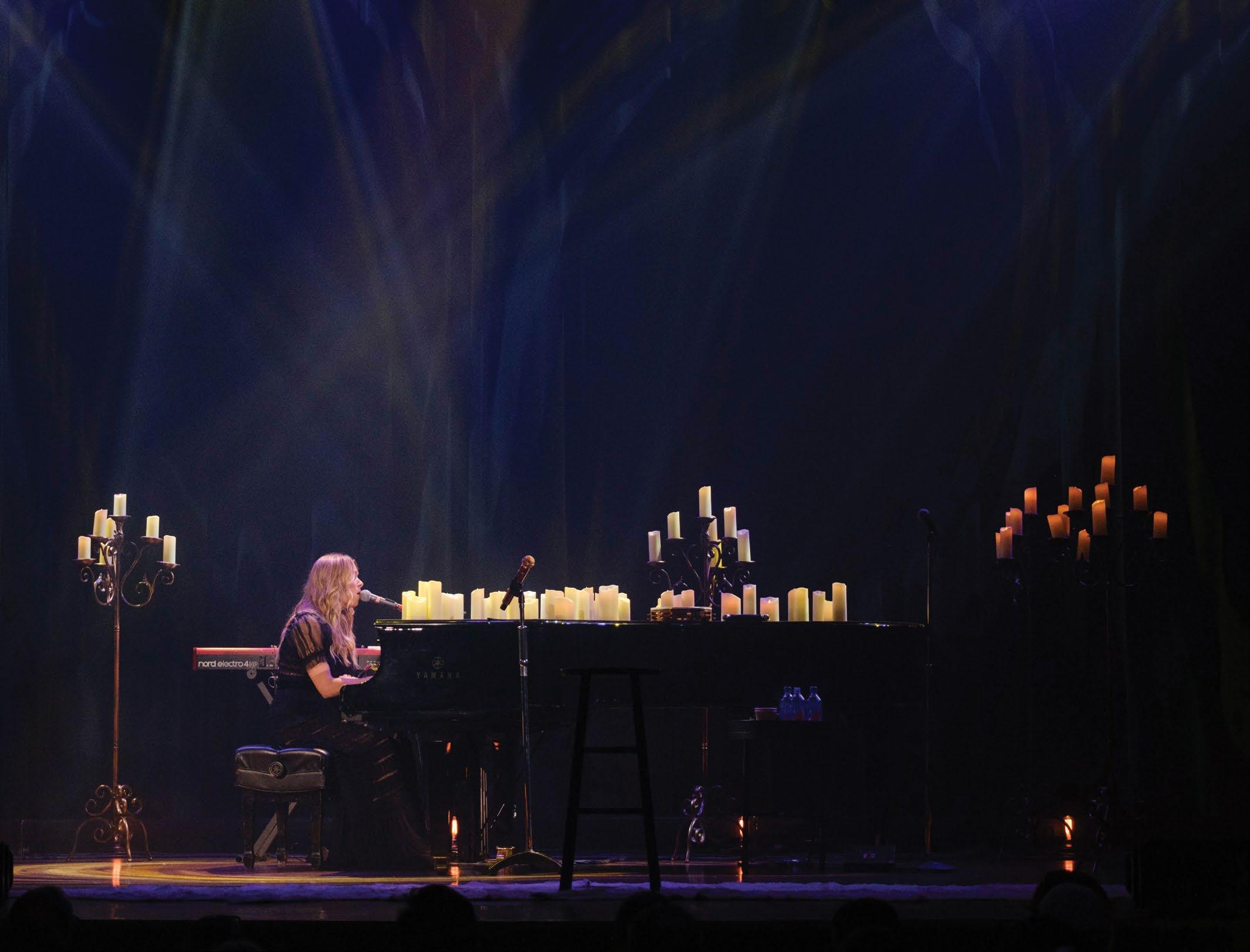
MO: How has the industry changed throughout your career, specifically as a female singer/songwriter and what, if any, influence do you feel you’ve had on that?
LR: It’s changed a lot, and still has a long way to go. I think there’s more space now for women to be fully themselves and not just fit into one lane. When I started, there was a lot more pressure to know your lane and stay in it. I hope in some small way I’ve helped show that you can evolve, you can take risks, you can tell the truth and still make great music.
MO: Can you tell us about your new single “Wild Things Run?” What was the emotional core of that song for you, and what do you want listeners to feel?
LR: That song is really about letting yourself be free again. Letting the part of you that’s been quiet or pushed down finally have some space to breathe. There’s a little wildness in all of us … and sometimes we forget that’s where the life is. I want people to feel permission when they hear it. Permission to feel, to move, to not have it all figured out, to love, be broken and love again … unapologetically.
MO: You’ve been open about mental health through your “Wholly Human” podcast. How did you find the courage to be so publicly open, and what impact do you hope it has?
LR: Honestly, it came from not wanting to feel alone anymore. And realizing that if I felt that way, other people probably did
too. The more I’ve shared, the more I’ve seen how much we all carry similar things. If anything I say helps someone feel a little less isolated, a little more understood … that’s everything to me.
MO: You once had your dental bridge fall out mid-concert and you kept singing … Have you always held that “the show must go on” philosophy, or where did it come from?
LR: I don’t know if it was a philosophy as much as just instinct in the moment. But I do believe in showing up as you are, even when it’s not pretty. Life doesn’t pause when things fall apart. So sometimes you just keep going … and let people see the realness of it. That’s where the connection is and it does make for a pretty hilarious story in the aftermath.
MO: How has stepping into acting changed the way you think about storytelling, and did anything about that transition surprise you?
LR: Acting has made me listen in a different way. It’s not just about delivering a line or a lyric, it’s about the emotional point of view underneath it. And God knows, if there’s one thing I have in this life, it’s an emotional point of view. I’m learning a lot about myself by getting to create in a new medium that’s still a bit foreign to me, but I’ve been loving every minute of it. It’s nice to have a place to really grow and learn something new, 30 years into my career.
Sophie Tsairis is the managing editor of Mountain Outlaw.















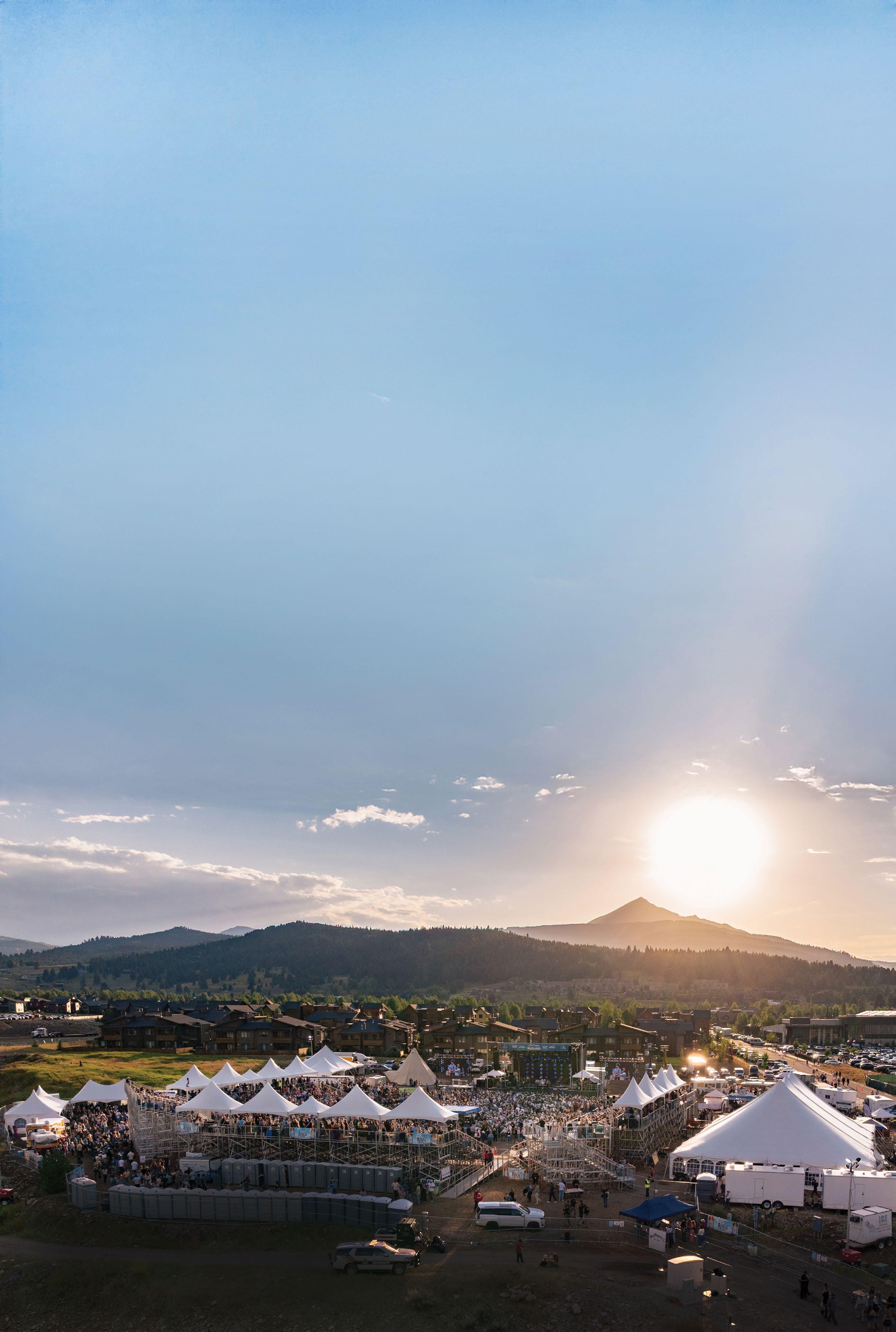
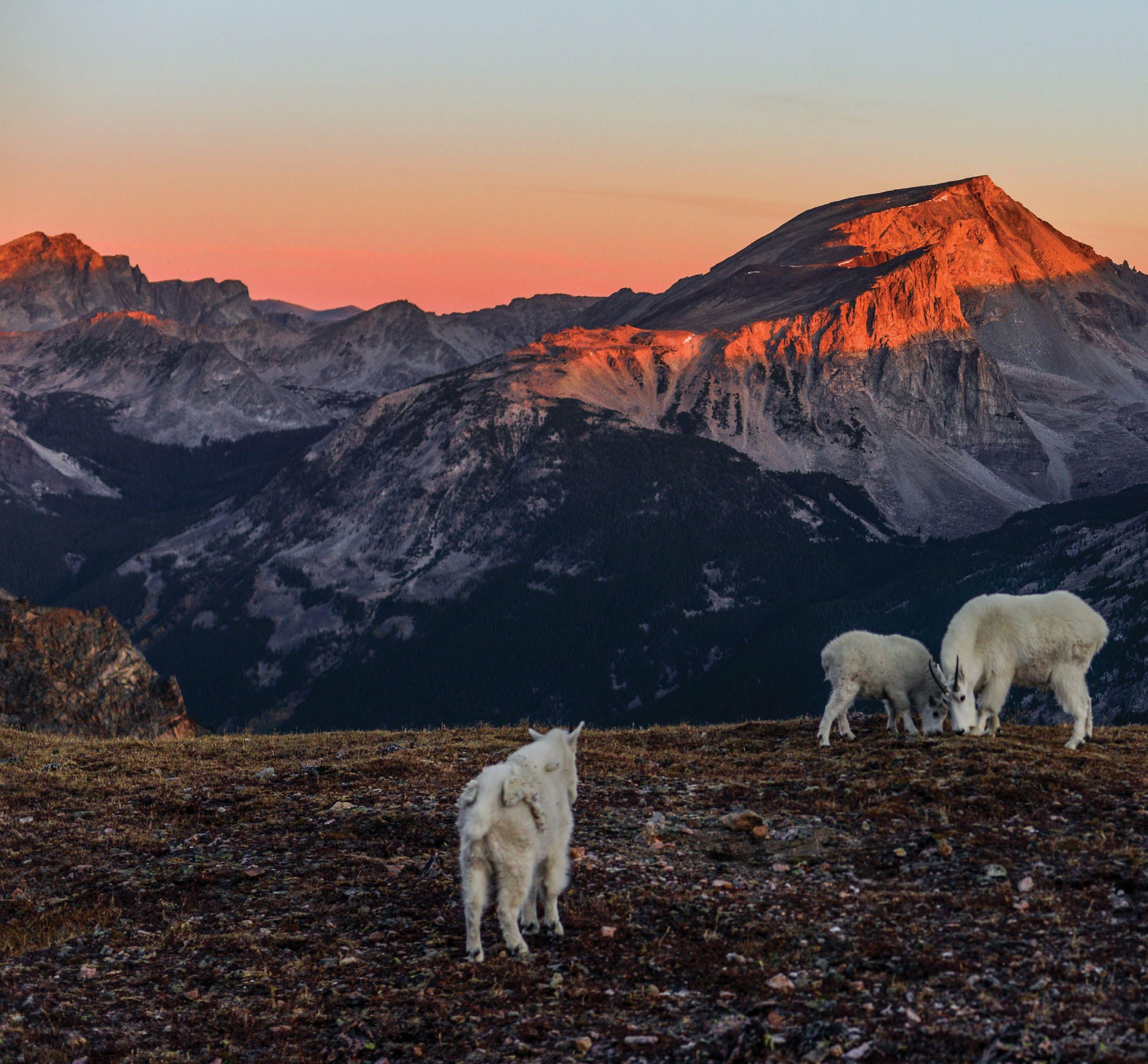
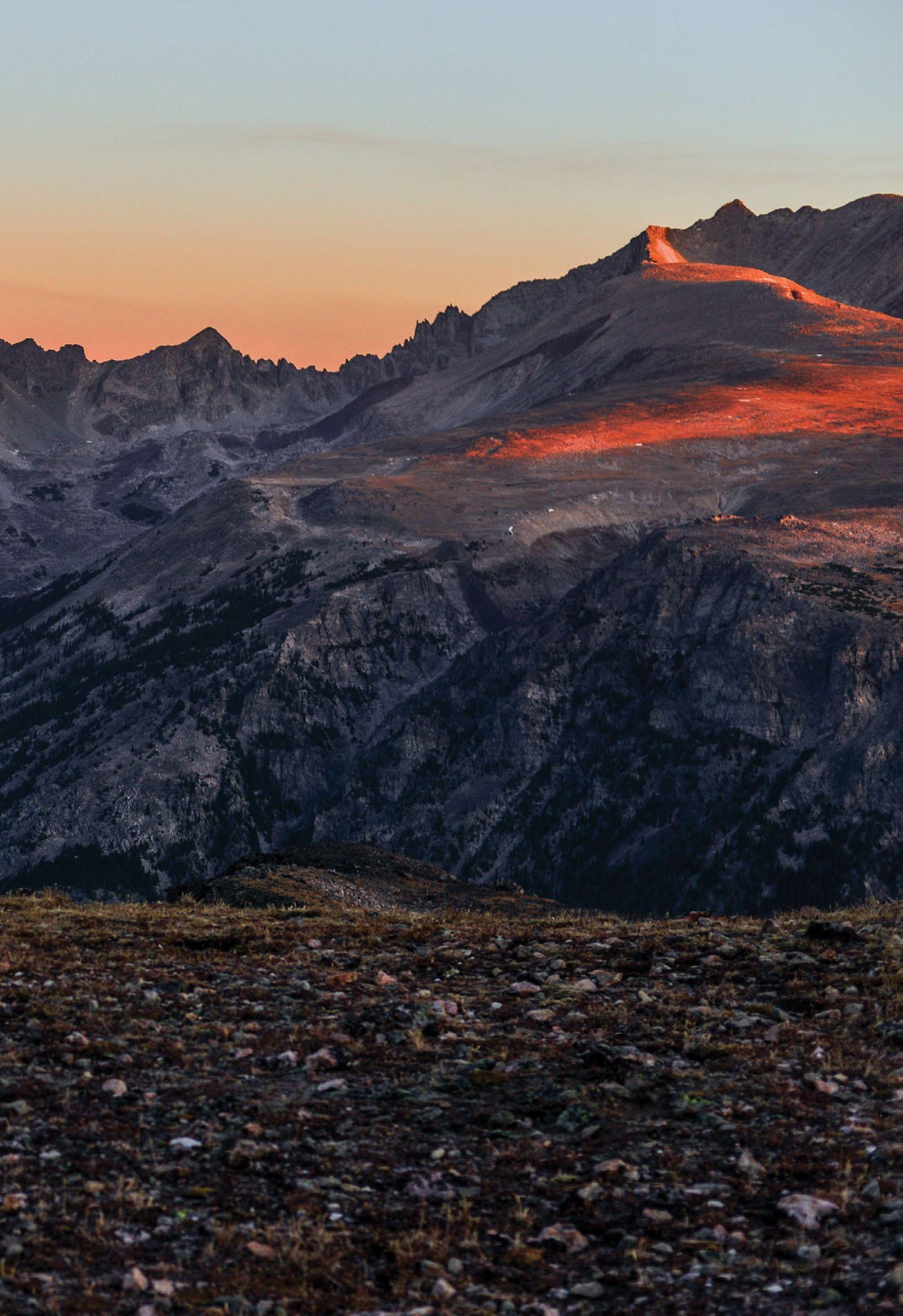
During the long days of a Montana summer, mountain goats roam the Beartooth Mountains, masters of stillness in motion, an invitation to what awaits beyond these pages.