FALL 2026
YOUR GUIDE TO AMERICA’S FIRST NATIONAL PARK
The Relevancy of the Bison
Reflecting on America’s 250th Wolf Watchers West Yellowstone’s
Smokejumpers PLUS: The Best Cookie
in Southwest Montana
Discover the hundreds of reasons your neighbors choose First Security Bank. Personalized service, local expertise, and financial solutions designed to help you move ahead with confidence. OURBANK.com
IN THE MIDST OF BIG SKY WONDER,
we invite you to discover nature’s grandeur.
Se t a mong t h e snow- cov e r e d Spa n ish P e a k s, Mon tage Big Sk y of f e r s sk i-i n / sk i- ou t acc e ss to 5,8 50 ac r e s of sk i a bl e t e r r a i n. A f t e r a day on t h e mou n ta i n, savor Nort h e r n Ita l i a n c u isi n e at Cort i na , spi r i t e d a pr è s at Backc a st a n d r e stor at i v e mom e n ts at Spa Mon tage.
mon tage.com / Big Sk y | (4 06) 993-814 0 @Mon tageBig Sk y
FALL 2026
Owned and published in Big Sky, Montana
PUBLISHER | Eric Ladd VP MEDIA | Mira Brody MANAGING EDITOR | Taylor Owens ART DIRECTOR | Corey Ellbogen Beans ART PRODUCTION | Megan Sierra, Griffin House, Luke Breum SALES & CLIENT MANAGEMENT | Ellie Boeschenstein, Ersin Ozer, Patrick Mahoney, Nic Thoman ACCOUNTING | Sara Sipe, Kaitlyn Malcom CHIEF OPERATING OFFICER | Josh Timon CHIEF MARKETING OFFICER | Megan Paulson VP DESIGN & PRODUCTION | Hiller Higman DISTRIBUTION | Ennion Williams Visit outlaw.partners to meet the entire Outlaw team. CONTRIBUTING WRITERS | Stella Fong, Fischer Genau, Julie Graves, Elisabeth Kwak-Hefferan, Carli Johnson, Simon Lynes, Sarah May, Annie O’Neill, Leath Tonino, Katie Thomas, Benjamin Alva Polley, Maggie Slepian, Menka Vansant CONTRIBUTING PHOTOGRAPHERS/ARTISTS | Lisa Contpetit Brabbit, Michael Francis, Jacob W. Frank, Fischer Genau, Neal Herbert, Carli Johnson, Ashton Jones, Matt Ludin, Larry Marlow, Annie O’Neill, Kyle Moon, Jim Peaco, Benjamin Alva Polley, Bradan Tobin, Luke Gentry, Simon Lynes, Dan Stahler Explore Yellowstone magazine is distributed to subscribers in all 50 states, including contracted placement in resorts and hotels across the West. Core distribution in the Northern Rockies includes Big Sky and Bozeman, Montana, as well as Jackson, Wyoming, the gateway communities around, as well as inside Yellowstone National Park.
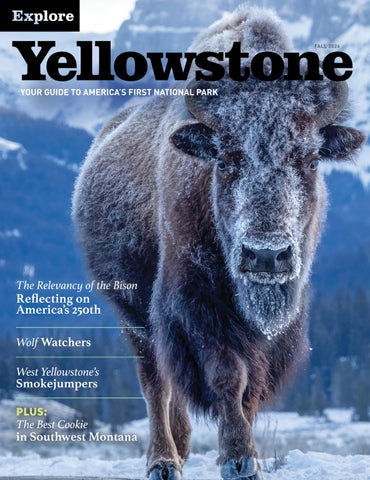
To advertise, contact nic@outlaw.partners. OUTLAW PARTNERS & Explore Yellowstone P.O. Box 160250, Big Sky, MT 59716 (406) 995-2055 • media@outlaw.partners © 2026 Mountain Outlaw Unauthorized reproduction prohibited ON THE COVER The Winter Queen - On a bitterly cold morning in Yellowstone’s Soda Butte Valley, a cow bison was walking down the road with frost covering her face. That frost immediately caught my attention; even in winter, we don’t always see bison looking like that on the Northern Range. I spotted her approaching from a distance and knew there might be a photograph if no other cars came through. I got low to the ground, staying well back, to give her a towering presence in the frame. Then I waited for her to reach the spot I’d picked out. The lines of the mountains and trees seemed to converge on her face, and I took the photograph as she moved into alignment with them. PHOTO BY KYLE MOON
4 Explore Yellowstone | exploreyellowstone.com
Photo Courtesy of YNP
exploreyellowstone.com | Explore Yellowstone 5
TA B L E O F C O N T E N T S
FIELD NOTES 9
A Smarter Way to Do Yellowstone With Kids & Grandparents
10
All Season Gear Guide to Yellowstone
12
How to Soundscape
14
Your Guide to The Rut
T H E W I L D AT W O R K 22
Fighting Fire from Above
27
Jim Halfpenny: Tracking the Wild in Yellowstone’s Snow
30
Billie Taylor is Rewriting What it Means to be a Yellowstone Outfitter
34
Wolf Watchers
41
Home on the Range at Lone Mountain Ranch
THE LIVING ARCHIVE 45
Yellowstone’s First Visitors
48
The Enduring Story of the National Park Ranger Hat
50
Honoring Our Sacred Relatives, the American Bison
56
Breaking a Few Eggs
T H E WAY I N 59
The Town Beyond the Pass
62
Where Winter Doesn’t End
66
Wild Crumb: Nation’s Outstanding Restaurant
68
A Season of Discovery at Museum of the Rockies
70
The Great Gallatin Valley Chocolate Chip Cookie Search
72
Bridging the Gap Between Producers and Consumers in a Changing Food System
6 Explore Yellowstone | exploreyellowstone.com
LOOKING BACK TO L O O K F O R WA R D Reflecting on America’s 250th anniversary, I am once again reminded of the amazing and original stories that exist within Yellowstone country. Whether these stories date back to Clovis-era early humans in Yellowstone National Park, the origination of a park ranger’s uniform hat, one individual who created forensic wildlife tracking, or the relevancy of the bison over the course of our known history, each one is a reminder that Yellowstone has always been a place where American stories begin. In this issue of Explore Yellowstone, we look back to look forward—tracing the threads that connect Yellowstone’s past to its present, and to America’s own 250-year story. Through these stories, we witness America’s changes distinctly through our shared relationship with bison, our failures and our redemptions, several times over. We experience a glimpse of America past, before it was ever known as such, through the stories held at Obsidian Point in Yellowstone National Park. We feel our own collective history through the skill of soundscaping, which transcends age and time period, bringing us back to what makes us distinctly human, alive, and connected with nature. In keeping with the time of year in which it is released, this issue is also about seasons of change. Fall reveals
Photo Courtesy of YNP
a different Yellowstone. As the crowds thin and the pace slows, the season makes room for stories that often go unnoticed. From the elk rut and the legacy of wildfire to the people who study wildlife, preserve history, steward the land, and call the Greater Yellowstone Ecosystem home, this issue explores a Yellowstone defined by change. I hope these stories take you on a journey through Yellowstone National Park and its gateway towns during the quieter, but no less exquisite, colder seasons of the year, as well as make you reflect on what it means to be human, our shared past, and what our shared future could be. After all, the story isn’t finished yet. We are all still writing it. See you out there.
- TA Y L O R O W E N S
MANAGING EDITOR
exploreyellowstone.com | Explore Yellowstone 7
FIELD NOTES 9
A Smarter Way to Do Yellowstone With Kids & Grandparents
10
All Season Gear Guide to Yellowstone
12
How to Soundscape
14
Your Guide to The Rut
8 Explore Yellowstone | exploreyellowstone.com
Photo Courtesy of YNP
O DO A SMARTER WAY T YELLOWSTONE
with Kids rents Grandpa BY JULIE GRAVES
ellowstone looks like a place you explore on foot, but visitors are often surprised by how much time they spend in the car. Add kids, parents, and grandparents, and everyone has a different idea of a good day. Kids need to move. Grandparents may need shorter walks and more breaks. The generation in the middle is trying to keep everyone happy while seeing Yellowstone. The secret isn’t fitting more in. It’s choosing wisely.
Wildlife is often more active in the morning and popular areas less crowded. Choose one area and build around one or two things you really want to see. The best part may be what you don’t plan. A bison jam reminds you the animals rule the road. The bellowing call of a bull elk during the rut or a chance black bear sighting can become the memory everyone takes home. Pack a cooler with sandwiches, fruit, snacks, and plenty of water. Yellowstone’s elevation and dry climate make hydration especially important. Short doesn’t always mean easy. Consider footing, elevation, and balance. Wraith Falls is about one-mile, round-trip hike to a 79-foot waterfall. Most is relatively flat, but the final section is steep and rocky. Harlequin Lake is a gentle, roughly 1-mile forest walk to a small lake. Ice Lake is another easy 1-mile round trip to a quiet, forest-lined lake between Norris and Canyon. Trout Lake is a beautiful 1.2-mile loop, but the beginning climbs about 150 feet. Save this one for active grandparents and older kids. Grand Prismatic Spring doesn’t look real. Its turquoise center, surrounded by yellow, orange, and rust, can feel more Caribbean than Yellowstone. Sunlight interacting with the deep, clear water creates the blue, while heat-loving microorganisms contribute to the colorful edges.
TheMidwayGeyserBasinboardwalkletseveryone experience it without a long hike. Old Faithful deserves its fame. There’s somethingspecialaboutthreegenerationswaiting together until water and steam shoot skyward. But don’t leave afterward. The Upper Geyser Basin holds an extraordinary concentration of geysers. Castle erupts from a massive mineral cone, Grand sends powerful bursts into the air, and Riverside shoots across the Firehole River, sometimes creating a rainbow in its mist. Mammoth Hot Springs feels completely different. Hot water moving through limestone creates white, cream, and rust-colored terraces resembling frozen waterfalls. Explore part of the Lower Terraces boardwalk, or choose the Upper Terrace Drive when walking isn’t in the cards. At Mud Volcano, Yellowstone gets weird. Acidic conditions help turn rock into clay while gases bubble through the mud, creating pools that plop, gurgle, and steam. Kids can listen, smell, and decide which feature sounds strangest. Parts of the boardwalk are steep, so choose what works for your group. Stop regularly to walk, stretch, and let kids move. In the car, let each generation choose three favorite songs and explain why. A grandparent’s song may lead to a story the kids have never heard. Play I Spy or Yellowstone bingo with bison, waterfalls, geysers, and steam.
Dr. Julie Graves is a chiropractor and founder of The JAG Method, helping women over 40 take control of how they age through strength, injury prevention, and better balance. Sign up for her newsletter at www.thejagmethod.com.
A multigenerational day might start early in Lamar Valley watching for bison, elk, orevenawolf.Stopforbreakfast,walkWraithFalls, and have a picnic lunch. Spend the afternoon at MammothHotSprings,whereeveryonecanchoose how much to walk, then head to an early dinner. That’s the rhythm of Yellowstone with three generations: drive, explore, move, rest, and leave room for the unexpected. Years from now, nobody will remember whether you checked every stop off the list. They’ll remember the bison that stopped traffic, the elk across the valley, the geyser they watched erupt, and the stories they told between stops. And remember, don’t try to pet the bison. PHOTOS COURTESY OF JOE BORDEN
exploreyellowstone.com | Explore Yellowstone 9
n o s a e s all
E D I U G R A E E G T
g id Br
er
Pe ak
GTX
N O T S W O L L E Y O BY KAT
IE T H O
MAS
by Obōz Sw it ch b
Cr os
u sc t
l
by S auce Ac t
by ōz
To
Lo w
Cap
Ob
Gravity Chil
ac k
q ue by e Sauc ve Acti
r so
ce Active Sa u
Fl ig ht
Vi
by
N ew por t H2
10 Explore Yellowstone | exploreyellowstone.com
by Keen
i ve
z
ō Ob
Katabatic
LT
d Mi
by
Consider your feet, the most important vehicle most of us depend on in the park. Getting to Yellowstone’s main attractions requires at least some walking, as you can’t drive right up to Grand Prismatic Spring or Old Faithful. You’re going to want footwear that is comfortable and sensible – this isn’t the time to show off those expensive Rockies Rebels cowboy boots you got in Big Sky. For walking around boardwalks and small day hikes, I like the Katabatic and Crosscut lines by Obōz, a local Bozeman company. There are several varieties to choose from, and they’re attractive yet gentle on the soles. For hiking or backpacking, I recommend Obōz’s Bridger Peak GTX boot. I also like to have options, depending on what I’ll be doing in the park. If I plan to be in the water, I always bring my Newport sandals by Keen Footwear. This shoe is like having a tire on your toe: it’s sturdy, designed for water-walking, and is especially perfect for navigating river rocks. In the winter, you’re going to want proper snow boots – the Ousel Mid Insulated waterproof Obōz are my favorite. Darn Tough and Smartwool are my preferred socks. Most times of the year in Yellowstone,
layers are your friend. You may end up in a tank top by noon in the July and August levels of heat, but even summer mornings can necessitate covering your extremities until the scorching afternoon sun kicks in. I usually start with a base layer, such as Stio’s Hylas hooded pullover, covered by a fleece and a down vest. For more protection, I might bring along a windbreaker, like prAna’s Heritage Wind Anorak, or a puffy coat. The nice thing about this plan is that you can add or shed layers as needed, keeping comfy throughout the day and evening. It’s always tragic to see people wandering Yellowstone in jeans. I recognize that denim is a safe space for many; however, with today’s technology, why not wear something practical? On a balmy day, I love my Stio Board Pants, which have drawstring ankles that you can tighten and pull up around the knees for wading. For something a little more robust, the Fjallraven Keb Curved Trousers are a good choice for a steep trail hike or fishing trip. I always have a pair of shorts on hand to change into later, because that strong mountain sun likes to pop out when you least expect it. If you’re skiing in Yellowstone during the winter, you’ll want some proper snowpants, such as Arc’teryx or North Face. Finally, our heads. Sauce Active, another Bozeman company, sells colorful, quickdrying hats that can be folded or scrunched up to fit in your pocket. For summer, there are
iso r
by
S
flip flops on the trail. Yes, this happened to me once. And I’ve since learned what to wear and not wear in the park, through different times of year and in all types of weather. Like the maps and “Don’t pet the wildlife” flyers handed out at the entrance gates, maybe one day there will be a brochure about e how not to dress while exploring t iv Ac Yellowstone. True, you’d have ce au already packed, but you’d now be better informed and perhaps make different apparel choices before heading into the great outdoors. Sa u c y V
Y
ellowstone Park is a majestic and rugged place. It hasn’t been shaped and molded by humans, making its landscape some of the most wild, natural on earth – hence the draw. But roughly 67% of the park’s 4.8 million annual visitors are first-timers, and many aren’t prepared for Yellowstone’s vast and varied terrain, its altitude, and its often-unpredictable weather. As any good worrywart knows, it only takes a split second for things to change in the outdoors. A sunny hiking excursion, for example, can become a hailstorm in the blink of an eye, and you could really regret that choice to wear
several options: the lightweight Switchback Cap and Saucy Visor, which both offer full head protection, and the Flight Visor, which has an elastic band at the back, making it stretch comfortably to fit your head. In wintertime my personal go-to is the Chill Toque. It’s fleece-lined inside, with a smooth top and optional vent (or high ponytail opening, if that’s your style). Sauce hats are extremely practical and cozy, and come in many different patterns and colors. These are just a few examples of clothes that are comfortable, accessible, and easy to move in. With all the excellent clothing options today, there’s really no excuse not to plan and dress for the park wisely. Unless your only mission there is to sit in the hotel lobby and people-watch, you’re likely going to be moving your body, and you might even get a little dirty. So, plan accordingly, have fun, be safe, and don’t forget to pack your common sense!
Katie Thomas grew up outside Yellowstone Park in Bozeman, Montana. She writes for many local publications about food, people, local history, and the outdoors. Her fiction has been published in the mystery anthology Deadly Yellowstone: An Original Collection of Tantalizing Western Mystery Tales. PHOTOS COURTESY OF KATIE THOMAS
exploreyellowstone.com | Explore Yellowstone 11
Thunderstorm at sunset, Swan Lake Flat Thunderstorm and lightning strike on Electric Peak; PHOTO BY NEAL HERBERT; June 2015
How to
Soundscape BY LEATH TONINO
S
oundscape is a noun, not a verb, and thus the above title is a mess—an intentional mess. Scientists and conservationists use the term to designate the acoustic environments within which all of us exist: think wolves howling in the Yellowstone backcountry, playing treble to the bass of an evening thunderstorm, a beaver’s slapping tail for percussion. But just because we reside in these rich, complex, omnidirectional soundscapes, it doesn’t mean we’re actually aware of them. Hence the need for a verb, an action word, a coinage—to soundscape.
First, Remove Your Earbuds Didn’t catch that? I said: REMOVE THOSE MISERABLE EARBUDS! Mozart is a genius. Ditto Aretha Franklin. But for once, please, unplug. If you want the following items on this list to be worth a damn, first you’ve got to embrace the more-than-human place as its own challenging, rewarding, full-bodied pastime.
Get Up Early, Stay Out Late The dawn chorus, the dusk chorus—these are periods when dozens of species, birds especially, let ’er rip. There’s plenty to hear at any hour (owling is awesome), but twilight concerts provide an easy introduction to soundscaping. Additionally, dawn syncs with coffee, dusk with wine—beverages that, in the correct dosage, increase alertness and enthusiasm.
Close Your Eyes Bull elk near North Entrance and Electric Peak; PHOTO BY JIM PEACO; November 2014
12 Explore Yellowstone | exploreyellowstone.com
Perhaps you’ve noticed that eyes are incredible and the sheer vibrant visibility of this planet is a miracle? And also that, well, you notice very little besides the visual when your eyes are freely exploring? A blindfold (bandanna, cap pulled low, etc.) will crank the volume, as it were. Relax into the darkness and see—no, hear—what transpires. I guarantee the chattering squirrels will chatter in a whole new way.
Enlarge Your Ears Human ears aren’t particularly sensitive, not compared to those of dogs, cats, bats, moths, elephants, and porpoises. Here’s a trick for boosting receptivity: Cup your hands behind your ears, thereby forming bigger dishes. You will appear to passing strangers like a lunatic (Is that weirdo picking up signals from the mothership?), but you won’t care, because you’ll be transported.
Make Recordings Years ago, I purchased a digital voice recorder to use as a journalist. The sweet surprise was that it drew me into a relationship with the voice of the wild. Attempting to capture a soundscape pricks your senses, puts you on tiptoes, induces a kind of hunter’s keen focus. And when you get home, you can re-appreciate the soundscape via humongous speakers, which is fun and deepens your study of the site’s nuances.
Return To The Same Spot As landscapes change with seasons—green leaves, brown weeds, white drifts, yellow flowers—so too do soundscapes. Migrants arrive, depart, arrive again. Weather booms one day, whispers the next. If you return repeatedly to the same spot—for instance a comfy log-seat beside a pond—your attunement will grow. Ask yourself: What’s constant? What’s different? Consider marking your observations on a calendar.
Let It All In Charismatic critters like bugling elk and trumpeting trumpeter swans are a treat, but they can distract us from abiotic wonders, such as tumbling rocks, dripping icicles, and soughing grasses. If you find yourself whining (Nothing happening this morning, not even a measly cricket!), it’s time to improve your game. Attend to those grasses, those icicles. Hang with a cliff and hear the grain-by-grain symphony of erosion.
Up The Inspiration Interest in nature’s sonic side—the side missing from postcards and glossy calendars, shunned when a movie depicts a bald eagle but overdubs a red-tailed hawk’s hoarse cry—is on the rise. Inspiring resources abound: Bernie Krause’s book The Great Animal Orchestra, Gordon Hempton’s “One Square Inch” project, Richard Nelson’s archived radio program “Encounters,” and the National Park Service’s Natural Sounds Division website.
Beaver, Lamar River NPS PHOTO BY NEAL HERBERT
Mute Thyself Zen meditators will tell you that sitting still and quieting the body is the simple part: it’s the mind that’s tough to mute. Yet without a hushed consciousness, we’re hard-pressed to receive the subtle clicks, whirs, gurgles, and boinks of this world. Don’t be discouraged. By some magic that I’ll never fully understand, the soundscapes themselves punch our pause button. We mostly just have to show up.
Join the Choir It’s important to remember that humans are earthly beasts, native to many habitats, and not alien invaders. Accordingly, cooing grandmas, farting grandpas, granddaughters strumming guitars, and grandsons munching potato chips ought to be enjoyed along with yapping coyotes and splashing trout. Yes, the din of civilization frequently overwhelms yaps and splashes, but that’s not to say it must. Search for balance. After getting super quiet, try humming counterpoint.
Finally… Remove Those Miserable Earbuds! Seriously, they’ve got to go. The rustling reeds and honking geese of an autumn marsh, the gentle drone of snow filtering through a valley’s million spruce—these aren’t soundtracks for the rest of our busy lives. Rather, they are our lives, the music of a moment, and another moment, and another moment. Or at least they can be. Leath Tonino is a freelance writer and the author of two essay collections about the outdoors, most recently The West Will Swallow You.
Wolves at Blacktail Pond PHOTO BY NPS/JIM PEACO
exploreyellowstone.com | Explore Yellowstone 13
the Rut YOUR GUIDE TO
Everything you need to know about the most exciting wildlife-watching season of the year BY ELISABETH KWAK-HEFFERAN
14 Explore Yellowstone | exploreyellowstone.com
Every year as summer fades into autumn, something comes over the hooved creatures of Yellowstone National Park. Individuals that had been scattered across the region begin to form large groups. Males abandon their solitary habits to hang out in mixed herds. Quiet bulls get loud. And animals who had ignored each other all year are suddenly spoiling for a fight. You might even say romance is in the air. From midsummer into early winter, one species of ungulate (that is, hooved mammal) after another enters its breeding season— aka, the rut. It’s a time when hormones run high and routines get a bit unusual. It also presents one of the best opportunities to watch animals like bison, elk, deer, and bighorn sheep across the West. Not only do these majestic creatures gather in large, easy-to-spot herds, but their behavior also gets downright exciting. Here’s what the rut looks like for two iconic Yellowstone species—and how to observe the action yourself.
BISON The first ungulate to kick off its breeding season, bison start coming together for rut in mid-July. “Typically, cows and calves are doing their own thing,” says Amanda Hagerty, chief program officer for the park’s partner nonprofit, Yellowstone Forever. “Males are solitary, or form their own groups.” But at the peak of summer, a surge in testosterone prompts the bulls to join the party. Soon, hundreds or even thousands of bison will have congregated in the park’s wide grasslands. For the bulls, the rut is all about impressing females.
“They do something called wallowing—they will roll around in a pit of dust and mud and make a big mess. They get themselves covered in dust as a display of their physical prowess.”
testosterone-fueled bulls in close proximity to each other, it’s likely that observers will witness a few tussles. Once a bull succeeds in finding a receptive cow, he’ll follow her around in what’s called a tending bond. Bull bison usually mate with only a few cows before the rut winds down in early September. BEST PLACES TO WATCH: • Lamar Valley • Hayden Valley
- MORGAN JACOBSEN,
Communication and Education Program Manager for Montana Fish, Wildlife & Parks
It’s not just dirt, either: Bulls will often urinate in the dust first as a way to broadcast their scent. This is also the time of year when bulls get vocal. The males emit a deep, guttural grunting noise, or bellow, to communicate with the rest of the group (sticking their tongues out while they do it). In fact, the word “rut” comes from the Latin “rugire,” or “to roar.” The bulls are competing for the cows’ affection, which leads to one of the most thrilling bison behaviors to watch: Males walloping other males. Rivals go head to head, locking horns and ramming each other back and forth until one of them cries uncle. With so many
PHOTOS BY MATT LUDIN, COURTESY OF YELLOWSTONE FOREVER
exploreyellowstone.com | Explore Yellowstone 15
WILDLIFE-WATCHING TIPS • Elk are crepuscular animals—that is, they’re most active at dawn and dusk. This is especially true during the rut. Venture out early or late for the best chances to see behavior like posturing and fighting. Bison, on the other hand, are active all day. • Surging testosterone makes bulls aggressive and potentially dangerous during the rut (the park’s YouTube channel is full of clips of elk charging people and ramming into cars). Stay a minimum of 25 yards away from elk and bison. If an animal looks at you or changes its behavior because you’re there, you’re too close. • Bring binoculars and/ or a spotting scope so you can watch the action from a distance. Besides taking photos and video, also consider recording the sounds of bugles and bellows.
ELK A bull elk’s life starts to get stressful as August gives way to September. That’s when his top job becomes gathering up a group of cows, called a harem, and defending it from other bulls. One of the telltale signs that this process has begun is the iconic sound of the elk bugle: a haunting, high-pitched whistle. The most dominant bulls are the ones who succeed in assembling harems of 10 to 20 females, showing off their strength by pummeling trees and shrubs with their antlers and posturing to show off how big they are. Elk, like bison, also wallow in the dirt and urinate on themselves. “This is a behavior to induce courtship, but also to let other bulls know, hey, this is my group,” Jacobsen says. Males need to constantly reinforce that point, because other bulls hanging out on the periphery of the harem—called satellite bulls—will periodically try to take over. “They live in a society of challenge,” notes Chris Geremia, wildlife biologist for Yellowstone National Park. And the stakes are high: Winners get to breed with the most females, passing on their
genes, while losers limp away without any cows. That’s the best-case scenario for the loser, as these fights can sometimes even prove fatal. An elk battle often begins with dominance displays. “Sometimes you’ll see them running or trotting parallel to each other to size each other up,” Jacobsen says. “They will use their antlers to spar with each other. You’ll see them spinning around to get an uphill advantage. Really, it comes down to which bull is going to get exhausted first.” Elk don’t face off as often as bison do, so observers will need some luck to catch one of these displays. By early to mid-October, the elk rut comes to an end.
BEST PLACES TO WATCH: • Mammoth Hot Springs • Swan Lake Flats
With its huge groups of animals gathering in one place, the sounds of bugles and bellows in the air, and the excitement of bulls challenging each other, the rut is an exceptional time to watch wildlife at Yellowstone.
“It really takes you back to what North America must have been like once upon a time. It’s incredible to see its power and wildness right in front of you.” - CHRIS GEREMIA Elisabeth Kwak-Hefferan is a Montana-based writer and editor who covers environment, climate, public lands, and all things West.
COME ONE, COME ALL Experience acclaimed dining and breathtaking mountain views year-round at One&Only Moonlight Basin.
THE LANDING Apres & Comfort Fare
WILDWOOD Ranch to Table
AKIRA BACK Modern Japanese Cuisine
DEAR JOSEPHINE Elevated Speakeasy
Scan to Reserve
77 Roosevelt Road, Big Sky, Montana 59716 | oneandonlyresorts.com/moonlight-basin
Sign Up For Our Newsletter
exploreyellowstone.com | @exploreyellowstone_
20 Explore Yellowstone | exploreyellowstone.com
Sc
a n H ere
T H E W I L D AT W O R K
Photo Courtesy of YNP
22
Fighting Fire from Above
27
Jim Halfpenny: Tracking the Wild in Yellowstone’s Snow
30
Billie Taylor is Rewriting What it Means to be a Yellowstone Outfitter
34
Wolf Watchers
41
Home on the Range at Lone Mountain Ranch
exploreyellowstone.com | Explore Yellowstone 21
A West Yellowstone Smokejumper performs a proficiency jump east of Hebgen Lake. Gallatin National Forest, Hebgen Lake District. USDA Forest Service PHOTO BY SAM DUFFEY.
FIGHTING FIRE
from Above BY TAYLOR OWENS
Smokejumpers - equipment. 1954. Lolo National Forest PHOTO BY WE STEUERWALD
22 Explore Yellowstone | exploreyellowstone.com
f you were to have stepped into Yellowstone National Park in late August 1988—a time period marked by a series of monthlong wildfires today known as the Yellowstone fires—the surrounding atmosphere would have been a surreal, bruised shade of orange. The sky would have been completely choked by a thick blanket of smoke, reducing the midday sun to an eerie red circle, the forest filled with a deafening freight train roar of 60 mile-an-hour winds that whipped through the valleys and vibrated through the soles of your boots. Century-old lodgepole pines violently exploded into towering walls of flame right before your eyes. You’d feel the blistering radiant heat hit your face like an open oven, even from hundreds of yards away, while burning embers are launched miles ahead to spark new blazes. While the park was devoid of visitors—officials had closed it to nonemergency personnel on Sept. 8, 1988 for the first time in history— amidst the chaos, you’d see fire crews working frantically to douse the roof of the historic Old Faithful Inn, while herds of calm elk stand kneedeep in the Madison River. Yellowstone was experiencing the largest wildfire in its recorded history, fueled by a series of fires that began in June, drought and high winds, and the West Yellowstone smokejumper crew were heavily involved in the fighting of the massive inferno. The Yellowstone fires burned for months, almost destroying two major visitors’ destinations.
where the crew reviews base operations, checks on nationwide fire activity, and studies the day’s weather to get a sense of how, and where, a fire might behave. To stay proficient, jumpers get a practice jump every-other week, but a lot of the job happens on the ground: rigging and repairing parachutes in the loft, building cargo loads, refurbishing chainsaws, maintaining gear. As West Yellowstone Smokejumper Nathaniel Leahy put it, “There’s always something that needs to be done.” What makes West Yellowstone distinct is that nobody commutes home at the end of the day— everyone lives at the base for the season. “In the evenings, people cook together, sit around the campfire and spend time together,” Leahy said. “It really does feel like summer camp.” On a fire, the day looks pretty different. Usually, the rookies are up early and have coffee going by 6 a.m. People eat breakfast, organize their gear, and get ready for the day. Most jumpers come into the program with a lot of previous fire experience, so everyone generally has a good sense of what needs to happen operationally. The Jumper in Charge (JIC)— the crew’s designated on-ground leader—will then give a quick briefing and lay out the plan for the day. From there, people head out of camp and get to work. The job can change quickly depending on how the fire is behaving and available resources. One day you might be cutting line—clearing away brush and digging down to bare dirt to stop the fire in its tracks—and the next could be running a pump, working with helicopters, scouting terrain, or helping build a plan for the fire. “We typically work long days on fires, and it’s not unusual to get back to camp after dark, eat something, and head to bed,” Leahy said. “You get up and do it again the next day.”
When you visualize a wildland firefighter, maybe your mind conjures images of people dressed in heavy gear, carrying equipment through deep woods and forest, traversing mountain ranges and pushing back a fire on foot; rarely does the idea of firefighters parachuting from the sky come to mind. Helicopters dropping flame retardant maybe, but men?
Top Left: USDA Forest Service Smokejumpers provided international support to Canada throughout multiple fire seasons. Top Right: Wildland fire smokejumper plane. PHOTOS COURTESY OF FOREST SERVICE NORTHERN REGION
Smokejumping is the practice of highly trained wildland firefighters parachuting from aircraft directly into remote, inaccessible areas to combat wildfires at their earliest stages. Their focus is on suppressing blazes before they grow large enough to threaten lives, property, or vast ecosystems. The West Yellowstone Smokejumper Base was established in 1951 as a seasonal crew installed by the National Park Service and officially transitioned to a U.S. Forest Service-operated base in 1955. Now located at the Yellowstone Airport, this crew provides quick initial attack responses for wildland fires across Yellowstone and Grand Teton national parks, the Custer Gallatin and Caribou-Targhee national forests, and other regional assignments as needed. It serves as one of seven of the nation’s active United States Forest Service smokejumper bases (alongside two Bureau of Land Management bases), housing a dedicated team of about 28 smokejumpers. Most of a smokejumper’s season doesn’t look anything like 1988. Most days of their season start with an 8 a.m. roll call. That’s when the crew sets the day’s “load”— the rotating jump list that determines who’s next out the door. The first eight names on the list are the ones who load the plane if a fire call comes in; once they jump a fire and return, they move to the bottom of the list, and the rotation starts again. After roll call, there’s time to work out and catch up on administrative duties before a morning briefing,
exploreyellowstone.com | Explore Yellowstone 23
“Some years things can start earlier, stay busy later, or remain unpredictable for longer,” Leahy said. Every season develops its own personality, he added—some are relentless from the first lightning strike, others leave crews waiting weeks for anything to ignite. When West Yellowstone is quiet, jumpers get sent to bases that are busy elsewhere in the country; when it’s not, jumpers from other regions come to them. It’s one of the advantages of a program that isn’t tied to a single patch of ground. That flexibility matters more, Leahy said, because the fire environment itself has grown harder to predict. “You can look at a chunk of ground and think you understand it, and then terrain, fuel conditions, or weather can completely change the situation,” he said. His perspective on fire is shaped as much by ecology as by firefighting. Leahy studied ecology and conservation at Montana State before joining the program and that background he said, changed how he sees fire’s role in a landscape like Yellowstone. “Fire isn’t simply something that’s good or bad,” Leahy said. “It’s been a part of these ecosystems for a very long time, and many of them have evolved with it.” At the same time, the modern landscape includes communities, roads, and infrastructure that fire didn’t have to contend with a century ago, which means there are real reasons to put some fires out, even as others are left to play their natural role.
Some seasons become legendary because of the fires. Others become memorable because of the places you went. But a lot of the time, years later, what smokejumpers remember most is simply the crew they were there with. Early in August, Leahy got a call to a fire on the Shoshone National Forest, just east of Yellowstone—a small burn, only about two and a half acres, on top of a ridge. Wind made it too dangerous to jump directly onto the ridge, so the crew jumped into a meadow roughly a thousand feet below in the valley while their cargo dropped separately near the fire itself. They landed, hiked up, retrieved their gear, and got to work. With two helicopters assisting, they stopped the fire’s forward progress that night, then spent several more days chasing down hot spots to make sure it stayed out. There was a detail to that call that stuck with Leahy. Before becoming a jumper, he had worked on the Shoshone National Forest crew alongside another firefighter who ended up on that same fire crew—and the person who ordered them both out to it was the boss who’d helped them get into smokejumping in the first place. “It was a full-circle moment for both of us,” he said. “The views were stunning, the firefighting was great, and the company was second to none.” Being first on the group offers a unique perspective; while Leahy has only been jumping since 2021, even in that short span of time, he’s noticed something—fire seasons don’t behave the way they used to. Historically, the Northern Rockies have leaned toward a later fire season. But longer periods of dry, warm weather have been stretching that window on both ends.
Left: Each spring from February through May, Northern Region smokejumpers attend training, refresher and proficiency hours to recertify, prior to heading on an initial assignment across the nation or internationally. Right: Smokejumper Base Spotter drops streamers prior to jump to test conditions for smokejumpers. PHOTOS COURTESY OF FOREST SERVICE NORTHERN REGION
24 Explore Yellowstone | exploreyellowstone.com
“I think the bigger challenge going forward will be figuring out how we live with fire,” Leahy said, “allowing fire to continue playing the ecological role it has always played while also doing what we can to mitigate its impacts on the communities and resources that are important to us.” Smokejumpers, with their ability to reach fires early and in terrain inaccessible by engine or hand crew, are one small piece of managing that balance. Leahy is careful not to overstate his own vantage point—he hasn’t yet seen the decades of change that older jumpers talk about—but he shares their observations. “There is a broad recognition throughout the fire community that conditions are changing,” he said, “and that fire seasons in many places are becoming more complex, longer, and less predictable.” When asked what actually sticks with him, Leahy said individual fires themselves rarely come up first. Because smokejumpers move between bases and get sent wherever they’re needed most, it’s entirely normal to end up with people you’ve never worked with before. “You can get on a plane somewhere you’ve never been before with seven people you’ve never met, and you still have a tremendous amount of trust in those jumpers,” Leahy said. Whether they’re a rookie or a twenty-year veteran, every jumper has gone through the same selection-based process and met the same operational standards. On the ground, the first person out the door becomes the JIC, regardless of experience
level, and the crew operates with the same capability either way. “Everyone has to be able to look at the problem in front of them, understand the overall objective, and figure out where they can be useful,” Leahy said. Once boots hit the ground, there’s rarely anyone standing over a jumper’s shoulder telling them exactly what to do. That independence only works because of trust. It adds up fast. Over a season, jumpers see each other exhausted, cold, frustrated, and also at their best. “That’s a bond that’s hard to replicate anywhere else,” Leahy said. By winter, that crew scatters back to families, partners, and lives spread across the country, back to being hunters, ski patrollers, nurses, EMTs, farmers, and dads. But by spring, Leahy said, people start missing the work and the people just as much. The unknown is one of his favorite parts of the job, never quite knowing whether a call will take him to a remote corner of Alaska, the Great Basin, or straight back into the Yellowstone backcountry. “The fires eventually blur together. The places will too,” Leahy said. “But I’ll remember the people.”
Left: Smokejumper spring training. Top right: Twin Otter Paracargo SVC loading for Missoula Smokejumper Operations, Wildland Fire. Bottom right: Ground crew member JP Knapp greets smokejumper Valerie Gill shortly after Valerie’s landing at Refuge Point. PHOTOS COURTESY OF FOREST SERVICE NORTHERN REGION
Taylor Owens is a writer who spends her days running in the sun, playing in the snow, or on the hunt for the best breakfast across the West. She is based in Bozeman and is the content marketing director at Outlaw Partners.
exploreyellowstone.com | Explore Yellowstone 25
EST. 1997
Big Sky, MT
bigskybuild.com
406.995.3670
REPRESENTING AND BUILDING FOR OUR CLIENTS SINCE 1997
PHOTO BY LARRY MARLOW
m i J Halfpenny Tracking the wild in Yellowstone’s snow BY BENJAMIN ALVA POLLEY
n a warm March evening near Pray, Montana, while most visitors scan the horizon for a wolf sighting, Jim Halfpenny is focused on what’s left behind on the ground. For Halfpenny, the story of the wild is written in clues: a scuff in the snow, a track in the dust, a paw print cast in plaster, a broken vertebra. In his Gardiner Research Center, it becomes clear that wildlife clues and detection take time to figure out and aren’t easily offered up. At 79 years of age, he introduces himself modestly: not as a wolf biologist, but as an ecologist whose world is cold. His specialty is defined by
three words—”latitudinal, altitudinal, seasonal”— and that triad has carried him from Colorado’s alpine tundra to Greenland’s polar deserts, from Yellowstone’s Lamar Valley to Antarctica. As I write this, he is currently chasing jaguars in Brazil. He has worked on all seven continents, led American expeditions to East Greenland in the 1970s, and wears the Antarctic Service Medal to show his passion for the cold. For many in the Greater Yellowstone ecosystem, though, he is simply the man who can read a track the way other people read a book.
exploreyellowstone.com | Explore Yellowstone 27
He came of age in a world that no longer exists. In the 1950s in Scottsbluff, Nebraska, his parents would hand him a can of Vienna sausages, a can of mandarin oranges, and a can of plaster of Paris and tell him to go track raccoons. By his own account, he had memorized every natural history and polar exploration book in the local library. Ernest Thompson Seton’s Hunter’s Signs and Animal Tracks was a favorite. By age 14, hunters were paying him to find wounded animals they had shot and lost. Long before “forensic wildlife tracking” was a buzzword, Halfpenny was living it. Today, in his Gardiner Track Education Center, those early obsessions have become an archive: hair and scat, bones and skulls, and more than 10,000 plaster casts, along with digital and 35-millimeter images of tracks—wolves, coyotes, cougars, wolverines, lynx, bears, even Bigfoot. Each supposed Bigfoot track is labeled carefully, not because he believes in the creature, but because serious trackers must be willing to question. The cases are arranged by what he calls the cardinal rule of evidence: the more important the case, the worse the evidence. On the top shelves sit pristine museum-quality casts. Slightly lower down are the messier truths: partial impressions, three-toed wolves that lost digits to being stomped on by large ungulates. These are the tracks that confound biologists and game wardens, and the ones he has spent a lifetime teaching people to decipher. He is not content with dirt and snow. Halfpenny helped pioneer the use of track plates—chalked or sooted surfaces laid over adhesive paper, baited to tempt passing creatures. When an animal crosses, it leaves a perfect, ink-like print. He has binders of plate prints from across North America, and he literally wrote the manual federal and state biologists use to distinguish marten, fisher, wolverine, and Canada lynx. In a time obsessed with GPS collars and remote cameras, his devotion to pawprints might seem out of date. It is not. Trackers, unlike instruments, must be physically present. They must be outside, slow down, and pay attention. PHOTO BY MICHAEL FRANCIS
Halfpenny’s name is inseparable from Yellowstone’s wolves. He started working with them in 1975, two decades before the famous 1995 reintroduction. When wolves began moving down from British Columbia into Montana, ranchers had questions: who ate my prize sheep? Halfpenny was the one called to tell a wolf from a coyote or domestic dog, a cougar from a bear, by the tracks and signatures they left behind. When reintroduction finally occurred, the federal government funded capture, transport, and initial release of wolves into Yellowstone and central Idaho. Salaries, flight time, radio collars, and long-term monitoring would rely on ingenuity, citizen science and donations. Halfpenny’s contribution has been the wolf chart, an annual playbook of the Yellowstone wolf cast. Each pack appears in a distinct color, alpha male and female at the top, offspring and subordinates below, with colors following
28 Explore Yellowstone | exploreyellowstone.com
dispersers as they move and sometimes even join rival packs. The charts became wall art for wolf watchers and a funding stream: money from every chart sold goes to the Yellowstone Wolf Project. This led to a full genealogy of the Yellowstone wolf population. Combining field observations from a community of wolf watchers with genetic work, Halfpenny and collaborators Leo Leckie and Shauna Baron built an exhaustive family tree with more than 1,200 individual wolves. When they approached Ancestry.com about hosting it, the company initially assumed they meant human family trees. After a flurry of calls and some disbelief about “animals,” the wolf tree was published. Schools now use it to teach genetics and ecology; fans follow their favorite wolves. On the 25th anniversary of reintroduction, Halfpenny and coauthors turned the charts into a phone-book-thick volume: every chart since
1995, plus short biographies of the first 1,300 wolves. For the 30th anniversary, they chose 22 particularly famous wolves and the breeding alphas of each extant pack, giving 40 individuals full-page biographies and genealogical fan charts. Some of his favorite wolves are 907F, who was blind in one eye for twelve years, or 13M, “Old Blue,” whose mate stayed by his body for days after his collar switched to mortality mode. Wolves like 263M, who survived being hamstrung by a rival in a fight, limped across several states, was trapped and relocated twice, and later became the alpha male of two different packs near Jackson Hole, and was ultimately the first legally harvested wolf there at age seven. These wolves are individuals with histories, injuries, strange journeys, and descendants. In debates that collapse wolves into symbols of wilderness, federal overreach, or rural resentment, Halfpenny insists on the uniqueness of their lives.
PHOTO BY LARRY MARLOW
He is blunt about the politics that swirl around wolves and bears. Science does not float above politics, but it slogs through it. On proposals to remove federal protections for grizzlies and wolves, he returns to first principles: the Endangered Species Act was designed to recover species to the point where states could manage them, not to confer permanent federal guardianship. By the recovery criteria originally set for wolves in the Northern Rockies, he argues, those goals have been met. Montana alone now has about 120 packs and well over 1,200 wolves (after the latest data, it’s more like 800). But he also knows how numbers and models can hide true value. “From a population standpoint, losing a few habituated Yellowstone wolves that wander over the park boundary and get shot is not a huge concern.” From a scientific standpoint, losing a wolf with seven or eight years of radio-collar data and a known place in the family tree is a harder pill to swallow. He is not naïve about state politics either. “Trust but verify,” he says of state management plans. The real target for wolf numbers, in his view, is not the bare minimum to avoid genetic collapse, nor the maximum fantasy of those who prefer a landscape untouched by livestock and people. The target is a messy, shifting social level of wolves that human communities will tolerate. If that sounds contradictory, that is because it is. Ecology rarely offers clean answers, he told a fireside chat near Yellowstone’s north entrance.
PHOTO BY BENJAMIN POLLEY
You see it in quieter things: in the kid who downloads his Yellowstone wolves app and realizes wildlife is not an amorphous mass but a set of individuals with birthdays and death dates and cousins; in the state biologist who studies a blurry snow track and, thanks to Halfpenny’s manuals, can say whether it belonged to a fisher or a wolverine, a coyote or a wolf; a lynx or a mountain lion or in the volunteer who learns that wolves and grizzlies do not merely compete, but negotiate each carcass with hunger, numbers, and In biology, there are rarely clear answers. Are Yellowstone’s riversides social ties. In a time when conservation fights are increasingly recovering because wolves reduced elk browsing, or because of fought in courtrooms, Halfpenny’s legacy is deeply climate change, beaver activity, or human land use? Likely some mix physical. It resides in plaster, chewed bones, broken of all of the above, with different weights in different valleys. vertebrae, chalk dust, and snow pits dug year after year to measure how winter itself is constantly changing. Halfpenny’s CV is long and decorated: PhD in biology, ecology, It is easy to argue about wolves in the abstract. It is harder and more and mammalogy from the University of Colorado; former director of honest to bend down next to a track, place your hand against it, measure the Mountain Research Station and its Long-Term Ecological Research it and imagine the living animal that made it. Jim Halfpenny has spent a program; past senior instructor and board chair at NOLS; Fellow of the lifetime helping the rest of us do exactly that. Explorers Club; Vietnam veteran with the Navy Achievement Medal with Combat “V.” He appears in multiple editions of Who’s Who. He has Benjamin Alva Polley is a place-based storyteller. His words have been published in Rolling Stone, Esquire, Field & Stream, The Guardian, authored at least 26 books, 15 laminated guides, and eight CDs and videos. Men’s Journal, Outside, Popular Science, Sierra, and WWF, among However, his bio does not fully reflect his impact. other notable outlets, and are available on his website.
exploreyellowstone.com | Explore Yellowstone 29
BILLIE TAYLOR IS REWRITING WHAT IT MEANS TO BE A YELLOWSTONE OUTFITTER
Yellowstone Roughriders is the only female-owned outfitter in the park, but that’s just the beginning BY MAGGIE SLEPIAN
PHOTOS BY ASHTON JONES
t’s early in the morning on a sunny July day in Livingston, and Billie Taylor is twisting her hair into a ponytail under her company’s logo cap, hopping into one of her six trucks, and starting the 45-minute drive to Corwin Springs where her dozens of horses are out on grass, munching hay in the corrals, or standing patiently at the rail before being trailered into Yellowstone National Park for the day’s rides. Taylor is the sole owner of Yellowstone Roughriders, a horseback outfitter set apart not only as the only female-owned operator in Yellowstone National Park, but also by its unique blend of traditional western offerings and modern hospitality. Along with private, group, half-day, and full-day rides in Yellowstone, her company runs one-hour and two-hour rides from her ranch near Corwin Springs, a lunch cookout and dinner cookout at her custom pavilion via horse-drawn wagon, overnight options, fish-and-ride customizations, and even the occasional wedding and engagement. Her next step is to secure a permanent home for the company instead of leasing land. This involves securing traditional financing—a challenging task for outfitting businesses—but Taylor isn’t willing to give up ownership to private investors. Once again, she’s taking the hard way. But things are progressing, and owning land and offering lodging isn’t too far in the future for Yellowstone Roughriders.
as a wrangler at Roosevelt Corrals in Yellowstone when she was in college, quickly becoming manager of the 80-horse operation that sent hundreds of guests on horseback and wagon rides each day. WHEN I WAS 12 YEARS OLD, I CAME After 11 seasons TO MONTANA FOR THE FIRST TIME. I at Roosevelt, Taylor TOOK ONE LOOK AT THE MOUNTAINS, bounced around the west for a few ELBOWED MY WAY THROUGH MY years, dipping a toe BROTHERS, TUGGED ON MY DAD’S into agricultural PANT LEG AND TOLD HIM, ‘I’M GOING lending, running sleigh rides in TO LIVE HERE SOMEDAY,’ AND THAT’S Washington, and EXACTLY WHAT I DID.” spending a winter season doing “If I wasn’t in Montana, I was snowcoach tours in Yellowstone. But thinking about it,” she continues. “I her heart never left the outfitting knew I had to find a way to live here world, and when the opportunity and support my favorite thing— came to buy Yellowstone Roughriders horses. The only thing that made and transform it into her own sense was figuring out how to make operation, she didn’t hesitate. the horses support themselves.” Years after her first visit to Montana, Taylor started working As she cruises past the silhouette of Emigrant Peak, Taylor recounts her origin story, which guests love to hear if they’re lucky enough to sit near her at the cookout.
exploreyellowstone.com | Explore Yellowstone 31
Few hospitality businesses have top contributor for the past three years as much red tape as commercial stock in Yellowstone National Park. That’s guiding in a national park. Even once when it became real.” she owned Yellowstone Roughriders, Taylor I REMEMBER THINKING, WHY CAN’T couldn’t start leading rides. There are only 37 WE HAVE IT ALL? WHY COULDN’T WE stock-guiding permits MAKE A LIVING, WORK WITH HORSES, AND for Yellowstone National Park, and she STAY CONNECTED TO THE LAND? WE DID had to get the permit THAT, AND NOW WE ARE ABLE TO SHARE IT transferred to her WITH GUESTS IN AN AUTHENTIC WAY.” name before she could operate. Among other If she had any doubts about her things, this involved preparing a 176page document to convince the National place in the outfitting world, seeing Park Service that she was qualified to her number-one ranking blew them away. All the risks, investments, and operate within park boundaries. “It felt like a thesis,” she says. “They challenges that come with running a wanted to know my credit history, all massive operation have been worth it. She climbs out of the truck and starts records, bank accounts, and how long I worked in the parks. They wanted to helping load horses into the trailer. “It’s not your traditional string of know what my parents did for a living.” She shakes her head. “I’m not joking. mules heading down the trail,” Taylor I literally had to record what my parents says, checking a cinch and straightening the halter on a gentle palomino. “It’s did for work.” Right as she was about to file, the outfitting meets hospitality.” “I want this to be a place where government shut down, turning the sixmonth transfer process into a full year. people can build a career and raise a Finally, Taylor was awarded a livestock family, and where the community we concession contract, and CCYEL-138 create within Yellowstone Roughriders strengthens the Gardiner community.” was officially in her name. The horses are loaded, and the truck But these permits are immensely sought after and hard to procure. and trailer ease down the hill toward the Once you get it, you need to keep it. Roosevelt Arch. Taylor strides into the barn This includes annual evaluations to check the guest list for tonight’s cookout and the creation of an extensive NPS and to confirm tomorrow’s bookings. “I want Yellowstone Roughriders to Concessions Prospectus every 10 years. “At that point, someone can come in become a staple of the North Entrance of and take my permit. If someone applies for Yellowstone—a place where people stop, it, the National Park Service can transfer it.” spend the day, ride, eat, meet the horses, Taylor is relaxed, though. She filed and see this way of life. We are one of her Prospectus this summer, and her a kind, and it’s one of those things you official “Superior” rating means she has have to experience to understand.” She’s quiet for a moment, looking a chance to reclaim her permit before losing it, but it’s certainly not a one-and- out at her team of towering Percherons done deal. These are coveted permits, who will pull the wagon to her cookout and the Prospectus is not a guarantee in a few hours, her trucks and trailers of renewal, though it did prompt Taylor lined up at the edge of the field, at the to review the financial concessionaire barn where her two goats stretch out in the shade. reports in a way she hadn’t expected. “I hope they leave feeling like they “That’s when I saw the numbers,” she says, visibly emotional as she turns were part of our life, not just customers off Highway 89 toward her corrals. “I passing through. Maybe it will change a looked at the numbers and saw I was the 12-year-old girl’s life, like it did for me.” Maggie Slepian is an award-winning Bozeman-based writer with work at the intersection of the outdoors, travel, culture, and mental health. Her writing has appeared in the New York Times, Lonely Planet, Longreads, New York Magazine, and more. More work can be found at maggieslepian.com.
32 Explore Yellowstone | exploreyellowstone.com
Yellowstone. All Yours. Discover Yellowstone’s Secret Season. Winter transforms Yellowstone into a landscape of contrasts: fire and ice, steam and snow, movement and stillness. Watch Old Faithful erupt into the crisp winter air, follow wildlife through silent valleys, and discover a Yellowstone where the views are vast, the crowds are few, and every moment feels entirely your own.
Local residents save 25%* on select lodges in the park. Residents of Montana, Idaho, and Wyoming can save 25% on select lodges and room types with code: LOCAL25. *Promotional offers are subject to restrictions and can change without notice. Visit our website for complete offer details.
Plan your winter Yellowstone National Park adventure today. YellowstoneNationalParkLodges.com Operated by Xanterra Parks & Resorts®. Xanterra Parks & Resorts is an authorized concessioner of the National Park Service.
Wolf Watchers BY FISCHER GENAU
34 Explore Yellowstone | exploreyellowstone.com
orning was still a long way off as I left my campsite in the hills above Gardiner and drove the dirt road down towards Yellowstone’s northeast entrance. I passed through the gates at 5:15 a.m., surprised to see a park ranger already there to usher me in. The twin beams of another car’s headlights appeared behind me as I pulled into the park, and I wondered if they were up early for the same reason that I was—that’s when the wolves like to move. I was en route to an early morning rendezvous, but I wouldn’t have service in the park, and I was anxious I might miss it. Longtime wolf watchers in Yellowstone have their own intelligence network where they exchange tips, sightings, and other information over radio waves, but as a novice, I wasn’t tapped in. Instead, I was armed with two pieces of information: the make and model of a vehicle, and the last three digits of its license plate. That vehicle belonged to Rick McIntyre, the original wolf watcher in Yellowstone National Park. McIntyre arrived in Yellowstone in 1994, the same year wolves did, and he still serves as a kind of figurehead for the wolf watching community. McIntyre has been observing Yellowstone wolves for 31 years, and he once spent 15 years straight visiting the park, only breaking it to get a quintuple bypass heart surgery in Billings. He’s also written 10 books on the subject, and anyone who knows a thing about Yellowstone wolves knows his name. If anyone could find wolves that morning, it was McIntyre. But I had to find him first. Rounding the bend into Lamar Valley an hour later, I clocked a black SUV that matched the description I’d been given, and as it passed me, I whipped around in a pullout to trail him, straining for a look at the license plate. It was a match. McIntyre and I weren’t the only ones who got up early. On my drive, I saw at least 30 cars snaking their way into the interior, and I imagine most of them were for the same reason that I was. Wolf watching is a demanding hobby, yet every year, tens of thousands of people travel to Yellowstone for the chance to see a wolf, and during the spring, crowds of hundreds line up each morning along the road to Slough Creek Campground to watch the new batch of pups from the Junction Butte pack emerge from their dens. Wolf watching has become so popular that it supports a number of wildlife tourism and guide businesses, and according to an ongoing Montana State University research project, wolf tourism alone brings in about $83 million to the region each year, making it one of Gardiner’s biggest industries.
Wolf in Firehole area. Wapiti pack. PHOTO BY NPS/JIM PEACO
exploreyellowstone.com | Explore Yellowstone 35
After a few miles cruising east at observation speed, McIntyre stopped at a pullout and I cut in behind. The sky was still dark, bruised by navy storm clouds leftover from the night before, and the landscape lay in shadow, so any canine shapes moving in the distance would have been hard to make out. I walked around McIntyre’s driver side to introduce myself, and found him speaking into a microphone connected to a small black receiver in his passenger seat. He and wildlife filmmaker Bob Landis were the first to establish radio contact in the park, and he still goes by Unit One. McIntyre told me it was still too dark to see much, so I walked back to my car to wait. Then a tip came in over the wire, and he and I were on the move again. About 80 wolves live in Yellowstone, spread across eight different packs. Right now, the largest is the Wapiti Lake pack at around 18, but the most well-known is the Junction Butte pack. The Junction Butte wolves live in Lamar Valley, and the open landscape and proximity to a major roadway means they’re often observable by visitors. It’s this visibility that makes Yellowstone wolves unique. Close to 60 wolves live in Glacier National Park too, but, due to terrain, people are lucky to catch a glimpse of one on the side of the road. In Yellowstone, visitors, researchers, and documentary film crews can track the wolves’ movements and behaviors for hours at a time. This has made Yellowstone wolves, especially those living in Lamar, unofficial ambassadors for the species with the sheer volume of sightings, nature films, and stories emanating out from the park. East of the Junction Butte pack live the Rescue Creek pack, another oft-observed group that occupy the land between Mammoth Hot Springs and Lamar Valley, and that’s where McIntyre and I were headed.
Top, Middle, & Bottom: PHOTOS BY FISCHER GENAU
“If one person spots the wolves, they let everyone else know, and they help new people who don’t have scopes, with the premise that every new person that we show the wolves to and tell their story will be one more person on their side,” - RICK MCINTYRE
36 Explore Yellowstone | exploreyellowstone.com
Junction Butte Pack photographed from a fixed-wing during wolf study PHOTO BY NPS / DAN STAHLER
Wolf in Lamar Valley; PHOTO BY JIM PEACO
Alpha female wolf of the Canyon pack; PHOTO BY NEAL HERBERT
We pulled into the Faces of the Northern Range trailhead parking lot to see a small crowd already standing in the sage, huddled behind spotting scopes and chatting excitedly in low voices. Everyone’s gaze was pointed south. I followed McIntyre up the short rise and watched as he set up his spotting scope and got it sighted in. Then he stepped aside so I could look, and I brought my eye down to the glass. Seven pups—six blacks and a gray—were trailing a bison through the sage, and lagging a few yards behind was another wolf, a black yearling who tailed them like a sort of chaperone. They were so far away that the image wobbled with the haze of compressed air hanging between us. The pack ambled along like school kids looking for something to do, making a game out of the presence of one of their much larger neighbors. The bison appeared unbothered. I stepped back from the scope, and not a minute went by before McIntyre invited someone else over to have a look. “If one person spots the wolves, they let everyone else know, and they help new people who don’t have scopes, with the premise that every new person that we show the wolves to and tell their story will be one more person on their side,” he explained. Wolves are still divisive across much of the west, with people pushing for them to be removed from the endangered species list so they can be hunted with fewer restrictions. But McIntyre and the other guides bringing people into the wolves’ territory to observe them firsthand are trying to tip the scales in the other direction. The entire time we stood there in the sage, McIntyre talked with fellow wolf watchers, telling them stories about wolves like 302, whom he described as a teenager living in his parents’ basement that the ladies needed to watch out for, and 8, the runt of the litter who was picked on by his bigger, stronger brothers before becoming the alpha male of the largest pack in the park. “They really are all individuals, and just like people, they make their own decisions that impact their lives,” he told me. exploreyellowstone.com | Explore Yellowstone 37
We shared the knoll with a diverse crowd. A couple from Seattle told me it was their third year traveling to Yellowstone to see wolves. On their first two days this year, they’d gotten skunked, so that morning’s sighting was especially exciting. Another couple from Jackson, Wyoming told me this was their 30th year visiting the park with spotting scopes in tow, while a woman from Pennsylvania admitted it was her first time in Montana and her first time seeing wolves. Some bubbled with the satisfaction of getting what they’d come for, while others stayed glued to their scopes, watching. At one point, a woman from a tour group asked McIntyre if she could take his photo, and he submitted gamely, smiling at her with wisps of white hair poking out of his forest-green beanie. McIntyre is “the OG watcher,” in the words of Yellowstone Wolf Tracker founder Nathan Varley, but there are other old hands who have been in the park watching wolves for decades. Varley himself is one, having moved to Gardiner in the 90s to work on the wolf reintroduction project and staying to launch his own guide outfit, although he doesn’t spend as much time in the park as he used to. Laurie Lyman, a former schoolteacher who fell in love with wolves and now lives year-round in Silver Gate, is another bastion of the wolf watching community, while a certain Jeff A. has become McIntyre’s right-hand man when it comes to tracking wolves in the park. Lyman operates a website called Yellowstone Reports that compiles wolf sightings. Once, wolf watching was a more niche activity, but now people like McIntyre share their passion with the masses.
Top & Bottom: PHOTOS BY FISCHER GENAU
“I think for a lot of people it’s fulfilling a lifetime dream to see a wild wolf, so it’s a really big deal,” he said. “Initially it’s, ‘Gee I got to see a wolf.’ Then if they stick around, they actually begin to think, ‘I can actually see how they live their lives.’” We watched the pups and yearling shadow the bison for thirty minutes through our scopes before they dropped into a ravine and vanished from sight. Before long, people began slowly packing up tripods and trickling back down the hill to their cars to try their luck elsewhere. But no doubt the wolves would be back soon, and with them the wolf watchers, peering into their scopes to watch their domestic dramas play out and, little by little, start to learn their stories.
Fischer Genau is a writer and filmmaker living in Bozeman. He enjoys active stretching, reading books outside, rain, Kettle Cornflavored Popcorners, and time with the people he loves. He works for Explore Big Sky as the Digital Media Lead.
“I think for a lot of people it’s fulfilling a lifetime dream to see a wild wolf, so it’s a really big deal, Initially it’s, ‘Gee I got to see a wolf.’ Then if they stick around, they actually begin to think, ‘I can actually see how they live their lives.’” - RICK MCINTYRE
38 Explore Yellowstone | exploreyellowstone.com
Home on the Range
AT LONE MOUNTAIN RANCH BY MENKA VANSANT
hen I was a child, I would sit on my rocking horse singing “Home on the Range,” pretending to be a cowgirl in the Great Plains from my home in Massachusetts. My life began to revolve around actual horses since age 10, when I started horseback riding lessons, which quickly evolved into competing in the hunter/jumper circuit. I seized any opportunity to ride no matter what the discipline; I trained off-the-track thoroughbreds, joined my college’s polo team, took reining lessons, and rode Prix St. George horses. Chasing my childhood dreams of riding out West was next, and I was hired as a wrangler at Lone Mountain Ranch in Big Sky, Montana in May 2025. Lone Mountain Ranch is a historic luxury guest ranch in Big Sky, Montana, originally founded as a homestead in 1915. It was established as a guest ranch in the 1930s, later becoming a boys’ camp after World War II, and then transitioned to a logging operation. In 1955, Lone Mountain Ranch returned to being a guest ranch, which entails taking guests out on trail rides through the picturesque scenery of the Madison Range of the Rocky Mountains. Each summer season, LMR has 100 horses for riding. The team of wranglers ride and train the younger horses, while guests are thoughtfully paired with an experienced trail horse suited to their height, build, and riding experience. Having grown up with horses that were kept in individual stalls and rarely crossed paths with each other, it was bewildering at first to see 100 horses living together, being herded up together, and riding together in groups of six. I soon learned the intricacies of the horses’ social circles and herd dynamics: that the horses have friend groups, best friends, and even “frenemies.” The LMR herd is something that I care deeply about and take great pride in, as the horses are a core part of what makes the ranch so special. Horses are the foundation of the ranch, and they are a prime reason why so many guests come year after year. Knowing each horse, their unique personality, quirks, and matching each horse with a guest is a fundamental part of the job as a wrangler.
The herd’s quirky personalities also give so much joy to the wranglers and the LMR guests: the sound Keno makes when he snores is reminiscent of a lawnmower; Trigger loves electrolytes, specifically the orange-mango flavored Body Armour sports drink; Simple likes to scratch himself on baby pine trees; ESPN enjoys setting the pace and to be at the front of the line right behind the wrangler on trail rides. Taking the horses and guests out on the ranch’s extensive trail system is also one of the most rewarding parts of the job, much of which is accessed through easements and National Forest. Watching the wildflowers change throughout the season is one of my favorite parts about the trails, from glacier lilies (which are edible) that are the first flowers to arrive in early June, to the bright red Indian paintbrushes, lupines, dainty bluebells, and my favorite, bright purple asters. I have seen black bears, grizzly bears, moose, elk, foxes, and coyotes while out on rides, and each wildlife sighting is a gentle reminder of who shares this land with us. Even though Waylon Jennings and Willie Nelson said, “Mamas, don’t let your babies grow up to be cowboys...let ‘em be doctors and lawyers and such…,” I am thankful to have still chased my childhood dreams. The kid on the rocking horse singing “Home on the Range” is still in awe when I lope through sage fields and aspen grove at Lone Mountain Ranch.
Menka Vansant is from Providence, Rhode Island and has been riding horses since she was a child in the hunter/jumper circuit. An environmental researcher by training, she is passionate about creating a more sustainable world. PHOTOS BY LISA MONTPETIT BRABBIT
exploreyellowstone.com | Explore Yellowstone 41
GARDINER MONTANA
Nature's Favorite Entrance to Yellowstone National Park SCAN TO PLAN YOUR TRIP AT VISITGARDINERMT.COM
THE LIVING ARCHIVE 45
Yellowstone’s First Visitors
48
The Enduring Story of the National Park Ranger Hat
50
Honoring Our Sacred Relatives, the American Bison
56
Breaking a Few Eggs
44 Explore Yellowstone | exploreyellowstone.com
Photo Courtesy of YNP
Yellowstone’s
FIRST VISITORS BY FISCHER GENAU
n sunny days, Obsidian Cliff lies almost completely in shadow. The rocky outcropping 15 miles south from Yellowstone’s north entrance was the first wayside exhibit ever built in a national park, and when I visited this summer, I had to squint into the midday sun to try to make out its dark face. The cliff itself is off limits, so I sat on a boulder at the end of a short trail on the other side of the road, and through the shadow’s veil, I could just barely see a black vein of obsidian cutting across the cliff’s face.
Upon closer inspection, the rock next to the one I was sitting on was not an ordinary boulder. It was black, chipped, and sharp, its surface gleaming. I reached down to feel its smooth edges and a piece jiggled loose. I thumbed it absentmindedly. I wanted to visit this site because of its archaeological significance—in that distant cliff face, which I’d driven by without second thought on every other trip I’d taken into the park, lie hidden the secrets of the littleknown, millennia-long history of the first peoples to ever visit what we now call Yellowstone National Park.
Top: Doug MacDonald (right) oversees the excavation of an archaeological site in Yellowstone. In 2013, MacDonald and his team discovered a Clovis point near the south arm of Yellowstone Lake, proving the presence of the Clovis people in the park over 11,000 years ago. PHOTO COURTESY OF BRADAN TOBIN PHOTO. Bottom: Tukudika (Sheepeater) men, women, and children in a tipi at Medicine Lodge Creek, Idaho in 1871. The Sheepeater, a band of Mountain Shoshone, lived for thousands of years on the land that would become Yellowstone National Park, with some of them staying within the park’s boundaries year-round. PHOTO COURTESY OF NATIONAL PARK SERVICE.
exploreyellowstone.com | Explore Yellowstone 45
Around 13,000 years ago, a group of people called the Clovis spread across North America like wildfire. Archaeologists believe their descendants came from Beringia, a vast land bridge that once connected Asia with North America. For thousands of years, they were prevented from traveling further east and south by glaciers, but when the ice finally melted enough to grant passage, they stampeded into the continent. The Clovis occupied North America in a matter of centuries, leaving sites and artifacts in 48 states, and the highly successful hunters shared their new territory with a menagerie of fantastical creatures— three-ton giant land sloths, sabertooth tigers, and the original wild horses. The Clovis weren’t actually the first people to live in North America. Recent archaeological discoveries strongly suggest that people had been living on the continent for millenia prior to the arrival of the Clovis, likely after sailing from Asia and exploring the Pacific Coast by boat. But it appears that none traveled as widely as the Clovis, and it was one of them who first laid eyes on Yellowstone. 11,000 years ago, the Yellowstone area bore little resemblance to today’s panacea of life. For almost 10,000 years, an ice age covered much of the continent in thick sheets of glacial ice, and Yellowstone, due to its high elevation, was a cold, desolate land. Then, those glaciers retreated, carving out Yellowstone Lake in their wake, but it took another few thousand years for the area to evolve into its
46 Explore Yellowstone | exploreyellowstone.com
resources like food and rocks to make tools. present form. When the Clovis first journeyed He says they also likely traveled to “keep into Yellowstone, likely traveling up one of connectivity across widely disparate hunterthe many rivers and waterways that begin gatherer groups,” by making social visits to there, they were met by a cold, wet landscape. nearby bands or venturing out to look for a Summers were soggy and thick with clouds of family member or potential mate. Regardless mosquitoes, and the rivers were swollen and of why they first ventured into Yellowstone’s dangerous. Winters were long and brutal, and interior, the Clovis found something useful Yellowstone had none of the abundance of there: Obsidian Cliff. megafauna that we see today. “You’re talking about an environment that wasn’t all that [Obsidian Cliff] is the most important archaeological colonized by animals and plants site in the park. It might be the most important like it is today,” Douglas MacDonald archaeological site on the continent if you think about said. “It probably was not that how much of that obsidian has been transported via amenable to people until around 10,000 years ago.” trade routes to all four corners of this continent. MacDonald is an archaeologist - SHANE DOYLE and professor at the University of Doyle is an educational and cultural Montana, and he’s been studying the history consultant from Crow Agency, Montana, of first peoples in Yellowstone National Park and his Apsáalooke ancestors once gathered for decades. It was his team of University of obsidian from the cliffs to fashion into tools Montana researchers that unearthed two just as the Clovis did thousands of years Clovis artifacts proving their presence in the park. The Clovis are known for the long, fluted before them. Experts estimate that Obsidian Cliff contains enough of the magma-formed stone points they used to hunt big game, and stone to fill 3,000 pro football stadiums, and MacDonald’s team discovered one in 2007 its progeny have been found littered all over near Gardiner and another on the south arm North America. of Yellowstone Lake in 2013. Although they probably had superior Bottom: The team from the University hunting and foraging in the lowlands of Montana’s Montana Yellowstone surrounding Yellowstone, the Clovis, as Archaeological Project surveys a site near Obsidian Cliff in 2014. The area surrounding evidenced by their rapid spread across the Obsidian Cliff is littered with thousands of continent, were explorers. MacDonald says artifacts from indigenous use. PHOTO COURTESY OF MONTANA they primarily roamed seeking natural YELLOWSTONE ARCHAEOLOGICAL PROJECT.
People of the Cody culture were the first to use Yellowstone obsidian frequently around 9,000 years ago, and after the Cody, subsequent cultures left artifacts in Montana, Wyoming, and Idaho. Around 3,000 to 1,500 years ago, use intensified, and Obsidian Cliff obsidian became a highly prized commodity across the continent. In Mound City on the banks of the Scioto River south of Columbus, Ohio, archaeologists unearthed 300 pounds of obsidian in just one burial mound, and 90% of it was traced back to Obsidian Cliff. This means that the Hopewell people of that area either traded with other tribes for the stone or else traveled hundreds of miles by foot and canoe to bring back hunks of the black gold. MacDonald and his University of Montana team conducted a survey at Obsidian Cliff in 2014, and he described his findings in his book Before Yellowstone: Native American Archaeology in the National Park: “Rivers of worked obsidian are present at the cliff, with large obsidian boulders broken open by Native Americans to make their tools. The ground is covered with literally billions of flakes, the by-products of the manufacture of millions of stone tools…The entire ground surface for thousands of acres at the cliff is covered by flakes from stone tool manufacture. In every direction around the cliff, there are thousands of stone tool production sites.” From the roadside exhibit, I couldn’t see any of what MacDonald described. Native Americans mostly mined above the cliff, and Yellowstone has closed the area to visitors to prevent them from carrying away the bluff piece by piece. But MacDonald and others are calling for a different approach. “There are a couple places to get access to
today, I think it’s somewhat difficult for people to find that information. They have to be kind of looking for it. I would encourage Yellowstone to develop walking trails, if not to archaeological sites, then to environments they used frequently, so people who are into hiking and that kind of thing can explore Native American history.” Sitting by the bank of Obsidian Creek, contemplating the impassive When you go to the national parks, you learn a lot rock face across the road, I tried about the environmental history. You learn a lot about to grasp the significance of what I was looking at. The cliff was the animals, the plants, the water ecosystems. But the unwilling to give up its secrets, but blind spot there is a cultural blind spot. Yellowstone, every so often, I would get a shiver since the beginning, has been a nexus point for over of recognition. Generation after generation of humans traveled a dozen tribal nations…I would just want people to here long before I did, and while know that it’s always been an important place for a I came as a tourist, hoping for a lot of different people. fleeting glimpse into the past, they - SHANE DOYLE came as its residents. Before it was Native Americans have lived in every nook ruled off limits to human interference, Native Americans traveled here with a practical need, and cranny of the park, but that information chipping off pieces of pure, black obsidian was almost impossible to find in the park for and turning them into the tools they used decades. Doyle says that people who wanted to make their lives. The history of Native to sell Yellowstone National Park as a tourist Americans in Yellowstone is little-known, destination wanted to sell the idea that it once purposefully obscured and now simply was a safe place. That meant glazing over the overlooked. But at Obsidian Cliff, that history presence of Native Americans and marketing is on display for those who come seeking it. Yellowstone as a pristine natural landscape, untouched by humans. That myth persisted Left: One of the Clovis points recovered by until recently. MacDonald’s team in the Yellowstone region. “In the last five years, Yellowstone’s done a Clovis points have a distinctive groove, or flute, chipped into one or both of its faces. much better job of disseminating information PHOTO COURTESY OF MONTANA YELLOWSTONE about Native American history,” MacDonald ARCHAEOLOGICAL PROJECT. said. “Just in recent history, [Yellowstone] Right: A Bannock family in Idaho. The Bannock has done a much better job at acknowledging are another tribe with deep ties to what is now Yellowstone National Park. deep Native American past,” Macdonald said. PHOTO COURTESY OF NATIONAL PARK SERVICE. “But till that point, it was invisible.” “Even [Obsidian Cliff] that aren’t that difficult, and I’ve often encouraged Yellowstone to make a visitor trail that keeps it so people could see some of the quarry pits,” he said. MacDonald wants visitors to the park to have the opportunity to learn about Native American history firsthand, especially considering that it’s long been a blind spot for the national park service.
Fischer Genau is a writer and filmmaker living in Bozeman. He enjoys active stretching, reading books outside, rain, Kettle Corn-flavored Popcorners, and time with the people he loves. He works for Explore Big Sky as the Digital Media Lead.
exploreyellowstone.com | Explore Yellowstone 47
T H E E N D U R I N G STO RY
National Park of the
Ra ng er Hat
BY SARAH MAY
alk into almost any national park visitor center and you will spot a broad-brimmed, high-crowned hat perched squarely on the head of a ranger in gray and green. The silhouette is unmistakable. Four neat pinches rise from the crown like the points of a compass, the stiff brim casts a clean shadow, and a leather band embossed with sequoia cones circles the base. This is the National Park Service “flat hat.” Designed in the early days of the National Park Service and refined through the 1930s, the iconic
National Park ranger hat made its debut atop the heads of the first park rangers and has remained a timeless utilitarian fashion piece ever since. Still worn today by present-day park rangers and one famous fire-preventing bear, the hat is far more than headgear. For park rangers, the distinctive flat hat is a cherished point of pride, a tangible link to park-ranger heritage and the daily mission of park stewardship. Easily spotted among the crowds, the familiar silhouette acts as a symbolic promise of helpful guidance and expert knowledge of the parks.
Top: Ranger at sunset, Lamar Valley Left: Ranger Terrance explains the mechanics of geysers, while a “grand” example erupts in the background PHOTOS BY NPS / NEAL HERBERT
48 Explore Yellowstone | exploreyellowstone.com
The hat’s story begins not in a design studio but on the rainsoaked battlefields of the Spanish-American War.
In 1898, American soldiers fighting in Cuba and the Philippines discovered a frustrating flaw in their standard campaign hats. A single crease running front to back created a natural well that collected water, only to dump it down the wearer’s neck with every step. Annoyed with the lack of protection from the elements, the soldiers began to mold their hats by pinching them into four quadrants, allowing for better water flow and less pooling during the rain. At the inception of the national parks, before a formal civilian ranger service existed, parks such as Yosemite and Sequoia were patrolled by veteran Buffalo soldiers who had served during the Spanish-American War. These troopers brought their hat knowledge to the job and introduced the efficient four-quadrant hat to the parks. In 1911, the U.S. Army officially adopted this effective “Montana Peak” design, spreading the hat shape to other parks, such as Yellowstone. By the time the National Park Service was created in 1916, the hat was already part of the informal uniform. It wouldn’t be until 1920 when the National Park Service’s first formal uniform regulations specified a “Stetson” hat of either stiff or cardboard brim in “belly” color—a soft reddish-buff shade named after the underfur of the Belgian hare. While the hat is effective in protecting rangers from the elements, the original design was underwhelming and bland. In 1930, landscape architect Thomas Vint prepared a simple leather band etched with sequoia foliage and cones and was secured on the left side with ring fasteners. Selecting the giant sequoia cone as the embellishment was a thoughtful choice; the enduring trees of Sequoia and Yosemite National Parks symbolized the Service’s mission of long-term preservation. With the design approved, the leather hatband, complete with sterling-silver sequoia-cone ornaments, became part of the standard uniform. Today, upon receiving their uniforms, new rangers learn to tie their own leather hatbands—a small tradition that many describe as a quiet moment of connection to the uniform and to those who wore
Signing a junior ranger booklet, Mammoth Hot Springs PHOTO BY NPS / NEAL HERBERT
Park Ranger Lydia Faller PHOTO BY NPS / JACOB W. FRANK
it before them. Over the decades the silver cones were replaced by brass versions, yet the basic design remains essentially unchanged. Occasionally, a ranger still appears with a vintage silver cone, a tangible heirloom passed from one generation of stewards to the next. As the national park system grew and visitors developed a deep love for the parks, the ranger hat became a beloved symbol. The same hat silhouette has made its way into popular culture in unexpected ways. Most notably, Smokey Bear, the Forest Service’s beloved fire-prevention mascot created in 1944, wears a nearly identical campaign hat. The association is so strong that many people casually call the ranger’s hat a “Smokey Bear hat,” even though the two agencies remain separate. The shared visual language only reinforces the hat’s status as a broader emblem of outdoor stewardship and public service. In an era of rapid change, the endurance of the flat hat is quite remarkable.
The four pinches that once kept rain from pooling now give the hat its instantly recognizable profile. The sequoia motifs that landscape architect Thomas Vint chose still speak of permanence and care. And the simple act of placing the hat on one’s head at just the right angle still carries the weight of a tradition that stretches from Buffalo soldiers in the high Sierra to the rangers who now greet visitors on a busy summer day. Should you come across a ranger wearing a flat hat, take a moment to chat about his or her uniform. Visitors to Yellowstone can learn more about the history of the park ranger hat at the Museum of the National Park Ranger while an extensive collection of artifacts can be found both in person or online through NPS History Collection at Harpers Ferry Center in West Virginia. Sarah is a freelance writer calling Bozeman, Montana home, where the mountains and open skies fuel her creativity. Her stories are deeply rooted in the landscape of the West, drawing on the natural world to explore themes of place, wonder, and belonging. Visit sarahemay.com to learn more.
exploreyellowstone.com | Explore Yellowstone 49
First Bison Group of the day (2) PHOTO BY NPS / JACOB W. FRANK
Honoring
Our Sacred Relatives,
BISON
THE AMERICAN
On America’s 250th, the bison is a living record of what we’ve lost, what we’ve restored, and what remains unfinished BY TAYLOR OWENS
he intrinsic relationship between humans and bison is one of the oldest examples of ecological codependency on Earth. Spanning 10,000 years in North America, this connection transcends simple utility, bridging deeply rooted spiritual kinship, historical trauma, and modern ecological restoration. As America marks its 250th anniversary, this relationship serves as a mirror for the nation’s past and a roadmap for its future. The bond between us reflects an intertwined destiny; human existence alongside bison has dictated the rise, fall, and modern resurgence of this species, and our shared future remains undetermined.
50 Explore Yellowstone | exploreyellowstone.com
The American bison is the official national mammal of the United States, designated in 2016 by former President Barack Obama when he signed the National Bison Legacy Act into law. The organized reintroduction and conservation of the American bison began in 1905 with the formation of the American Bison Society, and today there are an estimated 350,000 to 400,000 plus bison in North America. That progress is being tested again: an ongoing federal court battle in Montana centers on whether a bison herd can keep grazing on public land it has occupied for years — the latest round in a century-old fight over who gets to decide the bison’s fate.
A note on language: the animals commonly called buffalo in North America are American bison. French and English explorers called them “les boeufs” or “buffles”; Indigenous nations have their own names for the animal, such as “tatanka” in Lakota, and in many Plains languages the word doubles as a synonym for life itself. Many Indigenous people today use the word “buffalo” to refer to bison because it was adopted into common English and historical use. “Buffalo were not just our food,” said Jill Falcon Ramaker, Turtle Mountain Anishinaabe and assistant professor of community nutrition and sustainable food systems at Montana State University. She also directs the university’s Buffalo Nations Food System Initiative. “They were also at the heart of all our ceremonies. And they were the ones that protected us in that they clothed us,” she added. For many Indigenous nations, buffalo were the center of life. People moved with the buffalo. They had a mobile life that was tuned into the rhythm of the seasons. They moved with the herds, tending the land, and harvesting wild foods other than buffalo. Buffalo hides were used for lodges. All parts of the bison were used for tools. Indigenous land-management practices, particularly the use of strategic controlled burns, helped shape and maintain the vast grasslands that sustained millions of bison. This active stewardship, combined with a semiarid rain-shadow climate, deep-rooted perennial grasses, and nutrient-rich soils, created a powerful symbiotic relationship that allowed bison populations to thrive at an unprecedented scale.. “They were really the heart of our way of life and our belief,” Ramaker said. To Indigenous people, the buffalo is recognized as a sacred relative, and survival was viewed as a mutual agreement. In an interview with Explore Yellowstone, Ramaker shared that the Anishinaabe have a traditional story about Geshe Bishiki, grandfather buffalo. Ultimately, his disappearance in that story points to Indigenous people who forgot to listen to their elders, who forgot to perform their ceremonies, who abandoned the buffalo culture, teachings, their spirituality, their way of life.
“They weren’t just a source of food,” she said. “They were our kin, our bigger, older relative who looked out for us.” According to Ramaker, in order to understand what buffalo culture is, we must understand an Indigenous way of seeing the world, an Indigenous worldview that is completely different than the dominant worldview and the dominant economy. “We see our relatives that are not human as our older than human relatives,” Ramaker said. “They’re older because we understand we were the last ones to be brought to this realm.” In this Indigenous worldview, kinship is everything. As a keystone species—an organism whose presence holds an entire ecosystem together—bison dramatically improve their environment when allowed to roam freely. They create a “mosaic” effect — grazing some areas short and leaving others tall, which Beth Saboe, Director of Public Affairs at American Prairie, calls “a bad haircut on the prairie.” This patchwork of grass heights gives different bird species places to nest. Bison wallows — shallow depressions left behind — collect rainwater and bison-fur seeds, creating mini wetlands that support amphibians, birds, and insects. In winter, their heads act as snowplows, clearing paths through snow so smaller animals can reach the grass beneath. Even in death, bison sustain the ecosystem: scavengers feed on their remains, while decomposing bones and flesh enrich the soil with nitrogen and phosphorus. But those ecological relationships once played out on a scale that is difficult to imagine today.
Top: Bison dance of the Mandan Indians in front of their medicine lodge. In Mihtutta-Hankush. PHOTO COURTESY OF LIBRARY OF CONGRESS PRINTS AND PHOTOGRAPHS DIVISION WASHINGTON, D.C. 20540 USA Top cutout: Buffalo horn staff. Northern Plains. Bison horn, cloth, rabbit fur, beads, eagle feather. PHOTO COURTESY OF BUFFALO BILL CENTER OF THE WEST
Bottom Left: Bison herd with calves passing by the Lamar Buffalo Ranch in Lamar Valley in late afternoon PHOTO BY YELLOWSTONE FOREVER / MATT LUDIN Bottom Right: Buffalo hide presented to Lone Wolf, ca. 1925–1935. PHOTO COURTESY OF MS 320 PAUL DYCK PLAINS INDIAN BUFFALO CULTURE COLLECTION
exploreyellowstone.com | Explore Yellowstone 51
Millions of bison moved across North America, shaping the landscape as they went. By the end of the 19th century only a few hundred bison were left.. Reports from the North American frontier in 1886 made it clear that the bison was about to be extinguished. Some saw the fate of the bison as a sad but inevitable footnote to the tale of national expansion. “The bison has had his day, and now he must make room for some of his remote relations who have come to take his place,” wrote the San Francisco Chronicle on February 9, 1890. That footnote, though, was not only the byproduct of a booming hide trade. U.S. Army leadership saw the herds as a target in their own right: destroying the Plains tribes’ primary food source, they reasoned, would force them onto reservations faster than fighting them directly would. General Philip Sheridan, who led the campaign to pacify the Plains, is widely quoted as having urged hunters to keep killing, arguing that the loss of the buffalo would do more to end Indigenous resistance than the Army itself could. Historians have since described the extermination not as an accident of market forces but as a deliberate strategy of conquest aimed at Indigenous nations. Animal welfare societies expressed outrage at the sickening scenes of slaughter happening on the plains. But, for many Americans, what was happening to bison was an abstraction that they couldn’t identify with. Amidst the rapid westward expansion of the 1800s, an unexpected advocate for the bison emerged, William Hornaday: a taxidermist and avid big-game hunter, who had rarely paused to wonder about a species’ longevity. When Hornaday arrived at the National Museum in Washington D.C. in 1882, he was surprised to discover that the institution had only a few moth-eaten specimens of Bison bison. This prompted him to write to contacts across the Great Plains about the prospect of acquiring more, only to discover that there were now few, if any, free-roaming bison left alive in the western United States. He described being “scandalized” by the gore and waste reported by his contacts on the plains. The reports prompted Hornaday to head to Montana himself to collect and preserve at least a few of the remaining representatives of Bison bison behind glass.
52 Explore Yellowstone | exploreyellowstone.com
During his foray into Montana, he and his party killed 24 bison, with the final kill being the largest, later to be displayed as a central figure in the National Museum. He felt that bringing the bison to the masses would expand their worldview to the bison’s predicament. However, he didn’t stop there. He envisioned the formation and preservation of a herd of live buffaloes to “atone for the national disgrace” that was their extermination. Hornaday channeled his guilt and outrage into a landmark 1889 report, “The Extermination of the American Bison.” In it, he sounded an urgent national alarm: the last remaining wild, naturally occurring bison in the United States were hiding in the valleys of Yellowstone National Park, and poachers were systematically wiping them out. His fierce public lobbying worked. It directly pressured Congress into passing the Lacey Act of 1894 to protect Yellowstone’s wildlife, but by 1901, the park’s wild herd had plummeted to a mere 25 survivors. To prevent total extinction, Congress stepped in again in 1902, appropriating $10,000 to purchase bison from private ranches to supplement the survivors.
Brought to the park’s Lamar Buffalo Ranch, these bison were carefully bred and eventually released to roam free. Today, those 25 survivors and their introduced counterparts have grown into a thriving wild population of thousands. It was the second time humans had determined the species’ fate outright — this time through preservation rather than extermination. Decades after reintroduction, the work continues just beyond the park’s borders, as Indigenous nations look to the lessons of the past to forge a shared future with their sacred relative. “I call them the mother herd,” Ramaker said, referring to the Yellowstone bison. Today’s roughly 5,000 bison descend from Yellowstone’s surviving wild herd and the animals later brought in to rebuild the population. To Native American nations, Ramaker said, the herd represents an ancestral root — a living lineage that survived the trauma of the 19th century alongside Indigenous peoples. Ramaker explained that the onus is on Indigenous people and communities to come home to the buffalo. The work, education, and research she takes part in is aligned with the Buffalo Treaty. The Buffalo Treaty is a historic, cross-border agreement signed in September 2014 by Indigenous nations from the U.S. and Canada to restore wild buffalo to their
ancestral lands. Growing from eight to over 40 signatory nations, the alliance focuses on ecological restoration, cultural renewal, and tribal food sovereignty. Today, that legacy is driving a historic movement of cultural renewal. Through the Bison Conservation Transfer Program — a collaboration between the park, conservationists, and tribes — diseasefree bison from this original lineage are being relocated directly to Indigenous communities. Still, even those closest to the work are careful not to call this a finished story. Asked whether bison restoration amounts to a full recovery, both Ramaker and Saboe said “no.” Historically, tens of millions of bison moved across the Great Plains; today’s several hundred thousand, spread across North America, are a fraction of that. “I think that it’s a drop in the bucket, and we’re getting started,” Ramaker said. A few thousand animals divided across “postage stamp properties” scattered over the landscape can’t do the ecological or cultural work that tens of millions once did, she said. That will take large, contiguous parcels where bison can be wild and free-roaming again, the kind of connected range American Prairie and others are trying to build one purchase at a time. “I don’t think there’s a lack of public support for bison,” Saboe said. The obstacles she sees are structural: fragmented land ownership that breaks up the large, connected ranges bison need, and, increasingly, political resistance to growing their populations on public land, particularly in Montana. She’s optimistic about the role of Indigenous nations in that next chapter, pointing to tribes working to grow their own herds for both conservation and food sovereignty. Opposite Top: Bison exhibit, South Hall of the US National Museum, by Unknown, c. 1887 PHOTO COURTESY OF SMITHSONIAN INSTITUTION ARCHIVES Opposite Middle: William Temple Hornaday and bison calf “Sandy,” by Unknown, 1886. PHOTO COURTESY OF SMITHSONIAN INSTITUTION ARCHIVES Top: Bison Conservation Transfer Facility Expansion: remarks by Troy Heinert, Executive Director, InterTribal Buffalo council, Sicangu Lakota PHOTO BY YELLOWSTONE FOREVER / MATT LUDIN Bottom: Lamar Buffalo Ranch spring panorama PHOTO BY YELLOWSTONE FOREVER / MATT LUDIN
exploreyellowstone.com | Explore Yellowstone 53
The fight over bison’s place on public land is not over. In May 2026, the Bureau of Land Management (BLM) rescinded American Prairie’s grazing permits on federal allotments in Phillips County, Montana, ordering the bison removed by Sept. 30, 2026. BLM’s reasoning turned on definition: it concluded that American Prairie manages its bison primarily for conservation and ecological restoration rather than as “production-oriented” livestock, and that under its interpretation of the 1934 Taylor Grazing Act, animals managed that way don’t qualify for grazing permits. Saboe called the interpretation both unusual and destabilizing. “It certainly inserts confusion into a system and a federal act that has been interpreted and followed the same way since 1934 up until now,” she said. American Prairie and conservation groups counter that bison are livestock under federal grazing law, and that a conservation purpose doesn’t disqualify an otherwise lawful grazing operation. On Sept. 4, 2026, the dispute took a consequential turn. A federal district court judge in Great Falls granted American Prairie a preliminary injunction, meaning its bison do not have to leave those allotments by the Sept. 30 deadline while the underlying lawsuit proceeds. In issuing it, Judge Brian Morris rejected BLM’s argument that the Taylor Grazing Act requires livestock to be managed exclusively for commercial production and found American Prairie likely to succeed on the merits of its case. It is not a final ruling. But for now, the bison stay. “It’s unfortunate to see bison become a political football,” Saboe said. Even so, she described the public response to the fight as a source of momentum: people learning what was at stake, she said, “put some wind in our sails.” American Prairie is 25 years into a mission it expects will take decades more. “We’re in it for the long haul,” she said, “but I think what feels really good is to know that we’re not alone in this fight, and we feel like we’re on the right side of it.”
That fight is only the latest chapter in a much older pattern. For thousands of years, humans have determined the bison’s fate: first through Indigenous land-management practices that helped sustain vast herds, then by hunting the species to the edge of extinction, later by deliberately engineering its return through preserved bloodlines, fences and federal law, and now by litigating, allotment by allotment, where that return is allowed to continue. This is not the same country that let the herds fall to a few hundred animals by 1900. But the bison’s future still rests, as it always has, on decisions made by people, which is exactly why Ramaker calls the relationship a covenant, and why American Prairie keeps fighting for allotments in Phillips County. As America marks 250 years, the bison’s story remains what it has always been: unfinished, and up to the people still fighting for their return. Taylor Owens is a writer who spends her days running in the sun, playing in the snow, or on the hunt for the best breakfast across the West. She is based in Bozeman and is the content marketing director at Outlaw Partners.
Men standing with pile of buffalo skulls, Michigan Carbon Works, Rougeville MI, 1892. PHOTO COURTESY OF BURTON HISTORICAL COLLECTION, DETROIT PUBLIC LIBRARY
Group of school children viewing the first bison at the National Zoological Park Building, by Frances Benjamin Johnston, 1899. PHOTO COURTESY OF SMITHSONIAN INSTITUTION ARCHIVES
54 Explore Yellowstone | exploreyellowstone.com
Breaking
An American White Pelican on Yellowstone Lake. PHOTO COURTESY OF YELLOWSTONE NATIONAL PARK.
a Few Eggs BY FISCHER GENAU
In September of 1932, Mrs. Rosalie Edge of New York City, New York, composed a short letter to the national park service in Yellowstone. Written in her spacious apartment on Fifth Avenue, the pamphlet, titled “The Slaughter of the Yellowstone Park Pelicans,” would end up causing quite a stir. In it, Mrs. Edge alleged that park employees had been sneaking up on pelicans on the shores of Yellowstone Lake, clubbing them, and trampling their eggs. The park had denied claims of this nature, but Mrs. Edge had traveled to Yellowstone herself in her Ford coupe to investigate, questioning park officials and turning up damning internal documents intercepted by her network of eco-spies to prepare her report. That little pamphlet would spark controversy over the plight of Yellowstone’s pelicans and help change the way the park managed its wildlife for decades to come. Pelicans are pretty far down the list of iconic animal species in Yellowstone National Park. The sight of one is more likely to inspire confusion than awe in a visitor, but the American White Pelican has been nesting in Yellowstone since the 1800s. Although the enormous snowy white waterbirds spend their winters on warm coastlines, they breed all over the American West, including the south arm of Yellowstone Lake. While there, pelicans guzzle down up to 40% of their body mass each day in prey, mostly Yellowstone cutthroat trout, and it was this voracious appetite that made the birds into villains. In the 1930s, park officials saw the white pelicans nesting on the shores of Yellowstone Lake as a nuisance. “They’re hoggish,” one official said. “Even when they’re full, they go right on fishing and store up the catch in their bills. There’s nothing left for anybody else around here.” But Mrs. Rosalie Edge was not easily dissuaded. One of her friends, zoologist Dr. Van Name, called her “the only honest, unselfish, indomitable hellcat in the history of conservation.” She’d built a reputation fighting on the behalf of all kinds of overlooked and villainized creatures, including skunks, muskrats, snakes, woodchucks, coyotes, and mountain lions, and in a 1948 profile in the New Yorker, Robert Lewis Taylor wrote that “During a normal day, Mrs. Edge will compose between five and ten indignant letters—to newspapers, government officials, conservation groups that she considers dangerously inadequate, and mischievous individuals.” Born into a family of English nobles, Edge used much of her fortune on her conservation campaigns, later saying that “while I do not regret one cent of it, I am now in comparatively straitened circumstances—for example, I need a new coat, but I propose to spend that money on a pamphlet about coyotes.” Edge put her inheritance and
mettlesome nature to good use. She’s credited with establishing Olympic National Park in Washington, and she won hundreds of skirmishes with hunters, conservation groups, loggers, and other adversaries. Birds were her biggest preoccupation, having gotten involved in conservation after developing a feverish fascination with them in 1915, and Edge wasn’t budging on the matter of Yellowstone’s white pelican population. In “The Slaughter of the Yellowstone Park Pelican,” Edge quoted an anonymous whistleblower who described rangers stomping on pelican eggs and clubbing chicks to death under orders from former Yellowstone Superintendent Horace M. Albright. This account, backed up by reports and correspondence pointing to a prolonged cover-up, directly contradicted a 1928 letter from superintendent Albright saying that no pelicans had been killed in the park, aside for a few scientific specimens. Edge ended the pamphlet by calling on readers to write to the U.S. Secretary of the Interior to protest the pelican’s slaughter. A month later, Albright, who had been promoted to director of the National Park Service, sent a letter to the head of the Audubon Society, Gilbert Pearson, that said the pelican had received complete protection within the confines of Yellowstone National Park. In his 1999 book Preserving Yellowstone’s Natural Conditions: Science and the Perception of Nature, James A. Pritchard writes that “The controversy over the [Yellowstone] predator pelicans helped preserve the white pelican in North America, shaped wildlife management policy in Yellowstone, and… propelled Yellowstone and the National Park Service toward redefining the purposes of the parks.” Edge’s pamphlet appeared to have paid off.
The actual truth was a little more complicated. Apparently, in May of 1932, several months before Edge published her pamphlet, Yellowstone’s new superintendent Roger Toll decided to protect the Yellowstone Lake pelicans. However, this initial decision didn’t get any publicity, and Edge’s pamphlet ensured that protection for pelicans was publicized and enshrined for years to come. The National Park Service has evolved dramatically since the days of Rosalie Edge. It is now common knowledge that predatory species like wolves, mountain lions, coyotes, and pelicans play essential roles in an ecosystem, and they are protected just like any other animal. Firecrackers like Mrs. Edge helped bring their plight to the public, and through tenacity, wit, and courageous disagreeableness, made sure that they were safe to live, nest, and gobble up trout in the heart of Yellowstone National Park. Bottom: Rosalie Edge at the entrance to Hawk Mountain Sanctuary, an area she purchased and turned into a nature preserve after learning that hundreds of hawks were being gunned down there for sport. PHOTO COURTESY OF HAWK MOUNTAIN SANCTUARY.
Fischer Genau is a writer and filmmaker living in Bozeman. He enjoys active stretching, reading books outside, rain, Kettle Corn-flavored Popcorners, and time with the people he loves. He works for Explore Big Sky as the Digital Media Lead.
56 Explore Yellowstone | exploreyellowstone.com
MONTANA ADVENTURES, ZERO INTERRUPTIONS
Take a breath, we’re here for you!
Don’t let stomach bugs, dehydration or allergies derail your trip. Download the B2 VirtualCare app and have a doctor in your pocket for quick, expert care wherever your Montana adventure takes you.
Scan the code, get the app and get adventuring. B2VIRTUALCARE.COM |
SE HABLA ESPAÑOL
T H E WAY I N 59
The Town Beyond the Pass
62
Where Winter Doesn’t End
66
Wild Crumb: Nation’s Outstanding Restaurant
68
A Season of Discovery at Museum of the Rockies
70
The Great Gallatin Valley Chocolate Chip Cookie Search
72
Bridging the Gap Between Producers and Consumers in a Changing Food System
58 Explore Yellowstone | exploreyellowstone.com
exploreyellowstone.com | Explore Yellowstone 58Photo Courtesy of YNP
wn o T The
BEYOND THE PASS
Hemmed in by mountains and shaped by long winters, Cooke City remains one of the Greater Yellowstone Ecosystem’s most isolated—and enduring—communities. BY ANNIE O’NEILL
here is no cell service to speak of here, and that is more or less the point. Cooke City sits at 7,600 feet, hemmed in by the Absaroka and Beartooth Mountains, reachable by two roads that carve through some of the most dramatic mountain passes in the country: the Beartooth Highway and the Chief Joseph Scenic Byway. The Beartooth climbs to nearly 11,000 feet above treeline and through alpine tundra, and the Chief Joseph comes in from the northeast, tracing part of the route the Nez Perce took in their 1877 flight from the U.S. army. Both roads are seasonal, closing abruptly to weather, which is part of why
ALL PHOTOS BY ANNIE O’NEILL
Cooke City feels so remote. Cooke City lacks the amenities one might expect in a town bordering Yellowstone. The Northeast Entrance bordering the town is the least trafficked entrance to the park. There’s no cell service, and the town itself is unincorporated: no mayor, no city government, and a population of roughly 100 year-round residents. The fire department is made up entirely of volunteers, and the general store still runs a tab for locals. There’s a phone booth outside the local spot, Hoosier’s Motel & Bar. Almost as if it is locked in time, Cooke City holds onto all that Old Montana once was, a taste of the Wild West.
exploreyellowstone.com | Explore Yellowstone 59
ooke City’s roots stretch back to 1874, when prospectors found rich mineral deposits in the Beartooth Mountains, and the settlement that formed around the discovery became known as the “New World” mining district. First called “Shoo Fly,” after its most productive mine, the town was renamed Cooke City by 1880 in honor of investor Jay Cooke Jr. Gold, copper and lead-silver ore were mined through the late 1880s, though gold was often just a byproduct of the copper and lead, not the main draw. The population swung wildly in those years, from as few as 20 to as many as 1,000, driven by the unpredictable nature of mining and the harsh winters that came with it. That history is still on display today: the Cooke City Montana Museum’s outdoor “Backyard Tour” walks visitors past cable ore bins, a ten-stamp mill, a smelter pot, a jail door, hoisting buckets, ore chutes and hand carts once run by tramway cable down to the smelter. Inside, the museum covers everything from mining and schooling to Cooke City’s coldest winter.
60 Explore Yellowstone | exploreyellowstone.com
There are still traces of those mining days in the heart of town. Founded in 1886 and registered on the National Register of Historic Places in 1986, the Cooke City General Store has been supplying the community for generations. Current owner Troy Wilson has been behind the counter for nearly 30 years. Behind him are remnants of the past: old pharmaceutical shelves and hundreds of photographs charting Cooke City’s history along the walls. One old shelf is still labeled “gun powder.” It’s a classic place. “We still do a charge account,” Wilson said of the oldschool method of keeping a tab for locals. The store has passed through many hands since 1886. “It’s 140 years old,” Wilson said. “I don’t want to kill the history of this.” Wilson wears many hats in Cooke City. He’s not only the general store owner, but also the volunteer fire chief. People even call him “the mayor,” though the town has none. Twelve years ago, when Wilson took over the fire department, they had cracked gear, a truck from the 1960s and six volunteers. Since then, they’ve upgraded to entirely new rigs and introduced EMS to the area for the first time. Before Wilson, there was simply no EMS; if anything happened, the nearest help was anywhere from 1.5 to 3 hours away. And the two jobs collide constantly. When the radio page goes off, Wilson has to go, and so does anyone in the general store. But what speaks loudest in Cooke City is raw, unfiltered access to nature. From virtually anywhere in town, there’s a view of the Beartooths to the north and the Absarokas to the south, with peaks like Pilot Peak and Index Peak standing out. Katherine, a local from Kansas in her 14th summer in Cooke City, says the area has the “coolest hike in the Lower 48,” a 26-mile route called “the Beaten Path.” As she put it, “you can basically go up the Beartooths on foot.” The tallest mountain in Montana lies just outside town, too. Granite Peak, looming at 12,807 feet, draws mountaineers each year for climbs that often take in nearby Skytop Peak as well. There’s also been a lot of positive environmental change here. The buffalo have returned to Lamar Valley. “When I was a kid up here, we did not have any buffalo,” Wilson said. “Now it’s insane.” Cleanup and reclamation efforts in the ‘90s cleared decades of mining contaminants out of Soda Butte Creek and brought the fishing back; now, Wilson says, “it’s the best.”
olves have been reintroduced to Yellowstone, reshaping the local elk herds and hunting patterns. Wildlife spotting remains a constant draw for photographers and casual visitors, with plenty to see and do throughout the Lamar Valley. At Lulu Pass, wildflowers bloom in abundance, with “more of them than you can imagine,” Katherine said. Beyond that, there’s the museum’s mining relics, fly-fishing, and ATV trails that reach farther than any snowmobile route, plus hunting and mushroom foraging for those willing to look. Not everyone in Cooke City wears two hats behind a counter. Down Main Street at the Beartooth Cafe, open since 1979, there’s Sydney, who grew up in Cooke City and now works at her family-owned restaurant. They make all their baked goods in house, and their menu is adorned with Montana classics, like bison and fresh rainbow trout. She attended the Cooke City School and was one of six kids in the one-room schoolhouse with one teacher. Asked what it’s like as a young person here, she said it’s “tons of fun, time outside, paddleboarding and hiking.” She left for school and came back anyway. “The mountains and the good people keep me coming back,” she said. A few doors down, the bars carry their own history of Cooke City. At the Miner’s Saloon, the crowd running the length of the bar most evenings is often fly fishermen seeking refreshment after a day on the water. Motorcycles are a constant presence on Main Street in summer, and it’s not hard to see why: Cooke City sits at the meeting point of two of the most scenic rides in the country, the Beartooth Highway and the Chief Joseph Scenic Byway. Scott and Debby Newman, of Sheridan, Wyoming, are the kind of riders who keep the loop alive year after year. They’ve ridden the Chief Joseph-Beartooth loop many times, stopping overnight in Cooke City before pushing on to Red Lodge, Montana, the next morning. Debby, now in her 70s, didn’t learn to ride until she was 50; her first bike was a Harley. Two decades later, the loop is still worth the trip. And some never leave at all. Katherine, now splitting her year with the Seattle area, is in her 14th summer in Cooke City. She came, met someone, opened the Sideshow, a local shop selling handmade souvenirs, and stayed. An avid hiker, she spends much of her free time on the trails threading up into the
Beartooths right outside town. “We consider Yellowstone our front yard,” she said. The town has survived a lot, too. During the 1988 Yellowstone fires, ground crews saved all but two structures in Cooke City, with burn scars still visible as remnants around town. The 2022 Yellowstone flood was another natural disaster, happening during the park’s 150th anniversary year and dropping visitation by 32%, a serious hit for a town that depends heavily on summer tourism. Even so, Wilson called it one of his “favorite years,” because the community really pulled together. There’s no stoplight in Cooke City. Drive in, and the first thing you see isn’t a welcome sign so much as a warning: a handwritten board reading “bear in town,” propped up at the edge of Main Street. Your phone still won’t find a signal anywhere in town. The tab at the general store is still handwritten. The buffalo are back in Lamar Valley, and wolves too. The town has outlasted fires, a flood and its mining past. What remains is an authentic stretch of Montana, unspoiled wilderness and oldfashioned energy well worth the drive. Annie O’Neill is the editorial intern at Explore Big Sky newspaper, as well as an Outlaw Partners staff contributor, who is originally from Chicago but loving the Wild West. She enjoys hiking, skiing, seeing live music and dogs.
WHERE WINTER DOESN’T END BY SIMON LYNES
The view from one of the main ski runs at Beartooth Basin. PHOTO BY SIMON LYNES
62 Explore Yellowstone | exploreyellowstone.com
t nearly 11,000 feet on the Beartooth Plateau, an aging pair of lifts, a diesel generator and a small crew of diehard skiers keep one of North America’s strangest ski areas running into summer. Lodge Mountain during the more standard winter ski season of December to April. Growing up in northern New England and studying ski area management at the University of Maine Farmington, skiing has always been a huge part of Mike’s life. He is part of a small crew that is drawn from near and far to where Wyoming meets Montana. This ski area sits among a windswept cirque of snow split with rocks dotted with a ticket trailer and ski patrol trailer that serve as the base area. These two trailers sit at the top of the long alpine slope, flattening out at the bottom where two alpine lakes and subalpine fir gather, before the view plunges into a deep gorge five thousand feet below. The rattle and smell of the massive diesel engine that keeps it all running feels almost at odds with a landscape as proud and majestic as the Alps. The employees like to say that it is the spirit of skiing, and it is easy to see why. “It’s not something that has a ton of information on it,” Miller said. “And so sometimes people just show up and are like, ‘what the hell is this place?’ ‘Where’s the bunny hill?’ ‘How do you get down?’ We say, ‘Oh, you have to jump off the cornice, and you ride these ancient lifts.’” Miller explained to me that when he got hired as a patroller that the job description is much broader than a usual ski area. Everyone is hired as “a basin employee” and you are just as likely to see a patroller selling tickets as you are to see them fixing a lift or driving a snowcat. The ragtag crew that makes the wheels turn is small, tough, and well rounded, drawing from an enormous variety of skills. He emphasized, “don’t be expecting it to be like another ski area, some people do come here and expect it to be and then they quickly, quickly realize it’s not.” Originally, the Austrians that founded the ski area set up temporary rope tows every spring for a race camp. In the eighties, they reached out to friends and were able to acquire two pommel lifts. There is no lodge or warming hut facilities. “Eventually they’re going to be phased out, but we’ll keep them going for as long as we You could call it backcountry skiing with a lift. can,” Mike said. There is no power grid on this primeval alpine I sat down with my old friend Mike Miller who is an operations manager and ski patroller up at tundra. “Everything runs off of a big industrial diesel Beartooth Basin, as well as a patroller at nearby Red generator up there,” Miller said. “That being said, diesels don’t like operating at 11,000 feet.” A little over a year ago I headed up to the Beartooth Mountains with a group of friends from Bozeman. We all stopped in Red Lodge for pizza and some shop hopping along its classic Western main street before heading into the hinterlands. We got to camp relatively early, which is always the move with established Forest Service campgrounds, especially around greater Yellowstone. We set up and settled in by the fire, tucked beneath towering lodgepole pines and away from the open plains we had crossed. The next morning, we woke up and had coffee and a quick breakfast before ascending a vertical mile of switchbacks clawing their way up towards the Wyoming border and our destination, the strange and wonderful little ski area of Beartooth Basin. A unique roadside stop on the sprawling high elevation wilderness of the Beartooth Plateau in the northeast corner of Yellowstone National Park is Beartooth Basin, North America’s only ski area exclusively open during the summer months. It was originally established in the mid-1960’s by Austrians Pepi Gramshammer, Eric Sailer, and Anderl Molterer as an alpine ski racing summer training ground. Beartooth Basin (formerly: The Red Lodge International Ski and Snowboard Camp) is one of NorthAmerica’soldestalpineskitrainingareas.Asthe previousownersaged,theyfoundthemselvesbowing out to a younger generation of skiing enthusiasts who looked to open the area to the public and not just the private groups and teams, as had been tradition in the past. The area boasts 900 vertical feet of skiing and riding when both of its platter or “poma” lifts are running. These access the six hundred acres of patrolled advanced and extreme terrain. A day ticket will run you $50 and a season pass costs $395. If you look at the Beartooth Basin’s website, you’ll find the adage:
exploreyellowstone.com | Explore Yellowstone 63
Beartooth Highway Plowing Operations 2025: Bulldozers and rotary blowers PHOTO BY NPS / JACOB W. FRANK
Skier Simon Karroum jumps off the cornice at Beartooth Basin. PHOTO BY LUKE GENTRY.
sickness.Theparkinglotisapopularaprèsspotbutstandsatnearly11,000 feet, higher than even Arapahoe Basin’s infamous “The Beach” tailgating area in Colorado which is the highest base area of any major ski resort. “Be prepared and be humble, and don’t be afraid to admit, yeah, ‘this place might be a little bit too much for me,’” he said. “We’re not That’s one thing that’s unique about this place. A lot of ski big, but we’re steep and gnarly and kind of hard to get out of.” Withthatinmind,obstaclesareanotherimportantaspectto resorts will periodically maintain their cornice, which keeps it considerwhenvisitingthisskiarea.“IfIcoveredeveryrockthat friendly. We go in and the thing is like 15 feet tall, and we have to wasatBeartoothBasin,thisplacewouldlooklikeaporcupine,” figure out how to strategically blast it without hitting the lower lift Millersaid.“Therearesignsthatsayunmarkedobstaclesdoexist, ski with caution. And that’s about all we can do.” towers with the snow chunks. I asked him about what draws him and the others back A cornice is a wall of snow that gets packed into a ridgeline by the to the Basin year after year as opposed to following the herds of other seasonal workers, skiers and riders, who head for the rivers and bike wind throughout the winter. There is no lodging at the ski area. There are several maintained trails when the weather warms. “We just do it because we all really love skiing and it’s the most unique campgroundsinthewoodlandsnear thebottom oftheBeartoothHighway with facilities. Once you get up onto the Beartooth Plateau, there is a experienceyoucouldpossiblyhave,”Millersaid.“Itdoesn’tmatterifyou’re massive network of dispersed camping sites, but, be aware, you are very uptherefor14hoursaday,youjustdoitbecauseyouputsmilesonpeople’s far from gas or any other utilities, so come prepared. Even for Red Lodge faces and it’s some of the coolest, most unique skiing you can get.” locals and employees, the commute takes at least 45 minutes one way. Skiers waiting in line to buy their lift The dirt parking area at the ski area is small so skier visits are limited to tickets at Beartooth Basin. around 100-150 people, depending on how many cars are there and how PHOTO BY SIMON LYNES. well people park. Even if you’re a good skier, ski within your limits. Do your research and know that it’s a bare bones place. “I like telling people that we have double black terrain with triple black lift lines,” Miller said laughing. “Like riding downhill on a snowboard is one thing but trying to get back up a 35-to-40-degree slope on a snowboard with a handle in between your legs, it’s totally different.” Mike told me about a handful of people from the East coast that came from sea level and wanted to come ski hard all day, didn’t drink any water, had a handful of beers, and got what he described as “wicked” altitude As the last of the typical ski areas are shutting down and folks begin planning river trips, the Beartooth Basin crew heads up the seasonally closed Beartooth Highway. “Early season we’ll do a handful of blasting days cause that cornice sits untouched all winter,” Miller said.
Simon Lynes is a cinematographer and creative professional living in Bozeman, Montana. He has coached freeride skiing from Jackson Hole to Bridger Bowl for over ten years. He loves exploring the mountains with his wolf dog Ullr.
64 Explore Yellowstone | exploreyellowstone.com
PHOTOS COURTESY OF WILD CRUMB
66 Explore Yellowstone | exploreyellowstone.com
Wild Crumb Nation’s Outstanding Restaurant BY STELLA FONG
Wild Crumb, the corner bakery at North Wallace members of their staff. General Manager Kelsy Ludin Avenue and Peach Street in Bozeman, earned national accepted the award and delivered the speech the sisters acclaim this spring when it received the James Beard had written, joined by Jessie Arian, Hope Romeo, Erin Cox, Foundation’s prestigious Outstanding Bakery award. Swarthy Tock, and Claire Ramey, who together accepted Since opening in 2013, twin sisters Lauren Heemstra and the medallion bearing the James Beard insignia. “It’s still unbelievable,” Heemstra said. “We’re just Caroline Schweitzer have frosted, lacquered, caramelized, and kneaded their way into the hearts—and stomachs— super proud of our team. I’ve always looked up to James of customers. Alongside their staff of 70, they remain Beard Award-winning chefs, and I have their cookbooks. steadfast in their commitment to traditional baking while Now to be one of those people is crazy.” Linda Huang of Hummingbird’s Kitchen, a 2025 James embracing new innovations in technique and tastes. “We haven’t changed to machinery. Everything is still Beard Foundation semifinalist for Best Chef: Mountain, done by hand,” Heemstra said, reflecting the bakery’s was invited to serve as a featured chef at the James dedication to preserving the craft of making breads, Beard Awards post-ceremony reception at Union Station pastries, and desserts. The bakery’s name embodies that in Chicago. More than 1,000 of the nation’s leading chefs, same philosophy: Wild evokes the spirit of the American restaurateurs, food writers, and industry professionals attended the celebration. West, while Crumb refers to the tender Huang showcased one of interior beneath a loaf’s crust and the the signature dishes from her bits after slicing. I’ve always looked up monthly dinners in Bozeman—a Staying true to those values has to James Beard Awardwood ear mushroom and tofu become challenging as demand has skin salad. “I was excited because surged, especially after the bakery winning chefs, and I everyone is excited,” she said of received the JBF Award in June. have their cookbooks. the experience, adding that one of “We try to figure out how to grow the highlights was congratulating really quickly and not run out super Now to be one of those the Wild Crumb team on its historic early without burning our employees people is crazy. Outstanding Bakery win. out,” Heemstra said. - LAUREN HEEMSTRA Bozeman also earned To maintain their standards while three additional James Beard increasing production, the bakery is organized into specialized teams, each with its own Foundation semifinalist honors in 2026. Blackbird Kitchen manager. “Departments were crucial in making sure the was recognized in the Outstanding Restaurant category, quality stayed,” Schweitzer said. “The teams include while Brett Evje and Michael Ochsner received semifinalist pastry, bread, prep—which makes pie shells, cookies, and nods for Outstanding Restaurateur for their restaurants, including J.W. Heist Steakhouse, Plonk, and Stockman tart shells—croissants, front of house, and service.” The sisters lead by example with a strong work ethic. Bar. Meanwhile, Shan chef-owner Jarrett Wrisley received Producing about 500 croissants, 200 scones, and 1,000 his second James Beard Foundation recognition, earning bread items each day still requires long hours and early a Best Chef: Mountain nomination after his restaurant mornings. Schweitzer begins her overnight shift at 12:30 was named both a semifinalist and nominee for Best New a.m. and works until 9 a.m., while Heemstra steps in Restaurant in 2024. Bozeman is emerging as one of the nation’s premier wherever she is needed, often starting at 2 a.m. or 8 a.m. dining destinations, where artisan bakers, innovative “I’m a filler,” Heemstra said. “Wherever they need me.” Although it was their third James Beard Award chefs, and visionary restaurateurs are earning national nomination, the sisters did not attend the ceremony acclaim while honoring the region’s bounty and the at the Lyric Opera House in Chicago. Instead, they sent community that sustains them.
Flavors and deliciousness from under the Big Sky excites Stella Fong. She is always on the hunt for the stories and the people behind the good food in Montana. Through her radio show on Yellowstone Public Radio, Flavors Under the Big Sky, and books - Historic Restaurants of Billings, Billings Food, and Flavors Under the Big Sky: Recipes and stories from Yellowstone Public Radio and Beyond, she shares what bounty can be found here.
exploreyellowstone.com | Explore Yellowstone 67
A Season of Discovery AT MUSEUM OF THE ROCKIES BY TAYLOR OWENS
PHOTOS COURTESY OF MUSEUM OF THE ROCKIES
his fall, the Museum of the Rockies (MOR) is proving that a history museum can be anything but dusty. In the span of just three weeks, MOR will open three brandnew exhibits, host a runway show celebrating Indigenous design, and throw open its doors after dark for a 21-and-over Halloween event steeped in local legend. At the center of it all is Dr. Siriana Lundgren, MOR’s Curator of Cultural History — a Billings native and accomplished historian who came home to tell Montana’s stories in a way only she could.
relevant,” she says. “And what I think cultural history does for us as a field is it helps connect us to the past in a really intimate way.” Lundgren grew up visiting MOR as a kid, and she’s carried a pride in Montana’s history ever since leaving for college. “As a Montanan, I had a bit of a chip on my shoulder to explain to people, ‘you don’t understand — this place and the We’re not just a history museum. We’re also people who live here have the a science museum. And we’re always blending most rich, complex and inspiring stories,’” she says. That conviction together the past and the present. now shapes everything she brings to the museum floor. “I think people sometimes have Starting in October, visitors will this misconception that history is have plenty of new reasons to walk dusty and old and not super through MOR’s doors. With a background in historical musicology and a specialized interest in women in music in Western boomtowns, Lundgren has a very interesting perspective that makes her uniquely suited to her position. “I love history, but I’m a culture person first,” Lundgren says. That extends to how she sees the institution itself:
68 Explore Yellowstone | exploreyellowstone.com
On October 3, Popnology kicks things off. The traveling exhibit explores the surprising overlap between science fiction and science fact — including, Lundgren notes, actual pieces of a Mars rover on display. “Popnology is where science fiction meets science fact, and it’s all about how science fiction has influenced actual technological development,” she says. “There are going to be some show-stopping pieces in there — we highly recommend people come.” On October 10, Getting Dressed, Lundgren’s own curatorial debut at MOR, follows a week later. On October 17, Chisel and Razor, developed in partnership with the Montana State University School of Art and Architecture and Tinworks, rounds out the trio, telling the shared story of siblings Edmonia and Sam Lewis and, more broadly, the history of Montana’s Black community around the turn of the century. Edmonia was a world-class Anishinaabe and Black sculptor who lived in Italy, while Sam was a Bozeman barber and amateur opera singer. Ask Lundgren what she wants people to feel walking out of an exhibit, and she’ll tell you it starts with what she calls the “big idea.” For Getting Dressed, that idea is disarmingly simple. “Getting dressed is something we all do every day,” she says. “But doing it concretely impacts the way we move through life and has through history.” The exhibit grew out of Lundgren’s own research into Chinese women in boomtowns, a research she’d written about in her dissertation but had never encountered through an actual object, until she found a silk suit believed to have belonged to a Chinese woman living in Butte’s Chinese community around 1910. “What I love about clothing is that it’s so visceral,” she says. When you see a garment, you picture the person that wore it. You’re very rarely just looking at a shirt and not also imagining the body that inhabited that shirt.
That instinct runs through the whole show, which is organized into sections — Play, Rest, Work, and Change — each built around garments never before displayed at MOR. The Play section centers on a 1930 women’s ski suit, one of the earliest examples of women wearing pants for
athletics. Preparing it for display meant confronting the woman who once wore it, sweat stains and all. “You can see that she has armpit stains from where she sweat while she was skiing,” Lundgren says. “There was a woman in 1930 who went skiing and also got really hot and sweaty in her ski suit, just like the rest of us when we go skiing today.” Rest features three elk tooth dresses — one newly commissioned from Apsáalooke artist Miranda Rowland, one from Chokecherry Creek Designs’ Angie Howe, and one from Bethany Yellowtail of B.Yellowtail Designs. Work showcases the very first female ranger uniform from Yellowstone National Park. And Change closes the show with a beaded COVID face mask by designer Rebecca Jarvie. For visitors who think they already know Museum of the Rockies, look again. “Keep your eye on the History Hall,” she says. “We’re going to be changing a lot in the History Hall in the coming year, and hopefully it’ll start to look really different and new and exciting.” With three new exhibits, a runway show, and a full slate of programming landing in the span of a few short weeks, these upcoming colder seasons are as good a time as any to find out what’s changed. Taylor Owens is a writer who spends her days running in the sun, playing in the snow, or on the hunt for the best breakfast across the West. She is based in Bozeman and is the content marketing director at Outlaw Partners.
GETTING DRESSED Logo Ideation
Design by: Brian Helms
Date:
09/09/2026
Approved with no changes Approved with noted changes Revise with noted changes and resubmit
Signature
Date
T H E G R E AT G A L L A T I N VA L L E Y
Chocolate Chip Cookie Search BY CARLI JOHNSON
70 Explore Yellowstone | exploreyellowstone.com
PHOTO BY CARLI JOHNSON
lose your eyes and imagine taking a bite of the best chocolate chip cookie. It’s warm, crunchy on the outside, gooey as you get to the center, the perfect ratio of dough to chocolate and topped with flaky sea salt. There’s nothing quite like it. Ideally, the cookie is fresh out of the oven, which means it is approximately 17 degrees too hot to eat but that has never stopped anyone. You take a bite, immediately regret your decision, attempt to blow on the cookie while it is still in your mouth and spend the next week nursing the burned roof of your mouth. And yet, if someone puts a fresh cookie in front of you, you have to eat it immediately. Especially if there is a cold glass of milk involved.
A chocolate chip cookie is one of life’s simplest pleasures. It is a dessert requiring only the essentials: sugar, butter, flour, chocolate and, if the baker knows what they’re doing, enough salt to keep things interesting. It is also one of the few foods capable of transporting me directly back to elementary school, when someone’s mom would bring cookies into class for a birthday and suddenly 25 children were willing to behave for approximately four minutes. In search of more of that childlike joy, I decided to search for the best chocolate chip cookie in the Gallatin Valley. The rules are simple: try as many chocolate chip cookies as I can reasonably justify eating and rate each one on a scale of 1 to 10. I say “reasonably” because there is a limit to how many cookies one person can eat in the name of journalism. I have not yet discovered what that limit is. I understand this mission is entirely subjective. There is no scientific formula for cookie excellence, despite my willingness to create one. My ideal cookie is thin, rich with dark chocolate, crisp around the edges, soft in the middle and finished with flaky sea salt. If you prefer a thick, cakey cookie with milk chocolate chips, we can still be friends. I just don’t want you judging my rankings.
To no one’s surprise, my favorite cookie comes from the James Beard Award-winning Wild Crumb. Their cookie is large and thin, with a crunchy exterior, softer center and generous layers of chocolate chunks. The saltto-sugar ratio is, in my completely unbiased opinion, excellent. It is also conveniently located, making it an easy mid-day pick-me-up. This is important because the best cookie is not necessarily the best cookie if I have to drive two hours to get it. Another top contender is Little Star Diner’s milk and cookies dessert. It would have taken the number one spot if it weren’t a seasonal dessert. The cookies are baked fresh, ordered at the beginning of the meal and served hot with a cold glass of milk from Kalispell Creamery. It is essentially childhood in a dessert course. The cookies get all the ratios right, but more importantly, the presentation makes you feel like you have been handed an afterschool snack by someone who loves you. And sometimes that is enough to make an adult forget they have emails to answer.
If you’re willing to venture out to Four Corners, Aurore Bakery offers a cookie on the opposite end of the spectrum. It is big, fluffy and covered in chocolate chunks, with a little salt on top. The texture is closer to cake than cookie, with an airy lightness that almost makes you not feel guilty when you eat the entire thing. Aurore’s cookie reflects its French flair: elegant, soft and a little more refined than what I usually picture when I hear “chocolate chip cookie.” While you’re out there, you might as well stop at The Coffee Pot Bakery Cafe. Its cookie is similar to Aurore’s but feels more distinctly American—smaller chocolate chips, a little more air and a “straight from grandma’s kitchen” quality. Then there’s Cafe M, which has three locations throughout the valley and makes for an easy cookie pit stop. Its cookie most closely resembles the classic store-bought cookie of my childhood, which I mean as a compliment. If I were still in kindergarten, it would probably be number one. Unfortunately, I have a sophisticated palate now. Or at least that’s what I’m telling myself as I eat cookies for research. Studio Coffee Roasters near campus offers a solid cookie, although I’ve found its other pastries to be the real home runs, particularly the coffee cake muffins and vegan cupcakes. And then there are the honorable mentions. Uncle Dan’s Cookies in Big Sky is closed for the summer, but that doesn’t make it any less worthy of inclusion. The slope-side shack at the Madison Base at Big Sky Resort is a winter must-stop. Grab a cookie before getting on the chairlift and enjoy the sugar boost you’ll need to make it through the rest of the day. If you’re visiting in the summer, you can still find their cookies at the Hungry Moose Market in Big Sky Town Center. This search is far from over. There are more bakeries, coffee shops, different towns, and, presumably, cookies waiting to be judged. In the interest of thoroughness—and absolutely nothing else—I intend to try them all.
Carli Johnson is a Bozeman-based writer and staff writer for Explore Big Sky. When she’s not writing, she’s finding inspiration along wild rivers and in the scenic backcountry, with something delicious from a local bakery in hand.
exploreyellowstone.com | Explore Yellowstone 71
Bridging
the gap
BETWEEN PRODUCERS AND CONSUMERS IN A CHANGING FOOD SYSTEM BY TAYLOR OWENS
egenMarket didn’t begin with a business idea, it began with a question. RegenMarket, an online marketplace for Montana-grown regenerative food shipped directly to consumers, emerged from cofounder Ryan Kulesza’s search for where he could make an impact in the food system. Early on, he assumed the answer lay in getting more producers to adopt better practices. But as he spent more time learning about agriculture, a different challenge came into focus: many of those producers were already doing the right things—they just didn’t have a way to bring their products to market. Individual ranchers and farmers, he realized, were each trying to build their own sales platforms from scratch, often without the time, resources or expertise to do so. RegenMarket is a solution to that gap: a collective marketplace designed to handle the marketing and sales side, allowing producers to focus on what they do best. That mission is rooted in a broader shift toward regenerative agriculture, which Kulesza sees as less of a trend and more of a return to fundamentals. Over the past several decades, he says the food system has drifted away from one of its most important measures: nutritional quality. Instead, regenerative agriculture centers on producing nutrient-dense food by prioritizing soil health and natural systems. When animals are raised on healthy land and fed nutrient-rich forage, Kulesza explains, the quality of the final product reflects that. In his view, if the core problem in today’s food system is a lack of nutritional density, regenerative practices are designed to solve it. RegenMarket’s role is to make those products easier to find and trust.
The company works directly with ranchers and farmers, visiting operations in person and building relationships with each producer. That hands-on approach allows them to vet products on behalf of consumers, ensuring that the people behind the food are aligned with the principles they promote. We do the vetting for the consumer to some extent,” Kulesza said. “We go out and interview and put boots on the ground with every one of these producers and have a relationship with them. Unlike many online food platforms that specialize in a single category, RegenMarket brings together a wide range of products, from beef to poultry and beyond, into one place. The goal is to create a more complete, one-stop marketplace for regeneratively raised food, something Kulesza notes is still relatively rare. The producers themselves don’t all follow a single formula, but they do share a common direction. RegenMarket looks for partners who are moving away from conventional, input-heavy systems and toward practices that rely less on synthetic additives like hormones or implants. There’s no expectation of perfection, only a commitment to improvement. Rather than highlighting one standout ranch or farm, Kulesza sees the strength of RegenMarket in its collective.
PHOTOS BY FISCHER GENAU
Each producer brings a slightly different philosophy or method, but all are working toward the same goal: improving the relationship between land, animals and the people who ultimately consume the food. That diversity, he suggests, is part of what makes the model resilient. Consumers play a critical role in that system as well. “At the end of the day… these consumers vote with their dollars,” Kulesza said. “If they want cheap food, that’s what they’re going to get and if they want products that are raised with integrity, it’s a chance to show these producers their support.” That support has ripple effects—not just economically, but culturally—helping to sustain a network of producers who
“The fact that you can now purchase often work under challenging conditions. As Kulesza points out, the realities of this food using HSA dollars is an raising livestock are far removed from acknowledgement from the healthcare industry of how good this food is,” he said, most people’s daily lives. “I think the general public has no idea noting that it places nutrient-dense food in the same broader conversation as medicine. what it takes to raise animals,” he said. Even with that momentum, From extreme weather to the constant demands of animal care, the work requires he emphasizes that the success of a level of dedication that largely goes RegenMarket ultimately comes back to the unseen. “When it’s 20 below zero and the people who choose to support it, and the wind’s blowing sideways… they are outside producers who make it possible. making sure these animals are The absence of nutritionally dense food okay,” he said. “It’s a hell of a lot of work.” is the problem in our food system,” Kulesza That effort, and the quality of the food it produces, is beginning said. “That’s what regenerative agriculture is to gain recognition beyond the focused on delivering. agricultural world. RegenMarket As the regenerative food movement recently reached a milestone that underscores the growing connection continues to grow, RegenMarket is between food and health: certain products positioning itself as a bridge connecting can now be purchased using Health consumers not just to better products, but to the people and practices behind them. Savings Account (HSA) dollars. Find out more about RegenMarket and For Kulesza, that shift signals shop at regenmarket.com. something larger. Taylor Owens is a writer who spends her days running in the sun, playing in the snow, or on the hunt for the best breakfast across the West. She is based in Bozeman and is the content marketing director at Outlaw Partners.
exploreyellowstone.com | Explore Yellowstone 73
MONTANA’S BEST HOME LOANS are at
MONTANA’S LARGEST CREDIT UNION Home Purchase | Refinance | Home Equity | Commercial
Start today WHITEFISHCU.COM Subject to membership eligibility
WATER TREATMENT SOLUTIONS
YOU CAN RELY ON CONTACT US TODAY FOR A
FREE WATER CONSULTATION!
T E C H N O LO G Y
406-582-4411 | PureWaterTechnologies.com
Locally owned and operated since 1995! Pure Water Technologies 7539 Pioneer Way, Suite A Bozeman, MT 59718
Authorized Water Treatment Dealer