Scott Christensen, Elena Cizmaric, Rachel Hergett, Joseph T. O’Connor, Holly Pippel, Benjamin Alva Polley, Victoria Smith, Ellery Wakefield
TABLE OF CONTENTS
BIG SKY VOTES ‘YES’ FOR WELLNESS DISTRICT
The multi-year effort to create a hospital or “wellness” district in Big Sky has finally crossed the finish line, with Big Sky voters demonstrating clear support for the initiative that will bring millions of dollars into the community to fund health care and wellness infrastructure.
LPHS CAREER FAIR EXPANDS HORIZONS
Eighteen local businesses and nonprofits tabled at the Lone Peak High School gym on April 27, sharing insights into potential career paths like construction, hospitality, firefighting, health care and wellness. The annual fair is led by students in the Big Sky Futures Club, and is a key part of the group’s programming.
BIG SKY THRIFT SWITCHES TO PAID STAFF
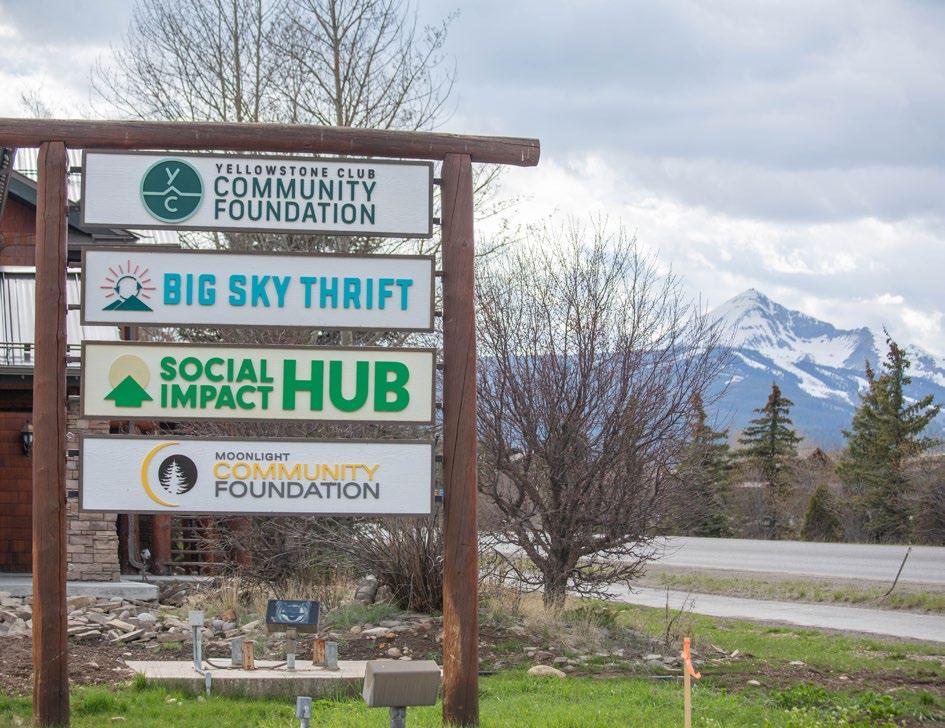
Former volunteers at Big Sky Thrift have been disappointed by the nonprofit store switching from a volunteer-run model to paid staff, as part of a restructuring from the Yellowstone Club Community Foundation. The new model is supported by three full-time employees with sporadic volunteer opportunities available, and the former thrift crew will miss the thriving community of store volunteers.
WARNING: ELK CROSSING
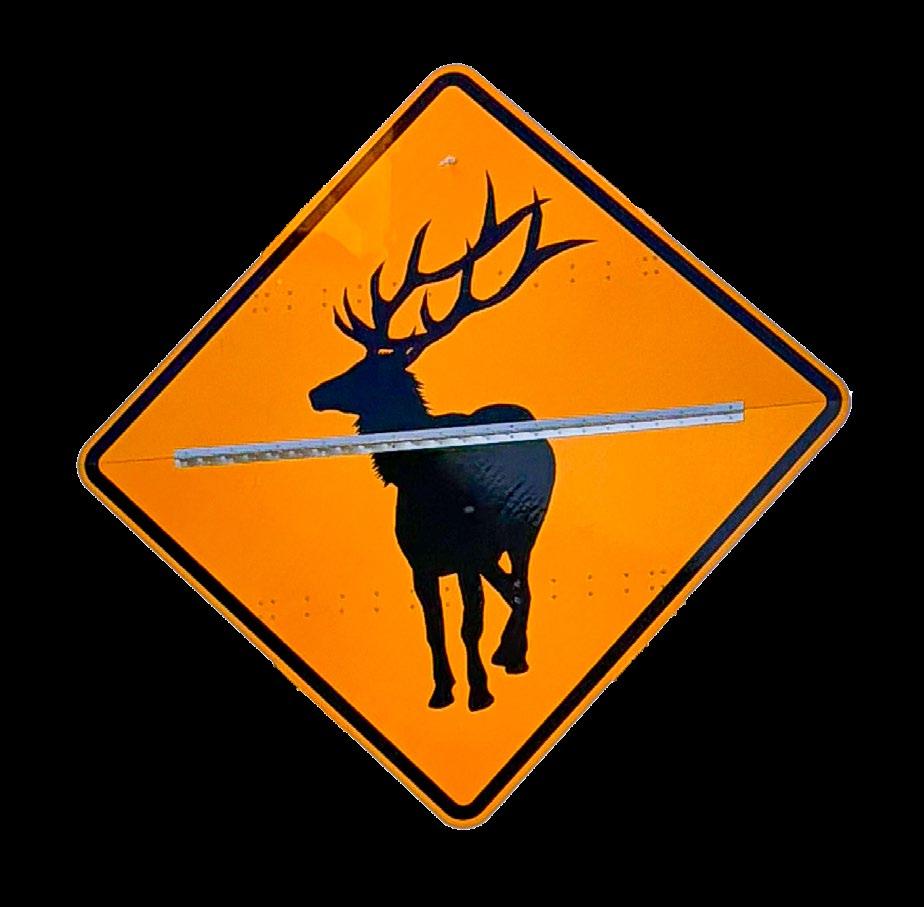
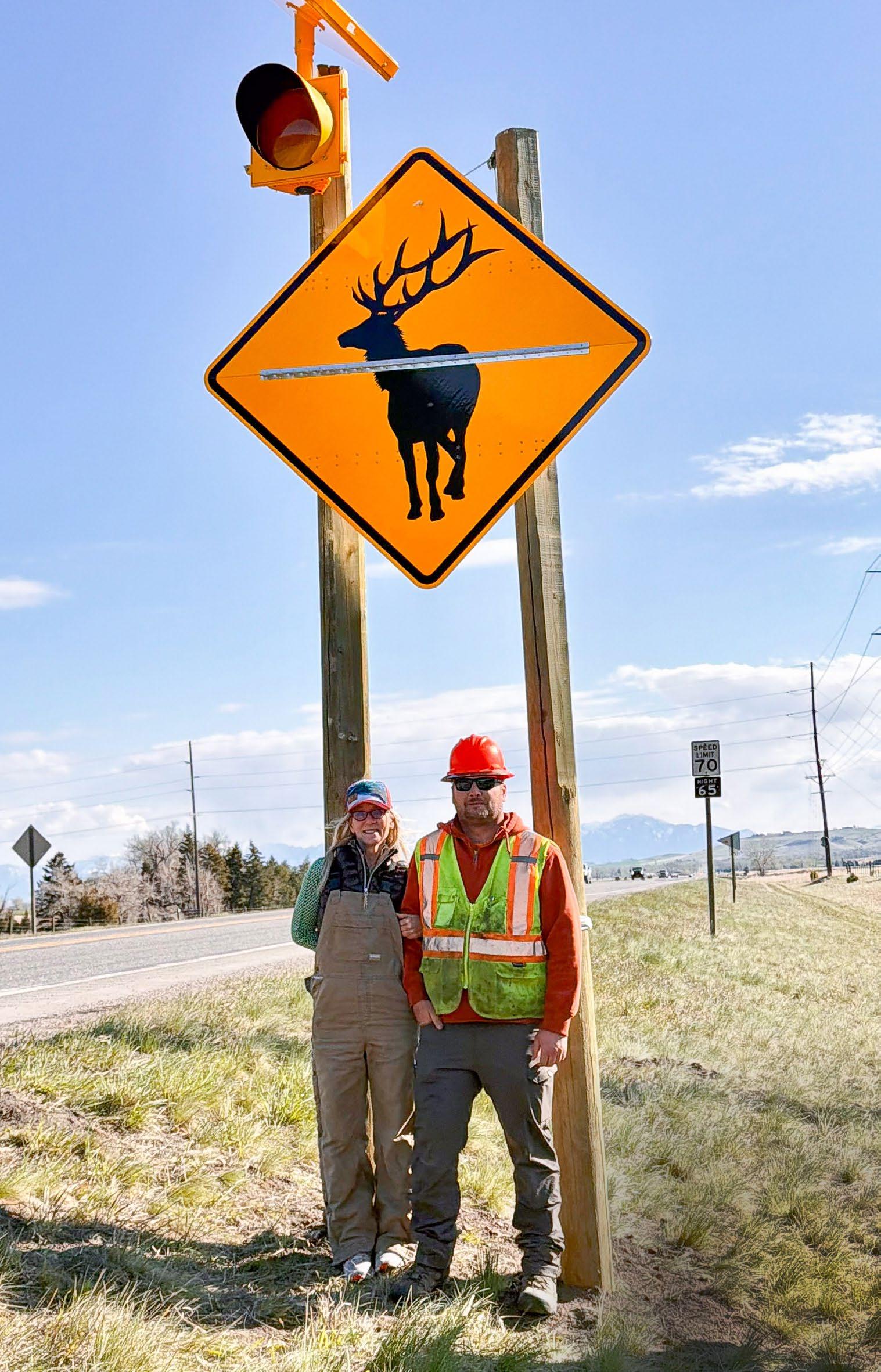
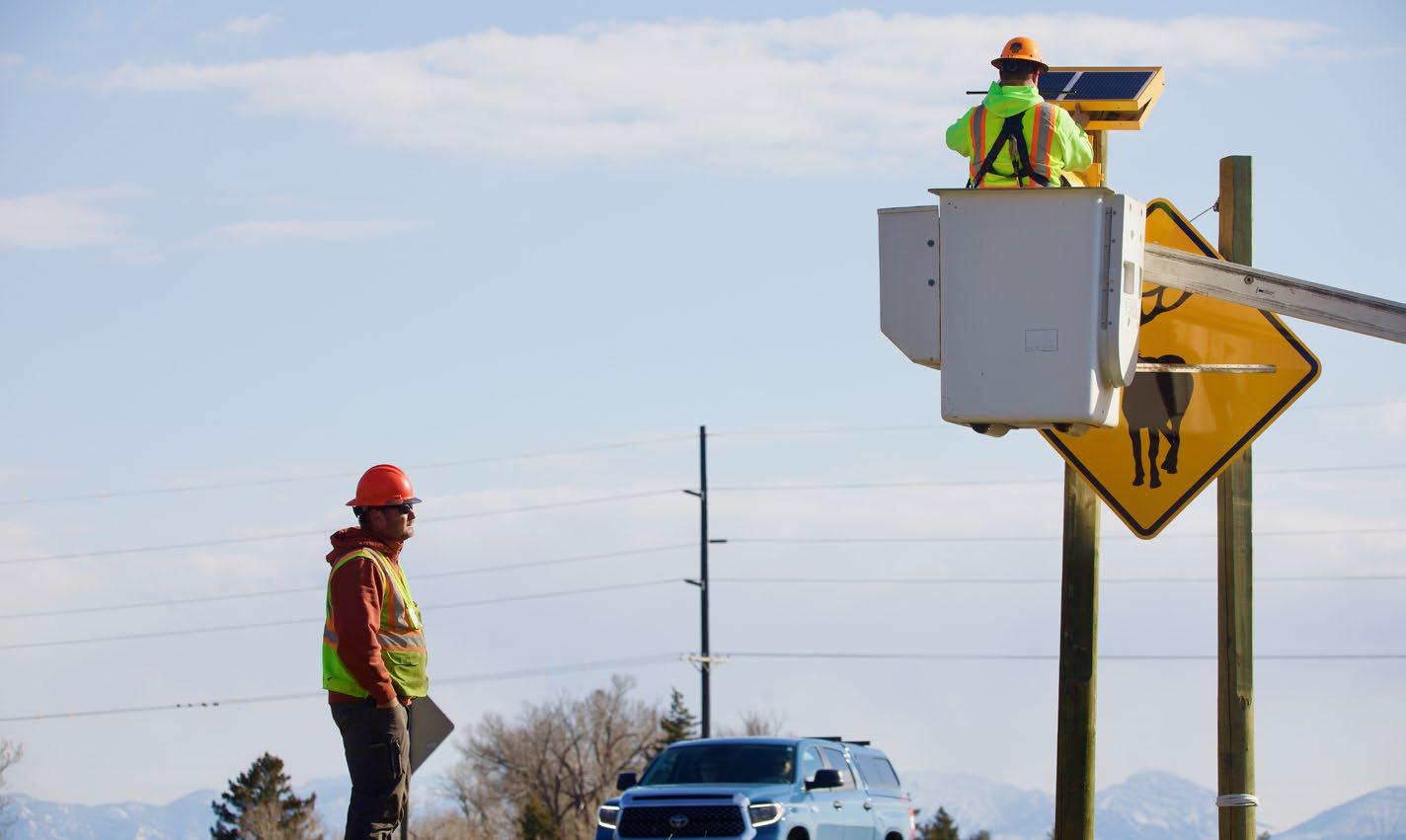
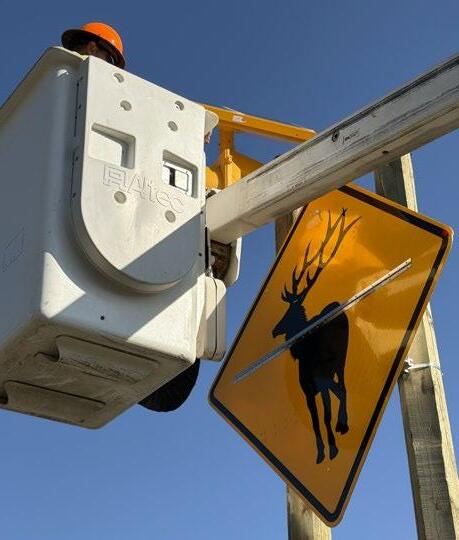
On Thursday, April 30, the Montana Department of Transportation installed two solar-powered, illuminated signs along a stretch of U.S. Highway 191 in Gallatin Gateway, between Bozeman and Big Sky. The Center for Large Landscape Conservation played a key role in securing the animal-friendly installation.
TED TURNER’S UNIQUE LEGACY
ON THE COVER:
After many years of outreach and activism, the Gallatin Gateway elk herd has one small but meaningful layer of further protection from drivers on U.S. Highway 191. PHOTO COURTESY OF HOLLY PIPPEL
EDITORIAL POLICIES
EDITORIAL POLICY
Outlaw Partners, LLC is the sole owner of Explore Big Sky. EBS reserves the right to edit all submitted material. Printed material reflects the opinion of the author and is not necessarily the opinion of Outlaw Partners or its editors. EBS will not publish anything discriminatory or in bad taste.
EBS welcomes obituaries written by family members or from funeral homes. To place an obituary, please submit 500 words or less to media@theoutlawpartners.com.
In memory of the late Ted Turner, Explore Big Sky highlights an exclusive Q&A from sister publication Mountain Outlaw, “Ted Turner – In His Own Words,” where Turner describes his visions as a conservationist, problem solver and American leader.
LETTERS TO THE EDITOR
Letters to the editor allow EBS readers to express views and share how they would like to effect change. These are not Thank You notes. Letters should be 250 words or less, respectful, ethical, accurate, and proofread for grammar and content. We reserve the right to edit letters and will not publish individual grievances about specific businesses or letters that are abusive, malicious or potentially libelous. Include: full name, address, phone number and title. Submit to media@outlaw.partners.
ADVERTISING DEADLINE
For the May 28th issue: May 20th, 2026
CORRECTIONS
Please report errors to media@outlaw.partners.
OUTLAW PARTNERS & EXPLORE BIG SKY P.O. Box 160250, Big Sky, MT 59716 (406) 995-2055 • media@theoutlawpartners.com
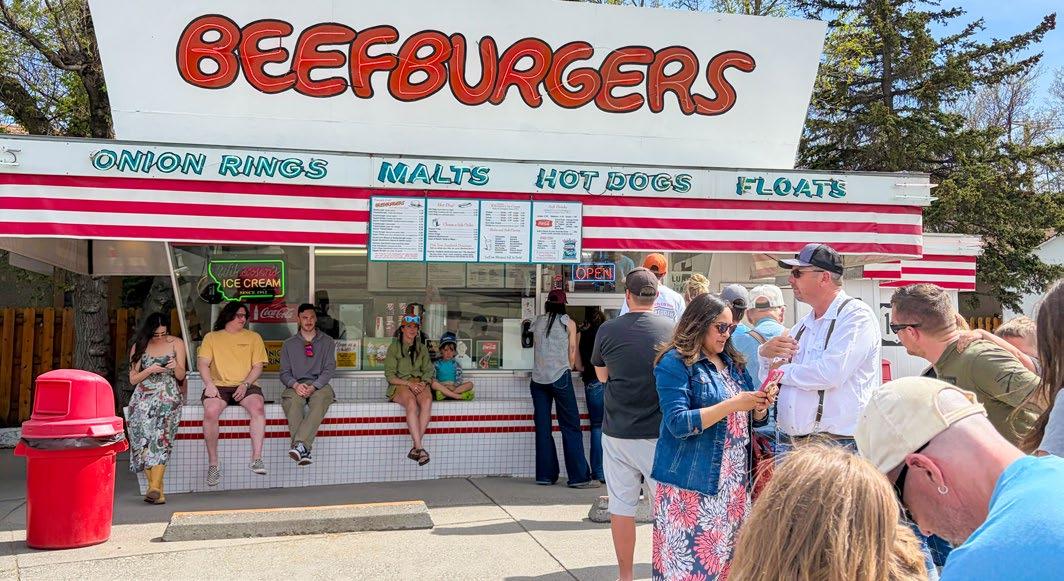
Customers lined up outside Mark's In & Out on Sunday, May 10 to get their first fix of the season. Open May through October, the iconic burger joint in Livingston is known for its classic diner menu and affordable prices. PHOTO BY CARLI JOHNSON
BRIEFS NEWS IN BRIEF
YELLOWSTONE BEAR ENCOUNTER LEAVES TWO HIKERS INJURED, TRAIL CLOSURES IN EFFECT
EBS STAFF
Two hikers in Yellowstone National Park were injured by “one or more bears” on the afternoon of May 4 along the Mystic Falls Trail near Old Faithful, announced a park service news release. National Park Service emergency crews responded, and the incident is still under investigation.
This is the first reported bear-related injury in Yellowstone in 2026. The last such incident occurred in September 2025 when a 29-year-old man was attacked on the Turbid Lake Trail near Yellowstone Lake’s Mary Bay. The most recent fatal bear attack in the park was in 2015 near Lake Village.
Several areas near the incident site are closed while the investigation continues, including land west of the Grand Loop Road between Fountain Flat Drive and Black Sand Basin, along with the following trails: Fairy Falls (north of Grand Prismatic Overlook), Sentinel Meadows, Imperial Meadows, Fairy Creek and Summit Lake. Backcountry campsites OG1 and OD1–OD5 are also closed, as is fishing access along parts of the Firehole River within the closure zone.
Visitors can still access Midway Geyser Basin, Black Sand Basin and the Grand Prismatic Overlook via the Fairy Falls Trailhead, although the area beyond the overlook remains closed.
In the news release, park officials reminded visitors to take precautions in bear country by keeping at least 100 yards away from bears, carrying bear spray and knowing how to use it, staying alert for signs of bear activity, making noise while hiking and traveling in groups of three or more, avoiding hiking at dawn, dusk or night and to never run from a bear.
GREATER YELLOWSTONE FIRE ACTION NETWORK HIGHLIGHTS IMPORTANCE OF WILDFIRE AWARENESS MONTH
EBS STAFF
Officials across the greater Yellowstone area are warning that the summer of 2026 could bring severe wildfire conditions, citing low snowpack, higher than average temperatures and early fire activity, reminiscent of 1988 when the region experienced devastating wildfire.
The Greater Yellowstone Fire Action Network reminds residents and business owners that May is Wildfire Awareness Month and urges proper preparedness sooner rather than later. GYFAN is a network consisting of organizations, agencies and communities within the greater Yellowstone region that work together to address challenges communities and the landscape face with wildfire. The goal of the network is to promote fire adapted communities across the ecosystem and support a fire resilient landscape.
A good start to prepare this year is to attend a community workshop and take practical steps to reduce risk.
“It may be raking dead and down material around your home, changing out the screens on your eaves or developing an evacuation plan. Start small and simple and improve or expand your efforts," said Teton County Idaho Fire Chief Mike Maltaverne in the release. "Every bit of effort can help.”
The network promotes long-term resilience through community programs, home safety assessments and public education about living with wildfire. For more information about GYFAN, visit their website or sign up for their mailing list by emailing gyfireactionnetwork@gmail.com.
BELGRADE AND GALLATIN COUNTY TRANSITION DEVELOPMENT
RESPONSIBILITY OF THE ‘BELGRADE DONUT’
EBS STAFF
The City of Belgrade and Gallatin County are working together to transition who is responsible for land use planning in the 4.5-mile area surrounding Belgrade, often referred to as the “Belgrade Donut.”
Beginning July 1, Gallatin County will assume planning and development review responsibilities in the Donut. Both the city and county are coordinating closely to make the transition as smooth as possible, a press release by Gallatin County stated.
The transition, initiated by Belgrade, will shift planning and development review within this area to Gallatin County, allowing the City of Belgrade to focus its resources on meeting new requirements under the Montana Land Use Planning Act.
The City of Belgrade will continue to process complete applications received prior to July 1. However, to provide greater continuity in review, applicants with proposals for subdivisions or buildings for lease or rent, who have not yet submitted, are encouraged to wait and submit directly to Gallatin County after July 1. Gallatin County will begin offering presubmittal meetings for projects in the Belgrade Donut area starting May 1.
This jurisdiction change will include Gallatin County extending its growth policy to encompass the Belgrade Donut while the City of Belgrade’s planning documents will be updated to comply with the requirements of MLUPA.
The County Commission will discuss the transition and related planning efforts during their regularly scheduled meeting on Tuesday, May 12 at 9 a.m. at the Gallatin County Courthouse. Community members are encouraged to attend and stay involved. Public input and questions can be directed to the Belgrade Community and Economic Development Department and the Gallatin County Planning and Community Development.
PUBLIC NOTICE
AVAILABILITY OF ANNUAL DRINKING WATER QUALITY REPORT (CCR)
Big Sky County Water & Sewer District 363 (PWS ID: MT0002385) has completed its 2025 Consumer Confidence Report (CCR), also known as the Annual Drinking Water Quality Report. This report contains important information about your drinking water, including water quality data, potential contaminants, and the steps taken to ensure safe and reliable drinking water for our community.
The CCR is available to the public online at: bigskywatersewer.com. For additional information regarding this report, please contact: office@wsd363.com. The public is also welcome to attend our monthly board meetings, held on the third Tuesday of each month. District 363 is committed to providing safe, high-quality drinking water to all customers.
DONN MATTUSCH
Donn Mattusch went home to be with his Lord on March 31, 2026. He was born in Davenport, Iowa on Sept. 23, 1936 to Donald and Garnet Mattusch. At an early age they moved to Waterloo, Iowa, where Donn received his primary education. He loved to swim and was a lifeguard in the summers.
After graduating high school, he went to Kansas City Institute of Art for one and a half years, then changed gears and went to The State University of Iowa and graduated with a BA in mathematics. His first job was in Southern California with Northrop Aerospace, so he moved there with his wife and had his first son. Deciding he did not want to raise his son in the big city, he moved to Boulder, Colorado in 1966 where he worked for IBM and had his second son.
Donn loved to photograph God’s creation and along the way climbed 14,000 foot peaks, hiked and camped, which he did for the next 40 years. After he was divorced, he moved to the Denver area where he lived for about the next 20 years. He taught himself how to run a computer and worked on mainframes for many years as a computer programmer, then switched over to PC’s and did contract work all over the nation. He always preferred small towns such as Pierre, SD—one of the coldest places on earth—-and Tupelo, MS— home of Elvis Presley.
Donn met Sally in church and after a long courtship they were married in 1984 and then
moved from Denver to Montrose, CO where they bought 11 acres and built an adobe home that looked out over the beautiful San Juan Mountain. There were plenty of deer and elk to photograph, as well as the stunning scenery of southwest Colorado. He then spent two summers working in Anchorage, Alaska where the photography of bears and moose was plentiful. In Montrose he started attending a Presbyterian PAC Church where he had many friends and said it was the happiest time of his life—except for when he was with his two sons! After retiring from computer work, he sold real estate for a few years. His last jobs were driving jeep tours in the San Juan Mountains, which was the most fun job he had ever had.
Sally’s health began to fail so they moved to Morristown, Arizona where she could be near her daughter. Donn continued to hike and photograph until his health also began to fail. That came with a few mishaps as he fell upside down coming off a solo hike up Vulture Peak in the Sonoran Desert one day. He had quite a time getting turned right side up and removing the cactus from his clothes.
After the passing of Sally, Donn moved to Big Sky to live with his son and finish out his years back in the Rocky Mountains. The desert heat in AZ was stifling, and he loved the cold fresh air of the Rockies. Most important of all, Donn wanted to serve the Lord in whatever capacity he was able, such as attending and teaching Bible studies, and researching and writing on different subjects of the Bible. He published his passion project before he passed, “God’s Covenant of Love: The Blood Covenant.” His greatest hope was to see his children come to know thy Lord and have them know the certainty that when they face Jesus, he will say, “well done thy good and faithful servant” just as his word says he will do to all of us that have called upon his name for salvation.
Donn is survived by his sons, Don and Dan; granddaughter, Kristina; and great grandchildren, Genesse and Estes. He’s also survived by his stepson, Rob and his step grandchildren, Mike and Jessica. Arrangements are in the care of DokkenNelson Funeral Service.
SUNDAY, JUNE
WELCOME COCKTAIL HOUR
G-MAN
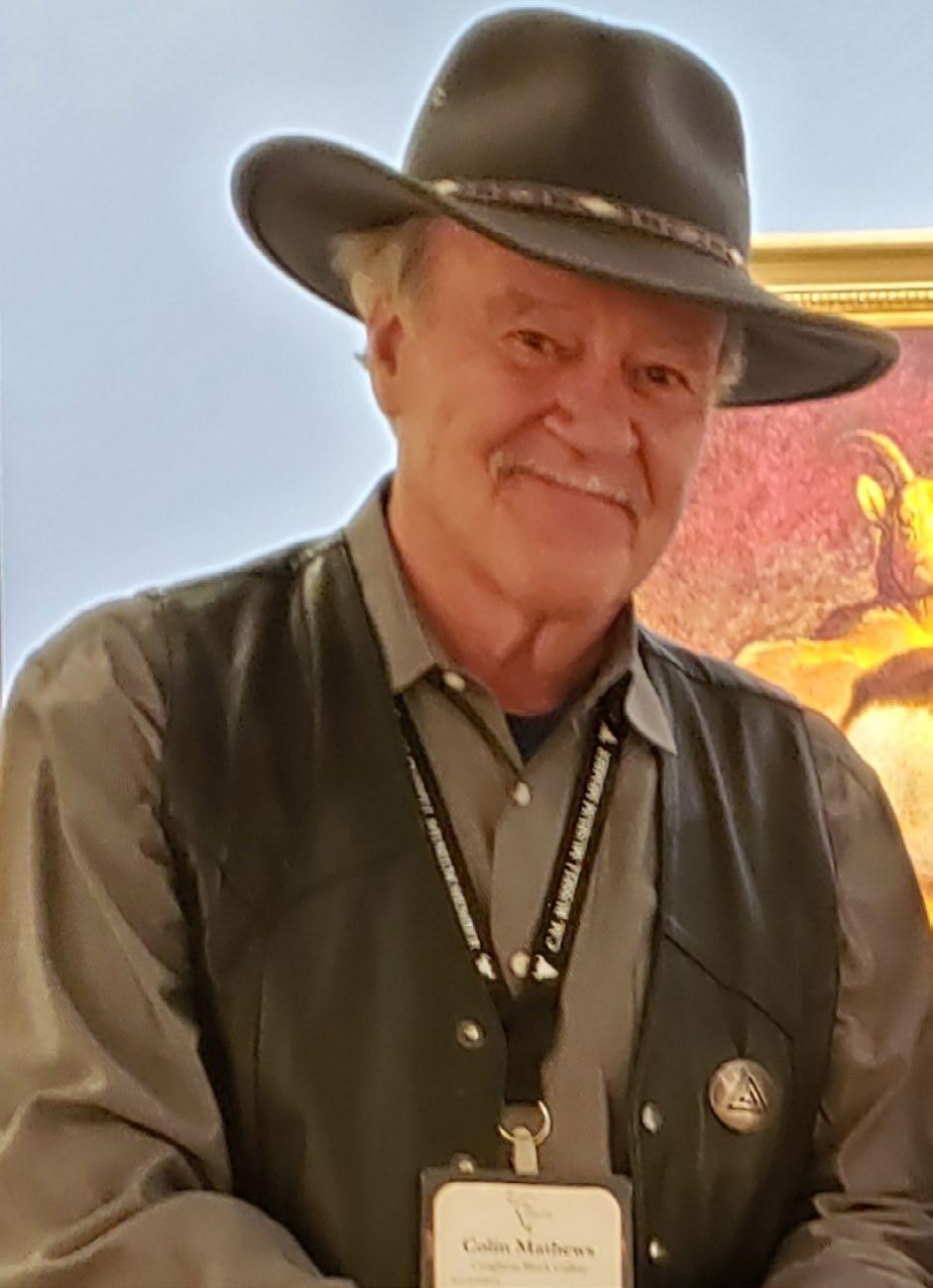
COLIN DEE MATHEWS
SEPT. 8, 1947 - MARCH 23, 2026
Colin Dee Mathews was late to many appointments, but he arrived a little bit early to his own death, at the age of 78, on Monday, March 23. After managing prostate cancer for the previous five years, small cell liver cancer snuck up and took him quickly. He was surrounded by all of his adoring and beloved children when he passed, at the Mayo Clinic in Jacksonville, Florida. He had inherited genes that would have taken him to his 90s, yet from the shock of his first diagnosis and prognosis, he adjusted quickly to making his best day be every day, with his accustomed good humor.
Born on Sept. 8, 1947 in Salt Lake City to Tom and Bonnie Mathews, Colin spent his early childhood in Utah. From his earliest days, he was an outstanding tennis player and skier. The family moved to Sausalito, California in the 1950s, then a run-down fishing village. They made a large circle of close friends including painters, sculptors, Bohemians, writers and photographers. He always regarded Sausalito as his spiritual home. Colin attended Marin Country Day School, where his high grades earned him a scholarship to Andover, the elite private school in Andover, Massachusetts. In the summer he coached basketball at a Headstart program in Brooklyn when his family moved to New York. He went on to Stanford, also with a scholarship, where he majored in English, a natural choice given his family’s love of literature. There he met and married Edith Glassmeyer. After graduating, they moved to Philadelphia where he earned a law degree at the University of Pennsylvania.
Colin spent his early career joining a string of political campaigns, starting with George McGovern’s presidential bid in 1972, and ending with Morris Udall’s in 1976, with a handful of Senate campaigns in between. Colin and Edie lived in Washington D.C and had two children by then, Zach and Hilary, but their marriage ended during his work on the road. None of those campaigns were ultimately successful, which meant Colin also found himself with an employability problem.
So he got a government job, with the help of Lynn Coleman, legal counsel at the Department of Energy. Lynn later helped Colin get a position as a capitol hill lobbyist. He joined Vinson & Elkins, a top law firm in Washington D.C., and shortly made partner.
Those years were to become his high-flying ones. In his second marriage to Jessica Tuchman, Colin had two more children, Oliver and Jordan, as well as an enviable house in Washington D.C., and a farm in Virginia an hour away, where they hosted many parties for Washington’s power brokers. They lived a life of horses and Porsches. But his restless soul, and perhaps his moral compass, steered him away from the lobbying profession, and he tried his hand at business, selling computer systems to the U.S. Department of Defense. His outsized dreams were sometimes impractical, but his enthusiasm never faltered. That venture was met with mixed success, and his second marriage ended in divorce.
Feeling like he had sold his soul to the political, legal and business professions, Colin spent much of his later life working on buying it back in the mountains where he was born. In his third marriage to Paula Craver, the two of them bought The Roadmaster Grille restaurant in Virginia City, Montana, a town where he was elected mayor. But the recovering lawyer tired of flipping burgers after a couple years, and he and Paula turned the operation into a western art gallery, which they
the Creighton Block Gallery. When the local ranchers, motorcycle enthusiasts, and occasional busload of tourists proved an inconsistent customer base for fine paintings and sculptures, he moved the gallery to Big Sky. Courtney Collins helped him in that venture for years, eventually taking over the business, reimagining it as Courtney Collins Fine Art.
Colin was a loving, extraordinary, eccentric, paradoxical man. He was a sweetheart and a dreamer. He loved a bad pun almost as much as a good story. He loved fine clothing and the trappings of wealth, and somehow also labor union songs, Italian opera and country music. In his childhood his family sang hundreds of songs on road trips, with Colin singing the loudest and most fervently, quite off key. Beloved by everyone who knew him for his unfailing good nature and kindness—ski lift operators, raconteurs, card dealers, bartenders, friends and artists, he nevertheless managed to vex more than a few lenders and bankers. His responsibilities, his dreams, and his good intentions were frequently at odds with one another, but in his final years he seemed to have found his way to harmony in that regard. He never failed to make an impression on any and all who knew him. If he
disappointed anyone along the way, it was in direct proportion to how much he was adored by them.
Colin’s family is a large and occasionally shifting constellation. He is survived by his wife Paula Craver, for whom he was the principal caregiver for a decade after she fell ill. She now lives with her daughter Caity in North Carolina. He is also survived by his four children Zach and Hilary, Oliver and Jordan, all of whom supported him throughout his illness. He had seven grandchildren, including Paula’s from her first marriage. His older brother Tom and younger sister Annie are heartbroken at his passing, as are his niece Clea Mathews, and nephews Nick and Isaac Aoki. He’s also survived by lifelong dearest friend Kevin Hicks of Bolinas, California, and preceded in death by his adoring parents, Tom and Bonnie Mathews.
“Hail to thee, blithe Spirit! Bird thou never wert, That from Heaven, or near it, Pourest thy full heart
In profuse strains of unpremeditated art.”
- Percy Bysshe Shelley
called
LOCAL
BIG SKY ‘WELLNESS DISTRICT’ APPROVED BY A LANDSLIDE
INITIATIVE CROSSES FINISH LINE WITH 90-PLUS-PERCENT SUPPORT; VOTERS SELECT CANDIDATES FOR SCHOOL BOARD, RESORT TAX BOARD
BY JACK REANEY
BIG SKY—The multi-year effort to create a hospital or “wellness” district in Big Sky has finally crossed the finish line, with Big Sky voters demonstrating clear support for the initiative that will bring millions of dollars into the community to fund health care and wellness infrastructure.
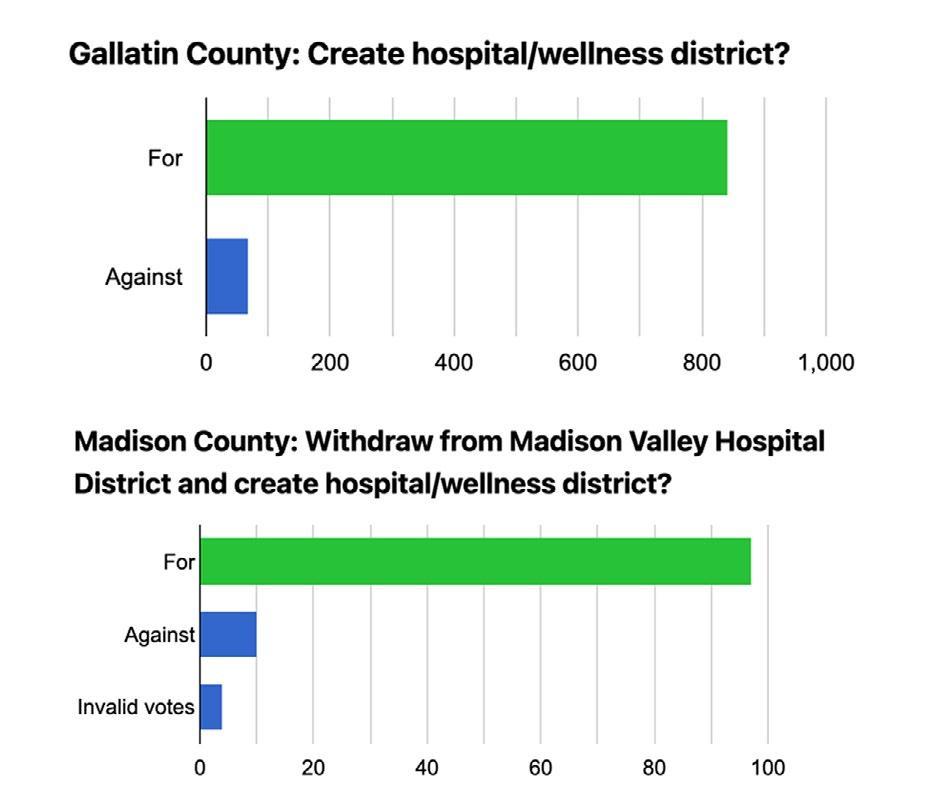
Many of those dollars will come from Big Sky’s Madison County residents, who voted 97-10 in favor of withdrawing from the Madison Valley Hospital District, which previously received these Big Sky residents’ hospital tax dollars, totaling nearly $2 million per year. Now, over the course of eight years, the new Big Sky district will gradually collect more of its own tax revenues—over $1 million in the first year and eventually totaling over $20 million by the end of the eight-year period, per estimates by Big Sky Resort Area District leaders.
On the Gallatin side of Big Sky, voters approved the new district by a margin of 842-66—roughly 93% support—according to unofficial results. The district’s creation does not impose any taxes. It will be up to the new trustees to seek voter approval for any potential taxes.
Trustees representing the two Big Sky hospital districts—Madison and Gallatin—are expected to form an interlocal agreement to align local priorities and share funds.
Daniel Bierschwale, BSRAD executive director, said the successful creation of both districts is “a monumental win" for Big Sky residents.
“Voters chose to support a long-term investment in essential health and wellness services, with local residents helping guide those decisions and priorities moving forward,” Bierschwale stated via email. “This is exactly what Livable Big Sky is about—creating a community where people can live, work, and grow together for the long haul.”
The Madison-side district’s election for trustees was not contested, as three candidates ran for three spots. Those trustees will be Heather Morris, Paula Cleary and Mike Rowe.
The Gallatin-side district did host a contested election, with four trustees running for three seats. Katie Grice led the popular vote with 668, Laura Seyfang followed with 627 votes, and Sally Stilwill narrowly won the third seat by a 21-vote margin, 498-477 over Marilyn Flint, according to unofficial results.
These results have not yet been confirmed or canvassed by the Gallatin County Commission.
Inaugural trustees reflect on new district
Katie Grice, who helped lead the Big Sky Wellness Coalition effort, said the vote to create the district is the result of community members working intentionally to create a livable community.
“Big Sky voters have made it clear that the district is the next step in investing in the long-term vitality of our community,” Grice stated in an email to EBS. “Now our trustees can begin the thoughtful planning required to turn vision into action to meet our critical needs. Let’s go to work.”
Fellow Gallatin-side electee Laura Seyfang said she’s “thrilled” that voters supported the initiative that will support the community’s wellbeing. "Big Sky just keeps getting stronger as we work together like this," Seyfang stated via email.
Madison-side electee Mike Rowe credited the “support, leadership and persistence” of coalition leaders, and promised “thoughtful, transparent and collaborative” leadership.
Heather Morris, whose efforts were integral in the process resulting in Senate Bill 260, said the May 5 result is the culmination of years of hard work.
“The lopsided wins in both Madison and Gallatin prove what we, who live here, already knew. We want to control our own destiny and we want our tax dollars to stay in the community charged with taking care of us,” Morris told EBS via text.
She added that considering voters’ May 2025 commitment to livability through commitments to housing and community park infrastructure, the Big Sky community has again demonstrated its focus on collaborating and prioritizing a sustainable future.
“The needs of our town are many, but they aren’t insurmountable when you have the support of 90% of the community,” Morris stated. “I’m looking forward to working with my fellow trustees on both sides of the county line to help benefit the health and wellness needs of our friends and neighbors.”
Candidates chosen for school, BSRAD boards
Aside from the hot-button wellness district referendum, voters also selected trustees to the Big Sky School District and Big Sky Resort Area District (Resort Tax) boards.
For the school board, voters selected incumbent Matt Dodd in a 1-on-1 race against Jonathan Gans. Dodd received 547 votes to Gans’ 326, according to unofficial results.
In the BSRAD election, three candidates ran for two spots. Incumbent Michelle Kendziorski received the most votes, with 652. Taylor Kissell's 569 votes earned him the second seat, beating out Laynee Jones’ 506 votes, according to unofficial results.
Again, these results have not yet been confirmed or canvassed by the Gallatin County Commission at the time of this story’s publication.
“Big Sky is built on the dedication and commitment of volunteers,” Bierschwale stated via email. “We’re grateful for all the candidates who stepped forward and demonstrated their willingness to serve our community.”
CAREER FAIR AT LPHS EXPANDS HORIZONS
BIG SKY FUTURES IS LED BY STUDENTS, BIG SKY CHAMBER, LMLC
BY JACK REANEY
BIG SKY—Eighteen local businesses and nonprofits tabled at the Lone Peak High School gym on April 27, sharing insights into potential career paths like construction, hospitality, firefighting, health care and wellness.
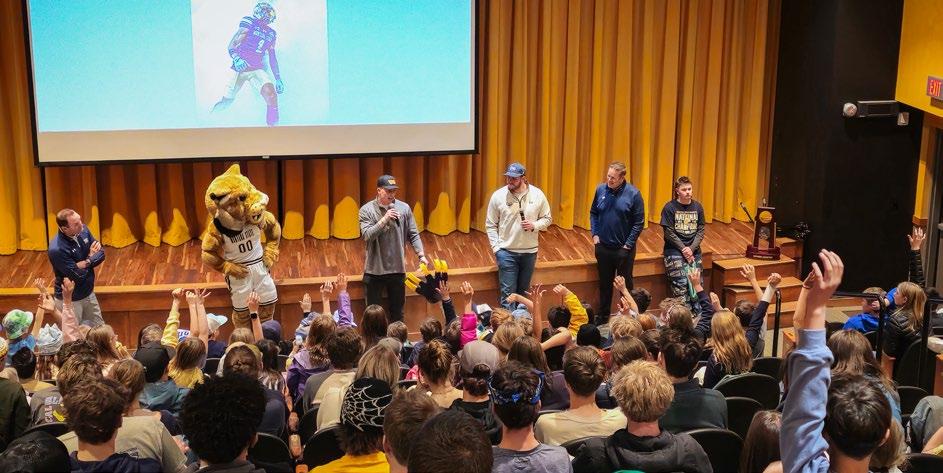
The annual fair is led by students in the Big Sky Futures Club, and is a key part of the group’s programming, in addition to monthly visits from speakers. Most recently, the club hosted Montana State University Athletics—Bobcat football players Justin Lamson and Titan Fleischmann, head football coach Brent Vigen, mascot Champ and Athletics Director Leon Costello gave a March presentation about all the jobs that go into a successful sports operation.
Every April, Big Sky Futures also hosts a job shadow day to visit three or four businesses, which included 35 to 40 students in 2026.
Lone Mountain Land Company President Matt Kidd helped former student and Big Sky Futures founder Charlee Sue Dreisbach create the program in 2023. Anna Johnson, LMLC’s director of community engagement, told EBS the company is proud to continue supporting Big Sky Futures.
“This community is full of professionals who want to support the next generation,” Johnson stated in an email to EBS. “By building these bridges between students and local professionals, we’re helping young people explore what’s possible and take real steps toward their goals—whether that’s college, a trade school, or jumping straight into the workforce.”
The Big Sky Chamber of Commerce also helps organize Big Sky Futures, and VP Megan Porter said April is the most exciting time of year, between shadow day and the career fair.
“The true impact of this program is introducing kids to jobs that they might not think of within an industry,” Porter said at the event.
For the chamber, last year’s event led one student to a summer internship. But the event is not designed for immediate job connections, so much as inspiration for students to consider future career paths.
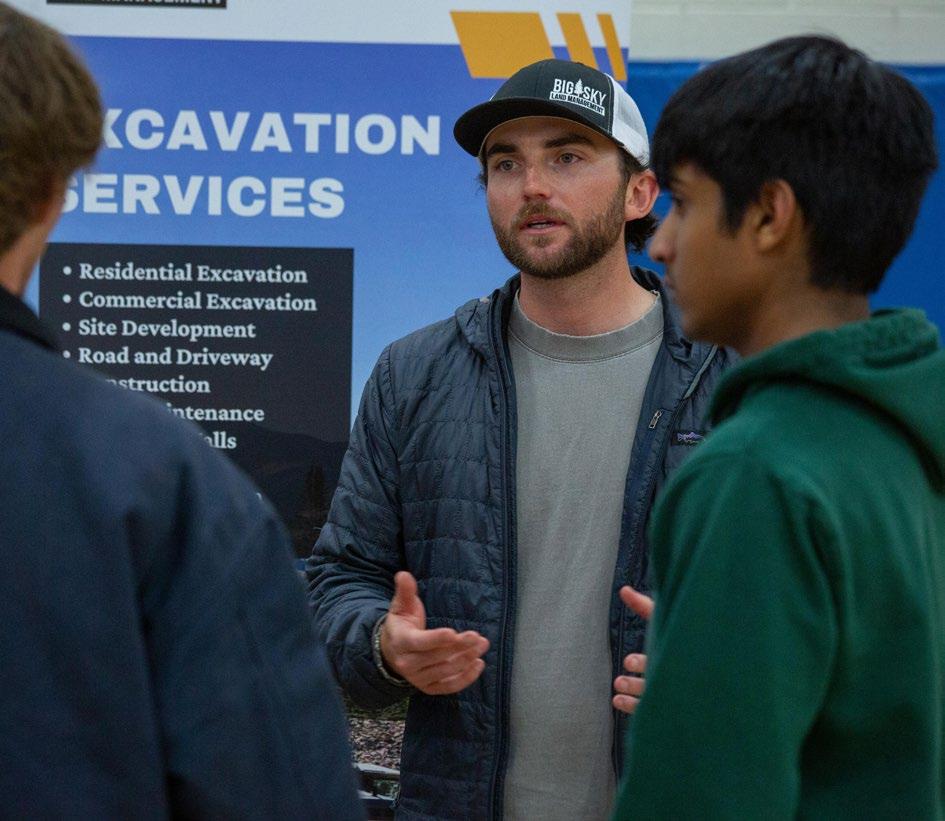
“We’re mainly here to try and plant seeds in their mind, about what’s available to them... educate them on what’s available, and maybe push them to go in a direction they maybe hadn’t thought about ahead of time,” said Jackson Chaput, marketing coordinator for Big Sky Land Management, a local construction company that’s participated in every year of Big Sky Futures.
Chaput explained that young workers face a strong opportunity as the construction industry faces a “silver wave” with many professionals nearing retirement. He noted that many careers exist in construction, including office-type jobs, contrary to popular belief.
“There’s a lot of opportunity up here in Big Sky, especially in construction,” Chaput said.
Korbin Frederick, human resources officer with Big Sky Resort, tells students about his story, a common one: he studied a subject in college that has little to do with his current field. He hopes the message helps relieve some of the pressure that weighs on ambitious high schoolers.
“I didn’t know what I wanted to do for a long time... It’s okay to not know what you want to do,” Frederick said.
Big Sky Fire Department Battalion Chief Dan Sheil said the career fair offers a chance for students to realize firefighting is a real career path, and a reliable industry in an increasingly automated job landscape.
“I don’t think a lot of people realize that they can do this as a job,” Sheil said, as curious students examined life-saving tools on display in the Lone Peak gym.
Firefighter Jake Czerniewski said well-rounded, hands-on workers and fast learners make strong candidates for the challenging work of firefighting. “Our goal is to reach out to the community, and hopefully, in future years, get more local firefighters,” Czerniewski said.
Paige Robison, assistant recreation director with nonprofit Eagle Mount, said the organization relies primarily on volunteers, which is a good fit for many high school students looking to log hours. In addition, Eagle Mount’s internships can be a good way for candidates to gain experience in adaptive recreation or, more generally, work with individuals with disabilities.
“I think [this fair is] a good way for people to know more about the [Eagle Mount] organization, but also for high school students to get involved and understand what we do. But then also, what other career opportunities are out there for [supporting] people with disabilities,” Robison said.
Jackson Chaput of Big Sky Land Management discusses careers in construction with Lone Peak seniors.
PHOTO BY JACK REANEY
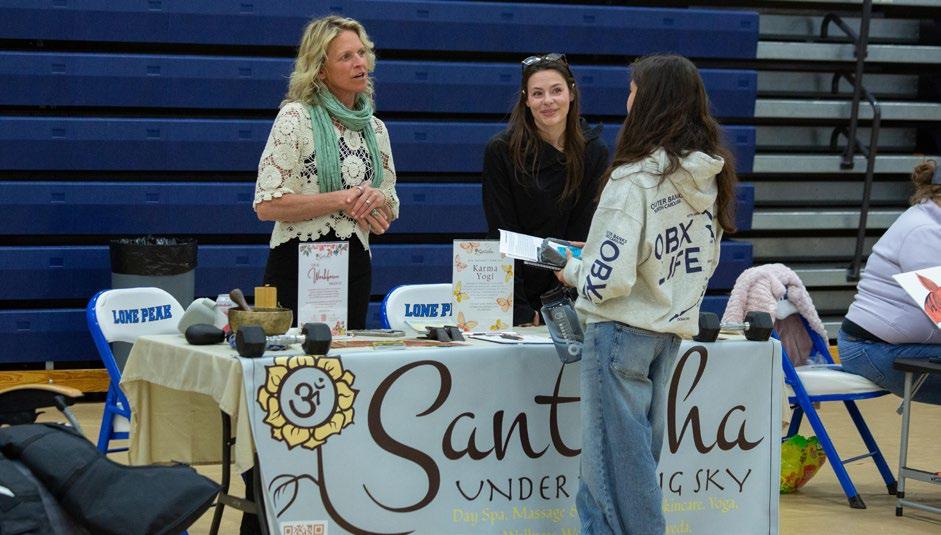
Callie Stolz-Dominick and Shannon Kautzmann of Santosha Wellness Center discuss working in health and wellness.
PHOTO BY JACK REANEY
Students: ‘I think we get a lot out of it’
Sophomore Kate O’Connor, Big Sky Futures’ communications lead, is interested in an emergency medical services career. She’s done three ridealongs with BSFD and completed a program called MedStart. She credits school counselor Janet Martinez for providing career advice, but believes Big Sky Futures can spark inspiration for those who otherwise might not visit a school counselor.
“I think the biggest takeaway is guidance,” O’Connor said, describing Big Sky Futures. “... Supporting students as much as we can, without handing them a job.”
Students from Big Sky Community School and Discovery Academy also attended the fair.
Lone Peak sophomore Violet Fischer said the fair is a good way for students to learn what types of jobs might be available for high school graduates or college students. She thinks most of her peers walk away with new knowledge and excitement.
“They are very cool companies, and it’s cool to learn about how they operate and if they have opportunities for you,” Fischer said.
Senior Elise Daugherty is president of Big Sky Futures, and said it’s been an engaging program since her freshman year, when Dreisbach got it started. Daugherty’s goal is to make Big Sky Futures more interactive, and she thinks students are getting more excited about the monthly visits from role models like the national champion Bobcats.
“[It’s] been so pivotal, and I think we’ve got a lot out of it,” Daugherty said. “Because I know a lot of people who have got jobs and internships because of it, and also just learned what they want to do when they graduate. It also shows students that there’s another path, aside from just going straight to college out of high school. Because that’s not in everybody’s game plan.”
Daugherty thanked every business that has ever given its time to support the program. She thanked LMLC's Matt Kidd and Anna Johnson, and Megan Porter from the chamber, for their guidance.
Finally, she thanked all of her classmates who give their full attention and energy at Big Sky Futures events.
"We are grateful to have such an active and serviceminded community that gives its time and energy to young adults so they can better navigate their future career paths," LPHS Principal Dr. Marlo Mitchem stated in an email to EBS.
"Big Sky Futures has proven to be a great twoway interaction with the community,” added Superintendent Dr. Dustin Shipman. “Our students get to hear, firsthand, from folks who have journeyed from high school to the present... The more we can have folks explore their futures, the clearer their own journeys become and to be able to do that with locals is even more meaningful."
Daugherty said Big Sky Futures shows students that many paths exist, and they can do what they want to do. “They just have to put some effort in,” she said.
On March 25, leaders of Montana State’s NCAA Division I champion football team visited the Warren Miller Performing Arts Center to discuss the many folks who contribute to an athletic program’s success. COURTESY OF BIG SKY SCHOOL DISTRICT
BIG SKY NONPROFIT LEADERS CELEBRATE SUCCESSFUL GIVE BIG DAY
OVER 250 NONPROFITS PARTICIPATED IN THE 24-HOUR GIVE BIG GALLATIN VALLEY
INITIATIVE, RAISING A RECORD-HIGH $3.3 MILLION ACROSS
BY VICTORIA SMITH EBS CONTRIBUTOR
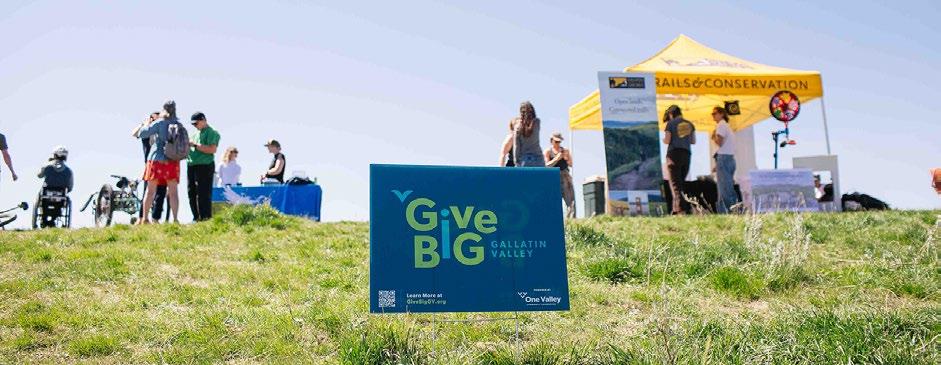
GALLATIN COUNTY—Thousands of donors came together for the 12th annual Give Big Gallatin Valley on Thursday, April 30 to Friday, May 1, raising a record-breaking amount of $3.3 million for local nonprofits.
The annual 24-hour giving initiative is organized by One Valley Community Foundation, and it connects community members and nonprofits through grassroots philanthropy. A total of 265 nonprofits participated this year, and 5,695 donors raised a total of $3.3 million. Since the initiative was started in 2015, Give Big has raised a total of $23.7 million to support 525 nonprofits.
“Our role is to set the table. [The community’s] role is to come and do the giving,” said Anna Burkholder, One Valley’s marketing and communications manager, in a phone call with EBS. “And so when we hit $3 million, it was a very good representation of the generosity in our community and the way that our community chooses to show up for the nonprofits they care about.”
This year, all donation fees were covered by the Jill and Nicholas Woodman Foundation—a donoradvised fund held at One Valley. Roughly one-fifth of gifts were $20 or less, showing participation from community members of all financial means.
“For me personally, it was the last piece of creating Give Big as this very intentional, impactful event where giving really excels, and we reduce barriers to make it as easy as possible so people can give and feel the joy of giving,” Burkholder said.
On Thursday, April 30, individuals gathered for kickoff events across seven communities as part of Give Big Fest. These events were held in Belgrade, Big Sky, Bozeman, Gallatin Gateway, Manhattan, Three Forks and West Yellowstone.
“Give Big is an incredible representation of this community,” Burkholder said. “I can’t say it enough that Gallatin County has an incredibly generous and strong community, and our nonprofits play a huge role in keeping this place so unique and special and such an incredible place to live.”
Reflections from Big Sky
This year’s Big Sky kickoff event was held at Big Sky Center for the Arts. Tamara Knappenberger, events and volunteer manager for Arts Council of Big Sky, said 21 nonprofit organizations participated.
The event featured live entertainment, interactive activities and an artist showcase with John Piacquadio. Event organizers focused on incorporating activities that would teach kids about philanthropy, with an overall event goal to increase donor engagement.
“[It’s] a chance for us [nonprofits] to all get together and collaborate because we’re all so small in terms of staff, we don’t really have a chance to check-in or commiserate or problem solve together,” Knappenberger said. “So this is definitely a lovely avenue for that.”
GALLATIN COUNTY
Local businesses supported the event, including Rocky Mountain Toy Company in providing prizes for the kids’ raffle, Scoops in providing ice cream cones to kids who donated and Blue Moon Bakery in selling pizza and donating the proceeds back to organizations.
“I just thought that was so cool, that… kids get exposure to [philanthropy] early on,” said Liv Grubaugh, director of development and communications for Big Sky Community Organization. “Especially for kids living in our community that get to benefit so much from nonprofit work.”
Various organizations worked with the Arts Council of Big Sky in planning the event such as BSCO, World Language Initiative and Warren Miller Performing Arts Center.
“[All organizations] checked in on their friends, brought something to contribute,” Knappenberger said. “We’ve been meeting since January, so most of the organizations have had people in the meetings.”
BSCO raised $19,550 across 37 donors during Give Big Gallatin Valley, and the funds will be used to support the nonprofit’s year-round programming, including recreation leagues, youth programming, and fitness and wellness classes.
BSCO was further recognized with an award given to the nonprofit between Big Sky, West Yellowstone and Gallatin Gateway with the highest number of donors between 11 a.m. to noon on Friday, May 1. The prize totaled $1,000.
“This was the biggest Give Big fundraiser that BSCO has ever seen. It’s like more than three times what we’ve ever done over Give Big,” Grubaugh said. “So I think that the more that we continue to showcase it as a nonprofit, kind of collective initiative in our community, the more momentum it’ll grow for everybody.”
Another nonprofit present at the kickoff event was Big Sky Community School—a new nonprofit, independent school that partners with the online learning platform Aeon. This was the nonprofit’s first year participating in the giving initiative, and it raised $1,965 across six donors.
As the school utilizes a variety of local businesses and organizations—such as Moving Mountains, BASE Community Center and Big Sky Center for the Arts—the funds will financially support
these opportunities for students, in addition to supporting other student needs, explained Jeremy Harder, head of school.
“[The funds] go into that bucket to serve students,” Harder said. “... All the money we raised there will go into something that will help students.”
Another educator and leader of the arts, WMPAC raised $2,575 across seven donors. These funds will go into a general fund to cover various program expenses throughout the year—artist fees, technical production, ancillary artist requirements and marketing—which helps the nonprofit keep ticket prices affordable.
“Give Big is great timing for WMPAC to say thanks to all of our patrons after the end of our season,” said John Zirkle, WMPAC executive director. “It’s also an opportunity for new donors to participate, and we are so grateful for a nice end-ofthe-year surprise.”
In addition to BSCO, another local group received an award from One Valley. Big Sky OUT, an inclusivity-focused nonprofit that aims to create and support queer spaces for the community, received the “Equity as a Lived Value” award, which provided a prize of $1,000.
“We’re really honored to be recognized in such a way because that is what we shoot for. Equity is our core value,” said Grey Shamburger, board member for Big Sky OUT. “I think that it’s nice to see our platform recognized as such when there are so many nonprofits based around the same thing.”
Across 21 donors, Big Sky Out raised $2,725 during the giving initiative. These funds will be used to support the nonprofit’s upcoming Pride Day celebration event, which is slated for June 28. The nonprofit plans to feature a vendor fair, a speaker and other festivities during the event.
Representatives of participating organizations expressed gratitude for Give Big Gallatin Valley. They noted the support of community members and the opportunity to further connect with fellow nonprofits during Give Big Fest.
“This fundraising campaign, I think, further recognizes and identifies that we are all one valley here, even though we’re separated by a canyon that’s full of cars all day,” Zirkle said. “We really are serving one big community here.”
Seven communities across Gallatin County participated in kickoff events to mark the beginning of the annual 24hour giving initiative organized by One Valley Community Foundation. PHOTO BY RACHEL JACKSON / ONE VALLEY
CHANGE TO BIG SKY THRIFT STRUCTURE CAUSES STIR
VOLUNTEERS DISMAYED AS THRIFT SWITCHES FROM VOLUNTEER-RUN MODEL TO PAID STAFF; YCCF ELIMINATES ROLE HELD BY FOUNDING MANAGER
BY JACK REANEY
BIG SKY—In late 2022, the Yellowstone Club Community Foundation announced exciting plans for a subsidized, volunteer-run thrift store to cut down on local waste and offer discount goods to support livability for Big Sky families, workforce and anyone else into thrifting. YCCF placed Emily Burke at the helm, who built a proud community of volunteers to staff the store.
In February, Burke learned that her position had been eliminated as part of a YCCF restructuring. She was offered a different role within the store’s new structure, but declined the job. During her leadership and still today, Burke has been outwardly proud of the Big Sky Thrift project.
“I absolutely loved it. The friendships that I made, the people that I met doing it, was just absolutely incredible,” Burke told EBS in a late-April phone call. “And I think there’s no way to replicate this. I think it was a truly incredible program that we had started, and it was the best thing I’ve ever done in my life.”
The thrift store transitioned to a paid-employee model, meaning volunteers were no longer able to support the store unless they took one of the two paid retail positions within a restructured business model, according to YCCF. None accepted the job.
“We are grateful to the volunteers and staff members who have helped build Big Sky Thrift into what it is today,” YCCF representatives told EBS via email.
According to YCCF, only about 50% of volunteer shifts were filled on an annual basis. The new model is supported by three full-time employees, with sporadic volunteer opportunities available for events like donation drives and distribution of unsold items to community partners.
Burke believes the store was “very well stocked” with volunteers to keep things running. Furthermore, she said the volunteer system was “so fun” and one of the best parts of Big Sky Thrift.
“I think by the three-and-a-half-year mark, we had built a very, very strong volunteer base,” Burke said. “And we were having between two and six people
work every day—almost all day every day. I mean, during the holiday season this year, you couldn’t get a volunteer shift if you didn’t sign up at least a week in advance... I think we were pretty well set by this point.”
As for the new staffing model, Burke said it’s not necessarily better or worse—just different.
“Due to community demand and the growth of Big Sky Thrift, the decision was made to move to a fully paid staffing model starting last month,” YCCF representatives stated in an email to EBS. “All staff members were offered positions within the new model, and additional employees from the community are joining YCCF's team.”
The email explained that the shift in operations would allow for additional hours and days of operation, expanded community partnerships with other nonprofits, and the creation of a community service hub. While YCCF will continue to subsidize
Big Sky Thrift's operations, the change intends to enable greater self-sufficiency and ensure “a large portion of revenue” is directed toward grants, scholarships and community impact.
YCCF hired a retail store manager, Ashley Nye, and will hire a part-time retail associate later in the summer. “We encourage the community to come by the store this shoulder season to meet our growing team,” representatives stated.
In three years, Big Sky Thrift “quickly became a vital community resource,” according to YCCF representatives, due to its low-cost retail and its grant program, recently named “Gift from the Thrift,” which converted store revenue into YCCF grants to local nonprofits, totaling hundreds of thousands of dollars to organizations such as Big Sky Sustainability Network Organization (SNO), the Arts Council of Big Sky, Eagle Mount, local schools and Big Sky RUFF’s animal shelter project.
Award distributions were always voted on by store volunteers.
“It enhances the volunteer experience,” former volunteer Melissa McKeithen said in a December 2025 interview with EBS, as Big Sky Thrift announced $139,000 in grants for 2026. “... To be able to turn around and [distribute] all the profit, you’re kind of doubling the community impact. It’s super rewarding for a volunteer to be involved on both sides of that.”
The grant program isn't going anywhere. YCCF will continue to invest 20% of store revenue in the community—in the past, the grant amount has been based on the revenue remaining after twothirds of the store’s operating cost were covered by sales, with the remaining one-third of costs being covered by YCCF subsidy, according to YCCF.
Burke has taken time to travel and is considering
Big Sky Thrift is a nonprofit store operated by the Yellowstone Club Community Foundation. PHOTO BY JACK REANEY
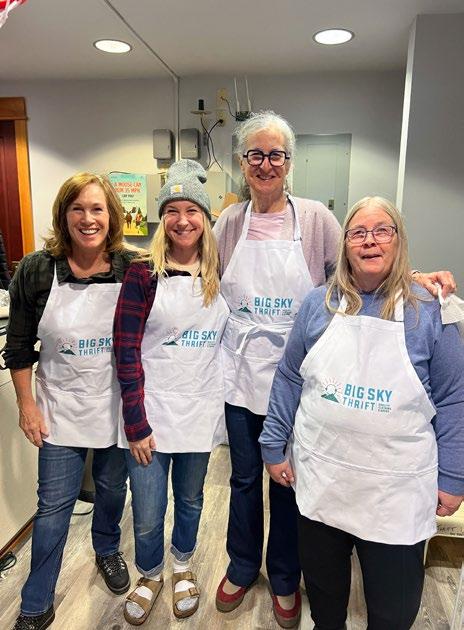
Burke (middle) and her volunteer crew. COURTESY OF EMILY BURKE
whether she’ll stay in Big Sky. She’s proud that during her three-and-a-half years opening and leading Big Sky Thrift, she helped divert thousands of items from landfills, while generating nearly $500,000 in grants for the Big Sky community and issuing emergency vouchers to people in need of blankets, clothing and other necessary items.
“We had over 160 different people volunteer, and make connections and friendships in our town... We have tangible things that we can talk about we did, but I think the reach goes far beyond anything that we can quantify,” Burke said.
Volunteers back Burke, express disappointment
EBS contacted two volunteers from the store to hear their perspectives on the change. Sherri Fast recalled learning of the store’s restructuring. She was notified in an email, which explained to volunteers the current store model posed legal liabilities in accordance with federal labor standards.
In email correspondence with Explore Big Sky, YCCF representatives declined to comment on how labor laws factored into the decision.
Suddenly, Fast felt underappreciated as a volunteer. She felt the foundation’s notification email was not a “sincere acknowledgement for all the volunteers who spent hours in helping [Big Sky Thrift] become the success it is today.”
She recalled helping someone who was wet and cold after getting their work truck stuck in a ditch. Burke, Fast and other volunteers gave him a warm outfit and sent him out the door, no charge.
LOCAL
“I miss my hours of volunteering and socializing with fellow volunteers and customers, and just the sense of being a part of a team that was making a difference in the quality of life for others in our Big Sky community,” Fast wrote.
She emphasized that the store’s new staff is very nice; her problem is not with those continuing the good work.
Fellow volunteer Patti Brosseau lamented the changes, including the short notice of just a few days given to volunteers. She found it “disappointing and frustrating” and felt it could have been handled differently.
“Volunteering was a social gathering. I met and became friends with other volunteers and customers in the community. It was rewarding and I will miss our close-knit group,” Brosseau, who volunteered twice a week for a three-hour shifts, wrote in an email to EBS.
She added, “Working with Emily and her positive energy was great. She welcomed customers with a smile. Emily made the thrift store what it is today.”
Brosseau noted her concern that the new model will negatively impact the store’s grant fund. Time will tell.
“The final grant amount for 2026 will not be known until year-end sales are finalized,” YCCF representatives stated. “However, with expanded operational hours, we anticipate that 2026 will be the strongest sales year the store has experienced.”
Under new structure, the store will now be open six days a week. New community partnerships will include a new program to donate clothing to the Bozeman Health Big Sky Medical Center’s emergency room, for patients unable to leave in their original garments, and donations of clothing and books to regional shelters and libraries.
In addition to Big Sky Thrift’s retail operations, YCCF plans to expand the facility into a community resource hub. Plans for the hub will be announced later this year.
Burke (middle left) and her volunteers. COURTESY OF EMILY BURKE
LONE PEAK GIRLS GOLF WINS DIVISION FOR THIRD STRAIGHT YEAR
SENIOR-HEAVY TEAM LOOKS TO WIN SECOND STATE CHAMPIONSHIP IN THREE YEARS
BY JACK REANEY
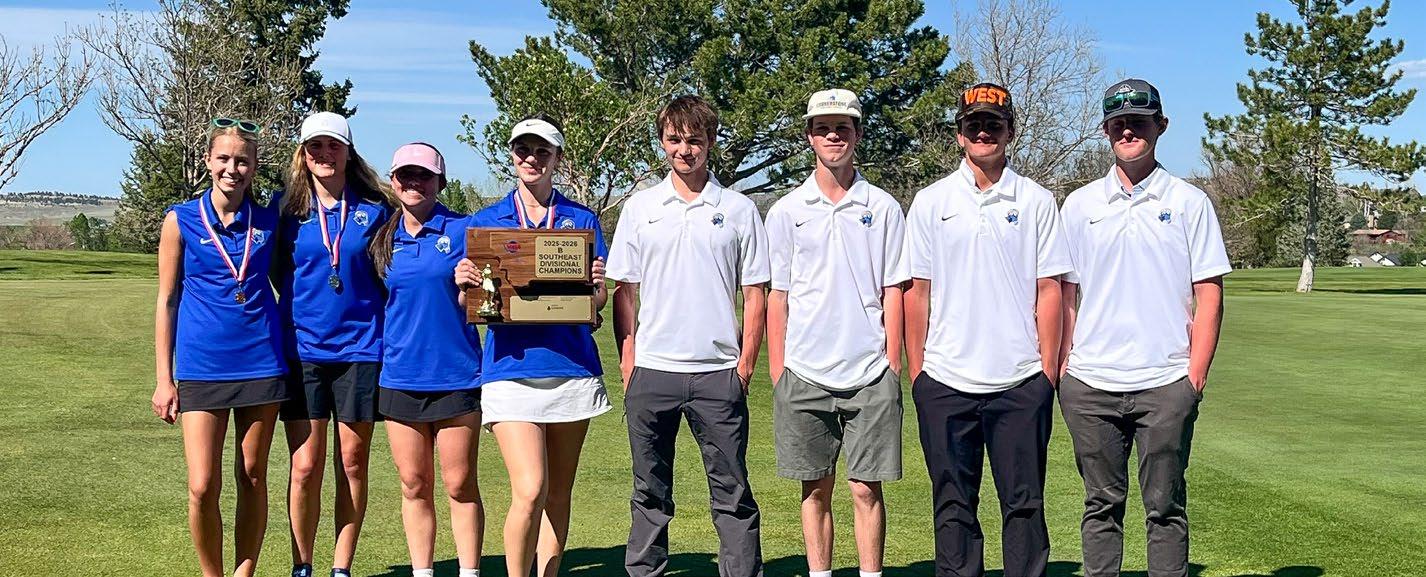
BILLINGS—The Lone Peak High School girls golf team continues to make a strong impression on the state. On Monday, May 11, the Big Horns earned their third straight Class B southern division title, with individuals finishing in first, second and third place for a cumulative 39-stroke win at Lake Hills Golf Course in Billings.
The girls combined to finish 66 over par, even without senior Maddie Wilcynski, who missed the match due to International Baccalaureate testing. Freshman Tatum Bedell stepped into Wilcynski’s spot, and finished 23rd with an individual score of 116. Seniors Cate Leydig, Dylan Manka and Olivia Kamieniarz finished in first, second and third place, shooting 75, 78 and 85, respectively, to sweep the individual podium and send the Big Horns into the state tournament with a lot of confidence and hopes of repeating their 2024 Class B title.
“We know that there’s going to be other competition from the other divisions,” head coach Jenny Wilcynski told EBS in a phone call Tuesday, reflecting on her team’s dominant performance in the divisional round. “But to have that big of a stroke difference is pretty reassuring for the girls.”
This year’s meet will be held on May 19 and 20, at the same Billings venue as the divisional tournament. Wilcynski said it’s a course that’s been friendly to her team over the years, and the squad is now closely familiar with the current conditions on the course.
Everything has lined up nicely for the experienced girls team, whose four typical scorers are all seniors with a track record of success. Coach Wilcynski credits all of their hard work over the years, and said they’ve come together in a very collaborative dynamic. Furthermore, their 2024 title proved they can handle the big stage, and Wilcynski said it’s an exciting time for the program.
“I feel like they’re all really working together and supporting each other, between their years of talent and all of their hard work,” Wilcynski said. “… You never know what next week will bring, and we just hope we can put our best foot forward and we can edge out our competition.”
While the boys team has not seen the same teamwide success over recent years, players like 2025 graduate Isaac Bedway have qualified individually for the state tournament. This year, sophomore Syd Leydig earned his spot in the tournament
by finishing tied for 19th on Monday, shooting an 88—the top 20 finishers advance from the divisional tournament.
Through the season, Leydig struggled to reach his potential at times, but enjoyed a breakout success in the high-pressure divisional round. Wilcynski credited Leydig's many additional practice hours for the rewarding result.
“I mean, he shot probably 12 to 15 strokes lower than he shot all year,” Wilcynski said. “… I think he has put in a lot of hours and is really hoping that his time has paid off.”
Syd’s sister, Cate, returned from a year training and studying at the Junior Players Golf Academy in South Carolina. In her absence, the Lone Peak girls finished in third place at the 2025 state tournament. Cate returned for her senior year and seems to be enjoying the return to her Big Sky teammates.
“We were so excited for her to come back, and be a part of the whole team again,” coach Wilcynski said. “And for her, it probably feels good to be a part of the team she grew up with.”
After next week’s tournament, the successful group of seniors will hang up their Lone Peak jerseys for the last time, and Wilcynski will shift her focus to continuing the program’s exceptional success. She highlighted young players in Penelope Brooke, Sabine Hurlbut and Ella Smith, noting they can “absolutely make things happen” when it’s their turn to lead the varsity squad.
“I would hope that more players come to the table and look at the success, and want to be a part of it,” Wilcynski added.
Supporters can follow along for next Tuesday and Wednesday’s tournament on the Golf Genius app and through the Montana High School Association’s website.
COURTESY OF JENNY WILCYNSKI
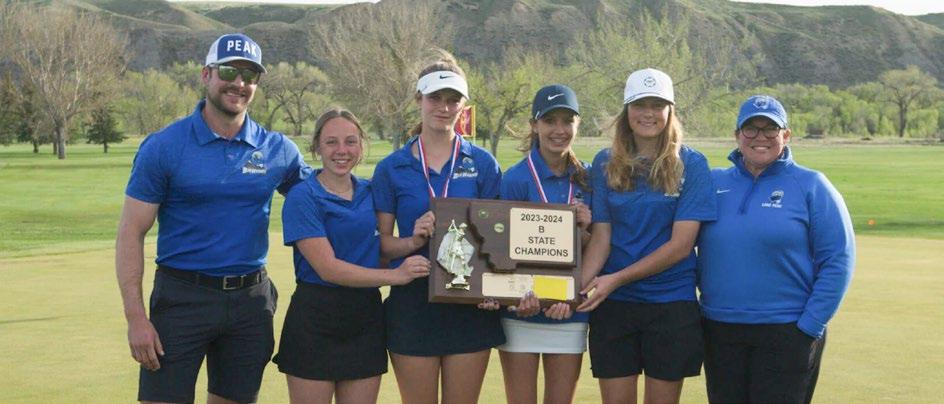
Ahtletic Director and coach John Hannahs (left) and head coach Jenny Wilcynski (right) celebrate a 2024 state championship with the team. PHOTO BY BRIAR NAPIER / 406 MT SPORTS
Scan the QR code to visit the website and learn more!
OP NEWS
BIG SKY’S WILDLANDS EXPANDS 2026 LINEUP WITH NEW ARTISTS AND FREE FAMILY MUSIC EXPERIENCE
OUTLAW PARTNERS
Big Sky’s premier summer music and conservation event just got even bigger.
Wildlands and Outlaw Partners are excited to announce the addition of acclaimed singer songwriter Jamie McLean and regional favorites Fader MaGavin and the Risky Livers to the 2026 Wildlands weekend lineup at the Big Sky Events Arena on July 31 and Aug. 1, alongside the debut of the new Wildlands Family Jam, a free Saturday morning concert experience designed to bring families into the heart of the weekend.
Known for blending world class live music, mountain culture and conservation impact, Wildlands continues to evolve into one of the most distinctive destination music events in the American West.
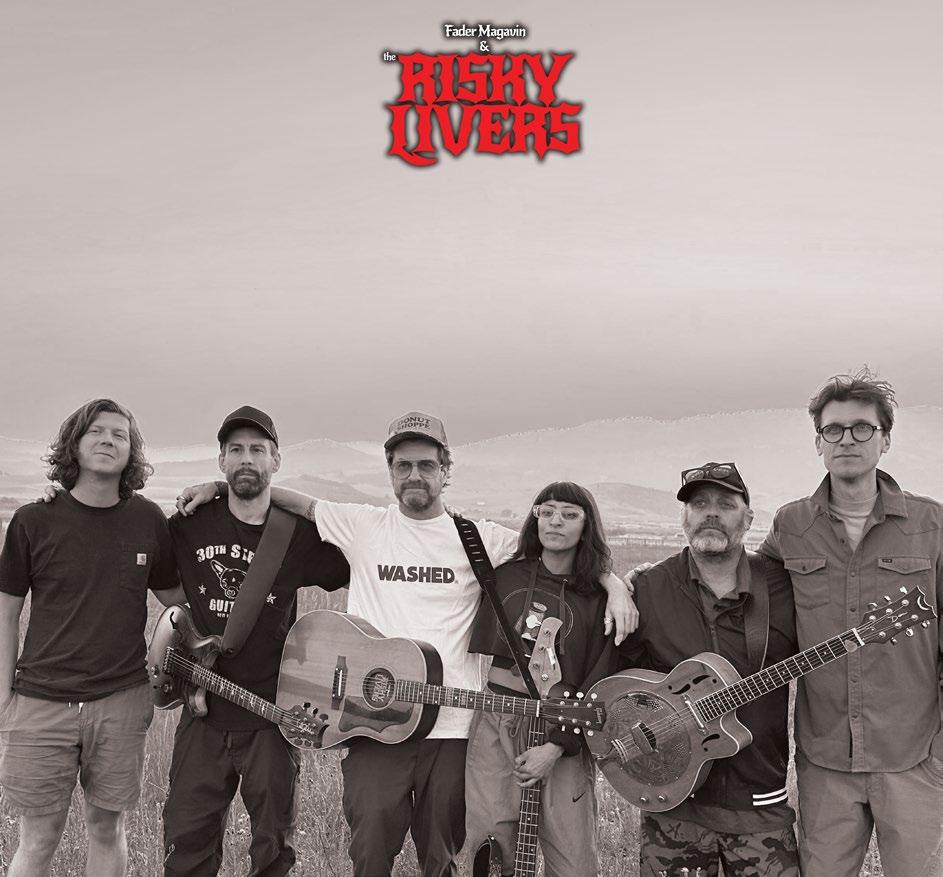
A longtime favorite in Big Sky, Jamie McLean will open Saturday evening performances with his electrifying mix of Americana, soul, rock and roots music. Joining the expanded lineup is Teton Valley and Jackson Hole staple Fader MaGavin and the Risky Livers, a gritty alt country and roots rock outfit celebrated for raw storytelling, outlaw energy and rough edged Americana spirit.
“I’m really excited to return to Big Sky this summer to join Carrie Underwood, LeAnn Rimes, Riley Green and be a part of Wildlands,” said Jamie McLean. “Big Sky is always a tour highlight for me and it has become a home away from home. Fans have become friends and family and I am truly honored to be embraced by the local community. Wildlands is an absolutely top shelf event and I can’t wait to come get down!”
The additions deepen Wildlands’ connection to the culture and sound of the Rocky Mountain West while amplifying an intimate mountain town atmosphere.
For the first time, Wildlands will also host the Wildlands Family Jam, a free Saturday morning family event from 10 a.m. to noon inside the Big Sky Events Arena. Designed to make kids feel like
they are stepping into a real concert experience, the event will feature a pancake breakfast, interactive family activities, face painting, music themed entertainment and a live performance from Papa Strings with special guest Jamie McLean.
The free event is open to families from Big Sky, Bozeman and across Gallatin Valley.
“This expansion reflects the evolution of Wildlands into more than just an evening concert series,” said Josh Timon, COO of Outlaw Partners. “We’re creating a full community experience rooted in music, conservation and Montana lifestyle, one that
welcomes longtime locals, visitors and families into something truly special.”
Now entering its sixth year, Wildlands has quickly established itself as one of the country’s most unique outdoor music experiences, pairing major national artists with an intimate venue surrounded by the mountains of Big Sky, all while raising funds and awareness for conservation efforts across the Greater Yellowstone Ecosystem.
Saturday night, Aug. 1, will feature global country superstar Carrie Underwood alongside rising country standout Kaitlin Butts. Friday, July 31, brings performances from multi-PLATINUM, ACM and CMA Award-winning singer-songwriter Riley Green and Grammy-winning singersongwriter LeAnn Rimes.
Event organizers say the new family programming reflects the rapid growth of young families across Big Sky and Gallatin Valley and the desire to create more shared cultural experiences around live music, community and the outdoors.
With major headline performances, conservation driven purpose and now a fully immersive family component, Wildlands 2026 is shaping up to be the biggest and most dynamic year yet.
For tickets, event updates and upcoming announcements, visit wildlandsmusic.com
Acclaimed singer songwriter Jamie McLean will join this summer’s Wildlands lineup on Saturday evening. PHOTO COURTESY OF JAMIE MCLEAN
Jackson-based rock band Fader MaGavin and the Risky Livers will open Friday’s Wildlands show. PHOTO COURTESY OF FADER MAGAVIN AND THE RISKY LIVERS
BOZEMAN
AARON FLINT TALKS CONSERVATION, FINDING COMMON GROUND IN BOZEMAN ROUNDTABLE
RADIO-FAMOUS REPUBLICAN WANTS TO CONTINUE ZINKE’S KNACK FOR ‘CONSERVATION CONSENSUS’
BY JACK REANEY
Editor’s note: This story describes a private meeting organized by Outlaw Partners, the publisher of Explore Big Sky. Outlaw Partners plans to conduct similar meetings with other candidates representing all political parties.
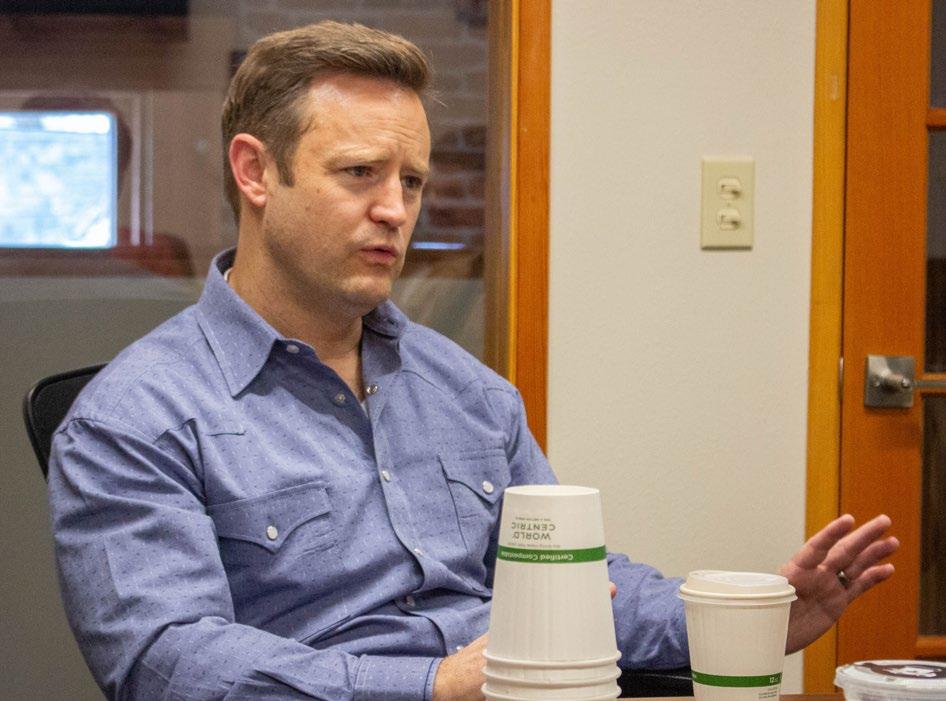
One of Montana’s candidates for U.S. Congress, Aaron Flint, believes he brings something unique to the table, forged by a long career as a talk radio host: his ability to listen, particularly to opposing views, and demonstrate respect.
Flint is running for Montana’s western congressional district as a republican, and aims to replace incumbent Rep. Ryan Zinke, who announced in early March that he will not seek re-election. Flint is endorsed by President Donald Trump, as well as Zinke and current Sen. Tim Sheehy. Montana’s primary election runs from May 4 to June 2, pitting Flint against Christi Jacobsen, Al Olszewski and Ray Curtis.
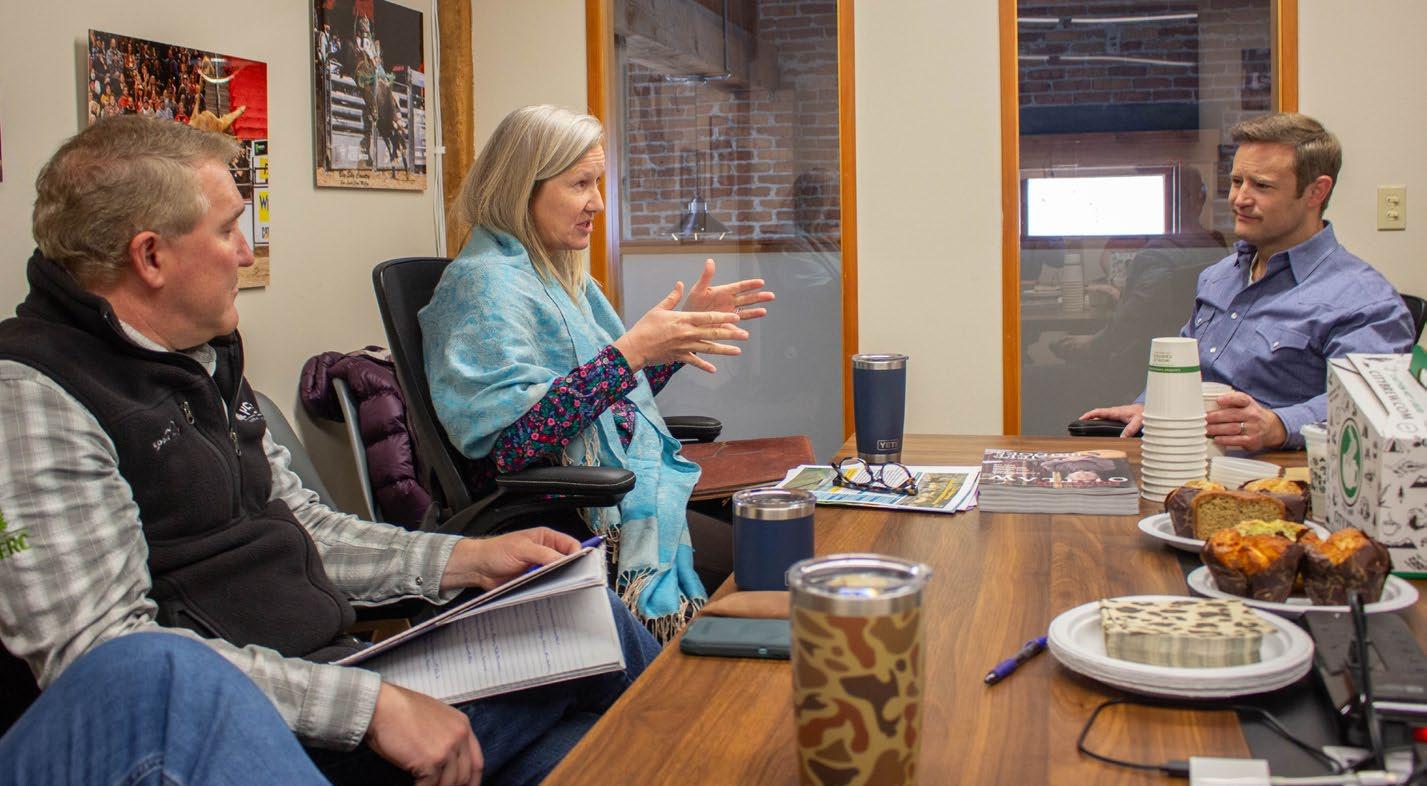
On April 30, Flint sat down with regional leaders of three conservation groups for a casual conversation in Bozeman. Hosted by Outlaw Partners CEO and Chairman Eric Ladd, the discussion featured American Rivers, Center for Large Landscape Conservation and the Property and Environment Research Center.
“I tried to get you a nice, diverse group today to give you some of the things that I think are really representative of what’s on the voters’ minds in this region,” Ladd said, opening the conversation in a small Bozeman conference room.
To begin, CLLLC Chief Strategy Officer Deb Davidson cited Montana’s two worst roads for vehicle-wildlife conflict—U.S. Highway 191 between Gallatin Gateway and West Yellowstone along the Gallatin Canyon, and U.S. Highway 89 from Livingston to Gardiner along the Paradise Valley—to underscore the importance of legislative support for wildlife crossings in Montana communities.
“Our rate for wildlife-vehicle collisions on 191 is 24% of accidents. The national average is only 5%. Montana’s statewide average is 10%,” Davidson said. “So for the animals that live in this region, particularly the elk... it’s a real problem. It’s also a huge human safety issue.”
Flint said that under Rep. Zinke’s leadership, preserving wildlife corridors through highway crossings has been “a big priority.” Hearing that CLLC and Montana Department of Transportation will plan to apply for the final round of the federal Wildlife Crossings Pilot Program, Flint said he'd like to emulate Zinke’s approach to public lands.
“It’s been so divisive and there’s been so many
fights, especially in the Rocky Mountain West on these issues, but I really feel like Zinke’s done an incredible job creating this conservation consensus. And finding things that we all agree on, and working with people,” Flint said.
Davidson agreed. “Thank you for your continued support,” she said. “I mean, Zinke has been amazing around this.”
If elected, Flint plans to take on most of Zinke’s staff. He added, “That’s going to be the beauty of having his team in place, is we hit the ground running with this.”
Brian Yablonski, CEO of PERC, asked how conservationists can generate revenue without having to rely on Congress—he called attention to PERC’s backing of an increased entrance fee at national parks for foreign visitors, for example.
“I think conservation at its core is about caring about the thing you own,” Yablonski said. “And I think for 100 years we’ve been acquiring land that we can’t manage, and we’ve been talking about disposing of land we should manage... We can all agree, we should better manage what have.”
He suggested Montana’s delegation make a commitment to reauthorizing the 2020 Great American Outdoors Act. “I will say, if you’re a champion for public lands, that’s going to go far in the district,” Yablonski said.
Scott Bosse, Northern Rockies director for American Rivers, asked about Flint’s metrics to
decide whether he’d support legislation protecting rivers and public lands.
“Rivers bring people together. It’s a totally nonpartisan issue,” Bosse said, pointing out a recent study showing dramatic support from both republicans and democrats for Rep. Zinke’s Greater Yellowstone Recreation Enhancement and Tourism Act. “... Rivers also support the two biggest sectors of our economy, which are agriculture and outdoor recreation. I mean, clean water coming from our headwaters sustains both those industries. So, super important economic issue as well.”
Flint re-emphasized the importance of finding “conservation consensus,” as he believes Zinke successfully accomplished.
“I think a lot of the metrics Zinke has been using are the same ones that I’d be looking to use as well,” Flint said, adding that he has not heard of any significant opposition to bills like the GYREAT Act.
Flint was also asked about data center construction and extractive industries—particularly in light of Zinke’s support for legislation impacting Minnesota’s Boundary Waters.
Flint responded that data centers need to be stopped if they’re going to jack up electricity rates, consume water or disturb Montanans’ way of life. However, he said it’s important for the U.S. to maintain its technological position, calling quantum computing “the next space race” and cautioning against rivals like China and Russia advancing to
Aaron Flint, best known as the radio host of "Montana Talks," met with conservation leaders at the Bozeman office of Outlaw Partners. PHOTO BY JACK REANEY
the point of controlling U.S. data and national security.
“We need them. Doesn’t mean we need them in Montana,” Flint said.
On mining, Flint said “slow is smooth, smooth is fast,” and that decisions must be taken very carefully. “There’s places where it’s right to say, ‘whoa.’”
‘We all agree more than we disagree’
Perhaps from his years on the radio, Flint's smooth, casual style of talking feels comfortable and unguarded. Meeting most everyone in the room for the first time, he felt like an acquaintance.
EJ Daws, managing broker for Outlaw Realty, shifted the discussion away from policy-specific inquiry, asking Flint about his approach to modern, polarized government. Daws asked if there’s any issues that might compel Flint to break party lines.
Flint reminisced on his military background, where he served in the U.S. Army National Guard and Reserves for 20 years. He said members of U.S. armed forces learn the importance of working together regardless of each others’ background, and that he’d stand up for public lands and veterans’ issues.
Later on, Flint discussed whether Montana is politically purple, as it was long believed to be.
“I do think there is a lot of Montana that is still purple,” he said. “When I look at this race in particular, I think the folks that are running on the other side of the aisle are not our old-school democrats... These are very, very far left folks... [they] are so controlled by, kind of, this extremist stance and far-left position that they don’t even appeal to the purple anymore.”
By contrast, Flint believes Montana’s republican delegation does appeal to Montanans closer to the middle.
“And no one on these campaigns is speaking to that group,” Ladd said. “... Nobody’s speaking to everybody in between... It’s unfortunate.”
To bring Montanans and Americans together—
regular folks, not policymakers—Flint said he’d start by listening, which he did four hours a day for the last eight years, as callers from across the state joined his “Montana Talks” radio show.
“I think the greatest advantage I have in this race is the fact that I wasn’t just talking to people, you know, for all these years on the radio. I was actually listening to people,” Flint said.
He said he enjoys listening to callers’ opposing views on his radio show, sometimes letting callers rant until they finally land on a point where they agree.
“When we all get around the table at Willie’s Distillery, or wherever else, we all agree more than we disagree,” Flint said. In Congress, he envisions a hunger for cooperation across the aisle.
Yablonski chimed in with his perspective that modern-day conservation CEOs are increasingly geared toward cooperation, instead of hard-line activism.
“We can all yell at each other, but there are ways we can really move the needle,” Yablonski said. “It would be nice if that was replicated in other [places].”
Explore Big Sky asked if Flint would bring this common-ground approach to a televised debate, in contrast to the heated 2024 debate between thenincumbent Sen. Jon Tester and challenger Tim Sheehy, for example.
He believes he stuck to his principles in an April 21 debate in Bozeman, beside candidate Al Olszewski—Christi Jacobsen and Ray Curtis did not attend.
“It was cordial, it was civil. And frankly, I think it’s more effective when you’re that way,” Flint said. “... You can be cordial and civil and still ask the muchneeded questions.”
Flint joked that he’s able to keep his cool because whether he’s elected is not a crucial, make-or-break moment in his life, as it may be for some politicians. Instead, he’s running because he thinks he can make a positive difference for the country and western Montana.
“At the end of the day, if my campaign goes in the other direction, I’ve got my pontoon boat waiting for me,” the Kalispell resident said. “So, you don’t have to be grumpy and grouchy about the stinkin’ thing.”
Regarding common viewpoints, Ladd mentioned the national issue of mass-violence acts among citizens. He asked Flint how he’d take a stand against an epidemic of tragedy.
Flint proposed a beefed-up system of defense and covert security among gathering spaces, especially schools. Ladd challenged that his answer missed the point. “What about violence ... We need people, especially those who served our country, to stand up and say, ‘Violence is bad,’” Ladd said.
The question put Flint at a rare loss for words. He touched on the root cause: waves of hatrid infecting American society.
“This could be another topic altogether,” Flint said. “The reason why I think there’s so much division, is because I think there are groups who want to change this country into something else. And how do you do that? You create division at every turn, every single step of the way. And you tear down institutions... I think there are groups—foreign influenced groups, as well—that are trying to divide Americans along every single line: racial lines, ethnic lines, gender lines, you name it.”
Across more than 90 minutes, the popular Trumpendorsed candidate made clear his understanding that division can be toxic, and respectful dialogue a cure.
As the small roundtable came to a close, Daws described his roots as a fourth-generation Montanan. He made an appeal to Flint.
“If you are elected... Just don’t forget the things that make Montana great,” Daws said, pointing out the Treasure State’s unique lifestyle, and its politics that feel reasonable and neighborly. “Because it’s not name-calling and divisive politics. It’s not fringe ideas and theory. You know, for me that would be proud representation.”
Left to right: Brian Yablonski, Deb Davidson, Aaron Flint. PHOTO BY JACK REANEY
‘THIS MAGICAL PLACE’: PRESIDENT BROCK TESSMAN REFLECTS ON FIRST YEAR AND FUTURE GOALS
BY ELLERY WAKEFIELD MSU EXPONENT
Back in August, one of the first events that Brock Tessman attended as University president was the annual M Photo with the incoming freshman class.
“It was early in the afternoon — so the sun hadn’t quite baked everybody — but we’re bringing everyone together like that and seeing new friendships being made,” Tessman said, recalling how the students radiated with contagious enthusiasm.
“I was also embarking on a new adventure,” he said. “It was my first big event with students. And then walking around that M and talking to all these different students and feeling all this excitement about the beginning of their college journey — I’ll never forget that.”
After a year of exploring campus and immersing himself in the MSU community, Tessman sat down with the Exponent to reflect on his accomplishments and outline his goals for next year.
Tessman became the 13th president of MSU in August of 2025. He said that since taking office, he has worked diligently to fill the shoes of his predecessor, Waded Cruzado.
“It’s been really rewarding for me to both come to a place where I can respect even more all the achievements that President Cruzado helped lead on this campus,” Tessman said.
Coming into the role, Tessman knew that he needed to build on the success that MSU was already experiencing.
“We have so much positive momentum that’s been building on this campus for a decade plus,” he said. “And part of my job is to make sure that we don’t bring that to a screeching halt just because you got a new president.”
One initiative Tessman has pushed is the creation of a new Strategic Plan. According to him, it will focus on creating immediate improvements.
“It’s not an aspiration of what we’d like to be 20 years down the road. What can we do now to support students, to support faculty, to support the communities that we serve across Montana?” he said.
According to Tessman, the process of drafting the new Strategic Plan has been collaborative. There have been over 40 listening groups, over 50 focus groups and around 1,300 responses to surveys this semester.
“For a new leader, the process of engaging all stakeholders, hearing what’s most important, hearing about the things that may be holding an academic department or a staff unit or holding students back — that is a great way to accomplish goal number one for this year, which is learning about the institution and figuring out what our next direction should be,” he said.
Tessman said that while the projects in the plan are not yet finalized, he is committed to maintaining MSU’s land-grant mission. According to the MSU website, this mission is to transform lives and
communities through education, research and outreach.
“It’s going to be about this transformational, high-quality, open-access educational experience for students. It’s going to connect back to research that makes a difference for Montana and the country and the world. It’s going to connect back to statewide outreach, engaging all the communities we serve across Montana,” Tessman said.
According to him, MSU’s land-grant status is something to be proud of and is a part of what makes the University so special.
“I think everything flows from our land-grant roots and our land-grant commitment, including our R1 status,” he said. R1 status is granted by the Carnegie Classification of Institutions of Higher Education and signifies very high research spending and doctorate production, according to Carnegie’s website.
Tessman said the land-grant mission is even reflected in the MSU football team’s recent national championship win.
“About half of our top-tier players are from the state of Montana, all around the state,” he said. “That’s very rare for a national championship-level team, especially in a state that has a pretty small population like Montana. That in itself is driven by the land-grant commitment to connect to communities — whether it’s Melstone, whether it’s Bozeman, whatever the community is.”
Part of Tessman’s goal is for MSU to remain a place where students from all over the world — not just Montana — can come to receive high-quality, accessible education.
“If we treat each one of those students as a student who has immense potential who can contribute in ways that we may be able to predict, but also in ways that we have no sense of yet, then the retention rate, the graduation rate, the career placement [will] take care of itself,” he said.
Tessman said his day-to-day role requires extensive crisis management and high-level problem-solving.
“If someone was asking about what quality is important to be a good president, one of the things I would put on the list is being able to exercise solid judgment under time constraints,” he said.
He said the other important aspect of his job is listening, studying and learning about MSU’s campus, students and faculty.
“I thought I would miss my professor life more than I do,” he said. “I still miss it quite a bit, in particular because I don’t get as much time with students as I used to. But the part I thought I’d miss is, ‘Oh my gosh, you’re not going to be able to learn and be doing research and all the other ways.’ Actually, I think I learn more and do more research now in this job than I did even in my own role as a faculty member.”
Tessman said that one way he learns about and feels connected to the MSU community is by talking to individuals, both on and off campus.
“That part, really being an advocate for this
University, off campus in particular, is really exciting,” he said. “And I’m so proud of this place. Even in 10 months, I’ve just developed a really intense sense of Bobcat pride. And so I find it very exciting to be able to talk about that with as many people as possible, as often as possible.”
Tessman said he appreciates student involvement in clubs and organizations.
“You have two very different people from different backgrounds, different majors, different personalities, but oh my gosh, they love medieval roleplay,” he said, pointing to a window where students below were jousting. “It’s all of these passions that intersect in unexpected ways. I think that that’s a big part of the college experience.”
He said he is also proud of students establishing advocacy-focused clubs and using their voices in protests.
“We have a very healthy, diverse set of perspectives on this campus and I love that,” he said. “And it’s a sign of what’s right on our campus — not something that needs to be sort of hidden away or squashed.”
Tessman said that he is constantly learning and adapting to his role, and will continue to do so throughout his presidency.
“I did not drive over Bozeman Pass, pull up into my parking spot and unfurl my scroll of next step strategies for MSU. I didn’t know what they are. I still don’t know what they are, which is not a weakness. I don’t feel like that is something to be embarrassed by.
“I think that leaning into the institution and all the good things happening here, bringing my own vision to the table when appropriate — has been my primary method of trying to say, ‘Look, we’re going to be not just good, but we’re going to be even better than we have been, and let’s figure out the right way to make that happen.’”
Tessman said that, moving forward, he hopes he can continue to create a positive culture on campus that highlights the individuality of all students and faculty.
“We are whole human beings who happen to come together in this magical place we call Montana State University,” he said.
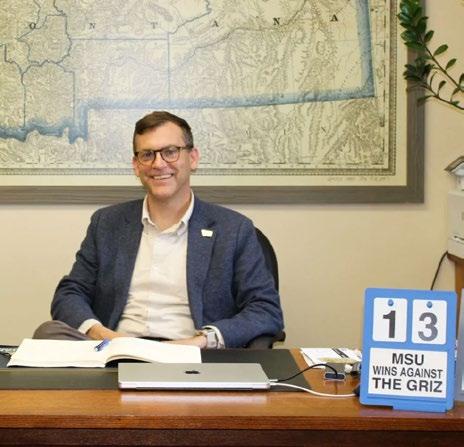
President Brock Tessman behind his desk in his office inside Montana Hall on April 21. PHOTO BY KELLY HAMMERAN
ENVIRONMENT
NEW SIGNS ALONG U.S. 191 WARN DRIVERS OF ELK CROSSINGS
SIGNS POSTED IN SENSITIVE AREA NEAR MOUTH OF GALLATIN CANYON
BY CARLI JOHNSON
GALLATIN GATEWAY—Drivers heading between Big Sky and the Gallatin Valley this past weekend may have noticed two new signs warning of popular elk crossing areas. On Thursday, April 30, the Montana Department of Transportation installed two solar-powered, illuminated signs along a stretch of U.S. Highway 191 in Gallatin Gateway, between Bozeman and Big Sky.
The Center for Large Landscape Conservation worked in collaboration with MDT and
community members, including activist and wildlife photographer Holly Pippel, for several months to plan and execute the project. Donations from K.C. and Karen Walsh covered the cost of the signs, while MDT handled installation.
"It's been a long time coming," said Josh Williams, MDT's supervisor for Gallatin Gateway and Big Sky. "It's not going to completely prevent accidents, but at least there is something to get drivers paying attention."
Pippel has been working to raise awareness along the corridor for years after encountering elk and deer carcasses while photographing herds.
"It started about three years ago when I started photographing and documenting the problem—for the elk," she said. "I started pushing MDT for message boards during periods of high elk activity."
In response, MDT installed variable message boards in recent years to flash messages warning of elk in the roadway, but they have since aged out of service, leaving the corridor without adequate working signs. Pippel, CLLC and other concerned community members then worked to get billboards posted along the route.
When those billboards expired, Pippel continued to brainstorm solutions and reached out to CLLC about collaborating on more permanent signage as part of broader efforts toward a wildlife crossing.
Pippel noted that the design of the signs—an elk silhouette without any text and a flashing light—
was intentional. "The silhouette in yellow with the flashers is pretty universal to, hey, these are on the road, slow down," she said.
She added that while local commuters are already aware of elk crossings along the corridor, visitors often have no idea the animals frequent the area. "I really do think it will have the greatest impact for visitors to our region, keeping people safe and wildlife safe."
CLLC Road Ecologist Elizabeth Fairbank said the signs are placed within the area where advocates hope to one day build a wildlife crossing. Sign locations were chosen using scientific data and GPS-collar tracking of elk to pinpoint where the animals cross U.S. Highway 191.
“They're placed kind of in the start and the end of that wildlife crossing zone, and that's where the project hopefully will ultimately be implemented,” Fairbank said. “We have so many visitors around here who just don't expect there'd be elk standing in the middle of the road as they often are there.”
The CLLC noted that while the signs are not a long-term solution, the organization hopes they encourage caution along the wildlife corridor until expensive but worthwhile road crossings c an be constructed.
Community members are encouraged to reach out to CLLC to support the nonprofit’s goal of securing funding and support for the wildlife crossing infrastructure that would allow elk to move freely across their Gallatin Gateway range.
Montana Department of Transportation installs flashing signs to warn drivers of elk crossing along U.S. 191.
PHOTO BY HOLLY PIPPEL
PHOTO BY HOLLY PIPPEL
DISPATCHES FROM THE WILD: FACTCHECKING THE WOOD-WIDE WEB AND WHAT IT MEANS FOR SAVING FORESTS
BY BENJAMIN ALVA POLLEY EBS COLUMNIST
On Feb. 27, 2026 (John Steinbeck’s birthday), a friend wrote to thank me for “helping set the record straight on wolves in Yellowstone” and then added a request: could I do the same for Richard Powers’ novel, “The Overstory,” and the much-debated idea that trees help one another through a “wood wide web” of fungi? It was a reminder that, in the age of viral science narratives, people want both enchantment and accuracy. The question is whether we have to choose.
The story that has captured the public imagination is a powerful one. In bestsellers like “The Overstory” and Suzanne Simard’s “Finding the Mother Tree,” forests are portrayed as cooperative societies. Ancient “mother trees” nurture their young through underground fungal networks, sharing carbon and other nutrients, passing along biochemical warnings, perhaps even recognizing kin. It is a vision that replaces the old “nature red in tooth and claw” with a gentler picture of interdependence and reciprocity.
Scientists, however, have been pushing back. A major 2023 review in Nature Ecology & Evolution, led by Justine Karst at the University of Alberta, challenged some of the most sweeping claims. The researchers examined three pillars of the “woodwide web” story.
First, they found that the idea of vast, universal fungal networks linking entire forests rests on surprisingly thin ground. Of the world’s roughly 73,300 tree species, mycorrhizal networks have been rigorously mapped in only two. That is hardly enough to justify talk of a global arboreal internet. Montana is home to 30 native tree species, and the Greater Yellowstone Ecosystem has only about a dozen. Despite low diversity, the ecosystem is heavily forested, dominated by coniferous trees, with lodgepole pine accounting for roughly 80% of the forest canopy.
Second, while studies do show that carbon can move between trees through shared fungal partners, the amounts are often minuscule. In at least one experiment, less than 1% of a tree’s carbon budget appeared to come from neighbors—a nutritional drizzle, not a lifeline. For critics, this suggests we are mistaking a faint physiological curiosity for a robust support system.
Third, the charismatic notion of “mother trees” preferentially feeding their own offspring is, in the eyes of many researchers, more metaphor than fact. Claims that trees recognize their kin and deliberately direct resources their way slide quickly into what they call “plant personification,” the projection of human motives and emotions onto beings that do not share our nervous systems.
These scientists are not villains for discounting fascinating theories. Their concern is that beautiful stories, repeated often enough, harden into dogma. Overstated claims about cooperative forests can morph into misleading guidance for land
managers, who might favor “letting nature be” when more active, evidence-based interventions are needed to help forests survive climate change, wildfire and invasive pests. In this view, tamping down hype is not anti-conservation; it is conservation done carefully.
And yet, the critics’ case is not the whole story either.
Simard and her supporters argue that what, in the lab, appears to be “anthropomorphism” is, in practice, a communication strategy. Words like “mother,” “talking,” and “sharing” are deliberate choices meant to bridge the gap between technical ecology and human feeling. You could say that trees exchange carbon through differential concentration gradients along mycorrhizal hyphae; or you could say that, in a dark soil world, trees are whispering. Only one of these phrases is likely to persuade a child or a voter that forests matter.
There is also the question of who is allowed to tell big, intuitive stories about nature.
Simard has described the backlash to her work as, at times, intensely personal, complete with letters imploring her university to rein her in. She has suggested that academic rivalry, sexism, and even corporate logging interests play a role in the ferocity of the response.
Let’s not forget that many scientific studies are funded by industry, which can influence the study in a certain way. Her work doesn’t just tweak a few hypotheses; it challenges an industry model built on clearcuts and monocultures by suggesting that relationships and diversity within forests have value that can’t be reduced to board-feet.
And while the scale and intent of underground sharing remain contested, few scientists deny that mycorrhizal connections exist or that nutrients do, in fact, move through them. The question is not whether forests are interconnected, but how much, how often, and in ways that matter for survival and reproduction. That is an open, evolving field of inquiry, and our tools and frameworks may still be catching up to the messy, subtle reality of life belowground.
It is also worth noting that Simard’s work resonates strongly with many Indigenous knowledge systems, which have long described forests as communities of relational beings rather than inert backdrops for human use. Western science is only beginning to grapple with the possibility that multiple ways of knowing: empirical, experiential and cultural approaches might all have something to contribute to how we care for the living world.
So where does that leave the curious reader, caught between a lyrical novel, a charismatic scientist, and a stern academic review? One option is to retreat to cynicism: if the “wood-wide web” is partly myth, we might be tempted to discard it entirely. Another is to surrender uncritically to the story we prefer, treating trees as stand-ins for our best selves and ignoring inconvenient data.
There is a third path. We can insist on rigorous science, on careful statistics, replication and sober language in the literature while also allowing a bit of magic and mystery into how we talk about the world in public. It is possible to say, “We don’t yet know how extensive these networks are,” and still feel awe at the fact that a fungus can knit together the roots of different species at all. It is possible to admit that “mother tree” is a metaphor and still let it change how we walk through a forest.
At a time of accelerating climate change and biodiversity loss, a slight bias toward empathy is not a bug; it may be a survival feature. If a more relational story about trees nudges us away from clearcuts and toward conservation, from treating forests as warehouses to seeing them as communities, that is not the worst kind of error to make.
We should keep asking hard questions about what is real beneath the forest floor. But in the meantime, as we wait for better maps of the underground, it might be wise to act as though the web is there, not because the myth is perfect, but because the cost of caring too much about forests is vanishingly small compared with the cost of not caring enough.
Benjamin Alva Polley is a place-based storyteller. His words have been published in Rolling Stone, Esquire, Field & Stream, The Guardian, Men’s Journal, Outside, Popular Science, Sierra, and WWF, among other notable outlets, and are available on his website.
ADOBE STOCK PHOTO
CREATIVE EXPRESSION TAKES CENTER STAGE AT LONE PEAK HIGH SCHOOL ART SHOW AND A CAPPELLA PERFORMANCE
BY LESLIE KILGORE
BIG SKY—Students, families and community members recently gathered at Lone Peak High School and the Warren Miller Performing Arts Center for an evening celebrating student creativity, as the school’s annual art show and a cappella performance highlighted the growing strength of the arts in Big Sky schools.
Led by art teacher Kate Riley, this year’s showcase combined visual art, Theory of Knowledge projects, and a musical performance into one collaborative event designed to spotlight student expression.
“This year’s event was really inspired by the idea of celebrating student creativity across disciplines,” Riley said. “We wanted to create an experience that highlighted not only the incredible visual artwork our students have been developing throughout the year, but also the energy and vulnerability that come with live performance and sharing ideas through Theory of Knowledge projects.”
Artwork filled the WMPAC gallery with a wide range of mediums and concepts, reflecting both technical growth and personal storytelling from students across grade levels. Riley said bringing the art show together with a live performance created a special atmosphere where students could share different forms of expression in a collaborative evening.
She explained that events like the art show allow students from different disciplines to support one another while sharing their work with the broader community.
“I hope attendees left the evening with a deeper appreciation for the time and emotional investment students place into their work,” Riley said.
For Riley, the event also reflected the distinct creative culture that has developed at Lone Peak High School.
“Lone
because our students are incredibly driven, not only as scholars and athletes, but also as artists and performers who are willing to take creative risks,” Riley said. “Especially for a small school, students here consistently push themselves through visual art, music, theater, design and so many other creative outlets.”
Katie O’Connor, a tenth grader at Lone Peak High School, shared her experiences with the school’s art curriculum in an email to EBS.
“Participating in the arts has overall changed my worldview. As a person who participates in and respects theater, music and art of different media, I have been trained to notice smaller details in the world around us,” O’Connor said. “This can be a natural small feature that is a part of a bigger landscape, or it can also be picking up and noticing people's emotions at a direct view.”
Riley added, “Art allows students to communicate experiences and perspectives that sometimes cannot be expressed in other ways,” she said. “I also hoped the show would remind people how important creativity is in education and in building strong community connections.”
According to Riley, the arts program at Lone Peak has continued to evolve in recent years as students become more confident in their artistic voices and increasingly willing to experiment creatively.
“This year, we had more students than ever before choose to submit their work to the art show, which was incredibly exciting to see,” Riley said. “We’ve also worked hard to bring in more contemporary and diverse artistic perspectives, helping students see art as something relevant, living and connected to the world around them.”
The evening also featured a performance by the school’s a cappella group, led by music teachers John Zirkle and Tim Sullivan. The student singers rehearse before school four days a week, selecting their own songs and arrangements while preparing throughout the year for performances.
Students involved in the group shared that singing together has strengthened their connection through listening, collaboration and harmony, helping them support one another both musically and personally.
According to the group, starting each morning focused on listening and working together creates a positive environment that carries into the rest of the school day.
“Sharing artwork with the Big Sky community is important to any student,” O’Connor said. “It allows us to showcase our personalities, as well as our artistic style and creative minds. Seeing people appreciate the arts, including mine, is somewhat refreshing, as an alternative to staring at a screen.”
The combined showcase served as both a celebration of student achievement and a reminder of the important role the arts continue to play within the Big Sky community.
“That willingness to take creative risks and support one another is what makes this community so special,” Riley said. “It’s incredibly rewarding to watch students discover new ways to express themselves through the arts.”
Peak has a very unique creative culture
LPHS students display their artistic talents at WMPAC during the LPHS art show. PHOTO COURTESY OF KATE RILEY
Left to right: LPHS teachers John Zirkle, Kate Riley and Tim Sullivan. PHOTO COURTESY OF KATE RILEY
The school’s a cappella group takes the stage. PHOTO COURTESY OF KATE RILEY
COMMUNITY EVENTS CALENDAR
BIG SKY RENAISSANCE FAIRE
SATURDAY THROUGH MONDAY, MAY 23-25
ASPEN LEAF DRIVE AND HUNTLEY DRIVE, 10 A.M.
From May 23-25, the Magpie Foundation will hold the Big Sky Renaissance Festival near Town Center and the Big Sky Events Arena, at Aspen Leaf Drive and Huntley Drive. There will be a medieval marketplace, live performances, activities of all kinds and local food and drinks. Admission wristbands are available at the fair entrance for $20 for adults and $10 for children aged 11-17. Active duty military service members, veterans, seniors over 65 and children under 10 get free admission.
Do You or Someone You Know Need Help Getting Sober?
Can’t stop drinking? We get it. Contact Alcoholics Anonymous today! Call 1-833-800-8553 to talk to an AA member or go to a meeting in-person or online. For a full list of meetings visit the website, aa-montana.org, or download the MEETING GUIDE® APP IF YOU HAVE A PROBLEM WITH ALCOHOL, CONTACT
MSU’s 50th Annual Powwow: A Guide with the American Indian Council
“Love the variety of this podcast. It covers everything from bear attacks to musicians to skiers to whiskey.”
PHOTO COURTESY OF MAGPIE FOUNDATION
Empowerin g abilities of Montanans of all a ges an d
families sin ce 1977.
No Cost Early Intervention Services tailored to your child and family. Proudly serving Children across Southwest Montana for nearly 50 years. Scan to Request your FREE developmental assessment. We cover pediatric therapies and supportive equipment costs for eligible children.
Scan to learn how you can invest in the future of Montana’s children.
A LA CARTE: THE BIG SALAD A&E
BY RACHEL HERGETT EBS COLUMNIST
Lettuce begin with a pun.
Terrible, I know, but I’ve got lettuce on the brain. I’ve gone down a rabbit hole in search of meaning, contemplating salad as a concept and the place of lettuce within it. This all started in a hospital recovery room in April, when the conversation naturally turned to health. My aunt inquired if I was eating well and my mom, still slightly groggy post knee replacement, stated simply, “you eat a lot of salads.”
She would know. Not too long prior, my mom kindly stocked her fridge before going on a presurgery vacation. They have a freezer full of game meat, so my grocery list was mainly salad kits and vegetables. I do eat a lot of salads. I have made it a near-daily practice to eat what I call a “big salad” for a meal, but these salads aren’t always what you might expect.
If someone says they had a salad for lunch, my brain automatically assumes it was some sort of lettuce-based salad, possibly with a slight expansion into other leafy greens. We’re talking a wedge, a Cobb, a Caesar, et cetera. Part of me still struggles to release the idea that a salad begins with lettuce. However, these are not the only salads in our lexicon. Far from it. There are fruit salads, bread salads, tuna salads, potato salads and—shout out to @thatmidwesternmom on Instagram for her continual deep dive into “Minnesota salads that aren’t really salads”—a whole host of Jell-o salads.
The word “salad” comes from Latin for “salted,” and was shortened from “herba salata,” or “salted vegetables,” a dish that was popular in Ancient Rome and featured greens dressed in a salt and vinegar brine. The idea of “dressing” ingredients remains true of all the aforementioned salads, even if the dressing is made from Cool Whip and Jell-o packets. Those examples also show us that traditional salad greens are no longer required. In Webster’s dictionary, a synonym for “salad” is “hodgepodge.” A salad can now be anything. “Salad is, literally and figuratively, what you make it,” Tanya Sichynsky wrote in the New York Times’ “The Veggie” newsletter in 2024.
Enter the big salad. This isn’t a single recipe; it’s a construct. My daily big salad is always changing. It’s based on mood, on taste, on what’s in the fridge and on what ingredients best fuel my body. Sorry, Minnesotans. That surely leaves out most mayonnaise and Jell-o based salads. A big salad is easy to construct, requiring little time or effort, and uses ingredients on hand.
Sometimes, I do start a big salad with a bagged, greens-based salad from the grocery store. These are seemingly complete with included dressings and toppings, and they fulfill the size requirement. But it is the stuff and not the lettuce that makes a big salad.
Those of us of a certain age may recall the term from the “Seinfeld” episode “The Big Salad,” where George buys Elaine a “big salad” to go and doesn’t get credit. Later in the season when a waitress questions her order, Elaine says, “It’s a salad, only bigger, with lots of stuff in it.”
This week, I used a Taylor Farms southwest salad as a base. It already has a cabbage, lettuce and cilantro
mix and a cilantro dressing topped with tortilla strips and roasted pepitas. Not enough. I added cotija cheese, olives, cucumbers, tomatoes and leftover carne asada. That’s a big salad.
After a Costco run, I like to use a base of seaweed salad and Romaine hearts, incorporating things like shiitake mushrooms, bamboo shoots, water chestnuts, cucumbers, green onions, sesame seeds, almonds, mandarin oranges and, of course, rotisserie chicken into the big salad with some sort of sesame dressing.
My mom, now recovering from home, told me she thinks of the big salad as a veggie heavy Buddha bowl. It is a good way to use leftovers and douse things in her favorite dressings, like the ginger dressing from Wasabi in Bozeman that she buys by the tub.
Many of my best big salad concoctions have been all about variety, about layering flavors and textures with ingredients like nuts and seeds, whole grains, fresh or dried fruits, cooked and/or raw vegetables, meats and other proteins.
Other big salads are minimalist. Friends and family spent time on Crete last summer, and returned with Greek salad seasoning, touting the simplicity of the salads on the island. The most basic is in heavy rotation as a big salad. My version has cucumbers,
tomatoes, feta cheese and Kalamata olives, plus the seasoning, salt, pepper, oil and vinegar.
My big salad creations reached new levels when I discovered the ideal vessel—a ceramic piece by local artist friend Ian Baldwin that I purchased from a studio sale. It is neither bowl nor plate, and somehow both. I call it a “blate.” The large, flat, plate-like bottom and squat curved sides would be perfect, I thought for one of my go-to potluck dishes: squash carpaccio. Then one day, probably due to the lack of clean dishes in my kitchen, I decided to use it for a big salad. Unlike a plate, the salad ingredients were contained and easily mixed, and unlike a bowl, ingredients on the bottom were accessible with the tines of a fork.
Lettuce recap: Physically, a big salad is big, has a lot of stuff, is covered in a dressing and is ideally served on a blate. Philosophically, it’s a portal for the imagination, expanding limits of what a salad can be. And personally, a big salad is a way to use leftovers and eat more vegetables—lettuce (sometimes) included.
Rachel Hergett is a foodie and cook from Montana. She is arts editor emeritus at the Bozeman Daily Chronicle and has written for publications such as Food Network Magazine and Montana Quarterly. Rachel is also the host of the Magic Monday Show on KGLT-FM and teaches at Montana State University.
PHOTO BY RACHEL HERGETT
LOCAL AUTHOR EMBRACES THE WUMPUS IN US ALL BOZEMAN
AUTHOR JULIA SHAW REFLECTS ON INSPIRATION FOR HER FIRST PICTURE BOOK, ‘THE GRUMPY WUMPUS,’ AND WHAT’S TO COME
“The
BY JEN CLANCEY
BOZEMAN—When Julia Shaw’s daughter turned 18 months old, a flip switched. While her daughter’s first year-and-a-half of life was peaceful and easygoing, suddenly Shaw noticed her daughter’s mood transform into surprising fits about things like a sandwich cut the wrong way. Like many parents trying to reel in big emotions for their kids, she researched parenting techniques and scripts for mindfulness to practice with her child.
“And the scripts enraged her even more,” Shaw said. It became clear that she needed a new approach, so she opted for playfulness. From there emerged the Grumpy Wumpus, a name she came up with for the big feelings that overtook her daughter, and the title of Shaw’s first picture book for families. “The Grumpy Wumpus” follows a little girl named Chloe who becomes a grumpy, albeit adorable, creature when she’s upset, and focuses on the character’s acceptance of overwhelming feelings, instead of well-meaning attempts to fix emotions.
Shaw found that when parents complimented the rhyming text and message, they also asked for tips on how to fix their child’s mood issues through common exercises like deep breathing. She responded with understanding of parents’ intentions.
“You know, I understand the instinct, but it’s really not the point because in reality, deep breaths are not a cure-all, and the point is not to fix it,” Shaw said.
“The point is to name it and notice it and feel safe talking about it.”
Since the book’s release this year, she’s heard from friends that their kids use Grumpy Wumpus to describe hard moments. For example, one friend’s daughter explained her brother’s tantrums as him being a Grumpy Wumpus, and another friend’s child admitted that she’d been a Grumpy Wumpus the day before.
The message doesn’t only apply to kids. Shaw used the Wumpus terminology to describe her own difficult experiences to her daughters. Last year, Shaw was diagnosed with cancer and underwent treatment. Her kids sensed the change at home and on the surface knew what was happening, but didn’t understand how the illness may affect their mom’s energy, mood and abilities.
“It was helpful for me to be able to reflect to them that they were perceiving things accurately,” Shaw said. “It’s like, ‘Yep, you’re right. This is different, and I am not how I used to be, and I’m a Wumpus right now. And that’s okay. Everyone’s a Wumpus sometimes, and we’ll get through it.’”
Her cancer diagnosis also reignited her dream of publishing a book. Shaw is not new to writing—as soon as she could hold a pencil she began telling stories. Her boundless love for writing left her with hundreds of pages of writing, including a Harry Potter fan-fiction written by her middle school self, and much later on, an editing job at Penguin
Random House in New York where she still proofreads.
The rhyme-style version of “The Grumpy Wumpus” sat in a drawer for three or four years until Shaw’s diagnosis.
“That was another big piece of what motivated me to just get it moving and stop waiting for permission and stop waiting for someone else to tell me it was good enough and worthy enough,” Shaw said. “I was like, you know what? Even if it’s just for me and my kids, and I’m the only one who ever reads it, I just really want to bring what’s in my head out into the world and hold it.”
Shaw began taking watercolor classes at The Emerson Center for the Arts and Culture in Bozeman, where the characters came to life on the page. She completed paintings and uploaded her many versions to ChatGPT, then edited versions in Canva over and over until she was satisfied with the result—including the book’s main character Chloe, and her Grumpy Wumpus, a fluffy purple monster with a dissatisfied expression.
The Grumpy Wumpus will soon have a buddy. “The Wild Wumpus” is Shaw’s next book in a series of Wumpuses. A book launch for “The Wild Wumpus” will be held on June 20, celebrating the new character who struggles to contain their enthusiasm. Aptly named the Wild Wumpus Rumpus, the event in Story Mill Community Park will host family fun and activities. Shaw also looks forward to being a vendor at the Downtown Bozeman Art Walks at the Emerson in June, July and September.
Following stories will center on her youngest daughter’s Wumpus and Shaw’s own, giving families a way to confront difficult circumstances like grief and illness with their children.
Shaw also likes to color in characters as an activity with her daughters. PHOTO COURTESY OF JULIA SHAW
Grumpy Wumpus” was published in 2026. IMAGE COURTESY OF JULIA SHAW
BACK 40
TED TURNER – IN HIS OWN WORDS
“IT DROVE HOME THE POINT TO ME, FOR THE FIRST TIME IN MY LIFE, THAT, AS A BUSINESS PERSON, THE DECISIONS I MAKE CAN EITHER CONTRIBUTE TO MAKING PROBLEMS FOR THE EARTH WORSE, OR THEY CAN HELP ADVANCE A SOLUTION.”
BY JOSEPH T. O’CONNOR
To many, Ted Turner, the adopted Montanan dwelling in our own backyard, is a bit of a mystery, a man who has led two lives. The Cincinnati, Ohio, native cut his teeth on business ventures of near-epic proportions. He founded the CNN and TBS television networks, owned the World Serieswinning Atlanta Braves, and for a time headed the World Championship Wrestling company. A fiercely competitive media mogul with a tongue capable of setting the room ablaze, Turner earned a reputation for being as tenacious as his 61foot racing yacht of the same name that won the infamous Fastnet Race in 1979.
But in the late ‘70s another side of Turner began to emerge. A mentor to Turner, one Jacques Cousteau, helped impart in him a notion of altruism. Indeed, Turner saw Cousteau the explorer and conservationist as a leader of men. “The Captain should rightfully be considered the movement’s father,” he once said. In 1977, Turner read a report commissioned by President Jimmy Carter outlining the dire straits the world was facing. Without comprehensive change, the report noted, these problems could spin out of control.
“It drove home the point to me, for the first time in my life, that, as a business person, the decisions I make can either contribute to making problems for the Earth worse, or they can help advance a solution,” Turner told writer Todd Wilkinson in the 2013 book "Last Stand: Ted Turner’s Quest to Save a Troubled Planet."
These days, the entrepreneur-turned-mogulturned-philanthropist is worth $2.2 billion. He still wears his moustache reminiscent of Clark Gable in Gone With the Wind, and puts his time and a famously restless energy into searching for solutions to the biggest issues facing the world today. Turner has founded five foundations, including the Turner Endangered Species Fund, and the Nuclear Threat Initiative.
In 1997, he pledged $1 billion to the United Nations, which, in turn, launched the United Nations Foundation dedicated to tackling worldwide concerns, among them global poverty, climate change, women’s empowerment and energy access. The event, in fact, was a challenge to other wealthy individuals to give more, and it resonated with the likes of Bill and Melinda Gates, as well as Warren Buffett.
Turner, who turned 78 in November, is the secondlargest private landowner in America, and has put much of it in conservation easements, ensuring its natural existence in perpetuity. He owns 15 ranches in the western U.S., of which four are in Montana. The 113,600-acre Flying D between Bozeman and Big Sky is managed for wildlife and bison. Turner is dedicated to the West, its land and its native animals, owning the world’s largest private bison herd. But he’s also loyal to bettering the world at large.
The one-time “Mouth of the South” (don’t call him that) has made an impact on sustainability and environmentalism considered among the most impressive in modern history. He’s been called a provocateur, a capitalist, a crusader. One thing you can call him: humanitarian.
Turner granted Mountain Outlaw an exclusive interview in November. Here are his words.
“WHAT’S IMPORTANT IS NOT ONLY WHAT YOU TAKE AWAY FROM THE LAND, BUT ALSO WHAT YOU DO TO MAKE SURE THESE LANDS ENDURE OVER TIME.”
MOUNTAIN OUTLAW: You bought your flagship Montana ranch, the Flying D, in 1989 and from there grew your landholdings in the U.S. and Argentina to more than 2 million acres, and expanded your bison herd to more than 51,000. Few people imagined this could be done. How do you feel about it looking back?
TED TURNER: I’m proud of what we have accomplished; it’s been a real team effort. In the beginning, I was on a steep learning curve because we set out to do something that had never been done before: bring back bison on a massive scale. In order to do that, we needed a lot of land. Fortunately, I had the economic resources to acquire properties that could accommodate an expanding herd. Now, here we are decades later and the bison is our national mammal.
M.O.: You were excited when a wolf pack began denning at the Flying D, and it now sounds like a sow grizzly and her cubs are living fairly close to your house. Are you equally as excited about having bears living not far from your backdoor?
T.T.: I hired Mike Phillips, who previously led the effort in the mid-‘90s to restore wolves to Yellowstone Park, to oversee the daily operations of the Turner Endangered Species Fund. He told me that if we provided habitat on the Flying D, the wolves of Yellowstone would eventually find their way to the ranch. When wolves established a pack, I was overjoyed. I think we may have been one of the first, if not the first, ranch in the West to lay out a welcome mat for wolves! I have literally howled to wolves off the back deck of my house with my family and friends.
I also hoped the Flying D could provide a home for grizzlies. In the past several months, we received reports that a sow with cubs had taken up residence
in the ranch interior. I was pretty excited. Wolves and grizzlies have reputations that are far worse than the reality, but if you give them room to roam, we can live with them peacefully. I’m proud to say that my home in Montana is also their home.
M.O.: When you arrived in Montana, development was really starting to take off and the easement you placed on the Flying D was one of the largest of its kind. Had the ranch not been protected and instead sold as a real estate play, it would look very different today, and you left a lot of money on the table by embracing conservation. What motivated you?
T.T.: Respect for nature and the environment. In so many parts of the country, wildlife is getting crowded out by people and development. When I first laid eyes on the Flying D, it didn’t take me long to realize how special it is; and I knew that if it wasn’t protected, it would turn into a giant suburb of Bozeman, just as other parts of the Gallatin Valley have. I view land ownership this way: What’s important is not only what you take away from the land, but also what you do to make sure these lands endure over time.
M.O.: In Wilkinson’s book, you make the analogy that the world is currently in the seventh inning and the home team is down by a couple of runs; that now is the time to rally. What keeps you up at night?
T.T.: Potential nuclear dangers are my top concern. The U.S. and Russia still [in 2016] have large nuclear arsenals pointing at each other, and we must also consider what North Korea is capable of. Human or computer error could trigger an event that leads to an exchange of nuclear weapons, and it would be catastrophic. Sam Nunn and I founded the Nuclear Threat Initiative 15 years ago to address these issues, and NTI is doing some outstanding work. After nukes, I would say climate change, addressing human poverty and population growth, and loss of biodiversity rank right up there. Many of these issues are so interrelated, and I should note they all have environmental components. Degraded environments cause people and countries to become desperate, and when you’re desperate, you don’t always behave rationally.
M.O.: In your forward to Wilkinson’s book, you write that one “…can be a tree hugger and still have name appear in Forbes.” In your opinion, why do people tend to compartmentalize these concepts into two separate schools of thought?
T.T.: It’s a myth that in order to make money, you have to trash the environment or that if you protect the environment, it’s going to cost our nation in lost economic productivity. That mentality should have faded long ago, and truthfully, when it comes to the current state of our environment, we can’t afford to think that way anymore.
M.O.: What’s a good day for Ted Turner like in the Wild West?
T.T.: When I’m in Montana, I’m usually up before dawn to exercise. After breakfast, I might fish or take a drive around the ranch to see the wildlife. When I’m out in nature doing the things I love, it
energizes me and allows me to think more clearly. I don’t own a cell phone, so I don’t have to remind myself to unplug when I’m on the ranch, but I encourage my family and friends to do so when they visit. Otherwise, they can’t fully unwind and appreciate what Montana has to offer.
M.O.: One of your more recent entrepreneurial endeavors is Ted Turner Expeditions (TTX), which launched in 2015, and allows visitors to explore and stay overnight on some of your properties. How did the idea for ecotourism evolve and what kind of a reception has it had?
T.T.: The response has already been phenomenal. The idea started at my largest property, Vermejo Park Ranch (585,000 acres) in northern New Mexico, which functioned as a guest ranch before I bought it in 1996. People had been going to Vermejo to hunt and fish for years, and at one time, the National Park Service even considered turning it into a national park, so the public interest was already in place on that property. At Vermejo, we just expanded upon our ecotour offerings and added an ultra-luxury accommodation option by opening my home, Casa Grande, to guests this past year. But for both the Ladder Ranch and Sierra Grande Lodge & Spa in southern New Mexico, we had to start from scratch when it came to renovating existing structures, creating a menu of tour offerings and building a team of dedicated associates who believe in the TTX vision.
I’ve made substantial investments in conservation on my landholdings, and TTX is a way for guests to witness the effects of this and enjoy the lands, while knowing the money they’ve spent is going back into our environmental protection projects. Over time, we’ll probably expand to some of my other properties, but for now we’re focused on making sure we do it right.
M.O.: Your Ted’s Montana Grill in Bozeman is among four dozen such restaurants, based in part on the idea of serving bison on the menu. I’ve heard that the
Bozeman Ted’s is one of the most popular. Why do you think that is?
T.T.: Well for one, the food is delicious! If you haven’t eaten there yet, you must stop by and have a bison cheeseburger on me. Ted’s is in downtown Bozeman, and for many folks, it has become a local favorite. No matter which city and state, all of our 46 restaurants pride themselves on supporting their local communities.
M.O.: Between your days spent sailing and as an angler and a conservationist, water has been a resounding theme in your life. Considering the droughts in California and the role climate change has on rising sea levels, talk about the importance of preserving earth’s most valuable resource.
T.T.: This is a good question. My kids and I think a lot about climate change and how their kids are going to deal with the consequences, especially if we continue to do so little to address it. I’m trying hard to be part of the solution, not part of the problem. On my properties, we’re doing what we can to keep our forests and grasslands healthy so they will absorb carbon. We’ve also expanded our investments in solar power so that we can generate enough clean energy to provide electricity for thousands of homes. I choose to be an optimist when it comes to human potential.
M.O.: You won the America’s Cup as a sailor, Emmys and Oscar nominations for TV programming and films you greenlit, and you won a World Series when you owned the Atlanta Braves. Of all the things you’ve done, what gives you the most satisfaction?
T.T.: First and foremost, my children and grandchildren give me the most satisfaction any person could ever hope for. They bring me so much joy, and I’m grateful that they’re all doing their part to make this world a better place for generations to come.
I’m also proud of the efforts my colleagues and I made to win those trophies because they are noteworthy accomplishments. But I’m proudest
of what we’ve done to protect and preserve our lands and species on them, as well as my foundations’ efforts to improve the lives of people around the world.
M.O.: You talk about the impacts that great Americans including Henry David Thoreau, Orson Welles and Andrew Carnegie have had on your life. How have these influences affected your dedication to philanthropy?
T.T.: When TBS started to become really profitable, I attended a seminar on philanthropy in Washington, D.C., where I learned how forming a family foundation can bring parents and their children together. At that time, I was working long hours building my company, which unfortunately took me away from my children more than I would have liked. So, the Turner Foundation was and is a great vehicle to contribute to my community and other organizations, while also spending quality time with my family.
Each year, I set aside a certain amount of money to give away and meet with all five of my children to decide how to invest it in ways that will have the most positive impact. What’s even better is now my grandchildren are involved too! Family foundations don’t require a ton of money, and when you do this, you not only teach your children economic literacy, but most importantly, the rewards that come with giving money away to make a positive difference in the world.
M.O.: Any regrets?
T.T.: I have a few regrets—who doesn’t? But dwelling on them doesn’t get you anywhere. If you’ve made mistakes in the past, the way to address them is by vowing to do better the next time. I firmly believe that if every one of us did more good things than bad things every day, the world would be a much better place.
Turner at the Flying D Ranch south of Bozeman, Montana, in 2013. PHOTO BY ELENA CIZMARIC