EPILEPSY FOUNDATION BUILDS COMMUNITY SUPPORT IN MONTANA
June 11 - June 24, 2026
Volume 17 // Issue 13
Owned and published in Big Sky, Montana
PUBLISHER
Eric Ladd | eric@theoutlawpartners.com
EDITORIAL
VP MEDIA
Mira Brody | mira@theoutlawpartners.com
SENIOR EDITOR
Jack Reaney | jack@theoutlawpartners.com
STAFF WRITER
Jen Clancey | jen@theoutlawpartners.com
LOCAL JOURNALIST
Leslie Kilgore | leslie@theoutlawpartners.com
DIGITAL MEDIA LEAD
Fischer Genau | fischer@theoutlawpartners.com
STAFF WRITER
Carli Johnson | carli@theoutlawpartners.com
CREATIVE
GRAPHIC DESIGNER
Luke Breum | luke@theoutlawpartners.com
SALES AND OPERATIONS
CHIEF OPERATING OFFICER
Josh Timon | josh@theoutlawpartners.com
CHIEF MARKETING OFFICER
Megan Paulson | megan@theoutlawpartners.com
VP DESIGN & PRODUCTION
Hiller Higman | hiller@theoutlawpartners.com
DIRECTOR OF RELATIONSHIPS
Ersin Ozer | ersin@theoutlawpartners.com
MARKETING MANAGER
Tucker Harris | tucker@theoutlawpartners.com
CONTENT MARKETING LEAD
Taylor Owens | taylor.owens@theoutlawpartners.com
SENIOR ACCOUNTANT
Sara Sipe | sara@theoutlawpartners.com
BUSINESS DEVELOPMENT LEAD
Patrick Mahoney | patrick@theoutlawpartners.com
ACCOUNT COORDINATOR
Ellie Boeschenstein | ellie@theoutlawpartners.com
Victoria Smith, Rachel Hergett, Kristin Gardner, Jade Allison, Benjamin Alva Polley, Ted Williams, Heather Goodin
TABLE OF CONTENTS
EPILEPSY FOUNDATION BUILDS COMMUNITY SUPPORT IN MONTANA
The Epilepsy Foundation of America was established in 1968 and its Montana chapter launched in 2023. The organization’s mission centers on ensuring that people do not face epilepsy alone, offering services across four core pillars: advocacy, research, support and awareness. The foundation is pushing for the passing of a Montana bill that could save lives in classrooms.
LMLC TALKS HOUSING, CHILD CARE AT OPEN HOUSE
On June 9, Lone Mountain Land Company held its annual community open house and President Matt Kidd addressed a crowd about how Big Sky can sustain a year-round population. He shared about housing opportunities like Cold Smoke, ways to expand child care capacity locally and shared more about new hotels.
RIVER FLOWS RAISE CONCERNS
Early signs point to a challenging summer for the Gallatin and Yellowstone rivers, as snowpack has melted weeks ahead of schedule and runoff has already peaked at unusually low levels. Both rivers have been draining faster than their longterm averages in recent years, raising concerns about low flows, warmer water and potential impacts on recreation, fisheries and water quality in 2026.
CITY TALKS NEW IDEAS FOR BOZEMAN CREEK
ON THE COVER:
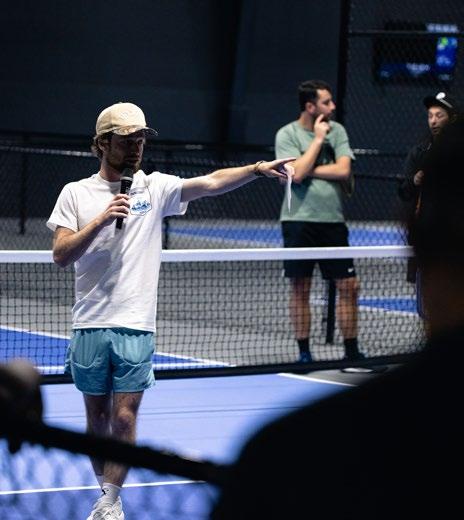
On June 5-7 in Bozeman, pickleballers battled on the court in the Montana State Pickleball Championships. Explore Big Sky photographed the leaps and coordination of competing pairs. PHOTO BY FISCHER GENAU
EDITORIAL POLICIES
EDITORIAL POLICY
Outlaw Partners, LLC is the sole owner of Explore Big Sky. EBS reserves the right to edit all submitted material. Printed material reflects the opinion of the author and is not necessarily the opinion of Outlaw Partners or its editors. EBS will not publish anything discriminatory or in bad taste.
EBS welcomes obituaries written by family members or from funeral homes. To place an obituary, please submit 500 words or less to media@theoutlawpartners.com.
SCAN FOR TOWN
In the decades after Bozeman’s 1864 founding, development covered and straightened parts of Bozeman Creek's winding channels. Now, citizen advocates and partners in the See Bozeman Creek group hope to protect and improve access to Bozeman’s namesake creek. On June 2, See Bozeman Creek held an open house in downtown Bozeman sharing ideas for the effort designed by engineers.
BOZEMAN HOSTS STATE PICKLEBALL CHAMPIONSHIPS
From June 5 to 7, the Picklr in Bozeman hosted the Montana State Pickleball Championships, opening their courts for mens, womens and mixed doubles categories, as well as a senior division. Athletes competed in the round robin tournament to qualify for the USA Pickleball National Championships.
LETTERS TO THE EDITOR
Letters to the editor allow EBS readers to express views and share how they would like to effect change. These are not Thank You notes. Letters should be 250 words or less, respectful, ethical, accurate, and proofread for grammar and content. We reserve the right to edit letters and will not publish individual grievances about specific businesses or letters that are abusive, malicious or potentially libelous. Include: full name, address, phone number and title. Submit to media@outlaw.partners.
ADVERTISING DEADLINE
For the June 25th issue: June 17th, 2026
CORRECTIONS
Please report errors to media@outlaw.partners.
OUTLAW PARTNERS & EXPLORE BIG SKY P.O. Box 160250, Big Sky, MT 59716 (406) 995-2055 • media@theoutlawpartners.com
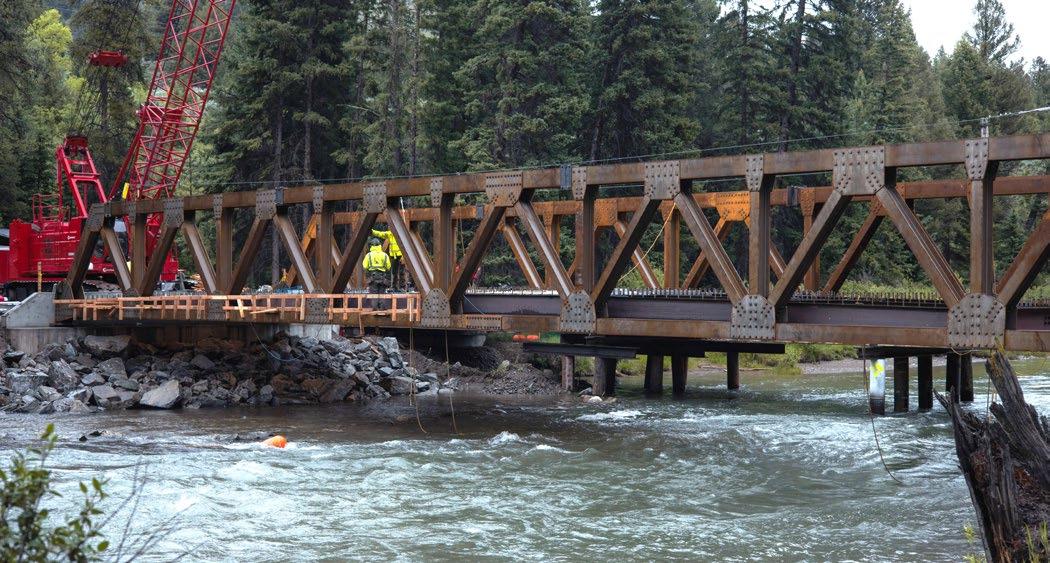
The new Markley or "Green" Bridge at the Deer Creek recreation site in Gallatin Canyon has been installed in place as crews continue work to get it pedestrian and automobile ready. Officials say it will not be green. PHOTO BY FISCHER GENAU
NEWS IN BRIEF
MORNINGSTAR PREPS FOR THIRD ANNUAL BLACK TIE TRIVIA
FUNDRAISER FOR EARLY CHILDHOOD EDUCATION EMBRACES NEW SEASON, NEW VENUE
EBS STAFF
BIG SKY—After hosting its annual fundraising ball in February or March for the past three years at Montage Big Sky, Morningstar Learning Center announced it would host Black Tie Trivia in June at Riverhouse BBQ and Events.
Black Tie Trivia will be hosted June 19, starting at 6 p.m. with tickets available online. The change from winter to near-summer aims to offer guests a “fresh seasonal setting for one of Big Sky’s most anticipated night’s out,” according to a press release from MLC, and the new venue allows for use of Riverhouse’s outdoor event tent beside the Gallatin River.
Funds support MLC’s mission of providing excellent and affordable early childhood education to serve and strengthen the greater Big Sky community, particularly through need-based tuition assistance for families, increased teacher pay and affordable housing support for teachers.
“The need for high-quality, affordable child care in our community is necessary to support families staying in Big Sky,” Mariel Butan, MLC executive director, stated in the release. “Black Tie Trivia is more than a fun night out. It directly impacts our ability to maintain the quality of care our families and their employers rely on, while helping ensure Big Sky remains a place where working families can live and thrive.”
The team-based trivia event includes food and drinks, and a silent and live auction with prizes including early Lone Peak Tram access with Big Sky Ski Patrol, a ride-along with the Big Sky Fire Department, and a hot air balloon ride over Big Sky.
MLC development committee chair Steph Kissell thanked MLC’s business sponsors and said the trivia event brings the community together to support “the workforce behind the workforce.”
The event is “black tie inspired, not required,” with the theme serving as a nod to its “elevated feel” rather than a dress code, the release stated. “Dress up or dress down—just don’t miss it,” stated Kim Vitou, MLC development coordinator. “The goal is to create a fun, engaging night out that still feels welcoming, relaxed, and full of community spirit.”
GOOSE CREEK, BEAR CANYON TRAIL CLOSURES SOUTH OF BOZEMAN
IN EFFECT
EBS STAFF
Custer Gallatin National Forest will close portions of Goose Creek trail #439 and Bear Canyon Loop trail #440 in the northern Gallatins starting the week of June 8. The closure will be temporary and is a part of the Goose Creek Fuel Break Project, aimed at reducing wildfire risk.
During the closure, logging crews and heavy equipment will be present in the area. “For your safety, please be aware of future trail closures and plan alternative routes if needed,” stated a news release from the forest service. Drivers on access roads are asked to be courteous, patient and share the road with log trucks and to, “be prepared to pull over and allow log trucks to pass.”
The project is expected to run through Oct. 15, 2026, but may be completed sooner. “Thank you for your patience and understanding as we work to create a safer, healthier landscape for everyone,” stated the release.
LPHS GRADUATE PROFILED BY THE ATLANTIC IN YALE GRADUATION
EBS STAFF
Samantha Suazo, who graduated from Lone Peak High School in 2022, tossed her cap at Yale University on May 18.
Working on a profile for The Atlantic, “Photos: A Family’s Final Trip Before the Father’s Self-Deportation," Getty Images photojournalist John Moore spent days with Suazo and her family, documenting not only the joy of Suazo’s Ivy League graduation, but the heartbreak of separation as her father, Marvin Suazo, self-deported back to Honduras just days later.
The Suazo family fled violence in Honduras in 2014 and sought asylum in the U.S., eventually landing in Big Sky. Unlike Samantha and her mother, Maribel, Marvin was ineligible for asylum due to a previous deportation, according to reporting by The Atlantic, and he lived as an undocumented immigrant in the U.S. until recent weeks.
The profile documents the Suazo family parting ways with Marvin, his return to Honduras, and Samantha’s visit to her native country after graduation.
FORUM IN BOZEMAN TO ADDRESS CLIMATE ANXIETY AND CONSERVATION
EBS STAFF
A one-day forum focused on climate change, conservation and mental health will be held Thursday, July 23, at the Emerson Center for the Arts and Culture’s ballroom in Bozeman.
The forum, “Climate, Conservation, and Well-Being,” is organized by nonprofit One Green Thing and will bring together national leaders in sustainability, wellness and conservation to highlight practical solutions to eco-anxiety, a term that describes the mental health toll of climate change, particularly growing concern over extreme weather events and proposed policies that would open public lands to privatization.
The inaugural forum will discuss how to employ change through “joyful daily action” and community building. One Green Thing was founded in 2021 and the nonprofit’s aim is specifically to address eco-anxiety through positive engagement.
The organization is led by CEO Heather White, whose recent book on the subject offers strategies for individuals and communities navigating climate-related stress.
OP NEWS
EPILEPSY FOUNDATION BRINGS AWARENESS, COMMUNITY TO MONTANA FAMILIES FOUNDATION PUSHES FOR PASSING OF MONTANA BILL THAT COULD SAVE LIVES IN CLASSROOMS
BY MIRA BRODY VP MEDIA
Editor’s note: Explore Big Sky is published by Outlaw Partners, the producer of Big Sky PBR.
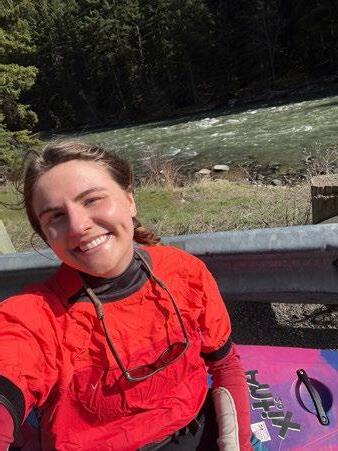
When Erica Salter's teenage daughter Alexis was diagnosed with epilepsy in 2021, the family was in the process of moving from California to Bozeman, and were faced with the same reality that many needing specialized care face: the lack of healthcare support in Montana. Navigating a new community, location and healthcare system was frustrating, Salter said.
Alexis experiences tonic-clonic seizures, the convulsive episodes many people picture when they think of epilepsy, which at times has stopped her breathing. This past school year, Alexis no longer felt safe at school and has since been completing her junior year online.
"She just didn't feel safe because... she found out that the teachers here aren't trained and then she is just kind of living in a little bit of fear," Salter said. "She's made the choice not to go to school. She feels like if people can't take care of her, then she is not safe to be in the classroom.”
The Salter’s fear does have a solution. According to the Epilepsy Foundation of America, 26 states and Washington, D.C. requires school personnel to complete seizure first aid training. . Montana has not yet adopted this law, something that the Foundation, alongside advocates like Salter, are trying to change.
The Epilepsy Foundation of America was established in 1968 and today operates approximately 59 chapters across the country. Its Montana chapter launched in 2023. The organization's mission centers on ensuring that people do not face epilepsy alone, offering services across four core pillars: advocacy, research, support and awareness.
An estimated 3.4 million Americans live with epilepsy, according to the Epilepsy Foundation, and about 456,000 of those are children under the age of 17, according to the Centers for Disease Control and Prevention. The Epilepsy Foundation puts
the odds at one in 26 Americans developing the condition over a lifetime, meaning on average, every classroom in America likely contains a student with epilepsy.
Treatment is not straightforward for many patients and studies suggest that epilepsy is difficult to control with medication alone in about one-third of adults and approximately 20-25% of children, according to the Epilepsy Foundation. For those patients, surgery and devices become the next options, the kinds of interventions that often require out-of-state travel for Montana families.
"These families are heading out of state for the bigger brain surgeries and stuff," said Jessica Veach, regional executive director of the foundation, who has lived with epilepsy herself since she was diagnosed at 19.
In addition to supporting families facing these treatments, diagnosis and medical travel, another one of the foundation's central advocacy goals in Montana is passing the legislation that would require all school personnel to complete seizure first aid training. The one-hour course, available in-person, online or virtually, covers what epilepsy is, what different seizure types look like and how to respond. Certification is good through two years.
While the bill is written, Montana has not yet found a bill sponsor to carry the legislation forward.
"Right now we need someone to sponsor the bill," Veach said. "We have the bill written so they just need to carry it forward. And then next spring when they meet, have maybe some of us testify.”
If someone near you is experiencing a seizure, Veach explained, it is recommended to turn the seizing person onto their side to prevent choking, place something soft under their head and never put anything in the person's mouth; a persistent and dangerous myth. If it is a person's first known seizure, if the seizure lasts longer than five minutes, or if the cause is unknown, it is recommended to call 911.
Part of what makes the training so necessary, Veach explained, is that most people do not recognize what epilepsy actually looks like.
"Not all seizures look like the convulsive seizures you see in the movies," she said. "There's so many different types and it took me several years to be diagnosed just because my seizures were so slight and I could talk during it, I could do anything.”
Salter echoed the isolation that can come with a diagnosis, especially in a state with limited specialists. Montana currently has one pediatric epileptologist in Kalispell and one adult epileptologist in Billings.
"It's a very lonely diagnosis," Salter said. "You're not alone. There's a lot more people who are affected than people think.”
That loneliness drove Salter to start a Bozeman support group, which she calls the Bozeman Brain Buddies. The group gives local families a space to compare medications, swap doctor referrals and simply feel heard. Her advocacy, and the foundation’s support, has also enacted a change in Alexis, her mother said.
Last spring, Alexis was selected to represent Montana through the Epilepsy Foundation's Teen Speak Up program, which sends one teen per state to D.C. to advocate at the Capitol. The experience changed her.
"She was like, 'Look at all these kids all over the country. They're just like me. I am not different. I am normal,'" Salter said. "And she made friends and she has learned that it's okay that she has epilepsy."
Moments like that are exactly what the Epilepsy Foundation hopes to create on a larger scale Thursday night at Big Sky PBR, a three-day bull riding event produced by EBS’s publisher, Outlaw Partners. The night will raise awareness and funding for the Foundation, and encourage attendees to wear purple, the color associated with epilepsy awareness.
"It's so huge for us," Veach said. "I think it's a little of everything, a little of outreach … and then just the awareness that this is a very common condition, so it needs to be talked about just as much as other things."
Families attend a Billings fundraiser for the Epilepsy Foundation of America. PHOTO COURTESY OF THE EPILEPSY FOUNDATION
The Brooks Bombers fundraising team at a walk for epilepsy event in Billings. PHOTO COURTESY OF THE EPILEPSY FOUNDATION
BIG SKY RESORT TO OPEN FOR SUMMER JUNE 13
KIRCLIFF ATTRACTION WILL HOST VISITORS FOR ITS FIRST SUMMER
EBS STAFF
Big Sky Resort will welcome summer visitors starting Saturday, June 13.
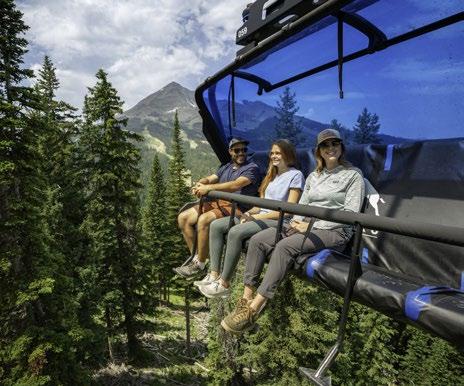
Visitors can catch scenic rides on the Explorer Gondola, Ramcharger 8 and the Lone Peak Tram
from 9 a.m. to 5 p.m. The gondola and Ramcharger will open to mountain bikers starting at 10 a.m. daily, and Swift Current 6 will open on weekends starting July 3.
Also starting on July 3, sunset hours allow for later rides on weekends. Visitors can take scenic rides from 5 to 8 p.m. and bikers can make use of later hours from 5 to 7 p.m.
Events this summer at the resort include downhill bike races designed for intermediate to expertlevel riders on 10 Fridays throughout the season; a women’s mountain bike skills clinic series starting on July 3; celebrations for July 4; and The Rut Mountain Runs in mid-September.
This will be the first summer for people to visit Kircliff, a glass observatory at the top of Lone Mountain with views of the mountain ranges surrounding Big Sky. Tickets to Kircliff are $67 for adults aged 18-69 and include access to the Explorer Gondola, Lone Peak Tram and Ramcharger 8 for scenic rides.
Visitors ride Ramcharger 8. PHOTO BY CHARLES STEMEN FOR BIG SKY RESORT
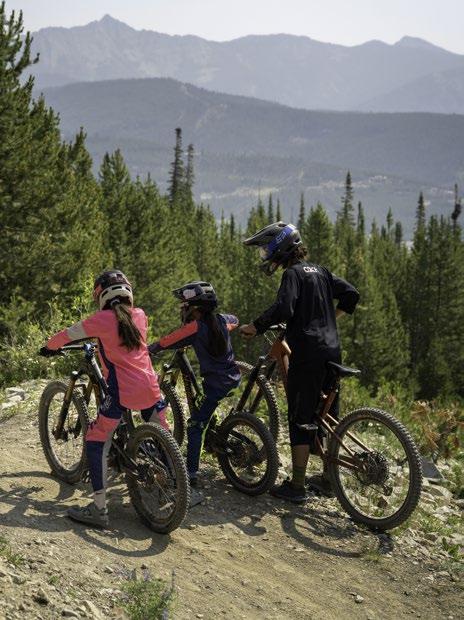
Mountain bikers on Big Sky Resort trails during summertime. PHOTO BY CHARLES STEMEN FOR BIG SKY RESORT
FRIENDS OF BIG SKY EDUCATION ANNOUNCES
LONE PEAK HIGH SCHOOL
CLASS OF 2026 COMMUNITY SCHOLARSHIP RECIPIENTS
FOBSE thanks the businesses, individuals and community organizations who contributed to these scholarships and congratulates all LPHS graduates.
BSOA MAKING MOVES TO IMPROVE ROAD, BRIDGE FUNDING SYSTEMS
TWO BRIDGES NEED ‘MAJOR’ REPAIRS; BIG SKY’S LARGEST HOA IS CREATING RURAL IMPROVEMENT DISTRICTS FOR LONG-TERM FUNDING
BY JACK REANEY
BIG SKY—The Big Sky Owners Association believes local transportation infrastructure is deteriorating, lagging behind Big Sky’s population growth and real estate development. For that reason, the organization is stepping up to improve the network of rural improvement districts which collect funds for neighborhoods’ eventual road maintenance needs.
BSOA Executive Director Holly Coltea said it’s going to require a collective effort, and an understanding that no neighborhood is being targeted unfairly. The RID project is a 2026 initiative of the BSOA board.
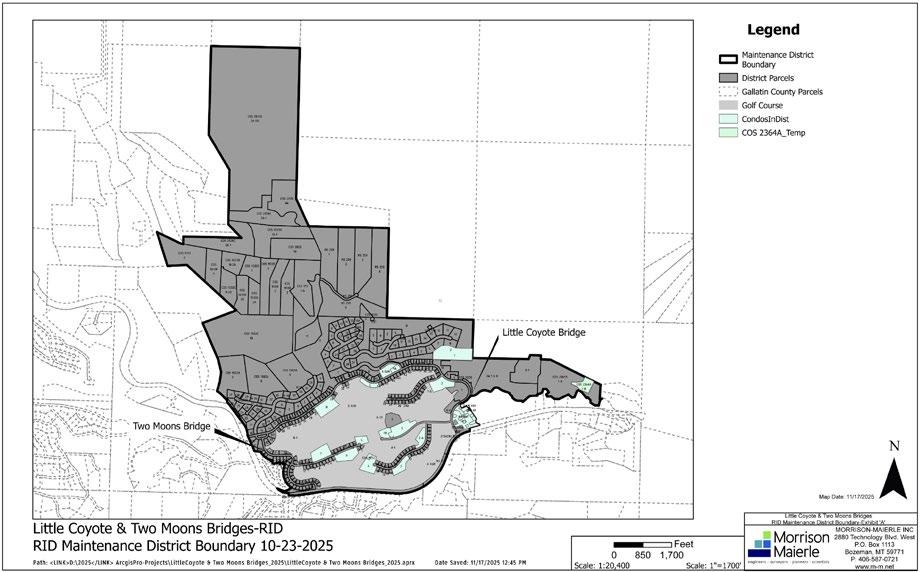
The question of who should fund necessary bridge repairs in the Little Coyote Road area has captured many residents’ attention, with some property owners hesitant to absorb a new property tax line item. The 835 properties being asked to help fund bridge repairs already contribute to an RID for Little Coyote Road, but that RID does not support bridges, hence the pursuit of a new, bridge-focused RID.
“Everybody has to do their part, and we all have to share in this together,” Coltea told EBS. She emphasized that the RIDs are already in place for just about every other neighborhood on the Gallatin County side of Big Sky.
According to a third-party engineering report from
December 2024, the bridges—each about 50 years old—need “major rehabilitation work,” Coltea explained, followed by replacement within the next 20 years. Until replacement, BSOA looks to take a “conservative repair approach” to keep costs down.
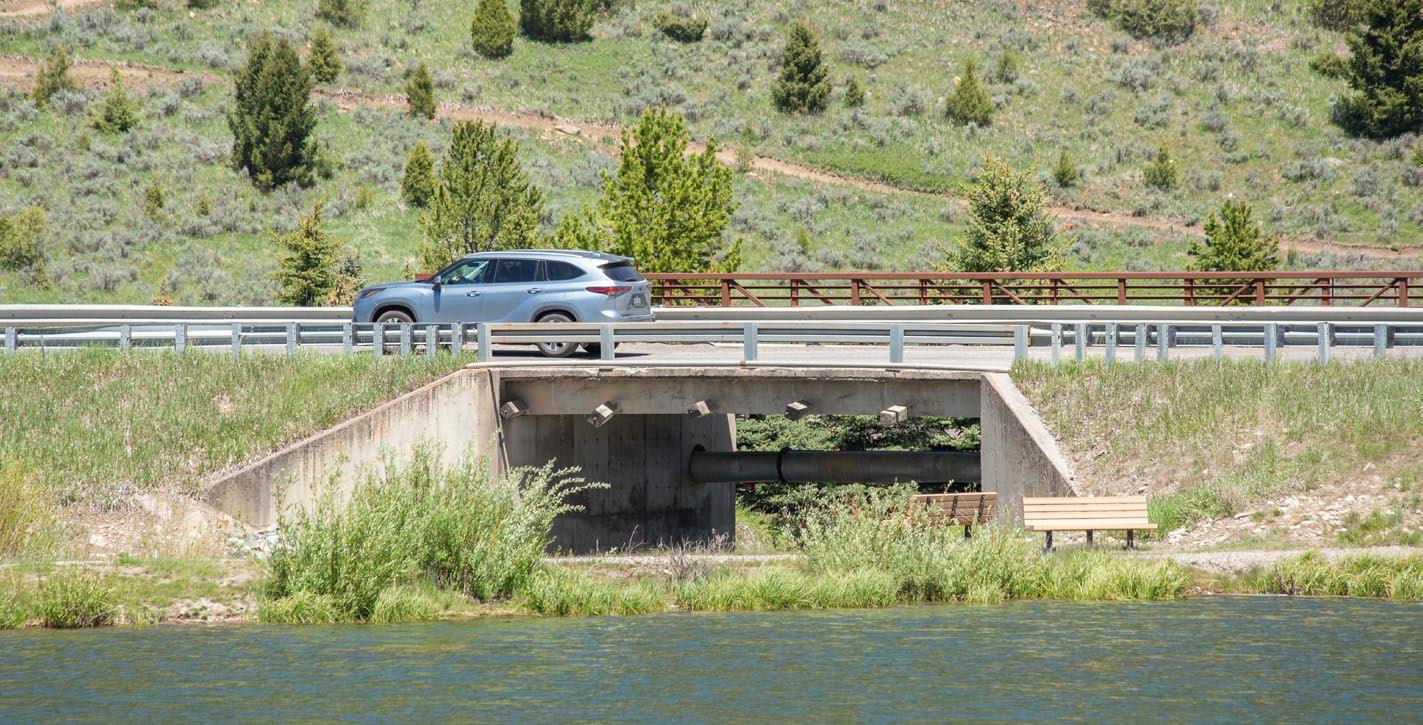
The Little Coyote Road bridge near HuntleyKern Pond is deteriorating, and repairs are estimated to cost $140,000. On the bridge along Two Moons Road, just off Little Coyote, short-term maintenance will cost approximately $60,000.
Some residents are concerned about the fact that roads and bridges are stressed largely by visitors and non-residents—it’s the same reason resort tax exists in Montana, to collect money largely from visitors and distribute the revenue through local infrastructure and community needs.
BSOA plans to ask the Big Sky Resort Area District for at least $100,000 as soon as bridge work is shovel-ready, as a match to the $100,000 BSOA will pull from its own reserves to cover the $200,000 in upcoming repairs.
Beyond repairs, a full replacement of both bridges will be needed in roughly 20 years, with an expected cost of $1.2 million total, motivating BSOA to set a sustainable, long-term pace of fundraising through the RID.
BSOA conducted outreach, polling the 835 total homeowners within the proposed RID boundary. Thirty-eight percent responded to the poll, showing 72% support: 231 voted in support and 89 voted against the creation of an RID.
With this result, the Gallatin County Commission agreed to formally discuss the possibility of an RID. That discussion will take place on June 22. If commissioners agree to issue a resolution of intent, the 835 property owners will receive a mailer with
The Little Coyote Bridge is one of two bridges in the area that will need replacement in the next 20 years.
PHOTO BY JACK REANEY
information, and a 30-day period will open in which residents can protest to the Gallatin County Commission.
Coltea emphasized again that this is not an isolated initiative for the Little Coyote Road members, but an initiative across BSOA with the goal of building sustainable funding streams for when problems emerge.
LOCAL
one given year,” Coltea said. “... It's like putting away a savings account for a rainy day.”
After the bridges are replaced—or at any other time—homeowners can petition for the RID to be dissolved. If not, they can use it to raise money for other maintenance needs.
“We’re trying to not put this on the shoulders of BSOA dues,” Coltea said. “... We don’t want to increase dues 4x. We want to take care of each neighborhood, and put each neighborhood into a proper rural improvement district.”
Coltea wishes Big Sky had a public works department to help offload this financial responsibility from BSOA and property owners, but noted that RIDs are the next best thing.
BSOA leading Madison County ‘global RID’
Entirely separate from the creation of an RID along Little Coyote Road, BSOA is also leading an effort to consolidate and improve RIDs on the Madison County side of Big Sky.
Currently, with four overlapping RIDs in Big Sky’s pocket of Madison County, many property owners are paying into multiple, which BSOA believes to be an inefficiency.
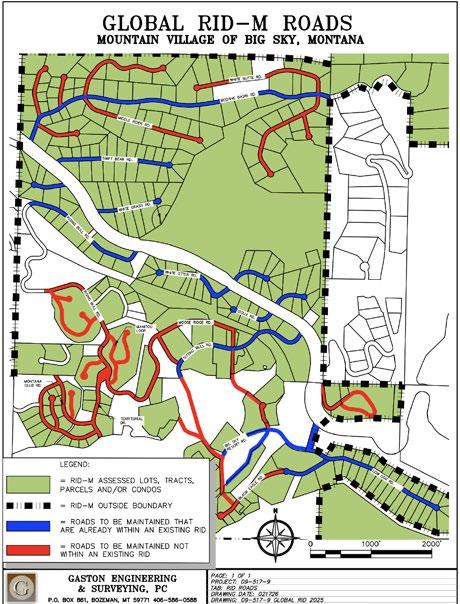
Coltea is calling it a “global RID,” and its boundary would include almost all properties except Moonlight Basin and gated neighborhoods such as Summit View. Under the new global RID, funds would be redistributed evenly across the new RID boundary.
“[It] would create a greater sense of fairness, much more predictability, and a much more sustainable infrastructure funding model, and stewardship, over the long haul,” Coltea said during the May 13 Madison-Gallatin Joint County Commission meeting. “... It’s just a broader, more fair, more equitable distribution. This is not about creating unnecessary infrastructure.”
In mid-May, the Madison County Commission approved a resolution of intent to create the global RID. As with the Little Coyote bridges RID, residents will have 30 days, between June 3 and July 5, to protest to the Madison County Commission.
BSOA is initiating the global RID, but if implemented, it would be managed by Madison County, not BSOA—the mechanism primarily exists to collect tax dollars, and when repairs are needed, the county uses funds to hire contractors.
Building on recent efforts to improve Beehive Basin Road and its steep “beaver slide” section, a group of homeowners is now working to deed the road to Madison County. If successful, improvements could be funded by the RID.
Coltea said the lack of clear authority on who should manage road funding underscores the need for the new coordinator position proposed by the Big Sky Transportation District on May 13.
“The objective here is not just funding,” Coltea told both county commissions on May 13. “It’s about stewardship, it’s about predictability, it’s about transparency, it’s about long-term planning.”
Map shows the proposed global RID boundary, including roads it would fund. COURTESY OF BSOA
'THE FUTURE’S BRIGHT’: LMLC PRESIDENT DISCUSSES HOUSING, FAMILIES AND GROWTH ANNUAL OPEN HOUSE
BY MIRA BRODY
BIG
SKY—Lone
Mountain Land Company
President Matt Kidd opened the company's annual open house community forum on June 9 with a posed question to the audience: who is recruiting full-time, Big Sky residents to strengthen our yearround community?
"Who's recruiting full-time year-round residents? Other locals? Nobody,” Kidd said to a full room at The Wilson Hotel.
That question set the tone for a broad community update that touched on housing progress, stalled school enrollment, child care capacity and the longterm vision for Town Center.
Resort tax collections are close to $25 million annually, Big Sky Resort was recently named No. 1 in the West by SKI Magazine and Expedia ranked Big Sky the top travel destination in the world. One number that has not moved, noted Kidd following these accolades, is Big Sky’s year-round population.
“We grew a little bit over a decade, and now we're kind of shrinking again,” Kidd said about the local population. “It is really interesting to me that our year-round population hasn’t grown with as much as everything has grown around it.”
Cold Smoke: Largest community land trust in the country
Central to the forum’s housing discussion was Cold Smoke, a community land trust project that consists of 99 acres valued at an average of $46.4 million reserved for 389 permanently deed-restricted homes. In January of this year, the Big Sky Community Housing Trust purchased the 99 acres for $39.75 million after the parcel’s former owner, LMLC, reduced the price by 14%.
“It is the largest community land trust housing effort that we know of in the country to be able to be built,” Kidd said. “The community owns it. There's nowhere else in the country doing this.”
Ground is expected to break on the project later this year with multifamily units offered as rentals depending on community need and financing conditions, and single-family homes will be for sale. Kidd outlined the symbolism of the project in his presentation.
"If you want to work in Big Sky, you should have the chance to live in Big Sky,” he said. “Cold Smoke actually takes that one step further to say, if you're willing to dedicate your career to Big Sky, you should have the opportunity to own a home in Big Sky.”
LMLC has also delivered 667 units and 2,200 beds across other housing projects in recent years, including Riverview and the Powder Light campus, and expressed support for the independently developed Quarry project, which Kidd said fills a price point that currently doesn't exist in the market.
Child care capacity remains a barrier
Kidd identified child care capacity—not the cost, and not a lack of variety—as a foundational barrier to creating a sustainable community for young families, the base that sustains enrollment, fills youth sports and fosters a year-round community.
Without enough space for infants and toddlers, he explained, enrollment in Big Sky's schools will continue to drop. The number of children enrolled in Big Sky schools has remained essentially flat for 10 years, a trend Kidd said is "really unfortunate."
"If we can't have more young children in Big Sky, they're not going to have more in those schools … that's the foundation, that's where it starts,” Kidd said of early learning centers.
LMLC has been working on plans for a centralized early childhood facility near Firelight Meadows that could house Morningstar, Discovery and Gallatin River Child Care under a “world class facility,” with capacity for more than 150 children ages zero to five. While a construction timeline has not yet been announced, Kidd described the design as “essentially complete.”
To end on a note of encouragement, Kidd noted that when that year-round community does arrive, existing Big Sky schools currently have room to welcome more students with quality education programs.
"We have three awesome schools in Big Sky: the public school, Discovery and the Community School [and they] have no capacity issues,” Kidd said. "More people can come here, and we have room for them."
Town Center continues growth, welcomes Hotel Free West
“The valuation of Big Sky is greater than Missoula, Bozeman and Billings combined,” Kidd emphasized. “We’re about the same size. So we are incredibly important to the state of Montana.”
That economic reality is reflected in the business development of Town Center, which serves not just as a gathering place for events such as the Big Sky Farmers Market or Music in the Mountains, but as infrastructure that locals depend on year-round.
To that note, LMLC announced that Hotel Free West, the blue-wrapped building that has become a noticeable development in Town Center, will open next summer with 81 rooms, a café, restaurant, bar and wellness space, managed by Columbia Hospitality. Two additional hotels are in planning stages, with a groundbreaking for one anticipated as soon as next year.
The emphasis on hotels reflects an effort to fill what Kidd described as a significant gap in Big Sky's hospitality offerings: the middle ground between The Wilson and the Montage Big Sky.
"If you think about hotel segmentation, there's a giant gap between what The Wilson is and what the Montage is," he said. "Our work in Town Center is largely to fill that gap and create more options.”
Additionally, more hotel keys opens the door to additional retail and dining options that would benefit both visitors and locals.
"There's no way we can justify any new restaurants or any new retail without more tourists and without more visitors,” Kidd said.
On the residential side, a new neighborhood called Ousel Meadows, located just south of the Copper
John and Uplands units, will bring roughly 40 units to market later this year, including 11 single-family homes, 10 duplexes, six triplexes and 17 homesites. Notably, it will mark the first time individuals have ever had the opportunity to purchase a standalone residential lot within Town Center, a milestone Kidd highlighted as a meaningful shift in how the area can grow.
Beyond the announced projects, Kidd pointed to the undeveloped land between The Wilson Hotel and Hotel Free West as a critical parcel in Big Sky. Closing that gap in the plaza, he said, is central to LMLC’s vision of Town Center fulfilling its role as a community gathering place for both locals and visitors.
"It is where tourists and residents come together," he said.
“We want to have these conversations as a community,” said Kidd in response to an audience question about Town Center development. “Nothing is off the table … everything is on the table, and we don't have 10 years to figure it out either. We do need to figure it out like, pretty soon."
Rooted in community
The open house meeting closed with archival footage of Taylor Middleton, former Big Sky Resort president and COO and a longtime Big Sky community leader whose vision helped shape the resort town for the decades he called it home. His words drew a clear line from the past to the present challenges Kidd outlined.
"Qualitatively, we're not building just a ski resort, we’re not just a series of developments, but we're also participating in developing community," Middleton said in the posthumous video clip. "The thing that makes me most proud is we are in the process of building a community. It's a community of great skiing, great recreation and a community that's got legs for the future.”
As he wrapped up, Kidd echoed that sentiment, acknowledging the tension between what Big Sky is and what it is still working to become and what he calls two interdependent goals: “to be both a worldclass resort destination and a thriving year-round community,” Kidd said.
"I think Taylor said it best,” Kidd concluded ahead of a Q&A session. “The future’s bright."
Victoria Smith contributed to the reporting of this story.
LMLC President Matt Kidd speaks at Lone Mountain Land Company's open house on June 9. PHOTO BY VICTORIA SMITH
Shift Into Luxury
3
GALLATIN, YELLOWSTONE RIVERS DRAINING FASTER THAN 30-YEAR AVERAGE
EARLY INDICATORS POINT TO BELOW-NORMAL SUMMER FLOWS IN 2026
BY CARLI JOHNSON
Spring in Montana doesn't leave much to be desired—all activities are a go. For those who can't stow away the skis quite yet, there's always the chance of a late storm to bring in a few more inches of snow. And for those itching to get on the rivers, there's usually enough snowmelt to find their fix. This year, however, early indicators suggest the Gallatin and Yellowstone rivers could see belownormal flows later this summer.
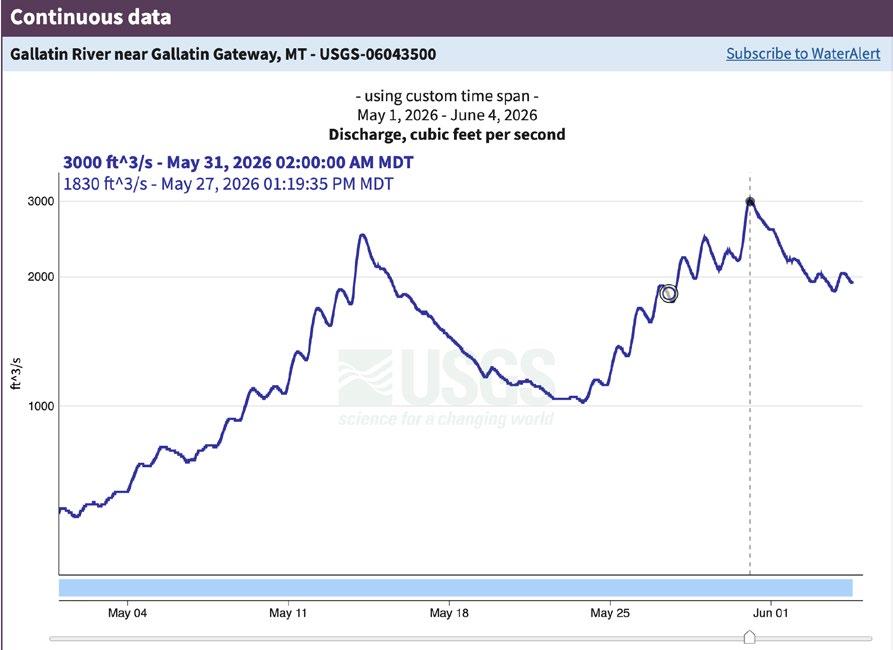
Snowpack at the Lone Mountain mid-mountain SNOTEL site is already gone, roughly two weeks ahead of the typical date, according to Kristin Gardner, chief executive and science officer at the Gallatin River Task Force. Peak runoff on the Gallatin has already occurred, and Gardner said the 2026 peak ranks among the lowest in recent years.
"Projecting from the current moment, things can change," Gardner said. "There's likely to be lower than normal flows if we have a hot summer. All that can change, though, if we have a wet summer."
The most likely scenario, Gardner said, is a summer marked by lower river flows and warmer water temperatures—conditions similar to, or potentially more pronounced than, those experienced last year.
The Natural Resources Conservation Service tracks snow-water equivalent—the amount of water contained in the snowpack—at monitoring stations across western mountain ranges throughout winter and spring. Those figures are used to forecast how much water will eventually reach rivers during runoff season.
"When a snowpack is shallow, it does tend to produce this kind of fast rise and steep fall," Gardner said. "There's simply less water stored in the mountains to release gradually over time."
Last year's runoff season offers a glimpse of what can happen when that pattern plays out.
A review of streamflow data maintained by the U.S. Geological Survey shows that while the Gallatin and Yellowstone rivers have been peaking near or above historically normal flow volumes in recent years, both rivers have been losing water significantly faster than average in the weeks that follow those peaks.
On June 2, 2025, the Gallatin River peaked at roughly 4,611 cubic feet per second—measured at the Gallatin Gateway gauge—slightly below its 30-year median peak of 5,250 cfs. The Yellowstone peaked the same day at 20,300 cfs, also slightly
below its historical median of 22,950 cfs. Aside from flow volume, June 2 is the average date for the rivers’ peak.
At first glance, both rivers appeared relatively healthy at peak runoff last year.
What followed is where the season diverged from the historical record.
Within six weeks, the Gallatin had lost 84% of its peak flow. The Yellowstone had lost 82%. While snowmelt-driven rivers naturally decline after runoff season, the speed of the drop stood out.
To understand where 2026 fits in the overall record, EBS reviewed daily flow data from USGS monitoring stations on both rivers for the period from 1997 through 2025.
The Gallatin River has run below its median peak in recent years. The lowest single-year peak in the dataset occurred in 2007, when the river reached just 3,034 cfs. That was followed by 2001 at 3,178 cfs.
On the Yellowstone, 2016 recorded the lowest peak in the 29-year dataset at 11,981 cfs, followed by 2004 at 12,299 cfs.
The long-term record shows that low-flow years are not unusual. What has drawn attention in recent
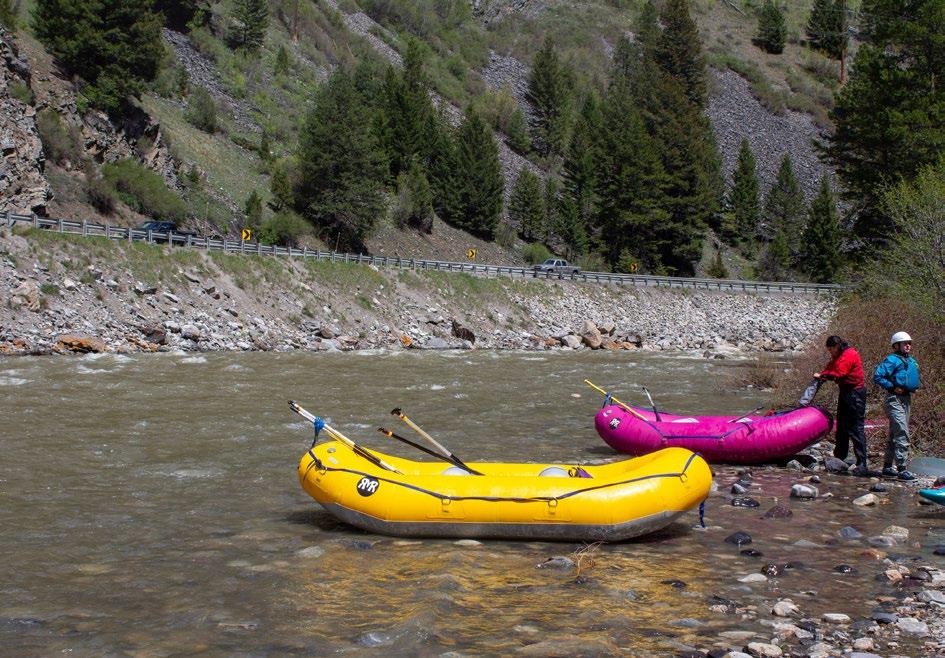
Recreational boaters enjoying early spring flows at the Lava Lake put-in. PHOTO BY CARLI JOHNSON
PHOTO BY CARLI JOHNSON
BOZEMAN
THE CREEK UNDER OUR FEET: CITY ENVISIONS WAYS TO BRING BOZEMAN CREEK TO LIGHT
BY JEN CLANCEY
Under the floorboards of the Fraternal Order of the Eagles, in tunnels under the city of Bozeman and emerging behind Bar IX is a mysterious character: the Bozeman Creek.
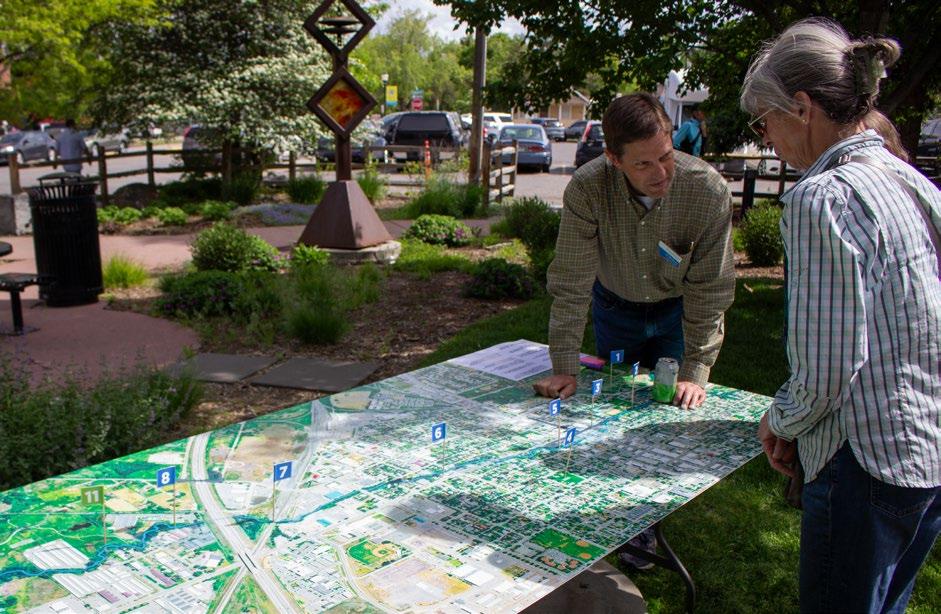
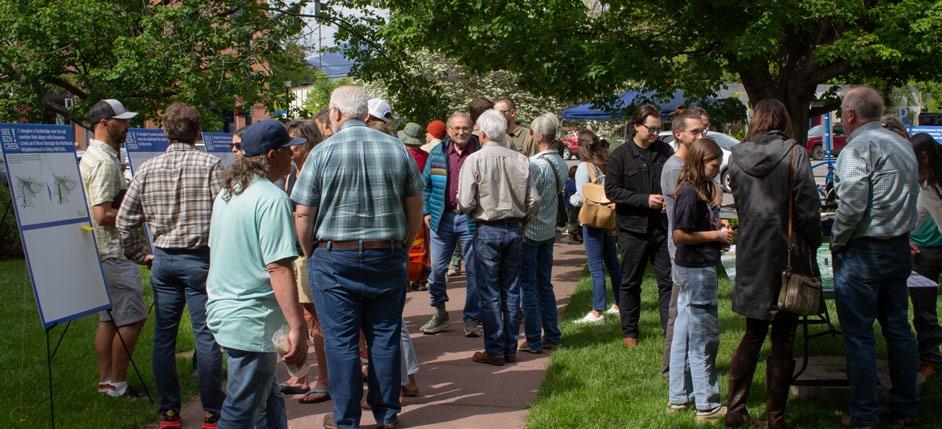
The waterway wasn’t always hidden from view. In the decades after the city’s 1864 founding, development covered and straightened parts of its winding channels into what it is today. Now, citizen advocates and partners in the See Bozeman Creek group plan to protect and improve access to Bozeman’s namesake creek. A June 2 open house at Soroptimist Park downtown shared 11 new ideas for the effort designed by engineers. Public input will shape next steps for project ideas, and by the end of the year, See Bozeman Creek will present viable projects for city commission approval.
Jim Madden is an advocate with See Bozeman Creek and the founder of one of the group’s partners, Mountain Time Arts. Other partners include the City of Bozeman and Downtown Bozeman Association. Madden noted optimism that the creek could become a downtown destination.
“My hope is that it would be an asset that people can really be proud of and drawn to—that when people come to town, they say, ‘Oh, yeah, we gotta go and look at the creek,’ or have a coffee by the creek,” Madden said. Visuals at the event demonstrated how features like parking can make way for nature within downtown Bozeman.
“There’s a lot of parking and a lot of it’s owned by the city,” Madden said, pointing to the city’s public parking lot behind the Eagle. If the city built a second parking garage on the southside, he explained, it’s possible that would lower the need for surface parking, allowing for more natural areas that complement the creek. Creating a multi-block park next to City Hall by using parking lot space, a footbridge over the rail corridor where the creek flows through the Northeast Neighborhood and dedicating public right-of-way for access to the creek, were other ideas presented at the event.
Longtime Bozeman residents like Chad Dokken, believe that projects enhancing and protecting the creek could remind residents of the nature right in their back yards.
“Yellowstone’s an hour and a half away, but you don’t need to drive an hour and a half to interact with nature,” Dokken told EBS. “And if we think that those are the places that we’re supposed to preserve rather than what’s right behind us here, I think that’s gonna be the start of the end.”
This week, Dokken, a standup paddleboarder with the brand Hala, ventured through the culverts of the creek from Bogert Park to Story Mill, catching on what he says is a two-week window when snowmelt makes the creek navigable by small watercraft.
His video of the adventure has garnered over 5,000 likes since he shared it two days ago, and he hopes it brings awareness to what the creek can offer.
“I kinda wanted to show this is a navigable creek,” Dokken said. “We can enjoy it. We can recreate on it. It is not just a culvert of water that goes behind the train yard that trash can go into.”
Dokken has paddle-boarded the creek in previous years, too, and he said it’s allowed him to observe pollution, fish populations and notice things like gas leaks under buildings.
He attended the Soroptimist Park open house to
learn more about ideas for the creek, where posters displayed designs of possible changes. Inspired by conversations with residents and stakeholders, the ideas are just for community consideration right now, Christopher Marcinkoski, the founder of PORT Urbanism explained. His design team, alongside engineering firm Rio ASE, are planning the project. Above each project design, they posed an open-ended “What if…” to invite attendees to attach sticky notes with their thoughts.
Through meetings, Marcinkoski learned about what matters to residents.
“I think Bozeman’s growth, Bozeman’s relationship to the creek and to water, the importance of nature and the natural environment to the identity of this place—those are all things that came through right off the bat and that we’ve kind of gone back to each time as we’ve worked through the process,” Marcinkoski said.
See Bozeman Creek will hold another open house on the weekend of Sweet Pea Festival, Aug. 7-9, where they will present more specific ideas for the public based on Tuesday’s feedback. Afterward in the fall, the design and engineering team will create final plans and present them to the city commission by the end of the year. Project partners will also research different funding sources to complete the projects.
Dokken, who grew up alongside the East Gallatin River, hopes that the projects can manage pollution along the creek and make it more visible and accessible.
“I think Bozeman Creek is buried, right? And it’s a shame,” Dokken said. “And I think it will be buried, probably, for quite some time unless the community really rallies around it and says, ‘We want a water source through our town.’”
Residents view a map of design ideas for Bozeman Creek. PHOTO BY JEN CLANCEY
Community members discuss ideas for Bozeman Creek. PHOTO BY JEN CLANCEY
PICKLR HOSTS MONTANA STATE PICKLEBALL CHAMPIONSHIPS
BY FISCHER GENAU
BOZEMAN—Over June 5-7, pickleball players converged on the Picklr in Bozeman to compete in the Montana State Pickleball Championships, a qualifying event for the USA Pickleball National Championships. Players from Florida, Colorado, Idaho and Montana all traveled to Bozeman to cross paddles over the weekend, with Ben Bishop and Manuel Monteiro placing first in the men’s
5.0
bracket on Saturday, the most advanced level of competition at the event.
The tournament featured Men’s, Women’s and Mixed Doubles categories, as well as a senior division. Pickleball ratings range from 1.0 to 5.5, which is considered expert, and the Montana State Championships featured 3.0-5.0 competition. Winners of their respective brackets earned 3,500 TPS points, and a minimum of 4,500 points are required to compete at the national level.
The Round Robin tournament played out on the Picklr’s 13 courts, four of which are championshipsized. The Picklr launched in June of 2025 in a warehouse off Laura Louise Lane near Four Corners, and the space has swelled to over 400 members since owners Andrew and Kelly Brief opened its doors.
The Picklr will host several other tournaments throughout the summer and fall.
The winners of the women’s 50+ 3.0 bracket accept their medals. Amy Wiening and Cary Hogue beat Barb McCain and Shelley Henry in a 12-10 overtime thriller to earn first place. PHOTO BY FISCHER GENAU
An energetic volley in the men’s 4.0 competition. PHOTO BY FISCHER GENAU
Pablo Negrete leaps to hit the ball. PHOTO BY FISCHER GENAU
The Picklr’s club coordinator Keegan Aimesbury announces the rules of the tournament on Saturday.
PHOTO BY FISCHER GENAU
Bozeman’s Layne Ryerson returns the ball to his opponents. Ryerson and his partner Pablo Negrete finished second in the men’s 5.0 competition. PHOTO
BY FISCHER GENAU
Spectators watch a match during the men’s 5.0 bracket on Saturday. PHOTO BY FISCHER GENAU
WMPAC ANNOUNCES SUMMER 2026 LINEUP
EBS STAFF
BIG SKY—The Warren Miller Performing Arts Center continues to grow its summer performances, and on June 1 announced the 2026 lineup of six shows including local theater, opera and live music.
Starting locally with Big Sky Broadway Jr., WMPAC will feature many local students between first and fourth grade in “Alice in Wonderland” on Friday, June 12. Two weeks later, on Friday and Saturday, June 26 and 27, Big Sky Broadway presents “Matilda” featuring students between fifth and eighth grade.
Opera is next. On Sunday, July 26, WMPAC welcomes Opera Montana for an outdoor preview of its new adaptation of “A River Runs Through It,” hosted at Riverhouse BBQ and Events beside the Gallatin River where parts of the 1992 movie were filmed. The world premiere of the opera is scheduled for September in Bozeman, and WMPAC’s preview will offer a glimpse into the new performance.
On Sunday, Aug. 16, Boston-based indie rock band Darlingside will perform in the WMPAC auditorium. Two weeks later, Grammy-winning singer-songwriter Madison Cunningham performs on Sunday, Aug. 30. Finally, on Sept. 16, WMPAC will partner with the Lone Peak Film Festival for a performance by pianist and composer Philip Glass.
Tickets are available online at warrenmillerpac.org.
Boston-based indie group Darlingside will visit in mid-August. COURTESY OF WMPAC
& TRails
COMMUNITY EVENTS CALENDAR
WILDFIRE FILM FESTIVAL
SATURDAY, JUNE 13
THE WAYPOINT, 6 P.M.
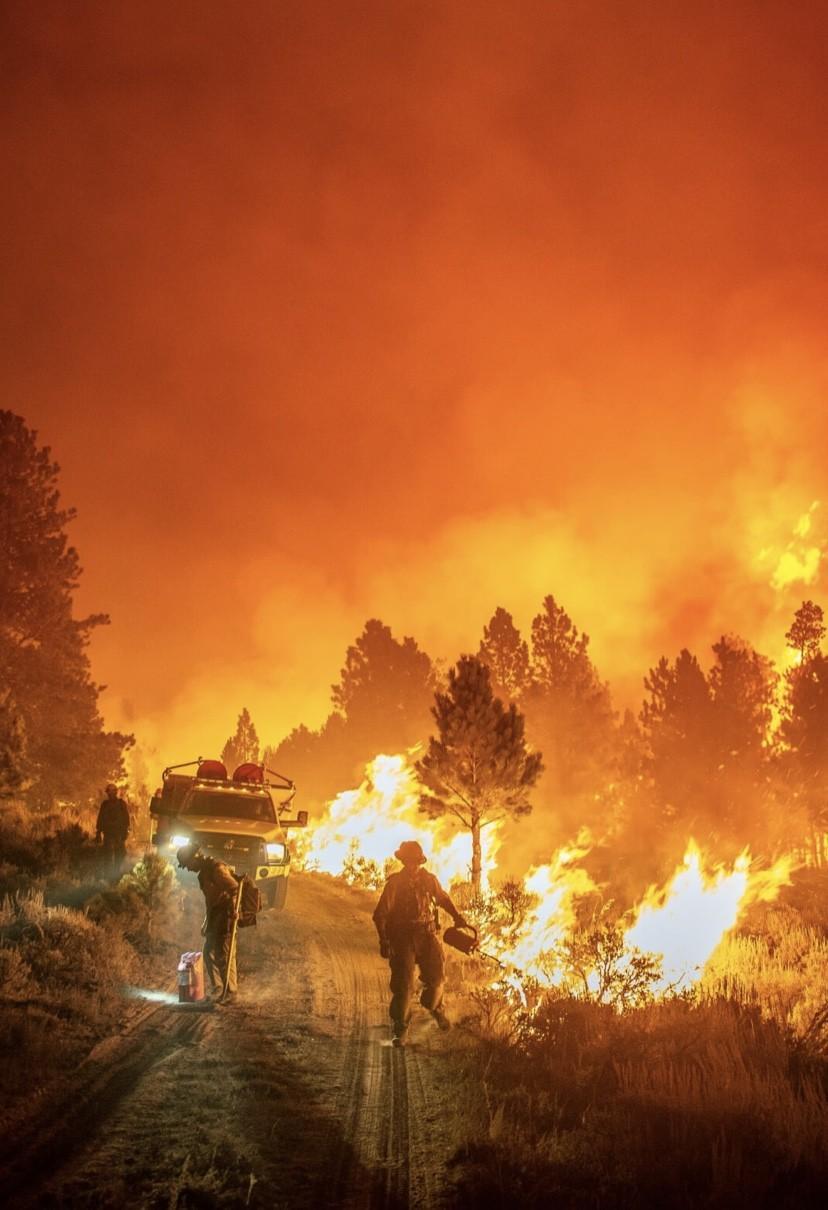
On Saturday, June 13, Fire Adapted Big Sky, The Rotary Club, The Waypoint and the Big Sky Fire Department will host the Wildfire Film Festival. The event will screen clips from local firefighters and organizations as well as more widely released films. Fire Adapted Big Sky will also present wildfire preparedness education, expert advice and prizes.
Other events at The Waypoint this month include World Cup watch parties on Friday, June 12 at 7 p.m. and on Friday, June 19 at 1 p.m.
Do You or Someone You Know Need Help Getting Sober?
PHOTO BY JACK REANEY
A LA CARTE: SHADY CHEESECAKE DEALS
BY RACHEL HERGETT EBS COLUMNIST
Have you ever come across a dish so delicious that you mourn it after the last bite? Once gone, though it still lingers on your tongue, you may even regret trying it. Who knows when (or if) you get the pleasure of another taste?
I came across such a food on Memorial Day weekend, while on a quick overnight to Salt Lake City for a Qveen Herby concert. This means another taste of said food is, according to Google Maps, currently a six-hour and 23-minute drive away from Bozeman. Not ideal. But damn if I can’t stop thinking about it.
It’s possible a part of me is writing this now so you may share in my pain. But this column also serves as a reminder to take a look around you. There are adventures in food to be had if you only slow down long enough to discover them.
This food adventure started on a Sunday afternoon, when my friend Amy and I checked into our Airbnb near our SLC concert venue, The Depot. We unpacked, decompressed and settled into the space a bit before I started getting my bearings on the world around us. Maybe I would walk to the temple or check out the coffee place down the street that the Airbnb host recommended. I went to Google Maps to check out the area and found that there was one business even closer than the coffee shop. It was directly across the street and obviously repping a dessert I love: cheesecake. Plus, it had a perfect five-star rating.
But when I looked across the street, all I saw was an apartment block. What and where was this Turkish
Bliss Cheesecake? The listed website was only an Instagram page, @burntbliss_slc.
“A Turkish guy who fell in love with burnt cheesecake and now sharing my homemade creations with you,” the Instagram bio read.
We’re talking the smallest of small businesses, I thought. This is a dude making cheesecake out of his apartment. And I love supporting the little guys. Reading through info on the Google listing and Instagram page, I learned that he asked for a 24-hour lead time. I didn’t have that, with plans to leave by 10 the next morning. But I sent him a message on Instagram anyway. Did he possibly have a cheesecake on hand? Or could I get my hands on one before our departure?
The person on the other end of the messages replied almost immediately to the affirmative. Sure, he could have a cheesecake ready for me by the morning. He even consented to finish earlier when I messaged him late night post concert with a desire to hit the road back to Montana a little earlier. I suspect he stayed up all night to make it for me.
“I’m here, where can I find you?” I message at 9 a.m. on Memorial Day, waiting outside the apartment block with cash in hand to make what could be described as a shady cheesecake deal. A few minutes later, a smiling, dark-haired twentysomething man emerges, carrying a large white box. That’s got to be him.
Anil, it turns out, is the sweetest young man. He shyly consented to having his picture taken then balked at the idea I would tip him, even though he only charged $30 for a nine-and-a-halfinch cheesecake.
Anil’s “Turkish cheesecake” is also known as a San Sebastian cheesecake or Basque cheesecake. It’s crustless and baked in parchment with the
top exposed so that it “burns.” The result is a cheesecake with a creamy, custard-like center that solidifies toward the edges and creates its own sort of crust as it bakes at a fairly high heat. I’ve had a Basque cheesecake before. This one, however, was on a different level.
I had cheesecake for breakfast that day, marveling at the caramelization Anil achieved and how much it added to the cheesecake. My only negative is I didn’t love the included chocolate sauce. It was maybe too watery and sugary, like a slightly thicker version of Hershey’s chocolate syrup. The cheesecake didn’t need it anyway. Eating it plain only highlighted the complexity that the burnt caramelization added to a seemingly simple dish.
I ate on the thing all week, only sharing a few slices when I had company. Admittedly, I even spent a solid half hour scraping the burnt bits off the parchment paper after I ate the last piece. It was that good.
Now, Anil is sitting at 4.8 stars thanks to a single negative review that was posted between my Salt Lake City trip and writing this column. The reviewer gave three stars, but never even tried the cheesecake.
“I was really looking forward to some yummy cheesecake, but the location is a private residence and therefore we were not able to pick up anything and we could not figure out how to order it online,” wrote one Benjamin Eaton.
Well, Benjamin. You have no sense of adventure, patience, or internet sleuthing skills. Yet the cheesecake is still there for you, if you wish to seek it out.
As for the rest of you, if you happen to be passing through or staying in Salt Lake City, message Anil, who still has every bit of a five-star rating in my book. Or look around, and you may end up on your own cheesecake adventure.
Rachel Hergett is a foodie and cook from Montana. She is arts editor emeritus at the Bozeman Daily Chronicle and has written for publications such as Food Network Magazine and Montana Quarterly. Rachel is also the host of the Magic Monday Show on KGLT-FM and teaches at Montana State University.
Chef Enil delivers the package. PHOTO BY RACHEL HERGETT
PHOTO BY RACHEL HERGETT
WILDFIRE FILM FESTIVAL
ENVIRONMENT
DISPATCHES FROM THE WILD: THE ‘TRUMP INTERSTATE’ IS AN ATTACK ON AMERICA’S WILD HEART
BY BENJAMIN ALVA POLLEY EBS COLUMNIST
Editor’s note: After this column was published, and following his defeat in the GOP primary, Sen. Cornyn signaled that the highway designation may no longer be a top priority.
Texas Sen. John Cornyn and Wyoming Sen. Cynthia Lummis want to carve a new interstate, branded the “Trump Interstate,” through one of the most intact wild landscapes left in the Lower 48. Their “I-47 Future Interstate Act” would redesignate nearly 1,800 miles of U.S. Highway 287 as Interstate 47, from Texas’ Gulf Coast to the Canadian border. On paper, it’s presented as a harmless reclassification that will spur “economic growth” and “improve safety.” On the ground, in places like Montana’s Madison Valley and the Greater Yellowstone Ecosystem, it’s something else entirely: an assault on public lands, wildlife, and the very idea that some places are too sacred to sacrifice for yet another commercial corridor.
The Madison Valley is not just another scenic byway. It is part of the beating heart of the Greater Yellowstone Ecosystem, one of the planet’s last largely intact temperate ecosystems. Here, wild elk, pronghorn, grizzlies, wolves, trumpeter swans, and countless other species still move across a landscape where ranchlands, river bottoms, and public lands fit together in a fragile but functional mosaic. It is also a crucial link in the broader Yellowstone to Yukon conservation vision, which seeks to maintain north-to-south wildlife connectivity from Wyoming to the Yukon as climate change and development squeeze habitat across the West.
To look at this valley, to know its ecological importance, and then to propose transforming its primary two-lane highway into a high-speed interstate freight route is to misunderstand what makes this place valuable in the first place. We don’t need a monument to a false god; we need our current highways and interstates fixed and maintained.
Sen. Cornyn describes the bill as a way to “increase economic growth and improve safety, all while honoring the most consequential president of our lifetime.” Notice what is missing: any serious reckoning with the ecological costs, the cultural meaning of public lands, or the long-term consequences of inviting substantially more semitruck traffic through one of the most wildlife-rich corridors in North America.
The logic is painfully familiar: designate a road as a future interstate, promise economic development, and let the details sort themselves out later. But we know what “upgrading” a highway to interstate standards usually entails. A two-lane road becomes four lanes. Curves are straightened; speeds increase; sometimes rivers are forced into straighter channels to protect the road instead of the river. Traffic volumes, especially heavy commercial truck traffic,
climb dramatically. Sprawl follows interchanges. And all of this happens across a landscape already under pressure from climate change, recreation, and rural subdivision.
In the Madison, those changes would not be abstract. Higher speeds and heavier traffic would almost certainly mean more collisions with elk, deer, pronghorn and other wildlife—events that cost animals their lives and drivers their safety and property. These are not problems that can simply be solved by sprinkling a few wildlife crossings along the route and declaring victory. Effective wildlife mitigation requires thoughtful placement based on migration data, significant funding, and a willingness to slow down, not speed up, the pace of industrialization in sensitive corridors.
Proponents of I-47 insist that a new interstate designation would guarantee economic growth. That assertion is as lazy as it is dangerous. There is no guarantee that a faster, busier highway brings durable, locally rooted prosperity—especially during wartime and at record diesel prices. Too often, what arrives instead are chain gas stations, truck stops, and distribution centers whose profits flow elsewhere, while local communities absorb the noise, pollution, traffic, and loss of character. Once the landscape is carved up, the promise of growth becomes a one-way bargain.
What is guaranteed, however, is that once we punch an interstate through a place like the Madison Valley, we do not get it back. The very qualities that make this region special—the open views, a wild river, the dark skies, the intact migration routes, the sense that you are moving through a living, breathing ecosystem rather than a logistics corridor—are fragile. The Greater Yellowstone Ecosystem is not just a backdrop for commerce; it is a living legacy of restraint. For generations, Americans have chosen, imperfectly but meaningfully, to protect these lands and the wildlife that depend on them.
Public lands and the wild communities they support are more than economic inputs or branding opportunities for politicians. They are part of our shared inheritance, a trust we hold not only for ourselves but for future generations and for the nonhuman life that has as much claim to this place as we do. To rename U.S. 287 as the “Trump Interstate,” and to reshape it in service of more freight and faster traffic, is not a neutral act of honorific politics. It is a declaration that no landscape is so sacred, no ecosystem so important, that it cannot be subordinated to short-term political theater and the endless expansion of asphalt.
We are at a crossroads in more ways than one. As climate change accelerates and biodiversity declines, large and connected landscapes like Greater Yellowstone and the Yellowstone to Yukon corridor are our best hope for preserving functioning wild systems on this continent. The choice before us is stark: treat these places as irreplaceable or treat them as empty space between markets.
Congress should reject the I-47 Future Interstate Act. More importantly, citizens from Texas to Montana and elsewhere should insist that their leaders stop using public lands and wildlife habitat as backdrops for symbolic politics. The Madison Valley, Greater Yellowstone, and the broader Yellowstone to Yukon region offer something far more enduring than a campaign slogan on a highway sign. They offer a chance to prove that, in the 21st century, we still know how to say, "This is far enough.” Here, the wild comes first.
Benjamin Alva Polley is a place-based storyteller. His words have been published in Rolling Stone, Esquire, Field & Stream, The Guardian, Men’s Journal, Outside, Popular Science, Sierra, and WWF, among other notable outlets, and are available on his website.
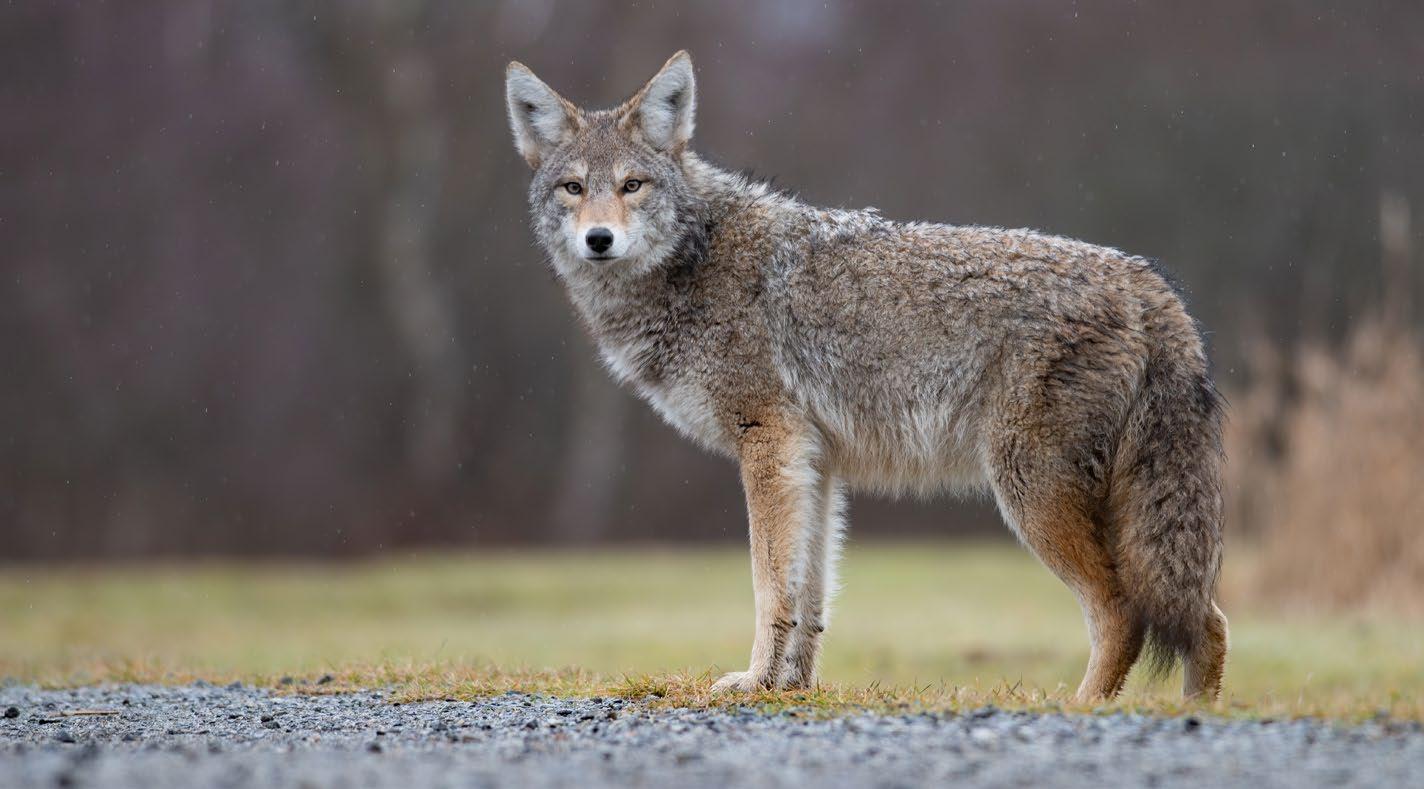
M-44s are spring-loaded devices stuck in the ground and scented with decomposed animal tissue. They blast cyanide into the mouth of any creature that bites and pulls them. They were introduced in 1967, to replace gunpowder-driven Coyote Getters.
M-44s are designed to kill coyotes, foxes and feral dogs that sometimes prey on sheep and newborn cattle. They also kill at least 150 nontarget species.
This April 15, the Trump administration lifted former President Biden’s M-44 ban on the Bureau of Land Management’s 245 million acres, and once again, M-44s will be deployed by the U.S. Department of Agriculture’s Wildlife Services.
“I’ve worked since 1994 with countless people who have lost their dogs to M-44s or been poisoned themselves,” said Brooks Fahy, director of Predator Defense, a nonprofit based in Eugene, Oregon. “M-44s can never be used safely. They are indiscriminate killers, and no young child, dog or wild animal can read a warning sign. I firmly believe it is only a matter of time until an M-44 kills a child.”
During Trump’s first term, M-44s were in widespread use but hugely unpopular. The public wanted them banned. In 2019, when Trump’s EPA issued a proposal to keep them registered for use, there was such public outcry that the agency pulled the proposal.
Four months later, EPA reissued its proposal. During the public comment period, it received 22,390 written responses. All, save 10, opposed continued M-44 registration. The Administrative Procedure Act requires federal agencies to consider
all “relevant matter presented” in public comments. Yet Trump’s EPA ignored the law, and M-44s remained registered until Biden’s ban.
This April 15, the Trump administration bypassed any public comment period, reauthorizing M-44 use on BLM land via a memorandum of understanding between BLM and USDA.
Wildlife advocates are furious. Predator Defense called the Trump administration’s resurrection of M-44s “insane.” Project Coyote called it “devastating.”
And this from Wayne Pacelle, president of Animal Wellness Action: “Reinstituting use of poison bombs sounds like war tactics from 1970s rebel guerrillas in Angola and not the actions of public lands agencies. Their statutory and moral responsibility is to steward native wildlife, not poison the animals.”
So, who’s pushing M-44s back on public land? Whoever it is, it’s not sheep producers, explained Carter Niemeyer, employed by Wildlife Services for 26 years and supervising field agents for much of that time. M-44s were created mostly for them, but they now use guard dogs. Littering public land with poison bombs scented to attract canids is the last thing sheep producers want, he said.
Still, Trump spokesmen claim that the M-44 ban was lifted to benefit the wool industry. There’s widespread speculation that Trump ended the ban simply because Biden imposed it.
“M-44s are unforgiving,” said Niemeyer. “Any animal that triggers one is dead. With traps and snares, you can usually release nontargets. Random coyote poisoning—‘preventive control’—is killing coyotes anywhere and everywhere because one might someday eat a sheep. When we had, say, two coyotes regularly killing sheep, we’d remove them. That’s ‘corrective control.’”
Robert Crabtree, America’s leading coyote researcher, found that random killing creates more coyotes. In natural populations, average litter size at birth is five or six. But competition in summer decreases pup survival to one or two. Random killing reduces competition, resulting in higher survival.
Niemeyer found that random killing also creates chaos by replacing older coyotes that have learned the dangers of depredating livestock with younger, inexperienced coyotes that do depredate.
But random killing is precisely what will now be happening on BLM land.
There has been legislation to permanently ban M-44s on federal lands, but it has been in limbo for years. Thanks to public outrage, there’s new life in a bill called “Canyon’s Law,” named for teenager Canyon Mansfield from Pocatello, Idaho. In March 2017, when he was 14, Canyon encountered an M-44 on BLM land behind his house. He thought it was a lost sprinkler head.
When he picked it up, his 3-year-old yellow Lab, Kasey, got hit in the muzzle and died. Some of the cyanide also sprayed Canyon’s face, damaging his eyes. Until his late teens, Canyon suffered from chronic cyanide poisoning. It’s unclear if he suffered permanent damage.
Americans who love public lands, their dogs and wildlife need to ask their legislators to support Canyon’s Law, H.R. 4180 and S. 2179, banning M-44s. Primary sponsors are Rep. Jared Huffman, D-California, and Sen. Jeff Merkley, D-Oregon. At this writing, there are seven cosponsors.
Longtime wildlife writer and author Ted Williams is a contributor to Writers on the Range, writersontherange. org, an independent nonprofit dedicated to spurring lively conversation about the West.
ADOBE STOCK PHOTO
EVERY DROP COUNTS: WHAT 2025 WATER MONITORING TAUGHT US ABOUT THE GALLATIN RIVER
BY KRISTIN GARDNER AND JADE ALLISON GUEST COLUMNISTS
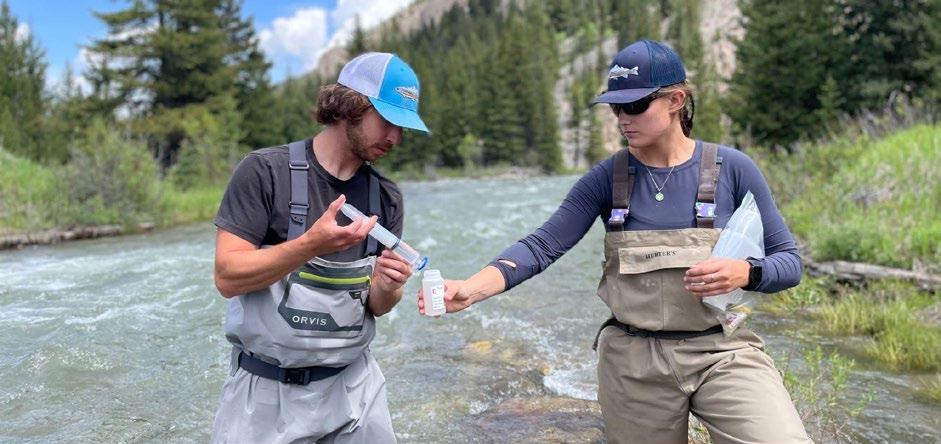
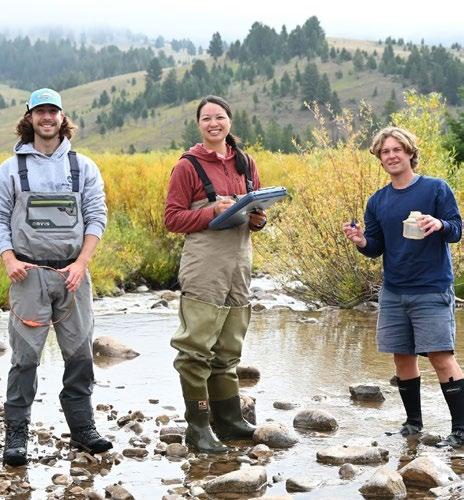
Every year since 2000, the Gallatin River Task Force has collected critical water data to track trends, identify issues and guide restoration and water management decisions. Donning waders and equipped with handheld water quality computers, flowmeters and laboratory sample bottles, our team— led by Chief Executive and Science Officer Kristin Gardner, Big Sky Watershed Corps members and dedicated volunteers— has tracked metrics like pH, dissolved oxygen, temperature, nutrients and streamflow that tell us more about the water quality and quantity in the Gallatin River and its tributaries.
The specific parameters of the testing vary depending on the goals, recent observations and funding. In general, we are looking at specific scientific markers in the makeup of the water along with the measurement of overall flows to help gain insight on the current and future health of the river. We use these insights to inform our work to protect and restore the Gallatin and its associated water resources, with a recent focus on tracking and preventing nuisance algae blooms.
By these metrics, the summer of 2025 provided all the ingredients for an ecological perfect storm for algae growth on the Upper Gallatin River. From our experience monitoring the river on an annual basis, we know that low streamflows and warm water temperatures lead to recurrent algae blooms, more often than not. A warm spring, early snowmelt and an abnormally hot July would be expected to create the exact combination that historically triggers large-scale nuisance algae blooms.
Yet, against the odds, in 2025, the mainstem of the Gallatin remained clear.
While that is a positive outcome, it is not a sign that the river is out of the woods. Instead, the 2025 monitoring season—which marked the final year of an intensive five-year partnership with the Montana Department of Environmental Quality— revealed a highly complex, fragmented reality. The mainstem may have been spared, but three major tributaries—the South Fork, Taylor Fork and Beaver Creek—all presented algae levels that exceeded state thresholds.
As we look at the data, the lesson of 2025 is clear: the science behind the Gallatin River is complex, and our efforts to protect it must adapt to specific conditions. What our testing and results show us is that all areas of the Gallatin’s mainstem and tributaries continue to be nuanced, responding to environmental factors differently. Essentially, the annual water quality monitoring report highlights a stark contrast between the mainstem and its tributaries, suggesting that continued research is needed to determine algae bloom causes wherever, and whenever, they are occurring.
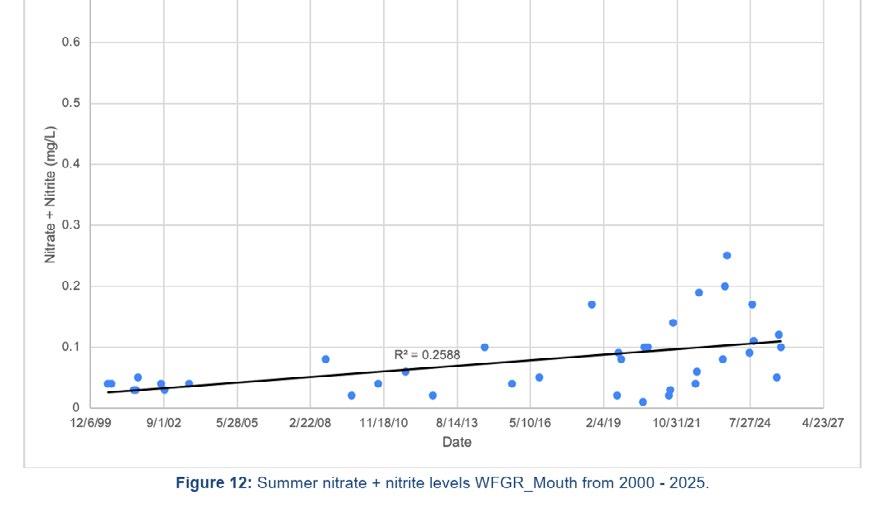
This past year of monitoring told us that despite the late-summer low flows and hot summer temperatures, something was missing to trigger a nuisance algae bloom on the Gallatin’s mainstem. However, the tributaries told a different story. Downstream of Meadow Village in the West Fork of the Gallatin, nitrogen levels continue to be higher than state thresholds, underscoring a known reality that humans are actively shaping the river’s chemistry.
With the DEQ’s intensive algae study wrapping up, the Task Force is shifting its strategy, but will continue to diagnose the broad factors of algae growth and target localized sources of the problem while maintaining our core long-term monitoring sites because we cannot manage what we do not measure. By targeting localized nutrient loading, we can better design projects aimed at reducing nutrients, augmenting streamflows, lowering water temperatures and keeping the mainstem healthy.
The Gallatin is resilient, but it is also giving us a clear warning. It is our job to use these insights to inform proactive protection, focused restoration and continued monitoring programs. Protecting the Gallatin River requires a collective community effort from both the locals who call Big Sky home and the visitors who come to enjoy the unique Montana experience that includes its pristine waters.
The full 2025 data and a shorter summary are available on the Task Force’s website for anyone interested in tracking these trends over time. Please reach out to our team with your questions or to see how you can get involved. Let’s work together for a clean, healthy and beautiful summer for the Gallatin—in 2026 and beyond.
Kristin Gardner is the Chief Executive and Science Officer of the Gallatin
River Task Force.
Jade Allison is a 2026 Big Sky Watershed Corps member with the Gallatin River Task Force.
The Gallatin River Task Force team gathers water data on the Taylor Fork in June 2025. PHOTO BY ROBIN FEDOCK
The GRTF team collects algae samples on Buck Creek. PHOTO BY ROBIN FEDOCK
ENJOYING THE RIDE: EMOTIONAL DETACHMENT OF INHERITANCE BUSINESS
BY HEATHER GOODIN EBS CONTRIBUTOR
Sponsored Article
Grief has a way of rearranging our priorities. A client walks into the office, eyes tired, voice unsteady. She has just inherited a meaningful sum from someone she loved deeply — yet the money feels heavy, almost intrusive. She signs the paperwork, moves the assets into her name, and leaves quickly. She can’t imagine reviewing the accounts; they feel like a reminder of what she lost, not a gift meant for her future.
This experience is far more common than people realize. Inheritance often arrives at the intersection of heartbreak and responsibility, and it’s completely normal to feel conflicted. Our role is to help clients navigate that tension with clarity and compassion. A few guiding principles can make the process gentler:
Pause before making big decisions — The first
months after a loss are not the time for sweeping financial changes. Give yourself permission to simply breathe and handle the immediate estate tasks.
Understand what you’ve inherited — Different accounts come with different rules, tax considerations, and timelines. A review with your financial advisor can help you avoid surprises and identify opportunities, such as a step-up in cost basis.
Make the portfolio your own — Investments built for someone else’s stage of life may not align with your goals. A thoughtful review ensures the portfolio supports your future, not your loved one’s past.
Consider philanthropic ways to honor their legacy — If the assets feel emotionally difficult to keep, donating them or establishing a foundation can transform grief into impact. Philanthropy may also offer tax advantages, depending on your approach.
At the heart of all of this is trust — trust in your advisor, trust in the process, and trust that your loved one wanted the best for you. While none of
us would choose money over more time with the people we cherish, we can choose to manage inherited wealth with intention, gratitude, and wisdom.
Heather Goodin is a Registered Client Relationship Manager at Shore to Summit Wealth Management. She currently works and lives near the Melbourne, FL office with her husband and daughter.
Asset allocation cannot eliminate the risk of fluctuating prices and uncertain returns. Asset allocation and diversification are investment methods used to help manage risk. They do not guarantee investment returns or eliminate risk of loss including in a declining market.
Wells Fargo Advisors Financial Network does not provide legal or tax advice.
Investment products and services are offered through Wells Fargo Advisors Financial Network, LLC (WFAFN), Member SIPC. Shore to Summit Wealth Management is a separate entity from WFAFN.
EBS STAFF CARTOON
ILLUSTRATION BY JACK
REANEY
This one’s a tribute to Luke Breum, the graphic designer best known for his work assembling Explore Big Sky every two weeks.
Luke hails from “The Magic City” of Billings and graduated from Billings Senior High School in 2021. From there, he majored in—you guessed it—graphic design at Montana State University, where he deepened his love for the Bobcats.
With a heart full of courage and a computer soon to be full of .indd files, Luke joined Outlaw Partners and began collaborating rigorously with the Explore Big Sky newsroom, assembling the biweekly newspaper with grace and precision.
“It is a constant battle and puzzle that needs to be solved,” Breum said, beaming.
Writer and videographer Fischer Genau added, “And God gives his hardest battles to his strongest warriors.”
If you enjoy reading this newspaper, now you know who to thank—greatness has a name, and it’s Luke Breum!