D ECEMB ER 6, 2017 O U T FR O N T M AGA ZINE .CO M | F R E E
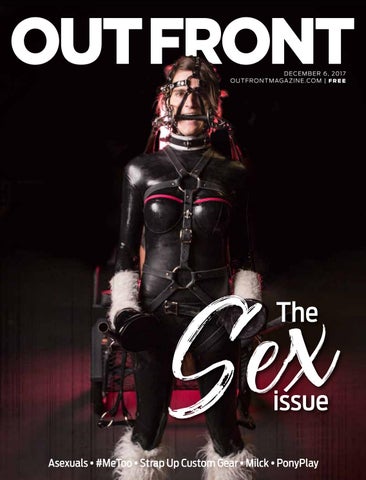
x e S The
issue
Asexuals • #MeToo • Strap Up Custom Gear • Milck • PonyPlay
2 \\ D E C E M B E R 6 , 2 0 1 7
OUTFRONTMAGAZINE.COM
// 3
CONTENTS DECEMBER 6, 2017 VOL41 NO24
42
4 ASEXUALS AND UNDERSTANDING SEX 8 FOR THE LOVE OF THE MALE CROP TOP 10 PONIES, HANDLERS, AND THE COMMUNITY OF KINK 19 MILCK TALKS MUSIC, ACTIVISM, AND #METOO 21 ME TOO 27
40 31
CHRISTOPHER NAIRNS: HE OR SHE 31 STRAP UP CUSTOM GEAR COVERS QUEERS OF ALL SIZES 39 HEY DENVER IS HERE TO HELP YOU ENJOY SAFE, HEALTHY SEX 40 DENVER’S GETTING WEIRD, Y’ALL 46 DUELING WITH DEPRESSION: LIVING IN THE PRESENT
8 4 \\ D E C E M B E R 6 , 2 0 1 7
SERVING THE LGBTQ COMMUNITY OF THE ROCKY MOUNTAINS SINCE 1976 PHONE 303-477-4000 FAX 303-325-2642 WEB OutFrontMagazine.com FACEBOOK /OutFrontColorado TWITTER @OutFrontCO INSTAGRAM /OutFrontColorado FOUNDER PHIL PRICE 1954-1993 ADMINISTRATION info@outfrontmagazine.com JERRY CUNNINGHAM Publisher J.C. MCDONALD Vice President MAGGIE PHILLIPS Operations Manager JEFF JACKSON SWAIM Chief Strategist EDITORIAL editorial@outfrontmagazine.com RYAN HOWE Editor ADDISON HERRON-WHEELER Digital Content Manager BRENT HEINZE Senior Columnist SARAH FARBMAN Copy Editor SOPHIA ALESSI Intern ARIANNA BALDERAMMA Intern WRITERS Denny Patterson, Rick Kitzman, David-Elijah Nahmod, Mike Yost SPECIAL THANKS TO THE BLACK BOX FOR ACCOMMODATING US FOR OUR SEX ISSUE PHOTOSHOOTS! GO DANCE WITH THEM! ART art@outfrontmagazine.com DESIGN2PRO Graphic Designer CONTRIBUTING ARTISTS Charles Broshous, Deirdre Fritz, Eric Magnusson MARKETING + SALES marketing@outfrontmagazine.com HARRISON SCHAFFER Director of Sales & Marketing DANNY GREGORY-O’SHEA Marketing Executive BRENNAN GALLAGHER Marketing Executive NATIONAL ADVERTISING Rivendell Media 212-242-6863 | sales@rivendellmedia.com
DISTRIBUTION
OUT FRONT’s print publication is available semi-monthly, free of charge, one copy per person. Additional copies of OUT FRONT may be purchased for $3.95 each, payable in advance at OUT FRONT offices located at 3535 Walnut Street, Denver CO, 80205. OUT FRONT is delivered only to authorized distributors. No person may, without prior written permission of OUT FRONT, take more than one copy of OUT FRONT. Any person who takes more than one copy may be held liable for theft, including but not limited to civil damages and or criminal prosecution.
COPYRIGHT & LIMIT OF LIABILITY
Reproduction of editorial, photographic or advertising content without written consent of the publisher is strictly prohibited. Advertisers are responsible for securing rights to any copyrighted material within their advertisements. Publisher assumes no responsibility for the claims of advertisers and reserves the right to reject any advertising. Publication of the name or photograph of any person or organization in articles or advertising is not to be considered an indication of the sexual orientation or HIV status of such person or organization. Publisher assumes no responsibility for the loss or damage of materials submitted. OPINIONS EXPRESSED are not necessarily those of OUT FRONT, its staff, or advertisers.
RESERVATION OF RIGHTS
Q Publishing Group, LTD is the owner of all right, title, and interest in the OUT FRONT brand and logo. No person or entity may reproduce or use (or authorize the reproduction or use of) the OUT FRONT brand and logo in any manner other than expressly authorized by Q Publishing Group. Unauthorized use of the OUT FRONT brand and logo is strictly prohibited. OUT FRONT is published by Q Publishing, Ltd., a Colorado corporation and is a member of: NEPA, Denver Gay & Lesbian Chamber of Commerce, and Denver Drama Critics Circle.
OUTFRONTMAGAZINE.COM
// 5
Sex Asexuals and Understanding
By Addison Herron-Wheeler
hey are the A in LGBTQIA, but they often get overlooked, especially when the conversation is about sex. They also often get shut out of the community, or treated like they aren’t a sexuality. But asexuals are diverse, welcome in our circles, and represent a very important part of the conversation when it comes to sex.
Sexuality is already an incredibly complicated topic. Many struggle for years trying to figure out if they are gay, straight, lesbian, bi, or somewhere in between, and those who are not cisgender also have to deal with the intersection of their sexuality and gender identification. For those who are asexual, it can be even more complicated, as others often don’t believe or accept an individual’s claims about how he, she, or they identifies. “One of the biggest issues for coming out with asexuals is 6 \\ D E C E M B E R 6 , 2 0 1 7
that you just aren’t believed,” explained Elliot, local leader of Colorado Ace Space, a meetup organization dedicated to providing resources for those who identify as asexual or gray-ace (somewhat asexual or less sexual). Colorado Ace Space is a branch of a larger, national Ace Space network that caters to asexuals in many different cities. The purpose of these groups is to be a hub for all things ace, since the people in this community often lack resources. “People say ‘you haven’t met the right person yet; you’ll grow into it,’ or other, similar things,” she continued. “When some of my gay friends came out, their biggest concerns were whether their parents were going to kick them out, but in the case of being asexual, it’s actually ‘how do I convince them that this is a sexuality and it’s mine?’” Those who identify as asexual also often have a hard time being understood. One common misconception is that asexual people
do not have sex. There are different levels of being asexual, and some have sex, some do not. Those who are sex-repulsed will probably never have sex with a partner, but many asexual individuals have sex as a regular part of their relationships. It is also a misconception that asexual people do not have sex drives. They do; rather, they experience a lack of attraction. “People have described it as having the urge without an aim,” Elliot explained. “It’s like you feel that sexual urge but then when you actually envision touching that person or having sex with that person and start going through a rolodex of different people it’s kind of like ‘um no, that doesn’t appeal to me,’ but you still feel kind of biological sexual urges. A lot of asexuals will use the analogy of being a straight guy with all your buddies. If you’re super horny, would you want to sleep with the guys you’re with? Probably not, if you’re straight and only like women. An asexual person is the same way. They feel the urge, but they don’t have a focus on either gender.” Some asexual individuals feel that urge more than others, or have more of a focus for their sexual desires. While certain individuals are completely sex-repulsed, meaning they don’t find the idea of sex appealing at all, others simply experience less sexual attraction than most, and reside in more of a gray area. When courting a human who identifies in some way as asexual, it is important to understand how that person feels about sex and what is and isn’t in the cards when it comes to that relationship. This doesn’t automatically mean that sex is not in the picture, but it can in some situations. “I think when you have a sexuality that may not align with whomever you’re with, you have to be really open about it,” said Elliot. “But if you feel it is going in a serious direction or you’d like it to go in a serious direction, I think there needs to be discussion about what the person needs, what you’re comfortable with, what they’re comfortable with, because a lot of people find that sex is a huge part of the relationship, and for some people not so much, even if they are non-asexual.” She explained that the experience will be different for each person, not something that can be generalized by how someone identifies, like with all queer people. “There are some asexuals who are sex-favorable or sex-neutral, but there are some who are sex-repulsed, so they need to be upfront about that,” Elliot added. “If they are sex-repulsed it is very, very unlikely that they are going to stop being sex-repulsed, so if that is going to be an issue it needs to be discussed. There are a wide range of identifications, so don’t assume someone hates sex, but also don’t assume you can convince them to like it.” The best way to become more educated on the topic of asexuality is to speak to people in the community who identify this way if you know them, or learn more about the subject by visiting forums, going to meetups, or reading online information. If you or someone you care for identifies as asexual, there are resources for community and understanding the identity better. Visit Facebook.com/ColoradoAceSpace to learn about community meetups, make some new friends, and seek advice or networking. Ace Space organizations are also available in many other cities to those looking for community. OUTFRONTMAGAZINE.COM
// 7
FOR THE LOVE OF THE
Male Crop Top By Denny Patterson
W
ithin the past couple of years, the male crop top trend has slowly but surely made its way back into the media, fashion, football, and festivals. The biggest spike seemed to be when Kid Cudi performed in a crop top at Coachella in 2014, which sparked hot topic social media hashtags like #boysincroptops and #croptopmovement. But, is this trend really a movement? The male crop top dates back to the 1970s and was highly popular throughout the 80s. Perhaps it’s simply a movement to bring the trend back in style—and I am completely, 100 percent on board with it. The male crop top was originally created by men for men and was a part of men’s fashion before women began wearing it. Weightlifters in the 1970s would cut the bottom of their shirts to get around gym dress codes that prohibited them from being shirtless. Crop tops soon spread to other sports and were often seen in football, track and field, and cross country. In the late 70s, it was common for men to wear a crop top to disco dance clubs. Who can resist a man with his navel proudly on display? Once the 80s rolled around, it became the golden age of crop tops. Name-brand clothing retailers such as Nike and Adidas were marketing cropped shirts and sports jerseys to teens and young men. Males from ages three to 60 would be seen out about with their stomachs showing. School, malls, you name it. In addition, even Hollywood glorified them in numerous films, including Johnny Depp in A Nightmare on Elm Street, Bill in Bill & Ted’s Excellent Adventure, and characters in Ernest Goes to Camp, Sleepaway Camp, Over the Edge, and Weird Science. Unfortunately, as time moved on, crop tops for men started to become obsolete and taboo. Unless you were a jock or punk, if you were a boy wearing a crop top, you were instantly assumed gay and feminine. F*ck those stereotypes. I have been a fan of male crop tops, ever since I was a kid. The earliest memory that sticks out to me is when I was watching National Lampoon’s Vacation. When the Griswalds visit Cousin Eddie, the oldest son, Dale, can be seen sporting cut-off jean shorts and a shirt that stops a couple of inches above his belly button. In addition, he wasn’t a skinny kid. He had a little bit of a belly. Now, why did this look appeal to me so much? To be honest, I do not know. It just looked cool. Even more, boys wearing crop tops were prevalent in cartoons like Hey Arnold and Cow and Chicken. I wanted to wear shirts like that.
8 \\ D E C E M B E R 6 , 2 0 1 7
However, I was a husky kid and super self-conscious, so like hell I was ever going to wear a crop top around anyone or out in public. I think that is a reason why many guys aren’t jumping on the crop top bandwagon. It’s disappointing. Society has built up this image of what the ideal guy should look like—and this goes for the LGBTQ community as well. Guys with six-pack abs should not be the only ones showing off. If you’re in the bear community and weigh 300 lbs, you have just as much right to flaunt it. Although I am no longer a husky kid, I would consider myself to be a cub, and I love wearing crop tops. I have several homemade ones and a cropped hoodie from Urban Outfitters. Just because I have a belly, I shouldn’t restrict myself from being comfortable. If you don’t like the way I look, that’s not my problem. It has been said before, and I’m going to be totally cliché, but clothes aren’t what makes the person. I would recommend checking out Marek+Richard, Calvin Klein, and Baldrick Benjamin. These clothing brands will fulfill all your crop top needs. Who would have known that my sexual fetish is actually helping me to love myself even more? A couple of months ago, I wore a crop top in public for the first time at a bear bar. It was liberating. It doesn’t matter if you’re gay or straight. Don’t let the idea of a crop top scare you. The manliest of men have worn them with no regrets. Look at Ezekiel Elliot, Zac Efron, and teenage Kevin from NBC’s This Is Us. Not only do they keep you super cool in the summer, they’re comfortable and freeing. You will thank me later.
OUTFRONTMAGAZINE.COM
// 9
By Addison Herron-Wheeler
Photos by Nicole Daniels
Ponie 1 0 \\ D E C E M B E R 6 , 2 0 1 7
H
es,
Handlers, and the Community of Kink OUTFRONTMAGAZINE.COM
// 1 1
ink and fetish play are certainly sexual in nature, but beyond just a way to spice things up in the bedroom, , they are also tools for letting go and relaxing, as well as a way to build unconventional community. The Rocky Mountain Pony Herd is offering such community to their members. While the ponies and their handlers who are coupled up like to experience ponyplay behind closed doors, they also enjoy hanging out together in character and having fun, being an outlet for community members who might be interested in the fetish, and even competing in pony events that involve being judged on how well they portray the animals. Blaze, who started the herd and serves as its leader, admitted that he was always into the concept of pretending to be a horse, even before he understood things like sex drive or fetishes. “I know for me as a kid, I ran around on the playground pretending to be a horse, and I know a lot of people, at least people who socialize as women, who did the same thing,” Blaze told OUT FRONT. “I’m a trans man and until my early 20s I identified that way [as a woman], so for me as a kid it was normal to go around doing that; it was innocent, play pretend. But as far as it extends outside of the bedroom now, it is really nice to know there are others like yourself in the community, and that is what the meetup is for.” The Herd likes to do public events that don’t center on sex, but rather on companionship. At the events that include dressing up in full gear, like Ponies in the Park, those who do not have a handler can be paired up with a platonic buddy who is willing to guide and control the pony during playtime. The group regularly meets up in local parks to run and play as ponies, set up obstacles, and also eat food and socialize. They always agree on a location for the meetup and and a date and time in advance through the private online group. For those who are not sure they definitely want to engage in a pony play, they also do a Munch event where the group meets up at a restaurant in street clothing just to talk. They normally put out some kind of a token, like a horse calendar, to show those interested in approaching the group and seeing if they want to participate that they are in the right place. At these Munches, interested parties are welcome to chat with the ponies and just make small talk, get to know some people, or ask questions about play and what it involves. No one is ever pressured to keep coming back or to attend and dress in gear if they come to a Munch. Those who do decide that pony play is right for them often experience a relaxing escape when they don their pony gear. In the realm of the pony, things like bills and day jobs don’t exist. The only things that are real are the relationship with the handler and the experience of being something else. “For me it’s an exercise,” Blaze explained. “It gets me out of my head, provides escape. I think for me the escape is the bigger part, and there’s no sex involved typically for that aspect of it. I go out and play in a park and all I’m doing is running around pretending I’m a horse. When I put on my pony hood and my tail, I become someone different. It’s sort of like going 1 2 \\ D E C E M B E R 6 , 2 0 1 7
into character, but my headspace is somewhere else. All the responsibilities and worries melt away; all I have to worry about is my handler and what my handler tells me to do.” He has even experienced a release from physical pain when in the mindset of a pony. “In my horsehead space I don’t know what pain is,” he said. “I’ll keep going and going and going. I think what a lot of people imagine is, you know, kinky, fetish stuff that happens inside the bedroom, which for sure it is, but there’s another side. It’s physical, but it’s also mental. It is also important to Blaze that the group is inclusive. Blaze is a trans man, one of the key pony/handler couples who attend the group are trans women, and many of those who participate in the group identify as queer. Blaze knows first-hand that unfortunately, this type of inclusion isn’t always typical in the fetish community.
OUTFRONTMAGAZINE.COM
// 1 3
“When I started the group I was really unsatisfied with a lot of happenings in the Denver community,” he said. “There are a lot of important people in the kink scene that do questionable things and I was tired of seeing people get hurt and having the people that hurt them not receive any consequences. That’s what made me step back from the Denver BDSM community in the first place, and it’s not a Denverspecific problem unfortunately.” After witnessing these problematic situations, Blaze decided to form the Rocky Mountain Pony Herd. “When I started, I wanted to hold a safe space not just for trans and queer people, but also for people who needed a space to come and feel included so that they wouldn’t be stuck at home alone having these feelings with nowhere to express them and not feeling safe enough to go out and find a community, because they had been burned before,” he added. “I think in my group I really strive to make people feel included; I strive to center those who have been marginalized and who are more likely to be victimized in the kink community.” Those interested in learning more about the Herd and coming out to a Munch can find Rocky Mountain Pony Herd on FetLife.com and get in touch. Due to privacy desires from the group members, that is currently the only way to get make contact.
1 4 \\ D E C E M B E R 6 , 2 0 1 7
OUTFRONTMAGAZINE.COM
// 1 5
1 6 \\ D E C E M B E R 6 , 2 0 1 7
OUTFRONTMAGAZINE.COM
// 1 7
1 8 \\ D E C E M B E R 6 , 2 0 1 7
Milck
Talks Music, Activism, and
#MeToo
By Arianna Balderamma
“
am a vessel in a lot of senses and the art I create is bigger than me.”–Milck
Based in Los Angeles, Milck, a pop artist, does not stray away from activism. Her sound centers around soft piano with empowering lyrics that touch on some of the most prominent social issues making their way around social media. Calling herself an introvert, Milck has found her voice based on the songs she creates. “Milck is the manifestation of my inner voice,” she told OUT FRONT. “I remember even from being a very young woman, I always felt suffocated, but I didn’t have the tools or the bravery to speak out for myself. I thought if that was possible that would mean I would get hurt or in trouble, so I created Milck.” Getting told as a child in a traditional Chinese-American home to sit still and be quiet simulated a sense of asphyxiation in her forms of expression. Suppressing her voice only led her to fantasize about what could be said. The birth of Milck began from diminuendo, but it led to a large crescendo. “Milck is an outward manifestation of those things I need to be in order to protect myself and feel like a strong woman.” However, despite her desire to be heard, Milck describes herself as an accidental activist. In her latest music video for her song “Quiet,” she highlights the issues of sexual abuse and the mistreatment of the trans community. Her experience with sexual abuse drives her to discuss social injustices in her music. The importance of inclusivity is displayed in the goal of Milck’s work. She uses her platform as a way to communicate and bring light to the issues she thinks are important. OUTFRONTMAGAZINE.COM
// 1 9
Milck was a part of the #MeToo movement. She described the #MeToo movement as “helping to dispel that sense of isolation and to create a sense of togethernes, which is what the Women’s March also did for a lot of people too.” The majority of Milck’s music sends out a message of improving one’s self confidence, and loving the skin you are in. Not only does her music promote self-reliance, it expresses Milck’s own battle between revealing her vulnerable side and voicing her powerful side. Her pop sound encapsulates raw moments that are seen as a rarity in the industry. We chatted with Milck about music, activism, and the future. Check it out!
How would you describe your sound? I’m not a loud person but I use my personal, introverted tools to protect myself and speak, so there are moments of swelling and crescendos with the music but there are also really vulnerable and naked moments with the music because that’s how I am—that’s how a lot of people are. We have these strong sides and then we have really vulnerable sides to ourselves. I think exposing both sides is important, especially during this time when there is a lot of machismo, ego, abuse of power going on in our society.
What are some issues you are focusing on through your work currently? There’s this thing called the Bechdel Test for film. The Bechdel Test is basically a list of requirements for a movie, some of them being like if there’s a scene with two women talking to each other they need to talk about something other than a man, so you can check off requirements and if it passes the Bechdel Test it is progressive and expanding on the narrative of what a woman can be. One of my friends that is into film and she was listening to my music said, “Your music passes the Bechdel Test.” I don’t have a lot of songs about love with a significant other. It’s more like love of yourself and the journey of becoming your own hero. I find myself writing a lot about family and forgiveness, and also just coming out, coming out of hiding, and breaking that sheet of silence; that’s a pretty big theme for my music. I’ve always liked hip hop music that has themes of perseverance, that struggle, that fight, and I’m like the opposite of what a rapper is, but those themes do come through in my music.
Do you feel more artists in the music scene should use their platform as a voice to promote a better society? I see myself as someone who believes that we can be better and really cares, and so naturally in this time of chaos, I’m becoming an activist, and especially with the song “Quiet.” I was using the term “accidental activist” at first because I remembered standing at the Women’s March and thinking 2 0 \\ D E C E M B E R 6 , 2 0 1 7
to myself, “Yeah I want to be an activist.” But, I had so much to learn, and then as the song went viral and all these organizations started reaching out to me, all the activities have taught me what it means to dedicate our life to making society better. I’m learning as I go, and I think it’s in my blood just because I care. I tend to be an optimist because I’m not discouraged and I want to keep going. I think artists’ jobs are to be completely honest and the people who naturally want to be part of the change will become activists and use their platform. I naturally gravitate towards artists who do something good, but my job as an artist isn’t to convince people of my political views. I am a vessel in a lot of senses and the art I create is bigger than me. I do my best to create the most timeless music I can and people are going to do with the music what they will. What people have done with my song is used it as a tool for activism. If people want to use it as a tool for self-healing and not activism that is just as beautiful, because that was the intent of the song for me originally.
How do you feel the #MeToo campaign impacted women and people who have dealt with sexual assault? Why did you feel it was important to support? I think the #MeToo movement is helping to dispel that sense of isolation and to create a sense of togetherness, which is what the Women’s March also did for a lot of people. The #MeToo movement, I think, is a very symbolic event because what it is is calling people out who are abusing their power to abuse others. And it’s in the sexual realm, like sexual assault, sexual abuse. There are so many different types of abuses of power all over our world and this is the first step, because once we can confront the most personal assault, which is sexual assault, we can bring that bravery and help people to figure out how to better battle political abuses of power, economic abuses of power, and help cleanse society. I think being a part of this movement is an honor because for the first time I am seeing women rise fearlessly about something that is a poison in our society, and addressing this will be the beginning.
OUTFRONTMAGAZINE.COM
// 2 1
Me Too By Rick Kitzman
have been raped.
Too much, too soon? No other words will suffice. My memory is my only proof.
Since the tipping-point exposé of Hollywood producer Harvey Weinstein, an avalanche of sexual abuse accusations, some decades old, are cascading across headlines. The Roy Moore story has grabbed the spotlight as a glaring example of the division within America because he is a man of God with our president’s endorsement. This rabidly religious Republican Senate candidate from Alabama, a judge twice removed from the bench, has been charged with allegations ranging from creepy behavior to sexual assault. His reprehensible behaviors against teenage girls have not deterred him from a war on Washington, the media, anyone and anything that does not embody evangelical Christian morals. 2 2 \\ D E C E M B E R 6 , 2 0 1 7
One of Moore’s nine accusers is a woman now in her fifties who was a 14-year-old girl at the time of his sexual abuse. I read that during those encounters she felt she “couldn’t wait for it to be over.” And suddenly, I had the same feeling.
An almost-four-decade-old memory played back in movie-like clarity: the early 80s, New York’s notorious St. Marks Baths, struggling, adamantly saying no to a tall and cute, dark haired young man throwing me down on a divan in a dark alcove, overpowering me, forcing himself inside me, holding my head so my cries were muffled. Lying on my stomach, I realized fighting would be more damaging, so I relaxed and couldn’t wait for “it” to be over. When “it” was over—thankfully, a short time—I whispered timidly, “I said no.” The guy chuckled, smacked my ass, and said, “You loved it.” I replied, “No, I didn’t.”
I found my party pal and told him what happened. He sneered, “You can’t rape the willing.” I should have ended that friendship then and there. For days, I was sore and bleeding. It was about the time I became HIV positive, and I wonder if my seroconversion began that night with that man. It’s a moot question no answer will satisfy. Afterwards, I reasoned I was responsible for choosing that situation, and felt, not that I got what I deserved, but that I had little excuse to complain, and certainly no one to complain to. Besides, I did not want to admit what happened. Real men don’t get raped, a gross stigma of weakness. If I’d been a strong, straight man, this never would have happened. I was in my late 20s; gay sexuality was exploding in the New York gay mecca. My nascent definition of manhood and issues of masculinity and body image contributed to a feeling— because I was proven helpless—that I was not even a good enough, butch enough gay man. High self-esteem was not my strong suit. Not a complete wimp, I was angry someone would take awful advantage of me in what was supposed to be a fun scene. I was angry, feeling horribly betrayed by a member of my own, special, wonderful tribe.
the presidential seal of approval. That stamp of authenticity represents specifically his office and metaphorically our nation. Resonating worldwide, his views on the issue grant supporters license to think and act likewise. Trump’s three points defending Moore (and himself)—denial by the accused, the lengthy time before accusers came forward, and implied lying (specifically in Trump’s case)—are typical tactics used to discredit the abused. Proof is often only memory, a memory that never escapes forever and demands disclosure and closure. After the Weinstein scandal, 50s and 60s film star Gina Lollobrigida, now 90, announced on Italian TV she was sexually molested at 19—a seven-decade memory admitted for the first time. Those who choose to report abuses years later can suffer stigma again, exacerbating an already complicated and emotional experience: mocked, shamed, ostracized, mistrusted. The victim is blamed again, and the culprit escapes unscathed. Many victims just want to be heard. The catharsis of revealing pain can create a spiritual, mental, emotional, and physical healing. Shared with others, individuals have the chance to rediscover their shared humanity.
I don’t remember telling a soul about my rape. After almost four decades of disconnection, I knew I needed to reconnect to this revelation.
Let us hope the good citizens of Alabama find their humanity and defeat Roy Moore, and indirectly our Sexual Abuser in Chief.
One morning, I sat still and quiet. I separated my mind from my environment with as much detachment as I could and viewed the movie-memory. I consciously and deliberately witnessed myself living that experience: the surprise, fear, helplessness, failed struggle, vulnerability, forced surrender, pain, depression, anger, loneliness, weakness, embarrassment, shame. I became overwhelmed with sadness for the Rick in his twenties, so young and passionate and hopeful. He was full of the promise, wonder and discovery New York offered, of being gay, the ecstasy of dancing, the fun and laughter with great friends. I failed him. I could not protect him from a horrible violation, yet because of that Rick’s resilience and courage, he did not let that horrible violation deter him from the joys life offered.
Alabamians should know these statistics from the Centers for Disease Control: Under-reported abuses are legion. Nearly one in five women and one in 71 men reported experiencing rape at some time in their lives. Before they turn 18, one in four girls and one in six boys will be sexually abused. Sexual abusers of children are 96 percent male. At the time of their first rape or victimization, 12.3 percent of women were age 10 or younger, 27.8 percent of men were age 10 or younger, and 30 percent of women were between the ages of 11 and 17. Violent sexual assault percentages were much higher for youth and adults identifying as LGBTQ. Averaging age 12, 325,000 children are at risk of becoming victims of commercial child sexual exploitation each year. Annually, rape costs the U.S. more than any other crime—$127 billion.
With love and compassion, I apologized to my Rick for not acknowledging what he went through alone these past 37 years. I honored him for the tough little f*cker he was then. And is today. Memory is all the proof I need.
Polls indicate Moore might still win. Why? Because his tribe has hunkered down to defend their hero against a lying, liberal media. Because what’s so bad about what he did; as a supporter said, Joseph had Mary and she was a teenager. Because good Christians must save this country from evil. Because there is a bigger picture at stake: more conservative judges, overturning Roe v. Wade, destroying same-sex marriage.
Yet memory, and its potential fallibility, is often a weapon of attack by sexual abusers. From the White House lawn, our president defended Moore: “[He] denies it. Forty years is a long time.” Poof! Fake news. Moore is innocent. That America rewarded Donald Trump, a repeat sexual abuser, with our highest elected office is old news. Naysayers may neigh all they like, but facts and indisputable truths—not fake news—condemn the man with his own words, credible accusers, video and audio recordings. Despite lying and absurd denials, he knows it; every citizen knows it; the world knows it. When our golfing president endorses an habitual and predatory sexual pervert like Moore, he gives sexual abuse
What can be done to combat sexual abuse in our country? (I have ideas, but they involve prods.) There must be ways for anyone harassed and abused to report grievances without threat of retaliation, to have access to equal pay and career opportunities that avoid rapacious mentors in the workplace. Exposure to appropriate and inappropriate behaviors could begin in kindergarten. For the holidays, The Girl Scouts issued guidelines that discourage automatically hugging adults as a way to set boundaries. On 9News Next, Colorado’s Governor Hickenlooper recommended procedures that are “quick, safe, and equitable.” OUTFRONTMAGAZINE.COM
// 2 3
As a former human resources director, I began sexual harassment training in the mid-90s, now ubiquitous in the professional world. Congress’s recent declaration to begin this training seems 20 years too late, like training foxes how to guard the hen house. Other than awareness, instruction yields questionable change-of-attitude effectiveness. As legal defense, it protects employees, but more importantly, their employers. I’ve fired dishwashers and executives for failure to adhere to clearly outlined policies. Someday, I’d love to say to Trump, “You’re fired!” Despite knowing Trump was a sexual abuser to a despicable degree, America hired him. The day after the president’s inauguration, millions of women worldwide echoed Michelle Obama’s outrage: “Enough!” The Women’s March on Washington mushroomed into a people’s march on the world, a protest of his sexually abusive behaviors, but also of the women’s rights he threatens: access to health care, birth control, equal pay. If anyone doubts the president’s denigration of women’s issues, try finding “The Rape and Sexual Assault Renewed Call to Action Report” on the White House website. You won’t. It was pulled in August and, like missing links to LGBTQ and climate change issues, has no support from the president. Sexual harassment headlines are not new. In 1991, Anita Hill testified before an all-white, male Senate Judiciary Committee, accusing then-Supreme Court nominee Clarence Thomas of sexual abuse. She recently criticized former Vice President
2 4 \\ D E C E M B E R 6 , 2 0 1 7
Joe Biden, who chaired that committee, for his failure at the time “to show leadership on this issue on behalf of women’s equality.” The president who submitted Thomas’s name? George H. W. Bush, recently accused of groping teenage girls. “The wheels of justice grind slowly, but exceedingly fine, and pride goeth before a fall (Proverbs 16:18).” Trump, Moore, Thomas, all sexual predators, one can hope will fall hard— including mine, if he’s even alive. My rape—words I never thought I’d write—never seemed important enough to give it power over living my life. I do not fool myself that this unearthed memory, buried for decades, may hold unknown hurts that require the bright light of clarity. For now, I feel surprisingly relieved. I do not diminish my experience nor overinflate my understanding of violent sexual abuse and rape. It happened. It was unfortunate. I moved on. Millions do, but with deep, long-lasting damage. I was lucky. Lucky today to be healthy, relatively happy, blessed with great love from a partner, family, and friends. I’ve thought about their possible reactions (my partner knows): embarrassment, awkward engagement, avoidance, concern. Before deciding to tell my tale, those were my reactions. It will be interesting. I owe Leigh Corfman, who courageously declared “Enough!” and reclaimed herself when she was a frightened 14-yearold girl in Alabama. The safety of our country’s children depends on more victims exiting the closet of sexual abuse. The cumulative strength can confront the issue and hopefully effect change, so other victims can courageously declare: Me Too.
Tim Timmons Born: June 14, 1941 Passed Away: November 21, 2017 Tim was born and raised in The Bronx, New York and is survived by his sister, Linda Robinson, and countless nephews and nieces. After leaving the Navy, Tim lived in San Francisco, CA and Houston, TX before moving to Denver, CO. Tim was a founding member of Colorado Aids Project, The Tavern Guild, The GLBT Community Center, and The Grey Stocking Review, and has been an important part of Denver's LGBTQ Community. He was a manager and owner at Mike’s, a manager at Tracks and The Foxhole, and worked at Charlie's for the last 15 years. He loved to build things and travel with friends, and was always in charge of the fire while camping, which is how he earned his nickname, "Gandalf."
OUTFRONTMAGAZINE.COM
// 2 5
2 6 \\ D E C E M B E R 6 , 2 0 1 7
Christopher Nairns: HE OR SHE
OUTFRONTMAGAZINE.COM
// 2 7
By Addison Herron-Wheeler
t may be a cliche that being sexy is a state of mind, but it’s also true. Despite the increasingly unrealistic images of beauty presented in society, now more than ever, people of color, people of size, and those who defy the gender binary and don’t fit into a box, are feeling empowered and attractive. OUT FRONT spoke to Christopher Nairns, a queer, plus-sized man of color who identifies as femme, about how he reaffirms his beauty and sexiness to the world every day.
How do you feel that being a femmeidentified gay man relates to your sexuality? Why is this identity important to you? I feel like we’re kind of underrepresented in the community. You look at the cover of magazines, articles, TV shows; it’s always two really masculine men with each other, and I feel like that construct in the gay community makes it tougher to date or meet people.
How do you think body image plays into sexuality and confidence, and how can we be more affirming? I think it all depends on the individual. It really depends on how they feel about themselves and how they portray themselves when they are out in the world. If you’re confident in who you are and you feel like you have great attributes, you can lean on those when you interact in the world. If you think you are a bigger individual, then just dress your best. That’s what I do; I feel like my fashion, my style, is really different. I moved here from Boston and D.C., and I feel like my fashion aesthetic is more gender-neutral. I would say it’s just up to the individual, rather than just playing into social norms and how society views you or views masculine or feminine roles. Times are changing.
What, to you, are the sexiest characteristics a person can have? I would say the sexiest characteristic a person can have is intelligence. There is nothing like having an amazing conversation and a connection with someone. I like the dialogue and banter and being able to talk about fashion and politics and how the world is progressing. To me that’s the sexiest thing, how you connect with someone.
How do you feel that race plays into sexuality, and how can we be inclusive without being fetishizing?
2 8 \\ D E C E M B E R 6 , 2 0 1 7
Everybody has their preferences and I think those preferences come from biases sometimes, and it’s all about breaking down those barriers. People might think that African Americans are ghetto or Spanish people live in the hood or whatever their biases are, but to me it’s a case-by-case basis and you can’t make generalizations. I always try and break down barriers, whether it is in my personal business or meeting someone; whether it is about real estate or what’s going on in the community, you walk away feeling more informed or having a vantage point about what it is like to be like someone else.
What stigmas do you think there are for more feminine men in our society, and how can we get away from these? I think some of the stigmas that you face are people see someone that is wearing makeup and lipstick, and to me those people are strong, being able to walk out the door and present yourself differently then you should be, but people think if you’re a man you should be a masculine man and hunt and fish and not enjoy things like dresses and jewelry. I always relied on being able to be emotionally intelligent and not put myself in danger, just being able to navigate and lean on my intelligence to get me through and just use my confidence. I love handbags and dresses and great makeup, but I feel like you can do that and not be weak. Some people might view you as being less than masculine and weak, but that’s not true.
What does sexiness mean to you? Sexiness is different for each person; that’s really an individual thing. I feel like people are really attracted to brightness and cheerful, happy people. Also if you are charismatic and present yourself in a cheerful, happy way, people like that. I get so much business just from being different and confident. To me my confidence is sexy. I’ll just walk into a room and own that room; people will want to know who I am.
How can we each be more confident and love ourselves more, despite society’s standards? Sometimes it’s just a really good role model. When you don’t see someone that looks like you, then be that role model for someone who looks like you. If you’re a bigger person and trying to find out where you fit in and how you should dress, you’re the role model now. Every day I look in the mirror and I say positive things to myself, and I say positive affirmations because we are so hard on ourselves sometimes, rather than just living up to our own standards or being the best person we can be. I’m always that listening ear, that person people in my circle come to for advice.
OUTFRONTMAGAZINE.COM
// 2 9
Buddy Bravo currently works as Senior Designer for Romantix Adult Store, a Denver based Adult Retailer. With a Fine Arts Degree and endless ideas in his head, he offers 100% original artwork for the brand. While many graphic designer rely heavily on stock photography and illustration, Buddy is dedicated to creating every piece of art from scratch. See more of his professional and personal work at www.buddybravo.com
3 0 \\ D E C E M B E R 6 , 2 0 1 7
By Ryan Howe
Strap Up
Custom Gear Covers Queers of All Sizes OUTFRONTMAGAZINE.COM
// 3 1
ou’ve seen them around town. They proudly stand shirtless behind a small pop-up table littered with multi-colored harnesses. Or maybe you’ve seen them fitting those same harnesses on bar-goers. Often they are sporting one of their own creations, handing out business cards, and shamelessly flirting their way through Denver—all for the sake of their company, Strap Up Custom Gear. Stephen Hook and Lou DeLucia took the traditional styles of leather harnesses, added some color, made them vegan, and set out to make people feel comfortable in sexy, fun, handcrafted gear. “Sounds easy, right?” Delucia said after passing a pre-rolled joint to his business partner. “It ain’t. This is hard work, but we really, really love doing it. And it seems that people are loving us as well.” He wasn’t wrong. Hook and DeLucia started Strap Up Custom Gear two years ago. After DeLucia attended bear week in Provincetown, Massachusetts, he saw a market for people who wanted fully customizable gear—preferably on the cheap but with style.
3 2 \\ D E C E M B E R 6 , 2 0 1 7
Photos by Nicole Daniels
OUTFRONTMAGAZINE.COM
// 3 3
“Honestly, I love what we do so much that I don’t mind if things get a little crowded. I just have to figure out where to put our new sewing machine.” The small team is still looking for ways to streamline their production. As they continue to grow, they aren’t letting their lack of manpower stop them from delivering exceptional pieces every single time some places an order. Instead, they are finding better ways to mass produce. That includes a new sewing machine that will claim what little floor space is left in the garage. “Strap Up is our baby and babies grow faster than you think,” Hook said. “A baby made with love and lot’s of joints.” But that love doesn’t end within the walls of Hook’s garage in East Denver. The business partners are both part of the bear community, and know the importance of body image within the community that is mostly comprised of bigger, hairier men. So, naturally, they want their
Once he got back, he convinced Hook to join him in making gear for people of all shapes and sizes. Hook was immediately on board, and together they hit Jo-Anne Fabrics. The material they landed on? Seatbelt webbing. Yes, the fabric seat belts are made out of. One of their first harnesses was worn in bear (not the animal) porn. Another, a blue harness that is now discolored with sweat and dirt, is safely in storage in their makeshift studio. Since their trip to Jo-Anne Fabrics and gearing up porn stars, Strap up Custom Gear has boomed with growth. Now producing large quantities of harnesses for stores in both Colorado and Florida, the duo has moved on from buying pre-printed material, and started designing their own. “Not much seat belt material comes with paw prints or our communities’ different flag colors,” DeLucia said. “Luckily, we found a supplier who allows us to give him custom designs. It’s a match made in heaven, and it’s given us so many more options.” Piles and piles of this seatbelt webbing litter the floor and table space in Hook’s—continually crowding—garage. Sharing the space with a green screen, a male mannequin, multiple bicycles, a grill, a huge computer display, a vintage sewing machine with enough power to rip through tightly woven polyester and nylon, a mouse, neatly organized and oddly labeled tupperware of buckles and thread, and large tubs of rolled up seat belt material, this is where they started making the harnesses, but are quickly outgrowing it. “I want to at least keep a little bit of my garage, but it’s not looking good,” Hook said as he riffled through a box of fabric.
3 4 \\ D E C E M B E R 6 , 2 0 1 7
customers to feel comfortable in the gear they produce. To help them better understand what styles work best for certain body shapes, they hit the town with samples and ask Denverites what feels good, and what needs changed. It’s their hands-on approach and elevated attitudes that contribute to the success of this small, local company. But, they aren’t just designing harnesses for men. They are working with a number of women on harness designs. They make suspenders, belts, collars, cuffs, and even leashes. “Everyone is sexy in a harness,” Hook said. “Why should the patterns come in a one-size-fits-all category? We all have so many different body shapes, and we can help figure out which pattern is right for you. Our gear is so customizable.” It’s true. StrapUpCustomGear.com makes it easy for any user to order a custom harness. They can choose size, color, pattern, the buckles, the hoops, if they want it studded, or neon, what stitch color they want, if they want one panel of color or the whole thing, etc. As the company continues to grow, so do the possibilities. Next stop? “Hell, maybe you’ll see us selling collars and leashes at the farmers market! But for now, we’re just making sure people feel cute and sexy,” DeLucia said, before asking Hook for the then-second joint of the night.
OUTFRONTMAGAZINE.COM
// 3 5
3 6 \\ D E C E M B E R 6 , 2 0 1 7
OUTFRONTMAGAZINE.COM
// 3 7
MARKETPLACE
[ REAL ESTATE ]
3 8 \\ D E C E M B E R 6 , 2 0 1 7
Hey Denver Is Here to Help You
Enjoy Safe, Healthy Sex
By David-Elijah Nahmod “HIV will change your life and what people think of you,” said Rick Garcia of Hey Denver, an HIV testing and information organization. “People aren’t taught how to have healthy sex; they’re not taught how to set boundaries.” Garcia realizes that many of today’s LGBTQ youth are unaware of how bad things were during the peak years of the AIDS crisis, which lasted from 1981 until the mid 1990s, when drug cocktails became available. Those drugs can now keep people alive and healthy indefinitely.
last checked? On your parents’ insurance and don’t want them to know you take PrEP? Quinn can help! Have other life stuff not listed that is making it hard to get PrEP? Quinn can help! Not sure if PrEP is right for you? No problem! Quinn loves talking about PrEP and is just as happy to spend time with you shooting the $#!T about what PrEP is/does/and will be!
“Look at how far we’ve come,” Garcia said. “This generation will not see a genocide, a plague.”
Call Hey Denver at 720-338-8728 to schedule an appointment to talk to Quinn.”
Garcia urges people to do their homework.
Garcia notes that Hey Denver is getting away from using words like “risk.”
“Condoms are safe,” he explained. “And it’s awesome to explore PrEP, which can be used with condoms. PrEP can be taken in pill form or as a shot.” Taking PrEP goes a long way in keeping you safe if you’re sexually active. The drug reduces the chance of HIV transmission. Garcia urges people to be prepared. “You don’t know where the day will take you,” he said. “You can go through periods of heightened sex to periods of no sex. PrEP is effective when you’re caught in the moment, and to deny that is to put ourselves at greater risk.” Hey Denver makes it easy for people to get all the information they need regarding PrEP access. The organization has a counselor named Quinn who’s there to answer all PrEP-related questions. Quinn discusses issues that many wonder about when considering using PrEP.
“For the last six months I’ve been saying ‘possibility of transmission,’” he explained. “People don’t want to hear words like ‘risky.’ HIV and STDs are sadly part of the human experience; getting them says nothing about you. What you choose to do about them shows who you are.” He also calls for an end to shaming. “Shaming silences people,” he said. “Instead of shaming people, we ask people what their ideal sex life is and how do we help you achieve that.” Garcia further urges people who are HIV positive to take their medications. “If your HIV is undetectable then your virus is untransmittable. You get that way with meds; take your meds as directed.” Mostly, Garcia would like to see people educate themselves and follow their hearts.
“Don’t have insurance? No problem! You don’t have to have insurance to qualify for low or no cost PrEP!
“Whether you choose to have a lot of sex or no sex, it’s all OK,” he said.
Have insurance but still think PrEP costs too much when you
For more information, please visit HeyDenver.org.
OUTFRONTMAGAZINE.COM
// 3 9
By Ryan Howe
Y’all
Denver’s Getting Weird,
s soon as the clock strikes 10 p.m. on Thursday, Vivica Galactica—one of Denver’s most recognizable new drag queens—takes the stage at one of Denver’s most popular new queer bars, Gladys the Nosy Neighbor, and Weirdo begins. Weirdo is unlike any weekly drag show in Denver. Many wouldn’t even call it a drag show, but since the main goal is to lip sync and deliver an eccentric performance, that’s exactly what we will call it. As does the show’s frontwoman, Vivica Galactica. The show, however, is a competition where performers battle it out to be the weirdest person on stage that night. “It’s an open invitation for anyone to come perform,” she said. “We’ve had so many different types of performers since our first show. That’s one of the main reasons this show is so popular—we’re not exclusive.”
She’s not wrong. Every Sunday Vivica posts the callout on her facebook and within minutes the slots for the show are filled. It’s first come, first serve. This gives newcomers a chance to perform alongside some of Denver’s elite and showcase their style. 4 0 \\ D E C E M B E R 6 , 2 0 1 7
“I started drag a year and a half ago, so I know what it is like to try and book gigs,” Vivica said. “I wanted something that would give anyone who wants to take the stage the opportunity to do so.” But, it’s not only the newcomers who have to push themselves to make an impression. Not one performer at Weirdo gets a free ride. In fact, one of Denver’s best queens, Yvie Oddly—who hosted another one of Denver’s alternative drag shows, The Odd Hour—didn’t even make it as a top three tribute when she competed in the Hunger Games-themed battle royale of past Weirdo winners in early November. Per usual, Vivica took the mic the night of the Hunger Games battle royale at 10 p.m. sporting a short purple dress, grey wig, and floral headpiece covered in maroon butterflies—her beautiful interpretation of Effie Trinket. She started the show off with a typical showtunes number, her specialty, and handed out scoring cards to the audience. “One of the most important parts of this show is the audience participation,” Vivica said. “They decide who wins. They give the feedback. They vote on the performances. Everyone involved in the show wanted this to happen. It’s important that people are having fun, and when their voices are heard, they actually get to be a part of the show.”
The audience isn’t your typical Denver bar audience, either. The customers came to slay just as much as the performers. Sitting at the tall tables surrounding the runway stage were queer people of all shapes, colors, identities, and ages. Some showed up in costume, while others just threw on a simple pair of rhinestone platforms. (Honestly, it was one of the queerest events I’ve been to in Denver.) But it is truly the performances that make this night so special. They start off with a runway, showing off their looks and getting introduced to the crowd. Then, half the performers take the stage for act one. After each performance, the audience gets to rate the performance, most of the time landing a three, four, or five—the highest rating. Then, after a short intermission for smokers and those wanting to grab a few more drinks from the bar, the next set of five performers take the stage. After everyone has been judged, the top three perform a final lip-sync battle to determine who walks away with $150 and the title of Mx Weirdo. The final three tributes—Biscuit, Finn James, and Lisa Frank
Cortez— during the Hunger Games night eliminated fellow contestants Jessica L’Whor, Jameson Rabbit, Glenn Closer, IzzyDead MotherEffer, Yvie Oddly, Dita Von Sleeze, and Maryjane Champagne for a chance at the title. As the three waited on stage in their Panem-inspired costumes, Green Day’s “American Idiot” started blaring over the speakers and the single spotlight found its first target of the lip-sync, Lisa Frank Cortez. Dressed as a tree wearing a confederate flag singlet and noose, the audience was both gagged and in love. I wish I could give details of both Finn and Biscuit, but I didn’t take my eyes off of Lisa Frank Cortez as she flailed around the stage wrapping the audience in her noose. Despite my obsession with Cotrez, Biscuit—an equally beautiful and talented queen who I believe ate the prosthetics off her face to the beat of Green day—walked away from the arena a victor. “You never know what is going to happen on this stage,” Vivica said. “When you get this many amazing queer artists in one place some really, really weird and cool shit goes down.”
OUTFRONTMAGAZINE.COM
// 4 1
Hundreds of people gathered outside ink! Coffee at 2851 Larimer Street on November 25 to protest their recent sign that read, “Happily gentrifying the neighborhood since 2014” and “Nothing says gentrification like being able to order a cortado.” Gentrification is the renovation of deteriorated urban neighborhoods through the influx of more affluent residents, and has been a contentious issue in some Denver neighborhoods such as Curtis Park, Five Points and Rhino. Protestors took issue with ink! and city leaders who they feel aren’t doing enough to protect their communities. The group called for a boycott of ink! and for the support of candidates who will work to curb gentrification. Both ink! Coffee and their ad agency, Cultivator Advertising & Design, have issued public apologies. Photos by Charles Broshous
4 2 \\ D E C E M B E R 6 , 2 0 1 7
OUTFRONTMAGAZINE.COM
// 4 3
The 9th Annual Red Ball was held at the EXDO Event Center on November 19, 2017. Red Ball is Denver’s premiere hair and fashion runway event that helps raise awareness for World AIDS Day and supports services provided by Denver Colorado AIDS Project. The event, which showcases high-end fashion from a number of talented local designers, also featured a cocktail reception and silent auction. Photos by Charles Broshous
4 4 \\ D E C E M B E R 6 , 2 0 1 7
OUTFRONTMAGAZINE.COM
// 4 5
Photo and Column by Mike Yost
Dueling with Depression:
Living in the Present 4 6 \\ D E C E M B E R 6 , 2 0 1 7
I
t all happened by accident.
I was sitting at the end of a bar at a local pub, one of those pubs in the middle of a Denver neighborhood neatly nestled between people’s homes. People’s lives. Couples next door having arguments about the dirty dishes in the sink as I sip slowly on a beer. An amber brew of some kind if I remember. A little drunk, but not yet swaying on the stool, my thumb flips through the list of songs on my phone, which is connected to the bar’s jukebox. A picture of Freddie Mercury flashes up on the screen, illuminating my face with a blue hue. The words “Bohemian Rhapsody” pop up under Freddie. I smile to myself. There are only a handfull of people in the bar with me. A few lonely drinkers like myself. A young couple near the other end of the bar, the two happily leaning into each other as they chat with the bartender. Cooks in the back are baking pizzas, smacking shut the metal doors of the ovens as the smell of boiling cheese on rising dough drifts through the bar. “Is this the real life?” Freddie sings to everyone from speakers bolted to the ceiling. The other drinkers smile, too. The bartender starts to sing along. The couple joins in. So do I. Halfway through the song, the cooks are out from behind the kitchen, some with their arms around each other as we sing, “I don’t want to die. I sometimes wish I’d never been born at all.” And for a brief moment, with most of us strangers to each other, we sing along with Freddie—laughing and drinking and just enjoying the shared experience of being there together. It felt like our problems couldn’t touch us. The divorced man drinking alone and missing his kids. The failed college student still paying off student debt. The woman who misses hearing the sound of her son’s voice before he was shipped off to another country on
the other side of the world and never came home. For a few minutes, the looming anxiety of all those tomorrows, and the cutting recollections of traumas from the past, were less impactful. We felt okay, knowing full well those heavy burdens were waiting patiently for us to carry on our backs as we walked home. And it all happened by complete accident. Like mindfulness, people keep telling me I need to live in the present, but few tell me just how to do such a thing, outside of exhausted clichés that seem to reword the same idea: Focus on the present. Think about what you are doing now. Just take it all in. But before going to the pub, we didn’t plan ahead to “take it all in.” We didn’t call each other up, telling each other we need be ready to sing along to Freddie Mercury so that we can live in the present. It just happened! And it disappeared almost as quickly as it emerged. There’s no way to re-create that night, even with the same people and the same music and the same amount of booze consumed by all. Maybe focusing on a method to get to where I want to be is what’s getting in the way of where I want to be. But how do I not get in my own way of trying to live in the present? I’ll need to think on that. But first, I’m going to toast some frosted, brown sugar and cinnamon Pop-tarts. Then maybe I’ll go back to reading one of my favorite novels or go for a walk with my camera. Maybe I’ll call up a friend for lunch and just enjoy the company, not thinking about how live in the present before I jump back into all this serious business of trying to figure out how to live in the present. Hopefully it’s not so obvious that I’m just not seeing it, whatever it is that I’m missing.
OUTFRONTMAGAZINE.COM
// 4 7
Heinzesight:
Judging Kinky Freaky Sex
By Brent Heinze I recently sent a note to a cute guy on a social networking site and unlocked my pictures for him to check out. I got the response, “you’re handsome but I’m not into that freak shit with the leather and the wax and all that.” It really took me aback for a moment, but it’s nothing I haven’t heard before. Although I consider myself to be an individual that truly enjoys getting to know people and developing deeper friendships, there are people who would look to classify me based on a few key pieces of information they may perceive regarding me personally and my lifestyle choices. I have a bunch of tattoos and piercings, wear leather sometimes, have a committed open relationship, and enjoy a variety of naked and clothed activities with other people. Having a good 4 8 \\ D E C E M B E R 6 , 2 0 1 7
time is high on my list of priorities and I often enjoy posting pictures of myself with my friends. Over time, I have discovered a range of diverse opinions and perceptions that others have shared with me about how they see my life and interests. These have also been talked about behind my back, often making their way back to me. I have come to realize that some people jump to their own conclusions regardless if their observations are based in fact or fiction. This reality is out of my control. Even though I’m not on the hunt for filthy, kinky sex often, it’s hard to argue with someone’s perceptions that I’m probably a hard-core, sex-craved fetish enthusiast. Even if they are inaccurate and biased, people tend to create their own beliefs based on what they think they know about something or someone. There are
absolutely elements of leather, kink, and BDSM that are a part of my life, but just because someone chooses to wear leather doesn’t necessarily mean that they are fully into the darker side of sexual encounters. I do sometimes enjoy playing with people where I may hit someone with a variety of implements or get greasy with them. Other times, body parts are stretched, contorted, restrained, bruised, pierced, tantalized, or teased. This can be a lot of fun and cause a complex series of pleasure and pain responses. Although this does not happen often, it is wonderful when it occurs with the right people. The funniest thing when I get pegged as being a one-note kinky dude is the fact that I am really a huge cuddle and makeout type of guy. I honestly love body contact above everything else. I generally like kinkier play with those whom I have already established a familiarity with. It’s about the importance of creating trust and connection due to the extra level of intensity and intimacy that can accompany these types of activities. These exchanges can be so much more than throwing someone up against the wall, spitting in their mouth, and making them submit. It is about the exchange of ideas and energies between two or more people. It can also be quite intense for everyone involved. There can obviously be elements of physical discomfort, pain, or other intense sensations, but there are also other emotional aspects to consider. Some of these activities bring up past issues, trauma, insecurities, or fears. There is also a long list of injuries that can potentially happen, even with those who have extensive experience. It is not for the inexperienced or disconnected. It can absolutely push some limits, which in turn can be quite fun. As I have more experiences and interact with different people, I have come to realize that not only do I have frustrations with people’s perception of me as a kinky guy, but also about how these types of fetish-based activities are seen as abusive, crazy, or brutal. Of course, looking in from the outside may cause someone to feel those concerns. Don’t get me wrong, at times these intense exchanges may cause praying to make the activity stop, a desire for it to happen more, or a feeling of relief that the interaction is over.
also occurs frequently online, and we often make judgements about someone based on a series of words designed to give information about who they are and what they want from exchanges with others. There are often images which accompany these crafted narratives. These may be fun, flirty, provocative, or downright dirty. Profiles are designed to hopefully get across ideas that will be attractive to others and gain us an audience with some great people. Regardless of how much we feel our profiles are well-crafted to convey information, we are at the mercy of how others may process what we put out in cyberspace. Especially regarding topics of sexuality, strong perceptions may be felt and expressed. It makes some people relatively uneasy and can bring up memories of past positive and negative experiences. At times it doesn’t matter what you write in your profile, the pictures you select, or how you present yourself in the real world. People may still choose to see you through their own perceptions and series of beliefs. As frustrating as it is, you cannot control these actions. You can attempt to be the nicest guy with the biggest open heart and some people may see you as an offensive, narcissistic jerk. You may honestly be seeking great connections, but somebody may consider you a slut because you choose to take off your shirt at dance parties, are affectionate with your friends, or pursue a non-monogamous relationship. Not everyone will take the time to get to know you. They may simply see a surface-level presentation of you and decide that you’re not worth further exploration or explanation. In this world where we are all trying to connect with likeminded people for a variety of exchanges, be careful to not just classify someone based on something that you feel is somewhat unsavory. You may be passing up a great potential connection. There are many ways to engage with someone, not just through an interest in sex or kink. Each engagement is unique, special, and can serve a variety of purposes for us. Sometimes we are pleasantly surprised or get to experience something unexpected and fantastic. Work on giving people a change instead of jumping to quick judgements. Truth can definitely be stronger and better than our fiction.
There are also cases where it may take time to process the sensations and emotions experienced by someone. It may take an evaluation period to consider what activities want to be tried or experienced again, as well as what modifications may want to be made. It is an exchange between people where plans are created and revised. It is a creative process that can result in ecstasy and fireworks, an epic disaster, or something to build on for the next experience. For many of us interested in kinky experiences, they are not only for sexual exchanges. How we connect with others through emotional intimacy or intimate play can create friendships, build relationships, and improve our quality of life. It can be more complex than simply going through the mechanics of doing something to someone. These elements of pushing sexual boundaries are just some of the ways to connect intimately. Sizing someone up and assessing them happens in person, but OUTFRONTMAGAZINE.COM
// 4 9
LIL’ DEVILS
1526 E. Colfax Ave, Denver (303) 484-8548 blushbludenver.com
255 South Broadway St, Denver (303) 733-1156 lildevilslounge.com
BOYZTOWN
LIPSTICK NIGHTCLUB
117 Broadway St, Denver (303) 722-7373 boyztowndenver.com
CHARLIE'S® NIGHTCLUB
900 E. Colfax Ave, Denver (303) 839-8890 charliesdenver.com
5660 W Colfax Ave, Denver (720) 669-3470
PRIDE & SWAGGER 450 E 17th Ave #110, Denver (720) 476-6360
TH E H OTTE ST C O LO RADO N IG H TL IFE
BLUSH & BLU
BAR TAB
R&R DENVER
4958 E Colfax Ave THU: 2-4-1 drinks 7 p.m. – closing (303) 320-9337 FRI: Neon Party
TRACKS
SUN: 3-4-1 drinks 4 – 8 p.m. Kai Lee’s KiKi at 9 p.m.
3500 Walnut St, Denver (303) 863-7326 tracksdenver.com
CLUB Q
TRADE
3430 N. Academy Blvd, Colo. Springs (719) 570-1429 clubqonline.com
CLOCKTOWER CABARET
16th St. Mall @ Arapahoe, Denver (303) 293-0075 clocktowercabaret.com
COMPOUND BASIX 145 Broadway, Denver (303) 722-7977 compounddenver.com
DADDY’S BAR & GRILL
SATURDAY BEER BUST $8 Bottomless Beers 3:30 – 7:30 p.m.
SUNDAY FUNDAY $1 Bud/Bud Light 7 - 11 p.m.
WRANGLER
WED: Big Gay Trivia 8 p.m.
.W
ES
T.
PRIDE & SWAGGER
31ST AVE. WRANGLER
T
HAMBURGER MARY’S XBAR
.
11TH AVE.
LI’L DEVILS
OGDEN ST.
1ST AVE.
BROADWAY
COMPOUND BOYZTOWN
PENNSYLVANIA
GLADYS 6TH AVE. TRADE
CLARKSON ST.
8TH AVE.
WASHINGTON ST.
VYBE
DADDY’S BAR & GRILL
R+R DENVER
CHARLIE’S BLUSH & BLU
YORK ST.
L
COLFAX AVE.
AV E
ES
17TH AVE.
VD BL
1027 N Broadway, Denver (720) 608-8923 vybe303.com
AL
K
O AH AP
R
VYBE
ST .M
PA R
. ST
UT
EE
629 E. Colfax Ave, Denver (303) 832-2687 xbardenver.com
H
SP
5 0 \\ D E C E M B E R 6 , 2 0 1 7
16 T
SANTA FE DR. KALAMATH ST.
X BAR
HAMBURGER MARY’S
CLOCKTOWER
FRI: $3.50 House Drinks
GLADYS: THE NOSY NEIGHBOR
N AL
AR
THU: 50 cent drafts 8p.m.
SUN: Charity Beer Bust Show Tune Sundays
AK
W
THU: Pool Tournament 7 p.m.
SAT: Svedka $3
1336 E 17th Ave, Denver (303) 993-5812 hamburgermarys.com/denver
BL
3090 Downing St, Denver (303) 837-1075 denverwrangler.com
4501 E Virginia Ave, Glendale (303) 388-8889 Facebook - Elpotrero.180
500 Santa Fe Drive Denver, Colorado (303) 893-6112
TRACKS T. ES
COLORADO BLVD.
EL POTRERO
THURSDAY SKIVVY STRIPDOWN
BROADWAY
1120 E 6th Ave, Denver (303) 993-6365 daddysdenver.com
475 Santa Fe Dr, Denver (720) 627-5905
DOWNING ST.
SAT: Shirts Off-Half Off!
OUTFRONTMAGAZINE.COM
// 5 1
5 2 \\ D E C E M B E R 6 , 2 0 1 7
OUTFRONTMAGAZINE.COM
// 5 3
OUTBACK CLASSIFIEDS ENVISIONED BY BOBERTO
5 4 \\ D E C E M B E R 6 , 2 0 1 7
OUTFRONTMAGAZINE.COM
// 5 5