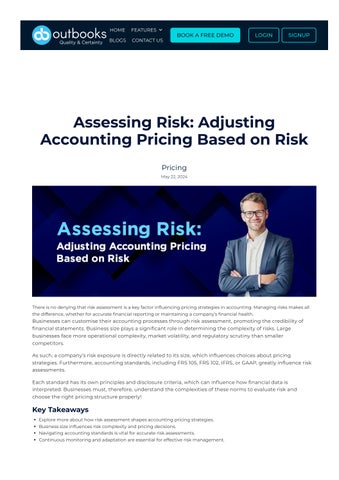

Assessing Risk: Adjusting Accounting Pricing Based on Risk

There is no denying that risk assessment is a key factor inuencing pricing strategies in accounting Managing risks makes all the difference, whether for accurate nancial reporting or maintaining a company’s nancial health Businesses can customise their accounting processes through risk assessment, promoting the credibility of financial statements Business size plays a significant role in determining the complexity of risks Large businesses face more operational complexity, market volatility, and regulatory scrutiny than smaller competitors.
As such, a company’s risk exposure is directly related to its size, which influences choices about pricing strategies Furthermore, accounting standards, including FRS 105, FRS 102, IFRS, or GAAP, greatly influence risk assessments
Each standard has its own principles and disclosure criteria, which can influence how financial data is interpreted Businesses must, therefore, understand the complexities of these norms to evaluate risk and choose the right pricing structure properly!
Key Takeaways
Explore more about how risk assessment shapes accounting pricing strategies
Business size inuences risk complexity and pricing decisions
Navigating accounting standards is vital for accurate risk assessments
Continuous monitoring and adaptation are essential for effective risk management
Pricing
May 22, 2024
BOOK A FREE DEMO LOGIN SIGNUP HOME FEATURES BLOGS CONTACT US
Understanding Business Risks for Accurate Accounting Pricing
Business risks are uncertainty about a business’s likelihood of reaching its nancial objectives due to various factors
It includes many types, such as:
Financial Risk– Connected to debt obligations or market swings
Operational Risk– Results from internal processes
Compliance Risk– Legal/ regulatory obligations
What is the importance of assessing risk for accounting practices? Accounting practices depend on risk assessment as it helps businesses see possible dangers to financial stability
Businesses can improve the accuracy of financial reporting as well as make wise strategic choices by lowering risks To better understand, let’s explore more about the key factors contributing to the business risks:
Size of the Business: Because of their operational complexity, larger businesses have more complicated risks than smaller firms
Industry-specific Factors: Variation in risk is also influenced by industry dynamics such as market competitiveness or technical developments
Regulatory Environment: The regulatory landscape affecting compliance needs is also important
These are some of the key factors influencing business risks; one must understand these elements for efficient risk management in accounting practices!

What is the Impact of Business Size on Risk and Pricing?
The size of a business has a big impact on its risks Because of their wide range of product lines, larger companies usually face diversified risks There is no denying that larger firms are more vulnerable to market swings, subject to more regulatory scrutiny, have higher operational expenses, and more.
On the other hand, smaller businesses often deal with fewer regulatory challenges but also more resource constraints, a greater reliance on key employees, and more noticeable effects from changes in the market
Let’s have a clear comparison of the difference in risk exposure between small and large businesses:
Aspect
Agility
Cash Flow
Small Businesses
More agile, can adapt quickly to changes
More vulnerable to cash ow issues
Large Businesses
Less agile due to size and complexity
Often, they have a more stable cash ow
Operational Costs
Market Changes
Risk Management
Lower operational costs but higher relative impact of xed costs
Signicant impact from market shifts
Limited resources for risk management
More extensive regulatory scrutiny and compliance requirements
Higher operational costs but benet from economies of scale
More resilient to market uctuations due to diversied revenue streams
Extensive risk management frameworks and resources
How does it impact accounting pricing strategies? Defining accounting pricing strategies for businesses of all sizes requires risk assessment Higher reserves to cover any cash flow problems or expenses in risk management tools can be part of pricing strategies for smaller businesses The price has to be in line with the requirement for flexibility in reaction to changes in the market
Larger businesses should include in their accounting pricing strategies the expenses of maintaining an extensive operational infrastructure, possible market shifts, and considerable compliance requirements.
Larger firms most often use complex risk management systems to reduce risks Because of their size, their pricing strategies can include more complex pricing models representing their wider risk profile
Accounting Standards and Business Risk: Aligning Pricing Strategies
An Overview of Different Accounting Standards
FRS 105
It offers a streamlined structure with fewer disclosure obligations, especially for micro-entities While simplified reporting reduces complexity, it could also restrict the depth of financial analysis, which might increase operational/financial risks because of a lack of supervision
FRS 102
Though it is still less complicated than IFRS, FRS 102 has more specific reporting requirements than FRS 105 for SMEs Assisting businesses in managing risks by providing enough financial information without being too complicated
IFRS
Large, publicly listed firms worldwide use IFRS, which offers a comprehensive framework to improve transparency The high level of detail helps in comprehensive risk management, but maintaining compliance requires a lot of resources
GAAP
GAAP is a set of accounting principles that provide guidelines for financial reporting While it might be complicated, it guarantees consistency in financial statements and facilitates robust risk management practices
A quick comparison of risk exposure of different accounting standards:
Standard
FRS 105
FRS 102
IFRS
Risk Exposure
Higher risk due to minimal reporting requirements
Moderate risk with balanced reporting requirements
Lower risk due to comprehensive reporting
Scrutiny
Regulatory
Face fewer regulatory challenges
Why is it important to align accounting pricing with the requirements of each standard? Aligning accounting pricing with each standard is essential for the following:
Compliance
Ensuring pricing strategies adhere to the regulations helps prevent fines from the regulatory authorities This is crucial for businesses operating in many countries or subject to strict regulatory supervision.
Reliability
Financial statement reliability is increased when accounting standards comply with This gives a transparent picture of the firm’s financial situation, which builds stakeholders’ confidence
Risk Management
Aligning prices with the specific requirements of the standards guarantees that risks are effectively managed For example, the detailed reporting required by IFRS gives a deeper knowledge of possible risks, which can be considered when determining price
Resource Allocation
Understanding each standard’s specific requirements facilitates businesses’ resource allocation For instance, simpler standards like FRS 105 could require fewer resources, while more complicated standards like IFRS would require a significant investment in risk management or compliance systems
Steering Towards Stability- Prioritising Risk Assessment in Accounting
Giving risk assessment top priority in accounting processes is essential to guaranteeing financial stability in today’s volatile business environment Businesses need to understand how important risk assessment is to determining pricing strategies
Are you tired of the endless struggle to maintain consistent pricing? Accountants, you can now effortlessly navigate the maze of pricing inconsistencies with a simpler solution- Outbooks Proposal Tool!
Outbooks Proposal Tool helps you to set fair prices reflecting your value Try Outbooks Proposal Tool today to experience the difference!
BY: Outbooks


GAAP Lower risk through consistent and reliable reporting
RELATED STORIES




HOME SIGNUP LOGIN CONTACT Copyright © Outbooks 2024 | All Rights Reserved Suite 18, Winsor & Newton Building, Whitefriars Avenue, Harrow HA3 5RN Registration No: 10746177 info@outbookscom +44 330 057 8597 CONTACT US Help Center Latest Articles Terms and Conditions ◦ When two services offer the same benets, why do some seem to cost more than. OUTBOOKS MAY 8, 2024 Read More Understanding Valuebased Pricing: 101 for Accountants ◦ Have you ever thought of this? When you want to buy an expensive one, even. OUTBOOKS MAY 7, 2024 Read More The Psychology of Pricing ◦ Are you an accounta decide how much to of making guesswor OUTBOOKS MAY Read More The Fundam Value-Based