“As
Year Two Curriculum NewsletterSummer 2026
“As
Year Two Curriculum NewsletterSummer 2026
soon as they sprout leaves you can see for yourselves and know that summer is already near. So also, when you see these things taking place, you know that the kingdom of God is near.”
Luke 21:30-31

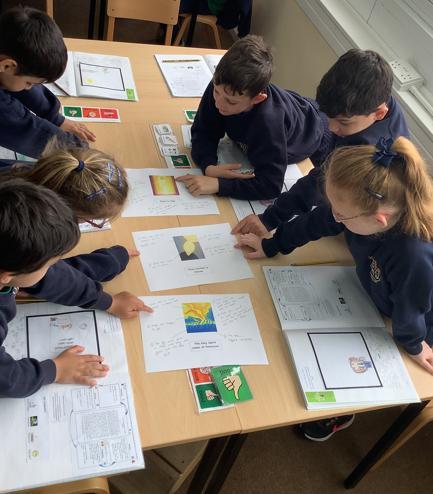
In this half term, pupils will be moving on to Branch 5 – The Ends of the Earth. The focus of this topic is to sequence the events from the Resurrection of Jesus through to the coming of the Holy Spirit at Pentecost. As part of this, pupils will begin to explore and retell The Ascension of Jesus Christ in detail through imagery and extended writing. Pupils will also look at St Luke and his Gospels, discussing the life of Jesus. They will also look at the Acts of the Apostles’ account of the early Church. Within the Acts, pupils will explore and retell the story of the Conversion of Saul.

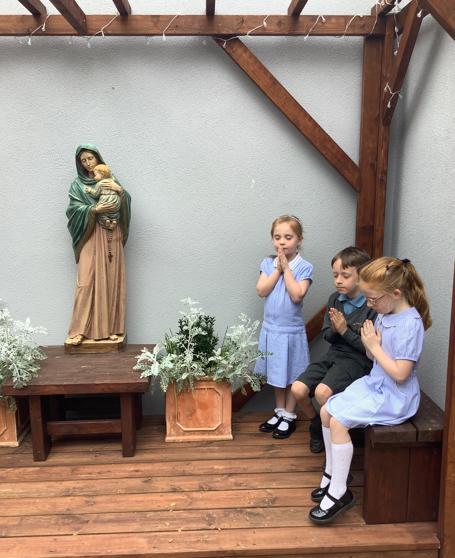
Pupils will look in detail at the Holy Spirit, recognising that Christians believe that the Holy Spirit opens up their heart to God, helping them to pray and develop habits of good behaviour towards themselves and other people. They will name the fruits of the Holy Spirit and make links with how these are shown in the lives of some saints.
The children will explore how God loves us at every stage of our lives and reflect on the cycle of life. We will learn that we are created to grow, change and learn. We will then move onto look at the concept of the Trinity by focusing on a story of Lucy and her family.
Children will be introduced to the concept of the Trinity and what this means for them. Through the story of The Good Samaritan, the children will focus on who is their neighbour, realising that this is everybody. This will lead onto us exploring what community means to us all. The children will learn about the different communities that they are part of both locally and globally. They will think about what it means to belong to a community and the rights and responsibilities that come with it. Children will also learn that how they act can help or harm their communities
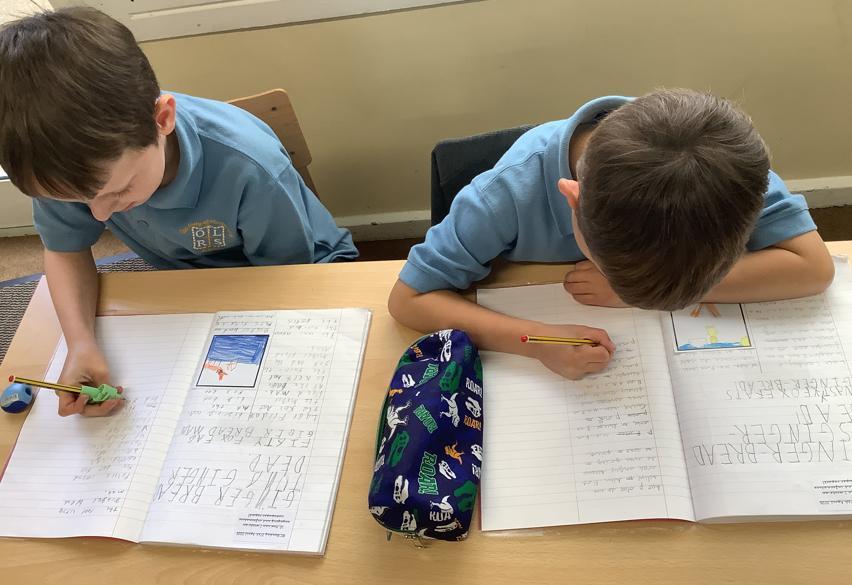
Pupils will continue to enjoy a variety of texts and authors. Our focus texts include ‘Rabbit and Bear’ by Julian Gough and Jim Field. We will compose writing linked to the key text, including newspaper reports, descriptive writing, narratives and recounts. Pupils will continue to learn new spelling, punctuation and grammar skills and further apply these to their learning across the curriculum. Pupils will explore how to write coherently for a range of purposes and audiences. Throughout the term, pupils will read a range of extracts and literature that relates to our topics, as well as their own interests. Through whole class reading, individual reading and guided reading sessions, pupils will practise comprehension skills and continue to learn new ways to understand vocabulary, retrieve information, summarise, infer and make predictions.
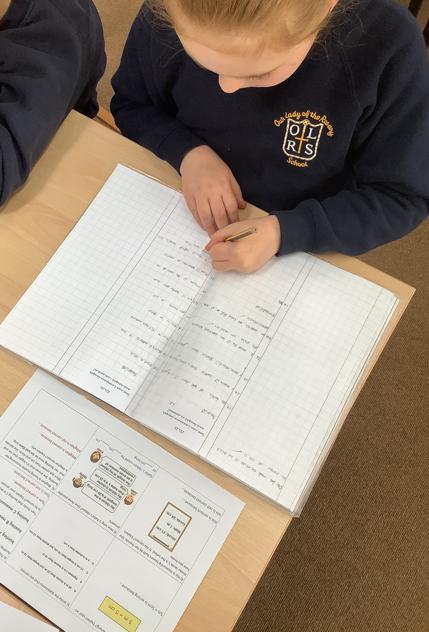
In maths we will be focusing on length and height, time, mass, capacity and temperature. The children will learn to measure objects in both centimetres and metres. They will also practise ordering and comparing measurements. Within time, the children will learn to tell the time to quarter past and quarter to the hour as well as in 5 minute intervals. The children will also be able to find durations of time and be able to compare them. Children will learn to measure the mass of an object in grams and kilograms and the volume of an object in millilitres and litres.
We will also look at the topic of geometry, learning about position and direction and being able to describe movements and turns. The children will also learn to read temperature scales. Within these topics, we will also keep practising our problem solving skills and continue with our arithmetic and mental maths lessons.
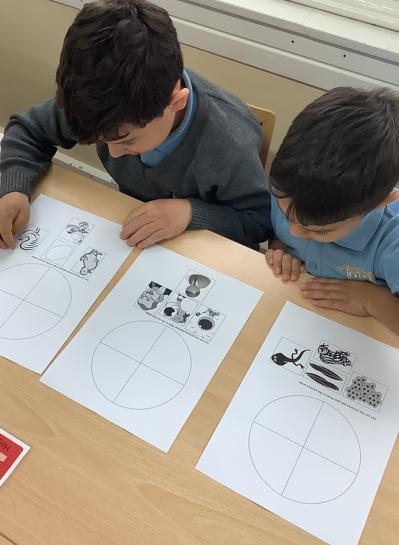
Our first science topic for the Summer term is 'Animals including Humans'. We will be studying the life cycle of different animals, including humans and learning that animals reach different sizes before they are able to produce offspring, which will then grow into adults. The children will learn that animals need different things to survive, including food, water and air. They will learn it is important for humans to stay healthy, including doing exercise, eating the right amounts and types of foods and having good hygiene.
Our second topic will be 'Plants'. We will learn that some plants grow from bulbs and that all flowering plants make seeds that can grow into new plants. The children will learn that plants need light, water and a suitable temperature to grow and stay healthy
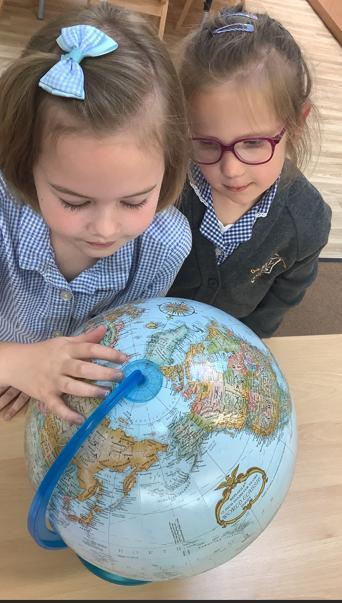
In geography, our topic is 'How to be a Geographer.' The children will learn to use different mapping media. They will be able to name and locate the continents and oceans of the world on a map. The children will be able to identify physical and human features found on a map and use fieldwork skills to collect information about the physical and human features of their local area.
Pupils will learn the skill of how to use a key and be able to recognise different map symbols. The children will learn to read a compass (North, South, East and West) and will be able to follow a simple route on a map using compass directions. The children will become familiar with directional language [e.g. near and far; left and right], to describe the position of features and describe routes on a map and will be able to use simple grid references.
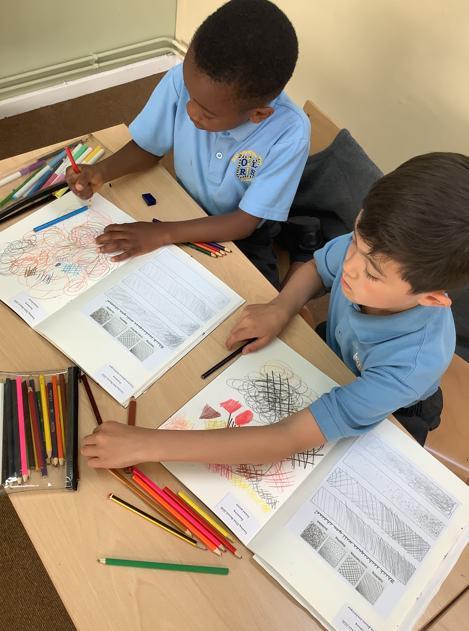
In art, we will be focusing on painting in the Summer term, learning about the Black Arts Movement and focusing on the work of Lubaina Himid. The children will begin to paint objects reflecting scale and proportion and learn to paint a picture of something they can see. They will be able to reproduce the colours of different objects and use thick and thin brushes as appropriate. The children will learn to predict with accuracy the colour that they mix and accurately place colours on the colour wheel. We will explore the colour and mood in artists’ paintings.
In Design and Technology we will be focusing on cooking and nutrition. Within this topic the pupils will be focusing on their cutting skills with the view for a final project of making sandwiches. This will also teach pupils the importance of a balanced diet and healthy foods.
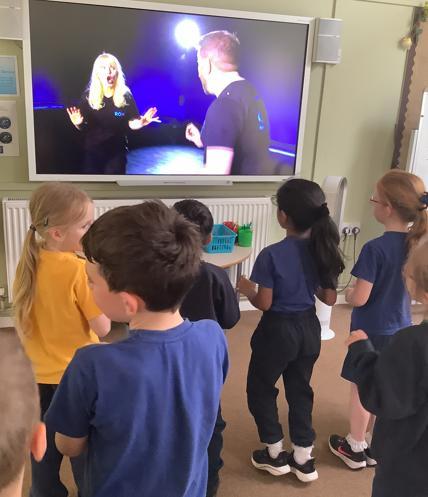
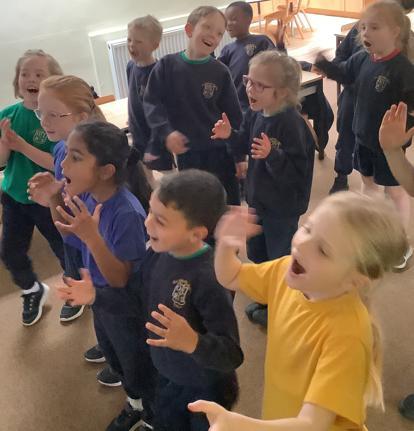
In music, we will be exploring the world of opera through the Royal Opera House by studying The Magic Flute. Children will listen to and discuss key pieces from the opera, learning about the story, characters, and emotions conveyed through music and performance. They will have opportunities to sing a range of songs with increasing vocal control, focusing on accurate pitching, clear diction, and expressive performance. As part of their learning, children will develop their listening skills by identifying and describing the different sounds, voices, and instruments used within the music. They will explore how composers use dynamics, tempo, and texture to create mood and atmosphere. Pupils will also compare different vocal types and orchestral instruments, recognising how each contributes to the overall performance. Through creative activities, movement, and discussion, children will build confidence in performing, appraising, and responding thoughtfully to music.
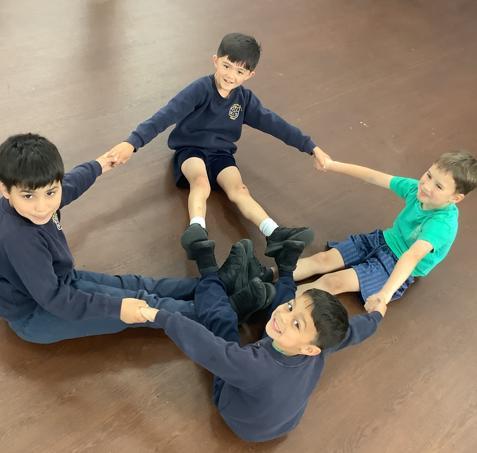
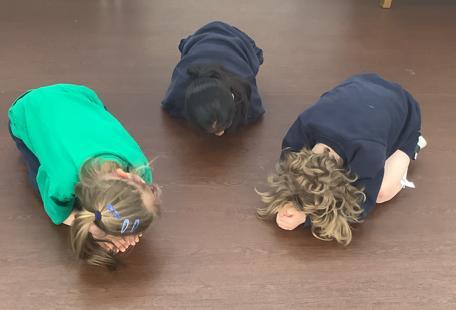
Within our PE lessons, the children will be focusing on the Physical, Health and Fitness themes of our programme. This will be carried out through the use of dance and the skills of agility and balance. In dance the children will be performing a series of movements with changes in level, direction or speed. They will be performing balances and shapes individually and with partners. The children will learn how to use equipment appropriately and move and land safely. They will be able to explain how their body feels before, during and after exercise.
Our outdoor PE will focus on the team games of netball and basketball in the first half of the Summer term, moving onto tennis and sports day practise in the second half of the term
For our first half term, we will be focusing on digital media through looking at magazines. The pupils will explore existing magazines, finding out what they are used for and why they are useful. Pupils will look at text and images to explore how they convey information. They will then add these to documents and edit the text and layout to create their own school magazine.
In the second half term, pupils will be looking at word processing and slideshows using Google docs and Google slides. Pupils will learn how to use the computer keyboard to write for a purpose as well as using the toolbar to edit different parts of their text, including the heading and main body. They will use the same skills to create their own slideshow presentations, exploring different features within this.
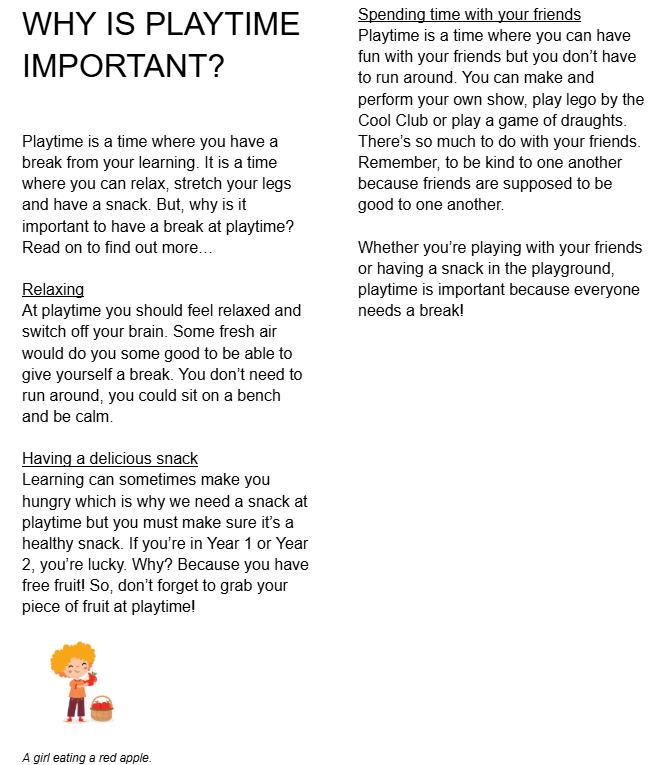
Model text put together with the class.
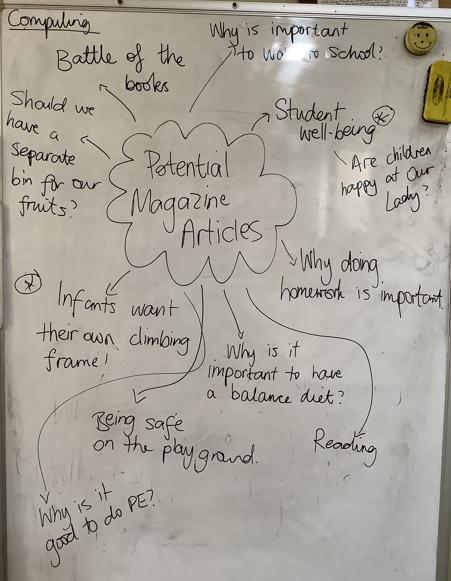
Ideas put together on topics for our own school magazine article.