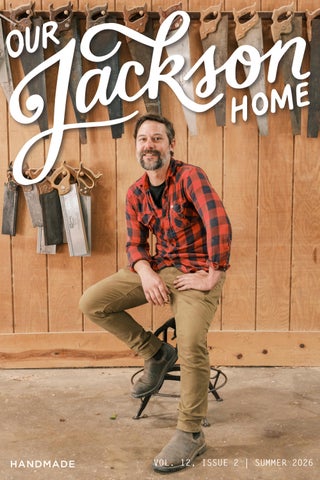
HANDMADE
VOL. 12, ISSUE 2 | SUMMER 2026
Editor's Note We’re all bombarded with the new and quickly emerging world of AI. If you’re not using it these days, you’re behind. There are certainly great uses for AI, and it can help us tremendously. Yet, I find people are empty, their brains are not being used as much, and we’re all craving a sense of authenticity. And ironically, we decided to create a journal themed "Handmade" in the midst of this new world we live in. Authenticity has always been a word I’d use to describe what the Our Jackson Home journal is, but what does that really mean? One definition that stands out to me is “true to one’s own personality or original source.” We need genuine interactions with others. We need to experience life in a tangible, and sometimes hard way. We all need an outlet to help us think deeply and awaken the creative side of our brains that produces the beautiful things we all love to look at. The beauty of creativity is in the process of making, not just in the finished result. AI produces finished results at the touch of our fingertips. But the beauty in art is the little brush strokes and intention involved in the process. Even if nothing is produced or profitted, is there still worth in the process of creating? This journal is filled with people doing hard, honest work with their hands. They’re creating thoughtful gifts for our community, raising local cattle that are impacting people across the country, or filling stomachs with homemade food. And each story is told by a person — an artist — who cares enough to ask the deep, thought-provoking questions to learn more about someone’s story. And they’re photographed by other artists who see the beauty of light and of people and notice the little details that make a story come to life on the page. Our Jackson Home always strives to be real, telling the stories of Jackson and noticing all the aspects that weave a place together and make it feel like a home. Handmade work comes from people of all ages and skill levels in our community. It spans from a 160-year-old family farm, to a high school graduate making puppets by hand. And you can join in on this ‘Handmade’ theme too. Even if you’re not someone who enjoys working with your hands, you can support local businesses with the guide we’ve included. I hope in reading this issue, you’re inspired to go create or do something difficult you’ve been afraid to tackle. Honest, hard work is good for the body and the soul.
MADDIE MCMURRY, EDITOR-IN-CHIEF
A PUBLICATION OF OUR JACKSON HOME VOL. 12, ISSUE 2: HANDMADE BROUGHT TO YOU BY THECO | WWW.ATTHECO.COM
EDITORIAL BOARD
CONTRIBUTORS
EDITOR-IN-CHIEF
FEATURED WRITERS
DESIGNER
Diona Ballard Gabe Hart Trista Havner Alex Jacobi Olivia Kirk Maddie McMurry Shelby Tyre
Maddie McMurry PROGRAM DIRECTOR
Lizzie Emmons COPY EDITOR
Esther Jones
CONTACT WEBSITE & BLOG
ourjacksonhome.com PHONE & EMAIL
731.554.5555 ourjacksonhomeinfo@gmail.com
FEATURED PHOTOGRAPHERS
Carrie Cantrell Colton Creasy Hannah Gore Maddie McMurry Ontoni Reedy Kristi Woody ILLUSTRATOR
ADDRESS
541 Wiley Parker Road Jackson, TN 38305
Maria Stewart
THIS JOURNAL ISSUE IS SUPPORTED BY:
CONTENTS 6/ RETHREAD AND POTTERY
Where Stillness Takes Shape By Alex Jacobi, Photos by Hannah Gore 12/ SLEEP IN HEAVENLY PEACE
Giving Children a Place To Rest By Gabe Hart, Photos by Kristi Woody 18/ WOOLFOLK FARMS
The Seven-Generation Legacy of Hardworking Hands By Maddie McMurry 26/ SPONSOR FEATURE
Yukon Outfitters 30/ GUIDE
Jackson Handmade Guide Illustrated by Maria Stewart 34/ STANDING THE TEST OF TIME
What It Means To be a Craftsman By Olivia Kirk, Photos by Colton Creasy 42/ THE RICHMOND FAMILY
The Currency of Care By Trista Havner, Photos by Carrie Cantrell 52/ STEPHANIE WILBOURN
Inside the Creative World By Diona Ballard, Photos by Maddie McMurry 60/ SAM WEATHERFORD
The Puppet Is Only the Beginning By Shelby Tyre, Photos by Ontoni Reedy
RETHREAD & POTTERY
Where Stillness Takes Shape WRITTEN BY ALEX JACOBI PHOTOGRAPHED BY HANNAH GORE
For most of her life, Malin Bergman has been in motion. At 16, she moved from her home in Sweden to Massachusetts, where she stayed with relatives for a year of high school. At 20, she went to Spain and studied Spanish. At 22, she made her way to Norway for a couple of years. After that, she went back to Sweden, where she attended university and met her husband and had two children. Although she and her family had plans to settle down in Sweden, their travels continued when her husband was given an opportunity to do expatriate work in India. After several years there, they made their way to Poland, where they had their third child. And now, she and her family live in Jackson. She’s moved so many times, and yet, as I sit with her and sip my latte, listening to all her adventures, I can’t help but immediately be struck by her rootedness. Motion, in and of itself, can sometimes come with energy or even chaos. But I see none of that in Malin, only a peace and simplicity that in an increasingly noisy and busy world is a breath of fresh air. That spirit of simplicity sits at the heart of her business, Rethread and Pottery, where she creates handthrown pottery and textile pieces designed for everyday use. The work is shaped by her Swedish background, her love of sustainability, and her belief that handmade things can help people slow down long enough to notice the beauty in ordinary moments. It was eight years ago, when Malin was in India and had extra time on her hands, that she began finding
old tablecloths to make into dresses, and eventually, she took a series of pottery classes there. “That was the first time I did anything with pottery, and I loved it,” Malin said. When she went to Poland, she took her creations to the next level and decided to start making more and selling them. After learning how to crochet by meeting with her friends every week, she began making beeswax wraps, a sustainable alternative to plastic wrap for preserving food. Eventually, her textile pieces expanded to bags, pennant banners, scrunchies, and other small accessories. All her textile pieces are created from secondhand fabric and her own threading work. “The whole idea was to not buy anything new besides the thread, unless I could find it secondhand. I wanted to keep it sustainable. The challenge is finding the right secondhand fabric. It feels good when you find the exact fabric you really like,” Malin said. When it comes to both her pottery and textile pieces, Malin aims for sustainability, handmade production, and usefulness — all traits she feels she’s inherited from her Swedish background. “In Sweden, especially in the last 20 years, there has been a lot of talk about living as sustainably as possible. There, buying secondhand is a good thing,” Malin said. Additionally, her work finds inspiration from the coast of Sweden, where she has spent a lot of her life. Her pieces are simple and practical.
V O L . 1 2, I S S U E 2: H A N D M A D E • 7
They are things that can be used in there is a deadline, but while I am everyday life, not just for decoration. making, I feel harmony,” Malin said. The more I talk Since being in with her, the more I Jackson, Malin has "I enjoy it more if I found that her busisee that her simplicidrink or eat from ty is part of the rootness has not only something made edness she carries continued to be her by somebody I with her from place creative outlet, but have met or feel to place. In a world it’s been an opportuof fast, mass-pronity to find her footconnected to. You duced goods, creathave a face behind ing in a new commuing art in a slow and it, and you know it is nity. intentional way can “Being in Jackmade by hand." bring a person peace son has been wonand clarity. derful. Everybody is “The work is very good, almost so engaged, and people reach out. like meditation because you can’t go At markets, everyone who comes by anywhere or do anything else. You is so friendly and genuinely kind and just focus on what you are doing. The interested,” Malin said. process around it can be stressful if In her four years here, Malin has
8 • OUR JACKSON HOME
seen just how much the people of Jackson value handmade items from local makers and small businesses. “Sometimes I'm surprised that people buy so much. Like, you could go and get something cheaper somewhere else, but a lot of people prefer to come to the small places instead. And that's wonderful,” Malin said. On the surface, it can seem easier to buy the cheaper, mass-produced item and move on. You might save a few dollars, but in the end, you lose something harder to measure: the appreciation that comes from choosing something intentionally and with care. “I enjoy it more if I drink or eat from something made by somebody I have met or feel connected to. You have a face behind it, and you know it is made by hand,” Malin said. “I hear people say about things they’ve bought, ‘It was cheap, so it doesn’t matter if it breaks.’ When people feel that way, they don’t really appreciate the thing, and I think that is a loss.” That is what she hopes her own work gives people: not just an item to use, but a moment to notice. A coffee mug that lets you sit and savor. A bowl to serve a special dinner to loved ones. A simple piece that reminds you, “This is my moment.” Today, Malin shares her work through local markets, online sales, and Garner Blue in Jackson. She appreciates the pace at which her business has grown, but she is also thinking toward what is next. “I want to reach more people, push myself, learn more, and establish myself more around here. In the
V O L . 1 2, I S S U E 2: H A N D M A D E • 9
10 • O U R J A C K S O N H O M E
end, I would love to have my own little shop or studio shop combined, where I sell my own items,” Malin said. As Malin shares her hopes for Rethread and Pottery’s future, I also hear in her voice a contentment with the present. She has dreams for her work, but they do not seem tightly held. She is comfortable with the unknown and letting it all unfold in the way it’s supposed to. Perhaps she can be that way
because she has seen it in her work. She’s seen how a piece of scrap fabric tucked in the corner of a store can become something new. She’s seen how a lump of clay can become a staple in someone’s kitchen. And that is the gift of Malin’s work: it invites people to slow down, savor the moment, and, in the midst of a life in motion, return to the stillness within.
V O L . 1 2, I S S U E 2: H A N D M A D E • 1 1
SLEEP IN HEAVENLY PEACE
Giving Children a Place To Rest WRITTEN BY GABE HART PHOTOGRAPHED BY KRISTI WOODY
When I was 7 years old, I won a life-size Freddy Krueger cardboard cutout from the bottle cap movies at the Malco Theater. For the next several months, that cutout haunted me, especially at night. For anyone unfamiliar with the "A Nightmare on Elm Street" series, Freddy was a burnt-faced monster with a left hand full of knives for fingers who would infiltrate people’s dreams while they slept. For a 7-yearold, the scarred face combined with the possibility of a nocturnal invasion was too much to handle. Until I finally admitted to my mom how scared I was of that towering character, the only remedy for my persistent fear was the bottom bunk of my bunk bed draped with quilts on all four sides — think Ebenezer Scrooge’s curtained fourposter bed but with patterned quilts. My bed was the only place I could go where I would feel completely protected from whatever imaginary fears I would concoct — a safe space that was for only me. It never crossed my mind that any kid wouldn’t have a place like this to rest and breathe if
only for several hours each night. There are still some children in Jackson who don’t have a bed to themselves, but one couple is aiming to change that by building one bed at a time. Kevin and Michelle Cozine aren’t from Jackson. In fact, they’ve only lived here a few years, but the difference they’ve made in those hidden spaces rarely seen or even thought about by most people is monumental. Kevin and Michelle spearhead the Jackson chapter of Sleep in Heavenly Peace, a nationwide nonprofit organization founded in Idaho in 2012 that builds and delivers beds to children who don’t have a place of their own to sleep. While Kevin and Michelle are the President and Vice President of SHP-Jackson, neither receives any compensation. SHP is completely voluntary. “No one has a salary,” Kevin said. “Including us,” Michelle followed. After being part of a bed build
V O L . 1 2, I S S U E 2: H A N D M A D E • 1 3
14 • O U R J A C K S O N H O M E
in Texas, Kevin and Michelle wanted a mattress, a pillow, sheets, and to continue giving back but found out bedding. Because SHP is a nonprofit, that the nearest SHP chapter was in they rely exclusively on community Nashville. donations of these items. So they started one in Jackson. If there’s a line to be drawn in “SHP flew us out to Utah, and this process, it’s when the deliveries we did three very intensive days of start. training from the ground up of what “If you’re going to go on a goes on behind the scenes — the delivery, you almost have to have process of building a bed, but also blinders on,” Michelle said. “We the process of building a coalition,” thank them for letting us come in the couple said. and help. We don’t want them to feel When a child in the community insecure and think that what we’re needs a bed, the family applies through coming to do is anything other than the Jackson chapter’s website. A need what it is — provide a child with a could also be established through safe space to sleep.” multiple channels, such “We’re there to solve as local churches, RIFA, one problem,” Kevin “Every hand said. “There’s no ulterior friends, or relatives. Once the need that touches motive.” is vetted, the process While deliveries can that bed is be challenging begins. on multiple a hand of Most bed-building levels, the stories told events involve large during those deliveries love.” groups of people — are the culmination of a churches, businesses that want to give process covered in care. back to the community, or even the There was a grandson living with city and county mayors, as recently as his grandmother and sleeping on a a few months ago. couch. “The bed building is like a The family that lost beds in a production line,” Kevin said. “We house fire, then applied for new ones take it from the raw wood, lumber, and got them. sand it, cut it, the whole process. A mother who had escaped a They show up to a pile of wood, but domestic violence situation with her we have all the tools to build.” four children and only had one couch “We set up stations and explain in their new home. to the groups how everything flows,” The mother who could finally Michelle added. enjoy a night alone in her own bed With enough volunteers, 50 to 60 because her children now had their beds can be built in about four hours. own beds. After the beds are built, the “Nobody’s sleeping with me delivery process begins. tonight!” Each child receives a complete There’s normally one common setup that includes a bed frame, question Kevin and Michelle hear on
V O L . 1 2, I S S U E 2: H A N D M A D E • 1 5
these deliveries, and it’s always asked with a sense of awe and a little bit of doubt to temper expectations that have most likely rarely been met until now. “This is really my bed?” “Yes, it is.” An obvious but never understated necessity of Sleep in Heavenly Peace is the involvement of the Jackson community. Kevin and Michelle have seen that firsthand in the relatively short time they’ve been in Jackson. “We were running out of storage for supplies for beds, and we mentioned that during a presentation to the Downtown Rotary Club. By the end of the next day, the school system had offered up space in the old Pope Elementary school for us to use,” they said. Local organizations such as Leadership Jackson, Lowe’s, the Jackson Fire Department, and many others have donated their time,
16 • O U R J A C K S O N H O M E
money, and labor to help meet the hidden needs of children in our community. I’ve long outgrown my fear of Freddy Krueger and have always had a place to sleep at night, but I’ve had students in my classes who may not have. I’ve seen homes where kids slept with siblings or parents because they had no other choice. Our community is filled with situations covered in the shadows of shame — hidden from most of us because we can’t see them or don’t have the time to shine a light. Thankfully, there are people doing the work who can. Michelle sums up SHP's work in a way that captures its mission succinctly. “Every hand that touches that bed is a hand of love.”
Become An Arts Advocate. Support programs like Our Jackson Home by purchasing a specialty license plate in Tennessee. Learn more at TN4arts.org.
WOOLFOLK FARMS
The Seven-Generation Legacy of Hardworking Hands WRITTEN & PHOTOGRAPHED BY MADDIE MCMURRY
In the midst of the summer, the memories of the winter storm we had this past year have started to slip my mind. I forget how we were all going a bit stir-crazy in our home for those two weeks, how the schools were canceled, how my neighbors and my husband were out on our hill-of-a-road scraping away to try and get our cars out. We thought we had it rough; we sure liked to complain. But what a privilege it was to complain about being stuck in our homes. I sat down with Scott Woolfolk, one of the owners and the current operator of Woolfolk Farms, the 161-year-old cattle farm here in Jackson. His perspective changed my outlook on that once-in-a-lifetime ice storm we all experienced. His day-to-day was much more grueling than mine. It involved thinking weeks ahead, heating their barns to keep the tractors warm, and stocking up on food for the over 300 cattle he cares for. Each day, in the freezing cold and ice, he would have to make an 8-mile journey in a side-by-side and tractor to check on the cows, feed them, and bring them water. "You got to go feed them, you got to go take care of them. You can't just say, 'Hope they're alright.' That two weeks was the worst I've ever experienced. Everyone fusses because they had to sit in the house… I wish we could've sat in the house," Scott explained as he retold the story to me. The one thing Scott continually said is overlooked in the cattle farming business is how much hard work and
perseverance it takes. No matter the season, no matter if it's Christmas morning, every single day starts with a cattle check. 300 cows. Seven days a week. 161 years. There's no break, no off-season, no choosing to just stay in bed. Scott is quite possibly the most hardworking person I've ever met. "99% of people don't realize that it's that time-consuming to take care of that many cattle." It's a hard life. There's drought, interest rates, ice storms, the harsh heat of summer — good times and bad times. And yet he said, "I wouldn't trade it for nothing." Growing up watching his father and grandfather run the farm, there was never really another option for Scott. His parents wanted him to consider another career, but for him, it was always about carrying on the legacy of Woolfolk Farms. He's lived in the same house for over 50 years — the same home he was born in and later purchased from his parents. His father, John, still lives on the property, and Scott's two sons are both involved in the decision-making and help out around the farm. His wife, Cher, has handled the bookkeeping for years alongside her career as a schoolteacher. Learning the cattle business isn't something you go to college for. Instead, you learn by watching. "That's all I know. The same way my kids learned, as soon as they were big enough to walk, they followed Dad. It's just kind of a thing you learn by watching," he explained. So how does a family business
V O L . 1 2, I S S U E 2: H A N D M A D E • 1 9
lasting 161 years and seven generations survive? Mostly hard work passed down through the bloodline but also diversification. The Woolfolks branched out into the hay business 20 years ago, which helped them grow by selling hay to horse owners in the surrounding areas. They also sell freezer beef, where customers come directly to the farm to pick up locally raised beef. None of it leaves Madison County, and Scott hasn't spent a single dollar on digital marketing to build his 100-person customer base. People simply spread the word after experiencing the honest, quality work the Woolfolks do. "People like to know what they're getting, how it's raised, and where it comes from," Scott said. They are most well known for their registered Hereford cattle, a
20 • OUR JACKSON HOME
herd with roots stretching back to 1941 when the family purchased their first registered female from a neighboring farm. Today, those cattle have been sold into 28 states, going as far as California, Wyoming, and Canada. They've even been shipped internationally to Turkey and Kazakhstan. Through the work of their hands on their own land, people are taking a piece of Jackson into communities across the country and around the world. "It makes you feel pretty good that they wanted to come all the way here for our cattle," Scott told me with a sense of pride. As we were driving around and I was taking photos of the lush green pastures and the cows, I asked if there were any other spots Scott would like to show me. We joked that all the cows would just look the same in
"If you're gonna have cattle, you're going to lose cattle. You learn the excitement of birth and the agony and defeat of death at a very young age. You can't lose them if you don't have them."
22 • OUR JACKSON HOME
photos, but Scott replied with, "But they all look different to me." "It's just like having 300 kids, there's something every day." Although it is a business — and a well-oiled one at that — Scott is still caring for each cow with his own hands. He's learned to be his own veterinarian over the years, delivering calves each season and handling basic ailments as they come. Growing up on the farm, you learn how to lose cattle before you ever lose a family member. "If you're gonna have cattle, you're going to lose cattle. You learn the excitement of birth and the agony and defeat of death at a very young age. You can't lose them if you don't have them," Scott said. There's real truth in that — about cattle and about anything
good in life. You can't lose what you don't love. Scott is grateful for the hard work, the sweat, the grief, the long hours. This legacy, recognized by the state of Tennessee in 1976 as a Century Farm, carried across seven generations and 161 years, is something special. And it's right here at our back door. "When it's all you know and all you've ever done, it doesn't really sink in, but when you print it, people really get excited about that [generational farm] because there's not many of them left," Scott said. "Usually 2 or 3 generations is a big deal." Scott is hopeful his children will carry the business forward one day. Cattle raised by hardworking hands, right here in Jackson, and making their way across the country and the world.
V O L . 1 2, I S S U E 2: H A N D M A D E • 2 3
SPONSOR FEATURE
Yukon Outfitters "A handmade customer experience occurs hundreds of times a week, every week here," Preston Powell, co-owner of Yukon Outfitters explained. "When you're given the privilege of putting another person's or a company's logo or brand on your product, there's a lot of trust involved with that.” Yukon Outfitters is based right here in Jackson, Tennessee, shipping across the country and supplying custom drinkware to big brands you might recognize, like Buc-ees and Ace Hardware. It supplies drinkware, coolers, dry bags, camping equipment, hunting products, and USA-made hammocks and accessories at a reasonable price, created to serve the customer over anything else. Preston Powell and Adam Scherer, co-owners of Yukon Outfitters, were classmates at Appalachian State University in Boone, North Carolina, in their China Business Program. They both
had spent about a decade working in Asia in quality control and product development since graduating from college when the global economic crash of 2009 left them both out of work. They decided to take a reset fly-fishing trip to the Yukon, and what they found wasn't the outdoor adventure they were hoping for. It was great for a few days, but then everything that could go wrong went wrong. "It rained. We got wet. Mosquitoes were horrible. The gear failed us," Preston recalled. “A light bulb clicked for us, and we thought, ‘What if we could make product that was overbuilt but not overpriced?’” And that’s how Yukon was first born. The brand made its debut on Amazon, back when the site was still mostly known for books, as the first ever featured brand on its Sports & Outdoor page. Hammock camping was the brand’s original trademark, and to this day, Preston and Adam operate the country's largest
V O L . 1 2, I S S U E 2: H A N D M A D E • 2 5
hammock factory right in Alamo, it makes you want to stay a while. It’s Tennessee. been a very welcoming community But the business has pivoted since we’ve joined it,” Adam added. considerably since then. As social Yukon operates with a catalog media changed how people engaged of over 150 pages of product — with the outdoors, they saw a new roughly three times the size of most opportunity: drinkware. They competitors — and 75% of its spotted a gap between overpriced orders are custom. That means logos name brands and cheap alternatives, engraved on tumblers, brand graphics and have developed a product that printed on coolers, embroidery fits right in the middle. stitched by West Tennessee hands in The business used to operate Alamo. Product ships to Alaska one 100% out of its Alamo facility, but day, Costa Rica the next. its move to a larger facility in Jackson When it comes to standing behind was driven by growth, geography, its products, Yukon keeps it simple: if and community. something breaks, All cut-and-sew, they fix it. No product printing, "The reason why we’ve receipts required, enjoyed considerable no and embroidery lengthy still happen processes, no hoops. success is because at the Alamo we’re here in Jackson. They intentionally facility, as well wanted a customer We’re big enough as the hammock experience that to matter, but we’re production. people first. small enough to care. places Everything else, " T h o s e This place is unique. customers that have like custom engraving, printing, a problem usually It's a blessing." and operations, end up being our happens out of the Jackson biggest cheerleaders because they’re warehouse. taken care of,” Adam said. "When we "We're able to deliver to our develop a system, we ask ourselves: customers within three days of really how do we make a system that we 90% of America's population," would want to experience if we were Preston noted. "Half the population, the customer? The lowest friction, we can deliver next day." minimal questions asked — make the Being here early, having the customer happy." relationships, and knowing the lay Part of what keeps Yukon of the land before the rest of huge ahead is an almost restless attention corporate investment came here has to culture — pop, regional, and been a game changer for Yukon. everything in between. They've “It’s also important as family worked with Post Malone as he people, we’re raising families here, navigated his country era ("advising the values in this community here is a guy who's sold 100 million albums a big draw. You grow those roots, and on how to do camo right," Preston
26 • OUR JACKSON HOME
laughs). They've developed products for Twisted Tea, Lil Peep, and luxury brands looking to translate their identity into drinkware. They developed the world's first glow-inthe-dark tumbler, which sold out at Buc-ee's in two weeks. “Preston and I both spend our days listening to our customers to understand their needs and what resonates, and taking our product knowledge and capabilities, and trying to find that sweet spot product that’s going to resonate with them. Delivering something that delights them that they’re not even expecting,” Adam said. For all its national partnerships and global logistics, Yukon's deepest pride is local. Any local customer is
28 • OUR JACKSON HOME
always the best relationship. "I love orders from Ace Hardware and Buc-ee's," Preston said. "But there's no better order than an order from your neighbor. And the neighbor's always going to get the best price from us.” “The reason why we’ve enjoyed considerable success is because we’re here in Jackson. We had the community accept us. We were embraced — from employees to business networking. We’re big enough to matter, but we’re small enough to care. This place is unique. It's a blessing." If you’d like to browse Yukon products for yourself or your business, check out their website at yukon-outfitters.com.
30 • OUR JACKSON HOME
V O L . 1 2, I S S U E 2: H A N D M A D E • 3 1
Our industrial chic brewery is an ideal venue for receptions, fundraisers, corporate dinners, showers and various events. Featuring a stage suitable for live performances, bowling lanes, and additional amenities, our all-inclusive space will simplify your event planning experience! bookhubcity@gmail.com | 731.240.1168
Everyone should receive unexpected delight! When you have the perfect gift, we have the perfect way to present it. info@LittleHappyInc.com LittleHappyInc.com
just because Find us on Facebook
Investing in Our Community WE PROUDLY SUPPORT OUR JACKSON HOME
STANDING THE TEST OF TIME
What It Means To be a Craftsman WRITTEN BY OLIVIA KIRK PHOTOGRAPHED BY COLTON CREASY
I thought about starting this piece with a line about the overwhelming smell of sawdust in the shop or the calluses that develop on the palms of any selfrespecting woodworker after years of crafting things with their hands. I also thought about starting it by describing the feeling of walking into a place where work happens, but without desks, cubicles, laptops, or Google Calendar. But instead, I want to begin with a fact about trees, because that’s exactly how my conversation with Bryce Miller and Chris Deming began. While Bryce and Chris, fellow woodworkers and business owners, gave me a tour of the shop they share in downtown Jackson, they showed me nearly every piece of wood that you could imagine exists. I learned about pine, white oak, cedar, softwood, and hardwood. If you can name it, they probably had it. But the thing that stood out the most to me was the fun fact they shared about a process called tree grafting. Tree grafting is a technique mainly used on fruit trees where two different kinds of trees are fused together. It’s done by taking a branch from one tree and wrapping it tightly to the branch of another so that one tree is able to produce multiple kinds of fruit. I’ll spare you the science behind it (it’s not something I fully understand anyway), but it’s one of those miracles of nature that you can’t help but marvel at when you see it. While Bryce and Chris showed me a piece of wood that you could tell had been grafted, it was the moment I realized
that these two men are more than just craftsmen. They are experts. Both of them shared the stories of how they got into woodworking and each began with two things you might expect: they grew up around it and they love working with their hands. “I applied for a bunch of apprenticeships all over the country. I ended up in Iowa in a shop where they only used the tools that they would have had in 1875,” Chris said. “I spent a year up there learning how to build furniture using old hand saws and old hand planes. I did that for a year, and then I came back and I worked for several cabinet makers in the Nashville area for about four years.” After Chris moved back to Jackson to be closer to family, that’s when he began Art & Mystery Woodworks. Bryce’s story is similar. “Out of everyone in my family, my grandmother was actually a furniture maker,” Bryce said. “I grew up watching her make furniture, and my great-uncle is a premier cabinet maker up in Northwest Ohio. I grew up around woodworking my whole life, and I've always been interested in it.” Bryce explained that he went to college for graphic design and photography and how that eventually led him to woodworking as he searched for a new career after 2020. He began his own woodworking business, Earthborne Goods, shortly after. Bryce and Chris explained that for woodworkers, there really are two
V O L . 1 2, I S S U E 2: H A N D M A D E • 35
photo by December Rain Hansen
main paths to learn this kind of trade. “If you want to build high-end, really good furniture, a lot of guys will go for training. A lot of guys will also just bang their head against the wall until they know how to do it,” Chris said. Woodworking isn’t one of those things you pick up and are immediately good at, at least not for most. Instead, it takes hours of messing up and trying again and practicing until you’ve started to do just one thing right. “It’s the rule of the 10,000 hours, that as soon as you put 10,000 hours into something, you become masterful at that craft. Especially being around each other, I glean a lot of information off of Chris, and he gleans nothing off of me,” Bryce laughed. “But by the same token, we both have a little set of knowledge that we can work off of. Then, the more you do something, the more
36 • OUR JACKSON HOME
you become competent at it.” This is something Bryce and Chris try not to take for granted when it comes to working in a shop beside another woodworker with similar, yet vastly different skills. They don’t see one another as competition. Instead, they believe iron sharpens iron. “We both have pretty different focuses, but at the same time, we do cross over quite a bit. Chris is much more known for cabinetry and furniture making, and I do different things. He can do everything that I can do, but it's just different,” Bryce said. With Bryce’s design background and Chris’ history with cabinetry, each of them has something unique to offer to their craft and to each other. Because of those skills, the work they make is as good as art. To many, including several business owners in Jackson who have adorned their shops and restaurants
"Every time I build a dining room table, I'm also thinking about ‘How many family meetings are going to happen on this table? How many Thanksgivings are going to happen on this table? How many birthdays?’ I think it's important to think about those things because it makes you a better craftsman and it makes you want to do a better job."
with things made by both men, the “I think one of my absolute art they make is also worth paying for. favorite things to build is a dining “Working with these local table. Every time I build a dining business owners, they have a dream, room table, I'm thinking about the a vision. I meet with them, and then table, of course, and I'm thinking we're able to come up with something about what the person wants, that they can't find on the internet. but I'm also thinking about ‘How They haven't seen it yet,” Chris said. many family meetings are going to From storefront counters to happen on this table? How many handmade signs hung outside and Thanksgivings are going to happen every little project in between, both on this table? How many birthdays?’ woodworkers have had a hand in I think it's important to think about creating that makeup those things because makes 8-acre you a Evangelinethe is bits one ofand fivepieces siblings growing and homeschooling on heritfamily’s up some of Jackson’s favorite places. better craftsman and it makes you homestead at Rose Hill, a historic house built in 1823 in Jackson. She loves to read, And more, Bryce and Chris have want to do a better job,” Chris said. pick blueberries, and bake pies, and her favorite place is home. also built things for so many homes As I walk into a local around our city that will stand the test woodworking shop like Bryce and of time. Chris’, it’s easy for me to say that I’d
V O L . 1 2, I S S U E 2: H A N D M A D E • 39
choose the handmade coffee table for my living room over the $100 one I found while scrolling through Amazon. However, I’d be naive to say that this isn’t a battle we all fight daily. In a world of fast fashion, there’s also “fast furniture.” But as we all know, those “come in a box and put it together in three quick steps (or 300 quick steps)!” pieces of furniture probably won’t last one move across town, let alone still be standing in another 50 years. “One of my favorite pieces of furniture that I have in my house is something my father built. It's standing the test of time. That's just a testament. He built that in the mid-’60s. What a true mid-century modern piece I have, and it's from my dad, which makes it so important,” Bryce said.
40 • O U R J A C K S O N H O M E
In a culture obsessed with convenience, Bryce and Chris have thought about longevity. They think about the dining room tables and those family memories. They think about the bookshelves and cabinets that will be repainted, fixed, and refinished instead of replaced. They think about the son or daughter who will point to something in their home one day and say “My dad built that.” They think about the fact that in a few years, the things they make will probably be considered antiques and that many of those things will become part of the history of that place. Maybe this is what separates furniture from craftsmanship. One is there to fill an empty corner in a room, and the other stands the test of time.
This series is a tribute to the people who carry a place — often quietly, often without recognition, and often without asking for any. You’ve seen them. You might know their names, or maybe just their faces. They’re the ones behind counters, fixing things, feeding people, checking in, showing up. The ones who do what needs to be done because it needs doing. The portraits in Community aren’t about status or accomplishment. They’re about presence. Every person here plays a part in holding their neighborhood together. Some lead with humor, some with grit. Some are tough as nails, some deeply tender. Many are both. What they share isn’t a personality type — it’s a choice to care. To make space. To do the work, seen or unseen. They aren’t loud about it. Their impact doesn’t come from titles or speeches — it comes from consistency. From being the kind of person who knows what’s needed before anyone has to ask. The kind of person who remembers, who notices, who steps in. And when you see that kind of care in motion, it changes the way you move through the world. It makes you more awake to the quiet contributions that keep everything going. I’ve tried to paint them the way they exist in the world: layered, textured, full of contradictions. Not romanticized or elevated, just recognized. Because that’s the point of this work — not to make these people into something more, but to reflect how much they already are. But this isn’t just about them. It’s about what happens when we decide to look more closely. When we make space for people we don’t yet understand. When we choose empathy, even when it's inconvenient. A strong community
42 • O U R J A C K S O N H O M E
isn’t built on agreement — it’s built on care. On the belief that everyone has value and that the small things matter. A kind word. A shared meal. A door held open. A neighbor checked in on. These things aren’t extra. They’re the foundation. What I’ve learned from the people in these paintings is that you don’t need a platform to make an impact. You don’t have to be in charge to matter. You just need to be there — and be willing. The rest grows from that. So let this series be more than a collection of portraits. Let it be a reminder. To be generous with your time. To look out for one another. To lead with understanding. Community isn’t built by grand gestures — it’s built by ordinary people choosing, every day, to treat each other like we belong to one another.
THE RICHMOND FAMILY
THE CURRENCY OF CARE WRITTEN BY TRISTA HAVNER PHOTOGRAPHED BY CARRIE CANTRELL
My daughter was born in October, and I was back to teaching fulltime in early December. I had used every single one of the paid leave days I had been saving when my son was born just 19 months prior, and we could not afford any extra maternity leave. This meant pumping for my baby at school, in a closet. One particular Tuesday, I found myself staring at the wall in my closet, tears streaming down my face. Postpartum is hard, always, but I was really struggling to hold it together. I made every attempt to erase the evidence of emotion from my face while I returned to my classroom, but a colleague about ten years my senior, with two children of her own, noticed me. She said nothing, but the next day chocolate chip cookies and a note that read “keep going” appeared in my school mailbox. She discreetly approached me after a faculty meeting to ask if I was eating. When I told her I could
not remember the last time I ate a vegetable, she brought me a homecooked meal. She left poems about motherhood on my desk along with brownies she baked with her children. Her quiet knowing, her willingness to remember me and to feed my stomach and my soul, healed me. And when I envision the times when I have felt most cared for or I have been the one doing the caring, the memories always involve food. A kitchen table. An invitation to slow down and savor time and taste. No one understands this better than the Richmonds, owners of Skillet Junction (and a host of food-centered businesses, past and present). If you have ever eaten at Skillet Junction or Saucy Jake's or Peppermint Addie’s, you know that Regina and Jacob Richmond understand the power of a good meal. They, together with their children, have established a reputation of culinary excellence in
V O L . 1 2, I S S U E 2: H A N D M A D E • 43
Jackson. Yes, the food they prepare, from wings to brisket to ice cream to grits, is delicious. Every time. But what sets them apart is the intentionality carefully crafted into every meal. Regina and Jacob Richmond are grafted-in Jacksonians. They were both born and raised in big cities — Regina in Chicago and Jacob in Atlanta — and made their way to the South in pursuit of degrees, ultimately landing at Lane College. Jacob had a scholarship to play football and had a promising future in the NFL before an injury shifted their plans. They got married and decided that Jackson was the place they wanted to raise a family — not too big and
44 • O U R J A C K S O N H O M E
not too small. They soon welcomed three children, and both had full-time jobs. As their children grew, Regina could feel their orbits diverging. The children were in school, her husband worked a corporate job, and she was tasked with bringing everyone back together whenever she could. Regina longed for familial connectedness in a time when they were being pulled in different directions. So, in 2016, Regina and Jacob made the decision to homeschool their children and start a food truck, Saucy Jake’s. Jacob had a background in corporate management for Chili’s, and Regina had always been cooking, even as a girl. Food
V O L . 1 2, I S S U E 2: H A N D M A D E • 45
46 • O U R J A C K S O N H O M E
"I realized that is what I feel every time I sit down for a meal at Skillet Junction. Welcomed, served food that invokes the way home feels, and gifted with watching Regina’s family serve Jackson with the kind of joy on display that cannot be faked." was a balm for their family, and Regina reflected that food had “always been their language for each other, a way to slow down and see each other.” The Richmonds leaned into the opportunity to operate the truck as a unit, and their children were able to navigate school and learn how to operate a business hands-on. Together, they served Jackson from their truck from 2016–2019, until they decided to open a brick-and-mortar location on Campbell Street in 2019. But then the pandemic hit. They had to learn to be resourceful to keep the business afloat, which they did, without closing for even one day. Through shrewd business acumen, they were able to survive the leanest parts of Covid. But even as they operated out of their little building on Campbell Street, Regina dreamed of operating out of downtown Jackson. “Downtowns are the only places that capture what a city was and what it can be,” Regina observed, and she knew that the presence or lack of good food could make or break a downtown. She and her family would decompress by walking around downtown,
imagining a future there and brainstorming about what Jackson needed. Their first venture was an ice cream shop, operated by their teenage daughter, Addison (an amazing story in itself). By 2022, Covid was still ongoing, but people were beginning to venture out again, and the Richmonds found they missed having people in their restaurant. They missed the chatter of patrons and the sounds of dining in — the clinking utensils, the noise of a busy kitchen. They had the togetherness of their family, but they missed the proximity to the community. They began to flesh out their next step: a brunch restaurant that would incorporate the best parts of breakfast, lunch, and a good cocktail. Thus, Skillet Junction was born, and in May of 2022, they opened the doors of the Neely House to the public. I sat down with Regina over coffee for an interview that felt less like a Q&A and more like two kindred spirits discussing business ownership with the knowingness that only comes with experience — of mothering children and working alongside spouses and the weight and joy of it all. Regina made me feel like I was the one there to tell my story. She listened and asked questions, interested in me and much as I was in her. She offered her complete attention. Time felt fluid. And I realized that is what I feel every time I sit down for a meal at Skillet Junction. Welcomed, served food that invokes the way home feels, and gifted with watching Regina’s family serve Jackson with the kind of joy on display that cannot be faked. So much has happened in the
V O L . 1 2, I S S U E 2: H A N D M A D E • 47
four years since the Richmonds opened Skillet Junction — they have employed family, grown in scale, and purchased the Neely House. I know those accomplishments make Regina proud. But the fire in her eyes when I asked why she does this hard work, why her family keeps showing up to feed our community, was deeply revelatory. Regina and her family are building, with their own hands and hearts, toward the freedom of time. Success for the Richmonds is life with the luxury of leaning in and out, taking days off, being together, and work48 • O U R J A C K S O N H O M E
ing hard and recharging just as hard. The currency the Richmonds are chasing is the currency of care. That is why their space and their dishes and their energy are different. They understand that to do good work, the kind of work that feeds stomachs and souls, they must work from a place of care — for themselves, for one another, and for the community. Food made with the kind of intentionality that the Richmonds pour into every dish doesn’t just nourish, it heals. And for the Richmonds, that is a legacy worth building.
C E L E B R AT I N G O U R
Proud to support Our Jackson Home
Inside the Creative World of Stephanie Wilbourn WRITTEN BY DIONA BALLARD PHOTOGRAPHED BY MADDIE MCMURRY
For Stephanie Wilbourn, creativity was never quite something she chose, but something that felt spiritually destined. As a member of the legendary Wilbourn Sister family, a name synonymous with fashion and beauty across Jackson and beyond, Stephanie has spent more than five decades turning fabric, vision, and faith into real art. Stephanie’s earliest memories are stitched with thread. Her grandmother converted her garage into a sewing and alteration business, and as a little girl, Stephanie would fan her grandmother while she sewed, which was a tradition meant to pass the trade down through generations. By age five, she was already making doll clothes on her own. Her aunts traveled the world doing fashion shows at notable venues like Essence Festival and Proud Lady Beauty Show. This exposed Stephanie to the fashion industry before she was even a teenager. In high school, she won art scholarships and attended Tennessee Governor’s School for the Arts at MTSU. She went on to Tuskegee University on a full basketball scholarship, originally intending to study architecture. But with the intense demands of athletics and lab hours, she was eventually pushed into something she already knew in her bones was kismet: fashion design. While at Tuskegee, she funded her education by doing hair on the side and sewing for the basketball team, as well as putting on her own fashion shows. Circumstances cut her time at Tuskegee short before her final semester, but rather than viewing it as derailment, Steph-
anie saw it as redirection. She decided to move to Atlanta, where she worked alongside her aunts at their store in Greenbriar Mall, sewing for their exclusive design line inside Macy’s. Eventually, she returned home to Jackson, earned her cosmetology license, and built a lifelong career never fitting into one box. Stephanie blended her love for hair, fashion shows, photography, and more into a career that she loved. Ask Stephanie how she balances so many creative pursuits at once, and she’ll tell you the question itself is based on a misunderstanding. “When you’re a true creative… other people on the outside looking in get confused thinking that you're all over the place. No, we’re not all over the place. You just don’t understand us,” she said. For Stephanie, the variety is less about being scattered and more of an outpouring of gifts she believes were given to her by God to use freely, without apology. “The creative side of me, that’s my therapy, that’s my balance,” she explained. “The things that I do, other people may look at it as work, but that’s my peace.” That mindset extends to how she runs her business, Sexes by Stephanie, where she creates custom designs for her clients. After years of working for others, she found her footing working for herself on her own terms and standards. “There’s an order about everything,” she said. “And a belief that there’s always a higher level people can strive toward if they’re allowed to be who they are.” She describes her work, particularly with the
V O L . 1 2, I S S U E 2: H A N D M A D E • 53
unisex "Sexes by Stephanie" title, as something rooted in helping people see themselves fully, beyond labels or expectations. Stephanie was born and raised in Jackson, Tennessee. After Tuskegee and her stretch in Atlanta, she eventually settled in Memphis for a time before returning to Jackson. She admits that her relationship with her hometown is layered. While she’s built a loyal client base and earned respect for her work locally, she’s candid that Jackson hasn’t always returned the kind of support she’s found elsewhere. Still, Jackson serves a purpose in her life. The cost of living and pace of the city give her room to breathe and provide a familiar comfort. Stephanie’s custom hats are wildly detailed, one-of-a-kind pieces that double as wearable art. She takes pride in her creations, as her process is rooted in something deeply meaningful: identity and repurposing. 54 • O U R J A C K S O N H O M E
She’s long been a collector of a variety of materials: vintage hats, fabrics, and random items she’s naturally drawn to long before she knows what they’ll become. While I was interviewing her, Stephanie was mid-construction on a hat made from a pair of jeans by the designer Christian Audigier (of Ed Hardy fame), repurposing the denim embroidered pockets, waistband, belt loops, and even the zipper into the design. Another piece in progress used Fendi fabric that a client brought her back from Korea. "I just collect things or save certain things that I'm drawn to naturally because I know at some point in time I'll be able to repurpose it," she said. Her home doubles as her studio and showroom — mannequins dressed in finished pieces fill the space, a living gallery for clients to walk through. “My house truly re-
V O L . 1 2, I S S U E 2: H A N D M A D E • 5 5
flects my creativity,” she said. “It’s an energy for me. Everything is about energy.” Each hat, Stephanie explains, is an alter ego, comparing it to the way fashion as a whole lets her step into different characters. Stephanie also designs full custom gowns, such as prom dresses and wedding pieces, entirely from scratch, without patterns. A basic mermaid-style dress, she stated with pride, can take her as little as three hours once the fabric is cut. She credits decades of hands-on experience and an intuitive understanding of pattern-making for sharpening this skill. Her made-to-order approach means each piece is for one client only — no duplicates. “My designs are one of a kind, meaning I’m only making that one,” she stated. She intentionally leaves the zipper as the final step on stretch-fabric gowns so the fit can be perfected at the very end, giving clients that “snatched” silhouette without excess pressure or rushed timelines. When it comes to the uniqueness of her designs, Stephanie admits that it’s intentional. She doesn’t care about fitting in. “With the hats, I look at a lot of hat designers or people on Pinterest, and I like to see if what I'm doing is different…I want to go against the grain,” she said. She feels most excited when clients come to her with unique custom ideas. “It allows me to be able to execute a way I wouldn’t normally…Most people are comfortable looking like somebody else — no, I’m coming to show up and show out.”
"With the hats, I look at a lot of hat designers or people on Pinterest, and I like to see if what I'm doing is different… I want to go against the grain. Most people are comfortable looking like somebody else — no, I’m coming to show up and show out." Overall, Stephanie says the most rewarding part about creating with her hands is that she gets to work freely. “Can’t nobody tell me what to create. There’s no right way, no wrong way, and I let my hands go to work, seriously,” she says. A major career milestone for Stephanie was when she got the opportunity to showcase her custom ascots at the 2019 BET Awards Show — she designed them for singer-songwriter Raheem DeVaughn, who was seen wearing one of her ascots on another award show carpet previously. The opportunity came not long after her mother passed away from uterine cancer, during a season when Stephanie was organizing a cancer benefit in her honor. Stephanie's creative output shows no signs of slowing. She recently published a digital adult coloring book on Etsy titled Stephanie Rena: The Fashion Factor, featuring her own designs, with herself illustrated as the central character across different eras of her life and style. A printed edition is in the works. She's also a contributing au-
V O L . 1 2, I S S U E 2: H A N D M A D E • 57
thor in an upcoming book called "Grands," a multi-author project exploring the relationships between Black women and the grandmothers who shaped them. She teaches sewing classes for students at Liberty Tech High School and finds a genuine passion for pouring into the students. “You have so many creative kids nowadays, but they don’t have an outlet, money, or parents that really care to see this is something they want to do…I just think it’s another way to raise up future designers.” Stephanie’s advice for creatives that may be hesitant to share their
58 • O U R J A C K S O N H O M E
handmade gifts with the world? Be authentic. “Stay true to yourself, find yourself first through your vision, and once you do that, it’s easy. Greatness looks a certain way, but the discipline part is what stops a lot of folks from being able to reach that next level.” As a self-proclaimed manifester, Stephanie identifies as someone who doesn’t only think about ideas, but truly brings them into being. It’s a distinction she believes separates dreamers from doers, and it’s a philosophy she’s lived by since she was a child sewing doll clothes in her grandmother’s garage.
SAM WEATHERFORD
The Puppet Is Only the Beginning WRITTEN BY SHELBY TYRE PHOTOGRAPHED BY ONTONI REEDY
“You can always tell when I’m working on a puppet because my room looks horrible,” Sam Weatherford said. “It’s like somebody blew up ‘Sesame Street.’” It's an image that feels fitting for Sam, whose room is often covered in fur, foam, feathers, fabric scraps, and half finished characters waiting to come to life. To know Sam Weatherford is to know passion. Passion for joy, individuality, performing, and creating worlds where nothing existed before. At just 17 years old, through Sam Weatherford Puppetry, he creates handmade puppets for theater productions, children's events, story times, and original performances. While many teenagers may still be figuring out what they want to do, Sam has already built an artistic practice
entirely his own. One that combines theater, storytelling, design, and community engagement. Handmade not only by skill, but by heart. What began with childhood fascination inspired by "Sesame Street," "Bear in the Big Blue House," and other puppet-filled worlds has slowly grown into an entire universe of his own. A process that often involves trial and error, piles of fabric, glue, thread, etc. That passion for puppetry eventually found its way from Sam’s bedroom floor to Jackson stages. For Sam, Jackson’s creative community played a major role in turning a hobby into something larger. He credits many of the people around him for helping him find both opportunities and confidence as an artist. One of his first major oppor-
V O L . 1 2, I S S U E 2: H A N D M A D E • 61
"Artists want to see other artists succeed. I think that’s super important. People taking the things they love to do and coming together to make something positive." tunities came through The Ned, a cultural arts center in Jackson, while working on "Cinderella", where he was asked to create handmade puppets for the production’s mice, dove, and cat characters. Suddenly, the puppets he had once been making alone in his room were being performed live onstage by young actors. “That was when I realized the puppet thing could go as far as I wanted it to go,” Sam said. Since then, his work has continued to appear throughout the community through productions with organizations like Catbird Studio and the Imagination Library, including "A Winnie-the-Pooh Christmas Tail," a project that combined many of the things Sam cares most about: storytelling, collaboration, childhood wonder, and live performance. "There’s no barrier to entry for being an artist and creator," he said. Sam specifically points to mentors and collaborators who encouraged him to keep creating, including Alice Hardin, David McCall, Tisha Ewing, and many others whose support helped open doors and provided opportunities to bring his work into the community. What began as a
62 • O U R J A C K S O N H O M E
personal passion became something shared. "Artists want to see other artists succeed," he said. "I think that’s super important. People taking the things they love to do and coming together to make something positive." But for Sam, puppetry is about far more than entertainment. The magic of puppetry has always been tied to something larger than performance itself. It’s about creating experiences people remember. That same sense of wonder is something he now hopes to pass on to younger audiences through his own work. “I want kids to be inspired,” he said. “I think that’s the most important thing about childhood.” And perhaps that's the real magic of Sam's work. The finished puppet is only the beginning. Once a character steps onto a stage, into a library, or into a room full of children, fabric and foam become something else entirely. A child isn't meeting a puppet. They're meeting Winnie the Pooh. They're listening to Stitch tell a story. They're stepping into a world that feels real, if only for a little while. “When you make media that’s for kids, you’re shaping people,” he said. “I want whatever they’re consuming to inspire them to know that they can be whatever they want to be.” That sense of inspiration begins long before an audience ever sees one of his creations. For Sam, the process is less about following a set formula and more like solving a puzzle. Before a single piece of fabric is cut, he spends time studying shapes, watching what experts and other
puppeteers have created, sketching ideas and figuring out how a character should move. Puppet mouths are often made from repurposed plastic tote lids, bodies are sculpted from foam, and every detail must be considered long before the final character takes shape. In an era increasingly shaped by artificial intelligence and digital creation, Sam believes there is still something irreplaceable about making something with your own hands. Each puppet carries small imperfections, creative choices, and human touches that make every character uniquely its own. “As soon as the eyes hit the puppet, I’m like, ‘Oh, I know this guy.’” The final step isn't simply finish-
ing a project; it's meeting the character for the first time. But for all the characters he brings to life, one of the most remarkable things about Sam is who he is when the performance ends. Spend enough time around Sam, and you begin to realize the qualities that make him a compelling artist are the same qualities that make him memorable as a person. I first met Sam while assistant directing “Hadestown: Teen Edition” at The Ned. From the moment rehearsals began, he carried himself with the same quiet intensity and thoughtfulness he brought to the role of Hades. He wasn’t loud about his talent, but it was impossible to miss.
V O L . 1 2, I S S U E 2: H A N D M A D E • 63
As rehearsals continued, I began nity, and inspiring others to create seeing more and more of the person alongside him. behind the character. Someone deepI've often asked Megan Weathly creative, observant, and kind in a erford, Sam’s mother, how she raised way that feels increasingly rare. such remarkable kids. Truly, all of Then came the final show. Be- the Weatherford children are uniquefore every performance, I made my ly themselves. Creative, thoughtful, way through the cast giving every- kind, and completely unafraid to take one fist bumps before places were up space. During my conversation called. That night, instead of a fist with Sam, she offered a simple explabump, Sam pulled me into a big hug. nation. It was a small moment, but one that "I just let them be whoever they has stayed with me. Behind all the want to be," she said. artistry, puppets, performances, and Maybe that's part of what makes creativity is simply a kid with a huge Sam's work resonate. Every puppet heart and a genbegins as little more uine love for the than an idea, a pile "Behind all the people and comof materials, and the artistry, puppets, munity around freedom to become him. performances and whatever it is meant T h e r e ’s creativity is simply a to be. Through pasomething deeply kid with a huge heart tience, imagination, refreshing about a willingness to and a genuine love and watching sometry, something enfor the people one so young tirely new emerges. and community move through the In many ways, that around him." world so unapolophilosophy extends getically as thembeyond puppetry. selves. It's the same lesson Sam hopes to For anyone hesitant to start cre- instill in young people and honestly, ating something of their own, Sam's the rest of us too, that creativity isn't advice is simple: "Make it. Worst case reserved for experts and that somescenario, you have a puppet." times the only way to discover what As Sam prepares to attend the you're capable of is to follow your University of Memphis this fall to passions and have the courage to study theater performance, he says keep going. puppetry will continue to be a part of (And maybe a lot of fur.) whatever comes next. To learn more about Sam WeathWhile college will bring new erford Puppetry and to hear about opportunities, new collaborators, upcoming projects or events, follow and new stages, his long-term vision him @samweatherfordpuppetry on remains much the same: creating Instagram. meaningful work, building commu-
V O L . 1 2, I S S U E 2: H A N D M A D E • 6 5
Contributors IN THIS ISSUE
DIONA
BALLARD is a writer and photographer based in West Tennessee whose work explores culture, music, identity, and pop culture. Her bylines include "ESSENCE" and "ESSENCE" Girls United, where she wrote for Zillenial/ Gen-Z readers. She's currently building a body of work that uplifts emerging voices and documents the trends and cultural shifts shaping her generation and beyond. CARRIE
CANTRELL is a Milan native, boy mom and photographer. With a decade of experience in storytelling through her lens, she has a keen eye for capturing authentic moments. Balancing her role as a Community Engagement Specialist with her passion for photography, she values spending quality time with her sons, family, and close friends. Her love for exploring in nature, travel and enjoying live music serves as a source of inspiration and balance in both her personal and professional life. COLTON CREASY is a photographer from Jackson, Tennessee, with a love for landscape, street, and documentary photography. He has been carrying a camera since his teenage years and finds joy in documenting the ordinary moments that often go unnoticed. Colton works in both digital and film, though he prefers the slower rhythm of shooting and developing film by hand. He and his wife own a small business, Gylden Bake House, in downtown Jackson. When
66 • O U R J A C K S O N H O M E
he's not photographing or working as a registered nurse, you can usually find him on a mountain bike or enjoying a good cup of coffee.
HANNAH
GORE is a photographer, writer, and artist from Jackson, Tennessee, who currently lives in the nearby town of Medina. She seeks to capture the heart and soul of Jackson through authentic storytelling in both visual and written form. Hannah currently owns her own photography business and specializes in live music, event, and portrait photography. GABE
HART works for an Edtech company specializing in providing schools with high-quality literacy curriculua. A lifelong Jacksonian, Gabe is a product of the Jackson-Madison County School System. Along with contributing to Our Jackson Home, Gabe is a columnist for Tennessee Lookout, whose editorial team recently won Best Editorial section at the Tennessee Press Association Awards. In his free time, Gabe is most likely reading, writing, exercising, or traveling. His daughter is a sophomore at the University of Tennessee at Chattanooga, and his fiancé is marketing consultant in the Philadelphia area. TRISTA
HAVNER is a born-andraised Jackson girl, a mom, wife, and small business owner. She and her husband, Charlie, have a charming local family
business and are passionate about the history there. Trista can be found putting together frames at Havner’s or curating shows for the gallery. Her love for home grows daily, and she is passionate about being an agent of growth and positive change in her beloved Hub City.
ALEX JACOBI is a writer, designer,
photographer, videographer and marketing professional with a love for creative visuals, and storytelling. She holds a bachelor’s degree in communications from the University of Tennessee at Martin and a master’s degree in journalism from the University of Missouri. She currently works as the Marketing Coordinator for Personnel Placements, LLC, and also does freelance marketing and media work. Alex and her husband, Matt, live in Dyersburg, Tennessee. Outside of work, Alex plays guitar and sings with her church’s worship team, loves Chick-fil-A and pineapple pizza, and will never say no to a slice of cake.
ESTHER
JONES is a Maryland native who moved to Jackson in 2019 to complete her English degree at Union University. She lives with her husband, Wesley, and their dog, Otis. Her favorite things are contemporary fiction novels and Pinterest vision boards, and she doesn't know what she would do without em dashes. OLIVIA KIRK is an award-winning
writer and Union University graduate living here in Jackson with her husband, Michael. She spends her weekdays as a Marketing Coordinator at B3 Creative Agency and her weekends pursuing life's finer things: iced lattes, home projects she swears will only take one afternoon, hosting friends, and finding any excuse to travel. She loves photography, storytelling, sweet treats, and crisp October days, and she's watched Gilmore Girls enough times to qualify as an honorary resident of Stars Hollow.
MADDIE MCMURRY serves as Editorin-Chief of Our Jackson Home and Communications Manager at theCO. She came to Jackson to attend Union University, where she graduated with a degree in journalism and decided to stay in Jackson and make it her home. She is a writer and photographer who loves telling real and authentic stories from behind the camera or on the page. In her spare time, she loves spending time with her husband, Zach and their dog, Winston, hosting people, and traveling.
MARIA
STEWART has a fine arts degree with an emphasis in graphic design. Her illustration technique combines digital components with textures derived from analog art tools and photographs of fabrics or materials. SHELBY
TYRE is a filmmaker, writer, and storyteller based in Jackson, Tennessee. She runs The Reel Collective and serves as the Festival Director of the Hub City Film Festival. With a passion for storytelling in all forms, she focuses on capturing and preserving meaningful narratives through film, writing, and community-driven projects. ONTONI
REEDY is a Tennessee educator of 16 years. A lifelong creative, he also enjoys writing music, photography, videography, musical theater, and writing poetry, using each art form to tell stories. KRISTI
WOODY is a freelance photographer and storyteller. Her photography work spans from headshots for Jackson's finest to family portraits to food photography at local restaurants, but her specialty is weddings. She also works part-time in SEO marketing and enjoys the data and detail-oriented nature of that work. In her free time, Kristi enjoys reading and spending time with her husband, daughter and rambunctious beagle, Rhett, Liliana and Chipper respectively.
V O L . 1 2, I S S U E 2: H A N D M A D E • 67