Our
FundTrhaei Editiosning
Community Matters
Edition 5, 2017 • October
How to grow a money tree BY KERRYN BURGESS
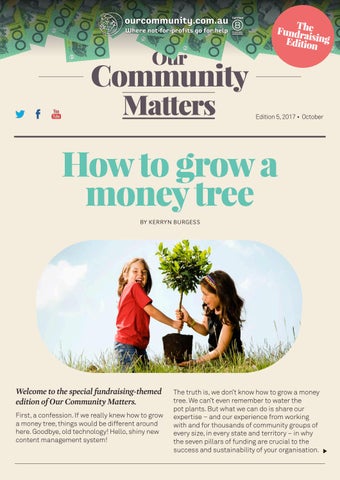
Welcome to the special fundraising-themed edition of Our Community Matters. First, a confession. If we really knew how to grow a money tree, things would be different around here. Goodbye, old technology! Hello, shiny new content management system!
The truth is, we don’t know how to grow a money tree. We can’t even remember to water the pot plants. But what we can do is share our expertise – and our experience from working with and for thousands of community groups of every size, in every state and territory – in why the seven pillars of funding are crucial to the success and sustainability of your organisation.
{
Cover story (continued) What’s more, we’ll tell you how to build them.
Our Community Matters • 2 •
Contents
Your organisation could probably get by for a while relying on just one or two sources of income – a couple of good grants, say, and an annual gala ball or trivia night or walkathon.
CROWDFUNDING: THE POWER OF ASKING
3
GREAT GRANT
5
But what happens when the grants dry up and the gala ball tickets won’t sell because the wheat price has gone south?
HOW TO WIN GRANTS: WEBINAR
6
For your organisation to be solid and financially unshakeable in the long-term, you need to be drawing funds from as many different sources as possible.
OPINION: KEEP AUSTRALIA GREAT AGAIN
7
PULSE POLL
9
TREASURERS’ AWARDS
10
NEW VOICE FOR COMMUNITY DIRECTORS
11
• Donations
DONATIONS: WHO GIVES?
13
• Crowdfunding
GRANTS NEWS: FUTURE OF FUNDING
14
DONATIONS: SMASHED AVO DAY
15
EARNING INCOME FROM SALES
17
CASE STUDY: THE SOCIAL STUDIO
18
COMMUNITIES IN CONTROL 2018
20
SPECIAL EVENTS: MANAGING RISKS
22
NEED TO KNOW: NEWS DIGEST
24
HOW TO LOSE A MEMBER: 10 EASY STEPS
26
SPONSORSHIPS: HOW TO STAND OUT
27
DEAR AGONY UNCLE
29
UPSKILL: TRAINING
30
PROFILE: MICHELLE JENKINS
32
BOARD MATCHING SERVICE
33
GOOD JOBS
35
COMMUNITY CALENDAR
37
Funding sources can be grouped into seven pillars: • Grants
• Membership and alumni • Special events • Sales (earned income) • Community–business partnerships (sponsorships) To survive and thrive, a not-for-profit organisation must develop a fundraising plan that rests on these seven pillars. In this issue of Our Community Matters, we offer tips, tricks, resources, and lessons from people who’ve raised funds from each of those seven sources. And if you know where we can get hold of a money tree, please get in touch: editor@ourcommunity. com.au.
Seven pillars: Crowdfunding
Our Community Matters • 3 •
The power of asking BY ALEX MCMILLAN
I want to tell you a story about a bunch of 20-somethings who decided one day to raise $125,000 for charity in five weeks. They did it – and then sailed right on to exceed their target. Hang on to your hat. The organisation In 2014, Katerina Gaita, the founder of Climate for Change (C4C), saw a gap in the Australian psyche – everyone knew climate change was happening, but no one was talking about it. Katerina decided to change that.
The team My first encounter with C4C and Kat was as one of 20 young professionals and students embarking on the organisation’s Fundraising and Communications Fellowship program. At our “welcome” retreat, Katerina and her team introduced us to C4C and its programs, and
outlined the organisation’s costs and income streams. Then they asked us how much cash we thought C4C would be able to raise through crowdfunding in 2017. Early on, someone mentioned $80,000, which seemed audacious enough – it was twice the previous year’s target. But by the end of the sessions, we’d decided on a big, hairy goal of $125,000. How did we get there?
The goal and the strategy We had an existing pool of about 30 supporters who we thought would be able to raise an average of $600 each. Board members, staff, and fellowship participants numbered 30 all up. Each of us set our own individual fundraising goal – the average was $2000. And we each agreed to invite two or three others to raise funds with us, averaging $600 each.
Seven pillars: Crowdfunding (continued)
Our Community Matters • 4 •
The maths
The key lessons
(30 x $600) + (30 x $2000) + (30 x 2.5 x $600) = a grand total of $123,000. We rounded our goal up to $125,000 and called it a day.
1. Ask someone to donate and you’ve got a successful campaign. Teach others to ask, and you’ve got a successful crowdfunder. Once your fundraisers are engaged in your mission, support them in reaching out to their networks.
The recruitment While the strategy seemed sound, we knew the practice would be tough. A huge part of our success would depend on recruiting a pool of dedicated people to help us fundraise. We invited family and friends to dinners and lectures, and engaged them in discussions about climate change. One by one, they accepted the invitation to join us on our journey. We ran a pre-launch event solely for their enjoyment and formed an active Facebook group. Before we knew it, all of our fundraisers had created individual pages on our crowdfunding website and were ready for action.
The fundraising Once we had the people, we started working on the dollars. As fellowship participants, we supported each of the fundraisers, including each other, in reaching out to those around us to ask for donations. We knew that the people around us had to believe in our mission if we were going to succeed.
2. The earlier you start, the greater the return when your crowdfunder begins. We spent five months planning a five-week crowdfunder, which seemed about right. 3. Your staff and your fundraisers all have stories to tell. Draw them out and share them with the group. The emotions that come with fundraising are both thrilling and deeply disheartening, and this collective emotional experience is something you can leverage. Apart from my family and my partner, my biggest supporters were the other fundraisers. The connections we made were at the core of all our successes. 4. Whether you have two people or 20, assign tasks and roles to each person so that nothing falls between the cracks. We used our fellowship team of around 20 people working short, sporadic hours to make this crowdfunder happen, and we all knew exactly what we were doing.
We focused on how to have difficult conversations about two things no one wanted to talk about: climate change and money. We taught each other how to construct emails, how to approach strangers, how to empathise. Every week, the fellows met to talk about and work through their highs and lows. This in turn gave us each of us the energy to support the other fundraisers we’d signed up.
5. Start big, finish bigger. Launch your crowdfunder with a well-run event, and this will carry you through the following weeks. Keep everyone’s eyes on the prize, and celebrate their success no matter the outcome.
We emailed, called, strategised, hugged it out, and week by week clawed our way closer to the target.
How to set up a crowdfunding project: Checklist
Then we shot straight past it. When we hit $150,000 – 20% more than we’d originally aimed for – I couldn’t believe it. Six months ago, I’d never asked a single person to donate to a cause. Now I’d effectively asked thousands – and it had worked.
More
Climate for Change’s crowdfunder video
~
Seven pillars: Grants
Our Community Matters • 5 •
Great Grant: Poverty and Disadvantage Small Grants Program This program is funded by the Myer Foundation and the Sidney Myer Foundation. For the next three years, it will prioritise the needs of asylum seekers living in the Australian community. Need to know Activities supported include health, education and employment initiatives, housing support and material aid, social connectedness and community engagement programs, and individual advocacy and legal support. Up to 15% of the total available grants pool will be available specifically for organisations and groups supporting and working with asylum seekers.
The program also encourages applications for initiatives that target indigenous Australians, people living in isolated areas, refugees, and disadvantaged kids. Public schools are eligible to apply. It supports small, discrete projects (those with budgets of less than $50,000) that meet the needs of a community rather than providing supplementary funding for large projects.
Deadline The program accepts applications on an ongoing basis; no specific closing dates.
More information https://www.fundingcentre.com.au/grant/ G06851 (Funding Centre log-in required)
Funding Centre: your grants toolkit Grants are a very important source of funds for most not-for-profits. Billions of dollars is provided each year by local, state and federal governments, as well as philanthropic, community and corporate trusts and foundations. The trick is knowing how to get your share. You could spend hours each week trawling the web, with no guarantees you’ll find grants to suit your organisation’s aims, or you could take out a Funding Centre subscription. This entitles you to access to Australia’s most comprehensive grants database – it’s an essential tool for any not-for-profit organisation. You’ll also receive regular customised grants newsletters • alerts for new and updated grants • access to fundraising help and tools Funding Centre subscriptions start at $85 per year. www.fundingcentre.com.au
Seven pillars: Grants
Our Community Matters • 6 •
Grant-seeking success: secrets revealed in exclusive webinar A November webinar for volunteers, staff and fundraisers on how to win the MOST GRANTS EVER for your community organisation or school will reveal top tips from successful grantseekers.
• form long-term relationships with grantmakers
This webinar provides an introduction to the answers to all your grantseeking questions. Learn the secrets for easily winning more grants for your community organisation or school, and find out how to drastically increase the number of grants you can apply for without pushing yourself (and your group) into an early grave. You will be taken through a grant process that will allow you to save time and be proactive with seeking grant funding.
• “Came away feeling like we’d learnt a lot!”
Learn how to:
• “So much information and relevant to my needs. Fantastic presenter.”
• present your proposal in its best light – tell the story of your project and your group to the greatest advantage • plan for grants in a practical and easy-tofollow process • develop your statement of need – choosing data to support your project proposal • use an “organisation template” to save time in writing applications • humanise your story and present a compelling picture • navigate the grants landscape – sorting out which grants are best for your project
• meet the different requirements of different grantmakers – government, philanthropic and corporate.
What past participants have said • “Delivery was clear – direct and easy to follow and understand. Interaction between participants was valuable.” • “Informative, relevant, interesting.” • “The trainer was very enthusiastic about the topics. Lots of practical information to use straight away.”
I’m sold! Where do I sign up? The webinar “How to win grants” is scheduled for noon–1pm (Melbourne time) on November 15. Choose the webinar only ($55) or buy the bundle: the webinar plus our acclaimed book Winning Grants Funding in Australia: The Step by Step Guide ($88). Either way, enrol here. (For the low-down on our other forthcoming funding webinar, “Seven pillars of fundraising ”, see page 30.)
Opinion
Our Community Matters • 7 •
Keep Australia great again BY DENIS MORIARTY, MANAGING DIRECTOR, OUR COMMUNITY GROUP
Australia is a great place to live, and to keep on living. Our life expectancy, for example, has gone up by about three months a year since 1890, and is now among the highest in the world. That’s wonderful, and we probably don’t appreciate it enough. We certainly don’t realise how fragile that achievement is, and how much vigilance is needed to protect it. There’s nothing inevitable about living longer. In the US, where improvements in the treatment of heart disease and cancer have increased life expectancy overall, deaths caused by overdoses of prescription and illegal drugs, particularly opioids, are so prevalent that they actually reduced the average life expectancy by about three months between 2000 and 2015, according to a study published in the Journal of the American Medical Association. And this in a place that already ranks low among developed countries on the life-expectancy tables. One of the underlying causes, surely, is the loss of community. Healthy societies trust each other and help each other. Unhealthy, divided societies lash out at each other like rabid ferrets in a sack. And in the US at the moment, the ferrets would probably do a better job of promoting unity and harmony. America is not a model for Australia to follow; it’s a horrible warning. We have to back away from the precipice. We have to embrace diversity, rather than tolerate it. We have to counter the
Ten reasons to join a community group 1. It’s good for your health Studies show that having a good social network extends your life, keeps you healthy, and staves off mental deterioration. 2. You meet new friends Get to know new people and work with them on things you all care about. How many people have met their future partners at the club? 3. You make new contacts Keeping your networks in good repair helps you to see opportunities when they come up and gives you people to call when you want help. 4. You learn new skills You can learn workplace skills from being a volunteer. You can learn governance skills – committee management, business planning – from joining a committee. 5. It’s good for the community The more people work together and get to be familiar with the way things work around the area, the more people support each other through the tough times.
Opinion (continued)
Our Community Matters • 8 •
Picture: Central Highlands Arts Atlas
politics of hate with the discourse of community engagement. We must treat the symptoms of societal weakness with such direct interventions as injection rooms for addicts, housing for the homeless, and services for refugees, and, at the same time, combat those who hope to rouse our resentment towards addicts, street people, and immigrants. Joining one of Australia’s community groups is an opportunity to join those who are working to make life better. It’s good for you as an individual. It’s also the only way I know to inoculate the Australian polity against the plague of viciousness that’s costing so many lives across Trump’s America. We’re not doing that badly in Australia now. The polls on marriage equality, for example, show that we’re not being conned by the forces of division. But nothing can be taken for granted. The challenges are increasing day by day. Ideologues still manage to profit from our prejudices. If we don’t lift our game to meet them, it’s a long way down.
6. You can follow your interests Whatever you like to do, there are other people out there who like it too. Join a group and you can learn from them. 7. You can build up your CV If you’re applying for a tertiary place, or a new job, or a new relationship, it helps to be able to point to the unselfish efforts you’re putting in for the community. 8. You can learn how to win your battles Experience in operating a community group gives you the tools you need to get your voice heard in the centres of power. 9. You can make a contribution We all want to make the world a better place, even if it’s only by having our team take the flag. 10. It’s good for the country Australia needs a strong civil society, where the government and business don’t run everything and people manage their own organisations for community goals.
~
Your say
Our Community Matters • 9 •
Pulse Poll: taking the pulse of the NFP sector Last edition, we asked:
When do you normally hold your AGM? Well, we’re in the thick of AGM season right now. You said: 50% 40% 30% 20% 10% 0% JAN FEB MAR APR MAY JUN JUL AUG SEP OCT NOV DEC
We also asked what you’re serving after the meeting – Cheezels and kabana? Stilton and shiraz? Answers ranged from the two-health-starrated “Party pies, sausage rolls, beer” to “Healthy tucker; no grog; pure fruit drinks – no poison (sugar)”. One generous group offers up a full meal to all attendees – phwoar! – while another calls in the caterers from a social enterprise – because social good should never sleep.
Latest poll If your organisation could ask Santa for one thing, what would it be? Take the poll: www.surveymonkey.com/r/XZN2778.
News
Our Community Matters • 10 •
Treasurer’s map to financial safe harbour BY MATTHEW SCHULZ
Volunteer treasurer Sinead Glennon is new to Australia and new to working with a not-for-profit group, but the Irish-born accountant says finance issues for small groups are the same the world over. Ms Glennon has won a $5000 donation to her organisation – the Genetic and Rare Disease Network (GaRDN) which connects and supports affected families – after winning one of three prizes given in this year’s Commonwealth Bank Not-for-Profit Treasurers’ Awards. This year’s awards generated more than 1300 submissions recognising the hard work of community treasurers.
Volunteer treasurer Sinead Glennon is sharing her knowledge of financial fundamentals.
The other two major prize winners, winning $5000 for their organisations, were Bruce Clarke of the Melbourne Mustangs Ice Hockey Club, and Kaveen Bachoo from Hepatitis Queensland.
The assessment system she used to help GaRDN is similar to one she uses for clients of her own firm, Opportuna, and helps paint a “snapshot of the financial health of the organisation” by examining income, expenses, profitability, cash flow and liquidity.
Ms Glennon’s prize recognises her creation of an online financial health check that all not-forprofits can use. TRY IT NOW: Sinead’s finance safety checklist Ms Glennon said her desire to enter came from knowing the difficulties not-for-profit treasurers face. “I designed this checklist because I believe that the role of treasurer comes with a significant workload and great responsibility. But lots of treasurers take on the role with little or no accounting knowledge or business experience.” Ms Glennon actually didn’t mean to become a treasurer, having applied to GaRDN as a general board member, but it took only moments for the service to home in on the formidable financial skills she gained through her work as a management accountant with a global firm.
“This survey should focus your mind on what you should know. What areas of information you should be accessing, and what you should be able to answer about your finances. “It’s all about planning, about access to information, reviewing the information you have to hand, putting a budget in place, then reviewing that budget against your operating day-to-day.”
More Take the survey: Sinead’s NFP finance health check Analyse yourself: Understand more about your health check score (PDF)
News
Our Community Matters • 11 •
A new voice for community directors BY MATTHEW SCHULZ
Community directors across Australia have a powerful new advocate, with the formation of a high-level governance advisory council. The Community Directors Council – a new advisory arm of the Institute of Community Directors Australia (ICDA) – will be headed by the outgoing commissioner of the Australian Charities and Not-for-profits Commission (ACNC), Susan Pascoe AM. ICDA hosts Australia’s only recognised diplomalevel governance qualification, the Diploma of Business (Governance), which is tailored for notfor-profit directors (see pages 31–33). ICDA’s new advisory council will be charged with guiding development of the institute’s curriculum and programs, and representing the interests of community directors. The role is the first Ms Pascoe has accepted at the end of a seminal five-year term setting up and running the ACNC, which now regulates the nation’s 55,000 charities and guides its 600,000 not-for-profits. Ms Pascoe finished her term at the ACNC last week. Chairing ICDA’s Community Directors Council would continue her mission of strengthening community groups, Ms Pascoe said. “I’ve long been committed to improving the governance of the community sector, and am passionate about the contribution that community organisations make to the social fabric of the nation,” she said.
Susan Pascoe continue ICDA’s important work to reshape notfor-profit governance,” Ms Schwartz said. “We’re very fortunate to have secured the support of the most respected regulator in the country to head up this new body.” Our Community group managing director Denis Moriarty said the council would drive ICDA’s goals of increasing community directors’ capabilities, in a sector that boasts 11% of the nation’s workers, and better equipping them to face a unique set of governance, funding, and political challenges. “This council will boost the effectiveness of our diploma for not-for-profit directors and continue to showcase the similarities and fundamental differences between a company director and a community director,” Mr Moriarty said.
Our Community chair and Reserve Bank board member Carol Schwartz AM said Ms Pascoe was a perfect fit for the new advisory council.
Mr Moriarty announced the Community Directors Council’s formation this week at the Commonwealth Bank Not-for-Profit Finance Week awards, hosted in Sydney to recognise the efforts of the best community treasurers in the country (see page 10).
“I’m absolutely delighted that Susan has agreed to chair this very important council, which will
READ MORE: Details of the announcement on our website.
Seven pillars: Donations
Our Community Matters • 13 •
Who Gives? What do you get when you let a data scientist loose on a giving platform that’s processed close to $70 million in donations? A lot of insights into donor behaviour, that’s what, writes Alex McMillan. We first reported on Who Gives?, our recent mega-study of donor behaviour in Australia, in Our Community Matters late last year. For this special fundraising issue, we’ve pulled more information from this rigorous, extensive, longterm analysis of donations processed through GiveNow. Who gives? The difference in donor behaviour between genders is most interesting. Women make 54.1% of donations processed through GiveNow, and are more likely to give a regular donation. Men make 36.7% of donations. (The donor gender for the remaining 9.2% of donations is not specified.) However, men tend to donate higher amounts than women – men’s average is $96, versus women’s $70. This means that overall, men and women donate roughly equal amounts. What do they give? The average value of a oneoff donation is $205, which is higher than the average value of a single transaction that is part of a regular monthly donation ($43). But when we look at one-off and regular donations together, we find that nearly 90% of all donations are for $100 or less. One of the most interesting insights from the study is that the average donation amount hasn’t changed significantly in the past 15 years. Crucially, suggested amounts matter. The old “pre-set” suggested amounts of $25, $50 and $100 were the most frequently donated
amounts. GiveNow’s new website now allows organisations to pick their own suggested amounts. Ongoing research at Our Community is aimed at finding the optimum suggested amounts, to help inform your choices. How do they give? At the time of research, GiveNow had processed far more regular donations (324,110) than one-off donations (258,740). On average, a regular donation lasted for one year and five months and was worth $789 over its “lifetime”. When do they give? Weekends are by far the quietest times on GiveNow. Thursday is the most popular day, accounting for 17% of donations (in number terms, not dollar terms). That said, donations made on Sundays have the highest average value, at $143. Why do they give? While we don’t have information on donor intent, we do categorise the organisations that use GiveNow. “Health and wellbeing” causes attracted the highest total amount and the most donations, while “Rural and regional” causes received the equal lowest total amount (tied with “Sport and recreation”) and the fewest donations. It’s important to note that the popularity of particular interest areas has changed over time. For example, “Health and wellbeing” attracted the most donations until 2013, but in recent years multicultural causes have overtaken them to become the leading interest area, with donations increasing from 6.4% in 2011 to 21.1% in 2015. This can be attributed to the increasing popularity of causes related to asylum seekers and refugees. MORE: Who Gives?
Seven pillars: Grants
Our Community Matters • 14 •
Private cash reveals the future of funding BY MATTHEW SCHULZ
An influential philanthropic grantmaker says she’s begun to see a reversal of the postGFC slump in grants from the philanthropic sector, in a positive sign for not-for-profit groups. Caitriona Fay, of Perpetual, also says NFPs should prepare for what she described as “the largest intergenerational transfer of wealth in history” as potential patrons consider how they’ll handle their estates. She stressed groups should always be ready to include philanthropic funds in their funding mix, especially amid changing trends caused by technology.
Caitriona Fay
Ms Fay predicts that new money will come with a shake-up of funding structures, as wealthy donors, the corporate sector and a new breed of tech-savvy givers re-enter the fray.
approaches to their giving. All that bodes well for a healthier funding eco-system,” Ms Fay said.
“We’re seeing more people come back to philanthropy now. We did see a drop in the number of private ancillary funds established during those post-GFC years, but we’re starting to see that increase again,” Ms Fay said.
Her comments follow a key finding of the Grants in Australia 2017 study, which showed the failure of corporate grants and philanthropic money to recover to levels seen before the 2008– 2009 global financial crash.
And this could be a positive sign for NFPs. “We’d expect to see not just more funds coming into the community sector but also more philanthropists with different interests and
This article was first published in extended form in Grants Management Intellingence, the member newsletter of the Australian Institute of Grants Management (AIGM). Join the AIGM here.
Seven pillars: Donations
Our Community Matters • 15 •
Critic toasted by ‘Smashed Avo Day’ fundraiser BY MATTHEW SCHULZ
A year after the furious backlash over conservative commentator Bernard Salt’s pot-shot at the under-40s for spending cash on smashed avocado brunches instead of saving for a house, enterprising mates have launched National Smashed Avo Day. The event on Sunday October 15 invites brunchers in cafes, restaurants, clubs, homes and parks to raise funds for youth and homeless charities, helping those who don’t have the luxury of saving. The event is set to trigger a string of foodie posts on Instagram, with diners invited to donate straight from their phones, tagging their pictures with #smashedavoday, #biggestbrunch and #brunchforacause.
“We’re flipping ‘Smashed Avo Furore’ into fundraising”, Smashed Avo Day co-founder Marty Bamforth said. In what’s been dubbed the nation’s first “Insta‑fundraising” event, donors are asked to help three youth and homeless charities: OrangeSky Laundry, Kids Under Cover, and Backpack Bed For Homeless. Mr Bamforth said Smashed Avo Day was a few mates who saw an opportunity to turn Bernard Salt’s attack into a positive. “Homelessness really bugs me, and I wanted to make a difference,” Mr Bamforth said. “We first had the brainstorm on Australia Day, while we were at the beach, floating on our backs in the ocean at Noosa. After that, it all came together and we activated the plan in July.”
Seven pillars: Donations (continued)
Our Community Matters • 16 •
“Who knows whether it will take off. But why not? There’s kind of nothing on that weekend. It’s the end of the footy finals, and hopefully it’ll be that first hot weekend leading into summer.”
Ms Richards is doing her bit to repair smashed avocado’s bruised reputation, saying the dish brought people together. “It’s about community and people eating good food with friends.”
The event had been pulled together on a shoestring.
“That’s why this event is so good, because for many customers, they might spend $17 without a second thought, whereas this create awareness and conversations about homelessness.”
“Everything’s so easy these days. You can create a big impact for a light footprint. It’s cost a few bucks, sure, but I reckon it’s worth it.” The cafes putting the heat on Mr Salt include The Winey Cow, in beachside Mornington, Victoria. Manager Amanda Richards said the $17 smashed avocado dish was one of the cafe’s biggest sellers, and featured bloody mary vinaigrette and stracciatella di bufala cheese on sourdough.
“It’s easy to cut people down, especially young people. But they’re the people who will be running the world soon, and it’s great they have a chance to learn about social issues in this way.” MORE: https://smashedavoday.com.au/
News
Welcome to Happy Hour Do you work or volunteer in the not-for-profit sector? Do you have questions that need answers? Do you need to vent about fundraising legislation? Need some people to throw ideas around with? Looking for like-minded people? Join Not-for-Profit Happy Hour Australia, a new Facebook peer support group for professionals and volunteers in the community sector. Find us at https://www.facebook.com/groups/nphhaustralia/.
~
Seven pillars: Sales
Our Community Matters • 17 •
Income from sales: Profit for not-for-profits Being a not-for-profit group doesn’t mean you can’t make a profit. It just means you can’t disburse any money that you make to your members. But you can absolutely boost your own coffers by charging for what you do, what you have, what you know, or what you can sell. Crucially, setting out to generate income requires a completely different mindset from the one required to minimise costs. If you as an organisation are going to set a goal of earning significant income, then you also need to give your leaders and managers the freedom to act accordingly, and to develop the policies and processes needed for commercial success.
Seven steps to planning an income stream 1. Identify a genuine need or desire in an area where your organisation’s primary work or infrastructure gives you an advantage over for-profit competitors in the marketplace. 2. Assess as specifically as possible what your target customers want in a product or service of this type – and how much they would be willing to pay for it. 3. Determine whether your organisation is equipped to profitably provide what your potential customers want. 4. Decide whether your organisation is willing to provide the product or service in the way the market desires it, and whether doing so falls within the organisation’s mission and mandate. 5. Explore how your organisation would fund and sustain such a venture during its start-up phase. Evaluate whether starting the business you have envisioned is truly the best use of your organisation’s financial and human resources. 6. Consider whether an equal amount of income could be generated with less investment of time and/or money. 7. Consider how starting and running a business would change your organisation’s culture and community, and what impact it might have on your mission.
A version of this article was first published in Board Builder, the member newsletter of the Institute of Community Directors Australia.
But we’ve got nothing to sell! Keen to jump on the incomeearning bandwagon, but lacking any products or services to sell? “Products” come in all sorts of shapes and sizes, not just wrist bands and mugs. A great example is Crisis Response Crew, launched recently by the Australian Red Cross. What is it? A product that provides the stories of humanitarian workers in the field to those who “Join the Crew” for $10 per month. Why do we love it? It fulfils donors’ common desire to see the impact their donation makes, by providing them with unique stories that wouldn’t be otherwise available to them. So smart!
Does your group sell a unique “product” or service? We’d love to hear about it! Email us at media@ourcommunity.com.au.
Seven pillars: Sales
Our Community Matters • 18 •
The Social Studio is on a roll with its hybrid social enterprise model. Picture: Liberation Images
Crafting a future for refugee youth: The Social Studio BY MATTHEW SCHULZ
Like the artists and fashion designers at the heart of The Social Studio’s hybrid social enterprise model, the people behind the inner-city Melbourne organisation are always refining their ideas of what works best. It’s why the not-for-profit association has adopted a form of social enterprise that still relies heavily on donations and, to a lesser extent, grants, while working steadily towards generating income that will make it selfsustaining. Combining fashion, art, retail and hospitality since 2009, The Social Studio has forged a mission to create jobs, education and community connection for young people from refugee backgrounds.
In a short time, it has become a fixture of Melbourne’s fashion and creative scene, from its base in funky Smith St, Collingwood. Known for its shopfront filled with designs from its graduates, the space is also an arts hub and community space nurturing talent. The Social Studio has helped launch careers in partnership with the RMIT School of Fashion, and has a strong connection with Melbourne Fashion Week. While The Social Studio employs about 20 people in positions ranging from casual to full-time, that number is boosted by up to 10 during shows and festivals. Volunteers add to the mix, often with specialist skills. Executive officer Eugenia Flynn says the studio’s continued success relies on its status as a not-for-profit association, and on being able
Seven pillars: Sales (continued)
Our Community Matters • 19 •
The Social Studio says it’s not prepared to sacrifice its mission to chase more cash. Picture: Liberation Images
to attract “the right type of people” as donors, driven by an interest in social issues.
“Our social impact is why we exist, and social enterprise is one way to support that.
The Social Studio says it’s not prepared to sacrifice its mission to chase more cash. That’s reflected in the fact that up to two-thirds of the organisation’s income comes from donations and philanthropists. A smaller share comes from government funding, while 25–30 per cent of income (and growing) now comes from art and clothing sales, the cafe and a digital print studio.
“Our enterprises are doing well; it’s just that with our hybrid model, we don’t have to be demanding of our social enterprises, but instead can focus on our people and social impact.”
Crucially, Ms Flynn said the The Social Studio didn’t want to sacrifice its social goals in the pursuit of more income. “With the target cohort that we have, we want to ensure that everything we do is working to servicing them. “If we were running purely as a business, the competing commercial aspirations could override wanting to put people first.
For those considering social enterprise models, she stresses there are benefits. “Being as agile and flexible as a business can seem counterintuitive, but good business practice can create efficiency, productivity and help generate higher levels of income. “But don’t forget that’s not the be-all and endall. The philosophy underpinning all you do is why you have credibility with the community you work with, and you don’t want to lose that.”
This article was first published in Board Builder, the member newsletter of the Institute of Community Directors Australia.
Communities in Control
Our Community Matters • 20 •
Communities in Control 2018 The community sector event of the year will see community leaders from across Australia converge on Melbourne in May next year to combat inequality. Our Community group managing director Denis Moriarty invites you to join the fight. Don’t believe those who tell you otherwise: Inequality is on the rise. And that needs to stop. Inequality is bad for individuals. In more equal societies, people are happier and live longer. It’s bad for regions. Local governments know this, and have made it a focus. Inequality is bad for the nation’s health: more equal societies do better. Inequality is bad for our economic development: more equal societies grow faster. And it’s bad for our political system. When special interests are allowed undue influence, we all lose out.
We can’t focus only on our own front yard, either. The challenges we face – climate change, mass migration, technological upheaval – are global. We have to address what’s in front of us, certainly, but we need to lift our gaze as well. We have to recognise our responsibility for each other. We have to recognise our responsibility for what governments do in our name. We have to work together, as a community. The late, great community campaigner Joan Kirner taught us to look towards children to learn what equality looks like. “That’s not fair!” children exclaim when they see something that doesn’t make sense, she told us. “Well, what are you going to do about it?” was always her reply. “Get together, get angry and get organised.” That’s what we’re going to be doing at Communities in Control 2018. Come and join us.
Communities in Control, Melbourne, May 28–29: Register here.
It’s not easy to change the system, but it’s a fight worth having. While we’re rolling up our sleeves, though, let’s just agree on a few guidelines. Being concerned about inequality doesn’t just mean that we want to tax rich people more and ordinary people less. We need to continue the battle for redistribution of wealth – we need to ensure the government has enough money to spend on the people we’re trying to help – but we have to go further. The opposite of inequality isn’t equality. We don’t want a population of well-off citizens each living in a hermetically sealed bubble behind a white picket fence. The opposite of inequality is community. Local, global, and virtual.
Communities in Control 2018 Save the dates: May 28–29, 2018, sees Communities in Control once again in Melbourne Don’t miss it. Subscribe here for updates on next year’s event.
Communities in Control
Our Community Matters • 21 •
Watchdogs, shakers, movers, talkers, makers We reveal the inspirational speakers headlining the 2018 community event of the year. Indomitable former Human Rights Commissioner Gillian Triggs, Aboriginal truthseeker Stan Grant, millennial-on-a-mission Jamila Rizvi, and “venture capitalist for good causes” Philip Wollen OAM will be among the prominent Australians headlining next year’s Communities in Control Conference. The four are among around a dozen speakers confirmed to grapple with the thorny topic of inequality at Australia’s premier community sector conference, to be held in Melbourne on May 28–29. Professor Triggs will give the Joan Kirner Social Oration, a landmark lecture previously delivered by luminaries including journalist and euthanasia campaigner Andrew Denton, TV personality Waleed Aly, and former Prime Minister The Hon Julia Gillard. Prof. Triggs was President of the Australian Human Rights Commission from 2012 to 2017. A prominent academic and international lawyer, Prof Triggs’ stint at the helm of Australia’s human rights watchdog was marked by her relentless pursuit of justice, particularly in relation to children in detention, and her refusal to yield to mounting political pressure to fall back. Stan Grant is the Indigenous Affairs Editor for the ABC and special advisor to the prime minister on Indigenous constitutional recognition. Following decades of work as a TV presenter both in Australia and overseas, Mr Grant rose to further prominence in 2015 when he delivered a speech on racism in Australia that shook many Australians’ view of
Gillian Triggs their country as an egalitarian nation. His 2016 book Talking to My Country has been similarly influential. Jamila Rizvi has been described as one of the pre-eminent voices of young Australian women online. A former editor-in-chief of Mamamia, she’s now a regular fixture on talk shows including The Project, The Drum and ABC News Breakfast. Ms Rizvi’s first book, Not Just Lucky, acts as a “career manifesto for millennial women,” while her particular blend of irreverence and practicality has seen her touted as a serious political contender. Philip Wollen is no accidental philanthropist. The former Vice-President of Citibank is known as a man of action, and he uses that to good effect in his work to promote kindness towards all other living beings, and to make that a “recognisable trait in the Australian character and culture”. Mr Wollen’s main project, Winsome Constance Kindness (named after his mother and grandmother), is a global initiative that emphasises ethics, compassion and cooperation.
Communities in Control, Melbourne, May 28–29: Register here.
Seven pillars: Special events
Our Community Matters • 22 •
Don’t let anything rain on your parade: managing risks Holding a special event is a great way to raise valuable funds and to bring together your members and the wider community for fun, good times and high spirits. Yet when you decide to hold a special event, your organisation is taking on a bundle of risks – everything from salmonella poisoning in your sandwiches to wild weather in the marquee. Accidents can happen even at the best-planned fundraisers, whether it’s a trivia night, a sausage sizzle, a fête or a black-tie dinner for 500 guests. This isn’t meant to deter you. Not a bit. But it’s a crucial reminder: when you plan and organise a fundraiser, you need to consider risk management, including insurance. To help, Aon have put together an event checklist to help you consider the risks your next fundraiser might expose you to, and what you can do to manage those risks. It’s not exhaustive,
and not everything on the list will be relevant to your event, but it flags the types of issues you need to be aware of. As you tick off the items on the list, consider what insurance you might need, such as public liability insurance or event cancellation insurance. For more information, visit the Aon website or call their dedicated NFP team on 1800 803 315. MORE: Our Community sample risk management plan for special events
Aon is an Our Community preferred supplier partner for insurance.
Events
Our Community Matters • 23 •
You’re invited to the night of nights
Anne Mitchell took out last year’s “Unsung Hero” award for her work with homeless people in Melbourne.
The HESTA Community Sector Awards recognise outstanding service provision, advocacy and leadership in improving the lives of people who rely on access to the services of this sector, and are proudly supported by ME – the bank for you. Health and community services is full of ordinary people doing extraordinary things, day in, day out, across Australia. That’s why HESTA came up with the HESTA Awards Program, to recognise the life-changing work being done by people like you. Come and celebrate the best of the best in your industry at the awards dinner on Tuesday October 24 at the Sofitel Melbourne, from 6.30pm. Tickets are on sale now at hestaawards.com.au. HESTA is an Our Community partner.
Need to know
Our Community Matters • 24 •
Your two-minute NFP news digest: fundraising special edition BY ALEX MCMILLAN
Global giving “The proportion of people across the world who reported donating money in 2016 – when the research for this year’s report was conducted – is the lowest seen for three years.” Charities Aid Foundation’s World Giving Index 2017 shows Australia has dropped out of the top five for the first time since 2011. This falling trend is matched by all developed countries, while giving in Africa is on the rise. Full report
Funding news to find connections “Philanthropy needs to urgently embrace the opportunities to build trust and empathy within communities by putting news and information at the heart of their funding strategies.” The managing director of the US-based News Integrity Initiative, Molly De Aguiar, reflects in Medium on lessons learned from Hurricane Sandy and the Charlottesville riots, both disasters in their own right. Read the article
Let’s get together “Donors reported engaging with giving groups substantially improved their philanthropic knowledge and changed attitudes and behaviours.” Collective Giving and Its Role in Australian Philanthropy, a research report by Creative Partnerships Australia, found that 70% of donors increased or substantially increased the amount they gave as a result of their engagement with giving groups. Read the report
Public interest and philanthropy “Advocacy is not always entirely comfortable. Public policy is a contact sport. When billions of dollars are at stake, there can be plenty of eye-gouging.” – John Daley, CEO, Grattan Institute The CEO of the Grattan Institute breaks down the processes of and relationship between public interest and advocacy into simple language, and explains philanthropy’s role in influencing this. His speech at the Philanthropy Meets Parliament Summit last month is a must-read for anyone seeking to understand the role of the community sector in moving the work of parliament closer to meeting public needs rather than private interests. Read the speech
Need to know (continued)
Our Community Matters • 25 •
In with the old, out with the new “Digital and phone outreach does not build relationships, and it does not reach the people in community who are not digitally engaged.” – Jackson Koeppel, Executive Director, Soulardarity
A number of Detriot-based not-for-profits are ditching the digital approach to fundraising, and returning to traditional approaches to community building. Surveys, meet-ups, door knocking and “sweat equity” are just some of the ways organisations are re-engaging with the community by placing face-to-face interactions at the top of their priority list, reports Dorothy Hernandez for Model D Media. Read more
Shaky foundations
Bombs away!
“The sector needs to start having the right conversations with supporters and the public to re-orientate their thinking to delivering results and outcomes rather than focus mainly on operational costs. Another dollar spent on another inefficient program is just another dollar wasted.” – Good Foundations
“Ensuring donors’ wishes are understood and that they feel respected is an important step in encouraging them to continue their relationship with your organisation.”
Only one in three respondents to Good Foundations’ 2017 survey believe most Australian not-for-profits are well-run. The Foundations of a Well-run Not-for-profit analyses supporters’ views on how well Australian not-for-profits are performing, taking into consideration issues of governance, collaboration, and impact. Read the report
UK-based nfpSynergy’s latest report, GDPR: The Change That Charity Donors Want, touches on the General Data Protection Regulation and its potential across the European NFP sector, but also provides insights into donors’ opinions on being “bombarded” by organisations. Older and younger donors have wildly different opinions on how frequently they should be contacted, but generally the public prefer an “opt-in” model for communication. Read the report
Who gives what? Why? How? “While fewer people are giving, they’re giving more as the average donation has increased. Similarly, the percentage of people volunteering and the hours volunteered have both increased over the past decade.” Professor Scaife, lead researcher and director, Australian Centre for Philanthropy and Nonprofit Studies
In the latest in the QUT Giving Australia 2016 report series, Individual Giving and Volunteering, the data alone is impressive. However, the responses from focus groups provide unique insights into donor and volunteer perspectives. Respondents were compelled to give to “good” causes and charities, and to those most in need, while the biggest barriers to giving were scepticism and lack of knowledge. Full report
Seven pillars: Memberships
Our Community Matters • 26 •
How to lose a member in 10 easy steps BY ALEX MCMILLAN
Are you sick of pesky people who want to support your cause by joining up? Tired of banking membership fees? Had enough of newbies’ enthusiasm and goodwill? Here’s how to lose ’em all! 1. Give them absolutely nothing in return for their time and money. You deluged their Facebook feed with invitations to join your cause, and they responded by signing up. Tick! Your work is done. 2. Don’t tell them anything about the valuable work your organisation is doing. Keep it all to yourself. Shhhhh. 3. After a long silence, flood their inbox with requests for money. Smoke them out! Make them wade through an inbox full of your impersonal fundraising emails. 4. Ensure your lines of communications are inefficient. Don’t give them your email address. Make them fill out a ‘contact request’ form on your website. Then autoreply with a promise to forward their query to the relevant staff – and don’t. Eventually they’ll give up. Hopefully they’ll leave altogether. 5. Arbitrarily make decisions without consulting them at all. Make it clear that this “membership” thing doesn’t get them any privileges whatsoever.
6. Better yet, actively consult them and then don’t do a single thing they suggest. HAH! You’re really sticking the knife in now. 7. Take away your membership coordinator. Leave them feeling abandoned and used, and surely they’ll finally leave. 8. Practise mission-drift. Gradually shift your organisation’s focus away from whatever your members are passionate about. So sneaky! Then they won’t even be supporting the cause they originally signed up for, and with any luck they’ll leave. 9. Cease to advocate for your cause. You’re already showing them you don’t care, so you might as well fade from view altogether. That should stop ‘em from renewing. 10. Focus on getting new members ahead of supporting your existing members. This should squash any loyalists who still think they’re special to you. As a bonus, you can squeeze money from the newbies. If you get sick of them too, start again at Step 1.
Seven pillars: Sponsorships
Our Community Matters • 27 •
Don’t treat potential sponsors like cash machines. The most successful deals benefit both the sponsor and the not-for-profit involved.
Sponsorship proposals: how to stand out from the crowd BY VANESSA NOLAN-WOODS, GENERAL MANAGER OF SOCIAL IMPACT BANKING, COMMONWEALTH BANK
Successful sponsorship deals bring benefits to both the sponsor and the not-for-profit involved, and to the wider community as well. But they’re a competitive business – demand always far outstrips supply.
sponsorship is a two-way street, and you’ll need to be able to demonstrate that your proposal will help deliver on your potential sponsor’s vision and mission.
If you’re taking a “one size fits all” approach to your sponsorship activities, chances are you’re not going to get the results you’re hoping for. Here are some tips to help your organisation stand out from the crowd.
Do your homework. Research your potential sponsor’s website and social media pages to get an understanding of what they stand for and what they are trying to achieve. You can then use similar language in your proposal and demonstrate the alignment between your organisation and theirs.
Know your audience
Red flags
Before you even begin to draft your sponsorship proposal, have a clear understanding of who you’re approaching and why. A successful
Many companies steer clear of sponsoring certain activities and events because they don’t align with corporate values or they carry the
{
Seven pillars: Sponsorships (continued) potential for reputational damage. As a not-forprofit, you should consider these questions: • Who sponsors you already? If you have an agreement with supermarket A, it’s unlikely you’ll be able to cut a deal with supermarket B as well. • Could your activity or event be considered high-risk? Running a read-a-thon is probably going to be fine; organising a sky-diving display or a boxing match to raise funds could see you short of sponsors. • Could your activity or event be viewed as discriminatory or excluding – in a sexual or racial sense, for example?
Be clear on what you’re offering Outline the potential benefits a sponsor will receive in exchange for their financial support. For example: • Explain how your organisation aligns with and promotes a potential sponsor’s vision and values • Outline how the sponsorship might deliver new business opportunities (e.g. “Your sponsorship dollars will be spent on supporting youth in our local community, which will build confidence and resilience in the community, and support economic development” • Offer the potential sponsor direct involvement in your activities, as a team-building opportunity for them, and a way of giving back • Offer speaking opportunities at your event, the chance to talk directly to the community.
Remember the ‘extras’ Consider what else you can offer to make your sponsorship proposal attractive. The bigticket item is naming rights, but you could also provide branding, marketing, media or other PR opportunities – logos on flyers, signage, tickets and programs, for example.
Our Community Matters • 28 •
Be clear on what you’re asking for Cold, hard cash is just one form of sponsorship. You might find it more useful or rewarding to ask for people’s time – that is, volunteering – or to seek donated or discounted goods, services or facilities.
Measuring success Think about ways you could enable potential sponsors to measure the return on their sponsorship dollar. Measures of success for sponsorship of a special event might include: • The number of people who attended your event • The level of media activity and positive press coverage (did the local newspaper pick up your event? Did other organisations repost your social media articles?) • The level of engagement of the sponsor’s staff in activities. This can demonstrate that people from the sponsoring organisation are passionate about your cause. • Brand recognition or reputation surveys during or after the event.
Time is your friend Don’t underestimate the amount of time a company might need to review your sponsorship request. A large corporation might need 12 weeks or more, depending on the type of sponsorship you’re seeking.
Put in the time There’s no magic formula when it comes to producing successful sponsorship proposals. However, by taking the time to do your homework and by clearly detailing the potential benefits to both parties, you have a much greater chance of standing out from the crowd.
Commonwealth Bank is an Our Community partner.
~
Funding
Our Community Matters • 29 •
Dear Agony Uncle Our Community’s thinker-in-residence, Chris Borthwick, answers readers’ questions about fundraising. We’re feeling conflicted Q. A small NFP I work for is considering engaging one of our board members (the treasurer) to undertake some fundraising work for us on a 15-month contract. Would it be a conflict of interest if he were to become an employee and be paid as such? (He would retain his role as board member.) Would it be preferable for him to be a contractor? A. Yes, it would be a conflict of interest. Which doesn’t mean it can’t happen legally. The consequences of having a conflict of interest are that • it must be declared to the board • the treasurer shouldn’t have any part in the decision of the board • the treasurer (depending on which state you’re in) probably shouldn’t be present for the discussion in the board room • the rest of the board shouldn’t favour the treasurer over any other tenderer/applicant/ whatever (the decision should be made at arm’s length). Other than that, go ahead. If your treasurer is the best person for the job, the law doesn’t require your organisation to suffer. If you want to underline transparency, advertise or call for tenders. If that would cost too much or lead to delays, don’t. Oh, and appointing the person as a contractor wouldn’t remove any of the conflict of interest problem.
Chris Borthwick national governing body, or do we just begin our own promotions? A. Every dog has his day, and most causes have their week. Some overlap is inevitable, which can be confusing – although when National Balloon Week fell in the same week as National Condom Week, this might be seen as useful synergy. The same week also saw National Breastfeeding Awareness Week, National Smile Week, National Feast Your Eyes Week (to raise awareness of what foods are good for your eyesight), National Barbecue Week, National Gossip Week, Sun Awareness Week (to remind people that dark glasses protect your eyes from the sun’s harmful rays), National Allergy Week, and National Positive Parenting Week.
How do we register a national week of…?
As you can see, there’s no need to get anybody’s approval before declaring your own week. On the other hand, there’s so much competition that you’ll need a very good concept before you’re going to get any real coverage. The fundraising field can only look on with helpless admiration at such marketing coups as Cup Week and Mother’s Day.
Q. We are interested in establishing and registering a National Week but we do not know how to go about that. Is there some formal process involving government? What criteria apply? Do we need to get consent from a
Got a question for our thinker-in-residence? Email chrisb@ourcommunity.com.au. For the next issue of Our Community Matters, our thinker will give priority to questions on technology, data, disruption and Christmas.
Training
Our Community Matters • 30 •
Upskill
The role of the chair in arts organisations takes centre stage at a free webinar on November 21 (see page 31).
Webinar: Seven pillars of fundraising October 25, noon–1pm (Melbourne time) If you’ve read this far in our special fundraising issue of Our Community Matters, you’ve learned a lot about the seven pillars of fundraising. Now try the webinar! Whether you’re new to fundraising, or looking to escape from your same old-same-old sources, this is a session you can’t afford to miss. Learn about: • Grants • Donations • Crowdfunding • Memberships
• Events • Sales • Sponsorship
Choose the webinar only ($55) or buy the bundle: the webinar plus our acclaimed guide The Complete Community Fundraising Handbook ($88). Either way, enrol here. (For the low-down on our other forthcoming funding webinar, How to win grants, see page 6.)
{
Training (continued)
Our Community Matters • 31 •
Diploma of Business (Governance) Upgrade your qualifications and expand your network by studying for a Diploma of Business (Governance). Australia’s only diploma-level governance qualification is designed specifically for existing and prospective not-for-profit board or committee members and the CEOs and senior staff who work alongside them. Check out the course start dates below and then enrol here. Brisbane Melbourne Perth Sydney
February 12, May 7 November 13, January 22, March 26 October 16 (sold out), February 12, May 7 October 9, January 22, March 26
Australia Council arts governance program: one-day workshop The Australia Council arts governance program has been developed specifically for the arts sector. It promises to enhance participants’ leadership in arts governance. Registration for this workshop will give you access to one day of governance training as well as two years of membership of the Institute of Community Directors Australia (ICDA), a specialist not-forprofit governance membership body. It also includes access to a private arts governance online forum. Attending as a group? Please note: The registration fee for this training is $350 per group of up to three people. Demand for this program is very strong and many scheduled sessions have sold out. Further dates and locations will be added according to demand. Please let us know if you’re interested in attending a workshop in your location by emailing leadershipprogram@australiacouncil.gov.au. Right now, places are available in the Alice Springs workshop on November 16. Register here.
Australia Council arts governance program free webinar: The role of an arts chair Tuesday November 21, 1pm (Melbourne time) When it comes to board performance, everything starts and ends with the chair. In this webinar you’ll learn how to be a good chair, what to expect from the chair, what to do if things need to change, and how to move on effectively and gracefully. This webinar takes the form of a 45-minute presentation followed by a 15-minute Q&A. Participants will receive access to written responses to questions submitted during the webinar, as well as relevant follow-up materials. Register here.
~
Profile
Our Community Matters • 32 •
“Not-for-profit leaders need to lead by example, which is no different from the animal kingdom,” says Michelle Jenkins.
Look for lessons everywhere, and be bold BY MATTHEW SCHULZ
If there’s one thing not-for-profits should learn, says Michelle Jenkins, it’s how to be bold and take more risks. The graduate of the Institute of Community Directors’ Diploma of Business (Governance) should know: she’s witnessed organisations from both the not-for-profit and corporate sides of the fence. Ms Jenkins was the first female head of commercial banking for Westpac in WA, before turning to involvement in aged services, and now community services. As chief of Community Vision, based in Joondalup, north of Perth, she helps the young and old. And her mission? To help clients “develop their aspirations and realise their dreams”.
Achieving that aim can’t be done without courage, she says. “I think as not-for-profits we think risk is a dirty word and are not as bold as we should be, perhaps allowing inertia to settle in, and we become very complacent in thinking that our world is not going to change and we’re all going to be secure because we’re not-for-profit. And actually, the reverse is true.” You never know where you’ll find inspiration, and Ms Jenkins is not shy of drawing lessons from her part-time roles as marriage celebrant and “fur babies” lover. The owner of English bull terrier Ellie May, miniature poodle Dougal and cat Charlie says, “Being a responsible parent ... it’s important that I teach them manners and values.”
Profile (continued) “In the same way, not-for-profit leaders need to lead by example, which is no different from the animal kingdom. Leadership is about setting examples which others can follow, as well as upholding the values of the pack – to protect and ensure that everyone is secure in their surroundings and knows what they have to do.” Conducting marriages has taught Ms Jenkins “all about checking credentials and paperwork to make sure everything is accurate, about planning a ceremony and executing the plan according to what has been agreed,” she says. “For not-for-profits, it’s the same.” Ms Jenkins says the Graduate Diploma in Business (Governance) has forged her existing skills and knowledge together for a deeper understanding.
Our Community Matters • 33 •
“The diploma challenged my thinking on how I work with my board. In my case, with so much change happening in the sector, I really need to focus my board more on the strategic initiatives and allow time for strategy-focused discussions. We have added some extra meetings to do just that.” The Diploma of Business (Governance) is Australia’s only currently approved diploma-level governance qualification. More info. This article was first published in Board Builder, the member newsletter of the Institute of Community Directors Australia.
~
Vacancies
Board Matching Service The board vacancies below are just a small sample of what’s currently listed at both the Institute of Community Directors Australia website and Good Jobs. New South Wales
Western Australia
Board member, Women’s Justice Network (WJN)
Multiple board roles, Australian Insulation Foundation Ltd
WJN addresses the issues facing criminalised women and female youth both systematically and through a mentoring scheme for individuals.
Queensland Board member, The Rattler Railway Company (RRC) Ltd RRC was formed by Gympie Regional Council to independently operate the Mary Valley Rattler as a sustainable tourism and heritage business.
Australian Insulation Foundation Ltd was founded to provide free insulation to Australians living in social or government housing.
Victoria Chair, Refugee Migrant Children Centre Based in the Brimbank council area, the RMCC seeks a person who is passionate about the rights of refugee and migrant children for the role of chair. The ideal candidate will be proactive and driven, and have experience on a board.
Toolbox
Our Community Matters • 34 •
Swift rescue for wildlife help service BY MATTHEW SCHULZ
Who could resist joining the board of an organisation whose clients look like this? (Picture: Ausgrid/Flickr)
Wildlife Victoria recruited a new communications expert for its board in just 24 hours thanks to Our Community’s Board Matching Service. The registered charity known for its wildlife emergency response service – and crew of 1500 dedicated volunteers – posted a free advertisement last month as it sought new talent.
Climate Council, but the journalist has also worked as a TV presenter and news anchor, marketing manager, podcaster and digital entrepreneur, and so it’s not that surprising that the wildlife service snapped her up.
President Ron Burke was pleasantly surprised to get the first response almost immediately, and that it turned out new recruit and experienced journalist Alexia Boland fit the bill perfectly.
“I have always been extremely passionate about the protection, preservation and conservation of animals and Australian wildlife,” Ms Boland said.
“We weren’t specific, but we were lucky with the first response,” Mr Burke said. Ms Boland offered the board extensive media experience, currently as an adviser with the
“Wildlife Victoria plays a vital role assisting wildlife in the Victorian community, and with the board searching for communications specialisation, serving the WV and wider community in this capacity was a natural fit.”
Vacancies
Our Community Matters • 35 •
Good Jobs At GoodJobs.com.au, our mission is to connect purpose-driven people with organisations in the not-for-profit and community sectors. We want to help energetic, idealistic, and passionate people overcome obstacles and achieve their career ambitions and dreams.
Selected current vacancies Australian Environmental Grantmakers Network Sydney Administration, Communications and Events Assistant (0.6)
Footscray Community Arts Centre Melbourne Creative Producer
This role covers three areas key to AEGN’s success: office management, communications support, and events coordination.
Responsible for delivering a progressive and influential artistic program, this role contributes to the future of FCAC as Australia’s leading centre for community engaged, community arts based practice.
Equity Trustees Melbourne
Peninsula Women’s Health Centre Woy Woy, NSW
Program Manager, William Buckland Foundation (PT considered)
Coordinator (0.6)
The Charitable Trusts and Philanthropy team are looking for key talent to join their 16-strong team to deliver outstanding service to one of Equity Trustees’ most significant and complex philanthropic clients and partners, The William Buckland Foundation (WBF).
Footscray Community Arts Centre Melbourne Marketing and Engagement Manager (0.8; maternity leave) This exciting role leads the development and delivery of FCAC’s marketing, communications and audience development strategies in a local, national and international context.
This is an opportunity for a dynamic woman to coordinate the Peninsula Women’s Health Centre, the Woy Woy outreach centre of the Central Coast Community Women’s Health Centre.
Doncare (Doncaster Community Care & Counselling Centre) Melbourne Family Services Worker (PT fixed term) Doncare is seeking a suitably qualified and highly skilled professional to join our Family Services team to deliver services under an exciting new pilot program known as Intensive Family Services.
Suppliers
Our Community Matters • 36 •
Good Suppliers October spotlight: fundraising help At Our Community, we receive calls every week from not-for-profit organisations looking for consultants to help them with their fundraising strategies. If you’re a consultant providing services to not-for-profits and you’re not listed in GoodSuppliers, you’re missing your target. List your business.
AskRIGHT
AskRIGHT fundraising consultants and prospect researchers help not-for-profit organisations raise more money by providing optimal fundraising strategies, identification of donors, training, recruitment and campaign implementation. More
DG Consultive
Fundraising, marketing strategy and implementation, accreditation, governance, grants, copy-writing, strategic planning, social media, communications, policies. More
O’Keefe & Partners
O’Keefe and Partners (OKP) provide fundraising, charity and philanthropic consulting services to hundreds of businesses and not-for-profits in Australia and New Zealand. More
Strategic Grants
Strategic Grants builds not-for-profit capacity to be ready to apply for and able to win grants with online Grants Expertise Management Systems (GEMS), grant strategies, research and training. More
Ellen Smith: official photographer, Communities in Control 2017 PHOTOS
Tel: 0418 335 935 | www.esphotos.com.au
Calendar
Our Community Matters • 37 •
Our favourite fundraising events this October and November. OCTOBER 15
National Smashed Avo Day Love to brunch? Flip “smashed avo furore” into fundraising! Join in on Sunday 15 October to #brunchforacause and raise funds for youth and homeless charities in Australia. In 2017, NSAD is raising money for OrangeSky Laundry, Kids Under Cover and Backpack Bed for Homeless. More: page 15. Details
OCTOBER 15–NOVEMBER 12
The Bloody Long Walk Walk, jog or run 35km – do it your way. Choose your speed, and participate as a team or an individual. Or volunteer and help make a big difference on event day. The Bloody Long Walk is happening in Canberra (October 15), Adelaide (October 22), Melbourne (November 5) and Sydney (November 12). Every dollar raised will help find treatments and a cure for mitochondrial disease. Details
OCTOBER 1–31
Dogtober Get into houndraising! Dogtober aims to raise dollars for Assistance Dogs Australia, where every dog undergoes tailored training to meet the individual needs of their new owner – a person living with physical disabilities, autism, post-traumatic stress, dementia, or other special needs. It costs over $35,000 to train each dog. Assistance dogs are placed free of charge with their new owner, providing life-changing support for up to 10 years. The choice of houndraiser is yours, whether it’s a hot-dog stall, a bring-your-dog-to-work day, or a howl-o-ween party. Details
Need to know (continued)
Our Community Matters • 38 •
Our Community Matters is your free community sector update, brought to you by Our Community – Australia’s centre for excellence for the nation’s 600,000 not-for-profits and schools, providing advice, tools, resources and training. It’s published on the first Wednesday of alternate months.
Contact us
51 Stanley St, West Melbourne Victoria 3003 Australia
Subscribe Subscribe to receive your own copy of Our Community Matters at www.ourcommunity.com.au/subscribe. It’s free!
Back issues Telephone (03) 9320 6800
www.ourcommunity.com.au
service@ourcommunity.com.au
twitter.com/OurCommunityAU
facebook.com/ourcommunity.com.au
youtube.com/OurCommunityAU
Catch up on issues you’ve missed: click here.
Copyright and reproduction You’re welcome to reproduce articles from this newsletter on the condition that you credit them like this: “Courtesy of www. ourcommunity.com.au”. If you’re reproducing the material online, please include a hyperlink to our web page at www.ourcommunity.com.au.
Unsubscribe To unsubscribe, email service@ourcommunity.com.au with “Unsubscribe-OCM” in the subject line.
Editor
Designer
Kerryn Burgess
Evoco Design