An enterprise of:
Community Directors Intelligence October 2018
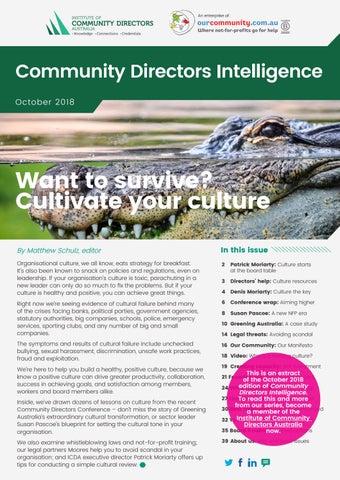
Want to survive? Cultivate your culture By Matthew Schulz, editor
In this issue
Organisational culture, we all know, eats strategy for breakfast. It’s also been known to snack on policies and regulations, even on leadership. If your organisation’s culture is toxic, parachuting in a new leader can only do so much to fix the problems. But if your culture is healthy and positive, you can achieve great things.
2
Patrick Moriarty: Culture starts at the board table
3
Directors’ help: Culture resources
Right now we’re seeing evidence of cultural failure behind many of the crises facing banks, political parties, government agencies, statutory authorities, big companies, schools, police, emergency services, sporting clubs, and any number of big and small companies.
6
Conference wrap: Aiming higher
8
Susan Pascoe: A new NFP era
The symptoms and results of cultural failure include unchecked bullying, sexual harassment, discrimination, unsafe work practices, fraud and exploitation.
16 Our Community: Our Manifesto
We’re here to help you build a healthy, positive culture, because we know a positive culture can drive greater productivity, collaboration, success in achieving goals, and satisfaction among members, workers and board members alike. Inside, we’ve drawn dozens of lessons on culture from the recent Community Directors Conference – don’t miss the story of Greening Australia’s extraordinary cultural transformation, or sector leader Susan Pascoe’s blueprint for setting the cultural tone in your organisation. We also examine whistleblowing laws and not-for-profit training; our legal partners Moores help you to avoid scandal in your An enterprise of: organisation; and ICDA executive director Patrick Moriarty offers up tips for conducting a simple cultural review.
4 Denis Moriarty: Culture the key
10 Greening Australia: A case study 14 Legal threats: Avoiding scandal
18 Video: What's a leading culture? 19 Creating capacity: NFP investment
This is an extract of the October 2018 edition of Community 24 Whistleblowing: Laws 'imminent' Directors Intelligence. 27 Lucy Doing data better ToBernholz: read this and more from our series, become 30 Best treasurers: Awards announced a member of the Institute of Community 32 Your pitch: Attract more support Directors Australia 35 Board trouble: Removal options now. 21 Foundations: Funding for leaders
39 About us: Info and back issues
8 Good practice
Culture can break down when organisations don’t behave in line with their values.
Good culture starts at the board table By Matthew Schulz, journalist, Our Community
ICDA’s executive director and head trainer Patrick Moriarty says the strife striking down organisations across the globe often boils down to a failure of culture. Having trained hundreds of not-for-profit board members and executives, Mr Moriarty says culture often falls through the gap between values and actions, but he says getting a handle on the health of your organisation’s culture doesn’t have to be a hard slog. Mr Moriarty suggests getting back to the basics, before getting into the nitty gritty of cultural reforms – if they’re needed. And you can start by asking yourself a simple question. “So you have a value statement, but how’s this actually working in practice?” Organisations need to keep asking whether their culture “fits the reason we exist”, and whether their activities continues to be in that organisation’s best interest. Many of the the recent failures in the RSL, ABC, big financial institutions and troubled sports clubs can be traced to conflicts within or between Community Directors Intelligence October 2018
management and the board, in which unhealthy, unhelpful relationships have prospered or the proper roles of the board and of staff have begun to break down. “In the worst cases there’ll be a stated value, but the way we’re behaving is totally in contradiction to that,” Mr Moriarty said He cites the example of big businesses – and small ones too – that trumpet the claim “our staff are our greatest asset”, and the next minute mercilessly sack those same staff without remorse. And he says a failing culture that isn’t addressed can slip further into entrenched problems. He says the most breathtaking examples of institutional corruption, such as that which infected the International Olympic Committee, the later years of Queensland’s Bjelke-Petersen Government, and the Catholic Church in its cover-up of child sex abuse, were allowed to fester for years as a result of organisational cultures in which corruption simply became “accepted practice”. Of course, these are all worst-case scenarios, which brings us to Mr Moriarty’s tips for community directors wanting to cultivate a healthy culture.
2
Pat's top culture tips for boards • Take responsibility for values and culture – don’t leave it to management • Maintain a bridge between the board (governance) and the management (operations) to help you to maintain standards you’ve committed to, and identify problems early • Conduct an annual cultural review, which may involve surveying staff and others • Make use of 360-degree staff and volunteer reviews (in which they’re encouraged to air their views of their superiors and the organisation), to gain feedback about how you’re really performing • Keep an eye on tell-tale signs of dissatisfaction such as staff absenteeism, sick days and turnover • Find out from funders, suppliers and clients how they see you exhibiting your values
Organisational culture resources Community Directors Intelligence past editions (PDF downloads) What makes a good leader? Understand your direction: What’s your endgame? The ethics edition: Developing an ethical framework for your organisation 'Before a merger, consider the culture' Back copies of newsletters and email updates
Web resources Values, governance, management, finances, volunteers and more: Policy bank templates Leadership resources for community directors Take the board effectiveness quiz ICDA’s code of ethics for boards
• Put your values and culture on display, literally posting them in a prominent position in your office and on your website
Leading with intent, a BoardSource resource
• Examine your board’s adherence to its own commitments – you can use easy measures such as how frequently you’re turning up to the board meetings
Tailored training at ICDA across eight areas of community practice
• Do your homework by taking heed of good cultures, well-explained, such as the Hawthorn Football Club’s strategic plan • Invest in governance training and refresher courses. Of course, it starts by knowing what your values and culture are.
Training and support
Books The essential board toolkit (a six-book bundle)
The Gluttons Guide to Nourishing Your Not-forprofit Organisation (a monthly guide) Recruiting for Your Not-for-profit, Good people for good jobs
“If you don't have any stated values, and if you're not really articulating what the behaviours of those are, well, it's pretty easy to have the culture you don't particularly want,” Mr Moriarty says. And once you’ve established your values and stated them, you’d better stick by them to avoid future sticky situations. “It's a mutual respect and a shared responsibility for the whole organisation, to be true to the values that we actually do articulate.”
MORE Video: Patrick’s tips on creating a stronger organisational culture Meet the trainer: Patrick Moriarty Community Directors Intelligence October 2018
WATCH NOW: ICDA’s executive director Patrick Moriarty shares some useful pointers
3
: Comment
Everyone agreeing to do the right thing isn't just about having laws of conduct and behaviour.
Culture is the key to good communities By Denis Moriarty, group managing director, Our Community
Like people, words have their good times and their bad times. This is a very bad year for the word “culture”, largely due to the Banking Royal Commission. Every media article on Mr Justice Haye’s nameand-shame extravaganza uses the word at least twice; a “toxic culture” here, a “poisonous culture” there, a “culture of greed” all around. The royal commission lifted the lid off a number of organisations and let the public peer in, and the public’s mood could be described in a terms of a spike in demand for pitchforks and torches. It’s not just banks either. The RSL, the ABC, private schools, and the Catholic Church have their own cultures, and all have been taking their lumps over problem behaviour. The Liberal Party has continuing problems with its toxic culture of bullying and secrecy. Community Directors Intelligence October 2018
But companies, charities and community organisations that haven’t yet been hauled over the coals should probably meditate on the significance of the word “yet”. Consider for a moment if something major were to go wrong in your workplace, sports club or school, and the public were to get a good look at your culture. How would that play? While hopefully most of you have nothing to worry about, it’s worth thinking for a moment about organisational culture, and how does one go about fixing it? It’s not as simple as just obeying the law, even though the various inquiries do tend to concentrate on the times when people haven’t. Obeying the law, or reporting other people in an organisation when they don’t, isn’t enough. You might even say that culture begins when the law stops. No law can go into the kind of detail that will distinguish between a toxic culture
4
A toxic organisational environment is destructive to a sense of community.
of greed and rivalry, and a respectful and accommodating culture you’d like to work in. There is a lot of overlap between a destructive culture and a difficult workplace or organisation. People don’t support each other, because they’re set against each other. They’re reluctant to share information, because trust is lacking. People want credit, but not responsibility. Tearoom and party room gossip outranks official announcements. Good people leave, nasty people prosper. There’s little sense of community, except where everybody’s grumbling together about their idiot bosses. Our Community works closely with not-for-profit groups, and many might assume those groups would have a major advantage in designing a humanist people-focused culture, where primary goals aren’t concerned with money, and people don’t get bonuses for fleecing mug punters. This doesn’t carry as far as it might, though, in that while not-for-profits aren’t driven solely by money, they don’t like losing it either. And, over and over again, cover-ups tend to be driven by fear that if the news (of whatever it is) got out, then donors would flee and the budget for all the good things they do would collapse.
Community Directors Intelligence October 2018
The more revered the institution, it would seem, the more need to bury scandals; and so people double down, avoiding washing their dirty linen in public. Getting on top of this vicious circle and developing a healthier culture is a matter of trust, internal and external. A sound organisation is one where a whistleblower can trust management not to punish them for having been woken up, and where management trusts their stakeholders sufficiently to believe that it will cope with a public airing of the problem. A healthy culture has values that can’t be shuffled to avoid embarrassment, and enough self-respect to apologise when necessary. It requires rules, guidelines, and the flexibility to recognise where those rules and guidelines are providing misguided incentives. Like so much else in business, and politics, and life, it comes down to common human decency. And like so much else, it involves continuous vigilance.
This commentary also appeared in Fairfax regional newspapers in several states, as part of a regular column.
5
s Conference report
Board members aiming higher after Community Directors Conference By Matthew Schulz, journalist, Our Community
Community directors are better equipped to crack the code when it comes to regulation, data, culture, media, finances, legal challenges, their internal politics, and much more, following ICDA’s conference in Melbourne last month. Hundreds of delegates descended on the Moonee Valley Racecourse for the rebranded day-long Septermber 14 Community Directors Conference, an event ICDA members had grown to love as the Board Builder Conference. Setting the tone was the chair of the Community Directors Council, Susan Pascoe, the immediate past chief of the Australian Charities and Notfor-profits Commission (ACNC), who delivered the keynote address on the state of the sector. Turn to page 8 for a more detailed report about Ms Pascoe’s speech. But the gist of Ms Pascoe’s address was that notfor-profits are now at the forefront of change in Australia, and they have the opportunities and responsibilities that go with that. She said that while organisations continue to be buffeted by rapidly evolving regulation, disruptions to traditional funding, rising expectations about accountability, and the continued need for strong advocacy, all have a great opportunity to set social standards.
ACNC deputy commissioner and now chief ombudsman of the new Australian Financial Complaints Authority (AFCA), also appeared on stage. He helped close the conference with a compelling session headed “Board Doctors”, teaming up with Our Community “chaos controller” Kathy Richardson, and ICDA executive director Patrick Moriarty. That group fielded some of the trickiest questions conference delegates could muster in a session dedicated to diagnosing ills related to recruiting, treasurers, strategic plans, performance reviews and keeping organisations fresh.
More highlights from the conference Impact measurement expert Jen Riley quizzed the leaders of Windana Drug and Alcohol Recovery and North Melbourne Football Club’s The Huddle about their data measurement methods, and the data “dash to do better”, giving delegates a better handle on the “how” of data and where to get help. Greening Australia’s chief, Brendan Foran, and chair, Gordon Davis, in a no-holds-barred, bracingly honest presentation, revealed how they upended their organisational structure, transforming an organisation with nine boards, nine chairs, nine CEOs and more than 80 directors (mostly men) into a single board with one CEO and a fresh focus on diversity. (Turn to page 10 for a full report).
“What people really, really want is to know that their lives have meaning. That’s what Australian not-for-profits have to offer,” Ms Pascoe told delegates.
Moores principals Catherine Brooks and Skye Rose bounced ideas between each other as they traversed the tricky terrain of the “triple threat” of sexual harassment, wrongful termination and child protection failures, presenting practical advice and some challenging real-life examples. (Read more on page 15).
Ms Pascoe’s former colleague David Locke, once
Media experts Aileen Berry (of Murray Primary
Community Directors Intelligence October 2018
6
Community directors from around Australia gathered for ICDA’s big annual conference.
Health Network) and Brian Walsh (of Bastion Reputation Management) didn’t hold back either, offering up plenty of examples for their session on reputation management.
“The audience was so engaged, and represented an incredibly smart group of people. It gives me great hope for the governance of the not-forprofit sector.
Mr Walsh got people’s attention with his tales of working at NAB, where he dealt with – among other things – “a murder, a kidnap and a couple of frauds”, while Ms Berry’s practical pointers on how to manage an inevitable crisis are sure to help keep ICDA members out of trouble.
“And we were spoiled with our speakers; they were all terrific. My favourite quote of the day was from Susan Pascoe in relation to increasing diversity on boards: ‘Are we ready to ask the men to bring a plate’?”
As MC Kylie Cirak (ICDA’s Directors of Diversity and Leadership) put it, Michael Parrant from Aon Insurance’s cyber risk section managed to “terrify” delegates into protecting their valuable data, highlighting a parade of disturbing facts about what could go wrong in light of tougher privacy and data protection laws.
Of course, for many delegates, the highlight of the Community Directors Conference was meeting like-minded community directors with similar missions and challenges. Early responses to the post-conference survey summed up the experience like this: “Great range of topics, great networking opportunities, will definitely attend again.”
He covered password protection, software patches, cyber attacks, trusting third parties with your information, and having a good plan in place.
Don’t forget that all delegates have been given access to all the presentations. Please contact us at service@ourcommunity.com.au if you didn’t receive the link.
On a less terrifying note, Professor David Gilchrist declared his love for his own topic – “costing and pricing your services” – early on.
And keep a close eye on Community Directors Intelligence and Community Directors Update. to ensure you don’t miss future events for community directors.
“There’s hardly anything better to be talking about than costing and pricing from my point of view”. His good-humoured enthusiasm for his subject was infectious as he spelt out detailed methods and formulas for organisations needing to establish their value and boost their bottom line. Ms Cirak, summed up the event like this: “The Community Directors conference was fabulous, and I had a great time as MC”. Community Directors Intelligence October 2018
MORE INFO The conference program, if you missed it. More pictures in our Facebook gallery | #AimHigh18 Tweets from the event Susan Pascoe’s speech in full | Report from legal partners Moores
7
Editor: Matthew Schulz matthews@ourcommunity.com.au Subeditor: Kerryn Burgess kerrynb@ourcommunity.com.au Designer: Sam Tzouramanis sam@evocodesign.com.au Contributions and thanks: ICDA executive director Patrick Moriarty, Our Community group managing director Denis Moriarty, Community Directors Council chair Susan Pascoe, Greening Australia chief Brendan Foran, Moores principals Catherine Brooks and Skye Rose, Our Community correspondent Lachlan Pollock, Non-profit Alliance’s Carmel Molloy, the Ian Potter and Myer foundations, the Australian Securities and Investment Commission (ASIC), Lucy Bernholz from the Stanford Centre on Philanthropy, and, The Funding Network. An enterprise of:
An enterprise of:
Feedback: We welcome suggested articles or improvements Email: service@ourcommunity.com.au Telephone: 03 9320 6800 Address: Institute of Community Directors Australia 51 Stanley Street, West Melbourne VIC 3003
Website: www.communitydirectors.com.au Twitter: @NFPDirectors Subscribe: Join the Institute of Community Directors Australia Back issues: Member-access only
Community Directors Intelligence is one of the membership publications of the Institute of Community Directors Australia (ICDA), an Our Community enterprise. The Institute is the best practice governance network for Australian not-for-profit board members, their committees and councils, and staff. Membership starts at just $65 per year. Join Now. © Our Community Pty Ltd.
An enterprise of:
Community Directors Intelligence October 2018
8