An enterprise of:
Community Directors Intelligence November 2018
This is an extract of the November 2018 edition of Community Directors Intelligence. To read this and more from our series, become a member of the Institute of Community Directors Australia now.
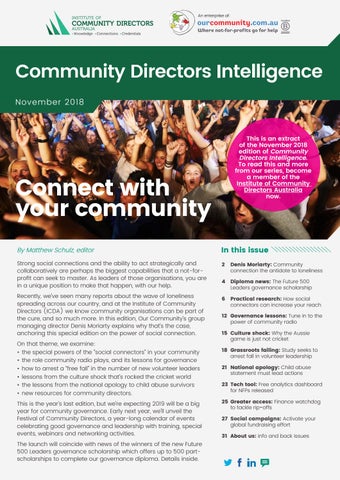
Connect with your community By Matthew Schulz, editor
In this issue
Strong social connections and the ability to act strategically and collaboratively are perhaps the biggest capabilities that a not-forprofit can seek to master. As leaders of those organisations, you are in a unique position to make that happen, with our help.
2
Recently, we’ve seen many reports about the wave of loneliness spreading across our country, and at the Institute of Community Directors (ICDA) we know community organisations can be part of the cure, and so much more. In this edition, Our Community’s group managing director Denis Moriarty explains why that’s the case, anchoring this special edition on the power of social connection. On that theme, we examine: • the special powers of the “social connectors” in your community • the role community radio plays, and its lessons for governance • how to arrest a “free fall” in the number of new volunteer leaders • lessons from the culture shock that’s rocked the cricket world • the lessons from the national apology to child abuse survivors • new resources for community directors. This is the year’s last edition, but we’re expecting 2019 will be a big year for community governance. Early next year, we'll unveil the Festival of Community Directors, a year-long calendar of events celebrating good governance and leadership with training, special events, webinars and networking activities. The launch will coincide with news of the winners of the new Future 500 Leaders governance scholarship up to 500 partAn which enterpriseoffers of: scholarships to complete our governance diploma. Details inside.
Denis Moriarty: Community connection the antidote to loneliness
4 Diploma news: The Future 500 Leaders governance scholarship 6
Practical research: How social connectors can increase your reach
12 Governance lessons: Tune in to the power of community radio 15 Culture shock: Why the Aussie game is just not cricket 18 Grassroots failing: Study seeks to arrest fall in volunteer leadership 21 National apology: Child abuse statement must lead actions 23 Tech tool: Free analytics dashboard for NFPs released 25 Greater access: Finance watchdog to tackle rip-offs 27 Social campaigns: Activate your global fundraising effort 31 About us: info and back issues
: Comment Want a long and happy life? Join a community group By Denis Moriarty, group managing director, Our Community
There are a few things that have got me thinking recently about the power of community. One was the appointment by the British Government of the world’s first Loneliness Minister. We could do worse than follow suit, given millions here also suffer from the social isolation that’s spreading like a silent scourge across every age group and culture. Sure, many of us are dealing with divorce or relationship breakdowns, work stress, or the pressure of young families. But unfortunately, many of us are dealing with those issues alone, whether we’re in the city, the country or the suburbs. I spent several years as a Lifeline counsellor in the early ’90s, taking calls from those in need. My friends generally assumed all the calls were from people threatening suicide. But they weren’t. In fact, 90 per cent of the calls I took came from the lonely. It was shocking and harrowing to hear the sorrow in their voices, to know how isolated they were, to realise there was no-one they could turn to. Another prompter for my reflections on community was the recent birth of my niece’s baby. Having a baby can be tough (as well as wonderful). But my niece told me that joining her local mothers’ group changed her life because of the connection she found with others experiencing exactly the same thing. These groups can help give new parents a safe outlet for their frustrations, some support when things feel hopeless. That small mothers’ group has the power to save lives. We know mental health is a huge issue. Victoria has just announced a royal commission and at our most recent Communities in Control Conference social demographer Hugh Mackay warned us the nation was in the grip of a mental health crisis.
Community Directors Intelligence November 2018
Denis Moriarty says community groups have the power to save lives He also said that the “state of the nation starts in your street”, pointing out that a bit of compassion in your neighbourhood can be the first step to battling social isolation. All these threads have a one theme: our need for connection. At Our Community we’ve taken note of the evidence that shows community connection is more important than eating well and exercise. One study demonstrated that your chances of dying in the coming year were cut in half by joining a community group and cut to a quarter if you joined two. I like to think of community groups as the heart that keeps our society flowing and the people within it connected. Australia’s 600,000 community groups prevent the health budget blowing out further. In fact, I’d love to see a government-backed campaign that doesn’t just point people to organisations when things go bad but urges them to join a community group in the first place. I don’t want people to confuse joining a group with volunteering. It’s not the same thing.
2
Loneliness: an epidemic
Loneliness may be one of the biggest health issues facing the country. Tracey Crouch was given the portfolio to address loneliness in Britain.
In fact, I’m against the type of volunteering where big corporates force staff who are already working 70 hours a week to work for nothing. Those staff should be going home early and reading to their kids. I’m talking about joining in. You see, when you're part of the footy club, the mothers’ group, the arts group, chess club, school council, church or faith group, you're not just being altruistic. You're joining in and joining up to a mission that that group is passionate about. At Our Community we work with many great welfare-focused not-for-profits, such as domestic violence or homeless shelters. But there’d be less need for these organisations – there would be less domestic violence and homelessness – if people were better connected in the first place. So, if strong social bonds will help us lead longer, happier lives, why wouldn’t you find out about the other community groups in your area, to build on the work you already do as a not-for-profit? You could start with the community directory on our website.
MORE INFORMATION Search now: The Our Community groups directory Hugh Mackay: The health of our nation starts in our street (Listen, watch or read a transcript of his Communities in Control presentation) Joining in and joining up is good for you, our references Community Directors Intelligence November 2018
The Australian Loneliness Report, released in November 2018, has sparked widespread interest and concern, revealing: • One in four Australians feel lonely. • Many Australians – especially younger Australians – report anxiety about socialising. • Thirty per cent don’t feel part of a group of friends. • Lonely Australians have worse physical and mental health and are more likely to be depressed. The study by the Australian Psychological Society (APS) and Swinburne University of Technology surveyed more than 1600 Australians, and confirmed concerns that loneliness is strongly connected to poorer quality of life, lower psychological wellbeing, higher social discomfort and poorer quality social networks. The issue has prompted fresh debate across the country about the need to take action on loneliness. Proposals for a Loneliness Minister, similar to the appointment made by the UK in January, are being put forward at the federal level by Labor Party frontbencher Andrew Giles and at the state level by Victorian Reason MP Fiona Patten.
MORE INFORMATION Australian loneliness report (November 2018, PDF) Friends for Good, the first Australian registered charity working solely to eliminate loneliness
3
) Diploma scholarship
Future 500 Leaders scholarship chips in $500,000 for better-run not-for-profits Up to 500 people from across Australia have the opportunity to win a part-scholarship to study for the Diploma of Business (Governance) thanks to the Trawalla Foundation and the Institute of Community Directors Australia (ICDA). The Future 500 Leaders governance scholarship was created to increase opportunities for the most under-represented groups in the community said Our Community Group Managing Director Denis Moriarty. “We have always been champions of diversity, but we’ve decided to dial up our efforts in
Community Directors Intelligence November 2018
2019. We’re encouraging applicants from the demographics which have consistently been ignored or shunned.That’s why we’ve called these scholarships the Future 500 Leaders program.” Applicants who represent or champion the following sectors are encouraged to apply: • Youth • Women • LGBTQI+ community • Culturally and linguistically diverse (CALD) groups • Aboriginal and Torres Strait Islanders • Rural and regional areas Mr Moriarty said the need for good leaders was especially important given recent scandals involving poor governance across Australia.
4
“Think RSL, the Catholic Church, charity rip-offs, advocacy issues, school collapses, community radio in-fighting, sporting club scandals and failures, and political battles. “It’s time to shake up the archaic governance structures that are hampering genuine community progress. What better way to do it than to provide opportunities for new blood?” The Trawalla Foundation’s Carol Schwartz said it was proven that education is the best investment in improving governance outcomes. “Research shows a 6:1 return (on value) for every dollar spent on governance training.” “The Trawalla Foundation’s vision for the future of Australia is focused on strengthening gender equality, creativity, sustainability and social justice within our society. These scholarships are an excellent means to further our work.”
Community Directors Intelligence November 2018
The scholarship will provide a $1000 discount on the full cost of the diploma, which is Australia's only diploma-level governance qualification specialising in not-for-profit governance. The diploma is delivered by Our Community’s Institute of Community Directors Australia in alliance with Federation Training. Applications close Wednesday, December 19. Winners will be announced in early February 2019.
MORE INFORMATION The scholarships: communitydirectors.com.au/scholarships About Trawalla Foundation: www.trawallafoundation.com.au Our Community updates: ourcommunity.com.au/subscribe
5
k Human capital
Community connectors are able to bridge the gap between services and people who are usually hard to reach.
Plugging into ‘the connectors’: A powerful resource for your community organisation By Matthew Schulz, journalist, Our Community
You’re sure to know a handful of them in your community: they’re the “connectors”. Connectors are the precious people who know many others and get things done. They have an uncanny ability to connect people, or to link them to resources, or information, or services. Often they’ll notice people who aren’t being included and they’ll do something about it. Sound like someone you know? Maybe it’s you. An Australian study into the role of these special individuals has described the incredible resource and potential they represent, particularly when it comes to engaging with people in the community whom services find the hardest to reach. Swinburne University of Technology PhD candidate Carolyn Wallace has become fascinated by these fixers, who can, she’s written, “facilitate the flow of ideas, information, activities and relationships” across organisations, and across social and cultural boundaries. Community Directors Intelligence November 2018
Her research is examining: • what characterises local community connectors • how they make connections and span boundaries between people, organisations and resources • the role of technology and social media in connections, and • perceptions about the connection between health and community services and their communities.
An instinct for empathy and help Ms Wallace has conducted a literature review and examined case studies in regional areas of Australia and Ireland for her research. She found connectors don’t have a common personality trait, and they don’t have to be long-term locals to have an impact in their communities. She did find that connectors must also act as “boundary spanners” to be successful.
6
Connectors are happy to help, and for many of them, it’s just an instinct.
They are often described by those around them as “engaged insider”, having a “bridging role”, or acting as a “cultural bridge”, “nexus”, “intermediary” or “trusted liaison”. But she says all of them demonstrate: • Love for and interest in people • Love of their communities • Openness to new ideas and information • Willingness to learn, and • Respect for privacy and confidentiality. Mostly they’re non-judgmental types, and many of them demonstrate flexibility and a general openness too. Ms Wallace believes for many their skill is instinctive.
PhD candidate Carolyn Wallace (left) is researching “connectors”, such as this friendly fellow, one of many making a difference in their communities in Australia and Ireland. Community Directors Intelligence November 2018
“Many of the connectors I spoke to talked about how this has been a consistent pattern in their life. They have a natural empathy with people, sense of justice and view that all people should be able to participate in their community.” But Ms Wallace also believes those skills can be learnt, with some connectors having been invited into the fold by other, more experienced connectors.
Model builds on strong connections Ms Wallace’s early findings suggest that social connectors can have a big impact on their communities, and on the efforts of health organisations to engage hard-to-reach groups. Their work has the potential to bring about new To keep reading, friendships, improvements in mental health, become an ICDA expanded social support, employment, practical member now. help with finding accommodation or financial aid, increased community involvement, and leadership development.
“Many of the connectors I spoke to talked about how this has been a consistent pattern in their life. They have a natural empathy with people, sense of justice and view that all people should be able to participate in their community.”
7
Editor: Matthew Schulz matthews@ourcommunity.com.au Subeditor: Kerryn Burgess kerrynb@ourcommunity.com.au Designer: Sam Tzouramanis sam@evocodesign.com.au Contributions and thanks: Our Community group managing director Denis Moriarty, Swinburne University researcher and PhD candidate Carolyn Wallace, Murdoch University researcher Dr Simon Order, The Ethics Centre's executive director Simon Longstaff, Flinders University PhD candidate Christel Mex, Moores principal Skye Rose, the Centre for Social Impact, the Australian Financial Complaints Authority (AFCA) chief ombudsman David Locke, Give Now executive director Cathy Truong, and Australian charity AusEE. An enterprise of:
An enterprise of:
Feedback: We welcome suggested articles or improvements Email: service@ourcommunity.com.au Telephone: 03 9320 6800 Address: Institute of Community Directors Australia 51 Stanley Street, West Melbourne VIC 3003
Website: www.communitydirectors.com.au Twitter: @NFPDirectors Subscribe: Join the Institute of Community Directors Australia Back issues: Member-access only
Community Directors Intelligence is one of the membership publications of the Institute of Community Directors Australia (ICDA), an Our Community enterprise. The Institute is the best practice governance network for Australian not-for-profit board members, their committees and councils, and staff. Membership starts at just $65 per year. Join Now. © Our Community Pty Ltd.
An enterprise of:
Community Directors Intelligence November 2018
8