An enterprise of:
Board Builder An enterprise of:
Post-conference report, edition 2, May 2017
The hot topics edition: Lessons from the Board Builder conference An enterprise of:
An enterprise of:
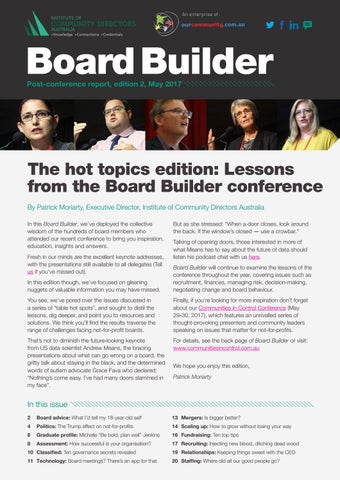
By Patrick Moriarty, Executive Director, Institute of Community Directors Australia In this Board Builder, we’ve deployed the collective wisdom of the hundreds of board members who attended our recent conference to bring you inspiration, education, insights and answers. Fresh in our minds are the excellent keynote addresses, with the presentations still available to all delegates (Tell us if you’ve missed out).
But as she stressed: “When a door closes, look around the back. If the window’s closed — use a crowbar.” Talking of opening doors, those interested in more of what Means has to say about the future of data should listen his podcast chat with us here.
In this edition though, we’ve focused on gleaning nuggets of valuable information you may have missed.
Board Builder will continue to examine the lessons of the conference throughout the year, covering issues such as recruitment, finances, managing risk, decision-making, negotiating change and board behaviour.
You see, we’ve pored over the issues discussed in a series of “table hot spots”, and sought to distil the lessons, dig deeper, and point you to resources and solutions. We think you’ll find the results traverse the range of challenges facing not-for-profit boards.
Finally, if you’re looking for more inspiration don’t forget about our Communities in Control Conference (May 29-30, 2017), which features an unrivalled series of thought-provoking presenters and community leaders speaking on issues that matter for not-for-profits.
That’s not to diminish the future-looking keynote from US data scientist Andrew Means, the bracing presentations about what can go wrong on a board, the gritty talk about staying in the black, and the determined words of autism advocate Grace Fava who declared: “Nothing’s come easy. I’ve had many doors slammed in my face”.
For details, see the back page of Board Builder or visit: www.communitiesincontrol.com.au We hope you enjoy this edition, Patrick Moriarty
In this issue 2
Board advice: What I'd tell my 18-year-old self
13 Mergers: Is bigger better?
4
Politics: The Trump effect on not-for-profits
14 Scaling up: How to grow without losing your way
6
Graduate profile: Michelle “Be bold, plan well” Jenkins
16 Fundraising: Ten top tips
8
Assessment: How successful is your organisation?
17 Recruiting: Injecting new blood, ditching dead wood
10 Classified: Ten governance secrets revealed
19 Relationships: Keeping things sweet with the CEO
11 Technology: Board meetings? There’s an app for that
20 Staffing: Where did all our good people go?
s Board advice
You’ll never be bored What I'd tell my 18-year-old self about joining on a board Ah yes, the “wise heads on young shoulders” routine. It’s always worth staging, and if nothing else, it reminds us about the most valuable lessons we’ve learnt from being part of not-for-profit boards. We asked delegates at this year’s Board Builder conference to consider what advice they’d give to their 18-year-old selves about being a board member. There was plenty of talk about “passion” – in fact, the word was used too many times to reproduce them all here.
Let’s face it, it’s not the pay packet that’s going to get you into bed with a not-for-profit group. It’s what makes your heart beat faster. What follows is a selection of the wise words of our delegates. We suggest trying these out on your closest teenager, or saying them out loud to remind yourself why you do what you do.
Feel the passion “You’ll get more out than you put in.”
“Never forget your ultimate goal.”
“Follow your passion — you’ll get better at it.”
“Small things can make a big difference.”
“If you don’t have a fire in your belly, don’t do it.”
“Passion is what matters. Follow that.”
“
A not-for-profit is somewhere you’ll get your kicks.
”
“If you want to see change, step up and make change happen.”
“Jump in, have a go, ask questions, be passionate, and anything is possible.”
Use the opportunity well “Don’t take no for an answer and take any opportunity that presents itself.”
“You can’t save the entire world. But you can make a difference.”
“Believe it or not, this can be fun.” “This is where the revolutionary thinking is really happening.” 2
Practical suggestions “Constant learning is important. So is instilling the value of learning in those around you.”
“
“Things will change. Go with it. Your group will evolve over time. That’s okay.”
“ ”
Get a good industrial lawyer with a background in not-forprofits on speed-dial.
Network like crazy, and embrace crazy.
”
Warnings “How do I draw the line between operations and governance?”
“Maintain your discipline: Don’t let the friendships taint the roles.”
“Be mindful of compliance but don’t let it scare you away from doing.”
“Think about your exit. It might be years on the horizon, but don’t let yourself become a fixture.”
“Ask questions and find at least one way that you could add value.”
Is this the time to begin, or to get out? “Use your youthful energy to get involved at ground level, where the action is, not on a board.”
“Be useful. Hurry up and do something for your community.”
“It’s a bit scary, but jump in and have a go.”
“Don’t take too long before you think you can contribute.”
“Select your board wisely.”
3
u Sector politics
Photo: Gage Skidmore via Foter.com
The Trump effect on not-for-profits EVEN as the Donald Trump effect sweeps the world, not-for-profits are acutely aware they could be in for a rough ride following the election of the maverick ex-reality star. One of the most engaging hot spot sessions of the day involved groups turning the microscope on themselves in discussing “Challenges of the Age: The key issues facing the not-for-profit sector”. And an overflowing session of delegates wasted no time in pointing the finger at the US President.
The Trump factor All agreed Trump represents a shift in politics. And Australia isn’t immune from the fallout.
“As someone working in regulation, from what I can see, shifts in the political landscape are a potential threat to some funding models,” another said.
How to adapt? That sparked discussion about government funding challenges, including the impact of the National Disability Insurance Scheme (NDIS).
“Trump is symbolic of the move to the right and towards a less sympathetic view about the disadvantaged,” said one delegate.
“As a result of the NDIS, mental health funding has halved, even though needs don’t change. It highlights the fact that you need to be aware of current policies and think about how you can prepare your organisation for changes,” one delegate said.
Another said Trump’s views about women were discouraging, and that his election had also amplified the voices of people who are opposed to supporting refugees, people with disabilities, or other vulnerable people.
Heavy reliance on government money has its own challenges: “There’s a continual challenge to maintain the independence of policy positions, program design and advocacy when you’re heavily reliant on government funding.”
They said Trump’s inflammatory comments against those groups had encouraged an anti-welfare, antiprogressive agenda.
“What are you prepared, and not prepared to do for your funding?” another asked.
4
Yet being “boxed in” by funders who aren’t looking to the needs of those who are receiving the service “is not sustainable”. Groups agreed they had to fight to be responsive to “the people we serve”. The difficult headwinds — including increasing regulation and compliance — prompted others to talk about the need to evolve. As one delegate put it, “It means we need — in some way — to think like a business in terms of innovating.” But while organisations are happy to consider aspects of social enterprise, others flagged concerns about being more “business-like”. “We don’t want to be another 7Eleven,” said one. Others pointed to the rewards of collaborating instead of competing with other groups. And while mergers remain on agendas, many have shifted their focus to “staying small, and doing it well”, rather than expending effort on growth and threatening their organisation's viability in the process.
The future of data Following data scientist Andrew Means’ talk about the power of data, many are now seeing the need for the sector to take charge of its own destiny, in the realm of big data. “In a world where data is king, not-for-profits all need assistance, especially the smaller organisations,” a delegate put it. Some advocated the creation of a “not-for-profit data think tank”, and the judicious use of data analysts by groups. “We realise that it’s not about just collecting the data, but using the data that’s already available, which is where we need the help of experts,” said one delegate.
Data scientist Andrew Means says not-for-profits can make much better use of the data tools at their disposal
Community connection Meantime, as boards continue to seek quality recruits as corporates lose interest in involvement in the sector, many see a way forward by employing those wanting to use boards as a springboard for their futures. Making others sit up and take notice will also require groups to find fresh ways to connect with the community including avoiding relying on messages about “catastrophe” as the only way of advocating for increased resources. But if a not-for-profit folds? As one pointed out: “It’s not the worst thing. Consider the fact that remaining funds will be diverted to an organisation still capable of addressing the cause you’ve been pushing”.
5
) Graduate profile: Diploma of Business (Governance)
‘Don’t be afraid ... be bold’ If there’s one thing Community Vision chief Michelle Jenkins says not-for-profits should learn, it’s how to be bold and take more risks. The West Australian-based recent graduate of the ICDA's Diploma of Business (Governance) should know. She’s seen how organisations run from both the not-for-profit and corporate sides of the fence. She was the first female head of commercial banking for Westpac in her home state, before turning to involvement in aged care and now community services, at the Joondalup-based Community Vision. “I think as not-for-profits, we think risk is a dirty word and are not as bold as we should be. We can sometimes allow inertia to settle in and we can become very complacent, thinking that our world is not going to change and we’re all going to be secure because we’re not-for-profit. Actually, the reverse is true.” A keynote speaker at our conference, that view was one key message Ms Jenkins hoped not-for-profits present would take with them. Despite already having a masters degree in business leadership, financial planning qualifications in two countries, and qualifications in home and community care, Ms Jenkins says the diploma has helped her to bring existing skills and knowledge together, creating a deeper understanding of the sector.
Marrying people has also taught her different lessons that can be applied to our sector. “It’s all about checking credentials and paperwork to make sure everything is accurate, about planning a ceremony and executing the plan according to what has been agreed. For not-for-profits, it’s the same process: checking policies and procedures and ensuring everyone has been trained to understand their role, while having KPIs in place to ensure delivery according to services offered.” The lesson for not-for-profits? Clearly, true love also requires proper leadership and planning. Which brings us to what Michelle thought about the course.
Her broad interests have also added to MIchelle’s understanding of her demographic: she is a marriage celebrant, a “fur babies” lover, and Justice of the Peace. We asked her what she’s learned from having pets and presiding over marriages. The owner of English bull terrier Ellie May, miniature poodle Dougal, and cat Charlie says: “Being a responsible parent ... it’s important that I teach them manners and values.” “In the same way, not-for-profit leaders need to lead by example, which is no different to the animal kingdom. Leadership is about setting examples which others can follow, as well as upholding the values of the pack — to protect and ensure that everyone is secure in their surroundings and knows what they have to do.”
Conference speaker Michelle Jenkins urged not-for-profit boards to be bold, but smart, in their decision-making
6
ICDA: Why did you decide to undertake the Diploma of Business (Governance)?
ICDA: What are the three key things you took from the diploma?
MJ: “Leadership is not just about the role you hold and how you account for what you do, but it’s also about having a passion for learning and about being better than you were last year. You need to challenge your thinking and take your strategy and operational processes to another level.”
MJ: We’ve now committed to the following:
ICDA: Tell us a bit about your diploma experience. “Having tools to help you focus and embed changes is always easier than starting with a blank canvas. The combination of different ways of learning – having a tutor who was able to bring case examples to the table — worked for me. “I met some great fellow students. What is interesting is how similar we all are and how we all face the same issues, just dressed differently!” ICDA: At our recent Board Builder conference you delivered a fabulous presentation about negotiating change. Has the diploma helped you in this area? MJ: The diploma challenged my thinking on how I work with my board. In my case, with so much change happening in the sector, I really need to focus my board more on the strategic initiatives and allow time for focused discussions. We have added some extra meetings to do just that.
1. To conduct an annual review across all governance areas to ensure we’ve addressed the risks, checked our insurance, understood tenders, updated policies and reviewed all processes and procedures. 2. To conduct a day-long board strategy session at least annually. 3. To ensure a strong audit process is in place for compliance. ICDA: If you could say one thing about the diploma… MJ: I recommend it to all managers and leaders who want to be aware of their compliance obligations, which extend well beyond the boardroom and into business operations. The course provides a platform to address governance and enables challenging conversations about change to ensure your organisation remains viable. The Diploma of Business (Governance) is Australia's only currently approved diplomalevel governance qualification. More info: http://bit.ly/2oO0NFo
7
VAssessment
The vanishing point: Is your organisation a success? Disappearance could be regarded as the ultimate measure of success of a not-for-profit organisation. If you’ve achieved your social mission, obviated the need for your existence, and wound up your operations, congratulations. It’s a counter-intuitive observation, but one well worth remembering for board members who are considering how best to develop key performance indicators (KPIs) and other measures. “Disappearance” was touted as the ultimate KPI in the table hot spot session “Defining success: How to measure the outcomes of your work” table hot spot session hosted by Our Community executive director Kathy Richardson. The round table talk was fully subscribed, demonstrating not-for-profits’ strong desire to prove how well they’re doing. Delegates agreed there are things that are relatively easy to measure, such as the “satisfaction of our members”. But they’re not necessarily the best measures of success, which for most organisations boils down to: “Are we making a difference?” Another discussion point that proved front-of-mind for delegates was simply: “Are we meeting the need?” While clearly important, delegates confirmed that measuring the extent to which an organisation is meeting a need can be mighty difficult. And some measures may give you the wrong impression. For example, having fewer clients, which to some could suggest success, may actually just mean you have fewer staff or less capacity, or that your outreach is not working well. Indeed, the key questions to ask depends on the type of organisation you’re running. For organisations in service provision, the question might be: “Are we meeting individuals' needs, whatever those needs are?”
Our Community executive director Kathy Richardson
For advocacy organisations, it could be: “How many people have we built relationships with? And, are they the right people (that is, the people who can help us)?” Others stressed that indicators of what may be described as “business” success – financial health; occupancy rates (for organisations managing properties, for example) – are also important to track, and that these are often easier to quantify. In the end these business-style markers can be boiled down to: • “Do we have all the money we need to do what we know we need to do?” and, • “Will we still be here in three years’ time, presuming the need for our services still exists?” KPIs can also be set from outside by funders, but that doesn’t necessarily mean they’ll track with how your organisation measures success. Other KPIs may be an expression of the organisation’s strategic plan, which could be based on a three-year cycle, or could be a “rolling” plan.
8
In any case, the Board Builder group agreed any business-like measures should sit alongside — rather than displace — mission-based measures of success.
Where to next? A data-driven solution If this hot spot’s discussion has prompted you to think it’s time to learn more, Our Community can help, and get you up to speed with the latest methods. A new free book from Our Community aims to show not-for-profits the way towards data collection and evaluation. Measuring What Matters: An Introduction to Project Evaluation for Not-for-profits explains evaluation principles in an accessible, jargon-free way. US-based data scientist and conference keynote speaker Andrew Means (see page 5) told Our Community some not-for-profits feel a level of discomfort with this area of work, and he understands their trepidation. “This is an entirely new skill,” he said. “This is an entirely new thing for nonprofits to wrestle with. And many of the people that are running these organisations never grew
up with these skills – they didn’t join the nonprofit sector because they were interested in data or technology. They began as social workers, youth workers, whatever, they came up through the practice of whatever their organisation does. They don’t actually have a background in statistics or technology. “But more and more organisations are seeing the possibilities of this, are seeing how data and technology isn’t just this trendy new thing, but can actually help them do the job they want to do better. When they see it actually play out in people’s lives – the people they're serving, the people they’re working with – when they see how it can actually benefit them, they get more and more excited, and I think that's the place we’re at right now. A lot of people have some fear and trepidation, but the early adopters are starting to see results right now, and that excitement's building across the sector.” To download a free copy of “Measuring What Matters” – click here (part of this article has been reproduced from the April 2017 edition of Our Community Matters).
9
L Classified
Ten governance secrets revealed Call it clickbait for board members: “Ten things you won’t read about in a governance manual that you absolutely have to do as a board member.” Conference delegates who signed up for this session at Board Builder 2017 came along expecting to be let in on a few secrets. Some were surprised to be asked to reveal classified information of their own, including answers to the follow-up question “What are the things you wish you’d known before you signed up as a board member?” Here are the responses that elicited the loudest murmurs of recognition from other delegates:
1 2 3 4 5 6 7 8 9 10
Being a board member takes a lot of time if you want to do it properly. A director has a duty to keep themselves up to date with events and trends in the sector and in the external environment. You have to stay ahead of legislative changes. You have to be futuristic. Tools you can use to get rid of a nonperforming board member include the constitution, board composition policy, code of conduct, KPIs and limited tenure. Getting people to volunteer is difficult. It’s hard to get the expertise. You have to draw a line between operations and governance. It’s easy to be snowed under by operations. You have to know a little bit about lots of things. In making decisions, your personal bias can lead you one way, but it’s not the only way. Read the policies manual. There’s a lot of stuff in the fine print. Read it again after six months. Volunteer fatigue is a big problem, especially in rural areas. Succession planning is only a dream. Being on a board is the opposite of all care and no responsibility. You’ve got all the responsibility.
10
Q Technology
Our Community technology “guru” Alan Matic is always on the hunt for good new applications.
Board meetings? There’s an app for that If there’s one thing that all board members can agree on, it’s the need to be organised. And there’s no shortage of technological offers that claim to have the answers. The reality, of course, is a bit more complicated. Not surprisingly then, many of the delegates at the conference session titled “Board portals: Using tech tools to manage meetings and boards” were there in the hope of finding an affordable solution.
Board members also described wading through the huge volume of information they were expected to digest. Many would like to see a system that could generate summaries — especially when it comes to finances — but also allow users to drill down into the detail when needed. All agreed the functions that would help them the most included:
Our Community’s information technology officer, Alan Matic, took the helm for this one.
• Document storage, messaging, task management, agenda recording, minute-taking and calendars.
The group highlighted major concerns around security, dealing with “a flood of information” and tracking who on their boards is reading what.
• The ability to see what materials had been read, and by whom.
Security is a top priority, with one delegate describing the horror of finding confidential board papers plonked outside their front door. Others raised fears that personal devices such as their phones and laptops could be compromised.
• Visual analytics and summaries of vital information. By contrast, what most groups are actually using are paper-based and ad-hoc technological fixes combining email; Google tools such as Gmail, Hangouts and Google drive; Facebook tools such as Groups, Messenger and Whatsapp; and Dropbox’s offerings. Board-specific portals that integrate a lot of what’s needed (usually) come at a price.
11
Photo: via Foter.com
Here are some nominated by delegates, Our Community staff and ICDA members, although there are other software solutions out there: • TidyHQ: https://tidyhq.com/ (basic version free, $300 a year for premium app) • BoardEffect: http://www.boardeffect.com.au/ from $5800 a year) • BoardWorks: http://www.cgsboardworks.com/ (From $2000 a year for five users) • Ecleva (formerly PNP solutions): http://www.ecleva.com/ (contact for prices) • Intelligencebank: http://www.intelligencebank.com/au/ boards (from $75 per user per month) For small organisations on a tight budget, Alan likes TidyHQ, which does a lot of what not-for-profits need for free. There is a $300-a-year option for larger groups allowing for 15GB of storage, apps, and 10,000 emails per month. Its promotional material plugs the system as “magical”, but we’ll let you be the judge of that. Alan says TidyHQ has its limitations, including the startup’s lack of polish in some parts of the program. A good example of a more advanced web-based tool is BoardEffect, which boasts 1500 mission-based organisations among its clients.
BoardEffect Australia’s Grant Lavac — who was among the delegates at the conference — says challenges facing smaller not-for-profit boards include lack of time, restricted financial capability to streamline, and heavy reliance on volunteers. At the same time, boards are being “inundated with information”, usually in printed form, he says. But he says an “old-school reliance on paper-based meetings” is fading as a feasible option for not-forprofits. For a bespoke solution, some organisations are approaching “solutions consultancies” such as Ecleva. Consultant Cristina Northcote says Ecleva, a Microsoft partner, employs an “array of products”, but not “off the shelf solutions” and that “pricing is very much dependent on what the client’s needs are”. A final piece of advice from conference delegates who had adopted software solutions was to budget for training, to ensure users aren’t left dismayed with the results. If you’ve come across an excellent board management tool, contact us at service@ourcommunity.com.au or drop your suggestions at the ICDA forum: http://forum. communitydirectors.com.au/
A subscription for not-for-profits with an operating budget under $6m costs from $5800-a-year.
12
8 Mergers
Is bigger better? Mergers remain a hot topic for notfor-profits wanting to thrive – and in some cases, simply survive. It was the single biggest issue at our Board Builder conference in 2015, dominating multiple sessions. This year, delegates remained keen to assess their options at the “Mergers: Risks and Rewards” table hot spot. Our Community group managing director Denis Moriarty — who hosted the session — says that in the midst of continued funding squeezes by state and federal governments and the tightening of household budgets, the issue is as relevant as ever. “Two years ago, Our Community studies found that 44% of our members were under pressure to merge, and 15% were expecting to take part in a merger in the coming year. For many groups, this very much remains a hot issue,” Denis says. But saving money to appease funders shouldn’t be the only force driving a merger. “Instead, not-for-profits should first think whether a merger is actually going to help or hinder your mission before you take the plunge.” And a good reason for this, as delegates agreed, is that mergers don’t occur easily. ICDA executive director Patrick Moriarty has previously pointed out, “Mergers are very difficult to pull off, and quite easy to stuff up. Even in the commercial world, where things are a lot more straightforward, only somewhere between 50% and 20% of mergers actually work.” So the message? Do your homework and be prepared to adjust to your circumstances. The “instant brains trust” at the conference included delegates with recent experience in mergers, and they urged others to remember the following before forging ahead: • There’s more than one model available. • What you’re doing is not just a merger, but entails a new alliance which will demand significant “back room” changes.
Our Community’s chief Denis Moriarty says mergers are still a hot topic.
• Get the finances and legal issues checked out really well. • Mergers will take a lot longer than you expected. • Make sure the values of the organisations are aligned. • Watch out for egos on boards. • Have the board manage a merger and not the CEO, who may have a strong vested interest in keeping their job. • Make sure you keep staff fully informed of what’s happening. • And lastly, get advice before pressing ahead. We draw your attention to Our Community’s comprehensive guide: Thinking Big: To merge or not to merge – that is the question. Click here for more The guide spells out valuable details about framing your decision, including advantages and disadvantages; the models you should consider; a 10-step guide; legal options; and critical factors related to tax, constitutions, licences and legislation. You should also read our 2015 post-conference Board Builder newsletter, which summarised keynote discussions about mergers. Click here for more
13
6Growth
Picture: Christopher Craig via Foter.com
How to get bigger without losing your way It’s the way many of the most successful not-for-profits began. Small. But when you’ve got a great idea and a good team, then money, supporters and resources tend to follow. At the Board Builder table hot spot hosted by ICDA trainer Julie-Ann Rose, one group of delegates examined how they might handle a sudden growth spurt without losing their focus. One participant told how in two years their service had more than doubled in value to $22 million, with the services offered significantly changing too. Another explained how their group had started with “a couple of people on Facebook trying to make a difference to women’s lives”. Now they boast 1500 members, and face a challenge in ensuring they use their donations and support wisely. All wanted to hear cautionary tales and success stories, and to understand the risks — with many concerned about the loss of the social benefits of their groups if they grew too large, too fast. But what about solutions? Luckily, delegates had these suggestions to help smooth your way.
Seek shelter or stretch out Consider the option of being auspiced by a larger organisation or developing a memorandum of understanding with a partner organisation to enable you to work together under funding structures such as the National Disability Insurance Scheme (NDIS). This could ensure that you remain committed to your core community, while at the same time enabling you to offer a more cohesive service, and offering a way of improving without expanding and being forced to take the risks associated with getting bigger. Of course, partnerships carry their own risks: what you’re aiming for is to collaborate, not to absorb or be absorbed. Remember, though, that to create scale you’ll need to bring in more income, which could require you to begin contracting or specialising to generate more revenue.
14
Understand your environment You need to speak and understand the language of the funder, partners, etc. If you’re working toward a common goal, shared language will improve the discussions. And there may be times you need to work with your “competitors” when working with government agencies. Tell people what you’re up to If you are proving your worth in terms of the money spent, good governance and other measures, it’s also crucial that you can make this known to the outside world. This could mean seeking media coverage, or using marketing to get the message out.
Organisations may need to improve their data measurement tools to ensure that they are on solid ground when spruiking achievements. Read on If this conference session piqued your interest, you can further explore the topics raised by catching up on these recent publications: Board Builder, edition 4, 2015 – What's your Endgame? A groundbreaking essay by Alice Gugelev and Andrew Stern about what it means to scale up. Board Builder, edition 4, 2016 – The Data Edition Why data, evaluations and logic models matter.
15
$ Fundraising
Photo: Randy Heinitz/Foter.com
Top tips for your next event Following our table hot spot on event management, we’ve summarised the best ideas into some easy-to-follow advice about making the most of your next fundraiser: Start early If you try to pull together a fundraiser two weeks before launch, you’ll leave yourself vulnerable to poor decisions, extra costs, and a lack of awareness. Start planning six months before the launch date.
Plan That brings us to the fact that there’s nothing worse than a poorly planned event, from both the organisation’s and the donor’s perspective. Everyone can see when things aren’t going smoothly, and your staff and volunteers will be left pulling their hair out trying to fix things at the last minute. Plan, and all that stress will melt away.
Research Make sure your event isn’t clashing with another major or competing community event, whether it’s a grand final, music festival or marathon. All of these can get in the way of maximising your attendance numbers.
Budget Don’t just weigh up how much your tickets or estimated donations will bring in. You’ve got to weigh up the cost of everything, including printing, catering and hosting a website.
You should also consider how much you’re asking of volunteers. Ensure you’re not asking them to over commit, or you’ll risk having them drop out or burn out.
Know thy audience Don’t expect your 80-year-old donors to participate in a social media competition, and don’t expect younger donors to be too cashed up. Your fundraiser should match your donor base. Younger people can be good for crowdfunded donations, and older generations are more likely to compete at an auction.
Create buzz You can’t just create a Facebook event and turn up on the day. Make sure you start telling your supporters through email, newsletters, and social media. Get local media on board. And find some sponsors or ambassadors to help spread the word. Visit Our Community’s Funding Centre now for help sheets, grants, and latest book offers. Plus, visit the ICDA site to examine our help sheets for treasurers.
16
gRecruiting
Picture: Christopher Craig via Foter.com
Injecting new blood and ditching the dead wood Board management can be a tough gig — particularly when it comes to recruitment. You need time, a wide reach, and a way to drop duds when they appear. It’s not surprising, then, than the table hot spot session “Diversity: How to get new blood onto your board” was a popular drawcard at our Board Builder conference. Experienced board members identified a series of common problems and suggested these potentially organisationsaving solutions.
Problem
Solution
Not enough people apply to your board vacancy, lowering your chances of finding a “best fit” for the role.
Looking for “cheap and cheerful” ways to be visible beyond your current marketing list can open doors to new talent. For example, the Institute of Community Directors Australia board matching service is free and has won rave reviews from boards using it. Listings are also featured on GoodJobs.com.au, increasing the reach of your new board member search. Take a look here.
17
Problem
Solution
You can’t find people who will commit to your cause, possibly as a result of it being tarred by social stigmas keeping talent away.
Word of mouth is the key. Ensure that you have regular discussions with those in your network about the work your organisation does. Values are sometimes best expressed in conversation, and can be a great way to transfer your passion and the value of your organisation to others. If your organisation is issue focused and not location focused, look outside your backyard. You might find more remote directors passionate about your vision.
You’ve found a large number of candidates, but you don’t have time to meet with them all individually.
Hold an expression of interest session and invite them all along. This will help weed out anyone who doesn’t fulfil your criteria, and further encourage and prepare people who do.
A changing political environment or situation for your board means you need specialists to join the team.
While lawyers and marketers are usually welcome additions, some groups employ a “skills matrix” to figure out who is needed and when. This will speed up the recruitment process when it’s crunch time.
The dead wood. There are people on your board who should probably move on.
Prevention is important. Create a culture that prevents dead wood accumulating in the first place, by setting term limits in the group’s rules and requiring breaks in service for key roles. Express the importance of diversity, new ideas, and role succession in value statements, codes of ethics, position descriptions, the constitution – in fact, everywhere! Good governance is all about good processes. Refining recruitment, induction, meeting and succession policies and processes will ward off the “dead wood dramas” that will inevitably occur if a policy vacuum is allowed to develop.
Get more recruiting help from us
• Top 10 tips to attract diverse talent
Don’t forget: ICDA offers a detailed series of help sheets on recruiting, including both free materials and members-only content:
• Getting the size and shape of your board right
• Building better board equality on not-for-profit boards • Top 10 tips for screening new recruits
• Finding effective board members • Ten ways to find great new board members Find all these articles and more here: http://bit.ly/2pxRpKm
18
j Relationships
How to keep things sweet between you and the CEO The all-important link between the board and their chief executive was a hot conference topic, with an overflowing table of board members powering through a discussion titled “Smooth sailing: Managing the board–CEO relationship”. Friction between the board and the chief isn’t uncommon, but there’s no point laying the blame on the desk of the top employee. Board Builder delegates offered these pointers on smoothing the way to a healthy relationship in a session hosted by ICDA executive director Patrick Moriarty.
ICDA executive director Patrick Moriarty
Be engaged The board needs to connect with staff, clients and stakeholders in a managed way. Invite senior managers to discussions with board members where appropriate.
Stay disciplined Board members need to avoid going off on tangents on their own pet projects, and the chair needs to take control to rein in that tendency. Develop and stick to a clear strategic plan.
Stay focused Ensure everyone shares the same understanding of the purpose and values of the organisation. This way you know that everyone’s moving in the same direction.
Develop and maintain a strong structure
Remain transparent With the proper mutual respect in place, the CEO and board members can each ensure all parties are properly held to account in healthy board discussions.
Assess your performance Don’t be afraid to ask fellow directors how you are performing; consider what you’re adding to the equation; and look at refreshing your board membership at regular intervals.
Learn more These are just starting points, and you’ll be pleased to know that at the Institute of Community Directors we’ve developed a raft of relevant resources for members to use.
Clear roles that are well communicated will make things a lot easier. Ensure your organisation’s portfolios are laid out clearly, including in your subcommittees.
These include help sheets on the following topics:
Establish mutual respect
• CEO remuneration
Employ a bit of emotional intelligence to help make this happen. A strong foundation here makes it an easier ride when it comes to determining the proper balance of a conservative versus a risk-taking approach. In turn this implies a reasonable level of trust, which means avoiding micro-managing your manager.
• Recruiting a great CEO for your community group
• Who does what? Board and staff relationships • The CEO and the board
You can find them all here: https://www.ourcommunity.com.au/icda/board_ceo If things are rocky, examine out this guide: Troubleshooting for boards
19
k Retaining staff
Where did all the good people go? Staff retention can be tricky, but community directors agreed investing your energy into retaining your most important resources can pay big dividends. Autism Advisory and Support Services founder Grace Fava facilitated this hot spot to tease out the lessons for boards. Every cent is justified Plainly, it is more expensive to employ someone than retain someone. Staff accumulate a detailed understanding of your organisation, its practices and processes. Remembering this, and the time it takes to recruit and train a new staff member, makes a focus on retention a no-brainer. And it’s even more true in small organisations, where the loss of a staff member can mean losing 10–50% of your workforce.
The personal is professional The greatest asset you can have as an organisation is flexibility. Your staff bring with them a myriad of personal circumstances. If they aren’t given the space to balance their home life, it may drive them to take a job elsewhere. Ensure your workplace is “family friendly”, for instance by allowing parents to be available from home rather than chained to their desk. This also means respecting people’s need to manage complex issues such as mental health or domestic violence, which can require sporadic, but extensive, attention.
Autism advocate Grace Fava hosted the session
Support is a two-way street While your staff are employed to do a job, it’s not enough just to hand out their fortnightly pay and provide them with instant coffee. They require feedback, both positive and constructive. Performance reviews can create role fulfilment and increase staff productivity. Providing training to employees, to help broaden and deepen their skill set, will reward your organisation tenfold. Dynamics can be difficult to manage, whether there are five staff or 50. To combat this, ensure your directors are supporting managers to support staff.
Don’t drop the ball It’s important to track your interactions and responses from staff, including how often you provide feedback. The discussion group also recommended keeping tabs on their satisfaction, which could be bolstered by offering chances to socialise.
More Support: Examine our jobs resources in our Good Jobs website
20
CONTROLr 2017 IN S IE IT N U M COM for-Profit secto ship for the NotThought Leader
WHAT MAKES HEALTHY COMMUNITIES?
2p
People Have the Power! MELBOUR
NE CONFE
RENCE: M
AY 29-30, 2
017
Tuesday, May 30, 2017, 3pm
Andrew Denton in conversation with Virginia Trioli
Tuesday, May 30, 2017, 1.30pm
This is Health: This is Healthy Communities: This is World Leading Dr Sandhya Ramrakha Monday, May 29, 2017, 12.00pm
Stronger, Smarter, Healthier: How high-expectation relationships create healthier communities Professor Chris Sarra Monday, May 29, 2017, 9.25am
Performance by Benny Walker Winner, Best Aboriginal Artist of the Year, 2016 The Age Music Victoria Awards Monday, May 29, 2017, 9.40am
Leading Mindfully: How to focus on what really matters Professor Amanda Sinclair
Communities in Control Conference
AND MANY MORE!
SECURE YOUR SPOT: www.communitiesincontrol.com.au
Board Builder is the membership publication of the Institute of Community Directors Australia. An Our Community enterprise, the Institute is the best practice governance network for the members of Australian not-for-profit boards, committees and councils, and the senior staff members who work alongside them. Membership starts at just $65 per year. Become a member at www.communitydirectors.com.au/icda/subscribe/. © Our Community Pty Ltd.