This sample is provided in draft format for inspection purposes.
To access a sample of the digital resources that support the series, visit: oup.com.au/ac-sci-info
Oxford University Press is a department of the University of Oxford. It furthers the University’s objective of excellence in research, scholarship, and education by publishing worldwide. Oxford is a registered trademark of Oxford University Press in the UK and in certain other countries.
Published in Australia by Oxford University Press Level 8, 737 Bourke Street, Docklands, Victoria 3008, Australia.
All rights reserved. No part of this publication may be reproduced, stored in a retrieval system, or transmitted, in any form or by any means, without the prior permission in writing of Oxford University Press, or as expressly permitted by law, by licence, or under terms agreed with the reprographics rights organisation. Enquiries concerning reproduction outside the scope of the above should be sent to the Rights Department, Oxford University Press, at the address above.
You must not circulate this work in any other form and you must impose this same condition on any acquirer.
ISBN 9780190332457
Reproduction and communication for educational purposes
The Australian Copyright Act 1968 (the Act) allows educational institutions that are covered by remuneration arrangements with Copyright Agency to reproduce and communicate certain material for educational purposes. For more information, see copyright.com.au.
Typeset by QBS Learning
Proofread by Kirsten Rawlings
Indexed by Max McMaster
Printed in XXXXXXXXXXX
Disclaimer
Aboriginal and Torres Strait Islander peoples are advised that this publication may include images or names of people now deceased.
Links to third party websites are provided by Oxford in good faith and for information only. Oxford disclaims any responsibility for the materials contained in any third party website referenced in this work.
DRAFT
Science toolkit
1
Scientists work collaboratively and individually, in the laboratory and in the field, to plan and conduct investigations safely and ethically. Scientists make predictions, control variables and record their results accurately. Scientists communicate their results using scientific language.
2
The rock cycle Rocks have useful properties and can be classified as sedimentary, igneous or metamorphic. Rocks are formed by processes within the Earth over different timescales.
4
3
Plate tectonics
Plate tectonics is a combination of two theories: continental drift and sea-floor spreading. Plate tectonics explains global patterns of geological activity and the movement of the continents.
Energy
Energy appears in different forms and can be transferred and transformed to cause movement and change.
Physical and chemical change
5
Physical change is a change in the shape or appearance of a substance. Chemical change involves substances reacting to form new substances.
Cells
All living things are made of cells. Cells have specialised structures and functions.
Surviving
Humans, and other multicellular organisms, survive using systems of organs that carry out specialised functions.
Experiments
Introducing Oxford Science 8
Australian Curriculum ................. vi
Aus tralian Curriculum: Science 8 scope and sequence viii
Acknowledgements .................. xii
CHAPTER 1
SCIENCE
TOOLKIT ... 2
1.1 Scientists ask questions 4
1.2 Scientists must be aware of experimental errors 6
1.3 Tables and graphs are used to present scientific data 10
1.4 Scientists present their data accurately 12
1.5 Scientists keep a logbook 14
1.6 Cognitive verbs identify the tasks in a question 16
Chapter 1 review 18
CHAPTER 2 THE ROCK CYCLE
.. 22
2.1 Rocks have different prop erties 24
2.2 Igne ous rocks develop from magma and lava 26
2.3 Sedimentary rocks are compacted sediments 28
2.4 Metamorphic rocks require heat and pressure 30
2.5 The rock cycle causes rocks to be re-formed 32
2.6 Weathering and erosion can be prevented 34
2.7 The age of a rock can be calculated 36
2.8 Science as a human endeavour: The location and extraction of minerals relies on scientists 38
Chapter 2 review 42
CHAPTER 3
PLATE TECTONICS
. 46
3.1 The Earth is made of layers 48
3.2 Forces cause the tectonic plates to move 50
3.3 Boundaries between tectonic plates can be converging, diverging or transforming 52
3.4 Tectonic plates can be constructive or destructive 56
3.5 Science as a human endeavour: Engineering solutions in earthquake zones 60 Chap ter 3 review 64
CHAPTER 4
ENERGY
................. 68
4.1 Energy can be transferred 70
4.2 Potential energy is stored energy 74
4.3 Moving objects have kinetic energy 76
4.4 Ener gy can be transformed 78
4.5 Elec tricity is the movement of electric charges 80
4.6 Science as a human endeavour: Engineers use their understanding of energy to solve problems 82
4.7 Science as a human endeavour: Solar cells transform the Sun’s light energy into electrical energy 84 Chap ter 4 review 88
CHAPTER 5
PHYSICAL AND CHEMICAL
CHANGE ................ 92
5.1 All matter is made up of atoms 94
5.2 Elements are made up of one type of atom 96
5.3 Atom s bond together to make molecules and compounds 98
5.4 Matter can be modelled 100
5.5 Physical change is a change in shape or appearance 102
5.6 Chemic al change produces new substances 104
5.7 Chemic al reactions can break bonds and re-form new bonds 106
5.8 Chemical reactions can be sped up and slowed down 108
5.9 Science as a human endeavour: Many substances exist because of the work of scientists 110
DRAFT
5.10 Science as a human endeavour: Physical and chemical changes are used to recycle hous ehold waste 112
Chapter 5 review 114
CHAPTER
6 CELLS .................. 118
6.1 All living things are made up of cells 120
6.2 Micr oscopes are used to study cells 122
6.3 Plant and animal cells have organelles 124
6.4 Cell s have different roles 128
6.5 Single-celled and multicellular organisms can cause disease 130
6.6 Science as a human endeavour: Fungal cells can save lives 132
Chapter 6 review 134
CHAPTER 7
7.1 Systems are made up of cells, tissues and organs 140
7.2 The digestive system breaks down food 142
7.3 The digestive system varies between animals 144
7.4 Sometimes things go wrong with the digestive system 146
7.5 The respiratory system exchanges gases 148
7.6 Sometimes things go wrong with the respiratory system 150
7.7 The circulatory system carries substances around the body 152
7.8 Sometimes things go wrong with the circulatory system 154
7.9 The excretory system removes waste 156
7.10 Science as a human endeavour: Organs can be transplanted 157
7.11 Plants have tissues and organs 158 Chapter 7review 160
8
INTRODUCING OXFORD SCIENCE 7–10 AUSTRALIAN CURRICULUM
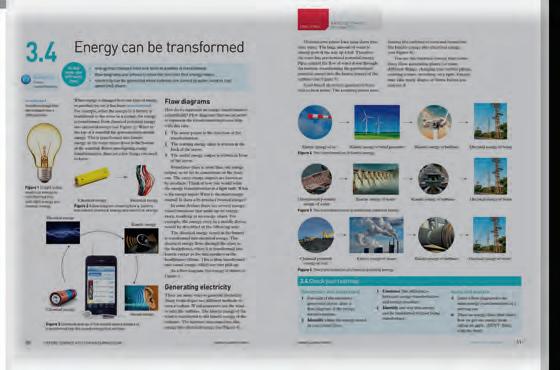
Oxford Science Australian Curriculum has been developed to meet the requirements of the Australian Curriculum: Science across Years 7–10. Taking a concept development approach, each double-page spread of Oxford Science represents oneconcept , onetopic and onelesson. This new edition ensures students build science skills and cross-curriculum capabilities, paving a pathway for science success at VCE.
The series offers a completely integrated suite of print and digital resources to meet your needs, including:
> Student Book > Student obook pro > Teacher obook pro.
Key features of this Student Book
> This Student Book combines complete curriculum coverage with clear and engaging design.
> Each print Student Book comes with complete access to all the digital resources available on Student obook pro.
Focus on concept development
Chapter openers
• Every chapter begins with a clear learning pathway for students.
Concept statements
• Every topic begins with a concept statement that summarises the key concept of the topic in one sentence.
Learning intentions
• Learning intentions are clearly stated for every topic.
Key ideas
• Key ideas are summarised for each topic in succinct dot points.
Integrated links to engaging digital resources
• Where relevant, digital icons flag engaging resources that can be accessed via Student obook pro. These resources are directly integrated with the topic being covered.
Margin glossary terms
• Key terms are bolded in the body in blue text, with a glossary definition provided in the margin.
Reflect
• Students are encouraged to selfassess their learning against a set of success criteria in the Chapter checklist tables at the end of each chapter. If students do not feel confident about their learning, they are directed back to the relevant topic.
Check your learning
• Each topic finishes with a set of `Check your learning’ questions that are aligned to the learning intentions for the topic. Questions are phrased using bolded cognitive verbs from Marzano and Kendall’s taxonomy, which state what is expected of a student and prepares them for studying senior science subjects.
Focus on science inquiry skills and capabilities
Science toolkit
• The Science toolkit is a standalone chapter that explicitly teaches important science inquiry skills and capabilities.
Digital hotspots
Icons found in the student book link to digital resources accessible via the obook pro
Digital versions of the Check your learning questions
Digital versions of the Chapter review questions
Videos
Digital quizzes
Interactives
Science as a human endeavour
• ‘Science as a human endeavour’ topics explore real-world examples and case studies, allowing students to apply science understanding.
Focus on practical work
Practical work appears at the back of the book
• All practical activities are organised in a chapter at the end of the book and signposted at the point of learning throughout each chapter.
Challenges, Skills labs and Experiments
• These activities provide students with opportunities to use problemsolving and critical thinking, and apply science inquiry skills.
Focus on STEAM
Integrated STEAM projects
• Take the hard work out of cross-curricular learning with engaging STEAM projects. Two fully integrated projects are included at the end of each book in the series, and are scaffolded and mapped to the Science, Maths and Humanities curricula. The same projects also feature in the corresponding Oxford Humanities and Oxford Maths series to assist crosscurricular learning.
Test your skills and capabilities
• This section provides scaffolded opportunities for students to apply their science understanding while developing skills and capabilities.
Problem solving through design thinking
• Each STEAM project investigates a real-world problem that students are encouraged to problem solve using design thinking.
Full digital support
• Each STEAM project is supported by a wealth of digital resources, including student booklets (to scaffold students through the design-thinking process of each project), videos to support key concepts and skills, and implementation and assessment advice for teachers.
INTRODUCING OXFORD SCIENCE
CURRICULUM
Key features of Student obook pro
> Student obook pro is a completely digital product delivered via Oxford’s online learning platform, OxfordDigital.
> It offers a complete digital version of the Student Book with interactive note-taking, highlighting and bookmarking functionality, allowing students to revisit points of learning.
> A complete ePDF of the Student Book is also available for download for offline use and read-aloud functionality.
Focus on eLearning
Videos
• Videos are available online to support understanding of concepts or key practical activities.
• Integrated Quizlet sets, including real-time online quizzes with live leaderboards, motivate students by providing interactive games that can be played solo or as a class. Quizlet can be used for revision or as a topic is introduced to keep students engaged.
Complete digital version of the Student Book
• This digital version of the Student Book is true to the print version, making it easy to navigate and transition between print and digital.
Interactive quizzes
• Each topic in the Student Book is accompanied by an interactive assessment that can be used to consolidate concepts and skills.
• These interactive quizzes are autocorrecting, with students receiving instant feedback on achievement and progress. Students can also access all their online assessment results to track their own progress and reflect on their learning.
> integrated Australian Concise Oxford Dictionary look-up feature
> targeted instructional videos for key concepts, practicals and worked examples
> interactive assessments to consolidate understanding
> integrated Quizlet sets, including real-time online quizzes with live leaderboards
> access to their online assessment results to track their own progress.
Quizlet
Key features of Teacher obook pro
> Teacher obook pro is a completely digital product delivered via OxfordDigital.
> Each chapter and topic of the Student Book is accompanied by full teaching support. Teaching programs are provided that clearly direct learning pathways throughout each chapter, including ideas for differentiation and practical activities.
> Teachers can use their Teacher obook pro to share notes and easily assign resources or assessments to students, including due dates and email notifications.
Focus on assessment and reporting
Additional resources
• Each chapter of the Student Book is accompanied by additional worksheets and learning resources to help students progress.
Complete teaching support
• Teaching support includes full lesson and assessment planning, ensuring there is more time to focus on students.
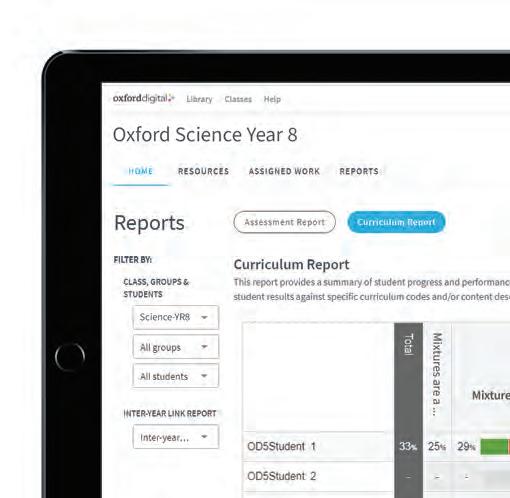
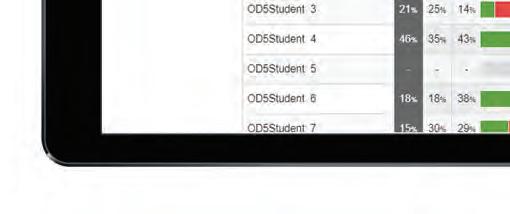
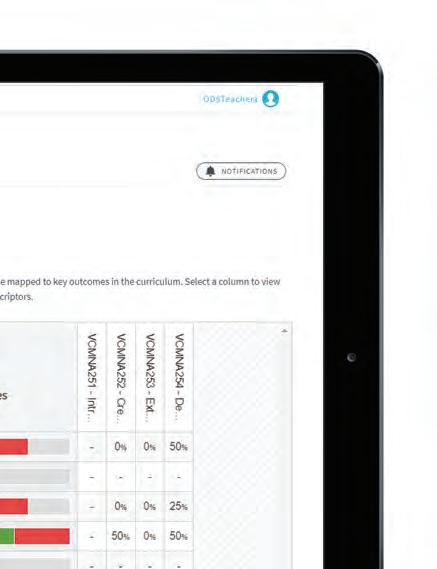
Curriculum and assessment reports
• Teachers are provided with clear and tangible evidence of student learning progress through curriculum and assessment reports.
• Assessment reports directly show how students are performing in each online interactive assessment, providing instant feedback for teachers about areas of understanding.
• Curriculum reports summarise student performance against specific curriculum content descriptions and curriculum codes.
> In addition to online assessment, teachers have access to editable class tests that are provided at the conclusion of each chapter. These tests can be used as formative or summative assessment and can be edited to suit the class’s learning outcomes.
> Teachers are provided with laboratory support through experiment answer guidance, laboratory technician notes and risk assessments to ensure safe learning experiences.
Benefits for teachers
AUSTRALIAN CURRICULUM: SCIENCE 8 SCOPE AND SEQUENCE
LEVELS 7 AND 8 DESCRIPTION
In Levels 7 and 8, the curriculum focus is on explaining phenomena involving science and its applications. Students explain the role of classification in ordering and organising information about living and non-living things. They classify the diversity of life on Earth into major taxonomic groups and consider how the classification of renewable and non-renewable resources depends on the timescale considered. Students classify different forms of energy and describe the role of energy in causing change in systems, including the role of heat and kinetic energy in the rock cycle. They use and develop models including food chains, food webs and the water cycle to represent and analyse the flow of energy and matter through ecosystems and explore the impact of changing components within these systems. Students investigate relationships in the Earth-Sun-Moon system and use models to predict and explain astronomical phenomena. They explain changes in an object’s motion by considering the interaction between multiple forces. Students link form and function at a cellular level and explore the organisation and interconnectedness of body systems. Similarly, they explore changes in matter at a particle level, and distinguish between chemical and physical change. Students make accurate measurements and control variables in experiments to analyse relationships between system components and explore and explain these relationships using appropriate representations. They make predictions and propose explanations, drawing on evidence to support their views.
LEVELS 7 AND 8 CONTENT DESCRIPTIONS
Science as a human endeavour
Chapter 2, 6, 7
Year 7
Chapter 3, 5, 7
Year 7
Biological sciences
Year 7
Scientific knowledge and understanding of the world changes as new evidence becomes available; science knowledge can develop through collaboration and connecting ideas across the disciplines and practice of science (VCSSU089)
Science and technology contribute to finding solutions to a range of contemporary issues; these solutions may impact on other areas of society and involve ethical considerations (VCSSU090)
There are differences within and between groups of organisms; classification helps organise this diversity (VCSSU091)
Chapter 6 Cells are the basic units of living things and have specialised structures and functions (VCSSU092)
Year 7 Interactions between organisms can be described in terms of food chains and food webs and can be affected by human activity (VCSSU093)
Chapter 7, 8 Multicellular organisms contain systems of organs that carry out specialised functions that enable them to survive and reproduce (VCSSU094)
Chemical sciences
<textonthisspreadwillbeupdatedat2pp>
Year 7 Mixtures, including solutions, contain a combination of pure substances that can be separated using a range of techniques (VCSSU095)
Year 7 The properties of the different states of matter can be explained in terms of the motion and arrangement of particles (VCSSU096)
Chapter 5 Differences between elements, compounds and mixtures can be described by using a particle model (VCSSU097)
Chapter 5 Chemical change involves substances reacting to form new substances (VCSSU098)
Earth and space sciences
Year 7 Predictable phenomena on Earth, including seasons and eclipses, are caused by the relative positions of the Sun, Earth and the Moon (VCSSU099)
Year 7 Some of Earth’s resources are renewable, but others are non-renewable (VCSSU100)
LEVELS 7 AND 8 CONTENT DESCRIPTIONS
Year 7
Chapter 2
Physical sciences
Year 7
Chapter 3
Chapter 4
Chapter 4
SCIENCE INQUIRY SKILLS
Questioning and predicting
Chapter 1
Chapter 9
Year 7
Planning and conducting
Chapter 1
Chapter 9
Year 8
Chapter 1
Chapter 9
Year 8
Recording and processing
Chapter 1
Chapter 9
Year 8
Analysing and evaluating
Chapter 1
Chapter 9
Year 8
Communicating
All chapters
Water is an important resource that cycles through the environment (VCSSU101)
Sedimentary, igneous and metamorphic rocks contain minerals and are formed by processes that occur within Earth over a variety of timescales (VCSSU102)
Change to an object’s motion is caused by unbalanced forces acting on the object; Earth’s gravity pulls objects towards the centre of Earth (VCSSU103)
Energy appears in different forms including movement (kinetic energy), heat, light, chemical energy and potential energy; devices can change energy from one form to another (VCSSU104)
Light can form images using the reflective feature of curved mirrors and the refractive feature of lenses, and can disperse to produce a spectrum which is part of a larger spectrum of radiation (VCSSU105)
The properties of sound can be explained by a wave model (VCSSU106)
Identify questions, problems and claims that can be investigated scientifically and make predictions based on scientific knowledge (VCSIS107)
Collaboratively and individually plan and conduct a range of investigation types, including fieldwork and experiments, ensuring safety and ehtical guidelines are followed (VCSIS108)
In fair tests, measure and control variables, and select equipment to collect data with accuracy appropriate to the task (VCSIS109)
<textonthisspreadwillbeupdatedat2pp>
Construct and use a range of representations including graphs, keys and models to record and summarise data from student's own investigations and secondary sources, and to represent and analyse patterns and relationships (VCSIS110)
Use scientific knowledge and findings from investigations to identify relationships, evaluate claims and draw conclusions (VCSIS111)
Reflect on the method used to investigate a question or solve a problem, including evaluating the quality of the data collected, and identify improvements to the methods (VCSIS112)
Communicate ideas, findings and solutions to problems including identifying impacts and limitations of conclusions and using appropriate scientific language and representations (VCSIS113)
ACKNOWLEDGEMENTS
The author and the publisher wish to thank the following reviewers: Professor Bradley Moggridge, James Kennedy, Paguiel Meunier and Michelle Moore.
They also wish to thank the following copyright holders for reproduction of their material.
Every effort has been made to trace the original source of copyright material contained in this book. The publisher will be pleased to hear from copyright holders to rectify any errors or omissions.
CELLS 6 CHAPTER
All living things are made up of cells
> Explain the key concepts of cell theory.
> Describe surface area to volume ratio. 6.1
6.2
Microscopes are used to study cells
> Compare stereomicroscopes and compound light microscopes.
> Compare electron and light microscopes.
> Calculate magnification.
> Focus a compound light microscope.
6.3
Plant and animal cells have organelles
> Describe the functions of the cell membrane, cytoplasm, DNA, mitochondria, cell wall, chloroplasts and vesicles.
> Identify the key differences in the structures of animal and plant cells.
6.4
6.5
Cells have different roles
> Describe the key differences between prokaryotic and eukaryotic cells.
> Recall examples of prokaryotic and eukaryotic cells.
Single-celled and multicelluar organisms can cause disease
> Describe the differences between natural flora and pathogens.
> Identify whether types of pathogens are single-celled or multicellular.
> Describe the process of binary fission.
6.6
Science as a human endeavour: Fungal cells can save lives
> Explain the relationship between bacterial cells and some fungal cells.
> Describe the development of fungal cells as a medical treatment.
What if?
Building blocks
What you need:
Building blocks (e.g. LEGO® blocks)
What to do:
1 Use the blocks to make a cube.
2 Rearrange the blocks to make a pyramid shape.
3 Rearrange the blocks a third time to make a rough circle. What if?
» What if you wanted to make your shapes bigger?
» What if you just had one large block? How many shapes could you make?
» What if you had different shaped blocks? How many shapes could you make?
6.1 All living things are made up of cells
Learning intentions
By the end of this topic, you will be able to:
• explain the key concepts of cell theory
• describe surface area to volume ratio.
Key ideas
• Microscopes allow scientists to see the building blocks of life (cells).
• Cell theory states that all living things are made up of cells; cells are the basic unit of life and structure; all living cells are created from existing cells.
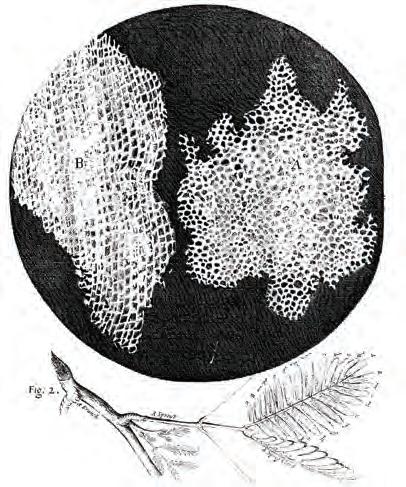
microscope, the cork looked like a piece of honeycomb with ‘holes’ and ‘honeycomb’. He called the small structures ‘cells’ because they reminded him of the small rooms in a monastery, which were also called cells. Hooke had discovered the fi rst plant cells.
cell (in biology) the building block of living things
microbiology
the science involving the study of microscopic organisms cell theory theory describing the properties that all cells have in common
Scientists have not always known that living things are made up of cells. It was the invention of the microscope in the midseventeenth century that allowed us to see the building blocks of life – the tiny units that form every living thing. Microscopes showed that each and every living thing is made up of cells
Discovering cells
When Robert Hooke published his book Micrographia in 1665 it became a bestseller. Hooke had made one of the fi rst microscopes. With it, he observed many types of living things and made accurate drawings of what he saw.
Although some called Micrographia ‘the most ingenious book ever’, others ridiculed Hooke for spending so much time and money on ‘trifl ing pursuits’. Thankfully for us, and for the whole science of microbiology, Hooke ignored the name-calling and kept experimenting with microscopes.
single-celled an organism that consists of one cell multicellular an organism that has two or more cells microorganism a living thing that can only be seen with the use of a microscope
DRAFT
It was because of Hooke’s contribution to microbiology that other scientists went on to develop a further understanding of cells.
Hooke’s most famous achievement was his diagram of very thin slices of cork (Figure 1).
He was surprised to see that, under the
Cell theory
Cell theory describes the properties of cells and their role in living things. It was fi rst proposed in 1839 by two German biologists, Theodor Schwann and Matthias Schleiden. In 1858, Rudolf Virchow concluded the fi nal part of the classic cell theory. The combined cell theory included the following principles:
> All organisms are composed of one or more cells.
> Cells are the basic unit of life and structure.
> New cells are created from existing cells.
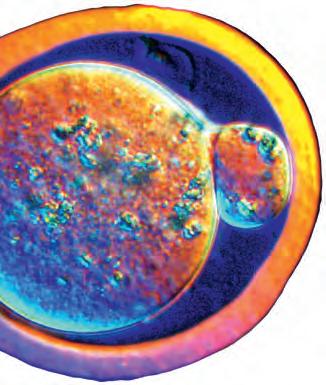
Any living thing that has more than one cell is referred to as multicellular (Figure 2a). There are many living things, such as bacteria, that consist of only one cell. These are called single-celled or unicellular organisms (Figure 2b). Microorganisms , which are also often referred to as microbes, are organisms that can only be seen under the microscope – they can be single-celled or multicellular.
Figure 1 Robert Hooke’s drawing of cork
Video 6.1 All living things are made up of cells
6.1: Drawing cells
cell membrane the barrier around a cell that controls the entry and exit of substances into and out of a cell
Why are cells so small?
The outside surface of a cell is called the cell membrane. It controls what can move in (nutrients) or out (waste) of the cell.
Large cells have more difficulty staying alive than small cells. Large cells need to move nutrients a long way to reach the centre of the cell. Small cells do not need to make the nutrients travel as far and this makes it easier for all parts of the small cells to stay healthy and alive.
The total space inside the cell is referred to as the cell’s volume while the size of the membrane is called the surface area. As a cell increases in size, both its volume and its surface area increase. The problem is, the volume increases much more than the surface area. Eventually the volume becomes so big that it is difficult for nutrients to get into the centre of the cell and for wastes to get out. We compare the relationship between the amount of surface area and the volume of a cell through a fraction – the surface area to volume ratio. Small cells have a large surface area compared to their volume (a large surface area to volume ratio) and are therefore better able to survive. This explains why single-celled organisms are so small. A single cell must do all the same things that a larger organism does (Figure 3).
It is essential that the cell membrane provides a large surface area for the transport of so many molecules into and out of the cell.
6.1 Check your learning
Retrieve
2Recall why cells are called ‘cells’.
3Define the term ‘multicellular’.
4Name five multicellular organisms.
5Identify three things that all singlecelled organisms have in common.
DRAFT
The cell membrane is particularly important because it provides a barrier between the inside of the cell and the external environment. All the nutrients needed to keep the cells alive, and the waste products made by the cell, are transported across the cell membrane.
1Name the person who invented the fi rst microscope.
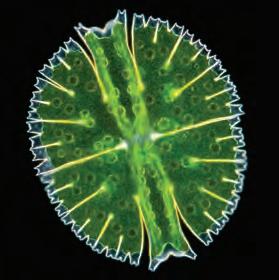
Figure 3 The irregular shape of this singlecelled organism (called a desmid) maximises the surface area to volume ratio.
6State the three principles of cell theory.
Comprehend
7 The common house dust mite is a microorganism. Recall whether you would be able to see this animal without a microscope. Explain your answer (by defi ning the term ‘microorganism’ and linking the defi nition to the need for a microscope).
8Explain whether a cell with a bigger surface area to volume ratio would be able to meet its requirements for nutrients effectively.
9Explain why single-celled organisms are very small.
Quiz me
Complete the Quiz me to check how well you’ve mastered the learning intentions and to be assigned a worksheet at your level.
surface area to volume ratio the relationship between the area around the outside of a cell and its volume, as a fraction
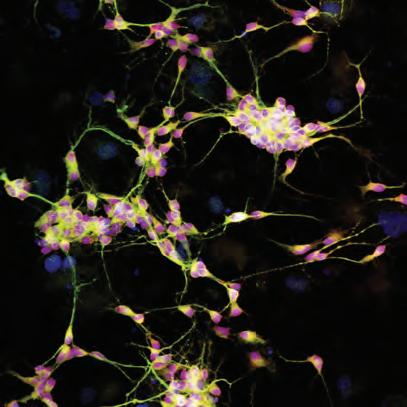
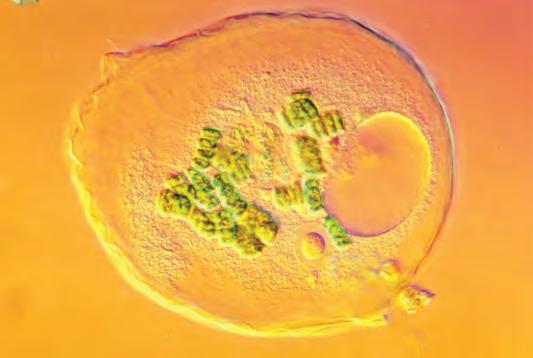
Figure 2 a Human nerve cells are part of multicellular humans, but b the amoeba is a single-celled organism.
Microscopes are used to study cells 6.2
Learning intentions
By the end of this topic, you will be able to:
• compare stereomicroscopes and compound light microscopes
• compare electron and light microscopes
• calculate magnification
• focus a compound light microscope.
Key ideas
• A microscope is an instrument that uses lenses to magnify the size of objects.
• The science of investigating small objects using a microscope is called microscopy.
Types of microscopes
As a science student, you will probably use a light microscope in your laboratory. You may also work with images produced by different types of microscopes, such as light microscopes and electron microscopes. The study of small objects using a microscope is called microscopy
Light microscopes
The word monocular is used to describe a microscope with one eyepiece (mono = one).
Microscopes with two lenses are called binocular (bi = two). The compound light microscope uses two lenses (one in the eyepiece and one further down the column, called the objective lens). Most cells are clear or transparent so a stain, such as iodine, can be used to help make them more visible.
microscope an instrument with lenses that is used for viewing very small objects electron microscope a microscope that uses electrons (tiny negatively charged particles) to create images microscopy the study of living things that can only be seen with the use of a microscope stereomicroscope a microscope with two eyepieces that uses low magnification
binocular using two eyes; a type of microscope compound light microscope a microscope with two or more lenses eyepiece where the eyes are placed when using a microscope monocular using one eye; a type of microscope
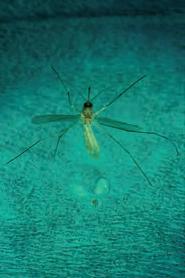
There are two common types of light microscope – the stereomicroscope and the compound light microscope. The stereomicroscope is used for viewing larger objects, such as insects (Figure 1a). It can magnify up to 200 times and shows a threedimensional view.
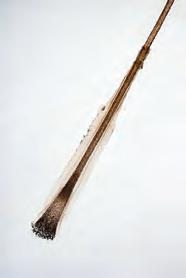
The compound light microscope is used to look through thin slices of specimens (Figure 1b). It can magnify up to 1500 times. Its view is two-dimensional. The specimen must be thin enough to allow light to pass through it.
The stereomicroscope has two eyepieces to look through, whereas the compound light microscope can have one or two eyepieces.
DRAFT
Electron microscopes
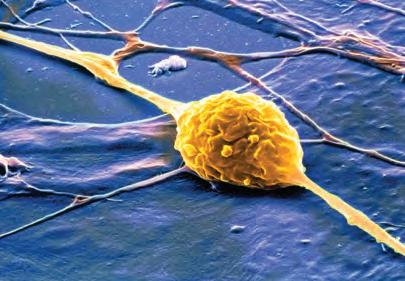
An electron microscope uses electrons (tiny negatively charged particles) to create images. The fi rst electron microscope, the transmission electron microscope (TEM), was invented in 1933 to help study the structure of metals. The scanning electron microscope (SEM), developed later, uses a beam of electrons to scan across the surface of a specimen. A computer is used to create the image, showing details of the specimen’s surface (Figure 2).
Electron microscopes can magnify up to a million times. Using this technology, many more details of the cell can be seen and understood.
Figure 2 Image of a nerve cell under a scanning electron microscope (SEM)
Figure 1 a An insect, as seen under a stereomicroscope b Human hair root as seen under a compound light microscope
Video 6.2 Microscopes are used to study cells
6.2: Getting to know your microscope Go to page XXX
Using a compound light microscope
Figure 3 shows the parts of a monocular compound light microscope. Microscopes are fragile instruments that must be treated with care.
> Always use two hands to carry a microscope – one hand around the main part of the instrument and the other underneath it.
> Some microscopes have a built-in lamp. Others have separate lamps that need to be set up so they shine onto the mirror. Adjust the mirror to project the light through the stage onto the specimen. Do not allow sunlight to shine directly up the column.
> Place the slide on the stage then select the objective lens with the lowest magnification.
> Look from the side and adjust the coarse focus knob so that the objective lens is just above – and not touching – the slide. Check which way you must turn the knob to move the objective lens away from the slide.
> Use the coarse focus knob to bring the specimen into view. Use the fi ne focus knob to help you see it more clearly.
> If you want a higher magnification, rotate the objective lens to a higher magnification.
> Draw what you see (as a record) using a sharp grey pencil.
> Work out the total magnification.
> Write the magnification next to your sketch.
> Label and date the sketch.
Light travels through microscope to eye
Eyepiece lens (ocular) Coarse focus knob Fine focus knob
Microscope tube
Revolving nosepiece
lenses
Magnification calculations
Using different combinations of lenses means you can magnify your object by different amounts. To calculate the total magnification of a compound light microscope, multiply the magnification of the eyepiece lens by the magnification of the objective lens (see Worked example 6.2 and Table 1). These fi gures are marked on each lens.
objective lens lens in the column of a compound light microscope stain substance, such as iodine, used to make cells more visible under a microscope
Worked example 6.2: Calculating magnification
Calculate the fi nal magnification of a cell that can be seen when using a ×4 objective lens and a ×10 eyepiece lens.
Solution
Mag n i ficat ion = eyepiece lens mag n i ficat ion × object ive lens mag n i ficat ion = 10 × 4 = 40
The cell was magnified 40 times larger than normal.
DRAFT
Table 1 The total magnification of a microscope can be determined by multiplying the magnifications of the eyepiece and the objective lens.
Complete the Quiz me to check how well you’ve mastered the learning intentions and to be assigned a worksheet at your level.
Plant and animal cells have organelles 6.3
Learning intentions
By the end of this topic, you will be able to:
• describe the functions of the cell membrane, cytoplasm, DNA, mitochondria, cell wall, chloroplasts and vesicles
• identify the key differences in the structures of animal and plant cells.
cell membrane
the barrier around a cell, controlling the entry and exit of things into and out of the cell
cytoplasm the jelly-like fluid inside the cell membrane that contains dissolved nutrients, waste products and organelles
DNA (deoxyribonucleic acid)
a molecule that contains all the instructions for every job performed by the cell; this information can be passed from one generation to the next
nucleus control centre of a cell that contains all the genetic material (DNA) for that cell
Key ideas
• A cell is the smallest basic unit of life.
• All cells have a membrane, cytoplasm and genetic material (DNA).
• All plant and animal cells are made up of smaller organelles.
Cell structures
All cells, regardless of which type of organism they are found in, share the same basic structure. This basic structure includes three key features.
> Cell membrane – this acts like the ‘skin’ of a cell, forming a barrier around the cell. It controls the entry and exit of things into and out of the cell.
> Cytoplasm – this is the jelly-like fluid and structures inside the cell membrane.
It helps provide structure to the cell and contains many dissolved nutrients and waste products.
> DNA (deoxyribonucleic acid) – this contains the instructions for every job your cells need to do and is passed from one generation to the next. The code for half your DNA came from your mother, and the other half came from your father. The same complete set of DNA is found in every one of your cells. Plant and animal cells keep their DNA surrounded by a membrane to form a nucleus (the control centre of the cell).
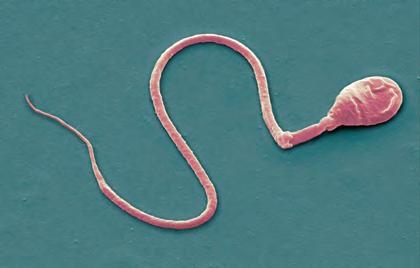
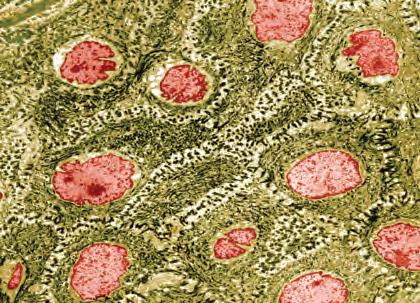
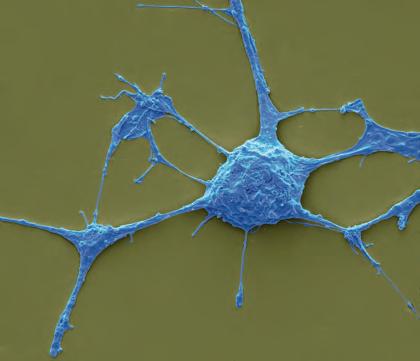
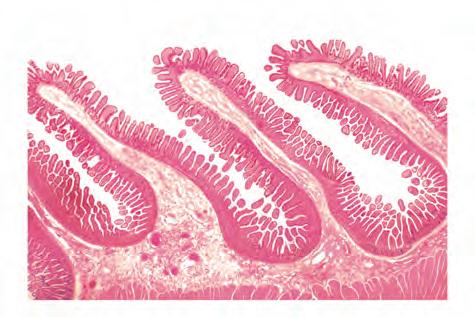
Figure 1 Cells can be different shapes and sizes: a sperm cell, b nerve cell, c skin cell and d intestinal cell.
6.3A: Comparing the size of cells and their parts Go to page XXX CHALLENGE
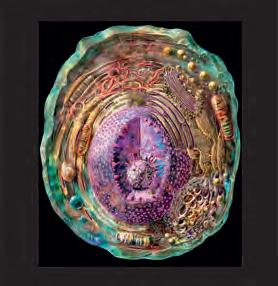
AN ANIMAL CELL
mitochondrion
nucleus
Golgi body cell membrane nucleolus
2 Some key parts (organelles) of an animal cell
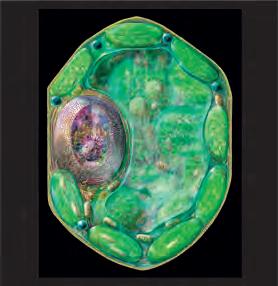
A PLANT CELL
central vacuole chloroplast
cell wall
mitochondrion
Figure 3 Some key parts (organelles) of a plant cell
A closer look at organelles
Some cells need special areas or organelles (mini-organs) to help them do special things (perform functions) (Figures 2 and 3). These functions are necessary for the cell to survive. Some organelles, such as ribosomes, are part of the cytoplasm, whereas other organelles are separated from the fluid in the cytoplasm by
chromatin lysosome
rough endoplasmic reticulum
smooth endoplasmic reticulum
cytoskeleton
ribosomes
DRAFT
nucleus rough endoplasmic reticulum
smooth endoplasmic reticulum ribosomes
Golgi body lysosome
cell membrane
a membrane, much like the cell membrane. These organelles, such as the nucleus and chloroplasts, are called membrane-bound organelles.
Let’s take a closer look at four very important organelles that are in some cells –the mitochondria, cell wall, chloroplasts and vesicles.
organelle
smaller part of a cell, each one having a different function
Figure
mitochondrion powerhouse organelle of a cell; the site of energy production (plural: mitochondria)
cell wall the outer protective and support structure of a plant cell
Mitochondria
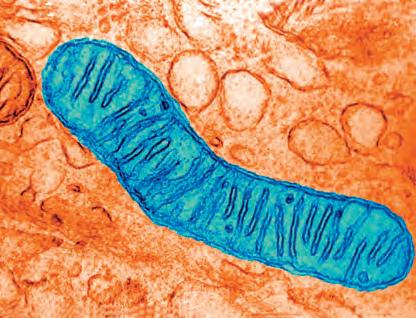
Mitochondria (singular ‘mitochondrion’) are the powerhouse of the cell. They are the site of energy production in the cell. There may be several thousand mitochondria in a cell depending on what the cell does. For example, skeletal muscle cells contain a lot of mitochondria to make sure we have enough energy to run and jump when we need to.
Mitochondria are rod-shaped organelles with an inner and an outer membrane (Figure 4). The inner membrane is folded to increase the surface area of the membrane. An important chemical reaction called cellular respiration occurs inside the mitochondria. This reaction involves the rearrangement of the atoms in glucose (from the food we eat) and oxygen to produce water, carbon dioxide and energy. This energy is used by our bodies to help us move and grow.
Cell wall
Cell walls are not found in animal cells. They are found around the outside of plant cells, fungal cells and bacterial cells (Figure 5). The cell wall is important for helping the cell keep its shape, especially in fresh water. Fresh water can easily enter a cell, making the outside membrane swell and possibly burst. If the cell is surrounded by a cell wall, the membrane cannot burst.
Chloroplasts
chloroplast organelle found in plant cells that transforms solar energy into chemical energy chlorophyll green pigment found inside chloroplasts that absorbs solar energy and uses it in photosynthesis
photosynthesis chemical process plants use to make glucose and oxygen from carbon dioxide and water
Figure 4 a Schematic diagram showing the structure of a mitochondrion b Electron micrograph of a mitochondrion
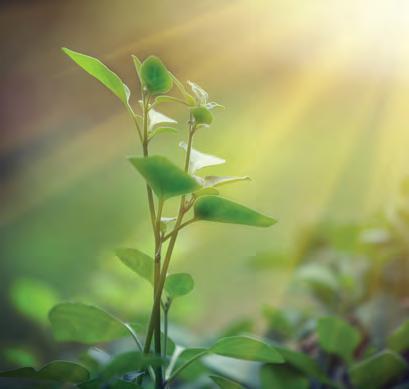
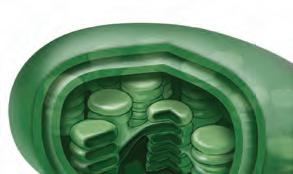
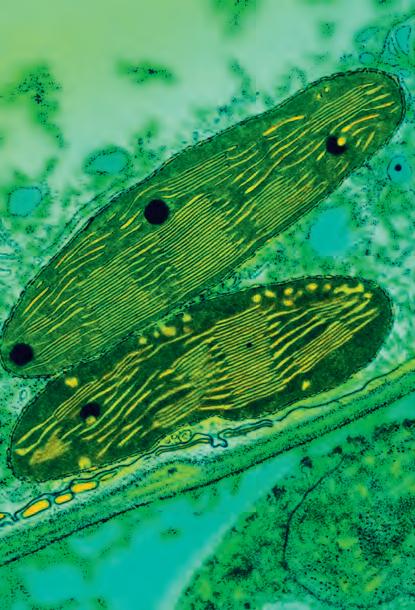
Chloroplasts are only found in plant cells and some unicellular organisms (Figure 7). These organelles are like microscopic solar panels that transform solar energy into chemical energy. Chloroplasts are usually green because of a molecule called chlorophyll. Chlorophyll uses the Sun’s light energy to rearrange molecules of carbon dioxide and water into glucose (a sugar) and oxygen. This chemical reaction is called photosynthesis.
4 The chlorophyll in plants uses the Sun’s light energy to create glucose and oxygen.
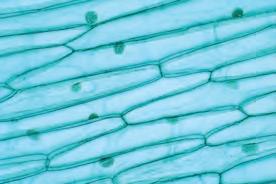
Figure 5 Light micrograph of plant cells showing the cell walls cell wall
Figure
6.3B: Looking at organelles Go to page
Thylakoid disks
Thylakoid disks
Grana (stacks of thylakoids)
Grana (stacks of thylakoids)
6.3 Check your learning
Retrieve
1Recall the function of the cell membrane.
2Name the organelle where cellular respiration occurs.
3State three things that are stored in a vacuole.
4Identify three organelles that are surrounded by a membrane.
Comprehend
Vesicles
6.3C: Measuring cells Go to page XXX
Vesicles are organelles that are used by plant and animal cells to store water, nutrients and waste products. A membrane surrounds the vesicle, separating the substances from the rest of the cell. Plant cells usually have one large vesicle called a vacuole. Animal cells may have many small vesicles.
vesicle an organelle surrounded by a membrane and used by cells to store materials; a vacuole is a type of vesicle found in plant cells
0102030405060708090100110
Human egg cell (ovum) with nucleus
5Describe the features of all living cells. (HINT: Remember MRNGREWW from Year 7.)
DRAFT
Figure 8 Different types of cells are different sizes and are measured in micrometres (μm). One micrometre is equivalent to one-thousandth of 1 mm.
6Describe the role of the cell wall in plants.
7Explain the function of chlorophyll.
Analyse
8Identify the reactants (present at the start) and products (present at the end) for the chemical reaction called photosynthesis.
9Contrast the structure of animal and plant cells.
Apply
10Explain where you would be more likely to fi nd large numbers of
mitochondria: in a muscle cell or a bone cell. Justify your answer (by explaining the function of mitochondria in a cell, explaining what each cell does and deciding which cell would need the mitochondrial function most).
Quiz me
Complete the Quiz me to check how well you’ve mastered the learning intentions and to be assigned a worksheet at your level.
Micrometres (μm)
White blood cell
Human hair cross-section
Red blood cell
Cell from inside cheek
Tubules
Tubules
6.4
Learning intentions
By the end of this topic, you will be able to:
• describe the key differences between prokaryotic and eukaryotic cells
• recall examples of prokaryotic and eukaryotic cells.
Cells have different roles
Key ideas
• All cells can be broken into two groups, prokaryotes and eukaryotes.
• Prokaryotes (bacteria) do not have organelles or a nucleus.
• Eukaryotes have a nucleus and different organelles that are used to divide them into Kingdoms.
Prokaryotes and eukaryotes
Cells are classified into two main groups –prokaryotic cells and eukaryotic cells.
Plant cells
Eukaryotic cell structure
prokaryotic cell primitive single-celled organism that has no nucleus eukaryotic cell complex cell that contains a nucleus and membranebound organelles
and b animal cells
Prokaryotic cells belong in the kingdom Monera. They are the most primitive cellular forms on Earth and are unicellular (single cells). They are much simpler than eukaryotic cells and do not have many of the organelles described in the previous topic. For example, they have no nucleus and their genetic material (DNA) is found free in the cytoplasm. Prokaryotes include all the bacteria found on Earth.
Eukaryotic cells are more complex cells and are found in organisms from each of the other four kingdoms – Animalia, Plantae, Fungi and Protista. Eukaryotic cells keep their genetic material in a nucleus and have the membranebound organelles described in Topic 6.3. Most eukaryotes are multicellular. Table 1 lists some of the characteristics of prokaryotic and eukaryotic cells.
When we look at whole organism plants and animals, it’s fairly easy to see that they are different. Once microscopes started to become more powerful, scientists could see differences between plant and animal cells (Figure 1). Plant cells use their chloroplasts to photosynthesise and need cell walls to provide structure. Many plant cells also store their nutrients in large vacuoles (large spaces surrounded by a membrane).
Fungal cells
Fungi such as mushrooms are often mistaken for a type of plant. Using a microscope, scientists are able to see that fungal cells are different from plant cells. For example, fungal cells don’t have chloroplasts, so they cannot photosynthesise, and they don’t have large vacuoles fi lled with liquid (Figure 2). Instead of making their own glucose, fungi such as mushrooms need to absorb their nutrients from the soil.
Number of cells MulticellularMulticellular Multicellular, some unicellular (e.g. yeasts)
Cell wall
AbsentPresentPresent
Multicellular or unicellular Unicellular
Present in some Present
Genetic material PresentPresentPresent PresentPresent
NucleusPresentPresentPresent PresentAbsent
MitochondriaPresentPresentPresent PresentAbsent
ChloroplastsAbsentPresentAbsent Present in some Absent
Large vacuoles
AbsentPresentAbsent Present in some Absent
RibosomesPresentPresentPresent PresentPresent
Table 1 Characteristics of eukaryotic and prokaryotic cells
Video 6.4
6.4A: Classifying using cells Go to page XXX
Protists
Protists (Kingdom Protista) are a mixed group of organisms that are mostly unicellular (the whole organism is made up of just one cell). Many live in water, some are photosynthetic (they make their own food, like plants), some eat other organisms and some cause diseases. Depending on where it lives and its food sources, a protist’s shape or structure will have evolved to suit its environment. The protists in Figures 3 to 6 have structures particular to their lifestyles.
Contractile vacuole (execretes water and waste)
Cytoplasm
Pseudopods
6.4B: Plant and animal cells Go to page XXX EXPERIMENT
Animal cells
Single-celled or unicellular organisms, such as bacteria, are made of one cell only. Multicellular organisms, like us, are made of more than one cell and often many billions of cells. The different cells in a multicellular organism communicate and work together to produce a functioning organism. Their different roles in the body mean they have different sizes and shapes. All animal cells have a nucleus and organelles, but no chloroplast or cell wall.
2 Cells in
Food being engulfed by pseudopods
Food vacuole (digests food)
Figure 3 An amoeba can change the shape of its blobby body, creating foot shapes for movement and mouth shapes for swallowing food.
Contractile
Fungi have cell walls and nuclei, but no chloroplasts.
Figure 5 Euglena moves quickly when it needs to, with a bullet-shaped body and a long tail called a flagellum to whip it into action.
Figure 4 The paramecium moves slowly with lots of tiny hairs called cilia that act like miniature oars.
6.4 Check your learning
Retrieve
1State where the genetic material is found in a prokaryotic cell.
2Recall an example of a unicellular organism and a multicellular organism.
Comprehend
DRAFT
3Describe the two main differences between eukaryotic and prokaryotic organisms.
Figure 6 Chlamydomonas has an eyespot to detect light and two flagella to swim.
4Illustrate a cell that would be found in a mushroom (eukaryotic fungal cell). Label all of the organelles.
Analyse
5 Use Table 1 to identify the kingdom that is often referred to as ‘the rest’ of the cells.
6 Table 1 shows that plant cells contain chloroplasts. Although a typical plant cell contains chloroplasts, they are not found in all plant cells.
aInfer why some cells in a plant root may lack chloroplasts.
bIdentify the part of a plant where you would expect to fi nd cells with chloroplasts.
Quiz me
Complete the Quiz me to check how well you’ve mastered the learning intentions and to be assigned a worksheet at your level.
Food vacuole
Cilia
Chloroplast
Chloroplast
Figure
kingdom
6.5 Single-celled and multicellular organisms can cause disease
Learning intentions
By the end of this topic, you will be able to:
• describe the differences between natural flora and pathogens
• identify whether types of pathogens are single-celled or multicellular
• describe the process of binary fission.
natural flora
microbes that live happily in our bodies pathogen
micr obe that can potentially cause a disease infectious disease dise ase caused by the passing of a pathogen from one organism to another; also known as a contagious disease
Key ideas
• Non-dangerous bacteria that live on or in our body are called natural flora.
• Pathogens are cells that cause disease in other organisms.
• Infectious pathogens can be passed between organisms.
• Bacteria reproduce through binary fission.
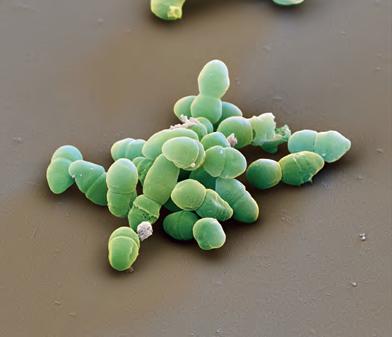
Unicellular organisms, such as bacteria, are living in and around us all the time. The average adult human has 1 kilogram of nonhuman life inside their large intestine alone. Some bacteria and microbes are essential for keeping our body healthy and working correctly. Others can be deadly. Figure 1 shows different bacteria found in the human body.
Microbes essential for health
The microbes that live happily on or in our bodies are referred to as natural flora . The careful balance between natural flora and the microbes in our environment is important to our health. The right amount of natural flora will protect us against foreign invaders, while too much of the natural flora can make us ill.
Bacteria in our intestines help our bodies digest food and provide vitamins to keep us healthy. The bacteria on our skin act as a protective coating, preventing disease-causing bacteria from growing.
Microbes causing disease
DRAFT
We have all been sick before. Some forms of sickness are caused by pathogens. A pathogen is a microorganism that can potentially cause a disease. An infectious disease is one where the pathogen is passed from one organism to another. Infectious diseases are described as being contagious. Pathogens always live on a host organism, such as a human, other animal or plant.
Figure 1 a Staphylococcus epidermis b Staphylococcus aureus in the hair c Haemophilus influenza in the nose d Chlamydia trachamates in the eye e Esherichia coli in the intestines
6.5: Microbes
Figure 2 a Trichophyton mentagrophtes – cause of ringworm and tinea b A red blood cell infected with malarial parasites c
You will investigate pathogens in more detail in Year 9. The symptoms of a disease are the changes that occur to a host due to the disease.
Harmful microbes can be viruses, fungi, protists or bacteria. Viruses are considered by most scientists to be non-living pathogens because they cannot survive and reproduce outside a host cell. Instead, they need to invade a cell and use the cell’s organelles to reproduce. They are not cells and are much smaller than cells. Viruses are hard to treat with medications because they hide inside our cells. They cannot be treated with antibiotics.
Fungi, protists and bacteria are living organisms made up of cells. Fungi can be single-celled or multicellular. Most protists are single-celled. Bacteria are single-celled. All these microbes can invade the body and cause disease. You are probably familiar with some diseases caused by harmful microbes. Fungi can cause infections such as tinea, which is also known as athlete’s foot, and ear infections. Protists can cause malaria and dysentery. Bacteria cause diseases such as tuberculosis (also known as TB),
6.5 Check your learning
Retrieve
pneumonia, Legionnaires’ disease and cholera. Diseases caused by bacteria can be treated with antibiotics, which kill the bacterial cells or stop them reproducing. Microbes causing some of these diseases are shown in Figure 2.
Bacterial growth
Bacteria reproduce using a process called binary fi ssion (binary = two; fi ssion = split). As the name suggests, a bacteria cell grows slightly larger and then splits in two. This is a very quick process, sometimes taking as little as 20 minutes. This can be represented on a graph such as the one in Figure 3.
Most bacterial growth is stopped at temperatures below 4°C and above 60°C. For this reason, your fridge should be below 4°C and cooked food waiting to be served should be stored above 60°C.
1Identify the type of microorganism that your digestive system relies on.
2aDefine the term ‘pathogen’.
bIdentify the four main types of pathogens.
cRecall whether each of the types of pathogen is single-celled, multicellular or not a cell.
Comprehend
3Contrast natural flora and pathogens.
4Describe the process of binary fi ssion.
symptoms the physical or mental signs of a disease
binary fi ssion a form of asexual reproduction used by bacteria; the splitting of a parent cell into two equal daughter cells
Growthofbacteriaovertime
Time(minutes) Number of bacteria
Figure 3 The number of bacteria cells can double every 20 minutes.
Analyse
5 It is not recommended that food be left out of the fridge for more than 3 hours. Use the defi nition of binary fi ssion to infer why.
Quiz me
Complete the Quiz me to check how well you’ve mastered the learning intentions and to be assigned a worksheet at your level.
Tuberculosis bacteria
//SCIENCE AS A HUMAN ENDEAVOUR//
Fungal cells can save lives 6.6
Learning intentions
By the end of this topic, you will be able to:
• explain the relationship between bacterial cells and some fungal cells
• describe the development of fungal cells as a medical treatment.
Have you ever scratched yourself on a bush, or pricked yourself with a needle? Before the discovery of antibiotics, such a simple break in the skin could have been enough to kill you.
The discovery of penicillin
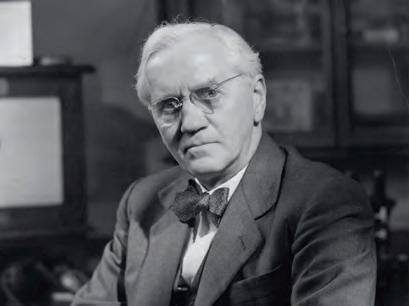
It has been accepted for over 3000 years that some fungal cells can kill bacteria. Alexander Fleming (Figure 1) is credited with discovering in 1928 the specific chemical responsible for this.
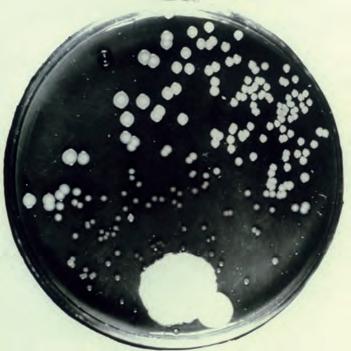
Fleming was trying to grow bacteria on special agar plates as part of his research. Bacteria usually grow very well across the top of agar plates. However, this day Fleming failed to clean up after his experiment and left an agar plate open on his bench before leaving for a holiday. When he returned from his break, a small spot of mould had started growing in the centre of the plate. All around the mould was a clear circle where the bacteria were unable to grow. Fleming concluded that the mould (Penicillium) was producing a molecule that prevented the bacteria from growing (Figure 3). The molecule, which was named penicillin, had the ability to stop bacterial growth by preventing the bacteria repairing or making a new cell wall.
Producing penicillin
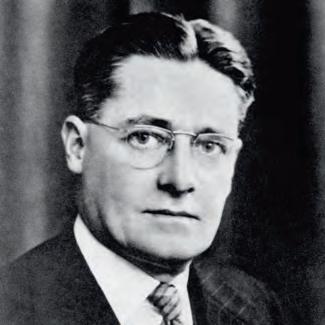
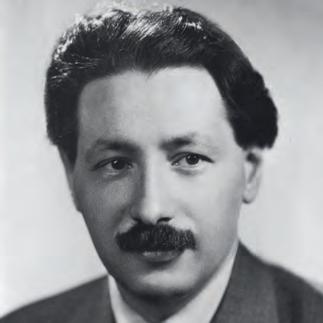
It took ten more years and the work of Howard Florey (an Australian, Figure 4) and Ernst Chain (Figure 5) to develop a way to separate the penicillin and produce it on a large scale. They were part of a team of specialists brought together to grow the mould, extract the penicillin, purify it and trial its treatment on patients.
DRAFT
In May 1940, Fleming’s group infected eight mice with streptococcal bacteria. Four of the mice were treated with penicillin. These mice survived, while the mice without the penicillin died.
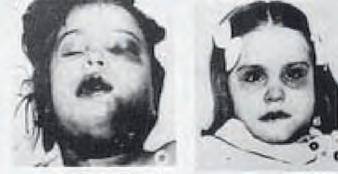
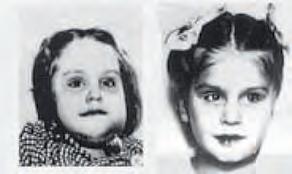
This led the researchers to trial the penicillin on their fi rst patient. Albert Alexander’s whole face was swollen after being scratched by a rose thorn. One eye had been removed and the other lanced to drain the pus. Within one day of being given penicillin, Alexander started to improve. Unfortunately, Fleming’s group did not have enough penicillin to fi nish the treatment and the patient suffered a relapse and died.
Figure 1 Alexander Fleming
Figure 3 Penicillium mould growing on Fleming’s agar plate
Figure 4 Howard Florey
Figure 5 Ernst Chain
Figure 2 A type of penicillin can grow on orange peels.
The researchers tried treating children next, as smaller doses could be used and the treatment could last longer. Eventually their purification methods and resulting treatment were successful (Figure 6). They were awarded a Nobel Prize in 1945 for their work.
The use of penicillin as an antibiotic revolutionised health care and the lives of many people who, without such treatment, would have died from bacterial infections.
The timeline of knowledge development about mould as a treatment for bacterial infection is shown in Figure 7.
Overuse of antibiotics
There are now many more different antibiotics available, most of which are extracted from fungi. The overuse of antibiotics is a cause for concern. Because bacteria reproduce quickly, some strains of bacteria are becoming resistant to treatment. That is, they are not affected by antibiotics.
1870s
Louis Pasteur: mould prevents anthrax growing.
1000BCE
Moulds and fermented materials used to treat infections.
Joseph Lister: samples of urine do not allow bacteria to grow.
Figure 7 Penicillin timeline
6.6 Test your skills and capabilities
Communicating with your audience
Scientists are continually searching for new types of natural and artificial antibiotics to treat these new ‘superbugs’ that are resistant to all known antibiotics.
A dose of antibiotics destroys not only the harmful bacteria, but also the good bacteria in your body, so they should only be used to treat bacterial infections when absolutely necessary.
Figure 6 These photos from 1942 show the improvement of a child after penicillin treatment for a bacterial infection.
a Before treatment
b Four days after treatment
c Nine days after treatment
d Fully recovered
Ernest Duchesne: mould prevents bacterial growth in animals.
1922
Alexander Fleming: a tear (containing lysozyme) from his eye prevents bacterial growth.
DRAFT
When you are sick, you visit the doctor. Doctors have many years of training to ask questions, observe disease symptoms, diagnose disease and decide if medication is needed. Doctors need to communicate their critical thinking to patients that do not have the same training or understanding. Doctors change the words about concepts so that their audience understands them.
Use your knowledge of viruses like influenza and how antibiotics kill bacteria to create a brochure that explains why a patient with influenza cannot be treated with antibiotics. Use the following hints to help you.
Before you begin
1928
1930s Howard Florey and Ernst Chain: able to grow and purify enough penicillin to be used by patients.
Alexander Fleming: mould prevents bacterial growth in the same way as lysozyme.
1 Decide the age of the person who will read the brochure.
2 Describe how much they know about cells and viruses.
In your brochure
3Describe the symptoms of influenza.
4Compare (the similarities and differences between) bacteria and viruses.
5Describe how antibiotics affect bacteria.
6Describe why antibiotics do not work on viruses.
CHAPTER 6 REVIEW
CELLS
Retrieve
1Name the first person to describe a cell.
2Identify two types of microscopes.
3Define the following terms:
a nucleus
b mitochondrion
c chloroplast
d binary fi ssion.
4Identify which of the following is not found in an animal cell.
A mitochondria
B a cell wall
C cytosol
D a nucleus
5Recall which important process takes place in the mitochondria of a cell.
A photosynthesis
B excretion
C cellular respiration
D cell division
6Identify the term that describes an organism that catches a disease.
A cell
B pathogen
C host
D organism
Comprehend
7Explain why multicellular organisms are made up of many cells instead of one large cell.
8Describe the benefit of using a stain when viewing some specimens.
9 Cell walls are found in every plant cell on Earth. Describe the function of the cell wall.
10Describe how our understanding of how living things function changed with the development of the microscope.
Analyse
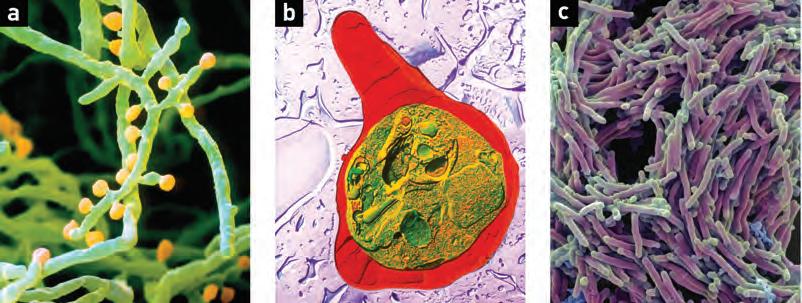
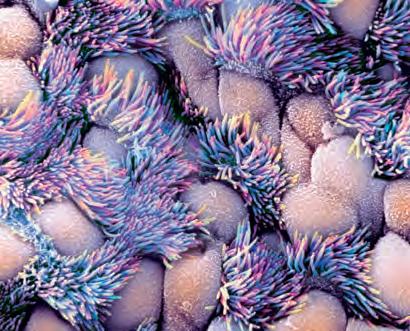
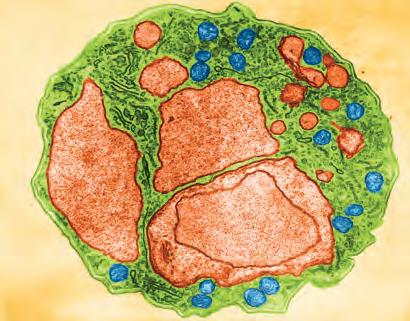
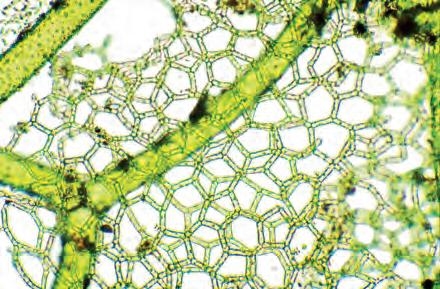
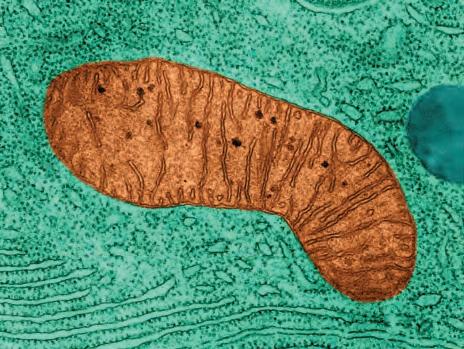
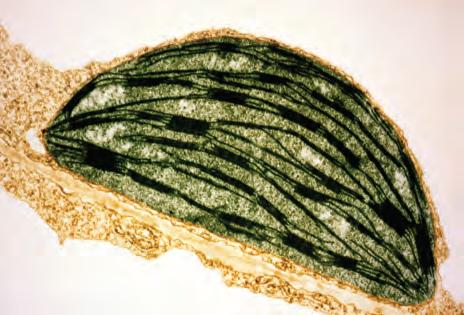
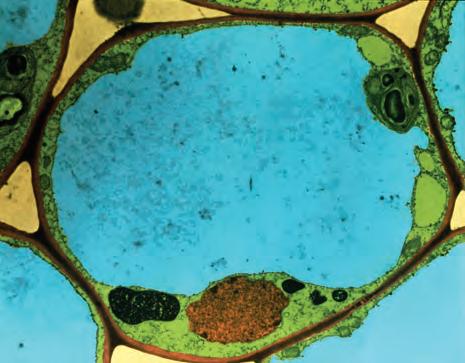
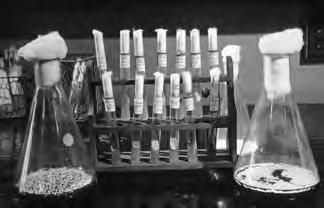
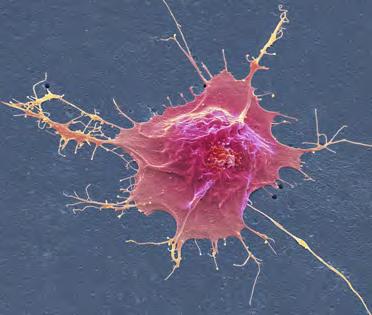
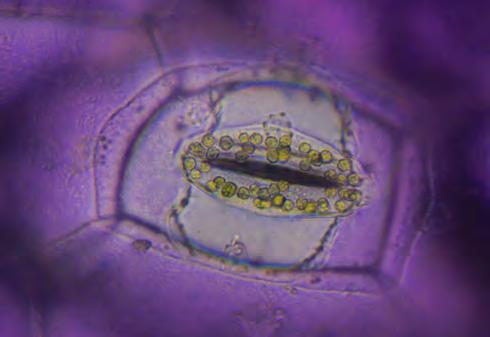
12Identify the microscope most likely to have created the images in Figure 1. Justify your decision (by describing the features in the picture that are unique and deciding which microscope would allow these features to be seen).
DRAFT
11Calculate the magnification of a cell that is viewed with a ‘×40’ objective lens and a ‘×10’ eye-piece lens.
Figure 1 Microscope images
13Identify the following organelles.
14Compare a mitochondrion and a chloroplast.
15Contrast fungal cells and bacterial cells.
Apply
17 Two students prepare slides from different sections of a spring onion under a light microscope in their school laborator y. Tran views a section of the green leafy part and observes many chloroplasts within each cell, but has difficulty identifying a nucleus in each cell. Emily views a section of the white stem of the plant. She comments that a nucleus is clearly visible in most of the cells, but does not identify any chloroplasts.
aPropose why Tran observed many chloroplasts within each cell when they appeared to be absent from the cells viewed by Emily.
b Emily commented that she could identify a nucleus in most cells. Discuss whether it is possible for a plant cell not to have nucleus (by describing the function of a nucleus, describing the importance of a nucleus to the cell staying alive and deciding if it is possible for a plant cell to live without a nucleus).
18 Write a very shor t creative story about a virus. Your story needs to be from the point of view of a cell. The first line of your story is: ‘Once upon a time, a virus arrived for an uninvited visit’.
DRAFT
16 A cell membrane is ‘partially permeable’. This means that only certain substances can cross the membrane. Identify some substances that would need to get into the cell and some that would need to get out.
19 Use the lenses from an old pair of reading glasses or a magnifying glass to create a model of a microscope. Discuss how your model is similar and different to Hooke’s microscope and modern compound microscopes.
Critical and creative thinking
20 Similes are often used in creative writing to compare two things using the words ‘like’ or ‘as’. Discuss the similarities that allow these similes to be used.
a Cells are like building blocks.
b The nucleus is like a control centre.
c The mitochondrion is like a power station.
Social and ethical thinking
21Discuss why a doctor should not prescribe antibiotics for a viral infection by describing:
a the ef fectiveness of the antibiotics on making the person healthy
b the long-term effects of overprescribing antibiotics on resistance.
Research
22 Choose one of the following topics for a research project. A few guiding questions have been provided for you, but you should add more questions that you want to investigate. Present your research in a format of your own choosing, giving careful consideration to the information you are presenting.
» Linking big concepts
In this chapter, six big concepts about cells were discussed. Consider a creative way to represent these concepts and make links between them, using as many of the key words in the chapter as you can. You might use a concept map or mind map with each of the questions as major bubbles. You could choose to use diagrams only or draw a picture that shows all the aspects of the particles of life. The method of presentation that you select must enable you to share your ideas with others.
» Discovery of penicillin
The discovery of penicillin was considered an important factor behind the outcome of World War II. Soldiers who were injured on the battlefield could be mended, given a shot of penicillin, and returned to the battlefield again instead of having limbs amputated. Develop and write a newspaper article describing the importance of this major discovery.
» Stem cells
Stem cells are cells in multicellular organisms that haven’t become specialised yet – they’re like blank canvases. Investigate what scientists have learnt about stem cells, where they find them and what they hope to be able to do with them.
DRAFT
» Plant cells
Plants do not have lungs to breathe. Instead, they have small pores called stomata which allow air to pass in and out of the plant. These stomata are made up of two guard cells that can change their shape.
» Inve stigate how stomata open and close in response to changing environmental conditions.
» Desc ribe the conditions that allow the stomata to open.
» Desc ribe the conditions that cause the stomata to close.
» Desc ribe how the shape of the guard cells assists the opening and closing of the stomata.
Figure 2 Represent the concepts in this chapter creatively.
Figure 3 The development of penicillin, 1940
Figure 4 Scanning electron micrograph of a type of pluripotent stem cell
Figure 5 Micrograph of a stomata on a purple and green leaf
Chapter checklist
Now that you have completed this chapter, reflect on your ability to do the following.
I can do this. I cannot do this yet.
• Explain the key concepts of cell theory.
• Describe surface area to volume ratio.
• Compare stereomicroscopes and compound light microscopes.
• Compare electron and light microscopes
• Calculate magnification.
• Focus a compound light microscope.
• Describe the functions of the cell membrane, cytoplasm, DNA, mitochondria, cell wall, chloroplasts and vesicles.
• Identify the key differences in the structures of animal and plant cells.
• Describe the key differences between prokaryotic and eukaryotic cells.
• Recall examples of prokaryotic and eukaryotic cells.
• Describe the differences between natural flora and pathogens.
• Identify whether types of pathogens are singlecelled or multicellular.
• Describe the process of binary fission.
• Explain the relationship between bacterial cells and some fungal cells.
• Describe the development of fungal cells as a medical treatment.
Check your Student
Play a Quizlet game to test your knowledge.
for
Test your understanding of this chapter with the chapter review quiz.
Go back to Topic 6.1 ‘All living things are made up of cells’. Page xxx
Go back to topic Topic 6.2 ‘Microscopes are used to study cells’. Page xxx
Go back to Topic 6.3 ‘Plant and animal cells have organelles’. Page xxx
Go back to Topic 6.4 ‘Cells have different roles’. Page xxx
DRAFT
Go back to Topic 6.5 ‘Single-celled and multicellular organisms can cause disease’. Page xxx
Go back to Topic 6.6 ‘Science as a human endeavour: Fungal cells can save lives’. Page xxx
Check your Teacher obook pro for these digital resources and more:
Launch a live team or individual quiz for your students on key concepts in this chapter.
obook pro
these digital resources and more:
Chapter quiz
[STEAM project 1] How can we build more energyefficient homes so that we live more sustainably?
Have you ever considered how much energy it takes to heat or cool your home? A study by the Australian Government found that homes contribute 11 per cent of Australia’s total carbon emissions. Reducing the amount of energy needed to heat or cool a home will not only save people money on their gas and electricity bills, it will make housing more sustainable.
NatHERS
The Nationwide House Energy Rating Scheme (NatHERS) is a rating system that is used across Australia to identify the energy efficiency of homes (where ten stars is the most energy efficient). Computer modelling software uses the local climate, the orientation of the home and materials used in construction to estimate the amount of energy needed to heat or cool the home. In most states and territories of Australia, new homes must reach a minimum of six stars to be approved for construction. There are many ways to improve the energy efficiency of your home. For example, if you insulate the walls, floors and roof, and use awnings (covers that extend over windows or doors), you can reduce the amount of thermal energy needed to cool the home in summer. Or in cooler climates, if you design the home so that living areas are on the northern side, you can maximise the sunlight that is available to heat the home in winter.
Your task
Design and build a model of a new energy-efficient home that has a high energy-efficiency rating (more than six stars). Alternatively, design modifications for an existing home to improve its energy efficiency and reduce the cost of energy bills for the people living there.
DRAFT
Retrofitting homes
Not everyone wants to or can afford to build a new home. People who rent sometimes have little choice when it comes to the energy efficiency of their home, but this doesn’t mean that they need to have large gas and electricity bills. There are things that they can do to reduce the movement of thermal energy in summer or winter. Covering the floor with rugs, preventing heat from moving in or out of windows, and controlling windows to manage airflow are all ways to make a home more energy-efficient and liveable.
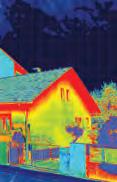
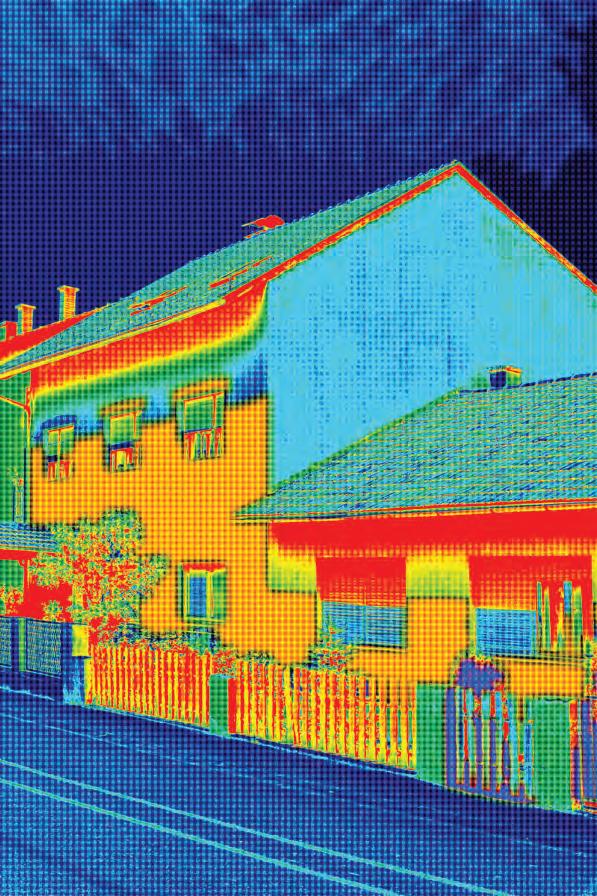
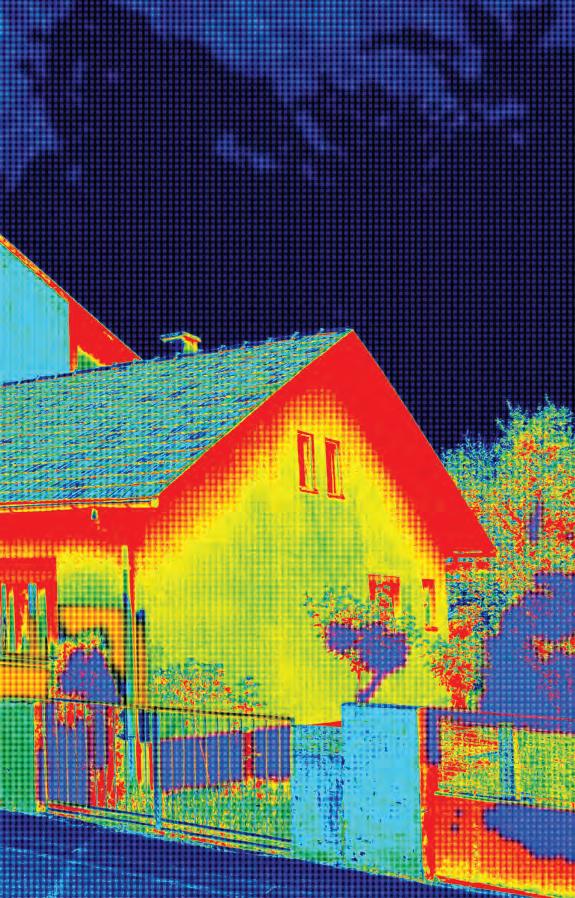
Figure 1 Infrared imaging shows warmer temperatures as red and cooler temperatures as blue. A building with insulation will lose less thermal energy to the outside environment in winter and will gain less thermal energy from the outside environment in summer.
HUMANITIES
In Geography this year, you will learn about the importance of sustainable housing in Australia’s urban centres and major cities. You will explore how the forecasted growth of Australia’s cities could impact their liveability, and the environmental issues resulting from urbanisation.
In Economics and Business, you will study the housing market, the interaction between businesses and consumers in meeting consumer demands and when the government intervenes in markets.
To complete this task successfully, you will need to study seasonal weather patterns at the location of your energy-efficient home, to improve energy use.
You will find more information on this in Chapter 5 ‘Urban life’ and Chapter 19 ‘Australian markets’ of Oxford Humanities and Social Sciences 8 Australian Curriculum.
MATHS
In Maths this year, you will learn how to determine the area and volume of different shapes, using and converting between appropriate units. You will also learn skills for dealing with percentage changes in financial contexts. These skills will help you to quantify the costs and benefits of design features and predict the popularity of market incentives. You will perform calculations with and without digital technology.
DRAFT
To complete this task successfully, you will need to perform calculations for your model home, and then scale up to estimate the potential benefits of your design at a national level.
You will find help for applying these maths skills in sections 3B ‘Percentage calculations’, 3C ‘Mark-ups and discounts’, 8C ‘Area of quadrilaterals’ and 8D ‘Area of a circle’ of Oxford Maths 8 Australian Curriculum
SCIENCE
In Science this year, you will learn about how thermal energy can be transferred between objects (such as between a home and its surroundings). You will also examine the impact that insulation, window awnings and verandas have on the ability of a home to stay cool in summer.
To complete this task successfully, you will need to identify how each element of a home’s design can affect its heating and cooling needs. You will also need to identify the elements that can be changed in a new home design, and compare these to the elements that can be changed in an established home.
more
You will find more information on this in Chapter 4 ‘Energy’ of Oxford Science 8 Australian Curriculum
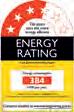
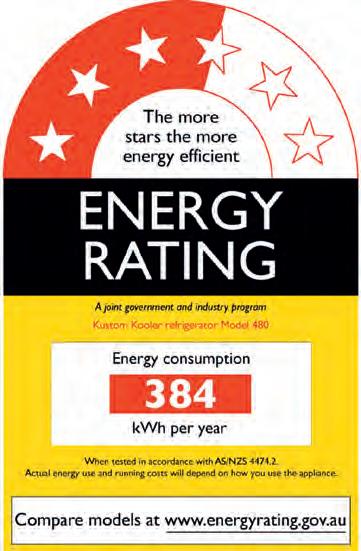
Figure 2 Energy rating schemes help consumers to understand the energy efficiency of products or appliances. The more stars, the
energy efficient the product or appliance is.
[STEAM project 1]
The design cycle
To successfully complete this task, you will need to complete each of the phases of the design cycle.
Define
Discover
When designing solutions to a problem, you need to know who you are helping and what they need. The people you are helping, who will use your design, are called your end-users.
Consider the following questions to help you empathise with your end-users:
• Who am I designing for? How big is their family and home?
• What factors might affect the liveability of the home?
• What do they need? What do they not need?
• What does it feel like to face these limitations on liveability? What words would you use to describe how it would feel to face these limitations?
To answer these questions, you may need to investigate using different resources, or even conduct interviews or surveys.
Before you start to design your home modifications, you need to defi ne the parameters you are working towards.
Define your version of the problem
Rewrite the problem so that you describe the group you are helping, the problem they are experiencing and why it is important. Use the following phrase as a guide.
‘How can we help (the group) to solve (the problem) so that (the reason)?’
Determine the criteria
1 Describe the orientation of the land where the home will be built or modified (include the location of sunrise and sunset, the angle of sun in the middle of summer and winter and any existing shadows).
2 Describe any existing energy-efficient features of the current home or design.
3 Describe how you will measure any improvement in energy-efficient features of the home.
Ideate
Once you know who you’re designing for, and what the criteria are, it’s time to get creative!
• Outline the criteria or requirements your design must fulfil (for example, improving heating or cooling of the home).
• Brainstorm at least one idea per person that fulfils the criteria.
Remember that there are no bad ideas at this stage. One silly thought could lead to a genius innovation!
Build
Draw each individual design. Include in the individual designs:
a labels for each part of the design
b the materials you will use for the home’s construction
c a description of how the modifications will improve the energy star rating of the home
d an estimation of the cost of applying the modifications. Present your design to your group.
Build the prototype
Choose and build two or three model homes for your group design (scale: 2 cm = 1 m).
Use the following questions as a guideline for your prototype.
• What materials will you need to build your model home?
• What skills will you need to build your model home?
• How will you test the effectiveness of your model home? (What will you compare it to?)
• How will you identify each energy-efficient feature of your model home?
• How will you collect data that supports your claims about energy efficiency?
Test
Use the scientific method to design and test the energy efficiency of your model home. You will test more than one design so that you can compare them, so you will need to control your variables between tests.
What criteria will you use to determine the success of your model home?
Conduct your tests and record your results in an appropriate table.
Communicate
Present your home design as though you are trying to get your peers to invest in it.
In your presentation, you will need to:
• construct a labelled diagram of your model home in its orientation, including the location of sunrise and sunset, the angle of sun in the middle of summer and winter, and any existing shadows
• describe the key energy-efficient features of your model home
• explain how each energy-efficient feature affects the liveability of your model home
• explain the principles that support your design (the importance of energy efficiency and how the existing landscape affected the design of the home)
• estimate the cost of implementing your design
• explain and quantify the benefits on a national scale if all new homes were to include your design features.
Student guidebook
This helpful booklet will guide you step-by-step through the
What is the design cycle?
This video will help you to better understand each phase of the design cycle.
DRAFT
How to manage a project
This ‘how-to’ video will help you to manage your time throughout the design cycle.
How to pitch your idea
This ‘how-to’ video will help you with the ‘Communicate’ phase of your project.
Across the world, climate patterns are changing and weather events are becoming more extreme. In 2020, 20 per cent of Australia’s forests were burnt, a record-breaking 30 named hurricanes developed over the Atlantic Ocean, and an extreme monsoon season in Asia caused flooding across a quarter of Bangladesh. Australia is particularly prone to natural disasters. Bushfi res, flooding, drought periods and cyclones dramatically affect people’s lives, and alter natural landscapes.
Natural disasters can be devastating for communities affected by them. Recovering from natural disasters also comes with huge economic costs. This can sometimes lead to a harmful cycle in which a nation gets stuck between experiencing disaster and responding to disaster.
Disaster management
[STEAM project 2] How can we use technology so that the impact of natural disasters is reduced?
Climate action is one of the 17 Sustainable Development Goals agreed to in 2015 by world leaders. One of the identified targets in combating climate change is to strengthen the resilience and adaptive capacity of all countries to natural disasters and hazards related to climate.
It is essential that communities prepare for disasters so as to reduce their impact. The United Nations Office for Disaster Risk Reduction (UNDRR) recommends using technology as part of disaster management, for example:
Your task
• warning systems in Japan that trigger emergency breaks in bullet trains if earthquakes are detected
• systems in sub-Saharan Africa that monitor rainfall data and analyse trends to forecast and build resilience to drought
Develop an innovative technology or strategy that will reduce the impact of natural disasters in your community. The technology or strategy should be useful and easy to use, and address one (or more) of the steps of disaster management.
DRAFT
• atlases in China that record the risk of natural disasters, using location data from spatial technologies such as GPS.
After the 2019–20 Australian bushfi res, it was argued that satellite technology, drones and mobile phone apps would have been extremely helpful for fighting the fi res and communicating with the people affected.
Disaster management should include four steps:
• prevention – reducing hazards before a disaster takes place, so its impact is not as severe (e.g. building schools that are earthquake resistant)
• preparation – training people so they know how to act when a disaster happens (e.g. running evacuation drills)
• response – taking action during a disaster (e.g. emergency crews and volunteers taking on emergency operations)
• recovery – taking action to help people rebuild their lives (e.g. restoring services in a community).
Disaster management is an ongoing process that can occur like a cycle between the phases of prevention, preparation, response and recovery.
Figure 1 Hundreds of people (and animals) huddled on Malua Bay beach in NSW for almost 24 hours, as bushfires tore through communities in the nearby Batemans Bay area.
HUMANITIES
In Geography this year, you will learn about landscapes and landforms and how they can be degraded by both human and natural causes. You will study a geomorphic hazard, its impacts on a place and various ways of responding to it.
In History, you might also study how past societies have dealt with disasters and managed their responses; for example, how Rapa Nui (Easter Island) inhabitants adapted to life without trees, how Shogunate Japan developed policies to sustain its forests, or how an unstable climate (including drought and heavy monsoons) affected the Khmer Empire.
To complete this task successfully, you will need to investigate a potential natural hazard in your local area. You will research any current disasterresponse plans related to managing such an event, and gain an understanding of how various people and businesses in the community would be impacted.
You will find more information on this in Chapters 2, 17, 15 and 16 of Oxford Humanities and Social Sciences 8 Australian Curriculum.
MATHS
In Maths this year, you will consolidate and extend your skills in describing and interpreting. This will include creating and analysing plots of non-linear data, investigating the use of sampling methods, and broadening your understanding of measures of spread. You will also perform calculations with percentage changes in financial contexts. You will analyse and represent data, both with and without digital technology.
DRAFT
To complete this task successfully, you will need to weigh up the costs of your disaster-management technology or strategy against its potential benefits, including by estimating the likelihood of natural disasters and the severity of their effects.
You will find help for applying these maths skills and statistics in sections 3B ‘Percentage calculations’, 3C ‘Mark-ups and discounts’, 6D ‘Plotting linear relationships’, and 9A ‘Collecting data and sampling methods’ of Oxford Maths 8 Australian Curriculum.
SCIENCE
In Science this year, you will learn about how the energy of the Earth over long periods of time generates forces that can melt rocks, produce volcanoes and make diamonds. You will also learn how the kinetic energy in the air and waves can cause damage to the surrounding environments during cyclones and tsunamis. The Australian bush also contains large amounts of chemical energy that is transformed into thermal energy during the summer fire season.
To complete this task successfully, you will need to consider how energy is transferred and transformed during natural disasters. This understanding will allow you to predict and potentially reduce the impact of the disaster in your local community.
You will find more information on this in Chapter 2 ‘The rock cycle’ and Chapter 4 ‘Energy’ of Oxford Science 8 Australian Curriculum
Figure 2 Floodwaters near Sydney
[STEAM project 2] The design cycle
To successfully complete this task, you will need to complete each of the phases of the design cycle.
Define
Discover
When designing solutions to a problem, you need to know who you are helping and what they need. The people you are helping, who will use your design, are called your end-users.
Consider the following questions to help you empathise with your end-users:
• Who am I designing for?
• What natural disaster could they face?
• How often could this disaster occur, and on what scale?
• What do they need? What do they not need?
• What does it feel like to face these problems? What words would you use to describe these feelings?
• What could the cost of such a disaster be in terms of lives lost, income lost, damage to private property and public infrastructure, and environmental impact?
To answer these questions, you may need to investigate using different resources, or even conduct interviews or surveys.
Before you start to design your innovative strategy or technology, you need to defi ne the parameters you are working towards.
Define your version of the problem
Rewrite the problem so that you describe the group you are helping, the problem they are experiencing and why it is important. Use the following phrase as a guide.
‘How can we help (the group) to solve (the problem) so that (the reason)?’
Determine the criteria
1 Define the term ‘innovation’. Describe how much a strategy needs to differ from current practice to be considered innovative.
DRAFT
2 Describe how the natural disaster will affect the people in the community.
3 Describe how you could measure whether your solution will reduce the impact of the natural disaster.
4 Explain how you could determine what cost (price) should be acceptable for implementing your solution.
Ideate
Once you know who you’re designing for, and you know what the criteria are, it’s time to get creative!
• Outline the criteria or requirements your designed strategy or technology must fulfil (for example, how many people will be helped, how much they will be helped, how long they will need the help).
• Brainstorm at least one idea per person that fulfils the criteria.
Remember that there are no bad ideas at this stage. One silly thought could lead to a genius innovation!
Build
Draw each design, strategy or technological idea. Label each stage of the strategy or part of the technology and how it will be used by the community.
Include in the individual strategy or technology:
a the timeline for the activation of the strategy or technology (i.e. how long after the disaster will the idea be ready to be used?)
b the number of people and materials that will be needed for the strategy or technology to reduce the impact of the natural disaster
c a description of how the community will benefit from the strategy or technology.
Present your strategy or technology to your group.
Build the prototype
Choose and build two or three versions of the prototype strategy or technology for your group design.
Use the following questions as a guideline for your prototype.
• What equipment do you have access to?
• What skills do you have, or will you need, to make your prototype strategy or technology?
• How could you model your strategy or technology if equipment is not available?
• How could you test the effectiveness of the prototype strategy or technology with the community?
Test
Use the scientific method to design an experiment that will test the effectiveness of your prototype strategy or technology. Alternatively, conduct a survey of the community to determine their opinion of the usefulness of the prototype.
Conduct your tests or survey your community, and record your results in an appropriate table.
Consider how you could use the results of the experiment or survey to modify your design.
Communicate
Present your design to the class as though you are trying to get your peers to invest in your strategy or technology.
In your presentation, you will need to:
• describe how the natural disaster will affect your community
• describe your prototype strategy or technology
• describe how the prototype will reduce the impact of the natural disaster on the community
• describe the materials, people and money that will be required to have the required effect on the natural disaster.
DRAFT
GL OS SA RY
Aabomasum
the fourth stomach of a cow
accuracy how carefully, correctly and consistently data has been measured or processed; in science, how close a measured value is to the true value alveoli tiny air sacs in the lungs where gas exchange occurs amino acids small molecules that make up proteins ammonia a chemical waste product (NH3) aorta the major artery that carries oxygenated blood from the heart and divides into smaller arteries around the body arterioles smaller arteries
artery
blood connective tissue that carries oxygen, nutrients and waste around the body
blood vessel
a tube or vessel that carries blood around the body
boiling point (BP) the temperature at which a liquid boils and becomes a gas bronchi air passages that carry air in and out of the lungs; airways
Ccaecum
a small dead-end pouch that connects the small and large intestines
capillary
a blood vessel with a wall only one cell thick; allows substances to pass into and out of the blood
catalyst
a thick, muscular-walled blood vessel that carries blood away from the heart under pressure
asthma
a disease caused by narrowing airways atom the smallest particle of matter; cannot be created, destroyed or broken down (indivisible)
atomic theory
the theory that all matter is made up of atoms atria the two smaller, upper chambers of the heart
Bbinary fission
a form of asexual reproduction used by bacteria; the splitting of a parent cell into two equal daughter cells binocular using two eyes; a type of microscope biodegradable capable of being decomposed by bacteria or other living organisms and reabsorbed into the natural environment
a substance that increases the rate of a chemical reaction without undergoing any permanent chemical change
cell
(in biology) the building block of living things cell membrane
the barrier around a cell that controls the entry and exit of substances into and out of a cell
cell theory
theory describing the properties that all cells have in common
cell wall
the outer protective and support structure of a plant cell
cellular respiration the chemical reaction between glucose and oxygen to produce carbon dioxide, water and energy
chemical potential energy energy stored in chemicals, e.g. in food, fuel or explosives; also known as chemical energy
chemical reaction
a procedure that produces new chemicals; same as chemical change
chlorophyll
a green pigment in chloroplasts that absorbs solar energy, which is used by plants in photosynthesis
chloroplast
organelle found in plant cells that transforms solar energy into chemical energy
chyme
a mixture of acid, enzymes and digested food that leaves the stomach circuit diagram the flow of electrical charge through a circuit
cognitive verb a doing word that requires you to perform a specific thinking task
collision theory a theory stating that the particles involved in a chemical reaction must collide in order to react
colloid
a type of mixture that always looks cloudy because clumps of insoluble particles remain suspended throughout it rather than settling as sediment combustion a reaction that involves oxygen and releases light and heat energy
compound a substance made up of two or more types of atoms bonded together (e.g. water)
compound light microscope a microscope with two or more lenses concentration the number of active molecules in a set volume of solution condense to become a liquid, from a gas connective tissue the group of cells that provide connections to other parts of the body
continental drift the continuous movement of the continents over time
convection the transfer of thermal energy by the movement of molecules in air or liquid from one place to another convection current the current or flow of air or liquid that results from the transfer of thermal energy through convection
converging boundary the boundary between two tectonic plates that are moving together core the centre of the Earth correlation a relationship between two or more things corrosion the gradual destruction of materials by a chemical reaction with their environment cost–benefit analysis a list of costs compared with benefits, usually used to analyse a proposed engineering project crust the lithosphere, or outer layer of the Earth cytoplasm the ‘jelly-like’ fluid inside the cell membrane that contains dissolved nutrients, waste products and organelles
DDNA (deoxyribonucleic acid)
a molecule that contains all the instructions for every job performed by the cell; this information can be passed from one generation to the next dependent variable a variable in an experiment that may change as a result of changes to the independent variable deposition the process whereby sediment from different forms of weathering accumulates in layers
diarrhoea
watery faeces
diatomic molecule
a molecule that consists of two atoms digestion the process of breaking down food into nutrients
directly proportional relationship a relationship between two variables in which the dependent variable increases as the independent variable increases
diverging boundary the boundary between two tectonic plates that are moving apart
donor
the person giving an organ; usually deceased, sometimes living
Eelastic potential energy the energy possessed by stretched or compressed objects
DRAFT
continental shelf a flat area under shallow ocean water at the edge of a continent
controlled variables variables that remain unchanged during an experiment
derived units units of measurement that are calculated using a combination of SI (international system) base units, e.g. cm3 for volume (base unit is cm), m2 for area (base unit is m)
diaphragm
a dome-shaped muscle attached to the ribs; moves up and down beneath the lungs
electric circuit
a closed pathway that conducts electrons in the form of electrical energy
electric current the flow of electrical charge through a circuit
electrical energy energy associated with electric charge, either stationary (static) or moving (current)
electromagnetic relating to the physical interaction between moving charged particles and the magnetic field that is created as a result
electron microscope
a microscope that uses electrons (tiny negatively charged particles) to create images
emphysema
a disease caused by broken down alveoli in the lungs
enzyme a chemical that helps make chemical reactions happen; a type of catalyst
epiglottis
a flap of skin above the larynx that controls the passage of food and air, preventing food from entering the windpipe
epithelial tissue the group of cells that cover and protect the body ethics the series of rules that determines what is right and what is wrong
eukaryotic cell complex cell that contains a nucleus and membrane-bound organelles
extrusive igneous rock rock formed at the Earth’s surface by quickly cooling lava eyepiece where the eyes are placed when using a microscope
F
fault
a fracture in rock where the tectonic plates have moved foliation layering in a rock that occurs when the rock is subjected to uneven pressure
fossilisation the process of an organism becoming a fossil
frost shattering a process of weathering in which repeated freezing and melting of water expands cracks in rocks, so that eventually part of the rock splits off
G
gallstone a hard substance or stone that is produced by the gall bladder
geologist a scientist who studies rocks gluten intolerant unable to digest gluten gravimeter a device that measures the difference in gravity between one location and the next gravitational potential energy the energy possessed by an object raised to a height in a gravitational field group (in chemistry) a vertical list of elements in the periodic table that have characteristics in common
H
hypothesis
a proposed explanation for a prediction that can be tested
I
igneous rock rock formed by cooling magma and lava
independent variable a variable (factor) that is changed in an experiment
index mineral
a mineral that only forms at a particular temperature and pressure; used to determine the history of the rock that contains the mineral infectious disease disease caused by the passing of a pathogen from one organism to another; also known as contagious disease
intrusive igneous rock rock formed underground by slowly cooling magma
inversely proportional relationship a relationship between two variables in which the dependent variable decreases as the independent variable increases
Llattice
a three-dimensional arrangement of particles in a regular pattern
lava hot, molten rock that comes to the surface of the Earth in a volcanic eruption
Mmagma semi-liquid rock beneath the Earth’s surface
magnetometer
metabolism all the chemical reactions in the body metamorphic rock
rock formed from other rock due to intense heat and pressure microbiology the science involving the study of microscopic organisms microorganism
a living thing that can only be seen with the use of a microscope microscope
an instrument with lenses that is used for viewing very small objects
microscopy
the study of living things that can only be seen with the use of a microscope
mid-ocean ridge
a series of underwater mountains that form as a result of tectonic plates moving apart and allowing magma to rise to the surface
mitochondrion
DRAFT
a device that detects the difference in a magnetic field between one location and the next mantle the layer of molten rock beneath the Earth’s crust melt change state from solid to liquid
powerhouse organelle of a cell; the site of energy production; plural (plural: mitochondria) mixture
a substance made up of two or more pure substances mixed together molecular compound a molecule that contains two or more different atoms bonded together
molecular element a molecule that contains two or more of the same atoms bonded together molecule
group of two or more atoms bonded together (e.g. a water molecule) monatomic consisting of a single atom monocular using one eye; a type of microscope motion
when an object changes its position over time
multicellular
an organism that has two or more cells muscle tissue
the group of cells that allow the body to move
N
natural flora microbes that live happily in our bodies
negative terminal the point in the circuit where electrons flow out from
nephron tiny structure in the kidneys that filter the blood
nervous tissue the group of cells that pass on electrical messages nuclear energy energy stored in the nucleus of an atom and released in nuclear reactors or explosions of nuclear weapons; much greater than the chemical energy released in chemical reactions
nucleus control centre of a cell that contains all the genetic material (DNA) for that cell
O
objective lens lens in the column of a compound light microscope
ocean trench a deep ditch under the ocean along a tectonic plate boundary
omasum the third stomach of a cow
onion-skin weathering weathering of rock where the outside of the rock peels off
organ a group of tissues that work together for a purpose
organelle smaller part of a cell, each one having a different function
osmosis the movement of water through a selective membrane from an area of low ‘salt’ concentration to an area of high ‘salt’ concentration; occurs in root cells outlier a data value that is outside the normal range of all the other results
Pparallax error
an error, or inaccurate reading, that occurs as a result of reading a scale from an angle
pathogen
microbe that can potentially cause a disease
period
(in chemistry) a horizontal list of elements in the periodic table
periodic table
a table in which elements are listed in order of their atomic number, and grouped according to similar properties
peristalsis
the process of swallowed food being moved along the digestive tract by a wave of contractions, as the muscles behind the food squeeze tight and the muscles in front of the food relax, causing the food to move along the oesophagus or intestines
pharynx the throat; connects the mouth to the oesophagus
phloem the vascular tissue in plant stems that carries sugars around the plant
photosynthesis chemical process plants use to make glucose and oxygen from carbon dioxide and water
photovoltaic cell (PVC) an electrical device that converts light energy into electrical energy; see solar cell plasma a straw-coloured fluid that forms part of the blood
plate tectonics the theory that the surface of the Earth consists of a series of plates that are continually moving due to convection, ridge push and slab pull
platelets small disc-like cells in blood that are involved in forming clots
polymer a long-chain molecule formed by the joining of many smaller repeating molecules (monomers)
positive terminal the point in the circuit where electrons flow into
product a substance obtained at the end of a chemical reaction; written on the right side of a chemical equation
prokaryotic cell primitive single-celled organism that has no nucleus
properties in chemistry, the characteristics or things that make a substance unique pure substance something that contains only one type of substance (e.g. a single element or a single compound)
RDRAFT
pneumonia a disease caused by bacterial or viral growth in the lungs
reactant a substance used at the beginning of a chemical reaction; written on the left side of a chemical equation
reading error an error that occurs when markings on a scale are not read correctly
reasonable experiment a test where all variables are controlled except for the one being changed on purpose
recipient the person receiving a donated organ
red blood cell cell in the blood that carries oxygen around the body
remote control an electronic device used to operate a machine remotely (i.e. at a distance)
reticulum the second stomach of a cow ridge push the force pushing the edges of tectonic plates away from each other when a ridge crest has formed
rift valley
a deep valley that forms as a result of tectonic plates moving apart on land rock cycle the process of formation and destruction of different rock types
root a plant organ involved in absorbing nutrients and water rounding off reducing the number of significant figures by increasing or decreasing to the nearest significant figure; for example, 7.6 cm is rounded up to 8 cm, 7.2 cm is rounded down to 7 cm
rumen the first stomach of a cow
Ssea-floor spreading the theory that the middle of the ocean is spreading apart, forming new oceanic ridges
sedimentary rock rock formed from compacted mud, sand or pebbles, or the remains of living things
seismic geophysical testing the collecting of geophysical data such as differences in magnetic fields and gravity fields between different geological locations
SI system
an international system of measurement based on the metric system, with units such as kilogram, metre, kilometre significant figures the number of digits that contribute to the overall value of a number single-celled an organism that consists of one cell slab pull the force pulling a tectonic plate beneath a less dense tectonic plate
solar cell a device that transforms sunlight directly into electrical energy; is usually in the form of a panel; also known as a solar panel solution a mixture of a solute dissolved in a solvent
sound energy
a type of kinetic energy produced when things vibrate, causing waves of pressure in the air or some other medium
stain substance, such as iodine, used to make cells more visible under a microscope stem
an organ that transports materials around the plant
stereomicroscope a microscope with two eyepieces that uses low magnification subduction the movement of one tectonic plate under another tectonic plate
sublimation
a change of state from a solid directly to a gas
surface area to volume ratio the relationship between the area around the outside of a cell and its volume, as a fraction
suspension a cloudy liquid containing insoluble particles
symptoms the physical or mental signs of a disease system
a group of organs that work together for a purpose
Ttectonic plate
a large layer of solid rock that covers part of the surface of the Earth; movement of tectonic plates can cause earthquakes
thermal energy the scientific term for heat energy tor
a large, round rock produced by onion-skin weathering
transferred describes energy that has moved from one object to another transformed describes energy that has changed into a different form
transforming boundary the boundary between two tectonic plates that are sliding past each other transpiration the process of water evaporating from plant leaves; causes water to move up through the plant from the roots tsunami a series of large waves that result from an underwater earthquake
Uulcer
an open sore on the inside or the outside of the body
ultrasound a way sound can be used to identify tissue or to shatter stones
DRAFT
trace fossil traces of an organism that existed in the past trachea the large tube that connects the throat to the bronchi; carries air in and out of the body
urea a chemical waste product produced by the body and removed in the urine
Vvalid experiment where an experiment investigates what it sets out to investigate
vaporise change state from a liquid to a gas; evaporate vapour gaseous form of a substance that is normally solid or liquid at room temperature (e.g. water vapour) variable something that can affect the outcome or results of an experiment
vascular bundle a group of tubes in plant stems that carry water and nutrients around the plant vein a thin-walled blood vessel that carries blood back to the heart
ventricles the two large lower chambers of the heart vesicle an organelle surrounded by a membrane and used by cells to store materials; a vacuole is a type of vesicle found in plant cells villi small ridges in the small intestine that absorb nutrients from the digestive system volatile describes a substance that easily becomes a gas
Wwhite blood cell an immune system cell that destroys pathogens
X xylem the tissue in plants that carries water from the roots to the rest of the plant
Zzero error an error that occurs when an instrument has not been adjusted to zero before the measurement is taken