Perceptions of Impact Study
Oxford Maths 7–10
Victorian Curriculum 2e
To what extent, and how, has the use of Oxford Maths Years 7–10 Victoria Second Edition enabled students to increase their confidence in their ability to learn mathematics?


Oxford Maths 7–10
Victorian Curriculum 2e
To what extent, and how, has the use of Oxford Maths Years 7–10 Victoria Second Edition enabled students to increase their confidence in their ability to learn mathematics?
In 2025, Oxford University Press Australia & New Zealand (OUP) undertook an impact study to gain an in-depth understanding of the extent to which and how Oxford Maths Years 7–10 Victoria Second Edition (Oxford Maths) enables students to increase their confidence in learning maths.
The impact study was undertaken using the Oxford Impact Framework: a rigorous process for evaluating impact, developed with the National Foundation for Research (NFER) and supported by the Oxford University Department of Education. Oxford Impact is OUP’s approach to evaluating the impact that our educational products and services have on teaching and learning.
The impact study was conducted by an independent researcher through a series of online depth interviews with 12 teachers at three secondary schools in Victoria who had been using Oxford Maths for 6 months. The participating schools were winners of a competition run by OUP in 2024. Most teachers stated that Oxford Maths is not their main resource. Two teachers use it for most of their teaching while six use it for some of their teaching.
An impact study is research that investigates a particular change a product or service has on the group of people it is intended to help or benefit.
Nearly all the teachers (10 of 12) in the study reported that the program does enable students to increase their confidence in their ability to learn maths to a moderate or significant extent. Specifically, they perceived that it enabled increased confidence in at-level and above-level students. Students working below-level were perceived to require additional guidance from their teachers and scaffolding of their learning to access complex multi-part questions with confidence.
The program was perceived to help increase students’ confidence by:
Giving schools access to the full program so that students at a range of levels have content appropriate to their ability.
Offering different access points through the three levels of questions: Fluency (basic, one-step questions), Problem-solving and reasoning, and Challenge (more complex multi-step questions) and multiple worked examples.
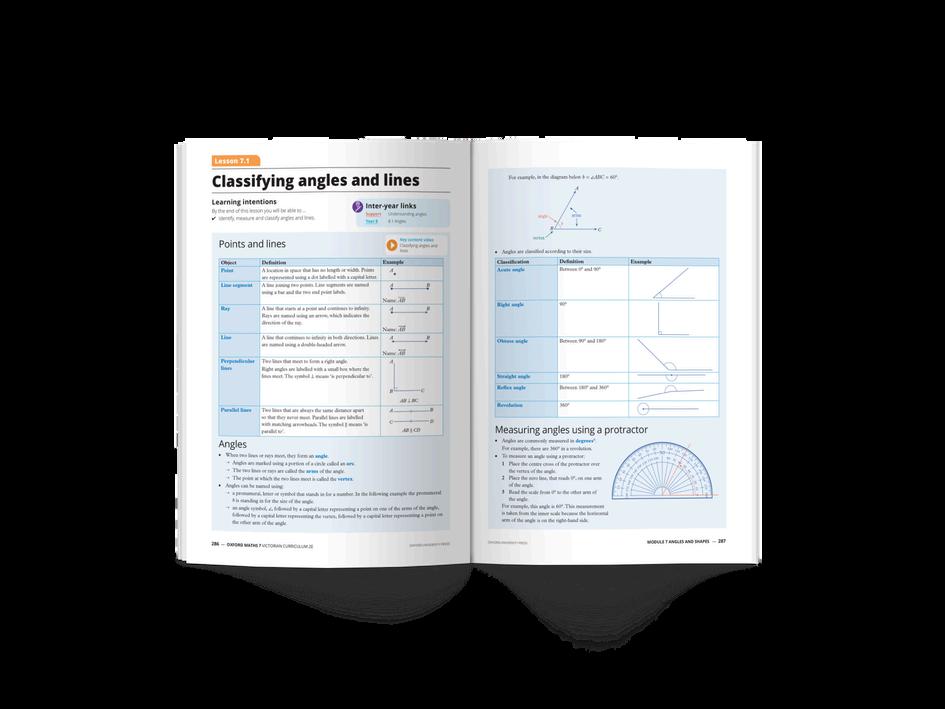
Providing colour-coded summary pages as an accessible reference point and useful key term definitions which support the development of mathematical literacy.
Providing print and digital components that engage students, test their knowledge and give them fast, accurate feedback on their progress through the interactive skill sheets and quizzes.
The online components of the program were used less extensively than the print, and more than a third of teachers (5 of 12) commented that their students experienced problems with the digital functionality. Based on feedback, the digital functionality was updated whilst the schools were using the program, but it is possible that they were unaware and had not yet seen the benefit of these changes.
Nearly all teachers (10) perceived that the use of Oxford Maths helped to increase students’ confidence to tackle unfamiliar problems and demonstrate mathematical reasoning ‘to a moderate extent’, or ‘to a significant extent’. The following themes emerged:
Fluency questions are accessible to students at all levels because they are written in simple language and only have one part to them. They give below-level students early success in the basic concepts and help at-level students to be confident in the basics before moving on to attempt problem-solving questions. Problem-solving and reasoning questions provide opportunities for at-level and above-level students to learn strategies to solve more complex problems. They introduce different approaches, and this gives students more confidence to attempt other questions.
Challenge questions are increasingly complex and multi-part which stretches and motivates above-level students who enjoy being out of their comfort zone.
“The textbook is perfect for General and Advanced [at-level and above-level] classes The Oxford Maths material is incorporated into our learning program. The online modules are used for practice and the [textbook questions] are used for mastery.”
(Years 7–10 teacher)
“It’s the structure of exercises into Fluency, Problem Solving and Challenge It builds the development of basic understanding and the more complex, and allows for mastery of concepts before students move on.”
(Year 9 teacher)
More than a third of the teachers (5 out of 12) mentioned that the worked examples helped to increase students’ confidence. Teachers identified that they help students’ confidence because:
There is a progression from basic skill to application which mirrors the progression in the textbook exercise questions (from Fluency to Problem solving and reasoning, to Challenge).
They provide students with the structure to follow when answering questions which they can use class and record for future reference.
“Worked examples are easy to find, clearly flagged and relevant to specific questions.”
(Years 7–9 teacher)
Nearly all teachers (10 of 12) adapt Oxford Maths in some way or use different resources to help their below-level students to attempt more complex questions with confidence. Teachers commented that they:
Simplify the question language and/or add scaffolding to break a question down, i.e. to identify the skill focus in a question.
Signpost students to a textbook, Interactive Skill sheet or Quick Quiz from an earlier year.
Use non-Oxford Maths resources which provide simpler questions and more scaffolding.
“Students within one class might be working on the at-level book, the one above or the one below. For support kids, I use other things such as worked examples on the board.”
(Years 7–10 teacher)
Most of the teachers (8 of 12) perceived that Oxford Maths helped to increase students’ confidence to use mathematical models to tackle real-world problems ‘to a moderate extent’ or ‘to a fairly significant extent’ referencing some specific features:
Problem-solving and reasoning questions and Challenge questions link mathematical theory to real-world using scenarios that students find relatable.
Problem-solving and reasoning questions are graduated in difficulty, allowing students to master skills before moving on to more complex material.
“Higher level students like the Challenge questions They don't mind being out of their comfort zone ”
(Year 10 teacher)
“There are ample textbook questions that are graduated, allowing kids to solidly master the skill they are learning Kids start simple and then move on when they feel ready ”
(Head of Department & Year 8 teacher)
“I model problem-solving questions for the whole class, then students try a question themselves I think this approach is starting to build confidence in below-level and at-level students.”
(Year 9 teacher)
Five teachers reported that higher-level students were comfortable attempting the Challenge questions and did not require much additional support to work independently.
Two thirds of the teachers (8 out of 12) perceived that Oxford Maths’ focus on developing mathematical literacy helped increase students’ confidence ‘to a significant extent’ or ‘to a moderate extent’.
Teachers perceived that the key terms and definitions helped students at all levels because the feature was easy to find on the colour-coded blue pages of the chapter, and the text was succinct and the meaning clear.
“The key terms in the blue summary pages are especially useful because they take away the literacy anxiety around questions ”
(Year 10 teacher)
Most teachers (9 out of 12) used some of the Oxford Maths online resources and features and perceived that they helped to increase students’ confidence.
Nearly half the teachers (5 out of 12) commented that the Interactive skill sheets were helpful in building confidence because students could undertake them multiple times and get instant feedback and clear guidance on knowledge gaps, which helped to lessen their anxiety around learning maths.
A third of the teachers (4 out of 12) perceived that the most helpful resources were the Quick quizzes for the same reasons: that students could attempt them independently as many times as they liked and received instant feedback and clear guidance on gaps.
“All the students apart from those working at Grade 4 [do the Interactive skill sheets] and enjoy them They attempt the skill sheets as many times as they like to get it right and get the instant feedback It takes the stress off them ”
(Head of Department and Year 8 teacher)
“They [students] get instant feedback and a clear visual representation of their level I find that they are great for engagement and to encourage independent working The feeling that they can tackle it without the teacher is great for their confidence ”
(Years 7 & 9 teacher)
More than half the teachers (7 out of 12) perceived that using Oxford Maths had a positive impact on students’ attitude or behaviour. Those who identified a positive impact commented on how they perceived that the program had supported increased independence, improved memory and understanding, and higher levels of engagement.
“Oxford Maths helps to improve some students’ agency and ownership of their learning and that can lead to confidence Features that help students to take responsibility, like the quizzes and interactive sheets, are helpful ”
(Years 7 & 9 teacher)
“The structure of the exercises means that students can practice a skill, apply it and use it to solve a problem All three of these are needed for mastery Having some success improves their positivity towards learning maths and makes them more likely to try again ”
(Years 7–8 teacher)
“The textbook has given them additional resources that allow them to go back and forth between the learning and the questions That has definitely led to an improvement in their capacity to remember and understand what they are doing on a deeper level It has extended and humbled some kids in a good way: they now see how concepts can be applied in different ways, that there’s more to maths than solving a formula, and that it’s worth trying for a deeper understanding ”
(Years 7–10 teacher)
The Oxford Impact study shows that Oxford Maths boosts students’ confidence in learning mathematics, particularly for at level and above level learners. Key features such as the structured progression of question types, clear summary pages, and engaging print and digital resources, help students build skills step by step and experience success with increasing independence.
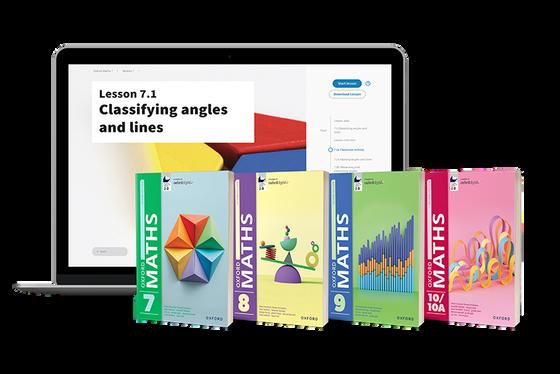
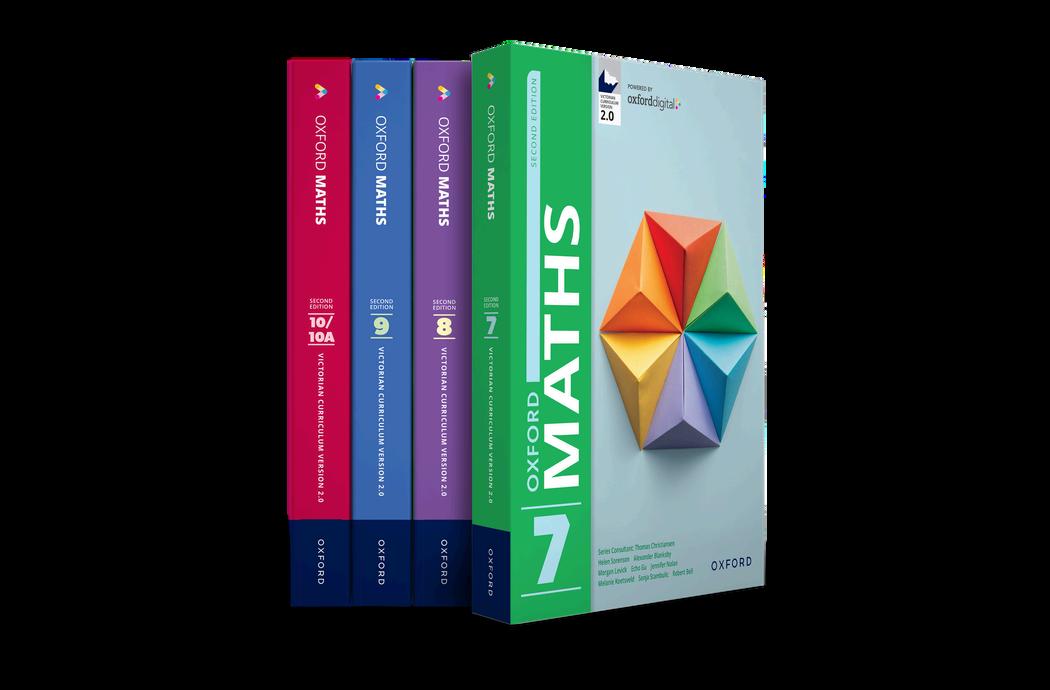
Oxford Maths was published in 2024. The program aligns with the Victorian Curriculum Version 2.0 for teaching and learning, which was implemented in schools at the start of 2025. The program also aims to address the multi-year skills gap in Australian secondary school maths classrooms identified in research conducted by OUP and other Australian and international research.
Oxford Maths is designed to:
Effectively bridge the multi-year skills gap in Australian secondary school maths classrooms.
Help teachers diagnose and fill in gaps in students’ understanding. Assign each student a learning pathway through the course with flexible, tailored resources. Prioritise the teaching and learning experience with online interactive teaching and personalised learning experiences.