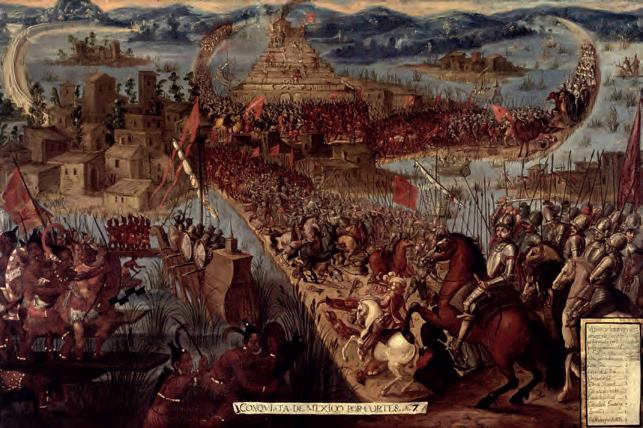
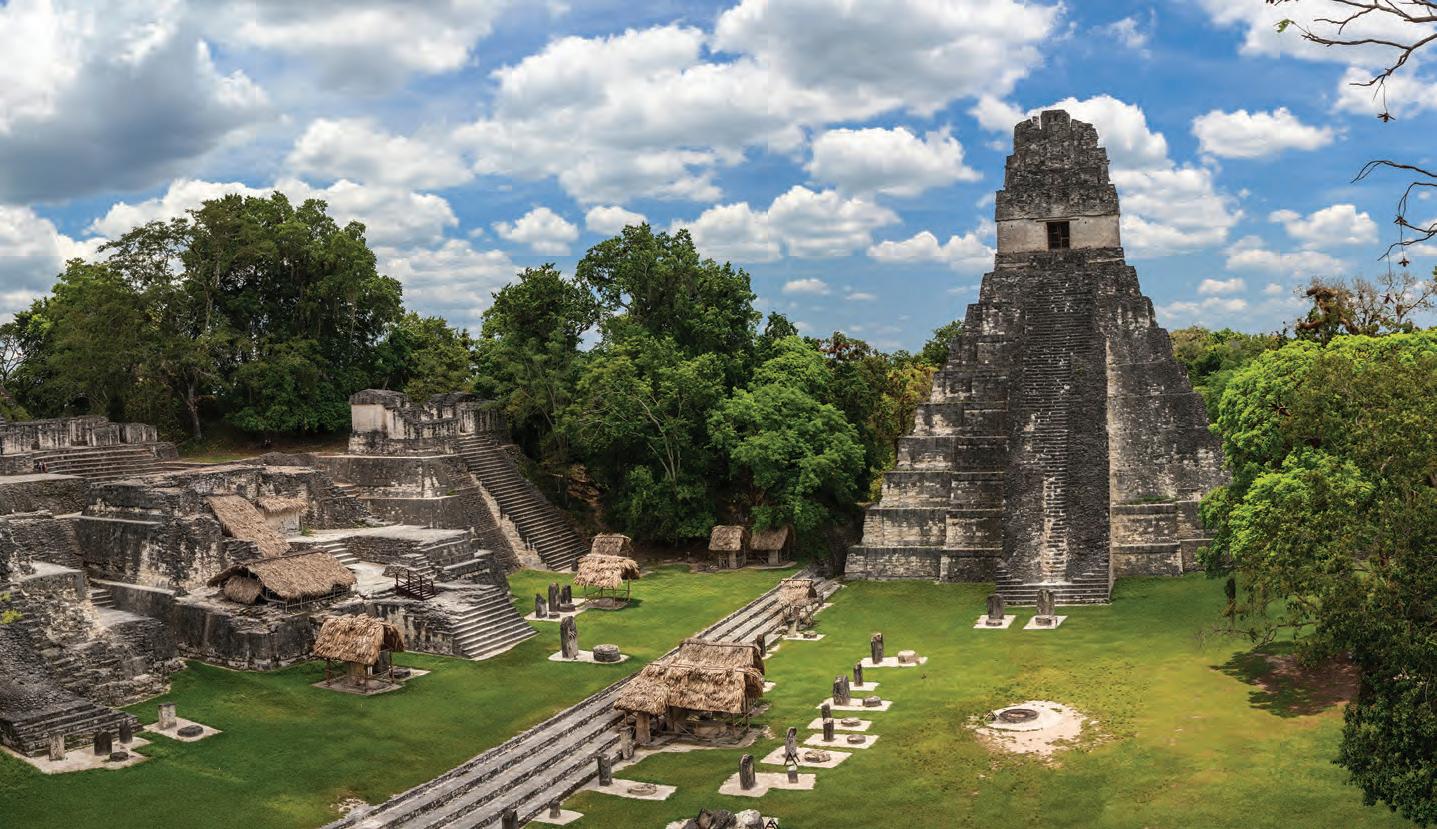
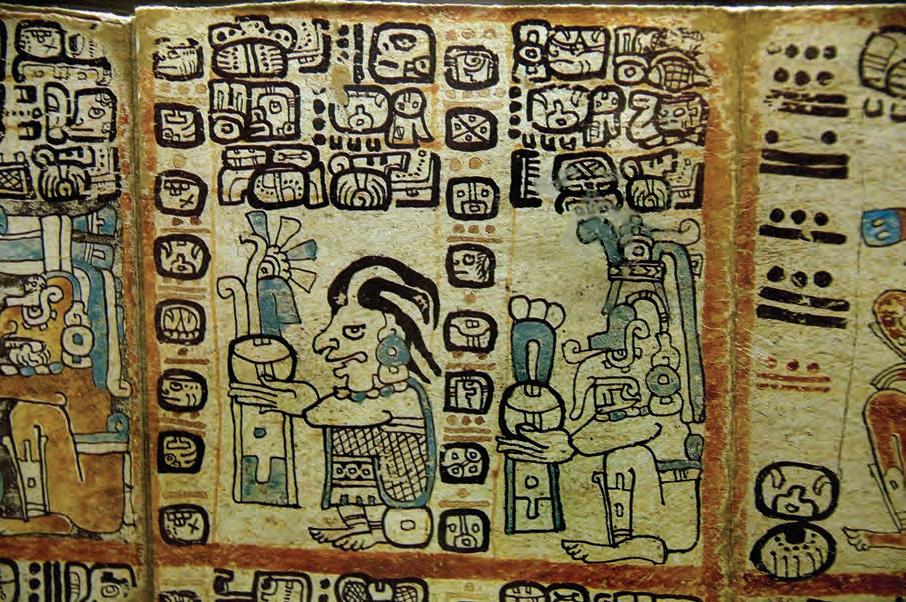
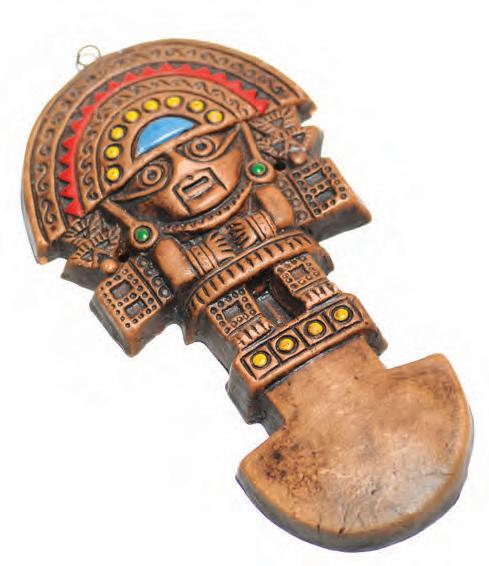
HASS AC YR8 SAMPLE CHAPTER 11 SPANISH CONQUEST OF THE AMERICAS
Oxford University Press is a department of the University of Oxford. It furthers the University’s objective of excellence in research, scholarship, and education by publishing worldwide. Oxford is a registered trademark of Oxford University Press in the UK and in certain other countries.
Published in Australia by Oxford University Press
Level 8, 737 Bourke Street, Docklands, Victoria 3008, Australia.
The moral rights of the author/s have been asserted
First published 2016
Second edition 2023
All rights reserved. No part of this publication may be reproduced, stored in a retrieval system, or transmitted, in any form or by any means, without the prior permission in writing of Oxford University Press, or as expressly permitted by law, by licence, or under terms agreed with the reprographics rights organisation. Enquiries concerning reproduction outside the scope of the above should be sent to the Rights Department, Oxford University Press, at the address above.
You must not circulate this work in any other form and you must impose this same condition on any acquirer.
ISBN 9780190331627
Reproduction and communication for educational purposes
The Australian Copyright Act 1968 (the Act) allows educational institutions that are covered by remuneration arrangements with Copyright Agency to reproduce and communicate certain material for educational purposes. For more information, see copyright.com.au.
Edited by Natasha Broadstock
Typeset by Newgen KnowledgeWorks Pvt. Ltd., Chennai, India
Proofread by Carolyn Leslie
Indexed by Max McMaster
Printed in Singapore by Markono Print Media Pte Ltd
The authors and publisher of Oxford Humanities and Social Sciences second edition Australian Curriculum would like to thank Peter Lawrence and Sally Lawrence (Black Cockatoo) for their review of content concerning First Nations peoples of Australia.
Disclaimer
Aboriginal and Torres Strait Islander peoples are advised that this publication may include images or names of people now deceased.
Links to third party websites are provided by Oxford in good faith and for information only. Oxford disclaims any responsibility for the materials contained in any third party website referenced in this work.
DRAFT
3.4
3.5
3C
3.9
4A
4.1
4A
4B
4.5
4.6
4.7
4.8
4B
4C
4.9
4.10
4C
Changing nations
Chapter
DRAFT
Chapter 6
8.18
PART 2
History
Concepts and skills
Chapter 7
7.1
Chapter 8
8A
8.1
8A
8B
8.8
8.10
8B
8C
8D
8.15
9A Why did the Renaissance develop?
9.1 Renaissance Italy: a timeline
9.2 What was the Renaissance?
9.3 City-states of Renaissance Italy
9A Skills in Context: The Italian League
9B How was society organised during the Renaissance in Italy?
9.4 The social structure of Renaissance Italy
9.5 Women and children in Renaissance Italy
9.6 Society in Renaissance Florence
9B Skills in Context: Renaissance society
9C What were the greatest achievements of the Renaissance and how did they influence the rest of Europe?
9.7 Humanism
9.8 Renaissance art
9.9 Renaissance science and technology
9.10 The Northern Renaissance and the Reformation
9.11 The culture of the Northern Renaissance
9C Skills in Context: The evolving Renaissance Chapter 9 review Chapter 10
Empires and expansions
Chapter 11
The Spanish conquest
11A How were societies organised in the Americas before the arrival of the Spanish?
11.1 The Spanish conquest of the Americas: a timeline 294
11.2 The major civilisations of the Maya, Inca and Aztec 296
11.3 Key groups in Aztec society
11.4 Religious beliefs in Aztec society ........................................ 304
11.5 Life in Tenochtitlan
11A Skills in Context: Life in the Aztec Empire 312
11B Why did the Spanish colonise the Americas? How were they able to do so?
11.6 The Age of Exploration begins 314
11.7 The Spanish conquest of the Aztecs 318
11B Skills in Context: Why the Spanish won 322
11C What were the effects of Spanish conquest in the Americas and around the world?
11.8 The Spanish colonisation of Mexico 324
11C Skills in Context: Impact of the Spanish conquest of the Americas 328
Chapter 11 review 330
Chapter 12
The Vikings
12A How was Viking society organised?
12.1 The Vikings: a timeline
12.2 Social classes and roles in Viking society
12.3 Viking home life and work .................................................
12.4 Viking laws and economy
12.5 Viking beliefs and mythology
12A Skills in Context: Brutal barbarians … or not?
13.6 Expansion of the Mongol Empire under Genghis Khan
13.7 Expansion under Ogodei and his heirs
13.8 Kublai Khan and conquests in Asia
13.9 End of Mongol rule in Asia
13B Skills in Context: Mongol warfare
13C What were the consequences of Mongol expansion?
13.10 The impact of expansion on traditional Mongol life
13.11 The impact of Mongol expansion
13C Life in China under Mongol rule
13C Skills in Context: Life in China under Mongol rule
Chapter 13 review
Chapter 14
The Ottoman Empire .........................
14A How was society organised during the Ottoman Empire?
14.1 The Ottoman Empire: a timeline
14.2 The origins of the Ottoman Empire
14.3 The rule of the sultan
14.4 Roles in Ottoman society
14.5 Daily life in the Ottoman Empire
14A Skills in Context: A day at the Topkapi Palace
14B What were the most significant achievements of the Ottoman Empire?
14.6 Expansion of the Ottoman Empire
14.7 The Ottomans and the people they conquered
14.8 Ottoman architecture, literature and art
14B Skills in Context: Ottoman power on land and sea
14C What challenges and developments influenced the Ottoman Empire?
14.9 The Black Death
14C Skills in Context: The consequences of population loss
Chapter 14 review
Asia-Pacific world
Chapter 15
Japan under the shoguns ................ 374
15A What led to the rise of the shoguns?
15.1 Japan under the shoguns: a timeline
15.2 Life before the shoguns
15.3 The rise of the emperor
15A Skills in Context: Religious beliefs
15B How was Japanese society organised during the rule of the shoguns?
15.4 The shogunates 386
15.5 Significant individual: Tokugawa Ieyasu 389
15.6 Social groups in Shogunate Japan 392
15.7 Women in Shogunate Japan 394
15.8 The life of a samurai 396
15.9 Towns and castles 398
15B Skills in Context: The Pillow Book
15C How did Japan change during the rule of the shoguns?
15.10 Changes to foreign policy
15.11 Changes to cities and the environment
15.12 Changes in culture and the arts
15.13 The end of the shogunate
15C Skills in Context: The fall of the shoguns 412 Chapter 15 review 414
Chapter 16
on
The Angkor/Khmer Empire ............... 416
16A How did the Khmer Empire rise to power?
16.1 The Khmer Empire: a timeline
16.2 The importance of geography for the Khmer Empire
16.3 Origins of the Khmer Empire
16.4 Significant individual: Jayavarman II
16.5 Expansion of the empire
16.6 Achievements in temple building
16.7 Angkor Wat
16A Skills in Context: The Khmer Empire’s physical features
16B How was society organised during the Khmer Empire?
16.8 Village life in the Khmer Empire
16.9 The structure of Khmer society
16.10 Daily life for the rich and poor
16.11 Religion in the Khmer Empire
16B Skills in Context: Understanding daily life in the Khmer Empire
16C Why did the Khmer Empire come to an end?
16.12 Internal challenges for the Khmer Empire
16.13 External challenges for the Khmer Empire
16C Skills in Context: Conserving Khmer sites Chapter 16 review
Chapter 17
The Polynesian expansion across the Pacific ............................ 418
17A How did Polynesians spread across the Pacific and where did they settle?
17.1 The Polynesian expansion across the Pacific: a timeline
17.2 The geography of Polynesia
17.3 Theories about Polynesian expansion
17.4 Polynesian journeys across the Pacific
17A Skills in Context: Origin myths of the Maori
17B How was society organised in Polynesian villages?
17.5 Polynesian societies
17.6 Maori society
17.7 Daily life in a Maori village
17B Skills in Context: Maori warrior culture
17C What developments influenced life in Polynesia?
17.8 Managing the environment
17.9 Polynesian arts
17C Skills in Context: Canoe building
Expanding contacts: discovery, colonisation and exploration
PART 3 Economics and business
Skills
Chapter 18 The economics and business toolkit ................................ 422
18A What are the economics and business skills?
Australian markets
Chapter 19 Australian markets ............................
19A How do markets influence the production of goods and services?
19A Skills in Context: Choosing chocolate
19B How do businesses adapt to changes in the labour market?
19.6
19C
Chapter
PART 4
Civics and citizenship Skills
Chapter
20A
20.1
20.2
22B
Chapter 23
23.1
Government and democracy
Chapter
24A
24B
1: How can we build more energy-efficient homes so that we live more sustainably?
STEAM project 2: How can we use technology so that the impact of natural disasters is reduced?
CONTENTS BY SKILL
Throughout Humanities and Social Sciences, you will study four distinct subjects: Geography, History, Economics & Business and Civics & Citizenship. Each of these subjects has its own set of key skill areas that you will learn about and develop through the course of your study. This table of contents shows where you can find the opportunities to practise these skills, both in the book and on obook pro. For more information on the key skill areas listed, visit the Toolkit for each subject.
Geography skills
Key skill
Curriculum strand : P lace , space & interconnection
Interpreting and analysing geographical data and information
QUESTIONING & RESEARCHING
INTERPRETING & ANALYSING
Practice the skill
Planning a geographical inquiry
Writing a fieldwork report
Distinguishing between quantitative and qualitative data
Ethically researching First Nations landscapes and landforms
Reading multiple-line graphs
Developing inquiry questions
Measuring longshore drift
Drawing sketch maps
Creating a field sketch
Reading a scatterplot
Creating column and line graphs
Creating column and line graphs
Understanding BOLTSS features
Understanding direction
Understanding six-figure GR
Interpreting a cross-section
Comparing types of geographical images
Interpreting contour lines
Constructing a cross-section
Analysing change using satellite images
Using maps to describe change
Drawing conclusions from choropleth maps
Comparing vertical aerial images
Drawing conclusions from maps Reading a complex map
Creating an annotated visual display (AVD)
Communicating Chapter 2
Communicating Chapter 3
Communicating Chapter 4
Answering ‘to what extent’ questions
Communicating Chapter 5
Creating an infographic
Communicating Chapter 6
History skills
Key
Curriculum sub-strand: Questioning and researching
QUESTIONING & RESEARCHING
sources
USING HISTORICAL SOURCES
Generating questions
Exploring the English Renaissance
Generating historical inquiry questions
Extracting information to answer research questions
Using the internet to find relevant, credible and reliable sources
Researching the earliest settlers in Japan
Summarising your research
Using Venn diagrams to compare information from a range of sources
Drawing conclusions about the usefulness of sources
Identifying the origin and purpose of primary sources
Analysing primary sources
TITLE TO COME
TITLE TO COME
Determining the usefulness and reliability of sources
Analysing primary sources
Analysing a source using DAMMIT U
Creating a concept map
Analysing a source on social order
Writing a source analysis
Analysing a map
Analysing historical representations
Analysing primary sources
Locating, comparing, selecting and using information from a range of sources as evidence
Creating a timeline
Exploring cause and effect and plague
Exploring continuity and change and pandemics
Interpreting a source
Sequencing events of the Crusades
HISTORICAL PERSPECTIVES & INTERPRETATIONS
Plotting events on a timeline
TITLE TO COME
Analysing historical significance
Interpreting sources
Sequencing the rulers of Japan during the Shogunate era
Identifying continuity and change in sumo wrestling
Analysing perspectives
perspectives
Preparing a speech
Communicating chapter 8
Creating and delivering an audiovisual presentation
Communicating Chapter 9
Communicating Chapter 10
Writing a historical discussion
Communicating Chapter 11
Integrating evidence into your explanations
Communicating Chapter 12
Writing an extended response
Communicating Chapter 13
Writing descriptions
Creating and presenting an audiovisual presentation
Communicating Chapter 14
Writing a historical description
Writing an evaluative essay
Communicating Chapter 15
Developing a written historical argument
Communicating Chapter 16
Communicating Chapter 17
Economics & business skills
Civics & citizenship skills
INTRODUCING OXFORD HASS 7–10
Oxford Humanities and Social Sciences Australian Curriculum has been developed to meet the requirements of version 9.0 of the Australian Curriculum: Humanities and Social Sciences across Years 7–10. As well as offering complete coverage of Geography, History, Economics and Business, and Civics and Citizenship, this new edition ensures that students build their Humanities and Social Sciences skills across all four subjects, preparing them for success in HASS subjects in the senior years.
The series offers a completely integrated suite of print and digital resources to meet your needs, including: > Student Book > Student obook pro > Teacher obook pro.
Key features of Student Books
> The Student Books combine complete curriculum coverage with clear and engaging design.
> Each print Student Book comes with complete access to all of the digital resources available on Student obook pro.
Focus on skill development
Skills in Context tasks
• Skills in Context tasks provide in-depth skills practice, encouraging students to apply the knowledge and skills they have learnt to a new case study, event or issue.
DRAFT
Check your learning
• Each topic finishes with a set of questions that enable students to meet the learning intentions and consolidate their learning.
Cognitive verbs
• Questions are generally phrased using bolded cognitive verbs, which state what is expected of a student and help develop their understanding of questions beyond ‘who, what, when, where and why’.
Visible thinking prompts
• Visible thinking prompts encourage students to develop their critical thinking and analysis skills.
Key skills
• Key skill activities enable students to practise and master skills in each subject. More key skill activities are available via Student o book pro to provide comprehensive coverage of HASS skills.
Extend your understanding
• These activities challenge students to conduct further research or complete group work to deepen their understanding of an issue or skill.
Focus on engagement
Topic-based approach
• Chapter content is sequenced in numbered topics to support teaching and learning.
Learning intentions
• Each topic begins with a statement of learning intentions, which link the content to the curriculum
Source materials
• A variety of source materials such as photographs, maps, illustrations, text extracts and graphs will spark students’ curiosity and provide rich learning opportunities.
Focus on support for mixed-ability classrooms
Margin glossary terms
• On-page glossary definitions are provided for key terms, supporting students at their point of learning. Key terms also appear in a glossary at the end of the book, and can be revised in a Quizlet game via Student obook pro.
Integrated digital resources
• Digital icons signpost a range of engaging resources that can be accessed via Student o book pro, including drag-and-drop activities, video quizzes, virtual field trips and quick quizzes. These resources are directly integrated with the topic being covered.
Easy-to-access text and design
• The text is written in clear and concise language and the text design is appealing and easy to navigate.
Focus on STEAM
DRAFT
Chapter review
• At the end of each chapter, a review activity gives students the chance to consolidate their knowledge and apply the skills they have learnt throughout.
Integrated STEAM projects
• Take the hard work out of cross-curricular learning with engaging STEAM projects. Two fully integrated projects are included at the end of each book in the series, and are scaffolded and mapped to the Humanities and Social Sciences, Science and Maths curricula. The same projects also feature in the corresponding Oxford Science and Oxford Maths series to assist cross-curricular learning.
Structured questions
• Questions for each topic are categorised according to the Marzano and Kendall taxonomy, catering for a range of abilities.
• Students are encouraged to self-assess their learning in the chapter checklist at the end of the chapter. If students do not feel confident about their learning, they are directed back to the relevant topic.
Problem solving through
design thinking
• Each STEAM project investigates a real-world problem that students are encouraged to problem-solve using design thinking.
Full digital support
• Each STEAM project is supported by a wealth of digital resources, including student booklets to scaffold students through the design thinking process of each project, videos to support key concepts and skills, and implementation and assessment advice for teachers.
Key features of Student obook pro
INTRODUCING OXFORD
Focus on eLearning
Complete digital version of the Student Book
• This digital version of the Student Book is true to the print version, making it easy to navigate and transition between print and digital.
Interactive assessments
• Each topic in the Student Book is accompanied by an interactive assessment that can be used to consolidate concepts and skills and for formative assessment.
• These interactive assessments provide a mix of auto- and teacher-corrected questions , with students receiving instant feedback on achievement and progress. Students can also access all their online assessment results to track their own progress and reflect on their learning.
> Student obook pro is a completely digital product delivered via Oxford’s online learning platform, Oxford Digital.
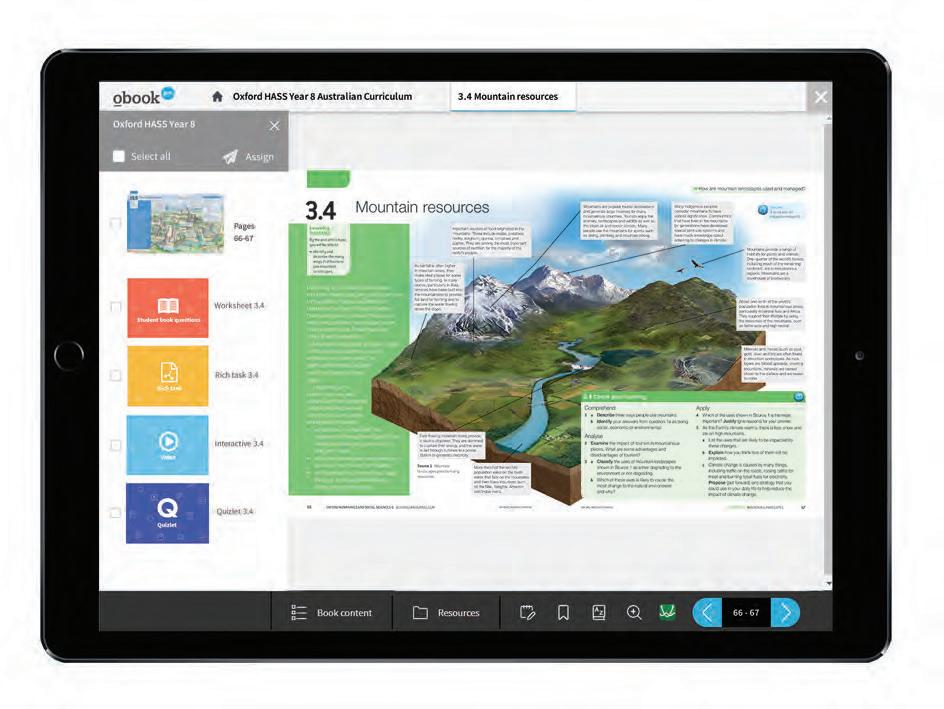
> It offers a complete digital version of the Student Book with interactive note-taking, highlighting and bookmarking functionality, allowing students to revisit points of learning.
> A complete ePDF of the Student Book is also available for download for offline use and read-aloud functionality.
DRAFT
Quizlet
• Integrated Quizlet sets, including real-time online quizzes with live leaderboards, motivate students by providing interactive games that can be played solo or as a class. Quizlet can be used for revision or as a warm-up activity when a chapter is introduced.
Additional resources
• A rich variety of additional resources such as interactive layered maps, videos, worksheets, quizzes and weblinks are linked to individual topics in the book so they can be accessed at the point of learning.
> integrated Australian Concise Oxford Dictionary look-up feature
> interactive assessments to consolidate understanding
> integrated Quizlet sets including real-time online quizzes with live leaderboards
> additional resources available at the point of learning
> access to their online assessment results to track their own progress
Integrated dictionary
• Each digital Student Book provides an integrated Australian Concise Oxford Dictionary lookup feature, so students can quickly access any terminology they aren’t sure of and continue their learning.
Benefits for students
Key features of Teacher obook pro
> Teacher obook pro is a completely digital product delivered via Oxford Digital
> Each chapter and topic of the Student Book is accompanied by full teaching support. Teaching programs clearly direct learning pathways throughout each chapter and provide ideas for differentiation.
> Teachers can use their Teacher obook pro to share notes and easily assign resources or assessments to students, including due dates and email notifications.
Focus on assessment and reporting
Complete teaching support
• Teaching support provides full lesson and assessment planning, ensuring there is more time to focus on students.
DRAFT
Additional resources
• Each chapter of the Student Book is accompanied by additional resources, including answers to every Student Book question, differentiated worksheets and class tests to monitor student progress.
> Teachers have access to all student resources.
> As well as online assessment, teachers have access to editable class tests that are provided at the end of each chapter. These tests can be used as formative or summative assessment and can be edited to suit the class’s learning outcomes.
Curriculum and assessment reports
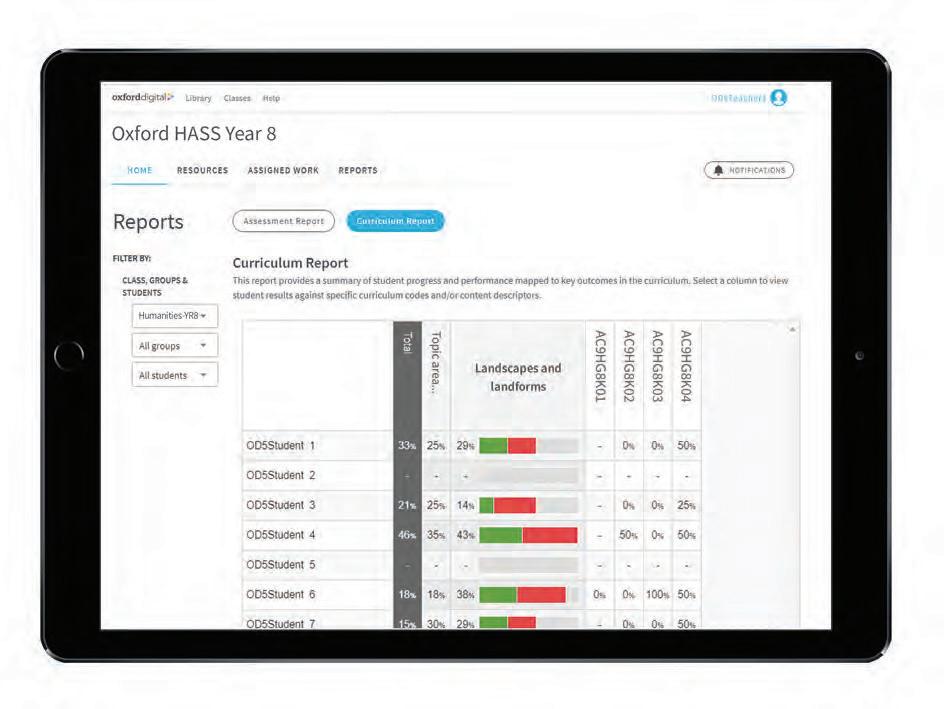
• Teachers are provided with clear and tangible evidence of student learning progress through curriculum and assessment reports.
• Assessment reports directly show how students are performing in each online interactive assessment, providing instant feedback for teachers about areas of understanding.
• Curriculum reports summarise student performance against specific curriculum content descriptions and curriculum codes.
> As students complete online assessments, their results are measured against curriculum outcomes through the curriculum report. This allows easy understanding of how students are progressing, and where they may need support.
Benefits for teachers
What are cognitive verbs and why do we use them?
A cognitive verb is a verb or ‘doing word’ that helps you understand how to answer a question. For example, the word describe is a cognitive verb because it requires you to remember what you know about something and talk about its features. Cognitive verbs are commonly shown in bold in the questions in this book. You will encounter a variety of cognitive verbs as you learn new information.
Common cognitive verbs and the task/s associated with them are given in the table on the next page Understanding these cognitive verbs and the tasks behind them will help you work out how to best answer a question.
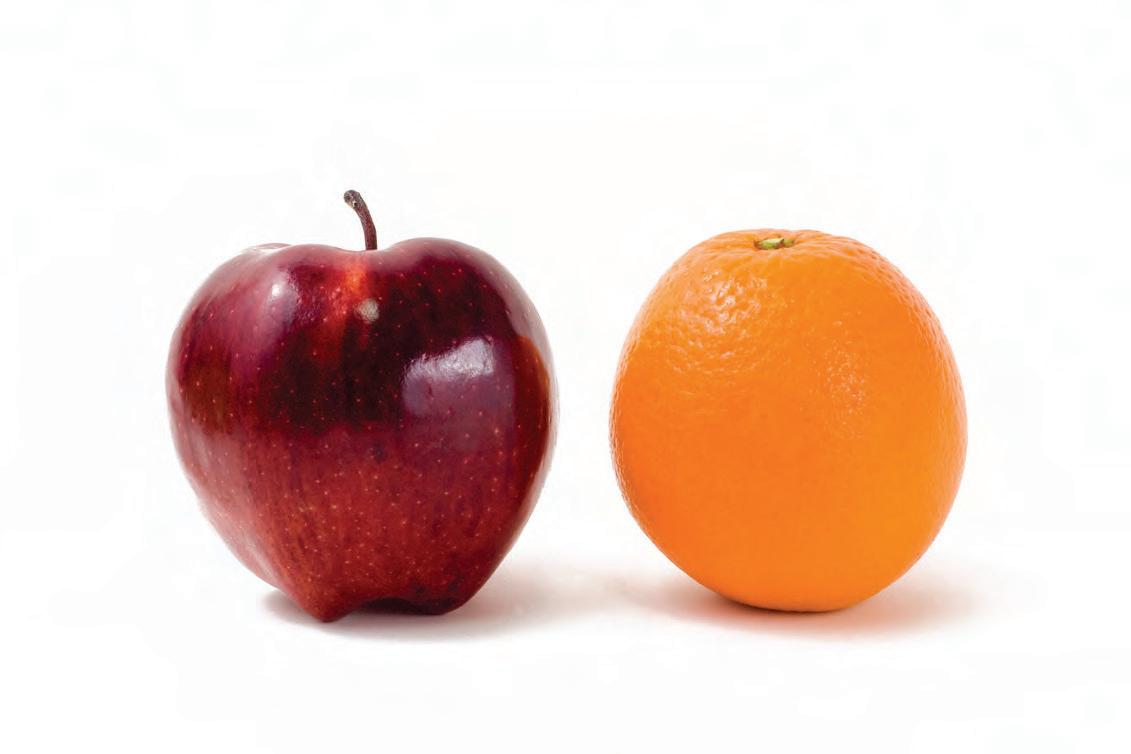
Some cognitive verbs require more thinking and understanding than others. For example, if you were given a picture of an apple and an orange, and asked to name the two fruits, you might instantly remember ‘apple’ and ‘orange’ and could write the names down without much trouble. However, if you were asked to compare the two fruits, you would need to think about the two fruits and identify at least one similarity and one difference between them. In this sense, compare requires a deeper level of thinking than name
Throughout this book you will notice that the questions in the Check Your Learning boxes are categorised in the following order:
> Retrieve
> Comprehend
> Analyse
> Apply
This is because working in order from ‘Retrieve’ to ‘Comprehend’ to ‘Analyse’ and finally to ‘Apply’ helps your learning process.
Source 1 shows the thought processes required for each type of cognitive verb, and the category to which it belongs.
DRAFT
Cognitive verbs
Cognitive verb Task Category
define give the meaning of a word or term
identify recognise and state a fact or feature
name provide the correct name
state provide the correct piece of information
describe give an account of a situation, event, pattern or process, or of the features of something
explain
summarise
analyse
make an idea or situation plain or clear by describing it in more detail, or providing reasons how or why
outline or give a brief statement of an event, theme or major point/s; present ideas and information in fewer words and in sequence
examine or consider something in order to explain and interpret it, identifying different components and the relationship between them
classify arrange, distribute or order in classes or categories according to shared qualities or characteristics
compare identify the similarities and differences between things
consider think carefully and reflect on before making a decision
distinguish identify the differences between things
examine inspect something carefully
create make or invent; reorganise or put elements together into a new pattern or structure
discuss
evaluate
examine by argument; examine the considerations for and against; debate; talk or write about a topic taking into account different views and issues
Retrieve – recall information from permanent memory
Comprehend – activate and transfer knowledge from your permanent memory to your working memory
DRAFT
Analyse – use your reasoning to go beyond what was directly taught
examine and determine the value or significance of something, talking about its strengths and weakness and giving your overall opinion
determine decide or come to a resolution
investigate plan, search or inquire into a topic to establish or obtain facts and reach new conclusions
justify give reasons or evidence to support an answer, response or conclusion
propose put forward a suggestion for consideration or action
Source 1 The tasks and categories associated with cognitive verbs
Apply – use your knowledge in specific situations
DRAFT
CHAPTER
7
The history toolkit
History is a process of inquiring into the past. Historians are interested in all aspects of the past and seek to piece together accurate pictures of what life was like in days gone by.
A historian uses a range of tools to discover the past. These tools are the historical concepts and skills you will learn about in your study of history.
Historians are curious. They investigate artefacts and want to know more about them. Despite these investigations, certain facts about many ancient artefacts still remain a mystery.
DRAFT
Uncovering the secrets of the past is not always easy and historians do not always agree. These mysteries drive historians to continue their important work.
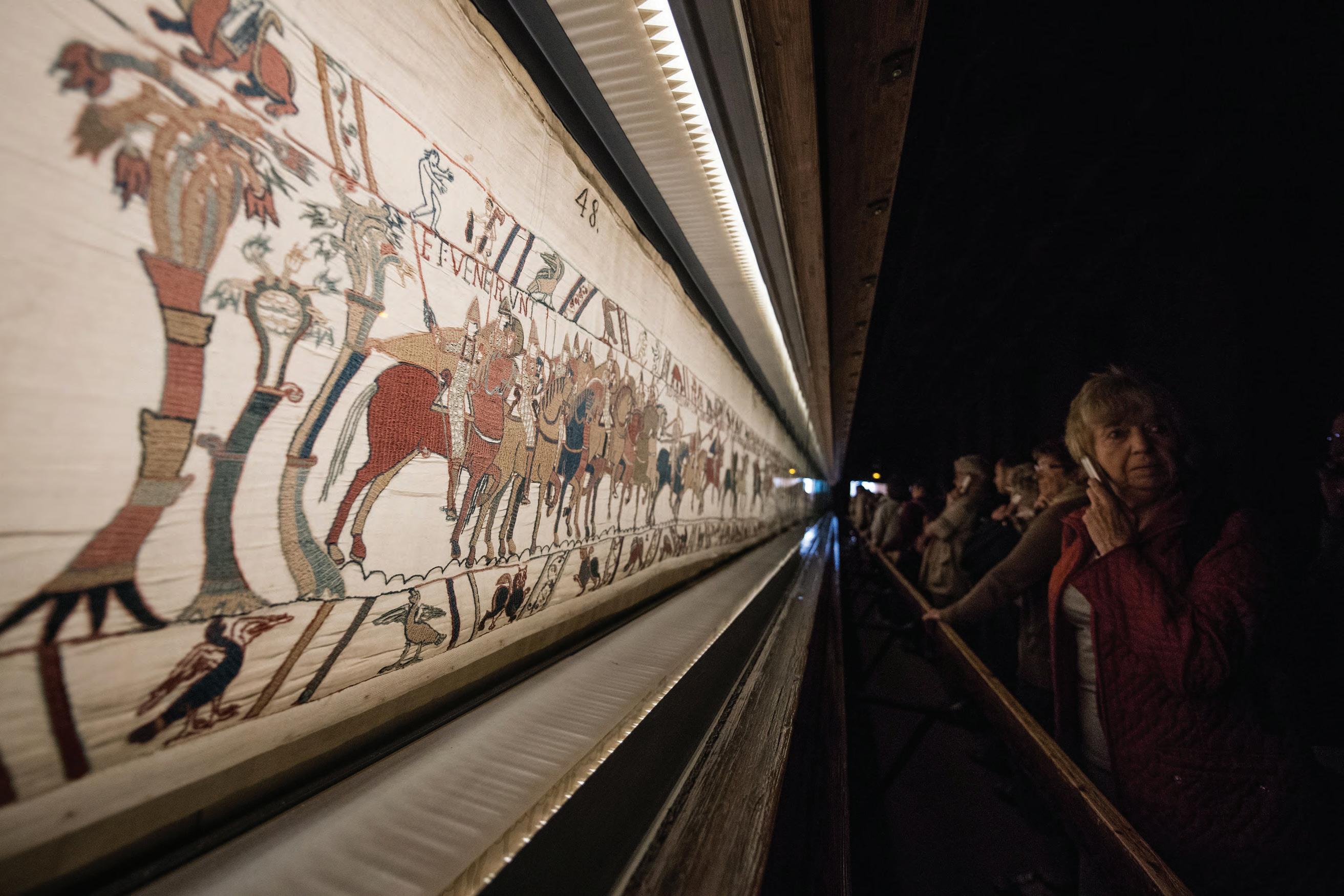
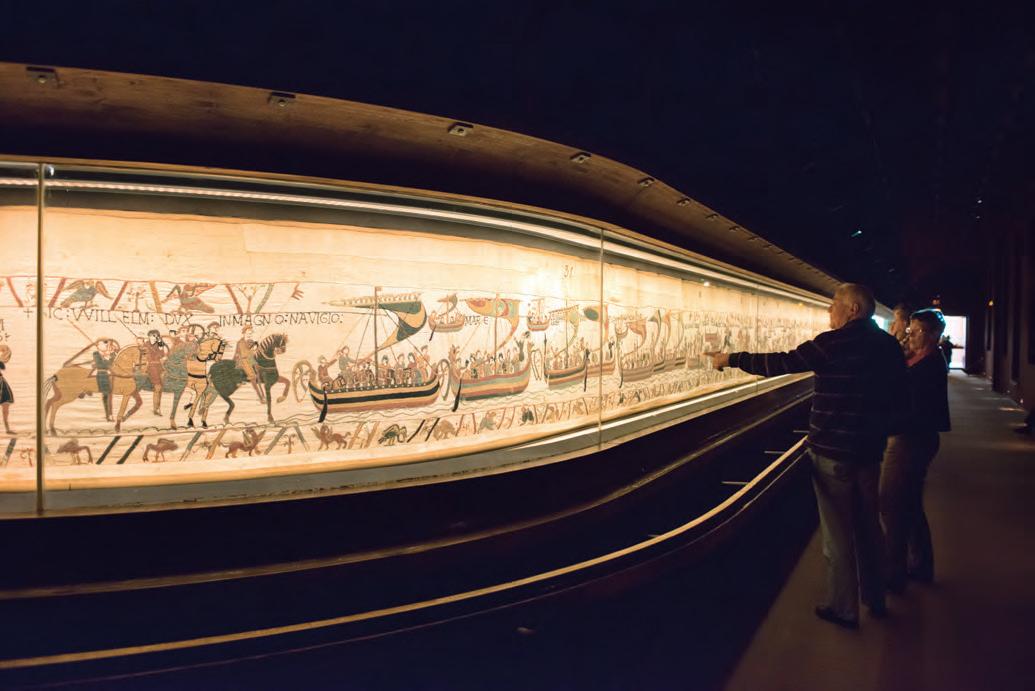
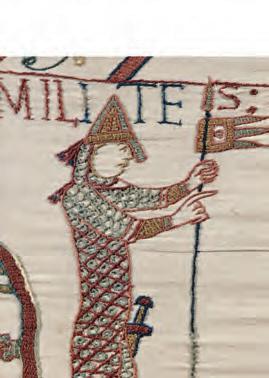
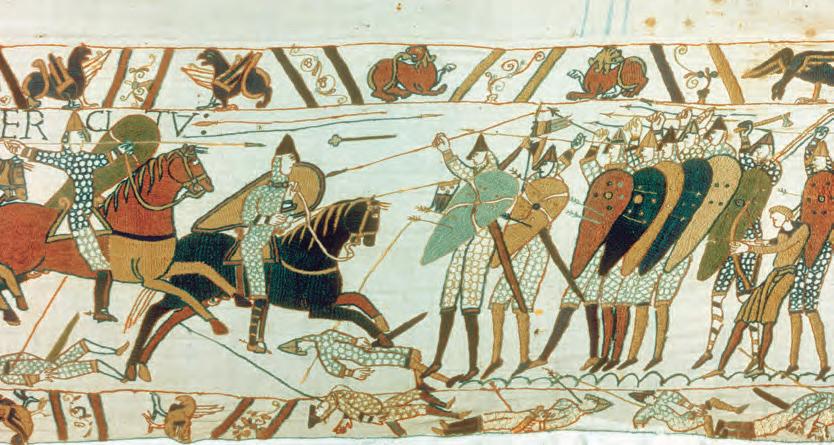
Source 1 The Bayeux Tapestry is one of the most significant primary sources from Europe’s medieval period. It is a piece of hand-embroidered cloth nearly 70 metres long that shows the events leading up to an important battle in 1066 known as the Battle of Hastings. This battle resulted in England crowning a new king and changed the course of history. The tapestry is exhibited at the Musée de la Tapisserie de Bayeux in Bayeux, Normandy, France.
Concepts and skills
7A
What are the historical concepts and skills?
Historical concepts and skills
Historians use concepts to help them investigate and understand the past. As you learn to apply each concept, you will begin to think like a historian. Six important key concepts in history are:
• evidence
• cause and effect
• continuity and change
• perspectives
• interpretations and contestability
• significance.
These concepts will be covered in more detail in the following topics.
There are a number of key skills that historians use to successfully investigate the past. They are:
1 Questioning and researching
2 Using historical sources
3 Historical perspectives and interpretations
4 Communicating.
Each of the skills you will learn over the course of this year is explained in this chapter, and by studying history you will gradually master each one. As you develop each new skill you will have gained another important tool for understanding and explaining events and people that have shaped our world.
It might help you to think of each of these skills as individual tools in your toolkit.
7.2
hypothesis a considered theory or statement, based on research and evidence, about something that has not been proven (plural: hypotheses)
KEY SKILL
Questioning & researching
7A What are the historical concepts and skills?
Questioning and researching
Developing historical questions about the past
One way to understand the past is to undertake a historical inquiry. A historical inquiry is a process of asking questions, finding and analysing sources, and using information from sources as evidence to develop an informed explanation or argument about the past. Historians begin any historical inquiry by asking big questions. From research in response to these big questions, historians develop a hypothesis about what events took place, why, where, and who was involved.
Generating questions
Look closely at Source 2. This visitor looking at the Bayeux Tapestry is asking some important questions. You can learn to do this too by starting your questions with the words ‘what’, ‘where’, ‘how’, ‘when’ and ‘why’, for example:
• What is the Bayeux Tapestry?
• Who made it?
• When was it made?
What is the Bayeux Tapestry?
Who made the Bayeux Tapestry and what is it made of?
What is the Bayeux Tapestry doing here?
Why was the Bayeux Tapestry made and who paid for it?
Why is the Bayeux Tapestry important?
The best questions open up an exciting area for you to explore. For example, the visitor might ask a simple question, such as: ‘What does the Bayeux Tapestry look like?’ This is a question with a relatively simple answer. A better historical question for the visitor to ask might be: ‘What does the design and construction of the Bayeux Tapestry tell us about the skills of people living in medieval Europe?’ This question opens up a whole new area for exploration.
Practise the skill
Generate four questions of your own that will help you research the Bayeux Tapestry.
Once you have generated your questions, identify the information you will need to answer these questions and where you might be able to locate it.
Are there any questions for which you have not been able to find reliable evidence or answers? What reasons might there be for this?
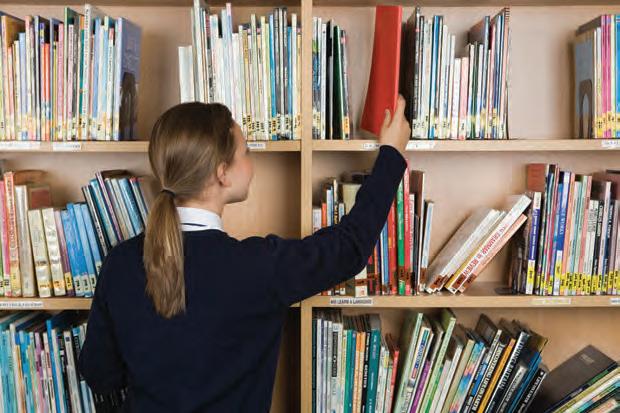
Source 3 Research is an important part of history. Your teacher or librarian can help you develop your research skills, both for the library and online.
Locating relevant sources
Sources provide information for historians. Locating relevant sources is a valuable skill that usually involves a number of different research methods, such as: using an online search engine such as Google visiting museum and government websites looking at newspaper and magazine archives contacting local historical societies interviewing older family members about the past.
relevant sources online
Books and newspapers are valuable sources of information. Research is also conducted . Your teacher or librarian can help you to develop good research skills. To make sure that sources gathered online are accurate, reliable and relevant, follow the guidelines below:
• Search engines are useful research tools, but sometimes material found online is not reliable and can contain inaccurate and misleading information, or material that is out of date. When using search engines, use keywords and be as specific as you can.
• Use sites linked to educational institutions, government departments, reputable companies, museums and universities to find reliable information. A quick way of telling if a site is reputable is to look at the suffix of the domain name, which is part of the URL (internet address).
• Avoid blogs or social media posts. If you do find information on a blog or social media site, be sure to verify it by using a more reliable source.
• Never cut and paste information you find online straight into your own work. Taking someone else’s work, ideas or words and using them as if they were your own is called plagiarism. Plagiarism is unethical and if you plagiarise, your work can be rejected.
Source 4 Some common domain suffixes
DRAFT
.edu
.gov
.net
.org
.com
The site is linked to an educational institution, such as a university or school. These sites are generally very reliable.
The site is linked to a government institution. These sites are generally very reliable.
The site is linked to a commercial organisation or network provider. Anyone can buy a domain name with this suffix, and generally nobody regulates the information posted on the site. As a result, these sites may be unreliable.
The site is linked to an organisation. Generally, these organisations are not-for-profit (e.g. Greenpeace, World Vision International, British Museum). If the organisation is reputable and can be contacted, it generally means that the information provided has been checked and verified by that organisation. You need to be aware of any special interests that the organisation may represent (e.g. particular religious, commercial or political interests), as this may influence what it has to say on a particular issue.
The site is linked to a commercially based operation and is likely to be promoting certain products or services. Domain names with this suffix can be purchased by anyone, so the content should be carefully checked and verified using another, more reliable source.
Recording relevant sources
As you identify and locate relevant sources, it is essential that you record details to include in your reference list or bibliography.
When citing (mentioning) a book in a bibliography, include the following, if available, in this order:
1 author surname(s) and initial(s)
2 year of publication (in brackets)
3 title of book (in italics)
author surname(s) and initial(s)
4 edition (if relevant)
5 publisher
6 place of publication
8 Australian Curriculum, 2nd edition, Oxford University Press, Melbourne
publisherplace of publication year of publication (in brackets) title of book (in italics)
Source 5 An example of how to cite a book in a bibliography
Easton, M., Saldais, M., Davey, K., Woodard, K., Dumovic, V., Cook, B. and Andrew, O. (2023) Oxford Humanities and Social Sciences
When citing an online source in a bibliography include the following information, if available, in this order:
1 author surname(s) and initial(s) or organisation name
2 year of publication or date of webpage (last update)
3 title of document (article) enclosed in quotation marks
Author surname(s) and initial(s)
4 date of posting
5 organisation name (if different from author name)
6 date you accessed the site
7 URL or web address enclosed in angled brackets <>.
DRAFT
Daley, J., 2019, ‘Architecture and math show the Bayeux Tapestry was designed to decorate a cathedral’, 30 October 2019,
Check your learning Log onto your obook pro to complete the questions for topic 7.2.
Smithsonian Museum, accessed 20 July 2022, <https://www.smithsonianmag.com/smart-news/architecture-and-math-show-bayeux-tapestry -decorated-cathedral-180973423/>.
Organisation nameDate you accessed the site
Source 6 An example of how to cite an online source in a bibliography
URL enclosed in angled brackets <>
Using historical sources 7.3
Understanding evidence and sources
KEY CONCEPT
Evidence
What is evidence?
Evidence is the information gathered from historical sources that can be used to develop, revise or support an argument or challenge an interpretation. Evidence can come from many different sources; for example, films, maps, newspapers, buildings, nursery rhymes and clothing. There are two types of sources:
• Secondary sources are accounts about the past that were created after the time being investigated. They often use or refer to primary sources and present a particular interpretation of them. Examples of secondary sources include documentaries, history textbooks and websites. Historians often have different points of view and do not always agree on evidence. This is why historians are constantly searching for new sources of evidence – they need to use a range of different sources to help them gain a more complete picture of the past. artefacts any objects that are made or changed by humans
DRAFT
• Primary sources are things that existed, or were written or made, at the time being investigated. Examples of primary sources include human remains, artefacts, official documents (such as laws and treaties) and personal documents (such as diaries and letters). These original, first-hand accounts are analysed by historians to answer
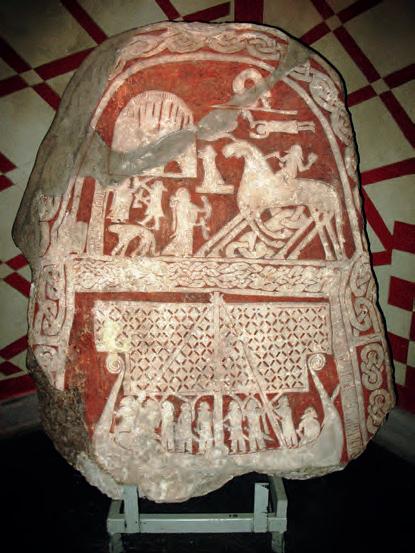
Source 7 This Viking stone carving, known as the Tjängvide image stone, was carved during the eighth century ce . It shows gods from Norse mythology and a Viking longship. It is a primary source because it was made during the Viking Age. The remains of several Viking longships confirm this representation.
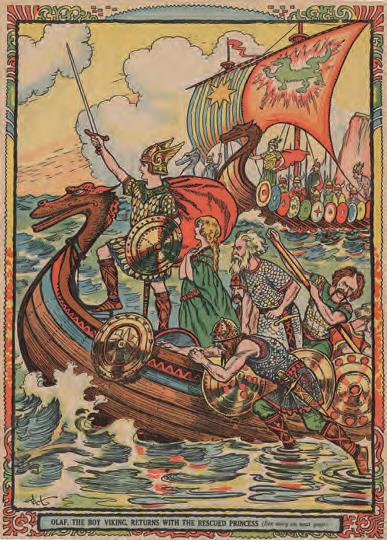
Source 8 This illustration from a children’s book published in 1928 shows a young Viking returning to the Viking homeland. It is a secondary source because it was created long after the Viking Age. Although a number of historically accurate features are shown (such as the design of the longships), it is not a reliable source of information and cannot be used as evidence because its purpose is to entertain.
The concept of evidence refers to the information obtained from historical sources that can be used in a historical argument. Understanding this concept will help you when using historical sources.
Understanding the origin and purpose of primary and secondary sources
Both primary and secondary sources are useful, but it is important to understand where they came from (origin) and what the creator of the source hoped to achieve (purpose). It is also important to understand why the source was created (motive). All sources reflect the author’s own point of view, and in some cases the author may have intentionally ignored certain facts because of their own views. This is referred to as bias, and is often aimed at persuading the reader to agree with the author’s point of view.
Asking questions is a way to begin examining sources. Analysing sources by asking ‘who’, ‘what’, ‘when’ and ‘why’ questions will help you identify their origin and purpose. bias a pre-set view about someone or something that is not altered by the presentation of facts and opinions to the contrary
Source 9 Examples of questions to help identify the origin and purpose of sources
Who wrote, produced or made the source?
What type of source is it?
When was the source written, produced or made?
Why was it written or produced?
What did the creator hope to achieve by producing this source?
Did the creator want to change people’s mind about something?
DRAFT
• Is the creator a member of a particular group, religion or organisation?
• Was the creator paid to produce the source? Who What When Why
• Was the source created at the time of the event or afterwards?
• How old is the source?
• Is it an eyewitness account or is it written by someone at a later date?
• Is the source complete?
• Was it designed to entertain, persuade or argue a point of view?
• Does the creator have anything to gain personally from the source?
• What other events may have been happening at the time and might have influenced the author or source?
• Was the creator motivated by a personal crusade?
• Was the creator influenced by events at the time?
Collecting, comparing and selecting information
While researching, you will have located and collected a variety of different sources and types of information. Now it is time to compare and select the most relevant information that you will use as evidence.
Organisation charts are very useful tools for collecting, comparing and selecting suitable resources that you have located. A source evaluation chart like the one shown in Source 10 can help you do this.
Source 10 A source evaluation chart showing an example of how you might compare and select sources
Research topic: Why was the Battle of Hastings important?
Hypothesis: That the Battle of Hastings was important for medieval Europe because it changed the course of history in England forever.
Source 1: ‘Battlefield Britain –medieval warfare at the Battle of Hastings’, Culture 24
Type of source: Secondary source (but includes many primary sources too)
Pros:
• good selection of primary sources, such as photos
• includes lots of interviews
• information is factually correct and detailed
Cons:
• information is a little complicated and the language is difficult to understand properly.
Drawing conclusions about the reliability and usefulness of sources
A useful source is one that adds to your understanding of a historical inquiry. The source needs to be reliable and relevant to the topic. The following questions will help determine the usefulness of a source:
• Is it a reliable source?
• Is there enough information to help me answer the inquiry question?
• Does the information support and reinforce evidence from other sources?
• Is it balanced, or does it present one point of view (meaning, is it biased)?
• Does it present facts, opinions or both?
• Is the information current?
Separating fact from opinion
Often, you will need to separate fact from opinion in a source.
• A fact is something that can be proved: when an event took place, what happened and who was involved.
• An opinion is based on what a person may believe to be true. Look closely at the language used. The use of words such as ‘might’, ‘could’ and ‘think’ all indicate that an opinion is being expressed. For example:
• Fact: ‘The Bayeux Tapestry is an important historical source.’
• Opinion: ‘The Battle of Hastings might be the most important battle ever fought.’
DRAFT
Analysing sources using ‘DAMMIT U’
As we have learnt, an important skill in history is the ability to analyse sources for clues and insights about the past.
The term ‘source analysis’ is used a great deal in the study of history. But the fact is, there are different ways to analyse sources, or different ‘things’ that you might look for and discuss in any given source. These include:
• the date, author, material, motive, intended audience, tone and usefulness (‘DAMMIT U’) of a source
• the different perspectives, attitudes and values presented by a source
• the significance of a source.
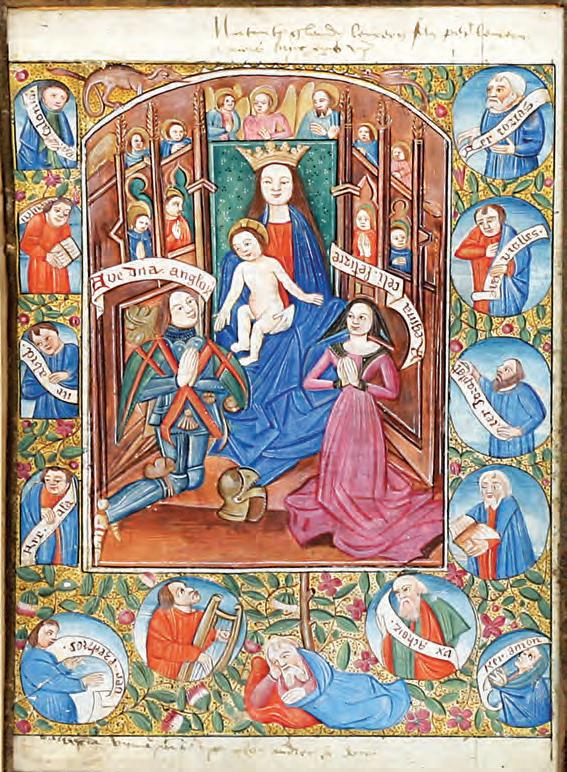
Imagine that you have been asked to analyse the image in Source 12. Between the source itself and the information contained in the caption, there is a lot for you to interpret and analyse – however, it can be difficult to know how to start.
DRAFT
Using an acronym, such as ‘DAMMIT U’, can make it easier to know what you should be looking for, and what questions you should be asking. Read the steps in Source 13 closely to see what each word means and how it can help you begin
When writing your response, the ‘DAM’ (date, author, material) can be summarised in one to three sentences, whereas the ‘MIT’ (motive, intended audience, tone) will require a little more detail. You should provide examples from the source to support your analysis in the ‘MIT’ section.
For a written source, use a short quote from the source and explain its meaning. For a visual source, like Source 12, refer to a feature or symbol in the source and explain why it is relevant. In general, a historical source analysis should form a paragraph of eight to ten sentences.
Discussing the ‘U’ (usefulness) often requires its own paragraph. You should always discuss at least one strength or weakness, and you may include examples.
Source 14 is an example of a source analysis written in response to the illuminated manuscript in Source 12. Annotations have been provided to show you exactly how you can turn your questions into a written response.
created on vellum leaf with 28 images of saints, angels, donors, Mary and baby Jesus
7A What are the historical concepts and skills?
D Date – when was the source created? If it was created during the time you are studying, it is a primary source, but if it was created after that, then it is a secondary source. A primary source may show attitudes or describe an experience, whereas a secondary source is often a factual interpretation.
A Author – who is the author of the source? Think about their gender, age, social status and profession. For example, they could be a historian, a leader, an aristocrat, a soldier or a prisoner.
M Material – is the source written, oral or visual? It could be a newspaper, letter, diary, photograph, textbook, online blog or tweet, or even statistics in the form of a graph or map.
M Motive – why did the author produce this source? Was it for official government use, a religious affiliation, the media or for personal reasons? A historian tries to establish the context of the source to help understand the perspective of the person who created it.
I Intended audience – for whom was the source produced? Was it for academics or the general public? Was it intended to be viewed, or was it meant to be private?
T Tone – how is the information in the source expressed? How does it make you feel? Words to describe tone can include ‘persuasive’, ‘critical’, ‘questioning’, ‘funny’ or ‘reflective’. Often, primary sources are more emotional than secondary sources, which tend to be factual as they are written with hindsight.
U Usefulness – what are the strengths and weaknesses of the source as a piece of evidence? Sources can be factual and accurate, or they can be exaggerated and contain bias. They may have the detail of an eyewitness, or the advantage of hindsight. A source may be an oral history, or it may be written down. All of these can affect how useful the source is.
DRAFT
Source 13 The ‘DAMMIT U’ acronym is a helpful way to remember the questions you should ask yourself when approaching any source.
Material
Author Date
The Adoration of Mary is an illuminated manuscript that was created c. 1475 in France. The author is unknown, but was possibly a monk of the Catholic Church. The purpose of this source is to show the respect for and the importance of Mary and baby Jesus. This is shown through the large size of Mary and her position front and centre in the artwork. The artist’s motive may have been his deeply held religious beliefs and his devotion to Mary. The intended audience for this source may have included royalty, nobles and bishops, and priests. This is because most illuminated manuscripts were kept in church libraries or were made for wealthy families to use as prayer books. The tone of the source is one of respect. This is shown through the two figures kneeling in front of Mary, looking up with their hands in a prayer position. This source is useful to some extent, because it shows us the importance of Mary in Catholic beliefs. The way the artist has shown Mary sitting on a throne, wearing a crown and a long robe, tells us that people considered Mary to be the Queen of Heaven and that Heaven reflected, to some extent, the social order of life on earth. However, the source is clearly biased as this is the only perspective it shows.
Source 14 A sample response that has been written using the ‘DAMMIT U’ approach
Motive
Intended audience
Tone
Usefulness
Check your learning Log onto your obook pro to complete the questions for topic 7.3.
chronological order the order in which events have taken place
Historical perspectives and interpretations
Sequencing significant historical events
One of the most helpful things historians can do to get a better understanding of the past is to organise events in the order that they happened. This is known as chronology. Chronology can help us organise things that happened over a small period of time, such as a day or week, or huge periods of time, such as hundreds of thousands of years. We can also use chronology to look at events that happened in one place or society, or to compare events across many different places and societies. Chronology allows us to develop an ordered sense of time. Once events have been placed in chronological order, we are able to use a range of historical concepts such as cause and effect, significance, and continuity and change to analyse them in detail.
Sequencing time
Examples of how historians sequence time are shown in Sources 15 and 16. Each table shows how 2100 years have been divided into smaller periods of 100 years, which are known as centuries. These tables will help you as you work through Year 8 history, so refer to them as often as you need to.
Source 15 Before the Common Era (bce): more than 2000 years of history divided into centuries; zero is not used, so when ordering time bce , remember to count backwards to 1.
DRAFT
Source 16 Common Era (ce): more than 2000 years of history divided into centuries; zero is not used, so when ordering time ce , remember to count forwards from 1.
3rd
4th
5th
6th
7th
Creating a timeline
Timelines are used by historians to sequence time and order important events chronologically. They help divide large sections of time into smaller periods so that events can be arranged in the correct order. Timelines can look quite different, but they all work in the same way.
Follow these steps, and refer to Source 17, when constructing a timeline:
Step 1 Work out the length of time you want to represent on your timeline, and then divide it evenly into suitable blocks of time.
Step 2 To represent a huge span of time, you may need to break your timeline into sections using a jagged line. This break shows that a section of time has been left out Just make sure no important events fall in the time you are leaving out.
Step 3 Mark specific dates onto the timeline. These dates need to be accurately plotted so that they appear in chronological order (from left to right). If an exact date is not known, the abbreviation c. (from the Latin word circa, meaning ‘around’) is placed in front of it (for example, c. 250 bce).
Step 4 Plot important dates and events on the timeline. Give a brief description of each event. Include pictures and captions, if appropriate.
Practise the skill
1 Create your own timeline based on one of the following topics:
• important events that have taken place in your life so far
• events in the life of someone important in your life (for example, a family member, a close friend or someone you admire).
1066
1500
Tribes of Germanic origin begin moving into the area now known as Scandinavia.
DRAFT
c 250–100
William of Normandy (a descendant of the Vikings) defeats King Harold at the Battle of Hastings and becomes King of England. He is known as William the Conqueror.
The development of Viking writing (runes) begins.
787
The first Viking attack on England takes place.
1000
Source 17 An example of a simple timeline, with some reminders
Events that took place Before the Common Era (BCE) – that is, before the bir th of Christ – are positioned on the timeline in descending order (i.e. counting backwards to 1, when Christ was born).
The first year of the Common Era was 1 – there was no year zero.
Events that took place in the Common Era (CE) – that is, after the birth of Christ – are positioned in ascending order (i.e. counting forwards from 1, when Christ was born).
CE
William the Conqueror, from the Bayeux Tapestry
KEY CONCEPT
Cause and effect
Bubonic plague (the most common form of plague) was spread by fleas infected with a bacterium known as Yersinia pestis (cause). The Black Death is estimated to have killed more than 75 million people across Europe, Asia and Africa, resulting in a sudden drop in population (effect).
Source 18 A fishbone diagram
Describing causes and effects
What is cause and effect?
The concept of cause and effect is used by historians to identify chains of events and developments, both in the short term and in
the long term. Cause and effect aims to identify, examine and analyse the reasons why events have occurred and the resulting consequences or outcomes. It helps to think of cause and effect as the ‘why’ and ‘what’ of history.
The concept of cause and effect refers to short-term and long-term causes and consequences. Understanding this concept will help you understand historical perspectives and interpretations. Cause and effect is used by historians to identify the reasons for an event, or changes in history, and the results of those events or developments, both in the short term and the long term. Sometimes the link between cause and effect is very clear. For example, heavy rain over many weeks (cause) leads (event) and the destruction of crops (effect). However, often this link is not quite so obvious. Generally, there are many causes (reasons) that lead to an event or action, and there can also be many effects (outcomes). Sometimes the effects are simple to identify, while in other cases they are more difficult to predict and may not even be observed until long after the event.
Analysing cause and effect
When you analyse something, you must break it down into smaller parts and explain how they relate to each other. The first step in analysing cause and effect is to identify the event, development or change, then what may have caused the event/ development/change, and then the effects. Different types of causes might be social, economic or political, or a cause might be sudden, and act as a catalyst (a trigger) for change. Once the causes of the event have been identified, consider the effects. Explain how each effect is linked to the event that you have identified. Remember, historical events can have multiple causes, and multiple effects.
DRAFT
Causes
When analysing cause and effect, it can be helpful to organise the information in a way that helps you to see the links between the event or change, the cause and the effects. Graphic organisers, such as a fishbone diagram, are a good way to analyse cause and effect. Sometimes, causes and effects are part of a cycle, and one effect is the cause of another effect.
Timelines can also be used to organise events, people and movements in a way that helps you identify links between the cause and effect of an event or change.
Cause and effect and the Black Death
During the fourteenth century, a plague known as the Black Death swept across Europe, Asia and parts of Africa. Historians estimate that at least 75 million people died as a result. A number of factors led to the rise and spread of the Black Death. Bubonic plague (the most common form of plague) was spread by fleas infected with a bacterium known as Yersinia pestis (cause). These fleas lived on black rats, commonly found in all medieval towns and cities because of poor hygiene and sanitation (cause). Bites from the infected fleas spread the disease to humans (cause). Pneumonic plague (another form of plague) was spread from person to person through the air, infecting bodily fluids such as mucus and blood (cause). The Black Death resulted in a range of effects.
Short-term effects included:
• a massive drop in population, resulting in shortages of farm labourers and skilled tradespeople
• abandoned houses left dirty and unattended, and rubbish and sewage in towns left to rot
• some priests refusing to bury victims of the plague for fear of contracting the disease.
Long-term effects included:
• a reduction in the power and influence of the Church on people’s lives, due to the belief that the Church (including priests and clergy) had not been able to prevent the plague
• improvements in hygiene and medical knowledge due to new regulations and laws introduced to prevent further infections.
Practise the skill
1 Identify two forms of the plague known as the Black Death.
2 Describe the connection between fleas and the Black Death.
3 Explain how the short-term effect of a massive drop in the population led to the long-term effect of the decline of feudalism in Europe.
4 Use a cause and effect tree to record one cause and multiple effects of the Black Death in Europe.
KEY SKILL
Historical perspectives & interpretations
plague a widespread disease with a high death rate
DRAFT
• the breakdown of feudalism across Europe, because labourers and tradespeople could demand better conditions and higher wages (instead of working in return for the protection of feudal lords)
feudalism a set of legal and military customs that served to organise the society of medieval Europe and Japan
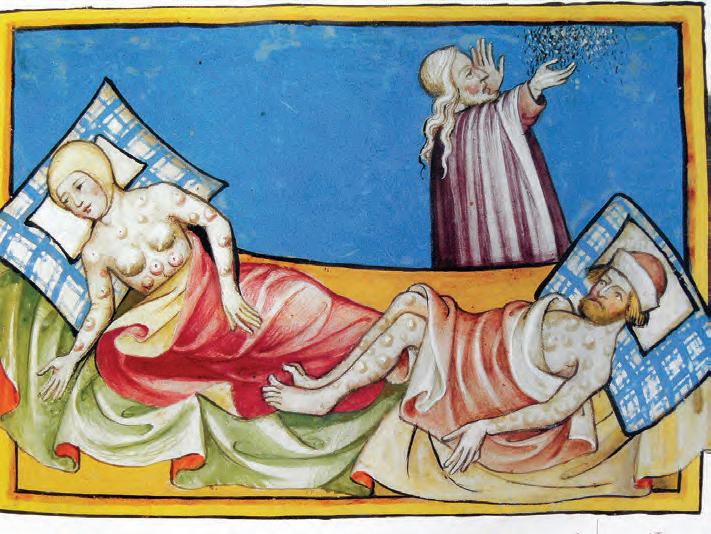
Source 19 A medieval illustration of a couple with the plague ; the Black Death had short-term effects and long-term effects.
KEY CONCEPT
Continuity & change
Explaining continuities and changes
What is continuity and change?
Historians recognise that over time, some things stay the same while others change. This concept is referred to as continuity and change. Examples of continuity and change can be seen across every
civilisation and any given period of time. Historians refer to aspects of the past that have remained the same over time as continuities. Aspects of the past that do not stay the same are referred to as changes. Change can occur within a certain civilisation or specific time period, but also across different civilisations and time periods.
DRAFT
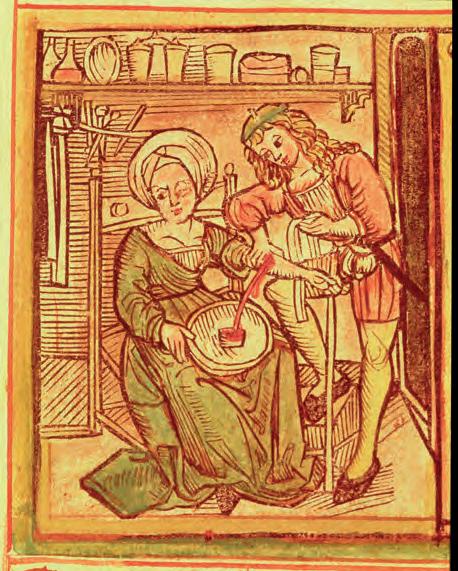
Source 20 In medieval Europe, barber shops for cutting hair were common, as they are today (a continuity). However, medieval barbers also performed medical procedures (a change) such as bloodletting (see left). The red-and-white spiral on modern-day barber poles (see right), dates back to when bloodstained bandages were hung out to dry on poles after bloodletting at medieval barber shops.
The concept of continuity and change refers to how things change or remain the same over time. Understanding this concept will help you understand historical perspectives and interpretations. To identify continuity and change, the sequence (order) of events and significance of these events (or people, or ideas) should be understood. Timelines can be used to organise events in a way that makes it clear when things changed. Timelines can also be used to understand how long things continued without changing.
Once you have identified when changes occurred in a society or civilisation over a period of time, you can identify what these changes were. These changes can be listed, and ranked in order of significance. To understand the significance of an event, refer to the key concept of significance (see page 217). When ranking changes in order of significance, you should use evidence to justify how significant (or not) these changes were to the society or civilisation.
After a change (or continuity) has been identified, state what caused the change, and why it had the effect it did. It is important to look at multiple different examples of continuity or change within a society or civilisation to be able to see any patterns of continuity and change.
Continuity and change and fighting pandemics
A pandemic is a global outbreak of disease. In a pandemic, a disease is widespread through a country, or the world. There have been many pandemics throughout history, from the Black Death in the fourteenth century, to the Spanish flu pandemic in the twentieth century and more recently the COVID-19 pandemic. During earlier pandemics such as the Black Death, people had no idea why they were dying. They knew nothing about germs or bacteria. The cause of the Black Death (the bacterium Yersinia pestis) was not discovered until the late 1800s. In the fourteenth century, bad smells were commonly considered to be one cause of disease. To protect themselves from bad smells, people carried small bunches of flowers, or pouches filled with fragrant herbs or spices. Today we know far more about many diseases.
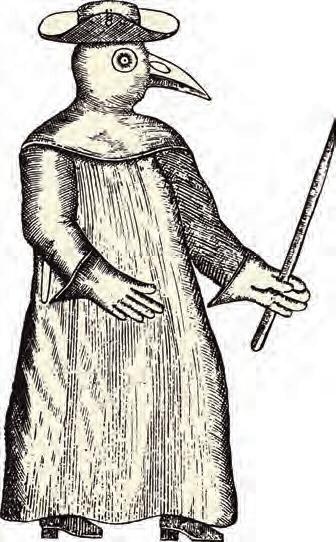
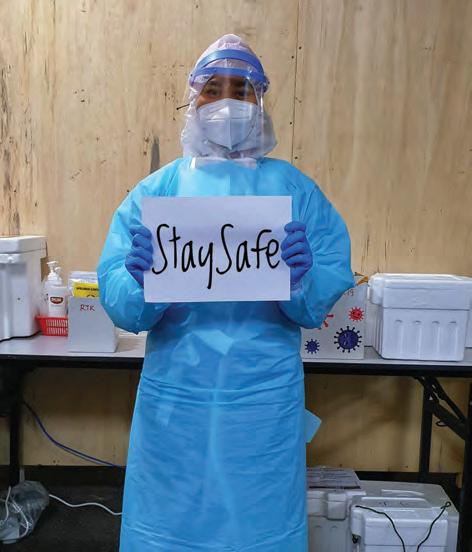
Source 21 shows how plague doctors dressed. Heavy floor-length coats extended up the back of the head. They wore a hat, and a bird-like beak, which was filled with strong-smelling items such as mint, spices, garlic, flowers or vinegar. They also used wooden canes to examine plague patients without having to touch them. Source 22 shows how a modern healthcare worker might dress, when required to wear personal protective equipment.
Practise the skill
7A What are the historical concepts and skills?
2 Briefly explain why modern healthcare workers no longer wear the things you have identified. To explain this example of a change:
• Calculate how much time (in centuries) has passed between the events of the Black Death and the start of the COVID-19 pandemic.
• Brainstorm what changes in medical knowledge or ideas have occurred between the Black Death and now (for example, what has changed in our knowledge about bacteria or germs?). Conduct research on your ideas.
DRAFT
KEY SKILL
Historical perspectives & interpretations
1 Identify two items of clothing or objects that the plague doctor in Source 21 is wearing that modern healthcare workers do not wear today.
• Decide how significant this change in medical knowledge or ideas has been to human history.
3 Summarise one example of a continuity between how the plague doctor shown in Source 21 is dressed and how the modern healthcare worker shown in Source 22 is dressed. Why do you think this aspect of fighting pandemics has continued?
Source 22 A 2020 photo of a healthcare worker, wearing full personal protective equipment
Source 21 A nineteenth-century illustration of a typical plague doctor; some earlier medieval plague doctors were similarly dressed.
KEY CONCEPT
Perspectives
Identifying perspectives
What are perspectives?
Perspective is the position from which people see and understand events going on in the world around them. People will have different points of view about a particular event, person, civilisation or artefact depending on their perspective, which can be affected by age, gender, social position, and their beliefs and values.
Historians also see events from different perspectives, which can influence their interpretation of the past and the way in which they write about it. Despite their own perspectives, historians must try to understand the different values and beliefs that shaped and affected the lives of people who lived in the past.
0702_30941
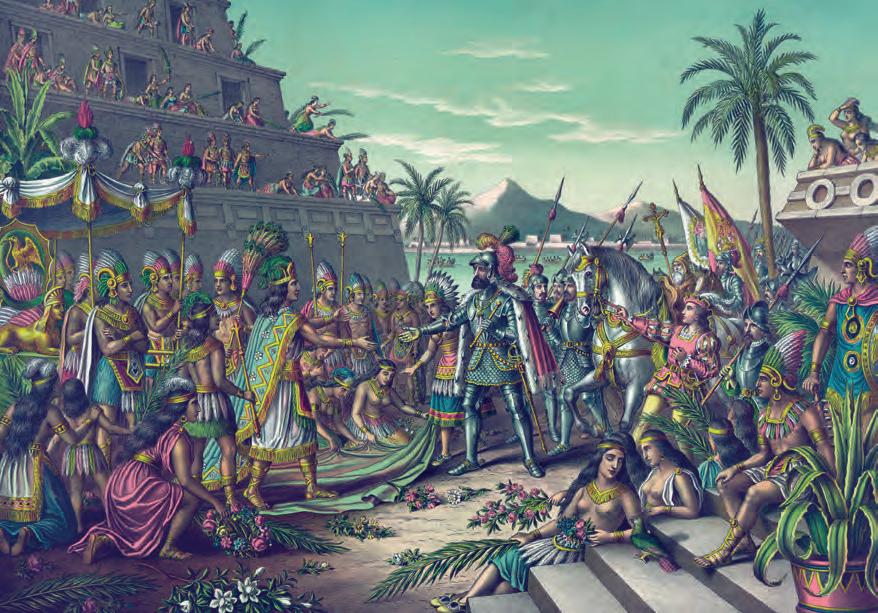
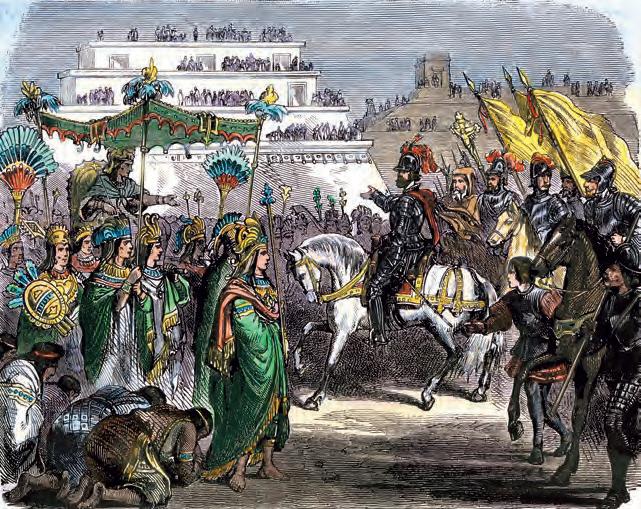
Source 23 This Spanish artist’s impression shows the conquistador (a soldier or conqueror) Hernán Cortés meeting the Aztec ruler Moctezuma II in Tenochtitlan, the capital of the Aztec Empire, in 1519. From 1492 to 1572, Spanish conquistadors such as Cortés invaded the Americas, believing it was their right and duty to convert the indigenous peoples to Christianity, to expand Spanish territory and to increase Spanish wealth. Within 100 years, the Inca, Aztec and Maya civilisations and cultures had been largely destroyed. From a Spanish perspective at the time, their actions were lawful and blessed by their Christian god. From a modern perspective, the conquests are seen as brutal and unjustifiable
Source 24
Then King William came from Normandy into Pevensey [a town on the coast of England], on the eve of the Feast of St Michael, and as soon as they were fit, made a castle at Hastings market-town. Then this became known to King Harold and he gathered a great raiding-army, and came against him at the grey apple-tree. And William came upon him by surprise before his people were marshalled. Nevertheless the king fought very hard against him with those men who wanted to support him, and there was a great slaughter on either side. There were killed King Harold, and Earl Leofwine his brother, and Earl Gyrth his brother, and many good men.
Extract from the Anglo-Saxon Chronicle recounting the events of the Battle of Hastings
The concept of perspectives refers to the factors (such as age) which can shape a person’s point of view. Understanding this concept will help you understand historical perspectives and interpretations. Historians analyse sources to identify points of view, perspectives, attitudes and values of people in the past. Both primary and secondary sources can show many different points of view, attitudes and values. These may reflect personal, social, political, economic or religious perspectives. The Battle of Hastings provides good examples of how different perspectives can be reflected in historical sources, such as Sources 24 and 25
• Source 24 tells the story of the Battle of Hastings from the perspective of the Anglo-Saxons (from England).
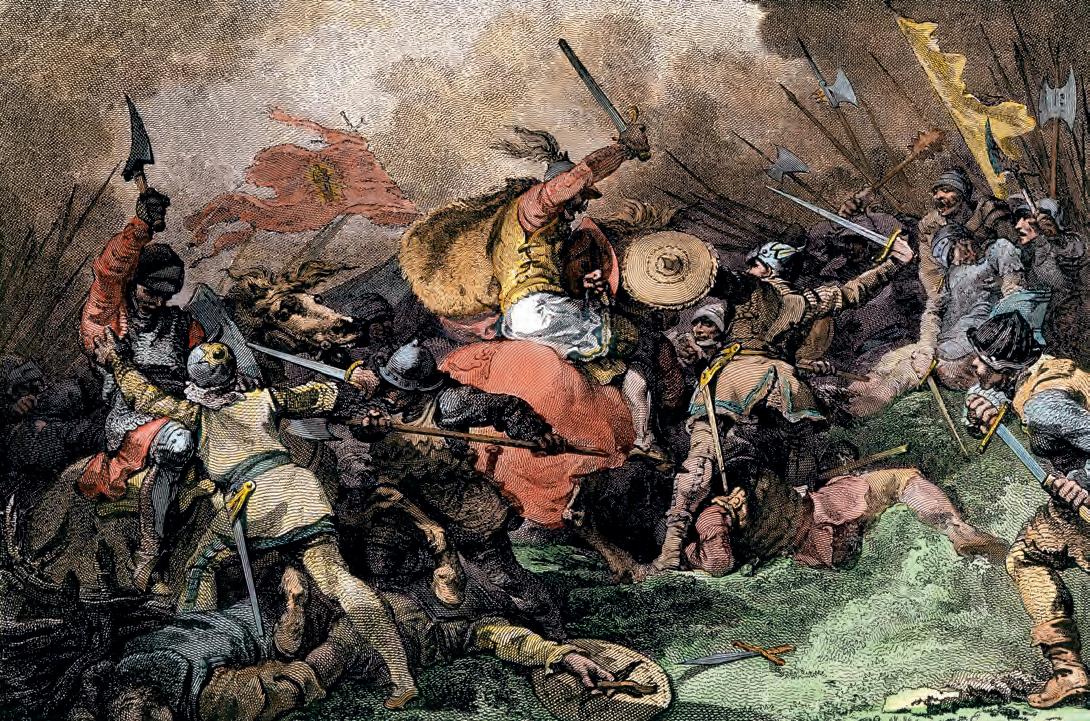
• Source 25 shows a scene from the Battle of Hastings from the perspective of the Normans (from France).
Sources 24 and 25 illustrate how the same event can be told in different ways, depending on the perspectives of the people who were there. For example, Source 25 shows Norman and Anglo-Saxon troops prepared for battle, but Source 24 tells how William of Normandy ‘came upon him [King Harold] by surprise’.
7A What are the historical concepts and skills?
It is only when we consider a range of different perspectives and examine all of the available sources that we can begin to form a more complete picture of the Battle of Hastings. A good way to do this is to compare the two perspectives directly, as in Source 26.
Source 25 soldiers are shown on horseback and Anglo-Saxon soldiers are shown on foot.
Source 26 A comparison of two historical sources relating to the Battle of Hastings in 1066
Source 24: The Anglo-Saxon Chronicle – an English source
• The Anglo-Saxon Chronicle is the main source of English history at the time of the Battle of Hastings.
• The chronicle is a kind of calendar of national life written by English monks in a number of different places across England.
• Unfortunately for historians, there are gaps in the chronicle, and the Battle of Hastings is only mentioned briefly.
• Because the English army lost the battle, and Harold Godwinson was killed, it is more difficult for English perspectives of the event to be taken as fact.
Using empathy
Empathy helps us to understand the impact of past events on a particular individual or group, including their circumstances and the motivations, values and attitudes behind their actions. Empathy is the ability to ‘walk in someone else’s shoes’ – to be aware of, and sensitive to, their feelings, thoughts and experiences.
DRAFT
Source 25: The Bayeux Tapestry – a Norman source
• Most historians believe the Bayeux Tapestry was commissioned by William the Conqueror’s half-brother, Bishop Odo of Bayeux.
• The tapestry provides a huge amount of detail for historians, both visually and in written accounts in Latin at the top and bottom of the cloth.
• Because the Norman army won the battle, and William was crowned king, it is easier for the tapestry to present the events as fact.
0708_30941
Source 27 This Japanese woodblock print shows a samurai about to perform seppuku (ritual suicide). In medieval Japan, samurai lived under a strict code of behaviour known as bushido (‘the way of the warrior’), based on honour, loyalty and discipline. To many people today, the act of seppuku may seem barbaric. However, by applying the concept of empathy, we are able to appreciate how young men trained in bushido would have believed that their honour and loyalty – and those of their families – were worth more than their life, and that if they lost their honour, no other option was acceptable.
KEY CONCEPT Interpretations & contestability
Explaining interpretations and contestability
What are interpretations and contestability?
Historians use sources from the past to give meaning and order to the events of the past. In other words, they interpret sources to explain the why and how of past events. These explanations or interpretations can differ among historians.
Historians may have access to the same sources but draw different conclusions or provide different interpretations about what these sources tell us about the past. This is called contestability. Contested interpretations must be reasonable interpretations based on the available sources. interpretations the assumptions and conclusions historians make about an event after the fact. Interpretations are formed by examining evidence.
contestability refers to explanations or interpretations of past events that are open to debate.
Source 28 DNA analysis carried out on Polynesian peoples across the Pacific – such as these M āori men in New Zealand – shows that they all share similar genetic characteristics with people in the South-East Asian countries of Taiwan and New Guinea. Many historians now believe this evidence proves ‘the west–east theory’ of Polynesian expansion.
The concept of interpretations and contestability refers to explanations and debates about the past. Understanding this concept will help you understand historical perspectives and interpretations. The development of historical understanding about the past relies on the primary sources available to historians. The sources can be written sources, like inscriptions, laws, histories, memoirs and plays, or they can be artefacts, such as statues, coins and buildings. Oral accounts of the past, passed down from generation to generation, are also primary sources. These sources can be fragmented, or there may even be an excess of sources. The role of the historian is to give meaning and order to the events of the past by interpreting the sources, so that the why and the how of the past are explained.
These interpretations are only as reliable as the sources available. If there is a lack or shortage of sources, the historians’ interpretations are likely to be more tentative or cautious. Differences in interpretations do not make one historian’s interpretation wrong and another one’s right. A historian’s interpretation of a source from the past must be a reasonable one, but there can often be different ways events can be understood and therefore interpreted. For example, people in the past have not always made clear what the motives for their actions were, so historians need to interpret their actions to determine their motives. Students of history need to be able to analyse these interpretations and recognise their differences in their own historical arguments.
The concept of significance refers to the widespread changes brought about by an event, person or development in the past and the continuing effects of those changes today. Understanding this concept will help you understand historical perspectives and interpretations.
0710_30941
For example, the t he Polynesian expansion across the Pacific took place over a long period of time. While historians generally agree that early Polynesians migrated to various islands across the Pacific Ocean from one point of origin (over a period of more than 2000 years), they do not always agree on exactly how or when the Polynesians spread throughout the area. One of the
7A What are the historical concepts and skills?
biggest disagreements is which direction the Polynesians came from – east or west. Since the sixteenth century, historians have argued about how stone-age people could have crossed vast stretches of oceans to settle on these remote islands. One theory (the ‘east–west theory’) suggests that Polynesians originated from modern-day Peru and travelled westwards. Another theory (the ‘west–east theory’) suggests that they originated in Asia and travelled eastwards. Today, many historians now believe the west–east theory is correct, due to supporting DNA evidence.
Understanding significance
What is significance?
The concept of significance relates to the importance assigned to aspects of the past, such as events, developments, discoveries, movements, people and historical sites. History is full of important events, significant people and interesting places. We need to make a judgment about which of these to study. To determine if an event, development, discovery, movement, person or site is historically significant, historians may ask the following questions:
The concept of significance refers to the widespread changes brought about by an event, person or development in the past and the continuing effects of those changes today. Understanding this concept will help you understand historical perspectives and interpretations. When analysing the significance of an event, development, issue, person, group or society, you should ask the questions listed in the key concept box above. For example, how important was this event, development or issue to people who lived at that time? One way to remember the sorts of questions you should ask to decide the significance of something is to use the ‘5Rs’ of historical significance. Source 30 outlines each of the 5Rs of historical significance.
• How important was this to people who lived at that time?
• How did this affect people’s lives?
• How many people’s lives were affected?
• How widespread and long-lasting were the effects?
• Can the effects still be felt today?
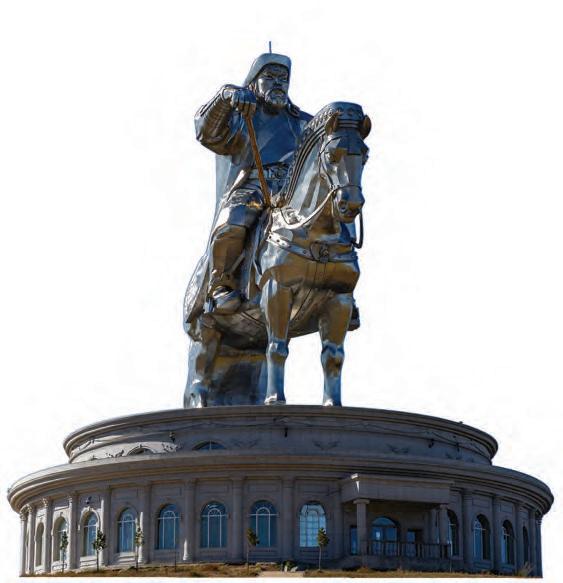
Source 29 This statue of Genghis Khan, ruler of the Mongol Empire from 1206 to 1227 over 40 metres high. While Genghis Khan ruled the Mongol Empire for a relatively short period of time, the changes he introduced are considered significant because they affected enormous numbers of people over a vast area of the world.
DRAFT
R Remarkable – what was the most notable thing about the event/ individual/group of people?
R Resulted in change – what happened as an immediate result of the event/individual/group of people? (Think about short-term effects.)
R Revealing – what does the event/individual/group of people tell us about the time period?
R Resonates – how does the event/individual/group of people (in the past) affect the lives of people today?
R Remembered – how is the event/individual/group of people remembered today? (Think about evidence that still exists.)
Source 30 The 5Rs of historical significance
Check your learning Log onto your obook pro to complete the questions for topic 7.4.
Communicating 7.5
Historical writing
Historical writing requires you to describe and explain using information from a range of sources as evidence.
How to write a description
The purpose of descriptions is to give clear information about people, places or objects at particular moments in time. They focus on the main characteristics of particular people or things. Descriptions must always follow a set structure, and events must be organised in chronological order.
Source 31
Structure of a description
Introduction
Body
Conclusion (optional)
• Introduces the subject
• States the name of the person or event
• Outlines why the topic is important
• The body provides details about the person or event (including dates and important facts)
• Information must be organised in paragraphs, with a new paragraph for each detail
• Quotations and descriptive words must be used where relevant
• Revisits the most important details and provides a concluding statement
How to write an explanation
The purpose of explanations is to tell how or why something happened. They provide the reader with a greater understanding of the causes and effects of past events. Explanations must be clear and factual. They should not contain opinions or emotional language. There must be supporting evidence from a variety of sources.
How to reference in an explanation
DRAFT
When you use information from a source within an explanation, either by a direct quote or an indirect reference, the source needs to be acknowledged. This can be done in various ways, depending on the referencing system you are using. One of the simplest referencing systems is the Harvard referencing method, where quotes and indirect references are acknowledged within the text. This is done by placing basic information about the source after the quote or the indirect reference. In brackets, write the name of the author, the year the source was published and the page number where it occurs, for example (Smith 1999:234). Whichever method you use, it is important that you use that method consistently.
Source 32
Structure of an explanation
Introduction
• Clearly states the main idea or aim
• Briefly outlines the reasons why an event occurred and its effects
7A What are the historical concepts and skills?
Structure of an explanation
Body
Conclusion (optional)
• Each idea must be supported by evidence; the evidence should be analysed to explain its significance or importance
• Information must be organised in paragraphs, with a new paragraph for each detail
• Language should be precise and not contain emotional words
• Personal opinions should be avoided
• Provides a short and clear overview of the main ideas presented in the body
• States a conclusion drawn from the evidence
How to write a paragraph using TEEL
When writing a paragraph – either by itself or as a part of an essay – it is important to structure your thoughts logically. The acronym TEEL is a helpful way of remembering how to do this. Read Source 33 carefully to familiarise yourself with each of the steps of TEEL. Then read Source 34 to see an example of a paragraph that has been written using TEEL.
Source 33 The TEEL structure
T Topic Introduce your main idea in the first sentence.
E Explain Provide some background knowledge on your main idea.
E Examples Be sure to use two or three examples in a paragraph. Examples are important in a history essay, as they act as your evidence. Examples include facts and figures, dates, names, places, events, statistics and sources.
L Link Sum up your paragraph by providing some analysis or evaluation on the topic. Do this by providing your opinion on the matter. Some ideas for a good link include:
• How useful is the evidence you have used?
• Did any changes take place because of the example you have used?
• Do you need any more evidence to make a proper judgment on the topic?
In your link, use linking phrases such as ‘overall’ or ‘ultimately’ to help make your final statement.
Source 34 An example of a written response using TEEL , on the impact of the Black Death
T One major effect of the Black Death on medieval Europe was the change in the way that people saw the role of the Catholic Church in society.
DRAFT
E Up until then, the Church was very powerful, influential and wealthy. It governed people’s behaviour and educated them in what was right and wrong. However, the Church was unable to control or explain the Black Death. In addition, many monks, nuns and priests died from the plague, or fled in fear of becoming infected. This made people feel disappointed and angry towards the Church.
E As a result, many common people began behaving without regard for the moral teachings of the Church. Italian writer Giovanni Boccaccio explained this in the fourteenth century, when he wrote that some ‘thought the sure cure for the plague was to drink and be merry, to go about singing and amusing themselves’. Furthermore, this feeling was also captured in the painting Dance of Death from the fourteenth century, which shows a knight and a man dancing happily with skeletons.
L Ultimately, the Black Death weakened the role of the Church in medieval Europe. This caused people to question the Church and seek their own knowledge, which eventually led to the Renaissance era. Even royalty began to question the power of the Church, leading to Protestants establishing new faiths, and a Reformation. While the Black Death did not bring an end to feudalism or the Church, it significantly weakened the Church’s role in medieval Europe.
Check your learning Log onto your obook pro to complete the questions for topic 7.5.
8A How were societies in medieval Europe organised?
Social groups in medieval Europe
King
• The king owned all the land. He kept 25% and granted 75% to his vassals.
• He administered the country, directed wars and fended off challengers to the throne.
• He enjoyed wealth and privileges, such as banquets and balls.
Nobles, lords and bishops
• Nobles inherited their family titles. They made up less than 1% of the population.
• They were granted 75% of the land belonging to the king.
• They lived in large manors or castles on a fief. Every fief had a church with many Christian workers, such as friars, monks and nuns.
• Lords ruled over all business matters, and collected taxes from peasants.
• Bishops also collected taxes, but did not pay taxes to the king. They became very wealthy.
Knights
• Knights were a small social group who protected their lords and would fight for the king when required. Most were the sons of nobles.
• They provided security within the fief, and received income (food and supplies) from the peasants.
• Knighthood could be earned through official training, starting as a page (a servant of a knight) at the age of 7. At 14, they received a sacred sword from the bishop and became a squire. As a squire, they fulfilled honourable duties for their knight. If they proved their bravery, they became a knight at 21.
DRAFT
8.3 Check your learning
Retrieve
1 What is a fief?
Comprehend
2 Describe the relationship between a vassal and a lord.
3 What is a hierarchy? Do we have hierarchies of any kind in Australia today? Explain your answer.
Analyse
Peasants and serfs
• Peasants and serfs were the labourers and farmers – producing all the food, supplies and services. They made up over 90% of feudal society.
• They were heavily taxed and paid rent to those above them.
• Their lives were hard, with little rest or comfort. They worked long hours on the fields with simple tools, such as sickles.
• Peasants had a few political rights and some owned land.
• Serfs had no political rights and did not own any land.
4 Suggest how a medieval ruler’s position might have been strengthened by giving fiefs to those who provided loyalty and support.
5 Distinguish between the main responsibilities of each group shown in Source 5. by writing about how they are different.
The Spanish conquest of the Americas
Towards the end of the fifteenth century, a period of exploration began in Europe. Driven by a desire for wealth, power and territories, countries such as Spain sent explorers known as conquistadors (conquerors) in search of new lands and trade routes.
In 1492, navigator and explorer Christopher Columbus – an Italian hired by the Spanish royal family – found the islands now known as the Bahamas. This marked the beginning the Spanish conquest of the Americas.
When the Spanish arrived, there were two dominant empires in the Americas: the Aztec Empire and the Inca Empire. The Spanish saw these indigenous peoples as primitive, godless ‘savages’; they enslaved them, and devastated their cultures.
Source 1 An artist’s impression of the capital city of the Aztec Empire, Tenochtitlan, before the arrival of the Spanish in 1519; at this time, Tenochtitlan was home to around 200 000 people. By 1521, two years after Spanish arrival, the Aztec Empire had collapsed and Tenochtitlan had been destroyed.
11A
How were societies organised in the Americas before the arrival of the Spanish?
11B
Why did the Spanish colonise the Americas? How were they able to do so?
11C
What were the effects of Spanish conquest in the Americas and around the world?
1428
The Spanish conquest of the Americas: a timeline
A triple alliance is forged between the cities of Tenochtitlan, Texcoco and Tlacopan. This cements the power of the Aztec Empire.
1494
The Treaty of Tordesillas is signed. In it, Pope Alexander VI grants all lands to the west of a line drawn through the Atlantic Ocean to Spain, and all lands to the east of the line to Portugal.
1507
‘America’ is first named by the cartographer Martin Waldseemüller, in honour of the explorer Amerigo Vespucci.
Source 1 A timeline of some key events during the Spanish conquest of the Americas
Christopher Columbus arrives in the Americas, landing in the Bahamas, Cuba and Hispaniola in the Caribbean.
1502
Montezuma becomes the Aztec ruler.
An artist's impression of the arrival of Columbus in the Americas
Spanish conquest of the Americas
An artist’s impression of Cortés meeting Montezuma
Hernán Cortés arrives in the Aztec Empire and enters the capital
11 A How were societies organised in the Americas before the arrival of the Spanish?
1521
The Aztecs are defeated and Tenochtitlan is destroyed after a three-month siege by the Spanish and their allies.
1532
Pizarro returns with a small force and captures the Inca ruler. The Inca capital of Cuzco falls to the Spanish in the following year.
1572
1517
Hernandez de Cordaba begins to explore the Yucatan Peninsula and Mexico’s east coast.
1520
Aztecs in Tecnochtitlan are massacred by the Spanish, and Montezuma dies. The Spanish are driven out of the city a few months later. A smallpox epidemic sweeps through the region in the same year, killing thousands.
11.1 Check your learning
Retrieve
DRAFT
Analyse
The last Inca Empire is defeated by the Spanish, ending all resistance to Spanish colonisation in South America.
1 Identify who the Aztec leader was when Hernán Cortés entered the Aztec Empire.
2 Name the Spanish and other Europeans mentioned in the timeline and identify the key events in which they were involved.
3 What does the abbreviation ‘ce’ stand for? Why is it used? (See page 206 of ‘The history toolkit’.)
Comprehend
4 Describe the purpose of the two zig-zag lines used on the timeline. (See page 207 of ‘The history toolkit’.)
5 Use the timeline to calculate the length of the period between:
a the arrival of Cortés in the Aztec Empire and the capture of its capital, Tenochtitlan
b the arrival of Pizarro in the Inca Empire and the capture of its capital, Cuzco.
Apply
6 Select an individual from the timeline. Investigate the person and write a paragraph that explains their significance in the Spanish conquest of the Americas.
1580 CE
1530
Francisco Pizarro makes contact with the Inca Empire.
The siege of Tenochtitlan
Learning intention
By the end of this topic, you will be able to:
» describe significant features of the Maya, Inca and Aztec civilisations.
‘Out of Africa’ one model in the theory of how modern humans spread around the world; it hypothesises that modern humans developed in Africa before migrating outwards ice age a cooler period in the Earth’s history when ice covered much of the northern hemisphere and sea levels were much lower than they are today
The major civilisations of the Maya, Inca and Aztec
According to the ‘Out of Africa’ hypothesis, modern humans evolved in Africa and first left the continent around 200 000 years ago to find new hunting areas. They settled in the Middle East, followed by areas in Europe and Asia, as these locations were the closest.
Eventually, humans arrived in the Americas (see Source 2) after migrating from the Eurasian land mass eastwards, sometime between 40 000 and 15 000 years ago, during the last great ice age They journeyed on a land bridge between Asia and North America that existed when sea levels were lower than they are now. Some people moved eastwards and settled across the northern parts of North America. Others moved further south, into the most southern regions of North America and into Central America and South America. The three main civilisations in this region were the Maya, the Inca and the Aztec (see Source 3). Only two of these civilisations remained by the fifteenth century. These were the Aztec (in the region that is now Mexico) and the Inca (in the region that is now Peru).
11 A How were societies organised in the Americas before the arrival of the Spanish?
The Maya
The Maya civilisation was the oldest of the three. It was at the height of its power between 250 and 900 ce , when the Maya ruled a large area of southern modern-day Mexico and northern Central America, centred around the Yucatán Peninsula. The Mayan people did not have one sole leader or capital city. Each of their cities had its own ruler, who governed independently. The Maya were skilled in arithmetic and astronomy, and had their own form of hieroglyphic writing, known as glyphs.
DRAFT
Source 5 An example of Mayan glyphs from the Madrid Codex, dating between about 900 and 1521 ce (from the Museo de América, Madrid); a codex is a bound ancient manuscript, similar to a book.
Source 4 The ruins known as Mundo Perdido (which is Spanish for ‘ Lost World ’) in the ancient Mayan city of Tikal (in modern-day Guatemala)
The Inca
The Inca were originally one of many tribes in the Andes Mountains of South America, in modern-day Peru. They conquered other tribes, and by 1493 ce the Inca Empire had become the most powerful in the Americas, with the city of Cuzco as its capital. Their territories extended for 4000 kilometres on the western coast of South America (see Source 3), including parts of modern-day Chile, Ecuador, Peru and Bolivia. To govern their empire, the Inca developed an efficient administrative system, an extensive network of roads, and strategically built stone fortresses. They excelled in working metals, such as silver, copper and gold.
DRAFT
The Inca built intricate cities and temples. One of the most famous examples of this is Machu Picchu, perched high on the top of a mountain (see Source 7).
Source 7 The restored remains of Machu Picchu
Source 6 An example of an Inca tumi – an ornate ceremonial tool, with a distinctive curved blade, which could be used for sacrifices
Explore it!
A virtual field trip to Machu Picchu
The Aztecs
11 A How were societies organised in the Americas before the arrival of the Spanish?
The Aztecs were a group that originated in the north of modern-day Mexico. Note that the word ‘Aztec’ can refer to the civilisation itself, the people, or just the ruling classes. The Aztecs were self-sufficient and highly skilled. By conquering rival tribes, they created an empire that stretched between the Pacific Ocean and the Gulf of Mexico (see Source 3). When the Spanish conquistador Hernán Cortés arrived in 1519, there were around 489 city-states in the Aztec Empire, ruled by the powerful ruler Montezuma II (also known as Moctezuma). The centre of Aztec civilisation was the capital Tenochtitlan, a city built on swampy islands in the middle of Lake Texcoco.
11.2 Check your learning
Retrieve
DRAFT
1 Identify the modern-day countries where the Maya, Inca and Aztec civilisations were located. (Hint: Refer to the map at the back of this textbook to help.)
2 Name three achievements of the Inca.
Comprehend
3 Describe the journey that humans took to occupy the Americas.
4 Explain why the land bridge connecting Europe and North America no longer exists today.
Analyse
Source 8 The Aztec ‘calendar stone’, also known as the ‘sun stone’, was discovered in Mexico City in 1790. This massive circular monolith, with the Aztec sun god at its centre, dates from the early sixteenth century. Its hieroglyphics relate the mythology of the Aztec world.
6 Examine Source 7 and think about what type of skills would have been required to build the city of Machu Picchu. List these skills based on your observation, and explain how you came up with each one.
Apply
7 Investigate the geographical features of one of the three civilisations discussed in this topic. How did the environment influence daily life in this civilisation? conquistador (pronounced con-kees-tador) a Spanish word for a soldier or conqueror city-states independent settlements made up of an inner fortified city surrounded by houses; this built centre was surrounded by farmland that supported (e.g. with food) the urban centre
5 Distinguish between the ways the Maya and Aztec civilisations were governed. Remember, when you distinguish between two things, you need to talk about how they are different.
Source 9 A modern artist ’s impression of the city of Tenochtitlan
11.3
Learning intention
By the end of this topic, you will be able to:
» describe the social organisation of the Aztecs.
Key groups in Aztec society
hierarchy a social structure that organises people with the most important group on top and others ranked beneath in decreasing order of importance
emperor someone who rules an empire; an empire is a group of countries or areas often speaking different languages and having different cultures, but centrally ruled
absolute ruler an individual who governs with supreme authority, unrestricted by laws tributes something given as a mark of respect to someone important
Aztec society was organised according to a strict hierarchy, and each person had a particular place and role to fulfil. There were five major social classes – the emperor, nobles, warriors, commoners and slaves – and there was little opportunity to move out of the class into which you were born. Older people were highly respected in Aztec society.
Emperor
At the top of the hierarchy was the emperor. The emperor was an absolute ruler, who was selected as leader by a council of nobles. He was regarded by the people as a god, and was called the ‘Great Speaker’. The emperor lived in a highly decorated palace and enjoyed a luxurious lifestyle. He ruled with the help of his noble officials, counsellors, judges and military leaders.
Nobles
The nobility included high-level priests, military leaders, landowners, judges and heads of government. These ruling groups were privileged, and lived well compared to the ordinary people. Nobles could receive tributes from commoners.
Noble status was passed down from parents to children. Nobles lived on their own estates, and were the only class other than the emperor allowed to wear decorated capes and jewellery. The wealthy and those who were heroes of war dressed elaborately, with intricate headdresses (often made of feathers), necklaces, earrings and bangles made of gold, silver, copper and precious stones. Their body art included ornaments worn in holes in the ears and in split bottom lips. The nobility would show their wealth and dominance through extravagant feasts and expensive gifts to each other.
Source 10 The Aztec emperor Montezuma
Source 11 An example of the long, feather headdress worn by an Aztec noble
Warriors
11 A How were societies organised in the Americas before the arrival of the Spanish?
Warriors were highly respected in Aztec society. Most males in Tenochtitlan were trained to be warriors, and left their families at puberty to go and live in the local warrior house. Women could not be warriors.
Warriors were expected to be very brave, and were taught that it was an honour to die in battle. There was a formal hierarchy within the warrior group based on how many live captives (who were later sacrificed to the gods) a warrior had taken in battle. Successful warriors could expect to receive gifts and riches, but for most it was a part-time profession. The majority of warriors had to practise another trade to support themselves.
DRAFT
Source 12 A sixteenth-century illustration of Aztec warriors from the Codex Mendoza; the warriors carry wooden weapons and shields made from feathers, agave paper (made from a type of succulent), leather and reed.
Commoners
All commoners were grouped into clans. Members of each clan owned and farmed their land, and they were responsible for maintaining their local temples and schools, which every child attended. Commoners included farmers, craftspeople, merchants and low-level priests. They were expected to pay tribute to the nobles who owned the calpulli (neighbourhoods) that they lived in.
Commoners usually ate basic foods, including domestic animals such as turkeys, dogs and guinea pigs, and lived in simple homes. They were not allowed to wear cotton, wear cloaks longer than the knee, or wear sandals in the presence of people of higher rank. Commoners could sometimes become nobles through marriage or in recognition of their bravery in war.
clans
groups of people linked and united in their aims and behaviours by the knowledge (or a belief) that they share common ancestors calpulli in Aztec society, a neighbourhood within a city-state
Analyse this!
Aztec warriors
Slaves
Slaves were owned by nobles or wealthy merchants, and had few rights. Typically, people became slaves if they were criminals, could not pay their debts or had been captured in war. Slaves could marry with their master’s permission and could also buy their freedom. Slave status was not passed down to children; the children of slaves were born free.
The role of men and women in Aztec society
KEY CONCEPT Evidence
DRAFT
An Aztec family was made up of a man, his chief wife, his other wives, his children and other relatives such as his parents. Marriages were arranged with help from priests, who would consult the stars to check for suitable matches.
Girls married at around 16 years of age and men at around 20. Both boys and girls went to school, although they were destined for very different lives. Women were expected to care for children, cook and weave cloth. They helped to tend home gardens and any other plots of land the family was given to work. They had almost no public role. Men, on the other hand, were expected to become warriors and seek glory by taking enemy captives.
Aztec discipline of children
When looking at pieces of primary evidence, historians use empathy to recognise how people in the past felt. By using empathy, historians can develop an understanding of how certain issues, events or relationships affected people.
For Aztec children, discipline was very strict, both at home and at school. Punishments included being speared with the sharp spines of a cactus, being left bound and naked in the dark in a cold puddle, or being bound and held over a fire to inhale smoke from burning chillies (see Source 14).
Source 14 Illustrations from the sixteenth-century Codex Mendoza (see page 11.20) give details of the Aztec discipline of children. Here, a boy is being forced to inhale dried chilli smoke for disobeying his parents.
Source 13 An illustration from the sixteenth-century Florentine Codex (see page 11.20) showing an Aztec commoner threshing amaranth grain (a food used by Aztecs in their religious ceremonies)
11 A How were societies organised in the Americas before the arrival of the Spanish?
Source 15 More illustrations from the Codex Mendoza show that typical jobs for children in the Aztec Empire included fishing and weaving . Children also ground maize (corn) to make tortillas (bread).
11.3 Check your learning
Retrieve
1 Identify the groups of people who helped the emperor rule.
2 How did people become slaves? Comprehend
3 Describe the roles and responsibilities of the warrior class. Analyse
4 Distinguish between a noble and a commoner. Remember, when you distinguish between two things, you should talk about how they are different.
DRAFT
b Identify whether this is a primary or secondary source. Use evidence to give reasons for your response.
c How reliable do you think this source is? Use evidence to explain your answer.
Apply
5 Examine Source 14.
a Describe what the source is showing. Refer to specific parts of the source and use evidence to support your answer.
6 a Imagine that you are an Aztec child from a family of commoners. Create a diary entry about your daily life and the discipline you face. You could include information about housing, food, clothing, reasons for discipline and types of discipline.
b How does your diary entry use empathy to help imagine what life was like for the Aztecs?
Learning intention
By the end of this topic, you will be able to:
» describe the key religious beliefs of the Aztecs.
polytheistic relating to the belief in or worship of more than one god
Religious beliefs in Aztec society
Religion was a central part of Aztec society and dominated almost every aspect of daily life. The Aztecs were polytheistic, and worshipped many gods who they believed were responsible for things such as the sun, war, rain, crops, harvests, fire and the dead (see Source 16). Aztec gods were believed to be demanding, and had to be calmed through bloody offerings.
Source 16 The gods who were most important to the Aztecs
Huitzilopochtli God of the sun and of war
Tlaloc God of rain, agricultural fertility and water
Xipe Totec God of springtime and new crops
Quetzalcoatl God of nature, earth and air
Tezcatlipoca God of the night sky; giver and taker of all life on Earth
Mictlantecuhtli God of the dead
Xiuhtecuhtli God of fire
Source 17 A drawing of the god Quetzalcoatl, the ‘feathered serpent god’, from the Codex Borbonicus
The Aztecs believed that their gods gave them life. For example, they believed that Huitzilopochtli battled with the forces of darkness every night so that the sun would come up the next morning. If ever he grew weak, the sun would not rise and the universe would come to an end, so people had to provide nourishment for him in the form of blood sacrifice. The Aztecs welcomed Tlaloc as a god who gave life and sustenance, but also feared him for his ability to send hail, thunder and lightning.
The Aztecs built temples to worship their gods. They were steep pyramid-shaped structures, with lots of steps to reach the top.
The Aztecs believed the process of ascending the stairs was part of preparing oneself to please the gods.
Life after death
The Aztecs believed in life after death. They believed that the way someone died, rather than the way they lived, determined what would happen to them in the afterlife. If a person died a normal death, his or her soul would pass through the nine levels of the underworld before reaching Mictlan, the realm of the death god Mictlantecuhtli. However, warriors who died in battle and women who died in childbirth joined Huitzilopochtli. The dead were buried with goods of all descriptions for use in the afterlife.
11 A How were societies organised in the Americas before the arrival of the Spanish?
Human sacrifices
Human sacrifices were performed in honour of the gods of the sun, rain and earth. The most common form of sacrifice among the Aztecs involved stretching the victim over a sacrificial stone. Four priests held the limbs of the victim, while another priest cut open the chest and took out the heart. The heart was placed in a chacmool (see Source 18) and the victim was then thrown down the steep temple steps. The body was picked up and part of it, such as the thigh, was given as a reward to the victim’s captor to eat. Those who were sacrificed were considered to be fortunate, since they were guaranteed a place in the highest heaven reserved for warriors who died in battle.
Mass sacrifices
DRAFT
Sacrificial ceremonies could involve just one victim or many thousands at once. For example, when the Temple of Huitzilopochtli was completed in Tenochtitlan, up to 20 000 people were sacrificed. The victims were prisoners from a group called the Huastecs, from the north-eastern part of what is now Mexico. In 1487, they had tried to revolt against the Aztec Empire but had been unsuccessful. As punishment, the Aztec warriors marched
chacmool in Aztec society, a sculpture of a reclining human figure with a tray on its lap, used to hold sacrificial offerings
Source 19 A knife used by Aztec priests for human sacrifices
Source 18 An Aztec chacmool
Analyse this!
An Aztec chacmool
them back to Tenochtitlan, roped together by cords which ran through a in their nose or around their neck.
As they arrived, they were greeted by priests who informed them that they had the privilege of dying as offerings at the Great Temple, or Templo Mayor. There were four lines of prisoners that stretched the full length of the streets leading up to the temple. The victims were men, women and children, who cried and wailed as they walked to their deaths. They climbed, stumbled or were dragged up the steps of the pyramid.
Source 21 This image shows the Road of Death leading to the Pyramid of the Moon, Teotihuacan (in modern-day Mexico). Life in the Americas before colonisation was so advanced that, by the time of the Aztecs, this ancient city was already abandoned and in ruins.
DRAFT
When they reached the top, they were sacrificed by the priests. One body after another – after the heart was cut out – rolled down the steep steps of the pyramid. The priests became drenched in blood, and eventually the blood ran in rivers down the steps.
Source 20 An illustration of a ritual killing from the Codex Magliabechiano, showing victims being sacrificed on the steps of a temple
11 A How were societies organised in the Americas before the arrival of the Spanish?
The 5Rs of historical significance
History is full of so many important events, people and discoveries that we could never study them all. Instead, we need to make a judgment about which ones are worthy of study. To do this, we must analyse how significant they are.
The 5Rs (see Source 22) are an easy way for us to remember what to look for and what questions to ask when analysing the historical significance of aspects of the past. They stand for remarkable, resulted in change, revealing, resonates and remembered. The table in Source 22 contains some guiding questions that we can use when distinguishing between each of the 5Rs.
For more information on this skill, refer to page 212 of ‘The history toolkit’.
Practise the skill
1 Using what you have learnt about the importance of human sacrifice in Aztec religious beliefs, analyse the historical
11.4 Check your learning
Retrieve
1 In your own words, define ‘polytheism’.
2 What did the Aztecs believe would happen if sacrifices were not made to Huitzilopochtli?
Comprehend
significance of this practice by working through each of the 5Rs (as outlined in Source 22).
Source 22
5Rs of significance
Guiding questions
Remarkable What was the most notable thing about the event/ individual/group of people?
Resulted in change What happened as an immediate result of the event or the actions of the individual/group of people (i.e. what were the shortterm impacts)?
DRAFT
Revealing What does the event/ individual/group of people tell us about the time period?
Resonates How has the event/ individual/group of people had an effect on future generations (i.e. what were the long-term impacts)?
Remembered How is the event/ individual/group of people remembered today? What evidence still exists?
3 Explain why the way Aztecs died was considered important.
4 Describe the purpose of a chacmool
5 Summarise the relationship that the Aztecs had with their gods. Why do you think they felt the way they did? Apply
6 Create a diary entry reflecting on the sacrifice of the Huastec people, from
the perspective of either a priest or one of the Aztec nobles watching the ritual. (See page XX of ‘The history toolkit’ for more on the key concept of perspective.)
7 The historical concept of cause and effect relates to why something happened, and what positive and negative effects it created. In pairs, discuss the cause and effect of human sacrifice on:
a the Aztecs
b the Huastecs and other civilisations.
11.5 Life in Tenochtitlan
Learning intention
By the end of this topic, you will be able to:
» describe life in the capital city of Tenochtitlan.
chinampas in Aztec society, humanmade floating islands used for agriculture
Tenochtitlan was the capital of the Aztec Empire. It was founded around 1325 ce in the Valley of Mexico, now the site of modern-day Mexico City.
By 1519, Tenochtitlan was home to 200 000 inhabitants on an island of about 8 square kilometres. This was at a time when Spain’s largest city, Seville, had a population of 70 000. Source 23 is an account from the Spanish conquistador Hernán Cortés. It shows us his first impressions of Tenochtitlan on his arrival that year.
The shape of the city
When we saw all those cities and villages built in the water … we were astounded … These great towns and pyramids and buildings rising from the water, all made of stone, seemed like an enchanted vision.
As the power of the Aztec Empire grew, the entire urban area of Tenochtitlan was carefully rebuilt in the fifteenth century. It was laid out on a grid pattern, with ‘roads’ running from north to south and from east to west. In Aztec mythology each of the four main points of the compass had important religious significance, with its own gods, rituals and colours. Because it mirrored the path of the sun, the east–west axis was the most important one.
The city was divided into four districts. Each district was composed of neighbourhoods called calpulli, inhabited by commoners such as craftspeople and farmers. It was possible to travel virtually anywhere in the city by boat. Many of Tenochtitlan’s ‘roads’ were in fact canals, or waterway channels. Six major canals – and many smaller ones – criss-crossed the city.
As Tenochtitlan was built on a lake, the Aztecs living there had no real access to farmland. To fix this, they constructed human-made islands called chinampas. A shallow part of the lake was fenced off and filled with mud until it rose above water level. This provided a bed on which to grow crops, such as maize (corn), tomatoes, potatoes, beans, chillies, peanuts, limes and avocadoes. Canoes took sewage from the city’s public toilets to be used as fertiliser on the chinampas.
Source 24 An illustration taken from a manuscript shows the chinampa system used by the Aztecs to construct the floating gardens for the city of Tenochtitlan.
Source 23
Extract from a letter from Hernán Cortés, describing his arrival in Tenochtitlan
Quiz me!
A quick quiz on life in Tenochtitlan
11 A How were societies organised in the Americas before the arrival of the Spanish?
Source 25 An artist’s impression of the marketplace in Tenochtitlan, with the Templo Mayor in the background
Creating chinampas
Over time, some things stay the same, while others change. Historians refer to aspects of the past that have remained the same over time as ‘continuities’, whereas aspects of the past that do not stay the same are referred to as ‘changes’.
A chinampa is a historical technique that has continued. Chinampas are a good example of sustainable farming, and still exist today in Mexico City. They
Commerce and tributes
are sustainable because they grow plants while conserving water, and they do not use large areas of land.
Some eco-friendly companies have used elements of the Aztecs’ methods for constructing chinampas to create new farming innovations.
For more information on this key concept, refer to page 200 of ‘The history toolkit’.
Source 26 Organic vegetable crops are grown on a chinampa in Mexico City today.
KEY CONCEPT
Continuity & change
DRAFT
In Tenochtitlan, the centre of commerce was the huge market square, where 60 000 people came each day to buy and sell. There was also a sacred precinct in the centre of the city, surrounded by a wall. Within this precinct were temples, public buildings, palaces and plazas. The Great Temple, or Templo Mayor, loomed over everything (see Source 2 5). The blood on its steps from human sacrifices was visible even from a great distance.
The Valley of Mexico did not have all the geographical requirements needed to keep a city the size of Tenochtitlan running. For example, there was very little land in the valley that could be farmed. Cotton could not be grown in the valley; nor could most food. For Tenochtitlan to survive, it relied on supplies from villages and societies outside the city. Some of the supplies were purchased through trade, but much of the city’s wealth and many of its goods were brought in from other parts of the empire through the tribute system.
The populations that surrounded Tenochtitlan were forced to pay taxes as tributes. Each year, Tenochtitlan received 7000 tonnes of corn, 4000 tonnes of beans, 4000 tonnes of amaranth grain and 2 million cotton cloaks. Tributes also included huge amounts of feathers, precious stones and metals, cacao beans (the seed pod from which cocoa is made), tobacco and chocolate.
Source 27 The ruins of the Templo Mayor, the main temple in the great city of Tenochtitlan
Source 28 An artist’s impression of daily life in Tenochtitlan
Daily life in Tenochtitlan
Tenochtitlan was the bustling capital of Aztec society. According to legend, the Aztecs decided to settle here because they saw an eagle land on a cactus plant with a snake in its mouth. They believed this was a sign from their god, Huitzilopochtli. The city was built on five marshy islands in the middle of Lake Texcoco.
1 When children were young, they were educated at home by their parents. By law, all Aztec children were required to attend school when they became teenagers. This included slaves and girls, which was unlike many other civilisations at the time. Boys and girls attended separate schools. Boys typically learned a trade, such as pottery or farming, whereas girls learned about religion.
2 The markets were the lively centre of the city. Merchants travelled great distances to the markets, by foot or canoe, to sell goods such as feathers, rubber, animal skins and foodstuffs.
3 The Templo Mayor (Great Temple) dominated the city. Huge numbers of people – and sometimes animals – were sacri ced at an altar on top of this pyramid to please the gods.
Daily life in Tenochtitlan
A popular game involved the use of elbows, knees and hips to ick a rubber ball through a stone hoop on the wall. Sometimes the defeated team lost their lives as well as the game!
11.5 Check your learning
Retrieve
1 Where was Tenochtitlan located?
2 What was Tenochtitlan’s population in 1519? How did this compare to Spain’s largest city?
Comprehend
3 Summarise the geographical limitations of the Valley of Mexico.
DRAFT
4 Explain why the tribute system was necessary for Tenochtitlan’s survival, and suggest what would happen if a group did not pay its tributes.
Analyse
5 Distinguish between the clothing worn by commoners and the clothing worn by nobles. Remember, when you distinguish between two things, you need to talk about how they are different.
Apply
4 Nobles dressed elaborately, with colourful clothing, jewellery and headdresses. They also wore masks during rituals for the Aztec gods. Clothing was important to nobles because they could trade it for a slave. For commoners, clothing for men was typically a length of plain cloth wrapped around the body and knotted on one shoulder. This assisted them in carrying goods. Women wrapped a piece of cloth around their hips and legs (much like a skirt), and added a loose top.
6 Investigate how the Aztec built chinampas.
a How have elements of the original Aztec chinampa method continued to exist today? What elements of this method have changed?
b Present the results of your research as a step-by-step guide to constructing a chinampa. Include labelled and annotated images.
c Compare the use of chinampas to the typical agricultural techniques used in Australia today. You may need to do some additional research to help you with this. Remember, you when compare things you must talk about how they are the same and different.
7 A poor farming family’s home on a chinampa (arti cial island) was made of mud brick, and its roof was made of reeds. Maize (corn), the staple food of the Aztecs, was ground into a coarse our to make tortillas ( at bread) to wrap around vegetables and meat.
SKILLS IN CONTEXT
Test me!
Once you’ve finished the topics in this section, test yourself with this quiz and find out which worksheet you should do.
Source 29 A view of the pyramids of Teotihuacan located in the Valley of Mexico, near of Mexico
Life in the Aztec Empire
In the sixteenth century, Spanish conquistadors created many illustrated accounts of daily life in the Aztec Empire so that people at home in Spain could gain a better understanding of traditional Aztec culture. Each of these accounts was bound together to make a special kind of book known as a codex (plural codices). These codices – including the Florentine Codex, Codex Mendoza and Codex Magliabecchiano – have provided valuable information to historians about how the Aztec people lived.
The Florentine Codex is a 12-volume work that was completed over the course of three decades, from 1549 to 1579. It was compiled by a Spanish priest, along with indigenous writers and illustrators. It includes more than 2000 painted illustrations, and documents the culture and religious practices of the Aztecs at the time of the Spanish conquests.
The Codex Mendoza was commissioned by Spanish rulers in 1541 to create a record of the Aztec Empire. Illustrations were drawn by indigenous artists, with explanations written by Spanish priests. The Codex Magliabecchiano (see Source 20 on page 11.14) was created as a religious document in the mid-sixteenth century.
Source 30
[Midwife’s address to newborn boys:]
My precious son, my youngest one … heed, harken: thy home is not here, for thou art an eagle, thou art an ocelotl [a jaguar] … Thou belongest out there … Thou hast been sent into warfare. War is thy desert, thy task. Thou shalt give drink, nourishment, food to the sun, the lord of the earth. Perhaps thou wilt receive the gift, perhaps thou wilt merit death by the obsidian knife [be killed as a sacrifice to the gods].
[Midwife’s address to newborn girls:]
Thou wilt be in the heart of the home, thou wilt go nowhere, thou wilt nowhere become a wanderer, thou becomest the banked fire, the hearth stones … And thou wilt become fatigued, thou wilt become tired; thou art to provide water, to grind maize, to drudge; thou art to sweat by the ashes, by the hearth [the floor of a fireplace].
Extracts from addresses given by midwives to newborn boys and girls, as described in the Florentine Codex
Source 31 Illustrations from the Codex Mendoza show punishments for children who disregarded instructions from a parent – being forced to inhale dry chilli smoke, and being forced to lie on damp ground with bound hands and feet.
KEY SKILL
Using historical sources
Determining the usefulness and reliability of sources
Primary sources are records produced during the period that is being studied or by someone with firsthand knowledge. They may be written documents such as letters, visual sources such as paintings or artefacts such as building remains. Historians examine these sources as evidence to help them determine what happened during a particular period of time. In doing so, they need to draw conclusions about their usefulness and reliability.
When determining if a source is reliable and useful, you should remember the following:
• Your opening sentence should answer the question by stating if the source is ‘reliable and useful’, is ‘not reliable and useful’, or is ‘somewhat reliable and useful’. However, if you are saying that the source is ‘somewhat reliable and useful’, you must have one argument for and against this.
• Using explicit evidence (information that is clearly stated; not just suggested or implied) from the source is the most important thing to do when you are completing a source analysis. This could be a visual observation, a quote from the source (if it is written) or a caption.
Practise the skill
Step 1 Evaluate reliability: When you are asked to determine if a source is reliable, your response should refer to one or both of the following:
• Is the source primary or secondary? Look at the year the source was created. Was it during the time period or by someone with first-hand knowledge?
• Is the source biased? Look at who created the source and why it might have been created.
DRAFT
Determine the usefulness of Sources 30 and 31 by answering the following questions for each one
1 Identify the type of source (for example, illustration, diary entry, artefact).
2 Identify if this is a primary or secondary source and explain why
3 Describe what the source tells you. Use specific evidence (for example, a quote or visual observation) to support your response.
4 Is the source reliable? Use specific evidence to explain your answer.
Step 2 Evaluate usefulness: When you are asked to determine if a source is useful, your response should refer to one or more of the following:
• Is the source reliable?
• Is the source primary or secondary? Look at the year the source was created. Was it during the time period or by someone with first-hand knowledge?
• Is the source biased? Look at who created the source and why it might have been created.
• What is the source saying or showing that will assist me to answer the historical question?
• What additional information would I like that will help me to answer the historical question?
For more information on this skill, refer to page 213 of ‘The history toolkit’.
5 Is the source useful? Use specific evidence to explain your answer.
Extend your understanding
1 Choose a civilisation in the Americas, other than the Aztec, and investigate to find three primary sources for that civilisation.
a For each source, identify one feature that helps you to understand an aspect of the civilisation.
b Explain which source you believe to be the most reliable and why. Support your answer with reference to the source itself, who produced it, when it was produced and for what audience.
Learning intentions
By the end of this topic, you will be able to:
» explain the reasons for the Spanish voyages of exploration and conquest
» understand the role of Christopher Columbus in the expansion of the Spanish empire.
The Age of Exploration begins
Towards the end of the fifteenth century, great voyages of exploration were being undertaken by the Portuguese and the Spanish, as they sought new sea routes between Europe and Asia. This period became known as the ‘Age of Exploration’. While the Portuguese sailed southwards, towards the tip of Africa, the Spanish looked to the west, across the Atlantic Ocean.
At this time, much of the world beyond Europe and Asia was unknown to Europeans, and navigating through unknown oceans was incredibly dangerous. Sailors could use the sun and stars to tell their latitude (how far north or south they were), but there were no reliable ways to establish longitude (how far east or west they were).
Nevertheless, the promise of wealth and riches from finding a new trading route to Asia was strong enough to outweigh the danger. European powers were seeking to expand their empires and establish foreign territories. They did this to gain wealth, power and religious converts. The explorers were attracted by the prospect of material
Analyse this!
The voyages of Christopher Columbus
Spain’s rulers, desperate to be more powerful than their European neighbours, were prepared to fund a risky voyage led by an Italian explorer, Christopher Columbus. On 3 August 1492, Columbus set sail from Palos, Spain, with three ships – the Niña, the Pinta and the Santa Maria – hoping to find a shortcut to the ‘spice islands’ of the East Indies (South Asia) and to reach the fabled lands of Cathay (China) and Cipango (Japan).
Source 1 This painting is called First Landing of Columbus on the Shores of the New World – At San Salvador, West Indies, October 12, 1492. Spanish painter Dioscoro Teofilo Puebla Tolin completed this work in 1892.
First Landing of Columbus on the Shores of the New World – At San Salvador, West Indies, October 12, 1492
11B Why did the Spanish colonise the Americas? How were they able to do so?
In October 1492, however, he landed in the Caribbean islands that are the presentday Bahamas, Cuba and Haiti. He thought that Cuba was Cipango (Japan) or perhaps part of the mainland of Asia. In further voyages, between 1493 and 1504, he landed on other islands in the Caribbean, and searched the Orinoco River in South America for a passage into the Pacific Ocean. Having failed to find one, he returned home in poor health. He died in 1506, still believing that he had achieved his aim of discovering a western route to Asia.
Explorers and conquistadors
Columbus was not the first European to arrive in the Americas. However, his voyage is significant because he started the process of colonisation and conquest that would transform the Americas and eventually go on to destroy the established civilisations there, including the Aztec and Inca Empires. The term ‘pre-Columbian’ is used to describe the period before the arrival of Europeans in the Americas.
After the journeys of Columbus, more than 200 ships brought more explorers and wealth-seekers from Spain to the Caribbean. Conquistadors such as Hernán Cortés and Francisco Pizarro took huge risks to explore unfamiliar territories in the hope of enormous reward.
Source 3 This magnificent replica of Columbus’ flagship, the Santa Maria, was built in 1997–98.
Source 2 Spanish exploration and conquests – key events
Columbus establishes a settlement at Hispaniola (now Haiti and the Dominican Republic), which becomes a launching ground for subsequent Spanish expeditions.
Puerto Rico and Jamaica are captured. The rst stable settlement on the continent is established in Panama in 1510, governed by Vasco Núez de Balboa.
Cuba is invaded by Diego Velázquez.
Florida, on the northern coast of the Caribbean, is discovered but not colonised by Juan Ponce de Leon.
Balboa becomes the rst European to see the Paci c Ocean after ascending a mountain on the Isthmus of Panama (the narrow strip of land that links North and South America).
The Yucatán Peninsula – the lands of the Maya – are discovered by Hernández de Cordóba. Mexico’s east coast is explored by Juan de Grijalva, who brings back gold trinkets and stories of rich tribes in the interior.
An expedition led by Hernán Cortés reaches the Aztec capital, Tenochtitlan. His soldiers are driven out of the city in 1521, but with the help of Aztec allies, the Spanish capture and destroy the city. This marks the end of the Aztec Empire.
Colonies are established in Venezuela (‘little Venice’), in South America.
The Inca coastline of South America is explored by Francisco Pizarro.
Francisco Pizarro sails from Panama with a force of 180 men to conquer the Inca lands. Pizarro’s forces capture the Inca ruler and gain control of the Incas’ largest city, Cuzco. Resistance to the Spanish invaders nally ends in 1572.
plunder to steal from, often using violent force
Reasons for Spanish exploration and conquest
Spain’s government and its people were motivated to explore and conquer new territories in the America’s for a number of reasons (see Source 4). Historians often sum up these reasons as ‘Gold, God and Glory ’
The quest for gold
Many explorers went in search of wealth, both for the Spanish Empire and for themselves. They hoped to find complex civilisations with great wealth that they could then conquer and plunder. Their earliest encounters in the Caribbean, however, did not promise such wealth. Nevertheless, some expeditions had seen tempting glimpses of great civilisations and artefacts made of gold and precious stones.
Source 4 Reasons for Spanish exploration and conquest
Expanding empires: The Spanish and other European powers sought to expand their power and wealth by adding new colonies to their empires. New colonies created wealth for empires through increased trade and taxation, and by using the labour of indigenous people.
New trade routes: Explorers searched for new trade routes to reach China and the Indies by sea.
Spreading Christianity: Supported by the Pope, the Spanish and other explorers wanted to convert pagan peoples (those who did not worship the Christian God) to Christianity.
The lure of adventure and riches: Younger sons of the nobility who would not inherit property and men from ordinary families became conquistadors in the hope of finding adventure and wealth, both for the Spanish Empire and for themselves.
The quest for gold: In the fifteenth century, there was an increased European demand for gold to make coins, jewellery and gold thread for tapestries.
Source 5 An artist ’ s impression of the Niña, the Pinta and the Santa Maria on their fifteenthcentury journey from Spain to the Americas
11B Why did the Spanish colonise the Americas? How were they able to do so?
This encouraged a wave of further exploration and, in both Aztec and Inca territory, the Spanish plundered the wealth and treasures of the empires. Very few gold or silver artefacts have survived because most of the precious metals were melted down to create jewellery or other valuable items back in Spain.
Wealth through tax and slavery
Conquest and colonisation also allowed the Spanish to gain further wealth through taxes. By colonising the Americas, the Spanish could continue to make money by taxing the local population. The Spanish collected the tribute lists from the Aztecs and continued to collect tributes. They also continued the Inca system of mit’a (compulsory labour), forcing men to work in the gold and silver mines.
Spanish settlers (usually conquistadors, soldiers or officials) were given responsibility for a certain number of indigenous people. In theory, they were supposed to protect these people, teach them Spanish and convert them to Catholicism. However, under a system called the encomienda (labour in exchange for benefits), the indigenous people were usually just kept as slaves.
New territories were also an important source of crops for Spain and for Europe. Many basic and exotic crops that had never been seen in Europe were brought back from the Americas. These included chocolate, tobacco, potatoes, tomatoes, bananas, chillies, corn, turkey, pumpkin, rubber, avocado, peanuts, vanilla and pineapple. Some of these crops, such as tobacco, were extremely valuable in monetary terms.
Spreading Christianity
An important motivation for colonisation, besides wealth, was the desire to spread Christianity to non-Christian peoples. The Catholic Church sent missionaries to the Americas to live in the newly established colonies. In fact, there were Catholic priests on some of the initial exploration missions.
11.6 Check your learning
Retrieve
DRAFT
1 What was the name of the island that Columbus thought was Japan?
2 Define the term ‘pre-Columbian’.
3 How did the Spanish use taxes to gain wealth? Comprehend
4 Explain what historians mean by the phrase ‘Gold, God and Glory’
5 Explain why the gold and silver artefacts found in the Americas did not remain intact.
6 Pick three reasons for the Spanish conquest of the Americas. Rank them in order of importance and explain why you have prioritised them this way.
Analyse
Source 6 Aztec gold jewellery found in Tehuantepec in the 1870s, now held in the British Museum; the Spanish took vast quantities of gold and other precious metals from the empires they conquered in the Americas.
Catholic Church the only Christian Church in Europe until the Protestants started breaking away from Rome in the sixteenth century
7 Choose one of the 5Rs (see page 11.15 and page 212 of ‘The history toolkit’) and use it to analyse the historical significance of Christopher Columbus.
8 Examine Source 1.
a Is this a primary or secondary source? Use evidence to explain your answer.
b How useful is this source? Use evidence to explain your answer.
Apply
9 Create a timeline that represents the key events during the Spanish exploration and conquests shown in Source 2. Ensure that the events are sequenced in chronological order, include an even scale, and accurately apply timeline features and terminology.
Learning intentions
By the end of this topic, you will be able to:
» identify key events in the Spanish conquest of the Aztecs
» describe encounters between Cortés and the Aztecs.
Sequence this!
The Spanish conquest of the Aztecs
Hernán Cortés was a Spanish conquistador chosen by the governor of Cuba to lead an expedition to the mainland of South America. Like many others, Cortés had come to the Caribbean to escape the poverty of his hometown in Spain and to seek fame and fortune.
In 1519, Cortés set sail with 11 ships and 530 conquistadors. He also took 16 horses and several large fighting dogs. Cortés intended to conquer and colonise on behalf of the king of Spain and in the name of Christianity. He also intended to find the strait that separated the ‘island’ of Yucatán from the ‘mainland’, in the hope of finding a route to Asia, as it was still believed that China and India were close by.
First contacts, first conflicts
When the conquistadors landed on the eastern coast of Mexico, they heard tales of the powerful Aztec king called Montezuma, who ruled from his capital at Tenochtitlan, several days’ march from the coast.
Cortés’ first contact with the indigenous peoples of the Americas was with the Totonac people, who were subjects of the Aztecs. The Totonacs promised to support Cortés in the overthrow of their Aztec masters. The support of indigenous groups who resented the domination of the Aztecs was an important aspect of Spanish conquest.
KEY CONCEPT
Significance
La Malinche
La Malinche was an individual who played an important role in the Spanish conquest of the Americas. Her father was the leader of an Aztec clan, which meant that she received an education and could speak multiple languages. When her father died, her mother sold her to slave traders, and eventually she became a slave of the Totonacs.
In 1519, Cortés and the Spanish had their first encounter with the Totonacs. La Malinche was one of the slaves given to the Spanish when the Totonacs and the Spanish formed their alliance. She became Cortés’ interpreter and was the mother of his first son, who was the first person of European and indigenous parentage.
Today, there is historical debate on whether La Malinche was a hero or a traitor. This is because while she is
believed to have prevented Cortés from taking the lives of more indigenous people, she also relayed messages that led to much devastation.
For more information on this key concept, refer to page 201 of ‘The history toolkit’
Source 7 Cortés and La Malinche with Montezuma in Tenochtitlan, 1519
The Spanish conquest of the Aztecs
11B Why did the Spanish colonise the Americas? How were they able to do so?
Cortés set out for Tenochtitlan in August 1519, having added 800 Totonacs to his force of conquistadors. They encountered and fought the Tlaxcalans, an indigenous people whose territories lay midway between the coast and Tenochtitlan. After being defeated, the Tlaxcalans agreed to become allies and march to Tenochtitlan. Cortés then reached Cholula, a town close to the high mountains, where he stayed for several days. The Cholulans were allies of the Aztecs, and were planning to ambush and capture the conquistadors on the road. Cortés learnt of the plan and summoned the Cholulan leaders. They arrived unarmed to the temple courtyard, where they were slaughtered by the Spanish conquistadors.
The first allies of Cortés, the Totonacs, returned to their homes laden with gifts from the Spanish, and Cortés left Cholua with a force of around 1000 Tlaxcalans. He chose to cross the mountains over the most difficult pass (now known as Paso Cortés) to surprise the Aztecs.
The conquistadors in Tenochtitlan
The conquistadors reached Tenochtitlan in November 1519. Montezuma met Cortés on the causeway (a raised path) leading into the city. At first, Montezuma believed that Cortés had been sent by the god Quetzalcoatl, but he soon realised that the Spanish were actually after land and treasure. As relations became less friendly, Cortés took Montezuma as a hostage and sent expeditions into the countryside in search of gold, while he continued to collect any treasure he could find in Tenochtitlan.
DRAFT
In May 1520, while Cortés was out of Tenochtitlan, the Spanish massacred a group of Aztec nobles during a festival. This led to an uprising of the city’s inhabitants, and Cortés returned to find that the conquistadors had lost control of Tenochtitlan. Montezuma is thought to have been killed by the crowds at this time. In July 1520, the Spanish tried to quietly withdraw from Tenochtitlan in the middle of the night. However, they were discovered and their withdrawal
Source 8 An artist’s impression of conquistadors slaughtering the local population at Cholula, in what is now central Mexico
Source 9 A coloured lithograph created in 1892, showing the fateful first meeting of Cortés and Montezuma
I used to think, now I think
Reflect on your learning about the factors that led to the conquistadors taking Tenochtitlan and complete the following sentences.
• I used to think ...
• Now I think ... What has changed in your understanding?
siege a military strategy to weaken an area by cutting it off from the outside world aqueduct a construction – such as a series of pipes or canals – that carries water from a source to a destination further away
became a desperate fight to escape. Cortés managed to get away unharmed, but hundreds of Spanish soldiers and Tlaxcalans were killed.
The Aztecs believed the Spanish threat was over after they had driven the invaders out of Tenochtitlan; but smallpox had arrived with the Spanish conquistadors, and soon killed around a quarter of the Aztec population of Mexico.
After escaping from the city, the Spanish retreated to the territory of their Tlaxcalan allies. Cortés rested his army for 20 days, and then set off on a campaign to conquer the Aztecs’ allies in the surrounding regions. This was the most brutal campaign conducted by Cortés. He won over half of the Aztec territories, with the indigenous people being forced to support the conquistadors. An estimated 15 000 to 20 000 people died in battle; women and children were enslaved, and some captives were given to the Tlaxcalans for human sacrifice and to cannibalise. Other tribes joined the Spanish willingly, to help end the rule of the Aztecs.
DRAFT
The destruction of Tenochtitlan
In May 1521, Cortés returned to Tenochtitlan and laid siege to the city with a force of 550 Spanish soldiers and 10 000 Tlaxcalans. As well as carrying out daily attacks, he used boats to cut off supplies of food, and destroyed the aqueduct that brought fresh water into the city.
The Aztecs, who were already vulnerable after the smallpox epidemic, were finally overcome after a three-month siege. Cortés had originally intended to preserve Tenochtitlan and offer it to the Spanish king as a prize. However, after months of bombardment by Spanish cannons, the once-great city lay in ruins.
The Spanish built a new city on top of the ruins of Tenochtitlan. Stones from the temples, pyramids and palaces were used to build churches and government buildings. The canals that had criss-crossed Tenochtitlan were filled in.
11B Why did the Spanish colonise the Americas? How were they able to do so?
Reasons for Spanish success
Historians estimate that around 100 000 Aztecs were killed during the three months that Cortés laid siege to Tenochtitlan. Tens of thousands of Aztecs and other peoples had also been killed as a result of Cortés’ military campaigns. In contrast, the Spanish lost fewer than 1000 of the 1800 conquistadors who came to Mexico between 1519 and 1521.
Source 11 Spanish advantages over the Aztecs in battle
Weapons • used steel for their armour and weapons
• used gunpowder with powerful cannons and firearms
• used horses in battle; before the Spanish came, the Aztecs had never seen horses and were initially frightened of them
• fought with wooden clubs and swords made of obsidian (a hard but brittle form of volcanic rock), which broke against the armour and swords of the conquistadors
Battle tactics
Fighting traditions
• were well trained in disciplined military manoeuvres; a smaller Spanish force could defeat a larger Aztec force as long as they could maintain their energy
• killed enemies from a distance with cannons and guns, retreated when battles were being lost, and attacked villages at night when the inhabitants were asleep
11.7 Check your learning
Retrieve
1 What was the purpose of the expedition led by Hernán Cortés in 1519?
2 Identify the tribes that were allies of the Spanish. Comprehend
• had a tradition of running at their enemies head on; this meant that only the front ranks could fight, to be replaced by rear ranks as they were cut down
• believed that killing from a distance was not honourable; Aztec battles were highly organised and fought hand-tohand
• were used to only wounding their opponents rather than killing (to capture them for sacrifice); this would often give the Spanish a chance to escape from battle to return to fight another day
DRAFT
3 Describe the incident that caused the Aztecs in Tenochtitlan to rise up against the conquistadors in 1520.
4 Describe the tactics Cortés used in his successful siege of Tenochtitlan. Analyse
5 Choose one of the 5Rs (see page 11.15 and page 212 of ‘The history toolkit’) and use it to analyse the historical significance of La Malinche.
6 Examine Source 9
a Identify the type of source that is shown.
b Describe the scene shown in the source. Give specific detail and evidence to support your response.
c Is this source primary or secondary? Use evidence to explain your response.
d Is this an accurate source? Use evidence to explain your answer.
Apply
7 ‘The Aztecs never stood a chance at defeating the Spanish.’ To what extent do you agree with this? A lot (strongly), a little bit (somewhat) or not at all? Write a 200-word paragraph explaining your position. You should refer to Source 11 and include two reasons to justify (give reasons for) your response.
8 Imagine that you are an Aztec survivor of the siege of Tenochtitlan. Write an account of what you experienced. Draw on the evidence from this topic to help write an account that has a beginning, middle and end.
SKILLS IN CONTEXT 11B Why the Spanish won
Test me!
Once you’ve finished the topics in this section, test yourself with this quiz and find out which worksheet you should do.
Source 12 An Aztec depiction of a battle with the Spanish, from History of Tlaxcala, a sixteenthcentury codex
Historians have considered a number of reasons why the Spanish were able to cause the downfall of the Aztec Empire with a relatively small force of conquistadors, compared to the huge indigenous population.
The Spanish had superior weapons and benefited from the way in which the Aztec warriors fought. Although Aztec warriors were fiercely courageous, they were on foot and only had wooden clubs, bows and arrows with which to fight. By comparison, the Spanish had horses, steel swords, crossbows, rifles and cannons. In addition, it was so important to Aztec warriors to take live captives that they often ended up fighting the Spanish twice –conquistadors who were captured were rescued, and could then fight again.
DRAFT
The Spanish were impressed with the courage of the Aztec warriors, but they could also not understand why they did not surrender when Spanish victory became clear. However, the Aztecs would never have surrendered. They saw the conquistadors as unpredictable, cowardly and unwilling to follow the rules of battle. Such people were not to be negotiated with.
Source 13
On the second day [of the festival] they began to sing again, but without warning they were all put to death. The dancers and singers were completely unarmed. They brought only their embroidered cloaks … their necklaces, their clusters of heron feathers, their trinkets made of deer hooves … The Spaniards attacked the musicians first, slashing at their hands and faces until they had killed all of them. The singers – and even the spectators – were also killed. This slaughter in the Sacred Patio went on for three hours … The king Motecuhzoma [Montezuma] … protested: ‘Our lords, that is enough! What are you doing? These people are not carrying shields or macanas [wooden clubs]. Our lords, they are completely unarmed!’… [The massacre took place] on the twentieth day after the captain [Cortés] left for the coast. We allowed the Captain to return to the city in peace. But on the following day we attacked him with all our might, and that was the beginning of the war.
Extract from an Aztec account of the slaughter of warriors during a festival in May 1520
Source 14
[The Aztec ruler Cuauhtemoc] would prefer to die where he was rather than on any account appear before me … The people of the city had to walk upon their dead while others swam or drowned in the waters of that wide lake where they had their canoes; indeed, so great was their suffering that it was beyond our understanding how they could endure it. Countless numbers of men, women and children came out toward us, and in their eagerness to escape many were pushed into the water where they drowned amid that multitude of corpses; and it seemed that more than fifty thousand had perished from the salt water they had drunk, their hunger and the vile stench. So that we should not discover the plight which they were in, they dared neither throw these bodies into the water … nor throw them [out of the city] where the soldiers might see them; and so in those streets where they were, they came across such piles of the dead that we were forced to walk upon them …
Extract from a letter by Hernan Cortés, describing the end of the siege of Tenochtitlan, in Anthony Pagden (ed.), Anthony Pagden (trans.), Letters from Mexico, Yale University Press, 1986, pp. 263–4
11B Why did the Spanish colonise the Americas? How were they able to do so?
KEY SKILL
Questioning & researching
Generating historical inquiry questions
One of the first and most important steps in conducting a historical inquiry is to generate or pose key questions. These questions will frame and direct the research you then undertake. Usually, historians generate one broad question for their inquiry such as: ‘What were the reasons for the Spanish victory in the siege of Tenochtitlan?’
After that, you need to generate more specific questions that are related to your overall inquiry question. You can use the following steps to help you develop questions to guide your historical inquiry.
Step 1 Think about what you already know about the topic. Use this knowledge as a springboard for questions that will help you to understand the topic in more depth. Brainstorm everything you know.
Practise the skill
1 Use the process described above to generate one overarching question about the reasons for Spanish success in their conquest of the Aztec Empire. Then develop at least six questions that will help you to address this ‘big’ question. Make sure that you use at least one of each of the three different types of questions (simple or closed questions, open or probing questions, or questions that relate to the process of historical inquiry).
Step 2 List, in point form, all the things that you already know about the topic.
Step 3 List, in point form, all the things that you would like/need to know about the topic.
Step 4 Use these two lists to develop a series of questions that will aid your research. You will need to generate three types of questions:
DRAFT
• simple or closed questions, such as ‘How did the siege of Tenochtitlan begin?’
• open or probing questions, such as ‘How important was the impact of the smallpox epidemic in the downfall of Tenochtitlan?’
• questions that relate to the process of historical inquiry, such as ‘What evidence is there that Aztec weapons and tactics gave the advantage to the Spanish conquistadors?’
For more information on this skill, refer to page 203 of ‘The history toolkit’.
You should use the material in this unit and the additional sources provided in this Skills in Context task.
Extend your understanding
1 Break into groups of three with your classmates. In your groups, create a role-play that includes
the three main groups of the Siege of Tenochtitlan. Instead of fighting, you will speak to each other and explain your motivations.
a Between you, decide who will play which role:
• the Aztecs
• the Spanish
• the Tlaxcalans.
b Locate relevant information in this textbook, and go online to find any extra information you need.
c Write some dot points to take into your role-play. You might want to refer to them, but don’t rely on them – remember, it should be a conversation between all three groups!
Learning intentions
By the end of this topic, you will be able to:
» explain the shortand long-term effects of the Spanish conquest
» describe the impact of the Spanish conquest on the indigenous populations of the Americas.
The Spanish colonisation of Mexico
The defeat of the Aztecs by Hernán Cortés encouraged other conquistadors in their dreams of conquest and wealth. By the mid-sixteenth century, Spain controlled territories more than 10 times the size of Spain itself. The Spanish Empire became one of the greatest trading empires of the early modern world, and lasted until the end of the nineteenth century.
The destruction of Tenochtitlan by Cortés was the beginning of 300 years of Spanish rule in the former Aztec Empire. From Tenochtitlan, Cortés sent expeditions out in all directions to expand Spanish settlement. Territories were divided up and ruled by Cortés, his Spanish companions and even a few Aztecs who had become Christians, such as the son and daughter of Montezuma. Each town was governed by a conquistador, who was meant to ensure that the indigenous peoples under his protection became Christians and good subjects of the Spanish king. In return, the conquistador required their payment of a tribute and their services.
Treatment of the conquered Aztecs
New Spain claimed Spanish territory during the colonisation of the Americas (1521–1821), including parts of North and South America, as well as some Pacific Islands
A remarkable characteristic of Spanish settlement was the part played by indigenous peoples, including the Tlaxcalans and Aztecs. Their leaders were permitted to ride horses and dress as the Spanish did, and they played an important role in bringing outlying tribes under the rule of New Spain. In two to three generations, their descendants became indistinguishable in habits and speech from the grandchildren of conquistadors.
In contrast to the way some of the indigenous leaders were treated, however, the Spanish treated the ordinary indigenous peoples very badly. The system , which had been put in place to protect the indigenous peoples, in practice enslaved them. The Spanish, greedy for gold and silver, forced the indigenous peoples to work in the gold and silver mines of the Americas, where they were brutally treated and sometimes worked to death.
Short-term effects of Spanish colonisation
The spread of European diseases in the Americas
Before the arrival of the Spanish, civilisations in the Americas had never been exposed to people from beyond their region. This meant that they had no immunity to diseases that were common in Europe. The Spanish, in contrast, came from a continent that had been devastated by epidemics for hundreds of years. Most Europeans had some immunity to diseases such as smallpox, measles and influenza.
silver mines established by the Spanish
Quiz me!
A quick quiz on the Spanish colonisation of Mexico
11C What were the effects of Spanish conquest in the Americas and around the world?
When these diseases accompanied the conquistadors to the Americas, however, outbreaks among indigenous peoples severely reduced their populations.
There were major outbreaks of smallpox in the 1520s, a measles outbreak from 1531 to 1532, and influenza outbreaks in 1545 and 1576. Plague, whooping cough and mumps also spread. It has been estimated that the indigenous populations in the Spanish colonies dropped by around 75 per cent between 1518 and the 1560s. Some have argued that the effect of these diseases in the Caribbean and South America was worse than that of the Black Death It has been claimed that 90 per cent of the inhabitants of the Inca Empire died from introduced diseases.
The spread of Christianity
After the Spanish conquest, priests came to set up the Catholic Church in Mexico and other colonies, and carried out thousands of conversions to Christianity. The rapidity of conversion was remarkable, with hundreds of thousands of indigenous people becoming Catholic. Spanish colonies were soon covered in a network of monasteries, churches, shrines and parishes. Out of sight of the priests, many indigenous people continued to worship their old gods, but without the element of human sacrifice.
Agriculture and food
From 1522, Cortés brought in European domestic animals – such as cattle, pigs, sheep, goats and mules – from the Caribbean to the mainland of the Americas, and introduced horses to the local populations. He also imported sugar cane, mulberry trees for silkworms, vines, olives and wheat.
DRAFT
European learning and technologies
The conquered peoples adapted quickly to the new European ways – learning Latin script and how to use the wheel and pulley, employing wax candles for light, and working with mules and oxen. They also learnt the advantages of metal nails and screws.
Black Death a deadly plague that spread across Asia, Europe and Africa during the fourteenth century monasteries places where monks live, worship and work
Source 2 This drawing from the Florentine Codex – by Bernardino de Sahagún, a sixteenth-century Spanish missionary – shows an indigenous man infected with smallpox.
Source 3 The Spanish introduced domestic horses to the Americas as a result of Cortés’ expedition.
Think, pair, share
• Think about the shortterm and long-term effects of Spanish colonisation in the Americas. Are there any other effects you can think of that have not been discussed here?
• Discuss your ideas with a partner.
• Share your thoughts with the class.
Long-term effects of Spanish colonisation
The colonisation of the New World
Explorers from other countries were motivated by Spain’s success in finding wealth and new land in the Americas. The initial voyage of Christopher Columbus started a wave of exploration in North and South America by the British, French and Dutch. Spain’s great rival, Portugal, also set up colonies in the Americas. Eventually the entire continents came under the control of colonial powers.
Population change, language and religion
Spanish colonisation dramatically changed the ethnic make-up of the Americas. First, many of the indigenous populations were killed by disease. Then, many Spanish people migrated to the Americas after colonisation began. Approximately 240 000 moved to the Americas in the sixteenth century, and another 500 000 in t he following century.
One of the legacies of the conquistadors was the spread of the Spanish language, which is by far the most common language in Latin America now. In fact, it is the second most widely spoken language in the world, after Mandarin. However, Brazil’s main language is Portuguese. This can be traced back to the Treaty of Tordesillas of 1494. This stated that all lands discovered west of a line drawn from the North Pole to the South Pole through the Atlantic Ocean – and including part of South America –should belong to Spain, and all to the east of the line to Portugal.
DRAFT
The Catholic Church also expanded its worldwide influence after Spanish conquest, spreading to distant regions in South America, Africa and the Philippines.
African slave trade
In the Caribbean, the brutal treatment of the local populations meant that most of them died or were not fit to work on the plantations established by the Spanish. To solve this problem, the Spanish brought shiploads of African slaves to work in the Caribbean and other parts of the Americas in the mid-sixteenth century. This led to an additional change in the ethnic make-up of the population, as outlined above, so that the majority were no longer indigenous but European and African.
A wider impact was the growth of the African slave trade, which became the reason behind one of the great movements of people during the eighteenth and nineteenth centuries. It is estimated that around 12 million
Source 4 African slaves at work in the mines of Hispaniola (now Haiti and the Dominican Republic); Africans were first brought to the Caribbean as slaves to replace the indigenous Taino people, many of whom had died from disease and overwork.
11C What were the effects of Spanish conquest in the Americas and around the world?
Africans were captured and brought to the Caribbean, South America and Britain’s North American colonies before the trade in humans was finally abolished in the nineteenth century.
The Columbian Exchange
The most significant changes resulting from the Spanish colonisation of the Americas in other parts of the world related to the introduction of new crops to Europe and Asia. Imagine Ireland without potatoes, Italy without tomatoes, Switzerland without chocolate, or Thailand without chillies. All these foods were unknown outside the Americas before the Spanish arrived, but became very important to the diets of these countries.
The ‘Columbian Exchange’ is the term used for the widespread transfer of crops, livestock, people and disease between the Americas and the rest of the world after Columbus arrived in the Americas.
The foods that were brought from the Americas became important sources of nutrition for European populations. Crops such as potatoes and peanuts allowed for more efficient farming, as they could yield more calories per acre than previously grown crops. In addition, foods such as tomatoes and chillies were rich sources of vitamins. In the Mediterranean, such foods enriched diets and improved the health of the population. These improvements in health and nutrition helped to trigger population growth in Europe and other regions.
11.8 Check your learning
Retrieve
1 Name the diseases that the Europeans introduced to the Americas and identify how many people are estimated to have died from them.
Comprehend
2 Describe how colonisation changed the population in the Americas.
DRAFT
3 Summarise why the new food crops from the Americas were so important to the rest of the world
Analyse
4 Compare the way the Spanish treated the indigenous leaders of the Americas and the ordinary people. Remember, when you compare two things, you must talk about how they are similar and different.
5 Analyse the effects of the Spanish conquest on either Aztec or European society. Did it lead to progress or decline in your chosen society? Remember, when you analyse something, you need to break it down into smaller parts and talk about how they relate to each other.
Apply
6 ‘The Spanish conquest of the Americas led to the progress of Aztec society.’ To what extent do you agree with this? A lot (strongly), a little bit (somewhat) or not at all? Write a 200-word paragraph answering this question, including at least two reasons to justify (give reasons for) your answer.
7 Investigate the wider impact of one of the following aspects of Spanish conquest in the Americas:
• the introduction of European diseases
• forced labour and slavery in the service of Spanish colonisers
• the spread of Christianity
• the introduction of European crops and livestock
• the introduction of European culture and technologies.
Present your findings in a way that would help other students understand the impact of the Spanish conquest on the indigenous people of the Americas.
Source 5 Chillies and maize (corn) are two examples of foods that were unknown outside the Americas before the travels of Columbus.
SKILLS IN CONTEXT
Test me!
Once you’ve finished the topics in this section, test yourself with this quiz and find out which worksheet you should do.
Source 6 A sixteenthcentury illustration depicting the arrival of Hernán Cortés and his conquistadors in the Aztec Empire
.
Impact of the Spanish conquest of the Americas
This chapter has concentrated on the Aztec Empire, but the treatment of the Aztecs was typical of the way indigenous populations in the Americas were treated by European colonisers.
Huge numbers of indigenous people in the Americas died through disease, warfare and brutal working conditions under Spanish rule. Some historians think that the Aztec population declined from 25 million in 1520 to 2.6 million by 1570, and that the Inca population declined from 3.3 million in 1520 to 1.3 million by 1570.
DRAFT
Local religious, cultural and social institutions were dismantled by the colonisers. It took hundreds of years for indigenous populations in the Americas to recover from the effects of colonisation, and some historians suggest they never did.
KEY SKILL Communicating
Writing a historical discussion
Historical discussions present different opinions about particular historical questions or issues. Follow these steps to research and write your own historical discussion.
Step 1 Consider evidence from a range of sources, and outline different possible interpretations of that evidence.
• Consider relevant primary sources.
• Consider the ideas of other historians, presented in secondary
Source 7 Elements of a historical discussion
sources such as textbooks and websites.
• Record the sources of all of your information.
Step 2 Make a decision about your view on the issue. Decide what arguments you are going to make, and how you will support them.
Step 3 Write up your discussion. Your discussion should include all the elements listed in Source 7.
Introduction Introduce the topic and the questions or issues to be explored.
Main body
The main body of your discussion is a series of paragraphs that outline different arguments related to the questions or issues. Each point should be supported with evidence.
Conclusion Sum up the material and give your opinion. Do not say ‘I’; instead, say something like ‘the evidence suggests …’
Involvement of sources in your writing
In addition to referencing all of your sources, you should indicate the sources of some of your information as part of your discussion.
Bibliography All written and internet sources must be acknowledged. See page 205 of ‘The history toolkit’ for more on how to reference.
What were the effects of Spanish conquest in the Americas and around the
Practise the skill
1 Read the following statement. Write an extended response about whether you agree or disagree with the statement. Follow the steps and elements listed on page 38 to help you.
‘In the end, the people of the Americas gained more than they lost by the Spanish conquests.’
Extract from Tim Stanley, ‘Two cheers for the conquistadors’, History Today website, 2011
Extend your understanding
1 Examine Source 8 and describe the activities presented in the mural.
a What do you think the artist is saying about the Spanish conquest of the Americas?
b Create a photo montage or artwork that represents your own depiction of the events and impact of the Spanish conquest of the Americas.
DRAFT
Source 8 This 1951 mural by Mexican painter Diego Rivera, titled The Conquest or Arrival of Hernán Cortés in Veracruz, shows details of Spain’s colonial domination of the indigenous peoples of Mexico.
11 CHAPTER RE VIEW
Review activity
Read the paragraphs below and respond to the questions that follow.
The Codex Mendoza
The Codex Mendoza was created approximately 20 years after the Spanish conquest of the Americas. It includes a history of Aztec rulers, as well as a description of daily life in Aztec society before the arrival of the Spanish. The Codex gives us an insight into the lives of the Aztecs and is one of best remaining sources about the Aztec Empire.
The Codex is named after Don Antonio de Mendoza, a Spanish official who governed in New Spain for 15 years. In around 1540, he ordered that the Codex be created so that Charles V, the King of Spain, could see what life was like in Aztec society. The Codex was created on European paper and bound in the European style, but the illustrations were drawn in the style of the Aztec peoples.
The cover page, pictured in Source 9, depicts the great city of Tenochtitlan. The city is divided into four parts by blue-green lines that historians believe represent the city’s canals.
At the bottom of the image, there are two scenes of military conquest. The Aztec warriors are depicted
1 Identify whether Source 9 is a primary or secondary source. (1 mark)
as strong warriors, towering over the men that they are fighting.
In the centre of the page, you can see an eagle on a cactus. This comes from the Aztec myth of how Tenochtitlan was founded.
DRAFT
2 Explain your answer to question 1. (3 marks)
3 Summarise the purpose of the Codex Mendoza. (3 marks)
4 Summarise how the Codex Mendoza was named. (2 marks)
5 Identify one symbol or illustration that represents each of the following elements in Source 9: – religion and rituals – war and military – geography and landscape. (3 marks)
6 Using Source 9 and your knowledge of Tenochtitlan, describe the geography of the city. (2 marks)
7 Look closely at Source 9 to answer the following questions about the Aztec’s military power.
a Identify and describe the section of the source that shows military power. (3 marks)
b Although the Codex was commissioned (ordered) by the Spaniard Don Antonio de Mendoza, the illustrations were created by Aztec people. Suggest how this might influence the reliability of the depiction of Aztecs as warriors. (3 marks) (Total: 20 marks)
Source 9 The cover page of the Codex Mendoza, created around 1541 on the orders of Spanish settler Don Antonio de Mendoza
Chapter checklist
Now that you have completed this chapter, reflect on your ability to do the following: I can do this. I cannot do this yet.
Describe significant features of the Maya, Inca and Aztec civilisations.
Describe the social organisation of the Aztecs.
Describe the key religious beliefs of the Aztecs.
Describe life in the capital city of Tenochtitlan.
Explain the reasons for the Spanish voyages of exploration and conquest. Understand the role of Christopher Columbus in the expansion of the Spanish empire.
Identify key events in the Spanish conquest of the Aztecs. Describe encounters between Corté s and the Aztecs.
Explain the short- and long-term effects of the Spanish conquest. Describe the impact of the Spanish conquest on the indigenous populations of the Americas.
back to Topic 11.2, page XXX.
back to Topic 11.6, page XXX.
to Topic 11.7, page XXX.
How can we build more energyefficient homes so that we live more sustainably?
Have you ever considered how much energy it takes to heat or cool your home? A study by the Australian Government found that homes contribute 11 per cent of Australia’s total carbon emissions. Reducing the amount of energy needed to heat or cool a home will not only save people money on their gas and electricity bills, it will make housing more sustainable.
NatHERS
[STEAM project 1] DRAFT
Your task
Design and build a model of a new energy-efficient home that has a high energy-efficiency rating (more than six stars). Alternatively, design modifications for an existing home to improve its energy efficiency and reduce the cost of energy bills for the people living there.
The Nationwide House Energy Rating Scheme (NatHERS) is a rating system that is used across Australia to identify the energy efficiency of homes (where ten stars is the most energy efficient). Computer modelling software uses the local climate, the orientation of the home and materials used in construction to estimate the amount of energy needed to heat or cool the home. In most states and territories of Australia, new homes must reach a minimum of six stars to be approved for construction. There are many ways to improve the energy efficiency of your home. For example, if you insulate the walls, floors and roof, and use awnings (covers that extend over windows or doors), you can reduce the amount of thermal energy needed to cool the home in summer. Or in cooler climates, if you design the home so that living areas are on the northern side, you can maximise the sunlight that is available to heat the home in winter.
Retrofitting homes
Not everyone wants to or can afford to build a new home. People who rent sometimes have little choice when it comes to the energy efficiency of their home, but this doesn’t mean that they need to have large gas and electricity bills. There are things that they can do to reduce the movement of thermal energy in summer or winter. Covering the floor with rugs, preventing heat from moving in or out of windows, and controlling windows to manage airflow are all ways to make a home more energy-efficient and liveable.
Figure 1 Infrared imaging shows warmer temperatures as red and cooler temperatures as blue. A building with insulation will lose less thermal energy to the outside environment in winter and will gain less thermal energy from the outside environment in summer.
HUMANITIES
In Geography this year, you will learn about the importance of sustainable housing in Australia’s urban centres and major cities. You will explore how the forecasted growth of Australia’s cities could impact their liveability, and the environmental issues resulting from urbanisation.
In Economics and Business, you will study the housing market, the interaction between businesses and consumers in meeting consumer demands and when the government intervenes in markets.
To complete this task successfully, you will need to study seasonal weather patterns at the location of your energy-efficient home, to improve energy use.
You will find more information on this in Chapter 5 ‘Urban life’ and Chapter 19 ‘Australian markets’ of Oxford Humanities and Social Sciences 8 Australian Curriculum.
DRAFT
MATHS
In Maths this year, you will learn how to determine the area and volume of different shapes, using and converting between appropriate units. You will also learn skills for dealing with percentage changes in financial contexts. These skills will help you to quantify the costs and benefits of design features and predict the popularity of market incentives. You will perform calculations with and without digital technology.
To complete this task successfully, you will need to perform calculations for your model home, and then scale up to estimate the potential benefits of your design at a national level.
You will find help for applying these maths skills in sections 3B ‘Calculating percentages’, 3C ‘Mark-ups and discounts’, 8C ‘Area of quadrilaterals’ and 8D ‘Area of a circle’ of Oxford Maths 8 Australian Curriculum
SCIENCE
In Science this year, you will learn about how thermal energy can be transferred between objects (such as between a home and its surroundings). You will also examine the impact that insulation, window awnings and verandas have on the ability of a home to stay cool in summer.
To complete this task successfully, you will need to identify how each element of a home’s design can affect its heating and cooling needs. You will also need to identify the elements that can be changed in a new home design, and compare these to the elements that can be changed in an established home.
The more stars, the more energy efficient the product or appliance is.
You will find more information on this in Chapter 4 ‘Energy’ of Oxford Science 8 Australian Curriculum
Figure 2 Energy rating schemes help consumers to understand the energy efficiency of products or appliances.
The design cycle
[STEAM project 1] DRAFT
To successfully complete this task, you will need to complete each of the phases of the design cycle.
discover define communicate test
ideate build
Discover
When designing solutions to a problem, you need to know who you are helping and what they need. The people you are helping, who will use your design, are called your end-users. Consider the following questions to help you empathise with your end-users:
• Who am I designing for? How big is their family and home?
• What factors might affect the liveability of the home?
• What do they need? What do they not need?
• What does it feel like to face these limitations on liveability? What words would you use to describe how it would feel to face these limitations?
To answer these questions, you may need to investigate using different resources, or even conduct interviews or surveys.
Define
Before you start to design your home modifications, you need to define the parameters you are working towards.
Define your version of the problem
Rewrite the problem so that you describe the group you are helping, the problem they are experiencing and why it is important. Use the following phrase as a guide.
‘How can we help (the group) to solve (the problem) so that (the reason)?’
Determine the criteria
1 Describe the orientation of the land where the home will be built or modified (include the location of sunrise and sunset, the angle of sun in the middle of summer and winter and any existing shadows).
2 Describe any existing energy-efficient features of the current home or design.
3 Describe how you will measure any improvement in energy-efficient features of the home.
Ideate
Once you know who you’re designing for, and what the criteria are, it’s time to get creative!
• Outline the criteria or requirements your design must fulfil (for example, improving heating or cooling of the home).
• Brainstorm at least one idea per person that fulfils the criteria.
Remember that there are no bad ideas at this stage. One silly thought could lead to a genius innovation!
Build
Draw each individual design. Include in the individual designs:
a labels for each part of the design
b the materials you will use for the home’s construction
c a description of how the modifications will improve the energy star rating of the home
d an estimation of the cost of applying the modifications. Present your design to your group.
Build the prototype
Choose and build two or three model homes for your group design (scale: 2 cm = 1 m).
Use the following questions as a guideline for your prototype.
• What materials will you need to build your model home?
• What skills will you need to build your model home?
• How will you test the effectiveness of your model home? (What will you compare it to?)
• How will you identify each energy-efficient feature of your model home?
• How will you collect data that supports your claims about energy efficiency?
Test
Use the scientific method to design and test the energy efficiency of your model home. You will test more than one design so that you can compare them, so you will need to control your variables between tests.
What criteria will you use to determine the success of your model home?
Conduct your tests and record your results in an appropriate table.
Communicate
DRAFT
Student guidebook
This helpful booklet will guide you step-by-step through the project.
What is the design cycle?
This video will help you to better understand each phase of the design cycle.
Present your home design as though you are trying to get your peers to invest in it.
In your presentation, you will need to:
• construct a labelled diagram of your model home in its orientation, including the location of sunrise and sunset, the angle of sun in the middle of summer and winter, and any existing shadows
• describe the key energy-efficient features of your model home
• explain how each energy-efficient feature affects the liveability of your model home
• explain the principles that support your design (the importance of energy efficiency and how the existing landscape affected the design of the home)
• estimate the cost of implementing your design
• explain and quantify the benefits on a national scale if all new homes were to include your design features.
How to manage a project
This ‘how-to’ video will help you to manage your time throughout the design cycle.
How to pitch your idea
This ‘how-to’ video will help you with the ‘Communicate’ phase of your project.
[STEAM project 2]
How can we use technology so that the impact of natural disasters is reduced?
Across the world, climate patterns are changing and weather events are becoming more extreme. In 2020, 20 per cent of Australia’s forests were burnt, a record-breaking 30 named hurricanes developed over the Atlantic Ocean, and an extreme monsoon season in Asia caused flooding across a quarter of Bangladesh. Australia is particularly prone to natural disasters. Bushfires, flooding, drought periods and cyclones dramatically affect people’s lives, and alter natural landscapes.
Natural disasters can be devastating for communities affected by them. Recovering from natural disasters also comes with huge economic costs. This can sometimes lead to a harmful cycle in which a nation gets stuck between experiencing disaster and responding to disaster.
Disaster management
Climate action is one of the 17 Sustainable Development Goals agreed to in 2015 by world leaders. One of the identified targets in combating climate change is to strengthen the resilience and adaptive capacity of all countries to natural disasters and hazards related to climate. It is essential that communities prepare for disasters so as to reduce their impact. The United Nations Office for Disaster Risk Reduction (UNDRR) recommends using technology as part of disaster management, for example:
Your task
Develop an innovative technology or strategy that will reduce the impact of natural disasters in your community. The technology or strategy should be useful and easy to use, and address one (or more) of the steps of disaster management.
DRAFT
• atlases in China that record the risk of natural disasters, using location data from spatial technologies such as GPS.
After the 2019–20 Australian bushfires, it was argued that satellite technology, drones and mobile phone apps would have been extremely helpful for fighting the fires and communicating with the people affected.
Disaster management should include four steps:
• prevention – reducing hazards before a disaster takes place, so its impact is not as severe (e.g. building schools that are earthquake resistant)
• preparation – training people so they know how to act when a disaster happens (e.g. running evacuation drills)
• response – taking action during a disaster (e.g. emergency crews and volunteers taking on emergency operations)
• warning systems in Japan that trigger emergency breaks in bullet trains if earthquakes are detected
• systems in sub-Saharan Africa that monitor rainfall data and analyse trends to forecast and build resilience to drought
• recovery – taking action to help people rebuild their lives (e.g. restoring services in a community).
Disaster management is an ongoing process that can occur like a cycle between the phases of prevention, preparation, response and recovery.
Figure 1 Hundreds of people (and animals) huddled on Malua Bay beach in NSW for almost 24 hours, as bushfires tore through communities in the nearby Batemans Bay area.
HUMANITIES
In Geography this year, you will learn about landscapes and landforms and how they can be degraded by both human and natural causes. You will study a geomorphic hazard, its impacts on a place and various ways of responding to it.
In History, you might also study how past societies have dealt with disasters and managed their responses; for example, how Rapa Nui (Easter Island) inhabitants adapted to life without trees, how Shogunate Japan developed policies to sustain its forests, or how an unstable climate (including drought and heavy monsoons) affected the Khmer Empire.
To complete this task successfully, you will need to investigate a potential natural hazard in your local area. You will research any current disasterresponse plans related to managing such an event, and gain an understanding of how various people and businesses in the community would be impacted.
DRAFT
You will find more information on this in Chapters 2, 17, 15 and 16 of Oxford Humanities and Social Sciences 8 Australian Curriculum.
MATHS
In Maths this year, you will consolidate and extend your skills in describing and interpreting. This will include creating and analysing plots of non-linear data, investigating the use of sampling methods, and broadening your understanding of measures of spread. You will also perform calculations with percentage changes in financial contexts. You will analyse and represent data, both with and without digital technology.
To complete this task successfully, you will need to weigh up the costs of your disaster-management technology or strategy against its potential benefits, including by estimating the likelihood of natural disasters and the severity of their effects.
You will find help for applying these maths skills and statistics in sections 3B ‘Calculating percentages’, 3C ‘Mark-ups and discounts’, 6D ‘Plotting linear relationships’, and 9A ‘Collecting data and sampling methods’ of Oxford Maths 8 Australian Curriculum .
SCIENCE
In Science this year, you will learn about how the energy of the Earth over long periods of time generates forces that can melt rocks, produce volcanoes and make diamonds. You will also learn how the kinetic energy in the air and waves can cause damage to the surrounding environments during cyclones and tsunamis. The Australian bush also contains large amounts of chemical energy that is transformed into thermal energy during the summer fire season.
To complete this task successfully, you will need to consider how energy is transferred and transformed during natural disasters. This understanding will allow you to predict and potentially reduce the impact of the disaster in your local community.
You will find more information on this in Chapter 2 ‘The rock cycle’ and Chapter 4 ‘Energy’ of Oxford Science 8 Australian Curriculum
Figure 2 Floodwaters near Sydney
[STEAM project 2]
The design cycle
To successfully complete this task, you will need to complete each of the phases of the design cycle.
discover define communicate test ideate build
Discover
When designing solutions to a problem, you need to know who you are helping and what they need. The people you are helping, who will use your design, are called your end-users. Consider the following questions to help you empathise with your end-users:
• Who am I designing for?
• What natural disaster could they face?
• How often could this disaster occur, and on what scale?
• What do they need? What do they not need?
Define
Before you start to design your innovative strategy or technology, you need to define the parameters you are working towards.
Define your version of the problem
DRAFT
• What does it feel like to face these problems? What words would you use to describe these feelings?
• What could the cost of such a disaster be in terms of lives lost, income lost, damage to private property and public infrastructure, and environmental impact?
To answer these questions, you may need to investigate using different resources, or even conduct interviews or surveys.
Rewrite the problem so that you describe the group you are helping, the problem they are experiencing and why it is important. Use the following phrase as a guide.
‘How can we help (the group) to solve (the problem) so that (the reason)?’
Determine the criteria
1 Define the term ‘innovation’. Describe how much a strategy needs to differ from current practice to be considered innovative.
2 Describe how the natural disaster will affect the people in the community.
3 Describe how you could measure whether your solution will reduce the impact of the natural disaster.
4 Explain how you could determine what cost (price) should be acceptable for implementing your solution.
Ideate
Once you know who you’re designing for, and you know what the criteria are, it’s time to get creative!
• Outline the criteria or requirements your designed strategy or technology must fulfil (for example, how many people will be helped, how much they will be helped, how long they will need the help).
• Brainstorm at least one idea per person that fulfils the criteria.
Remember that there are no bad ideas at this stage. One silly thought could lead to a genius innovation!
Build
Draw each design, strategy or technological idea. Label each stage of the strategy or part of the technology and how it will be used by the community.
Include in the individual strategy or technology:
a the timeline for the activation of the strategy or technology (i.e. how long after the disaster will the idea be ready to be used?)
b the number of people and materials that will be needed for the strategy or technology to reduce the impact of the natural disaster
c a description of how the community will benefit from the strategy or technology.
Present your strategy or technology to your group.
Build the prototype
Choose and build two or three versions of the prototype strategy or technology for your group design.
Use the following questions as a guideline for your prototype.
• What equipment do you have access to?
• What skills do you have, or will you need, to make your prototype strategy or technology?
• How could you model your strategy or technology if equipment is not available?
• How could you test the effectiveness of the prototype strategy or technology with the community?
Test
Use the scientific method to design an experiment that will test the effectiveness of your prototype strategy or technology. Alternatively, conduct a survey of the community to determine their opinion of the usefulness of the prototype.
Conduct your tests or survey your community, and record your results in an appropriate table.
Consider how you could use the results of the experiment or survey to modify your design.
Communicate
DRAFT
Present your design to the class as though you are trying to get your peers to invest in your strategy or technology.
In your presentation, you will need to:
• describe how the natural disaster will affect your community
• describe your prototype strategy or technology
• describe how the prototype will reduce the impact of the natural disaster on the community
• describe the materials, people and money that will be required to have the required effect on the natural disaster.
Glossary: Geography
A
alphanumeric grid referencing a coordinate system on a grid in which each cell is identified by a combination of a letter and number; using this system makes it easy to locate a specific position on a map
annotated visual display (AVD) a way of presenting the final results of a research project, incorporating images, graphs, notes and explanations in a poster-style format
aquifer
layers of rock or soil in the ground that hold water or that water can pass through
arch
a natural feature, usually rock, that forms a bridge-like arc as a result of erosion
ash
very fine rock and mineral particles, less than 2 millimetres in diameter
B
compass bearings a precise way of giving compass directions, such as ‘135º south-east’ constructive waves
gentle waves that deposit material and build up beaches contour lines
lines drawn on a map that connect points at the same height to show the height and steepness of land converge come together from different directions
DRAFT
blowout dunes
horseshoe-shaped disturbances in a sand dune system
C
cardinal points
the four main directions: north, south, east and west
cave
a hollow space along the coast produced by the action of waves
census a ‘head count’ or audit of the number of people living in a particular place at a particular time
climate change
the long-term change in the average weather patterns of Earth colony
a country or area under the control of another country, and occupied by people from that country
Country for Aboriginal peoples, Country is both a place of belonging and a way of believing; Country includes all living things and embraces creation stories
D
decentralisation the process of encouraging population growth and job creation in suburbs and smaller regional towns or cities, rather than in central areas of major cities deforestation the action of clearing a wide area of trees
deposition the building up of land through deposits of sand and other materials
destructive waves strong waves that wear away coasts and remove material
developing countries less economically developed countries that have some difficulties in supporting the needs of their own people
direction
a way of orienting a map, usually shown by the use of compass points, such as north diverge move apart in different directions Dreaming the belief system central to all Aboriginal cultures; the Dreaming also provides a moral code and guidance
on interacting with Country; the Dreaming is not fixed in time – it is in the past, present and future
Eecosystems
communities of organisms that live together and interact with each other in a specific environment epicentre the place on the Earth’s surface directly above where an earthquake occurs Equator
an imaginary line that runs around the middle of the Earth, separating the Northern Hemisphere from the Southern Hemisphere erosion the wearing away of the Earth’s surface by water, wind and ice
export sending goods or services from one country to another for sale exurbs areas beyond a city’s suburbs, with some economic and commuting connection to the the city
Ffood security
a state where all people at all times have access to enough safe, nutritious food to sustain a healthy life
Ggeographical inquiry the process that geographers use to guide their investigations of people, places and issues
Hheadland
a piece of land jutting out into the sea hot spots points where there is volcanic activity, but the hot spots are not on a plate boundary
Iice ages
cooler periods in the Earth’s history when ice covered much of the northern hemisphere and sea levels were much lower than they are today ice cap
a thick layer of ice that covers an area of land
ice sheets
layers of ice covering a large area of land for a long period of time
industrial age
a period of history that began around 1760; it saw huge social and economic changes in society due to the widespread use of machinery, factories and automatic labour
Industrial Revolution
a period of major change in the late 1700s and early 1800s, where industries were revolutionised by the use of machinery
infrastructure the facilities and services necessary for any community, city or country to function
landforms
natural geographic features or shapes that appear on the Earth’s surface (e.g. dune, hill, valley, beach or cave)
landscape
a section of the Earth’s surface made up of a variety of geographical features (known as landforms) that define and characterise it; landscapes can be natural (e.g. coastal and mountain landscapes) or human (e.g. neighbourhoods and cities)
landscape degradation a process that occurs when the productivity of land is lost
DRAFT
internally displaced persons (IDPs)
people who have been forced to migrate, but remain in their home country
latitude
imaginary lines running east–west around the Earth’s surface, parallel to the Equator, used to work out location and direction
lava
the molten material that flows from a volcano
liquefied natural gas (LNG)
natural gas that has been converted to a liquid form to make it easier and safer to transport and store longitude
imaginary lines running north–south around the Earth’s surface, from the North Pole to the South Pole, used to work out location and direction
longshore drift
the process that moves sediment in a zigzag pattern along a beach by the wash and backwash of waves approaching the shore at an angle
Mglacial retreat where the lowest point of a glacier does not extend as far down the mountain as it did previously; this is happening more often because of climate change
glaciers rivers of ice in mountain and polar landscapes
Kkampongs
an Indonesian word that means ‘villages’; it is also used to refer to slum areas in cities
Llahars
destructive flows of mud or debris on the slopes of volcanoes
magma
the hot, liquid (molten) rock beneath the surface of the Earth
magnetic north
the physical place on the Earth, near the North Pole, to which a magnetised needle points
mantle
the soft layer of hot rock between the crust and the core of the Earth
map a simplified plan of an area shown from directly above
megalopolis
a collection of large cities that are close together, and so closely linked that they effectively form one continuous urban area
migrants
people who move from one place to another migration movement of people to a new country or area
mountain ranges
series of mountains or hills ranged in lines and connected by high ground
Ooral history
a mix of oral traditions and recorded history – allowing people to share their memories and ensure their stories are never forgotten
Ppermanent residents
non-citizens with a permanent visa that allows them to remain in a country indefinitely plan view a way of showing something as if the viewer is looking down on it from above; a bird’s-eye view plate boundaries the edges where two tectonic plates meet; most geologic activities take place here, including volcanoes and earthquakes
prime meridian
an imaginary line of longitude that runs from the North Pole to the South Pole; longitude is defined as 0 degrees at the prime meridian pyroclastic flows
fast-moving and dangerous mixtures of hot gas and rock that are ejected from volcanoes
Rrefraction
the process by which the direction of a wave is changed when moving into shallow water
refugees
people who move to another country because of a natural disaster or to avoid persecution
Ssecondary data data for a geographical inquiry that was not collected by the geographer conducting the inquiry (e.g. textbooks, atlases and government websites)
sedimentary rock
rock formed from compacted mud, sand or pebbles, or the remains of living things
settlers
people who leave their homeland by choice to settle in a new country or colony
shield volcanoes
Ttectonic plates
immense, slowly moving pieces that make up the Earth’s surface (or crust) terraced formed a flat area on a sloping piece of land (such as a mountain face)
topographic maps
maps that show the shape of the land, its relief and landforms
training walls
walls, banks or jetties built to confine and direct the flow of a river or tide
DRAFT
polluted when harmful materials have been introduced into the environment population density a measurement of the number of individuals per unit area (e.g. 1500 people per square kilometre)
primary data data for a geographical inquiry that was collected in the field by the geographer conducting the inquiry (e.g. survey data, hand-drawn maps and photographs)
volcanoes characterised by gentle eruptions that emit runny lava over a wide area
stack
a part of a cliff that has separated from the mainland as a result of the erosive effect of the waves
subduction when two tectonic plates meet, and one is forced under the other suburbanisation the process of growing cities outwards by building new housing estates and businesses away from the Central Business District
transform boundary when two tectonic plates scrape sideways past each other, often causing an earthquake tsunamis
giant ocean waves, often caused by underwater earthquakes
Uurban renewal
the process of taking areas of land in a city that are no longer being used and redeveloping them urban sprawl
the growth of a city onto productive farmland on the city fringes
Vvolcanic bombs
masses of liquid rock that explode from a volcano and harden before reaching the ground
volcanic cones
triangle-shaped mountains formed as material from volcanic eruptions piles up around the volcanic vent or opening in the Earth’s crust
volcanologists
scientists who study and monitor volcanoes
Wwealth inequality
the unequal distribution of money and assets in a group of people
Glossary: History
Aabsolute ruler
an individual who governs with supreme authority, unrestricted by laws
absolution
a formal statement from a Christian church that a person is forgiven for what they have done wrong
AD
an abbreviation of the Latin ‘Anno Domini ’, meaning ‘in the year of our Lord’ – a term used for any time after the birth of Christ (i.e. after 1 ad); it has largely been replaced by ce
age
a period of history with specific characteristics that make it stand out from other periods (e.g. the Stone Age, the Bronze Age)
anatomy
the study of the human body
Anglo-Saxon
a Germanic people who settled in Britain in the 400s ce; they drove the local Celtic people to the land’s extremities
animism
a belief system teaching that all creatures, objects and places have a spirit
anthropologists
people who study human societies, customs and beliefs
artisans
skilled workers in a specialised trade or craft
autopsies
examinations of bodies to discover – or find out more about – the cause of death
Bbarbarian
a term used by ancient Romans to describe someone living outside the borders of their empire, whom they considered ‘uncivilised’
bartering
the exchanging of goods or services between people (typical of trade before the use of money), where both parties agreed that what was exchanged was of roughly equal value
battlements
the top of the wall around a castle, with regular spaces, through which the people inside could shoot
BC
an abbreviation of ‘Before Christ’ – a term used for the period of history before the birth of Christ (i.e. before 1 bc); it has largely been replaced by bce
bce
buboes
the blackened, swollen, pus-filled lymph nodes (part of the human body’s immune system) evident on the body of someone with the bubonic plague bubonic plague an infectious disease caused by bacteria (called Yersinia pestis), which are carried by fleas on rats and mice; it often quickly kills those who contract it; visible symptoms include buboes
DRAFT
apprentices young people who work for an employer for a fixed period of time in order to learn the particular skills needed in their job
aqueduct
a construction – such as a series of pipes or canals – that carries water from a source to a destination further away
ariki
a member of a noble or chiefly rank in many Polynesian societies
artefacts
objects, small or large, that have been made or changed by humans
an abbreviation of ‘Before the Common Era’ – a term used for the period of history before the birth of Christ (i.e. before 1 ce); it has largely replaced bc, because it is culturally neutral bias a pre-set view about someone or something that is not altered by the presentation of facts and opinions to the contrary
Black Death
a deadly plague that spread across Asia, Europe and Africa during the fourteenth century bloodletting the deliberate cutting of someone to cause bleeding; this medieval practice, often performed by barbers, was seen as a treatment and cure for illness
Buddhism
a major world religion that originated in India, based on the teachings of Buddha; it encompasses a variety of traditions, beliefs and spiritual practices
bushido the code of behaviour of the Japanese samurai warrior that required honour, loyalty (even to death), good living, thrift and martial arts skills
Ccaliph
a historical title used for the religious and political leader of the Muslims; the caliph was regarded as the successor of Muhammad
calpulli in Aztec society, a neighbourhood within a city-state cannibalism when a human eats another human’s flesh
caste
a social group into which a person is born; castes are part of a social system known as the caste system, which is generally associated with the Hindu religion in India and is still used today casualties people who are killed or injured in war or in an accident
catapult a weapon that worked like a giant slingshot; it hurled large rocks – and sometimes the infected bodies of people and animals – over a wall, e.g. of a city an army might be laying siege to
Catholic Church
the only Christian Church in Europe until the Protestants started breaking away from Rome in the sixteenth century cause and effect chains of events and developments over time (both long term and short term), and the impact these have on people and places
CE
an abbreviation of ‘Common Era’ – a term used for any time after the birth of Christ (i.e. after 1 ce); it has largely replaced ad, because it is culturally neutral
census
a ‘head count’ or audit of the number of people living in a particular place at a particular time; information collected during a census often includes age, occupation, income, etc. century a period of 100 years
chacmool in Aztec society, a sculpture of a reclining human figure with a tray on its lap, used to hold sacrificial offerings
charter a formal document in which a person in authority states that certain rights or responsibilities are granted to others chinampas in Aztec society, human-made floating islands used for agriculture chivalry polite and kind behaviour that shows a sense of honour, especially by men towards women
chronicle
city-states
independent settlements made up of an inner fortified city surrounded by houses; this built centre was surrounded by farmland that supported (e.g. with food) the urban centre
clans
groups of people linked and united in their aims and behaviours by the knowledge (or a belief) that they share common ancestors
clergy
the priests or ministers of a religion, especially the Christian Church coat of arms
a design or shield that is a special symbol of a family, city or other organisation codex
a bound ancient manuscript, similar to a book commissioning ordering and paying for the creation of a work of art, building, etc. communes
medieval towns with local governance and an oath binding them to a larger empire for mutual protection concubines
women kept for the entertainment and pleasure of a ruler or emperor conquistador
(pronounced con-kees-ta-dor) a Spanish word for a soldier or conqueror constitution
Ddaimyo
a feudal lord of Japan who was a large landowner, and offered his loyalty and service to the shogun
Danelaw
an area in north-west England (which includes the city of York) that the King of Wessex gave to the Vikings in exchange for their stopping raids of the region
decade
a period of 10 years deel
DRAFT
traditional Mongolian clothing, usually made of cotton, wool or silk deforestation the action of clearing a wide area of trees
delta
an area of flat, low land, where a river approaches the sea and empties into it
devsirme
the practice of taking boys from nonMuslim families, converting them to Islam and training them for military or civil service in the Ottoman Empire disenfranchise to take away somebody’s rights, especially their right to vote dowry
a detailed narrative on an event chronological order the order in which events have taken place
chronology
a record of events in the order they took place
circa a Latin word meaning ‘around’ or ‘approximately’ (abbreviated as c.)
the political principles on which a country or society is based and that guide its government; also, a written document that outlines these principles contestability refers to explanations or interpretations of past events that are open to debate
continuity and change the state of remaining the same over time, and the state of progress or decline
Crusades
a series of wars fought by Christians and Muslims between 1096 and 1291 ce over control of the Holy Land
money and/or property that, in some societies, a wife or her family must pay to her husband when they get married
dynasty
a period of rule by successive members of one extended family
Eempathy
appreciation of the circumstances people faced in the past, and the motivations, values and attitudes behind their actions; empathy is what brings history to life; it connects us as human beings, regardless of how much time has passed
emperor
someone who rules an empire; an empire is a group of countries or areas often speaking different languages and having different cultures, but centrally ruled
Enlightenment
a school of French-inspired thinking that spread through Europe in the eighteenth century; its view was that reason, tolerance and equality should replace superstition, cruelty and injustice era
a period of time marked by distinctive characteristics, events or circumstances (e.g. the Roman era, the Victorian era) erosion
the wearing away of the Earth’s surface by water, wind and ice eunuchs
slaves who had been castrated by having their testicles removed; eunuchs had many responsibilities in the Ottoman Empire evidence
information provided by a source that supports a given interpretation, or provides support for possible answers to inquiry questions excommunicated being cut off from the church community (including participation in communion and confession); a religious punishment exiled expelled from one’s place of birth, usually for political reasons
F‘femme fatale’
finite
a definite limit or fixed size
flagellants
a group of radical Christians who, during the Black Death, whipped themselves to gain God’s forgiveness for their sins
Ggeishas
Japanese women trained to entertain men with conversation, dancing and singing
guilds
groups of people all working in the same trade (e.g. butchers, tailors, cobblers) who band together in support of their common interests
Hharem
during the Ottoman Empire, the separate part of a Muslim household reserved for wives, concubines and female servants
hereditary inherited; passed down from one generation to another heresy
doing or saying something regarded by the medieval Catholic Church (and by some other faiths) as being in serious conflict with its teachings hierarchy
in the past to influence a person’s health and character hypothesis
a considered theory or statement, based on research and evidence, about something that has not been proven (plural: hypotheses)
Iice age
a cooler period in the Earth’s history when ice covered much of the northern hemisphere and sea levels were much lower than they are today Indianisation
DRAFT
a social structure that organises people with the most important group on top and others ranked beneath in decreasing order of importance
the spread of culture, traditions and spiritual beliefs beyond their traditional home in India to other countries around the world indulgences
ways that Catholics could shorten their time in purgatory and gain quicker entry to heaven
Industrial Revolution
a period driven by the development of steam power, where new methods of transport and production changed the way people worked and lived infamous widely known for negative reasons infrastructure bridges, roads and public buildings interpretations the assumptions and conclusions historians make about an event after the fact; interpretations are formed by examining evidence
a beautiful woman whom men find attractive, but who brings them trouble or unhappiness
feudalism
a set of legal and military customs that served to organise the society of medieval Europe and Japan; under feudalism, a lord (in Japan, a daimyo) gave a fief (parcel of land) to a person (called a vassal) in exchange for service and loyalty
Holy Land territory in the Middle East (now mostly made up of Israel and Palestine) that is important to the Christian, Jewish and Muslim religions humanism
a group of philosophies centred on the importance of human beings, values and evidence, rather than religion, gods and supernatural matters humours
four liquids – blood, phlegm, yellow bile and black bile – that were thought
Jjarls the nobles of Viking society
jesters
medieval comedians who joked and ‘played the fool’ at occasions such as banquets and fairs; they typically wore a multi-pronged floppy hat with bells on it
jury
a group of people who are required to decide on a ‘guilty’ or ‘not guilty’ verdict in a court case
KKamikaze (pronounced ka-mee-kazee) a Japanese term meaning ‘divine wind’; a name given to the storms that saved the Japanese from Mongol invasion in the thirteenth century; during World War II, Japanese pilots who deliberately crashed their planes into Allied ships were called kamikaze karls in Viking society, the social class of farmers, merchants and craftsmen khan
the title given to a leader of a Mongolian community (and, during the thirteenth century, to the head of the Mongol Empire) khanate
a region (similar to a state or territory) of the Mongol Empire; the Mongol Empire eventually split into four khanates, each administered by a different khan (leader)
kimonos
long, loose Japanese robes with wide sleeves worn as an outer garment; it has a wide belt and is often elaborately decorated; ‘kimono’ means ‘thing to wear’ kingdoms regions ruled by a king or queen knights
warriors in medieval Europe kumis
a fermented dairy product, usually made from the milk of a horse or donkey
hulls, making them speedy and easy to manoeuvre, and they were often decorated with mythical creatures
loot
stolen property taken during a violent event
lords
wealthy nobles under the system of feudalism
MMagna Carta
meaning ‘Great Charter’; a document signed in 1215 by England’s King John and his nobles – it outlined the rights of the people and meant that the king would thereafter be expected to rule according to the law manuscripts in the medieval sense, documents written by hand (usually by monks) mass
an act of worship in the Catholic Church
medieval period
another name for the Middle Ages of European history
Meiji restoration
a period in Japanese history from 1868 to 1912 when the last shogun was overthrown and the emperor regained control over Japan
mercantile
moai
huge human figures created from a single block of stone, present on Rapa Nui (Easter Island) in Polynesia moat
a wide band of water surrounding a built structure such as a castle; it provided some protection in the event of attack monasteries
places where monks live, worship and work
monsoons
DRAFT
L lineage the series of families that a person comes from
longhouses
Viking houses, characterised by their long shape, often built into mounds of earth; they sheltered the extended family and their animals longships types of ships used by the Vikings to transport warriors on attack-andraid missions; longships had shallow
connected with trade, merchants and commercial or business affairs midden
a deposit of waste containing shells, animal bones and other refuse that indicates the site of a human settlement millennium
a period of 1000 years
millet system
a special legal system in the Ottoman Empire that allowed non-Muslims communities to use their own laws and largely govern themselves minstrels
medieval singers and musicians who typically wandered around the countryside performing at events (often as part of a small group)
seasonal heavy rainfall that affects the climate of a large area of Asia
morbidity
the number of people in a population who have a particular disease mortality rate a measure of the number of deaths in a particular population
NNew Spain
claimed Spanish territory during the colonisation of the Americas (1521–1821), including parts of North and South America, as well as some Pacific Islands
New World
a term that started being used by Europeans in the late 1400s for the new lands (the Americas) being discovered nomadic
a society of people who do not live in a set place but move around, usually in search of food and shelter, and good pasture for their animals
O‘Out of Africa’
one model in the theory of how modern humans spread around the world; it hypothesises that modern humans developed in Africa before migrating outwards outrigger
a wooden structure that is fixed to the side of a boat or ship in order to keep it steady in the water; ‘outrigger’ can
also refer to a boat fitted with such a structure
Ppagans
a term sometimes used by people of Christian, Muslim and Jewish faiths to describe people who do not share their beliefs
palanquin
a covered carriage or fort, consisting of a large box, usually carried on horizontal poles by a number of bearers
pandemic
a term used to describe the spread of an infectious disease across an entire country, a large region, or even the whole world
patriotism
love of one’s country and the desire to defend it
patrons
people who devote some of their wealth, time and interest to developing the skills of others (usually in the arts)
perspective
a new approach to painting developed during the Renaissance, which involved making objects larger in the foreground and smaller in the background to suggest distance perspectives a point of view about an event or issue; a person’s perspective is often influenced by their knowledge, culture or beliefs
plague
prehistory
the period of history before written records
primary source
a source that existed or was made at the time in the past being studied
Protestant
a member of one of the new Christian Churches that developed during the Reformation
purgatory
a place where Catholics believed their souls had to suffer for a time, before they were cleansed and pure enough to enter heaven
Qquarantine
a period of time when an animal or a person that has – or may have – a disease is kept away from others in order to prevent the disease from spreading
RReformation
a movement that began in Europe in the sixteenth century when the scholar-monk Martin Luther publicly challenged the Catholic Church; it shifted the balance of power in Europe away from dominant control by the Church
regent
runes symbols with mysterious or magical significance, sometimes used for protection, luck or to foretell the future
Ssagas long stories (sometimes mixed with poetry) about heroes who achieved great things and fought noble battles; often a mix of real events, legends and myths
sakoku
DRAFT
a widespread disease with a high death rate
plunder to steal from, often using violent force polytheistic relating to the belief in or worship of more than one god
pre-Columbian
a term used to describe the period in the Americas before the arrival of Christopher Columbus and the Spanish
a person who rules in place of a monarch who is temporarily absent from the country (e.g. fighting a war) or who is too young or sick to rule
Renaissance
a period in Europe’s history between the late twelfth and sixteenth centuries that saw a revival of culture and learning; a French term meaning ‘rebirth’
republic
a system of government in which the power lies with a group of elected officials rather than a king or queen reservoir
a large body of water (such as a natural or artificial lake) that is used as a supply of fresh water
the name given to Japan’s foreign policy during the Edo period that forbade any Japanese person from leaving Japan, or any foreigner from entering it; the penalty for disobeying was death
samurai
a Japanese medieval warrior; the word ‘samurai’ means ‘one who serves’ sand bars long, narrow banks of sand, especially at the mouth of a river
Sanskrit
an ancient language of India and the language used in documenting the holy books of Hinduism
Scientific Revolution
a change in thinking among sixteenthand seventeenth-century European scholars (academics) that placed a new focus on the laws of science and the natural world rather than the spiritual world
secondary source
a source created after the time being studied
secular not connected to religious or spiritual matters
seppuku
a form of ritual suicide common among Japanese samurai who felt they had been dishonoured; this involved self-disembowelling (cutting open the belly)
serf
a peasant who was forced to live and work on land that belonged to a landowner, whom they had to obey shoguns
chief military commanders of Japan between the twelfth and nineteenth centuries; shoguns dictated how the country would be ruled; their positions became hereditary during the Ieyasu shogunate
shogunate the government controlled by the shogun siege
a military strategy to weaken an area by cutting it off from the outside world significance the importance given to a particular historical event, person, etc.
Silk Road
a network of trade routes stretching west from China to the Mediterranean Sea; it was the main means by which silk was introduced to the West smelters
places where metal is extracted from its ore by a process that involves heating and melting society
a group of people who organise themselves to best survive in their environment
steppe
a large stretch of grassland (without trees), typically found in places such as Siberia and Mongolia
sultan
the ultimate ruler of the Ottoman Empire; he exercised complete political, military, religious, judicial and social control
Ttariff
a tax (usually applied to goods being imported or exported)
Tatars
members of an ethnic group whose members can be found today in countries such as Turkey, Uzbekistan, Kazakhstan, Ukraine and Azerbaijan thing
in Viking society, a gathering or assembly that determined laws thralls in Viking society, the social class of slaves, prisoners of war and criminals time period
a block of time in history
timeline a sequence of related historical events shown in chronological order; a timeline is generally scaled, with years marked at equal distances
tithe
a tenth of the goods that a person produced, or the money that they earned, which was paid as a tax to support the Church tournament
tributes something given as a mark of respect to someone important
Vvagabond
a person who has no home or job and who wanders from place to place value
a quality of character that a society or community regards highly, e.g. an important Australian value is freedom; a traditional Japanese value is honour vassals
DRAFT
successor a person or thing that comes after another
a public event held in medieval Europe, similar to a fair or carnival; tournaments featured organised battles and a series of jousts between knights on horseback treason
the act of betraying one’s own country or ruler
people who offered their loyalty and service to a lord in return for his protection and the granting of land
Wwaka
a Maori canoe; it can be small and used for fishing, or large and used for war
warlord
someone who both rules a society (or community) and heads up its military operations
Yyam
a communication system that covered all regions of the Mongol Empire; stations were set up to provide food, shelter and horses to messengers in this system
year
a period of 365 days
yurt
a Mongolian circular tent, with a wooden frame and felt walls
Glossary: Economics and business
B
bank interest
the amount of money paid to a person by a bank for keeping their money in an account with the bank
C competitors rival businesses that make products in the same market
D debt money that is owed to others developing countries less economically developed countries that have some difficulties in supporting the needs of their people
E employees
people who work for a business employers
businesses that employ workers to produce goods and services
F
factors of production economic resources that are divided into four categories: land, labour, capital and enterprise
G goods and services
investing
when a person uses their money to make more money over time; for example, by buying a house to rent out to tenants
L
labour market
the supply of and demand for labour; also known as the job market law of demand when prices rise, the quantity demanded decreases and when prices fall, the quantity demanded increases law of supply
the higher the price that a good or service can be sold, the higher the quantity that producers are willing to supply
leased
a contract that allows a person to use a property for a period of time, usually in exchange for rent (money)
living standards
the level of wealth, material goods and comfort available to people
M
market forces
profit the amount of money a business earns after taking away its expenses
R resources
natural or manufactured materials that can be used to produce goods and services
S saving setting aside money to spend later service sector
DRAFT
goods are physical things (e.g. food and clothing), while services are things people do for us (e.g. cutting our hair)
goods and services tax (GST)
a tax that is taken from consumers when they buy most goods and services
I income tax
a tax that is taken from a person’s income
interest
the cost of borrowing money from a bank; a person has to pay the bank interest on top of the original amount borrowed from the bank
changes in supply and demand that affect how much people are willing to pay for or sell goods and services marketing activities that businesses undertake to promote the buying or selling of products
minimum wage
the lowest amount of money that a worker can be paid; it is usually an amount for each hour worked
Ooutsourced
to have obtained goods and services from outside suppliers to reduce costs
Pprice mechanism
the way price can affect the supply and demand of goods and services
companies, businesses and government enterprises that provide intangible goods that benefit consumers, such as tutoring, accountancy, hairdressing and legal advice
strike a refusal to work as a form of protest until something is done to address the workers’ concerns
Ttax file number (TFN)
a personal reference number used by the government to identify people for tax purposes
tenant
a person who pays rent in exchange for living in a house owned by someone else
Wwage
the amount of money that a worker is paid based on the work they do
workers’ unions
organised associations of workers that are formed to protect and further the workers’ rights, interests and working conditions
work–life balance
the relationship between a person’s work and lifestyle, and the impact they have on each other
Glossary: Civics and citizenship
Aabrogation
cancelling a court-made law by passing an Act of Parliament
absolute majority the requirement of a candidate (or political party) to win over half the votes to be declared the winner of the electoral division (or form the government)
Act of Parliament
a law made by parliament (state and territory parliaments, or the Commonwealth Parliament of Australia)
Australian Constitution a written set of rules and principles that guide the way Australian is governed
Bbalance of power
the ability of individuals who are Independents or part of a minor party to decide an issue by the way they vote; this is due to no single party or coalition of parties having majority support
balance of probabilities the standard of proof in civil disputes; for a plaintiff to be successful, they must establish that it is more probable (i.e. likely) than not that their version of the facts is correct
beyond reasonable doubt the standard of proof in a criminal trial; the judge or jury must be satisfied that there is no ‘reasonable doubt’ before finding an accused guilty bill
civil law
an area of law that defines the rights and responsibilities of individuals, groups and organisations, and regulates private disputes coalition
two or more political parties that join together in an attempt to win an election and form government codification
when parliament creates a statute based on a precedent set by a judge colonisation
the process of setting up outposts or settlements in other lands, by a country, kingdom or empire common law
law that is created by the courts when a judge makes a ruling about a case; also referred to as a precedent, because it sets a standard for all future judges to refer to when deciding a case community
a group of people who live in the same place and shared interests constituents
people living in an area that has elected someone to act as a political representative crime
direct action
forms of public protest that seek to raise awareness about issues
Dreaming
a belief system at the centre of all Aboriginal cultures, giving meaning to everything – including creation, spirituality, family, the lands, the waters and the law
E
Elders
DRAFT
an act that breaks an existing law, is harmful to an individual or to society as a whole, and is punishable by law customary law
rules, customs and traditions upheld by First Nations peoples
D damages
a proposed law that has not been passed by both houses of parliament burden of proof the responsibility for proving the case
C candidates
members of political parties who are nominated to run for office in an election
an amount of money that a court orders one party to pay to another party to compensate the wronged party for the loss they have suffered
delegated legislation rules and regulations made by authorities (such as local councils) who are given the power to do so through an Act of Parliament
key people and keepers of cultural and spiritual knowledge within Aboriginal and Torres Strait Islander (First Nations) communities elections
processes whereby the people are able to choose their representatives and members of parliament
F
federal relating to the central government of the Commonwealth of Australia formal vote
a valid ballot paper that has been correctly completed in accordance with the instructions
Hhung parliament
a parliament where no one political party has enough seats to have the overall majority in the House of Representatives
I ideologies sets of ideas or beliefs about politics, economics or society independent
a member of parliament who is not associated with a political party indictable offences
serious criminal offences that are usually heard by a judge and jury
informal vote
an invalid ballot paper that has not been completed in accordance with the instructions and therefore is not counted in the final vote tally
J
judgment
the decision of the Court in a particular case jury
a group of people who are required to decide on a ‘guilty’ or ‘not guilty’ verdict for a case
Llobbying making requests to politicians or public groups to try to influence the government to change the law
Mmembers of parliament individuals who have been elected by the people to represent their views and values in parliament
migrants
People who move from one place to another to settle
minority government a government formed by a party (or coalition of parties) which does not have a majority in the House of Representatives, but is able to govern with the support of the majority all members in the House of Representatives
multicultural
having many different cultures, races and/or religions
O Opposition
the second largest political party, or coalition of parties, after the government party in the lower house of parliament, which works to scrutinise and oppose government policies
Pparliament
an organisation that makes the laws in a country, often with a lower house to draft laws and an upper house to review the proposed laws; in Australia, the King's representative (the governorgeneral) is also part of parliament and officially creates the laws
political party
a group of people with similar views and ideas about how a country (nation), state or territory should be governed
precedent
a previous case or example that is used as a guide for decision making when similar circumstances arise
preferential system of voting
a voting system that provides multiple counts of ballot papers to determine who has gained an absolute majority of total votes
proportional voting
Qquota
in a Senate election, the number of votes a candidate must receive before they are elected
Rrepresentative democracy a political system based on citizens voting to elect representatives
royal assent
approval given by the governor-general (as the King ’s representative) for a bill to become official law
DRAFT
a system of voting which allocates seats in proportion to votes cast for candidates in an election
rule of law
the idea that everyone is equal before the law, regardless of their power or status in society
Ssimple offences less serious criminal offences that are usually heard by a magistrate; also called a summary offence statute law
law that is made by parliament; also called statute, legislation, Act of Parliament or statutory law
WWestminster parliamentary system the British parliamentary system, upon which the Australian parliamentary system is modelled