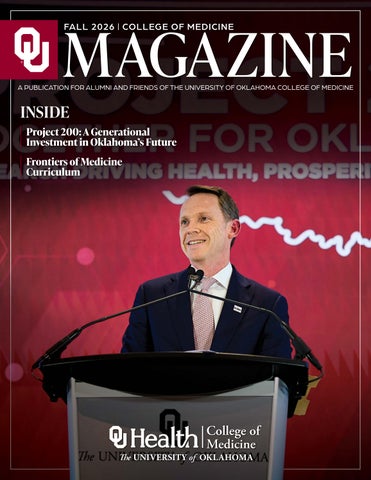
MAGAZINE FALL 2026 | COLLEGE OF MEDICINE
A PUBLICATION FOR ALUMNI AND FRIENDS OF THE UNIVERSITY OF OKLAHOMA COLLEGE OF MEDICINE
INSIDE Project 200: A Generational Investment in Oklahoma’s Future Frontiers of Medicine Curriculum
Dean’s Message Dear Alumni, Friends and Colleagues, At the OU College of Medicine, our mission extends far beyond the classroom, clinic or laboratory. Every day, our faculty, students, trainees, researchers and staff work together to advance discoveries, educate future physicians and improve the health of communities across Oklahoma and beyond. This issue of our magazine celebrates many of the people whose dedication and innovation make that mission possible. Research has long been a cornerstone of academic medicine, serving as the bridge between scientific discovery and improved patient care. Today, that work is more important than ever. Across our campuses, investigators are pursuing groundbreaking research in areas ranging from cancer and neuroscience to genetics, cardiovascular disease and population health. Their work is helping answer some of medicine’s most pressing questions while creating new opportunities to prevent disease, develop therapies and improve outcomes for patients throughout our state and around the world. As you will read in these pages, the College of Medicine continues to build momentum as the state’s leading center for biomedical discovery. The University of Oklahoma’s recent launch of Project 200 reflects a bold commitment to expanding research excellence through strategic investments in talent, infrastructure and innovation. The College of Medicine will play a central role in this effort by recruiting exceptional investigators, supporting our outstanding teams here already, fostering interdisciplinary collaboration and accelerating discoveries that improve lives. Equally inspiring are the remarkable achievements of our faculty, many of whom are recognized in this issue for their leadership, scholarship and service. These accolades represent more than individual accomplishments; they reflect the culture of excellence that defines our institution. Our faculty are not only advancing science and clinical care but also mentoring the next generation of physicians and researchers who will shape the future of medicine. This year, we also celebrated important milestones across our educational mission. We debuted a novel new curriculum in the medical school, honored the accomplishments of the MD Class of 2026, welcomed a new generation of students into the profession through the White Coat Ceremony and continued preparing future physicians, scientists and health professionals to meet the evolving needs of our communities. Their passion, curiosity and commitment to service remind us that the future of medicine is bright. The stories in this magazine demonstrate the power of academic medicine at its best: discovery that drives innovation, education that transforms lives and people whose work creates healthier futures for all. Thank you for your continued support of the OU College of Medicine and for helping us advance our shared mission of improving health through excellence in education, research, clinical care and service.
Sincerely,
Ian F. Dunn, M.D., FACS, FAANS Executive Dean, OU College of Medicine Chief Physician Executive, OU Health
UNIVERSITY OF OKLAHOMA
COLLEGE OF MEDICINE President, The University of Oklahoma Joseph Harroz, Jr.
Table of Contents Featured Project 200: Powering Oklahoma’s Push for Improved Health Outcomes.......................................................................... 4 OU College of Medicine Launches Transformational New Curriculum................................................................................ 8
Senior Vice President and Provost, OU Health Sciences Gary E. Raskob, Ph.D.
Reputational
Executive Dean, College of Medicine Ian F. Dunn, M.D.
Leadership
Contributing Writers Vallery Brown, OU Health Edna Espino, OU Health Kat Gebauer, OU MarComm Jacob Guthrie, OU MarComm Kristen Hoadley, OU Foundation Megan Louk, OU MarComm Jacob Munoz, OU MarComm Lorene Robertson, OU MarComm Bonnie Rucker, OU MarComm Jennifer Walters, OU MarComm April Wilkerson, OU MarComm This magazine is published by the University of Oklahoma Office of Marketing and Communications on behalf of the OU College of Medicine. For more information, contact marcomm@ou.edu. Copies of this magazine were printed at no cost to the taxpayers of the state of Oklahoma. The University of Oklahoma is an equal opportunity institution. www.ou.edu/eoo Copyright 2026 University of Oklahoma
OU’s Research Excellence Propels it to Top 100 Nationally................................................................................................ 12 OU Health Stephenson Cancer Center Breaks Ground on Major Tulsa Expansion............................................................ 14
OU COM Announces New Associate Dean for Veterans Affairs........................................................................................... 16 OU COM Names T.R. Lewis as Associate Dean for Student Affairs...................................................................................... 17 Nationally Renowned Psychiatrist Joins OU Health to Advance Behavioral Health Care in Oklahoma.......................... 18 International Leader in Neuroradiology, Imaging Innovation Chosen to Lead Radiology at OU Health......................... 19 OU COM Names Jay Kaneria Chief Administrative Officer.................................................................................................. 20
Research From Family Loss to Brain Research: A Scientist’s Mission to Prevent Cognitive Decline................................................. 21 Researchers Identify Mechanism for Body Weight-Reducing Hormone............................................................................ 23 OU Researchers Develop New Way to Deliver Cancer Therapies...................................................................................... 24 The Lancet Paper Calls for Earlier Diagnosis as Leprosy Persists Globally......................................................................... 25
Patient Care New TIL Therapy Brings Breakthrough Hope for Advanced Melanoma Patients in Oklahoma........................................ 26 Investigational Regenerative Therapy Shows Success in Complex Radiation Wound Treated by OU Health Physician........................................................................................................................................................ 28 A 22 Week Birth, a Tiny Heart Device, and a Life Saved at Oklahoma Children’s OU Health............................................ 30 Clinical Trials Give Glioblastoma Patients a Second Chance.............................................................................................. 33
Medical Education OU Medical Students Learn Their Futures on Match Day................................................................................................... 35 College of Medicine Celebrates the Class of 2026............................................................................................................... 37 OU Medical Students Named Oklahoma State Medical Association Students of the Year............................................... 40
School of Community Medicine OU School of Community Medicine’s Doctor for a Day Inspires the Next Generation of Healers..................................... 42 Study Identifies Why Nightmares Persist in Children and How to Break the Cycle........................................................... 44
Faculty Achievements Rodney Tweten Named OU’s SEC Faculty Achievement Award Recipient........................................................................ 45 OU COM Honors Two With Stanton L. Young Awards.......................................................................................................... 46 Jennings Accepted Into National Leadership Program...................................................................................................... 48 Dunn Named to AAMC Council of Deans Administrative Board......................................................................................... 49 Naqash Honored by American Society for Clinical Investigation....................................................................................... 50 Holter-Chakrabarty Appointed to American Society for Transplantation and Cellular Therapy Board........................... 51 Bhatti Selected for National ROP Advisory Board.............................................................................................................. 51 Allen Receives 2026 American Academy of Dermatology Presidential Citation................................................................ 51 Singh Named Fellow of the American Association for the Advancement of Science........................................................ 51 Benbrook Receives 2026 Woman of Achievement Award.................................................................................................. 52 Salinas Receives BLGAP Distinguished Service Award....................................................................................................... 52 Bien and Mims Recognized by Triological Society.............................................................................................................. 52
Alumni Donor Spotlight: A Legacy of Hope...................................................................................................................................... 53 In Memorium........................................................................................................................................................................ 54 Evening of Excellence Gala and Alumni and Friends Weekend......................................................................................... 55
FEATURED
Project 200: Powering Oklahoma’s Push for Improved Health Outcomes The University of Oklahoma’s ambitious recruiting drive will add 150 doctors and scientists to advance prevention, treatment, and patient care across the state Ian F. Dunn, M.D., remembers the patient vividly. A middle-aged Oklahoma farmer who arrived at his first appointment carrying studies documenting a surgery he hoped could remove the pineal region tumor growing in his brain. 4
“He couldn’t find anyone in Oklahoma who believed the surgery was possible for him,” said Dunn, executive dean of the University of Oklahoma College of Medicine and chief physician executive at OU Health. “Visiting us at OU Health was, in his view, a last-ditch appointment.” Just a few years earlier, the farmer would have been right.
THE UNIVERSITY OF OKLAHOMA - COLLEGE OF MEDICINE
FEATURED
Called Project 200, the state-supported effort aims to recruit 200 world-renowned researchers to OU in disciplines that save lives, strengthen Oklahoma’s economy, and position the university among the most impactful research institutions in the world. But by then, Dunn – a neurosurgeon with a reputation for treating complex brain lesions – had landed in Oklahoma. He agreed to operate, and today, the farmer is thriving. “He’s doing well,” Dunn said. “We don’t see him very often anymore.” Dunn’s arrival was more than fortuitous timing for a cancer-stricken rancher. It also marked the dawn of a bold endeavor in academic medicine, designed to ensure that patients no longer must leave Oklahoma – or give up hope – to find world-class expertise. Called Project 200, the state-supported effort aims to recruit 200 world-renowned researchers to OU in disciplines that save lives, strengthen Oklahoma’s economy, and position the university among the most impactful research institutions in the world. About 150 of those hires will be experts in cancer, diabetes, brain health, chronic diseases, and supporting fields. Dunn, who arrived before the official inception of Project 200, could be considered hire No.1.
Excellence From the Ground Up For decades, Oklahoma has been among the unhealthiest states in the country, with high rates of obesity, diabetes, and heart disease compounded by wide income disparities and rural health shortages. At just 73.8 years, an Oklahoman’s life expectancy is one of the lowest in the nation. Project 200’s mandate is to reverse these trends. “We are now at a convergence of opportunity unlike anything this state has seen in generations,” OU President Joseph Harroz Jr. said at the Project 200 opening in May, which was attended by university and state leaders, including Gov. Kevin Stitt. “The university’s ‘Lead On’ Strategic Plan sets bold ambitions for Oklahoma, including decreasing cancer deaths by 10% and deaths related to diabetes by 30%,” President Harroz said. Project 200 will help OU answer that call. To date, 22 health sciences faculty have been recruited – chairs in medicine, pediatrics, radiology, and psychiatry, as well as physician-scientists in cardiology and elite level researchers in psychiatry, cell biology, and other teams. An additional 35 searches are active. Dunn joined OU in late 2018 from Brigham and Women’s Hospital in Boston, a teaching hospital of Harvard Medical School. The impact of Project 200 will extend far beyond the university. By 2032, it is projected to generate nearly $100 million annually in new federal research funding, and over the next decade is expected
to support more than 2,000 new jobs, produce an estimated $95 million in new state and local tax revenue, and help train more than 1,000 scientists in Oklahoma. Among the first wave of recruits was Carlos Bustamante, Ph.D., an internationally recognized expert in medical and population genetics, as the inaugural Vice Dean of Research at the OU College of Medicine. Bustamante, a former professor at both Cornell and Stanford Universities who arrived in September 2025, studies how human genetic variation impacts health and disease. Like Dunn, Bustamante is spearheading Project 200’s efforts to grow the college’s ranks. “One major advantage we have relative to almost any other academic health system right now is that we’re expanding, plain and simple,” said Bustamante. “Most universities at this point are in retrenchment mode, given concerns about state of federal funding.” Unlike previous decades, when federal health funding typically went to established centers on the coasts, today, new grants are finding their way to the Great Plains. Oklahoma researchers have benefited. In 2025, the OU Health Campus became a Top 100 recipient for National Institutes of Health funding for the first time, jumping nearly 35% to $80.9 million, from $60 million 2022. There’s also growing state and federal interest in funding rural health initiatives, championing digital health transformations, and supporting long-neglected populations, said Bustamante. For toptier researchers and clinicians, these challenges represent a rare opportunity to make a lasting impact on public health. “There’s been a narrative for decades that it’s hard to bring elite talent to Oklahoma, but we’ve been remarkably successful in flying in the face of that narrative,” said Dunn. “We offer a compelling professional opportunity for people who want to continue their professional and personal lives, even among people who have no connection to this region.”
The Building Blocks of Care Guided by the “Lead On, University Strategic Plan,” Project 200 will zero in on five key areas: cancer; diabetes and metabolic diseases; neuroscience and brain health; chronic disease and population health; and clinical trials. Expertise will be needed in host of disciplines, including biomedical engineering; data science and healthcare-related AI; and molecular, cellular, and biochemical sciences. Once an ecosystem of talent is established, it will drive innovation in a continuum known as translational medicine: moving discoveries from the laboratory into treatments that benefit patients.
FALL 2026 ALUMNI MAGAZINE
5
FEATURED
“Think about medication,” said Dunn. “The journey that ended with a pill in a brown vial started in a lab somewhere, with the understanding of a certain biological mechanism, which was advanced and then translated into a medication deemed safe in a clinical trial.”
Enter the ‘Force Multiplier’
Over the next five years, Project 200 will expand OU’s strengths at the Stephenson Cancer Center and Harold Hamm Diabetes Center while building new capacity with a Neuroscience Institute and broader population-health research efforts.
“I chose to come to OU because it’s a once-in-a-lifetime opportunity to catch an organization on its upswing,” said Li, who spent nearly two decades in Ann Arbor, most recently a professor of human genetics. “Oklahoma has had downward cycles in the past, but now, we are at another upward bend of the arc.”
Across these five areas, the goal is the same: translating scientific discoveries into better outcomes for Oklahoma patients, particularly in rural, tribal, and underserved communities. Bustamante said Project 200 is meant to serve as a springboard, propelling OU – and the state – into the next tier of academic health excellence. “There are places in the history of science that met a moment, which accelerated their growth,” he said. “Los Alamos, New Mexico, was put on the map because of the Manhattan Project. The space race and personal computing fueled the semiconductor business, which led to expansion in Silicon Valley. Leipzig, Germany, emerged as a giant in evolutionary genetics because of the Max Planck Institutes.”
Contributing to the growth of an academic health powerhouse is what led Jun Li, Ph.D., to leave the University of Michigan last year to become the founding chair of OU’s Department of Molecular Genetics and Genome Sciences.
Li studies complex human diseases using genomic approaches. His current work involves identifying genetic markers to pre-screen patients for drugs or treatments, which could reduce side effects. He’s also exploring human reproductive biology and its relationship to infertility, sub-fertility, and aging; and is using genetic and genomic techniques to study cancer remissions, relapses, and metastatic potential – the capacity of cancer cells to break away from primary tumors and establish new tumors in other parts of the body. “Think of all of this as precision, but not personalized, medicine,” Li said.
He added: “Project 200 is our Manhattan Project.”
6
THE UNIVERSITY OF OKLAHOMA - COLLEGE OF MEDICINE
FEATURED
“We have a deep drive and a commitment to elevate the health of Oklahoma, which is among the poorest ranked in essentially every category you can come up with. It’s been that way for a long time, and at some point, leaders needed to make a bold decision to try and do what it takes to change the outcome and move the needle.” - Ian Dunn, M.D. Like Dunn and Bustamante, Li is focused on building his team. With more researchers, Li said he will be able to compete for larger grants – pushing OU’s NIH ranking even higher. “Genetics and genome science were disciplinary gaps in OU medicine,” Li said. By bringing his life’s work from Michigan to Oklahoma, he aims to be a “force multiplier” for the university, complementing the capabilities already in place.
Mindful, Thoughtful Growth Like Li, Isabella Grumbach, M.D., Ph. D., was attracted to OU for the opportunity to build. After nearly two decades at the University of Iowa, where she led pioneering research on vascular disease and radiation-related vascular injury, Grumbach became chair of OU’s Department of Internal Medicine last year. Based in Oklahoma City, she’s helping to lead the academic health system’s three-part mission of clinical care, research, and education.
studies include examining small blood vessels in the back of the eye to measure the effect of radiation on blindness and related cognitive decline. “We’re trying to understand if we can develop mitochondria-targeted therapies to prevent these changes,” Grumbach said. An early focus for Grumbach has also been expanding partnerships with colleagues in biochemistry and biophysics to deepen understanding of mitochondrial function. “There’s interest in coming together to better understand these cellular powerhouses,” she said. “As a chair, I’m mindful in how we build to focus on areas of strength,” Grumbach said. “We’re being very thoughtful about how we grow. When you have more people working on a project together, then we can write big, strong grants, which will have a real impact on the health of the state.”
Health Starts at Home
Dunn, who recruited Grumbach, said she possesses a trio of traits that OU Health needs to soar.
The desire to improve health outcomes in tangible ways is what brings big-city physicians to Oklahoma, Dunn said.
“Dr. Grumbach has built a career as a bona fide ‘triple threat’ physician-scientist and leader,” said Dunn. “Her deep credibility and expertise in the clinical, research, and educational missions will help drive our academic health system forward.”
“We have a deep drive and a commitment to elevate the health of Oklahoma, which is among the poorest ranked in essentially every category you can come up with,” he said. “It’s been that way for a long time, and at some point, leaders needed to make a bold decision to try and do what it takes to change the outcome and move the needle.”
Grumbach’s expertise will be crucial in meeting Project 200’s objectives, particularly on chronic diseases and cancer. As a nationally recognized physician-scientist in cardiovascular medicine, she has published extensively on vascular injury — as occurs in atherosclerosis and after vascular procedures — and on the role of mitochondria in cell metabolism and stress responses. That foundation has led her to one of the most pressing problems in modern cancer care. As cancer therapies have become more effective, patients are living longer — but survival has come at a cost. Radiation and chemotherapy injure mitochondria, triggering vascular damage that accumulates over time, and cardiovascular disease has become the number one killer of cancer survivors. Reducing that burden is a defining challenge, and one Grumbach is uniquely positioned to address.
Much of that work will take years. But for some patients, including the farmer who arrived with an iPad full of studies and a sliver of hope, the impact is already clear. “He was very uncomfortable,” Dunn said. As a farmer, he couldn’t simply leave the state in search of care. He needed treatment close to home. Dunn made sure he got it. “We want to build an ecosystem where no patient ever needs to leave Oklahoma for care,” Dunn said. “They may choose to leave, but we want that to become the exception, not the rule.”
Most of her trials in Iowa were on mouse models, she said. At OU, she’ll be looking to expand that work to human trials. Early
FALL 2026 ALUMNI MAGAZINE
7
FEATURED
OU College of Medicine Launches Transformational New Curriculum More than 10,000 students have graduated with a Doctor of Medicine degree from the College of Medicine since it established a four-year program in 1910. What was once a small preclinical school in Norman has flourished into a four-year college that anchors OU’s Health Campus in Oklahoma City and offers an integrated track through the School of Community Medicine in Tulsa. As the College develops the healthcare leaders of the future, it is transforming by adopting a new curriculum designed to maximize student success. Developed under the name “Frontiers of Medicine,” the curriculum emphasizes active learning and preparation for clinical practice. Students complete the preclinical phase in 18 months, rather than the traditional two years, before beginning their clinical rotations. The curriculum also better integrates foundational sciences across organ systems and reinforces the relationship between 8
basic science and clinical medicine. Faculty are transitioning from delivering large-group lectures to facilitating interactive smallgroup learning. This new curriculum was first implemented last year with the incoming class of 2029. But plans for it were in development for much longer. Frederick (Kris) Miller, Ph.D., recalled discussions about shortening the preclinical phase as early as 2018. A faculty working group evaluated the feasibility of the transition, and a few years later, a survey was distributed to a broad group of stakeholders, including students, alumni, faculty and community partners, to gather additional input. “We analyzed that data and came up with themes”, said Miller, assistant dean for preclinical curriculum. “A lot of those themes were, ‘Yes, it’s time to shift from a lecture-based model to more
THE UNIVERSITY OF OKLAHOMA - COLLEGE OF MEDICINE
FEATURED
of an active learning model. It’s time to shift from a drawn-out preclinical phase to one that prepares students by providing earlier preceptor experiences to be more ready to rotate as third-year students in the hospital setting, and clinic settings.’” By revitalizing its curriculum, the college is also joining a growing number of medical schools that are moving away from the traditional “half-and-half” model in favor of earlier clinical experiences. Ian Dunn, M.D., executive dean of the College of Medicine and chief physician executive of OU Health, said that this change is not only allowing students to gain more hands-on learning opportunities, but could also launch shortened degree tracks, providing more accessible paths for pursuing specialties. “Moving our four-year curriculum to an 18-month preclinical phase unlocks a lot of flexibility for us in the future to shorten medical school, for some students, to three years,” Dunn said. “The most common instance where that happens is students who want to go into primary care, pediatrics or other frontline specialties where there are shorter residencies, and where we have a shortage of these physician specialists. They could spend a little bit less time in medical school and get right to residency.”
The Student Experience The redesigned curriculum uses a flipped classroom model in which students learn foundational concepts before class, then apply that knowledge during faculty facilitator-led peer-assisted learning sessions. Students also participate in twice-weekly casebased learning sessions to explore clinical cases in depth. Together, these instructional approaches integrate foundational science with clinical medicine from the beginning of medical school to prepare students well ahead of their clinical rotations. Irene Alexandraki, M.D., Ph.D., MPH, MBA, said that this model promotes self-directed learning, which fosters a proactive approach
to lifelong learning. Appointed vice dean of education for the college in July 2025, she is overseeing how students are adapting to the new curriculum. “I have been very impressed with how our students have already started developing clinical reasoning skills,” Alexandraki said. “Thinking like physicians is a skill that typically takes much longer in a traditional medical school curriculum. And I think, also, the active learning and those opportunities that they have for early immersion clinical experiences really help accelerate the development of these skills.” Alexandraki noted that, among the benefits of the curriculum, students will also be better equipped for the next stage of their medical training and future careers as physicians. They can use the added time from their shortened preclinical phase to get support from the college’s career and specialty advisors and grow their expertise, such as through research and community experiences. This will help them develop more competitive residency applications. The college is also taking a more comprehensive approach to student assessment, emphasizing clinical skills and professional competencies beyond traditional test scores. Students receive frequent written and narrative feedback from faculty, which promotes reflection, reinforces strengths and supports their development. The curriculum also emphasizes competencies such as professionalism and empathy that will benefit students during their clinical practice. As qualitative assessments are strengthened, so are students’ academic exams. In the new curriculum, each course now features board-style exams for midterms and finals using tests from the National Board of Medical Examiners. Miller said that through March, students had been performing, as a collective, no less than
FALL 2026 ALUMNI MAGAZINE
9
FEATURED
at the national average on all exams. He credited that in part to the growth of their clinical reasoning skills.
increase for the Doctor of Medicine program will add around 40% more students by 2029, compared to 2024.
“Students are required to engage with the material instead of just passively accepting it,” Miller said. “That’s how medicine is actually practiced, right? I come to you and say, ‘I’ve got this headache that won’t go away. What do you think?’ And you ask me some questions, I give you some answers, and you have to put all those puzzle pieces together into a coherent story and a diagnosis.”
To accomplish this, the college has renovated the fifth floor of Garrison Tower on the Health Campus, adding 24,000 square feet of modern educational spaces. Preclinical students in OKC now have access to two 250-seat active learning centers on the tower’s fifth floor, complete with amenities like lounge spaces and kitchenettes. This upgrade pairs with the existing clinical skills center on the sixth floor, providing a convenient, central location for instruction and coursework.
The focus on group settings has also made it easier for students to interact. Will Kaiser is part of the class of 2029, joining his peers in paving the way for future College of Medicine cohorts under the curriculum. “You get to meet new people,” he said, “and I think it’s a very cool way to collaborate on these difficult and really challenging concepts at times.” Kaiser, who is from Oklahoma City and earned his bachelor’s at OU, added that he has more time to explore his clinical interests because of the updated 18-month structure. “For people like me who are maybe not so sure what they want to do, it does give you a little bit more of an opportunity to figure that out,” he said. Elena Woodburn is another student experiencing the new curriculum as part of the pioneering class of 2029. She grew up in Kansas and earned her undergraduate degree at Vanderbilt University, where in her basic science classes she experienced an active learning environment that she said was similar to the College of Medicine’s new system. “It’s really helpful to be able to have gone through the material and identify what parts you don’t really understand very well,” Woodburn said. “And then when you’re in with a small group or working with the facilitator, you’re able to ask questions because you already know what parts you’re struggling with.” Woodburn also said the college’s case-based discussions have made her ready for the next stage of medical school. “I already feel like it’s preparing me to start thinking in the way of a physician that will be really beneficial when I’m in a new environment during our clinical rotations.”
Behind the Scenes Curriculum changes that promote smaller group learning are also transforming the College of Medicine’s physical spaces. As dean of the college, Dunn is mindful of the need to re-envision how buildings and rooms are utilized, especially as the school prepares to accommodate more degree seekers: a targeted enrollment
Other upgrades include a new active learning center at the School of Community Medicine in Tulsa, and a multi-million-dollar renovation of anatomy facilities within the OKC Health Campus’s Basic Sciences Education Building. “The University of Oklahoma is really investing heavily in the future of medical education,” Dunn said. “We are simultaneously building out more permanent space just across the campus here. The students will stand to benefit from this.” The new curriculum is requiring more than just an upgraded strategy around space: faculty and staff are handling both practical challenges and updated approaches to workflow. For example, when second-year students begin their clinical rotations, they will overlap with third-year students from the previous curriculum for six months. And faculty – many of whom are active practicing physicians – have transitioned away from traditional large-group lectures to serving as small-group facilitators. “It’s required a totally different level of faculty development to enable,” Dunn said. “It’s one skill set to lecture. It’s another to be really engaged in a hands-on, small group session. So, there’s a lot in flight around developing faculty to be really great teachers. We’re blessed to have great teachers already at OU.” Faculty members have also streamlined course content to create a more efficient and integrated curriculum. Alexandraki, who joined the college shortly after implementation, noted that this process reduced redundancies and connected related topics across courses, building progressively on foundational concepts. “Faculty looked at what the most important, high-yield concepts were that we needed to emphasize in the curriculum and made sure those were consistently delivered across all small groups, so that every student had access to that essential content,” Alexandraki said. “We want students to be successful in their career aspirations, but also on their board exams.”
The new curriculum is requiring more than just an upgraded strategy around space: faculty and staff are handling both practical challenges and updated approaches to workflow. 10
THE UNIVERSITY OF OKLAHOMA - COLLEGE OF MEDICINE
FEATURED
Part of the curriculum redesign includes a two-pass approach to foundational learning. In the first pass, students build an understanding of organs and biological systems through foundation courses. In the second pass, they explore how these systems relate to disease development, treatment and prevention. Miller led that approach in his role as preclinical dean. He noted that the College of Medicine has also received support from other public peer institutions, such as the University of North Carolina and the University of Utah, which already shifted to an 18-month preclinical phase. “There’s a lot of informal communication just because we’ve made friends with a lot of them,” Miller said. “Those relationships are important because you don’t want to be isolated as a medical school. We want to increase our rankings and continue to improve.”
Fostering an Impact College of Medicine leaders view the revamped curriculum as more than just an investment in student and school success. It’s also a commitment to Oklahoma during a critical period: in recent years, the state ranked 49th for its healthcare system, according to a report, and 48th in active physicians per capita. As the median age of Oklahomans increases, and as conditions requiring specialized care receive more attention, talented and dedicated cohorts of new physicians are needed to bolster the workforce. OU is playing a vital part in addressing that need. Half of all physicians who graduate from the College of Medicine remain in Oklahoma to practice. That portion jumps to 75% when those graduates also complete their residency at the college. Those changes, along with the ongoing increase in enrollment capacity
and a growing number of residency programs – including in underserved rural areas – aim to bolster the state’s outlook. Mallory Williams is among the students looking to make a local difference. She graduated from OU with her bachelor’s and is taking in the new curriculum as a member of the College of Medicine’s class of 2029. “I’m from here, and I want to make a big impact on my community,” Williams said. “We have one of the highest needs for physicians in the country and the only way we’re going to solve that is by getting more doctors to stay in Oklahoma.” She is interested in working long term with patients, such as by becoming an OB-GYN or family medicine physician. And her passion for healthcare is informed by lived experiences: attending high school in the middle of the COVID pandemic and living with a serious chronic health condition. “I really do think it makes you a better physician in the long run, because we get to really know what it’s like to be a patient and be in that vulnerable position.” As the College of Medicine continues to prepare physicians of the future, with the updated curriculum laying a new foundation, Dunn acknowledges the school’s impact on Oklahoma. To accomplish that begins with what prompted these changes in the first place: providing students a stronger education with positive experiences they will take through life. “We have an obligation to students to make sure that we’re providing as innovative and educational a product as we can,” Dunn said. “We’re confident that we have that right now. And where we have opportunities to continue to iterate and get better, we’ll always take those, on behalf of our students, in service to the state.”
FALL 2026 ALUMNI MAGAZINE
11
REPUTATIONAL
University of Oklahoma’s Research Excellence Propels It to Top 100 National Ranki ng Among U.S. Medical Institutions Research Conducted at OU Addresses Oklahoma’s Most Pressing Health Challenges, Lifting the Health of the State and Beyond Earlier this year, the University of Oklahoma Health Campus was recognized for its increased momentum in advancing discoveries that change lives, achieving the state’s first Top 100 national ranking based on funding from the National Institutes of Health, according to the Blue Ridge Institute for Medical Research. The ranking — the highest in OU’s history and in the state — solidifies the university’s position as the state’s leading driver of healthrelated research.
12
With this achievement, OU now stands among the top 3.6% of the 2,702 institutions and entities nationwide that receive NIH funding. “As the largest research engine in the state and the leading recipient of NIH funding in Oklahoma, the University of Oklahoma carries a profound responsibility,” said OU President Joseph Harroz Jr. “This record level of support reflects the strength of our research community and our unwavering commitment to
THE UNIVERSITY OF OKLAHOMA - COLLEGE OF MEDICINE
REPUTATIONAL
improving health outcomes, accelerating the search for cures and deepening scientific understanding. Most importantly, it reflects our dedication to serving the people of Oklahoma and changing lives for generations to come.”
Lifting the health of Oklahoma is a cornerstone of OU’s “Lead On, University: The Next Phase” Strategic Plan, which sets a goal of reaching the top 75 in NIH funding by 2030. Entering the top 100 signals meaningful progress toward that ambition.
The OU Health Campus is one of only a few comprehensive research universities in the nation to house six health professional colleges and an interdisciplinary Graduate College on a single campus.
The College of Medicine received $72.2 million in NIH funding in FY2025 – the largest amount in its history – and now ranks No. 65 among 145 medical colleges nationwide, placing it firmly in the top half nationally. Twelve individual OU College of Medicine departments are nationally ranked, including four ranked in the top 25 in their respective disciplines (Family Medicine, Physiology, Obstetrics and Gynecology, and Neurosurgery). The Department of Family Medicine is ranked No. 2.
In just three years, OU has jumped 31 spots in the Blue Ridge rankings to its current spot of 98, with NIH funding increasing nearly 35% — from $60 million in federal fiscal year 2022 to $80.9 million in FFY 2025. This sustained growth reflects OU’s increasing competitiveness for federal research support, as well as the expanding scope and impact of the work happening across its campuses, including improving patient care, strengthening public health and addressing the state’s most pressing medical challenges. The OU Health Campus is one of only a few comprehensive research universities in the nation to house six health professional colleges and an interdisciplinary Graduate College on a single campus. Strategic research areas include cancer, diabetes, neurosciences and vision, infectious diseases, and geroscience. “The continued rise in NIH funding reflects the collaborative strength of our entire campus,” said Gary Raskob, Ph.D., senior vice president and provost of the OU Health Campus. “Our faculty members are securing highly competitive federal funding because their work addresses urgent health challenges and delivers real impact.”
Several notable awards contributed to OU’s research ranking. Competitive grant renewals will continue the work of the Oklahoma Center for Microbial Pathogenesis and Immunity, a hub for research into infectious diseases and how the immune system responds to them, as well as for the Oklahoma Center for Geroscience and Healthy Brain Aging, whose researchers study the relationship between aging and disease. Another major research award will allow the OU Health Stephenson Cancer Center to expand its Cancer Undergraduate Research Experience (CURE) program, providing undergraduate students with hands-on opportunities to conduct cancer-related research to build the next generation of scientists and health professionals. “Our continued rise in Blue Ridge rankings reflects the strength and depth of our research programs,” said Ian Dunn, M.D., executive dean of the OU College of Medicine and chief physician officer at OU Health. “Our faculty are competing successfully for some of the most rigorous grants in the nation, and that success fuels innovation, collaboration and improved patient care.”
“In just three years, OU has jumped 31 spots in the Blue Ridge rankings to its current spot of 98, with NIH funding increasing nearly 35% — from $60 million in federal fiscal year 2022 to $80.9 million in FFY 2025.” FALL 2026 ALUMNI MAGAZINE
13
REPUTATIONAL
OU Health Stephenson Cancer Center Breaks Ground on Major Tulsa Expansion 176,100-square-foot facility targets state’s high cancer mortality rate and expands clinical trial access
14
Last November, OU Health Stephenson Cancer Center celebrated the groundbreaking of its new 176,100-square-foot facility on the University of Oklahoma’s Schusterman Center campus, marking a transformative step forward in expanding access to National Cancer Institute-designated cancer care for thousands of residents in northeast Oklahoma.
new cancer diagnoses in Oklahoma, with approximately 8,300 occurring in northeast Oklahoma alone — a region with some of the state’s highest cancer mortality rates. This region’s need for outpatient cancer care is projected to increase by 14.2% through 2034, driven by high rates of pancreatic, hepatobiliary and other complex cancers often resistant to traditional therapies.
Set to open in 2028, the facility will directly address the state’s
This expansion fulfills a vision more than two decades in the
significant cancer burden — ranked fourth in the nation for cancer deaths. In 2025, it was estimated there will be about 24,000
making. “Today reflects our unwavering mission to ensure every Oklahoman has access to the very best cancer care, no matter where they live,” said Joseph Harroz Jr., president of the University of Oklahoma. “Stephenson Cancer Center delivers the gold standard of research-driven care as Oklahoma’s only NCI-designated cancer center — a distinction achieved by just 2% of cancer centers nationwide. This expansion brings that level of care for northeastern Oklahoma, closing a gap that has existed for far too long. The Stephenson family’s extraordinary generosity, combined with support from our Tribal partners, the Legislature and community philanthropists, makes this life-saving work possible. Together, we are building a legacy that will serve generations of Oklahomans.”
THE UNIVERSITY OF OKLAHOMA - COLLEGE OF MEDICINE
REPUTATIONAL
The expansion of Stephenson Cancer Center to Tulsa is facilitated by a robust public-private partnership involving key stakeholders led by Charlie and Peggy Stephenson. It includes appropriations from the Oklahoma Legislature from the American Rescue Plan Act and the state General Revenue Fund to the University Hospitals Authority and Trust. Contributions from the Cherokee Nation as well as gifts from the Norton, Trussell and Croteau families underscore the collaborative endeavor aimed at enhancing cancer care in northeast Oklahoma.
trials are only accessible in Oklahoma through Stephenson Cancer Center and our statewide network.” In addition to advancing Stephenson Cancer Center’s long-term
Advanced Cancer Care, Closer to Home Despite northeast Oklahoma’s high rates of cancer, the region has historically had the lowest clinical trial participation rates at Stephenson Cancer Center. The new facility in Tulsa aims to reverse this trend and reflects the critical importance of accessible cancer care.
“Our vision at Stephenson Cancer Center is to eliminate cancer in Oklahoma and beyond. Our mission is to provide patient-centered, researchdriven, multidisciplinary cancer care.” - Robert Mannel, M.D. The National Cancer Institute designation is awarded only to cancer centers that demonstrate scientific leadership, robust clinical research and a commitment to reducing cancer incidence and mortality. As Oklahoma’s only NCI-Designated Cancer Center — a distinction first earned in 2018 and renewed in 2023 — Stephenson Cancer Center meets rigorous standards for transdisciplinary research, community outreach and delivery of leading-edge therapies. This prestigious recognition places Stephenson Cancer Center among an elite network of fewer than 75 institutions nationwide. The new facility in Tulsa will feature 70 exam rooms, 45 infusion spaces, three linear accelerators, comprehensive imaging capabilities including MRI and PET-CT, and dedicated clinical trial space designed to expand as the center grows. Patients will have increased access to early-phase clinical trials, removing barriers to treatments that are often a last resort for those with complex cancers that don’t respond to standard regimens. It ensures patients in northeast Oklahoma receive the same caliber of care found at the nation’s top cancer centers, without having to leave Oklahoma. “Our vision at Stephenson Cancer Center is to eliminate cancer in Oklahoma and beyond. Our mission is to provide patientcentered, research-driven, multidisciplinary cancer care,” said Robert Mannel, M.D., director of OU Health Stephenson Cancer Center. “Clinical trials offer hope for patients facing complex, rare or treatment-resistant cancers, and many of these early phase
goal of achieving Comprehensive Cancer Center designation from the National Cancer Institute — the organization’s highest designation held by only an elite group of cancer centers nationwide – the expansion directly supports Pillar 4 of OU’s “Lead On, University” Strategic Plan: Lift the Health of Oklahoma.
Building on Partnership and Progress The expansion also strengthens OU Health’s collaboration with Hillcrest HealthCare System, which began in 2024, to deliver advanced cancer therapies and clinical trials to the residents of northeast Oklahoma. The new building will provide even more clinical space and serve as a clinical home for both local medical oncologists and academic physician scientists. Stephenson Cancer Center has been phasing in clinical trials at Hillcrest and has enrolled more than 20 patients so far this year, including those for complex cancers like pancreatic and lung. “Partnering with OU Health on cancer care has already brought more clinical trials and specialized expertise to northeast Oklahoma,” said Hillcrest Regional President Jeff Johnston, MHA, MBA. “We are excited for this addition to help even more patients with nationally recognized cancer care closer to home.” Much of this expansion builds on the foundation laid by the Oklahoma Tobacco Settlement Endowment Trust, whose grants have funded the lung cancer screening bus, the TSET Phase I Clinical Trials Program and ongoing research across the University of Oklahoma’s academic health system. Stephenson Cancer Center opened a location with Norman Regional Health System in June 2025 and has plans to open a facility in McAlester, Oklahoma, this year — further extending its reach across the state.
FALL 2026 ALUMNI MAGAZINE
15
LEADERSHIP
OU College of Medicine Announces New Associate Dean for Veterans Affairs The University of Oklahoma College of Medicine has named Kelly Stratton, M.D., FACS, as associate dean for Veterans Affairs. Since joining the College of Medicine’s Department of Urology in 2014, Stratton has held numerous leadership roles in the OU Health system. He previously served as the department’s associate program director for the residency program and currently serves as the director of research and as the Stephenson Cancer Center’s chair in Urology. Stratton also has a rich background with the Oklahoma City Veterans Affairs Medical Center, bringing more than 10 years of experience as a clinician and principal investigator for multiple clinical trials.
“Dr. Stratton’s wealth of experience makes him uniquely qualified to lead as our associate dean for Veterans Affairs.” - Ian Dunn, M.D.
In his new role, Stratton serves as a key leader for the College of Medicine, OU Health and the VAMC, sustaining their active collaborations to support and grow clinical activity and create new opportunities for research and learning. “Dr. Stratton’s wealth of experience makes him uniquely qualified to lead as our associate dean for Veterans Affairs,” said Ian Dunn, M.D., executive dean of the OU College of Medicine and chief physician executive at OU Health. “He also brings an exceptional understanding of our educational and research programs.” Stratton earned his medical degree at the College of Medicine before completing his residency at Vanderbilt University Medical Center’s Department of Urology. He also
16
received fellowship training at Memorial Sloan-Kettering Cancer Center in New York City. In addition to his work as a urologist and urologic oncologist, Stratton serves as an associate professor in the College of Medicine’s Department of Urology and as an adjunct associate professor of medical oncology at the Stephenson Cancer Center. His service, mentorship and research have been recognized nationally. Stratton is the recipient of the Society of Urologic Oncology’s Distinguished Service Award, the American Urological Association’s
Young Urologist of the Year Award and a National Institutes of Health Research Specialist Award focused on expanding and improving access to clinical trials for veterans. “Dr. Stratton has been intensely involved in mentoring faculty, residents and medical students,” said Karl Hansen, M.D., Ph.D., senior associate dean of the College of Medicine. “He has demonstrated a deep commitment to our college’s missions and will be a valuable member of our leadership team.”
THE UNIVERSITY OF OKLAHOMA - COLLEGE OF MEDICINE
LEADERSHIP
OU College of Medicine Names T.R. Lewis as Associate Dean for Student Affairs The University of Oklahoma College of Medicine has announced the appointment of T.R. Lewis, M.D., as associate dean for student affairs. Lewis is a board-certified orthopedic surgeon specializing in pediatric orthopedics. He completed his residency at OU in 2009 and has been a faculty member in the College of Medicine since joining Oklahoma Children’s Hospital OU Health in 2010. As associate dean, Lewis oversees all aspects of the medical student experience, including mentoring, advising, and support programs and services. His commitment to fostering educational excellence and student well-being will further strengthen the College of Medicine’s inclusive and thriving learning environment.
“Dr. Lewis is an accomplished medical educator and mentor, and we are excited to have him in this important role to further advance our college’s mission.” - Ian Dunn, M.D. Lewis succeeds Teresa Scordino, M.D., following her extraordinary tenure and impactful leadership as associate dean. “Dr. Lewis is an accomplished medical educator and mentor, and we are excited to have him in this important role to further advance our college’s mission,” said Ian Dunn, M.D., executive dean of the College of Medicine and chief physician executive at OU Health.
Lewis has served as the Children’s core medical director for OU Children’s Physicians clinics on the OU Health campus. He is also a member of the OU Physicians and OU Medicine peer review committees, the Women’s and Children’s Quality and Safety committee, and the OU Physicians Compliance and Ethics committee. He also serves on the College of Medicine’s Faculty Board. Before joining OU’s faculty, Lewis earned his medical degree from the Texas A&M
Lewis also serves as a deacon and community group leader at Henderson Hills Baptist Church in Edmond and is a board member of Willow Springs Boys Ranch in Chandler, Oklahoma. “We look forward to the contributions Dr. Lewis will provide in supporting our students and offering valuable insights as part of our leadership team,” said Irene Alexandraki, M.D., Ph.D., MPH, MBA, vice dean of education at the College of Medicine.
University College of Medicine in 2004. He received a Fellowship in Pediatric Orthopedic Surgery at the Shriner’s Hospital for Children in St. Louis, Missouri, and Washington University, training from 2009 to 2010.
FALL 2026 ALUMNI MAGAZINE
17
LEADERSHIP
Nationally Renowned Psychiatrist Joins OU Health to Advance Behavioral Health Care in Oklahoma Oklahoma Children’s OU Health Behavioral Health Center, we have an unprecedented opportunity to expand access, elevate standards of care and build a model of behavioral health that can serve as a beacon for our state and region. Dr. Diler’s experience in innovative, outcomes-driven care aligns strongly with this vision and will accelerate our impact for patients and families across Oklahoma.” Board-certified in general psychiatry and
The University of Oklahoma has recruited nationally renowned psychiatrist Rasim Somer Diler, M.D., MBA, DFAACAP, to serve as Paul and Ruth Jonas Chair of the Department of Psychiatry and Behavioral Sciences at the OU College of Medicine and clinical service chief of psychiatry and behavioral health at OU Health. Diler’s recruitment follows a highly competitive national search to lead the program at a time of pivotal need and opportunity for Oklahoma. A clinicianscientist with a national and international reputation who embodies the OU Health tripartite mission of clinical care, research and education, Diler has devoted his career to improving care for young adults with complex mood disorders and suicide risk. He is widely recognized for building highperforming teams, strengthening clinical operations, advancing quality and safety, expanding access, and bringing innovation and integration to complex areas of modern medicine. “This appointment comes at a uniquely important moment for behavioral health in Oklahoma,” said Ian F. Dunn, M.D., FACS, FAANS, executive dean for the OU College of Medicine and chief physician executive at OU Health. “With the opening of the
18
child and adolescent psychiatry, Diler is an internationally recognized expert in pediatric bipolar disorder, specializing in novel care models, differential diagnosis, early detection, monitoring, treatment, and prevention for youth and young adults with or at risk for the condition. He edited the first international book on pediatric bipolar disorder, featuring perspectives from 11 countries. Diler has held numerous leadership roles on national and international advisory, scientific, and professional organization committees and boards, including chairperson, course director and conference organizing positions. His scholarly contributions include more than 160 peer-reviewed publications, 120 national and international presentations, and a strong record of external funding. He serves as principal investigator on two NIH-funded longitudinal studies focusing on neural and behavioral markers for early detection and treatment of bipolar disorder and mixed depression in youth. This work has incorporated neuroimaging and machine learning and innovative assessment methods combining wearable technology with mood and energy tracking. Diler also serves as the principal investigator at the Pittsburgh site for a multi-site study examining machine
learning algorithms to predict school violence in adolescents.
“I am honored to join OU Health and the University of Oklahoma College of Medicine at such a pivotal time.” He is a Distinguished Fellow of the American Academy of Child and Adolescent Psychiatry and was inducted into Beta Gamma Sigma, the International Business Academic Honor Society, after completing his MBA at the Katz Graduate School of Business, University of Pittsburgh. Diler earned his medical degree from Istanbul University Faculty of Medicine and completed residency training in psychiatry and a fellowship in child and adolescent psychiatry at UPMC, shaping his lifelong commitment to improving outcomes for children and families. “I am honored to join OU Health and the University of Oklahoma College of Medicine at such a pivotal time,” Diler said. “The privilege to lead a department with such strong foundations while helping to shape the future of behavioral health care in Oklahoma and beyond is incredibly exciting. I am energized by the strengths I observed, encouraged by organizational alignment and the department’s drive for transformation, and inspired by the abundant opportunities that lie ahead, guided by a shared commitment of OU Health to be ‘never done, never outdone.’” Diler succeeds Britta Ostermeyer, M.D., MBA, DFAPA, Paul and Ruth Jonas Chair and professor and chair of the Department of Psychiatry and Behavioral Sciences at OU College of Medicine and chief of psychiatry for OU Health.
THE UNIVERSITY OF OKLAHOMA - COLLEGE OF MEDICINE
LEADERSHIP
International Leader in Neuroradiology, Imaging Innovation Chosen to Lead Radiology at OU Health After a competitive national search, Javier Villanueva-Meyer, M.D., has been named chair of the Department of Radiological Sciences at the University of Oklahoma College of Medicine and clinical service chief of radiology at OU Health, the University of Oklahoma’s academic health system. In addition to his clinical leadership at OU Health, Villanueva-Meyer will hold educational and research responsibilities for the university, advancing OU Health’s tripartite mission of patient care, research and education. The appointment comes at a pivotal time for the department. Radiology sits at the center of modern clinical care and serves as a foundation for discovery, education and the use of advanced technology, including artificial intelligence, theranostics — a combination of therapy and diagnostics that uses radioisotopes to target and kill cancer cells — and precision medicine. An academic neuroradiologist and operational leader, Villanueva-Meyer has built his career at the intersection of advanced imaging, quality and safety, technology, and multidisciplinary care. His research in brain tumor imaging, molecular neuroimaging and PET/MRI has earned him international recognition, and he is known for integrating emerging technology into clinical practice. His research program is supported by National Institutes of Health R01, P01 and SPORE funding, and he has authored more than 160 peer-reviewed publications. Villanueva-Meyer joins OU from the University of California, San Francisco, where he served as associate professor of radiology, vice chair of quality and technology in the Department of Radiology
“Dr. Villanueva-Meyer is an accomplished neuroradiologist and an operational leader who understands where modern radiology is headed.” - Ian F. Dunn, M.D. and Biomedical Imaging, and medical director for radiology quality and safety at UCSF Health. Villanueva-Meyer earned his medical degree from Baylor College of Medicine and completed a diagnostic radiology residency, an NIH T32–funded postdoctoral fellowship and a neuroradiology fellowship at UCSF. He is board certified by the American Board of Radiology and holds a Certificate of Added Qualification in neuroradiology. “Dr. Villanueva-Meyer is an accomplished neuroradiologist and an operational leader who understands where modern radiology is headed,” said Ian F. Dunn, M.D., FACS, FAANS, executive dean of the OU College of Medicine and OU Health chief physician executive. “His experience building academic programs, developing faculty and
FALL 2026 ALUMNI MAGAZINE
bringing emerging technology into patient care aligns directly with our aspirations for this department. He will be a tremendous addition to our community.” Villanueva-Meyer succeeds Anthony Alleman, M.D., MPH, who served as chair for more than a decade and helped shape the department’s growth and direction. “I am honored to join OU Health and the University of Oklahoma College of Medicine at such a pivotal moment for our field,” said Villanueva-Meyer. “The department has a strong foundation anchored by talented faculty and a deep commitment to its patients and its mission. I look forward to working alongside this team to advance discovery, strengthen education and ensure the people of Oklahoma have access to the most advanced imaging care available.”
19
LEADERSHIP
OU College of Medicine Names Jay Kaneria Chief Administrative Officer The OU College of Medicine has named Jay Kaneria as its next chief administrative officer following a national search. The role is intentionally designed as a shared leadership position between the OU College of Medicine and OU Health, reflecting the continued commitment to strengthening alignment across education, research and patient care. Kaneria also serves as vice president of clinical faculty and financial services at OU Health, maintaining leadership responsibilities across both organizations. According to Ian F. Dunn, executive dean of the College of Medicine and chief physician executive for OU Health, the structure is designed to create stronger collaboration and operational alignment across the academic health enterprise. “At a time when partnership across the college, health campus, university and OU Health is more important than ever, this structure creates a vital bridge and a clear point of connection for our departments and centers,” Dunn said. “There is so much overlap and shared work across our missions of education, research and patient care, and I believe this design will create meaningful synergy between our academic and clinical enterprises.” Kaneria brings extensive experience in academic medicine and health care administration to the role. After earning his undergraduate degree in finance,
20
he completed a master of health administration degree at Tulane University. He went on to serve in administrative roles within Mass General Brigham before gaining additional leadership experience at Emory Healthcare.
role in helping co-create and implement the physician compensation plan.
“Jay is a trusted colleague, a thoughtful leader and someone who cares deeply about this institution and the people who make it strong,” - Ian Dunn, M.D.
“Jay is a trusted colleague, a thoughtful leader and someone who cares deeply about this institution and the people who make it strong,” Dunn said. “I am truly excited to continue our partnership in this new way and grateful that he will be stepping into this important role for the College of Medicine, Health Campus, university and OU Health.”
Since joining the OU health system, Kaneria has held positions of increasing responsibility, including administrative director of strategic planning, chief administrative officer of OU Health Physicians and, most recently, vice president of clinical faculty and financial services at OU Health. Among his many contributions, he played a key leadership
Dunn said Kaneria’s leadership style and long-standing commitment to the institution made him a natural fit for the position.
As chief administrative officer, Kaneria helps lead strategic and operational initiatives that support the College of Medicine’s missions while also strengthening collaboration across the broader academic health system.
THE UNIVERSITY OF OKLAHOMA - COLLEGE OF MEDICINE
RESEARCH
From Family Loss to Brain Research: A Scientist’s Mission to Prevent Cognitive Decline Growing up, Stefano Tarantini, Ph.D., watched his grandmother lose her independence to cognitive decline. At the same time, he became fascinated with the medical language surrounding her care — terms like ischemia and abnormal vascular function. Those experiences led him to pursue a research career focused on the cerebrovascular system, the network of vessels that supply blood to the brain. Today, as an assistant professor in the Department of Neurosurgery at the University of Oklahoma College of Medicine, he spends his days in the laboratory searching
for answers to the cognitive decline that too often plagues older adults. “Dementia is one of the major reasons that older adults lose their independence, and it is becoming a bigger problem as our population ages. In the coming decades, more than 30% of our population is projected to be over the age of 65,” Tarantini said. “We are trying to understand what is happening at the cellular level to cause cognitive decline and, ultimately, to prevent or delay its onset.”
FALL 2026 ALUMNI MAGAZINE
21
RESEARCH
The American Heart Association has supported Tarantini’s work since his time as a pre-doctoral student, including funding awarded this year. Although widely recognized for its support of cardiovascular research, the organization also invests in studies of the brain’s blood vessels. Discoveries made with AHA support have helped Tarantini secure additional funding from the National Institutes of Health.
“Dementia is one of the major reasons that older adults lose their independence, and it is becoming a bigger problem as our population ages.” - Stefano Tarantini, Ph.D. Tarantini’s early research examined how hypertension and aging contribute to micro-hemorrhages — small bleeds in the brain — and how those vascular injuries are linked to cognitive impairment in older adults. As a post-doctoral Fellow, he expanded his focus to other mechanisms that could lead to cognitive decline, such as insulin-like growth factor 1 (IGF-1), a circulating molecule that decreases with age and plays a role in maintaining healthy blood vessels. As an independent faculty member, Tarantini shifted his research toward potential interventions to slow cognitive decline, particularly through diet and lifestyle. One project involves the study of capsaicin, the active compound in chili peppers. Evidence suggests that capsaicin may counteract some of the harmful effects of a high-fat diet, and emerging research indicates it may also help protect against cognitive decline. “Our goal is to understand the mechanisms of how capsaicin may be affecting cognition. People may not want to eat spicy foods, but perhaps an intervention could be in the form of a supplement,” said Tarantini, who also holds an adjunct faculty position in the Department of Nutritional Sciences at the OU College of Allied Health. Tarantini’s lab is also investigating the effects of circulating LDL (low-density lipoprotein), or the “bad” cholesterol, on cognition. Over time, LDL can become oxidized, making it even more damaging to blood vessels. Because aging is already associated with chronic, low-grade inflammation — sometimes called “inflammaging” — additional vascular inflammation may further accelerate cognitive decline. Another study examines the cognitive benefits of intermittent fasting — consuming the same number of calories within a shorter daily time window. Tarantini said periods without food allow the body to perform cellular “housekeeping,” clearing out damaged
22
components that may contribute to cognitive decline. Fasting also allows the liver to produce ketones, a process that converts fatty acids into fuel. “In today’s culture, we tend to be in a ‘fed’ state from early morning to late at night,” he said. “But increasing the time your body spends fasting really has beneficial effects.” Although each project examines a different pathway, they share a common goal: protecting the aging brain by preserving the health of its blood vessels. Finally, Tarantini is studying how the integrity of the brain’s blood vessels influences cognition. As people age, the blood vessels in their brains become “leakier,” which can lead to inflammation in the brain. His research seeks to determine how that vascular “leakiness” drives inflammation and, ultimately, cognitive decline. In addition to his research, Tarantini mentors graduate students and post-doctoral Fellows, several of whom have received their own AHA funding. He credits the AHA not only with advancing his own work but also with helping launch the careers of young scientists in his lab. “The American Heart Association has been very supportive of younger generations of researchers,” he said.
THE UNIVERSITY OF OKLAHOMA - COLLEGE OF MEDICINE
RESEARCH
Researchers Identify Mechanism for Body Weight-Reducing Hormone A hormone that reverses obesity in mice appears to work by signaling to a brain region involved in metabolism and appetite regulation, the same area targeted by the popular GLP-1 drugs. The finding, from University of Oklahoma researchers, is published in Cell Reports. The study provides valuable new insight into the naturally occurring hormone, called FGF21 (fibroblast growth factor 21), which is already involved in drug development. Drugs that target the pathway of this hormone are currently being examined in clinical trials for the treatment of MASH (metabolic dysfunctionassociated steatohepatitis), a form of fatty liver disease. Researcher Matthew Potthoff, Ph.D., is the lead author of the study, which demonstrates that the hormone produces its beneficial effects by signaling to the hindbrain, or the lower back region of the brain. “In our previous studies, we found that FGF21 signals to the brain instead of
the liver, but we didn’t know where in the brain,” said Potthoff, a professor of biochemistry and physiology in the OU College of Medicine and deputy director of OU Health Harold Hamm Diabetes Center. “We thought we would find that it signaled to the hypothalamus (which is widely implicated in body weight regulation), so we were very surprised to discover that the signal was to the hindbrain, which is where the GLP-1 analogs are believed to act.” Specifically, FGF21 signals to a part of the hindbrain known as the nucleus of the solitary tract (NTS) and the area postrema (AP). The NTS and AP essentially make a “phone call” to a different brain region called the parabrachial nucleus, a signaling process that is necessary for FGF21 to exert its beneficial metabolic effects to reduce body weight. “This brain circuit seems to be mediating the effects of FGF21,” Potthoff said. “We hope that by identifying the specific circuit, it can help in the creation of more targeted therapies that are effective without
FALL 2026 ALUMNI MAGAZINE
negative side effects. FGF21 analogues have side effects like gastrointestinal issues and, in some cases, bone loss.” Although they target the same area of the brain, FGF21 and GLP-1 act in different ways. GLP-1 works by reducing food intake, whereas FGF21 increases the metabolic rate, which burns energy and leads to weight loss. Ultimately, Potthoff hopes to see a new drug for weight loss and MASH. “While this study focused on the mechanism of FGF21 to reduce body weight, additional studies are necessary to examine whether this circuit also mediates the ability of FGF21 and FGF21 analogues to reverse MASH,” he said.
About the project “Pharmacological administration of FGF21 reverses obesity through a parabrachialprojecting neuron population in the hindbrain” can be found at https://www. cell.com/cell-reports/fulltext/S22111247(26)00171-3.
23
RESEARCH
OU Researchers Develop New Way to Deliver Cancer Therapies Gold Nanoparticles Help Cancer Cells Take in More Treatment University of Oklahoma researchers have created a new drug delivery system that helps cancer cells take in much more of a treatment, improving its ability to kill tumors. The findings are published in Science Advances. The delivery system packages messenger RNA (the therapeutic component) together with gold nanoparticles inside a tiny, round carrier. Once the carrier enters a cancer cell, the gold nanoparticles essentially open the “main gate” to the cell, allowing more of the therapeutic to enter and ultimately prompting the cell to die. “The delivery system is like a Trojan horse,” said Joshua Seaberg, Ph.D., the doctoral student who created the system. “The end result is that we get a flood of the therapeutic inside the cell rather than individual pieces creeping in one at a time.” Seaberg is the lead author of the paper, which comes from the laboratory of Priyabrata Mukherjee, Ph.D., a professor of pathology in the OU College of Medicine. Mukherjee encourages his trainees to think in novel ways and to consider that the delivery system itself could be part of the treatment process rather than merely a vehicle for the therapeutic.
To overcome these delivery challenges, Seaberg created a vehicle called an aurniosove, a stable carrier designed to hold both the gold nanoparticles and mRNA. Messenger RNA (mRNA) is notoriously difficult to get into cancer cells, but once there, it can instruct the cell to make proteins that trigger apoptosis, or cell death. To overcome these delivery
24
challenges, Seaberg created a vehicle called an aurniosove, a stable carrier designed to hold both the gold nanoparticles and mRNA. Once inside the cancer cell, the gold nanoparticles bind to two key proteins, triggering a process that allows more carriers and their cargo to enter. The delivery system was tested in laboratory studies and in mouse models of ovarian and liver cancer. In laboratory studies, aurniosoves entered cancer cells more efficiently than carriers without gold nanoparticles, and in mice, the treatment slowed tumor growth. “Many delivery systems have approached this problem in different ways, but ultimately, the efficiency of the delivery is still very low,” Seaberg said. “There are many barriers between designing a medicine and getting it to where it needs to go. We saw that gap and thought we had a unique approach that could dramatically increase the delivery efficiency.”
While this delivery system focused on mRNA, the vehicle could carry other treatments, such as chemotherapy or another type of RNA called small interfering RNA (siRNA). Seaberg said the delivery system is designed to be adaptable, and the team is now testing it with additional therapies. They have also applied for a patent for the delivery system and its fabrication process. “Traditionally, researchers have thought that the delivery vehicle is innocuous, that it doesn’t contribute to the therapy,” Mukherjee said. “Our work shows that the delivery system can play an active role in treatment. This shift in thinking opens up entirely new possibilities.”
About the project The paper, “Enhancing mRNA therapy through iterative delivery,” can be found at https://www.science.org/doi/10.1126/ sciadv.adx0916.
THE UNIVERSITY OF OKLAHOMA - COLLEGE OF MEDICINE
RESEARCH
The Lancet Paper Calls for Earlier Diagnosis as Leprosy Persists Globally Although often considered a disease of the past, leprosy remains a global health issue, causing preventable disability due to delayed diagnosis and gaps in care. In a paper published in The Lancet, a professor of infectious diseases from the University of Oklahoma College of Medicine calls for stronger awareness, earlier detection and improved long-term management. Nelson Agudelo, M.D., an OU Health infectious disease physician, is the lead author of the paper, which details the current state of leprosy worldwide. Although the condition, also known as Hansen’s disease, is considered eliminated in some countries, it still exacts a toll, especially in impoverished and underserved communities. “Leprosy is still a real problem today,” Agudelo said. “It continues to cause preventable disability because it is often diagnosed late and poorly managed over time. Ongoing cases highlight the need for policymakers to strengthen access to diagnosis, long-term management and public health support.” Globally, about 180,000 new cases of leprosy are reported each year, likely an underestimate because many cases are missed or diagnosed late. It is rare in the United States — about 200 new cases are reported each year, including some Oklahoma cases. Agudelo said the condition causes pale or red skin patches, numbness, tingling, weakness and thickened nerves. If untreated, it can cause wounds, deformities, chronic pain and vision problems. The exact way leprosy spreads is not known, he said, although evidence
suggests that it usually requires longterm close contact, probably through droplets from the nose or mouth of someone with untreated disease. However, most people who are exposed never get sick. Transmission likely involves multiple factors, including a person’s immune system, living conditions and environmental exposure. While many U.S. cases are linked to exposure abroad, some appear to be acquired in the United States. In parts of the southern United States, armadillos have been found to carry the same bacteria that cause the disease in humans. Agudelo is helping to plan a leprosy surveillance study of armadillos in Oklahoma to determine if they also carry the bacteria. Early diagnosis of leprosy is crucial, Agudelo said, although that does not always happen for a variety of reasons. “Leprosy is often missed because symptoms can look like other conditions, and many healthcare providers — especially in high-income countries — have little experience with it,” he said. “Combined with limited diagnostic tests and fragmented long-term care, these gaps result in avoidable disability and ongoing transmission.” Stigma also plays a role, sometimes even from healthcare providers, and leads to dismissal of symptoms, delayed referrals and discomfort in managing patients, FALL 2026 ALUMNI MAGAZINE
Agudelo said. Stigma also makes people afraid to seek care and worsens mental health. For centuries, people with leprosy endured forced isolation. A well-known example is in Hawaii, where people with leprosy were sent to isolation settlements like Kalaupapa on the island of Molokai. A major turning point came in the mid-20th century with the discovery of effective antibiotics. By the 1980s, multidrug therapy made leprosy fully curable, allowing patients to be treated without isolation. Agudelo said he is hopeful that leprosy cases will decrease over time. A supportive community of researchers, healthcare professionals and public health teams is dedicated to patients around the world. “Their commitment, together with improvements in diagnostic testing, the development of shorter and safer treatment regimens, preventive therapy for close contacts, ongoing vaccine research, and increasing attention to stigma reduction and patient rights, provides a strong foundation for continued progress,” he said.
About the project The paper, titled “Leprosy,” is at https:// www.thelancet.com/journals/lancet/ article/PIIS0140-6736(25)01963-4/fulltext.
25
PATIENT CARE
New TIL Therapy Brings Breakthrough Hope for Advanced Melanoma Patients in Oklahoma Imagine being told no more options exist in your fight against cancer. For many Oklahomans with advanced melanoma, treatment options were limited — until now. OU Health Stephenson Cancer Center is bringing new hope to patients and families as the first and only center in Oklahoma to offer tumor-infiltrating lymphocyte therapy, an advanced new
26
treatment that uses a patient’s own immune cells to fight cancer when other therapies have failed. The U.S. Food and Drug Administration approved TIL therapy in 2024 for melanoma patients who have not responded to other treatments. Only major university hospitals and cancer centers across the country are equipped to offer this treatment.
THE UNIVERSITY OF OKLAHOMA - COLLEGE OF MEDICINE
PATIENT CARE
“We’re committed to making the most advanced therapies available right here in Oklahoma, so patients don’t have to leave home to get the care they deserve.” - Taha Al-Juhaishi, M.D. “This is about giving people a second chance at life,” said hematologist-oncologist Taha Al-Juhaishi, M.D., associate chief medical officer for cancer services at OU Health and assistant professor in the Section of Hematology-Oncology at the University of Oklahoma College of Medicine. “We’re committed to making the most advanced therapies available right here in Oklahoma, so patients don’t have to leave home to get the care they deserve.”
The treatment is complex and requires many specialized teams working together, including surgical oncologists Ajay Jain, M.D., chief of the Division of Surgical Oncology in the Department of Surgery at OU College of Medicine and core medical director for the Stephenson Cancer Center, and head and neck oncologic surgeon Greg Krempl, M.D., FACS, professor and chair of the Department of Otolaryngology at OU College of Medicine.
TIL therapy is more than a medical breakthrough. By harnessing and multiplying the body’s own cancer-fighting cells, this treatment offers a powerful new weapon against melanoma, with the potential to change lives and outcomes for years to come.
The oncologists remove the tumor and send it to a specialized lab. Once the immune cells are grown and shipped back, the patient receives chemotherapy to prepare their body. Then the new cells are put back into the patient along with a medication that helps the cells work better.
TIL therapy works by removing a tumor from the patient’s body and collecting the immune cells found inside it. These immune cells, called lymphocytes, are already fighting the cancer. Scientists then grow millions more of these cells in a lab and put them back into the patient’s body, where they can attack the cancer with much greater strength. “We are aggressive about bringing new technologies here and developing the expertise to make it an option for patients in Oklahoma,” said Al-Juhaishi. For patients with advanced melanoma who have tried other treatments without success, TIL therapy can mean the difference between life and death. Before this treatment became available, many patients had no other options. “This is a life-or-death situation for these patients,” Al-Juhaishi said. “When it works, it’s thought to be curative. We have data showing patients 10, 15, even 20 years out from treatment who are still in remission.”
Stephenson Cancer Center has performed TIL therapy in clinical trials for roughly two years, giving the team valuable experience before offering the treatment commercially. OU Health Stephenson Cancer Center medical oncologist Abdul Rafeh Naqash, M.D., associate professor in the Department of Internal Medicine at OU College of Medicine and senior associate director for AI and data science at Stephenson Cancer Center, leads the melanoma clinic alongside hematologist-oncologist Vishnu Nagalapuram, M.D., and both work closely with the cell therapy team to identify patients who might benefit from this treatment. “When a complex treatment gets FDA approval, we are the ones who will have it first and can do it,” Al-Juhaishi said. “We take these risks as an institution that nobody else is willing to take, not because we are reckless, but because this is what we do to give our patients the best possible outcomes.” “We don’t claim 100% success, but we will take a shot at success for the benefit of our patients,” said Al-Juhaishi.
FALL 2026 ALUMNI MAGAZINE
27
PATIENT CARE
Investigational Regenerative Therapy Shows Success in Complex Radiation Wound Treated by OU Health Physician Experts at OU Health have successfully used a regenerative therapy currently being studied in clinical trials to heal a complex chronic wound that resisted all standard treatments — a breakthrough that
in March 2023. The wound was caused by radiation damage during his cancer treatment, decades after undergoing extensive therapy that included radiation and the surgical removal of his
underscores the innovative care available at Oklahoma’s flagship academic health system.
voice box (a procedure called a total laryngectomy). Despite months of antibiotics, in-office and formal surgical debridement, and 30 hyperbaric oxygen sessions, the wound failed to heal and progressively worsened.
The therapy, called Purified Exosome Product (PEP™), is currently under evaluation in ongoing FDA-regulated clinical studies and is not yet available commercially. In this case, it was provided under the FDA’s Expanded Access Program for compassionate use in a single patient. OU Health’s use of this therapy highlights its commitment to academic-driven care and advancing solutions for patients facing the most challenging conditions. The patient, Jim Everest, a three-time cancer survivor first diagnosed in the 1990s, developed a severe soft tissue wound
“It started as barely more than a scratch on the neck,” said OU Health Stephenson Cancer Center head and neck surgeon Greg Krempl, M.D., FACS, professor and chair of the Department of Otolaryngology at the University of Oklahoma College of Medicine. “But over the course of weeks and months, it evolved into a deep, open wound. The tissue was so damaged from prior radiation that the normal healing process simply didn’t occur.”
OU Health’s use of this therapy highlights its commitment to academic-driven care and advancing solutions for patients facing the most challenging conditions. 28
THE UNIVERSITY OF OKLAHOMA - COLLEGE OF MEDICINE
PATIENT CARE
Everest described the wound as alarming. “The deep wound was not only unsightly but was spawning numerous infections with an almost nauseating smell,” he said. “The many antibiotics I received were wearing me down, not to mention worrying about how we might be able to stop the deterioration.” With no viable surgical reconstruction options because of previous surgery and poor blood flow, Krempl turned to regenerative therapy. After learning about PEP, he initiated FDA authorization for compassionate use.
“Without this therapy, he would have likely lived with an open wound for the rest of his life with regular infections. Traditional surgery simply wasn’t possible in his case.” PEP Biologic is a platelet-derived regenerative medicine product invented at the Mayo Clinic under the Van Cleave Cardiac Research Program and further developed by RION. It uses extracellular vesicles — tiny carriers of biological signals — derived from platelets to promote regeneration of damaged tissues. These vesicles, often called exosomes, help stimulate tissue repair and regeneration by delivering healing signals directly to damaged cells. In this treatment, the exosomes are combined with a fibrin sealant, a gel-like substance that helps keep the therapy in place within the wound, allowing for a more sustained and effective healing process.
“Each visit involved applying local anesthetic, debriding and cleaning the wound, preparing the product, and dressing the area,” Krempl said. “It was a rigorous protocol, but one that ultimately yielded impressive results.” By April 2025, the wound had stopped draining and was 95% closed. In June, for the first time in nearly two years, Everest no longer required a bandage and new skin covered the entire wound By November 2025, Everest’s wound was filling in with new tissue growth, reducing the size of the sunken area. “Without this therapy, he would have likely lived with an open wound for the rest of his life with regular infections,” Krempl said. “Traditional surgery simply wasn’t possible in his case.” Everest said the treatment gave him a renewed sense of freedom. “The fact that OU Health specialists saw a difficult situation and found a solution says it all,” he said. While regenerative therapy may not be appropriate for all wound types, Krempl believes this case highlights potential for broader applications in complex wound care. “These scenarios are rare, but when standard treatments fail and tissue damage is severe, regenerative therapies like PEP offer hope,” said Krempl, who plans to publish a case report to further evaluate and share findings. “This took an impossible situation and gave us a closed wound. That’s no small thing.” To learn more about RION and PEP Biologic therapy, visit www. riontx.com.
Everest’s treatment consisted of weekly applications over 16 weeks, starting on Oct. 18, 2024, followed by an FDA-approved extension for eight additional treatments.
FALL 2026 ALUMNI MAGAZINE
29
PATIENT CARE
A 22 Week Birth, a Tiny Heart Device, and a Life Saved at Oklahoma Children’s OU Health When Kara Deaver was 17, she had major surgery to remove her bowel because of a rare condition called familial adenomatous polyposis (FAP). She was warned that pregnancy might never be possible. In early 2025, after four years of trying, Kara and her partner, Tyler Christian, were finally expecting a baby. Each obstetric appointment brought reassurance — the baby looked strong, healthy and right on track. At Kara’s anatomy scan everything was perfect. However, at just 22 weeks pregnant, this all changed when Kara woke up bleeding. Her mother urged her to go straight to the Obstetrics Emergency Room inside Oklahoma Children’s. Within minutes of arrival, Kara was admitted because she was already 2 centimeters dilated.
30
For two days, her care team worked to slow the contractions and prepare for every possible outcome. On the evening of Tuesday, May 6, Kara’s contractions returned stronger than ever. When the doctor checked again, she was 4 centimeters dilated, meaning she was in active labor. Moments later, her water broke, and Kara’s tiny daughter arrived at 22 weeks and 2 days’ gestation. Although Saylor was impossibly small, weighing only 1 pound, 1 ounce, she was alive. The Oklahoma Children’s neonatal delivery team immediately stabilized the baby and rushed her to the neonatal intensive care unit for the high-level, expert care she would need to survive. “Saylor was so tiny,” Kara said. “Her dad saw her move and cry. She didn’t even have a voice yet, but she was fighting.”
THE UNIVERSITY OF OKLAHOMA - COLLEGE OF MEDICINE
PATIENT CARE
Receiving care at a Level IV NICU, like the one at Oklahoma Children’s, provides preemies with the best possible chance to survive and thrive. An Extremely Premature Beginning Babies born before 23 weeks are considered micro-preemies — among the smallest and most fragile patients in neonatal care. Their organs, especially the lungs and heart, are still developing and need highly specialized support. While doctors are getting better at helping these tiny newborns, their journey is still very difficult. For a baby born at 22 weeks’ gestation, like Saylor, the chance of surviving and going home without major, long-term health problems is about 1 in 16. Receiving care at a Level IV NICU, like the one at Oklahoma Children’s, provides preemies with the best possible chance to survive and thrive. The team, led by OU Health neonatologist Patricia Williams, M.D., medical director of Oklahoma Children’s NICU and associate professor in the Section of Neonatal-Perinatal Medicine at the University of Oklahoma College of Medicine, was called to Saylor’s birth. Dr. Williams placed her in a temperature-controlled incubator and covered her with sterile plastic wrap to keep her warm because her skin was too thin to regulate her temperature. She was also given a breathing tube since her lungs weren’t developed enough to allow her to breathe on her own. Saylor’s initial care was guided by the Oklahoma Children’s NICU Small Baby Program. Saylor had a series of scans and heart tests during her first few days of life. OU Health neonatologist and hemodynamics specialist Marjorie Makoni, M.D., assistant professor in the Section of Neonatal-Perinatal Medicine at the OU College of Medicine, performed a series of echocardiograms. Oklahoma Children’s is the only hospital in Oklahoma to have a dedicated neonatal hemodynamics program — the second-highest volume in the United States. The echocardiogram results revealed a condition common in premature infants — patent ductus arteriosus.
Understanding Patent Ductus Arteriosus Before birth, every baby has a small vessel called the ductus arteriosus that allows blood to bypass the lungs. After birth, in term babies, this vessel normally closes within a few days. In extremely premature newborns, it often stays open. When the duct remains open, or patent, it allows blood to flow abnormally between the heart’s major arteries (aorta) to the lungs. This causes the heart to enlarge and the lungs to be flooded with too much blood, making it harder for the baby to breathe and grow. In collaboration with the neonatal hemodynamics program, doctors first tried to close Saylor’s PDA with medication.
“They did three or four rounds of treatment to try to close it on its own,” Kara said. “But it didn’t resolve it.” As Saylor’s heart continued to enlarge, her doctors knew she needed a more direct solution. They turned to the Piccolo procedure — a minimally invasive technique performed in the cardiac catheterization (cath) lab to close the vessel without openheart surgery. It can be performed on babies as tiny as 1 pound.
Setbacks and a Second Chance Before the scheduled procedure, Saylor developed a serious intestinal complication that can affect premature infants, requiring immediate medical treatment and close monitoring. “A PDA sends extra blood into the heart and lungs that the body doesn’t need,” explained OU Health pediatric cardiologist Subhrajit Lahiri, M.D., FAAP. “The heart starts getting bigger and begins to fail, and the lungs become congested.” These changes may also affect overall circulation, including to the digestive system, Lahiri said. Saylor started antibiotics right away but while she was recovering, her care team discovered that she had cytomegalovirus. This common viral infection can cause complications in newborns with immature immune systems. Saylor began a six-month course of antiviral medication. Once the infection was under control, her cardiology and neonatology teams collaborated again to reschedule the Piccolo procedure.
Oklahoma Children’s has the only pediatric operating room in Oklahoma equipped to perform the Piccolo procedure on such premature infants, and everything has to happen with extraordinary coordination. A Tiny Device With a Huge Impact On July 9, two months after Saylor was born, she was finally able to have the Piccolo procedure. Through a thin catheter inserted into a vein in her leg, Dr. Lahiri and the interventional cardiology team guided a tiny self-expanding device, smaller than a pea, into her heart to seal the open vessel. Unlike open-heart surgery, the Piccolo device doesn’t require large incisions.
FALL 2026 ALUMNI MAGAZINE
31
PATIENT CARE
“The device blocks the blood flow, and within a few months the body covers it with its own tissue,” said Lahiri. “It stays there for life, but as the child grows, it becomes almost invisible.” Oklahoma Children’s has the only pediatric operating room in Oklahoma equipped to perform the Piccolo procedure on such premature infants, and everything has to happen with extraordinary coordination. “It takes an entire team — cardiologists, neonatologists, anesthesiologists, cath-lab nurses and respiratory therapists — working together,” said Lahiri. “We keep the baby warm, move quickly and limit time outside the NICU. It’s a very controlled process.”
Dietitians, physical therapists, speech therapists, pharmacists, respiratory therapists and neonatologists focused on supporting Saylor’s physical development by ensuring adequate respiratory support to feed by mouth. By the time she was discharged on Sept. 18, Saylor’s oxygen support was minimal, and she was drinking all her bottles on her own. By Thanksgiving, she was off oxygen entirely.
The procedure took about 30 minutes. When it was done, Saylor’s heart finally had a chance to rest and grow stronger.
“Saylor’s lungs are growing, and she’s gaining about an ounce a day,” Kara said. “She’s doing so well, and we are preparing for her to have laser eye surgery to correct the ROP.”
Her condition began improving almost immediately.
A Team That Felt Like Family
“She could eat more, her lungs stopped filling with fluid and she started growing like a weed,” Kara said.
For Kara and Tyler, the weeks in the NICU were filled with anxiety, hope and gratitude.
The “Breathe Sooner” program is the only program of its kind in Oklahoma and one of only a few in the southwestern United States.
“The doctors and nurses at OU Health saved our daughter,” Kara said. “There were ups and downs, but they were always there. They explained everything, they cared for us like family, and they never gave up on her. I don’t think Saylor would have made it anywhere else.”
Overcoming Every Challenge As Saylor grew stronger, she faced another common complication of prematurity — retinopathy of prematurity. ROP is a condition in which blood vessels in the back of the eye grow abnormally due to oxygen exposure outside the womb. “At 34 weeks, she developed stage 2 ROP in both eyes,” Kara said. “The doctors said it’s fairly common and can correct itself as she grows, especially as her oxygen levels come down.” As Saylor grew, her care transitioned to the Oklahoma Children’s “Breathe Sooner” bronchopulmonary dysplasia program for babies with evolving chronic lung disease due to premature birth. The “Breathe Sooner” program, under the directorship of Mary E. Robbins, M.D., associate professor in the Section of NeonatalPerinatal Medicine, Department of Pediatrics at OU College of Medicine, is the only program of its kind in Oklahoma and one of only a few in the southwestern United States.
32
Every ounce she gains and every smile she gives are reminders of the care that kept her alive.
Growing, Smiling, Thriving Although Saylor was born six months ago, her corrected age (the age she would be if she had been born on her due date) is only 6 weeks — and she’s thriving. Every ounce she gains and every smile she gives are reminders of the care that kept her alive. “They saved my daughter’s life,” Kara said. “We’ll be forever grateful.”
Excellence and Compassion, Working Together The neonatal intensive care and pediatric cardiology teams at Oklahoma Children’s provide advanced, life-saving care for the tiniest and most complex patients in the region. Using innovations like the Piccolo device and dedicated programs like the neonatal hemodynamics and “Breathe Sooner” programs, our teams can treat fragile preemies with minimally invasive procedures that once required open surgery and support optimal outcomes, allowing babies like Saylor to heal faster, grow stronger and thrive.
THE UNIVERSITY OF OKLAHOMA - COLLEGE OF MEDICINE
PATIENT CARE
Clinical Trials Give Glioblastoma Patients a Second Chance When Mike Schuster woke up in the back of an ambulance the day before Thanksgiving in 2014, he had no idea what was happening.
For a year, things looked promising. Then an MRI showed the cancer had returned.
The 50-year-old Norman, Oklahoma, resident had been healthy all his life. No medical issues. No warning signs. One moment he was at his desk finishing up work for the holiday weekend, and the next, he was being rushed to the hospital after a seizure.
“That was devastating,” Mike said.
An MRI revealed a brain tumor the size of a golf ball.
That willingness to explore every option led Mike to a clinical trial being conducted at Stephenson Cancer Center. The trial featured a drug called OKN-007 that was developed by the Oklahoma Medical Research Foundation right here in Oklahoma.
“I’ve been healthy all my life,” Mike said. “I just couldn’t believe this was happening.” The diagnosis was glioblastoma, one of the most aggressive forms of brain cancer. The five-year survival rate for glioblastoma is just 5% to 13% — and the average life expectancy after diagnosis is measured in months, not years. Today, more than 10 years later, Mike is celebrating his 60th birthday. He has watched his sons graduate from college and law school. He has seen his oldest son get married. He has two grandchildren, with another wedding to look forward to soon. “I can’t believe I got to see all that,” Mike said. “I remember thinking I wouldn’t be able to see my kids grow up, that I’d miss all the big moments. The grandkids, all that stuff.” What made the difference? A clinical trial at OU Health Stephenson Cancer Center
When Standard Treatments Aren’t Enough After the initial surgery, Mike went through 31 rounds of radiation and oral chemotherapy at Stephenson Cancer Center. His wife, Teresa, who works at the University of Oklahoma, helped connect him with OU Health neuro-oncologist James Battiste, M.D., Ph.D., associate professor in the Department of Neurosurgery at the University of Oklahoma College of Medicine, who has become a leader in brain tumor research.
Mike underwent additional surgeries, including a procedure where he stayed awake while doctors carefully removed tumor fragments.
“I kept telling Dr. Battiste, if you got any experimentals, I’m willing to do them,” Mike said. “He said, ‘Well, I got one more to try if you want.’ And it was working.”
The Power of an Academic Health System Mike’s story shows what it means to have an academic health system right here in Oklahoma. OU Health, the University of Oklahoma’s academic health system, brings together patient care, research and education. This means patients don’t have to leave Oklahoma to access the most advanced treatments. Stephenson Cancer Center is Oklahoma’s only National Cancer Institute-Designated Cancer Center. Fewer than 75 cancer centers in the entire country have earned this recognition. The designation means Stephenson Cancer Center meets the highest standards for scientific research, clinical care and community outreach. “Since we can successfully show standards like this, we get more access to more clinical trials,” Battiste said. “It’s one good thing leading to another. We get more access to allow patients to get these more advanced drugs. Hopefully, that means improved care and successful outcomes.”
FALL 2026 ALUMNI MAGAZINE
33
PATIENT CARE
Stephenson Cancer Center currently ranks in the top 10 among all cancer centers in the nation for the number of people taking part in clinical trials sponsored by the National Cancer Institute. Researchers work on more than 400 cancer research projects, supported by $60 million in annual funding from sources like the National Institutes of Health and the American Cancer Society.
The Best Care Without Leaving Oklahoma
Understanding What Made the Difference
“I think Stephenson saved my life, actually,” Mike says. “Everybody was fantastic. They made the experience nice, which is hard to say about cancer treatment.”
Dr. Battiste and his team continue to study why some patients respond so well to certain treatments. In Mike’s case, researchers believe there may have been something special about his tumor that made it more likely to respond to the clinical trial treatment. “We’re trying to figure out why Mike responded so well,” Battiste said. “There’s got to be some genetic factor, some factor in this tumor. Glioblastoma is one disease, but we know there are lots of different variations. Finding that variation would be key.”
When positive results emerge from clinical trials, it means those treatments can eventually become available to everyone. That’s good for Oklahoma and good for the nation. “Oklahoma can take pride in being the starting point for breakthroughs like this,” said Battiste. “As we make more progress, we begin to develop our own medications and attract
This kind of research matters because it helps doctors know which patients might benefit most from certain treatments. It also drives the development of new therapies that could help future patients.
pharmaceutical companies to set up here. This not only advances healthcare but also boosts our state’s economy by creating new businesses and jobs.”
“If we can really make an inroad in being able to treat this, then we’ve got hope for everything else being treated, too,” Battiste said.
Looking to the Future of Continued Care
Bringing Advanced Care Closer to Home One thing Mike has noticed over the years is how many people travel from far away to get care at Stephenson Cancer Center. He remembers meeting a family from Tennessee in the waiting room. “They traveled all the way from Tennessee to Stephenson,” Mike said. “I guess they didn’t want to go down to Houston.” But not everyone can travel. That’s why Stephenson Cancer Center is expanding across Oklahoma to bring advanced cancer care closer to where people live.
Why Clinical Trials Matter Clinical trials are how new treatments move from the laboratory to patients. They test whether new drugs are safe and whether they work. Without people like Mike who are willing to try experimental treatments, medical science cannot move forward. Not every clinical trial leads to a miracle. Battiste is honest about that. But sometimes there are patients who respond remarkably well, and those cases help researchers understand what works and why. “Hopefully, there’s one or two from clinical trials that really do amazing,” Battiste said. “Mike’s the one from this one.” When asked what he would tell others facing a cancer diagnosis, Mike talks about keeping an open mind about treatment options. “I have people ask me all the time,” he said. “I just tell them what I’ve done to try and keep it at bay.”
34
Mike’s experience shows that Oklahomans can receive outstanding cancer care without leaving the state. The tripartite mission of OU Health combines education, research and clinical care to give patients access to treatments that were once available only at a handful of medical centers across the country.
Mike knows that glioblastoma can never truly be declared “cured.” He still gets regular MRIs to make sure the cancer hasn’t returned. But after more than a decade, he’s living proof that hope is real. “I’ve been so lucky,” he said. “I got to see my oldest son get married. I have two grandkids now. My other son graduated from Georgetown Law. I’ve been very fortunate and blessed.” Dr. Battiste and his team continue their research, working to understand which patients respond best to different treatments and developing new clinical trials that could help future patients. “We are always grateful when there are grateful patients and grateful families who donate or contribute to the research,” Battiste said, pointing to the ability for people to donate to cancer research at OU Health. “There are ways people can get involved in the whole system. That support fuels the whole thing.”
Take the Next Step in Healing If you or someone you love is facing a cancer diagnosis, know that you have options right here in Oklahoma. Stephenson Cancer Center offers access to emerging treatments, clinical trials and some of the nation’s best cancer specialists. “If there’s interest or need, then I would say just come see us at Stephenson Cancer Center,” Battiste said. “We do have other things that are going on right now. Hopefully, that combination will really push the field forward.” Because in Oklahoma, you don’t have to travel far to find hope.
THE UNIVERSITY OF OKLAHOMA - COLLEGE OF MEDICINE
MEDICAL EDUCATION
OU Medical Students Learn Their Futures on Match Day Cheers and happy tears filled campuses in Oklahoma City and Tulsa earlier this year as 161 members of the OU College of Medicine Class of 2026 learned where they will be training for their residencies. The occasion was Match Day, a pivotal milestone that helps shape the future of the state’s healthcare workforce. On the Oklahoma City campus, 132 students matched into residencies across Oklahoma and the nation. Of the total, 39 are staying with the OU College of Medicine in Oklahoma City and Tulsa for all or part of their residencies. In Tulsa, on the OU School of Community Medicine campus, 29 students matched, including 10 at the School of Community Medicine and five at the college’s Oklahoma City campus. “Congratulations to you and the family and friends who are with you today,” said OU College of Medicine Executive Dean Ian Dunn, M.D. “The entire arc of your academic life has brought you to this exact moment. Some of you will match exactly where you hoped. Others of you may find yourselves somewhere unexpected. But it’s
not where you train that defines your career — it’s how you show up where you are.” Matching as a couple in the highly competitive field of orthopedics, Matthew Harter and Taryn Kedzior will both stay at the College of Medicine. They consider orthopedics one of the most rewarding specialties they could enter. “In orthopedics, you have the ability to make an immediate impact for your patients every single day,” Harter said. “We will be seeing everyone from young children to older adults, and we look forward to making a tangible difference in their lives.” Both said they felt incredible support from the college and their classmates during their four years of medical school. “We wouldn’t be where we are without that support,” Kedzior said. Match Day is the culmination of many weeks of preparation and residency interviews for medical students across the country. According to the National Resident Matching Program, more than 53,000 applicants competed for over 44,000 residency positions this year, underscoring the competitiveness of the process and the significance of Match Day for OU students. “Residency is the extraordinary transformation that will prepare you for the privilege of changing lives,” Dunn said. “Because make no mistake: That is what you are called to do. Medicine remains one of the most meaningful and rewarding ways to spend your time on this planet.”
FALL 2026 ALUMNI MAGAZINE
35
MEDICAL EDUCATION
36
THE UNIVERSITY OF OKLAHOMA - COLLEGE OF MEDICINE
MEDICAL EDUCATION
College of Medicine Celebrates the Class of 2026 The OU College of Medicine and the School of Community Medicine proudly celebrated the MD Class of 2026 during commencement ceremonies held in Norman and Tulsa, respectively. Surrounded by family, friends, faculty and mentors, graduates marked the culmination of years of rigorous training, resilience and service as they prepared to begin the next chapter of their medical careers. Together, the ceremonies celebrated not only academic achievement, but also the commitment of these future physicians to advancing health and caring for communities across Oklahoma and beyond.
FALL 2026 ALUMNI MAGAZINE
37
MEDICAL EDUCATION
38
THE UNIVERSITY OF OKLAHOMA - COLLEGE OF MEDICINE
MEDICAL EDUCATION
FALL 2026 ALUMNI MAGAZINE
39
MEDICAL EDUCATION
OU Medical Students Named Oklahoma State Medical Association Students of the Year Reagan Amason and Lily Robistow, two medical students with the University of Oklahoma’s College of Medicine, have each been honored with the Oklahoma State Medical Association’s inaugural Medical Student of the Year Award for the State of Oklahoma. OSMA’s Board of Trustees has established the award to “honor an outstanding medical student for exemplary leadership, advocacy, service and professional excellence from the four medical schools in the state.” Amason recently graduated from the College of Medicine in Oklahoma City, and Robistow is a fourth-year student at the college’s School of Community of Medicine in Tulsa. Both described their reactions toward receiving the honor.
40
OSMA’s Board of Trustees has established the award to “honor an outstanding medical student for exemplary leadership, advocacy, service and professional excellence from the four medical schools in the state.” Ian Dunn, M.D., executive dean of the College of Medicine, and Boyd D. Burns, D.O., interim dean of the School of Community Medicine, congratulated the award winners.
“It was very rewarding,” said Amason, who matched into Urology at COM’s Department of Urology. “It felt like a culmination of all the things that I’ve worked on so hard for the past four years, and it was finally something that could draw it all to a close.”
“I have gotten to know Reagan over the past three years, and I have been so impressed with him as a leader and ambassador,” Dunn said. “We are proud of him for his incredible achievement, which highlights our students’ accomplishments and the power of leadership in medicine. We also thank OSMA for its work highlighting and furthering the excellence of Oklahoma’s medical students.”
“Not only does it mean a lot to me,” Robistow said, “but for the students that I’m mentoring, I think it means a lot for them to see that recognition of what it is that a medical student can accomplish.”
“Lily is a leader in her class and a tireless advocate for others, consistently elevating student perspectives,” Burns said. “We are proud of the example she sets for the future of medicine, and this recognition by OSMA is a well-deserved celebration of both her
THE UNIVERSITY OF OKLAHOMA - COLLEGE OF MEDICINE
MEDICAL EDUCATION
accomplishments and the meaningful difference she is already making for patients and communities.” During his time at the College of Medicine, Amason has embraced academic research and leadership opportunities. He received the college’s First-Year Outstanding Leadership Award and earned first place in the Prostate Cancer Podium Session at the South-Central Section of the American Urological Association’s 2025 meeting. He also serves as the vice president of COM’s Class of 2026. Amason plans to use his passion to help patients in Oklahoma, noting that rural communities in the United States are facing challenges with healthcare access, such as hospital closures. He is also interested in physician advocacy: he previously served as president of OSMA’s Medical Student Section and a member of OSMA’s board of trustees, and he is currently a staff consultant with Oklahoma Political Strategies. In those roles, Amason has promoted initiatives related to naloxone access, cancer screening funding and end-of-life care. He said it’s important for medical professionals to use their voices to inform politicians and support patients. “Unless we are there to tell them about the issue and how we think they should fix it, nothing’s ever going to get done,” Amason said. “I think that’s part of our responsibility, and so that is definitely something that I will continue to be involved in.”
She is involved with the Tulsa County Medical Society and serves as both a board trustee and the chair-elect of OSMA’s Medical Student Section. She is also a regional policy chair for the American Medical Association’s Medical Student Section and coordinates her region’s delegates. Along with her policy advocacy, Robistow mentors pre-med students as a way to support people from different backgrounds entering medicine. She cites her lived experience of being raised by a single mom and thinking critically about expenses as a motivation for helping other students. While Robistow lived in seven different states throughout her life, she views Oklahoma as “home” and wants to continue working in the state professionally. She hopes to become a pulmonologist and critical care doctor, providing care and guidance to people dealing with difficult moments. “For us as doctors and healthcare workers, we go to the hospital every single day,” Robistow said. “But to our patients, this is potentially the first time they’ve ever been hospitalized. This is potentially the first time that their family members have ever had to try to navigate the system and understand what is happening. And I think that’s a huge privilege to be able to help people understand what’s going on and help them make decisions about their health.”
Robistow is a former teacher and respiratory therapist who was drawn to SCM for its focus on the social determinants of health.
FALL 2026 ALUMNI MAGAZINE
41
SCHOOL OF COMMUNITY MEDICINE
Tiny White Coats, Big Dreams:
OU School of Community Medicine’s Doctor for a Day Inspires the Next Generation of Healers Tiny white coats, stuffed animal patients and big imaginations filled OU School of Community Medicine at OU–Tulsa recently as elementary age children from across the Tulsa area stepped into the world of medicine during Doctor for a Day, a highly visual, hands on experience designed to spark curiosity about healthcare careers — and make the doctor’s office feel a little less intimidating. For one lively morning, young participants became mini medical professionals, bringing their own teddy bears and plush companions for checkups at the Teddy Bear Clinic. With guidance from School of Community Medicine physicians, medical students and simulation experts, children practiced taking vital signs, listening to heart and lung sounds, examining the eyes and ears, and diagnosing makebelieve injuries using real medical tools. The result was a lot of learning, laughter and plenty of photo worthy moments.
42
THE UNIVERSITY OF OKLAHOMA - COLLEGE OF MEDICINE
SCHOOL OF COMMUNITY MEDICINE
Kids proudly posed in tiny white coats at the photo booth, carefully wrapped bandages around their stuffed animals, and confidently explained their “diagnoses.” The experience wasn’t just cute — it was intentional. Organizers say early exposure is key to building comfort with healthcare while planting the seeds for future careers in medicine at a time when communities nationwide face healthcare workforce shortages. Throughout the event, children rotated through immersive stations designed to bring science and medicine to life. One standout attraction was the medical simulation lab, where kids met AI powered manikins that cry, breathe and react like real patients. An infant simulator affectionately nicknamed “Tori” demonstrated how doctors respond to symptoms such as fever,
breathing difficulties or even seizures, giving children a glimpse into the realities of patient care. At the mock surgery station, participants tested laparoscopic simulators, while nearby STEM and game based stations kept curiosity high. Kids built colorful DNA models, explored nutrition activities and reached into “Can You Feel It?” mystery boxes to identify objects by touch alone. X ray crafts, heart and lung sound demonstrations, and a classic game of Operation reinforced how fun — and accessible — learning about the human body can be. Adding to the excitement was a special visit from the Tulsa Drillers mascot, Hornsby, who stopped by to cheer on the budding doctors and pose for photos, drawing smiles from kids and parents alike. Lauren Conway, D.O., emphasized the long term impact of events like Doctor for a Day. “Events like Doctor for a Day are an opportunity to try and build that healthcare workforce,” Conway said. “Granted, we’re starting pretty young in elementary school, but we want these kids to continue to engage with us through our high school programming and our college programming and eventually join us here at the School of Community Medicine.” By the end of the day, many young participants left with more than a sticker or photo — they left feeling confident, curious and inspired. And for OU–Tulsa, Doctor for a Day once again proved that nurturing the next generation of healthcare professionals can start with a stuffed animal, a stethoscope and the simple joy of discovery.
FALL 2026 ALUMNI MAGAZINE
43
SCHOOL OF COMMUNITY MEDICINE
Study Identifies Why Nightmares Persist in Children and How to Break the Cycle Recently published research from the University of Oklahoma and the University of Tulsa proposes a new model to explain why nightmares can persist over time in children and how therapy can be designed to break that cycle. The study, published in Frontiers in Sleep, introduces the DARC-NESS model, a mnemonic for the factors that can keep a child stuck in chronic nightmares. At the center of the model is “nightmare efficacy,” or the idea that children can learn skills to rid themselves of nightmares and restore good sleep. “The DARC-NESS model looks at the mechanisms of what is maintaining nightmares, as well as the mechanisms that can break the cycle of nightmares,” said Lisa Cromer, Ph.D., a professor of psychology at the University of Tulsa and a volunteer child psychiatry faculty member at the OU School of Community Medicine in Tulsa. “It’s a child’s response to a nightmare that causes the chronic nightmares to happen, which means if we can learn to respond to nightmares differently, then we can interrupt that cycle. It’s empowering to understand that we can take steps to master our dreams.” Rather than focusing only on the content of a nightmare, the model encourages clinicians to consider a broader set of factors, including how a child interprets the dream, worries about going to sleep, experiences anxiety at bedtime and copes after waking. That information can help guide a personalized treatment plan instead of a one-size-fits-all approach. For some children, treatment may focus on reducing bedtime anxiety. Others may benefit from improving sleep habits or participating
44
in exposure-based therapy, such as describing, writing about or drawing the nightmare and then working with a clinician to “rewrite” it.
providers either assumed that nightmares couldn’t be treated or that they would go away if an underlying trauma or mental health condition were addressed.
“We believe we have created a way to conceptualize why nightmares persist and how we can better treat them in kids,” said OU Health child and adolescent psychiatrist Tara Buck, M.D., an associate professor at the OU School of Community Medicine in Tulsa. “What’s unique about the model is that it’s customizable to what the patient needs, and it focuses on what the patient can control. We look for the potential intervention points and target those in a collaborative way with patients and their families.”
However, that’s not always the case.
Unlike insomnia, in which people fear they won’t sleep, children with chronic nightmares are afraid they will sleep. According to Buck, helping children build confidence in their ability to address nightmares can have benefits far beyond sleep. “Self-efficacy is at the heart of the model,” she said. “When children feel empowered to do something about the nightmares, they begin to see how things are interconnected — because they’re sleeping better, they have more energy, they go to school more consistently and their parents report improved behavior.” The model is designed for use by a range of clinicians, including therapists and pediatricians. For many years, healthcare
“We’ve worked with children who have been in mental health treatment for a long time and their nightmares are still persistent,” Buck said. “There is a need for a nightmare treatment model to help children when their nightmares are recurrent and distressing.” “A nightmare is a bad dream that you wake up from,” Cromer said. “If you don’t wake up, then the brain is doing its job of resolving the fear of the dream. But if a child does wake up, they’re trying to escape the nightmare. And when a child wakes up, they’re not able to resolve the nightmare, which actually exacerbates the problem. That’s why nightmares are so important to treat.”
About the Project “DARC-NESS: a mastery-based cognitivebehavioral model for treating chronic nightmares in youth,” can be found at https://doi.org/10.3389/frsle.2026.1772987. Additional authors are Lauren E. Prince of the University of Tulsa and Emily Kaier Cromwell of the Department of Psychiatry, Child and Adolescent Services, University of Rochester Medical Center, Rochester, New York. The research was supported by the Oklahoma Center for the Advancement of Science and Technology.
THE UNIVERSITY OF OKLAHOMA - COLLEGE OF MEDICINE
FACULTY ACHIEVEMENTS
Rodney Tweten Named OU’s SEC Faculty Achievement Award Recipient Rodney Tweten, Ph.D., a professor in the Department of Microbiology and Immunology at the OU College of Medicine, was selected as the University of Oklahoma’s recipient of the Faculty Achievement Award supported by the Southeastern Conference. Recipients from SEC institutions go on to compete for a national SEC Professor of the Year award. “Dr. Rodney Tweten exemplifies the very highest standards of scholarly excellence and scientific impact,” said Gary E. Raskob, Ph.D., senior vice president and provost for the OU Health Campus. “Across four decades at the OU College of Medicine, his groundbreaking research, sustained NIH funding and commitment to translating discoveries from the laboratory toward patient care have made a lasting impact on human health and elevated the university’s national research profile.”
Tweten’s 40-year career with the college has focused on bacterial toxins and virulence factors in human diseases, including Streptococcus pneumoniae, which causes pneumonia. He developed a vaccine candidate to provide broad protection against pneumonia, and it was tested in a Phase 1 clinical trial beginning in 2023. In preclinical studies, the vaccine appeared to protect against most of the approximately 90 known variants of streptococcal pneumonia. More recently, his laboratory has focused on a genus of bacteria called Bacteroides, which constitutes nearly 50% of the microbes living in the intestines. The bacteria are also fierce protectors of their own turf. They produce proteins called cholesterol-dependent cytolysin-like (CDCL) toxins that punch holes in rival bacteria. Tweten is studying CDCLs for their potential to kill the cells of deadly diseases.
FALL 2026 ALUMNI MAGAZINE
During his time with the OU College of Medicine, Tweten has been continuously funded by the National Institutes of Health. He is one of only a handful of OU College of Medicine researchers to receive an NIH MERIT (Method to Extend Research in Time) Award, which provides long-term funding to superior researchers. He has published widely, including more than 20 publications in high-impact journals. Last year, Tweten was inducted into the National Academy of Sciences, one of the highest honors a scientist can receive. He also received the inaugural Stanton L. Young Excellence in Research Award for his innovation and scientific rigor. He is a George Lynn Cross Professor of Research, a President’s Associates Presidential Professor, holds the Joseph J. Ferretti Endowed Chair and is a Fellow of the American Academy of Microbiology.
45
FACULTY ACHIEVEMENTS
OU College of Medicine Honors Two With Stanton L. Young Awards Two OU College of Medicine faculty members, Mary Moon, Ph.D., and Priyabrata Mukherjee, Ph.D., were honored recently for their excellence in teaching and research. Moon received the 2026 Stanton L. Young Master Teacher Award, and Mukherjee received the Stanton L. Young Excellence in Research Award. This year marks the 43rd annual presentation of the Master Teacher Award, which recognizes the transformative power of exceptional teaching and originates from nominations from students. The award was established through an endowment made by the late Oklahoma City businessman Stanton L. Young, whose vision helped advance the OU Health Campus and the OU College of Medicine. The award comes with
46
This year marks the 43rd annual presentation of the Master Teacher Award, which recognizes the transformative power of exceptional teaching and originates from nominations from students. a $15,000 cash prize, one of the largest in the nation for medical teaching excellence. As an educator, Moon is held in high regard by her students. Students nominating her for the award said: “She is very approachable, knowledgeable and always willing to help out, whether it be through teaching, research or mentoring.” And, “She has a way of explaining concepts to make them make sense far more than any of the readings ever could. One of the primary
reasons I understand anatomy at the level I do now is because of the amazing teaching of Dr. Moon. She is always enthusiastic about the content she is teaching and never says no to helping us or giving us advice.” Moon is an assistant professor in the Department of Cell Biology at the OU College of Medicine. She completed both her undergraduate and doctoral training at OU, earning a bachelor of science degree in microbiology and a doctoral degree in
THE UNIVERSITY OF OKLAHOMA - COLLEGE OF MEDICINE
FACULTY ACHIEVEMENTS
biomedical education. After completing her doctorate, Moon joined the College of Medicine faculty, where she serves as the anatomy and embryology thread director for the undergraduate medical education curriculum. Medical students have recognized her dedication to teaching with the Aesculapian Award for Excellence in Teaching the Basic Sciences in 2021 and 2025. In addition, she received the College of Medicine Outstanding Teacher Award annually from 2021 to 2025, multiple Dewayne Andrews M.D. Excellence in Teaching Awards, and she is an active member of the Academy of Teaching Scholars. In addition to her primary teaching role with medical students, Moon contributes to educational efforts across the OU Health Campus, including the Physician Associate Program, the College of Dentistry, Graduate College and the College of Allied Health. She also serves as site director of the OU Biomedical Education Program on the Oklahoma City campus, overseeing program logistics and mentoring graduate students. The Stanton L. Young Excellence in Research Award was created last year to recognize and support research that advances knowledge, has the potential to
improve the patients’ lives and drives the academic mission of the university forward. The $15,000 award was established with the support of the Stanton L. Young Foundation, the University Hospitals Authority and Trust, and the Presbyterian Health Foundation. Mukherjee is a professor in the Department of Pathology in the OU College of Medicine, and at OU Health Stephenson Cancer Center he is senior director of Research Partnership and Collaboration, as well as co-director of the Nanomedicine Program. He was honored for his dedication to basic and translational science and his leadership in the fields of nanoscience and molecular oncology. His research has been continuously funded by R01 grants, considered the gold standard in National Institutes of Health funding, and he is currently the principal investigator on three R01s and co-principal investigator on four other grants. He leads a multidisciplinary laboratory, publishes high-impact papers and creates patentable technologies. He is recognized as an outstanding mentor, working with high school students through faculty members. Currently, his laboratory consists of early-career faculty members,
FALL 2026 ALUMNI MAGAZINE
postdoctoral Fellows, graduate students and research technicians. Mukherjee has been recognized in numerous ways, including with the George Lynn Cross Professorship and the Presbyterian Health Foundation Presidential Professorship, and he holds the Peggy and Charles Stephenson Endowed Chair in Cancer Laboratory Research. He is a foreign Fellow of the Indian National Science Academy and chair of the College of Fellows of the American Institute of Medical and Biomedical Engineering. He is co-chair of the Web of Life Conference, which brings together experts from different fields to facilitate dialogue and foster collaboration. Those nominating and supporting Mukherjee for the award said he “is an outstanding biomedical engineer and scientist whose highly creative past and ongoing work holds great promise for our fellow Oklahomans and patients far beyond,” that his work shows an “incredible depth and maturation” and that he is able to “build large teams of funded investigators who are doing cutting-edge, impactful research.”
47
FACULTY ACHIEVEMENTS
Jennings Accepted Into National Leadership Program OU College of Medicine Associate Professor Lee Jennings, M.D., chief of the Division of Geriatrics and Palliative Medicine in the Department of Internal Medicine, has been selected for the Hedwig van Ameringen Executive Leadership in Academic Medicine program, one of the nation’s top leadership fellowships in academic healthcare. Jennings, an OU Health geriatrician, will be a Fellow in the year-long program, which provides leadership training with extensive coaching, networking and mentoring opportunities. She is among approximately 100 faculty members nationwide chosen this year through a competitive process. She was selected in recognition of her leadership in geriatrics and palliative medicine, her nationally relevant research on dementia care delivery, and her commitment to training the next generation of physicians. “This is going to be a wonderful opportunity to expand my skill set for leadership,” Jennings said. “I look forward to networking with a group of people who have similar aspirations. I also think it will help me come up with new ideas for the Division of Geriatrics and Palliative Medicine and to think more broadly about innovations we want to implement within the university health system.” As part of ELAM, she will develop an Institutional Action Project focused on advances she’d like to make at the OU College of Medicine. Her ideas include growing the palliative medicine program, both clinically and by building a pipeline of trainees and faculty members entering
48
the field. She also wants to increase health services research on campus. Her own research focuses on improving the delivery of dementia care. “Dr. Jennings exemplifies the qualities this prestigious fellowship seeks to recognize — visionary leadership, deep compassion for her patients and a commitment to advancing academic medicine,” said Isabella Grumbach, M.D., Ph.D., professor and chair of the Department of Internal Medicine. “Her work has already had a meaningful impact on our patients, learners and faculty, and this recognition is a testament to her leadership skills.” OU College of Medicine Executive Dean Ian Dunn, M.D., said Jennings’ selection for ELAM is an honor for both her and the college. “This recognition reflects Dr. Jennings’ exceptional talent and dedication as a physician-scientist and leader,” Dunn said. “Her work makes her an outstanding representative of our institution on the national stage.”
Jennings said her acceptance into ELAM demonstrates the OU College of Medicine’s support for developing its faculty members. She is motivated by that support to create innovations that ultimately improve the lives of the patients she serves. “My clinical work focuses on older adults with cognitive impairment, and my leadership, education and research goals are driven by that,” Jennings said. “I’m troubled when I see a caregiver struggling to take care of their mom at home or if someone can’t afford a medication they need. That has spurred me to help create better models of care within our academic health system. At the end of the day, I want to use my skills to have a system of care that works for all people.” ELAM, now in its 31st year, has more than 1,800 alumni who hold leadership positions at 300 institutions around the country. The program is hosted by the Drexel University College of Medicine in Philadelphia.
THE UNIVERSITY OF OKLAHOMA - COLLEGE OF MEDICINE
FACULTY ACHIEVEMENTS
Dunn Named to AAMC Council of Deans Administrative Board Ian F. Dunn, M.D., executive dean of the University of Oklahoma College of Medicine and chief physician executive for OU Health, the university’s healthcare partner, has been named to a one-year term with the Council of Deans Administrative Board with the Association of American Medical Colleges. The OU College of Medicine is a member of the AAMC, a nonprofit organization dedicated to transforming health through medical education, clinical care, biomedical research and community collaborations. The Council of Deans convenes deans of AAMC member medical schools in the United States and Canada to address issues affecting academic medicine and develop strategies to achieve excellence in its mission areas. As a member of the Administrative Board, Dunn will help manage the affairs of the Council of Deans. “I am deeply honored to join the AAMC Council of Deans Administrative Board and proud to represent the OU College of Medicine, OU Health and our state while working alongside fellow leaders across the country to champion teaching, research and clinical care at such an important time,” Dunn said. Dunn joined the OU College of Medicine in 2018, serving as professor and chair of the Department of Neurosurgery. Under his guidance, the department saw significant growth and innovation, expanding clinical services to serve more Oklahomans while investing in research and growing the residency program. He played a pivotal role in the historic merger that led to the creation of OU Health, Oklahoma’s first fully integrated academic health system, and he served
as the first president of the physician group. As the chief physician executive, he continues to ensure the integration of the university’s academic and research missions with the clinical mission of the health system. An accomplished neurosurgeon with OU Health, Dunn is especially known for his expertise in skull base surgery and neuro-oncology, with advanced training in minimally invasive approaches to complex tumors of the brain and skull base. He is active as a researcher, publishing widely on these topics and on the role of genomic alterations in brain tumors. He has also worked to advance the college’s research mission as a whole. He is passionate about medical education, prioritizing medical student mentorship and championing the growth of residency programs.
associate professor in the Department of Neurosurgery at Harvard Medical School and as director for the Center for Pituitary and Skull Base Surgery at Brigham and Women’s Hospital. He earned his medical degree from Harvard Medical School and completed his neurosurgery residency and served as chief resident at the Children’s Hospital/Brigham and Women’s Hospital, as well as serving a general surgery internship at Brigham and Women’s Hospital. He completed his clinical fellowship in skull base neurosurgery at the University of Arkansas for Medical Sciences/St. Vincent Infirmary Medical Center in Little Rock, as well as a postdoctoral fellowship in cancer genomics at the Dana-Farber Cancer Institute/Broad Institute in Boston.
Prior to arriving at the OU College of Medicine, Dunn served eight years as an
FALL 2026 ALUMNI MAGAZINE
49
FACULTY ACHIEVEMENTS
Naqash Honored by American Society for Clinical Investigation Abdul Rafeh Naqash, M.D., associate professor of medicine at the University of Oklahoma College of Medicine and senior associate director of AI and Data Science at OU Health Stephenson Cancer Center, has been awarded the 2026 Young PhysicianScientist Award from the American Society for Clinical Investigation. He is among approximately 50 physicianscientists from numerous medical disciplines nationwide to receive the award, which recognizes those in their first faculty appointment who have made notable research achievements. Earlier this year Naqash attended a joint meeting of the Association of American Physicians, the American Society for Clinical Investigation and the American Physician Scientists Association, where he had opportunities to network with peer, mid-career and senior physicianscientists. Throughout the remainder of the year, he has participated in several virtual networking opportunities, including panel discussions, peer review groups, and other career development and mentorship opportunities. “I am grateful to ASCI for this honor and to the mentors, collaborators, trainees and patients who have shaped my work at OU and outside of OU,” Naqash said. “This would not have been possible without the support of my family, especially my wife, who has always been an immense source of steady support. This recognition highlights the importance of team-based science and reinforces my dedication to mentoring the next generation of physician-scientists.” Much of Naqash’s research focuses on identifying biomarkers to select patients
50
“I am grateful to ASCI for this honor and to the mentors, collaborators, trainees and patients who have shaped my work at OU and outside of OU.” for appropriate therapies and on assessing immunotherapy-related toxicities. He is also known nationally for his work on lung cancer. He is the principal investigator for numerous clinical trials and grants, and he has published more than 110 papers in peer-reviewed scientific journals, including the New England Journal of Medicine, Lancet Oncology, Nature Reviews, Journal of Clinical Oncology and JAMA Oncology. Naqash has received numerous honors for his work as a physician-scientist. Last year, he was named a Fellow of the American Society of Clinical Oncology. The title is given to members of the American Society
of Clinical Oncology who have shown extraordinary service to the society, the specialty of oncology and the patients they serve. He is among a select group of physicians recognized with the FASCO designation early in their faculty careers. He also was awarded a 2025 Conquer Cancer Career Development Award by the ASCO Foundation. The award is a highly competitive three-year grant that supports early-career clinical investigators in establishing independent research programs. He was among only 19 recipients selected globally.
THE UNIVERSITY OF OKLAHOMA - COLLEGE OF MEDICINE
FACULTY ACHIEVEMENTS
Holter-Chakrabarty Appointed to American Society for Transplantation and Cellular Therapy Board Jennifer Holter-Chakrabarty, M.D., has been appointed to the Board of Directors for the American Society for Transplantation and Cellular Therapy, marking a national recognition of her expertise and impact in transplant medicine. Holter-Chakrabarty is a professor in the Department of Internal Medicine, a Presbyterian Health Foundation Presidential Professor and key leader within the OU Medicine Transplant and Cellular Therapy Program at OU Health Stephenson Cancer Center.
Bhatti Selected for National ROP Advisory Board Faizah Bhatti, M.D., MS, FAAP, has been invited to join the advisory council for the National Center for Children’s Vision and Eye Health at Prevent Blindness. Through this role, she’ll develop educational resources on retinopathy of prematurity and contribute to a first-of-its-kind national effort to track longterm outcomes for babies with ROP. Bhatti is a clinical neonatologist and a post-doctoral trained basic, translational and clinical investigator. As an independently funded clinician scientist, she committed to improving outcomes of premature infants by understanding how blood vessel development is altered in inflammatory diseases. In particular, the focus of her research program is to elucidate the role of inflammation and surfactant proteins in abnormal blood vessel growth in the retina as it relates to retinopathy of prematurity.
Allen Receives 2026 American Academy of Dermatology Presidential Citation Pamela Allen, M.D., professor and chair of the Mark Allen Everett Department of Dermatology, has been named a recipient of a 2026 American Academy of Dermatology Presidential Citation. Allen was honored at the American Academy of Dermatology Annual Meeting in Denver in April. American Academy of Dermatology selected Allen for this award in recognition of her exemplary academic leadership and the founding of the Mark Allen Everett, MD Skin of Color Symposium, an educational initiative designed to enhance the knowledge and skills of clinicians and allied professionals across the full spectrum of skin of color and ethnic skin care, including clinical, cosmetic, hair and procedural dermatology.
Singh Named Fellow of the American Association for the Advancement of Science Shaping the future of cancer research through leadership and innovation, Pankaj Singh, Ph.D., has been named a Fellow of the American Association for the Advancement of Science, a prestigious recognition of his impact in the field. Singh, is professor and founding chairman of the Department of Oncology Science in the OU College of Medicine, holding the Jim and Christy Everest Chair in Cancer Research. He is senior director of oncology science and associate director for basic research at OU Health Stephenson Cancer Center.
FALL 2026 ALUMNI MAGAZINE
51
FACULTY ACHIEVEMENTS
Benbrook Receives 2026 Woman of Achievement Award Doris Benbrook, Ph.D., was named the 2026 Woman of Achievement Award recipient by the Zonta Club of Central Oklahoma. This honor recognizes her exceptional leadership, service and lasting impact in advancing opportunities for women and girls. A pioneering researcher, Benbrook has led the development of OK-1, a novel cancer drug created entirely in Oklahoma that is now in Phase 1 clinical trials at OU Health Stephenson Cancer Center, bringing new hope to patients with advanced cancer. Benbrook is a Presbyterian Health Foundation Presidential Professor in the Department of Obstetrics and Gynecology and a gynecologic oncologist at OU Health Stephenson Cancer Center.
Salinas Receives BLGAP Distinguished Service Award Robert Salinas, M.D., recently received the 2026 Building the Next Generation of Academic Physicians Distinguished Service Award. Salinas was honored at the 2026 BNGAP National Pre-Faculty Career Development Conference and 15th Anniversary celebration earlier this month for his exceptional dedication and impactful leadership in strengthening the future of academic medicine. A respected faculty member at the OU College of Medicine, Salinas continues to inspire and uplift the next generation through his unwavering commitment and service. Salinas is the assistant dean for access and community engagement and a professor in the Department of Family and Preventive Medicine.
Bien and Mims Recognized by Triological Society In April, Alexander Bien, M.D., FACS, and Mark Mims, M.D., were recognized by the Triological Society during the 2026 Annual Meeting at the Combined Otolaryngology Spring Meeting in Phoenix, Arizona. The American Laryngological, Rhinological and Otological Society, Inc., aka The Triological Society, was founded in 1895 in New York, New York. In the more than 125 years since its founding, the Triological Society has attracted the best and brightest in academic and clinical otolaryngology. Bien is an associate professor in the Department of Otolaryngology and a board-certified otolaryngologist at OU Health with fellowship training in otology, neurology and skull base surgery. Mims is an assistant professor in the Department of Otolaryngology and a facial plastic and reconstructive surgeon at OU Health specializing in surgical and non-surgical cosmetic and reconstructive techniques of the face, head and neck.
52
THE UNIVERSITY OF OKLAHOMA - COLLEGE OF MEDICINE
ALUMNI
Donor Spotlight: A Legacy of Hope For much of his life, Steven Randall Basinger lived with epilepsy. While the condition brought challenges, it never defined him. Instead, his determination, compassion and commitment to helping others left a lasting impression on everyone around him — especially his son, Matthew. That legacy inspired a $1 million gift to the University of Oklahoma College of Medicine that will advance epilepsy research and support future breakthroughs in patient care. The gift furthers support for the Steven Randall Basinger Epilepsy Research Chair in the Department of Neurology, named in memory of Matthew’s father, who lived with epilepsy and passed away in 2023. The chair will help recruit and support a senior faculty leader dedicated to advancing epilepsy research, including precision medicine, AI-powered seizure forecasting and neuromodulation therapies. “This gift is a tribute to my dad and my grandparents – it’s about honoring their legacies and helping further the cause to better understand and treat epilepsy,” Basinger said.
The gift reflects the powerful connection between personal experience and medical discovery, said Ian Dunn, M.D., executive dean of the OU College of Medicine and chief physician executive at OU Health.
proud of,” Basinger said. “He was incredibly thoughtful and compassionate toward other people. He always was looking for ways he could make other people’s lives better.”
“When a family’s personal experience motivates a gift, it creates a powerful and deeply meaningful connection to the work,” Dunn said. “This meaningful gift made by Matthew in memory of his father will help advance discoveries that may improve the lives of future epilepsy patients and families. It is both generous and purposeful, and it reminds all of us why this work matters.”
The endowed chair ensures that commitment to helping others will continue for generations. Endowed support provides lasting resources to attract top talent and accelerate discoveries that can move from the laboratory to the bedside.
Epilepsy is one of the world’s most common neurological disorders, affecting approximately 50 million people globally and more than 3 million Americans. Characterized by recurrent, unprovoked seizures, the condition can affect people of all ages and backgrounds.
research changes the world,” Dunn said. “The critical insights we gain into human health and disease are what make new treatments possible — treatments that relieve suffering, extend lives, and save lives.”
At the OU College of Medicine, the Epilepsy Section within the Department of Neurology is leading efforts to improve care and advance discoveries for patients with epilepsy. As Oklahoma’s only Level IV Epilepsy Center, the program provides comprehensive services for adults and children with complex seizure disorders while conducting research aimed at improving treatments and outcomes. For the Basinger family, epilepsy was more than a diagnosis — it was a shared journey. “With a condition like epilepsy, it’s not just the person diagnosed who is dealing with it,” Basinger said. “In our case, it brought our family together.” He remembers his father as a man of remarkable determination and compassion whose outlook on life extended far beyond his diagnosis. Thanks to advances in treatment, he was able to live a full life while remaining deeply committed to helping others. “Any research findings that come out of this will be something my dad would have been
FALL 2026 ALUMNI MAGAZINE
Dunn said philanthropic support is essential to advancing medical research and improving patient care. “Fundamentally, and without exaggeration,
“To anyone considering supporting medical research, I would simply say this: your support matters. It fuels discovery, accelerates progress, and creates the possibility of better outcomes for patients and families. That commitment is deeply meaningful and deeply appreciated.” For Basinger, the impact of the gift is measured not only by the discoveries it may inspire, but by the lasting legacy it creates for his father. “This endowed chair is a wonderful way for my dad’s name to live on and continue to provide meaning and purpose for his life even though he’s not here anymore,” Basinger said. Looking ahead, he hopes the research supported through the chair will build on decades of progress in epilepsy treatment and bring new possibilities to patients and families. “His name lives on through this research chair,” Basinger said. “And even though he’s gone, he’s still making our lives better.”
53
ALUMNI
In Memorium Bruce Bell, M.D., Class of 1963, Oklahoma City, OK Carl Bowie, M.D., Class of 1946, Union Grove, WI James Brown, M.D., Class of 1979, Albuquerque, NM Scott Donaldson, M.D., Class of 1984, Celina, TX William East, M.D., Class of 1961, Amarillo, TX Michael Fisher, M.D., Class of 2009, Tulsa, OK John Floyd, M.D., Class of 1953, Springfield, MO Harvey Gaspar, M.D., Class of 1961, Tulsa, OK Charles Hahn, M.D., Class of 1964, Vancouver, WA Sam Hamra, M.D., Class of 1963, Dallas, TX Laura Koehn, M.D., Class of 1960, Tahlequah, OK Loy Markland, M.D., Class of 1960, Southlake, TX Duane Miller, M.D., Class of 1960, Abilene, TX Anthony Morris, M.D., Class of 2017, Purcell, OK Mai Pham, M.D., Class of 2000, Seattle, WA Joe Potter, M.D., Class of 1975, Norman, OK Donald Resler, M.D., Class of 1960, Dallas, TX Donald Sheffel, M.D., Class of 1953, Mendocino, CA John Standifer, M.D., Class of 1953, Tucson, AZ Eric Taft, M.D., Class of 1981, Fort Smith, AR Casey Truett, M.D., Class of 1969, Bixby, OK Daniel Vaughn, M.D., Class of 1955, Terrebonne, OR Betty Whitener, M.D., Class of 1959, Oak Ridge, LA
54
THE UNIVERSITY OF OKLAHOMA - COLLEGE OF MEDICINE
Evening of Excellence Gala AND
Alumni and Friends Weekend September 17–20, 2026 Oklahoma City, OK We’re excited to welcome all alumni back to the University of Oklahoma College of Medicine for our Alumni Reunion Weekend! Join us in reconnecting with classmates, meeting current students, and celebrating our shared legacy. Whether you graduated five years ago or fifty, this weekend is designed to honor your contributions to medicine and the OU community. Reunion Weekend will kick off with Evening of Excellence — a celebration of the College’s legacy, achievements, and impact, past, present, and future — featuring the College of Medicine Hall of Fame Awards.
Learn More and Register Now! medicine.ouhsc.edu/reunion
NON-PROFIT ORG. US POSTAGE
PAID OKLAHOMA CITY, OK University of Oklahoma College of Medicine P.O. Box 26901 Oklahoma City, OK 73126-0901
STAY CONNECTED
PERMIT #220
For the most up-to-date news and information about the OU College of Medicine, follow us on our social media channels.
@OUCollegeofMed
@oucollegeofmedicine
OU College of Medicine
The University of Oklahoma College of Medicine
medicine.ouhsc.edu