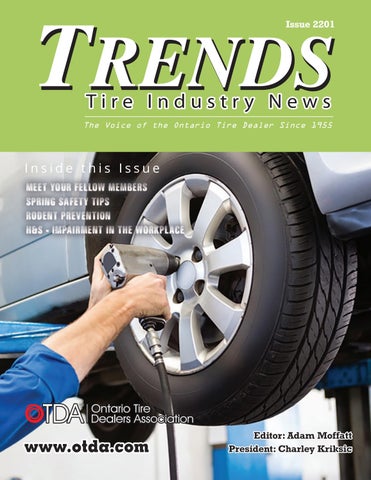
Issue 2201
The Voice of the Ontario Tire Dealer Since 1955
Inside this Issue
Editor: Adam Moffatt President: Charley Kriksic
T N E M P EQUI
E
AND TIR ES I L P P SU
2021
LABLE I A V A DUCTS O R P 000 OVER 6
Member
3685, avenue des Grandes Tourelles, Boisbriand (Québec) J7H 0E2 T 514 331-0302 | 1 800 361-1932 F 514 745-3109 | 1 888 745-3109
Check out our web catalog
www.quemont.com Catalogue Cover
2021.indd 1
and tire supp lies
SUPPLIES?
essoires pour pneus | Equi pment
NEED
s et Équipement pour pneus accessoires Equipment plies and tire sup
e 1981 Depuis/Sinc
ENTS VOS DÉPLACEM PARTENAIRE DE ROAD E TH ON U YO SUPPORTING st ast to coa | à l’autre Co D’un océan Membre
t.com www.quemon 1932 | 1 800 361514 331-0302
2021-02-08
8:05 PM
President’s Message
! " # $ " " $
% & ' ( " ) * $ + , + - .
/ ! *0 1 2 3 4 3 5 67 0 4 3 3 ! / ! $ $ $ $ 8 . 8 *0 9 0 ! : / ! ; < / % = $ *0 ' . / + $ $ ' /
Charley Kriksic
3
In this Issue
Please take note to use the correct address as listed below Main Office 4 Oakwood Drive Port Dover, Ont N0A 1N4 P: 289-887-4046 E: amoffatt@otda.com W: www.otda.com
Billing Office Ontario Tire Dealers Association 5-4104 Fairview St. Suite 312 Burlington, ON L7L 4Y8
Printer Barney Printing 1001 Dundas St. Woodstock, Ont N4S 1H5 P: 519-537-5596 1-866-534-0004 F: 519-537-8209 E: info@barneyprinting.com W: www.barneyprinting.com
Editor: Adam Mofffatt President: Charle ey Krriksic
3 5 6 7 9 10 12 14 15 19 20 22 25 27 28 29 30
T H A Y N O K U
President’s Message OTDA Annual Fundraiser & Golf Classic OTDA Members and Directors Letters to the Editor Meet Your Members - OK Tire Protect Your Business Against Rodents Treadlines Vehicle Weight and How Tires are Changing Spring Safety - 6 Tips for Staying Safe CEBA Loans - Update OTDA Throwback Common Risks Your Tire Business Could Face Safety Corner RPRA - Registrar Announcement Money Wise with BMO Meet the Vendors Classifieds
OUR ADVERTISERS 2
Qué-Mont Equipment
8
Hunter Engineering Company
16
West Lake Tires
21
Emterra Tire Recycling
24
Hunter Engineering Company
27
eTracks Tire Management Systems
30
Tyre Connection
30
R & E Tire
31
Federated Insurance
32
Prema Canada
!" # $ %& ' '
( ) * + ( ( ) * + ., ( , %,, , ( ( , %,, + + + / + - - # . * * * *
REGISTRATION OPENS NOW! 0 1 2 3 3 4 5 ' 3 6-/66 /! !"
“YOUR STRENGTH IS IN OUR NUMBERS” The OTDA is recognized by industry and government as the representative body of the Independent Tire Dealers of Ontario.
New Member
City
Centreline Tire Distribution . . . . . . . . . . . . . . . . . . . . . . . . . . Brantford Sisca's Auto Service Ltd . . . . . . . . . . . . . . . . . . . . . . . . . . . . Toronto
President ......................................... Charley Kriksic ................ Consumers Tire Vice President ................................. Harold Boake ................... Steelecase Tire Treasurer .......................................... Glenn Warnica ................. OTDA Secretary .......................................... Rejean Murray ................. O.K. Tire Service (Val-Rita) Member Benefits ............................. Alexa Labrecque .............. Provincial Tire Distributors Past President ................................. Bob Bignell ...................... Veritech MFG & Wholesale Inc. Health & Safety ................................ Bruce Barnim ................... Tirecraft Ontario Board Development ........................ Don Frisby ....................... Frisby Tire Co. Environment .................................... Eric Gilbert ...................... Ericway Tire Education & Training ...................... Jim Taleporos .................. Midas Canada Inc. Marketing/Promotions/Events ....... Ron Spiewak ................... O.K. Tire Cobourg Executive Director .......................... Adam Moffatt ................... OTDA
7 . 8 $ . 1 ( 9 / : 3, , / : 3, , - / 3 $ / %8
;3 3 4 5 ' 3 3 3 6
LETTERS
Do you have a question, comment or view you would like to share with the readers of Trends Magazine? Send them to amoffatt@otda.com
to the editor
Q
Q A
Do I need to change my winter tires over, they are almost worn out, and I want to save my summers for another year?
We have customers come to the shop starting early March looking to take off their snow tires.
Simply put, winter tires don't like warm roads.
We try to advise the best we can that it might not be time for a changeover because winter is probably not over yet!
Winter tires are designed to work best in cold conditions and are less effective at dissipating heat, so the risks of overinflating and blowouts are much higher.
We have always followed the general rule that snow tires should remain on until the roads are clear and the temps are averaging 7C. Is there anything else we should mention to our customers?
The rubber compound in a winter tire is much more flexible, affecting how your vehicle handles and feels on the road, especially when you make sudden turns, which could result in a loss of control.
A
Everyone has their take on when snow should be removed; some look at temperatures, others note dates, and I've even heard a few bases it on the farmer's Almanac!
Since the rubber compound is softer, the tread changes shape more; this creates more rolling resistance and uses more gas.
In addition to monitoring road conditions and consistent temperatures (7 C or higher), it is also advisable to have your customers check with their insurance company before removing their snow tires. With insurance companies now offering snow tire discounts, your customers should ensure they understand what the Insurance company requires not to violate their snow tire discount.
Finally, driving on winter tires in summer increases the braking distance by at least 10 percent on dry pavement and 26 percent on the wet pavement!
7
Built tough for tires. Built easy for techs. Hunter’s wide range of tire changers readies your shop for any wheel assembly.
Scan or visit hunter.com/tire-changers
M E E T YO U R MEMBERS
is a new addition Meet Your Members ciation where you, our asso to Trends Magazine, yourself, ce du ro an opportunity to int members, will have s. busines your team, and your
OK TIRE ST. GEORGE
In 1986, Greg and Carla Lindsay decided it was time to “take the plunge” and open their retail tire shop, St. George Tire, located in St. George, Ont. Within one year of opening, the pair quickly outgrew their single-bay shop. They relocated just up the road to a multi-bay shop, where one year later, an addition was built to accommodate their rapid customer growth. In 1989 St. George Tire Joined the OK Tire family, becoming OK Tire St. George. Over the next three decades, OK Tire St. George grew to become one of Brant counties leading tire and automotive shops, promoting tire safety & awareness, being a strong community leader, and building a team that felt more like a family. Tragically, in 2017 Greg passed. However, with the support of her team, Carla pushed forward and continues to own and operate OK Tire St. George today. Congratulations, OK St. George, on a successful 35 years, and we wish you nothing but the best over the next 35 years!
Key Tips to Protect Your Business Against Rodents Federated Insurance Rodents can become a nuisance and cause serious damage for any business, in both rural and urban settings. Rats, house mice, field mice, and squirrels are considered pests as they can cause property damage and disrupt business operations.
If buildings, vehicles, and equipment are left unattended and unoperated for long periods, there is a high chance of rodents finding their way in and nesting. As for what their nests are made with, they may utilize the following materials:
In buildings, rodents can destroy walls and chew through electrical wiring, insulation, furnishing, products, and other materials. We’ve seen major battery-related fires caused by rodents chewing through the wiring of vehicles stored inside buildings without the battery being disconnected. They can also pose a problem outdoors, in yards, lots, waste areas, or other accessible locations.
• Insulation found within building walls, vehicle parts, and equipment • Ducting and air filtration components in heating and air conditioning systems What signs may indicate a rodent infestation? Common signs to be on the lookout for are chew marks, droppings, tracks, holes, grease marks, musky or rotting odours, and noises. If you notice any of these, it is likely that one of your workspaces contains a nest or at the bare minimum, a rodent was looking around for a place to stay. These sensory cues are often the first indications that damage has been done.
Where do rodents build their nests? Rodents look for warm and cozy locations to construct nests. Typically, they build nests in or around vehicles (cars, trucks, RVs, campers, etc.) and contractor equipment that is rarely used. It’s important to find and resolve the presence of rodents before they build nests. Once that occurs, they will only multiply.
What’s the impact of a rodent infestation? Rodent infestations can impact your business resulting in damages to your property, lost operational time (use of vehicles and equipment), and lost revenue (sale of vehicles and equipment). It is also generally very costly to repair damages due to rodent infestations. At the same time, it can also be hazardous to your health.
Rodents generally construct their nests in the following locations: • Inside of buildings (attics and crawl spaces) • Inside of vehicles (engine compartments, headliners, gloveboxes, on or under vehicle seats, trunks, and spare tire compartments) • Outside of vehicles (taillight and headlight access areas and enclosures) • Within equipment (engine and tool compartments)
10
Key tips to help protect your business against rodent infestations: • • Implement a rodent control program – There are rodent control companies who can help you develop a program tailored to your needs based on your unique premises and the rodents identified in your geographical area. They can also provide ongoing inspections and monitoring to ensure the program is effective. • Park and store vehicles – Store RVs, campers, trailers and equipment in yards or fenced areas where there is no tall grass or vegetation. Avoid storage in fields or wooded areas where rodents are commonly found. • Disconnect your batteries – If you do park vehicles inside a building and there is evidence of nesting inside those vehicles, ensure you disconnect batteries before conducting a full investigation, as well as before any cleaning and removal of infestation. This can help eliminate the chance of battery-related fires. • Seal up openings and holes – You may find these in windows, sunroofs, and doors within vehicles, as well as pathways leading to vehicles. If possible, restrict access entirely. • Lay traps and remove food – If storing vehicles in a garage or warehouse, lay traps and remove food from the area to avoid scents that rodents are drawn to. When storing RVs, camper units, and trailers, remove barbeque units, as rodents are attracted to the odours from residue. Remove food, fat food packaging, pet food, and small scraps of food that may be on the floor of vehicles. • Use essential oils or rodent repellent smells – Treat vehicles or equipment with essential oils or commercial products that emit rodent repellent
•
•
•
smells. These products may need to be reapplied on a regular basis to maintain their effectiveness. Sprinkle cedar shaving, sawdust, or mulch – Do this in the areas that vehicles and equipment are kept. These materials contain phenols that emit a strong smell and repulse rodents. Capture devices – An ultrasonic device, for example, emits a high-pitched sound to repel rodents. These devices can cause confusion, convulsions, and ultimately, they have the ability to kill rodents. Regularly inspect your vehicles – Inspect the exterior and interior of vehicles on a regular basis, whether the vehicle is used often, or rarely. This helps prevent the colonization or infestation of a vehicle. Air out the vehicle – When starting a vehicle that has been idle for an extended period, air out the vehicle and inspect the air intakes and filters before starting the engine.
While rodent problems can be prevalent, luckily there are steps you can take to minimize infestations and to help prevent losses. By utilizing the tips above, you can help ensure your property doesn’t suffer costly damages. Reliable business insurance can help you manage your risks. Visit the Federated Insurance page to learn more, and ensure your business is adequately protected. This blog is provided for information only and is not a substitute for professional advice. We make no representations or warranties regarding the accuracy or completeness of the information and will not be responsible for any loss arising out of reliance on the information.
11
Treadlines Ontario Provincial Police say they recently pulled over the driver of a vehicle who was spotted on the QEW in Niagara Falls with a missing tire and only a hubcap. OPP alleges the 35-year-old driver was travelling from Fort Erie to Mississauga when they were stopped. The individual was charged with careless driving, and no one was injured.
! The Mufflerman Inc. nc. (("Th ("The Mufflerman"), a portfolio company of Argyle Capital Partners has acquired Superior Tire & Auto Inc. ("Superior Tire") from Frank Bongiovanni, President and Howard Minsker, Chief Executive Officer. Superior Tire's President and employees will be remaining with the business and will continue to lead the Superior Tire franchisees and operations as a distinct division of The Mufflerman. The Superior Tire name will continue with no change. Frank Bongiovanni, President of Superior Tire, said "we are extremely excited about the combination of these two iconic auto repair and tire shops. We know The Mufflerman and Superior Tire share a focus on the customer experience that is unparalleled in the industry and are looking forward to continued growth and success."
"#$ % & ' (& ) ' The Goodyear Tire & Rubber Company announced the release of a demonstration tire with 70% sustainable-material content, including industry-leading innovations. The 70% sustainable-material tire includes 13 featured ingredients across nine different tire components, including Carbon Black, Soybean Oil, Silica and Polyester. Company performance indicators have shown the component properties to deliver strong overall tire performance.
*) ' + + ,
Deutsche Post DHL Group is introducing a global DHL Green Carrier Certification to reward road transport subcontractors for their efforts to become more sustainable. As part of its sustainability roadmap, Deutsche Post DHL Group aims to reduce greenhouse gas emissions to below 29 million tons by 2030 and net-zero by 2050. Ground transport accounts for 21 per cent of the Group’s total CO2e emissions. Accordingly, in addition to electrification of the last mile and investment in alternative drives and fuels in its own fleet, another important lever is the scope of sustainable transport services provided by the Group’s service partners. By certifying its green subcontractors, the world’s leading logistics provider underlines its responsibility in terms of sustainability and climate change while at the same time creating the necessary transparency for its stakeholders.
12
- . + + . ( / ( + ' Continental is proud to announce the winner of the second Continental Challenge for sustainable material solutions: Low Sulphur Fuels (LSF), a young enterprise based in Amersham (UK), prevailed over more than 50 participants from across the world. LSF’s winning idea recycles mechanically sorted plastic materials, end-of-life tires and rubber products as well as used oils through its Fast Electrochemical Process (FEP). Within this closed-loop oxidation process, the feedstock is first heated to its gas phase and then reacted with a proprietary electrolyte. The distillate is then separated and washed, resulting in a low sulphur distillate, broad-range naphta and raw carbon black which can then be used as feedstock materials for the chemical, automotive and other industries.
Fred Brundle March 2, 1943 – December 30, 2021
It is with a heavy hearts that the Brundle Family announces the passing of Fred Brundle. In 1966, Fred started the family retail tire business, Fred’s Tire, in Orangeville, Ont. Retiring in 2015, Fred sold the retail side of the business, leaving his legacy to be carried on by his son, Frank Brundle, who owns and operates the wholesale side of the business known as Tire Discounter Group. Fred will be remembered fondly, by all whose lives he touched.
' ' ( / %% / ' %( /
% 2 - . )
Researchers at Martin Luther-University Halle-Wittenberg (MLU) and the Leibniz Institute of Plant Biochemistry (IPB) in Germany have discovered that enzymes are capable of degrading synthetic polyisoprene.
As part of its growth plan, Distribution Stox announces that an agreement has been reached for the acquisition of the wholesale distribution division of Service de Pneus Lavoie Outaouais (Pneus Lavoie).
The specific conditions needed for this to occur were created and exploited by the researchers. Polyisoprene is the principal component of natural rubber, a material used for the production of car tires. Until now, the degradation of polyisoprene has only been possible with a composition that is similar to naturally occurring rubber.
The transaction is expected to be completed at the beginning of 2022 and is subject to usual conditions for this type of transaction. Retail divisions operating service centres under the Point S banner, as well as the tire retreading facility, that serve Québec and Ontario will remain the property of Mr. Normand Lavoie.
The MLU and the IPB believe that the research could provide important insights for a move toward a circular economy.
) % / ( . 0 / 1 eTracks Tire Management Systems launched its Sustainable Recovery Platform (eSRP) to over 6,500 Ontario tire collection sites, 100 service providers and over 50 producers. eSRP's development was spurred by the need for better data and insights into where, how and what becomes of recyclable materials put into market, and how much of that material is made into new products. eSRP will help to improve the way Producers and PROs are able to manage recyclable materials and regulatory compliance; and drive a more sustainable, circular economy.
) ' ' . The Ontario government has launched the Advanced Manufacturing and Innovation Competitiveness (AMIC) program to help companies get the tools, technology, and talent they need to grow, compete and innovate in an increasingly competitive global market. As part of the 2021 Fall Economic Statement, AMIC is a new stream of the Regional Development Program (RDP). The two-year, $40 million programs will support advanced manufacturing businesses to invest in the equipment, advanced technologies, and skilled workforce needed to improve competitiveness and growth. The Advanced Manufacturing and Innovation Competitiveness program will build on Ontario’s successful RDP. In 2019, Ontario launched the RDP to help eligible businesses, municipalities, and economic development organizations create jobs and opportunities in Eastern and Southwestern Ontario.
' / . + 3 4#45 ' . Tire and Rubber Association of Canada (www.tracanada.ca) is proud to announce that it received a 2021 Award of Distinction from the Canadian Society of Association Executives (www.csae.com) for its new website design. CSAE Awards of Distinction recognize outstanding achievement in association leadership, structure, and governance; and/or the planning and execution of internal, external, and integrated programs that serve associations’ members and/or engage external stakeholders and volunteers.
+3 ' 6 ' + ( The former Fountain Tire CEO and Board Chair passed on December 5 with his family by his side. Brian Hesje joined Fountain Tire in 1984 and rose through the company ranks as Vice President and ultimately, President. He later served as CEO from 1992-2005, and as Chair of the Fountain Tire board of directors from 2005 until 2014.
To meet most challenging rolling resistance requirements, the whole tire is considered. Tire manufacturers continue to work on every possibility to reduce the rolling resistance contribution of all applicable tire components. For example, a low rolling resistance sidewall, ply composition, base construction, and wire coat are all under development. Manufacturers are even using 3D printing to find new advantages.
How Vehicle Weight is Changing How Tires are Made
Secondly, a vehicle’s weight can be a huge factor in efficiency, thus requiring engineers to develop low-weight components. We’re seeing engineers use all sorts of exotic materials to reduce weight on EVs, but it’s happening with the tires, as well. The general public may not think about it, but tire weight plays a significant role in efficiency. Lightweight/high strength materials are being investigated, including higher strength steel and fabric reinforcement, advanced composite materials and more. Remember, too, that increased work in the area of tire sealants and run-flats allows for the elimination of the spare tire, so overall lightweight considerations come into play there.
Tire Review Staff Tires have long been the standard and common item on every type of vehicle. But vehicles are changing – electric, autonomous, and more – so how will that reality affect tires and their critical role? Keep reading as tire industry veteran Jim Davis, retired Goodyear communications manager and former Tire Review editor, delves into the future of tires looks like.
Of course, you’ve always heard that tire development and design is a matter of compromise or trade-offs. A common question when considering tires for EVs, for example, is “Can you have quiet and traction, too?”
You might say the tire industry – manufacturers, retailers, distributors, and everyone connected to this business– has held a monopoly in the field of transportation. Let’s face it, on cars, trucks, busses, motorcycles, tractors, aircraft and just about anything else, tires have long been the single component that touches the ground. In other words, if it rolls, it rolls on tires.
Because EV noise and comfort are magnified due to lack of sound or vibration from an internal combustion engine, everything else – the noise from brakes, suspension and tires – gets amplified. Already, you’re seeing tire manufacturers developing foam inserts and other solutions that can lower the noise generated by the tires by half. It creates no loss of performance in the tire, and the foam is light enough to create no impact on the tire’s speed or energy consumption.
The good news … tires will remain vital for future vehicles, even as they evolve. The composition of tires may change, and the technology developed into them is different – but hey, that’s been happening for the last several decades anyway. The evolution of tire design and the manner in which tires need to continually improve is an ongoing march forward, adapting to future vehicle development.
Most tire noise comes from the tread pattern and the pitch sequence of the tread elements. That noise can also be reduced by fine-tuning the construction, overall contour design and tread pattern. Acoustically optimized tread grooves help to provide an optimal solution.
With tires playing a very important role in the efficiency of electric and autonomous vehicles, they need certain characteristics for EV fitments. Those include low rolling resistance qualities and sound-dampening technologies. Rolling resistance refers to the energy used to roll a tire; those calculations then translate into fuel or battery efficiency. Lower rolling resistance tires also squeeze out the best possible range for EVs.
All in all, while most consumers likely don’t realize or appreciate the high level of technology that goes into their tires, these products have continually delivered ever-greater performance and efficiency.
Amongst many tire designs and types, a significant difference of miles per gallon or overall EV range can exist – so the technology in various tires matters greatly.
With the onset of new vehicle types, that will not change. The technology will keep pressing forward and the four things that connect the vehicle to the pavement will continue to be tires.
This is achieved by adapting the tire’s structure — making it more lightweight, optimizing the rubber compound, even aerodynamically tuning the sidewall. With rolling resistance accounting for up to 20% of a vehicle’s energy consumption, any savings here can have a significant effect on range.
One commonality for all future mobility solutions is the one thing that touches ground. The tire enables precise steering, grip to accelerate and brake and absorbs vibration and noise. Simply put, the tire is integral to the driving experience – no matter what you’re driving.
14
Spring Safety 6 tips for staying safe At long last, it's spring! Time to renew, relax and rejuvenate in the warmth and sunshine, but don't let that excitement get the best of you as outdoor hazards don't disappear with the change of season. "We're in the middle of a transition from one season to the next," says WSPS Consultant Kristin Hoffman. "We are still getting some winter hazards, starting to see some summer hazards, while managing some unique spring hazards. It's a unique time of the year." Ideally, workplaces already have programs and controls in place for these hazards, but spring is a good time to review, refresh, evaluate and implement any opportunities for improvement.
Six spring time hazards to prepare for: 1. Severe weather. Crazy weather patterns seem to affect us in spring particularly. There can be snow, rain, sleet, hail, thunderstorms, even tornados. Be clear about your expectations for outdoor workers, whether they are working onsite or in a remote location.
4. Slips, trips and falls. After everything melts, you need to protect workers from muddy, slippery conditions in your workplaces, especially in entrances, parking lots and on stairs. For service-based businesses, there is extra liability if customers are hurt on your property.
2. Dangerous driving conditions. In some parts of Ontario, driving in snow and ice persists well into spring. Other areas may be thawing out, resulting in flooding or muddy and slippery driving conditions. Have protocols in place for every scenario and provide refresher training on defensive driving techniques and distracted driving.
5. Sun hazards. These include heat stress, sunburns and UV radiation. It's easy to forget that the sun is no safer in April than it is in July. Don’t wait until summer to put your ultraviolet exposure policy in place, and provide proper breaks, shade and access to water. 6. Insects and vegetation. Poison ivy and ticks that may carry Lyme disease are prevalent in spring. It's important for workers to wear gloves and long sleeves and use insect repellent when working near long grass or forested areas. Rodents may also have wreaked havoc on the wiring of equipment inside your facility. Check the wiring on all equipment that has not been used recently.
3. Flooding and high-water levels. Washed out roadways and creeks are a definite hazard for both outdoor workers and drivers. Whether walking or driving, workers need to avoid flowing water (which can carry us or our vehicle away) and standing water (which may be deeper than we think and contain debris, tree branches or pot holes).
15
Advertise With Us!
Benefits > * " &
*0 0
> * " & >
? *
1 6@ &
Advertising Rates PACKAGE
2022
/ 3
AB7
SOLD
AB7
SOLD
AC D
SOLD
AC7
9 $ 3
AD7
SOLD
AD7
SOLD
AE E
SOLD
AC7
1
AF7
AF7
AC E
AC7
G
AE7
AE7
A 7
A 7
9 3
A 7
A 7
A6 7
A6
, Don t Delay! Book Today! Contact Adam Moffatt 289-887-4046 amoffatt@otda.com www.otda.com
!" # $ !# %
<* 8;
8( , 3 ;: = , $ + $ > 3 9 9 $ $ $
( ( , 3 3 ( ?! ?" ( ? >, @
3H9
I
> J !"! > 7J 5 6 E, = +
# $ > K = 0 C6 C > / 0 C6 C = 0 C6 7 % > / 0 C6 C L * 4 I@@ @
3
19
( + Throwback 8 *( @ ;3 ( 3 5 ' 3
Thinking innovatively. Transforming waste to resources.
YE AR S 1976 - 2021
WHEN YOUR TIRES LOOSE THEIR GRIP, WE HELP THE EARTH GET A GRIP ON YOUR TIRES.
THE EMTERRA DIFFERENCE Emterra Tire Recycling is a division of Emterra Group, a family-owned Canadian company with expertise in creating and delivering products and services that enable people and businesses to become environmentally responsible.
ONTARIO FLEET With one of the largest fleets in the province, Emterra can service businesses across Ontario.
ONE-STOP SHOP We are RPRA registered Collectors, Haulers, and Processors. By independently processing our tires, we can provide reliable services all year round.
8 Bramwin Court, Brampton ON
|
WORK WITH PROs
TRACKING
Work with registered Producer Responsibility Organizations like eTracks and Ryse Solutions to meet your compliance requirements.
By developing our own tracking software, Emterra electronically reports collections to conform to regulations in a timely manner and avoid RPRA audits.
www.emterra.ca
|
info@emterra.ca
|
1-866-498-0339
Common risks your tire business could face... continued Security
CYBER SECURITY Society is increasingly reliant on technology, and businesses that deal with tires are no different. But while technology can help in the everyday running of a company, it also opens businesses up to a new set of risks. That’s why cyber security is so important.
Point of sale (POS) Information and software should be backed up and kept off-site, and backups should be performed regularly enough that records are always up-to-date. The information should be kept off-site not only to protect against hackers, but also to minimize the chance it could be destroyed in an incident like a fire. Backing up information is especially important at the head-office level, but each business will need to decide if backups are needed at the store level as well.
When a customer purchases something from a business, their personal information is shared with that business. This type of interaction, the point of sale, presents businesses with two responsibilities: protecting customer information that’s stored on your system and ensuring your system is protected so it cancontinue to operate. The customer information that’s shared could range from names to addresses to credit card information to links to a customer’s website. Hackers can use this information to gain access to a customer’s website. Because of this, access must be controlled through measures like firewalls, passwords, and the separation systems. It’s also important to ensure your operating system is secure, as hackers often look to gain access to a computer system and will then lock the system, and demand a ransom or maliciously destroy information.
Companies with multiple locations will also need to control how they push out information to their various stores or offices to prevent hackers from gaining access to their system. There are numerous companies and individuals that provide cyber protection services to ensure your information is protected. Expert advice is essential, as technology is continually changing and hackers come up with new ways to access systems every day.
22
Server rooms
Wi-Fi guest networks
Wherever there are server rooms, whether they’re at the head office, at back-up locations, or at individual stores, security measures must be in place. Doors need to be locked, access needs to be limited to trusted personnel, and security systems need to be installed. Depending on the size of the servers and the size of the rooms, the equipment could overheat, which may cause damage. At a minimum, these rooms need to be air conditioned; in some cases, dehumidifiers should be used to protect the equipment.
Many businesses now offer customers access to their Wi-Fi. While this is a great move from a customer service perspective, it can open you up to some additional risks. Fortunately, there are some steps you can take to mitigate those risks.
Stand-alone guest network: It’s important to ensure that guests cannot access your business network. To help with this, guest networks must be stand-alone and should be professionally installed. You may also want to work with your providers to configure your routers and firewalls to block certain types of data on the guest network to protect your company’s reputation.
Splash-page agreement: It’s a good idea to consider listing your network access policies on a splash page that guests must pass through before connecting to the network. Often these pages include a “click here to agree” button.
Guest passwords: Don’t give out one password to everyone. Look for third-party services that automatically assign security keys on a per-user basis. Per-user, per-session keys make it easier to block a specific troublesome user with no interruption to everyone else.
Manage guest bandwidth consumption: You likely don’t want guests downloading movies or large data files, as this could make the connection unusable for other guests and drive up your internet costs. To combat this, your provider can set up your network to manage guest bandwidth consumption.
Credentials expiration: Login credentials for guests should expire after a certain amount of time, such as every four hours or at the end of the workday. Credentials that don’t expire often become a security hole, allowing unauthorized re-entry onto the network down the road.
23
Wheel balancing should be quick, easy and accurate.
We made sure of that. Set up your shop for maximum ef昀ciency with Hunter tire and wheel balancing equipment.
Scan or visit hunter.com/wheel-balancers
SAFETY
CORNER
Managing Workplace Impairment Raise the issue of COVID-19 and impairment, and our minds may go in multiple directions. Increased substance use from isolation and stress, for one; extreme fatigue from overwork for another. But these are just two forms of impairment. CSA Standard Z1008:21, Management of impairment in the workplace defines impairment as "a temporary physical, psychological, or physiological state of the worker that has a negative impact on performance or creates a hazard in the workplace." In other words, a state that distracts a worker from fully concentrating on the task at hand. At any time, there could be many possible causes of impairment: unpredictable schedules, employee turnover, working excessive hours or multiple jobs, operating in extreme temperatures, a temporary disability, conflict in the workplace or at home, and more. All of these causes may exist in retail, warehouses and distribution centres, especially given the explosive demand for logistics services in this fast-paced, high-demand environment. These causes could compromise workers' ability to do their job safely, making them a hazard to themselves and others. As workplaces shift from a short-term to long-term approach to COVID-19, this may be an ideal time to review and update your impairment policy. That's if you have one. Most employers already have a substance abuse policy, but that's just one form of impairment.
Here are seven steps for addressing workplace impairment: 1.
Recognize as an organization that we all manage our way through this pandemic differently. It’s important to acknowledge we’re going through a hard time, and it’s okay not to be okay.
2.
Conduct an impairment hazard assessment. Consider all possibilities (e.g. shiftwork). Any of them could contribute to impairment.
3.
Create an impairment policy that sets out the workplace's approach. Establish expectations and responsibilities of all workplace parties, and procedures to follow. The Canadian Centre for Occupational Health and Safety offers useful information for developing a policy at ccohs.ca.
4.
Build anti-impairment measures into practices and procedures. For example, to minimize shift-related fatigue, whenever practical enable employees to choose shifts conducive to a healthy sleep pattern. Ensure new hires are fully qualified and trained, and have practical experience before you consider them fully competent. In one workplace I visited, a newly hired young worker was qualified to operate a powered piece of mobile equipment, yet was too young to operate a motor vehicle on the highway.
25
5.
Provide information and instruction on impairment. Among other things, this could include 1) educating everyone on the impairment policy, 2) informing them of their responsibilities under occupational health and safety (OHS) legislation, and 3) training them on the dangers of using equipment or machinery while impaired, and how to recognize signs of impairment.
6.
Create a culture where people are encouraged to disclose possible impairment. Start by demonstrating through policy and actions that you will accommodate people who disclose, and offer support and access to resources. Talking about it, encouraging self-reporting, and demonstrating that you support your employees will help them feel safe in coming forward.
7.
Provide ready access to supports. Employee and family assistance programs and community-based crisis, distress, or addiction support are just some of the resources that can help workers with impairment issues.
How OHS law applies to impairment Under the legislation, employers, supervisors and workers each have responsibilities for maintaining a healthy and safe environment. For example: •
employers and supervisors are required to take every precaution reasonable in the circumstances for the protection of a worker. This includes ensuring workers are not impaired, and not exposed to hazards caused by impairment. Employers and supervisors who become aware of a worker operating heavy mobile equipment in proximity to other workers and who may be impaired must take every precaution reasonable in the circumstances to ensure this worker and others are protected.
•
workers have an obligation to perform their job safely, which includes not performing work when impairment may affect their and others’ health and safety. Workers are also responsible for reporting hazards, such as a co-worker who may be impaired.
26
Tire Manufacturers
Distributors/ First Importers
OEMs
As a Producer Responsibility Organization (PRO) in Ontario, we work with Collectors, Haulers and Processors to ensure that used tires are kept out of landfills and recycled into new products.
Working for producers to ensure they meet their legal obligations under Regulation 225/18.
Manufacturers
Collectors
Haulers
Processors
Working with eTracks to exceed the requirements of Producers under Regulation 225/18.
eTracks is bringing industry players together to advance the circular economy in Ontario Questions? Contact us at 1.844.387.2257, info@etracks.ca or visit at etracks.ca eTracks_OTDA_HALFPAGE_AD_22_8.5x5.5_v4.indd 1
2022-02-08 9:06 AM
! "#""$ $ % & ' ' ' % $ $ & ( "#!) % ' ' & *+ , ' % - ( "#!. / "#!. $ 0 1 0 % % 0 ' ' 2 3 % ' 4 ' ( 5 6 * ' ' & $
OTDA
Meet the Vendors
. ' 7 ' Preferred Customer
Privilège
& & ' ( ' )
- ' . 6 , - ' . 5&8##&49:	## % 545 "":;
* + ❏ No Fees, No Penalties, No Contracts ❏ It is Easy to enroll with 1 simple phone call! ❏ Members will receive the knowledgeable support of our Customer Care Representatives, and the personal attention of a dedicated Staples Onboarding Specialist ❏ Web based and phone ordering systems ❏ Over 300,000 products to choose from, which includes paper, ink/toner, stationary basics, furniture, technology, breakroom/kitchen, cleaning/sanitation, safety apparel/equipment and health/medical supplies, retail store supplies/display, personal care, household items ❏ when purchasing items in the Bulk Centre ❏ 10% savings on Copy, Print & Marketing Services ❏ Buy on-line, Pick up at store (BOPIS) and of course the Fast, Next Business Day Shipping on all orders placed before 5:00PM local time ❏ available depending on size of order) ❏ Use Visa, MasterCard, American Express or Staples Account as Method of Payment for Orders ❏ Earn Basic and Bonus Air Miles reward miles
!" #
$%
%8 3 3 + A & # A & # +%'%
, -
$ ' (
$ ) ( *
%
%
0 + *
#
$ .
5&8##&49:	##
<59 94#&=94#
#
$ / '( B' 3
& ' "( )*+*,,-.
#
!
$
%
3 4 5 ' 3
& , & ( - . - / 0 )
1 234 2 2
Email for more information
Email amoffatt@otda.com for more information. 29
8 * ( %8
CLASSIFIEDS
5 ' 3 6-/66 /! !"
C ,
. , 8 C $
82#; ) <8%1%827; ;&8#; % 8; 2& :# ;:#2 ; %%D2& 8% 02 8C; 0% % 2& *%.282%&. • Certified Wheel & Rim Installers • Licensed S Automotive Technicians & Apprentices
• Tire Counter Salesperson • Tire Technicians
%00;#2& • Mon to Fri 8-5 (position dependent) • Competitive hourly wage • Year-round full-time employment • Benefit package
• In-shop and Road positions • Tool allowances • Bonuses
2 ( 8 ) 8 3 + /"!"/ !6 3 5 '
30
8E#; %&&; 82%& Providing scrap Tire collection services London to Burlington. Collection services for all passenger, light truck and medium truck sizes, on and off the rim. -/!!9/6--6 #); 82#; Providing scrap tire collection services for Eastern Ontario - Oshawa to HWY 416 and north to Hwy 60 and Deep River. Collection services for all tire types and sizes, on and off the rim. : : / " 9/9-6/ !
Keeping you safer since 1920
We’ve been at it since 1920 – learning what matters most to our customers and the challenges they face.
Call 1.844.628.6800 and speak to a Commercial Insurance Specialist today.
www.federated.ca Not all industries are the same, so we pride ourselves in understanding the intricacies of your business.
Recommended insurer of the Ontario Tire Dealers Association (OTDA).
31
Federated Insurance Company of Canada is the insurer of Federated Insurance policies. [3706-002 ed01E | 02-2021]
Tire Repair Materials & Tools Wheel Service Tools & Equipment Wheel Weights & Balancing Compounds TPMS Tools and Sensors Valves & Gauges Service Chemicals Air Tools & Accessories Shop Supplies & Equipment & more! 800-268-6311