

3rd Anniversary:
Insecurity, Corruption Top Chart As Nigerians Lament Tinubu’s Failures
•Opposition Parties Fault President’s Scorecard, Demand Tangible Results
•Citizens Question Impact Of Subsidy Savings As Poverty Bites Harder
•Tough Policies Have Stabilised Economy, Attracted Investments – Tinubu

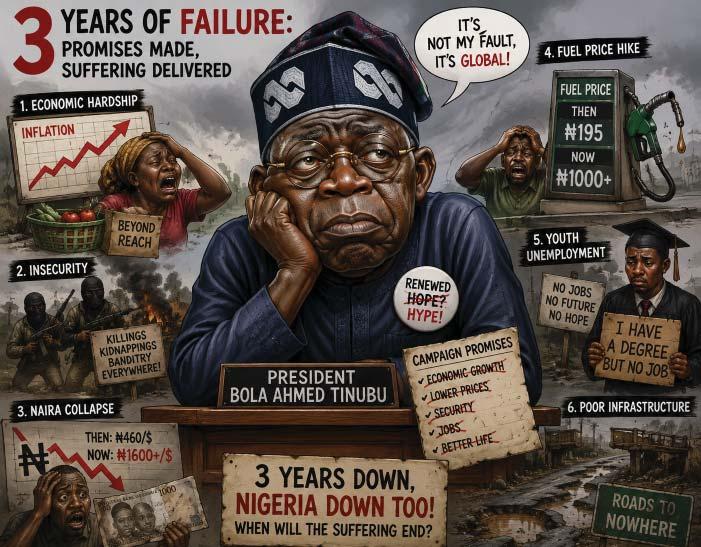
AS President Bola Tinubu marks three years in office, Nigerians have remained sharply divided over the impact of his administra on’s reforms, with insecurity, poverty and corrup on emerging as the dominant concerns among ci zens.
While the Presidency insists the country is on the path to economic recovery, many Nigerians say the reali es of daily life tell a different story.
OSUN DEFENDER reports that across major cities and rural communi es, complaints about rising living costs, food prices and declining purchasing power con nue to dominate public conversa ons.
Data from the Na onal
Bureau of Sta s cs showed that infla on stood at 15.69 per cent in April 2026, while food infla on was recorded at 16.06 per cent year-onyear.
Although the figures represent a decline from previous highs, feelers from many households say prices of staple foods remain far above what they were when Tinubu assumed office in May 2023.
On social media, many Nigerians ques oned why hardship has intensified despite government claims of increased revenues and economic growth.
Posts on X, Facebook and TikTok were dominated by complaints about transporta on costs, electricity tariffs, food prices and un-

employment.
In the last three years, Security has also remained another major challenge confron ng the administraon.
Despite repeated assurances from security agencies, incidents of kidnapping, banditry, terrorism and communal clashes connue to affect several parts of the country.
The persistence of insecurity has also disrupted farming ac vi es in many regions, worsening food supply challenges and contribu ng to infla onary pressures.
Ques ons have equally been raised about corrupon and accountability in public spending.
Opposi on Par es Fault
President’s Scorecard, Demand Tangible Results
The removal of fuel subsidy, arguably the administra on’s most consequenal policy decision, remains a major source of debate among economists and cizens alike, despite claims by government officials that the decision saved trillions of naira and prevented fiscal collapse.
Checks by OSUN DEFENDER revealed that between May 2023 and December 2025, subsidy removal generated potenal savings of over ₦11 trillion, which cri cs argued have not translated into visible improvements in public infrastructure, healthcare, educa on or social welfare for ordinary Nigerians.

Social media reac ons monitored by OSUN DEFENDER mirrored cri cisms from opposi on poli cians and public commentators.
Former Vice President and 2027 presiden al candidate of the African Democra c Congress (ADC), A ku Abubakar, described the administra on’s economic direc on as one that has deepened hardship and suffering for millions of Nigerians, insis ng that government policies have failed to improve living standards.
Also, Human rights acvist and former presidenal candidate, Omoyele Sowore, argued that “hunger, insecurity and hopelessness” have become defining features of the current administra on, maintain-
ing that ordinary Nigerians have seen li le improvement in their welfare.
Cobbora ng them, Presiden al Candidate of the Nigerian Democra c Congress (NDC), Peter Obi has repeatedly ques oned the disconnect between official economic sta s cs and ci zens’ reali es, stating that economic indices must reflect in the lives of the people.
Public affairs analyst and broadcaster, Rufai Oseni ques oned the pace of improvement, asking: “Can the average Nigerian honestly say life is be er today than it was three years ago?”
Former Minister of Educa on, Oby Ezekwesili,
One Reported Dead, Many Injured As Osun Accord House Of Reps Primary Turns Violent
ONE person has been reported dead during the chaos that erupted at the Accord Party House of Representa ves primary elec on for the Ayedire/Iwo/Ola-Oluwa Federal Cons tuency on Friday.
OSUN DEFENDER reports that the Accord party primary in the federal cons tuency turned rowdy with the camp of the anointed aspirant and current lawmaker represen ng the cons tuency, Hon. Lukman Mudasiru and another aspirant, Engr Ayodeji Bello laying claim to victory.
In videos shared on social media, members of the Accord Party were seen in a free-for-all fight during the primary held at Iwoland Town Hall.
Following the primaries, the camp of Hon Mudasiru, alleged that some polical hoodlums loyal to Engr Bello, a empted to disrupt the exercise.
The camp, however, insisted their primary was successfully concluded with Mudasiru emerging as the party’s flag bearer.
But a statement released from the camp of Engr. Ayodeji Bello, announced its principal won the primary elec on.
The statement noted that out of the 10,402 accredited votes, Bello polled 7,177 votes while Hon. Lukman, got 3,225 votes.
The statement also alleged that hoodlums loyal to the federal lawmaker disrupted the exercise which led to chaos and injuries before security personnel intervened to restore order.
Meanwhile, one of the members who sustained injury during the incidence whose name was given as Mrs Simbiat from Gidigbo Ward 3 died on Saturday.
Confirming the incident, Engr Bello in a statement on Sunday, said, “Democracy should never come at the cost of human lives. Every ci zen deserves to par cipate in the democra c process without fear, in midaon, or violence.”
He called on the Inspector-General of Police, the Commissioner of Police, and other security agencies to conduct a “thorough, impar al, and transparent inves ga on” into the tragedy.
“No one is above the law, regardless of status, posi on, or poli cal affiliaon. Jus ce must be served, not only for the deceased and her family but also to reinforce the principle that violence has no place in our democracy,” he stated.
Speaking with OSUN DEFENDER, a member of the Accord Party in Iwo, Rasaq Odeyemi, condemned the violence that marred the
primary and blamed it on the despera on of party leaders to impose candidates.
“I was at the venue from the start. Everything was calm un l thugs loyal to a par cular aspirant started in mida ng voters. That was when the trouble began,” he said.
•Two Aspirants Lay Claim To Victory, Party Remains Silent
Odeyemi argued that the party’s internal democracy is under threat if violence becomes the tool for selec ng candidates.
“If party leaders can allow this level of violence during a primary, then we have a bigger problem than
just one elec on. We are teaching our youths the wrong poli cs,” he lamented.
Odeyemi called on the Accord Party leadership to intervene quickly before the crisis deepens.
“The leaders of the party must not fold their arms. They need to set up an independent panel to inves gate what really happened. Without that, the party will lose credibility in Osun West,” he stated.
Odeyemi prayed for the family of the deceased and called for jus ce, adding, “It is painful that a woman lost her life in a party ac vity. The family deserves jus ce, and those responsible must face the law. Democracy should never cost lives,” he said.

•Stakeholders of the Accord party in Osun West Senatorial District at the party’s affirmation exercise for its Senatorial Candidate, held last Friday, in Ikire
ADC Constitutes Caretaker Committees, Extends NWC Tenure By One Year
THE Na onal Execuve Commi ee (NEC) of the African Democra c Congress (ADC) has approved the cons tu on of caretaker commi ees at the zonal, state, local government and ward levels across the country, while also extending the tenure of the party’s Na onal Working Commi ee (NWC) by 12 months.
OSUN DEFENDER reports that the decisions were contained in a public no ce issued at the end of the party’s 101st NEC mee ng and signed by the Na onal Publicity Secretary, Mallam Bolaji Abdullahi.
According to the noce, the NEC approved the extension of the NWC’s tenure for a period of one year from the expira on of its current mandate.
The commi ee also approved the cons tu on of caretaker commi ees at the zonal, state, local government and ward levels for a period of 12 months.
In another major decision, the NEC ra fied the results of all recently conducted party primaries for State Houses of Assembly, Na onal Assembly, governorship and presiden al elec ons, except those with pending appeals as of May 29, 2026, and those yet to be concluded.
The party further declared former Kaduna State Governor, Mallam Nasir El-Rufai, a prisoner of conscience and called for his immediate release.
The resolu ons were adopted during the 101st
mee ng of the NEC held at the party’s na onal headquarters in Abuja. The latest decisions are
expected to shape the party’s prepara ons ahead of the 2027 general elec ons, par cularly with the re-
newal of the NWC’s mandate and the establishment of caretaker structures across the federa on.
Mrs Kafayat Olatunji, a member of the party in Ayedire Local Government, accused supporters of the aspirants of turning the primary into a ba lefield.
“We came ready to vote peacefully. But the moment loyalists of one aspirant felt they were losing, they brought out weapons. That is shameful for our party,” she said.
Olatunji described the scene as chao c and frightening for the women who par cipated.
“Many of us were running for our lives. I saw people bleeding. No woman should go through that just to exercise her right as a delegate,” she recounted.
The leadership of the Accord Party in the state is yet to speak on the incident.
Efforts to get the reac on of the party chairman in Osun, Pasor Victor Akande, proved abor ve as of the me of filing this report.
Oyo School Abduction: Fear, Anger As 46 Victims Remain In Captivity
MORE than two weeks a er gunmen stormed schools in Oriire Local Government Area of Oyo State and abducted dozens of pupils and teachers, anxiety con nues to mount as the vic ms remain in capvity despite ongoing rescue efforts by security agencies.
OSUN DEFENDER reports that the a ack, which occurred on May 15, saw at least 39 pupils and seven teachers kidnapped from three schools, while one teacher was later confirmed killed by the abductors.
•Govt Assures Increased Rescue Efforts As Protests Continue
Governor Seyi Makinde has repeatedly assured residents that the government is working “round the clock” to secure the release of the vic ms.
According to him when he visited the family of the abductees on Saturday, several suspects, including alleged informants and logis cs suppliers linked to the a ackers, have been arrested, while inves ga ons con nue into the circumstances surrounding the abduc on.
OSUN DEFENDER had in its May 25 edi on reported that security opera ves attemp ng to rescue the vic ms also reportedly encountered improvised explosive devices planted by the kidnappers, leaving some personnel injured and underscoring the sophis ca on of the criminal network behind the a ack.
Members of the Nigeria Union of Teachers in Oyo State on Friday protested the development, demanding urgent ac on from both state
3rd Anniversary: Insecurity, Corruption...
•Continued from page 1
called for greater transparency in public spending, insis ng that ci zens deserve accountability for revenues generated from subsidy removal.
The Tanimu Turaki-led Peoples Democra c Party also said the administraon’s anniversary celebraons were out of touch with the reali es of Nigerians ba ling hunger and insecurity.
Similarly, The Labour Party argued that government claims of progress remain largely sta s cal, maintaining that ci zens are more concerned about food prices, jobs and security than macroeconomic
indicators.
Tough Policies Have Stabilised Economy, A racted Investments – Tinubu The administra on, however, rejects claims of failure.
In a statement marking the third anniversary, presiden al spokesman Bayo Onanuga said Tinubu’s policies have stabilised the economy, improved government revenues and attracted fresh investments into key sectors.
According to the Presidency, exchange-rate reforms, subsidy removal and tax restructuring have strengthened fiscal sustainability and boosted investor confidence.
The government also pointed to improvements in oil produc on, growth in the non-oil sector, increased FAAC alloca ons and infrastructure projects across the country.
Supporters of the government insist that difficult reforms were necessary to avert economic collapse and create the founda on for long-term growth.
Yet for many Nigerians, the true measure of success remains whether those reforms will eventually translate into lower living costs, greater security and improved quality of life as Tinubu enters the twilight of his administra on’s four years in office.
and federal authori es.
Carrying placards and chan ng “Bring Back Our Children,” the teachers warned that the prolonged cap vity of the vic ms has deepened fears over the safety of schools across the state.
Social media has also become a pla orm for outrage and grief. Many Nigerians have ques oned how a mass abduc on of schoolchildren could occur in the SouthWest, a region previously considered rela vely insulated from the wave of school kidnappings that plagued parts of northern Nigeria.
Across online pla orms, users have cri cized the worsening security situa on and called for decisive ac on to rescue the cap ves.
The incident has reignited concerns that banditry and terrorism are spreading into new territories.
For the families of the vic ms, however, every passing day brings fresh anguish. With children as young as two years old reportedly among those abducted, the Oriire school kidnapping has become one of the most disturbing security incidents in recent South-West history, raising difficult ques ons about the safety of schools and the capacity of authories to protect vulnerable communi es.
IF any measure of human empathy remains in our public life, this should be a season of sobriety, introspec on, and moral reckoning. Across many parts of the country, lives are being sha ered by violence, abduc ons, killings, and widespread insecurity. Yet, instead of reflec on and accountability, Nigerians are being subjected to an endless stream of official spin and poli cal theatrics designed to create an alterna ve reality.
The truth, however, is far more difficult to conceal. Nigerians know that they are worse off today than they were three years ago. They experience the hardship daily in rising living costs, declining purchasing power, worsening insecurity, and a growing sense of uncertainty about the future.
More troubling is the apparent insensi vity shown towards the vic ms of these tragedies and their families. The anguish of those who have lost loved ones, suffered abduc ons, or endured brutal a acks deserves compassion and solidarity from those entrusted with leadership. Instead, what many have witnessed is a disturbing absence of empathy.
A par cularly painful example was the handling of the recent tragedies that coincided with

Platitudes On Patience And Suffering
Children’s Day celebra ons.
Rather than seeing senior government officials visit affected
families and communi es to offer comfort and reassurance, the public was treated to hollow
The Emperor And Democracy
THE Minister of the Federal Capital Territory, Nyesom Wike, appears to be opera ng in full mul tasking mode. Not only is he exercising what many perceive as an imperial writ over the FCT and maintaining an outsized influence in the affairs of Rivers State, he has now seemingly assumed the role of regulator-in-chief of event centres and hotels within the na on’s capital.
The implica on is both startling and troubling. Henceforth, anyone desirous of hos ng an event in Abuja may have to be mindful not merely of venue availability or logis cs, but of whether such an event might offend the sensibili es of the minister. Those planning wedding recep ons, conferences, poli cal mee ngs or social gatherings may soon find themselves consul ng poli cal opera ves rather than event planners on how to avoid a rac ng official displeasure.
We should never ask for whom the bell tolls, because in circumstances
“The responsibility therefore falls on all citizens, institutions and democratic actors to resist every encroachment on constitutional liberties, regardless of whose ox is gored. Eternal vigilance remains the price of liberty, and in the present circumstances, that vigilance has become more necessary than ever”
such as these, it tolls for everyone.
Even colonial administrators, notorious for their authoritarian tendencies, o en exercised greater cau on when dealing with the rights and liber es of the people under their control. Few would have contemplated such ac ons without risking public backlash, resistance and possible removal from office.
Many Nigerians are presently trea ng the minister’s latest ac ons as li le more than poli cal theatre—a comic interlude in the na on’s endless drama. They should not. What is unfolding before our eyes is not comedy but a warning. It is a glimpse into a poten ally dangerous future.
Democra c norms and values are not merely being weakened; they are being systema cally eroded. Ins tuons designed to safeguard freedom are increasingly vulnerable to arbitrary exercises of power. As the na on approaches another electoral cycle, the founda ons of democra c governance appear to be under strain.
More concerning is the subtle effort to normalise these developments. Ci zens are gradually being condi oned to accept restric ons that would once have provoked widespread outrage. Yet the freedom to choose, to assemble, to associate and to par cipate freely in public life cons tutes the very essence of democracy. Once these freedoms are surrendered, reclaiming them becomes infinitely more difficult.
If current trends are any indica on,
Nigerians may not have seen the full extent of what lies ahead. The defence of democracy cannot be postponed un l it is convenient. It demands vigilance, courage and ac ve ci zenship. History teaches that democra c freedoms are rarely lost in one drama c moment; they disappear incrementally, one concession at a me.
The responsibility therefore falls on all ci zens, ins tu ons and democra c actors to resist every encroachment on cons tu onal liber es, regardless of whose ox is gored. Eternal vigilance remains the price of liberty, and in the present circumstances, that vigilance has become more necessary than ever.
“Ultimately, Nigerians must take their civic responsibilities seriously. Democracy offers a peaceful mechanism for demanding accountability. When leaders fail to serve the public interest, citizens possess the power and indeed the duty to respond through the ballot box. The future of the nation depends not only on those who govern, but also on the willingness of the governed to hold them accountable”
statements and self-congratulatory rhetoric. Such conduct only widened the gulf between the government and the governed. It was an unfortunate display of disconnected leadership, and one that did li le to inspire confidence at home or respect abroad.
To further underscore this disconnect, ci zens were once again lectured about the virtues of paence and the supposed necessity of suffering. Nigerians have repeatedly been told to endure hardship today in an cipa on of a be er tomorrow. Yet there has been li le discussion about leadership by example, fiscal restraint at the highest levels of government, or the sacrifices expected of those in power.
On the contrary, the public con nues to witness displays of official excess that contradict the message being preached. The sight of ordinary ci zens trapped for hours in traffic because of presiden al movements serves as a stark reminder of the distance between the rulers and the ruled.
Pa ence is a virtue, but it cannot become a permanent subs tute for good governance. Neither can suffering be elevated into a na onal policy or presented as a civic obliga on. Ci zens deserve competent leadership, accountability, security, and a tangible improvement in their quality of life.
ISSN : 0794-8050 Telephone : 0809-301-9152 Website : www.osundefender.com/index.php e-mail : osundefenderhq@gmail.com osundefenderbank@gmail.com All correspondence to the above email addresses.
Ul mately, Nigerians must take their civic responsibili es seriously. Democracy offers a peaceful mechanism for demanding accountability. When leaders fail to serve the public interest, ci zens possess the power and indeed the duty to respond through the ballot box. The future of the na on depends not only on those who govern, but also on the willingness of the governed to hold them accountable.

MONDAY, JUNE 01, 2026 VOL. 21 NO 42 www.osundefender.com, email: osundefenderbank@gmail.com
IN the last few days, owing to the ongoing primaries of the various poli cal par es, par cularly the ruling party, the All Progressives Congress (APC), and the defeat of a sizeable number of incumbent members of the Na onal Assembly, public interest has suddenly intensified regarding the fate of these poli cal casual es. The anxiety stems largely from the perceived implica ons of the new Electoral Act and the sugges on that defeated aspirants may no longer have the opportunity to seek alterna ve poli cal pla orms to pursue their ambi ons a er losing their party primaries. This subject became par cularly compelling to me after reading the interven on of a colleague, First Baba Isa, who rhetorically posed the ques on thus: Can an aspirant decamp to another poli cal party and become a candidate a er losing a consensus process or primary in another party?
In trea ng the issue, he undertook an extensive analysis of the import of the provisions of Sec on 77 of the Electoral Act. To the writer, upon a cursory digest of the provisions of that sec on, it would appear that a candidate who has lost a contest in the primary elec on of a poli cal party cannot subsequently migrate to another polical party to secure its cket. However, upon deeper reflec on and though ul analysis of the provisions, par cularly subsec ons (5), (6), and (7) of the said Sec on 77 of the Act, he came to the conclusion that the story might not be en rely as straigh orward as commonly assumed. In his view, the significance of the repeated use of the word “primary” in the relevant provisions becomes central to the interpreta on.
The premise of his asser on is that while the Independent Na onal Electoral Commission (INEC) requires the submission of the membership register to be used for party primaries twenty-one days prior to the conduct of such primary, conven on, or congress, the concept of consensus is conspicuously not alluded to within the framework of Sec on 77 of the Electoral Act. Let me state unequivocally that I share the thoughts of the writer in this regard and further solidify the posi on as opined herea er. In other words, the use of the membership register appears to be expressly restricted to the conduct of party primaries alone. In addi on to his discourse, I have read quite a few other views aligning with, and in some instances dissen ng from, that thought. It is in this connec on that I have equally chosen to join the debate and express my preference in the circumstances. By way of further enlightenment, the implica on of the provision of Sec on 77 of the Electoral Act is that a party member can only vote or be voted for in a party primary
“The practical implication of this legal position is that aspirants who lose party primaries may still secure nominations in alternative political parties through consensus arrangements before the expiration of the one hundred and twenty-day deadline preceding the election. This, perhaps, is the strategic legal window already left open for both aggrieved political parties and defeated aspirants to explore”
PERSPECTIVE BY MUIZ BANIRE

Exploring Legal Windows For Defeated Aspirants In Nigeria’s Party Primaries
if his or her name appears in the membership register earlier submi ed to the Commission.
The prac cal consequence of this posion is profound. Since, by the same Electoral Act, an individual cannot validly belong to two or more poli cal par es simultaneously, once an aspirant loses in one polical party, such a person ordinarily cannot simply move to another party to par cipate in that party’s primary elec on because his or her name would naturally not appear in the membership register already submi ed by the new poli cal party to INEC for primaries. Indeed, to underscore the mandatory nature of the provision, the law further s pulates that any poli cal party that fails to submit its register before the conduct of its primaries would be incapable of fielding a candidate for the elec on. It would therefore seem that the mischief which the legislature intended to cure was the growing culture of premature cross-carpe ng during the nomina on process. In essence, the lawmakers sought to prevent the scenario where an aspirant loses in one polical party today and immediately defects to another poli cal party tomorrow in search of a cket. The logic appears water ght at first glance. A er all, no other register can be used apart from the one already submitted to the Commission.
By this mechanism, the dra sman of the law must have believed that the field had been comprehensively covered and that the objec ve of preven ng post-primary defec ons had been successfully achieved. However, upon further and deeper interroga on, it would appear that this supposed blanket prohibi on may not have been fully accomplished a er all. As earlier observed, all the relevant provisions appear to focus almost exclusively on the use of the membership register in rela on to party primaries and nothing beyond that. It is important to note that by virtue of Sec on 84(2) of the Electoral Act, a poli cal party may nominate its candidates either through direct primaries or through a consensus arrangement.
The implica on and inference therefore drawable from Sec on 77 of the Electoral Act is that the u lisa on of the membership register is only mandatory for the conduct of party primaries. The inevitable implicaon of this interpreta on is that a poli cal party may not necessarily require the use of its membership register in the nomina on of candidates through consensus. The agelong principle of statutory interpreta on immediately comes into play here: expressio unius est exclusio alterius, the express men on of one thing implies the exclusion of another. Having repeatedly men oned
“party primaries” in rela on to the mandatory use of the membership register, the legislature may reasonably be taken to have deliberately excluded the consensus op on from the ambit of the provision. Interestingly, under Sec on 87 of the Electoral Act, where the mode of consensus candidacy is comprehensively provided for, there is no men on whatsoever of the use of a membership register. This omission further reinforces the posi on that the mandatory deployment of party registers does not apply to consensus arrangements. By extension, this interpreta on opens an en rely different legal window. It suggests that a candidate who loses in the primary elec on of one poli cal party may s ll be validly adopted by another poli cal party through the mechanism of consensus, since consensus does not require the use of the membership register for vo ng or qualifica on purposes. The name of such a candidate would not necessarily need to appear in the party register for him or her to emerge through consensus because there is technically no voting process requiring verifica on through the register. To worsen the situa on, the law itself does not forbid con nuous party registra on.
Thus, an aspirant may resign membership of one poli cal party and subsequently register with another poli cal party. The prac cal effect of this loophole is that defeated aspirants may s ll find poli cal refuge in alterna ve par es, provided the nomina on process adopted by such pares is consensus and not a formal primary elec on. Of par cular interest to me within this discourse is the cri cal issue of locus standi and the ques on of who is even legally posi oned to challenge the candidature of such a candidate. Under the prevailing provisions of the Electoral Act today, only an aspirant of the same poli cal party possesses the legal standing to ins tute an ac on challenging the qualifica on or nomina on process of another candidate within the party. In situa ons involving consensus arrangements, such legal challenges are unlikely to arise because there may be no compe ng aspirant willing or able to challenge the nomina on, since all must have signed wri en consent yielding the slot to the candidate. This naturally creates a degree of insula on around such candidatures.
Where there is no rival contestant within the adop ng poli cal party, the possibility of successful li ga on becomes substanally reduced. The safe haven, therefore, for defeated aspirants may lie precisely within this legal and procedural gap. Equally significant is the import of Sec on 29 of
the Electoral Act concerning the meframe within which poli cal par es are expected to submit the names of their candidates to INEC. By the express provisions of the secon, poli cal par es have up ll one hundred and twenty days before the conduct of the elec on to submit their list of candidates to the Commission. The implica on of this provision is quite revealing. It means that poli cal par es are legally en tled to conduct their nomina on processes at any me before the expira on of the statutory period prescribed by the Act. Consequently, INEC may not possess the legal authority to compel poli cal pares to conduct their primaries or nominaon processes much earlier than the period contemplated by the statute if such par es are unwilling to do so. In that regard, any purported guideline or regula on issued by INEC seeking to abridge or alter the meline expressly granted by the Electoral Act may well be ultra vires the powers of the Commission. Poli cal par es, in such circumstances, would be within their legal rights either to ignore such direc ves or to challenge them in court. It is elementary law that where there exists a conflict between the provisions of a statute and a subsidiary legisla on such as regula ons or guidelines, it is the principal legisla on that must prevail. Applying this principle to the scenario under discourse, it follows that poli cal par es may lawfully refuse to conduct their nomina on processes within the earlier melines prescribed administravely by INEC and may equally delay the submission of their candidates’ names un l the maturity of the period expressly s pulated by the Electoral Act itself.
The prac cal implica on of this legal posi on is that aspirants who lose party primaries may s ll secure nomina ons in alterna ve poli cal par es through consensus arrangements before the expira on of the one hundred and twenty-day deadline preceding the elec on. This, perhaps, is the strategic legal window already le open for both aggrieved poli cal par es and defeated aspirants to explore. As earlier noted, there is also a considerable degree of insula on surrounding such nomina ons because only aspirants within the same poli cal party are generally competent to challenge them. In many instances, there may simply be no willing challenger within the adop ng poli cal party, especially where the adop on was achieved through consensus.
The en re development once again exposes the fascina ng complexi es, ambigui es, and unintended consequences that o en accompany legisla ve dra ing in Nigeria. It also reminds us that in poli cs, as in law, the apparent closure of one door o en leads to the opening of another. The Electoral Act may have a empted to discourage opportunis c defec ons a er party primaries, but whether it has successfully sealed every legal loophole remains a ques on far from being conclusively se led. As the poli cal season unfolds and more aggrieved aspirants seek survival pathways, it is only a ma er of me before the courts are invited to pronounce authorita vely on these emerging interpreta ve controversies.
Un l then, the debate remains alive, vibrant, and deeply consequen al to the future of Nigeria’s electoral jurisprudence and internal party democracy.
•(Culled from The Sun Newspaper of May 21, 2026)
•Banire, an accomplished lawyer and politician, is a Senior Advocate of Nigeria
OSUN DEFENDER is published by Moremi Publishing House Limited, Behind Oranmiyan Building, Gbodofon, Off Gbongan Road, Osogbo, Osun State. All correspondence to the Deputy Editor, MICHAEL BAMIGBOLA, Telephone: 0809-301-9152. ISSN: 0794-8050. Website: www.osundefender.com Email: osundefenderbank@gmail.com, osundefenderhq@gmail.com